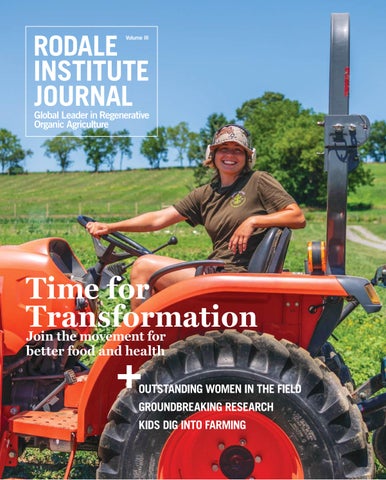
RODALE INSTITUTE JOURNAL Volume III
Global Leader in Regenerative Organic Agriculture
Time for Transformation Join the movement for better food and health
+
OUTSTANDING WOMEN IN THE FIELD GROUNDBREAKING RESEARCH KIDS DIG INTO FARMING
INNOVATORS OF REGENERATIVE ORGANIC AGRICULTURE SINCE 1947
Rodale Institute Main Campus, Kutztown, Pennsylvania
The birthplace of the modern organic movement and one of the world’s most respected agricultural research and education nonprofits, Rodale Institute has been rooted for eight decades in a simple, profound belief: True healing begins with the soil. Today, Rodale Institute is leading the movement to restore soil as the foundation of human and planetary health and to build a healthier food system for all.
WORLD-CLASS RESEARCH
Generating the science that powers transformation
GLOBAL EDUCATION
Training the next generation of farmers and healthcare leaders
ORGANIC CONSULTING
With five regional campuses, partnerships with hospital networks and senior-living communities, and a growing team of scientists, educators, consultants, and healthcare experts, Rodale Institute is setting the pace toward a brighter future.
HEALTHY SOIL = HEALTHY FOOD = HEALTHY PEOPLE™ —J. I. Rodale, founder of Rodale Institute
PHOTOS BY RODALE INSTITUTE
Supporting new and transitioning organic farmers with information and guidance
BOARD OF DIRECTORS Cochairs Maria Rodale, Roberta Lang Christa Barfield; Eve Cinquino; Christopher Ely; Alison Grantham, PhD; Mark Koide; Brian Lenhart; John McGlinn II; Sam Nana-Sinkam; Loren Speziale; Scott Stoll, MD; Bill Wolf Chief Executive Officer Jeff Tkach BLUE ROOT MEDIA Editorial Director Scott Meyer Design Director Kimberly Brubaker Photography Director Rob Cardillo
Rodale Institute Locations These campuses and resource centers are carrying the mission far and wide through solutions-based research, consumer education, and farmer training. Main Campus Kutztown, Pennsylvania Phoebe Organic Farm at Rodale Institute Founders Farm Emmaus, Pennsylvania RESEARCH AND PARTNERSHIP CAMPUSES Davines Group–Rodale Institute European Regenerative Organic Center at Davines Group Village Parma, Italy
Copy Editor Diana Cobb
Camarillo, California
Regenerative Organic Resource and Training Institute University of Agricultural Sciences Dharwad, India
REGIONAL RESOURCE CENTERS
Rodale Institute Trailside Organic Farm at Cornwall Manor Cornwall, Pennsylvania
Midwest Organic Center at Etzel Sugar Grove Farm Marion, Iowa
St. Luke’s–Rodale Institute Organic Farm Easton, Pennsylvania
California Organic Center at McGrath Family Farm Camarillo, California
Pacific Northwest Organic Center at Cascadian Farm Rockport, Washington
Rockport, Washington
Production Editor Nancy Rutman All text and images (except where noted) by Blue Root Media © 2026 Rodale Institute Rodale Institute is a 501(c)(3) nonprofit dedicated to growing the regenerative organic agriculture movement through rigorous research, farmer training, and education. The Institute’s groundbreaking scientific research and direct farmer support programs serve as catalysts for change in farming and food production worldwide. Over its 80-year history, Rodale Institute has proved that organic farming is not only viable but essential to humanity’s survival. Rodale Institute 611 Siegfriedale Rd. Kutztown, PA 19530 (610) 683-1400 RodaleInstitute.org
Parma, Italy
US Resource Centers and Consulting Hubs
European Regenerative Organic Center Parma, Italy Regenerative Organic Resource and Training Institute Dharwad, India
RODALEINSTITUTE.ORG
1
CONTENTS FEATURES 12 LEADING ACTIONS
For eight decades, Rodale Institute has been working to build a food system that works for farmers, consumers, and the environment.
18 OLD FARM, NEW LIFE
A beloved family farm gets a regenerative organic revival.
24 CULTIVATING CHANGE
A productive California region is shifting thousands of acres to regenerative organic agriculture.
MISSION BRIEFS 3 LETTER A bold plan for the future.
4 HEALTH
Healthcare professionals, students, patients, and consumers are discovering that regenerative organic food is the best medicine.
6 EDUCATION
An imaginative new course of study based on a popular film teaches students about food, health, and the environment.
8 RESEARCH
Studies across the country are evaluating plastic mulch alternatives, assessing organic elderberries, and testing regenerative grazing strategies.
28 MARKETPLACE
Certified organic products are more popular and profitable than ever.
30 PROFILE
Rachel Kulchin of Blue Heron Farm, winner of the 2026 Good Farmer Award US, shares her experiences and insights.
32 GUIDE
Eight ways you can join the movement to create a healthy and flourishing world. Robert Rodale launched the Regeneration Project in the 1980s. See page 15. On the cover: Rodale Institute Farmer Training student Mackenzy Chastain learns how to safely use farm equipment. Photograph by Gabe Meyers
2
RODALE INSTITUTE JOURNAL VOLUME III
LETTER
PHOTOS BY RODALE INSTITUTE (ROBERT RODALE) AND RAMON MADRID/RODALE INSTITUTE (TKACH)
A Radical Idea Becomes a Movement NEARLY 80 YEARS AGO, J. I. Rodale planted an idea far ahead of its time: The health of our soil is inseparable from the health of our food and our people. Today, that once-radical idea has grown into a movement, thanks to generations of farmers, researchers, partners, and supporters like you. In this issue of the Rodale Institute Journal, you’ll meet people putting that idea into practice. A beloved family farm gets a new beginning (page 18). Farmers in Ventura County are building healthier farms and a stronger local food system (page 24). Students are discovering connections between soil, food, and the world around them (page 6). Researchers are testing approaches that could shape how we farm in the years ahead (page 8). And farmers like Rachel Kulchin (page 30) are rethinking the role a farm can play in its community. Together, these stories bring our guiding premise to life: Healthy Soil = Healthy Food = Healthy People. They demonstrate what becomes possible when scientific discovery meets practical action, empowering farmers and communities to build a healthier future. As we look toward Rodale Institute’s 80th anniversary, farmers are navigating changing markets, rising costs, and an aging rural population. Millions of acres of farmland are expected to change hands in the years ahead. These challenges underscore the urgency of our mission, but they also present an extraordinary opportunity to reshape the future of agriculture. Our five-year strategic plan sets a goal of catalyzing the transition of 10 million acres of farmland to organic and regenerative organic management by 2030. More than a milestone, this represents the chance to restore soil health, protect our natural resources, strengthen rural economies, and build a healthier, more resilient food system for the future. To pursue these goals, we will bring together the strengths that have defined Rodale Institute for generations: research that builds knowledge, education that shares it, and consulting and partnerships that help farmers put it to work. We also aim to conduct 10 major research trials; educate 100,000 farmers, agricultural professionals, and changemakers; and reach 100 million people with our message. Rodale Institute’s $139 million comprehensive campaign will provide resources for that work by growing our endowment and supporting the infrastructure we need to connect with our local and global community. With help from supporters like you, the new Center for Regenerative Organic Innovation will become a place where farmers, researchers, educators, and community members learn from one another and advance practical approaches to regenerative organic agriculture. None of this happens without you. Your support helps make the work described on these pages possible—from research in our fields to education in classrooms and guidance for farmers taking their next steps. As you read, I hope you see the part you play in each story. Thank you for believing in the power of healthy soil and for helping us turn a once-radical idea into a movement that continues to grow.
GET INVOLVED Your financial contribution is the most important way for you to advance the mission of building a healthier food system and planet. Here are a few other ways you can join the movement. Shop. Rep your support for Rodale Institute with cool branded hats, T-shirts, and more from the online store at RodaleInstituteGardenStore. square.site. See. Field-to-table dinners, plant sales, and other special events give you a chance to enjoy time on the farm as you help the cause. See the schedule at RodaleInstitute.org/events. Learn. Rodale Institute’s free email newsletter keeps you up to date on everything that’s happening with regenerative organic agriculture around the world and in your region. Sign up at RodaleInstitute.org/newsletter.
Jeff Tkach CEO, Rodale Institute RODALEINSTITUTE.ORG
3
HEALTH
Well-Being from the Farm Healthcare professionals, students, patients, and consumers are discovering that regenerative organic food is the best medicine. FARMERS GROW FOOD. Physicians treat people who are sick. We don’t tend to think of them together as partners in our health. But food producers and the medical community are now finding common ground, thanks to Rodale Institute’s efforts to expand awareness about the links between individual and social wellbeing and agriculture. Through a university class for healthcare professionals in training, workshops for practicing medical pros, partnerships with hospitals and senior-living facilities, and research trials, Rodale Institute is bringing the message “Farming is health” to the front lines of the healthcare system. Here’s how.
Rodale Institute researchers have been studying the impact of different farming systems on crops through the long-term Vegetable Systems Trial. Their initial findings show that soil and crops managed with organic practices have higher nutrient levels than those managed using conventional methods, says Andrew Smith, PhD, Rodale Institute chief scientific officer. A study led by a University of Washington scientist and published in 2022 in the journal PeerJ found that crops grown with soil conservation practices contained, on average, more magnesium, calcium, potassium, and zinc, as well as more vitamins, including B1, B2, C, E, and K, compared with their conventionally grown neighbors. The conservation crops were also lower in elements detrimental to human health, including sodium, cadmium, and nickel.
CLASS ACTIONS
In spring 2026, 16 undergraduates at Lehigh University in Bethlehem, Pennsylvania, enrolled in “The Chronic Disease Crisis: Farming as Medicine,” a course taught by Krista Hirschmann, PhD, Rodale Institute senior program director of medical and health systems education
4
RODALE INSTITUTE JOURNAL VOLUME III
and an adjunct professor at Lehigh. The students came from a variety of majors, including premed, bioengineering, psychology, and business, Hirschmann says, and during the semester, they heard from farmers, physicians, public health experts, nutritionists, and researchers. Visits to Rodale Institute’s main campus and local farmers’ markets provided in-person experiences to accompany students’ assigned readings and classroom discussions. “The goal was to help these students to see how the food system works and to think about how it is affecting our health as individual people and as a population,” Hirschmann says. “Before, I thought of treating health as something that happens in a doctor’s office or is more tied to individual choices than systems,” wrote one of the students. “This class has reframed it as more holistic; it is connected to soil quality, food systems, access, culture, and relationships. Medicine is not just prescriptions or treatments; it can look like growing foods, restoring land, or building community around food.”
CLINICAL SETTINGS
Since 2022, Rodale Institute has hosted a series of regenerative health conferences with lectures and workshops for
“We believe the conversation about health and nutrition begins on the farm.” —Krista Hirschmann
healthcare professionals, public health policymakers, and other interested people. In the next few years, Rodale Institute’s education team will launch in-person and online “Farming for Health” courses designed to engage healthcare professionals while showing “that all broccoli isn’t created equally,” Hirschmann says. Through a certified organic farm adjacent to a hospital in Easton, Pennsylvania, Rodale Institute is providing healthy food and useful information directly to caregivers and patients of the St. Luke’s University Health Network. The 14-acre farm was established in 2014, and it now produces 30 types of vegetables and fruits, including perennial crops such as asparagus, blueberries, raspberries, apples, and pears. Much of the harvest
PHOTOS BY JACK DEMPSEY (TOP) AND ROB CARDILLO
NUTRITIONAL CONTENT
Patients and staff of the St. Luke’s University Health Network enjoy the harvest from a farm managed by Rodale Institute on the Easton, Pennsylvania, hospital campus (pictured here). Cornwall Manor’s organic farm (below), also managed by Rodale Institute, supplies fresh produce to residents of a senior-living community.
and offers community members opportunities to volunteer on the farm. Rodale Institute has now signed on to operate the 1-acre Farm at Augusta Health, part of a hospital system in Virginia’s Shenandoah Valley. The farm was initially launched in 2017 to supply fresh food for the patients, the medical and support staff, and the surrounding community, and it has held workshops on nutrition and health for its constituents. The Rodale Institute farm team is ensuring that the food is grown with regenerative organic practices.
SENIOR CARE
is distributed to the health system’s 12 hospital cafeterias. About 125 members of the hospital network’s staff belong to the farm’s CSA (community-supported agriculture) subscription program, which provides them with weekly boxes of healthy produce for their own use. The St. Luke’s–Rodale Institute Organic Farm also hosts plant sales, provides flower bouquets to the hospitals,
Access to fresh, healthy food is especially important to older adults trying to maintain their well-being into their retirement years. In 2021, Rodale Institute formed a partnership with Cornwall Manor, a senior-living community in Lebanon, Pennsylvania, to establish and operate a 2-acre farm on the community’s campus to grow organic produce for the residents. “Studies have shown that organic foods as well as healthy eating habits benefit the senior-living population by not only helping to prevent disease but also improving overall health and longevity,” says Gary Toscano, Cornwall Manor’s general manager of dining services. “Our residents love having access to fresh, organic produce through our dining services and weekly farmers’ market. It provides them a way to savor the purest flavors and embrace a life of well-being, nourishing their bodies and spirits.” Residents of the four senior-living communities operated by Phoebe Ministries in southeastern Pennsylvania are now enjoying regenerative organic food that’s been grown at Rodale Institute’s Founders Farm. Based on the land J. I. Rodale first used to test his ideas about organic agriculture and health, the Rodale Institute Phoebe Organic Farm was launched in 2025 to raise food for the facilities’ kitchens and to distribute to residents and staff. In coming years, the farm’s growing area
FAST FACTS Forty percent of adults in the US are overweight enough to be classified as obese, according to a 2024 data brief from the CDC’s National Center for Health Statistics. Households that are food insecure in the US are at a higher risk of obesity because of the nutritionally poor quality of food commonly available to lowincome people. Over 50 percent of the average American’s daily calorie intake comes from ultraprocessed foods. The nation’s top agricultural products—corn, soybeans, and wheat—are used to make sweeteners, hydrogenated oils, refined flour, and other ingredients that don’t nourish you. More than 124,000 premature deaths annually in the US could be attributed to the excess consumption of ultraprocessed foods, says a study published in the American Journal of Preventive Medicine in April 2025.
will expand to 10 acres, and an on-site farm stand will offer the excess harvest to local consumers. “Regenerative healthcare is a systembased approach that emphasizes preventative care and lifestyle choices,” Hirschmann says. “It recognizes the impact of hidden hunger [caused by an abundance of high-calorie, low-nutrientdensity food] and focuses on population health as well as individual well-being. We believe the conversation about health and nutrition begins on the farm, not in the kitchen.” Learn more about regenerative healthcare at RodaleInstitute.org/why-organic/ issues-and-priorities/human-health.
RODALEINSTITUTE.ORG
5
EDUCATION
Film to Classroom An imaginative new course of study is teaching students about food, health, and the environment. THE FIRST CLASS OF THE MORNING for high school students tends to be a little subdued. But before 8 a.m. each day in the last semester of spring 2026, 13 students at Saratoga Springs High School in upstate New York were actively engaged by a science curriculum that introduced them to organic farming and environmental stewardship. “Students need to learn about farming to know where their food is coming from and how much work was put into the fruits and vegetables in stores,” says Kaylee Colombe-Prosser, a sophomore in the class. The students were learning from a program of study developed in a partnership between the producers of the popular
6
RODALE INSTITUTE JOURNAL VOLUME III
film The Biggest Little Farm, American Farmland Trust, and the Rodale Institute education team. In 2026, eight educators from schools across the country presented concepts such as food production, biodiversity, and soil health to students in grades 3 and 6 and high school. This pilot program was the initial field test of the new curriculum. “Engaging young learners in how the food system works creates more informed citizens,” says Jason Slipp, PhD, Rodale Institute director of education. “As adults, they will already have a strong foundation in food production and the precarious nature of our current system.”
FARM AND FLICK
John Chester, an organic farmer and filmmaker, documented the revitalization of his land in Moorpark, California, and produced The Biggest Little Farm in 2018. It’s a powerful depiction of the challenges and joys of transforming an arid landscape into a productive regenerative organic farm. The film garnered multiple awards and quickly became a popular teaching tool for educators. “We’ve received letters from teachers and students from all over the world,” Chester says. “Teachers using the film in classrooms described a remarkable shift in their students’ engagement with the subject matter after watching it. It was a deepening of their curiosity.” Many of those teachers asked for help creating lessons around the film, Chester notes, so he connected with Rodale Institute. “Who else has been a steady voice and researcher in this space longer,” Chester says. “Rodale Institute has always kept the farmer at the center of its agenda.” For Rodale Institute, The Biggest Little Farm has been an effective conversation starter in classrooms and among other groups. “Given the film’s success and its impact on viewers, we know that it’s a direct conduit to learners of all ages,” Slipp says.
LEVELS OF LEARNING
Rodale Institute’s education team is ensuring that the curriculum for each grade level meets the standards and benchmarks required by accredited public schools. The lessons are built around the widely adopted Next Generation Science Standards (NGSS), which “pivot science learning from rote memorization to experiential, hands-on learning,” explains Renée Baran, Rodale Institute’s dean of education. The third graders’ course begins with building the students’ connection to the content before they delve into the science. After discussing the farmers’ story, students dig into the basics of soil types, microbes, and compost. At the high
PHOTOS COURTESY OF FARMLORE FILMS (BOY) AND SUSAN PIENTA (CLASS)
John Chester’s documentary about his regenerative organic farm tells a story that captures kids’ attention.
VIRTUAL CAMPUS
The environmental science class at Saratoga Springs High School learned about soil health, growing food, and composting.
school level, the students use information from the film and their own research to investigate topics such as cover crops and ecosystem resilience. Among the eight educators who tried the program in 2026, “implementation methods were diverse, ranging from using the curriculum as a supplemental outdoor education unit to using it for a comprehensive six-week interdisciplinary program,” Baran says.
HANDS-ON EXPERIENCE
“These lessons allowed me to connect content to our school,” says Susan Pienta, a biology and environmental science teacher at Saratoga Springs High School. “I wouldn’t say students loved emptying the (sometimes very fresh!) compost into our bins, but it was cool for them to see how easy the process of composting is and how doable reducing our school’s contribution to landfills is through the use of our compost.” Pienta’s students selected her environmental science course as either a third science credit or as an optional elective, she says. “The class was first block—at 7:49 a.m.—and 5 of the 13 students were seniors who did not need the credit to graduate. They could have dropped this
class and come to school by 9:12! They chose to be here because they wanted to learn more about the environment and sustainability solutions.” Fernanda Fragozo Ortega, an 11thgrade student in the class, concurs. “It’s important to know about what’s happening with the ecosystem and animals and the weather,” she says. Suzanne Duffney, also a junior, learned that “farming doesn’t just take a few days or even months but requires years of hard work and patience.” The teacher saw a broader impact on her class. “There has definitely been a shift in how my students look at the environment from a systems perspective,” Pienta says. The curriculum of The Biggest Little Farm “solidified the idea of solving environmental issues by looking at the scale of your solutions and thinking about a farm as a place that can be a diverse ecosystem.”
BUILDING OUT
This fall, a new 12-part sequel to the original film, The Biggest Little Farm Series, launches on YouTube. Chester aims to “encourage deeper connections to nature, promote systems thinking, build confidence in the individual, and foster hope for the future.”
Farmers, scientists, advocates, and informed consumers can now build their knowledge about regenerative organic farming, composting, smart shopping, and many related topics without leaving home. Already nearly 8,000 learners around the world are engaged with Rodale Institute’s robust virtual education platform. The course selection is expanding rapidly, offering professional training, as well as workshops that are accessible to anyone who cares about food, health, and the environment. “We consistently see adult learners drawn to organic farming for two reasons,” says Renée Baran, Rodale Institute’s dean of education. “They want to grow healthy food, and they want to be part of the solution to our environmental challenges.” Find out more at RodaleInstitute. org/education. To date, more than 1,000 people have requested the curriculum through the Rodale Institute website. For the 2026– 27 school year, the Rodale Institute education team has taken feedback from the pilot program, refined the materials, and prepared lesson plans for grades 4, 5, 7, and 8. Planning is under way for in-person workshops for teachers on how to use the lessons. “We may not live to see a healthier planet ourselves, but we can equip the next generation with the tools to build one,” Baran says. “That’s not just an opportunity—it’s our responsibility.” Thomas Flanagan, a senior at Saratoga Springs High School, offers us hope. “We need food to live,” he says, “so having more people who know how it’s done will benefit farmers.” Learn more about The Biggest Little Farm curriculum at RodaleInstitute.org/ biggest-little-farm-curriculum.
RODALEINSTITUTE.ORG
7
RESEARCH
Field Reports
ELDERBERRY EVALUATION
The study: In fall 2025, European elderberry (Sambucus nigra) and American elderberry (S. canadensis) were planted at a certified organic research orchard in western Washington. The scientists are assessing and comparing irrigation strategies, planting densities, and other farming techniques to identify management practices that optimize plant establishment, growth, and long-term productivity under organic care. “The goal is to better understand which elderberry species, cultivars, and management practices are best suited to organic production in the Pacific Northwest,” says Arianna Bozzolo, PhD, Western region research director at Rodale Institute. The study is supported by Mountain Rose Herbs, a supplier of Regenerative Organic Certified herbal products. What we’re learning: Preliminary observations show excellent survival, including following the winter flooding experienced at the site, with no evidence of transplant shock or significant cold-related damage. These baseline observations will provide the foundation for evaluating the effects of irrigation and planting density as the orchard matures.
Elderberries are in demand for the preparation of vitamin supplements and natural remedies.
8
RODALE INSTITUTE JOURNAL VOLUME III
Why it matters: Elderberries are rich in anthocyanins and other bioactive compounds, and they are in great demand for use in healthy foods, beverages, and dietary supplements. This study will provide new and existing elderberry growers with science-based recommendations on choosing varieties adapted to the region’s conditions and producing a profitable crop of the high-value fruit.
PHOTOS BY SAID HAMIDO/RODALE INSTITUTE (GRAZING), SEAN STOKES/RODALE INSTITUTE (AERIAL), AND ROB CARDILLO (ELDERBERRIES)
Rodale Institute scientists and farm managers around the country are studying strategies for more effective and productive regenerative organic agriculture.
Location: Pacific Northwest Organic Center, Cascadian Farm Rockport, Washington
ROTATIONAL GRAZING
Location: Heal the Planet Farm Summertown, Tennessee, and Koshkonong, Missouri The study: Livestock at farms in Tennessee and Missouri graze for feeding in a rotation through a series of small paddocks rather than on an entire pasture. The periods of short-duration, highdensity grazing of livestock in each paddock allow the other areas to rest and recover. In this study, in partnership with Ancient Nutrition, the researchers are evaluating the impacts of the adaptive rotational grazing on greenhouse gas emissions and soil health.
The soil benefits when livestock rotate among paddocks to graze. Raising diverse crops along with grazing livestock may improve fertility and farmers’ profitability.
What we’re learning: The adaptive rotational grazing has led to measurable improvement in several soil health indicators, including organic matter content and the availability of nutrients for crops. The data also shows evidence of the potential for enhanced carbon sequestration in the soil. Why it matters: Regenerative grazing practices can contribute to agricultural productivity while helping to improve soil and mitigate climate change.
CROPS WITH LIVESTOCK
Location: Midwest Organic Center, Etzel Sugar Grove Farm Marion, Iowa The study: The Diverse Systems Trial (DST) is evaluating whether adding diverse crops such as oats, wheat, cereal rye, buckwheat, or field peas, along with annual livestock grazing, can improve soil fertility, reduce weed pressure, sustain crop yields, and enhance profitability with fewer off-farm inputs. The trial compares several four-year rotations that retain corn and soybean production but add small grains, forage cover crops, and livestock grazing opportunities.
RODALEINSTITUTE.ORG
9
RESEARCH What we’re learning: This project started on farmland where decades of conventional practices had severely degraded the soil. Regenerative organic management is now healing it. Yearly data collection provides insight into the impact that diversified systems have on soil health and farm profitability. Why it matters: Corn and soybeans are top commodity crops for US farmers, and this research is exploring how organic producers in the Midwest can be more profitable than industrial operations while eliminating the environmental costs of synthetic fertilizers and toxic herbicides.
Fruit and nut trees (above) help maintain soil health. A roller-crimped cover crop acts as a natural weed-blocking mulch.
PERENNIAL PRODUCTION
Location: Rodale Institute main campus Kutztown, Pennsylvania
What we’re learning: Incorporating oats, hay, clover, or oat-and-clover mixtures into alleys between hazelnut trees can maintain a high level of soil organic matter (5 to 7 percent) without negatively affecting tree establishment or early orchard development. Why it matters: Trees that bear fruit, nuts, and other marketable crops supply valuable income to farmers, protect soil structure and biodiversity, provide habitat and other resources to wildlife, and store carbon in the soil.
10
RODALE INSTITUTE JOURNAL VOLUME III
PLANTS VS PLASTIC
Location: California Organic Center, McGrath Family Farm Camarillo, California The study: Over multiple seasons, researchers are comparing living mulches, rollercrimped cover crops, and reduced-tillage systems to the use of plastic mulch in the production of strawberries, globe artichokes, and annual vegetables and examining the impact of these different systems on soil health and productivity. What we’re learning: Compared with conventional tillage, high-residue cover crop systems have been more effective at improving soil fertility, suppressing weeds, and maintaining or increasing vegetable yields. In strawberry and globe artichoke crops, living-mulch systems have increased soil biological activity and microbial diversity. Why it matters: Living mulches and other regenerative organic practices enhance soil health while sustaining profitable yields and can reduce reliance on plastic mulch, which doesn’t contribute to the soil’s well-being.
PHOTOS BY RAMON MADRID/RODALE INSTITUTE
The study: Tree crops including apples, hazelnut, Chinese chestnut, honey locust, and black locust are assessed for their fit into integrated planting systems that diversify income, increase the farm’s resilience, and provide regenerative benefits to soil. The research aims to aid in the development of improved cultivars and optimized production practices, as well as emerging technologies such as automated orchard management tools that enhance crop monitoring and reduce the time and labor required for commercial production.
1 LEADING ACTIONS FOR EIGHT DECADES, RODALE INSTITUTE HAS BEEN BUILDING A FOOD SYSTEM THAT BENEFITS FARMERS, CONSUMERS, AND THE ENVIRONMENT.
A
lmost all food was organic until the 20th century, even if no one referred to it that way. But drastic changes to farming practices and food distribution created an industrial system that has become harmful to human and environmental health. J. I. Rodale, among others, began sounding the alarm about the threat, and in 1947, he founded the Soil and Health Foundation (which would become Rodale Institute) to gather and share information to help farmers grow nutritious, safe food, earn a fair living, and protect their most precious resource, the soil. That year, he wrote on a chalkboard the principle that still defines Rodale Institute’s mission: “Healthy Soil = Healthy Food = Healthy People.” Every decade since has brought accelerating developments to agriculture and new challenges to preserving a healthy food supply. Through the decades, Rodale Institute has been ready to meet the moment every step of the way. At this pivotal time, when solutions seem out of reach, Rodale Institute is scaling up to lead a radical transformation that restores soil as the foundation of human and planetary health. Find out how you can help at RodaleInstitute.org/10millionacres.
1940s 1940s
THE MOMENT
During World War II, many Americans grew victory gardens to supply their families with fresh food. As thousands of soldiers returned to the US after the war, many sought work in urban centers rather than returning to their homes in rural areas. Production of motorized tractors ramped up to replace the labor of humans and draft animals. Companies such as Bayer and DuPont repurposed chemicals they had been supplying for military use into new products marketed to farmers: toxic pesticides and synthetic fertilizers.
50s
1950s
THE MOMENT
With the baby boom in the US and the rapid expansion of suburbs, supermarkets became the shopping choice of consumers. In 1953, frozen “TV dinners” were introduced and immediately became popular with consumers. Farms grew steadily larger, thanks to consolidation, and more mechanized to supply the increasing demand for the processed foods sold in supermarkets.
PHOTOS BY RODALE INSTITUTE (J. I. RODALE) AND WIKIMEDIA COMMONS (POSTER, SUPERMARKET)
THE RESPONSE
THE RESPONSE
J. I. Rodale, the New York–raised owner of an electrical supply manufacturing business, had purchased a 63-acre farm (now known as Rodale Institute’s Founders Farm) in Pennsylvania in 1940 and began studying agriculture and its links to nutrition and health. He published his findings in books, magazines, and pamphlets. “It is rather paradoxical that the medical profession and its thousands of scientific workers are spending so much time measuring the amounts of vitamins in various food products and formulating interesting principles regarding their application to health problems yet disregarding the basis or foundation of the food products,” Rodale wrote, in 1942, in the inaugural issue of his Organic Farming and Gardening magazine. Rodale established the Soil and Health Foundation, later renamed Rodale Institute, a nonprofit dedicated to pursuing research and disseminating information about organic farming.
J. I. Rodale built on his insight about the link between soil and human health by launching Prevention magazine in 1950. In a book titled Organic Merry Go Round (1954), Rodale described the change in his farm’s condition from organic management. “The Land became healed and the regeneration showed itself in the fruitfulness of the crops.” Rodale’s publications found a ready audience of people concerned about the food and healthcare systems in the US and began raising public awareness about their impact on our well-being.
While many Americans were growing victory gardens during World War II, J. I. Rodale (opposite page) began to publish books such as Organic Merry Go Round, which shared his insights about the dangers to human health posed by the shift to an industrial food system.
RODALEINSTITUTE.ORG
13
60s 1960s
1970s
THE MOMENT
THE MOMENT
When Rachel Carson published Silent Spring, her bestselling book, in 1962, it sparked a public outcry about the pesticide DDT (dichlorodiphenyltrichloroethane) and its lethal consequences for birds, notably bald eagles. While DDT was later restricted, American policy at the time incentivized farmers in developing countries to use chemical fertilizers, pesticides, and bioengineered seeds in a “Green Revolution” to ramp up agricultural production.
In the early 1970s, Earl Butz, the US secretary of agriculture, was quoted as telling farmers to “Get big or get out,” advocating for the expansion to ever-larger, intensively capitalized farms and discouraging small producers from holding on to their land and their livelihoods. A “back to the land” movement emerged among people embracing alternative lifestyles, self-sufficiency, and freedom from mainstream culture. By the end of the ’70s, consumers began to see products labeled as “organic” in health food stores.
THE RESPONSE
In 1972, Robert Rodale (son of then-deceased J. I. Rodale) purchased a 300-acre farm in Berks County, Pennsylvania, that was dubbed the Rodale Research Center and would later become the main campus of Rodale Institute. The farm was envisioned to be a place where farmers, consumers, and agricultural leaders could convene, and in September 1972, 500 organic farmers, distributors, and concerned consumers from the region gathered there to share information and ideas with the research center staff. Pennsylvania’s secretary of agriculture, Jim McHale, was reportedly present to discuss the commonwealth’s efforts to assist organic producers. In 1978, Rodale Institute began publishing The New Farm magazine, bringing information and community to organic producers across the US.
70s THE RESPONSE
J. I. Rodale’s publications and the research he was pursuing began to attract a rapidly expanding cadre of farmers and consumers concerned about the food supply and the environment, though he was labeled a “crackpot” by many defenders of the status quo. He and his editors collected their accumulated knowledge into a comprehensive reference book, How to Grow Vegetables and Fruits by the Organic Method, published in 1961. Readers of Rodale’s publications found experience-based guidance on how to prevent aerial pesticide spraying by municipalities, a common practice of the time.
Robert Rodale (right) established an expansive research farm to study the best organic methods and help farmers to stop treating their crops and soil with pesticides and other toxic chemicals.
14
RODALE INSTITUTE JOURNAL VOLUME III
1980s 1980s PHOTOS BY NATIONAL ARCHIVES (TRACTOR), RODALE INSTITUTE (ROBERT RODALE, RICHARD HARWOOD), AND COURTESY OF GEORGE DEVAULT (NOVII FERMER)
THE MOMENT
Rising interest rates, mounting debts, and other factors led to a widespread crisis of foreclosures on family farms and homes in rural America. The ongoing series of Farm Aid concerts started in 1985 to raise money and draw attention to the problem. The first Whole Foods Market opened in Austin, Texas, in 1980. Intolerable Risk: Pesticides in Our Children’s Food, a 1989 report from the Natural Resources Defense Council, noted that early childhood exposure to Alar, the trade name for daminozide (a growth regulator widely used on apples), could increase the lifetime risk of developing cancer. Concerns about Alar were covered in national news broadcasts and congressional hearings, and parents feared feeding apples and juice to their children.
80s THE RESPONSE
In the early 1980s, Rodale Institute researchers began the Cornucopia Project, an extensive study of the food system and farmland crisis, and they worked with Pennsylvania’s departments of agriculture and environmental resources to advocate for policies supporting family farms. The Cornucopia Project, which also investigated highly nutrient-dense crops such as amaranth, was renamed the Regeneration Project after Robert Rodale saw the power of regenerative organic practices in early results from the Farming Systems Trial. That landmark study, established by Rodale Institute scientists in 1981 and continuing ever since, is a side-by-side comparison of cash crops raised with organic and conventional methods. It has been measuring the longterm impact on soil health, yields, and profitability and has served as baseline knowledge for generations of farmers, researchers, and policymakers.
90s
1990s
THE MOMENT
The first commercially grown genetically modified organism (GMO), the Flavr Savr tomato, was approved for sale by the Food and Drug Administration in 1994, and genetically modified soybeans and corn that could withstand the herbicide Roundup followed within a few years. Congress responded to the exploding marketplace for organic farm products with the passage of the Organic Foods Production Act of 1990, which authorized the USDA to set up and administer a National Organic Program. The first draft of the proposed standards for organic certification, published in 1997, was met by farmers, scientists, and consumer advocates with a variety of objections, including the permitting of products with GMOs to be labeled as “organic.”
THE RESPONSE
Robert Rodale’s voice was crucial to the development of the National Organic Program, offering testimony and providing data to Congress and the USDA. When he died in a tragic car accident in Russia in 1990, he was on his way home from meetings with the country’s leaders about an organic, farmer-centered approach to agriculture that could emerge from the dissolution of the Soviet Union’s massive farms. The following year, Rodale Institute began publishing Novii Fermer, a Russian version of its publication The New Farm, to share information with the growers there. At home, Rodale Institute sponsored a symposium on soil quality for scientists and farmers in 1991, and its president, John Haberern, wrote a guest editorial in the Journal of Soil and Water Conservation, proposing a soil health index as “a report card that documents the gains and losses in soil quality.”
Rodale Institute researcher Richard Harwood (above left) shows a study plot of the supernutritious grain amaranth to an international visitor. Novii Fermer (above) introduced Russian growers to organic methods.
RODALEINSTITUTE.ORG
15
THE MOMENT
The USDA enacted in 2002 the approved rules for earning the certification required to sell products that would be labeled as “organic” and bear the official seal. The standards were developed and continue to be evaluated by the National Organic Standards Board (NOSB), which also oversees the “National List of Allowed and Prohibited Substances.”
THE RESPONSE
Jeff Moyer, Rodale Institute CEO emeritus and a lifelong farmer, served on the NOSB from 1995 to 2011, advocating for rules that support soil health and protect the integrity consumers expect from organic crops. Moyer’s book Organic No-Till Farming (published in 2011) showed farmers how to reduce the frequency of soil-damaging tilling and control weeds without harmful herbicides. The roller-crimper, popularized by Moyer in 2004, gave organic farmers the tool they needed to turn cover crops into weed-blocking mulch.
10s
2010s
THE MOMENT
Sales of organic products in the US reached nearly $30 billion by 2010, bolstered by their increasing availability in the nation’s biggest retail outlets and the proliferation of organic options from mainstream brands. Between 2011 and 2021, the number of certified organic cropland acres reached 3.6 million, and certified organic farms amounted to 17,445, according to the National Agricultural Statistics Service. “Nutrient density” became known as an important measure of good food.
THE RESPONSE
Rodale Institute inaugurated its farmer training programs in 2011, with an emphasis on preparing military veterans to work in agriculture. A Rodale Institute online course that provides farmers with information and guidance about transitioning from conventional to certified organic production opened in 2015. The Vegetable Systems Trial, begun in 2016 and still going today, compares the long-term impact on soil health and the nutrient density of food when crops are raised with organic versus conventional methods. With demand for organic food growing across the US, Rodale Institute began to expand from one research farm to a national network of resource centers—now with locations in California, Washington state, and Iowa—to conduct relevant research trials and educate farmers in those regions.
Rodale Institute Farmer Training teaches students (above) how to start and manage an organic agricultural operation. Jeff Moyer (left) showed farmers how to make mulch from soil-building cover crops with a roller-crimper.
16
RODALE INSTITUTE JOURNAL VOLUME III
PHOTOS BY RAMON MADRID/RODALE INSTITUTE (MOYER, TRACTOR, CHILD) AND ROB CARDILLO (TRAINING)
2000s 2000s
2
20s 2020s
THE MOMENT
Consumer demand for organic meat and dairy products has overwhelmed the domestic supply of organic livestock feed, prompting many producers to seek sources outside the US. In 2020, $25 billion of organic crops, or 1.9 million metric tons, to be primarily used for livestock feed, were imported into the US. Reports in the news media and from organic food experts raised concerns about international products fraudulently labeled as “organic.” The USDA responded in 2024 with the implementation of new rules to strengthen oversight of the production, handling, and sale of organic products imported into the US.
THE RESPONSE
Thanks to funding from the Commonwealth of Pennsylvania, Rodale Institute began offering its expertise to individual farmers in 2018, and now operations across the US have access to its Organic Consulting Service. The consultants help with every aspect of establishing an organic farm or transitioning to one, including soil management, navigating the certification process, finding financial resources, and identifying markets for the crops. In-person field days and workshops and an extensive video library of webinars continue to offer practical information to farmers.
Field days bring farmers, agronomists, and scientists to Rodale Institute’s campuses to see research trials, learn, share, and network. The future for today’s children depends on more farmers adopting regenerative organic practices.
30s
2030s
THE NEXT CHAPTER
Imagine that in the next decade atmospheric carbon is reduced by 20 million tons per year, use of fossil-fuel fertilizer decreases by 1.5 billion pounds, and America’s farmers earn $1 billion more in profits each year. Healthy food is available and affordable for all, especially the most vulnerable people.
THE VISION
The 10 Million Acre Solution is Rodale Institute’s plan to bring about the change you’ve just imagined. The campaign will educate 100,000 farmers and other professionals, connect to 100 million consumers, conduct 10 major research trials, and catalyze the transition of 10 million acres of farmland to organic and regenerative organic management by 2030. As a supporter of the regenerative agriculture movement, you are part of the next chapter in this story. RIJ
RODALEINSTITUTE.ORG
17
OLD FARM, NEW LIFE 18
RODALE INSTITUTE JOURNAL VOLUME III
A BELOVED FAMILY FARM GETS A REGENERATIVE ORGANIC REVIVAL. By Scott Meyer Photographs by Rob Cardillo
R Cookie Till (above with her fluffy pal Callie) envisioned the revived farm as a source of healthy food and connections for the people of nearby Atlantic City. The fields, raised beds, and hoop houses are now yielding fresh vegetables and herbs, and the farm hosts a growing herd of animals, including Chevy the sheep.
eed’s Farm had been a staple for 85 years in the South Jersey community of Egg Harbor Township, its roadside stand a popular spot to buy fresh-picked sweet corn, blueberries, peaches, and, of course, Jersey tomatoes. Changing circumstances left the 72-acre property vulnerable to development, but thanks to one woman’s bold vision, it’s now a certified organic farm with deepening roots in its community and an expansive plan for providing healthy food, meaningful employment, and empowering education to people. “I used to come here when I was a kid,” says Caroline “Cookie” Till, a restaurateur, healthy-eating advocate, and the driving force behind the regeneration of Reed’s Farm. When she found out the farm was for sale and might be subdivided, she saw an opportunity to put her values and vision to work. She did, however, lack farming experience, so she sought help from the Rodale Institute Organic Consulting Service, which coached her through the early stages of restoring the land and launching a successful operation. Today, Reed’s Farm is scaling up its production of vegetables, fruits, and herbs; building its capacity for livestock management; implementing a plan for longterm soil health; and forming collaborative relationships with other organizations. It’s developing a regional food hub that connects the farm to nearby Atlantic City, where fresh, healthy food is hard to find. And the farm is raising a crop of young women farmers who are committed to regenerative organic agriculture. “Reed’s Farm works to restore the connection between people, food, and the land,” Till stated in the farm’s 2025 annual report. “Through regenerative farming and community programming, we nurture healthy soil, grow nutritious food, and create meaningful opportunities for underserved individuals.” FIRST STEPS The Reed family had maintained a diversified operation through three generations, using conventional practices, such as synthetic fertilizers and herbicides. After the older members of the family passed away in 2016, the land was leased to a soybean farmer to cultivate, and it was offered for sale. Builders were expressing interest in purchasing the property for new construction. “This is clearly farmland,” Till says. “It has been farmland, and there was no reason why it couldn’t continue being farmland.” She imagined its future as a community-based farm and partnered with Caring Inc. (a local nonprofit supporting adults with disabilities) to purchase the farm in 2020.
RODALEINSTITUTE.ORG
19
AGROFORESTRY BLUEBERRIES
OPERATIONS The agroforestry team, led by Gabe Lewis (top left), has planted native persimmons, rhubarb, asparagus, and other perennial crops. Gary Mortellite (top right), a lifelong New Jersey blueberry farmer, has embraced regenerative organic practices. Samantha Howley (above) is working to expand an urban food hub.
20
RODALE INSTITUTE JOURNAL VOLUME III
Permaculture consultants helped design the new farm’s layout, and restoring the soil was the top priority. With guidance from Sam Malriat, director of Rodale Institute’s organic consulting team, the fields were planted with cover crops, such as brassicas, radishes, and sunflowers, which were selected because they draw metals and toxins out of the earth while adding essential organic matter and nourishing the underground food web. In 2025, Reed’s Farm earned USDA organic certification. Vegetable production began in a small hoop house in 2021. Now there are four high tunnels, and on an early-summer day, they are lush with cucumbers, squash, peppers, and many varieties of tomatoes. “People loved our spring crop of carrots,” says Kristin Burns, vegetable production manager. “They do really well in the sandy soil, and they were so sweet.” A couple of repurposed shipping containers have been transformed into a packhouse and coolers for storing the harvest. FOREST AND FIELD At Reed’s Farm, agroforestry is a key initiative for restoring the land while producing marketable crops. The farmers are developing a “food forest” in which trees, shrubs, and perennial ground-level plants are planted together in layers, generating multiple harvests from the same space. Raising these crops protects the soil because farmers don’t disturb the ground each year with plowing or tilling. Trees and shrubs
“ This is clearly farmland. It has been farmland, and there was no reason why it couldn’t continue being farmland.” —Cookie Till store carbon in the soil and in many cases offer essential resources to wildlife. (Turn to page 10 to learn about agroforestry and Rodale Institute’s research on the use of regenerative organic practices.) “In our woodland area, we have planted about 20 American persimmons, which are native here,” says Gabe Lewis, who is leading Reed Farm’s agroforestry project. “We also have a chestnut orchard with different varieties that we’re trying out.” The farm has hickories, elderberries, and native viburnums, which produce fruits similar to blueberries and blackberries. “There are native huckleberries in our woods as well,” Lewis reports. Perennial crops include local favorites asparagus and rhubarb and less familiar, nutrient-dense vegetables such as Jerusalem artichokes and skirret, a sweet relative of carrots. As the trees mature, they’ll provide the setting for a silvopasture, an area where livestock can graze among them, and for alley cropping, the practice of growing cash crops between rows of trees. “I believe in a reciprocal relationship between humans and nature,” Lewis says. “We can’t continue to extract from nature without considering the relationship that we have with the soil, the plants, and the critters.” Blueberries thrive in the sandy, acidic soil of South Jersey, and buying the local fruit is a tradition for many families in the community and the throngs who visit the nearby beach towns in summer. Gary Mortellite, who comes from several generations of blueberry farmers, managed a 150-acre operation in Hammonton, New Jersey, until he retired a few years ago. He was growing conventionally and sold most of his harvest to a broker in Canada. In 2025, he joined Reed’s Farm to lead its regenerative organic blueberry production. “We have about 200 one-year-old plants in the ground, and we had a crop this year [2026],” Mortellite says. “I’d like to get the ‘you-pick’ blueberry field up and running in four years, develop a plant nursery, and then teach people how to grow blueberries at home.” Mortellite has been learning about regenerative organic practices and won’t ever go back to conventional ways. “I’ve seen what it does to the land. It just takes everything from it,” he says. “You’re poisoning everything—the birds, the streams, ourselves.” TAKING CARE An extensive herb garden is yielding ingredients for a line of natural self-care products already available in the farm’s store.
FARM FACTS
Reed’s Farm, Egg Harbor Township, New Jersey FARM SIZE 72 ACRES
YEAR FOUNDED 2020
PRODUCTS
Fruits and vegetables, medicinal and culinary herbs
Rows of cherry tomato plants in the hoop house yield bushels of tasty fruit.
PRODUCE GROWN AND DISTRIBUTED 40,000 pounds (as of January 2026)
PEOPLE ENGAGED
600 in 2025 educational programs, field trips, and volunteer days
YEAR CERTIFIED ORGANIC 2025
MORE INFORMATION reedsorganicfarm.org
RODALEINSTITUTE.ORG
21
Workshops on herbal self-care with Leah Martin (pictured here) bring visitors to the farm. Melanie Reed (below) builds relationships with the community to help restore the connection between people, food, and the land.
“I think of herbal products as lifestyle medicine or preventative medicine—they don’t replace a doctor’s care, but you can build relationships with herbs and use them to support your health,” says Leah Martin, who tends the herb beds and makes the products. Workshops and tours of the herb garden bring visitors to the farm and expose them to the principles of natural health. “Every other Friday throughout the summer, I take people into the herb garden and introduce them to plants. The garden changes week to week with what’s growing, what’s fading, and what’s coming in,” Martin says. “My hope is that when people walk away, they are inspired to be better stewards of the land and better stewards of their own health and the health of their communities.” In summer 2026, four horses, a miniature donkey, two alpacas, two sheep, about forty chickens, and a friendly and fluffy Great Pyrenees dog named Callie reside in the farm’s barn and corral. They are all here because “they needed a soft place to land,” says Kirsti Snyder, who leads the team of three who care for the animals on the farm. “They are helping us to talk to the public—people who may have never seen a sheep or pig up close—about responsible management of these animals.” Forage crops are sprouting up in a large, adjacent field, becoming the foundation of a rotational-grazing plan that will both nourish a larger population of animals and restore the soil’s health in coming seasons. (Rodale Institute’s longrunning Farming Systems Trial has shown that including livestock in crop rotations significantly improves biological activity and other markers of soil health.) As capacity grows, the farm will demonstrate for visitors “how much abundance the land can produce when you work with nature rather than against nature,” Snyder says.
HERBS
COMMUNITY
“ My hope is that when people walk away, they are inspired to be better stewards of the land and better stewards of their own health and the health of their communities.” —Leah Martin
22
RODALE INSTITUTE JOURNAL VOLUME III
Clementine the pig and other animals improve the farm’s soil health while allowing Kirsti Snyder to demonstrate responsible livestock management to the public.
LIVESTOCK Connecting with the community is central to the plan for Reed’s Farm. In 2025, about 600 people participated in its volunteer days, workshops, kids’ camp, and other activities, reports program manager Melanie Reed (no relation to the prior owners). Young adults with cognitive or developmental challenges are participating in vocational training and paid internships at the farm. “I think diversity of people is just as important as diversity in a natural ecosystem,” says Till, who has been a longtime supporter of Atlantic County Special Services School District, which provides education and support for people with disabilities. “I would never feel right about bringing people onto a farm that was not organic and having them exposed to toxic pesticides and other things that are disruptive to not only the environment’s health but our health as well,” Reed says. Atlantic City is well-known as a resort town, but for the residents, affordable fresh food has become scarce. “We are the closest farm to Atlantic City, and our long-term goal is to provide as much food as we can to the area,” Reed says. “We’re doing cooking classes in Atlantic City to introduce people to seasonal produce that we’re growing here and that they can have access to in the city through our different partnerships.”
Bringing the food directly to the city is the focus of the farm’s operations director, Samantha Howley, who is helping to develop the Food Hub on Farmers Row, an Atlantic City aggregation and distribution site that connects regional farms with retailers, restaurants, institutional buyers, and community groups. “The big dream is to make contracts with the schools, with the hospital, with the casinos and create a true regional food system,” she says. Cookie Till grew up in Atlantic City and has been feeding residents and visitors with local ingredients through her restaurant (Steve and Cookie’s), sandwich shop (Florida Cuts), and coffee shop (Ventnor 7311) for nearly 30 years. Reed’s Farm is the platform for her intention to expand the benefits of fresh, healthy food to more of her neighbors. “A regional food system is good for people’s health and for the economic health of the region,” Till says. “It’s a survival technique—people in the community taking care of each other because they can.” RIJ To see how you can support Rodale Institute’s mission to build a healthier food system, go to RodaleInstitute.org/ 10millionacres.
RODALEINSTITUTE.ORG
23
Cultivating
CHANGE
A productive California farming region is shifting thousands of acres to regenerative organic agriculture.
Rodale Institute farm operations technician Reyna Ortega-Aviles (shown here) and consultant Nathanael Gonzales Siemens (opposite) host bilingual field days for farmers at the California Organic Center.
24
RODALE INSTITUTE JOURNAL VOLUME III
Ventura County, about 70 miles up the coast from Los Angeles, has a moderate climate year-round that is ideal for raising lemons, strawberries, avocados, nuts, other fruit and vegetable crops,
PHOTOS BY BROOKE BOROUGH
Scan this QR code to watch a brief video and learn more about Regenerate Ventura County.
and beef cattle. More than 300,000 acres of the county are used for growing crops and raising livestock, and the vast majority of the 2,000-plus farms are conventional operations, which regularly apply pesticides and other toxic chemicals that drift into nearby communities. Now, Regenerate Ventura County, an initiative led by Rodale Institute, is supporting existing and new farmers in adopting regenerative organic practices that yield nutritious food for residents, provide a fair living to producers, and protect the environment. The impact on Ventura County is already significant, but the effort is a model for scaling up the transformation everywhere to a food system that’s healthier for all living things. “We are working with farmers, landowners, buyers, food processors, and many different types of support organizations to increase the supply and demand for regenerative organic food in Ventura County,” says Nathanael Gonzales Siemens, Rodale Institute’s organic consulting manager for the Pacific region. “We want to get to the point where it’s part of the school lunch program, where everyone in the community can get it without even thinking about it.” Regenerate Ventura County was launched in 2024 with backing from Holdfast Collective, Patagonia’s nonprofit shareholder. (Patagonia is headquartered in Ventura County.) The initiative provides technical assistance, education, outreach, and research to growers and ranchers, with Rodale Institute’s California Organic Center in Camarillo serving as a local hub. Rodale Institute’s consultants are also building relationships with local organizations and working to strengthen market access and the regional supply chain for organic and regenerative organic food. The emphasis, Gonzales Siemens says, is on ensuring financial viability for farmers while improving environmental outcomes. GROWING BUSINESS Juan Osorio was raised by parents and grandparents who worked the land, and he had been a farmhand himself when he and his wife set their sights on having their own farm. In 2018, they established Osorio Family Farms, raising greens, tomatoes, and other vegetables and fruits on 15 acres in Carpinteria, California.
RODALEINSTITUTE.ORG
25
“ Every farm business is unique, so we spend a lot of time listening and learning. We sit at [the farmers’] kitchen tables, and we help them to figure out how regenerative organic methods can work for them.” —Daniel Chavez
26
RODALE INSTITUTE JOURNAL VOLUME III
“We wanted to grow real food that we could feel good about giving to our own family—food without harmful chemicals,” Osorio says. “We wanted to give back to the land, not just take from it.” Two years later, Osorio Family Farms began selling its fresh produce in a Ventura County farmers’ market, and Osorio came to recognize the benefits of practices such as cover cropping, reducing or eliminating tilling, and building soil health. By 2024, the farm was ready for organic certification, which Osorio knew would increase the demand and prices for its products. The application process, however, was daunting for him. “I know what I’m doing out in the field,” he says, “but there was a lot of paperwork [needed for certification], and it was complicated.” Osorio was aided by Daniel Chavez, a longtime Ventura County resident and a Rodale Institute organic consultant. “He helped me get through the paperwork,” Osorio says, “and I was confident it was done right.” Chavez guided Osorio through the entire certification process. “He was concerned about the inspections from certifiers, so I was at his farm with him for their visits,” Chavez says. “He’s very hardworking and ambitious—traits key to his success. But he can use someone
to bounce ideas off and to point him in the direction of resources. That’s a lot of what I’ve been doing with him. I think I give him comfort and courage.” Osorio Family Farms is now selling its products in 17 farmers’ markets and to restaurants in Los Angeles and Santa Barbara. Currently, 57 farms and more than 10,000 acres of farmland in Ventura County are in the process of transitioning to certified organic production. The Regenerate Ventura County program has reached about 40 percent of the county’s growers who are BIPOC (Black, Indigenous, or people of color). “Every farm business is unique, so we spend a lot of time listening and learning,” Chavez says. “We sit at [the farmers’] kitchen tables, and we help them to figure out how regenerative organic methods can work for them.” Xochitl Coronado and Charles Beckley started their operation, Growwits, in Oxnard, California, in 2020 because “we have grown up surrounded by conventional farms that use toxic chemicals, and we want to support our family and our community with nutrient-dense, healthy organic foods,” Coronado says. The couple began by raising microgreens and mushrooms on a quarteracre urban lot. “We’ve talked a lot about creative ways to farm at their scale, about
PHOTOS BY BROOKE BOROUGH (CHAVEZ, PECENKA) AND COURTESY OF XOCHITL CORONADO)
Farmers Xochitl Coronado and Charles Beckley are now adding ginger, grapes, vegetables, and tropical plants to their product mix with guidance from organic consultant Daniel Chavez (left).
the pest pressures on a farm like theirs, and about how to adapt equipment for their needs,” says Chavez, who operates his own small urban farm. Coronado and Beckley, now expecting their first child, have expanded into raising crops such as ginger, grapes, popular annual vegetables (like peppers and eggplant), and tropical plants (including bananas). With support from Rodale Institute, “we’ve been able to optimize our production spaces by adding infrastructure such as more raised beds and a greenhouse. And [the institute’s consultants] have helped us acquire essential tools like a seeder, cultivator, chainsaw, and hedger,” Coronado says. “They’ve also encouraged us to start the process of organic certification.” SOLUTIONS ORIENTED Through bilingual field days and workshops at McGrath Family Farm (which hosts the California Organic Center), newsletters, and other outreach, Regenerate Ventura County has already engaged more than 500 farmers and farm workers. Rodale agronomists have provided 230 hours of hands-on technical assistance across 12 community events since 2024. “We try to present creative ideas that farmers can use,” Gonzales Siemens says. “For example, we recently held an event focused on growing heritage grains,” heirloom varieties of oats, barley, wheat, and rye that are in demand among artisan bakers and consumers in the area. “Orchard operators with alreadyestablished markets for citrus fruit or avocados may be able to plant heritage grains in between the rows of trees, increasing the productivity and profitability from the same amount of land.” Farmers in Ventura County face a variety of obstacles to adopting regenerative organic methods. The climate is suitable for raising many types of crops throughout the year, but “there is no offseason, no break in the production cycle like you have in the Northeast and Midwest,” says Jacob Pecenka, PhD, a research associate at the California Organic Center. “That puts a lot of stress on the soils and makes incorporating cover crops into the rotations more complicated.”
Rodale Institute researchers are focused on studies that provide useful knowledge to the wide range of farmers in Ventura County. “There aren’t single strategies that work for everyone here. The farming community is diverse, from mixed vegetable operations on less than 10 acres to huge production companies farming hundreds of acres. And there are many different microclimates in the county, from the coastline to the valleys,” Pecenka explains. “We listen to what the growers say about their needs and challenges and try to help them with road maps for their operations rather than give one solution for all farmers.” Many conventional and organic strawberry growers and vegetable producers in Ventura County use plastic mulch to block weeds from sprouting up, hold moisture in the soil, and reduce soilborne diseases that can spoil the crops. The plastic, however, is made with fossil fuels, is not biodegradable, and does not contribute to soil health. “We are researching alternatives, such as cover crops that can give farmers similar benefits while helping to improve the soil over the long term,” Pecenka says. “We have several different trials comparing plastic versus other options. One trial is on the raised beds that many smaller vegetable growers use, and another is on flat fields for the larger growers.” While the researchers are helping to support the production process, the Saticoy Food Hub is a key community partner for distributing the harvest to the public. The nonprofit is working to build “a more equitable, resilient, and regenerative food system” through “food aggregation, direct market opportunities, business development, nutrition incentives, and community-led programs,” according to its website (saticoyfoodhub.org). The majority of the harvest from Ventura County is exported to other states and internationally, yet many residents face food insecurity. The small town of Saticoy, for instance, has no supermarkets or permanent stores selling local food. The food hub helps expand access to fresh, nutritious produce in the community while helping family operations like Osorio Family
“ We listen to what the growers say about their needs and challenges and try to help them with road maps for their operations rather than give one solution for all farmers.” —Jacob Pecenka
Researchers such as Jacob Pecenka focus on developing organic solutions for the challenges that the region’s farmers encounter.
Farms and Growwits to reach consumers and earn fair prices for their products. “We believe that health is wealth and that health stems from the food we eat,” Coronado says. “By using regenerative organic practices, we produce the absolute healthiest, nutrient-rich foods that are amazing to eat, and we also foster a biodiverse ecosystem. This type of farming system preserves our community landscapes and native soils, and it emulates the natural food production that our ancestors had been doing generations before us.” RIJ Find out how you can support a healthier food system at RodaleInstitute. org/10millionacres.
RODALEINSTITUTE.ORG
27
MARKETPLACE
Rising Tide
Certified organic products are more popular and profitable than ever.
WHEREVER YOU SHOP, organic food, health-and-wellness, and textile products are filling up the shelves these days. Demand for and sales of organic goods keep growing, as the “USDA Organic” label on certified products has earned the trust of consumers. Transitioning more farmland to certified organic agriculture will supply the growing market while protecting the environment and providing farmers with a sustainable livelihood. Rodale Institute trains new farmers, generates and disseminates practical, research-based information, and provides active support to farmers. It all adds up to more organic products for people who need and want them. Join the effort to grow organic acreage in the US at RodaleInstitute.org.
NUMBERS UP 2025 $76.6 billion in sales of organic products $70.1 billion in sales of organic food 6.8% increase in organic sales (compared to 2024), or 2x the growth rate of the total comparable marketplace 2024 75% of US consumers bought one or more organic products 33% bought organic products in five or more categories SOURCES: Organic Market Report 2026 and Organic Market Report 2025 (Organic Trade Association)
28
RODALE INSTITUTE JOURNAL VOLUME III
PHOTOS BY DEVON KOCH (CARROTS), TIHOMIRLIKOV/SHUTTERSTOCK (TOMATOES), AND RAMON MADRID/RODALE INSTITUTE (AERIAL)
LABEL MATTERS
Informed consumers know that product claims can be deceiving. “The USDA Organic label remains the highest standard for trust, associated with avoiding chemicals and perceived nutritional benefits,” according to the Organic Trade Association’s 2025 report Consumer Perception of USDA Organic and Competing Label Claims. That trust comes with real benefits for farmers, ranchers, and other producers because “organic is the only claim that aligns closely with perceived importance and consumers’ willingness to pay [a price premium],” the report states. Regenerative organic certification was introduced in 2019, in a partnership between Rodale Institute, brands such as Dr. Bronner’s and Patagonia, farmers, scientists, and others, to allow consumers to find products grown and made according to standards that build on the USDA organic certification. Purchasing any of the more than 3,000 Regenerative Organic Certified products now in the marketplace supports practices that prioritize soil health, ensure animal welfare, and treat farmers and workers fairly. See the growing list of brands that are qualifying for this label at regenorganic.org.
THE 10 MILLION ACRE SOLUTION To meet the growing demand for organic food, Rodale Institute has set a goal of catalyzing the transition of 10 million acres of farmland to organic and regenerative organic management by 2030.
RODALEINSTITUTE.ORG
29
PROFILE
Rachel Kulchin (above) and Aki Stankoski (right) raise vegetables, such as cabbage (left), and tree fruits on their 10-acre farm.
Blue Heron Farm, Bishop, California FARM SIZE 10 acres
YEAR FOUNDED 2025
PRODUCTS Apples, peaches, and other tree fruits; vegetables
NOTABLE ACCOMPLISHMENT Winner of the 2026 Rodale Institute and Davines Group Good Farmer Award US
MORE INFORMATION theblueheronproject.com
30
RODALE INSTITUTE JOURNAL VOLUME III
Ripe for Growth A regenerative organic orchard and vegetable farm nourishes its community and the land.
Rachel Kulchin went from growing vegetables across a patchwork quilt of backyard gardens to taking over management of a 10-acre farm. She launched the Blue Heron Project in 2020, piecing together growing space wherever she could and producing fresh food for her community through a CSA (community-supported agriculture) program that began with six families and later grew to 25. In 2025, Kulchin and her partner, Aki Stankoski, moved on from the scattered backyard operation and established Blue Heron Farm on 10 acres in California’s Eastern Sierra region. Today the farm produces an abundance of fruits and vegetables while advancing regenerative organic farming practices and building connections between the farm and its surrounding community. Kulchin’s growth as a farmer and commitment to regenerative agriculture earned her the 2026 Rodale Institute and Davines Group Good Farmer Award US.
PHOTOS BY BRUCE WILLEY
FARM FACTS
fruits throughout the season. We also grow a wide variety of vegetables—including salad greens, root crops, tomatoes, peppers, and squash—for our CSA, farm stand, restaurants, and local markets. Our CSA brings all of those crops together into a weekly share and creates a direct relationship between our farm and the families we feed. That connection gives us the freedom to grow a remarkable diversity of crops while encouraging our members to eat with the seasons. That diversity makes us more resilient, healthier ecologically, and better able to serve our community.
RODALE INSTITUTE JOURNAL: WHAT INSPIRED YOU TO BECOME A REGENERATIVE ORGANIC FARMER? RACHEL KULCHIN: From the beginning, I’ve wanted to leave this land better than we found it. Regenerative organic farming isn’t a technique to me. It’s a mindset. It’s the belief that if we work with nature instead of against it, we can grow incredible food while leaving the land healthier for the next generation. It’s also about growing relationships— between people and the land, between neighbors and farmers, and between this generation and the next. Being a small part of rebuilding those connections is the most rewarding thing I can imagine. WHAT ARE THE MOST IMPORTANT CROPS AND PRODUCTS TO YOUR OPERATION? The backbone of the farm is our mixedfruit orchard, with nearly 900 trees producing apples, apricots, peaches, plums, pears, cherries, figs, and other
WHAT ARE YOUR SHORT-TERM AND LONG-TERM GOALS FOR THE BLUE HERON PROJECT? People often expect a farm producing this much food to be much larger. We’re passionate about demonstrating that you don’t need thousands of acres to have a meaningful impact. Thoughtful, intensive farming on a small piece of land can feed a lot of people while strengthening the local food system and the community. Our long-term vision is much bigger than a single farm. We want the Blue Heron Project to help rebuild a local food system throughout the Eastern Sierra. By demonstrating that regenerative agriculture can thrive even in the high desert, we hope to inspire a new generation of farmers. WHAT HAVE BEEN THE KEYS TO YOUR SUCCESS? Farming has a way of keeping you humble. No matter how much you learn, every season reminds you there’s still more to understand. Farming has taught me to ask questions, pay attention, and never assume I have all the answers. Community has been very important for us. We’ve learned from other farmers, leaned on mentors, partnered with incredible organizations, and been supported by customers who believe that local agriculture matters.
AWARD SEASON
The Good Farmer Award US, established as a partnership between Rodale Institute and Davines North America, introduces agricultural producers to the resources available to help with the transition to regenerative organic certification. Applications for the third Good Farmer Award will be accepted from November 2026 through January 2027. Learn more at RodaleInstitute. org/good-farmer-award-us. WHAT CHANGES TO POLICIES, CULTURE, OR INDIVIDUAL BEHAVIOR WOULD BE HELPFUL TO YOU AS A WOMAN FARMER? Women have been tending the land, saving seeds, growing food, and feeding their communities since the beginning of human history. I don’t think agriculture needs more women farmers because they’re women. I think agriculture needs more people who care deeply about the land and are willing to steward it well. The changes I’d most like to see are the ones that help all beginning farmers succeed: better access to land, affordable capital, mentorship, and communities that welcome new farmers with encouragement instead of gatekeeping. WHAT IS MOST REWARDING TO YOU AS A REGENERATIVE ORGANIC FARMER? For me, it’s watching people reconnect with food and with the land. It’s seeing a child pluck a ripe peach off the tree. It’s someone telling us they ate their first Japanese turnip because it was in their CSA box. It’s watching families return to the farm week after week until it starts to feel like their farm too. Watching the farm come alive is equally rewarding. Every year the soil gets a little healthier. There are more birds in the hedgerows, more pollinators in the fields, and more signs that we’re building an ecosystem rather than simply producing crops.
RODALEINSTITUTE.ORG
31
GUIDE
Difference Makers Eight ways you can join the regenerative organic movement to create a healthy and flourishing world
Small steps add up to big change if every one of us takes action. Try a few or all of these simple things to help make the world better for people and the planet.
1
3 32
4
Share and swap. Before you throw away old stuff or buy new stuff, reduce waste by donating or trading unwanted household goods, clothing, and other items.
5
Read labels. You can trust that USDA certified organic products are produced according to high standards. Thousands of products have now earned the “Regenerative Organic Certified” label, which builds on the USDA standards with requirements for soil health, respect for animals, and fairness for people. See regenorganic.org.
6
2 Regenerate waste. Keep kitchen scraps and yard waste out of landfills by turning them into compost, a valuable plant fertilizer. If you don’t have room for a pile outdoors, compost indoors with the easy bokashi method. Find more ideas at RodaleInstitute.org/blog/ backyard-compostingbasics-a-cheatsheet.
RODALE INSTITUTE JOURNAL VOLUME III
Show kids. Take children to buy food from local farms and markets so they see where real food comes from and why they should support farmers. Watch The Biggest Little Farm (biggestlittlefarmmovie.com) together and talk about the issues it raises and why you hope for a better food system. Details on page 6.
7
8
Support the 10 Million Acre Solution. Your contributions fund education, research, and consulting that give farmers what they need to adopt regenerative organic practices and in turn grow the supply of healthy food for consumers. Go to RodaleInstitute.org/10millionacres.
PHOTOS BY ROB CARDILLO (1, 2, 3, 6) AND SHUTTERSTOCK (4, 5, 7)
Know your farmers. Buying directly from local producers gives you the freshest, most nutritious food and lets you ask about their farming practices.
Grow a little. Raise vegetables, fruits, and herbs in a garden bed or a few containers on a patio, and you tune in to the seasonal cycles and eat the freshest, healthiest food possible. You also gain appreciation for the challenges of farming and why farmers need support.
Clean safely. Avoid using cleaning products with phosphates, nitrates, or volatile organic compounds (VOCs, which are not good despite the word “organic”). All of these substances pollute water and the air. Where possible, use white vinegar, baking soda, and other household ingredients that are effective without containing toxic chemicals that cause damaging side effects. Learn more at RodaleInstitute.org/education/resources/ rethinking-agricultural-solutions-for-clean-water.
The 10 Million Acre Solution Restoring Soil as the Foundation of Human and Planetary Health
Rodale Institute has set a goal of catalyzing the transition of 10 million acres of farmland to organic and regenerative organic management by 2030. One campaign. Three connected ways to heal our soil.
Fund the Infrastructure
Fund the Legacy
Power today’s work.
Build tomorrow’s capacity.
Ensure our critical work continues for generations.
PHOTO BY RAMON MADRID/RODALE INSTITUTE
Fund the Mission
Please join us in building a healthier future by making a gift to Rodale Institute. To learn about the ambitious campaign to protect the world’s soil and support organic farmers, go to RodaleInstitute.org/10millionacres.
DO YOUR PART AT RODALEINSTITUTE.ORG/10MILLIONACRES
PHOTO BY ROB CARDILLO
The future of food and health is in YOUR hands!