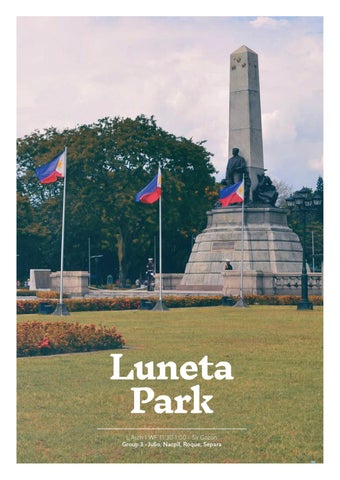
Luneta Park
Contents 06 History of Luneta Park 08 How to get to Luneta 10 Luneta by the Numbers 12 Landscape of Luneta 18 Luneta’s Top 10 Activities 22 Adventure Checklist 23 Guide Map
Luneta Park
Meet the Team
Wilford Julio
Carl Joseph Rafael Nacpil
Wren Roque
Krist Jan Separa
BS Architecture
BS Business Administration & Accountancy
BFA Visual Communication
BS Mining Engineering
5
The Story Behind Manila’s Famous Park
Luneta Park
History of Luneta Park
T
he Luneta Park, situated in the heart of Manila City, has been one of the key (history and aesthetics) landscapes in the Philippines. Home to various types of gardens, Luneta Park has always projected itself as a diverse landscape while serving as a unification symbol of history and culture; the place where the National Hero was executed. Also, the park serves as one of the few “breathing spaces” in the urban jungle, contrasting the gridiron streets, with wide open spaces, giving the city a less congested sight and atmosphere. The design and planning of the area were given mainly by Daniel Burnham, “The Burnham Plan”, as part of William Howard Taft’s commission. Daniel Hudson Burnham is one of the most influential icons in the field of Architecture and Urban Planning. He was the director of works at the World’s Columbian Exposition of 1893 and had designed much of the famous buildings, such as the Flatiron Building in New York and the Reliance Building in Chicago, mostly in America, during that time. The Burnham Plan was mainly influenced by The City Beautiful Movement that had aimed to portray Manila and Baguio as in the image of the European cities of Rome, Venice, and Paris; utilizing the esteros as means of transportation, similar to that of Venice and urban parks situated mainly near historic areas (intramuros), also similar to that of Rome and Paris. Much of the works had centered on water and transportation. The
plan had to include detailed drainage constructions in stagnant waters around Intramuros and in reclaimed areas near Manila Bay. The City Beautiful Movement describes a city plan that takes in consideration urbanization factors and key areas important in residential settings such as: Recreation places, e.g. waterfronts, parks, and parkways; Street system that would have direct and easy communication from one part of the city to the other; Location of Building sites for various activities; Waterways for Transportation; Summer resorts. The plan included several principles regarding the conversion of moat areas near Intramuros’ walls and the reshaping of areas nearby the Pasig river and Manila Bay. Burnham’s plan was further executed by William E. Parsons, an architect who graduated from École des Beaux-Arts, Paris, which explains the French and Italian Baroque style and forms of most of the constructed buildings. Parsons’ works include the Manila Hotel, Philippine General Hospital, and University Hall of UP Manila.
7
How to get
Where are you coming from? North of Manila (Caloocan, Malabon, Navotas, Valenzuela)
East of Metro Manila (Pasig, Mandaluyong,Pateros, etc.)
Option 1. From Monumento, ride an LRT 1 train headed to Taft. Alight the train at United Nations Station and walk to Rizal Park.
Option 1. Ride the MRT 3 southbound train and alight at Taft Station. Transfer to the LRT 1 train via footbridge and go down at United Nations Station.
Option 2. From Monumento, ride a jeep along Rizal Avenue headed to Taft. Ask to be dropped of at T.M. Kalaw St. or in front of the Rizal Park sign along Taft Avenue depending on the route of the jeep.
Option 2. Ride the MRT 3 southbound train and alight at Taft Station. Ride a jeep or bus bound for Quiapo, Divisoria, or Lawton and go down at United Nation Station. You will have to cross the street as you go toward Luneta.
Quezon City and Marikina Option 1. Take the LRT 2 train and alight at Recto Station. Transfer to the LRT 1 train via footbridge and go down at United Nations Station. Option 2. From Cubao, ride a jeep/FX/UV Express van bound for Quiapo and asked to be dropped off along Rizal Avenue. Ride the LRT 1 train heading to Baclaran and go down at United Nations Station.
8
Option 3. If you’re up for using all three trains, ride the MRT 3 train, alight at Araneta Center-Cubao Station. Transfer to the LRT 2 line via access gates of the mall and ride to Recto Station. Transfer to the LRT 1 train and alight at United Nations Station. A Beep card will be pretty handy!
to Luneta
South of Metro Manila (Makati, Pasay, Paranaque, etc.) Option 1. Ride an LRT 1 train and alight at United Nations Station. Take a short walk to Rizal Park. Option 2. Ride an FX/UV Express van or bus headed for Manila City Hall or Lawton and get down at United Nations Station.
Around Manila Option 1. Ride an LRT 1 train and alight at United Nations Station. Take a short walk to Rizal Park. Option 2. Ride a jeep along Rizal Avenue headed to Taft. Ask to be dropped of at T.M. Kalaw St. or in front of the Rizal Park sign along Taft Avenue depending on the route of the jeep.
Option 3. From Roxas Blvd., ride an FX/UV Express van with Sucat-Lawton route and ask to be dropped off at Luneta.
Option 3. From Roxas Blvd., ride an FX/UV Express van with Sucat-Lawton route and ask to be dropped off at Luneta.
Option 4. From SM Mall of Asia or Taft Avenue, ride a jeep bound for Divisoria, Quiapo, or Mabini and get dropped off at Luneta.
Option 4. From Lawton/Manila City Hall, ride a jeep bound for Baclaran and go down at the Shell Station between M.H. Del Pilar and T.M. Kalaw.
Option 5. From Makati/Pasay, ride a jeep with bound for the Libertad or Buendia or a bus with Ayala-Leveriza route. These will lead you to Taft where you can take the LRT 1 or jeepneys that will pass by United Nations Station.
9
Luneta Park
Luneta by the numbers 0
Kilometer Zero, the point of origin for measuring the distances of provinces and cities in the country, is found across the Independence Flagpole.
1
Committee under the Department of Tourism which administers the park, namely the National Parks Development Committee.
2 8 10
The minimum number of guards from the Philippine Marine Corps’ Marine Security and Escort Group found within the perimeter of the monument.
The number of members for the committee dedicated to raising funds for the erection of the monument, which were Pascual Poblete, Paciano Rizal (José’s brother), Juan Tuason, Teodoro R. Yangco, Mariano Limjap, Máximo Paterno, Ramón Genato, Tomás G. del Rosario, and Ariston Bautista.
17 42
The monument was unveiled during Rizal’s 17th death anniversary on December 30, 1913.
The height of the monument in feet, or 12.7 meters.
58
Hectares of land occupied by Luneta (which can even fit the Vatican).
100
The approximate number of meters from the north-northwest of the monument where the exact location of Rizal’s execution can be found.
150
Feet at which the tallest flagpole in the Philippines, the Independence Flagpole, stands.
2012
The year when DM Consunji Inc. (DMCI) started constructing the infamous Torre de Manila which is considered as Rizal’s photo bomber.
243
The Act Number through which Luneta was planned and constructed during the Americans’ reign over the Philippines, approved by the US Philippine Commission by the authority of then President Roosevelt on September 28, 1901.
2015
The year when the Supreme Court issued a TRO on the construction of the said project.
5000
The prize money for the international design competition held by the committee which was one by Carlos Nicoli of Carrara, Italy for his work named “Al Martir de Bagumbayan.” Second-placer Swiss Richard Kissling, however, was the one whom the contract was awarded to for his Guiding Star artwork.
1872
GomBurZa’s execution by garrotte in Luneta.
1905
The year when the master urban architectural plan for the country, in which Rizal Park was included, was devised by Daniel Burnham.
100 000
Rizal monument’s estimated cost in PhP.
1913
When Luneta Park was renamed to Rizal Park to pay tribute to the national hero.
15 000 000
The value of the 40-foot brass statue of Lapu-lapu found in Rizal Park. This was a gift by the Korean Freedom League and was sculpted by Juan Sajid Imao.
Lands of Lu Elements of Design 1.Lines are rigid if within the main park. 2.Form is rather formal, since most plants are maintained to a certain size and shape. 3.Color of Luneta park gives a tropical vibe, but it is not too colorful. 4.Textures of the park makes use of combinations of textures from the plants, to the walkways, to the picnic grounds.
Design Principles 1.Rhythm is as seen through the gallery of heroes along the park.
2.Scale is as seen through the mini PH map. 3.Focal points are the main statues such as Rizal monument and Lapu-lapu. 4.Unity and Balance creates a certain harmony among the elements making it pleasing to the eyes, evident as it is a famous tourist spot.
Design Style City Beautiful Movement - aimed to portray in the image of European cities such as Rome, Venice, Paris.
scape uneta Oriental and Western
SWOT Analysis
The landscape had both oriental and western inspired structures and gardens. The Chinese and Japanese gardens had complimented with the Baroque style statues [insert sculpture heads of famous people here] and Beaux Art inspired buildings. (National Museum) The positions of the gardens in between major buildings in the park harmonized the area and had contributed for the buildings to “pop-out” of the landscape.
S - open space good for physical activities, urban greening, variety of gardens and plant collections, artwork, history, and cultural show exposure, highly accessible.
Contemporary Less contemporary, more classical and baroque (Beaux art influences) with much of the Classical Oriental gardens. Contemporary components: Modern Water fountains, and circular structures in the middle of the fountains.
W - not much shade which can be a big issue especially during summer days. O - addresses need for public space where social interactions are frequent for the general public (meaning no matter what social class or age you’re in it’s okay to go) . T - known as an unsafe park especially at night due to history of hold up incidents.
Luneta Park
Geography & Geology
Balance of Hardscape & Sofscape
Location of the sun (most important source of energy and greatest factor affecting weather and climate), location of the site (to consider whether other considerations should be made such as whether there are fault lines, and other activities that can affect the landscape such as volcanic activity, tectonic activity, wind, rainfall).
In general, Luneta has wide spaces in its middle, covered with the groundcovers, and tall distinct trees on its borders which had help delineate itself from the outside urban setting. This has contributed much to balance out the pathways, statues, and other vertical structures, within the park.
Climate For appropriateness of plant selection, as well as consideration for the social use of the space aka how will the people interact in the park
Plant Selection on the Design Several tall trees, such as Palm Trees, lined the pathways, giving these areas a “vista� like setting; guiding people from one keypoint area of the Park to another. Palms were also noticeable, near the gardens, which pretty much had given these areas much shade for the people to go into. This gave these gardens, the Chinese and Japanese gardens, a cool environment. Carabao grass, as groundcovers, were used mostly in spaces near fountains and statues. The grass occupied much of the Park, which gave it a good environment to have picnics on.
Environmental Significance. Given that the site is located in the middle of Manila, an area that is not exempt from the hot and humid tropical climate of the Philippines, features of the park has been greatly influenced by designing around the fact. Trees are often avenue planted along each major road and pathway to provide shade under the harsh and unforgiving sun. The type of soil and rock of the site was also taken into consideration, given that the site is located near the shore wherein water content and weathering of soil poses a considerable threat.
History Describing Luneta as a place with rich history is an understatement - but prior to being known as the famous Luneta Park, the site was once known for being the place of executions. More than a hundred
people have been documented to have been executed here, among which includes the three Filipino priests Mariano Gomez, Jose Burgos, and Jacinto Zamora, and of course our national hero, Dr. Jose Rizal. Today, their deaths have been honored by markers and monuments which includes the famous bronze and granite monument of Rizal.
Artworks The Filipino culture and its concept of beauty and aesthetics is evident in all of the artworks found in the site; among which include the sculptures and monuments lined inside the Gallery of Heroes. One can easily observe the fine details of each sculpture of known heroes such as Juan Samuroy, Marcelo del Pilar, Gregorio Alipay, Sultan Kudarat, and many more.
Social Behavior The choice of installations and exhibits in and around the park reflect the way we view our society and the people that we deem as important and played a vital role in the shaping of our country.
Emotions Walking through the Gallery of Heroes with fellow Filipinos and observing each relief sculpture of our national heroes, one can’t help but feel a sense of nationalism - a “bayanihan” of sorts. The design of this
16
landscape evokes hidden memories of our shared past, that which reminds us to never forget of our roots as we grow into the future.
Psychology Being an urban park, it is naturally a go to place for the people of Manila to get away from the hustle and bustle of city life. The park is a very drastic change in landscape from those found along nearby urban streets such as Roxas Boulevard. Almost the whole area of the park is surrounded with tall trees and different other kinds of plants such as shrubs, groundcovers, etc. of indigenous, endemic, and exotic alike. One is relieved and made calm by the slow movement of the leaves of each of these plants as they dance in the wind, and walking beneath the shade of these large trees while breathing in the less polluted air, one is made more attuned to nature.
Conclusion We like Luneta park especially becuase of its refreshing scenery despite being located in the busy streets of Manila. A lot to do with less spending. But we don’t think it achieved the idea of Eden. Not complete in terms of basic human necessities like food, and shelter.
Luneta Park
Luneta’s Top 10 Activities W
hether you’re going out for a date or spending time with family, Rizal Park has always been known to provide different activities for adventure seekers on a tight budget. After going around the area, here is the team’s list of the top 10 things to do in Luneta: 1. Have a picnic If you’re worried about overspending on food, because let’s face it – food is life, but inflation is deadly – then having a picnic with your loved ones is a good compromise for you. Just pack some homemade snacks, chips, drinks, and a good mat that fits your posse and you’re good to go! Impromptu picnics are fine as well, since there are people who rent out mats in the park for a certain fee. However, you should take note that some of the food and beverages in the stalls might be a little overpriced (especially ice cream during a hot summer day). 2. Watch the Rizal Monument guards Now this may sound a little weird at first, but do hear us out. The Rizal Monument usually has two guards facing each other with no sign of any unnecessary movements and facial expressions for hours on end, even under the blistering heat. This says a lot about their impressive discipline. Hence, if you’ve got a lot of time to spend, you can play one of the trickiest staring games in the country by looking for their minor slipups, or watch their very own staring game at work. 3. Feed the birds While walking along the park, you’d eventually find a huge birdhouse that might be their own equivalent of a condominium. Some of them you’d find in their own pigeonholes, others on its roof or nearby trees, and the rest probably on the ground. They may be a little shy especially when people get too close, but they do acknowledge food, so don’t forget to pack even
breadcrumbs for our feathered friends. 4. Learn from the Gallery of Heroes Aside from the statues of Jose Rizal and Lapu-Lapu, you can also find the Gallery of Heroes along the North and South promenades of the park. This gallery consists of bust sculptures of heroes coming from different parts of the country with plaques of their contributions. Feeling a bit lost? No worries since it encircles the Central Lagoon which is famous for its musical dancing fountains. 5. Watch the Lights and Sounds show From the Gallery of Heroes, you’re already within the perimeter of the Central Lagoon which is a body of water by day, and an entertainment spot by night. Here you can find one of the most vibrant water fountain shows in the country with attractions that include fireballs, exploding water rockets, and waters soaring for more than 80 feet. Of course, all of this happens in the midst of its accompanying music. 6. Talk to strangers Luneta caters to a wide variety of people including students, couples, families, storekeepers, and security and maintenance personnel. If you’re feeling a bit sociable, you can approach anyone who doesn’t seem too busy and ask if you could chat. Part of the beauty of Rizal Park is its invitation to learning, and that isn’t restricted to the history of the heroes and artworks around the area. Learn more about your fellow countrymen! Each has their own interesting story to share. 7. Japanese Garden, Chinese Garden, Senior Citizens’ Garden Fond of nature? Then these gardens are for you! The Japanese and Chinese gardens are the most common hangouts of Luneta’s visitors. Aside from providing
19
Luneta Park
landscapes whose designs fit their respective names, these gardens provide more shade and a better view of greenery that add to a relaxing ambience. It is no wonder why couples and artists flock to these two. Don’t forget to bring extra money since you need to pay a small amount of Php10 per head before you get to enter. If ever you do, you can still go to the Senior Citizens’ Garden for free. 8. Have a photo shoot With the picturesque view, it wouldn’t be surprising to find lots of people taking selfies with their phones or capturing the landscape with their digital cameras. You can go as formal as you’d like, or as creative as you can get with your shots! Here, there is no photoshoot fees and permits to think about. Up for a challenge? Try to take a picture of the Rizal monument without showing the Torre de Manila at the background. 9. Have your picture taken for Php100 In this millennial-driven age, you might want to take a step back from the digitally-stored photos and relive the bliss of holding pictures with your hands. Scattered within the premises of Rizal Park are photographers who are easy to spot due to their number and signature cameras around their necks. You might encounter them with sample photos in their hands as you walk by. If your budget permits it, you can have a picture taken for Php100 and get it after a few minutes. Give it to your date as a souvenir, or hang it up in your house after a day well-spend with family. 10. Take a calesa tour Walking around can be very tiring considering the area of Rizal Park. You can opt to have a different view and your very own tour of surrounding establishments with Manila’s calesas. Be warned, however, that calesa drivers are known for overpricing their service. Don’t be afraid to negotiate to meet your budget. storekeepers, and security and maintenance personnel. If you’re feeling a bit sociable, you can approach anyone who doesn’t seem too busy and ask if you could chat. Part of the beauty of Rizal Park is its invitation to learning, and that isn’t restricted to the history of the heroes and artworks around the area. Learn more about your fellow countrymen! Each has their own interesting story to share.
20
Adventure Checklist After checking every item, you’re good to go! Just one more tip: don’t forget to pack your curiosity with you since this will certainly be a worthwhile learning experience.
1
2 3
4
5
22
Cellphone Nowadays, we cling to our cellphones like our lives depended on it. In Rizal Park, it is also an essential for your communication and photoshoot needs. Don’t forget to charge the night before, or bring your power banks just in case you run out of batteries on the field. Go get that perfect #selfie with Jose Rizal!
Bottles of Water Regardless if you’re going out under the sun or avoiding the heat by visiting at night, roaming around the park will get you tired and dehydrated. Pack up on your water supply or sports drinks such as Gatorade and Pocari Sweat.
Snacks Aside from getting thirsty, the heat and fatigue will get your tummies rumbling at a certain point. Prepare homemade snacks such as sandwiches – or full meals with rice if you’re into long picnics – to fill your tummy, replenish your energy, and prepare yourself for the rest of your stay. Light snacks such as chips and nuts can also be good to eat while you explore.
Extra Cash for Entrance Fees Rizal Park is a park for the masses, and with that means that most of the attractions are free such as the artworks, lights show, dancing fountains and picnic grounds. Some facilities, however, charge a minimal amount for entrance fees which are used to maintain the attraction’s beauty. Try to have at least Php50 pocket money for these.
Umbrella A little sunshine might be good to soak in some Vitamin D, but living in a tropical country plus the effects of global warming may lead to heat and radiation that can damage your skin during the day. This is also a good way to prepare for unexpected rain since the trees in Luneta don’t really provide much shade. Don’t forget to bring your trusty umbrella so you can better enjoy the trip.
Luneta Park
Guide Map
Social Distances Intimate & Personal (0.00 0.45m and 0.45m - 1.20m) - usually present only when you go to Luneta with a group; others that go within the intimate and personal distances are accidental and sometimes repeated (like bumping into stranger as you go around the park). Social (1.20 - 3.60m) - most common distance along the walkways given that both lanes are wide. Public (3.60m - 7.20m) distance from people who are resting in the more organic spots of the park (such as picnic grounds)
23
Enjoy Luneta!