SEPTEMBER 2026
pg. 18
Printhead Height for DTO................................... pg. 8 IMTS Preview..................................................pg. 14 3D Metal Printing........................................... pg. 22
#2
DUSTRIAL HINT
SEPTEMBER 2026
FEATURES [ 18] From Prototypes to Production UV Curing for Corrugate
[ 22] Clear Business Case Metal AM for Spare Parts
'
COLUMNS Editor's Letter [Traveling Time] .............................................................. 4 Showtime [First Look PRINTING United Preview] ............................... 6 OTO [ Mind the Gap] ................................................................................ 8 Target Chart [Objectifying Print Direct to All Shapes] ........................ 12 Showtime [ Step Right Up Corrugated Week 2026] .......................... 13 Showtime [ Drawing Inventors Near and Far IMTS 2026] ................ 14 Showtime [ Smart Manufacturing for Automotive Summit] ............. 15 AM [ Improving Quality, Efficiency] ....................................................... 16 Advertiser Index/Companies Mentioned .................................... 17
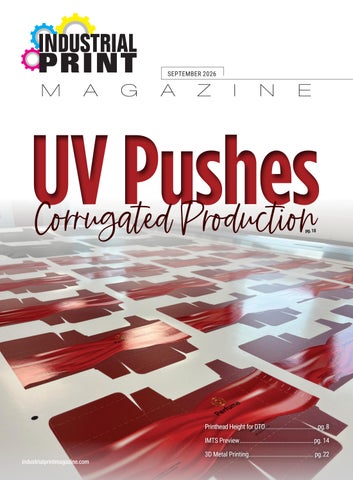
ON THE COVER Canon USA, lnc.·s Arizona 2300 Series offers fiatbed printing to corrugated thanks to its FLXfiow Technology, which helps easily handle heavy or irregular substrates. See page 18.
industrialprtntmagazine.com
September 2026 [ Industrial Print Magazine J 3
.RIAL 9PRINT
IN DUSTRIALPRI NTMAGAZINE.COM Volume 13, Number 4
EDrTIIR'S LETTER
TRAVELING TIME It's a busy time of the year. There is a different trade show or summit to
attend every week starting in September. Since Industrial Print magazine
covers three distinct markets-direct to object, corrugated, and additive manufacturing (AM)-there are many events to canvas. Up first, September 10, 2026, the Smart Manufacturing for Automotive Summit held by AMG World in Detroit, Ml. A must for manufacturers operating in the automotive industry, with special insight on using AM in this space.
September 14 to 19 visit Chicago, IL for the International Manufacturing Technology Show (IMTS). IMTS boasts over 1.2 million square feet of ex hibit space with vendors from multiple backgrounds attending the show, with one goal in mind-achieving efficiency in manufacturing. Las Vegas, NV welcomes the PRINTING United trade show September 23 to 25 for those interested in commercial, apparel, packaging, and wide format print.
EDITOR IN CHIEF Thomas Tetreault 978-921-7850 EDITOR Melissa Donovan mdonovan@rockportpubs.com ASSOCIATE EDITOR Cassandra Balentine cbalentine@rockportpubs.com ART DIRECTOR Sarah M. White swhite@rockportpubs.com WEB EDITOR Melissa Mueller CONTRIBUTORS Pete Basiliere, Marco Boer, Kemal Carr, Maria Conrado, Melinda Tetreault ADVERTISING SALES PUBLISHER Thomas Tetreault 300 Newburyport Turnpike, Ste. 11 Rowley, Massachusetts 01969 Ph 978-921-7850 x110 • Fx 978-921-7870 edit@rockportpubs.com SALES Amanda Doyon Ph 978-921-7850 x170 • Fx 978-921-7870 adoyon@rockportpubs.com
September 28 to 30, TAPPI and AICC host Corrugated Week in Fort Worth, TX. Come for quality networking and learn about the future of corrugat ed-from the hardware to the software and everything in between. Further out, Formnext takes place November 17 to 20, 2026 in Germany.
ROCKPORT
CusToM PuBLISHING
The show highlights solutions across the entire process chain of industrial 3D printing. Grab your passport and visit some of these events this Fall.
CORPORATE & PUBLISHING OFFICE 300 Newburyport Turnpike, Ste. 11 Rowley, Massachusetts 01969 ROCKPORT CUSTOM PUBLISHING, LLC
Cheers
Melissa Donovan, Editor
CHAIRMAN Jeffrey Jensen PRESIDENT & CEO Thomas Tetreault CONTROLLER Missy Tyler Industrial Print magazine is published by Rockport Custom Publishing, LLC. Send change of address forms to 300 NewburyportTurnpike, Ste. 11, Rowley, MA 07 969. © Rockport Custom Publishing, LLC 2026. Reproduction by any means of the whole or part of Industrial Print magazine without written permission from the publisher is prohibited. Views expressed in the editorial pages do not imply our endorsement. Subscription Rates: U.S. $41.65 per year, seven issues; single copies: $5.95, Cana da and Mexico: $52.22 (U.S.D.), Other international subscriptions: $71.05 (U.S.D.) Vendors: We welcome your product news. Include prices, slides, photos, and digital files with your press release. Please forward product samples and media kits to Reviews Editor, Industrial Print magazine 300 Newburyport Turnpike, Ste. 11, Rowley, MA 01969. We cannot be responsible for unsolicited product samples.
4 [lndustfia/ Print Magazine J September 2026
industrialprintmagazine.com
#1
FIRST LOOK PRINTING United Preview
by Industrial Print Magazine Staff
Head to Las Vegas, NV between September 23 and 25, 2026 and stop by the Las Vegas Convention Center to experience PRINTING United. With over 800 exhibitors and 70 education sessions, the expo is where print service providers from all backgrounds can learn about the newest technologies. Innovation and connection are two of the biggest themes of the event. Both of which are seen in the following exhibitor booths. Canon U.S.A., Inc., booth N5801, showcases a range of technologies, including the Colorado XL‑se‑ 1 ries, the Colorado M‑series, the Arizona 2380 GTF, and the DigiTechTexas ST2/X1 Flatbed Printer. INFO# 190 Colex Finishing Solutions, booth C1337, presents the Colex Sharpcut Flatbed Cutter, featuring advanced digital cutting ca‑ pabilities for a range of materials and applications. INFO# 191 Elitron America, booth C331, features live demonstrations of the Spark and Kombo TH systems. Both solutions incorporate Elitron’s patented Seeker System technology, which automati‑ cally recognizes printed graphics and cutting marks. INFO# 192 Flatbed Tools, booth C132, hosts the Summa Vantage flat‑ bed cutter running live, cutting real production materials in real time. INFO# 193 Fluid Color, booth C531, exhibits the RF84 HG flatbed print‑ er, which prints braille, textured signage, and flat graphics with a Z-axis print height of up to 19.6 inches. INFO# 194 Inkcups, booth C1215, demonstrates the recently launched Helix High Throw, engineered to decorate complex cylindrical products with exceptional print quality, including drinkware with removable handles, footballs, and bowls. INFO# 195 Innovative Digital Systems, booth C759, demonstrates the Prisma Z-Max Pro high-gap UV flatbed printer, the RevPro 360 rotary UV printer for cylindrical and tapered objects, the Sonic Jet SP100 single-pass UV printer, and the new Surface‑ Treat 360 pretreatment system. INFO# 196 Koenig & Bauer Kammann, booth N5749, promotes its ad‑ vanced decoration equipment. Kammann printing machines are designed to decorate not only cylindrical articles but all shapes—including handled ware—without special equipment, 6 [ Industrial Print Magazine ] September 2026
with sustained output ranging from eight to 120 parts per min‑ ute. INFO# 197 LSINC, booth C701, brings its signature UV inkjet innovation, the Peri Series, to decorators, brand owners, and print profes‑ sionals. Front and center is the PeriOne, LSINC’s single-spindle helical UV printer. INFO# 198 LogoJET, booth C2691, helps businesses create, customize, and grow. Experience vibrant, full-color printing on wood, met‑ al, plastic, glass, PVC, and paperboard while exploring profit‑ able applications for packaging, signage, promotional products, awards, industrial parts, and personalized goods. INFO# 199 Summa, booth C723, promotes the F Series Vantage range, featuring the F1612 Vantage and F1625 Vantage. Designed to deliver higher productivity, greater ease of use, and a more connected workflow, the F Series Vantage represents Summa’s most advanced flatbed cutting platform to date. INFO# 200 Sun Chemical, booth C2880, presents Streamline Kashu, an aqueous pigment ink for paper, poster, and corrugated printing tuned for Epson i3200 printheads. Corrugated solutions also in‑ clude SunEvo EV-LWR09 WB LEP primer, Sun Chemical’s first HP Indigo-approved primer for label applications. INFO# 201 swissQprint, booth C1737, exhibits its engineering expertise. At the booth, visitors can see that engineering up close, in the Kudu flatbed printer and the Karibu 2 roll-to-roll printer, both running live throughout the show. INFO# 202 Visit industrialprintmag.com for more information. IPM
1. Visit LogoJET in booth C2691 to learn about direct to object printing.
industrialprintmagazine.com
#6
DTO
MIND THE GAP
Distance Expands Between Printhead and Object by Melissa Donovan
Direct to object (DTO) printers evolve to print directly to any number of shapes, objects, and sizes. One consideration as the range of printed products grows is the gap between printhead and object. "The demand for printing DTO on dimensional, curved, and complex shapes has made larger print gaps essential-not optional. High-gap printing expands what manufacturers can decorate, allowing larger graphics, greater coverage, and new applications," attests Michael Perrelli, director of sales, Inno vative Digital Systems (IDS). Today's print technology-printhead, ink, software-makes this possible by maintaining print performance even at these wider distances.
Average Distance
the same shift in print gap size, from two to ten mm, depend ing on the application. "Print gap is critical because many objects are not perfectly flat or dimensionally stable. This is true for round items such as cans or balls, as well as molded components like plastic lids, which can warp." Based on Koenig & Bauer Kammann (US) Inc.'s experience, customers commonly ask "how do we decorate more surface area on containers that aren't flat?" A good example is the spe cialty brewery glass market. "A traditional pint glass is straight forward, but a Belgian tulip or a glass with a pronounced foot and bulbous body creates real challenges. Decorators want full coverage on those curves, and that demand is pushing the con versation on throw distance further than ever;' continues Nevin White, sales manager, Koenig & Bauer Kammann (US).
The average distance between the printhead and object is changing, especially as applications are introduced that drive the need for larger print gaps to avoid collisions. "There is a higher expectation to have clear prints on prod ucts with more curved surfaces, textures, recessed area, and just generally uneven surfaces. Part of this includes expanding the ability to print clearly with a higher printhead gap and at variable distance," explains Hugo Gonzalez, senior segment specialist, Mimaki USA, Inc. Neil Cook, head of strategic marketing, Xaar, says there is a clear shift from gaps below two millimeters (mm) toward three to even ten mm in some industrial applications. "This is driv en by coding and marking on corrugated and sec �----------,,----------� ondary packaging, direct to shape printing, high speed packaging lines, and production environ ments where dust, vibra tion, and contamination risk need to be managed." Kenneth Stack, execu - Nevin White, sales manager, Koenig & Bauer Kammann (US) tive chairman, Engineered Printing Solutions, notices
Decorators want full coverage on those curves, and that demand is pushing the conversation on throw distance further than ever.
�-------,,-------�
8 [lndustfia/ Print Magazine J September 2026
Practicality in Action There are limits to how far a printhead can be po sitioned from an object, based on the printer and object in question. "In any DTO applica tion there is a theoretical 1. The Mutoh XpertJet 661 UF prints directly to a variety of sub strates up to 5.91 inches thick, like plastic blocks.
industrialprintmagazine.com
maximum to the distance a system can project ink effectively onto a surface. The actual capabilities of the printhead, combined with the viscosity and drop configurations of the ink, and the system alignment all work together. The reality is, optimal print clarity will be achieved when the correct distance from the prin thead is used and the system is aligned to that distance," says Lon Riley, found er/CEO, DPI Laboratory. Three things contribute to this, ac cording to Paul Edwards, VP of the dig ital division, INX International Ink Co. "First, the drop speed must be high enough to ensure it reaches the sub strate. Secondly, the drop accuracy of the printheads will limit the throw as the distance increases. If the nozzles have a high level of angular deviation, the drops
industrialprtntmagazine.com
will not hit the target spot accurately, which leads to print quality issues. Last ly, the amount of mist increases with throw distance. Mist can impact print head reliability and find its way all over the printer." Mike Pruitt, product manager, Pro fessional Imaging, Epson America Inc., notes that "as the printhead gap increas es, droplet trajectories deviate, droplets decelerate, and airflow can disrupt droplet placement, resulting in blur, graininess, dot gain, and reduced edge sharpness;' ''At its lowest sizes, environmental factors such as humidity, static, air move ment, and temperature influence how the droplet travels. The farther the droplet has to travel before reaching the surface, the more time those factors have to affect placement and as a result the quality of
the print. That is why longer printhead gaps require more than simply raising the printhead. The printer, ink, waveform, print profile, and application all need to work together," adds Gonzalez. Gregory Harwood, director of digital product management and global service, Inkcups, also stresses that "achieving lon ger throw distances requires careful opti mization of the entire printing system to ensure image quality remains consistent." "It is wholly dependent on what ma chinery you are printing with, the prin thead being utilized, the ink jetted, and the software driving the print electron ics. Those elements have to be working in tandem. Then the proper use of set tings to tune your machine is what max imizes your print gap and establishes those limits," adds Perrelli.
September 2026 [ Industrial Print MagazineJ 9
image quality issues. By allowing greater tolerance for height variation, larger print gaps can simplify setup and reduce the fre quency of adjustments;' agrees Hardwood. In an ideal situation, print gap adjust ment is handled automatically by the system. "In higher end, single-pass plat forms, cameras and servo-driven mech anisms are often used to dynamically adjust printhead position. In contrast, lower cost multi-pass systems rely more on manual setup and adjustment. The level of automation largely depends on the production volume, application com plexity, and system design," shares Stack. White admits that "physics set the ceiling. Beyond a certain distance, drop let integrity breaks down regardless of the quality of your ink and hardware." "At some point, physics takes over. The bigger challenge today isn't usually the overall object height-it is the vari ation between the highest and lowest points of the object. A tumbler with a slight taper or a product with contours can be more challenging than a tall flat object. The good news is that improve ments in dot placement and carriage control have helped printers maintain quality over larger height variations than ever before," continues Emilio Rangel, product manager, Mutoh America, Inc.
Operator Setup Larger print gaps influence operator set up procedures.
For most operators, setup is easi er than it was a few years ago. ''A lot of the manual adjustments have been re placed by automation. Users can save preferred print gap settings and quickly recall them when running repeat jobs. Once a shop establishes a workflow for a particular product, setup becomes very straightforward," notes Rangel. Cook argues that "larger print gaps can make systems less sensitive to tight mechanical tolerances, which helps simplify setup and print integration into high-speed production lines." "One of the key benefits of larger print gap capabilities is actually the reduction in setup complexity. With conventional systems, operators often need to spend considerable time ensuring products are positioned within tight tolerances to avoid challenges like printhead strikes and
COM PAN IES MENTION ED -�Seepage17formoreinformation. INFO# Company
130 131 132 133 134 135 136 137 138 139 140
Website
DPI Laboratory
dpi-lab.com
Engineered Printing Solutions
epsvt.com
Epson America, Inc.
epson.com
lnkcups
inkcuos.com
Innovative Diciital Systems
ids-diciital.com
INX International Ink Co.
inxinternational.com
Koenig & Bauer Kammann (US) Inc.
kammann.koenig-bauer.com
Mimaki USA, Inc.
mimakiusa.com
Mutoh America, Inc.
mutoh.com
Roland DGA Corp.
rolanddga.com
Xaar
xaar.com
1 O [lndustfia/ Print Magazine J September 2026
Sensing Technologies
Sensing technologies can detect object height automatically. Laser sensors and camera-based systems are popular. Most modem systems have automatic height sensing. This provides a predict ably safe gap from the object to the prin thead for normal operation. Laser break beam systems are still the most prevalent in the smaller and medium format ma chines, notes Riley. Laser-based sensing systems are the most commonly used technology for au tomatic object height detection, as they provide an excellent balance of accuracy, reliability, and cost, admits Pruitt. "Camera-based vision systems are more prevalent, and this technology has improved since it was first introduced. This allows for enhanced 'repeatability' of the prints and can significantly reduce setup times, with increased scanning speeds making more frequent change overs far more viable," explains Harwood. Vision systems and artificial intelli gence (AI) also play a role in the process. "Vision systems are now widely de ployed in single-pass production environ ments, not only for positioning but also for real-time quality control," adds Stack. Perrelli believes that "as the demand for decorating more dimensional products 2. The IDS Prisma Z-Max Pro high throw flatbed printer handles objects up to 19.7 inches Z height.
industrialprintmagazine.com
grows, decorators will need systems with greater flexibility and built-in features like laser sensing, machine vision, and automated height detection to drive set up automation, part recognition, and print optimization." Combining vision systems with ma chine learning will make it easier to automatically identify defects that neg atively impact print quality. "The end result is a system that is more easily op timized for print quality and reliability,'' says Edwards. White sees vision systems with AI-as sisted detection becoming more popular. "This is particularly where container geometry varies significantly or change overs are frequent. For high-mix produc tion environments, the case for smarter sensing gets stronger."
industrialprtntmagazine.com
Visual Appearance Print gap influences image sharpness, color consistency, and registration. •� the print gap increases, print quality and perceived resolution can de crease. The greater the distance between the printhead and substrate, the more opportunity for droplets to deviate from their intended path, reducing placement accuracy. This can result in softer detail, less-defined edges, and an overall reduc tion in image quality," notes Pruitt. As in most cases "the correct bal ance depends on the application and the production conditions. In coding and marking, for example, the priority is usually code readability and robustness rather than photographic resolution. For more graphic or decorative applications, shorter gaps are still generally preferred
where possible to ensure the required results,'' explains Cook. Another trade off is speed. "Generic distance-adjusting the ink droplet size and slowing the print carriage to maintain high print quality when printing on chal lenging objects-does two main things. It alters the ink droplet size to counter the irregular shape of the substrate and it slows the printhead down so the ink drop lets fall and cure where they are supposed to," according to Philip Chu, product man ager, Roland DGA.
Mind the Gap As DTO applications expand beyond flat, uniform surfaces to curved, contoured, uneven, textured, and tiered pieces it is imperative to maintain print quality across larger printhead gaps. 1PM
September 2026 [ Industrial Print Magazine J 11
OBJECTIFYING •
PRIil
DIRECT TO ALL SHAPES
KEY
'Unless noted otherwise bph = bottles per hour
in/s = inches per second m/min = meters per minute
Grow Your Business With UV Printing Many businesses are limited because
they can't customize products in-house.
At LogoJET, we make printers that print
on almost any item, from golf balls to
packaging, so you can print in-house to
PRINTING UNITED EXCLUSIVE OFFER· DON'T WAIT FOR THE SHOW TO SAVE. Pre-order now or purchase at PRINTING UNITED and receive an exclusive bonus package.
Visit LogoJET.com/PrlntlngUnlted for more information.
LOGO]EfiSales@LogoJETcom I 3373308471 I LogoJET com
1111
I
... �
170 ApachePrinters apachedtf.com 171 ColDesi. Inc. coldesi.com 172 Direct Color Systems directcolorsystems.com
[16045
300H3F SOOHlf UV84-DTS Gen2 UV-21MP UV-32MP UV-44D!S 173 DPILaboratory Catalyst Nanos dpi-lab.com CatalystAventra Catalyst Nexus 174 Engineered Printing Solutions fJET24Gen2 XD Series epsvt.com fJETXL BottleJET XD-360° SureColorV/000 175 Epson SureColor V400 epson.com SureColorV1070 XJET800 176 lnkcups XJEf 8001 inkcups.com XJET Switch X5-T X5-T Highlhrow Helix High Throw Helix ONE Helix Helix+ Double Helix Revolution 177 Innovative Digital Systems Revolution 360T RevProl60 ids-digital.com TwinRev360 TwinRevPRO QuadRev360 QuadRev PRO RevHDL PrismaZ-Max Pro Prisma PRO Sonic.Jet Single PasslOO CP800 178 INX International Ink Co. inxinternational.com K15CNC 179 Koenig & Bauer Kammann K4 kammann.de lnspira Series -UVx45i 180 LogoJET lnspira Series -UVx90i logo1et.com Strata Series- TERRA Strata Series-LUNA UVx40R Pt.US-SE UVx90R-SE 181 lSINC Corporation Perivallo360m !sine.com Peri0360 PeriOne PeriH 182 MimakiUSA, lnc. UJF-3042 Mkll e mimakiusa.com UJF-6042 Mkll UJF-7151 Plus lie JFX200-1213 EX JFX/00-2513 EX JFX/00-2531 JFXS00-2513 JFXS00-2531 183 MutohAmerica, Inc. XpertJet461UF mutoh.com XpertJet 661UF XpertJet 1462UF ll4 Roland DGA Corporation VersaSTUDIO BD-8 rolanddga.com VersaSTUDIO BD-12 VersaOBJECT M0-180 VersaOBJECT M0-240 VersaOBJECIC0-300i-F2 VersaOBJECT C0-640i-F3 EU-IOOOMF(4-color model) EU-IOOOMF(6-colormodel) 185 XANTE X-24 xante.com X-36 X-55 X-98 X-121
Dmm!II
I
UVLED
720x2.400
UVLED UVLED UVLED UVLED UVLED UVLED UVLED UVLED UVLED UVLED UVLED UVLED UVLED UVLED UVLED UVLED UVLED UVLED UVLED UVLED UVLED UVLED UVLED UVLED UVLED UVLED UVLED UVLED UVLED UVLED UVLED UVLED UVLED UVLED UVLED UVLED UVLED UVLED UVLED
CM CM 1,200 720x2,400 720xl,200 605x2,400 720x3,600 720x3,600 720xl600 1,200 600 1,200xl,200 600 600 720xl,440 600xl,200 1,440xl,440 1,200xl,200 1,200xl,200 720xl,200 1,200xl,200 1,200xl,200 1,200 x 600 600xl,200 1,200xl,200 1,200xl,200 1,200xl,200 702x900 1,200x900 1,200x900 1,200x900 1,200x900 1,200x900 1,200x900 1,200x900 1,200x900 1,200xl,200 1,200x900 1,0BOxl,440
UVLED 720 UVLED 720 UV 720x3,600 UV 720x3,600 UV 720xl,440 UV 720xl,440 UV 720x2,400 UV 720x2.400 UV 5,000xl,200 UV 5,000xl,200 UV 5,000xl,200 UV 1,200x600 UVLED 1,200 UVLED 1,200 UVLED 1,800 UVLED 1,200 UVLED 1,200 UVLED 1,200 UVLED 1,200 UVLED 1,200 UVLED 1,440 UVLED 1,440 UVLED 1,440 UVLED 1,440 UVLED 1,440 UVLED 1,200 UVLED 1,200 UVLED 1,440 UVLED 1,440 UVLED 720x600 UVLED 720x900 UVLED 2,880 UVLED 2,880 UVLED 2,880 UVLED 2,880 UVLED 2,880
llll
-
24x18
6
✓
CM
CM 36x24 CM 63x47 304 96x48 48 24x18 60 24x36 152 48x48 53.8 11.7x16.5 172.3 23.6x35.43 190.0 51.18x55.11 144 20x24 50 in/s CM CM 41.75x24.6 CM CM CM CM CM 98.4x49.2 CM 27.5xl8.5 CM 8.3xll.7 CM 31x24 CM 31x24 CM 13.8x25.6 CM 43x24 CM 43x24 CM 6.75 CM CM CM CM CM CM CM CM CM CM 9.44 CM CM 11.8 CM 14.1 CM 13 CM 8.66 CM 8.66 CM 14.17 189.76 43x24 CM 43x24 1,614 3.9x354 20 bph lOxlO
9.8 5.9 12 7 12.6 12 3.94 7 3.94 2.9 11.8 CM CM CM 3.15
✓ ✓ ✓ ✓ ✓ ✓ ✓ ✓ ✓ ✓ ✓ ✓ ✓ ✓ ✓ ✓ ✓ ✓ ✓ ✓ ✓ ✓ ✓ ✓ ✓ ✓ ✓ ✓ ✓ ✓ ✓ ✓ ✓ ✓ ✓ ✓ ✓ ✓ ✓ ✓ ✓ ✓ ✓ ✓ ✓ ✓ ✓ ✓ ✓ ✓ ✓ ✓ ✓ ✓ ✓ ✓ ✓ ✓ ✓ ✓ ✓ ✓ ✓ ✓ ✓ ✓ ✓ ✓ ✓ ✓ ✓ ✓ ✓ ✓ ✓ ✓ ✓ ✓ ✓ ✓ ✓ ✓ ✓ ✓ ✓ ✓
CM CM $99,000 $29,999 $41,999 $69,999 $14,900 $37,900 $44,900 $39,000 CM CM CM CM CM $53,995 $8,995 CM CM CM CM CM CM CM CM CM CM CM CM CM CM CM CM CM CM CM CM CM CM
✓ ✓ ✓ ✓ ✓ ✓ ✓ ✓ ✓ ✓ ✓ ✓ ✓ ✓ ✓ ✓ ✓ ✓ ✓ ✓ ✓ ✓ ✓ ✓ ✓ ✓ ✓ ✓ ✓ ✓ ✓ ✓ ✓ ✓ ✓ ✓ ✓ ✓ ✓ ✓ ✓ ✓ ✓ ✓ ✓ ✓ ✓ ✓ ✓ ✓ ✓ ✓ ✓ ✓ ✓ ✓ ✓ ✓ ✓ ✓ ✓ ✓ ✓ ✓ ✓ ✓ ✓ ✓ ✓ ✓ ✓
CM CM $34,995 $59,995 $178,000 $99,999 $29,995 $56,000 $370,000 $649,000 $225,000 $761,000 CM CM CM CM CM CM CM CM $20,995 $28,995 $69,995 $10,995 $15,995 $31,895 $38,495 $54,995 $82,495 $74,995 $79,995 $30,996 $40,996 Starts at$60,995 Startsat$75,995 $87,995
CM
50 m/min 50 m/min 42 91.1 897 640 44 109 CM CM CM CM 27 38 86 269 343 243 2,152 2,152 89 89 84 10.78 14.18 96.27 126.85 95.76 121.59 297 202 CM CM CM CM CM
llx15 llx20 18x24 24x36 59x98 39.3x70.8 18x24 24xl6 CM CM CM CM 11.8x16.5 23.6x16.5 27.9x20 50x5l.2 98.4x5l.2 98.4x122 98.4x5l.2 98.4x122 llx19 19x23.3 55.9x27.5 8.2x5.8 12x8.2 18x12 24x18 29.4x59 63.4x98.4 96x48 96x48 24x18 24x36 55x50 55x98 60x121
7.8
2.75 10 20 8 19.7 19.7 CM CM CM CM CM CM 4.7 6.3 5.1 5.1 4.7 4.7 5.12 19.7 6 3.9 CM CM CM 5 6 3.93 5.9 5 6 CM CM CM CM 6 6 6 2 2 2 2 2 5.9 5.9 5.9 4 4 8 8 9.5 9.5 3.74 3.74 6 6 3 3 3
✓ ✓
✓ ✓ ✓ ✓ ✓ ✓
Q�INf0#1D 12 [lndustfia/ Print Magazine J September 2026
industrialprintmagazine.com
STEP RIGHT UP Corrugated Week 2026
by Industrial Print Magazine Staff
Corrugated Week shapes the future of corrugated, allowing professionals from all backgrounds to gather under one roof. Jointly hosted by TAPPI and AICC, this event provides a variety of unique connections and the ability to build long-lasting relationships through exclusive networking events. Held September 28 to 30, 2026 in Fort Worth, TX at Fort Worth Convention Center, the following companies plan on participating in the exhibitor hall. Stop by their booths to learn more about the future of corrugated. A.G. Stacker Inc., booth 507, invites attendees to operate virtual versions of A.G.’s eBREAK Bundle Breaker and eXT Front End using DUO Digital Twin 1 technology. The booth also features GO AG, A.G.’s digital platform for equipment documentation, training, service, and support; along with SIMCORRA, an advanced production planning and simulation tool. INFO# 100 Advantive, booth 801, showcases Kiwiplan, an automated packaging execution system built for sheet plants, box plants, sheet feeders, and specialty manufacturers. It also features Advantive ONE, the intelligence layer that is built on top of Kiwiplan. INFO# 101 Alliance Machine Systems Intl. LLC, booth 113, designs and manufactures material handling systems that keep pace with today’s fastest finishing machines. Products include robotic loadformers, stackers, prefeeders, pallet handlers, specialty folder gluers, laminators, bundle breakers, and conveyors. INFO# 102 BAHMÜLLER, booth 639, presents its latest innovations in specialty folder-gluer technology. A major focus is the automation of specialty folder-gluer lines, developed in cooperation with BAHMÜLLER’s automation partner, MuK. Together, the companies offer the U.S. market an integrated stack-to-stack solution. INFO# 103 Baysek, booth 438, invites trade show attendees to discover a faster, cleaner, and more efficient approach to corrugated die cutting. At the show, visitors can see how Baysek’s fully automatic rotary anvil flat die cutting technology delivers clean, shipment-ready products. INFO# 104
industrialprintmagazine.com
Elitron America, booth 104, presents the Kombo TAV. It is ideal for corrugated converters seeking to streamline workflows and reduce turnaround times, the Kombo TAV represents a smart investment in automated finishing. INFO# 105 KENTO Digital Printing, booth 826, explains how converters and packaging professionals can explore the latest innovations in hybrid digital printing for corrugated packaging. INFO# 106 Sun Chemical, booth 114, showcases its portfolio of corrugated printing and converting solutions, including SunVisto water-based inks, SunSys Vallocoat water-based coatings, SunCure UV coatings for digital print applications, SunVisto AquaGreen sustainable ink technology, and the SunConnect and SunDigiGuide color management solutions. INFO# 107 WSA USA, booth 426, features robotic solutions designed to improve safety, increase throughput, and reduce labor dependency across corrugated converting operations. It also showcases the new WSA SmartShipping Automation System, a fully integrated shipping and logistics platform. INFO# 108 The exhibit floor is accessible 12:00 to 5:00 p.m. Tuesday and 12:00 to 4:00 p.m. Wednesday of the event. If attending Corrugated Week, plan to stop by during these times. IPM 1. Baysek, booth 438, invites trade show attendees to discover a faster, cleaner, and more efficient approach to corrugated die cutting.
September 2026 [ Industrial Print Magazine ] 13
DRAWING INVENTORS NEAR AND FAR IMTS 2026 Preview
by Industrial Print Magazine Staff
IMTS 2026 takes place September 14 to 19, 2026 at McCormick Place, Chicago, IL. Billed by the Association for Manufacturing Technology as the largest trade show in the western hemisphere, IMTS or the International Manufacturing Technology Show, hosts over 2,000 exhibitors in more than 1.2 million square feet of exhibit space. Advantive, booth 135704, showcases Advantive
1
ONE, an intelligence layer built on top of all Advantive products. Visitors can also see AIVA, Advantive ONE’s AI-powered virtual assistant. INFO# 113 ATLIX, formerly TRUMPF additive manufacturing (AM), booth 338365, showcases its latest generation of industrial productivity with the TruPrint 5000. The device offers high-efficiency automation for cost-effective mass production and best-in-class laser powder bed fusion (LPBF) technology. INFO# 114 Axtra3D, booth 338374, showcases its complete production ecosystem, combining the Lumia.X1 Hi-Speed SLA printer with Axtra.Solutions and Axtra.Workflow. INFO# 115 EDM Network, booth 338360, introduces two cutting technologies. The Edmmax650HW is designed to horizontally remove LPBF and wire arc AM parts from their build plates. The Edmmax Diamond Abrasive Saw uses a PCD diamond plated steel wire to abrade materials into 2D shapes. INFO# 116 EOS, booth 338450, highlights its newest metal printer, the EOS M4 ONYX. Engineered for maximum productivity and reliability, it combines a spacious build volume with laser technology and intelligent process control. INFO# 117 FormAlloy, booth 338474, invites attendees to experience directed energy deposition (DED). Its robotic systems are capable of producing metal parts up to two meters in length. INFO# 118 JEOL, booth 338367, displays many sample industrial parts and debuts its newest material offering—3D printed pure tungsten. JEOL’s electron beam powder bed fusion technology offers its users unprecedented capabilities in AM. INFO# 119 Mass Finishing, Inc., booth 338009, demonstrates the HZ-40 and HZ-85 centrifugal barrel finishing machines. Experience how the equipment deburrs, polishes, radiuses edges, and removes support material. INFO# 120
14 [ Industrial Print Magazine ] September 2026
Mastrex, booth 338363, introduces two LPBF systems, the MX100 and MX400, equipped with build volumes of 100x100x80 and 400x350x400 millimeters, respectively. INFO# 121 Meltio, booth 338264, shows its Meltio Robot Cell. It manufactures and repairs big volume metal parts in a containerized solution, which allows for easy installation and logistics transportation. INFO# 122 MicroTek Finishing, booth 338482, showcases machined, cast, and additive parts from various industries. The company helps manufacturers of critical components solve what traditional finishing can’t—achieving demanding surface specifications without altering part geometry. INFO# 123 Nidec Machine Tool America, booth 237054, showcases gear manufacturing and inspection technologies, including the newly released RoboCam inspection solution, the ZFA260 gear grinder, and the MSS300 Super Skiving machine. INFO# 124 Nikon Metrology, booth 134240, offers two new products— the APDIS MV5X Laser Radar system for large applications and the ECLIPSE LV100AMS smaller jobs. INFO# 125 Nikon SLM Solutions, booth 338468, showcases how industrial manufacturers scale metal AM from a single system to factory-level production. INFO# 126 Stratasys, booth 338460, helps manufacturers reduce lead times, lower costs, and increase manufacturing flexibility through an end-to-end AM ecosystem. INFO# 127 Tiger-Vac, booth 135786, exhibits a range of portable vacuums for the metalworking industry and AM. INFO# 128 This six-day event is filled with new technologies from leading vendors such as those highlighted in this article. IPM 1. Visit Nidec, booth 237054, for the MSS300 Super Skiving and ZFA260 gear grinder.
industrialprintmagazine.com
EMERGING TECHNOLOGIES Smart Manufacturing for Automotive Summit Preview
by AMG World Staff
The automotive industry is navigating a period of rapid change. Tariffs, supply chain volatility, localization efforts, shifting production strategies, and increasing cost pressures are forcing manufacturers to rethink how they operate. At the same time, expectations around quality, efficiency, flexibility, and resilience continue to rise. On September 10, 2026, join smart manufacturing, technology, and automation leaders at the seventh annual Smart Manufacturing for Automotive Summit held by AMG World in Detroit, MI to explore how artifi1 cial intelligence (AI), digital twins, advanced analytics, automation, and connected manufacturing technologies help automotive manufacturers build smarter, more resilient operations.
Automotive Manufacturing Leaders Join manufacturing practitioners and decision makers from organizations including BorgWarner, Gestamp, Lear Corporation, Lucid Motors, Magna International, Rivian, and ZF Group. Speakers include Liz Fernandes, senior electrical engineer, equipment integration (Americas), Continental; Aaron Dunlap, manufacturing execution systems architect, General Motors; Dan Drouin, VP operational excellence, iDEA by Lear, Lear Corporation; Arun Prakash Mantena, global manager, advanced manufacturing engineering – stamping, Lucid Motors; Austin Ulerick, senior engineer, stamping production engineering, Toyota Motor Engineering and Manufacturing North America; and Raidan Lage, regional smart factory coordinator, ZF Group.
Key Themes in Targeted Discussions Building the Digital Core discusses secure, connected, and data-driven manufacturing. This explores how manufacturers can establish the digital, data, and cybersecurity foundations required to scale smart factory capabilities across their operations. Transforming the Workforce looks at leadership, skills, and culture for the modern factory. It discusses the skills, leadership mindsets, and organizational culture needed to enable a digitally empowered, future-ready manufacturing workforce.
industrialprintmagazine.com
Verified AI-Powered Productivity highlights intelligent automation for quality, safety, and operational excellence. The focus is on proven, practical ways AI, analytics, and automation can unlock step-change improvements in efficiency, quality, safety, and overall factory performance.
Meet the Sponsors Connect with solution providers helping manufacturers accelerate smart manufacturing and digital transformation initiatives, including Belden, Concept Reply, Kundinger, Lenovo x Nvidia, MaintainX, and MetaLearner.
Why Attend? Learn directly from automotive manufacturers implementing Industry 4.0 initiatives. Benchmark strategies with OEMs, suppliers, and technology leaders. Explore practical applications of AI, automation, analytics, digital twins, and connected manufacturing. Gain real-world lessons on improving efficiency, quality, flexibility, and operational performance. Build valuable connections with decision makers from across the automotive value chain.
Register Today Register using PARTNER15, 15 percent discount code, by visiting smartmanuauto.com, emailing enquiries@amg-world.co.uk, or calling +44 (0) 113 3970 379. IPM 1. On September 10, 2026 join smart manufacturing, technology, and automation
leaders at the Smart Manufacturing for Automotive Summit in Detroit, MI.
September 2026 [ Industrial Print Magazine ] 15
AM
IMPROVING QUALITY, EFFICIENCY 3D Build Software Evolves by Cassandra Balentine
Beyond its primary role of file preparation, modern build software for three-dimen sional (3D) printing offers valuable insights that allow operators to identify issues, re duce waste, and make informed decisions in real time.
Latest Features Just a few short years ago, build software was solely print preparation, utilized to slice mod els, set machines, generate a tool path, and send it to the printer. Dr. Ali Tamijani, founder/CEO, Novineer, Inc., explains that build software historically drove the machine, but it didn't really understand the part. In serial production the focus becomes even more demand "The biggest shift since then is that build software has become ing because manufacturers want to optimize every detail for re an engineering decision layer rather than a setup utility. It now peatability, cost, and quality. "So overall, build software is becom carries intelligence about how a part will actually behave, ac ing more intelligent, automated, and closely connected to real counting for orientation, layer direction, infill, and material production requirements," adds Neugebauer. anisotropy, and it increasingly connects to the broader digital The software application that was only for print preparation thread that runs from the physical part through design and tasks like orienting a part and generating supports-now spans simulation to production." design automation, performance simulation, fleet analytics, sus One of the biggest advancements in build software is the in tainability tracking, and security, according to Victor Gerdes, VP, creased use of simulation to identify print risks before a build software, Stratasys. starts, reduce scrap, and improve first-time-right performance, notes Volker Schillen, product manager, Materialise. Build Demanding More software is also smarter in how it prepares data. It does this by 3D parts manufacturers demand more from build software with taking process constraints into account earlier and consistently, functionalities like process monitoring and automation. It is important to note that process monitoring and automation while becoming more efficient at handling the growing volumes of data generated by larger and complex part geometries. are not mutually exclusive. ''At first there were process monitor Fabian Neugebauer, �-------------,,-------------� ing sensors, but not much quality domain manag certainty about what to er, Materialise, adds that do with the sensor data context matters. In pro and how to interpret it. totyping, flexibility is key That has improved, and because every geometry valuable insights can now is different. In mass cus be gleaned from sensor tomization and higher data. The final step in the - Dr. Ali Tamijani, founder/CEO, Novineer throughput environments, 1. Elevate AM with Stratasys' GrabCAD Print Pro. users want automation. ,,
The biggest shift since then is that build software has become an engineering decision layer rather than a setup utility.
�-------
16 [lndustfia/ Print Magazine J September 2026
--------
industrialprintmagazine.com
process is to automate the feedback cycle so that builds can automatically self cor rect;' says Zach Simkin, president, Senvol. Gerdes agrees that these two functions reinforce each other. "On automation specifically software, customers want to remove manual, specialized steps. Ex tending automation includes integration of robots on the factory floor to interact with 3D printers-yes-there is growing demand for comprehensive and secure APis to integrate the robots and 3D print ers for pre- and post-build workflows." Automation is essential when compa nies want higher throughput, less manu al intervention, and more standardized preparation workflows. "That is particu larly true when similar parts are produced repeatedly or when companies want to scale operations without scaling manual effort;' offers Schillen. At the same time, process monitoring is becoming important as AM is used in more demanding production envi ronments. Neugebauer points out that in medical, aerospace, and other quali ty-sensitive industries, customers need
visibility, traceability, and better control over what happens during production. Moshe Benaish, director, Streamline Pro and loT, global software, Stratasys, says when it comes to monitoring opera tions, customers want the data to optimize overall equipment effectiveness including visibility into utilization, uptime, and job status across a growing fleet. "Customers who are manufacturing or moving toward manufacturing 3D printed end use parts are looking for process monitoring capa bilities to provide evidence of part quality, consistency, and repeatability;'
Machine Data One perk of modern build software is the data it captures and shares in real time The types of data depend on the AM processes you're working with, which machines you have, and more specifical ly the types of sensors the machines are equipped with. "Some machines have many sensors, and others have none. Of those that do have sensors, how well, if at all, those sensors are tied into the build software varies," says Simkin.
�
Neugebauer feels that as manufactur ers industrialize AM, they want this infor mation available in a broader software environment, not isolated in machine-spe cific tools. That is relevant for companies running mixed fleets and trying to stan dardize visibility and traceability. Schillen stresses that real-time ma chine monitoring is not the main job of build software itself. The primary role is to create the build and prepare the data the machine needs to print. Real-time monitoring belongs more to the produc tion management and execution layer.. Frank Lindeman, customer success, Stratasys Software, points out that for companies with existing standard cen tralized monitoring solutions, some en able access to real-time printer telemetry and integrate it into external systems like SCADA/MES for monitoring and control.
Beyond Builds Build software prepares files for print. However, today's tools are able to optimize the process through simulations, smarter data preparation, and automation. /PM
Get more information from vendors appearing in this issue! Visit IPMagdirect.com. With just a few clicks, order FREE information from dozens of companies covered in this issue.
AD INDEX
2
3 4 6
Innovative Di ital S stems 1ST America Lo oJET
2 21
7
ids-di ital.com ist-uv.com lo IQjet.com
28 27
g
23
swiss rint.com corru atedweek.com
COMPANIES MENTIONED Company
INFO#
Company
INFO#
Company
INFO#
Canon U.S.A., Inc. Diqitech DPI Laboratorv Durst lmaoe Technoloav US Enaineered Printina Solutions EOS Epson America, Inc. Excelitas HP Additive Manufacturina Solutions lnkcups
150 152
Innovative Diaital Svstems INX International Ink Co. JEOL USA, Inc. Koeniq & Bauer Kammann (US) Inc. Mastrex Materialise Meltio Mimaki USA, Inc. Mimaki USA, Inc. Mutoh America, Inc.
134 135 162
Mutoh America, Inc. Nidec Machine Toal America Nikon Advanced Manufacturina Inc. Novineer, Inc. Roland DGA Corp. Senvol Stratasys Vanguard Digital Printing Systems Wavland Additive Xaar
138 165 166 142
industrialprtntmagazine.com
130 153 131
160 132 151 161 133
136 163 143 164 154
137 155
139 144 145
156 167 140
September 2026 [ Industrial Print Magazine J 17
UV CURING FOR CORRUGATE by Cassandra Balentine
igital printing to corrugated is increasingly popular in many applications. UV systems of fer both benefits and limitations to printing on this notoriously challenging media. UV is used for both full production and proto type printing directly onto corrugated board. Hard ware as well as ink formulations have an effect on the end result.
18 [lndustfia/ Print Magazine J September 2026
From Prototyping to Manufacturing UV printers print to corrugate for prototyping, short run production, or full-scale manufacturing. "The market has evolved such that print providers now invest heavily across all three segments based on Above and Right: Canon's Arizona fiatbed series is a stationery fiatbed well suited for precise package prototyping, design proofing, localized structural samples, and intricate multi-layered displays.
industrialprintmagazine.com
operational needs,” offers Patrick Donigain, senior manager, large format printing solutions, Canon U.S.A., Inc. While digital UV flatbed technology was once primarily for prototyping and mockups, Donigain explains that localized demand and SKU proliferation have fueled rapid growth in high-quality, short-run production using specialized roll-to-roll engines. “Simultaneously, display and packaging operations are adopting automated industrial flatbeds for full-scale digital manufacturing.” Hugo Gonzalez, senior segment specialist, Mimaki USA, Inc., admits that while the more popular entry point is short-run work in the corrugated space, print providers take advantage of UV technology’s versatility and expand their portfolio with the range of products to match the ink and printer. “It provides an entry point for many shops into the corrugated print space while being able to provide other services without additional setup.” In Tad Bozdech, product manager, Excelitas’, experience, a majority of customers use UV LED curing for full production runs. They focus on building large format, high throughput, single-pass printers. “For the past 20-plus years, UV wide format has been the only game in town allowing for printing on corrugated board with relative ease and consistency,” shares James Stanley CPP, RPbD, business development manager packaging, Mutoh America, Inc. Mark Crawford, product and business development manager, Vanguard Digital Printing Systems, sees the strongest growth in short-run production as well as a continued movement toward full-scale digital manufacturing. Converters and display producers invest in UV digital printing because it allows them to produce sellable, production-quality work with faster turnaround times, less setup, and fewer minimum order constraints.
industrialprintmagazine.com
Important Characteristics In the digital UV print space for corrugated there are desirable ink characteristics. Processing ability and appearance are two. “The ink needs to be able to resist being cut, creased, and flexed during finishing. This means it needs to remain flexible after curing, durable enough to resist handling, and it needs to remain adhered to the material when cut,” says Gonzalez. Donigain feels that a broad, saturated color gamut is vital for precise brand replication in commercial displays. “Robust mechanical durability is essential for post-print workflows like automated cutting and creasing to help limit chipping or cracking. Additionally, low odor formulations free of volatile organic compounds and hazardous air pollutants are important for handling and indoor use,” he adds. Gonzalez says the ink needs to feature a wide gamut and opaque whites to remain vibrant even on materials that are not white. “Best in class color is always job one. Beyond this, corrugated applications demand a challenging balance of flexibility and rub durability from the ink film,” comments Ted Pierpont, national sales manager, large format/textile/corrugated, Durst Image Technology US. Stanley notes that ink with flexibility is important as most UV printed applications are cut on digital finishing equipment/CAD tables.
Digitech’s team says as corrugated applications require creasing and bending, UV inks must accommodate that. “Different formulas have different amounts of stretch to them.” Bozdech points out that scratch resistance and low migration are of high importance since corrugated substrates tend to be absorbent unless they are coated. Inks also need to cure efficiently at production speeds. According to Crawford, if the ink does not respond well to the curing system it can limit throughput or compromise adhesion, scratch resistance, and rub resistance. For corrugated work the finished print must also be able to withstand handling, cutting, creasing, folding, and shipping.
Coated Versus Uncoated Coated and uncoated corrugated materials behave differently. Uncoated corrugated substrates are generally more absorbent and less uniform. They may require an ink set or print strategy that manages penetration, dot gain, and surface variation. “The goal is to maintain color density and image quality while still achieving proper adhesion and durability,” says Crawford. Uncoated corrugated board is highly porous, which Donigain points out can cause standard inks to penetrate fibers and complicate curing. Inks for these liners must control bleed and minimize dot
September 2026 [ Industrial Print Magazine ] 19
UV Curing System
1 gain. While some UV inks work on both surfaces with proper settings, coated substrates keep ink on the surface, enabling sharp dots, low ink consumption, and a broad color gamut. “Due to the absorbency of uncoated substrates, we find that viscosity is a key consideration in inks designed for those materials. To account for the slipperiness of coated surfaces, surface adhesion is a must have, so formulators design their inks with that in mind,” comments Bozdech. Certain methods can improve printing on uncoated material. “While corrugated material does not generally require a primer, printing a base layer of primer can reduce the absorbency and improve the print quality. However, with a highly absorbent surface, it might be difficult to fully cure the printed ink once it has soaked into the fibers. This is why
C O M PA N I E S M E N T I O N E D
is it highly recommended that inks are tested on the actual application material. It is also always a good idea to purchase the right materials for the job; in this case, coated or surface-treated materials,” shares Gonzalez. Coated corrugated liners typically provide a smoother and less absorbent print surface, which can support sharper detail, more uniform color, and stronger visual impact. “On these materials, ink formulation and curing must promote adhesion while controlling dot gain and maintaining a consistent surface finish,” notes Gonzalez. Stanley explains that there has not been a differentiator between coated and uncoated corrugated media traditionally. “It is either flexible or more rigid ink, unlike flexographic or offset most UV wide format will not have the ability to swap inks after you start with one.” See page 17 for more information.
INFO# Company
Website
150
usa.canon.com
Canon U.S.A., Inc.
151
Excelitas
excelitas.com
152
Digitech
digitech.com
153
Durst Image Technology US
durstus.com
154
Mimaki USA, Inc.
mimakiusa.com
155
Mutoh America, Inc.
mutoh.com
156
Vanguard Digital Printing Systems
vanguarddigital.com
20 [ Industrial Print Magazine ] September 2026
The curing system is fundamental to both image quality and productivity. UV lamps work with fast drying inks that increase speeds and feeds through the printing equipment, shares Stanley. Instant UV curing means faster production speeds and higher quality prints, according to the Digitech team. “Curing can impact adhesion, flexibility, and rub, and can be used strategically to control gloss level. In a well-designed system, it will deliver the needed cure energy at all print speeds,” adds Pierpont. Gonzalez says the curing system determines how quickly the ink is fixed to the surface, which affects dot control, color consistency, adhesion, finish, and the ability to be immediately processed. “A good curing system is matched to the ink to provide the precise curing frequency at the right intensity without adding too much energy, which could heat or possibly damage substrates.” UV LED provides near-instantaneous curing, allowing for very high process speeds. Bozdech points out that careful control of light exposure can produce either glossy or matte finishes. “In that way, there is a delicate interplay between the inkjet printheads and the UV curing light sources in determining the look and feel of the printed end product.” Curing configurations establish the baseline for speed and quality, as output is limited by the system’s ability to immediately solidify ink. Donigain says precise lamp positioning freezes droplets to minimize spread and allow complete curing. Curing consistency across the full print width is also critical. Uneven cure can lead to differences in gloss, adhesion, scratch resistance, and finishing performance. “In a production environment, reliable curing is one of the keys to predictable output,” comments Crawford. 1. Many customers utilize the Digitech TruFire flatbed for short-run production and prototyping.
industrialprintmagazine.com
Curing Evolution Curing technology has transitioned from high-heat mercury vapor lamps to efficient UV LED arrays. "The move from mercury halide lamps to LED greatly reduced media surface temperatures and the amount that sheets would move under the print ing/curing unit. This innovation enables better print quality overall and helps mitigate registration and media hold down challenges," explains Pierpont. Donigain says that unlike traditional halide lamps that required mechanical shutters, significant heat, and typically a 30- to 60-second warm up, modern LED arrays offer instant electronic on/ off functionality with no standby energy draw. Certain curing methods provide uniform curing across the swath, which
helps limit gloss banding and provide consistent ink adhesion at high com mercial speeds. Most digital UV printing platforms now employ UV LED lamps that can be programmed for instant on/off use, which contributes to low heat and low running costs, while improving produc tion speeds. It also allows a wider gam ut of materials including thin and sensi tive substrates, notes Gonzalez. As print production speeds have in creased, Bozdech says the demand for high-power UV LED light sources has grown proportionately. "In the past, air cooled lamps dominated the market, since they are easiest to integrate, but more demanding processes have re quired the introduction of water cooled curing lamps."
"Originally all machines had UV lamps on the sides of the printheads. Today there is a UV section on high speed solutions that follows the print heads," offers Stanley. For corrugated applications, the reduced heat of UV LED is especially valuable. "Corrugated board can be sensitive to temperature, moisture, and dimensional changes, so LED curing helps protect the substrate while still supporting high-quality production," shares Crawford.
UV for Corrugated UV print technology is effective for corru gated print. Continued advancements in inks, automation, and UV curing systems improve quality, efficiency, and sustain ability for corrugated applications. /PM
Process expertise, application support, and advanced curing technologies - engineered to perform.
industrialprtntmagazine.com
September 2026 [ Industrial Print Magazine J 21
D
processing with high prec1s1on
••
1,100+ Industry Professionals
120+ Industry Suppliers
THANK YOU TO OUR SPONSORS Pla tinum
BW Papersystems
Gold
♦ MITSUBISHI
l,t., HEAVY INDUSTRIES MitsubishiHeavylndustriesAmerica,lnc. Com,gallngM-..y0Moio<1
Bronze
1 qualified manufacturing workflows, and producing components closer to the point of need—helping manufacturers strengthen supply chain resilience,” explains Rangarajan. According to Dr. Behrang Poorganji, VP of technology, Nikon Advanced Manufacturing Inc., “on demand spare parts production addresses one of the most persistent challenges manufacturers face—maintaining equipment and systems when replacement components are difficult to source, expensive to inventory, or no longer in production. An added challenge for these older parts is that key reference documentation and schematics may no longer be available.” “Equipment operating today in many industries was manufactured 20 to even 1. Tooling insert printed with an EOS M 300-4 using EOS MaragingSteel MS1. 2. At the ExxonMobil Baton
Rouge refinery in LA, Meltio’s M600 system—a laser metal deposition technology—was used to manufacture an anti-wicking device, which prevents oil from wicking up thermocouple wires into the instrument cabinet. The new design was printed using Titanium 64.
24 [ Industrial Print Magazine ] September 2026
50 years ago, and the companies that made that equipment might no longer exist. Certainly the tools that made the parts have long been forgotten, and the skilled people that made them have long since retired,” adds Will Richardson, CEO, Wayland Additive. Another point, according to Tyson Gregory, advanced manufacturing technologies sales, Nidec Machine Tool America, involves cost. “It is difficult for companies and the government to balance the cost of storing specialized or large parts long term or the extended lead times necessary to replace these parts.” Maritime and defense organizations often require low volume and infrequent parts over a larger span of time, this is difficult for traditional manufacturing processes to support. On demand spare parts production addresses the challenges of cost and inventory, according Jonathan Buckley, senior AM applications engineer, JEOL USA, Inc., which makes it a critical application for metal 3D printing. “Metal 3D printing enables these industries to hold digital inventories instead, allowing low-volume spare parts to be printed on demand. Because printing is not tied to a specific manufacturer or location, delivery times can be reduced even further. The ability to compress spare part delivery from months to days demonstrates the true economic value of 3D printing across the range of industries that need spare part production,” continues Buckley. Other benefits to using metal AM for spare parts production, “is the removal of expensive tooling typically required to
get spares produced. When it comes to on demand spares or aftermarket components, it’s typically related to supply chain problems such as outdated tooling, unavailable tooling, or vendors that have gone out of business. The ability to scan existing components, categorize them, and produce them on demand is a huge value add for critical industries that cannot afford equipment downtime,” explains Nate Harris, VP of sales NA, Mastrex. “For many industries, it also provides a practical solution for legacy parts that are no longer supported by original suppliers or require expensive tooling to manufacture conventionally,” says Jenna Haggin, marketing communications specialist, EOS. Beyond eliminating tooling, molds, and minimum order quantities, “AM enables redesign opportunities that can improve performance, reduce weight, consolidate assemblies, and extend service life. Manufacturers increasingly use AM to establish digital inventories that support more resilient and responsive spare parts supply chains,” admits Haggin. “What’s becoming important is the production system around the technology. To manufacture spare parts at scale, organizations also need robust production workflows, validated materials, repeatable processes, and rigorous quality assurance. Digital inventories and software that enable qualified parts to be produced consistently across different locations are becoming just as critical as the printers themselves,” adds Rangarajan.
Benefiting from the Technology On demand spare parts production via AM is advantageous for many industries. According to Haggin, “those that operate complex, high-value assets and maintain extensive spare parts inventories, as well as industries with parts needed on demand with minimal lead time” benefit the most from on demand spare parts production.
industrialprintmagazine.com
This includes aerospace and avia tion, defense and military, oil and gas, nuclear power, industrial manufactur ing and heavy equipment, automotive, rail, marine and maritime, and mining and construction. AM addresses spare parts challeng es in these sectors because they "often operate equipment for decades, making conventional spare parts sourcing diffi cult and costly," shares Dr. Poorganji. "Many of these industries also man age aging infrastructure alongside increasingly complex global supply chains, making on demand manufac turing an effective way to improve resil ience while reducing inventory require ments," notes Rangarajan. In addition, these industries are known for holding onto extensive physi cal inventories, making them ideal can didates for 3D printing. "Maintaining a physical inventory creates challenges, as the cost of proper storage and the effective use of space over many years can be high. The volume of individual spare parts that may need to be stored can require large storage facilities also," notes Buckley.
Specific Methods
Metal 3D printing technology encom passes a variety of processes, including directed energy deposition (DED) and powder bed fusion (PBF). For large geometries, Buckley says DED including wire arc AM (WAAM) are commonly used for large spare parts. "Their open build envelopes are not con strained by a powder bed, allowing them to produce large, near-net-shape compo nents at high deposition rates." DED including WAAM "can be used in repair and maintenance to add mate rial to existing components and support repair and refurbishment applications," says Dr. Poorganji. The team at Meltio believes DED or wire laser technologies are in demand for metal spare parts in industries like industrialprtntmagazine.com
defense, aerospace, oil and gas, mining, and automotive. "The most prevalent AM metal technology on the market today is PBF, and this is being qualified for spare part production in multiple industries. PBF technologies allow production of high-reso lution components that can match the fidelity of the original components they create;' attests Richardson. PBF is able to "produce titanium, aluminum, stainless steel, and inconel components with exceptional tolerance and quality, which is ideal for high-per formance applications such as heat ex changers, impellers, turbines, and fluid ic devices," shares Harris. "The combination of complex geome tries, print speed, and mechanical prop erties is a key driver for specific spare parts. PBF produces complex, near-net shape spare parts with mechanical prop erties comparable to wrought or cast equivalents," explains Buckley. Furthermore, PBF technologies like electron beam PBF can print more chal lenging alloys efficiently, owing to a vac uum environment and an elevated-tem perature build process, adds Buckley. Haggin cites laser PBF (LPBF) as a preferred choice "when high precision, complex geometries, repeatability, and demanding material properties are re quired. In many spare parts applications, particularly those involving critical com ponents, accuracy and performance are mission critical to the larger component." "There are increased requests for la ser powder DED versus LPBF as demand for large parts grow. This is driven by the costs of storing and handling the large quantities of powder that large LPBF sys tems require," foresees Gregory. Overall "the optimal technology de pends upon key factors such as part size,
performance requirements, and produc tion economics," notes Dr. Poorganji.
Future Growth
Metal spare parts developed on demand via AM continue to influence the indus tries currently using it as well as others. "Growth is expected in sectors fac ing geopolitical challenges, increasing supply chain pressures, aging infra structure, and workforce challenges," observes Dr. Poorganji. Haggin foresees growth in all seg ments that currently use AM to manu facture metal spare parts on demand, in addition to "any that are pursuing digital inventories, supply chain localization, and asset lifecycle extension. As more organizations qualify their individual AM processes and establish digital part libraries, spare parts production is like ly to shift from a reactive capability to a standard component of maintenance and logistics strategies." Rangarajan agrees and says much of that growth will be enabled by qualified digital inventories. "Rather than storing warehouses full of rarely used compo nents, manufacturers will increasingly manage certified digital part files that can be produced through trusted manu facturing networks when required. The ability to design, digitally qualify, and certify both parts and manufacturing September 2026 [ Industrial Print Magazine J 25
3 processes will further accelerate adoption as digital engineering tools continue to mature and gain broader industry acceptance to become a standard part of asset lifecycle management across many industrial sectors.” Beyond the traditional industries using metal 3D printing for spare parts, Buckley also expects growth at “point of need; printing closer to where parts are required, rather than at a centralized location, which further shortens the time from request to delivery. Reducing dependence on specific manufacturing regions and shortening supply chains remain critical to ensuring supply chain resilience for these industries.” “We see a large opportunity in the defense industry that is leaning towards owning its intellectual property for 3. Aluminum heat exchanger printed using one of
Mastrex’s LPBF printers.
C O M PA N I E S M E N T I O N E D
spares and repairs so that they can produce them digitally, on demand. Most commonly, once technology and processes are adopted by the military, it eventually transfers to commercial applications, which is likely to impact heavy equipment, energy, and oil and gas industries,” suggests Harris. Oil and gas industries are expected to expand their usage of AM for parts. “Currently, billions of dollars of spares sit in warehouses across the world ‘just in case’ a part fails in the field. Ultimately, 85 percent of these parts will be scrapped unused. If the supply chain lead time can be radically shortened through AM, then many billions of dollars of inventory can be eliminated,” explains Richardson.
Overcoming Limitations There is hesitation when it comes to the use of AM in this segment. Investment and mindsets are restricting for some, notes Haggin. “The upfront investment required to establish and validate an AM production workflow can be limiting, however, once qualified, metal AM is particularly well suited for spare parts applications. There is also a mindset change required if AM is new to an organization. The manufacturing habits of the past do not need to be eliminated, but See page 17 for more information.
there must be an openness to successfully adopt AM within a well-established manufacturing workflow.” “The primary challenges are less about the printing technology itself and more about industrial implementation. For regulated and mission critical applications, qualifying parts, validating materials, and demonstrating repeatable production remain significant challenges. In many industries, spare part tooling or molds are also held by lower-tier suppliers in overseas locations, where long-term availability and access are not always predictable. Digital inventories combined with AM offer an opportunity to reduce this dependency by enabling qualified parts to be produced when and where they are needed,” believes Rangarajan. Qualification of the technology remains a significant hurdle for regulated industries to get past, agrees Buckley. “Qualification of metal 3D printing to replace traditionally manufactured components can take a significant amount of time and cost to justify the replacement and demonstrate equivalence, along with adopting additional risk in changing the manufacturing process. Not all parts make sense to 3D print for a variety of reasons including cost, part geometry, and material. A case by case analysis must be performed to demonstrate that the economics of using metal 3D printing for specific spare parts is justified.” “The biggest limitation for metal 3D printing in spare production is historically the price per part. Yes, metal 3D printing reduces tooling and warehousing costs, but it’s still an expensive cost per part,” admits Harris.
INFO# Company
Website
160
EOS
eos.info
Spare Parts Production
161
HP Additive Manufacturing Solutions
hp.com
162
JEOL USA, Inc.
jeoladditive.com
163
Mastrex
mastrex.com
AM reduces inventory costs, minimizes downtime, and supports aging equipment. The application of metal spare parts is a great use of the technology. Specifically, PBF and DED—including its derivatives—provide all of the aforementioned benefits and more. IPM
164
Meltio
meltio3d.com
165
Nidec Machine Tool America
nidec-machinetoolamerica.com
166
Nikon Advanced Manufacturing Inc.
ngpd.nikon.com
167
Wayland Additive
waylandadditive.com
26 [ Industrial Print Magazine ] September 2026
industrialprintmagazine.com
#8