INDUSTRIAL PRINT M
A
G
I OCTOBER 2026
A
Z
N
E
-Conquer Complex Objects w[/}v Digital pg.14
#2
OCTOBER 2026
�DUSTRIAL OiRINT
FEATURES [ 7 4] Conquering Challenging Surfaces Advancements in OTO Printing [ 27 ] Flat to Felt
Achieve Authenticity with Digital Decorative Printing
COLUMNS Editor's Letter [The Real Thing] ............................................................ -4 Showtime [Development for Manufacturing FABTECH Preview] ...... 5 Showtime [ Meeting Evolving Requirements]....................................... 6 AM [Keeping Pace] .................................................................................. 7 Corrugated [ Critical Operation Platform] ...........................................7 0 Target Chart [Heavy Metal 3D Metal Printing] ...................................7 2 Advertiser Index ..................................................................................20 Companies Mentioned......................................................................20
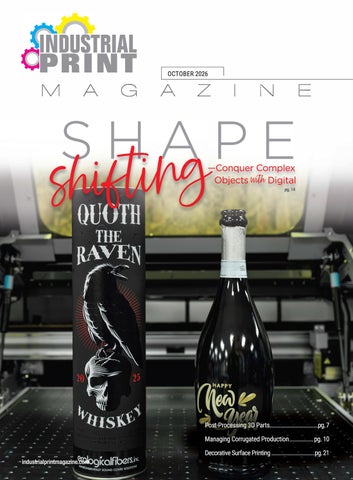
12 ON THE COVER The Mutoh America, Inc. XpertJet UF series of printers offer the capability to directly print on complex objects and shapes. See page 14.
industrialprtntmagazine.com
October 2026 [ Industrial Print Magazine J 3
DEVELOPMENT FOR MANUFACTURING FABTECH Preview
by Industrial Print Magazine Staff
FABTECH is North America’s largest metal forming, fabricating, welding, and finishing event. The show, which takes place October 21 to 23, 2026 in Las Vegas, NV, includes over 700,000 square feet of exhibition space. Travel to the Las Vegas Convention Center and visit with over 1,400 exhibitors to see the latest innovations. Apex Machine Group, booth C915, offers high-quality abrasive sanding machines and supplies for processing a variety of wood, metal, and composite/plastic products. It is a world leader in the metal deburring and finishing market. With a combination of 1 abrasive belts, oscillating discs, and rotating brushes, it is possible to grind, remove burr or slag, round edges, or polish your product in a single pass. Machines are available in widths from 13 to 64 inches wide and come in a variety of configurations. INFO# 163 AXYZ Routers, booth C7449, invites attendees to discover how AXYZ CNC routing and WARDJet waterjet cutting solutions help manufacturers improve precision, productivity, and efficiency. Whether you’re looking to increase production capacity, improve cut quality, reduce processing time, or explore new manufacturing possibilities, the team is available throughout the show to discuss your applications and learn more about the needs of your business. INFO# 164 Formlabs, booth N10025, highlights how its three-dimensional (3D) printing devices are used in sheet metal manufacturing. Formlabs is one of the largest suppliers of professional stereolithography and selective laser sintering 3D printers. INFO# 165 Hexagon Metrology, booth C1556, offers technology that enables manufacturers to harness and deploy data from all the key stages of the manufacturing process. Underpinned by the unique combination of both software and hardware, its portfolio of digital manufacturing technologies spans CAD 1. FABTECH takes place October 21 to 23, 2026 in Las Vegas, NV.
industrialprintmagazine.com
CAM and complementary software for production applications, metrology hardware and software solutions, as well as data management and analytics tools. INFO# 166 Laguna Tools, booth C1551, focuses on providing precision and quality machines that deliver speed; precise and consistent cuts; and reliability in metal workings’ most demanding applications. Its range of machines are ideal for high-performance results in both ferrous and non-ferrous metals. INFO# 167 Raise3D Technologies, booth N10024, demonstrates its capabilities to conceive, build, and offer its 3D printing products as a complete solution made up of printing hardware, software, and materials. Customers can find ever-growing value from what Raise3D offers, with an ecosystem continually expanding its capabilities synergistically. INFO# 168 Trotec Laser, booth N10050, highlights its laser systems, specifically the InMarker series with speed and accuracy for a range of applications, from industrial parts to high-volume production. An expert team is on hand to answer any questions and help you discover the ideal laser solutions for your business needs. INFO# 169 The 2026 event looks to be as exciting as last year’s. FABTECH 2025 concluded a four day run in Chicago, IL bringing together 42,000 manufacturing professionals and more than 1,700 exhibitors. IPM
October 2026 [ Industrial Print Magazine ] 5
MEETING EVOLVING REQUIREMENTS Smart Manufacturing for Aerospace & Defense Summit Preview
by AMG World Staff
Aerospace and defense manufacturers are at a pivotal juncture. Rising geopolitical risk, increased defense spending, and rapidly evolving mission requirements are driving demand for greater manufacturing capabilities and supply chain resilience. To keep pace and meet shifting customer expectations, manufacturers must adapt quickly by embracing digital transformation across their assets, processes, and workforce. However, achieving smart manufacturing while ensuring compliance and resilience requires more than incremental change; it de1 mands a coordinated, enterprise-wide approach to digitalization. Artificial intelligence (AI), automation, robotics, data science, and digital thread are reshaping defense-grade manufacturing by shortening innovation cycles, reducing lead times, lowering costs, improving supply chain visibility, and enabling faster responses to evolving requirements. On October 27, 2026, join industry leaders at the Smart Manufacturing for Aerospace & Defense Summit held by AMG World in Chicago, IL to discover how to deploy smart technologies, modernize operations, and build resilient, Industry 4.0-enabled aerospace and defense manufacturing and supply chain capabilities.
plants, future proofing manufacturing with continuous innovation, and workforce enablement. Of note, a timely discussion on leveraging AI, automation, robotics, and advanced manufacturing technologies to increase precision, scalability, and operational resilience. Also, how to establish an end-to-end digital manufacturing backbone, connecting engineering, production, supply chain, and sustainment across product lifecycles is an important topic. Join peer-led, interactive discussions to uncover how aerospace and defense manufacturers, including Bell Flight, GKN Aerospace, and Lockheed Martin are delivering precision at scale, speed without compromise, and excellence as standard.
Aerospace and Defense Leaders
Why Attend?
Join manufacturing practitioners and decision makers from organizations including CESMII, General Dynamics Mission Systems, GKN Aerospace, Leonardo DRS, Lockheed Martin, MxD, National Institute for Aviation Research, Pratt & Whitney, Rapta, Raytheon, and the United States Air Force. Throughout seminars and speaking engagements representatives from the aforementioned organizations discuss key themes including digital thread and data centric manufacturing, AI and intelligent automation, scaling digital
The event is the ideal opportunity to learn from aerospace and defense 4.0 experts in a collaborative setting. It delivers precision at scale and speed without compromise, with sponsors like AutoTime Solutions and Rapta AI offering a granular understanding of the industry’s needs.
1. On October 27, 2026 join industry leaders at the Smart Manufacturing for Aerospace & Defense Summit held by AMG World in Chicago, IL.
6 [ Industrial Print Magazine ] October 2026
Register Today For more details on the event visit bit.ly/AeroSMAC_IPM, email enquiries@amg-world.co.uk, or call +44 (0) 113 3970 379. Register using this 15 percent discount code, PARTNER15. IPM
industrialprintmagazine.com
AM
KEEPING PACE Automating Post Processing by Melissa Donovan
Traditionally, post-processing additive manufactured (AM) parts was a manual process—removing supports, depowering parts, sanding, polishing, and cleaning. Today, manufacturers invest in automated systems that reduce labor, improve repeatability, and increase throughput. Some of these may include automated depowdering stations, robotic support removal, automated bead blasting, conveyorized cleaning systems, and robotic loading and unloading mechanisms.
Push to Automation Labor, productivity, quality, and reliability are just some of the reasons manufacturers are automating the post processing of three-dimensional (3D) printed components. According to Andreas Hartmann, CEO/CTO, Solukon, metal AM in particular has matured quickly. “Build 1 volumes are up, part geometries are growing more complex, and industries like aerospace, autoAM moving beyond prototyping and into serial production, motive, and medical are demanding tighter tolerances and each job continues to need to be processed with no delays. full process documentation. Post processing and depowder- Manual solutions are slow, inconsistent, and tie up skilled ing in particular are the bottleneck that manual workflows operators. With production facilities running multiple printsimply can no longer overcome.” ers, they cannot afford bottlenecks at the end of the line, Hartmann believes explains Hartmann. there are three rea“The biggest driver sons the automation is simple. 3D printing of post-processing 3D has grown past proparts is expanding— totyping and into real scale and throughput production, and once pressure, part comyou are making parts plexity, and material — Michael Brokordt, marketing and sales manager, 1. Solukon offers a range of safety and compliance. metal depowdering systems MicroTek Finishing In terms of scale based on its SPR Smart Powder Recuperation technology. and throughput, with
Your printer can run all night, but if every part still has to be finished by hand, that is where the work piles up.
industrialprintmagazine.com
October 2026 [ Industrial Print Magazine ] 7
in volume, the hand finishing at the back end becomes the bottleneck. Your print er can run all night, but if every part still has to be finished by hand, that is where the work piles up," agrees Mi chael Brokordt, marketing and sales manager, MicroTek Finishing. Part complexity is commonplace. "Lattice structures, winding cooling channels, and internal geometries are what makes metal AM worth using and 2. Mass Finishing manufactures and sells a line of centrifugal barrel finishing machines called the HZ-Series. 3. MicroTek Finishing is an exclusive North American provider of MMP Technology, a su per-precision surface finishing process.
C O M PA N I E S M E N T I O N E D INFO# 155
156
157 158
Company
EDM Network, Inc.
also what makes manual depow dering unreliable. Powder trapped in channels smaller than one mil limeter cannot be shaken out by hand,'' states Hartmann. Material safety and compliance is more important than ever be fore, and automated systems are designed to monitor for safe ty issues. "Reactive metal powders like titanium or aluminum ,. alloys carry real occu pational health risks. Regulatory pressure and internal safety stan dards are pushing opera tors out of direct powder contact. Automated, closed loop depowdering systems contain the powder, protect the operator, and create an auditable process record,'' explains Hartmann. With skilled finishers harder to find and even harder to retain, automating the post 3D printing process inspires productiv ity, quality, and reliability. Brokordt ad mits that manual work presents room for error. "Manual work drifts from day to day and from one person to the next, which turns scheduling into a guessing game. On quality, a controlled process does it the same way every time. Two people finishing by hand, or the same person at the end of a long week, will give you slightly different results. When a part has to hit a specification, that consistency is the whole point. On reliability, you end up with a result you can repeat and count on, part after part. That is what lets a manufacturer
COMING NEXT ISSUE Beyond Traditional Ceramic Print Recycled Beverage Containers Al in 30 Ceramic Printing Corrugated Printing and Finishing 30 Ceramic Printers Chart and More!
Website
edmnetwork.com
massfin.com
Solukon
solukon.de
8 [lndustfia/ Print Magazine J October 2026
DUSTRIAL HINT
4'llllill'ii:ll See page 20 for more information.
Mass FinishinCJ, Inc.
MicroTek Finishing
treat finishing as a dependable step in production instead of a variable at the end of the line." Consistency is essential. Depend ing on the part and material, when manually finishing a 3D printed piece, Cole Mathisen, director business de velopment, Mass Finishing, Inc., says some clients might spend days trying to achieve the same surface finish as a part completed prior. This just isn't practical.
mmptechnoloqy.com
industrialprintmagazine.com
CORRUGATED
codes and serialized data are unique and compliant, regulatory information matches the target market, regional languages and graphics are correct, customer approvals are current, and production operators always receive the latest approved version. “Without workflow automation, these tasks become highly error prone. A single outdated artwork file or incorrect version can result in costly reprints, wasted material, recalls, or compliance issues. The challenge grows exponentially as the number of SKUs increases, making automated version control, approval management, and traceability essential,” says Sosnowksi. To minimize errors such as these from occurring, workflow systems offer a controlled and trackable process from order entry to production. Solutions include automated workflow validation, barcode and QR code tracking, version control, production scheduling rules, MES data collection, and real-time production feedback. With these tools in place, Sosnowksi believes that there is a “significantly lower risk of printing the wrong SKU, wrong language version, or outdated artwork.” Artificial intelligence (AI) is another tool that modern workflow solutions rely on to reduce errors. Its role in corrugated package production printing is increasing, especially as personalized, customized output is preferred. “Within digital corrugated production specifically, AI is increasingly used for automated file preparation, quality inspection using computer vision, adaptive color management, predictive maintenance of digital printheads,
C O M PA N I E S M E N T I O N E D
detection of workflow bottlenecks, and automated data extraction from purchase orders and customer documents,” lists Sosnowksi. In the future AI will be used in different ways, according to Sosnowksi. “It will move from providing recommendations toward semi-autonomous and eventually fully autonomous workflow decisions, further reducing manual intervention while increasing production efficiency.”
Modern Solutions Advantive’s Advantzware is a mid-market ERP software for packaging manufacturers that need to automate estimating, scheduling, inventory, and order-to-cash across corrugated, folding carton, point of purchase, paperboard, and foam fabrication operations. The solution offers a centralized database and integration to optional modules like ecommerce, CRM, and scheduling. Amtech Software connects quoting, scheduling, and the plant floor in one solution. EnCore ERP is the main system, built specifically as an ERP for corrugated sheet plants and integrated manufacturers. EnCore supports high-volume, high-complexity production environments with full operational visibility. Advanced Planning Board is AI-assisted scheduling that helps build better machine lineups with less manual effort. ScoreKeeper offers real-time machine monitoring to improve performance and reduce downtime on any machine—even older ones. Automated Performance Costing helps understand job profitability using cost models that match how a plant really runs. See page 20 for more information.
INFO# Company
Website
119
advantive.com
Advantive
120
Amtech Software
amtechsoftware.com
121
Fiery, LLC
fiery.com
122
HiFlow Solutions
hiflowsolutions.com
industrialprintmagazine.com
Fiery, LLC offers technologies with variable data printing capabilities that easily fit into any workflow. Fiery FreeForm Create is a free, standalone application that makes it easy to add personalization to any print job. Add variable text, images, QR codes, and barcodes to files in minutes to create impactful, customized pieces that connect with customers. Seamlessly integrated with Fiery servers, it’s the fast, free way to add value to every print. It offers data preflight as well as smart barcode detection. From the onboarding of a job through final invoicing and shipping, HiFlow MIS/MES is the umbrella that covers an entire business and production ecosystem. With over 70 configurable modules HiFlow tailors its software to fit each unique packaging business. HiFlow integrates product management, job management, artwork status, production planning, MES functionality, and data collection into a single environment. The goal is to ensure that every department works from the same approved information while maintaining full visibility and traceability throughout production. Recently, HiFlow introduced an AI-powered invoice processing module. It helps reduce manual invoice entry by capturing data from PDF invoices received via email and populating key invoice fields within the HiFlow ERP system, including line items, quantities, amounts, purchase order numbers, and vendor information. Prepared invoice data then moves into HiFlow’s standard Accounts Payable workflow for matching, approval routing, and posting.
Supporting Print Brands demand more personalized packaging, which influences software’s role in digital corrugated production. Today’s workflow solutions are tasked with managing data through the entire process, from prepress to final print and beyond. IPM
October 2026 [ Industrial Print Magazine ] 11
QUERI /
ADVANCEMENTS IN OTO PRINTING
D
by Cassandra Balentine
irect to object (DTO) printing continues to advance, leveraging digital print technology to accommodate customization and smaller print runs. Today, print buyers and custom ers print directly to almost any object. However, certain products-like curved, contoured, uneven, textured, tiered, and cylindrical-present challenges. Michael Perrelli, sales director, Innovative Digital Systems, says the demand for higher quality graphics on uniquely shaped products-from coolers and sports balls to tumblers and other drinkware-is driving much of today's innovation.
14 [lndustfia/ Print Magazine J October 2026
Growing Demand There is an uptick in DTO printing for industries such as sporting goods, footwear, and personal protective equip ment. Dan Valles, business development manager, OEM printheads, Epson, says examples include safety and sports helmets, shoe components, and other molded prod ucts with curved, textured, uneven, or tiered surfaces. Above: When it comes to irregularly shaped-but flat-objects, DPl's Cat alyst Camera Vision Al system allows companies to accurately print to the objects, based on the scanned shape. Examples of complex objects include holiday ornaments printed on either the DPI Aventra or Nexus UV printers with the Catalyst Camera Vision Al system.
industrialprintmagazine.com
2 plastics manufacturing coming back from overseas, which was traditionally produced and then pad printed with any additional marking or decoration. Manufacturers here are looking for different marking technologies that allow cost-effective short runs, and digital UV is a perfect replacement for pad printing and other older, more limiting technologies,” adds Riley.
Complex Considerations Compared with printing on flat surfaces, complex shapes present three primary challenges. First, the distance between the printhead and the object’s surface can vary significantly, making it
C O M PA N I E S M E N T I O N E D
difficult to maintain ink placement. Second, graphics and images can become distorted when applied on irregular surfaces, requiring pre-compensation based on the specific geometry of the object. Third, the angle that ink droplets land changes across different contours and slopes and can affect image quality, color consistency, and detail, explains Valles. Ink throw distance refers to the gap between an inkjet printhead and the item or substrate it is printing on. “When printing on smooth, flat surfaces using a flatbed printer or even around a cylindrical shape using cylindrical DTO printing, this gap will typically be a few millimeters. This is to ensure accurate See page 20 for more information.
INFO#
Company
Website
100
Boston Industrial Solutions, Inc.
bostonindustrialsolutions.com
101
DPI Lab, LLC
dpi-lab.com
102
Engineered Printing Solutions
epsvt.com
103
Epson
proimaging.epson.com
104
Inkcups
inkcups.com
105
Innovative Digital Systems
ids-digital.com
106
INX International Ink Co.
107
Koenig & Bauer Kammann (US) Inc.
inxinternational.com kammann.koenig-bauer.com
108
Mutoh America, Inc.
mutoh.com
109
Roland DGA Corp.
rolanddga.com
16 [ Industrial Print Magazine ] October 2026
placement of ink droplets and avoid any blurring, but it also helps to avoid spatter and nozzle damage. However, this has historically meant that items with irregular surfaces or variations in height or diameter were difficult or even impossible to decorate using DTO printing,” explains Gregory Harwood, director of digital product management and global service, Inkcups. “There are physical limits to how far shape following can be achieved, so verification for each target application is a prerequisite,” states Valles. Early DTO printers required an extremely small gap between the printhead and the surface of the substrate to maintain image quality. “While this worked well for flat objects or those with little to no height variation, it severely limited what decorators could print,” explains Perrelli. “As the object gets farther and farther from the printhead, you will lose quality from a combination of the alignment and the ability of the ink to effectively land in the right place. Cylindrical items are typically not difficult to print with inkjet, given the same curvature limitations. Many systems will use a smaller portion of the printhead when printing smaller diameters. This will slow down the print process but result in a higher quality imprint along the print surface,” notes Perrelli. Mosiah adds that on a complex 3D part, the distance and angle between the printhead and surface can change continuously, affecting dot placement, resolution, and ink deposition. The difficulty arises from the difference in height the ink must drop to the surface of the object. The ability to maintain accuracy with both detail 2. Engineered Printing Solutions supports printing on
curved, contoured, uneven, textured, and tiered products through inkjet systems.
industrialprintmagazine.com
and color over these distances is what makes UV printing so valuable in this space, says Rangel. With irregular objects, Liberman points out that the system has to maintain accurate drop placement across changing heights, angles, and distances from the printhead. Tapered walls, compound curves, handles, tiered features, and semi-spherical shapes can all affect registration and motion control. “The object may also need to be printed from a specific orientation, such as horizontally, vertically, from the side, or top down. In rotational applications, the motion of the part and the print system must be synchronized precisely.” Complex shapes once required artwork restrictions or alternative print methods because printheads, software, and ink technology had not yet evolved enough to
maintain accurate ink placement across uneven surfaces. As the distance between the printhead and the object changed, image registration, sharpness, and overall print quality quickly deteriorated. “Today’s high-gap printing technology has changed that. Advances in printheads, motion control, software, and UV inks allow decorators to produce crisp, vibrant graphics on curved, contoured, and irregularly shaped objects—opening the door to applications that were once considered impossible and/or limited,” adds Perrelli. Part handling is often as important as imaging. “The system has to understand what areas of the product can be touched, how the part can be held without distortion, what surfaces require pretreatment, and how to avoid contact with freshly printed areas. In many complex DTO
applications, solving the part-handling challenge comes before solving the print challenge,” offers Liberman. Complex parts can also have recesses, sharp transitions, textures, and varying surface characteristics. “The part must be accurately fixtured and the printing system must navigate the geometry without collisions while maintaining the required image quality,” adds Mosiah. For UV flatbed printers, the physical mechanism is effectively linear, and the systems are aligned to provide the highest print quality at a defined distance between the printhead and the target of the print. However, for curved surfaces Riley explains that the highest print quality is achieved within that alignment window. Since high-quality industrial printing is dependent on high levels of reliability and accuracy, Philip Chu, UV
#3 industrialprintmagazine.com
October 2026 [ Industrial Print Magazine ] 17
3 product manager, Roland DGA Corp., says a fixture or jig helps ensure both, “as printing directly on irregular shapes by themselves often requires multiple touches that can slow down your production process.”
Achieving Consistency Consistent image quality must be maintained across varying heights, angles, and textures when printing to unique objects. Liberman feels that consistent image quality comes from controlling the full process. “That includes the substrate, pretreatment, ink, printhead position, motion system, cure strategy, fixturing, automation, and inspection. For complex objects, repeatability depends on how consistently the product is presented to the print system and how well the process accounts for geometry, surface condition, and normal production variation.” 3. Inkcups manufactures the Helix family of cylindri-
cal inkjet printers designed to digitally decorate 360 degrees around reusable drinkware, wine bottles, cans, and cosmetic containers. 4. Koenig & Bauer Kammann has developed software that makes decorating complex shapes possible. It accounts for surfaces that change height, angle, and curvature across a single decoration pass.
18 [ Industrial Print Magazine ] October 2026
Valles shares that 3D shape data it can pre-compensate for image scaling and control dot spread through curing, helping to ensure uniform image quality across 3D surfaces. In addition, it combines this with path control that keeps the head-to-work distance within the appropriate range, as well as printing technologies that make the seams between multiple paths less noticeable. The placement of the printhead in relation to the substrate or object to be printed is critical to consistency. “The printhead and/or the object needs to be manipulated in such a way so the printhead has as consistent and as close a gap as possible. To accomplish this, an accurate motion control system is required. The system itself must know how the object is sized or oriented in such a manner that it can calculate the motion,” explains Paul Edwards, VP, digital division, INX International Ink Co. Generally image quality is maintained through control of the dot size as well as the speed of the carriage moving over the object. “We have found that slowing the carriage speed down by sometimes up to less than half the normal speed of
standard first surface printing gives the most optimal results,” says Rangel. Accurate positioning of the part and understanding its geometry is essential. “Depending on the application, this can involve precision fixturing, controlled motion, printhead positioning, software compensation, and carefully selected print parameters,” adds Mosiah. Ink management is also critical. “Temperature control and active circulation keep the ink system stable across the full production run. Viscosity drift and temperature variation are two of the fastest ways to lose consistency on a complex shape, and eliminating those variables is built into how the machine operates rather than left to the operator to manage,” explains White. Mosiah points out that the ink must wet the surface appropriately, maintain image definition, and provide required adhesion and durability. “Ultimately, consistent DTO quality comes from coordinating the mechanical system, software, printheads, inks, and substrate preparation as one integrated process.” The combination of powerful modern printheads, specialized software, and the right ink formulation give highgap printing the ability to maintain exceptional image quality across height variations. “Additionally, engineering teams constantly invent fixturing solutions that maximize print size, image quality, and product consistency. With the advanced power of today’s high-gap UV printers, no shape is off limits and decorators can now offer more value to their customers than ever before,” shares Perrelli. Pretreatment is often central to maintaining consistency in DTO printing. “Print quality is partly a surface outcome. Pretreatment raises surface energy, improves wetting, and creates a more uniform foundation so ink droplets can flow together into a smoother film. It can also reduce defects caused by contamination, fingerprints, molding residues,
industrialprintmagazine.com
or surface-active additives that may interfere with adhesion and appearance,” adds Liberman.
Notes on Ink Ink formulations also evolve to support more complex DTO applications. The challenge is that many industrial parts are not designed with printability in mind. “Plastics can have low surface energy, carry molding residues, or contain additives that migrate to the surface. Smooth materials such as glass and some metals can also be difficult because they may not provide the surface characteristics needed for reliable bonding, even when they appear clean. As a result, ink formulation must be considered alongside pretreatment and cure strategy,” says Liberman. Modern DTO applications often require inks and pretreatments be tested together for the exact substrate and end-use requirement. “Flame, plasma, corona, and pyrosil treatments are used to modify or prepare surfaces, while dry ice blasting or other cleaning methods may be needed when contamination is the barrier. The key point is that ink alone does not solve every application. Adhesion and image quality are system results influenced by substrate chemistry, surface condition, ink formulation, curing, and the mechanical or chemical stresses the part will face in use,” shares Liberman. Primer development evolves in parallel, comments White. “A reliable, automated primer application changes what’s possible in terms of adhesion and durability, particularly on surfaces and substrates that have traditionally been difficult to decorate.” Industrial inks are engineered for specific materials and end use requirements, including adhesion to plastics, composites, metals, and coated surfaces, as well as resistance to abrasion, chemicals, and environmental exposure. “For complex DTO applications,
industrialprintmagazine.com
4 controlling wetting, spreading, curing, and adhesion is important. The trend is toward application-specific ink solutions that are matched to the substrate, surface preparation, printing process, and durability requirements of the finished product,” notes Mosiah.
The complexities of ink formulation can take several forms. Edwards says substrates can often be a challenge as far as achieving the adhesion and robustness required. “Printheads now have a capability of printing from very low to quite high viscosities for inkjet.
#1 October 2026 [ Industrial Print Magazine ] 19
1 Dealing with Demand Tactile decorative printing is experiencing rapid growth. Market trends drive demand for more realistic digitally printed surfaces, with certain industries leading the adoption of digitally textured printing to create many types of applications—from flooring to cabinets and furniture. The “trailblazer” of digitally textured printing is the flooring industry, according to Dr. Anke Pankoke, head of marketing/PR, Hymmen GmbH Maschinen- und Anlagenbau. However, the furniture industry is quickly becoming interested. “Not only because of the advantages of digital printing for flexibility and cost effectiveness but also concerning multiple design options including texture on unicolored surfaces that create unknown optical effects.” 1. Digitally printed black tiles depicting structure, with and without underlying décor. Image is courtesy of Hymmen and showcases the capabilities of its print portfolio. 2. Mimaki’s UV LED ink can be deposited in multiple layers, building measurable surface height, enabling a digital printer to create peaks, valleys, grain structures, and embossed effects directly during the production process.
22 [ Industrial Print Magazine ] October 2026
Todd Rhinerson, senior specialist, product planning, Canon U.S.A., Inc., says some of the strongest adoption is in interior design and architecture. “Think replicating realistic wood grains or concrete textures on rigid panels, as well as luxury packaging and premium retail displays where ‘touch’ can help influence a purchase.” Another segment using digital print is fine art reproduction. “Recreating an artist’s actual brushstrokes can add incredible value, alongside functional applications like tactile signage and braille,” adds Rhinerson. “Across applications ranging from luxury vinyl tile and laminate flooring to cabinetry, furniture, wall panels, and architectural surfaces, digital tactile printing is evolving from a niche innovation into a core manufacturing strategy,” notes Rob Nelson, senior segment manager, Mimaki USA, Inc. These industries add digital printing into their production facilities to meet demand from customers, who are fielding requests for tactile digital printing from their customers.
“When you look at what’s driving this rapid growth in tactile digital printing, it really boils down to three things. First, we see a collective ‘haptic craving.’ Consumers are fatigued by flat, digital screens and are drawn to physical, touchable experiences. Second, sourcing materials such as wood and stone can be expensive and logistically demanding. And third, digital flatbeds have all but removed some expensive, time-consuming barriers, which provides the potential to make short-run textured prints profitable,” explains Rhinerson. Nelson believes that consumers, architects, as well as product and interior designers are no longer willing to compromise between aesthetics, customization, and performance. Instead they expect all three. “Digital printing technologies are uniquely equipped to meet these demands, enabling manufacturers to create highly authentic, customizable, and durable surfaces on demand.”
Delete the Repeat The elimination of pattern repeats is important for decorative applications like flooring, cabinets, and furniture. One of the reasons users are attracted to digital printing is because it is cost effective. “Consumers increasingly seek premium, natural-looking aesthetics without the high cost, supply constraints, or environmental impact associated with authentic materials. Digital printing makes it possible to replicate the beauty of rare woods, natural stone, marble, leather, and textiles on engineered substrates with exceptional realism. An oak-inspired floor, for example, can deliver the visual appeal of premium timber while reducing reliance on limited natural resources and supporting more sustainable manufacturing practices,” explains Nelson. Buyers look for authenticity. Eliminating repetition gets close to the original as possible. “When we look at natural materials, whether it’s an oak plank,
industrialprintmagazine.com
a slab of marble, or a walnut cabinet face, nature never repeats itself. Every knot, marble veining, and grain swirl is unique,” shares Rhinerson. “If you’ve ever walked into a room with laminate flooring, tiled backsplash, or looked at a set of kitchen cabinets and immediately spotted the exact same knot or swirl over and over, your brain instantly recognizes a pattern. It breaks the organic illusion and can even create a mechanical look,” admits Rhinerson. According to Kitt Jones, business development and product manager, Roland DGA Corp., “repeating patterns immediately signal that a surface is manufactured rather than natural, reducing the perceived value of products such as flooring, cabinetry, furniture, and decorative panels. Industrial UV digital printing allows manufacturers to produce natural non-repeating textures significantly reducing visible pattern repetition while maintaining precise color consistency and production efficiency.” Dr. Pankoke agrees, saying one of the main achievements of digital printing is getting as close to nature as possible— especially because in nature there are no repetitions in design at all. The larger the surface area of the graphic, the more important it is to have no or few repetitions as possible. It is challenging to achieve this goal when using other traditional print methods. Digital printing makes it possible because a huge amount of data can be stored in the printer, for example 50 to 100 different flooring planks. This is opposed to only five to eight planks on the gravure cylinder of an analog press, explains Dr. Pankoke. “Digital printing has revolutionized this by shifting from print cylinders, dies, and films to digital files, which allows for today’s digital printers to process massive, non-repeating image layouts. Instead of a handful of unique planks, digital workflows can output dozens of entirely distinct boards or
industrialprintmagazine.com
2 massive, continuous panels before a single design element ever repeats,” continues Rhinerson.
Closer Everyday Thanks to the elimination of repeated patterns, digital decorative or textured printing is very close to replicating the appearance of natural materials. “The ‘look and feel’ is already so close to nature that even experts need to take a very close look against the light to distinguish between the original and the copy,” admits Dr. Pankoke. Rhinerson believes that two things still need to be addressed in terms of replicating the appearance of natural materials—multi-texture features and file creation bottlenecks. Regarding multi-texture, Rhinerson notes that “nature isn’t one uniform look regarding surface finish. Replicating contrasting variable gloss levels is something that’s still being tackled.” In terms of file creation bottlenecks, “creating 3D displacement maps typically requires highly specialized design skills and long hours to generate true,
realistic dimensional print-ready files. Thankfully, software and artificial intelligence (AI) are constantly evolving to help shorten and simplify that process,” continues Rhinerson. If there is any challenge left to overcome, Dr. Pankoke believes it isn’t so much visual, but the feel of the material and the sound when walking on it. “The remaining challenge is not image quality, but continuing to improve designs and depth to perfectly replicate the uniqueness found in nature,” seconds Jones. Bridging the gap between sight and touch, Canon’s PRISMAelevate XL allows for building up to four millimeters of unassisted elevation on the Canon Arizona 1300 and 2300 series printers. “This means when you look at a printed piece of distressed oak, you can now physically feel the ridges, the grain, and dips that your eye has already registered. We’re no longer just creating an imitation; we are engineering a sensory experience,” asserts Rhinerson. “Nature is infinitely complex. Reproducing every microscopic variation in
October 2026 [ Industrial Print Magazine ] 23
is crucial for clean, crisp images. High resolutions and pinpoint head positioning means that ink can be deposited with extreme accuracy, creating smooth gradations and very sharp definition,” explains Rhinerson. Many of today’s wide format flatbed printers offer the ability to raise the print carriage. “When building height, it’s crucial for the print carriage to adjust along with the ink build to avoid printhead strikes and to maintain dot registration. Having the ability to automatically raise the carriage between physical passes of the gantry, precise dot control can be maintained without the need for operator intervention,” says Rhinerson.
3 wood fiber or stone crystallization is still difficult. But the gap is narrowing rapidly. The largest issue is scale, can digital production keep up with industrial needs? The more relevant question has become—how can we use digital technology to improve upon nature and create experiences, functionality, and differentiations that natural materials alone cannot provide?” asks Nelson.
Improvements Make it Possible Digital hardware, ink, and software evolve along with buyer and user expectations. Each part of the process brings 3. A board entering the Hymmen Digital Lacquer Em-
bossing Unit, which is capable of producing tactile depths up to more than 20 μm. 4. Mimaki’s specially formulated UV LED inks produce safe, color accurate, and long lasting prints.
24 [ Industrial Print Magazine ] October 2026
digital decorative printing closer to not only the appearance but also the feel of natural surfaces such as wood, concrete, or marble. “The shift from ‘flat’ to ‘felt’ relies heavily on the hardware, inks, and software working together,” admits Rhinerson. Hardware Improvements in print resolution, color gamut, and printheads contribute to decorative printing that yields more realistic applications like flooring, cabinets, and furniture. New technologies offer precision and accuracy. “Since creating texture with a digital printer relies on multiple passes of the print carriage to jet one ink drop directly on top of another, a precise drop size and dot placement
Ink Ink also evolves to support digital tactile printing. The process of layering ink to create texture is notable. Hymmen uses a patented Digital Lacquer Embossing technology to produce tactile depths up to more than 20 μm. “This technology uses a different type of ink to emboss the surface in the desired design. The relevant design is derived with a special software tool from the original four-color picture with the natural look,” explains Dr. Pankoke. Another option is UV LED ink. “To build physical dimension, instant cure inks with outstanding adhesion properties are necessary. The non-evaporative nature of UV LED cure inks instantly ‘freeze’ the droplet in place before it can spread out. This allows UV printers to stack layers to achieve dimension,” shares Rhinerson. Ink sets like Canon’s IJC357 are designed with a unique balance of flexibility and adhesion. Especially when printing tactile elements on challenging substrates like wood or plastics, these inks are designed to bond well and to help users create highly durable surfaces that can hold up over time. Mimaki’s specially formulated UV LED inks have grown a niche market
industrialprintmagazine.com
in the industry, producing safe, color accurate, and long-lasting inks. Most of the company’s UV printer lines can produce tactile printing. The ink can be deposited in multiple layers, building measurable surface height, enabling a printer to create peaks, valleys, grain structures, and embossed effects directly during production. All of Roland’s UV inkjets, including flatbeds within the VersaObject family and roll-to-roll models in the TrueVis Series, make incorporating eye-catching special effects quick and simple, according to the company. Roland’s Dimense digital printing system works differently than UV printing methods, but it’s also capable of creating physical surface texture, which it accomplishes through a specialized ink, media, and heat process, but is limited to Dimense roll-fed media. Software Software plays a key role in creating realistic textured surfaces, with AI and advanced imaging developing textured print files at an increased pace. “The software component ties this all together. As the inks and hardware evolve, so does the software,” admits Rhinerson. What used to take hours to create layer stacking using technical graphic software, can now take minutes with dedicated prepress software.” For example, Canon’s PRISMAelevate XL or PRISMAguide XL software streamlines the textured file creation process, even allowing for on-screen 3D previews and providing ink utilization estimates for each print. Hymmen ECHO—Easy Color Calibration & Homogenious Output—shifts defect correction and homogenization from hardware-based control to an intelligent, software-driven solution. “This delivers measurable benefits for our customers, including reduced setup times, lower hardware wear, and enhanced color accuracy. The hardware or printheads can always be kept running at their best performance
industrialprintmagazine.com
4 level without changing the hardware settings at all,” notes Dr. Pankoke. AI is used in this application, says Rhinerson. Software such as Canon’s HeightIQ uses AI to quickly view and recognize elements in an image, then generate the grayscale render used to create elevation. “With the ability to easily manipulate digital files, a new world opens up. Digital file designs can now create those seemingly conflicting, random, and contradictory patterns that we see throughout nature, and with the prevalence of AI-assisted designing, it will only make it more random and therefore, more natural looking,” adds Nelson. Jones believes AI is poised to accelerate the design process and creation of unique, non-repeating surface designs that further enhance realism and customization.
Functioning Focus Beyond appearance, functional advantages such as scratch resistance, anti-fingerprint, antimicrobial, and wear resistance are provided by digitally printed textured surfaces. These are each created using different methods. Hymmen tests lacquers and inks with its partner, Hesse Lignal, to create the ideal combination for the situation at hand. The correct thickness of each layer, the time it takes to dry, and amount of steps between printer and base coat influence the function of the textured surface. “Of all the functional demands we hear of, wear and scratch resistance is most frequently requested. If you are printing textures for surfaces that experience physical interaction, like braille and wayfinding signage, the print has to stand up to everyday wear. When we
October 2026 [ Industrial Print Magazine ] 25
5 talk about maximizing the durability of textured or elevated prints it starts with a highly durable yet somewhat flexible ink. Combine that with proper surface preparation and additional finishing steps depending on the application,” advises Rhinerson. For the flooring industry, Dr. Pankoke says there are higher standards for scratch and wear resistance. Furniture manufacturers prioritize anti-fingerprint and antimicrobial features. “Anti-fingerprint and antimicrobial finishes are also gaining traction in healthcare, hospitality, retail, and commercial interiors, where cleanliness and 5. Using software like PRISMAelevate XL with a Canon Arizona 1300 or 2300 series flatbed printer, users can do more than create a non-repeating visual; they can build physical, tactile textures directly on top of it with outstanding registration.
C O M PA N I E S M E N T I O N E D
ease of maintenance are key purchasing factors,” explains Jones.
Compared to Analog Digital texture printing offers manufacturers a host of advantages compared to traditional embossing methods commonly used for decorative applications like flooring, cabinets, and furniture. “Traditional texturing, whether you’re making flooring, cabinets, or furniture components, relies on physical tooling like engraved steel rollers, stamping plates, or heavy machining dies. Digital printing textures can remove many of the bottlenecks associated with the traditional approach— reducing set up costs and capital expenditures, limiting costly downtime, and enhancing customization and design agility,” says Rhinerson. See page 20 for more information.
INFO# Company
Website
112
Canon U.S.A., Inc.
usa.canon.com
113
Hesse Lignal
hesse-lignal.com
114
Hymmen GmbH Maschinen- und Anlagenbau
hymmen.com
115
Mimaki USA, Inc.
mimakiusa.com
116
Roland DGA Corp.
rolanddga.com
26 [ Industrial Print Magazine ] October 2026
Customization is one of the more attractive benefits. Users “can create all manner of wood grain textured, stone type, embossing, and even material effects. Also, the ability to print a small test amount to make sure it matches your desired effect before committing to the expense of longer runs is huge,” adds Nelson. According to Dr. Pankoke, digital lacquer embossing is finally closing the gap between the advantages of digital décor printing and the structuring process. “Digital embossing is catching up in terms of flexibility and economic benefits. All of the advantages of digital printing such as shorter time to market, lower stock size (capital expenditure), and individual customer décors, are now also available with embossing.” “Creating a textured roller for embossing, or a set of stamping dies can cost thousands of dollars along with weeks of manufacturing. Because of this, the manufacturer must often commit to large order quantities just to break even on the tooling portion. Even a simple mockup or prototype can cost time and money. Digital printing replaces the tooling with a digital file, drastically reducing setup time and upfront costs. You can create a single prototype or short run just as you can a run of thousands,” notes Rhinerson.
The Real Thing Digital decorative surface printing offers both practical and aesthetic benefits. The use of this technology over more traditional processes continues to grow as it succeeds in recreating textures and patterns only seen in nature. “Digital printing has come staggeringly close to replicating natural materials. Thanks to high-resolution printheads, wide color gamuts, and equipment precision, a digitally printed wood grain or marble slab can easily fool the eye from a normal viewing distance,” says Rhinerson. IPM
industrialprintmagazine.com
swissaprint
MADE FOR WINNERS LOVED BY THOUSANDS