SEPTEMBER 2026
dpsmagazine.com
PLUS: AI Drives Variable Data LOUPE Americas Preview PRINTING United Preview Transactional Print
INFO #1
tab e
0
contents �'26
features 1711 Print, Personalized with Al How Al is Transforming Variable Data Printing 20 II Security in Transactional Print Mailing and Fulfillment Tools
departments Editor's Letter ..... .................................................................... .........4 Work Smarter Spotlight Investing in Success .......................................................................6 Showtime PRINTING United Preview
.........8
LOUPE Around the Corner
... 14
Recent Events ................................................................................ 16 thINK Ahead 2026 Advertiser Index .....................
.............................................. 26
Companies Mentioned .........
.............................................. 26
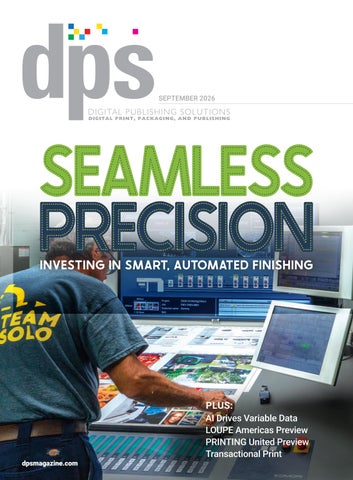
I On the cover: Solo Printing is a full service, high-volume commer cial print provider. See page 6.
dpsmagazine.com
September 2026 II dps II 3
dpsmagazine.com Volume 28, Number 5 • ISSN: 1529-2320
Work Smarter Technology is evolving. It’s hard to go even an hour without touching or talking about artificial intelligence (AI), which provides functionally across an array of print-related areas, including data management, preflighting, workflow automation, and reporting. In this issue we look at the role of AI when it comes to variable data publishing (VDP). Print providers utilize AI functionality to help with
Print providers utilize AI functionality to help with imposition, address cleaning, as well as up and cross selling. imposition, address cleaning, as well as up and cross selling. However, it is critical that it be approached with caution. Find an in-depth discussion on this topic in our feature article, Print, Personalized with AI, as well as web-exclusive content and a webinar at dpsmagazine.com. We also discuss advancements in file-based processing, specifically when it comes to transactional printing and finishing. Security in Transactional Printing highlights how today’s smart inserters provide piece-level accountability as well as detailed reports.
EDITOR IN CHIEF Thomas Tetreault 978-921-7850 EDITOR Cassandra Balentine cbalentine@rockportpubs.com ASSOCIATE EDITOR Melissa Donovan mdonovan@rockportpubs.com ART DIRECTOR Sarah M. White swhite@rockportpubs.com WEB EDITOR Melissa Mueller CONTRIBUTORS Marco Boer, Kemal Carr, Olivia Cahoon, Richard Huff ADVERTISING SALES PUBLISHER Thomas Tetreault 300 Newburyport Turnpike Ste. 11 Rowley, Massachusetts 01969 Ph 978-921-7850 x110 • Fx 978-921-7870 edit@rockportpubs.com SALES Amanda Doyon Ph 978-921-7850 x170 • Fx 978-921-7870 adoyon@rockportpubs.com Subscribe online at dpsmagazine.com
Also in this issue, our Spotlight section features Solo Printing. This FLbased print provider thrives with the help of advanced finishing solutions from Muller Martini and MBO Americas. As we head towards trade show season, we highlight two print-focused shows, LOUPE Americas and PRINTING United, each taking place this Fall. Last but not least, find a recap of the thINK Ahead 2026 event that occurred in July.
Cheers,
CORPORATE & PUBLISHING OFFICE 300 Newburyport Turnpike Ste. 11 Rowley, Massachusetts 01969 ROCKPORT CUSTOM PUBLISHING, LLC CHAIRMAN Jeffrey Jensen PRESIDENT & CEO Thomas Tetreault CONTROLLER Missy Tyler
Cassandra Balentine, editor cbalentine@rockportpubs.com
Digital Publishing Solutions is published by Rockport Custom Publishing, LLC. Please send change of address forms to: 300 Newburyport Turnpike, Ste. 11, Rowley, MA 01969. © Rockport Custom Publishing, LLC 2026. Reproduction by any means of the whole or part of Digital Publishing Solutions without written permission from the publisher is prohibited. Views expressed in the editorial pages do not imply our endorsement. Subscription Rates: U.S. $41.65 per year, seven issues; single copies: $5.95, Canada and Mexico: $52.22 (U.S.D.), Other international subscriptions: $71.05 (U.S.D.) Vendors: We welcome your product news. Include prices, slides, photos, and digital files with your press release. Please forward product samples and media kits to Reviews Editor, DPS Magazine, 300 Newburyport Turnpike, Ste. 11, Rowley, MA 01969. We cannot be responsible for unsolicited product samples.
4 || dps || September 2026
dpsmagazine.com
INFO #10
spotlight
Investing in Success
Solo Printing Utilizes the Latest Technologies to Expand Business By Cassandra Balentine
Today's print providers are challenged with evolving customer demands, rising costs, and labor shortages. Actions like investing in new technologies-including digital print and finishing equipment; focusing on workflow automation and optimization, emphasizing customer service, and prioritizing production scalability, are all critical factors for success. For Solo Printing, staying competitive It serves a range of industries including We also see that our clients value hav while continuing to invest in technology hospitality, tourism, financial, healthcare, ing printing, finishing, mailing, and ful and workflow automation is a priority. automotive, and nonprofits. "We focus on fillment managed under one roof, which Established in 1985, the business delivering high-quality print production simplifies logistics, improves turnaround is one of the nation's largest minor with speed, consistency, and operational times, and creates production efficien ity owned printing companies and em reliability," shares Robert Hernandez, VP cies," offers Hernandez. ployees a staff of approximately 150 of sales, Solo Printing. people. Offering superior color lithog Direct mail and commercial print pro Well Rounded Portfolio raphy, its 180,000-square foot facility duction are among most in-demand ser Solo Printing adapted for success in is located in the Doral/Airport area of vices. "Year over year, businesses contin print production by focusing heavily on Miami, FL. It serves clients across the ue to rely on physical marketing to drive operational efficiency, production scal engagement and customer response. ability, and customer service. "We reU.S. and the Caribbean. The full-service, high-volume main competitive in a evolving industry by investing in new commercial printer specializes in web offset, sheet-fed, and digi equipment, workflow optimiza Year over year, businesses continue tal print production. Its core ser tion, automation, and integrated to rely on physical marketing to drive vices include direct mail, bind engagement and customer response. 1. & 2. Established in 1985, Solo Print ing, finishing, packaging support, ing's 180,000-square foot facility is lo fulfillment, and large-scale com - Robert Hernandez, VP of sales, Solo Printing cated in the Doral/Airport area of Miami, mercial print manufacturing for FL. It serves clients across the U.S. and businesses and organizations. the Caribbean.
6 II dps II September 2026
dpsmagazine.com
finishing and direct mailing capabilities. Our ability to manage complex projects in house also allows us to maintain quality control and deliver consistent results at scale,” shares Hernandez. To support its diverse portfolio of print products, Solo Printing has a robust lineup of printing and finishing equipment. For offset, it relies primarily on Komori machines. While digital print only makes up a small portion of its business, it has an impressive press lineup that includes a Xerox Iridesse Press with inline Plockmatic 35 Trimmer, Fujifilm Revoria Press PC1120S, and BlueCrest EvoleJet inkjet printing system. The company also operates an array of finishing equipment. Its bindery department includes solutions from MBO, Palamides, Polar, Muller Martini, and Bograma.
Solo Printing invested in two Muller Martini Alegro perfect binders just a few years ago, and Hernandez finds them to be a valuable addition to its production floor. The binders have helped increase efficiency while maintaining the quality and consistency its customers expect. For mailing and fulfillment it runs automated collating and shrink wrap systems, inkjet equipment, tabbing solutions, polybagging and labeling systems, and a high-integrity inserting machine.
Investing in the Future Solo Printing plans to continue growth through operational efficiency, technology investments, and by strengthening integrated service offerings. As a high-volume commercial printer, it is focused on improving customer experience by maintaining and adding
services to its ecosystem so it can continue to complete all print projects under one roof. “Clients look for partners that can simplify execution, improve turnaround times, and deliver consistent quality at scale,” says Hernandez. “That is where we see the industry continuing to move.” Solo Printing is focused on capabilities that allow it to operate more efficiently while maintaining the level of service and reliability its customers expect. “At the end of the day, the goal is sustainable growth. We want to continue evolving with the industry while staying focused on what has always mattered most—strong relationships, operational excellence, and delivering results for our customers,” concludes Hernandez. dps See page 26 for more information.
INFO #15 dpsmagazine.com
September 2026 || dps || 7
•
showtime
PRINTING United 2026
The Industry Convenes in Las Vegas, NV By OPS Magazine Staff
PRINTING United Expo highlights the latest innovations across commercial, industrial, apparel, packaging, mailing, in plant, and wide format printing. The event promises attendees will find better ways to work, new ideas to explore, and a clearer sense of what to do next. Hosted by the PRINTING United Alli ance, the PRINTING United Expo 2026, takes place September 23 to 25, at the Las Vegas Convention Center in Las Ve gas, NV.
On the Floor Among the hundreds of exhibitors, we highlight what to expect from just a few. Find more coverage at dpsmagazine.com. Canon U.S.A., Inc., booth N5801, shows its portfolio of production and large format technologies. Highlights include live demonstrations of the varioPRINT iXl 700 sheetfed inkjet press and an appli cation gallery featuring the varioPRESS iV7 B2+ sheetfed inkjet press. Attendees can also see the imagePRESS V family of digital color presses in action printing high-value applications and the varioPRINT 6000 TITAN digital monochrome
press. Large format solutions displayed include the Colorado XL-series, Colorado M-series, Arizona 2380 GTF, and the new DigiTech Texas ST2/Xl flatbed printer. Canon's imagePROGRAF GP-4600S and TZ-3200 MFP Z36 are also shown alongside exciting new product additions to the imagePROGRAF portfolio. To demonstrate complete end-to-end pro duction, Canon features PRISMA work flow software and third-party finishing solutions. INFO# 210 Customer's Canvas, booth C230, demonstrates its personalization plat form for companies building custom print ordering and campaign workflows, including a new embeddable Direct Mail Solution for personalized, data-driven campaigns. For print providers that want to launch faster without custom de velopment, it also shows the Customer's
Canvas B2B Portal with controlled tem plates, approvals, easy reordering, and production-ready output. Specialized workflows for commercial print, large format, and promotional products are also displayed. INFO# 211 Domino, booth C2673, features the new Domino N410 digital LED inkjet label press. This is the first exhibition for the Domino N410 in North America. The Domino N410 is an entry-level, low cost digital press from a trusted supplier with world-class service and support. The N410 has a small footprint and produces labels at print speeds up to 164 feet per minute. N410 has a 13-inch web width, provides consistent five-color CMYK+W 1. Standard Finishing Systems offers live, on-demand demonstrations of over 20 Horizon solutions in booth N5828. 2. Canon's highlights the varioPRINT iX1700 sheetfed inkjet press in booth N5801.
I 2
8 II dps II September 2026
dpsmagazine.com
INFO #14
print, and enables production of highquality labels with 600 dpi resolution for a range of applications. INFO# 212 Drytac, booth C1937, invites visitors to explore five decades of adhesive science innovation alongside its latest print media and graphic solutions. Highlights include the recently announced Polar Chrome silver PET print media as well as collaborative demonstrations showcasing how its materials are designed to help graphics professionals create high-performance installations across multiple markets. INFO# 213 Duplo USA, booth N5323, features an interactive booth designed to showcase print finishing solutions for every stage of business growth. Organized into three solution zones—Start Strong, Grow with Confidence, and Stay Ahead, each feature live demonstrations of scalable finishing technologies that help print providers improve efficiency, increase profitability, and expand capabilities. Whether looking to automate everyday workflows or invest in advanced production finishing, Duplo’s experts tailor solutions for your business goals. INFO# 214
EFI, booth C2115, showcases its latest innovations in wide format digital printing and workflow automation. On display EFI VUTEk FabriVU i8, EFI VUTEk M3h X, EFI VUTEk X5r, EFI VUTEk Q3h XP, and the EFInsight cloud-based business intelligence platform. INFO# 215 EMT International, booth N5229, features the production-ready Vira Cutter and Stacker in a live automated finishing workflow. Running pharmaceutical, direct mail, postcard, and commercial print applications, the system showcases the flexibility and performance of EMT’s latest cut-to-stack solution. INFO# 216 EngView Systems, booth C1328, highlights EngView Package & Display Designer software. Discover the latest tools for the structural design of packaging, point of purchase/sale displays, and exhibition booths, helping designers move efficiently from creative concepts to production-ready files. INFO# 217 Felix Scholler, booth C1974, highlights RubyPaper, a new photographic paper for industrial photo production on high-speed inkjet systems. RubyPaper combines the traditional look and feel of
INFO #7
10 || dps || September 2026
photographic paper with a more efficient production process. INFO# 218 Fiery, booth C1449, showcases its latest RIP and workflow solutions designed to power every corner of the digital print room. From previews of next-generation Fiery digital front end technology to the latest software innovations for commercial, large format, textile, direct to film, and industrial print production, visitors experience the cutting edge of digital print technology live at the show. INFO# 219 GBC, booth N5521, demonstrates the GBC LamPrix 100 Laminator in action, delivering fully automated lamination and trimming at speeds of up to 100 sheets per minute, alongside SEAL production laminators and the MagnaPunch Elite modular punching system. INFO# 220 General Formulations (GF), booth C523, introduces Quick-Split Scored Liner. Designed for speed, precision, and efficiency, Quick-Split Scored Liner is engineered to streamline installation and application workflows, enabling faster and more efficient application of stickers, decals, window graphics, and point of purchase displays. GF offers Quick-Split Scored Liner in wide format media, narrow format digital, and screen and offset sheets. INFO# 221 Graphic Finishing Partners, booth C2640, features its 663TH Smart Technology 63-inch heat-assist laminator as well as many other laminator models to fit your graphic finishing needs. Smart Technology simplifies your set-up and production capabilities. INFO# 222 HP, booth C1715, highlights the latest innovations from its Graphics Solutions Business, showcasing how print providers and brands can enhance productivity, streamline operations, and unlock new growth opportunities. Throughout the event attendees can watch live demonstrations and enjoy firsthand access to the company’s newest technologies and solutions. INFO# 223 Inkcups, booth C1215, demonstrates how its latest direct-to-object solutions,
dpsmagazine.com
including the new Helix High Throw UV cylindrical printer and the X5-T High Throw flatbed printer, expand what’s possible with direct-to-object printing. Inkcups also showcases some of its popular pad printing solutions, including the B100 1-Color and 2200-PS 2-Color pad printers. INFO# 224 INX, booth C2649, features advanced digital print for packaging through innovation in inkjet chemistry, printhead capability, and production system design. Learn more about the technologies enabling reliable, highquality digital printing and the next phase of digital manufacturing for packaging applications. INFO# 225 Kongsberg Precision Cutting Systems and MultiCam, booth C300, highlight how connected production workflows enhance precision, productivity,
and scalability across print, display, packaging, and signage applications. See the Kongsberg Ultimate equipped with the Roll Feeder and the C-series fitted with the Smart Material Handler in action, and witness the global debut of MultiCam’s latest routing technology. INFO# 226 Kyocera, booth N5043, showcases its expanding inkjet portfolio. The event comes during a landmark year for Kyocera in the inkjet industry. Recently, Kyocera introduced the TASKalfa Pro 15000b, bringing its market-leading inkjet platform to monochrome production for the first time. The TASKalfa Pro Tandem also makes its PRINTING United debut. The device pairs two of Kyocera’s engines on a single platform to double throughput for high-volume environments. INFO# 227
MBO America, booth N521, announces that it will once again join forces with Komori America. Visitors are invited to experience the combined strengths of both companies, where MBO America and Komori America showcase an integrated print and finishing ecosystem designed to help commercial and packaging printers improve productivity, automation, and overall workflow efficiency. Together, MBO America and Komori America offer a seamless approach to modern print production— from press to finishing—giving printers access to innovative technologies that reduce manual touchpoints, streamline operations, and maximize output. By combining Komori’s printing systems with MBO America’s advanced finishing solutions, customers can explore complete production workflows built
INFO #12 dpsmagazine.com
September 2026 || dps || 11
to meet today’s evolving manufacturing demands. INFO# 228 Müller Martini, booth N6129, highlights three standout technologies designed to help modern print operations produce more with less—the Hunkeler GEN8 EVO roll-to-stack solution, the Vareo PRO perfect binder, as well as InfiniTrim. INFO# 229 Nobelus, booth N5243, showcases three unique thermal laminators ranging from entry-level lamination to double-sided production volumes. Visit the booth to see live demonstrations and get samples of its specialty finishes, including soft-touch Karess, sandpaper FineGrit, our new FineGrain wood pattern finish, and more. INFO# 230 PLASTGrommet, booth C2431, features a selection of its banner finishing systems including The Finishing Station
and Evolve Air Welder, along with its semi-automatic and automatic grommet presses and grommets, and media roll lifters. INFO# 231 PressWise, booth N6953, highlights all of the latest advancements to its end-to-end Print MIS platform. Support is added for coupons on storefront orders, customer deposits, and postage accounting. Additionally, payments can now be made across defined groups of customers to support franchise-type customer groups or municipalities. The storefront template editor has also seen multiple improvements to aid in the design of the products displayed on the storefront. INFO# 232 Ricoh, booth N6169 demonstrates how its production portfolio, expertise, and services help print providers connect workflows, gain visibility across their
operations, make smarter decisions, and improve measurable business outcomes. INFO# 233 Shark Machinery, booth N5204, invites attendees to discover the latest additions to the Shark finishing line, including the new SFP-45, SFP-330, and SFP-350 Foil Printers; the SB-660ACF Perfect Binder; and Shark’s industryleading Paper Cutters. Stop by to see these innovative solutions in action and learn how they can help improve productivity, precision, and profitability in your print operation. INFO# 234 Sharp Electronics, booth N6960, offers its most comprehensive production print portfolio yet. Attendees can preview Sharp’s complete Digital Production Press Series and are invited to explore specialty toner, workflow automation, and partner solutions, which
INFO #2
12 || dps || September 2026
dpsmagazine.com
are designed to help drive growth and profitability. INFO# 235 Standard Finishing Systems, booth N5828, offers live, on demand demonstrations of more than 20 Horizon solutions, including the Horizon BQ-300 Perfect Binder and the StitchLiner Mark V Saddlestitcher inline with the new Palamides Gamma 502 HO Automatic Stacker/Bander. To schedule a demo at Standard’s booth, visitsdmc.com/printing-united. INFO# 236 Supply55, booth C721, is the North American distributor for ZFP. The company showcases its new line of ZFP sheet-fed and wide format laminators. Built for print shops that demand precision and throughput, the ZFP lineup delivers professional finishing across a range of formats. Stop by to see live demonstrations and talk with the team
about the right laminator for your operation. INFO# 237 Tecnau and Sitma, booth N7026, show visitors live demonstrations of the Tecnau Revolution 50 AutoSetup, CutReady c7, and Tecnau Connect, alongside the Sitma eWrap packaging solution. Together, these technologies enable smarter, more automated production workflows that help print service providers turn every opportunity into profitable output, taking jobs From Profit to Print. INFO# 238 Viesus, booth N6531, understands that screens boost images in ways print can’t reproduce, and HDR displays widen that gap every year. Viesus V13, previewing at the AI Pavilion as well as at Fiery and Enfocus booths, takes that on directly. HDR-to-print maps what the customer saw on screen to what the
press produces, automatically and at production volume. INFO# 239 Zünd, booth C912, showcases its super-fast and precise Q-Line, which is making its first-ever trade show appearance. A new Q-Line-inspired oscillating tool also highlights how the latest Zünd digital cutting technologies continue to advance the G3/D3 platform. INFO# 240
United in Print This September, PRINTING United 2026 attendees can expect a mix of demonstrations and product launches across every segment of print as well as education sessions covering critical and emerging topics like automation, AI, workflow efficiency, sustainability, and business growth. Please visit dpsmagazine.com for an extended version of this preview as well as continued event coverage. dps
INFO #9 dpsmagazine.com
September 2026 || dps || 13
•
showtime
LOUPE Around the Corner
Event for Labels, Flexible Packaging, and Folding Carton Comes to Chicago, IL
By OPS Magazine Staff
LOUPE (formerly Labelexpo) comes to North America this September at the Donald E. Stephens Convention Center in Chicago, IL. Attendees are invited to meet leading global suppliers at North America's largest conference dedicated to labels, flexible packaging, and folding carton converting industries. The conference takes place from Sep tember 15 to 17, 2026 and features 400plus exhibitors.
On the Floor We highlight what to expect from just a few exhibitors here. Check out our July/ August issue for additional exhibitor infor mation on LOUPE Americas. as well as dpsmagazine.com for continued updates. Canon U.S.A., Inc., booth 6000, showcases digital and flexographic print innovation and versatility for la bels, folding cartons, and corrugated applications. Plans include introducing the modular Edale LabelLine platform. Canon also features the LX-D400 and LG-P800 on demand label printers, the imagePROGRAF and Colorado M-se ries wide format solutions for label and
packaging applications, and previews the next-generation of digital production with the LabelStream LS2000 and cor rPRESS iBl 7 systems. INFO# 199 CARTES, booth 5710, showcases three fully operational production lines, giving visitors the opportunity to experience live demonstrations of CARTES' latest tech nologies for premium label printing, em bellishment, and converting. INFO# 200 CERM, booth 3419, invites attendees to discover the latest innovations for la bel, flexible packaging, and folding carton converters. Experience Lexis, its cloud based AI application that transforms the way email processing is handled-intel ligently converting incoming emails into real-time CERM7 business data, helping you work faster, smarter, and with greater accuracy-alongside a new version of the
Scheduling Optimizer and a preview of upcoming Traceability and Quality Man agement capabilities. INFO# 201 EyeC-America, booth 423, focuses on the new EyeC Proofiler Graphic Connect and ProofRunner options for AI-based defect classification and the flagship EyeC Proofiler DT series. The team also spotlights the recently launched EyeC Proofiler Graphic Connect. INFO# 202 Graph-Tech USA (GTUS), booth 6133, demonstrates its advanced RFID and dig ital label production technologies, includ ing the capabilities of its RFIDRunner and LabelRunner systems. INFO# 203 HP, booth 3223, showcases how its Al-powered, end-to-end print solutions 1. hubergroup presents a portfolio tailored to con verters' needs in booth 505. 2. EyeC-America, booth 423, showcases its latest developments at LOUPE.
1
1411 dps II September 2026
dpsmagazine.com
help label and packaging converters unlock new levels of productivity, agility, and versatility to meet evolving market demands. HP demonstrates how intelligent automation is helping to streamline label and packaging production by reducing manual touchpoints, accelerating job setup, and boosting throughput across the production floor. On display, the HP Indigo 6K+ Digital Press, the HP Indigo 200K Digital Press, and virtual demonstrations of the HP Indigo V12 Digital Press. INFO# 204 hubergroup Print Solutions, booth 505, presents iray, its dual-cure UV flexographic system for paper, film, and shrink sleeves, its water- and solventbased portfolio as well as its offset series for label applications. INFO# 205 Konica Minolta, booth 3627, showcases its digital label presses alongside
advanced digital embellishment systems. Visitors see how its equipment empowers businesses to advance production capabilities and capture new, highly profitable revenue streams. The company also announces the launch of new products and solutions designed to elevate operational efficiency and inspire creative possibilities. INFO# 206 Nobelus, booth 5916l, invites attendees to explore a full range of label films and thermal flexible packaging solutions designed for the digital market. Feel Karess PET, a new soft-touch finish for specialty packaging along with EcoElement PE Thermal Sealants, all-PE films that support reverse printing on premium finishes for two-layer thermal packaging. For the label market, Nobelus showcasse how soft-touch films and other specialty finishes can be combined
with embellishments to make one-of-akind labels. INFO# 207 theurer.com, booth 5838, exhibits at LOUPE Americas for the first time, presenting its ERP/MIS software C3 for label, flexible packaging, folding carton and converters. The company’s participation supports its expansion into North and Latin America. With initial U.S. client projects and a new office in Miami, FL, theurer.com is strengthening its local presence and support for the printing and packaging industry. INFO# 208 Zeller+Gmelin, booth 911, showcases its premium NUVAFLEX ink solutions. INFO# 209
Labels and Packaging Labelexpo rebrands to LOUPE to include related packaging industries. Find more event coverage at dpsmagazine.com. dps
INFO #11 dpsmagazine.com
September 2026 || dps || 15
thINK Ahead 2026 Inkjet Innovation Showcased at Annual Customer Event By DPS Magazine Staff
thINK, an independent community of Canon production inkjet customers, solutions partners, and print industry experts held its annual forum from July 13 to 15, 2026 at The Boca Raton resort in Boca Raton, FL. Visitors were presented several networking and educational opportunities with peers, partners, and industry experts. Throughout the event, attendees were encouraged to visit the nearby Canon Americas Customer Innovation Center. An executive sponsor of thINK, Canon U.S.A., Inc., used the opportunity for the U.S. unveiling of its next-generation B2+ sheetfed inkjet press, the varioPRESS iV7. This announcement represents the next phase of the platform’s global rollout.
Educational Environment Attendees of thINK Ahead come to learn and grow, taking new ideas and considerations back to their businesses. In addition to general sessions, breakout courses targeted more specific topics throughout the event including cyber security, the economy, new revenue streams, artificial intelligence, print room
1
16 || dps || September 2026
productivity, robotics and automation, and a look at specific segments like direct mail and wide format.
Partner Focus Another major aspect of the thINK Ahead conference is the Partner Pavillion, where industry partners are on hand to share expertise and solutions for production inkjet. In addition to Canon U.S.A., this year’s Partner Pavilion included Aleyant, APS Imaging Solutions, BDT Media Automation, Billerud, C.P. Bourg, Canon Financial Services, Crawford Technologies, CTP Solutions, Domtar, Duplo, EF Cooling US, Inc, EMT International, Enfocus, Finch Paper, Goelzer Envelope, GPA Acquisition Company LLC, Harris & Bruno, Ikeuchi USA, Infigo, Lindenmeyer Munroe, MBO America, Merlin Technologies,
Midland Paper, Mohawk (Fedrigoni), Muller Martini Corp., Neenah, Nobelus, Plockmatic Group, Quadient, Rochester Software Associates, Rollem International, Smurfit Westrock, Southern Index, Inc., Spencer Metrics, Standard Finishing Systems, Sylvvanmo, TEC Lighting, Technotrans Americas, Tecnau, Ultimate Tech, Videk, Valpack Direct Marketing, VITS, and XMPie.
Inkjet on the Mind thINK Ahead showcases the continued industry investment in production inkjet innovation as an essential component of the ongoing transition from offset to digital across a variety of print segments. dps 1. Visitors to thINK Ahead 2026 were among the first to see the Canon varioPRESS iV7 at the Canon Americas Customer Innovation Center. 2. Several solutions were displayed at thINK from Canon and its partners.
2
dpsmagazine.com
) s
Pm Pte\liew
\hi
Al
••••••••••••••••
I • • • • • • • • • • • • • • •
HOW Al IS TRANSFORMING VARIABLE DATA PRINTING
P
rint and marketing service pro viders level up variable data publishing (VDP) with artificial intelligence (AI). There is ample opportunity to utilize AI to max imize productivity, however it requires guidance, rules, and human oversight.
dpsmagazine.com
by Cassandra Balentine
Piet DePauw, head of marketing, Enfocus, explains that AI can be used to build a powerful agentic framework able to take in orders from customer agents, carrying out complex multi-step operations from simple, human-driven prompts. For example, AI-driven agents
can interpret customer requests, ex tract production intent from simple prompts, gather missing information, trigger preflight checks, route files, gen erate summaries, and support multi-step workflows that would previously require several manual touchpoints. September 2026 II dps 1117
lifting that most print businesses previously could not resource." Product Options (Envelopes) The commercial model chang r..tossTemplote Enable Mass Personalization for Personolizotlon es too. "When you offer AI-assisted Specific Products 4 HMO Uhl campaign strategy, audience seg Choose if you want to allow VDP for a particular product mentation, and attribution report or not from a centralized and intuitive admin panel. Have ing alongside production, you can Account A charge for the intelligence. That iiildfiiili Upload XLS and Zip File is where the margin lives. Print as Allow XLS File and Zip File for execution, AI as the brain behind Images Upload Separately it," adds Patel. let your print buyers upload data for VDP in an XLS file .,.,._,_ (!)_, ..... ,_, ... Szabo-Melamed points out that and if they want to include an image too, let them upload a zip file for all the images separately. Manage customers don't wake up wanting the data file efficiently. AI per se. "They want better re sponse rates, higher revenue, more 1 efficient campaigns, and a better customer experience. AI helps "The commodity trap is real, and service providers deliver those out"That matters because it gives peo ple time back. Instead of using skilled most print businesses already feel it. comes more quickly and efficiently." staff to chase artwork, check basic Margins compress, clients treat print data, or manually move jobs through as a line-item purchase, and differenti Tracking Attribution repeatable steps, providers can use that ation becomes nearly impossible when Print and marketing service providers expertise where it has greater value," the conversation starts and ends at are able to utilize technology to track at shares DePauw. price per unit," agrees Naimish Patel, tribution and prove return on investment It is this type of service that enables VP of sales, OnPrintShop. (ROI) to clients. AI supports this in two ways. "First, it providers to move away from being seen However, the escape route is not just as commodity suppliers. ''AI can support adopting Al. It is adopting AI in a way can help connect campaign data across faster intake and smarter automation, that visibly changes the outcome for cli multiple touchpoints, such as direct mail but the strategic value still comes from ents, stresses Patel. "When a print ser responses, quick response (QR) code human judgment," adds DePauw. vice provider uses AI to build targeted scans, personalized URLs (PURLS), Ayelet Szabo-Melamed, VP market audience segments, clean a mailing list, email engagement, online forms, CRM ing, XMPie, stresses that the opportu generate personalized layouts at scale, updates, and sales outcomes. Second, nity for print and service providers is and then connect campaign results back it helps interpret that data, identifying selling outcomes. "It always has been, to measurable response rates, they stop patterns that may not be obvious from a looking like a vendor and start looking standard report," shares DePauw. no matter what technology it uses." like a marketing partner." For print providers, there is also an Success also comes when you lead operational ROI story. Automation can 1. OnPrintShop is a cloud-based, Al-powered W2P platform built specifically for print businesses look with the data. Patel says the customers track how long work takes, how many ing to scale operations and offer clients a more auto that do it right walk into client conver manual touchpoints are removed, how mated, personalized ordering experience. 2. Enfocus sations asking about CRM exports, cus many errors are caught before press, Switch provides workflow automation for print and graphic production. It is designed to enable print tomer segments, and purchase behavior. and how much rework is avoided. De providers to get more throughput from existing tools, "They are not pitching print runs. They Pauw suggests that when data is con machines, and staff; cut manual handoffs and catch are pitching outcomes. AI enables that nected to hourly costs, job margins, production mistakes; and provide scalability that al shift because it does the analytical heavy and production capacity, providers can lows you to grow as production demands increase. demonstrate the value of better work COM PAN I ES M ENT ION ED � See page 26 for more information. flows in commercial terms. INFO# WEBSITE Patel feels that attribution has his Enfocus enfocus.com 130 torically been the Achilles heel of print. OnPrintShop onprintshop.com 131 "Digital channels deliver a click log. XMPie xmpie.com 132 Print delivers a best guess. That gap has
HhHWliiiill·
UploodnSFila
Uploodlm<lgeszlpF�
('.'i)""'9o ... Oll.-ct•M
18 II dps II September 2026
dpsmagazine.com
INFO
MAILING AND FULFILLMENT TOOLS
C
by Cassandra Balentine
losed-loop inserters utilize file based processing, adding a layer of security to the transactional print and finishing process. File-based processing represents a significant shift in how transactional mail operations manage job integrity. "The core advantage is simple, you know exactly what you are supposed to produce before production begins. The inserter receives a
20 II dps II September 2026
structured file that defines every mail piece in the job-how many pages, which inserts, what selective content-and compares ac tual production output against that known manifest in real time," explains Eddy Edel, VP of product management, BlueCrest. Every major player that manufactures inserters for the fulfillment of inserting Above: Epic from BlueCrest is a high-speed inserting system designed to deliver fast and accurate results.
dpsmagazine.com
mail into an envelope prior to sending to the recipient offers their own proprietary variant of file-based inserting, according to Bow Smith, manager, technical sales, BW Converting. Without file-based processing, Edel says an operator running a job has no reliable way to know whether the first or last ten pieces were missed. “The total count might appear on a job ticket banner page, but it is not embedded in the production workflow itself. File-based processing closes that gap.”
File-Based Benefits/Limitations In addition to providing piece-level accountability, file-based inserting systems provide detailed records, such as count and reprint reports. For many clients, Kelly McManus, senior director, production mail, North America, Quadient, believes it’s enough for some to know that the correct documents are inserted into the proper envelopes, but for others—especially where compliance is required like in healthcare and insurance with HIPAA or the financial industry with SOX—a higher standard is required. When a piece fails to complete successfully—due to a misfeed, a double-feed, or a divert condition—the system generates what Edel calls a select file, a reconciled list of every piece that did not reach the conveyor. At the end
of the job that select file is sent to IT, which uses it to automatically generate a reprint file. No human needs to manually identify the missing pieces or reconstruct which images belong to which envelope, regardless of whether a collation is one page or 50. “This enables what we refer to as a ‘touch-and-toss’ environment. Once the job runs, the process is hands off—the select file feeds directly into automated reprinting with no manual intervention in the reconciliation process. That level of automation also supports make-good workflows, where a supervisor can review flagged pieces at the end of a job, manually correct recoverable exceptions, scan them with a handheld device, and have the system determine whether a reprint is needed or whether the piece has been satisfactorily remediated,” says Edel. “As the inserter starts processing the physical documents, it reads each page and compares it to the file to make sure every page that was supposed to be processed for this job is accounted and verified all the way into the envelope,” says McManus. If a physical document is missing from the job—i.e. did not make it from print to inserter—this is now known, recorded, and an automated “reprint” file is created. “Once every page of every document is verified, we close the loop and AIMS tells the OMS (Quadient Inspire) that the
file has been 100 percent processed, so reporting can then be generated to meet compliance,” notes McManus. Smith says BW Converting’s Reprint Report allows the user to get reprints printed and reprocessed though the print room and then the inserter in an “automated and timely manner” while not relying on an operator to manually account for what was not mailed. Using file-based inserting also allows the machine to selectively control insert pulls, selective diverting of envelopes for various reasons, selective sealing or not sealing a specific envelope, as well as other features of a machine without having the driving intelligence printed in the primary documents intelligent barcode thus allowing it to be smaller and less intrusive to the recipient’s eye because the data is part of the job’s Input Data file, adds Smith. On the availability front, file-based processing is well established in the industry. “Roughly half of active transactional applications currently run on file-based workflows, with the remainder still operating on legacy systems. The trend, however, is clear—new applications are almost universally onboarded to file-based workflows because the integrity and automation benefits are difficult to replicate any other way,” comments Edel. Lars Grüter, director, European mechanical engineering, BW Converting,
INFO #4 dpsmagazine.com
September 2026 || dps || 21
1 says another advantage is that the database can be updated even at the last minute before the job starts. For example, to exclude specific recipients, such as those who have passed away. As for disadvantages of file-based processing, Smith admits there really aren’t many. “Maybe the need to have an Input Data file for every job so that the process works. Possibly the need to add or remove a specific selective insert or other machine function to the input file after it has been already created.” Edel says the primary disadvantage is the upfront infrastructure investment. File-based systems require integration between the print platform and the inserter, coordination with IT for select file processing, and some degree of process redesign for operations that have historically relied on manual oversight. For shops running lower-stakes applications, that overhead may not be justified. For high-integrity environments—financial statements, healthcare correspondence, legal notices—it is increasingly considered standard practice.
Vision Systems
COMPANIES MENTIONED
See page 26 for more information.
A camera system provides “vision” to the inserter, and is a prerequisite for intelligent enveloping. “The camera itself, combined with smart software, detects sequencing errors and thus identifies duplicate or missing documents,” comments Grüter. In addition to the camera system, Grüter notes that intelligent tracking of mailings is necessary. At all times, the machine knows which recipient is located where within the machine. This tracking is specific to the machine manufacturer and is the heart of every machine. As the process continues toward the end of the machine, cameras can also repeatedly verify the tracking. With vision, the inserter is then capable of assembling variable multi-page document sets. “If the document coding is secure and uses a built-in page and set sequencing—i.e. page one of three, two of three, three of three—the inserter knows how many pages to expect in each set and exactly which page of the particular set it is currently ‘seeing,’” says McManus.
COMPANY
WEBSITE
INFO#
BlueCrest
bluecrest.com
135
BW Converting
bwconverting.com
136
Quadient
quadient.com
137
22 || dps || September 2026
This keeps sets secure and in order. “This sort of logic coding is also done at the data level using a solution like Quadient Impress and Quadient Inspire and can then also add unique identification coding. Without secure document logic coding there is no way to know if a page is blank, missing, or with the proper set. Without coding the Quadient Integrated Integrity can still work, but is not as secure. When a secure coding logic—normally 2D data matrix—is applied, it is like placing a seat belt on your document for secure transport into the envelope,” adds McManus. Vision systems have evolved considerably from their origins as simple barcode scanners. Early reading technology relied on moving beam scanners—reliable for linear barcodes but limited in resolution, placement flexibility, and data density. “Today’s camera-based vision systems can capture an image of an entire page or a defined region, read 2D barcodes at high resolution, and do so regardless of where on the document the barcode is positioned,” says Edel. The security contribution of vision systems operates at several levels. First, 2D barcodes carry more information than linear codes—including page sequencing, collation instructions, selective insert triggers, postage weight thresholds, and divert flags. “This richer data payload supports more granular integrity checks at each stage of production,” explains Edel. Second, 2D barcodes include internal error-correction algorithms that allow the reader to reconstruct missing or corrupted data. In a paper-based production environment, dust and pulp particles are a genuine operational reality. When a particle lands on a barcode at print time and then leaves the page, it creates a gap in the code. “A 2D barcode’s redundancy 1. Under its Winkler+Dünnebier (W+D) brand, BW Converting’s BB816+ high-performance mail inserter is the latest addition to the 800 series platform of servo-driven mail inserters.
dpsmagazine.com
structure allows the vision system to recover that missing information and still achieve a reliable read—something a linear barcode cannot do,” notes Edel. Third, camera-based systems allow operators to anchor scanning to a fixed reference point on the document, such as a company logo or a registration mark. “This anchoring improves read rates in environments where barcode placement may vary slightly across documents or paper stocks,” adds Edel. Taken together, Edel finds that vision systems increase read rates, reduce exception rates, and improve the overall integrity of the production run. They also create an auditable record at the page level, which supports downstream reconciliation and chain-of-custody documentation.
100 Percent Inspection When it comes to transactional mail, 100 percent inspection is a quality control process achieved when every mailpiece is examined to ensure all printed data is accurate and complete before it is mailed. For high-integrity transactional applications, Edel stresses that 100 percent inspection is not only achievable—it is increasingly expected. The technology to verify every piece in a production run has been available for some time, and in applications where the cost of a mailing error is significant—a healthcare notice going to the wrong
address, a financial statement with incorrect account data—the economics of full inspection are straightforward. During the mail insertion process at the inserter level, Smith says it is already standard practice to read an intelligent code on every sheet within a job so that they end up in their respective envelopes. Edel feels the more nuanced question is where full inspection is warranted and where it is not. “A standard promotional mailer where content is identical across all pieces does not carry the same risk profile as a patient statement or a legal notice. The inspection infrastructure that makes sense for the latter would be disproportionate for the former.” However, Grüter says it has customers that process vote-by-mail jobs on its machines. “Their current error rate is less than three errors per million mailings. It is important to note that achieving a zero-error rate requires a combination of well-maintained machines, well-trained operators, and the use of the most advanced codes and processes available.” The outsourcing dynamic has shifted in recent years. “As more transactional mail production is handled by third-party service bureaus rather than in-house operations, both the bureaus and their clients have a stronger interest in documented verification. If a piece is mailed incorrectly and the client asks what happened, the bureau needs to be able
to demonstrate that its production process was sound. Full inspection, with the audit trail it generates, provides that documentation. It is as much a liability management tool as a production quality tool—and that framing has accelerated adoption considerably,” argues Edel.
Industrial AI Of course, any technology discussion isn’t complete without a mention of artificial intelligence (AI). “Industrial AI is entering transactional print environments in a very different way than in many other industries. This is not a greenfield market, and it is not one where operators can afford to experiment freely. These are SLA-driven environments where missing a mail date is not acceptable, and where production systems are expected to run every day without disruption. That reality dictates how AI can be adopted,” says Edel. Today, the role of AI is focused on incremental, low-risk improvements layered into existing workflows, rather than wholesale process redesign. “File-based processing, vision systems, and inserter platforms are already operating at high levels of reliability. Any new capability— AI included—must coexist with those systems without introducing variability,” cautions Edel. The market structure reinforces this. “Transactional print is mature, highly
INFO #5 dpsmagazine.com
September 2026 || dps || 23
2 penetrated, and in many segments declining in volume. There are no new entrants redefining the operating model. Instead, the focus is on extracting more performance, consistency, and efficiency from established platforms,” adds Edel. Within that context, the most practical applications of AI today are in analytics, anomaly detection, and predictive support. “Production environments generate large volumes of data—read rates, exception patterns, feeder performance, cycle counts—but that data is often underutilized. Applying AI techniques to that data helps surface patterns and early indicators that support better operational decisions without changing how jobs are executed,” says Edel. The more important dynamic is the convergence of software and hardware. Platforms like Bluecrest’s Output Manager and DirectConnect define job intent—structure, sequencing, integrity requirements—while the inserting system executes and validates that intent in real time. Cloud connectivity extends that loop by making performance and 2. BlueCrest delivers mission-critical automation equipment, software, and services that improve the integrity, efficiency, visibility, and productivity of postal operations worldwide.
24 || dps || September 2026
diagnostic data visible beyond the machine. This creates a closed system where data continuously informs operation, even if the core workflow remains unchanged. One practical example is guided service and maintenance, where machine data and visual workflows are used to support technicians in diagnosing and resolving issues more efficiently. Edel says this improves service consistency and reduces reliance on highly specialized expertise being physically present, without altering production processes. This same model extends beyond inserting into areas like sortation, where additional operational and postal preparation data is generated. Edel points out that as more of that data becomes connected and accessible through cloud environments, it creates further opportunities to improve planning, throughput, and alignment with downstream postal processes—again without changing the underlying production workflow. Looking ahead, adoption is expected to continue to follow this same pattern—incremental, embedded, and driven by operational constraints rather than technology ambition. As cloud connectivity expands, Edel sees potential to make better use of accumulated data—improving tasks such
as job planning, refining exception handling, and aligning production more closely with downstream postal processes. “In this industry, the objective is not to radically reinvent workflows. It is to make them more predictable, observable, and resilient while continuing to meet the service levels that the business depends on. AI will play a role in that evolution—but it will be measured by its ability to enhance stability, not disrupt it,” comments Edel. McManus feels that the entire key to success is one single vendor offering a truly end-to-end solution. “Then it’s about having the reporting tools that can provide the data for you to work with AI or other systems if desired.” Smith points out that BW Converting's BBXXX series of inserters already employ a variant of AI when jobs run that requires multiple personalized pieces to be matched before being inserted into the envelope. Because it employs intelligent codes to drive the matching process, the machine can—within a reasonable number of attempts—to autocorrect one or more of the insert feeders to resynchronize the insert streams without operator intervention and while diverting all of the mismatched envelope packages. Smith adds that inserters of old were strictly mechanically driven with a limited ability to drive selective functions and with the inability to alter mechanical timings dynamically to make every process more effective as machine speeds increased or decreased. A setup mechanic had to make many timing adjustments prior to every job change based on its envelope format and no two mechanics would adjust a machine the same, it required a highly skilled mechanic to make a machine run optimally. “With the introduction of computers and software as well as modern electronics such as servo motors, many of those mechanical adjustments that an operator had to
dpsmagazine.com
make were brought under computer and software control allowing them to be adjusted dynamically as part of the job changeover and then on the fly as the machine speed increased and decreased thus allowing them to run optimally at any given speed and this also allows all machines across the production floor to run much like the others on a like job, therefore increasing productivity.” Grüter envisions an AI that analyzes event counters—either per job or over a specific timeframe—to provide the production managers of its machines with valuable insights regarding performance improvements or suggestions for preventive maintenance.
Specific or Agnostic A hardware-agnostic vision system is one that can be mounted and integrated across equipment from multiple manufacturers. Edel says vendors such as Cognex, Videk, and few others produce camera systems capable of operating on inserters, printers, finishing lines, and sorters regardless of the underlying equipment brand. One of the primary advantages of hardware-agnostic systems is flexibility. A print service provider running a mixed fleet—for example, BlueCrest inserters alongside equipment from other manufacturers—can standardize
on a single vision platform across all production cells. “This simplifies operator training, centralizes reporting, and reduces the number of vendor relationships required to maintain inspection infrastructure,” shares Edel. However there is a tradeoff, which is typically integration depth. Edel points out that a vision system purpose-built for a specific platform can take advantage of tight hardware-software coupling—shared data streams, native event triggers, and integrated exception handling. Meanwhile, a hardware-agnostic system may require additional middleware to achieve equivalent functionality, and the integration work can be non-trivial in complex production environments. Edel explains that neither approach is inherently superior. “The right choice depends on the shop’s fleet composition, IT resources, and appetite for standardization versus optimization. Larger service bureaus with heterogeneous equipment tend to benefit most from agnostic platforms. Operations running a homogeneous fleet can often extract more value from native integration.” McManus believes that the best camera vision systems are always going to be the type that are integrated into the hardware to work with integrated integrity and possibly file-based
processing. “When a hardware-agnostic vision system like Ironsides is applied it can help to compile information from different vendors’ equipment, but it is always better and more secure if the hardware vendor can produce a file for the agnostic system so that the hardware is running at top security, while the customer can compile data from equipment from multiple vendors. Companies like Quadient have a pre-existing relationship with agnostic vendors like Ironsides or otherwise can integrate the agnostic systems normally using Quadient AIMS.”
Smart Finishing When it comes to mailing and fulfillment, security is increasingly expected and required. Transactional print providers look to smart equipment that is able to track, trace, and prove accuracy in sensitive mailings. Today’s smart finishing equipment makes sure only the right documents are placed into the appropriate envelopes, and that only the correct recipient receives sensitive documents. “The technology ensures that only the intended document owner can get the information and use it, preventing possible fraud,” adds McManus For more discussion on security considerations for transactional print and finishing, visit dpsmagazine.com. dps
INFO #6 dpsmagazine.com
September 2026 || dps || 25
AD INDEX INFO# Company
Page Website
INFO# Company
Page Website
1
Canon U.S.A., Inc.
2 usa.canon.com/production
8
LOUPE Americas
27 loupe-americas.com
2
Domtar
12 domtar.com
10
Muller Martini
5 mullermartini.com
7
Graphic Whizard
10 graphicwhizard.com
11
Nobelus
15 nobelus.com
3
Kodak
19 duplousa.com
12
Sharp Electronics
11 business.sharpusa.com
4
Kodak
21 kodak.com
13
Signs365
28 signs365.com
5
Kodak
23 kodak.com
14
Standard Finishing Systems
9 standardfinishing.com
6
Kodak
25 kodak.com
15
Tecnau I Sitma
7 tecnau.com
9
Komori Americas
13 komori-america.us
COMPANIES MENTIONED Company
INFO#
Company
INFO#
Company
INFO#
Company
INFO#
BlueCrest
105
EyeC-America
202
Kongsberg
226
Quadeint
137
BlueCrest
135
Felix Scholler
218
Konica Minolta
206
Ricoh
233
BW Converting
136
Fiery
219
Kyocera
227
Shark Machinery
234
Canon U.S.A., Inc.
199
Fujifilm
106
MBO America
110
Sharp Electronics
235
Canon U.S.A., Inc.
210
GBC
220
MBO America
228
Standard Finishing Systems
236
CARTES
200
General Formulations
221
MCS
109
Supply55
237
CERM
201
Graph-Tech USA
203
Muller Martini
111
Tecnau I Sitma
238
Customer's Canvas
211
Graphic Finishing Partners
222
Muller Martini
229
theurer
208
Domino
212
HP
204
Nobelus
207
Viesus
239
Drytac
213
HP
223
Nobelus
230
Walco Systems
114
Duplo USA
214
hubergroup Print Solutions
205
On Print Shop
131
Xerox Corp.
115
EFI
215
Inkcups
224
Palamides USA
112
XMPie
132
EMT International
216
INX
225
PLASTGrommet
231
Zeller+Gmelin
209
Enfocus
130
Kirk-Rudy, Inc.
107
Plockmatic
113
Zund America, Inc.
240
EngView
217
Komori Corp.
108
PressWise
232
26 || dps || September 2026
dpsmagazine.com
INFO #8
INFO #13