AUGUST 2026
pg. 8
Large Format Viewpoint | pg. 10 DIGITALOUTPUT.NET VOL XXXII, NO. 8 • $6.95 USA
DO_26_8-0_CoverRevFinal-SWMD.indd 1
ADA/Braille Signage | pg. 13 State of the Industry | pg. 19
8/7/26 4:53 PM
#8
DO_26_08-Mutoh.indd 1
7/24/26 9:51 AM
6
19
8
13
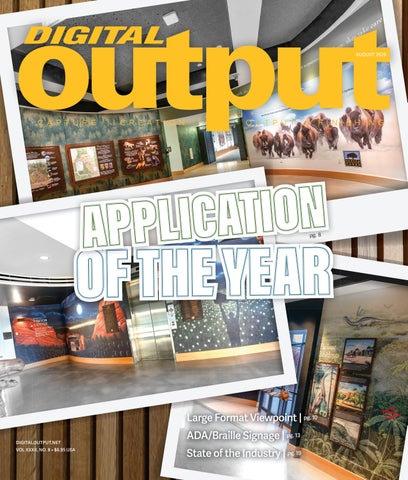
ON THE COVER: FASTSIGNS of DTC in Centennial, CO is the 2026
Application of the Year honoree for its work at Red Rocks Park and Amphitheatre’s visitor center. Photo credit Sandy Marak of Denim Sky Media. See page 8.
features 10 } Buyers as the Winners
Editor’s Input ................................................................ { 4
2026 Wide Format Graphics Inkjet Forecast Total industry revenues grow despite challenges.
In the Aisles .................................................................. { 6
13 } Feeling It
Departments
Application Spotlight ................................................. { 8
by Marco Boer
Versatile UV and Lasers for ADA and Beyond Higher margin works create endless opportunities. by Cassandra Balentine
Plus Marketplace Spotlight ................................................ { 7 Advertiser’s Index ........................................................ { 17 Companies Mentioned .............................................. { 17
19 } The Next Chapter State of the Industry Differentiation is the key to success. by Melissa Donovan
Showcase Advertisers................................................{ 18
digitaloutput.net
DO_26_8-8_TOCRevFinal-SWMD.indd 3
August 2026 | Digital Output { 3 }
7/24/26 9:59 AM
C A P T U R E
C R E AT I O N
O UTPUT
FINIS HING
VOLUME XXXII, NO. 8 DIGITALOUTPUT.NET ISSN: 1083-5121
EDITOR IN CHIEF
Thomas Tetreault ttetreault@rockportpubs.com
Opportunity to Differentiate
Our entire August issue includes editorial illustrating the current state of the wide format graphic arts industry. And what is that current state, to sum it up in a few key words—efficiency, flexibility, and differentiation. Everyone is trying to do more with less and the tools—whether it be substrates, hardware, or software—that can help print shops achieve this are heavily leveraged.
And what is that current state, to sum it up in a few key words—efficiency, flexibility, and differentiation.
EDITOR Melissa Donovan mdonovan@rockportpubs.com ASSOCIATE EDITOR Cassandra Balentine cbalentine@rockportpubs.com WEB EDITOR Melissa Mueller ART DIRECTOR Sarah M. White swhite@rockportpubs.com CONTRIBUTORS Marco Boer, Olivia Cahoon, Tim Greene, Melinda Tetreault, Amber Watson ADVERTISING SALES PUBLISHER Thomas Tetreault NATIONAL ACCOUNT EXECUTIVES Amanda Doyon adoyon@rockportpubs.com 978-921-7850, Ext. 170 Subscribe online at digitaloutput.net
The Next Chapter, our annual state of the industry report, discusses why efficiency, flexibility, and differentiation are currently so popular. Tariffs, supply chain disruptions, rising material costs, labor shortages—challenges yes, but also opportunities for print providers to branch out to high-value applications and offer customers something different.
An example of a print provider doing just that—the winner of this year’s Application of the Year awards. FASTSIGNS of DTC of CO created a multitude of prints from wallcoverings to directional signage, posters, and much more for the Red Rocks Park and Amphitheatre’s visitor center. The scope of the project is what drew our judges’ attention. Read more on page 8. Elsewhere in this edition, read about ADA/braille signage—a high-value application that can offer differentiation, an analytical report on the industry from I.T. Strategies, and a pre-show look at the upcoming PRINTING United event in September.
Cheers,
Melissa Donovan, editor mdonovan@rockportpubs.com
CORPORATE & PUBLISHING OFFICE 300 Newburyport Turnpike, Ste. 11 Rowley, Massachusetts 01969 ROCKPORT CUSTOM PUBLISHING, LLC CHAIRMAN Jeffrey Jensen PRESIDENT & CEO Thomas Tetreault Digital Output is published monthly by Rockport Custom Publishing LLC. ©Rockport Custom Publishing, LLC 2026. Reproduction by any means of the whole or part of Digital Output without written permission from the publisher is prohibited. Views expressed in the editorial pages do not imply our endorsement. Vendors: We welcome your product news. Include prices, slides, photos, and digital files with your press release. Please forward product samples and media kits to Reviews Editor, Digital Output, 300 Newburyport Turnpike, Ste. 11, Rowley, MA 01969. We cannot be responsible for unsolicited product samples.
SUBSCRIPTION RATES
U.S.: $82.95 per year; $165 for 2 years; single copies: $6.95; Canada and Mexico: $99.50 per year (U.S.D.); Other international subscriptions: $275 per year (U.S.D.)
POSTMASTER
Please send address changes and form No. 3579 to: Digital Output, 300 Newburyport Turnpike, Ste. 11, Rowley, MA 01969. Periodical Class postage rates paid at Rowley, Massachusetts and additional mailing offices.
CHANGE OF ADDRESS NOTICE
Six to eight weeks prior to moving, please clip the mailing label from the most recent issue and send it along with your new address (including zip code) to: Digital Output magazine, change of address notice, 300 Newburyport Turnpike, Ste. 11, Rowley, MA, 01969. Attention: Circulation Department.
{ 4 } August 2026 | Digital Output
DO_26_8-9_EditorLetterRevFinal-SWMD.indd 4
digitaloutput.net
7/24/26 10:00 AM
#4
DO_26_08-Canon.indd 1
7/24/26 9:43 AM
First Look PRINTING United Preview by Digital Output Staff
H
ead to Las Vegas, NV between September 23 and 25, 2026 and stop by the Las Vegas Convention Center to experience PRINTING United. With over 800 exhibitors and more than 70 education sessions, the expo is where print service providers from all backgrounds can learn about the newest technologies. Innovation and connection are two of the biggest themes of the event. Both of which can be seen in the following exhibitor booths. Colex Finishing Solutions, booth C1337, presents the Colex Sharpcut Flatbed Cutter, featuring advanced digital cutting capabilities for a range of materials and applications. Attendees can also experience Fotoba X/Y Cutters, known for delivering accurate, automated trimming. New this year, Colex features the NESCHEN laminator line, expanding its finishing portfolio with high-quality laminating solutions. INFO# 175
1) Colex Finishing Solutions, booth C1337, presents a complete lineup of finishing technology designed to improve productivity and precision. 2) Onyx Graphics, booth N6200, showcases solutions designed to help print shops work smarter, faster, and more profitably.
{ 6 } August 2026 | Digital Output
DO_26_8-6_PUPreview1RevFinal-SWMD.indd 6
dimensional letters, displays, and graphic installations. Visitors also learn how FASTENation helps manufacturers improve production efficiency through custom converting capabilities tailored to customer applications. INFO# 176 Fluid Color, booth C531, exhibits the RF84 HG flatbed printer, which prints braille, textured signage, and flat graphics with a Z-axis print height of up to 19.6 inches, giving customers the ability to produce dimensional, ADA-compliant work alongside standard flat output on one machine. The ZH126 hybrid printer delivers fast, high-volume production with the versatility to run both rigid and flexible substrates. INFO# 177
FASTENation, booth C1225, showcases adhesive and foam tape products designed for sign and graphics. Featured products include high-performance acrylic foam tapes, double-coated tapes, mounting tapes, transfer adhesives, and specialty foam tapes for sign fabrication,
Infigo, booth N7149, offers a redefined platform story built around three pillars—storefront, workflow, and intelligence. Visitors can see live demonstrations of Infigo’s web to print storefront capabilities, workflow automation tools that eliminate manual order handling, and the intelligence layer that surfaces business insight from print operations data. This year’s centerpiece is the introduction of AI capabilities integrated into different areas of the platform. INFO# 178
1
2
digitaloutput.net
7/24/26 10:03 AM
Inkcups, booth C1215, demonstrates the recently launched Helix High Throw, engineered to decorate complex cylindrical products with exceptional print quality, including drinkware with removable handles, footballs, and bowls. Visitors can also see the X5-T High Throw, designed for printing on challenging flat and irregular surfaces. Additionally, Inkcups showcases the Helix ONE benchtop cylindrical printer, the versatile B100 and 2200-PS pad printing systems, and the Cobalt Edge laser plate engraver. INFO# 179 Kernow North America, booth C1873, launches KernowJet Interiors, a new range of customizable printable wallcoverings featuring five unique finishes for modern interiors. Designed to deliver outstanding print quality, durability, and dimensional stability, the range includes both a fully recyclable option and an easy-to-remove adhesive solution. Visitors can also discover new protective overlaminate and dry erase film for interior applications and a new refined satin finish backlit media. INFO# 180
Koenig & Bauer Kammann, booth N5749, promotes its decoration equipment. Kammann machines are designed to decorate not only cylindrical articles but all shapes including handled ware, with sustained output ranging from eight to 120 parts per minute. The models start with the K4 for quick change overs, and on the other end of the spectrum is the K15 digital platform for high output. Kammann has a newer K15 model designed for higher speeds on round articles only. INFO# 181 digitaloutput.net
DO_26_8-6_PUPreview1RevFinal-SWMD.indd 7
Onyx Graphics, booth N6200, showcases ONYX Align, a cloudbased print shop management software that helps centralize operations from quoting to delivery, with tools for job tracking, QuickBooks Online integration, customizable workflows, and real-time profit visibility. Visitors can also learn about ONYX 25, the latest version of the company’s RIP software built to support smarter automation. INFO# 182
Orbus, booth C2761, highlights its expanded grand format printing capabilities, driven by the recent addition of the 16-foot Durst
P5 500 TEX iSub printer, which reduces the need for seams and enables brands to create larger, more impactful visual experiences. Additionally, its new EverSpan dye-sublimated fabric collection is an ideal solution for grand format exhibits, events, and retail environments. INFO# 183 swissQprint, booth C1737, exhibits its engineering expertise. A deadline doesn’t move just because a printer does. When equipment goes down mid-run, the job nor the client don’t wait, and the shop absorbs the cost. 90 percent of swissQprint devices
DRYTAC
built ten or more years ago are still running in daily production. At the booth, visitors can see that engineering up close, in the Kudu flatbed printer and the Karibu 2 roll-to-roll printer. Both run live with real production samples across textiles, backlit graphics, and packaging. Walk through the application zones, see what each machine produces, and talk with swissQprint experts. INFO# 184
September Issue
Look to Digital Output’s September issue for information from more vendors and their plans for exhibiting at PRINTING United. D
SUPPLY55, INC.
Award-Winning Silver PET Print Media
Finishing Simplified
Drytac Polar Chrome is a premium silver satin PET print media designed to create eye-catching graphics with exceptional print quality and visual impact. Compatible with UV, latex, and resin printing technologies, Polar Chrome allows print service providers to produce striking retail displays, promotional graphics, point of sale applications, and interior signage with a unique metallic appearance.
Engineered and manufactured in Europe, the KalaXY cutter/trimmer reduces labor and increases profits by eliminating the time-consuming task of manually cutting printed digital images. Our line of automatic XY cutters are the ideal solution for processing a range of media including wallpaper, paper, direct to film, canvas, laminated/ encapsulated films, banner material, polycarbonate, and other non-woven roll goods. Increase your output while reducing operation costs with KalaXY cutters.
Recently named a winner of a 2026 PRINTING United Alliance Pinnacle Award, Polar Chrome continues to set the standard for innovative specialty media solutions.
For more information on the KalaXY visit supply55.com, call 734-668-0755, or email sales@supply55.com. INFO# 2
Visit Drytac at booth C1937 during the PRINTING United Expo to see Polar Chrome in person and discover how it can elevate your next graphic project. Visit drytac.com to learn more. INFO# 1
August 2026 | Digital Output { 7 }
7/24/26 10:03 AM
Modernizing Red Rocks Application of the Year Winner by Melissa Donovan
D
igital Output’s Application of the Year awards are designed to showcase digitally printed projects representative of the current state of the graphic arts. This year’s winner, an expansive job for Red Rocks Park and Amphitheatre’s visitor center in Denver, CO by FASTSIGNS of DTC of Centennial, CO, perfectly illustrates themes discussed in our state of the industry report on page 19. Most specifically, versatility. FASTSIGNS of DTC did a remarkable job creating a variety of applications— wallcoverings, directional signage, posters—that modernized the space while honoring its prestige in outdoor music history.
Hectic Construction
1, 2, 3, & 4) This year’s Digital Output Application of the Year is an expansive job for Red Rocks’ visitor center in Denver, CO by FASTSIGNS of DTC of Centennial, CO. The shop created a variety of applications—wallcoverings, directional signage, posters—that modernized the Red Rocks visitor center while honoring its prestige in outdoor music history. Media used includes 700 to 900 square feet of ChromaLuxe metal, over 850 square feet of DreamScape wallcovering material, and Sihl 3686 TriSolv PrimeArt poster paper. Epson SureColor S80600 and Epson SureColor F6470H were printers of choice. Photo credit Sandy Marak of Denim Sky Media.
{ 8 } August 2026 | Digital Output
DO_26_8-4_ASAppofYearRevFinal-SWMD.indd 8
FASTSIGNS of DTC celebrates over 30 years in business, with 15 employees working in 7,000 square feet of space. If offers signs and graphics to the
1
entire state of CO, with a specialization in architectural signage. Buddy Williams, president, FASTSIGNS of DTC adds that three to five other projects are contracted every year that end up in states besides CO.
For the recent project at Red Rocks’ visitor center, FASTSIGNS of DTC found itself immersed in 15 different types of signage from commemorative plaques and wall graphics to outdoor pylons and rotating artist posters. Installers were on site for almost six months installing finished graphics in phases. This occurred with the concert venue open, so staff had to work around visitors.
Because we were working on such a world famous and cherished venue,
everyone was very intense and insistent on extreme quality standards. — Buddy Williams, president, FASTSIGNS of DTC
An additional challenge, active construction. The project was not a simple graphics refresh. The visitor center hadn’t been updated in over 20 years, so demolition
2
digitaloutput.net
7/24/26 5:40 PM
and building occurred simultaneously. It was the contractor— Haselden Construction—that chose FASTSIGNS of DTC for this particular job.
“We worked with Haselden prior and have done work at Red Rocks on a previous construction phase with a different general contractor, so we were familiar with the location. Haselden chose us because it believed we could deliver value in engineering while not reducing quality or taking away from design intent. Also, it knew we could install in a tight time frame while part of a hectic construction site,” explains Williams.
Signage Variety
One of the 15 types of signage to appear in the visitor center are wallcoverings. Over 850 square feet of DreamScape material was printed on an Epson SureColor S80600 64-inch printer with Epson UltraChrome GS3 nine color solvent ink to create dynamic imagery depicting CO and the park. “The designer chose DreamScape as she wanted a true texture-like wallcovering, and we had good experience with the product printing beautifully on the Epson SureColor S80600,” shares Williams.
The Epson SureColor S80600 was also used to print posters of past concerts held at Red Rocks. These were printed on Sihl Inc. 3686 TriSolv PrimeArt poster paper.
To produce other signage like commemorative plaques, FASTSIGNS of DTC purchased new hardware—an Epson SureColor F6470H 44-inch dye-sublimation (dye-sub) printer digitaloutput.net
DO_26_8-4_ASAppofYearRevFinal-SWMD.indd 9
and heat presses. Dye-sub was chosen for its color vibrancy and gamut, which is achieved with Epson UltraChrome DS ink. The FASTSIGNS of DTC team had to learn how to produce metal signage via dye-sub on ChromaLuxe metal sublimation blanks.
As this was the first project with this equipment setup, Williams notes it “took some effort to troubleshoot and dial in.”
Between 700 to 900 square feet of ChromaLuxe metal is part of the many directional and informational signs placed around the visitor center. “ChromaLuxe was integral to the project as vibrancy, texture, and long image life were critical. Dye-sub metal prints are resistant to wear and cleaning compared to other types of first surface printing as this is a high-traffic area. Additionally the textured surface of ChromaLuxe is perfect to help defuse the down lighting in the space and looks brilliant,” says Williams.
3
Reflecting on the finished project, Williams notes some of challenges unique to this job. For one, since construction was occurring in real time, installation methods for certain graphics often couldn’t be determined until the structure was finished. Additionally, FASTSIGNS of DTC chose to re-use and repurpose various materials, which meant de-installing and re-installing items that were over 20 years old.
world famous and cherished venue, everyone was very intense and insistent on extreme quality standards.”
Meeting Standards
Finally, Williams says the quality standards were high. “Because we were working on such a
4
Fortunately, the goal of creating a modern immersive experience was met and FASTSIGNS of DTC’s talents are fully on display. In fact, the city of Denver contracted the franchise to continue updating and maintaining the graphics.
Winning Job
FASTSIGNS of DTC remains versatile in its service offerings thanks to a willingness to upgrade
its equipment list and work with a variety of media. This is why the print provider was able to complete a range of signage from dye-sub on metal to textured wallcovering media for the Red Rocks project. This job is an excellent representation of the type of work driving the graphic arts forward, which is why it was chosen as 2026’s top Application of the Year.
To read about the second, third, and honorable mention winners of Digital Output’s Application of the Year contest visit the website digitaloutput.net. D August 2026 | Digital Output { 9 }
7/24/26 5:40 PM
2026 Wide Format Graphics Inkjet Forecast by Marco Boer
unning a wide format print business is more complicated than ever. Changing patterns in order volume due to geo-politics and inflation are leading to order patterns that no longer conform to the norm. Despite this, greater capacity utilization and inflation enabled total industry revenues to grow five percent year over year. A big driver in productivity gains is due to the shift from eco-solvent and latex to UV-curable technology. As { 10 } August 2026 | Digital Output
DO_26_8-2_LFViewpointRevFinalMD.indd 10
the number of wide format graphics print providers consolidates, those remaining compete on efficiency or productivity. Many of the eco-solvent vendors are proactively moving their product line mix from eco-solvent to UV-curable ink technology to take advantage of this shift. As we look ahead to 2026 and beyond, the geo-political challenges are expected to continue to create a conservative outlook for new capital investment.
digitaloutput.net
7/24/26 10:11 AM
MARKET SHIFT IN FAVOR OF UV-CURABLE TECHNOLOGY Thanks to Demand for Higher Productivity
100%
100%
90%
90%
80%
UNITS
UNITS
100%
100%
90%
90%
80%
80%
70%
70%
60%
HARDWARE HARDWARE REVENUEREVENUE
100%
100%
90%
90%
80%
80%
70%
70%
60%
60%
50%
50%
40%
UV-Curable
INK REVENUE INK REVENUE
Aggressive Solvent
100%
100%
90%
90%
80%
80%
80%
70%
70%
70%
70%
60%
60%
60%
60%
60%
50%
50%
50%
50%
50%
50%
40%
40%
40%
40%
40%
40%
40%
30%
30%
30%
30%
30%
30%
30%
30%
20%
20%
20%
20%
20%
20%
20%
20%
10%
10%
10%
10%
10%
10%
10%
10%
0%
0%
0%
0%
0%
0%
0%
0%
2020
2020
16%
2023
2023
2025
UV-curable UV-curable Aggressive Aggressive Solvent Solvent
There willLatexalsoLatex be consolidaEco-solvent Eco-solvent tion pressure, in part because Aqueous Aqueous commercial printers who face continued revenue decline in offset print are becoming more attracted to the profit margins of wide format graphics, despite the low output volumes in contrast to offset print. Wide format application experience is difficult to grow organically, so many commercial printers chose to acquire existing wide format graphics print providers as a means to scale faster.
16%
2025 2020
2020
53%
2023
2023
53%
2025
UV-curable UV-curable Aggressive Aggressive Solvent Solvent
in Manhattan Latex Latextook months to Eco-solvent design and Eco-solvent fabricate. It disguises Aqueous Aqueous a multi-year construction project as a giant stack of vintage Louis Vuitton vintage trunks.
2025 2020
2020
29%
2023
2023
2025
29%
2025 2020
2020
Latex
Aqueous
TOTAL REVENUE TOTAL REVENUE
40%
2023
UV-curable UV-curable
UV-curable UV-curable
Aggressive Aggressive Solvent Solvent
Aggressive Aggressive Solvent Solvent
Once Latex ideas Latex and capabilities are in Eco-solvent Eco-solvent place, they are often replicated in Aqueous Aqueous other cities and by other brands. Louis Vuitton expanded upon the building wrap idea in Shanghai,
Eco-Solvent
2023
2025
40%
2025
China—where there are fewer Latex permitting regulations—and creAqueous Aqueous ated an over-the-top experiential design of a steamship, driving up sales to their highest level to date. Latex
Eco-solventEco-solvent
Despite the challenges, the need for signage doesn’t go away. Businesses continually change and require new signage, events compete for consumer attention and use large scale graphics to draw focus, and the range of applications continues to expand, especially in creative experiential designs that require fabrication. For example, the 15-story Louis Vuitton building wrap at its flagship store on Fifth Avenue digitaloutput.net
DO_26_8-2_LFViewpointRevFinalMD.indd 11
#10
August 2026 | Digital Output { 11 }
7/24/26 10:11 AM
WIDE FORMAT GRAPHICS MARKET Total Market Inkjet Unit Forecast by Ink Type, Worldwide 2021 to 2031 $4,000
CAGR ‘26 - ‘31 3%
AGR
4% C
$3,500
7%
$3,000 $2,500 $2,000
4%
$1,500 $1,000 $500
-6%
$0 2021 $179 $1,046 $1,412 $435
2022 $237 $1,020 $1,439 $426
2023 $228 $1,037 $1,382 $456
2024 $222 $1,056 $1,347 $402
Soft Signage
2025 $0 $1,167 $1,346 $473
UV-Curable
The more than 30 year old wide format graphics inkjet market has long been a replacement market. Print shops are holding onto their wide format printers longer, and simultaneously well-resourced print providers—often using ecommerce platforms—are starting to consolidate output by shifting production onto high-productivity, lower cost output devices. These shifting trends have hit the lower—sub-$30,000—wide format graphic printer sales hard in 2025, significantly decreasing unit sales volumes.
The other good news for wide format output is that largescale events continue to remain strong; in addition tourism and travel are back—both driving the need for signage. In-store retail shopping and dining is also slowly returning, although many retailers struggle with finding labor, rising costs, and reducing { 12 } August 2026 | Digital Output
DO_26_8-2_LFViewpointRevFinalMD.indd 12
2026 $189 $1,277 $1,339 $469
2027 $187 $1,372 $1,324 $439
2028 $198 $1,476 $1,340 $431
Eco-Solvent/Latex
2029 $206 $1,574 $1,395 $425
2030 $215 $1,671 $1,504 $419
2031 $224 $1,759 $1,650 $351
Aqueous
available resources for marketing and signage, especially as ecommerce shopping habits with no signage needed have become engrained in consumers. I.T. Strategies projects wide format graphics inkjet revenues to grow five percent annually between 2026 and 2031. A portion of that growth is attributable to inflation, and some is attributable to the expansion of wide format graphics into more valuable applications.
The Bottom Line
The first introduction of a wide format graphics inkjet printer happened over 30 years ago. Since then, the market has remained a remarkably steady replacement industry for decades, but improvements in productivity across all ink technologies are projected to cause a decline in the demand for new units and a shift in product mix. Future
units will be more productive, which has a long-term impact of a declining weighted average ink per liter price—even as individual segment ink prices increase.
Consolidation among wide format print providers also adds pressures to the window of opportunity to sell a new device. This consolidation in dedicated wide format graphics printer providers is offset somewhat by the expansion of commercial printers moving into wide format graphics printers in a bigger way. The net result is that it is projected to become a “tighter market,” meaning there will be less room for the number of printer manufacturers serving this application. Back in the early 1990s there were over ten wide format aqueous printer manufacturers; today there are three. It is a similar situation in the eco-solvent/latex printer market. There are still tens of manufacturers in the UV-curable segment, excluding Chinese manufacturers. The Chinese UV-curable printer manufacturers will directly or indirectly put price pressure on the Western UV-curable printer manufacturers, which in turn will force those Western printer manufacturers to become more efficient. We’ve seen the beginnings of a movement to greater efficiencies through manufacturing partnerships, and we are likely to see more in the next five years. Despite the shifts in product mix towards more productive, lower cost hardware and high-
er ink prices, the wide format market will remain a profitable, modest printer manufacturer revenue growth market. Due to the consolidation pressures on both hardware—higher productivity printers—and print service providers, there will be less room for the number of hardware manufacturers serving this market. Acquisitions and partnerships will become more common in the next five years, with buyers of wide format print output as the winners.
Editor’s Note
Limited engagements like pop-up retail shops, immersive experiences with our favorite brands, multi-day concerts, traveling museums—these are prime opportunities for wide format graphics printers. Whether leveraging technologies like UV-curable, solvent, or latex, the capabilities of these printers present productivity and hopefully revenue growth for users. D
About the Author Marco Boer, president, I.T. Strategies, is recognized as a trusted consultant to the digital printing industry. He has a reputation for being able to put complex information and concepts into a context that is easily understood by his audience. With more than 35 years of experience in advising and guiding senior executives of Fortune 1000 and smaller innovative companies to successful business solutions in emerging digital printing markets, Boer has developed a deep understanding of inkjet printing technology and its applications. digitaloutput.net
7/24/26 10:11 AM
by Cassandra Balentine
latbed speciality printers and laser engraving solutions—in both wide format and desktop-sized configurations—support everything from directional signage to office number plaques. Tactile print capabilities increase value as it enables print providers to transition to ADA-compatible work like braille.
According to Adam Tourville, CEO, Fluid Color, ADA and tactile signage represent a stable, specification-driven market that continues to grow alongside commercial construction, healthcare, digitaloutput.net
DO_26_8-3_ADABrailleRevFinal-SWMD.indd 13
education, hospitality, and municipal infrastructure development. Unlike some markets that are commoditized, ADA signage requires compliance expertise, precision manufacturing, and specialized production capabilities.
Tactile processes also create opportunities to expand into complementary signage and graphics applications for existing customers, points out Corey Kelly, marketing director, Trotec Laser. This tends to be higher margin work with less pricing pressure when compared to traditional banner or commodity signage markets.
Tangible Revenue
If they haven’t already, print service providers (PSPs) may want to consider adding speciality printing/laser engraving services to their offerings. Today’s newest UV and laser engraving devices— wide format and desktop versions—are affordable and practical options. Creating tactile signage—including braille—can be completed using a laser cutter or UV printing.
Above) Canon’s premier hardware offerings for directional signage include the Arizona series flatbed printers.
August 2026 | Digital Output { 13 }
7/24/26 10:16 AM
wayfinding systems alongside traditional graphics creates strong cross-selling opportunities and deeper customer relationships,” comments Tourville.
1 With a laser, operators are able to cut the sign shape as well as create holes for a braille pattern. The holes are then filled with acrylic or metal beads/balls from the back so that they protrude from the front. Alternatively, UV flatbed printers stack layers of ink to create dots that meet braille requirements, which are instantly cured.
Tactile signage that can be used as part of a company’s ADA efforts provides potential for point-ofbusiness differentiation and a gateway to additional revenue. “While traditional flat signage is commoditized, architectural wayfinding and tactile signage may be necessary in public accommodations and commercial facilities. Because digital printing allows for on demand customization without tooling setup, PSPs can produce specialized, tactile signage,” offers Todd Rhinerson, senior specialist, production planning, DGS Solutions Strategy, Canon U.S.A., Inc. 1) The Canon Arizona series is powered by advanced software platforms, PRISMAguide XL and PRISMAelevate XL, which help automate the complex layer mapping required for tactile graphics.
{ 14 } August 2026 | Digital Output
DO_26_8-3_ADABrailleRevFinal-SWMD.indd 14
Any type of custom, short-run work commands premium pricing and the more specialized the application, the more superior the price. “Digital UV platforms allow fast setup and print execution, extending the capabilities of decorators to match virtually any environment, and to do it quickly at a higher margin,” adds Lon Riley, founder/CEO, DPI Lab, LLC. Kevin Currier, director of marketing, Direct Color Systems, points out that this type of signage offers access to a whole area that may be unknown to some producers at the moment. “It is generally part of very large projects and the profit margins remain high.” “These projects are not typically isolated, they are a recurring need and part of a larger architectural, branding, or facility project, which can create many more opportunities for a print shop,” agrees Hugo Gonzalez, senior segment specialist, Mimaki USA, Inc. Many customers prefer sourcing all signage from a single provider, “so offering ADA-compliant
UV printing also requires less labor and setup compared to traditional raster or photopolymer methods for ADA signage, “making it a faster, more efficient, and more cost-effective way to bring ADA production in house,” shares Emilio Rangel, UV product manager, Mutoh America, Inc.
In addition to ADA/braille signage, David Bistrovic, product manager, Professional Imaging, Epson America, Inc., points out that flatbed UV printers support a range of signage applications, printing directly to acrylic, metal, plastic, and wood, as well as promotional goods. “This versatility allows print providers to expand their offerings and potentially increase customer reach.” Rhinerson explains that hardware and software capabilities used to build ADA elements fall under a broader, highly creative category known as “elevated printing.”
When dealing with non-ADA signage, Rhinerson points out that print providers are “completely free from strict geometric rules, font limitations, and specific height constraints, allowing them to lean heavily into high-impact aesthetic applications. Software that automates the creation of elevated print is critical to success.” Currier adds that most directional and wayfinding signage does not require braille, so it is important that a chosen system can perform
just as well and have consistent results in scenarios where braille and non-braille signs make up the larger project.
Desktop to Wide Format
A range of devices create speciality signage, including ADA/braille. Desktop/benchtop-sized solutions offer a lower capital cost and a significantly smaller physical footprint compared to traditional wide format flatbed devices. Desktop UV solutions are best suited for short-run production and highly personalized output, such as small-format ADA signage, nameplates, keychains, golf balls, pens, and decorative signage. “Desktop solutions offer efficiency and versatility for smaller, custom projects and are a good entry point,” notes Bistrovic. Rhinerson admits that desktop solutions are restricted by narrow media widths, thin material tolerances, and lower throughput.
Currier sees benefits to doing this work on wide format devices. “Real production requires throughput and consistency.” Gonzalez points out that while some signs can be completely unique one-ups, having a larger format machine can produce many unique one-ups and simultaneously save time and money. Many desktop solutions are singleor linear-head configurations, which mean substantially longer print times. This is compounded by extreme textures. “Desktop printers are often used more for short-run prototyping or sample
digitaloutput.net
7/24/26 10:16 AM
production. This can compliment production lines by allowing concept development to happen elsewhere, keeping the larger production equipment processing at scale,” says Riley.
Tourville feels that industrial platforms become more economical at scale due to automation, faster production speeds, and reduced operator intervention.
Wide format systems offer higher throughput and the capacity for larger materials, making them ideal for bigger shops, while desktop systems have a lower cost entry point for smaller shops looking to enter this market, agrees Kelly.
Wider printers enable high-volume manufacturing. Print providers can utilize nesting software to lay out and produce hundreds of office numbers or directional signs in a single run, which reduces finishing time and maintains variability, explains Rhinerson.
#11
Bistrovic finds wide format solutions ideal for larger ADA/braille and specialty signage applications, including menu boards, wayfinding signage, wall graphics, and architectural elements. “They support larger substrates, higher production volumes, faster print speeds, and often include expanded ink sets for improved color accuracy and versatility.”
Precision and Control
Producing tactile signage requires physical precision and strict adherence to design parameters. Rhinerson says requirements include elements such as height control, dot size, distance, and layout. digitaloutput.net
DO_26_8-3_ADABrailleRevFinal-SWMD.indd 15
#6
August 2026 | Digital Output { 15 }
7/24/26 10:16 AM
production process allows shops to move efficiently from design to output without bottlenecks, which is essential for consistent and profitable ADA production.”
2 When UV printing ADA-compliant braille signage, precision and control—including precise printhead technology—is required to ensure accurate dot placement and consistent formation of rounded braille dots at the required height, comments Bistrovic. The ink needs to be rigid enough to withstand some physical abrasion and durable against solvents and cleaners, as signs can be regularly sanitized, especially in medical and educational environments, notes Gonzalez.
“Ink designed to meet many applications can often be a compromise and could cause issues in the future, involving redos and frustrated customers,” cautions Currier.
Consistency is critical because ADA signage must maintain uniform tactile readability across every sign. “ADA guidelines specify the height, spacing, and font style and it is important to be within those guidelines,” stresses Tourville. 2) The Epson SureColor V4000 offers a print area of 27.5x38.5 inches and supports media up to 7.8 inches thick.
{ 16 } August 2026 | Digital Output
DO_26_8-3_ADABrailleRevFinal-SWMD.indd 16
UV flatbed printers must be capable of building durable, tactile layers—typically using matte varnish—to achieve the specified dot dimensions, strong adhesion, and a non-glare finish. “Together, these capabilities enable reliable production of compliant, high-quality tactile signage,” offers Bistrovic.
Most UV digital printers are able to build texture to the ADA compliant 0.032-inch level—the key is how the art files and the printer work together to create the right combination of size, shape and color. “The art file defines the size, separation of characters, etc., while the printer software defines the layering—how much ink is applied to achieve full compliance,” explains Riley. Reliable software workflows and compatibility with ADA-approved materials are critical to maintaining production consistency, stresses Kelly.
Rangel agrees, noting that workflow/RIP software are essential but often overlooked. “Minimizing setup time and simplifying the
Software designed to generate the braille elements is a necessity for true production. “Some include built-in guides to ensure compliancy in font size, style, kerning, and auto-generation of the braille dots. In addition, the full range of languages and braille grades may be included,” adds Currier.
Critical Compliance
ADA compliance is the most important aspect of producing braille signage. ADA guidelines define specific requirements for tactile signage, including braille dot height, spacing, placement, and the use of non-glare surfaces, all of which are critical to readability and usability, notes Bistrovic. ADA signage must provide accessibility for visually impaired individuals and meet strict federal standards for tactile lettering, braille formatting, spacing, and installation. “Achieving compliance requires careful attention to design, materials, fabrication accuracy, and installation guidelines,” cautions Kelly.
The ADA Standards for Accessible Design establish requirements for tactile lettering, braille placement, contrast, character sizing, and mounting location. “For example, ADA-compliant braille signage typically requires Grade 2 Braille, rounded or domed braille dots, non-glare finishes, and tactile characters raised at least 0.031 inches above the background surface.
Character spacing, font selection, and sign mounting heights are also regulated,” explains Tourville. Several requirements must be met before a sign is installed. “Contrast is critical, as tactile elements must stand out clearly from the background. In addition, ADA signage materials must have a non-glare finish to improve visibility under different lighting conditions,” offers Rangel.
Compliance is not simply about producing raised text. Manufacturers must understand the full specification requirements related to readability, durability, installation placement, and tactile usability. “Failure to meet these standards can create accessibility issues and potential legal liability for building owners and sign providers,” cautions Tourville.
Profit Talk
Often, PSPs produce ADA-compliant signage on systems that perform additional work.
In a generalized sense, Currier says users who utilize a system solely for braille are about 40 percent, while 60 percent partake in additional non-braille applications. The breakeven between a dedicated device or a versatile printer/ cutter largely depends on production volume, labor costs, and application diversity. Rhinerson cautions against purchasing a highly specialized, single-purpose device designed for braille or small format plaques as it may introduce financial risk. “If local demand for ADA signage
digitaloutput.net
7/24/26 10:16 AM
For businesses focused exclusively on high-volume ADA production, Kelly says a dedicated system can provide a strong return through efficiency and specialization. “However, many shops achieve a faster overall ROI with a platform that supports ADA signage alongside broader graphics, engraving, and fabrication applications.”
By leveraging a single printer across multiple revenue streams, including signage, décor, and promotional products, print providers can maximize utilization, reduce idle time, and achieve faster payback compared to a single-purpose solution, adds Bistrovic. Single application devices can be a good investment if the scope and scale of the work can support digitaloutput.net
DO_26_8-3_ADABrailleRevFinal-SWMD.indd 17
The breakeven point depends on factors like production volume, application mix, and how the equipment is utilized. “Printers dedicated to ADA/braille signage may make sense for high-volume, specialized operations with consistent demand. However, many PSPs find greater ROI with versatile UV flatbed printers that can support both compliant signage and a range of additional applications,” says Bistrovic. Rangel feels that in most cases the breakeven depends on production volume and the type of work being targeted. “A smaller desktop ADA-focused printer can often pay for itself quickly by bringing outsourced signage production in house, especially for shops regularly producing room signs, office numbers, or directional signage. Larger wide format UV flatbeds, however, offer a much broader
PAGE
INFO#
WEBSITE
23 aglinc.com
12 Alpina Manufacturing, LLC
18 fastchangeframes.com
13 Alpina Manufacturing, LLC
18 bannergrip.com
4 Canon U.S.A., Inc.
5 usa.canon.com
5 Colex Finishing, Inc.
21 colex.com
1 Drytac
7 drytac.com
6 Flatbed Tools
15 flatbedtools.com/summa
14 Graphic Whizard, Inc.
18 graphicwhizard.com
7 ImagineThis
27 imaginethisprinting.com
8 Mutoh America, Inc.
2 mutoh.com
15 Newlife Magnetics
18 newlifemagnetics.com
16 Sign Guardian
18 signguardian.com
9 Signs365
28 signs365.com
10 Stratojet USA
11 stratojetusa.com
2 Supply55, Inc.
7 supply55.com
11 swissQprint
15 swissqprint.com
110 AGL Inc.
19
117 Fluid Color
19
111 Brand Management Group
19
118 Jessup Manufacturing Company
19
COMPANY
PAGE
INFO#
Finances might not be the only deciding factors. “Are outsourced applications meeting your quality standards or time requirements? Does it represent your shop well? Having more direct control over the process might be worth the investment of application-dedicated equipment,” believes Gonzalez.
ADVERTISER
3 AGL Inc.
PAGE
Conversely, utilizing a versatile, production-grade flatbed can help accelerate return on investment (ROI) and lower the breakeven point. Rhinerson explains that industrial solutions can spend 85 percent of a shift running traditional, high-speed commercial graphic work—such as promotional banners, posters, window graphics, and retail point of purchase. “When a tactile or architectural signage contract is secured, the shop can seamlessly pivot the same machine to specialized tactile production. This hybrid utility allows the printer to keep generating revenue, maximizing shop capacity, and optimizing equipment amortization.”
it. “They also have lower entry points compared to more versatile equipment. The breakeven point, in my opinion, would be unique to each case. Assuming we are talking about a shop that has a variety of printing products, adding application-dedicated equipment can be a real asset if they have enough work to justify it,” offers Gonzalez.
INFO#
fluctuates, that dedicated asset sits idle. It may stretch the breakeven point out over several years and limit the business’ agility.”
COMPANY
112 Caldera
19
119 Kongsberg Precision Cutting Systems
19
100 Canon U.S.A., Inc.
13
120 Lintec of America, Inc.
19
113 Canon U.S.A., Inc.
19
105 Mimaki USA, Inc.
13
171 Chromaluxe
8
121 Mimaki USA, Inc.
19
114 Continental Grafix USA, Inc.
19
106 Mutoh America, Inc.
13
101 Direct Color Systems
13
122 Mutoh America, Inc.
19
102 DPI Lab, LLC
13
123 SAi
19
172 DreamScape
8
124 Significans Automation
19
173 Epson America, Inc.
8
174 Sihl Inc.
8
103 Epson America, Inc.
13
125 Summa
19
115 Fiery, LLC
19
107 Trotec Laser
13
116 Flatbed Tools
19
126 Ultraflex Systems, Inc.
19
104 Fluid Color
13
127 Zund America, Inc.
19
ROI opportunity because they can handle ADA production alongside traditional graphics, promotional products, décor, and specialty printing applications. That flexibility allows shops to keep the machine utilized across multiple revenue streams rather than relying solely on ADA work to justify the investment.”
ADA and More
Tactile signage, including ADA-compliant braille, is produced using UV flatbed printers
and laser engravers in small and large format configurations. While this specialized application has the potential to bring in work with high profit margins, it requires understanding and knowledge of ADA requirements to ensure compliance. Machines used to produce ADA-compliant signage are often versatile and produce a broad array of customized, high-value signage solutions found across a range of industries. D
August 2026 | Digital Output { 17 }
7/24/26 10:16 AM
#12
#13
#14
Floor Graphics Removal Cutting Magnetic Material Commercial Vehicle Wraps File Preparation Software ...and More!
#15
{ 18 } August 2026 | Digital Output
DO_26_8-10_ShowcaseRevFinal-SWMD.indd 18
#16
digitaloutput.net
7/24/26 10:31 AM
by Melissa Donovan
he graphic arts remains resilient in 2026, with growth increasingly driven by high-value, application-focused services rather than traditional volume production. Demand for personalized products, short-run production, interior décor, textiles, packaging, and specialty graphics continues to expand, creating new opportunities for innovative print service providers (PSPs). Tariffs, supply chain disruptions, and rising material costs tighten margins; labor shortages challenge staffing needs; and evolving digitaloutput.net
DO_26_8-1_SOIRevSEMI-Final-SWMD.indd 19
customer expectations make it so PSPs must differentiate themselves from the pack. Workflow automation, integrated systems, artificial intelligence (AI), and advancements in printing technologies are all ways to achieve this.
Strategic Investment
Conditions vary by geographic region and as a subset application type, but overall the current state of the wide format industry is healthy and somewhat stable. While many PSPs are thriving, those setup to serve customers with higher value applications are positioned for success.
Lieven Bertier, CMO, Summa, says that as a whole, many businesses face pressure on margins and investment decisions. However, there are specific growth opportunities in areas that benefit from customization, shorter production runs, and faster turnaround times.
Above) FASTSIGNS of DTC of Centennial, CO, first place winner of Digital Output’s Application of the Year awards, helped reimagine the Red Rocks Park and Amphitheatre’s visitor center. Wall graphics are from DreamScape, printed on an Epson SureColor S80600 64-inch printer with Epson UltraChrome GS3 nine color solvent ink. Photo credit Sandy Marak of Denim Sky Media.
August 2026 | Digital Output { 19 }
7/24/26 10:25 AM
décor, experiential installations, personalized short-run production, textile/soft signage, or full-service design and execution partners,” attests Sean McGettigan, director, product marketing, Brand Management Group, a division of S-One Holdings Corporation. According to Adam J. Tourville, channel manager, Fluid Color, “shops that are highly automated, diversified, and application-focused are performing well, while providers competing primarily in commodity banner and basic signage production are under significant margin pressure.”
Hot Segments
1 “Companies that stand out are those willing to invest strategically. Businesses with a clear vision and appetite to embrace new technologies can create a significant competitive advantage, in challenging conditions,” notes Bertier. According to Martin Thornton, business development manager, Zund America, Inc., “wide format printing remains resilient, with growth driven less by volume and more by application diversity and value-added services.”
“Growth is moving away from volume to high-value applications— customization, short runs, and on demand production—driven by
1) Art City Wraps of Oshkosh, WI won third place in this year’s Application of the Year awards for its work at the Kolf Sports Center at the University of Wisconsin–Oshkosh in Oshkosh, WI.
{ 20 } August 2026 | Digital Output
DO_26_8-1_SOIRevSEMI-Final-SWMD.indd 20
ecommerce, retail transformation, and localized manufacturing,” agrees Gudrun Bonte, chief product officer, SAi.
Demand for higher value applications is spearheaded by consumers who are aware of and excited by personalization, bespoke, and customization, suggests Kerry Moloney, senior product marketing manager, Fiery, LLC. “Why settle for an off-the-shelf product when a personalized or bespoke piece can be produced instead? This trend is seen across all areas of wide to superwide format print production.”
“The strongest shops in 2026 are not marketing themselves as the cheapest printer; they are becoming niche specialists in applications such as vehicle wraps, healthcare graphics, sports environments,
Market segments that continue to cause excitement vary. The differentiation between offerings is indicative of the industry as a whole, proving PSPs are creative and forward thinking.
The strongest opportunities, according to Mike Richardson, business development manager, Jessup Manufacturing Company, are in specialty media, durable floor and wall graphics, high-tack applications, and safety-related graphics—applications that help print providers differentiate beyond standard banners and signs.
Sebastien Hanssens, VP marketing and operations, Caldera, sees the most momentum in short-run packaging and labels; soft signage, textile, and direct to film (DTF)-related production; personalized interior décor; and specialized industrial applications.
“Textile continues to be a strong growth market, especially with the
apparel decoration opportunities that DTF and UV DTF provide, as well as the lower cost of high speed and 1.8- to 3.2-meter textile printers. Sign and graphics has been very competitive for years, with margins getting thinner it is more important than ever for shops to find ways to differentiate themselves,” adds Josh Hope, director, marketing, Mimaki USA, Inc. Justin Davis, director of sales and marketing, Flatbed Tools, also sees fabric-based applications as a huge growth market. “Direct to fabric and soft signage keep growing. Demand for printed textiles, custom apparel, and fabric displays is strong. Acoustic panel production is another one; it feels like every office renovation and hospitality project spec includes them now.” In addition to soft signage, Kylie Schleicher, VP of business development and product management, Ultraflex Systems, Inc., believes interior décor and architectural graphics are among the fastest growing segments. “The opportunity lies in specialty work such as décor, experiential branding, interior design, and customized environments, where creative value outweighs price competition.” Corrugated-based applications also show strong growth, as they span packaging and signage as well as display graphics and point of purchase, explains Peter Pudner, VP sales Americas, Kongsberg Precision Cutting Systems and MultiCam. “These are aligned with the need for shorter runs, faster turnarounds, and in certain areas such as retail, more sustainable material choices.”
digitaloutput.net
7/24/26 10:25 AM
According to Emilio Rangel, product manager, Mutoh America, Inc., traditional banner and commodity signage are still important markets, but they have become more price competitive, pushing shops to look for higher margin specialty applications. These include growing segments like personalization, promotional products, ADA signage, interior décor, packaging, and specialty UV applications. “Traditional signage categories continue to generate volume, but are intensely competitive and price driven, pushing print businesses to differentiate through service, agility, and reliability
rather than commoditized pricing,” suggests Hanssens.
Impacting the Print Shop
Tariffs, supply chain issues, and material costs are rising concerns for PSPs of all sizes.
Tony Simmering, product manager, Mutoh America, Inc., believes “print shops are seeing massive procurement and pricing issues related to tariffs and other geopolitical situations. Not just ink pricing, but supply stability over the next year is very important.” “Substrate prices, inks, and freight remain volatile, forcing shops to
adjust pricing more frequently and carry higher inventory. Lead times have improved since peak disruption, but reliability is still inconsistent for certain materials. As a result, many PSPs are diversifying suppliers and investing in workflow efficiency to offset cost increases,” notes Bonte.
Hope says the most challenging part of the situation is how quickly it changes day to day. “Planning for increased costs is difficult enough when you know about them well in advance, but ongoing changes make planning increasingly difficult for everyone involved—manufacturers, dealers, and customers.”
“With tariff levels subject to change, it is difficult for customers to plan capital investments with confidence. This uncertainty leads to delayed decision making, longer sales cycles, and more cautious investment strategies. We also see a shift in the nature of sales conversations. Financial risk, cost pressures, and return on investment are now core considerations, reflecting a more risk-averse market,” shares Pudner.
In terms of material costs, “most printer depend on globally sourced materials and equipment. Paper costs are among the most significant negative impacts on print
#5
digitaloutput.net
DO_26_8-1_SOIRevSEMI-Final-SWMD.indd 21
August 2026 | Digital Output { 21 }
7/24/26 10:25 AM
domestic warehousing strategies,” shares Tourville.
2 shops today. Paper accounts for a large amount of the cost of a printed piece, yet the number of paper mills in the U.S. has shrunk, leaving print shops dependent on imported paper, which is heavily tariffed,” explains McGettigan.
Thornton cites industry data, stating that over 60 percent of print businesses experience compressed profit margins. Approximately 86 percent of manufacturers and service providers plan to pass some costs on to clients while others choose to absorb costs in the short term in order to remain competitive and retain client relationships. While we can consider these challenges as negatives, Bertier chooses to spin them as positives. “They drive demand for greater efficiency. Print shops look beyond equipment specifications and
2) LD Events Decor based out of Lake Zurich, IL received an honorable mention in this year’s Application of Year awards for a project that consisted of a 24x24-foot dance floor graphic, totaling approximately 576 square feet of printed material, specifically General Formulations GF 223 printed with a Roland DGA Corporation printer.
{ 22 } August 2026 | Digital Output
DO_26_8-1_SOIRevSEMI-Final-SWMD.indd 22
focus on productivity across the entire workflow. When labor and material costs rise, reducing waste, minimizing errors, and improving throughput become critical. This is where automation and workflow optimization make a real difference. The biggest gains often come from simplifying setup, reducing operator intervention, and eliminating costly mistakes.” Another positive, renewed interest in on-shoring and domestic supply. “Customers want more predictable sourcing, shorter supply chains, and vendors who can respond quickly,” says Richardson. U.S. manufacturers are well positioned to support this by domestically sourcing raw materials and helping reduce the uncertainty tied to overseas supply chains. “A major shift is regionalization of supply chains. Manufacturers are working to reduce dependence on single-source overseas suppliers by increasing North American inventory, dual-sourcing components, and expanding
Big Asks
Nick Howe, GM, AGL Inc., points out that U.S.-based manufacturers are able to maintain price consistency with domestic sourcing. In addition, if relationships with suppliers overseas are in good standing, pricing is maintained with minimal increases.
PSPs are savvy and know what they want. Over the last few years their needs have evolved based on what is going on in the world around them—i.e. tariffs, supply chain issues, and material costs.
PSPs want media products that “install easily, reduce labor, eliminate extra steps, and perform reliably in real-world environments. Two years ago, the conversation was centered on print compatibility and price. Today, customers are asking about total application cost, removal, slip resistance, surface compatibility, durability, and whether a media can help them complete jobs faster with fewer callbacks,” states Richardson.
“The demand from substrates and media is versatility and performance, using one media for a range of surfaces and applications. When one media can cover a range of surfaces, it reduces the number of products stocked. Media that can perform reliably in a variety of applications reduces the need for
specialty products,” explains Laura Antenucci, marketing director, Continental Grafix USA, Inc.
Support and training are more important than ever. “Harder questions about service and support are asked more than they used to be because PSPs were burned,” explains Davis. “Equipment goes down, the vendor goes quiet, and they lose days of production. We hear it constantly. The shops that are growing are the ones who figured out that their real competitive advantage is throughput, not just equipment specs.” Ease of use is simply a requirement in all aspects of a job. “It is a critical factor, and customers seek equipment that can be operated with minimal training, reduces dependency on skilled operators for manual tasks, and allows users to move between machines and processes with ease,” says Pudner.
“Inspired by the simplicity of modern consumer technology, print shops no longer accept complex systems that require extensive training or specialist knowledge. Instead, they look for intuitive, operator-friendly solutions that offer one-click workflows, automated setup procedures, and rapid onboarding of new employees,” explains Bertier. Accurate color is non-negotiable, especially in instances where a customer is paying more for a personalized or bespoke piece. “They are certainly going to expect the color quality to be right. That means everything from accurate brand colors through to maximum detail and vibrancy—all of which
digitaloutput.net
7/24/26 10:25 AM
start with good color management,” states Moloney.
As a whole, print shop owners want to do more with less. “They are no longer asking whether a solution can produce quality output; they ask whether it can help them scale profitably with limited staff, mixed fleets, and rising complexity. They want centralized control, repeatable results across sites and operators, seamless integration with upstream systems, and clear visibility into production performance,” shares Hanssens. “This translates to a critical need for customized integration of all important print and packaging workflow processes to reach the highest levels of automation. Owners—many of whom are working managers lost in daily business operations—demand partners who can provide a documented process and an executable plan to implement automation, rather than just selling software or hardware,” suggests Marc Raad, president, Significans Automation. “Automation is a major priority and technology differentiator in wide format printing—primarily driven by labor shortages, the need for efficiency, and demands for faster turnaround times,” admits Richard Reamer, senior director, product marketing and planning, large format systems, Canon U.S.A., Inc. According to Thornton, PSPs are looking to strategically implement advanced automation solutions specific to their production environment. “This includes adding automation components gradually rather than taking an ‘everything, digitaloutput.net
DO_26_8-1_SOIRevSEMI-Final-SWMD.indd 23
everywhere, all-at-once approach.’ As a result, thorough process evaluation has become a critical first step before any investments are made. Customers are placing greater weight on long-term viability. Assessing these decisions over a ten-plus year horizon makes perfect sense, as does carefully evaluating suppliers and their ability to support and sustain advanced automation over time.”
Recruiting Skilled Laborers
The challenge of recruiting staff to fill a print shop grows as legacy employees retire.
“Recruiting skilled labor has reached its highest level of difficulty in decades. A shrinking pipeline of trade school graduates, an aging workforce, and intense competition from other technical sectors have made finding experienced prepress technicians, press operators, and finishing specialists challenging,” suggests Thornton.
is cautious. “Many businesses are exploring options but delaying purchasing decisions due to broader economic uncertainty. A key enabler of automation adoption is software usability, with customers placing increasing importance on intuitive, easy-to-integrate solutions.”
Human involvement is still necessary. “Automation plays an important role in addressing the challenge of less skilled labors, but it is not about removing people from the process. It is about supporting operators, simplifying tasks, and preventing mistakes before they happen,” admits Bertier.
Materials also play a role in supporting laborers. “Easy install media, products that do not require overlamination, and solutions
designed for clean removal can reduce labor demands and help less-experienced teams produce better results with fewer errors,” suggests Richardson.
Certainly, McGettigan says there is still a need for skilled workers. “Print operations are exploring initiative-taking recruitment strategies, such as apprenticeships, partnerships with trade schools, and competitive compensation with lifestyle benefits like flexible schedules and workfrom-home options that younger workers are seeking.” “There seems to be a fundamental lack of energy within the print industry to recruit young talent; the print industry historically has low wages, long hours, and physically difficult work. These
This is driving automation adoption. “By embedding best practices into the workflow, automation reduces dependence on individual expert knowledge, minimizes repetitive manual intervention, and enables smaller teams to run higher volumes with greater confidence,” admits Hanssens. Implementing automation “allows print businesses to significantly increase production and capacity with the equipment and staff they already have, effectively solving the lingering problem of skilled labor shortages,” explains Raad. Interest in automation remains high, but Pudner says investment
#3
August 2026 | Digital Output { 23 }
7/24/26 5:11 PM
AI is integrated into manufacturing and printer diagnostics. “Over time, AI-driven systems will likely become much more common for predictive maintenance, printhead monitoring, workflow optimization, and automated quality control,” foresees Tourville.
3 factors don’t look as attractive as other trades where at least one of those pain points is minimized,” explains Simmering.
now including dedicated sessions on its potential applications,” admits Thornton.
AI’s Role
“AI now plays a major role in prepress workflows and automatic job preparation. This includes everything from generating realistic missing image data to producing a polished canvas-style wrap, through to AI-powered job analysis that ensures the correct print settings are applied based not only on job metadata, but also on the content of the file itself,” explains Moloney.
More schools are introducing STEM and STEAM initiatives, which helps present digital printing into the curriculum and gives students more hands-on learning with printing and manufacturing projects, shares Hope. AI addresses PSPs’ demands for ease of use, doing more with less, and supporting operators across the production floor.
“AI plays an important role across the industry. Cost evaluation, margin optimization, and material tracing take on added importance as companies look for greater efficiency and visibility throughout production. It is quite obvious that AI is top of mind everywhere, with nearly every industry conference
3 & 4) GetWrapped out of Oshawa, ON, Canada won second place for its work on the Immersive Van Gogh Exhibit held at Pier 36 NYC, a 75,000 square foot waterfront space located in Manhattan’s Lower East Side. The job consisted of about 9,000 square feet of Drytac ReTac in the canvas texture applied on walls, building, and stairfaces inside and on painted aluminum panels outside.
{ 24 } August 2026 | Digital Output
DO_26_8-1_SOIRevSEMI-Final-SWMD.indd 24
Raad notes design/prepress, workflow/estimating/scheduling, and customer service as three main areas where AI “is stunning and pervasive” in speeding up production and reducing human error, which directly boosts the bottom line.
In design/prepress, AI programs simplify challenges like difficult-to-extend bleeds and creating value-added print embellishments. AI automates repetitive tasks found in workflow/estimating/scheduling by learning from and analyzing data. Under the category of customer service,
AI helps with micro-targeting advertisements to pinpoint sales prospect needs, shares Raad.
Common use cases for AI also include inventory forecasting, scheduling, automatic batching of similar jobs, and routing jobs to the right printer, lists McGettigan. “Estimating is seeing a big impact from AI. Instead of manually researching and building every estimate, AI can now recommend pricing based on historical data, predict labor costs, generate quotes automatically from customer specs, and standardize pricing.”
“Print shop owners now look to generative AI to automate content creation and prepress tasks that once required skilled operators. This includes generating or adapting artwork for different formats, automating layout and imposition, and quickly creating print-ready files from minimal inputs. They also expect AI to personalize designs at scale— enabling mass customization without manual setup. Generative AI is increasingly used to fix low-quality assets, extend graphics, and ensure consistency across jobs,” explains Bonte.
AI is leveraged earlier in the print journey—when PSPs source consumables and equipment. “PSPs increasingly use AI tools to research equipment, compare solutions, and evaluate suppliers before engaging directly with manufacturers,” suggests Pudner.
“AI can help in predicting demand by product as well as selling season. It allows AGL to keep supplies on the shelf at regular intervals throughout the year and helps maintain cash flow,” admits Brian Buisker, president, AGL Inc. Similar to Bertier’s thoughts on automation and its role as a supporting player—and not as a substitute for human practicality— Richardson says AI is best used as a “practical support tool rather than a replacement for print expertise. The key is oversight. In specialty wide format applications, material choice, installation conditions, surface type, safety requirements, and durability expectations still require experienced people. AI can speed up the front end of the process, but human review remains essential.”
Ink and Substrate Advances Ink and substrate advancements are worth noting. “The development of new inks and coatings is primarily driven
digitaloutput.net
7/24/26 10:25 AM
by evolving environmental and safety standards and increasingly stringent government regulatory requirements,” states McGettigan. This includes the reduction of SVHC or Substance of Very High Concern chemicals as a major focus, especially with the EU REACH—Registration, Evaluation, Authorization, and Restriction of Chemicals—compliance. Ink manufacturers work to introduce new inks that conform to REACH laws and provide printed output that is vivid and durable, says Hope.
“Modern UV inks are significantly more advanced than they were even five years ago. The industry is seeing improvements in flexibility, adhesion performance, lower odor formulations, reduced brittleness, outdoor durability, and compatibility with more challenging substrates. There is a strong focus on lower temperature curing and improved LED cure efficiency to expand material compatibility,” shares Tourville. Reamer notes that CAGR projections for the UV sector of wide format printing are positive and show it being one of the fastest growing sectors within wide format relative to other technologies.
Water-based UV ink is a game changer, according to Rangel. “It has all of the positive attributes of UV ink, being scratch/cleaning resistant as well as offering instant curing for immediate finishing work. Yet is the most eco-friendly ink on the market in terms of volatile organic compound (VOC) content at roughly half the VOCs of latex ink.” digitaloutput.net
DO_26_8-1_SOIRevSEMI-Final-SWMD.indd 25
“The market is demanding affordable, low-to-no VOC ink sets that provide same-day lamination, instant curing, and lower cost,” adds Simmering.
Elsewhere, the availability of white ink as a standard feature on printing equipment is a significant advancement. “When a piece of equipment can print white ink, shops can print on more wide format films to diversify their offerings and income streams. White ink as a standard feature directly leads to the advancement of new materials and obsolescence of others,” states Antenucci.
4
Sustainable Solutions
Recyclable and PVC-free materials continue to edge toward mainstream. Despite pricing pressures, they are used when the job and budget calls for them. “More print shops are asking sustainability questions. They request recyclable substrates, materials that are more environmentally friendly, and/or were produced using more sustainable methods,” says Schleicher.
Jim Halloran, VP sales and marketing, Lintec of America, Inc., believes end users increasingly balance cost considerations with sustainability goals and environmental commitments. “We continue to see growing interest from customers who recognize the long-term value of recycled and PVC-free solutions, particularly for
architectural and window graphic applications where performance, aesthetics, and environmental responsibility all matter.”
“PVC-free media is the default in many regions for exhibition and indoor graphics, point of sale applications, and retail campaigns. Recyclable display boards and honeycomb paper boards are frequently requested by print buyers and becoming increasingly common. Less common, but steadily gaining market share, are recyclable banner materials as well as self-adhesive films,” shares Moloney. The capabilities, appearance, and construction of eco-conscious substrates has progressed significantly, according to Schleicher. “PVC-free options now provide smooth finishes, strong color output, reliable stability, and excellent durability, often so close
in performance to traditional counterparts that the difference is barely noticeable.”
While both recyclable and PVCfree media are gaining ground and “sustainability continues to influence purchasing decisions— price and performance still matter. Recyclable, PVC-free, and lower impact materials are gaining traction, especially with brands and end users that have formal sustainability goals. However, these options are not yet universal across every application because print shops must balance environmental preferences with durability, safety, installation performance, and budget,” explains Richardson. In response, Richardson believes the most successful approach is based on the application or job. “Customers choose sustainable alternatives where they make sense, while still relying on proven
August 2026 | Digital Output { 25 }
7/24/26 10:25 AM
Antenucci agrees, explaining that PVC-free and sustainable options are in use not just for their “green” aspect. “Recyclable materials have higher dimensional stability offering less shrinkage and expansion than PVC and often remove cleaner at the end of the campaign. Starting with the priorities of the project and choosing the right media that meets those priorities allows for optimization at every step.” It’s important to take the entire job into consideration, meaning if the base �ilm is PVC-free, the overlaminate it is paired with must be as well. “You cannot mix materials. A PVC-free graphic �ilm must be paired with a PVC-free overlaminate or it negates the recyclability and causes tunneling/shrinking due to different expansion rates,” notes Tony Caruso, sales, AGL Inc.
In fact, as Schleicher points out, sustainable materials still carry a price premium, which makes it dif�icult to absorb or justify the up charge to price-sensitive clients. “Shops serving corporate and retail brands are generally able to pass through sustainable material costs; commodity sign shops face more resistance.”
This “pricing pressure means manufacturers need to keep developing options that are both responsible and commercially practical,” suggests Richardson.
Major Disruption
Raad believes the continued adoption and subsequent maturity of
See page 17 for more info.
INDUSTRY LEADER PARTICIPANT • COMPANY • WEBSITE Brian Buisker, president, AGL Inc.
INDUSTRY LEADER PARTICIPANT • COMPANY • WEBSITE Kerry Moloney, senior product marketing manager, Fiery, LLC
115
fiery.com 110
aglinc.com Nick Howe, GM, AGL Inc.
111
112
caldera.com Richard Reamer, senior director, product marketing and planning,
113
large format systems, Canon U.S.A., Inc. • usa.canon.com Laura Antenucci, marketing director, Continental Grafix USA, Inc. cgxusa.com
{ 26 } August 2026 | Digital Output
DO_26_8-1_SOIRevSEMI-Final-SWMD.indd 26
Adam J. Tourville, channel manager, Fluid Color
Mike Richardson, business development manager, Jessup Manufacturing Company
The Next Chapter
PSPs that prioritize ef�iciency, �lexibility, and value-added solutions are reshaping the industry. The winners of this year’s Application of the Year contest are perfect examples of this. Images are scattered throughout this feature and you can learn more about the �irst place winner, FASTSIGNS of DTC on page 8. For more information on the second, third, and honorable mention winners, visit the website digitaloutput.net in August. D
INDUSTRY LEADER PARTICIPANT • COMPANY • WEBSITE Emilio Rangel, product manager and Tony Simmering, product manager,
Gudrun Bonte, chief product officer, SAi
123
Marc Raad, president, Significans Automation
124
significans.com 118
Lieven Bertier, CMO, Summa
125
jessupmfg.com
summa.com
Peter Pudner, VP sales Americas, Kongsberg Precision Cutting Systems and MultiCam 119
Kylie Schleicher, VP of business development and product management,
kongsbergsystems.com
Ultraflex Systems, Inc. • ultraflexx.com
Jim Halloran, VP sales and marketing, Lintec of America, Inc.
Josh Hope, director, marketing, Mimaki USA, Inc.
122
thinksai.com 117
120
digitalwindowgraphics.com 114
Customers will continue expecting graphics to work on more surfaces, last longer, install faster, remove cleaner, and meet higher sustainability expectations. The companies that succeed are the ones that combine technology with application expertise. Wide format printing is no longer just about putting ink on media. It is about solving visual communication, installation, durability, safety, and speed challenges all at once,” foresees Richardson.
Mutoh America, Inc. • mutoh.com 116
fluidcolor.com
a division of S-One Holdings Corporation • globalbmg.com Sebastien Hanssens, VP marketing and operations, Caldera
Justin Davis, director of sales and marketing, Flatbed Tools flatbedtools.com
110
aglinc.com Sean McGettigan, director, product marketing, Brand Management Group,
“The biggest disruption may come from the combination of AI-driven work�low, automation, and more advanced specialty substrates.
110
aglinc.com Tony Caruso, sales, AGL Inc.
Thornton agrees that AI will be a major factor when it comes to disruption in the industry. “AI-driven operations will reduce reliance on people to manage processes and instead leverage AI technologies. At the same time, the industry will continue to place importance on identifying key quali�ied personnel while also prioritizing cross training. This strategy will ensure that individual operators are capable of ef�iciently managing multiple applications and machines.”
INFO#
companies mentioned
“Eco-friendly materials often cost more and cut differently. Shops navigate that trade off job by job right now rather than making a full switch,” adds Davis.
customized work�low integration and automation will reshape wide format printing. “Print providers who rely solely on off-the-shelf software and hardware with embedded AI features will continue to face disruption; the future is with customized integration that ties all parts of the business into a single, ef�icient, and scalable ecosystem.”
INFO#
In relation to the back end of the process, Thornton notes that the
developments in PVC-free options as well as other sustainable materials increase the need for “�lexible and precise �inishing technologies.”
INFO#
materials when performance, slip resistance, removability, or outdoor durability are critical.”
Martin Thornton, business development manager, Zund America, Inc.
126
127
zund.com 121
mimakiusa.com
digitaloutput.net
7/24/26 5:42 PM
#7
DO_26_08-ImagineThis.indd 1
7/24/26 9:46 AM
#9 DO_26_08-Signs365.indd 1
7/24/26 9:53 AM