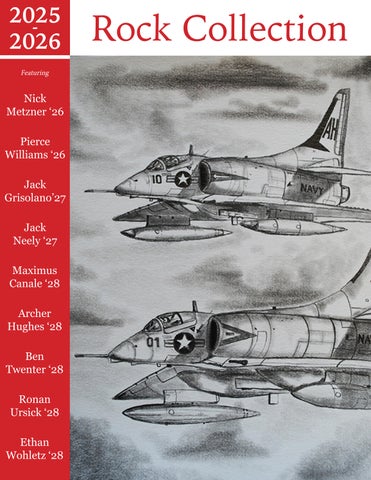
2025 2026 Featuring
Nick Metzner ‘26 Pierce Williams ‘26 Jack Grisolano’27 Jack Neely ‘27 Maximus Canale ‘28 Archer Hughes ‘28 Ben Twenter ‘28 Ronan Ursick ‘28 Ethan Wohletz ‘28
Rock Collection
Ad Majorem Dei Gloriam Club President Brendan Ortbals
Editor-In-Chief Jack Neely
Staff & Editorial Jack Grisolano Cormac Reidy Will Sampler Ethan Wohletz
Faculty Moderator Dr. Megan Caughron
The publication of this literary magazine is made possible through the sponsorhip of Andrews McMeel Universal companies in honor of James F. Andrews, co-founder of Universal Press Syndicate. John P. McMeel, chairman of AMU and companies, and Kathleen W. Andrews, chief executive officer in Andrews McMeel Publishing, established the literary magazine program in his memory after his death in 1980. Jim Andrews’ interest in nurturing and developing artists and creative writing talent is reflected in the program, which provides young men and women the opportunity to express and cultivate those talents. Materials appearing in Rock Collection may not be reproduced or reprinted wthout the written consent of the author of the work. Contributors to Rock Collection retain full rights to their work and need not obtain permission for reproduction.
Contents 2. Song of Exigence ............................................................................ Nick Metzner ‘26 3. Light of Christ ...................................................................................... Jack Neely ‘27 4. Abandoned Star ................................................................................... Jack Neely ‘27 6. Tankas ..................................................................................... Landon Hochstein ‘26 7. A Life Well Wasted ........................................................................... Nick Metzner ‘26 9. Time Stops ..................................................................................... Charlie Tietjen ‘28 10. Untitled ....................................................................................... Pierce Williams ‘26 12. Theme Park .................................................................................. Ethan Wohletz ‘28 16. Sight, Sound, Smell .......................................................................... Jack Neely ‘27 17. Homecoming ....................................................................................... Jack Neely ‘27 18. Nature’s Captivity ....................................................................... Charlie Tietjen ‘28 19. The Folly of Creation ........................................................................ Ben Twenter ‘28 20. The Bus Stop ................................................................................. Jack Grisolano ‘27 23. Untitled ........................................................................................ Pierce Williams ‘26 24. Chalk Sketch #5 ...................................................................... Landon Hochstein ‘26 25. Untitled ............................................................................................ Will Sampler ‘28 26. Beautiful Things ............................................................................. Ronan Ursick ‘28 27. Tension ........................................................................................ Charlie Tietjen ‘28 28. Barge ............................................................................................. Jack Grisolano ‘27 32. Prepped News .................................................................................... Jack Neely ‘27 33. Untitled ........................................................................................ Pierce Williams ‘26 34. Print #5 .................................................................................... Landon Hochstein ‘26 34. Striking Decisions ....................................................................... Archer Hughes ‘28 36. Persegue Somnium ....................................................................... Charlie Tietjen ‘28 37. Print Success ............................................................................ Landon Hochstein ‘26 38. Beneath the Armor ..................................................................... Maximus Canale ‘28 44. Print #4 .................................................................................... Landon Hochstein ‘26 44. Cosmic Tale ...................................................................................... Nick Metzner ‘26 47. To Contemplate ............................................................................. Charlie Tietjen ‘28 48. Untitled ........................................................................................ Pierce Williams ‘26 Front and Back Cover Art by Pierce Williams ‘26
1
Song of Exigence Nick Metzner Ding dong the witch is dead! Yell with the revolutionaries, “Off with her head!” The London bridge is falling down Caesar killed for taking the crown. Snicker-snack! Watch the vorpal blade kill. Jack and Jill fall down a hill. A celebration of violence, that’s all we seek, To slaughter the innocence, to murder the meek. We don’t see the shooter. We don’t see the shot, Read the manifesto while the barrel’s still hot. To all the deaths we turn a blind eye, Sit and watch Icarus soar so high. We rant and we yell with hearts full of ire, Go and burn Beowulf upon his pyre. A worship of bloodshed, of rights undivine, Gunmetal, needle, and hatred ashine. We stare and we laugh to hide all our fears, We bathe in the blood covering myriad tears. Another man reduced to an outline of chalk. Pull back the hammer and watch the gun cock. We drown ourselves in hatred’s red fog, Wrapped ‘round the words of the demagogue. A culture divided, that’s all we know. Across the aisle no Man will go. Immigrant, addict, homeless, and crook, From them our humanity we took. At society’s table we deny them a place: Look away. They don’t deserve grace. No! From them our gaze we must not avert. We must try to aid all those who hurt. A cry of change, a goal to seek. We must help each other make tomorrow less bleak.
2
Enough with the rage, the shame, and the vitriol, If we don’t stand together then we will fall. Snake oil salesmen, we’ve taken the bait, We must recall truth before it’s too late. Democrat, Republican, Christian, or Jew. Atheist, Muslim, Buddhist, or Hindu. A simple truth, so long forgot, One we all know and yet have not thought. So break down the walls, reject the division charade. Turn disgusted from the blood-red parade. Reach out to the needy, the helpless, the poor. Together we remedy hate’s festering sore. I know it is harrowing but it still must be tried. We must come together and not pick a side. A shout from my lips, one that I shall illumine. You are like me and we are all human.
Light of Christ Jack Neely
3
Abandoned Star Jack Neely
A
colossal metal structure hung around the star like a frayed cloak draped over a flickering lamp. It created a rough semicircle outline of the star, hinting that it had once been a full enclosure, but now had fallen to pieces. The edges looked as if the rest of the structure had been violently torn off by some great hand. The metal, however, besides gashes and other marks of stress, remained pristine and shiny. Metal supports forming a ribcage crisscrossed past larger metal anchors welded to the beams. Large, dull-blue reflective panels were riveted to the anchors and pointed inward, toward the star. Some panels were shattered to pieces, others had great gashes through them. The whole scene looked like the grave of some long-dead monster, forever forgotten in the darkness of space around it. The back of the anchors had small chambers on the other side, facing away from the star. They were dwarfed by the behemoth of the rest of the structure and the supporting rivets that held everything in place. They each had two grimy windows and a circular access hatch barely tall enough to accommodate a person. The mechanic stood at his post, a position he had held for… he could never quite remember. It had been years. Many years. His room was bare and uniform. He had no personal effects. The wall facing away from the windows was dominated by an information panel pulsing with flashing lights. An inconsistent stream of data rolled down a pixelated, low-resolution screen in green text; he had forgotten long ago what any of the numbers meant. An equally low-resolution live feed view of the star was fixed to a screen directly in the center of the panel. He never cared to look at the star, though. He sometimes forgot it was even there. His metal cocoon provided all that he needed. A small kitchen was tucked into a corner, fitted with a stove, sink, and a few cabinets stocked with the bare necessities of life; a beige door led into a small bathroom beyond. A cot stood in another corner. A partition wall, really a rectangular archway, separated the main room from a small foyer. Some rusted metal lockers, most of their paint chipped away, were set against one wall, while the final wall held the circular access hatch with a small square window in its center. The mechanic’s navy blue uniform, once crisp and new, was now rumpled and faded. The fabric was worn around his knees and elbows, and the collar hung limply by his neck. His black work boots were scuffed and had not been polished for a few months; polishing the boots was one of the few housekeeping activities he still did, but they never looked as shiny as they once had. His hair was dirty and matted, and his hands were perpetually smudged with the grease and grime from the platform’s mechanicals. A pair of well-worn work gloves hung halfway out of the back pocket of his pants. As the streams of meaningless data flashed before his unfocused eyes, his mind wandered back to how things were. He still remembered when his uniform was not so scratchy, how the lockers did not groan when they opened, how there were other workers on other platforms
4
he could visit. Then it all fell apart. Everyone left. The platforms collapsed. The freighters stopped coming. There was nothing: no one left for him, nowhere in the whole abandoned star. A sudden steady beeping snapped the mechanic out of his daydream. He glanced at the screen; it was blinking red. His usually empty, wandering gaze locked onto the panel with uncharacteristic intensity. He furiously pressed buttons on the panel and adjusted dials with careful precision. He seized an old headset hanging from a hook on the wall. A freighter was coming. “Hello? This is Refinement Facility Deep Space Unit 117. Can you hear me?” The mechanic’s voice was scratchy from disuse. “Come on, what’s the frequency? Can’t you hear me? This is RFDS 117, come in! What am I not doing? Freighter, can you hear me? Come in!” Cold and unfeeling static met his frantic attempts. Each turn of a dial, each press of a button, failed to alleviate the unrelenting sound of nothing. “No! Come in! I just want to hear someone! Anyone!” He slammed the headset on the panel, static bursting from the radio like a strangled shout, and ran to the opposite side of the room where one of the two windows ran across the length of the room. He could see a bulky gray shape lumbering past against the speckled void. “What will it take? I’m all alone here! Just… please! There’s nobody left for me! Nobody to talk to, nobody to care!” The freighter continued on, unconcerned. “No! Don’t leave!” He slammed his fist against the glass, following the freighter’s path as it slipped from view. “Come back! No! No! Please, no!” He reached the end of the window. He hung his head and hit the window once, twice, three times. The freighter drifted out of sight. The static still whispered from the useless headset. He was shaking violently, his head resting against the cold glass. “No…” he whispered shakily under his breath. “No…” A sudden noise jerked him out of his despair: the sound of metal scraping against metal. Then a loud thud, a metallic clank. The lights flickered. The platform must finally be falling apart, he thought. It would end him at last. He pulled a flashlight from his belt and held it in front of him with a shaky hand. He ran forward, toward the access hatch and lockers. There was a suit in there that would protect him from the vacuum and the star. His gaze darted around as he heard a hissing sound, like air escaping through a tube. He tore open the locker and seized the suit. Then a light tap. Knuckles rapping on glass. “Hello?” A muffled voice said through the circular door. The mechanic spun around. The noises stopped. “Who…” he said shakily, eyeing the door with distrust. “RFDS 118. I heard you on the radio. It sounded like you needed help.” “No,” he replied. “You couldn’t have. That radio doesn’t work.” “Is… everything alright here?” “Listen, you can’t be RFDS 118. All these platforms are abandoned. I’m the only one left,” he said, slowly stepping toward the door. He kept his gaze glued to the floor, not daring to raise his eyes to the window. “But I’ve been here for ten years…” “Go,” he snapped. “Go away. I’m fine. Just leave me alone.” “Are you sure?” Instead of replying, the mechanic grabbed a large red handle set into the wall, and pulled it down with both hands. There was a loud whirring from above.
5
“Hey, what are you doing?” There was a hiss, the scrape of metal, then silence. The mechanic threw the flashlight across the room. It clattered to the floor and tumbled into a corner. The beam of light flickered for a few moments before going out. He turned back to the door and pressed his face against the window. He looked into a small airlock area, with the other door wide open, looking out at space. He could see some other parts of the platforms and the glint of the starlight beyond. But it was an empty scene. There was nothing outside. Nothing at all.
Tankas Landon Hochstein The cool wind whips me I feel it pull me forward To what I know not Restless I let it tug me To someplace unknown to me. The colors fill me I smell them all around me Delicate and soft Overwhelmed with old senses I know them all, oh, so well. The slow music drones Like tv static buzzing Quiet guitar plays It soothes me as I sit still Eyes closed, breath soft, body still. A statue stands still Crumbling from age, and yet It stands as sturdy As when it was still brand new The skin is weak, the soul, strong.
6
A Life Well Wasted Nick Metzner
T
he man sat up in his medical bed. The IV tube slowly dripped forming a strangely serene musical accompaniment when paired with the steady beeps and whirrings of the other medical equipment. He slowly scanned the small room before his gaze landed on the man sitting next to his bed. “Hello,” the old man’s voice was weak but mirthful. “Hello, Mr. Grant,” the seated man’s voice was sharp and cold as a scalpel. The seated man wore the uniform of a businessman. His eyes glittered with hungry greed. His slicked-back hair and glittering Rolex made him look like an old-school mobster. An aura of affluence and mercilessness clung to him. “Ah, you know my name. Might I ask you yours?” Mr. Grant’s tone was cordial and calm. “My name is Charlie Mason,” he handed Mr. Grant a neatly written business card. “I’m from your insurance agency. We need to talk-” “Mr. Grant you have another visitor,” the nurse who had spoken moved aside to let the newcomer through. The new visitor sat in the chair next to Charlie, prompting him to move one seat over. The newcomer was dressed lavishly but all his finery looked old. The silk jacket he wore was moth-eaten, his silver cuff links were tarnished, and the ornate watch on his wrist had stopped working. His cold eyes were sunken into his skull. This and his bony angular features made him appear like a cubist’s caricature of death. Charlie looked at the man quizzically. The newcomer said nothing; he watched the two men with vulture-like hunger. Charlie cleared his throat. “Anyway, Mr. Grant, I need to speak to you about your coverage. I regret to inform you that your coverage will be terminated later today, and, seeing as how you lack a job, relations, except maybe for this man,” he gestured at the man sitting next to him, “and no collateral of any kind, we regret to inform you that you will no longer be able to stay at this hospital or any other hospital.” “Ah, I see.” Mr. Grant smiled warmly at Charlie, “It was a pleasure meeting and I wish you a great rest of your day.” The newcomer tapped his index finger on the armrest of his chair. Charlie scowled. “May I ask your name and your relationship to Mr. Grant?” The newcomer turned and fixed his hollow eyes on Charlie. He seemed to be staring not at Charlie but at a point on the wall behind him. Then he smiled and his gaze focused on the man in front of him. Charlie felt a shiver run down his spine. Something was horribly off with the man’s mouth. His gums were black and looked rotten, yet his teeth were so white they gleamed. It looked as though someone had taken healthy teeth and jammed them into the gums of a corpse. “I’m a friend of John’s,” he gestured at Mr. Grant, “but we’re not so close that I’d go bailing him out.” The man chuckled wheezily. “You can call me Death.” Charlie couldn’t tell if it was a trick of the evening light: the man’s face seemed to grow more pale and his eyes more sunken. His smile had even seemingly grown, stretching freakishly
7
across his ghoulish face. “Well, seeing as you’re not going to offer any assistance to Mr. Grant, our conversation is over.” The man’s smile grew even larger, “Our conversation is never over, just postponed.” He truly looked horrible in the deepening shadows. “Mr. Grant, do you have anything you would like to add before I go?” Charlie was beginning to feel frustrated. Mr. Grant smiled warmly at Charlie: “No, and I do hope you have a good rest of your day.” Charlie felt angry. “You really don’t care if you die tonight, do you?” Charlie had not meant to say it out loud, but he was irritated to the point he did not care. Mr. Grant cocked his head at Charlie’s question. “Of course not. I’ve lived a good life.” “A good life? A good life?! You think this is what happens at the end of a good life?” Charlie gestured around the small, empty hospital room, “You’re going to die a broke old man with no friends and no one to mourn you.” Mr. Grant’s smile deepened; it was an old, sad smile. “I guess I didn’t have a life welllived. I was once the king of the world, you know? I was a partier. I never made any good relationships. I didn’t want to be tied down. I guess that came back to bite me, but through it all I won’t regret it. I might not have a lot to show out here,” he gestured to the hospital room, “but I have plenty of stuff up here where it really matters.” He tapped his forehead. Charlie looked at him. “You didn’t appreciate the life you were given and only made a fool of yourself. You’re a hedonist. How can you have the gall to be content?” Mr. Grant looked at him with somber eyes. “Maybe you’re right. I guess I didn’t have a life well lived, but I did have a life well wasted. Have you led a good life?” Mr. Grant was smiling now. “Goodbye!” Charlie stormed out of the room. Walked down the cold, sterile hallway he saw through a far window the sun beginning to dip below the horizon. “What a pity for an old man like that to die alone.” The nurse’s voice barely registered as Charlie walked past. As he drove away from the hospital he remembered when he was young. He had big dreams then, but he had partied when he should have studied. He had played when he should have worked. And now he had to settle with being an insurance repo man. Mr. Grant’s words rang in his head. Was he living a good life? He thought back. Then he thought about the future. Would he die just like Mr. Grant, alone and with no legacy? Would he be able to smile like that? The nurse’s voice rang in his head. He turned the car around. “You came back.” Mr. Grant looked at Charlie. Charlie, soaked from the rain, walked to the other side of the bed, sat down, and took Mr. Grant’s hand. “Why?” Charlie looked up. Across the bed stood death. The light above his head flickered unnaturally. “Why would you come back?” Death seemed taller, his skin paler, his eyes more sunken. The skin looked like it had sloughed off of his scalp, revealing the yellowed bone. Charlie hoped that this was a trick of the light. “Despite what I said earlier, I’m glad you came back.” Mr. Grant looked at Charlie. He took a shaky breath, “I don’t regret my life, but I think it would have been terrible to die alone.” Charlie gripped Mr. Grant’s hand. The old man’s breath was beginning to falter. The light stopped flickering. It went out. The shining teeth of death shone in the dark. It was an unnatural darkness. It devoured the light on the other side of the medical bed. “He deserves to die alone,” Death whispered. Charlie felt a hand on his shoulder but did
8
not dare to turn. He kept his eyes fixed on the smile in front of him. “You said it yourself: he didn’t appreciate the life that he was given. Why would you come back?” Another hand was placed on his shoulder. Death’s leering smile inched forward. “I couldn’t not come back.” “Because he reminded you of yourself.” The voice spoke directly into Charlie’s ear. A skeletal hand placed itself over his. Death’s smile moved closer and closer. It was oversized and twisted; then it disappeared. A hand reached from the darkness across the bed before pulling back and walking its fingers down the length of the bed. It was a grotesque sight. Each bony finger was freakishly long, tipped with a long, yellowed, claw-like nail. The skin on the arm was rotten and hung as if it had been draped over the bone. Mr. Grant’s breathing grew weaker. Death moved around to Charlie’s side of the bed. The darkness followed him. The myriad hands that gripped Charlie retreated only to be replaced by thoese of Death. The smell of rot made him want to retch. He could feel the cold, stale, crypt air of Death’s breath as Death leaned in towards Charlie’s ear. Charlie shook as Death moved his cold hand from his shoulder to his hand. “Do you think this will change anything? You’ll still die alone. He won’t repay this kindness. Let go.” Death placed his hand on Charlie’s shoulder. “This meager act of kindness is pointless. You’re wasting your time. You’re wasting your life.” The machine let out a continuous beep. Mr. Grant was gone. Charlie let go. He turned to face Death. Death stood behind him, hunched, unnaturally tall, his back scraping the ceiling. His tattered black cloak billowed around him despite the complete lack of air movement in the hospital room. Two black raven wings sprouted from his crooked back. His weirdly elongated arms almost reached the floor. A large scythe rested next to him, its handle rotted and wormed with maggots, its blade rusted from years of use. Death’s face was mere inches from Charlie’s. It was a skull of sorts, but its smile twisted it out of shape. Death’s smile was monstrous and hungry. It delighted in pain, in tearing apart families and friends, in cutting what should be long short, in watching the light fade from a loved one’s eyes. Charlie looked up into the twin sockets of Death’s skull. “I chose this. I wanted to be able to know that if I died tomorrow I would be satisfied. This may be a waste of my life, but it is life well wasted.” With that, Charlie turned and left.
Time Stops Charlie Tietjen Days go by, many weeks pass. Who’s there to tell what day it is? We don’t know much, but we do know this: For days ahead, we hope for bliss.
9
Untitled 10
Pierce Williams
11
Theme Park Ethan Wohletz
N
icholas had wanted to finish his work before he even left his house. For the whole day, snow had been falling softly. It was a Saturday in mid-January, and he would see his grandchildren for his birthday tomorrow. He had worked at Walterville Bank in the town of Walterville for his whole life, starting as a cleaner boy at fifteen. He had stayed after dinnertime, sorting documents of deposits in the backrooms on rows of shelves and running sums of money when checks were cashed, when a man stepped up to the teller’s box. He wore a heavy black overcoat over his expensive-looking business suit and a black top hat over his thin, dark hair. His face was a black hole—it portrayed no emotion and seemed to suck life from his surroundings with its cold seriousness. More alarming still, Nicholas did not recognize him; it is not terribly exciting to live in a small town like Walterville and notice foreigners in shops on Main Street or at the Louie’s gas station, but an outsider in the bank was certainly unorthodox. “What is your business, sir?” the teller said, startled. He did not know the man either; in such a town, tellers always addressed everybody by name. “Henry A. Scribe,” he said gruffly. “Real estate developer.” He shoved a check under the gate. “Pay to Edward L. Mason. Give me the deed to the land that Sandy Lake Park now stands on.” This startled Nicholas: Sandy Lake Park was the local theme park, and it had been open and in the Masons’ hands since long before Nicholas’ birth. “Sir,” said the teller, startled and annoyed at the sudden ungeniality. “We cannot process such a request without Eddie’s authorization. You also do not seem to have any accounts or standing in our bank.” “Hmph!” Henry said impatiently. Just then Eddie Mason, the owner of the theme park, sheepishly stepped out from behind him. A short man with a plump belly, blonde hair, and a face so round you could use it to prove geometry theorems; he also wore a suit, though a cheaper-looking one than the other man, and he wore no hat. Most of Walterville would associate the sight of him with some of their happiest memories, but his usual jolly appearance had been replaced by a teary-eyed countenance. “No, that’s right,” he mumbled with a sniffle of such sadness that a heart made of tungsten would melt at the sound of it. “I sold the land to him. It’s his.” Nicholas stood dumbfounded. He simply could not believe this. He even expected Eddie to change his demeanor, yell “April Fool’s—early!” and throw his hands up in the air, then they would all laugh, including Henry. This joke, if it had been a joke, would have been a new high, even for Eddie, but with him it seemed somehow possible—perhaps even likely. But that did not happen, and this was not a joke. Henry interrupted his train of thought: “Well?,” he grumbled, “the deed? And make a place for me in the shelves. I’ll be staying for a while.” Nicholas had heard the whole conversation. The teller stepped back to relay the requests:
12
“Nick—,” he said shakily. “I know.” He took the check and walked back to Eddie’s cubby almost subconsciously. He felt as if he would soon wake up, go to work and, when he saw Eddie again he would say, “You know, I had the strangest dream…” and tell the story, all the time Eddie laughing, and he would say afterwards, “Thank you, Nick—that’s a good idea for a joke!” But this also would not happen. His lack of focus slowed him down and when he returned to the front desk Henry looked even more impatient and irritated. “Hmph,” he growled menacingly, “took you long enough!” Nicholas thought momentarily that refusing to hand him the deed would be a heroic action that would save the land from Henry Scribe. But then reason reminded him of reality. He held out the deed only a few feet from his body when an icy hand touched his for hardly a moment as Henry snatched the deed with starling violence. “Good day to you,” he muttered, his back already turned. Shoving the deed into the pocket of his black pants, he stomped away. “Oh, dear, oh dear!,” Eddie whimpered as he shuffled in place. He then suddenly left, as if his wits had recovered just enough for him to realize the prudent course of action, all the while repeating, “oh, my, oh dear…” Nicholas walked back and sat on a crate in a daze. It really was true. He did not know how to receive the news, or even how to believe it. Not that he was a particularly frequent visitor to the park, or at least not anymore. But knowing the place where some of his dearest memories were forged—the park that Eddie had owned—was gone, bothered him. He thought of those earlier years, when his Aunt Charlotte would take him to the theme park. It was an exaggeration to call it a theme park back then since the place contained only two rides of any kind, but that is how he would always remember it. His aunt would take him and his ten siblings one Saturday every month for time interminable. This routine was normal in Walterville; Sandy Lake Park had served the town as the primary entertainment destination for his whole life. It was everyone’s first choice for a free Saturday or a fun picnic. These picnics were common; while the park featured modern amusements to be expected in any theme park, it also had fields and a beach which were open to all parkgoers. As a small child, he had enjoyed the fields and the beach, but he preferred to ride the park’s only two rides—a tiny roller coaster and a small train—again and again. Mr. Mason walked around the park nearly every day, shaking so many hands that Nicholas wondered how he could bear such strain on his hand, and laughing his big, hearty laugh. He once gave Nicholas a chocolate bar and a gold coin, which was required to ride one of the rides, which had made him feel immensely special even if he later realized that Mr. Mason had probably given many other children the same treatment. As Nicholas grew, however, so did Sandy Lake Park. When he was thirteen, he would still go to the park, but it had changed; it was nearly empty—families who did come stayed for less time and walked away saying, “Now that wasn’t as much fun as I remember it.” And, in spite of the birth of his son, Eddie, Mr. Mason looked more tired and stressed; he did not shake as many people’s hands, instead preferring to stand back and observe guests’ behavior. Nicholas noticed that part of this sudden change in his behavior was due to the changes in guests’ behavior, and he understood the reason for the guests’ discontent: he himself, who once so enjoyed riding the park’s two rides, found a day at the park less and less interesting each time he went. He still did enjoy those summer Saturdays, but he looked forward to them less. “Nicholas, young man,” he remembered Mr. Mason asking him in a serious tone on one of these Saturdays, “Are you enjoying yourself on this fine afternoon?”
13
“Yes, sir,” responded Nicholas, startled. “I know that you are among my most frequent parkgoers, and that you have been for years. Have you noticed this, shall we say, depletion in fellow attendees?” “Yes, sir.” “And what do you think the root, so to speak, of this change is?” “I think that many parkgoers are bored.” Nicholas bubbled inside with excitement. “And what do you think the fix is for the problem?” “We want a big coaster!” Nicholas blurted out. “Oh, I see…” Mr. Mason appeared disappointed. He walked away with his head down and his hands in his back pockets. Nicholas frowned with shame at the memory, but the request came to fruition. He remembered seeing the front-page article for a mid-January week on the Walterville Weekly—“Sandy Lake Park Adds Major Roller Coaster Dragon’s Flight”—and almost leaping out of his chair in excitement. The ride would be ready for the coming season, and it would be built on some grass near the entrance that hardly anybody used. He begged his aunt to bring him to the park on the opening day of the ride. When she refused, he instead went to his parents, who agreed only if his siblings could come and he paid for half the tickets. He accepted the offer without a second thought. The first quarter of that year dragged on; he dreamed of rediscovering that sense of newness in the rides and seeing the park buzzing with activity again; he even wrote Mr. Mason a thank-you letter in late February. And the rest of the town hummed with excitement. At school to truthfully state that one would ride it on the first day of the season became a sign of status and bravery. He still remembered when he announced that he, Nicholas Bank, would do so, and the silence of his classmates revealed the honor that they paid him. At last it was Dragon’s Flight opening day. He remembered stepping out of the car and forgetting to help ready the family for the day, which merited his father grabbing him by the ear and yelling: “Now, young man, you will help your mother, or I will take your money and we will leave!” That removed him from the daze, and he diligently assisted his family. He still remembered walking toward it. The red and green color of the towering steel track and beams testified to man’s brilliant machinery, and the train swept through the course with a majestic energy. He boarded. It climbed the lift hill. His eyes closed. His heart raced. And the roller coaster flew down. It really was dazzling at the time, he reflected; Dragon’s Flight dwarfed any other roller coaster he had ever seen, so it shattered his expectations for a roller coaster. For a few summers, he always looked forward to every other Saturday, when he could go ride Dragon’s Flight. But, by his twenty-sixth birthday, the shine of its paint had worn, the elements he had experienced three hundred times, and the whole park was generally less popular again. Nicholas could now drive himself to the park, and he did, but only a few times a summer. Again Mr. Mason regressed into his unhappy, concerned attitude, and again he asked Nicholas what he should do. “Nicholas, your advice rang true last time, let us see if it does so again,” he said. “We want a theater to watch shows in,” he said. And so it happened, again in the news, again to be ready for the upcoming season, but this time to be built on some walking trails that were also largely unused among parkgoers. He remembered being excited, though less excited than for Dragon’s Flight, but also again being
14
impressed; he rediscovered the joy of non-ride attractions, and he watched the current show with his young son each time he went to the park, which was more often due to the new attraction. But, again, the luster of the theater faded, and the park returned to emptiness. And, again, shortly after Nicholas’s thirty-fifth birthday, Mr. Mason asked for Nicholas’s advice. “A drop tower,” he said. The Walterville Weekly announced it in mid-January: “Sandy Lake Park Adds Three-Hundred Foot Drop Tower.” The cycle repeated itself many times: a dark ride after his forty-third birthday built on some more picnic land, a much larger roller coaster after he turned fifty built on a central walking trail, a new Christmas event in December the year he turned fifty-four. And then, one mid-December day, Eddie approached him as the lights flashed and the music blared around them: “What does the town want?” “A whole new elaborately themed space land; we want to feel like we are on a different planet when we walk into this section of the park.” Eddie gasped. He walked away, obviously disturbed. And two months later the newspaper ran the announcement: “Sandy Lake Park to Add Brand New Immersive World!” It would be huge: the lake and Dragon’s Flight were to be permanently closed, and, for the first time, the new ride would not be ready for the upcoming season; it would be ready the season after the next, though Dragon’s Flight and the lake were already closed. Nicholas dreamt about the new section of the park, and the rest of Walterville seemed to share his interest. The park had more visitors, though they came mostly to observe the construction as it progressed. It seemed to slog on through the summer; he patiently waited, watching the construction when he attended the park as if he expected it to open at any moment and he could be the first inside. Finally, the first day of the next season arrived. He could barely see five inches ahead due to the heavy rain, and he could barely move due to the crowds. The whole town had come. Local schools had cancelled for the day. Another parkgoer told him that he had driven twelve hours to Walterville. The motels for miles had no vacancies. Nicholas had felt pride at that. Sandy Lake Park would usher in growth for the town because now it was a destination. He felt that it could never close, that he and Eddie would be famous for bringing their small community to wider recognition, that they would enjoy the gratitude of the town for all they did to save Walterville. As the years progressed, however, it became more and more apparent that no such recognition or appreciation would come. He did enjoy the new land. But its rides soon became old to him and the immersion experience wore off. It appeared Eddie was neglecting the land’s upkeep. His daytrips grew less frequent. By his sixty-first birthday, he only went to the park once every three months, and, as before, others visited even less. I expect that Eddie will ask about the new attraction soon, he had thought, he always does! That was during his drive to work this morning. Now Sandy Lake Park was gone. Gone! he thought, really gone! A tear slid down his cheek and dropped to the floor. Pathetic. Like the park: there for an instant, then not. There would be no epic finale, no farewell parade or fireworks show, no triumphant final rides. Just a fading existence as all its rides and buildings get disassembled and carted away.
15
Sight, Sound, Smell Jack Neely
16
Homecoming Jack Neely
A
year ago, I would never have thought I would be here, in this exact place at this exact time on this exact occasion. Homecoming. A dance. I would have laughed at the very idea of me going to one. But for some reason I’m standing in front of a sink in the Ashley Hall bathroom, with the faint sound of thumping music and overlapping conversations sneaking past the door. I raised my eyes to the mirror mounted on the wall, and was faced with an unfamiliar sight. Me… but different. My hair was wet, fresh with gel, and combed perfectly to one side, not falling halfway into my eyes like it usually did. It looked darker than it usually did too. The lights might have even been reflecting off of it. I had on a white shirt and a blue and silver striped tie; my navy blue coat had already been dropped off at the coat check desk. A small silver tie clasp with a stylized W was clipped halfway down my tie to keep it in place. I let out a long sigh. I still couldn’t believe I was here, at Homecoming. One would think my standing in “high society”— football letterman, two-time state champion, the kicker who just so happened to make the game winning kick for one of those championships— would thrive in a situation like this. But I am more of the quiet and reserved type, the guy who does not say anything unless he has to, the guy who, somehow, after three years of high school, has made three deep friendships and experienced exactly zero romantic relationships. I kept count. I really did not want to leave. I had not gone to Homecoming last year, something the football guys liked to talk about for some reason, and I would have been perfectly content with walking back to get my coat and driving away. But I had made it this far. What was the problem with going further? Actually, I can answer that one: Allie. It was always Allie, appearing when I least expected it. Little did the rest of the world know that the stone-cold, emotionless Connor Wilson actually had a crush on someone. So of course, on the most important day of my social career, Allie would find her way to the forefront of my mind. I closed my eyes. I remembered walking up to the student entrance, the red bricks and the silver “Neil McShane High School” lettering acting as the literal threshold into the social world. I walked through those doors and had never thought much of them, but tonight had been different. The sights and sounds of the dance flooded over me. Then I caught a glimpse of Allie, making her way through the crowd. I panicked. I opened my eyes. I was still in the bathroom, looking at myself in the mirror. It still did not feel right that I did not look like myself. Like I was some sort of imposter. At the same time, though, maybe it was a good thing. Maybe the world was telling me I needed to be different, to change. Finally, I walked out of the bathroom and into the dance. The music, the talking, the
17
smell of the concession stands washed over me again, but this time, I was ready. I cut through the crowd, maybe hesitating to give a quick wave to anyone who happened to notice me, but never stopping. I was on a mission. I stepped into the gym, the pulsing heart of the dance. Lights flashed from the DJ’s booth at one end of the gym. The music seemed loud enough to shake the whole building. The lights had been dimmed, but I could still see who everyone was. I saw plenty of the football guys and presumably some of their dates, and a few classmates I knew well. And Allie. She was at the center of it all, her dress swaying with her movements, more graceful than anyone else there. The dancing lights seemed to be pointed toward her, as if she herself was pulling them in. The crowd was almost parting for me, giving me a clear road right to her. Now was my chance. I could— Will. Of course he was here. He had been in a few of my classes, and I knew plenty about his uncanny ability to capture seemingly any girl’s heart. I was not friends with him or anything, but I had never had any reason to not like him. But right now I wanted to throw him into the bleachers. As people stepped past, I saw him standing right next to Allie. They were dancing together. Laughing together. They were together. I really had no reason to feel how I did. It was not like Allie was my girlfriend or anything, and I certainly could not “lay claim” to her. That is not how things work. But at the same time, that was supposed to be me with Allie. This was not how my first dance was supposed to go. This was… agony. I took a step forward, and immediately froze. It felt like everyone was staring at me. Even the music seemed to beat down on me. Still, Allie and Will danced like there were no problems in the world. I had to leave. Escape. Run away. I burst out of the doors again. The dance quickly faded into the background as I was simultaneously hit with the chill of the evening. I slumped into one of the benches along the walkway to the door. Two realizations set in as I slowly froze under the faint glow of a nearby lamp. I had forgotten my coat at the coat check. And no matter how I felt about Allie, there was no way she would ever know, and no reason why she would feel any different towards me. To Allie, I was nothing.
Nature’s Captivity Charlie Tietjen The sea roars with emotion Living just for the ocean Yet it yearns for something more To live life less like a chore.
18
The Folly of Creation
“E
Ben Twenter
ureka, I’ve finally done it!” exclaimed Professor Chaves, his cry of triumph echoing through the quiet, empty lab. “I created life!” The professor hunched over a tiny, glowing, luscious purple landscape, filled to the brim with miniature trees and rivers. Mountains scraped the artificial sky he had made only a month ago. Now the objects of his greatest pride were the little, green people running around and living their little lives in his own little world. There were four of them: two males and two females. They wore thin fur coverings. They had three horns on each of their heads; otherwise, they looked like tiny humans. He had designed them entirely by himself and as he continued to watch them run around, exploring this new environment into which he had beamed them, Chaves felt a rush of power. He smiled to himself: “I could squash all of them like a bug if I so pleased. I could rip up their families and homes like a hurricane. I’m like a god to them. No… no... I AM their god.” Chaves would never really do any of the harms he imagined, of course; he was a man of science and too proud of his creations to even lightly touch them. But that feeling of absolute power and the authority that comes only with the joy of creation was still there, fueling him. For now, however, he was content to sit and watch them, to merely play the role of onlooker and not god. Then Chaves noticed something peculiar: the little people, while he had expected them to advance and procreate, were doing it more quickly than he ever could have believed. They had gone from being confused animals to already building huts and making tools in five minutes, and after five more minutes they were growing food and mining the stone he had given them. Even stranger than that, there were so many of them, far too many for Professor Chaves to even begin to count. As he watched them he felt a pang of anxiety at how fast they were progressing, but that feeling was quickly overwhelmed by a flood of pride at how amazing his creations were. As he watched them, however, he realized his own mundane humanity. He started to head to the bathroom, then hesitated. His creations would continue living even if he were to leave them alone. Chaves hestitated for a moment, wavering. “Oh I’m sure they’ll be fine without me. After all, we humans have survived without any help, haven’t we?” And with that he rushed out of the room. Unbeknownst to him, the little species continued evolving faster and faster, their evolution moving far more quickly than the human race ever could. Ten minutes later Chaves returned. “I’m back, children. What have you done in my abse-” Professor Chaves stared at the gaping hole surrounded by smoking ruins; where the once verdant artificial landscape stood, there was nothing but the wreckage of tiny futuristic buildings, fire, and ash. Chaves fell onto his knees sobbing. “My life’s work, wh..what happened here? What could’ve done this?” Chaves knelt on the sterile lab floor, grabbing and digging into the wreckage and dirt of
19
his tiny world, trying desperately to find any remnants of his beautiful creations. Then he stopped. “No, WHO could have done this? Someone has to have tampered with my project.” Chaves rushed to check the video cameras. He played back the footage of the time he was gone; he replayed the birth and death of an entire world. It began with peaceful advancement, the tiny people moving from savages to societies as they began to establish houses and governments. They sped through creating naval technology and exploring the oceans of their tiny world. They populated new places, made more and more modern houses, and progressed faster and faster. Soon they did not seem so small as they began to build skyscrapers and planes, trying to reach beyond their world. He watched the wars they fought over the centuries— with rocks, then swords, then arrows, then guns, then bombs. Finally he found the moment it all stopped: one small plane flew over the world they had made and dropped an even smaller weapon which, through someone’s miscalculation or morbid desire, destroyed everything. Chaves shielded his eyes from the blinding light as the civilization he was so proud of was wiped out in an instant; all possibility, all potential, destroyed in that one, miniscule act. Once the video had finished, he checked the timestamp: 60 minutes. The professor stood in awe and sorrow as he stared at that time. “Sixty minutes, that’s all it took. Sixty minutes for the the rise and fall of a whole world, my world. What could have caused them to want that? Apart from their physical features, I made them exactly like us…” Then Professor Chaves stood up, walked to the exit of the lab, turned off the lights, and walked out shutting the door behind him.
The Bus Stop Jack Grisolano
T
...............he wind swirled down the empty street like a massive exhale from the sky, bringing with ...............it a bone-deep chill. Trash fluttered along the curb, spinning down the road alongside the ...............browned leaves from the old oak tree that somehow still grew on the small plot of dirt next to the curb, its stripped branches stretching up towards the night sky like skeletal fingers. A lone figure sat huddled on the bench inside the bus stop. He was slumped against the wall, wrapped in a thick wool jacket. His leather boots, once a fine, black leather, were worn out. Overhead, a tram rattled by on an overhead rail. As it passed by several stories above, it brought with it a fresh slipstream. A pile of leaves and trash fluttered to a soft landing in front of the man. The man softly snorted and shifted, his grubby hand emerging momentarily from the folds of his clothing to tighten his coat briefly revealing the army jacket beneath with the name “Mac” in faded yellow over the breast pocket. He was a man who had slowly been folding in on himself, brittle and worn, but not yet broken. He could not remember the last time he had had a real conversation. People always passed
20
by him like he was invisible, and in a way, he was. But he saw them all. He had been trained to see. To notice postures, ticks, where gazes drifted, where hands were hidden. Habits like that died hard. Especially the useful ones. He opened his eyes. They were dark and shrewd. While his body was fading, his mind was sharp as ever. He shifted forwards and looked up and down the street. It was empty and dark save for the pools of yellow-gold light cast from the streetlights. Several of the bulbs were out, leaving long stretches of road in complete blackness. Bus 17 was scheduled to arrive at 5:40. Mac glanced at the old watch on his wrist. 5:02. Mac pulled his other hand from the folds of his coat and groped around in an outer pocket before he pulled out a crushed pack of cigarettes and a lighter. He fumbled with the lighter and for a flash the small flame illuminated his face—deep creases, one eye more open than the other, both equally sharp. He took a deep drag on the cigarette and slowly exhaled a cloud of smoke. He checked his watch again. 5:10. Half an hour at least. Lack of city funding meant the bus might be up to a full hour late. Mac hunched forwards and looked at the pile of rubbish sitting on the far end of the bench. “The bus won’t be here for ages.” Mac nodded sagely, leaning backwards and settling himself down again. “Yes indeed. No bus, no bus!” Time ticked on. The tram passed overhead twice more. The second time, the tram slowed and came to a stop with a shriek of brakes and hiss of hydraulics, steam spewing from unseen vents and valves along the cars. Doors squeaked open and boots pounded on metal walkway. After a few moments, the tram let out a hiss and again lurched away. 5:27. He heard the clang of metal and footsteps echoed down the street. Mac jerked forwards, his hand drifting towards his pocket out of habit. The footsteps were sharp and precise, the steps of someone who knew where they were going. A figure emerged onto the sidewalk under the streetlight by the staircase. He looked about forty, in a neat gray suit with a long overcoat. He walked with shoulders back, with long, purposeful strides. He held a black leather briefcase. Mac didn’t move. He just watched. He stepped into the bus stop without a glance towards Mac. The bench groaned a little as he sat down on the opposite end. He placed the suitcase in his lap and rested both his hands light on top. His gray eyes flickered over Mac once. The man wrinkled his nose slightly. “Evening,” he said coolly, facing out towards the empty street. Mac inclined his head slightly but offered no response. He studied the man: clean shaven, but looked like he missed shaving this morning. His shoes were designer, highly polished. He smelled slightly of aftershave. Definitely corporate, but with something off. He should not be in this part of the city at this time of night. “Bus 17 still come through here?” The man asked after a moment, clearing his throat. “Sometimes.” Mac didn’t blink. “Work?” “That’s right.” 5:31. Mac’s eyes flicked back and forth between the man’s emotionless face and the briefcase in his lap. He thought about the way the man’s eyes had swept the bus stop when he had first arrived. Those were the eyes of a hunter. The man looked over. His eyes were cold and empty. Mac just took another long drag from his cigarette. In his mind though, a different street was laid out in front of him. It was dusty and arid, lined with sandbags and barbed wire. He remembered a boy walking towards him, barely eigh-
21
teen, with clean boots and a well pressed uniform. He’d carried a case just like it. The boy had looked at Mac just like the man did now. And then the case had exploded. “What’s in the case?” Mac asked suddenly. “Papers.” “I mean… don’t you think it’s a little strange,” Mac said shrewdly, leaning forwards and eyeing the man beadily. “Man like you down here waiting for the bus at this hour?” The man’s brows tightened. “No, I don’t. I stopped on my way home to see my brother.” Mac leaned closer, his eyes narrowing. “You didn’t check your watch when you came in here— and that is a nice watch, mister.” He leaned towards him, taking his hands out of his pockets. “You’re not waiting for the bus.” The man stiffened, looking down the sidewalk as if looking for a way out. “I’m just going home, buddy.” “Don’t ‘buddy’ me!” Mac snapped up, his features suddenly alive. “If you have nothing to hide, let me see what’s in the case.” The man stood up suddenly, still clenching the case’s handle tightly in both hands. His knuckles were white. “It’s just papers, buddy. Just work.” The man stepped out from under the bus stop’s overhang. He looked up the street. “No bus! No bus!” Mac laughed wildly. “You’re not well and you need help.” “Am I?” Mac narrowed his eyes. “Open the case.” It was a ridiculous scene: an old homeless man shouting at a well dressed man-abouttown. “Look,” the man said, making a placating gesture with her free hand, the other still holding the case in a vice grip. “I don’t know what’s going on with you or what you’ve been through but I think you need some help.” “You don’t know what I’ve been through!” Mac shouted.. His voice echoed down the empty street. Headlights appeared around a corner. The bus was on time for the first time in nearly a month. The man reached out a hand in a ‘stop’ gesture. “Just… calm down, okay? I’m not… whatever you think I am.” “You think I don’t see you? You think I’m just some broken down ghost on a bench, stuck in my own world?” Mac’s voice cracked. “I see everything. I see you.” The man and Mac looked at each other, the noise of the bus coming closer, the hiss of hydraulics and the crunch of tires on asphalt. “Give me the case,” Mac said suddenly, stepping forward. He spoke with such authority that the man took another step back towards the road. “You don’t want to do this,” the man said again, his voice carrying a hint of warning as the bus pulled up to the curb. “All aboard for Downtown West…” The driver’s voice carried out into the night from the inside but trailed off as he saw the scene unfolding on the sidewalk. “What the hell…” “What’s in the case?” Mac yelled, suddenly lunging forwards and grabbing the edge with both hands. The man led out a strangled sound and yanked back, both hands on the handle. “Give it—” the man grunted, pulling back harder. Mac heaved the case out of the man’s hands and held it up over his head then threw the case down onto the sidewalk. It exploded open. Papers flew everywhere: stamped manila folders, signed forms, shift
22
logs, a pack of office pens, and a half-eaten sandwich wrapped in a paper towel. A flashdrive. Everyone froze. The bus driver was staring out the door with his mouth agape. “I told you,” the man hissed quietly, stooping to quickly scoop up the papers. Mac stood there breathing hard and staring at the papers. His mind was moving a thousand miles a minute, but at the same time he felt absolutely still. “I—” he stammered, looking around helplessly, “I thought— I thought I saw it coming this time.” The bus driver helped the man. “Hey, you okay? What’s going on here?” “I was just on my way home from a business meeting.” “Sir,” the bus driver said pointedly now to Mac, leaning out the doors. “What the hell were you doing?” Mac looked up at him, his eyes empty and despairing. “I—” The man tilted his head at him, leaning down to pick up the now-empty brief case. “I don’t know anymore.”
Untitled Pierce Williams
23
5 Chalk Sketch #_ Landon Hochstein
24
Untitled Will Sampler
25
Beautiful Things Ronan Ursick
M
y dad didn’t really like me all that much. For all I know, he liked me more before I was born. Mom and Dad named me Daniel McMillen III. Mom was gone quickly after I was born. I wonder who she really was. She probably smelled like flowers. I like flowers. I just go by Tre. McMillen & Son’s Construction works out of a small office building above a yoga studio. For being right next to the highway, it’s not too loud. The fluorescent lights give me headaches, but they’re dim, so sometimes I sleep. That’s why I don’t go to the site. I like being in the office more than on site. The site is always loud and people yell. As long as my Dad was alive, they never yelled at me. Today, they yelled at me. Today they told jokes I don’t understand. The office is just for rainy days, so rainy days are the best. Today’s a rainy day. It’s raining, but it doesn’t feel like a new flower kind of rain, or a mourning kind of rain. Just a rain like the earth needed some extra water. I suppose there isn’t any new water ever, ‘cause Mrs. Knobel said matter isn’t created or destroyed. I hated that class. It always felt like everything was geared to make me lose. I was surrounded by sports guys, and they never liked me. My dad was always friends with their dads when I was little. He and Mrs. Knobel would tell me to get my head out of the clouds. My head was really in the flowers. My parking spot is steps away from the front door which is good because I’ve never been much of an exercise person. Most days, the leather driver’s seat of my Civic is cold and hard. I pull out of the parking lot and see an old retired company truck. * * * School let out at 3 o’clock on that Friday. After school, I hung out with my friends in the botany club while Dad finished at the job site. When he pulled up, I could already tell he was in a bad mood. The lettering of his name on the side panel of his truck glared at me as I reached for the handle to get inside. “Get in.” Silence. As he pulled away, he huffed, “How are those friends of yours?” The clash between his tone and words made me know this wasn’t a question. “Good,” I answered anyway. “How was work?” I offered. Silence. I could hear the thoughts in his head. “Ya know, there’s nothing wrong with gettin’ a little dirt under your fingernails. Generations of men in our family have put food on the table working construction and seeing you try to turn your back on that makes me sick. Playing with the flowers won’t get you anywhere. Real men take pride in a day’s hard work. I won’t be here forever.” “I know, Dad.” “Son, this company will not die with me,” he stated. “I know, Dad.” I looked through the side mirror to see the letters of my name reflected back. * * *
26
The trees have gotten really tall and lush on this stretch of road. Oaks and maples mostly. There’s a gorgeous sprinkling of goldenrod peeking out from among the weeds in the ditches.The purple coneflowers seem to be reaching up to drink the rain and I swear I can see them growing. As I pass, they seem to wave to me the way only the flowers seem to. I remember a time I held a bouquet of purple and golden flowers in my hand. * * * Dad never cried. He always swallowed hard when we got to Mom’s grave. This time, he let me lay the flowers down. They were simple in their perfect beauty. That day, the cemetery was nearly empty and the sun shone in its golden hour. Heather Jane McMillen Beloved Wife and Mother 1946-1976 “Dad, do you think Mom would like the flowers we bring her?” “She would have loved them. She always loved flowers.” I dragged my finger along the edge of the headstone. He told me to stop fidgeting as he angrily swiped at the edges of his eyes. * * * The rain has stopped. I step out and look around my freshly rain-watered lawn, verdant and fragrant. My azaleas are thriving in this beautiful weather. After a day like today, I want to collapse into my bed but I need to get down on my knees and dig. Plant. Prune. Think. The hostas need to be divided. I look up and realize the sun has gotten low and I should head in. I rock back on my heels and gaze down at my fingers, dirtied by the wet earth. My hands are my Dad’s hands. My name is my Dad’s name. But we are not the same. He wanted me to be the quarterback or commanding voice at the job site, but that is not who I am. I became a son who was not afraid to get dirt under my fingernails. Mom loved the flowers and her love lives in me. I have much to be thankful for.
Tension Charlie Tietjen He didn’t really move Until I drew near. He advanced toward me, In his hand, held a spear. I don’t know where to go, The nerves are starting to set. If only there was a way, A way to escape and forget.
27
Barge Jack Grisolano
D
Excerpted From A Longer Work
octor Ethan Blank stepped into the operator’s room of the barge, the engine whirring in the background. Jake Nestle was hunched over a control panel, not bothering to turn around as Ethan stepped across the threshold. The former TRM engineer looked much better compared to the doctor even though both of their uniforms were sad remnants of what they had once been. At least Jake’s wasn’t covered in dirt and blood. “You look terrible,” Jake said, finally sparing Ethan a glance as he stepped up to the main windows of the bridge. From their vantage point, they could see the entirety of the barge’s cargo arrayed on the deck— random crates and sandbags interrupted by the gleaming truck with the cargo container still strapped down to the bed. Beyond the barge, the vast, muddy expanse of the Drewis River slowly sloshed along, dragging them downstream and away from the chaos they had left behind. The heist of the cargo container and its classified contents hadn’t exactly gone to plan. Ethan had successfully hijacked the worker’s crane, waited until the TRM convoy was close enough— the lanes of traffic closed for construction had slowed the vehicles down significantly— and when the truck was close enough, Ethan had simply used the crane’s magnetic clamp to lift the entire truck, cargo container and all, into the air. The TRM had been slow to respond, and by the time they had begun shooting at the crane, Ethan had already rotated the crane to drop the truck onto the barge as Jake had calmly piloted it under the bridge and down the river. The TRM soldiers, however, finally had woken up and sent several grenades to the base of the crane, which was why Ethan was drenched in the river’s muddy water. “I’m fine,” Ethan replied, leaning forwards and bracing himself on the control panel. “What are we doing?” Jake nodded out the front windows facing the cargo deck. “We just sit tight for now. They’ll send someone after us— probably sooner rather than later— so we’ll have to stay sharp.” He turned back to the console. “You know how to fire an RPG?” Ethan blinked, thinking his hearing must still be messed up from the drop. “Excuse me?” “Storage locker. Previous crew must not have been exactly law-abiding.” Jake shrugged, keeping his attention on the radar screen in front of him. “It’s only got three rounds, so don’t get excited.” “Who said I was excited?” Ethan muttered, reaching the storage locker in the back of the room; the doors had obviously been forced open, as they were only limply hanging onto the locker’s frame. “So if anything comes up, we just… blow it up?” Ethan asked, hefting the RPG. It was much heavier than he expected. “If they’re TRM,” Jake replied. “Just hold it steady, pull the trigger. It’s not that hard.” “Why can’t you do this?” The RPG felt awkward in Ethan’s grip. “You want to try navigating the barge through river traffic?” Jake retorted. “You’d better
28
get out there. We’ve got incoming.” Jake looked down at his console, which was now beeping steadily. “Two helicopters, a gunship and a transport. They’re going to try and board.” “I guess I’ll… be on the deck.” * * * “This is Genesis 6, approaching the target,” the voice of a pilot came over the lieutenant’s radio. “This is Beta 9. Awaiting orders.” The TRM lieutenant who was in charge of retrieving the truck and missing cargo looked out from the bridge, watching the stolen barge as it moved further downriver. “We need to commandeer that barge and seize control of its cargo,” the lieutenant ordered into his radio, keeping his steely gaze on the slowly shrinking outline of the barge. The distant whir of rotor blades was slowly growing louder behind him. “And… how, exactly?” The gunship pilot, Genesis 6, asked. “We don’t want to disrupt the shipping lines of the river, or worse, hit the wrong barge.” “Irrelevant,” the lieutenant snapped. “We must retrieve the cargo at all costs! Just send some missiles at the barge to disable it.” “It’s risky,” Genesis 6 warned. “The cargo—” “Proceed!” the lieutenant barked, showing emotion for the first time. “And don’t miss.” Genesis 6 muttered something, and then quickly cut off the channel before the lieutenant could say anything else. The lieutenant distractedly slipped the radio away, turning to watch the two helicopters move in on the barge. * * * “Beta 9, follow behind me,” Genesis 6 said, brushing a stray strand of brown hair out of her face and flipping her helmet visor down. “Copy, Genesis 6,” the pilot of the transport replied, the voice filtering through the in-helmet comm over the whir of the gunship’s rotors. “I’ll hit the barge and try to disable it,” Genesis 6 said. “Once the missiles hit, you’re clear to approach and drop troops.” “We’re standing by,” Beta 9 said, and the comm crackled off. Genesis 6 turned to the helicopter’s scanning screen, where a 3D model of the barge was displayed. “I’m not seeing any weapons or anything,” Genesis 6 muttered to herself, looking over the model. It looked like a regular cargo barge, but sometimes it paid to be careful. There were no mounted guns and only two heat signatures. “I’m making a preliminary run on the barge,” Genesis 6 reported, pushing forward on the helicopter’s control stick. She kept her hand tense and her grip firm, ready to redirect at the first sight of danger. Nothing happened as Genesis 6 approached the barge. She considered arming her missiles, making the bombing run now, when suddenly, there was a flash of light and smoke from the barge, and an alert appeared on the H-HUD. WARNING. ROCKET INBOUND. WARNING. A small yet dangerous streak of orange flew straight toward the helicopter. Genesis 6 jerked the control stick to the left, the rocket whistling past the cockpit. Immediately, she spun the helicopter around, positioning it behind the rocket. She fired a short burst of the helicopter’s Z-4 lasers, and the rocket exploded. The helicopter pulled away from the barge, looping around as Genesis 6 considered the next move. “They’ve got a rocket launcher,” she warned over the comm. “If I can do enough dam-
29
age, whoever’s operating the barge should be too focused on keeping it floating to fire off another rocket. If you can drop fast enough, you can secure the ship.” “We’re ready when you are,” Beta 9 replied. “I’m going in,” Genesis 6 announced, activating the gunship’s missiles. She placed one hand firmly on the control stick, guiding the helicopter forward, while the other rested on the missile launch switch. Genesis 6 flew the helicopter down until it was skimming against the surface of the river, the rotors sending up a spray of water. She switched to the targeting screen, her hand ready to fire as soon as the barge was in range. A tense silence followed, Genesis 6 waiting for missile lock while also being ready in case another rocket came flying at her. A few seconds later, and the targeting screen gave a shrill beep. She was in range. “Beta 9, now!” Genesis 6 shouted, firing off two missiles. The helicopter shuddered as the missiles detached and flew forward, skimming the water’s surface before smashing into the back of the barge. An explosion erupted just above the waterline. The entire barge shook, and Genesis 6 pulled away. The transport came down from its waiting position, dipping low to the water. Its side door was open, TRM soldiers ready to jump out as soon as they were able. Genesis 6 looped around, ready to fire any more missiles in case she had to. “Make the drop quick!” Genesis 6 said, her voice tense. The explosion had shaken the barge off course, but she could see that it was angling back to its original position. The transport pulled up just over the barge, stopping and hovering in the air. The first soldier jumped down, and their form disappeared behind the barge’s bridge. Then, an explosion bloomed from the top of the transport. The rotors stopped spinning, the engine destroyed, and it shakily plummeted forward like a bird that had suddenly had its wings clipped. “No!” Genesis 6 yelled, though nobody else could hear her inside the cockpit. The transport, smoking and disabled, crashed into the river, the still-spinning rotors sending up plumes of spray. The barge continued forward, undeterred, as the remains of the transport sank into the river. “Genesis 6, what happened?” The lieutenant’s voice came over the comm, and he sounded angry, or fearful, or maybe both. “They hit the transport with a rocket!” Genesis 6 shouted, bringing her gunship forward. Instead of going after the barge, she brought the helicopter over the transport’s remains, letting the gunship hover as she looked down into the water. A shrill beeping came from the helicopter’s display. WARNING. ROCKET INBOUND. WARNING. Genesis 6 yanked the stick hard to the left as a trail of smoke raced past the canopy. Seconds later, she was slammed forwards, her helmet smacking down against the controls as the helicopter shook, a fireball blooming directly overhead. She pulled up hard on the stick, trying to regain control, but the helicopter responded sluggishly, smoke trailing from the tail as it spun out, slowly bringing her down towards where the river met the muddy, shrub-covered bank. The world was spinning in circles as she fought with no hope of success against the forces of gravity. “I’m hit!” Genesis 6 shouted into the radio as the sky and ground blurred. All the lights on her display lit up, alarms sounding shrilly inside her helmet—
30
* * * Ethan watched in surprise and horror as the rocket slammed into the helicopter, striking its tail. The machine stopped for a moment, hanging in the air, and then plummeted forward with a groan of metal and the whir of the damaged engines. Smoke billowed from where the rocket had struck, the main rotors fighting desperately as the stabilizing tail fins suddenly ceased to exist. The helicopter slowly began to spin towards the ground like a deadly carnival ride, then crashed onto the embankment of the river, sending up a spray of water and mud as the main rotors drove into the ground. Shards of metal flew through the air as the blades chipped themselves off on the bank, and then fell still. Ethan slowly set the rocket launcher on the floor, both relieved and horrified. He was safe, but he did not think that taking back the jet would have come to this. The remains of the helicopter slowly sank into the waters of the Drewis River, still smoking. “Hold it!” A loud, authoritative voice cut across the barge. Ethan’s head snapped towards the source: the one soldier who had managed to jump to the barge before the transport had been shot down. The soldier now held his Z3-15 laser, aimed directly at Ethan. Slowly, Ethan stood up, and raised his hands, showing that he was unarmed. It was true; he didn’t have a Z3-15, or anything else that could save him. “Step forward, slowly,” the soldier said, slowly and clearly. He was standing on the edge of the barge, with a view of the entire ship. “I-I’m sure we can work something out,” Ethan stuttered, not knowing what else to say. This certainly was not a negotiation, but it was the first thing he had thought of. “This isn’t a negotiation,” the soldier growled, mirroring Ethan’s thoughts. “You are under arrest.” “For what?” Ethan asked dumbly, trying to stall. He had remembered that Jake was in the operator’s room, righting the barge after the missiles had hit. He had to buy as much time as possible to give him an opportunity to be able to do something. “I’m just a barge operator, and this is an unprovoked attack.” There was a slight pause as both Ethan and the soldier glanced over at the empty, still slightly smoking, RPG. Ethan swallowed nervously. The soldier laughed once. “Yeah, right… ‘barge operator’.” “Would you like to see the manifest?” Ethan asked innocently. “No, Doctor, that won’t be necessary,” the soldier spat, adding emphasis on Ethan’s name. “Why don’t you put your hands behind your back before I force them there.” “I don’t think that can be arranged…” Ethan said, hoping that Jake was about to do something. “You see, I really must get back to piloting the barge. We wouldn’t want to, uh, crash.” “It’s over, ‘barge operator’,” the soldier snapped, taking a step forward. “I don’t have—” PTHEW! The soldier jerked backwards, shouting in pain as he dropped his laser and grasped his shoulder. At the same time, he slipped off the barge, his knees going over the railing. There was a splash as he hit the water, and Ethan leaned over the railing to see the soldier’s dark, soaked form floating to the surface. “You shot him!” Ethan spluttered, turning around to see Jake, still with his Z3-15 outstretched in his hand, standing on the top of the stairs leading to the bridge of the barge. “You actually shot him!” “What was I supposed to do, ask him nicely and wish him well?” Jake shouted back, lowering the Z3-15.
31
Ethan said nothing; instead, he glanced back down at the water. The body had already floated downriver. Is this what it would come to? Is this what I have to do?
Prepped News Jack Neely
T
he sun had long since set, and the world outside the windows of the office were obscured with darkness. The reporter eagerly typed at his computer, a stark contrast to the slow, dragging actions of the other few reporters left in the room. For them, the clocks that stood precariously on the walls of their cubicles were the stone-faced guardians of the end of their shift, silent soldiers slowly and remorselessly counting down each agonizing second. For the reporter, though, his clock was giving an urgent countdown— he was the runner, the clock was yelling his times and urging him on. Papers were strewn haphazardly across his workspace, though he knew the place and contents of each. He had been on this story for months, following lead after lead, and it had finally paid off. Many prominent people would be implicated, people who had done their best to keep everything hidden away. But secrets don’t stay that way forever. The story was ready to be published. If he got it in before the shift was up, the night crew could edit and get it on the front page of the next morning’s release. He hastily typed a few closing sentences and clicked “print” with a smile on his face. He jumped up from his desk with an enthusiasm that seemed very out of place for the dwindling minutes of the 5-11 shift. Across the room lined with rows of identical cubicles, a printer shuddered and began spitting out papers. The reporter grabbed his article as he passed the printer and pushed open the door of the editor’s office. The editor was an old friend, back from when they studied journalism together in college. The editor’s career had taken off soon after graduating, and after a few years, he had reached out about a job opening at the Boston Courier the reporter couldn’t refuse. But the editor seemed distant now, less of his normal self. “What’s that look on your face?” The editor growled as the reporter walked in. The late shift obviously wasn’t doing him any favors. “Don’t tell me it’s about that story of yours. I’ve already told you, they’ll never put it up. You need facts, not some secondhand reasoning.” “But I do have facts,” the reporter said, dropping the papers on the editor’s desk. “And an article. This needs the front page, tomorrow morning.” “I’ll have a look, alright? But don’t expect anything,” the editor said. “I knew I could count on you,” the reporter replied with a smile. “‘Night.” The editor looked down at his desk, and shook his head once the door closed behind the reporter. He sank down into his plush rolling chair, picking up the reporter’s article and dropping it into an innocuous-looking chute fixed into the wall. He held down a button on the company phone on his desk, glancing to his left and to his right like a pickpocket about to snatch a wallet. “I’ve got an article headed your way. It’s that one I’ve been telling you about. I think we’re going to need to clean an office.”
32
“We’ll handle it,” a flat voice filtered through the phone’s speaker. “The Courier appreciates your service.” * * * The reporter’s car rumbled down a four-lane road. It was usually a busy thoroughfare, but at this hour of night, other cars were scarce sights. The streetlights cast a yellow glow on the road and reflected off of the roof of the reporter’s car, and where their glows didn’t reach all the way across the street, the car’s headlights sliced through the darkness. The road curved gradually, one side pressed against the rows of closely-packed buildings, the other against a thin creek that snaked through the trees in its small valley. On one of the roofs, nestled between two large, whirring air conditioner units, a shadowed figure stood. In the darkness, their appearance was completely obscured. They stood overlooking the road, and as the reporter’s car approached, they hefted a large weapon: a sniper. The figure trained the weapon at the approaching car, their face pressed against the sight. They hesitated for a few seconds, then a single shot rang out in the relative silence of the night. The car swerved violently, ran over the curb, and tumbled down the steep embankment into the creek, trees tearing off pieces of the car as it fell. There was a resounding crash as it hit the water… then silence once again. The figure stood up, dragging the sniper to a large case nearby. Here, there was a faint light fixed to the side of the roof access door. Though the figure was still indiscernible, one thing stood out, hanging from their pocket— a company ID for the Boston Courier.
Untitled Pierce Williams
33
Print #_5 Landon Hochstein
Striking Decisions
G
Archer Hughes
...................od, when will he get home? I thought to myself, debating whether I should tell my fa...................ther my plan when he got home, or wait another day. I’d had ideas of fleeing to the army ...................base three miles outside my house to fight for Southern Vietnam for a while now, but I knew my father would never let me. The messy script I had written yesterday was sitting in front of me. The picture of my dad lay next to it, and his stern eyes pierced me as I practiced asking him. Um, so dad, do you think it would be okay if I leave home and fight for South Vietnam? No, too straightforward, that would never work. No, you will be like your father and support the Viet Cong. Either way, you are far too weak to fight in a war. My imagination mimicked my dad’s deep voice.
34
After much more preparation, I came up with the perfect way to ask: Hey, dad, I know this is against what you feel, but after a lot of reflecting I’ve decided that I want to leave home and fight for South Vietnam. I know this isn’t how I was raised, but it is what I really believe, and I want to fight; I wish for your approval. I would tell him that night. My mother was on my side and just agreed with my father out of fear. She would get home a little after my father, so she could help mediate the argument if it escalated. I burned with anxiety and anticipation. Seconds felt like minutes, minutes felt like hours. After what felt like a lifetime, I heard the old wooden door creak open. As I stepped into the room and smelled it– the undeniable and nauseating stench of beer, whiskey, or whatever he was drinking these days. He was already reclining, one of the worst ways I could find him. I approached slowly, praying he would be in an at least somewhat good mood. When I touched his shoulder, he jerked and his eyes opened. “What in the world do you want! I had the worst day ever today!” Oh no, I thought to myself. But I had come this far and could not give up now. I took a deep breath. “Dad, I need to tell you something. After careful consideration, I have decided to join the South Vietnamese army. I know this is against your wishes, but I want to fight for what is right and what I believe.” The way my dad glared at me made my heart beat fast. “Why in God’s name would you EVER ask this to me? You know how I feel about those… those traitors.” “Dad, I…” He angrily interrupted me, “Not another word!” “Dad, you’re drunk. Please just consider this as an option for me.” I was so close to starting to plead and beg for him to bless my decision, but trying to convince my drunk dad to do something he doesn’t like was like talking to a brick wall. He stood up, leaned right in front of my face, and breathed on me the suffocating smell of too much alcohol. “You ungrateful little brat. After all I’ve done for you, you just want to throw it all away and join those traitors?” “Dad! This army, this government you support! They are horrible! Did you see how they bombed Song Ha last week?! Those were innocent people!” I was practically screaming. “Ha!” he scoffed. “Those idiots probably deserved it.” I took a step back, enraged. “Dad, I had friends there who died.” “And?” my dad jeered, “My government is just doing what’s necessary to move forward towards the master plan of domination.” Suddenly I only wanted to leave. He was solely controlled by his hatred. “Dad, all I ask is that you give me permission to go to the base camp. If they deny me, then I will come right home. I just ask for the opportunity. For your permission.” My dad laughed. “You really think they’d let you in? I’d be surprised if you could even carry a gun that big, let alone shoot it!” I was getting fed up. He could say as much about me as he wanted, but if he mentioned my mother at all, that would be the end of it. My dad started laughing even harder. “Also, what makes you think I’d let you back into this house? The only person who would even consider doing that would be…” He trailed off, realization sparking. “Your…. your… mother.” He said, his face darkening. “She put you up to this.” His voice grew louder. I stepped back. “I knew that woman still had some love for the traitors left in her.”
35
I knew what was going to happen next. It had happened once before in my life, but I could barely remember anything about it. Just then I heard that same slow creak of the door. I braced myself. “You!” my dad screamed at her. “You put him up to this, didn’t you?” My mother’s voice was pleading and afraid. “Dear, I don’t even know what you are talking about!” “Liar!” my dad seethed. My mom turned around to pull the door shut, but before I could say anything to my father, he charged. “Mom, look out!” I screamed. But I was too late. Before I realized what I was doing, I was sprinting. This was the last straw. I swung as hard as I could and struck my dad square on the jaw. He wiped his mouth and laughed. “You see? This is what I was talking about. You wouldn’t last a day out there.” He stopped laughing. “Dad…” I started to speak, but something hit me. I didn’t know if it was a fist or a bottle, but I was on the floor. Seconds later I was running to my room. I took one last look in the mirror as I grabbed my bag, my black eye staring back at me. As I climbed out the window, I saw a tall silhouette enter my room. It was my father. I turned and looked back and yet did not stop. I looked him in the eyes. I wanted him to see me leave. But he did not chase me. He let me run. He wanted me to go.
Persegue Somnium Charlie Tietjen In a world of despair One must dream. These dreams can be scary. Or so they seem. But fear not: For dreams may prevail. If one takes action And casts out their sail.
36
Print Success Landon Hochstein
37
Beneath the Armor Maximus Canale
S
ir Lucien was a knight held in quiet esteem throughout the royal household. He never boasted of victories, nor did he seek favor with nobles, yet there was a steadiness in him that others trusted without question. His composure, discipline, and the measured grace with which he carried himself had earned him a reputation of unwavering loyalty. Most if not all the young squires watched him with reverence, as though he embodied knighthood itself. But Lucien knew how fragile an ideal could be. Beneath his polished armor and noble title lay a truth he had spent years building and concealing. This truth pulsed like a hidden ember beneath every breath he took. Most days, he managed to tame it. Tonight, it ran wild. He lay wide awake hours before dawn, the cool air brushing against his face as other knights slept around him. A metallic taste lingered in his mouth, sharp and unfamiliar, as though his own thoughts had turned to iron. He drew a slow breath and let his gaze rest on the darkened rafters above ancient beams of oak that had watched over generations of men before him. They seemed to regard him now with a patient, knowing stillness. For years he had shaped himself into what the court believed him to be. Every gesture, silence, carefully chosen word had been part of the life he built, one of discipline, honors, and obedience. He had learned to speak like a noble, write like a scholar, and fight like a knight. And yet, beneath all of it, something unspoken stirred restlessly, a truth he could not change and which he had carried with him since birth. It whispered to him in quiet moments, reminding him that he did not truly belong to the world he served. No matter how flawlessly he performed the role expected of him, there was a part of him that would never be accepted. A part he could never reveal without risking everything he had built. He closed his eyes, and her face rose unbidden in the darkness. Her highness—bright, intuitive, and sharp beyond her years—he had guarded since her childhood, watched her grow into a young woman whose presence softened the very air around her. She trusted him, confided in him, sought his counsel when the burdens of court pressed too heavily upon her. And somewhere along the way, quietly, inevitably, his heart had bound itself to hers. He had tried to master it. He had tried to bury it. But love, once rooted, does not yield to discipline. Now, with the king’s summons to battle looming over the coming dawn, the truth pressed against him with unbearable force. He could not march from the castle with this weight unspoken. He could not leave her without giving voice to the lingering devotion that shaped every hour of his life. Lucien rose, fastening his armor with steady hands. The metal felt colder than usual, as though it sensed the choice forming within him. He stepped into the corridor, where the torches burned low and the silence of the castle stretched like a long, uncertain road. Before the sun rose, he would speak his heart. Before the day claimed him, he would confess his love. And whatever followed, he would accept it—whether it cost him his title, his secrets, or the fragile place he held in her world.
38
* * * Princess Adélaïde had not slept either. She lay awake below the embroidered canopy of her bed, its silken drapes stirring faintly with each draft that slipped through the stone walls. She listened to the castle breath in the dark. A quiet dread pressed against her body, one she could not name aloud. The stillness felt quiet tonight, and her guardian would ride when dawn came, and though she had watched knights depart before, this time felt different—worrying in a way that tightened her throat. She feared the battle, but she feared something else far more: marriage. The thought of standing beside a stranger, offering vows she did not feel, made her chest ache. She was not naive. She understood what marriage meant, the expectations placed upon her, the quiet calculations behind every visiting nobleman. She had endured their rehearsed compliments and shallow promises of alliances and prosperity. None of them awoke anything in her. None felt real. She also understood herself, her mind, desires, and the quiet pull she felt towards Lucien. It was a pull she had tried to dismiss, but it returned with greater clarity each time. She knew that, once he left, her father would most definitely seize the opportunity to choose a husband for her, sealing her future away to a stranger before she could understand her own heart. Adélaïde sat up, pulling her knees to her chest. She had spent years observing the court, listening rather than speaking, studying the nobles, learning which words were sincere and which were merely strategy. Her intuition was her greatest weapon, though she rarely revealed it. People underestimated a princess who listened; she used that to her advantage. Yet for all she understood she could not untangle the knot forming in her chest. It strengthened each time she thought of Lucien riding beyond the gates, each time she imagined the empty space where he stood beside her. He had been a constant presence in her life, stoic, patient, and protective. She trusted him more than anyone in the castle. She relied on him in ways she had never admitted, even to herself. She stood up and crossed to the foggy glass window across the room. The courtyard was pitch black, but she could not help but feel he was coming. She wondered if he felt the same heaviness on his heart as she did, subtle but undeniable. She pressed her palm to the cool pane, watching the faint glow of dawn gather at the horizon. Somewhere beyond the walls, he was awake too. She felt her stomach twist, she could not explain why, but she sensed the upcoming hours would change everything she had ever known. And as the dawn faintly touched the horizon, she understood that everything was about to change. * * * Sir Lucien reached the castle gardens just as the first light of dawn grazed the horizon. The air was cool and still carried that faint scent of dew and earth. For a moment he simply stood there, taking a deep breath, potentially one of his last. The quiet settled around him. The garden had always been a stronghold for Adélaïde, a place she wandered when the pressures of her royal duties grew too heavy. He knew its paths well, each archway, each corner, and every quiet nook where she paused to ponder the world beyond her duties. It felt right that he began here, in the place that held so much of her presence. He stepped forward, boots brushing softly against the stone walkway. Rows of flowers stretched before him, their colors faded in the early light. They filled the beds in careful patterns which she had a large part in designing. He crouched and paused for a few moments, carefully analyzing the color-coded columns. Then made his selections. He carefully picked a handful, the flowers feeling fragile in his grasp and far more dangerous than any weapon he had ever held. He hesitated, the weight of his intentions almost crushing him. Confessing his truth meant risking
39
everything he had built, his honor, his nobility, and his very identity. Would she ask to see him? The true him… But leaving without speaking it felt like a betrayal he could no longer bear. The chosen few lying peacefully in his gauntlet reminded him of her... Lilies for her purity and inerrant nature. Irises for her royalty. Roses for his eternal and undying love for her. Drawing a slow breath, he turned toward the castle doors. The great wooden entrance rose before him, carved with scenes of ancient victories and crowned with ironwork that softly glinted in the rising light. He pushed it open, and familiarity washed over him. The castle was beautiful in the early morning. Sunlight filtered through the stained glass windows, scattering soft colors across the stone floors. Tapestries lined the walls, their threads catching the light in muted golds and deep reds. The air carried the slight warmth of the light which had burned through the night, mixing with the cool draft drifting through the corridors. Lucien walked with purpose, though each step heavier than the last. He passed through the great hall, its long tables empty and silent, then ascended the staircase that curved toward the royal wing. The closer he came to her chambers, the more the castle seemed to narrow around him, as though guiding him forward with quiet insistence. He tightened his grip on the flowers, their stems cool against his palm. At last, he reached the hallway that led to her room. The corridor was still, lit only by the faint glow of dawn slipping through the high windows. Lucien paused at the threshold, the flowers held carefully in his hand, his heart unsteady but resolute. * * * Princess Adélaïde tossed and turned beneath her sheets, sleep slipping further from her each time she closed her eyes. The room felt too still, too heavy, as though the air itself waited for something she could not name. She pressed a hand to her forehead, willing her thoughts to settle down, but they only ran faster. The uncertainty of morning and what followed, the ache she could not shake. It was Lucien, and he was riding off into where she could not see. She rolled onto her back, staring at the ceiling. For a moment, she could almost feel him again. Walking down the corridor toward her, the early light catching on his armor, something held carefully in his hand. The image felt so vivid she sat upright, the breath catching in her throat. It had to be her imagination. A wish, nothing more. Then came a soft knock at her door. She froze. Another knock, gentle but unmistakably real. A voice followed, low and familiar through the wood. “Your Highness?” Adélaïde recognized the voice instantly. Steady and low, it was without a doubt Lucien’s. For a breath she wondered if exhaustion had finally blurred reality, but the final soft knock that followed shattered any unsureness in her mind. She pushed up from the bed, trying to smooth her messy golden hair and steady her racing thoughts, yet all she could think was that he had come for her. She opened the door and dawn’s light spilled across the hall, revealing him in his familiar armor, shoulders squared, gaze lifted to hers. And though he stood as he always did, she noticed the faintest shift behind his back, as if he were hiding something he was not ready to show. Lucien cleared his throat softly, the sound barely audible in the quiet corridor. “Good morning, Her Highness,” he said, the formal title steady on his tongue even as his voice betrayed the slightest tremor. Adélaïde felt warmth rush to her cheeks. She had heard him say those words a hundred
40
times, yet never like this, never when she stood before him with her heart unguarded, her hair unbound, and the truth she had buried rising too quickly to hide. “Morning Lucien,” she whispered. It slipped out before she could compose herself, and she hoped he did not hear the breathless tone to it. She stepped aside quickly, trying to appear calm despite her churning stomach and pounding heart. “Come in,” she said, though her voice still wavered. He obeyed at once, moving past her with a stiffness that spoke to her with unsettlement and restlessness. His armor shifted with each step, but his hands remained oddly rigid at his sides… no, not at his sides. One was tucked carefully behind his back. She closed the door gently, turning to face him. He stood in the center of her room as though afraid to disturb anything, shoulders tense, jaw clenched, he was shaking ever so slightly. “Lucien…” she began softly, her gaze narrowing. “What are you hiding?” His head jerked up, startled. He had clearly believed he had concealed it well. A flush crept up his neck, and he shifted his weight, nearly fumbling whatever he held behind him. “I—well—it is nothing, Your Highness…” She took a step closer; her heart felt like it would burst. “Lucien,” she said again, more gently this time. He swallowed hard. His hand tightened behind his back. And for the first time in years, the valiant Lucien was truly afraid. He hesitated for a moment, his fingers gripping behind his back as though what he held might anchor him. He looked as if he might deny it again, but then he exhaled slowly. He stepped forward. “I… suppose there is no hiding it now,” he murmured. He brought his gauntlet around, revealing the small bundle of flowers he had gathered from the garden. Their petals were still touched with morning dew, soft and trembling in the morning light. Adélaïde’s breath caught. “Oh, Lucien… They’re beautiful.” She reached out tenderly, as though afraid the flowers might vanish if she touched them too quickly. When her fingers brushed against the petals, something warm flickered across her face, something deeper which she was not afraid of hiding. “They’re perfect,” she whispered, lifting her eyes to his. “Truly.” She smiled sweetly at him with nothing but gratitude and admiration. She turned with elegance to place them in the vase beside her bed. She took a few graceful steps. “That… that is not all I am here for… Your Highness.” He stammered quietly. Her expression softened, curiosity and concern mingling within her. She turned back to face him. “Lucien?” He drew a breath, steadying himself. “Your Highness… I have seen you grow from a small girl who hid behind the Queen’s gown into a beautiful young woman whose grace and elegance in the courts is uncontested. All in the nobility yearn for a daughter with a fraction of your beauty and reason. And while many do not notice, I believe you to be more intelligent than many of our scholars.” She listened to him with an encouraging look, giving him the confidence to continue.
41
“Most of all, I can say that serving you has been my most fulfilling duty.” He stopped, but her flushed face and deep blue eyes spurred him into speaking more. “For the past five years… I’ve stood guard outside your lessons, your councils, your celebrations. I’ve also seen you navigate expectations that only you alone could handle and would crush others. And… I have grown quite fond of you.” She nodded, silently begging him to go on. “But… as we grew closer this fire started to grow in me. I tried to quench it, but that seemed to make the flames blaze even more. Especially as you came into your womanhood.” His jaw tightened with each word that left his mouth. “And now… there is something I must tell you. Something I must not shield you from any longer. Something which I cannot protect you from, Your Highness.” Adélaïde said nothing. She stood there, the assortment of flowers gathered in her hands, her breath soft and easy as she waited. She did not interrupt, did not rush him, did not try to ease the tension. She let this be his moment, his truth, finally unshielded. Lucien inhaled once more, deeper this time, as though he were preparing to step into battle. His fingers curled at his sides, and for a heartbeat he closed his eyes, grounding himself. “When I leave soon, I do not know if I will return. No knight ever does. And I have made peace with that.” He spoke quietly, his voice never faltering. “But what I have not made peace with… is the fire that still rages within me… I tried to smother it beneath duty, beneath honor, beneath every oath I have sworn. But it only grew stronger… each year. Each season. Each time you smiled at me as though I were more than a knight standing at your side.” He could feel she was ready. His jaw finally loosened. “Adélaïde… I fear I have fallen in love with you.” For a long moment after Lucien’s final words, Adélaïde could only stare at him. Her heart felt too full, too tight, as if it had been waiting years for this single breath of truth. Relief washed through her first—warm, overwhelming, almost dizzying. He loved her. He had loved her all this time. The ache she had carried finally left her, and tears gathered before she could stop them. She pressed a trembling hand to her mouth, trying to support herself, but the emotion broke through anyway. A soft sob escaped her, not of sorrow but of release. He loved her. He truly loved her. Lucien’s eyes widened, panic flickering across his face, but before he could speak she stepped forward and wrapped her arms around him. He froze for a heartbeat, stunned, then slowly returned the embrace, his hands gentle on her back as though afraid she might vanish. “I thought…” she whispered against his chest, voice shaking, “I thought I was alone in feeling this way.” “You were never alone,” he murmured, his voice breaking. “Not for a moment.” They stayed like that, holding each other in the quiet of her chamber, until she finally pulled back, wiping her tears with the back of her hand. “B-but what if you don’t return?” She mumbled between sniffles, trying to compose herself. Lucien cupped her cheek gently, his thumb brushing away the last of her tears. “I will return,” he said steady despite the tremor beneath his words. “I swear it on my honor, my life, and everything I have ever been. I will come back to you.” She wanted to believe him. She did believe him. But fear still flowed throughout her body, sharp and unyielding. For a moment neither of them spoke. The room felt suspended, held in a fragile stillness as dawn crept slowly across the floor. Adélaïde gathered herself. She blinked carefully, straightened her posture, and looked at him with a quiet resolve. “Lucien… let me see you.”
42
He stiffened. “Your Highness—” “Please.” Her voice was soft, but there was no wavering in it. “I have never seen you. Not truly. Only once, years ago, when you spoke to my father. I remember dark hair. That is all” Lucien hesitated, fear flickering in his eyes again, different from the fear of confessing his love. Deeper. Older. But slowly, with trembling hands, he began to unfasten the clasps of his armor. The metal fell away piece by piece until he stood before her in his simple tunic. He lifted his head. Adélaïde’s breath stopped. His hair was thick and dark, curling slightly at the edges. His eyes—bright, piercing gold —caught the light in a way that made his name suddenly make sense. His skin held the warm, sun-touched complexion she had only seen among the lowly caravans that passed through the outskirts of the kingdom. And along the left side of his face ran a long, jagged scar, pale against his skin. “You’re…” Her voice faltered. “You’re a Gypsy.” Lucien lowered his gaze. “Half,” he said quietly. “My father was a French noble and a friend to your family. My mother was a gypsy.” Silence fell again—longer this time. Adélaïde’s thoughts spun wildly. She had never imagined loving a man the court would scorn. She had been raised to fear his kind, to distrust them, to keep her distance. And yet… here he stood. The man who had protected her, understood her, steadied her. The man she loved. Half-Gypsy. Half-French. And wholly Lucien. Her heart steadied. Lucien, however, felt something entirely different. Shame flickered across his features— raw, unguarded, almost painful. He lowered his gaze, breath catching as though he expected her to recoil at any moment. “I should have told you sooner, Your Highness,” he murmured, voice tight. “I should have been honest about what I am… about how unworthy—” “Lucien.” Her voice cut through his spiraling confession, soft but firm. He looked up, startled. She stepped closer lifting her hand to his cheek, her thumbs brushing the edge of his scar. “It does not change anything,” she whispered. “Not for me. I love you, Lucien. All of you.” His breath shuddered, relief flooding his features. And then she rose onto her toes, and he bent to meet her, and their lips met in a soft, trembling kiss that carried every unspoken word they had held for years.
Truth revealed. Fear quieted. Love finally spoken.
43
Print #_4 Landon Hochstein
Cosmic Tale Nick Metzner
T
he Wanderer looked around. He stood on a craggy outcropping of some strange blackened expanse. Beyond this plane of rock was a vast sea. The water was flecked with starlight and reflected the sky. At the horizon the sea and sky seemed to become one. He walked to the edge of the rock to an area where the stone turned to whitish-yellow sand. Far off in the distance massive amalgamations of existence, behemoths of fused metal creations, earth, fire, and flesh, erupted from the water before falling back beneath the waves. He took a step forward and removed his sandals. The fasteners were worn and the once-smooth leather had frayed away forming a soft surface. He stepped into the sand.
44
The sand pressed up between his toes. It was soft. He knelt and picked up a handful of the sand. He slowly let it trickle through his fingers. Bone. He had almost forgotten the composition of this beach, but his gaze fell upon a skull half -buried. Its color made it almost indistinguishable from the millions of billions of bone shards all around it. This was the first time he had seen a bone not ground to dust this close to the shore. Maybe even the most intact bone he had seen, period. After all, the great skull monoliths had been beaten and battered. When he had last seen them they had already begun to crumble. Maybe the next time he saw them they would be nothing more than this beach. The jet and gold inlays resting as small memorials to those once-grand monuments. He wondered how long the skull had been there on the beach. Had it always been there? Had it recently been washed ashore by the great sky-sea’s waves? Had it been placed there by another? He began to walk towards the water. Another. He stopped. How long had he been alone? He thought of them now. Their faces moved past him like images in a flip book. Then she stood before him. He reached out but grabbed only air. Of course. She had died long ago. He had engraved the gold adornments himself. He had added the skulls himself. He felt tears come to his eyes. A long-forgotten pain erupted anew in his chest. He fell to his knees and wept. Then the sorrow began to become rage. Rage against them for dying, for leaving him alone in this damnable place. Rage towards himself for living, for clinging to this mere scrap of existence. He slammed his fist into the ground and let out a pained, gasping howl. He crawled to the edge of the water. His face looked back at him, strange and alien. The tears had carved little valleys down the ash caked onto his face. “Hello.” The Wanderer turned to face the newcomer. He was a spindly thing, almost just a skeleton. His torso was so thin he looked like he might snap in half. He was draped in a tattered shawl, and a large pack hung loosely on his back. The Wander looked at the newcomer’s face, or lack thereof. The shade of his shawl and large reed hat turned his face into a pitch black void. “Who are you?” The Wanderer had not meant his tone to be so accusatory. “I’m a fisher. I fish. Who are you?” The Fisher’s voice was quiet. “I don’t know anymore,” The Wander’s voice was raspy from years of neglect and from his outburst. “I’m sorry.” The Fisher maneuvered his way onto a small black rock and, pulling out a fishing rod, cast. “Did you lose someone?” “Yes.” The pain returned and The Wanderer choked back tears. “I did as well.” The Fisher gestured to the sky-sea, “they are somewhere out there. I fish because of that foolish hope that someday I might reel them in alive and well and we could be together again.” Silence hung in the air. “Why?” The Wanderer’s voice was thick with hate. “Why would you torment yourself like that? Why not just let them die? Forget them. Move on. Keep walking and never look back.” The Fisher remained silent for a minute, then grunted in a sudden burst of effort. The Wanderer watched as The Fisher drew a fist-sized black fish from the water with strange iridescent crystals growing out of its sides, a perfect camouflage for the cosmic waves of the sky-sea. The Wanderer watched as The Fisher gently released the fish back into the water. Crack. A red haze spewed from the fish’s skull. Tendrils of crimson wrapped around the star
45
reflections before extinguishing them. The fish’s corpse rose to the surface: a black malignance crowned in blood. Like the great black void in the sky where the sun had once hung, the scaly cadaver was an unspeakably ugly thing. The Fisher stared at the desecration. It was another blemish on the great firmament. It was the fallen sun. The Wanderer had thrown the stone with deadly accuracy. It had been a vicious throw. A throw full of hate. “Why do you ignore me?” The Wanderer’s voice trembled with rage, “Answer me!” “I could ask you the same question. You still cling to them. Why?” The silence was deafening. A vein pulsed in The Wanderer’s forehead. The noiselessness drowned out the world. Then The Wanderer lunged forward. He tackled The Fisher and tried to slam his fist into his face. His fist hit nothing. The Fisher grabbed him and tossed him aside. The man’s bony arms were like iron. The Fisher stood and slowly turned. A light erupted from the darkness where his head should be. It spiraled out forming a brilliant nebula of green and pink. He walked off of his rock and stepped on the air. He walked on the air to where The Wanderer stood. Coils of darkness slithered from his back. God. “So you’re a divinity, are you?” The Wanderer’s words hung in the air. The Fisher stopped. Then The Fisher nodded. “Of course you are. You and your kind. Haven’t you done enough? Why did you come here? Why? Did you come out of your ivory towers just to laugh?” The Wanderer spat out the words like daggers. “No, I came to offer salvation.” “Salvation! Look around you!” The Wanderer threw his arms aside in a sweeping motion. “You can’t save anything anymore. There is nothing left to be saved! If you wanted to save us you could have done so before all of this. We have nothing left. There is nothing left!” “I didn’t come to save the world. I came to save you.” “Save me. Save! Me! I am as damned as this world. You want to save me? Then bring them back. You clearly have power.” The Wanderer gripped The Fisher’s cloak, pleading. “Please, bring them back.” “You don’t really want that. Do you?” “You’re right.” The Wanderer sank to his knees. “You’re right. They’re free now. I don’t want to drag them back here.” The Fisher bent to the ground, knelt, and embraced The Wanderer. The Wanderer buried his face in the Fisher’s cloak and wept. “Soon we will both be free. It is coming.” The Fisher released The Wanderer and walked back to his perch to resume fishing. The Wanderer turned to face the horizon. Then he saw it. Far off in the distance it was beginning to snuff out the stars as its shadow crept toward them. It seemed as though it would be an eternity before it got to them, but The Wanderer knew better. He walked forward into the water and picked up the still bleeding fish. The small brook of gore carved rivers into the dirt long encrusted on his skin. “I’m sorry.” The Wanderer cradled the small corpse with the same tenderness that he had once cradled his own child when she was alive. He dug in the beach. He had not done this before. He clumsily tossed handfuls of bone aside. The sharp shards of bones tore through his flesh. He laid the fish in the small hole and buried it. Then he turned to the Fisher. “Shouldn’t we run? Shouldn’t we try to escape?” The Fisher said nothing and continued to fish. “Why? Why do you fish?” The Fisher turned his head. The nebulous mass of his face stared at The Wanderer. “Why not?” The Fisher returned to staring at the water. The Wanderer stared at The
46
Fisher. Had The Fisher not said he was coming to save him? How was this salvation? The Wanderer looked at the fish’s grave. His gaze then fell on the blood running from his cracked knuckles and forming bubbles on his fingertips before falling to the ground. Why? Why bleed for this insignificant fish? Why had he felt remorse? He looked at the small, poor grave. He had not had the luxury of burying them. Maybe this gesture was some small measure of atonement. A strange hissing noise caught his attention and he turned back to face the water. He saw it now. The Brightblack. The Brightblack’s shadow loomed. He had seen it before. He had seen the shadow of that radiant void, that brilliant abyss, that great glowing nothing. He watched as the sky-sea blanched in its wake. With a thud, an object landed next to him. He turned and picked it up. It was a piece of the sky now hardened like ceramic. He ran his finger along the brittle clouds. He looked up. He watched as the sky cracked and broke. He could hear it raining down around him. In the spaces where the sky had fallen existed nothing. There was no darkness, no light. It was incomprehensible. Making sure not to look at the Brightblack, he turned his gaze back to the water. Massive fused monoliths of blackened, waterlogged corpses sparking with brilliant purple growths of gem rose from the water towards the Brightblack. They stretched out their arms, but the Brightblack could not be touched, and so they crumbled to ash. He now turned his eyes to the Brightblack. Its massive form stretched incomprehensibly across the non-existent sky. He tasted static. He heard the familiar smell of copper. He smelled gray. He saw the familiar taste of blood. He felt fear. “Please.” The Fisher turned. “Please, could I fish with you?” The Wanderer’s voice shook from fear. The Fisher reached into his pack and pulled out a second fishing rod. A smile seemed to play across his nonexistent face. “I brought one just for you, but I was beginning to worry you wouldn’t ask.” The Wanderer took the fishing rod from The Fisher and sat next to him on the rock. “Thank you,” The Wanderer’s voice was calm now. He cast the line into the sea and sat fishing with The Fisher.
To Contemplate Charlie Tietjen Gentlemen, there’s no need to agitate For all of life’s sorrows will dissipate. I know, it’s tempting to just castigate But please, take a moment to educate.
47
Untitled Pierce Williams
48
49
Rockhurst High School 9301 State Line Road, Kansas City MO 64114