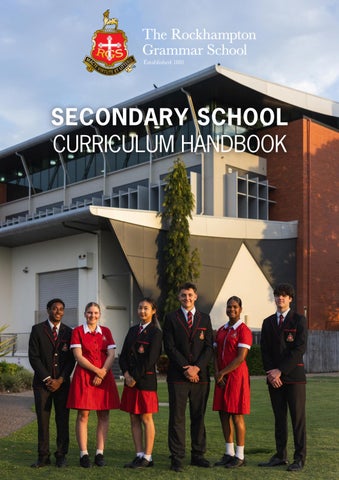
SECONDARY SCHOOL CURRICULUM HANDBOOK
Curriculum Handbook Table of Contents This Handbook aims to provide families and students with information that relates to the courses offered by the School in Years 7 to 12. The Handbook serves as a reference document during the important process of subject selection Table of Contents Section 1:
Year 7 - 8
Page 2
Section 2:
Year 9
Page 3
Year 9 English & Mathematics
Page 5
Year 10
Page 6
Core Subjects
Page 7
Elective Subjects
Page 9
Year 11 - 12
Page 11
QCE & ATAR information
Page 12
General & Applied Subject List
Page 13
Vocational Education and Training - Key information
Page 14
List of VET courses
Page 16
Key websites
Page 17
Section 3
Section 4
Section 5
Year 7 and 8 CURRICULUM STRUCTURE
Year 7 and 8 students are split into heterogeneous core class groups, by both gender and ability. Students follow a five-day cycle based on eight 40minute periods per day (40 periods per week).
Curriculum Overview Balanced curriculum combining core subjects and pre-elective experiences in Years 7 and 8. Core subjects: Mathematics, English, Science, Humanities, and Health & Physical Education (HPE). Humanities rotation: Students study both History and Geography across different semesters. Pre-elective subjects allow students to explore a variety of interests and learning areas. Tutorial and Form classes provide academic support and foster a strong sense of community through the Wellbeing Programme. Year 7 Enrichment Programme offers weekly opportunities to extend learning, skills, and interests.
Pre-Electives
Timetable
Semester-based subjects: Students complete four pre-electives in Year 7 and four in Year 8. Pathway exploration: Pre-electives help students discover their interests and make informed subject choices for Years 9–12. Subjects offered: Year 7 – Agriculture, Digital Technology, Drama and Visual Arts Year 8 – Business, Economics and Civics, Design and Technologies, Japanese and Music.
Each subject has a set number of lessons per week: Six periods per week – Mathematics, English and Science Five periods per week – Humanities All pre-elective subjects will be allocated five periods per week in Year 7, and six periods per week in Year 8 Three periods per week – HPE Students will have one Tutorial period during the week, and two Form periods Two periods per week – Enrichment Programme (Year 7 only)
2
Year 9 CURRICULUM STRUCTURE
Year 9 students are split into heterogeneous core class groups, by both gender and ability. Students follow a five-day cycle based on eight 40-minute periods per day (40 periods per week).
Curriculum Overview The core subjects are English, Humanities (Geography/History), Mathematics, Science, and Health and Physical Education. Students participate in Tutorial and Form classes, which provide academic support and help build a sense of community within the School through the Wellbeing Programme. Elective options in Year 9 are: Agriculture, Business Enterprise and Management, Design Technologies - Design Design Technologies Workshop, Digital Technologies, Drama, Health, Sport and Exercise Science, Food Technology and Textiles, Japanese, Marine Operations, Music, Visual Arts.
Please note:
Timetable
Some subjects have class size limits determined by the availability of equipment and the current recommended size of practical facilities under the Workplace Health and Safety Act 1995.
Each subject has a set number of lessons per week: Six periods per week – Mathematics, English, Science and all elective subjects Five periods per week – Humanities Three periods per week – HPE During the week, students will have: One Tutorial period Two Form periods
These include Design Technologies (Workshop and Design) and Food Technology and Textiles. Entry to these classes may have to be on the basis of ability and/or need. 3
Year 9 Curriculum Overview Core curriculum: All students study: English Curriculum Overview Mathematics Science Humanities (History/Geography) Health and Physical Education Tailored learning pathways: Students select the level of Mathematics that best suits their abilities and goals. Subject level options: Mathematics options include: 9 Advanced 9 Mathematics Essential Mathematics (by invitation) English offers both standard and Essential pathways (Essential subjects by invitation). Two elective subjects: Year 9 students select two electives as part of their course of study. Flexibility to change: Students may review and change their electives at the end of Semester 1, subject to availability.
4
Year 9 English & Mathematics English Based on the Australian Curriculum, English is a compulsory subject in Year 9 that develops students’ ability to analyse, understand and communicate through a range of written and spoken texts, supporting their growth as learners and global citizens. The programme assumes a sound foundation in grammar, language and regular reading and prepares students for Year 10 English. Students requiring additional support may be invited into the modified Essential English programme, with individual guidance provided on future pathway options.
Mathematics Based on the Australian Curriculum, Year 9 Mathematics develops students’ understanding and skills across Number and Algebra, Measurement and Space, and Statistics and Probability, while strengthening their fluency, reasoning and problem-solving abilities. Mathematics is compulsory in Year 9, with students able to choose pathways that align with their future goals. Please note: Students wishing to study 9 Advance Mathematics are generally expected to achieve a B or higher in Year 8 Mathematics. Students considering this pathway are encouraged to discuss their subject selection with the Head of Department or classroom teacher. A modified Essential Mathematics programme is also available by invitation for students requiring additional support.
5
Year 10 CURRICULUM STRUCTURE
Year 10 students all do a core group of six subjects. They are required to select two additional elective subjects.
Curriculum Overview Core curriculum: All students study: English Mathematics Science Humanities (History/Global Studies) Health and Physical Education Certificate I in Active Volunteering (CHC14015) Tailored learning pathways: Students select the level of English, Mathematics and Science that best suits their abilities and goals. Subject level options: Mathematics options include: 10A (Advanced) 10 Mathematics Essential Mathematics (by invitation) English and Science offer both standard and Essential pathways (Essential subjects by invitation). Two elective subjects: Year 10 students select two electives as part of their course of study. Flexibility to change: Students may review and change their electives at the end of Semester 1, subject to availability.
6
Year 10 Core Subjects English
Mathematics
Based on the Australian Curriculum, English is a compulsory subject in Year 10 that develops students’ ability to analyse, understand and communicate through a range of written and spoken texts, supporting their growth as learners and global citizens.
Based on the Australian Curriculum, Year 10 Mathematics develops students’ understanding and skills across Number and Algebra, Measurement and Space, and Statistics and Probability, while strengthening their fluency, reasoning and problem-solving abilities. Mathematics is compulsory in Year 10, with students able to choose pathways that align with their future goals, including 10 Mathematics, which leads to General or Essential Mathematics in Years 11 and 12, or 10A Mathematics, which prepares students for Mathematical Methods and Specialist Mathematics.
The programme assumes a sound foundation in grammar, language and regular reading and prepares students for senior pathways in English, Literature and EAL (General subjects contributing to an ATAR) or Essential English (an Applied subject contributing to the QCE).
Please note: Students wishing to study 10A Mathematics are generally expected to achieve a B or higher in Year 9 Advanced Mathematics, or an A in Year 9 Mathematics. Students considering this pathway are encouraged to discuss their subject selection with the Head of Department or classroom teacher.
Students requiring additional support may be invited into the modified 10 Essential English programme, with individual guidance provided on future pathway options.
A modified Essential Mathematics programme is also available by invitation for students requiring additional support.
Science
History & Global Studies
Year 10 Science is an integrated programme based on the Australian Curriculum, drawing on Biology, Chemistry, Physics, and Earth and Space Science to develop scientific literacy, critical thinking and problem-solving skills.
Year 10 humanities is divided into one semester of History and one semester of Global Studies. This provides students with a strong foundation in understanding the modern world and developing critical thinking skills.
The course prepares students for senior pathways in Biology, Chemistry, Physics, Psychology and Aquatic Practices, while the modified Essential Science programme, offered by invitation only, provides additional support and pathways into Aquatic Practices.
In History, students explore Australia and the world from 1918 to the present, examining global conflict, social change and Australia’s place in the world, while Global Studies investigates contemporary issues such as poverty, development, migration, refugees and global sustainability from local and international perspectives.
Please note: The Essential Science programme is designed to provide additional support and is not recommended for students intending to study Biology, Chemistry, Physics or Psychology in Years 11 and 12.
The course prepares students for senior studies in Ancient History, Modern History and Geography.
7
Year 10 Core Subjects Health & Physical Education Year 10 Health and Physical Education focuses on active participation in physical activity and developing the knowledge, skills and confidence to lead healthy, active lives. Through movement and health education, students build teamwork, communication, decision-making and problem-solving skills while exploring personal and community wellbeing. As a compulsory subject, it provides a strong foundation for senior studies in Physical Education, Health Education, and Sport and Recreation.
Certificate I Active Volunteering Delivered through The Rockhampton Grammar School’s Registered Training Organisation (RTO 30501), the nationally recognised Certificate I in Active Volunteering equips students with practical skills in communication, teamwork, problem-solving, personal safety and working with diverse people. The course contributes two credits towards the QCE and includes 20 hours of volunteer work, providing valuable realworld experience, professional networks and personal development opportunities. Completed during Year 10, the course costs approximately $200 and offers a strong foundation for a wide range of future career pathways and community involvement. The certificate cost will be added to the school fee account.
8
Year 10 Elective Subjects Introduction To... INDUSTRY
DIGITAL SOLUTIONS Introduction to Digital Solutions introduces students to coding, algorithms and digital design through practical, real-world projects. The subject provides a foundation for senior Digital Solutions and future pathways in STEM, technology and related careers.
Introduction to Industry gives students hands-on experience in timber and metal production, including furnishing, fabrication and welding, while developing practical, vocational and life skills. The course provides a pathway to senior vocational studies and Industrial Technology Skills, with no prerequisites required.
SENIOR AGRICULTURE
SENIOR ART
Introduction to Senior Agriculture combines handson learning with classroom investigations to build knowledge and skills in areas such as animal and plant production, sustainability, farm management and agricultural technologies. The course provides a strong foundation for both academic and vocational pathways in agriculture, with no prerequisites required.
Year 10 Visual Arts encourages students to explore ideas and express personal perspectives through creative experimentation and artmaking. The course develops technical, conceptual and problem-solving skills, providing a strong foundation for senior Visual Art pathways and future studies and careers in design, architecture, media and other creative industries. No previous experience is required.
SENIOR BUSINESS
SENIOR DRAMA
Introduction to Senior Business explores how businesses, economies and legal systems shape society, while developing students’ enterprise, leadership, problem-solving and teamwork skills. The course introduces key concepts from Accounting, Business, Economics and Legal Studies, providing a strong foundation for senior business subjects and future vocational pathways. No prerequisites are required.
Introduction to Senior Drama encourages students to explore ideas and tell stories through performance, developing creativity, confidence, collaboration and communication skills. The course provides a strong foundation for senior Drama pathways and supports future studies and careers in the creative industries and other communicationfocused fields. Completion of Year 9 Drama is recommended.
SENIOR DESIGN
SENIOR GEOGRAPHY
Introduction to Senior Design develops students’ creativity, problem-solving and critical thinking skills through real-world design challenges and emerging technologies. The course provides a strong foundation for senior Design and future pathways in fields such as architecture, graphic design, digital media, fashion and industrial design. No prerequisites are required, although previous study of Design is advantageous.
Introduction to Senior Geography offers students an engaging introduction to the world around them. Through the exploration of contemporary issues such as globalisation, sustainability and the rise of China, students develop a deeper understanding of the dynamic relationships between people, places and environments. The course develops highly transferable skills in research, data analysis, critical thinking and communication, empowering students to interpret complex information and make informed, evidence-based judgements. Students will be equipped with valuable skills for further study and diverse career pathways.
9
Year 10 Elective Subjects Introduction To... SENIOR HEALTH & PHYSICAL EDUCATION
SENIOR MUSIC Introduction to Senior Music develops students’ skills in performing, composing and musicology through solo and ensemble work, music technology and listening analysis. The course provides a strong foundation for senior Music studies, building confidence, creativity and independent learning skills. No previous experience is required, although experience with an instrument or voice and participation in cocurricular ensembles is encouraged.
Introduction to Senior Health and Physical Education explores the factors that influence health, physical activity and performance through practical and inquiry-based learning. Students develop critical thinking, teamwork, communication and leadership skills while investigating strategies to improve health and wellbeing in diverse contexts. The course provides a strong foundation for senior studies in Physical Education, Health Education and Sport and Recreation, with no previous experience required.
SENIOR PSYCHOLOGY
SENIOR JAPANESE
Introduction to Senior Psychology explores the scientific study of human behaviour, examining how the mind, development and social factors influence the way people think and act. The course provides students with a broad understanding of Psychology and supports future pathways in fields such as health, law, business and education. No prerequisites are required, and the subject is not a prerequisite for studying Psychology in Years 11 and 12.
Year 10 Japanese extends students’ language skills and cultural understanding through spoken, written and visual communication, building confidence in using Hiragana, Katakana and Kanji in meaningful contexts. The course provides essential preparation for senior Japanese and supports future pathways in areas such as education, tourism, international business and global communication. Students must have successfully completed Year 8 and Year 9 Japanese, or demonstrate equivalent language proficiency, to enrol.
HOME ECONOMICS
MARINE OPERATIONS
Home Economics is a hands-on, design-based subject that develops creativity, critical thinking and practical problem-solving skills through real-world projects in food, fashion and sustainable design.
Marine Operations is a practical, hands-on course that develops the knowledge, skills and confidence to safely interact with the marine environment through a range of unique activities.
Students build confidence, independence and teamwork skills while exploring solutions that meet personal and community needs. The course provides a strong foundation for senior studies and future pathways in hospitality, food science, nutrition, fashion and textile design, with no prior experience required.
The subject provides a foundation for future studies and careers in marine-related industries, while also supporting safe participation in recreational activities such as boating, fishing, snorkelling and diving. No prerequisites are required.
10
Year 11 and 12 CURRICULUM STRUCTURE
Students in Years 11 and 12 are required to select six subjects or courses at the beginning of Year 11, consisting of core and elective subjects.
Curriculum Overview Core subjects: Essential English OR English OR Literature OR English as an Additional Language Essential Mathematics OR General Mathematics OR Mathematical Methods (Students who choose Mathematical Methods are also eligible to choose Specialist Mathematics as an elective). General subjects are suited to students who are interested in pathways beyond senior secondary schooling that lead primarily to tertiary studies and to pathways for vocational education and training, and work. General subjects include Extension subjects. Applied subjects are suited to students who are primarily interested in pathways beyond senior secondary schooling that lead to vocational education and training or work. Vocational education and training (VET) Students can access VET programmes through the School if it: is a registered training organisation (RTO) has a third-party arrangement with an external provider who is an RTO offers opportunities for students to undertake school-based apprenticeships or traineeships Please note: Students wishing to undertake more than one (1) VET course must obtain approval from the school prior to enrolling in those courses. 11
Year 11 and 12 Key Information Senior Education Profile
Queensland Certificate of Individual Achievement (QCIA)
Students in Queensland are issued with a Senior Education Profile (SEP) upon completion of their senior studies. This profile may include a: Statement of results Queensland Certificate of Education (QCE) Queensland Certificate of Individual Achievement (QCIA)
The Queensland Certificate of Individual Achievement (QCIA) reports the learning achievements of eligible students who complete an individual learning programme. At the end of the senior phase of learning, eligible students achieve a QCIA. These students have the option of continuing to work towards a QCE post-secondary schooling.
For more information about the SEP see: www.qcaa.qld.edu.au/senior/certificate s-qualifications/sep
For more information about the QCIA, see:
Queensland Certificate of Education (QCE)
Australian Tertiary Admission Rank (ATAR) eligibility
Students may be eligible for a Queensland Certificate of Education (QCE) at the end of their senior schooling.
The calculation of an Australian Tertiary Admission Rank (ATAR) will be based on a student’s: best five General subject results OR best results in a combination of four General subject results plus an Applied subject result or a Certificate III or higher VET qualification.
3 Queensland Certificate of Individual Achievement (QCIA) | Queensland Curriculum and Assessment Authority
Students who do not meet the QCE requirements can continue to work towards the certificate post-secondary schooling. The QCAA awards a QCE in the following July or December, once a student becomes eligible.
The Queensland Tertiary Admissions Centre (QTAC) has responsibility for ATAR calculations.
Learning accounts are closed after nine years; however, a student may apply to the QCAA to have the account reopened and all credit continued.
Eligibility for an ATAR will require satisfactory completion of a QCAA English subject.
For more information about the QCE see: QCE eligibility and requirements | Queensland Curriculum and Assessment Authority
Satisfactory completion will require students to attain a result that is equivalent to a ‘C’ Level of Achievement in one of five subjects: English, Essential English, Literature, English and Literature Extension or English as an Additional Language.
For more information about the ATAR, see: Year 12 ATAR - QTAC
While students must meet this standard to be eligible to receive an ATAR, it is not mandatory for a student’s English result to be included in the calculation of their ATAR. 12
Year 11 and 12 Subjects The subjects offered at The Rockhampton Grammar School are listed below. Please note that inclusion of a subject below does not guarantee it will be offered. Subjects will run only if sufficient student enrolment is achieved.
General Subjects ACCOUNTING
AGRICULTURAL SCIENCE
ANCIENT HISTORY
BIOLOGY
BUSINESS
CHEMISTRY
DESIGN
DIGITAL SOLUTIONS
DRAMA
ECONOMICS
ENGLISH
ENGLISH AS AN ADDITIONAL LANGUAGE
ENGLISH AND LITERATURE EXTENSION (YEAR 12 ONLY)
GENERAL MATHEMATICS
GEOGRAPHY
HEALTH EDUCATION
JAPANESE
LEGAL STUDIES
LITERATURE
MATHEMATICAL METHODS
MODERN HISTORY
MUSIC
MUSIC EXTENSION (YEAR 12 ONLY)
PHYSICAL EDUCATION
PHYSICS
PSYCHOLOGY
SPECIALIST MATHEMATICS
VISUAL ART
Applied Subjects AQUATIC PRACTICES
BUSINESS STUDIES
ESSENTIAL ENGLISH
ESSENTIAL MATHEMATICS
INDUSTRIAL TECHNOLOGY SKILLS
SOCIAL & COMMUNITY STUDIES
SPORT AND RECREATION
VISUAL ART IN PRACTICE
For more information about the subjects listed above see: Senior syllabuses | Queensland Curriculum and Assessment Authority Please note not all subjects listed on the QCAA website are offered by The Rockhampton Grammar School.
13
VET Course Information WHAT IS VET? Vocational Education and Training (VET) provides pathways for all young people, including those seeking further education and training and those seeking employment-specific skills. The Australian Qualification Framework (AQF) governs the different types of qualifications that all Australian students can attain. Certificate I, II and III qualifications are at the AQF Level 1, 2 and 3 respectively. Vocational Education and Training in Schools is referred to as VETiS. VET is not just for traditional trades; it encompasses hundreds of different occupations and industries. Qualifications can lead to traineeships and apprenticeships in a variety of industries, as well as further study/higher education and/or work outcomes. It should be noted that one Certificate III or above may contribute to an ATAR. It may also be used on a stand-alone basis for tertiary admission in some courses (refer direct to institutions for further information).
WHAT IS AN RTO? A qualification must be delivered by a Registered Training Organisation (RTO). Each RTO is responsible for the training and assessment of the courses they offer, meeting national requirements and responsibilities. The Rockhampton Grammar School (RTO 30501) is registered to offer specific qualifications and may also work with external providers under different types of third-party arrangements. Reputable external RTOs have also been identified in this handbook for specific qualifications. For every qualification offered, the RTO is responsible for the issuance of the Certificate upon successful completion, or a Statement of Attainment upon partial completion (with successfully attained units).
WHAT COURSES ARE AVAILABLE? In addition to the qualifications offered at RGS identified in the table below, other courses through alternative RTOs may be considered on an individual basis. Please contact the Head of VET and Careers if you have identified a specific course that is not listed and wish to pursue it as enrolment support is required from the school. Off-campus requirements or subject clashes may impact the number of courses or choices that may be supported. Please Note: the running of a certificate course is at the discretion of the relevant RTO. 14
VET Course Information HOW DO STUDENTS ENROL Each RTO has their own enrolment processes; however, every provider will require a student to have a Unique Student Identifier (USI) which is freely available at usi.gov.au and, once created, remains with a learner for life. The USI should be created only once, using the students legal name that matches government issued identification. Before applying to enrol, any course requirements (such as the ability to attain a Blue or White card, finding vocational placement or clients, attending residential schools or classes during school holidays, vaccination requirements, etc.) should be carefully reviewed to ensure these can be fulfilled. Language Literacy Numeracy and Digital Literacy (LLN) testing may also be requested by the RTO to determine the level of support that may be required for the learner. Course fees, including VETiS funding eligibility and Fee for service arrangements, as well as any course levies, equipment and/or uniform items should also be carefully considered. Consult the RTOs website for additional information if needed or discuss with the Head of VET and Careers.
WHAT IS VETiS FUNDING AND FEE FOR SERVICE? Provided by the government, secondary students may access VETiS funding for an eligible qualification (usually Certificate I or II level) meaning the course should be fee-free. However, it may only be applied once – not per year or per course, but once only in secondary school. Therefore, if there is an intention to study more than one qualification, at any time in Year 10 – 12, then it must be carefully determined as to which eligible course is best to have the VETiS funding applied to. NOTE: The School’s VET policies and procedures can be viewed at www.rgs.qld.edu.au/vocational-education in the VET Student Handbook, with VET Student Induction and the VET Student Enrolment Forms available prior to an enrolment in a vocational qualification on the School’s QCAA Student Management Portal.
15
RGS Timetabled VET Courses Code
Certificate
MEM20422
Certificate II in Engineering Pathways
AHC30122
Certificate III in Agriculture
RTO
Blue Dog Training
RGS
Eligible for VETiS Funding
Y
N
Fee for Service
Cost
Y
Course cost is $1200. Consumable Levy: An annual levy of $250 (at $125 each semester) is charged by the School to Fee for service students to cover the costs of consumable engineering materials, safety glasses and hearing protection.
Y
Course cost is $2860. Charged over two years, $715 is charged at the beginning of each semester.
SIS30321
Certificate III in Fitness
Binnacle Training College
N
Y
Course fee is $495 + $75 First Aid Training. Course fee is charged in the first year of enrolment at $285 per semester. An annual equipment levy of $250 is charged at $125 per semester for the duration of the course.
HLT23221
Certificate II in Health Support Services
Axial Training
Y
Y
Course fee is $3,850.
HLT33215
Certificate III in Health Services Assistance
Axial Training
N
Y
Course fee is $1,000 upon the successful completion of the Cert II in Health Support Services.
UEE22011
Certificate II in Electrotechnology (Career Start)
Axial Training
Y
Y
Course fee is approximately $5,400.
Code
Certificate
RTO
CPC10120
Certificate I in Construction
CQUniversity
ACM20121
Certificate II in Animal Care
CQUniversity
AUR20720
Certificate II in Automotive Vocational Preparation
CQUniversity
SIT20421
Certificate II in Cookery
CQUniversity
SIT20322
Certificate II in Hospitality
CQUniversity
SHB20216
Certificate II in Salon Assistant
CQUniversity
CHC30121
Certificate III in Early Childhood Education and Care
CQUniversity
CUA30120
Certificate III in Dance
Empowerdance
MEA20518
Certificate II in Aircraft Line Maintenance
Aviation Australia
BSB50120
Diploma of Business
Axial Training
Helpful Websites: RGS Careers Website Frequently asked questions from QCAA Queensland Tertiary Admissions Centre Slideshow on the ATAR for parents About the External Assessment and how it will work from QCAA Further information regarding qualifications, units and training packages Queensland Training Information Service Queensland Government: School-based apprenticeships and traineeships TAFE Queensland online study courses
17
Please note: Form Class, Year Level Meetings (YLM) and Prep for Senior (PFS) are compulsory components of the programme, and students are expected to attend all scheduled sessions. In Year 11, attendance at the Year 11 Leadership Workshop, delivered by yLead, is also compulsory. An approximate cost of $70 for the workshop will be added to all Year 11 student fee accounts.
rgs.qld.edu.au Archer Street Rockhampton QLD 4700 (+61) 07 4936 0600 | inform@rgs.qld.edu.au ABN 71 055 702 035 | CRICOS 00507F | RTO No. 30501