SEP 2026 | Vol.39 | No.8
THE VOICE OF THE GREATER ROCKFORD BUSINESS COMMUNITY
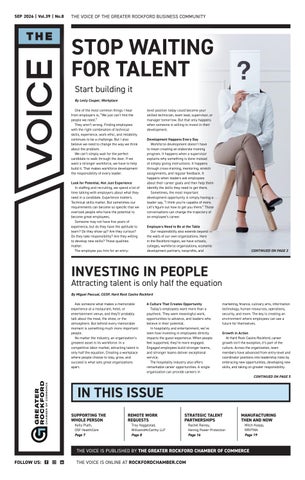
STOP WAITING FOR TALENT Start building it By Lesly Couper, Workplace One of the most common things I hear from employers is, “We just can’t find the people we need.” They aren’t wrong. Finding employees with the right combination of technical skills, experience, work ethic, and reliability continues to be a challenge. But I also believe we need to change the way we think about the problem. We can’t simply wait for the perfect candidate to walk through the door. If we want a stronger workforce, we have to help build it. That makes workforce development the responsibility of every leader. Look for Potential, Not Just Experience In staffing and recruiting, we spend a lot of time talking with employers about what they need in a candidate. Experience matters. Technical skills matter. But sometimes our requirements can become so specific that we overlook people who have the potential to become great employees. Someone may not have five years of experience, but do they have the aptitude to learn? Do they show up? Are they curious? Do they take responsibility? Are they willing to develop new skills? Those qualities matter. The employee you hire for an entry-
level position today could become your skilled technician, team lead, supervisor, or manager tomorrow. But that only happens when someone is willing to invest in their development. Development Happens Every Day Workforce development doesn’t have to mean creating an elaborate training program. It happens when a supervisor explains why something is done instead of simply giving instructions. It happens through cross-training, mentoring, stretch assignments, and regular feedback. It happens when leaders ask employees about their career goals and then help them identify the skills they need to get there. Sometimes, the most important development opportunity is simply having a leader say, “I think you’re capable of more. Let’s figure out how to get you there.” Those conversations can change the trajectory of an employee’s career. Employers Need to Be at the Table Our responsibility also extends beyond the walls of our own organizations. Here in the Rockford region, we have schools, colleges, workforce organizations, economic development partners, nonprofits, and
CONTINUED ON PAGE 3
INVESTING IN PEOPLE
Attracting talent is only half the equation By Miguel Pascual, CGSP, Hard Rock Casino Rockford Ask someone what makes a memorable experience at a restaurant, hotel, or entertainment venue, and they’ll probably talk about the meal, the show, or the atmosphere. But behind every memorable moment is something much more important: people. No matter the industry, an organization’s greatest asset is its workforce. In a competitive labor market, attracting talent is only half the equation. Creating a workplace where people choose to stay, grow, and succeed is what sets great organizations apart.
A Culture That Creates Opportunity Today’s employees want more than a paycheck. They want meaningful work, opportunities to advance, and leaders who believe in their potential. In hospitality and entertainment, we’ve seen how investing in employees directly impacts the guest experience. When people feel supported, they’re more engaged. Engaged employees build stronger teams, and stronger teams deliver exceptional service. The hospitality industry also offers remarkable career opportunities. A single organization can provide careers in
marketing, finance, culinary arts, information technology, human resources, operations, security, and more. The key is creating an environment where employees can see a future for themselves. Growth in Action At Hard Rock Casino Rockford, career growth isn’t the exception, it’s part of the culture. Across the organization, team members have advanced from entry-level and coordinator positions into leadership roles by embracing new opportunities, developing new skills, and taking on greater responsibility. CONTINUED ON PAGE 5
IN THIS ISSUE SUPPORTING THE WHOLE PERSON Kelly Plath, OSF HealthCare Page 7
REMOTE WORK REQUESTS
Troy Haggestad, WilliamsMcCarthy LLP Page 8
STRATEGIC TALENT PARTNERSHIPS
Rachel Rainey, Hennig Power Protection Page 16
MANUFACTURING THEN AND NOW Mitch Koepp, RRVTMA Page 19
THE VOICE IS PUBLISHED BY THE GREATER ROCKFORD CHAMBER OF COMMERCE FOLLOW US:
THE VOICE IS ONLINE AT ROCKFORDCHAMBER.COM
2
THE VOICE
SEPTEMBER 26 | VOL.39 | NO.8
GUIDING TO GREATNESS The power of coaching in the business setting By Angela Kay Larson, chief executive officer, Greater Rockford Chamber of Commerce
Micahel Jordan said, “A coach is someone that sees beyond your limits and guides you to greatness.” I distinctly remember the day in 2012 when my boss came into my office, closed the door and asked, “Do you have time for some coaching?” I immediately thought, “Drat. What have I done wrong?” Knowing he was quick to address issues, I replayed the past 24 hours in my mind to figure out where I had misstepped. I was at a loss, yet surely, I had done something that required a coaching moment. “Of course,” I replied. “Have I done something wrong?” He looked me in the eye and said, “You’re fine, I’m the one who needs some coaching.” Imagine my relief. Imagine my surprise. Imagine my respect. My boss recognized my strength in coaching and trusted me to guide a critical conversation that could help him work through an issue. To this day, his faith in the coaching process reminds me of the power of coaching in the business setting. I earned my coaching credentials in 2009 from CoachU. Fully accredited by the International Coaching Federation (ICF), CoachU is a global institution founded in 1992 to provide comprehensive training
for professional coaches. I joined ICF that same year to enhance my credibility as I hung out my shingle as a business coach ready for hire. I began to build my practice with a focus on helping professionals who aspired to be promoted to the C-suite. When successful, these clients quickly transitioned to “it’s lonely at the top” CEOs who benefitted from having a go-to confidante to help them work through issues and opportunities and remain focused on their goals. The power of coaching lies in three principles. First, the client has all the answers and simply needs someone to help draw out the elements and crystalize them into an insight or a solution. Second, the coach is not an adviser but a conduit for helping the client move forward. This makes the coach’s greatest skills curiosity, questioning, and listening. Third, the client wants to be held accountable for the steps they agree to take. People often ask me why I chose to become a trained coach. I explain that I didn’t choose coaching; coaching chose me. I realized that even before I started my training, I had been naturally following my curiosity and asking people thoughtful questions. (Not gonna lie; some see that as being nosey.) I was already encouraging others to consider a different perspective and asking them if I could do anything to help them move forward. I was already coaching, unknowingly. My career has moved fluidly from working as a consultant/coach to sitting in a corporate chair. The first time I
The International Coaching Federation (ICF) is one of the world’s largest and most widely recognized professional organizations for coaches. Its primary mission is to advance the coaching profession by setting high standards for ethics, education, and professional practice. ICF offers globally recognized coaching credentials at different levels, including Associate Certified Coach (ACC), Professional Certified Coach (PCC), and Master Certified Coach (MCC). Members and credentialed coaches agree to follow the ICF Code of Ethics, which emphasizes confidentiality, integrity, professionalism, and client well-being. ICF has developed a framework of core coaching competencies that define effective coaching practices, such as active listening, cultivating trust, asking powerful questions, and facilitating client growth. The organization provides continuing education, conferences, research, networking opportunities, and resources to help coaches maintain and improve their skills.
transitioned back into a corporate role with my coaching credentials, I remember having a conversation with my own coach about the decision. She asked about my hesitation in returning to a corporate job. I told her that the biggest item on the “con” side of my pro/con list was daily coaching calls with clients. I didn’t want to stop coaching. She assured me that I would have more opportunity to use my coaching skills in a corporate setting than I did as a consultant. My approach to my
daily work and my relationship with peers, employees, and boss proved her right. Without a doubt, I use my coaching skills every day and suspect many others do the same. For anyone who coaches naturally but has not had the benefit of a formal coaching class, I encourage you to make the investment to learn more about coaching as a professional discipline and consider joining the ICF. I’m confident you’ll find that opportunities abound in guiding others to greatness.
Angela Kay Larson, Greater Rockford Chamber of Commerce CEO, is a trained business coach and member of the International Coaching Federation. Her leadership purpose was born of her work in helping others and serves as a daily reminder of the power of coaching: “Encourage others to see their worlds differently and motivate them to try new things.”
ABOUT THIS ISSUE … The editorial theme for this month’s issue of the VOICE is Workforce and Talent, and our guest contributor articles are all about “the ships.” Not the maritime kind but the people kind—relationships, internships, apprenticeships, friendship, mentorship, partnership, leadership, and craftmanship. So how much do “the ships” really matter? Take a look at Gallup’s 2026 “State of the Global Workplace” report. It found that global employee engagement fell to 20% in 2025, its lowest level since 2020, costing the world economy an estimated $10 trillion in lost productivity. U.S. employee highlights from the report include (as of May 2026): • • • • • • • • • • •
31% are engaged and 17% are actively disengaged. 19% say they are extremely satisfied with their company as a place to work. 34% say they have the opportunity to do what they do best every day at work. 29% say they have received recognition or praise for doing good work in the past seven days. 40% say there is someone at work who seems to care about them as a person. 31% say there is someone at work who encourages their development. 26% feel their opinions count at work. 31% say their company’s mission makes them feel their job is important. 22% say they have a best friend at work. 31% report that someone at work has spoken with them about their progress in the past six months. 32% say they have had opportunities to learn and grow at work in the past year.
When you look behind the numbers, it comes as no surprise that “the ships” are critical to recruiting and retaining a happy, successful workforce. So climb aboard and join your shipmates (aka guest contributors) as we navigate the turbulent seas of workforce and talent.
— Christine Hand, managing editor
THE VOICE Published monthly by
PUBLISHER — Angela Kay Larson | MANAGING EDITOR — Christine Hand ART DIRECTOR/CIRCULATION — Doug Hessong | ADVERTISING — ads@rockfordchamber.com
THE VOICE
ROCKFORDCHAMBER.COM
CONTINUED FROM PAGE 1 employers all working to strengthen our workforce. Those efforts are most successful when employers are actively involved. Employers know where the gaps are. Employers know which positions are difficult to fill. Employers know which technical skills are becoming more important. Employers also know the workplace skills that often determine whether someone succeeds once they are hired. That information needs to be shared. When employers engage with educators and workforce partners, training and career pathways are created that lead to real opportunities. At the same time, employers should to be willing to open their doors through internships, job shadowing, apprenticeships, on-the-job training, mentoring, and entry-level opportunities.
Leaders can start by looking at the talent already inside our organizations. Who could take the next step with some additional training? Who has leadership potential? Where can we create a career pathway instead of simply filling a position? During the hiring process consider asking a different question. Instead of only asking, “Does this person have everything we need today?” ask, “What could this person become if we invest in them?” Building a stronger workforce is about more than filling today’s openings. It’s about creating opportunities, developing people, strengthening our organizations, and ultimately strengthening our community. The workforce we need tomorrow starts with the investments and opportunities we create today.
We All Have a Role There is no single organization or program that will solve our workforce challenges. It takes all of us.
The views expressed are those of the author(s) and do not necessarily represent those of the Greater Rockford Chamber of Commerce.
Lesly Couper is the president at Workplace where she oversees company operations and strategy while fostering a highly inclusive workplace culture. Lesly has over 20 years of experience in human resources, operations, and sales. She is also involved in community service, serving on the boards of several organizations, including Carpenter’s Place and the Greater Rockford Chamber of Commerce.
v
3
4
THE VOICE
SEPTEMBER 26 | VOL.39 | NO.8
BEYOND THE 9-TO-5 What 100 tours have taught me about talent attraction By Whitney Martin, Made for Rockford By the time a job candidate arrives in the Rockford area for an interview, they aren’t the only one being interviewed. So are we. They hop in the car, sometimes running on little sleep after an early-morning flight. They’re dressed for the interview, resume ready, probably replaying answers in their head. Before we pull away, I tell them all the same thing: “Take a deep breath. I’m not part of your interview.” You can almost see the relief. “My name is Whitney, and I’m the director of Made for Rockford. Let’s show you around.” Over the last year, I’ve had the opportunity to tour more than 100 candidates around the Rockford region. Different careers, different ages, different hometowns, and different reasons for considering a move. But they’ve all taught me one thing: A job might be the reason someone comes to this region, but it’s rarely the only thing they’re thinking about when they get here. Oftentimes, a candidate arrives in our area alone. However, the decision to relocate rarely belongs to just one person. There’s often a spouse, a partner, and maybe a few tiny humans hundreds of miles away waiting for the “How did it go?” phone call. They’re on my mind, too. “My daughter might have to leave her soccer team.” She plays soccer? Suddenly, we’re headed toward Mercyhealth Sportscore Two. I tell them about the indoor and outdoor fields, the tournaments that bring teams here from all over, and how some of those weekend games could be less than 20 minutes from their front door. And then I give them a scenario that can be hard to imagine in a larger city:
You can perform surgery at 9 a.m. and still be standing on the sidelines of your daughter’s soccer game by 5 p.m. That’s when a community tour becomes about so much more than showing someone where things are located; it’s about helping them imagine what a life here could actually look like. It’s different for everyone. GoRockford’s Made for Rockford program is unique, not only in its tailored approach, but also in where it’s housed. It’s one of the few (and potentially the only) talent attraction programs housed within a destination marketing organization. Typically, you’d see this type of work fall under a chamber of commerce or an economic development organization. I’ve come to appreciate that distinction; so much of this work is less about the 9-to-5 and more about the 5-to-9. What happens after work? Where do people go? What do they do on the weekends? What will make this place start to feel like home? GoRockford is the direct source for what there is to see, do, and experience here. That makes a destination marketing organization like GoRockford a natural home for talent attraction. The questions I receive during these tours aren’t always the ones I anticipated. Some are very Midwestern-specific:
“Are there neighborhoods with sidewalks here?” “Yes, and we have some incredible walking and biking paths, too. I’ll show you some.” And then there’s my favorite, and probably the question I get asked most: “Where’s your Trader Joe’s?” I giggle again ... knowing it was coming. That question gives me an opportunity to talk about one of the best parts of living in our region. If it’s not here, chances are it’s around here. Madison, Milwaukee, and Chicago are all within about an hour and a half. You can spend the day in a major city, go to a concert, catch a game, shop at Trader Joe’s, and then drive right back home to a place where housing is still affordable and
getting around doesn’t have to consume your day. We get to show people that you can have access to so much without having to pay the price, literally or figuratively, of living in the middle of it all. After more than 100 tours, I’ve learned something I didn’t fully understand when I started: The best tours aren’t about selling Rockford. They’re about context. You can Google a community, ask ChatGPT about it, and scroll through every list online. None of that replaces experiencing it. Somewhere along the drive, Rockford starts to feel less like a place they’re visiting and more like a place they could call home. The views expressed are those of the author(s) and do not necessarily represent those of the Greater Rockford Chamber of Commerce.
“Does the grass turn green here?” “Yes. Of course,” I giggle and explain the snow just melted. “What are those plastic containers outside the gas stations?” “Oh, that’s salt. For the sidewalks. We get to experience four seasons here.”
Whitney Martin leads the Made for Rockford program, attracting talent to Winnebago County. As a former Emmy-nominated journalist, she’s earned multiple awards, including “Best Reporter.” She’s a GRCC 40 Under 40 leader and serves on the Workforce Connection Board, Greg Lindmark Foundation, Leadership Rockford, and the fundraising committee for Family Counseling Services.
THE VOICE
ROCKFORDCHAMBER.COM CONTINUED FROM PAGE 1 One example is Marketing Manager Andres Murillo. A first-generation college graduate with a master’s degree, Andres returned to the Rockford area to build his career and give back to the community that helped shape him. He joined Hard Rock Casino Rockford in 2021 as a marketing coordinator with no gaming industry experience but a willingness to learn. By embracing new challenges and earning the trust of leadership, he advanced to marketing manager, helping lead marketing efforts surrounding the property’s grand opening, continued growth, and future hotel expansion. His journey shows that career growth happens when preparation meets opportunity—and employers invest in people ready to step forward. Building a Winning Team The strongest workplace cultures often have a few things in common: clear pathways for professional growth; leaders who mentor and recognize employees; and a culture built on trust, respect, and collaboration. Organizations that develop their people are better positioned to retain talent, deliver outstanding customer experiences,
and strengthen the communities they serve. As our region continues to grow, employers, educators, and community partners all play a role in creating opportunities that encourage talented people to build their futures here. At Hard Rock, one of our guiding mottos is Take Time to Be Kind. We believe it’s more than a slogan—it’s a leadership philosophy. Taking time to mentor a new employee, recognize a job well done, or simply listen with empathy creates stronger teams and a stronger workplace. Successful organizations create careers, develop leaders, and remember that great customer experiences begin with great people. Hard Rock Casino Rockford is one of Illinois’ top-performing casinos, attracting visitors from around the world. It features over 175,000 square feet of gaming and entertainment space, including restaurants, a sportsbook, and the Rock Shop. The views expressed are those of the author(s) and do not necessarily represent those of the Greater Rockford Chamber of Commerce. v
Miguel Pascual, CGSP, is a seasoned HR leader with a background that spans military service, hospitality, and gaming. A proud Southwest Florida native from the small town of Immokalee, Miguel began his professional journey in the United States Marine Corps, serving over four years with two overseas deployments, including a tour in Afghanistan.
DRIVERS OF EMPLOYEE ENGAGEMENT Employee engagement grows when people feel connected to their work, valued for their strengths, and supported by great managers. Gallup identified five essential elements that consistently drive engagement: • Purpose — Doing work that feels meaningful and mission-driven • Development — Having opportunities to learn and grow • Caring managers — Feeling supported by someone who genuinely cares • Ongoing conversations — Receiving consistent feedback and coaching • Focus on strengths — Being encouraged to use what you do best every day
5
6
THE VOICE
SEPTEMBER 26 | VOL.39 | NO.8
MENTORING AND MANUFACTURING Building a blue-collar workforce By Dave Hataj, Craftsman with Character Growing up in a blue-collar family business in the 1970’s, I never gave much thought to fancy terms like workforce development or employment pipeline. My dad didn’t seem to either, as he always seemed to find plenty of folks that wanted a job. But while serving my apprenticeship in the early 1980’s, our tech college instructor warned us that journeyman machinists would soon be a rare commodity. Although he may have been a bit early in his prophecy, I don’t think even he could imagine the hiring crisis that would hit the trades and manufacturing in the early 2000’s. By 2010, this crisis was threatening the future of our business, as an aging demographic of machinists were retiring with not nearly enough young people interested in our trade to replace them. The over-emphasis on four-year university degrees was excluding an entire generation of young hands-on learners that should have found their way in our businesses. But with the reduction and even elimination of high school teched classes, such as wood shop, machining and welding, and auto shop, we were indeed reaping what we sowed. The numbers tell a chilling story. By 2030, it’s estimated that 2.1 million skilled trade jobs will go unfilled. For every five workers retiring, only two new workers ae entering the skilled workforce. A whopping one-third of employers say more than half of their employees are over the age of 55. A tour of our local high school’s teched department woke me up to this reality and made me wonder how to re-engage these shop kids that looked a lot like me when I was their age. They may not be great academic students, but they are often wicked smart when it comes to mechanical aptitude. The question was how do I get them in my shop? The answer was simple yet somehow lost, as we have strayed from some ancient wisdom. Besides our basic needs for food, shelter, and clothing, we all desperately need a sense of purpose and friendship. We need to be part
of a community and to have healthy relationships where we are seen and appreciated. Remarkably, for thousands of years, manufacturing and the skilled trades provided both of these. The apprenticeship model of education where a young person learns a trade from an older person can be traced back 4,000 years to the ancient Babylonians. Cultures throughout the world have understood that our communities thrive when we take the time to hand down learned wisdom and skills to the upcoming generation. In a word, it’s mentoring. But it’s intentional mentoring within the context of everyday work, not just over a cup of coffee once a month. In this mentoring tradition, I created a course called Craftsman with Character® that focuses on character development in tandem with job-shadowing experienced tradespeople. Over the past dozen years, we’ve helped other communities and businesses become mentoring cultures. The results are rather stunning. In our own company, the average age of our employees is under 30, with close to zero turnover and almost too many young people that want to work here. The major lessons we’ve learned are: • Young people want to be mentored. • Older people want to mentor. • Becoming a mentoring culture takes time and effort but is truly the most sustainable employment pipeline. Jeff Van Duzer points out that, at its core, the purpose of business isn’t about making money. It’s about people: • To provide the community with goods and services that enable it to flourish • To provide opportunities for meaningful employment I’ve come to realize that, if taken seriously, blue-collar businesses really can change lives, communities, and even the world. The views expressed are those of the author(s) and do not necessarily represent those of the Greater Rockford Chamber of Commerce.
GUIDING PRINCIPLES OF THE CRAFTSMAN’S CODE 1. I am not the center of the universe. 2. I do not know everything nor nearly as much as I think I do. 3. The world needs me. 4. Pay is a reward for my efforts but not my main motivation. 5. Every person has unique gifts and talents.
Dave Hataj is the second-generation president/ owner of Edgerton Gear, Inc. He’s also the founder of Craftsman with Character®, which introduces high school students to the trades and manufacturing, while developing character and soft skills. The U.S. Navy recently partnered with Dave to expand Craftsman with Character nationally. To learn more, visit craftsmanwithcharacter.org.
THE VOICE
ROCKFORDCHAMBER.COM
SUPPORTING THE WHOLE PERSON The value of wellness programs By Kelly Plath, OSF HealthCare Investing in employee well-being is more than offering benefits. It’s a longterm strategy that can improve health outcomes, strengthen workplace culture, and reduce costs over time. As health care costs continue to rise, employers increasingly recognize the value of investing in preventive care and whole-person wellness programs. Supporting employees before health concerns escalate can lead to healthier teams, lower medical costs, and fewer workplace disruptions. Rather than waiting to respond to illness after it occurs, organizations are finding value in helping employees stay healthy from the start. The financial impact of employee health challenges can be substantial. According to the Centers for Disease Control and Prevention (CDC), U.S. employers lose an average of $1,685 per employee each year due to missed workdays. Missed workdays reduce productivity, team performance, and overall operational efficiency, creating costs that extend far beyond medical claims. In addition, chronic diseases and workplace injuries cost U.S. employers approximately $575 billion annually in lost productivity, according to CDC workplace health data. Preventive health initiatives are designed to address these challenges before they become larger and more expensive problems. Three of the chronic conditions associated with some of the highest employer costs—diabetes, cardiovascular disease, and high blood pressure—can often be prevented, detected early, or successfully treated through preventive care initiatives. Employees with access to comprehensive benefits, including medical, dental, and vision coverage; preventive screenings; mental health programs; and educational resources focused on nutrition, exercise, diabetes prevention, and heart health, are often healthier and more engaged. These resources promote healthy habits and support long-term wellness goals that benefit both employees and employers. The benefits of wellness programs extend beyond physical health. Investing in emotional and financial well-being can also yield meaningful results. Employees who feel supported are often more engaged, more productive, and more likely to remain with an organization. Stronger retention can help reduce expenses associated with recruitment,
onboarding, and workforce turnover. Work-life balance and mental well-being resources also contribute to organizational success. Stress management tools and mental health support can help reduce missed days and burnout while fostering a healthier, more stable workforce. In the Illinois Workplace Wellness Study, participation in wellness programs notably increased health screening rates, indicating that employees took a more proactive approach to preventive care and health awareness. At OSF HealthCare, our wellness program provides access to exercise trainers, nutritionists, a health library, educational workshops, smokingcessation courses, and sleep-support resources. These offerings are designed to help employees make healthier choices and improve overall well-being. Research shows that investing in wellness can yield measurable returns. Studies across multiple industries indicate that a well-designed wellness program can save employers at least $3 for every $1 invested. These savings reflect only health care costs and do not include additional gains from fewer missed days and reduced turnover, which can create an even greater financial impact. Preventive health initiatives represent a strategic investment in people and in the long-term success of an organization. Healthier employees can mean lower medical and insurance costs, fewer missed workdays, stronger retention, and a more productive workforce over time. However, the strongest programs are not built solely on annual screenings. They build awareness and healthy behaviors into everyday life. As you continue to look for ways to control your overhead and support employees, investing in well-being increasingly stands out as both a great people and business strategy. OSF HealthCare, founded by The Sisters of the Third Order of St. Francis in Peoria, Illinois, is an integrated system with 18 hospitals, 170+ locations, and over 27,000 Mission Partners (employees). It provides advanced care, education and innovation across Illinois and Michigan and is known for innovation and workplace excellence. The views expressed are those of the author(s) and do not necessarily represent those of the Greater Rockford Chamber of Commerce.
Kelly Plath is a Western Illinois University graduate with over 17 years of experience in sales and leadership, specializing in strategic growth and community engagement. Now a business development specialist in employer relations at OSF HealthCare, she works in Rockford to foster partnerships and create meaningful relationships with local employers.
7
8
THE VOICE
SEPTEMBER 26 | VOL.39 | NO.8
REMOTE WORK REQUESTS What employers need to know By Troy Haggestad, WilliamsMcCarthy LLP Remote work has become a go-to tool for recruitment and retention, especially for younger, tech-savvy employees who do their best work outside a traditional office. But remote work also raises a tangle of legal questions: how to track hours, which state’s laws apply, multistate tax exposure, and privacy limits on monitoring employees at home. Those are topics for another day. This article tackles one narrow but increasingly common scenario: If an employee asks to work from home because of a physical or mental health condition, do you have to say yes? And if so, for how long? As with most employment law questions, the honest answer is, “It depends.” When the ADA Comes Into Play The Americans with Disabilities Act (ADA) doesn’t require every employer to offer remote work. However, if an employee’s condition qualifies as a “disability” under the ADA, and the employer already allows remote work in some form, disabled employees must have an equal opportunity to participate.
But then the law gets a little more complicated. The ADA requires employers to provide “reasonable accommodations” that allow an employee with a disability to perform the essential parts of their job. That can include letting someone work from home. However, remote work isn’t automatically the answer just because an employee requests it. If another accommodation would work just as well, the employee is not entitled to their first choice, including remote work. How to Evaluate the Request The law requires an “interactive process” between employer and employee. In practice, that means the employee explains their medical limitations and how the job could still get done from home, and the employer can ask for reasonable documentation if it’s unclear whether the condition qualifies as a “disability” by the ADA. If There’s a Dispute Every business should maintain written job descriptions that clearly specify each role’s essential functions. Courts generally defer to an employer’s
judgment about what’s essential, but they may still expect minor duties or marginal functions to be reassigned if that’s the only thing preventing the employee’s ability to work from home. For many jobs, the answer is obvious. A cashier, a food server, or a delivery driver can’t do their job from a laptop at the kitchen table. For office and knowledgebased roles, it’s murkier. The EEOC points employers toward a few key questions: • Does the role require regular face-to-face collaboration with coworkers? (This may be increasingly hard to justify as video conferencing platforms facilitate that interaction.) • Does the job depend on in-person contact with clients, customers, or outside partners? • Does the employee require immediate access to documents or other information only available in the workplace? How Long Does the Accommodation Last? Generally, an employee is entitled
to work from home for as long as their condition requires it, whether that’s one week or several months during treatment or recovery. Some conditions come with unpredictable flare-ups, which may call for an “as needed” arrangement rather than a fixed schedule, so long as it doesn’t create undue hardship for the business. The Bottom Line When an employee asks to work remotely for a health-related reason, resist the urge to give a knee-jerk answer. Be mindful of the ADA’s requirements, work through the interactive process in good faith, and document your reasoning along the way. Better yet, contact an experienced employment lawyer to make sure you navigate the gray areas with confidence for the benefit of your employee and your business. The views expressed are those of the author(s) and do not necessarily represent those of the Greater Rockford Chamber of Commerce.
Troy Haggestad serves as president of WilliamsMcCarthy LLP and has extensive experience representing business clients in commercial litigation matters involving contractual disputes, shareholder disputes, non-compete litigation, trade secret litigation, insurance coverage litigation, and actions brought under the Uniform Commercial Code. He can be reached at thaggestad@wilmac.com or 815-987-8977.
THE VOICE
ROCKFORDCHAMBER.COM
STARTING FROM ZERO What four interns taught us about entering the workforce By Austin Kassner, Spherion WI and Northern IL
We spend a lot of time as employers talking about the next generation of talent: how to attract them, what they expect from work, and whether they are prepared for the workforce. This summer we welcomed four college interns. Before they left, we asked them to write about their experience. What they gave us was an honest look at what entering the workforce feels like from the other side of the hiring table. Through the Eyes of Interns This summer we experienced what it’s like to be the youngest, least experienced people in the workplace. Before even becoming interns, we had to find a place that was willing to teach us the ropes. Applying for internships was a stressful four to six months. We sifted through hundreds of applications with different locations, duties, and qualifications. Trying to find the best fit was a lot to manage. Each time we clicked the apply button, thoughts of “What if someone else is better?” or “I don’t have the skills for this” permeated our minds. Overcoming these thoughts is no easy feat, and we were all relieved to be offered this opportunity. As students, we’re told we need summer internships to help build a path for our future careers. However, finding your first job or internship with no previous experience is virtually impossible. Anyone who has applied for internships recently knows the sheer exhaustion of going through multiple rounds of interviews—sitting through standard resume walk-throughs, answering complex hypothetical scenarios on the spot, and compulsively mapping every past story into the rigid STAR framework just to hit the right checkboxes. These steps are supposed to help us stand out, but they mostly highlight a frustrating contradiction: We’re forced to prove
we can perform in a professional environment before we’ve even been allowed to enter one. The answer is we must learn by doing it. But that only works if the room lets us do it. The best environment for anyone new to the workforce is one that is conducive to learning and willing to forgive mistakes. No matter how much effort we put into a project, a presentation, or even a single sentence, we are bound to get something wrong. This summer, working with a team that welcomed any question and was always willing to help us through an issue made being the youngest, least experienced people in the office a lot less scary. As our summer as interns officially comes to an end and we enter our final year as undergrads, the impending hunt for a full-time job feels a bit less like an unconquerable mountain and more like a familiar trail. We may still suffer from imposter syndrome, but we’re no longer stepping into the professional world empty-handed. This experience taught us that being the youngest person in the room isn’t a handicap, it’s an opportunity to absorb, adapt, and grow. As we prepare to re-enter the application battleground, we do so with sharper skills, a clearer picture of the type of work cultures we thrive in, and the confidence that comes from knowing we have a place at the table. We’re ready to take those next steps, secure in the knowledge that every mistake made and lesson learned this summer laid the foundation for the careers we’re about to build. Anika, Ava, Ethan, and Jaclyn (your Spherion WI and Northern IL 2026 summer intern class) The views expressed are those of the author(s) and do not necessarily represent those of the Greater Rockford Chamber of Commerce.
Austin Kassner is president and franchise owner of Spherion WI and Northern IL, a locally owned staffing and recruiting firm in Rockford. He leads a tenured team providing workforce solutions across industries. Austin holds degrees in industrial engineering and economics from Northwestern University and an MBA from Harvard Business School.
9
10
THE VOICE
SEPTEMBER 26 | VOL.39 | NO.8
A FRAMEWORK FOR SUCCESS Defining excellence for new employees By Alvena Ivy and Jason Pope, RPS 205 At Rockford Public Schools (RPS), we are proud to have dedicated, talented, and compassionate educators serving our students every day. Great teaching, however, is not simply something people are born with. Like any profession, excellence is cultivated through learning, experience, coaching, and reflection. That’s why RPS is committed to investing in educators at every stage of their professional journey. When we intentionally develop and support our teachers, we strengthen our schools and improve outcomes for every student. Developing great teachers begins long before they become teachers of record. At RPS, student teachers start their journey with an orientation that helps them build a support network with their peers and encourages them to explore their confidence, professional growth, and identity as educators. They participate in six professional learning workshops rooted in the Danielson Framework for Teaching. These workshops provide dedicated time for them to reconnect, reflect on their classroom experiences, collaborate with peers, and deepen their understanding of effective instructional practices. By creating structured opportunities for learning, reflection, and collaboration, we better equip
future educators with the knowledge, confidence, and professional habits necessary to successfully navigate the rigor and responsibilities of the teaching profession. Our new teacher orientation centers on HR and new hire-related topics, such as benefits, district technology tools, and curriculum. It also addresses professional standards, the evaluation process, and how meaningful feedback can drive professional growth over time. It’s important that our new educators, whether they’re fresh out of college or veteran teachers new to our district, feel prepared and empowered to engage in meaningful dialogue with their evaluators about their professional growth. It’s our commitment and responsibility to provide new employees with learning opportunities that are aligned to Illinois State Board of Education mandates and the instructional practices that define excellence in their profession. We recognize the critical role mentoring plays in supporting our newest teachers— strengthening their instructional practice and their ability to navigate the social and emotional complexities of working with students and families. Enlisting a team of highly trained and motivated mentors to support our newest professionals is
CHILDCARE IS WORKFORCE INFRASTRUCTURE The connection between childcare and workforce stability By Livia Bane, Birth to Five Illinois When business leaders think about workforce challenges, they often focus on recruitment, retention, and productivity. Yet one of the most significant barriers to workforce participation exists outside the workplace: access to affordable, reliable childcare. According to the U.S. Bureau of Labor Statistics (BLS), mothers and fathers make up a significant proportion of the labor force, with participation rates of 73.9% and 93.7%, respectively (BLS, April 2026). For many working parents and caregivers, childcare is what makes employment possible. When care is unavailable, unaffordable, or inconsistent, families are forced to make difficult decisions, leading to increased absenteeism, higher turnover, staffing shortages, and reduced productivity for employers.
Across industries, employers continue to report difficulties filling positions and retaining talent. At the same time, many communities face shortages of childcare providers and early learning programs, creating a layered challenge for families, businesses, and the local economy. In Boone and Winnebago Counties alone, there are an estimated 55,615 children aged 12 and younger who require fulltime care or before- and after-school supervision (Illinois Early Childhood Asset Map). In a competitive labor market, employers can’t afford to overlook the role childcare plays in workforce stability. Access to quality childcare has become as essential to economic success as transportation, housing, and broadband infrastructure. Without it, businesses struggle to attract and retain
a responsibility our district takes very seriously. Once teachers are in their third, fourth, and fifth year, many have the support of instructional coaches or curriculumbased assistant principals to support their autonomy, agency, and growth as they become more independent practitioners. Again, it’s the responsibility of our talent development department to collaborate with all departments across our system to make sure that there are opportunities for high-quality professional development. Tenured teachers also have opportunities to grow in their career. Whether an educator wants to deepen their expertise as a classroom teacher through our urban education master’s program at Rockford University or pursue leadership opportunities through our principal residency program at NIU, we strive to provide the support, professional learning, and the resources
needed to make that growth possible. Through RPS, teachers can pursue pathways that align with their professional goals. Educators who want to remain in the classroom can develop their expertise and grow into teacher leadership roles. Those who aspire to school administration can pursue opportunities that prepare them to lead buildings. By developing talent from within, RPS strengthens its leadership pipeline and creates meaningful career pathways for educators. Most importantly, this investment creates a sustainable succession plan that allows the knowledge, experience, and passion of our educators to serve our community for generations to come. The views expressed are those of the author(s) and do not necessarily represent those of the Greater Rockford Chamber of Commerce.
Alvena Ivy is the executive director of talent development for Rockford Public Schools, leading major professional learning initiatives focused on school-based and district-wide professional learning for certified and non-certified staff. Her department also oversees performance management across all employee groups.
Jason Pope is the executive director of talent acquisition for Rockford Public Schools, leading talent initiatives serving 5,000 employees and 28,000 students. He’s also an adjunct Society for Human Resource Management (SHRM) instructor at Northern Illinois University and serves on the talent committee for the Greater Rockford Chamber of Commerce.
the workers they need to grow and thrive. Forward-thinking employers are beginning to recognize this connection. Some are exploring flexible scheduling options, childcare partnerships, or advocacy efforts aimed at strengthening local childcare systems. While no single business can solve the challenge alone, employers have an important voice in the conversation. One example of employer leadership comes from La Crosse, Wisconsin (story by Alex Loroff, WEAU News, Eau Claire, Wisconsin). To address the childcare needs of its nearly 3,000 employees, Kwik Trip prioritized the establishment of a centralized childcare facility on its campus—providing essential childcare to Kwik Trip employees for years to come. “One of the things we have heard for many years from all of our co-workers is the stress and hassle of trying to find childcare. We are always trying to find innovative ways to take care of our employees, and we thought this would be
a great initiative,” said Kwik Trip Public Relations Director John McHugh. The message is clear: Businesses need workers, workers need childcare, and communities need both to thrive. When parents have dependable care, they are more likely to maintain employment, pursue career advancement opportunities, and contribute fully to their organizations. In Boone and Winnebago Counties, Birth to Five Illinois works with families, providers, and community leaders to address critical early childhood gaps in the region, including advocating for an early childhood apprenticeship program and partnering with local stakeholders to identify solutions that support families and employers. To learn more, visit www.birthtofiveil.com/region4. The views expressed are those of the author(s) and do not necessarily represent those of the Greater Rockford Chamber of Commerce.
Livia Bane is the regional council manager for Birth to Five Illinois: Region 4, serving Boone and Winnebago Counties. A dedicated child advocate and community champion, she identifies pressing needs and advances meaningful solutions that strengthen families, support children’s success, and foster positive community outcomes.
ROCKFORDCHAMBER.COM
THE VOICE 11
12
THE VOICE
SEPTEMBER 26 | VOL.39 | NO.8
CHEERS TO AN UNFORGETTABLE 815 ROCKIN’ EVE ANNUAL DINNER
THANK YOU TO OUR INCREDIBLE SPONSORS OSF Saint Anthony Medical Center, Presenting Sponsor Thayer Energy Solutions, Executive Sponsor Waldom Electronics, Business Sponsor PNC, Citizen of the Year Sponsor Hard Rock Casino Rockford, Venue Sponsor Trekk, Raise a Glass Sponsor Made For Rockford, Award Sponsor WilliamsMcCarthy, Cheers Sponsor Larson & Darby Group, Cheers Sponsor Mindy Joy Photography, Photography Sponsor Bank of America, Champagne Sponsor T-Mobile Fiber, Countdown Sponsor Aqua Aerobics, Confetti Sponsor
THE VOICE 13
ROCKFORDCHAMBER.COM
Congratulations Kate Ambrose, 2026 Made for Rockford Award winner
Congratulations Jim Derry, 2026 Citizen of the Year
14
THE VOICE
SEPTEMBER 26 | VOL.39 | NO.8
CONNECTING AND GROWING Providing value to members and our region By Meredith McKay, Greater Rockford Chamber of Commerce I’m thrilled to introduce myself as the new director of membership at the Greater Rockford Chamber of Commerce (GRCC) and am so very excited about what comes next. For more than 15 years, I’ve had the privilege of working throughout the region in roles spanning community engagement, fundraising, communications, and marketing. I’ve worked with donors, volunteers, businesses, community partners, families, educators, and medical professionals. The roles I’ve held have had a very important common denominator: I connect people with opportunities, and I absolutely love doing it. GRCC members represent an extraordinary cross-section of this region, from small businesses and nonprofits to manufacturers and major employers.
Every one of those organizations has a story. Every one has goals. Every one faces challenges. And every one brings something valuable to the table. My job is to make sure you understand the value of membership with the GRCC, and that you’re teed up to take full advantage of it all. I want to know what you’re working toward. Are you trying to grow your customer base? Make new connections? Find great employees? Increase your visibility? Develop your team? Get more plugged in to the community? Meet the person who knows the person who can help you solve that one problem that’s been driving you crazy for six months? One of the things I love most about this kind of work is connecting dots. Sometimes the greatest value an organization like the GRCC can provide
isn’t a program or an event. It’s an introduction, an idea, a resource or an opportunity you didn’t know existed. If you haven’t attended a GRCC event in a while, come back. If there’s a program you’ve never tried, give it a shot. If you’re not sure what benefits are available to you, ask me. If there are people you want to meet, let’s figure out how to get you into the right room. And if your company is a member but you personally haven’t engaged with the Chamber before, this invitation is for you, too. Membership shouldn’t be something that simply gets renewed once a year. It should be something that actively helps your organization move forward. I’m also incredibly excited to grow this community. There are businesses and organizations throughout our region that
aren’t yet part of the GRCC, and I want them here. Not because we want a larger membership number, but because every new voice, perspective, relationship, and resource makes this network more valuable for everyone. A strong GRCC reflects a strong business community. And a strong business community helps build a region where people want to work, invest, create, raise families, walk their dogs, and build their futures. That’s work worth getting excited about. So, consider this my official introduction and my open invitation. Reach out. Introduce yourself. Tell me about your business. Tell me what’s working, what isn’t, what you need, and what you’re dreaming about. I can’t wait to connect you to what’s next.
Meredith McKay is a proud Rockfordian and holds degrees from Rock Valley College, University of Illinois at Urbana-Champaign, and Ashford University. She has spent her career in community building, higher education, and advancement. She and her husband have an ill-tempered cat and two sweet dogs, one of which helped her break both of her ankles.
BRIDGING COLLEGE AND CAREER Building our region’s talent pipeline By Kaylene Groh, Rockford Promise For years, our community has focused on an important question: How do we help more local students earn a college degree? Increasingly, we’re asking the next question: How do we connect that talent back to opportunities here at home? That question is driving a collaboration between Rockford Promise, the Greater Rockford Chamber of Commerce (GRCC), and The Workforce Connection to strengthen the bridge between college and career—and help area employers connect earlier with talent being developed in our region. College Access, Career Connection Rockford Promise was created around the belief that education can be a catalyst for individual opportunity and community transformation. Today, hundreds of Rockford Promise Scholars attend Northern Illinois University, Rock Valley College, Rockford University and Saint Anthony College of Nursing. As our program has grown, so has our responsibility to think beyond college access and completion. We want students to graduate with professional experience, relationships, and an understanding of opportunities available here. At the same time, employers need stronger ways to identify and develop emerging talent. Internships can help bridge that gap. Testing the Model This summer, Rockford Promise, The Workforce Connection, and GRCC piloted
a paid internship initiative connecting 11 Rockford Promise Scholars with local employers. Each organization brought a critical piece. GRCC identified interested employers within its network and connected them with Rockford Promise. The Workforce Connection provided infrastructure and funding, while Rockford Promise identified students, connected them with opportunities, and supported them throughout the experience. Employers provided meaningful work, mentorship, and a chance for students to envision building careers here. The early results are encouraging. One scholar, Teba, completed a spring internship at the Chicago Rockford International Airport that was extended into the summer. Another, Brynn Krug, turned her internship with TREKK into a full-time job. “Rockford Promise exists to open doors for local students, and the best possible outcome is when those students bring what they’ve learned back home,” said Shayne Terry, co-owner and COO of TREKK. “Brynn is exactly the kind of talent we want to grow—curious, driven, and already an accomplished storyteller.” Brynn’s experience illustrates something larger: When employers get to know students beyond a resume—and students experience a workplace beyond a job posting—both can make more informed decisions about their futures.
Teba, airport intern Changing the Student Narrative For many college students, especially those attending school outside the region, the default career narrative can become: Graduate, then move somewhere else to find opportunity. We want to change that. Rockford-area students should know there are companies, healthcare systems, nonprofits, and public agencies doing meaningful work here. But we can’t expect students to discover those opportunities on their own after graduation. Relationships need to begin earlier. Internships, employer visits, mentoring, and networking can help students build professional relationships while still in college. Employers, in turn, can begin developing relationships with promising students well before they have a position to fill. Building What Comes Next The summer pilot was a starting point, not the finish line. Building on the success of the pilot, Rockford Promise, GRCC, and The Workforce Connection are exploring how to create a more intentional, regional
talent pipeline—connecting students with employers earlier and expanding access to meaningful, paid work experiences. The vision is bigger than summer internships: Help students explore local industries, build professional relationships, gain meaningful experience, and ultimately, transition into careers in the region. Through Rockford Promise alone, more than 1,000 scholarships have been awarded to local students. The opportunity before us is to make sure that investment comes full circle. If we help more students earn degrees, connect them with local employers, and give them compelling reasons to build their careers and lives here, we aren’t just developing individual talent. We’re building the workforce—and the community—Rockford will need for the future. The views expressed are those of the author(s) and do not necessarily represent those of the Greater Rockford Chamber of Commerce.
Kaylene Groh is executive director of Rockford Promise, a nonprofit providing full-tuition scholarships and comprehensive support to Rockford students. Under her leadership, Rockford Promise serves more than 500 scholars currently enrolled at partner institutions, including Northern Illinois University, Rock Valley College, Rockford University, and Saint Anthony College of Nursing.
ROCKFORDCHAMBER.COM
THE VOICE 15
16
THE VOICE
SEPTEMBER 26 | VOL.39 | NO.8
WORKING GENIUS The best leadership tool I didn’t know I needed By Brooke Hall, Hall Stewardship Strategies I thought being a good leader meant being good at everything. I spent 21 years helping lead a complex organization—an organization I had been part of for nearly half my life. I started as a part-time work-study receptionist at 21 and eventually became the #2 leader, supervising staff, overseeing hundreds of volunteers, and wearing more hats than I could count. Somewhere along the way, I developed a belief: If something needed to be done, a good leader figured out how to do it. And I became very good at figuring things out. But there was a cost. I became so accustomed to burnout that I didn’t even realize I was burning out. The grind became normal. Sacrifice became expected. The workload seemed neverending. Eventually, I began to understand something that changed how I viewed leadership: Just because I could do the work didn’t mean I should. I was capable, committed, and good at getting things done. But I was exhausted. Some parts of my work energized me. Others required tremendous effort and seemed to zap every ounce of energy I had left. I would go home depleted and cranky, only to return the next day knowing more energy-zapping work was waiting.
At the time, I didn’t have language for why some work energized me while other work drained me. I assumed I simply had too much on my plate. Then I was introduced to Working Genius. I was participating in a coaching cohort for women leaders. I often joke that I was hungry to learn but too tired to chew. During one session, we were introduced to Patrick Lencioni’s Working Genius model, and suddenly, I had language for something I had experienced my entire career. Working Genius isn’t simply another personality assessment. It is primarily a productivity tool that identifies six types of work required to move something from an idea to completion. Each of us has areas that naturally give us energy—our geniuses—and areas that require significantly more energy—our frustrations. For me, that distinction was freeing. I wasn’t a bad leader because I didn’t enjoy every aspect of my job. There wasn’t something wrong with me because certain responsibilities exhausted me. I had spent years expecting myself to be equally good at every kind of work. As I began applying Working Genius— and eventually became a certified facilitator—I saw implications far beyond
STRATEGIC TALENT PARTNERSHIPS Teaming up with community and vocational colleges By Rachel Rainey, Hennig Power Protection When our company needs to find and hire the best qualified employees—never an easy task—we get collaborative by partnering with higher education institutions. Often, it’s a single partner: Rockford Career College (RCC). In recent years, Hennig, a global manufacturer headquartered in Machesney Park, has hired more than 100 RCC graduates, mostly welders, electrical specialists, and maintenance technicians. Almost all of those hired have earned promotions and raises, launching careers destined to progress further and last for decades. Most of those 100+ RCC graduates are still on our staff, with one celebrating 10 years at Hennig. Our successful partnership raises some important questions. Why have we consistently hired so many RCC graduates? How does the partnership work? What’s the key to successful matchmaking? And how can other local companies partner with local schools such as RCC to build a robust talent pipeline and a thriving workforce?
For starters, Hennig is part of the RCC ecosystem. We regularly dispatch our supervisors and recruiters to campus to give updates on job opportunities, act as guest speakers, conduct mock interviews with students, and serve on the RCC advisory board to help shape its curriculum. We also participate in career fairs and host facility tours. I strongly urge other companies to do the same. Telling colleges exactly what kind of skills you need and expect in employees helps them better train students for the marketplace and, specifically, for your jobs. Graduates come out ready to go to work and strengthen your business, a benefit that ripples through the community. RCC, to its credit, often takes the initiative in establishing this rapport. Its career services staff network with local employers, including hospitals, law firms, and manufacturers. They visit companies to talk shop and invite employers to visit the RCC campus to see faculty and students in action and learn about the
my own leadership. It gave me a new lens for hiring, building project teams, running meetings, delegating work, and developing employees. It also helped me ask a better question about burnout. When an employee is struggling, it’s easy to assume there’s a skill, attitude, motivation, or performance problem. Sometimes there is. But sometimes we need to dig deeper: Does this person simply have too much work on their plate—or too much of the wrong kind of work? One of my greatest leadership lessons has been to stop trying to make everyone good at everything. That doesn’t mean avoiding frustrating work. Every job has responsibilities we won’t naturally enjoy. But good leadership means understanding where people do their best work and building teams where different strengths complement one another. It means asking: • Where am I at my best? • Where are my people at their best? • Where are we asking people to operate outside those areas too often? • What does our team collectively need?
Leaders spend tremendous energy trying to attract and retain great people. Perhaps we need to spend just as much energy understanding the talent already inside our organizations—and creating more opportunities for people to use those talents. I wish I had understood that decades earlier. It’s why Working Genius became the leadership tool I didn’t know I needed. Hall Stewardship Strategies helps businesses, nonprofits, and churches do more with less by aligning teams, strengthening leadership, and optimizing systems. Through Working Genius and the 3 Pillars of Organizational Clarity— right people, right place, right systems— HSS helps leaders unlock productivity, create clarity, and achieve lasting impact (hallstewardshipstrategies.com). The views expressed are those of the author(s) and do not necessarily represent those of the Greater Rockford Chamber of Commerce.
Brooke Hall is a leadership strategist, consultant, and Certified Working Genius Facilitator with more than 20 years of leadership experience. After two decades in nonprofit executive leadership, she founded Hall Stewardship Strategies to help leaders strengthen their teams, create greater organizational clarity, and steward their people and resources more effectively.
curriculum. Nationally, surprisingly few employers actively engage in this type of partnership. While 84% of employers surveyed by Harvard Business School reported hiring community college or vocational school graduates, only about one in four said they were transparent about their hiring needs with the colleges—highlighting a significant opportunity for employers to become more active partners in building their talent pipelines. More positively, research consistently shows that when colleges work closely with employers to align education with workforce needs, students can gain a significant advantage in the job market. Partnerships that provide hands-on experience, internships, and training in skills employers need can help students move more quickly from the classroom into careers. In other words, companies need to forge strategic partnerships to keep their talent pipeline viable. Schools like RCC regularly survey employers to better understand how they
can support the needs of local businesses. One college recently polled participating employers at a job fair: • 82% said they were “satisfied” or “very satisfied” with the fair. • 85% made hiring connections, saw hiring potential, and left believing the event produced current or future recruiting opportunities. • Nearly 70% said they had at least three “meaningful” conversations with candidates. • 82% were either “very likely” or “likely” to participate again. If you’re interested in building a partnership with a local community college or vocational school, starting a conversation is as easy as contacting the career services department. Together, you can customize the workforce solution best for you. The views expressed are those of the author(s) and do not necessarily represent those of the Greater Rockford Chamber of Commerce.
Rachel Rainey is an HR generalist and recruiter for Hennig Power Protection in Machesney Park, a specialized division of Hennig that concentrates on backup power and electrical infrastructure enclosures. Hennig Inc. has been designing and producing quality machine protection and chip/coolant management products since 1950.
ROCKFORDCHAMBER.COM
THE VOICE 17
18
THE VOICE
SEPTEMBER 26 | VOL.39 | NO.8
CEJA WORKFORCE DEVELOPMENT Creating skilled-workers By Amy Salamon, Region 1 Planning Council It’s tough to find and hire quality workers. Northern Illinois employers confront this reality every day, through retirements, business growth, and normal turnover. Soft skills—things like good communication, professional demeanor, and leadership—are at a premium. Technical skills can always be taught, but hiring someone who cares about their job and gets along with others is a home run. This isn’t news to anyone in the business community. Hiring CEJA-trained workers may be the employment pipeline solution you’re looking for. They’re motivated to learn quickly and have obtained industry and safety certifications. Simply graduating from the program demonstrates their tenacity in seeing things through, even when it gets hard. You want to be confident the candidates you do find are willing to grow alongside you. About CEJA CEJA, or the Climate and Equitable Jobs Act, is an Illinois initiative to build up the clean energy economy. It has many components, but workforce development is primarily how it’s seen in the Rockford region. Designed to create a pipeline of workers eager to build a career, this program has trained over 130 individuals in the two years it’s been active. Graduates go on to take jobs or apprenticeships in manufacturing, construction, and training, to name a few. Trainees choose their path from one of five options, listed here with the host organization: • Electrician and building weatherization – Awaken Foundation L3C • Solar panel installation – Zion Enterprise • Computer numerical control (CNC) operation – Rock Valley College • Electric vehicle maintenance – Rock Valley College • COMING SOON: HVAC – Goodwill Training lasts about four months. Participants begin with a five-week soft skills and OSHA/first aid certification course. Then they move directly into job-specific instruction, a commitment of up to 30 hours per week. Those who complete the program with a certification, many who have been out of school for years, are truly determined to make positive changes happen for themselves. Upon graduation, trainees begin their job search, either on their own or with assistance from CEJA support staff.
Not a clean energy business? Think again. Clean energy jobs go well beyond solar panel installation and building weatherproofing. They could also include: • Manufacturing a screw that is used for wind turbines • Driving a truck to deliver clean energy products • Working reception, sales, training, or office support Even if these aren’t your business model, CEJA trainees can thrive in any workplace. They have tool and technical knowledge that applies to many jobs, particularly those related to manufacturing. The soft skills they gain are just as valuable, giving graduates a solid, versatile foundation for any role they take. What it means for the region According to the Greater Rockford Chamber of Commerce Q2 Business Sentiment Survey, 90% of regional business owners said that they plan to maintain or increase staff in the next year. But they also cited that skilled workforce availability is a barrier to business growth. If your business is clean energyspecific, the answer is clear—there’s a local pipeline of trained workers available to you. If you’re a manufacturer, this workforce has a solid foundation that you can shape to your specific needs. If you’re not directly connected to clean energy, you still benefit. Every few months, another trained group graduates and is looking for work. We can build a training-to-hire pipeline with your business so you know how they will benefit you and when they’ll be available to hire. To learn how this workforce fits with your business, contact: • Gina Caronna, president, The Workforce Connection, gcaronna@ theworkplaceconnection.org • Amy Salamon, communications specialist, Region 1 Planning Council, asalamon@r1planning.org • Lesly Couper, president, Workplace, lesly@workplacestaffing.com The views expressed are those of the author(s) and do not necessarily represent those of the Greater Rockford Chamber of Commerce.
Amy Salamon is the communications specialist for Region 1 Planning Council, one of the agencies in the region’s CEJA partnership. One of her favorite aspects of communications is knowing a little bit about a lot of regional topics.
READING TODAY, WORKING TOMORROW Childhood literacy and our future workforce By Julie Bosma, United Way Rock River Valley Reading the first paragraph of this article probably comes as naturally to you as brushing your teeth or tying your shoes. But each of those skills had to be learned. Someone had to take the time to teach us, and we had to practice until it became second nature. We aren’t born knowing how to read, yet reading is one of the most important skills we ever learn. Those who miss out on building strong reading skills as children can suffer the consequences their entire lives. According to national data from the Program for the International Assessment of Adult Competencies (PIAAC), 54% of U.S. adults read below the equivalent of a sixth-grade level, and 64% of the country’s fourth graders do not read proficiently. Winnebago County faces a similar challenge. According to Illinois State Board of Education testing data, just 36.75% of Winnebago County third graders read at a proficient level in 2025. This was up from 32% in 2022, but still far short of where the community needs to be. Third grade is the turning point for a reason. Up to that point, kids are learning to read. They’re sounding out words, building vocabulary, and gaining fluency. Starting in fourth grade, they’re expected to read to learn, using those skills to work through math word problems, science lessons, and history texts. A child who hasn’t reached proficiency by then doesn’t just fall behind in reading. They fall behind in every subject that depends on it, and the gap tends to widen every year after. Those statistics represent more than educational outcomes. They shape the size of the talent pipeline available to local employers, how quickly employees can learn new skills, and ultimately, the competitiveness of our regional economy. Rockford-area employers see this play out firsthand. “Literacy is a gateway to employment and long-term career success. It empowers individuals to complete applications, learn new skills, understand safety protocols and confidently contribute in the workplace. When we invest in literacy, we’re not only creating a more qualified workforce; we’re building safer workplaces and stronger communities,” said Lesly
Couper, president of Workplace Staffing, a Rockford and Belvidere staffing agency. Janet Johnson, owner of Manpower in Rockford, describes the challenge this way: “When someone is not literate, navigating the world is like playing a strategy game where every other player has a rulebook, but you’re expected to figure things out purely by watching.” Those barriers don’t begin when someone starts looking for work. They begin years earlier when a child struggles to learn to read. Reading proficiency is built in elementary school not during employment onboarding, which is why literacy isn’t simply an education issue. It’s an economic development issue. That’s the thinking behind many of the literacy efforts taking place across Winnebago County. Organizations, schools, libraries, health care providers, and businesses are working together to help more children read proficiently by third grade. Through its United for Literacy initiative, United Way Rock River Valley set a community-wide goal of reaching 75% third-grade reading proficiency by 2034. The strategy to get there ranges from integrating books into pediatric well-child visits through Reach Out and Read, to mailing free books each month through Dolly Parton’s Imagination Library, to funding literacy programs led by organizations such as the YMCA, YWCA, Boys & Girls Club of Rockford and Rockford Public Library. Together, these efforts help children build strong reading skills from birth through elementary school, laying the groundwork for success in school and eventually the workforce. For employers, the payoff won’t come next quarter or even next year. But every child who learns to read proficiently today represents a future employee better prepared to learn, adapt, and contribute. Building a stronger workforce doesn’t begin when someone submits a resume. It begins when a child learns to read. The views expressed are those of the author(s) and do not necessarily represent those of the Greater Rockford Chamber of Commerce.
Julie Bosma, executive director of United Way Rock River Valley, has more than 30 years of nonprofit leadership experience. Since joining United Way in 2021, she has focused on early childhood literacy and community health, partnering with schools, employers, and local agencies to strengthen outcomes across the Rock River Valley.
THE VOICE 19
ROCKFORDCHAMBER.COM
MANUFACTURING THEN AND NOW Our region’s workforce story By Mitch Koepp, Rock River Valley Tooling & Machining Association My grandfather used to say that, of all the towns he had ever lived in, Rockford was the one he found most idyllic. “There’s no better place in America to plant your roots,” he said. As an insurance salesman working directly with business owners, he saw Rockford’s manufacturing golden age up close, if secondhand. But by the 1990s, the Rockford region had changed so dramatically that he no longer felt the same way.
Class I railroads, and access to the Illinois Waterway system. Very few manufacturing regions offer such multimodal access. There’s also the Chicago Rockford International Airport. Recently recognized as the nation’s 12th-largest cargo airport, its air freight infrastructure is unmatched by metro size. Plainly put, Rockford offers an unprecedented transportation advantage for its population size and cost of living.
The Decline Rockford, like many rust belt areas, experienced a roller coaster of decline, particularly in the manufacturing sector, due to inflation, high energy prices, and overseas competition. Manufacturing unemployment hit rock bottom in the 80s, achieving the highest rate in the nation at the time. Rockford’s reputation as a regional manufacturing utopia was stripped away by global headwinds. According to Bureau of Labor Statistics (BLS) employment data, Rockford’s manufacturing employment declined from roughly 42,500 workers in 1990 to roughly 29,700 workers in 2025, a loss of about 12,800 jobs, or 30%. At the same time, the industry struggled against a national perception that manufacturing jobs were dirty and offered little opportunity for advancement. With rising unemployment and negative perceptions, what hope could the Rockford region have? As it turns out, the lemons of the past are now ready to be squeezed into lemonade. The ingredients: specialization and geography.
Challenges ahead Despite specialized capabilities and accessible infrastructure, the region’s manufacturing industry faces an uphill battle. According to a study produced by the Manufacturing Institute and Deloitte, “Taking charge: Manufacturers support growth with active workforce strategies,” more than 2.6 million workers will retire from manufacturing jobs over the next decade, even accounting for a broader trend of delaying retirement. For those ages 26-44, the workers manufacturers most want to recruit and retain, the high cost of living has driven many out of major metropolitan areas and away from post-secondary college degrees. Fortunately, Rockford offers a unique mixture of job opportunities in specialized fields with advanced technologies, proximity to major metropolitan areas, and a lower cost of living—an ideal scenario for young adults looking to build a career, start families, and avoid debt.
Specialization Rockford was once known for furniture, then fasteners. As recessions thinned the ranks, surviving manufacturers shifted from bulk metal processing to precision machining. Today, manufacturing accounts for 12.6% of local employment— more than twice the national share of 5.7% (BLS, May 2024). CNC machine operators, tool and die makers, and equipment operators are in high demand, and the region’s manufacturing jobs out-earn the typical American job. Geography The Stateline area has historical and geographical advantages. We’re 90 minutes from Chicago, Madison, and Milwaukee, with direct access to four interstate highways, four
Apprenticeships More than ever, apprenticeships in the manufacturing industry are essential for stability and growth. It’s a chance to pass on specialized skills that cannot be easily replaced, while simultaneously providing opportunities for generations that need a path forward. At Rock River Valley Tooling and Machining Association (RRVTMA), we’ve taken matters into our own hands by building a robust apprenticeship program to ensure the viability of our industry now and in future. My grandfather’s Rockford may be a memory, but we’ve got the right tools to cut and shape what comes next. The views expressed are those of the author(s) and do not necessarily represent those of the Greater Rockford Chamber of Commerce.
Mitch Koepp is senior director of operations at All World Machinery Supply, where he leads business strategy, marketing, ecommerce, IT, and HR. With over 10 years in manufacturing, he blends operations and brand strategy. He also serves as director of public relations for RRVTMA, advancing regional manufacturing.
20
THE VOICE
SEPTEMBER 26 | VOL.39 | NO.8
MEMBERS IN THE NEWS
1. Brynn Krug
2. Marc Smith
3. Natalie Busch
4. Kari McCue
5. Kristin Gonzalez
6. Tiffany Herron
7. Stephanie Nissen
8. Lafakeria Reuter
Following an eight-week internship, Brynn Krug (1) joined Trekk, Inc. as marketing coordinator. She attended NIU as a Rockford Promise Scholar. Fehr Graham promoted Marc Smith (2) to survey technician manager. Rockford Mutual Insurance Company welcomed Natalie Busch (3), internal marketing representative. The following employees celebrated milestone years of service: Kari McCue (4), mailroom supervisor, 25 years; Kristin Gonzalez (5), account manager, 10 years; and Tiffany Herron (6), CFO/VP of accounting, 10 years. Rockford Public Library (RPL) appointed Stephanie Nissen (7) and Lafakeria Reuter (8) to its board of trustees and welcomed Leon Smith as its director of adult online education. First Mid Insurance Group earned a place on Business Insurance’s prestigious Top 100 U.S. Brokers list for the first time, ranking No. 95 among insurance brokerage firms nationwide. Rockford Promise, Rock Valley College (RVC), and Rockford University (RU) signed a new memorandum of understanding (MOU) that creates a seamless and affordable pathway for Rockford Promise Scholars to earn a bachelor’s degree while remaining in the Rockford region. Beginning with students entering RU in Fall 2026, eligible Rockford Promise Scholars who complete an Associate of Arts or Associate of Science degree at RVC with at least a 2.3 GPA will be eligible to receive a scholarship covering remaining tuition and the security
fee for up to two years while completing an RU bachelor’s degree. Ingenium Aerospace was chosen by AURA AERO to supply pilot controls for their next-generation, hybrid-electric regional aircraft. Ingenium Aerospace is known for electromechanical motion control systems. Chartwell Agency partnered with Rockford Promise to redesign the organization’s website, creating a scalable digital platform that supports its expanding mission. United Way Rock River Valley announced $347,805 in literacy funding for the 2026–27 program year, awarding grants to 20 community organizations working to improve early literacy across Winnebago County. KMK Media Group partnered with the City of Rockford to refresh the economic development section on its website with updated content and engaging design. The BMO Center is moving forward with the next phase of its long-term exterior concourse restoration project, an important investment that will preserve one of Rockford’s most recognizable landmarks and ensure a safe, accessible facility for generations to come. KMK Media Group received a Gold Award in the Commercial Construction Sector category at the DotCOMM Awards for its work designing and developing the new website for Ceroni Group. Bucciferro Family McDonald’s sold nearly 5,000 promotional Maybelle Blair Meals at 31 area locations during the Women’s Baseball World Cup Group Stage
in July. BFM donated 10% of Maybelle Meal proceeds back to the International Women’s Baseball Center. The Rock River Valley Blood Center (RRVBC) now gives all blood donors a free A1c diabetes screening as part of their donation testing. The new screening provides donors with a convenient way to learn more about their diabetes risk while helping address the region’s ongoing need for blood donations. The need is especially significant given local and regional diabetes trends. First Mid received its fourth consecutive Top Workplaces Financial Services Industry award, along with seven Top Workplaces Culture Excellence awards recognizing its strengths in compensation and benefits, employee appreciation, employee well-being, innovation, professional development, purpose and values, and work-life flexibility. Rockford Park District’s Therapeutic Recreation Fall 2026 Program Guide is available free online and at park district customer service locations. The 40-page guide contains descriptions of programs and activities scheduled from September through December 2026 for children, teens, and adults with disabilities. Digital Hive Mind completed a new three-piece print advertising campaign for Forest City Gear that promotes the precision gear manufacturer’s aerospace and defense capabilities through a cohesive visual narrative inspired by classic defense industry
illustration and vintage adventure posters. Rosecrance Therapies now offers virtual outpatient gambling group. This new group combines CBT, DBT, motivational interviewing, mindfulness, and peer support to help participants manage urges, strengthen recovery skills, and connect with others who understand the challenges of gambling addiction. Chartwell Agency recently partnered with Kirby Medical Center to develop its annual report, creating a publication that showcased the organization’s leadership, patient care, community impact, philanthropy, and vision for the future. WATT PoultryUSA and Poultry Future named Popeyes Louisiana Kitchen the recipient of the 2026 Chicken Marketer of the Year award for its bold, picklethemed marketing campaign that transformed a limited-time menu launch into a cultural event, driving record guest traffic and widespread consumer engagement. Per Mar Security Services launched LiveShield, marking the next evolution of its Live Video Monitoring service. Designed to intercept intruders before damage occurs, LiveShield offers comprehensive security for both permanent facilities and temporary job sites via fixed camera setups or mobile solar surveillance trailers. “Frank Lloyd Wright’s Illinois: Explore His Most Prolific State, From Prairie to Usonian” by author Kristine Hansen was released on July 7 and features the Kenneth and Phyllis Laurent
THE VOICE 21
ROCKFORDCHAMBER.COM
MEMBERS IN THE NEWS UNITED WAY RECEIVES PARTNER IN EDUCATION AWARD The Greater Rockford Chamber of Commerce and the BooneWinnebago County Regional Office of Education #4 named United Way Rock River Valley as the first-ever Partner in Education award recipient. Multiple nominations were received in support of United Way and its iRead program. The program focuses on boosting early-grade reading skills to help children transition successfully from learningto-read to reading-to-learn. The award was presented at July event hosted by GRCC welcoming Larry Huff, Ed.D, as the new superintendent of RPS 205.
House prominently on its cover. Copies of the book are now available for purchase in the Laurent House museum store. Alignment Rockford released a new interactive StoryMap featuring results from the 2024–2025 Early Development Instrument collection in Winnebago County. Kindergarten teachers completed the EDI to help create a community-level picture of children’s health, development, and readiness for school. The Winnebago County Community Mental Health Board (WCCMHB) received approval of its updated three-year strategic plan 3.0. This comprehensive plan, developed by Region 1 Planning Council through local data collection and analysis, identifies critical service gaps and sets actionable steps to enhance mental health services throughout Winnebago County. OSF HealthCare is expanding its use of an artificial intelligence platform to its hospitals across its Illinois and Michigan health system. The Rapid Enterprise
Platform is designed to help doctors analyze medical images, identify potential strokes and other conditions, and coordinate care more quickly. The Rockford IceHogs Community Fund (ICF) awarded $152,000 in grants to support 12 Rockford area organizations for the fiscal year 2026 grant cycle. The Mercyhealth Patient Experience department is expanding its Patient and Family Advisory Council (PFAC) program to additional Mercyhealth locations beginning in fall 2026. Building on the success of Mercyhealth Hospital–Freeport’s PFAC, the councils will give patients and caregivers a voice in improving the care experience throughout Mercyhealth. The Natural Land Institute’s Legacy Tree Program August Tree of the Month is an Eastern Cottonwood located at Nature at the Confluence in South Beloit. The Rockford Park District’s 2026-2027 Fall/Winter Program Guide is now available at rockfordparkdistrict.org/guides.
Joint & Vascular Institute celebrated their grand opening at 534 Roxbury Road in Rockford with a ribbon cutting July 16.
Printed versions can be picked up at Sports Factory in downtown Rockford, and Carlson Ice Arena in Loves Park, and in limited quantities at many other park district facilities. Chartwell Agency received four dotCOMM Awards from the Association of Marketing and Communication Professionals: Platinum awards for Bank of Lake Mills Branding Video and Chartwell Agency Website Redesign; Gold award for RFD American Airlines Landline Digital Campaign; and Honorable Mention for The Paradise Ridge “A Piece of Paradise” Digital Marketing Campaign. OSF HealthCare is expanding access to primary care with the launch of OSF OnCall Primary Care On the Go, a mobile clinic designed to bring high-quality, in-person health care directly to communities where access to primary care is limited. Keith Country Day School celebrated the new high school gym floor with a ribbon cutting.
First Mid Insurance Group (FMIG) was once again recognized as a Best Practices Agency for 2026, marking the seventh time it has achieved this honor. Barbara Olson Center of Hope congratulates Tom Lasley on his retirement after eight years of dedicated service as director of development. OSF HealthCare has again been recognized on the Forbes list of Best Employers by State for 2026, ranking #37 out of 100. The YWCA Northwestern Illinois was awarded a $105,000 state grant to support its adult literacy program. Region 1 Planning Council is seeking public input on its Green Streets Guide, a regional roadmap with recommendations to redesign streets and sidewalks into greener, healthier, more resilient spaces. View the document and submit comments at engage-r1.com/green-streetsguide. Public comments close Sept. 9.
MAS Mail & Print Center celebrated their grand opening at 5970 E. State St. in Rockford with a ribbon cutting Aug. 11.
22
THE VOICE
SEPTEMBER 26 | VOL.39 | NO.8
MEMBERSHIP RENEWALS
NEW MEMBERS LAUREN DAVIS CREATIVE INC.
THE CALDWELL GROUP, INC.
Location(s): Rockford, IL, servicing the Midwest
Location(s): Manufacturing & Engineering, 4080 Logistics Pkwy, Rockford; Warehouse & Distribution, 2136 12th St, Rockford; Administrative (Sales/ Marketing/HR) Office, 200 State St., Beloit
Online at: laurendaviscreative.com, Linktree.com/ldaviscreative What we do: We help small businesses build personal brand and digital visibility that get them community buy-in, raving fans, new customers, and more. Drawing on 20+ years of real business experience. Our customers/ideal referrals: Small businesses/community organizations ready to invest in visibility that reflects their values, mission, and what makes them unique. Speaking engagements on personal branding, digital visibility, and marketing strategy for small businesses.
BUFFALO WILD WINGS Location(s): 6275 E. State Street, Rockford, IL Online at: buffalowildwings.com/ locations/us/il/rockford/6275-east-stateroad/sports-bar-177 What we do: Get your wings fix in Rockford. Enjoy crispy, saucy Buffalo Wild Wings, craveable sides, endless flavors, wall-to-wall sports, ice-cold drinks, and game-day energy—all waiting for you at B-Dubs. Our customers/ideal referrals: Anyone who wants to catch a game and enjoy some wings. Diners who appreciate fresh food, friendly and attentive staff, and a fun atmosphere.
3
Online at: caldwellinc.com What we do: Caldwell, the leading manufacturer of below-the-hook lifting devices in the U.S., brings together three of the biggest names in the lifting industry: Caldwell® below-the-hook lifters, Renfroe® lifting clamps, and RUD® lifting points. Our customers/ideal referrals: Known for both in-stock standard equipment and custom-engineered lifting solutions, Caldwell serves rigging distributors, crane operators, plant managers, contractors, project managers, engineers, and industrial distributors around the globe.
VELOUR HAUS Location(s): Serving Rockford, Northern Illinois, Southern Wisconsin & Chicagoland Online at: thevelourhaus.com, facebook. com/profile.php?id=61564554727756 What we do: We offer elevated, editorialinspired photo booth experiences for weddings and events across Northern Illinois and Southern Wisconsin.
Thank you to our members who renewed their investment with the Greater Rockford Chamber of Commerce in July 2026.
A New Look by Nisha
Project First Rate
Ege WorkSmart Solutions, PC
Reinhart Boerner Van Deuren P.C.
Fairhaven Christian Retirement Center
Reno & Zahm LLP
Foresight Bank
Rock Road Companies, Inc.
Forest Hills Country Club
Rockford Limo Company
Golden Apple Foundation Heinzeroth Marketing Group
Rockford Mutual Insurance Company
Howe Freightways, Inc.
Rockford Symphony Orchestra
Ingenium Aerospace LLC
Rockford Township
Ingersoll Machine Tools
Sosnowski Szeto, LLP
Junior League of Rockford
Special Olympics Illinois-Region A
Kelce & Company
Stockholm Inn
KMK Media Group, Inc.
Sunset Funeral Home & Memorial Gardens
Larson & Darby Group
RJ Link International, Inc.
LDR Cleaning & Restoration, Inc.
The Arc of Winnebago, Boone and Ogle Counties
Lucas Group Financial Advisors + CPAs
The Brian Boyer Group - State Farm
LawnCare by Walter, Inc.
Our customers/ideal referrals: Engaged couples planning weddings, wedding planners, and venue owners. We also love partnering with corporate teams for holiday parties, galas, and events, and collaborating with brands on creative activations.
POW(H)ER
Nov. 12, 8 a.m.-4 p.m. | Embassy Suites by Hilton Rockford Riverfront Join us as we dive deep into issues vital to women in the workplace. Event registration includes the Women-in-Business Luncheon. Luncheon only registration also available. Sign up at RockfordChamber.com. Event Sponsors: Foresight Bank, AT&T, Edward Jones Financial Advisor Erna Colborn, Midland States Bank, Thayer Energy Solutions, UW Health, Mindy Joy Photography, Nothing Bundt Cakes
THANK YOU FOR YOUR INVESTMENT IN THE GREATER ROCKFORD CHAMBER OF COMMERCE!
THE VOICE 23
ROCKFORDCHAMBER.COM
MEMBER ANNIVERSARIES
ADVERTISERS INDEX
The following companies are celebrating milestone membership anniversaries with the Greater Rockford Chamber of Commerce in Septmeber 2026.
OSF HealthCare . . . . . . . . . . . . . . 3
Vintage Routes . . . . . . . . . . . . . . 11
Midwest Aerospace Conf. . . . . . . 4
GreenState Credit Union . . . . . . 15
40 YEARS
10 YEARS
Foresight Bank . . . . . . . . . . . . . . . 5
Leading Lawyers . . . . . . . . . . . . 17
Stillman Bank . . . . . . . . . . . . . . . 6
Affordable Insurance & Tax . . . 19
25 YEARS
Echo Electric (Springfield Electric)
Earthrise 815 . . . . . . . . . . . . . . . . 6
Community Foundation of Northern Illinois . . . . . . . . . . 19
Ascension Living Saint Anne Place Midwest Stitch
Digital Hive Mind
5 YEARS
Open Arms Early Learning Childcare Center
Mindy Joy Photography . . . . . . . 7 Rockford Limo Company . . . . . . . 8 Thayer Energy Solutions, Inc. . . 9 Byron Bank . . . . . . . . . . . . . . . . . . 9
GRCC EVENTS SEP 17 FALL MEMBER MIXER 4 p.m., Rockford Country Club, 2500 Oxford St., Rockford Presented by Thayer Energy Solutions Join us for an evening of networking in a relaxed, social setting. Build relationships that lead to new customers, collaborations, and referrals. Whether you’re reconnecting with long-time contacts or meeting someone new, these mixers make it easy to grow your network and stay top-of-mind in the business community.
OCT 14 & 15 MIDWEST AEROSPACE CONFERENCE (MAC2026) Embassy Suites by Hilton Rockford Riverfront, 416 S. Main St., Rockford Presented by the Rockford Area Aerospace Network (RAAN) and GRCC Get ready for a dynamic, two-day conference packed with industry insights, expertled sessions, and valuable networking opportunities.
OCT 29 COFFEE & CONNECTIONS 8:30 a.m., Greater Rockford Chamber of Commerce, 308 W. State St., Suite 190, Rockford Coffee & Connections is your monthly morning boost of meaningful networking. Designed with small businesses and entrepreneurs in mind, this meetup helps you make new contacts, find potential partners, and stay visible within the regional business community. It’s low-pressure, high-ROI, and a great way to start your day with conversations that matter. No speakers, no agenda, just genuine connection. Enjoy coffee from Ivy House Creative Café.
NOV 12 POW(H)ER 8:30 a.m., Embassy Suites by Hilton Rockford Riverfront, 416 S. Main St., Rockford This conference is for all who support, believe in, and champion the advancement of women. An expansion of our Women-in-Business Luncheon, Pow(H)er is an allday event that offers women and men the opportunity to dive deeper into issues vital to women in the workplace. The Women-in-Business Luncheon is included in the Pow(H)er registration. For those unable to attend the full conference, separate registration is available for the luncheon only.
DEC 1 COFFEE & CONNECTIONS 8:30 a.m., Greater Rockford Chamber of Commerce, 308 W. State St., Suite 190, Rockford Sponsored by MembersAlliance Credit Union Coffee & Connections is your monthly morning boost of meaningful networking. Designed with small businesses and entrepreneurs in mind, this meetup helps you make new contacts, find potential partners, and stay visible within the regional business community. It’s low-pressure, high-ROI, and a great way to start your day with conversations that matter. No speakers, no agenda, just genuine connection. Enjoy coffee from Ivy House Creative Café.
Visit rockfordchamber.com/events for event info and registration.
LET YOUR VOICE BE HEARD The Greater Rockford Chamber of Commerce welcomes member submissions for the VOICE. Deadline is the 10th of the month preceding publication date. Send news releases and people announcements to editor@rockfordchamber.com. For information about advertising contact customer service at 815-987-8100. The VOICE of the Greater Rockford Business Community (USPS 784-120). ISSN number 1086-0630, is published monthly by the Greater Rockford Chamber of Commerce, 308 W. State St., Ste. 350, Rockford, Illinois 61101. Periodicals postage paid at Rockford, Ill. POSTMASTER: Send address changes to: The VOICE of the Greater Rockford Business Community, 308 W. State St., Ste. 190, Rockford, IL 61101.
Greater Rockford Chamber of Commerce . . . . . . . . . . . . . . 22 Made for Rockford . . . . . . . . . . . 24
GRCC STAFF CHAMBER OFFICE 815-987-8100
DIRECT LINE
Angela Kay Larson, Chief Executive Officer............................................................815-987-8100 Caitlin Pusateri, Chief Operating Officer..................................................................815-316-4337 Melissa Adams, Operations Manager......................................................................815-316-4312 Everett Butzine, VP Business Expansion & Attraction.........................................920-203-3859 Doug Hessong, Director of Publications & Technology.........................................815-316-4338 Meredith MacKay, Director of Membership............................................................815-316-4310 Audrey Moon, Director of Communications............................................................660-341-8461 Christine Hand, Managing Editor, the VOICE .........................................................815-988-3354 Lily Zahn, Economic Development Specialist .......................................................919-909-7944 Carmen Kellerman, Events Manager .....................................................................815-316-4302 Kristin Muehlfelder, Member Operations Specialist.............................................815-316-4315 Jessica Prath, Membership Operations ................................... jprath@rockfordchamber.com
GRCC BOARD OF DIRECTORS EXECUTIVE COMMITTEE Conor Brown NorthWest Illinois Alliance of Realtors Chair Wendy Alsteen Hard Rock Casino Vice Chair Peter Schmeling Schmeling Contruction Treasurer
Sheila Hill Think Big Corporation Jeff Hultman Foresight Financial Group Nate Jordan Illinois Small Business Development Center Carly LaMonica LaMonica Beverages, Inc. Roger Raley Waldom Electronics
Lesly Couper Workplace Immediate Past Chair
Jose Solorzano Solorzano & Associates Agency LLC
DIRECTORS
Alexis Wright Conniff Woodward
Travis Andersen UW Health Northern Illinois Region David Anspaugh Northern Illinois Building Contractors Assoc. Dietmar Goellner Advanced Machine & Engineering/Hennig
Kika Young Forest City Gear EX-OFFICIO DIRECTORS Mayor Tom McNamara City of Rockford Gina Caronna The Workforce Connection
Alec Grabowski OSF Healthcare
Michael Dunn, Jr. Region 1
Thomas Green Barrick, Switzer, Long, Balsley & Van Evera, LLP
John Groh GoRockford
Troy Haggestad WilliamsMcCarthy LLP
Angela Kay Larson Greater Rockford Chamber of Commerce