OCT 2026 | Vol.39 | No.9
THE VOICE OF THE GREATER ROCKFORD BUSINESS COMMUNITY
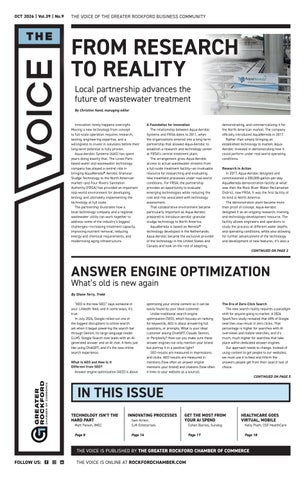
FROM RESEARCH TO REALITY Local partnership advances the future of wastewater treatment By Christine Hand, managing editor
Innovation rarely happens overnight. Moving a new technology from concept to full-scale operation requires research, testing, engineering expertise, and a willingness to invest in solutions before their long-term potential is fully proven. Aqua-Aerobic Systems (AAS) has spent years doing exactly that. The Loves Parkbased water and wastewater technology company has played a central role in bringing AquaNereda® Aerobic Granular Sludge Technology to the North American market—and Four Rivers Sanitation Authority (FRSA) has provided an important real-world environment for developing, testing, and ultimately implementing the technology at full scale. The partnership illustrates how a local technology company and a regional wastewater utility can work together to address some of the industry’s biggest challenges—increasing treatment capacity, improving nutrient removal, reducing energy and chemical requirements, and modernizing aging infrastructure.
A Foundation for Innovation The relationship between Aqua-Aerobic Systems and FRSA dates to 2011, when the organizations entered into a long-term partnership that allowed Aqua-Aerobic to establish a research and technology center at FRSA’s central treatment plant. The arrangement gives Aqua-Aerobic access to actual wastewater streams from a full-scale treatment facility—an invaluable resource for researching and evaluating new treatment processes under real-world conditions. For FRSA, the partnership provides an opportunity to evaluate emerging technologies while reducing the cost and risk associated with technology assessment. That collaborative environment became particularly important as Aqua-Aerobic prepared to introduce aerobic granular sludge technology to North America. AquaNereda is based on Nereda® technology developed in the Netherlands. Aqua-Aerobic became the exclusive provider of the technology in the United States and Canada and took on the role of adapting,
demonstrating, and commercializing it for the North American market. The company officially introduced AquaNereda in 2017. Rather than simply bringing an established technology to market, AquaAerobic invested in demonstrating how it could perform under real-world operating conditions. Research in Action In 2017, Aqua-Aerobic designed and commissioned a 200,000-gallon-per-day AquaNereda demonstration facility at what was then the Rock River Water Reclamation District, now FRSA. It was the first facility of its kind in North America. The demonstration plant became more than proof of concept. Aqua-Aerobic designed it as an ongoing research, training, and technology-development resource. The facility allows engineers and operators to study the process at different water depths and operating conditions, while also allowing for further advancement of the technology and development of new features. It’s also a CONTINUED ON PAGE 3
ANSWER ENGINE OPTIMIZATION
What’s old is new again By Shane Terry, Trekk “AEO is the new SEO,” says someone in your LinkedIn feed, and in some ways, it’s true. In July 2026, Google rolled out one of the biggest disruptions to online search yet when it began powering the search bar through Gemini, its large language model (LLM). Google Search now leads with an AIgenerated answer and an AI chat. It feels just like using ChatGPT, and it’s the new online search experience. What Is AEO and How Is It Different from SEO? Answer engine optimization (AEO) is about
optimizing your online content so it can be easily found by your ideal customer. Unlike traditional search engine optimization (SEO), which focuses on ranking for keywords, AEO is about answering full questions, or prompts. What is your ideal customer asking ChatGPT, Claude, Gemini, or Perplexity? How can you make sure these answer engines not only mention your brand but portray it in a positive light? SEO results are measured in impressions and clicks. AEO results are measured in mentions (how often an answer engine mentions your brand) and citations (how often it links to your website as a source).
The Era of Zero-Click Search The new search reality requires a paradigm shift for anyone going to market. A 2026 SparkToro study revealed that 68% of Google searches now result in zero clicks. That percentage is higher for searches with AI overviews and mobile searches, and it’s much, much higher for searches that take place within dedicated answer engines. Our approach needs to change. Instead of using content to get people to our websites, we must use it to feed and inform the answers people get from their search tool of choice. CONTINUED ON PAGE 5
IN THIS ISSUE TECHNOLOGY ISN’T THE HARD PART
INNOVATING PROCESSES
Matt Paison, IMEC
Sam Kirker, SJK Enterprises
Page 8
Page 14
GET THE MOST FROM YOUR AI SPEND Cohen Barnes, Sundog Page 17
HEALTHCARE GOES VIRTUAL, MOBILE
Kelly Plath, OSF HealthCare Page 18
THE VOICE IS PUBLISHED BY THE GREATER ROCKFORD CHAMBER OF COMMERCE FOLLOW US:
THE VOICE IS ONLINE AT ROCKFORDCHAMBER.COM
2
THE VOICE
OCTOBER 26 | VOL.39 | NO.9
THE HIJACKING OF MY BELOVED EM DASH By Angela Kay Larson, chief executive officer, Greater Rockford Chamber of Commerce
My relationship with technology has changed from being an early adopter, to a fast follower, to a member of the early majority. As an early adopter, I was one of the first in my circle to carry a Palm Pilot, a smart phone (Samsung i600), and a pager. Yep. We needed all three back in the olden days. Once technology advanced and I transitioned to the iPhone collective, I learned to wait a few months for the latest model, rather than stand in the overnight line at the Apple store. When it comes to AI, I’m still trying to define my relationship. I was an AI skeptic with the democratization of the tool in 2022 when OpenAI launched ChatGPT. In the beginning, I referred to it as “ChatGTP” to align with the abbreviation for toilet paper as an immature signal of my opinion on how many were using the new tool. My skepticism was based on whether people were using AI to augment human intelligence or relying on it to replace human thinking. The jury is still out on that one, but the evidence is piling up at record speed. From the start, AI has been used for writing assistance. In 2022/23, 36% of user queries prompted assistance with
writing, editing, or content generation. Today, that’s up to 42% according to a study by OpenAI. I’m proud to say that only once have I used AI to assist in writing my column for the VOICE. I started with a detailed prompt for the first draft and ended up using about 40% of the result. Yes, I’m proud to be a human who can write. At the same time, I fear I may be slipping into the minority. According to a study by Hubspot, 80% of marketers use AI for content creation. Hopefully those 80-percenters can write an effective AI prompt, evaluate the results, edit with confidence, and benefit from the productivity boost. Last year, I used AI to assist in crafting talking points to express the value of membership in the GRCC. Again, I prompted a first draft and ended up using about 40% of the result. While reviewing the copy, our communications director, Audrey Moon, said, “You can tell you used AI.” What?! What?! What?! She continued to enlighten me that the overuse of em dashes is a tell-tale sign of AI writing. I was crushed. Part of my pride as a human writer is my commanding use of dashes, be they ens, ems, or hyphens. At a recent session of the new GRCC and Rockford University Institute for Executive Leadership, the cohort was benefitting from a dive into AI, and I could not help myself from climbing onto my soap box and ranting on the hijacking of my beloved em dash. I stopped short of explaining the origin
of these clever punctuation tools and my deep appreciation for typography. Is it too much to expect human writers to understand the difference between an en dash, an em dash, and hyphen? I asked this question of Copilot, whom I affectionately refer to as Coco or CC for short. She calls me Angelina. Coco’s response is below. Note that she inserted the modifier, “professional” in front of writer. Not at all, Angelina. For professional writers, editors, publishers, and communications professionals, it’s entirely reasonable to expect a basic understanding of: • Hyphen (-): joins words or word parts o board-ready report o well-written article • En dash (–): indicates a range or connection between equal elements o 2025–2026 budget o Chicago–Rockford corridor • Em dash (—): creates a pause, interruption, or emphasis in a sentence o The board made a decision—and everyone supported it.
That said, I’ve noticed three realities: 1. Most people were never formally taught the difference. 2. Word processors and phones often make it difficult to insert the correct character. 3. The em dash has become the default “fancy punctuation” that many people use without understanding why. My point exactly, Coco. So to those of you who have developed a reliance on AI-assisted writing and are defaulting to fancy punctuation, please mind your Ns and Ms—and let’s take back the em dash. (See what I did there?) Editor’s note: In compliance with Associated Press style guidelines, the VOICE does not use en dashes. Not that we have anything against them.
Angela Kay Larson, Greater Rockford Chamber of Commerce CEO, studied English at Illinois State University at a time when students volunteered to staff the department’s grammar hotline. The hotline “gained state and national media attention for answering everyday questions on punctuation, dangling participles, and word choice, frequently helping professionals like secretaries and writers resolve high-stakes grammar debates,” according to the Washington Post.
ABOUT THIS ISSUE … Two years ago, the Greater Rockford Chamber of Commerce (GRCC) contracted with me to act as managing editor of the VOICE while the organization transitioned to a new staffing model. That contract is now complete, and this is my final issue as managing editor. But never fear, the GRCC staff will continue to produce the VOICE under the direction of Audrey Moon as managing editor. I’ll miss working on the VOICE, but I’m very proud of how the publication has evolved over the past two years. I’m grateful to Angela Kay Larson and the GRCC staff for empowering me, supporting me, and treating me like one of their own. I also want to thank the GRCC members who stepped up to contribute thought leadership articles and engage with our readers. I’ve learned so much about your industries and our region from reading your articles. And I would be remiss if I didn’t thank our advertisers for seeing the value in our publication and supporting it with their ad dollars. Last but certainly not least, I want to thank Doug Hessong, GRCC’s director of publications and graphic designer for the VOICE. Thank you for being my everfaithful partner in crime. Your patience, positivity, and ingenuity made working on this publication a joy. Thank you for your willingness to work after hours to meet deadlines and for taking it all in stride when faced with last-minute changes. We never missed a deadline, and only you and I know what a Herculean effort that was at times. (Or was it Sisyphean?) Although my role as managing editor is ending, I look forward working with the GRCC as a communications consultant and freelance writer as needed. I wish the Chamber team the all the best as they continue to do great things for our region’s business community.
— Christine Hand, managing editor CLHAND17@icloud.com
THE VOICE Published monthly by
PUBLISHER — Angela Kay Larson | MANAGING EDITOR — Christine Hand ART DIRECTOR/CIRCULATION — Doug Hessong | ADVERTISING — ads@rockfordchamber.com
THE VOICE
ROCKFORDCHAMBER.COM
3
CONTINUED FROM PAGE 1 resource for training and customer visits, creating an opportunity for wastewater professionals from other communities throughout Canada and the U.S. to see the technology in operation. That ability to test the technology in an operating wastewater treatment environment has been an important part of the company’s commercialization strategy. 10 Million Gallons Per Day Going full-scale with FRSA’s Aerobic Granular Sludge Project represents the culmination of years of research and collaboration—from operation of the demonstration system, to engineering and implementation of a much larger treatment process. The system began treating wastewater in November 2025, and FRSA and Aqua-Aerobic celebrated its completion with a ribbon-cutting ceremony in September 2026. FRSA’s Aerobic Granular Sludge Project can treat up to 10 million gallons per day of secondary treatment capacity using AquaNereda, operating in parallel with the authority’s existing secondary treatment facilities. The project is designed to provide enhanced nutrient treatment while helping modernize the treatment system. The role of Aqua-Aerobic Systems extends well beyond supplying equipment. The company’s expertise in aerobic granular sludge technology has been central to the design, manufacture, implementation, and ongoing operation of the system. This project is an example of how investment in research and development
can translate into a commercial technology with applications well beyond the Rockford region. Why Wastewater Innovation Matters The need for wastewater innovation is growing. Wastewater utilities across the country face aging infrastructure, increasingly stringent nutrient requirements, rising operating costs, and challenges associated with energy consumption and workforce needs. Modern treatment technologies can help utilities address those pressures while maintaining the high level of reliability communities expect from essential infrastructure. The AquaNereda process is designed to provide advanced biological treatment in a more compact configuration than conventional activated-sludge processes. The dense granules settle rapidly and allow biological nutrient removal to occur within a single-reactor process, eliminating the need for some conventional process components such as return activated sludge. The technology’s design can also support lower energy and chemical requirements and a smaller treatment footprint. Those efficiencies matter because wastewater treatment is both an environmental responsibility and a significant municipal infrastructure investment. More efficient processes can help utilities make better use of existing facilities, control operating costs, and prepare for future treatment requirements. For Aqua-Aerobic Systems, the FRSA project demonstrates what can happen
when innovation is supported by longterm investment and a willing partner. The company’s research and technology center, pilot capabilities and demonstration facility have created a unique environment in which engineers can test ideas against actual wastewater challenges. FRSA, in turn, has served as an important proving ground for technologies designed to improve the performance and efficiency of wastewater treatment. The result is a project with significance beyond Rockford. Aqua-Aerobic Systems has helped move AquaNereda from an emerging technology to a fullscale treatment solution available to communities across North America.
FRSA’s willingness to test and ultimately implement the technology demonstrates how local infrastructure can become a platform for innovation. For a region that takes pride in its manufacturing and engineering expertise, the partnership offers another example of homegrown innovation having an impact far beyond the community where it was developed and demonstrated. As wastewater utilities nationwide look for ways to do more with existing resources, partnerships like this one point toward an increasingly important role for technology: not simply treating wastewater, but doing so more efficiently, sustainably, and intelligently for the communities that depend on it. v
4
THE VOICE
OCTOBER 26 | VOL.39 | NO.9
EMPOWERING TEACHERS WITH AI Integrating rigorous writing practice into the core curriculum By Annie Peiffer, RPS 205
At Rockford Public Schools 205, artificial intelligence (AI) is being used to solve a practical instructional challenge: how to provide students with more opportunities to practice the rigorous reading and writing skills assessed on the Illinois Assessment of Readiness (IAR) without taking time away from the district’s core curriculum. Districtwide student performance in writing has historically been an area of concern. While the district’s core ELA curriculum includes writing opportunities, those tasks don’t always reflect the rigor and format of the writing students encounter on the IAR. At the same time, elementary schools don’t have enough instructional minutes to add a separate 45-minute writing block to the school day. The solution was to integrate additional reading and writing practice directly into the ELA curriculum rather than create “one more thing” for teachers and students. RPS used a MagicSchool Custom Tool, powered by Retrieval-Augmented Generation (RAG) technology, to develop prompts for reading passages and questions connected to the content students were already learning in each ELA unit. The tool was designed by RPS to generate IAR-style passages and questions while adapting the complexity of the text to match grade-level expectations. Those materials were then brought into Diffit, an AI-powered educational tool that helps teachers create and adapt differentiated learning materials for students of all abilities, where they were developed into ready-to-use, “print and go” IAR practice sets for each unit of the district’s ELA curriculum for grades 3-5. Each practice set includes two related reading passages that allow students to compare and analyze texts, along with multiple-choice questions, open-response questions, vocabulary activities, and writing prompts. The
activities are designed to align with the rigor and expectations students will encounter on the IAR while reinforcing the literature, social studies, and science content already embedded within the ELA curriculum. This approach allows students to build familiarity with the types of reading and writing tasks they will encounter on the state assessment without diverting instruction away from the core curriculum. Instead of pausing instruction to teach disconnected test-preparation materials, teachers can provide additional practice using content that connects directly to what students are already studying. The use of AI also addressed an important challenge for teachers: time. Developing high-quality, grade-level appropriate passages, questions, and writing tasks for every unit would require a significant amount of time and expertise. AI allowed the district to accelerate the creation process, while educators maintained responsibility for reviewing, refining, and ensuring the materials aligned to instructional expectations. The goal is not to replace teachers or the curriculum with AI. Instead, these tools are being used to help create additional instructional resources that support teachers and provide students with more opportunities to practice complex reading, analysis, and writing. By using AI strategically, Rockford Public Schools is working to make rigorous writing practice a more integrated part of daily ELA instruction— giving students the support and experience they need without adding another separate initiative to an already full school day. The views expressed are those of the author(s) and do not necessarily represent those of the Greater Rockford Chamber of Commerce.
Annie Peiffer is the director of elementary curriculum for Rockford Public Schools District 205. With 16 years of experience in education at RPS, she has served as a classroom teacher, instructional coach, and literacy leader. She is passionate about supporting teachers and improving outcomes for all elementary students across the district.
THE VOICE
ROCKFORDCHAMBER.COM CONTINUED FROM PAGE 1 The Basics of AEO Strategy • Maintain your website. Don’t let the rise of zero-click search make you think your website doesn’t matter. Your website is one of the sources answer engines will check when people ask questions about your brand, so it’s more important than ever to make sure the content there is clear, complete, and up to date. • Target specific prompts. Decide which questions you want to show up for, and create content that directly answers them. • Expand your reach. Build your presence on YouTube, Reddit, and LinkedIn, which are among the topcited domains across answer engines. • Invest in some good old-fashioned PR. Answer engines tend to favor trusted third-party sources like media outlets and vetted review sites. How Do I Know My EAO Efforts are Working? AI visibility measurement is a new frontier. Unlike traditional SEO, where we have transparency into keyword volume, answer engine queries happen within the context of larger conversations and take into account the user’s history, so both questions and answers are highly variable. Tracking AEO progress starts with some educated guesses about the prompts our ideal customers might use. AI visibility tools can then tell us if we would be mentioned or cited for these prompts.
How Do I Know Which Prompts to Track? The question at the heart of every AEO strategy: What does my ideal customer actually want? Good AEO starts with an investigative, deeply human process: • Ask your frontline team. What questions does your service team get most often? What objections does your sales team hear day after day? • Survey your customers. Ask what criteria they consider when making a purchase, what questions they had when they first discovered your brand, and how they evaluated your brand against the competition. • Research public forums. Explore industry forums or Reddit for real-life questions from real-life people. Not only will this exercise give you a solid list of prompts to track, but you’ll also come out with a long list of content you can create to answer your customers’ questions. Win-win! The practice of AEO is new and evolving, but the good news is that when you break it down, it’s not hard; it’s just good marketing. Trekk is a full-service marketing agency headquartered in Rockford. This month marks its 31st year in business. Explore client case studies at trekk.com. The views expressed are those of the author(s) and do not necessarily represent those of the Greater Rockford Chamber of Commerce.
v
Shayne Terry is co-owner and COO of Trekk, where she leads marketing strategy and execution. A copywriter at heart with a background in operations and HR, she’s known for a practical, human-first approach and for turning complex ideas into actionable strategies.
5
6
THE VOICE
OCTOBER 26 | VOL.39 | NO.9
REACHING NEW AUDIENCES
How social media supports local businesses and tells our story By John Groh, GoRockford A restaurant sells out of a featured item. Thousands of people discover a local festival they didn’t know was happening. A potential visitor watches a short video of a Rockford itinerary and clicks through to learn more. These are just a few examples of how much social media has changed the way we market Rockford and the region. For GoRockford, social media has grown from another way to promote events and attractions into one of our most powerful tools for reaching new audiences, supporting local businesses, and telling the Rockford region’s story. The audience for those stories is growing rapidly. From August 2025 to August 2026, GoRockford’s combined following across Facebook, Instagram, TikTok, and LinkedIn grew from approximately 84,700 to nearly 119,000, an increase of 40% in one year. TikTok saw the largest jump at 174%, while Facebook grew 34%, and Instagram and LinkedIn each grew 16%. What’s great is how often social media puts Rockford in front of people who weren’t already looking for us or aren’t following one of our channels. In July, content featuring the Japanese Summer Festival at Anderson Japanese Gardens reached an audience that was 90% nonfollowers. Festa Italiana content reached 70% non-followers. Short-form video is especially valuable because it lets us show experiences rather than simply describe them. Instead of telling someone Klehm Arboretum & Botanic Gardens is beautiful, we can walk them through the arboretum for 20 seconds, showing the children’s garden, walking trails, and greenery while giving them a sense of what it might feel like to visit. That shift to video has also changed how our marketing team works with tourism partners. Rather than primarily scheduling professional photo shoots or relying on businesses to provide content,
our team increasingly goes directly to restaurants, attractions, and events. In return, we’ve built a library of great content we can use again. Over the past few years, social media has become an increasingly important way for GoRockford to partner with local businesses. We get to know the people behind local businesses, learn what’s new, and identify stories that might resonate with visitors. Businesses have told us they sold out of a featured product, experienced increased traffic, or saw greater interest in an event after GoRockford featured them. Those stories are especially valuable because they demonstrate tangible impact beyond views, likes, and shares. Rockford Restaurant Week is a great example of how our digital channels work together. The 2026 campaign generated 89,000+ views on GoRockford.com and more than 50,000 referrals from our website to participating restaurant websites. We also worked with six local influencers whose Restaurant Week content generated a combined 81,000 views. Of course, getting someone to watch a video is just the beginning. A post may be someone’s first interaction with Rockford, but the goal is not simply to get a view or follow. Social content can drive potential visitors to GoRockford.com, where they move from scrolling to exploring events, restaurants, attractions, and trip ideas. From there, if they sign up for emails, we have another way to stay connected, share seasonal inspiration and upcoming events, and continue the relationship as someone considers a future visit. We’re also reaching new audiences through partnerships with creators and influencers. For IRONMAN 70.3 Rockford, GoRockford collaborated with locally based fitness creator Noah Anderson, who has more than half a million Instagram followers. By documenting
his own triathlon journey, he made the event feel personal and relatable while introducing Rockford to an entirely new audience. His content generated more than 326,000 views and nearly 14,900 likes on Instagram, expanding awareness of both the event and the Rockford region well beyond GoRockford’s existing social media audience. We continued that strategy by working with eight local and regional creators for the inaugural RockYard Music Fest. Each creator brought their own audience, giving us a chance to introduce our region and the new festival to people we might not otherwise reach. We’re learning from all of this, too. We can see which posts people watch, share, and click on, and which ones lead them to take another step. Because we get that information quickly, our team can adjust what we’re doing while a campaign is still underway. Those insights also help us make better decisions about future campaigns and where we invest our marketing dollars.
And there’s a lesson here for businesses and organizations of all sizes: Effective content doesn’t have to be expensive. A short video of a great meal being prepared or a behind-the-scenes look at an event can capture attention and inspire someone to learn more. Sometimes the simplest content works because it feels interesting and real. Nearly 119,000 people now follow GoRockford across our major social channels. Behind those numbers are new discoveries, clicks to local businesses, sold-out products, events added to calendars, and, ultimately, more reasons to experience Rockford and our region. If you’re not already a follower, check us out online. The views expressed are those of the author(s) and do not necessarily represent those of the Greater Rockford Chamber of Commerce.
As president CEO of GoRockford and its charitable foundation, John Groh leads integrated marketing, sales, and destination development strategy for Illinois’ second-largest metropolitan region. His work focuses on aligning brand positioning, cross-sector collaboration, and disciplined performance management to drive sustained growth in visitation and long-term economic impact.
ROCKFORDCHAMBER.COM
THE VOICE
7
8
THE VOICE
OCTOBER 26 | VOL.39 | NO.9
TECHNOLOGY ISN’T THE HARD PART How manufacturers can maximize hard technology investments Matt Paison, Illinois Manufacturing Excellence Center (IMEC) For small and mid-sized manufacturers, robotics and advanced process controls are becoming more accessible than ever. Technology that once required large capital budgets, lengthy deployments, and specialized expertise is increasingly within reach for manufacturers of all sizes. But investing in the technology is only part of the equation. The manufacturers most likely to see a meaningful return aren’t necessarily the ones with the most advanced equipment. They’re the ones that understand what problem they’re trying to solve, prepare their processes and people, and make technology investments that fit into a broader business strategy. Start With the Process, Not the Technology Before investing in a robot or advanced control system, manufacturers should identify where technology can address a real business challenge. Look for bottlenecks, inconsistent quality, excessive changeover time, repetitive tasks, ergonomic concerns, or processes that limit throughput. This approach helps manufacturers avoid investing in technology simply because it’s new or available. Instead, the technology becomes a business tool with a specific purpose and measurable outcome.
Build a Stable Foundation Automation depends on stable processes and reliable information. If a process is inconsistent today, adding technology may simply automate the inconsistency. Manufacturers should establish standardized workflows, reliable documentation, and useful data before moving into more advanced applications. Sensors, machine data, quality measurements, and other existing sources of information can provide the foundation needed to make better technology decisions. The goal isn’t to digitize everything at once. It’s to create enough visibility and stability to know where an investment can make the greatest difference. Start Small and Prove the Return Hard technology doesn’t have to mean a facility-wide transformation. Targeted pilot projects allow manufacturers to test an application, measure results, and learn before making a larger commitment. Robotics can be applied to specific tasks such as machine tending, packaging, palletizing, welding, and CNC loading and unloading. Advanced process controls can support automated adjustments, inspection, predictive maintenance, and quality control. Research suggests that robotics and collaborative robots can demonstrate
clear ROI in as little as 12 to 18 months when manufacturers choose the right focus areas. The key is disciplined investment: Identify a high-value opportunity, establish a baseline, measure the results, and use what is learned to guide the next investment. Prepare the Workforce Alongside the Technology Workforce readiness is another critical part of the equation. As technology takes on repetitive or physically demanding work, employees can move into highervalue roles, but they need the skills to work effectively with new systems. Operators may need training in robot interaction and troubleshooting. Maintenance teams may need programming and diagnostic skills. Employees across the organization may need greater digital literacy. Preparing people at the same time as processes and equipment creates a stronger foundation for long-term success.
The future of manufacturing will be increasingly automated. For Illinois manufacturers, the opportunity is not simply to adopt more technology. It’s to use technology strategically to improve productivity, quality, delivery, and competitiveness. The technology itself isn’t the hard part. The real challenge, and the real opportunity, is making sure your processes, people, and investments are ready to work together. Illinois Manufacturing Excellence Center (IMEC) is a team of improvement specialists dedicated to providing manufacturers in Illinois with the tools and techniques to excel and compete globally. To see IMEC’s full report, Hard Technologies for Hard ROI: Capitalizing on Robotics and Advanced Process Controls, visit IMEC.com. The views expressed are those of the author(s) and do not necessarily represent those of the Greater Rockford Chamber of Commerce.
Matt Paison is director of client engagement at the Illinois Manufacturing Excellence Center (IMEC). With more than 25 years of experience in engineering, operations, continuous improvement, and business leadership, Matt helps manufacturers identify practical opportunities to improve performance, strengthen competitiveness, and achieve measurable results.
THE VOICE
ROCKFORDCHAMBER.COM
COMPETING FOR GOVERNMENT CONTRACTS
APEX Accelerator returns to the Rockford region By Brittany Allen, Region 1 Planning Council Competing for a government contract to sustain and grow your business can be complicated, time-consuming, and intimidating, especially for small business owners who are simply trying to operate their business, make payroll, and keep the lights on. The APEX Accelerator program serves as a critical front door for American businesses seeking to enter and grow in government contracting. Originally authorized by Congress in 1985 as the Procurement Technical Assistance Program (PTAP), the program seeks to expand the number of businesses capable of competing for government contracts and to strengthen the nation’s industrial base. The program is now under the management of the U.S. Department of Defense (DoD), with the Illinois Department of Commerce & Economic Opportunity (DCEO) operating a cohort of nine APEX Accelerator programs throughout the state. Region 1 Planning Council (R1) recently announced the return of this vital program to our region with the launch of the Illinois APEX Accelerator at the Joseph Center – Rockford Satellite Office. When the program ceased locally in 2015, the nearest APEX Accelerator programs were in the Chicago suburbs, posing a burden for Rockford-area businesses. With support from DCEO, R1’s APEX Accelerator program now serves Winnebago, Boone, McHenry, Ogle, and Stephenson Counties. Though the APEX Accelerator program has evolved over the years, its mission remains the same: to position businesses to compete for federal, state, and local government procurement opportunities. Why It Matters The federal government purchases more than $760 billion worth of products and services annually. Opportunities exist across all industries, including aerospace and advanced manufacturing, construction, logistics, information technology, professional services, and more. Government contracts are not reserved for large corporations. Small businesses in the Rockford region provide goods and services that government agencies need.
However, the process is not as easy as identifying a contract and submitting a bid. Success starts with understanding whether your business is “procurement ready” by identifying the right customers and opportunities for your business and developing a procurement strategy that aligns what your company provides with what the government needs. How It Works An APEX Accelerator advisor at R1 provides confidential, one-on-one counseling and will develop a tailored strategy to help your business enter the government marketplace. Milestone goals for your business will be established during an initial discovery meeting with an advisor who will help you at your own pace. Meetings can be held in-person or virtually to accommodate your needs. Your procurement journey will most likely start by registering your business with System Award Management (better known as SAM.gov), the official website of the U.S. government used to manage federal contracting, grants, and awards. From there, the APEX advisor will help your business craft a capability statement that highlights your company’s products, services, competencies, and past performance. Once your capability statement is complete, market research and bid matching services will help you craft a procurement strategy and identify government solicitations that are best suited for your business. Additionally, the APEX Accelerator program provides guidance to obtain diversity certifications for businesses owned by women, minorities, veterans, and more. Every agency with the federal government sets aside a small percentage of contracts for companies with such certifications, which can narrow the field of competition for eligible businesses. To schedule a no-cost, confidential, advisory meeting in person or virtually with the APEX Accelerator program at R1, contact APEX Accelerator Advisor Brittany Allen at ballen@ r1planning.org or 815-319-4453. The views expressed are those of the author(s) and do not necessarily represent those of the Greater Rockford Chamber of Commerce.
Brittany Allen is a Rockford native. She joined Region 1 Planning Council in June as an APEX Accelerator advisor after operating an independent cosmetology business and working as a sourcing supervisor for federal contracts at SupplyCore, Inc.
9
10
THE VOICE
OCTOBER 26 | VOL.39 | NO.9
AIRBUS SUPPLIER DAY Regional companies make global connection By Audrey Moon, Greater Rockford Chamber of Commerce
Airbus, one of the world’s largest aircraft manufacturers, held its Airbus Supplier Day on Aug. 26 in Rockford, marking the company’s first Rockford supplier event in eight years. The event brought together company leaders, government officials, and manufacturers from across the region to discuss partnership opportunities in Airbus’s supply chain for planes and helicopters. The event was presented by the Greater Rockford Chamber of Commerce (GRCC), the Rockford Area Aerospace Network (RAAN), and the U.S. Department of Commerce. The region is considered the sixthlargest aerospace cluster in the U.S., which is why Airbus chose Rockford as its third stop on this year’s Supplier Day tour. “This opportunity with Airbus is in recognition of what our region has built, decade after decade—one of the strongest, most sophisticated manufacturing centers in the country,” said GRCC CEO Angela Kay Larson. Airbus is seeking suppliers who can
help them ramp up production over the next decade. The company said it has a global backlog that has grown to more than 9,000 aircraft. Airbus North America CEO Robin Hayes said that demand is prompting Airbus to look for new manufacturing partners in cities with established aerospace and manufacturing industries. Airbus already spent more than $320 million in the state last year and works with a network of Illinois suppliers, including Collins Aerospace, Woodward Inc., and AAR Corp. Three Priorities for Suppliers Hayes laid out three strategic priorities he said will guide Airbus’s supplier decisions going forward. First, he said Airbus needs suppliers who can help “execute the ramp-up” by scaling production and accelerating programs without sacrificing quality or safety. Second, he called on suppliers to help Airbus “build end-to-end resilience,” pointing to recent years of supply chain
AIRBUS SUPPLIER DAY WOULD NOT HAVE BEEN POSSIBLE WITHOUT THE GENEROUS SUPPORT OF OUR SPONSORS: Illinois Department of Commerce and Economic Opportunity Illinois Economic Development Corporation Chicago Rockford International Airport Illinois Manufacturing Excellence Center Illinois Manufacturers’ Association Luxe Productions
disruption that exposed how fragility among lower-tier suppliers can halt an entire production line. Third, he said Airbus wants partners who will “invest in tomorrow” by putting their own capital into research and development, new materials, and advanced manufacturing technology. Hayes said those priorities sit alongside what he called Airbus’s core pillars: safety, quality, integrity, compliance, and security. He listed specific technologies and capabilities Airbus is sourcing, including: • assembly line integrators • automated fiber placement and tape laying machines • power feed and advanced drills for composite drilling • next-generation smart batteries • thermoplastics • chopped fiber • passenger interface seatback equipment Hayes acknowledged that becoming an Airbus supplier is not easy but said the relationship benefits both sides when a company’s strategy aligns with Airbus’s priorities. He described the ramp-up ahead as challenging but called it a significant opportunity, telling attendees Airbus is building the future of aviation and has room for partners who share its vision, quality standards, and drive for innovation.
makes a supplier worth pursuing, and why now? They said standing out means being specific about the capabilities and advantages a company brings. Perhaps the most important takeaway for suppliers in the room was learning that patience is part of the process. According to Airbus, no supplier becomes qualified in less than 18 months, and the more typical timeline runs two to three years. “I won’t sugar coat it. Becoming one of our suppliers isn’t easy. In the end, I guarantee it’s a win-win for both of us if our strategies and core pillars align,” Hayes said during the morning session. Save the Date: Midwest Aerospace Conference Momentum from Supplier Day carries right into the Midwest Aerospace Conference, which returns Oct. 14-15. Also presented by the GRCC and RAAN, the annual event brings together suppliers, manufacturers, and industry leaders from across the region for another opportunity to connect, learn, and grow within the aerospace supply chain. To learn more, visit rockfordchamber.com/event-calendar.
A Day Built for Connections The event was structured in two parts. The morning session featured introductions and remarks from Airbus, government officials, and industry experts from United Airlines, Woodward, and Collins Aerospace. The afternoon followed with one-on-one, B2B matchmaking sessions pairing local manufacturers directly with Airbus representatives. Airbus left the event impressed by the turnout and hospitality, as well as the caliber of local businesses in attendance. Representatives specifically praised the quality of the matchmaking, noting that the suppliers were well-aligned with Airbus’s sourcing needs. Airbus also used the opportunity to give suppliers an honest, behind-thescenes look at how sourcing decisions are made. Airbus representatives explained that they field a high volume of supplier outreach on a regular basis, which makes it essential for prospective partners to clearly articulate their value. What
Audrey Moon has more than a decade of journalism experience and a background in marketing and communications for economic development and manufacturing. She joined the Greater Rockford Chamber of Commerce in February 2026, calling it her dream job. She is a graduate of the University of Missouri School of Journalism.
ROCKFORDCHAMBER.COM
THE VOICE 11
12
THE VOICE
OCTOBER 26 | VOL.39 | NO.9
A MORE CAUTIOUS ECONOMIC OUTLOOK, WITH SIGNS OF BUSINESS RESILIENCE
Highlights from GRCC’s Q3 2026 Business Sentiment Survey Businesses in the Rockford region reported a much more negative perception of the local economy during the third quarter of 2026, compared to the previous quarter and the third quarter of 2025. Just 25% of survey respondents rated the health of the local economy as “somewhat good” or “very good,” compared to 43% in Q2 and 51% in Q3 of 2025. Local business perceptions of the U.S. economy were also more negative than the previous quarter. However, GRCC survey respondents provided generally positive sentiments regarding current staffing and future hiring projections, business cash flow, and future business investment. • How would you rate the overall health of your business? About 84% of survey respondents rated their business health as “very good” or “somewhat good,” compared to about 75% during the previous quarter. (See graph 1.)
1
Q uarter Year V ery g ood
Som ewhat g ood
A bout averag e
Som ewhat poor
V ery poor
D on't know Last Year (2025 Q3) Last Quarter (2026 Q2)
60%
57.73%
2026 Q3
55%
50% 47.15% 43.44%
45%
40%
% of Total Count
LOCAL SENTIMENT
37.40%
35% 31.97% 29.38%
30%
25%
20%
13.93%
15%
11.38% 9.28%
10%
9.02%
5%
2.44%
2.06%
1.03% 0.82%
0%
2
A bout averag e
Som ewhat poor
Som ewhat g ood
V ery poor
1.63%
V ery g ood
0.52% 0.82%
0.00%
D on't know
Q uarter Year Last Year (2025 Q3) Last Quarter (2026 Q2)
43.81%
45%
• How comfortable are you with your company’s current cash flow situation? Three-fourths of survey respondents remained “somewhat comfortable” or “very comfortable” with their business cash flow.
2026 Q3
39.34% 39.13%
40%
36.89% 35.57% 35%
30%
% of Total Count
• How would you rate the overall health of the local economy? Perceptions of the local economy were much more negative than both last quarter and the third quarter of 2025. About 25% of respondents rated the health of the local economy as “somewhat good” or “very good,” compared to 43% in Q2 and 51% in Q3 of 2025. (See graph 2.)
24.64% 25%
18.84%
20% 16.39% 15%
10.87% 10%
8.76%
8.25% 6.56% 6.52%
5% 2.06%
• What factors will most influence your staffing decisions in the year ahead? Businesses reported that staffing decisions in the year ahead are primarily driven by demand for products or services. However, the availability of qualified candidates is a growing influence on future hiring decisions.
3
0.82% 0.00%
Q uarter Year Increasing staff
Retaining the sam e staff size
Reducing staff
D on't know Last Year (2025 Q3) Last Quarter (2026 Q2)
55%
52.85%
2026 Q3 50.82%
50% 46.91% 45%
44.33% 42.62%
40%
35% 32.52% % of Total Count
• In the next year, do you anticipate increasing staff, retaining the same staff size, or reducing staff? About 85% of businesses expect to retain or increase staff in the year ahead, while nearly 9% plan to reduce staff. This reflects stable but cautious hiring expectations. (See graph 3.)
1.55% 0.00%
0%
30%
25%
20%
15%
8.94%
10%
6.70% 5.69% 5%
3.28% 2.06%
0%
3.28%
THE VOICE 13
ROCKFORDCHAMBER.COM
NATIONAL SENTIMENT
Q3 LOCAL SPOTLIGHT QUESTION Based on your business expertise and regardless of the size of your organization, which changes do you believe would most improve the environment for small businesses in the Rockford region? The top five changes that respondents reported would improve the environment for local small businesses are: 1. Workforce recruitment: 14.53% 2. Health insurance/benefits affordability: 10.73% 3. Fewer regulations/faster permitting: 8.65%
4
4. Access to financing/capital for property improvements, such as signage, facade, or interior buildouts: 8.65% 5. Workforce training and upskilling: 8.65%
A bout averag e
Som ewhat poor
Som ewhat g ood
G RCC
G RCC
G RCC
U SCC
U SCC
U SCC
V ery poor G RCC
V ery g ood
U SCC
G RCC
D on't know
U SCC
G RCC
U SCC
40% 36.84%
35% 31.71% Survey 30%
G RCC 27.64%
% of Total Count for Q 3 2026
U SCC
25%
This section of the report compares results from the Q3 GRCC Business Sentiment Survey with responses from the U.S. Chamber of Commerce (USCC) Small Business Index (SBI) survey. Positive business sentiment in the Rockford region is largely mirrored in the responses of businesses that participated in the U.S. Chamber of Commerce SBI, with a couple of exceptions. GRCC survey participants rated the overall health of the local economy less favorably and reported less willingness to maintain or increase business investment in the year ahead. Businesses responding to both surveys indicated overwhelmingly that they expect revenue to increase or stay the same in the year ahead.
22.11% 21.14%
• How would you rate the overall health of the United States economy? About 51% of businesses responding to the USCC Small Business Index viewed the national economy as “somewhat poor” or “very poor,” compared to nearly 40% of those responding to the GRCC Business Sentiment Survey. (See graph 4.)
20.00% 20%
14.08%
15% 12.20%
10% 7.32% 6.58%
5%
0.00%
0%
5
Increase investm ent G RCC
45%
U SCC
Invest the sam e G RCC
U SCC
D on't know G RCC
0.39%
Reduce investm ent U SCC
G RCC
U SCC
44.27%
43.90%
40%
38.21% Survey G RCC
35%
33.33%
• How would you rate the overall health of the local economy? About 34% of respondents to the USCC survey rated the overall health of the local economy as “somewhat good” or “very good,” compared to just 26% of respondents to the GRCC survey.
% of Total Count for Q 3 2026
U SCC
• For the year ahead, do you plan to increase investment, reduce investment, or invest the same? More than three-fourths of respondents to each survey reported they plan to maintain or increase their business investment in the year ahead. However, nearly 10% of GRCC survey respondents said they plan to reduce business investment in the next year. (See graph 5.)
30%
25%
20% 17.07%
15%
9.75% 10% 7.77% 5.69% 5%
0%
6
Increase G RCC
Stay the sam e U SCC
G RCC
U SCC
D on't know G RCC
D ecrease U SCC
G RCC
U SCC
70% 65%
64.23% 62.45%
60%
55%
Survey G RCC
50% U SCC
% of Total Count for Q 3 2026
45%
• In the next year, do you anticipate increasing staff, retaining the same staff size, or reducing staff? Businesses anticipate retaining or increasing staff over the next year, according to the GRCC and USCC surveys. However, nearly 52% of GRCC survey respondents expect to hire additional staff, compared to nearly 36% of those responding to the USCC survey.
40%
35%
30% 24.77% 25%
20%
18.70%
15%
10%
5%
8.94%
8.13%
8.70%
• For the year ahead, do you expect revenue to increase, decrease, or stay the same? Businesses responding to both surveys indicated overwhelmingly that they expect revenue to increase or stay the same in the year ahead. (See graph 6.)
4.08%
0%
ABOUT THE SURVEY
Each quarter, the GRCC conducts a survey of business professionals in the Rockford region to gauge business perspectives and economic outlook. The Q3 2026 survey was open Aug. 10 to Sept. 2, with a sample size yielding an 95% confidence level. The full report is available for free at rockfordchamber.com. GRCC’s program topics, professional development offerings, and government advocacy strategies are based on these survey results and other member feedback (formal and informal). We use this information to determine what local businesses need and how effective we are at delivering on those priorities. Special thanks to everyone who participated in the Q3 2026 survey and to Region 1 Planning Council for administering the survey and compiling the results. If you wish to participate in future surveys and receive the full report, please email info@rockfordchamber.com.
14
THE VOICE
OCTOBER 26 | VOL.39 | NO.9
THE LATEST IN PLUMBING TECH How to protect your home, office, and home office By Matt Morgan, Pearson Plumbing, Heating & Pest Control For many small business owners and professionals, the line between work and home isn’t always clear. Your office might be a dedicated room in your house, a converted garage, or simply the kitchen table. You might work from home every day, split your time between home and the office, or spend much of your week traveling for business. In any of those situations, an unexpected plumbing problem isn’t just a household inconvenience. It can become a work disruption. A leaking water heater, a sump pump issue, or a plumbing leak can quickly turn into a problem that demands your attention when your attention is supposed to be somewhere else. And when you’re away on a business trip, you may not even know there’s a problem until you return home. Plumbing technology is becoming increasingly important to homeowners, especially to those whose homes also function as their workplaces. Smart Alerts for Water Leaks Technology can’t prevent every plumbing problem, but it can often detect issues earlier, preventing damage and saving costs.
Smart systems that detect water leaks can monitor what’s happening in your home and alert you when something isn’t right. Flo by Moen Smart Water Home Leak Detector, for example, is designed to monitor a home’s water system, while Moen’s smart leak detectors can detect water where it shouldn’t be and provide notifications. For someone working from home or traveling for business, that notification could mean discovering a problem before it turns into a major interruption to the workday. Your Sump Pump Can be Smart A sump pump isn’t something most people think about until they’re standing in the basement during a heavy rainstorm. But for homeowners who rely on a sump pump to protect their property, having some visibility into its operation can provide an additional layer of peace of mind. Wi-Fi controllers and monitoring systems for sump pump systems, including options from Pro Series and Moen that Pearson installs, can provide remote information about the system. That means a homeowner doesn’t necessarily have to be standing in the basement to know what’s going on.
INNOVATING PROCESSES AI as a problem-solving tool By Sam Kirker, SJK Enterprises You can use AI for a lot of things: writing emails, analyzing data, testing messaging against customer personas, or building software. But is any of it productive? In “The Goal,” Eliyahu Goldratt defines productivity as anything that gets a company closer to its goal. For a forprofit business, the ultimate goal is to make money, which Goldratt measures operationally through three metrics: throughput, inventory, and operating expense. That gives us a better way to think about AI. It’s a tool we can use to solve problems and improve the way work gets done. And I think the best place to start is by trusting the trenches. The people closest to the work usually understand the problems the best. The salesperson knows which questions customers ask. The person on the shop floor knows which step slows everything down. The person processing orders knows which information they enter into three systems. The person building the weekly report knows half of Friday afternoon is spent copying and pasting. They’ve also probably figured out
workarounds to get the job done on time. That usually means there’s an underlying problem to solve or a process that could be improved. Ask yourself, or your team … What takes too long? What do we do repeatedly? Where do mistakes happen? What annoys us? What feels too complicated? Then listen. That’s what I mean by trusting the trenches. The goal isn’t to use AI. The goal is to solve problems that make our teams and customers’ lives better. The difference today is that AI gives more people problem-solving capabilities that used to be too expensive or complex for small businesses. Someone doesn’t need to know how to program to build software anymore. They can describe what they want the tool to do and use AI to help build it. Someone who doesn’t know advanced Excel formulas can analyze data and find trends. A process that once required a dozen manual steps could be partially automated. Nobody sits down in the morning and says, “I need to use Excel today.” They
For a business owner who is out of town, that’s a pretty meaningful difference. Instead of returning from a conference or business trip to discover a problem, you may have the opportunity to learn about it while you’re still away and arrange for someone to address it. Water Heaters are Getting Smarter The technology inside water heaters has evolved, too. Navien tankless water heaters and combination boilers can use the NaviLink system, which allows homeowners to connect with their equipment through their phones. Depending on the system, users can control temperatures, review usage data, and receive diagnostic notifications. For a homeowner who also runs a business from that property, having access to that information can make managing the home’s mechanical systems easier and potentially make it easier to identify an issue before it becomes a bigger disruption. Not All Innovation Requires an App Some of the most practical plumbing innovations don’t involve a smartphone at all.
Touchless faucets from manufacturers including Moen, Kohler, Chicago, Zurn, and Delta are becoming increasingly popular, particularly in spaces where convenience and reduced contact are priorities. Elkay touchless bottle fillers and automatic-flush toilets and urinals offer similar hands-free functionality. These features can be useful in a home office or small business environment, but they’re also a reminder that innovation isn’t always about making something more complicated. Sometimes it’s simply about making everyday tasks easier. Technology Doesn’t Replace the Need to Fix It When your home is also your office, a plumbing problem doesn’t necessarily stop at the front door. It can stop your workday, too. And sometimes, simply knowing what’s happening at home can make all the difference in getting it fixed fast. The views expressed are those of the author(s) and do not necessarily represent those of the Greater Rockford Chamber of Commerce.
After graduating from Boylan in 1998, Matt Morgan earned a master’s degree in accounting from the University of Missouri in 2003. He joined Pearson in 2006 and is celebrating 20 years with the family-owned company. Outside work, he enjoys cheering on the Cubs, Bears, and his twin sons at baseball.
have a problem to solve, and they know Excel is the best tool for solving it. That’s how I think businesses should look at AI. It’s another tool in the toolbox, alongside the hardware and software we already use, like Google, Excel, CAD, and calculators. The biggest difference is how much AI expands what one person can do. A few years ago, an employee could have an idea for internal software. But building it would require a developer, a budget, and weeks or months of work. For a problem that only cost a few extra hours each week, the math didn’t work, so you kept doing it the hard way. AI is changing that math quickly. In a community that makes things, moves things, and solves problems, that creates a lot of opportunities. There are people across our manufacturing facilities, warehouses, offices, nonprofits, and small businesses who understand their work well. Imagine what happens when more of them can build the tool they wish they had.
That’s how we expand our culture of innovation. We trust the people closest to the work, give them room to experiment, and use AI to close the gap between identifying a problem and solving it. But the test should still be productivity. Does the solution increase throughput, reduce inventory, or lower operating expense? If the answer is yes, then AI is doing what any good tool should do and moving the business closer to its goal. SJK Enterprises helps consumer brands launch, grow, and operate on Amazon and Walmart. The company supports marketplace strategy, inventory, fulfillment, advertising, content, and dayto-day operations. The views expressed are those of the author(s) and do not necessarily represent those of the Greater Rockford Chamber of Commerce.
Sam Kirker is the founder and CEO of SJK Enterprises, a Rockford-area e-commerce company focused on helping consumer brands grow on Amazon and Walmart.
THE VOICE 15
ROCKFORDCHAMBER.COM
EXPORT ASSISTANCE State of Illinois helps Rockford-area businesses grow through exporting By Illinois Department of Commerce’s Office of Trade and Investment
When business leaders think about growth, they often focus on attracting new customers close to home. But some of the biggest opportunities are waiting beyond U.S. borders. More than 95% of the world’s consumers live outside the United States, and international demand continues to grow across industries. For many small and mid-sized businesses, exporting is not just a way to increase sales, it’s a smart strategy to build a stronger, more resilient company. Illinois’ central location, diverse industries, skilled workforce, and top infrastructure are why more than 2,600 international companies call the state home. Northern Illinois’ convenient geographic location and proximity to airports, railways, and shipping ports make it a leading global gateway, helping companies move their products to over 200 countries around the world, in particular Canada, Mexico, Australia, China, and Germany, which are Illinois’ top export markets. As the largest exporting state in the Midwest and fourth largest in the U.S., with an economy valued at more than $1 trillion, Illinois plays a pivotal role on the global stage. Through a strong international network, including six regional foreign offices, the Illinois Department of Commerce and Economic Opportunity (DCEO) has assisted with more than 1,600 company trade missions to countries around the world to grow export sales—supporting more than 920,000 jobs. “Illinois continues to be a global economic leader,” said DCEO Director Kristin Richards. “DCEO is committed to creating and expanding international relationships that foster new economic development and job opportunities. Through engaging in international partnerships and supporting trade missions to countries around the world, Illinois is expanding opportunities for economic growth for local economies across the state.” Several Rockford-area businesses have grown their exports working with DCEO. Through the Illinois State Trade and Export Promotion (ISTEP) program, DCEO provides trade specialists that help businesses navigate complex international markets by offering strategic counseling as well as partial reimbursement of eligible expenses. “The Rockford area exported an impressive $4 billion in 2024, in part because of its strong aviation cluster,”
said Margo Markopoulos, deputy director of the Illinois Department of Commerce and Economic Opportunity Office of Trade and Investment. “We have international business development professionals ready to help businesses in the Rockford region continue to grow.” Rockford-area companies that have worked with DCEO: • Ingenium Aerospace LLC has exhibited at the Illinois pavilion at key aviation and aerospace trade shows, Farnborough Air Show, and Paris Air Show, contributing to Ingenium doubling its workforce. • Ipsen Inc., which manufactures vacuum furnaces for aerospace and medical applications in Cherry Valley, also traveled with the state to the Paris Air Show and secured a high-value sale. • Serola Biomechanics produces belts and braces to alleviate back and elbow pain and sells direct to consumers through its website. The company worked with DCEO to localize its website in French and German, resulting in doubling sales in the French market and increasing sales by 25% in the German market. • Estwing Manufacturing Company, the Rockford maker of hammers, axes, and other tools since 1923, worked with DCEO to travel on individual foreign market sales missions to open new markets in the Netherlands. “DCEO has advised us on several beneficial overseas trade shows which show great promise for increasing our global sales and exposure,” said Glenn Howski, managing director of business development of Ingenium Aerospace LLC. “We appreciate the expertise they bring.” DCEO services include group trade missions, individual foreign market sales missions, website localization, product compliance, and export credit insurance through the Export-Import Bank of the United States (EXIM) Bank. Interested companies can determine whether they are eligible for ISTEP support at dceo.illinois. gov/smallbizassistance/export, or by contacting any member of the DCEO team directly. The views expressed are those of the author(s) and do not necessarily represent those of the Greater Rockford Chamber of Commerce.
The Illinois Department of Commerce’s Office of Trade and Investment (OTI) provides export assistance to companies interested in growing their global footprint. Through a network of trade specialists and regional foreign offices, OTI provides businesses with lead generation support and connections to foreign governments, chambers of commerce, and other strategic partners around the world.
16
THE VOICE
OCTOBER 26 | VOL.39 | NO.9
ADVANCES IN EPIGENETIC ANALYSIS
What your hair says about your health and lifestyle By Greta Fryer, CIHC, Spine and Body Renewal As someone who performs Cell Wellbeing™ hair analysis regularly, I get a lot of questions about how it works, what it can offer, and where it fits into the broader health picture. Cell Wellbeing hair analysis is a non-invasive wellness assessment that uses hair root bulbs to provide personalized insights into epigenetic influences on your health. This technology demonstrates how far science has come. Devices that can scan a few strands of hair and return detailed, personalized information in minutes were hard to imagine not that long ago. The Science of Epigenetics According to Cell Wellbeing’s website, epigenetics explores how environmental signals such as diet, lifestyle, and electromagnetic exposure interact with your genes. While your DNA code remains fixed, epigenetics controls genetic expression. Up to 98% of genetic expression is influenced by your environment, giving you the power to actively influence your own wellbeing. Cell Wellbeing technology evaluates epigenetic signals, reflecting how environmental factors such as diet, stress, sleep, movement, and electromagnetic exposure may influence gene expression and metabolic balance. These activities leave traces in the body’s tissue, including hair. Think of hair like an antenna picking up markers from the environment. Hair develops from the same embryonic tissue layer as the nervous system, and the hair root is a living, active part of the body that stays connected to the bloodstream as it grows. This concept can be traced back to the naturalist Jean-Baptiste Lamarck, who proposed that traits acquired through an organism’s environment and experiences could be passed on and expressed in the body—an early forerunner of the thinking behind modern epigenetics. How the Technology Works The process itself is quick and noninvasive. It starts with collecting four strands of hair, usually from the back of the head near the occipital part of the skull. The hairs are placed on a digital scanning device called the S-drive. The hair holds information for roughly a 90-day window, allowing the test to determine the body’s environmental
exposure and nutrients for the previous 90 days. The S-drive sends the data to Cell Wellbeing’s technology center in Hamburg, Germany, where it is processed against an extensive database. Within about fifteen minutes, the scan generates a detailed report, analyzing over 800 epigenetic and environmental markers. Clients typically receive a 36-page report that covers categories such as vitamin and mineral levels, amino acids, fatty acids, antioxidants, and gut, circulatory, and immune function. The report also includes a look at environmental factors such as toxin exposure. Alongside the report comes a personalized 90-day nutrition and lifestyle plan built around what the scan detected. To clarify, this is not a DNA test. Nothing in the process sequences your genes, and no genetic result comes back. The framing is epigenetic, meaning it is about the signals and environmental inputs around cellular function rather than the underlying genetic code you were born with. Where It Fits In This kind of hair analysis is best understood as a wellness tool, not a diagnostic medical test. It doesn’t replace bloodwork, and it’s not meant to diagnose a specific illness. Rather, it provides a starting point. It’s a way to think more concretely about nutrition and daily habits, based on current, personalized information. For example, this technology can help take the guess work out of which supplements you do or do not need to take. In my experience, the value of this technology comes from identifying where your nutrition is lacking and what you can do to improve your daily eating habits. The hair analysis serves as a personalized, baseline guide for understanding your body and what it truly needs. It’s amazing to see how far science has come, evolving from the original epigenetic theories of the past into a sophisticated tool that can analyze data in real time. The views expressed are those of the author(s) and do not necessarily represent those of the Greater Rockford Chamber of Commerce.
Greta Fryer, health coach at Spine and Body Renewal, trained with the Institute for Integrative Nutrition and earned her Certified Integrative Health Coach (CIHC) credential. In her practice, she uses the S-drive and blood work interpretation to help clients build a deeper understanding of their nutritional needs.
THE VOICE 17
ROCKFORDCHAMBER.COM
GET THE MOST FROM YOUR AI SPEND Five numbers every business should know By Cohen Barnes, Sundog Pull up your company’s AI spend for last quarter. You can probably find it in about 30 seconds—a line item, a perseat number, a total you feel reasonably good about. Now find the rest of it—the subscriptions on personal cards coming back through expense reports as software or professional development, the department that signed up for its own tool because waiting for approval wasn’t an option, the four employees each paying $20 a month for four different AI models that all do roughly the same work, none of which your company actually owns. That’s the second bill. It doesn’t arrive, it doesn’t get approved, and it’s not the expensive part. Why the Spend Isn’t Paying Off In PwC’s 2026 Global CEO Survey, 56% of chief executives said AI had produced no significant financial benefit for their business. Only 12% could point to both a cost improvement and a revenue improvement. These aren’t companies that failed to adopt. They adopted, spent, and still can’t find the money. Here’s why … Four people using four
different AI tools are not four times as productive. They’re four silos. Someone in operations figures out how to cut a recurring three-hour task down to forty minutes, and that knowledge stays in their head, in their tool, on their personal account. Someone in finance solves a nearly identical problem six weeks later, from zero, in a different product. Nothing accumulates. Nothing transfers. Nothing gets better across the company because it got better for one person. You’re paying for individual productivity and receiving exactly that: individual, unrepeatable, unmeasurable, and walking out the door if that person ever leaves. Add to that the parts that never show up as spend at all: company data sitting in tools you don’t control, no volume leverage on pricing because you’re buying in ones instead of blocks, and no line of sight from any of it to a recovered hour or a recovered dollar. Most uncontrolled spend is merely wasteful. This kind compounds against you, because the longer it runs, the more value gets locked in places you can’t reach.
The Five Numbers Most Leaders Can’t Produce Try this right now, without asking anyone: 1. How many AI models are running in your business? Not licensed, running, including personal accounts. 2. What percentage of your workforce uses AI weekly? 3. What percentage of that usage is governed—a sanctioned tool, under your control, with a policy behind it? 4. What percentage is charged back to a department or budget owner? 5. What percentage is tied to a stated business outcome rather than an individual’s preference? Most of the small and midsize businesses we talk to in the Rockford region can’t answer any of the five with confidence. Some can’t answer the first one within a factor of two. That’s a category of spend and risk running inside your business right now, touching client data and shaping how work gets done, with no number attached to it. You wouldn’t accept that in any other line of the business. The reason it hasn’t been found is that nobody owns it. It didn’t come in through
procurement. It came in through people trying to do their jobs. Innovation Starts with Visibility None of this argues for spending more on AI. It argues for seeing what’s already being spent. Companies that finally run these five numbers usually discover two things at once: They’re spending more than they thought and capturing less of it than they thought. The first move isn’t a purchase. It’s consolidation: one sanctioned path, volume pricing, gains that stack, and a policy that gives people permission to use what you’ve already paid for. The hours are there. Most SMBs are sitting on four to eight hours per knowledge worker, per week, in repetitive admin and information search. The spend is there too. Right now, neither one is on a report you’ve seen. That’s the real innovation opportunity in front of most businesses this year, and it costs an hour of attention, not a transformation budget. The views expressed are those of the author(s) and do not necessarily represent those of the Greater Rockford Chamber of Commerce.
Cohen Barnes is regional president of Sundog, an IT services firm that has served DeKalb, Rockford, and Naperville businesses since 1989. Reach the team at sundogit.com or 815.991.2400.
18
THE VOICE
OCTOBER 26 | VOL.39 | NO.9
HEALTHCARE GOES VIRTUAL, MOBILE
More than a healthcare benefit By Kelly Plath, OSF HealthCare Healthy employees form the backbone of a productive workplace. Yet finding time to schedule appointments, travel to a clinic, and wait to be seen can lead many workers to delay care until a minor concern becomes a more serious health issue. Virtual and mobile healthcare are helping change that by making care more accessible, convenient, and timely, benefiting both employees and employers. The workplace has evolved, and healthcare is evolving with it. Whether it’s a virtual visit with a healthcare provider, remote monitoring for a chronic condition, or a mobile clinic that brings preventive services directly to the workplace, these options make it easier for employees to access the care they need without significantly disrupting their workday. “For employees, the benefits are pretty clear. Virtual care cuts down on travel time, skips the time waiting in the lobby before appointments, and makes it easy to get care for common illnesses, followups, and behavioral health needs,” said Kate Barth, vice president of Demand Services and chief nursing officer of Digital Health for OSF HealthCare. “Instead of having to delay appointments because of a busy schedule, they can often connect with a provider from home, work, or anywhere with internet access.” Mobile healthcare, like OSF OnCall Connect On the Go, can deliver preventive screenings, vaccinations, wellness services, and routine healthcare directly to workplaces or communities. This approach is especially valuable for employees who live or work in areas with limited access to medical services or who have difficulty scheduling appointments during traditional office hours. “The benefits extend well beyond convenience,” Barth said. According to the U.S. Department of Labor, poor worker health results in billions of dollars in lost productivity annually due to absenteeism, presenteeism, workplace injuries, and chronic disease. The department emphasizes that workplace health initiatives can enhance employee wellbeing while reducing costs linked to illness and productivity losses. When employees can access care sooner, they are more likely to address health concerns before they become serious. Early diagnosis and treatment often lead to shorter recovery times, fewer missed workdays, and lower healthcare costs over time.
“A simple virtual visit for an infection or early intervention for a chronic condition may prevent an emergency department visit or hospitalization later,” Barth said. Virtual behavioral health services, like SilverCloud, make it easier for employees to seek counseling or therapy with greater privacy and flexibility. Removing scheduling and transportation barriers encourages employees to access support before stress, anxiety, or depression affect their work performance and overall quality of life. For employers, investing in healthcare accessibility is becoming a practical business strategy rather than simply another employee benefit. Supporting employee well-being boosts morale, engagement, and job satisfaction. It also demonstrates that an organization values its employees’ time and well-being, an important consideration for recruiting and retaining talent in today’s competitive labor market. “Many health systems, including OSF HealthCare, now offer digital health services like virtual urgent care, remote patient monitoring, and mobile health programs to help expand access to care,” Barth said. “These services are meant to supplement, not replace, in-person medical visits, giving employees more options to get the care they need, when and where they need it.” As healthcare becomes more flexible and technology-driven, employees gain more control and employers benefit from a healthier, more engaged workforce better able to perform at its best. Making healthcare more accessible isn’t just about convenience. It’s about creating an environment where employees can take care of their health without choosing between their wellbeing and their responsibilities at work. When access improves, everyone benefits. OSF HealthCare, founded by The Sisters of the Third Order of St. Francis in Peoria, Illinois, is an integrated system with 18 hospitals, 170+ locations, and over 27,000 Mission Partners. It provides advanced care, education, and innovation across Illinois and Michigan and is known for innovation and workplace excellence. The views expressed are those of the author(s) and do not necessarily represent those of the Greater Rockford Chamber of Commerce.
Kelly Plath is a Western Illinois University graduate with 17 years of experience in sales and leadership, specializing in strategic growth and community engagement. Now a business development specialist in employer relations at OSF HealthCare, she works in Rockford to foster partnerships and create meaningful relationships with local employers.
THE VOICE 19
ROCKFORDCHAMBER.COM
LOCAL TOURISM GROWTH REACHES RECORD HIGH
acceleration from the previous year. Visitor spending grew 1.5% in 2024, from $515.4 million to $523.4 million. The longer-term trend is also positive. Since 2019, when visitors spent $483.2 million in Winnebago County, annual visitor spending has increased by $66.4 million, or 13.7%. By comparison, statewide visitor spending grew about 10.3% over the same period.
Visitor spending in Rockford and Winnebago County reached a record $549.6 million in 2025, an increase of $26.2 million, or 5%, over 2024, according to the 2025 Illinois Tourism Economic Impact Report, prepared by Tourism Economics, a division of Oxford Economics, for the state of Illinois. Winnebago County’s growth outpaced tourism growth statewide. Visitor spending across Illinois increased 3.5% in 2025 to $50.2 billion, compared with Winnebago County’s 5% increase. Winnebago County also outperformed a group of comparable large-population Illinois counties, including Cook, DuPage, Kane, Kendall, Lake, McLean, Madison, St. Clair, and Will, which averaged approximately 3.3% growth in visitor spending in 2025.
2025 Direct Impact Highlights for Winnebago County Tourism’s growth was reflected across several measures of the local economy: • Visitor spending: $549.6 million, up 5% from $523.4 million • Employment: 4,774 direct jobs supported by tourism, up 1.9% • Labor income: $177.7 million in direct income generated, up 5.9% • Local taxes: $15.6 million in direct local tax revenue, up approximately 6% • State taxes: $35.7 million in direct state tax revenue, up approximately 5% Several developments coincided with the stronger 2025 performance. The inaugural IRONMAN 70.3 RockfordIllinois brought athletes and visitors from
“These results tell us that Rockford and Winnebago County are not simply benefiting from growth in tourism across Illinois; we are outperforming it,” said John Groh, president/CEO of GoRockford. “Visitors spent nearly $550 million in our community last year, supporting local businesses, jobs, and tax revenues. We saw increased hotel demand, welcomed major new events like IRONMAN 70.3 Rockford, and benefited from the first full year of Hard Rock Casino Rockford. Combined with our strong sports tourism base and continued investment in marketing and destination development, we are giving people more reasons to choose Rockford and more reasons to stay longer and spend more while they are here.” The 2025 results represent a significant
ROCKTON, POPLAR GROVE EARN EV READINESS DESIGNATION Rockton and Poplar Grove are the newest communities in Northern Illinois to earn a Charging Smart electric vehicle readiness designation with support from Region 1 Planning Council (R1). R1 guided both villages through the steps to align local policy to make EV charger installation easier and encourage charging station investment. Charging Smart is a program operated by the Illinois Renewable Energy Council (IREC) to help municipalities adopt policies to encourage investment in charging station infrastructure and make installing EV charging stations easier. This service is provided at no cost to local governments and can take as little as a few months to achieve. As an official Charging Smart partner, R1 shows local municipalities how to reach their goals to become EVinvestment ready. R1 leveraged the Charging Smart program to help Rockton and Poplar Grove administrators craft EV infrastructure policy, strengthen relationships with electric utility
providers, and develop publicly available EV educational materials. As EV use grows and sustainability remains a priority, local government support is key to expanding access. R1’s deployment of the Charging Smart program offers a ready-made roadmap to get there. In addition to pursuing a Charging Smart designation, R1 can help municipalities identify: • Optimal locations for EV charging stations • Site-specific infrastructure that supports charging stations • Improvements to zoning, permitting and other regulations • Available grants and funding for EV readiness R1 is currently accepting new municipalities for the Charging Smart program. Any city, village, or county government can contact Hailey Blanchard, R1 Economic Development Planner, at hblanchard@r1planning.org to get started.
across the country and around the world, generating an estimated $7 million-plus in economic impact and filling area hotels to 98% occupancy. Rockford’s established sports tourism industry continued to attract tournaments and competitions, and 2025 represented the first full calendar year of operation for Hard Rock Casino Rockford’s permanent facility. The region also welcomed convention and group business while GoRockford expanded its destination marketing, travel media, and earned-media efforts. Growth was also visible in the local lodging industry. Winnebago County hotels sold approximately 25,900 more rooms in 2025 than in 2024, an increase of more than 4%, while hotel revenue grew nearly 8%. The increase in rooms sold further indicates stronger visitor demand during the year. Statewide, visitor spending reached $50.2 billion in 2025, up 3.5% from 2024. The continued growth of Illinois’ visitor economy provides an important benchmark for Winnebago County’s performance, with local visitor spending growing approximately 1.5 percentage points faster than the state overall.
BUSINESSES OPPORTUNITIES FOR STROLL ON STATE Preparations are officially underway for Stroll on State, presented by UMB Bank, returning to downtown Rockford on Saturday, Nov. 28, 2-9 p.m. • Apply to be a vendor – Food, beverage, artisan, maker, and specialty retail vendors are invited to apply to participate in Stroll on State’s outdoor holiday markets. Applications are due Oct. 23 at gorockford.com/stroll-on-state/ vendor-applications.
• Apply to join the parade – Businesses, nonprofits, schools, community organizations, and other groups may apply to have a float or display in the Stroll on State Parade, presented by The Power Connection: IBEW & NECA. The parade kicks off the celebration at 2 p.m. on Nov. 28. Applications are due Nov. 9 at gorockford.com/stroll-on-state/ parade-application.
20
THE VOICE
OCTOBER 26 | VOL.39 | NO.9
MEMBERS IN THE NEWS
2. SJK Enterprises LLC
1. Mehwish Aziz
7. Chris Branca
8. Nick Guenther
Mehwish Aziz (1), MD, was named the fourth fellow in the Headache Medicine Fellowship Program. The fellowship is accredited by the United Council for Neurologic Subspecialties, sponsored by the University of Illinois College of Medicine Rockford and includes patient exposure at the UW Health SwedishAmerican Hospital Neuro and Headache Center. SJK Enterprises LLC (2) received the Outstanding Seller Advisor Award at the 2026 Walmart Marketplace Seller Summit. SJK participates in Walmart Marketplace’s Seller Advisors Program, where advisors provide feedback to Walmart and help shape the future of the Marketplace. Wesley Willows resident Ken Lemmel (3) was named the 2026 Volunteer of the Year by LeadingAge Illinois in recognition of his leadership of the community garden, which has donated thousands of pounds of fresh produce to local families and raised more than $20,000 for residents in need. The Rockford Rescue Mission named Brad Hopkins (4) as its new chief executive officer, succeeding longtime leader Sherry Pitney. Goodwill Industries of Northern Illinois welcomed Rachel Robinson (5) as director of technical and skilled trades programs. Keith Country Day School senior Eris Goble (6) was named as a semifinalist in the 2027 National Merit Scholarship Program. Goble is one of only 16,000 semifinalists in the 72nd annual National Merit Scholarship Program.
9. Anna Jacques
3. Ken Lemmel
4. Brad Hopkins
5. Rachel Robinson
6. Eris Goble
10. Marc C. Gravino
Ingenium Aerospace welcomed Chris Branca (7) as director of engineering. Branca returns to the Rockford area after years of working in the aerospace industry nationwide. Ingenium also promoted Nick Guenther (8) from quality manager to director of operations. OrthoIllinois welcomed Anna Jacques (9), DO, to its team of specialists. Jacques is a fellowship-trained orthopedic trauma surgeon specializing in fracture care, traumaplasty, and limb salvage. She is seeing patients at the Rockford-Roxbury Clinic. WilliamsMcCarthy LLP attorney Marc C. Gravino (10) has, for the fifth consecutive year, been recognized by Best Lawyers®, the oldest and most respected peer-review publication in the legal profession. He was selected by peers for inclusion in the 33rd Edition of The Best Lawyers in America®. Forest City Gear celebrates the retirement of Mark Garey after 27 years of dedicated service to the company. Aqua-Aerobic Systems, Inc. (AASI) and Four Rivers Sanitation Authority (FRSA) held a ribbon cutting ceremony on Sept. 9 to celebrate the startup of the new AquaNereda® Aerobic Granular Sludge Technology at FRSA’s treatment facility in Rockford. Digital Hive Mind developed a billboard campaign for Forest City Gear designed to spotlight careers in precision manufacturing and celebrate the people behind the world-changing work happening throughout the region.
Rock Valley Credit Union was named one of the 2026 Best Credit Unions to Work For by the Best Companies Group for the fifth consecutive year. Pec Playhouse Theatre began work on its new home at 202 W. 3rd Street in downtown Pecatonica following a groundbreaking ceremony on July 15. Pec Playhouse also announced a supportersponsored $12,500 matching grant challenge. Chartwell Agency partnered with Idaho Trust to develop a comprehensive brand system, including a full set of brand visual assets, a brand guide, and readyto-use design templates. The Rockford Fire Department has once again earned Accredited Agency status from the Commission on Fire Accreditation International. Rockford Fire has maintained international accreditation since 2011. Rockton and Poplar Grove are the newest communities in Northern Illinois to earn a “Charging Smart” electric vehicle readiness designation with support from Region 1 Planning Council (R1). R1 guided both villages through the steps to align local policy to make EV charger installation easier and encourage charging station investment. This service is provided at no cost to local governments. R1 is currently accepting new municipalities for the Charging Smart program. The Illinois Department of Commerce and Economic Opportunity (DCEO) announced $11.4 million in funding for 23 organizations across Illinois as part of the Job Training and
Economic Development Program (JTED) to expand workforce training, career pathways, and support services for Illinoisans facing barriers to employment. Comprehensive Community Solutions, The City of Rockford, and YWCA Northwestern Illinois are local organizations receiving JTED funds. Rockford News First (RNF) named veteran local broadcaster Derek Bayne as sports director for newscasts and special projects. The Natural Land Institute’s Legacy Tree Program September Tree of the Month was a Southern Catalpa located along the Rock River in Illinois Street Park, where Rockford and Loves Park come together. RAMP Disability Resources & Services received a $25,000 donation from Golf for the Cure in support of RAMP’s mission to empower individuals with disabilities to promote independence, accessibility, and inclusion in the community. Camcar Innovations and Ford Tool raised more than $7,000 for RAMP at their annual Acument Charity Golf Outing. Digital Hive Mind, a Rockfordbased advertising, design, and content development agency, celebrated its 15th anniversary in September. The Forest Preserves of Winnebago County accepted a donation of 4.6 acres adjacent to Kilbuck Bluffs Forest Preserve in Rockford from the Natural Land Institute. The parcel is located along Kilbuck Creek and will be incorporated as an expansion of Kilbuck Bluffs Forest Preserve.
THE VOICE 21
ROCKFORDCHAMBER.COM
MEMBERS IN THE NEWS Angus-Young Associates, Inc. celebrated its 70th anniversary Oct.1. The Rockford Area Arts Council’s September 2026 Marin Mazzie Action Grant recipients are: • Jordan Hannah: A locally
filmed dystopian sciencefiction proof of concept.
• Comprehensive Community
Solutions and the League of Women Voters of Greater Rockford: A youth-led branding project supporting gun-violence-prevention.
• Karla Clark/Main Course
Books: Development of a nonfiction book exploring Rockford’s history.
• James Hamilton: A
multidisciplinary public album release celebration.
• Publack Library Publishing/
Antonia Royal-Whitmore: Republishing an expanded bilingual children’s affirmation book.
• Constance Kuntz: Completion
of a play about Gracie Allen’s 1940 presidential campaign.
• King Moosa: An immersive
exhibition exploring trauma, systemic barriers, and young people’s choices.
• Juan José Solares
Castellanos: Publication of a Spanish-language novella about migration and resilience.
• Violet Munoz: A free art
exhibition and creative networking event at Nicholas Conservatory. Munoz received the Ron Mertz Action Grant for Visual Arts.
Palace Wine Bar celebrated their grand opening at 202 N. Main Street in Rockford with a ribbon cutting on Aug. 27.
THANK YOU, ORANGE HORIZON WEALTH GRCC extends its gratitude to Jeff Aurand and the team at Orange Horizon Wealth for their sponsorship support of our 815 Rockin’ Eve annual dinner. They were inadvertently left off the sponsor list in the September issue, so we wanted to give them a special shout out here in Members in the News, everyone’s favorite section of the VOICE. Thank you, Orange Horizon Wealth, for your generous support of our region’s business community.
Aqua-Aerobic Systems, Inc. celebrated the installation of their AquaNereda® Aerobic Granular Sludge Process at Four Rivers Sanitation, 3501 Kishwaukee Street in Rockford, with a ribbon cutting on Sept. 9.
THANK YOU FOR YOUR INVESTMENT IN THE GREATER ROCKFORD CHAMBER OF COMMERCE!
22
THE VOICE
OCTOBER 26 | VOL.39 | NO.9
THE VOICE 2027 EDITORIAL CALENDAR
MEMBERSHIP RENEWALS Thank you to our members who renewed their investment with the Greater Rockford Chamber of Commerce in August 2026.
11th Street Express Printing, Inc.
As the region’s only print and digital publication dedicated to business news and insight, the VOICE publishes news and thought leadership articles tailored to a business audience. GRCC member companies/organizations may contribute two thought leadership articles a year to the VOICE as part of their member benefits. Our readers are interested in stories that share best practices, help them solve problems, or share insights and opinions on trends or current events. This is not, however, an opportunity for advertorial self-promotion. Articles should position authors as experts rather than promoting their businesses or organization. To reserve article space in an upcoming issue, please contact editor@rockfordchamber.com. For information on advertising options, please contact ads@rockfordchamber.com.
ISSUE
EDITORIAL THEME
ARTICLE DEADLINE
AD ART DEADLINE
JAN/FEB
Finance and Law
1/10/2027
1/15/2027
MAR
Sales and Customer Service
2/10
2/15
APRIL
Leadership and Professional Development
3/10
3/15
MAY
Small Business
4/10
4/15
JUNE
Marketing and Media
5/10
5/15
Affordable Insurance & Tax
Laurent House Museum (designed by Frank Lloyd Wright)
Anderson Automotive Group
Morgan Building Maintenance Inc.
Atmosphere Commercial Interiors
Northwestern Mutual
C & H Design Center
Prairie Street Brewing Co.
Cicero, France & Alexander, P.C.
Premier Technologies
Collins Aerospace
Rasmussen University
Community Foundation of Northern Illinois
Rock River Valley Tooling & Machining Association
Easterseals
Rockford Barbell
ELDR-US, LLC
Rockford Carpetland USA, Inc.
First Northern Credit Union
Spherion Staffing & Recruiting
Fleet Feet Rockford
Stateline Youth for Christ
Forest City Gear Co.
Sub Source
Hirsch Law Group Honest Pest Control Inc.
The Happy Cannabis Co. Loves Park
Hughes Recruiting & Consulting
The UPS Store
Imagine More Counseling Solutions LLC
Think Big Corporation
J. Carlson Growers, Inc.
WinMan LLC
Johnny Pamcakes
Winnebago Motor Homes
Klehm Arboretum & Botanic Garden
Wired Café
MEMBER ANNIVERSARIES The following companies are celebrating milestone membership anniversaries with the Greater Rockford Chamber of Commerce in October 2026
40 Years
20 Years
30 Years
15 Years
Wesley Willows
JULY
AUG
Recreation, Travel, and Hospitality
6/10
6/15
Celebrating the 815: Regional Collaboration/ Success
7/10
7/15
SEP
Workforce and Talent
8/10
8/15
OCT
Manufacturing and Supply Chain
9/10
9/15
NOV
Innovation and Technology
10/10
10/15
DEC
The Business of Nonprofits
11/10
11/15
Welders Supply
Thayer Energy Solutions
Remedies Renewing Lives
The Pension Specialists, Ltd.
Morgan Stanley - The Custer/Meisch Group
25 Years
5 Years
Nelson Fire Protection
Wal-Mart Stores, Inc. #1490 Wal-Mart Stores, Inc. #1955 Wal-Mart Stores, Inc. #5398
Calendar subject to change.
POW(H)ER
Nov. 12, 8 a.m.-4 p.m. Embassy Suites by Hilton Rockford Riverfront Join us as we dive deep into issues vital to women in the workplace. Event registration includes the Womenin-Business Luncheon. Luncheon only registration also available. Sign up at RockfordChamber.com. Event Sponsors: Foresight Bank, AT&T, Edward Jones Financial Advisor Erna Colborn, Midland States Bank, Thayer Energy Solutions, UW Health, Mindy Joy Photography, Nothing Bundt Cakes
THE VOICE 23
ROCKFORDCHAMBER.COM
GRCC EVENTS
ADVERTISERS INDEX
OCT 14 & 15 MIDWEST AEROSPACE CONFERENCE (MAC2026)
OSF HealthCare . . . . . . . . . . . . . . 3
Affordable Insurance & Tax . . . 16
Embassy Suites by Hilton Rockford Riverfront, 416 S. Main St., Rockford Presented by the Rockford Area Aerospace Network (RAAN) and GRCC Get ready for a dynamic, two-day conference packed with industry insights, expertled sessions, and valuable networking opportunities.
Byron Bank . . . . . . . . . . . . . . . . . . 4
Sustain Rockford . . . . . . . . . . . . 16
Wesley Willows . . . . . . . . . . . . . . 4
Rockford Limo Company . . . . . . 17
Foresight Bank . . . . . . . . . . . . . . . 5 Midwest Aerospace Conf. . . . . . . 6
Community Foundation of Northern Illinois . . . . . . . . . . 18
Vintage Routes . . . . . . . . . . . . . . . 7
Widmer Interiors . . . . . . . . . . . . 19
Thayer Energy Solutions, Inc. . . 9
GRCC . . . . . . . . . . . . . . . . . . . . . . 21
Stillman Bank . . . . . . . . . . . . . . . 9
Pow{H}er . . . . . . . . . . . . . . . . . . 22
GreenState Credit Union . . . . . . 11
Coffee & Connections . . . . . . . . 23
Mindy Joy Photography . . . . . . 15
Made for Rockford . . . . . . . . . . . 24
OCT 29 COFFEE & CONNECTIONS 8:30 a.m., Greater Rockford Chamber of Commerce, 308 W. State St., Suite 190, Rockford Coffee & Connections is your monthly morning boost of meaningful networking. Designed with small businesses and entrepreneurs in mind, this meetup helps you make new contacts, find potential partners, and stay visible within the regional business community. It’s low-pressure, high-ROI, and a great way to start your day with conversations that matter. No speakers, no agenda, just genuine connection. Enjoy coffee from Ivy House Creative Café.
NOV 12 POW(H)ER Embassy Suites by Hilton Rockford Riverfront, 416 S. Main St., Rockford This conference is for all who support, believe in, and champion the advancement of women. An expansion of our Women-in-Business Luncheon, Pow(H)er is an allday event that offers women and men the opportunity to dive deeper into issues vital to women in the workplace. The Women-in-Business Luncheon is included in the Pow(H)er registration. For those unable to attend the full conference, separate registration is available for the luncheon only.
DEC 1 COFFEE & CONNECTIONS 8:30 a.m, Greater Rockford Chamber of Commerce, 308 W. State St., Suite 190, Rockford Sponsored by MembersAlliance Credit Union Coffee & Connections is your monthly morning boost of meaningful networking. Designed with small businesses and entrepreneurs in mind, this meetup helps you make new contacts, find potential partners, and stay visible within the regional business community. It’s low-pressure, high-ROI, and a great way to start your day with conversations that matter. No speakers, no agenda, just genuine connection. Enjoy coffee from Ivy House Creative Café.
GRCC STAFF CHAMBER OFFICE 815-987-8100
DIRECT LINE
Angela Kay Larson, Chief Executive Officer............................................................815-987-8100 Caitlin Pusateri, Chief Operating Officer..................................................................815-316-4337 Melissa Adams, Operations Manager......................................................................815-316-4312 Everett Butzine, VP Business Expansion & Attraction.........................................920-203-3859 Doug Hessong, Director of Publications & Technology.........................................815-316-4338 Zemrije Jakupi, Economic Development Intern.....................................................815-987-8100 Meredith MacKay, Director of Membership............................................................815-316-4310 Audrey Moon, Director of Communications............................................................660-341-8461 Christine Hand, Managing Editor, the VOICE .........................................................815-988-3354 Lily Zahn, Economic Development Specialist .......................................................919-909-7944 Carmen Kellerman, Events Manager .....................................................................815-316-4302
Visit rockfordchamber.com/events for event info and registration.
Kristin Muehlfelder, Member Operations Specialist.............................................815-316-4315 Jessica Prath, Membership Operations ................................... jprath@rockfordchamber.com
Coffee & Connections
Oct. 29 | 8:30 a.m. GRCC Office, 308 W State St, Suite 190, Rockford Coffee & Connections is your monthly morning boost of meaningful networking. Designed with small businesses and entrepreneurs in mind, this meetup helps you make new contacts, find potential partners, and stay visible within the regional business community. It’s low-pressure, high-ROI, and a great way to start your day with conversations that matter. No speakers, no agenda, just genuine connection. Enjoy coffee from Ivy House Creative Café. Register at rockfordchamber.com/event-calendar.
LET YOUR VOICE BE HEARD The Greater Rockford Chamber of Commerce welcomes member submissions for the VOICE. Deadline is the 10th of the month preceding publication date. Send news releases and people announcements to editor@rockfordchamber.com. For information about advertising contact customer service at 815-987-8100. The VOICE of the Greater Rockford Business Community (USPS 784-120). ISSN number 1086-0630, is published monthly by the Greater Rockford Chamber of Commerce, 308 W. State St., Ste. 350, Rockford, Illinois 61101. Periodicals postage paid at Rockford, Ill. POSTMASTER: Send address changes to: The VOICE of the Greater Rockford Business Community, 308 W. State St., Ste. 190, Rockford, IL 61101.
GRCC BOARD OF DIRECTORS EXECUTIVE COMMITTEE Conor Brown NorthWest Illinois Alliance of Realtors Chair Wendy Alsteen Hard Rock Casino Vice Chair Peter Schmeling Schmeling Contruction Treasurer Lesly Couper Workplace Immediate Past Chair DIRECTORS Travis Andersen UW Health Northern Illinois Region David Anspaugh Northern Illinois Building Contractors Assoc. Dietmar Goellner Advanced Machine & Engineering/Hennig Alec Grabowski OSF Healthcare Thomas Green Barrick, Switzer, Long, Balsley & Van Evera, LLP
Troy Haggestad WilliamsMcCarthy LLP Sheila Hill Think Big Corporation Jeff Hultman Foresight Financial Group Nate Jordan Illinois Small Business Development Center Carly LaMonica LaMonica Beverages, Inc. Roger Raley Waldom Electronics Alexis Wright Conniff Woodward Kika Young Forest City Gear EX-OFFICIO DIRECTORS Gina Caronna The Workforce Connection Michael Dunn, Jr. Region 1 John Groh GoRockford Angela Kay Larson Greater Rockford Chamber of Commerce