NOV 2026 | Vol.39 | No.10
THE VOICE OF THE GREATER ROCKFORD BUSINESS COMMUNITY
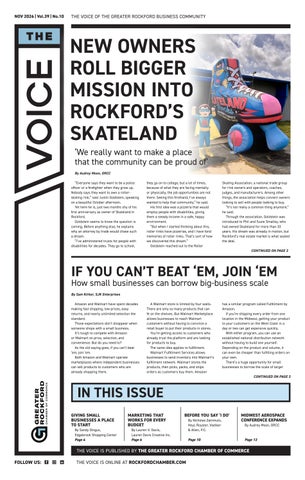
NEW OWNERS ROLL BIGGER MISSION INTO ROCKFORD’S SKATELAND ‘We really want to make a place that the community can be proud of’ By Audrey Moon, GRCC “Everyone says they want to be a police officer or a firefighter when they grow up. Nobody says they want to own a rollerskating rink,” said Justin Goldstein, speaking on a beautiful October afternoon. Yet here he is, just two months shy of his first anniversary as owner of Skateland in Rockford. Goldstein seems to know the question is coming. Before anything else, he explains why an attorney by trade would chase such a dream. “I’ve administered trusts for people with disabilities for decades. They go to school,
they go on to college, but a lot of times, because of what they are facing mentally or physically, the job opportunities are not there. Seeing this firsthand, I’ve always wanted to help that community,” he said. His first idea was a pizzeria that would employ people with disabilities, giving them a steady income in a safe, happy environment. “But when I started thinking about this, roller rinks have pizzerias, and I have fond memories of roller rinks. That’s sort of how we discovered this dream.” Goldstein reached out to the Roller
Skating Association, a national trade group for rink owners and operators, coaches, judges, and manufacturers. Among other things, the association helps connect owners looking to sell with people looking to buy. “It’s not really a common thing anymore,” he said. Through the association, Goldstein was introduced to Phil and Susie Smalley, who had owned Skateland for more than 33 years. His dream was already in motion, but Rockford’s real estate market is what sealed the deal. CONTINUED ON PAGE 3
IF YOU CAN’T BEAT ‘EM, JOIN ‘EM
How small businesses can borrow big-business scale By Sam Kirker, SJK Enterprises Amazon and Walmart have spent decades making fast shipping, low prices, easy returns, and nearly unlimited selection the standard. Those expectations don’t disappear when someone shops with a small business. It’s tough to compete with Amazon or Walmart on price, selection, and convenience. But do you need to? As the old saying goes, if you can’t beat ’em, join ’em. Both Amazon and Walmart operate marketplaces where independent businesses can sell products to customers who are already shopping there.
A Walmart store is limited by four walls. There are only so many products that can fit on the shelves. But Walmart Marketplace allows businesses to reach Walmart customers without having to convince a retail buyer to put their products in stores. You’re getting access to customers who already trust the platform and are looking for products to buy. The same idea applies to fulfillment. Walmart Fulfillment Services allows businesses to send inventory into Walmart’s fulfillment network. Walmart stores the products, then picks, packs, and ships orders as customers buy them. Amazon
has a similar program called Fulfillment by Amazon. If you’re shipping every order from one location in the Midwest, getting your product to your customers on the West Coast in a day or two can get expensive quickly. With either program, you can use an established national distribution network without having to build one yourself. Depending on the product and volume, it can even be cheaper than fulfilling orders on your own. There’s a huge opportunity for small businesses to borrow the scale of larger CONTINUED ON PAGE 3
IN THIS ISSUE GIVING SMALL BUSINESSES A PLACE TO START
By Sandy Dingus, Edgebrook Shopping Center Page 4
MARKETING THAT WORKS FOR EVERY BUDGET
BEFORE YOU SAY ‘I DO’
By Lauren V. Davis, Lauren Davis Creative Inc. Page 6
By Nicholas Zammuto, Heyl, Royster, Voelker & Allen, P.C. Page 10
MIDWEST AEROSPACE CONFERENCE EXPANDS By Audrey Moon, GRCC
Page 12
THE VOICE IS PUBLISHED BY THE GREATER ROCKFORD CHAMBER OF COMMERCE FOLLOW US:
THE VOICE IS ONLINE AT ROCKFORDCHAMBER.COM
2
THE VOICE
NOVEMBER 26 | VOL.39 | NO.10
A MOSAIC OF WORK Why owning a small business is the new badge of honor By Angela Kay Larson, GRCC
Gone are the days when a person would get hired into a company after high school and retire from there 50 years later. That used to be more of the norm. It meant putting in the hours and the effort to earn promotions, vesting in the pension plan, growing from “the new kid” to the one with all the institutional knowledge, and celebrating milestone service anniversaries every decade. That commitment to one company, and that company’s commitment to every employee, used to be a badge of honor. Somewhere in the 1980s and ’90s, the unwritten contract shifted. Faced with intense global competition, companies responded by closing plants, restructuring, switching from pensions to 401(k) plans, entertaining mergers, and laying off workers. I remember it well. I remember thinking, “Company loyalty is dead.” I remember my dad questioning why I changed jobs every five years. “It’s the only way to get ahead, Dad,” I explained. In today’s work environment, it’s normal to experience periods of unemployment. I found myself “between jobs” a few times, and with each break in employment, I hung out my shingle and
freelanced as a writer and copy editor. I always found work. I always paid the bills. Once, I left the cushy corporate job of my own accord to start a consulting firm, offering strategic plan facilitation, training, and executive coaching. Starting a business from scratch is an exciting venture, and being a small business owner is incredibly rewarding. However, that entrepreneurial episode ended when I was recruited back to the corporate world with an irresistible job offer from Woods Equipment Company. That’s when I realized I had a love-hate relationship with corporate work. That’s also when I realized that my fulfillment came not from a single corporate career track, but from a “mosaic of work.” When I returned to corporate, I used vacation days to teach marketing at Rockford College (before it became Rockford University) as part of the certificate program offered by the Northern Illinois Center for Nonprofit Excellence. Over my lunch breaks and in the evenings, I coached executive clients. I volunteered on the nonprofit board of the Village of Progress in Oregon, Illinois, when we opened The Village Bakery. I joined the for-profit board of German American State Bank. When I left Woods at the end of 2020, within a month I secured a consulting contract and happily returned to placing “entrepreneur” as a bigger tessera in my mosaic of work. It was time to once again hang out the shingle and start another
small business. Having started two small businesses (excluding the sweatshirt venture my dad funded with $50 when I was in high school), I have learned myriad lessons about what it takes to hang out your shingle. Here are three of my favorites. Plan your exit. When you are caught up in the excitement of getting started, be sure to also create your exit strategy. How you intend to leave your business can help shape how and why you start it. This is especially important if you have partners or investors. Hire a coach. Having an outside perspective to help you maintain your focus, navigate growth, and overcome obstacles is invaluable. A good coach won’t tell you how to manage your business. Instead, they’ll help you tap your own expertise, drive, and determination to move forward. Leverage your network. Lean into those whose own expertise can supplement yours. Work with a CPA and a lawyer to ensure your new company is properly set up, licensed, and compliant. Meet with your banker to learn about the tools available for managing your revenue and
funding your venture. Hire a professional designer to help you first create your brand and then your logo. Check with your insurance agent about protecting your assets and covering your liabilities. Connect with a realtor to find a space and understand the total cost of occupancy. Don’t have a network? GRCC can help with that. Starting a business is relatively easy. Growing and sustaining a business is hard. Nonetheless, I’m seeing that owning your own business is becoming the new badge of honor. When facilitating discussions, strategy sessions, and courses, I occasionally ask, “How many of you own an LLC?” (That’s a limited liability company, a simple business structure that’s common among sole proprietors and partnerships.) Quite often, more than half of the people in the room raise their hands. More and more, I think career-savvy professionals are structuring their work, income streams, and creative outlets as small businesses that contribute to a fulfilling mosaic of work. AKL
Angela Kay Larson, GRCC CEO, also owns two small businesses, the family farming operation Larson Bros. and the strategic planning consultancy Grindstone Strategic LLC. She married into the first and founded the second by leveraging her professional network. If she were creating another start-up, she’d first call Sheila Hill, D.Min., to tap into Think Big’s network of entrepreneurial experts.
ABOUT THIS ISSUE … Since childhood, I’ve seen my family pour their blood, sweat, and tears into small businesses that feed their souls and serve their communities. That experience helps me live the GRCC mission of leading business growth, whether big or small. In fact, roughly 80% of GRCC’s more than 700 members are small businesses. As a community partner, we help them succeed. Small business isn’t just a segment of our membership, it is our membership. Running a small business can feel like a solo act, but it doesn’t have to be. The GRCC gives you a network to lean on, referrals that bring new customers, a voice with local policymakers, and a platform to share your story. That’s the power of partnership, and the focus of this month’s issue: Small Business and Partnerships. On the front page, meet new GRCC members Justin and Tommy Goldstein, who bought Skateland with a bigger mission in mind. In our Small Business, Big Lessons Q&A, three owners share what they’ve learned, and guest contributors offer advice on building local partnerships, choosing a first storefront, pursuing government contracts, and knowing when to say no. You’ll also find resources built for small businesses. As this issue came together, one thing stood out: when we asked owners who helped them, every answer came back to community. None of them got here alone. If you own a small business, this issue is for you. And if you’re not sure you’re getting the most from your membership, give us a call. Helping you grow is the whole point. — Audrey Moon, managing editor
THE VOICE Published monthly by
PUBLISHER — Angela Kay Larson | MANAGING EDITOR — Audrey Moon ART DIRECTOR/CIRCULATION — Doug Hessong | ADVERTISING — ads@rockfordchamber.com
THE VOICE
ROCKFORDCHAMBER.COM
3
SKATELAND - CONTINUED FROM PAGE 1 “When it comes time to sell, it takes a special circumstance to buy a roller rink. You’re not going to get rich doing it,” he said. “Real estate in Rockford is getting more expensive, but it was reasonably priced compared to Chicago or other places we looked like Massachusetts.” Goldstein’s son Tommy, a recent graduate of Columbia College Chicago, enjoyed living in Illinois and was committed to moving to Rockford. Tommy
Goldstein now runs the day-to-day business. “I’ve learned a lot about the community in Rockford. It’s been such a great experience being thrust into a cultural community hub in a place I’m just getting to know,” Tommy Goldstein said. Since buying Skateland, the father and son have invested heavily in breathing new life into the beloved landmark. The building has new electrical wiring and lighting, upgraded countertops, UV
wallpaper, new video games, and an updated sound system. A design for new carpet is in the works. There are even new skates. “Kids light up. It’s so fun to hand out skates to people,” Tommy Goldstein said. For many, that moment is familiar. They remember lacing up a pair of rental skates, the music turned up loud, colored lights sweeping across the floor, and the smell of popcorn and pizza drifting from the snack bar. It all brings back the
nostalgia of a roller rink. The Goldsteins know that feeling well, and they want to make sure a new generation in Rockford gets to have it too. As they write this next chapter for Skateland, they say their focus is on serving Rockford as a whole, including people with disabilities, who inspired the dream in the first place. “We really want to make a place that the community can be proud of,” Justin Goldstein said. v
Large businesses use strategic partnerships, joint ventures, distributors, and outside specialists all the time. They recognize that they don’t need to own every capability to be successful. Why should small businesses approach things differently? Maybe you partner with another manufacturer to reach a new market. Maybe you use an agency or fractional specialist to access expertise you aren’t ready to hire for internally. Most growing businesses eventually reach a point where they’re too big for the owner to do everything but too small to hire someone for every function. Partnerships can help bridge that gap. Of course, there are trade-offs. Marketplaces charge fees, set policies, and prioritize their customers. Partnerships create dependencies, and not every arrangement makes sense.
But I think the bigger risk for a lot of small businesses is trying to do everything themselves. Time and money are limited. The more you spend building capabilities that already exist elsewhere, the less you have to invest in what actually makes your business competitive. I think that’s the opportunity. You don’t have to be a big business to take
advantage of big-business capabilities. You just have to figure out which ones are worth borrowing.
SJK - CONTINUED FROM PAGE 1 companies and focus on what they actually do better. Scale isn’t necessarily a competitive advantage. If everyone can access the same fulfillment network, fast shipping alone isn’t what makes your business special. Maybe you make a better product, understand your customers better, or can try something new without going through five layers of approval. Instead of spending time and money building everything yourself, you can invest more of those resources into what makes your business different. This also creates opportunities to test new products and markets without making huge investments up front. A local manufacturer can introduce a product nationally, learn what sells, and adjust before committing to a larger expansion. And I think the same principle applies beyond e-commerce.
The views expressed are those of the author(s) and do not necessarily represent those of the Greater Rockford Chamber of Commerce. v
Sam Kirker is the founder and CEO of SJK Enterprises, a Rockford-area e-commerce company focused on helping consumer brands grow on Amazon and Walmart.
4
THE VOICE
NOVEMBER 26 | VOL.39 | NO.10
GIVING SMALL BUSINESSES A PLACE TO START
What first-time owners should look for beyond rent and square footage By Sandy Dingus, Edgebrook Shopping Center
For a first-time business owner, finding a location is an early step in the larger challenge of building a customer base. Opening the doors means introducing a new business to people who may have never heard of it and giving them a reason to return. Rent, square footage, and visibility are natural starting points when comparing spaces. The surrounding business community deserves attention, too. Established neighbors, opportunities to meet customers, and people willing to share their experience can make a difference as a new owner gets started. At Edgebrook Shopping Center, our mix of local businesses, restaurants, and community events offers a useful way to think about that decision. A new owner considering a shopping center should look closely at how the businesses around a prospective space operate and what brings people to the property throughout the week. A busy parking lot is encouraging, but it only tells part of the story. Are people visiting at the hours your business will be open? Are they likely to need what you sell? Can they easily walk from the business they came to visit to your front door? A lunchtime crowd may be valuable to one owner and have little bearing on another’s sales. It helps to visit a potential location more than once. Walk it on an ordinary weekday. Come back during an event. Doing so can reveal things a tour of an empty space cannot. The neighbors themselves deserve attention, too. For someone learning to run a business, having other owners nearby creates opportunities to ask questions and compare experiences. A conversation about a dependable local printer or how to prepare for a busy weekend can save a newcomer time. Over time, those relationships can also lead to customer referrals or a promotion that gives people a reason to visit both businesses.
Community programming can give those relationships room to develop. At Edgebrook, the Farmers Market, Music on the Mall and seasonal events like Cider N’ Cinnamon Arts & Crafts Fair give people reasons to visit throughout the year. For a new business, that can mean opportunities to be discovered by someone who arrived with something else in mind. For a new owner, those visits can be a first introduction to potential customers. Someone who notices a storefront while attending a concert or browsing a market may remember it when looking for a gift or making dinner plans. Becoming familiar to people is part of getting established. That is worth considering when choosing a first storefront. Along with the space itself, look at what brings people to the area and how your business might fit into their routines. A setting where people already enjoy spending time can give a new owner a place to begin building those connections. Giving small businesses a place to start matters to Rockford. For someone opening a first storefront, there is value in joining an area that people already know and visit. That familiarity can give a new business opportunities to be noticed as the owner works to earn customers of their own. Owned by the Orput Companies, Edgebrook is an established shopping and lifestyle center located in the heart of Rockford at 1639 N. Alpine Road. Edgebrook offers a unique blend of eclectic boutique shops, excellent restaurants, convenient service-oriented businesses, and seasonal events. The views expressed are those of the author(s) and do not necessarily represent those of the Greater Rockford Chamber of Commerce.
Sandy Dingus is in her seventh year as Marketing and Special Events Coordinator for Edgebrook Shopping Center. With 40 years of marketing experience in radio, national retail and promotional advertising, she creates events including Margaritas on the Mall, the Farmers Market, Music on the Mall and arts and crafts events.
THE VOICE
ROCKFORDCHAMBER.COM
SUSTAINABILITY PREPAREDNESS IS GOOD BUSINESS
How the regional Climate Action Plan can lower costs and strengthen the Rockford region By Brad Roos, Paul Schweitzer, and Mike Bacon of Sustain Rockford Successful organizations rarely leave their future to chance. Any organization serious about its mission must adapt to an operating environment that is never static. That means paying attention to new evidence, anticipating changing markets, identifying risks, investing in people and infrastructure, and positioning itself to take advantage of opportunities that lie ahead. There are really only two ways organizations change, through aspiration or through desperation. Only one of those is likely to be sustainable over time. Change driven by aspiration is often called strategic planning. It’s how successful organizations prepare for a smarter, healthier, and more resilient tomorrow. Community leaders did something similar when they developed a regional Climate Action Plan through Region 1
Planning Council. The plan bridges the gap between where we are today and a more prepared, proactive, and resilient community and Northern Illinois region. The most challenging part of any plan is turning it into meaningful action. Communities that prepare for extreme heat, flooding, poor air quality, water availability and quality, and other disruptions can better protect the health of their residents, strengthen their businesses, improve infrastructure resiliency, and support the long-term economic vitality of the region. Sustain Rockford is hosting Earthrise 815 on Nov. 6 to discuss our role in moving this plan to action. Earthrise 815 is an all-day conference focused on practical ways businesses and the general community can accelerate sustainability efforts.
The Rockford Region Climate Action Plan provides a framework built around seven interconnected goals. • Improve air quality • Promote climate-resilient development • Increase reliance on renewable energy and improve energy efficiency • Cultivate a conservation mindset • Promote sustainable waste management • Improve water resources • Help residents prepare for current and future climate-related disruptions These goals represent both responsibilities and opportunities for businesses. Leadership is particularly important because businesses shape how our community grows, invests, and prepares for the future. In fact, many climate solutions are good business. Improving energy efficiency reduces operating costs. Adopting clean energy infrastructure supports workforce development and innovation. Resilient buildings and infrastructure reduce maintenance costs. Embedding sustainability in company strategy strengthens recruitment and retention by giving employees a purpose beyond a paycheck.
5
Ultimately, sustainability is the goal. Sustainability is about our shared capacity to support and nurture a healthy, resilient future by strengthening the economic, social, and natural systems upon which Northern Illinois depends. It’s a lens through which we can view community decisions, recognizing that the choices we make today shape the opportunities and well-being of both current and future generations. The quality of the air we breathe, the water we drink, the food we grow and consume, and the places where we live, work, and play profoundly influence our health, economy, and quality of life. Sustainability benefits people, planet, and profit. In this way, sustainability isn’t simply about protecting the environment. It is about building stronger communities that are smarter, more efficient, more inclusive, and better prepared for an uncertain climate future. Join us at Earthrise 815 to talk about how that can happen. Learn more at earthrise815.com. The views expressed are those of the author(s) and do not necessarily represent those of the Greater Rockford Chamber of Commerce.
6
THE VOICE
NOVEMBER 26 | VOL.39 | NO.10
MARKETING THAT WORKS FOR EVERY BUDGET
Five brand fundamentals any small business can put in place By Lauren V. Davis, Lauren Davis Creative Inc. Small businesses power nearly half of the U.S. private-sector workforce and make up 99.9% of all businesses in the country, according to the U.S. Small Business Administration. And according to a 2025 Constant Contact report of more than 8,000 consumers, 82% of people say small businesses positively impact their lives. Small-business owners often operate as if they need a marketing department and a six-figure ad budget before their marketing will work. They take on too much, and then they burn out. After two decades working on branding and marketing strategy, I’ve found that the most common thing business owners overlook is quite basic. Shiny-penny syndrome has owners trying to be everywhere online while wearing every hat, chasing every platform, trend, and tactic while the five most achievable drivers of sustainable growth wait their turn. When we talk small business, people often think “restaurants and shops.” Those are important to support, but small businesses are also the HR consultant, photographer, bookkeeper, mechanic shop, funeral home, chiropractor, coach, and law firm. Each of these businesses contributes real revenue to our local economy that cannot be replicated anywhere else. My Five Brand Fundamentals Framework applies to businesses of every size. 1. Can Someone Find You? Does your Google Business Profile have: • A website • Current hours • A phone number • Recent photos Do your Facebook, Instagram, or LinkedIn profiles have current information?
When someone searches your name, business name, or service in northern Illinois, does something credible come up? This is where most people start, and it matters even more now that AI tools, Alexa, and Siri hand searchers a single answer. 2. How Will They Experience You? A potential client forms an impression online within seconds, before you ever speak. Your website, email signature, social profiles, and even the way someone is greeted when they call should all tell the same story. Your first impression is your biggest marketing opportunity. I call these signals. Are your signals sharing what you want to be known for? When your signals are consistent, people feel confident. When people feel confident, trust follows. 3. Do You Prioritize Building Trust? According to PwC’s 2024 U.S. Trust Survey, 61% of consumers have recommended a company they trust to friends or family, and 4 in 10 consumers have stopped buying from a company because they no longer trust it. Those numbers make sense when you consider that trust requires time, repetition, and proof. Layering in testimonials, case studies, your values, and genuinely useful information before anyone pays you is how trust gets built. Your biggest hack? Create a list of the questions you hear most often. Use it for inspiration on your website, press releases, social content, networking conversations, news interviews, and more. 4. What Are Your Systems for Selling? When was the last time you worked on reducing the friction it takes to buy from you? Complicated systems make people push the sale down the road. The fix could be as simple as a followup sequence, a clear next step on your
website, a weekly email to your list, or even how you send estimates. The goal is an easy, efficient path from lead to client. 5. Can You Make It Repeatable and Referable? The best marketing is a client who tells someone else, which happens reliably when the experience is consistent enough to describe and remarkable enough to share. When a client tells a friend, the friend looks your business up to validate the recommendation, and the process starts over. It’s a cycle, and it’s one you can control. What This Looks Like at Different Stages At $0 in revenue, marketing is relational and free. It’s coffee conversations, networking events, social media posts that highlight your story, and asking for introductions. Make sure the
five basics above are in place. Time and attention take the place of a budget. At $250,000 in revenue, you have proof of concept and the capacity to invest in marketing help. Here, I recommend an email marketing strategy, help creating content that communicates your values, a PR strategy, and paid local visibility. The businesses that become iconic in our community (I bet one came to mind right away) rarely started with a gigantic online presence. They made themselves easy to find, gave their customers a consistent experience, and built enough trust that their customers kept talking about them. That is a strategy any business with any budget can start. The views expressed are those of the author(s) and do not necessarily represent those of the Greater Rockford Chamber of Commerce.
Lauren V. Davis is the founder of Lauren Davis Creative, where she helps professionals and experts establish their memorable brands, resulting in higher confidence, better performance, and professional influence. The skills Lauren acquired while co-building a non-profit for 1000 business owners and operators taught her the power of cultivating loyal community.
THE VOICE
ROCKFORDCHAMBER.COM
BETTER TOGETHER
Six ways small businesses can build local partnerships By Jacob Brandt, RockBuzz Network After spending more than a decade promoting small businesses, serving on boards, and advocating for our community, I’ve noticed a few things that successful small businesses do. Yes, they shop local themselves. They bring unique products and services to our community. But beyond their personal habits, they make a real effort to partner with others inside our community. Much like the Luke Combs song, we’re “Better Together.” So here are a few ideas and examples of how you can build partnerships within our community.
4. Build a Real Relationship With a Nonprofit Choose a cause that genuinely connects with you and your business. You might host an event, become a fundraising partner, provide space for a meeting, or serve on a board of directors. The key is consistency over the long haul. A relationship is much better for both organizations than attaching your logo to a single fundraiser and moving on. Find a nonprofit that pulls on your heartstrings and reach out to see what help it needs.
1. Partner With Your Competition Your competition may understand your challenges better than anyone else. Instead of treating every neighboring business as a rival, look for opportunities to make your entire industry more visible. Small businesses that choose collaboration over competition usually win bigger. The Rockford Record Crawl and the Coffee Crawl are great examples. Participating businesses gave Rockfordians a reason to go somewhere new and discover a local business they’d never visited before. When businesses put the larger community first, each one has an opportunity to gain new customers.
5. Share What Your Business Already Has Partnership doesn’t always require spending money. Your business may have a lobby, email newsletter, social media audience, event space, or professional expertise that could help another local organization. Offer a lobby display to a nearby retailer. Include a partner in your employee newsletter. Give a local organization a few minutes at your next event. Often, the most useful thing you can share is access to an audience that may not know them yet.
2. Look One Step to Either Side Some of the best partners are businesses that serve the same customers in a different way. A kitchen remodeler might connect with a local sink and faucet retailer, interior designer, or furniture store. A wedding photographer could partner with a florist, venue, or caterer. Start by asking what your customer needs immediately before or after working with you. The answer will often point directly toward a natural partner. 3. Make Room for Local Creatives You don’t need to own an art gallery or music venue to support our local creatives. Invite a local musician to perform at an event, hire a photographer for your next campaign, or feature an artist’s work on your walls. If your business receives public foot traffic, consider displaying artwork for sale and introducing customers to the person who created it. The artist gains exposure, while your business becomes a more interesting and memorable place to visit. In downtown Rockford, 27 Aluna has local art for sale year-round and is a regular participant in ArtScene.
6. Be the Kind of Partner People Want to Call Again Good partnerships are built on the basics. Communicate clearly, meet deadlines, pay invoices on time, and promote the collaboration as enthusiastically as your partner does. If something works, do it again instead of treating it as a one-time experiment. Also, give credit where credit is due. Tag the businesses on social media, connect them to your network, and shout them out from the rooftops. A successful partnership should leave everyone feeling recognized. None of this is charity. Strong partnerships introduce businesses to new customers, create better experiences, and help people discover more reasons to spend time in the Rockford region. For many small businesses, community can be the most affordable and enduring form of marketing available. And if more of us take steps toward building lasting partnerships, we’ll find that all of Rockford will be better together. The views expressed are those of the author(s) and do not necessarily represent those of the Greater Rockford Chamber of Commerce.
Jake is a content creator, community advocate, and owner of RockBuzz Network, a full-service digital marketing agency serving Rockford, Beloit, Janesville, Aurora, and the surrounding regions. He recently rebranded his company to RockBuzz and launched two apps aimed at helping small businesses better manage their social media content and gain more local visibility. When he isn’t working, he’s spending time with his family, watching F1, or practicing his pilot skills.
7
8
THE VOICE
NOVEMBER 26 | VOL.39 | NO.10
NEW TOURISM DISTRICT APPROVED Hotel-led initiative creates new fund to help the Rockford region attract more visitors and events By GoRockford The Rockford Region Tourism Improvement District (RTID) has received final approval, establishing a new, dedicated investment to attract more visitors, sporting events, meetings and group travel while strengthening the region’s image as a destination. Led by the region’s hotel industry and created through a partnership of Rockford, Loves Park, Cherry Valley and South Beloit, the RTID is Illinois’ first multi-city tourism improvement district and joins districts already established in Chicago and Peoria. After final approval by the Rockford City Council, the district was formally established under Illinois’ Tourism Preservation and Sustainability District Act. The RTID includes hotels with 45 or more rooms in Rockford, Loves Park, Cherry Valley and South Beloit and is expected to generate approximately $1.38 million annually to increase overnight visitation, elevate the region’s brand, and strengthen the visitor economy. Local hotel owners initiated and supported the district. Owners of 29 hotels across the district signed petitions supporting its creation, representing more than 94% of the assessments the district is expected to generate. That includes all 24 eligible hotels in Rockford. “This is an important investment in the future of the Rockford region, and it is especially meaningful because it was initiated by our hotel owners,” said John Groh, president/CEO of GoRockford. “These new resources will help us compete for more visitors and events while also telling the Rockford region’s story to a much broader audience. Strengthening how people see and understand our region is an investment that will pay dividends well beyond hotel stays. More visitors mean more customers for our hotels, restaurants, shops, attractions, event and entertainment venues, and other businesses, more support for local jobs, and additional tax revenue for our communities.”
The formation of the RTID is the culmination of a multi-year effort led by a steering committee of local hotel owners and operators. The committee helped develop the district plan, engaged fellow hoteliers, worked with municipal partners, and built the industry support necessary to move the district forward. “As hotel owners, we see firsthand the impact that events and visitors have on our businesses and on the entire community,” said Chintan Thakkar, owner of the Days Inn in Cherry Valley and member of the RTID Steering Committee. “The RTID gives us the opportunity to invest together in bringing more business to the Rockford region and, importantly, gives hotel owners a voice in how that investment is made. The overwhelming support of our hotel owners demonstrates the need for this vehicle and reinforces that we believe growing overnight visitation will benefit our hotels and strengthen the region’s visitor economy for years to come.” Investing in Demand and the Rockford Region Brand For participating hotels, the RTID creates a dedicated resource focused on generating overnight hotel demand. The new investment will allow the region to compete more aggressively for sporting events, meetings, group travel, and other business that produces hotel room nights, while significantly expanding destination sales and marketing efforts. The investment will also provide new resources to strengthen the Rockford region’s brand and image in markets outside the region. Through expanded marketing, storytelling, public relations, and promotion, GoRockford will reach new audiences, showcase the region’s assets and experiences, and build greater awareness of the Rockford region as a compelling place to visit. A stronger destination brand can also create benefits beyond an individual
trip or event. By introducing more people to the region and showcasing its quality of life, attractions, amenities, and experiences, destination marketing can help strengthen broader perceptions of the Rockford region. “The hotel industry has made a significant investment and placed its confidence in GoRockford to turn that investment into results,” said Geno Iafrate, chair of the GoRockford Board of Directors and president of Hard Rock Rockford. “Our responsibility is to put these resources to work strategically, pursuing opportunities that generate overnight stays and visitor spending while building greater awareness and a stronger image of the Rockford region. The entire organization takes that responsibility very seriously.” The RTID establishes a 2% assessment on eligible hotel room revenue and will be effective on December 1, 2026. Under state law, the assessment is imposed on hotels in the four municipalities with 45 rooms or more and may be passed through to hotel guests as a separately disclosed charge. A Regional Partnership Creation of the RTID required cooperation among four local municipalities. Cherry Valley, Loves Park, and South Beloit entered into intergovernmental agreements with the City of Rockford, which serves as the district’s lead governmental jurisdiction. “Visitors don’t stop at municipal boundaries, and neither does the economic impact they create,” said Rockford Mayor Janessa Neal. “The RTID demonstrates what is possible when our communities and private-sector partners work together to bring new visitors and new spending into the region. That activity supports businesses, jobs and the tax base throughout our communities.” “Cherry Valley benefits when more people choose the Rockford region as a place to visit, stay, shop and dine,” said Cherry Valley Village President Dave Schroeder. “The RTID gives our communities and the hotel industry another way to work together to grow visitation and the economic benefits that come with it.” “South Beloit is proud to be part of an initiative that recognizes the strength of working together as a region,” said South Beloit Mayor Tom Fitzgerald. “Our communities each have something unique to offer visitors, and by working collectively we can bring more people to the region and create opportunities
for businesses throughout northern Winnebago County.” “This kind of regional cooperation is important to note and celebrate,” Groh said. “Four municipalities and owners of 29 hotels came together around a shared objective to bring more people to the Rockford region, encourage them to stay longer and spend more, strengthen the image of our region, and create greater economic impact throughout our communities.” Building on the Region’s Momentum The RTID gives GoRockford a stable, predictable resource to compete for business against destinations that already use similar tourism improvement districts and dedicated destination funding. Tourism in Winnebago County has grown in recent years, with direct visitor spending reaching $549.6 million in 2025, up from $523.4 million in 2024. That growth reflects increasing visitation and demand for the Rockford region’s attractions, events, and experiences, providing a strong foundation for the additional investment made possible through the RTID. The RTID will be administered by GoRockford. Additionally, the hotel industry will have a direct voice in how those dollars are invested. A hotelowner committee will play a direct role in developing and reviewing the RTID budget and expenditures, helping ensure that funding remains focused on strategies and opportunities that generate overnight visitation and benefit the hotels funding the district. The RTID has a five-year term, providing an opportunity to measure results and evaluate the return generated by the hotel industry’s investment. “The hotel owners and operators who served on the steering committee deserve tremendous credit. They invested their time, asked hard questions, worked through the details, and helped build support among their peers. Now the work begins,” Groh added. “We have an opportunity to introduce the Rockford region to new audiences, strengthen our reputation, compete for business that previously may have been beyond our reach, and generate more economic activity for our hotel owners and communities. We are excited about what this investment can make possible.” The views expressed are those of the author(s) and do not necessarily represent those of the Greater Rockford Chamber of Commerce.
THE VOICE
ROCKFORDCHAMBER.COM
MORE THAN A BUSY SEASON
Turning the holiday rush into opportunity in the River District By Andrea Cook, River District Association The most wonderful time of the year is quickly approaching, and for small businesses, preparation is already underway. While strong sales are the goal, a successful holiday season also means having a prepared staff, realistic expectations, and a plan for managing the unexpected. In the River District, we have a mix of established businesses with triedand-true holiday traditions and newer businesses still learning what works best for them. Regardless of experience, the changing season brings opportunities and challenges for everyone. Restaurants and bars are preparing for holiday gatherings and packed weekends. Retailers and artists are stocking shelves, creating gift ideas, and painting festive windows. Cafes are welcoming shoppers and friends meeting for coffee. Entertainment venues are preparing for full houses, while organizations like the library are balancing busy calendars of programs and community activities. Events like Stroll on State and Small Business Saturday bring another level of excitement and foot traffic downtown. So, how can businesses make the most of it? A good place to start is giving yourself permission to let go of perfectionism. Not every project needs to be finished before the holidays. New ideas can wait. Focus on what matters most by creating a positive customer experience, supporting your employees, and keeping daily operations running smoothly. Angela from The Scrap Jar says she’s working on letting go of perfectionism and the overwhelming list of ideas that comes with it. This year, she’ll create a calendar to stay focused, decompress before the busiest time of year, and make her to-do lists early. Strategic planning now can reduce stress later. Review your calendar and identify your busiest days. Consider what can be prepared ahead of time, where to simplify, and how you’ll accommodate larger groups. Make sure best-selling items are stocked, gift options are easy to find and checking out is efficient. Clearly communicate parking and business hours before guests arrive. When major downtown events approach, think beyond managing crowds. Consider how to turn that activity into an opportunity to welcome new customers.
Make it easy for people walking downtown to step inside. Clear signage, pop-up events, festive storefronts, gift-related merchandise, special offers, convenient payment options, free gift wrapping, and helpful staff can turn a passerby into a customer. Leverage the unique experiences only local businesses can provide. Customers can see products in person, meet the people who create or select them, discover something unexpected, enjoy a meal or coffee, browse local art, or listen to live music. A simple shopping trip can become an afternoon exploring downtown. Doc and Jerry from J.R. Kortman Center for Design have run their business in downtown Rockford for many years. Their formula for success is to operate with instinct, taking things one day, month, season, or art opening at a time. Learn what works and what doesn’t, and cultivate new ideas for the future. Highlight what makes shopping locally unique. Independent businesses offer personality, personal connections, and stories from their own community. Those experiences are difficult to replicate without authenticity, and they’re worth sharing. Let people know what makes your business worth visiting. Use social media, local media and community partnerships to share information people need and want to know. Finally, remember to take care of yourself, too. Build in breaks when possible, eat, hydrate, and ask for help. Celebrate the big and small wins along the way. The goal isn’t to navigate the holidays perfectly. It’s to make mindful decisions, embrace opportunities, care for your people and customers, and finish the year strong. Downtown shines when each business brings something unique to the table. This holiday season, let’s give people plenty of reasons to shop, dine, create, gather, and explore everything the River District has to offer. Prepare where you can, simplify when possible, let go of what can wait, and be proud of what you’ve accomplished. The views expressed are those of the author(s) and do not necessarily represent those of the Greater Rockford Chamber of Commerce.
Born and raised in Rockford, Andrea Cook brings over 25 years of leadership and extensive marketing, communications, and event experience to her role supporting River District businesses. Passionate about community and collaboration, she enjoys helping local businesses grow. Outside of work, Andrea loves traveling, reading, exploring locally, and family time.
9
10
THE VOICE
NOVEMBER 26 | VOL.39 | NO.10
READY FOR GOVERNMENT CONTRACTS? Five questions to ask
VACANT SPACES TO THRIVING PLACES City of Rockford’s new program will support small business growth By Megan McBride, City of Rockford
By Brittany Allen, Illinois APEX Accelerator Government contracts can open new markets for business, but entering this marketplace requires careful thought, preparation, and a realistic understanding of the government procurement process. The Illinois APEX Accelerator program at Region 1 Planning Council is a nocost resource for businesses looking to explore government procurement or expand their presence in this marketplace. Before you start, here are five questions every business owner should consider when determining whether government procurement aligns with their business goals and capabilities. Business Formation - The most important thing to consider is whether your business is properly established. Businesses looking to enter the government marketplace must be registered with the Illinois Secretary of State and maintain the appropriate tax identification, business licenses, certifications, and insurance. A business should also evaluate its financial position, staffing needs, production capacity, and overall ability to meet contractual requirements. Do you have the proper business structure, resources, and capacity to fulfill a government contract? Time and Effort - Government contracting is structured to be a long-term business strategy, not a quick source of revenue. The process involves learning the landscape and understanding how the government buys what you sell. Business owners will need to learn how to identify opportunities, understand solicitation requirements, and develop relationships with government buyers. Are you prepared to invest the time and resources needed to establish your business in the government marketplace? Registration and Compliance - Contract opportunities exist at all levels of government, but for businesses looking to pursue federal contracts, an active SAM.gov registration is mandatory. SAM. gov is the federal government’s System for Award Management. Through SAM. gov, a business is assigned a Unique Entity ID (UEI) and a Commercial and Government Entity (CAGE) code. SAM.gov is also where federal buyers post contract opportunities and sellers find them. It’s important to note that registration is only a starting point and does not guarantee a contract award. Is your business properly registered, and is all your documentation
in order to create a SAM.gov account? Targeted Marketing - Government contracting requires a targeted marketing approach. There is a wide variety of government agencies, contract vehicles, purchasing offices, and government buyers to consider. Business owners must tailor their approach to align their business capabilities and strengths to buyers that are already purchasing what they sell. Additionally, business owners must conduct market research to understand a buyer’s historical spend, current contract opportunities, and the competitive procurement landscape facing your business. Most importantly, businesses must craft an effective capability statement, a business resume that provides technical details about the goods and services your business offers and your procurement experience. Effective marketing will require a business owner to build relationships with procurement officials, small business specialists, and prime contractors. Have you crafted a targeted marketing plan to pursue government contracts? Identifying and Evaluating the Right Opportunities - Finding the right opportunity and determining if it is the right fit before responding to a solicitation can save a business owner a lot of time and effort. Before pursuing a contract, one must carefully review the scope of work, eligibility requirements, technical specifications, submission instructions, delivery timelines, pricing, and contract terms. Not every opportunity will be worth pursuing. Can your business meet the requirements, deliver the work, and submit a competitive and financially sound proposal? Where to Get Help - Government contracting can feel overwhelming, especially for businesses unfamiliar with public procurement. Contact Brittany Allen, APEX Accelerator advisor at Region 1 Planning Council, at ballen@r1planning. org or 815-319-4453 to schedule a no-cost, confidential advisory meeting in person or virtually to determine if government procurement is a good fit for your business. The views expressed are those of the author(s) and do not necessarily represent those of the Greater Rockford Chamber of Commerce.
Brittany Allen is a Rockford native. She joined Region 1 Planning Council in June as an APEX Accelerator advisor after operating an independent cosmetology business and working as a sourcing supervisor for federal contracts at SupplyCore Inc.
A vacant storefront is more than just an empty building. It’s a missed opportunity for a business owner, a gap in the customer experience, and untapped potential within a commercial district. At the same time, for many entrepreneurs, opening their first brick-and-mortar location or expanding into a second storefront can feel just out of reach, with security deposits, rent, and other startup costs preventing promising businesses from taking that next step. To help address this gap, the Rockford City Council recently approved the Spaces to Places program, a new initiative launched to support small business growth while bringing new energy and activity to vacant storefronts throughout the city of Rockford. The program will provide businesses with up to $15,000 to reimburse security deposits and up to 50% of their monthly rent. By reducing financial barriers associated with leasing a new commercial space, the city hopes to make it easier for entrepreneurs to establish permanent locations in the community’s main street commercial districts. Spaces to Places is part of Rockford’s broader commitment to supporting small businesses and recognizing their vital role in the local economy. Small businesses create jobs, catalyze local spending, attract visitors, and shape the unique character of the community’s neighborhoods and shopping districts. These businesses create the experiences that make commercial districts special and inviting for residents and visitors alike. When a vacant storefront comes back to life, existing businesses in the area benefit from increased visibility and foot traffic. A more active streetscape also builds momentum, draws interest from other investors, and strengthens a business district’s overall appeal. Since increasing activity in commercial corridors is a primary goal of the program, eligibility is focused on customer-facing businesses that will draw foot traffic into these districts. Retail shops, restaurants, cafes, and other experiential services will be eligible to apply. To qualify, businesses must locate in a ground-floor commercial storefront that has been vacant for at least six months. The property must also be commercially zoned and current on property taxes. Another central goal of the program beyond storefront activation is to support
the long-term success of the businesses that will occupy them. Applicants will be required to work with a small business support organization such as Think Big, the Small Business Development Center, or another city-approved resource provider. These partners offer expertise in business planning, financial management, marketing, and operations, and will help entrepreneurs build a strong foundation for sustainable success. To further support the success and sustainability of businesses assisted through the program, only storefronts located within areas served by an existing business district association will be eligible for funding. By locating in an area with an existing business association, new businesses will be part of a network committed to advancing their goals and supporting their success. Areas with an existing business association include Downtown (River District), North Main (North End), South Main (SWIFTT), Seventh Street (Midtown), and East State Street from Midtown to Mulford (Miracle Mile). The city aims to activate at least three vacant storefronts in each eligible district, though funding will be awarded on a first-come, firstserved basis. Applications are open and will be accepted on a rolling basis for one year or until designated funding is obligated. Through Spaces to Places, Rockford is making a strategic investment in entrepreneurship, commercial corridor revitalization, and community vitality, helping transform vacant storefronts into thriving businesses that benefit the entire community. Businesses interested in learning more about the program and other city resources for small businesses should contact Megan McBride, community engagement and development coordinator for the City of Rockford, at megan.mcbride@rockfordil.gov. The City of Rockford Community and Economic Development Department includes the Construction and Development Services, Neighborhood Standards, Neighborhood Development, Economic Development, and Planning and Zoning divisions. The views expressed are those of the author(s) and do not necessarily represent those of the Greater Rockford Chamber of Commerce.
Megan McBride is the community engagement and development coordinator for the City of Rockford, a new position created in July 2026 that focuses on supporting small businesses, engaging entrepreneurs and residents, and strengthening business associations.
THE VOICE 11
ROCKFORDCHAMBER.COM
BEFORE YOU SAY ‘I DO’ A relationship guide to buying a business By Nicholas Zammuto, Heyl, Royster, Voelker & Allen, P.C. For anyone buying a business, the practical warning is simple. Do not fall in love before the first date. A respected name, loyal customers, or promising financials can make a machine shop, restaurant, or professional practice look like the perfect match. But first impressions reveal very little about what life together will actually look like. Before saying “I do,” the buyer needs to understand the business’s history, obligations, and people, then decide whether the relationship still makes sense after the flattering profile gives way to reality. The Match and the First Date Most deals begin with matchmaking. A broker, accountant, banker, or mutual contact introduces a possible match. The early conversations are the first date, covering broad goals, price expectations, timing, and chemistry. If there is mutual interest, the parties often sign a letter of intent (LOI). The LOI is the “define the relationship” conversation. It sketches price, structure, financing assumptions, and key conditions. The parties often intend many business terms to be nonbinding, while provisions such as confidentiality and exclusivity
may be binding immediately. Before going exclusive, a buyer should know exactly what it is buying, whether assets, ownership interests, or some combination, and which liabilities may remain with the business or be assumed by the buyer. Red Flags Due diligence is the background check. It is how the buyer learns whether the attractive first impression holds up. Financial statements, tax returns, customer and vendor contracts, leases, employment arrangements, licenses, litigation, debt, and intellectual property all tell part of the story. This is where buyers find red flags they may be tempted to ignore because they have already fallen in love. A single issue may be manageable. A dependence on one customer, an expiring lease, weak financial controls, and undocumented employee arrangements may collectively change the value of the business or the wisdom of the deal. Sellers benefit from diligence, too. Organized records, clean ownership documents, and candid disclosure reduce surprises and build credibility. Nobody wants to meet the complicated relatives for the first time at the wedding.
The Prenup The purchase agreement is the prenup. It records the bargain while everyone still wants the relationship to work. It identifies what is being purchased, how and when the price will be paid, what must happen before closing, and what each side is promising about the business. Representations and warranties are not ceremonial language. They establish the facts on which the buyer relies. The agreement also decides who bears the loss if those facts prove incomplete or wrong, including through indemnification provisions, escrow holdbacks, and purchase-price adjustments. Like a good prenup, it allocates risk calmly and in advance. Meeting the Family A transaction also brings third parties into the relationship. Lenders may control the money. Landlords may need to consent to an assignment. Key employees, customers, or vendors may affect whether the business retains its value. Government approvals or licenses may be essential. Each can become the demanding in-law
who objects at the wedding unless brought into the process early. The Wedding and the Marriage Closing is the wedding. The buyer is committing to the business, while the seller is handing over the keys. Signatures, funds, consents, and document delivery must line up before the parties can celebrate. Then comes the marriage, which means transferring relationships, introducing new leadership, retaining employees, and keeping customers comfortable. The best transactions are the ones in which the buyer and seller understood the relationship they were entering, addressed the red flags before committing, and planned for life after the ceremony. Before buying a business, take time to date, investigate, and negotiate. A deal that survives honest questions before closing has a better chance of working after the honeymoon. The views expressed are those of the author(s) and do not necessarily represent those of the Greater Rockford Chamber of Commerce.
Nicholas Zammuto is an Illinois and Iowa attorney at Heyl, Royster, Voelker & Allen, P.C. His practice includes business transactions, commercial real estate, and general business counseling. He advises businesses and nonprofit organizations on contracts, acquisitions, and operational matters.
12
THE VOICE
NOVEMBER 26 | VOL.39 | NO.10
MIDWEST AEROSPACE CONFERENCE EXPANDS
Two-day event unveils new name for regional alliance By Audrey Moon, GRCC More than 200 people representing more than 100 companies in the aerospace and defense supply chain gathered Oct. 14-15 at the Embassy Suites in Rockford for the 2026 Midwest Aerospace Conference (MAC2026). The conference expanded to two days this year in response to feedback from past attendees, who asked for more opportunities for networking and education. The Greater Rockford Chamber of Commerce (GRCC) and the Midwest Aerospace and Defense Alliance (MASDA), formerly the Rockford Area Aerospace Network (RAAN), hosted the conference. “A conference only grows like this when an industry is growing,” said David Forward, vice president of operations at Woodward and chair of MASDA. The first day opened with factory tours at Collins Aerospace and Woodward, giving attendees an inside look at two of the region’s largest aerospace manufacturers. GRCC then hosted business-tobusiness matchmaking sessions, connecting 32 suppliers with six Tier 1 and original equipment manufacturer organizations including Boeing, Kaney, Woodward, GE Aerospace, Pursuit Aviation, and Collins Aerospace. A New Name for a Growing Network The second day began with a major announcement. The Rockford Area Aerospace Network is now the Midwest
Aerospace and Defense Alliance. Forward said that over the past year, the alliance and GRCC mapped the region’s supply chain, gathered cluster research and talked with prime contractors, suppliers, and educators. They found that the supply chain reaches well beyond Winnebago County into the Midwest, and that many member companies serve both aerospace and defense customers. RAAN was founded in 2010 by regional companies that believed that by working together, they could strengthen area businesses and the overall aerospace supply chain. Forward said the organization has outgrown the boundaries of its original name, though not its Rockford roots. “Taken together, this region represents one of the largest concentrations of aerospace and defense manufacturing in the nation, and Rockford is the hub for that,” Forward said. The change is a new name, not a new organization. Memberships carry over, and leadership, committees, and the partnership with GRCC remain the same. New membership tiers will be announced in early 2027. Companies interested in joining can contact Meredith MacKay, GRCC’s director of membership, at mmackay@rockfordchamber.com. Lifetime Achievement Awards Forward and Angela Kay Larson, CEO of GRCC, presented MASDA Lifetime
Membership Awards to two longtime industry leaders, Bruce Krandel and Spitty Tata. Krandel joined Sundstrand as a program engineer in 1980 after earning an engineering degree from the University of Illinois. He spent 37 years with the company through its evolution into Hamilton Sundstrand and UTC Aerospace Systems, earning a master’s degree in theoretical and applied mechanics along the way. He became the first general manager of actuation systems in 1998, led business management for the Boeing 787 and legacy Boeing programs, and eventually ran the company’s central business development organization. He led pursuits on major aircraft platforms including the Embraer E2, the Boeing 777X and the T-X trainer. His team’s work with Pratt & Whitney on the E2 earned the UTC Board of Directors award for collaboration across business units. After retiring in 2017, Krandel consulted for the company for four more years before volunteering with MASDA. His industry contacts helped secure this
year’s lineup of conference speakers. Tata grew up in India, where he earned a bachelor’s degree in electrical engineering before coming to the United States. He earned a master’s degree in electrical engineering from West Virginia University and an MBA from Rockford College. He spent 36 years at Woodward, starting in reliability for the full authority digital engine control system for jet engines and later taking on mechanical controls. He led Woodward’s aerospace quality department for 12 years before moving into continuous improvement. Tata co-chaired RAAN and still serves on its steering committee, making him one of MASDA’s founding members. Though retired from Woodward, he teaches and mentors lean and Six Sigma through Air Academy Associates. “Bruce and Spitty spent their careers building something bigger than one company,” Forward said. “MASDA is how we make sure the next generation builds something bigger than one city.”
ROCKFORDCHAMBER.COM
THE VOICE 13
14
THE VOICE
NOVEMBER 26 | VOL.39 | NO.10
A SEASON OF THANKS Celebrating the community partners who show up for Rockford Public Schools students By Bridget French and Maureen Kirschmann, RPS 205 As we enter a season centered on gratitude, we have an opportunity to recognize something we see throughout the year in Rockford Public Schools (RPS 205). Our community shows up for our students. Businesses, nonprofit organizations, service clubs, volunteers, and community leaders provide that support by sharing their time, resources, and expertise with our schools. Some partnerships reach students across the district, while others grow from a relationship with a single school. Each contributes to the experiences and opportunities available to RPS 205 students and families. For our youngest learners, community members can become another encouraging adult in their school day.
Through Rockford Reads, volunteers from the Rockford Rotary Club spend time reading with second-grade students, helping them build reading confidence and a positive connection with books, often provided by United Way. Math Mentors from Collins Aerospace share their knowledge and help students with math while giving them a chance to connect with professionals in their own community. As students get older, those community connections can help them begin to imagine what comes after graduation. Meeting local professionals gives students a chance to learn about careers from the people doing the work and to see how what they are learning in school connects to life beyond the classroom.
RESILIENCE LIGHTS THE WAY FOR STROLL ON STATE 2026
After a snowy 2025, downtown’s holiday festival returns bigger than ever Nov. 28 By Kristen Paul, GoRockford We often talk about resilience as a characteristic of strong businesses and healthy economies. This year at GoRockford, our team is seeing resilience in practice through Stroll on State, the Saturday-after-Thanksgiving daylong downtown festival that has become one of our region’s holiday traditions. After unprecedented snowfall brought Stroll on State 2025 to an early close and sidelined several major attractions, Stroll on State 2026 (Nov. 28) is coming together as the biggest and most ambitious festival yet. Our sponsors, vendors, volunteers, parade participants, Dasher Dash 5K runners, and dozens of community partners all chose to keep moving forward. Because UMB Bank renewed its contract as presenting sponsor, Stroll on State will again be a free event. Thanks to further sponsorships and partnerships, nearly every element of the festival has been expanded, multiplied, or reimagined. First-time visitors and year-after-year attendees will again have countless
opportunities on and around downtown Rockford’s State Street corridor to soak in the magic of a winter wonderland. Our team spends the entire year planning and organizing every block of the event on both sides of the Rock River. We intentionally spread activities across downtown so that no matter how many thousands of people attend, being there remains comfortable, accessible, and welcoming. Whether a child is mailing a letter to Santa, a family is finding the perfect photo op, or a group of friends is taking in live music at one of the stages, Stroll on State is designed to create holiday memories for people of all ages, interests, and abilities. Attendees can step into the storybook holiday atmosphere many people know only from TV movies. Think bonfires in ice sculptures, s’mores and hot cocoa stations, music on multiple stages, a hometown parade with giant balloons, ice skating on the rink where the hometown hockey team plays, and a countdown to
Experiences like job shadowing allow students to step into local workplaces, ask questions, and begin to picture themselves in careers they may not have considered before. Those connections are valuable for our business community, too. When employers engage with students, they are helping young people understand the opportunities that exist right here in the Rockford region and building relationships with the generation that will become our future workforce, entrepreneurs, and community leaders. Our partnerships extend far beyond these examples. Every day, organizations throughout our community find their own ways to support students and families. They share knowledge, create experiences, provide resources, and respond when schools identify opportunities to work together. There is no single way to be an RPS 205 community partner, and that is part
of what makes these relationships so valuable. We want our partners to know that their involvement matters. Every hour spent with a student, every door opened to a new experience, every connection made and idea shared adds something to our schools that we could not create alone. This season, we simply want to say thank you. Thank you for believing in our students, investing in their futures, and continuing to be part of RPS 205. Our students are growing up as members of this community, and our partnership shows our students that the entire Rockford community stands behind them. The views expressed are those of the author(s) and do not necessarily represent those of the Greater Rockford Chamber of Commerce.
Bridget French is executive director of college and career readiness for RPS205, where she oversees the High School Academies and career and technical education programs. Maureen Kirschmann is director of attendance and community engagement and builds partnerships among schools, families, and community organizations
lighting a fresh-cut, 30-plus-foot tree. This year, Rockford’s primary Christmas tree will be at Davis Park, where a year of sustained improvements is transforming this riverfront area into the community gathering space envisioned long ago. Smaller trees will sparkle near the BMO Center, at Main and Mulberry streets, and in Eddie Green Park at East State and North First streets. All the trees will have new custom stars, new ornaments, and updated lighting. With Davis Park added to the festival footprint, décor for Stroll on State has nearly doubled. Along with the signature giant lollipops, gingerbread men, and toy soldiers, there will be new string trees, more garland, new ribbons and bows, and twice as many larger-than-life gift boxes in a wider array of colors. There will be additional stations for photo ops. The parade will have a new starting point and a new staging area. To celebrate the 10th year of the Dasher Dash 5K, there will be a new logo, new medals, and new participant shirts. Thanks to Bucciferro Family McDonald’s, the race’s presenting sponsor, there also will be a visit from Ronald McDonald. When GoRockford organized the first Stroll on State in 2013, we strategically chose the Saturday after Thanksgiving to capture foot traffic on a weekend when
many former residents return home for the holidays and families gather from across the region. We wanted to give as many people as possible reasons to discover both the nostalgia of downtown and its new energy. The event’s connection to the day recognized across the nation as Small Business Saturday is equally important. Typically attracting tens of thousands of people to the heart of the city, Stroll on State generates visibility for local businesses during the most critical shopping period of the year. It has become both a tourism asset and an economic development tool. Beyond the lights, decorations, and entertainment, Stroll on State is an investment in our region’s quality of life. It is one of the clearest examples of what a community can accomplish when public, private, and nonprofit partners work toward a shared vision. We invite you to join us downtown Nov. 28 to know Rockford at its festive best. Visit StrollonState.com for parking and shuttle information, maps, and other details. The views expressed are those of the author(s) and do not necessarily represent those of the Greater Rockford Chamber of Commerce.
Kristen Paul is executive vice president of GoRockford. She has guided Stroll on State’s planning and growth since 2018.
ROCKFORDCHAMBER.COM
THE VOICE 15
16
THE VOICE
NOVEMBER 26 | VOL.39 | NO.10
THE CASE FOR SAYING ‘NO’ Why turning down the wrong job can build trust, and how to do it well By Verneda Kessling, Kelce and Company Everyone loves a good mystery. Who did it? Was it in the dining room with the candlestick? Was it the maid, the butler, or the elegantly dressed woman everyone admired during dinner? When it comes to our homes and businesses, however, we do not want mysteries. We don’t want to wonder whether the person we hired can actually do the job. We want consistency. We want someone we trust, someone our parents trusted, or someone our best friend can confidently recommend. We want the person entering our home to be insured, professional, and reliable, not just someone walking in off the street. But how do you build trust? Sometimes “no” is one of the most valuable words you can say – especially if your business
is not equipped or able to take on the job. Every no you say today can benefit your business tomorrow. Being honest with your clients and telling them that a project is outside your skill set or beyond the scope of your services can actually strengthen their trust in you. People in our communities value clarity, especially from businesses that have been serving them for years. You have already built relationships. You have already earned your clients’ trust. They know the kind of business you run and the character you have demonstrated over time. Because of that, saying no does not necessarily harm your business. In many cases, it reinforces your reputation. Clients appreciate honesty. They respect
professionals who know their limits and refuse to compromise quality simply to make a sale. By staying true to your standards and expertise, you show customers that their best interests come first. How to Say No Well Say it early. The moment you realize a job is outside your expertise, tell the client. A no on day one is a courtesy. A no after a missed deadline is a broken promise. Explain why. A short, honest reason, such as “we don’t have the equipment to do this safely” or “this needs a licensed electrician,” shows you are protecting the client’s interests, not avoiding work. Offer what you can do. You may not be able to handle the whole project, but you might take on part of it or schedule
it when you have the right crew. Clients often remember the alternative more than the refusal. Know who to send them to. The strongest no comes with a name. Build a short list of businesses you trust in neighboring trades, and get to know their owners. When you refer a client to someone who does great work, you keep that client’s trust and strengthen a partnership that may send work back your way. In the end, saying “no” is not a sign of weakness. It is a sign of integrity. And integrity is what keeps clients coming back for years to come. The views expressed are those of the author(s) and do not necessarily represent those of the Greater Rockford Chamber of Commerce.
Kelce and Company has proudly served the Rockford community for over 40 years as a woman-owned, family-operated business. From carpet cleaning and restoration services to commercial facility maintenance and epoxy coatings, we’re committed to helping local homes and businesses look their best. Trusted, experienced, and community-focused, we’re here when you need us.
BEYOND THE SHOP FLOOR Applying lean thinking to office and support functions By Jeremy Smith, IMEC When people hear the word “lean,” they usually picture the manufacturing floor, where the focus is on reducing setup times, improving production flow, and eliminating operational waste. Those are certainly important applications of lean. But some of the greatest opportunities for improvement often exist beyond the shop floor. Every day, office and support teams process purchase orders, respond to customer inquiries, onboard employees, review engineering changes, schedule production, manage invoices, and approve countless requests. While these activities don’t produce a physical product, they have a direct impact on lead times, customer satisfaction, cash flow, and overall business performance. Lean Doesn’t Stop at Production Manufacturers spend significant time improving production processes, and for good reason. But when office processes remain inefficient, those gains can be offset by delays elsewhere in the business. Think about how often work gets slowed down because an engineering change waits days for approval, customer information must be entered into multiple systems, employees spend valuable time
searching for documents or emails, or teams wait on information before they can move to the next step. These delays may not be as visible as machine downtime or excess inventory, but they create waste just the same. That’s why lean thinking belongs in every department, not just manufacturing. Follow the Flow of Information One of my favorite tools for improving office processes is transactional value stream mapping. Traditional value stream mapping focuses on how materials move through production. Transactional value stream mapping follows the movement of information, tracking requests, documents, approvals, and decisions from beginning to end. When organizations take the time to map these processes, they often uncover opportunities they didn’t realize existed. These include bottlenecks that delay decisions, duplicate work across departments, unnecessary approval loops, communication gaps, and steps that add little or no value. Once teams can see how information flows, it becomes much easier to improve it.
Start With One Process One of the biggest misconceptions about lean is that organizations need to overhaul everything at once. In reality, the best place to start is often with one process that consistently causes frustration. Maybe it’s customer order entry. Maybe it’s engineering change requests. Maybe it’s purchasing approvals or employee onboarding. Choose one process. Map how work currently flows. Involve the people who do the work every day. Identify the delays and unnecessary steps, test improvements, and standardize what works. Those small wins build momentum, demonstrate value, and often inspire broader continuous improvement efforts across the organization.
Lean Is a Business Strategy Lean isn’t simply a collection of manufacturing tools. It’s a mindset for improving how work gets done. When manufacturers apply lean principles across production, engineering, finance, human resources, customer service, and other support functions, they create an organization that’s more responsive, more efficient, and better equipped to meet customer needs. The biggest opportunities for improvement aren’t always found on the shop floor. Sometimes they’re sitting in an inbox, waiting for approval. The views expressed are those of the author(s) and do not necessarily represent those of the Greater Rockford Chamber of Commerce.
Jeremy Smith views manufacturing through a value stream lens. At the Illinois Manufacturing Excellence Center, he draws on expertise in leadership, continuous improvement, zero-defect culture, visual management, total productive maintenance, supplier management, and logistics to help manufacturers apply these tools in ways that maximize return on investment and last.
THE VOICE 17
ROCKFORDCHAMBER.COM
THE MEET-ANDGREET EDGE How college career fairs can benefit employers and students alike By Carol Taylor, Rockford Career College
College job fairs are still as popular as ever, despite all the digital options available for applying for openings, the latest research suggests. No wonder. More than 45% of students and graduates who attend a job fair are offered interviews, according to the National Association of Colleges and Employers. That’s unsurprising. Shortages of skilled labor in health care, manufacturing, and construction have motivated employers to partner with technical colleges. As a result, schools are holding job fairs and other oncampus recruiting events with increasing frequency. Job fairs bring numerous advantages to everyone involved. For starters, they’re highly personal. No AI, no algorithms, no QR codes, and no job applications submitted through website portals. Just handshakes, eye-to-eye contact, and face-to-face conversations taking place in real time. Call it the meet-and-greet edge. Students and graduates get to introduce themselves to employers, and vice versa. Employers get to pass out business cards, and job seekers take home brochures and branded souvenirs. Companies can set up exhibition booths to scout for talent, collect resumes, and even schedule interviews with candidates. They can hunt for trained professionals interested in getting hired and pursuing new career opportunities. Job seekers, in turn, can network with prospective employers, gather information about individual organizations, and, as if speed dating, deliver elevator pitches. But job fairs at vocational colleges differ from those at traditional four-year universities, and in certain respects they are more effective and productive. Career fairs at vocational colleges take a more targeted approach toward career options, zeroing in on particular professions, such as nursing and welding, and often result in more hiring. A job fair early this year at Stautzenberger College, a trade school in Maumee, Ohio, affiliated with Rockford Career College, serves as a case in point.
A poll of the employers who participated found that 85% either made hiring connections or saw hiring potential. Nearly 70% said they had at least three “meaningful” conversations with job candidates. An employer partner career fair at Rockford Career College in August was likewise successful. Representatives from 27 local companies met with more than 150 current students and graduates. Employers on hand spanned the spectrum of career sectors. Lined up over here on our campus were health care companies including Addus HomeCare, Mercyhealth, PCI Pharma Services, Rockford Rehab, and Crusader Community Health. Stationed over there were educational institutions such as Rockford Daycare and Academy, St. Ambrose University, and Upper Iowa University. Recruiters joined, too, including Spherion Staffing & Recruiting, The Workforce Connection, and FurstStaffing. Also there were the Hard Rock Casino Rockford and manufacturers including Swenson Spreader, Hennig Power Protection, and Imperial Punch and Manufacturing Inc. Many of the employers, such as Sheet Metal Workers Local 219 and Hughes Recruiting & Consulting, have previously hired Rockford Career College graduates. Hennig Power Protection, a global manufacturer headquartered in Machesney Park, Illinois, has hired more than 100 of the college’s graduates over the years, mostly welders, electrical specialists, and maintenance technicians, including 25 last year alone. Career fairs are a win-win. A company can build a robust talent pipeline and thriving workforce while students get the opportunity to land a job and launch a rewarding career. When it comes to boosting our local economy so families and communities flourish, that’s as good as it gets. The views expressed are those of the author(s) and do not necessarily represent those of the Greater Rockford Chamber of Commerce.
Carol Taylor is director of career services at Rockford Career College, which USA Today rated among the nation’s top 250 vocational colleges last year. She helps about 600 students a year launch careers and previously worked in sales, recruiting, and business development at Coldwell Banker Realty, Redfin, and Phonak.
18
THE VOICE
NOVEMBER 26 | VOL.39 | NO.10
THE VOICE 19
ROCKFORDCHAMBER.COM
ROOM TO GROW Three manufacturers expand, revive, and reinvest in the Rockford region By Audrey Moon, GRCC On a single day in September, two of the region’s manufacturers opened their doors to show off major new investments. Nine days later, a third was honored by the state for bringing a shuttered plant back to life. Taken together, PCI Pharma Services, Comer Industries, and Rockford Brake Manufacturing show three different paths to growth, and each one runs through the Rockford region’s manufacturing workforce. PCI Pharma Services Adds Three Facilities PCI Pharma Services, the Rockford region’s largest industrial employer, opened three new facilities in south Rockford and showcased them at an open house Sept. 22 at its Linden Road and Alpine Road campuses. PCI employed 3,183 people in the Rockford area in 2025, according to the company. Based on data kept by the Greater Rockford Chamber of Commerce (GRCC), that makes PCI the region’s largest industrial employer, excluding health systems, school districts, and government. Together, the new buildings support drug-device combination products from clinical development through commercialization. On Linden Road,
a 320,000-square-foot plant handles final device assembly, testing, labeling, packaging, and serialization for highvolume commercial production. A 200,000-square-foot plant next door assembles prefilled syringes, autoinjectors, and pens. On Alpine Road, a 155,000-square-foot facility provides temperature-controlled storage and distribution of clinical trial supplies, with space reserved for future ultra-cold storage. PCI expects to keep hiring for line operator, project manager, technical engineering, and quality assurance roles. The facilities were designed by Blakemore Architects and built by Cord Construction, both local companies. PCI is a global contract development and manufacturing organization, and Rockford is home to its largest operations worldwide. Work here centers on advanced drug delivery systems and the final assembly and packaging of selfinjection devices that reach patients in more than 100 countries. PCI Chief Operating Officer Gil Valadez said the company chose Rockford after a nationwide search, citing strong publicprivate partnerships, local leadership, and the talent and work ethic of the region’s workforce.
Comer Industries Doubles Its Loves Park Plant The same day, the GRCC joined Comer Industries to celebrate the completion of a three-year, $65 million renovation of its plant at 1200 Windsor Road in Loves Park. The project roughly doubled the facility to nearly 600,000 square feet and makes it the flagship of the Italian manufacturer’s U.S. operations. Comer Industries President and CEO Matteo Storchi traveled from Italy to cut the ribbon alongside Arlin Perry, president of Comer Industries North America. “This is the beginning of a new chapter, one of growth, innovation, and opportunity,” Storchi said. Founded in Reggiolo, Italy, in 1970, Comer designs and builds engineering systems and mechatronic solutions for power transmission and powertrains, serving customers such as John Deere and Caterpillar. Its 2021 acquisition of Walterscheid Powertrain Group brought the Powertrain Rockford and Rockford Clutch brands under the Comer umbrella. In 2023, Comer bought the Windsor Road site, giving new life to a plant that has operated since the 1960s. It now houses advanced machining, assembly and painting operations, highintensity warehousing, and a research and development testing center. It also consolidates operations from Woodridge, Rockford, and Charlotte, North Carolina, under one roof. The plant employs 352 people and has room to grow to about 500. Perry said Comer decided several years ago to manufacture and invest in the United States rather than simply sell here, and the expanded plant increases
capacity, strengthens the supply chain, and brings the company closer to customers. Rockford Brake Earns State Honor Just over a year after four former employees bought the shuttered Gunite plant out of bankruptcy, their turnaround is getting statewide recognition. Rockford Brake Manufacturing received the Governor’s Award for Local Impact for Northern Illinois on Oct. 1 at the inaugural Illinois Impact Awards. The award recognizes companies whose investment, growth, and long-term presence strengthen their communities. Rockford Brake was one of four companies statewide to receive the award. Brandon Baumann, Scott Henderson, Mike Brandi Jr., and Tim Davis acquired the idled 619,000-square-foot plant from former parent company Accuride. With support from Illinois’ EDGE for Startups tax credit, they reopened it as Rockford Brake. The plant is fully back in production, and the company has delivered $20 million in direct economic impact, including more than $7 million in wages and benefits for its more than 130 team members. “Rockford Brake’s success is due to the people we have been able to bring into the organization,” said Paul Wright, CEO of Rockford Brake. “The strong generational foundation of manufacturing talent in Northern Illinois has meant we have been able to ramp up production with skilled team members to support the rapid growth of the company.”
THANK YOU FOR YOUR INVESTMENT IN THE GREATER ROCKFORD CHAMBER OF COMMERCE!
20
THE VOICE
NOVEMBER 26 | VOL.39 | NO.10
MEMBERS IN THE NEWS
1. Rachel Robinson
2. Amy Knaul
3. Michelle Young
7. Anna Jacques
8. Lawal A. Labaran
9. Eris Goble
10. Michael Wilson
13. Dave O’Connor
14. Bobby Reitsch
15. Lukas Tresemer
16. Vanessa Nienhouse
Goodwill Industries of Northern Illinois welcomed Rachel Robinson (1) as director of technical and skilled trades programs. Stillman Bank promoted Amy Knaul (2) to commercial portfolio manager. Winnebago County Housing Authority board commissioner Michelle Young (3) received the Alvira B. Long Memorial Award for Commissioners from the National Association of Housing and Redevelopment Officials. SJK Enterprises LLC (4) received the Outstanding Seller Advisor Award at the 2026 Walmart Marketplace Seller Summit in San Diego on Sept. 2. Ingenium Aerospace LLC welcomed Chris Branca (5) as director of engineering and promoted Nick Guenther (6) from quality manager to director of operations. OrthoIllinois welcomed Anna Jacques (7), DO, a fellowshiptrained orthopedic trauma surgeon specializing in fracture care, traumaplasty and limb salvage. OrthoIllinois also welcomed a new fellowshiptrained orthopedic spine surgeon, Dr. Lawal A. Labaran (8). Keith Country Day School senior Eris Goble (9) was named a
4. SJK Enterprises LLC
semifinalist in the 2027 National Merit Scholarship Program. Trekk, Inc. celebrated the 15th work anniversary of Chief Creative Officer Michael Wilson (10) on Oct. 31, 2026. Schmeling Construction Co. (11) received the Illinois Association of Park Districts’ Best Friend of IL Parks award for donating time and talent to build Home Base Sports Fields at Lindberg Park in Loves Park. Dody Hollins (12), director of support services for OSF HealthCare Saint Anthony Medical Center, was named to Becker’s Healthcare’s 2026 Rising Stars: Healthcare Leaders Under 40 list. Alpine Kiwanis Club elected its 2026-27 officers, including Dave O’Connor (13) as president, Ben Shaw as president-elect, Fred Muehlfelder as vice president, Pat Kasmar as club secretary, Dina Johnson as membership secretary and Kathy Vigna as administrative treasurer. The club also installed its 2026-27 board of directors. United Way of Rock River Valley welcomed Bobby Reitsch (14) as director of development, leading the organization’s fundraising efforts. Forest City Gear Co. promoted Lukas Tresemer (15) to
5. Chris Branca
11. Schmeling Construction Co.
17. Lori Bradley
18. Beth Dettman
engineering manager. Tresemer joined the company in May 2022 as a process engineer and was promoted to senior project engineer in April 2026 before stepping into the engineering manager role in October. Mercyhealth welcomed Vanessa Nienhouse (16), MD, a board-certified obstetrician/ gynecologist, to Mercyhealth Roscoe. Nienhouse is certified by the American Board of Obstetrics and Gynecology and is a fellow of the American College of Obstetricians and Gynecologists. Thayer Energy Solutions welcomed Lori Bradley (17) as Office Manager. Lori also received her Lighting Specialist I certificate. The M3 Foundation announced a leadership transition on its board, recognizing Beth Dettman (18) for six years of dedicated service and leadership as board president and welcoming Matt Cranney (19) as the Foundation’s new board president. City of Rockford and Winnebago County were designated an American World War II Heritage City by the National Park Service, recognizing the region’s contributions to the World War II home front and its continuing commitment to preserving that history. The designation followed
6. Nick Guenther
12. Dody Hollins
19. Matt Cranney
a collaborative effort involving Veterans Memorial Hall and Museum, Midway Village Museum, City of Rockford and Winnebago County. Chartwell Agency received three Web Excellence Awards for work in website design and video creation. The awards recognized Chartwell’s work for Rock Valley Credit Union, Bank of Lake Mills and Barbara Olson Center of Hope. Pec Playhouse Theatre began interior demolition Oct. 15 at its future home in downtown Pecatonica. The renovation is expected to take up to nine months, followed by installation of lighting and sound systems. RAMP Disability Resources & Services received a three-year grant from the U.S. Department of Justice’s Office on Violence Against Women to expand its collaborative work supporting survivors with disabilities and Deaf survivors of domestic violence and sexual assault. The initiative, previously focused on Winnebago County, will expand across Boone, DeKalb, Stephenson and Winnebago counties. Rosecrance Behavioral Health served 81,672 individuals in fiscal year 2026, reflecting its growing reach and continued investment in mental health and substance
THE VOICE 21
ROCKFORDCHAMBER.COM
MEMBERS IN THE NEWS use treatment. As Rosecrance expands, its purpose remains rooted in the people and families who turn to it for hope. The NAACP Rockford Branch and GoRockford are pleased to announce that Rockford has been selected to host the 90th Annual NAACP Illinois State Conference Convention, September 24–26, 2027, at Embassy Suites by Hilton Rockford Riverfront. The
milestone convention will return to Rockford for the first time in 15 years, bringing an anticipated 250 attendees to the region for the three-day statewide gathering. Attendees will include NAACP members, community leaders, youth, business leaders, elected officials and community partners from across Illinois. Rockford Public Schools, District 205’s Brookview Elementary
School in Rockford has been named one of Illinois’ 2026 Governor’s Blue Ribbon Schools, earning recognition for its success in closing achievement gaps among students. With the objective to accelerate cancer detection and care for residents in the greater Rockford area, OSF HealthCare Saint Anthony Medical Center now has access to leading-edge
technology, allowing medical providers to scan a person’s lungs and get a biopsy on the same day. The Intuitive ION robotic system is a minimally invasive way for providers to biopsy a patient’s lungs and get answers more efficiently. The goal of the Ion technology is primarily to diagnose lung cancer early. However, it also gives patients with noncancerous lung nodules peace of mind.
Hillman Elementary School in Rockford celebrated the grand opening of their playground at 3701 Green Dale Drive in Rockford with a ribbon cutting on September 21, 2026.
Comer Industries celebrated their facility expansion at 1200 Windsor Road in Rockford with a ribbon cutting on September 22, 2026.
Senior Helpers of Rockford celebrated the grand opening of their new location at 801 Perryville Rd, Suite 3 in Rockford with a ribbon cutting on September 23, 2026.
Rivers Christian Academy celebrated their grand opening at 323 N 2nd Street in Rockford with a ribbon cutting on October 20, 2026.
Nov. 12 | 8 a.m.-4 p.m. Embassy Suites by Hilton Rockford Riverfront A conference for those who believe in, support, and champion the advancement of professional women. Learn more & register at rockfordchamber.com.
Presented by:
22
THE VOICE
NOVEMBER 26 | VOL.39 | NO.10
NEW MEMBERS Development Counsellors International aboutdci.com Kaney, Inc. kaney.com Kingdom Global Advisors kingdomglobaladvisors.com Palace Wine palacewinebar.com Pec Playhouse Theatre pecplayhouse.org Prescient Solutions prescientsolutions.com Village of Pecatonica villageofpecatonica.com Canfield & McKenna Attorneys canfieldmckennalaw.com Catered Memories Catered Memories on Facebook Comer Industries USA, Inc. comerindustries.com
MEMBERSHIP RENEWALS
Cornerstone Caregiving cornerstonecaregiving.com/ locations/rockford-il Hartwig Mechanical hartwigmechanical.com Home Instead homeinstead.com/home-care/usa/ il/rockford/471/ Rivers Christian Academy riverschristianacademy.com Rooster Roofing rooster-roofing.com Siepert & Co., LLP siepert.com Skateland skatelandrocks.com The Foundation for Northwest Illinois fornwil.org Victory Pickleball victorypb.com
MEMBER ANNIVERSARIES The following companies are celebrating milestone membership anniversaries with the Greater Rockford Chamber of Commerce in November 2026 45 Years Rockford Toolcraft, Inc.
20 Years City of Rockford
40 Years Independence Village at Rockford
Professional Graphics Inc.
25 Years Winnebago County CASA (Court Appointed Special Advocate)
Winnebago County Housing Authority
Saint Anthony College of Nursing 5 Years U.S. Commercial Service, U.S. Department of Commerce | International Trade Administration
Thank you to our members who renewed their investment with the Greater Rockford Chamber of Commerce in September 2026.
Absolute Grinding & Manufacturing, Inc. Alpine Body Shop, Inc. Auto Body Specialists Inc. Baymont by Wyndham Rockford Boone-Winnebago Regional Office of Education Canfield & McKenna Attorneys Cherry Valley Fire Protection District Clearcut Orthodontics Comer Industries USA, Inc Cornerstone Caregiving Culver’s Restaurant Digital Hive Mind Echo Electric (Springfield Electric) Event Floral Fitzgerald Equipment Co., Inc. Forgewise LLC Hartwig Mechanical Header Die & Tool, Inc. Home Instead HUB-REMSEN Print Group Illinois Department of Commerce & Economic Opportunity (DCEO) Illinois Economic Development Corporation
Illinois State Credit Union Key Realty, Inc. LITE Strategies LLC Midwest Stitch Movement Fitness Mr. Goodwater, Inc. Natural Land Institute NorthWest Illinois Alliance of REALTORS® Open Arms Early Learning Childcare Center Rockford Board of Election Commissioners Rockford Generation Rooster Roofing Security First Title Company Siepert & Co., LLP (Rockton) Siepert & Co., LLP (Sycamore) Skateland Sustain Rockford, Inc. Tavern on Clark The Citadel at Saint Anne Place The Vintage Routes Victory Pickleball WATT Global Media Wood CPA’s Ltd
STATEMENT OF OWNERSHIP, MANAGEMENT AND CIRCULATION 1. Publication Title: The VOICE of the Rockford Business Community 2. Publication Number: 784-120 3. Filing Date: 9/9/2026 4. Issue Frequency: Monthly 5. Number of Issues Published Annually: 11 6. Annual Subscription Price: $25 7. Complete Mailing Address of Known Office of Publication: 308 W. State St., Ste. 190, Rockford, IL 61101-1104 Winnebago County.
(2) In-County Paid/Requested Mail Subscriptions Stated on PS Form 3541:
g. Copies not Distributed:
Average No. Copies Each Issue During Preceding 12 Months: 2,573
No. Copies of Single Issue Published Nearest to Filing Date: 440
No. Copies of Single Issue Published Nearest to Filing Date: 2,500 (3) Sales Through Dealers and Carriers, Street Vendors, Counter Sales, and Other Paid or Requested Distribution Outside USPS®: Average No. Copies Each Issue During Preceding 12 Months: N/A No. Copies of Single Issue Published Nearest to Filing Date: N/A
8. Complete Mailing Address of Headquarters or General Business Office of Publisher: Same as above.
(4) Requested Copies Distributed by Other Mail Classes Through the USPS (e.g. First-Class Mail®):
9. Publisher: Greater Rockford Chamber of Commerce, 308W. State St., Ste. 190, Rockford, IL 61101-1104.
Average No. Copies Each Issue During Preceding 12 Months: N/A No. Copies of Single Issue Published Nearest to Filing Date: N/A
Editor: N/A
c. Total Paid and/or Requested Distribution [Sum of 15b (1), (2), (3), and (4)]:
Managing Editor: Doug Hessong, same as above. 10. Owner: Greater Rockford Chamber of Commerce
Average No. Copies Each Issue During Preceding 12 Months: 2,870
Complete Mailing Address: 308W. State St., Ste. 190, Rockford, IL 61101-1104.
No. Copies of Single Issue Published Nearest to Filing Date: 2,775 d. Nonrequested Distribution (By Mail and Outside the Mail)
11. Known Bondholders, Mortgagees, and Other Security Holders Owning or Holding 1 Percent or More of Total Amount of Bonds, Mortgages, or Other Securities.
(1) Outside County Nonrequested Copies Included on PS Form 3541:
Full Name: N/A Complete Mailing Address: N/A 12. Tax Status (For completion by nonprofit organizations authorized to mail at special rates.) The purpose, function, and nonprofit status of this organization and the exempt status for federal income tax purposes: Has Not Changed During Preceding 12 Months. 13. Publication Title: The VOICE of the Rockford Business Community 14. Issue Date for Circulation Data: September 2023 15. Extent and Nature of Circulation: Chamber members and distribution sites in the community. a. Total Number Copies (Net Press Run): Average No. Copies Each Issue During Preceding 12 Months: 5,727 No. Copies of Single Issue Published Nearest to Filing Date: 6,000 b. Legitimate Paid and/or Requested Distribution (By Mail and Outside the Mail):
Average No. Copies Each Issue During Preceding 12 Months: N/A No. Copies of Single Issue Published Nearest to Filing Date: N/A (2) In-County Nonrequested Copies Included on PS Form 3541: Average No. Copies Each Issue During Preceding 12 Months: N/A No. Copies of Single Issue Published Nearest to Filing Date: N/A (3) Nonrequested Copies Distributed Through the USPS by Other Classes of Mail (e.g. First-Class Mail, nonrequestor copies mailed in excess of 10% limit mailed at Standard Mail® or Package Services rates): Average No. Copies Each Issue During Preceding 12 Months: N/A No. Copies of Single Issue Published Nearest to Filing Date: N/A 4) Nonrequested Copies Distributed Outside the Mail (Include pickup stands, trade shows, showrooms, and other sources): Average No. Copies Each Issue During Preceding 12 Months: 2,633 No. Copies of Single Issue Published Nearest to Filing Date: 2,785 e. Total Nonrequested Distribution [Sum of 15d (1), (2), (3), and (4)]:
(1) Outside-County Paid/Requested Mail Subscriptions Stated on PS Form 3541:
Average No. Copies Each Issue During Preceding 12 Months: 2,633
Average No. Copies Each Issue During Preceding 12 Months: 297
f. Total Distribution (Sum of 15c and 15e):
No. Copies of Single Issue Published Nearest to Filing Date: 275
Average No. Copies Each Issue During Preceding 12 Months: 5,503
No. Copies of Single Issue Published Nearest to Filing Date: 2,785
No. Copies of Single Issue Published Nearest to Filing Date: 5,560
Average No. Copies Each Issue During Preceding 12 Months: 224 h. Total (Sum of 15f and g): Average No. Copies Each Issue During Preceding 12 Months: 5,727 No. Copies of Single Issue Published Nearest to Filing Date: 6,000 i. Percent Paid and/or Requested Circulation (15c divided by 15f times 100): Average No. Copies Each Issue During Preceding 12 Months: 52.15% No. Copies of Single Issue Published Nearest to Filing Date: 49.91% 16. Electronic Copy Circulation a. Requested and Paid Electronic Copies: Average No. Copies Each Issue During Preceding 12 Months: N/A No. Copies of Single Issue Published Nearest to Filing Date: N/A b. Total Requested and Paid Print Copies (Line 15c) + Requested/Paid Electronic Copies (Line 16a): Average No. Copies Each Issue During Preceding 12 Months: 2,870 No. Copies of Single Issue Published Nearest to Filing Date: 2,775 c. Total Requested Copy Distribution (Line 15f) + Requested/Paid Electronic Copies (Line 16a): Average No. Copies Each Issue During Preceding 12 Months: 5,503 No. Copies of Single Issue Published Nearest to Filing Date: 5,560 d. Percent Paid and/or Requested Circulation (Both Print & Electronic Copies) (16b divided by 16c times 100): Average No. Copies Each Issue During Preceding 12 Months: 52.15% No. Copies of Single Issue Published Nearest to Filing Date: 49.91% I certify that 50% of all my distributed copies (electronic and print) are legitimate requests or paid copies. 17. Publication of Statement of Ownership for a Requestor Publication is required and will be printed in the November 2026 issue of this publication. I certify that all information furnished on this form is true and complete. I understand that anyone who furnishes false or misleading information on this form or who omits material or information requested on the form may be subject to criminal sanctions (including fines and imprisonment) and/or civil sanctions (including civil penalties): Signed: Doug Hessong, Dir. of Publications and Technology Date: Sept. 9, 2026
THE VOICE 23
ROCKFORDCHAMBER.COM
GRCC EVENTS NOV 12 POW(H)ER Embassy Suites by Hilton Rockford Riverfront, 416 S. Main St., Rockford This conference is for all who support, believe in, and champion the advancement of women. An expansion of our Women-in-Business Luncheon, Pow(H)er is an allday event that offers women and men the opportunity to dive deeper into issues vital to women in the workplace. The Women-in-Business Luncheon is included in the Pow(H)er registration. For those unable to attend the full conference, separate registration is available for the luncheon only.
DEC 1 COFFEE & CONNECTIONS 8:30 a.m, Greater Rockford Chamber of Commerce, 308 W. State St., Suite 190, Rockford Sponsored by MembersAlliance Credit Union Coffee & Connections is your monthly morning boost of meaningful networking. Designed with small businesses and entrepreneurs in mind, this meetup helps you make new contacts, find potential partners, and stay visible within the regional business community. It’s low-pressure, high-ROI, and a great way to start your day with conversations that matter. No speakers, no agenda, just genuine connection. Enjoy coffee from Ivy House Creative Café.
Visit rockfordchamber.com/events for event info and registration.
ADVERTISERS INDEX Rockford Limo Company . . . . . . . 3
Event Floral . . . . . . . . . . . . . . . . . 8
Byron Bank . . . . . . . . . . . . . . . . . . 4
Entré Computer Solutions . . . . . 9
Community Foundation
Foresight Bank . . . . . . . . . . . . . . 11
of Northern Illinois . . . . . . . . . . . 4
Vintage Routes . . . . . . . . . . . . . . 13
OSF HealthCare . . . . . . . . . . . . . . 5
GreenState Credit Union . . . . . . 15
Rock Valley Credit Union . . . . . . 6
Mindy Joy Photography . . . . . . 17
Thayer Energy Solutions, Inc. . . 7
Pow{H}er . . . . . . . . . . . . . . . . . . 21
Stillman Bank . . . . . . . . . . . . . . . 7
Made for Rockford . . . . . . . . . . . 24
GRCC STAFF CHAMBER OFFICE 815-987-8100
DIRECT LINE
Angela Kay Larson, Chief Executive Officer............................................................815-987-8100 Caitlin Pusateri, Chief Operating Officer..................................................................815-316-4337 Melissa Adams, Operations Manager......................................................................815-316-4312 Doug Hessong, Director of Publications & Technology.........................................815-316-4338 Zemrije Jakupi, Economic Development Coordinator...........................................815-987-8100 Meredith MacKay, Director of Membership............................................................815-316-4310 Audrey Moon, Director of Communications............................................................660-341-8461 Lily Zahn, Economic Development Specialist .......................................................919-909-7944 Carmen Kellerman, Events Manager .....................................................................815-316-4302 Kristin Muehlfelder, Member Operations Specialist.............................................815-316-4315 Jessica Prath, Membership Operations ................................... jprath@rockfordchamber.com
GRCC BOARD OF DIRECTORS EXECUTIVE COMMITTEE Conor Brown NorthWest Illinois Alliance of Realtors Chair Wendy Alsteen Hard Rock Casino Vice Chair Peter Schmeling Schmeling Contruction Treasurer Lesly Couper Workplace Immediate Past Chair DIRECTORS
LET YOUR VOICE BE HEARD The Greater Rockford Chamber of Commerce welcomes member submissions for the VOICE. Deadline is the 10th of the month preceding publication date. Send news releases and people announcements to editor@rockfordchamber.com. For information about advertising contact customer service at 815-987-8100. The VOICE of the Greater Rockford Business Community (USPS 784-120). ISSN number 1086-0630, is published monthly by the Greater Rockford Chamber of Commerce, 308 W. State St., Ste. 350, Rockford, Illinois 61101. Periodicals postage paid at Rockford, Ill. POSTMASTER: Send address changes to: The VOICE of the Greater Rockford Business Community, 308 W. State St., Ste. 190, Rockford, IL 61101.
Travis Andersen UW Health Northern Illinois Region David Anspaugh Northern Illinois Building Contractors Assoc. Dietmar Goellner Advanced Machine & Engineering/Hennig Alec Grabowski OSF Healthcare Thomas Green Barrick, Switzer, Long, Balsley & Van Evera, LLP
Troy Haggestad WilliamsMcCarthy LLP Sheila Hill Think Big Corporation Jeff Hultman Foresight Financial Group Nate Jordan Illinois Small Business Development Center Carly LaMonica LaMonica Beverages, Inc. Roger Raley Waldom Electronics Alexis Wright Conniff Woodward Kika Young Forest City Gear EX-OFFICIO DIRECTORS Gina Caronna The Workforce Connection Michael Dunn, Jr. Region 1 John Groh GoRockford Angela Kay Larson Greater Rockford Chamber of Commerce