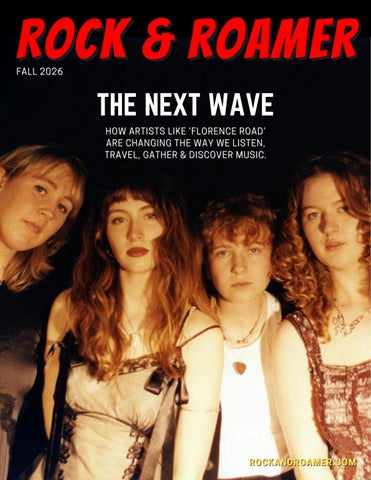
Rock & Roamer FALL 2026
THE NEXT WAVE HOW ARTISTS LIKE ‘FLORENCE ROAD’ ARE CHANGING THE WAY WE LISTEN, TRAVEL, GATHER & DISCOVER MUSIC.
ROCKANDROAMER.COM
Editor's Note
Rock & Roamer caters to good music, both mainstream and indie, finds you the most interesting places to travel, and the food to get you there.
Rock & Roamer Fall 2026 Playlist SUPERSCAR ADÉLA Pale Song Dove Ellis Throw Yourself to the Sword
Die Spitz The Actor Folk Bitch Trio Luck of the Draw Laci Kaye Booth
CRUISING TO SELF SOOTHE
Photo by Tiana Perez
The future of music doesn’t arrive with a warning. It sneaks in through a song you can’t stop playing, a band you somehow found before everyone else, a tiny venue with a line around the block, or an artist doing something so new that it makes you think, Wait… are we doing this now? That’s what we wanted to chase in this issue of Rock & Roamer: what’s happening just ahead of us. We’ve got artists on the verge, new sounds bending the rules, cities building their own scenes, and a look at how technology is changing the way music gets made and discovered. We’re also asking a few bigger questions: Is the album changing? Is rock having another moment? And in a world where an algorithm can serve you almost anything, how do you still stumble onto something that feels like yours? Think of this issue as a field guide to The Next Wave, not a crystal ball, just a really good excuse to look around, turn the volume up, and pay attention to what’s coming.
Ecca Vandal What You Want CORTIS If You Know Me Hudson Freeman Too Pretty For Buffalo Baby Nova PEACE Speed Won't Force You Jai’Len Josey The Pines Noah Rinker 300 dreams After Drop HotWax Elvis Queen Meg Lui
LAUREN ELIZABETH CAMPBELL Editor-in-Chief
ROCK & ROAMER | 2
@ROCKANDROAMER
Table of Contents
04
ARTISTS YOU FOUND FIRST Being told about an artist isn't quite the same as finding one.
06
YOU HAVE TO HEAR THIS You’ll add these to your playlist.
07
EVERYONE CAN MAKE A SONG A machine can understand what a breakup song sounds like. But a human knows how to live that actual feeling.
08
THE NEXT WAVE A scene isn't simply a collection of musicians making similar music. It is a collection of people who keep finding one another.
11
WHO GETS TO BE A ROCKSTAR Today, a musician can begin building an audience before releasing a song.
12
THE “YOU” IN EVERY LOVE SONG In John Mayer’s “Queen of California,” he questions, if there is no longer a muse, then what am I going to write about?
14
BECOMING MY OWN PATTIE BOYD What it means to live at the intersection of being a person and an archetype.
17
THE RECORD STORE KID When everything is available, nothing is rare.
18
BETWEEN HERE & THERE A playlist for where music is and where it is going.
19 The sounds, artists, and places shaping what comes next.
ROCK & ROAMER | 3
WHAT WE WEAR High meets low, vintage nostalgia meets curated luxury, and suddenly you’ve built an outfit that feels like a playlist. @ROCKANDROAMER
MUSIC
FALL 2026
The Artists You’ll Say You Found First By Lauren Elizabeth Campbell Editor-in-Chief
There’s a particular kind of excitement that comes from hearing a song before you know what it is. Maybe it happens in the passenger seat of someone’s car. Maybe a friend sends you a link with no explanation. Maybe you hear a band in a room that holds 200 people, and for three minutes the room feels much bigger. You look around afterward and think, Wait. Who was that? That feeling is getting harder to come by. We have never had more music at our fingertips. We have never had more playlists, recommendations, releases, clips, snippets, feeds, algorithms, “For You” pages and carefully calibrated ways to be told what we might like next. Spotify alone highlighted dozens of emerging artists in its 2026 Artists to Watch program, spanning everything from Afrobeats and country to indie, rock, R&B and pop. And yet, somehow, discovery can still feel wonderfully personal. Because being told about an artist isn't quite the same as finding one. That distinction is what we're interested in here. The artists in this list aren't united by a sound. They're united by something harder to define: a sense that they're becoming themselves in public. Some are already picking up momentum. Some are still playing rooms small enough that you can see the drummer's expression from the bar. Some are bending genres until the labels start to feel useless. And all of them have something we keep coming back to: A voice. Not necessarily a technically perfect voice. Not necessarily a giant voice. We mean voice in the bigger sense, the thing you recognize after about ten seconds and think, Oh. Nobody else would have made this. That is where the next wave usually starts. Dove Ellis The London-based artist makes indie music that feels less like a performance and
ROCK & ROAMER | 4
Photo courtesy of MOLIY more like someone letting you read the notes app. There is melancholy here, but not the polished, Instagram-ready kind. His songs have edges. They wander. They leave room for uncertainty. The FADER included Ellis among its artists to watch for 2026, describing his work alongside a group of emerging musicians whose music still feels distinctly human in an increasingly AI-saturated landscape. That word, human, keeps coming up for a reason. Ellis doesn't seem particularly interested in making himself easier to categorize. And maybe that's precisely the point. The best new artists don't always sound like the future. Sometimes they sound like someone finally figuring out what they were trying to say. Start with: “Pale Song.” Die Spitz Die Spitz makes you want to get closer to the stage. The Austin trio landed on Spotify's 2026 Artists to Watch list in the rock/alternative category, alongside Ecca Vandal and Speed.
Their music has the kind of physicality that streaming playlists can't quite capture. You can hear the guitars. You can hear the drums. More importantly, you can imagine what happens when those sounds hit a room full of people at the same time. For years, the internet made music feel smaller: one pair of headphones, one bedroom, one screen. Now there's something happening in the opposite direction. Young artists are building identities around the live experience again, around sweat and volume and the slightly chaotic feeling that something might go wrong. That's where a band like Die Spitz makes sense. The next wave may not be about making rock sound new. It might be about making people remember why they needed rock in the first place. Start with: “Throw Yourself to the Sword.” MOLIY There are artists who arrive with a song, MOLIY arrives with a feeling.
@ROCKANDROAMER
MUSIC
FALL 2026
ROCK & ROAMER | 55
feels more like a suggestion. The most exciting young artists aren't necessarily combining two genres in a neat little equation. They're pulling apart the idea that those genres were ever supposed to stay separate. A guitar can be a guitar. A beat can be a beat. A club can be a venue. A rock show can become a dance party. Why not? The next wave doesn't seem particularly interested in asking whether something is allowed. Start with: “Bon Bon.” Grumpy Sometimes the next wave doesn't sound polished. Sometimes it sounds like friends found each other. Brooklyn band Grumpy began as a solo project for Heaven Schmitt before growing into a six-piece. Their debut, Unfindable Ring, pulls from alt-country, indie folk, grunge and Auto-Tuned pop while creating something even more important than a genre: a sense of community. The Guardian recently described the group as a celebration of trans joy and found family. That idea of found family feels particularly relevant to where music is right now. Scenes don't necessarily form because somebody in a boardroom decides there's a market. They form because people start showing up. One friend brings another. Someone books a show. Somebody designs a flyer. Someone starts a band. Somebody else starts taking pictures. A song gets passed around. Suddenly there's a scene. And then, eventually, somebody outside the room notices. SO, WHAT'S NEXT? Maybe the mistake is thinking the next wave has to sound like a wave. Waves are tidy in retrospect. First there was the sound. Then the scene. Then the artists. Then the movement. Then the think pieces explaining what everyone had apparently been listening to all along. But music rarely works that neatly while you're living through it. Right now, the interesting stuff is scattered. It's in bedrooms and basements. In tiny clubs and giant festivals. In songs made on laptops and records cut to tape. In artists who have 300 Instagram followers. It's in the places algorithms haven't figured out yet. And maybe that's the best part. Because even with all the technology designed to predict what we'll like, there is still room for the oldest form of music discovery.
Photo courtesy of ADÉLA
The Ghanaian singer's Afrobeats-inflected pop has the rare quality of sounding immediately familiar without sounding like anything you were expecting. Spotify selected her for its 2026 Artists to Watch program, pointing to “Shake It To the Max (FLY) (Remix)” as her essential track. The interesting part isn't simply that the song travels. It's why it travels. The world of pop is becoming increasingly porous. Songs cross borders before listeners necessarily know where they came from. Genres collide without asking permission. A beat can start in one city, pick up a new rhythm somewhere else and end up on a dance floor thousands of miles away. The result is music that feels increasingly global without always feeling deliberately “global.” That's an important difference. MOLIY doesn't sound like she's trying to represent a movement. She sounds like she's making music people want to move to. And sometimes that's the whole revolution. Start with: “Shake It To the Max (FLY) (Remix).” ADÉLA The pop provocateur appeared on both Spotify's 2026 Artists to Watch list and NME's 2026 emerging-artist class. NME's broader list included artists working across pop, rap, hyperpop, rock, R&B and global sounds, a useful snapshot of just how little the next generation seems interested in staying inside one lane. That's what makes artists like ADÉLA worth paying attention to. Not because they have figured everything out. Because they haven't. There is something exciting about watching an artist build a language while they're still speaking it. The edges are visible. The influences are there. The ambition is obvious. And every once in a while, you hear a song that makes you think: Oh. They're onto something. Start with: “Superscar.” Fcukers Some bands seem destined to be discussed in adjectives. Fcukers are better experienced at volume. The New York trio appeared on Spotify's 2026 indie/folk Artists to Watch list despite sounding like they belong in a much messier category: dance floor, indie rock, post-punk, club music, whatever you want to call the thing happening when a guitar band starts thinking like a DJ. And that's exactly what makes them interesting. Genre used to be a filing system. Now it
@ROCKANDROAMER
PLAYLIST
FALL 2026
YOU HAVE TO HEAR THIS
YOU’LL ADD THESE TO YOUR PLAYLIST. Heavy Florence Road
C’est La Vie Isabel Dumaa
Throw Yourself to the Sword Die Spitz
Heather Ava Liv Mabry
Foreign Bird Folk Bitch Trio
Golf on TV Lennon Stella
Pale Song Dove Ellis
Positive Spin Gretta Ray
Shower Beer The Beaches
Never Better Wild Rivers
Superscar ADÉLA
Run For Your Money The Greeting Committee
TTYGF Fcukers
Backroads Gabriella Rose
Jayden Claire Rosinkranz
Holy Revival Maisie Peters
who’s your boyfriend Royal Otis
You Let Me Down Alessia Cara
Salt Water Taffy MARIS
Body Elle Coves
Playlist by Lauren Elizabeth Campbell ROCK & ROAMER | 6
@ROCKANDROAMER
MUSIC
FALL 2026
What Happens When Everyone Can Make a Song? By Lauren Elizabeth Campbell Editor-in-Chief
For most of music history, making a song required a certain amount of trouble. You needed an instrument, someone who knew how to play it, a room to record in, or at least a friend with a four-track. You needed time, money, patience, and a willingness to make mistakes. The trouble was part of it. Now, you can open a laptop, type a few words, and ask a machine to make something that sounds like a song. It can be beautiful, terrible, strange, or eerily convincing. And it can happen almost immediately. As AI music tools become more sophisticated, the conversation around them has become less about whether they can make music and more about what that means for the people who do. Copyright, consent, artists' rights, and training data are all complicated questions. But there's another question that may matter even more: If everyone can make a song, what makes us want to listen to yours? For a long time, scarcity helped answer that question. There were only so many records, so many bands, so many hours of radio. Recording an album required enough money and effort that someone had to believe it was worth making. Now those barriers are disappearing. That's exciting. It means more people can create, experiment, and find an audience without waiting for someone in an office to give them permission. But it also means we're going to have more music than we could ever possibly hear. And when there is too much music, the most valuable thing may not be the ability to make it. It may be taste.Knowing which song matters. Knowing which voice feels different. Knowing when something is worth playing twice. A machine can understand what a breakup song sounds like. It can imitate nostalgia. It can generate a convincing guitar solo. But a human being knows what it feels like to drive home after a breakup with nowhere else to go. They know what feeling
ROCK & ROAMER | 7
is like. They miss someone. They have a story they can't quite get out of their head. That's the part we recognize. Maybe the human advantage isn't imperfection, either. Machines can imitate imperfections, and humans can make perfectly polished records. The difference is experience. A song becomes meaningful because someone lived something before they made it. This is why the places where people still discover music from other people matter. The record store employee who pulls an album from a shelf. The friend who sends you a song at 2 AM. The opening band you ended up loving. The DJ who plays something you've never heard and somehow gets the whole room moving. Someone chose it. Someone cared enough to say, Listen to this.
AI may become another instrument in the studio, and there's no reason it can't. Every generation has eventually absorbed new technology into the creative process. The interesting artists won't necessarily be the ones who reject it or surrender completely to it. They'll be the ones who figure out what it can do, and what still belongs to them. Because we don't really need more songs. We need more reasons to care about them. The future of music may not belong to humans versus machines. It may belong to the people who still have something worth saying, and who know when to put the machine down and let the song be theirs. When everyone can make a song, the rarest thing won't be a song. It will be a voice.
@ROCKANDROAMER
FEATURE
FALL 2026
The Next Wave By Lauren Elizabeth Campbell Editor-in-Chief
There is a particular moment when you realize you are listening to something before everyone else is. It doesn't usually happen somewhere glamorous. It happens in a car with a cracked windshield, in the back corner of a bar, through headphones on a train, or at a show where the room is so small that the singer can see what everyone is wearing. Someone plays a song. You don't know the artist. You don't know the scene. You don't know whether anyone else has heard it. You just know that, for the next three minutes, you are paying attention. That feeling is harder to manufacture than it used to be. There is now an almost absurd amount of music waiting for us at any given moment. Algorithms can recommend an artist based on another artist based on another artist based on the fact that you listened to a song at 11:43 p.m. on a Tuesday. There are playlists for moods that haven't been invented yet. There are videos of musicians recording songs in bedrooms, kitchens, buses, and dressing rooms. And still, every so often, you find something the old-fashioned way. You hear it. You stop. You look it up. You send it to somebody. The next wave probably begins there. Not with a press release or a marketing plan, but with one person turning to another and saying, “Have you heard this?” Florence Road understands something about that feeling. The Irish band has the kind of energy that makes the word “emerging” feel slightly inadequate. Their music carries the recognizable DNA of guitar bands, hooks, volume, melody, the emotional directness of rock, without behaving as though the genre needs to be preserved behind glass. There is youth in it, but not the manufactured kind. They sound like people who are still discovering what their own songs can do. That is one of the most interesting things happening across music right now. The next wave doesn't necessarily sound new. It sounds restless. You hear it in artists pulling from genres they were never supposed to belong to. You hear rock bands borrowing the physicality of dance music, pop artists getting stranger, country artists drifting
ROCK & ROAMER | 8
Photos courtesy of Florence Road toward indie, electronic musicians becoming obsessed with live performance. You hear musicians treating old sounds less like rules than like materials left behind by somebody else. Maybe you can see the next wave more clearly if you leave the city. Drive far enough out of town and the music business starts to look different. The billboards disappear. The radio stations become local. The roads get darker. Somewhere between one town and the next, a song you have heard a hundred times begins to sound like a different song simply because of where you are hearing it. This is one of music's oldest tricks. It attaches itself to geography. A song belongs to a place because you heard it there. A band becomes part of a city because people saw them in the same room over and over again. A record becomes inseparable from a highway, a motel, a summer, a particular stretch of coastline. This is why emerging scenes matter. A scene isn't simply a collection of musicians making similar music. It is a collection of people who keep finding one another. A drummer joins another band's show. A photographer takes their picture. A bartender gives them a Tuesday night.
Someone starts a record label in their apartment. Somebody else starts a zine. A fan makes a playlist. A band from two towns away comes through and stays on someone's couch. Nobody calls it a movement. Not yet. They're too busy doing it. By the time somebody writes an article about the scene, the scene has usually already changed. There is something wonderfully inefficient about discovering music this way. You can spend four hours driving somewhere and hear one song that changes the entire trip. You can walk into a venue because you liked the name on the poster and walk out with a new favorite band. You can miss the artist you came to see because the opening act was better than you expected. The algorithm has no idea what to do with this. Good. Some of the best discoveries in music have always been accidents. The record bought because of its cover. The band seen because your friend couldn't find anyone else to go with. The song heard through a bedroom wall. The artist whose name you misremember for three days while trying to find them again. There is something deeply human about wanting to find music rather than simply
@ROCKANDROAMER
FEATURE
FALL 2026 receive it. Maybe that's why the next wave feels less like a genre than a scavenger hunt. Look in the small room. Look in the strange city. Look at the artist with a few thousand followers who somehow sells out every local show. Look at the band that has not figured out what it is yet. Look at the person opening for the person you actually came to see. Look wherever nobody has thought to put a spotlight. And then there are the artists who make you reconsider what “emerging” even means. Some have been playing for years. Some have already toured internationally. Some have managers and labels and publicists. Some are still recording songs in their bedrooms. Some have gone viral and are desperately trying to prove they are more than the thirty seconds that made them famous. The common denominator isn't obscurity. It's possibility. You can hear when an artist is still becoming. There is a particular looseness to
ROCK & ROAMER | 9
it. The edges haven't hardened yet. Influences are still showing. Songs occasionally take a wrong turn and discover something better on the other side. The live version doesn't quite sound like the recording. The artist changes their mind. That uncertainty is not a weakness. It is the exciting part. Florence Road, like so many young artists moving through this landscape, feels interesting precisely because there is somewhere left for the music to go. And that may be the best definition of the next wave we have: somewhere left to go. The strange thing about looking for the future is that the future rarely announces itself as the future. It sounds like a song someone made last night. It looks like four people loading amplifiers into a van. It is a half-empty Tuesday show in a city you had never planned to visit. It is a band playing to fifty people who are paying very close attention. It is the kid in the crowd who will
start a band next year because of what happened onstage tonight. It is a singer writing something in the back seat while the highway disappears behind them. It is an artist who doesn't quite fit the playlist, the scene, the genre, or the plan. It is the feeling that something has started moving before anyone has agreed on its name. Maybe that's why we keep traveling for music. We aren't only going somewhere. We're looking for evidence. Evidence that there are still rooms we haven't entered, cities we haven't understood, artists we haven't heard, songs that haven't found us yet. The next wave is out there somewhere. It may be playing in Dublin tonight. Or Nashville. Or a basement in Philadelphia. A song sneaks through the window. A band takes the stage. A city starts humming. Someone turns the volume up. And, for a moment, it belongs to you.
@ROCKANDROAMER
Photo by Emma McIntyre/Getty Images | Courtesy of Premium PR
@ROCKANDROAMER
ROCK & ROAMER | 10
MUSIC
FALL 2026
MUSIC
FALL 2026
Who Gets to Be a Rockstar? By Sebastian Potter Staff Writer
There was a time when becoming a rock star required a certain amount of disappearing. You could be mysterious. You could be difficult. You could refuse the interview. You could wear sunglasses indoors and let somebody else explain why. You could vanish for six months and return with a new record, a different haircut, and perhaps a slightly alarming theory about the nature of existence. The distance was part of the magic. We didn't know everything about our favorite musicians. We knew what they wanted us to know, which was often enough. The photograph, the interview, the album cover, the few carefully chosen appearances, these were fragments from which an audience assembled a person. The rest was left to imagination. That arrangement has become difficult to maintain. Today, a musician can begin building an audience before releasing a song. A fan might see the bedroom where the song was written, the failed demo, the tour-van breakdown, the dinner backstage. They might even know what the artist had for breakfast. The musician no longer simply releases music. Increasingly, the musician releases a life. And yet, despite all this access, we still want the same old thing. We want to be astonished. That may be the peculiar problem facing the next generation of rock stars: how do you become larger than life when your life is available in miniature, all day, every day? There is an uncomfortable truth underneath the modern music business: being good at music is no longer the whole job. An emerging artist is expected to be a songwriter, performer, photographer, editor, marketer, merch designer, community manager, tour promoter and, occasionally, a person capable of producing a funny video at exactly the right moment. The music can take three years to make. The video explaining why the artist almost didn't write the song may need to be posted by Thursday. This isn't necessarily a bad thing. The
ROCK & ROAMER | 11
Photo courtesy of sombr internet has given musicians a direct line to listeners that previous generations could only dream about. An artist can build a following from a bedroom and sell a record from a kitchen table. You can make something strange and, somewhere, find five hundred people who think it's exactly as strange as it ought to be. That's freedom. But freedom has developed its own obligations. Don't just make something. Show us how you made it. Don't just release the song. Tell us the story behind it. Don't just play the show. Film the backstage. Don't disappear. And if you do disappear, make sure you post about it first. The photographs of older rock stars now look almost impossibly self-contained. David Bowie in a suit. Joan Jett with a guitar. Debbie Harry under stage lights. Prince in purple. Kurt Cobain in a thrift-store cardigan. The images became mythology partly because they left so much unsaid. Now imagine the opposite. An artist wakes up and livestreams from the bedroom. At noon, they post a joke. At three, they tease a chorus. At seven, they perform. At nine, they upload a photograph from the stage. The audience isn't waiting outside the castle anymore.
In an era of unprecedented access, withholding something may be its own form of charisma. There is one place where the old mythology survives almost untouched: the room. Stand in a small club while a band you've never heard begins playing, and the internet suddenly seems like a remarkably poor substitute for music. Nobody knows exactly what will happen next. That uncertainty is part of the pleasure. Streaming has made recorded music almost frictionless. The live show remains gloriously inconvenient. You have to leave the house. You have to wait. Sometimes the opener is terrible. Sometimes the beer is expensive. And then, sometimes, something happens. The singer steps toward the edge of the stage. The room gets quiet. The first note lands differently than it did on the recording. You look around. No algorithm can quite reproduce that feeling. Maybe the new rock star isn't the person who has mastered the internet. It's the person who has figured out how to make the internet lead somewhere. To a record. To a stage. To a community. To a room where the everythings feels like magic.
@ROCKANDROAMER
MUSIC
FALL 2026
The “You” in Every Love Song Is Really “Me” By Lauren Elizabeth Campbell Editor-in-Chief
There’s always a room, maybe it’s a studio at 2 a.m., or a car idling under sodium light, or a bedroom where the blinds cut the dark into ribbons, where a songwriter sits, chasing the shape of another person through sound. They think they’re describing them, the way their voice cracked, the way they left. But by the time the song is finished, the person’s face is gone. What’s left is the echo. Love songs promise portraiture, but in reality, deliver self-reflection. The “you” in a lyric is less a person than a projection, someone glimpsed through the heat distortion of feeling. The writer writes to convey a likeness, but what they’re really building is a self-portrait lit by someone else’s shadow. You can hear it in every era. A singer murmurs a name, and the room changes temperature. Details bloom: a scarf forgotten in a drawer, headlights fading down some highway, a text left unsent. We’ve heard these fragments before, scattered across decades of melody. But none of them tell you who the person is. You know exactly how they felt to the singer, but not who they are as a being. They exist as vibration, not form. That’s the paradox of intimacy: it erases even as it reveals. The closer we get to someone, the less we see them cleanly. Love collapses the observer and the observed. A song captures that collapse, a blurred photograph where the light is perfect, but the subject has moved. You can hear that awareness most clearly in John Mayer’s “Queen of California,” where the song questions, if there is no longer a muse, a “Queen of California” if you will, then what am I going to write about? What happens to the part of himself that only existed in writing about her? When the muse steps down, the mirror breaks. It’s not just the loss of a person, it’s the loss of a way of seeing. He then goes on to pull from his favorite artists, “If Joni wrote Blue in her house by
ROCK & ROAMER | 12
Photos courtesy of California Typewriter the sea, I gotta believe there’s another color waiting on me,” and “Looking for the song that Neil Young hung, After the Gold Rush of 1971.” Almost like you need to be infatuated with someone to really see yourself. Every songwriter becomes a kind of photographer at that point, chasing an impossible exposure. You can freeze the glow, but never the person who caused it. That’s why the most unforgettable lines in song aren’t about the beloved’s traits, they’re about their effect. “I will always love you.” “You’re so vain.” Each phrase is a study in aftermath. But when I hear songs like “Queen of California,” I’m not thinking of who the “Queen of California” is to Mayer, but who she is to me. To the listener, the song
becomes about the universal weather of emotion itself. When we listen, we don’t picture the singer’s subject, we feel our own. The vagueness of the “you” is what makes it infinite. The “you” becomes whoever once rearranged our center of gravity. It’s not biography we crave in these songs, it’s recognition. Not them, but the feeling they left. That’s what songs have taught me about dating. How someone experiences you isn’t really you at all. It’s the version of you refracted through their own timing, fears, and way of living. You become a feeling, not a person, a chorus someone hums long after they’ve forgotten the verses. A few months ago while driving alone at
@ROCKANDROAMER
MUSIC
FALL 2026 night, “Clean,” a song I’d heard a hundred times, came on shuffle. Nothing about the song had changed, same Taylor Swift, same lyrics, same chords, but as it played through my car speakers, I listened as if I had never heard the song before. It was the first time I heard the song since I finally let go of someone. And while I had heard this song so many times before, it was
ROCK & ROAMER | 13
the first time I truly felt it, that quiet, steady relief, the simple, undeniable sense that I was clean too. But I believe that’s the secret endurance of a love song. The “you” disappears, but the light they cast remains. What’s recorded isn’t the person, but the proof that they were once close enough to distort the air. The same air that gets blown though dimly
lit restaurant booths, empty subway stations, and quiet 2 a.m. sidewalks. Every chorus, in the end, is a photograph of absence: warm, grainy, and alive with motion. And when we sing along, we step into the frame, because the “you” in every love song was always “me.”
@ROCKANDROAMER
MUSIC
FALL 2026
Becoming My Own Pattie Boyd: Learning to Be Both Star and Muse By Lauren Elizabeth Campbell Editor-in-Chief
Lately, I’ve been obsessed with the 1970s hit “Layla.” The opening riff has become a kind of morning ritual, a minor act of devotion that begins in muscle memory and ends in mythology. The song’s backstory is infamous: Eric Clapton writing about his love for Pattie Boyd, George Harrison’s thenwife, and the mythic tension that created. Boyd wasn’t merely a woman in a magazine; she was the gravitational pull behind some of the twentieth century’s most enduring rock ballads. “Something.” “Wonderful Tonight.” “Layla.” All orbiting her, each a snapshot of a private moment turned into public folklore. As I keep the song on repeat, my mind keeps drifting to her. To what it means to live at that kind of intersection, to be at once a person and an archetype, a fleshand-blood woman and a shorthand for an era’s desire. Pattie Boyd has been written about endlessly, but rarely does the conversation linger on what it felt like to be her. Was it empowering? Claustrophobic? Did she feel like a co-conspirator in those songs or merely a silhouette? That question bled into my own life almost accidentally. In the past few months, I’ve noticed people around me, not in some cinematic way, but in ordinary, offhand ways, telling me that I’d inspired them in comments whispered like confessions: “I did this because you…” “You made me want to…” These statements are flattering, but they are also destabilizing. It’s humbling because I’m not trying to be anyone’s muse. I’m trying to be my own person, building projects that belong to me. And yet, I recognize that inspiration leaks out of all of us in ways we don’t plan. We become metaphors in someone else’s story, whether we sign up for it or not. There’s a
ROCK & ROAMER | 14
Photo courtesy of Lauren Elizabeth Campbell kind of power in that, but also a responsibility. At the same time, I’ve been thriving in my own right. I’ve been devouring law school casebooks, building my business, finishing long-dreamed-of projects, and showing up for myself in a way that feels more complete than it ever has before. I’m not waiting to be cast in someone else’s light. I’m building my own. This duality of being a muse while simultaneously stepping fully into my own work has forced me to rethink the binary we tend to build between the inspired and the inspirer. We often imagine them as opposite
ends of the spectrum: the star under the spotlight versus the quiet figure offstage who gave the star their fire. But what if those roles aren’t mutually exclusive? “Layla” has taught me this. In its riffs, I hear the ache of longing, but also the assertion of self. It’s a plea, yes, but it’s also a declaration of artistic identity. When the song plays, I feel like I’m reaching for something just out of view, not just the chord changes, but the possibility of occupying both spaces at once. To be the muse isn’t about being passive or ornamental. It’s about sparking something in others simply by existing fully in your own
@ROCKANDROAMER
MUSIC
FALL 2026 velocity. And to be the star isn’t about ego. It’s about owning your work, honoring your craft, and giving yourself permission to stand in the center of your own frame. Sometimes that balance is tricky. Being told you’re someone’s inspiration can feel like a compliment and a cage at once, a reminder that your life can become symbolic to someone else before it’s fully real to you. But stepping into the “star” role can be equally intimidating, because it requires you to say, “I’m worthy of this spotlight” even when you’re not sure. What I’m learning is that the healthiest place to stand is right at the intersection. Being the muse keeps me soft and connective, reminding me to nurture the
parts of myself that ripple outward into other people’s lives. Being the star keeps me grounded and ambitious, reminding me that my own dreams deserve the same devotion I pour into others. I think about how Pattie Boyd lived inside that dynamic. She was never just one thing. And maybe that’s the point. Our culture loves categories, but real life blurs them. We’re all somebody’s chorus and somebody’s verse; we’re all the backbeat in one room and the lead guitar in another. In a way, “Layla” has become my metaphor for this balancing act, one hand on the fretboard of my own ambitions, one hand brushing the chords of how I appear in other people’s stories. The song is
demanding but beautiful, a perfect symbol for what it feels like to live at the edge of myth and self-determination. If there’s a lesson here, it’s that you don’t have to choose. You can be both the star and the muse. You can inspire while creating. You can create while inspiring. That’s not hubris; it’s wholeness. And when you give yourself permission to hold both, you stop waiting to be written about and start writing your own music. And maybe, years from now, someone else will pick up a guitar, start playing a riff they can’t get out of their head, and think of you, not as a muse or a star, but as a person who inspired them.
Photo courtesy of Pattie Boyd
ROCK & ROAMER | 15
@ROCKANDROAMER
Photo by Emma McIntyre/Getty Images | Courtesy of Premium PR
@ROCKANDROAMER
ROCK & ROAMER | 16
MUSIC
FALL 2026
MUSIC
FALL 2026
The Return of the Record Store Kid By Sebastian Potter Staff Writer
There is a particular kind of person who walks into a record store without knowing exactly what they're looking for. They have a general idea. Maybe something loud. Something from the seventies. Something that sounds like driving at night. Maybe an album they heard somebody mention once and have been quietly thinking about ever since. They start flipping. One record becomes five. Five becomes twelve. Eventually they're standing at the register holding an album by a band they had never heard of twenty minutes earlier. This is how music discovery used to work. And, somewhat strangely, it is how it seems to be working again. For years, the great promise of streaming was that ownership didn't matter anymore. Why buy an album when you could listen to almost anything, whenever you wanted, from the same rectangle you used to order takeout? It was efficient. It was cheap. It was, in almost every practical sense, better. And yet something funny has happened. The record store didn't disappear. The record collection didn't disappear. And young people, who theoretically should have the least reason to care about physical music, keep walking through the door. The resurgence isn't simply about vinyl, either. CDs have begun finding their way back into the hands of younger listeners, too. In 2026, U.S. CD sales saw a notable increase, suggesting that the appetite for physical music extends beyond the nostalgia of older vinyl collectors. Maybe the question isn't why physical music came back. Maybe it's why we ever thought people would stop wanting things they could hold. Streaming solved the problem of access. It didn't solve the problem of attachment. When every album is available all the time, an album can start to feel strangely weightless. You don't have to save up for it. You don't have to choose between two records at the store. You don't have to walk home carrying it. You just press play. And then, inevitably, something else starts playing.
ROCK & ROAMER | 17
The abundance is extraordinary, but abundance has a downside. When everything is available, nothing necessarily feels rare. A physical record introduces a little friction back into the experience. You have to choose it. You have to buy it. You have to find somewhere to put it. You have to turn it over. You have to get up when Side A ends. None of these are particularly efficient activities. That's precisely why they can feel meaningful. There is also the record store itself. The internet can tell you what you like. A record store can introduce you to what you don't know you like yet. That's a different kind of recommendation. Walk into a good shop and there is always somebody who has an opinion. The employee who tells you that if you like one album, you should hear another. The stranger flipping through the same bin. The handwritten note taped beneath a record. The album playing overhead that makes you
stop halfway down the aisle. There is no algorithmic explanation for why you suddenly want it. Someone just put it on. That might be one of the most important things music has lost, and is beginning to rediscover: the accident. The beautiful, inefficient accident of finding something you weren't looking for. For younger listeners, physical music can also function as proof. Proof that you were there. Proof that the song mattered. Proof that the concert happened. Proof that you loved the album before everybody else did. You remember where you bought it. You remember who you were with. You remember the summer you played it constantly. Maybe you remember the apartment you lived in when you bought it, or the person you were dating, or the road trip where it became the only acceptable soundtrack. Maybe that's what the record store kid was always looking for. Not a record. A rabbit hole.
@ROCKANDROAMER
PLAYLIST
FALL 2026
BETWEEN HERE & THERE WHERE MUSIC IS AND WHERE IT’S GOING Minibar Gracie Abrams
Staying Still Noah Kahan
Mexico Honey Kacey Musgraves
Lose My Life MICHA
Never Let Me Down Pyramid Park
Opium Sofie Royer
Procida Flo
Vivian GUS
brand new chanel$ Slayyyter
feeling good Temsu Clover
Nicole Kidman ADÉLA
HIGH ROLLERS Tiga
This Trip Brittle Stars
Meaning Business Wendy Eisenberg
bloodstream Soccer Mommy
Mirror Deep Neurosis
Eu Me Lembro Clarice Falcão
Up Down Lightris
Way Too Self Aware Ian Asher
Now I’m Grace Ives
Playlist by Sebastian Potter ROCK & ROAMER | 18
@ROCKANDROAMER
MUSIC
FALL 2026
The Soundtrack of What We Wear By Lauren Elizabeth Campbell Editor-in-Chief
There’s a strange alchemy that happens when you lace up a pair of $600 Golden Goose sneakers, scuffed to perfection by someone in an Italian factory, and then, tug on an old concert tee that’s more holes than cotton. High meets low, vintage nostalgia meets curated luxury, and suddenly you’ve built an outfit that feels like a playlist: contradictory, messy, but somehow seamless. It’s not just about putting things on your body, it’s about wearing a story that’s already halfway written before you even leave the house. Fashion thrives in these juxtapositions. A skirt with cowboy boots isn’t just an outfit; it’s a signal flare. It says you know something about Dolly and Lana, about Nashville grit and Brooklyn cool, about how Americana never really died, it just learned to drink mezcal and dance in dimly lit clubs. A lace slip dress paired with a leather moto jacket pulls the same trick, romance and rebellion stitched into a single silhouette. Style becomes a form of genre blending: punk grit with a hint of couture polish, country fringe with city gloss, athleisure crossed with archival. It’s messy, inconsistent, occasionally incoherent, and yet somehow, it works. That’s because fashion, like music, is rarely about purity. It’s about tension. It’s about what happens when two seemingly opposite ideas crash into each other and make sparks. Just as Nirvana could crash through the walls of mainstream pop radio with distorted guitars and still end up on MTV’s most-requested countdown, fashion lives in that uneasy space between authenticity and artifice, comfort and performance. Music, of course, has been doing this forever. Hip-hop long ago made peace with jazz samples and Motown hooks. Country flirts shamelessly with pop: Shania did it, Kacey did it, Beyoncé’s even taken her swing and won a GRAMMY with it. Rock bands tuck synthesizers under their guitars and pretend they’ve always been there. The genres blur and overlap until all you’re left
ROCK & ROAMER | 19
with is a track that works, not because it’s loyal to a category, but because it feels good. Think about Fleetwood Mac weaving folk into rock into soft pop, or Post Malone crooning over trap beats in a voice that could just as easily soundtrack a dive bar ballad. Nobody cares what shelf it belongs on. If it moves you, it’s music. Clothes operate the same way. It isn’t just about a “rock tee” or a “designer shoe.” It’s about what happens when you throw them together and wear them out in the world, when you make contradictions look inevitable. The Golden Goose isn’t luxury anymore; it’s just your sneaker. The tee isn’t a relic of the past; it’s your armor for today. A Chanel blazer with Levi’s 501s? That’s the same philosophy as Kendrick sampling a Marvin Gaye track. You’re not honoring the old by keeping it pristine, you’re honoring it by making it new again. And maybe that’s the point: fashion and music are both about reinterpretation. Every time you walk into a swap meet, you’re
remixing. Every time you layer a vintage band tee under a luxury trench coat, you’re sampling. You’re making an outfit the way a producer makes a track, digging through crates (or closets) until you find something that feels alive again. The beauty of it is that the boundaries don’t matter nearly as much as we think they do. Nobody’s stopping you at the door to ask whether your cowboy boots came from Nashville or Nordstrom, just like nobody’s asking whether your favorite song counts as indie rock or dream pop or alt. The categories are useful for marketing, for critics, for gatekeepers who thrive on definitions. But for the listener, or the dresser, it’s always been simpler. At the end of the day, the labels stop mattering. Fashion isn’t about staying true to one school, and music isn’t about clinging to one genre. The outfit just is fashion. The song just is good. And the moment, if you’re lucky enough to catch it, is yours to wear.
@ROCKANDROAMER
ROCK & ROAMER
Fall 2026 Issue 13
0730127
THE N EX T W AV E Read on Page 8