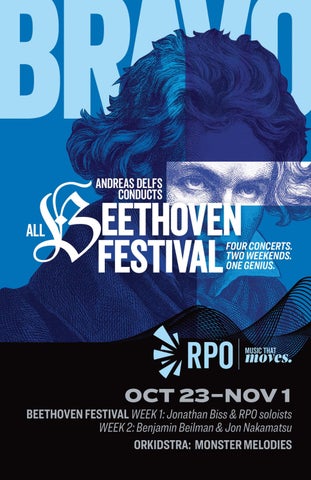
B
BRAVO ORKIDSTRA: MONSTER MELODIES OCTOBER 26
ANDREAS DELFS, MUSIC DIRECTOR JEFF TYZIK, PRINCIPAL POPS CONDUCTOR CHRISTOPHER SEAMAN, CONDUCTOR LAUREATE
The Christopher Seaman Chair, Supported by Barbara and Patrick Fulford and The Conductor Laureate Society
IN THIS ISSUE: 2 25/26 Season Orchestra 3 Our Conductors 6 Board of Directors 7 Bravo to Our Season Sponsors 29 Bravo to Our Supporters 36 About Us
PLEASE NOTE:
Our Phils and Pops Series performances will feature a new start time of 7:30 PM unless otherwise noted.
The safety of patrons, musicians, and staff is of the utmost importance. Following the University of Rochester masking protocols and guidelines, masking is currently optional at Eastman Theatre.
9
BEETHOVEN FESTIVAL WEEK 1A: WITH JONATHAN BISS Thursday, October 23
13
BEETHOVEN FESTIVAL WEEK 1B: WITH RPO SOLOISTS Saturday, October 25
19
ORKIDSTRA: MONSTER MELODIES
21
BEETHOVEN FESTIVAL WEEK 2A: WITH BENJAMIN BEILMAN
Sunday, October 26
Thursday, October 30
25 BEETHOVEN FESTIVAL WEEK 2B: WITH JON NAKAMATSU Saturday, November 1
RPO.ORG | 454-2100
1
VIOLIN 1
BASS
The Caroline W. Gannett & Clayla Ward Chair, funded in perpetuity
The Anne Hayden McQuay Chair, funded in perpetuity
Juliana Athayde+, Concertmaster
Michael Griffin,
Daniel Morehead Edward Castilano Fred Dole Jeff Campbell+ Eric Polenik
TROMBONE
FLUTE
BASS TROMBONE
The Orchestra 2025/26 SEASON
Shannon Nance,
Assistant Concertmaster
Jeongwon An Tigran Vardanyan James Zabawa-Martinez Thomas Rodgers Anna Leunis Molly McDonald Kurt Munstedt Chihiro Kakishima Perrin Yang Jeremy Hill An-Chi Lin
VIOLIN 2
Jeanelle Thompson, Principal The Dr. Ralph F. Jozefowicz Chair
Rebecca Gilbert, Principal The Charlotte Whitney Allen Chair, funded in perpetuity
Sean Marron Elise Kim
PICCOLO
The Dr. Jacques M. Lipson Chair, funded in perpetuity
ENGLISH HORN
Charles Ross+, Principal
PERCUSSION
Caleb Breidenbaugh, Principal The Barbara and Patrick Fulford Chair, funded in perpetuity
Brian Stotz
CLARINET
The Eileen Malone Chair. A Tribute to Mr. and Mrs. Harcourt M. Sylvester
Hector Noriega*, Principal
The Robert J. Strasenburgh Chair, funded in perpetuity
Kamalia Freyling^ Andrew Brown
BASS CLARINET
RPO.ORG | 454-2100
The Rob W. Goodling Chair, funded in perpetuity
HARP
Marc Anderson,
Lars Kirvan, Assistant Principal Samuel Pierce-Ruhland Christopher Haritatos Garri Hovsepyan Benjamin Krug Jennifer Carpenter^ Ingrid Bock
W. Craig Sutherland, Principal
Anna Steltenpohl
E-FLAT CLARINET
The Clara and Edwin Strasenburgh Chair, funded in perpetuity
TUBA
The Harold and Joan Feinbloom Chair, funded in perpetuity
Joshua Newburger+, Principal
Ahrim Kim, Principal
Jeffrey Gray+
OBOE
Anna Steltenpohl Megan Kyle
CELLO
The Austin E. Hildebrandt Chair, funded in perpetuity
Lisa Albrecht Jeffrey Gray+
TIMPANI
Patricia Sunwoo John Sullivan Lara Sipols Sooyeon Kim Petros Karapetyan Liana Koteva Kirvan Margaret Leenhouts Heidi Brodwin Elin Schlichting Ellen Stokoe
Assistant Principal
David Bruestle, Principal
Sean Marron Elise Kim Erik Behr, Principal
The James E. Dumm Chair, funded in perpetuity
Rebecca Christainsen James Marshall Olita Povero Neil Miller Melissa Matson Ye In Son David Hult Grant Rieke
2
Assistant Principal
Daryl Perlo, Assistant Principal
The William L. Gamble Chair, funded in perpetuity
PHOTO: SMILLIEPHOTO.COM
Wesley Nance+ Herbert Smith Paul Shewan
The Fred M. And Lurita D. Wechsler Chair, funded in perpetuity
VIOLA
CONCERTMASTER
TRUMPET
Angelina Phillips,
Associate Concertmaster
JULIANA ATHAYDE,
Cory Palmer, Principal
Kamalia Freyling^ Andrew Brown
BASSOON
Grace Browning, Principal Rosanna Moore
KEYBOARD
Chiao-Wen Cheng+, Principal The Lois P. Lines Chair, funded in perpetuity
PERSONNEL MANAGER Fred Dole
PRINCIPAL LIBRARIAN
Matthew McDonald, Principal
Kimberly Hartquist
Karl Vilcins Martha Sholl
Danielle Suhr Cederick Martinez
The Ron and Donna Fielding Chair, funded in perpetuity
STAGE MANAGERS
CONTRA-BASSOON Karl Vilcins
HORN
YiCheng Gong, Associate Maura McCune Corvington+ Nathan Ukens Stephen Laifer+
+ Eastman faculty ^ Year leave of absence * 1-year appointment
Andreas Delfs has built a reputation over his 35-year career as one of the most dynamic and respected conductors on the international stage. Celebrated for his visionary leadership and deep musical insight, he is equally renowned as a masterful orchestra builder and an inspiring music director. Known for his emotionally charged and dramatically nuanced interpretations—particularly of the late Romantic repertoire—Delfs has earned critical acclaim across North America and Europe. His performances are marked by an ever-deepening artistic maturity, bringing a rare combination of passion, precision, and authenticity to every podium he graces. Educated at leading conservatories on both sides of the Atlantic and shaped by mentorships with legendary conductors, Delfs has cultivated a style forged through decades of experience. At the same time, his unwavering curiosity and enthusiasm for contemporary music have made him a champion of living composers. He has established lasting collaborations with many of today’s most compelling musical voices, conducting numerous world premieres and commissioning new works. Among his many artistic inspirations are Hans Werner Henze, György Ligeti, Philip Glass, and Roberto Sierra—composers whose diverse idioms have helped shape his unique interpretive voice. His artistry has also drawn world-class soloists to the stage, including André Watts, Emanuel Ax, Joshua Bell, Hilary Hahn, Yo-Yo Ma, Lang Lang, and Renée Fleming. Delfs has held prominent leadership roles with orchestras on both continents. As Music Director of the Milwaukee Symphony Orchestra from 1996 to 2009—and later as its Conductor Laureate—he played a pivotal role in elevating the ensemble to national acclaim. He also led the Saint Paul Chamber Orchestra as Music Director (2001–2004) and Artistic Consultant (2004–2006). In Europe, he served as General Music Director of Hanover, Germany (1995–2000), overseeing both the city’s symphony orchestra and its distinguished opera company. Earlier appointments include Music Director of the Bern Opera, Resident Conductor of the Pittsburgh Symphony during Lorin Maazel’s tenure, and Music Director—at an impressively young age—of the Orchestre Suisse des Jeunes.
Our Conductors 2025/26 SEASON
ANDREAS DELFS Music Director
Throughout his career, Delfs has conducted many of the world’s premier orchestras. His international credits include the London Philharmonic, Royal Philharmonic, Frankfurt Radio Symphony, Leipzig Gewandhaus Orchestra, Tonhalle Orchestra Zurich, Danish National Symphony, Netherlands Philharmonic, NHK Symphony Orchestra Tokyo, Philadelphia Orchestra, San Francisco Symphony, Los Angeles Philharmonic, Sydney Symphony, Beijing Symphony, Seoul Philharmonic, and the National Symphony Orchestra of Taiwan. Born in Flensburg, Germany, Delfs began studying piano and music theory at the age of five. He studied under Christoph von Dohnányi and Aldo Ceccato at the Hamburg Conservatory, where, at just 20 years old, he became the youngest Music Director of the Hamburg University Orchestra and served as Musical Assistant at the Hamburg State Opera. He later continued his training at The Juilliard School, studying with Jorge Mester, Sixten Ehrling, and Leonard Bernstein, and was honored with the prestigious Bruno Walter Memorial Scholarship. PHOTO: ALEX CASSETTI
RPO.ORG | 454-2100
3
JEFF TYZIK Principal Pops Conductor
Our Conductors 2025/26 SEASON
25/26 marks Jeff Tyzik’s 32nd season as RPO Pops Conductor. But his musical journey began long before his permanent residency in Kodak Hall. Born in Hyde Park, New York, he started playing cornet at age nine—inspired by the buglers during an Independence Day parade in nearby Poughkeepsie. He switched to trumpet at age 11, and eventually went on to attend Rochester’s Eastman School of Music, ultimately earning Bachelor of Music and Master of Music degrees. Even before Tyzik’s schooling was completed, his star was on the rise. While at Eastman, Tyzik met Chuck Mangione, with whom he worked between 1973 and 1980 —both as lead trumpeter in Mangione’s band and as co-producer of four albums. During that time, Tyzik befriended Tonight Show band leader Doc Severinsen, who eventually invited Tyzik to London to record two albums. That relationship proved fruitful, with Tyzik producing the Grammy-winning The Tonight Show Band with Doc Severinsen, Vol. 1. Severinsen’s albums with Tyzik would go on to earn three additional Grammy nominations. Tyzik also recorded his own albums as a solo trumpeter between 1981 and 1990, when he and his big band frequently performed in Rochester. In 1993, Tyzik proposed a four-concert series featuring RPO members dubbed “All in the Family.” The first debuted Oct. 22 and highlighted Kenneth Grant (clarinet), Joseph Werner (piano), and percussionists William Cahn and Dave Mancini. Less than a month later, Tyzik was asked to become Principal Pops Conductor. Jeff quickly made his mark on the orchestra, in his second season performing the first in his endearing, enduring Gala Holiday Pops series. He also made RPO history conducting an all-Gershwin album featuring pianist Jon Nakamatsu. The recording topped the Billboard Classical chart and remained in the top 10 for three months. Over five decades, Tyzik has guest-conducted more than 100 orchestras, including the Boston Pops, Cincinnati Pops, and Milwaukee Symphony. In September 2023, he made his debut with the New York Philharmonic and returned later that season to conduct the Philadelphia Orchestra’s 2023–24 finale. He’s also shared the stage with a remarkable range of artists across genres—from Tony Bennett and Leslie Odom Jr. to Wynonna Judd, Art Garfunkel, Marilyn Horne, Arturo Sandoval, The Chieftains, Megan Hilty, Dawn Upshaw, and John Pizzarelli. In 2012, Tyzik and his daughter Jami co-founded the management and production company Greenberg Artists. Since 2016, in partnership with Schirmer Theatrical, they’ve developed dozens of orchestral Pops programs now performed by nearly 200 orchestras. In 2023, Tyzik launched TyzikMusic.com, a digital publishing platform featuring more than 150 of his arrangements, orchestrations, and compositions for symphony orchestra, chamber ensembles, and wind ensemble.
PHOTO: SMILLIEPHOTO.COM
4
RPO.ORG | 454-2100
CHRISTOPHER SEAMAN Conductor Laureate
Christopher Seaman was music director of the RPO from 1998-2011, and was subsequently named conductor laureate. During his 13-year tenure, the longest in RPO history, he raised the Orchestra’s artistic level, broadened its audience base, and created a new concert series. This contribution was recognized with an award from the American Society of Composers, Authors, and Publishers. In May 2009, the University of Rochester made him an honorary doctor of music. Previous positions include music director of the Naples Philharmonic Orchestra (Florida) for 10 years, conductor-in-residence with the Baltimore Symphony Orchestra, and artistic advisor of the San Antonio Symphony. He is recognized for his wealth of repertoire, which ranges from baroque to contemporary, and in particular the works of Bruckner, Brahms, and Sibelius Seaman also is highly regarded for his work with younger musicians, and he served as course director for the Symphony Services International Conductor Development Program (Australia) for many years. Recent conducting engagements include the Aspen Music Festival, Detroit, Houston, St. Louis, Cincinnati, Milwaukee, and Seattle symphony orchestras; the Warsaw Philharmonic Orchestra, Kristians Symphony Orchestra, Orchestra of Opera North, and Orquestra Filarmônica de Minas Gerais in Brazil. He frequently visits Australia and Asia where he has conducted the Hong Kong Philharmonic Orchestra and the National Taiwan, Sydney, Melbourne, Adelaide, and Singapore symphony orchestras, among others.
Our Conductors 2025/26 SEASON
The Christopher Seaman Chair, supported by Barbara and Patrick Fulford and The Conductor Laureate Society
RPO.ORG | 454-2100
5
RPO Board of Directors 2025/26 SEASON
Maintaining and operating the Rochester Philharmonic Orchestra (Founded in 1923 —Incorporated in 1930) OFFICERS
Diana Clarkson, Esq., Chair of the Board
Katherine Lindahl, Chair-Elect of the Board Cindy Yancey,
EX-OFFICIO
Vice Chair of the Board Secretary
Kate Sheeran
Treasurer
Nathan Ukens
Karen Kessler, Richard Stein,
Ross P. Lanzafame, Esq., Immediate Past Chair
TERM EXPIRES JUNE 2026
Daisy R. Algarin Diana Clarkson, Esq. George Daddis Catherine Frangenberg Allyson Hiranandani Dr. Diane Lu Sujatha Ramanujan Elizabeth F. Rice Ronald E. Salluzzo Dr. Eva P. Sauer George J. Schwartz, M.D. Richard Stein Dr. James Watters
Brian Bennett Emerson Fullwood Kimberly Gangi Paulette Gissendanner Catherine Gueli Zuzanna Kwon Katherine Lindahl Jack McGowan Sidney Sobel, M.D. Cindy Yancey
CHAIR OF THE BOARD
6
Ron Dougherty Sreeram Dhurjaty James Fulmer Laurie A. Haelen Ralph F. Jozefowicz. M.D. Karen Kessler Deborah Onslow Keila Pena Sara Poe Joseph B. Rizzo, Esq. Curtis S. Long President & CEO Ross P. Lanzafame, Esq.,
TERM EXPIRES JUNE 2027
DIANA CLARKSON,
TERM EXPIRES JUNE 2028
RPO.ORG | 454-2100
Immediate Past Chair
Dean, Eastman School of Music Orchestra Representative
Wesley Nance
Orchestra Representative
James Englert
Chairperson, Honorary Board
HONORARY BOARD James Englert,
Chairperson, Honorary Board
Stephen B. Ashley Nancy Beilfuss* James M. Boucher Paul W. Briggs* William L. Cahn Louise Epstein Joan Feinbloom Ilene Flaum Betsy Friedman Patrick Fulford Ronald A. Furman* Mary M. Gooley* Suzanne Gouvernet* David C. Heiligman A. Thomas Hildebrandt Harold A. Kurland, Esq. Dr. Dawn F. Lipson Jacques M. Lipson, MD* Cricket and Frank Luellen* Michael Millard Elizabeth F. Rice Nathan J. Robfogel, Esq. Jon L. Schumacher, Esq. Katherine T. Schumacher Ingrid Stanlis Betty Strasenburgh* Josephine S. Trubek Suzanne D. Welch Patricia Wilder* Deborah Wilson Robert Woodhouse
The RPO expresses its gratitude to all those who have served as Honorary Board members in the past.
PAST RPO CHAIRPERSONS
1930–32: Edward G. Miner* 1932–34: Simon N. Stein* 1934–38: George E. Norton* 1938–41: Leroy E. Snyder* 1941–42: Frank W. Lovejoy* 1942–43: Bernard E. Finucane* 1943–46: L. Dudley Field* 1946–48: Edward S. Farrow, Jr. * 1948–51: Joseph J. Myler* 1951–52: Joseph F. Taylor* 1952–55: Raymond W. Albright* 1955–57: Arthur I. Stern* 1957–59: Thomas H. Hawks* 1959–61: Walter C. Strakosh* 1962–63: Ernest J. Howe* 1963–65: O. Cedric Rowntree* 1965–67: Frank E. Holley * 1967–69: Thomas C. Taylor* 1969–71: Thomas H. Miller* 1971–72: Mrs. Frederick J. Wilkens* 1972–73: Edward C. McIrvine 1973–74: Robert J. Strasenburgh* 1974–75: John A. Santuccio 1975–76: Robert J. Strasenburgh* 1976–78: Dr. Louis Lasagna* 1978–80: Edward C. McIrvine 1980–82: Peter L. Faber 1982–84: Paul F. Pagerey* 1984–85: Peter L. Waasdorp* 1986–89: Robert H. Hurlbut* 1989–91: Paul W. Briggs 1991–93: Karen Noble Hanson* 1993–95: Ronald E. Salluzzo 1995–98: A. Thomas Hildebrandt 1998–00: Harold A. Kurland, Esq. 2000–04: David C. Heiligman 2004–06: Ingrid A. Stanlis 2006–09: James M. Boucher 2009–11: Suzanne D. Welch 2011–13: Elizabeth F. Rice 2013–15: Dr. Dawn F. Lipson 2015-17: Jules L. Smith, Esq. 2017-19: Ingrid A. Stanlis 2019-2024: Ross P. Lanzafame, Esq.
* Deceased
DATA: 25/06/2020
DEVONO ESSERE ELABORATI DA PARTE DEL FOTOLITISTA VERIFICANDO FUSTELLE, ABBONDANZE, SOVRASTAMPE ECC.
FORMATO:
• I COLORI A CUI ATTENERSI SONO QUELLI INDICATI SUL DOCUMENTO ESECUTIVO, SALVO DIVERSE ESIGENZE TECNICHE
FUNZIONALI A CONCILIARE CARATTERISTICHE DEL TIPO DI STAMPA E RISULTATO CREATIVO DESIDERATO (EVENTUALI MODIFICHE DA CONDIVIDERE SEMPRE CON L’AGENZIA).
STAMPA:
• PER LA CORRETTA VISUALIZZAZIONE, STAMPA E UTILIZZO DEI FONT È NECESSARIO DISPORRE DEL SOFTWARE E
SUPPORTO:
RELATIVI DIRITTI DI UTILIZZO (I FONT NON SONO CEDIBILI).
• UNA PROVA COLORE O UN CROMALIN È RICHIESTO PRIMA DI PROCEDERE ALLA STAMPA. LA PROVA COLORE VA
LAVORAZIONI SPECIALI:
VERIFICATA E APPROVATA DA PARTE DELLA COMMITTENTE E DELL’AGENZIA. • OVE NON PRESENTE NELL’ESECUTIVO, IL CODICE A BARRE DEVE ESSERE FORNITO AL FOTOLITISTA O ALLO STAMPATORE DA PARTE DELLA COMMITTENTE. • RICEVUTA APPROVAZIONE DEL PRESENTE DOCUMENTO ESECUTIVO TRAMITE FIRMA ANALOGICA O MAIL DA PARTE DELLA COMMITTENTE, LA RESPONSABILITÀ PER EVENTUALI ERRORI DI STAMPA - REFUSI - OMISSIONI RIFERITI A TESTO E/O IMMAGINI NELLO STESSO CONTENUTI, SARÀ IMPUTABILE ALLA COMMITTENTE STESSA. THIS ARTWORK WAS NOT PROCESSED THROUGH COLOUR SEPARATION YET. • BEFORE GOING TO PRINT ALL THE ARTWORKS MUST BE CARRIED OUT BY THE PRE PRINTER AS PER THE PRINTER’S REQUIREMENTS AND THE CUTTER GUIDES, BLEEDS, OVERPRINTS AND RELATIVE CODES CHECKED. • WHEN SELECTING COLOURS, PLEASE REFER TO THE GUIDELINES FEATURED ON THE DOCUMENT, UNLESS TECHNICAL REQUIREMENTS DICTATE OTHERWISE (ANY CHANGES ARE ALWAYS TO BE SHARED WITH THE AGENCY). • FOR THE CORRECT DISPLAY, PRINTING AND USE OF THE FONTS IT IS NECESSARY TO HAVE THE SOFTWARE AND RELATIVE USAGE RIGHTS (THE FONTS ARE NOT TRANSFERABLE). • A COLOUR PROOF OR A CROMALIN IS REQUIRED BEFORE PRINTING. • THE BAR CODE MUST BE SUPPLIED TO THE PRE PRINTER OR THE PRINTER BY THE CLIENT (IF IT IS NOT PRESENT IN THE ARTWORK). • RECEIVED APPROVAL OF THIS ARTWORK BY ANALOGICAL SIGNATURE OR MAIL FROM THE CLIENT, THE RESPONSIBILITY FOR ANY PRINTING ERRORS - MISPRINTS - OMISSIONS REFERRING TO TEXT AND / OR IMAGES IN THE SAME CONTENTS, WILL BE IMPUTABLE TO THE CLIENT ITSELF.
COPIA AL: 100 % SOFTWARE: ILLUSTRATOR CC
COLORI:
CYAN
MAGENTA GIALLO
NERO
POPS SERIES SPONSORS SUNDAY MATS AT NAZ SERIES SPONSORS ORKIDSTRA SERIES SPONSOR
IN LOVING MEMORY OF
LENORE P. LESSER
RPYO SPONSOR HOLIDAY SPONSOR RPO FOR ALL SPONSOR SEASON MEDIA SPONSORS
CONCERT SPONSORS: THE OCTOBER 25 BEETHOVEN FESTIVAL PERFORMANCE IS SUPPORTED BY:
JON AND KATHY SCHUMACHER
THE OCTOBER 25 BEETHOVEN FESTIVAL CHAMPAGNE TOAST SPONSOR:
Bravo to our Sponsors 2025/26 SEASON
SEASON & SERIES SPONSORS:
THE OCTOBER 30 BEETHOVEN FESTIVAL PERFORMANCE IS SUPPORTED BY:
KAREN DUGUID AND WALLY JOHNSON OFFICIAL HOSPITALITY PARTNER OFFICIAL HOTEL PARTNER
ROCHESTER
GOVERNMENT SUPPORT:
ADAM BELLO COUNTY EXECUTIVE
PHOTO: SMILLIEPHOTO.COM
RPO PERFORMANCES ARE MADE POSSIBLE BY THE NEW YORK STATE COUNCIL ON THE ARTS WITH THE SUPPORT OF THE OFFICE OF THE GOVERNOR AND THE NEW YORK STATE LEGISLATURE.
CONNECT WITH US: RPO.ORG | 454-2100
7
8
THU
7:30 PM KODAK HALL AT EASTMAN THEATRE
Andreas Delfs, conductor
For Andreas Delfs’ biography, please see page 5.
Jonathan Biss, piano
LUDWIG VAN BEETHOVEN
Egmont Overture, op. 84
9:00
LUDWIG VAN BEETHOVEN
Piano Concerto No. 2 in B-flat major, op. 19
28:00
I. Allegro con brio II. Adagio III. Rondo: Molto allegro
Jonathan Biss, piano
INTERMISSION LUDWIG VAN BEETHOVEN
Symphony No. 3 in E-Flat major, op. 55, “Eroica”
47:00
I. Allegro con brio II. Marcia funebre: Adagio assai III. Scherzo: Vivace IV. Finale: Allegro molto
We kindly ask you to please silence all cellphones and electronic devices. Also, please note that photography and video recordings are prohibited during the performance.
BEETHOVEN FESTIVAL WEEK 1A: WITH JONATHAN BISS
OCT 23
CONNECT WITH US: PHOTO: BENJAMIN EALOVEGA 2023
RPO.ORG | 454-2100
9
JONATHAN BISS, piano
Praised as “a superb pianist and also an eloquent and insightful music writer” (The Boston Globe) with “impeccable taste and a formidable technique” (The New Yorker), Jonathan Biss is a world-renowned educator and critically acclaimed author, and has appeared internationally as a JONATHAN BISS soloist with the Los Angeles and New York Philharmonics, the Boston, Chicago, and San Francisco Symphonies, and the Cleveland and Philadelphia Orchestras as well as the London Philharmonic, the Royal Concertgebouw, the Philharmonia, and Gewandhausorchester Leipzig, among many other ensembles. Biss is also Co-Artistic Director alongside Mitsuko Uchida at the Marlboro Music Festival, where he has spent fifteen summers. In the 2023-24 season, Biss returned to perform with the Saint Louis Symphony and Stéphane Dénève, the Cincinnati Symphony Orchestra and Ramón Tebar, and the Philadelphia Orchestra and Yannick Nézet-Séguin at Carnegie Hall. Throughout the season, Biss presented a new project pairing solo piano works by Schubert with new compositions by Alvin Singleton, Tyson Gholston Davis, and Tyshawn Sorey at San Francisco Performances, Boston’s Isabella Stewart Gardner Museum, and other venues. Biss continued his collaboration with Mitsuko Uchida featuring Schubert’s music for piano 4-hands at Carnegie Hall and beyond. He also appeared with the Brentano Quartet at Chamber Music Detroit, the Royal Conservatory of Toronto, and more. European engagements that season included performances with the London Philharmonic Orchestra under Karina Canellakis and the BBC National Orchestra under Ryan Bancroft. Biss reunited with the Elias String Quartet at Liverpool Philharmonic Hall, Cockermouth Music Society, and Wigmore Hall. In the new year, he performed works by György Kurtág and Schubert at Sala Verdi in Milan. He concluded his European season with the Orchestre de chambre de Paris and conductor Pekka Kuusisto and Timo Andres’s The Blind Banister, part of his ongoing Beethoven/5 commissioning project.
10
RPO.ORG | 454-2100
BENJAMIN EALOVEGA 2023
ARTISTS
PROGRAM NOTES
LUDWIG VAN BEETHOVEN Egmont Overture, Op. 84
B. BONN, GERMANY December 17, 1770
D. VIENNA, AUSTRIA
March 26, 1827 A beloved nobleman and military general in the Netherlands, the Count of Egmont, confronts the ruling Spanish nobility over religious freedom in sixteenth-century Europe, leading to his beheading. This is the plot of Egmont, a play completed in 1788 by the influential German writer Johann Wolfgang von Goethe. When the play was scheduled for a Viennese premiere in 1810, Beethoven was commissioned to compose incidental music—an overture, now firmly part of the standard orchestral repertory, and nine pieces—to enhance the play’s drama. Egmont falls within Beethoven’s middle period of composition, which is marked by a more ambitious style, with many works considered “heroic” in tone, perhaps an allegory for his battle against deafness. The commission for Egmont, a historical story about a martyr, came at an unusually relevant time for Beethoven: Napoleon Bonaparte, whom Beethoven once admired for his freedom-fighting role in the French Revolution, had crowned himself Emperor of France and, in a campaign to take over Europe, bombed Vienna in 1809. Beethoven hid in his brother’s basement, covering his ears with pillows to prevent further hearing loss. Against this backdrop, Beethoven composed his incidental music to Egmont, viewing the Count of Egmont as a figure of the oppressed whose demise inspired resistance, drawing easy parallels to feelings evoked by Napoleon’s reign. In sonata form, the overture begins with ominous chords in a deep F minor. As the winds join the orchestra, the overture develops in a hopeful but careful mood, an optimistic Egmont diplomatically working to broker peace between his people and the nobility he serves. But he is unsuccessful: Military horns and a somber wind chorale mark Egmont’s fate. In the play, Egmont gives a rousing speech about freedom before resigning to his death; Egmont’s bravery allows Beethoven to end his overture not with defeat but with a grand display for the orchestra.
LUDWIG VAN BEETHOVEN Piano Concerto No. 2 in B-flat Major, Op. 19
B. BONN, GERMANY December 17, 1770 D. VIENNA, AUSTRIA
March 26, 1827 Before Beethoven gained a reputation as a composer, he was a highly regarded concertizing pianist. He gave his first public performance at the age of seven and became a local legend at 11 when he could play all of Bach’s Well-Tempered Clavier. His compositional skills, however, came in handy: In his early twenties, he wrote cadenzas to Mozart’s Piano Concerto in D minor, K. 466, that are still frequently performed today. As a pianist, his first four concertos were written for himself (before his hearing loss made playing with an orchestra impossible), and so he didn’t worry about creating definitive versions of them out of the gate. He would continue to rework them over several years, only later publishing them. The second piano concerto was actually the first one he wrote—published second, in order of his preference—taking initial shape around 1790. The first movement remains closely related to the original, while the other movements underwent more significant revisions, particularly the final rondo. Beethoven did not settle on the concerto’s final version until 1801. Due to its earlier genesis, the concerto adheres most closely to the more restrained classical conventions of Mozart. But Beethoven’s footprint is undeniable, especially in some of the key relationships he explores. The middle Adagio is elegant, drawing on the eighteenth century’s galant style of regal simplicity and clarity. The final rondo movement is especially playful and features double trills at the end, a specialty of Beethoven as a pianist.
RPO.ORG | 454-2100
11
PROGRAM NOTES
LUDWIG VAN BEETHOVEN
Symphony No. 3 in E-flat, Op. 55 “Eroica”
B. BONN, GERMANY December 17, 1770
D. VIENNA, AUSTRIA
Discontent with political leaders is not only a marker of the present moment. March 26, 1827 Political discontent was also brewing in the early nineteenth century, when Napoleon Bonaparte, then the First Consul of France, began his campaign for widespread power over Europe. First a general, Napoleon had risen through the ranks as a leader poised to restore order and peace for the French people and Europe more broadly during the French Revolution. Through Beethoven’s student Ferdinand Ries, we learn that Beethoven initially held Napoleon in high regard, believing him to be a man of high moral character. However, on December 2, 1804, at the Notre Dame Cathedral in Paris, Napoleon grasped the imperial crown from the hands of the pope and placed it on his head. Refusing to be crowned by the church and effectively claiming the title of emperor was a bold gesture, antithetical to a proletarian leader. Beethoven, who had planned to dedicate his newly finished Third Symphony to Napoleon, responded to Napoleon’s seizing of the crown by using a knife to furiously scratch out the name “Bonaparte” on the dedication page. Instead, the symphony was printed with the inscription, “Sinfonia Eroica composta per festiggiare il Souvenire di un grand’uomo,” or “Heroic Symphony composed to celebrate the remembrance of a great man.” But in initially dedicating the symphony to the benevolent version of Napoleon, Beethoven was also conceiving of a symphony modeled on “the larger image of a hero who has the vision and capacity to create a new order, a just and harmonious society,” according to Beethoven biographer Jan Swafford. The Third Symphony is programmatic in that it is the story of Beethoven’s ideal hero. Following two attention-grabbing chords, the first movement’s opening theme presents the hero in a simple fanfare-like outlining of an E-flat major triad. But rather than set it militaristically in a duple march meter, he radically sets it in a swinging, freer three. The stability of the triad quickly veers off course, introducing dissonance and setting the hero on an uncertain road ahead. As this is a hero never before seen, so are the elements of the movement: Beethoven multiplies thematic ideas and disrupts expectation in the sonata narrative, shifts harmonic centers to distant areas, and prolongs the drama (and length) throughout the first movement. However, it is the second movement that reveals just how much Beethoven conceives of his symphonies as psychological manifestations: it is a funeral march in the relative C minor, a lamentation for a fallen hero led most mournfully by the oboe, with some intersecting reminiscing of the hero’s deeds before it is back to mourning with a dark fugue and stammering laments. This heavy emotional shift in the second movement would have been heard as confounding to audiences at the premiere in Vienna in 1805. The third movement introduces necessary levity in a redeeming frolic, with a heroic horn fanfare trio in the distance, a sign that there’s more of the hero’s story to tell. This is evidenced in the epic fourth movement, a magnificent set of variations that metamorphoses into fugues, hymns, and a grand finale fit for a hero. Program notes © 2025 Anna Reguero, PhD, a Rochester-based scholar and arts writer.
12
RPO.ORG | 454-2100
SAT
Andreas Delfs, conductor
7:30 PM KODAK HALL AT EASTMAN THEATRE
Juliana Athayde, violin
For Andreas Delfs’ biography, please see page 5. Concertmaster, The Caroline W. Gannett & Clayla Ward Chair
Ahrim Kim, cello
Principal, The Clara and Edwin Strasenburgh Chair
Chiao-Wen Cheng, piano The Lois P. Lines Chair
LUDWIG VAN BEETHOVEN
Leonore Overture No. 3, Opus 72A
13:00
LUDWIG VAN BEETHOVEN
Concerto in C major for Piano, Violin, Cello, and Orchestra, Opus 56, “Triple Concerto”
34:00
I. Allegro II. Largo III. Rondo alla polacca
Juliana Athayde, violin Ahrim Kim, cello Chiao-Wen Cheng, piano
INTERMISSION LUDWIG Symphony No. 5 in C minor, Opus 67 VAN BEETHOVEN I. Allegro con Brio
BEETHOVEN FESTIVAL WEEK 1B: WITH RPO SOLOISTS
OCT 25
36:00
II. Andante con moto III. Allegro IV. Allegro
CONCERT SPONSOR: JON & KATHY SCHUMACHER
CHAMPAGNE TOAST SPONSOR:
We kindly ask you to please silence all cellphones and electronic devices. Also, please note that photography and video recordings are prohibited during the performance.
CONNECT WITH US:
RPO.ORG | 454-2100
13
ARTISTS JULIANA ATHAYDE, violin
Concertmaster, The Caroline W. Gannett & Clayla Ward Chair
Appointed concertmaster of the Rochester Philharmonic Orchestra in 2005 at the age of 24, Juliana Athayde became the youngest person and first female to hold the position since the orchestra’s founding in 1922. She has JULIANA ATHAYDE appeared as guest concertmaster with the Houston, San Diego, Kansas City, and Santa Barbara symphonies, as well as the National Arts Center Orchestra in Ottawa, Ontario. She has also performed with The Cleveland Orchestra in the United States and Europe. A native of the San Francisco Bay Area, Ms. Athayde made her solo debut at the age of 16 performing with the San Francisco Symphony and has been praised by critics for her “power and precision,” “melting lyricism,” and “larger than life” performances. A passionate advocate for contemporary music, Athayde’s numerous solo appearances with the RPO have covered a wide range of composers and include multiple world premieres: Allen Shawn’s violin concerto (2010), Jeff Tyzik’s Jazz Concerto for Violin (2016), and Roberto Sierra’s violin concerto (2022), all commissioned by the RPO and written specifically for her. Athayde has also performed as a soloist with orchestras throughout the United States and is in demand as a chamber musician. Notable collaborations include Jean-Yves Thibaudet, Vadim Gluzman, Michael Tilson Thomas, Paul Neubauer, Anton Nel, Orion Weiss, Shai Wosner, Joseph Silverstein, Orli Shaham, Jon Nakamatsu, William Preucil, Jon Kimura Parker, and Anthony McGill. Together with her husband, RPO principal oboist Erik Behr, Ms. Athayde demonstrates her commitment to fostering a thriving classical music scene in the community and serves as Co-Artistic Director of the Society for Chamber Music in Rochester. A dynamic teacher, Ms. Athayde is Associate Professor of Violin at the Eastman School of Music and serves on the faculty at music festivals throughout the United States, including Carnegie Hall’s National Youth Orchestra and the National Orchestral Institute + Festival with Music Director Marin Alsop. She has held visiting faculty positions at both the Cleveland Institute of Music and Cornell University, and has guest taught at Rice University’s Shepherd School of Music. Ms. Athayde holds a B.M. from the University of Michigan where she studied with Paul Kantor, and both M.M. and A.D. degrees from the Cleveland Institute of Music, studying with former Cleveland Orchestra Concertmaster, William Preucil, where she was the first graduate of CIM’s Concertmaster Academy. A fellow at the Aspen Music Festival and School for six years, Ms. Athayde was awarded the prestigious Dorothy DeLay fellowship in 2005 and was invited to deliver the festival’s convocation speech in 2010. Summer festival residencies include San Diego’s Mainly Mozart Festival and the Sun Valley Music Festival in Idaho where Ms. Athayde is a frequently featured soloist and chamber musician. She can be heard on multiple RPO recordings for the Harmonia Mundi label and is also featured on a recording of Stravinsky’s L’Histoire du Soldat with the Eastman Virtuosi. Ms. Athayde performs on a J.B. Vuillaume violin and a Jean Dominique Adam bow.
14
RPO.ORG | 454-2100
ARTISTS AHRIM KIM, cello
Principal, The Clara and Edwin Strasenburgh Chair
Ahrim Kim is an accomplished soloist, chamber musician, and orchestral leader who joined the RPO as principal cellist in the fall of 2015. She AHRIM KIM CHIAO-WEN CHENG was awarded the Cassado Prize at the Gaspar Cassado International Cello Competition in Japan and top prizes in numerous other competitions, including the Houston Symphony’s Ima Hogg Young Artists Competition, the Hudson Valley Philharmonic String Competition, the Five Towns Music Competition, and the Corpus Christi International Competition. She has performed solo and chamber repertoire at Boston’s Symphony Hall, The Juilliard School, Alice Tully Hall at Lincoln Center, the Sarasota Music Festival, Jordan Hall at the New England Conservatory, the Kennedy Center, and the Salzburg Mozarteum. As a soloist, she has appeared with the Boston Pops, Houston Symphony Orchestra, Hudson Valley Philharmonic Orchestra, and others. She was a member of the Indianapolis Symphony Orchestra for the 2014-15 season as acting principal cellist, and she has also played in the Orpheus Chamber Orchestra. In 2016, she taught and played at the Bowdoin International Music Festival. Born in Seoul, South Korea, Kim began her cello studies at the age of six. She moved to the U.S. in 2002 and studied cello through Juilliard’s Pre-College Division for young musicians. She holds a master’s degree in cello performance from the New England Conservatory of Music, where she also earned her bachelor’s degree under the tutelage of Laurence Lesser and Natasha Brofsky. Kim was awarded the Arthur Foote Award from the Harvard Musical Association as the cellist of the Klimt Trio. As a chamber musician, she has participated in festivals such as Yellow Barn, Chesapeake Chamber Music, and Marlboro.
CHIAO-WEN CHENG, piano The Lois P. Lines Chair
A versatile musician and educator, Taiwanese pianist Chiao-Wen Cheng has performed as soloist, recitalist, and chamber musician in major venues throughout the United States, Europe, and Asia. Cheng has become a sought-after collaborative partner through her sensitive playing, vibrant sound colors, and detailed voicing. Cheng has performed with violinist Juliana Athayde, and Robin Scott, cellist Steve Doane, Guy Johnston, and Astrid Schween, and members of many major orchestras. She has also performed at the Aspen Music Festival, the Atlantic Music Festival, Bowdoin International Music Festival, Festival Mozaic, the International Bass Convention, International Trombone Festival, International Viola Congress, society for Chamber Music in Rochester, Seattle Symphony Chamber Music Series, and the Southeast Trombone Symposium. Since 2019, Cheng has been an Artist-Faculty Piano Collaborator at the Perlman Music Program. Cheng’s solo engagements include concerto performances with Rochester Philharmonic Orchestra, Fort Worth Symphony, Greece Symphony, and other major orchestras, as well as solo recitals in major venues in Shanghai, Taipei, San Francisco, New York, and more. Cheng has won numerous piano competitions and awards, including the Clara Ascherfeld Award in Excellence in Accompanying (2009); the Excellence in Accompanying Award at Eastman School of Music (2010); and first prizes in the the Piano Texas International Academy and Festival Concerto Competition (2010) and the Schubert Club Competition (2012). Cheng began piano lessons with her aunt at the age of four. She completed her bachelor’s degree at the University of Cincinnati College-Conservatory of Music as a student of Frank Weinstock, and her master’s degree at Peabody Institute, Johns Hopkins University as a student of Benjamin Pasternack. Cheng holds a doctoral degree from the Eastman School of Music. Cheng is currently an Assistant Professor of Collaborative Piano and Chamber Music at the Eastman School of Music. She joined the Rochester Philharmonic Orchestra as a Principal Keyboard in 2022. Chiao-Wen Cheng is a Steinway Artist.
RPO.ORG | 454-2100
15
PROGRAM NOTES
LUDWIG VAN BEETHOVEN Leonore Overture
B. BONN, GERMANY December 17, 1770
D. VIENNA, AUSTRIA
March 26, 1827 A woman named Leonore disguises herself as a man called Fidelio to rescue her husband from deadly imprisonment: this is the backdrop of Beethoven’s first and only opera, Fidelio. Beethoven drew influence from the French ‘rescue’ opera, a popular subgenre of opera of the time in which a main character is saved from oppression or danger. Because the story’s protagonist is the heroine Leonore, Beethoven originally titled the opera Leonore but later renamed it Fidelio for the opera’s 1805 premiere at the theater’s behest. Beethoven began writing the opera in 1803 and revised it two more times after its premiere, settling on a final version only in 1826. As much as he wrangled with the opera, he also struggled with its overture, a short orchestral opener to familiarize audiences with the tunes and whet their appetite for the adventure ahead. He wrote three “Leonore” overtures, scrapping them all. The overture version that was finally attached to the opera is the Fidelio Overture, Beethoven’s fourth overture attempt, which contains none of the themes from the opera.
The most performed version of the Leonore Overture is the third. It is the opera—with all its characters and drama—in miniature form. So suggestive and comprehensive was this overture that Beethoven felt it would give the opera away before it even began. We hear the dark imprisonment of Leonore’s husband, Florestan, in the overture’s opening, feel the resolve of Leonore’s plan as she forges ahead disguised as Fidelio, and hear Florestan’s woeful state in material derived from his famous second act aria. An off-stage trumpet announces Florestan’s liberation, and even the timpani joins in with exciting rolls for a celebratory ending where Florestan realizes it was Leonore who saved him. The instrumental writing in the overture is so exemplary that several parts are assigned in orchestral auditions.
LUDWIG VAN BEETHOVEN Triple Concerto for Violin, Cello, and Piano, Op. 56
B. BONN, GERMANY December 17, 1770 D. VIENNA, AUSTRIA
Imagine being a wealthy pupil of Beethoven’s, able to commission a work that March 26, 1827 features you, an amateur, alongside professionals. According to Beethoven’s assistant, that’s precisely what Beethoven’s high-profile student, Archduke Rudolph of Austria, did. The commission was for a triple concerto—a concerto that spotlighted not only one but three soloists, namely a violin, cello, and piano. To ensure the Archduke could keep up, it is thought Beethoven constructed the piano part with easy flash, saving the true technical chops for the violin and cello. But accounts by Anton Schindler, the assistant, tend to be unreliable, and there’s no record of a performance by the Archduke, which would’ve been with his private orchestra. And Beethoven dedicated it not to the Archduke, but to a more recent patron, Prince Lebkowitz. The first recorded premiere took place in 1808 in Leipzig, featuring three entirely professional players. The reception was iffy, though, and the work is still one of Beethoven’s least performed. As Beethoven biographer Jan Swafford puts it, the triple concerto is “gorgeous but peculiar, expensive and impractical to perform.” As a triple concerto, it harkens to the Baroque concerto grosso and short-lived Classicalera sinfonia concertante, both types of concertos for two or more instruments. But none before combined the same instruments that Beethoven used. It’s also the only concerto by Beethoven for cello, and the part is the most virtuosic of all.
16
RPO.ORG | 454-2100
PROGRAM NOTES
LUDWIG VAN BEETHOVEN
Symphony No. 5 in C minor, Op. 67
B. BONN, GERMANY December 17, 1770
D. VIENNA, AUSTRIA
March 26, 1827 Few works in the Western music canon trigger imposter syndrome in composers as much as Beethoven’s Fifth Symphony. (If any do, it’s Beethoven’s Ninth.) The main character of the symphony is a simple yet iconic motif— short-short-short-long—where the short notes repeat a pitch and the long note is a third down. From that motif and the four-pitch formula that emerges when it is repeated a step downward in the opening statement, Beethoven engineers an entire four-movement symphony that traverses from a turbulent C minor to a triumphant C major, a sonic evocation of overcoming struggle. It is a symphony of relentless motivic unity. The symphony is commonly thought to have a thematic program of “fate knocking at one’s door,” due to a secondhand account from Beethoven’s assistant. Whether or not the account is true, fate seems appropriate, both for the unfolding of the symphony and the work’s future resonances. Tchaikovsky, Brahms, Mahler, and composers up to the present day have—and still feel—the weight of the opening motif and its unfolding on their shoulders when attempting to write a symphony.
For a work of such influence, it is ironic that the work’s premiere was part of an under-rehearsed, DIY concert. After years of begging Vienna venues to allow him to present a public concert of his works, Beethoven was finally granted the Theater an der Wien after agreeing to conduct a charity concert there in 1808. He was given only about a month to whip a concert together. Instead of playing it safe, he mounted a four-hour event that included no less than four premieres, including the Fourth Piano Concerto and the Fifth and Sixth Symphonies. According to biographer Jan Swafford, not only was the concert long and the works strenuous for the unprepared performers and unassuming listeners, but the theater was unheated and frigid. Did audiences have any sense of how the Fifth would continue to reverberate across the Western world—inspiring even a disco hit in the 1970s? Given the circumstances of the premiere, it was probably impossible for listeners to fully assess what they heard. But a year later, music critic E. T. A. Hoffman would name it one of the most important works of the time. The simplicity of the first-movement sonata form design—a two-theme exposition, a development section, and return of the opening themes—helps listeners hear the fate motif’s grip over the work as it is woven in and passed around. Unusually, though, the oboe is granted a mini cadenza in the recapitulation, a quick moment to breathe before Beethoven notches up the movement’s fury one last time through a prolonged coda. The second movement, Andante con moto (slow with movement), neutralizes the first movement’s wrath with lilting beauty, now in A-flat major, using two themes in variation with brief rhythmic echoes of the fate motif. The third movement is a scherzo, returning to C minor, with the brass wielding the ‘fate’ motif’s rhythms determinedly. This determination continues into the ‘trio’ section, now in C major, with a spirited fugue. It leads into one of the most celebratory final movements of all time, its jubilance accentuated by an instrument new to symphonic audiences at the time: the trombone. Program notes © 2025 Anna Reguero, PhD, a Rochester-based scholar and arts writer.
RPO.ORG | 454-2100
17
18
RPO.ORG | 454-2100
OCT 26 2 PM
HOCHSTEIN PERFORMANCE HALL
Yonatan Dvir, conductor Mathew Atalla, clarinet Daniella Miller, clarinet Michael Shi, clarinet Jemma Wallis, clarinet
JOHN POWELL
How to Train Your Dragon
4:35
LEROY ANDERSON
Clarinet Candy Mathew Atalla, clarinet Daniella Miller, clarinet Michael Shi, clarinet Jemma Wallis, clarinet
3:00
MODEST MUSSORGSKY
A Night on Bald Mountain
4:00
JOHN WILLIAMS
Harry Potter and the Sorcerer’s Stone Suite for Orchestra
5:00
CAMILLE SAINT-SAËNS
Danse macabre, Opus 40
7:00
MANUEL DE FALLA
Ritual Fire Dance from El amor brujo
5:00
JOHN WILLIAMS
Superman March
5:00
HECTOR BERLIOZ
Symphonie fantastique, op. 14
8:00
(ARR. O’LOUGHLIN)
(ORCH. RIMSKY-KORSAKOV)
ORKIDSTRA: MONSTER MELODIES
SUN
I. Hedwig’s Theme
V. Dream of a Witches’ Sabbath
SERIES SPONSORS:
IN LOVING MEMORY OF
LENORE P. LESSER
We kindly ask you to please silence all cellphones and electronic devices. Also, please note that photography and video recordings are prohibited during the performance.
CONNECT WITH US:
RPO.ORG | 454-2100
19
ARTISTS YONATAN DVIR, conductor
Yonatan Dvir is an Israeli-Italian conductor and composer based in Rochester, NY. He is a recent graduate of the Eastman School of Music, where he earned a Master’s Degree in Orchestral Conducting. During that time he served as assistant conductor to the Eastman School Symphony Orchestra and the Eastman Philharmonia. Yonatan is also a Conducting Fellow at OAcademy 2025, under the direction of Carlos Miguel Prieto, Scott Wilson, and Alexander Shelley.
YONATAN DVIR
In his time at Eastman, he also collaborated and performed with the Eastman Film and Media Ensemble, OSSIA New Music Ensemble, the Eastman Chamber Orchestra, and a variety of other independent projects. Between the years of 2020 and 2022, Yonatan served as the artistic director of the Temple University Repertory Orchestra, and as the inaugural assistant and cover conductor for the Temple University Symphony Orchestra. In recent years, Yonatan has worked as guest conductor with the Susquehanna Symphony Orchestra, Abington Festival Strings, and as assistant to the National Symphony Orchestra in Santiago, Chile. In July 2022, he was a conducting fellow with the Chamber Orchestra of Belgrade. Among his mentors are Neil Varon, Andreas Delfs, Tito Muñoz, Anthony Parnther, and José-Luis Domínguez. Yonatan holds a Bachelor in Music Composition from Temple University, which he obtained in December 2022. As a composer, he has had several works premiered with ensembles such as the Jasper Quartet (May 2022), the Temple University New Music Ensemble (2019-2022), and Contemplum’s Soundprints concert series (2020-2022), and projects like NPR›s From the Top (2024). He has also participated in masterclasses with Samuel Adler, Tonia Ko, and George Tsontakis. Yonatan is the recipient of the Milan Conservatory prize in piano studies (2017) – where he studied trombone performance and music composition - and the Frances G. Lumsden memorial scholarship (2020).
RPYO CLARINET SECTION
The Rochester Philharmonic Youth Orchestra (RPYO) Clarinet Section is made up entirely of seniors this season, each bringing their own school pride and musical dedication to the ensemble. Mathew Atalla (McQuaid Jesuit), Daniella Miller (Brighton High School), Michael Shi (Pittsford Sutherland), and Jemma Wallis (Pittsford Mendon) all study clarinet with RPO clarinetist Andrew Brown. Together, they’ve grown as musicians and friends through their time in RPYO, helping to shape the group’s sound and spirit. Their leadership and artistry are a perfect example of what makes RPYO such a special community - a place where talented young musicians come together to challenge themselves, inspire one another, and create music that will last in their memories long after graduation.
20
RPO.ORG | 454-2100
THU
7:30 PM KODAK HALL AT EASTMAN THEATRE
Andreas Delfs, conductor
For Andreas Delfs’ biography, please see page 5.
Benjamin Beilman, violin
LUDWIG VAN BEETHOVEN
Overture to Fidelio, Opus 72
6:00
LUDWIG Concerto in D major for Violin VAN BEETHOVEN and Orchestra, Opus 61 I. Allegro ma non troppo
42:00
II. Larghetto III. Rondo: Allegro
Benjamin Beilman, violin
INTERMISSION LUDWIG VAN BEETHOVEN
Symphony No. 6 in F major, Opus 68, “Pastoral”
40:00
I. Awakening of cheerful feelings on arriving in the country: Allegro ma non troppo II. Scene by the brook: Andante molto mosso III. Merry assembly of country folk: Allegro IV. Thunderstorm: Allegro V. Shepherd’s Song - Happy, grateful feelings after the storm: Allegretto
CONCERT SPONSORS:
BEETHOVEN FESTIVAL WEEK 2A: WITH BENJAMIN BEILMAN
OCT 30
KAREN DUGUID AND WALLY JOHNSON
We kindly ask you to please silence all cellphones and electronic devices. Also, please note that photography and video recordings are prohibited during the performance.
CONNECT WITH US:
RPO.ORG | 454-2100
21
ARTISTS BENJAMIN BEILMAN, Violin
Benjamin Beilman is one of the leading violinists of his generation. He has won international praise for his passionate performances and deep rich tone which The New York Times described as “muscular with a glint of violence”, and the Strad described as “pure poetry.“ Le Monde has described him as “a prodigious artist, who combines the gift of utmost sound perfection and a deep, delicate, intense, simmering sensitivity”.
BENJAMIN BEILMAN
Benjamin’s 2024/25 season includes his debut with the Berlin Philharmonic and Kirill Petrenko on tour in the US, as well as returns to the Chicago Symphony, Cincinnati Symphony, and Antwerp Symphony. He also makes his debut with the Belgian National Orchestra in a performance of Stravinsky’s concerto, and with the Tokyo Metropolitain Symphony performing Korngold. In the US, he also embarks on a recital tour with pianist Steven Osborne. Last season included Benjamin’s subscription debut with the Chicago Symphony with Semyon Bychkov, and six weeks of performances in Europe, including concerts with the SWR Symphonieorchester Stuttgart alongside Elim Chan, a return to the Kölner Philharmonie with the Deutsche Radio Philharmonie Saarbrücken, and appearances at the Grafenegg Festival, Festpielhaus St. Pölten, and the Musikverein in Vienna with the Tonkünstler Orchester and Tabita Berglund. He also returned to play-direct the London Chamber Orchestra, and re-united with Ryan Bancroft for his debut with BBC National Orchestra of Wales. Meanwhile, performances in the US included his debut with the St Louis Symphony under Cristian Macelaru, as well as returns to the Minnesota Orchestra with Elim Chan. In past seasons, Benjamin has performed with many major orchestras worldwide including the Chicago Symphony, Philadelphia Orchestra, San Francisco Symphony, Rotterdam Philharmonic, London Philharmonic, Trondheim Symphony, Oslo Philharmonic, Taipei Symphony, Frankfurt Radio Symphony, Zurich Tonhalle, Sydney Symphony, and Houston Symphony. He has also extensively toured Australia in recital under Musica Aviva, and in 2022, became one of the youngest artists to be appointed to the faculty of the Curtis Institute of Music. In recent seasons Beilman’s commitment to and passion for contemporary music has led to new works written for him by Frederic Rzewski (commissioned by Music Accord), and Gabriella Smith (commissioned by the Schubert Club in St. Paul, and the San Francisco Conservatory of Music). He has also given multiple performances of Jennifer Higdon’s violin concerto, and recorded Thomas Larcher’s concerto with Hannu Lintu and the Tonkünstler Orchester, as well as premiered Chris Rogerson’s Violin Concerto (“The Little Prince”) with the Kansas City Symphony and Gemma New. Conductors with whom he works include Yannick Nézet-Séguin, Cristian Măcelaru, Lahav Shani, Krzysztof Urbański, Ryan Bancroft, Matthias Pintscher, Gemma New, Karina Canellakis, Jonathon Heyward, Juraj Valčuha, Han-Na Chang, Elim Chan, Roderick Cox, Rafael Payare, Osmo Vänskä, and Giancarlo Guerrero. Beilman studied at the Curtis Institute of Music with Ida Kavafian and Pamela Frank, and with Christian Tetzlaff at the Kronberg Academy, and has received many prestigious accolades including a BorlettiBuitoni Trust Fellowship, an Avery Fisher Career Grant and a London Music Masters Award. He has also recorded works by Stravinsky, Janáček, and Schubert for Warner Classics. He performs with the ex-Balaković F. X. Tourte bow (c. 1820), and plays the “Ysaÿe” Guarneri del Gesù from 1740, generously on loan from the Nippon Music Foundation.
22
RPO.ORG | 454-2100
PROGRAM NOTES
LUDWIG VAN BEETHOVEN Fidelio Overture, Op. 72
B. BONN, GERMANY December 17, 1770
D. VIENNA, AUSTRIA
Beethoven suffered from Goldilocks syndrome when writing an overture to his only March 26, 1827 opera, Fidelio. It took four tries in total. The first three were either too dramatic, giving away the opera’s story too early, or not quite enough. To get it just right, he abandoned any overt themes from the opera, settling on a more generic opener that served to build excitement for the story ahead. That it took Beethoven a while to write an overture is not surprising, as the full opera was also a slow burn, taking over 10 years to finalize. And when the opera first premiered in 1805, barely anyone was there to hear it, as many folks had vacated Vienna due to Napoleon’s military occupation. And the French military in attendance wasn’t keen to pick up on the opera’s subversive themes. This finalized overture, however, didn’t appear until the opera’s third ‘premiere’ on May 1826 at Vienna’s Kärtnertor Theater, long after Napoleon’s fall. The overture’s outset features two contrasting themes that, when presented in quick succession, provide the seeds of its drama: a rousing dotted statement that jumps the intervals of the tonic chord (the chord of the home key, E major), followed by a quiet, inert horn chorale that suspends the prior action. The overture grows from there towards a melodious horn call, answered by the clarinet, and then develops into a victorious melody in the strings. After another section of quiet suspension, the work surges off in a circuslike presto rush to the celebratory finish. The themes may not reveal much about the opera, but the overture does make for an exciting opening to any concert, which is how it has endured in the concert hall.
LUDWIG VAN BEETHOVEN Violin Concerto in D Major, Op. 61
B. BONN, GERMANY December 17, 1770 D. VIENNA, AUSTRIA
March 26, 1827 In Beethoven’s time, ‘benefit’ concerts were less like charity events and more like GoFundMe events. Musicians organized benefit concerts when they needed a financial boost. Musical income in the early nineteenth century was modest and variable, dependent on the whims of noble patrons and the availability of playing and teaching gigs. Even those with permanent positions sometimes struggled with cash flow issues. Franz Clement, the concertmaster at the Theater an der Wien in Vienna, was in such a position to organize a benefit concert for himself in 1806 and asked Beethoven to write him a violin concerto for the occasion. Not only was Clement one of the most highly regarded violinists in Vienna, but he had also earlier conducted the premiere of Beethoven’s Eroica Symphony (the third symphony). And so, despite being in the throes of a busy year— the Fourth Symphony, the “Razumovsky” String Quartets, the “Appassionata” Piano Sonata, the Leonore Overture No. 3, and other commissioned works were all written that same year—Beethoven agreed.
But Beethoven was also a known procrastinator. He had a reputation for burning the midnight oil to finish works in the days before their premieres, particularly works like the Eroica Symphony and his first and fourth piano concertos. The Violin Concerto is yet another work that was finished only in the nick of time— Beethoven cut it so close that Clement may have had to sight-read some of the solo part for the concert. Thankfully, the work was tailor-made for Clement, Beethoven accounting for the violinist’s strengths. Clement wasn’t a pyrotechnic like the soon-to-be-famous Italian violinist Paganini. Instead, Clement was renowned for his beautiful tone and exceptional singing qualities, particularly in the highest reaches of the violin. And so, the Violin Concerto doesn’t feature defying tricks for the violin, but is an exercise in sustained, songlike lyricism. That’s not to say the violin doesn’t get a chance to show off at all: Beethoven writes sequential octave leaps, undulating arpeggios, and sparkling filigree throughout, in addition to space for cadenzas.
RPO.ORG | 454-2100
23
PROGRAM NOTES
LUDWIG VAN BEETHOVEN
Symphony No. 6 in F major, op. 68 (1808)
B. BONN, GERMANY December 17, 1770
D. VIENNA, AUSTRIA
March 26, 1827 Roaring brooks, bird calls, and passing thunderstorms—few works are as evocative of a place in Beethoven’s oeuvre than his Symphony No. 6, “Pastorale.” Beethoven frequently visited the countryside of Vienna, drawn to the solace of the country in the wake of his hearing loss. He named each picturesque movement after a countryside scene: “Awakenings of Happy Feelings Upon Arriving in the Country,” “Scene by a Brook,” “Joyful Gathering of the Country Folk,” “Thunder. Storm,” and “Shepherds’ Song: Happy and Thankful Feelings After the Storm.”
Note that those descriptions point to a symphony of five movements instead of four, the standard number of movements in the symphony genre. Additionally, the last three movements are played without a pause. This symphony was written during Beethoven’s heroic period, a middle phase in Beethoven’s life when he gained greater confidence to experiment with classical forms. It was during this period that Beethoven’s works began to move the needle from Classical balance and clarity to the heightened expression and psychological depth of the Romantic period. Although the subject matter of the Sixth Symphony gives it an outward feeling of simplicity, its natural themes are a hallmark of Romanticism. Nature was one of the gateways to the sublime, and Beethoven’s symphony certainly has such Romantic aspirations. Despite the programmatic titles, Beethoven wrote on the score, “More the Expression of Feeling than Tone Painting.” After a cheerful and serene opening movement in sonata form that would easily conjure up feelings of the countryside even without Beethoven’s thematic indications, the strings imitate water flowing down a brook in the second movement, Andante molto mosso, ending with bird calls in the woodwinds. Specific birds are written right into the score: the flute is the nightingale, the oboe is the quail, and the clarinets are the coo-coos. The third movement is a scherzo in which the games of the country folk can be heard in horn calls and off-kilter melodies in the woodwinds. The interrupting trio section of the scherzo is a wheeling hoedown. A storm brews in the fourth movement, the only movement to feature the thunderous timpani. The storm dissipates into the fifth and final movement, where the clarinet and horn evoke the sound of shepherd calls, declaring clear skies ahead. A golden sun finally breaks through, and the movement reaches a happy and comforting conclusion. The work premiered in a mega concert that Beethoven organized at the Vienna Theater an der Wien in December 1808, which featured several other premieres, including a symphony that is the opposite of the Sixth in almost every way: Beethoven’s Fifth Symphony. Program notes © 2025 Anna Reguero, PhD, a Rochester-based scholar and arts writer.
24
RPO.ORG | 454-2100
SAT
7:30 PM KODAK HALL AT EASTMAN THEATRE
Andreas Delfs, conductor
For Andreas Delfs’ biography, please see page 5.
Jon Nakamatsu, piano
LUDWIG VAN BEETHOVEN
Coriolan Overture, op. 62
8:00
LUDWIG Piano Concerto No. 1 in C major, op. 15 VAN BEETHOVEN I. Allegro con brio
36:00
II. Largo III. Rondo: Allegro
Jon Nakamatsu, piano
INTERMISSION LUDWIG Symphony No. 7 in A major, Op. 92 VAN BEETHOVEN I. Poco sostenuto - Vivace
36:00
II. Allegretto III. Presto IV. Allegro con brio
We kindly ask you to please silence all cellphones and electronic devices. Also, please note that photography and video recordings are prohibited during the performance.
BEETHOVEN FESTIVAL WEEK 2B: WITH JON NAKAMATSU
NOV 1
CONNECT WITH US:
RPO.ORG | 454-2100
25
ARTISTS JON NAKAMATSU, piano
Catapulted to international attention in 1997 as the Gold Medalist of the Van Cliburn International Piano Competition—the only American to achieve this distinction since 1981—Jon Nakamatsu subsequently developed a multifaceted career that encompasses recording, education, arts administration, and public speaking in addition to his vast concert schedule.
JON NAKAMATSU
A former high school teacher of German with no formal conservatory training, Mr. Nakamatsu studied privately with Marina Derryberry for over 20 years beginning at the age of six; worked with Karl Ulrich Schnabel since the age of 9; and trained for 10 years in composition, theory and orchestration with Dr. Leonard Stein of the University of Southern California’s Schoenberg Institute. Mr. Nakamatsu holds undergraduate and graduate degrees from Stanford University in German Studies and secondary education. Nakamatsu has been a guest soloist with over 150 orchestras worldwide, including those of Baltimore, Berlin, Boston, Cincinnati, Dallas, Detroit, Florence, Los Angeles, Milan, San Francisco, Seattle, Tokyo, and Vancouver. He has worked with esteemed conductors like Marin Alsop, Sergiu Comissiona, James Conlon, Philippe Entremont, Hans Graf, Marek Janowski, Raymond Leppard, Gerard Schwarz, Stanislaw Skrowaczewski, Michael Tilson Thomas, and Osmo Vänskä. As a recitalist, Mr. Nakamatsu has appeared in New York City’s Carnegie Hall and Lincoln Center, Washington DC’s Kennedy Center for the Performing Arts, the Musée d’Orsay, and the Théâtre du Châtelet in Paris and in major centers such as Boston, Chicago, Houston, London, Milan, Munich, Prague, Singapore, Warsaw, and Zurich. In Beijing he has been heard at the Theater of the Forbidden City, the Great Hall of the People, China Conservatory, and the National Centre for the Performing Arts. His numerous summer engagements included appearances at the Aspen, Tanglewood, Ravinia, Caramoor, Vail, Wolftrap, Colorado, Brevard, Britt, Colorado College, Evian, Interlochen, Klavierfestival Ruhr, Santa Fe, and Sun Valley festivals. Mr. Nakamatsu’s 13 CDs recorded for harmonia mundi usa have garnered extraordinary critical praise. An all-Gershwin recording with Jeff Tyzik and the Rochester Philharmonic Orchestra featuring Gershwin’s Rhapsody in Blue and Concerto in F remained in the top echelons of Billboard’s classical charts for over six months. Other acclaimed discs include the recording premiere of Lukas Foss’ first Piano Concerto with Carl St. Clair and the Pacific Symphony, the Brahms Piano Quintet with the Tokyo String Quartet in the quartet’s final recording as an ensemble, and a solo recording including Robert Schumann’s Second Piano Sonata whose YouTube posting has garnered over 700K hits. Mr. Nakamatsu has been profiled extensively in print, radio, television, and online. He has appeared on CBS Sunday Morning, in Reader’s Digest magazine, and on Live from Here! with Chris Thile. In 1999, Mr. Nakamatsu performed at the White House at the special invitation of President and Mrs. Clinton. He has also performed for the United States Mayor’s Convention in San Francisco and in 2001 was the featured guest artist during the opening and dedication of the Japanese American Memorial to Patriotism During World War II in Washington D.C.
26
RPO.ORG | 454-2100
PROGRAM NOTES
LUDWIG VAN BEETHOVEN Coriolan Overture, Op. 62
B. BONN, GERMANY December 17, 1770
D. VIENNA, AUSTRIA
It was right after Napoleon Bonaparte crowned himself emperor that German March 26, 1827 playwright Heinrich Joseph von Collin wrote his take on the tragic life of Gnaeus Marcius Coriolanus. Coriolanus was a general, like Napoleon, who initially fought for Rome’s independence from the Volscians in the fifth century. And like Napoleon, Corolianus needed the people’s approval to advance up the chain of command but couldn’t bear to level himself with the plebeians. Instead, he insulted them, starved them, and refused them any humanity. Fed up with his superiority complex, the people united against him, chasing him out of Rome. To retaliate, Coriolanus conspired with Rome’s old enemies, the Volscians, offering to help their army attack Rome. There was just one wrinkle in the plan: Coriolanus’s family showed up at the gates of Rome, and his mother pleaded with him to reconsider. In his one redemptive move, Coriolanus agrees to cancel the attack. But he is now a traitor to both sides, with no escape. In Collin’s version, Coriolanus commits suicide. Beethoven was asked to write a prelude to accompany a performance of Collin’s play in 1807. The overture dramatizes Coriolanus’s self-conceit with dark, stabbing chords and restless, scheming rhythms, which are juxtaposed with a lyrical appeal representing his pleading mother. The movement concludes with quiet resignation, a mood that contrasts with the heroics that characterize most Beethovenian endings.
LUDWIG VAN BEETHOVEN Piano Concerto No. 1 in C Major, Op. 15
B. BONN, GERMANY December 17, 1770 D. VIENNA, AUSTRIA
March 26, 1827 The Piano Concerto No. 1 is actually Beethoven’s second piano concerto, not counting an unfinished concerto attempt when he was just thirteen years old. A skilled performer and improviser, Beethoven wrote his concertos to play himself and was in no rush to make them finished, published products. But this one came together relatively quickly, at least in comparison to the ‘first’ concerto’s over-decade-long genesis. He began work on the C major concerto perhaps as early as 1793 and initially premiered it in a concert mounted by Haydn, his teacher, in Vienna in 1795. Per Beethoven’s usual practice with his piano concertos, it underwent revisions before it was published in 1801, where he assigned it an opus number that reflected his preference over its order of completion. Owing in part to his laissez-faire approach to writing his piano concertos, he still had not finished the Rondo final movement two days before the premiere. There are accounts of Beethoven passing off pages to copiers in between bouts of vomiting; Beethoven suffered severe abdominal issues throughout his life. And in a true mark of his aptitude, when the piano was flat the next day during rehearsal, he transposed his solo part up a half-step on the spot, to C-sharp major, according to an account by a visiting friend.
The first piano concertos feel like a young Beethoven dipping his toe into the piano concerto genre, using Mozart as a model. But Beethoven never wrote anything without originality. The expressive writing for the piano, as well as the extent of its virtuosity, owes more to the Romantic directions that Beethoven would soon innovate than to the classical era. As does some of the more distant key relationships he explores, especially moving far away from C major as early as the second theme of the first movement’s orchestral exposition, before the piano even enters. The first movement is a regal march, and the second movement, Adagio, is quietly introspective and passionate. The finale starts as far away from home base as possible: in the key of B major. The playful movement dances the key center back to C major.
RPO.ORG | 454-2100
27
PROGRAM NOTES
LUDWIG VAN BEETHOVEN
Symphony No. 7 in A Major, Op. 92
B. BONN, GERMANY December 17, 1770
D. VIENNA, AUSTRIA
March 26, 1827 In letters, Beethoven frequently wrote about his “Grand Symphony in A,” calling it “one of my best.” But the audience at the premiere of Beethoven’s Seventh Symphony in December 1813 at the University of Vienna wasn’t there to hear it. They were there to listen to a work that receives little playtime today, a smaller orchestral work titled Wellington’s Victory, also sometimes referred to as the “Battle Symphony.” The work celebrated a small victory in northern Spain, where allied forces led by the Marquess of Wellington launched a successful attack on the French army occupying Spain. It was one of the blows to Napoleon’s reign that would ultimately lead to his defeat. But most immediately, it energized Napoleon’s opposition, which, soon after, drove Napoleon out of Germany. By the time of the concert, there was much to celebrate, and diplomats had gathered in Vienna, overlapping with Beethoven’s concert, to coordinate and plan their next moves. They were eager to hear a patriotic work by Beethoven. But with the Seventh Symphony, they were in for a treat.
A new symphony for Beethoven was always an opportunity to up the ante. In the Seventh, Beethoven made the orchestra dance anew. After an extended introduction of cascading scales, a stuttering repeating E launches the movement into a brisk, sunny, swinging 6/8, propelled by folksy dotted, skipping rhythms. When it seems like the movement might get an easy wrap-up, a hiccupping seventh interval rising the A scale rolls things back with an extended coda that expands to a brilliant horn fanfare, bringing the dance to a dazzling finish. What more could follow? Only the most impressive build-ups of Beethoven’s output. Using a solemn motif with a simple rhythmic profile (a quarter note followed by two eighths and a quarter note), Beethoven adds layers of countermelodies that together grow into a towering, mournful march. The third movement returns to dancing, a jolly scherzo featuring a rolling trio, which is afforded a repeat. The dance takes off in the final movement, Beethoven here reworking an Irish tune to create a theme of rollicking sixteenths, which generates an exciting momentum. The movement chassés between bright and dark moods, both subdued and brash, with the brass shifting the excitement into ever higher gears, leading to a whirlwind ending. While Wellington’s Victory still received the most considerable response of the night, the Seventh Symphony’s second movement received such an ecstatic response that the orchestra was forced to give it an encore. A reviewer called the second movement, “the crown of modern instrumental music.” It was the most positive reception that any of Beethoven’s symphonies had garnered yet at a premiere. However, this was partially because the musicians were well-prepared. Plus, Beethoven held his temper in check during rehearsals, assuring rather than berating the players over challenging sections. The symphony—but mainly its second movement—was so popular that it became a money-maker for Beethoven through in-demand transcriptions for smaller instrumental arrangements. Program notes © 2025 Anna Reguero, PhD, a Rochester-based scholar and arts writer.
28
RPO.ORG | 454-2100
The Rochester Philharmonic Orchestra gratefully acknowledges the following corporate, foundation, and community organizations for their generous support. Please contact the Development Office at development@rpo.org with questions or corrections. Listings are in recognition of our current donors during the 2025-26 Season from July 1 through September 30, 2025.
Scan to view the full listing from July 1, 2025 through September 30, 2025
SYMPHONY ($50,000 AND ABOVE) City of Rochester G.W. Lisk Company, Inc.& Lisk Morris Foundation, Inc. & Monroe County CONCERTO ($25,000–$49,999) Canandaigua National Bank & Trust MusicPower.org The Kilian J. and Caroline F. Schmitt Foundation Waldron Rise Foundation in honor of Anne G. Whitman& Wegmans Food Markets SONATA ($10,000–$24,999) The Gertrude Chanler RPO Fund at the RACF Community Bank, N.A. The Community Foundation Kimbo il Café di Napoli M&T Bank Guido and Ellen Palma Foundation Pittsford Federal Credit Union^ St. Ann’s Community TwoPoint Capital Management
SUITE ($5,000–$9,999) Eggers Family Charitable Fund Melvin and Mildred Eggers Family Charitable Foundation The Robert and Jean Freligh Memorial Fund& The Robert and Jean Freligh Memorial Fund& Grace & Disgrace Heathwood Assisted Living & Memory Care Hoselton Auto Mall L3Harris Technologies Music Performance Trust Fund Rochester Gas & Electric OVERTURE ($3,000–$4,999) Matthew Geherin, Matthew Hettinga, Bruce Marche, and Kristen Story - Vision Financial Group
PROGRAM BOOK PRODUCED BY
PARTNER ($1,000–$2,999) Alliance Advisory Group, Inc. Bristol Mountain BRX Research Flaum Management Company, Inc. High Falls Advisors Nazareth University Rochester Education Foundation FRIENDS ($1-$999) Fox Pest Control Fred M. and Lurita D. Wechsler Memorial Fund West Rush Media, LLC MATCHING GIFT COMPANIES Charities Aid Foundation of America Johnson and Johnson Matching Gift Foundation
Bravo to Our Generous Supporters
CORPORATE PARTNERS, FOUNDATIONS, AND ORGANIZATIONS
ART & PRODUCTION SENIOR GRAPHIC DESIGNERS
Joshua Flanigan Kim Miers Nicholas Vitello PRESIDENT & CEO
Sharon Levite
VICE PRESIDENT/CHIEF REVENUE OFFICER/PUBLISHER
Barbara E. Macks
GRAPHIC DESIGNER
Rachel Kaznica
EXECUTIVE EDITOR Katie Smith
TO ADVERTISE
MANAGING EDITOR Donna Hoke
buffalospree.com or call 716-972-2250
CREATIVE DIRECTOR Jean-Pierre Thimot
RPO.ORG | 454-2100
29
MAESTRO’S CIRCLE LEADERSHIP GIVING SOCIETY
Scan to view the full listing from July 1, 2025 through September 30, 2025
The Rochester Philharmonic Orchestra gratefully acknowledges the generous individuals listed here who help us continue to enrich and inspire the community through the art of music. While space only permits us to list pledged gifts made at the Benefactor level and above in the printed program book, we value the generosity and vital support of all donors and have moved all donors from Contributor amount and above to be listed in our digital edition donor roll on www.rpo.org/donor-recognition. Please contact us at development@ rpo.org questions or corrections. Listings are in recognition of our current donors during the 2025-26 Season from July 1 through September 30, 2025.
MAESTOSO ($50,000 AND ABOVE)
Anonymous& Mr. and Mrs.* James T. Englert& Stephen and Janice Ashley& Barbara and Patrick Fulford& Christine Colucci& Dr. Ralph F. Jozefowicz& Karen Duguid and Wallace Johnson&
Larry and Betsy Rice& Nellie J. Rosenberg& Drs. Eva and Jude Sauer&
Barbara and George Segel^ Dr. and Mrs. Sidney H. Sobel& Robert A. Woodhouse&
Bruce Jacobs Jack McGowan and Kathleen Muscato&
Deborah Ronnen and Sherman Levy* Katherine T. and Jon L. Schumacher&
Mr. and Mrs. David K. Weber Geff and Cindy Yancey&
Gouvernet Fund for the Arts at RACF Mrs. Laura J. Hameister^&S Amy R. Hecker and Howard S. Decker& Tom and Nan Hildebrandt& Kathleen Holt and Stephen Lurie Laurie and David Kennedy
Karen and Laurence Kessler Ross P. Lanzafame, Esq.& Lenore* and Marshall Lesser& Michael and Frances Millard& William J. O’Connor, Jr.& Pace Family Fund& Mrs. Richard Palermo& Victor Poleshuck&
Nathan J. and Susan S. Robfogel& Ron and Sharon Salluzzo& Sandra and Richard Stein& Mimi and Sam Tilton& Josephine S. Trubek& Krestie Utech&
Ron DoughertyS& James and Stephanie Fischer& Shirley B. and Kevin Frick Emerson and Vernita Fullwood& Marjorie and James Fulmer& Judith Fulmer& Paul and Carol Goldberg& Carl E. Grimm& David L. Guadagnino and Mary Beauchamp& Mr. Gary D. Haines Jeffrey and Lynne Halik&^ David and MaryAnn Hamilton& Susan and Chris Holliday Philip and Eleanor Hopke H. Larry and Dorothy C. Humm& Will and Lois Irwin& Robert and Merilyn* Israel Nick and Kitty Jospe&S Charles* and Daryl Kaplan Richard and Karen Knowles& Glenn and Nancy Koch
Elsbeth J. Kozel& Karen and Gerald Kral& Marcy and Ray Kraus in loving memory of Dr. Allan and Charlotte Kraus& Vincent and Zuzanna Kwon& Connie Leary and James O’Connell& Norma and Anthony* Leone, MD Curtis and Elizabeth Long&S Barbara E. Marshall& Tom and Emily McCall Paul Marc and Pamela Miller Ness& Noel and JoBeth NicholsL& John and Tobie Olsan& Deborah Onslow&S Suzanne and Richard Portland Robert and Anne QuiveyS Nancy and Vincent Reale& David and Betsy Riedman Marion Swett Robinson& Mr. Fritz Ruebeck and Dr. Cecilia Meagher
Mr. and Mrs. James Ryan, Jr. Drs. Carl and O.J. Sahler& Gary B. Schaefer David and Antonia Schantz Joan M. Schumaker& George J. Schwartz, M.D., and Paula Maier Kate Hickey Spencer& Ingrid Stanlis& Dr. David and Abby Stern Richard Sterns and Suzanna Rubright Aaron and Rachel Stuckey&S Margaret Tonkinson Sally Turner Patricia Ward-Baker& David and Julie Weinstein Carol Whitbeck& Kitty J. Wise&L
Mr. and Mrs. Steven DeSmitt Gary Domenico and Barbara Buscaglia Roy Czernikowski* and Karin Dunnigan Rose Duver
Michael C. Dwyer Udo Fehn and Christine Long David and Anne Ferris Evelyn Frazee and Thomas Klonick Betsy and Jay* Friedman& Kevin FrischS
PRESTISSIMO ($25,000-$49,999) Anonymous& Mary Ellen Burris& Dr. and Mrs. Elmar Frangenberg&^L
VIVACE ($10,000-$24,999) Anonymous Patrick and Irene Burke& William L. and Ruth P. Cahn^& Mr. and Mrs.* Harlan D. Calkins& Terence Chrzan and Susann Brown*& Barbara A. Colucci^ Alison and John Currie&
ADAGIO ($2,500-$9,999)
Quincy and Sonya Allen Anonymous& Anne and Steve* Bauer& Stewart Beecher& Mr. and Mrs. Matthew Bielaska, Jr. Mr. and Mrs. Paul* W. Briggs Joseph* and Nancy Briggs Peter W. Briggs Ann Burr and A. Vincent Buzard& Brad Calkins Keith and Joan Calkins& Dr. Thomas and Ann Caprio Betsy and John Carver& William T. Chandler Diana R. Clarkson, Esq. and Jim Donnelly& Jeff and Sue Crane^& George Daddis, Jr., Ph.D. Judy and Joe Darweesh& Karen E. Dau Gary and Kathleen DeWitt Tex and Nicki Doolittle
PHILHARMONIC FRIENDS
ADVOCATE ($1,000-$2,499) Anonymous Suzanne Bell and Chris Brown Kristine Bouyoucos Simon* and Josephine Braitman Josephine Buckley Andrew Burke, RE/MAX Realty Group&
32
Bill and Julie Capossere The Carpenter Family Dr. Mark Cohen Rick and Sandra Crawshaw Jacqueline Davis Katie and Rob Dermody&S
RPO.ORG | 454-2100
ADVOCATE ($1,000-$2,499) CONTINUED Paul Gardella Mary Anne Gillespie Patricia Goodwin Debbie and Michael Gordon Jeanne and Bob Grace Robert and Deborah HallS Marilyn* and Dick Hare& Bob and Kathy Heinig Walter B.D. Hickey, Jr. Drs. Ryan and Makiko Hoefen^ Dr. Marvin and Nancy* Yanes Hoffman John and Barbara Holder Bob and Sarah Hurlbut
Ronald and Martha Jodoin Judy and Norm Karsten Robert J. Kennedy Tom and Kate Kidera Mr. and Mrs. R. Alan Lattime Jennifer Leonard and David Cay Johnston Sue and Michael LococoS Joseph J. Mancini* Scott Manspeaker Richard W. McGrath Andrew and Kay Melnyk Ralph and Martha Meyer Daniel M. Meyers&
Phillip and Karen Sparkes Ann H. Stevens and William J. Shattuck& Wayne and Anne Vander Byl Harry and Ruth* Walker James Watters Pierce and Elizabeth Webb Stephen R. Webb Mr. and Mrs. Fred Weingarten&^ Joyce and William Weir Bill and Wende Young
Fritz and Maura Minges Helene Newman Peter J. Obourn Tom Parker Jerry Peters Dick and Cathy Rasmussen Rene Reixach Nancy and Art Roberts Hannah and Arnold Rosenblatt Tom and Ellen Rusling Joan and James* Ryan, Sr. Mr. and Mrs. William Schultz Heidi B. Schwarz, M.D.& Libba and Wolf Seka
BENEFACTOR ($500-$999) Barbara Agor Jim and Linda Baroody Jay and Beth BlaufussS Gretchen and Paul Burke Drs. David Bushinsky and Nancy Krieger Brendan and Suzanne Casey Kathleen DillS Donald and Stephanie Doe Terrence R. Doherty Gerald G. Estes Almon Fisher Susan and Leslie Foor Ruth Freeman Linda and David FriedmanS Linda and John Haight Michael R. Herzog
Sheila Hollander David and Monika M. MullenS Michael D. Nazar Dr. Dewey Jackson Mr. and Mrs. John Norris Connie KaminskiS& Mr. Edward Klehr Joan R. Nusbaum Mrs. Ellen Konar Christian and Sarah Peyre Ellen C. Lewis Stan and Anne Refermat Sarah F. Liebschutz, PhD Carolyn and Charles RuffingS& David and Naomi Schrier Rose and Roger Linscott David Segal Janet and Haines Lockhart Rich Sensenbach Edwin Lopez-Soto and Harvey Simmons Patricia Braus Daniel and Sarah Singal John and Judy Lynd S Ms. Maureen A. Stables Chen and John Magee Russell J. Mandrino Berl Stein Dick and Sandra McGavern Steve and Cheryl Swartout Maureen McGlynn David and Carol Teegarden Jonathan Mink and Janet Cranshaw Eugene and Gloria Ulterino
Robert Vosteen John and Anne Walker Marsha Walton Stephen Wershing Susan and Paul Wilkens Lawrence and Susan Yovanoff Eric Zeise and Ellen Henry Denotes donor(s) has/have contributed to the RPO& Comprehensive Capital Campaign. S Denotes donor(s) has/have a recurring Sustaining Circle contribution to the RPO. * Denotes donor(s) is/are deceased. L Denotes donor(s) has/have contributed to the Rochester Philharmonic League (RPL). ^ Denotes donor(s) has/have contributed to the Rochester Philharmonic Youth Orchestra (RPYO). &
BRAVO TRIBUTES
Scan to view the full listing from July 1, 2025 through September 30, 2025
IN MEMORY OF…
The Rochester Philharmonic Orchestra gratefully acknowledges the following individuals and organizations for their generous support by honoring or remembering in memory of, the individuals listed below. Listings are in recognition of tribute gifts received from July 1, 2025 through September 30, 2025. Tribute gifts are a special way to remember loved ones or commemorate special occasions such as birthdays, anniversaries, weddings, births or graduations. If you would like to make a memorial or honorarium gift, please visit www.rpo.org/donate or contact the Development office at 585/454-7311 ext. 249 or email development@rpo.org.
Ellen Englert Anthony and Raechel Taddei Renee Brownstein Timothy M. Verna Robert and Frances Clawson Suzanne Verstraten R. Carlos Carballada Judith Cruppe Cynthia Whitehouse Sam and Mimi Tilton Richard DeMallie Frances R. Howell, Jr. Catherine and Elmar Douglas Cline Jennifer McRae Fitzsimmons Frangenberg, M.D. Patte Bishop Nancy Howell Robert and Christine Guistina Timothy and Marilyn Downs Gregory and Judith Graham Ellen Fenger Lew D. Jones Antony Gugino and Earlene Siebold Charles Fujita and Dulcy Lecour Itai Bronshtein High Falls Advisors Mary Anne Gillespie Bruce and Ann Leonard Barbara Law Faye Shea John W. Littwitz Stanley and Anne Refermat Josephine Trubek Ray and Patrizia Macera Margaret Vanas Russell J. Mandrino Anne W. Sullivan Mary Ann Mrva Philip and Eleanor Hopke Sheila Dermody Tracy A. Romano R. Alan and Deborah Lattime Catherine and Elmar Bonnie B. Sale Frangenberg, M.D. Robert W. Sweeney Joann Smith David Strasenburgh Gerald Estes
Leon Williams Jerry Maus Sheri Unglaub Williams Heather Fuller Douglas and Sarah Hughes Andrew and Elizabeth Swanson
IN HONOR OF… Dr. Harold Kanthor’s Birthday Joseph Rapoport & Family Nathan and Susan Robfogel’s 60th Wedding Anniversary Charles and Kathleen Salitan Valerie Salitan Catharine “Kitty” Wise J. Michael and Alice Smith
RPO.ORG | 454-2100
33
RPO GEORGE EASTMAN LEGACY SOCIETY
Scan to view the full listing from July 1, 2025 through September 30, 2025
Members of the RPO George Eastman Legacy Society are true believers in the power of music. The RPO George Eastman Legacy Society honors those individuals who remember the Rochester Philharmonic Orchestra through a planned gift. The RPO’s team of development professionals are available to work with you and your advisors to create a plan that will help you meet your financial and philanthropic goals. For more information, please contact the Development Office at 585.454.7311.
Anonymous Marie Aklin* Betty Jane Altier* Alva Angle* Catherine N. Asmuth* Jean Boynton Baker* John B. and Margaret Barnell* Walter J.* and Jeanne M. Beecher Walter S. Beecher Nancy and Harry Beilfuss** Carol and John Bennett Jack and Carolyn Bent Donald Berens* Ellen S. Bevan* Stuart* and Betsy Bobry James R. Boehler* Marilyn Bondy Beverly T. Bowen* John W.* and Margaret Z.* Branch William and Ruth Cahn Mary Allison Callaway and Paul R. Callaway* Catherine B. Carlson* Norris F. Carlson* Margaret J. Carnall* Joan and Paul Casterline** Susann* and Terence Chrzan Nancy A. Clemens* Barbara Colucci Christine Colucci Mary Consler* Judy and Joe Darweesh Alfred L. Davis* Barbara Dechario* Paul Donnelly* Marilyn A. Drumm* Amelia N. Dunbar* Frederick Dushay Richard and Harriet Eisenberg* James T. and Ellen Englert John R. Ertle* Julia B. Everitt* Glenn and Rebecca Fadner Ruth H. Fairbank* Joan and Harold* Feinbloom Albert Fenyvessy* Donald C.* and Elizabeth Fisher Catherine and Elmar Frangenberg Carolyn and Roger Friedlander Betsy Friedman Karyl P. Friedman Linda and David Friedman Patrick and Barbara Fulford William L. Gamble* Sharon Garelick Rob W. Goodling Mary M. Gooley*
34
RPO.ORG | 454-2100
Barbara Jean Gray-Gottorff* George Greer* Jean Groff* Sue C. Habbersett* William B. Hale* Mrs. Laura J. Hameister Marilyn* and Dick Hare Karen G. Hart* Monica R. Hayden* Warren* and Joyce Heilbronner David W. Hinz* Jean Hitchcock Norman L. Horton* Mrs. Samter Horwitz* H. Larry and Dorothy C. Humm Mr. and Mrs. Robert D. Hursh* Carol A. Jones Nick and Kitty Jospe Dr. Ralph F. Jozefowicz Nancie R. Kennedy* Robert T. Kimbrough* Marcella Klein and Richard Schaeffer Glenn and Nancy Koch Ross P. Lanzafame, Esq. Jeanne Lareau* Marshall and Lenore* Lesser Drs. Jacques* and Dawn Lipson Sue and Michael Lococo William C.* and Elfriede K. Lotz Mr. and Mrs. Daniel Mahar Linda Malinich* Joseph J. Mancini* Gerard Mayer* John T. McAdam* Pete* and Sally Merrill Donald R. Messina* Robert J. and Marcia Wishengrad Metzger Dan Meyers Mrs. Elizabeth O. Miller* Jane E. Miller* Mary L. Mitchell* Deanne Molinari* Eleanor Morris* Mrs. Marjorie Morris* Patricia McCurdy Morse* John S. Muenter Diane F. Nelson* Paul Marc and Pamela Miller Ness Carolyn Noble* Deborah Onslow Margaret Paaschen* Mary Anne Palermo Ms. Lydia Susan Palmer Eleanor T. Patterson* Suzanne F. Powell Robert and Ann Quivey
Ernest Rashiatore* Eileen D. Ramos* Marjorie Cohen Relin* Doris Repenter* Dr. Ramon L. and Judith S. Ricker Dr. Suzanne H. Rodgers* Nellie J. Rosenberg Dick* and Bea Rosenbloom Elise and Stephen* Rosenfeld Pearl W. Rubin* Wallace R. Rust Ron and Sharon Salluzzo Wesley Saucke Peggy W. Savlov* James G. Scanzaroli* David G. and Antonia T. Schantz William and Susan Schoff Peter Schott and Mary Jane Tasciotti Jon L. and Katherine T. Schumacher Vicki* and Richard Schwartz Laura M. Seifferd* Libba and Wolf Seka Gretchen Shafer* Virginia Durand Shelden* Elbis A. Shoales, M.D. Carol Shulman Anna Rita Staffieri* Ingrid Stanlis Abby and David Stern Patricia E. Stott Betty Strasenburgh* Martha Ann* and Daniel Tack Amanda Tierson Ivan Town* Carol Van Hoesen* Elizabeth Van Horn* Harry and Ruth Walker Patricia Ward-Baker Margaret Webster* Robin and Michael* Weintraub Jean B. Wetzel* Mildred Wischmeyer* Kitty J. Wise John and Laurie Witmeyer Helen W. Witt* Mary Alice and Robert Wolf* Susan and Lawrence Yovanoff Nancy and Mark Zawacki Alan Ziegler and Emily Neece Mr. and Mrs. Ted Zornow
* Denotes donor(s) is/are deceased. ^Denotes donor(s) has/have contributed to the Rochester Philharmonic Youth Orchestra (RPYO).
PHOTO: SMILLIEPHOTO.COM
ABOUT US
Since its founding by George Eastman in 1922, the Rochester Philharmonic Orchestra has been committed to enriching and inspiring our community through the art of music. Currently celebrating our Centennial Season, the RPO is dedicated to maintaining its deep commitment to artistic excellence, educational opportunity, and community engagement. Today, the RPO presents up to 120 concerts per year, serving nearly 170,000 people through ticketed events, education and community engagement activities, and concerts in schools and community centers throughout the region. Nearly one-third of all RPO performances are educational or community-related. In addition, WXXI 91.5 FM rebroadcasts approximately 30 RPO concerts each year. For more information, visit rpo.org.
IMPORTANT INFORMATION
TICKETS: The RPO Patron Services Center is located at 255 East Avenue in the back of the Farash Place building in downtown Rochester. Free parking is available in a small lot between the parking garage and building. Open Monday through Friday 10 AM–5PM. NIGHT-OF-CONCERT PURCHASES: RPO will-call tickets and concert tickets are available at the RPO tables in the Eastman Theatre Box Office lobby starting 90 minutes prior to concert time. PARKING: Paid parking for Kodak Hall at Eastman Theatre is available at the East End Garage, located next to the theatre. Paid parking for the Performance Hall at Hochstein is available at the Sister Cities Garage, located behind the school at Church and Fitzhugh Streets. PRE-CONCERT TALKS: All ticketholders are welcome to attend free pre-concert talks held one hour before all Philharmonics concerts and all Jeff Tyzik-conducted Pops concerts. Ticketholders are asked to sit anywhere they would like in the orchestra level of the theatre, then head to their reserved seat for the concert. SERVICES FOR PATRONS WITH DISABILITIES: Wheelchair locations and seating for those with disabilities are available at all venues; please see the house manager or an usher for assistance. Elevators are located in the Eastman Theatre Box Office lobby. A wheelchair-accessible restroom is available on the first floor. SERVICES FOR HARD-OF-HEARING PATRONS: Audio systems are available at Kodak Hall at Eastman Theatre; headsets may be obtained from an usher prior to the performance. CHANGING SEATS: If you find it necessary to be reseated for any reason, please contact an usher who will bring your request to the House Manager. LOST AND FOUND: Items found in Kodak Hall will be held at the Eastman Theatre Box Office, 433 E. Main Street. For more info, call 585-274-3000. ELECTRONIC DEVICES: The use of cameras or audio recording equipment is strictly prohibited. Patrons are asked to silence all personal electronic devices prior to the performance. REFRESHMENTS: Food and drink are not permitted in the concert hall, except for bottled water. Refreshments are available for purchase in Betty’s Café located on the orchestra level of Kodak Hall at Eastman Theatre. TICKET DONATION: If you are unable to attend a concert, please consider donating your tickets to us as a tax-deductible contribution. Return your tickets to the RPO no later than 2 PM the day of the performance to make them available for resale. Bravo is published cooperatively by the Rochester Philharmonic Orchestra and Buffalo Spree Joyce Tseng| Editor, Rochester Philharmonic Orchestra Meg Spoto | Creative Director, m dash studio Don Anderson | Program Annotator, Don Anderson © Editorial Offices: Rochester Philharmonic Orchestra 255 East Avenue, Suite LL02 Rochester NY 14604 585-454-7311 • Fax: 585-423-2256
36
Publisher and Designer: Buffalo Spree Publishing, Inc. 1412 Sweet Home Road-Suite 12, Amherst, NY 14228 Advertising Sales: 716-972-2250
RPO.ORG | 454-2100
CONNECT WITH US facebook.com/RochesterPhilharmonic @rocphils (Instagram) www.youtube.com/c/RochesterPhilharmonicOrchestra linkedin.com/company/rocphils