Rochester Area Media Partners LLC, Chris Hastings, chairman
FOUNDERS
Bill and Mary Anna Towler
EXECUTIVE DIRECTOR
Ryan Williamson
EDITORIAL
Editor-in-chief: Leah Stacy
Arts reporter: Patrick Hosken
Multimedia reporter: Roberto F. Lagares
Contributors: Kellen Beck, Vanessa Cheeks, Gary Craig, Brendan Dabkowski, Rudy Fabre, Ten Gardner, Johanna Lester, Stephen Lewis, Mike Martinez, Justin Murphy, Christopher Osburn, Jessica L. Pavia, George Cassidy Payne, Suhasini Patni, Julio Sáenz, Max Schulte, Jinelle Vaiana, Veronica Volk, Wren Werner
CREATIVE
Art director: Jacob Walsh
ADVERTISING
David White ads@roccitymag.com 585-730-2666
CITY is available free of charge. Additional copies of the current issue may be purchased by calling 585-784-3503. CITY may be distributed only by authorized distributors. No person may, without prior written permission of CITY, take more than one copy of each monthly issue.
28
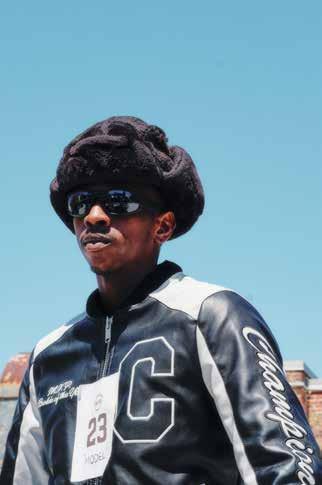
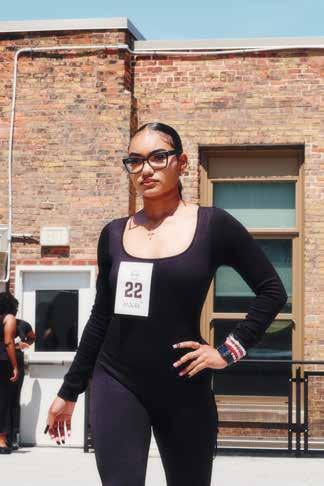
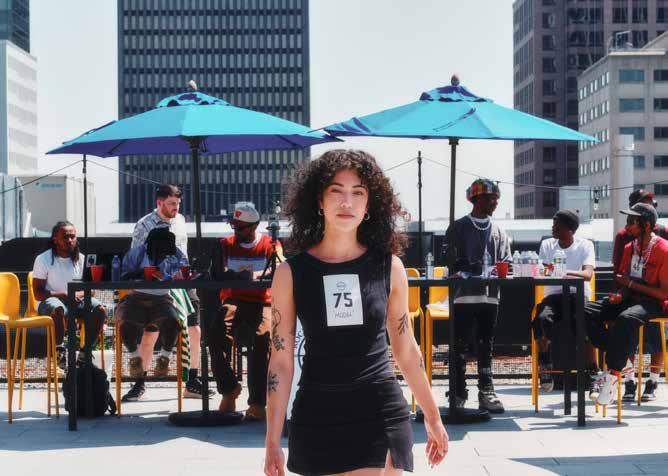
COMMUNITY THE TEAM BEHIND ROCHESTER FASHION RUNWAY IS JUST GETTING STARTED. BY LEAH STACY
46 ROCHESTER INTERNATIONAL JAZZ FESTIVAL OUR GUIDE TO THE 23RD ANNUAL FEST, FROM FOOD AND PARKING TO CLUB PASSES AND MUSICIAN PROFILES.
CITY (ISSN 1551-3262) is published monthly 12 times per year by Rochester Area Media Partners, a subsidiary of WXXI Public Broadcasting. Periodical postage paid at Rochester, NY (USPS 022-138). Address changes: CITY, 280 State Street, Rochester, NY 14614. Member of the Association of Alternative Newsmedia and the New York Press Association. Copyright by Rochester Area Media Partners LLC, 2026 - all rights reserved. No part of this publication may be reproduced or transmitted in any form or by any means, electronic or mechanical, photocopying, recording or by any information storage retrieval system without permission of the copyright owner.
of
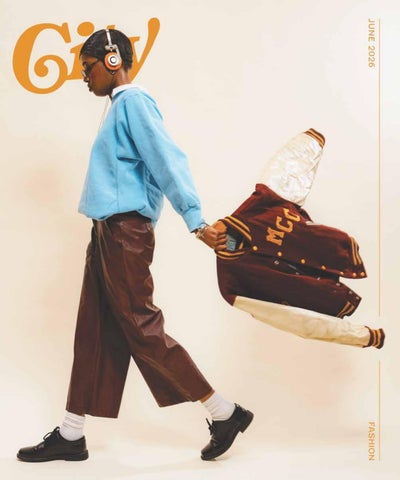
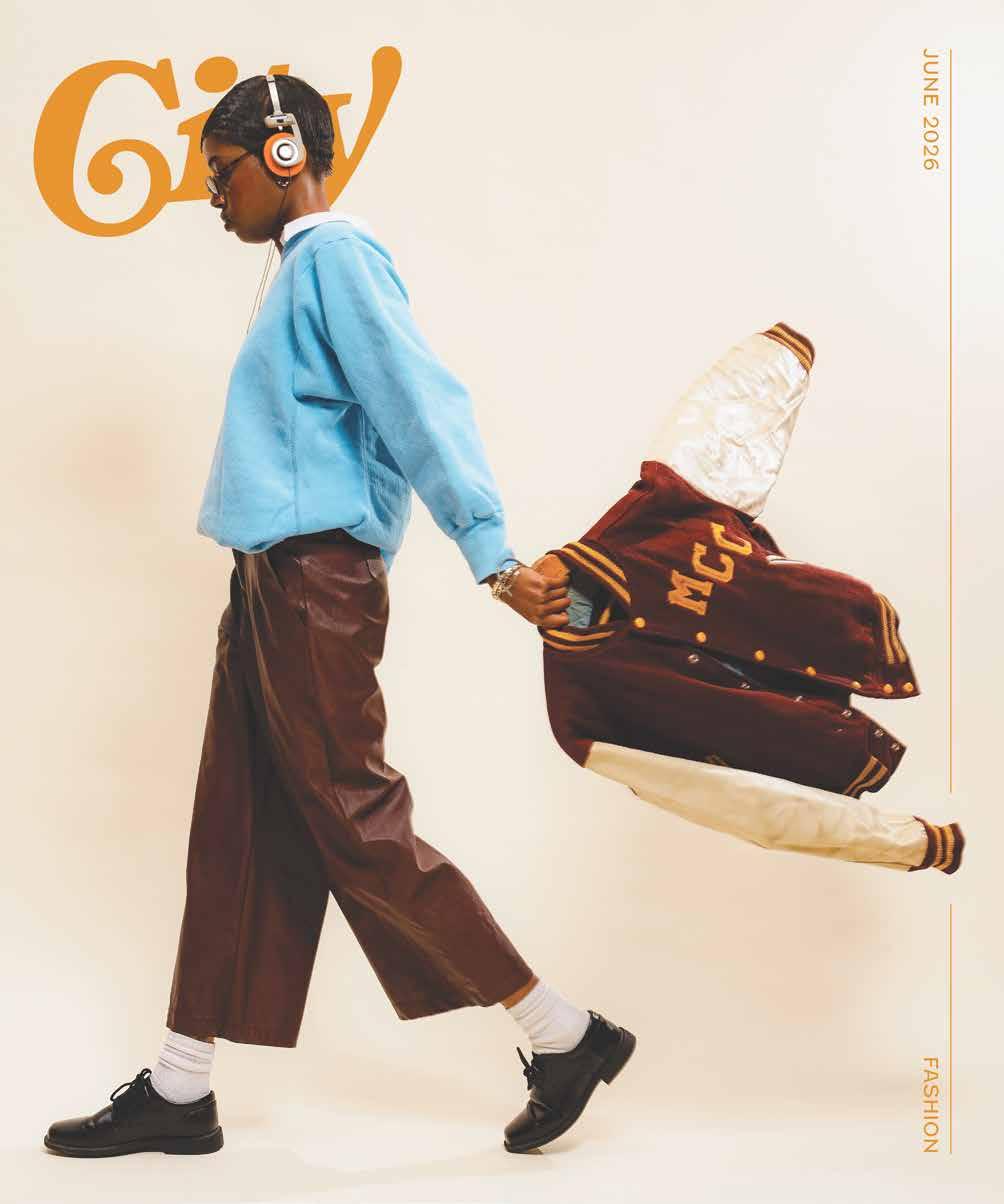
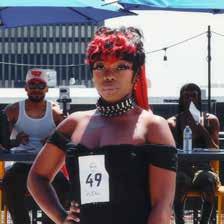
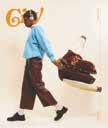
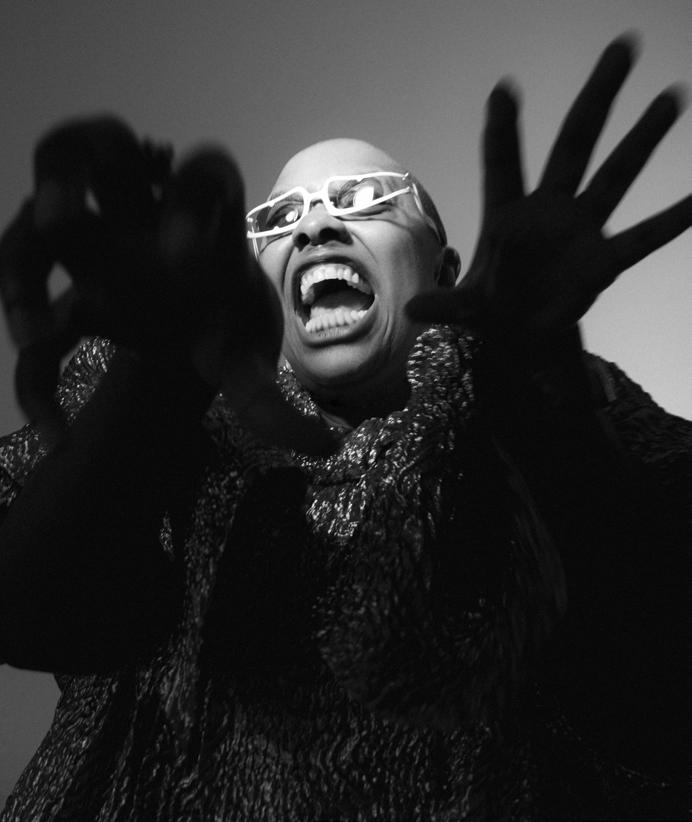
Model: Sadé Smith
Photographer:
Roberto Felipe Lagares
Production Assistant (PA):
Rudy Fabre
Wardrobe:
Clothewell Inc.
Art Direction: Jacob Walsh
The champions, my friends
PHOTO BY ROBERTO F. LAGARES
EDITOR'S LETTER
BY LEAH STACY LEAH@ROCCITYMAG.COM
Last month, I sat in a reclining chair at Cinemark Tinseltown in Gates with a cherry Coke Icee and a bucket of neon yellow popcorn. It was my first time at the multiplex in more than a decade; “The Devil Wears Prada 2” had opened in theaters that day and seeing it immediately was nonnegotiable.
I didn’t anticipate needing a trigger warning for the opening scene of the movie (without dropping spoilers, the first few minutes hit close to home if you’ve ever worked in media). And for the next 90 minutes or so, my sister kept giving me sidelong glances as the plot danced along a similar timeline to media reality. Was
I riding a delusional sugary syrupand-fake butter high, or was Anne Hathaway’s character Andy Sachs more relatable than I’d like? We’re even the same “age.” Could she save journalism? Can I and my colleagues? So much for a night of escapism at the movies.
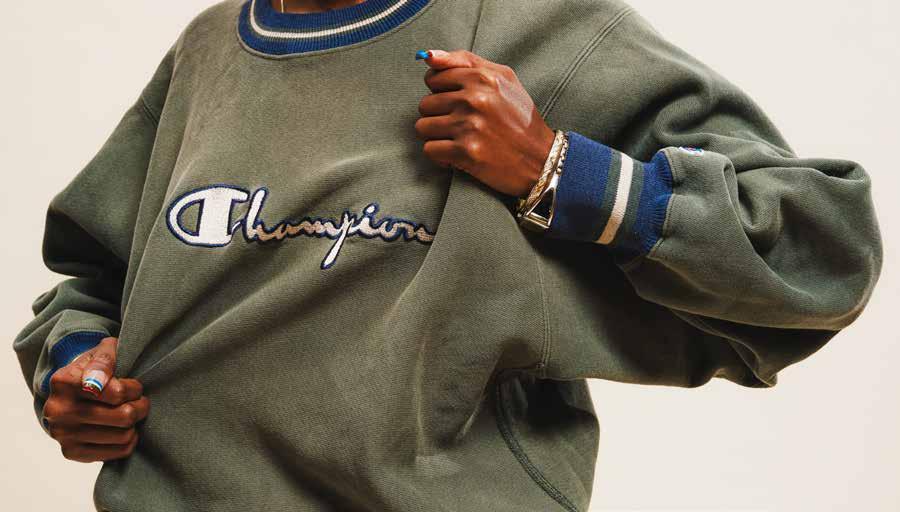
And as I drove home, it struck me as (silly) serendipity that our next issue of CITY was centered around fashion. Travel anywhere outside Rochester, mention you’re from here and it’s likely you get hit with a reference to Wegmans, garbage plates and/ or Kodak. But we’ve created a few other things here, too — including one of my very favorite inventions ever, the hoodie. I was a fully grown adult before I knew my go-to comfort clothing was invented locally in the 1930s by Knickerbocker Knitting Company (which later became
the brand Champion, which also originated here). Initially dubbed an “after hood,” the hoodie was meant to keep cold warehouse workers and athletes warm, but soon became accepted ubiquitously.
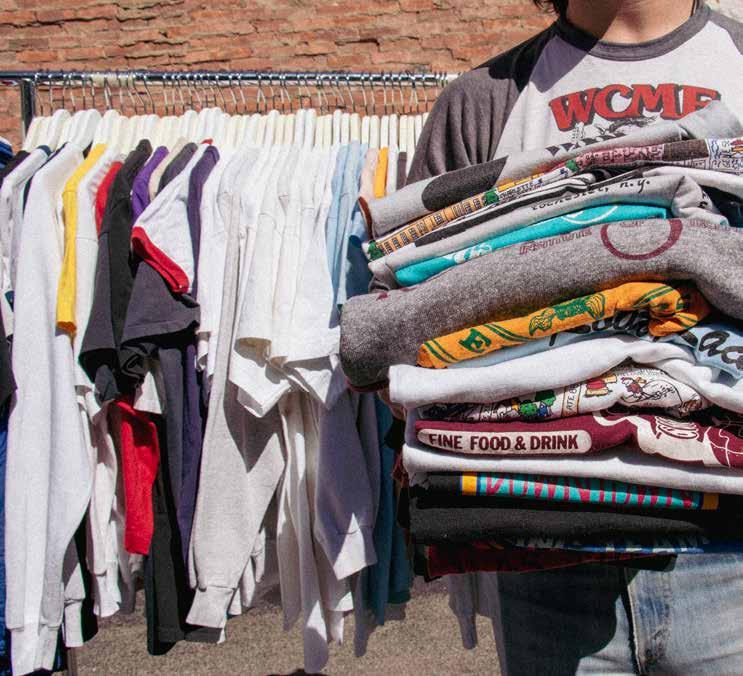
For the cover shoot, Roberto reached out to our friend Noah Baskin, who collects and resells vintage clothing including Champion items, and styled a few pieces on model Sadé Smith. (I stopped by the shoot and loved the crewneck pictured on this page so much that I bought it from Noah.)
I love the thread — pun intended — from cover through the pages inside: our first-ever Fashion issue. The goal was to shine a light on Rochester’s avid underground scene, and to be honest? We barely chipped the surface. What we did feature is equal parts inspirational and aspirational; a tribute
to the deep garment industry roots of the Flour (before Flower) City and its current wavemaking and trendshaping in the community.
In addition to being a mode of artistic and self-expression, fashion has long been used as a political statement, from Met Gala ‘fits (think Alexandria Ocasio-Cortez’s ‘Tax The Rich” gown in 2021) to T-shirt messages worn in protest and support.
As Bill Cunningham, who famously pioneered street style photography for “The New York Times,” once said, "Fashion is the armor to survive the reality of everyday life."
Consider this our contribution to the textile revolution.
Cheers,
L
Strong suit
BY JESSICA L. PAVIA
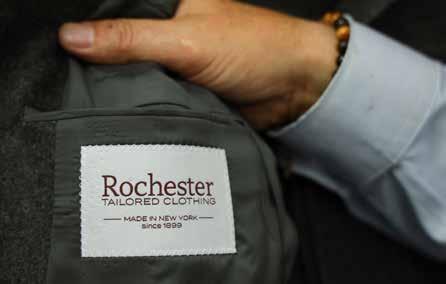
Small tailoring shops primarily powered by immigrants new to Rochester led way to a garment industry with a still massive visible legacy — in buildings, names, on clothing tags.
Companies like Hickey Freeman, which clothed soldiers during World War II, helped revolutionize the local economy with mass manufacturing of clothing. Soon, anything made in Rochester was equated with quality.
According to the 2016 WXXI documentary, “Tailor Made: The Story of Rochester’s Garment Industry”:
By 1920, the clothing-making industry is the second largest employer in the city… and nationally, it’s number four in terms of production of men’s clothing.
Today, there are few clothing manufacturers, and even fewer doing work by hand. But when it comes to men’s clothing, several custom tailors are keeping tradition alive.
ADRIAN JULES
2937 Monroe Ave. | adrianjulescustomclothier.com
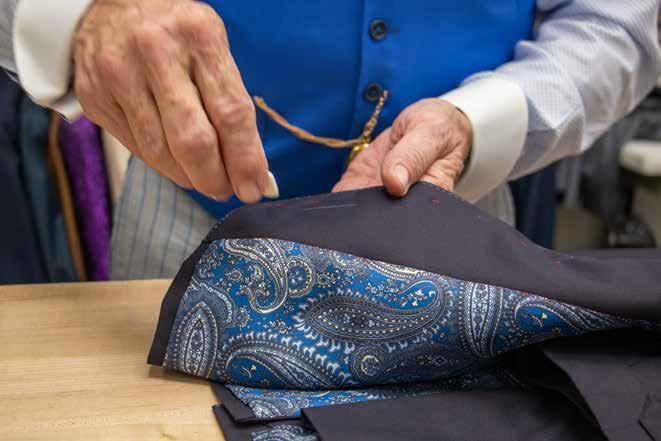
Walking into Adrian Jules, visitors are met with rows of tweed and cotton swatches. A glass vault protects even more fabric: the rare kind, dusted with gold flakes or made only a few times a year.
Adrian Jules, like most custom stores in this town, is a multigenerational family business. Peter E. Roberti and Peter A. Roberti are the father-son duo now at the
The history of Rochester men’s fashion legacy.
PHOTO BY MAX SCHULTE
helm. It was Peter E.’s master tailor father, Adriano, who started the business in 1964.
While trends have changed over the years, Peter E. and Peter A. have noticed an increased interest in custom clothing.
“We’re seeing a lot of people of a younger generation invest in their clothing,” said Peter A. “They know there’s people here making the clothing. There’s love and passion behind it.”
Not only that, but the garment is more than a piece of clothing. Attached to a new position, an award, a wedding — emotions and a sense of self are tied to the piece.
ONE CUSTOM CLOTHIERS
2423 Monroe Ave. | onecustomclothier.com
Down the road is another custom men’s tailor; the wood-soaked storeroom of ONE Custom, run by third-generation tailor Vince DiGiorgio with his son, Alessandro. Vince recognizes the oddity of Rochester still having a thriving custom scene, as most tailors now are in their 70s or 80s. “It’s really strange, and it’s only because of the clothing town that it was,” he said. “At this point in time, Rochester
is not what it used to be when we’re talking about tailors. It’s unfortunately a dying art here.”
While their suit construction is now outsourced to Italy, the initial conception of the suit, and the finishing touches, are done in-house. To ensure an accurate fit and cut down travel time of the suit, their tailors do fittings partway and only once the garment is local.
Vince and Alessandro take great pride in their work, and Alessandro mentioned a few times that he’s learning every day, preparing to take over eventually.
“The one thing I truly plan on continuing is doing this right,” he said. “The main thing is that the fit is more than anything. You can make a pattern with certain types of buttons or stitching, but it’s nothing if it doesn’t fit correctly.”
CHARLES MEN’S SHOP INC. 200 E. Main St., Batavia | charlesmensshop.com
For a bit less of a time and financial investment, Charles Men’s Shop in Batavia, family owned since 1947, offers a department store-oriented approach. Don Brown has been working there since 1994, about
10 years after his uncle bought the store; he also firmly stated what they do at Charles Men’s is not custom.
“I do that work ahead,” he said. “85% of the work is done. I buy the models people want, in the colorways they want, and then I hang [them in the store]. Now, where we’re different, (is) we custom tailor it.”
They also do made-to-measure, a process where skilled tailors fit a pre-existing garment to the customer. What’s interesting about Charles Men’s Shop is how their status as a department store has changed drastically over the years. Now, they’re considered a niche market for offering the same items they always have — and yet, they’re still here, as is the need for human touch in the garments people wear.
“The garment industry in Rochester has always been a strong suit,” Brown said.
Jessica Pavia is an English teacher and freelance culture writer from Rochester. She’s interested in the small moments and niche interests that make us who we are.
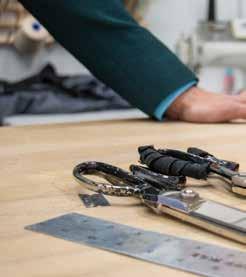
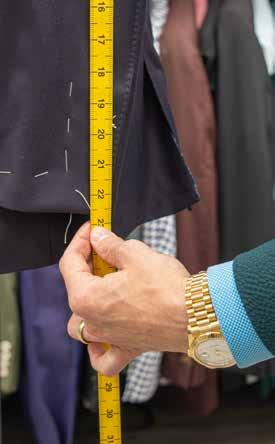
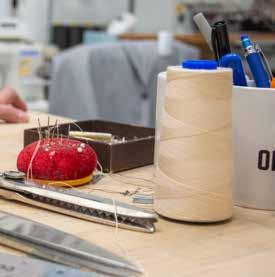
Tools of the trade at Adrian Jules Custom Clothier. PHOTOS BY JACOB WALSH
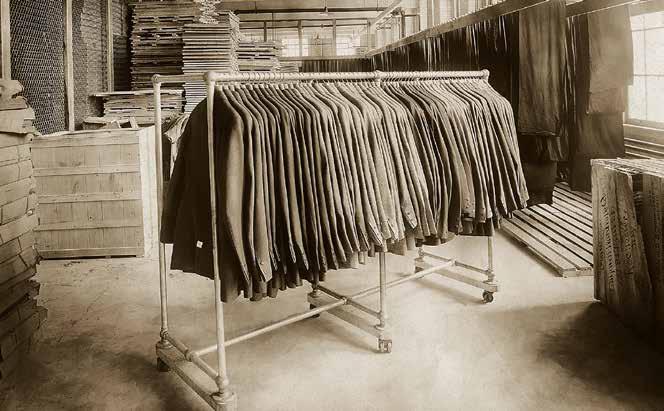
A rack of suitcoats at Hickey Freeman, circa 1912. PHOTO PROVIDED
Inside Goodwill’s efforts to position Rochester as
a regional recycling hub.
Circular fashion
SUSTAINABILITY
BY VERONICA VOLK VVOLK@WXXI.ORG
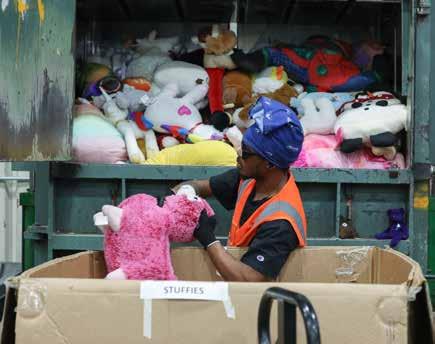
Along the back wall of the Goodwill Clearance Center on Jefferson Road in Rochester, giant cardboard boxes are stacked to the ceiling and filled to the brim with discarded clothing, sheets, curtains and stuffed animals.
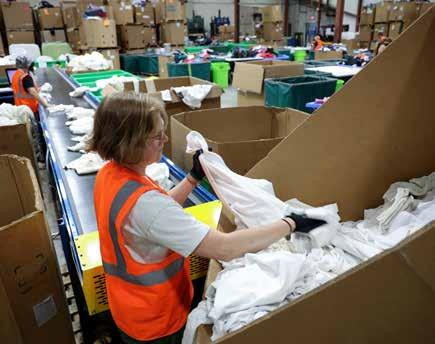
Workers in orange safety vests sort material by hand, preparing it for its next stop. Some items will be sold in secondary markets in other countries. Others will be sent to companies that turn them into carpet padding or mattress stuffing. But Goodwill president and CEO Jennifer Lake hopes that soon, they will have the technology to help even more material have a second life.
A $200,000 state grant will allow Goodwill to purchase a textile shredder, positioning Rochester as a regional hub in fashion’s growing circular economy.
“It really will give those textiles that are worn, torn and tattered another chance to become the textiles of tomorrow,” Lake said.
Goodwill of the Finger Lakes already keeps nearly 30 million pounds of material in circulation each year through resale and recycling partnerships, according to data from the organization. The new equipment is expected to expand what can be done with clothing and textiles that are too damaged to be sold. Inside the warehouse, circularity program director Ariella Knight
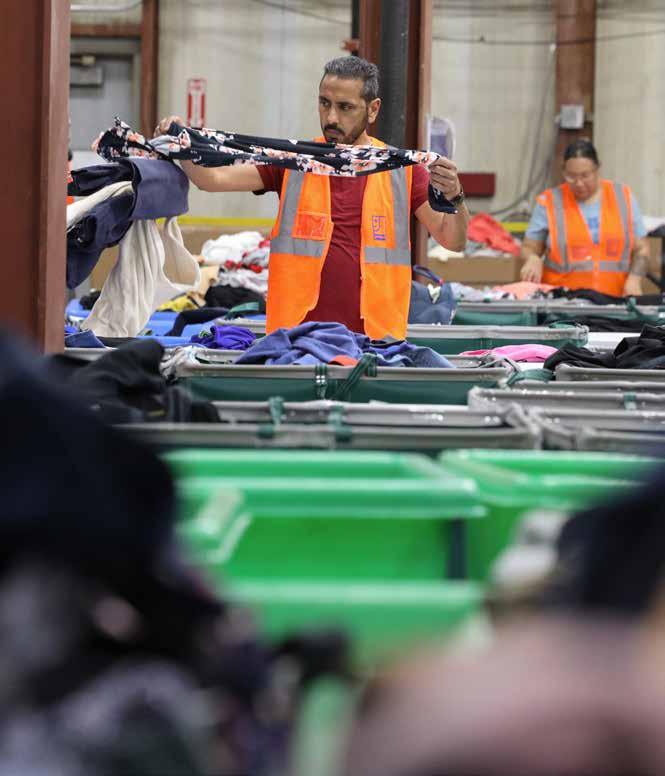
Gurpreet Malhi sorts clothing by fabric type at the Goodwill Clearance Center.
PHOTO BY MAX SCHULTE
rapidly pre-sorts garments before placing them on a humming conveyor belt.
“This is woven, and it also has a sheen to it,” she said, feeling a white tablecloth in her gloved hands. “I also see that it’s not wrinkling, so I think there’s a chance it’s polyester, and I send it down the line.” A microfiber blanket is labeled polyester. A sheet is identified as a poly-cotton blend. Another worker passes items over an infrared scanner that identifies fiber content in seconds.
Knight previously worked in costume shops in New York City and later earned a graduate degree in industrial design at the Rochester Institute of Technology. She also worked as an innovation architect at NASA. Now, she is helping build textile recycling systems in Rochester.
“One of the things that’s exciting about this process,” she said, “is that as you use the scanner, you become more fluent. It’s sort of a way to apprentice into this textile-expert position that I see as an emerging (career).”
Sorting fabric by type is important because Goodwill sells baled textiles into a global resale market, and some materials have more value for industrial recyclers.
Locally, polyester could soon
become increasingly valuable. French textile regeneration company Reju is planning a facility at Eastman Business Park that they say would add 70 jobs. The focus will be on chemical recycling, which breaks down polyester-rich materials into new fiber.
Before it gets to that point, breaking down fabric is still a physical process. Workers remove buttons, zippers and metal grommets by hand because those materials can jam mechanical recycling equipment. The shredder would change that.
Goodwill’s senior vice president of business operations and circularity, Joyel Bennett, said the shredder will automate some of the most labor-intensive steps and increase the volume of textiles Goodwill can process.
“For textile recycling to really work at scale, you want to be able to do it a lot faster than you could ever deconstruct by hand,” she said.
Efficiency and sustainability are common themes throughout the warehouse. Workers said many of their personal habits reflect the mission, including driving hybrid cars, reducing disposable products and shopping secondhand.
Goodwill’s culture of reuse extends beyond the building as
Jennifer Lake, president and CEO of Goodwill of the Finger Lakes.
PHOTO BY MAX SCHULTE
well. Through their annual event Sustainability Under the Stars, the organization partners with local designers, students and community groups who create upcycled fashion from reclaimed materials and thrifted pieces. The next event, scheduled for September, culminates in a live fashion show featuring designs made almost entirely from Goodwillsourced materials. (The call for designers runs May 20 through June 20, with participants to be announced in July.)
Back inside the clearance center, surrounded by mountains
of garments, workers are already imagining what comes next.
“I think before I started working here, I would have hoped that this is the kind of effort that was happening,” Knight said. “It’s so wonderful and gives me hope for the future that it actually is.” goodwillfingerlakes.org
Veronica Volk is an audio journalist and podcast enthusiast at WXXI. On instagram @soundslikeveronica.
Workers sort through donations at the Goodwill Clearance Center. PHOTOS BY MAX SCHULTE
Sole purpose
An Italian cobbler still has tread in the trade, even as it fades.
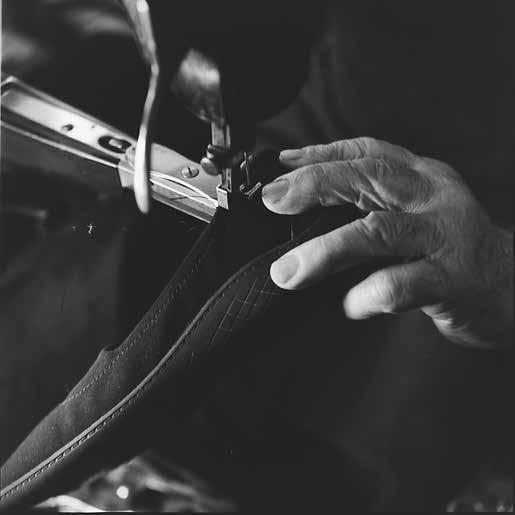
WORDS AND PHOTOS BY ROBERTO F. LAGARES
“What do you want to be when you grow up?”
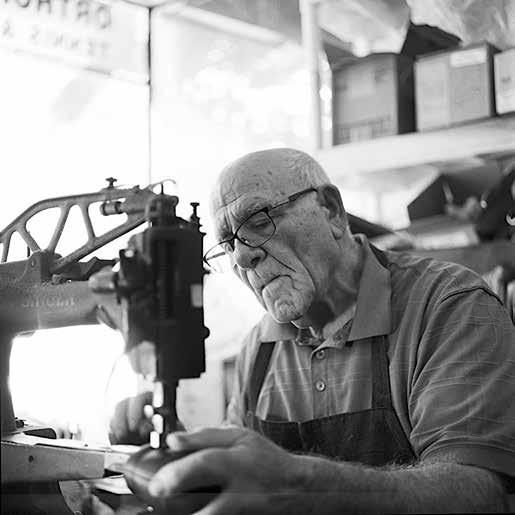
The age-old question seems impossible to answer. There is a domino effect of fear and doubt — endless possibilities await, but the uncertainty of the unknown is ever-present. For Mario Gagliardi, there was never an opportunity to second guess his future.
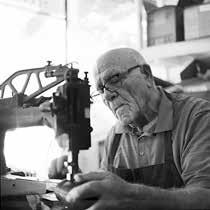
“Where I come from, when we reach the fifth grade, we don’t have no more school to go any higher,” Gagliardi said. “So you have to learn something, you know — tailor, mason — so I choose shoe repair.”
Gagliardi was 12 when he started learning the cobbler trade as an apprentice under his uncle. He was born and raised in the city of Matera, Italy, but his parents eventually decided to move to America for more opportunity. The family immigrated first and Gagliardi followed in 1964, via a nine-day boat ride from Naples.
As a young adult, Gagliardi left Utica for Rochester to continue his craft, working for a shoe repair shop in Westgate Plaza for seven years until leaving due to a shifting landscape.
“I changed my job because shoe repair was declining all the time,” he said.
The decline Gagliardi experienced in the the 1960s never changed course. According to the Bureau of Labor Statistics, the height of the trade was in the Great Depression Era with an estimated 100,000 to 120,000 shops. Today, that number is around 3,500.
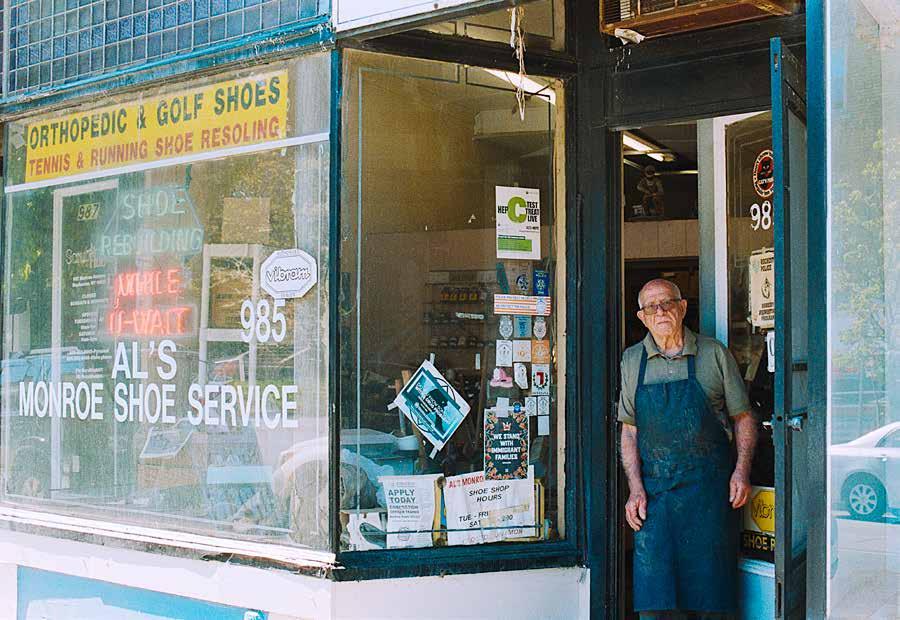
Gagliardi worked at Kodak until his retirement in 1998. Decades after leaving the cobbler industry, Gagliardi got a call from a friend, Al Riolo, asking for help. Ten years prior, Riolo opened Al’s Monroe Shoe Service at 985 Monroe Ave.
“I met him right away the first day I came here in Rochester,” said Gagliardi. “He used to come help us at Westgate.”
Gagliardi took over the business in 2014 after Riolo passed away. Twelve years later,
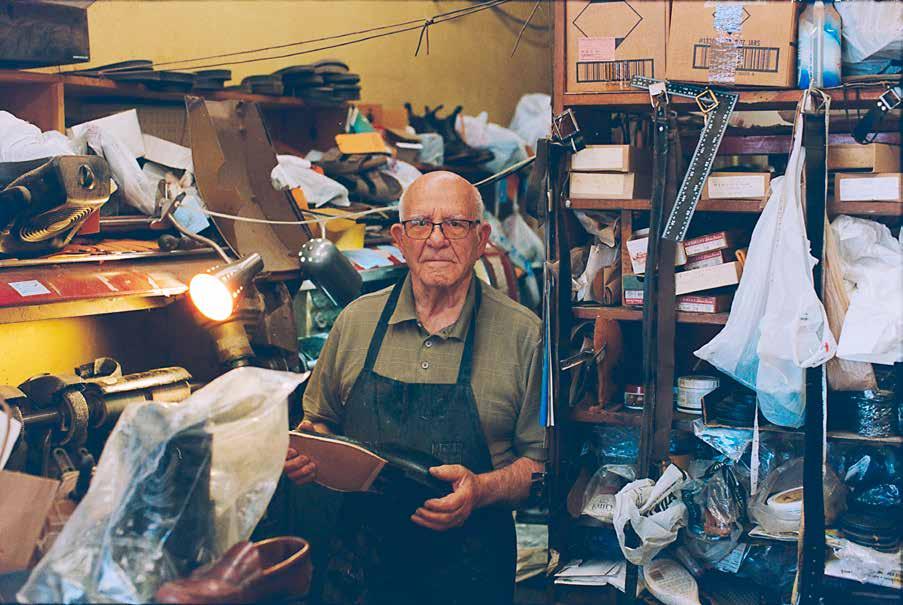
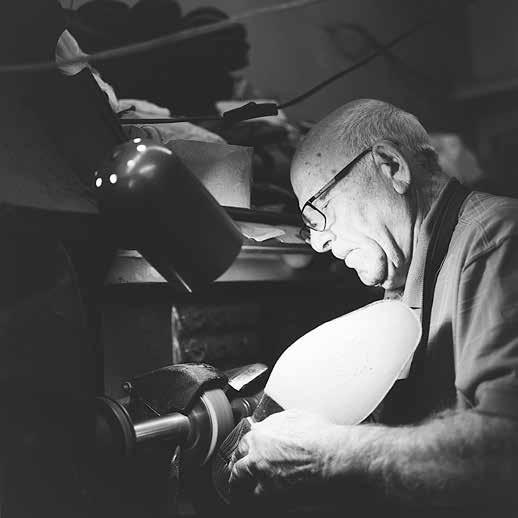
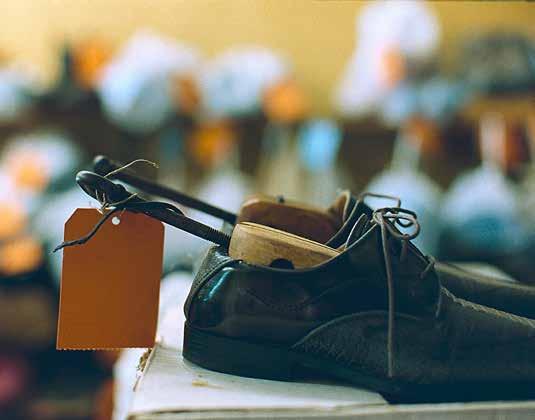
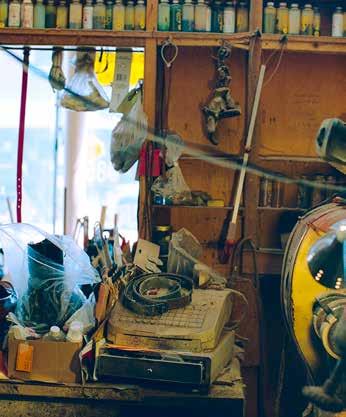
he’s still operating out of the same location, a space that could be described as ‘the size of a shoebox,’ every shelf, drawer and corner filled with anything from shoes to be worked on to new soles and replacement heels.
“It’s not a good system,” he laughed. “But, I know where everything is.”
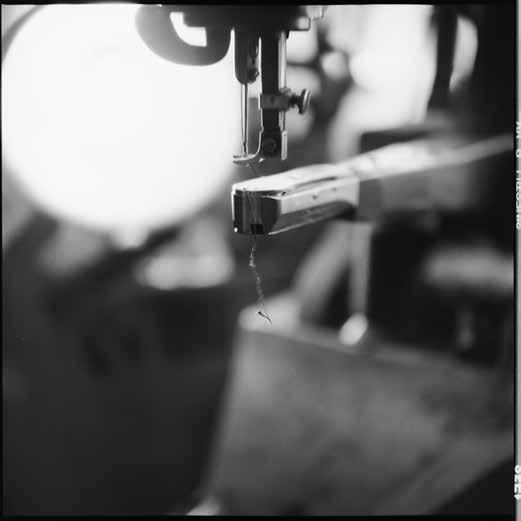
Gagliardi can fix, as he described, “anything with leather,” from resoling a worn pair of Birkenstocks to replacing heels and repairing belts or purses. He’s careful to never bite off more than he can chew and mindful to keep the most important tools — his hands — in working condition.
Over the years, Gagliardi said he’s occasionally had younger people come in looking to learn the trade, which he politely declines.
“I don’t have the time to teach them and there is no money in this,” Gagliardi said.
It took six years of apprenticeship under his uncle before Gagliardi went out on his own in Italy. At 87 years old, it is not the money that keeps his doors open — he frequently credits his retirement from Kodak for the ability to continue operations. It is the joy of the craft and helping people that keeps Gagliardi coming back five days a week to the storefront that still features Al’s name.
“He was my friend and he learned just like me,” Gagliardi said. “He started when he was a little kid in Sicily.”
It’s been nearly 75 years since Gagliardi decided to learn the trade, build a life that took him to a new country, get out of the cobbling industry and go back again. The shoemaker “Mario Gagliardi,” as he proudly stated through his thick-as-leather Italian accent, still hasn’t worn through his passion.
“I can’t wait in the morning to get up and come here,” he said. “I love this.”
Roberto Felipe Lagares is CITY’s multimedia reporter and has an unruly amount of film cameras on his person at all times. You can follow him @bertoscamera.
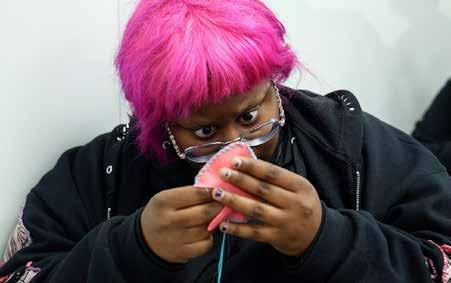
Students spent the spring semester learning how to sew, mend and
embroider.
RIT class pushes back on fast fashion
EDUCATION
BY VERONICA VOLK VVOLK@WXXI.ORG
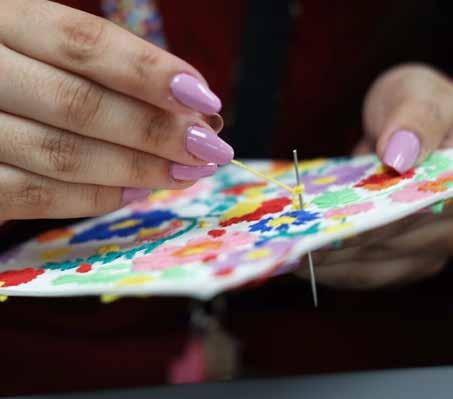
On a Tuesday afternoon in the basement of Wallace Library at Rochester Institute of Technology, students sit cross-legged on the floor passing around needles and thread. Fabric scraps spill from homemade tote bags. A small group works on stitching together a banner.
It feels less like a college lecture and more like a sewing circle, which is exactly the point.
“I think that anyone who has attended a setting where you get people together, crafting and chitchatting, they absolutely get how beneficial it is to the human spirit,” said professor Hinda Mandell.
Mandell’s class is called “Global Craftivism, Gender and Handwork,” and it teaches sewing, mending and embroidery as tools for community and conversation. As they stitch, the students discuss sustainability, inequality and the value of making something slowly and by hand.
Americans throw away roughly 17 million tons of textiles every year, according to the U.S. Environmental Protection Agency. Much of that is fueled by the rise of fast fashion: cheap clothing designed to be worn briefly and discarded quickly.
But in Mandell’s classroom, students are trying to build a different relationship with their clothes.
Nikki Murello, a game design major, first learned to sew by
stitching patches onto a denim jacket. Eventually, the hobby became more practical: fixing worn-out jeans, eventually rescuing secondhand finds from thrift stores.
“I like being very conscious about the things that I buy and the places that I buy them from,” Murello said.
Across the room, Valentine Johnson wears a thrifted hoodie covered in handmade patches cut from an old T-shirt.
“If you can even sew up one T-shirt or one hoodie or just a pair of jeans and give it new life, that’s super appealing to me,” Johnson said.
As class discussion drifts from environmentalism to personal finance to phone addiction, the needles never stop moving.
Mandell, who also has an Instagram around yarn-based activistism projects, crochets while she lectures. The work, she said, is about more than clothing.
“I think classes on crafting and thrifting and mending and stitching really put people in the here and now,” she said. “It makes them encounter what it means to be a human.”
In the fall, RIT will offer another crafting class simply called “Thrifting and Mending,” also taught by Mandell. instagram.com/crochetactivism
Veronica Volk is an audio journalist and podcast enthusiast at WXXI. On instagram @soundslikeveronica.
Valentine Johnson hand stitches a project during a “Global Craftivism, Gender and Handwork” class led by Professor Hinda Mandell at Rochester Institute of Technology. PHOTO PROVIDED
Secondhand gifting, curated for the recipient.
Bundles of joy
CULTURE
BY TEN GARDNER
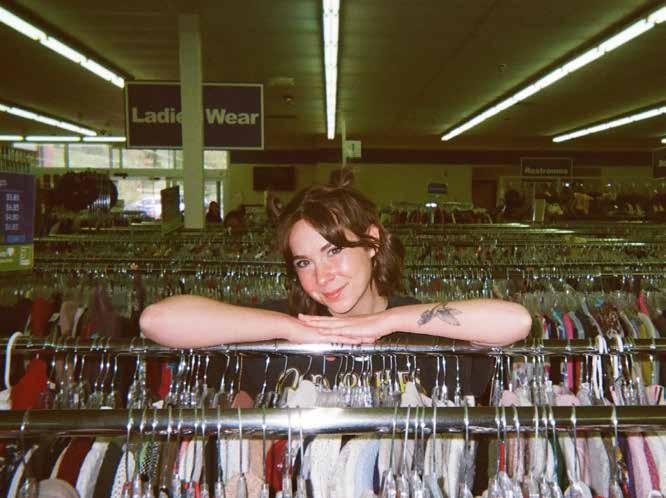
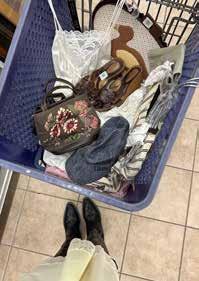
Put together a Pinterest board, color palette and size guide, and 29-year-old Meredith Thorpe will be your personal secondhand shopper. Her popular “thrift bundles” include 11 pieces on average — tops, bottoms, shoes and accessories — all plucked specifically for the recipient from a thrift store. The only catch is that her orders are indefinitely on hold as she fulfills her lengthy waitlist.
Get to know Thorpe, and it becomes clear why she’s in such demand: she moves through the world with uncompromising exuberance. The landscape of social media is oversaturated with businesses interested in nothing more than turning a profit, and people can sense that. So when they meet Thorpe, someone invested in helping her community, she stands out. Not only does she have good taste, but she’s the kind of person who stands for what she believes in and refuses to sacrifice her morals or her joy in pursuit of capitalistic success.
“Places like Goodwill or Amvets or Salvation Army, they were originally made for people who can’t afford retail,” Thorpe said. “So, I think to go in there and just take what you can because you want to make money, I struggle with that because you’re taking away quality items from people who can’t afford it.”
Thorpe’s demographic of young consumers wants to patronize businesses that align with their values of sustainability and community. They see themselves reflected in Thorpe, someone stepping outside of survival mode and into joyful creative expression.
When the economy crashes and gas is over $4 a gallon, joy for the sake of it becomes more elusive. Thorpe’s
essence, her joyful morality, is the most valuable asset to her business. You’re not just paying for thrifted clothes; you’re paying for her brand, aesthetic and taste. What Thorpe sells is both sustainable and psychological; she’s a cool girl with a moral compass, and maybe if a cool girl picks out your clothes, you’ll be cool, too.
“I’m not losing any money, I tend to break even most of the time,” she said. “I mostly do it because I get a lot of fulfillment and enjoyment out of people realizing that they can do it, too, and that they can get quality items secondhand.”
Thorpe’s thrift bundle services
might not be scaleable to mass consumption, but the ability to trust your own instincts is readily accessible. So check out her Instagram, get inspired, and take your neighborhood Goodwill by storm. instagram.com/ meredithorpe
Ten Gardner is a Rochester-based writer committed to fostering community between creatives. Follow them @tenxfollowers.
Meredith Thorpe. PHOTO PROVIDED
Sweaters handmade in Peru
land on the Rochester Fashion Week runway.
An international legacy
CULTURE
BY JINELLE VAIANA
This year’s Rochester Fashion Week (RFW) is being reimagined to include a greater focus on social justice and a greater clarity on the event’s role as fundraiser for the Center for Youth.
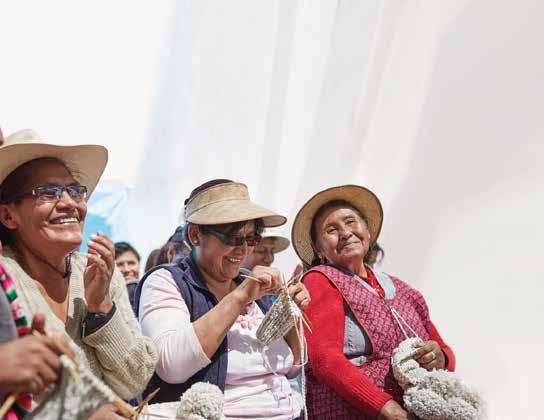
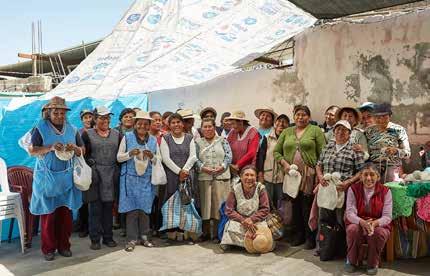
While the RFW runway has showcased local brands and artists for the past 15 years, this year will feature something slightly unexpected — a global perspective, thanks to sweaters donated by Eileen Fisher, made by workers in Peru.
Eileen Fisher is a minimalist clothing brand that has long led ethical fashion and environmentally conscious sourcing. In recent years, the brand has partnered with a Fair Trade Certified factory in Arequipa, Peru called Art Atlas. The sweaters set to grace RFW’s Friday show in October were manufactured there.
The factory employs more than 270 workers — including more than 175 women, most of whom are single mothers providing for their families. As a Fair Trade Certified factory, Art Atlas workers are guaranteed a fair wage, and the factory meets strict social and sustainability standards. Workers also control a fund, which they decide how best to invest in
their community.
Elaine Spaull, executive director of Center for Youth, said the connection to Fair Trade USA came via her daughter Maya, who worked for the nonprofit for about 15 years and grew the organization’s textile projects.
“The result [of Maya’s vision and work] was many women and families were now provided housing, education, access to nutritious food and water, access to transportation — all the things that the Center for Youth works toward locally,” Spaull explained. “The connections between Fair Trade USA and the Center for Youth through social and racial justice are clear and consistent.”
When Maya died four years ago at age 42, Spaull started the Maya Dream Fund to continue her daughter’s work and further her legacy by supporting women and families through Fair Trade. It was then she was introduced to and found great appreciation for the work happening at Art Atlas.
Eileen Fisher’s fair-trade sweaters will be modeled on the RFW runway by “loved ones and guardians of social justice and equity,” said Spaull. Those models will include women who value and support the work of the CFY and some who knew Maya personally.
The three-day annual fashion
event raises funds for the CFY’s homeless shelters, transitional living programs and Crisis Nursery sites. The organization is “the sole provider of homeless beds in Monroe County for youth who are unaffiliated with families,” said Spaull. Last year, CFY served more than 35,000 young people throughout the county.
Showing the Eileen Fisher pieces on RFW’s runway builds on the values being explored throughout the night, including “thoughtful production, human connection, sustainability, and the stories behind what we wear,” said Julia Sibley, founder of Storied personal styling and curator of RFW’s Friday night show.
“Friday’s runway is designed around the themes of family, heritage, craftsmanship, and clothing built to last,” she added, “spotlighting fashion not as trend or spectacle, but as something deeply connected to identity, culture, care and community.”
fashionweekofrochester.org
Jinelle Vaiana is a freelance writer and proofreader, and a self-proclaimed “word nerd.” When she’s not obsessing over commas, she enjoys live music, gardening and perfecting her popcorn game.
Workers from Art Atlas in Peru.
PHOTO PROVIDED
PHOTO PROVIDED
Vintage, to a tee
BY KELLEN BECK
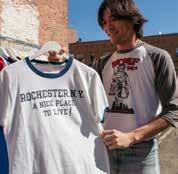
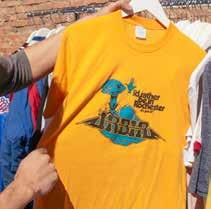
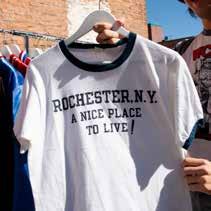
Standing just off the curb on a street downtown, Gordon MacKay leans into the rear passenger door of his car. He holds up a shockingly yellow T-shirt. An affable blue alien named Irbir holds up a four-fingered hand in greeting. He looks like a cross between E.T. and something Luke Skywalker would nod to inside the cantina on planet Tatooine. Bold black letters next to him read, “I’d rather be in Rochester,” above the smaller tagline, “It’s got it!” — a defunct marketing slogan and mascot for the city that only lasted a couple of years.
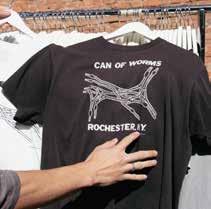
The shirt, copyright 1982, is one of 100-plus vintage Rochester fashion items in MacKay’s collection. He peeled off shirts one by one from a crisp stack lying on his back seat. There was a shirt celebrating the opening of a new Wegmans store in 1994; one marketing the Red Wings Ticket Club with a dopey-looking cartoon guy holding a frothy Genesee Beer glass in 1981; and a gray shirt from 1987 covered in white earthworms, laid out in the form of the city’s infamous Can of Worms junction of Interstates 490 and 590 and Route 96..
MacKay’s collection has grown over the last two-and-a-half years as he’s rummaged through thrift stores and fleas, scoured online marketplaces and even asked to buy clothes off peoples’ backs. Arranged for a later date, of course.
“I’ve been able to do a couple different buyouts from people who owned the pieces originally, and
NOSTALGIA
they come with stories,” he said. “They represent different things that cohesively build into the really dynamic identity of Rochester, which I really love. I love Rochester.”
A Williamson native who just graduated from SUNY Geneseo and was accepted into Nazareth University’s psychology masters program, MacKay is an all-vintage guy. When we met, he listed off his wardrobe’s decades-of-origin. A faded blue, logoless cap from the ‘90s. Jeans, also from the ‘90s. A longsleeved, white-collared rugby shirt with thick green and blue stripes from the ‘50s.
Now living in the city of Rochester, his penchant for collecting old Rochester gear offers him a glimpse into local history. One muted yellow shirt he holds up from his car is from the Seneca Park Zoo in the ‘70s. A portrait of the chimpanzee Jimmy is featured in the top middle, a great ape who lived at the zoo to a recordsetting 55 years old.
Look around anywhere and you’ll see someone wearing some 20-to-60-year-old, one-off, freebie T-shirt advertising an old business or product or destination. It can be both a fashion statement and a conversation starter.
MacKay makes money both working for The Lucky Flea and selling vintage clothes online. He has hundreds, maybe a thousand-or-so items that he’s procured for resale in his apartment. But the Rochester stuff he keeps for his personal collection.
Sarah Pavia, owner of the curated Second Look Boutique in the South Wedge, has seen the rise in popularity of vintage clothes across all ages.
“Nineties- and Y2K-era clothing has been especially hot lately and doesn’t stay on our shelves for long,” she said, adding that Rochester pieces, especially, fly out the door. “The area loves embracing their love of Roc.”
Aside from some of the older and more fragile pieces in his collection, MacKay wears his vintage finds out and about “all the time,” part of his mind for sustainability in fashion.
“I like the idea of not buying new clothes,” he said. “There’s more than enough that’s already out there.”
At this year’s Lilac Festival, he and his girlfriend, Evelyn Hochreiter, were rocking vintage fest merch and they were stopped multiple times by people who wanted to talk about the
old clothes. It’s a semi-regular occurrence for MacKay, and goes both ways. One day he ran into someone wearing a 96.5 WCMF shirt from the ‘80s. His name was Zack, and it turned out his dad was a local radio legend – Dave Kane.
“I didn’t know he was his son,” MacKay said. “I wanted to know if I could buy (the shirt) right off his back. He said, ‘No, I have personal connections to this one. But my dad might have some old ones.’”
That’s how MacKay wound up making acquaintance with Kane-O, who hosted popular radio blocks Breakfast with the Beatles and Workforce on WCMF from the 1980s up into the 2020s. Now MacKay owns a handful of ‘80s and ‘90s shirts from the station, plus a pair of Kane’s personally embroidered and flashy WCMF jackets.
A bookcase in MacKay’s Rochester apartment has been repurposed to display stacks and stacks of these venerated historical artifacts. To keep everything neat and uniform, he bought a shirt folding board, the kind they use in retail stores. He’s always on the lookout to add to his collection. instagram.com/ lilaclaundry
Kellen Beck is a Rochester-based writer whose most-prized piece of fashion is a Sterling Marlin Kodak Film Racing NASCAR hat from the mid ‘90s. You can email him at kellentbeck@gmail. com.
Gordon MacKay shows off a stack of his vintage Rochester T-shirts.
PHOTOS BY JACOB WALSH
Immigrant-owned boutiques outfit — and educate — across cultures.
Compliment economy
CULTURE
BY SUHASINI PATNI
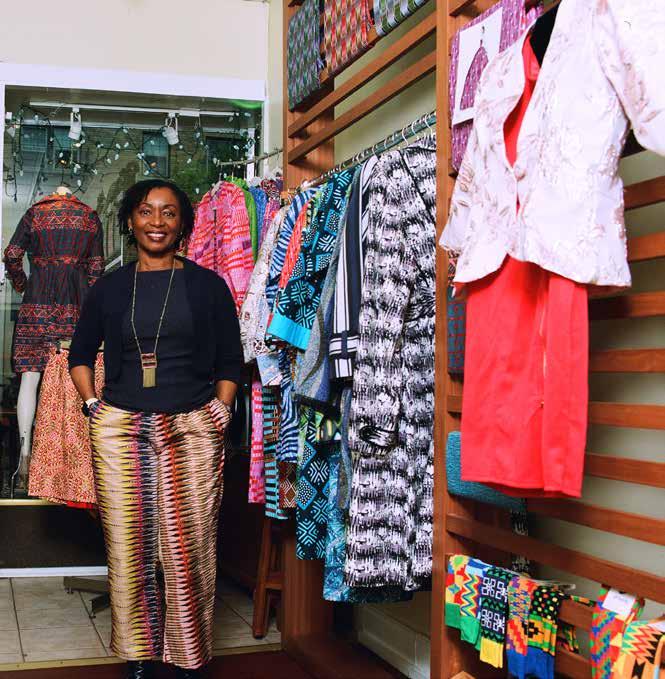
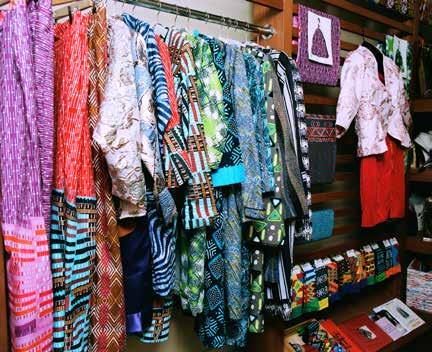
Over 20 years ago, Nita Brown was changing in the locker room at a local YMCA and her lockermate, Theresa Mazzullo, complimented her clothes. It was their usual interaction. Brown, who grew up learning about fashion from her seamstress mother and grandmother in Ghana, had been combining traditional Ghanaian patterns and fabrics with modern silhouettes for years. When she worked at Kodak, she would wear a tailored jacket instead of the usual cardigan. Her clothes made her stand out, and the constant compliments pushed her to launch Mansawear, a boutique on Park Avenue named after her grandmother, in 2013.
“My style is a unique fusion: modern-themed Ghanaian fabrics blended with mix-and-match pieces from my existing wardrobe, what I call ‘The Mashup,’” Brown said.
Aneela Perwez, who immigrated to the United States from Pakistan in 2005 and lived in New York City before moving to Rochester, had similar experiences. She would be decked out in cotton salwar kurtas while shopping at Wegmans and get stopped constantly.
Nita Brown owner of Mansawear.
PHOTO BY RUDY FABRE
“I would be told I’m wearing beautiful clothes,” she said. “People wanted to buy them and would ask me for recommendations, but there was no place to buy Pakistani clothes in Rochester.”
In New York City, the South Asian community was large, so buying fabrics and traditional clothing was not an issue. In Rochester, however, online shopping was Perwez’s only option.
“I was always shopping for clothes online, but the colors look different in pictures,” she said. “You can’t feel the fabric; you can’t tell if the embroidery is cheap or sturdy.”
In 2022, Perwez opened the by-appointment-only Riwaayat Fashion Boutique next to her family’s Brighton Xpress Mart on Monroe Avenue. Shoppers will often find her working at the mart as she sets up client appointments and takes care of her three children.
“‘Riwaayat’ means tradition,” she said. “That’s what I wanted to see in Rochester.”
For both the boutiques, customization is key. Shoppers walk in, browse through the fabrics and readymade pieces, and then they can order something truly unique. Bridalwear, engagement parties, or just a casual day out — everything’s on the table.
Mansawear’s clothes are made in Ghana and Riwaayat’s clothes are made in Pakistan, their respective home countries, and both women have local tailors and seamstresses on call for any alterations. Most importantly, both sell beautiful, oneof-a-kind clothes — a rare treat in today’s fast fashion-obsessed world.
“Rochester is a very cosmopolitan city,” Brown said. “No one is boxed in by fashion trends. My store starts a conversation. My customers are my community.”
But she adds it wasn’t an easy journey.
“When I started, it was the age
PHOTO BY RUDY FABRE
of dial-up internet,” said Brown. “It wasn’t easy to send orders to Ghana. I got my MBA from Georgetown in 2000. The industry has completely changed since then. I had to adapt.”
Today, Brown teaches a course on entrepreneurship at Monroe Community College and has also presented in local K-12 schools, offering internships to high schoolers and reiterating that immigrant businesses play a huge role in the larger Rochester community.
Because of Brown and Perwez, West African and South Asian communities have a place to get their clothes, but some customers worry about cultural appropriation.
“If I rely on the Ghanaians to buy my clothes, I’ll be broke,” Brown, adding that the Ghanaian community in Rochester has shrunk since the downsizing and restructuring of Kodak and Xerox.
“Sixty percent of my business comes from white women,” she said. “I used to do social media shoutouts for the amazing people who visited my store. But three years ago, I turned it into a blog on my website. These women are city counselors, educators and executives. Their stories inspire me and I’m so glad that the store brought me closer to them.”
Perwez found her way to the larger Asian community through Riwaayat, designing clothes for Afghani and Turkish brides while
connecting with Indians and other Pakistanis in the area.
“Americans love our clothes, but they don’t know where to find them,” she said. “When they get invited to Indian weddings, they need help selecting the appropriate outfits and jewelry. I can guide them and it’s always a very positive experience. They know my clothes are authentic.”
At the mall, Perwez finds a lot of modern brands inspired by traditional South Asian clothing.
“There’s a resemblance. Everyone is making our scarves and kurtas now. But the embellishments and embroidery we can provide, especially with our affordable costs, is unbeatable,” she said. “Plus, Americans can understand our fashion more through the store.”
In a world of mass-produced clothing and short trend cycles, both women are here to stay as fashion continues to evolve.
“You grow into your style,” Brown said. “That’s why I always say I want to design clothing that lifts you.” mansawear.com, instagram.com/ riwaayatfb_official
Suhasini Patni is a freelance writer from Jaipur and Rochester. Her work has appeared in “Los Angeles Review of Books,” “Asympote Journal,” “Mekong Review” and elsewhere.
PHOTO BY RUDY FABRE
All the world’s their stage
COMMUNITY
BY LEAH STACY LEAH@ROCCITYMAG.COM
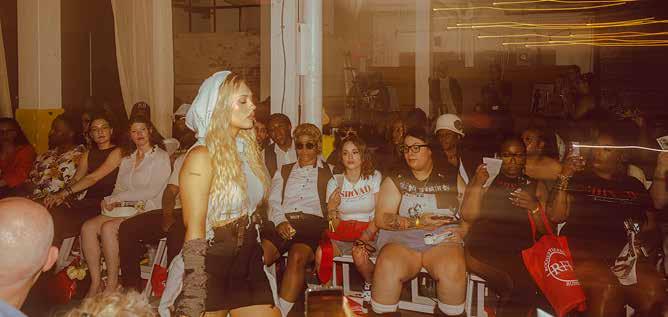
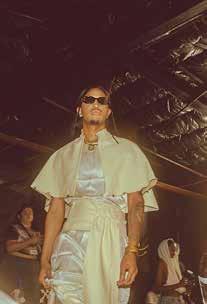
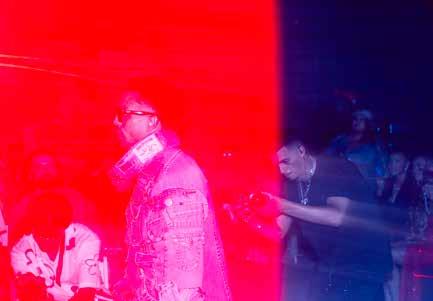
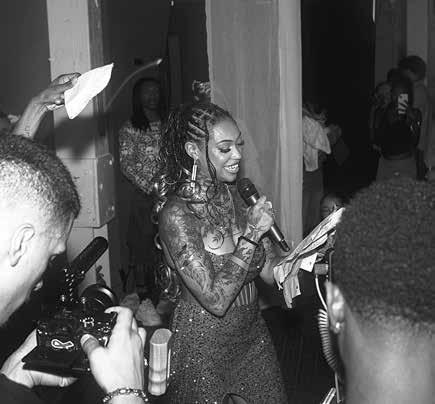
On a humid 90-degree day last July, nearly 400 people sat shoulderto-shoulder inside the Fedder Building on East Main Street. Handheld fans and sweating bottles of Modelo took the edge off, and any discomfort was forgotten as the first-ever Rochester Fashion Runway program began. For the next two hours, more than 10 designers, 20 performing artists and 100 models presented the region’s most hip underground fashion show — one that sold out to standing room only and immediately outgrew the rambling warehouse in its first year.
To understand how such an event was executed in just 10 months requires understanding the team at work behind the scenes — in particular, founder and executive director Aliyah Delice. Rewind to December 2024, when then-restaurant server Delice and photographer Rudy Fabre (who also freelances for CITY Magazine) took a roadtrip down the thruway for Buffalo Fashion Runway, a large-scale event then in its second year. Fabre was shooting the show and invited his friend Delice because she was newly interested in the fashion scene after being recruited to model for
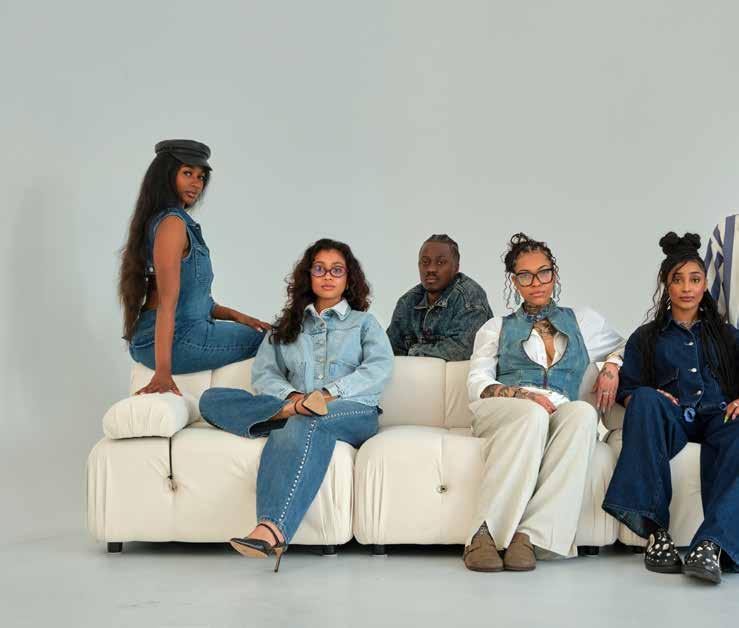
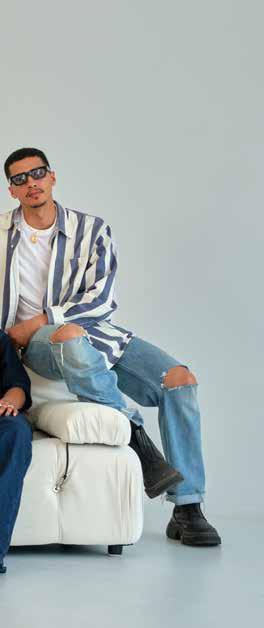
The team behind Rochester Fashion Runway is just getting started.
boutique owner Chantiza Singh while serving her table at Roux on Park Avenue.
When the duo arrived at Shea’s Buffalo for the show, Fabre was off to shoot, and Delice was tempted to pull out her phone but noticed everyone else was networking. So, she began talking to other local leaders her age until the program started.
“Then the lights go down and this girl is on a piano, singing. Then they have interpretive dancers on the runway, and I was like, ‘Oh, shit, I’m in for a show,’” Delice said. “Models come out, rappers come out, then this woman comes out of a suitcase. The whole ride home, I’m like, ‘Rudy, how the hell do we bring this back to Rochester? And he said, ‘you just do it.’”
Delice had a winding career path up to that point. She spent time serving tables and working at a country club where she landed an internship to learn software engineering. There, she had a manager who identified her people skills.
“He said, “You talk too much to be a coder, I’m gonna take you under my wing and introduce you to other areas,” Delice said. “He introduced me to customer service and project management, which I liked, because it’s really just people management.”
If Delice was going to pull off a version of Buffalo Fashion Runway in Rochester, she knew the team would be important. She had operations experience, but her fashion resume only extended to walking the runway a few times for Rochester Fashion Week, an annual fundraiser for the Center for Youth.
Delice’s first call? Rudy Fabre, who was there when the idea was born. Their next recruit was Tay Wheats, a creative with a knack for marketing. The team grew to six, then nine, now including Fphasieth Jimmeson, Ayanna Sampson, Rafael Rodriguez, Alexis McLemore, Allan Johnson and Emily Burritt. Delice’s strategy, ultimately, was to find people smarter than her in other areas.
“I know how to put an outfit together for myself, but I don’t know anything about PR. I didn’t know anything about model coordination,” she said. “But I know how to put events together and make people feel special, because that’s what I’ve been doing all my life.”
Delice’s next task was convincing the team to pull off an event in just 10 months.
“I had some resistance, but I’ve been somebody that has constantly gotten stuck in the planning phase,” she said. “I knew if we really wanted to pull this off, it would have to be soon.”
The biggest hurdle was finding a venue that aligned with the team’s vision. At the time, Delice was bartending at Good Luck
and one of the owners, Chuck Cerankosky, had been co-hosting and DJing raves at the Fedder Building, a cavernous space that houses WAYO Radio and other tenants. Delice reached out to the building manager, Patrick Dutton, on a whim.
“As soon as I walked in there, I knew it was exactly where we were having the first show,’” she said. “I told Pat, ‘I don’t care what needs to happen to make this happen. We’re doing it here.’”
Nine months later, the same space was filled with more than 400 fashion enthusiasts and creatives, most from BIPOC communities, in their 20s and 30s. Searnie Knight, a local social
The Rochester Fashion Runway team in 2025.
PHOTO BY RUDY FABRE
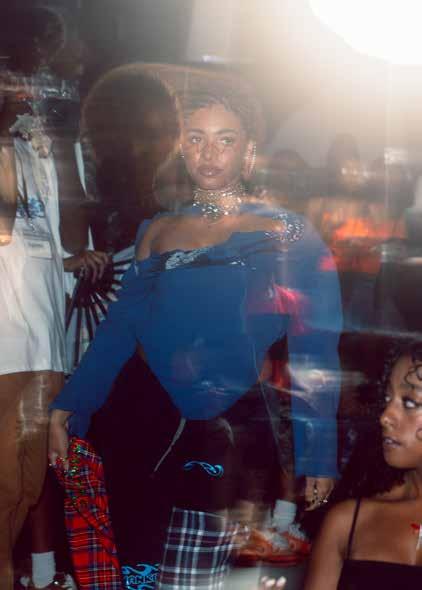
Madelyn Quinlan walking in "Veil of Influence," Rochester Fashion Runway's first show in 2025.
PHOTO BY ROBERTO F. LAGARES
media influencer, co-emceed the Rochester Fashion Runway show with Adrian Franco.
“I’d never been a host before, but I wanted to get behind this, especially since it was the first year,” Knight said. “I told them I was ready to hit the ground running whenever they were.”
Knight has been involved in the local fashion scene since birth — her parents co-founded New York Stylee on Monroe Avenue 30 years ago as an answer to the outfit compliments they got while club and bar hopping. Now, Knight addresses her followers as “Styleestas” and runs marketing for the shop.
Knowing my parents’ small business and my dad being a designer as well, it’s so important to support other designers, fashion houses and people putting on fashion events,” Knight said. “There’s the artists that make art and perform music, and there’s art within fashion as well.”
Knight also partners with many festivals around town to create content; last year, she spearheaded an initiative during Rochester Fringe Festival where 12 local designers reimagined Fringe apparel over the festival’s 12 days.
“The fashion and designer scene in Rochester is punching well above its weight in all aspects,” Knight said. ”And the way the RFR team was set, the way the designers were put together, the way the marketing was, I couldn’t believe that was their first show. They’re going to keep killing it.”
The first sold-out RFR show created such a strong demand for more that Delice, who was concurrently apprenticing as a tattoo artist and now works full-time in that field, and her team went right into planning the next.
“We collected a lot of testimonials from people and screenshotted all the DMs and it was just crazy,” she said. “Everyone’s like, ‘we need this once a season, we need this bad.’”
An hour into the casting call for this year’s RFR show last month, more than 60 models had strutted down the rooftop “runway” on the sixth floor of The Sibley Building on East Main Street. It was an unseasonable 80 degrees for midMay, and the nine fashion designers and RFR staff watching auditions took frequent shelter under a few umbrellas scattered around the space.
Scenes from "Veil of Influence," Rochester Fashion Runway's first show in 2025.
PHOTOS BY ROBERTO F. LAGARES
Founder and executive director, Aliyah Delice.
PHOTO BY ROBERTO F. LAGARES
Social entrepreneur Chad Williams, co-founder of Buffalo Fashion Runway, and a few other friends were there to support; the teams now stay in touch regularly. BFR was founded in 2023 by Williams and four others — Dan Abbotoy, Eman Wajed, Rodney Chatmon and Caine McDermott — as a “cultural non-profit leveraging fashion as a tool for storytelling, education, and collective action.”
Their five shows and various community outreach events have been so well-received that Williams, 27, who also has a clothing line called Due Process (named for a wrongful criminal accusation he experienced in 2019), left his full-time job to become executive director of BFR. Early in her planning process, Delice reached out to ask if she could replicate the model in Rochester.
“That first meeting, the (BFR) team saw ourselves in (the RFR team), and we said, ‘yeah, definitely do this in Rochester,’” Williams said. “They’ve been doing a phenomenal job. We want them to keep soaring and winning and moving in unity as they do great things.”
As for Delice and the RFR team, that’s the goal.
The 2026 RFR will take place September 5 at The Hochstein School, 50 N. Plymouth Ave., which allows for a little more planning time.
“We love the history behind (The Hochstein School),” Delice said. “The ties to the Black community, the ties to the female community — we love being able to shine a light on Rochester itself.”
Where last year’s “Veil of Influence” was about the past, the 2026 show, “Living Provenance,” will focus on the present.
“It matters more now than ever, especially with the political climate that we’re in,” said Delice. “At the end of the day, we’re all creatives: people who put on outfits, shoot pictures, design clothes, create mediums of art. I hope we touch more of our community. I hope more people know who we are and what we stand for.” instagram.com/rochesterfashionrunway
Leah Stacy is the editor-in-chief of CITY Magazine and producer of Rochester Cocktail Revival. She loves to plan travel around dining and theater experiences. Find her reposting poetry and today’s egg @ leahstacy.
Scenes from the 2026 Rochester Fashion Runway casting call. PHOTOS BY RUDY FABRE
todo DAILY
Full calendar of events online at roccitymag.com
SUNDAY, JUNE 7
FESTIVAL
Fairport Canal Days
Village of Fairport, fairportcanaldays.com
Vendors, artists, and food and drink stalls line the streets of downtown Fairport for this annual celebration of life on the venerable Erie Canal, a 200-year-old stretch of waterway that Herman Melville describes in “MobyDick” as “one continual stream of Venetianly corrupt and often lawless life,” chock with sinners, metropolitan freebooters, and howling pagans. Much has changed in the last two centuries, and Fairport has developed into quite a charming spot. Free to attend. KELLEN BECK
COMEDY
Tig Notaro
Kodak Center, kodakcenter.com
A comic’s comic, Tig Notaro has an effortless style that’s as disarming as it is dry. Her storytelling is fueled by a bubbling undercurrent of constant deadpan jokes and unexpected punchlines, executed with incredible timing. These days, Notaro tends to look inward with her comedy, covering her own life and family in her sets with personal and intimate anecdotes. The show starts at 7 p.m., tickets $43+. KB
NIGHTLIFE
Bar Room
Battle Royale
Radio Social, rochestercocktailrevival.com
Bartenders from around the city go shaker-to-shaker in the annual Bar Room Battle Royale — the culminating event of the weeklong Rochester Cocktail Revival — but only one will claim mixological supremacy. Ticket price includes admission to the Bar Ninja competition and spirit tasting tables. Drink specials and snacks from Radio Social and other vendors will be available, all set to a live soundtrack by DJ Chreath and emceed by your fave dad duo Chuck Cerankosky + Patrick Stetzel. Judges for this year’s competition include V Spehar (AKA UnderTheDeskNews), New York Times bestselling author Jonathan Graziano, sommelier Thera Clark and last year’s champion, Studio Lounge. Tickets are $20 online, $25 at the door. LEAH STACY
MONDAY, JUNE 8
FILM
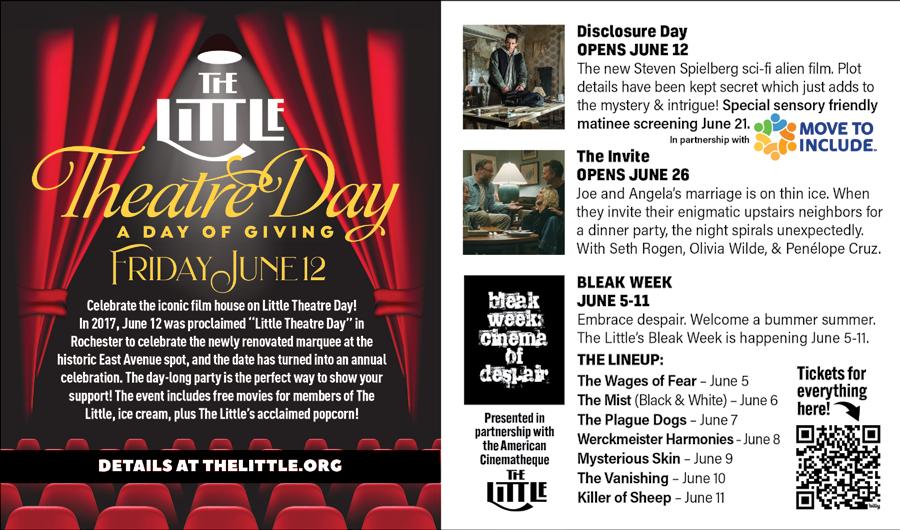
Bleak Week
The Little Theatre, thelittle.org Bleak Week at the Little Theatre combats the bright and sunny start of summer with a schedule of dismal, distressing and depressing films, running from June 5-11. With flicks
like “The Plague Dogs” on the 7th, in which two dogs are hunted down as suspected carriers of a plague, or the unnerving weirdness and total societal collapse in “Werckmeister Harmonies” on the 8th, Bleak Week is a perfect cure for those summertime– what’s the opposite of blues? Showtimes vary, but the vibes stay bad. Tickets $7-12.
KB
TUESDAY, JUNE 9
ART
Print Club of Rochester
Members Exhibition
MCC’s Mercer Gallery, printclubofrochester.org
The Print Club of Rochester hosts an annual exhibition for its printmaking members to showcase their artwork together, and this year’s lineup is hosted at Monroe Community College’s Mercer Gallery. Woodcuts, lithographs, linocuts and all kinds of print styles are on display from local artists in the club, which got its start in 1930. The exhibition runs through July 2, and the gallery is open Monday to Thursday 11 a.m. to 7 p.m., Fridays 11 a.m. to 2 p.m. KB
WEDNESDAY, JUNE 10
LITERATURE
“Harvest Season” book tour
ARTISANworks, artisanworks.net
Dark romance author Brynne Weaver stops in Rochester on tour for her latest book “Harvest Season,” the second book in her steamy and bloody Seasons of Carnage trilogy. Weaver, whose Ruinous Love trilogy is a New York Times Bestseller, will be partaking in a Q&A and book signing organized by Burn Bright Books. The event is sold out, but there’s a waiting list for all you hopeful, horny bookworms out there. Tickets are $45 and the event starts at 6 p.m. KB
FOOD + BEV
Midday Bash
Parcel 5, downtowndefinitely.com
If the daily grind is wearing you down, take some time away from the old day job to enjoy some food and fresh air at this month’s Midday Bash, put on by the Rochester Downtown Development Corporation. Parcel 5 will be home to eight local food trucks, music, massage chairs and giveaways for anyone that stops by between 11:30 a.m. and 1:30 p.m., a perfect lunchtime getaway. For this Bash, the small business spotlight shines on Side Bar. KB
FESTIVAL
Flower City Poetry Fest
Highland Park Bowl, wab.org
From June 10-12, the Highland Bowl is filling up with poetry in the open air. Featuring poetry and live music performances, the third Flower City Poetry Fest put on by Writers & Books features headliners Kimiko Hahn (2025-’27 New York State Poet Laureate) and Rochester’s Cornelius Eady, who recently read one of his poems at the inauguration of New York City Mayor Zohran Mamdani. Entry is pay what you can, $0-50, and the event runs 6-8 p.m. all three days. KB
THURSDAY, JUNE 11
THEATER
“A Streetcar Named Desire”
The Company Theatre, thecompanytheatreroc.org
Poetic and powerful, Tennessee Willams’ most enduring work “A Streetcar Named Desire” cries out (STELLAAAAA!) for beauty and grace in a dark, graceless world. This production, which closes The Company Theatre’s 2025-26 season, is directed by founding artistic director Carl Del Buono and runs through June 21. A pay-what-youwish performance is Thursday, June 11, a post-show talkback with the cast and creatives is Sunday, June 14, and an ASL-interpreted performance is Saturday, June 20. A portion of ticket sales from the ASL-interpreted performance go to the Rochester Deaf Kitchen. LS
FRIDAY, JUNE 12
SPORTS
U.S. vs. Paraguay World Cup watch party
East & Alexander, instagram.com/eastandalex
The area around East and Alexander downtown is closing down for an open-air World Cup watch party. With two big screens showing the tournament’s opening soccer match between the United States and Paraguay, plus food trucks and live music performances from Zac Brown Tribute Band and DJ Napps, it’s about as American as a soccer-focused block party can get. The festivities are free to attend and runs from 5 to 11 p.m., kickoff is at 9. KB
THEATER
“Anastasia: The Musical”
Geva Theatre, gevatheatre.org
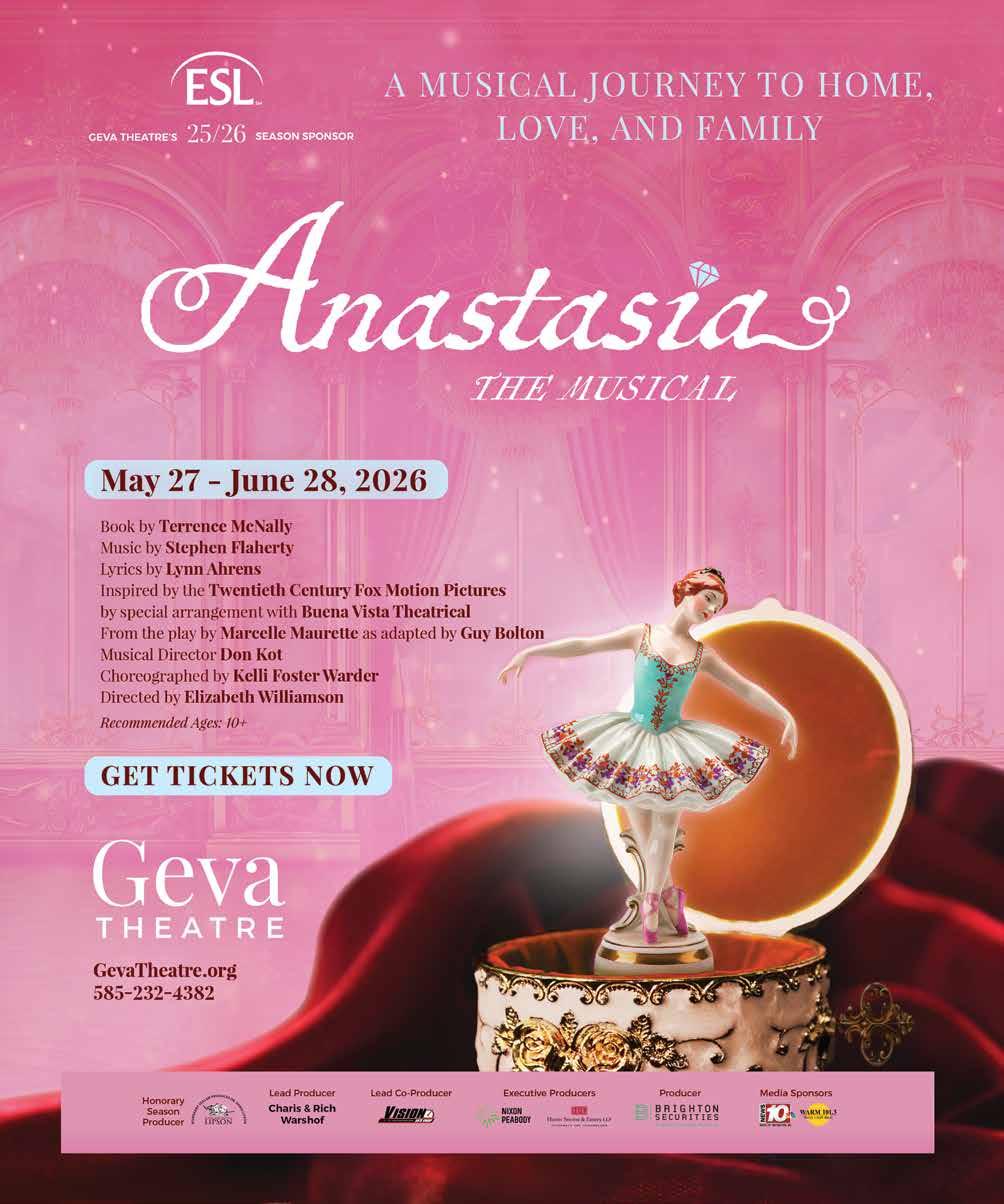
After the revolutionary Bolsheviks descended upon the Russian royal family in the 1910s, it was long rumored that Anastasia, daughter of Tsar Nicholas II, escaped execution and became the only surviving family member. In “Anastasia,” a young woman named Anya with amnesia tries to remember her past but gets caught up in a scheme when two men attempt to capitalize on her resemblance to the famed Grand Duchess. Geva Theatre’s run of the musical goes through June 28, with shows daily except Mondays. KB
SATURDAY, JUNE 13
FESTIVAL Freedom Festival
Levi Corser Park in Bristol Center, bristolhillshistory.org
The towns of Canandaigua, Bristol and South Bristol are teaming up to celebrate America’s 250th with a two-day recreation of an earlyAmerican frontier town at Levi Corser Park in Bristol Center, complete with Revolutionary War reenactors, craftspeople (think blacksmiths, loghewing, sheepherding, with farm animals and kids’ games). Add food, live folk music and costumes for a full experience from 10 a.m. to 4 p.m. Saturday and Sunday. LS
FESTIVAL
Northfield Common
Creators Fest
Northfield Common in Pittford, pittsfordchamber.org
This is the fourth annual outdoor festival presented by RocOnly Events, NOTION gift shop and Neutral Ground Coffeehouse at Northfield Common, a unique shopping destination located next to the towpath of the Erie Canal in the Village of Pittsford. The event brings together a curated mix of local artisans alongside food trucks, live music and a dedicated kid zone, all in one easy, walkable setting. Visitors can also take part in interactive offerings like tarot readings, a braid bar, pet portraits, on-the-spot poetry, permanent jewelry and a mobile plant truck. Shops will be open throughout Northfield Common during the 11 a.m. to 4 p.m. fest. LS
RECREATION
Adirondack
Mountain Club’s Outdoor Expo
Mendon Ponds Park, gvc-adk.org
Can’t pitch a tent? The 26th annual Outdoor Expo has you covered. For one day, partake in demonstrations and workshops for hiking, canoeing, kayaking, backpacking, camping, bicycling and other related outdoor activities, as well as sustainability, all presented by a variety of local clubs and organizations. Live music from Golden Link Folk Singing Society, and plenty of food (including ice cream), will be there — plus, a petting zoo. Sponsored by the Genesee Valley Chapter of the Adirondack Mountain Club and Monroe County Parks, the festival will take place at Mendon Ponds Park, in the beach parking lot near Canfieldwoods Shelter from 9:30 a.m. to 3:30 p.m. Admission is free. LS
SUNDAY, JUNE 14
FESTIVAL
Father’s Day Celebration
International Plaza, cityofrochester.gov/internationalplaza
The International Plaza plays host to a Father’s Day celebration from 1 to 5 p.m., with live music from Western New York salsa group La Krema and a community domino tournament. This is on top of the usual International Plaza Sunday Market fare, including vendors selling Latin food and drinks and plenty of entertainment. Free to visit. KB
FESTIVAL Celtic Faire
Genesee Country Village & Museum, gcv.org
Hear the sounds of bagpipes, watch Highland games and Irish dancing, shop specialty vendors, enjoy traditional foods and explore a variety of pan-Celtic traditions. Kilts welcome! This much beloved annual event takes place at Genesee Country Village and Museum from 10 a.m. to 4 p.m. both June 13 and 14; admission required. LS
MONDAY, JUNE 15
MUSIC
Planet K-Pop
Kodak Center, kodakcenter.com Korean pop has truly taken over the planet. Groups like BTS and Blackpink, and franchises like “K-Pop Demon Hunters” have blown the genre up over the last decade or so, thanks in large part to the South Korean government’s heavy investments into the arts. The Planet K-Pop show at Kodak Center is a tribute to the musical phenomenon out of East Asia, covering a slew of hot K-pop tracks combined with the genre’s iconic choreography. The show starts at 7 p.m. and tickets are $50+.
KB
TUESDAY, JUNE 16
ART
“Flea
Market, a window into the past”
Image City Photography Gallery, imagecityphotographygallery.com
Photographer Steve Levinson turns flea market finds into artwork. On display all month until June 14, Levinson’s collection examines these artifacts of life that are up for sale and their dual identities as both something old to the seller and something new to the buyer. All in sepia-toned black and white, the photographs have a historical, Americana feel to them. The University Ave gallery is open Tuesday through Saturday noon to 6 p.m., Sunday noon to 4 p.m. KB
The Irondequoit Beer Company is filling up their outdoor patio space with a lineup of music sprinkled throughout the summer. There are a couple of matinee performances by Stephens and Sparkles of the band Dial Up (June 14) and Anthony Blood from Judah (June 21), and evening shows with Manny Lopez (June 17), White Woods (June 20) and Cool Club Sisters (June 27). Pairs well with classic brewery fare and a whole bunch of beers on tap, plus cocktails and other libations. KB
THURSDAY, JUNE
18
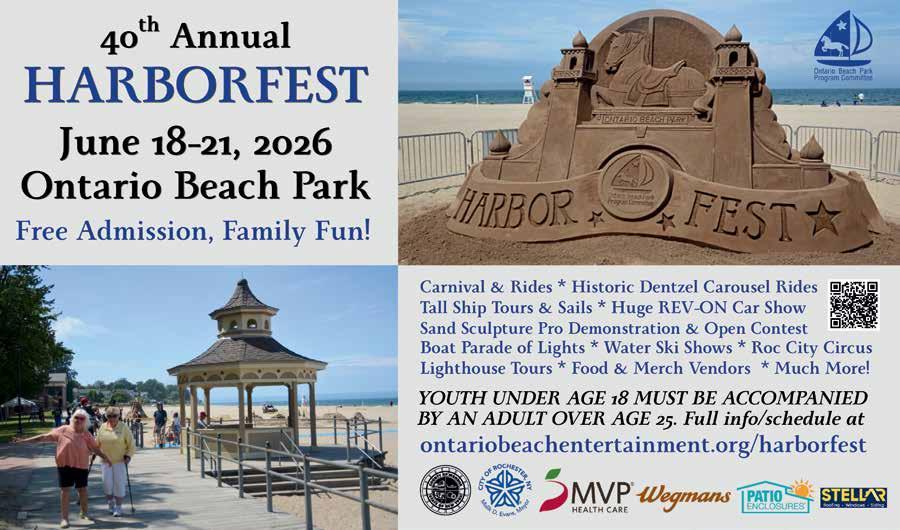
FESTIVAL Harborfest
Ontario Beach Park, ontariobeachentertainment.org
Kicking off on Thursday and continuing through the weekend around Ontario Beach Park, Harborfest brings a whole slew of summer fun to our stretch of the great Lake Ontario: food vendors, carnival rides and games, live music, sand sculptures, water ski shows, and a visit from a tall-sailed fishing schooner built in 1893. The full schedule of activities (most of them free) is available online. Open 5 p.m. to 10 p.m. Thursday, 7 a.m. to 10 p.m. Friday and Saturday, 7 a.m. to 6 p.m. Sunday. KB
FRIDAY, JUNE 19
FESTIVAL
Rochester International Jazz Festival
Various, rochesterjazz.com
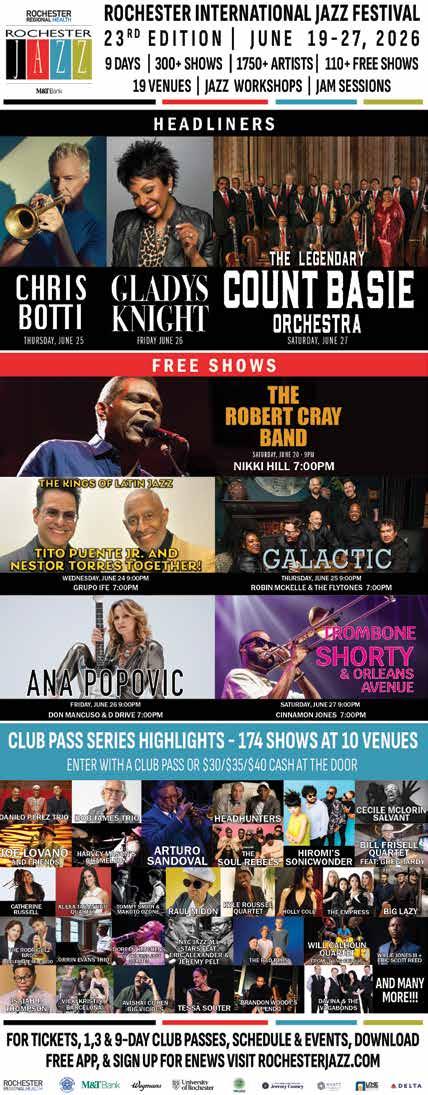
The 23rd edition of the Rochester International Jazz Festival transforms downtown Rochester into a walkable celebration of world-class music across 19 venues. Featuring 300+ shows, including more than 110 free concerts, jam sessions and workshops, the festival showcases over 1,750 artists from around the world. The 2026 lineup includes Bob James (June 20), Arturo Sandoval (June 21), Hiromi (June 23), Chris Botti (June 25), Gladys Knight (June 26), Count Basie Orchestra (June 27), and Trombone Shorty & Orleans Avenue (June 27), plus many more. Experience up to 20 shows each night during one of the most immersive and musically diverse festivals in North America. LS
MUSIC
Celebrating John Coltrane
Kodak Hall at Eastman Theatre, rochesterjazz.com
The sweeping, Earth-shattering opening of John Coltrane’s 1965 album “A Love Supreme,” which delicately unfolds into an infectious, leading bass riff and legendary saxophone run, changed music permanently. It’s been 100 years since the jazz legend was born and almost 60 since he died, but his 10year career remains one of the most impactful in all of music. A jazz show celebrating Coltrane, featuring four different illustrious saxophonists, piano, drums, and bass kicks off at 9:30 p.m. Included in the Jazz Fest club pass, or $40 at the door. KB
SATURDAY, JUNE 20
MUSIC
Bleachers
CMAC, cmacevents.com
It’s been a dozen years since Bleachers blew up with the anthemic singles “I Wanna Get Better” and “Rollercoaster,” spinning off from the short-lived pop rock group Fun. Band lead Jack Antonoff has had a penchant for producing some of the biggest hits of the last decade-plus for artists
like Taylor Swift, Sabrina Carpenter, Kendrick Lamar and Lorde, helping to steer the sound of pop into its modern incarnation. Bleachers hits the stage in Canandaigua with supporting acr Wednesday at 7:30 p.m. Tickets $49 and up. KB
SUNDAY, JUNE 21
MUSIC
Bonerama
Theater at Innovation Square, rochesterjazz.com
Not one, not two, but three trombones form the bulk of New Orleans band Bonerama. Playing trombon-ified covers and funky originals, Bonerama helps push the boundaries of what trombones can do with the help of some drums, guitar, bass and sousaphone. With two shows, the spit valves start filling at 6:30 and 8:45 p.m. Tickets are $30, free for Jazz Fest club pass holders. KB
MONDAY, JUNE 22
MUSIC
The Headhunters
Kodak Hall at Eastman Theatre, rochesterjazz.com
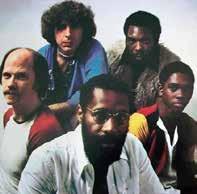
Masters of rocking, jazzy funk, the Headhunters first came together in 1973 for Herbie Hancock’s massively popular and influential “Head Hunters” album. After putting out a few records, the sound and the vibes were so good that the group continued on without Hancock. Coled by Bill Summers on percussion and Mike Clark on drums, the jazz fusion sounds continue to live long and strong. The Head Hunters’ set at Kodak Hall starts at 7:30 p.m. $40 at the door, or included in the Jazz Fest club pass. KB
TUESDAY, JUNE 23
DANCE
Dances at MuCCC
MuCCC, muccc.org
The annual contemporary dance festival happens at 8 p.m. on June 23, 24, 26 and 27 and features Program A Tuesday and Wednesday, then Program B on Friday and Saturday. All shows will take place at the MultiUse Community Cultural Center (MuCCC). Each program showcases dancing and compositions by selected choreographers and collaborators within this year’s theme “Moving Margins to the Center,” directed by Donna Davenport and Nanako Horikawa Mandrino. Tickets can be reserved in advance or purchased at the door; $15 general admission, $10 students and seniors (65+). LS
LITERATURE
Bookluck
Flower City Arts Center, flowercityarts.org
Forget a potluck, it’s time for a bookluck. Hosted in the Book Arts Studio at the Flower City Arts Center, swing by with your favorite off-thebeaten-path book, zine or small press publication and commune with other alt book lovers, artists, writers and creators. Attendees have the opportunity to learn about what goes into making books and other bound works of media. Free to attend, 6-8 p.m. KB
WEDNESDAY, JUNE 24
MUSIC
Playboy Manbaby
Bug Jar, bugjar.com
On its 2026 tour, Playboy Manbaby wants everyone to know: It’s not a band. It’s a corporation. The satirical, nerdy and energetic art-punk group is leaning into commercialism, at least that’s what they’re saying. With tunes like “Please Kill Me,” “You Can Be
A Fascist Too” and “I Wanna Fight My Clone,” Playboy Manbaby brings intoxicating heat to its eclectic live performances. The show with Flower Kitty and Danny’s Favorites starts at 7 p.m., tickets $18-23. KB
THURSDAY, JUNE 25
MUSIC
“Harlem Renaissance Revisited”
Rochester Academy of Medicine, rossings.org
This 7 p.m. vocal recital featuring soprano X’Zaya Ivy with Kevin Nitsch highlights works from the Harlem Renaissance, including texts by Langston Hughes. The event is part of the Rochester Oratorio Society’s Arts Connexions Festival, “America at 250: The Journey to Freedom,” which invites the community to a three-day exploration of America’s evolving story, expressed through music, history and the voices that continue to shape our understanding of freedom. Two other events take place June 24 in Brighton and June 28 in Pittsford, more info online. LS
DANCE
Thursday Nite
Swing-In
St. Thomas Episcopal Church, rocswingin.com
When’s the last time you danced? Like, truly danced. Every Thursday, St. Thomas Episcopal Church hosts the Thursday Nite Swing-In, where everyone is welcome to join in on the jubilation, no partner or experience needed. If you’re not experienced or need a refresher, free lessons are taught on the first Thursday of every month. Lessons start at 7:15 p.m., and dancing goes until 10 p.m. Entry is $7 on DJ nights, $15 on band nights. KB
CONTINUED ON PAGE 42
FRIDAY, JUNE 26
MUSIC
Les Greene & The Swayzees
Bug Jar, bugjar.com
Playing with an electric and intoxicating energy, Les Green & The Swayzees know how to get a party started. The soul-music collective is coming hot off a European tour and their first stop back in North America is at the Bug Jar. Catch them burning the house down with special guests the Televisionaries. Doors open at 8 p.m., show starts at 9. Tickets are $20+. KB
SATURDAY, JUNE 27
THEATER
“Simple Little Things”
Geva Theatre, gevatheatre.org
In her first solo show, actor and singer Olivia Hernandez focuses on the small details of life while reflecting on “love, loss, and the little everyday moments.” The cabaret performance features new takes on Broadway tunes and personal stories woven together to urge an appreciation of life, a little more than two years after the loss of her own mother. Shows are June 25 at 7 p.m., June 26 at 7:30 p.m., and two shows June 27 at 1:30 and 7:30 p.m. Tickets $45. KB
SUNDAY, JUNE 28
ART
“Hold Your Tongue”
MUCCC, muccc.org
Artist Martha Schermerhorn explores the societal pressures and restraints placed on women’s voices with her exhibition “Hold Your Tongue.” Utilizing photographs, mixed materials and the symbols used as informative codes by homeless and migratory people in the early 20th century, Schermerhorn’s collages tackles the dichotomy between speaking up and staying quiet. On display at the MuCCC Gallery for free through June 28. KB
FILM “Alien 3”
The Little Theatre, thelittle.org An inflection point for both the “Alien” franchise and Hollywood as a whole, “Alien 3” is messy. Mired in production problems and profitminded studio meddling, the film was handed off partway through shooting to a young David Fincher. The meddling didn’t end and the result is a movie that abandons much of what made the franchise so great, setting fire (sometimes literally) to so many beloved characters and ideas that, with a distance of 24 years, is a spectacle to behold. Sigourney Weaver as Ellen Ripley is, of course, as incredible as ever. The 35mm film screening is at 7:30 p.m. Tix $7-12. KB
MONDAY, JUNE 29
FILM
“Billy
Preston: That’s
the
Way God Planned It”
The Little Theatre, thelitte.org Billy Preston had an incredible and impactful career as a songwriter, keyboardist and singer, playing with and contributing to groups and performers like Little Richard, Ray Charles, the Rolling Stones and the Beatles, on top of an impressive solo oeuvre. The documentary about his life and career digs into his complicated relationship between his faith and sexuality – Preston did not publicly come out as gay until shortly before his death in 2006. “That’s the Way God Planned It” screening starts at 7 p.m., tickets are $7-9. KB
RECREATION
Strangebird Run
Club
Strangebird, strangebirdbeer.com
Running outside in the hot summer sun can be tough, especially when you’re hitting the pavement all on your own. Meet up with the Strangebird Run Club at 6 p.m. on Mondays, which welcomes all skill levels and ages. Explore the neighborhoods around the Genesee River with fellow runners and then grab one of the best beers in town back at the brewery. Maybe a pizza, too. Always check out the kitchen specials for something new and funky. And don’t forget the fries with that aioli. KB
TUESDAY, JUNE 30
FITNESS
Yoga on the Riverway
Austin Steward Plaza, downtowndefinitely.com
For a midday moment of bending, stretching, breathing and goats, swing over to Austin Steward Plaza on the Genesee River, where a free outdoor yoga session will be underway from noon to 1 p.m. Put on by the Rochester Downtown Development Corporation nonprofit, there will be light refreshments to accompany the downward dogs and leaping goats. Find it on the west side of the river between Andrews and Main Streets. KB
WEDNESDAY, JULY 1
MUSIC
Garden Vibes with Kahlil Kwame Bell
George Eastman Museum, eastman.org Kahlil Kwame Bell is bringing jazzy, percussion-forward sounds to the beautiful George Eastman Museum garden starting at 6 p.m. Best known for his prolific work with the slapaphone, a percussion instrument that is made out of a set of differentsized tubes that the player slaps with their hands or paddles. The East Lawn opens at 5 p.m. and tickets are $15 for nonmembers, $12 for members. Free for kids 12 and younger. KB
THURSDAY, JULY 2
MUSIC
Red, White & Boom! With the RPO
CMAC, cmacevents.com
The Rochester Philharmonic Orchestra heads outdoors for an Independence Day concert, kicking off the country’s 250th birthday weekend with all manner of classic American songs and anthems, conducted by RPO Music Director Maestro Andreas Delfs. There will be fireworks, of course. Tickets are $10 a pop, with family four-pack deals for $30. Starts at 8 p.m. KB
FRIDAY, JULY 3
ART
6X6x2026
Rochester Contemporary Art Center, roco6x6.org
Thousands of artists have contributed to the Rochester Contemporary Art Center’s 6x6 hybrid exhibit/fundraiser. Anyone can submit a 6-inch by 6-inch artwork to be displayed anonymously at RoCo’s gallery and online, which can then be purchased for $20 to benefit RoCo. Artists’ credits are only revealed after purchase. It stitches together a quilt of vastly varying work, with space for up to 6,000 pieces to be shown in-person. Starting July 3, visitors can view just the unsold work left in the gallery, open Wednesday through Sunday noon to 5 p.m., Fridays noon to 9 p.m. KB
SATURDAY, JULY 4
HOLIDAY
Independence Day fireworks
Downtown Rochester, cityofrochester.gov
Celebrate the 250th anniversary of the genesis of the great American experiment the only way we know how: with controlled explosives. Fireworks will be popping off across Monroe County, but the show that happens downtown over the Genesee River is something extra special. Grab a spot on the bridges on Broad Street or Court Street for the closest and most unobscured views to soak in the bombastic spectacle of lights. The fireworks start launching at 10 p.m. and the show lasts for about 20 minutes. KB
FESTIVAL
Sterling Renaissance Festival
Sterling, sterlingfestival.com
This festival at 15385 Farden Rd. in Sterling may seem niche to the casual observer, but it’s a popular one in this neck of the woods, and 2026 marks its 50th anniversary. This celebration of the post-Middle Ages era of enlightenment and cultural boom is more the stuff of idealized myth than historical fact, but it’s plenty of fun all the same. Each weekend of the Sterling Renaissance Festival focuses on a different theme, from Romance with a Renewal of Vows Ceremony and Ale Fest to Pirate Invasion and Fantasy, Fairies & the Future. Expect plenty of theatrical performances, music, food and general merriment. There’s no better festival for escapism, so grab a turkey leg and a tankard of ale, or have tea with the Queen. Saturday and Sundays only, July 4August 16. LS
SUNDAY, JULY 5
SPORTS
Rochester Red Wings vs. Lehigh Valley IronPigs
ESL Ballpark, milb.com/rochester Close out Fourth of July weekend with America’s pastime as the Rochester Red Wings take on the IronPigs downtown. With burgers and Zweigles’s hot dogs and ice cold beverages and soft serve ice cream, there’s nothing missing for an Independence Day feast. At publication, the Red Wings are hovering around the top of league standings. The series goes all week, with games against the IronPigs every day June 30 through July 6 and postgame fireworks on the 3rd and 4th. Tickets $16+. KB
WHAT TO KNOW BEFORE YOU GO
ROCHESTER INTERNATIONAL JAZZFESTIVAL
Jazz Street’s back for year 23, and with each consecutive iteration, the Rochester Regional Health Rochester International Jazz Festival presented by M&T Bank — sporting a new title sponsor this year — continues to grow in size. The region’s largest fest will also receive support from Wegmans and the City of Rochester, along with many other community partners.
From headlining acts like Count Basie Orchestra and returning festcloser favorite Trombone Shorty & Orleans Avenue to 100+ free shows and expanded Club Pass options, the 2026 Rochester International Jazz Festival has something for everyone.
“We’re extremely humbled and honored by the high demand from thousands of artists from around the world who want to perform here,” producer and artist director John Nugent said. “This year’s program will cover all facets of creative improvised music, with a special emphasis on emerging artists. It’s always been our firm belief that ‘it’s not who you know, it’s who you don’t know.’ We look forward to seeing everyone on Jazz Street!”
Whether you’re planning a onetime visit or mapping out the entire nine-day lineup, we’ve gathered the basics on the fest in one place for easy reference.
IN THE FOLLOWING PAGES YOU’LL FIND
NEW ARTIST Q&A: Cécile McLorin Salvant is lighting up stages around the world with a storytelling style that incorporates everything from vaudeville, blues and folk traditions from around the world to theater, jazz and baroque music. Justin Murphy interviews her on page 56.
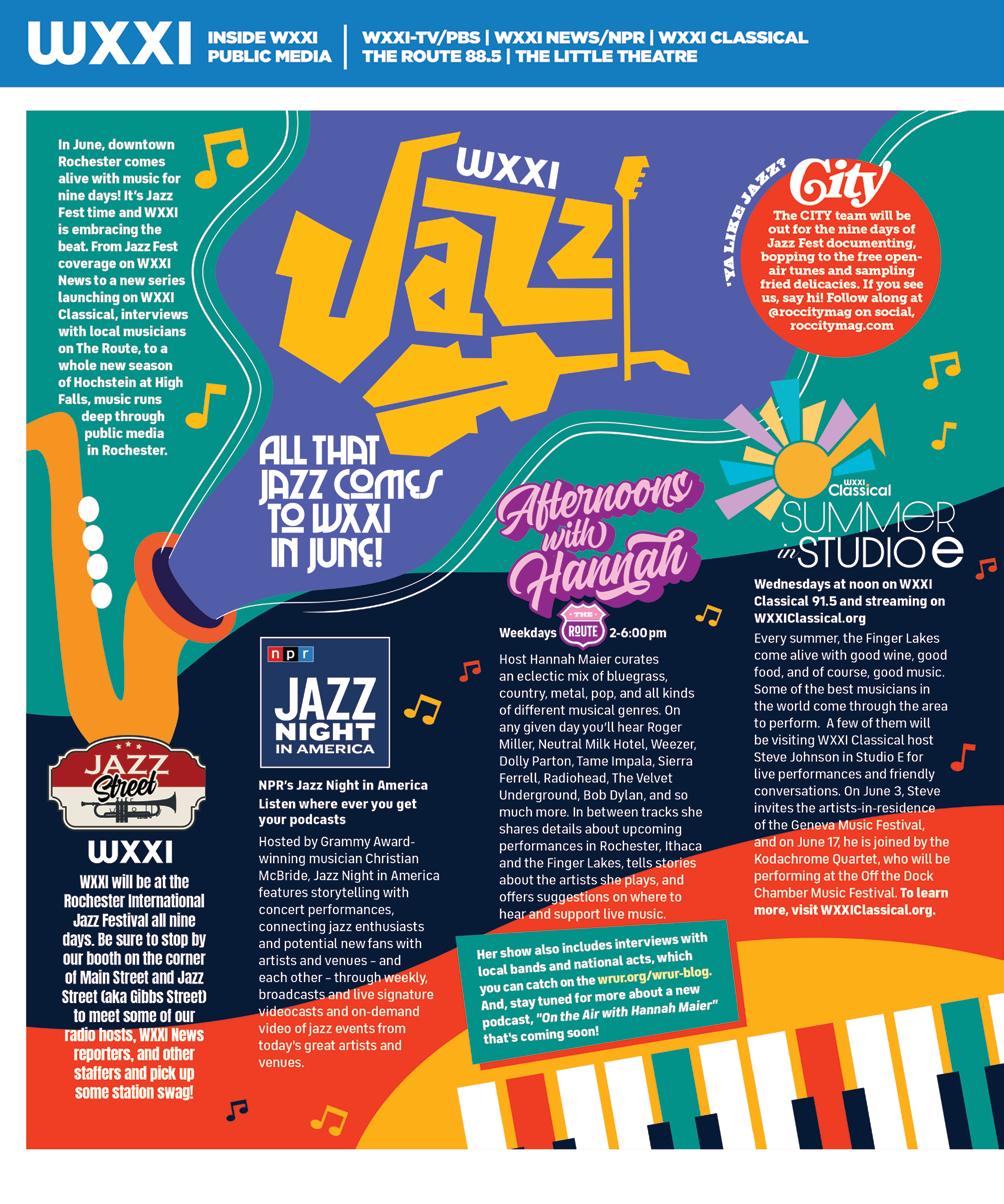
YA LIKE JAZZ?
The CITY team will be out during Jazz Fest documenting, bopping to the free open-air tunes and sampling fried delicacies. If you see us, say hi! Follow along at @roccitymag on social, roccitymag.com and on WXXI-AM (1370) and WRUR-FM (88.5).
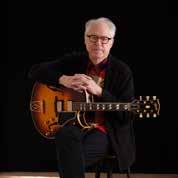
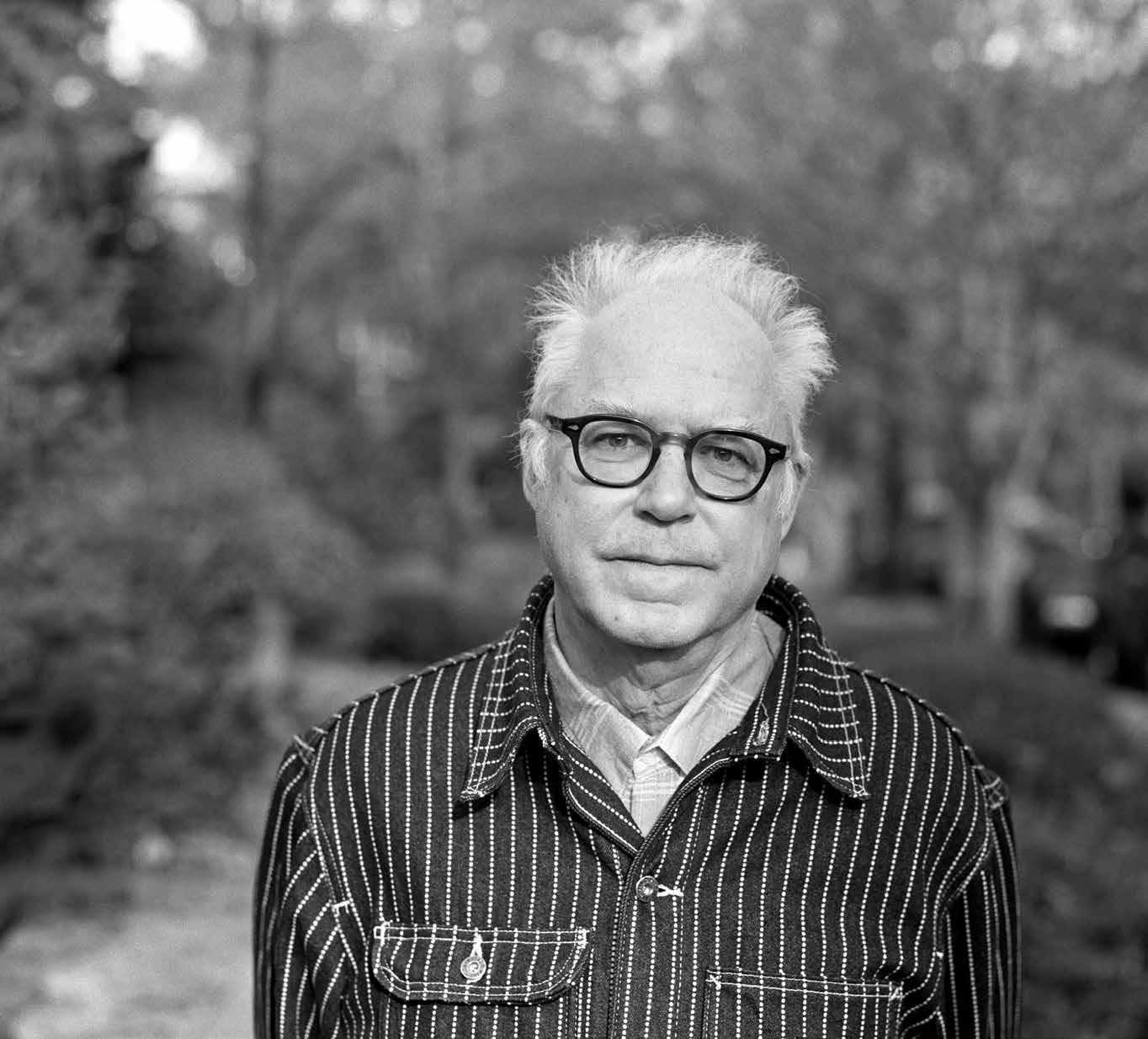
RETURNING ARTIST PROFILE: Bill Frisell was almost an Eastman School of Music student, but he didn’t get accepted in to the program he wanted. The rejection drove him to the guitar, and this year the Bill Frisell Trio will take the Jazz Fest stage for the eleventh time. Read fest aficionado Gary Craig’s full interview with Frisell on page 54.
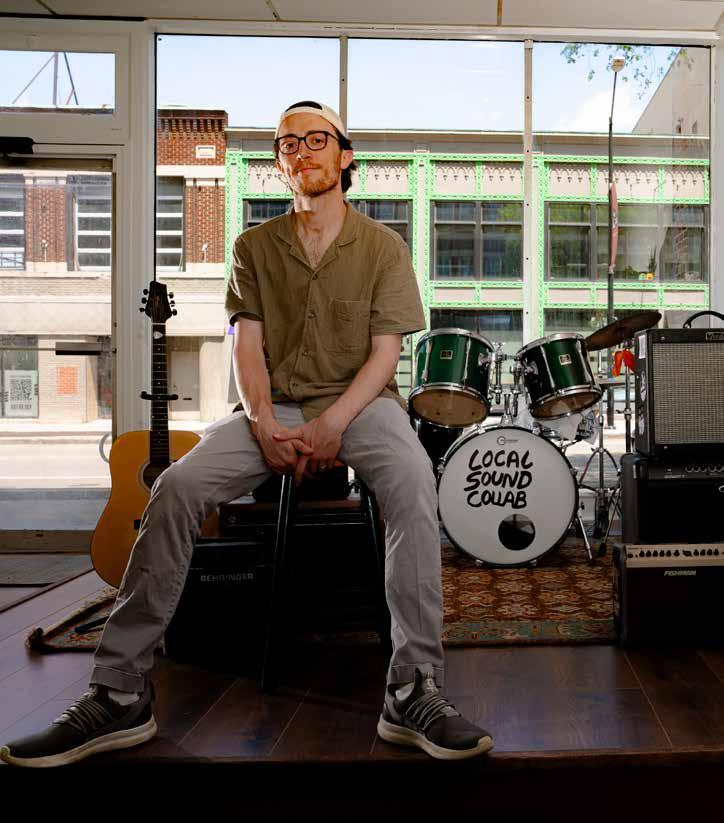
LOCAL SPOTLIGHT: There’s live music in Rochester every week year-round, and Local Sound Collaborative helps make that energy possible through artist grants and resources.
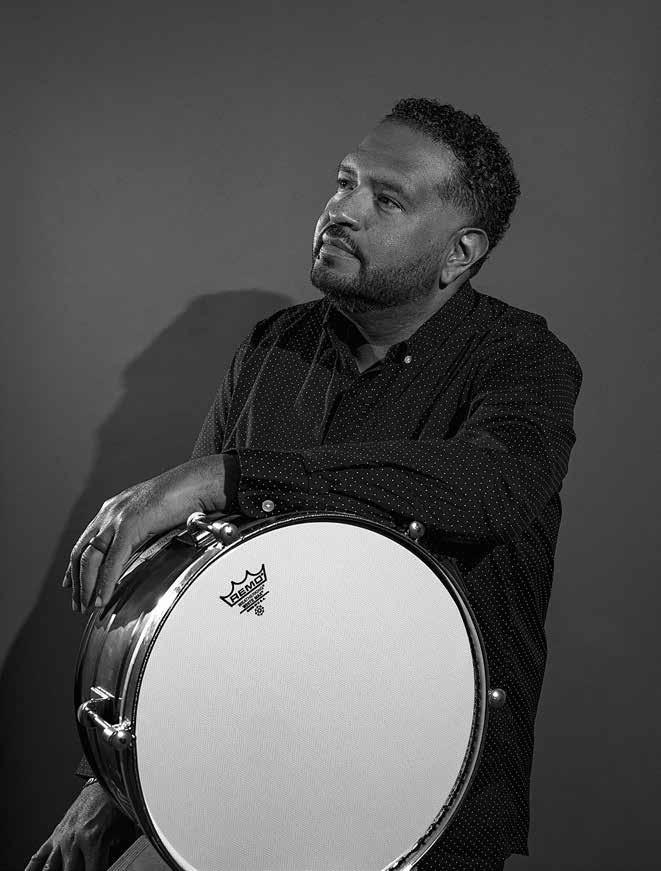
The Collab recently moved to a new space around the corner from Jazz Fest, where recent grantee Freddy Colón will play with both the Mambo Kings and his band, Freddy Colón and 5 Con Swing, on June 26. CITY contributor George Cassidy Payne has the full story on page 50.
QUICK STUDY:
How do you make the most of your visit? What are the best food and drink options? Is it possible to do this on the cheap? Can you attend at the last minute? Is there any parking downtown? What’s the bathroom situation?
Read on for those answers and more…
HEADLINER SHOWS
Three of this year’s eight headliner shows are ticketed and will be held in Kodak Hall at Eastman Theatre: Chris Botti on June 25, Gladys Knight on June 26 and The Legendary Count Basie Orchestra on June 27 (As of press time, tickets were still available to all three.) The five free headliners are Robert Cray Band (June 20) at the East & Chestnut Stage, Tito Puente Jr. and Nestor Torres (June 24); Galactic (June 25); Ana Popović (June 26); and Trombone Shorty & Orleans Avenue (June 27), all at the Wegmans Stage at Parcel 5.
CLUB PASS SERIES
The Club Pass provides access to up to 174 acts across 10 Club Pass Series venues, ranging from intimate settings to mid-size rooms and larger stages (Kodak Hall is a new Club Pass venue for six nights). Also new this year, the Jazz Festival offers three options for club passes: a one-day, three-day and the traditional nine-day pass, which gives a concertgoer access to every act at every venue for the duration of the festival (not using it for a day? Hand it off to a friend!). A one-day pass runs $79.53, including $9.53 service fees (must choose online which day). A three-day pass runs $257.55, including $20.55 service fees. A nine-day pass runs $441.74, including $27.74 service fees (as of press time, all passes were still available). Without a Club Pass, shows are $30 cash at the door ($35 for Kilbourn Hall, $40 for Kodak Hall at Eastman Theatre). Seating at the Club Pass venues is on a first-come, first-served basis.
BY THE NUMBERS
200,000+ people attend Jazz Fest annually
1750+ artists will perform in
300+ total shows over 9 days
174 Club Pass shows
110+ free shows
19 venues
10 countries represented
Doors to every Club Pass show open 30 minutes before the start of the performance; get there early. For the first shows at the busiest Club Pass venues — Kilbourn Hall and Max of Eastman Place — line up at 4 p.m. outside the venues to get a color-coded wristband that specifies a return time to see the show. (You must be present and in line to get a wristband.) Then come back at your assigned time and enjoy the show!
NOT ALLOWED
• Pets (though guides and service dogs are OK)
• Coolers
• Wagons
• Outside food or drink
• Tents or umbrellas
• Professional cameras with removable lenses
WHAT TO BRING
• Valid photo ID
• Digital and printed tickets
• Your Club Pass (it can’t be replaced, so keep it safe and label with your contact info)
• Low-profile lawn chairs for outdoor shows on Parcel 5 and Jazz Street (Gibbs St.) Stage
• Blankets for outdoor shows at the Wegmans Stage @ Parcel 5, which is on a lawn
• Strollers (and maybe headphones) for children
• Earplugs
FOOD AND DRINK
Food and drinks will be available throughout all nine days in two main areas: along East Main Street (food trucks) and outside Rhythm Square at East Main Street and Gibbs; Parcel 5 will also have a full lineup on show days (June 24-27).
Many of the venues will offer food and drinks — from light snacks to full meals — and local restaurants and bars within walking distance are a good go-to option before or after taking in a performance. There are five bars open all nine days, eight bars open on free headliner show days, June 20 for headliner show on East & Chestnut, and June 24-27 for shows on Parcel 5, and a happy hour on Jazz Street 3:30 to 5 p.m. each day featuring $1 off Lake Beverage products, including NA beer and other zero-proof options. Jazz Fest has an exhaustive directory of onsite vendors, bars and food trucks at rochesterjazz.com/fooddrinks, which makes planning by day, area or specific food vendor seamless.
ACCESSIBILITY
All venues are accessible. Since needs vary by individual, the festival encourages anyone needing assistance to get in touch at 585454-2060 at least two weeks before the jazz festival or a specific concert.
Accessible portable bathrooms for those attending outdoor shows are located:
• Outside the Rochester Regional
• Health Rhythm Square on East Main, for people attending shows in the Wegmans Pavilion
• At the end of the Kilbourn Hall alley, on Swan Street
• Near Wegmans Stage on Parcel 5, June 24-27
• Near the East & Chestnut Stage, June 20 only
FIRST AID TENT
Located in Rhythm Square on East Main Street, between Chestnut and Gibbs Streets.
BIKE RACKS
You may park (and be sure to lock) your bike at the racks located in Rhythm Square, on the corner of East Main and Chestnut Streets.
RTS BUS ROUTES
Rochester’s East End can be directly accessed from several east side transit routes, including 31 Park, 33 Goodman, 38 East Main, 48 University and 57 East.
The East End is a short walk from the RTS Transit Center, where all bus routes stop. Many routes run
until midnight or 1 a.m., making an evening out without the hassle of parking an easy option.
Visit myRTS.com for more information and to download the Where’s My Bus? app for real-time bus arrival info on your smartphone from Google Play and the App Store.
PARKING
Street parking is available, and sometimes you luck out! Meters are free after 6 p.m. and on weekends; download the Flowbird app for easy payments.
Parking for all East End events can be found in the East End Garage (475 Main St. East, $7 after 3 p.m. weekdays and all day Saturday and Sunday) at the corner of East Avenue and Scio Street or the Washington Square Garage (111 Woodbury Blvd., $2/half-hour, 1 hour/$4, 2 hours/$6, 3 hours/$8, 24-hour, minimum $10. Special event rates Saturdays & Sundays only $12).
If a little walking isn’t out of the question, additional parking can be found at the Sister Cities Garage (28 North Fitzhugh St., $7 cash, free on Saturdays, closed on Sundays), Court Street Garage (194 Court St., $2/half-hour, 1 hour/$4, 2hours/$6, 3hours/$8, 24-hour, minimum $10. Special event rates Saturdays & Sundays only $12), Midtown Garage (270 East Broad St., $7), and the South Avenue Garage (39 Stone St., $2/hour, up to $10 max.).
FOR MORE
Pick up a free pocket schedule at any venue during the fest or at the RIJF ticket shop,
100 East Ave., from June 15 through June 27. Online, visit rochesterjazz.com or download the free Jazz Fest app for maps, schedules and additional information to help navigate the festival.
FOLLOW JAZZ FEST ON SPOTIFY
THE LOCAL SOUND COLLABORATIVE MOVES TO EAST AND ALEXANDER.
2026 ROCHESTER INTERNATIONAL JAZZ FESTIVAL
FOLLOWING THE MUSIC
BY GEORGE CASSIDY PAYNE
Rochester is not always loud about its cultural shifts.
More often, they show up in patterns only noticeable once they have taken hold. Each June, that pattern becomes easier to see during the Rochester International Jazz Festival. The city absorbs thousands of visitors, stages multiply across downtown and music becomes one of the main ways people move through space. What looks like a festival is also a snapshot of an existing system — musicians, venues, educators and audiences already linked through a year of smaller, less visible exchanges.
What is even less visible is how much of that system depends on informal infrastructure. School programs, neighborhood rehearsals, pop-up performances and community spaces that rarely register as part of a larger cultural network, even though they are.
That gap between visibility and daily practice is where the Local Sound Collaborative has been building.
During a recent phone interview with CITY, Ray Mahar described the work in practical terms. He does not frame it as an arts initiative, so much as a structure that keeps musicians active and connected. Over the past four years, new programs have been added, participation has widened and the range of musicians involved now spans early learners to working professionals.
Two years ago, the Collaborative established a base in the Rochester Public Market neighborhood. That move increased exposure and changed how the organization functioned day-to-day. Activity became more consistent. Programming became easier to access. Growth followed.
Now, the next step is geographic: downtown.
“We can make a move somewhere central,” Mahar said, “where our stakeholders and constituents can see us.”
The plan is the East Avenue and Alexander Street corridor, where entertainment, foot traffic and cultural activity already overlap. The model is a flexible performance space built around a pop-up stage, designed to shift depending on programming needs rather than fixed programming schedules. Initial funding of roughly $20,000 would support equipment and setup; the scale is intentionally modest.
Inside the organization, programming already runs across multiple levels. Early childhood music classes, informal performance spaces and intergenerational ensembles all operate within the same structure. Participants often move between roles over time.
“We are not a music school,” Mahar said. “We are a music hub.”
The distinction is important operationally. Instruction is only one function, and the larger goal is sustained participation across different points of entry. That approach also shapes internal culture. Staff meetings begin with brief icebreakers, a practice Mahar carried over from earlier work as a summer camp counselor.
“They pick on me for it,” he said, “but I keep it.”
The purpose is to establish basic connections before moving into logistics. It is a small structural choice, but one that reflects a broader concern about fragmentation in community-based work.
At a city level, Rochester’s cultural output is often measured through external benchmarks. One national arts vibrancy index ranks it 19th among large U.S. cities in supply, demand and institutional support for the arts. The ranking places Rochester in a notable position, especially given its population size relative to other cities in the same category. But the challenge is that these measurements capture output more easily than cohesion. They reflect how much activity exists, not how connected it is over time.
Mahar returns often to the idea that cultural systems only hold when
they become part of everyday life, rather than isolated events.
His previous career at Foodlink shaped that view. Food, he said, is not abstract. It is immediate. He believes music functions in a similar way.
“Everyone can get around the idea that people need to eat,” he said. “But people (also) need music. People need art. It draws people together. It is essential.”
The question becomes not how to expand cultural programming, but how to embed it more deeply into everyday systems.
That often means smaller, more distributed forms of access like popup performances, neighborhood ensembles and recurring community gatherings that allow people to enter and exit cultural participation without formal barriers.
Mahar compares it to the early growth of the microbrewery sector. What began as a scattered set of independent efforts eventually became an integrated cultural and economic identity in many cities. The key shift was not scale alone, but consistency over time. The comparison becomes clearer when looking at musicians working within the local system.
Percussionist Wilfredo (Freddy) Colón is part of the Collaborative’s 2025 cohort, which received monthly grant stipends toward musical work. His career includes performances with Aretha Franklin, Tito Puente and Philip Bailey, as well as ongoing work as a performer, educator and bandleader with Freddy Colón and The Latin Jazz Quartet.
His entry into the Collaborative was low stakes.
“I got referred by a friend,” he said. I filled out the application. I was like, ‘let’s give it a shot.’”
Like many working musicians, Colón describes the financial realities of the field in direct terms.
“It is pretty tough being a musician in this area,” he said. “The money helped me buy sticks, drumheads, things of that nature. But the support they offered was big.”
What he emphasizes most is the consistency of engagement, not just the funding.
“I went to events and I saw the great work,” he said. “They were extremely supportive. Ray is doing a great job.”
Colón also points to the Collaborative’s presence in schools and the involvement of musicians like Rochester Philharmonic Orchestra third trumpet Herb Smith on its board as part of a broader support structure for younger players.
For Colón, music carries a responsibility that extends beyond performance. Afro-Caribbean and Latin jazz traditions, he said, are not just styles but histories in motion.
“I am responsible for a person who has never heard that music before,” Colón said. “When I am playing, I want them to leave with a nugget of knowing.”
He referenced educational settings where younger audiences encounter forms like bomba and plena for the first time.
“A lot of younger Puerto Ricans have not heard that,” he said. “It was grandpa’s music and now it is mainstream.”
Founder of The Local Sound Collaborative, Ray Mahar, on the mainstage at the new East Avenue location.
PHOTO BY ROBERTO F. LAGARES
5 Con Swing. PHOTO PROVIDED
He traces similar shifts in bachata, a genre that moved from cultural margins in the Dominican Republic to global circulation.
“Now, (as) a DJ, I play it at parties,” he said. “It is very requested.”
These movements between tradition and visibility mirror the broader dynamics the Collaborative is trying to work within — how cultural memory is maintained, adapted and passed forward.
That context also reframes what happens each June during the Rochester International Jazz Festival. The festival is not the starting point; rather, it’s where existing networks become visible at scale.
This year, Colón’s presence at the festival on June 26 reflects that continuity directly.
“(You) will see me at the Jazz Fest twice (that day),” he said. “I will open up with the Mambo Kings — we are going on 27 years. I will close out the night with 5 Con Swing, my salsa band.”
5 Con Swing began in 2017 as an informal ensemble and gradually became more structured through repetition and performance.
“We do not rehearse,” said Colón. “We just create at all times. We have an amazing chemistry.”
That chemistry reflects a larger point about how musical ecosystems function. They are built less through isolated performances and more through sustained relationships over time. From that perspective, the Collaborative’s downtown move is not only about location. It is about making those relationships more visible and more connected within a shared space.
“What if we just give people money?” said Mahar. “Not a hundred artists. Maybe five.”
So they do. The idea is not broad distribution, but concentrated support that allows stability to form. Mahar points to other cities where sustained investment in music infrastructure has shaped long-term identity.
“Twenty-five years ago, Nashville was similar in size to Rochester,” he said. “Now, it is a huge city. And when you think of Nashville, you think of music.”
The difference, he suggested, is accumulation over time.
The Collaborative’s move downtown places an existing network into closer proximity with the public
spaces where culture is already happening. The question is whether that proximity can strengthen the system as a whole. Because the issue is not how much music Rochester produces; it is whether the systems around it are built to sustain what already exists. thelocalsoundcollaborative.org
and
exploring the intersections of art, culture and social justice in Western New York. He also works as a crisis counselor and community organizer, bringing a deep commitment to storytelling and human connection.
George Cassidy Payne is a writer
journalist
Percussionist and band director Freddy Colon of 5 Con Swing.
PHOTO BY ROBERTO F. LAGARES
THE LEGENDARY BILL FRISELL PLAYS FAMILIAR SONGS HIS WAY.
2026 ROCHESTER INTERNATIONAL JAZZ FESTIVAL
SOUL OF ORIGIN STORY
BY GARY CRAIG
The song opens simply enough, with mildly sonic-looping, electronic pings reminiscent of raindrops on a metallic roof. The music presents as a mystery, a harbinger of something to come but no indication of what.
Then the transition begins, a gentle segue into the recognizable notes of the folk standard “Shenandoah.” This is a song performed thousands of times by dozens of artists, but in the hands and fingers of renowned jazz guitarist Bill Frisell it is imbued with both its traditional melodic foundation and a hypnotic otherworldliness that separates it from the multitude of other renditions.
This, after all, is what Bill Frisell does. He takes known songs — roots standards, solo John Lennon songs, jazz greats, just to cite a few — and morphs them into something unique while keeping the artistic soul of origin intact.
“There’s the incredible freedom I have to use the melody as a jumping-off place to all kinds of other worlds,” Frisell said in a recent phone interview with CITY. “The guitar is my voice and I’m just singing the song. The songs change from moment-tomoment or from day-to-day.”
Frisell returns to the Rochester International Jazz Festival this year for the eleventh time. The Bill Frisell Trio performs June 24.
On the call from his Brooklyn home, Frisell said he’s surprised he keeps getting invited back; but no one else is.
“Bill Frisell is not just a brilliant guitar virtuoso, he is one of the most eloquent and gifted
jazz artists of our time,” Rochester International Jazz Festival (RIJF) co-producer John Nugent wrote in a recent email. “His artistry embodies ingenuity and dexterity. Time and time again, he mystifies and captivates his audiences around the world with an endless stream of magically unique improvisations.”
It’s also no surprise this festival favorite is one of the artists chosen this year for something new: Club Pass performances at the stately Kodak Hall at Eastman Theatre.
“Bill has performed in various venues at RIJF and is the perfect artist for our newest Club Pass series venue, Kodak Hall at Eastman Theatre,” Nugent said.
Frisell could have been a student at the Eastman School of Music, had life taken a different turn. Music was always an emotional centerpiece of his life (he kept a transistor radio under his pillow as a kid), but his first instrument was the clarinet. Frisell was first chair with most performances, and the classical masters were a constant with his repertoire.
He applied to Eastman as a performance major but was instead accepted as an education major. He declined, and then turned to the instrument that he loved, the guitar.
Even now, Frisell wonders what would have happened had he made a different choice.
“If they had accepted me as a performance major, who knows,” he said. Perhaps he would now be a jazz clarinetist.
Like so many, young Frisell was a fan of the rock music of his era. But he also found himself enamored with the blues and big band and country and, especially, jazz.
It was in the latter he witnessed a freedom, an improvisational arc that took music to an even more special and heightened place for him.
“There was always an element of improvisation, even all the way back to surf music, probably the first guitar music that I tried to play,” he said.
But jazz took improvisation to different realms.
Within those realms, and perhaps beyond, is where Frisell and his music now reside. Those who have seen Bill Frisell Trio performances in Rochester often leave with the same questions: did the performers have any idea what song was coming when Frisell began with his uniquely singular openings? Did Frisell even know?
“I’m often not even sure what song I’m going to play,” he said. “I’ll play a chord or I’ll play a sound and I’m sort of just looking around in whatever is in my imagination, something that will spark a memory of a song. It’s that kind of spontaneity where we don’t really plan a setlist.”
For those looking for clues as to what to expect when the Bill Frisell Trio takes the stage at Kodak Hall, there are no answers. That’s the beauty of Frisell — the uncertainty for the audience as well as the performer.
“Thinking back, maybe more than I realize, music was always a world that I could enter into even before I tried to play an instrument,” he said.
As a youth, Frisell would flip on that transistor radio under his pillow and the sounds would seep through.
“I would be transported by whatever was coming out of the radio,” he said.
He is still transported, as are audiences when graced with a Bill Frisell performance.
“I’m 75 years old and I just can’t wait for the next time I get to play.”
Gary Craig is a former “Democrat and Chronicle” reporter who retired last year after 45 years in the newspaper business. He continues to freelance and also report and write via his Substack.
CROSSWORD PUZZLE ANSWERS
The Bill Frisell Trio will perform at RIJF June 24. PHOTO PROVIDED
THE MULTIFACETED SINGER PERFORMS AT RIJF ON JUNE 24.
CÉCILE MCLORIN SALVANT
BY JUSTIN MURPHY
Growing up in Miami in a Haitian-French household, Cécile McLorin Salvant’s musical exposure spanned continents and cultures: Haitian and Caribbean music, folk music from South and North America, R&B and hip-hop, jazz and the blues. She breathed it all in and then, together with formal training in opera and classical singing, translated it into a similarly global career as a singer.
Along the way she won three Grammy Awards as well as a MacArthur Fellowship, otherwise known as a Genius Grant, in 2020.
McLorin Salvant’s new album, “With Every Breath I Take,” to be released June 26, marks another first in her career — recording with a full orchestra, the Netherlands’ Metropole Orkest. It includes mostly well-known standards like “Lush Life” and “Sophisticated Lady” along with one original composition, “Left Over,” with arrangements by Darcy James Argue.
CITY caught up with McLorin Salvant via email ahead of her June 24 performance at Rochester International Jazz Festival.
YOU’VE BEEN PERFORMING LIVE WITH ORCHESTRAS FOR MANY YEARS, BUT THIS IS THE FIRST TIME YOU’VE MADE AN ALBUM WITH ONE. WHAT TOOK SO LONG?
It’s a big project and has a lot of moving parts! A lot of what took so long is getting logistics.
YOU SAY YOU CHOSE THE SONGS ON THIS ALBUM BECAUSE THEY’RE CRUCIAL TO YOU. WHAT DO YOU MEAN BY THAT?
They are very important songs to me for a number of reasons and have been a part of my life for many years.
WHICH WAS THE FIRST SONG THAT YOU KNEW WOULD BE ON THE ALBUM, AND WHY?
“Sophisticated Lady”! Because I love it so much. Unfortunately, this isn’t a very interesting answer because so much of choosing songs to record is intuitive.
HOW DO YOU APPROACH SINGING WITH A FULL ORCHESTRA VERSUS A SMALLER GROUP?
I don’t think I plan on singing any differently. But with a full orchestra we are locked into an arrangement. With a smaller group we can and do veer off, even in the structure of the song. We can’t really do that with an orchestra.
YOU’VE TALKED ABOUT HOW, UNLIKE SOME MUSICIANS, YOU WEREN’T DRIVEN AND DETERMINED IN THE SENSE OF PRACTICING 10 HOURS A DAY. CAN YOU DESCRIBE WHAT YOU THINK WAS IMPORTANT ABOUT YOUR MUSICAL UPBRINGING, IF NOT SUPER-INTENSIVE PLAYING? AND WHAT IS YOUR APPROACH TO PRACTICE AND DEVELOPMENT AT THIS STAGE OF YOUR CAREER, ESPECIALLY AS YOU’RE MOVING IN SO MANY NEW DIRECTIONS?
I’m practicing more now than I ever have. And I’m really enjoying it so much. My musical upbringing was more about music as a part of life, as a daily part of it, not as a task, as work or something to tackle. We danced to it, we listened together, we sang together. The idea of technique or analysis was always secondary to the more communal function of music.
YOU SAID IN AN INTERVIEW ONCE: “I’M A SINGER, BUT I DON’T REALLY FEEL LIKE A SINGER. I FEEL LIKE I’M AN AUDIENCE MEMBER, I’M A LISTENER.” WHAT DO YOU MEAN BY THAT?
I’m not sure how better to explain it, but my primary relationship to music is that of being a fan of it, and someone who listens to it extensively. Singing is a smaller part than listening in terms of how I interact with music.
WHAT WAS THE IMPACT OF WINNING A MACARTHUR GENIUS GRANT IN 2020?
2020 was a scary year for everyone, and for musicians it was also one of absolute uncertainty. I had no idea when or even if I would perform again. The grant was not only a huge honor, but it gave me a sense of safety in that time. But thinking about it now, now that that time is behind us, the idea that I have a MacArthur is absolutely crazy.
YOU HAVE WORKED IN AN INCREDIBLY WIDE RANGE OF STYLES AND GENRES OVER YOUR CAREER, IN MULTIPLE LANGUAGES AND MEDIA. HOW DO YOU DECIDE WHAT DIRECTION YOU’RE GOING TO GO IN NEXT?
I follow my intuition, my interests, my curiosity.
Cécile McLorin Salvant performs at 7 p.m. Wednesday, June 24, at Kodak Hall at Eastman Theatre as part of the Club Pass series. rochesterjazz.com
Justin Murphy is a freelance journalist and author of the book Your Children Are Very Greatly in Danger: School Segregation in Rochester, New York. Find him online justinmurphywriter. com writing about Rochester history, education, racial segregation and more
“WHEN I AM A FOSSIL”
BY BENNY BLEU
New York singer, songwriter and clawhammer banjo player Benny Bleu has announced his debut collection of selfrecorded songs, “When I Am a Fossil” due June 5, with a release show at Bop Shop Records on June 6.
A decade in the making, Bleu, a geologist by trade, examines the roots of traditional song through his own emotive folk tributes to nature, progress and people. Accompanied by a talented group of musicians, he recorderd his intimate album direct to analog tape.
The resulting recording features gently rounded edges and is comprised of songs that are playful, eco-forward and run the gamut from country lilts to jug band music, all the while expressing the plaintive call of a high and lonesome sound.
Throughout the collection, Bleu’s banjo strings stitch themselves into a landscape of village farms, lovable mutts and mountain paths often accompanied by the inspired strains of a lone fiddle. His hand-hewn songs carry an organic looseness that speaks to an old-time vernacular reminiscent of Pete Seeger or Ronnie Lane’s Slim Chance.
From the opening title track a varied, pastoral pulse runs through the collection. “Serenity Song” is cinematic in its rustic detailing and lyricism, while the joyous jug band bent of “Old Dog” and the moody mystery of the album’s centerpiece, “March of the Mollusk,” balance Bleu’s deft frailing with the tasteful melodic rambling of his ensemble.
“I’ve Endured,” heeds its inspired call from the rolling hills of Appalachia and the closing shuffle of the traditional “Penny’s Farm,” reaches into the agricultural past of a historical American songbook.
“When I Am a Fossil” is a collection of songs that looks backward to move forward. In the same way that Benny Bleu searches the strata of the earth for deeper insight, the songs he has crafted provide the listener with a similar understanding.
—STEPHEN LEWIS
“GRACELAND WAY”
BY MIKAELA DAVIS
It’s morning. You’re sipping coffee, watching the sun crest over a California canyon. Or, it’s midnight. You’re crushing beers, closing down a bar somewhere on Monroe Avenue.
Either way, “Graceland Way,” Rochesterborn Mikaela Davis’s latest, would be an apt soundtrack. Davis and company strain melancholy and make-believe through frontier thinking. Orville Peck — your favorite gay, Canadian cowboy — (r)ambles to mind. Davis and her band (bassist Dan Horne, drummer Austin Beede and guitarist John Lee Shannon) see a darkness, but it’s a beautifully composed, folky one; their psych-tinged alt-country songs could drift through an episode of “Westworld.”
I have to mention the harp. Davis’s signature instrument’s sound, interlaced with this dark, but also often cheerful, music — and her haunting voice — are enough to make anyone misty-eyed. Her string-plucking gives the record a mystical and singular quality that most alt-countryadjacent music simply doesn’t have.
Right away, “Graceland Way” is a highnoon showdown that dissolves into a dream.
If wishes were horses / then I’d be a cowboy / and not a rodeo clown, she sings on the upbeat, dust-kicking opener, “(Looking Through) Rose Colored Glasses.” The song features Grammy Award-winning singer-songwriter Madison Cunningham on backup vocals and, apparently, comedian Tim Heidecker adding his prankish baritone somewhere in the mix (he plays the rodeo clown in the music video).
“Mizmoon” is pensive and, ahem, moonlit, ending in a burst of out-of-tune fuzz that makes you want more. The harp shines on “11:11.” And “Starlite Tonite” begins like a pop song before cascading into dark psychedelia.
Davis’s lyrics are more relatable than poetic and that’s a strength, particularly on “Junk Love,” where bad-for-you romance becomes a junk-food metaphor. And with Karly Hartzman of Wednesday on backing vocals, Davis hints at where she could go by leaning further into the noisier, indie rock end of their sound. We’d welcome it.
— BRENDAN DABKOWSKI
“SPIT TAKES AND SPLIT TAPES, VOL. II” BY VARIOUS
Lilypad Underground and Raincoated Records are at it again, showcasing four of Rochester’s most interesting indie bands recorded directly to a four-track cassette tape. The result is “Spit Takes and Split Tapes, Vol. II,” an endearing split EP offering two songs each from local bands Chores, Comfy, Bad Bloom and Big Nobody.
The opening song, “Milo” from Chores, starts with some tape hiss and band chatter as the bass intro gets counted in and the experience begins. The cassette tape compression hits hard once the entire band jumps in, but it’s part of the experience (which falls somewhere between getting to sit in on a band rehearsal and listening to a bootlegged Bug Jar show).
Comfy continues with the song “Wasn’t The Same,” which sounds like Wilco if they had a fuzz pedal fetish which absolutely suits the cassette sonics perfectly. Not to be outdone, Bad Bloom hits listeners with a wonderfully warbly guitar intro and outro that bookends their perfected post-punk-grunge revival ethos perfectly. Easy to understand why they’ve been on a string of shows opening for the likes of Flatwaves, Fotocrime, and Into It. Over It.
Big Nobody brings the heat with “Franklin Big Mouth,” which has whammy bar guitar riffs that are reminiscent of The Toadies and full-on harmonized guitar leads that would make Thin Lizzy swoon. Such quality craftsmanship is to be expected from creative polymath bandleader Jacob Walsh, who is also responsible for the entire project’s art design. (Editor’s note: Walsh is the art director at CITY Magazine.)
To check out the other tracks, including a fantastic cover of Green Day’s “She” by Bad Bloom which will make you think your tape deck is melting, pre-order physical cassettes on Raincoated Records’ Bandcamp page.
—WREN WERNER
REVIEW |
“COMO ME LA PIDA”
BY ORQUESTA LA MURALLA
Rochester loves its hometown icons, and in that pantheon of lilacs and frozen custard there is a special place for the long-tenured local salsa band La Muralla. Founded on the city’s northside in 1973, this all-star mashup of musicians is releasing a new album, “Como Me La Pida,” June 28 that provides a delightful break from the reggaeton that dominates current music charts.
The band’s name translates, in English, to ‘the wall,’ as in a ‘wall of tropical sound’ — and this new album, their first since the passing of cofounder Mike Rosario in 2015, lives up to that moniker. La Muralla still features three original members: Tony Alvarez, David Antonetti and lead singer and songwriter Johnny Vega, who was inducted into the Rochester Music Hall of Fame in 2024.
Far from a nostalgia act, La Muralla is an intergenerational effort featuring a lineup of Rochester’s best Latin musicians. There is no AI, drum machines or any artificial ingredients added to the mix of danceable salsa and tropical boleros. The brassy wall of sound soars over the syncopated rhythms led by Lucas Santana, Ito Aguinzoni and Daniel “Deecoy” Antonetti (who has performed with legends like Tito Puente, Don Omar and Marc Anthony).
From the bright, danceable pace of the opening title track to the joyous autobiographical “La Muralla, Su Historia,” “Como Me La Pida” is perfect for those hot summer afternoons in Rochester when we can close our eyes and imagine a slice of the tropics closer to home.
—JULIO SÁENZ
A spirited pivot
BY CHRIS OSBURN
Acirca-1835 cobblestone house in Victor’s otherwise new-build High Point development is now home to Bonesteel Wines & Spirits, a designforward, community-oriented shop which opened April 24.
The minority and womanowned boutique wine and spirits shop is helmed by Tanvi Asher, who also owns Peppermint Boutique at the Culver Road Armory in Rochester.
“The store was built around the idea that wine should feel approachable and exciting, whether someone is deeply knowledgeable or just beginning to explore it,” says owner Tanvi Asher.
For Asher, a Rochester Institute of Technology design graduate who started Peppermint in a tiny storefront on Park Avenue in 2012, it was vital to bring her boutique experience to this new venture.
“I’ve always loved introducing people to something they may not have found on their own — whether that’s a new apparel designer or a wine from a small producer,” she said.
She added that in both worlds, there’s an emotional connection to the experience.
“There’s a strong element of discovery in both fashion and wine.”
In addition to the expected bigname brands, the store also sells a number of locally made spirits and wines. Asher and operations manager Becca Barnum both
Bonesteel Wines & Spirits is fronted by a familiar face in fashion.
FOOD + BEV
worked at vineyards in the Finger Lakes and fell in love with the region’s wine.
“We want our community to connect with the beautiful region we have on our doorstep,” Barnum said.
“Our goal is for this shop to be an intimate place to learn not only about what small winemakers in the Finger Lakes are up to, but to connect Rochester to them.”
The shop features a highly curated selection of wines and spirits, with every bottle selected to reflect unique quality and stories not typically found elsewhere.
“We strongly emphasize smaller Finger Lakes producers, women winemakers and thoughtfully made products that tell a story,” Asher said.
Beyond retail, Bonesteel was designed as a gathering space. The store features a dedicated room for tastings, workshops and classes exploring wine’s connection to cuisine and culture, setting Bonesteel apart as a hub for exploration. Asher hopes the store will become a space where smaller producers and women winemakers are celebrated and where thoughtfully crafted wines and spirits, many of which are unavailable in typical liquor stores, are brought to the forefront for curious customers.
“My hope was to build something that feels less transactional and more like a gathering place,” she said. “Somewhere people can ask questions, discover something new and feel genuinely excited about what they’re bringing home.”
The name Bonesteel is a reference to the property’s and the community’s history.
“The Bonesteele family once lived here, and the site later became known as the Bonesteele Schoolhouse, a boys’ school that became part of Victor’s local history,” Asher said. “I loved the idea of preserving a name that already meant something to the area and giving it a new chapter.”
Asher chose Victor for Bonesteel due to a landlord connection and customer base from her previous store, Salty Boutique, which operated at Eastview Mall from 2019 to 2024. Victor is also one of
the region’s fastest-growing suburbs, with residents excited about new local businesses and experiences.
“Over the years, many longtime Peppermint customers started families and made Victor their home, so there was already a sense of familiarity here,” she said. “I saw an opportunity to create something that felt elevated and communityoriented while still being approachable and welcoming.”
Barnum, likewise, hopes visitors to Bonesteel will find a discovery-driven experience, with unexpected, fun and intriguing spirits and wines rarely found elsewhere, highlighting the store’s commitment to offering something truly distinctive.
“We want to have a
conversation with you, talk about your palate and introduce you to something delicious that fits that vibe but is not something you would generally reach for,” she said. “We want you to drink what you love, but to also stay curious. Every bottle is a memory, an adventure, a story just waiting to be told. Let’s go off the beaten path together.” bonesteelwines.com
Christopher Osburn is a food and drinks writer located in the Finger Lakes region. He's been writing professionally for more than 20 years and has had his work published by “Men's Journal,” “Food & Wine,” “The Manual,” “VinePair” and more.
Owner Tanvi Asher; the interior of Bonesteel.
PHOTOS BY MIKE MARTINEZ
What to watch for moments of sartorial excellence.
Throwing ‘fits
BY JOHANNA LESTER
With “Devil Wears Prada 2” in theaters, and cerulean and the fashion closet back in our collective consciousness (not to mention the theme of this month’s issue), the time is right to take a quick look back at seminal moments in movie fashion history. Maybe this adds a few more titles to your to-watch list or sends you to Poshmark or Depop with inspiration; in any case, here are some ensembles that gave their ensembles a leg up.
THE ICONS
Anyone who has ever had to pack for an overnight will understand the magic that is Edith Head’s work for Alfred Hitchcock’s 1954 masterpiece “Rear Window.” Perhaps the most recognizable — and recognized, winning eight Oscars from 35 nominations — costume designer in movie history, Head’s creations for the film include one gloriously diaphanous number for Grace Kelly, which makes its entrance from the tiniest of overnight cases (for propriety) and secures Head’s status as an actual magician.
It feels impossible to make the costumes of one superhero movie, let alone two, feel unique and significant. For “Black Panther” and its sequel “Wakanda Forever,” two-time Oscar winner Ruth E. Carter did just that by turning what could be rote military outfits into influential, specific fashion statements. The texture, patterns and actual fit of every single article worn by every character tells its own story, while also connecting back to the movie’s themes and motifs.
THE DRESSES
I don’t think “How to Lose a Guy in 10 Days” is a good movie (sorry, don’t email
me) but there’s no denying the impact Kate Hudson’s yellow dress — designed by Carolina Herrera — continues to have 23 years later. (A quick Google search yields hundreds of possible dupes at every price point.) The brief “ta-da” that Hudson gives when debuting the outfit cemented her as a star, and the dress as a pillar of early aughts fashion inspiration.
Have you seen “Atonement,” Joe Wright’s 2007 film adaptation of the Ian McEwan novel? If so, you know what I’m about to mention. If not, there’s a good chance the green dress Kiera Knightley dons about a third of the way through has seeped into your cultural memory like some phosphorescent cinematic algae. Designed by Jacqueline Durran, the slightly NSFW gown rightly becomes an important plot point, setting up the rest of the drama’s heartbreaking story.
Gene Kelly’s “Hello, Dolly!” is not fondly remembered, but I caught a screening of it during the Dryden Theatre’s recent tribute series to Barbra Streisand. The moment Streisand, as the titular Dolly, enters the Harmonia Gardens restaurant after a long absence still hits, and the dress — a gold beaded number so perfectly tailored and chandelier-esque as to elicit gasps — literally shines. (In the stage show, the dress is red, but true to Streisand’s nature she lobbied for gold so as to make it a
signature design for her.)
Cheating a little bit here, but it’s virtually impossible to talk about onscreen fashion and not mention “Sex and the City” and the brilliance of Pat Fields’s costume design and curation. From Carrie’s Dior newspaper dress to every single preppy polka dot Charlotte pledges allegiance to, the fashion of both the show and the subsequent movie (we don’t acknowledge that sequel) is the actual fifth character in the series (sorry, NYC). Emotionally, we’ve all been Carrie wearing a tutu, covered in dirty street water.
THE MOMENTS
Paul Thomas Anderson’s “Phantom Thread” is a movie about fashion as much as it’s a movie about how men will literally ask to be poisoned instead of going to therapy. For Reynolds Woodcock (the most perfect name for an exacting fashion house director) as embodied by Daniel Day-Lewis, it’s the meticulous detail of construction and embellishment that make his work so sought after. The close-ups of fabric and stitching, buttons and bows give this film a documentary-like feel. Woodcock’s own impeccable suiting offers an important detail on the equal importance of menswear. No one delivers a monologue like Meryl Streep and no one sends a
withering glare like Miranda Priestly. The “sweater speech” from “The Devil Wears Prada” endures, because for many people (like Andy Sachs, played by Anne Hathaway) it was the first time we thought about fashion as art as commerce as consumerism. Cerulean isn’t just a color, it’s a statement. A belt isn’t just an accessory, it’s a history lesson. Several scenes later, a newly inspired Andy stuns her coworkers in the Chanel boots and we bear witness to a true convert.
Do you ever think about the costumes from Sofia Coppola’s “Marie Antoinette” or are you a normal person with a full life? I joke (a little) but those petticoats, wigs and corsets live on forever in my brain’s library. Several reported pieces on the 2006 film share that Kirsten Dunst wears over 60 costumes. Not to be outdone: the shoes for some scenes of the movie were designed by Manolo Blahnik. Let them eat cake, yes, but the movie is less a confection than a shimmering ode to the impermanence of youth. Party dresses thrive here.
From the moment Nathan Lane swans into that Miami apartment dressed as Mrs. Coleman, “The Birdcage” kicks into a higher gear, which is truly wild considering it’s already been soaring for 40 minutes. Dressed by costumer Ann Roth in what can only be described as a Martha Washington wig and your rich grandmother’s finest, Lane fully embodies a Southern belle, by way of drag club. It’s an incandescent turn and performance. The costumes throughout Mike Nichols’s 1996 hit strike the exact right tone of tropical theater: long live a boa and some false eyelashes.
Johanna Lester is a pop culture critic who mainlines movies, TV and the best cookies Rochester has to offer. She’ll also hold that grudge on your behalf. Follow her @ theauntjojo.
The Dish
FOOD AND BEV NEWS, GOSSIP AND GATHERINGS CURATED BY LEAH STACY
WHET YOUR PALATE
Chef Steven Lara, who previously opened Bitter Honey and spent time at the helm of Ox & Stone, FLX Table, Carnegie Cellars and now, Angelina’s on South, will open a California-style smashburger joint called Lefty’s in Fairport later this summer. Until then, follow along for news about pop-ups: instagram.com/leftys_burger
Table 19 Restaurant & Wine Bar has opened at 366 Arnett Blvd., featuring elevated Southern, soul and Islandinspired cuisine. Chef Liz “The Bougie Street Chef” Diaz and her son, Jamihl, are behind the brick-and-mortar. Previously, Chef Liz was a member of The Commissary and was CITY Magazine’s chosen winner at Foodlink’s Festival of Food competition last September. table19roc.com
The opening of Nightcap Blues, a new jazz club in High Falls, will coincide with the City of Rochester’s Flower Fest on June 6 and the momentum behind the High Falls Business Improvement District. The nightclub is owned by Rochester-based entrepreneur Tyrone
Reaves, who also owns TruForm Manufacturing and founded the Young Adults Manufacturer Training Employment Program (YAMTEP).
FOR THE LOCAVORES
Hold their beer — in mid-May, the 150-year-old Genesee Brewing Company revealed a new brand identity and package design. It’s an interesting move for the beloved local biz; especially the choice to hire an out-of-town agency (the women-led, NYC-based creative studio Sister Mary, whose client is Genesee parent company FIFCO), when there is so much design talent within just a few miles of New York State’s oldest brewery. geneseebeer.com
‘Tis the season for Finger Lakes tourism, and the tasting rooms, cheese farms and other specialty shops are ready to welcome out-of-towners to their charming corner of the world. Planning a day (or weekend trip) from here? Check out the calendar at newyorkwines.org/wine-events.
FOOD FÊTES
Flower City Food Tours returns for its 10th year with walkable culinary adventures through Park Avenue, Fairport, Pittsford, Neighborhood of the Arts and downtown. The three-hour tours are led by entertaining tour guides and include a tasting at each eatery along with historical and architectural highlights and cultural points of interest. flowercityfoodtours.com
has returned for the season on the last Wednesday of every month; June 24 will feature food, beer and live music from Junkyardfieldtrip 5-9 p.m.
Headquartered biannually in Geneva, FLXcursion is an international celebration of Riesling regions featuring public events like the FLXcursion Grand Tasting: The World Cup of Riesling on Linden Street (June 27), wine dinners and industryonly seminars, tastings and more held in venues across the Finger Lakes June 27-29. Mingle and explore the grapes and topics that unite Riesling winemakers, and try wines from around the world along the way. flxcursion2026.com
The Rochester Public Market’s monthly Food Truck Rodeo series
AN ADVICE COLUMN FROM CITY MAGAZINE
Dear Maggie,
How can I talk to my adult daughter about being more put together and taking better care of herself without making her defensive? She’s always been somewhat messy and unkempt. As a teen, it was clutter and piles of clothes everywhere, and now it’s wrinkled outfits, disorganization and often looking rushed or thrown together. Whenever I gently bring it up or encourage better habits, she gets irritated and shuts down. I worry about how it affects her daily life, relationships and how others perceive her — especially professionally.
Sincerely,
Just Trying to Help
Dear Just Trying to Help,
As a fellow untidy girl, I feel for your daughter. It can be hard to exist comfortably when organization and presentation don’t come naturally to you. Some people are simply wired differently, and constantly feeling like you’re falling short in an area where everyone else seems to succeed can become exhausting.
But etiquette applies here, even with your children. Often when we’re close to someone, we use familiarity as an excuse to throw civility out the window. If you’ve mentioned these things to your daughter before, then she already knows how you feel. Repeated comments about it likely make her feel worse about herself and even more so if you tell her at times where she can’t do much about it.
I live by the 30-second rule. Generally, if someone’s appearance needs adjusting and they can do it in 30 seconds or less, then you tell them. That means things like spinach in their teeth, a downed zipper or upturned collar, go for it. Just be quick, polite and discreet. But if they can’t — like they spilled something on their shirt, their outfit doesn’t match or their pants are wrinkled — what does pointing it out do, other than make them feel self-conscious?
Odds are, they already know. I’ve never stained a shirt and not been painfully aware. Have you? Keep it to yourself, even if it’s someone you know well.
The other layer here is what many people attribute to laziness or chalk up to “bad habits” can usually be something else entirely: depression, ADHD, anxiety, executive dysfunction or burnout. I am not trying to diagnose your daughter (and you shouldn’t, either), but I am saying that maybe the answer lies in exploring accommodations, rather than simply forcing her to change.
A cleaning service, laundry pickup, meal delivery, consultation with a stylist; these things aren’t indulgences if they allow someone to function better. If you’re looking for ways to help and your daughter is on board, this might be the way to go. But she has to be interested.
Consider that her priorities might be elsewhere and make peace with the idea she simply has her own aesthetic which does not match yours. Usually people don’t need more criticism; they need tools, support and a little compassion.
xoxo, Maggie
Groans
PUZZLE
BY S.J. AUSTIN & J. REYNOLDS
28. Elizabethan verb suffixes
30. “Hmm... I don’t think so”
31. Setting for The Iliad
32. Airport transports
35. Letters above zero on an old-timey telephone
37. Clue for an animal tracker
39. “O, Canada” and “La Marseillaise”
42. 25% of a standard deck of cards
44. Loves to bits
48. ** Office gathering where people can’t focus?
50. ** Character trait for a narcissist at their wedding?
52. Summery drink ending
53. Prefix with -pod or -pus
54. New Haven collegian
56. What is a pirate’s favorite letter? (3)
57. Lighthouse, e.g.
60. Restaurant starters
63. Flee
64. Passover meal
66. NYC neighborhood in western Queens
68. Southern Florida higher ed institution, for short 70. Rushed
71. ** A den, a mate, some berries and fish, maybe a little honey?
75. Vice President Agnew 78. Snarky English TV talent show judge
Reclined
Slobber
G.I.’s address
Underlined words on a webpage
Tata!
Pro wrestler Flair
** Smile, eyes, and nose drawn on a bucket?
** Murderer who poisons the Froot Loops?
Page who became the first openly trans man to appear on the cover of Time magazine
Fastidious to a fault
Contribute to a fund
Tractor trailer rig
Tiny complaints
122. ** That little skinny part on an hourglass? 125. ** Big-eyed avian hunter wearing a helmet for some reason?
128. American fur tycoon and first multimillionaire
129. Laser printer cartridge contents 130. Oft-pluralize cry of pain
131. “Really, though?”
132. Itty-bitty
133. What a leopard can’t change 134. Course for a business maj.
135. WWE star John who has granted over 650 Make-A-Wish requests
Simon
Scenic Adirondack mountain overlooking Saranac Lake
Grannies
Also
Frightens 106. Hall of Fame baseball manager Tony
Imaginary line around which Earth rotates
Slugger Sammy
North Pole bigwig
1. Seethe
2. The slightest amoung
3. “Darn,” even less profanely
4. Put away, as a sword
5. Carpool lane initialism
6. Most common English word
7. Digs for ore
8. Surname for a 1990s senator or defensive back
9. Length that is often nearly equal to one’s height 10. Romanian currency 11. Guarantee
Netting
13. American track superstar whose Olympic dominance in 1936 defied Nazi ideals 14. Unruly group
15. Partner in crime?
16. Backside
17. Classic toy brand behind Tickle Me Elmo and the Magic 8-Ball
18. Like skin in need of Vaseline, maybe 24. Messed up
26. What the “Find My” feature on an iPhone can do
29. Pueblo people
33. Nitrogen hydride, more commonly
34. One of 60,000 in a min.
36. Performatively provocative
38. Landmark 1990 civil rights legislation, for short
39. Addis ____, Ethiopia
40. Connection points
41. Ice cream, or to pay for a date’s ice cream 42. Red light meaning
43. Cured meatstick
45. Enjoys Joyce, Carroll or Oates (5) 46. Wading bird
47. Children’s board game that often causes players to say its name to each other
49. Fig. often provided after texting “OMW” 51. Boundaries
55. “Regrettably...” 58. Snake for a snake charmer
Blizzard mix-ins 61. Color whose name derives from the French for “flea colored”
Odor
64. “Masters of the Universe” superheroine
65. Artist’s implement whose name derives from the Dutch word for “ass”
67. Region for 118-Across
69. “La _____ Bonita” (Madonna hit)
72. Not belonging to anyone
73. Cute “Return of the Jedi” creature
74. “There, there!”
75. Hogwarts professor portrayed by Rickman
76. Of the Vatican
77. How sardines are stored
80. Word on some elementary school bathroom doors
81. Prestigious universities
82. Triangular pelvic bones
86. Decorates, as a cake
87. Actress Vardalos
90. Like about 20% of the US population, including Marco Rubio
91. Look over briefly
93. Penne _____ vodka
96. Intermediary
97. “Sly” canid
99. Pencil ends that are often used up before the lead