14 CANNABIS A LOCAL NONPROFIT TAPS THOSE MOST HARMED BY CANNABIS CRIMINALIZATION TO LEAD LEGALIZATION. BY GINO FANELLI
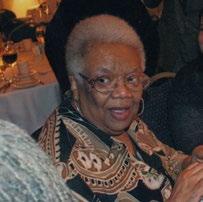
20 LITERATURE A NEW COLLECTION ADDS DIMENSIONS TO THE PROFOUND CATALOG OF LATE POET LUCILLE CLIFTON. BY PATRICK HOSKEN 38 SPORTS DON STEVENS HEADS INTO RETIREMENT AFTER 40 YEARS AS AMERKS BROADCASTER. BY JIM MANDALERO
BY ROBERTO F. LAGARES
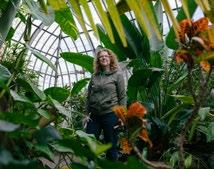
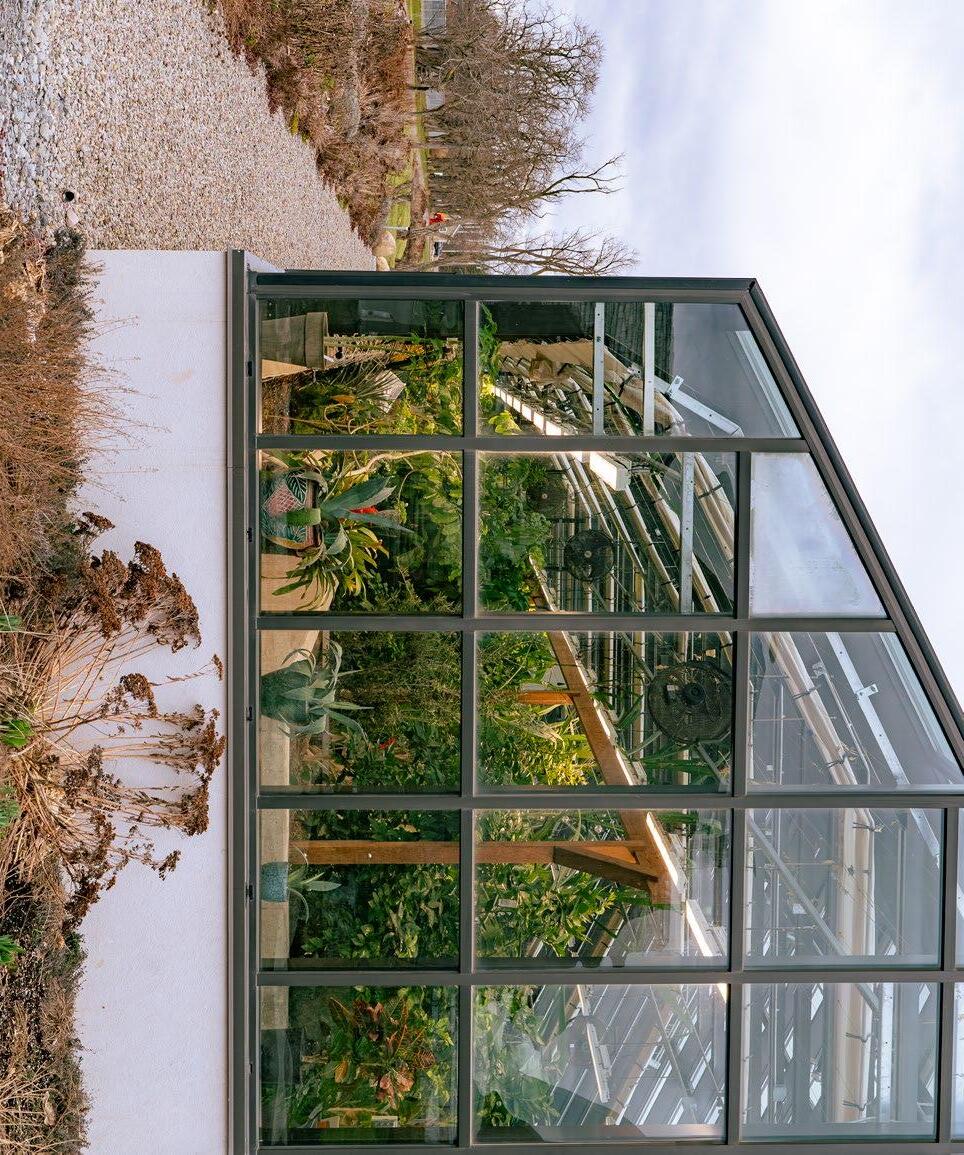
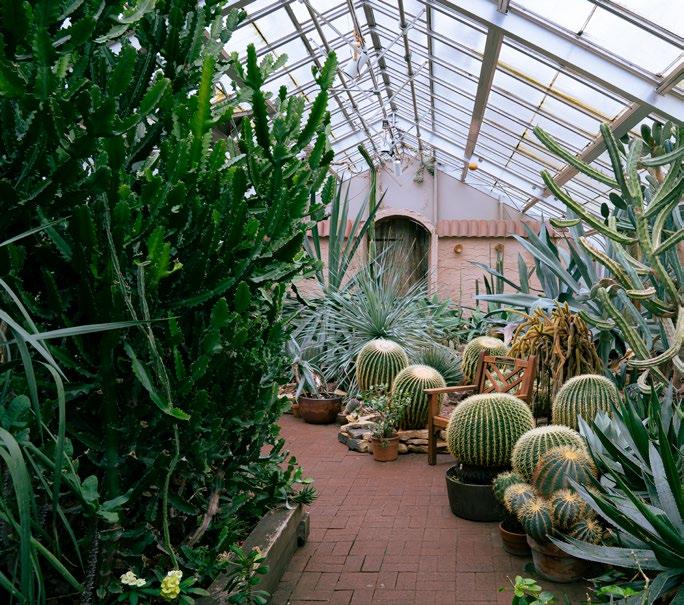
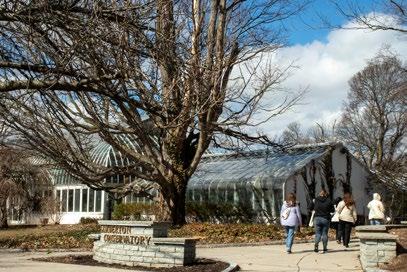
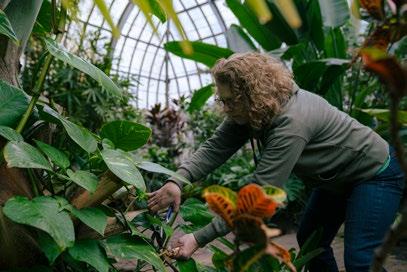
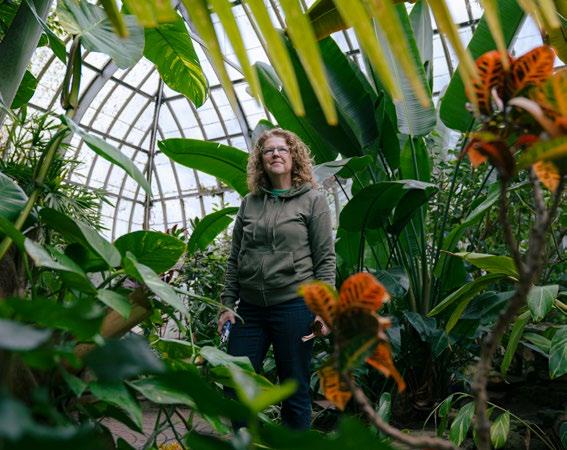
CULTURE EXPLORE OVER A CENTURY OF GROWTH AT LAMBERTON CONSERVATORY. BY SARAH WOODAMS
280 State Street
Rochester, New York 14614 feedback@rochester-citynews.com phone (585) 244-3329 roccitymag.com
PUBLISHER
Rochester Area Media Partners LLC, Chris Hastings, chairman
FOUNDERS
Bill and Mary Anna Towler
EXECUTIVE DIRECTOR
Ryan Williamson
EDITORIAL
Editor-in-chief: Leah Stacy
Arts reporter: Patrick Hosken
Multimedia reporter: Sydney Burrows, Vanessa Cheeks, Erin Connorton, Gino Fanelli, Lauren Fravel, Nick Greco, Jon Heath, Leah Joy, Johanna Lester, Megan Mack, Jim Mandelaro, George Cassidy Payne, Max Schulte, Mona Seghatoleslami, Helana Shumway, Katherine Varga, Veronica Volk, Wren Werner, Sarah Woodams
CREATIVE
Art director: Jacob Walsh
ADVERTISING
David White ads@rochester-citynews.com 585-730-2666
CITY is available free of charge. Additional copies of the current issue may be purchased by calling 585-784-3503. CITY may be distributed only by authorized distributors. No person may, without prior written permission of CITY, take more than one copy of each monthly issue.
CITY (ISSN 1551-3262) is published monthly 12 times per year by Rochester Area Media Partners, a subsidiary of WXXI Public Broadcasting. Periodical postage paid at Rochester, NY (USPS 022-138). Address changes: CITY, 280 State Street, Rochester, NY 14614. Member of the Association of Alternative Newsmedia and the New York Press Association. Copyright by Rochester Area Media Partners LLC, 2026 - all rights reserved. No part of this publication may be reproduced or transmitted in any form or by any means, electronic or mechanical, photocopying, recording or by any information storage retrieval system without permission of the copyright owner.
Words all day through
EDITOR'S
LETTER
BY LEAH STACY LEAH@ROCCITYMAG.COM
Working with words every day makes me wonder if I will ever run out of them; if I will tire of writing, if words will cease to mean as much. Most of my professional life has been spent writing in some way. Journalism, teaching, copywriting, content creation — my chosen occupations depend on words. I go home after work and want to read one of my many untouched books, but my brain simply cannot handle more words.
One of the ways I keep reading recreationally (without the commitment of a 400-pager) is poetry collections. It’s like a jumpstart for the mind: read a poem or two, reset the creative engine. For me, poetry also finds a poignant juxtaposition between gravitas and whimsy that is much needed in the current state of the world.
In a mid-February edition of his Substack newsletter Ordinary Plots, my friend Devin Kelly wrote, “People often talk about what poetry can do for the world, and I think they mean it in a way that supposes that a single poem might result in something. Might result in the change of someone’s heart, or some sort of material change in someone’s life. We often share poems with this idea in mind. We say: this poem will change your life. But I think a different way of considering this has nothing to do with a poem being out in the world, and has, instead, more to do with the very idea that thinking through the lens and music of language and structure might change the way you process the world.”
And I think of that scene in “Dead Poets Society,” where Robin Williams’ character preaches the gospel of poetry: “We don’t read and write poetry because it’s cute. We read and write poetry because we are members of the human race. And the human race is filled with passion. And medicine, law, business, engineering, these are
noble pursuits and necessary to sustain life. But poetry, beauty, romance, love, these are what we stay alive for.”
My first “gateway poet” was Mary Oliver, whose quote, “Tell me, what is it you plan to do with your one wild and precious life?” inspired many a decision in my late 20s. Years later, I discovered another of her poems, “Don’t Hesitate” (from the 2017 book “Devotions”):
If you suddenly and unexpectedly feel joy, don’t hesitate. Give in to it. There are plenty of lives and whole towns destroyed or about to be. We are not wise, and not very often kind. And much can never be redeemed. Still, life has some possibility left. Perhaps this is its way of fighting back, that sometimes something happens better than all the riches or power in the world. It could be anything, but very likely you notice it in the instant when love begins. Anyway, that’s often the case. Anyway, whatever it is, don’t be afraid of its plenty. Joy is not made to be a crumb.
I have returned to those lines time and again, through sunny and rainy days, in times of peace and grief. This is the power of poetry: it is the language of the human heart.
April is National Poetry Month, and Patrick wrote a lovely piece for this issue about lauded poet Lucille Clifton, a Buffalo native whose work has been published by Rochester’s own Boa Editions. We also have features on cannabis, climate change and sustainability — themes that all intertwine somewhat poetically.
As the weather breaks and we all begin to spend more time outside, I encourage you to take these pages with you, sit on some earth and inhale deeply. You are alive. Don’t be afraid. Joy is not made to be a crumb.
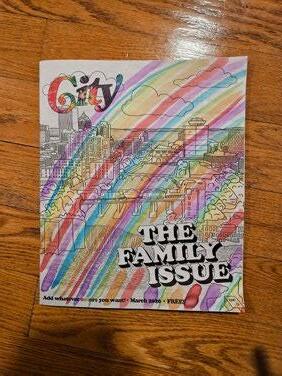
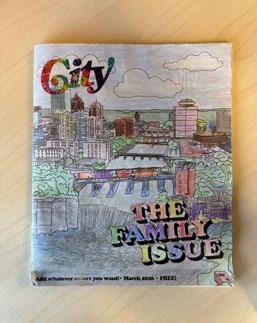
COLORING OUTSIDE THE LINES:
We hope you had a blast adding some much-needed color to the cover of our March issue — here are a couple of our favorites!
CITY COFOUNDER AND PUBLISHER WILLIAM TOWLER (1939-2026)
In memory of Bill Towler
Retired City Newspaper
publisher Bill Towler died February 27 at age 87 after a long, courageous battle with the neurological disease Progressive Supranuclear Palsy. He was a loving, intensely engaged husband, father, and grandfather and is survived by his wife Mary Anna; daughters Elizabeth Towler-Menon and Cheryl Towler Weese; son Will; son-in-law Dan Towler Weese; daughter-in-law Dawn Brandenburg; grandchildren Micah, Cole, and Carter Weese; sisters Lena Scott and Martha Jones; brother Bob; brothers-in-law Robert Scott and Chipper Jones; sister-in-law Cheryl Mullins; and numerous nieces and nephews.
A quiet, humble force of nature, Bill grew up in the South but spent most of his life in Rochester, devoted to the city and its people. He was born in Columbia, Tennessee, and had wanted to be an architect, but there was no university architecture program in Tennessee at that time, and he couldn’t afford out-of-state tuition, so he earned a degree in electrical engineering at the University of Tennessee. He paid his way through college working as a co-op student for Southern Bell telephone company and then as an employee at Oak Ridge National Laboratory.
He married Mary Anna in 1962, graduated from the university in the spring of 1963, and the two moved to the Cape Canaveral, Florida, area, where Bill was a project engineer in Pan American World Airways’ Guided Missiles Range Division during the nation’s early space exploration period. They and their infant daughter moved to Rochester in 1965, where Bill worked first at General Dynamics Electronics as a staff engineer, then at Eastman Kodak as a management consultant in industrial engineering, and then at the Gananda Development
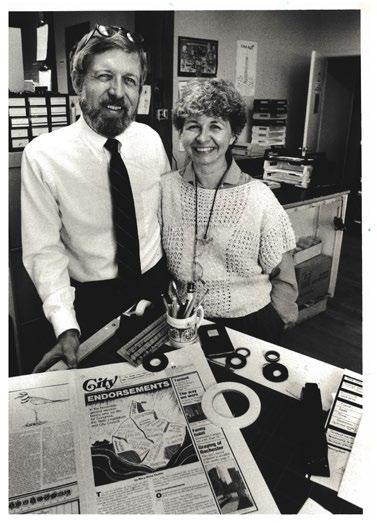
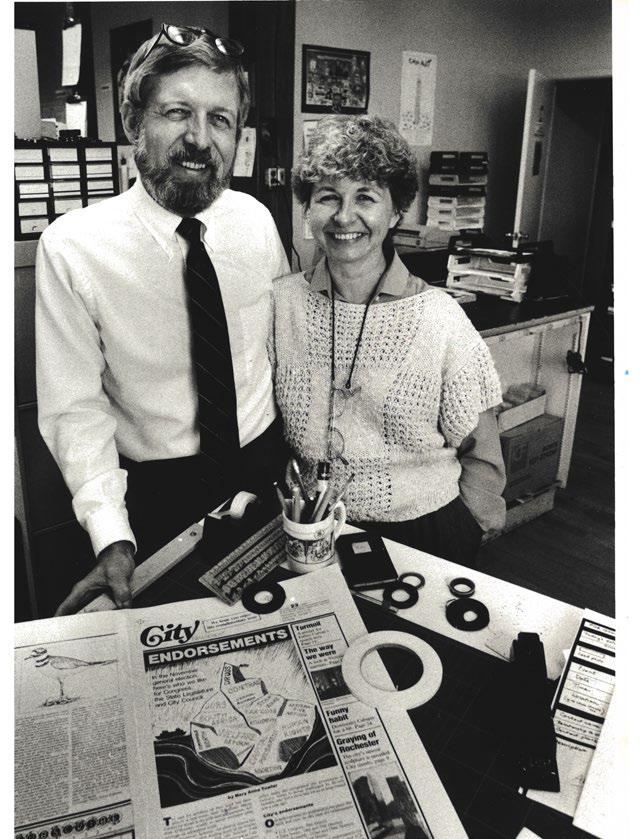
Bill and Mary Anna Towler in 1986. They sold CITY to WXXI Public Media in 2019 after running what was then
weekly newspaper together for 48 years. PROVIDED PHOTO
Corporation as associate director of community development.
And in his spare time, he became heavily involved in city-oriented community activities. A passionate supporter of cities, he served as president of the Park-Oxford Neighborhood Association, chaired a city-wide citizens’ coalition that helped develop a city-planning strategy for Rochester, and served on a task force that developed street-lighting standards for the city. Through the Rochester Episcopal Diocese’s Board for Urban Ministry, he served on a committee working with residents of the Southeast Loop neighborhood as the city prepared to demolish the Savannah Street-Broad Street area during Urban Renewal. And he was an executive committee member of a political action group that took control of the Monroe County Democratic Party.
In 1971, he and Mary Anna founded City East newspaper (later, City), ultimately leaving outside employment for a full-time career as City’s co-publisher, sales manager, and business manager. And for the following nearly 50 years, he devoted himself to supporting independent journalism in Rochester and, in a role he treasured, assisting local businesses and nonprofits, especially arts organizations and small, independent businesses. Bill considered his role in sales to be one of public service, helping small businesses assess their strengths and opportunities, and he often took photographs and designed their ads himself. He served on the board of the Friends & Foundation of the Rochester Public Library and was active in the congregation of Third Presbyterian Church. Nationally, he served as a board member and as president of the Association of Alternative Newsweeklies, which honored him in 2021 with its Lifetime Achievement award. He retired from City in January 2020 following its sale to WXXI.
Bill loved to cook, to read, to sail, to travel, to paint, to go to concerts, plays, and museums – and to just wander around, anywhere he was (in his last years, frequently frustrating family and caregivers by speeding off in his power chair without them). He never found a food he didn’t like, never heard a type of music he didn’t like, never met a person he didn’t like, never saw a need he didn’t want to try to fill. And despite the progression of his disease, which took away his ability to walk and then to talk, he remained intelligent, curious, and engaged in life as much as he was able, attending an RPO concert two weeks before his death.
In lieu of gathering at a memorial service, friends are encouraged to celebrate his life by supporting Rochester-area arts organizations and efforts for peace and justice.
REMEMBERING BILL
I met Bill in 1978 while I was auditioning for a reporter job at City/East. I had no reporting experience and no journalism training, but Mary Anna asked me to go report on City Hall’s moving from Broad Street to the old federal building at Fitzhugh and Church Streets. Before I left, I met Bill and he pulled me aside and suggested which offices and staff might give me good quotes. He wished me good luck. I did OK with that story and Bill and Mary Anna quite literally changed my life by taking me on. Mary Anna was my editor, but Bill was always Bill — cheerful, welcoming, encouraging and eager to pass on news tips. I am forever grateful.
—MARK HARE
I was hired at CITY when I was twenty three years old in 2017. It was my first “real” design job — my dream job, too — and as I’ve learned in the weeks following Bill’s death, through personal memorials similar to this one, I’m not the only one to whom the Towlers afforded their first shot in this industry. Bill could leap acrobatically between modes: sly, coy, and winking in one moment; right down to business in the next. He was efficient in that way, and it made our collaborations feel more exciting and authentic. I remain grateful for his easy humor, profound expertise, and quiet mentorship, and I will always remember the warmth and grace he extended to me as a very nervous, very green young employee of his.
—JACOB WALSH
The first time I met Bill, it was to apply for a job. We talked for a few minutes then he handed me a big old metal stapler and said sell me this stapler. I started my pitch and in an effort to sound clever I said, I’m not just selling you a stapler. I’m selling you organization. Then I looked at his desk and there wasn’t anything out of place! It was the most orderly desk I had ever seen. He laughed. I worked for Bill and Mary Anna for nearly 20 years. Until we meet again my friend.
—TIM LOUIS MACALUSO
Bill and Mary Anna Towler moved to Rochester in the late 1960’s and founded an institution, CITY newspaper, that has illuminated and endured for more than 50 years. Around the same time, another Southern-born couple, Jim and Carolyn Blount relocated here and founded another iconic print media organ, About… Time magazine. The Blounts also endured for more than 50 years, until their recent deaths.
I am so saddened to hear this news. My husband and I were fortunate to meet the Towlers when we moved to Rochester and bought their beautiful home. Bill was so thoughtful in his follow up calls with my husband, making sure we knew all the quirks and special features. Bill and May Anna hold an important part in Rochester’s history and we are honored to have a small connection to that. Sending love to Mary Anna and the entire family. May he rest in peace.
—STEPHANIE BOWEN
Bill and Mary Anna were outspoken advocates for justice and neighborhood revitalization. Rochester owes them a huge thank you for City Newspaper.
—REVEREND JUDY HAY
Bill Towler should be remembered as a man who partnered effectively with his wife to produce something of tremendous value that has sadly gone out of existence in recent years: an independent media voice that speaks with great clarity, moral consistency and unflinching integrity. They covered stories that the major media shied away from. They opined editorially without fearing where the chips might fall. With no ambiguity, they consistently spoke truth to power. You only saw Bill’s name on the masthead. His beloved life partner was the face and editorial brains of CITY. But the venture would not have survived without his super-effective back room skills. He raised the capital and organized the strategy that kept CITY on firm ground for five decades.
Thank you, William M. Towler, for every conscious act you contributed to making Rochester a wonderful community to live, work and activate in. And thank you for your friendship and support over these many years.
—WILLIAM A. JOHNSON, JR.
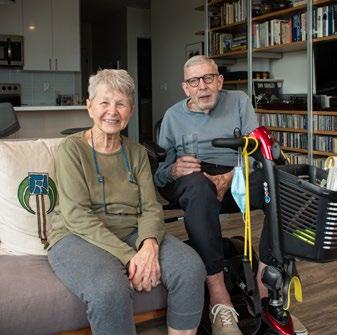
Mary Anna and Bill Towler in 2021.
Landmark and question mark
BY GEORGE CASSIDY PAYNE
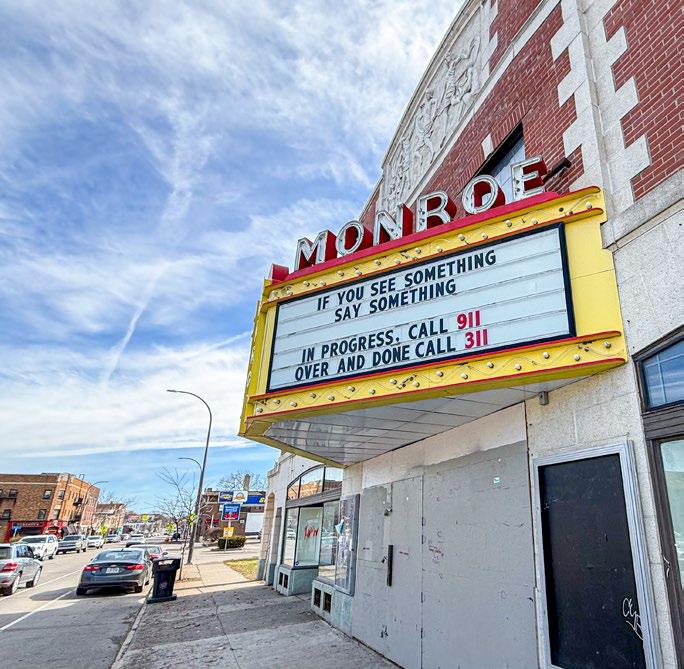
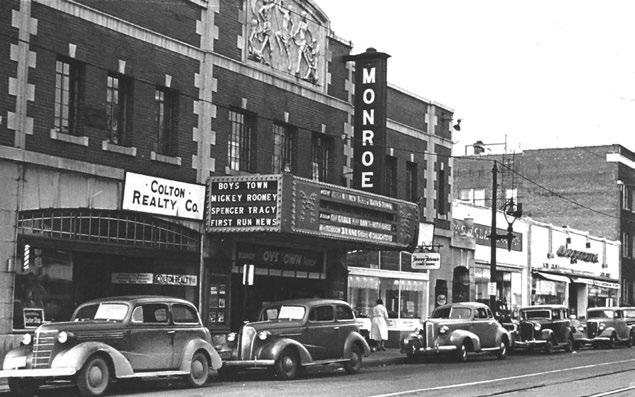
Along Monroe Avenue, buildings don’t just stand. They lean into traffic, watch the sidewalks and quietly record the neighborhood’s evolution. The Monroe Theatre, with its Art Deco façade still intact and its marquee frozen mid-thought, feels less like an abandoned structure than an unfinished sentence.
People notice it. They ask about it. They debate it. Why does one of the most recognizable buildings on one of Rochester’s busiest corridors remain dark, and how long will it stay that way? This isn’t nostalgia. Monroe Avenue is one of the city’s most active mixed-use corridors, where nightlife, small businesses, apartments and historic spaces collide. When a prominent building goes quiet, the absence doesn’t stay contained. It reshapes the block around it.
That concern surfaced in a recent community survey conducted by the Monroe Avenue Revitalization Coalition (MARC) to which more than 1,000 people responded. About 60% of respondents do not live along Monroe Avenue, yet one question surfaced repeatedly: what is going to happen to the Monroe Theatre? The persistence of that question suggests something deeper than redevelopment curiosity. The theater has become a visible symbol of stalled potential along an intersection that rarely stands still, and residents are increasingly wondering whether the delay is temporary or permanent.
To understand why it matters, it
Monroe Theatre’s historic façade and unused space leave a community waiting for answers.
helps to stand across the street. Kevin Hunt has done that for nearly two decades. He works at Enright’s Thirst Parlor, directly opposite the theater, giving him a daily view of what happens when a large commercial building sits unused.
“In the summer especially, it attracts loitering,” Hunt said, describing ongoing issues near the grassy knoll and surrounding doorways. He is careful not to place blame on unhoused individuals.
“When a place isn’t being used, it isn’t being managed. That affects everyone around it.”
Hunt’s observation points to a larger reality: Monroe Avenue functions as an ecosystem. When one space goes inactive, pressure shifts outward. Activity reroutes. Problems relocate. The longer a vacancy persists, the harder it can become to reverse those ripple effects.
Mike Evans, executive director of the Southeast Area Coalition (SEAC), saw that dynamic play out during the pandemic. He recalls an unhoused individual living
for months beneath the theater’s marquee. Because the overhang is private property, enforcement options were limited.
“The City of Rochester eventually cited Walgreens, which leases the property, giving daily fines until the situation was resolved,” Evans said.
The area was later boarded up. As Evans became more involved in Monroe Avenue revitalization, the theater repeatedly surfaced as a community concern, often framed less as a development question and more as a question of responsibility. Residents often ask about Walgreens’ role. Others wonder who ultimately controls the building’s future. The answer lies largely in commercial real estate structure and contracts designed to prioritize stability over flexibility.
The Monroe Theatre sits within a parcel owned by Monroe Goodman Associates, LLC, which includes the Walgreens pharmacy and the adjacent parking lot. Walgreens operates under a long-term “absolute triple-
net” lease, meaning it is responsible for rent, taxes, insurance and maintenance regardless of whether the space is open to the public.
(The theater is currently closed and only used for storage.) Evans said Walgreens previously explored converting the theater into office space, but those plans never moved forward. No public redevelopment timeline has been announced since.
“I see the marquee as a valuable historic part of Monroe Avenue,” he said. “But restoration costs can eventually become overwhelming.”
The arrangement is common. Single-purpose limited liability companies often isolate liability and simplify financial management. Naming entities after intersecting streets — like Monroe and Goodman — is standard industry practice. For Walgreens, maintaining the lease can be strategic. Walking away could trigger significant financial penalties. Holding the space also prevents competitors from entering a hightraffic pharmacy sector and provides overflow storage.
CONTINUED ON PAGE 12
PHOTO BY JACOB WALSH
PHOTO PROVIDED
But for residents and business owners who interact daily with the building’s street presence, that strategy can feel disconnected from neighborhood reality. Rome Celli, president of the Upper Monroe Neighborhood Association, said many residents believe the company has fallen short of community responsibilities.
“Walgreens has not fulfilled its obligation to the community,” he said. “From a neighborhood point of view, they have not fulfilled their responsibilities.”
Celli cited recurring graffiti, broken windows and trespassing as well as unauthorized gatherings and performances that have occurred on or near the property — signs, he argued, of a building that exists in limbo.
“The building itself, while nominally secured, is often dirty and neglected,” said Celli. “Volunteers have stepped in to help clean the area. We have reached out to Walgreens, but there appears to be little interest in helping.”
Preservation advocates warn that prolonged inaction carries risks beyond appearance.
Wayne Goodman, executive director of the Landmark Society of Western New York, said historic buildings play a crucial role in neighborhood identity, but they also deteriorate faster when unused.
“This is not the building’s fault,” Goodman said. “It’s an inanimate object. It is policies and inactions that have brought us here.”
While the theater may qualify for historic tax credits, Goodman warned that continued vandalism and neglect could eventually trigger city code violations, a possibility that would complicate any future rehabilitation.
“This isn’t about demonizing anyone,” he said. “Historic buildings matter. Monroe Avenue matters.”
The community conversation extends beyond preservation and redevelopment into broader questions about civic life and what is lost when shared public gathering
spaces disappear. Dr. Barbara Lowe, a philosophy professor at St. John Fisher University, connects the Monroe Theatre to a tradition of communal spaces that once defined neighborhood culture. Her mother grew up nearby and often described attending Saturday morning shows there with siblings and friends.
“At that time, the theater functioned as what sociologist Ray Oldenburg called a ‘third place,’” said Lowe. “Not home, not work, but a shared space where people gathered, stayed connected to the wider world, and encountered one another.”
Those gathering places quietly shape identity and strengthen neighborhoods.
“The Monroe Theater remains a tangible connection between the neighborhood’s past and its possible futures,” she added.
Lowe’s comments are timely amid growing national concern about social isolation. Former U.S. Surgeon General Vivek Murthy has warned about rising loneliness,
while political and cultural divisions continue to deepen.
“We are in dire need of places where people can gather without pretense and across differences,” said Lowe.
She referenced what social reformer Jane Addams described as adopting a “neighborhood point of view,” centering the experiences of residents most affected by development decisions.
“Sustainable community change doesn’t come from top-down, profitdriven models, it grows through collaboration with the people who live there,” she said. “Democracy doesn’t exist only in elections. It exists in everyday spaces where neighbors encounter one another.”
That philosophical lens mirrors a practical debate already underway — one complicated by economics, contracts and shifting retail realities. Community advocates say the theater’s inactivity blights the street and conflicts with Walgreens’ public commitments to supporting healthy communities. Critics also cite the
broader “dark store” phenomenon, where profitable locations remain closed while long-term leases prevent new tenants from moving in.
Financial realities, however, remain significant. Walgreens has closed more than 1,200 stores nationwide amid shifting pharmacy economics. Investing millions to rehabilitate a community space outside its retail model presents substantial challenges.
Ownership adds another layer. While Walgreens handles maintenance under the lease, major structural restoration could legally fall to Monroe Goodman Associates and its parent company, Rainaldi Brothers Inc. (Efforts to reach Rainaldi Brothers Inc. and Monroe Goodman Associates, LLC for comment were made multiple times prior to publication, but no response was received.) Large-scale rehabilitation would likely require coordination among multiple stakeholders, each with different financial and operational priorities.
Most redevelopment experts say collaboration represents the most
realistic path forward. Public-private partnerships — often supported by preservation groups — have revived several Rochester landmarks, including the Sibley Building and former industrial complexes now converted into mixed-use spaces. Subleasing is another possibility. A third-party developer or nonprofit could potentially activate the theater while Walgreens maintains lease control. But such arrangements require negotiation, financing and long-term commitment, processes that can stretch for years without clear guarantees of success.
Over the years, several conceptual ideas have surfaced. One local nonprofit has explored restoring portions of the interior while preserving the historic lobby and marquee, potentially reopening the space for comedy performances, youth programming and community events. No formal proposal has been approved.
From the City of Rochester’s perspective, activation remains central to corridor health and delays can carry
broader economic consequences.
Erik Frisch, deputy commissioner of Neighborhood and Business Development, said commercial buildings like the Monroe Theatre serve as anchors for entrepreneurship, gathering spaces and neighborhood identity. The city supports adaptive reuse through programs such as the Small Mixed-Use and Commercial Renovation (SMUCR) initiative.
“Preserving historic structures balances honoring the past while creating opportunity for the future,” said Frisch, “but adaptive reuse becomes more difficult the longer buildings remain dormant.”
Survey responses suggest residents largely agree. The call is not necessarily for a major entertainment venue or large-scale redevelopment. Many simply want the building active again. Monroe Avenue thrives on motion — storefronts changing hands, crowds filling sidewalks, neighborhoods constantly reinventing themselves. A vacant theater interrupts that rhythm and raises a question that grows louder with each passing year.
The lobby still exists. The marquee still hangs over Monroe Avenue. Beneath it, traffic continues to pass, businesses open and close, and residents move through daily routines. For now, the theater remains both landmark and question mark, a reminder of Monroe Avenue’s past and an unresolved test of its future.
The question facing the Monroe Theatre is no longer whether it holds value — the question is whether that value will remain symbolic, or return to public life before time, cost and neglect make that decision irreversible.
George Cassidy Payne is a writer and journalist exploring the intersections of art, culture and social justice in Western New York. He also works as a crisis counselor and community organizer, bringing a deep commitment to storytelling and human connection.
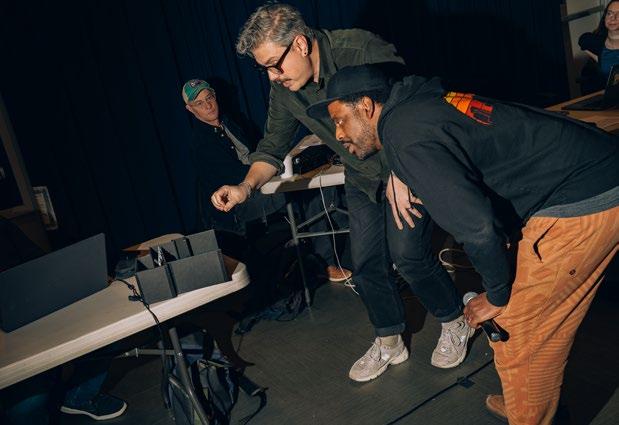
A local nonprofit taps those most harmed by cannabis criminalization to lead legalization.
Bloom and grow
BY GINO FANELLI GFANELLI@WXXI.ORG
Sitting around a boardroom table at their University Avenue headquarters, members of non-profit organization BLOOM ROC describe their paths into the world of cannabis. They use business-tinged terms like “distribution” and “logistics” as their roles in the legacy market — the era before the legalization of cannabis in 2021 — words that simply mean they grew and sold weed long before it was legal, and they know "the industry" inside and out.
“I really wanted to make sure that women and individuals who look like me, they had a fighting chance if we were going to put equity at the forefront, if we were going to talk about communities that were devastated by prohibition,” said Precious Brown, president of BLOOM.
BLOOM stands for “blossoming leaders of our market.” Those leaders are clear to members of the cannabis incubator: they believe the people most harmed by criminalization deserve to lead the legal marketplace.
When New York passed the Marihuana Regulation and Taxation Act, it was a historic moment for legal weed. Namely, it opened one of the largest potential markets for weed in the world. In 2025 alone, sales passed $1.6 billion, and that
CANNABIS
Brandi Hester-Harrell, strategic advisor for BLOOM ROC.
PHOTO BY MAX SCHULTE
number is only expected to rise exponentially over the next decade.
But different from other legal states, New York’s legalization made social equity its prime priority. Instead of handing off the market to well-funded corporations poised to seize the moment, it gave those most harmed by criminalization a first crack at opening dispensaries and cultivating operations. That list included people of color, women and disabled veterans.
That didn’t always go smoothly. Lawsuits protracted the rollout of the first version of social equity licenses, dubbed Conditional Adult-use Retail Dispensary, or CAURD licenses. Those licenses were specifically aimed at people who were justice-involved. In many cases, the slow rollout left many applicants holding the bag, paying rent on spaces they couldn’t legally open.
Brandi Hester-Harrell, strategic advisor to BLOOM, said dwelling on those facts misses the bigger picture.
“My push in journalism is everyone is quick to talk about how bad New York’s rollout was,” Hester-Harrell said. “I work in multiple states (and) I have not seen one state publicly put social equity at the forefront and try to hold the line. Everybody else weeded it in in a way that it was second.”
Part of BLOOM’s role now is to help guide Social and Economic Equity (SEE) license holders to enter the market. The state set a goal of handing out half of its cannabis license to those applicants. To qualify, a person must be from a marginalized group. Special priority is given to people who make under 80% their area’s median income, live in a community disproportionately affected by criminalization or have a conviction for cannabis prior to the passage of the Marihuana Regulation and Taxation Act.
The incubator aims to provide resources to minority-owned businesses to help build a brand, network with other business owners and find their position in the market, to name a few.
“It’s already hard to be able to own and operate any business, more or less a cannabis business,” Brown said. “There wasn’t really a how to book in order to come out of prohibition.”
To the leadership at BLOOM, it was clear that the legalization of cannabis and the way the law was written provided a unique opportunity to make lasting changes to communities ravaged by criminalization of cannabis.
The profundity of the racial disparity in cannabis arrests, prior to legalization, is clear. For example, a 2019 study from the Data Collaborative for Justice at John Jay College for Criminal Justice tracked cannabis arrests in New York state from 1990 through 2017. It found that for every white person arrested for cannabis
possession in upstate New York cities, 12.1 Black people were arrested.
Rochester City Councilmember Michael Patterson represents Rochester’s northeast district. That district is largely Black in population, and Patterson said he’s seen firsthand the effects of years of policing of cannabis (he doesn’t use cannabis himself, describing himself as an “old guy.”) Following a visit to Chicago, Patterson saw how social equity failed to uplift the most criminalized communities in Illinois.
“We met with Chicago (National Organization for the Reform of Marijuana Laws), which was Black-led,” he said, “and their main point that they just drove home across the board was that, look, we’re getting screwed in Illinois because we didn’t have the inclusive piece built in.”
When Patterson returned home, he had a meeting with Jeff Medford, a legacy market player who later became BLOOM’s director of community engagement. Patterson said Medford is carrying the work of building up a truly local community around the cannabis industry.
“My job was to kind of show up, give them the spiel and then get the hell out the way and let them do the work,” Patterson said of the early meetings of cannabis leaders in the early hours of legalization.
Medford said the state “dropped the ball” in the first steps of legalization. Farmers were left sitting on pounds of product with nowhere to sell it and dispensaries were left paying for retail space they couldn’t sell from, to name the most glaring issues.
He added that BLOOM has a unique opportunity to consistently show up for the local industry.
“BLOOM ROC is never a one-and-done thing,” Medford said. “We still communicate with those people who have come through our program.
They can always call us and get information. We’re always making referrals and just trying to connect them with other good business sources as well. I really love that about what we do.”
Patterson views the role of the state, and the social equity positioning of the law, as a potential form of reparations. But there’s a long way to get to that goal, and it comes in the form of money. He sees the need for the state to help financially support legacy market players in entering the legal market.
“Honestly, only New York State could fuck up drug sales,” Patterson said. “Only New York could fuck up drug dealing. Really, again, you didn’t create the market. We did. They all know how to sell weed.”
The next few years for BLOOM, as the market continues to become more established, will be critical. A key piece missing is onsite consumption, which would allow smokers’ lounges and similar establishments to open. The group continues to push the state to move forward on such provisions.
But despite the intricacies of law and specific goals, its overarching goal remains the same: give the industry to the people who built it long before lawmakers signed off on it.
“It’s not just about Black and brown people,” Brown said. “It’s about service, disabled veterans, women, minorities, anyone living in a community devastated by prohibition from 1981 to 2021 as well as farmers, right? We want to make sure that we’re all encompassing and being a resource to everyone.”
bloomroc.org
Gino Fanelli is an investigative reporter for WXXI News. You can reach him at gfanelli@wxxi.org.
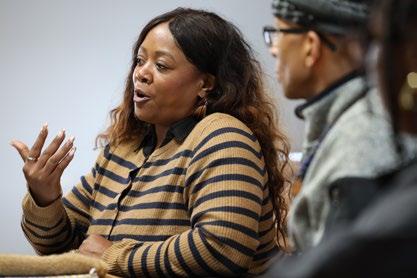
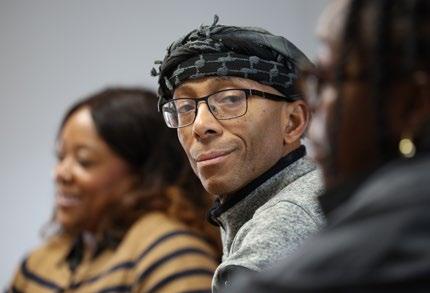
Precious Brown, president, BLOOM ROC, and Jeffrey Medford, director of community engagement.
PHOTOS BY MAX SCHULTE
The door to tomorrow
LITERATURE
BY PATRICK HOSKEN PATRICK@ROCCITYMAG.COM
Though she died in 2010, Lucille Clifton remains one of the most consequential poets in American literature. It requires only a few lines to understand her power. Clifton, a Buffalo native who spent years in Baltimore, chose clear, distilled language to articulate her meanings.
“(T)hey ask me to remember,” she wrote in a 1987 poem, “but they want me to remember / their memories / and i keep on remembering / mine.” The work is titled “why some people be mad at me sometimes,” published in her collection “Next,” a finalist for the Pulitzer Prize.
Yet until recently, discussions of her poetics remained scarce, even as her work traveled and unspooled through new generations. Enter the writer and editor Kazim Ali, who rigorously examined Clifton’s work in his book “Black Buffalo Woman: An Introduction to the Poetry and Poetics of Lucille Clifton,” published by Rochester’s Boa Editions in 2024.
The title was a nod to both Clifton’s identity and hometown as well as an Indigenous historical figure of the same name. The book afforded Ali the platform to highlight Clifton as more than just a poet.
“Lucille Clifton could be considered a philosopher and a theologian,” he said. “She’s also masterful in the art of poetry and prosody. But you don’t have to know
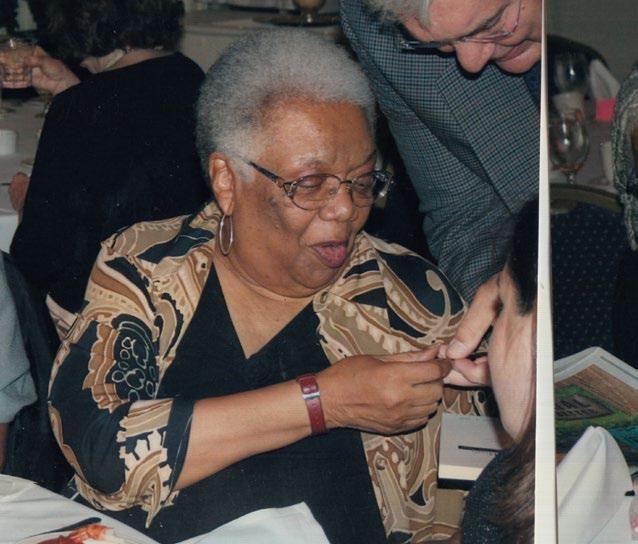
The career of poet Lucille Clifton, a Buffalo native, spanned more than 40 years. For many of those, her work was published by Rochester press Boa Editions. PHOTO PROVIDED
all of those things to have these poems strike you.”
As Ali worked through Clifton’s deep archives at Georgia’s Emory University, he came across a trove of unpublished and uncollected works dating back to the late ‘80s.
“It was kind of thrilling to find them,” he said. “There was this whole body of work that nobody had seen and that none of the scholars that worked on Lucille Clifton had seen and talked about.”
The work will now be read widely, thanks to “At the Gate: Uncollected Poems 1987-2010,” a new book of Clifton’s verse, out April 14 via Boa Editions. It contains more than 70 poems from Clifton’s final two decades, revealing work that simply didn’t fit into her other published volumes.
For Ali, “At the Gate” resumes a longrunning discussion.
“It’s like entering into this conversation about poetry, as well as the pleasure of enjoying new poems from a writer who we thought we were going to hear no more from,” he said.
Ali also characterized some of the uncollected poems as occasionally “edgier” than the rest of Clifton’s work. One of them, “haiku,” dates back to the 2007 mass shooting at Virginia Tech and expresses sympathy for the 32 murdered students and faculty as well as the shooter.
“(W)hat can we say to / their mothers / what can we say / to his mother,” the poem ponders.
“It’s hard to say whether she would have just buried these poems or not,” Ali said. “She didn’t tend to do that. She tended to always work on things until she could bring it to a (final) version, and then she would eventually put it into a book.”
As such, “At the Gate” reveals new depths to a poet that Toni Morrison once celebrated for her “astute, profound intellect.” By her own account, Clifton was an achieving daughter who traced her family’s roots back to slavery — and even further back, to Africa — and who grew into a celebrated and influential poet.
But her beginnings were, by her own admission, as an acute observer and “a nervous child.”
“I used to go to the black-market meat store during the war and it was always packed and I would lean on the counter and it seemed like I was going to faint and they would always wait on me before it was really my turn,” Clifton wrote in her 1976 poetic memoir, “Generations.”
Such insights came from potent selfreflection. She synthesized religious stories
with her own, giving her work an intrinsic complexity. Her economy of language yielded potent work; the introspective title poem of “At the Gate” finds a traveller coming upon “the door to tomorrow.”
But on the page, the language was simple, often lowercase and short in length.
Peter Conners, Boa Editions’ Publisher and executive director, said this can present readers with a certain first impression.
“It can come off almost as simplistic,” he said. “It can come off almost like, ‘gee, I think I could do that.’”
But Clifton’s insights were singular.
“The skill level that goes into writing something that translates to immediate connection — that’s where the magic happens,” Conners said.
“At the Gate” marks Clifton’s 10th published work with Boa. The partnership began in 1987 when Clifton, then in her early 50s, released “Next” and “Good Woman”; both became Pulitzer finalists the following year. Her 2000 collection, “Blessing the Boats,” won the National Book Award for Poetry. Boa later launched its own “Blessing the Boats Selections” initiative, which publishes poetry collections by women writers of color.
The occasion of a posthumous Lucille Clifton book — made all the more poignant by the fact that she died 16 years ago — warrants special treatment, Conners said.
When the press put out Clifton’s collected works in 2012, the 800-page book was available in hardcover with a built-in cloth bookmark. Fittingly, it also came with a foreword by Morrison.
The plan was to likewise publish “At the Gate” in hardcover editions. But Boa lost $35,000 in funding from the National Endowment for the Arts last year. As a result, those plans were stifled.
“We just didn’t have the extra money,” Conners said. “The most important thing is to get the work into the world in the most beautiful condition that we can and in a way that we are able to afford it. I will say, the paperback looks beautiful, but, you know, it’s not that.”
Nevertheless, there will be a hardcover edition available for sale, he noted, without the “bells and whistles” that Boa originally planned to include.
Just as Clifton’s relationship with Boa is its own historical document, Clifton’s verse throughout her career tended to evoke history, like the lineage of family. There’s Aunt Timmie, whose labor ironing the bedsheets of a “master poet” is
also art. There’s her father, Samuel Sayles, who built railway couplers.
But there’s also the Black history of Cynthia and Carol and Denise and Edy Mae, the little girls killed in a Baptist church fire bombing in 1963 Alabama. (“Four little birds shattered into skylarks,” Clinton writes.) There’s the lynching of James Byrd Jr. in Jasper, Texas in 1998.
That line of despicable violence also traces to a Tops supermarket in Buffalo, where a white supremacist gunman killed 10 Black people in 2022. The harrowing scene played out blocks from where Clifton grew up on nearby Purdy Street. There is all of this weight, and there is hope.
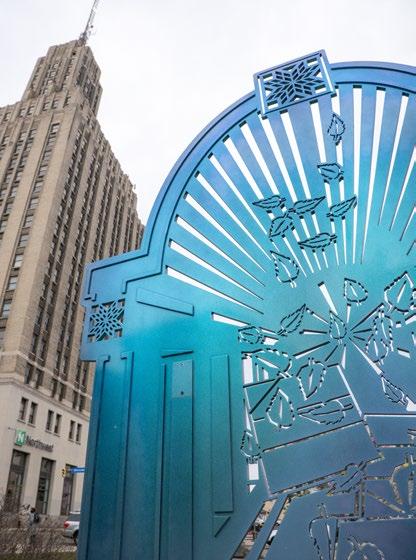
In 2023, the City of Buffalo Art Collection dedicated a new sculpture titled “Spirit of Inspiration” near the downtown library. Created by visual artist Olalekan Jeyifous, the airy blue structure was inspired by Clifton and bears a few lines of her verse on its plaque.
“(L)et love be / at the end,” it concludes.
Ali said that as much as Buffalo shaped Clifton, it was Baltimore that supported
her poetic leanings and “welcomed her and helped her build her life.” This is why “At the Gate” makes a perfect companion to “Black Buffalo Woman,” beginning with its cover artwork, a mosaic of red and white brush strokes.
It’s a piece by the Black American painter Alma Thomas; the Memorial Art Gallery presented an exhibition of her vibrant work in 2025. Ali said Thomas and Clifton shared a Baltimore connection, but beyond that, the image seems to be in conversation with Clifton’s poems.
“This painting expresses so much joy and beauty, and that’s what Lucille Clifton always is to me, despite the intensity and pain that’s sometimes expressed,” Ali said. “At the end of the day, there’s always this desire for more life and this commitment to joy.”
Patrick Hosken is CITY's arts and culture reporter. He was formerly the music editor at MTV News and a producer at Buffalo Toronto Public Media.
A sculpture inspired by Clifton titled "Spirit of Inspiration" was installed in downtown Buffalo in 2022.
PHOTO BY NICK GRECO
He shoots, he scores
BY JIM MANDELARO
When Don Stevens was hired as the Rochester Americans’ radio broadcaster in the summer of 1986, his wife asked how long they would be there.
“Two years, max,” Don said. Stevens had his eyes on a career in the National Hockey League and thought Rochester would be the final minor-league stop on that journey.
“The feeling was that things would change with the (parent) Buffalo Sabres, and I’d get my shot,” he said. “But that never happened.”
Two years turned into 40.
“It seemed like every NHL chance that came along, I was in the mix,” Stevens said. “And then, all of a sudden, a friend of a friend got the job.”
He laughed.
“I’m still waiting for that call.”
This spring, Stevens is retiring after a 58-year career in broadcasting. He has been the soundtrack for legions of Amerks fans, but the puck stops here.
“I just got to the magical number of 40 and decided, ‘That’s it,’” he said. “That’s enough.”
Amerks Hall of Famer Jody Gage, the team’s director of strategic planning, said Stevens made fans feel like they were sitting at center ice.
“You knew when the Amerks scored versus when the visiting team did,” Gage said. “He made the players, coaches, staff and fans feel welcome and a part of the family. He bled red, white and blue.”
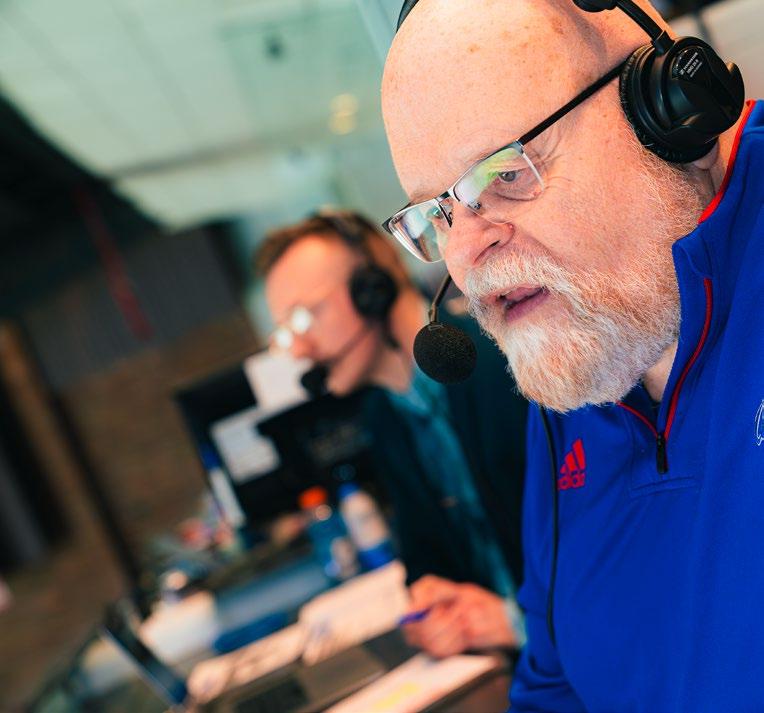
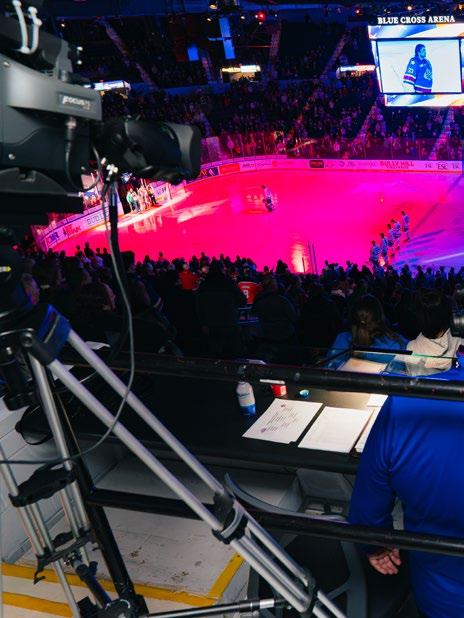
Don Stevens heads into retirement after 40 years as Amerks broadcaster.
Stevens has worn numerous hats during his Rochester tenure, including public relations director, radio talk show host, and founder/president of the AHL Broadcasters/Writers Association. In the late 1990s and early 2000s, he doubled as the voice of the Amerks and the pro soccer Rochester Rhinos — with the teams’ schedules often overlapping.
“I remember doing a home hockey game on a Friday night, then catching the red eye and flying to Seattle and driving to Vancouver for a Saturday Rhinos game,” he said. “After the game, I drove back to Seattle and caught a red eye to Buffalo. Then, I drove to Hamilton, Ontario, for another Amerks game that Sunday afternoon.”
Stevens lived in Wainwright, a small town in Alberta, until his family moved to Vancouver when he was seven. He didn’t watch TV until he was 12, yet he has been on TV (and radio) for 40 years as the voice of the Amerks, his shouts of “He scoresssss!” and “What a save!” burned into the brains of diehard fans.
Stevens’ broadcasting career began in 1969, when he served as disc jockey and sports director for
a small station in Grand Island, Nebraska. Then it was on to Denver; Sioux City, Iowa; Grand Forks, North Dakota; San Diego; Seattle; Portland; Phoenix; back to Seattle; and then to Salt Lake City, Utah. He covered baseball, hockey — even World Team Tennis.
In 1979, Stevens turned down the job of radio voice for the NHL’s Los Angeles Kings. He had just taken a job with a minor-league team in Seattle and felt he should honor his commitment. His wife at the time also didn’t want to leave her job and move to L.A. “So, I said ‘no,’” Stevens says. “I was 29. I figured there would be many opportunities along the way.”
In 1986, he received a call from Amerks general manager George Bergantz. Play-by-play man John Gurtler was leaving for a job with the parent Buffalo Sabres. Bergantz interviewed 50 candidates but quickly settled on Stevens.
“I’m really looking forward to being in a city where the fans like hockey,” Stevens said upon taking the job. “I’ve been in places where I say I work for a hockey team, and they say, ‘We have a hockey team?’’’
Some of Stevens’ greatest moments behind the microphone took place in his first year, which was the 1986-87 season.
The Amerks won a shootout at Binghamton on the final night of the regular season, clinching the division title by one point over the host Whalers.
“We came back to town in the early morning hours and we couldn’t get our bus across the bridge,” he said. “It was totally packed with fans.”
A few weeks later, the Amerks outlasted Sherbrooke in seven thrilling games to win the American Hockey League’s cherished Calder Cup championship behind coach John Van Boxmeer and star players like Gage, Gates Orlando and goalie Daren Puppa. This time, fans swarmed the airport in the middle of the night.
“You walk down the steps of the plane and look out and see thousands of fans outside of the chain link fence, yelling and screaming,” said Stevens. “It was magical.”
The Amerks would win their only other Calder Cup with Stevens behind the microphone in 1996.
“That team was great, too,” he said, “but there’s nothing like the first championship.”
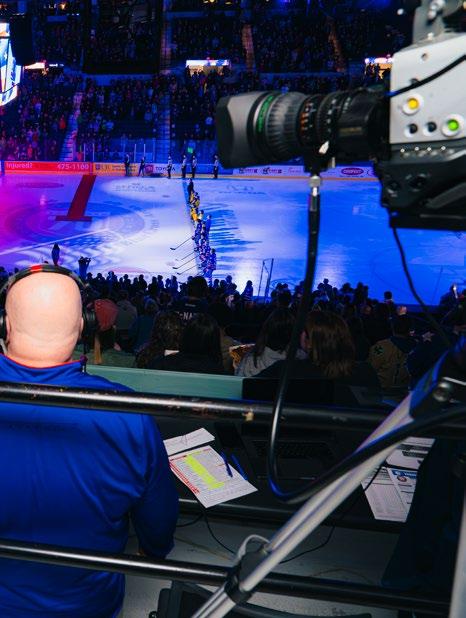
Don Stevens in the media booth.
PHOTO BY ROBERTO F. LAGARES
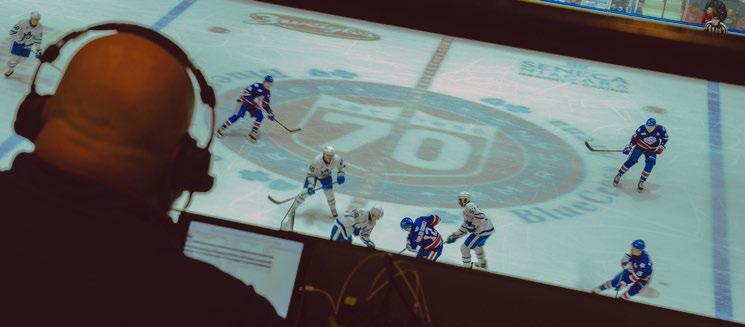
Don Stevens looks over the ice as he announces the play-by-play.
PHOTO BY ROBERTO F. LAGARES
2026 Rochester International Film Festival
He has been honored countless times through the years: A two-time recipient of the AHL’s James H. Ellery Award for outstanding media contributions to the league, he was inducted into the Frontier Field (now ESL Ballpark) Walk of Fame in 2003 and the Amerks Hall of Fame in 2011. But to Stevens, the greatest honor came in 2023, when the press box at Blue Cross Arena was named in his honor.
“That one left me speechless,” he said.
Stevens still spends “three hours of preparation for every hour I’m on the air” to get ready for his broadcast, studying statistics and player bios.
“If I use two percent of what I put on paper, I’d be surprised,” he said. “But you never know what you’re
going to need — and when you’re going to need it.”
The AHL has changed immensely since Stevens joined the Amerks.
“There were 12 teams when I started, and now there are 32,” he said. “And every team has a total one-to-one relationship with NHL teams.”
When Stevens started, he would receive statistics from the AHL on Tuesday morning and use those stats throughout the week.
“I’m sitting there doing the broadcast saying, ‘Well, at the start of the week, so-and-so led the league with X number of goals,’ but it’s really four games later,” he recounted. “You couldn’t give accurate information. Now, everything is instant.”
Blue Cross Arena stands for the National Anthem.
PHOTO BY ROBERTO F. LAGARES
Stevens has no retirement plans, and he’s trying to soak in every moment of this final season. He’ll broadcast all 36 home games and select road games as he winds down his career.
“I’ve been trying to slow the clock down, but that’s definitely not working,” he said.
One thing is certain: Stevens’ legacy in Amerks lore is secured.
“Don will always be remembered as the voice of the Amerks and an all-time great Rochester American,” Gage said. “I’m proud to call him a friend, teammate, colleague. His voice will be missed. To Don: enjoy retirement, travel the world and remember: you’ve always got a home here with the Amerks.”
Jim Mandelaro is a freelance writer and former sports reporter who covered the Red Wings for 24 seasons for “The Democrat and Chronicle.” In 2022, he was inducted into the Red Wings Hall of Fame.
PHOTO BY ROBERTO F. LAGARES
Flocking to the sun
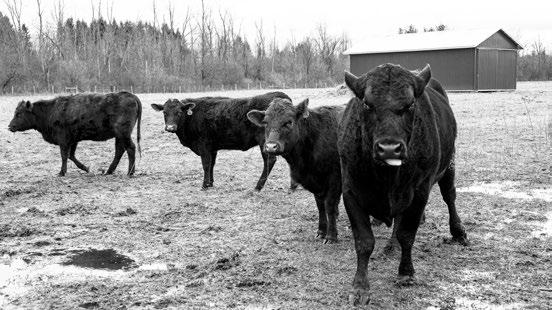
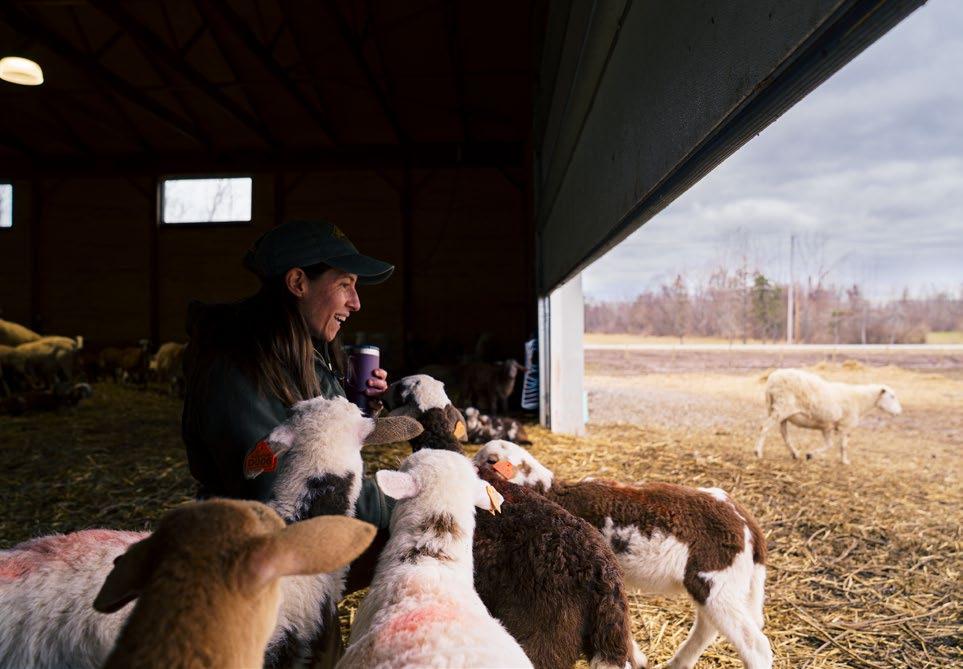
AT NORBUT FARMS, THE FUTURE OF SOLAR IS SHEPHERDED BY THE SHEEP.
WORDS AND PHOTOS BY ROBERTO F. LAGARES
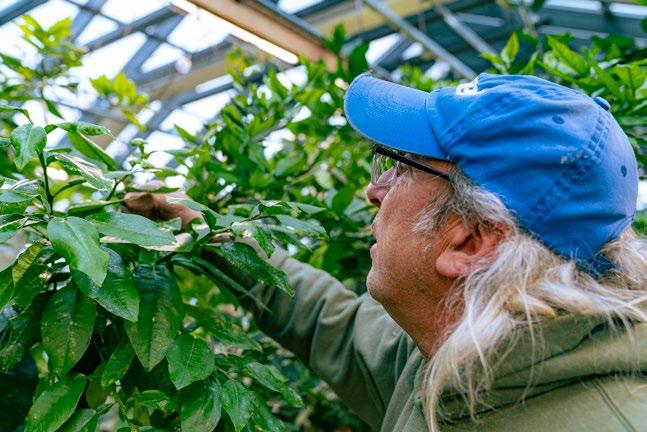
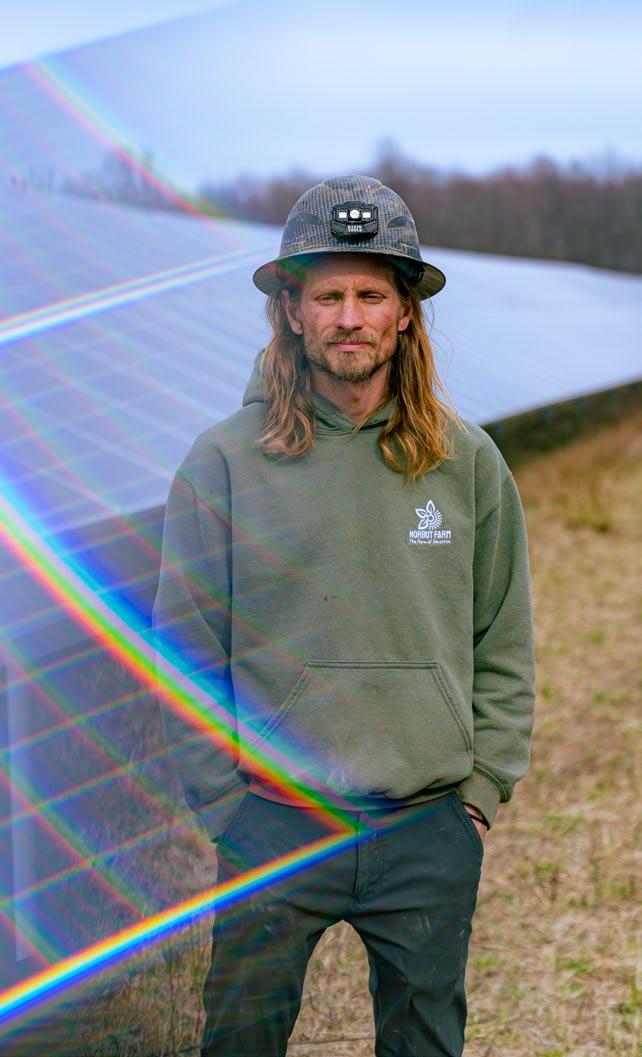
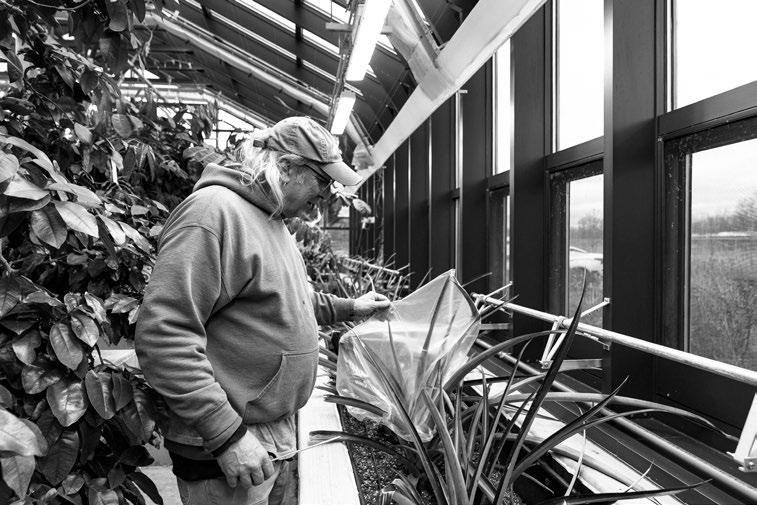
Embroidered on J. Michael Moore’s pine green hooded sweatshirt is the Norbut Farms logo. Beneath it the phrase, “The farm of tomorrow.” That’s the core belief throughout the grounds of the agriculture division that Moore, general farm manager, runs at Norbut Solar Farms in Spencerport. The Kentucky native pioneered the first solar grazing program at utility scale back in his home state, and after seeing the impact of this agrivoltaic method (placing solar panels on farmland to aid coproduction of agriculture and electricity), Moore saw the untapped potential in New York.
“Kentucky is still pretty combative, as a state, as communities, as individuals. So I knew I could make more of an impact in Rochester,” Moore said “Solar is smaller, but more prolific and much further across the state than Kentucky, and as this industry continues to grow I have a few of the answers to manage land.”
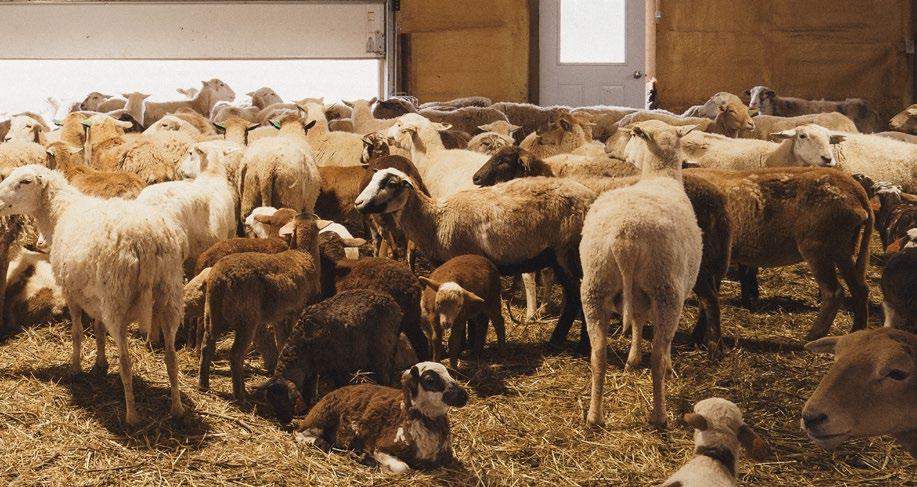
Solar grazing is considered a sustainable method to manage vegetation on farms, primarily utilizing livestock such as sheep to maintain the grounds. This allows the land to remain productive, which is a common misconception of solar farms.
“It starts with sheep, and then it expands outward,” said Moore.
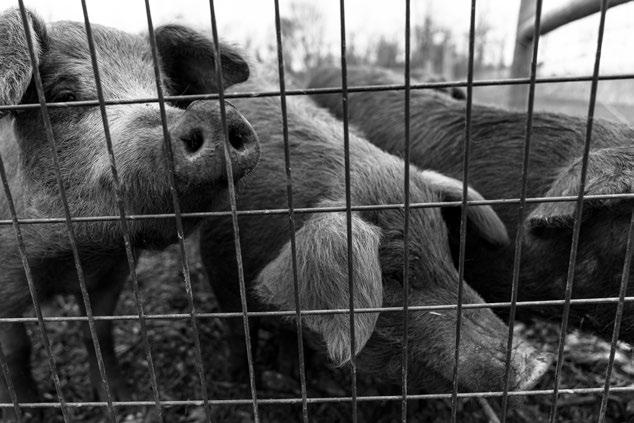
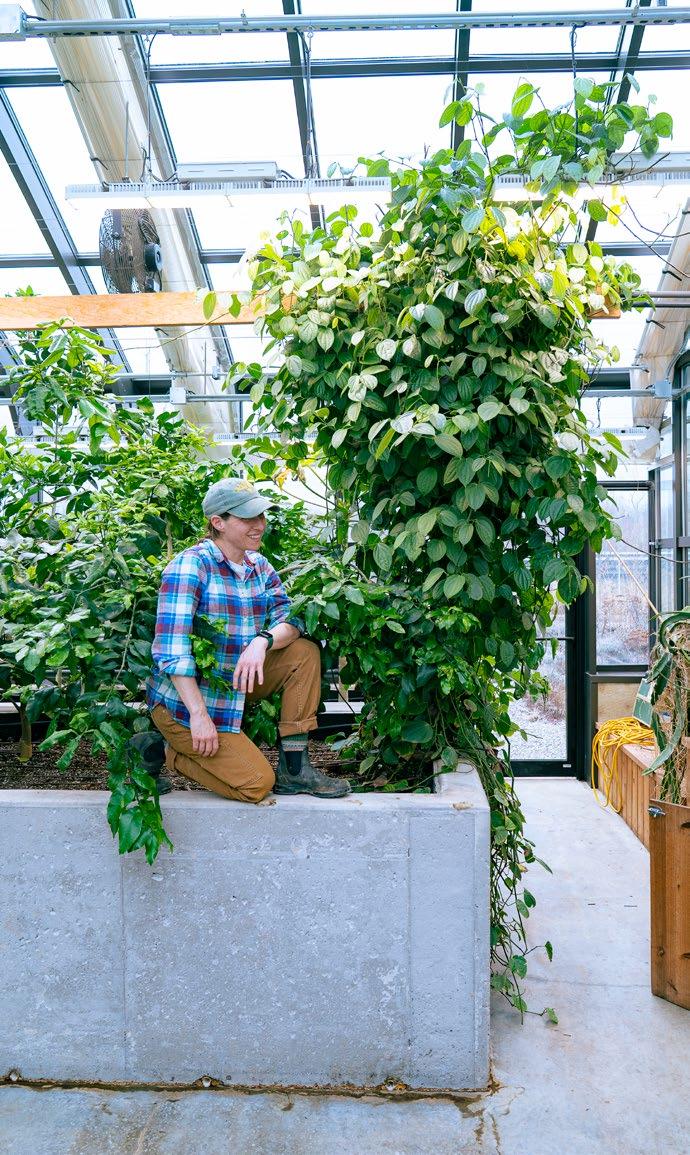
The regenerative farming method at Norbut began as a wellness program to feed its employees during the pandemic, and has grown beyond sheep to include a tropical greenhouse, hogs, goats and cattle — along with some other unexpected crops.
“(In our) tropical greenhouse we’re growing fruiting bananas, limes, peppercorns, very rare plants, and we do that using geothermal and rainwater collection systems,” said Moore.
Inside the 80º structure, yuzu trees grow beside Greek olives. Pineapples bloom opposite agave plants and tall sugar cane just misses the ceiling.
“It’s really like I work in a jungle,” said Chris DiDio, farm assistant for Norbut. “We’re building a full ecosystem, down to the insects.”
The diverse farmscape has provided fresh and unique produce for myriad plates in the community, supplying businesses like Lucky’s, Dough Boyz Pizza, Wildflour and Foodlink with protein, produce and herbs.
Kayleigh Moriarty, flower and operation lead at Norbut and server at Lucky’s in the North Winton Village neighborhood, said the marriage of the two worlds is a special, full circle moment to not only witness but take part in.
“To harvest it, to bring it to the restaurant, to watch them use it, garnish it with those spicy microgreens and then bring it to a table — it really starts a cool conversation,” Moriarty said.
The goal with solar farm development is to create a positive impact for farmers. Even as lucrative leasing deals become a subject of concern believed to lead farmers to reduce operations or give up on farming altogether, a February 2026 report by Cornell University showed that New York farmers were three times more likely to invest solar revenue back into their farms and nearly half of the farmers did not plan to change their agricultural practices at all.
Combine these findings with the National Corn Growers Association’s February 2026 report that monocrop farmers are entering a fourth year of decline, citing cash flow pressures resulting in farms to rely on offpremise work to stay afloat. The agrivoltaic model at Norbut looks to become a blueprint of relief for farmers, the land and community.
“This initial site has become a model to showcase, if it’s going to be developed into solar, how a whole farm system can interact to remain productive, feed our homes energy, but also feed ourselves using the same land,” said Moore “If it’s community solar, it can also be a community foodscape — it doesn’t have to be one or the other.”
norbutsolarfarms.com
Roberto Felipe Lagares is CITY’s multimedia reporter and has an unruly amount of film cameras on his person at all times. You can follow him @bertoscamera.
Flora grows the scene
NIGHTLIFE
BY JON HEATH
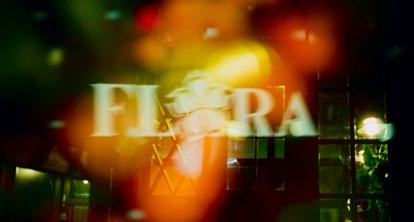
On a gray afternoon in Rochester, light filters through the tall windows of Flora on Monroe Avenue, catching blue-tinted glass and clay-toned walls. The room feels warm, almost unexpectedly so. In one corner, someone reads quietly with a drink. At the bar, a small group chats with the bartender. Later, the music will get louder and the dance floor will fill. But for now, the atmosphere is calm, welcoming and full of possibility.
For owner Tom DeBlase, that mix of energy and ease is exactly the point.
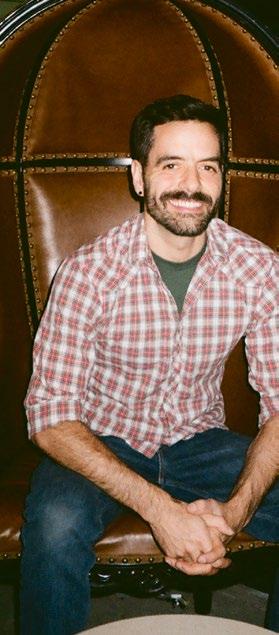
DeBlase is a Rochester native who has spent years cultivating the local electronic music scene. With Flora, which opened in December 2025, he hopes to create something Rochester has always needed more of: a space where people can gather, connect and grow together.
Before Flora became a bar, the idea had already been taking shape. DeBlase spent more than a decade organizing dance events and DJ nights across the city under the moniker “Sole Rehab.” Those gatherings moved from venue to venue, sometimes in traditional clubs and sometimes in less conventional spaces.
“There’s a level of freedom and comfort that queer communities feel in venues that aren’t traditional,” said DeBlase. “Warehouse spaces especially allowed people, particularly the trans community, to feel more comfortable being themselves.”
A new queer gathering space
opens on Monroe Avenue.
Tom DeBlase, right. PHOTOS BY ERIN CONNORTON
scene
The events developed a devoted following. Eventually, a friend (and now business partner) encouraged DeBlase to take the next step. Flora was born from that idea — a place where the energy of those pop-up events could take root in a permanent space. The name itself reflects the bar’s guiding philosophy.
“Fostering community and bringing people together is my life’s work,” said DeBlase.
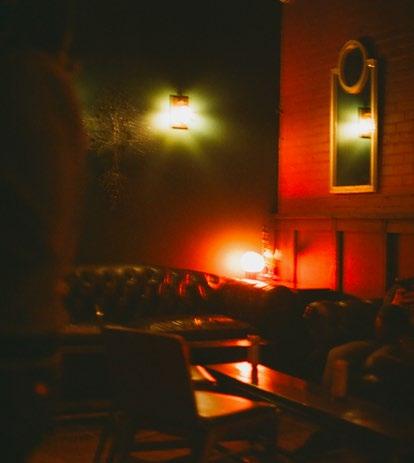
The building that houses Flora was once a car dealership, and DeBlase embraced its unusual structure rather than hiding it. Exposed pipes remain visible, balanced by tufted sofas and warm lighting. The effect is a kind of industrial-meets-earthy aesthetic — what he describes as “shabby chic.” Intentional color choices create an atmosphere that feels grounded and organic. For DeBlase, it reflects the realities of Rochester itself.
“Rochester can be so gray and bleak, especially in the winter,” he said. “I wanted a space that felt vibrant and full of life.”
Music, too, is central to Flora’s identity. Friday nights lean toward pop, while Saturdays bring underground house and techno. DeBlase’s focus now is less on performing himself and more on creating opportunities for others.
“I’m a middle-aged white guy,” he said with a laugh. “I feel like I’ve said a lot of what I need to say creatively already.”
CONTINUED ON PAGE 30
LUNCH & DINNER
THURSDAY-SATURDAY 11:30am-10:00pm
SUNDAY & MONDAY 4:00pm-9:00pm
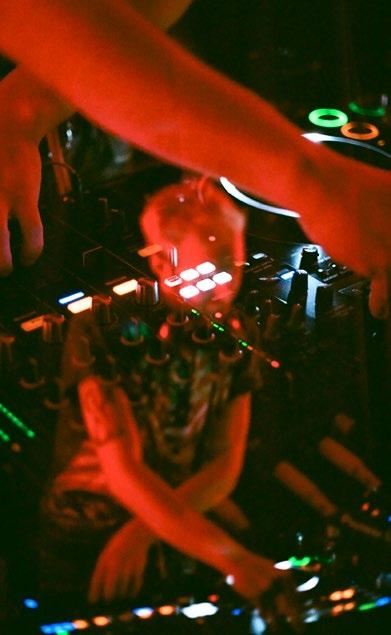
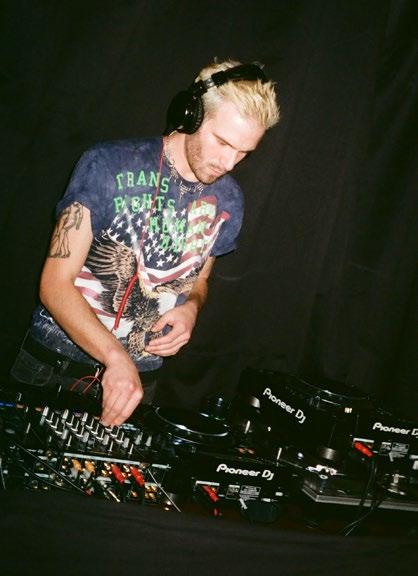
He uses the bar as a platform for emerging DJs, giving them access to professional equipment and the freedom to shape their own nights. One of those DJs is Brian Buttlett, whose Friday event “Night Bloom” features pop-forward dance music curated for queer folks, community and allies. Another is Rosamaria Martinez, who performs under the name Cherry Midnight. Her monthly residency, “Midnight Fever,” is inspired by the music she grew up hearing.
“It’s a love letter to disco, house and funk,” said Martinez. “I spend a lot of time digging through music to find tracks people may never have heard and share them with the crowd.”
She said Flora offers something rare for performers.
“Every time I walk in it’s a different crowd and always an enthusiastic, energetic vibe,” said Martinez. “That energy gives me the freedom to explore musically in ways I normally might not be able to.”
She also values the sense of representation she experiences there.
“As a queer Afro-Latina, seeing people who look like me in the space means a lot,” she says. “It makes my heart happy whether I’m dancing in the crowd or behind the decks.”
The bar’s menu includes house cocktails such as the “Carrie Bradshaw Lied” (spoiler: it’s not a Cosmo) and “Gay Coffee” (their take on an espresso martini), along with light fare like flatbreads and homemade hummus.
But DeBlase believes the biggest draw isn’t the drinks or the music, it’s the feeling of belonging. Guests describe the space as “a gay Cheers” or simply a friendly neighborhood bar. For many, especially those who have not always felt welcome
in public spaces, Flora has quickly become something close to home. The space opens at 4 p.m., which is earlier than many nightlife spots, and the decision has produced an unexpected but welcome trend. Some visitors arrive not to party but simply to spend time.
“We have people who come in with books or notebooks,” said DeBlase. “I remember telling my partner, ‘We have a bar people bring books to — how cool is that?’”
Flora’s opening comes at a moment of change for Rochester’s LGBTQIA+ nightlife. The longrunning Avenue Pub closed at the end of 2025 after 50 years in operation, while the Bachelor Forum has temporarily closed for rebranding and reorganization. For DeBlase, those losses don’t represent an opportunity, but a reminder of how much work remains.
“We need more spaces, not fewer,” said DeBlase. “Rochester could support so many more queer places. We’re an underserved population.”
That sense of urgency shapes his vision for Flora. In a time when queer and marginalized communities often feel under pressure, he sees the bar as more than a nightlife venue. It’s a gathering place — somewhere people can relax, dance, talk or simply exist among friends.
And like the name suggests, the goal is to keep growing.
florarochester.com
Jon Heath is an English writer now based in Rochester who enjoys getting to know people and teasing out their stories; he writes about music, literature and friendly folks.
DJ Brian Buttlett.
A martini-forward millennial microdoses cannabis for 52 hours.
Such great heights
BY LEAH STACY LEAH@ROCCITYMAG.COM
My first real interaction with anything cannabisrelated was at the Bonnaroo Music & Arts Festival in 2011. To save money, my friends and I had purchased cleanup crew tickets, meaning we stayed — sunburned, largely unwashed and dehydrated from four days of open-air concerts in the Tennessee hills — to help sweep the massive festival grounds.
There was a special term when we found anything interesting or valuable: someone would yell (or excitedly whisper), “ground score!” and we got to keep anything we could carry. My ground scores amounted to two like-new camp chairs, several bungee cords and a glass weed pipe swirled with orange and white. It reminded me of a creamsicle.
Had I ever smoked weed? No, no I had not. Did I plan to? I guess some part of me did, though my memory is a bit foggy now. But after staying sober through an entire music festival where drugs were readily available (the Molly era, IYKYK), it’s kind of hilarious to think that was my final act of defiance.
My boyfriend and I smoked weed from the pipe once or twice in the decade that followed; I couldn’t tell you where it ended up. And for a millennial who produces a cocktail festival and prefers a sippable social lubricant to smoking grass, cannabis, in its many forms,
is not something I’ve ingested often in my adult life. It’s never made me feel amazing enough.
That’s probably why the CITY team agreed I was the best person to microdose for a story. But if I was going to do it, I was going to have some sort of hypothesis, and I was going to need data. I settled on the ongoing conversation about the loneliness epidemic, which alleges that people are going out less, drinking less and getting laid less — is it due to cannabis? Is it doomscrolling? A 2020 study by the National Library of Medicine found “marijuana, but not alcohol, use frequency (was) associated with
greater loneliness, psychological distress, and less flourishing among young adults.” This was a hypothesis worth exploring.
To say I was high for an entire weekend isn’t entirely true. To say I spent 52 hours microdosed on different strains of edible and drinkable cannabis is more accurate. But it was for science, and I was the lab rat.
The theory: We’re in the midst of a loneliness epidemic. People are going out less, spending less, drinking less. Is weed to blame?
The hypothesis: Choosing weed as a recreational activity usually eliminates third places, since
smoking lounges and cannabis bars aren’t (yet) legal in New York State. Third places are traditionally where we gather, find serendipity, encounter new people and ideas, have meet-cutes — all the things that lead to a great story the next day and beyond. These interactions don’t happen from your couch. Based on my previous experience, weed makes me tired, hungry and more anxious in social settings. Could it be the culprit for less social engagement?
The experiment: From 6 p.m. Friday until 10 p.m. Sunday, I would go through a typical weekend in my life, only changing one thing:
CANNABIS
PHOTOS BY ROBERTO F. LAGARES
I would forgo alcohol intake, and instead ingest 2-5mg of edible and drinkable cannabis a few times per day. (As an aside, I am historically very sensitive to cannabis and my alcohol tolerance is perhaps embarrassing to my ancestors.)
5:40 p.m. Time to go shopping. I compare reviews and online product listings, eventually landing on Wicked Reserve Dispensary on University Avenue. I approach the cannabis “bar,” where the weekend manager, Trevor, is patient with my questions, guiding me through the New York State-produced inventory on an iPad ordering screen. I know sativa is the strain that makes me feel less sluggish, and indica tends to make me paranoid and sleepy. We select five products with differing strains — two drinkable, three edible — and he rings me up. I pull out a credit card, it’s denied. Payment is cash or debit only due to limited legality, which sends me driving a few streets back home to get my debit card.
6:39 p.m. It feels strange to pop a weed gummy instead of toasting at happy hour, but that’s what I do before heading inside the gym. The “Lions Mane Mango” gummy is savory, the texture satisfying.
7:16 p.m. I’m sweating and yawning as I move from an elliptical to a stairmaster, but it’s Friday so I’m not sure the gummy is to blame.
8:25 p.m. My friend and I are having a hot tub yap session when the gummy really hits. My entire
bloodstream is rushing from the exercise, the hot water and the high. I down my bottle of electrolyte water — ah yes, now I remember how thirsty this makes me — and head home.
8:55 p.m. By now, I have eaten a generous amount of sour cream and cheddar chips and bread and butter pickles while I air fried pizza rolls (bless whatever party I bought those for) and chicken tenders. Hot honey and bleu cheese dips only. Why am I so dizzy!?
9:07 p.m. I shower and get a big idea for a consulting company: “What Could Go Write.” (LOL, oh. So that’s how those things start.)
9:36 p.m. A friend and I head to the Public Market, where we’re mounting a show in June, to plan the footprint. The recent rainfall glints off the cement under the lights. I take a lot of photos and stare, the reflection is mesmerizing.
10:20 p.m. I’m slurring words and fighting sleep from behind my mocktail at Cure, so my friend drops me off at home. How am I still high? This gummy is hitting like NyQuil. Let me sleep.
SATURDAY
8:30 a.m. I’m attending a baby shower this morning for one of my best friends, and I volunteered to pick up the flowers from somewhere near Seabreeze. The term “dazed and confused” makes a lot more sense now.
11 a.m. No microdosing until after the shower (respectfully), and no mimosa either. I did, however, absolutely house the brunch buffet options.
2 p.m. Home from the shower, I crack an ayrloom Half + Half (lemonade tea, like an Arnold Palmer, but with 10mg THC and 5mg CBD per can). Delicious. I drink a third of it and head out to meet my sister, brother-in-law and niece for a walk since it’s one of those rare 70-degree March days.
2:22 p.m. Already feeling warm and buzzy, but maybe I’m sun drunk?
3:15 p.m. Stuck at a coffee shop while we wait out a downpour. Classic Rochester weather. Ran into some friends, had to concentrate incredibly hard to play it cool during conversation because it felt like my brain was zooming in and out.
5:45 p.m. Smuggled an unflavored ayrloom tincture into the movies and added 5mg to a crispy cherry Coke. Halfway through Maggie Gyllenhaal’s unhinged flick “The Bride,” the popcorn and M&Ms start hitting hard.
8:21 p.m. True solidarity in friendship means going to Taco Bell after you eat a large bag of popcorn. Crunchwraps with a side of those weird little chips and cheese dip forever.
10:03 p.m. First time experiencing a sleep rope gummy, which has indents to measure milligrams and tastes like blueberry pie — Violet! You’re turning violet, Violet! It took about an hour to kick in then landed with a whoosh, leaving me dizzy and heavy. I folded a large amount of laundry and then fell fast asleep.
SUNDAY
9:15 a.m. Daylight Savings happened the night before, so all my clocks were wrong and it felt like 8:15 a.m. Drank another third of the ayrloom can before heading to Pilates (5/10, would not recommend, dry mouth and thirsty for all of class).
10:50 a.m. Grabbed a coffee and knocked out some work. Felt a little
buzzy, but it was a more focused energy this time.
2:12 p.m. Another unseasonably warm day, so my parents and I take a walk in the woods behind their house after lunch. Every color and sound feels sharper, but I’m floating in a base state.
7:43 p.m. I pop a 5mg Belgian chocolate and head to a birthday party. It’s DJ-level loud, there are people there who make me socially anxious and I decide to Irish goodbye. I do a shot with the birthday friend before I leave — the first alcohol I’ve had all weekend — and it warms all the way down my torso.
8:58 p.m. Arrive at Compline, a 25-minute weekly chorale concert by candlelight. The tequila and the chocolate prove to be a winning combo, and I close my eyes while the Eastman singers’ voices lilt through the church’s cavernous space.
9:40 p.m. Ending it full circle with a jaunt to McDonalds: double cheese no onions, small fry, hot fudge sundae. Thank you and goodnight.
The result: I asked for advice on my dosage amount, laid a good food foundation (clearly) and drank a lot of water, but my final conclusion is that cannabis doesn’t add value for me. I don’t enjoy the dry mouth, the super focus-dissociation waves or the dizziness; and the buzz leaves me feeling tired and a little anxious at times. (Alcohol can certainly have similar effects.) Regardless of the loneliness epidemic, cannabis does make me more apt to stay home in soft pants than strike out on a side quest. My highly unscientific opinion is that it depends on the person, so do what works for you. But leaving the couch is the only way to experience the outside world and find some serendipity.
Leah Stacy is the editor-in-chief of CITY Magazine and producer of Rochester Cocktail Revival. She loves to plan travel around dining and theater experiences. Find her reposting poetry and today’s egg @leahstacy.
Awakening the spirit
SPIRITUALITY
BY LAUREN FRAVEL
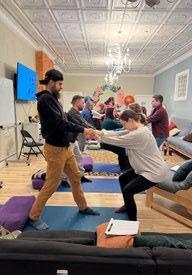
In a time of literal thawing and renewal in Rochester’s spring season, I went on a search to become unstuck after a restless winter; an attempt to experience spiritual growth and reignite a passion for life. To learn about energy, silence and reverence. Rochesterians subscribe to various avenues of spiritual and wellbeing practices, but universally we are in pursuit of peace. Our energies are all connected. I went in search of a higher power and ultimately found anti-hate rhetoric, self-acceptance and strength in community. What follows is my journey.
ACCEPTANCE OF THE TRUE SELF
Temple B’rith Kodesh, tbk.org
If you tuned in to the hit sitcom “Nobody Wants This,” you may be familiar with the Purim holiday Kristen Bell’s character cleverly dubs “Jewish Halloween.” At Temple B’rith Kodesh, Purim meant celebrating freedom from oppression with humor. The huge energy of Rabbi Peter Stein and the welcoming disposition of Associate Rabbi Rochelle Tulik led the community in an artistic retelling through the guise of “Wicked” characters.
A
Immersed in feelings of joy, I learned the night’s phrase, “Am Yisrael Chai,” means “The People of Israel Live.” It can be recognized as an inward affirmation of survival, existence and acceptance of oneself.
ACCEPTANCE OF ALL PEOPLE
Islamic Center of Rochester, theicr.org
Ramadan is a time of reflection to foster spiritual growth and gratitude. During a recent “Fastathon” event at the Islamic Center of Rochester, Muslim student associations from local high schools shared their faith, and during a tour of the gorgeous mosque, I learned that this discipline focuses on unity, compassion and growth in understanding.
Spiritual leader Imam Jamaluddin spoke about Muslim beliefs and shared that there are two main facets: piety and knowledge. His closing statement resonated the most: he expressed that Muslims strive to make the world a better place for all people, all races and all religions.
CONNECTION THROUGH COMMUNITY
First Unitarian Church of Rochester, rochesterunitarian.org
“If you came here today because you are worried about yourself, or someone else, or the world, welcome.” This relatable statement of acceptance came from Reverend Shari Quan during a Sunday worship service at the First Unitarian Church of Rochester. She spoke on their mission — through spiritual connection in one’s community, we can be open-minded to transformation, love and acceptance.
She emphasized that people come to church to grow and course-correct.
Reverend Eileen CaseyCampbel continued by engaging the congregation in breathwork. We focused on emotions that we might have been holding in — rage, sorrow, hope — and she offered that we do not have to hold these alone.
BALANCING ENERGY
Integrative Reiki, integrativereikimd.com
Before my session at Integrative Reiki, Dr. Supita Barr, a reiki master and local pediatrician, noted that most of her patients come to her at a crossroad in their lives, because they are looking to evolve. Reiki is an ancient Japanese practice based on the foundation that energy from all living beings originates from one spiritual cosmic point. “If we are able to tap into the energy that connects us, that’s where our power lies,” said Dr. Barr.
During our session, Dr. Barr worked as a conduit as she passed universal energy, hovering over each of my chakras (an Indian term that refers to the body’s energy points).
A wispy green light danced behind my eyelids, and I experienced an overwhelming sense of calm. “It’s beyond our understanding a little bit,” said Dr. Barr, “but reiki opens the door to meditate, to find yourself, to concentrate on your higher self.”
HEALING ENERGY
Moon & Stone, moonandstone.com
When people feel stuck, some believe it’s because their chakras aren’t open; they run at lower vibrational frequencies overcome with feelings of comparison, envy and anger. Crystals are believed by some to help raise those vibrations to higher frequencies
of joy, peace and acceptance.
Certified crystal healers Lauren and Courtney of Moon and Stone Crystals taught me that energy is always exchanged, so beginners benefit from a group setting. I joined a meditation on their Instagram live, where we set intentions to send love and kindness to ourselves and the whole community. To access growth and renewal during meditation in the spring season, they suggested malachite to release emotional trauma, labradorite for transition into life changes and selenite for fresh, positive vibes.
MANIFESTING PEACE
Breathe Yoga, breatheyoga.com
“Sometimes doing nothing is harder than doing something.” While leading a restorative yoga sound bath session at Breathe, yoga teacher and holistic healer Lisa Frerichs spoke about the importance of stillness and silence. She employed a euphony of soundwaves while I engaged in a series of poses. Vibrational tones resonated through my body, deepening my sense of relaxation. Frerichs emphasized that stillness and energy work together, and we can use that tranquility to find reunion with our inner authentic self.
“Our bodies are not separate from our story,” she said. “Every breath, every heartbeat (is) a sacred frequency reminding you of who you are.”
Lauren Fravel holds degrees in journalism and educational leadership. She is a local teacher, dog lover and coffee enthusiast who enjoys exploring Rochester in search of inspiration.
ILLUSTRATION
BY JACOB WALSH
todo DAILY
Full calendar of events online at roccitymag.com
SUNDAY, APRIL 5
THEATER
“Dear Evan Hansen”
Cobblestone Arts Center, theatre444.com
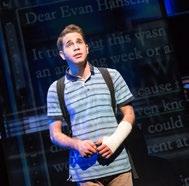
“Dear Evan Hansen” first made waves on Broadway in the mid-2010s, tackling tough topics like teen suicide and social anxiety. Then, the discourse goes, it became a 2021 film adaptation starring Ben Platt and a questionable wig. Enough time has passed since then that it’s safe to once again declare it a very good and worthwhile musical, which Theatre444 presents at a 4 p.m. show. Through April 12.
PATRICK HOSKEN
COMMUNITY
ARTISANworks
Thrift Sale
ARTISANworks, artisonworks.net
Each Sunday, ARTISANwork turns into a whimsical thrifting market. Not all 46,000 square feet of the space is for rummaging through vintage goods; that would simply be too much. But there’s plenty of space for the new furniture, antiques and artwork put out each week — find it past the “Casablanca” room, the 1960s firehouse, the Victorian dining room and the other treasures. 12-4 p.m. Free entry. PH
MONDAY, APRIL 6
MUSIC
Stick Men
Lovin’ Cup, lovincup.com
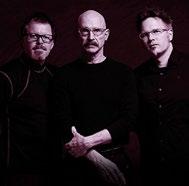
A band called Stick Men must be all drummers, right? Not quite. This supergroup made up of prog musicians Tony Levin, Pat Mastelotto and Markus Reuter has one percussionist (Mastelotto), but Levin and Reuter are proficient in the Chapman Stick, an instrument best described as a combination guitarbass. The unique makeup of the Stick Men allows the band to delve into the deepest of prog-jazz terrain befitting Levin’s and Reuter’s stints in King Crimson. 7:30 p.m. show. $40 advance, $50 at the door. PH
TUESDAY, APRIL 7
MUSIC
Open Mic with Tracy Eckstrand
The Biltmore Bar & Lounge, thebiltmoreroc.com
Each week, local Americana singersongwriter Tracy Eckstrand hosts an open mic where, the Biltmore promises, anything goes. Aspiring roots musicians and hardscrabble journeymen welcome, of course, as are “blues players, poets and jugglers.” The State Street club may see all of them. 8 p.m. PH
FOOD + BEV
Cocktail Making: Easter Cocktails
Rochester Brainery, rochesterbrainery.com
Spring is here and it’s time to shake things up…literally. In this hands-on class held at the Daily Refresher, you’ll learn how to make festive seasonal drinks. Enjoy a welcome cocktail and light appetizers, while learning about cocktail and bar tool history. Ages 21+. 6-8 p.m. $58. MEGAN MACK
WEDNESDAY, APRIL 8
MUSIC
“Poetry in Sound: Lyricism and Virtuosity”
The Hochstein School, hochstein.org
Live From Hochstein returns for another free lunchtime show, this one dedicated to works showcasing the violin and piano as equal partners in an intimate musical conversation. Faculty members Koki Tanaka (violin) and E-Na Song (piano) present works by Franz Schubert and Bedřich Smetana beginning at 12:10 p.m. PH
THURSDAY, APRIL 9
THEATER
“Wife to James Whelan”
MuCCC, rochestercommunityplayers.org
Irish playwright Teresa Deevy was deaf from the age of 19, an interesting fact given that she became a regular writer of radio plays. “Wife to James Whelan,” a work penned in 1937, went largely unproduced until being rediscovered in 2010 by New York’s Mint Theater Company; the Community Players present the Rochester premiere of the play, directed by Jean Gordon Ryon, at 7:30 p.m. Performances through April 18. PH
FRIDAY, APRIL 10
COMEDY
Brian Bates
Comedy @ the Carlson, carlsoncomedy.com
You might know Brian Bates from his appearance on Nate Bargatze’s podcast or from the home of all modern comedians, Instagram. The Nashville-based comic is known for his even-keeled demeanor and good, clean fun. He’ll be right at home for this 21+ night hosted by Bethlehem Family Shelter, also featuring Dan Viola, Dan Kulp and Pastor Matt. All proceeds benefit homeless prevention funding. PH
SATURDAY, APRIL 11
MUSIC
Flower City Thaw
Multiple venues, flowercitythawfestival.com
The East + Alex music fest returns for a concert featuring 12 performances across five venues. Aaron Lipp, The Honey Smugglers, A Girl Named Genny and Ivy’s Home are just some of the artists on the bill. The music begins at 4 p.m. and goes ‘til midnight. One admission gets you into all the gigs. PH
A WILD IDEA: THE BIRTH OF THE APA
Thursday, April 23 at 3 pm ON WXXI-TV / Streaming on PBS and WXXI apps
The Adirondack Park is one of the largest deciduous forests on Earth with a thousand miles of streams and rivers, hundreds of lakes, and lofty peaks. This film chronicles the history of the park and the founding of the Adirondack Park Agency 50 years ago.
The crocuses are popping up, the trees are budding, and the days are getting longer — it’s April! It’s also Earth Month, a perfect time to come together and care for this planet we call home. Whether you’re looking to reduce waste, conserve energy, lend a hand in conservation efforts, or explore one of these WXXI events and programs, there are plenty of meaningful ways to get involved.
WILDING
Wednesday, April 22 at 10 pm on WXXI-TV / Streaming on the PBS and WXXI apps
Based on Isabella Tree’s bestselling book by the same title, WILDING tells the story of a young couple, Charlie Burrell and Isabella Tree, who bet on nature for the future of their failing, 400-year old estate.
NATURE: LEGENDARY TIGERS OF INDIA
Wednesday, April 22 at 8 pm on WXXI-TV / Streaming on the PBS and WXXI app
Explore the dramatic, 50-year recovery of India's Bengal tigers. The film tracks the evolution of these predators from threatened populations to a 70-strong, thriving clan.
NYSDEC + CITY OF ROCHESTER'S ACCESSIBLE FAMILY LEARN-TO-FISH EVENT
Sunday, April 25, starting at 1 pm
Lake Riley Lodge at Cobbs Hill Park
100 Norris Dr, Rochester
The NYS DEC, City of Rochester, and Seth Green Chapter of Trout Unlimited are hosting their 4th annual, all ages, all levels, & all abilities family friendly fishing event to let guests explore the world of fishing. And WXXI’s Early Learning Team will be there with takehome PBS KIDS nature/explore the outdoors resources.
MORE KIDS EVENTS!
PBS KIDS will also feature an Earth Month playlist with naturethemed episodes from Wild Kratts, Weather Hunters, Daniel Tiger's Neighborhood, Molly of Denali, and more, bringing earthly inspiration to young audiences! qq wxxi.org/earth
OUR COMMON NATURE
Tuesday, April 21 at 3 pm on WXXI Classical (FM 91.5) WXXIClassical.org
Chinese American cellist Yo-Yo Ma travels to places where people have deep connections to the earth. Host Ana González joins him to uncover stories of the ways that culture binds us to nature, our own humanity, and each other.
HENRY DAVID
THOREAU
Sunday, April 19 from 1-5 pm on WXXI-TV / Streaming on the PBS and WXXI apps
Henry David Thoreau helped define modern environmentalism and nonviolent resistance. This threepart film features George Clooney as the voice of Thoreau, examining his life as a writer, naturalist, and philosopher who championed individual conscience.
BIG DIG THE THE HEALER'S JOURNEY
CLOSING THE LOOP
FROM GBH’S THE BIG DIG AND WXXI NEWS
Podcast Taping at WXXI Studios (280 State Street, Rochester, New York)
Tuesday, April 7 at 6:30 pm
Cities are increasingly exploring ways to undo highway damage — covering, converting, or removing them — but the best solution for each community is rarely clear and will often spark public debate.
THE HEALER'S JOURNEY
Monday, April 6 at 9 pm on WXXI-TV / Stream on the PBS and WXXI Apps
Follow five University of Rochester medical students as they navigate the grueling yet inspiring path of becoming physicians. Filmed over four years, it conveys a visceral quality of the experience while dealing with the immense demands of training. The result is a compelling, hopeful, and thought-provoking portrait of the next generation of healers.
Repeats Saturday, April 11 at 4 pm, and Monday, April 13 at 5 pm.
Ian Coss, host of the Peabody-Award winning podcast THE BIG DIG is taking the show on the road to do live tapings in different cities facing the same issue. His next stop — Rochester, where he’ll be joined by a panel of guests (including Brian Sharp from WXXI News) to unpack the ongoing issues facing Rochester’s Inner Loop. Want to be part of the live studio audience? Register here uu
WXXI CLASSICAL PRESENTS… FOUR RATIONAL PEOPLE
Saturday, April 18 at 3 pm at The Little Theatre (240 East Avenue, Rochester, New York)
After nearly 50 years of making music together, the Emerson String Quartet plays its final notes. The film will be followed by a discussion around the music moderated by WXXI Classical morning host/ producer Brenda Tremblay. WXXI Classical Presents is a series of films selected by WXXI Classical hosts; each film chosen exemplifies the power of music in a non-traditional narrative. For tickets, visit TheLittle.org.
COLLABORATIVE FOR THE EARTH
Sunday, April 12 at 9 pm on WXXI News (FM 105.9) and WXXInews.org
After shying away from an energy source that is now needed, the United States is going nuclear. Collaborative for the Earth covers the debate in public opinion and politics, the immediacy of climate change, and nuclear technology that offer the promise of safe, reliable, and carbon-free energy in the U.S.
THE LIBRARIANS
Friday, April 24 from 1-3 pm | FREE
Kate Gleason Auditorium of the Central Library of Rochester & Monroe County 115 South Avenue, Rochester, New York
WXXI & Central Library of Rochester & Monroe County host a free screening of The Librarians which explores a case of Texas lawmakers seeking to review a list of books, and librarians finding themselves on the frontlines of a national battle. The film will be followed by a discussion moderated by Central Library's Director Emily Clasper. Registration is required. Scan the code above to reserve your seat.
SUNDAY, APRIL 12
MUSIC
Gloriously “Degenerate” Wind Music
Beston Hall, chambermusicrochester.org
The Society for Chamber Music in Rochester presents an afternoon featuring, among other pieces, works by German-Jewish composers Joseph Horovitz and Robert Kahn, whose compositions were deemed “degenerate music” by the Nazis. Co-artistic director Erik Behr will play oboe alongside piano, horn and clarinet; music begins at 3 p.m. with a pre-show talk at 2:30. Tickets $35, with season passes also available. PH
MONDAY, APRIL 13
“La Bamba”
The Little Theatre, thelittle.org
Ritchie Valens died in an infamous 1959 plane crash with Buddy Holly and The Big Bopper. But before that, he lived 17 years, including a few as a genuine musical sensation. A large part of the ardor was due to “La Bamba,” the Mexican folk song Valens adapted into a smash hit the year before his death. Lou Diamond Phillips captures Valens’ shining spirit
in this 1987 biopic that helped extend his legacy. With a post-screening talk by Dr. Kristyn Storey on “how trauma-driven phobias shape our lives.” 7 p.m. PH
TUESDAY, APRIL 14
THEATER
“Furlough’s Paradise”
Geva Theatre, gevatheatre.org
“An abolition play or simply a play about cousins” is how this 2025 work from a.k. payne is summarized. Here’s another: As Sade gets a furlough from prison to attend her mother’s funeral, she stays with her cousin Mina, with whom she was close as kids. Their time together is explored by payne, as directed by Jasmine B. Gunter, on stage at Geva through May 10. PH
WEDNESDAY, APRIL 15
FOOD + BEV
An Evening with Alton Brown
Kodak Center, kodakcenter.com
The “Good Eats” personality comes to Rochester with, presumably, an empty stomach and a penchant for sharing his view on the culinary world — as well as the terrain outside the kitchen. The show promises an evening of “equal parts humor, science, food and heart.” Sounds delicious. 7:30 p.m. Tickets $57+. PH
THURSDAY, APRIL 16
MULTIDISCIPLINARY
“CirqueUS: One Man’s Trash”
Theater at Innovation Square, theaterais.com
Someone tell Oscar the Grouch the trash circus is coming to town. Though not affiliated with “Sesame Street,” this production by CirqueUS celebrates similar themes, namely the spirit of teamwork and community, as performers dazzle with feats of acrobatics and storytelling — all while surrounded by dumpsters and garbage bags. 6:30-8 p.m. Tickets for adults $26.03; students with ID $13.16; kids 2-13 $6.73. Children under 2 are free. PH
MULTIDISCIPLINARY
Behind the Scenes Tour: “Let’s Get Crafty”
Rochester Museum & Science Center, rmsc.org
RMSC opens its collection vaults for tours a few times a year, and this one is for lovers of arts and crafts. From handmade quilts and samplers to jewelry, baskets, and more, it’s your opportunity to see generations of handicrafts not on public display. Ages 18+. 6-7:30 p.m. $30. MM
FRIDAY, APRIL 17
THEATER
“The Bodyguard”
OFC Creations, ofccreations.com
The lasting legacy of the 1992 film “The Bodyguard” is and always will be Whitney Houston’s dominating rendition of “I Will Always Love You.” But the story itself is timeless, blending romance with thrilling drama. This is what makes it prime for the stage; OFC Creations presents its production starring Aliyah Khaylyn, an alum of NBC’s “The Voice.” 7:30 p.m. show. Performances through April 29. PH
FESTIVAL “50 Years of Orchids
in the Flower City”
Rochester Museum & Science Center, geneseeorchid.org/annual-orchid-show
Back in April 1969, the Genesee Region Orchid Society held its very first orchid show at the Garden Center of Rochester. The organization celebrates a half century this year with
the annual show, which promises to be bigger than ever, inside RMSC’s Eisenhart Auditorium April 17-19. Friday 1-5 p.m.; Saturday 10 a.m.-5 p.m.; Sunday 10 a.m.-4 p.m. Adult tickets are $10; students $5; kids under 12 are free. PH
MUSIC
Madrigalia: “Change”
Asbury First United Methodist Church, madrigalia.org
As part of the choral group’s 50th anniversary season, Madrigalia presents “Change,” a program of numbers that hope to inspire around that very theme. Performances at 7:30 p.m. on April 17-18. General admission tickets $25; seniors $20; students and those with limited income $10. PH
SATURDAY, APRIL 18
COMEDY
Stavros Halkias
Kodak Center, kodakcenter.com
Stavros Halkias is unmistakable. His path from balding, bespectacled host of a podcast with a name unfit for print to viral comedy star to big-deal film actor in “Bugonia” is uniquely 2020s. But he’s here, he’s massively popular and he’s filling Kodak Center. It helps that he’s funny, too. 7 p.m. stand-up show, tickets begin at $43.
PH
COMEDY
Scott Thompson
Comedy @ the Carlson, carlsoncomedy.com
“The Kids in the Hall” remains a foundational comedy group for Gen Xers and therefore their descendants. Scott Thompson is a big reason why. The comedian’s outlook is whimsical and fabulous, qualities that have made him a fixture of Canadian television for decades. He comes to Rochester for two nights, with shows at 7 p.m. and 9. Tickets $29+. PH
SUNDAY, APRIL 19
LITERATURE Poetry Night
The Little Cafe, thelittle.org
In addition to being the cruellest month (thanks, T.S. Eliot), April is also National Poetry Month. To celebrate, the local group Just Poets — a collective of writers who help elevate the awareness of the craft and help fellow scribes — hold this reading at, where else, a cafe. The creativity begins flowing at 6:30 p.m. PH
MONDAY, APRIL 20
Flying Squirrel Community Space, thesquirrel.org
Every Monday from 4-8 p.m., Flying Squirrel hosts this free evening of all things creative. Make art with likeminded folks at the center’s space at 285 Clarissa St. and maybe get an idea for your next project. PH
TUESDAY, APRIL 21
MUSIC
Jake Shimabukuro
Theater at Innovation Square, theaterais.com
When someone is hailed as “the Jimi Hendrix of the ukulele,” I simply must see what that performance is all about. That makes Jake Shimabukuro a can’tmiss concert, and not just to see if he lights his instrument on fire (I’m sure he doesn’t), but because experimental virtuosos of the uke don’t come along very often. Shimabukuro’s blend of folk, classical, traditional Hawaiian music and rock makes a potent cocktail. He begins playing at 7:30 p.m. Tickets $54.84+. PH
THEATER
“A Beautiful Noise: The Neil Diamond Musical”
West Herr Auditorium Theatre, rbtl.org
Between the new film “Song Sung Blue” and the infinite life cycle of “Sweet Caroline,” Neil Diamond’s music is having a renewed moment in the spotlight. (And here I thought his finest hour was the 2001 Jason Biggs film “Saving Silverman!”) This jukebox musical first hit Broadway in 2022; its touring production comes to RBTL for six performances beginning with a 7:30 p.m. show. Tickets $53+. PH
ART
Lux Art Fux
Lux Lounge, lux666.com
Held on the third Tuesday of every month, this mutual aid night centers queer and disabled artists. Expect live music to groove to, professional figure models to sketch, and art for sale. Past events have included live tattooing, artisan chainmail and, of course, pizza.
VERONICA VOLK
WEDNESDAY, APRIL 22
MUSIC
Don’s After Dark
Don’s Original, donsoriginal.com
Since taking over the beloved Sea Breeze burger spot in 2024, new owners Reo and Alayna Alderman
have made a few changes. Namely, this weekly evening of live music that kicks off every Wednesday at 6 p.m. with a special food and drinks menu. Check the schedule for performers. PH
THURSDAY, APRIL 23
MULTIDISCIPLINARY
“Lingua
Lucem: The Language of Light”
Visual Studies Workshop, vsw.org
Joel Dow and Ava Monske bring their live audio-visual performance to VSW for an evening of ambient tones and interactive video feedback. Given the nature of the immersive presentation, each show is different. What will the space at 36 King St. hold for this one? Find out from 7-9 p.m. Suggested donation of $10. PH
MUSIC
Ruha
Three Heads Brewing, threeheadsbrewing.com
Charley Orlando’s band Ruha fuses rootsy Americana, blues riffs and soulful vocals — in other words, the perfect backdrop for an evening at Three Heads Brewing. Doors open at 7 p.m. $10. PH
FRIDAY, APRIL 24
NATURE
Big Night for Salamanders
Genesee Country Village & Museum, gcv.org
Picture it: It’s a warm, rainy night, and you – flashlight in hand – are hiking alongside your fellow explorers, eagerly scanning the ground for mole salamanders. Each year, the amphibians migrate from their woodland habitats to vernal ponds to reproduce. Join the expedition, then warm up at a campfire and hear a
salamander story. 6:30-9 p.m. Tickets are $15 and must be purchased online by 4/23. This event also takes place on 4/25. MM
SATURDAY, APRIL 25
MUSIC
The New
Pornographers
Water Street Music Hall, waterstreetmusichall.live
Two decades ago, The New Pornographers released one of the best power-pop songs of all time, “Sing Me Spanish Techno.” The group, led by AC Newman and Neko Case, could’ve rested on its laurels. Instead, it’s continued to take left turns, including toward drowsy electro-pop on new single “Pure Sticker Shock” and pastoral melodies on “Votive.” The power remains, of course, making this a can’t-miss 7 p.m. show. $43.28. PH
Begun six years ago as an active measure against climate change, the regional Sierra Club’s annual tree giveaway is exactly what it sounds like. Show up to one of four county parks and take home a locally grown, native, bare-root seedling. Then plant it and watch it grow. Every year, the club gives away around 2,000 trees. This year’s can be picked up between 10 a.m. and 3 p.m. at Seneca Park, Webster Park, Northampton Park and Genesee Valley Park. PH
MUSIC
Thursday with Chris Conley
Anthology, anthologylive.com
Seminal post-hardcore band Thursday celebrates its three best albums, 2011’s “No Devolución” and 2006’s “A City by the Light Divided” and 2001’s “Full Collapse,” with a unique concert
spanning two sets. The first blends the first two, while the second is dedicated to the latter. Between them, the band welcomes Chris Conley of fellow legends Saves the Day for a solo performance. Nostalgia works hard, but two of the best artists of their era work harder. 16+. 7:30 p.m. show. Tickets $50.57. PH
SUNDAY, APRIL 26
MUSIC
Rochester Music Hall of Fame
Induction Ceremony & Concert
Kodak Hall at Eastman Theatre, rochestermusic.org
This year’s marquee RMHOF inductees are Taye Diggs and The Skycoasters. But the full list includes plenty of other local cultural heavyweights, too: the Pythodd Room, the musical tradition of the Seneca Nation, the La Barbera Brothers, Donna Lynne Champlin and photographer Paul Hoeffler. The concert and ceremony begins at 7 p.m. PH
MUSIC
Ty Segall
Water Street Music Hall, waterstreetmusichall.live
Throw a rock in a record shop and you’ll hit a Ty Segall album. The California garage-psych maestro creates at an intimidating clip (two albums in 2024, three in 2012, etc.) and somehow never loses the urgency. His origin story is wild: he attended high school in Laguna Beach during MTV’s production on its teen soap opera of the same name. But Segall’s taste skews less “reality TV” and more “70 guitar pedals for maximum squelch.” Doors at 6 p.m. $35.16. PH
MONDAY, APRIL 27
MUSIC
Catmospheric
Smith Opera House, thesmith.org Here’s something mystical for your calendar: a cosmic fairytale of music delivered via electro-acoustic harp and tasteful folk-rock. That’s Catmospheric, a performer billed for The Smith’s Winter Cabaret series. The 18+ event occurs in the theater’s downstairs cabaret space. Music’s at 8 p.m.; tickets $12.93. PH
TUESDAY, APRIL 28
THEATER
“Baron Vaughn: Cycle Breaker”
Geva Theatre, gevatheatre.org
Comic Baron Vaughn’s TV acting credits are staggering (bit parts on “Arrested Development,” “Girls,” “Black-ish” and “Superstore”), showing that his path has constantly led him to the right places. His solo show “Cycle Breaker” finds
the comedian unpacking a very different journey: fatherhood and his relationship with his own family who preceded him. Presented on Geva’s Fielding Stage through June 7. PH
CONTINUED ON PAGE 46
MUSIC
John Stowell / Bob Sneider Duo
Bop Shop Records, bopshop.com
John Stowell performs with his guitar neck inches from his face, yielding a cozy and lyrical sound that can’t help but feel intimate. He’s known for his sonics as much as his instruments: unusual and futuristic-looking “headless” guitars. When paired with the jazzy tones of Eastman School of Music professor (and former Chuck Mangione collaborator) Bob Sneider, the sum is unequivocally greater than its parts. The duo performs at 8 p.m. $20 tickets, free for students with ID.
WEDNESDAY, APRIL 29
FOOD + BEV
Food Truck Rodeo
Rochester Public Market, cityofrochester.gov/events/food-truckrodeos-market-2026
You know the drill: arrive hungry (and maybe a little early) and enjoy the plethora of food truck favorites from tacos to pizza to lobster. Stay for the live music and people watching. Bring a lawn chair, bring your friends, and pace yourself. VV
THURSDAY, APRIL 30
Photo City Music Hall, photocitymusichall.com
Appalachian string band Redd & The Paper Flowers comes to Rochester from Knoxville for an evening of traditional folk given a modern update. The band plays with support from The Byways, Ahren Henby and Jeremy Button of Growl Bear. 6 p.m. $19.75. PH
Maundy Thursday Tenebrae Service April 2nd, 7:30pm
Traditional
Good
Sanctuary
Easter Sunday Service April 5th, 10am
FRIDAY, MAY 1
SOCIAL
Birds, Bees & Brews
Seneca Park Zoo, senecaparkzoo.org
A tasting event to appreciate local beverages and the pollinators that make them possible. Sip beer, cider, kombucha, coffee, and more while wandering the zoo after hours (and after the crowds). Check out animal habitats, meet animal ambassadors, and learn a little ecology along the way. Tickets $65. VV
SATURDAY, MAY 2
MUSIC
The Music of Tina Turner
West Herr Auditorium Theatre, rpo.org
What’s love got to do with it? The RPO aims to provide it with this celebration of the work of Tina Turner, featuring vocalists LaKisha Jones, Nova Y. Payton and Armando Imagines. 7 p.m. $31+. PH
CROSSWORD PUZZLE ANSWERS
PUZZLE ON PAGE 70. NO PEEKING!
“THE SNOW GLOBE IS FOREVER AND A DAY” BY NO GLITTER
This past winter was particularly brutal and seemingly never-ending. One of the only positive takeaways is that it inspired a wildly imaginative new track from Rochester studio project No Glitter. Snowed in after one of the many blizzards suffered by the region, musical polymath Billy Martin challenged himself to capture the chilly isolationist vibes in a track titled “The Snow Globe is Forever and a Day.”
No Glitter’s productions are always top notch, but this particular track finds more open groove and negative space for driving drums and vintage synths to play with some serious sonic alchemy. It’s a far cry from the last release, “Vas” in 2024, which was an exercise in acoustic indie songcraft.
“The Snow Globe is Forever and a Day” is a galloping horseback ride through the tundra of classic rock’s finest contributions. Think Pink Floyd, but it goes well beyond that. In the way that the greatest art channels the artist’s influences into something new and uniquely their own, this track embodies an almost prog-rock element that harkens back to Deep Purple and King Crimson. There is also an unmistakable contemporary psychedelic influence from Queens of the Stone Age and King Gizzard & the Lizard Wizard.
The track starts with analog synth patches flipping through octaves and setting a stage for ambient drums and organ. The beat drops with a melancholic guitar progression, then the gallop begins, and the real ride starts as the melodies start winding around the guitars in a sonic space odyssey.
Poetic as they are, the entirety of the lyrics paint an image of longing, isolation and perseverance — a metaphor for other everyday struggles. Had I known you could be inspired this hard by the drab, grey, cold monotony of winter I would’ve asked Santa for a synthesizer.
—WREN WERNER
“BURN FROM BOTH ENDS” BY PLUCK
On “Burn From Both Ends,” the second full-length release from local favorite Pluck, the band’s indie-rock sound rings true. This vibrant collection explores a wide variety of topics and themes. From sickness to relationships to the political state of the world, Pluck’s sophomore album is ready to converse with the listener.
“Sooner” opens the album strong, with its stop-in-your-tracks chorus, frontperson Brock Saltsman’s hypnotic vocals and dynamic guitar from Javan Levey. To follow, “Attach/Detach” lyrically explores the symbolism and change that comes with moving: If we pack up and move to a different town / Will that make me a better person? Despite the topics of inner turmoil, the tune is hopeful, and Levey’s guitar and drums from Ben Chesnes carry a bounce in the step toward the future.
“Cough Syrup Lullaby” meets us in the middle of the album loud and proud, born of Saltsman’s unfortunate bout with COVID-19. The macabre and foreboding “She Doesn’t Want Me Around” tackles the messy and the ugly of relationships, exploring how we may look at ourselves in the aftermath of our mistakes.
The politically charged ninth track, “Reminder,” is grungier than its predecessors with its dark tone reflecting that of our current times. The song is more instrumentally focused, the grit and chaos mirroring how it feels to navigate such a tumultuous modernity. Pluck is here to create a safe space for all, and it’s felt throughout these 10 tracks.
To close out the album, Pluck has saved the best for last. “Fixations” encourages listeners to not just survive, but to truly live despite it all. This sentiment travels via the whimsical melody of bass from Alyssa Zaso and sublimely divine guitar solo, carrying us out to the end.
To celebrate the release of their achievement, Pluck will play an album release show at The Bug Jar on April 25.
—LEAH JOY
“PRELUDES AND FUGUES FOR PIANO” BY
DAVID S. LEFKOWITZ
Four pianists, a cantor and a composer walk into a recording studio.
The result? Not a punchline, but a richly varied collection of inventive works that revel in the possibilities of the piano.
These pieces are part of a centuries-old tradition of writing preludes and fugues — carefully constructed works exploring interwoven musical lines.
What does this practice sound like in an era where Bach, Balinese Gamelan, traditional Jewish dances, classic funk and modernist experiments are all just a click away?
Enter David S. Lefkowitz. He’s an Eastman School of Music alum and a Los Angeles-based composer who teaches at the UCLA Herb Alpert School of Music.
His preludes and fugues are divided into two books, played over the two-disc album by pianists Steven Beck, David Kaplan, Michael Mizrahi and Mika Sasaki — with grace, intelligence and a willingness to explore.
First there is “Expanded Universe,” where the piano’s familiar timbre plays musical tapestries woven out of newly invented scales. Some float dreamily with an almost pop-instrumental sensibility, while others dance enigmatically around the keys.
Things get (delightfully) weird in the second book, “Parallel Universes,” thanks to “prepared” piano — with various items placed between the strings to alter the instrument’s sound. The string is even rubbed with a metal screw until it starts vibrating.
Some of these “Parallel Universes” pieces draw inspiration from abstract French painter Marcelle Cahn, among others. It’s also where you hear the composer whistling, and in one of my favorites, Prelude and Fugue No. 12, “Nigun, Hora & Freylekh” cantor Marcus Feldman’s lines intertwine with the piano.
Even though you can get lost in these little musical worlds, the pieces resist letting themselves become background, as they continue to surprise, unsettle and delight.
—MONA SEGHATOLESLAMI
“DEVIL’S GONNA GET YOU”
BY ANNIE WELLS
People mean well. They offer thoughts and prayers, best wishes and Bible verses, but they don’t understand. Sometimes their good intentions end up as judgments.
This social consternation is at the heart of local singer-songwriter Annie Wells’ newest single, “Devil’s Gonna Get You,” released in March. The bluesy number was inspired, Wells writes in the song’s Bandcamp description, by “a dearly loved friend who said my family member suffering from illness would be healed if she rejected the devil.”
Wells sublimates that unpleasant experience into a clear musical villain: a “Holy Roller in blue jeans” who thinks he’s delivering divine help but winds up lonely in the wind.
Musically, she constructs this with the kind of strutting, confident piano progression she also displayed on previous single “True Blue Boy” as well as others from her newest LP, “Pictures of a Heart.” But piece by piece, Wells adds dimension.
Coy guitar lines from Phil Marshall. Otherworldly waves from Margaret Explosion and Wren Cove cellist Melissa Davies. And a tight, understated rhythm courtesy of bassist Ken Frank and drummer Roy Marshall.
“Devil’s Gonna Get You,” the sum of these parts, comes across as both uneasy — thanks to its subject matter — and completely sure-footed in its execution, a neat trick to pull off. Much credit goes to Wells, an evocative but never showy singer who sounds right at home on a track brushing up against coffeehouse folk, jazz and foundational blues.
Indeed, the song channels the long fascination of the blues with the devil, from Robert Johnson’s “Cross Road Blues” to the 1928 Bessie Smith song with which Wells’ composition nearly shares a name.
The difference here? Wells’ antagonist ends up being the devil you know.
—PATRICK HOSKEN
Muck Duck spreads its wings
COMMUNITY
BY PATRICK HOSKEN PATRICK@ROCCITYMAG.COM
Take a walk with Casey Arthur.
Descend the stairs at 100 College Ave. and meet the artist and founder of Muck Duck Studio, who is standing in a feathered hat.
Then step into a 7,000 squarefoot space where soon, Arthur said, couches will host first dates in which paintbrushes and chamomile tea break the ice.
“A lot of young people want to date and don’t know where to meet people,” Arthur said. “Having art and creativity as a shared language gives everyone an in to the conversation.”
Muck Duck’s newest venue is not a matchmaking service or even a community center, but an event space in the Neighborhood of the Arts. The location is set to open this spring after nearly six months of planning, construction and a public hearing in front of the city’s Planning Commission.
Muck Duck’s original artist studio remains in the Blossom Business Center, where Arthur and a team opened it in 2021. That location will continue to host resident artists, while the new NOTA location can throw concerts, mixers, open mics and more.
The events are in service of Muck Duck’s essential mission: creative care.
The art studio expands with a new event space in NOTA.
Muck Duck founder Casey Arthur focuses on creative care, or “curating experiences for vulnerable groups in a contained setting.”
PHOTOS BY JACOB WALSH
Or, in Arthur’s words, “curating experiences for vulnerable groups in a contained setting.” Like, for example, an industrial space a block away from the Memorial Art Gallery and the West Herr Auditorium Theatre. Perhaps even out in the community via the new Muck Truck, a pink mobile art studio retrofitted from an old food truck.
“Once we were in here, everything melted, and I knew that the issues I would face while building this place were privileged problems compared to the things that I hope to solve in the city over the longevity of this,” Arthur said. “Fixing the floor? What kind of couches do we want? That’s privileged problems. We have things we have to deal with immediately, like what we’re going to do with our homeless population by the beginning of next winter.”
On a sunny day in early March, as Arthur gave CITY a tour of the new digs, she clocked the space at about 80% complete — including hanging paper lanterns for coziness. The remaining 20% includes details like final decor, a schedule of programming and the little matter of settling on a name for the venue.
Visual artist Christina Counts helped the new Muck Duck space take shape, including painting the bathrooms. PHOTOS BY JACOB WALSH
It’s a feminine space, Arthur said, but she’s going to meditate on it.
What’s certain is that Arthur and her collaborators see Muck Duck’s NOTA location as an important third place in a highly walkable area. She had plenty of help realizing the new space, including an anonymous $20,000 donation and other substantial contributions from community members who support the mission.
Arthur calls Muck Duck’s story “a trajectory of opportunity and hard work.” She’s eager to pass it on, thanks to a partnership with RochesterWorks that will pay city school students to set up and break down Muck Duck’s events.
“We have kids that are falling through the cracks at RCSD,” she continued, mentioning the proximity of the School of the Arts on Prince Street. “They need somewhere to go. I’m going to host a couple youth-led empowerment openmic events where kids can come in and express their poetry.”
The tour continues. Past large gallery walls is a left turn into a yoga area. A towering rack of mats and foam blocks
by the dozens nests in a corner. Beyond that lies the crown jewel of the event space: a stage.
It’s still early in the life of this stillunnamed venue, so the only performer is a headless mannequin in needle pose. But Arthur envisions diverse social events like “pitch your friend” — think “The Dating Game” meets bachelor(ette) auctions, with slideshows of the contestants’ most dateable qualities backdropping the stage.
These are all reasons to get people in the door, Arthur said. Then the real work of Muck Duck’s creative care can begin.
That work is what excites self-taught painter Christina Counts.
“What fills your cup is what I’m trying to figure out with my life,” she said. “It really is about something bigger than yourself.”
Counts met Arthur through an art residency at The Yards Collective. Years later, feeling burnout from her corporate job after working as a tattoo artist, Counts got back in touch. It was just the right time.
“The whole message of what she was trying to deliver, it inspired me,” Counts said of Arthur. “I’m like, ‘I think I have
some skills to offer. I like what you're doing.’”
Arthur gave Counts free reign to paint the bathrooms in the venue, and the artist bathed the walls with gold leaf and made them her own. Counts said those pulled into Muck Duck’s orbit experience a kind of “collective effervescence,” a feeling of intense energy shared among a group who gather for a purpose.
How does one monetize such an experience? That’s one of the many questions Arthur has considered in the context of running a nontraditional business.
Much of it comes from partnerships with other local businesses and organizations. She knows that Muck Duck serves folks in need — artists, vulnerable people with addiction issues, those struggling with mental illness. The rest will evolve as it needs to.
“We get a lighthouse effect, where they’re all invited into a new way of doing life, which you’ll see in our business practices here,” she said. “There’s no trapping you in a subscription. I’m not doing that. A lot of my motivation comes from rewriting our business norms.”
There’s also no alcohol, so no money to be made at the bar. But there’s an art supply library. A men’s group that meets regularly to unpack, among other issues, toxic masculinity. A dance floor.
Muck Duck’s wide breadth of programming distills down into a simple mission.
“A lot of what art does in people’s lives, you can’t touch or grab or hold or measure. It’s a feeling,” Arthur said. “When people come in contact with what we do, they say, ‘I don’t really know what it is, but it just feels different.’”
After pointing out the walls that will soon be filled with her own watercolor works, Arthur walks back near the venue’s entrance. She picks up a handpan, taps rhythmically in a circle and sends the notes of the D minor scale up to the high ceiling.
It’s a more creative way to say goodbye. muckduckstudio.org.
Patrick Hosken is CITY's arts and culture reporter. He was formerly the music editor at MTV News and a producer at Buffalo Toronto Public Media.
Planted here
HORTICULTURE
BY SYDNEY BURROWS
Rochester is the Flower City (or Flour City, depending on who — or when — you ask). But how many of our flowers are meant to be here?
Native landscapers, who prioritize local biodiversity rather than just gardening aesthetics, suggest we lean toward plants native to our area when picking flowers this spring.
A plant doesn’t have to originate upstate for it to benefit Rochester’s environment. For Patty Love of Barefoot Permaculture, the key is simply choosing plants that do no harm, meaning they won’t out-compete native plants or become invasive.
“Native plants support all forms of life. They’re more adapted to our climate, temperature, and seasons,” Love said. “Those plants will be more likely to be healthier, grow faster and easier to care for.”
Love, who has worked in the landscaping space locally for almost 20 years, started by studying permaculture, an approach to sustainable agriculture rooted in indigenous insights. Love explains that the key elements of permaculture — earth care, people care, and future care — can be applied to any design system. She uses it as a guide to help her clients create gardens that meet not only their vision, but also the needs of insects, other plants and fungi.
Since Love started consulting in the early 2010s, she has seen a jump in both interest in and availability of native plants in the Rochester area. Much of that
Native landscapers cultivate a more
New York ironweed. PHOTOS PROVIDED BY BAREFOOT PERMACULTURE
Top: Haploa confusa, a native moth, on a raspberry leaf.
Bottom: Apios Americana AKA groundnut, an edible tuber that can be made into flour and a traditional indigenous food source.
interest stems from community efforts like Healthy Yards Monroe County and Color Your Community Green. Though both are part of the broader Climate Solutions Accelerator of the Genesee-Finger Lakes Region, each group creates specific campaigns and gardens tailored to its community’s needs.
When Peter Messner, former president of Messner Flooring (and current WXXI board member), saw the Town of Pittsford’s efforts toward native planting, he recognized an opportunity. The company’s Pittsford location was due for a garden refresh and Messner liked the idea of trying something new. Native plants could both contribute to the community’s ecosystem and help the building’s exterior reflect the mission of the business.
Messner Flooring prides itself on offering unique products — something that sets it apart from big box stores like Home Depot or Lowe’s.
“The garden is along those same lines,” Messner said. “It’s something a little different, something you don’t see a lot of in commercial spaces.”
Messner doesn’t see native landscaping as a fad, but rather a movement rooted in the desire to contribute to one’s community. When searching for a landscaper, he wanted someone who was both knowledgeable and genuinely passionate about native plantings.
Mike Cauwels of RocNative Landscaping fit the bill.
Cauwels, a Penfield native whose fervor for gardening and helping the environment is evident even through a quick conversation, returned to Rochester after living around the country, including Hawaii, California and North Carolina. Beyond family ties, upstate New York offered something else: a climate where sustainable landscaping can thrive.
The Rochester area has a wide variety of native trees — something many cities in the United States lack. The cooler climate also supports plants that can’t thrive elsewhere, like the city’s beloved lilacs. Though not native to the region, lilacs are “naturalized,” meaning they provide essential food and shelter for wildlife.
Providing nutrients and habitat for other living things is at the heart of native landscaping.
“Planting a native plant is a really simple way to make a big impact on our environment,” Cauwels said. “For the cycle to work, for animals to thrive, you need the plants.”
Milkweed, for example, is a plant that has been in the region long enough to form an essential connection with local wildlife. Monarch butterflies rely on milkweed as a host plant where they lay their eggs. Birds, in turn, rely on caterpillars to feed their young and the cycle continues.
To figure out which native plant to add to a garden, Cauwels suggested working backwards. First, think about what animals you want to attract. Then, consider the shapes and colors of plants. If you’re hoping to spot hummingbirds, red, bell-shaped flowers are a good place to start. If you’d prefer to avoid pesticides, choose plants with flat flowers, which attract predatory insects that naturally keep pests in check.
A native garden doesn’t necessarily have to be a messy garden. Many native plants are easy to maintain and can still look tidy and intentional. With a thoughtful mix of species, any gardener can have something blooming throughout the growing season.
“You don’t need a sprawling native garden to make an impact,” said Cauwels. “If you swap out a few bushes or simply plant a single oak tree, that will make a huge difference.”
Sydney Burrows is a Rochester-based digital strategist, dancer and writer focused on amplifying the stories of passionate changemakers across the region.
Messner Flooring in Pittsford. PHOTO PROVIDED BY ROCNATIVE LANDSCAPING
A monarch caterpillar on milkweed. PHOTO PROVIDED BY ROCNATIVE LANDSCAPING
From the shadows
THEATER
BY KATHERINE VARGA
Growing up in Las Vegas, Baron Vaughn loved comedy. His mother and grandmother raised him through a tumultuous childhood, and his father was out of the picture. Comedians on TV like Eddie Murphy and Richard Pryor became Vaughn’s father figures. He wanted to be like them, so he pursued the first opportunity he found to go on stage and talk: acting. While he was studying theater at Boston University, a friend suggested he try standup comedy.
Twenty-five years later, with a prolific and multidisciplinary career ranging from acting on shows like “Grace and Frankie” and “Mystery Science Theater 3000” to writing and directing credits with Comedy Central, Blavity and Funny or Die, Vaughn feels most at home within a Venn diagram of standup and theater.
His latest project, “Baron Vaughn: Cycle Breaker,” a one-man show about trauma and parenting, caps off a two-year artist residency at Geva Theatre. It will premiere on the Fielding Stage from April 28 through June 7.
Initially, Vaughn resisted the idea of writing a solo show. His residency included a commission to create a new artistic piece, left to the artist’s discretion. As part of his residency, Vaughn served on the curation team for the 202325 seasons. Most of the shows produced at Geva are written by a playwright for other actors to perform. Vaughn assumed that’s what his show would be, too.
Baron Vaughn rehearses his performance at Geva.
PHOTOS BY ROBERTO F. LAGARES
In the meantime, comedy was calling.
Strong standup routines don’t spontaneously generate out of thin air (though a good one may feel that way). Comedians need to try, and retry, material on a live audience to see if it, well, works out. During his time at Geva, Vaughn founded and curated “The Work Out Room,” a work-in-progress comedy series inspired by the Edinburgh Festival’s template for UK comedians.
To work out “The Work Out Room,” Vaughn developed a routine for the inaugural week, and his jokes kept returning to the same topic — family.
Now that his sons are 6 and 8 years old, he often thinks about how he didn’t have a father at their age, and how his mother and grandmother parented him in ways he doesn’t always want to emulate.
“Those were the themes that started to come up, over and over again,” Vaughn said. “My childhood and my relationship with my mother next to my relationship with my children.”
He added it felt like he was throwing mud at the wall — but for the audience, something both hilarious and vulnerable was forming.
“We all realized, ‘oh my god, that’s your show. That’s what you’ve got to write towards,’” said Geva dramaturg Fiona Kyle.
Many people ask themselves if they want to have kids, but Vaughn thinks there’s a second, more important question they should be asking: “Do I want to do the most insane shadow work I’ve ever done in my life?”
Parenting forces you to see yourself in a new light, he said.
“Everything that you do becomes a reflection of everything that has happened to you,” Vaughn said. “How you act and how you see yourself and all these things affect this other person, this child.”
Writing “Cycle Breaker”— digging into his personal experiences to create a show that would both entertain and move audiences — has been another type of shadow work. It’s been aided by the creative team at Geva, including Kyle and director Evren Odcikin, who Vaughn said have been crucial to the piece’s growth.
For Vaughn, the key was finding the emotions that will resonate with people who didn’t
grow up with the traumas he experienced, but given the uncertainty of the world, many people can still relate to feeling overwhelmed and confused.
That’s where the comedy lies.
“The events themselves? No, that’s not funny. What’s funny is that we’re all scared, and we all don’t know what to do,” Vaughn said. “It’s OK to not know. It’s OK to be uncertain and unsure.”
Kyle added the piece also offers a beautiful portrayal of Black masculinity and fatherhood.
“In a time when we’re so obsessed with the male loneliness epidemic and men behaving badly, it’s nice to see men trying to break cycles,” she said. “He’s saying just because you’ve had hardships doesn’t mean you can’t show up with softness for the people in your life.”
Katherine Varga is a Rochester-based writer and arts educator. On an ideal day, you’ll find her biking to a library or theater.
PHOTO PROVIDED
PHOTO BY ROBERTO F. LAGARES
A labor of love
WELLNESS
BY HELENA SHUMWAY
Tdoula training. Both pregnant at the time, they quickly became friends and that friendship evolved into Beautiful Birth Choices, a North Winton Village-based business focused on helping people navigate pregnancy, birth and their postpartum experience. Alison Spath joined their team in 2014 and came on as third co-owner in 2020. What began as a desire to create a space for community has grown to doula support services for over 1,700 births.
The heart of Beautiful Birth Choices’ work is birth and postpartum offerings for the birthing person and their partner.
Muscato, Sittig and Spath are DONA International certified doulas and contract approximately 15 other independent doulas to help support the Rochester community. (For those interested in becoming a doula, Beautiful Birth Choices also offers birth doula training.)
While doulas do not provide medical or clinical guidance, their role is designed to be a part of an expectant parent’s care team. Muscato, Sittig and Spath do much of their work as doulas prenatally, meeting with expectant parents to discuss the birth plan and learn what is important to each couple during labor.
A doula and partner support a mom in the end stages of labor.
PHOTO BY JENNIE KIEFFER
Whether they choose an unmedicated home birth, a hospital birth, the use of an epidural, pain relief or a planned cesarean, Beautiful Birth Choices relies on a comprehensive model and provides evidence-based care to support each person’s birth as they define it.
During labor and delivery, doulas provide continuous physical and emotional support for the birthing person and their partner by staying through the entire birth and a few hours postpartum. The commonly known hip squeezes, yoga balls and cold compresses are accurate, said Sittig, but their work as doulas extends far beyond the bounce of a ball.
“We’re like the putty on the wall,” said Muscato. “So, it fills in any of the gaps to make everything go smoothly.”
Beautiful Birth Choices offers an array of childbirth education classes, support groups, lactation services and pregnancy and birth workshops to help expectant parents prepare for their little one’s arrival and provide support through the baby’s first year of life. Such offerings include the baby basics class, first aid and infant CPR, prenatal and postpartum yoga classes (Spath is one of the registered yoga teachers) and the Body Ready Birth workshop.
The latter focuses on the physiological birth process and helps the birther connect to their natural instincts. Based on the Body Ready Method, the Body Ready Birth workshop provides tools for individuals throughout pregnancy, like examining posture and ways to loosen ligaments for pelvic support. It also focuses on the labor flow state, prioritizing central nervous system regulation while simultaneously utilizing helpful birthing positions and techniques throughout the birthing process.
Another popular offering is the Breastfeeding Cafe, an informal breastfeeding support group for all pregnant and lactating people, no matter the individual’s lactating state. Facilitated by Spath — who is an international board certified lactation consultant (IBCLC) — the group provides a nonjudgmental space to discuss breastfeeding, pumping and bottle feeding, combo feeding, adoptive breastfeeding, inducing lactation or relactation.
After a challenging first birth, Kristen Valencia connected with Beautiful Birth Choices for her second pregnancy.
“In the months spent talking through birth options, hospital arrangements, prenatal wellness, postnatal care and my overall mental health, I started to feel more empowered,” said Valencia. “Less like
my birth was just happening to me, and more like I was steering the ship.”
The focus on empowerment is one of the core pillars of Beautiful Birth Choices’ work. As doulas, they do not advocate on behalf of the birthing person, but rather they empower the person to advocate for themselves.
“We’re mammals,” said Muscato. “In order for us to give birth, we have to feel safe.”
Compassion and a sense of community are woven into the fabric of Beautiful Birth Choices. Like a newborn wrapped snug, Muscato, Sittig and Spath hold tight to creating an environment where expectant parents feel seen and secure.
“I think a lot of it is emotional safety,” continued Sittig. “(The birthing person) needs to know that they can be vulnerable.”
This vulnerability focuses on comfort. Comfort in letting the body do what it needs to during labor, delivery and postpartum. The sounds people make, the bodily functions — Beautiful Birth Choices normalizes everything so that each person feels safe and knows what their body needs in order to give birth.
Beautiful Birth Choices also works with individuals in their fourth trimester — the 12 postpartum weeks following delivery — to help with the transition into parenthood. They provide parents with education on topics like how to soothe a baby and feeding support, with the goal of maximizing time spent with the newborn.
Muscato, Sittig and Spath have a “for the people” mentality. Their work supports individuals during a time of growth: growth of a family, of a baby and of a birthing person’s confidence. The three owners are dedicated to creating an environment where people don’t feel alone during a time of great change; where they feel listened to and validated; where they can prioritize growth and cultivate community. For Muscato, Sittig and Spath, this is the work, and they are passionate about it.
“We love what we do-ula,” said Sittig. bbcroc.com
Helana Shumway is a Rochester-based writer who enjoys shedding light on kind humans doing remarkable things in our community. Follow her @helanashum.
Some of the groups provide support throughout the baby's first year of life.
PHOTO BY JENNIE KIEFFER
Beautiful Birth Choices offers an array of childbirth education classes. PHOTO PROVIDED
Rooted in Highland Park
BY SARAH WOODAMS
“Please watch for wandering turtles” reads the sign on the door leading into Lamberton Conservatory.
Brimming with plant varieties from across the world and a horde of tortoises, turtles and quails, the conservatory in Highland Park welcomed nearly 70,000 visitors through that door last year, a 46% increase from 2021.
The Lamberton Conservatory was built in 1911 and was named for then-president of the parks board and park commissioner Alexander B. Lamberton. Originally focused primarily on unique flowers, it wasn’t until 1985 that the conservatory expanded to its current size, explained horticultural aide Nancy Mastin, with two new rooms added on each side of the building. With this newfound space came additional plants and the development of distinct ‘houses’: seasonal, epiphyte, tropical, desert and houseplant.
Explore over a century of growth at Lamberton Conservatory.
The seasonal house is the busiest, hosting five shows a year. The space is currently transformed with a colorful array of tulips and daffodils for the spring show, which runs through May 3. Any of the show plants that can be saved for future use are brought back to Monroe County’s approximately 9,000-square-foot greenhouse, which provides growth and storage space for plants across all the county’s parks.
The other houses remain relatively static throughout the year, many plants growing on display for decades. And with a $4 admission rate ($12 for an annual pass), the conservatory has a steady group of regular visitors.
“I see some of the same people here throughout the year, even in our slow season of the summer,” Mastin said. “They enjoy the quietness — you’ll often find people reading or journaling.”
The epiphyte house contains the oldest plant in the entire conservatory: a shaving brush tree believed to be over 100 years old. It’s also home to three of the five free-roaming tortoises (Rob, Frank and Diamond) in the conservatory, all slowly but steadily on their way to a similar age.
The tropical house is the center of the original structure, which was torn down and reconstructed in 2007 by Monroe County after decades of high temperatures and humidity inside caused structural issues. The scale of the plants dramatically increases upon stepping into the space, from towering palms to Mastin’s favorite plants, the Amstel King fig and the croton. Stepping toward the sound of running water reveals a bale of red-eared sliders, often perched haphazardly on top of each other to enjoy the heat lamp, while others take a dip in the pond or meander across the pathways.
PHOTO BY ROBERTO F. LAGARES
PHOTO BY ROBERTO F. LAGARES
PHOTO BY SARAH WOODAMS
PHOTO BY SARAH WOODAMS
Mastin keeps an eye on all the plants at risk of damaging the glass windows, trimming those that are pressing too hard. Some plants, like the Amstel King fig, can be continuously trimmed and grow back. Others, like the large palm fronds, will eventually need to be removed and brought to the Monroe County compost pile in Genesee Valley Park.
Shellville, at the entrance to the houseplant house, is home to over a dozen turtles and tortoises, with several enclosures to keep any aggressive town members apart. Animals weren’t always part of the conservatory — Mastin and Jen Stirpe, a front desk staffer, credit now-retired horticultural aide Noelle Nagel for her integration of donated pets into the ecosystem.
Stirpe and her coworkers are the main caretakers of the animals, setting out their food, taking care of young offspring and wrangling any rogue animals.
“We don’t intentionally breed (the animals),” Stirpe said. “Whatever happens, happens, and we’ll support them.”
The staff set up enclosures for new quail chicks, along with an aquarium at the front desk for some turtle hatchlings who will call it home for several years.
“By the time they’re out (in the main areas), they’ll be about 8 to 10 years old,” Stirpe said. “It’s for their own safety. They look big in the tank, but as soon as they’re out on a path, they look like pebbles.”
Mastin credits the efforts of the Highland Park Conservancy, a volunteer-led advocacy and stewardship group for the park, with sustaining and growing public interest in the Lamberton Conservatory and Highland Park through their promotion and event planning.
“They’re all so passionate,” she said. “I don’t know what we’d do without them.”
Sarah Woodams is a Rochester-based freelance writer, photographer and environmental communications specialist. You can find her at @swoodamsphoto.
PHOTO BY ROBERTO F. LAGARES
PHOTO BY SARAH WOODAMS
PHOTO BY ROBERTO F. LAGARES
Coming of age films for the young and
young-at-heart.
Age is just a number
BY JOHANNA LESTER
To come of age isn’t necessarily to become an adult, in practice. You likely don’t yet have a mortgage, but you are confronting truths about the world that show a path forward through a different lens. There are many feelings and many tears (I’m pretty sure this is why most of us are perpetually dehydrated). Likewise, coming of age movies are a real sticking point — but they’re also an essential part of the filmgoing experience, resonating on different frequencies depending on where you are in life. Whether you’re actually coming of age or simply looking to relive those painful, yet poignant, years (are you OK?), these movies will always be ready to hold your hand, your heart or your hair back.
THE HARDSHIP
“Winter’s Bone” (2010) was most of the world’s introduction to Jennifer Lawrence, who scored her first Academy Award nomination for her portrayal of Ree Dolly, an Ozark teenager forced to grow up way before her time. This flinty, determined performance in a cold and unforgiving film paved the way for Lawrence’s best-known coming-of-age role of Katniss Everdeen in “The Hunger Games” franchise.
“Atonement” (2007) is based on the lauded Ian McEwan novel of the same name, starring Saoirse Ronan as Briony Tallis and Keira Knightley as her older sister, Cecilia. Things are seen and said and shared that change the course of many lives in England during World War II, and it would be irresponsible to divulge more details than that. (I’ve already said too much.)
THE DEFINING MOMENT
“Akeelah and the Bee” (2006) is proof that Keke Palmer has always been a star. Here, she’s the titular Akeelah, living in LA and trying to make it into the National Spelling Bee. With terrific supporting performances from Laurence Fishburne and Angela Bassett, queue this up when you want to stand and cheer in your living room.
“Stand By Me” (1986) is perhaps the quintessential coming-of-age film. Four friends, a summer adventure and a dead body. As the friends, River Phoenix, Wil Wheaton, Jerry O’Connell and Corey Feldman have just-plucked-fromrecess energy; taunting and joking and struggling with how much to feel their feelings. Add this to your viewing lineup as a nice tribute to late director Rob Reiner.
“Dead Poets Society” (1989) is the reason why so many of us knew about the poetry of Robert Frost and Walt Whitman from an (often too) early age, along with the power of whispering the phrase “carpe diem.” A youthful Robert Sean Leonard, Josh Charles and Ethan
Hawke lead the cast of boarding school boys about to have their lives upended by the arrival of Robin Williams as their new English teacher. Stand on a desk in solidarity after viewing.
THE AWKWARD YEARS
“No Hard Feelings” (2023) places Jennifer Lawrence on the other side of the age gap as she helps Andrew Barth Feldman’s much younger Percy step out of his comfort zone (with some assistance from his parents) before he heads off to college. Too many people slept on this movie — marketed as a rom-com, which it is not! — making it a noteworthy addition to any movie night. Feldman, in particular, is a delight, striking the perfect balance of charm, intelligence and naivety.
“Booksmart” (2019) knows that no one vibes with a coming-of-age story more than a late bloomer. Perfectly cast Kaitlyn Dever and Beanie Feldstein (and, really, the entire supporting ensemble) are on their way out of high school and finally attempting to shed their overachieving personas. There is a party and there is a yacht and there is a nearly unbearable amount of friendship, love and acceptance. Watch this with your best pal.
THE HEARTBREAK (AND REPAIR)
“Lady Bird” (2017) has Saoirse Ronan again at the center of a story, only this time she’s an American teenager tormented by emotions, figuring out her college plans and working out her feelings for two boys (played by Lucas Hedges and Timothee Chalamet). Like so many of the most memorable coming-of-age movies, this one also includes an all-timer of a parental role, played here by the formidable and incandescent Laurie Metcalf.
“Moonlight” (2016), guided by director Barry Jenkins, features a trio of actors playing characters Chiron and Kevin, covering a decade-plus of their lives in Miami. The queer love story at the center of the film unfolds gradually throughout each of the three distinct sections, allowing the audience to feel Chiron and Kevin’s despair and joy in what feels like real time. Simply one of the best American films of the last decade.
“Love and Basketball” (2000) is not a romantic comedy (sorry!) so much as it is a coming-of-age romance. Sanaa Lathan and Omar Epps play Monica and Quincy, who grow up together sharing secrets, some flirtation and a love of the game (it’s in the title). We watch their relationship flourish and falter while navigating significant reallife obstacles, including injuries and romantic relationships. Their friend and morethan-friend chemistry is potent and timeless.
Johanna Lester is a pop culture critic who mainlines movies, TV and the best cookies Rochester has to offer. She’ll also hold that grudge on your behalf. Follow her @theauntjojo.
The Dish
FOOD AND BEV NEWS, GOSSIP, AND GATHERINGS CURATED BY LEAH STACY
WHET YOUR PALATE
A new soul food joint — Kinfolk Smokehouse and Brisket — has opened in Village Gate near Lento Restaurant. The menu features BBQ favorites and sides along with a full service bar, see more at kinfolksmokehouseandbrisket.com
Family owned Indian spot Amaya has returned, this time to 998 S. Clinton Ave. (it was formerly in the Tops Plaza at 1900 S. Clinton). A lunch buffet is available 11:30 a.m. - 2:30 p.m. Tuesday through Sunday, with menuonly dinner available 5:30 - 9 p.m. Monday through Sunday, more at amayaindiancuisine.com.
Since a car drove through part of the building in late January, Salt in Fairport has been operating with limited capacity as they repair the damage — as of late March, they are fully reopen, reservations at saltfpt.com. Drive-thru 7 Brew, which offers over 20,000 unique drink combinations, now has a stand at 160 Eastern Blvd. in Canandaigua, a summer opening is planned. The stand will add 50 jobs to the area; apply at 7brew.com.
FOR THE LOCAVORES
Regional breweries Strangebird, Okay Beer Company, Sager Beer Works, Big aLICe Brewing, New York Beer Project, Brewery Ardennes, Genesee Brew House, Stoneyard Brewing Company and Eli Fish Brewing Company all brought home medals from the 2026 New York State Craft Beer Competition in Albany on March 20. A total of 1,142 beers were entered by 178 breweries, with 101 medals awarded in 32 beer-style categories. nyscbc.com
Chef Hayleigh Clark of Field & Vine in Romulus has been selected to represent the Finger Lakes region in the United States Jeunes Chefs Rôtisseurs Competition April 9-10. The event is organized by the Chaîne des
Rôtisseurs, an International Association of Gastronomy with members in more than 75 countries. The competition challenges rising young chefs under age 27 to prepare a timed, multi-course meal using mystery ingredients.
FOOD FÊTES
Content creator EatLocalNewYork is hosting the second annual (twoweek) Restaurant Week April 13-26. Eateries “from Buffalo to the Bronx” will participate, offering prix-fixe menus or special discounted items. eatlocalnewyork.com/restaurant-week
The fourth annual FLX West Food Fest, a culinary celebration that brings together “discerning palates, celebrated chefs, talented musicians, makers, crafters and creators” will take place 12-4 p.m. on Sunday April 19 at Genesee Country Village & Museum in Mumford. Attendees must be 18 or older, tickets range from $15 to $100. valleyticketing.com
The final round in this season’s Food Fight, the Rochester chef throwdown series that began at Jackrabbit Club in 2024, will take place between Paul Langlois of Lucky’s and Kelly McDonald of Jack’s Extra Fancy and Easy Sailor on Sunday, April 19. Doors at 8 p.m., competition at 9 p.m.; free and open to all with a canned or dry good donation for Marion Food Pantry.
Rochester Lilac Festival will host its first-ever food and bev event, “The Lilac Table: A Tasting Collective” will take place 1:30-4:30 p.m. on Saturday, May 16. The ticketed tasting, now on sale, features shuttle dropoff, a welcome drink, more than 25 local partners sampling items and a gift bag.
Save the date(s): Rochester Cocktail Revival, New York State’s only weeklong spirits fest with more than 80 events at 30 venues downtown, returns June 1-7, while Hoochenanny Whiskey and Music Festival returns August 14-16, this time at Perinton’s Center Park West in Fairport.
Dear Maggie,
I’m 40 years old, have my own home, a great career, but I don’t feel like a fully grown adult. I’m not having a midlife crisis or anything — at least, I don’t think so — but I can’t help but feel something is stalled. What does it actually mean to “grow up,” and how do I know whether I’m doing it?
Yours, Peter Pan
Dear Peter Pan,
If “growing up” meant that one day you would just suddenly have it all together, things would be a lot easier for everyone.
The problem with your question isn’t that you’re behind, it’s that we want to be “grown up” our entire childhood without really understanding what it means. We assume it’s something that happens to us, rather than something you step into over time. And when it doesn’t happen automatically, we assume we’ve failed.
Biologically, you’re already there. Take a multivitamin and pat yourself on the back. Mentally and emotionally, though, is where things get messy. Mentally: take stock of how you react to the unknown. Can you do hard things without quitting? From what you’ve shared, it sounds like it.
Emotionally: can you regulate your emotions, and take responsibility for your actions? Neither of these comes with age alone. They’re built through experience, reflection and mistakes (and no one likes making those).
So why do so many adults still feel like imposters?
One reason is that previous generations had clearer milestones — marriage, home ownership, kids, a set career path. Today, those things are either optional or economically out of reach. When there’s no clear “you have arrived” sign, it’s easy to feel perpetually unfinished.
Another reason is that realizing you are an adult can conflict with how you see
yourself. I don’t feel 37, but the amount of retinol and face cream I go through tells a different story.
My sister and I were gossiping at a family function once when my nephew appeared. She promptly told him to scram because “grown folks are talking.” We immediately looked at each other, wideeyed. The phrase thrown at us whenever we got too near to closed conversations was suddenly ours to use. We are now, in fact, the “grown folks,” and it had never occurred to us before that moment.
My nieces and nephews come to me now for advice. Colleagues ask me for guidance at work. People looking to you for answers while you’re Googling “how to pick a contractor” or “is this pain in my side normal?” can be confusing.
News flash: the adults in your life — the ones who always seemed to have the answer to your problems — were also just winging it.
My advice is simple. If you feel stuck, it is not because you haven’t grown up, but it might be because you are measuring yourself against an idea of adulthood, rather than the real thing. Avoid comparing yourself to outdated expectations. Rather, narrow your focus to who you are, and who you still have room to be.
Growing up isn’t about becoming someone or something else. It’s about becoming more intentional about who you already are.
xoxo, Maggie
AN ADVICE COLUMN FROM CITY MAGAZINE
Alley Challenge
BY S.J. AUSTIN & J. REYNOLDS
Got too old for
67. Contents of a bowl, or how you get the contents onto your chip
68. First name in mysteries
70. Passenger car class known as a saloon in British English
71. Dermatological evidence of a February
trip to Florida
73. Multi-platinum Alicia Keys album
77. Job for a mechanic
80. Traveler’s stopover
81. The “S” of “STEM”
83. Zap with a stun gun
86. Former surgeon general C. ___ Koop
88. Casual conversation
89. Controversial clothing material
90. “I’ll be right with you”
92. When payment for goods may be expected
95. “Good heavens!”
96. Participant in a blood drive
98. Tax-collecting agcy.
99. Like some exams and reports
100. ID provided to 98-Across
101. Like the daughter in the “A Quiet Place” films
103. Reverberation
105. Pale and exhausted in appearance
107. Wood-shaping tool
108. Bloke
111. Wound permanently
113. Many characters on “The Pitt,” for short
116. Pure bliss
120. Comedic partner of Carvey
122. First letter of a name or word
124. Magician’s gibberish word
126. Archipelagic state between the Indian and Pacific Oceans
128. Exploratory partner of Lewis
129. Olympic blades
130. Many a babysitter or camp counselor
131. Sketch comedy show where Catherine O’Hara got her start, for short
132. Abominable snowmen
133. Breastfeed
134. Fountain beverage
135. Alternatives to fries
1. Italian lawn game
2. Pallid
3. Style of underwear, or sandal
4. Drains
5. Off course
6. D&D character class with high dexterity
7. Tool for an M.C.
8. Fifth Avenue retailer that filed for bankruptcy earlier this year
9. Audio systems
10. “Handsome” public broadcasting pledge rewards
11. Indian coin
12. Bank draft letters
13. Hit upside the head
14. Effervescent vitamin supplement brand
15. Bombay born conductor Zubin
16. English boys’ school
17. Alaska city that sounds like a mythical creature
18. One who acts rather than merely talking 24. “You bet!”
26. Siestas
29. Classic lunchbox fare, familiarly
33. Part of a bridal gown
35. David Howell Evans, by his U2 stage name
37. Four-term US prez
39. Surgery sites, in brief
41. ___ vincit amor (love conquers all)
42. Wicked
43. Department in a clothing store
44. One of Chekhov’s “Three Sisters”
45. Fathers, in Hebrew
46. R&B star Mary J.
47. To the third power
48. Do some post-production work, say
50. Noah’s boat
51. Country star Womack
53. “Relax, soldier”
55. History Channel outdoor survival reality show
56. Pronoun that sounds like its last letter
57. Biblical perpetrator of fratricide
59. Social insect with elbowed antennae
63. Challenge for a bowler... or what’s happening with the circled letters in this puzzle
66. Have the nerve
67. “Black Swan” director Aronofsky
69. Caribbean nation that shares an island
with the Dominican Republic
71. Closes with a knot
72. Obsessed with
74. Word often confused with “imply”
75. Vehicle make whose logo is a letter “A” shaped like a mechanical caliper
76. Oscar queen Streep
78. Ballpoint, rollerball, or felt tip
79. Vegan cosmetics brand
81. “_____ Got A Way” (Billy Joel hit)
82. MLB Hall of Famer Ripken
83. Worst poker pair
84. Sounds of relaxation
85. Omen
87. Green prefix
88. Storage medium common on computers in the ‘90s
91. Slightly weird ones, colloquially
93. Partner of the CDC and FDA
94. Middle of many German names
97. Press statement
102. Journalist and commenter Klein
104. Airport rental
105. Actress Ryder
106. Dictator Idi
107. Arcade game pioneer
109. Smoldering remnant
110. Cousins of harps
112. Assisted
113. Dance party that might be silent
114. Singer and slide guitarist Bonnie
115. Poles or Czechs
116. Risqué
117. Up to the task
118. Nincompoop, in Nottingham
119. Paradise
121. Takes a load off
123. Trial
125. “Simpsons” shopkeeper who hasn’t had a speaking role since 2017