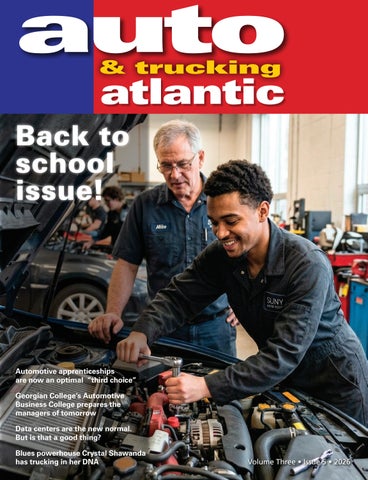
auto & trucking
atlantic
Back to school issue!
Automotive apprenticeships are now an optimal “third choice” Georgian College’s Automotive Business College prepares the managers of tomorrow Data centers are the new normal. But is that a good thing? Blues powerhouse Crystal Shawanda has trucking in her DNA
Volume Three • Issue 5 • 2026
Your next move can be a game changer. Strategize with Fix Auto.
When you invest in a Fix Auto franchise, you invest in a business model with a globally proven track record. You invest in a fully branded business with a roadmap for success. You invest in the same values and work ethic that grew your local business to what it is today. Drive your business forward with: • Solid performance-driven operational model and ongoing training. • Full branding and marketing support for local awareness and promotion. • Proven experience in winning insurance work. • Established global supply and fleet arrangements. Our owner started as a franchisee, and this inspires our commitment to the success of the local business owner.
Make your first move!
auto & trucking
atlantic
SCAN TO VISIT OUR ONLINE HUB!
Page 4
ditor’s letter E It’s September which means back to school. Our editor introduces this issue.
Page 5
This issue we were.... ..next issue you could...
PUBLISHER
Robert Alfers rob@autoatlantic.com
EDITOR
Carter Hammett carter@autoatlantic.com
Page 6 News of the weird Time to take your car for a….walk? More! Page 8 The green mile Data centers are becoming a thing but with EVs will they eventually cause “gridlock?”
MARKETING MANAGER
Page 10 Electric avenue Rohit Narayan Sholingur sits down with staff from the College of the North Atlantic to discuss their automotive program Page 13
Women and wheels
Our writer recalls a memorable trip to Jasper, Alta. Page 26 Motor matters The strengthening the competitiveness and resiliency of Canada’s automotive industry The CAPC meets to discuss challenges and solution facing Canada’s automotive industry.
Wa-el Ibrihaim
IT MANAGER
Tyler Graves tyler@autoatlantic.com
FEATURES – Back to school! Page 14
ART DIRECTOR Nicole Shadbolt
CONTRIBUTORS
Carter Hammett Sana Fatemi Sean Maddox Jeremy Woolward Alexandra Law Rohit Narayan Sholingur Shammi Thakur
IMAGES VIA
Benefits of an apprenticeship in the automotive sector
Once thought of as “the third choice” automotive apprenticeships have gained a lot more traction and respect in recent years. Here’s why. By Alexandra Law Page 16 Shifting gears: Preparing the next generation of automotive
industry leaders
Rohit Narayan Sholingur talks to the people behind Georgian College’s Automotive Business School of Canada. Page 20 The road to better drivers starts at school Jeremy Woolward gives us the lowdown on trucking schools and their interconnectedness with issues of the day. Page 22
Unsplash Magnific kppt.ruralrides.ca
he workshop is evolving: What software-defined vehicles mean for T dealers, fleets, and technicians
As automotive technology evolves so do the people servicing your car. Your mechanic is also becoming a technologist writes Shammi Thakur.
ETC. Page 30 Auto & Trvucking Atlantic is published digitally by Robert Alfers. For advertising rates or information regarding Auto & Trucking Atlantic, please contact us at:
rob@autoatlantic.com Tel: 902.452.0345 Mail: 608 - 56 Jacob Lane Bedford, NS B3M 0H5, Canada
he road ahead: Latest UAP T training tools encourage auto professionals to ‘focus on front windshield’
Page 39
For many people–seniors, people with disabilities–living in rural centers, driving services are a lifeline when getting from here to there, proves almost insurmountable says contributor Sean Maddox.
NAPA’s commitment to lifelong learning takes many forms writes Kristen Lipscombe. Page 36
The Atlantic road report
Serious investment in the province’s electric vehicle charging infrastructure + more!
irst person: Rural F transportation: The road to independence
Page 41
Stars in cars
With a new album out and a tour looming, 54-40 bassist Brad Merritt reflects on life on the road. 2026 • Issue 5 • autoatlantic.com •
3
Back to school: Learning to keep Canada moving By Carter Hammett
T
his issue of Auto and Trucking Atlantic puts education firmly in the driver’s seat, with a special focus on the people who are preparing to build, repair, manage and lead the transportation industries of tomorrow. If you have ever wondered what it takes to become an automotive technician, where that career can take you or whether there is a future in the skilled trades, this issue is for you. We begin by taking a closer look at the road to becoming an automotive technician. It is a career that has changed dramatically from the days when a good mechanic could diagnose most problems with a wrench, a screwdriver and a well-trained ear. Today’s technicians work with increasingly sophisticated electronics, computer diagnostics, hybrid and electric vehicles, advanced driver-assistance systems
and a host of technologies that would have seemed like science fiction a generation ago. And then there is the Red Seal. We take a look at what the designation means, how apprenticeship and certification work and why earning that familiar red-and-white endorsement can be an important milestone for technicians looking to establish themselves across Canada. Automotive Service Technician is a Red Seal trade in every province and territory, although certification requirements vary by jurisdiction. We also look at what technicians can earn in different parts of the country—a useful consideration for anyone contemplating where their automotive education might ultimately take them. Our own Rohit Narayan Sholingur has been busy in the classroom
as well, sitting down with staff from Georgian College’s Automotive Business School of Canada. Their conversation looks beyond simply fixing vehicles and explores how education can help prepare the industry leaders of tomorrow. As the automotive world continues to evolve, the people managing dealerships, businesses and operations will need to understand not only technology, but customers, business strategy and the changing nature of the industry. Rohit also turns his attention eastward, meeting with staff at the College of the North Atlantic to discover how the institution is preparing students for an automotive world that refuses to sit still. CNA’s Automotive Service Technician program, for example, combines classroom and practical preparation with a pathway toward apprenticeship and Red Seal certification. It is a timely look at how colleges and training institutions are responding to the skills employers will need in the years ahead. And because this is Auto and Trucking Atlantic, we haven’t forgotten the big rigs. Our favourite trucking writer, Jeremy Woolward, takes us through the latest developments in trucking schools and the changing ways new drivers are being prepared for life behind the wheel. With trucking facing its own technological and workforce changes, training has never been more important. Finally, we shift gears for another edition of Stars in Cars, where blues powerhouse Crystal Shawanda joins us for a conversation that brings together music, trucking and life on the road. So settle into your favourite chair, turn the page and fasten your seat belt. September may be back-to-school season, but there are no pop quizzes here—just plenty to learn. The bell has rung. Class is in session. Let’s take a ride.
4 • autoatlantic.com • Issue 5 • 2026
This issue we were.... Carter Hammett, Editor
Alexandra Law
Toronto writer Carter Hammett has been the editor of Auto and Trucking Atlantic for the past 17 years. His writing has appeared in the Toronto Sun, Ottawa Citizen and Convenience and Carwash Canada among many other publications. View his work at: https://authory.com/CarterHammett.
Journalism diploma graduate from Sheridan College in Oakville, Ontario.
Sana Fatemi Writer and editor with a deep love for storytelling and the literary world. With experience in both writing and editing across various publications, she enjoys shaping narratives, refining language, and bringing ideas to life on the page.
Sean Maddox is a N.S. artist inspired by people, places and things in his communities. Most pieces he creates are made with 90% recycled materials.
Jeremy Woolward Employed as a fleet safety & human resource manager for a commercial motor carrier in Calgary, Alberta.
Rohit Narayan Sholingur An emerging writer with a focus on storytelling that connects culture, society, film, media and technology. He brings a fresh perspective shaped by curiosity and a keen eye for detail.
Shammi Thakur Is a Research Director at Vyansa Intelligence, bringing over 15 years of experience in strategic market intelligence, competitive analysis, and industry forecasting. He leads research initiatives across automotive and mobility, energy, healthcare, ICT, chemicals and materials, and advanced manufacturing, delivering data-driven insights that help businesses navigate emerging technologies, evolving market dynamics, and informed strategic decision-making. Increased Throughput. Faster ROI. Now faster than ever! With improved vehicle
throughput, superior cleaning and more efficient ...Next issue you could
drying. The Laserwash® 360 Plus delivers profits to your bottom line. Reduce wash times by 30-60 seconds per car with the latest high pressure rinse and multi-function application passes to increase your daily wash volume.
DRIVE CLEAN
Toll Free: 1-888-775-8383 - 6 First Street, Elmsdale, NS - maritimecarwash.ca
Increased Throughput. Throughput. Faster Faster ROI. ROI. Increased Nowfaster fasterthan thanever! ever!With Withimproved improvedvehicle vehicle Now throughput,superior superiorcleaning cleaningand andmore moreefficient efficient throughput, drying.The TheLaserwash® Laserwash® 360Plus Plus delivers profitsto to drying. 360 delivers profits Increased Throughput. Faster ROI. your bottom line. Reduce wash times by 30-60 seconds your bottom line. Reduce wash times by 30-60 seconds percar carwith withthe thelatest latesthigh highpressure pressurerinse rinseand andmulti-function multi-function per Now faster than ever! With improved vehicle application passes to increase your daily wash volume. application passes to increase your daily wash volume. throughput, superior cleaning and more efficient drying. The Laserwash® 360 Plus delivers profits to your bottom line. Reduce wash times by 30-60 seconds per car with the latest high pressure rinse and multi-function application passes to increase your daily wash volume.
DRIV DRIV
DRIVE CLEAN
DRIVE CLEAN
TollFree: Free:1-888-775-8383 1-888-775-8383- -66First FirstStreet, Street,Elmsdale, Elmsdale,NS NS- -maritimecar maritimeca Toll Toll Free: 1-888-775-8383 - 6 First Street, Elmsdale, NS - maritimecarwash.ca
2026 • Issue 5 • autoatlantic.com •
5
NEWS OF THE WEIRD
Bits and pieces of the bizarre, strange and just plain odd car and truck items collected from around the web, so you don’t have to. Yer welcome!
This bizarre walking car runs on compressed air instead of an engine This wacky Romanian prototype relies strictly on compressed air to crawl down the street without any gas or batteries, delivering some truly mind - bend ing speeds.
I do not think I have ever seen an automotive invention that left me asking so many burning questions right from the start. This bizarre walking car is actually the very first functional prototype of the Rosmar H, which is the incredibly ambitious brainchild of a rogue Romanian inventor named Adrian Roșca.
So why on earth does it walk instead of rolling? The vehicle walks because conventional cars waste tremendous energy converting linear piston motion into rotational motion for their wheels, only to convert it right back to linear motion on the highway. Roșca sidesteps this friction completely with massive, double-acting pneumatic air cylinders.
violently inchworm its way ahead across the tarmac. It is essentially a giant air-powered pogo stick mounted horizontally on wheels.
The strange vehicle has recently surfaced online and secured quite a bit of mainstream media attention, but Roșca has actually been tirelessly developing this wild contraption for over a decade in relative obscurity. It fundamentally abandons traditional automotive propulsion, ignoring combustion engines and EV power entirely to favor something completely unhinged and beautifully strange.
A different kind of crawl mode
By carefully routing highly compressed air to alternating sides of a central piston, the system aggressively pushes the vehicle’s wheels forward and backward in sequence. The tires mechanically brake in one direction and roll completely freely in the opposite direction, forcing the lightweight chassis to
Unlike older failed air-powered cars from Peugeot or Tata, this design avoids the dreaded engine expansion cooling trap. Because each massive pneumatic stroke takes time to complete, the expanding air naturally absorbs ambient heat from the surrounding environment. This brilliant thermodynamic loophole provides decent range, using literally nothing but pressurized air and a twelve volt battery for basic valve controls.
Source: https://www.autoblog.com/news/this-bizarre-walking-car-runs-on-compressed-air-instead-of-an-engine
Brembo wants you to wear its brake calipers Brembo is taking its signature caliper design from behind the wheels and putting it on your back with a new clothing collection.
it wants to put them on you. The Italian brake manufacturer has launched Brembo Collections, a new lifestyle project that quite literally lets you wear the hardware.
Brembo has spent the last few decades fitting calipers onto some of the world’s best performance cars. Now, apparently,
The first collection is called Brembo Colors of Speed, and it does exactly what you’d expect from a company known for its
6 • autoatlantic.com • Issue 5 • 2026
brake calipers: It puts them on T-shirts. Brembo unveiled the collection ahead of the Formula 1 Italian Grand Prix at Monza. Colors of Speed features T-shirts in 11 different color variations, with the Brembo brake caliper serving as the centerpiece of the design. The shirts are designed and printed in Italy and will be available for pre-sale through Brembo’s new online store, brembocollections.com. Not just shirts The T-shirts aren’t just a one-off, either. Brembo says Colors of Speed is the first step in a larger Brembo Collections project, with more products and collections planned over the coming months. Source: https://www.motor1.com/news/806892/brembo-caliper-t-shirts
Toyota is telling mechanics to hit tundra engines with a hammer Toyota technicians are employing a highly specialized plastic hammer test to diagnose whether recalled Tundra V6 engines contain fatal manufacturing debris. If you walk into a dealership and see a mechanic whacking a brand-new truck engine with a hammer, you might assume they have finally lost their minds. However, this is actually the latest official diagnostic procedure from the Japanese automaker. Dealership technicians are currently utilizing a plastic hammer to determine the fate of the V35A twin-turbo V6 engine found in certain 2022-2024 Tundras. While it looks entirely unhinged, the method prevents perfectly healthy trucks from undergoing massive and unnecessary mechanical heart transplants. This bizarre directive is tied to an ongoing manufacturing nightmare. The automaker previously issued massive recalls because rogue machining debris was left inside the engine block during production, causing catastrophic failure. Unfortunately for truck owners, this recall expansion recently grew to include the 2024 model year. To manage the immense volume of affected trucks, engineers developed this striking new inspection method to efficiently sort the good engines from the doomed ones. How the impact test actually works The root of the problem lies deep within the block. A recent engine teardown vividly showcased how leftover manufacturing debris destroys the main bearings, leading to knocking, rough idling, and a complete loss of motive power. Toyota claims engines produced later received an improved No. 1 main bearing designed to resist this exact debris, but thousands of trucks remain in the danger zone.
Enter campaign 25TA14, officially known as the V35A Crank Bearing Inspection. According to a report from Pickup Truck + SUV Talk, the process is surprisingly rigorous. Technicians must first change the oil, reach specific operating temperatures, remove accessory belts, and align the crankshaft perfectly. They then mount a sensitive accelerometer directly to the crankshaft bolt. Finally, the mechanic strikes the crankshaft pulley at the 3 o’clock position with a specific plastic hammer.This impact sends vibrations through the metal, which are captured by the accelerometer and fed into advanced diagnostic software. The computer analyzes the resonance, judges the quality of the strike, and automatically uploads the data to the cloud to return a simple pass or fail grade. Because of this software, the targeted replacement strategy guarantees mechanics are replacing only the specific engine assemblies that genuinely fail the acoustic check. Method behind the madness Calling it a hammer test makes the entire ordeal sound laughably primitive, but it is rooted in solid science. This technique is formally known as experimental modal analysis. Engineers have used impact sensors for decades to measure how structures respond to a controlled force. By analyzing the natural frequencies and damping within the crankshaft, the software can effectively detect compromised bearings without tearing the entire block apart. While the engineering principle is an established industry practice, seeing it deployed on the service floor is undeniably unusual. It is a brilliant way to save millions of dollars in warranty claims while quickly diagnosing customer vehicles. Still, peering through the service bay window to watch a mechanic hitting your expensive rig with a hammer is definitely going to spark some highly entertaining conversations at the dealership counter. Until then, try not to panic if you hear rhythmic thumping coming from the garage during your next scheduled maintenance visit.
Source: https://www.autoblog.com/news/toyota-is-telling-mechanics-to-hit-tundra-engines-with-a-hammer
2026 • Issue 5 • autoatlantic.com •
7
THE GREEN MILE The data center dilemma By Carter Hammett With the surge in electricity demand mirroring unprecedented growth in the United States, data centres are rapidly becoming a talking–occasionally a pain–point for people across the country. But what is the environmental impact of these projects and how is Canada preparing to meet this demand?
A
s Canada readies itself to plunge deeply into data centre development, it’s also facing pushback from a number of communities across the country who either outwardly reject, or have put on hold, a number of developments.
Already Oakville O.N. and Rocky View County Alta have imposed one-year moratoriums on data center development. Meanwhile Manitoba Premier Wab Kinew has kyboshed a project that would have been constructed outside of Winnipeg, stating that drawbacks outweighed the benefits. Backlash against a proposed 7.5 gigawatt outlet by none other than Shark Tank personality Kevin O’Leary has reached
a climax with protestors marching strong in Vancouver. Positioned as an opportunity to enhance Canada’s digital sovereignty, critics argue that any economic wins gained against U.S. influence, will actually be more modest than projected. The feds have allocated over $700 million to bolster AI infrastructure, while simultaneously corporations have proposed 150 new large data centres across the country. This rapid growth has led to protests, petitions and calls for a national moratorium on new construction. An Angus Reid poll recently suggested that up to 68% of respondents reject a large AI data centre in
their neighbourhood, while a Leger survey indicated that four out of five of those surveyed, identified environmental impacts and increased electric bills as cause for concern.. Data centres have been on a lot of people’s minds lately but there appears to be a lot of confusion over what they do and both the benefits and challenges that come with them. So just what are data centers anyway? When a file is uploaded, movies are streamed or even when a photo is sent to someone, data is being routed through miles of buried fiber and cables to a data centre. These operations power the overall digital infrastructure, and are home to the servers and equipment needed to keep the Internet active. You may not realize it but every time you do online banking for example, some data centre is in the background processing data. Data centres touch every facet of our lives, including health care, cloud computing and even scientific research. These centers have been deemed essential for business, cloud computing, AI and other services, but critics warn these operations can also have significant environmental impact, including huge energy consumption to operate servers, networks and cooling systems. There are also significant concerns around water consumption which is
8 • autoatlantic.com • Issue 5 • 2026
used to operate cooling systems. This can put a lot of stress on local freshwater supplies. Also the “water footprint” of electricity can also be significant. There’s also been a lot of chatter about the electronic waste that can contribute to the loss of valued resources through servers, storage equipment, hardware and batteries becoming obsolete if they aren’t reused or recycled properly. Furthermore, there have been concerns raised about the impact on traffic. While temporary, the most invasive issue occurs during the construction phase, even before the data centre is operational. Because of rapid technology evolution and changes in industry practices, centres will constantly need to be upgraded and the way these buildings are constructed and operated suggest a new set of best practices and environmental impact analysis is a priority. A dark horse emerging for attention? Ironically perhaps, there is yet another concern on the horizon and that’s the ever-growing adoption of electric vehicles (EVs) that is projected to have a huge impact on the power grid’s resilience globally. A report released in April of this year by Prisma Photonics estimates that by 2030 EVs electricity demands in the U.S. alone could reach up to 4.6% of total power demand. Worldwide, that demand for electricity could reach as high as 20%. Data centres meanwhile, are anticipated to reach 10% of available power during the same period. The strain on electric grid resilience presents enormous challenges and has sparked a lot of debate on everything from consumer behaviours to peak transmission times. One of the possible outcomes are rolling brownouts, similar to what currently exists in countries like South Africa. Whereas EV charging is quite broad and variable in nature, data centres place a high demand on electricity that is both heavily concentrated and localized. In 2025, data centres gobbled up
an estimated 312.6 terawatt hours with power consumption up 26% in global and regional data centre demand. Goldman Sachs research indicates that that figure is expected to reach 66 gigawatts by 2027. At present, data centres are responsible for “only” about 1% of Canada’s electricity usage. There’s about 300 data centres currently operating across the country generating up to an estimated 750 megawatts, which may vary depending on classification. With the demand for electricity expected to surge with the almost 200 data centres either under construction or proposed, these new projects are projected to surge demand by as much as 21.7 gigawatts according to York University researchers. A federal framework In September of this year, the feds unveiled a national framework for responsible data centre d eve l o p m e nt , which includes protecting electricity ratepayers, limiting water usage and benefitting Canadians in the longterm.
ment regulatory processes at all levels and be shaped by unique community needs and regional priorities. The framework is supported by a fairly impressive range of signatories that include Amazon, Meta, Google, Telus and Bell Canada among others. “Canada is building the digital infrastructure we need to lead in the age of AI, grow our economy and strengthen our sovereignty,” said Minister of artificial intelligence and digital innovation Evan Solomon. “But how we build matters. Data centres must protect ratepayers, respect water and energy resources, and create lasting benefits for the communities that host them. These principles set a clear national standard: If you build in Canada, you must build responsibly and transparently and you must build for Canadians.” Let’s hope these words are as resilient as the grid they’ll be taking energy from.
The framework includes five expectations for data centre d eve l o p m e nt , including local benefits, not shifting electricity costs to Canadians, minimizing environmental impacts, a transparency and strategic value to Canada. The framework goes on to state that data centre development must comple2026 • Issue 5 • autoatlantic.com •
9
ELECTRIC AVENUE Wired for change: Auto training meets the EV era By Rohit Narayan Sholingur
T
he automotive industry is in the midst of a major shift and training programs across the country are racing against time to keep pace. We reached out to College of North Atlantic (CNA) to talk about how the Automotive Service Technician program is preparing students for that changing landscape. Here’s what Associate Dean, Marty Madore had to say:
Q. The automotive service technician program is advertised as a Red Seal certification program. How does that designation shape the curriculum, and what does it mean for graduates in terms of industry recognition?
A. CNAs Red Seal trades are aligned with nationally-recognized occupational standards. That means our curriculum is designed to ensure students develop the competencies required not only in Newfoundland and Labrador, but across Canada. The program emphasizes both theoretical knowledge and hands-on skills that support progression into apprenticeship and eventual Red Seal certification. For graduates, Red Seal recognition represents a highly respected industry credential. It enhances labour mobility, provides employers with confidence in the graduate’s training, and positions graduates to work anywhere in Canada where automotive service technicians are in demand. Q. The overview notes on the website states that the program ‘may not be suitable for applicants with normal color perception’. What are some specific tasks in the program that require accurate colour perception?
A. Colour perception is particularly important in automotive diagnostics and repair. Students routinely work with colour-coded electrical wiring, wiring schematics, fuse identification systems, sensor connections, fluids, and indicator lights. As vehicles become more electronically sophisticated, the ability to accurately distinguish colours can contribute to both diagnostic accuracy and workplace safety. This is especially important when working with modern electrical and high-voltage systems where identifying the correct components is critical. Q. The program outcomes focus on safe work practices, engines, engine support systems, vehicle management sys10 • autoatlantic.com • Issue 5 • 2026
tems, driveline systems, and electrical systems. Which of these do you see evolving as EVs become more common?
A. The greatest evolution is occurring within vehicle management systems, electrical systems, and safe work practices. While traditional mechanical systems remain important, electric and hybrid vehicles place a much greater emphasis on electronics, software, battery management systems, power distribution, and advanced diagnostics. Safety procedures are also evolving because technicians must understand how to safely work around high-voltage systems. The automotive industry is not replacing traditional skills entirely but rather adding new layers of electrical and digital competency. Q. Admission requirements rely heavily on specific high school or adult basic math and science courses. How well do these pre-requisites prepare students for the increasingly electronics heavy nature of modern vehicles , including EVs?
A. The math and science prerequisites provide students with an important foundation in problem-solving, measurement, physics, and technical reasoning. Those skills are increasingly valuable in today’s automotive industry. Modern vehicles require technicians to interpret diagnostic information, understand electrical principles, and apply logical troubleshooting processes. While most students do not enter with advanced electronics knowledge, the pre-requisites help ensure they are prepared to learn those concepts successfully during the program. Q. Can you walk us through the ‘Mature Student’ pathway? How common is it for applicants to enter through this pathway, and does it change the way they’re supported once enrolled?
A. The Mature Student pathway provides opportunities for individuals who may not meet traditional admission requirements but possess relevant experience, motivation, and the ability to succeed in a technical program. We see mature applicants enter from a variety of backgrounds, including career transitions, previous trades experience, and workforce re-entry situations. Once admitted, mature learners have access to the same academic and student
support services as all learners. In many cases, mature students bring valuable life and workplace experience that contributes positively to the learning environment. Q. The program requires respirator fit testing and notes that students need to be clean-shaven for it to work properly. How do students typically respond to that requirement and does it ever affect who gets to complete the program?
A. Most students recognize that this is a workplace safety requirement rather than a program preference. In NL legislation requires that respirators must form an effective seal to provide protection, and facial hair can compromise that safety standard. We communicate the requirement clearly, so students understand it before entering workplace and shop environments. Compliance is generally not an issue, as students appreciate that these expectations reflect the same safety standards they will encounter in industry. Q. Looking at the currriculum, students take on general health and safety and learn about basic tools and equipments before they start learning about EV and Hybrid systems. How does that sequencing help students to eventually understand EV systems?
A. The curriculum is intentionally structured to build knowledge progressively. Students first develop a strong understanding of workplace safety, tools, equipment, basic vehicle systems, and diagnostic processes. Only after those fundamentals are established do students move into more advanced technologies such as hybrid and electric vehicle systems. Understanding EV technology requires knowledge of electrical principles, diagnostics, and vehicle architecture, so the progression ensures students have the foundation necessary to work with those systems safely and effectively Q. Career opportunities listed include garages, dealerships and service stations. Are you seeing employers in these specific settings ask for EV or Hybrid competency when hiring your graduates?
A. We are seeing growing interest from employers in EV and
hybrid competencies, particularly among dealerships and organizations preparing for the continued growth of electric vehicles. That said, employers continue to place a high value on strong foundational diagnostic and troubleshooting skills. The technology will continue to evolve, but employers consistently tell us they need graduates who can think critically, diagnose effectively, and adapt to changing vehicle platforms. EV knowledge is becoming an increasingly valuable addition to those core competencies. Q. The program is offered at three locations (Bay St. George, Gander and Prince Philip Drive) . Is EV specific equipment and lab space consistent across all three campuses or is it concentrated at one specific campus?
A. Our objective is to ensure students receive a consistent learning experience regardless of campus location. As automotive technology evolves, we continue investing in equipment and instructional resources to support program delivery across our campuses. Like many institutions, specialized equipment investments are made strategically and may vary somewhat by campus based on instructional needs, available facilities, enrollment, and industry partnerships. However, our focus remains on ensuring all graduates achieve the required learning outcomes and competencies. Q. With automotive service technician being one among 100 different programs offered at CNA, how does this program compete for investment against other in-demand trades?
A. Program investment decisions are guided by several factors, including labour market demand, industry input, student enrollment, provincial workforce needs, technology changes, and strategic priorities. The Automotive Service Technician program remains an important skilled trade that supports transportation, industry, and economic activity throughout Newfoundland and Labrador. As vehicles become increasingly sophisticated, maintaining current equipment and training environments becomes even more important. We work closely with industry partners to ensure our investments align with workforce requirements and emerging technologies. 2026 • Issue 5 • autoatlantic.com • 11
Q. How has the decline of foreign students affected the program? Have tariffs been an issue?
A. Automotive Service Technician has traditionally been driven primarily by domestic workforce demand and apprenticeship pathways. While changes in international enrollment can affect post-secondary institutions broadly, the impact on individual programs varies considerably. With respect to tariffs and broader economic pressures, institutions across Canada have seen increased costs associated with equipment, tools, technology, and supplies. Automotive training is particularly dependent on current technology, so cost pressures are something we continue to monitor closely.
12 • autoatlantic.com • Issue 5 • 2026
Our goal is to ensure students have access to industryrelevant equipment while maintaining high-quality training and responsiveness to workforce needs. What becomes clear through this conversation is that CNA views adaptation not as a departure from trade roots but rather as an expansion. As the Associate Dean puts it, the goal is to prepare graduates for both “today’s industry” and the “increasingly electrified and technology-driven industry of tomorrow”. For a program educating the next generation of technicians, making sure graduates leave the program prepared for anything and everything rather than choosing between new and old skills might be the real test that lies ahead.
WOMEN AND WHEELS A summer drive to Jasper By Sana Fatemi
T
he summer sun was beating down on the hot cement as my friend and I tossed our bags into the back of the trunk, eager to trade the city skyline for the jagged peaks of Jasper, Alta. Before hitting the highway, we did a quick safety check of the car; monitoring the tire pressures, topping up the washer fluid, and ensuring the fan levels were ready for the mountain heat. We were heading out for a local book event, which gave us the perfect excuse for a weekend getaway. While the book event was our official destination, the true heartbeat of the trip was simply hitting the highway. There is something special about a summer road trip that makes you appreciate the simple joy of driving, away from daily routines and traffic jams.
The next day we travelled around Jasper, visited a few lakes, went hiking, and bought some souvenirs. After having dinner, we packed everything in the trunk, fired up the engine, and started the journey to a cabin with beautiful scenery watching over Jasper. This trip reminded us exactly why summer road trips remain a classic tradition. It isn’t just about counting the kilometers; it’s about a great friend, a perfect playlist, a good story, and the unforgettable places the road can take you.
Getting ready for the drive was a team effort. I rode shotgun and my friend drove. While she had the responsibility of driving, I ensured we stayed hydrated, put on playlists to listen to and made conversation. We also listened to the author’s audio book that we were on our way too see. About halfway through the drive, we pulled off the highway to stretch our legs and stock up on road trip snacks, picking out cold drinks, and food to fuel the rest of our journey. The winding highway north to Jasper is a true adventure for anyone who genuinely loves the feel of the open road. The route features long, smooth straightaways, tight switchbacks, and sweeping elevation changes. It was incredibly satisfying to feel how smoothly the car handled the steep mountain grades, while watching the beautiful views and mountains in the background. Feeling the responsive steering feedback through the tight corners reminds you how much fun a wellhandling car can be, especially when the asphalt is completely clear of winter snow and ice. As great as the drive felt, the summer scenery out the windows constantly stole the show. Summer in Jasper is absolutely spectacular. Massive limestone peaks rose sharply against a clear blue sky. We drove past lakes, saw green pine trees, and caught sight of the Rocky Mountains. Soon enough, we rolled into the beautiful town of Jasper, got settled in our airbnb, and headed to the book event after getting ready. The book event was a total blast from start- to- finish. The venue was packed with enthusiastic fans, and we spent the afternoon chatting with authors and fellow book lovers. It was a great change of space, filled with good energy, lots of laughs, snacks, and fun conversations. By evening, we grabbed a bite to eat and headed back to our Airbnb. 2026 • Issue 5 • autoatlantic.com • 13
Back to School Feature
Benefits of an apprenticeship in the auto sector By Alexandra Law A hands-on way to start a career — with pay, mentorship, and a clear path forward.
A
pprenticeship in the automotive sector has so many benefits any young person starting out in the industry needs to know. It lets you skip years of classroom time and start working right away. You train on real vehicles, use real tools, and get paid from day one. Here’s what you need to know. Why it’s a good career choice
You earn while you learn. You get paid during training instead of racking up years of tuition debt first. This is particularly advantageous to those who can’t afford the rising costs of education as well as those who would rather just dive right in to the real thing. Little- to- no student debt. Most of
your training happens on the job, so you avoid the big loans that come with college or university. Many students end up with tens of thousands in student debt and with no real job prospects. Real hands-on experience. You work with actual vehicles and diagnostic tools — the equipment mechanics use to figure out what’s wrong with a car — instead of just reading about it. Apprentices can “hit the ground running” and get their hands dirty…literally. Credentials that matter. You earn certifications that employers and the industry respect. Apprentices can be assured that the time they put in is looked on seriously.
YOUR ONE-STOP SHOP FOR DRIVETRAIN PARTS & SERVICES NA
TIO
NAL ORGAN
IZA
CERTIFIED
T
N
IN
ER
IO
C
T
RE GROUP OF
AR
NT
OM
CE
IES
THE GE
PA N
SE
OF
DR
IVE
TRAIN EXPE
RT
I
FO
QUALITY R S
TA N D A R D I Z AT
IO
N
A clear path to full-time work. Apprenticeships often lead straight to a job, often with the same employer who trained you. They already know your work, so hiring you is an easy call. This makes the whole process streamlined and benefits both sides. Mentorship. Experienced technicians pass on knowledge you can’t get from a textbook. Apprentices get the benefits of years, maybe decades, of their experience, and can apply it right away. Skills you’ll build • Modern technology: Hands-on exposure to electric and hybrid vehicles (cars that combine a gas engine with an electric motor). • Well-rounded skills: Technical ability plus customer service, problemsolving, and teamwork. • Brand-specific training: If you apprentice at a dealership like BMW or Toyota, you get training specific to that brand. Long-term advantages • Job security: Skilled technicians are always in demand. • A clear career path: From apprentice to qualified technician, then specialist, then manager. • Room to specialize: Later on, you can focus on areas like electric vehicles or bodywork.
Transmissions • Differentials • Transfer Cases • Clutches Driveshafts • PTOs • Wet Kit Packages • Steering Parts
• Portable credentials: Your qualifications are recognized nationally and internationally, so you can work in different regions. Things to consider
#5 & #6, 191 Henri Dunant Street Moncton, NB
1-84 4-701-4327 GE A RCENTREGROUP.COM 14 • autoatlantic.com • Issue 5 • 2026
• Lower starting pay: Apprentices earn less at first than fully qualified technicians. • Physical work: Expect to be on your
feet, lifting, and working with your hands. • Training length varies: It depends on the level you’re pursuing and where you work. Apprenticeships in Ontario Regulation
The bottom line
All three end in the same Red Seal, so once you’re certified in one province, you can work in any of them. How to get started 1. Find a sponsor. This can be an employer, a contractor, or a group like a union (for example, Niagara College).
• A provisional certificate of qualification
2. Apply. Download the paper application from the Skilled Trades Ontario website, NS Apprenticeship Agency, Trade Secrets (AIT) or Skilled Trades BC, fill it out, and sign it. If you’re under 18, a parent or guardian also needs to sign.
• A certificate of qualification
3. No sponsor yet?
Skilled Trades Ontario gives you a certificate of apprenticeship when you finish training, and a certificate of qualification once you pass the certification exam.
• In high school? Ask your guidance counsellor about the Ontario, NS, BC or Alberta Youth Apprenticeship Program.
To work legally, you need one of the following, listed on the Skilled Trades Ontario Public Register: • A registered training agreement
Training A typical apprenticeship includes: • About 6,500 hours of on-the-job training
• Post your resume on the Job Bank. • Use your province’s apprenticematching service. • Contact trade unions or associations. • Reach out to local shops directly.
• 720 hours of in-school instruction
Pay
In-school training is either:
Apprentices typically earn $18.74 to $43.27 per hour, depending on their level and location — and pay increases as you progress. You may also qualify for Employment Insurance (EI) to help cover income during in-school training.
• Block release — full-time study for several weeks at a time, or • Day release — one day a week from September to June
An automotive apprenticeship gives you real income from day one, handson training on modern vehicles, mentorship from experienced pros, and a credential the industry respects. Yes, the pay starts lower and the work is physical — but in return, you get job security, a clear path to advance, and room to specialize as you grow. If you’d rather learn by doing than sit in a lecture hall, it’s a solid way to build a lasting career.
Here’s a snapshot of what it takes to apprentice in Nova Scotia, Alberta and British Columbia: Nova Scotia
Alberta
British Columbia
Must you be certified to work?
Yes
No
No
Length
4 years
4 years
4 years
Average wage $25/hr
$37/hr
$26
Who runs it?
Trade Secrets (AIT)
Skilled Trades BC
NS Apprenticeship Agency
2026 • Issue 5 • autoatlantic.com • 15
Back to School Feature
Shifting gears: Preparing the next generation of automotive industry leaders A conversation with Georgian College’s Taylor Woods sheds light on an ever-evolving sector and the methods of developing emerging leaders. By Rohit Narayan Sholingur
F
rom artificial intelligence and digital retail platforms to evolving consumer demand and new career pathways, the automotive business is becoming increasingly technology-driven and diverse. We sat down with Taylor Woods, marketing officer for Georgian College’s Automotive Business School of Canada (ABSC), to talk about an industry that’s evolving faster than most people realize. Taylor has spent the last three years shaping how the school tells its story to the world. However, his connection to the institution runs far deeper than what his job title suggests. Taylor is a two-time graduate of Georgian College and more notably, a third-generation ABSC employee. His grandmother worked as a co-op consultant back when the ABSC was first formed, followed by his mother, who worked as a professor within the school. That kind of lineage gives Taylor a rare vantage point. He isn’t just marketing for a school, but rather is representing a community that has quite literally shaped his family across generations. The automotive industry doesn’t look like anything like it used to a generation ago, and the people training the next generation of industry leaders know it better than anyone else. When asked about how the ever-changing automotive landscape is altering the way ABSC prepares the next generation of industry leaders, Taylor didn’t hesitate.
“We are preparing the students for an industry that’s going to look very much different from what most of us grew up with.” Taylor explained that ABSC doesn’t just want its students to have a strong understanding of the automotive business but also to be comfortable with technology and to be adaptable to change. That dual mandate of grounding students in fundamentals while keeping them nimble enough to handle constant challenges has become the single consistent theme of ABSC’s educational philosophy. For students who are trying to make sense of an industry that constantly reinvents itself, Taylor’s advice is deceptively simple. He believes that curiosity is the single most important trait a student can bring into the program.
“ When in doubt, ask questions. Don’t be afraid to ask questions” he said. “Because if you don’t ask questions and don’t have a desire to learn, then it’s going to be difficult to navigate through this industry.”
fresh talent coming from in the industry? Well, according to Taylor, both dealers and manufacturers alike are struggling to keep up the pace with new consumer behaviour, and that in turn is translating directly into the hiring process. “There’s a lot of emphasis on online lead generation. There’s also AI implementation through various different platforms such as Customer Relationship Management (CRMs): for example, if someone’s trying to buy a car, it’s all tied in through CRM platforms.” To put that in simpler words, the modern car-buying journey increasingly begins online, and dealerships are in need of staff members who understand digital lead generation and the AI-powered customer relationship management systems that now sit at the center of the sales funnel. That technological shift naturally raised a follow-up question about what’s the traditional skill that’s becoming obsolete and what skills are essential. Taylor was careful enough to phrase his answer as a personal opinion rather than speaking on behalf of the institution.
Rather than being a flashy piece of advice, his words reflect upon something that he clearly believes at a structural level: that the shifting terrain can be intimidating for students who are stepping into their first professional roles.
“This is my personal opinion, but I feel like the one thing that’s necessary to survive would be the ability to build networks and maintain relationships,” he continued explaining that the skill that is fading away has to be the uniqueness that people bring to the table.
So where exactly is the demand for
It is a notable answer that in an indus-
16 • autoatlantic.com • Issue 5 • 2026
try that is increasingly defined by automation and algorithms, as the technical tools start to become more standardized across the industry, the differentiator for career longevity seems to be old fashioned relationship building. ABSC’s ties to the broader automotive world aren’t just theoretical. A wide network of partnerships directly benefits students’ career prospects. Some noteworthy mentions include the Canadian Automobile Dealers Association (CADA) , provincial dealer associations and the Global Automakers of Canada (GAC). The crown jewel of these partnerships is the Georgian College Auto Show: ABSC’s student-run auto show, which Taylor describes as one of North America’s largest outdoor student-run auto shows. Held every year during the first weekend of June at ABSC’s Barrie campus, the event gives students hands-on experience representing real automotive brands. “Students get a chance to participate
in that, where they represent a brand and get trained at the corporate level on whatever product the said brand wants to promote,” Taylor explained. It’s a rare opportunity for students to step into a corporate setting even before they’ve graduated. With that being said, ABSC has a 95% graduate-placement rate, meaning the overwhelming majority of students walk into full-time employment immediately after finishing their studies. Beyond the statistics, Taylor pointed out to specific alumni success stories as proof of concept. He explained how one graduate from within the last two years landed the role as sponsorship director for the Vancouver International Auto Show: a high-profile position that speaks volumes to just how far an ABSC credential can carry a young professional. One of the more persistent challenges facing automotive education is marketing these programs to a younger audience who don’t really see themselves as ‘car people’ and assume that rules
them out of the industry entirely. Taylor is actively working towards dismantling that assumption. “I think we need to stop telling young people that the automotive industry is just about loving cars when you can have an awesome career in the automotive sector in so many different ways, shapes or forms”, he said. Taylor elaborated by adding that since the industry is changing so rapidly, there are many different pathways and opportunities for people with various backgrounds and interests. That messaging shift has made ABSC rethink their marketing strategy towards prospective students. Ever since stepping into his role as marketing advisor, Taylor says the strategy has changed substantially when compared to how it was when he first took on the role. “It was a lot of evergreen content before, now we focus on what’s trending, like day in the life- themed videos”
2026 • Issue 5 • autoatlantic.com • 17
“There’s always a lot of energy on campus”, Taylor said. He continued to explain how new students find an unusually strong sense of community from day one. Orientation kicks things off, followed by a steady stream of community-building events such as trivia nights, welcome swag bags, branded t-shirts and other merchandise designed to make students feel like they are part of something bigger. The most interesting part of the conversation centered around how ABSC manages to keep its curriculum relevant to an industry that’s constantly evolving. The answer lies around a dedicated curriculum committee made up of program graduates and industry partners, who meet to hash out emerging trends and feed them back into the classroom. ABSC offers both a twoyear diploma and a four-year degree, and Taylor gives credit where it’s due. “A lot of our professors are really up to speed on the constant changes within the program,” he said, “but it’s all about staying in loop with the industry. We are constantly talking with dealers, manufacturers and industry professionals on what they’re really looking for in students”.
Taylor mentions that parents remain the single most influential voice in a teenager’s decision about where to attend school, so ABSC runs awareness campaigns and workshops targeted at them. High-schoolers on the other hand, get a different treatment entirely: one that’s designed to actually capture their attention. “For the highschoolers we make it more flashy and make them attend our in-person events where they can come talk with current students”. The school has also tapped into a re-
source most institutions overlook: its own graduates. Several recent ABSC alumni have become social media influencers in the automotive community, and now they produce video content for the school, which then gets used as part of the marketing content. It’s an approach that leans on authenticity. Prospective students aren’t hearing a sales pitch from an administrator; they are hearing from those who took these programs before. ABSC operates year-round without a summer break, which changes the rhythm of campus life when compared to a typical academic calendar.
18 • autoatlantic.com • Issue 5 • 2026
Structurally, the programs are divided into two, with the theoretical aspect of things revolving around classroom coursework and the hands-on, practical experience reserved primarily for co-op placements. But that doesn’t mean the classroom is purely academic, however. Taylor described inclass workshops where students get to work in groups.
“ We have a dealership simulator in one of the classes where students practice the day-to-day operations of a real dealership” Final projects push students even further into applied thinking in the form of
Top automotive education pathways in 2026 case studies and in some instances, full marketing plan revamps for brands that might be struggling to push their products forward. The coursework is designed to feel less like an academic exercise and more like a preview of the job itself. When asked about one common misconception about the automotive industry among the general public, Taylor responded by saying that most people think the business is all about buying and selling cars. “People think it’s primarily about selling cars, when there’s much more to it than just the sales side of things like marketing, service and financials.” Taylor closed the conversation with a direct invitation to the wider community. For anyone looking to support ABSC’s students, he pointed towards one clear path forward: getting involved directly. “The number one way for people to support us would be to get involved with the school by coming in as a guest speaker or offering to mentor any of our students”, he said. For an institution built upon relationship-building, industry partnerships and real-world mentorships, the invitation to join in not just as a spectator but rather a contributor reflects the broader philosophy behind ABSC: preparing students for the future cannot happen in isolation. As the automotive industry continues its rapid evolution, the definition of an automotive professional will likely evolve with it. The next generation might not arrive with a lifelong passion for cars, and they might pursue careers that would have seemed unconventional in the industry a few generations ago. But ABSC’s best bet is that students who are curious, adaptable and well connected will be the ones to thrive.
As the industry evolves, Canadian colleges are starting to offer students a wide range of pathways to enter the trade. From dealership-track apprenticeships to programs built entirely around electric vehicles. Here are five programs that are worth considering in 2026. Automotive Service Technician – Centennial College Centennial College’s automotive service technician program is delivered through its School of Apprenticeships as Modified Apprenticeship Programs (MAPs), built in direct partnership with General Motors, Ford, Honda and Toyota. Students alternate between in-class training and paid on-the-job placements at a dealership, working on each manufacturer’s latest vehicle systems under Skilled Trades Ontario’s apprenticeship framework. What makes this pathway distinct in 2026 is the fact that students get to train and work simultaneously from day one, rather than choosing between school and the shop floor. Motive Power Technician – Conestoga College The Motive Power Technician diploma offered by Conestoga College is a twoyear program built for students who want a broad grounding in the trade. Training covers diagnostics and repair across electrical, engine, and drivetrain systems inside dedicated shop space using industry-standard tools. The program also carries built-in exemptions from Level 1 and 2 of apprenticeship training, giving graduates a head start towards full certification as an automotive service technician. It’s a strong fit in 2026 for students who want flexibility without having to commit themselves early on in their career to a specific brand or specialty. Electric Drive Vehicle Technician – Durham College Durham College’s diploma is one among a couple of programs of its kind that are offered in Ontario. Students train inside the college’s dedicated EV training facility, working through coursework on battery systems, regenerative braking and electric drivetrains before finishing with a capstone project that mirrors the work of an EV technician. The program’s singular focus on high-voltage service makes it one of the more forward-looking specializations a new graduate can hold in 2026. Green Vehicle Technician – Fanshawe College The Green Vehicle Technician diploma opens with a foundational coursework in safety, mathematics and physics built specifically around EV technology before moving into topics like power systems, energy storage and vehicle HVAC. This specific course structure gives students a conceptual understanding of why a system fails and not just about how to fix it. As the curriculum expands to keep pace with emerging technologies like hydrogen fuel cells, the grounding in fundamentals positions Fanshawe graduates well for a field where the underlying technology keeps shifting under the technician’s feet. EV Technician – George Brown College The EV technician certificate offered at George Brown is delivered entirely online and at the student‘s own pace, using CircuitLogix Pro simulation software to let students build, test, and troubleshoot EV circuits virtually before ever touching a live vehicle.The program is aimed at technicians who have knowledge about internal combustion systems but need to build power-electronics and high-voltage skills, as well as technicians moving into EV charging station work. As working technicians look towards adding EV credentials without stepping away from a job, this self-paced fully remote format makes George Brown one of the more accessible pathways in 2026. Whether a student wants a career in dealership, a broad mechanical foundation or a specialization in EV technology, Canadian colleges now offer a pathway for it. The right choice ultimately comes down to the career the student wants to pursue. 2026 • Issue 5 • autoatlantic.com • 19
Back to School Feature
The road to better drivers starts at school With commercial truck training at a vulnerable crossroads, our pundit takes a helicopter view and identifies some of the changes necessary to make education stronger and more unified. This requires all stakeholders to step up to the plate. By Jeremy Woolward
W
hile doing double duty as both a fleet safety and HR manager, I’m tasked daily to ensure I have the right people for the job as well as ensuring those people remain safe and compliant on our highways. I expect that the drivers have strong competencies when it comes to the safe operation of a commercial motor vehicle, as well as strengths in managing their hours, performing their trip inspections, managing their cargo, ensuring their weights and dims are legal as well as being competent in reading, interpreting and following permits. This is a short wish list. The reality is that this is not the case. Often enough, I get drivers who have gaps in these fundamental skill sets. Newer drivers come with the mentality that they know how to drive and that’s all they need to know; the rest are just rules to follow. While that may sound nice, it’s a false reality, but one that has become a bit of the norm. And why could that be? When I look at my data and then start asking drivers questions about what they learned and when they learned it, the discrepancy becomes even more apparent between those who are relatively new to trucking and those who have been doing it for years. Truck driving schools as they are get tasked with almost a no-win scenario: the expectation lies with them to train drivers, but because a driving school is a school, it can only prepare drivers so far. Driving schools are not necessarily equipped to handle every possible scenario out there; it’s just not feasible to have one of every single truck,
one of every single trailer, and create training opportunities for every type of commodity that could ever exist. People would never learn effectively, and it would produce even fewer qualified drivers and more opportunities for incidents to occur on the roads. Then, the responsibility for specialized training lands on the motor carrier. However, the motor carrier may not necessarily be equipped with adequate personnel to train these drivers. Just because a driver has been driving for decades doesn’t necessarily mean they are qualified teachers. Arguably, they may be worse teachers because they may also end up teaching bad habits that stakeholders would not want to see in commercial drivers. Industry is left with its own problem to solve, and while many are advocating different solutions, nobody examines the root causes that could have created the scenario we have today. The solution is more than just a simple catchphrase or a simplistic answer; rather, it is nuanced, multi-faceted, and involves participation at all levels and representation from all industry players. However, what becomes clear is that a potential fulcrum on which this solution presents itself is found at its foundation: driving schools and arguably reassessing what is required of driving schools, be it in Canada or the United States. Lately, on both sides of the border, driving schools have come under increased scrutiny. Most driving schools run under the private model, and receive government funding based on students enrolled, graduates produced, and li-
20 • autoatlantic.com • Issue 5 • 2026
censes issued. Schools also generate funding enrollment fees. This in turn requires schools to pump out graduates to keep the doors open and be profitable. Nobody is going to want to go to a school where the pass/fail ratio is skewed towards failure, and driving schools are no different. They want to be positioned as the place to go, so they will do what it takes to succeed. In some cases, this means schools are artificially inflating numbers, producing misleading statistics, while overpromising and under-delivering on results, without any option for students to seek recourse. However, this house of cards has started to come down with increased scrutiny: governments are shutting down fraudulent schools, imposing fines on instructors, and in some cases revoking licenses fraudulently obtained. This is one side effect of poorly managed schools. Another is a visible lack of training on the part of the driver, specifically as it relates to driving skills, including hoursof-service management, performing quality trip inspections, securing cargo, knowing one’s weights and dimensions, along with other abilities related to driving. In Alberta, the former Mandatory Entry Level Training (MELT) program has been amended where these skills are no longer done in the schools. Rather, interested people enroll in a government-provided LMS and do this theoretical training online before being able to get into the cab and begin the real work of driving. There’s also an expectation that this theory is reviewed in person before a student completes their necessary hours to obtain
a Class-1 license. In some instances, that’s not happening. One example involves a driver I had who did well and knew how to operate his vehicle, but didn’t know how to manage a logbook to save his life, even after redoing the theory assigned to him when we onboarded him. He went through the motions, but when tasked to run the ELD, he couldn’t. He didn’t know how to distinguish day- and- shift limits, or how to work his sliding cycle scales in either the United States or Canada, and it was only after seeing several violations show up in his HOS reporting did we notice the fallacy. When I sat him down to review the issue, I asked him if this was something he covered in school. His response: “I did it online, but nobody reviewed it in the school. They didn’t care, and while I took notes, I didn’t understand.” Same thing here, except in this case, I made it a point to review his hours of service and teach him as if he had never heard it before. What came out of the training wasn’t that he couldn’t figure it out, but rather, he found himself unprepared for the realities that came with commercial trucking. To further complicate things, he found himself in a large amount of debt to cover his costs and didn’t want to walk away from it as it was something he wanted to do. He didn’t last long with us as he found a job with a more regional carrier where he could learn how to be a driver without the added stress of managing these fundamentals in a longhaul environment. This was something not addressed in a driving school; in fact, it was glossed over. While it’s not an indictment of all schools, it did highlight a gap in what’s being taught versus what carriers are expecting. There’s a tunnel-visioned approach to developing drivers, and that tunnel vision is going to further compound an existing driver shortage because they will graduate with licenses and schools will get funding, but these drivers will not be employable. They won’t get the insurance history or practical job training needed to truly succeed because they’re not adequately
prepared, and if a carrier does not have the time or resources to pick up where the school left off, that carrier will experience further problems and likely come to a point where they may go out of business because they won’t be able to keep the people they have. Circling back to Alberta, there’s work being done on turning commercial trucking into a Red Seal- style industry, but long before that happens, we need to determine what the foundational education needs to be and harmonize it across all of industry. So where does this leave the truck schools? While in no way a complete solution, here’s what I propose as a starting point: • Ensure that the theoretical training goes back to the driving schools. In Alberta’s case, they can continue to use the government’s learning management system to provide training, but it shouldn’t be done off-site. It should be done at the venue, with instructors being able to answer questions and provide examples of understanding that goes beyond what’s seen online. • This training needs to be reinforced during the practical hours as well behind the truck’s wheel. While understanding how the truck’s mechanical components work is critical, knowing how these components work in tandem with the theoretical training will only make the components stick. • Schools need to be transparent about their success-and-failure ratios. This is going to be one of the hardest points to enforce because it makes schools be honest and transparent about their processes. Being accountable for their metrics and linking those metrics to appropriate funding will weed out bad players and reinforce the positive behaviours modelled by more successful schools • Carriers need to visit driver schools and be involved in some of the training processes by advising the schools as to what they’re hauling; collaborating on training initiatives, and taking a vested interest in the talent of to-
morrow. Those willing to collaborate on the development of future drivers will help produce stronger and more reliable personnel. It’s not enough for carriers to sit on the sidelines and be passively engaged. Rather, they need to be anxiously engaged and more visible in this process. Like scouts for sports teams, they need to be watching the action and taking notes. • Each jurisdiction needs to start taking a more unified approach and harmonizing expectations. This is likely another area of contention because for so long, commercial trucking has fallen under the scope of the federal government, which has given each province and territory room to operate on their own. This practice, while positive on paper, doesn’t work. Instead, it’s bred its own type of competitiveness, increased the red tape, forcing Ottawa into its own no-win scenario: do they leave it with the provinces to solve, maintaining the status quo, or do they overreach, reassert control, and in some jurisdictions, fuel fire to the idea that the feds “overreach and impede province’s rights”. Right now, no action and no direction will only breed further uncertainty and further entrenches people in their own ways of thinking, making it even harder to reach consensus. While this story began with the idea of driving schools on their own, it evolved and demonstrated how interconnected this issue has become, and it’s not even the whole picture. When you start to add layers, like the accountability of shippers/receivers/brokers; the realities of the insurance companies and commercial trucking, and topics like Driver Inc, it only exposes how vulnerable commercial trucking has become and how it will take all of us collaborating to resolve these issues as we move forward into the next part of the 21st Century. We can solve the problems, but we cannot sit on our laurels or hope for a best-case scenario. The time to act is now, and the place to start is with how education is delivered and who chooses to be responsible for its outcomes.
2026 • Issue 5 • autoatlantic.com • 21
The workshop is evolving: What software-defined vehicles mean for dealers, fleets, and technicians By Shammi Thakur
A
vehicle arriving at the workshop today often tells a different story than it did a decade ago. While replacing worn components and diagnosing mechanical faults remain part of the job, technicians are increasingly connecting diagnostic tools before reaching for a wrench. A repair that once ended with fitting a new part may now include software programming, sensor calibration, or verifying that multiple vehicle systems are communicating correctly.
This shift isn’t limited to luxury passenger vehicles or emerging electric models. It is steadily influencing mainstream cars, commercial vehicles, and fleet operations alike. As manufacturers rethink how vehicles are designed and managed, the workshop has become the place where those engineering decisions translate into day-to-day service realities. At the centre of this transformation is the Software-Defined Vehicle (SDV)— a vehicle designed to deliver, manage, and improve many of its functions through software rather than relying solely on hardware. For dealerships, independent repair facilities, and fleet operators, understanding this evolution isn’t about learning another industry buzzword; it’s about preparing for a different approach to vehicle service. The engineering shift behind modern vehicles The changes taking place in today’s service bays began long before vehicles reached customers. Behind the scenes, manufacturers have been redesigning vehicle architecture to make software a core part of how modern vehicles operate, communicate, and evolve throughout their lifespan. Instead of adding a separate electronic control unit for every new feature, many
newer vehicle platforms are moving toward centralized domain computing and zonal architecture. In simple terms, this replaces dozens of isolated electronic “black boxes” with a smaller number of high-performance computing systems capable of managing multiple vehicle functions simultaneously. This engineering approach is reshaping vehicles in several practical ways: • Smarter system integration: Steering, braking, infotainment, and driver assistance systems can communicate through shared computing resources instead of operating independently. • Continuous software evolution: New functionality, performance refinements, and system improvements can increasingly be delivered through software updates during the vehicle’s life. • Simplified electronic architecture: Fewer computing modules reduce wiring complexity while making future upgrades and diagnostics more streamlined. • Greater system coordination: Vehicle functions no longer operate as isolated components; they work together as part of an integrated digital ecosystem. For service professionals, the significance lies not in the engineering terminology itself, but in what it changes on the workshop floor. As software becomes the layer connecting more vehicle systems, servicing those vehicles requires looking beyond the component being replaced and understanding the digital environment it operates within. That new reality becomes most apparent once the vehicle enters the service bay.
22 • autoatlantic.com • Issue 5 • 2026
Redefining the service bay The traditional repair process followed a predictable path: identify the faulty component, replace or repair it, verify the fix, and return the vehicle to the customer. While those fundamentals remain, Software-Defined Vehicles are adding an entirely new layer to that workflow. Today, many repairs begin by understanding the vehicle’s digital condition before evaluating its mechanical condition. A typical service visit may now follow this sequence: 1. System-wide diagnostics to identify software faults, communication errors, or stored event data. 2. Mechanical inspection and repair, where the physical component is repaired or replaced. 3.Programming or calibration, ensuring the newly installed component is correctly recognized by the vehicle’s software ecosystem. 4. Final digital validation, confirming every interconnected system communicates and performs as intended before delivery. This progression is becoming increasingly common, particularly as advanced driver assistance systems, connected safety features, and centralized vehicle computing become standard across more model ranges. The industry’s direction is becoming increasingly evident in day-to-day service operations. Earlier this year, Mercedes-Benz issued multiple overthe-air software campaigns affecting communication modules, digital vehicle key functionality, and its MBUX infotainment platform. Rather than requiring customers to schedule workshop appointments for every improvement, qualifying vehicles received software enhancements remotely, while
dealerships focused on vehicles requiring physical intervention or software verification. For workshops, this changes more than the repair itself. It changes scheduling, technician workflows, diagnostic procedures, and even customer conversations. From scheduled maintenance to continuous vehicle intelligence Fleet maintenance has traditionally been built around fixed service intervals, driver feedback, and responding quickly when something goes wrong. Connected vehicle platforms are steadily shifting that model toward continuous monitoring, where software provides early warning before a fault develops into downtime. Instead of waiting for a vehicle to arrive with a warning light or operational issue, fleet managers increasingly have access to information that helps prioritize maintenance based on actual vehicle condition. Remote visibility before workshop visits Software can identify communication faults, battery management issues, or electronic system irregularities before they interrupt operations, allowing maintenance teams to plan interventions instead of reacting to unexpected failures. Reducing unnecessary downtime Not every issue requires a vehicle to occupy a service bay. Certain software corrections, configuration updates, and system optimizations can now be delivered remotely through over-the-air updates, allowing vehicles to remain in operation while receiving improvements. Earlier this year, Ford announced a large-scale recall involving a software
issue affecting trailer brake and lighting functionality. Rather than replacing physical components, the remedy was delivered through an over-the-air software update for eligible vehicles—an illustration of how software has become an integral part of maintaining vehicle safety and operational readiness. Planning around availability, not just maintenance For commercial fleets, every hour a vehicle spends off the road carries operational consequences. Predictive diagnostics and connected vehicle intelligence help maintenance teams schedule work around availability, reducing unplanned workshop visits and improving fleet utilization. The objective is no longer simply fixing vehicles efficiently. It’s identifying potential issues early enough that repairs become planned activities rather than operational disruptions—a shift that benefits fleet managers, technicians, and customers alike.
• Performing sensor calibration after repairs or component replacement. • Recognising how software updates influence vehicle performance and functionality. Across the automotive service industry, workforce development is evolving to match changing vehicle technology. Dealerships, independent workshops, and technical training providers are expanding programmes covering software diagnostics, electronics, cybersecurity awareness, and calibration alongside traditional mechanical skills. Mechanical expertise remains the foundation of every successful repair. Digital competence builds on that foundation, enabling technicians to service increasingly software-driven vehicles with greater confidence and accuracy.
The technician behind the technology Modern workshops demand more than mechanical expertise. Every repair increasingly combines physical work with digital diagnostics, programming, and validation, requiring technicians to understand how interconnected vehicle systems operate. Moving between a scan tool and a torque wrench is becoming part of everyday workshop practice. Growing expectations for today’s technicians include: • Interpreting diagnostic data generated by interconnected vehicle systems. • Programming and configuring newly installed electronic modules. 2026 • Issue 5 • autoatlantic.com • 23
Vehicle service is becoming a long-term relationship Vehicle ownership no longer ends when customers leave the dealership. Software updates, feature enhancements, and connected services have extended the relationship well beyond the initial sale, giving service departments a larger role throughout a vehicle’s lifecycle. Customer interactions are evolving alongside vehicle technology. Explaining a software update, confirming successful sensor calibration, or validating newly programmed components has become part of delivering a complete service experience. Clear communication helps customers understand why certain repairs involve more than replacing a physical part. BMW’s ConnectedDrive platform reflects how digital services continue long after vehicle delivery. Eligible owners can activate or purchase selected software-enabled features following purchase, reinforcing the growing importance of service teams that understand both mechanical systems and digital functionality. Success will increasingly depend on more than workshop efficiency. Investment in diagnostic capability, technician development, and digital service processes will help dealerships and independent repair facilities remain competitive while supporting connected vehicles throughout their operational lives. Preparation now shifts from understanding change to acting on it. Building a software-ready workshop No single roadmap fits every business. Priorities differ depending on whether the focus is retail service, independent repair, or fleet maintenance, but every organisation is preparing for the same technological shift. • Dealerships: Factory-backed software platforms, OEM technical documentation, and manufacturer training provide a strong foundation. Continued investment in calibration
equipment, digital workflows, and technician development will help service departments support increasingly software-driven vehicles. • Independent repair facilities: Competitive advantage depends on access to reliable diagnostic platforms, J2534 pass-through programming, technical information, and ongoing skills development. Growing Right to Repair initiatives are also expanding opportunities to service vehicles that once depended almost entirely on dealership networks. • Fleet operators: Maintenance planning increasingly relies on connected vehicle data rather than fixed service intervals alone. Close collaboration with workshop partners, predictive diagnostics, and proactive scheduling help reduce unexpected downtime while improving fleet availability. • Cybersecurity and data management: Connected vehicles exchange significantly more software and operational data than previous generations. Protecting diagnostic systems, workshop networks, and customer information is becoming an essential part of day-to-day service operations rather than a responsibility reserved for IT teams. • Continuous learning: Vehicle platforms will continue to evolve through software updates, introducing new functions and service procedures over time. Regular technical training and access to current service information will help workshops remain confident and capable as vehicle technology advances. Different priorities may shape individual businesses, but one objective remains common across the industry: combining mechanical expertise with digital capability. Software-defined vehicles are changing how repairs are performed, while skilled technicians, trusted processes, and a willingness to adapt will continue to define successful workshops. Looking beyond the next service visit
24 • autoatlantic.com • Issue 5 • 2026
Software-defined vehicles are still in the early stages of industry-wide adoption, yet the direction of travel is becoming increasingly clear. Vehicle platforms will continue integrating more connected services, centralized computing, advanced driver assistance features, and over-the-air capabilities, reducing the gap between vehicle engineering and aftersales support. Repair facilities are likely to spend less time dealing with isolated component failures and more time managing interconnected vehicle systems. Remote diagnostics, predictive maintenance, digital service records, and software validation will gradually become routine elements of workshop operations rather than specialist services. Success will not depend on adopting every new technology overnight. Longterm competitiveness will come from steady investment in people, diagnostic capability, digital processes, and continuous learning. Conclusion Every vehicle entering a workshop still relies on the fundamentals of quality service—accurate diagnosis, skilled repairs, and attention to detail. Softwaredefined vehicles have not replaced those principles; they have broadened them. Digital diagnostics, software programming, and connected technologies now sit alongside mechanical expertise, making adaptability just as important as technical proficiency in delivering safe, reliable, and efficient repairs. For dealerships, independent workshops, and fleet operators, success will depend on building capabilities that evolve with the vehicles they support. Investment in people, modern diagnostic tools, and continuous learning will help businesses remain competitive as vehicle technology advances. The workshop will continue to be where engineering meets experience, and the organisations that combine both mechanical excellence and digital capability will be best positioned for the road ahead.
2026 • Issue 5 • autoatlantic.com • 25
MOTOR MATTERS News gathered from around the automotive and trucking sectors that’s vital to industry knowledge.
Strengthening the competitiveness and resiliency of Canada’s automotive industry
make long-term production and investment decisions in an increasingly challenging global environment.
The Canadian Automotive Partnership Council (CAPC) met September 9, 2026, in Toronto to discuss challenges facing Canada’s automotive industry and potential actions needed to strengthen the sector’s long-term competitiveness.
Members also provided feedback on the measures required to support the sector through the current period of uncertainty and to strengthen its longterm competitiveness. The discussion included the importance of supporting automotive investment, maintaining a skilled workforce, assisting businesses affected by tariffs, and ensuring that Canada remains an attractive location for automotive production.
CAPC members were joined by the Honourable Mélanie Joly, Minister of Industry (Government of Canada), and the Honourable Victor Fedeli, Minister of Economic Development, Job Creation and Trade (Government of Ontario). The meeting was chaired by Dave Jamieson, President and CEO at Honda Canada Inc. Members discussed challenges posed by U.S. tariffs to Canada’s automotive industry. Members emphasized the highly integrated nature of the North American automotive industry and the importance of restoring greater certainty and predictability for manufacturers and suppliers operating across the region. Members highlighted the importance of maintaining Canada’s competitiveness as automotive companies
In closing, members reiterated that a competitive and successful Canadian automotive industry depends on a stable trading relationship with the United States, strong domestic investment conditions, and continued cooperation among governments and industry. CAPC will continue to engage with governments on measures to address immediate tariff pressures while supporting the long-term strength of Canada’s automotive sector. The Honourable Mélanie Joly, Minister of Industry and Minister responsible for Canada Economic Development for
26 • autoatlantic.com • Issue 5 • 2026
Quebec Regions, noted: “The Government of Canada’s commitment to Canadian workers, businesses and the long-term strength of our economy does not waver. Hearing directly from industry leaders whose workers and businesses are affected allows the government to take informed measures to respond to U.S. automotive tariffs. Canada has already taken action through the Automotive Strategy launched in February 2026, and we will continue working with industry to build a more resilient, competitive and innovative automotive sector that creates good jobs and drives prosperity for generations to come.”
Announcing Saskatoon Trucking and Logistics Workforce Bootcamp Complimentary October 28 Bootcamp brings practical workforce solutions, combines workforce intelligence, peer exchange and expert-led discussions Trucking HR Canada (THRC) and the Saskatchewan Trucking Association (STA) are bringing the Trucking and Logistics Workforce Bootcamp to Saska-
toon on October 28, offering transportation and logistics employers a full day of practical workforce learning, industry insights and networking. Registration is now open. The Bootcamp takes a unique approach to workforce learning, combining the latest regional workforce intelligence with peer exchange and expert-led discussions among employers. Short, interactive sessions give participants opportunities to explore emerging workforce trends, share practical approaches and learn directly from industry peers. “Our Bootcamps are built around the real workforce issues employers are navigating every day,” says Angela Splinter, President and CEO of Trucking HR Canada. “They combine current workforce intelligence with practical discussion and peer exchange, giving participants the opportunity to learn from industry experts and from one another. The goal is simple: to leave with ideas, tools and connections they can put to work in their own organizations.” The event will feature a panel discussion with leaders from some of Saskatchewan’s Top Fleet Employers: Aero
Delivery Ltd. (Jessica Reid, Customer Service Manager); Q-Line Trucking (Josh Singh, Director, Human Resources); and Northern Resource Trucking Limited Partnership (Wendy Featherstone, Manager, Human Resources and Safety). What to expect in Saskatoon: • Hands-on, high-impact learning — short, intensive sessions focused on practical takeaways you can put to work immediately • Expert-led roundtables — collaborate with peers, tackle shared challenges and strengthen your leadership toolkit
fleets demonstrating their commitment to creating workplaces where women can build and advance their careers with the presentation of Women’s Leadership Accord certificates. The Bootcamp is designed for anyone responsible for leading or supporting people in a trucking and logistics organization: • People leaders and supervisors • HR professionals and recruiters • Safety and compliance managers • Operations staff with HR responsibilities • Anyone looking to strengthen their people-management skills.
• The latest industry intelligence — understand the workforce trends shaping Saskatchewan’s trucking and logistics sector
STA’s AGM and annual conference takes place the following day at the same location.
The Saskatoon Bootcamp emcee will be Susan Ewart, Executive Director, Saskatchewan Trucking Association. The day wraps up with a special networking opportunity, including an exclusive session with Saskatchewan PGA golf pro Anna Young.
New school year, new safe habits: CAA encourages families to make a school year resolution for safer school zones
THRC will also recognize Saskatchewan
As students head back to class, CAA South Central Ontario (CAA SCO) is en-
2026 • Issue 5 • autoatlantic.com • 27
couraging families to make one simple resolution this school year: help create safer school zones. New CAA research shows that school zone congestion remains a significant concern for Ontario parents. Eight in 10 parents report congestion during school drop-off and pick-up times, while 84 per cent say they have witnessed at least one dangerous driving behaviour in their child’s school zone. The most observed behaviours include speeding, doubleparking, stopping in undesignated areas, and blocking school bus drop-off zones. “Back-to-school season is exciting, but it can also be hectic,” says Tracy Marshall, manager, community relations at CAA SCO. “The good news is that small changes to our daily routines can make a meaningful difference. By planning ahead, following school drop-off procedures and staying alert, we can all help make school zones safer for children, parents and school staff.” According to the survey, 63 per cent of Ontario parents reported that their child’s school zone was not very safe. Three of the four most frequently observed unsafe behaviours are directly related to school drop-off and pick-up activity, highlighting the need for safer habits during busy school travel periods. CAA is encouraging families to set a few ‘school year resolutions’ to create safer school zones as children go back to school: • Give yourself a few extra minutes: We know mornings don’t always go according to plan. When possible, build in a little extra time for the school run. A less rushed arrival can help reduce behaviours such as double parking, stopping in undesignated areas, or dropping children off in unsafe locations. • Follow your school’s drop-off routine: Every school has procedures designed to move students safely and efficiently. Following designated pickup and drop-off practices, even when the line is long, helps improve traffic
flow and creates a safer experience for children, families, and school staff. • Consider a “park and walk”: If it’s practical for your family, parking a short distance from the school and walking the last block can help ease congestion near entrances while giving children an opportunity to build road safety awareness. • Help reduce traffic with active school travel: If possible, incorporate active school travel into your family’s routine, even one or two days per week. Encouraging your kids to walk or wheel to school helps to ease traffic congestion, among other benefits.
CTA urges federal government to boost trucking competitiveness in upcoming budget The Canadian Trucking Alliance is calling on Ottawa to address trucking productivity and competitiveness in Budget 2026, with recommendations ranging from tax incentives and border investment to tariff support and regulatory changes. CTA submitted its recommendations as part of the federal government’s prebudget consultations, which concluded Sept. 2. The federal government is expected to table Budget 2026 this fall.
• Reinforce road safety rules: Proactively chat with children about how to safely walk, bike or scooter based on their age and neighbourhood. Simple reminders like looking “left, right, left” before crossing, paying attention to adult crossing guards and staying alert around driveways and parking lots can make a big difference.
The alliance said the trucking sector is facing trade-related headwinds along with structural pressures within the industry.
CAA SCO is also asking all motorists to remember that when you’re in a school zone, children are nearby. Drivers can support school zone safety with a few simple actions:
CTA is also seeking harmonization with U.S. permanent full expensing provisions, which would allow businesses to immediately deduct qualifying capital investments rather than depreciating them over several years.
• Stay alert: Put away distractions and focus on the road. Children can appear unexpectedly between parked vehicles, near crossings or around school buses. • Slow down: Reduce your speed and be prepared to stop. School zones require extra attention, particularly during arrival and dismissal periods. • Watch for school buses and crossing guards: Always obey school bus signals and be aware of adult crossing guards, safety patrollers and students crossing the road. Not only is it illegal to pass a stopped school bus with red lights flashing and the stop arm extended, it is also incredibly dangerous. For more school zone safety information and tips, visit caasco.com/schoolzone.
28 • autoatlantic.com • Issue 5 • 2026
Among CTA’s recommendations are measures to support a strong and compliant trucking industry and changes to paid medical leave provisions.
Other priorities include investments in border and information technology infrastructure, development of a national trucking database and tariff-related support for the sector. “The government indicated it will be looking at measures that strengthen economic growth, improve affordability and support Canada’s workforce,” Jonathan Blackham, CTA director of policy and public affairs, said in a news release. “We believe the trucking industry is uniquely positioned to help the Government of Canada deliver on all of these priorities. We look forward to continuing to work with the government to advance policies that strengthen our sector and help keep Canada’s economy moving.”
TRAINING PROGRAM 2026 Annual subscription required
Recommended for all technicians of all skill levels.
DIAGNOSING AIR FUEL DRIVABILITY ISSUES – DATA DRIVEN TROUBLESHOOTING Accurately diagnosing drivability issues related to air–fuel mixture requires more than just retrieving diagnostic codes—it demands a practical understanding of how fuel system components, sensors, and physical factors interact to affect vehicle performance. When technicians face problems such as misfires, unstable fuel trims, or poor acceleration, they need clear diagnostic methods that combine scan data interpretation with thorough component inspections. This course is designed to provide the automotive repair facility with a systematic approach to identify and resolve air–fuel driveability issues. By teaching the proper use of scan tools, freeze frame and live data interpretation, and sensor analysis, the program empowers technicians to distinguish between electrical faults (such as sensor drift or wiring deterioration) and mechanical faults (like injector leaking or restricted and or fuel system malfunctions). Participants will learn a structured troubleshooting process to isolate the root causes of drivability complaints efficiently. The methods presented provide a clear, step-by-step approach that integrates diagnostic data and physical checks so that technicians can implement repair actions with confidence and get vehicles back on the road promptly.
LEARNING OUTCOMES BY THE END OF THE COURSE, PARTICIPANTS WILL BE ABLE TO: 1. UNDERSTAND AIR–FUEL CONTROL SYSTEMS: ▶ Describe the key components involved in air–fuel management (injectors, fuel rails, sensors, control modules, etc.). ▶ Explain how the interplay of mechanical components and electrical signals affects overall drivability.
2. INTERPRET DIAGNOSTIC DATA: ▶ Retrieve and analyze scan tool data—including live data and freeze frame information—to detect abnormalities in fuel trims, sensor outputs, and misfire counts. ▶ Recognize the signatures of both mechanical issues (e.g., faulty injectors, fuel pressure anomalies) and electrical issues (e.g., sensor inaccuracies or wiring faults).
▶ Recognize the signatures of both mechanical issues (e.g., faulty injectors, fuel pressure anomalies) and electrical issues (e.g., sensor inaccuracies or wiring faults).
4. PERFORM TARGETED REPAIRS AND VERIFICATION: ▶ Execute effective repair methods—such as cleaning, recalibrating, or replacing sensors and injectors—using best practices that technicians can apply directly in the shop. ▶ Verify repairs through comprehensive post-service testing and clear documentation, ensuring that systems are restored to their intended performance.
5. CONSOLIDATE MULTIPLE DATA SOURCES: ▶ Combine diagnostic data with visual and manual inspections to establish a complete picture of the vehicle’s air–fuel system performance. ▶ Translate diagnostic insights into effective, immediate actions that reduce customer downtime and improve vehicle reliability.
3. APPLY SYSTEMATIC TROUBLESHOOTING TECHNIQUES:
▶ Sign up to napaautotech.ca. If needed, go to the Canada Subscription page and subscribe to the premium package. ▶ If already subscribed, sign in to: • View the NAPA Autotech instructor-led catalogue for current class listings.
aa
ca
For in-person Classes: • Enroll in the class and show up at the location and time listed. For virtual Classes: • Select the virtual meeting link and register for the Webex meeting invitation. • Enroll in the class and attend the webinar via the invitation that was sent.
nap
HOW TO REGISTER?
P N U ON
LINE
SIG
▶ Retrieve and analyze scan tool data—including live data and freeze frame information—to detect abnormalities in fuel trims, sensor outputs, and misfire counts.
u t o t e c h.
The road ahead: Latest UAP training tools encourage auto professionals to ‘focus on front windshield’ By Kristen Lipscombe “Always focus on the front windshield and not the rearview mirror.”
T
hose are the words written on a presentation put together by Chris Thorne, Manager of Automotive Service Provider Training for UAP, Inc., who borrows that quote from former U.S. Secretary of State Colin Powell to help motivate NAPA Autotech students, who need to learn the latest tools and techniques to ensure they’re providing the highest quality service to their clients.
“It’s really a commitment to lifelong learning,” Thorne told Auto and Trucking Atlantic of his approach to what NAPA AutoTech describes as “specialized diagnostic training for automotive service technicians.” This instructor-led curriculum, which includes both in-person and virtual formats both across the country and throughout Atlantic Canada, equips automotive experts with even more knowledge, helping them “resolve complex customer concerns on today’s most challenging vehicles.” As the automotive industry evolves, it’s important that NAPA business owners, technicians and even trainers themselves stay up- to- date on modern technology across major systems including engine and powertrain, fuel and exhaust, electrical and electronics, cooling and heating, steering and suspension, body control, tires and safety equipment, wheels and brakes – and more.
tually taking on regional coordinator roles, then becoming a national manager for NAPA before making his way up to his current position. “We’re training the digital world,” Thorne said. “What is happening to cars is they’re not direct anymore. “For example, (in some newer cars), to change gears, you press buttons,” he explained. “We call it shift by wire.” “So, what’s happening? A sensor is actually telling the transmission to shift into the gear that is needed,” he said. Then there’s “brake by wire,” and sometimes even “steer by wire” in cars such as Tesla’s Cybertruck. “So, you have no steering column; you’re steering with sensors.” All this new technology can be overwhelming for experienced mechanics who are learning completely new systems, but these changes can’t be ignored, which is why Thorne and his trainers encourage technicians to get excited about developing their skills – and to focus on the road ahead.
“This industry requires exactly what doctors need to do,” Thorne said. “They have to take constant upgrading… to stay ahead of it…It takes passion.”
It’s clear that Thorne’s commitment to professional growth is real, and he’s proud of passing that particular passion on to eight committed trainers from coast-to-coast, including three on the east coast. David Anderson, Mike Bishop and Martin Creasey teach their automotive “students,” who receive ongoing professional development, with some mandatory and many optional courses, including inside NAPA shops themselves to bring training as close to learners as possible.
Like many automotive professionals, Thorne entered the industry because of a genuine interest in vehicles, working his way up from a multi-line sales representative for UAP in 1993, even-
Upcoming classes well be held in-person in Antigonish, Dartmouth, Kentville and Sydney, N.S.; in Charlottetown, P.E.I.; in Moncton, N.B.; and in St. John’s, N.L. along with two virtual we-
30 • autoatlantic.com • Issue 5 • 2026
binar classes available matter where eager students may reside. “Participating shops also get full access to our eLearning library,” the NAPA AutoTech brochure says, which includes hundreds of self-paced courses ranging from business and project management, to sales and marketing, to lessons on how to use the newest computer software, to safety and compliance updates, to incredible technical courses, to soft skills needed to work successfully with colleagues and customers alike. “Whether you’re a technician, service advisor, or owner/manager, NAPA AutoTech is a complete training solution for your entire team.” Autotech classes provide as much hands-on demonstration learning as possible, which include real-word scenarios, videos and “one on one talk” with the instructors, which helps participants better understand and apply lessons. “A lot of these guys got into it because they have a passion for cars,” Thorne said, adding that often makes them more excited to keep progressing their abilities. “You’re going to work harder to learn it… and we want to keep that passion going in these guys (and girls).” Newer technological tools need to be used to get jobs done right, Thorne said, pointing to scope amp clamps as an example. “Otherwise, it’s a professional guess,” he said of the sometimes-old-school way of diagnosing vehicle problems. Experience, of course, is extremely valuable, but so, too, is learning the latest and greatest, so that NAPA continues to adhere to its core principles of providing high-quality service from
knowledgeable and genuine people. Continued Excellence requires continued learning, to put it simply. One of the trainers that Thorne relies on to ensure the UAP and NAPA commitment to excellence is passed on is Dave Anderson, a long-trusted contractor who leads classes in Nova Scotia, New Brunswick and on Prince Edward Island. “He can fix anything and literally repairs computer circuit boards,” Thorne said of the trainer’s specialized and always evolving expertise. “He’s sharing his knowledge with Atlantic Canada.” As for Anderson, he said he got a call from Chris asking him to be an instructor, and it became an ideal fit for the former marine engineer turned longtime shop owner. Over the course of its 30-year history, Anderson Automotive in Summerside, P.E.I., has developed a reputation for its honest and top-notch customer service and commitment to adapting to the newest trends available in order to
ensure cars and trucks that come into the shop are cared for in a way technicians would treat their own vehicles. His shop falls under the NAPA AutoCare banner, which is part of NAPA Canada, meaning he can offer the same nationwide warranties, and naturally he adheres to the high standards and values that fall under the UAP umbrella. “I’m proactive not reactive to technology,” he explained. “I try to learn first, and we’re known for that.” Whether it’s adaptive cruise control and collision avoidance tech, “the lifesaving stuff,” or the growth of selfdriving vehicles and applying artificial intelligence (AI) to help his business run more smoothly, Anderson doesn’t shy away from what’s new – but what may seem scary to those used to the more traditional tools of the trade. Anderson entered the car business because he also loves fixing vehicles. Once again passion drives the automotive industry, form technicians to trainers.
He started Anderson Automotive after taking some business coaching, which helped him build his brand and team, and he quickly realized he also had a desire to become a coach himself. Now he’s one of the best in that business. “I have the advantage of a ‘360 circle’ view of the business,” Anderson said of his various roles. “I’ve been a technician, a service advisor, and I’m an owner.” Anderson doesn’t like to hold onto trade “secrets,” which surprises some business owners because he believes that if everyone continues to learn, the industry itself will continue to grow. “I get to help others,” Anderson said. “And when they succeed, everybody succeeds.” Anderson believes everyone in the automotive business should be improving themselves, for both personal and professional development. “You have to keep learning,” he said, “and do it better today than you did yesterday.”
2026 • Issue 5 • autoatlantic.com • 31
TRAINING PROGRAM
2026
INSTRUCTOR-LED TRAINING
2026 PROGRAM CLASSES 01 Diagnosing Network Communications 02 GDI System Troubleshooting: Mechanical & Electrical Challenges 03 HVAC 1234yf: Service, Safety & Diagnostic Essentials 04 ABS, Stability & ADAS: Integrated Diagnostics & Calibration 05 Electrical Diagnosis with Amp Clamps: Practical Applications 06 Diagnosing Air Fuel Drivability Issues – Data Driven Troubleshooting
02 View all upcoming instructor-led classes and complete eLearning 03 If you have any questions, contact your NAPA Auto Parts store or contact us at napaautotech@matthewscott.com.
nap
offerings while signed into the site.
P N U ON
aa
LINE
Subscription page and subscribe to the premium package.
SIG
01 Sign in or sign up to napaautotech.ca. If needed, go to the Canada
ca
HOW TO SUBSCRIBE?
L ANNUA TION IP R C S SUB UIRED REQ
u t o t e c h.
2 CONVENIENT TRAINING FORMATS
ACCESS THE TRAINING FROM ANYWHERE
1. VIRTUAL THE VIRTUAL TRAINING TECHTECH TRAINING ▶ Engaging classes led by experienced instructors ▶ Up-to date topics based on what is currently in your bays ▶ Courses developed for technicians at an intermediate or advanced skill levels ▶ Classes feature animations, demonstrations, or video diagnostics ▶ Convenient virtual webinars accessible on your preferred device LOCAL CLASSROOM FORMAT WITH YOUR PEERS
2. IN-PERSON TECH TRAINING ▶ Engaging classes led by experienced instructors ▶ Up-to date topics based on what is currently in your bays ▶ Courses developed for technicians at an intermediate or advanced skill levels ▶ Classes feature animations, demonstrations, or video diagnostics ▶ Held in convenient locations Includes a printed manual per session.
For NAPA Autotech online support: 1-866-284-4143 or support@napaautotech.ca
E-LEARNING PACKAGE Busy schedule? Live training not available in your area?
Try our e-learning package, a flexible training program tailored to your needs.
ONLINE TRAINING FOR EVERYONE IN THE SHOP ▶ Technicians (new or experienced)
▶ Customer relations
▶ Financial practices
▶ Office administration
▶ Operations management
▶ Sales and marketing
▶ And much more!
ca
na
pa
h.
COURSES
UP ONL INE
600
SIGN
OVER
autotec
PREDETERMINED LEARNING PLANS Predetermined Learning plans based on skill levels tiers of 100 (Apprentice/basic), 200 (General), 300 (Advanced) new ways to explore more courses and improve your knowledge.
THE ATLANTIC
ROAD REPORT Automotive-related content gathered from around the Maritime provinces so you don’t have to!
NEW BRUNSWICK
sites that are used more frequently.
Support for more electric vehicle charging infrastructure
“Growing New Brunswick’s network of electric vehicle chargers – especially fast-charging ports – is key to reducing range anxiety for electric vehicle drivers,” said Energy Minister René Legacy. “NB Power does a great job of managing the network of public chargers, which is essential in cutting down reliance on fossil fuels, and reassuring for those who are considering making the switch to electric.”
Climate Change Fund invests nearly $64 million in 72 projects for 2026-27 Nearly $64 million is being invested in 72 projects under the 2026-27 Climate Change Fund. This includes more than $6 million for three projects to strengthen the province’s electric vehicle charging network and expand charging infrastructure. “The Climate Change Fund is an important tool to reduce greenhouse gas emissions, protect and preserve the environment and transition to a greener economy,” said Environment and Climate Change Minister Gilles LePage. “Adding more electric vehicle chargers to the network is a positive step towards achieving our 2030 greenhouse gas emissions reduction target and our goal of being net zero by 2050.” New Brunswick’s eCharge network will expand with 16 new fast chargers (29 total ports), supported by a $5 million investment. The Department of Energy will work with NB Power to install fast-charging infrastructure in underserved areas that the private sector may not see a business case for at this time. There will also be expansion at existing
The government is also investing $955,000 to expand its electric vehicle fleet. The Department of Transportation and Infrastructure will establish three regional charging hubs in Moncton, Saint John and Miramichi. It will also install single-port charging stations at strategic fleet housing locations to improve readiness and enable the transition. “New Brunswick remains committed to ensuring the vehicles in its government fleet are both modern and environmentally sustainable,” said Transportation and Infrastructure Minister Chuck Chiasson. “This additional funding will help us continue this trend, by expanding upon our existing inventory of electric vehicles and increasing the fleet’s charging infrastructure across the province.” Visitors to République, Mactaquac and Herring Cove provincial parks will ben-
36 • autoatlantic.com • Issue 5 • 2026
efit from new charging stations through an investment of $100,000. This addition to existing charging infrastructure in the parks will help reduce reliance on fossil fuels while making provincial parks more accessible to electric vehicle drivers. “Electric vehicle charging stations help make New Brunswick a more welcoming destination for the growing number of travellers who drive electric vehicles,” said Tourism, Heritage and Culture Minister Isabelle Thériault. “By expanding electric vehicle charging infrastructure in and around our provincial parks, we are improving the visitor experience, encouraging longer stays, and supporting our vision of sustainable, regenerative tourism while showcasing the natural beauty of our province.” The Climate Change Fund supports projects that reduce greenhouse gas emissions, advance education and strengthen the province’s climate resilience. A list of projects is available online. The 2024-25 Climate Change Action Plan Progress Report provides an overview of the progress being made to protect the environment. It highlights key achievements, ongoing initiatives and a continued commitment to building a sustainable future across all priority areas.
NEWFOUNDLAND
NOVA SCOTIA
Supporting safer roads and communities through Highway Traffic Act consultations
Canada administered places across Cape Breton/Unama’ki and Canso Français
The Provincial Government is inviting public feedback on potential changes to Newfoundland and Labrador’s Highway Traffic Act to ensure the legislation remains current, effective and responsive to evolving road safety issues.
On September 2, Jaime Battiste, Parliamentary Secretary to the Minister of Crown-Indigenous Relations, on behalf of the Honourable Julie Dabrusin, Minister of the Environment, Climate Change and Nature, announced close to $130 million in federal funding for investments in critical infrastructure and heritage asset improvements in Parks Canada administered places, including Cape Breton Highlands National Park and Alexander Graham Bell, Fortress of Louisbourg, Canso Islands, and St. Peters Canal National Historic Sites.
The public can participate in several ways. An online questionnaire on engageNL. Participants must create an account before responding if they do not already have one. Those who require an alternate format or prefer to provide a written submission are encouraged to email roadsafetyfeedback@gov.nl.ca. Written submissions may also be sent through regular mail to the address below: Department of Government Services P.O. Box 8700 2nd Floor, West Block Confederation Building St. John, NL A1B 4J6 The consultation will focus on four areas: • E-bikes, e-scooters, and other micromobility devices • Car and booster seats for children • Bicycle safety for children • Driving schools Inter-municipal transit would ideally connect to existing fixed-route services run by municipalities, with reasonably priced fares. New/enhanced park and ride sites could be established at key locations to enable passenger access, and buses would be equipped for longer trips to ensure passengers can travel comfortably. “We’re pleased to see this initiative moving forward, and we support the expansion of affordable transportation options for Nova Scotians, airport workers and the travellers we serve every day. Better regional transit connections will help improve access to jobs, services and communities across the province, while enhancing the overall travel experience for those travelling to, from and within our region,” said Joyce Carter, president & CEO, Halifax International Airport Authority.
Parks Canada protects and presents national historic sites, national parks and national marine conservation areas in Canada, enabling people to discover and connect with history and nature, and helping sustain the economic value of these places for local and regional communities. This investment funded multiple projects in Cape Breton Highlands National Park, including work on the Cabot Trail, and visitor-use areas affected by extreme weather events in recent years. Projects include roadway and bridge improvements, trail rehabilitation and rerouting, parking area upgrades, and retaining wall stabilization. Investments also support important heritage conservation work at Alexander Graham Bell National Historic Site including the rehabilitation of windows and structural elements of the museum building. Additional projects include improvements to visitor and operational infrastructure at Fortress of Louisbourg, Canso Islands, and St. Peters Canal National Historic Sites. Through infrastructure investments, the Government of Canada conserves national treasures for future generations, supports local economies and benefits local tourism. This investment will ensure public safety, enhance visitor experiences, and protect built heritage in Canada.
“National parks and national historic sites in Canada are among our country’s greatest shared treasures. The federal government is committed to investing in the infrastructure that supports them, helping to protect our natural and cultural heritage, strengthening resilience to a changing climate, and ensuring visitors can safely experience these remarkable places for generations to come,” said Julie Dabrusin, Minister of the Environment, Climate Change and Nature
PRINCE EDWARD ISLAND
Affordable rural transit helps students get to campus As thousands of post-secondary students prepare for the fall semester, the province is reminding students in rural communities that public transit can provide a convenient and affordable ride to campus. Transit PEI connects communities across Prince Edward Island to Charlottetown, Summerside, Georgetown and other regional centres every weekday (Mon - Fri). For students, choosing transit can mean spending less money on gas, parking, vehicle maintenance and other costs associated with driving. Post-secondary students can purchase a monthly pass for $10. A single trip costs $2. Full-time UPEI students have access to the T3 Transit network through the UPass included with tuition. Due to the popularity of the service, students are encouraged to review their route and reserve their seats as early as possible. Since January, ridership on rural transit routes has increased by more than 4 per cent year over year. Bookings should be made at least three hours before travel and can be secured up to 30 days in advance. Recurring bookings are also available for students who follow a regular class schedule. Online bookings can be made at T3 Rural Transit Schedules.
2026 • Issue 5 • autoatlantic.com • 37
38 • autoatlantic.com • Issue 5 • 2026
First person
Rural transportation: The road to independence By Sean Maddox For many people–seniors, people with disabilities–living in rural centers, driving services are a lifeline when getting from here to there, proves almost insurmountable.
A
couple of years ago, I moved to Nova Scotia’s Annapolis Valley with no clear plan beyond putting my art first.
After 55 years of setting aside my own ambitions to support other people’s hopes and dreams, I decided it was time for something different—something rooted deeply within me. To help with the transition, I took a night job driving a taxi for CJ’s. Since my art is influenced by people, places and things, driving seemed like an ideal way to get to know my new community. It also gave me time to connect the many ideas and observations that eventually become creative work. While driving, I began noticing large blue passenger vans throughout the area. I learned they belonged to Kings Point to Point Transportation, a nonprofit based in Kentville that provides scheduled transportation across Kings County for seniors, people who are ill, and individuals with intellectual or physical disabilities. One night, a passenger mentioned the organization was looking for drivers. Before long, I was hired. With the support of excellent colleagues and office staff, I spent several months training and developing a deeper understanding of rural transportation in Canada. I also discovered how challenging it can be to provide these services—and how essential they are to the people who depend on them. Many clients are seniors who have reached a point where driving has become unsafe or uncomfortable, particularly over long rural distances. They still need to attend medical appointments, shop for groceries, visit the bank and complete the other tasks of daily life.
Others are undergoing treatment for cancer, diabetes or other illnesses that temporarily or permanently prevent them from driving. At Kings Point to Point, about half of our clients are people with intellectual or physical disabilities. We transport them to work, school, appointments and community activities—safely and on time. These trips are about more than transportation. They help people remain independent, connected and involved in their communities. Recent Canadian research and government programs recognize that rural transit plays an important role in access to health care, employment, education and essential services. Providing this service requires specialized vehicles equipped with ramps or lifts, wide doors and space for heavy wheelchairs. They must also withstand thousands of kilometres on rural roads, often in challenging weather. There is no single vehicle designed for every need, and no one supplier provides everything an agency requires and can afford. Like transportation organizations across the country, agencies purchase what they can afford when they need it. Rural roads bring their own demands: potholes, rough surfaces, winter salt and long distances. Maintenance costs are high, and an unexpected repair can quickly affect service. When a vehicle is off the road, someone may miss work, school or an important medical appointment. Government funding can help agencies purchase vehicles and develop services. The federal Rural Transit Solutions Fund supports options such as demand-response transit, community shuttles and accessible vehicles. But
purchasing a vehicle is only the beginning. Agencies must still pay drivers, buy fuel, maintain and insure the fleet, and eventually replace aging vehicles. Driving for a rural transportation agency is about much more than following a route. Drivers may help passengers board, secure a wheelchair, wait during an appointment or carry groceries. Sometimes, their most important role is simply listening. Humility and patience are essential. Many passengers are experiencing a stage of life they never expected, and drivers must be able to connect with them respectfully and compassionately. Interestingly, many drivers are seniors themselves. They are people who want to give back, support their neighbours and remain active in their communities. Some volunteer; others are paid staff. Across Canada, rural transportation services operate under many different models. Some are municipal, some nonprofit and some rely heavily on volunteers. Others serve entire regions or operate within larger organizations. There does not appear to be one reliable count of how many agencies exist. Perhaps the more important number is the number of people who depend on them. Funding typically comes from a combination of government grants, passenger fares, contracts and fundraising. Every level of government has a role to play. Rural transportation is easy to overlook until you need it. For many people, however, it is the link to health care, employment, education, groceries and community. It is not simply a ride. It is a road to independence.
2026 • Issue 5 • autoatlantic.com • 39
Join the Team Driving Atlantic Canada’s Auto and Trucking Stories! Advertising representatives Auto and Trucking Atlantic — the region’s trusted voice for over 30 years — is on the hunt for a dynamic, commission-based Advertising Sales Representative who can steer new partnerships and accelerate business growth. Do you have the drive to close deals, the charm to build long-term relationships, and a passion for the automotive or trucking world? We want to hear from you! What you’ll do: • Connect with businesses and advertisers to build meaningful relationships. • Sell advertising space in digital editions of our respected publication along with other occasional publishing projects. • Work independently, manage your own territory, and reap the rewards of your success. What you bring: • Experience in magazine or media sales is a strong asset. • Stellar communication and negotiation skills. • A good understanding of — or keen interest in — the automotive and trucking industries. • Entrepreneurial energy and a self-starter attitude. Join a brand that’s been at the heart of Atlantic Canada’s vehicle scene — from aftermarket news to environmental shifts and community events. Help us keep readers and businesses moving forward! To apply, send your resume and a brief note about what drives you to: rob@autoatlantic.com
Freelance writers If you love cars, trucks, and everything that moves, we want your words! From major auto shows and industry innovations to profiles of the people driving change, this is your chance to share stories that keep readers in gear. What we’re looking for: • A flair for idea generation and storytelling. • Comfort covering events, interviewing industry leaders, and writing features. • Strong writing, editing, and time management skills. • Genuine enthusiasm for the automotive and trucking sectors. If you’ve got the discipline, drive, and writing chops to match, we’d love to see what you can do! Send us your details and three writing samples to carter@autoatlantic.com
40 • autoatlantic.com • Issue 5 • 2026
STARS IN CARS Crystal Shawanda
Gravel, gears and heartache: On the road with Crystal Shawanda By Carter Hammett First Nations blues powerhouse on life on the road and trucking in her foundations
I
t’s It’s not uncommon to hear truckers say something like, “trucking’s in my blood,” but for First Nations blues singer Crystal Shawanda, trucking’s genetically encoded in her DNA. “My dad worked at a paper mill but always wanted to be a trucker. After 11 years he quit his job and became an independent operator, starting out with one truck. He later trained his brother and then his other brother joined. Later a cousin joined and Shawanda Trucking grew to have four trucks. I grew up on the windshield of a big rig,” she laughs. In Toronto to perform at the UpFRONT Festival of Indigenous Arts and Music in August, Shawanda took a break to speak with ATA about life on the road and her latest record, Homesick Indian Blues. A performer since childhood, Shawanda moved to Nashville at the tender age of 16. In Nashville, she won a singing contest and a chance to perform at The Grand Old Opry. Thrilled to promote the occasion, she was on her way to a media event when her truck broke down. It so happened her father was nearby and she was dropped off for her very first media appearance in a big rig. She’s had many trucking adventures since, both positive and unnerving she says, recalling some stories that oc-
curred throughout her career. “We were on a tour bus and opening for (country music singer) Brad Paisley in a tour that started in southern Ontario. Our first gig was in London before we were booked to play several gigs in the northwestern states, when the bus generator broke. We were playing a different city every night and there’s not a lot of repair shops in February across Canada!” she says. “My husband went into Walmart and taped pillows and cardboard to the window to try to keep the heat in. We cuddled our way across Canada! The tour led down to California and we found ourselves in New Mexico with no air conditioning! My brother was dressed only in boxer shorts and we had a small fan blowing at the driver. And our winter tour had no heat. “You just have to roll with the punches. There’s no sick days as a musician.” On yet another occasion, Shawanda had planned to meet her mother in Michigan, when she noticed a pickup truck had been following them for some distance. Nervous, Shawanda picked up her CB radio and called for help. In a flash a small group of truckers heard her cry for assistance and before she knew it she was surrounded by a protective group of fellow truckers. It didn’t take long for her stalker to take off.
Born and raised in Wiikwemkoong First Nation on Manitoulin Island, Shawanda moved back and forth between there and Nashville for several years before signing with RCA Nashville in her early twenties. She released Dawn of a New Day in 2008, which became the highest charting album by a full- blooded Canadian Indigenous country artist in the SoundScan era. She was also the first Indigenous woman to win the Canadian Country Music Award for Female Artist of the Year in 2009, before making the transition to blues music, winning several Juno awards in the process. In 2012, she founded New Sun Records, the first female and Indigenous- owned record label in Canada, which she continues to run while mentoring emerging Indigenous artists. “Come Unto Me” the first powerful single from her forthcoming album, Homesick Indian Blues, is a cover of the legendary country group Mavericks song and a soulful tribute to late band member Raul Malo, who passed away in 2025. “The whole new album is about finding our way back to who we really are so we can remember who we wanted to end up as. It’s getting rave reviews on blues radio,” she enthuses. For more info visit crystalshawanda3.bandzoogle.com
2026 • Issue 5 • autoatlantic.com • 41
DEFINING THE
STANDARD
SAFE. FAST. PRODUCTIVE. PROFITABLE.
Hunter Engineering HD equipment is trusted in facilities around the world. Take advantage of the most efficient HD service systems in the business.
QUICK CHECK® COMMERCIAL
Scan or visit
HAWKEYE® XL
Scan or visit
hunter.com/en-ca/hawkeye-xl
hunter.com/en-ca/qcc