
By Robin McDougal, Publisher Interstellar Magazine Opinion Editorial
By Robin McDougal, Publisher Interstellar Magazine Opinion Editorial
“The return to the Moon is not the end of a journey—it is the beginning of a generation of innovators who will use space to improve life on Earth.”
The Artemis program represents far more than a return to the lunar surface. It is a catalyst for innovation that will shape technologies capable of improving life on Earth. Advances emerging from this new space economy will influence fields such as healthcare, responsible use of artificial intelligence, monitoring the health of our planet, efficient energy systems, and the technologies needed to sustain human explorationtoMarsandbeyond.
The commercial space economy is no longer a distant concept. it is an active, accelerating force reshaping global markets. What was once government-led is now powered by entrepreneurs, private capital, and crossindustryinnovation.Wewitnesssatellitesaremonitoring Earth’s changes. We use real-time data from orbit to guideandtransformagricultureandurbanplanning.
Why Space Matters: The New Engine of Growth,Discovery,andPurpose.
We often speak about the future of space in termsofdestinationstotheMoon,Mars,and beyond. We measure progress by distance traveled, rockets launched, and missions completed. But if we pause for a moment and really reflect on how far we have come, webegintoseesomethingdeeperemerging. Space is not just changing where we go. In fact,itistransformingwhowearebecoming.
And in that realization lies one of the most important truths of our time: The most important frontier may not be the Moon or Mars. It may be about understanding ourselves.
Everyday we depend on our space-based technologies are driving communications, defense, logistics, and finance. Our most impactful shift is that space is becoming infrastructure for life on Earth. For business leadersandfounders,thissignalsanewreality:
The space economy is not a niche—it is a platform economy
Innovation is increasingly dual-use (space + Earth applications)
Thenextgenerationofcompanieswillbebuiltatthe intersectionofspace,data,andhumanity
The opportunity is no longer just to “go to space.” Itistobuildwithspaceasafoundationallayerofour globalsystems.
2035ForecastMarketSize:USD851.8Billion
As the space economy expands, so too must our approachtoeducation.
“When we look to space, we don’t escape our problems we discover new ways to solve them.”
Today, STEM careers in the growing space economy are abundant. As a result, we are preparing students for S.T.E.M. careers needed for the space economy, not just for a handful of astronaut roles—we are preparing them for thousands of interconnected careers:
Spacehealthandhumanperformance
AIandautonomoussystems
Spacelawandpolicy
ClimatescienceandEarthobservation
Entrepreneurshipandinnovation
The future workforce must be equipped not onlywithtechnicalknowledge,butwith:
Criticalthinking
Adaptability
Collaborativeleadership
The ability to solve problems we have not yetfullydefined
This is where education becomes missioncritical because the next generation is not just learning about space, they are being called to designthefutureofit.
“Space matters because it challenges us to think bigger, act bolder, and collaborate globally.”
Perhaps the most profound impact of space exploration isnottechnological,itishuman.
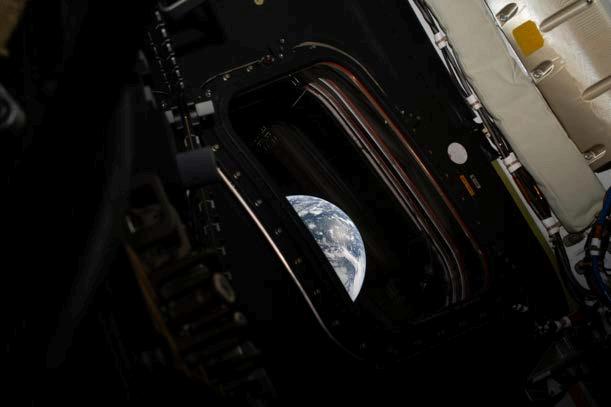
When we leave Earth, even briefly, we are confronted withapowerfulperspective:“TheOverviewEffect”
Thefragilityofourplanet
Theinterconnectednessofalllife
Thesharedresponsibilityweholdforourfuture Spaceforcesustoaskdeeperquestions: HowdowesustainlifebeyondEarth?
How do we care for one another in extreme environments?
What does it mean to be human when we are no longerboundtooneplanet? reflectsnotjustourcapabilities,butourvalues,priorities, andpurpose.
We are entering an era where exploration is no longer defined solely by distance, but by depth of understanding. The future of space is not just about where we go, it’s about how we live, adapt, and thrive whenwegetthere.Itisabout:
Designing systems that support human life in the harshestenvironments
CreatingtechnologiesthatimprovelifeonEarth
Building economies that are sustainable, inclusive, and forward-thinking. Why Space Matters?: Expanding Horizons for a Better Planet.