Bali Arabica Coffee Beans in the Specialty Coffee Supply Chain
Coffee rarely travels directly from a farm to a consumer. Instead, it moves through a network of farmers, processors, cooperatives, exporters, importers, roasters, retailers, and cafés. Understanding this journey provides valuable context for anyone interested in Bali Arabica Coffee Beans and the specialty coffee industry. Each participant has a different responsibility, from cultivating and processing coffee cherries to maintaining quality during
transportation and developing the final roast. The specialty coffee supply chain also places greater attention on origin, traceability, quality, and relationships between producers and buyers. Understanding how these stages connect helps explain how coffee from Bali eventually reaches consumers around the world.
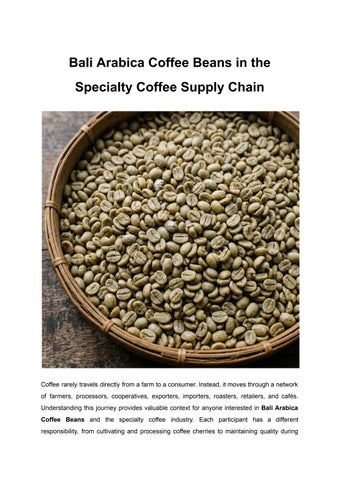
How Does the Specialty Coffee Supply Chain Work? The specialty coffee supply chain begins at the farm. Coffee producers cultivate trees, manage their crops, harvest ripe cherries, and prepare them for processing. After harvesting, coffee cherries require careful post-harvest handling. Processing removes the fruit surrounding the coffee seed and prepares the beans for drying. Depending on the producer and market, coffee may undergo washed, natural, honey, or other processing methods. Once the coffee has been dried and prepared, it becomes green coffee. At this point, the beans can enter a broader supply network involving cooperatives, collectors, processors, exporters, and international buyers. For consumers researching Bali Arabica Coffee Beans supply chains, understanding these stages provides a clearer picture of how agricultural products become specialty coffee.
From Coffee Farm to Processing Facility The first major transition occurs when harvested cherries move from the farm to processing. Coffee farmers may process their own cherries, work with a cooperative, or deliver them to a dedicated processing facility. The exact arrangement depends on the local supply chain and production model. Processing plays an important role because it affects both the physical condition and potential flavor characteristics of green coffee. Producers must manage factors such as fermentation, drying, moisture, and storage.
During drying, coffee needs protection from excessive moisture and contamination. Producers may use raised beds, patios, mechanical dryers, or combinations of different techniques. After drying, the coffee may undergo additional preparation to remove unwanted material and defects. Proper storage then helps protect the green beans until they move to the next stage. This part of the supply chain demonstrates that quality begins long before the coffee reaches a roasting facility.
Cooperatives, Collectors, and Exporters In many coffee-producing regions, producers do not handle every stage of the supply chain independently. Cooperatives and other organizations can help farmers with processing, quality control, logistics, and market access. Collectors may also purchase coffee from multiple producers and consolidate lots. While this can make transportation and trading more efficient, it can also affect the level of traceability available to buyers. Exporters play another important role. They prepare coffee for international shipment, manage documentation, coordinate logistics, and connect producing regions with overseas buyers. For specialty coffee, buyers may seek detailed information about individual lots. This can include the growing region, producer group, processing method, harvest period, altitude, and variety. The level of available information can vary significantly between supply chains. This is why traceability has become an important consideration when purchasing specialty coffee.
Bali Arabica Coffee Beans and International Trade
Once green coffee is prepared for export, it enters the international supply chain. Coffee may travel by sea or other forms of transportation before reaching an importer or roasting company. International buyers evaluate green coffee based on several factors. These can include physical quality, cup characteristics, consistency, origin, processing method, and availability. Specialty coffee buyers may also request samples before purchasing larger quantities. Sample evaluation allows them to assess the coffee's aroma, flavor, acidity, body, sweetness, and aftertaste. For Bali Arabica Coffee Beans international sourcing, this stage can be particularly important because buyers need to understand what makes a specific lot distinct from other Indonesian coffees. Transportation and storage also require attention. Green coffee needs appropriate conditions to minimize exposure to excessive moisture, heat, odors, and other factors that can negatively affect quality. Once the coffee reaches its destination, the importer or buyer can distribute it to roasting companies or other specialty coffee businesses.
What Happens at the Roastery? The roastery is where green coffee undergoes another major transformation. Roasters evaluate the characteristics of the green beans and develop a roasting profile designed to bring out desirable qualities. Variables such as temperature, airflow, roasting time, and development time can influence the final result. The objective is not necessarily to roast every coffee in the same way. A coffee with delicate floral or fruit characteristics may require a different approach from one with a naturally heavier body or chocolate profile. After roasting, the coffee may undergo quality evaluation. Roasters can use cupping and other sensory methods to determine whether the roast expresses the desired characteristics.
Packaging also becomes important at this stage. Proper packaging helps protect roasted coffee from oxygen, moisture, light, and other factors that can accelerate quality deterioration. The roastery therefore acts as an important bridge between agricultural production and the consumer's final brewing experience.
From Roaster to Retailer, Café, and Consumer After roasting and packaging, coffee enters the final commercial stages of the supply chain. Roasters may sell directly to consumers through online stores, distribute coffee to cafés, or work with specialty retailers. Cafés may then prepare the coffee using espresso machines, pour-over equipment, immersion brewers, or other methods. Retail packaging can communicate information gathered throughout the supply chain. A coffee bag may identify its origin, producer, processing method, roast date, and tasting notes. This information allows consumers to understand more about the coffee they are purchasing. However, the amount and accuracy of information can differ between products. The final stage is brewing. Water quality, grind size, temperature, extraction time, and brewing ratio can all influence how the coffee tastes. The supply chain may therefore end commercially at the café or retail shelf, but the coffee journey continues when the consumer prepares it.
Why Transparency Matters in the Specialty Coffee Supply Chain Transparency has become increasingly relevant because specialty coffee consumers often want to understand the origins of their coffee.
Traceability can help connect a finished product with its producer, region, processing method, and supply-chain partners. It can also provide useful information to roasters when they evaluate different green coffee lots. For producers, maintaining identifiable lots can create opportunities to communicate the distinctive qualities of their coffee. For buyers, reliable origin information can support more informed purchasing decisions. However, traceability and quality are not exactly the same thing. A highly traceable coffee is not automatically a higher-quality coffee. Instead, traceability provides information that helps businesses and consumers understand the product and its journey. This distinction is important when evaluating specialty coffee.
Conclusion The specialty coffee supply chain involves far more than transporting beans from one location to another. It is a sequence of interconnected stages that begins with cultivation and harvesting and continues through processing, exporting, importing, roasting, distribution, and brewing. For Bali Arabica Coffee Beans, each stage can contribute to the identity and quality of the final product. Farmers establish the foundation, processors protect and develop the green coffee, exporters and importers facilitate its movement, and roasters transform the beans into a finished product ready for consumers. For anyone researching Bali Arabica Coffee Beans from farm to market, understanding this supply chain provides a deeper appreciation of the people, processes, and decisions behind every cup.