

T h e Es c o ndid o Unio n S c h o o l Distric t
i s d e d i c a t e d t o givin g ev er y c h i l d i n
E s c o n d i d o t h e opportunit y t o l e a r n
i n s a f e , i n n o v a t i v e e n v i ron m ent s .
E U S D e d u c a t o r s a n d s u p p o r t s t a f f a r e
c o m m i t t e d t o o p e n i n g th e doo r s t o t h e
u n l i m i t e d p o t e n t i a l o f e v e r y s tude n t
thr oug h awar d -winnin g educational
t e c h n o l o gy and innovation , f a m i l y
en gag ement , a n d a c a d e mi c p rog rams .


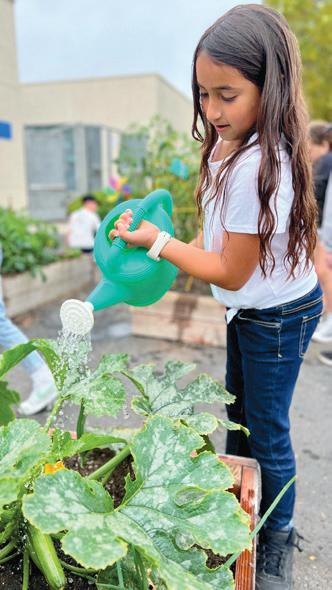
INNOVATION & ENRICHMENT
•STEAM instruction (Science, Technology, Engineering, Art, and Math)
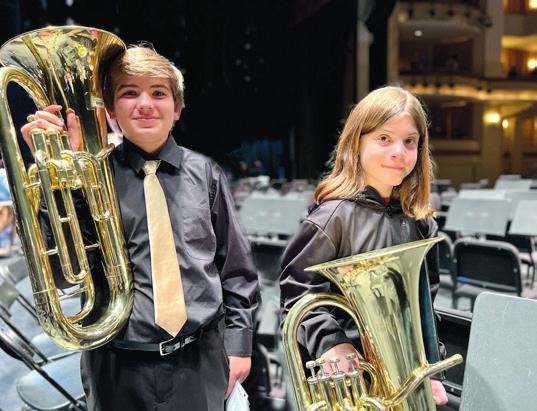
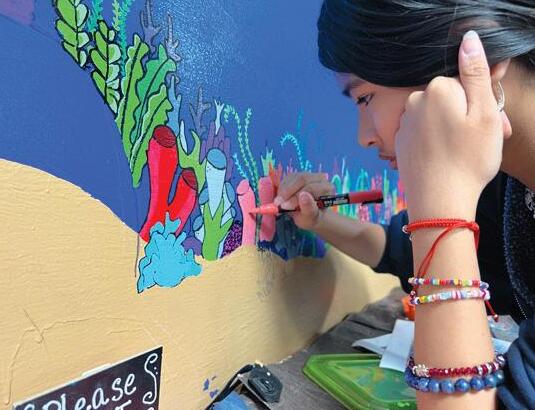
•Visual and performing arts at every school
•Video production
•Middle school electives
•Physical education at every grade level with credentialed physical education teachers
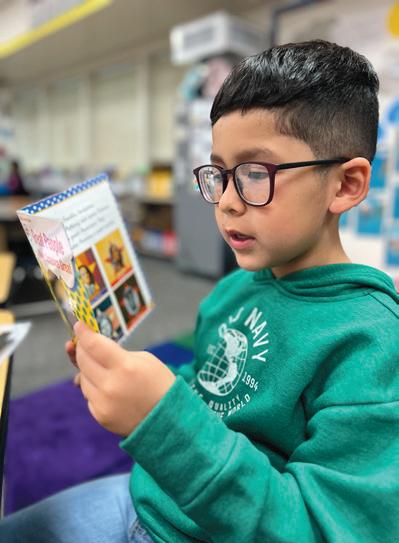
•Dual-language immersion programs
•One-to-one technology
•Full-day Kindergarten and TK
COMMUNITY ON CAMPUS
• No-cost after-school programs
• Neighborhood schools
• Home Education Program
• Innovative specialty schools:
Conway Academy of Expeditionary Learning
Del Dios Academy of Arts and Sciences
Limitless Learning Academy
Quantum Academy

• Robust family engagement program
• Full-time at every EUSD school:
School social worker
Licensed vocational nurse
Family liaison
Two counselors at every middle school



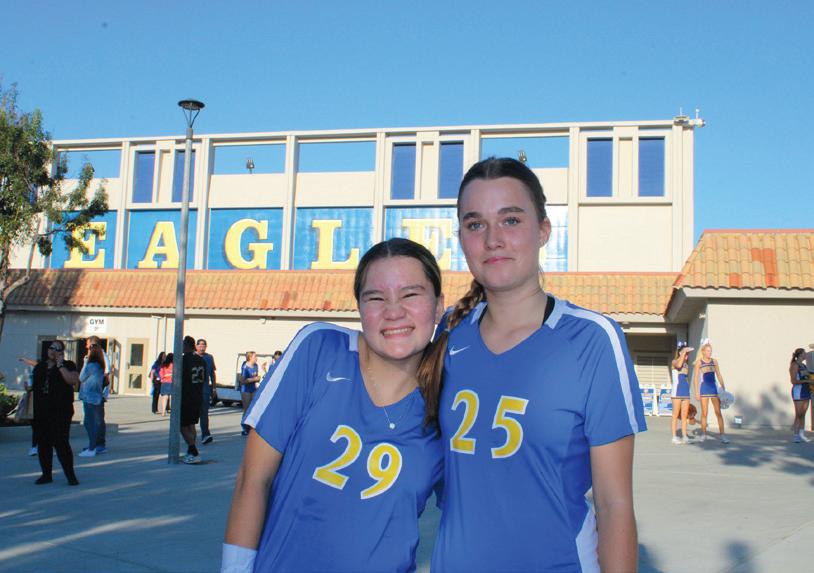
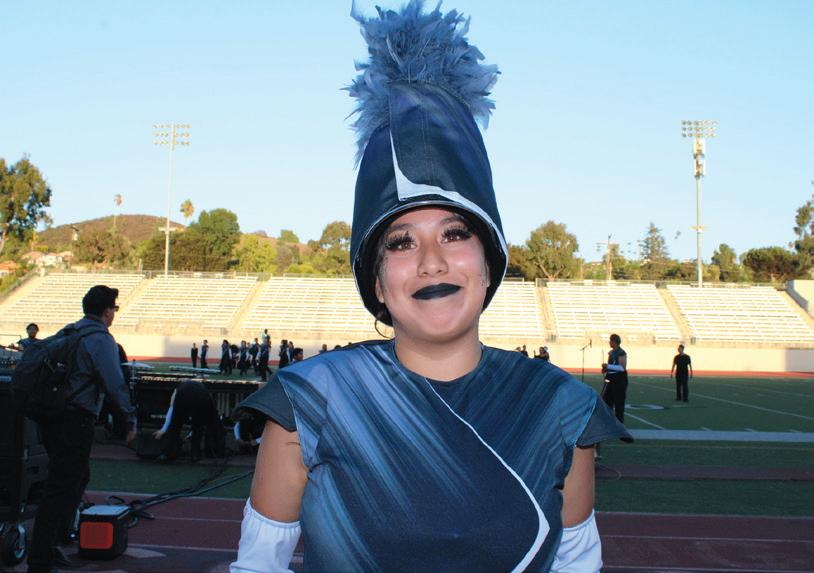
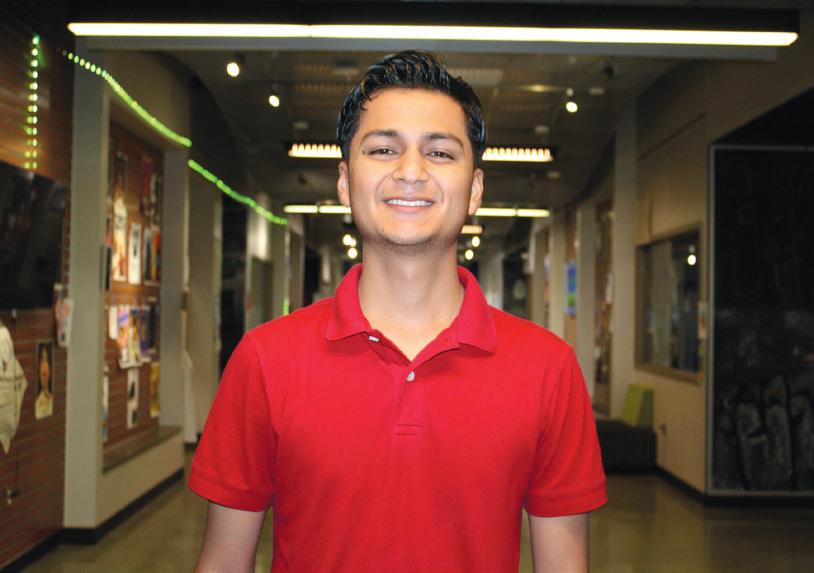
Empowering every student to graduate prepared for
Empowering every student to graduate prepared for college, career, and life through excellence in learning. college, career, and life through excellence in learning.
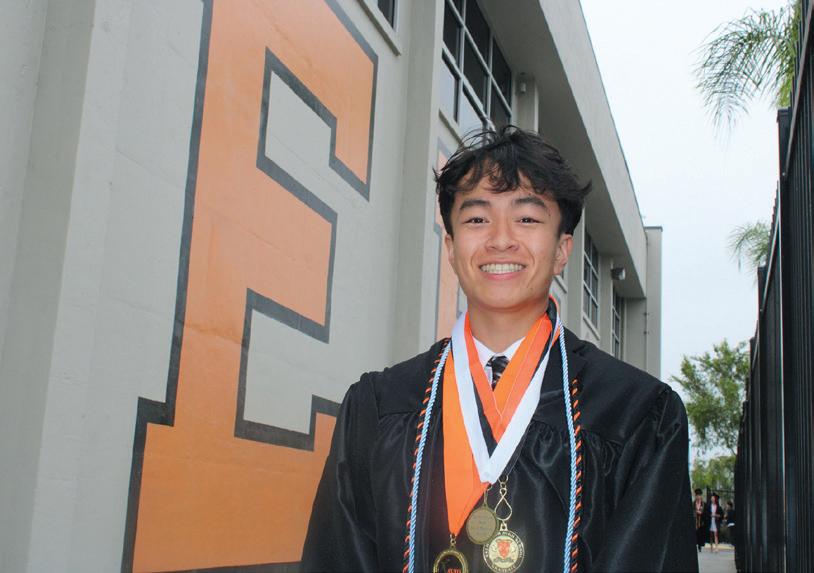
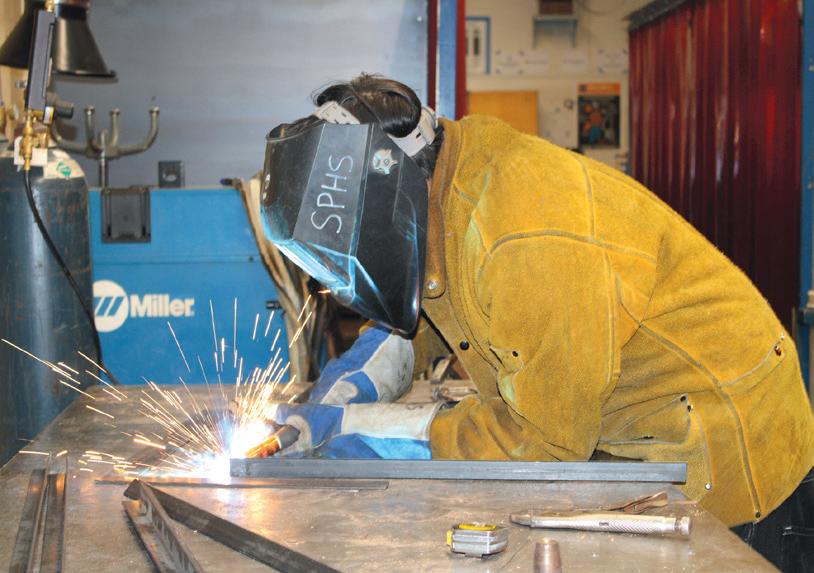
Offering more than 180 courses, including nationally recognized Advanced Placement classes, award-winning College & Career Technical Education programs, athletic programs, after school enrichment, career exploration, STEM opportunities, and more.
In-person and Independent Study options available for all students, grades nine through twelve.







•

PUBLISHER
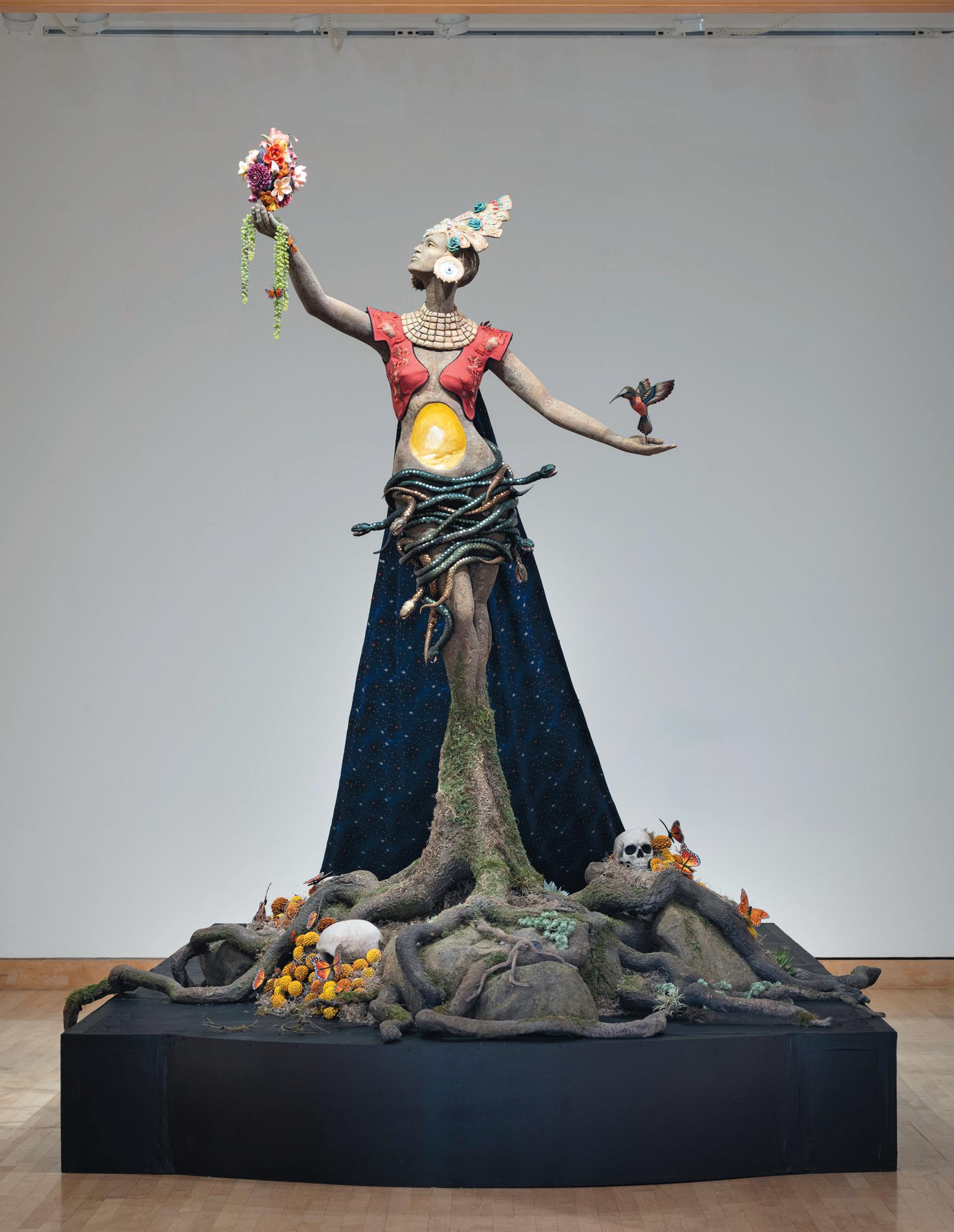
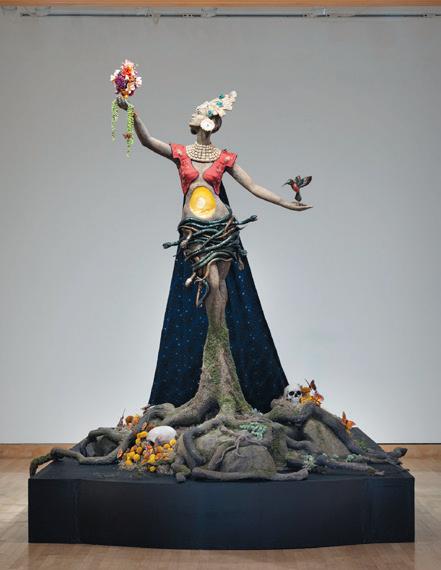
Cover: Louis Verdad: TONÁNTZIN
Louis Verdad: TONÁNTZIN is comprised of a striking 11-foot reinterpretation of the Mesoamerican goddess, created by Mexican-American fashion designer Louis Verdad and a team of artists, which includes renowned muralist Eloy Torrez. Combining art and fashion, the installation explores the dual nature of creation and destruction, drawing connections to La Virgen de Guadalupe as a symbol of identity and resilience.
On view at California Center for the Arts Museum through November 2, 2025.

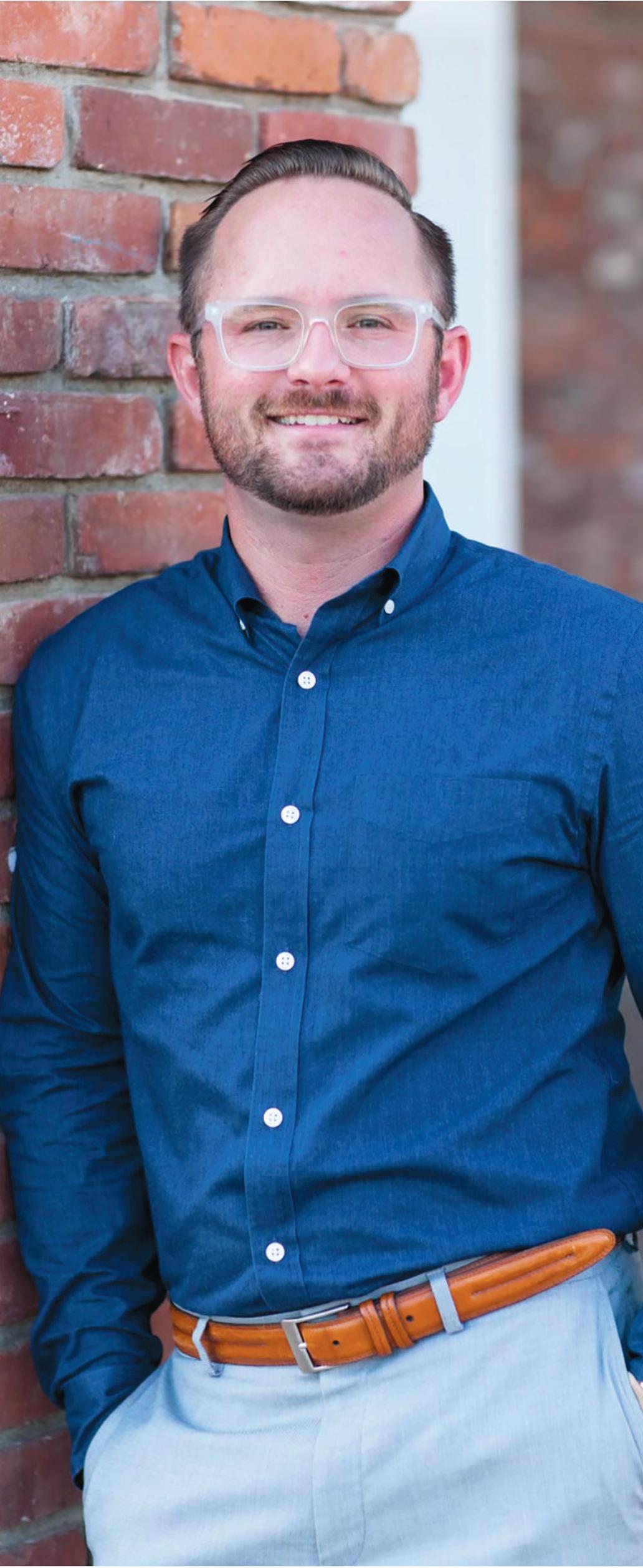
It is my honor to greet you today as your Mayor and to share some exciting developments happening right in the heart of our city— downtown Escondido. Our community has always taken pride in our unique blend of historic charm and vibrant local culture, and I’m proud to say we are building on that legacy in bold and meaningful ways.
Over the past year, we’ve made major strides in revitalizing our downtown corridor. Our goal has been simple but ambitious: to make downtown Escondido a welcoming, walkable, and engaging destination for residents and visitors alike. Thanks to the hard work of city staff, local businesses, and community members, we’re seeing that vision come to life.
One of the most noticeable improvements is our newly widened sidewalks. These expanded pathways not only make it easier and safer to navigate downtown on foot, but they also open up new possibilities for outdoor activities and social connection. Whether you’re strolling with your family or heading to a favorite local café, the wider sidewalks enhance your experience.
Alongside these upgrades, we’ve introduced beautiful string lighting that now illuminates our downtown evenings with a warm, inviting glow. These lights aren’t just decorative—they help create an atmosphere that encourages people to linger, explore, and enjoy the charm of our city long after the sun goes down.
Outdoor dining has also taken center stage. Local restaurants now have the space and support to serve guests in open-air settings, creating a vibrant culinary scene right on our sidewalks. It’s been a game-changer for small businesses and a big hit with residents looking for community and connection over great food.
Finally, we’ve installed two modern roundabouts that are already making a positive impact. These additions improve traffic flow, increase safety for pedestrians and drivers, and signal our commitment to thoughtful urban design.
In addition to the progress downtown, we’re seeing a wave of exciting activity at the Escondido mall. New businesses are bringing fresh energy and entertainment options to our city. One highlight is the Grand Comedy Club, which will offer live comedy performances and events, giving residents and visitors a great reason to enjoy a
night out without leaving town.
Another exciting addition is Round One, a premier entertainment center featuring bowling, arcade games, karaoke, billiards, and more. It’s a dynamic, family-friendly destination that promises hours of fun for all ages—and it adds a whole new level of activity and vibrancy to the mall.
For our youngest residents, Kids Empire is on the way. This indoor play space is designed for exploration, imagination, and energy, offering a safe and engaging environment for children to play while parents relax or socialize nearby. It’s a wonderful addition that supports Escondido families and makes our city an even better place to raise kids.
Beyond revitalization and economic development, our city has also taken bold and compassionate steps to address homelessness. I’m proud to share that, through a multi-pronged approach, we have reduced homelessness in Escondido by 25%. This achievement reflects our commitment to both safety and support for our most vulnerable residents.
Key to this progress has been the implementation of an encampment ban and new regulations around RV parking on public roads. These policies help us keep our public spaces clean and safe while ensuring that resources are directed toward real solutions—not long-term dependency on the streets. At the same time, we’ve remained focused on pathways to stability and recovery.
Our strengthened partnership with Interfaith Community Services has been instrumental in these efforts. Together, we’ve expanded access to shelter, mental health care, job placement services, and long-term housing solutions. This collaboration exemplifies what can be accomplished when government, nonprofit organizations, and the community work hand in hand to change lives for the better.
Escondido’s downtown and commercial areas are being reimagined with purpose and passion, and our approach to social challenges reflects the same spirit of innovation and compassion. Together, we’re shaping a city that honors its past while stepping confidently into the future. Thank you for your continued support, your input, and your love for this great community. I look forward to seeing you downtown and at the mall.
Sincerely,
Dane M. White,


BY MICHAEL HOWARD
Escondido is adding a new highlight to its already thriving arts scene with the introduction of film festivals to the city. Of the two upcoming festivals, one stands out among them.
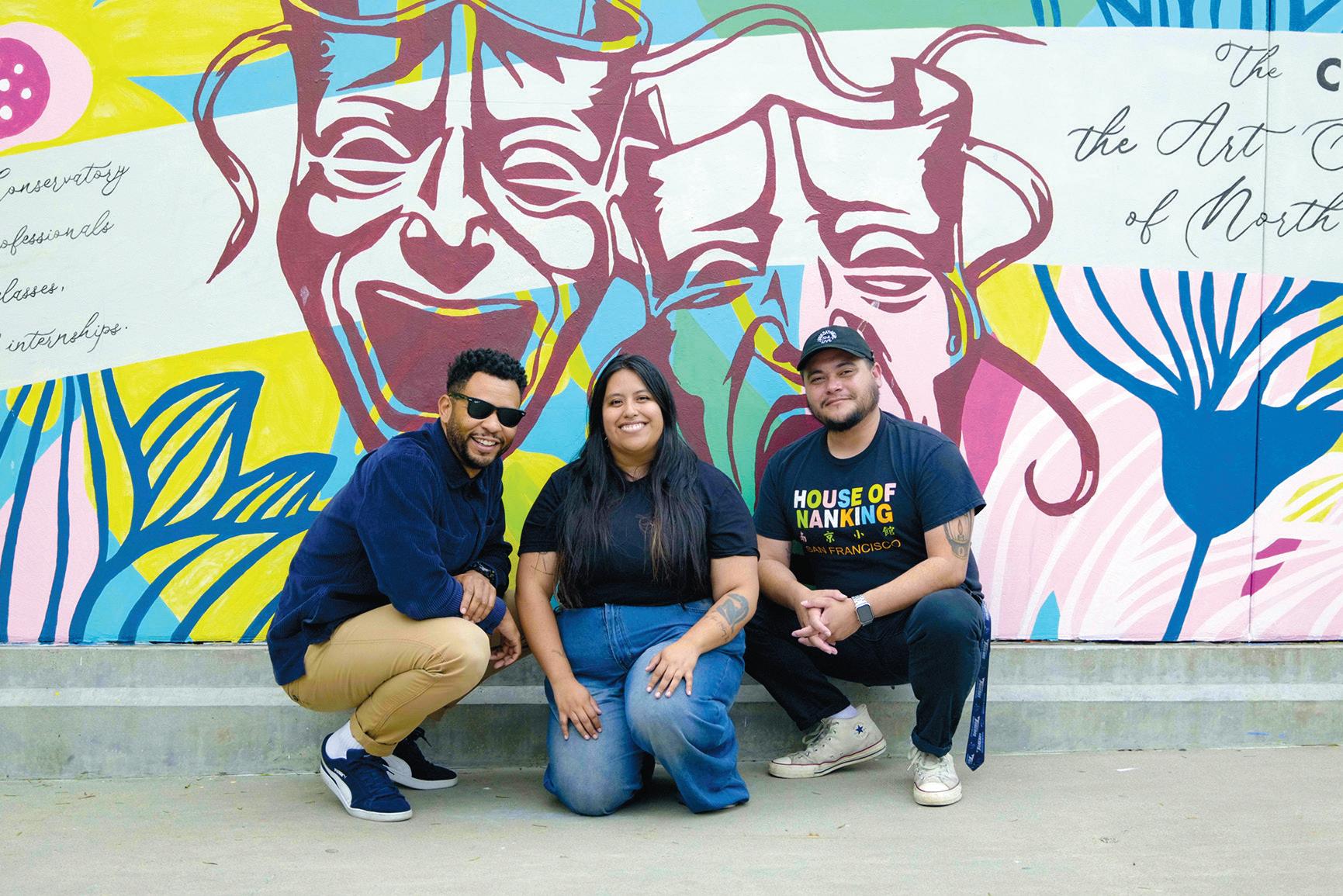
The California Center for the Arts, Escondido Foundation (CCAEF) recently announced its inaugural Hidden City Film Festival. The non-profit art organization will host film screenings September 26 thru September 28, 2025 at the Regal Es-

condido Theatre as part of their first-ever festival. The event will culminate in an awards ceremony at the center’s campus on the final evening of September 28, 2025.
“The tagline [of the festival] is uncovering hidden stories, “ Jesse Gonzalez, Community Advancement Manager at the CCAEF shared with Escondido Magazine during a recent interview. “That’s what it’s about. It’s putting the stories of San Diego locals, especially North County, at the forefront in order to really ride this wave into what will be a budding industry [of filmmaking] here [in Escondido], and San Diego.”
Given Escondido’s history in the arts and more recently filmmaking, it’s somewhat of a surprise there hasn’t already been a film festival. In 2013, John Paul the Great Catholic University relocated its filmmaking school from Scripps Ranch to Grand Avenue in downtown Escondido. Since then, there’ve been numerous North County film festivals by various groups, but this will be the first held within the city by an organization that resides there.
Gonzalez explains: “It’s an easier sell now because John Paul is expanding their program which means it’s doing its own development and they’re bringing talent to Escondido. There’s a multimillion dollar studio being built as we speak.”
But it’s not just John Paul’s contribution to the city’s art scene that served as a catalyst for the festival, says Gonzalez. It’s also CCAEF’s long-standing commitment to building programs that foster art as a craft in the workforce. “The idea is to create a placethis hub - that can create a funnel into those programs just like our workforce development program [teaching stagecraft],” Gonzalez explains.
Since 1997, the CCAEF has hosted the Technical Arts Youth

Workforce Program where interns are paid to gain hands-on experience by industry professionals during live theatre events. “It is one of the only - if not the only - program like this in the state, or in the country,” Gonzalez says.
And that is exactly what this film festival does, says Ryan Echols, the festival’s operations manager and member of CCAEF’s Community Advancement team. A unique feature of the festival will be mixers where film industry professionals meet with contestants.
“So all of our mixers are really with the intent to help some more established film makers connect with some of the up and coming film makers,” Echols reports. “So the plan is to get the students – or the up and coming people - here so they can get connected.”
Echols is passionate about the access filmmaking can give individuals who normally don’t have a voice. “I was somewhat of a troublemaker when I was in high school and I would get kicked out of class for blurting out or acting out. One of the teachers that would always let me in her classroom was my drama teacher, who would say ‘Oh, you want to act up - then get on stage and do it,’ ” he remembers.
Echols’s high school experience has had an indelible effect on him. “It changed my life. It set me on my career path and it opened up so many doors and relationships with people I would have never had,” he explained.
Festival Curator and CCAEF volunteer Kelly Dexter believes partnership with schools and film students are essential in building for the future. The festival plans on partnering with John Paul the Great Catholic University as well as California State University San Marcos (CSUSM), where Dexter was a student, and is now staff. CSUM historically had its own film festival, but this is the first year in Dexter’s memory that they will not have one.
“So we’re partnering with them too because we want to help lift students. We want to lift upcoming artists,” she shares.
Like Echols, Dexter was introduced to film at an early age— where it had a positive effect. “So my stuff is more experimental, but nonetheless, I love film. It’s a way to express yourself and have a sense of belonging where you can find it. It changes your life. You’re like, well, I actually can do this for a living. It was so uplifting for myself and then I saw it lifting other students [as staff],” she says.
“There’s so many talented voices, there are so many stories that should be told, and I just think it’s super cool that we get to do that,” she adds.
Besides the opportunity to tell their story, CCAEF offers additional incentives for filmmakers to submit their work to the festival.
“First and foremost, it’s recognition,” Gonzalez says. “Especially for the young and up and coming artists or students, you know, being able to have your work alongside professional work. It’s different when your work is on the same screen that Avengers is playing next door, you know what I mean,” he adds, referring to screenings being held on the big screens at Regal Escondido Theatre.
Additionally, the festival partnered with San Diego based Roku channel San Diego Indie Film Network who will host and stream the winner’s content on their channel. With the recognition from the event, opportunity to meet and network with industry professionals, and have their content streamed on a nationwide platform that serves millions of viewers, the film festival packs a powerful punch.
“There’s a pair of vouchers for the entire presented season, too,”
Gonzalez throws in with a laugh. Meaning a winner will also receive two tickets to all of the concerts and performances for the entire California Center for the Arts, Escondido season.
What’s more, the CCAEF’s Hidden City Film Festival isn’t the only film festival slated to take place in Escondido. The same local Roku channel sponsoring the art organization’s festival will hold its film festival, the San Diego Streaming Film Festival, in 2026, complete with movie screenings hosted by downtown business owners and an award ceremony at the Grand Ritz theatre on Grand Avenue in April. [Full disclosure, this author is connected to both the Roku channel and San Diego Streaming Film Festival].
Given the buzz and energy of filmmaking in Escondido, Gonzalez summarizes why film and storytelling is so important: “It puts you in other people’s shoes,” he declares. “I think it’s a great way to build empathy for others outside of yourself. I think that’s one of the most important, important things. It’s what makes civilization run. To know what someone is feeling — if you can’t put yourself in their shoes, the next best thing is at least the window into their lives.”
For more information about submitting films to the Hidden City Film Festival, visit filmfreeway.com/HiddenCityFilmFestival or the California Center for the Arts, Escondido Foundation’s website artcenter.org. For more information about the San Diego Streaming Film Festival, visit filmfreeway.com/SanDiegoStreamingFilmFestival or the San Diego Indie Film Network Roku channel at sdindiefilmnetwork.com. To learn more about arts in the city, visit escondidoarts.org.









BY JOSH BOARD
When I was writing for the San Diego Reader, I did a story on tattoos. It was about the time I got my first (and last) piece of ink. I had a huge scar on my stomach from surgery done when I was a kid. So when I was dating a woman with tattoos, I thought she’d be impressed if I had her name covering the scar.
I got the idea from a friend who had a scar on his arm, and he had that tattooed into the Chargers lightning bolt logo. I had her name tattooed like the AC/DC logo. She wasn’t impressed. And a few years later when we broke up, I regretted it (although I got it covered with my wife’s name 15 years later, but I digress).
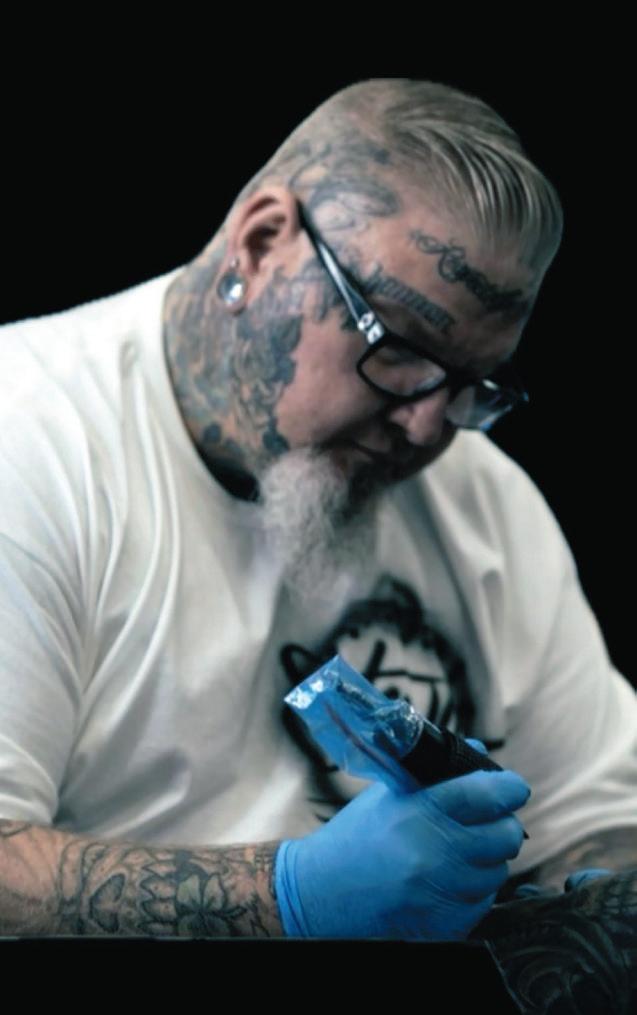
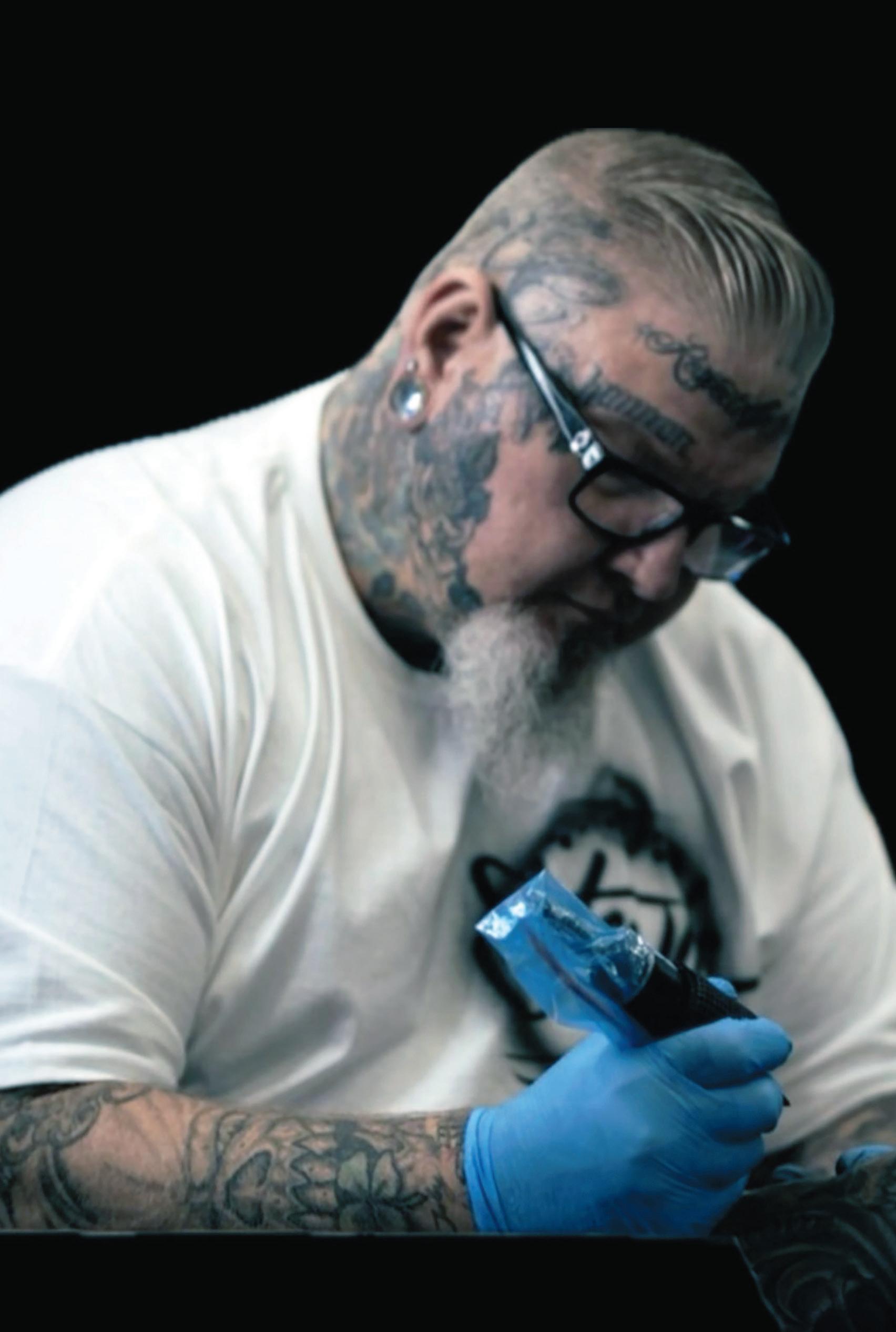
Now—I thought —it was time for my second. Not a tattoo, but a second story on ink. And I thought I’d talk to Stevie O’Dell, an Escondido native who has been tattooing for over 25 years here.
He owns Grand Legacy Tattoo with his buddy Mike and wife
Shannon (I was afraid to ask if he had her name tattooed on him). He’s involved in community groups like MAGEC (museum arts growing Escondido culture), and Esco Ally Art. You can see a few of those murals around town.
He collaborated on an art piece called “Schools in Session” as a tribute to a few high schools in town, and “Rolling on a Memory”—which celebrates the roller skating rink in Esco. He’s also became a member of the Escondido Chamber of Commerce (even being named “ambassador of the year”). Not the first thing you’d think a person with ink is involved in, or maybe you didn’t back in the day, when tattoos weren’t so common.
When talking to O’Dell about what he does, his enthusiasm is infectious.
I asked him how it all started, and O’Dell said, “Growing up in Escondido, my art was inspired by street art – graffiti and Chicano style art. My favorite time was in art class drawing, painting, even ceramics. But I always felt more comfortable drawing on paper in ball point pen or the classic #2 pencil. Flipping through Lowrider magazines and looking at the art and tattoos, always caught my eye. It was my calling.”
He adds, “I even did a ‘stick and poke’ on myself and some of my homies at the time. Nothing to brag about, but it was cool back then. At least I thought so. My homemade tattoo machine was a Walkman motor, guitar string, and battery. My body was my canvas and helped with learning the do’s and don’ts! I got my first professional tattoo shop at 18.”
I asked what his parents thought about it all, and if he’s ever given family members some ink. He responded, “Funny, growing up my mom always told me I better not come home with a tattoo. Oops! But I ended up giving her a couple tattoos and she loves them. Most of my family I’ve had the opportunity to bless with some cool pieces. Even my son Devon has five already. Father/son bonding for sure!”
Asked about ideas and things that influence his work, he wasn’t short on answers.
“Being surrounded in a shop with those you call your family and who are talented artists with different insights and thoughts bouncing off each other, is what keeps the creative juices flowing. Especially in de-
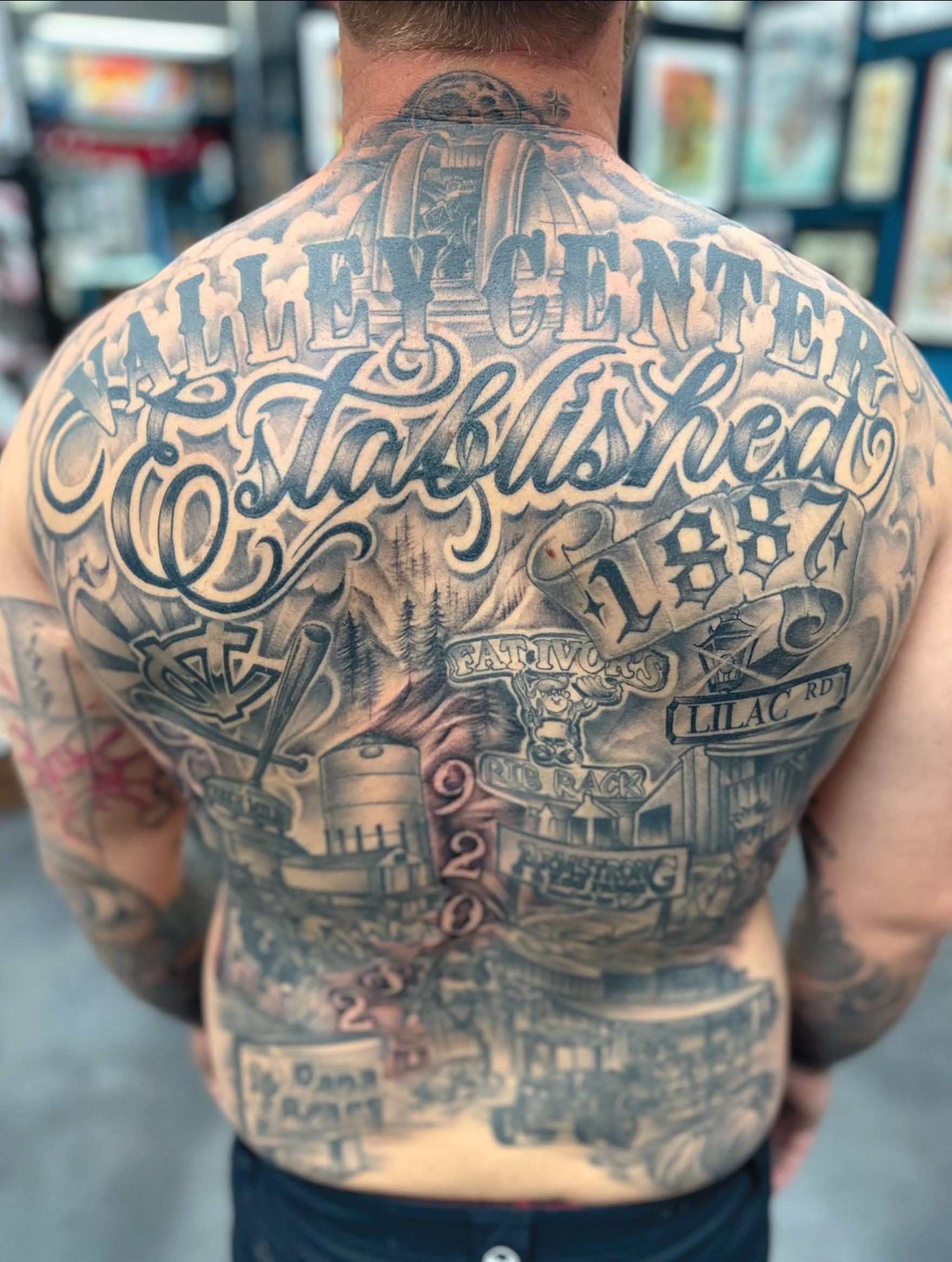
signing your next piece for a client. Today the internet is a huge source of reference. Some great ideas, but also some bad ones. It guides you in the right direction so you come up with something they appreciate.”
Just talking to O’Dell brought back memories. The smells, the sounds. He laughed and said, “Walking into a tattoo shop, hearing that buzzing sound of the machines going and the smell of green soap in the air, is addictive. The art being created was and still is, freaking mind blowing! So many tattoo influences, iconic artists, legends, and styles that keep our
industry pumping with creativity. It’s truly amazing.”
You can find Stevie O’Dell at Grand Legacy Tattoo at 316 W. Mission Ave., Suite 104. Bring your own piece of art, or let him use his #2 pencil to come up with something cool.
Josh Board is an Escondido resident, who has been a journalist for over 35 years. He has one tattoo, but if he ever gets divorced, he’ll get a second. You can hear him every Friday on Newsradio KOGO 600 AM.
BY KATI COWAN
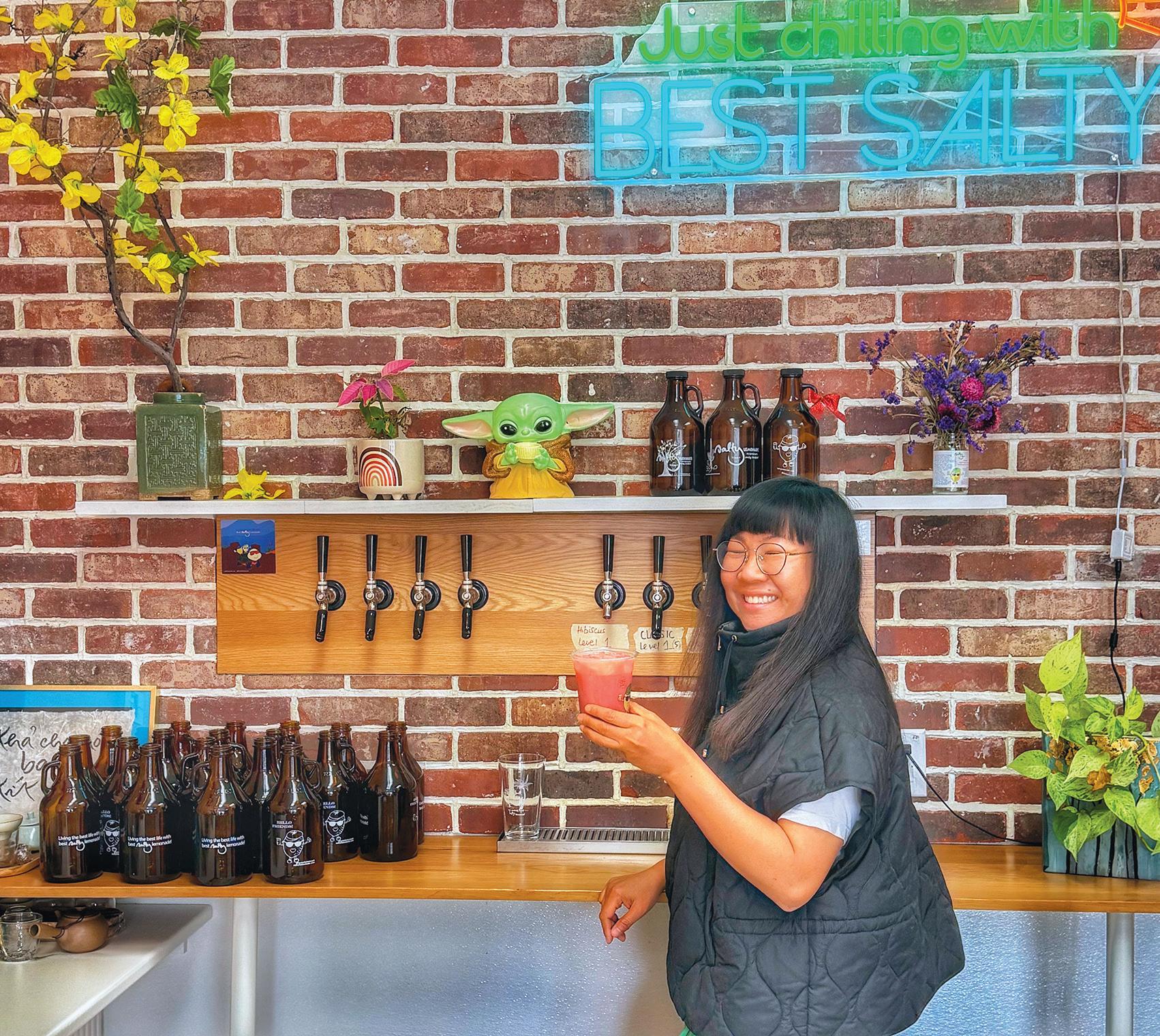
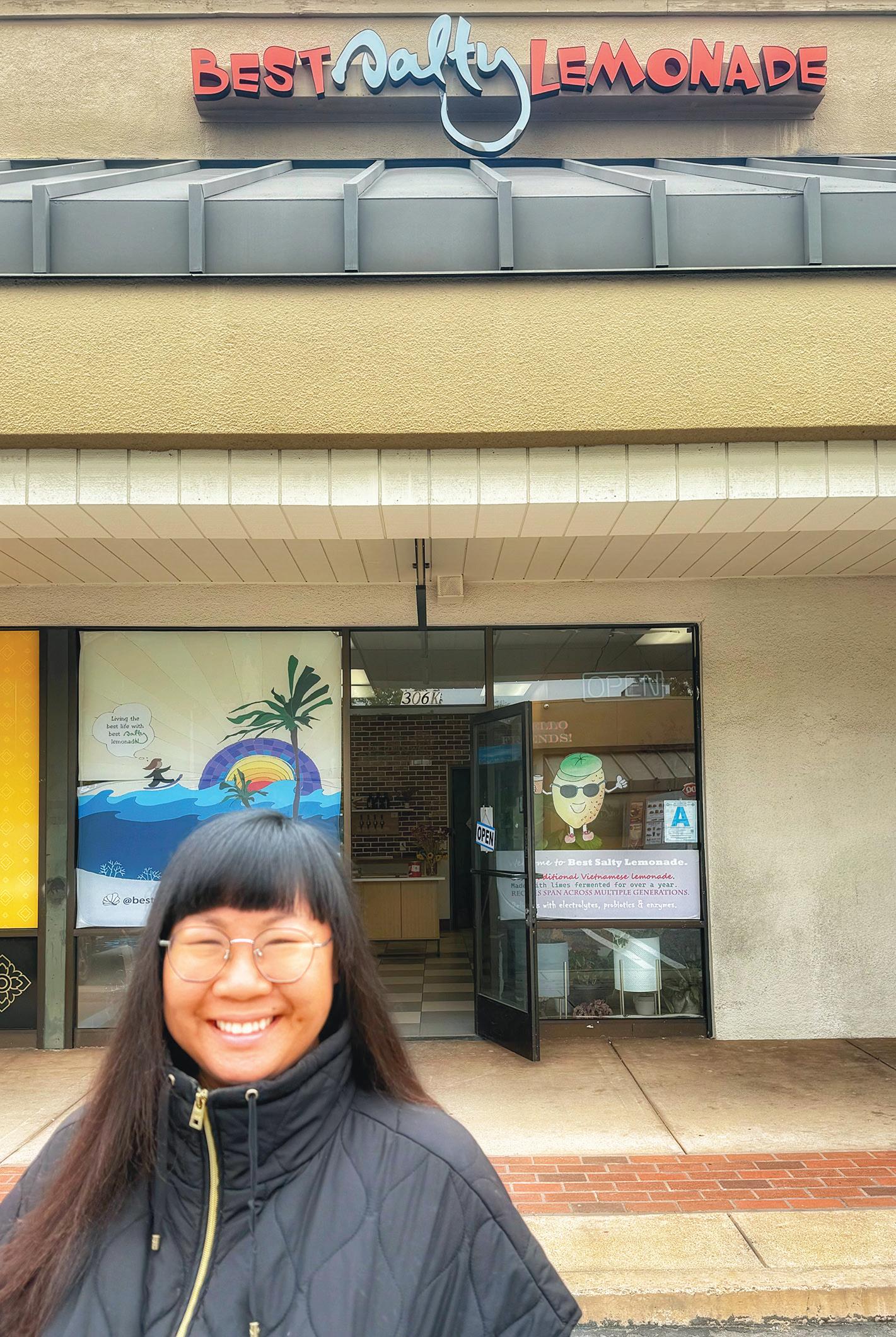
I’d never heard of salty lemonade. What I found was a refreshing drink whose name may sound odd, but there is nothing odd about Tramy Tran’s thriving business or her delicious product.
In fact, her Del Norte Plaza business can simply be described as
extraordinary producing a unique, fermented non-alcoholic beverage.
Tran is the founder and owner of “Best Salty Lemonade” on El Norte Parkway in Escondido—where she treats her ever increasing clientele to a unique brew that dates back centuries in her native Vietnamese culture.


“Once you taste it, you will start to crave it and you just can’t put it down,” said Tran. Growing up, Tran saw her mother placing several jars of salted and pickled limes in the hot sun in their Vietnam backyard and later in the United States, keeping them there to ferment for years. She would give these mystery jars away to friends and family.
Tran never paid much attention until years later. Shortly before she went off to college her mother made her some salty lemonade from one of these jars. Taking it somewhat for granted, she took some back with her to college sharing it with her Vietnamese roommate—who loved it. True to her gracious nature, Tran gave her roommate the entire jar to take with her when she moved away—not thinking she would miss it.
But much to her surprise, miss it she did. One night, Tran had an intense craving for the lemonade and went looking for it at various Vietnamese grocery stores and restaurants, thinking it could be easily replaced. The trendy Pho and Vietnamese coffee were ubiquitous, but not the lemonade.
Her craving continued until her frustrating quest led her to dream making some herself—using her mother’s recipe to “share it with the world.” The first challenge came when she discovered that her mother did not have a recipe. Instead, she would tell Tran, “it’s all in the hands in how you prepare it.”
Tran soon understood what her mother meant. And even though she learned how to prepare and ferment salty limes or lemons in jars she felt there was something special that went into the making of this pickled fruit that went beyond the ingredients.
Salty lemonade is a Vietnamese delicacy that dates back centuries. It originated from the need to preserve limes when refrigeration did not exist.
It has been part of the Vietnamese culture, now slowly disappearing partly due to modernization and a desire to westernize which is why Tran had such a difficult time finding some.
Tran says that today’s young Vietnamese people have never even heard of “salty lemonade.”
In Vietnam the fermented fruit would be mixed in with carbonated or plain water and often drunk salty, while others would add sugar and serve it hot or cold. On cold days it would warm and soothe and on hot days it was a refreshing pick me up. According to Tran it has all kinds of medicinal value, containing electrolytes, probiotics and en-
zymes that help hydrate, digest, ease sore throats, flu, digestive upsets and more.
To Tran, salty lemonade is more than just a product. It is a way of life.
Limes need to ferment for over a year and half. It is only then that they are ready to create this tasty brew.
In a parallel way, Tran is mulling whether to expand her business. There have been offers and opportunities, and she sees the business growing significantly but wants to allow the idea to ferment slowly resulting in the best outcome.
Tran is introspective and practices mindfulness in all that she does. She wants her product and her life to reflect it. Her goal is to conduct life and business accordingly and share her culture by resurrecting salty lemonade from near extinction.
She believes that a contemplative attitude brought to the preparation of her product makes a difference. It contributes to the healing effects of the beverage.
You can detect this is special simply in the way she serves you. There is a relaxed, gentle presence that she brings to each in-
teraction and transaction. She is never rushed and takes time with each client.
It is not only her lemonade that heals but so does her attitude–which echoes her approach to and philosophy in life. She takes time to listen and talk to her customers. Each person feels welcome and special.
“That is the problem with the world,” said Tran. “It is just about profit. This is a human being. I like to think that I help people by offering a calm serene presence. If it is just about profit, I do not want to be a part of that.”
Tran does not make any quick decisions that may negatively impact her approach to life or her contentment.
“Throughout the year, I try to prioritize my leisure time by attending mindfulness retreats and being in nature to help me be grounded with what’s truly important,” said Tran
Growing up as a Buddhist, she does not remember being devout, but her family’s way of life always mirrored Buddhist principles of peace and happiness.
After graduating from college and subsequently working in the corporate world, Tran realized she was not happy. She transitioned to owning her own business on her own terms.
She makes her own hours. According to her website her store opens at 11 a.m. and closes at 6:30 p.m. on Tuesday, Wednesday and Friday. And on Thursdays she closes at 5:30 p.m. Her shop is closed on Saturday, Sunday, Monday and Tuesday. On weekends you can find her selling her wares at the Farmer’s market in Hillcrest and Little Italy.
Tran does not want the business to dictate to her and take over her life. Rather she wants to take the helm and set her own parameters.
“I am not rich,” Tran shared. “But I am happy. I do not want to do anything that will take away from that. Money is not that important to me. My serenity is.”
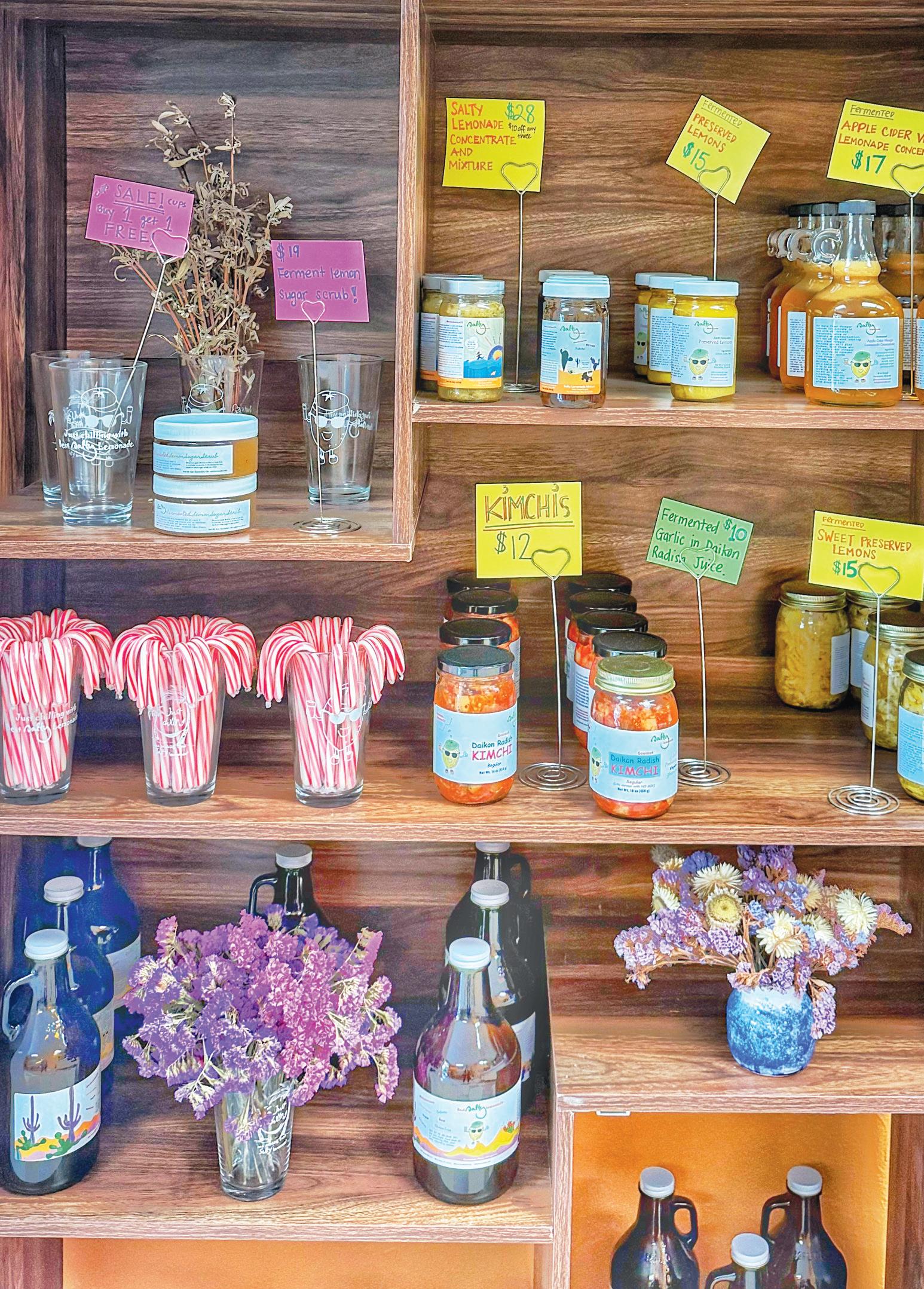
At Best Salty Lemonade you will find different flavors. There is Classic Regular Salty Lemonade, Ginger, Arnold Palmer, Hibiscus, Classic Regular with apple cider vinegar, and other flavors of the week like grapefruit and lavender, and she is always working on developing new ones.
In addition to this tasty, ready to serve beverage, she also sells jars of fermented lemons or limes, some kimchi, and a fermented lemon/ sugar scrub just to mention a few.
Tran takes great pleasure in serving up her traditional salty lemonade.
Not only do you get a refreshing drink, but it always comes with a secret ingredient: her calm presence that radiates peace, acceptance and love.
Priceless!
For more information, see: www.saltylemonade.com.














BY DAVID ROSS
An event that will raise funds to teach kids that their food doesn’t come from an app or the supermarket—but grows on farms—is coming to Escondido in the fall.
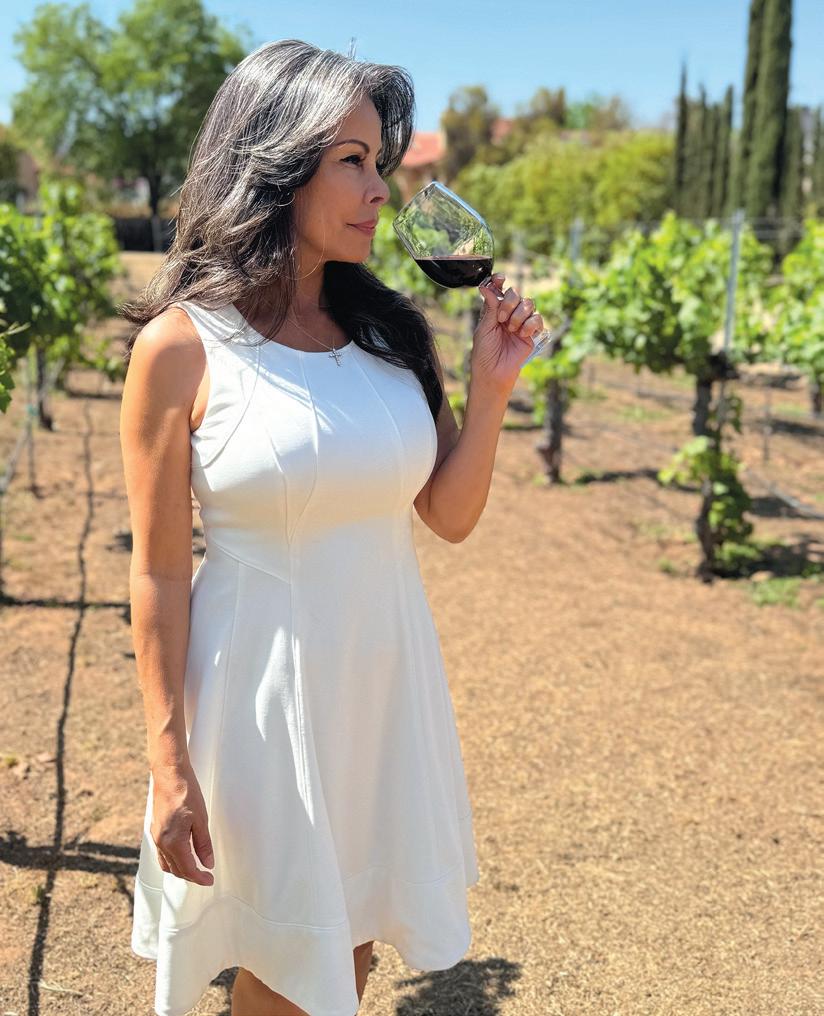
Deanna Smith, CEO of Deanna Inc., is sponsoring the Grape Day Wine Competition September 20. With the awards gala beginning at 6 p.m. at the California Center for the Arts, Escondido. The theme of the black tie gala event is: Hidden No More.
The gala, limited to 130 seats, will be held on the 6th floor balcony of the Center and will be catered by the Center with a “huge” charcuterie board, “tasty soup, a nosh and a nibble with a special, artistic dessert,” says Smith. And, of course, lots and lots of wines from more than a dozen local wineries—maybe more.
“There are twenty four wineries in Escondido, and we want to highlight them and get as many of them as possible to participate,” she said. “Most are creating absolutely delicious wines.”
She is working with the Hidden Valley Wine Association and San Diego County Vintners Association putting together the event. “I wanted to focus on Escondido wineries,” she said. “That’s why I decided to have a wine competition and fundraising gala.”
Competitors could be awarded bronze, silver, gold and double gold medals.
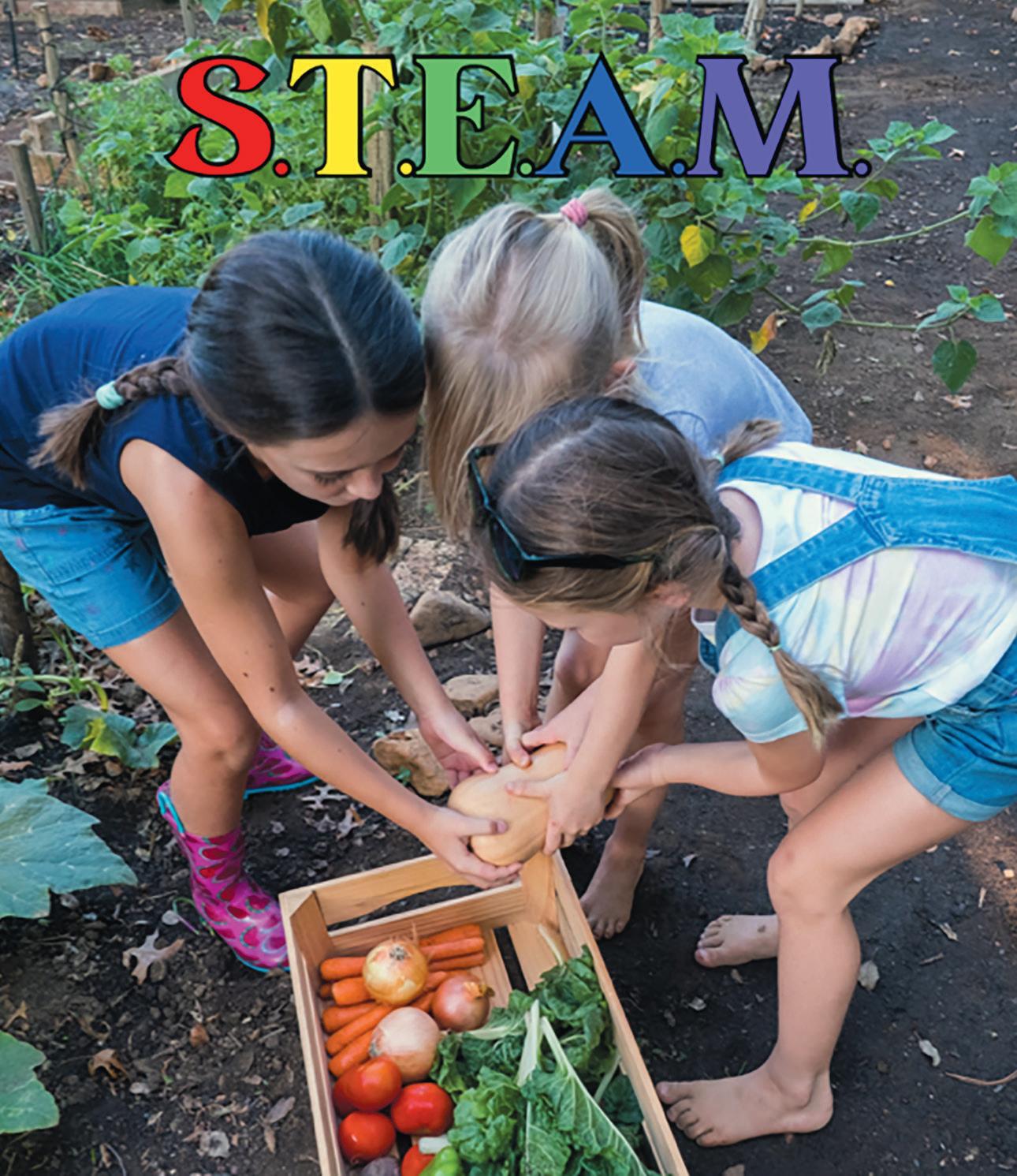
The event will benefit S.T.E.A.M. (Science, Technology, Engineering, Art and Math) program, and will specifically help provide education to develop an interest in farming for elementary age kids. The name of the organization is Grape Day S.T.E.A.M. Foundation at Deanna Smith Ranch.
Smith, a well-known owner of a gluten-free bakery, says, “I invite you to be a part of history as we raise a glass to Escondido’s very 1st Grape Day Wine Competition. This is so much more than a wine competition. With your support, S.T.E.A.M. at Deanna Smith Ranch creates an innovative program that equips our youth with life skills, academic enrichment, and entrepreneurial thinking. From seed to sale, farm to fork and bird house to barn, Deanna’s farm becomes a dynamic classroom. Students will learn about real food, basic skills in the industrial arts and business skills as they harvest, cook, build and go to market. Join us in our growth. Our Youth, Our Future.”
The judging—which Smith believes is the first ever such competition in Escondido— took place on June 24 behind closed doors.
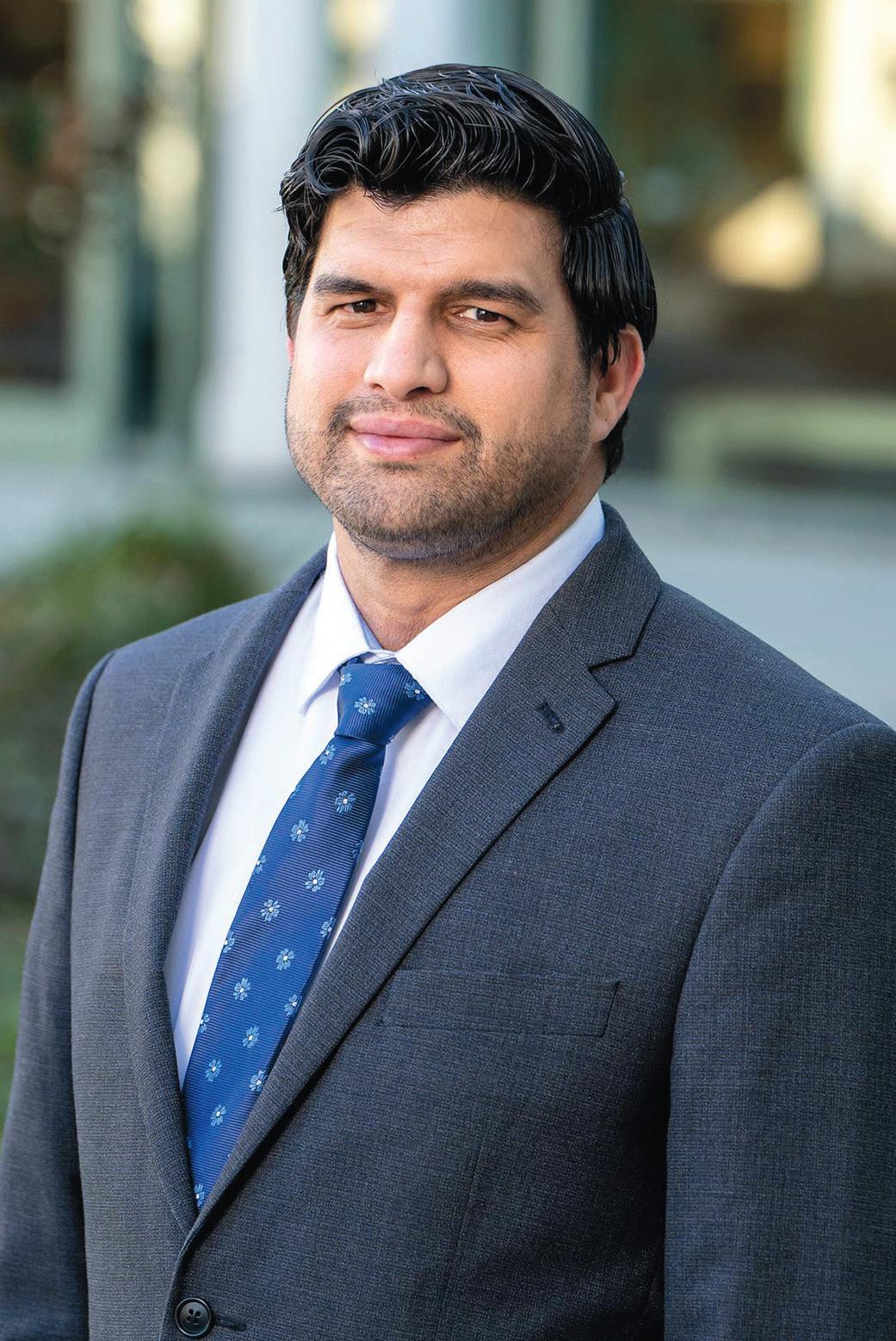
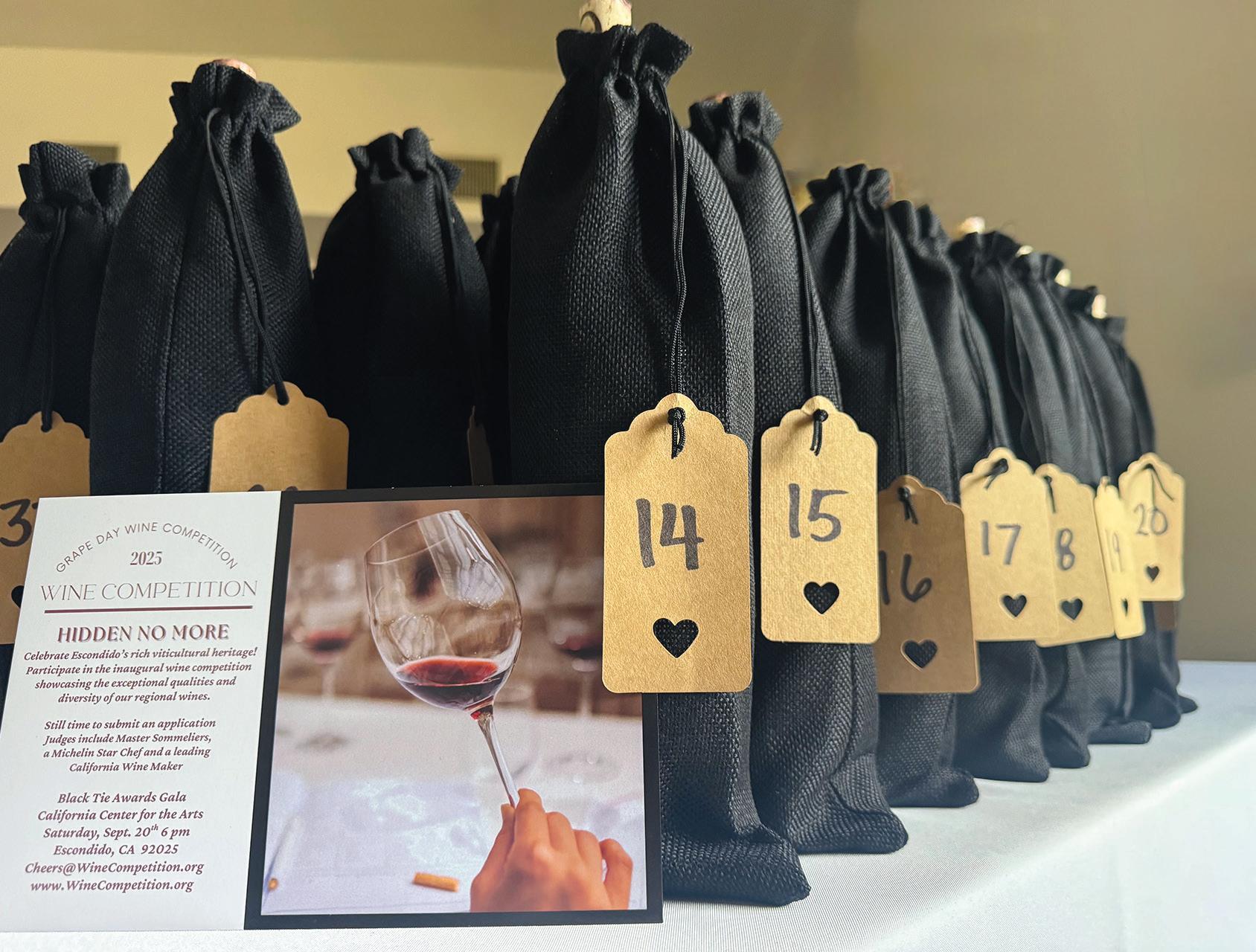
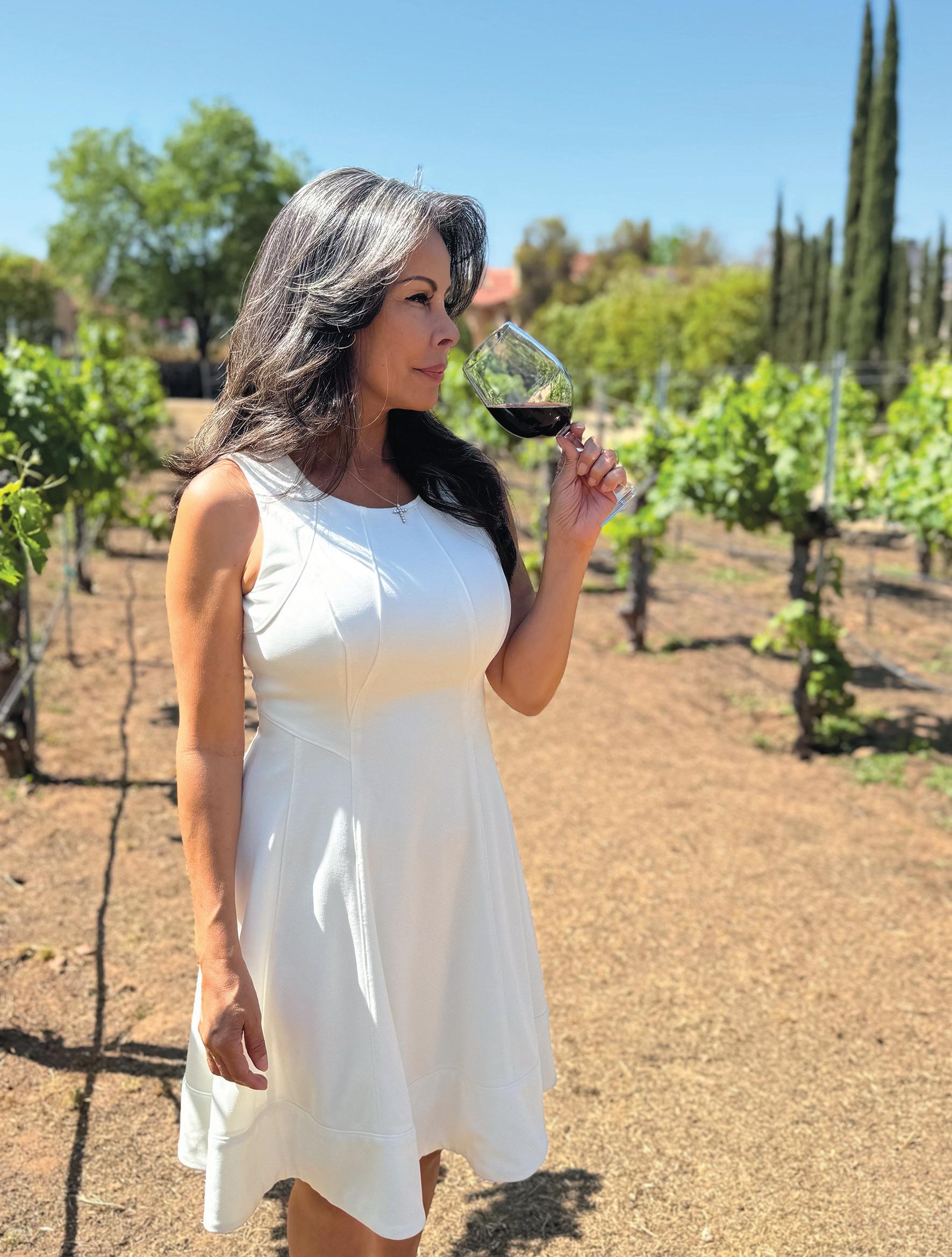
The four judges are all paragons in the field of wine.
Smith hopes to expand the event until 2027, when she plans a Grape Day Wine Parade to celebrate spring and agriculture at a time of year when many farming activities are happening.
Smith wants to bring attention to growing and to interest more children in this important industry. She is starting with 100 third graders from Heritage Charter School this September, with the expectation that the number will grow. “We hope to open it to as many as are interested.”
So far, several area churches with educational programs are showing an interest in the program.
The youngsters will visit Deanna Smith Ranch three times a year. In between those field trips they will be able to monitor their plants online at SmithRanch.com.
Smith has been farming for a decade now. “I have eight grandkids of all differ-
ent ages learning on my farm. I know what interests them and what doesn’t. I wanted to share that experience with as many kids as possible.” She added, “Most kids think food comes from the supermarket or from an app.”
When kids actually get to visit a farm and help grow plants that may help feed them, “they are so proud,” she says.
Smith is a strong supporter of vocational education, what used to be known as “the trades,” and of bringing that back to the schools.
Students will learn how to feed themselves, and many other valuable skills. They probably won’t grow up to be farmers, but they will learn that even if you live in an apartment, you can grow plants.
“Not everybody needs to go to college. We need people who are mechanics, wood workers. We need a healthy balance of both!”
Christian Garcia is a San Diego native. He was raised in North County San Diego and has always called this area home.
After graduating high school, Garcia attended UC Irvine where he received his bachelors After college, Christian served in the United States Peace Corps in Cambodia for two years where he served as a teacher for two years. After coming back home, Christian received his master’s degree in public policy from USC.
In 2020, he got elected to the board of Palomar College. In January 2023, he was appointed onto the city council and elected to serve in 2024.
His hobby and passion has always been in the culinary arts. In 2017, Garcia moved to Costa Rica to work on a coffee farm and learn about the industry. From 20182020, Christian and his wife visited nearly
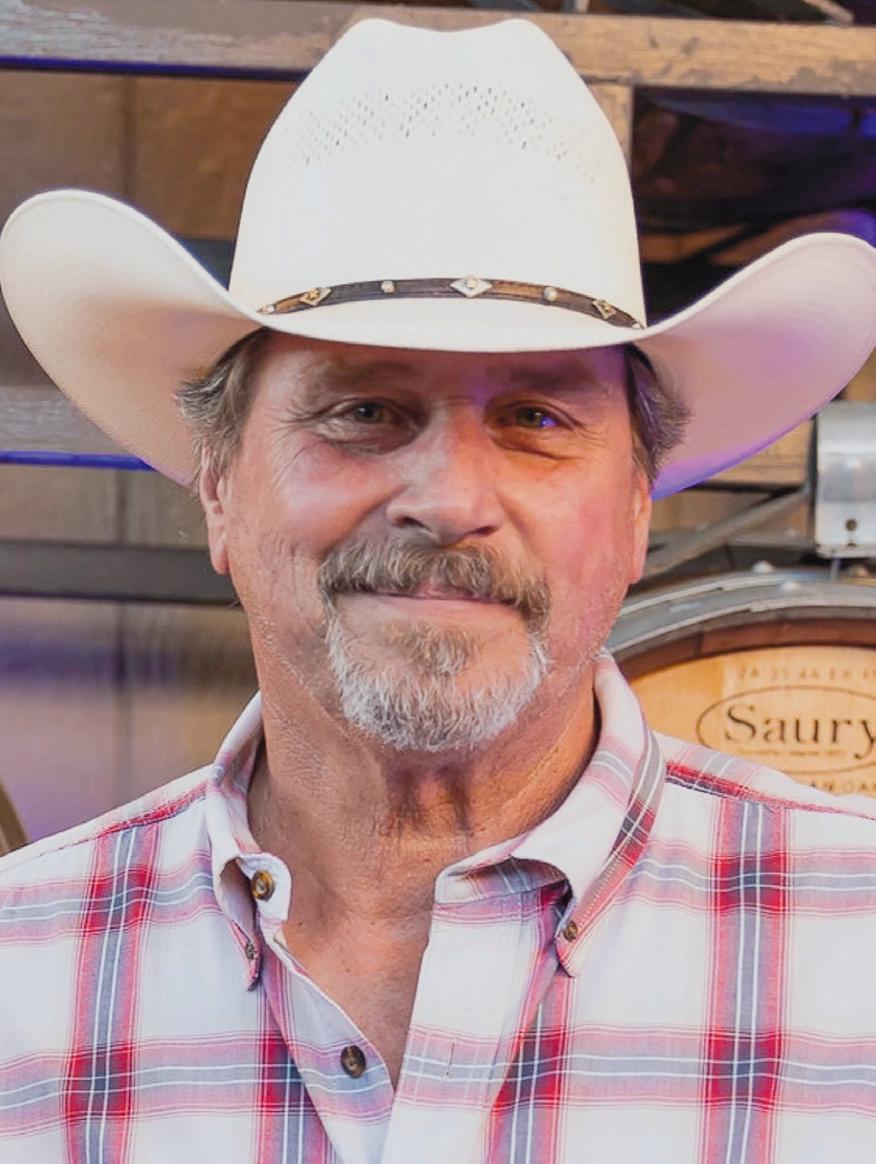
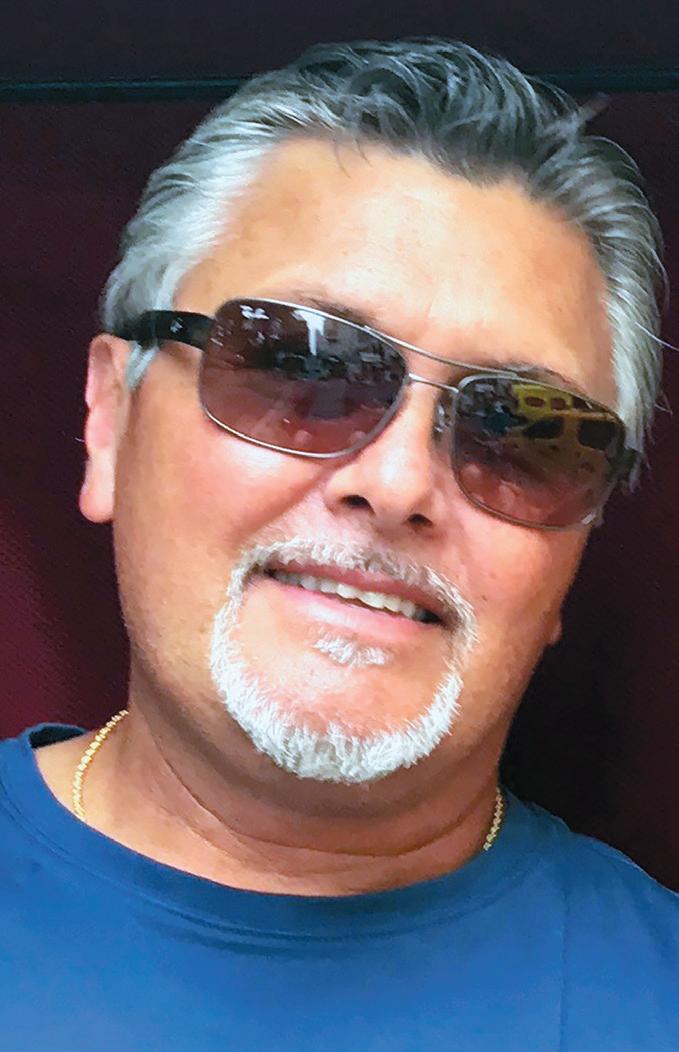
100 vineyards in California and Mexico to take tours, classes and tastings. He has been a member of several wine clubs and has taken certified wine courses to grow is knowledge for his passion.
Embarking on a remarkable journey from the challenges of a humble childhood. Born without a legacy and facing the harsh realities of homelessness on the streets of San Diego, Richard’s determination to forge his own legacy led him to the path of becoming a winemaker and Sommelier. Montano Wines, the embodiment of his resilience and unwavering passion, stands as a testament to overcoming adversity and his commitment to community and family.
Today, Richard Montano not only wears the hat of a seasoned Sommelier but stands as a symbol of triumph, enriching communities and championing the values of family. In every aspect of his life, his commitment shines through, and this commitment is poured into every bottle of Montano Wines. As you indulge in the exquisite flavors curated by Richard, you’re not just sipping on wine; you’re partaking in a legacy that he hopes will be passed down through generations.
In crafting Montano Wines, Montano brings a unique perspective to the world of wine, creating a space that is not just about
the wine in the bottle but about the stories woven into each sip. The warm and inviting experience of Montano Wines reflects not only the craftsmanship of the Sommelier but also the tales of resilience and the joy of discovery that lie within every drop.
Jaime Rueda is a seasoned professional with over 30 years of experience in wine retail, corporate training, and management. His extensive expertise in the industry is backed by prestigious certifications, including:
• Certified Sommelier – Court of Master Sommeliers
• Certified Specialist of Wine – Society of Wine Educators
• Level III Advanced Certificate in Wines & Spirits – WSET
As a Corporate Trainer and Manager for one of the West Coast’s largest wine retailers, Jaime has played a pivotal role in shaping the next generation of wine professionals. He has co-authored and facilitated Basic Wine Fundamentals, along with advanced courses in French and Italian wine studies, educating hundreds of students each year.
Beyond his professional accomplishments, Jaime is deeply committed to giving back to the community. He organizes charitable wine events benefiting Toys for Tots
and the Escondido Police Athletic League (PAL), using his passion for wine to support meaningful causes that uplift children and local communities.
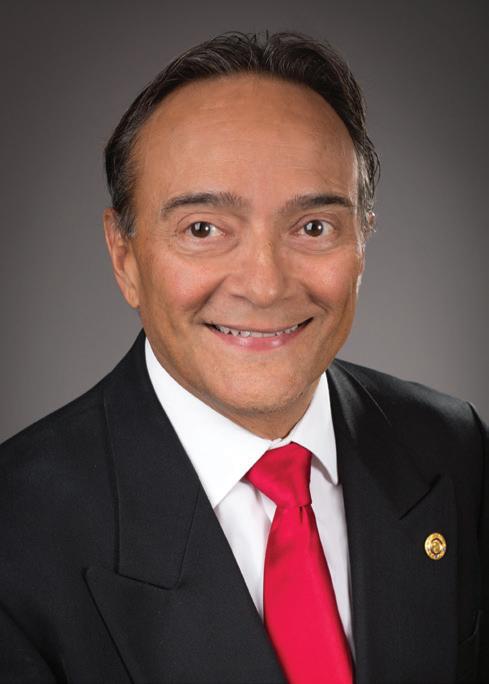
Marshall Stuart has carved a unique path as both a seasoned general engineering contractor and a pioneering force in Southern California’s wine industry.
His professional journey began in 1976 with a focus on construction equipment and trucking operations. By 1979, he had developed his own 20-acre property, building not only his first home but also an 80’x60’ commercial steel structure—laying the foundation for what would become a lifelong legacy in construction and development.
Stuart’s transition into the world of wine was out of genuine curiosity and a desire to grow something meaningful. In 1988, he immersed himself in the hands-on process of winemaking. He completed formal studies in Viticulture, Enology, and Winemaking at the University of California, Davis—home to one of the most prestigious programs in the field.
In 1994, he purchased 40 acres in Temecula. Four years later, he built and opened Stuart Cellars. His wines—particularly his signature red blends—drew acclaim for their bold character and balance. Stuart Cellars stood as a testament to Marshall’s philosophy: that wine, like great construction, is all about structure, balance, and attention to detail.
After selling Stuart Cellars in 2010, Stuart collaborated with the principals of Lorimar Winery, helping them develop a brand and product line that elevated the region’s reputation.
In 2013, Stuart launched Off the Vine Into Wine, focusing on wine production, custom crush, and bulk wine sales.
In 2015, Stuart debuted his own personal label: Marshall Stuart Fine Wines. With a focus on quality over quantity, the label offers handcrafted wines that reflect both the terroir of Temecula and Marshall’s refined winemaking style.
Influenced by legends like Eugene Seghesio and Robert Mondavi, Stuart often recalls Seghesio’s words: “Once you get the wine in your blood, you can never get away from it.”
For more information, visit: www.WineCompetition.org.
Or email: Cheers@WineCompetition.org

When you hear “Better Business Bureau,” you might think of a logo on a website or a window decal. But at its core, BBB is about helping people feel more confident in the everyday decisions they make—especially when it involves bringing a business into their home or life.
With summer in full swing, many of us are planning home upgrades, hosting backyard gatherings, or simply catching up on that to-do list we’ve been putting off since spring. That might mean hiring a painter, booking a caterer, or finally calling someone to fix the fence. Whatever the project, it often involves inviting a business into your personal space—which is a big deal.



“Our home is our sanctuary,” says Erin Morrow, Senior Director of Accredited Business Experience at BBB. “It’s where we spend our time, where our families find comfort. So before inviting a business in, it’s worth making sure they’re someone you can count on.”
That’s where BBB comes in. With a local campus in San Diego and thousands of Accredited Businesses across California, BBB provides a resource for anyone wanting to hire with a little more peace of mind. On BBB.org, you can search for businesses, read reviews, view company profiles, and understand how they’ve handled past customer interactions. Businesses that are BBB Accredited commit to ethical standards—things like transparency, responsiveness, and honesty.
And if something doesn’t go as planned? BBB offers support to help resolve issues fairly.
But the organization’s work doesn’t stop at accreditation. At the San Diego Campus, BBB is building a space for the community through events, educational programs, and even a podcast and production studio at ignite sparked by BBB, designed to amplify local voices and support small business growth.
Whether your summer to-do list is full of ambitious renovations or simply calls for a helping hand, doing a little homework before hiring can help protect your time, your investment, and your peace of mind.
Because at the end of the day, summer should be about enjoying your space—not stressing over it.
Find a
business at BBB.org, or visit us at 4747
CA 92123.
Janna Scroggins and Pat Hunter at City Hall with their award winning paintings. Two members of the Escondido Art Association united across generations by their passion for art.
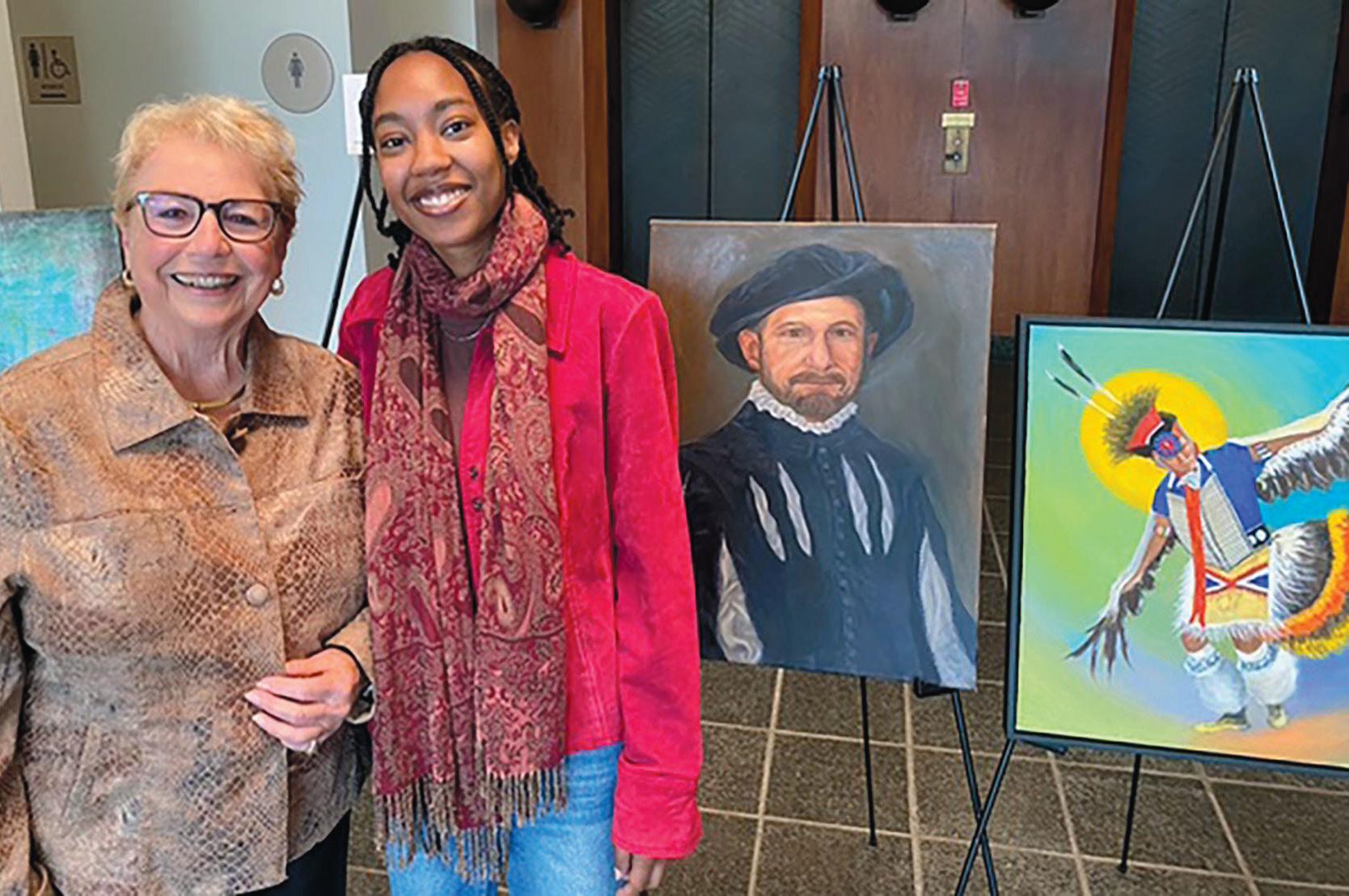
Two Escondido Art Association members from two different generations were recognized and awarded by the Mayor of Escondido in a recent exhibition.
Pat Hunter and Janna Scroggins were two of the five honorees to have their art submissions selected for display in the City Hall by the Mayor as part of the Art Contest.
“I’m deeply impressed by the work of artists in the Escondido Community that was submitted for this Inaugural Contest, and I am thrilled that such different generations are represented in the awardees,” said Mayor Dane White.
Pat Hunter’s submission is a lively bright painting of a Navajo Dancer doing the Great Eagle Dance titled “Navajo Eagle Dancer.” “I have great affinity for the indigenous people of the Southwest, and this was such an important work for me,” she said. “I put my heart and soul into it. I’m so happy it is part of the awards.”
Pat Hunter is a decades’ long member of the artistic community in Escondido and a legacy member of EAA since 2008. “It all started with a 6th grade field trip to the Art Institute in Chicago and I fell in love with Claude Monet’s paintings of “Haystacks,” she recalls. “It started a passion in me for art that still lives on to this day.”
Like many people whose first interest was kindled in school, Pat turned once again to painting in the 1970’s, studying with local artist Marge Gray and later with Richard Stergulz at Green Art House—whom she follows to this day. “You don’t know what you don’t know; so it’s important to keep learning and striving in painting. You can start anywhere but you’re never done,” says Hunter.
She adds, “I credit my passion for art and painting in this chapter of my life and the friends and volunteer activities at EAA in keeping me active and vibrant. At our age we’ve all suffered losses and setbacks, and my art helps me deal with those losses and makes me feel I am doing why I am here. Painting is both a passion and a solace. I love EAA and my friends and colleagues who make it all work. It’s a family.”
Janna Scroggins, another of the contest awardees, shares a similar passion for art and painting but from a very different perspective as one of the youngest members of EAA. “I joined five years ago when I was still in High School. I met Pat on my first visit to the Gallery on Grand Avenue,” she says. Scroggins studied Visual Arts at UCSD and graduated with a bachelor’s degree in visual arts. She now serves as Gallery Director for EAA.
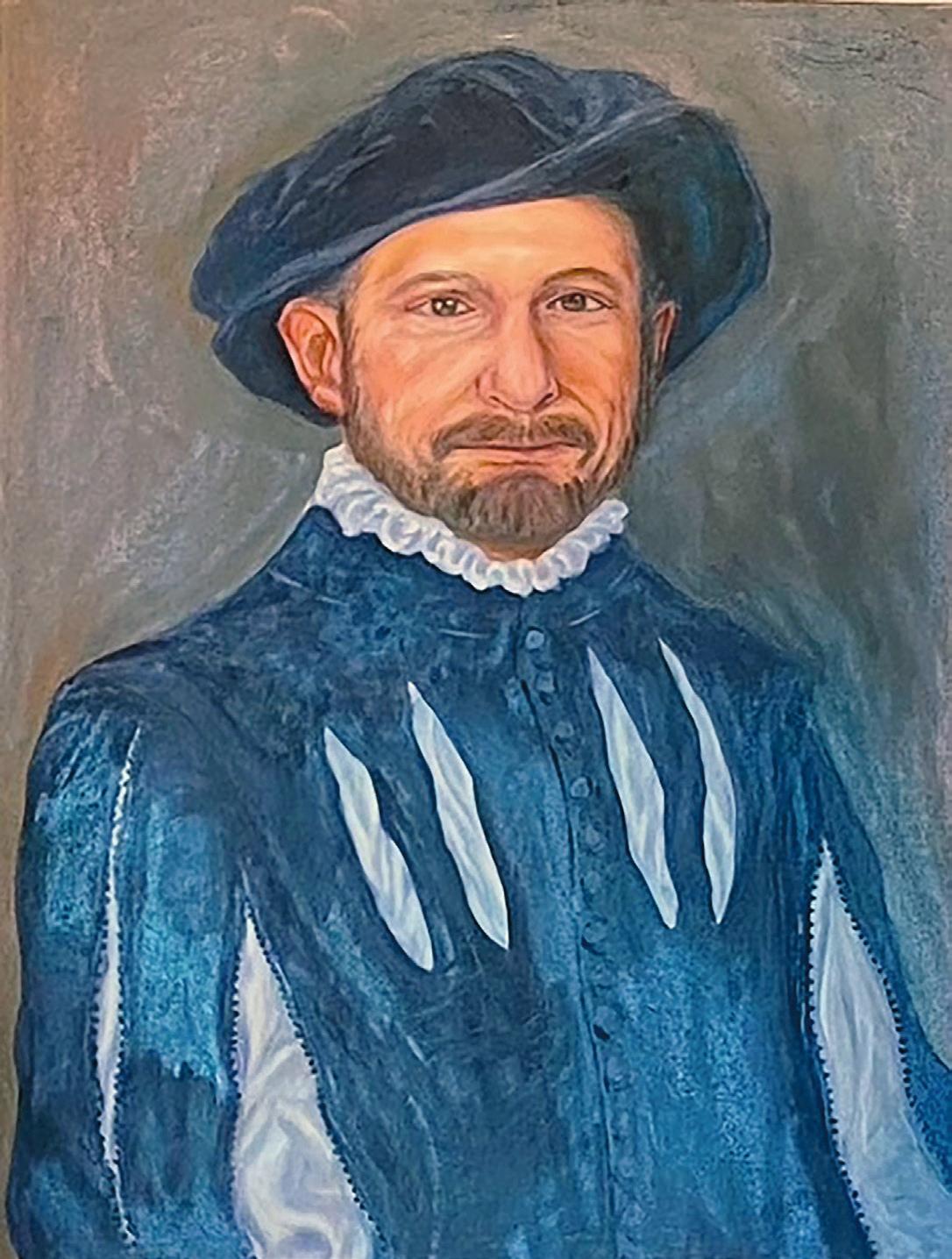
Scroggins’s submission for the contest is a unique portrait of Mayor White set in Renaissance costume, titled “The Mayor in His Finery.” “I’m a huge fan of the Renaissance Fare and it seemed to be a different
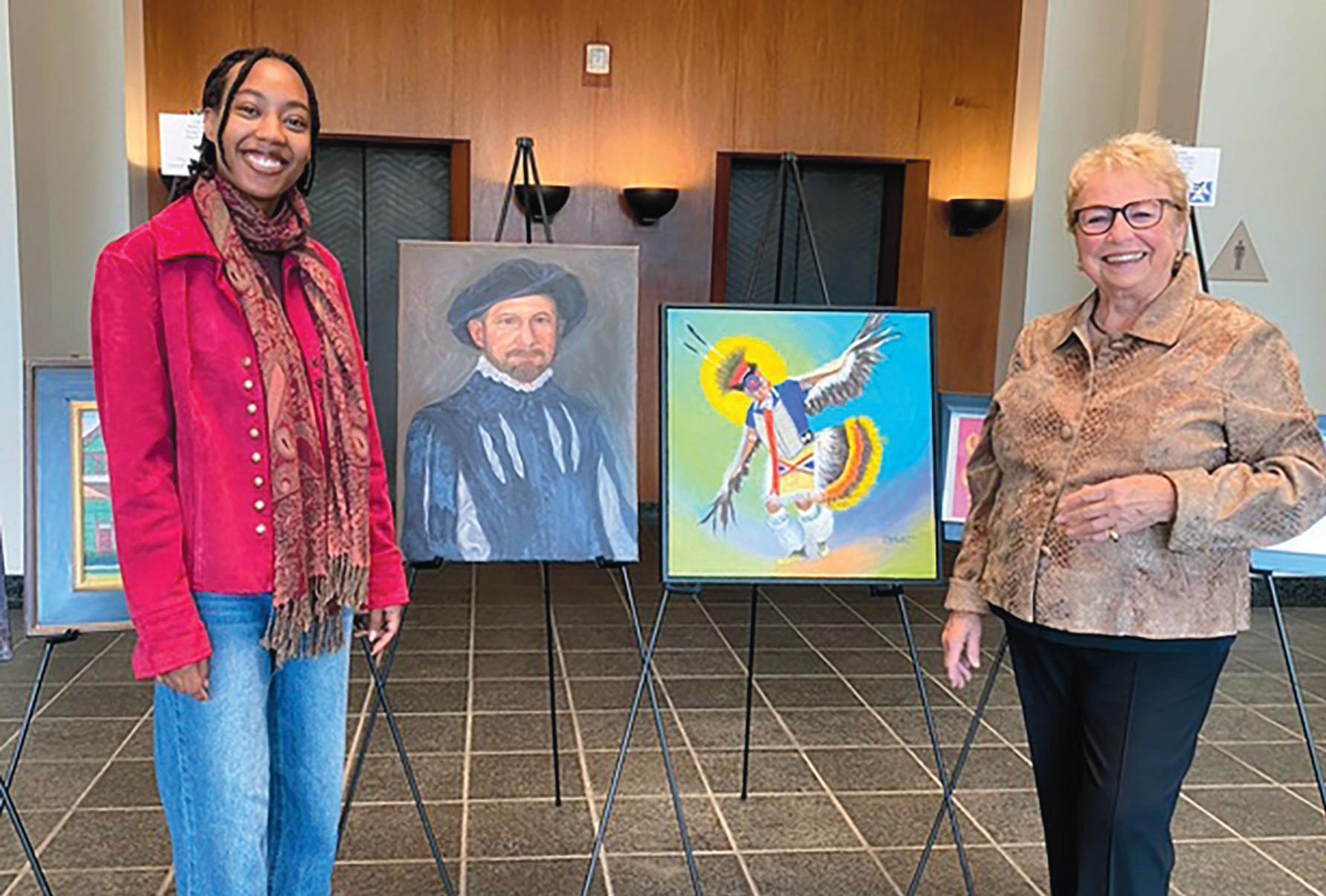

and unique interpretation to paint the Mayor dressed in this era’s costumes and outfit,” Scroggins says with a smile.
In addition to her creative work Scroggins also volunteers for the EAA at all the monthly exhibitions “take ins,” registering
the entrants and processing their submissions. “It’s a great opportunity to meet all the artists in our Escondido Community,” she says. “It’s such an eclectic and vibrant artist community in Escondido.”
“Art really does speak across generations
and cultural differences, It’s great to be part of EAA and an honor to join Pat and the other awardees in this contest,” says Scroggins.
Art speaks through generations as a common passion.
Escondido Art Association is one of the oldest arts community organizations in Escondido having been founded almost 66
years ago. “Our mission is to provide vital arts educational programs in Escondido for young people to begin their journeys in art including our High School Scholarship program for seniors,” says Adrian Stewart, president of EAA “Our Gallery on Grand Avenue is a unique exhibition space that gives access to a professional quality gallery shows for local Escondido artists to display

their work and creativity each month. Our organization is entirely supported by our dedicated volunteers. We are the heart of the Escondido Artistic community,” For more information visit: www.escondidoartassociation.org to become a member and learn more.


By KATI COWAN
What’s in a name?
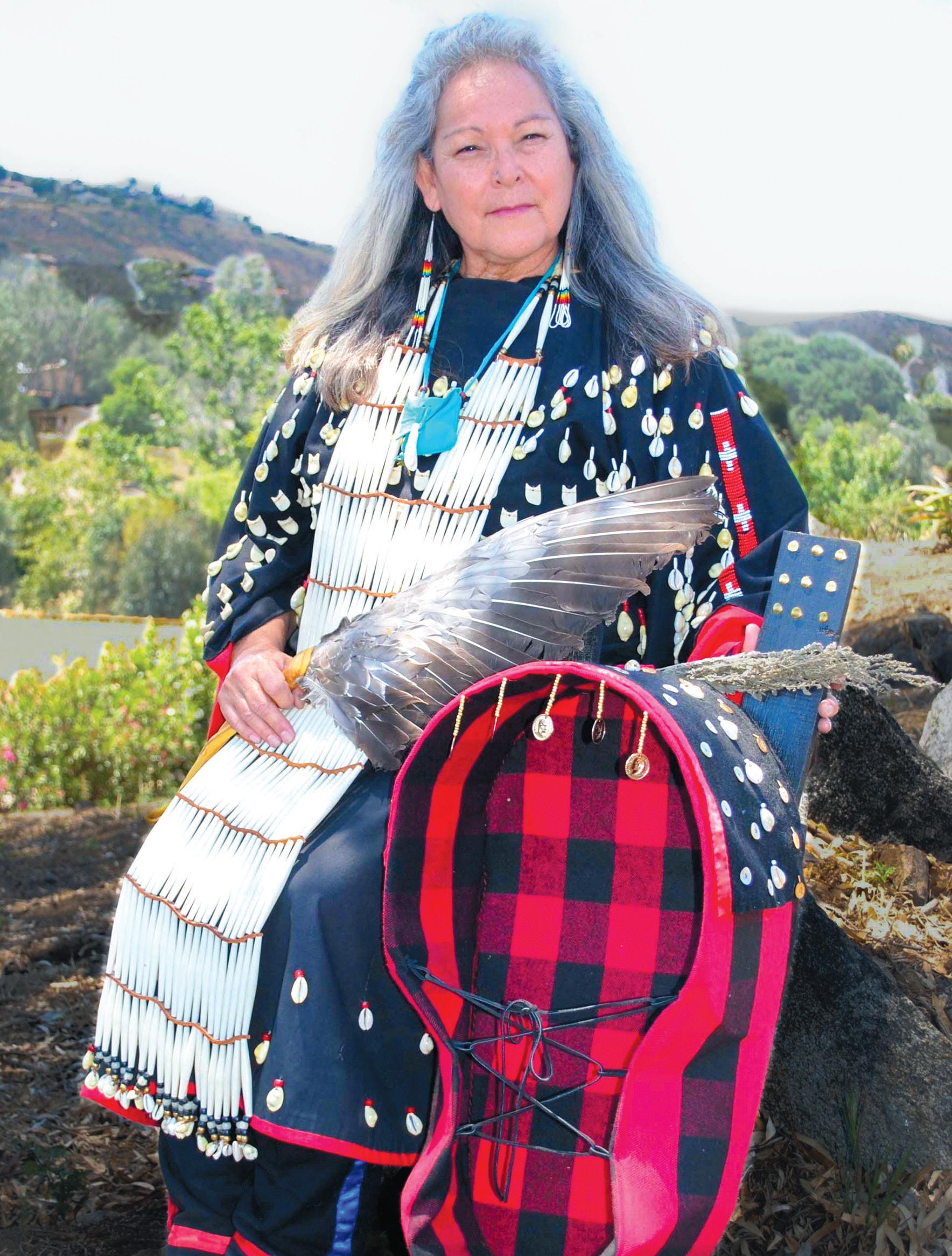
For Oglala Lakota artist Diane Tells His Name, it’s everything. Knowing who she is and where she comes from is of utmost importance and is reflected in her art—which paradoxically includes “no face” Lakota dolls.
Forty-five years ago, she married a Scots-Irish American and took his name. Fifteen years later, she decided to revert to her Native American name.
“I wanted my own identity, “ she said. “Lakota women never took their husband’s name. We are our own significant person, and our role is just as important. Lakota men’s sole purpose is to support women who are the life bearers. We are very important. We are not matriarchal or patriarchal. We all have our own important roles to keep the tribe going.”
Tells His Name, now a matriarch of the family, got her name from her grandfather who enrolled at the Pineridge agency in 1890 and introduced himself by saying, “I am the warrior who tells his name when he counted coup.”
Counting coup was a warrior tradition practiced by Native American tribes. It refers to the act of approaching and touching your enemy in battle and surviving while arrows or bullets flew all around you. It required agility and courage to get that close to the enemy. It earned admiration and honor among the Plains Indians. When you counted coup, you had prestige and were highly respected.
Tells His Name’s grandfather is a such a warrior even to this day because he counted coup and his enemies knew him by his name.
“I try to make sure my great grandchildren know as much as possible about their heritage, she said. “You know it in your heart. It is blood memory.”
This blood memory is what prompted her to reconnect with her true Native American heritage after discovering that she was adopted by a Caucasian couple.
“Now when I meet another person they will say, who are your people?” said Tells His Name. “Then I say, ‘I’m Oglala Lakota from Bad Face Band from Calico and Porcupine community.’ Often when they hear, they say: ‘Cousin!’ And we work out how we are related.”
For Tells His Name this is a very personal and special moment.
“When I say those words of who I am, I get very emotional because I know what my ancestors have done,” she said. “We are still here alive and active even if we do not live out in the plains. We are still here, and we have that blood memory that keeps us strong.”
The Lakota tribes have ceremonies that bestow a name on the members of their community.
“Mine was from elders,” said Tells His Name. “An elder must be petitioned and they fast and pray. There is talk for two, three months about the name.”
The elders were the culture bearers. They knew the old stories, the songs, the culture and the oral traditions.
“They talked with my mother,” said Tells His Name. “Your name can change as your life progresses and depending on what happens to you in your life. My initial name was Falling Star, which means, bring the dawn, new hope, the beauty of the new day.”
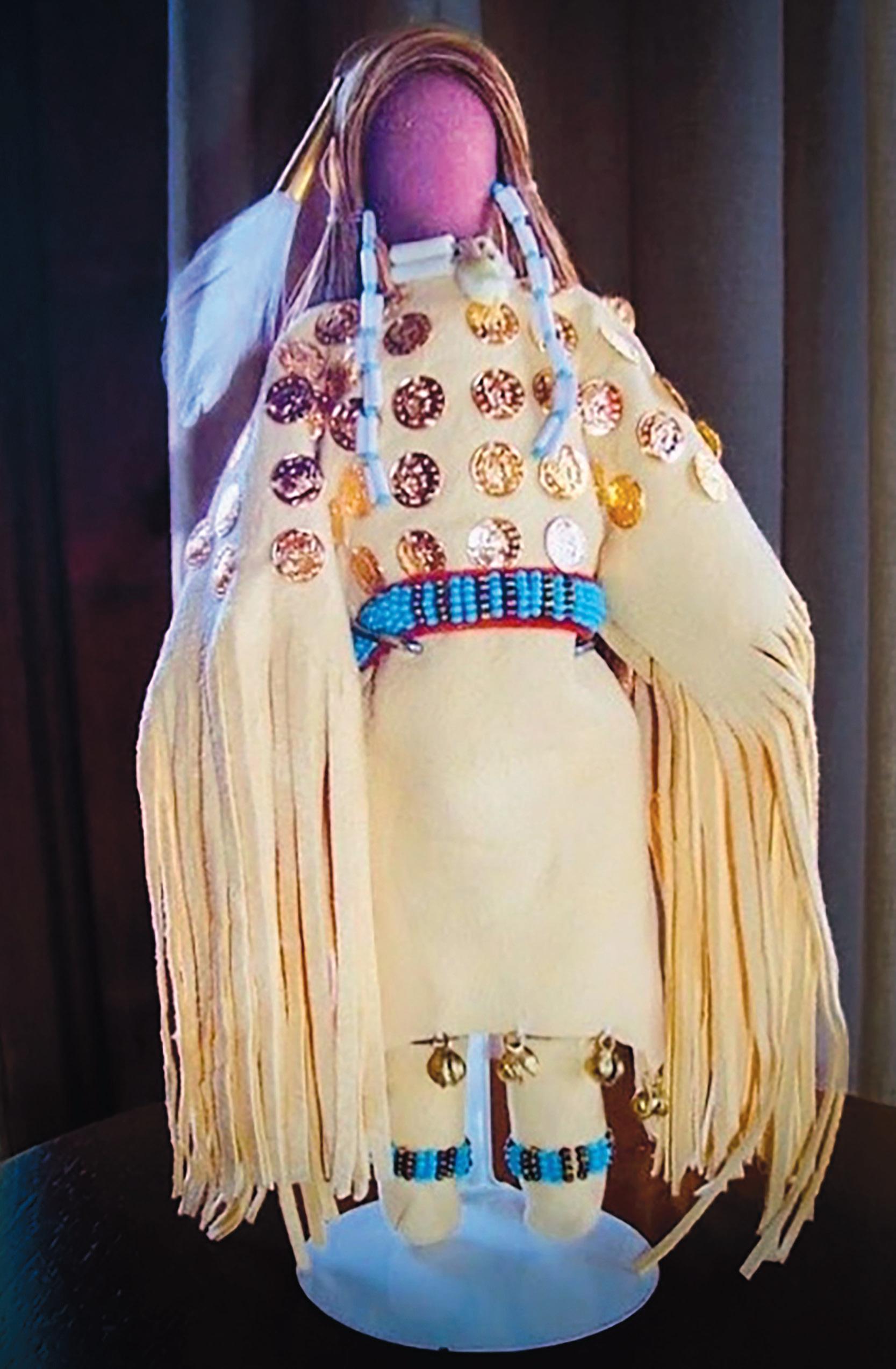
Because of this dedication to personal identity, it is of particular interest that Tells His Name’s renown came from making Native American dolls with no face.
No face dolls are powerful symbols that carry important cultural, spiritual and educational messages.
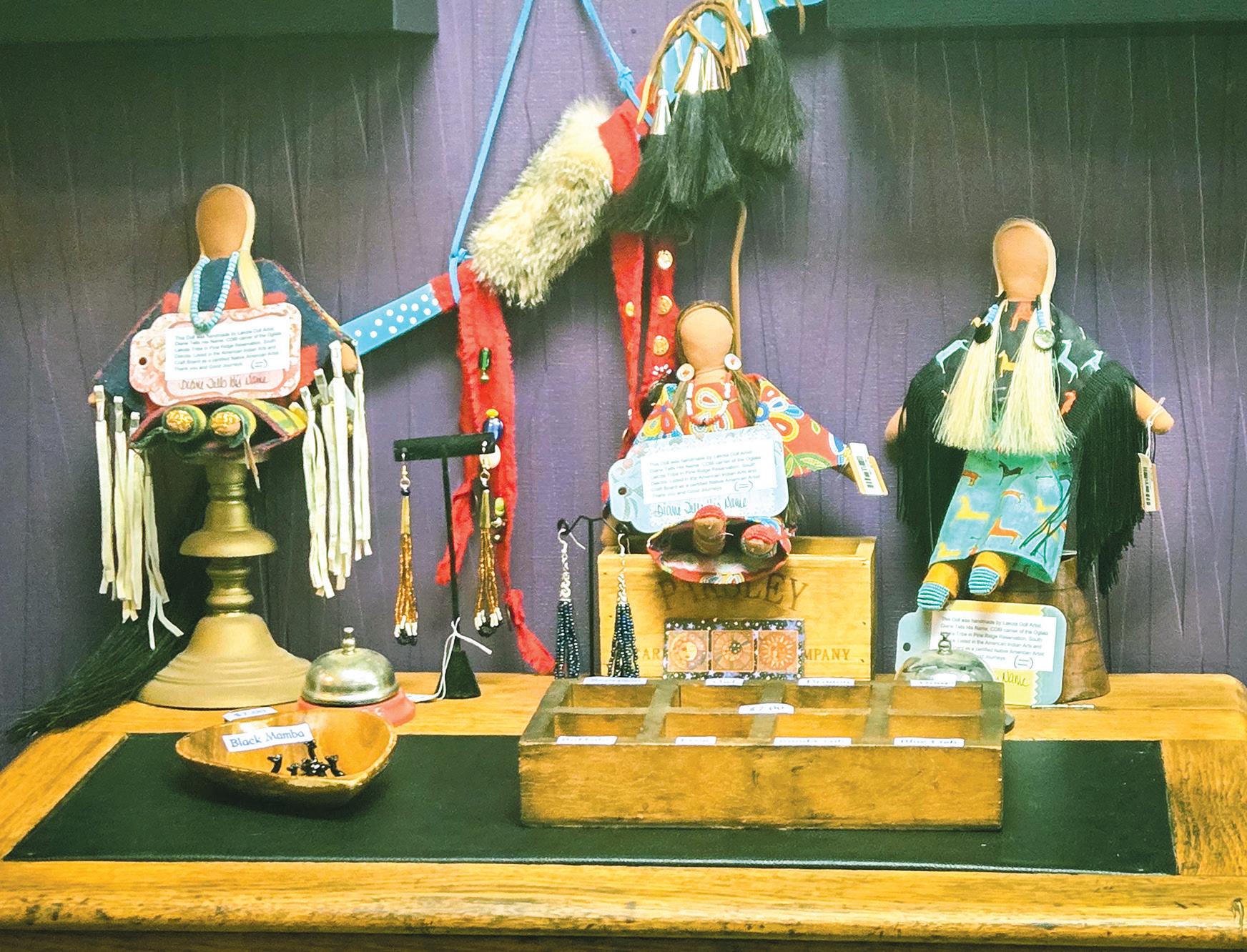
“The dolls have family stories that I have dreamt and that have been passed on,” said Tells His Name. “Before I create a new doll, I pray on it, burn sage and think about it until the idea comes to me. The doll has a lot of my energy in it, so I smudge it. I send it to the purchaser with sage for safe travels.”
She makes dolls out of old Beacon Blankets, old cloth representing hope.
“The idea is that there is always hope,” said Tells His Name. “There is always something that can be reused that can be passed down to generations leaving hope and prayers for the familiar. That is how we made it, with hope.”
She first started making “no face” dolls as gifts to give to her friends when her youngest daughter was four or five years old.
Tells His Name became a member of the Native American Women’s Intertribal Circle and upon the suggestion of one of her friends, she submitted her dolls to the 2005 Women’s Museum Art Show, thinking nothing of it. Two of them were accepted into the show.
Much to her surprise, a representative from the Griffith Park Autry Western History Museum purchased both dolls to add to the Autry museum’s collection.
The sale of her dolls took off through the Autry Museum’s gift shop. Others sold on Facebook and through word of mouth. And soon she started selling them in the Barona Cultural Center gift shop.
Contacting the Smithsonian, her doll called “Fur Trader’s Daughter” was accepted into their collection. This doll was fashioned after her aunt, Josie Fast Wolf who lives at the Pineridge Indian Reservation in South Dakota and where Tells His Name is also enrolled.
Tells His Name has made over 30 different varieties of dolls. For her, it is not about making money. It is more about handing down the tradition and the telling of the stories.
“I have made one doll for our first granddaughter who is now 33 years old.” she said. “It is called Sky Woman. It looks like
One of Kat Furrow’s Mixed Media Quarterly Workshops.
my black and red regalia. It is my granddaughter’s name. Sky Woman is one of the relatives killed at Wounded Knee.”
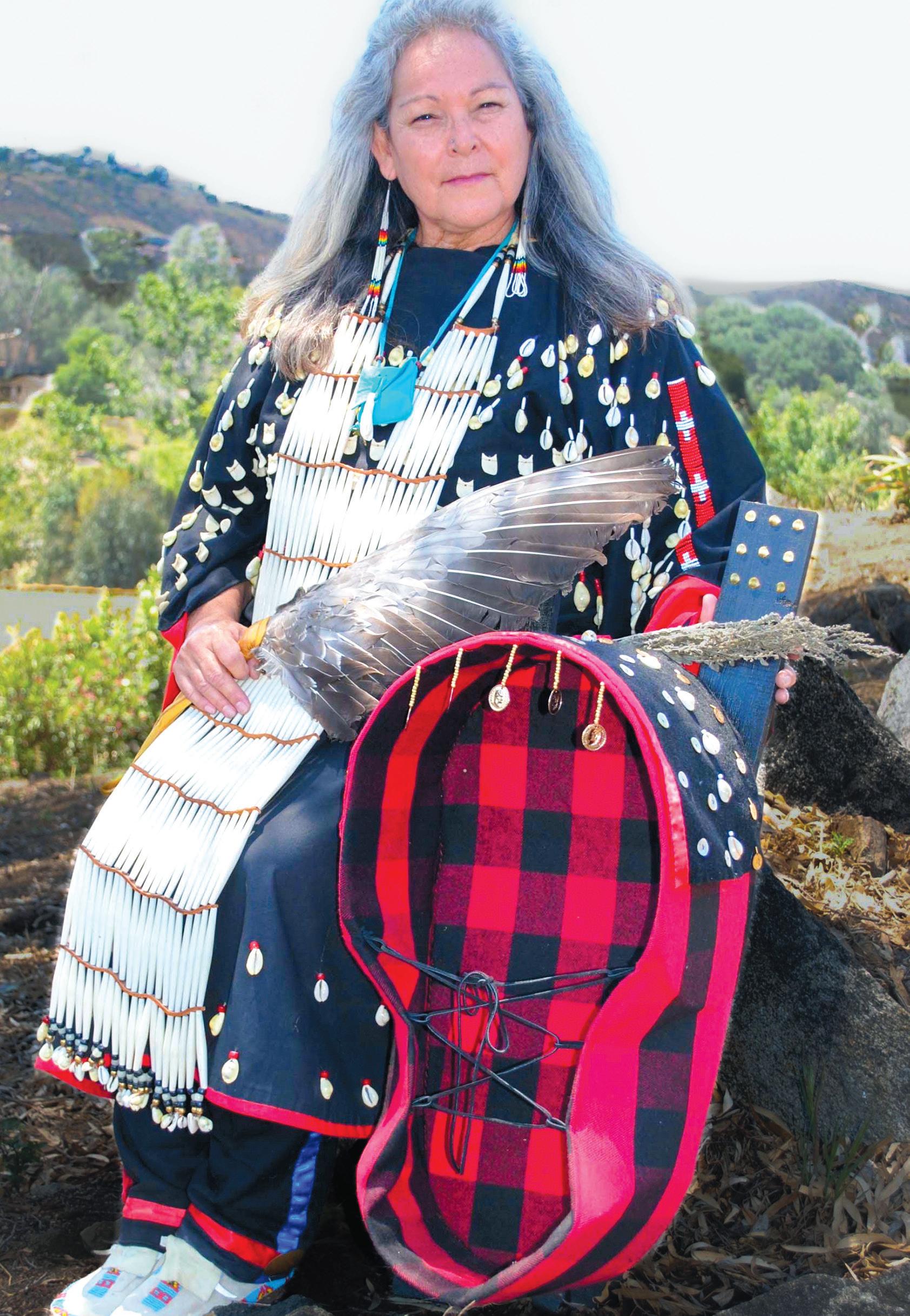
Regalia is what Tells His Name calls her Lakota ceremonial clothing she made herself. Her actual regalia weighs 20 pounds.
One of her favorite dolls is called Walks with the Sunset.
“She is dressed for her coming of age ceremony, said Tells His Name. “She wears her hair behind her shoulder, a sign of her still being a child in the Lakota culture. After the ceremony she will wear her hair in front of her shoulders and she will be available for courting. Her father says with her auburn hair, sunny disposition, inner and outer beauty she looks to him like she should Walk with the Sunset in her everyday life and have a bright and hopeful future ahead of her.”
In addition to the no face dolls, Tells His Name makes jewelry and horse effigy dance wands or sticks.
The horse was an important part of the Lakota Indians’ life. The horse provided transportation and was a heroic companion in battle, on hunts and raids.
When a warrior lost his horse, he would honor it with an effigy stick memorializing its life.
The stick would be carried in dances to pay homage to the horse in the hopes that the spirit of the horse would accompany the warrior giving him strength and authority.
The stick may be decorated with the horse’s hair, tail or mane, leather, feathers, beads, paint and more.
Tells His Name also holds classes in making horsetail earrings. In one of her classes Tells His Name recalls two people brought hair from their therapy horse tail who had passed away.
“We were crying,” said Tells His Name. “These are memorials of your beloved horse. There is a spiritual connection which is hard to explain. It is having that sacredness reminding you of how precious life is and how good it is.”
She is an active member of the Native American community and participates at many of their events—including powwows. She walks the arena in her regalia and participates in the dances.
Her faceless dolls and other works of art speak volumes of her rich history, culture and heritage.
For Tells His Name there is indeed a lot in a name.
Tells His Name is a Lakota artist living here in Escondido. She has a certification in Native American Studies and Archeological Lab Surveying.
You can find her works of art at Prism and Pendulum at 156 W Grand Avenue in Escondido or online at www.sevenfiresart. com/collections/diane-tells-his-name
BY PAM ROSS, MARKETING/PUBLIC RELATIONS, ASSISTANCE LEAGUE
INLAND NORTH COUNTY
Forty years ago, the Sony Discman hit the shelves, Microsoft released Windows 1.0, and in the heart of San Diego’s North County, a small group of visionary women laid the foundation for what would become one of the region’s most impactful volun-
teer organizations. What started as a modest dream in 1982 has grown into a powerful force for good: the Assistance League of Inland North County.
In the beginning
The group was known as Assistance League of Escondido Valley. It all began when Mary Malone of Escondido, Marti Fer-
ry of Lake San Marcos, and Genie Jenson of Rancho Bernardo hosted an invitational coffee to rally support for starting a local chapter of National Assistance League. They began with a rented building, a cigar box cash register, and an unwavering belief in the power of community. Seventy-nine women answered the call and became the chapter’s founding members. Today, the
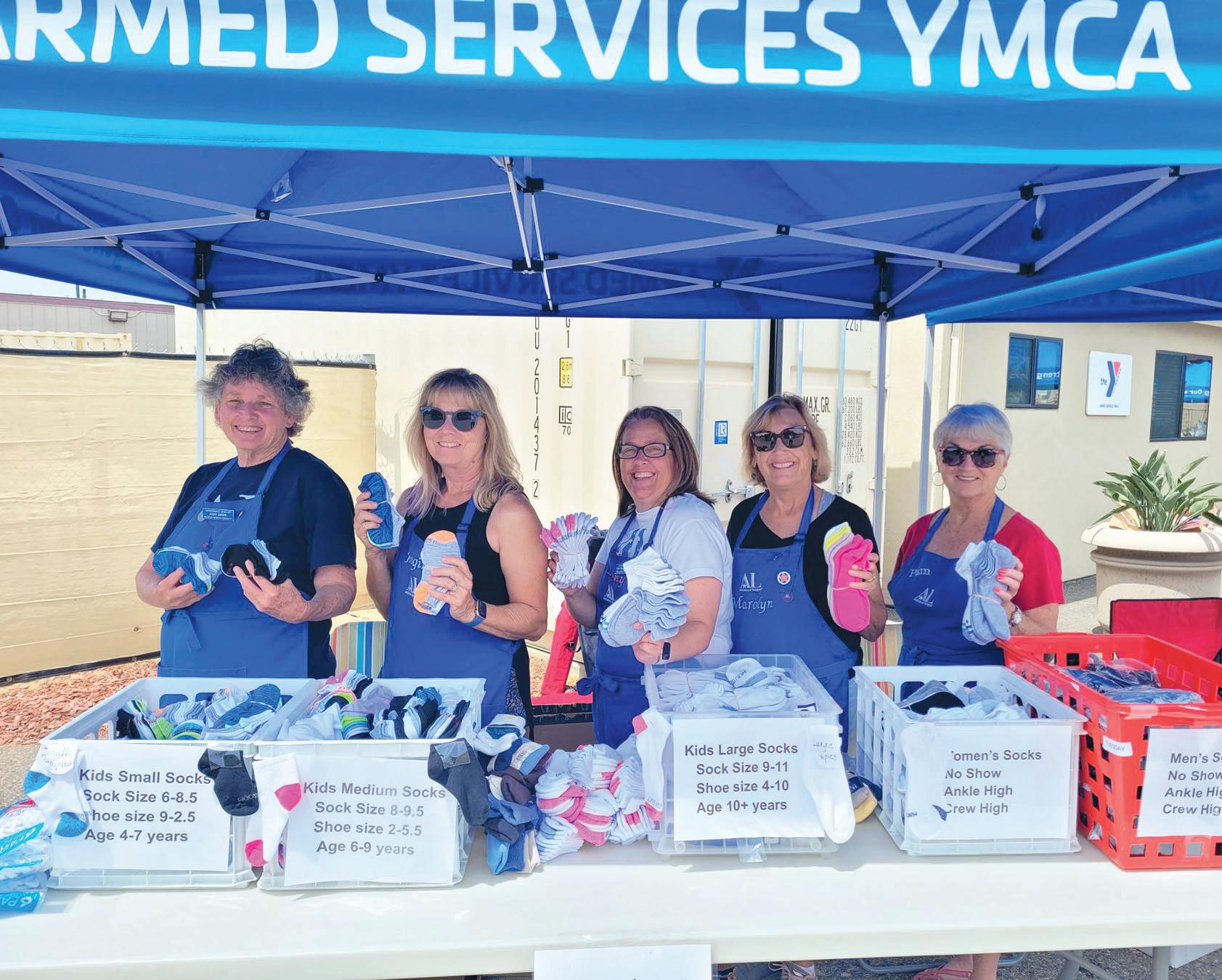
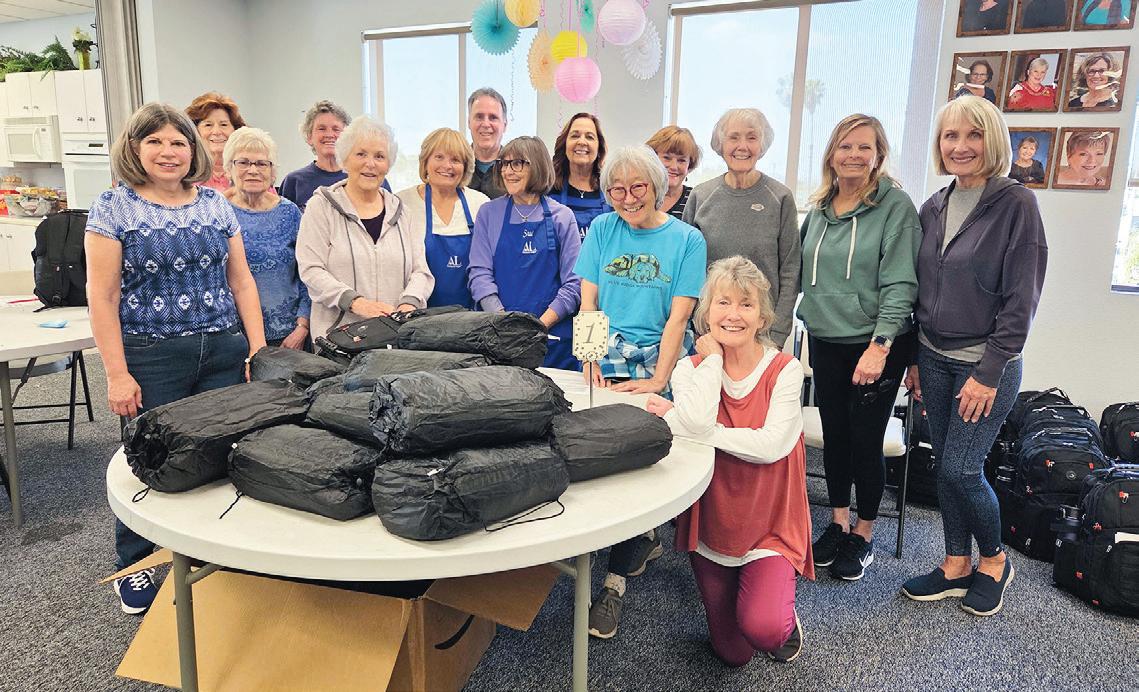
organization has grown to more than 150 active members and community volunteers, donating over 20,000 hours and $325,750, annually to support children, students, seniors, and families throughout North County. This year Assistance League proudly celebrates its 40th anniversary—four decades of serving communities including Escondido, Fallbrook, Valley Center, Warmer Springs, Bonsal, Pauma Valley, Rancho Bernardo, and Camp Pendleton.
At the heart of their mission lies a suite of philanthropic programs that meet people where they are and help them move forward.
One of their cornerstone programs is Operation School Bell, which provides new school clothing and shoes to children in need— many of whom have never had anything new of their own. “It’s not just about clothes,” one volunteer explains. “It’s about dignity, confidence, and helping children believe in their future.” This year alone, nearly 2,500 children have been served, including those from military families at Camp Pendleton.
Other transformative programs include:
• Ready, Set, Read: Volunteers work one-on-one with children in classrooms to help them learn to read and foster a lifelong love of books. Author visits bring stories to life and spark imaginations.
• Operation Duffel Bags: Supports high school graduates who are housing insecure or aging out of foster care. The program provides essential home goods and gift cards to ease the transition to independence.
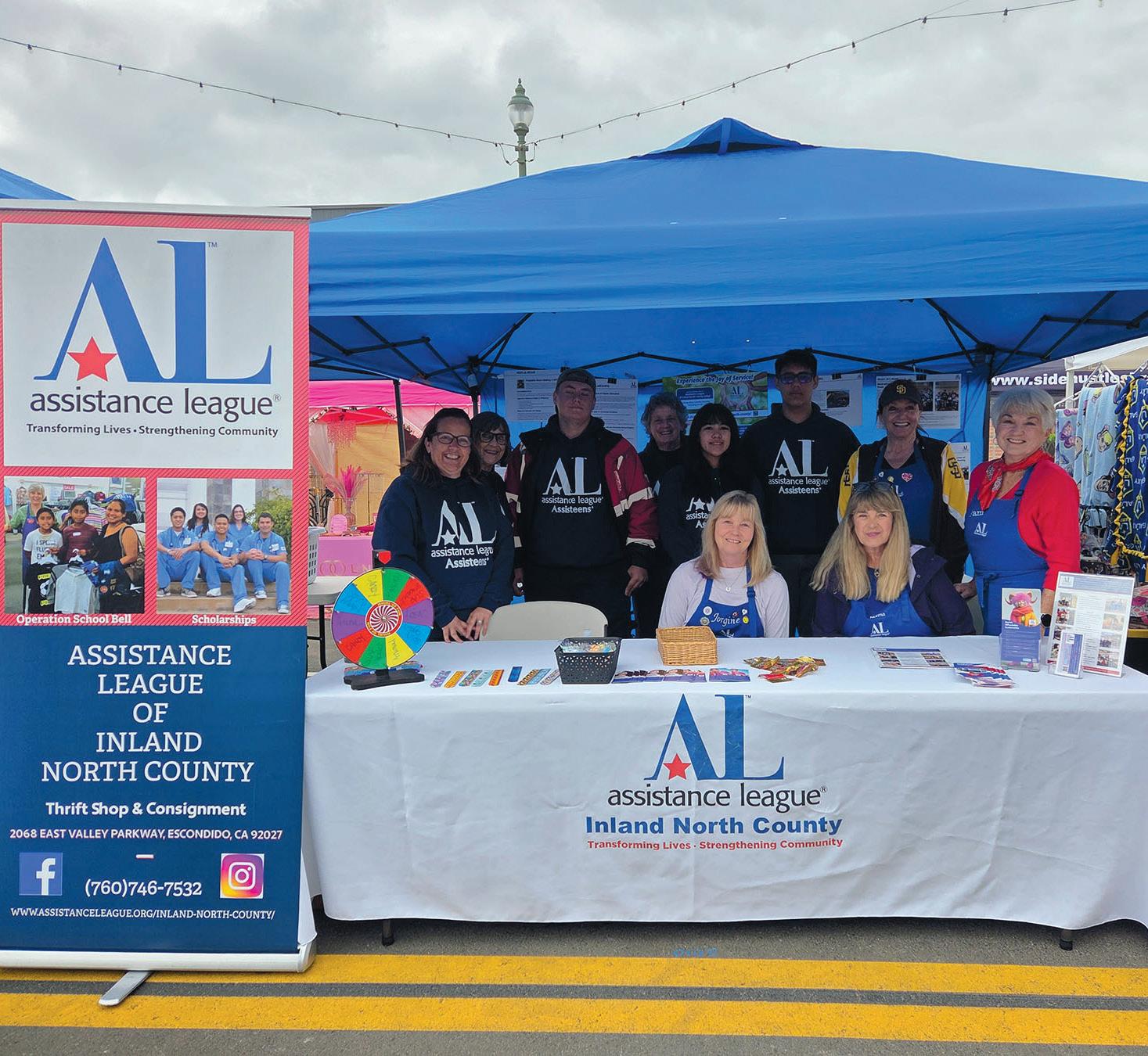
• Scholarships: More than $150,000 in scholarships are awarded annually to underserved students, helping them pursue higher education and vocational training.
• Project Seniors: Ensures that elderly residents in senior facilities are remembered and celebrated.
• Waste Not: Donates unsold Thrift Shop goods to other nonprofits and community agencies, ensuring that nothing goes to waste.
The vibrant Thrift Shop and Chapter House, located at 2068 East Valley Parkway, Escondido, is operated entirely by volunteers. The shop serves as both a fundraising hub and a community connection point. Additional funds come from grants, individual donations, special events, and legacy endowments.
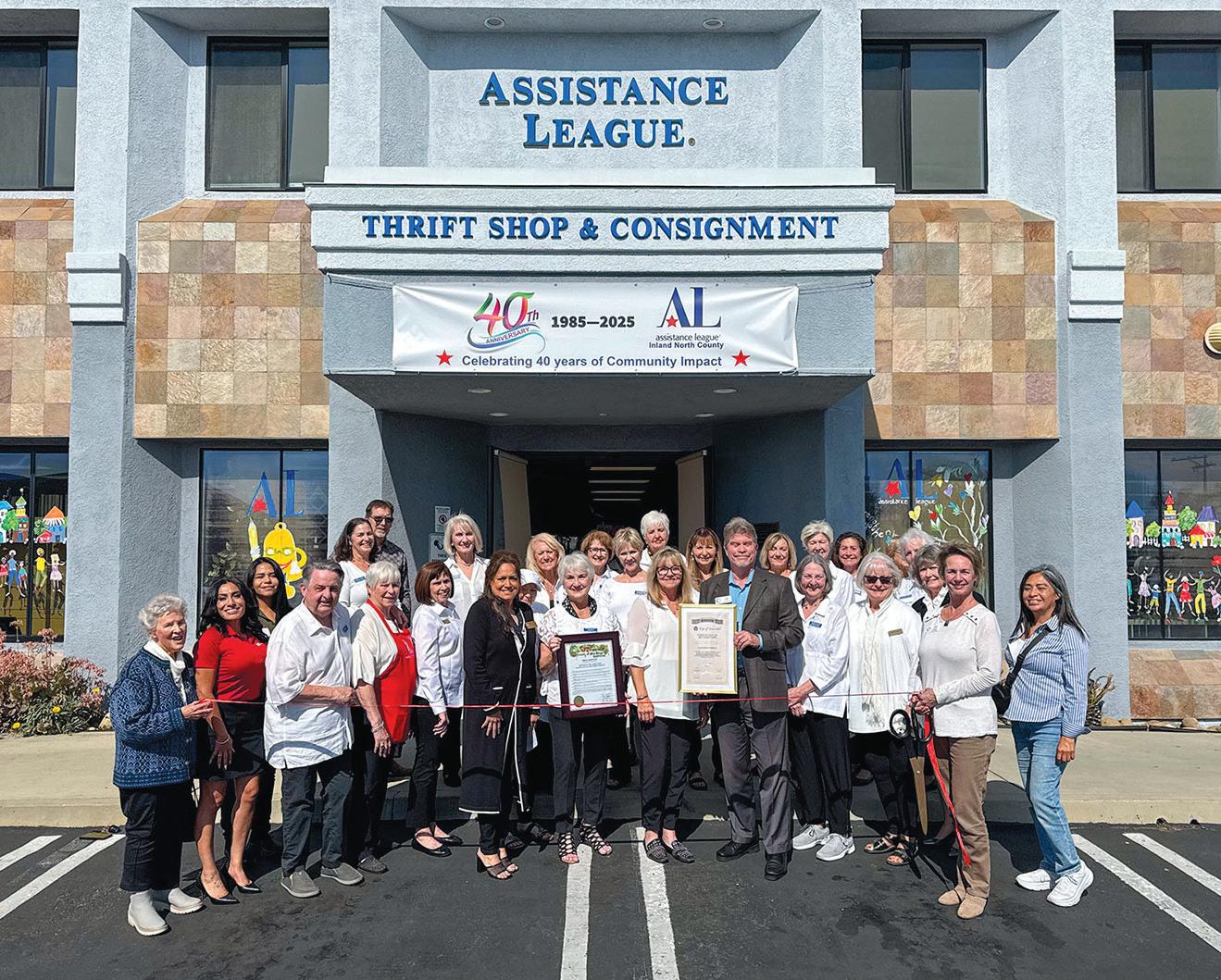
Most recently, the chapter hosted an Open House on May 1, 2025, a joyous celebration marking its 40th Anniversary. The event featured a ribbon-cutting ceremony attended by members of the Chamber of Commerce, followed by official proclamations and certificates of recognition from County Supervisor Jim Desmond, Escondido Mayor Dane White, and State Senator Brian Jones. Guests enjoyed light refreshments, toured the thrift shop, and participated in a raffle and silent auction, featuring more than 20 unique items valued between $75 and $1,500. Adding to the celebration was an incredibly special milestone: Marti Ferry, one of the original founders, celebrated her 100th birthday just weeks earlier on April 12. Her vision, commitment and pioneering spirit continue to inspire our work
An often-heard comment is, “I didn’t know you were here in Escondido!” As a chapter of National Assistance League, we operate with national guidance—but our heart, soul, and funding come directly from YOU, the community we serve!
In a world that is often uncertain, one thing remains constant: the power of compassionate, hands-on service. From preschoolers to seniors, Assistance League Inland North County has transformed countless lives, always with the same guiding principle—Transform Lives and Strengthen Community
To learn more, donate, or get involved, visit: https://www.assistanceleague.org/inland-north-county/
BY KATI COWAN
They dared to dream and are making those dreams come true for themselves and for everyone they encounter.
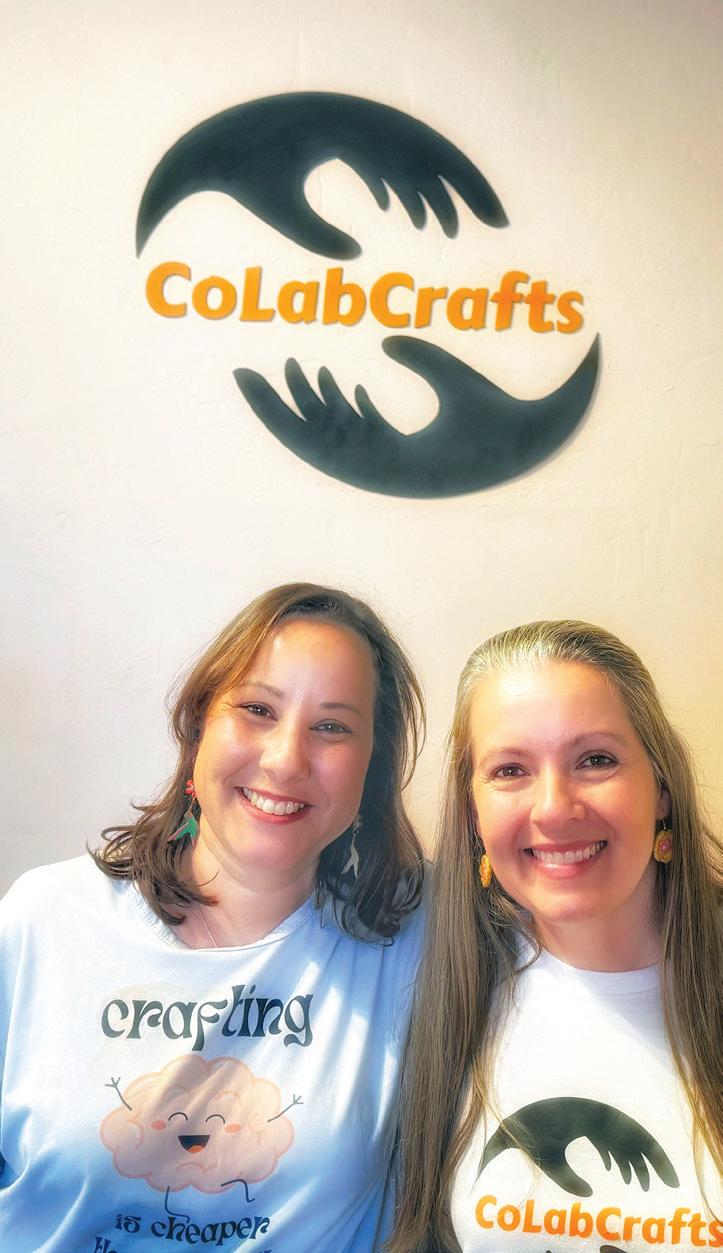
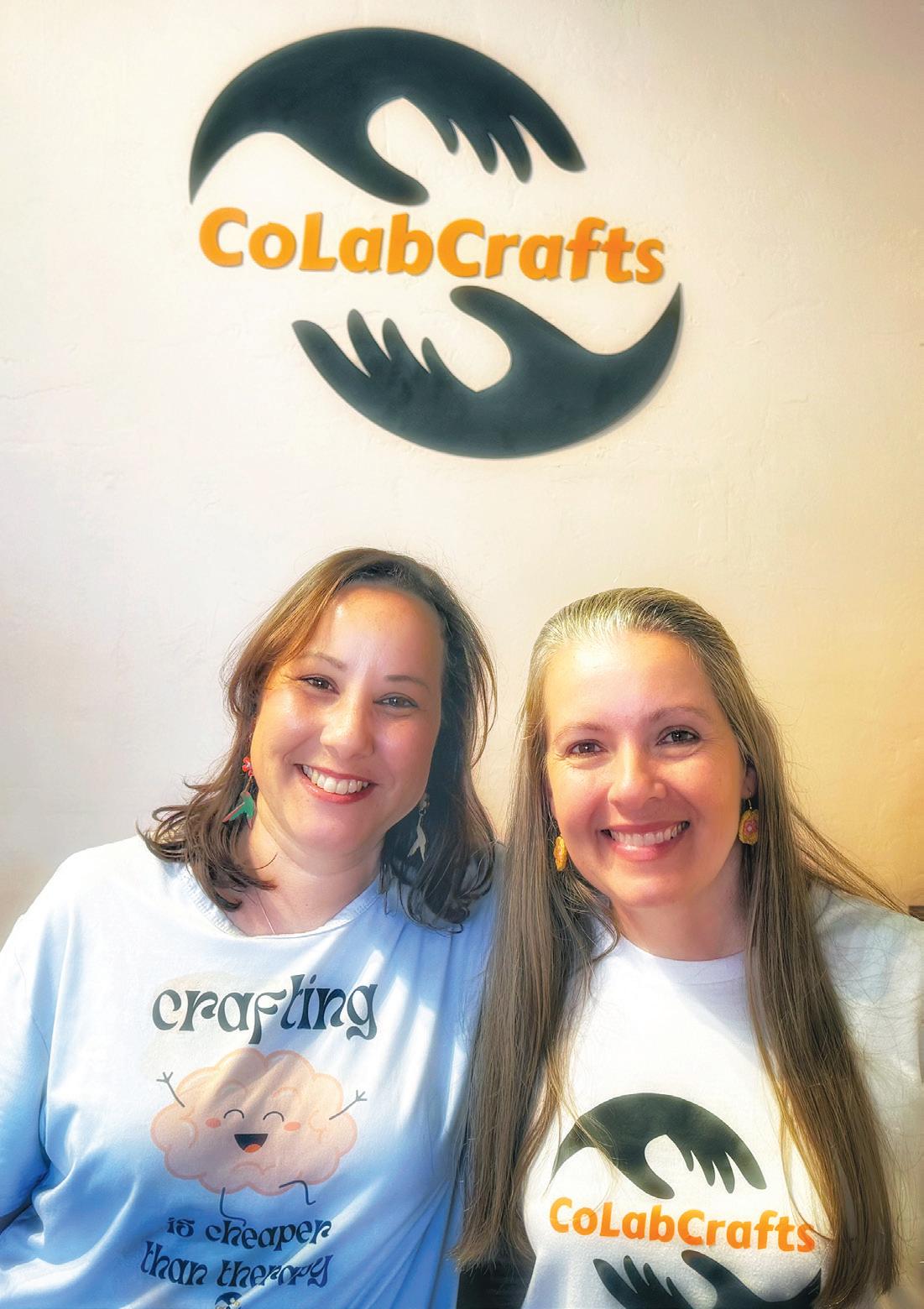
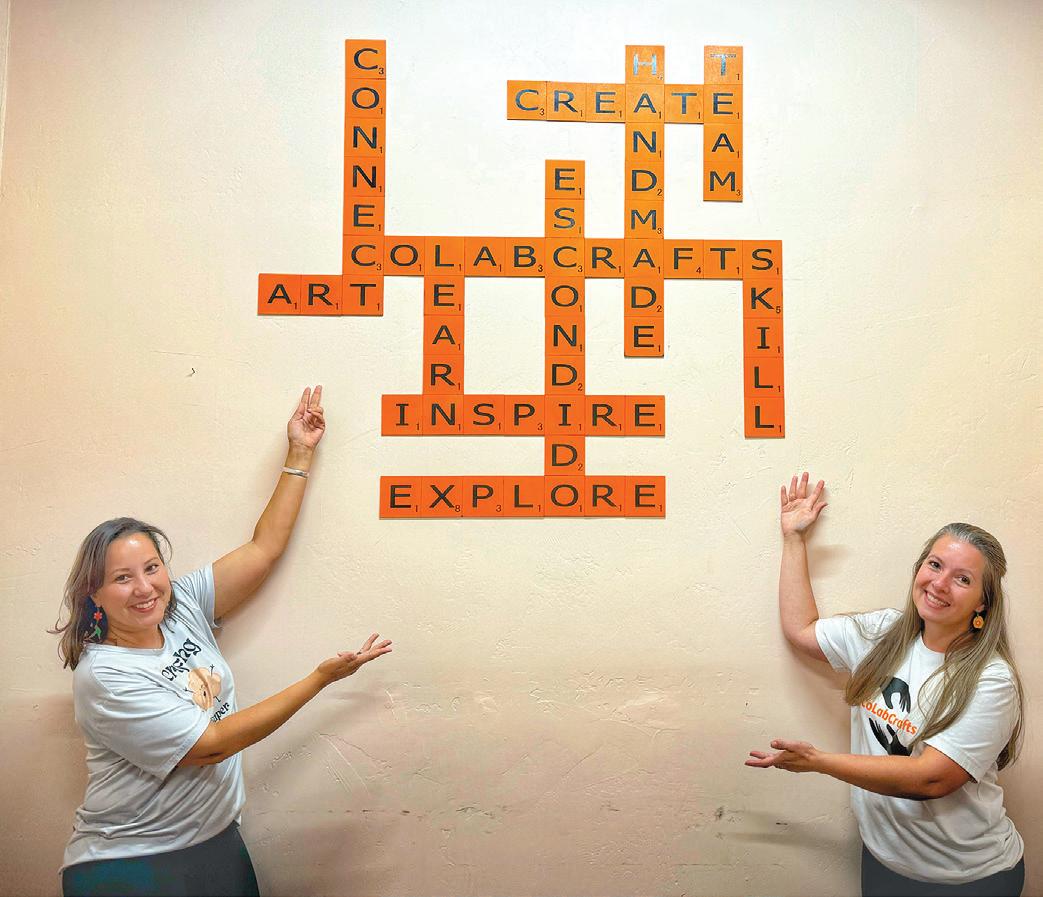
Tatiana Tesch and Grace Tarrac joined forces a year ago to launch an innovative business that has melded caring and commerce. Their goal is to elevate the retail business through a plan based on collaboration.
Their Grand Avenue store is called CoLabCrafts.
The two inspired Brazilian women created an outlet where crafters could sell their work daily instead of waiting for street fairs, farmers markets or church bazaars.
Currently there are over 50 artisans they call makers, participating at CoLabCrafts.
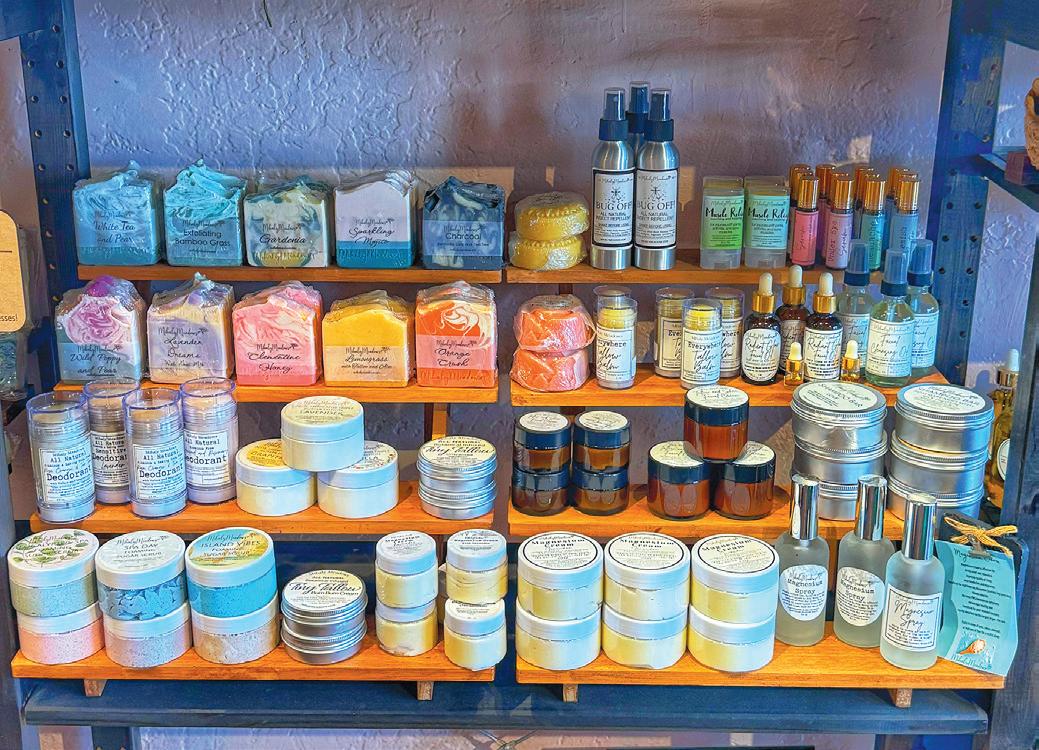
The variety and quality of the artistic products are impressive.
Tesch and Tarrac take personal interest in each maker. They offer suggestions on how to make changes to their products if the items do not sell. They encourage the makers to begin by renting a small space, so they are not overextended financially.
To encourage artists, they only charge a 15% commission on items sold on concession at the shop, below traditional gallery commissions.
Their main goal is not money. It is about serving the community and helping the crafters.
Walking into the bright and cheerful space one could spend hours perusing the myriad gift ideas that satisfy just about any taste.
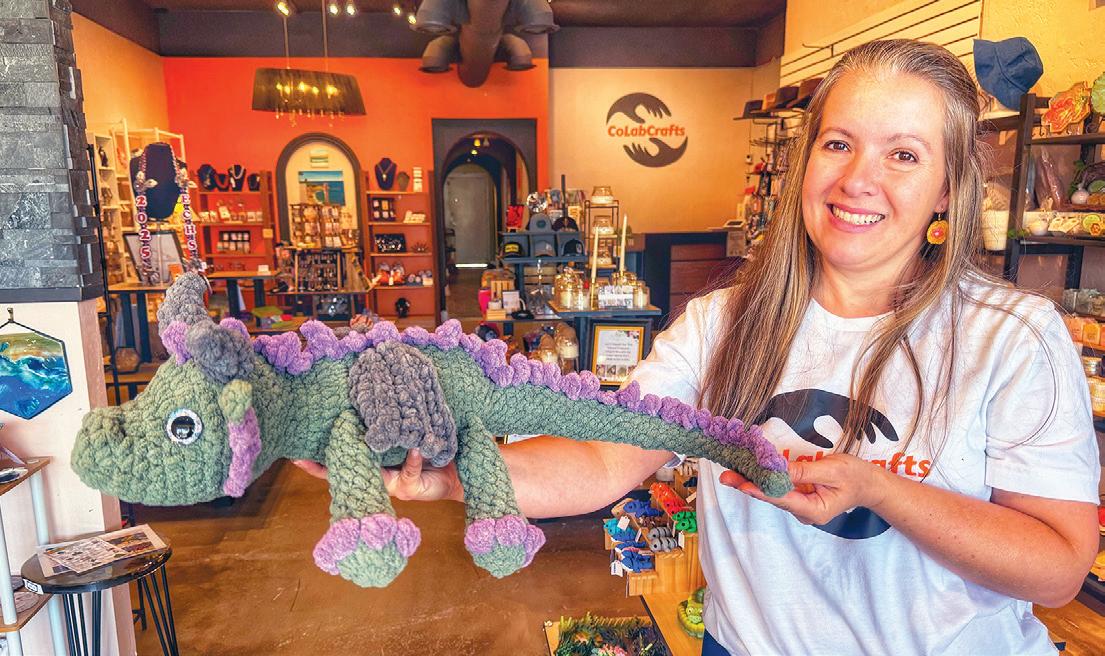
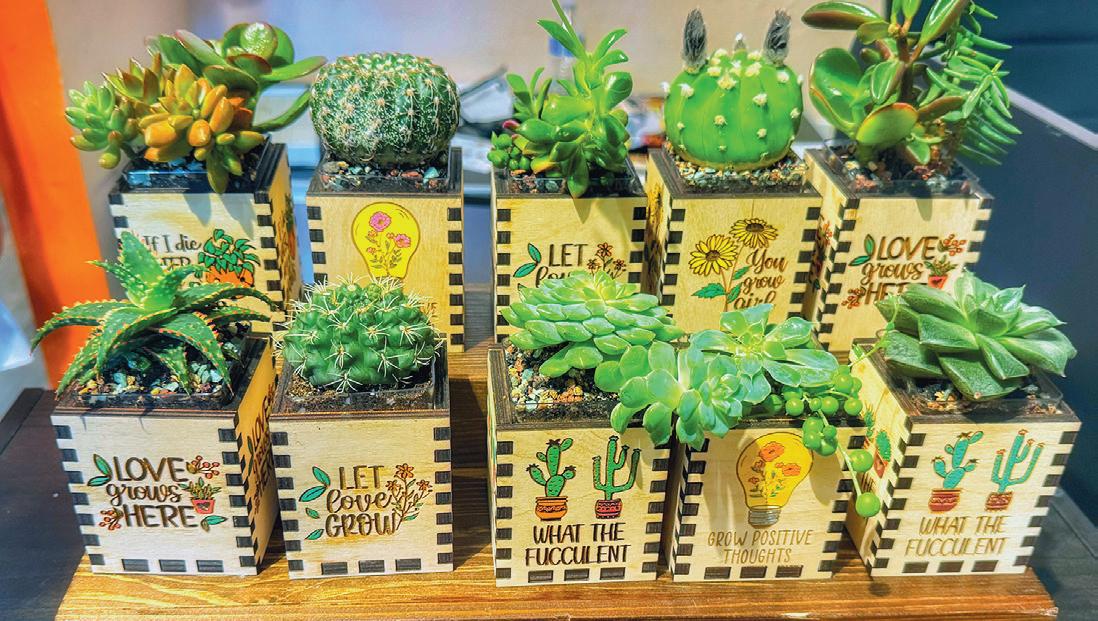
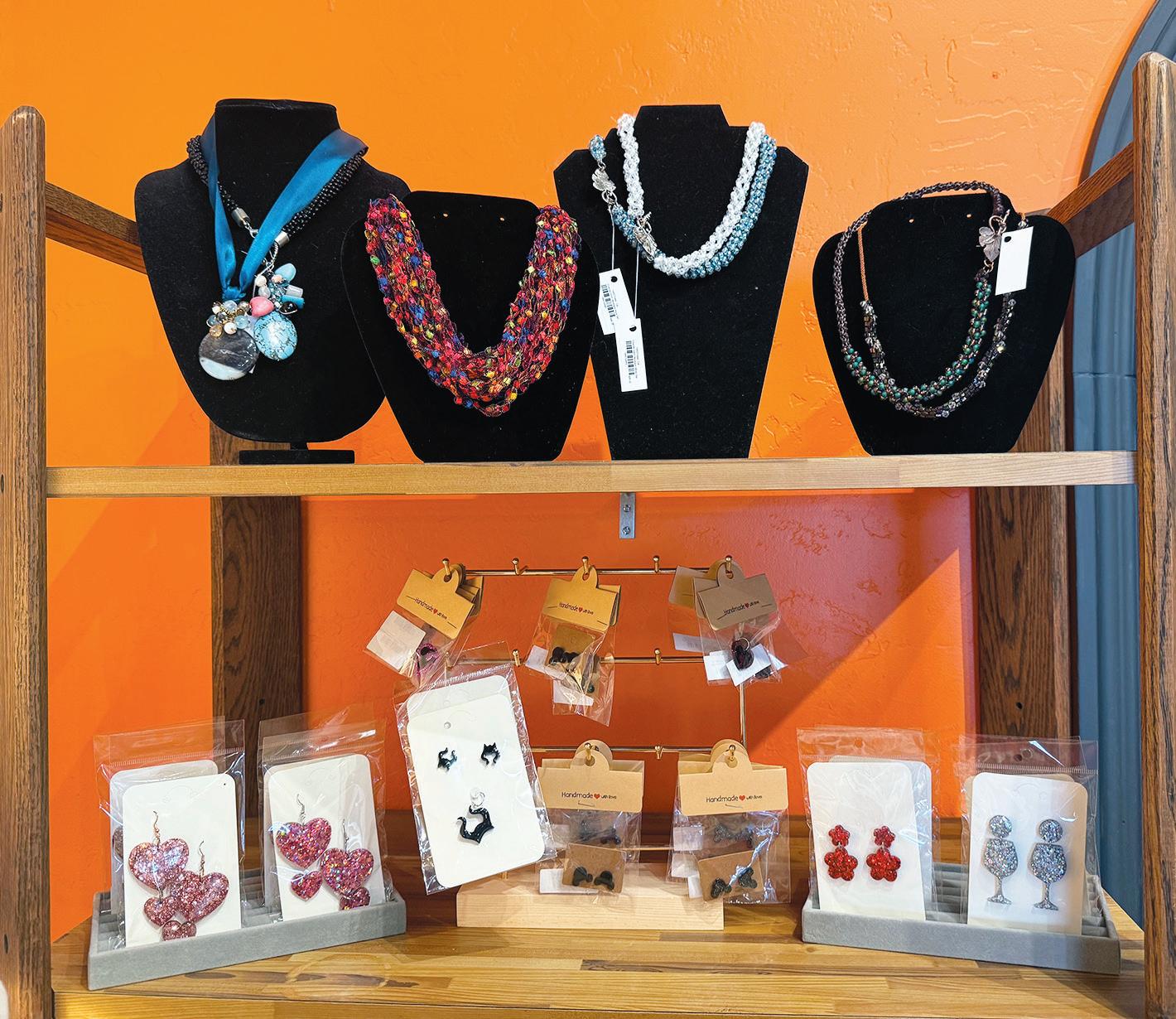
Items vary from imaginative and colorful macramé stuffed toys like dragons or jelly fish to stained glass flowers or delicate beaded bracelets that spell out “love” or “friend” made by a nine-year-old little girl.
To list the many different types of products in their store is almost next to impossible. Plan on spending time during your visit to CoLabCrafts to allow for surprise discoveries at every turn.
Tesch and Tarrac are crafters themselves.
Tesch specializes in cartonnage, the technique of making exquisite decorative boxes from cardboard or wood and fabric. She welcomes special orders that include personalized messages placed on or inside the lid or sides of the box. An elegant way to replace a gift bag or wrapping paper.
Tarrac’s specialty is laser printing on wood. She too accepts special orders. She can reproduce photos of anyone or anything onto wood signs that include personal messages.
Available are a variety of jewelry; quilted, macramé, knitted and sewn items; stained glass, superb cutting boards combining acrylics and wood, painted glassware, and anything else you might imagine or hope for.
There’s more.
In addition to providing this commercial outlet to artisans for a
small fee, they also offer crafting classes.
This summer, for a fee, discover how to make a fairy garden, or make a crystal resin cutting board, learn how to sew, crochet, do basket weaving, ceramic painting, upcycling art composition, and more.
Themed parties for children and adults are also available in one or more of their many existing creativity lab rooms.
This summer, kids can discover basket weaving, finger knitting a stuffed animal, sewing, watercolor or needle felting—just to name a few.
For Tesch and Tarrac, this is more than just a business. It is about serving the community through collaboration.
Although their Brazilian backgrounds were different, they share the same vision.
When Tesch was growing up in the small town of Pirassununga, her mother owned a tiny shop where crafts were taught. She would sell the items needed for the classes. She remembers spending many hours in her mother’s tiny pink house with rooms where crafts were being taught.
Tarrac’s experience was in retail that started at a very young age. Growing up in Rio de Janeiro with a single mom who worked as a maid making meager wages, eight-year-old Tarrac would sell homemade buns to factory workers near her home to afford school supplies.
Once she became an adult she moved to England where she worked in high end retail establishments selling expensive shoes. Never forgetting her roots and how her own small retail efforts as a child helped make a difference, she knew she wanted to give a helping hand to those who need it.
After meeting Tesch with similar interests three years ago in a Brazilian young moms’ group in San Diego she saw an opportunity. They were both crafters. They both wanted to open a business. Tarrac began pushing the idea to open a business.
“Grace is the dreamer between the two of us, “ said Tesch. “ I am the realist. I am always the one seeing what could go wrong and want to make sure we have solutions. One such challenge were rents. I know what my parents went through to run a business. I know what the hurdles are. I have a degree in Business Administration. Being conscientious I am always asking if we can afford it.”
Tarrac, although undaunted, still had some doubts. She looked for some sign for the answer.
It came after a battle with cancer and chemotherapy.
While leaving treatment, a woman came running after her to say, “I am a spiritual person. God asked me to tell you that ‘He’s got you!’”
Tarrac was stunned—but knew that this was the sign she was waiting for.
When Tesch said that she was not willing to move forward unless they could find a place they could afford, Tarrac went to work searching for locations, finding a place in Escondido that met their conditions.
They painted the store themselves and used recycled materials for shelving and tables and then spread the word to local crafters.
They joined the Downtown Business Association (DBA) and MAGEC (Museums & Arts Growing Escondido Culture) to network and get involved with the community.
CoLabCrafts doors opened a little over a year ago and its reputation is growing.
It is a place of discovery blurring the lines between arts and commerce.
This is a welcome phenomenon—both to artists seeking commercial representation and the public who clamor for quality, local, unique and affordable gift items and opportunities to learn how to make them.
Tarrac and Tesch expressed gratitude for the community and helpful relationships that they have made along the way through their involvement with the DBA and the art community.
Their collaborative spirit, like the tide that raises all boats, continues
to benefit the people of Escondido and beyond. CoLabCrafts is located at 143 Grand Ave. in Escondido. For more information about their programs and hours of operation www.colabcrafts.com