THE
ROAD SAFETY TRUST
Making Roads Safer
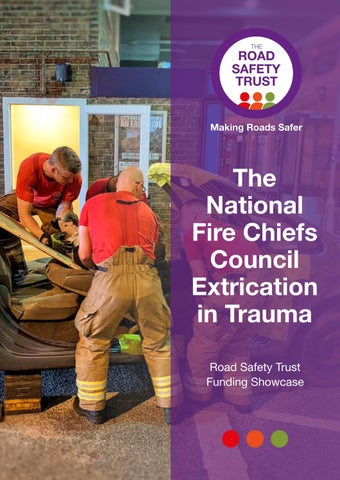
The National Fire Chiefs Council Extrication in Trauma Road Safety Trust Funding Showcase
1
The Road Safety Trust is dedicated to making the UK’s roads the safest in the world. As an independent grant-giving charity, Road Safety Trust funds vital research and practical interventions committed to reducing the number of people killed or injured on our roads.
In 2017 the National Fire Chiefs Council was awarded a grant by the Road Safety Trust to conduct research into the effect of extrication techniques applied to casualties following road traffic collisions. This project is called the Extrication in Trauma project, or EXIT. The ambition is to decrease injuries and save more lives.
Many serious Road Traffic Collisions result in patients requiring extrication – the process of removing potentially injured people from vehicles. It is a complex process, often completed under difficult circumstances and with limited information about the extent of the injuries.
The basic principle of extrication was developed in the 1960s out of the need to remove injured racing drivers from their cars. George Hurst invented the ‘Jaws of Life’ a hydraulic apparatus used to pry apart the wreckage of crashed vehicles in order to free people trapped inside. This principles for this method were developed based on suspicion of spinal injury with the objective of limiting spinal movement. The same basic principles of extrication are still being used some 50 years later.
The EXIT team is led by Tim Nutbeam (Consultant in Emergency Medicine, Professor of Prehospital Care and the Lead Consultant for the Devon Air Ambulance), Rob Fenwick, (Advanced Clinical Practitioner) and Mike Dayson, a UK Fire Officer seconded from Cleveland Fire brigade to the National Fire Chiefs Council. The team is supported by Dr James Shippen and Dr Barbara May from Coventry University who provide the biomechanical and motion capture expertise. Additional fire service support comes from Jenny Hill and West Midlands Fire and Rescue Service. Each year 1.35 million people die worldwide as a result of a road traffic collision, with a further 20 – 50 million suffering injuries. Extrication is an important but relatively unstudied link in the chain of survival for these road users. Over 7000 extrications are carried out each year in England alone and research has found that 88 per cent are extricated based on suspected spinal injuries. In reality the number of spinal injuries where small movements may make a difference is much smaller than previously thought. The EXIT group’s research has found that the average extrication time is 30 minutes with the fire service arriving 5 minutes before the ambulance service . The EXIT project team is examining how to complete more timely extrications with the minimum force and movement.
The project is exploring three different options into extrication: • •
•
Self-extrication – allowing a patient to remove themselves from the vehicle; More timely extrications – sliding a board under the patient and removing them with minimal cuts applied to the vehicle; Full roof removal – using the ‘Jaws of Life’ to dismantle the car.
The methodology to test the three options involves simulating car crashes and using volunteers wearing Inertial Measurement Units (IMU) suits to examine all of the movements. By establishing the quickest and safest methods of extrication, this project hopes to improve patient outcomes, make better use of resources from all emergency services and reduce the impact of accidents on other road users.
The Road Safety Trust Registered charity number 1156300 Company registered in England & Wales number 8837451 Registered Office: Critchleys LLP, Beaver House, 23-38 Hythe Bridge Street, Oxford OX1 2ET www.roadsafetytrust.org.uk
RoadSafetyTruUK