THE
ROAD SAFETY TRUST
Making Roads Safer
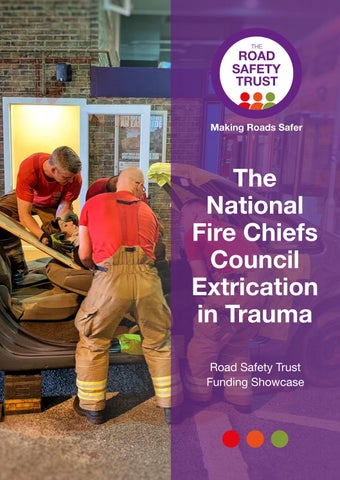
The National Fire Chiefs Council Extrication in Trauma Road Safety Trust Funding Showcase
1
In 2021 there were 127,967 casualties and 1560 deaths in Great Britain caused by motor vehicle collisions. In the same period, over 7,000 patients needed to be assisted to leave the vehicle by a process known as extrication. During this process, which has been the “gold standard” since the 1960’s patients may remain in the vehicles for on average 30 minutes as slow, careful movements are used; to avoid potential spinal injuries. In 2017 the National Fire Chiefs Council was awarded a grant by The Road Safety Trust to conduct research into the effect of extrication techniques applied to casualties following road traffic collisions. This project is called the Extrication in Trauma project, or EXIT. The ambition is to decrease injuries and save more lives.
An extrication involves trained Fire and Rescue personnel using the ‘Jaws of Life’ (a hydraulic apparatus) and other similar tools to pry apart the wreckage of crashed vehicles in order to free people trapped inside. The principles for this method were developed based on the paradigm that spinal injury was more important than other injuries and the overall objective was therefore to limit spinal movement during extrication. The number of spinal injuries is however much smaller than previously thought and in those with spinal injuries, many will also have significant other lifethreatening injuries which need rapid assessment and management.
To test the most effective extrication methods the EXIT team simulated car crashes using volunteers wearing Inertial Measurement Units (IMU) suits to examine all of the movements. The results found that the current extrication methods may be increasing the rate of death and injury and do not offer the benefits that they were thought to offer as they are associated with significant movement and only 0.7 per cent of patients trapped in motor vehicle collisions have spinal cord injury. There is now a case to change how the extrication process is performed. Furthermore, the spinal movements associated with extrication were found to be much larger during assisted extrication than when a patient selfextricated; rapid extrication techniques were found to produce very similar movements to much slower techniques aimed at movement minimisation. The research recommends that selfextrication should be delivered wherever possible with the extrication goal of minimising entrapment time.
Through the development of a bespoke patient-centred extrication plan with the primary focus of minimising entrapment time, the EXIT team hope to improve patient outcomes, make better use of resources from all emergency services and reduce the impact of accidents on other road users. The results of the research are being widely shared. The United Kingdom Rescue Organisation have adopted the new principles for their Extrication Challenge in September 2022 after which the new guidance will be translated into National Operational Guidance for Fire and Rescue Services. More details about the project and the report are available here.
The Road Safety Trust is dedicated to making the UK’s roads the safest in the world. As an independent grantgiving charity, The Road Safety Trust funds vital research and practical interventions committed to reducing the number of people killed or injured on our roads.
The Road Safety Trust Registered charity number 1156300 Company registered in England & Wales number 08837451 Registered Office: Colwyn Chambers, York Street, Manchester, M2 3BA www.roadsafetytrust.org.uk
RoadSafetyTruUK