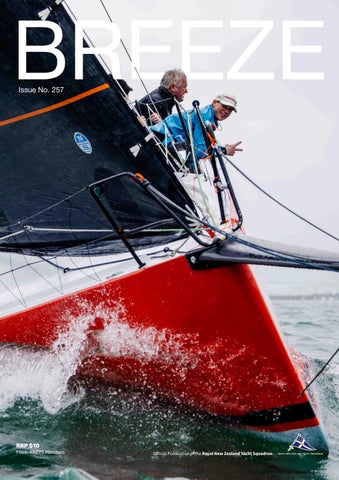
BREEZE Issue No. 257
RRP $10 FREE: RNZYS Members
Official Publication of the Royal New Zealand Yacht Squadron
Cover Shot: Cameron Thorpe’s General Lee during the North Sails Winter Series Photo: Suellen Hurling Live Sail Die
Contributors Commodore David Blakey Rear Commodore Hamish Williams Georgia Witt Ella Sagnol Brooke Adamson Harry Thurston Stephanie Haden Hayley & Nick Dawe Life Member Chris Bouzaid MBE Life Member Chris Collins Jim Cooke Marguerite Delbet Colette Kraus Chloe Turner Isaac Gaites Yannick Carol Penelope Carroll Suellen Hurling
DISCLAIMER The views and opinions expressed in this magazine are purely those of the authors and are not necessarily the official view of the RNZYS, nor of the publishers. PERMISSION Reproduction rights in part or in full of the contents of this publication must be applied for from the Editor.
Advertising enquiries athurlby@rnzys.org.nz Editorial and other enquiries shurling@rnzys.org.nz DEADLINES Edition #258 / 2026 #4 Now four seasonal issues per year Editorial & Advertising: 30 November Magazine posted: ~14 December
Contents 7 9 10 13 18 21 22 24 25 26 27 28 29 30 31 32 35 36 38 40 41 42 43 45 46 47 48 50 52 54 57 58 59 60 62 66 68 69 70
Commodore’s Report General Manager’s Report RNZYS up for a match racing double-header in 2027 From the Sailing Manager From the Performance Sailing Coach Athlete Profiles: Chris Kenrick & Sally Roff Emirates Team New Zealand YTP International Debut - in Sydney It’s a numbers game, and we take it quite seriously! Greta Pilkington - 13th at the ILCA 6 Women’s World Championship Chloe Turner - Back to back ILCA 6 success Isaac Gaites - My first ILCA 6 World Championship It’s a “Squadron” Love Story Josh Hyde & Waitematā Racing clince first win on the World Match Racing Tour Lidgard House: The timeline ends, but the memories live on forever Get away for the weekend, leave the anchor in the well Chris Bouzaid: Sailing is a lifelong sport Reflections, which Chris Collins Decades of Dedication Celebrated at RNZYS Pins Presentation Celebrating decades of membership Jim Cooke & A Lifetime of Sailing Make CoLab Christmas your Staff Christmas Party! B&G at 70: Seven Decades of Sailing Innovation Kiwis make their mark in The Ocean Race Atlantic America’s Cup & Claret Jug: Side by side Become a sailing umpire PIC Coastal Classic 188 Women line up for Barfoot & Thompson Women’s Day Out North Sails Winter Series Winners Log Rally Races & Winery Afternoons RNZYS at Kawau: A legacy of care Shayan Darvish has a goal: to raise the standard of our hospitality offerings Yannick’s Pasta all’Amatriciana - My Way Spring Rose Cocktail 38th America’s Cup Schedule Turn the Tide into a Tactic Classic Yacht Journal Fog: When a cloud can’t commit to the sky The sailing roots of every day speech Squadron Events
Flag Officers Commodore David Blakey dblakey@rnzys.org.nz Vice Commodore Garry Scarborough gscarborough@rnzys.org.nz
Editor, Layout and Typesetting Suellen Hurling / Live Sail Die
Rear Commodore Hamish Williams hwilliams@rnzys.org.nz
Office & Members’ Bar Printed by ColorMania Registered as a magazine at the GPO, Wellington. ISSN 0113-7360 (Print) • ISSN 3142-1032 (Online)
Squadron Team General Manager Georgia Witt - 029 020 20457 gwitt@rnzys.org.nz Sponsorship Anita Thurlby - 021 203 9911 athurlby@rnzys.org.nz Membership Experience Beth Orton - 027 555 9567 membership@rnzys.org.nz Sailing Manager Ella Sagnol - 027 288 3157 esagnol@rnzys.org.nz
RNZYS Office reception@rnzys.org.nz 09 360 6800
Event & Venue Operations Rocky Singh - 027 373 3919 rsingh@rnzys.org.nz
Members’ Bar Reservations 09 360 6814
Events events@rnzys.org.nz 09 306 0771
Expatria • Frans De Court Racing during perfect conditions for Race 3 of the Shorthanded Sailing Association Triple Series Photo: Suellen Hurling / Live Sail Die
Page 4
Janice of Wyoming Larry Finch Photo: Suellen Hurling Live Sail Die
Royal New Zealand Yacht Squadron PA R T N E R S & S U P P O R T E R S
MAJOR PARTNERS
SUPPORTING PARTNERS
CORPORATE MEMBERS Antipodes Argosy Property Management Canon Clean Corp Club Med Datacom ecostore GOFuel Harken Hikvision
Hick Bros Construction Kordia Live Sail Die MAST Academy PredictWind Propspeed Rayglass Boats Southern Spars Suncorp New Zealand Takacat
NON-PROFIT PARTNERS LEGASEA dedicated to restoring the abundance, biodiversity and health of NZ’s marine environment
5
NZ SAILING TRUST Empowering young people and keeping Steinlager II & Lion NZ on the water
Royal New Zealand Yacht Squadron is hosting the 2026 Pied Piper National Championship from the 6-8th November. Pideys get up and go! Photo: Live Sail Die
F R O M T H E CO M M O D O R E
David Blakey
Welcome to the 155th season for the Royal New Zealand Yacht Squadron – it’s going to be a busy one! While much has changed in our environment over recent years – some things haven’t. This year Georgia and her team, plus our outstanding volunteers, have worked hard to enhance many of our traditional events, to encourage more members to get involved and share their love of sailing and being on and around the water. Here's what summer at the Squadron looks like this year.
Our much anticipated nine race PIC Wednesday Series kicks off on 7th October and continues fortnightly over the summer, pausing from early December to mid-February so we can all switch into summer cruising mode. Likewise, our weekly refreshed and very popular Friday evening Sundowner Rum Race Series starts on 2nd October and continues right through the summer.Look out for our annual Christmas race in December, the ideal opportunity to bring friends and celebrate the upcoming festive season. We are really excited to see the launch of the City of Sails Sprint Series starting on 29th September. RNZYS is pleased to work alongside our neighbour's Northcote Birkenhead Yacht Club and Ponsonby Cruising Club to bring five Auckland keelboat fleets together for Tuesday and Thursday evening one-design fleet racing. The MRXs, Elliott 7s, Etchells, Stewart 34s and Young 88s will come together across Tuesday and Thursday evenings from September through to April with the three clubs pooling resources and shuffling their busy summer calendars to ensure the fleets can enjoy this fun, fast paced and exciting mid-week racing fromat. This year our Commodores Cup series is being extended by one race, with the addition of the Roy McDell Memorial Race on 3rd October. This season our annual Squadron Weekend will be held over 12th and 13th February, with the Night Race to Kawau and Round Kawau Race being Commodore's Cup races four and five. There will also be a cruise-and-rally option for those who'd rather arrive under motor than spinnaker! We’re also absolutely delighted to be hosting the 2026 Pied Piper New Zealand Championships from 6-8 November. For many of our members, their earliest memories of keelboat sailing were aboard the very enduring Des Townson signed Pied Pipers. Come down to the Squadron and enjoy us hosting one of the most competitive and fun keelboat fleets in Auckland.
And this summer carries something extra. From late February to early March, we welcome The Ocean Race back to Auckland, our city's 11th stopover in this race, nearly fifty years since we first hosted the Whitbread in 1977–78, and our first time back since 2018. The inshore race on 7 March will be one of the most spectacular days of sailing Auckland has seen in years. The Squadron will again be on the water providing race management and course marshalling, and I'd encourage members and volunteers to put their hands up to help out - it's a rare chance to be involved in a world-class event, from the best seat in the house. We're especially proud to have a Squadron-flagged entry involved in this edition of The Ocean Race, skippered by Conrad Colman. All of this sits against the bigger backdrop of our America's Cup defence, with racing in Naples scheduled to get underway in May 2027, with the match for the 38th America’s Cup set to start of the 10th July 2027. Mark that date in your calendar! The 155th season of the Royal New Zealand Yacht Squadron is going to be a busy one. With lots going on, my ask is a simple one. Enter a race. Join a rally. Bring the family to the Picnic. Put your hand up for the Ocean Race. Or just come down to Westhaven – maybe on a Tuesday or Thursday evening to see some fantastic sprint racing or Friday evening to see the Sundowner Rum Race Series, while watching from the Member’s Bar, enjoying our hospitality and some of the best views in Auckland. I look forward to seeing you on the water and around the Squadron.
David Blakey COMMODORE
Page 7
Bizarre • Barry Martin Racing in the wind and rain for Race 2 of the Shorthanded Sailing Association Triple Series Photo: Suellen Hurling / Live Sail Die
FROM THE GENERAL MANAGER
Georgia Witt
As we head into summer, the Squadron starts to get busier again, with racing underway and more members making the most of the clubhouse, lawns and balcony. One milestone worth reflecting on is 1 October, which marks 12 months since we moved to our new Food & Beverage model with Montana Group. The aim was to improve the quality and consistency of our hospitality offering while building a more sustainable operation for the Squadron. Twelve months on, we’ve made progress, but there is still work to do. Hospitality at a yacht club is a unique operation, with demand changing significantly depending on racing, weather and events. Over the past year we’ve continued to adjust menus, staffing and service based on what we’re seeing and member feedback. This has included changes to the Members Bar menu and beverage offering, introducing Allpress at Lighthouse Cafe and continuing to improve our post-racing offering. More recently, Montana appointed Shayan Darvish as their dedicated onsite Operations and Relationship Manager. You’ll meet Shayan elsewhere in this issue, but his appointment has brought additional focus to service, consistency and the wider operation. As we enter year two, the priority remains simple: continue improving the member experience while ensuring our Food & Beverage operation is sustainable. Summer is a great time to make the most of it – whether that’s a coffee at Lighthouse, lunch with friends or a post-race drink on the balcony. Another development I’m particularly proud of is the announcement that RNZYS will host the 2027 World Sailing Youth and Women’s Match Racing World Championships.
The support of Tātaki Auckland Unlimited has also been critical in making it possible to bring these championships to Auckland, alongside the support of Yachting New Zealand. The championships will also create some unique opportunities around the wider event, which we'll share much more about as plans develop. And the timing feels particularly special: 2027 marks 40 years of the RNZYS Youth Training Programme. Welcoming the world's best young match racers to the Squadron in the same year seems a very fitting way to celebrate that legacy. There is plenty happening between now and then, though, and right now I'm looking forward to seeing the Squadron come alive again for summer. Whether you're racing, cruising, volunteering or simply coming down to enjoy the club, I hope to see you around the Squadron.
Georgia Witt GENERAL MANAGER
This follows months of work since February, including planning, funding and discussions with World Sailing, Yachting New Zealand and our Auckland partners. To now have two World Championships coming to the Squadron back-to-back is a fantastic result. Importantly, events of this scale simply aren't possible without our volunteers. They are at the heart of our ability to deliver world-class racing, and we will be relying on that incredible community again in 2027. L2R: Anita Thurlby, Shayan Darvish, Georgia Witt, Brooke Adamson, Rocky Singh, Gabby Leyland during Barfoot & Thompson Women’s Day Out
Page 9
Page 10
Royal New Royal New Zealand Zealand Yacht Squadron Yacht Squadron gears up gears up for for a a match match racing double-header racing double-header in 2027 in 2027 The Royal New Zealand Yacht Squadron, with support from Auckland Council Events, will host not one but two major World Sailing events in November 2027: the World Sailing Youth Match Racing World Championship and the World Sailing Women’s Match Racing World Championship. The action begins with the Youth World Championship from 15–20 November, when sailing’s brightest rising stars go head-to-head. From 22–26 November, the world’s top female match racers will take over the harbour for the Women’s World Championship. Staged back-to-back, the championships promise an unforgettable fortnight of close racing, clever tactics and high-pressure boat-on-boat battles—all against the spectacular backdrop of Auckland’s waterfront.
There could hardly be a better home for the action. RNZYS is the home of the America’s Cup and the renowned Emirates Team New Zealand Youth Training Programme, and it has a proud history of producing world-class sailors. The championships will arrive in an especially big year for the Squadron, as 2027 marks the 40th anniversary of its Youth Training Programme. That means the event won’t just celebrate the world’s best match racers, it will also celebrate four decades of developing some of New Zealand’s finest sailing talent. The championships will arrive in an especially big year for the Squadron, as 2027 marks the 40th anniversary of its Youth Training Programme. That means the event won’t just celebrate the world’s best match racers, it will also celebrate four decades of developing some of New Zealand’s finest sailing talent.
Page 11
World Sailing Director of Events Ferran Muniesa said Auckland was the perfect place to bring the two championships together.
“World Sailing is thrilled to bring the 2027 Youth and Women’s Match Racing World Championships to Auckland,” “Holding the two championships in one premier racing window will create fantastic opportunities for collaboration and put even more attention on these exciting disciplines. Spectators can expect highadrenaline racing filled with intense, tactical, boat-onboat duels.” RNZYS Commodore David Blakey said being chosen to host two World Championships was a huge honour, and a reflection of the Squadron’s international reputation.
“To be entrusted with hosting not one, but two World Sailing World Championships is incredibly exciting,” “These events are a perfect fit for our vision of helping sailors reach the highest levels of the sport while inspiring the next generation. We can’t wait to welcome competitors, officials and supporters from around the world for an unforgettable celebration of match racing in Auckland.” For RNZYS Youth Training Programme graduate Ethan Fong, the news makes the road to 2027 even more exciting. Currently ranked No. 2 Youth skipper in the world, Fong represented New Zealand at the 2026 Youth Match Racing World Championship in Denmark and will still be young enough to compete in Auckland.
“Having raced the Youth Worlds in Denmark, it’s pretty cool knowing the next one will be here at home,” “Racing a World Championship on the Waitematā, on waters we know so well and in front of friends, family and everyone at the Squadron, would be pretty special. There’s obviously a lot of sailing and qualifying to happen before then, but having the Youth Worlds here at RNZYS gives us something pretty big to aim for.” The Women’s World Championship will be just as inspiring for New Zealand’s next generation of female sailors. New Zealand’s top-ranked female match racing skipper, Megan Thomson, is a former world No. 1 and is currently ranked No. 6 in the World Sailing Women’s Match Racing Rankings. When RNZYS last hosted the championship in 2022, she raced onto the podium with a third-place finish.
“Having the Women’s Worlds here is a really exciting opportunity for female sailors coming through in New Zealand,”
Page 12
“They’ll get to see some of the best match racers in the world competing right here at home and see first-hand where the pathway can take them. Hopefully, it gets more young women excited about match racing and gives those already involved something pretty special to aim for.” Yachting New Zealand Chief Executive Steve Armitage said the double-header would be a major moment for sailing in New Zealand.
“These championships strengthen New Zealand’s reputation as a world-leading sailing nation and give us a fantastic opportunity to showcase our exceptional race management, volunteers and sailing venues to an international audience,” “Yachting New Zealand is proud to support the Royal New Zealand Yacht Squadron in delivering what will be a world-class event in Auckland.”
Youth World Match Racing Championship 15-20 November 2027
Women’s World Match Racing Championship 22-26 November 2027
FROM THE SAILING MANAGER
Ella Sagnol
A NEW SEASON, AND A FEW NEW IDEAS As I write this, I'm deep in the bilges of our club racing documentation, and I'm genuinely excited about the season ahead. Notices of Race, Sailing Instructions, course addendums, handicapping policies - you name it, it's probably open on one of my screens right now. It might not sound like the most glamorous part of yacht racing, but this is where months of discussion, member feedback, committee meetings and review finally start turning into what you'll actually experience on the water. In the last edition of Breeze, I wrote about participation and the need for yacht clubs to evolve. I talked about listening to our members, being prepared to try new things and accepting that meaningful change takes time. Well, now comes the fun part. We're putting some of those ideas into practice. There are changes across the club racing programme for 2026-27. Some are small, some are about making our racing simpler or fairer, and a few might generate some healthy debate around the Members' Bar. So, here's some of what you can expect when you hit the start line this season.
opportunities around the series, without losing what makes Rum Racing, Rum Racing. And while there’s a new name on the programme, what’s changing on the water is much more interesting. Mark Foy racing is coming to Rum Racing. The final race of each seasonal series Spring, Summer, Autumn and Winter - will be a Mark Foy race. Most sailors will be familiar with the format from Opening Day, Milford RNZYS Corporate Regatta and our annual Christmas Race. Instead of everyone starting together, each boat is given an individual start time based on its handicap. The slower boats get away first, the faster boats start later, and from
there it becomes a pursuit around the harbour. There is something particularly exciting about a Mark Foy race. There are boats to chase, places changing constantly and, if the handicapper has done their job, everyone starts converging as the finish approaches. Last year's Christmas Race was a perfect example. Around 20 boats from a 40-strong fleet finished within roughly five minutes of each other. Watching boats pile into the finish after racing different parts of the harbour was genuinely thrilling. Now we're bringing a little more of that to Friday nights.
RUM RACING GETS A SHAKE-UP First things first: the name. While the name is changing, the tradition isn’t – we’ll still be racing for a bottle of rum. Rum Racing remains an integral part of our club programme and the Friday afternoon sailing our members know and love. The new name simply gives us greater Photo: Suellen Hurling / Live Sail Die flexibility to broaden the sponsorship
Page 13
WOMEN’S HELMING RACES ARE COMING TO FRIDAY NIGHTS AS PART OF THE SUNDOWNER RUM RACE SERIES
Women, we’re also calling you to the helm. Every sixth race will include a Women’s Helm prize. Importantly, participation is completely optional. Boats without a woman on the helm will race exactly as usual and receive their normal series score. There is simply an additional result and prize on those designated race days for boats with a woman at the helm. Why restrict the encouragement of women’s participation to a single event such as Women’s Day Out? We want to see more women taking the helm throughout the season, and this is one small way we can encourage and celebrate that. Can’t find a woman to helm that week? No problem. Come racing anyway. This is about creating another opportunity, not excluding anyone. And then there’s possibly the most radical shake-up Rum Racing has seen in a while. Wait for it… You can fly a spinnaker. Or a gennaker. Or a Code Zero. Otherwise known as “extras”. I know. Controversial. Before anyone says “that's not in the spirit of Rum Racing,” hear us out. What actually is the spirit of Rum Racing? It's getting out on the water at the end of the working week, having some fun with your mates, encouraging people to participate and enjoying yacht racing without taking ourselves too seriously. The result matters just enough to create some healthy competition but it isn't sheep stations, and for some sailors, flying extras is fun.
Page 14
Maybe you've got newer crew who you'd like to introduce to a spinnaker on a nice Friday afternoon without the pressure of a Wednesday night start. Maybe you've just bought a new kite and want to test it in a race environment. Or maybe the breeze is perfect, the angle is right and sending the gennaker up simply sounds like more fun than leaving it in the bag. So now you'll have that choice. In practice, it's simple. If you intend to use extras, you'll declare before the first warning signal of the day and an automatic percentage adjustment will be applied to your PHS handicap for that race. At the time of writing, we're still working through where the exact value of that percentage increase lands, the final number will be confirmed in the Notice of Race. It needs to be significant enough that, if your sole objective is winning, you'll have to genuinely consider whether flying extras is worth it. But could a well-sailed boat, in the right conditions, come charging across the finish line under gennaker and still win a Rum Race? Absolutely. And that sounds like a lot of fun. The changes don't stop on Friday afternoons.
WE'VE TALKED A LOT ABOUT WEDNESDAY NIGHT RACING. TWO OF THE BIGGEST CHALLENGES ARE GETTING PEOPLE BACK INTO THE CLUB AFTER RACING AND MAKING SURE THE HUGE VARIETY OF BOATS LINING UP ON THE START LINE ARE CATERED FOR ACROSS THE SEASON.
RETHINKING WEDNESDAY NIGHTS A big thanks to PIC Insurance Brokers who are continuing their sponsorship of the series this season. We've talked a lot about Wednesday night racing over the past year. Two of the biggest challenges are getting people back into the club after racing and making sure the huge variety of boats lining up on the start line are catered for across the season. Weeknight racing in Auckland presents some unique challenges. At the beginning and end of the season we're racing against the sunset, while in the height of summer we're often racing against the breeze as it shuts down with the setting sun. For decades, many of our courses have taken the fleet up and down the harbour. While that can produce great racing, it can also become repetitive. Throw in a dying breeze, an outgoing tide and the occasional funkiness around the container terminal, and sometimes all the tactical work put in earlier in the race can come undone. The bigger boats finish while there's still breeze on the course, and the little guys are left drifting home. Equally, a reach out and a reach back might get everyone home quickly, but it doesn't necessarily make for particularly interesting racing and tends to favour waterline length over tactical decision-making.
So, we reviewed the courses. Writing a course sheet for a fleet as diverse as ours is no easy feat, and I want to take a moment to thank the members who stepped up and volunteered to lock themselves in the engine room with me on a Monday night and pull the whole thing apart. I won't name names, but around the table we had Race Officers, a Sailing Committee representative and experienced club sailors, all bringing different perspectives, plenty of local knowledge and, most importantly, a shared passion for seeing our club racing thrive. We didn't simply add a few new courses. We went through the existing course sheet course by course and asked what each one was actually trying to achieve. You'll see new options that finish at Resolution, giving us greater flexibility to get boats finished and sailors back to the club. We've also overhauled many of the existing courses we're retaining, with a focus on creating a genuine beat for each wind direction and giving Race Officers sensible opportunities to shorten if the breeze starts disappearing. We also removed a number of marks that simply sat on the rhumb line between two other marks. If rounding a mark doesn't meaningfully change the race, why are we sending you around it? Wherever possible, we've tried to create courses that give sailors more opportunities to make tactical decisions rather than simply follow a procession from mark to mark. Will every course be perfect in every breeze, tide and Auckland weather scenario? Of course not. But the objective is simple: better racing, more tactical opportunities, greater flexibility for Race Officers and a better chance of getting everyone home while there's still some life left in the evening. And hopefully, enough time for a drink at the Squadron afterwards.
Page 15
SQUADRON WEEKEND ISN’T GOING ANYWHERE, SO LOCK IN THE 12-13 TH FEBRUARY 2027
A FITTING START TO THE COMMODORE'S CUP
AND THERE’S MORE TO COME
This season, the Commodore's Cup will grow from five races to six, with the inclusion of the Roy McDell Memorial Race to kick off the series.
There's plenty more happening behind the scenes.
Many members will know that Roy McDell was a Past Commodore of the Squadron, serving from 1981-1983, while others will recognise the race as part of the Gold Cup interclub series. Roy made a significant contribution to the Squadron and our sailing community, so it feels particularly fitting that the race bearing his name should also form part of a series celebrating one of the Squadron's most significant honours: the Commodore's Cup. Importantly, the Roy McDell Memorial Race will remain part of the Gold Cup series. If you're entering the Commodore's Cup, you'll enter exactly as you usually would. If you also want to contest the wider Gold Cup series, go ahead and enter that too. There's no change to how either series is entered; the race simply counts towards both.
SQUADRON WEEKEND CONTINUES As most members will know, Lidgard House at Kawau Island was sold this winter. But if anyone thought that meant the end of Squadron Weekend, think again. We're still making our annual pilgrimage to Kawau in February for the familiar race to Kawau – party – race around Kawau programme, with both races forming part of the Commodore's Cup. The Squadron's connection with Kawau stretches back far beyond our ownership of a property on the island. Members have been making the annual pilgrimage there since the early 1930s, long before Lidgard House ever became part of the Squadron story. The property may have changed hands, but the tradition doesn't belong to a building. It belongs to the generations of Squadron members who have raced there, rafted up, shared stories and probably stayed up a little later than they intended. So Squadron Weekend continues. Same island, same spirit, and another chapter in a tradition approaching a century on the Hauraki Gulf.
Page 16
We're currently developing a new Category 3 coastal race for April 2027, with long and short-haul course options and divisions for shorthanded, fully crewed and cruising boats. The idea is to create an accessible step into coastal racing and a feeder event for our biennial Category 2 Three Kings Race, next contested in April 2028. Whether you're building towards Three Kings, looking to stretch your legs beyond the harbour, get some night sailing miles under your belt, or simply take on a new challenge with your crew, there should be an option for you. We're working through some course ideas now and, once we've narrowed them down, we'll be putting the final options to members for a vote. If you've got an interest in coastal racing, keep an eye out – we'll be looking for your input.
NOW WE NEED TO GO RACING There's been a lot of work going on behind the scenes, and I've only scratched the surface here. None of these changes are intended to reinvent club racing overnight. Some will work brilliantly. Some will need tweaking. Some might generate strong opinions – and knowing sailors, I'd be concerned if they didn't. The important thing is that we're prepared to try, listen and keep improving. In the last edition of Breeze, I wrote that our challenge isn't to recreate the past, but to build a racing programme that is relevant, sustainable and enjoyable for the sailors of today and the generations that follow. This season, we get to put some of that thinking into action. The documents will soon be finished, the marks will be in the water and, thankfully, I can climb back out of the bilges. Then all that's left is the important part. Let's go yacht racing.
Ella Sagnol SAILING MANAGER
F R O M T H E P E R F O R M A N C E S A I L I N G CO A C H
Harry Thurston
The past few months on and off the water for the Emirates Team New Zealand Youth Training Programme have been busy, exciting and full of opportunities for our athletes. We have visited the Emirates Team New Zealand Base, welcomed some inspiring guest speakers to share their sailing stories and experiences, completed our first in house fleet racing regatta, and begun our transition into match racing. It has been great to see the athletes continuing to develop both on and off the water, while also getting opportunities to connect with people who have competed and worked at the highest levels of our sport. These experiences are an important part of the programme, giving our sailors a broader understanding of where sailing can take them and the many different pathways available within the sport.
Emirates Team New Zealand Base Visit One of the highlights of the quarter was the opportunity to visit the Emirates Team New Zealand Base. A big thank you to Kevin Shoebridge, Spencer Loxton (a former YTP member) and Chris Hickey for making the visit possible and giving us such an amazing tour. It was great to see how interested all of the athletes were throughout the visit and to watch them get a glimpse into what goes on behind the scenes of an America’s Cup team. The tour was a great reminder that making it into an America’s Cup team is about much more than just sailing. There are a huge number of different career paths and roles that contribute to a successful campaign, and hopefully the visit opened the athletes eyes to some of the opportunities that could be available to them in the future. A big thank you again to the team for having us along and giving the athletes such a valuable experience.
Guest Speakers – Inspiration from the Top We were also lucky enough to have former YTP member and America’s Cup winner Guy Endean, along with Black Foils coach Matt Steven, join us to share some stories and inspiration with the group. I have sailed a lot with and against both Guy and Matt over the years, so it was great to catch up with them and reminisce about some of the amazing times we have shared around the world. More importantly, it was fantastic to see our athletes get the opportunity to spend time with two sailors who have competed at the highest level of the sport and pick their brains about their experiences. The session was a real boost for the group, with plenty of questions from the athletes — particularly for Matt once the formal talk had finished! These opportunities to hear first-hand about the journey to the top level of sailing are invaluable for our athletes and give them something to aspire to as they continue their own development. A big thank you to Guy and Matt for giving up their Saturday morning and sharing their time and experiences with the group. Looking ahead, we have some exciting opportunities on the horizon. With our partnership with Emirates Team New Zealand, we will be visiting the base to gain an insight into what goes on behind the scenes of an America's Cup campaign - this is extremely exciting for our athletes, and a fantastic opportunity that only comes with being in the programme. International regattas are also on the schedule, providing a great opportunity for the athletes to test themselves against strong competition.
Page 18
Supporters
Boat Sponsors
First In House Fleet Racing Regatta At the conclusion of our first block of fleet racing, we held our first in house regatta. It was fantastic to have three YTP graduate teams return to the programme and have a crack at the current sailors. It was particularly pleasing to see these teams confident enough to come back for a one off regatta despite having been out of the boats for some time. VMG Racing, led by Noah Malpot, Waitemata Racing, led by Josh Hyde, and Quest Racing, led by Ethan Fong, all made the most of the opportunity and added some great competition to the fleet.
First place and the Fleet Racing Trophy went to current Emirates Team New Zealand Youth Training Programme sailors James West (skipper), Lorenzo Barros, James Blyth and Lachlan Wills (supersub), sailing aboard Boat 3 Live Sail Die. This result is a great reflection of the hard work the athletes have been putting into their training throughout the year and demonstrates that the improvements we are seeing on the water are starting to translate into results. Hot on their heels in second place was YTP graduate Noah Malpot, with two current ETNZ YTP members on board. Third place went to Boat 4 Barfoot & Thompson, skippered by Loick Eeman, while Boat 2 Watts & Hughes, skippered by Robbie Wooldridge, finished fourth overall.
The regatta was a great way to finish the first block of fleet racing and provided some valuable racing experience for the athletes before we moved into the next phase of the programme. Final Results 1st – Boat 3 – James West– Current YTP 2nd – Boat 8 – VMG Racing – Graduates 3rd – Boat 4 – Loick Eeman – Current YTP 4th – Boat 2 – Robbie Wooldridge- Current YTP 5th – Boat 9 – Waitemata Racing – Graduates 6th – Boat 7 – Quest Racing – Graduates 7th – Boat 6 – Dominic Lilley – Current YTP 8th – Boat 5 – Chris Kenrick – Current YTP We are now into the match racing phase of the programme, which all of our athletes are really enjoying. We have started with pre start drills, focusing on maintaining control of the opponent, time on distance and acceleration. The group has made a strong start and is pushing hard each session. It has been great to see the athletes embracing the different challenges that match racing brings and continuing to develop their skills and decision making on the water. There is plenty more to come over the next few months, and I’m looking forward to seeing how the group continues to develop as we build on these skills and move into more competitive match racing.
Harry Thurston PERFORMANCE SAILING COACH
Page 19
YOUR CREW APPAREL EXPERTS
Branded Apparel • Promotional Products • Corporate Gifts • Display Merchandise
thepromolab.co.nz
09 416 5500
Register online to have access to instant pricing on over 40,000 products
The Promo Lab are proud supporters of the Emirates Team New Zealand Youth Training Programme
ATHLETE PROFILES
Chris Kenrick and Sally Roff started their sailing careers like most kiwi kids - in an Optimist. Now they are respected athletes, part of the Emirates Team New Zealand Youth Training Programme, with their sights set on careers and offshore racing.
Chris KENRICK
Sally ROFF
AGE
AGE
FROM
Learn more about these two aspiring yachties who are on the water every weekend.
18 NZL
FROM
19 NZL
WHEN DID YOU START SAILING? Chris: A holiday sailing camp at Ponsonby Cruising Club when I was 8 (2016) Sally: I grew up sailing on our family Young 6 pretty much since I was born, but first helmed an Opti when I was 4.
WHAT WAS THE FIRST BOAT YOU SAILED? Chris: First learnt to sail in an Optimist but the first boat I owned was an O’pen Skiff Sally: The first dinghy I properly sailed was an Optimist.
WHO ARE YOUR SAILING IDOLS? Chris: Chris Ward, my old chemistry teacher and sailing coach who first got me into keelboat sailing by taking us out on a MRX during the Squadron Wednesday night racing. Sally: I’ve always been inspired by Ellen MacArthur’s determination and ability to push her sailing to the limits.
WHY DID YOU WANT TO JOIN YTP? Chris: I decided to join the programme after racing in the 2023 Coastal Classic on a boat with several YTP members. I initially signed up with the goal of getting into big‑boat offshore racing, but I ended up really enjoying the match racing in the Elliott 7s. Sally: After competing in a couple of match racing regattas, I discovered how much I enjoyed it and the tactics involved compared to fleet racing. I wanted to get more involved and YTP was the best way to train consistently while working towards other regattas.
WHAT ARE YOUR SHORT TERM GOALS WITH SAILING? (the next five years)
Need to upgrade your wet weather gear? Order your next set of MUSTO gear through us! Get in touch with Anita Thurlby and let RNZYS be your personal shopper! athurlby@rnzys.org.nz
Chris: I’m working toward competing on the youth match racing circuit, taking part in the major Australian regattas and hopefully events like the Governor’s Cup and the Youth Worlds. Off the water, I’ve recently joined the Auckland University Sumoth team, where we’re building a Moth from sustainable materials to compete internationally. Sally: I’m super keen to continue with match racing and see where it can take me overseas. This year I've mostly been on mainsheet, which I've enjoyed, but I'd love to get back into helming soon.
WHAT ARE YOUR LONG TERM GOALS WITH SAILING? Chris: I’d like to get into offshore racing, competing in major events such as the Sydney to Hobart and the Round North Island. Alongside that, I’m aiming to complete a Bachelor of Engineering Science with a focus on fluid modelling, with the goal of building a career in the sailing industry at organisations such as Emirates Team New Zealand or North Sails Sally: I want to get more into the offshore racing scene at some point and test myself with its endurance aspect. I hope to keep sailing as much as possible in the future, so balancing sailing and a career will be key.
Page 21
Emirates Team New Zealand Youth Training Programme Athletes who competed in the John Messenger Regatta on Sydney Harbour, hosted by the Cruising Yacht Club of Australia. L2R: Api Baker (main), Teaghan Denney (helm), Charlie Wren (float), Gretel Satterthwaite (bow) and Georgia Howlett (trim). Photos: Coach Harry Thurston
Page 22
Emirates Team New Zealand Youth Training Programme International Debut - in Sydney By Coach Harry Thurston Our first regatta of the season for the Emirates Team New Zealand Youth Training Programme was the John Messenger Women’s Regatta, hosted by the Cruising Yacht Club of Australia (CYCA) at Rushcutters Bay, Sydney.
To make things even more challenging, Teaghan came down with a cold and completely lost her voice, making communication on the boat extremely difficult throughout the day. Despite this, the girls continued to work hard and showed great resilience.
The regatta followed a two-day format, with a round robin on day one followed by semifinals and finals on day two. With only a limited number of races to secure a place in the top four, it was important for us to start strongly and put ourselves in a good position to make the semifinals.
We finished the day strongly, taking a win in the final race with some great boat handling in the bigger breeze. This left us with one win and four losses. Unfortunately, this result meant we were unable to make the top four and would instead race the other two teams twice on day two for the lower-place playoffs.
Our team for the regatta was Teaghan Denney on the helm, Api Baker on main, Georgia Howlett trimming, Charlie Wren floating, and Gretel Satterthwaite on the bow.
Day Two
We caught the first flight on Friday morning, giving us plenty of time to get to the venue, settle in, and head out for a training session in the Elliott 7s. While the boats are the same, some of the rigging and systems are different, so we spent some time getting familiar with the setup and understanding how everything worked. We also took the opportunity to study the course and the different conditions we could expect on Sydney Harbour. Sydney Harbour is an incredibly tricky place to sail. With Shark Island, Clark Island and Bradley’s Head all influencing the breeze, the wind can be extremely gusty and unpredictable from every direction. Even in a typical north easterly, the velocity and direction can change significantly across the course. Having sailed a few Hardy Cups and 18 Foot Skiff JJ Giltinans, I knew how challenging the harbour could be. On top of the tricky geography and breeze, there is plenty of boat and ferry traffic creating large waves and affecting the pressure across the course. With all of these outside factors in mind, we put a big focus on keeping our heads outside the boat and making the best possible decisions based on what was happening around us. Day One Day one saw a change to the scheduled format, with the first warning signal brought forward to 9:57am due to strong afternoon conditions being forecast. The day started in light north-westerly breeze, which gradually built throughout the day. Our first race was a tough one. We entered from port with very little wind, while the starboard boat had plenty of pressure and was able to control us and secure the better start. The team showed great speed and worked hard to get ourselves back into the fight, but we were unable to take the win. The following three races were also challenging. In two of the starts, we came off the line with a penalty on the other boat, but unfortunately we weren't able to capitalise on the advantage.
Day two was a much better day for the team. We came out with a clear focus on putting the results from day one behind us and sailing our own races. The team won all four races in the playoff, including two wins against the defending champions of the regatta. It was great to see the girls reset, work hard and put together a strong performance when it mattered. Winning all four races allowed us to take the playoff and finish 5th overall. There are plenty of learnings for us to take away from this regatta, particularly around sailing in the challenging conditions of Sydney Harbour, communication, and making the most of opportunities when they present themselves. Most importantly, it was great to see the team respond after a difficult first day and finish the regatta strongly. Congratulations to Juliet Costanzo and her team on taking out the regatta. A big thank you to the Cruising Yacht Club of Australia for the fantastic hospitality and for putting us up on a boat for the weekend. Finally, a huge thank you to the Royal New Zealand Yacht Squadron and all of our sponsors for their continued support of the Emirates Team New Zealand Youth Training Programme. We look forward to taking the learnings from Sydney into the next regatta and continuing to build throughout the season.
Final Results 1 2 3 4 5 6 7
Juliet Costanzo (RPAYC) Isobel Payne (RSYS) Heidi Ferguson (CYCA) Isabella Holdsworth (RPAYC) Teaghan Denney (RNZYS) Chelsea Williams (CYCA) Emily Armitstead (Ascham/CYCA) Page 23
HANDICAPPING
It’s a numbers game, and we take it quite seriously! By Stephanie Haden Handicapping Committee
Is handicapping really just a bunch of old salts sitting in a dark room, conspiring to steal your rum?
Gradient - Race 7 of the North Sails Winter Series. Photo: Suellen Hurling / Live Sail Die
If you’ve spent enough time around the Squadron bar after racing, you’ve probably heard some version of it. Handicaps are a lottery. The handicappers are old has-beens — washed-up old male sailors with too much time on their hands and an unhealthy interest in ruining your Saturday afternoon.
North Sails Winter Series Results Division B • Race 7
Which, as a female handicapper in my thirties who is not quite ready to describe herself as an old has-been, always makes those comments slightly awkward to read.
Boat Name
AHC
Elaps’d Time
Cor’d Time
1
GRADIENT
0.830
02:21:29
01:57:26
2
FINELINE
0.817
02:23:51
01:57:32
3
BIZZARRE
0.793
02:28:32
01:57:47
4
TICKETTY BOO
0.806
02:26:14
01:57:52
The challenge for us is finding the sweet spot.
5
FORCE ELEVEN
0.859
02:17:21
01:57:59
Have one brilliant race and you shouldn’t immediately be punished for it. Sail consistently above your handicap, however, and eventually the numbers need to respond. Adjust too aggressively and handicaps bounce around wildly; adjust too slowly and consistently improving boats disappear off into the distance.
6
SIMPLE MINDS
0.742
02:39:20
01:58:14
The reality is rather less mysterious — and increasingly, much more data-driven. Performance handicapping is fundamentally about trying to answer one question: how did your boat and crew perform relative to past performance? In many ways, you’re not really racing the boat beside you; you’re racing your own handicap.
We’ve been progressively refining that balance, using more race data, greater consistency between events and increasingly sophisticated algorithms to inform adjustments. And this winter, we’re seeing some pretty satisfying results. One race saw just eight seconds separate first and second on corrected time. Another had the top three within 23 seconds. And perhaps my favourite: after more than two hours of racing, six boats finished within just 48 seconds of one another on corrected time. For handicappers, that’s the good stuff. What gets us more excited: winning on handicap ourselves, or opening the results and seeing a cluster of boats separated by seconds? Increasingly, it’s the latter. Because that’s what performance handicapping is trying to create — boats of different designs, ages and speeds all arriving at the business end of the results with a genuine chance. We’ll never make everyone love their handicap — particularly on the day it changes. But when six boats are separated by less than a minute after two hours of racing, perhaps there’s a little more science behind the rum thieves than you thought. Page 24
Greta Pilkington 13th at the ILCA 6 Women’s World Championship in Dublin, Ireland “It was like putting pots and pans through a full cycle in the dishwasher! This regatta was anyone’s game.”
Greta Pilkington in action during the ILCA 6 Women’s World Championship Photos: Downunder Sail
Greta Pilkington had the regatta of her career to date, with her best two races being back-to-back 3rd places. Conditions for the event were all over the place, with a mix of light airs racing, and full on sends as 108 of the best women ILCA 6 sailors in the world raced for glory. Dublin Bay had it all!
“I’m proud of the progress I’ve made this season and the lessons, challenges and growth along the way. Still plenty to improve, but I’m excited about where this is heading. Keeping the foot on the gas!
Greta headed into the final day of racing in the top 10 - a first time achievement for the 2024 ILCA 6 Olympian.
Now it’s time to head home, reset,
During one of the interviews during the regatta, Greta had the fleet in stitches as she explained the racing as being “like putting pots and pans through a full cycle in the dishwasher!”
January in Fortaleza, Brazil.”
Greta went into this regatta determined to make it her best one yet as she ramps up the campaign ahead of the 2028 Olympic Games in Los Angeles. While Greta kept pushing for the entire event, she was disappointed to have missed a spot in the medal race, where the top ten race for the overall standings. Being so close to the cut off was a challenge to take in for the 22 year old sailor, and even though she was “gutted to narrowly miss out on the medal race after a pretty consistent week, I’m proud of the performance and have plenty to build on.”
and get stuck into a big summer of training before the next Worlds in
The 2028 ILCA 6 Men’s and Women’s World Championships will be hosted in Auckland from Takapuna Boating Club which is one of the final major events before the 2028 LA Olympic Games, and Greta will get to race again the best in the world right in her own backyard. “I can’t wait for that event - to have the worlds best head to New Zealand in an Olympic year is going to be epic - and we are racing where I train, so I’m hoping the home town advantage will come into play! Keep following Greta and her progress via her Instagram channel: @gretapilkington
Page 25
Celebrating with lemonade at the Worlds prize giving
Chloe Turner
kicking goals claiming back-to-back bronze medals in the ILCA 6 Olympic Class By Chloe Turner
“I returned home from this year’s European tour with bronze medals from both the ILCA 6 Youth European Championships in Greece and the Youth Worlds in Denmarl. The results exceeded my original goal of finishing inside the top 10 at both events. My first international experience in the class came at the 2024 World Sailing Youth World Championships on Lake Garda. I then competed at my first ILCA class Youth World Championships in Los Angeles last year, where I sailed a consistent six-day series to win the U17 world title and finish 13th overall in the U19 fleet.”
Chloe with her coach and Olympian Thomas Saunders Page 26
This past year, I have worked hard to develop the areas of my sailing needed to compete consistently with the world’s best youth sailors. Greece and Denmark put that work to the test in two completely different ways. The Youth European Championships were held in the Bay of Thessaloniki, Greece. Hot weather, light and variable winds - and plenty of seaweed - made every race challenging. The fleet was extremely competitive, and racing against many of the world’s best sailors meant that every decision and every place mattered. I stayed consistent throughout the week, remaining inside the top five and heading into the final day in second overall. I was proud to finish the championship by winning the final race by more than a minute, securing the bronze medal and my first major international podium at U19 level. There were lots of learnings to take away from the event. I continued to learn more about managing risk in a high-quality fleet, staying patient in difficult conditions and continuing to trust my own decisions when the racing was close. From Greece, I travelled to Aarhus in Denmark for the ILCA 6 Youth World Championships, where 122 sailors competed in the female fleet. The conditions couldn’t have been more different. Aarhus delivered cold, gusty and shifty winds that challenged the entire fleet. Once again, consistency was important. I put myself in a position to fight for the podium throughout the finals series and wore the red third-place bib for all three days of the finals series. The forecast for the medal-deciding final day was particularly difficult, with winds ranging from five knots to the high teens and arriving from a completely new direction across the city. With the points close, it would have been easy to become caught up in what everyone else was doing. I tried to stay focused on my own sailing, make the best decisions I could and take each race as it came. It worked, and I finished the championship with another bronze medal, my second major international medal in less than a month. Winning two bronze medals at the biggest events of my season was more than I had hoped for when I left New Zealand. More importantly, the tour showed me that I can compete consistently near the front of a world-class fleet across a wide range of conditions. I still have another year of youth competition ahead of me while also beginning the transition into the senior circuit. These results have given me plenty of confidence, but they have also shown me where I can continue to improve. I have returned home proud of what I achieved, grateful to everyone who helped me get there and even more motivated for what comes next.
Racing during the Worlds
Chloe racing during the European Championship
My First ILCA 6 International Regatta
Isaac Gaites
The 2026 ILCA 6 Under-19 Youth World Championships was my first international regatta in the ILCA 6 and a great introduction to the extremely high level of racing in Europe. The event was hosted by the Aarhus International Sailing Center in Denmark, with 307 male sailors and 122 female sailors representing 45 countries. The sailing center had fantastic facilities, including a large boat ramp and plenty of space for boat storage. Even so, launching and coming ashore could still be chaotic, with boat trailers everywhere, traffic jams around the hoses, and boats piling up as everyone tried to get off the water. The regatta began with a long day of floating around under the AP flag while we waited for wind. Unfortunately, it never arrived, and no racing was completed. On the second day, the conditions changed completely. A strong and shifty offshore westerly challenged the entire fleet. Days two and three were both very long, with three races completed each day to make up for the lack of racing on day one. After two demanding days on the water, I qualified for the silver fleet in 96th place. Day four was the first day of the final series, and it was not my day. I came away with a 49th and a black-flag disqualification. The penultimate day brought light winds and a silver fleet that was very eager to start racing. By the end of the day, we had been through four general recalls, three under the black flag, four races postponed during the starting procedure, and two races abandoned shortly after the gun. Unfortunately, only the gold fleet managed to complete a race. The wind finally returned for the last three races of the regatta. It was one of my better days, and I managed to gain 18 places, finishing 100th in the world.
Isaac with his mum Heather at the worlds in Aarhus.
Overall, the Youth Worlds was a great learning experience. It gave me my first taste of international ILCA 6 competition and showed me just how high the standard of racing is in Europe. I came away with plenty to work on and even more motivation for the next one. Page 27
F O R T H E LO V E O F S A I L I N G
It’s a “Squadron” Love Story
“The Squadron gave us community, friendship,and each other”
For Squadron members Hayley Dawe (née Gilespie) and Nick Dawe, a life on the water was almost inevitable. Hayley grew up with a passionate sailor for a father, a spar maker and talented boat builder who built his own steel ketch liveaboard, while Nick’s grandfather and great-grandfather were ship architects and builders. Hayley was essentially born on the water in Queen Charlotte Sound, while Nick took to the water as a teenager, rowing in a skiff for two decades and also coaching from a chase boat. Their paths first crossed as flatmates and friends - with romance certainly not on the agenda. It was the Squadron and sailing that eventually brought them together in a very different way. Hayley was already an active Squadron racer, sailing on Extreme for rum racing, Rawene during classic racing and volunteering on the Membership and House Committee. Page 28
“I was introduced to the Squadron through my wonderful friend, Mel Homer, who secured me a spot on the Whitings boat Emotional Rescue to watch the America’s Cup. It was there that I met Mark Roberts (AKA Moulet) and was welcomed to learn to sail on his boat, as well as finding a wonderful crew alongside Bob Still and the all female crew on Tino Rawa Trusts’ Rawene. “I committed time to sailing and quickly realised the community was becoming a second family, and the club a second home. With the people and sport giving me so much in life, it made sense to me to put time and energy into the club - you get out of it what you put into it!” says Hayley. Nick, a retired national-team rower, was looking for a new sport, so Hayley encouraged him to try sailing. He signed up for the Squadron’s Learn to Sail Level 1 course and was quickly hooked.
Sailing proved to be the perfect replacement for rowing, and Nick soon became a Full Member. Hayley then helped connect him with the Whitings and Emotional Rescue for rum racing. Before long, the Squadron had become a shared social circle and an important part of both their lives. “I fell in love with sailing as my new sport,” said Nick. “After all those years on a boat going backwards, I can now see where I’m going! As someone who has moved from overseas, the Squadron has become a family for me in many ways and I want to help keep that going for others through lending a hand, so I joined the Membership and House Committee which also allows us both to volunteer together. “The people keep me coming back, but the views from the club and the time on water don’t hurt!” says Nick.
F O R T H E LO V E O F S A I L I N G It was during a day of cruising aboard La Rochelle with Rick Menalda at the helm, that their friendship took an unexpected turn. After sailing and swimming off Rangitoto, they began to wonder if there might be something more between them. Dating followed, with plenty of time together on the water, racing in different divisions aboard Bob Stills’ Mustang Sally and Mark Roberts’ Extreme. A year later, Nick proposed aboard La Rochelle during a carefully planned anniversary cruise on ANZAC Day. With the help of skipper and co-owner Mark Roberts and a group of friends, the surprise unfolded at Motuihe Island. One of Hayley’s favourite songs was deliberately cued, Nick dropped to one knee, and the champagne soon followed.
On 6 March 2026, Hayley and Nick were married alongside the Waitematā Harbour.
These days, you’ll still find this husband and wife duo out sailing and rum racing together, as well as volunteering at events and spending time with the friends they’ve made through the club with the new addition to their family, Luna.
For the past year, they have been serving together on the Squadron’s Membership and House Committee and volunteering at Squadron events, continuing to give back to the club that played such an important part in bringing them together.
“The Squadron gave us community, friendship, and each other. It’s a club full of generous, fun, and amazing people who have made us feel incredibly welcome. We are grateful to call it part of our family and our home.”
From flatmates who became friends, to friends who sailed together, to friends who discovered there might be something more, the Squadron has been there for every moment of Hayley and Nick’s journey. Their message... “Get involved, support events, become part of the fabric of this incredible club - you never know where it will take you!”
JOSH HYDE & WAITEMATĀ RACING CLINCH FIRST WIN ON THE WORLD MATCH RACING TOUR
During an intense of week of racing, Waitemata Racing was able to stay on top, and took out the World Match Racing Tour event, the Chicago Grand Slam in the USA. This marks the first time Josh Hyde has won a World Match Racing Tour event! Hyde, including team mate Zach Fong, are graduates of the Youth Training Programme and were athletes in the Performance Programme. Waitemata Racing defeated USA’s Christian Prendergast 3-0 in the final with Australia’s Marcello Torre finishing 3rd. Page 29
THE END OF AN ERA
Kawau Island & Lidgard House
The timeline ends, but the memories live on forever The Royal New Zealand Yacht Squadron has completed the sale of its remaining Kawau Island property to Ngāti Manuhiri, marking a new chapter in its long association with the island. RNZYS purchased the property from BP New Zealand Ltd in 1989. Since then, Lidgard House and the waterfront have hosted generations of members for Squadron Weekends, Youth Training Weeks, cruising, family holidays and other memorable occasions. Following member approval and a structured sale process, the remaining six land titles (Lots 271 to 276 on DP7675) were transferred to Ngāti Manuhiri on 21 August 2026. As mana whenua of Kawau, Ngāti Manuhiri has a long and significant connection with the island. The acquisition provides an important opportunity for cultural reconnection and to strengthen their relationship with the whenua. Although RNZYS ownership of Lidgard House and the surrounding land has ended, members’ connection with Kawau will continue. The Squadron retains its four moorings at Smelting House Bay, and Ngāti Manuhiri has invited RNZYS to use the beachfront, jetty, pontoon and lawn area twice each summer for an initial 20-year period. This will allow traditions such as Squadron Weekend and Youth Training Week to continue, with use of Lidgard House agreed on each occasion. We look forward to a positive and respectful relationship with Ngāti Manuhiri and to RNZYS members continuing to enjoy Kawau for years to come.
1989
Property purchased RNZYS completed the purchase of its Kawau property from British Petroleum (BP) New Zealand Ltd.
1989-2026
More than 30 years at Kawau Lidgard House and the surrounding property served as a base for Squadron events, youth training, cruising and member holidays. RNZYS also undertook an extensive native reforestation programme across areas of the property.
2014
Lot 279 sold The lot containing the former Kawau Boating Club operator’s house was sold privately.
2024
Lot 270 sold The lot containing the Kawau Boating Club property was sold to KBC.
21 Aug 2026
Remaining titles transferred RNZYS completed the sale of Lots 271– 276 to Ngāti Manuhiri. Covering approximately 33,000m², the six titles included Lidgard House, the wharf and jetty, water tanks and bore, and the disused boatshed and ramp.
The connection continues Four RNZYS moorings remain at Smelting House Bay for members’ continued use. Squadron access continues: RNZYS has been invited to use the beachfront, jetty, pontoon and lawn area twice each summer for an initial 20-year period, allowing Squadron Weekend and Youth Training Week to continue.
Page 30
Get away for the weekend, leave the anchor in the well Did you know that RNZYS own four moorings located in Smelting House Bay, Kawau Island - and members can book them?
W H Y I C R E AT E D B O O K A B U OY
Current RNZYS Full, Country, Overseas, Squadron and Associate Members can book the RNZYS moorings for FREE using the promo code. You can find the promo code in the Member Benefits area in your RNZYS Member Account or by contacting RNZYS reception. Other membership categories and the public are welcome to book the moorings for a small nightly rate.
I'm a Kiwi yachtsman and software engineer who built BookABuoy after experiencing firsthand how difficult it could be to find and contact mooring owners while travelling New Zealand by water. During one of my sailing trips, what should have been a simple search for a buoy or mooring quickly turned into a frustrating rabbit hole of phone calls, uncertainty, and outdated information. That experience sparked the idea for BookABuoy.
How It Works Read the mooring rules & regulations on the RNZYS website Create a BookABuoy account at www.bookabuoy.co.nz You need to do this to browse available moorings and to book Check availability Search Kawau Island to find our moorings, check availability and book
Today, myself and a small team operate BookABuoy from the Coromandel Peninsula, where we provide support, develop the platform, and live the boating lifestyle ourselves.
SM01 - 15m (max) SM02 - 15m (max) SM03 - 12m (max) SM10 - 12m (max) We have blocked some moorings over public holidays and the Christmas period for members use only, these will be released prior to the start date unless already booked by a member. Check the moorings availability by contacting RNZYS Reception directly.
Referral Scheme Do you have a berth or mooring sitting vacant for days at a time? Use the referral link below to support the Squadron and create your own listing with BookABuoy to start earning from it. https://bookabuoy.co.nz/r/2KHNKS3L
We work directly with marinas, harbourmasters, yacht clubs and individual mooring owners across the country - from Northland and the Bay of Islands down through Auckland, the Coromandel, Tauranga and the Marlborough Sounds - to bring more of New Zealand's coastline online and bookable. Our passion is simple - to make it easier for everyone to explore New Zealand by water. Chris Woodhams Jr
Smelting House Bay Kawau Island
SM10 - 12m Kawau Boating Club
Lidgard House SM03 - 12m SM01 - 15m
SM02 - 15m
Page 31
FEATURE
Sailing
Coming into the finish of the Shipyard Cup, no second in sight!
is a lifelong sport. Sailing a yacht, any size, any type,
can be life extending LIFE MEMBER CHRIS BOUZAID MBE
It's sad to see so many great pals sailing
We have a simple measurement rule here
away. I don't fancy coming back as a dog or
for classic yachts that keeps everybody in
a cat, I believe all sailors will get their
line with their potential. Whether light or
second wind on some distant planet up
heavy, skinny or fat, they all sail in the same
there in the Milky Way, where the wind's
races and generally handicap out very close
always aft of the beam. And spinnakers
to each other.
never come down. I started by buying Luders 24 and racing her
Take my mate Gordon Ingate who flew over to Auckland to attend my 80th birthday at the RNZYS when he was 96. In March this year he had his 100th
At the end of the windy 1979 Fastnet Race,
in the local classic regattas. She was a
when the Herald reported I had been lost at
fabulous little yacht very much like a 6
sea (wrong!) I announced I was retiring. I'd
Meter fast upwind and not so fast
done enough, seen enough, and learned
downwind. After a few years I decided I
and forgotten enough.
wanted something a little larger and faster, especially downwind.
birthday party at the RSYS with a
After that I cruised to and from the
couple hundred of his best
Caribbean six times, sailed around the
While skiing in Utah a few years ago I came
friends, then went out and raced
world, visited Labrador to the north and the
across an advertisement for a 30 Square
Auckland Islands to the south and logged
Meter yacht for sale in Seattle. I drooled
over 100,000 sea-miles.
over it a bit but decided I didn’t need
the following day and won. He went home, fell down the next day, and died. What a way to go! That's the beauty of sailing - you can do it all the way to the end. Never too old.
Page 32
another yacht. When we arrived at the But then the racing bug found its way back
airport to fly home, I discovered my wife
into my system. In 1997, I began racing
Lydia had changed my plane ticket. Instead
sport boats, but finally I decided it was time
of heading home, I was headed to Seattle. I
to slow down so I returned to Classic
flew, I saw, I bought. There, on a dock in
yachts. After all, the boat I had grown up on,
Seattle, sat Bijou II - a sister ship to my old
sailing with my brother Tony, was the 126-
Caprice and like Caprice 60 years earlier she
year-old Rainbow, arguably the finest of the
has become a delightful addition to the
Logan classics.
family.
In 1964, at twenty-one, I bought a 30 Square Meter yacht named Caprice that had recently arrived in Auckland from Sweden. We
Camden Classic, reaching across Penobscot Bay
raced her in Auckland’s inshore and offshore events and won the Balocovic Cup in 1966 with the teenagers Peter Shaw and Jimmy Lidgard onboard. There were no lifelines, no life jackets, and no self-draining cockpits and no electric bilge pumps - just wet decks a bucket and plenty of fun. Life was simpler then. Last year sailing was off the agenda, I had to take time off for a new shoulder - I'd ordered one and it had finally arrived. This growing up is a bitch! But I spent that year dreaming about racing. When this summer came, I was ready. This year, we had a season worth remembering.
Coming in to the finish of the Camden Classic
Boothbay Shipyard Cup Our first regatta was in Boothbay, central Maine. Lydia handled tactics, Geoff Prior another Kiwi-trimmed, and Evan Mullen, Alison Gold and John Anderson managed the sails. We were competing for the Shipyard Cup, a beautiful half model of Defender, the largest of the Herreshoff-designed America’s Cup yachts. Both races were sailed in light, shifty winds. We were lucky to always be in the right place at the right time. We won the first race by 3 minutes on corrected time and the second by over 14 minutes. Not bad for races that only took a little over an hour. We won our class and the Shipyard Cup for the overall regatta.
Camden Classic Regatta This is the premier race event of the year in Maine. The classic fleet ranged from old 12-meters and NY 32s to yachts of every size and age imaginable. Conditions were near perfect: 12 to 18 knots of wind and a variety of courses. My crew now included Richard Bouzaid and his wife Kristen, plus Geoff Prior, Scott Lawless, Alison Gold and Ryan Bergman. An abundance of Kiwis onboard, there is no doubt having Richard onboard is worth a few minutes around the track, he certainly reads the wind and calls the sail trim unbelievably well.We managed to win both races in our division. They then merged the results for both divisions and it turned out that Bijou had the best corrected time of all the yachts in both races. Not by much but a win is a win, right? This meant we won the Camden Classic Cup and a Salmanazar of Whispering Angel wine. This was the second time for Bijou and the fourth time for team Bouzaid in the last 10 years. The headaches were well-earned. Page 33
The New York Yacht Club Cruise Not to be outdone, the following week we raced in the New York Yacht Club Cruise, flying the RNZYS burgee. This is a fun regatta, called a Cruise because the fleet finish up in a different location each night. There are two course races and four passage races. It started in Camden and went as far East as Southwest Harbor on Mount Desert Island and then back West to Rockland. My crew included Geoff, Allan and Christy Prior, Cyanne Crump and Lydia and myself. The whole programme was a bit of a logistical nightmare as we had to move our
We now had two firsts. Then the wind went away. The next two races were shortened and slow. We managed a first more by luck, than good management—Dorade, who should have won, was OCS at the start and was DSQ. In the final drifter, we managed a third. We finished with three firsts and a third, making us the top-scoring yacht in the cruise. Black Watch, a 58-foot S&S yacht, racing in a different division, finished with the same points, but we won the tiebreaker because they had 2 firsts and 2 seconds.
Racing through “The Gut”
power boat, Waianiwa, and our large inflatable to each location and race Bijou.
I cannot leave without relating the one race remaining a little local race with a mixture of yachts. This year, Lydia took the
The first race was sailed in dense fog, a windward-leeward six-
helm and I was the trimmer. The course goes around Gay Island
leg course. There were boats at each end of the starting line,
and then through what's called the Gut to the finish. The Gut
but they couldn't see the other end so it was pretty hard to
dries out at low tide and is about 7 feet deep at high tide.
know exactly where the line was so we elected to start right at the leeward end boat. Without radar, finding the weather mark
This year the race started an hour after high tide. Bijou draws 5
for the first time was nearly impossible. But with a couple of
feet, so we really had to hurry. They always give us a longer
divisions starting before us, we could figure out roughly where
course than the smaller yachts that draw far less. I surveyed the
they were coming from and finally located it without losing
scene the day before at low tide and realized there were also a
time. With the help of the mighty iPad albeit in a Ziplock bag
few rocks to dodge.
the rest of the race was easy. We were awarded second place, but when we realized the winning yacht—a NY 36—had the
It was a fun race, and we managed to get through the Gut
fastest time of any boat in the race, we cried foul. It turned out
without hitting any uncharted pieces of granite, after all Maine
they'd only sailed four legs instead of six. We were finally
is the Granite State! But it's always interesting trying to tell your
awarded first place.
wife, “What to do or Where to go!!!”
On the second day, fog and lightning cancelled racing. The fleet proceeded to Isle Au Haut for the following day's race. This race turned out to be a beauty: 24 miles all downwind in 20 knots gusting to 28. The first leg was a tight reach—fun and fast. The famous Olin Stephens-designed Dorade was in our division, and we managed to hook into her stern wake and ride it almost all the way to the first mark. According to the boys, our top speed was 11.4 knots. Not bad for a yacht, only 8.5 meters on the waterline. Poor little Bijou was almost submerged at times, but she was not going to give an inch. The little, short tiller was bending and my new ball joint in my shoulder was becoming oblong. The next leg was a run that gave us a little relief and time to drink and gobble a sandwich before rounding the last mark for a 7-mile reach to the finish. Here we were lucky again who should pass us but Pleione, a new 8-meter. Yes, you got it: we hooked into her stern wave all the way to the finish. This was our best result, winning by almost 11 minutes on corrected time. I thanked them both for the tows.
Page 34
So what next? I will be in Auckland in late February to do a little racing on the great old Rainbow. I can’t wait although looking at the results during this season they certainly don’t need me to keep her winning races.
Reflections With RNZYS Historian and Life Member Chris Collins
SQUADRON WEEK 1971
WITH LIFE MEMBER AND SQUADRON HISTORIAN CHRIS COLLINS
Squadron Week for the centennial year was big. All the planning was by members of the General, House, Finance, Race, Flagship & Patrol Boat, and M Class Committees, under the leadership of Commodore John Brooke. For the members by the members. The night race to Kawau was sailed in great conditions with a westerly breeze, with everyone finishing before midnight. The following day, Saturday, saw a change to south easterly 30 knots, gusting 40. Racing was confined to inside Kawau Bay. The 18 foot M Class fleet departed from Okahu Bay early in the afternoon under conditions that were not ideal. But the Emmy crews, with experienced, hardened yachtsmen, together with young sailors happy to take part in the adventure, keen to get to Kawau. Wearing standard attire, rugby jerseys and shorts, with one hand always ready for a quart bottle of Lion Red. Line 7 wet weather jackets that were so stiff they didn’t need to be hung up to dry. They stood up on their own. That’s what you expect with something designed for farmers. An escort of motor yachts kept an eye on them. However, misfortune occurred with ‘Makoura’ capsizing off Motuora. She went ashore on Saddle Island and, sadly, broke up, despite attempts to rescue her by members of the escort motor yachts. All survived. Sunday was a lay day. Skippers and crew repaired damage to sails, sheets and gear. Then off to The Elephant House, the public bar in Mansion House Bay, so named as it resembled the one in Auckland Zoo, but with leaners. The sides and front were open, with the bar and toilets at the rear. Easy to clean with a good hose out. There were more refined surroundings in the Mansion House if this was not your choice to have a drink and a quiet catchup with old mates.
more comfortable. Then the preparation on the beach. Ranger Ron Fisher and the ‘Rawhiti’ crew, with a digger, laid down the hangi in the beach at Lady’s Bay on the high tide line. As the tide rose the salt water permeated through the sand, warmed by the hot rocks, and steamed the food. With plenty of cold beer the day developed into a party that will never be forgotten by those there. The crew from ‘Ranger’, with Lou Tercel as conductor, provided the music. Saturday was Ladies Race Day. That evening there was a cocktail party at Mansion House and for the lower ranks a big afternoon followed by a bigger night in the Elephant House. It was a wonderful week, well planned and organised by volunteers. Despite the efforts to drink the pub dry, there was no trouble and many new friendships were made. The wind gods were helpful with sunshine and a good nor easterly making for eased sheets. Back to work on Monday was the only dark cloud on the horizon.
M O N D AY T O S U N D AY 0700-1400
Racing was limited to 4 divisions each day owing to the limited number of crews. It worked very well. During the week a few overseas One Tonners, here for the upcoming defense of the One Ton Cup, joined in the fun. The Navy arrived in HMNZS Blackpool and anchored off Bon Accord. Her crew also topped up the crew numbers. The Navy signaled sunset colours with a 12 pounder. On Wednesday morning, very early, ‘Scott Colville’ made the trip to Sandspit to collect the supplies for the hangi. Pork, kumara, potatoes, fish, and greens for 350 people. All wrapped in wire baskets. A few glasses of whisky and milk made the passage
NOW BREWING
Page 35
COMMITMENT
Decades of Dedication Celebrated at RNZYS Pins Presentation There are few honours at the Royal New Zealand Yacht Squadron that carry as much meaning as a membership service pin. At a special Pins Presentation held at the Squadron, 23 members were recognised for reaching remarkable membership milestones of 40, 50, 60 and 70 years. Each recipient received a commemorative lapel pin, certificate and a heartfelt thanks from the Squadron for their decades of loyalty, service and commitment. Welcoming members, Commodore David Blakey reflected on what makes the Squadron so special – its people. “Our members are the heart of this Club,” he said.
“One of the things that unites us all is our love of being on and around the water, and our members love hearing each other’s stories.” Chair of the House Hamish Williams led the presentation, reading the names of each recipient as they came forward to receive their pin from Commodore Blakey. The afternoon was filled with laughter, applause and plenty of stories. Members reflected on memories stretching back to the Squadron’s Parliament Street clubhouse, America’s Cup campaigns, lifelong friendships, family traditions and countless days spent on the water. Among those recognised were Life Members, former Commodores and volunteers whose contributions have helped build the Squadron into what it is today. Page 36
L2R: RNZYS’s first female member, Rachel Upton with Commodore Blakey celebrating 50 consecutive years of Squadron membership.
David Liggins 50 years
Guy King 40 years
Forres McPheat 40 years
Robert Hurley 50 years
Past Commodore John Crawford - 50 years
Steven Hyde 50 Years
John McIntosh 50 years
Tom Marshall OBE 50 years
Richard Aitken 50 years
Rex Hudson 50 years
Doug Easton 40 years
Grant Fitzpatrick 50 Years
Neil Harris 50 years
Ronald Wilkin 50 years
Derek Cutting 50 Years
COMMITMENT
L2R: Jim Cooke, who celebrated 70 years of consecutive Squadron membership, pictured with Commodore Blakey
Rodger Duncan 50 years
Jim Lott 60 years
Gary Stanborough 50 years
Don Uljee 50 years
Leonard Heard 60 years
One particularly significant moment came as Rachel Upton received her 50-year pin. Alongside Penny Whiting OBE, Rachel was the first woman to be accepted as a member of the Royal New Zealand Yacht Squadron, a milestone that carved a new direction. Special recognition was also given to Bryan Taylor, who made a determined effort to attend despite “escaping” from hospital, earning warm applause from everyone in attendance. He returned to hospital once the presentation concluded in high spirits – proud of his achievement to get to the celebration! The longest-serving member honoured on the day was Jim Cooke, who celebrated an extraordinary 70 years of membership after joining the Squadron on 1 January 1956. Guests also learned that Jim represented Singapore in sailing at the 1960 Olympic Games, adding another remarkable chapter to an already distinguished life on the water. Closing the presentation, Commodore Blakey thanked every recipient for their unwavering support of the Squadron. “You are truly special,” he said. “You are a big part of what makes the Squadron remarkable.”
L2R: Martin Taylor with Bryan Taylor who escaped hospital to be at the Pins Presentation!
L2R: Squadron Pins - 40 years, 50 years, 60 years and 70 years.
The morning concluded with family photographs, shared memories over coffee and scones, and many members continuing the celebrations together over lunch in the Members’ Bar.
Photos: Suellen Hurling
Page 37
COMMITMENT
Celebrating Decades of Membership By Hayley & Nick Dawe Membership & House Committee
The Quarterdeck of the Royal New Zealand Yacht Squadron provided a fitting setting for an afternoon celebrating some of the club’s most enduring members. The Pin Presentation recognised members who have reached remarkable milestones of 40, 50, 60 and 70 years of membership. Alongside their families and with the General Committee, some members of the House and Membership Committee, and several past commodores in attendance, it was an opportunity not only to present pins, but to celebrate the stories, friendships and sailing adventures behind those decades. For one member, being there was so important that he even checked himself out of hospital to attend. Among those celebrating was Jim Lott, whose 60 years with the Squadron provide a remarkable window into how much sailing - and the club has changed.
Page 38
“Victoria”
Jim joined in 1966, aged just 18, after being introduced to keelboats by Ken Simich. Membership was rather different in those days: prospective members needed two nominators and reference letters, and existing members had several months in which to “blackball” an applicant. Jackets and ties were required in the clubhouse, then in Anzac Avenue, and women were admitted only on special occasions - a tradition long since dropped as women are now a vibrant and crucial part of the modern club. Jim's six decades have included some extraordinary milestones, from Rainbow II winning the One Ton Cup and the arrival of the Whitbread yachts, to the Squadron's involvement in America's Cup sailing. His own sailing adventures have taken him around the world. He and Karin built Victoria, launched in 1988, and eventually sailed her approximately 150,000 miles over 30 years, carrying the Squadron burgee to Chile, Canada, Europe and Scandinavia. Jim has also maintained a lifelong connection with the Spirit of Adventure Trust and Spirit of New Zealand, volunteering on youth development voyages. Yet, for Jim, the greatest value of membership has never been the boats or the buildings.
“The most important part of being a member is the people… Members are vastly more important than clubhouses or even yachts and lead to meeting other sailors in yacht clubs all over the world. Everyone needs to contribute… it's so much more rewarding to contribute as a volunteer. Without that contribution clubs like the Squadron and organised sailing will wither away.”
That sentiment is echoed in the story of Grant FitzPatrick, who began sailing with the Squadron around 1961/62 on Waitere F79 commonly known as “Hong Kong Charlie”, Grant later sailed Fandango B13 and the IOR Carousel, a Jim Young design.
Grant remembers Squadron weekends at Mansion House on Kawau Island as great fun for the younger sailors. Beer cost two shillings a quart - 24 cents - and the young crew would help clear tables while people danced, enjoying plenty of food and drink in return. Grant has now been sailing Stewarts 34 for around 54 years and is a regular on Playbuoy to this day.
Grant is the only crew you can see on Playbuoy in this shot! Roy Dickson is helming under the wash of spray. This photo was taken “about 15-20 years ago!”
His memories capture another essential part of Squadron life: the friendships and camaraderie that turn sailing into a lifelong community. John McIntosh brings yet another perspective - the lessons that come from a lifetime on the water and those passed to or even learned from the next generation. In 2018, John took his 47-foot sailing catamaran to Tahiti. During one challenging passage, with winds reaching around 70 knots, he and fellow Squadron members Roger Jack, Anne Needham and John’s wife Ankelien faced conditions that demanded careful decisions. After he had finished taking down the sails, John realised somewhere along the way he had inadvertently unclipped his safety harness. It was a sobering reminder of just how unforgiving offshore sailing can be. Then there was the time John was sailing with his grandchildren near Mickey Rocks in the Bay of Islands. After an anchor became jammed, Coastguard suggested heading to Opua for the night. His 17-year-old grandson, Finn, had another idea: nudge the yacht towards the shore, take a rope ashore and use it to free the anchor. It worked and they were free.
John McIntosh’s “Katariana”
For John, the real reward in sailing is that the grandchildren still ask, “Grandad, can we come away in the boat this weekend?” Three stories, spanning more than six decades, reveal what the Pin Presentation was really celebrating. Boats and technology have changed dramatically, sailing has evolved, and the Squadron itself has grown and changed. But the enduring ingredients remain the same: people, friendship, adventure, volunteering and a shared love of the sea.
That is the legacy behind every pin.
Page 39
70 YEARS OF MEMBERSHIP
Jim Cooke & A Lifetime of Sailing “I joined the Royal New Zealand Yacht Squadron in 1955.” My first experience was as a part-owner of the M Class yacht Moerangi (#12), having previously owned and sailed a P Class. The “Emmies” were a great class, with a wonderful group of young yachties.
New York Yacht Club Women’s International Championship
Not long afterwards, I moved to Singapore, where I joined the Royal Singapore Yacht Club and purchased a 16-foot Sydney Harbour skiff. It was crewed by a colourful group of sailors much like those I had known in the Emmies. This led to my crewing aboard a Dragon and, in 1960, becoming the forward hand aboard June Climene, a brand-new Börresen boat, at the Olympic Games in Naples. It was a wonderful experience. I then returned to work in India, where I was surprised by a visit from RNZYS Commodore Abel, who had made the trip to Calcutta aboard one of the Union Steamship Company’s vessels. The only boating available there was rowing, including an annual outing on the River Hooghly that offered some interesting, and occasionally sobering sights. From India, I moved to Malaysia. There, I spent time sailing a GP and a keelboat owned by a lawyer friend, aboard which we explored both the eastern and western shores of Peninsular Malaysia. I later spent time in Buenos Aires, boating on the River Plate, and in Hong Kong, sailing aboard a junk. In Hong Kong, the skipper was required to hold both boatmaster and marine engineer qualifications before embarking - perhaps something we could consider here!
Eventually, I returned to New Zealand and the RNZYS, becoming a part-owner of The Stoned Crow, a 31-foot Raven. We competed in the Coastal Classic and enjoyed many other voyages around the Hauraki Gulf and its surrounding waters. I also assisted the Squadron’s race committees during an Etchells championship and two America’s Cup regattas. Throughout all my comings and goings, I maintained my membership of the Squadron. It was always a comfort to know that, whenever I returned to Auckland, I could meet fellow sailors in welcoming surroundings. The Squadron’s reciprocal clubs overseas also gave me that same sense of fellowship during my travels.
Jim’s M Class, Moerangi
Many years later, I was invited back to Singapore as a former Olympian. I was impressed by the effort being put into sailing there, supported by the RNZYS Youth Training Programme. The programme is world-class, and it is something of which both the Squadron and the young athletes taking part should be immensely proud. Yachting is a truly international sport, in which people of all genders can compete on equal terms while meeting competitors, and making friends, from around the world. Had a programme like this been available in the 1950s, I may have led a very different life!
Jim’s 16-foot Sydney Harbour Skiff
ROYAL NEW ZEALAND YACHT SQUADRON ON THE WORLD STAGE AT THE NEW YORK YACHT CLUB WOMEN’S INTERNATIONAL CHAMPIONSHIP As we were going to print for this edition of BREEZE, these amazing women were in New York representing the Royal New Zealand Yacht Squadron at the New York Yacht Club Women’s International Championship. Racing in a fleet of one-design IC37 keelboats, this event is considered to be the most intense full crewed fleet racing event for women. Visit www.nyyc.org/2026-womenschamp for results Page 40
L2R: (Back) Lydia Boyd, Josi Andres, Jenny Egnot, Leslie Egnot, Chelsea Rees. (Front) Ella Arnold, Megan Thomson, Ellie Copeland, Sara Tucker
Make CoLab Christmas your Staff Christmas Party! Thursday 3rd December 6pm
We’ve chatted with Santa, and he’s excited to be a part of CoLab Christmas – a festive initiative to bring small businesses together, for one massive Christmas Party! CoLab Christmas is aimed towards smaller teams who are keen to celebrate the silly season, but without all the hassle of organising something – mix it up on the dance floor with others and create a proper party vibe! No minimum spend • No event planning Just show up and celebrate! What you can expect: Arrival drink and nibbles Cash bar Christmas buffet dinner and dessert petit fours DJ and dance floor Host MC Photo booth Festive theming and décor throughout the venue Party vibes! Book before 5pm on the 25th September and we’ll shout you a bottle of bubbles for the table! rnzys.org.nz/colabchristmas
Page 41
Originally founded as Brookes & Gatehouse in the United Kingdom, B&G was created with a singular focus: sailing. While the marine electronics industry has evolved dramatically over the past seven decades, that commitment has never changed. Today, B&G remains a brand designed by sailors, for sailors, developing technology specifically tailored to the unique demands of life under sail.
B&G at 70: Seven Decades of Sailing Innovation In sailing, trust is earned over time. It is built through countless ocean crossings, hard-fought regattas, and generations of sailors relying on technology when conditions are at their most demanding. In 2026, B&G celebrates an extraordinary milestone: 70 years of sailing innovation. Since its beginnings in 1956, the brand has become one of the most respected names in marine electronics, helping sailors navigate farther, race smarter, and sail with greater confidence.
The APAC team recently celebrated B&G’s 70th anniversary with two successful events and the Royal New Zealand Yacht Squadron and Southport Yacht Club on the Gold Coast. B&G are proud corporate members of RNZYS and an Elliott 7 boat sponsor. Page 42
From pioneering sailing instruments and wind systems to chartplotters, autopilots, and integrated navigation solutions, B&G has consistently been at the forefront of innovation. Its products have found homes aboard everything from weekend cruisers and bluewater passagemakers to some of the world's most competitive racing yachts. Major events such as SailGP and The Ocean Race continue to showcase the performance and reliability that have become synonymous with the B&G name. What sets B&G apart is its deep connection to the sailing community. The brand's development philosophy has always been closely aligned with the needs of sailors, whether they are chasing podium finishes or exploring distant horizons. Features such as advanced sailing navigation, precision wind
data, race-focused tools, and intuitive user interfaces have helped transform the way sailors interact with technology on the water. As B&G celebrates its 70th anniversary, it is not simply reflecting on its rich heritage. The company is continuing to push forward with new technology designed to shape the future of sailing. The recent introduction of the Zeus® SRX chartplotter and expanded Nemesis® display range demonstrates B&G's ongoing commitment to delivering premium navigation solutions for modern sailors, combining advanced performance with a seamless user experience. Seventy years is a remarkable achievement in any industry, but in sailing, where reputation is built over generations, it represents something even more significant. It is a testament to the trust sailors have placed in B&G, the brand's relentless pursuit of innovation, and its unwavering dedication to life under sail. As the sailing world continues to evolve, one thing remains certain: B&G's passion for helping sailors perform at their best is as strong today as it was in 1956. Seventy years on, the journey is far from over. The next chapter of sailing innovation has only just begun.
The crew, led by Conrad Colman (right) alongside OBR Georgia Schofield (left), Anna Merchant, Elie Pirnay and Megan Thomson finished The Ocean Atlantic, coming home in sixth place Stop the Press! Starlink's New Rules at Sea: Roam Plan Changes and the New Personal Maritime Plan Last issue, we walked through the maritime connectivity basics and urged readers to keep a "weather eye" on the frequent changes to Starlink's plans and policies. Sure enough, the rules changed significantly in August. The Roam plan, traditionally used by recreational cruisers heading offshore, is no longer a viable option for many. Following considerable customer backlash, Starlink introduced a new Personal Maritime plan, but it comes with some important limitations. The choices remain complex, so we recommend reading Starlink's latest terms and conditions carefully. Alternatively, contact the connectivity specialists at Global Marine for independent advice and assistance: www.gmts.io
Kiwis make their mark in The Ocean Race Atlantic Conrad Colman and his predominantly New Zealand crew have completed the inaugural Ocean Race Atlantic in sixth place aboard MSIG Europe. Colman raced alongside YTP Graduates Anna Merchant, Megan Thomson, RNZYS member Georgia Schofield as onboard reporter and Elie Pirnay from Germany who joined shortly before the start after Aaron Hume-Merry (RNZYS) was ruled out with an injury sustained during the delivery trip to New York. With extremely light winds and an adverse tidal current preventing further progress, the
race committee finished MSIG Europe on a shortened course approximately 15 miles from the line. The team’s official finish time was 12 September 2026 at 07:40 UTC, after 9 days, 7 hours and 40 minutes of racing. The crew finished nearly two days behind winners United by the Ocean but delivered a determined performance in challenging circumstances. MSIG Europe, launched in 2007, was the fleet’s oldest boat and the only entry fitted with a straight keel and daggerboards, leaving it at a significant disadvantage in foiling conditions. After a strong opening day within 50 miles of
the leaders, the team fell as much as 400 miles behind while battling rough seas and technical problems, including a headsail furling issue and damage to the boom track. Despite those setbacks, the crew secured third place in the “Super Sprint” and recovered valuable miles late in the race, demonstrating their resilience and ability to compete with newer boats. MSIG Europe / Aotearoa Ocean Racing was representing the Royal New Zealand Yacht Squadron in this race - they are now aiming to raise the funds needed to do The Ocean Race, with the goal of sailing up the Waitematā in March 2027. Page 43
Page 44
HISTORY MAKING
AMERICA’S CUP & CLARET JUG
Side by side
Ryan Fox’s win at the 2026 Open Championship was an extraordinary moment in New Zealand sporting history. Fresh from his historic victory at The 154th Open Championship at Royal Birkdale Golf Club, Ryan Fox brought the Claret Jug to the Royal New Zealand Yacht Squadron, where it met the America's Cup in what we believe may be the first time these two iconic sporting trophies have ever been displayed together. It was a remarkable pairing. Both trophies rank among the oldest and most prestigious prizes in world sport, and both were crafted by the renowned Garrard & Co. of London. With only a very small window in Ryan's schedule, this unique moment came together thanks to the efforts of many people. Joining Ryan and his Family were Ray Davies and Greg Horton from Emirates Team New Zealand along with RNZYS Commodore David Blakey, Vice Commodore Garry Scarborough, Rear Commodore Hamish Williams and several golf-loving members of the RNZYS General Committee. For a few special moments, two of sport's greatest prizes stood side by side representing excellence across two very different sports, but sharing the same values of skill, perseverance and an uncompromising pursuit of success. Ryan's achievement, alongside New Zealand's remarkable history in the America's Cup, is another reminder that world-class success doesn't happen by accident. It is a reflection of the world class sporting ecosystem that Auckland and New Zealand earns through generations of dedication, countless hours of hard work, the support of great teams, and a relentless commitment to being the very best.
Photography: Marcus Brummel / Live Sail Die
Page 45
TRAVEL THE WORLD
Becoming an umpire gets you as close as you can get to the action, and could lead all the way to the international stage. From an umpire boat, you are close enough to see every tactical move, protest and near miss. Occasionally, you may even find yourself wondering: “Did they really just do that?” Umpiring offers one of the most exciting perspectives in sailing, but becoming an umpire involves more than simply securing a great seat on the water. It takes training, practice and experience, and reaching international level can take several years. Every umpire, however, has to start somewhere.
BECOME A SAILING UMPIRE COLETTE KRAUS
SQUADRON MEMBER & INTERNATIONAL UMPIRE Have you ever watched match racing and thought, “Wow, I’d love to be right in the middle of that action!”...? Well… you can! There is no better seat in the house than an Umpire boat when it comes to match racing. You need to be right up close to the action to make the calls - which means you get a front-row seat to some of the most exciting boaton-boat racing around.
Club Umpire Course
📅 26 November ⏰ 6:30pm to 9pm 📍 RNZYS
Introduces you to the basics of Match Racing rules.
National Umpire Course
📅 ⏰ 📍
17–18 October 9am to 4pm RNZYS
Page 46
To qualify as a National Umpire, you’ll need to complete a written exam and an onwater assessment, as well as gaining some practical experience.
The Royal New Zealand Yacht Squadron runs a busy programme of match racing events throughout the year. These range from in-house Emirates Team New Zealand Youth Training Programme racing to the Open and Women’s National Championships and the Youth International Match Racing Championships. That programme creates plenty of opportunities for aspiring umpires to learn the “flags”, gain practical experience and enjoy competitive racing from an entirely different perspective. RNZYS is always keen to welcome more people to its umpiring team. Club Umpire: Where it begins The Club Umpire course is the ideal introduction to match racing officiating. Participants learn the fundamentals of the match racing rules, become familiar with “umpire speak”- yes, umpires really do have their own language - and discover how to position an umpire boat to get the clearest possible view of the action. The next Club Umpire course will be held at RNZYS on 26 November, from 6:30pm to 9pm. Its timing provides an immediate opportunity to put the lessons into practice. The Emirates Team New Zealand Youth Training Programme’s in-house match racing takes place on 28-29 November. Learn it on Thursday, try it on Saturday! National Umpire: Taking the next step After gaining some club-level experience, umpires can progress to the national pathway. The National Umpire course explores match racing in greater depth. It covers the World Sailing Match Racing Call Book, more challenging racing scenarios and the responsibilities involved in serving as chief umpire at a regatta. Qualification requires candidates to complete a written examination and an on-water assessment, as well as gaining practical umpiring experience. The next National Umpire course is scheduled for 17 and 18 October at RNZYS, running from 9am to 4pm on both days. Soon afterwards, the Open National Match Racing Championships will be held from 30 October to 1 November, providing another valuable opportunity for participants to apply their knowledge on the water. International umpire: taking your skills worldwide For those who want to progress even further, the International Umpire Seminar provides the pathway towards accreditation as a World Sailing international umpire. Yachting New Zealand is applying for RNZYS to host a seminar on 23 and 24 February, immediately before the Youth International Match Racing Championships from 25 to 28 February. Further details will be released once the seminar has been confirmed. Ready to give it a go? You do not need to know every rule before you begin. You do not need years of experience, and nobody expects you to be an expert on your first day. All you need is an interest in match racing, a willingness to learn and an appetite for getting closer to the action. Your first event might be spent observing from an umpire boat. Before long, you could be making calls at a national championship. One day, you may even find yourself travelling the world as an international umpire.
If you’ve ever stood on the dock listening to people swap Coastal stories and thought, “I really should do that one year” - then make 2026 the year! The PIC Coastal Classic starts off Devonport on Friday 23 October, then heads 119 nautical miles north to Russell. It’s fast, frustrating, exhausting and ridiculously good fun. You’ll make brilliant tactical calls, question other tactical calls and probably spend at least a few hours wet, tired and wondering why Russell doesn’t appear to be getting any closer. Then you’ll cross the finish line, hear the horn and remember exactly why you signed up. Russell after the Coastal is the place to be. The boats are in, the crews are ready for a rampage and everyone has a few twisted stories to tell. Someone flew up the coast. Someone parked at Cape Brett. Someone’s “quick race” became a very long night. By the time you’re ashore and celebrating with the rest of the fleet, the painful bits are already becoming the best bits.
Next, come to the clinics. They’re genuinely useful, whether this is your first Coastal or your fifteenth. By the time you read this, the Personal Safety Clinic will have already passed, but there’s still time to ensure you’re prepared. The Boat Preparation Clinic is at 7pm on 6 October. Coastal veterans will talk through equipment, communications and getting both boat and crew ready. Bring your questions, and bring the people you’ll be sailing with. Then, at 7pm on 19 October, it’s time for the Forecast and Tactics Clinic. PredictWind will unpack the developing forecast, while the experts discuss the decisions that can make or break your race. Tiri Passage or outside? Inshore or offshore? Push hard or protect the boat? This is when the pre-race opinions really start flying.
The Skippers’ Briefing is at 6.30pm on Thursday 22 October. The following morning, the first divisions start at 9.30am, followed by starts at 9.45am and 10am. And then it’s on: Devonport, Rangitoto, Kawau, Bream Bay, the Poor Knights, Cape Brett and finally Russell. Yes, it’s a yacht race. But it’s also a 119nautical-mile road trip with no road, very little sleep and a much better party at the end. Get the crew together. Enter the Coastal. Come to the clinics. Meet us in Russell. You know you want to.
coastalclassic.co.nz The great race north!
So, how do you get there? First, enter the race. Standard entries close on 12 October, and late entries may be accepted until 19 October for an extra $100 (that money can be spent better elsewhere - hurry up and get that entry in!).
Russell
Keelboats should apply for their PHRF certificate by 30 September to avoid a late fee. You’ll also need your safety documentation sorted, so don’t leave everything until the week of the race.
Key Dates
🗣️ Boat Preparation Clinic 📅 Tuesday 6 October ⏰ 7pm 📍 RNZYS 🗣️ Forecast & Tactics Clinic 📅 Monday 19 October ⏰ 7pm 📍 RNZYS
🗣️ Skippers Briefing 📅 Thursday 22 October ⏰ 6:30pm 📍 RNZYS ⛵️ RACE START 📅 Friday 23 October ⏰ From 9:30am 📍 Devonport Wharf
119nm
Auckland Page 47
MAJOR EVENT
188 Women line up for Barfoot & Thompson Women’s Day Out By Brooke Adamson Club Sailing Lead
AND THEY CAN’T WAIT TO DO IT ALL AGAIN IN 2027!
“It’s a privilege and such fun to be involved. Just love to see the enthusiasm, encouragement and support of women at all levels in sailing on and off the water... SO GOOD!!” Natalie-Jane, TYPBC When reflecting on another successful Barfoot & Thompson Women’s Day Out, it’s comments like this that fill us with pride and continue to drive what we do. While this event is undoubtedly the largest on our calendar, it is the personal stories and connections that emerge from the day that mean the most. One of my favourite stories from Women’s Day Out this year was seeing a former Learn to Sail student reach an exciting milestone. I coached her during one of our Level 1 Learn to Sail courses in May 2023, which she later told me had reignited her spark for sailing and given her the foundational skills and confidence to get back on the water. Since then, she has participated in Women’s Day Out, continuing to build her skills and experience each year. This year, her team entered the spinnaker division for the first time – a fantastic achievement. Seeing her journey from brushing up on her skills to confidently embracing new challenges has been incredibly rewarding and is a powerful reminder of the impact our programmes and events can have. Stories like these highlight what Women’s Day Out is all about. While there is some friendly competition on the water, the event is equally about creating opportunities, building confidence, fostering friendships and encouraging women to continue their sailing journeys, regardless of where they begin. Events of this scale simply would not be possible without the support of our incredible volunteers, race officials, instructors, skippers, club staff and sponsors who generously contribute their time, expertise and energy to make the day such a success. Their commitment helps create an environment where participants feel welcomed, supported and empowered to challenge themselves. To everyone who took part, whether as a first-time sailor, a returning competitor, a volunteer or a supporter, thank you for helping make this year's Women’s Day Out such a memorable occasion. Your enthusiasm, positivity and willingness to get involved are what make this event so special. Finally, thank you to those who have supported Women’s Day Out since its inception, and to those who joined us for the very first time this year. We hope you enjoyed the experience, made new connections, learnt something new, and left inspired to continue your sailing journey. If you wanted to continue your journey with us, we offer Learn to Sail courses throughout Summer and opportunities to get out crewing too, just get in touch with the Sailing Office.
Page 48
THE STATS 2
HARBOUR RACES
4
WINDWARD / LEWARD RACES
9
SPONSORS & SUPPORTERS
28
RNZYS.ORG.NZ/SAILING/WDO ENABLERS (BOAT OWNERS!)
30
VOLUNTEERS
188
SAILORS
Women’s Day Out 2027 SATURDAY 21 AUGUST
Lock the date in your diary today! Page 49
W I N T E R S E R I E S 2026 BY BROOKE ADAMSON | CLUB SAILING LEAD PHOTOGRAPHY BY SUELLEN HURLING | LIVE SAIL DIE
OVERALL SERIES WINNERS Div A 1st PHS
REHAB
Div B 1st PHS
THE BLACK PEARL
Div E 1st PHS
LORENZ
Div MRX 1st LINE
2000 FLOATING DOCK
Div Y88 1st LINE
FLASH GORDON
Div S 1st PHS
TEAM SEX
Div Classic 1st PHS
ARAMOANA
Rob Shaw Tony Wallis
Cedric Allan
Aaron Young
Karyn Drummond Anne Hirst Andy Ball
Change was the name of the game for the 2026 North Sails Winter Series; with a different start area divisional structure and courses it was certainly not a copy-paste of previous years, and the results… there was tight racing with only seconds separating some boats on corrected time throughout the season. Across the series, sailors faced a mix of conditions. Most race days were light and tricky, where reading the tide was often more important than finding extra breeze, while a stronger winter breeze later in the series brought a different set of tactical challenges. With racing often closely contested, consistency proved just as important as speed, with small gains on the water adding up over the series. Looking back holistically, the changes introduced opened up new opportunities and increased our understanding of what works best within the new format. Although some initiatives were more successful than others, member engagement has been highly encouraging, and we are excited to build on this momentum as we continue to refine and improve the programme next winter. As always, a big thank you goes to all competitors, race management volunteers and everyone behind the scenes who helped deliver the series, as well as North Sails for their continued support of RNZYS club racing. With winter racing now complete, the focus turns to the summer season, no doubt some of the battles from this winter will continue.
OFFICIAL SAILMAKER O F T H E R O YA L NEW ZEALAND YA C H T SQUADRON Page 50
W I N T E R S E R I E S 2026 PHOTOGRAPHY BY MARCUS BRUMMEL | LIVE SAIL DIE
PRIZE GIVING
The Black Pearl Tony Wallis
Flash Gordon Karyn Drummond
Team Sex Anne Hirst
Floating Dock Aaron Young
Lorenz Cedric Allan
Rehab Rob Shaw / Oliver Lloyd (pictured)
Aramoana Andy Ball
Page 51
MOTOR YACHTS
Log Rally Races &
Page 52
MOTOR YACHTS
Winery Afternoons The 2026 Winter Series delivered three memorable Motor Yacht Log Rallies, combining keen competition on the water with a wonderfully social programme ashore. At the centre of the series was the close contest between Black Pearl, skippered by Bruce Nisbet, and Kingfisher, skippered by Ray Ferner. Black Pearl ultimately took the series with five points, finishing second in the first two rallies before claiming a decisive win in Rally 3. Kingfisher was consistently competitive throughout, to finish runner-up on eight points. The rivalry between the two boats set the tone for the season as a combination of fierce competition and some spirited banter over the radio on the water, and great yarns at the vineyards and the marina that lasted into the night. A special mention goes to the crews of Little Ritz and Meritor, their perseverance is very much in the spirit of the series and was appreciated by competitors and organisers alike. Geoff Thorpe also deserves recognition for bringing Salanjo, his sailing catamaran, into the series. Geoff completed the log rally under motor, adding a distinctive and welcome entry to the fleet. The series though was about much more than just the results. Waiheke Marina generously hosted the fleet after racing, providing a warm and welcoming place for crews to gather, compare notes and enjoy the camaraderie that makes these events so special. Our prize-giving celebrations were equally well supported, with superb wine and food tastings hosted at Bach Winery, Casita Miro and Cable Bay. The social side of the Winter Series continued to grow, attracting just as many non-racers as competitors. Groups of more than 50 attended several of the tastings, creating lively occasions for friends, family and the wider boating community to share in the season. Congratulations to every skipper and crew who took part, Bruce and his first mate Grace are said to already be already planning their defence for 2027. Page 53
SUSTAINABILITY
RNZYS AT KAWAU A legacy of care By Marguerite Delbet General Committee With the sale of the Kawau property, the Squadron’s reforestation programme has come to an end. This is a chance to acknowledge and honour what was achieved over five years: around 7,000 native trees planted at Smelting House Bay, and a once-cleared hillside beginning its return to native bush. This was never only a planting project. Volunteers travelled by boat to plant, weed and remove pest plants, while also caring for Lidgard House and its grounds. They welcomed new hands, shared practical skills and returned time and again to do the many jobs that allowed the project to thrive. The programme created a remarkable community of members, staff, supporters and friends. What many of us will remember most is the camaraderie: the teamwork, great atmosphere, lively dinners and games, and the shared pleasure of a job well done. We cannot name everyone here, but every contribution was part of Kawau’s legacy and is deeply appreciated. The profiles below recognise Richard McCrystal Trophy recipients whose commitment reflects the spirit of the wider volunteer community.
Sheryl and Mike Lanigan Richard McCrystal Trophy recipients Sheryl and Mike Lanigan have been at the heart of the Kawau reforestation project since it began. Sailing to Kawau on their yacht Share Delight, they oversaw the planting of more than 7,000 trees and travelled to working bees, where they welcomed volunteers and sponsors, maintained Lidgard House and its grounds, controlled weeds and helped native trees thrive. Sheryl’s environmental knowledge and Mike’s practical skills and long connection to Kawau made them central to the project. Their generosity of time and spirit made the work enjoyable for everyone around them.
Debbie Whiting and Jim Griffin Richard McCrystal Trophy recipient Debbie Whiting and her husband Jim have been pillar members of the Kawau volunteer community. They offered boat transport from Westhaven for working bees, and Debbie also volunteered as a RIB driver, encouraging family and friends to join in. Jim spent countless hours making repairs and improvements to Lidgard House. Together, Debbie and Jim’s practical support forms part of the many hours of care that turned an ambitious programme into a lasting environmental legacy.
Page 54
He Tangata He Tangata He Tangata It is the people who come together to form a club. It is the people who bring life to the clubrooms. It is the people like you and me who volunteer our time, knowledge and expertise to realise the purpose of the club. The Kawau reforestation project leaves a legacy not only in the thousands of trees now growing on the island, but in the friendships, shared purpose and enduring care that will be remembered for years years to come.
Helen Woods Helen Woods, Richard McCrystal Trophy’s 2026 recipient, made a generous and practical contribution to Kawau. She transported volunteers to and from Sandspit, towed the Squadron RIB, joined the pest-plant removal team and brought expert chainsaw skills to clearing problem branches and maintaining the property. Helen also brought warmth, good humour and a deep affection for Kawau’s people, wildlife and landscape. Her quiet willingness to help captured the spirit of the project.
We warmly acknowledge other volunteers, staff and supporters Past Commodore Andrew Aitken Current and past members Mary-Louise Batchelor; Tony Bennett; Jon Bilger; Anna Bowker; Kate Browne; Steve Callagher and Cindy Wiersma; Marguerite Delbet; Diana Dobel; Nick and Hayley Dawe; Adrienne Furness; Cooper Hopman; Jim and Karen Lott; Garry and Sue Lock; Rob and Fiona Marler; Barry and Sue Martin; Johnny Montgomery; Warwick and Margaret Palmer; Garry Scarborough; Adrienne Speakman; Barbara Thompson; Dee Weck; Ivor and Elsbeth Wilkins; Life Member Penny Whiting Staff members Jason Carr and Geoff Dawson Our Sponsors Southern Spars, Mastercard and PredictWind, who provided volunteer teams and equipment And all other members and friends who lent a hand during the life of the project.
Page 55
MEMBER’S BAR Great for sharing
HOSPITALITY SHAKEUP
Shayan Darvish has a goal
to raise the standard of our hospitality offerings The Royal New Zealand Yacht Squadron has welcomed a new face to its hospitality team, and Shayan Darvish isn't shy about the challenge that lies ahead. Joining RNZYS as Operations and Relationship Manager, Shayan Montana brings extensive experience improving hospitality operations and building strong service cultures. He has arrived at the Squadron with a clear mission: improve standards, strengthen the member experience, and create a venue people genuinely want to return to. While yacht clubs are new territory for him, hospitality is not. "I've been fortunate to build a reputation for improving hospitality businesses," Shayan says. "It's not something I necessarily wanted to be known for because it's difficult. Especially when you're dealing with hospitality and the reputation of a business." “When I first heard about the opportunity, I naturally started thinking about how I would approach it," Shayan says. "In hospitality, it's often easier to create something new than to build on an established reputation. But once I learned about the Squadron's rich history and what it means to its members, I realised this wasn't about changing its identity. It was about building on its strengths, honouring its traditions, and helping create an experience that members are proud of. That challenge was exactly what attracted him. "I wasn't specifically looking to work at a yacht club," he explains. "This opportunity presented itself and I accepted it because it's something I've never done before. I've never been involved with clubs, and I'm always looking to grow in my career, experience new things, and add to my versatility."
"Most hospitality businesses have an owner or a boss. Here, you've effectively got more than 2,400 people who care deeply about the place. That makes it more challenging, but it's also what makes it exciting." One of his biggest focuses is creating a culture where everyone works together toward a common goal.
While improving the member hospitality offerings, Shayan is keen to "It took me a while to understand all the different parts of the receive feedback directly from members. organisation," he says. "But for me, we're all one team. Whether it's hospitality, events, sailing, or administration, we're all under the "When members tell us they've had a great experience, that's what motivates me to keep improving. I encourage members to talk to me same roof and we're all working towards making this place better." That philosophy is already shaping the way he leads. about their experiences - the more I know, the more I can improve things."
Although the Squadron's Members' Bar operates differently from a public restaurant, Shayan believes the standards should be no different.
"I don't want to hear 'that's not my job'," he says. "If something needs doing, we get it done. The goal is simple: make this place better."
Shayan’s enthusiasm is clear. With a focus on people, service, and teamwork, he's determined to help elevate the Squadron's hospitality "I look at the Members' Bar like any other hospitality venue. Whether offering and ensure every member experience reflects the standards it's a member or a guest walking through the door, we have to be the of one of New Zealand's most iconic yacht clubs. best. That's always been my mindset wherever I've worked." And if his track record is anything to go by, he's ready to roll up his sleeves and get to work. Part of that challenge comes from the unique structure of the Squadron itself.
Page 57
Yannick’s Pasta all’Amatriciana - My Way
This is my own version of pasta all’Amatriciana. It is not the traditional Roman recipe, there is no cream or anchovy in the original, but this is the version my children, and the children of our neighbours, absolutely love. The anchovies and capers may sound unusual, but when everything is cooked slowly, the flavours mellow and come together into a rich, savoury and very moreish sauce. It is a dish I love in winter after a long, wet or windy day, but it is just as lovely served al fresco on the deck in summer. Ingredients 1 drizzle of olive oil 50 g butter 250 g smoked streaky bacon, guanciale or smoked pancetta 100 g shallots 20 g garlic 10 g anchovies 20 g capers 1 sprig thyme 1 bay leaf 100 g tomato paste 1 glass white wine 1 litre chicken stock 200 ml cream 20 g flat-leaf parsley 20 g basil 100 g Kalamata olives 600 g pasta of your choice Parmesan and extra virgin olive oil, to serve
Serves 8
Method
Prepare all the ingredients first. Cut the pancetta into small pieces, or the bacon into thin lardons. Finely slice the shallots and garlic. Rinse and dry the herbs, remove the leaves and reserve them. Roughly chop them just before adding to the sauce to preserve their freshness. Finely chop the anchovies until they form a rough paste. Heat a large sauté pan over medium-low heat. Add a drizzle of olive oil and the butter. Add the pancetta and cook gently until golden and caramelised. Add a little oil from the anchovy jar, followed by the shallots, garlic, anchovies, thyme and bay leaf. Season with salt and freshly ground black pepper. Cook gently for 15 minutes, stirring regularly so nothing burns. This slow cooking is what develops the flavour. Add the capers and tomato paste and cook for another 15 minutes, stirring occasionally. Tomato paste can catch easily, so scrape the bottom of the pan with a wooden spoon to loosen any caramelised pieces. Deglaze with a little caper liquid and the white wine. Reduce completely, then add the chicken stock. Simmer until the sauce has reduced to a fairly thick consistency. The sauce can be made ahead and refrigerated at this stage. When ready to serve, gently reheat the sauce. Add the cream and keep it at a gentle simmer, do not boil vigorously, or the cream may split. Cook the pasta in a large pot of generously salted water. Meanwhile, add the roughly chopped parsley and basil and the whole Kalamata olives to the sauce. Stir in a small knob of butter and check the seasoning. Serve the sauce separately or toss it through the pasta, as you prefer. Finish with a drizzle of good olive oil and plenty of freshly grated Parmesan.
A final tip Trust your taste. Add more herbs or pepper if you like, and adjust the anchovies to your preference. The most important thing is not to rush the sauce, low cooking allows all the flavours to come together.
Wine pairing A New Zealand Pinot Noir is a beautiful match for this rich, savoury pasta. For white, try a Marlborough Sauvignon Blanc. In summer, a chilled Provence Rosé makes a lovely, refreshing partner.
Bon appétit! Page 58
Yannick Cayrol RNZYS Head Chef
Spring Rose The Spring Rose is a refreshing, light, and floral cocktail that captures the bright flavors of the season. Delicate rose notes mingle with crisp, vibrant ingredients to create a beautifully balanced sip that’s fragrant, elegant, and irresistibly fresh. With spring springing into action, now is the perfect time to try something new and toast the season in style. INGREDIENTS 22.5 ml grapefruit juice 15 ml fresh lemon juice 15 ml St‑Germain elderflower liqueur 15 ml London dry gin 60 ml French rosé wine 7.5 ml simple syrup Fresh ice and a sprig of thyme or half grapefruit wheel for garnish HOW TO MAKE IT Shake the mixture well to chill. Double-strain the liquid into a glass filled with fresh ice. Garnish with a sprig of fresh thyme and a half grapefruit wheel.
MEMBERS • Don’t forget that you get 5% off everything in the RNZYS Bottle Shop
Billet our visiting sailors Competing sailors are often seeking billeted accommodation for our events. If you have space in your home or aboard your boat and are able to help host a team, please get in touch. Our members are always warmly looked after when travelling internationally, so it is great to be able to return the favour. RNZYS.ORG.NZ/COLABCHRISTMAS
REGISTER TODAY rnzys.org.nz/billeting
Helping accommodate international sailors so they can compete in AKL means more competitors to our events! Page 59
th
38 America’s Cup Spencer Loxton SCHEDULE EMIRATES TEAM NEW ZEALAND
the Boat Captain
22–23 MAY 2027 LOUIS VUITTON CUP / STAGE 1 The man inRacing charge of two AC40's and an AC75 - no big deal right?! Photos: Emirates Team New Zealand The Fleet Opener Three fleet races per day across the opening weekend. Seven AC75s on a single start line will push boat handling and tactical awareness to the absolute limit.
From sweeping floors to running the show as Boat Captain,
26 MAY – 11 JUNE 2027 Spencer Loxton has/ been part LOUIS VUITTON CUP STAGE 2 of the engine room behind Emirates The Match Racing Gauntlet Team New Zealand's America's Cup campaign for several years The classic one-on-one duels begin. Three relentless Round Robins of 21 races each. As Defender, Emirates Team New now. We sat him down to find out what really goes on behind the Zealand exit the competing fleet at the end of the third Round Robin, leaving the top three Challengers to directly advance to scenes - fromand histhe go-bag essentials the itday fell from the Semi-Finals, remaining teams toto battle outTaihoro in a third stage of thethe Challenger Selection Series.
crane in Barcelona.
12–13 JUNE 2027 LOUIS VUITTON CUP / STAGE 3 The Repêchage Weekend The remaining three Challengers fight tooth and nail in a do-or-die knockout stage to claim the fourth, coveted slot in the Semi-Finals. 16 JUNE – 04 JULY 2027 LOUIS VUITTON CUP Louis Vuitton Cup Semi-Finals & Final First-to-five wins determine who survives the Semi-Finals and moves to the white-hot intensity of the Louis Vuitton Cup Final, which is a first-to-seven-wins Match Race. The triumphant Challenger wins the Louis Vuitton Cup and earns the right to line up against Emirates Team New Zealand in the Louis Vuitton 38th America's Cup Match.
10 JULY 2027 – ONWARDS THE MATCH The Louis Vuitton 38th America’s Cup Match Once the dust settles and the Louis Vuitton Cup champion lifts their trophy, the countdown clocks reset. The winning Challenger gets a minimum of five days to catch their breath before they start 'The Match': on July 10th the first race of a 'Best-of-13 Series', where the first team that wins seven races wins the oldest trophy in international sports: the America's Cup. A feat which Emirates Team New Zealand will be aiming to achieve for a 4th consecutive time.
Squadron members enjoyed a thrilling experience in Barcelona for the 37th America’s Cup, with exclusive events and opportunities. Don’t miss out on the 38th adventure, this time in Naples, Italy!
Page 60
JULY 2027 EXCLUSIVE MEMBER EXPERIENCE AND TRAVEL PACKAGES NOW AVAILABLE
rnzys.org.nz/ac38 Page 61
GET THE UPPER HAND
T U R N T H E T I D E I N T O A TA C T I C How using the currents on the PredictWind app could win you bragging rights, and races.
By Suellen Hurling In yacht racing, the difference between glory and explaining yourself at the bar can come down to a few metres. Everyone watches the wind, but the current is down there quietly meddling with your race while pretending it had nothing to do with it. For the Sundowner Rum Race Series, PIC Wednesday Night Racing, the Commodore’s Cup and other opportunities to shout “Starboard!” at your friends, the PredictWind app can provide a useful tactical advantage. Its current maps show the speed and direction of tidal flow, helping you identify where the water might carry you toward the finish — or escort you backwards with impressive efficiency.
Before leaving the dock, crews can check how the current is expected to develop around the course. PredictWind offers tidal modelling at resolutions down to 400 metres near many coastlines, with selected areas mapped at up to 100 metre resolution. That extra detail can reveal differences around headlands, channels, harbour entrances and underwater features - all the places where the tide likes to get creative. Current information can determine some important tactical decisions. Upwind, it may be worth sailing a slightly longer route to escape a strong adverse flow. Downwind, stronger favourable current could make the opposite side of the course more attractive. It can also improve layline calls and mark approaches, reducing the likelihood of arriving spectacularly early, painfully late or directly underneath three other boats. Things become even more entertaining when wind and current disagree. Wind against tide can produce short, steep waves that rearrange the crew and test everyone’s vocabulary. Wind travelling with the current may create smoother water but reduce the apparent wind, leaving you wondering why the boat has suddenly developed the enthusiasm of a garden shed.
Page 62
PredictWind combines tidal information with larger-scale ocean-current data and incorporates currents into its routing tools. The aim is not to blindly follow a colourful line on a screen. It is to build a better picture of the racecourse, then combine that knowledge with observation, boat speed, local experience and whichever crew member is currently claiming to be a tactical genius. PredictWind cannot guarantee victory. You still have to start on time, sail fast and avoid towing half the harbour around your keel. But when every second counts, knowing what the tide is doing might provide the upper hand, and a much better story at the bar.
Download the PredictWind App for your fav app store, and start getting the winning edge today.
MILFORD RNZYS CORPORATE REGATTA
Gather your crew, get out on the water and make this your team’s best afternoon of the year.
BUSINESS IS BETTER ON THE WATER An afternoon of sailing, friendly competition and networking on the Waitematā, followed by dinner, drinks and live entertainment at the Squadron.
rnzys.org.nz/sailing/corporate-regatta Page 63
Sponsored Content
Navigating Uncertainty: What Sailing Can Teach Us About Investing Whether you're crossing the Hauraki Gulf or building a long-term investment portfolio, one thing is certain: conditions rarely unfold exactly as expected.
The challenge is that volatility often feels most uncomfortable immediately before it becomes most rewarding. Diversification: Your Investment Life Jacket
Over the past year, investors have had plenty to contend with. Markets have been driven by developments in artificial intelligence, shifting interest rate expectations, geopolitical tensions, and changing economic conditions. Headlines seem to alternate between optimism and concern with remarkable speed. In many ways, it can feel like sailing in a constantly changing breeze. For sailors, uncertainty is nothing new. No skipper leaves the dock expecting conditions to remain constant throughout the day. Wind direction shifts, sea states change, and forecasts are often revised. The best sailors don't rely on perfect predictions. Instead, they prepare thoroughly, stay flexible, and adjust their course as conditions evolve.
Another lesson sailing teaches us is the importance of preparation. Prudent sailors carry safety equipment not because they expect something to go wrong, but because they recognise that unexpected events can occur. In investing, diversification serves a similar purpose. By spreading investments across different asset classes, sectors, geographies, and investment styles, investors reduce their reliance on any single outcome. Not every part of a diversified portfolio will perform well all of the time, but diversification helps provide resilience when conditions change unexpectedly. It's not designed to maximise returns every year. It's designed to help investors stay invested through a range of market environments.
Investing requires a similar mindset.
Focus on the Destination
You Can't Control the Wind
Perhaps the most important lesson sailing can offer investors is the value of keeping sight of the destination.
One of the most common mistakes investors make is believing they need to predict what markets will do next. Will shares rise or fall? Will interest rates move higher or lower? Has the latest investment trend become overvalued? While these are interesting questions, accurately forecasting short-term market movements is notoriously difficult. Just as sailors cannot control the wind, investors cannot control short term market outcomes. What investors can control are their own decisions: how much they save, the level of risk they take, how diversified their portfolio is, and perhaps most importantly, how they react during periods of uncertainty. Staying the Course During rough conditions, experienced sailors don't typically abandon their passage plan at the first sign of adverse weather. They assess the situation, make appropriate adjustments, and continue towards their destination.
Most sailors don't judge the success of a voyage based on a single gust of wind or a difficult hour at sea. Likewise, long-term investment success is rarely determined by what markets do over a week, a month, or even a year. Instead, it is often the result of hundreds of small, sensible decisions made consistently over many years. For those investing for retirement, future lifestyle goals, or to leave a legacy for the next generation, maintaining a long-term perspective remains one of the most powerful advantages available. Final Thoughts The investment landscape will continue to evolve. New technologies will emerge, economies will expand and contract, and market sentiment will inevitably swing between optimism and pessimism. But much like sailing, success in investing rarely comes from perfectly predicting the conditions ahead. Instead, it comes from having a wellconstructed plan, remaining adaptable, and staying focused on where you're ultimately trying to go.
The same principle applies to investing. Periods of market volatility are uncomfortable, but they are also normal. History shows us that markets have experienced wars, recessions, financial crises, pandemics, and countless unexpected events. Yet over the long term, patient investors have generally been rewarded for remaining invested and maintaining discipline.
After all, a smooth sea never made a skilled sailor, and a little uncertainty is often the price we pay for reaching worthwhile destinations.
Disclaimer: This article is intended to provide general information only. It does not take into account your investment needs or personal circumstances. It is not intended to be viewed as investment or financial advice. Should you require financial advice you should always speak to a Financial Adviser. If you would like to speak to a Milford Adviser please contact us on 0800 662 347 or send an email to wealthmanagement@milfordasset.com. For more information on our financial advice services visit milfordasset.com/getting-advice. Milford Funds Limited is the Issuer of the Milford KiwiSaver Plan and the Milford Investment Funds. Please read the relevant Milford Product Disclosure Statement at milfordasset.com.
Page 64
www.classicyacht.org.nz
ISSN 1175-804X
Issue 157
A new chair, and a new launch captain By Penelope Carroll David Glen, the new CYA chair, is passionate about ensuring our classic fleet – launches and yachts – remain an integral part of the Waitematā seascape. He has been a CYA member for 20 years: “It’s an exciting challenge setting the CYA up for success in the future.” The CYA is not just about yacht racing and launch events, he says – it is a whole community of people dedicated to maintaining and using our “magnificent launches and yachts and showcasing our maritime heritage.” “It is critical that we work towards putting the CYA and classic boating on a more sustainable basis going into the future. While a lot of our boats are in good nick at the moment, we have to keep them that way. There are many passionate custodians of classic boats and we need to expand our base and bring more people into our community if the future is to be as we wish.” A co-owner of the Arch Logan masterpiece Rainbow, first launched in Auckland in 1898 and relaunched in 2007 after a major restoration, David is very aware of the commitment and work required to keep such boats “in good nick”. He is also committed to “reinvigorating a closer relationship” between launch owners, workboat owners and crew and yacht owners and crew. “We are all part of the same very special classic boat community,” he says. The committee is planning a series of events to give members more opportunities to participate on and off the water. The first event planned is the new John Street Memorial regatta on November 21 to be run in conjunction with the Royal Akarana Yacht Club. “We will convene at the end of the day as a classic fleet in Okahu Bay in a big get-together of launches and yachts and then celebrate in the yacht club. It will be amazing to see so many classics in Okahu Bay and a great opportunity for crews, families and friends to come together.”
David Glen
Rainbow. Photo: Suellen Hurling / Live Sail Die
Page 66
Michelle Khan-Stevenson, the new CYA launch captain, is also keen to ‘reinvigorate’ the relationship between classic launches and yachts. A CYA member since 2007 and Deputy Chair 2016-2018, she is equally passionate about them both. Wild Duck (1937), long-time CYA committee boat, and then the Lady Gay (1935) were Michelle’s introduction to classic launches and the launch community. She is currently a custodian of Lady Shirley, the C. Bailey and Son classic built in 1936 and restored in 2002 by Ian and Blanche Cook. Purchased by the Royal NZ Navy in 1940 for coastal patrol, Lady Shirley later served 16 years as the police boat on the Waitematā. “Many of our launch fleet had former lives as working and service boats and their histories are fascinating,” says Michelle. She spends as much leisure time as she can on Lady Shirley – in between racing on Tino Rawa Trust yachts Tucana (1905), Rawene (1908) and Teal (1946). Sometimes she and her husband, Tony Stevenson, go down to Westhaven and just sit on her, she says, watching the sun go down; but she also loves cruising on Lady Shirley and took part in this year’s three-day CYA Autumn Cruising Rally, an informal gathering open to both classic launches and classic yachts: “It was fantastic.” Michelle’s goal as launch captain is to encourage more sharing of stories between the launch community and all CYA members and ensure there are plenty of CYA opportunities for launch owners and crew to connect on and off the water. Off-water activities will include a series of mid-week talks.
This month members will be surveyed about what they would like from the CYA going forwards.
Michelle Khan-Stevenson & Tony Stevenson on their launch “Lady Shirley”
Classics in the Percy Vos Boat Yard By Penelope Carroll The work of maintaining old wooden boats is never-ending. Larry Paul, chair of the Classic Yacht Charitable Trust (CYCT), applies one of 12 coats of varnish to Waitangi’s topsail spars in the Percy Vos Boat Yard. Thelma’s bowsprit is also being worked on in the yard. Waitangi and Thelma are two of the six classic yachts – along with Gloriana, Ethel, Ida and Frances – the Trust maintains and shares with the wider community sailing on the Waitematā. First established in 1922 in Poore Street and operating at its present-day site from 1937-1994, the Yard (now restored and managed by the New Zealand Maritime Museum/Hui Te Ananui a Tangaroa) is once again playing a role in keeping some of New Zealand’s classic wooden boats afloat and preserving our rich maritime history. “It’s fantastic to see such a range of passionate maritime organisations and people working on boats side by side in the Yard, building relationships and sharing ideas” says Larry. These include at present the CYCT, the Pou Kapua Creations Trust and the NZ Traditional Boatbuilding School, along with Sam Harkin working on Nordic. Sam Harkin, now 34, grew up sailing and boatbuilding. It’s in the family: both his grandfathers, his father, his brother Jordan, his uncle and two cousins were/are boatbuilders– and his sister Sophie is a skipper and marine engineer.
Larry Paul
Sam Harkin
Sam now has his own company, Nordic Yacht Services and does annual haul-outs for the Maritime Museum’s Breeze and Ted Ashby. For the past decade he has not just repaired, refitted and rerigged boats, he has lived aboard as well: first with his brother Jordan for three years on the 34’ steel boat Grace he bought and fitted out to sail to Fiji “until she was sadly scrapped when we discovered terminal rust after removing the interior”; and then with his partner Jen Greengrass, on their Caribe 26’ wooden classic yacht, Nordic (pictured). Sam had been looking for another 34-footer for the Fiji voyage to transfer Grace’s rigging on to when he saw Nordic in Owhira Harbour in the Bay of Plenty and bought her in 2017. “She was built to a 1926 Sam Rhodes design and has lovely lines. She hadn’t been touched for two years and was in over-all poor condition, but sound under the old rough paint work; and I liked the idea of crossing an ocean with no winches, like our forefathers did…” Built by Max Peek in his back yard in Christchurch over a 10-year period, Nordic was launched in 1948 and the Peek family enjoyed more than two decades sailing around the South Island in her. In 1960 she was bought by RT Lloyd (then Commodore of the Christchurch Yacht Club), who planned a family voyage to various Pacific islands, first stop Fiji. But they never made it out of NZ waters. In a tragic turn of events, Nordic she was wrecked on rocks off Leigh. Salvaged and rebuilt in the Whangateau Boatyard by Claude Greenwood, she was moored at Ti Point during many years of cruising around the Gulf and the Coromandel, and then moved to the Tamaki River; and that’s where she was Max Peek’s son Lew came up to Auckland looking for her. After several days scouring the Auckland waterfront, he spotted her at Buckland’s Beach. “Lew borrowed a dinghy, rowed out and left a message in a bottle in the cockpit for the owners who got in touch several months later and said he could buy her. Lew took Nordic back to Wellington and the Peek family enjoyed her for another four decades or so. Then there were two owners between Lew and me.”
“She has spotted gum frames, iron bark dead wood, grown-to-shape Pohutukawa hanging knees andkauri planking. We stripped her back to the bare timber inside and out, built a new companionway, hatch and cover and rigged her with dyneema rather than wire. We got a new sail plan designed and made by Paul Meyer.” Nordic finally made it to Fiji in 2024, where Sam cruised around and surfed for five months with Jen and other friends. Now he is again hard at work on Nordic in the Percy Vos Boat Yard, and not just sanding, painting and varnishing: “We have rewired, replumbed, rerigged, remoulded her interior…there’s not much we haven’t redone now!” Sam is getting her ready for another off-shore trip next year– or for sale to finance a bigger boat. Ideally, he says, he would like a 40’ version of Nordic: “She is so lovely and she handles so well.”
CLASSIC YACHT ASSOCIATION GENERAL ENQUIRIES - Jane High • admin@classicyacht.org.nz
Page 67
THE MORE YOU KNOW
Fog: When a Cloud Can’t Commit to the Sky Fog is basically a cloud with commitment issues: instead of staying in the sky, it settles at ground level and swallows roads, runways, valleys and harbours. It forms when air becomes so saturated with water vapour that it can no longer keep all that moisture invisible. Tiny droplets condense around microscopic particles such as dust or sea salt, creating the grey-white blanket we call fog. The key number is the dew point, the temperature at which condensation begins. When the air temperature cools to meet the dew point, relative humidity approaches 100 percent and fog becomes likely. One of the most common varieties in New Zealand is radiation fog. On a clear, calm night, the ground loses heat, cooling the moist air sitting above it. Add damp soil, perhaps after rain, and just enough light breeze to mix that cool air upwards, and the fog factory starts working. No wind may produce only dew; too much wind mixes the air and stops fog forming. Fog can form in other ways too. Advection fog develops when warm, moist air moves over a colder surface, while valley fog collects where cold, heavy air drains downhill and becomes trapped. Sea fog is also advection fog, often forming when humid air crosses cooler water.
WHY DOES IT APPEAR ON SOME DAYS BUT NOT OTHERS? Fog needs the ingredients to line up: plenty of moisture, cooling, stable air and light winds. Cloud cover can act like a blanket and prevent the ground from cooling enough. Strong wind disrupts the delicate layer. Drier air simply has too far to cool before reaching its dew point.
HOW FOG FORMS
MOIST AIR
Moist air moves over a cool surface
AIR COOLS
Radiation fog is more frequent during autumn and winter because longer nights allow cooling. It usually thickens late at night or near dawn, then lifts once sunlight warms the ground. Sea fog follows different rules and can persist during the day or arrive whenever moist air crosses cold water. To forecast it, watch for a shrinking gap between the forecast temperature and dew point, high humidity, clear skies, wet ground and light winds beneath high pressure. Check visibility forecasts too, because terrain and nearby water make an enormous difference. And the world champion? NASA identifies the Grand Banks, a group of underwater plateaus off the southeast coast of Newfoundland, Canada, as Earth’s foggiest place, with more than 200 foggy days a year. Warm, humid air from the Gulf Stream meets the cold Labrador Current there, creating a near-perfect fog-making machine.
FUN FACT Hamilton, New Zealand is regularly listed as one of the foggiest locations in the world!
Heat escapes from the ground overnight, cooling the air new the surface
TEMPERATURE MEETS DEW POINT
----------------------------The air cools to its dew point. It becomes saturated with moisture
TINY WATER DROPLETS FORM
Water vapor condenses into millions of tiny droplets, creating fog at ground level
Page 68
THE MORE YOU KNOW
The Sailing Roots of Everyday Speech You don’t need to own a boat or hold a captain’s ticket to speak like a seasoned yachtie. In fact, you probably use the language of the high seas every single day without even realising it. Long before tarmac roads, railways, or aviation connected the globe, the world's economy and survival relied entirely on wooden sailing ships. For centuries, hundreds of thousands of sailors lived, worked, and fought within the cramped, highstakes confines of these vessels. Out at sea, they developed a rich, highly specialized vocabulary to describe everything from the behavior of their sails to the discipline of the crew. When these sailors returned to dry land, they brought their colorful jargon with them. Landlubbers quickly adopted these vivid maritime phrases to describe their own everyday struggles, successes, and social slip-ups. Over generations, the literal meanings of these nautical terms faded into history, leaving behind the idioms we use today. From the boardrooms of modern corporations to casual weekend conversations, our language remains deeply anchored in maritime history. Here is the surprising seafaring truth behind some of our most common everyday expressions.
"Under the Weather"
"Knowing the Ropes"
"By and Large"
When heavy seas hit a sailing ship, the motion on the open deck can quickly trigger severe motion sickness. To find relief, ailing crew members and passengers were sent below deck to the leeward side, the side of the ship sheltered from the wind and crashing waves. By retreating to the lowest, most stable part of the vessel, they were literally placed "under" the force of the weather until they recovered their sea legs.
A traditional square-rigged merchant vessel could have miles of running rigging and hundreds of individual ropes, lines, and sheets, each controlling a specific part of the sails or masts. For a novice sailor or "greenhorn," memorising what every single rope did, and finding the correct one in total darkness during a storm, was the ultimate test of competence. A sailor who truly "knew the ropes" was considered a fully trained, reliable mariner.
In modern English, this means "on the whole" or "generally speaking," but it originates from two distinct methods of sailing a boat relative to the wind. Sailing "by" meant keeping the vessel as close to the direction of the wind as possible, while sailing "large" meant the wind was blowing from behind, allowing the sails to draw fully. If a ship handled well both "by and large," it was a highly capable, well-rounded vessel that could handle any wind condition.
"Three Sheets to the Wind"
"Squared Away"
If a sheet is let go or breaks, the sail flaps wildly in the wind, losing its efficiency and causing the vessel to stagger or veer off course. A boat with one loose sheet is difficult to manage; if it has three sheets to the wind, the vessel loses all stability and wobbles uncontrollably across the water, closely mimicking the unsteadiness of a heavily intoxicated sailor.
On a square-rigged sailing ship, getting the vessel ready for an incoming storm or a change in wind direction required immense coordination. The crew had to adjust the yards (the horizontal spars holding the sails) so they were at right angles to the keel, maximizing wind efficiency or minimizing danger. Once everything was perfectly aligned and secured, the ship was considered "squared away." The phrase has since evolved to mean having your affairs fully organised and prepared.
SQUADRON EVENTS
Dates to secure in your calendar - We’ve got events for all members both on and off the water. We look forward to seeing you at the Squadron! Check out all our upcoming events rnzys.org.nz/whatson
Second Thursday every Month Ladies Mahjong A group of Squadron ladies who enjoy a coffee and a catch up while playing each other in the game of Mahjong.
From 2 October Sundowner Rum Race Series The Sundowner Rum Race Series is open to members of any yacht club and are held on Friday afternoons all year round.
From 7 October
This seasons series involves six races including our annual Squadron Weekend at Kawau!
15 October Milford RNZYS Corporate Regatta
PIC Wednesday Series
Wednesday racing is back on from the 7th October so make sure the winter gear is swapped out for summer racing fun.
October-March Commodores Cup Series
6-8 November Pidey National Championship The Piedy Nationals are probably, most likely, one of the hottest contested regattas in New Zealand!
Bring your colleagues together for an unforgettable afternoon of racing, connection and celebration.
3 December
6 December
CoLab Christmas
Kids Christmas Party
9 December Squadron Christmas Lunch
Santa and his elves will be busy this year celebrating the Kids Christmas Party at the Squadron! This is a great way to keep the kids entertained during the silly season.
The perfect long lunch with all the Christmas trimmings including a special guest speaker to be announced very soon. Stay tuned!
Share your Christmas party with others in the industry and let us do all the organising! CoLab Christmas is your party, without all the work!
MEMBERS Did you pick up your copy of BREEZE from the Squadron? Why not get it delivered next time? Full Members, Country Members, Corporate Members, Life Members, Honorary Members, Overseas Members - BREEZE delivery is included in your membership category.
RUN CLUBS
The Lighthouse Café has become popular with local run clubs, and you can get involved too! Check out the mornings that each run club calls The Lighthouse Café home.
Page 70
Monday Yachts ‘N Yap @yachtsnyap Tuesday Social Striders @socialstriders_nz Thursday Morning Shuffle @the.morning.shuffle Startup Run Club @startuprunclubnz
Friday Just Run Club AKL @justrun_clubakl Femmi (all female) @femmi.co @femmi.rc Saturday OutRunnerz @outrunnerz_nz
The Lighthouse Café Monday to Sunday 7am to 2pm 5% discount for RNZYS Members
N OW AVA I LA B L E I N T H E S Q UA D R O N B OT T L E S H O P
COMMODORE’S RESERVE HAVE YOU GOTA Gin Pennant? The Gin Pennant provides an open invitation to socialise and swap stories over a nice cold G&T or any beverage of your choosing!
Limited edition Dry Gin and Spiced Rum, signed by Commodore David Blakey and batch distilled by our friends at Puhoi Organic Distillery Co. is now back in the Squadron Bottle Shop. We've worked closely with Alex Kirichuk to bring this special recipe back for our members. Get in quick, once it's gone - it's gone! Available in store only.
Now available in store & online rnzys.org.nz/product/gin-pennant
SHOP SQUADRON ONLINE AND INSTORE rnzys.org.nz/rnzysshop
ILCA sailing siblings Greta & George Pilkington Photo by Suellen Hurling