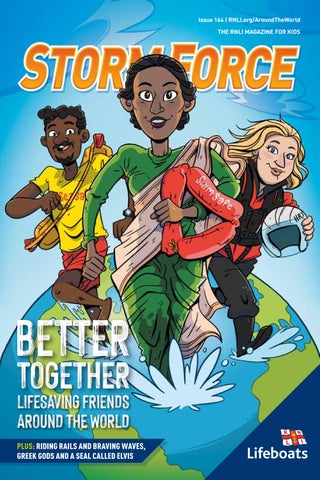
Issue 164 | RNLI.org/AroundTheWorld THE RNLI MAGAZINE FOR KIDS
BETTER TOGETHER LIFESAVING FRIENDS AROUND THE WORLD
PLUS: RIDING RAILS AND BRAVING WAVES, GREEK GODS AND A SEAL CALLED ELVIS
GREEK
CONTENTS
SALAD
4 We have a winner! 5 Latest rescues 6 Read this comic! 8 International heroes 10 Glorious Greece 12 Colour this rescue! 14 Your pictures 15 Trains vs lifeboats 18 Crack these puzzles! 20 Big laughs 22 Answers 23 Send your stuff! 24 Spot these lifeboats
KEBABS
We’re exploring Greece this issue – so why not have a go at this bite-sized version of a classic Greek dish? These yummy salad kebabs are simple to make and will keep nice in the fridge for a couple of hours. Kali orexi!*
WANT MORE ACTIVITIES? HEAD TO RNLI.org/AroundTheWorld Why not pass your mag to a friend when you have finished?
YOU WILL NEED: • Cherry tomatoes • Feta cheese • Cucumber • Olives • Greek salad dressing or vinaigrette • Cake pop sticks or kid-safe food picks
*It means enjoy your food in Greek
IF YOU DON’T LIKE FETA AND OLIVES, HOW ABOUT USING CHUNKS OF CHEDDAR AND GREEN PEPPER INSTEAD?
INSTRUCTIONS:
1
2
PREPARE
GET BUILDING
Ask a grown-up to chop the feta and cucumber into small cubes.
3
Thread a tomato, feta cube, cucumber chunk and olive onto each cake pop stick.
4 FINISHING TOUCH
Before serving, drizzle your kebabs with salad dressing.
ENJOY!
OVERBOARD AND BITTER COLD
IT’S 3 MAY 2025. SEB AND KYRA TAKE A BREAK FROM CLEANING HER DAD'S BOAT AND HEAD FOR CHRISTCHURCH QUAY ON SEB’S JET SKI. EVERYTHING IS OK AT FIRST BUT THEY START HAVING ENGINE TROUBLE.
IT’S STARTING TO GET WINDY AND THE SEA IS TURNING CHOPPY. THEY DECIDE TO HEAD FOR SHORE BUT THE ENGINE SUDDENLY CUTS OUT AND THE JET SKI STOPS, THROWING THEM BOTH INTO THE COLD WATER.
SEB’S PHONE IS AROUND KYRA’S NECK IN A WATERPROOF POUCH BUT, IN THE CONFUSION, IT FALLS INTO THE SEA.
FOR THE NEXT 30 MINUTES, KYRA WAVES TO PASSING BOATS FOR HELP. BUT NOBODY SEES THAT THEY ARE IN DANGER.
THEY CAN’T BOTH GET BACK ONTO THE JET SKI WITHOUT IT TIPPING OVER, SO SEB STAYS IN THE WATER AND TRIES TO SWIM THEM BACK TO THE BEACH.
EVENTUALLY, A FISHERMAN SPOTS THE PAIR AND BRINGS THEM ONBOARD. BY NOW, SEB IS DANGEROUSLY COLD. HIS FACE IS BLUE AND HE’S STRUGGLING TO STAY AWAKE.
7 THE FISHERMAN CALLS 999 AND MUDEFORD RNLI VOLUNTEERS LAUNCH THEIR B CLASS LIFEBOAT TO THE RESCUE.
OUR LIFESAVERS HELP SEB AND KYRA ONTO THE LIFEBOAT, REALISING THEY ARE BOTH SUFFERING FROM HYPOTHERMIA.
BACK ON DRY LAND THEY ARE HELPED INTO THE STATION BY THE CREW TO GET WARMED UP AND HAVE FURTHER MEDICAL CHECKS.
SEB AND KYRA BOTH MAKE A FULL RECOVERY. SEB IS LUCKY: IF HE HAD BEEN IN THE COLD WATER FOR 10 MORE MINUTES, HE MAY NOT HAVE SURVIVED.
THEY ARE TAKEN TO THE CREW ROOM AND WARMED UP SLOWLY WITH SHOWERS, DRY CLOTHES AND UNDERFLOOR HEATING.
If you fall into cold water FLOAT on your back 1. Tilt your head back, with your ears in the water 2. Relax and try to breathe normally 3. Stretch out your arms and legs to find a comfortable floating shape 4. Gently move your arms and legs to help you float 5. Stay calm. Raise an arm and shout for help. Or swim to safety if you can.
‘WE’RE SO GRATEFUL THAT THE RNLI CREW WERE THERE SO QUICKLY,’ SAYS SEB. ‘THEY HELPED US AND REASSURED US. WE FOUND OUT AFTER THAT THEY WERE VOLUNTEERS, THAT MAKES US EVEN MORE THANKFUL.’
IN COLD WATER, YOUR MISSION IS TO FLOAT!
HEROES AROUND THE WORLD Did you know that the RNLI works with amazing lifesavers all around the world? When you’re faced with a big problem like drowning, it’s better to solve it with good friends. Meet some of ours here!
URUGUAY: LIFE
When an RNLI lifeboat crew gets a new lifeboat, their old one sometimes goes on to do amazing things in other places. Some of our lifeboats have even travelled across the Atlantic Ocean to Uruguay in South America, where they continue saving lives with our friends on the lifeboat crews there! The first RNLI lifeboat went to Uruguay in 1957 and was called the Greater London. It was also the very first lifeboat in Uruguay!
GHANA: YOUN
G PEOPLE
With its long Atlantic coastline, rivers and lakes, Ghana has a lot of water! And in the rainy season, parts of its capital city Accra flood. So, we’ve been working with our friends at the Felix Foundation – named after a man called Felix (not the cat!). Together we’ve created fun lessons for in the classroom and in water that teach young people swimming, rescue and safety skills – like how to check how deep the water is. 'Since the lesson, I use a stick to check my path in waterways whenever it rains' Class 4 student, Ghana
BOATS
9
RS
ISHE F : A I N A Z N A T In northern Tanzania is the world’s largest tropical lake: Lake Victoria. And it’s huge! Imagine the whole area of London, then multiply it by 38 – that’s how big it is! Thirty million people live around Lake Victoria and 100,000 people work on the lake as fishers. It’s a tough job and the deadly Musoke (drowning wind) easily capsizes boats. We’re working with Tanzanian communities to make sure more fishers can have good lifejackets, rescue training and weather information.
NES
TTLE O I L : H S E D A L G N BA
Did you know that Bangladesh has more than 5,000 miles of rivers, canals and ponds? There’s so much water around that 40 children drown every single day. It’s very sad and we know it doesn’t have to be this way – so we’re working with our friends there to change this. We’ve helped support lifeguards, swimming lessons and even anchals (like play schools) for little ones to be safe during the day when their parents have to work.
FINLAND: RESCUERS mara
Our crew mate Ta
Since 2012, more than 500 RNLI lifeboat crew members have taken part in an exchange programme with other European lifeboat crews. They spend time in each other’s countries, learning how they save lives at sea there. It’s a brilliant way to make friends – and to trade rescue tips and techniques with each other. Last year, Falmouth RNLI Helm Tamara Brookes went to Finland to train with a Finnish lifeboat crew. She says it was: 'thrilling, interesting and inspiring!'
10 16
S U IO
etter known c Republic (b ni le el H e Th y tip of s on the sunn as Greece) lie s ou for its Europe. Fam south-east food and us io ory, delic ancient hist country has Games, the the Olympic ed across tt islands do thousands of r of search be m and a nu three seas – ams working and rescue te ve lives. sa together to
R O L G
E C EE
GR
nd of Assos, on the isnlad seals ge lla vi g in sh fi ul The beautif e to endangered turtles … a Kefalonia. Hom
THE COUNTRY
and ears, jackals b o t e m o h sts are Greece’s foarere full of cats! Its cities
deer.
Surrounded by the Mediterranean, Ionian and Aegean seas, Greece has the longest coastline in Europe. The country is divided into three areas: the mainland, the Peloponnese (a big chunk of land in the south), and about 6,000 islands – including Crete. The mainland has rugged mountains, forests, rivers and lakes – and a canyon that’s more than 1km deep. Summers are hot and dry, winters are mild and rainy, and earthquakes are common!
PEOPLE AND FOOD Family is an important part of Greek life and many people stay with their parents even after they get married! Greek people live long lives. Some say it’s because they have healthy diets that include olive oil, fish, lamb and plenty of fresh fruits and vegetables. Olive trees have been grown in Greece for more than 6,000 years, and almost every village has its own olive grove.
Photos: Shutterstock
Souvlaki (meaning ‘litt le skewer’) is a tast of bite-sized pieces of meat, cooked over aygrdish ill
ANCIENT OLYMPIANS WONDER IS THE BEGINNING OF WISDOM!
The ancient Greeks had lots of brilliant ideas about science, medicine, art and philosophy (thinking deeply about life). They invented the alphabet (many English letters are based on Greek ones), democracy (where people choose their government), geometry (maths about shapes) – and even lighthouses! The Greek king, Alexander the Great, helped spread these ideas around the world. The Olympic Games began in Greece as a festival for the god Zeus and became a worldwide sports event.
LAND OF THE GODS The ancient Greeks believed in lots of gods and built temples to worship them. When the Romans conquered the country more than 2,000 years ago, they copied and changed some of these gods. You may recognise a few from DC and Marvel films: Zeus (the Greek god of the sky) became the Roman god Jupiter, Poseidon (god of the sea) became Neptune, and Aphrodite (goddess of love) became Venus.
uilt in honour B s. en th A in le temp The Parthenonddess of wisdom and war of Athena, go
THE LIFESAVERS
Lifesavers on Lesvos use ex-RNLI lifeboats in their sea rescue missions around the island
The sea is very important to Greeks – connecting all their lands like a busy, watery motorway! The Greek coastguard is in charge of sea rescues. It has a fleet of lifeboats and aircraft but also relies on volunteer organisations in emergencies. Probably the biggest one is the Hellenic Rescue Team (HRT). It has lifeboat crews like the RNLI, but also has mountain rescue experts and disaster response teams that help in earthquakes.
SPOT THE G N I T T SPO CARD AT O B E LIF
HAVE YOU LOOK OUTSPOTTED FOR ALL NINE THESE RNLIDIFFERENT RESCUE CLASSES OF LIFEBOAT CRAFT WHEN YOU'RE AROUND THE UK OUT AND ABOUT AND IRELAND?
WHEN YOU SEE ONE, TICK IT OFF HERE!
D CLASS
D-XXX
B-XXX Spotted!
D-000
B CLASS
B-000
17-XX Spotted!
XXXXXXXXXXXX
17-00
TAMAR
16-XX
Spotted!
D-000
SEVERN
E CLASS
E-XX
A-XX Spotted!
XXXXXXXXXXXXXXXXXXXXXXXXXXXXX
INSHORE RESCUE BOAT
SHANNON
13-XX RNLB BRIANNE ALDINGTON
Spotted!
RNLB BRIANNE ALDINGTON
RNLI 13-21
TRENT
14-XX
RNLI 13-21
Spotted!
RESCUE HOVERCRAFT
H-XXX
XXXXXXXXXXXXXXXXXXXXXXXXX
XXXXX
16-00
Spotted!
FIND MORE FUN ACTIVITIES AT RNLI.org/AroundTheWorld
14-00
Spotted!
XXXXXXXXXX
Spotted!