OFFSHORE Winter 2026–27 | ISSUE 109
LIVE LIFE TO THE FULL AT THE COAST RNLI.org
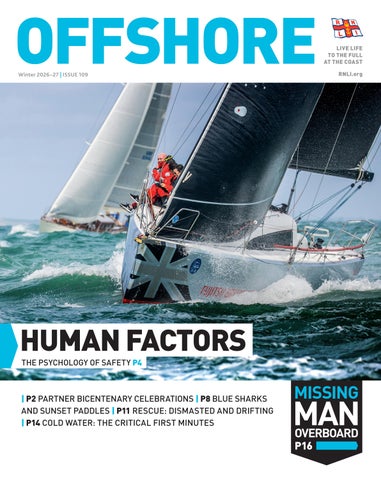
HUMAN FACTORS THE PSYCHOLOGY OF SAFETY P4
| P2 PARTNER BICENTENARY CELEBRATIONS | P8 BLUE SHARKS AND SUNSET PADDLES | P11 RESCUE: DISMASTED AND DRIFTING | P14 COLD WATER: THE CRITICAL FIRST MINUTES
MISSING
MAN OVERBOARD P16
WELCOME Dear reader On the water, enjoyment goes hand in hand with preparation. In this issue, we explore how willingness to learn leads to good decision making when it counts. Page 4 introduces the RNLI's human factors approach to safety learning. Taking time to understand how things unfold can help us all become safer. Then journey to Plymouth (page 8), where your local RNLI volunteers share their highlights – from sailing and paddling to unforgettable shark encounters. We hear from a skipper who learned the value of early communication, when his yacht dismasted close to The Manacles (page 11). On page 14, we focus on the critical first minutes in cold water – and the simple actions that improve your chance of survival. Finally, put yourself to the test with a missing man overboard scenario on page 16. Thank you for your steadfast support in our mission to save every one. Please see page 4 of Lifeboat magazine for a special message from our Chief Executive. Have a wonderful festive season and see you next year!
dunnāco
RNLI partner GJW Direct celebrates 200 years of business
dunnāco lee-morikū and the Offshore Team Email: offshore@rnli.org.uk
Photo: RNLI/Andy Parish
Winter 2026–27 | ISSUE 109 ©RNLI 2026. All rights reserved. Reproduction is permitted with the prior consent of the RNLI. Opinions expressed by authors are not necessarily those of the publishers. Care is taken to ensure that editorial information is correct at the time of going to press but is subject to change. Chair: Janet Legrand KC (Hon) Chief Executive: Peter Sparkes Offshore Editor: dunnāco lee-morikū Offshore Designer: Andy Perryman
Front cover photograph: RNLI/Andy Parish (J261732050)
2
CONTACT US Would you prefer to receive a digital copy of Offshore magazine or not receive it at all? Are you moving house? Do you have another question? Then please email supporterexperience@rnli.org.uk with your request, including your supporter number. You can also call us on 0300 300 9990 (from the UK), 01 511 9836 (from Ireland) or +44 1202 663234 (from any other country), or write to us at RNLI Support Centre, West Quay Road, Poole, Dorset, BH15 1HZ.
GIFT IDEAS from shop.RNLI.org/offshore RNLI MEMBERSHIP BEANIE HAT, NAVY Show your support and inspire others with this exclusive beanie, embroidered with the RNLI member logo. The perfect accessory for chilly mornings on the water. 100% acrylic. One size. RRP: £10/€12 Ref: RS2442112
ON THE RADAR:
MEET OUR
GJW DIRECT 200TH ANNIVERSARY
In this issue of Offshore, quotes, practical advice and lifesaving tips are brought to you by:
Bring out the birthday bunting for our partner GJW Direct marine insurance!
ADRIAN WOOLRICH-BURT
As well as providing insurance to the boating community since 1826, GJW Direct has been an RNLI partner since 2018. A partnership that now includes its new sister companies Insure4Boats and CraftInsure, under the umbrella of Ripe. Our corporate partnerships help us save more lives at sea. Throughout the year, the people at Ripe will share vital water safety information with their customers – from our Float to Live advice to boating safety essentials. Ripe CEO Alan Thomas says: 'The RNLI's work is vital, and we're proud to stand alongside them. Our partnership reflects a shared commitment to helping more people enjoy the water safely. We look forward to continuing to support their mission in the years ahead and share lifesaving water safety advice with a growing audience of coastal and boating communities.'
RNLI HUMAN FACTORS TRAINING LEAD
Adrian is a former airline training captain, RNLI Thames commander and London Ambulance Service liaison lead.
DEBRA SEARLE VOLUNTEER CREW MEMBER, PLYMOUTH RNLI
As well as saving lives, Debra is an adventurer who's rowed the Atlantic solo and has won world championship medals in dragon boating.
NIKKI BONIFACE RNLI SEA SURVIVAL TRAINER
' The RNLI's work is vital and we're proud to stand alongside them' Alan Thomas | CEO of Ripe
Nikki was a member of the British Sailing Team and an Olympic sailing development coach. She now trains RNLI lifesavers.
TIM DORAN
Photo: Ripe
FIND OUT MORE
RNLI NATIONAL WATER SAFETY PARTNER
For water safety advice visit RNLI.org/water-safety To read more about the partnership visit gjwdirect.com/RNLI
Tim creates high-impact RNLI water safety partnerships that save lives. He also surfs and swims marathons.
Find exclusive members-only items at shop.RNLI.org/members
RNLI AIRFIX SHANNON KIT This Airfix 1:72 scale Shannon class lifeboat kit makes a great gift for lifeboat lovers and maritime enthusiasts. The kit includes poly cement, two paintbrushes and six acrylic paints. Suitable for ages 8+.
RNLI ICONS MAP A5 JOURNAL WITH PEN
RRP: £20/€24 Ref: RS0012801
This A5 journal and attached pen is perfect for jotting down important notes or documenting your coastal adventures. Featuring illustrations by volunteer Crew Member Jonty Storey.
Additional Airfix Shannon decals RRP: £10/€12 Ref: RS2412801
RRP: £9/€11 Ref: RS2263108VAR
Please visit shop.RNLI.org/policies for all T&Cs, delivery information and Republic of Ireland guidelines on pricing and customs duties, taxes or other fees.
3
NEED TO KNOW
HUMAN FACTORS
DECISION MAKING UNDER PRESSURE
4
NEED TO KNOW
When a routine call out becomes life-threatening, shock and startle can affect lifesavers. RNLI human factors training helps crews recognise the signs and respond effectively as a team The launch bell rang at the station just after 10am. Daily checks were complete and the crew were sitting down to their second and probably favourite breakfast of the day. The tasking seemed routine: assist London Fire Brigade with a person reported to be stuck in the mud on the Thames foreshore. This is the kind of call Thames lifeboat crews understand well. It is serious, but familiar. Whatever the tasking, crews assess conditions, brief the approach, work with other agencies and prepare for what may happen next. But when the crew arrived, they found a situation significantly different from the tasking. The casualty was not stuck in the mud. He was in fast-flowing water 15m deep. In that instant, the timeline changed. What had been a problem measured in hours before the tide reached the casualty in the mud became a life-threatening situation measured in minutes. SHOCK AND STARTLE Shock and startle are normal human responses to abnormal situations. They can temporarily disrupt attention, thinking and decision making, even for experienced people. Pulse rises, breathing quickens and shallows, muscles tense. Attention can narrow. People can easily become fixated on the initial plan, miss new information or find typically simple tasks unexpectedly difficult.
Lifeboat crew build well-practised skills and resilience through training
For lifeboat crews, this matters because maritime search and rescue is full of variables. Information available at launch rarely describes exactly what crews find on arrival. Conditions, casualties and priorities can change quickly. A search for a missing person can become a recovery from the water. A medical emergency can happen during a routine tow. A minor mechanical issue can turn serious very quickly in darkness, weather or traffic. COURAGE MEETS PREPARATION The RNLI's human factors approach stems from a simple premise: high performance depends on understanding how people think, communicate and make decisions under pressure. Courage matters as much today as it did when the RNLI's Founder Sir William Hillary wrote: 'With courage, nothing is impossible.' Now, we also have a better understanding of how people respond to stress, and how
' Shock and startle are normal responses to abnormal situations. They can temporarily disrupt attention, thinking and decision making'
preparation, communication, leadership and teamwork support performance. On the Thames that morning, the crew had to adapt quickly. The casualty needed immediate help. Busy river traffic had to be stopped in both directions. The crew had to recover a person from fast-flowing water while considering water temperature, medical care, and which of the hundreds of piers, jetties and wharfs was most suitable to rendezvous with an ambulance. Every part of the response depended on teamwork. No one can do all of that alone. KEEPING EACH OTHER SAFE At the RNLI, we train and assess crews in core human factors subjects including communication, leadership and teamwork, situational awareness, and decision making under time or emotional pressure. These are not optional extras, they are the core skills that make a high-performing team perform even better. A lifeboat is not only made safer by engines, radios and navigation equipment. It is also made safer by the way the crew share information, check assumptions, challenge respectfully and keep verbalising their thoughts when pressure rises. Maritime search and rescue is unpredictable. We cannot train for NEED TO KNOW
5
SAFETY TAKES COURAGE
Crew learn how to communicate well under pressure
Safety Takes Courage reinforces a simple message: to deliver effective maritime search and rescue, we also need to operate safely. Sometimes that takes courage – the courage to speak up, slow down, challenge an assumption or make a robust decision when pressure is high. This is best achieved when the whole crew feel part of the decisionmaking process. This builds a resilient team that can cope with anything maritime search and rescue might throw at it.
' What has changed, who needs to know, and what do we need to do to stay safe and complete this task?' Adrian Woolrich-Burt | RNLI Human Factors Training Lead
everything, so we train for anything. This means building well-practised skills and resilience, and recognising when the situation is no longer matching the original plan. This is practical safety training. Physical signs of stress can be useful because they are easier to notice than the cognitive effects that may accompany them. Crew are trained to understand that when they notice their heart or breathing rate increasing they can assume that their mental ability will be decreasing. They actively look for tunnel vision, task fixation, confirmation bias, and confusion. Recognising these signs early gives crews the ability to keep performing effectively when under pressure. Crew are trained to: state the change out loud, share the picture, confirm the 6
NEED TO KNOW
plan, give people clear jobs, check for obvious errors, invite challenge, have confidence in the person who sees something that they’ve missed. BEYOND LIFEBOATING These same principles apply far beyond lifeboat operations. Offshore readers know that things can and do go wrong quickly on the water. A yacht crew member hits their head. Visibility closes in. A line jams. A fire starts. The engine fails near a lee shore. Someone becomes unwell. In those moments, the first plan may no longer be the right plan. The key inquiry we teach lifeboat helms and commanders to make is: 'What have I missed?' It's an open question that invites comment. It's a style that deepens, rather than diminishes, leadership. Additional
questions you can consider during your own activities include: what has changed, who needs to know, and what do we need to do to stay safe and complete this task? The best crews, whether professional, volunteer or recreational, brief before safety-critical activities such as operating at high speed, towing another vessel or manoeuvring in shallow water. These crews will assess risks together, agree their roles and responsibilities, and make sure that everyone has chance to speak up if conditions change. This is not bureaucracy, it's resilience. CRITICAL LEADERSHIP SKILLS The casualty on the Thames was recovered into the lifeboat, given medical attention and then handed over to the London Ambulance Service
' One of the things I found really refreshing when I joined the RNLI was that you are expected to speak up. The commander is always the commander, and that is clear, but search and rescue is not about everyone else sitting there waiting to be told what to do. We have to work as a crew, and that means if you see something that others have missed, it's your responsibility to speak up. Everything we do, we do as a team.' Liam Sidders | RNLI Thames Commander
WHY HUMAN FACTORS? Human Factors and Operational Decision Making training grew from the recognition that accidents are rarely caused by technical failure alone. Aviation was one of the first industries to systematically study how communication, workload, leadership, stress and decision making affect the ways people react and perform. Similar approaches were later adopted in surgery and pre-hospital medicine, where teams also work under pressure with incomplete information and little margin for error. These lessons have been transformative. The RNLI is now leading the way in applying them to maritime search and rescue. This programme has already shown that it helps crews make safer and more effective decisions. And we look forward to sharing more of this knowledge with Offshore readers too.
' A lifeboat is not made safe only by engines, radios and navigation equipment. It is also made safer by the way the crew share information, check assumptions, challenge respectfully and keep thinking together when pressure rises' Critical leadership skills make use of all available resources
Hazardous Area Response Team. Their life was saved that day. This outcome did not happen by chance. The crew were prepared to absorb surprise, share workload and act as a team. The RNLI's Human Factors and Operational Decision Making training programme is designed to help crews use all of the resources available to them. Human factors help make high performance more reliable by turning experience, courage and seamanship into effective action under pressure.
These behaviours are part of the RNLI's Critical Leadership Skills and are an established part of how we operate. They help crews use all the resources available – people, information, training, equipment, teamwork and trust – while keeping the casualty and crew at the centre of every decision. When things go wrong at sea, nobody is immune to shock and startle. But with human factors training, the physical responses we've talked about become useful information: a visible clue that
Adrian Woolrich-Burt | RNLI Human Factors Training Lead
there are less obvious changes in thinking happening. Recognising these cues helps crews strengthen their team and make better decisions together when the unexpected happens. Words: Adrian Woolrich-Burt and dunnāco lee-morikū Photos: RNLI/(Adrian Woolrich-Burt, Liam Sidders)
READ MORE
RNLI.org/CrewTraining ■ NEED TO KNOW
7
Love where you live ...
PLYMOUTH Few places let you paddle at sunset, motor upriver for dinner, then head offshore in search of blue sharks at sunrise. In Plymouth, that's just the start
SHELTERED COVES, RICH WILDLIFE AND SEA VIEWS AT EVERY TURN 8 LOVE WHERE YOU LIVE
The city unfolds in tiers before giving way to moorland
Join a group for a paddle
DEBRA SEARLE
VOLUNTEER CREW MEMBER, PLYMOUTH RNLI
We have the best of both worlds here. Plymouth Sound stretches out below the city like a huge natural amphitheatre – a great bowl of water protected by the breakwater – while Dartmoor rises beyond. The city unfolds in tiers from the Barbican to the Hoe, before giving way to open moorland. I've spent my life seeking adventure and I love having both within reach. It's completely unique. On weekends you'll find me out at sunrise, paddling around Drake's Island. The Sound is waking up, cormorants are drying their wings in the morning light and, if you're lucky, you'll have the water to yourself. The little sea cave at Jennycliff is another favourite spot. You can paddle right inside and look up through the roof to the sky above. It takes my breath away.
' I love the diversity of this city' I love that you don't have to travel far to find adventure. The South West Coast Path winds along the coast, Dartmoor's right on your doorstep, and there's always another cove waiting to be explored. Always check the forecast before heading out. Plymouth Sound can feel calm and sheltered, but conditions change quickly beyond the breakwater.
There are regattas throughout the season
SAM STEPHAN
VOLUNTEER MECHANIC, PLYMOUTH RNLI
It's easy to get out on the water here. When I have a free evening, I can jump in a boat, cruise along the coast and find a beach for a barbecue or head up the River Yealm for dinner. On the right tide, you can take a small boat up the estuary and tie alongside nice spots to eat. It feels a world away from the city. Plymouth's fantastic for boaters because it's naturally deep and incredibly accessible. Whether arriving or setting off from here, you've got everything you need – from marinas and chandlers to places to stop. Heading east, you've got
Salcombe and Dartmouth within easy reach. Westwards, you've got Whitsand Bay and Looe. Locally, Cawsand is a popular place to moor up for the weekend. There are also Cornish pilot gig rowing groups here, and the new GigRower European Championships in July.
' You never know what's going to happen. Every day can be different' For SUP or kayaking, the local bays are good options. A word of caution: sometimes the currents pick up. And choosing the right wind direction is key – the other day, we picked up some people who went out on an offshore wind and kept going! LOVE WHERE YOU LIVE 9
BEYOND THE BREAKWATER The natural inlet (or sound) around Plymouth is reasonably sheltered from bad weather. However, once you venture beyond the breakwater, conditions can worsen quickly. It may suddenly go from flat calm to unmanageable swell. This catches people out, especially kayakers and other paddlers. But boaters too can be caught out. The water gets very deep close to the shoreline beyond Plymouth Sound. So if you're drifting, you may not have enough anchor line to secure yourself. It's a wise idea to carry a drogue in these waters. And to consider the topography of any area you're sailing, and what you may need in an emergency. Refresh your sailing safety knowledge at RNLI.org/sailing.
Mola mola are occasional visitors
Drake's Island, in Plymouth Sound 10 LOVE WHERE YOU LIVE
Plymouth offers great boating
SAM BALDERSON
VOLUNTEER CREW MEMBER, PLYMOUTH RNLI
People are surprised by what turns up off the south Devon coast. As head ranger for Plymouth Sound National Marine Park, I spend my time helping people discover what's living beneath the surface. It's amazing how many opportunities there are to see things for the first time. Take Wembury Bay – the rockpools are full of life and it's a great spot for snorkelling. Devon Wildlife Trust offers rock pool safaris out of Wembury Marine Centre. Or join the Rock Pool Project's monthly BioBlitz Battles at Firestone Bay. Offshore, encounters get even more exciting. We regularly encounter dolphins, including the octopusspecialist Risso's – who are enjoying the second year of an octopus bloom. Always follow the WiSe Code of Conduct or choose a WiSe-certified operator to make the experience safer for both you and the wildlife. Then there are the pelagic blue sharks – which really are a brilliant blue from above. Plymouth Marine Safari's trips for experienced snorkellers have taken off. They head into deeper
TELL US WHERE YOU LOVE
Blue sharks pass through in summertime
offshore water, turn the engine off and release chum to drift with the current. Blue sharks are beautiful and curious animals. Once comfortable, they'll often spend an hour or more around the boat. Encounters like this can completely change our perception of sharks. You can learn all about our shark and ray species from local charity the Shark Trust.
' Offshore, encounters get even more exciting' So keep your eyes open in the blue – you never know what will surface! This year we've had basking Mola mola hanging around, following the jellyfish. And every year there are occasional sightings of Porbeagle sharks and Minke whales. The sea here just gives and gives. FIND OUT MORE • visitplymouth.co.uk • gigrower.co.uk • plymouthsoundnationalmarinepark.com • wemburymarinecentre.org • therockpoolproject.co.uk • thewisescheme.org • plymouthmarinesafari.co.uk • sharktrust.org Words: dunnāco lee-morikū Photos: Debra Searle, Fergus Kennedy, Geoff Squibb, RNLI/(Darren Blight, Andy Parish, Nathan Williams), Shutterstock.com
Let us know which area of coastline you'd like to see here in future issues by emailing offshore@rnli.org.uk.
RETRO RACE
DISMASTED NEAR THE MANACLES RESCUE
The Manacles, Lizard Peninsula, Cornwall
Falmouth Shannon class all-weather relief lifeboat George and Frances Phelon
Blue Dolphin's skipper was looking forward to a nice cuppa when a huge bang shattered the calm. Moments later, the yacht's 17m mast came crashing down, leaving boat and crew in trouble off a dangerous stretch of rocks In April 2025, Dr Richard Ayres and two friends were on passage to the Isles of Scilly onboard his Southerly 42, Blue Dolphin. With a fresh breeze running, sailing conditions were ideal. 'It was a lovely morning,' Richard says. 'We had full sails up and everyone was happy.' Richard was at the helm, thinking about switching to autopilot and making a cup of tea, when he suddenly felt a huge bang. At first, he thought they'd hit something. Then he heard a 'whoosh' and saw something flash past his head, ripping a large winch off the side of the vessel. 'I realised that the whole mast, the sails and everything were in the water on the starboard side. Obviously, that's bad, particularly when you're right by The Manacles,' he says, referring to the notorious group of rocks lying off Cornwall's Lizard Peninsula.
Force 5 Fresh breeze 1.5–2.5m waves moderate chop
DR RICHARD AYRES
' You've got this enormous mast trying to stove your boat in' Dr Richard Ayres | Skipper, Blue Dolphin
Richard's first instinct was to make a mayday call. But the dismasting had also taken out the yacht's main means of communication. 'I realised that the VHF aerial was on the mast and the mast was under the water. So, that wasn't going to work,' he says. Luckily, one of his crew mates was able to call for help using a mobile. Richard knew the immediate danger wasn't losing the mast, but what the wreckage might do to the yacht. 'You've got this enormous mast trying to stove your boat in,' he says. 'The whole thing is in the water, but the base is still attached. So it acts like a battering ram.' RESCUE 11
HUMAN FACTORS INSIGHT: 'Shock and startle are natural responses to something unexpected. They prepare us to react quickly: our body releases adrenaline, causing a racing pulse and rapid breathing. But hidden effects also include tunnel vision, confusion and difficulty processing information. RNLI sea survival training teaches lifeboat crews to deliberately 'pause, plan and brief' – stop, assess what's changed, decide what to do, then share the plan with the crew. These vital seconds improve performance and can prevent critical mistakes.' Adrian Woolrich-Burt | RNLI Human Factors Training Lead
R ESCU E H E A D C A M
01
03
R N LI LIF EB OATS
R N LI LIF EB OATS
02
04
Falmouth RNLI crew work alongside Blue Dolphin to clear the remains of the fallen rig. With the yacht unable to continue under its own power, the lifesavers take it under tow and safely into harbour. 12 RESCUE
EXPERT ADVICE
' YOUR BOAT IS YOUR BEST CHANCE OF SURVIVAL' Elliot Holman | Coxswain, Falmouth RNLI
'If your rig comes down, don't waste time trying to save it. That's more likely to cause serious injury and could even end up punching a hole in your hull. Your boat is your best chance of survival, so cut the rig away safely and quickly, then focus on keeping afloat. Carry decent hacksaws or hydraulic wire cutters for exactly that reason. If you need help, use every means available: carry a backup VHF aerial in case you lose your main one with the mast, call 999 or 112 on a mobile, use a location app such as what3words, and don't forget about EPIRBs and PLBs. People often carry them but forget to use them.'
Knowing the rig had to be cut free, Richard set to work on the remaining stays. The yacht's bolt cutters were near useless on the heavy stainless-steel cables, leaving him to rely on a hacksaw. Working on the damaged side deck, with broken guardrails and waves breaking over the side, was no easy task. 'With the help of adrenaline, I managed to cut through four of the cables,' he says. 'It was all a bit hairy.' Eventually the mast separated from the deck, though it remained attached at the bow. As Richard worked to free the remaining tethers, there was a welcome sight on the horizon. 'That's when I saw the lifeboat,' he says. Onboard the relief Shannon class lifeboat George and Frances Phelon, Falmouth RNLI Coxswain Elliot Holman and his crew faced a complex scene. 'We've got a mast hanging over the side. There's debris in the water, there's lines, there's sails, there's this wire,' Elliot says. With the yacht rolling in a 2m swell and a tangle of rigging alongside, getting RNLI volunteers across required precision. 'Doing a boat transfer, there's a lot that can go wrong, especially in choppy conditions,' he adds. Once two RNLI crew members were safely onboard the yacht, they helped Richard and his crew free the remaining wreckage. When the final connection was severed, the rig disappeared beneath the surface. Ropes had already fouled the yacht's propeller, leaving it without any means
SHARE YOUR STORY
' If we hadn't been there, they would have ended up on those rocks' Elliot Holman | Coxswain, Falmouth RNLI
of propulsion. So, the lifesavers took Blue Dolphin under tow and escorted it safely into Pendennis Marina. The cause of the sudden dismasting only became clear later. A marine surveyor found that one of the yacht's chainplates had failed, due to a hidden defect within the metal. 'Nobody could have predicted it,' says Richard. 'Short of X-raying it, we couldn't have known it was there.' For Richard, though, the strongest memory is the sight of the lifeboat arriving: 'It's the best thing you've ever seen, you know? Because I knew we were in a lot of trouble.' Elliot is in no doubt about how serious the situation had become. 'Ultimately, if we hadn't been there, they would have ended up on those rocks.'
BOOST YOUR SKILLS Make sure you and your crew know what to do in an emergency. Get our essential boating checklists at RNLI.org/BoostYourSkills ■ Words: Jon Jones Photos: RNLI/(Falmouth, Nigel Millard)
Offshore is a space for sharing our experiences and increasing our knowledge. Do you have a story about a time things went wrong on the water, or news about ways you're advancing water safety or watersports participation? If so, please email offshore@rnli.org.uk. RESCUE 13
HOW SURVIVE TO: COLD WATER
Even experienced seagoers find themselves in the water unexpectedly. Add cold into the mix and you're struggling within seconds. Knowing what to do in those first few minutes can make all the difference In water below 15°C, the immediate danger is cold water shock – hypothermia takes longer to develop. Cold water shock can cause involuntary gasps, rapid breathing and panic, increasing the chance of inhaling water. 'Getting your breathing under control is vital,' says RNLI Water Safety Partner Tim Doran. 'Try not to panic. Float on your back if you can, then think about your next steps. Stay with your vessel or equipment if it's safe to do so, conserve energy, call for help and, if you're not able to swim to safety, Float to Live until help arrives.' And there are vital steps to take before you even head out. 'Preparation is important to improving your chance of survival,' says Tim. 'Share your plans, check your equipment, wear the right clothing for your activity, and make sure, for example, your buoyancy aid fits properly and your kayak is watertight (if relevant). Check the forecasts and daylight hours, particularly in winter when it gets dark early. Always carry a means of calling for help, whether that's a phone in a waterproof pouch, a VHF radio, or a PLB. These are all sensible precautions.' 14 HOW TO
FLOAT TO LIVE
RNLI NATIONAL WATER SAFETY PARTNER TIM DORAN SHARES TOP TIPS FOR WHAT TO DO IF YOU FIND YOURSELF IN COLD WATER
1 2 3 4 5
BEFORE SETTING OFF Tell someone your plans. Pack a warm drink and wear layers, gloves and a hat. Check equipment, tides, weather, daylight hours and sea temperature. Always carry a means of calling for help – and know how to use it.
STAY CALM If you unexpectedly enter cold water, fight your instinct to thrash around. Tilt your head back, keep your airway clear and focus on steadying your breathing. Once your breathing is under control, you can make a plan.
Check conditions and daylight hours before you head out
STAY AFLOAT Float on your back with your ears submerged and arms and legs spread out. To help flotation and visibility, stay with your vessel or equipment as long as it's safe to. If separated from it, Float to Live.
COMMUNICATE Once calmer, call for help and conserve energy. Use a waterproofed phone or VHF radio, or activate your PLB. If available, use the whistle attached to your buoyancy aid. This travels further than a shout and uses less energy.
Always carry a means of calling for help
WAIT FOR RESCUE If you're with others in the water, stay together and huddle for warmth. Make yourself as visible as possible to rescuers. Use a torch or flashing light in poor visibility and continue using your whistle to attract attention.
FIND OUT MORE
Learn more about winter sailing: RNLI.org/WinterSailing
Words: Amy Bratley Photos: RNLI/(Harrison Bates, Nigel Millard), Shutterstock.com
In trouble? Stay calm and call for help HOW TO 15
WHAT WOULD YOU DO NEXT? SCENARIO
DO YOU
One of your crew has gone missing overboard, but you didn't see them fall into the water.
A Turn the boat around at full speed?
What do you do next?
C Stop immediately, note position, send a mayday and slowly retrace your route?
w
B Go to the nearest port and phone their next of kin?
EXPERT ANSWER
Reconstruction of a man overboard rescue
NIKKI BONIFACE
When someone goes missing overboard but you haven't seen them fall: stop, note your position, send a mayday, and slowly retrace your route (C). Gather the crew and make sure everyone else is accounted for as you make the call. When was the missing person last seen? What were they wearing? Were they wearing their lifejacket, or was it left behind? Are they wearing a personal locator beacon (PLB)? The coastguard will handle the wider rescue, so you can now retrace your route slowly, searching your immediate area thoroughly. Have as many people as possible looking from port and starboard sides. Watch for lights and listen for whistles or shouting. Prevention is best, so before heading out, make sure all crew have lifejackets and a safety harness to clip onto railings. Arrange a buddy system, so no one is ever alone on deck.
16
Photo: RNLI/Nigel Millard
SEA SURVIVAL TRAINER
RESCUE IN ROUGH SEAS On a February morning, Angle RNLI was tasked to a yacht in distress near Stokholm Island. The single-crewed 8.5m yacht was suffering engine failure, had blown out its sail and was taking on water. In seas up to 6m, the safest action was to take the vessel under tow. Shortly after starting the tow, the skipper was thrown overboard by a large wave. Attached by his harness, he was trailing by the vessel in the water, so the lifeboat crew immediately cut the tow. In rough conditions, a crew member boarded the yacht and cut the safety harness, so the casualty could be safely recovered. 'Clipping to your vessel is important for any sailor to avoid falling overboard,' says Angle Coxswain Lewis Creese. 'Here, even though we had to cut the harness, we knew exactly where the casualty was to pick them up. If they'd been washed overboard without a harness, they could have struggled and drifted quite a distance in the water.' ■
SPREAD THE WORD
In 2025, 47% of man overboard incidents attended by the RNLI were from motorboats. For safety advice about motorboating or yacht sailing visit RNLI.org/BoatSafety.
Royal National Lifeboat Institution, a charity registered in England and Wales (209603), Scotland (SC037736), the Republic of Ireland (CHY 2678 and 20003326) the Bailiwick of Jersey (14), the Isle of Man (1308 and 006329F), the Bailiwick of Guernsey and Alderney (CH135 and CH386), of West Quay Road, Poole, Dorset BH15 1HZ
OS/12/26