OFFSHORE Autumn 26 | ISSUE 108
LIVE LIFE TO THE FULL AT THE COAST RNLI.org
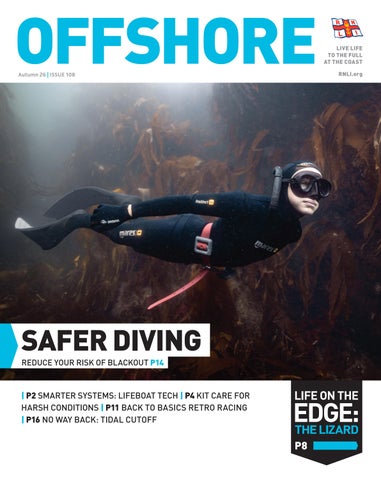
SAFER DIVING REDUCE YOUR RISK OF BLACKOUT P14
| P2 SMARTER SYSTEMS: LIFEBOAT TECH | P4 KIT CARE FOR HARSH CONDITIONS | P11 BACK TO BASICS RETRO RACING | P16 NO WAY BACK: TIDAL CUTOFF
LIFE ON THE
EDGE: THE LIZARD P8
WELCOME Dear reader As autumn brings more changeable conditions, we focus on preparation: equipping ourselves with skills and kit that stand up to the elements. Exploring the technical kit our crew and lifeguards wear, we see how careful selection and maintenance keep it fit for both lifesaving and longevity (page 4). On page 8, volunteers from The Lizard bring their peninsula to life – from gig rowing and boating to spotting basking sharks and diving protected maerl beds. Then, get onboard with Lymington Crew Member Gunnar Christensen as he prepares for a demanding solo retro race and shares how timeless seamanship skills still matter (page 11). And hear from British Freediving Association Chair Liv Philip on preventing shallow-water blackout when breath holding underwater (page 14). We close with a dreaded water-rising-around-yourankles tidal cutoff scenario (page 16) – what would you do next? Everything we do and share is made possible by your valued membership. Thank you for your support. Stay safe, wherever the season takes you.
dunnāco
dunnāco lee-morikū and the Offshore Team Email: offshore@rnli.org.uk
Photo: RNLI/Nathan Williams
Autumn 2026 | ISSUE 108 ©RNLI 2026. All rights reserved. Reproduction is permitted with the prior consent of the RNLI. Opinions expressed by authors are not necessarily those of the publishers. Care is taken to ensure that editorial information is correct at the time of going to press but is subject to change. Chair: Janet Legrand KC (Hon) Chief Executive: Peter Sparkes Offshore Editor: dunnāco lee-morikū Offshore Designer: Andy Perryman
Front cover photograph: Daan Verhoeven (J261569501)
2
CONTACT US Would you prefer to receive a digital copy of Offshore magazine or not receive it at all? Are you moving house? Do you have another question? Then please email supporterexperience@rnli.org.uk with your request, including your supporter number. You can also call us on 0300 300 9990 (from the UK), 01 511 9836 (from Ireland) or +44 1202 663234 (from any other country), or write to us at RNLI Support Centre, West Quay Road, Poole, Dorset, BH15 1HZ.
AUTUMN PICKS from shop.RNLI.org/Offshore RNLI DRYROBE® CAR SEAT COVER, GREY Whether you’re a swimmer, surfer, paddler or want to protect your car seats from muddy gear and dogs, this water-repellent cover is the ultimate accessory. Features the 'RNLI since 1824' logo. RRPs: £60/€72 (single), £75/€90 (double) Refs: RS2333502 (single), RS2333501 (double)
ON THE RADAR:
MEET OUR
RAYMARINE TRIALS Treacherous conditions, rescues in total darkness – saving lives at sea takes great courage. It also takes the best possible equipment. To help crew respond to emergencies at sea safely, swiftly and effectively, we're upgrading our lifeboat fleet with a new stateof-the-art lifeboat electronics system. Working with partners Teledyne Raymarine and FLIR Marine, lifeboats will be equipped with advanced navigation and thermal imaging technologies. The new digital system includes Raymarine’s Axiom multifunction displays with integrated vessel management features, allowing control of key capabilities from the safety of the crew's seats. It also features Quantum solid state radar, vector charting with radar overlay, auto-routing, enhanced navigational hazard warning, and Yachtsense digital switching – which replaces ageing technology and is used to monitor and control onboard systems. Crew have trialled the new system on a Shannon class lifeboat, with their feedback helping to shape the wider rollout. Eventually all RNLI lifeboats will be fitted with the system, helping crew save lives at sea now and for years to come.
' These enhanced features give our volunteer crews better situational awareness and navigational capabilities. They future-proof our fleet, allowing us to keep pace with modern technology' Fergus Holley | Senior Operations Manager and Volunteer Crew Member at Swanage RNLI
In this issue of Offshore, quotes, practical advice and lifesaving tips are brought to you by:
ALAN PARMENTER RNLI IN SERVICE SUPPORT LEAD AND VOLUNTEER CREW MEMBER
As well as being part of our expert Engineering Team, Alan saves lives with Swanage RNLI.
ANNA FRIZZELL RNLI SUSTAINABILITY MANAGER
Anna supports our environmental impact reduction and increased lifesaving resilience.
LIAM FAYLE-PARR RNLI WATER SAFETY DELIVERY SUPPORT
Liam, a former lifeguard, educates people in how to stay safer in, on, and by water.
LIV PHILIP CHAIR, BRITISH FREEDIVING ASSOCIATION
Liv is a record-breaking freediver who chairs the organisation representing the sport in the UK.
Find exclusive members-only shop items at shop.RNLI.org/members
MEN’S RNLI SINCE 1824 WATERPROOF FLEECE HOODIE, NAVY
AQUAPAC RNLI WATERPROOF PHONE CASE
Stay warm and dry whatever the weather with this versatile RNLI hoodie. Combining a 10,000mm waterproof outer layer with a thermo-soft Sherpa fleece lining. Available in sizes M–2XL.
Keep your phone safe and dry wherever your adventure takes you with this RNLI-branded case. Waterproof to 10m depth, it provides complete protection from water, sand, dirt and dust while still using your phone as normal. 11 x 20cm.
RRP: £80/€96 Ref: RS2440607NAV
RRP: £20/€24 Ref: RS2238209
Please visit shop.RNLI.org/policies for all T&Cs, delivery information and Republic of Ireland guidelines on pricing and customs duties, taxes or other fees.
3
NEED TO KNOW
EXPOSED TO THE ELEMENTS
4
NEED TO KNOW
RNLI crew and lifeguards face extreme conditions in an unforgiving environment, so their kit must be made to last It’s tough out there. Repeated exposure to saltwater, ultraviolet (UV) radiation and temperature changes is punishing for RNLI kit. The elements gradually affect the durability of the clothing, degrading fabrics, coatings, seams and seals. Whether you’re patrolling a beach in a torrential downpour or out on a lifeboat with waves crashing over you, you need to trust in your RNLI clothing. In our unpredictable weather, wetto-dry cycles can stiffen materials and weaken seams, stressing membranes and adhesives to breaking point. And when the sun does shine, UV exposure degrades synthetic fibres and coatings. Sunlight weakens polymers and causes fading and brittleness. The saltwater environment brings extra challenges. Salt in the water and the air penetrates fabrics and attracts moisture. This accelerates corrosion and breaks down fibres over time.
MATERIAL CHOICES Former RNLI Lifeguard and current RNLI Operations Manager (Lifeguards) Brett Shepherd is involved in selecting lifeguard kit. He says: 'There’s an awful lot of thought that goes into choosing the right material for the job.' Alan Parmenter works in the RNLI Engineering Team and volunteers as a crew member. He stresses that: 'RNLI kit materials are chosen for consistent performance over time, not just initial results.' Materials for RNLI clothing are selected to balance: • waterproofing and breathability (multilayer membranes) • strength and tear resistance (reinforced outer fabrics) • flexibility and comfort (allowing movement during operations) • chemical and salt resistance • longevity under repeated stress cycles. THEN AND NOW Towards the end of the last century, breathable waterproof fabrics didn’t last well in a saltwater environment. 'Older waterproof materials clogged up easily at the coast,' explains Brett. Salt affects the garment’s breathability and waterproof
efficiency. UV rays, salty air, suncream and sweat break down the waterproof coating. These days, materials are significantly more advanced – for better performance and longer life. We demand a lot from our suppliers. Our partner Helly Hansen provides our lifeboat crew and lifeguard technical clothing, including waterproof jackets. Alan enthuses: 'There’s better breathability without compromising waterproofing. There’s also enhanced UV and chemical resistance, plus greater comfort and mobility.' The material is more than 30% lighter than previous kit, reinforced in exposed areas, and tailored to fit. Plus all RNLI clothing has an SPF rating of 50 and has good colour fastness. During a busy, hot summer, the crew rely on the long-lasting breathability of the Helly Hansen layers. Weymouth Crew Member Alice Alford-Higgins says: 'In our old gear we’d sweat quite a bit, which meant you would get cold quickly. Returning from a shout not drenched in sweat is definitely a bonus!' Our lifesavers have a say in what kit we buy. Brett’s started the process for designing the next version of lifeguard patrol shirts and board shorts and he’ll engage with lifeguards early on: 'We’ll run focus groups and send out feedback forms to define the requirement for each item of clothing.'
' Wearing yellows means confidence in the kit that helps keep you safe in the most demanding conditions. Even when it’s raining for days on end, we’ve been able to keep nice and dry and warm' Asher Robinson | Volunteer Crew Member, Tower RNLI
NEED TO KNOW
5
Thick rubber wellies provide grip on wet surfaces and keep out water, but they can degrade with UV and flex fatigue Helly Hansen base layers made from moisture-wicking synthetics, keep our crew warm and dry It’s easy to spot lifeguards on the beach in their colour-fast bright yellows and reds
THE PRICE TAG 'The kit is deliberately high-spec, which comes at a cost,' says Alan. For example, a lifeguard wetsuit costs £300/€344 and layered clothing and boots for an all-weather lifeboat crew member costs £1,710/€1,959. Alan explains: 'Quality durable kit directly supports crew safety and lifesaving missions. It’s designed for extreme environments, not casual use. Ultimately, it reduces long-term replacement costs.' Brett adds: 'We can’t protect our lifesavers without our kind supporters’ donations and also the relationships we have with our suppliers.'
Lifeguards rinse their wetsuits in fresh water after use, to extend their useable life
' Quality durable kit directly supports crew safety and lifesaving missions. It’s designed for extreme environments, not casual use' Alan Parmenter | In-service Support Lead, RNLI Engineering and Supply 6
NEED TO KNOW
MINIMISING ENVIRONMENTAL IMPACT 'Our first consideration is always the technical ability of the clothing we buy,' says RNLI Sustainability Manager Anna Frizzell. 'Then we consider the environmental and social credentials of the product and the supplier alongside other factors.' The RNLI aims to be Zero Waste to Landfill by 2030 and we’re looking for viable affordable ways to send materials to be reused and remanufactured into useful things, rather than disposal.
Creative recycling: decommissioned kit is made into these tote bags, available at shop.RNLI.org/repurposed
Care and maintenance of our high-tech clothing makes it last longer
Longer-life Typhoon drysuits have durable latex and alternative seal technologies around the neck. The old rubber seals used to disintegrate from UV exposure, ozone and repeated stretching
Helly Hansen is bluesign® certified for the environmental credentials of its manufacturing and products. Together, we are actively exploring recycling options for RNLI clothing. For example we're trialling materials that are recycled and recyclable for our lifeguard patrol shirts. We've also trialled the recycling of lifeguard wetsuits and hope to do more of this in future. TLC Material choice is important to durability, but it’s not the only factor. Clothing is also affected by how frequently and intensely the kit is exposed, and how it’s looked after. To maintain it, we must: • rinse it with fresh water after shouts and daily patrols to remove salt contamination • dry thoroughly before storage • store in cool, dry, UV-protected environments • follow specific washing guidance • inspect for wear, seam issues, or seal degradation regularly • report and replace damaged components early.
Technical fabrics need TLC. If a Helly Hansen jacket is losing its waterproof integrity, action is needed. 'There are two ways of doing that,' explains Brett. 'One is to pop it in a tumble dryer, which can reactivate the repellency. If that doesn't work, then we wash and spray it with Grangers products.' The RNLI official aftercare partner, Grangers, supplies cleaning and proofing products to lifeboat crews and lifeguards. The products are free of perfluorinated compounds (PFCs) and are bluesign® approved. They remove salt and dirt without damaging technical materials, helping to maintain the breathability of fabrics. They also restore durable water repellency – extending the life of waterproof garments. Brett highlights what a difference good maintenance can make: 'We specify to Helly Hansen that their high-quality jackets should stay waterproof for a minimum of 2 seasons. With the retreating and reproofing process, there’s no reason why they shouldn’t last up to 5 years.' The RNLI also sends kit for repair where possible, rather than paying for replacements. 'Maintaining and repairing our kit,' says Anna, 'is not only an efficient use of supporter’s money but also reduces new resource use and is better for the planet.' So what is it that ultimately makes RNLI kit last? Alan concludes:
'It’s a combination of robust engineering, operational feedback and disciplined care. That’s what ensures RNLI kit performs reliably when it matters most.'
FOLLOW OUR LEAD TOP TIPS FOR DURABLE OUTDOOR KIT •
Choose wisely. Prioritise quality materials over low cost, and buy from a company with good environmental and social credentials. Look for reinforced high-wear areas and the right sun protection factor ratings.
•
Care for your clothes. Maintain kit properly – wash, reproof, store correctly – following manufacturer’s guidelines. And avoid prolonged UV exposure.
•
Repair early rather than replace late. Repair or upcycle clothing by learning how to do it yourself or find a local repair café that can do it for you.
Words: Bethany Hope Photos: RNLI/(Grangers, Nigel Millard, Dave Riley, Nathan Williams)
READ Find out more about our allMORE weather kit at RNLI.org/kit ■ NEED TO KNOW
7
Love where you live ...
LIZARD PENINSULA Cornwall’s southernmost tip has a charm that stays with you
SHELTERED COVES, RICH WILDLIFE AND SEA VIEWS AT EVERY TURN 8 LOVE WHERE YOU LIVE
Gig racing is a local tradition
DAVID GASCOIGNE
VISITOR CENTRE MANAGER, THE LIZARD RNLI
We fell in love with the area after spending holidays in Cadgwith, and later retired here. We have two spaniels and we love to go on walks down to one of the beaches or to the clifftops. On the cliffs you need to take care when the easterly wind whips up – its strength can surprise you! One of my favourite times to walk is during the autumn – the scenery is stunning, with golds and scarlets everywhere. In fact, there’s always a little bit of colour somewhere. If you went to the same spot 365 days a year, you’d see something different each
' I never tire of the beauty of the place'
Look out for the hoopoe, a bird likened to a pickaxe dressed like a tiger
time. As I write this, there’s a hoopoe flying around. And just recently, local fishermen spotted some orcas. My wife has spotted a basking shark, and we have a pod of dolphins in the cove. Another sight to look out for is one of the gig boats. Gig racing is a proud tradition around these parts and local crews train every year for championships in the Isles of Scilly. ELSA AMISS
VOLUNTEER LIFEBOAT CREW MEMBER, THE LIZARD RNLI
Everyone here has a boat, or a punt. And if you’re arriving by boat – which is the best way, as the car parks get full very early – you can’t beat Kynance Cove. It has a beautiful beach, but watch out – it disappears at high tide. Mullion Cove is good for paddleboarding and kayaking.
Lizard Lighthouse marks the most southerly point of mainland Britain
We have amazing diving schools, and a popular dive site is The Manacles, a group of rocks that are famous for shipwrecks. The water is so deep and clear, and the rocks rise out of the depths. It’s a protected area due to the marine life and the maerl beds (a pink coral-like seaweed) that a lot of it relies on. Sometimes, we invite schoolkids to the lifeboat station for a bit of sealspotting. Once, we had 18 seals on the slipway! On the lifeboat one day, I was lucky to see tuna feeding – they’re majestic when they sail out of the water. With the gulls swooping down it was a real David Attenborough moment. The coastline is stunning. One of my favourite walks is to the lifeboat station via Housel Bay. If your walk happens to be on a Tuesday – our training day – you might even catch sight of us launching.
' You can’t escape the sea'
Arrive by boat to beat the traffic
The maerl beds are now protected LOVE WHERE YOU LIVE 9
JONNY PASCOE
VOLUNTEER CREW MEMBER AND WATER SAFETY ADVISOR, THE LIZARD RNLI
Mullion Cove is popular for paddleboarding and kayaking enthusiasts
When I’m not on the lifeboat, I’m the Harbour Master at Mullion Cove. One of the reasons I love it here is because it hasn’t really changed – it’s retained its charm. The harbour is a lovely place to sit and watch the sun go down. Another nice spot is Gunwalloe Church Cove, a beach near Poldhu. For watersport lovers, our cove provides protection from the east wind. But, during spring tides, it’s important to be aware of the strong currents between Mullion Island (a bird sanctuary) and the headlands. Paddleboarders need to be mindful of offshore winds. It can look serene between the harbour and the island, but boarders can get caught out when they try to turn and come back. Even though the area has escaped the pressures of tourism, what has changed – for the better – is the food scene. Porthleven is a great place for seafood. So is the Mullion Cove Hotel, which has great views. My favourite view is from the clifftops overlooking the harbour – on a clear day you can see right across to Land’s End.
'It’s unchanged by time' Orcas are occasionally sighted
The Lizard lifeboat launches from one of our most dramatic locations
FIND OUT MORE • thelizard.uk • cornwallsbest.co.uk • kennackdiving.co.uk • trinityhouse.co.uk/lighthouse-cottages • makai.co.uk • mullion-cove.co.uk/suggested-walks Words: Darren Crew Photos: Jane Morgan, RNLI/(Andy Parish, Nathan Williams), Shutterstock.com, Geoff Squibb
TELL US WHERE YOU LOVE
You’ll find surf schools at Kennack Sands and Poldhu Beach 10 LOVE WHERE YOU LIVE
Let us know which area of coastline you’d like to see here in future issues by emailing offshore@rnli.org.uk.
RETRO RACE
RNLI Crew Member Gunnar Christensen shares what it takes to reach the starting line of the Golden Globe – with no GPS systems or chart plotters in sight You could say Gunnar’s journey to the Golden Globe Race was written in the stars. His parents and his uncle Brian inspired him to sail and seek adventure. Gunnar was brought up in New England, prime sailing location, and he’s a boat builder by trade. Plus he’s an experienced offshore racer. When Gunnar moved to the UK, he volunteered first with the Teddington RNLI crew on the Thames. Six years ago he moved to Lymington in Hampshire and he’s been a dedicated member of the RNLI crew there ever since. Now he’s 59 and ready for 'a bit of an adventure': 30,000 nautical miles, solo sailing, non-stop around the world, using 1960s-era navigation and communication methods. Gunnar enthuses: 'I believe the Golden Globe Race captures the essence of what sailing truly is … a retro race that evokes the era when sailors faced the world's oceans in a single boat with only their own skill and seamanship.'
HANDS ON
Gunnar Christensen
ON YOUR MARKS First things first. He needed a boat. So he went to Trinidad, bought a Hans Christian 34 (designed by Bob Perry) and sailed it solo – 4,000 miles – back to Lymington. 'Pompoen was very seaworthy,' says Gunnar, 'But it needed an extensive refit to be race-ready.' Gunnar left his boatbuilding job and he’s done a lot of the adaptations himself. For the task ahead, he also needed a new mast and sails. Stepping aboard Pompoen is like stepping back in time. You’ll find a sextant, paper charts and a single sideband radio. You won’t find GPS, chart plotters, a mobile phone or even a digital watch onboard. There’s physical and mental preparation too. 'Sailing by yourself can be a full-body workout. And you need a clear mind for this race. It’s a real challenge.' Part of Gunnar’s HANDS ON 11
Gunnar has faith that his traditional full-keeled boat, a Hans Christian 34, can handle tough conditions better than a lot of modern boats
Learning from the best – Gunnar with Sir Robin Knox-Johnston, who was the only sailor who finished the first Sunday Times Golden Globe Race in April 1969
Gunnar Sails Racing Team gather at Lymington Lifeboat Station For entertainment, he’s packed a cassette player and tapes, a small library of books and a guitar. Gunnar says: 'The extra weight will be worth it!'
GOLDEN GLOBE RACE LES SABLES D’OLONNE
Race start: 6 September 2026
' You’re a winner if you reach the starting line' Gunnar Christensen
ATLANTIC OCEAN NORTH EAST TRADE WINDS
PACIFIC OCEAN
SOUTH EAST TRADE WINDS
Equator
INDIAN OCEAN
PACIFIC OCEAN
CAPE OF GOOD HOPE
CAPE HORN
12 HANDS ON
STORM BAY ‘GATE’ CAPE LEEUWIN
EXPERT ADVICE
GUNNAR’S TIPS Go stem to stern before any trip and ask yourself: What happens in a certain scenario? Chat it through with another sailor. Have a man overboard plan. Whether you’re solo sailing or with a partner, plan for this. I use a jack line that's on the outside of the boat to help get back onboard.
Gunnar’s C Plath sextant (given to him by Uncle Brian) is helping him navigate by the stars
Get a sextant for offshore and I’m a big advocate of paper charts. I love technology, but I don't think we should lose touch with the traditional ways of navigating. Refresh your skills and training. I knew my celestial navigation skills were a bit rusty, so I took an online course. I recently took an RYA theory course on coastal navigation too. training included a meditation course to help stay calm and handle the solitude. TEAMWORK While he’ll be alone from the starting line onwards, he’s very much part of a team now. 'It’s a daunting task to prepare for such a long sail. I couldn’t do it without my team,' says Gunnar. Many RNLI volunteers offer support. Al Mackay is a key member of the team. He’s also Lymington RNLI Lifeboat Operations Manager. Al says: 'There's always somebody at the RNLI who can help Gunnar, because we’re all so involved in the boating community around here.' It’s a huge project to manage. Between them, the team cover fundraising, budgeting, technical preparations, boat adaptations, compliance with stringent Golden Globe rules, provisions and more. The preparation doesn’t come cheap. 'I’m very grateful to all my current sponsors, including Trinity Bridge, Mustang Survival and Advanced Yacht Systems,' says Gunnar, 'and I’m always on the lookout for new sponsorship.' SOLO SAFETY There’s also the safety aspect. 'The race is sailing like it's 1968 as far as technology goes,' says Gunnar. 'But safety is
SHARE YOUR STORY
Gunnar’s old-school single sideband radio
state-of-the-art. So we have EPIRBs and satellite phones (only programmed to race headquarters). We have a liferaft with PLBs, airband radios and extra VHFs. I’ll even have Starlink (a satellite internet provision).' Gunnar has to be ready for anything – and as a lifeboat crew member he’s well prepared. He’ll wear a lifejacket and harness. He and his team will go stem to stern on Pompoen, coming up with different scenarios for problems at sea, and creating check cards to follow in an emergency. WRITTEN IN THE STARS By the time Offshore reaches you, Gunnar will be ready and raring to go, following 3 years of meticulous planning. The race starts on 6 September 2026. 'You’re a winner if you reach the starting line,' reflects Gunnar. Until now, only 43 sailors have started the Golden Globe and only 9 sailors have completed it. All of his RNLI family will be cheering him on and his competitive streak will kick in: 'I’m here to make it around. And if you finish the race, you’ve got a good chance of making the podium!' ■
Words: Bethany Hope Photos: Gunnar Christensen, Olly Rose, Shutterstock.com
Offshore is a space for sharing our experiences and increasing our knowledge. Do you have a story about a time things went wrong on the water, or news about ways you’re advancing water safety or watersports participation? If so, please email offshore@rnli.org.uk. HANDS ON 13
HOW PREVENT SHALLOW-WATER TO: BLACKOUT
Enjoy the underwater world safely by reducing your risk of losing consciousness while holding your breath Shallow-water blackout can happen to anybody holding their breath underwater. Liv Philip, Chair of the British Freediving Association, explains the science in a nutshell: 'Shallow-water blackout is a rapid fall in blood oxygen supply (hypoxia) to the brain that causes unconsciousness underwater, which can lead to drowning.' With freediving – where you’re underwater on one breath – loss of consciousness is more likely as you near the surface, with the change in pressure. But freedivers aren’t the only ones at risk. Swimmers, snorkellers, spearfishers and sailors diving to untangle rope from a propeller could also black out. 14 HOW TO
The RNLI has worked with Professor Mike Tipton and other experts, publishing a report titled The Physiology of Survival: Breath-Hold Shallow-Water Diving. It focusses on how young, fit and healthy people can be hit by shallow-water blackout and gives tips on preventing it. RNLI lifeguards know all about it. To qualify as an RNLI lifeguard, candidates have to complete a 25m underwater swim (it’s an operational necessity to swim through surf and dive down to retrieve casualties). This is done in a controlled environment – in a swimming pool, under strict supervision – and shouldn’t be copied by members of the public. Thankfully, education and awareness of shallowwater blackout can significantly reduce the risk. Follow Liv’s tips opposite to enjoy the underwater world safely.
LIV PHILIP SHARES HER TOP FREEDIVING SAFETY TIPS
1 2 3 4
GET SOME TRAINING Book a beginner freediving course with a qualified instructor from an internationally-recognised training agency.
NEVER FREEDIVE ALONE Always go with a trained buddy. You and your buddy should be able to spot the signs of shallow-water blackout and know what to do if it happens. Ideally, go with a group and in an area where there is supervision.
Always freedive with a buddy
NEVER IGNORE A STRONG URGE TO BREATHE Prioritising safety is a strength. Resist the temptation to be target-driven or competitive. Progress slowly while freediving. Respect your body’s limits on any given day, and rest and fully recover between dives.
NEVER HYPERVENTILATE BEFORE A FREEDIVE This is an old-fashioned technique and isn’t a safe way to dive. By hyperventilating, you are effectively removing the body's triggers to breathe, leaving you with no way of knowing when to end the dive.
FIND OUT MORE
Learn with a trained instructor
To find out more about shallow-water blackout, read the full report by Professor Mike Tipton, published by the Physiological Society at doi.org/10.1113/EP093322
For training and information on freediving, head to: aidainternational.org britishfreediving.org divessi.com diving.ie ■
Professor Mike Tipton
Words: Bethany Hope Photos: RNLI/Nathan Williams, Daan Verhoeven - with thanks to Aquacity Freediving
Enjoy freediving safely, with an organised group HOW TO 15
WHAT WOULD YOU DO NEXT? SCENARIO
DO YOU
You’re walking along a beach on a blustery day, with an incoming tide. You realise that your route out of the cove is getting swamped.
A
Wade through the knee-high water, before it gets any deeper?
B
Climb up the rocks to stay dry, and wait for the tide to turn?
What do you do next?
C
Call 999/112 and ask for the coastguard?
w
EXPERT ANSWER
LIAM FAYLE-PARR
RNLI WATER SAFETY DELIVERY SUPPORT
LAST YEAR OUR
CREWS LAUNCHED
325 TIMES TO PEOPLE CUT
OFF BY THE TIDE 16
Rescuing a man and two dogs, cut off by the tide
RISING TIDE In December, Ramsgate RNLI crew launched Tamar class relief lifeboat Frank and Anne Wilkinson. A man with two dogs had got trapped by the rising tide. Thankfully, the dog walker had his phone with him and was able to give his rescuers a precise location – at the bottom of cliffs underneath King George VI Park. The RNLI crew were paged at 9.38am and found the man and his dogs by 10am. The volunteers used the Y boat (small inflatable boat, kept aboard the Tamar) to rescue the three of them. Ramsgate Coxswain Ian Cannon says: 'We are lucky to have a beautiful coastline and there is nothing better than walking your dogs along the beach. However, please always carry a means of communication and check the tides before setting out on your journey as they come in very quickly.' ■
Royal National Lifeboat Institution, a charity registered in England and Wales (209603), Scotland (SC037736), the Republic of Ireland (CHY 2678 and 20003326) the Bailiwick of Jersey (14), the Isle of Man (1308 and 006329F), the Bailiwick of Guernsey and Alderney (CH135 and CH386), of West Quay Road, Poole, Dorset BH15 1HZ
Photos: Crew of the ESL pilot boat, RNLI
To avoid getting into trouble in the first place, check tide times and speak to somebody local before your walk. You have to be cautious when there’s an incoming tide. At some locations, you can get cut off shortly after low water. In this scenario, you might be tempted to make a dash for it, but be aware that the water can drag you off your feet and get deeper quickly. Instead, we recommend that you call 999/112 and ask for the coastguard (C). Tell them your location and stay calm. Also, take in your surroundings. Can you get further up the beach without any risky climbing? Stay dry as long as possible. If you end up in the water, keep your feet on the ground. And if you’re out of your depth, Float to Live. Know that if you’ve called the coastguard, help is coming.
OS/09/26