Smart Healthy
SPRING/SUMMER 2015
YOUR HEALTH
YOUR TIME YOUR LIFE
Aging gracefully Be prepared and proactive
Prime time Why you need a primary care doctor
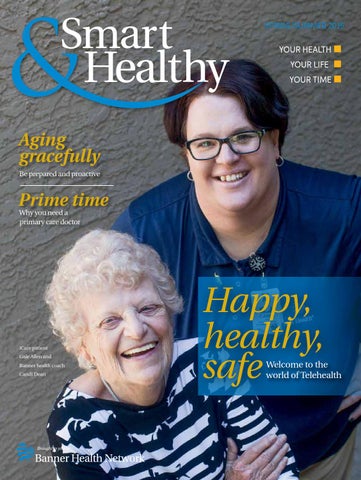
iCare patient Gale Allen and Banner health coach Candi Dean
Brought to you by
Happy, healthy, safe
Welcome to the world of Telehealth
welcome / LETTER
Dear Reader: It is likely that you have used a computer, or even your smart phone, to learn more about a health diagnosis. You have probably also looked up a prescription medication or checked a symptom you were experiencing. But, did you know that many Medicare beneficiaries around the Valley are now getting real-time chronic care in their homes through special tablet devices that allow them to quickly connect with a medical professional 24 hours a day? Read more in this issue about the program we call Banner iCare. Other topics you will read about in this issue are how to balance the risks and benefits of medications, why you need a primary care physician and how to take proactive steps to aging gracefully. Diabetics will get a reminder about the importance of foot care, and everyone can benefit from advice about staying hydrated and adding low impact exercise to life. You are receiving Smart & Healthy magazine because you are a Medicare recipient and your physician participates with Banner Health Network and the Medicare Pioneer Accountable Care Organization. You didn’t have to sign-up, there is no cost to you, and it does not change your Medicare benefits in any way. As a result of your physician’s participation, you have access to a variety of free services to support your good health. For example, we encourage you to call our 24-hour Banner Health Network Member Experience Center if you are ill or have a health concern that you would like to discuss with a nurse. If needed, he or she can connect you with the medical care or services you need. We can help you find a doctor or help you understand your doctor’s instructions. There is no charge to call the Member Experience Center– it’s free. They can be reached at 602-747-7990. To your health,
Dr. Nishant (Shaun) Anand Chief Medical Director
2 | Smart & Healthy
Spring/Summer 2015 / contents
n COV E R S TO RY
8 Happy, healthy, safe‌ Welcome to the world of Telehealth
Using technology to save lives and improve care
4
5
6
8
7
Aging gracefully? Be prepared, proactive and roll with the changes
Putting your best foot forward Pick the right footwear if you are diabetic
Water for life Staying hydrated is essential to a healthy lifestyle
Low impact, great results Exercises that help bone, heart health
12 Your Banner Health Hospital team Meet the professionals who are
making a difference in your care
13 Prime time Your primary care doctor
is your health advocate
14 Pharmacutical risks? Do the benefits outweigh the risks? 15 Puzzling?
5
Check out the Smart & Healthy crossword
7
CREATED BY REPUBLIC MEDIA CUSTOM PUBLISHING A division of The Arizona Republic 200 E. Van Buren St., Phoenix AZ 85004
16 H ealthy living events and activities
General Manager: CAMI KAISER Creative Development Director: ISAAC MOYA Editor: JIM WILLIAMS Sr. Managing Art Director: TRACEY PHALEN Editorial Coordinator: NICK KOSTENKO Design: RACHEL TULLIO
Cover Photography: EMILY PIRAINO
If you no longer wish to receive Smart & Healthy magazine: Please notify us through email at smarthealthy@republicmedia.com or by phone at 602-444-2235. Be sure to include your full name, address, city and zip code as it appears on the mailing label of the publication. bannerhealthnetwork.com |
3
your / LIFE
“There are plenty of resources, support groups and volunteer opportunities available,” Payne said.
Aging gracefully Be prepared, proactive and roll with the changes
By Meghann Finn Sepulveda he retirement years are intended to be enjoyable, filled with family, hobbies and new adventures. Yet, there can be worry and fear about the future. By taking a few proactive steps to maintain health and wellness, you can prepare to age gracefully.
T
Accept changes Changes to the body during aging are common. While these changes occur gradually, they become more noticeable over time. “People experience changes to skin, vision and hearing, and some memory loss is normal,” said Sarah Payne, DO, family medicine physician specializing in geriatrics at Banner Medical Group. While these differences may affect functionality and appearance, it’s important to be prepared and keep a positive attitude. Often your physician will have suggestions that can help.
4 | Smart & Healthy
Know your health history Make sure you understand your medical and family history, including past surgeries. “It’s especially important for people to be aware of the medications they are taking, and what condition or disease each is for,” Payne added “Be sure that all physicians who treat you have this information.”
Be proactive Maintain annual wellness appointments. Screenings for vision, hearing, memory and depression are available. “There are specialists who specifically care for the geriatric population,” Payne said. “Know when to talk to someone, especially if you are feeling isolated.”
Get involved Seek resources at community centers or through local senior groups. Start a hobby or new activity.
Keep your body and mind challenged Daily physical activity as simple as a 10 minute walk around the neighborhood lubricates joints and wards off osteoporosis and depression. “Brain games such as crossword puzzles and reading keep the mind challenged and healthy,” Payne said.
Start advanced care planning Your doctor can provide guidance and encouragement when making decisions about transition of care such as arranging independent, community or assisted-living, selecting a power of attorney and creating a living will. At her clinic, Payne distributes The Five Wishes to empower patients about taking control of personal medical care if a serious illness occurs.
Have fun! You’ve worked hard over the past 30 or 40 years. Now take time to do what you love! “Age is just a number,” Payne said. “Attitude is everything.” For more information about aging, visit the National Institute on Aging at nia.nih.org. Find The Five Wishes materials referenced by Dr. Payne at agingwithdignity.org.
your / HEALTH Ask the Expert with LeeAnne Denny, M.D., Banner-University Medical Center Phoenix
Putting your best foot forward It’s important for type 1 or 2 diabetics to pick the right footwear By Gremlyn Bradley-Waddell
I
f you’re diabetic, you want to put your best feet forward. Specially made footwear can help you do just that. While individuals with either type 1 or type 2 diabetes who do not experience diabetic neuropathy – or diminished sensation in the feet due to nerve damage, often due to uncontrolled blood sugars – are typically just fine wearing well-fitting athletic shoes, those folks with less sensitivity in their feet should wear shoes made for diabetics, said LeeAnne Denny, MD, a family medicine physician with BannerUniversity Medical Center Phoenix. That’s because people with diabetic neuropathy are at risk for infection, tissue damage or even, in a worst-case scenario, amputation because they may not realize they have ulcers, callouses or wounds on their feet. Diabetes can also impair blood flow which can also lead to foot trauma. “Feet are especially at risk because they’re located far from the heart, which means wounds on them take longer to heal, and because we’re always putting pressure on them,” Denny said.
So the answer to diabetics staying healthy – along with taking their prescribed medications, eating right and exercising to maintain good blood sugars – is investing in well-fitting diabetic shoes that protect the feet, don’t allow them to slide around inside the shoes and don’t put too much pressure on any one area. “Diabetic shoes are custom fit by either your primary care provider or a podiatrist, who will decide what kind of shoe you need, so check with them first,” she said, adding that diabetic shoes come a wide variety of styles for men and women. “And you may only need a custom-molded insert that you can place in your regular shoes.” While it’s true that the cost of diabetic shoes can be quite high, several hundred dollars for one
3 SMART STEPS At minimum, Denny said, anyone with type 1 or type 2 diabetes should do the following: Do daily foot checks. “After a shower or bath, sit on your bed and use a mirror to look at all the surfaces of your feet. If you see a red spot, go right to your doctor. A pressure ulcer does not look like an ulcer. It looks like a big red patch on your foot, the size of a pencil eraser or bigger.” Wear proper footwear. “Always wear closed-toe shoes and proper socks (well fitting, clean and without holes) and don’t walk barefoot to help avoid accidental injury.” Make an appointment. Have your feet checked regularly by either a primary care physician or podiatrist.
pair alone, Denny said Medicare will usually cover the expense if there is a documented problem, and might even allow for the purchase of one pair of shoes per year. She also suggested patients wear diabetic socks, which comfortably cradle the feet. bannerhealthnetwork.com |
5
your / TIME
Water for life By Dolores Tropiano he next time you have a headache you may want to skip the extra-strength aspirin and reach for a cool, refreshing bottle of water instead. According to Carlos Ventura, a physician who specializes in internal and geriatric medicine, a lack of water can lead to anything as common as crankiness and headache pain to more severe health issues such as kidney disfunction. Ventura, a physician with the Banner Health Center in Verrado, says that 30 to 40 percent of patients that come in to see him for other issues are also
T
6 | Smart & Healthy
Staying hydrated is essential to a healthy lifestyle
dehydrated. Dehydration occurs more frequently in children and older adults. “A lot of older adults lose their thirst reflex so it is easier for them to get dehydrated,” Ventura said. Drinking water is essential to the proper functioning of the body. Dehydration occurs when a person uses or loses more fluid in their body than they have taken in and the body doesn’t have enough water and other fluids to operate in the normal way. This can often take place after sweating during vigorous activity or during the hot, summer months. Symptoms of mild dehydration may include thirst, dry skin and
some irritability. More moderate dehydration can involve headaches, fatigue and even dizziness. Another simple sign of dehydration is dark and dense urine. Those who are severely dehydrated can have low blood pressure, rapid breathing, kidney failure and even cardiovascular complications, delirium and heat strokes. The solution for dehydration is not always a simple eight glasses of water a day. Other factors such as activity level and weight may impact the quantity of water required but Ventura says that 64 ounces of water a day is “a good guideline.” And although coffee and soda do contain some water, the harmfulness of these drinks (sugar, excessive sodium, caffeine) can outweigh their benefits. But there is more. Loss of liquids also means a less electrolytes, those mighty minerals in your blood, urine and body fluids that are needed for the body’s blood chemistry, muscle function and other metabolic processes. Sports drinks with electrolytes can help replace lost electrolytes. “The important thing is to listen to your body,” Ventura said. “If you are working out and working outside and have any of these symptoms it may be a simple sign that your body needs some water.”
your / HEALTH
Low impact, great results Exercises that help bone and heart health By Kristine Burnett s we age, it becomes increasingly important to focus on bone health. Arthritis, rheumatoid arthritis and osteoarthritis pose many threats. According to Lee Anne Denny, MD, a family medicine physician at the Family Medicine Center at Banner – University Medical Center Phoenix, keeping our bones strong requires maintaining a regular low-impact exercise routine, even when rising temperatures make working out seem like a daunting task. “Incorporating a variety of low-impact activities including weight-bearing exercises as we age is a must, particularly for older adults,” she said. “While there are definite heart health benefits that come from high-impact exercises, the risks for older adults can outweigh those benefits.” Instead, Denny says it’s important to focus on low-impact activities that can still net great health benefits for the heart. She notes that high-impact exercises are generally harder on the joints, whereas low-impact activities put just enough pressure on the bones to help build strength while minimizing joint pain.
A
She recommends that older adults trade sports like jogging, singles tennis and basketball for things like step aerobics, ballroom dancing, yoga, pickleball, golf, swimming, water aerobics, elliptical machines and rowing (outdoors or via an indoor rowing machine). But to really reap the rewards of one’s exercise endeavors, Denny says it’s important to aim for variety and to ensure you’re getting enough exercise. “Every adult, regardless of age, should exercise for about 150 minutes per week, which equates to 30 minutes a day, five days a week,” she explained. “It may not be feasible for beginners to start that high, but gradually increasing the duration and intensity of one’s workouts is critical.” She stresses the value of variety and weight-bearing exercise when it comes to keeping bones strong and preventing fractures, including compression fractures
in which softening bones essentially compress down and fall in on themselves. “There’s a common misconception that weight-bearing exercise literally means lifting weights, but that couldn’t be further from the truth,” Denny commented. “Weight-bearing exercise refers to all activities in which you hold your own body weight up against gravity.” Hiking, yoga, Zumba and walking are all considered weightbearing exercises. Getting year-round exercise, especially the low-impact variety, is paramount to maintaining one’s health. When high temperatures strike, Denny says to be smart about when and where you workout. “Golf in the early mornings, incorporate aquatic fitness into your routine and find fun and creative ways to engage in weightbearing exercise indoors.” bannerhealthnetwork.com |
7
Using technology to save lives and improve care By Paula Hubbs Cohen
WELCOME TO THE WORLD OF
TELEHEALTH
8 | Smart & Healthy
While telehealth might sound like something from the future, it’s available today from Banner Health. What is telehealth? Telehealth got its start when specialist physicians reached out to do consultations via telephone to rural communities. Today at Banner, high tech telehealth technology now also supports those patients who need the highest level of care in intensive care units (ICUs), those receiving care in Emergency Departments (ED) and even patients in their own homes. “In 2006, we started to implement tele-ICU services for every ICU bed in every Banner Health hospital,” says Julie Reisetter, MS, RN, Chief Nursing Officer for Banner Telehealth. “It was a major investment since the entire team of remote health care workers must be licensed in all the states we serve and be credentialed in the hospitals. But it was important to us to make that commitment because we have a strong belief that this technology improves outcomes and saves lives.”
How does it work? Using sophisticated technology, ICU patients’ vital statistics are closely monitored and if a change in status is happening, medical staff at the remote site are alerted to look for any problems or adverse trends in the patient’s condition. “The bedside team of nurses and physicians, who are constantly caring for the patient, is then notified and has the opportunity to intervene,” Reisetter says. “They have a second set of highly trained eyes always helping them to care for their patients.” Telehealth is now standard for every ICU bed within Banner and has showed such positive results, including reduced mortality, that the decision was made to use the same type of technology in every patient room at two of Banner’s newer facilities, Banner MD Anderson Cancer Center in Gilbert and Banner Ironwood Medical Center in San Tan Valley. “At these two hospitals, every patient has
telemedicine support, with early results indicating it has cut the number of transfers to intensive care,” Reisetter says. “We’ve also seen shorter hospital stays and better outcomes for patients.”
Telemedicine and the Emergency Department Just as in the ICU and regular patient floors, ED telehealth applications are becoming more prevalent. “Think about stroke,” Reisetter says. “If someone comes to an emergency department in one of our smaller facilities with symptoms of stroke, we can quickly connect them to a neurologist — even if the specialist is at another Banner facility. That’s obviously very important when time is of the essence.” Another ED application for telehealth relates to behavioral health. “We’re working hard to introduce telehealth for ED behavioral health patients,” Reisetter says. “For example, when individuals present
bannerhealthnetwork.com |
9
“iCare is helping people stay at home — healthy, happy and safe. We do that with in-home equipment that monitors blood pressure, oxygen levels and more.”
with psychiatric or behavioral health concerns, we’re using that two-way access to connect to behavioral health experts to help our bedside teams assess the situation and make sure the patient is safe, plus determine the appropriate level of care needed.”
Telehealth in-home usage: iCare™ With documented success in the ICU and the Emergency Department, Banner recently began shifting tele-technology into home settings. “We took a lot of learning from our experiences in the ICU and other settings and realized this type of technology could take measurements (blood pressure, weight, glucose levels and more) from a home setting,” Reisetter says. “This resulted in the creation of the Banner iCare™ program.” “iCare is helping people stay at home — healthy, happy and safe,” says Margaret Cromford,
10 | Smart & Healthy
MSW, Social Work Senior Manager for Banner iCare Intensive Ambulatory Care. “We do that with in-home equipment that monitors blood pressure, oxygen levels and more.” Indeed, through the use of a tablet-like device, patients interact directly with their health team — whether that’s a Banner iCare physician, a pharmacist, a nurse or their health coach — to track and address their medical concerns from the comfort of their own home. In addition, Banner health coaches conduct video visits and provide educational materials via the tablet technology. “We also remind members to take their measurements, which are then transmitted to us for review,” Cromford says. Other services include video visits with a nurse or pharmacist to help members with prescription refills and questions about the medications. Cromford adds that one of Banner’s core beliefs is that
emotional and physical health are tied together. “If you’re down or depressed, it impacts your health,” she says. “If you’re filled with stress and anxiety, health coaches can help you learn coping strategies and also find community resources that can be of assistance.” The equipment for this program is provided by Banner for patient use. If you have multiple chronic conditions and want to know if you are a candidate for Banner iCare, talk to your physician.
to participate, I said sure.” After Gale was discharged, her Banner health coach, Candi Dean, came to her house and installed the equipment. “Candi came to see me almost every Gale Allen week at the beginning,” Gale recalls. “I was pretty rough around the edges back then, but she made sure I was okay and that my vitals got sent in every morning.” The system sends Gale’s vitals in every day, and if she misses a day, someone calls to check on her. “They don’t hover, but it’s a good, secure feeling to know they’re there,” she says. “And if my levels are too high, they make sure I see my physician.” Gale’s advice to others? “You never know what you’re going to need. Even if you think you’re healthy, you could have some bad medical interruption or could fall. If anybody’s on the fence, I always say go for the side that says ‘yes, you’re going to be looked after’. They will come help you figure out how to use it.”
iCare program gives patient peace of mind, security By Paula Hubbs-Cohen t 76 years old, Gale Allen says she has been a Banner patient “forever.” Last year, the former fashion designer had a stroke and was a patient at Banner Del E. Webb Medical Center in Sun City West for several weeks. “They told me that in order to go home, I’d have to have a Lifeline (medic alert system). I was in bad financial straits and didn’t think I could afford it.” During her hospital stay, a social worker came to her room and explained Banner’s iCare program. “I was worried about the cost, but Banner said it’s free as part of my coverage. When they asked if I wanted
A
bannerhealthnetwork.com |
11
your / CARE
Your Banner Health Hospital team Meet the professionals who are making a difference in your care
By Brian Sodoma xcellent patient care in hospitals requires professionals of all kinds. If you or a loved one is hospitalized, you should always feel comfortable asking hospital personnel to explain their role on the care team. Here’s a brief list of some staff you may meet:
E
Hospitalists It used to be that primary care physicians checked on their hospitalized patients before their daily office hours. Now, a hospitalist, a licensed physician, usually specializing in internal medicine or critical care, assumes that role. He or she coordinates your hospital care, consults with specialists and is your go-to resource for explaining your condition and plan of care. It is important to know that hospitalists work in shifts, so you may see several hospitalists during your stay.
Registered Nurse (RN) A registered nurse constantly monitors your status and is your advocate throughout your stay. He or she communicates to your hospitalists to guide your care. He or she also oversees medication, testing, and provides discharge instructions.
12 | Smart & Healthy
Case Manager In need of services or further care after your hospitalization? The case manager, who is often a nurse, coordinates next steps and helps to arrange follow-up appointments or medical equipment needs. Though not often seen until the end of a stay, a case manager will help you transition back to daily life.
Service Excellence Director Banner employs staff to oversee the entire patient experience and use patient feedback to improve overall service. It is Banner’s goal to provide excellent patient care and service every time you are in a Banner facility. A random selection of patients receives a survey after their stay to help us be better all the time.
Certified nursing assistants Nursing assistants help patients with basic needs like bathing or hygiene, as requested. They can be found filling water pitchers, changing linens and helping with a wide variety of personal needs. They may also check your vital signs.
Transporters These staffers are trained to safely move patients from room to room or to a scheduled test. All Banner transporters are CPR-certified.
The rehabilitation team
Volunteers
Physical, occupational and speech therapists develop a road map to assist in your recovery from injury or illness. They can be seen during and after your hospital stay.
We are so grateful for the work our volunteers do at the main information desks and in other areas of the hospital. Volunteers donate thousands of service hours every year and can often offer the small gesture or reassurance a patient or family member needs during a hospital stay. Learn more about becoming a Banner volunteer at BannerHealth.com/volunteer.
Respiratory therapists These members of the hospital team administer breathing treatments during a hospital stay and help keep patients breathing easier.
your / CARE Do you need to find a primary care provider to help manage your health care? Contact the Banner Health Network Service Center at 855-874-2400. We can help you identify a provider in your area who takes Medicare and meets your other preferences.
Prime time A primary care doctor helps you navigate all your health concerns
By Debra Gelbart primary care provider (PCP) is the most important member of your health care team — after you! Most specialists encourage their patients to choose a PCP and visit that physician at least once a year. “A primary care provider is that one touch point in the health care system where all of a patient’s needs can be coordinated,” said Andrea Darby-Stewart, MD, a family medicine physician and clinical department chair of family medicine for Banner Medical Group. “A PCP knows the entirety of a patient’s medical history and is well-versed in what we call the ‘bio-psycho-social’ aspects of medicine.” Sometimes events in patients’ personal lives affect their health, she explained, “and those can make it difficult to obtain the state of health patients want to achieve. It’s our job to help them figure out their options.”
A
Managing prescription challenges A PCP can consider all of the medications a patient has been prescribed by all of his or her doctors and
make sure there are no drug interactions that may be of concern, Dr. Darby-Stewart said. Or, a PCP can make sure that a patient is complying with other doctors’ instructions. A PCP coordinates a patient’s total health picture, she said, and reinforces the importance of disease and injury prevention by discussing such things as getting health screenings (like a colonoscopy or mammogram) at appropriate times, wearing seatbelts in vehicles and removing obstacles at home that may put the patient at risk for falling.
What to know about a wellness visit Another advantage? Medicare encourages, and pays for, beneficiaries to have an annual wellness exam through their PCP. “Wellness visits focus on what can we do to help you maintain your health and wellness in the future,” Dr. Darby-Stewart said. “We go through very specific screenings and try to determine what resources a patient may need to allow him or her to stay in an independent living situation for as long as possible.” Because Medicare requires that doctors discuss certain topics at a wellness visit, it’s important to mention when you check in for your appointment that you’re there specifically for your Medicare wellness visit, Dr. Darby-Stewart said. She added that it’s a good idea to bring a list of all of the medications you take and the specialists you see, along with any information you have about your most recent immunizations. Your PCP can also help with questions you have about how to ensure that your health care wishes are known should you experience a medical crisis in the future (in a form called “Advance Directives”). “At a Medicare wellness visit, you’ll typically spend between 20 and 30 minutes with your doctor,” she said, “talking about many topics within the spectrum of wellness and planning for the future.” This is valuable time to talk about you, and your health goals. bannerhealthnetwork.com |
13
your / HEALTH
DO THE BENEFITS OUTWEIGH THE RISKS OF YOUR MEDICATION? How to manage side effects, evaluate effectiveness and make adjustments By Meghann Finn Sepulveda ou’ve seen them. Drug advertisements on television that mention every possible side effect that could potentially happen while taking a medication. They range from shortness of breath and loss of appetite to fatigue and even death. While these commercials are intended to be informative, they can also be scary. Side effects can range from minor to severe and are dependent on the individual taking the medication. If you are concerned about side effects related to a certain medication, it’s best to speak to a doctor or pharmacist to determine if it is right for you.
Y
Patient education Pharmaceutical companies are required by law to publicly report side effects of prescription medication in literature and advertising. These can range from common to extremely rare occurrences. “Medication information must include all possible side effects, even if something happened only once or during the clinical trial phase,” said James McNamara, Pharm.D., clinical pharmacy spe-
14 | Smart & Healthy
cialist for Banner Family Pharmacies. “In some cases a side effect could have occurred for multiple reasons aside from the medication in question.” It is always best to consult your physician or pharmacist if you have any questions about side effects.
Determining risk Seniors are more predisposed to experiencing side effects from medication because of other health problems and changes that occur in the body, according to Health In Aging. “As we age, drugs don’t metabolize and clear out of the body as quickly as they used to,” McNamara said.
Gradual dose adjustments Physicians can prescribe medication in lower doses to minimize side effects. “When you ‘start low and go slow,’ there is the opportunity to increase that dosage over time,” McNamara added. “After several weeks of observation, patients should report any side effects to their doctor in case adjustments need to be made.” Sometimes side effects can pass with time. There also may be a new or similar drug in the same or different class available for you to try.
Areas of concern Side effects such as dizziness, drowsiness or fatigue should be monitored. “We key in on these side effects, especially in older adults, specifically because they could lead to other problems such as falls and fractures,” said McNamara.
Questions to ask your doctor If you’re starting a new medication, have an open dialogue with your physician and ask about side effects and monitoring techniques. “There are ways to determine the effectiveness of the drug through blood tests, patient reporting and home monitoring,” said McNamara. “It’s ultimately up to the patient in conjunction with his or her physician to determine if the gain is greater than the risk.”
puzzling / CROSSWORD
PUZZLE ANSWERS ONLINE AT
BannerHealth Network.com/ SmartandHealthy Crossword
bannerhealthnetwork.com |
15
BANNER HEALTH 1441 N. 12th SREET PHOENIX, AZ 85006-2887
NONPROFIT ORG U.S. POSTAGE PAID LONG BEACH, CA PERMIT NO.1677
calendar / Healthy Living Events
— Compiled by XXX
MORE SEMINARS AND CLASSES
You & Him: Men’s Health (Banner Health’s Spirit of Women seminar series) Dates & locations throughout the Valley in June Women, you can help the men in your life get and stay healthier. Sometimes men need encouragement to participate in routine preventive care, including recommended screenings and assessments for the leading causes of death in men: heart disease, cancer, and accidents or injuries. Call 602-230-CARE (2273) to attend this free lecture at a location near you.
CLASSES AND SUPPORT GROUPS Banner Health Network offers a variety of lifestyle management programs to provide participants skills and education to manage common chronic health conditions. Healthy lifestyle classes are also taught on a regular basis. Classes are offered at Banner facilities Valley-wide. Dates and times vary by location. For information and registration, call 602-230-CARE (2273) or 480-684-5090. All classes are free. Living Well with Diabetes This is a four-part series to learn diabetes self-management skills. Topics include monitoring, medications, nutrition and meal planning, exercise and preventing complications. Living Well with COPD This is a two-part series to learn about lung disease, better breathing skills, symptom management and preventing complications.
Living Well with Heart Disease This is a three-part series to learn heart-healthy lifestyle tips, how to identify warning signs of heart disease or stroke, how to manage risk factors and what to do in an emergency. Eat Healthy, Be Active This is a series of six interactive workshops to help people attain and maintain a healthy weight, reduce risk of chronic disease and live a healthy, active lifestyle.
VA for Seniors Friday, July 31; 2–3:30 p.m. In this Banner Sun Health Research Institute lecture, we’ll discuss general assistance through the VA, with a primary focus on the WarTime Pension and Aid and Attendance program that can help assist a widowed spouse to pay for Home Care, Assisted Living or Long Term Care. This free lecture will be held at Banner Sun Health Research Institute, 10515 W. Santa Fe Road, Sun City. Registration is required. To register, call 623-832-3248. Legal Considerations for Long Term Care Learn the tools that will help you to be prepared for long-term care if needed, while avoiding costly legal issues. Especially helpful for caregivers caring for individuals with chronic illness. Wednesday, Sept. 9; 2 -3:30 pm; Banner Sun Health Research Institute, 10515 W. Santa Fe Road, Sun City. Free, but registration is required. To register, call 623-832-3248.