FALL 2017
Smarts
Eating right and staying active key to managing diabetes
A fruitful lifestyle
Right plan for you
Post-acute care is a benefit for some patients
Be well
Immunizations are ‘worth a shot’
Good eats
Finding ‘ho ho’ help for the holidays
Welcome LETTER
Happy, healthy holidays! Welcome to the autumn edition of Health Smarts! Looking forward to the holidays can bring great joy as we anticipate gathering with friends and loved ones. Sharing family meals, family stories and lots of laughter are the experiences that connect us. Unfortunately, the holidays can also bring anxiety to those of us who may have suffered a loss this year or whose health has taken a turn for the worse. Whether the year has been good or more difficult, we can all benefit from reducing unhealthy stress. Reducing stress is particularly important during the holidays when anxiety peaks for many, while we would like to be at our best for friends and family. In this issue, you’ll find tips to help you safely and joyfully navigate the season including ways to enjoy healthy foods. Not only are we likely to feel better when we eat well, we are also likely to avoid adding unwanted holiday pounds. We also introduce you to a gentleman diagnosed with diabetes who’s not letting the disease get the best of him. You’ll read his inspiring story and learn how he’s controlling his disease through proper diet and exercise. We’ll provide you with valuable information about adult immunizations, how to get the most out of your Fitbit and other health-monitoring devices and we’ll break down the myths and facts about statin medications. This edition also features information about skilled nursing facilities and long-term care, and
2 | Health Smarts
some of our doctors will share what they’ve learned from patients like you. Finally, you already know how important it is to take good care of your body, so check out our crossword puzzle and we’ll keep your mind sharp, too. This publication is designed for and distributed to Medicare beneficiaries whose doctor participates in the Medicare Shared Savings Program Accountable Care Organization through Banner Health Network. The Medicare Shared Savings program does not require a sign up and does not change your Medicare benefits. This Health Smarts magazine is an added bonus, providing you with valuable information on the latest health care news and how to achieve your best personal health. We’re here to help you, so if you have any questions about your health you can access our 24-hour Banner Health Nurse On-Call service. Our nurses can answer questions about medications, symptoms you are experiencing, or make recommendations about where to get care. Just reach out to us at (602) 747-7990 or (888) 747-7990. To your health,
Robert Groves, MD Chief Medical Officer
10
Fall 2017 CONTENTS
COVER STORY
8 A fruitful lifestyle
Even small changes can make a big difference
4 Doc Talk
What is one thing your patients have taught you?
5 Worth a shot
Immunizations protect patients from disease
6 The right care plan for you
Post-acute care may be a benefit
10 Finding ‘ho ho’ help
Don’t let your mental health take a hit during the holidays
12 Health Smarts
Easy high-tech solutions to get your workout started
13 Get Moving
Understanding high cholesterol
14 Good Eats
Avoid the holiday pounds
15 Crossword
14
NEED TO CONTACT MEDICARE?
800-MEDICARE (800-633-4227) www.Medicare.gov
16 Calendar
Healthy living events and activities
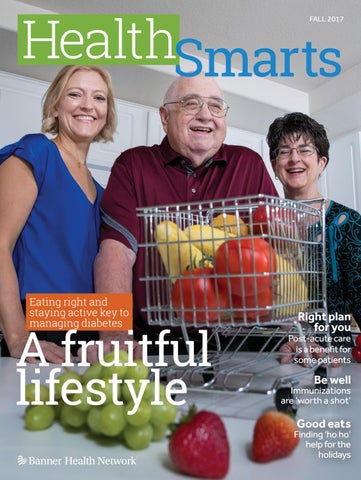
On the cover: (left to right): Marilyn Cryan, registered dietitian; Michael Yabroff, diabetes patient; Margaret O’Brien, registered dietitian.
CREATED BY REPUBLIC MEDIA CUSTOM PUBLISHING A division of The Arizona Republic 200 E. Van Buren St., Phoenix AZ 85004
General Manager: Cami Kaiser Creative Development Director: Isaac Moya Editor: Jim Williams Project Manager: Nick Kostenko Design: Rachel Tullio Cover Photo: Rick D’Elia
NOTICE OF NONDISCRIMINATION Discrimination is Against the Law: Banner Health complies with applicable federal civil rights laws and does not discriminate on the basis of race, color, national origin, age, disability, or sex. Banner Health does not exclude people or treat them differently because of race, color, national origin, age, disability, or sex.
Banner Health provides free language services to people whose primary language is not English, such as: • Qualified interpreters • Information written in other languages
Banner Health provides free aids and services to people with disabilities to communicate effectively with us, such as: • Qualified sign language interpreters • Written information in other formats (large print, audio, accessible electronic formats, other formats)
If you believe that Banner Health has failed to provide these services or discriminated in another way on the basis of race, color, national origin, age, disability, or sex, you can file a grievance with the Banner Patient Relations Services Center Director, P.O. Box 16423, Mesa, AZ 85211-6423, or call 602-747-6880, fax 480-
If you need these services, contact Banner staff.
If you no longer wish to receive this magazine: Please notify us at healthsmarts@ republicmedia.com or 602-444-2235. Be sure to include your full name, address, city and zip code as it appears on the mailing label of the publication. 684-6325 or email bannerhealthpatientrelations@bannerhealth. com. You can file a grievance in person, or by mail, fax, or email. If you need help filing a grievance, the Banner Patient Relations Services Center Director is available to help you. You can also file a civil rights complaint with the U.S. Department of Health and Human Services, Office for Civil Rights, electronically through the Office for Civil Rights Complaint Portal, available at ocrportal.hhs.gov, or by mail or phone at: U.S. Department of Health and Human Services, 200 Independence Avenue SW, Room 509F, HHH Building, Washington, D.C. 20201 800-8681019, 800-537-7697 (TDD). Complaint forms are available at hhs. gov/ocr/office/file.
bannerhealthnetwork.com |
3
Doc TALK
What is one thing your patients have taught you?
“Every patient responds differently to what I say. Some want a firm recommendation, others need more reassurance and moral support to help make a decision. If the physician can understand what style works better for an individual patient, then together they will have a healthier outcome.”
“Time after time, patients have taught me not to underestimate their resiliency and determination in the face of serious disease. At the same time, they have shown me the value of preserving independence and maintaining a sense of humor in promoting the healing process.”
Harvey Hsu, MD, Medical Director Internal Medicine Banner – University Medical Center Phoenix Internal Medicine Clinic
Jason Leubner, MD Family Medicine/Geriatrics Banner – University Medical Center Phoenix Family Medicine Clinic
“My patients have taught me to embrace each day with a positive attitude — that alone will take you through the good times and the difficult times.”
“As a family medicine physician, I learned that being available and actively listening to all aspects of a patient’s life helps with providing better care. I value being a part of my patient’s lives and hold dear the trust they have in me. My patients have taught me that a trusted relationship may be the ultimate factor to achieve better outcomes.”
“Since my patients often search for medical information on the internet, they have taught me how to carefully integrate that information into my practice. I have learned to guide them toward the best resources which help them become a better engaged, informed, invested and healthier patient.“
Jesse Bracamonte, DO Divisional Medical Director, Arizona West Banner Medical Group
M. Zuhdi Jasser, MD, FACP, Assoc. Medical Director Internal Medicine Neighborhood Physician Alliance
Sarah Payne, MD Internal Medicine/Geriatrics Banner Medical Group
4 | Health Smarts
“One thing my patients have taught me is that medical care is not a spectator sport! The more engaged my patients are in their care, the better the outcome. In this era of team-based care, the patient is the most valuable player.” Jeff Wolfrey, MD Family Medicine/Geriatrics Banner – University Medical Center Phoenix Family Medicine Clinic
Be WELL
Shingles
Worth a shot Immunizations protect patients from disease
By Elise Riley When a patient visits Dr. Jason Leubner’s office, his team goes over more than vital signs, current medications and symptoms - they also talk about immunizations. Shots are not just for infants or children. Whether it’s guarding against the flu or arming yourself from exposure to a dangerous disease, immunizations can help adults stay healthy. “Increasingly, what we’re trying to do is identify those patients who need vaccines when they’re in the office for any reason,” said Dr. Leubner, a family practice physician. Most major pharmacies now carry vaccines, which means getting immunized takes just a matter of minutes. Depending on your health history, an immunization might be a solution to help “boost” your defenses. Talk to your doctor to find out which vaccines are best for you. “Especially as we age, our immune systems don’t work quite as well as they did when we were younger,” said Joan Ivaska, senior director for infection prevention at Banner Health.
“We’re prone to developing more severe complications and infections.” Among the most commonly used vaccines for adults are those that protect patients from influenza, shingles and pneumonia.
Flu
Every year, starting around September or October, an annual flu shot is available. It’s recommended for patients older than 6 months, with few exceptions. “Flu vaccine is the most effective method we currently have to prevent flu,” Ivaska said. “It’s highly effective, even if you are exposed to a strain that’s not covered by the vaccine.” It’s also important that older patients get the flu shot every year. According to the Arizona Department of Health Services, more than 4,000 people are hospitalized and more than 700 people die in the state because of the flu each year. “Seniors are at risk for severe complications – pneumonia or even death – if they don’t get immunized,” Ivaska said. “It’s extremely important.”
Adults age 60 and older are encouraged to get a shingles vaccine. A single shot can prevent this reactivation of the chicken pox virus. Shingles can be extremely painful when it forms itchy rashes throughout the body. “This is a shot you’d get once in your lifetime, and it doesn’t matter if you’ve had shingles before,” Dr. Leubner said. “But if you have a compromising immune condition, you should first talk to your doctor.”
Pneumonia
There are many types of bacteria and viruses that can cause pneumonia. Vaccines and antibiotics are available to prevent or treat bacterial pneumonia. Generally, it’s recommended that adults 65 years and older receive the vaccine to prevent bacterial pneumonia. “With the development of the vaccines (for bacterial pneumonia), we’re seeing fewer people who are sick with it,” Dr. Leubner said. “It’s less common than it used to be, but that’s because of the vaccine.” While there are some antiviral medications to treat viral pneumonia, many times a person may have to wait it out with home treatments to get better, depending on the severity of their viral symptoms. However, the best defense against getting viral pneumonia is to get the flu shot. Another best defense to combat both bacterial and viral pneumonia is to always wash your hands. Talk to your doctor about your vaccination history to find out which vaccines may be best for you.
bannerhealthnetwork.com |
5
THE RIGHT CARE PLAN FOR
YOU Post-acute care is a benefit for some patients By Debra Gelbart
W
hen you or a loved one leaves the hospital after surgery or treatment for an illness or injury, the doctor may prescribe what’s called “post-acute” care.
Post-acute care occurs after your initial treatment and is designed to help you recover quickly. It may come in different forms for the 40 percent of patients who need it. This includes home care, an inpatient rehabilitation facility or long-term nursing care. Having your post-acute care at home with a home health nurse can be the simplest option after you leave the hospital. The nurse may help administer medication, change a wound dressing and assist with daily nursing tasks, explained David Edwards, MD, chief medical officer for post-acute services at Banner
6 | Health Smarts
Home Care and Hospice. However, sometimes the patient doesn’t feel comfortable with a caregiver in their home. “There is a significant percentage of patients who could benefit from home health who say, ‘I don’t want someone I don’t know coming into my house,’” Dr. Edwards said. “For patients who decline home health services, their chance of having to return to the hospital goes up twofold,” he said.
Other options
If your condition requires continuous medical attention after a hospital stay, you may be admitted to a skilled nursing facility, Dr. Edwards explained. In this setting, you will be monitored 24 hours a day. “ A skilled nursing facility is for patients who can’t go home but require ongoing services from a nurse and possibly a physical, occupational or speech
HOSPICE COMPARE
Looking for information on local hospice options? Want to see how Banner Hospice compares to other facilities? Thanks to the Centers for Medicare and Medicaid Services, you can review local hospice options on their new Hospice Compare website: medicare.gov/hospicecompare/.
therapist,” he explained. “Depending on the patient’s underlying condition and how much he or she is improving, a typical skilled nursing facility stay can run about two to three weeks,” Dr. Edwards said. If the patient requires intensive therapy after a hospital stay, an inpatient rehabilitation facility may be the most appropriate post-acute setting. However, Medicare requirements for admission to an inpatient rehab facility can be strict, explained Susan Kreps, senior director for four Banner Health inpatient rehabilitation programs. “A patient must be able to tolerate at least three hours each day for therapy usu-
ATTENTION ALL FEE-FOR-SERVICE MEDICARE BENEFICIARIES Because your health care provider is a participant in the Banner Health Network (BHN) Medicare Shared Savings Program (MSSP), you may get a survey in the mail from the Centers for Medicare & Medicaid Services (CMS) that asks about your experience with your health care provider and his or her office staff. CMS is the federal agency that administers the Medicare program and is responsible for making sure that Medicare beneficiaries get high quality care. One of the ways that CMS fulfills that responsibility is by asking Medicare beneficiaries about the care they are currently receiving. If you are selected to receive a survey, please take the time to evaluate your health care provider honestly. Completing this survey is voluntary and your decision to participate or not to participate will not affect your Medicare benefits in any way. However, your opinion is important and we hope you will take this chance to tell CMS about the quality of care you receive. CMS will combine the information you provide with information from others to understand the quality of care delivered to Medicare beneficiaries. Your provider does not know who is selected to receive a survey, and will not see your individual survey or answers.
ally a minimum of five days a week,” Kreps said. The patient also must require the services of a physical medicine and rehabilitation physician who agrees to accept the patient, she added. The typical stay in an inpatient rehabilitation facility is about 13 days, Kreps said. Sometimes, a patient coming out of a hospital stay is either terminally ill or chronically ill to a degree where they do not expect a full recovery. In that situation, the patient may be discharged to a long-term nursing facility, a memory care facility (if dementia is an issue) or hospice care, Dr. Edwards said.
Under the appropriate circumstances, Medicare typically will pay for home health, skilled nursing, inpatient rehab and hospice, Dr. Edwards said. If the patient requires only custodial care, rather than nursing care, in a long-term care facility, Medicare will not cover these costs.
A shared outlook
“The determination of the best postacute setting is made by the patient’s doctor in consultation with the patient, the family, the nursing staff, the care manager (the professional who coordinates all of the care the patient receives) and the therapy team,” Dr.
Edwards said. Where a patient goes after a hospital stay is “a shared decisionmaking process,” explained Kathleen Harris, senior director of government operations for Banner Health Network. “You and your doctor will customize a discharge plan that works for you.” GET MORE INFO
Visit our blog healtheconnect. bannerhealth.com for more information.
bannerhealthnetwork.com |
7
A FRU ITFU L LIFESTYLE Even small changes can make a big difference By Meghann Finn Sepulveda Photos by Rick D’Elia
A
ccording to the American Diabetes Association, 1.5 million Americans are diagnosed with diabetes every year. Fortunately, many people can manage their illness by eating healthy, being active and taking medication prescribed by their doctor.
Get the facts
Type 2 diabetes is the most common form of diabetes, and occurs when blood glucose (sugar) levels rise higher than normal, according to the American Diabetes Association. There are risk factors that can contribute to the progression of the disease and a blood test can detect whether a person has diabetes. “We know that many people who are diagnosed with diabetes have a strong family history,” said Scott Haferkamp, MD, an internal medicine doctor at Banner – University Medical
8 | Health Smarts
Center Phoenix. “Weight can also be a major factor.” Symptoms of diabetes include frequent urination, extreme thirst, blurred vision and fatigue. “When people with diabetes have elevated blood sugar levels, it exceeds the kidneys’ capacity to reabsorb the sugar,” Dr. Haferkamp said. “Over time, this puts people at risk for kidney failure and even heart attack or stroke.” Dr. Haferkamp emphasized that it’s important for people to see their primary care doctor on a regular ba-
sis and get screened for diabetes. “We want to intervene as early as possible so we can effectively treat and manage the disease,” he explained. When Michael Yabroff, a 72-yearold Phoenix resident, was diagnosed with type 2 diabetes more than 30 years ago, he didn’t manage his disease properly. Eventually, he needed emergency triple-bypass heart surgery. “After the procedure, my doctor told me it was time to get my diabetes under control,” Yabroff said. “I knew I had to take it seriously.”
Maintain a healthy diet
Those newly diagnosed might find their new meal plan overwhelming and may worry about feeling restricted or deprived. “You don’t have to make huge changes,” said Marilyn Cryan, a registered dietitian and health coach at Banner Health Network. “It’s just learning about foods that affect blood sugar levels and making healthier choices.” People living with diabetes should stay away from refined sugars such as candy and sweetened beverages along with simple carbohydrates like white bread and pasta. “While you do need to make some diet modifications, you can easily replace the foods you love with healthier options that raise blood sugars in a more stable way,” Cryan said. “Food with fiber and nutrients fights cravings and helps with weight loss.” Motivated to manage his diabetes, Yabroff visited Banner – University Medical Center Internal Medicine Clinic and quickly realized he wasn’t eating properly. “I learned how to count carbohydrates and manage portions,” Yabroff said. “I stopped eating large quantities of meat and fatty, greasy foods.” Today, Yabroff, now incorporates more fruit, vegetables and fish into his diet. “My blood sugar levels have significantly come down,” he said. “I feel really good.”
STEPS TO MANAGE DIABETES Banner Health Network registered dietitian Margaret O’Brien says today there are many more flexible strategies to effectively manage diabetes: 1). Eat regularly – This keeps blood sugars from going too high or too low 2). Eat smaller servings – Follow serving size guidelines from the American Diabetes Association 3). Keep big sources of sugar to a minimum – Limit cake, candy, ice cream and sweetened drinks 4). Reduce fat and calorie intake – Choose heart healthy fats such as avocado and nuts 5). Exercise – Whether you walk, swim or dance, just moving regularly is beneficial
to take oral medications or insulin injections to manage blood glucose levels effectively. “We take into perspective the whole patient to determine the right time to start medication,” Dr. Haferkamp said. “We often begin with oral medication and then transition to
insulin if needed.” Yabroff learned he wasn’t taking the appropriate medication so his doctor made an adjustment. Today he takes two oral medications to treat his diabetes while watching what he eats. Diabetics like Yabroff are encouraged to check their blood sugars daily, usually before and after a meal. “We like to teach patients how to adjust insulin on their own, which ultimately empowers them to be in control,” Dr. Haferkamp explained.
Find support
A lifelong disease, diabetes requires family encouragement and support, which ultimately leads to greater outcomes for everyone. “A diabetic diet is truly beneficial for the entire family,” Dr. Haferkamp said. “It’s so important everyone in the household learns how to incorporate these healthy behaviors to have success.” GET MORE INFO
To learn more about living with diabetes, visit bannerhealth.com.
(left to right): Michael Yabroff, diabetic patient; Margaret O’Brien, registered dietitian; Marilyn Cryan, registered dietitian
Follow the treatment plan
Diabetes can sometimes be controlled through diet and exercise alone. However, experts say that most diabetics will eventually need bannerhealthnetwork.com |
9
Don’t let your mental health take a hit during the holidays
FINDING ‘HO HO’ HELP By Kristine Burnett he holiday season is widely considered a time of cheer and good tidings. Unfortunately, it can also be a trigger for a wide range of mental and emotional challenges. While the reasons for feeling blue during the holidays are numerous, the emotional toll it takes is very real. Recognizing the triggers of emotional distress and finding ways to cope with and overcome them can help make your holiday season a little happier.
T
Gagandeep Singh, MD, chief medical officer of Banner Behavioral
10 | Health Smarts
Health Hospital, cites unrealistic expectations as a key contributor to feelings of sadness, depression and loneliness during the holidays. He says this applies to people with a history of mental illness as well as those for whom mental illness isn’t a factor.
Unrealistic expectations
“Society and the media have created certain expectations of what the holidays are supposed to be like,” Dr. Singh said. “Often, those expectations don’t match reality. That can be difficult for people to accept.” In most instances, holiday expectations include joyful gatherings with
family and friends. As a result, some people may begin thinking about loved ones they’ve lost through death, separation, or other life changes. “Thinking about family and friends who are no longer here can cause negative reactions for a lot of people,” Dr. Singh said. “This is especially true if they lost someone at the holiday season.” When a traumatic event like an accident or death occurs around a holiday, that day can become a lifelong marker for the tragedy. For some, the holiday spirit may become overshadowed by feelings of sadness, anger or isolation. Managing these emo-
tions becomes increasingly difficult as people get caught up in the hustle and bustle of the season, and let their regular self-care strategies slide.
Self-care and stress management
“During the holidays, most of us sleep less, take less care of ourselves, and put ourselves in stressful situations like being around negative people – sometimes family – with whom we’d rather not associate,” Dr. Singh explained. “Drinking more, staying up late to attend events, or worrying about finances when we feel obligated to make a lot of purchases can all lead to stress.” While tolerance for stress varies greatly from one person to the next, Dr. Singh says everyone has a breaking point for how much stress they can handle. Thankfully, however, he says people can increase their resilience to stress. “We all have different skill sets for handling stress,” he said. “Building resilience is about the day-to-day things we do to take care of ourselves and make life more meaningful.”
Resilience through acts of kindness
As part of the plan to build resilience, Dr. Singh suggests focusing on others and doing something good in return to help manage and counteract negative thoughts, feelings and emotions. “Doing things for others adds a sense of meaning to our lives, and we all thrive when we feel there’s meaning to what we’re doing and to our overall existence,” he explained. “These positive feelings can build
DE-STRESS YOUR LIFE By Barbara Holt
Stress. We all experience and deal with it (or not) in our own ways. Here are a few tips to help reduce the amount of stress in your life. BREATHE DEEPLY: When you feel your shoulders and neck beginning to tense up, take one minute to close your eyes and breathe deeply. Try to take the “in” breath all the way to the pit of your belly, and then allow the “out” breath to release slowly, as you consciously follow the flow of each breath. If you find this technique helpful, then try to practice it for one minute each hour during your workday. HUG YOURSELF: Wrap your arms around yourself, reaching for your shoulder blades, and pull gently as you round your shoulders forward slightly and lower your head to your chest. MEDITATE: Either in the morning or at the end of the day, make time to sit quietly for five minutes, closing your eyes and allowing your attention to rest with the gentle motion of your breath.
BEDTIME BREATH: If you can’t find time during the day to meditate, then when you lie down at night, close your eyes, place your left hand on your heart and your right hand on your belly. Allow your attention to rest with the gentle motion of your breathing. As you follow the breath, observe how your belly rises and falls while your chest remains still. Continue until you fall asleep. EAT MORE “BRAIN” FOOD: Add blueberries, fresh fruits and veggies, fatty fish (such as salmon and sardines), and whole grains to your daily diet while cutting back on saturated fats and sugars. PLAY “BRAIN” GAMES: Create time every other day or so to exercise your mind by reading, working puzzles (such as Sudoku, the jumble or crossword), play scrabble or other games that require
up a sort of reserve for dealing with stress when it arises.” Doing for others, whether it’s volunteering or giving back in another manner, helps reduce stress and feelings of isolation. Knowing you’re making a difference in someone’s life can help you feel engaged and connected to others. “The reality is everyone experiences stress, loss and loneliness,” Dr. Singh said. “These feelings can have
concentration, learn a new language, learn to paint, learn to cook or learn to play a musical instrument. In other words, give your brain a little exercise! SLEEP: Try to get 7 - 8 hours of sleep each night. Rest is an important part of strengthening memory recall. EXERCISE: Find time for 30 minutes of exercise each day. Those 30 minutes can be broken into 10-minute sessions throughout the day. They can include walking, jogging, lifting weights, or participating in sports. LAUGH: Laugh whenever and wherever you can. Laughter releases endorphins into your system that decrease stress and promote happiness. Barbara Holt is a Banner Health Network Board Member and Beneficiary Representative.
a more significant negative effect on people with mental illness, but it’s important we all learn how to manage our mental health.” Dr. Singh urges people to cast aside expectations about what the holidays should be like and instead embrace reality. “The disconnect between expectation and reality is what causes trouble.”
bannerhealthnetwork.com |
11
Health SMARTS
Fitness helpers Easy high-tech solutions to get your workout started By Leigh Farr You’ve probably heard it from your doctor: an exercise program helps you feel better and also lowers your risk for heart disease, diabetes, high blood press and colon cancer. But the question is, how do you get started? A high-tech gadget might help. “With all the technological options nowadays it’s easy to find something that fits you,” says Kimberly Steward, a physical therapist at Banner Del E. Webb Medical Center Rehabilitation. To ensure success, she says, “You want to define your goals and make sure you start out really simple. And be sure to consult with your physician before you start any exercise program.” Here’s a mini guide for finding the most reliable fitness information, the best gizmos to track your daily progress and fitness apps that support you every step of the way.
A click away
These days, there is a wide variety of tips and strategies online to help you start a workout routine. “If you like to do your own research
12 | Health Smarts
and gather a lot of information it’s easier now than ever because there’s so much good information out there,” says Steward. To get the most reliable facts, she says, look for websites sponsored by national organizations and steer away from manufacturer-sponsored sites. Here are a few sites to try: ■■American Heart Association: heart.org ■■American Physical Therapy Association: moveforewardpt.com ■■National Institutes of Health: nih.gov ■■Centers for Disease Control and Prevention: cdc.gov
Apps to get you active
To start a new workout routine, here are some free fitness apps you can easily download from the internet onto your mobile phone or tablet. For extra motivation, you can use these apps to connect with other fitness enthusiasts online: ■■Strava (strava.com) – This app helps you track the number of miles you bike or run and it allows you to easily keep track of your times and your routes. ■■Johnson and Johnson 7 Minute Workout (7minuteworkout.jnj.com) –
“This is a good option for people looking for basic body weight type exercises such as pushups, sit ups and air squats. It’s very short and is easy to use,” says Steward. ■■8Fit (8fit.com) – This workout/meal planner combo app helps you set goals, suggests meals and activities and allows you to track your progress. ■■Today (apple.com/itunes) - This habit tracker allows you to track up to three healthy habits, such as walking, planning meals or drinking water.
More than wrist candy
■■If you’re looking for a simple gadget
to track your steps, a pedometer (think Yamax Power Walker, WPX Walking Pedometer or Omron Alvita Pedometer) may be all you need. But if you want to monitor your heart rate, meals, sleeping habits and more—and you’re willing to pay more for a device — a fitness tracker may come in handy. Here are some snazzy wearables to help you get started: ■■Apple Watch Series 1 – This userfriendly smartwatch comes with a built-in activity tracker to monitor your heart rate, steps, standing hours and calories. ■■Fitbit Alta HR – Not only does this device come with an app that tracks your pulse, your steps, and sleeping patterns, it stays charged for seven days. ■■Garmin Vivosmart HR+ – This sleek contraption tracks your heart rate, and monitors your steps, distance, calories and floors climbed. Bonus: You can even go swimming with it. GET MORE INFO
Need help getting started on a fitness routine? Call Banner Del E. Webb Medical Center Rehabilitation at (623) 524-4038 for a consultation.
GET MOVING
Understanding high cholesterol
Statin medications are an effective treatment
By Julie Maurer Hearing you have high cholesterol can be daunting, but physicians have a tool to help combat the disease – statin medications. With every prescription, side effects are a possibility, but most of them are minor. Unfortunately, many people are shying away from their medications because of secondhand information rather than listening to their doctor or pharmacist. “It has a lot to do with what they read, or what they watch on television – or somehow hearing it from your neighbor gives it more credence than hearing it from a doctor or pharmacist,” said Betty Louton, clinical pharmacist at Banner Health. But according to the American Heart Association, studies have shown that the benefits of statins far outweigh the risk of side effects.
What is a statin?
According to Louton, statins are a class of medications that block the production of cholesterol in your liver. Most of these medications have “statin” at the end of their name, such as atorvastatin (Lipitor) or
simvastatin (Zocor). There are a number of reasons you can be prescribed statins, including: ■■High Cholesterol ■■ Atherosclerosis, or fatty buildup that can clog arteries ■■Diabetes ■■Coronary Artery Disease “Cholesterol can cause a lot of major problems if it blocks and starves your body of the blood it needs,” Louton said.
Myths and concerns
By understanding some of the myths and concerns about statins, you can be equipped to discuss your medications with your doctor rather than taking the advice of non-experts. Myth 1: Grapefruit and statins “It (grapefruit) does contain compounds that can change the way your body processes a statin,” Louton said. “It can cause more of the drug to be in your bloodstream.” However, she said that it would take a large amount of juice or several grapefruits to cause any impact. Patients should consult with their physicians first, but they can probably still enjoy a half of grapefruit or 8 ounces of grapefruit juice with their medication.
Myth 2: All statins are the same “They aren’t all equal in potency, in their chemical makeup or in the way your body uses the medication,” Louton said. She recommends that if patients believe they are having side effects, they should talk to their doctor about switching medications rather than avoiding statins altogether. Myth 3: Statins are causing your muscle pains or memory lapses While these are symptoms that can occur to people who take these medications, Louton noted that many of these can also be attributed to the normal changes that come with age. “If you have any unusual, really severe muscle pain, you need to contact your doctor,” Louton said. “But before blaming your medications, stop and think about what physical activities could also be the cause of your aches and pains.”
Talk to your doctor, not your neighbor
Louton urged patients to never just stop taking something because you do not like the side effects, and to make that important call to your doctor first. “People should never just stop taking their medication a doctor has prescribed for them. The doctor prescribed it because a patient needs it and has weighed the benefit of the medication over the risk of side effects,” Louton said. To research a medication beyond consulting a doctor or pharmacist, Louton recommends specific medical websites, such as the National Institutes of Health, www.nih.gov or the American Heart Association, www.heart.org. bannerhealthnetwork.com |
13
Good EATS
Avoid the holiday pounds Make a Plan to Nourish Yourself
By Joan Westlake Many of us fall victim to holiday weight gain. The last months of the year can be unforgiving for your waist, especially if you enjoy the treats and feasts that come with the holidays. Don’t despair. Registered Dietitians Margaret O’Brien and Marilyn Cryan have advice and tips to help you ward off the gain. O’Brien said, “Holiday pounds pile on because there is more food available. Parties, office potlucks, seasonal sweets and big family gatherings fill your plate.” “Also, we tend to prepare dishes that have more calories,” she said. “And, there’s the element of emotional eating; especially for people who are lonely, depressed and stressed.” Approaching each celebration with a practical plan is at the heart of gaining control. Cryan pointed out that the act of researching your upcoming food situation can be empowering and help keep you from overindulging. Here are some tips the nutritionists offer to guide you in creating your strategic plans.
14 | Health Smarts
HEALTHIER EGGNOG ■■Maintain a steady blood sugar
level. Starving all day before the big meal sets you up for cravings as well as energy crashes and binge attacks. ■■Make thoughtful choices. Skip common foods like packaged rolls or canned corn and enjoy traditional holiday treats. ■■Indulge yourself with a serving of grandmother’s pineapple pie or those dark chocolate-covered cookies shaped like stars, but remember sugar is addictive. ■■Survey the food choices and then prioritize what you put on your plate. ■■Fill your plate only once and remove it. Stand far away from the buffet table. ■■Keep your home full of fresh vegetables and fruits without temptations like holiday candy or the plate of leftovers your daughter handed you as you walked out her door. “Put some balance in the season. Food doesn’t have to be the only focus. Plan gatherings to increase activity. Go to the park, play a game of flag football or take a family stroll
Eggnog is a minefield of calories — from the heavy cream to the sugar to its main ingredient, eggs. Weighing in at around 340 calories per cup, with 19 grams of fat, this is one holiday drink that’s better left at the bar — unless you make some serious changes. First, skip the heavy cream and use skim milk and fat-free half-and-half instead. Egg substitutes are just as good as the real deal, and a single packet of artificial sweetener can add all the flavor of a teaspoon of calorie-heavy sugar. And, since you’ve carved off the calories in all the right places — down to about 60 calories per serving — feel free to add 1/4 cup of brandy or rum for a little kick, or spice it up naturally with a shaving of fresh nutmeg. —Courtesy of WebMD
after you’ve eaten,” said O’Brien. Cryan concluded, “Give up being ‘perfect.’ Taking care of yourself is important. The key is, if you eat cookies or miss exercising, don’t fall into the ‘all or nothing’ trap and eat cookies everyday or stop working out for a month. Every day is a new chance to nourish your body and feed your spirit.”
Crossword PUZZLE “ILK-CONCEIVED”
ACROSS 1 TV-regulating gp. 4 Dems.’ foes 8 May birthstone 15 Deform 19 Head of corn 20 Farm unit 21 Award hopeful 22 Suspicion 23 Bunch 25 Course taken 27 28 0 3 31 32 5 3 36 37 8 3 39 40 41 2 4 44 46 8 4 49 54 57 59 0 6 61 62 3 6 64 66 67 71 72 74 5 7 76 77
at night “Wish Tree” artist Yoko Meal for an echidna Bic fluid Slogs Comment to a very generous person Defeat Martinique, par exemple Cobwebby room, often Operating Pol Paul Shape Original texts: Abbr. Hightailed it Forest and desert, e.g. Siam or Sudan ender Cat coater Credit card feature A portion of Pal, to Pablo Sister of Bart Simpson Verse writer Nash Spur 47-Down or 96-Down fuel It precedes Tue. Got tangled Actress Sothern Gravity, e.g. Eden figure Stool pigeon When doubled, a Gabor sister Horse kin La — Tar Pits Hawke of film
8 7 80 82 83 6 8 88 89 90 1 9 94 97 99 01 1 103 104 105 107 109 10 1 111 112 115
18 1 119 20 1 121 22 1 123 124 125
azan of film K R&B singer Marilyn Stalin’s fed. Z-to-A dataalphabetizing arrangement Start dozing Mao — -tung Not stray from, as a schedule Connector to the WWW Elhi support org. Split couple Misfortunes Take back, as the title Esau’s father Family ride Possesses Emphatic print Silky cats Actress Lucy of “Kill Bill” iPhone voice Enzyme suffix Hollywood publication for 80 years Word with synonyms at the ends of the answers to the starred clues “Dame” Everage Stately street shader Elderly Counterpart of masc. Chop — Sows again Loch — Rx watchdog
DOWN 1 Sprinkling of 2 In — (conspiring) 3 Hybrid bakery 4 5 6 7 8 9
treats Norma — (Field part) Dazzling effect We, he or it Melees Denver-toDetroit dir. Not lingering
Crossword by Frank A. Longo
0 1 11 12 13 4 1 15 16 17 18 24 6 2 29 2 3 33 34 5 3 39 40 43 5 4 47 48 49 50
dit, as text E Hockey site DiFranco of song Like pre-Easter periods Abases Savage Slow tempo Put on eBay, say Went beyond Greiner of “Shark Tank” Chop or crop Gear holder for the slopes Orange tuber Tan color English architect Jones Grounds Eye layer Combine Region west of Catalonia Brunch fruit Kitchen appliance Narc, e.g. This and that: Abbr. Tenor played
1 5 52 53 54 5 5 56 58 63 5 6 67 8 6 69 0 7 73 76 79 80 81 84
by Lanza Goof-offs Riles Make beloved Showed clemency to Florid Year’s 12 Prominent Advanced music or drama deg. Burning crimes Monetary penalties Web mags Broadway’s “August: — County” Mediator’s skill Almanac fill Future leaf Digs Econo Lodge, e.g. Throngs Member of Devo, say
85 Germinated 87 T aylor boy
of old TV
0 F 9 uming mad 91 Is profitable 92 Narrowed
gradually
3 A 9 ir hero 94 Avoids, as capture 95 Site of Kubla
Khan’s palace V-8, for one Lower-priced Promiser’s proviso Doe partner Suffix with invent Bar brew, in France Quotes as an authority 108 Big skin cream brand 109 Low-cal 113 Apt. parts 114 “Sure thing!” 116 Pub. house hirees 117 Sumac of song PUZZLE ANSWERS ONLINE At BannerHealthNetwork.com/ members/healthsmarts 6 9 98 100 102 104 105 106
bannerhealthnetwork.com |
15
BANNER HEALTH 1441 N. 12th STREET PHOENIX, AZ 85006-2887
NONPROFIT ORG U.S. POSTAGE PAID LONG BEACH, CA PERMIT NO. 2297
Healthy Living CALENDAR Heart Healthy Eating Banner Heart Hospital Let experts from Banner Heart Hospital help you navigate toward hearthealthy eating as part of a wholesome lifestyle. Free, but registration is required. To register, call (602) 230-CARE (2273) or (800) 230CARE (2273).
To find more classes near you, visit BannerHealth.com/calendar.
Free, but registration is required. To register, call (623) 832-3248 Wednesday, Oct. 25; 10 -11:30 a.m. Banner Sun Health Research Institute, Morin Auditorium 10515 W. Santa Fe Drive, Sun City
Finding Meaning While Living with Loss Caring for someone with dementia Tuesday, Nov. 7: 11 a.m. - Noon creates ongoing awareness of loss as Tuesday, Nov. 21: 11 a.m. - Noon the person with dementia is physiTuesday, Dec. 5: 11 a.m. – Noon cally present but psychologically different from who they once were. This Banner Heart Hospital can be confusing and overwhelming Mariposa Room for family and others who care about 6750 E. Baywood Ave., Mesa them. This class provides strategies to infuse hope and meaning into Emotional Changes: Understanding one’s life while providing care in order Symptoms beyond Memory Loss to cope with continual changes. Free This program focuses on helping care- but registration is required. To regisgivers grasp the common emotional ter, call (623) 832-3248 changes that may occur in the person with Alzheimer’s. Learning to better Wednesday, Nov. 8; 10 -11:30 a.m. understand emotional changes can Banner Sun Health Research Institute, help increase your level of empathy Morin Auditorium and reduce caregiver frustration. 10515 W. Santa Fe, Sun City
Dementia Dialogues Webinar: Facing Financial Issues: Is the Rainy Day Here? Most people plan to live independently their entire life, but when a loved one is diagnosed with dementia, that is unrealistic. Most families are not aware or prepared for the high costs of care over an extended illness like dementia. This Dialogue reviews the logistics of how to plan and pay for care over the course of the disease.
NOTE: This is an Online Webinar. Register at banneralz.org under events/education and online education. All webinars are recorded and available for viewing 24-48 hours after the live session. If you need to register for the audio only, call (623) 832-3248 Wednesday, Nov. 15; Noon – 1 p.m. Arizona Time
For life’s potential emergencies
Have you ever wondered, is this an emergency? If you aren’t sure, or you need a nurse’s advice about where to get care, call us. We are here to help. 24 hours a day.
Banner Health Nurse On-Call: (602) 747-7990 or (888) 747-7990