FALL 2017
A P U B L I C A T I O N O F T H E C O R E I N S T I T U T E
®
Meet Our New Providers Relief for Degenerated Disc Pain Healing the Body With Its Own Cells
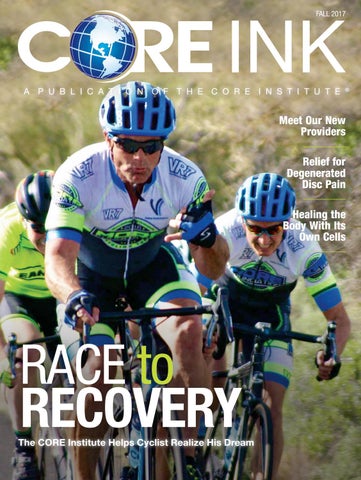
RACE to RECOVERY
The CORE Institute Helps Cyclist Realize His Dream
Not ready for surgery? Did you know your own fat may help you heal the natural way?
LipogemsÂŽ is a cutting-edge technology that uses the natural and powerful reparative capability of your fat tissue reserves. This innovative procedure may provide an alternative to surgery. Lipogems helps you heal the natural way by aiding in the healing process for the repair, replacement, or reconstruction of damaged or injured tissue.
Ask the CORE Institute Doctors if Lipogems is Right for You The Natural Way to Heal www.understandlipogems.com PAT-005-v1 2/2017 Copyright Š 2017 Lipogems Printed in USA
We give you more: MORE Space
MORE Clarity
MORE Comfort
MORE Peace of Mind
Schedule your appointment online at valleyradiologists.com or call 623.847.2000
WELCOME VOLUME 8, ISSUE 2 – FALL 2017
FROM THE CHAIRMAN
Dedication and innovation to get you back in the game Autumn has arrived, a season for inspiration and innovation. You will read about both in this edition of CORE Ink. For starters, we feature the inspiring story of Steve Cullinan, a 60-year old cyclist who is Captain of the MORE Foundation Cycling Team. Steve was training hard for a trip to New Zealand, where he planned to compete in the World Masters Games, a multi-sport event held once every four years. He expected the international competition would be tough; he never expected to suffer a heart attack while training, or a freak elbow injury just weeks before the Games. Did that stop Steve? Not a chance. Read his whole story on page 10. We also feature more articles on sports conditioning tips to avoid injuries, review the different sports medicine techniques to help battle pain, and discuss how relief can be obtained through interventional spine and pain treatments for Degenerative Disc Disease. Plus, when it comes to innovation, Dr. Jefferey Michaelson has become the first physician in Michigan to utilize the Lipogems device on patients diagnosed with early onset of arthritis. Lipogems is an FDA-cleared method for treating osteoarthritis and certain orthopedic conditions by isolating stem cells from a patient’s own fat cells to promote natural healing. For more information on stem cell therapy and which of our physicians are experts offering the procedure, please visit our website. It’s all part of our never-ending quest at The CORE Institute to stay on the cutting edge of orthopedic and neurology care, providing transparency for your treatment options and continuing to deliver best-in-class patient care for you, your family, and our community.
Keep Life in Motion!®
David J. Jacofsky, MD Chairman & CEO
A P U B L I C A T I O N O F T H E C O R E I N S T I T U T E
CREATED BY REPUBLIC MEDIA CUSTOM PUBLISHING FOR THE CORE INSTITUTE
General Manager: Cami Kaiser/ cami.kaiser@pni.com Creative Development Director: Isaac Moya/ imoya@republicmedia.com
Editor: Jim Williams/JLWilliams@republicmedia.com Project Manager: Nick Kostenko/nkostenko@republicmedia.com Design: Rachel Tullio Advertising Coordinator: Linda Knoebel/lknoebel@republicmedia.com
®
Contents
15
14 COVER STORY
Race to Recovery The CORE Institute Helps Cyclist Realize His Dream. See page 10.
FEATURE
10
For the Love of the Game Sports Conditioning Can Help Avoid Injury See page 14.
D E PART M E N T S
20 connect with us 1.866.974.2673
www.thecoreinstitute.com
Ask the Expert
Specialty Spotlight
8 Relief Offered Through Interventional Spine and Pain Treatment for Degenerated Discs
18 Sports Medicine Techniques Battle Pain, Benefit Weekend Warriors and Professional Athletes.
What’s New?
Nutrition
9 The CORE Institute is pleased to introduce new physicians to the CORE team.
20 What’s in Your Lunch Box? Healthy, Nutritious Meals Can Come From Home or School.
Trends 16 New Device Uses Patient’s Own Body Fat Tissue to Provide Potential Source of Stem Cells to Promote Healing
RESEARCH 22 Helping Hands: New 3D Printer Provides Prosthetic Hands for Kids.
5
Medication Guide XIAFLEX® (Zī a flex) (collagenase clostridium histolyticum) For injection, for intralesional use Read this Medication Guide before you receive XIAFLEX for the treatment of Dupuytren’s contracture and each time you get an injection. There may be new information. This Medication Guide does not take the place of talking with your healthcare provider about your medical condition or treatment. What is the most important information I should know about XIAFLEX for the treatment of Dupuytren’s contracture? XIAFLEX can cause serious side effects, including: 1. Tendon rupture or ligament damage. Receiving an injection of XIAFLEX may cause damage to a tendon or ligament in your hand and cause it to break or weaken. This could require surgery to fix the damaged tendon or ligament. Call your healthcare provider right away if you have trouble bending your injected finger (towards the wrist) after the swelling goes down or you have problems using your treated hand after your follow-up visit. 2. Nerve injury or other serious injury of the hand. Call your healthcare provider right away if you get numbness, tingling, increased pain, or tears in the skin (laceration) in your treated finger or hand after your injection or after your follow-up visit. 3. Hypersensitivity reactions, including anaphylaxis. Severe allergic reactions can happen in people who receive XIAFLEX, because it contains foreign proteins. Call your healthcare provider right away if you have any of these symptoms of an allergic reaction after an injection of XIAFLEX: • hives • chest pain • swollen face • low blood pressure • breathing trouble • dizziness or fainting What is XIAFLEX? XIAFLEX is a prescription medicine used to treat adults with Dupuytren’s contracture when a “cord” can be felt. It is not known if XIAFLEX is safe and effective in children under the age of 18. Who should not receive XIAFLEX? Do not receive XIAFLEX if you: • are allergic to collagenase clostridium histolyticum, or any of the ingredients in XIAFLEX, or to any other collagenase product. See the end of this Medication Guide for a complete list of ingredients in XIAFLEX. Talk to your healthcare provider before receiving this medicine if you have any of these conditions. What should I tell my healthcare provider before receiving XIAFLEX? Before receiving XIAFLEX, tell your healthcare provider if you: • have had an allergic reaction to a XIAFLEX injection in the past • have a bleeding problem • have received XIAFLEX to treat another condition • have any other medical conditions • are pregnant or plan to become pregnant. It is not known if XIAFLEX will harm your unborn baby. • are breastfeeding or plan to breastfeed. It is not known if XIAFLEX passes into your breast milk. Talk to your healthcare provider about the best way to feed your baby if you receive XIAFLEX. Tell your healthcare provider about all the medicines you take, including prescription and over-the-counter medicines, vitamins, and herbal supplements. Using XIAFLEX with certain other medicines can cause serious side effects. Especially tell your healthcare provider if you take: • medicines to thin your blood (anticoagulants). If you are told to stop taking a blood thinner before your XIAFLEX injection, your healthcare provider should tell you when to restart the blood thinner. Ask your healthcare provider or pharmacist for a list of these medicines, if you are not sure. Know the medicines you take. Keep a list of them to show to your healthcare provider and pharmacist when you get a new medicine. How will I receive XIAFLEX? • XIAFLEX should be injected into a cord by a healthcare provider who is experienced in injection procedures of the hand and treating people with Dupuytren’s contracture. If you have more than 1 contracture, your healthcare provider may give you 2 injections in 1 of your hands during your visit. • Your healthcare provider will inject XIAFLEX into the cord that is causing your finger to bend.
• After an injection of XIAFLEX, your affected hand will be wrapped with a bandage. You should limit moving and using the treated finger after the injection. • Do not bend or straighten the fingers of the injected hand until your healthcare provider says it is okay. This will help to keep the medicine from leaking out of the cord. • Do not try to straighten the treated finger yourself. • Keep the injected hand elevated until bedtime. • Call your healthcare provider right away if you have: • signs of infection after your injection, such as fever, chills, increased redness, or swelling • numbness or tingling in the treated finger • trouble bending the injected finger after the swelling goes down • Return to your healthcare provider’s office as directed 1 to 3 days after your injection. During this first follow-up visit, if you still have the cord, your healthcare provider may try to extend the treated finger to “break” the cord and try to straighten your finger. • Your healthcare provider will provide you with a splint to wear on the treated finger. Wear the splint as instructed by your healthcare provider at bedtime to keep your finger straight. • Do finger exercises each day, as instructed by your healthcare provider. • Follow your healthcare provider’s instructions about when you can start doing your normal activities with the injected hand. What are the possible side effects of XIAFLEX? XIAFLEX may cause serious side effects, including: • See “What is the most important information I should know about XIAFLEX?” • increased chance of bleeding. Bleeding or bruising at the injection site can happen in people who receive XIAFLEX. Talk to your healthcare provider if you have a problem with your blood clotting. XIAFLEX may not be right for you. The most common side effects with XIAFLEX for the treatment of Dupuytren’s contracture include: • swelling of the injection site or the hand • bruising or bleeding at the injection site • pain or tenderness of the injection site or the hand • swelling of the lymph nodes (glands) in the elbow or armpit (axilla) • itching • breaks in the skin • redness or warmth of the skin • pain in the armpit Tell your healthcare provider if you have any side effect that bothers you or does not go away. These are not all of the possible side effects with XIAFLEX. For more information, ask your healthcare provider or pharmacist. Call your doctor for medical advice about side effects. You may report side effects to FDA at 1-800-FDA-1088. General information about the safe and effective use of XIAFLEX. Medicines are sometimes prescribed for purposes other than those listed in a Medication Guide. This Medication Guide summarizes the most important information about XIAFLEX. If you would like more information, talk to your healthcare provider. You can ask your healthcare provider or pharmacist for information about XIAFLEX that is written for health professionals. For more information, go to www.XIAFLEX.com or call 1-800-462-3636. What are the ingredients in XIAFLEX? Active ingredient: collagenase clostridium histolyticum Inactive ingredients: hydrochloric acid, sucrose, and tromethamine. The diluent contains: calcium chloride dihydrate in 0.9% sodium chloride This Medication Guide has been approved by the U.S. Food and Drug Administration. Distributed by: Endo Pharmaceuticals Inc. Malvern, PA 19355 US License No. 1816 US Patent Nos. 7,811,560 and RE39,941 118324 Approved: 07/2017
XD-05404
Over 100,000 patients have been treated with FDA-approved XIAFLEX® since 2010.* If bent fingers from Dupuytren’s contracture are affecting you, explore XIAFLEX.com and find a hand specialist near you.
*Based on estimates through May 2017. Actor portrayal.
WHAT IS XIAFLEX®? XIAFLEX® is a prescription medicine used to treat adults with Dupuytren’s contracture when a “cord” can be felt. It is not known if XIAFLEX® is safe and effective in children under the age of 18. IMPORTANT SAFETY INFORMATION FOR XIAFLEX® Do not receive XIAFLEX® if you have had an allergic reaction to collagenase clostridium histolyticum or any of the ingredients in XIAFLEX®, or to any other collagenase product. See the end of the Medication Guide for a complete list of ingredients in XIAFLEX®. XIAFLEX® can cause serious side effects, including: • Tendon rupture or ligament damage. Receiving an injection of XIAFLEX® may cause damage to a tendon or ligament in your hand and cause it to break or weaken. This could require surgery to fix the damaged tendon or ligament. Call your healthcare provider right away if you have trouble bending your injected finger (towards the wrist) after the swelling goes down or you have problems using your treated hand after your follow-up visit • Nerve injury or other serious injury of the hand. Call your healthcare provider right away if you get numbness, tingling, increased pain, or tears in the skin (laceration) in your treated finger or hand after your injection or after your follow-up visit
• Hypersensitivity reactions, including anaphylaxis. Severe allergic reactions can happen in people who receive XIAFLEX® because it contains foreign proteins. Call your healthcare provider right away if you have any of these symptoms of an allergic reaction after an injection of XIAFLEX®: — hives — swollen face — breathing trouble — chest pain — low blood pressure — dizziness or fainting • Increased chance of bleeding. Bleeding or bruising at the injection site can happen in people who receive XIAFLEX®. Talk to your healthcare provider if you have a problem with your blood clotting. XIAFLEX® may not be right for you. Before receiving XIAFLEX®, tell your healthcare provider if you have had an allergic reaction to a previous XIAFLEX® injection, or have a bleeding problem or any other medical conditions. Tell your healthcare provider about all the medicines you take, including prescription and nonprescription medicines, vitamins, and herbal supplements. Using XIAFLEX® with certain other medicines can cause serious side effects. Especially tell your healthcare provider if you take medicines to thin your blood (anticoagulants). If you are told to stop taking a blood thinner before your XIAFLEX® injection, your healthcare provider should tell
you when to restart the blood thinner. Ask your healthcare provider or pharmacist for a list of these medicines if you are unsure. The most common side effects with XIAFLEX® for the treatment of Dupuytren’s contracture include: • swelling of the injection site or the hand • bruising or bleeding at the injection site • pain or tenderness of the injection site or the hand • swelling of the lymph nodes (glands) in the elbow or armpit • itching • breaks in the skin • redness or warmth of the skin • pain in the armpit Tell your healthcare provider if you have any side effect that bothers you or does not go away. These are not all of the possible side effects with XIAFLEX®. For more information, ask your healthcare provider or pharmacist. Please see the Medication Guide on the adjacent page. You are encouraged to report negative side effects of prescription drugs to the FDA. Visit www.fda.gov/ medwatch, or call 1-800-FDA-1088.
Rx Only XIAFLEX® is a registered trademark of Endo International plc or one of its affiliates. © 2017 Endo Pharmaceuticals Inc. All rights reserved. Malvern, PA 19355 XD-05413/August 2017 www.xiaflex.com 1-800-462-ENDO (3636)
Explore XIAFLEX.com
and find a specialist near you.
ASK THE EXPERT
structures. Both can cause low back pain and shooting pain as seen in sciatica. The most common disc problems originate 1) in the lumbar disc space where low back pain can radiate into the hips, legs, and feet; and 2) in the cervical disc space where neck pain radiates into the shoulders, arms and hands.”
Q&A
‘Oh, My Aching Back!’ Relief Offered Through Interventional Spine and Pain Treatment for Degenerated Discs by Pat Whitney You see someone walking bent over at a 30-degree angle—in obvious pain. And not all that old. Chances are they suffer from degenerative disc disease (DDD) — one of the most common diagnoses for people with back pain. Yet, DDD isn’t a disease at all. “It is a process of natural aging,” says Dr. Anuj Daftari, Interventional Spine and Pain Medicine Physician with The CORE Institute. “Unfortunately, eventually everyone develops it. Fortunately, not everyone develops pain during this process.” Some begin to experience the condition as early as their 20s. A World Health Organization Review estimates 149 million work days are lost annually in the U.S. due to low back pain and
8
degenerative disc disease. Trauma, such as a car collision or a hard fall, commonly activate the symptoms. Is surgery inevitable? Dr. Daftari explains alternative strategies for reducing pain: Q: What is disc degeneration? A: “It is a process that occurs with natural aging. The inner nucleus of the disc is made up mostly of water and protein, a gelatinous substance. Over time, it dries out and gets thinner, allowing small tears to occur in the outer part of the disc. The gelatinous nucleus can push through the tear leading to a herniated disc that can irritate nearby nerves.” Q: What causes DDD pain? A: “When the inner disc releases its contents through the tear in the disc’s outer rim, proteins are released into the area causing an inflammatory response. A herniation can also develop and apply pressure on the neighboring neural
Q: How do you diagnose the condition? A: “The patient’s medical history and physical exam are the most important tools. We find the source of the pain and what positions and activities make it worse. We perform a neurologic exam to test strength and sensation along with provocative tests to help differentiate pain from different sources. Conservative treatments include anti-inflammatories, muscle relaxants and a course of physical therapy. After six weeks and no improvement, we may order an MRI and, based on the findings, may recommend Epidural injections or refer the patient to a spine surgeon. Other treatment options may include radiofrequency ablation, sacroiliac joint injection and trigger point injections. For patients who have had neck or low back surgery with continued pain refractory to a conservative approach, we discuss a spinal cord stimulator.” Q: What is the ultimate objective? A: “The goal is to calm the inflammation, relieve the pain and slow down the progression of the degenerating discs so patients may have a better quality of life with their family and friends, stay functional and be productive—both at work and in their personal lives. Daily exercise is very important as it helps keep our bodies well-conditioned and helps our brain release natural painfighting endorphins. Also essential is staying hydrated, limiting alcohol consumption, maintaining good posture and proper nutrition, and stopping smoking. All can help slow the process.”
www.thecoreinstitute.com
WHAT’S NEW NEW PROVIDERS
The CORE Institute is pleased to announce these additions to our provider team. ARIZONA
ARIZONA
K. ADAM LUNDBERG, DO Dr. Lundberg is a fellowshiptrained physician specializing in interventional spine, pain management, and anesthesiology.
MICHAEL MCKEE, MD Dr. McKee is an internationally renowned, fellowship-trained and board certified surgeon, specializing in orthopedic trauma and upper extremity surgery.
MICHIGAN
MICHIGAN
MATTHEW T. MCCARTHY, MD Dr. McCarthy is a boardcertified and fellowship-trained sports neurologist, specializing in the treatment of concussion, post-concussion syndrome, and neurological disorders in athletes.
MICHAEL SLESINKSI, DO Dr. Slesinski is a fellowshiptrained and board certified, physical medicine and rehabilitation (PM&R) physician specializing in interventional spine/pain management, electrodiagnostics (EMG), and sports medicine.
GAIN the DJJ AdvantEDGE Communications Solutions
WHY COMPROMISE?
Hosted
The Power of mobility and unified communications. The flexibility of virtulization and multi-vendor integration. Security. Scalability. Resiliency. There’s a reason why more than 5,000 businesses in Greater New York and across the US trust DJJ to handle their communications:
On-Prem
pCloud
DJJ Gets it Right.
1.800.355.2952 Headquarters 3116 Expressway Dr. South, Islandia, NY 11749 AR-0008689604-01
NYC 116 W. 23rd Street, Suite 500, New York, NY 10011
www.djjtechnologies.com facebook.com/djjtechnologies Connect with DJJ
@djjtechnologies djj technologies
COVER STORY
BY KRISTINE BURNETT
RACE to
Recovery
The CORE Institute Helps Cyclist Realize His Dream Steve Cullinan, an avid cyclist, spent five years training to compete in the World Masters Games 2017, an international multi-sport event held every four years. Just five weeks before the 60-year-old athlete was set to travel halfway around the world to race in New Zealand, a freak elbow injury threatened to dash his cycling dreams. Then Cullinan met Tony Nguyen, MD, an orthopedic surgeon and sports medicine physician at The CORE Institute. “My emotions went from shock and anger, to numbness at the thought that I wasn’t going to New Zealand,” Cullinan said. SOMETHING WASN’T RIGHT On what began as a pretty typical Sunday, Cullinan spent the morning of March 5 racing. He then went home to help his wife move an oven
10
as part of a kitchen remodel. With just one wrong move, he knew something wasn’t right. “I put ice on my elbow and headed back to the race,” Cullinan said. His plan? To get a recommendation from his friend and fellow MORE Foundation cycling team member, Rene Lucas, MD, an interventional spine and
pain management physician at The CORE Institute. “He [Dr. Lucas] called Dr. Nguyen from the race and explained what happened,” Cullinan shared. “Dr. Nguyen knew immediately what it was.” Cullinan had torn his left distal biceps tendon. In lay terms, the tendon that allows a person to flex the arm and make a muscle.
www.thecoreinstitute.com
Uniting Sports and the World
Organized by the International Masters Games Association, the World Masters Games is one of the largest participatory multisport competitions in the world, bringing together up to 30,000 men and women aged 35 and above, from more than 100 countries, for the simple joy of competing with their peers. All Masters multi-sport events embody the original ideals of the Olympic movement. The IMGA currently organizes Summer World Masters Games, Winter World Masters Games and Regional Masters Games in Europe and the Americas.
11
COVER STORY
Why cycling? Why not!
means you are more likely to continue to cycle regularly, compared to other physical activities that keep you indoors or require special times or places. »» Time-efficient – as a mode of transport, cycling replaces sedentary time spent driving motor vehicles or using trams, trains or buses with healthy exercise.
If you’re looking for a fitness activity that is perfect for both the novice and experienced exerciser, check out cycling. Fitness trainers will tell you that it only takes two to four hours a week to achieve a general improvement to your health: Here’s a look at why cycling is Source: Better Health Channel such a great complement to any exercise program. It is: »» Low impact – it causes less strain and injuries than most other forms of exercise. »» A good muscle workout – cycling uses all of the major muscle groups as you pedal. »» Easy – unlike some other sports, cycling does not require high levels of physical skill. Most people know how to ride a bike and, once you learn, you don’t forget. »» Good for strength and stamina – cycling increases stamina, strength and aerobic fitness. »» As intense as you want – cycling can be done at very low intensity to begin with, if recovering from injury or illness, but can be built up to a demanding physical workout. »» A fun way to get fit – the adventure and buzz you get from coasting down hills and being outdoors
12
Cyclist Steve Cullinan nearly saw his dream to compete in the World Masters Games 2017 come to an end when he suffered a freak injury helping his wife move an oven during a kitchen remodel. Cullinan turned to the team at The CORE Institute to help him quickly recover from a torn tendon in his arm. Thanks to Dr. Tony Nguyen, an orthopedic surgeon and sports medicine physician at The CORE Institute, Cullinan was able to compete in the race only a few weeks after undergoing surgery.
www.thecoreinstitute.com
“I had full strength and full range of motion in my elbow. Everyone was blown away. That’s all Dr. Nguyen. He’s that good!” — Steve Cullinan
mountain bike trail ride. “I had to test it [the brace] and the flowers were blooming,” he said, justifying his decision to ride so soon after surgery.
He met with Dr. Nguyen the next morning. ‘I’LL HAVE YOU READY” “Dr. Nguyen understood the way that we race and hold the handlebars,” Cullinan recalled. “Then he looked at me and said, ‘I’ll have you ready. You’re going to New Zealand.’” Four days later, Cullinan underwent distal biceps tendon repair, a minimally invasive surgical procedure,
at Banner Thunderbird Medical Center in Glendale, Arizona. Following the operation, a week later he was fitted for a removable brace. “I had really good range of motion right away,” Cullinan said. Though still donning an elbow brace and taking part in physical therapy, Cullinan was getting antsy. After only two days of wearing the brace, he headed out for a
HEART SETBACK After another 48 hours, he mounted his bike again. This trip proved to be more eventful. “I had a heart attack while riding and all I could think was that I wasn’t going to New Zealand,” he said. Cullinan headed to a nearby fire station where crews stabilized him before transferring him to the hospital. Five days after the heart attack, his doctor grudgingly gave him the all clear to fly to New Zealand. “Every doctor was telling me I was out of my mind, but nothing was stopping me,” Cullinan explained. “I was hell-bent on doing this race.” COMPETING AT THE HIGHEST LEVEL Still technically recovering GET ON THE ROAD To learn more about arthroscopic and reconstructive surgery or to find an orthopedic surgeon near you, visit thecoreinstitute.com.
from elbow surgery and a heart attack, Cullinan flew to New Zealand. On April 30, he competed and won his first of three races. With jet lag setting in, he didn’t fare as well in the second race, a mountain bike event.
“I got my butt kicked,” he laughed. “I was humbled.” Cullinan’s final event was a difficult road race. He ranked 22 out of 100 cyclists. “I had full strength and full range of motion in my elbow,” Cullinan said. “Everyone was blown away. That’s all Dr. Nguyen. He’s that good!” Cullinan still has a bit of recovering to do, but he’s already gearing up for the World Masters Games 2021. Thanks to Dr. Nguyen and the experts at The CORE Institute, he’s keeping life – and his bicycle – in motion.
13
For the Love of the Game Sports Conditioning Can Help Avoid Injury By Susie Steckner You get off the couch and dive into a basketball tourney at the last-minute. Or you dust off your old running shoes and hit the road for a 5k race. Then, limping home to nurse sore muscles or an injury, regret settles in. Sound familiar? Next time, skip the “weekend warrior” approach and instead get your body in shape to tackle any activity. Not only will you reduce your risk of injury, you will boost your enjoyment of every two-point shot or finish-line win. IMPROVE YOUR GAME Sports conditioning isn’t just for elite athletes, said Katherine Zwanziger, PT, DPT, a seasoned physical therapist with The CORE Institute who specializes in treating musculoskeletal injuries. Conditioning can improve
14
anyone’s performance, whether for a specific sport or range of exercise. Here are Zwanziger’s keys for success: »» Find a favorite. Look for an activity that interests you. No matter what your fitness level, often you can vary the intensity, duration or position to allow you to participate in a particular activity. »» Start slow. If you’ve been inactive and want to begin walking, for instance, going zero to 60 with a two-hour walk could leave you sore and injured. For any age and any sport, it’s important to ease into the activity. Focus on stretching, proper hydration, and warm up and cool down activities to assist with muscle recovery. The biggest thing is a slow progression of whatever you’re getting into to help you get the best outcome. »» Post-surgical. In sports rehabilitation, most people are starting at square one. When cleared by a physician, start light and controlled — maybe at 25 percent of your previous level.
The people who go back to the level where they left off are the ones who tend to reinjure themselves or strain something else and will not recover the way they want. »» Sport specific. If you are focusing on a specific sport, plan on adding conditioning that will boost your endurance in that particular sport — beyond your regular fitness routine of workouts at the gym or daily walking. Just because you can swim for four hours doesn’t mean you can run a marathon. There’s not always that crossover. THE BOTTOM LINE? Start slow and start smart. You’re not starting at a level you left off pre-injury or starting at a level you were 10 years ago in high school. “You’re starting at the level you are at now and you can build up to what is appropriate.”
www.thecoreinstitute.com
SCOTTSDALE’S ONLY NOT-FOR-PROFIT CONTINUING CARE RETIREMENT COMMUNITY
Since 1988, Westminster Village has been dedicated to creating an enviable lifestyle for our residents. Come experience for yourself what makes our community so unique. JOIN OUR WAIT LIST TODAY, WHAT ARE YOU WAITING FOR? Contact Marketing at 480.451.2000 or visit us at www.WestminsterVillageScottsdale.com 12000 N. 90th Street | Scottsdale, AZ 85260
T R EN DS
seeking alternatives to surgery, are not candidates for surgery, wish to use it in conjunction to surgery to promote healing, or are suffering from an ailment or injury. Lipogems treatment may be used when standard treatment options such as physical therapy, nonsteroidal antiinflammatory drugs, or steroid injections have not provided significant relief, Dr. Michaelson explained.
Future of Healing
New Device Uses Patient’s Own Body Fat Tissue to Provide Potential Source of Stem Cells to Promote Healing By Brian Sodoma Patients can now benefit from an innovative and next-generation regenerative ® cell technology, called Lipogems , using adipose stem cells to treat chronic orthopedic conditions. The technology is used to harvest, concentrate, and transfer a patient’s own fat for the repair, reconstruction, or replacement of injured or damaged tissue. Adipose tissue, commonly known as fat, contains an ideal source and high number of mesenchymal stem cells and has been long used for support of tissue repair and replacement. This technology can be used in orthopedic medicine for supporting healing of tissue in the shoulder, knee, hip and spine, as well as for certain cosmetic applications such as hand rejuvenation (contouring of the hand to improve appearance). HOW IT WORKS The Lipogems system is used to liposuction fat cells from the patient’s thigh or abdomen with local anesthetic. The device then rinses and cleans the inflammatory oils and blood from the patient’s harvested fat and keeps the natural and
LEARN MORE If you would like more information about stem cell therapy, visit www. thecoreinstitute.com/lipogems.
16
beneficial properties of the fat tissue, such as stem cells. The stem cells are then injected to the injured site and tend to remain in the area where injected instead of being immediately reabsorbed by the body. This allows for the body to absorb and maximize the benefits of Lipogems where it was injected for an extended period of time. Following the injection, the stem cells promote healing and symptom reduction as early as three weeks after treatment. The entire procedure from harvesting to the injection is completed in less than one hour. “More than 27 million people have been diagnosed with osteoarthritis. Patients present in our clinics everyday with joint pain and may not be ready for a joint replacement. Our goal is to provide them with the best treatment options,” said Dr. Jefferey Michaelson, Orthopedic Surgeon with The CORE Institute. “With Lipogems, we can help patients who may suffer from joint pain or injury that limits their ability to perform their daily activities. Our motto is ‘Keep Life in Motion’ and with this new device and treatment option available, we can do just that for our patients.” In May, Dr. Jefferey Michaelson became the first doctor in Michigan to utilize the Lipogems device on three patients who were diagnosed with early onset of arthritis. Lipogems may be beneficial to patients
COSMETIC USE In addition to the orthopedic use cases, Lipogems can be used cosmetically. Dr. Damon Adamany, orthopedic hand surgeon with The CORE Institute, based in Sun City, Ariz., uses the technology to aid in regenerating tissue around the dorsal area, or top part of the hand. “There is an old saying that you can tell a woman’s age by looking at her hands,” said Dr. Adamany. “Although this may have been true in the past, modern technologies have allowed us to advance the field and provide rejuvenation approaches to treat the aged appearance of the hands such as visible veins and tendons, wrinkled and thin skin, and appearance of sun spots or discoloration.” The harvesting of the cells remains the same as the orthopedic uses cases noted by Dr. Michaelson, however the cells are used to inject into the grooves and between the bones to create a plump appearance on the top of the hand. Whether the patient’s hands require volume replacement, correction of sun damage or erasure of lines and wrinkles, Lipogems is a minimally invasive treatment option to improve the appearance. “There was a need and request for this treatment option in our community and we are excited to offer this new technology to our patients seeking experts in hand rejuvenation,” said Dr. Adamany. Disclaimer: The information in this article is provided as information only, and is not intended as a substitute for patient education, professional medical advice, diagnosis, or treatment recommendations, nor does it establish a doctor-patient relationship. Should you request an appointment with The CORE Institute, we will use the information you submit to arrange for an appointment for a consultation.
www.thecoreinstitute.com
Mini plates, many applications
Smith & Nephew, Inc. www.smith-nephew.com | Š2014 Smith & Nephew, Inc. ™Trademark of Smith & Nephew. Certain marks Reg. US Pat. & TM Office
Evolving Possibilities www.EVOSplating.com
SPECIALTY SPOTLIGHT custom physical therapy program or leading-edge surgery, The CORE Institute orthopedic sports medicine team is there at every step, providing technologically advanced surgical techniques and rehabilitation. The chances of requiring sports medicine treatments is likely greater than you think. More than one-third of adults say low back pain has affected their ability to engage in tasks, according to the American Physical Therapy Association. The American Health Statistics Reports indicated that In 2012, 54.5 percent of adults in the United States had a musculoskeletal pain disorder.
Sports Medicine Techniques Battle Pain Weekend Warriors and Professional Athletes Benefit By Joan Westlake While you might be able to pinpoint an accident, sports incident or chronic condition as the direct cause of your pain, Michael Slesinski, DO, said there are usually multiple and very individualized factors affecting your condition and therefore the recovery plan. Recently joining The CORE Institute’s Michigan orthopedic sports medicine team, Dr. Slesinski, a spine and non-operative sports physiatrist, said the treatments and techniques he used on athletes while on the sports medicine team at Michigan State University are the same as he employs in the recovery plans of weekend warriors and those suffering from accidents or chronic pain conditions.
SPECIALIZED CARE A hallmark of The CORE Institute is providing specialized, individualizes care to patients. Physicians have in-depth training in surgical, non-surgical and rehabilitative hip, knee, shoulder, elbow and ankle procedures; arthroscopy; fracture management; orthopedic traumatic injury; cartilage restoration; foot and ankle reconstruction; and orthopedic sports medicine. Dr. Slesinski said this comprehensive, multi-disciplinary approach has been shown to achieve optimal outcomes for patients. Whether your injury requires a
RAPID RECOVERY The CORE Institute’s arthroscopic, minimally invasive approach to sports injury allows rapid recovery and returnto-play activity. On-site x-ray and physical therapy services help speed patients’ diagnosis and recovery time. “I often begin by recommending a specific exercise program and therapy to achieve recovery from an injury,” said Dr. Slesinski. “Medications, manual manipulation, ice or heat can also be helpful. Occasionally, injections are beneficial.” He added that some of the more advanced but still less invasive than surgery procedures might include: Regenerative medicine: Platelet rich plasma (PRP), amniotic, bone marrow or adipose stem cells are injections to treat chronic orthopedic conditions and soft tissue defects. These treatments can reduce pain and provide long-lasting relief from chronic soft tissue pain, early arthritis, and cartilage damage in the joint.Spinal radiofrequency ablation: X-ray is used to direct a radiofrequency
Dr. Slesinski is a fellowship-trained and board certified, physical medicine and rehabilitation (PM&R) physician specializing in interventional spine/pain management, electrodiagnostics (EMG), and sports medicine practicing in our Michigan Market.
MICHAEL SLESINSKI, DO
18
www.thecoreinstitute.com
SPECIALTY SPOTLIGHT needle alongside the nerves of the spine to disrupt their ability to send pain signals. Percutaneous ultrasonic tenotomy: An ultrasound-guided needle is gently passed through the abnormal tendon multiple times to change a chronic degenerative process into one that is more likely to heal. Needle lavage and aspiration procedures: Similar to the tenotomy procedure but performed on tissue that has calcium deposits that may require a more “aggressive” procedure such as saline injected to “wash out” the calcium deposits. IMPROVING QUALITY OF LIFE Dr. Slesinski concluded, “Sports medicine therapies can be useful to help strengthen muscles, improve flexibility, decrease pain and improve function, even when the cause is due to ‘wear-and-tear.’ My goal in treating patients is to help them improve their function and quality of life. I want them to get back to doing the things they love to do. We also discuss prevention of injuries, which is very important for athletes of all abilities.”
Who Says You Can’t Do That? What good is living to a ripe old age if you can’t do what you want? Strength, flexibility, balance — got it?
LEARN MORE If you would like more information about our sports medicine team, visit thecoreinstitute.com.
Find a location near you at
TEAM-REHAB.COM
Why Wait? SimonMed Offers Same Day Appointments! Compassionate Staff We Handle Authorizations Subspecialty Trained Radiologists Walk-In X-ray
Schedule today call 623-XRAY-NOW (623-972-9669) Connect with us
@simonmedimaging
simonmed.com
NUTRITION
What’s in Your Lunch Box? Healthy, Nutritious Meals Can Come From Home or School By Debra Gelbart One of the most challenging aspects of back to school is time management. After a summer of at least some relaxation, the beginning of the new school year means all kinds of obligations return, including ensuring that your children will have a healthy lunch they won’t be eating at home. So should you pack your child’s lunch every day, or is it okay to only pack it two or three times a week? What if it’s simply easier for your family to allow your kids to purchase the school-prepared lunch? BETTER LUNCHES The good news is that since 2012, new federal nutritional standards have made school-prepared lunches healthier. In December 2010, President Obama signed into law a measure called “Healthy, Hunger-Free
20
PEANUT BUTTER AND JELLY ROLL-UPS 2 2 2
2
tablespoons creamy peanut butter tablespoons jam, jelly or honey slices bread
Remove crusts from bread. With a rolling pin or large soup can, completely flatten bread. Spread 1 tablespoon of peanut butter and 1 tablespoon of fruit spread on each slice of bread. Roll each slice into a tight spiral. Cut each spiral into 4 pieces so they resemble sushi rolls. Serves 1. Source: www.food.com (food.com/recipe/ peanut-butter-and-jelly-sushi-rolls-143003)
ZUCCHINI QUESADILLAS 4 tablespoons olive oil 1 onion, coarsely chopped Salt 4 cloves garlic, minced 2 medium zucchini (about 1 pound), halved lengthwise and thinly sliced crosswise 1 cup frozen corn kernels (4 ounces) 1/4 cup chopped fresh cilantro (optional) 4 (8-inch) flour tortillas
cups grated pepper jack cheese
Preheat oven to 400 degrees. In a large skillet, heat 3 tablespoons oil over medium heat. Add onion and 1 teaspoon salt; cook, stirring occasionally, until onion is soft, about 5 minutes. Stir in garlic; cook 1 minute more. Add zucchini and frozen corn kernels; cook, stirring occasionally, until zucchini is soft and corn is tender, about 6 minutes. Remove from heat; stir in cilantro, if using. Brush one side of all tortillas with remaining tablespoon oil; lay 2 tortillas, oiled side down, on a baking sheet. Place half of the filling on each, and sprinkle with half the cheese. Place remaining 2 tortillas on top, oiled side up; press down gently with a spatula to seal. Bake until cheese has melted and tortillas are golden brown, turning once, about 10 minutes. Remove from oven; let cool slightly. To serve, slice each quesadilla into wedges. Shredded cooked chicken or sautéed shrimp could also be added to these quesadillas. Serves 4 Source: marthastewart.com
www.thecoreinstitute.com
Kids Act of 2010,” marking the most comprehensive changes to the school nutrition environment in more than a generation. The first phase became effective in July 2012. New requirements for school-prepared lunches include a daily serving of fruits; a daily serving of vegetables plus a weekly requirement for dark green, red/orange, beans/pea (legumes), starchy and “other” vegetables; and an increased quantity of combined fruits and vegetables. One survey in 2014 found that almost 31 percent of students never bring their lunch to school, because they purchase the school lunch. Yet 41 percent of school-age children bring their packed lunch to school five times a week. HEALTHY HOMEMADE If you opt to join the 41 percent of lunch-makers, here are some considerations from registered dietitians: »» All components of a packed school luanch should be easy to eat. Avoid drippy sauces and over-sized sandwiches, for example. »» The protein component of the lunch might be a peanut butter and honey sandwich on whole wheat bread, hard-boiled eggs or a lean deli meat (perhaps with a slice of low-fat cheese) sandwich. You could swap the bread for whole wheat crackers, a small tortilla or pita bread for the whole-grain component. »» Include a half-cup of vegetables that are easy to eat, such as organic baby carrots or cucumber slices.
»» Include a serving of fresh or dried fruit. »» For the dairy component, your child could purchase a half-pint of low-fat milk at school or you can pack a low-fat cheese stick or a low-sugar yogurt cup. If your child doesn’t like milk, encourage him or her to drink water rather than soda.
RESEARCH for supplies and the oversight of our engineers, they can be assembled by a team of volunteers and delivered to children in need quickly with the hopes of impacting the child’s quality of life,” Dr. Jacofsky said. Fundraising for this project started on April 4, Arizona Gives Day, in which nonprofits in Arizona put together a pitch and people can go to www.azgives.org to donate. “We raised $5,570 in a single day. We were the second highest grossing medical charity program on that day,” Dr. Jacofsky said. “Something we are extremely proud of and want to continue to share.”
Helping Hands New 3D Printer Provides Prosthetic Hands for Kids By Julie Maurer Thanks to generous donations from the community and the physicians and staff at The CORE Institute, the MORE Foundation will literally be lending a “helping hand” to children in need. The MORE Foundation, created by senior leadership at The CORE Institute in 2009, raised nearly $9,000 this year to purchase a 3D printer to create prosthetic hands for children. “Children grow very quickly and they also tend to beat up on their prosthetics quite a bit,” said Marc Jacofsky, PhD, The CORE Institute’s Chief Scientific Officer and Executive Director of MORE Foundation. “And insurance companies don’t typically approve frequent and expensive prosthetic replacements.”
22
Dr. Jacofsky added many insurance companies will deny coverage for prosthetic hands until a child is fully grown, or only provide one until they are 18, which denies these children years of developing critical manual dexterity. “That is simply not practical,” Dr. Jacofsky said. QUALITY OF LIFE To solve this problem, the MORE Foundation created their “Helping Hands” program, which will use a 3D printer to make prosthetic hands free of charge for children in the community. “With the new printer, the cost to make custom prosthetic hands is relatively low. With some limited funding
FUNDRAISING In addition to participating in Arizona Gives Day, the MORE Foundation launched an internal marketing campaign for staff at The CORE Institute to purchase and wear Helping Hands t-shirts on Fridays, also known as “Helping Hands Friday.” With those sales and a generous gift from one of their board members, the Helping Hands program has now raised enough to purchase the printer and supplies for the first few prosthetic hands. Dr. Jacofsky anticipates the first hand will be printed and assembled by September 2017. He noted that their primarily referrals will come in from hand therapists and physicians. “We’ve already identified a few recipients,” he said. “We anticipate doing one or two a month, but we may have to ramp up our efforts if there is a greater need in the community.” “We would like to continue to raise funds to offset the ongoing expenses for supplies to provide those hands,” Dr. Jacofsky added. “We rely on the goodwill and donations of people who want to support these programs.”
LEND A HAND
If you would like to donate, purchase a t-shirt, or sign up to volunteer, visit more-foundation.org/helpinghands. www.thecoreinstitute.com
HEALTHY + ACTIVE YOUR TOTALLY WORTH-IT LIFESTYLE
Care simplified so you can enjoy the activities you love. • A single point of contact to guide you from pre-surgery to post-surgery • Step-by-step education so you are informed about your surgery and recovery • Streamlined communications and simplified logistics • Advanced technology and treatment proven to yield you the best results
Find an orthopedic doctor near you: 1-855-409-7520
BannerCORECenter.com
Together we can transform orthopaedics. Every day, hospitals across the world are transforming orthopaedics with Mako Robotic-Arm Assisted Surgery. Isn’t it time you meet Mako?
A surgeon must always rely on his or her own professional clinical judgment when deciding whether to use a particular product when treating a particular patient. Stryker does not dispense medical advice and recommends that surgeons be trained in the use of any particular product before using it in surgery. The information presented is intended to demonstrate the breadth of Stryker’s product offerings. A surgeon must always refer to the package insert, product label and/or instructions for use before using any of Stryker’s products. The products depicted are CE marked according to the Medical Device Directive 93/42/ EEC. Products may not be available in all markets because product availability is subject to the regulatory and/or medical practices in individual markets. Please contact your sales representative if you have questions about the availability of products in your area. Stryker Corporation or its divisions or other corporate affiliated entities own, use or have applied for the following trademarks or service marks: Mako, Stryker. All other trademarks are trademarks of their respective owners or holders. MKORIO-AD-8 MKORIO-AD-9 07/16