INK
FALL 2014
A P U B L I
N O F T H E C O R E I N S T I T U T E
®
The CORE Institute’s Physical Therapists Play Key Role in Recovery Process Don’t Let Joint Pain Slow You Down
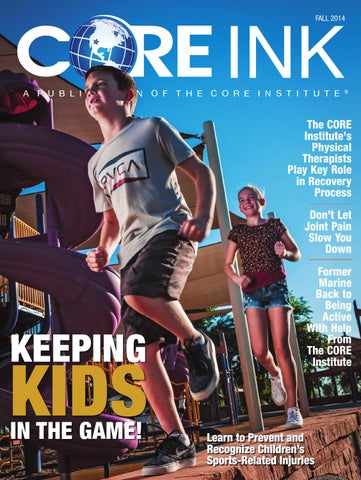
KEEPING
KIDS The CORE Institute’s Physical Therapists Play Key Role in Recovery Process
IN THE GAME!
Former Marine Back to Being Active With Help From The CORE Institute Don’t Let Joint Former Marine Pain Slow Back Being Active You Down With Help From The CORE Learn to Prevent and Institute Recognize Children’s Sports-Related Injuries
WELCOME VOLUME 5, ISSUE 3 FALL 2014
FROM THE MARKET PRESIDENT A Message from Your New Market President
FROM THE CHAIRMAN
Musculoskeletal care, rehabilitation, and neurosciences...the future of The CORE Institute
It’s been nine years since I began practicing with The CORE Institute in the Southwest Valley. It is an honor to introduce myself as your new President for the Arizona market. I am excited about what the future holds, for not only our organization, but our community as well. In this issue, we feature a former Marine, who not only battled lung and prostate cancer, but overcame an osteosarcoma thanks to our own Dr. Amalia De Comas. His dedication to not only his country, but the community has touched the lives of so many and now it’s time we share his story. In addition, we showcase how acupuncture can assist in reducing your pain, how to stay active despite everyday joint pain, common back-to-school injuries, and the tools and treatment options in pain management. I encourage you to connect with us on our social media platforms, including Facebook and YouTube, and to stay up-to-date with news and updates about The CORE Institute. As we continue to break national healthcare news, lead industry developments, and grow our comprehensive services, CORE Ink will keep you on the brink of innovation right along with us. Our advances in medicine are now your advances in health.
In the last edition of CORE Ink, we told you to expect news of growth in Arizona and beyond, and we are excited to announce our latest expansion. Effective October 1, 2014, many of the physicians from Arizona Neurological Institute, Arizona’s largest neurological practice, will be joining The CORE Institute. Adding neurological specialty service to The CORE Institute will enhance care to our patients in an increasingly coordinated fashion. The CORE Institute is very proud to have grown into the largest orthopedic practice in Arizona and this expansion allows us to also become the largest comprehensive neuroscience practice providing accessible outpatient and inpatient neurological, physical and rehabilitative medicine services. Musculoskeletal care, rehabilitation and the neurosciences are deeply intertwined and many conditions require the integrated approach of both specialties, making this a natural specialty expansion. The unique ability to provide our patients complete care along this continuum for diseases such as multiple sclerosis, neuromuscular disorders, neuropathy, and back pain has been a goal of ours for quite some time. With the new expansion of services, The CORE Institute will now offer comprehensive orthopedic care, podiatric medicine, pain management, physical medicine and rehabilitation, comprehensive spine care, rheumatology, neurology, neuropsychology, physical therapy, and infusion therapy. On behalf of all of our physicians, providers, and staff, The CORE Institute appreciates your continued support.
Keep life in motion!® Keep Life in Motion!
®
Steven L. Myerthall, MD Market President, Arizona
David J. Jacofsky, MD Chairman & CEO
A P U B L I C A T I O N O F T H E C O R E I N S T I T U T E
CREATED BY REPUBLIC MEDIA CUSTOM PUBLISHING FOR THE CORE INSTITUTE
®
General Manager: Cami Kaiser/ cami.kaiser@pni.com Creative Development Director: Isaac Moya/ imoya@republicmedia.com
Editor: Jim Williams/JLWilliams@republicmedia.com Editorial Coordinator: Nick Kostenko/nkostenko@republicmedia.com Sr. Managing Art Director: Tracey Phalen/tphalen@republicmedia.com Design: Rachel Tullio Photography: Jeff Noble Advertising Coordinator: Dominick Galluzzo/dgalluzzo@republicmedia.com
Contents
16 FEATURES
Keeping Kids in the Game!
COVER STORY: The playgrounds and sports fields are busy this time of year. But it’s also when accidents can happen. The CORE Institute offers help and advice not only for recognizing sportsrelated injuries, but also preventing them. See page 16.
Don’t Let Joint Pain Slow You Down
Learn how The CORE Institute is using innovative procedures and treatments to help patients resume being active. See page 20.
Get Physical
PATI E NT C A RE
The CORE Institute’s Physical Therapists play an important role in the surgery recovery process. See page 22.
A Different Kind of Battle Former Marine gets back to being active with help from The CORE Institute. See page 24.
20 D EPART ME N TS What’s New?
24 connect with us 1.866.974.2673
www.thecoreinstitute.com
8 T he CORE Institute is pleased to introduce new physicians to the team.
Ask the Expert 10 D r. David A. Ben-Aviv shares how acupuncture treatments help to naturally relieve pain and inflammation.
Research 14 T he MORE Foundation expanded vision includes focus on veterans and education.
Specialty Spotlight 28 The CORE Institute offers many treatment options for pain management.
CORE Candid 29 E mployees at The CORE Institute are “Keeping Life in Motion.”
7
WHAT’S NEW
ERIK B. ELLER, MD Orthopedic Foot & Ankle Surgery
NEW PROVIDERS The CORE Institute is pleased to announce the addition of seven new physicians to our provider team practicing at The CORE Institute. EMILY R. SQUYER, MD Orthopedic Traumatology
ARIZONA
DAVID KNESEK, DO Primary & Revision Joint Replacement Surgery of the Hip & Knee
GEORGE GENDY, MD Orthopedic Foot & Ankle Surgery
ARIZONA
NINA PATELHINKLE, MD Non-Surgical, Rehabilitative and Medical Sports Medicine ARIZONA
MICHIGAN
MICHIGAN
JUSTIN E. STATT, DO Physical Medicine & Rehabilitation
ARIZONA
MICHIGAN
WILLIAM K. KESTO, MD Arthroscopic & Reconstructive Surgery of the Shoulder, Elbow & Knee Orthopedic Sports Medicine
ASK THE EXPERT
FOR MORE INFORMATION about acupuncture, please call 1.866.974.2673 or email us at contactus@thecoreinstitute.com.
Acupuncture Treatment helps to naturally relieve pain, inflammation By David A. Ben-Aviv, MD Friends, family, and patients often ask me whether acupuncture would be helpful in a vast array of painful conditions. Regardless of the intensity, chronicity, or reason for the pain, I say, without hesitation, “yes”. Although millions of Americans have received acupuncture, the overall usage of acupuncture services is still quite low. For those who do seek out acupuncture, the most common reason is for treatment of musculoskeletal pain. To an acupuncturist, pain is a result of an obstruction of energy (qi). Acupuncture is an avenue used to restore disturbances in energy flow, therefore relieving pain and inflammation. As a result of acupuncture
10
treatment, there is a stimulation of the brain and spinal cord causing the body to release natural pain relieving chemicals including endorphins. Acupuncture does not cure disease, but can be a helpful adjunct in pain management whether the pain is acute, sub-acute, or chronic. Acupuncture provides another treatment option for patients to treat pain prior
to or after surgery. As a follow up question, I am often asked whether treatment with an acupuncture needle will hurt and whether acupuncture is safe. Most first-time acupuncture patients are surprised by how thin the needle is, and how little discomfort the needle causes on insertion. The needles used for acupuncture are only slightly wider than a strand of hair. Unlike needles used to draw blood, acupuncture needles are not hollow and do not have a sharp edge. Due to the above reasons, and considering that acupuncture needles are single-use needles, acupuncture is very safe with a low risk of infection or damage to internal tissues. The rate of minor complications from an acupuncture treatment is approximately 1 in 10,000 and the prevalence of severe complications is negligible. Considering the efficacy in pain relief as well as the lack of discomfort and safety of treatments, when I am asked whether acupuncture will help in treating pain, instead of answering “yes” I really should answer “why not?”
“To an acupuncturist, pain is a result of an obstruction of energy (qi). Acupuncture is an avenue used to restore disturbances in energy flow, therefore relieving pain and inflammation.”— Dr. David Ben-Aviv
DAVID A. BEN-AVIV, MD
David A. Ben-Aviv, MD, a board certified specialist in the field of physical medicine and rehabilitation, serves The CORE Institute as Medical Director of Acute and Subacute Rehabilitation at Banner Boswell Medical Center. He also holds positions as the Program Director of Santé of Chandler, Santé of Mesa and Santé of North Scottsdale and Chief Program Officer at Santé.
www.thecoreinstitute.com
RESEARCH
MORE Foundation aims to save lives Expanded vision focuses on military veterans, education By Gremlyn Bradley-Waddell You probably know about the great work done by The CORE Institute, but have you heard about The MORE Foundation? The non-profit organization, so named for its focus on MusculoskeletalOrthopedic Research and Education (MORE), is devoted to empowering individuals to Keep Life in Motion® through innovative research, community education and charitable assistance. Since its inception in 2007, the Foundation has concentrated initially on research, and it will continue carrying out GINA ORE that innovative work, said CEO Gina Ore. However, in addition, now that the mission and vision has been expanded, it’s time to develop and fund programs around community education and serving the medically underserved veteran population through charitable assistance. VETERAN’S ASSISTANCE “The CORE Institute physicians had a dream of giving back to the community when they created the Foundation,” Ore said. “Their goal has always been to assist the medically underserved veteran population who suffer with orthopedic conditions such as chronic joint and spine pain. We are focusing on designing clinics and referral centers that will help accomplish such a goal. In fact, we’re getting input from veterans, who understand better than most, the orthopedic and rehabilitation needs of their fellow military veterans.”
14
Ore, who joined the Foundation in May of this year, after 14 years at the Sun Health Foundation and most recently serving as Vice President and Chief Development Officer, said the veterans’ outreach program is just one way in which the MORE Foundation empowers people to live the organizations’ motto: “Keep Life in Motion.” EXPANDED VISION In addition to research and charitable assistance, community education is a major pillar of the Foundation. The MORE Foundation researchers and The CORE Institute physicians have donated hundreds of mentor hours over just the past few years, and now there’s discussion about developing programs for internship studies and fellowship studies. Additionally, physicians from The CORE Institute will provide interactive educational FOR MORE INFORMATION About the MORE Foundation and how to support the organization, please visit more-foundation.org or call 623.544.5546.
opportunities for high school students to shadow physicians, physician’s assistance and other medical providers, in an effort to groom future generations of researchers and clinicians. Of course, all these efforts require funding. It is not uncommon that many grateful patients have found that the healing power of philanthropy inspires them to support projects and programs such as research, community education and charitable assistance. “When a procedure positively changes someone’s life, I think that person feels benevolent, and a philanthropic gesture is the ultimate way of paying it forward,” said Ore, who has more than 25 years of experience in fundraising. And although efforts surrounding the enhanced charitable mission are just getting underway, Ore stated that staff from The CORE Institute have already steppedup with their own contributions. “They really want to move the needle forward,” she said, “and with them modeling truly philanthropic behavior, I feel confident that grateful patients will follow their example.”
www.thecoreinstitute.com
COVER STORY
KEEPING
KIDS IN THE GAME! Learn to Prevent and Recognize Children’s Sports-Related Injuries BY DOLORES TROPIANO | PHOTOS BY JEFF NOBLE
September signals back to school for most kids. It’s also the time that sports schedules start filling up. And where there are bikes, bats, balls and a bunch of kids trying to tackle one another — injuries are almost inevitable.
16
Club sports are part of the problem. Though we commonly say that kids are “playing sports,” many girls and boys today are involved with more serious club teams for sustained seasons, making young athletes work harder than ever at the sports they “play.” Choices must be made. To play or not to play, is a question many parents wrestle with. But if all the
bases are covered through preventative actions, kids can work and play at their favorite sport and still remain safe or at least greatly reduce the risks of injury. BEING PROACTIVE Dr. Nina Patel-Hinkle has seen it all: From fastballs to the face to basketball players collapsing on the court. She says that whatever sport your child chooses should
www.thecoreinstitute.com
OP FIVE T SPORTS INJURIES 1. Anterior cruciate ligament (ACL) in the knee — The over stretching or tearing of the ACL in the knee. A tear may be partial or complete. Basketball, football, soccer and skiing are common sports linked to ACL tears. 2. Meniscus tears — A knee cartilage injury. 3. Physeal fracture — An injury to the growth plates most commonly in wrist. 4. Tendonitis — or overuse injury. 5. Spondylolysis — An overuse injury in the back caused by repeated stress. This stress is most often due to movement associated with certain competitive sports, such as gymnastics, dance, and some types of soccer and football plays, as well as others. Source: The CORE Institute
17
DID YOU KNOW?
More than 3.5 million children ages 14 and younger get hurt annually playing sports or participating in recreational activities. Although death from a sports injury is rare, the leading cause of death from a sports-related injury is a brain injury. Sports and recreational activities contribute to approximately 21 percent of all traumatic brain injuries among American children. Almost 50 percent of head injuries sustained in sports or recreational activities occur during bicycling, skateboarding, or skating incidents. More than 775,000 children, ages 14 and younger, are treated in hospital emergency rooms for sports-related injuries each year. Most of the injuries occurred as a result of falls, being struck by an object, collisions, and overexertion during unorganized or informal sports activities. Source: National SAFE KIDS Campaign and the American Academy of Pediatrics
be taught to him clearly and accomplish what they were correctly. With some sports, meant to.” it’s also important that kids Dr. Patel-Hinkle stresses are placed with others within the importance of hydration, their experience level. especially in Arizona as well “It is definitely very imporas stretching as part of the tant that kids are taught warm-up and cool-down how to play sports corprocess. rectly and given the right “All these things need to equipment to play,” said be considered when kids are Dr. Nina Patel-Hinkle Dr. Patel-Hinkle, a primary playing sports,” Dr. Patelcare sports medicine physician with Hinkle said. The CORE Institute. “And if equipment Participation in middle and high such as helmets are not the proper fit, school sports often requires a physical and can fall off, they are not going to to ensure that a child does not have any
18
risks for a sport. According to Dr. PatelHinkle, “The main reason we go through physicals is to check for cardiac issues. We are screening for conditions of that nature to prevent a child from passing out during a sport. Patient history is mainly cardiovascular — we are looking for heart conditions.” PRACTICE DOES NOT MAKE PERFECT Overuse injuries are also very common — especially when children have a passion to play a sport or are involved with more than one sport and play throughout
www.thecoreinstitute.com
COVER STORY
“The wrong thing is to not recognize that they have an injury. It is very important to know what you are looking for — the signs and the symptoms and recognize the injury.” — Dr. Nina Patel-Hinkle, primary care sports medicine physician, The CORE Institute the year. Softball or baseball pitchers are typically limited in the amount of pitches they can throw per game to protect them from shoulder or elbow overuse caused by repetitive throwing. Boning up on common injuries may also be helpful for parents to not only prevent injuries but to be prepared to properly handle them if they come. “The wrong thing is to not recognize that they have an injury,” said Dr. PatelHinkle. “It is very important to know what you are looking for — the signs and the symptoms and recognize the injury.” Dr. Patel-Hinkle says that injuries such as fractures are far more obvious than perhaps a concussion. “Physical injuries are easy to pick up, but with something that is not seen, like a concussion, it’s important to know what to look for,” she said. CONCUSSION SYMPTOMS in Michigan recommends STOP, Symptoms to look for with a concussion an acronym that stands for sports include blurred vision, headaches, trauma overuse prevention. He steers dizziness, balance issues, fatigue, inabilpatients to the website sportsmed.org ity to think clearly or concentrate as well for information developed by leaders as irritability, difficulty sleeping and in the sports medicine field related anxiousness. Dr. Patel-Hinkle says that bleeding can to specific sports and sports injury prevention. also develop in the brain that “Coaches are starting to can cause other issues. She treat young kids as profesrefers to secondary impact sionals and that is part of syndrome as the situation the problem,” said Dr. in which an athlete gets a Kesto. “If a kid is not playconcussion and does not fully ing year round, they are recover and then goes back in told they are not good to play again and develops a enough. Listen to your second concussion before the kids, make sure they are first one heals. having fun. And if some“That leads to brain swelling Dr. William Kesto thing is wrong and they and can cause fatality,” she are hurt make sure they don’t try to said. push through the pain but address it Dr. William Kesto, an orthopedic right away.” surgeon with The CORE Institute
Tips for preventing sports injuries Get a physical prior to the season to make sure there aren’t any predispositions for injury. Get in shape. Obese or overweight athletes are more prone to injury. Parents and athletes should educate themselves about the sport being played and the potential injuries that can occur as well as the best ways to prevent them. Know what to look for in an injury, especially a concussion. Don’t ignore pain. Take time off between sports. Experts say three months a year is preferable. Keep an eye on the fun factor for your child. When winning adds too much pressure the enjoyment of the game is easily lost. 19
FEATURE STORY
Don’t Let
Joint Pain
Slow You Down
Learn About Innovative Procedures and Tips on Keeping Your Life in Motion By Meghann Finn Sepulveda If you or a loved one is suffering from joint pain and are considering a hip or knee replacement, you’ll be happy to know that resuming normal activity following surgery is not only highly recommended, but is significantly beneficial to improving overall health. From walking and swimming, to hiking and skiing, regular exercise and outdoor activity will Robert Cercek, MD not only speed the recovery process but will help maintain the longevity of a new joint. RISE IN YOUNGER CANDIDATES Hip and knee replacement surgery is no longer solely impacting the elderly population. In fact, national statistics
20
show a rising trend in people younger than age 65 undergoing total knee replacements and total hip replacements, according to the American Academy of Orthopaedic Surgeons. “We are seeing many more patients in their 40s, 50s and 60s as appropriate candidates for joint replacement surgery,” says Robert Cercek, MD, orthopedic surgeon, specializing in hip and knee replacement at The CORE Institute. “People are more active and there is also an association between obesity and arthritis, among a combination of other factors that contribute to the need for joint replacement.” The average life expectancy of a hip or knee implant is 30 to 40 years, which has significantly improved in recent years. “With more durability and increased longevity of the implants, we are hopeful that patients would never need a revision surgery,” Dr. Cercek explains.
WHEN TO SEEK SURGERY The first goal in joint replacement surgery is to provide pain relief. Following the procedure, patients typically no longer need prescription pain medication. While a prosthetic hip or knee will never be as good as a natural joint, surgeons aim to replicate everyday mechanics for patients to achieve their previous active lifestyle. “When considering joint replacement surgery, patients should speak to their primary care physician to determine if they are medically suitable, can undergo anesthesia and if their overall health is sufficient to support proper recovery,” Dr. Cercek says. Surgery is spaced between two to three months if both knees require joint replacement to reduce stress on the body and to allow time for rehabilitation. Patients typically spend one day
www.thecoreinstitute.com
“The more active the patient, the more conditioned the joint will be when preparing for surgery. Patients won’t have to spend extra time reconditioning those muscles.” David Knesek, DO, orthopedic surgeon, The Core Institute, Michigan
in the hospital followed by six to 12 weeks of outpatient physical therapy rehabilitation to focus on recovery. “The more active the patient, the more conditioned the joint will be when preparing for surgery,” says David Knesek, DO, orthopedic surgeon at The CORE Institute, Michigan. “Patients won’t have to spend extra time reconditioning those muscles.” Hip replacement patients are restricted to extreme ranges of motion such as deep squatting and bending during the first few months postsurgery. It is also recommended that patients are seen on an annual basis. “A yearly X-ray will allow us to catch problems in advance of any symptoms,” Dr. Knesek says. “Bone loss or destruction of the cartilage is a gradual process which can result in better outcomes if there is early intervention.”
LESS INVASIVE TECHNIQUES Orthopedic surgeons at The CORE Institute are utilizing computer navigation technology for joint replacement, a less invasive procedure as opposed to traditional surgery. “With the assistance of this technology, the speed of recovery is accelerated and patients can return to normal function quicker,” Dr. Cercek explains. “People desire to get back to their active lifestyle.” Surgeons at The CORE Institute will soon transition to robotic surgery for partial, full knee and hip replacements. “This new technique will be an extension of computer navigation surgery, but with more precision,” he says. GET MOVING In combination with recovery and rehabilitation, patients may be surprised to learn that physical activity is strongly encouraged.
“Being active is certainly recommended before and after joint replacement surgery,” Dr. Cercek says. “Whether a patient desires physical fitness or recreational activity, there are many high and low-impact exercises that can be performed on a regular basis.” Younger patients and those who were previously active often have a strong desire to return to an active lifestyle. David Knesek, DO Walking or swimming is ideal for patients who exercise frequently, while hiking, running and skiing are safe to do on occasion. “Not only will activity be beneficial to the new joint, but it is also good for overall cardiovascular health.” Dr. Cercek says.
21
FEATURE STORY
A CORE SERVICE
Physical Therapy Clinics help patients to a full recovery By Debra Gelbart are trying to avoid such surgery. In the Physical therapists work in a unique niche Southfield Clinic, Watson said, about 50 in the healthcare field, and people somepercent of the patients have not had surtimes misunderstand their role in helping gery and are trying to avoid surgery. patients recover full function after surgery “We try to figure out the underlying or an injury. cause of a patient’s pain and “We speed up the recoveducate the patient on what ery process and ensure as the problem is and how we are full a recovery as possible,” going to try to fix it,” Watson explained Jim Watson, PT, said. “Physical therapy may MPT the Physical Therapy be indicated if someone has Manager for The CORE injured him- or herself in the Institute’s Physical Therapy gym by not using the proper Clinic in Southfield, Mich. form when exercising. Physical “Our goal is to teach therapy can protect an injured patients to rely on themjoint and stabilize the areas James Watson selves as they’re recoveraround it.” ing in the weeks or few “With patients who have months after their surgery not had surgery, sometimes or injury, instead of relying something as simple as on the healthcare system improving their posture can continually to feel good,” make a huge difference in he said. “We are a bridge to how well they can function the doctor’s office and we and minimize their pain level,” have direct lines of comsaid Stephanie Williams, PT, munication with doctors at MPT, Manager of The CORE The CORE Institute, which Institute’s Physical Therapy Stephanie Williams, helps us deliver the best Clinic in Peoria, Ariz. PT, MPT quality care.” “Physical therapy is vital for Physical therapists in The CORE post-surgery orthopedic patients,” she Institute clinics typically work with two said. It’s almost impossible for orthopedic groups of patients—those who have surgery patients to recover optimal funchad orthopedic surgery and those who tional mobility without correct instruction
22
in and assistance with strengthening muscles and the proper mechanics of movement, she emphasized. PHYSICAL THERAPY CLINICS IDEALLY SITUATED Both the Southfield and Peoria clinics are located adjacent to The CORE Institute’s physician clinics, so if a patient experiences a medical problem while undergoing physical therapy, a physician’s help is just steps away. “This is so helpful,” Williams said. “Often times our physicians like to check up on their patients, so in between their clinic they will stop by and see how their patients are recovering and
www.thecoreinstitute.com
feeling. Not only is it a feel-good for the patient, but as a physician and therapist, we can rest assured the patients are receiving the best possible care.” “We also find out right away what medical issues might be going on with a patient,” Watson said, “instead of waiting for the patient to get an appointment with the doctor and then waiting to hear the outcome from the doctor’s office.” DEDICATION OF THE STAFF HELPS PATIENTS The physical therapists consider the people they help to be more than their patients. “We’re lucky enough to spend
four to 16 weeks with those we take care of, so we really get to know them,” said Dan Neal, PT, Vice President of Physical Therapy at The CORE Institute. “We learn about their jobs, their vacations and other aspects of their lives. Those connections allow for more open communication and trust, making it easier for patients to let us know about a problem or a concern. We get to know them well enough that we genuinely will feel like we’re seeing friends after a while. It is a good environment.” PATIENTS AT THE PHYSICAL THERAPY CLINICS A majority of the surgical patients seen
in the Physical Therapy Clinics are recovering from knee, hip or shoulder replacement surgery, a rotator cuff (a group of muscles and tendons in the shoulder) repair or reconstruction of the knee, Watson said. He and Williams also see patients between the ages of 20 and 40 years old who have sustained an injury and want to get back to peak performance, as well as patients between the ages of 70 and 90 who want to return to independence with everyday tasks. “Most of our patients recover full function after their therapy is complete,” Williams said.
23
James Sharp has been active his entire life. But bone cancer in his right leg forced him to limit his activities. Thanks to The CORE Institute, and his orthopedic surgeon, Dr. Amalia De Comas, he’s back doing what he loves.
A different kind of
BATTLE Former Marine returns to the links with help from The CORE Institute By Gremlyn Bradley Waddell Photos by Rick D’Elia
24
www.thecoreinstitute.com
PATIENT CARE
TWO OPTIONS Sharp began feeling pain in his leg several years ago, and it eventually became so severe that he couldn’t finish a round of golf. He soon got a diagnosis of osteosarcoma — cancer that starts in the bones — of the tibia, the larger of the two bones in the leg that runs from the knee to the ankle. He met with orthopedic surgeon Amalia De Comas, MD, of The CORE Institute, who, after assessing his risk factors including diabetes, gave Sharp three options: reconstruction using a donor tibia, amputation below the knee or taking TEEING OFF AGAIN no action. He went with the But after a December 2011 first choice, even after Dr. De surgery to spare his limb, Comas told him the recovery Sharp was told to avoid putprocess would be lengthy ting weight on the leg for and that the location of his AMALIA DE COMAS, MD more than a year. So it’s no malignant tumor, which was surprise that as soon as he close to the ankle, could was cleared and feeling up to it, the active make the complex surgery even more octogenarian and avid golfer made his challenging because of the lack of way back to the links. Though he couldn’t muscle tissue in that area of the body. put in a full 18 holes, getting in some Sharp said he fretted about his recent swings with his grandson was a decision, but Dr. De Comas, who was milestone on his road to recovery. pregnant and nearing her due date, “Needless to say, I’m a careful stepwas always there for him. per,” quipped Sharp, who even found a “In the time leading up to the surgolf coach to teach him how to swing a gery, Dr. De Comas would call me in club without twisting his leg, which could the evening after she got off work, undo all the good the surgery has done and she’d try to make me feel better him. “Life’s coming back in a very about it,” he recalled, touched by her positive way.” concern. A bout of bone cancer in his right leg sidelined him temporarily, but James Sharp isn’t the type to sit back and take it easy. This is a man, after all, who joined the Marines, served in Korea and Vietnam, devoted his career to public service – including four years as the Mayor of Flint, Michigan – and then started his own business. He’s also the type who tried to retire twice before actually doing so. And along the way, with help from his wife, Tessie, the Goodyear resident has battled lung and prostate cancer.
A SUCCESSFUL SURGERY Working carefully to avoid harm to the area around Sharp’s ankle, Dr. De Comas removed all the cancerous cells and replaced much of his tibia with the donor bone. “The native bone grows into (the donor bone), kind of like a scaffold, and it heals at both edges,” she explained, adding that a patient’s own bones assist in the healing process by bleeding and making new bone cells. “We let (the patient’s) body do the rest.” Eight days after the surgery, Dr. De Comas became a mom for the first time; she has since had a second child. As for her patient, she tracks Sharp’s progress during regular checkups and said his progress has been excellent, with the bones growing together well. Sharp is extremely pleased with the results, too. “I feel wonderful,” he said.
“In the time leading up to the surgery, Dr. De Comas would call me in the evening after she got off work, and she’d try to make me feel better about it.” —James Sharp, former Marine and cancer survivor 25
CORE CANDID
CO M M U N I T Y
‘Beaming’ in Michigan By Josh Weiss The CORE Institute team in Michigan was “beaming” as Drs. Markel and Higginbotham signed a final steel beam to be used in the construction of its newest location, at the Grand Hilton Professional Building in Brighton Township. The CORE Institute joined local business, government and Greater Brighton Area Chamber of Commerce officials at the “Steel Topping Out” ceremony held this past in August. In building construction, a
topping out is a builder’s rite traditionally held when the last beam is placed atop a structure during its erection. Often dignitaries and tenants will sign the beam with a permanent marker before it is affixed to the outside frame of the building to bring good luck. After topping out, the remaining elements of construction include interior finish and mechanical, electrical, and plumbing systems. “The CORE Institute is
excited to expand into the Brighton area to better serve our patients’ needs,” said Dr. David Markel, Michigan
Market President of The CORE Institute. “We are elated to share this experience with both the community at large as
CO M M U N I T Y
FOR MORE INFORMATION or if you have an event you would like us to participate in, please contact us at communityrelations@thecoreinstitute.com
well as our partners within the community.” “Our ability to investment and expansion into this new facility
demonstrates that The CORE Institute is achieving its mission to bring a new standard of excellence to surgical care
in Michigan,” said Dr. William Higginbotham, chief medical officer for The CORE Institute’s Michigan market. “It’s very exciting to have another location to bring a new standard of orthopedic
care to the area.” “We’re always excited to have something like this going on,” chamber President and CEO Pam McConeghy told the Livingston Daily newspaper. “It’s a very positive economic boost going on.” Brighton Township Manager Brian Vick added that the new office is a “shot in the arm for the local economy.” The CORE Institute, along with other tenants of the 30,000 square foot facility, are expected to begin moving into the space in early 2015.
CORE CANDID
SPECIALTY SPOTLIGHT
Tools of treatment in pain management Many options to form the best treatment plan for patients By Kirk M. Puttlitz, MD The CORE Institute Pain Management team formulates a comprehensive treatment plan for our patients, which includes physical therapy, medications, injections, and, if necessary, surgical referral. PHYSICAL THERAPY Physical therapy is the foundation for KIRK M. PUTTLITZ, MD musculoskeletal care, and consists of stabilization exercise, massage, modalities (heat, ultrasound, etc.), and traction. MEDICATIONS Medications for pain are numerous, and include nonsteroidal anti-inflammatory drugs, which decrease both pain and inflammation, and are used for such conditions as osteoarthritis. Oral corticosteroids (prednisone taper, etc.), suppress inflammation even more, as may be needed with acute sciatica. Membrane stabilizing agents like gabapentin treat the neuropathic pain seen with diabetic peripheral neuropathy. Opiods are the strongest analgesics, and may be short acting, or long acting “extended release.”
28
INJECTIONS Injections are predicated upon the pain condition and anatomical structure(s) involved, and are typically done under fluoroscopic (x-ray) guidance with radiologic contrast dye enhancement, to ensure proper needle placement. Epidural steroid injections decrease inflammation seen with low back sciatica and neck pain. Lumbar and cervical (stellate) sympathetic blocks treat limb pain from an “overactive” sympathetic nervous system which occurs with reflex sympathetic dystrophy (RSD). Intercostal nerve blocks decrease chest wall and rib pain from shingles. Peripheral joint injections (hip, knee, shoulder) decrease pain and inflammation from osteoarthritis. Facet and sacroiliac
joint injections reduce inflammation in the spinal facet and sacroiliac joints, respectively; should patients derive relief with these injections, but only for a short time, they can then undergo radiofrequency ablation of these joints, in which the pain nerves are “burned”, to confer longer lasting (i.e., possibly several months’) relief. Spinal cord stimulators decrease intractable back sciatica by stimulating painful nerves within the spine. Lastly, kyphoplasty and vertebroplasty place cement in spinal compression fractures to decrease pain and restore spinal stability. The CORE Institute’s team of physicians are dedicated to finding the source of patients pain. Through treatment modalities such as, physical therapy, medications, and injections can help keep the pain away…and keep life in motion!
www.thecoreinstitute.com
CORE CANDID
What Does ‘Keeping Life in Motion’ Mean to You
VICENTE CHAVIRA, Physical Therapy, Sun City West BRITTANY TETLOW, PT, DPT, ATC, Physical Therapy, North Phoenix
I love to Keep Life in Motion by taking adult dance classes of all different genres at various studios throughout the Phoenix valley. In addition, I enjoy discovering new hiking trails around the state, riding our bikes, running, and going to the gym. We are extra active these days as we recently added a second furry child to our home. We are looking forward to taking both our dogs on camping trips this fall and up north to play in the snow this winter.
My way of Keeping Life in Motion is to continue to challenge myself physically and mentally. The biggest reward that comes from this is the gratification of accomplishing goals. Never settle for anything less!
CHRISTOPHER ROBINSON, MD, Mesa and Gilbert
Keeping life in motion for me is staying active by engaging in cardiovascular exercise with either racquetball or resistance training daily. I also enjoy playing in a variety of flag football leagues across the valley.
NICHOLETTE DOMORACKI, Lead Credentialing Specialist
I have always been a “jogger,” but my New Year’s resolution was to really step up my fitness. I entered a 30-day Challenge at TruHIT in North Phoenix and I’ve been Keeping Life in Motion by doing high intense training ever since. With the help of an amazing trainer and health coach, who have taught me to “Eat Clean and Train Dirty”, I have been able to get into the best shape of my life.
LAUREN STREETER, Patient Care Coordinator
My family and I Keep Life in Motion by enjoying the beautiful outdoors and engaging in everything Arizona has to offer! We just spent my birthday weekend hiking the trails in Sedona! Our other favorite family activity to do is swimming, my daughter and I love spending time together playing in the water any chance we get!
29
CORE CANDID
MELISSA GALLI, DPM, North Phoenix
As an avid runner for the past 20 years, my mainstay of Keeping Life in Motion are early morning 4-5 mile runs near my home. To prevent injury, I focus on core body exercises, do Power Yoga twice a week and lift moderate weights three times a week. Staying active and exploring with my family, friends and dog is very important to me so I’m quick to swap a ‘routine’ workout for hiking, road biking or walking 18 holes golfing. If you’re just starting out, take baby steps, hydrate well and above all, have fun with your fitness!