INK
SUMMER 2014
A P U B L I C A T I O N O F T H E C O R E I N S T I T U T E
Innovation Meets Patient Care at The Motion Store Wittman Man ‘On the Road Again’ Thanks to The CORE Institute Ask the Expert: Arthritis of the Spine
®
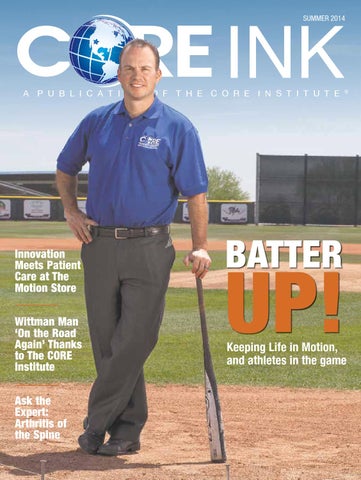
BATTER
UP!
Keeping Life in Motion, and athletes in the game
WELCOME VOLUME 5, ISSUE 2 SUMMER 2014
FROM THE CHAIRMAN
A New Delivery of Healthcare As our Market Presidents share with you the great successes they have had in Arizona and Michigan, we celebrate with them and continue to showcase great patient stories and feature articles about our practices. It is no surprise that The CORE Institute continues its expansion, but despite this growth, we continue to focus on our number one value, “The Patient.” Through collaboration with hospital systems, insurance companies and other partners, we drive processes to deliver optimal outcomes and unmatched reliability for patients across the country. Beginning on January 1, 2014, The CORE Institute is now part of a bundled payment Medicare program for primary hip and knee replacement at some of the Arizona Banner Health facilities. This means that our physicians will be paid one fee per patient, regardless of how many services the patient receives, and that our providers are taking full risk for the quality of their outcomes. Through this healthcare reform strategy, healthcare costs are reduced while driving improved collaboration and improved patient results. Objective Medicare data demonstrates that The CORE Institute has made a dramatic impact on the historic and comparative orthopedic metrics of quality and cost in the state of Arizona. In addition, we celebrate our research department. Over the past 12 months, our research department has produced over 20 academic publications in peer reviewed journals, all authored by physicians and research staff of The CORE Institute. Recently our intellectual property development team received word from the United States’ Patent Office that two additional new patents have been allowed or issued. The first patent is related to a “Passive Motion Machine Integrated Mechanical DVT Prophylactic Therapy” that may help prevent blood clots and the second, issued on October 15, 2013 is titled “Spinal Interbody Spacer Device.”
Keep Life in Motion!®
CREATED BY REPUBLIC MEDIA CUSTOM PUBLISHING FOR THE CORE INSTITUTE
In this issue of CORE Ink, we introduce you to a patient whose knee pain was so intense he was nearly unable to walk, much less ride a bike. Through the help of Dr. Mark Campbell, he is now cycling almost 11 miles every day. We showcase The Motion Store, an online and retail store specifically designed for patients with product needs to assist in keeping life in motion. In addition, we feature stories on elbow replacement, arthritis of the spine and how we help athletes stay in the game. Continuing with our CORE Values, we have been proud to sponsor and participate in a number of community initiatives. This past spring, we partnered with CCV Stars, providing medical coverage for their tackle and flag football league as well as provided enhanced school physicals for student-athletes, helping raise funds for athletic programs in the local Arizona high schools. Support for The CORE Institute’s community efforts are also on the rise as several organizations recognized our positive impact on the community. We were ranked #1 Orthopedic Group by Ranking Arizona for the second year in a row. Additionally, The CORE Institute was one of the IMPACT Award recipients from the Greater Phoenix Chamber of Commerce. Achievements by our providers were further recognized in the Phoenix Magazine Top Docs issue, where Dr. Michael Lucero was awarded Top Orthopedic Surgeon and Dr. John Kearney was awarded Top Sports Medicine Physician. As we continue to break national orthopedic news, lead industry developments, and grow our comprehensive services, CORE Ink will keep you on the brink of innovation right along with us. Our advances in medicine are now your advances in health.
To stay up-to-date with our ongoing expansion, changes, and improvements, please visit our website and ‘like’ us on Facebook. On behalf of all of our physicians, providers, and staff, The CORE Institute appreciates your continued support.
David J. Jacofsky, MD Chairman & CEO
FROM THE MARKET PRESIDENT Community Service and Recognition
Keep life in motion!
A P U B L I C A T I O N O F T H E C O R E I N S T I T U T E
®
General Manager: Cami Kaiser/ cami.kaiser@pni.com Mgr. Creative Development: Isaac Moya/ imoya@republicmedia.com
John A. Brown, MD Market President, Arizona
Editor: Jim Williams/JLWilliams@republicmedia.com Editorial Coordinator: Nick Kostenko/nkostenko@republicmedia.com Sr. Managing Art Director: Tracey Phalen/tphalen@republicmedia.com Design: Rachel Tullio Photography: Mark Lipczynski, Rick D’Elia
Contents FEATURES
The Motion Store The Motion Store blends innovation, expert advice and patient care. See page 14.
Batter Up!
14
COVER STORY: The CORE Institute’s Arizona Market President and Director of Sports Medicine, Dr. John Brown hits a homerun in getting athletes back on the field. See page 18.
PAT I E NT C AR E
‘On the Road Again’
18
Wittman man back to doing what he loves, thanks to The CORE Institute. See page 22.
D E PART ME N TS What’s New? 8 T he CORE Institute opens West Phoenix clinic and expands the provider team.
22 connect with us 1.866.974.2673
www.thecoreinstitute.com
Ask the Expert 10 D r. Norman Chutkan shares advice and treatment options for arthritis of the spine.
Specialty Spotlight 25 Patients with chronic elbow pain are benefiting from new surgery advancements.
Community Relations 26 T he CORE Institute continues to raise the bar for community commitment and involvement.
CORE Candid 28 Employees at The CORE Institute are “Keeping Life in Motion.”
7
WHAT’S NEW
N THOMAS ROAD
91ST AVENUE
VEN UE
ANUJ DAFTARI
93R DA
To support its growth and expand our orthopedic practice in the Southwest Valley, The CORE Institute has opened a new clinic next to the Banner Estrella Medical Center in West Phoenix! The new West Phoenix clinic is located on the Southwest corner of North 93rd Avenue and West of Thomas Road at 9305 W. Thomas Road in Suite 305. Comprehensive orthopedic care and physical therapy are available at the new location.
101
95TH AVENUE
New CORE Clinic open in West Phoenix
MCDOWELL ROAD
RYAN SCOTT, DPM
10
ROBERT CERCEK, MD
NEW PROVIDERS The CORE Institute is pleased to announce the addition of two new physicians to our provider team practicing at The CORE Institute.
8
Norman Chutkan, MD, FACS
is a board certified, fellowship-trained and internationally recognized in orthopedic spine surgery. With more than 15 years’ experience, he is an academic orthopedic ARIZONA spine surgeon specializing in complex spinal reconstruction, spine trauma and spinal deformities. Prior to joining The CORE Institute, Dr. Chutkan served as the Professor and Chairman of the Department of Orthopedic Surgery at Georgia Regents University in Augusta, Georgia. Aforementioned, he was Associate Professor and Chief of Orthopedic Spine Surgery.
Kirk Puttlitz, MD
is a board certified physician in Physical Medicine and Rehabilitation, subspecialty board certified in Pain Medicine, and fellowship-trained in Interventional Pain Management and Spine. ARIZONA Dr. Puttlitz received his pain management and spine fellowship training at KDV Orthopaedics and Rehabilitation, Ltd. His fellowship included extensive training in cervical, thoracic, and lumbar epidurals, discography, facet and sacroiliac injections, radiofrequency ablation, sympathetic nerve blocks, and more.
www.thecoreinstitute.com
ASK THE EXPERT
Arthritis of the Spine Millions of people affected by chronic pain and restricted movement
By Norman Chutkan, MD Arthritis of the spine is a common problem that affects millions of people in the United States. The term “Arthritis” is derived from the Greek terms “Arthros” meaning joint and “itis” denoting inflammation. The two most common types of arthritis are rheumatoid arthritis, an autoimmune disorder, and the more common osteoarthritis which is often described as “disease of degeneration” or “wear and tear.” In the spine, osteoarthritis primarily affects the two small joints behind the disc called the facet joints. It is frequently associated with degeneration of the disc itself, a condition often described as “Degenerative Disc Disease.” Because the disc is not a true joint, the term “arthritis” should not be used to describe disc degeneration. DISEASE PROCESS Osteoarthritis begins with degradation, or breakdown, of some of the large molecules within the cartilage lining of a joint. These molecules are critical for maintaining the water content, or hydration, of the cartilage. As the cartilage becomes dehydrated it becomes stiffer and more easily worn down. A similar process is also happening in the disc. As the disc loses water it may become loose or lax. This laxity may result in abnormal motion, even to the point of one vertebra slipping forward on another, called “spondylolisthesis” from the Greek “Spondylo” meaning vertebra, and “listhesis” meaning slippage. If the degeneration is asymmetric, meaning affecting one side of the disc more than another, it may result in a spinal deformity often referred to as a degenerative scoliosis.
“The diagnosis of arthritis of the spine can usually be made with a careful history, physical exam and X-rays.”— Dr. Norman Chutkan
NORMAN CHUTKAN, MD, FACS
10
Norman Chutkan, MD, FACS is a board certified, fellowship-trained and internationally recognized in orthopedic spine surgery. With more than 15 years’ experience, he is an academic orthopedic spine surgeon specializing in complex spinal reconstruction, spine trauma and spinal deformities.
www.thecoreinstitute.com
The body’s response to this increased looseness or laxity is to try to increase stability (autostabilization) by forming osteophytes (bone spurs). In addition to the facet joints and disc, other ligaments within the spine may become hypertrophied or thickened in an attempt to increase stability. As osteophytes form in the area of the disc and facet joints, and as the ligaments in the spinal canal thicken and hypertrophy, the spinal canal and the openings for the nerves to exit the canal get correspondingly smaller, a condition called stenosis. Nerves may be squeezed within the canal or at the opening behind the disc, the neural foreman. As the disc degenerates it also loses height, reducing the size of the neural foreman. It is this constellation of changes that frequently result in symptoms. SYMPTOMS Arthritis of the spine frequently causes two main types of symptoms: leg pain or claudication from narrowing of the spinal canal or opening for the nerves, spinal stenosis, and mechanical back pain from the instability or deformity. Claudication is pain and/or weakness in the legs that gets worse with activity. It is most commonly caused by compression of nerves from spinal stenosis (neurogenic claudication) or from poor circulation (vascular claudication). It may often be difficult to differentiate between the two, however, a careful history and physical exam will usually allow for the correct diagnosis. In rare cases, vascular studies and consultation with a vascular surgeon may be necessary to rule out vascular claudication. Patients with neurogenic claudication will often report being able to walk farther when flexed or stooped forward such as when walking leaning forward on a shopping cart, the shopping cart sign. Mechanical back pain from arthritis is usually worse in the upright position and relieved with lying down. Some people report the pain being worse in the mornings and with initiation of activities with the pain improving with progressive motion, however.
FOR MORE INFORMATION about spine conditions, please call 1.866.974.2673 or email us at contactus@thecoreinstitute.com. DIAGNOSIS The diagnosis of arthritis of the spine can usually be made with a careful history, physical exam and x-rays. In some cases dynamic x-rays, bending forward and backward, may be necessary to evaluate instability. Advanced imaging studies such as CT scans, myelograms and MRIs are rarely necessary for diagnosis and should be reserved for patients undergoing interventions such as injections or surgery. Inappropriate use of advanced imaging has been associated with overtreatment of patients. Occasionally blood tests may be used to help differentiate between osteoarthritis and an autoimmune disorder such as rheumatoid arthritis or ankylosing spondylitis. One of the major difficulties in the diagnosis of arthritis of the spine is that most of the changes seen are identical to the changes seen in the normal aging process of the spine. Additionally, most people with these changes are without symptoms (asymptomatic). Only a small subset of patient with degeneration/arthritis exhibit symptoms that require intervention. Why some people develop symptoms and others do not is one of the great unanswered questions in medicine.
TREATMENT Treatment for patients suffering from symptoms of arthritis of the spine generally begins with conservative care. Most people will respond to exercise, anti-inflammatory medication and activity modification. In some cases weight loss may be recommended. Smoking has been shown to worsen the degeneration and is associated with worse pain and poorer outcomes following treatment so smoking cessation is highly recommended. For people who have not responded to conservative care, injections may sometimes be helpful. Epidural steroid injections and facet blocks are the most common types of injections used and will frequently relieve the symptoms. Those that have failed conservative care and not received lasting relief from injections may be candidates for surgery. There are two main types of surgery for spinal arthritis, decompressions for leg pain and claudication and fusions for mechanical back pain. Often patients with leg pain or claudication may require a fusion in addition to a decompression if they have significant instability or deformity. In these patients a decompression alone may worsen the instability/deformity leading to gradual worsening of the symptoms. Decompression involves opening the spinal canal and removing some of the overgrown, hypertrophied tissue, relieving the pressure on the nerves. This is often referred to as a laminectomy and may be accomplished through a traditional open incision or with minimally invasive techniques. A complete decompression is more important than the technique used and both approaches have similar long term success. If a fusion is required it is commonly performed with the use of screws and rods. As with decompressions, fusions may be performed using standard open techniques or minimally invasive techniques. Again, long-term success rates are similar between the two techniques if a solid fusion is obtained. Fortunately most patients with arthritis of the spine can be managed with conservative care and do not require surgical intervention.
11
FEATURE STORY
Introducing The Motion Store TheThe CORE Institute Motion Storeoffers offersunique uniqueproducts, products, advice to relieve pain, aid treatment pain and aid treatment 14
www.thecoreinstitute.com
The CORE Institute opened The Motion Store in January, and it’s already become popular with patients hoping to get medically graded performance products and equipment. Orthopedic surgeons Ryan Scott and Tony Nguyen (previous page) helped create the concept for the innovative retail store.
By Dolores Tropiano
The Motion Store is an innovative retail concept, unlike any other in Arizona. In January, The CORE Institute opened The Motion Store, an Arizonabased company with the mission to improve performance for athletes and outcomes for patients. The Motion Store offers a full line of medically graded postsurgical products and performance gear recommended by healthcare professionals to keep your life in motion. Products help with spine, hip, knee, shoulder, elbow, foot, ankle, hand and wrist injuries. Merchandise is also available for those trying to boost their athletic and competitive performance, recover from an acute injury or improve their ability to perform daily living tasks. And, as with all of The CORE Institute’s
enterprises, this one gets to, well, the core of a real retail need. “The store is stocked with braces and equipment for post-operative care after surgery and even pre-operative care products that patients can use to alleviate pain and increase stability,” says Dr. Tony Nguyen, a sports medicine orthopedic surgeon with The CORE Institute. FULL SPECTRUM OF MOTION PRODUCTS Products include, but are not limited to: »» Orthotics
»» Performance & Comfort Footwear »» Diabetic Footwear & Socks »» Cold & Heat Therapy »» Exercise & Therapy Bands »» Rehab & Functional Bracing »» Muscle Stimulation »» Compression Therapy “All the products are selected by a team of orthopedic surgeons, physicians and physical therapists,” Nguyen explains. “We have made it easier for the consumer to find the best product for their care — the selection process is done.”
“All the products are selected by a team of orthopedic surgeons, physicians and physical therapists.” — Dr. Tony Nguyen, Sports Medicine Orthopedic Surgeon, The CORE Institute
15
FEATURE STORY
FOR MORE INFORMATION Visit www.themotionstore.com or call 623.537.5679.
TOTALLY NEW CONCEPT Nguyen said that The CORE Institute was looking for a different concept when they came up with The Motion Store. “We wanted to have a store available for consumers who, for example, might have ankle or wrist pain, but didn’t want to see a doctor. They could come into the store and without a prescription, buy a prescription-grade brace,” Nguyen said. And more importantly, trained personnel help buyers with the selection of gear to meet their medical needs. “They are fitted by a specialist,”
16
Nguyen continued, “Our customer service can’t be offered by any other retail store out there.” Dr. Ryan Scott, a foot and ankle surgeon with The CORE Institute, says the company sends sales associates through a specialized training program to prepare them to work at The Motion Store. “The training helps the sales associates understand appropriate needs for compression, bracing and fitting patients with gear that will help speed along their post-operative recovery,” said Scott.
PUBLIC IS WELCOME The Motion Store is serving the institute’s patient community as well as the general public. Hours are 8 a.m. to 5 p.m. Mondays through Fridays at 18444 N. 25th Ave. Phoenix. The store is unlike any other retail operation and The CORE Institute plans to multiply The Motion Store concept adding locations to all of their six Arizona clinics and physical therapy centers. Whether it’s for work or play, The Motion Store has just the right products to keep your life in motion.
www.thecoreinstitute.com
COVER STORY
BATTER Keeping Life in Motion…and Athletes in the Game By Kristine Burnett
Y
outh, high school, collegiate, professional and recreational sports. Each comes with its own set of rules, requirements and, unfortunately, risks of injury. While not all athletes are burdened with the worry that an injury may be career-ending, the potential impact on one’s physical and emotional wellbeing is not limited to the pros. The sports medicine specialists at The CORE
18
Institute are helping athletes at virtually every level keep life in motion and stay in the game, whether they play for fun, fitness or even fame. In the arena of sports medicine, healthcare advances have brought about significant changes in care strategy and technique. Dr. John Brown, Arizona Market President and Director of Sports Medicine at The CORE Institute, knows firsthand how today’s treatment approaches make staying active and at the top of the game a reality for athletes of all ages.
www.thecoreinstitute.com
Dr. John Brown, Arizona Market President and Director of Sports Medicine at The CORE Institure.
19
COVER STORY
Jim Braden, Athletic Director for Dysart School District, with Dr. John Brown, values the high level of sports medicine care and expertise offered by The CORE Institute.
“I was an athlete growing up, but an ACL [anterior cruciate ligament] knee injury in high school that was ignored and then repeatedly reinjured took me out of the college playing pool,” he says. “Now we [physicians] take a much more aggressive approach to care that, when coupled with less invasive surgical options and state-of-the-art techniques, gives athletes a greater likelihood of returning to play. As a physician, it’s incredibly gratifying see someone you helped overcome an injury, get back on the field and take part in the activities they love.”
“Working with CORE helps our athletic trainers, students, parents and coaches better understand which risk factors increase the chances of injury while exploring new and different ways to protect young athletes.”
provide orthopedic consultations and, when necessary, surgical and therapeutic — Jim Braden, athletic director for Dysart Unified School District interventions. In Arizona, sports medicine coverage spans numerous high schools across HELP AT EVERY LEVEL metropolitan Phoenix. The CORE Dr. Brown and his sports medicine Institute also oversees sports medicine physician colleagues in Arizona and during the spring training season for Michigan, all of whom are fellowshipMajor League Baseball’s Texas Rangers, trained, are instrumental in helping which calls Surprise, Ariz. its spring trainathletes at every level stay on the field, court, course and track. In both markets, ing home, and the Arizona Fall League, an off-season league owned and operThe CORE Institute has established ated by MLB. The relationship with MLB professional relationships with local began during the Texas Rangers’ 2005 hospitals, high schools, colleges and spring training season. professional sporting organizations to
20
“We work closely with school and professional teams and their athletic trainers to provide direct care and treatment in the event of any orthopedic injury,” Dr. Brown explains. “In every situation, we tailor the care strategy to the player, taking into account their age, level of physical activity prior to injury, and end goals.” IMPORTANCE OF EDUCATION Education is a key part of working with those organizations, including educating players, parents of student athletes and coaching staff about injury risk factors, prevention and overall safety. “Our high school certified athletic trainers play a vital role in helping to assess
www.thecoreinstitute.com
COVER STORY
mild and even moderate injuries, but CORE provides a high level of sports medicine care and expertise,” says Jim Braden, Athletic Director for Dysart Unified School District. “The number of student athletes in our district has increased, and so have their physical demands. Working with CORE helps our athletic trainers, students, parents and coaches better understand which risk factors increase the chances of injury while exploring new and different ways to protect young athletes, including not letting injured athletes return to play until they’re ready.” PASSION FOR CARING The CORE Institute’s sports medicine team affiliations in Michigan include Novi High School in the city of Novi and Madonna University in Livonia. Dr. Sean Bak, an orthopedic sports medicine specialist and reconstructive shoulder surgeon who serves as Director of co-management at The CORE Institute, says he and his colleagues are passionate about caring for student athletes. “My own experience as an athlete playing baseball in college really served as the basis for my interest in sports medicine,” he says. “I fractured my elbow in the eighth inning, which ended my pitching career, but fortunately not my entire baseball career. Interestingly, I now focus primarily on treating shoulder and elbow injuries. I can definitely relate to what my patients are experiencing because I’ve been in their shoes.” CHANGE THE FACE OF SPORTS MEDICINE While there are no guarantees in medicine, Dr. Brown and Dr. Bak say today’s sports medicine care techniques, treatment technologies and standardized protocols make results more predictable, treatment less painful and recovery much faster.
“Everyone wants to stay active — it’s the American way and a key part of living a healthy lifestyle,” notes Dr. Bak. “As we age, degenerative injuries are a concern and we want to keep older athletes and active adults going so they can stay strong and independent for as long as possible.” Echoing those sentiments, Dr. DR. SEAN BAK Brown says a lot of orthopedic injuries in the older adult population, such as rotator cuff tears to the muscles and tendons surrounding the shoulder, are caused by gradual wear and tear that comes with age. The resulting pain often keeps people from engaging in sports and other forms of physical activity common among older adults, like golf, tennis and pickleball. “Our goal is to help alleviate our patients’ pain so they can get back out there and continue living life,” says Dr. Brown. CONTINUING SUPPORT Most of The CORE Institute’s sports medicine surgical procedures are performed on an outpatient basis, meaning patients can go home the same day. That said, some patients and/or procedures may require the additional monitoring and support that comes with hospitalization.
“Joint preservation, which goes a long way toward preventing arthritis, is an important area of focus for us and one that requires cartilage restoration,” Dr. Brown says. “Some restoration techniques necessitate an overnight hospital stay.” Dr. Bak says sports medicine professionals at The CORE Institute also deliver an array of non-surgical therapies aimed at reducing inflammation and alleviating pain. “We really serve a diverse patient base,” he explains. “From a seven-yearold pee wee football player who hurt his knee on the field, to a 70-year-old patient who plays on a championship softball team, we see and care for it all.” MOST COMMON SPORTS INJURIES Overall, Dr. Brown and Dr. Bak agree that injuries associated with exercise and physical fitness are far more common than many people believe. Topping the list of injuries among athletes are ACL tears (ligament knee injuries), meniscal tears (cartilage knee injuries), shoulder dislocations, rotator cuff and elbow issues, and hip injuries. “The treatment strategy will surely differ between a high-level athlete, weekend warrior and active retiree,” said Dr. Brown. “However, the care philosophy remains the same: Return the player to the highest level of physical function using the most appropriate medical means available.”
GET BACK IN THE GAME To find a sports medicine physician in your area, call 1.866.974.2673 or visit thecoreinstitute.com.
21
Cycling has become fun and painfree again for Claude “Gunny” Marquis, thanks to the total knee replacement he received from The CORE Institute.
Claude Wittman back doing the things he loves, thanks to The CORE Institute By Gremlyn Bradley Waddell Photos by Rick D’Elia
‘On the road again 22
www.thecoreinstitute.com
PATIENT CARE
Just a few years ago, the pain in Claude “Gunny” Marquis’ left knee was so intense, it would bring him to the ground. “Sometimes, my knee would buckle, and I’d fall,” says the 68-year-old retired Wittman man, who earned his nickname, “Gunny,” in the U.S. Marines. Marquis had been dealing with the effects of normal wear-and-tear on his knee for a number of years he said. Thankfully, he sought help four years ago from The CORE Institute and underwent a total knee replacement performed by Mark D. Campbell, M.D., a knee as well as foot and ankle specialist, and also a co-founder of The CORE Institute. The surgery changed Marquis’ life and he got back to doing the things he loves, such as golfing and walking with his wife, Carmel.
proper rehabilitation, like hiking, downhill skiing, biking, softball and pickleball,” he says. “They tend to do very well, are able to stay pain free, and do what they want in life. There are very few limits on their lifestyle.” COMPLICATED SURGERY Marquis’ surgery wasn’t exactly a standard one since he had undergone a prior osteotomy, a surgical procedure in which the knee is realigned to decrease the pressure on the knee joint. Removing the metal staple device used in that procedure took some extra time and expertise. Dr. Campbell then removed any remaining cartilage from the end of the
CYCLING AGAIN Marquis recently dusted off his 18-speed mountain bike and took it out for a spin. Success on the 18-speed and his newfound knee mobility has inspired him to become a two-wheeling regular on the hilly streets of his community. “Today, I almost rode 11 miles,” Marquis says. “My legs have adapted. My legs just feel awesome.” Dr. Campbell, the surgeon who performed Marquis’ total knee replacement is not surprised. Not only are knee replacements less limiting as patients might think, but a positive attitude like the one Marquis has also tends to lead to a positive outcome. “We let most knee replacement patients do quite a few activities after surgery and
23
PATIENT CARE
femur and tibia bones and inserted a metal-on-plastic articulation device that takes the place of the cartilage that was once there. Dr. Campbell is pleased that Marquis has taken up cycling and said the rotating movement the sport requires on the legs is actually good for knee replacement patients. This movement keeps the quadriceps and other muscles strong and stimulates the production of normal joint fluid. In fact, the doctor added, biking will keep Marquis’ other knee in good shape.
“(Patients) tend to do very well, are able to stay pain free, and do what they want in life. There are very few limits on their lifestyle.” — Mark D. Campbell, M.D., The CORE Institute
JOINING THE CORE TEAM Now, there’s talk of Marquis joining The CORE Institute Cycling Team, a group aimed at promoting health and wellness and organized by The CORE Institute’s Dr. Rene Lucas, an interventional spine specialist who also oversees Marquis’ pain management. Marquis, though still something of a newcomer to the cycling scene, is up for the challenge. After all, he feels that good. “You know how you keep putting things off?” he says, in reference to the years he spent avoiding a total knee replacement. “Why put up with the pain, especially with the advancements in technology? I should have done this a long time ago.” FOR MORE INFORMATION about knee conditions, please email us at contactus@thecoreinstitute.com or call 1.866.974.2673.
24
www.thecoreinstitute.com
SPECIALTY SPOTLIGHT
Elbow replacement surgery The up and coming arthroplasty By Scott G. Edwards, MD You look out your window and see your neighbor outside, who had a knee replacement earlier this month, walking her dog like before. Your father had his hip replaced six weeks ago and is getting around as if nothing happened. With great joint replacement stories like these, why do you have to live with your troublesome elbow? It may be limiting your ability to turn a doorknob, comb your hair or participate in your hobby. Your dad was able to return to golf after his new hip replacement, so why should you be burdened by pain in a joint? As it happens, just about every joint in the body can be replaced. You may not have heard about some of them because they are much less common than hip and knee replacements. But there are plenty of people around with painful elbows. Why have you never heard of elbow replacements? FEWER REPLACEMENTS, SAME PAIN Unlike hip and knee joint replacements, elbow joint replacement is a newer operation. While there are more than 700,000 knee replacements and over 300,000 hip replacements performed in the U.S. each year, there are only 3,000 elbow replacement surgeries. Not as many people need elbow replacements. But that’s little comfort for those nursing painful elbows. Another reason so few elbow replacements are performed is fewer surgeons are trained to perform elbow replacements. While most general orthopaedic surgeons freely include hip and knee
SCOTT G. EDWARDS, MD
“Like everything else, we have learned from our successes and failures. It has taken years to understand what methods work and which don’t work.” — Dr. Scott G. Edwards Dr. Scott Edwards is a board certified and fellowship-trained orthopedic surgeon specializing in hand, wrist, and elbow surgery, with special qualifications in minimally invasive surgery and advanced reconstructive surgery.
replacements as part of their routine practices, only specially trained elbow specialists will consider performing elbow replacement surgery, and with good reason. ELBOW SURGERY MISUNDERSTOOD Until recently, elbow replacement surgery was both feared and criticized by the medical community. Historically, patients just did not seem to do as well as those who received artificial hip and knees. There are many reasons for this perception. Older elbow techniques and implant designs were fraught with problems. The
elbow does not lend itself to accepting an implant because (1) the elbow is a complicated joint and challenging to reproduce accurately; (2) the elbow bones are relatively delicate and could break during or shortly after the surgery; (3) the elbow does not have a substantial amount of surrounding muscle to help stabilize the implant and act as a barrier to infection; and (4) despite being a little joint, the elbow is subjected to very high forces as the long levers of the adjacent bones pull and twist at the joint. These all culminate in a situation that poses a formidable challenge to replacing the elbow with the same successful outcomes seen in hips and knees, which don’t have the same limitations. Like everything else, we have learned from our successes and failures. It has taken years to understand what methods work and which don’t work. The first hip replacement, for example, was performed in 1942 and ever since, surgeons have been working to perfect their techniques. In contrast, the first elbow replacement was performed more than 30 years later. Consequently, hip surgeons had a three-decade head start to discover the best methods for surgery. Slowly but surely, elbow replacement surgery has evolved into a well-established surgical procedure in its own right. Through improved techniques and technologies, patients with horribly arthritic elbows are being given the opportunity to live pain free. As a result, patients receiving elbow replacements are younger and more active than they used to be. So if you have elbow arthritis, don’t feel content to sit on the sidelines and watch everyone else have fun. Technology has advanced to give you the elbow you need to keep life in motion.
25
CORE CANDID
CO M M U N I T Y
Making great strides in the community Continuing commitment to excellence and service Community relations goals for the first half of 2014 appeared daunting, but efforts were fruitful. Halfway through 2014, we can already celebrate several successful collaborations with various partners in education and clinical service endeavors, further cementing The CORE Institute’s commitment to excellence and continuous growth. The CORE Institute’s providers facilitated educational lectures attended by the public as well as healthcare professionals. These events were hosted by community organizations
like Sun Health Foundation and East Valley Adult Resources, as well professional groups like Arizona Athletic Trainer’s Association. The CORE Institute also partnered with Arizona State University, leading lectures on key orthopedic topics for the School of Nutrition and Health Promotion. Building off of 2013’s sports medicine efforts, The CORE Institute continues to ramp up activity in 2014. This past spring, we partnered with CCV Stars, providing medical coverage for their tackle and
flag football league every Friday night. In February, we also provided medical coverage for the Volleyball Fiesta Classic
for the second year in a row. In May, we also continued to provide enhanced school physicals for student-athletes
CO M M U N I T Y FOR MORE INFORMATION or if you have an event you would like us to participate in, please contact us at communityrelations@thecoreinstitute.com
in the Peoria and Dysart school districts, helping raise funds for athletic programs in the local Arizona high schools.
Support for The CORE Institute’s community efforts are also on the rise as several organizations recognized
our positive impact on the community. We were ranked No. 1 Orthopedic Group by Ranking Arizona for the second year in a row and Dr. Jacofsky was named one of the finalists for the 2014 Healthcare Leadership awards by AZ Business Magazine. Additionally, The CORE Institute was one of the IMPACT Award recipients from the Greater Phoenix Chamber of Commerce. Achievements by our providers were further recognized in the PHOENIX Magazine Top Docs issue, where Dr. Michael Lucero was awarded Top Orthopedic Surgeon and Dr.
John Kearney was awarded Top Sports Medicine provider. Our providers were further celebrated in additional profiles on the PHOENIX Magazine Top Docs issue as well as in the Phoenix Business Journal Book of Lists. The CORE Institute is committed to building on the community service successes of early 2014, continuing to strategize for health education and service-type opportunities. This summer, we will provide medical coverage for the 31st annual Volleyball Festival and in the fall, we will continue our presence at local high schools as on-site medical providers.
CORE CANDID
What Does ‘Keeping Life in Motion’ Mean to You
KATHERINE ZWANZIGER, Physical Therapist at The CORE Institute-Gilbert
“I have a wonderful family with a soon-to-be two year old that keeps my life in motion. No matter how busy I am, it is important for me to work out four times a week with running and strength training to keep my body healthy. Working out helps me de-stress my busy work week.”
JENNIFER SPINDLER, Sports Medicine Coordinator at The CORE Institute-Michigan
Keeping life in motion to me is easy because I never sit still. Michigan is a great state to get outside and enjoy hiking, kayaking, skiing, and just about any other outdoor recreation you can think of. I also enjoy the competitive side of being active and participate in a number of cycling, running, and triathlon events throughout the year.
iNK
INK
SUMMER/FALL 2013
Winter 2013
A P U b l i C A T i O N O F T H E C O R E i N S T i T U T E
®
A P U B L I C A T I O N O F T H E C O R E I N S T I T U T E
®
Cutting-Edge Innovations From The CORE Institute Back to Being Dad, Thanks to The CORE Institute
Meet the Foot and Ankle Team!
Race to Live:
A Doctor’s Survival Story
Chart a Course for Excellence The CORE Institute, Banner Health Partner Together for Orthopedics
Patient Back in the Water Thanks to The CORE Institute
Detroit Surgeon Gives Back to High School Athletes
The CORE Institute Performing Groundbreaking Research
INK
SPRING 2014
Don’t miss an issue of CORE Ink
A P U B L I C A T I O N O F T H E C O R E I N S T I T U T E
World-Class Exp
ansion The CORE Instit ute 70,000 Square-Fo Opens New ot Headquarters
Course Correction Prescott Woman Back on the Tee Thanks to The CORE Institute Winning Combina tion
The CORE Instit Good Samaritanute and Banner Create Powerful Medical Center Partnership
To register for the free CORE Ink mailing list, e-mail your name and address to marketing@thecoreinstitute.com.
Nerve Pain in and Legs, CoulBack d be a Prolapsed Disc
MORE INFO? 1.866.974.2673
®