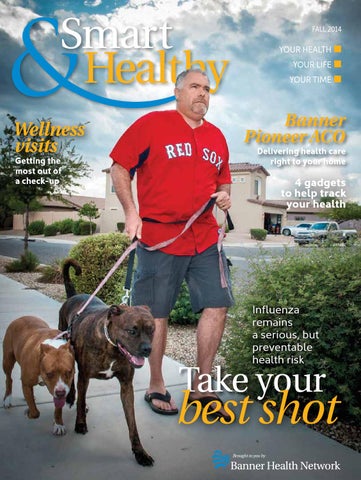
Smart Healthy Wellness visits Getting the most out of a check-up
FALL 2014
YOUR HEALTH YOUR LIFE YOUR TIME
Banner Pioneer ACO
Delivering health care right to your home
4 gadgets to help track your health
Influenza remains a serious, but preventable health risk
Take your best shot Brought to you by
welcome / LETTER
In this issue I started my medical career as an Emergency Room physician. My patients and their families trusted me to care for them in times of unexpected crisis. In this role I learned to think quickly on my feet and to act decisively, especially when working with patients who were critically ill. But those experiences have also led me to understand, in many cases, there are opportunities to keep people from reaching that level of medical crisis. As health care professionals, we can make a meaningful difference in people’s lives, and their health, by intervening at key moments. Engaging patients in maintaining their health, and collaborating with that patient’s other physicians and caregivers are important elements, too. My growing interest in transforming the way physicians, like me, have traditionally provided care is what led me to step out of the emergency room and become Medical Director for Banner Health Network. This Accountable Care Organization, working handin-hand with organizations like the Centers for Medicare and Medicaid Services (CMS), has the power to make a meaningful difference in people’s lives through more proactive care of their members and beneficiaries. This magazine can begin to give you a glimpse into the work that is being done on your behalf. On the pages that follow, I hope you will read about the importance of getting a flu vaccine this year. I promise it will be a story you won’t soon forget. Also, find out about a new way we are able to monitor and care for chronically ill patients in their homes. You can learn about how to keep your bones strong with calcium, how to make the most of your annual wellness visit and how long your joint replacement is expected to last. There are articles to explain the benefits of shared decision-making with your physician, and recent changes in mammography recommendations. I hope you will learn something new, and dare to act upon it. Yours in good health,
Dr. Nishant (Shaun) Anand Medical Director, Banner Health Network
2 | Smart & Healthy
Fall 2014 / contents
n COV E R S TO RY
8 Worth a shot! Influenza remains a serious, but quite preventable, health risk — just ask Valley resident Stephen Witten.
4 Tracking success Nifty gadgets that can help you eat more healthy, exercise more efficiently.
5 M ake the most out of your wellness visit little preparation can help you A become your own health advocate.
6 Good to the bone
8
Being kind to your bones pays dividends in overall health
12 Virtually perfect Banner Health doctors are delivering care, right to your home.
13 Ask the expert The scoop on mammography guidelines
14 Shared decision-making You play the most important role in your health
15 Puzzling? Check out the Smart & Healthy crossword
5
16 H ealthy living events and activities
6
CREATED BY REPUBLIC MEDIA CUSTOM PUBLISHING A division of The Arizona Republic 200 E. Van Buren St., Phoenix AZ 85004
General Manager: CAMI KAISER Creative Development Director: ISAAC MOYA Editor: JIM WILLIAMS Sr. Managing Art Director: TRACEY PHALEN Editorial Coordinator: NICK KOSTENKO Design: RACHEL TULLIO
Cover Photography: RICK D’ELIA
If you no longer wish to receive Smart & Healthy magazine: Please notify us through email at smarthealthy@republicmedia.com or by phone at 602-444-2235. Be sure to include your full name, address, city and zip code as it appears on the mailing label of the publication. bannerhealthnetwork.com |
3
your / TIME
Tracking Success Gadgets that can help you eat more healthy, exercise more efficiently
By Gremlyn Bradley-Waddell ooking to change — and get more out of — your workout? Consider an activity tracker, the newest gadget on the fitness scene, said Abbie Knapp, a Banner Health wellness specialist. Probably the best thing about these devices is they help people realize how much they eat, and how little energy they expend, each day. “People often overestimate the number of calories they burn and underestimate the number of calories they consume,” Knapp noted. When purchasing a tracker, choose one that aligns with your fitness goals. Athletes, for example, will benefit more from trackers that provide detailed information; non-athletic types won’t need that extra information. It’s also important to remember trackers aren’t 100 percent accurate all the time. So what’s Knapp’s favorite? The Fitbit One, which is “best for most people, not too expensive and one of the few trackers that tracks stair steps,” she said.
L
4 | Smart & Healthy
WANT TO KNOW MORE?
Here’s Knapp’s take on a few top trackers: Fitbit Zip – The most basic and least expensive of the Fitbit line, this tracker is essentially a pedometer that tracks steps (but not stairs), distance and calories burned. The device uses a watch battery, so it doesn’t need to be charged and it syncs wirelessly to your Fitbit account. Fitbit One and Fitbit Flex – Fitbit One can be clipped on clothing (“Just don’t lose it in the laundry!”) or taken out of its case and stashed in a pocket or purse; it logs distance, steps taken, stairs climbed, calories burned and the amount of restful sleep you get. Fitbit Flex is a wristband that tracks steps (but not stairs), distance, calories burned, how long you have been active, and how long and how well you sleep.
Jawbone Up24 – This tracker’s pricey, but it measures sleep, calories, steps taken and has an alarm that can wake you during your lightest sleep cycle. It does not, however, have a display, and you need a smartphone because it won’t sync with a computer. Nike+ FuelBand – This spendy tracker’s also worn as a bracelet, and displays steps, calories burned, the time and hours you were active; it does not track distance, stairs or sleep. Basis Carbon Steel Edition – This is probably the most high-tech and costly tracker; it detects when you run, walk, bike and sleep and displays heart rate, total calories burned that day, steps taken, skin temperature, and perspiration.
your / HEALTH
Make the most out of your wellness visit A little preparation can help you become your own health advocate By Meghann Finn Sepulveda
A
nnual wellness visits are a great opportunity to review medical history, stay current with vaccinations and screenings, and ask questions or share concerns with your primary care physician. Be prepared for your next appointment with these simple tips.
Be consistent It’s important to schedule a wellness visit every year, even if you are feeling well. “An annual visit gives us the ability to check on things and stay on top of your health,” said Christopher Stalberg, M.D., an internist in Sun City West. “New evidence-based screening guidelines are more conservative and suggest not everyone requires a head-to-toe exam every single time,” he adds Depending on age and gender, certain screenings may not be needed on an annual basis. Your doctor will discuss this with you at your appointment.
Be prepared Be sure to take a list of current over-the-counter and prescription medication with you so your
physician can update your medical chart. It’s also OK to bring a spouse, family member or friend, if that person can help you remember the conversation and remind you of any important questions you had. “I encourage patients to absolutely bring someone with them, especially elderly patients or those with dementia,” Stalberg said. “Designating a family spokesperson can also be very beneficial.”
answer every question you have,” Stalberg said. “That’s why we are here.” Stalberg also recommends that patients do research in advance and share findings with their physician. It may be the basis for some good questions. “For example there are websites and smart phone apps that can calculate your risk for heart attack based on your blood pressure numbers,” he said.
Be organized
Your physician’s office is a place where you should feel comfortable, knowing your health, safety and privacy are top priorities. “Be open and honest and have good communication with your physician,” Stalberg said. “It makes for a much better visit.”
Make sure you arrive at your appointment early to fill out any necessary paperwork. If you have specific questions to ask your doctor, write them down and bring them with you. “Your doctor is prepared to
Be open
bannerhealthnetwork.com |
5
your / NUTRITION
Good to the bone Being kind to your bones pays dividends in overall health By Dolores Tropiano one health is a big deal. Brittle bones can lead to broken bones. When breaks affect hips, health can rapidly decline. According to The Journal of the American Medical Association, 20 to 30 percent of Americans 65 or older with a hip fracture will die within a year. Most people think bone health can be addressed when there is a problem. But research indicates that this may be too late. Bone mass increases up to the age of 30 and then gradually declines. If not maintained, it can cause trouble in later years.
B
Strawberry Smoothies Nutrition facts: 417 mg. calcium Ingredients 2/3 cup strawberries 1/3cup bananas 1 cup low-fat strawberry banana yogurt 1 cup strawberry juice concentrate
Directions Fill blender 1/4 full with ice. Add  strawberries and bananas to 2/3 full. Top with 1 cup of strawberry banana low-fat yogurt. Pour in 1/2 to 1 cup of strawberry juice concentrate. Blend.
Source: www.americanbonehealth.org
6 | Smart & Healthy
your / NUTRITION
Questions
Answers
Q&A with registered dietitian Margaret O’Brien, a registered dietitian with Banner Health Network, offers these tips: Q: When does bone health become important?
A: At any age. Don’t wait until you have a problem. Women usually consume less calcium than they need after Margaret O’Brien age 12. Men consistently consume more calcium in their teens and 20s, offering some protection.
Q: What is crucial to maintaining bone health? A: Exercise, calcium and vitamin D.
Q: Why is vitamin D important?
A: Because it helps the body absorb calcium. The best source is 15 minutes of sun a day. Supplements can help.
Q: What exercise is best?
A: Weight-bearing activities, such as walking 30 minutes every day, are great. Strength training with weights and stretchy bands helps improve balance and coordination, which reduces falls and fractures. Household chores also qualify as weightbearing. Dusting, sweeping and vacuuming can help your bones as well as your house!
CALCIUM SOURCES 99Dairy products — such as low-fat and no-fat milk, cheese, and yogurt 99Almond milk 99 Almonds, pistachios, sunflower seeds 99Spinach 99Kale 99Okra 99Collards 99Soybeans 99White beans 99Some fish, like sardines, salmon, perch, and rainbow trout 99Calcium-fortified foods such as some juices, oatmeal and breakfast cereal NOTE: The body can only absorb about 500 mg. of calcium at a time. This includes supplements. Try to spread your calcium out with some at each meal.
VITAMIN D SOURCES 99Tuna, mackerel, and salmon 99 Foods fortified with vitamin D, like some dairy products, orange juice, soy milk, and cereals 99 Beef liver 99 Cheese 99 Egg yolks Source: National Osteoporosis Foundation and Banner Health Network
Calcium, expercise and Vitamin D support healthy bones.
bannerhealthnetwork.com |
7
Stephen Witton gets back to living, taking care of his motorcycle after surviving a health battle that kept him in the hospital for more than 50 days.
WORTH A
SHOT
8 | Smart & Healthy
INFLUENZA REMAINS A SERIOUS, BUT PREVENTABLE, HEALTH RISK By Elise Riley | Photos by Rick D’Elia
Stephen Witten thought it was a silly cold, nothing major. But he was wrong. It was the flu.
sudden onset. Patients experience severe aches and pains, and a high fever up to 103 degrees. Fatigue is extreme.
After a 57-day stay at Banner Del E. Webb Medical Center during which he was near death, Witten is now a living example of why the flu is not a joking matter. “I was intubated, I was unconscious,” he said. “Twice my family came to say goodbye to me. I’m a miracle, a walking miracle.” While it’s often passed off as an insignificant virus, the flu is serious. It killed 37 adults in Maricopa County in the last year. And, more often than not, it’s completely preventable with a simple vaccination. “It’s a substantial health threat,” said Dr. A. Max Germaine, a family physician at Family First Physicians in Mesa. “In the United States it’s responsible for the deaths of 35,000 people a year, and most all those are preventable.” While many people confuse common upper-respiratory infections with the flu, they’re very different. Influenza isn’t a mild cold — it’s serious, and has a
Flu Season The typical flu season in the Valley runs from December through March, although the virus season can start earlier and it is possible to get the flu year-round. Vaccines become available by September. Experts recommend getting vaccinated two weeks before exposure, which is why Fall is the prime flu vaccine season. Getting vaccinated and practicing basic wise-health behaviors like hand washing can protect everyone — including those younger than 2 and older than 65, who are the most at-risk. “Even though the flu vaccine might not be 100 percent effective – and no vaccines are – it can definitely lessen the severity of
the illness,” said Kerry Montefour, RN, senior infection preventionist at Banner Good Samaritan Medical Center. “If the elderly contract influenza, it can even cause severe complications, especially if they have any other illnesses. It can cause pneumonia, and that’s often how people die.” A typical influenza infection lasts five to 10 days, sometimes as long
Three questions to ask your doctor: 99When will you have the flu vaccine in your office? 99What side effects might I experience from the vaccine? 99Are there other important vaccines I should get this year?
bannerhealthnetwork.com |
9
as two weeks. Patients are infectious from a day before they feel symptoms to up to a week after the onset of symptoms. The virus can survive for 30 to 40 minutes on a hard surface, 12 hours on clothing and indefinitely on frozen materials. Contact with the general public — at the mall, at the grocery store, at a community center — can make it spread rapidly. That’s why experts are so adamant about getting vaccinated, and frequent hand washing. “You’re inhaling the droplets in the air in a crowded area, or you’re touching common properties — like shaking hands or touching appliances,” Germaine said. “If you’ve ever tried not to put your hands on your eyes, nose or mouth for 30 minutes, you’ll realize how hard it is. Washing your hands is very important.”
Turning serious The flu is a respiratory virus that can lead to other illnesses. Most concerning is pneumonia. “Pneumonia is the biggest worry, but it can make underlying conditions worse,” Montefour said. “They can’t breathe right. It can be very, very serious and it’s usually how people end up in the hospital.” That was the situation for Witten, a previously healthy 45-yearold. Originally, he thought he could wait out the virus, but Witten’s wife talked him into going to the hospital.
10 | Smart & Healthy
FLU STATS 37 adults died from influenza in Maricopa County in 2013-2014 According to the World Health Organization, there are 3 to 5 million cases of severe flu annually, resulting in up to 500,000 deaths. The WHO also reports that most deaths occur in populations aged 65 or older. In 2010, influenza and pneumonia were the 10th leading cause of death in the United States, according to the Centers for Disease Control and Prevention.
It saved his life. The flu quickly became pneumonia. Doctors couldn’t get the fluid out of his lungs. The pneumonia lowered his blood pressure, and started to damage his kidneys. After his 57-day hospitalization, Witten returned to the hospital with gallbladder problems. He also had a spot on his lungs. And today he’s in stage 4 kidney failure — stage 5 means he’ll need a transplant. “They’re going to go out,” he said of his kidneys. “We know they won’t last. With everything that happened, I’m pretty lucky, actually.” Witten’s story underscores
Flu Shot Facts & Myths
The flu shot might be one of the most misunderstood elements of modern healthcare. Here are some facts — and myths doctors want to dispel. FACT: The annual flu vaccine contains three different strains of the virus. Every year, it’s different.
“I was that person who said, ‘Oh, everyone gets the flu. It’s no big deal.’ But it is a big deal. It almost killed me.”
why flu shots are so critical for seniors, who might already have underlying medical issues that, when combined with the flu, can quickly create a serious medical issue. “The flu is a compounding issue,” Germaine said. “People with other high-risk considerations like asthma, diabetes or COPD, they’re at risk.” Witten says he, and his family, will always get a flu shot in the future. “We will never take it lightly again,” he said. “I was that person who said, ‘Oh, everyone gets the flu. It’s no big deal.’ But it is a big deal. It almost killed me.”
MYTH: The flu vaccine will give you the flu. “There is nothing, nothing, in the flu vaccine that can give you the flu,” Montefour said. “It’s a killed vaccine. Physically, it cannot give you the flu. It’s not possible.” What is possible, she says, is that you’re already fighting off a respiratory illness at the same time of your vaccine. Most people get flu shots while other infections are spreading. FACT: Routinely getting the flu shot has a compounding benefit to your immunity because your body will have resistance to many different strains of the virus. “There does seem to be a benefit for having the flu shot on a regular basis,” Germaine said. “We may or may not be covered well on one particular year, but if you’ve had the flu shot for the past 10 years, there seems to be an augmentation of immune response.” MYTH: People with egg allergies can’t get a flu shot. “For most people, it’s OK,” Montefour said. People who have mild sensitivity to dishes like omelettes or scrambled eggs are safe to get vaccinated. Consult your doctor if you have questions. FACT: Influenza today is essentially the same virus as the Spanish flu that killed 3 to 5 percent of the world’s population — up to 100 million people — in 1918. “People get cavalier about it today, but the remnants of the flu that had the capacity to kill all those people is still around,” Germaine said. bannerhealthnetwork.com |
11
your / LIFE
A virtually perfect way to access care Banner Health Network offers new ways to connect with your medical team
By Debra Gelbart eed to see your doctor for a routine “office visit”? Soon routine matters, and even chronic care, could be managed from the convenience of your home instead of a doctor’s office. New services that make connecting with a medical professional even easier are becoming available to beneficiaries whose physicians are part of Banner electronic tablets that allow them Health Network’s Pioneer Account- to simply press a large button on able Care Organization (ACO). the home screen whenever they need medical help. Almost instantly, What’s available now? a member of the Banner iCare In early 2014, the Banner iCare™ health team—which includes program was established to help doctors, nurses, health coaches the most chronically ill beneficiaand pharmacists—will appear via ries of the Pioneer ACO connect video chat software to answer their question or address their concern. with a health care provider electronically through an electronic It is easy to use, even for those tablet in their home. The around who are not computer users. You the clock medical support provided can see the medical professional, by this program has reduced medi- and they can see you, plus if your cal emergencies among users by pupils are dilated, or even how managing symptoms as they occur. your wound is healing. “We’re bringing the health For the same reason, it has reduced care provider directly to patients, the need for emergency care and 24-hours a day. This is especially even hospital admissions. helpful to those who may have To date, hundreds of chronically ill ACO beneficiaries have physical difficulty getting to a been given specially programmed doctor’s appointment for a
N
12 | Smart & Healthy
routine matter,” said Shaun Anand, M.D., medical director for the Banner Health Network. “This is not intended as a replacement, but as a support to the care being provided by the patient’s primary care provider.” Certain beneficiaries who are at risk for falls have also been given an emergency alert bracelet so that if a fall occurs, and the beneficiary can’t reach the electronic tablet, he or she can contact emergency assistance. Other inhome electronic equipment like scales and blood pressure cuffs are also used. Patients must meet specific health criteria to qualify for the program, but there is no additional cost to the patient to participate in Banner iCare.
your / HEALTH
What’s coming soon? Telehealth, as this area of electronic-access medicine is called, will also apply to those who are not experiencing serious, chronic illness. Maybe you just have a cough that won’t go away, or a re-occurring health issue that requires attention. Banner Health Network will begin a pilot program next year allowing patients to see a physician from the convenience of their home or work computer when they have a minor illness. Called eVisit, this program is expected to be available soon to Pioneer ACO beneficiaries who would prefer a video consultation with a health care provider for a routine matter. “We’re going to provide the ability for beneficiaries who have minor complaints to connect with a family medicine or an emergency medicine physician via video chat in the convenience of their home,” explained Dr. Anand. “They will be able to connect almost immediately to a professional from the eVisit team using their smartphone, tablet or computer. Our goal is to improve access to care and make it convenient.”
Want to know more? To see if you may qualify for the Banner iCare program, talk to your primary care doctor. Look for more information about the eVisits program in upcoming issues of Smart & Healthy magazine.
Mammography Guidelines Ask the Expert with Dr. Steven Charney, MD, Banner Boswell Medical Center
Q:
As a woman in my 60s, should I still get an annual mammogram?
A:
U.S. Health and Human Services has recently updated its recommendations for breast cancer screening using mammography, a type of X-ray that is proven to reduce breast cancer deaths by identifying tumors early. The agency suggests that women age 50 to 74 should have mammograms every other year, unless they are in a high-risk category. Every woman is different, so your physician might recommend more frequent screenings depending on your current health status and any family history of breast cancer. Because a woman’s risk for getting breast cancer increases with age, in some cases, women over 74 should also get regular mammograms. An early breast cancer diagnosis offers the best opportunity for TIME TO SCHEDULE recovery. Fortunately, screening YOUR MAMMOGRAM? mammograms are covered by most These Banner Health locations Medicare plans, and new, highly acoffer mammography services: curate 3-D technology is available Banner Baywood Medical to provide even earlier detection. Center, Mesa Your annual well woman apBanner Boswell Medical Center, Sun City pointment is the ideal time to (3-D imaging available) discuss any changes in your health Banner Del E. Webb Medical with your physician and determine Center, Sun City West which screenings, including (3-D imaging available) mammography, are appropriate Banner Estrella Medical at your stage of life. Center, Phoenix Dr. Steven Charney, MD, is medical imaging director at Banner Boswell Medical Center. For more information on this topic, talk with your doctor or call Dr. Charney’s office at 623-832-5798.
Banner Good Samaritan Medical Center, Phoenix Banner MD Anderson Cancer Center, Gilbert (3-D imaging available) Banner Thunderbird Medical Center, Glendale bannerhealthnetwork.com |
13
your / CARE
You play the most important role in your health Ask questions, share decisions with your health-care providers By Michael Ferraresi ou may have been told that “doctor knows best.” It’s true that Banner Health Network (BHN) providers are highly trained, experienced medical professionals. Your doctor will appreciate input from you, however, about which treatment choices make the most sense for you. That’s why you are encouraged to participate in the process of shared decision-making. For many patients, personal preferences and lifestyle habits can factor into decisions about treatments, medications or rehabilitation. When visiting with your physician, shared decisionmaking is employed so you can feel confident asking questions and shaping medical decisions with honest feedback.
Y
Range of treatment First, you’ll want to be clear about understanding your diagnosis. Ask your doctor about the range of treatment options that exist for your condition. Talk to your doctor about the risks and benefits of each. Are there side effects? Will an alternative option fit your lifestyle? Shared decision-making can be
14 | Smart & Healthy
used to address conditions that range from treating your lower back pain to difficult end-of-life decisions. Treatment options might include everything from choosing no treatment, to surgery, to physical therapy, to other medication options, depending on your diagnosis. A patient facing heart disease, for example, may talk to their cardiologist about the benefits of a stent compared to angioplasty or the invasive process of openheart surgery. A diabetic may be a candidate for oral medications, or an insulin pump, to stabilize blood sugar rather than taking on insulin injections.
Be an active team member
Sarah Payne, DO, family medicine and geriatric specialist, said she encourages patients to participate in shared decision making. Patients should ask specific questions and be informed about their conditions, so they can indicate to physicians how treatments might affect their lifestyle, or how aggressive they want to be in treatment. Dr. Payne said shared decision making has evolved to the point where patients are a vital member of the health care team, and should actively participate in their treatment plan, rather than simply following a doctor’s orders. She finds that personal participation leads to better compliance with the chosen care plan, too. “It begins with learning about your illness,” Dr. Payne said. “We can help direct and guide patients in making the right treatment decisions, but they need good facts and information first.”
CROSSWORD / puzzling by Frank A. Longo
PUZZLE ANSWERS ONLINE AT
BannerHealth Network.com/ SmartandHealthy Crossword
bannerhealthnetwork.com |
15
BANNER HEALTH 1441 N. 12th SREET PHOENIX, AZ 85006-2887
NONPROFIT ORG U.S. POSTAGE PAID LONG BEACH, CA PERMIT NO.1677
calendar / Healthy Living Events
— Compiled by Paula Hubbs Cohen DIABETES SUPPORT GROUPS Free; no registration required. All groups meet from 10 to 11 a.m. Sun City West Banner Del E. Webb Medical Center Second Thursday of every month
Mesa Red Mountain Active Adult Center Third Thursday of every month
Sun City Banner Boswell Medical Center Third Thursday of every month
Tempe Friendship Village Fourth Thursday of every month
MORE SEMINARS AND CLASSES CLASSES AND SUPPORT GROUPS Banner Health Network offers a variety of lifestyle management programs to provide participants skills and education to manage common chronic health conditions. Healthy lifestyle classes are also taught on a regular basis. Classes are offered at Banner facilities Valley-wide. Dates and times vary by location. For information and registration, call 602-230-CARE (2273) or 480-684-5090. All classes are free. Living Well with Diabetes This is a four-part series to learn diabetes selfmanagement skills. Topics include monitoring, medications, nutrition and meal planning, exercise and preventing complications. Living Well with COPD This is a two-part series to learn about lung disease, better breathing skills, symptom management and preventing complications.
Living Well with Heart Disease A three-part series to learn heart-healthy lifestyle tips, how to identify warning signs of heart disease or stroke, how to manage risk factors and handling emergencies. Eat Healthy, Be Active A series of six interactive workshops to help people attain and maintain a healthy weight, reduce risk of chronic disease and live a healthy, active lifestyle.
Alzheimer’s Lecture Series Alzheimer’s prevention research: Learn about new clinical trials aimed at preventing Alzheimer’s disease. Sponsored by Banner Alzheimer’s Institute. All lectures are from 10:30 a.m. to noon. Free; Registration required, call 602-230-CARE (2273). Nov. 14: Banner Gateway Medical Center, Gilbert Dec. 12: Ed Robson Branch Library, Sun Lakes Free Memory Screening Events The screening takes about 20 minutes and is scheduled by appointment. Register at 602-230-CARE (2273). Nov. 19 and 21: Banner Sun Health Research Institute, Sun City Nov. 21: Banner Alzheimer’s Institute, Phoenix Muscle And Joint Pain Seminar Physicians will present the latest information on hip, knee, foot and ankle diagnostics, procedures and treatment options. RSVP: 602-230-CARE (2273). Oct. 23, 1-3 p.m.: Banner Del E. Webb Medical Center, Sun City West Nov. 20, 6-8 p.m.: Banner Desert Medical Center, Mesa