prevention power of
PR E V EN TION • R ESE A RCH • INNOVAT ION
FALL 2014
Peace of mind
Receiving an early diagnosis at the Undiagnosed Breast Clinic leads to treatment success and lifestyle changes | By Brian Sodoma
A
t 75, Charlene Gouvenier is still at her high school weight. She walks regularly, dances, swims and can play a mean game of golf. But in May 2010, a mammogram revealed a tumor with irregular edges. After two needle-core biopsies by a different health provider, which are required to see if the tumor is cancerous, failed, she became frustrated. “No one in my family had breast cancer. I had been conscientious about health my whole life. … I was just going to ride the rails and see how it worked out,” she said. Gouvenier adopted an antioxidant-rich diet with no red meat and minimal sugar for the next four years. But while she felt fine, the thought of cancer kept creeping into her mind. “The tumor was still there. I could feel it all the time. It was wearing on my brain,” she said. So Gouvenier paid a visit to the Undiagnosed Breast Clinic at Banner MD Anderson Cancer Center in Gilbert in February 2014. Stage-1 breast cancer was the diagnosis; but a successful
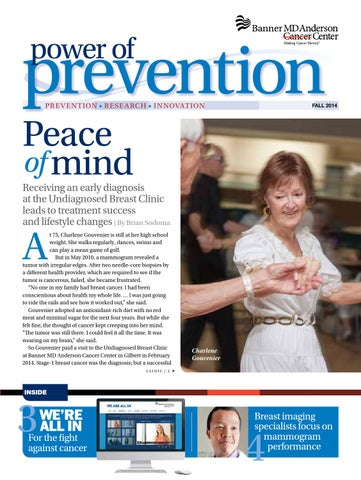
Charlene Gouvenier
C L I N I C | 2
INSIDE
3
WE’RE ALL IN
For the fight against cancer
Breast imaging specialists focus on mammogram performance
4
COVER FEATURE
FROM THE COVER
surgery by Banner MD Anderson Cancer Center’s Dr. Julie Billar and radiation treatment brought swift positive results. Gouvenier is back to her daily routine and feeling better than ever. “I can’t say enough about the caring people there,” she said of her experience. A UNIQUE CLINIC
Roughly 15 percent of those who visit the Undiagnosed Breast Clinic actually have cancer, but most come with legitimate reasons for concern: they either have a lump, an abnormal mammogram, need a second opinion, or have other breast-related abnormalities. “We will see almost all breast concerns, which is a relief for primary care physicians or OB/GYN’s who may not have the time or immediate resources to evaluate the patient,” Billar said. “Breast disorders can be confusing for people who do not specialize in them or for providers who do not see these conditions on a regular basis. We can also do risk assessments, counseling, go over exercise and diet. People will often say ‘Wow, that was the most thorough exam I’ve ever had.’” PROMPT TREATMENT
Dr. Shefali Birdi, an internal medicine physician at the clinic, says prompt service is also a priority. If a patient requires a biopsy, the procedure can be done that same day, and results are available within 24-48 hours. If surgery is required, a meeting with the surgeon can be had within days, not weeks. “To get all of that done at one center in a couple days really brings peace of mind to patients,” she added. With a cancer diagnosis, medical oncologists, radiation oncologists and surgeons collaborate to assure the best treatment outcomes. The clinic also brings access to support groups, a wellness center, acupuncture, yoga and integrative medicine offerings. “Disease prevention has always been a strong area of interest for me. Providing women with education on how to reduce their risk of breast cancer as well as helping in the process for early detection has been a rewarding experience,” Birdi added. • pp
2 FA L L 2 0 1 4 P O W E R O F P R E VEN TIO N
MAMMOGRAMS OFFERED AT BANNER MD ANDERSON CANCER CENTER The Women’s Imaging Center at Banner MD Anderson Cancer Center in Gilbert offers both screening mammograms (for women with no breastrelated symptoms) and diagnostic mammograms (for women who do have at least one symptom of possible breast disease) using digital technology. The technology, called 3D tomosynthesis, produces images that are viewed in stacks of very thin layers or slices — essentially a three-dimensional mammogram. This allows radiologists to see breast tissue with unprecedented detail. Appointments can be made by calling 480-543-6900.
After receiving treatment at the Undiagnosed Breast Clinic at Banner MD Anderson Cancer Center in Gilbert, Charlene Gouvenier can happily dance off into the sunset.
SUPPORT
There’s power in community! Our family, our friends,
patients at Banner MD Anderson Cancer Center in Gilbert, as
our neighbors, our co-workers. And there’s nothing more
well as our satellite radiation oncology programs in Mesa and
powerful than knowing we have community behind
Thunderbird. “It’s a fact that patients who have strong social
us, especially during our darkest hours. At Banner
networks and support do better getting through their therapy
MD Anderson Cancer Center in Gilbert, WE ARE ALL IN for
than those who don’t,” said Santosh Rao, M.D., a medical
the fight against cancer, and we believe in the healing power
oncologist and integrative medicine specialist at Banner
of a supportive community. That’s where you come in. You
MD Anderson. “That’s why we want to encourage loved ones
can be part of this supportive community! Join us as we
and the community to participate in the most positive way
collect messages of hope to encourage people fighting a battle
possible in a cancer patient’s experience.” We hope you’ll take
with cancer. You can upload a video or write a message at
part in sharing your inspirational message. Because when it’s a
WEAREALLIN.com. These messages will be shared with
battle with cancer, we want everyone to know WE’RE ALL IN.
PREVENTION
Who is reading your mammogram? The benefits of fellowship-trained physicians who read, evaluate results BY MEGHANN FINN SEPUBVEDA
R
adiologists at the Women’s Imaging Center at Banner MD Anderson Cancer Center in Gilbert boast highly specialized training in breast imaging. Through advances in imaging technology, these dedicated physicians see clearer, more precise images and deliver rapid results if any abnormalities appear. Banner MD Anderson employs a comprehensive approach that integrates the skills of breast imaging specialists, breast surgeons and oncologists to diagnose, evaluate, and treat breast cancer. This multidisciplinary approach ultimately improves overall outcomes.
patients to take additional images. Loving also plays an active role in planning the next steps of care. PERSONALIZED APPROACH
Loving has a personal investment in quality of care. He wants his patients to have a connection with him and the other medical professionals at Banner MD Anderson who provide care. “I take great pride in my work with patients,” Loving said. “I keep up with the latest medical research, clinical studies, read relevant journal articles and attend conferences surrounding advances in breast imaging.” LEARN MORE
ANNUAL SCREENINGS
It is recommended that women begin screening mammograms annually once they reach age 40, or sooner if strong family history of breast cancer is present. “If the results are normal, we plan to see the patient in one year,” said Vilert Loving, M.D., director of breast imaging at Banner MD Anderson. “If something is abnormal, we call and talk to the patient to determine next steps.” As opposed to a general radiologist, Loving is fellowship-trained in breast imaging, focusing solely on reading mammograms, which allows him to be more successful in finding cancer. MULTIDISCIPLINARY TEAM
Physicians at Banner MD Anderson collaborate frequently to discuss the best treatment options for patients.
4 FA L L 2 0 1 4 P O W E R O F P R E VEN TIO N
The Women’s Imaging Center at Banner MD Anderson is designated a Breast Imaging Center of Excellence by the American College of Radiology (ACR). This is an honor Vilert Loving, M.D., that truly recognizes the director of breast high practice standards of imaging at Banner image quality, staff qualiMD Anderson fications, technology and equipment, quality control “It’s important for patients to underprocedures and quality assurance stand that our approach to care is truly programs. integrated,” Loving said. “We can very Patients in need of a mammogram rapidly provide a face-to-face consultascreening can expect fast results and tion with a surgeon or oncologist within referral resources that create seamless days of a cancer diagnosis.” care. Staff are highly experienced and Because there are so many various dedicated to creating a holistic envitypes of cancer, treatment can vary greatly. ronment that attends to the physical, “Patients who are newly diagnosed emotional and spiritual needs of with cancer want to get it taken care of each patient. • pp immediately,” Loving said. “The process is cohesive, not disjointed or delayed.” To learn more or to schedule Loving performs most of the breast a mammogram screening, biopsies and, if necessary, will meet with call 480-543-6900.
ASK THE EXPERT
Just ‘let it go!’ Reduce stress to improve health, help prevent cancer BY KRISTINE BURNETT
C
an stress cause cancer? While there may not be a direct cause and effect correlation, research suggests that stress does in fact wreak havoc on our health. Janie Goodall, PsyD, director of psychology for Banner Medical Group of Arizona, says stress has been implicated in a wide range of health conditions, including cancer. “There is clear and compelling evidence that stress can adversely impact immune function,” Goodall noted. “Impaired immune function has been implicated in carcinogenesis — the development of cancer.” UNHEALTHY CHOICES
In addition to compromising one’s immune system and affecting sleep quality, stress often leads to other unhealthy lifestyle choices. Individuals struggling with stress may find themselves turning to high-fat, high-calorie comfort foods, turning away from exercise and physical activity, or even adopting harmful habits like tobacco use and excessive alcohol consumption. So how does one avoid the everyday stresses of life, love and labor? According to Goodall, there isn’t a onesize-fits-all strategy to combat stress, and managing stress is sometimes easier said than done. “Humans are very complex, both physiologically and psychologically,” she said. “Trying to target any one thing as a means of minimizing stress is incredibly difficult and, truthfully, not practical. You need to figure out what stress looks like for you and then find ways to manage it within the context of your life.” FOCUS ON THE BASICS
To start, Goodall suggests focusing on the basics like getting adequate rest, proper nutrition and exercise. From there, try introducing techniques like deep breathing exercises and meditation to help you relax. However, Goodall says it is important
JANIE GOODALL, PsyD
Director of psychology, Banner MD Anderson Cancer Center
to make incremental changes, identify an array of relaxation methods that work for you and, above all, be flexible. “There are no quick fixes and routines sometimes get interrupted,” she said. “Have multiple tools in your stress management toolbox. There will always be times and situations when life just happens and you can’t engage in the stressreduction activities you normally would. Have a backup plan.” WORK-LIFE BALANCE
Another key to managing stress is finding that often elusive work-life balance. “There’s so much hype about multitasking, but research shows it causes stress,” she explained. “Rather than fragment your time, attention and energy, try focusing on one task at a time and be present in the moment. That alone can help reduce stress.” For individuals undergoing cancer treatment or in remission, stress management is incredibly important. “New research suggests that stress can contribute to the metastatic, aggressive nature of cancer,” she stated. “Managing stress can help lower your risk of disease progression.” • pp Learn more about stress management support groups and integrative therapy techniques like yoga and meditation available at Banner MD Anderson Cancer Center in Gilbert by calling 480-256-6444 or visit bannermdanderson.com.
“Humans are very complex, both physiologically and psychologically. Trying to target any one thing as a means of minimizing stress is incredibly difficult and, truthfully, not practical. You need to figure out what stress looks like for you and then find ways to manage it within the context of your life.” JANIE GOODALL, PSYD
GIVING
The view from the other side Cancer survivor offers helping hand to others on their cancer journey BY BRIAN SODOMA
C
athy Jackson didn’t see cancer coming. But when it did, she found a way to beat it. Today, she works to bring a smile to the faces of other cancer patients while also having a hand in advancing treatment outcomes. In 2011, Jackson was considered to be in great health. But her husband — one-time Harlem Globetrotters player and owner Mannie Jackson — was concerned she was losing too much weight. She underwent testing in Las Vegas, her home at the time, and the diagnosis was grim: Stage-4 ovarian cancer. SEEKING HELP
“The problem with ovarian cancer is that it’s not detected until it’s too late. There aren’t really any symptoms,” says Jackson. “I kept going back to doctors. Some thought it was as simple as irritable bowel syndrome.” Unhappy with a perceived lack of professionalism and skeptical of an aggressive surgical-treatment approach offered by her previous health care provider, Jackson sought out care from The University of Texas MD Anderson Cancer Center in Houston. Rather than immediate surgery, MD Anderson’s staff suggested
Jackson first undergo chemotherapy near her second home in Phoenix. Jackson underwent three rounds of chemotherapy in September 2011 at the newly opened Banner MD Anderson Cancer Center in Gilbert. In January 2012, she had surgery at MD Anderson in Houston which was then followed up by three more rounds of chemotherapy in early 2012 in Gilbert. Jackson also used adjunct therapies like acupuncture, Chi Gung massage and Vitamin C Therapy, while also being strict with her diet. In only seven months, she was cancer-free and has been ever since. “The experience just couldn’t have been better,” Jackson says. “I had the best treatment. I just feel very fortunate.” GIVING BACK
Now Jackson volunteers weekly in the infusion therapy department at Banner MD Anderson, where she assists staff
6 FA L L 2 0 1 4 P O W E R O F P R E VEN TIO N
by delivering blankets, drinks and food to patients. She also does her fair share of listening. “When I was diagnosed I kind of hunkered down and reached inside myself. It’s what got me through,” says Jackson. “But I always thought it would be nice to see someone on the other side (who made it through treatment). It was hard to walk back into that chemo lab. But you have to give people encouragement, keep people lifted up.” Jackson also made a gift to establish an Ovarian Cancer Research Fund at Banner MD Anderson. Enjoying her new role as a first-time grandmother, Jackson has committed to a slower lifestyle, eating right and enjoying each moment of each day. Seeing her first grandchild was one of her greatest incentives to beat cancer and stay cancer-free. “I would really like to see more grandkids,” she says. • pp
FEATURE
Understanding thyroid cancer, risk factors Important to recognize early symptoms The thyroid gland is responsible for making hormones that regulate the body’s metabolism, controlling the way it uses and stores energy.
B Y G R E M LY N B R A D L E Y- WA D D E L L
F
or some folks, a visible lump or swelling on the neck, a change in their voice or difficulty breathing or swallowing are signs they could have thyroid cancer. But for most people with this relatively uncommon disease that affects the hormone-producing endocrine gland in the neck, there are no symptoms, said Karen Pitman, M.D., a fellowship- trained otolaryngologist at Banner MD Anderson Cancer Center in Gilbert.
cancer is found in women ages 30 to 50, so she said younger women need to be aware of their risk potential. There’s also a “small, but measurable” incidence of thyroid cancer in children, she added.
SCREENING EXAMS
“Thyroid cancer is usually detected during a routine physical exam, like when a patient goes to a dentist, gynecologist or primary care doctor,” said Pitman, who specializes in thyroid, head, neck and skin cancer. “Part of a screening exam is to palpitate the neck, and that’s often when a doctor will find a lump, or nodule. In fact, a nodule has to get fairly large before it causes symptoms.” Nowadays, she noted, a physician is most likely to find a nodule – and, subsequently, often thyroid cancer – during an imaging test such as a CT scan or an MRI that a patient is undergoing because they already have cancer somewhere else in their body. The good news is, however, that only about five percent of nodules are cancerous. “It’s not abnormal to have a nodule, and as we get older, the incidence of having one increases,” she said. While it’s not fully understood why some people get thyroid cancer, Pitman said risk factors for the disease include family history and a history of radiation exposure due to a nuclear accident or, more commonly, therapeutic radiation such as the kind often given to cancer patients. The highest incidence of thyroid
SYMPTOMS OF THYROID CANCER If you should experience any of the following symptoms, consult your physician: • Lump or nodule in the front of the neck • Enlargement of the thyroid or swelling in the neck • Pain in the front of the neck that may stretch to the ears • Change in voice or hoarseness • Breathing problems, especially the feeling that you are breathing through a straw • Cough that does not go away and is not caused by a cold • Cough with blood • Swallowing problems
EASILY TREATED
Nearly all thyroid cancers can be treated and cured, and the typical treatment for patients of any age is surgery, a procedure known as total thyroidectomy during which the entire thyroid gland and any involved lymph nodes are removed. Any metastases, or cancer cells that have spread to other areas of the neck or, more rarely, into the bones or lungs, are removed as well, Pitman said. After surgery, patients generally undergo radioactive iodine therapy to destroy thyroid cancer cells in the body and reduce the chance of recurring cancer, which is usually negligible. When treated with surgery and radioactive iodine therapy, thyroid cancer patients of all ages face very good prognoses, Pitman said. They will need to take a daily thyroid replacement hormone for the rest of their lives – the thyroid is responsible for making hormones that regulate the body’s metabolism, controlling the way it uses and stores energy – and follow up yearly with an endocrinologist to have an ultrasound and lab samples taken. Other than that, patients can “resume their daily activities and their normal lives,” she said. • pp
BannerMDAnderson.com 7
BANNER HEALTH 1441 N. 12th SREET PHOENIX, AZ 85006-2887
NONPROFIT ORG U.S. POSTAGE PAID LONG BEACH, CA PERMIT NO.1677
If you no longer wish to receive Power of Prevention magazine:
Please notify us through email at powerofprevention@republicmedia.com or by phone at 602-444-2235. Be sure to include your full name, address, city and zip code as it appears on the mailing label of the publication.
EVENTS AND CLASSES
FOR ALL CLASSES (UNLESS NOTED) Time: 6-7:30 p.m. Location: Grand Canyon Conference Rooms, Banner Gateway Medical Center To RSVP: Call 602-230-2273 (CARE)
Cancer Survivorship Series
Nov
12
Dec
10
Nutrition for Cancer Survivors | Learn evidence based nutritional advice and recipes for the cancer survivor. Listen to our board certified specialist in oncology nutrition, Christi Kirk, and our expert Chef, Heather Metell as they discuss the what and how of nutrition for the cancer survivor.
To learn more about these events or to register, please visit www.Banner MDAnderson.com
Exercise for the Cancer Survivor | Understand the importance of exercise and physical activity for the cancer survivor. Exercise can reduce side effects related to cancer treatment and reduce reoccurrence of some cancers. Kristine Salmon will provide a survivor’s exercise prescription.
FOR MORE INFORMATION
On the campus of Banner Gateway Medical Center, U.S. 60 and Higley Road in Gilbert Banner MD Anderson Radiation Therapy also available at: Banner Thunderbird Medical Center, 55th Avenue and Thunderbird in Glendale, 602-865-5445 Banner Desert Medical Center, Dobson and US 60 in Mesa, 480-412-3808
To schedule an appointment, call 480-256-6444
Check out our website
BannerMDAnderson.com
Follow us on Facebook:
Facebook.com/bannermdanderson