F R I D AY , O C T O B E R 2 3 , 2 015
BENEFITS ARIZONA
F r i d a y , O c t o b e r 2 3 , 2 015
GREAT FOR TRIBES | G What does Tribal Gaming mean to Arizonans? Nightlife, entertainment venues, pool parties and luxury resorts? Tribal Gaming is all of this, and so much more. Tribal governments in Arizona operate 23 casinos across the state, eleven of which are in rural Arizona. These facilities provide a powerful economic engine that benefits Tribal peoples and all Arizonans. Since the signing of the Tribal-State Gaming Compacts, Tribes have contributed over $1.1 billion to programs and services that benefit all Arizonans. State, city, town
Without the money made available to the trauma centers from tribal leaders, the trauma center in Tucson would not be where it is today.
and county governments are the beneficiaries of these shared revenues, 88% of which are dedicated to statewide programs: Educational Improvement, Trauma and Emergency Care, Tourism Promotion and Wildlife Conservation. In addition, local communities, cities and towns receive 12% of all shared revenues that provide additional support for government services such as public safety, healthcare and more. Equally important, Tribal Gaming has been the single most effective approach for improving the economies of Native American reservations and enhancing tribal self-sufficiency. On the pages that follow you will find a small collection of the many ways that Tribal Gaming benefits all Arizonans. These stories reflect but a sample of the successful history of Tribal Gaming in Arizona and demonstrate a mutually beneficial relationship between the Tribes and our state. Terry Rambler Chairman, Arizona Indian Gaming Association Chairman, San Carlos Apache Tribe DR. PETER RHEE, Chief Division of Trauma, Critical Care, Burn and Emergency Surgery, Medical Director, Banner University Medical Center Tucson
TRIBAL GAMING IS ONE OF ARIZONA’S TOP EMPLOYERS
T
ribal Gaming provides benefits to the State’s economy in many direct and indirect ways.
Tribal casinos employ over 15,000 Arizonans statewide—a majority of whom are non-Tribal members who live near Tribal lands. While the largest employment is found in the population centers of Pima and Maricopa counties, nearly one-third of these jobs are in rural areas from La Paz to Yuma counties, to Gila and Navajo. For example, more people are employed by Tribal casinos than McDonald’s in Arizona. Indirectly, Tribal Gaming creates over 20,000 more jobs, as Tribes purchase the vast preponderance of goods and services from off reservation businesses. Tribal Gaming revenues also fund tribal programs and investments in non-gaming economic diversification, both of which employ many thousands more Arizonans in all corners of the state.
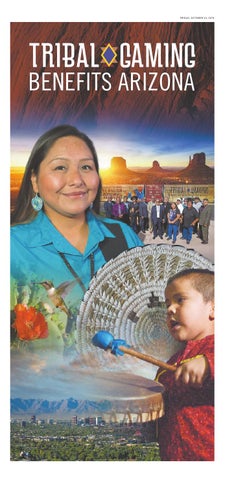
CHRISTABELLE MULL General Manager of Apache Gold Casino Resort Christabelle Mull is a San Carlos Apache Tribal member who rose through the ranks from employee to the casino’s general manager. Christabelle’s story epitomizes the positive impact that Tribal Gaming brings to Native American communities across Arizona. While today Christabelle serves as the General Manager to the Tribe’s flagship Apache Gold Casino Resort, her success story was far from assured growing up in the Community. When Christabelle was young, life on the reservation lacked many support networks for its young people, especially scholarships for college and other continuing education pursuits. The Apache Gold Casino gave Christabelle the opportunity to work as a summer intern upon graduating high school. Without this opportunity, Christabelle would have been forced to uproot from her family, friends and community to attend college, and likely pursue a career off of the reservation. Because of the casino, it was a choice she is happy she wasn’t forced to make. Today the San Carlos Apache Tribe uses revenues from the casino to fund grants, scholarships, and more opportunities on the reservation. This means that more members like Christabelle have the ability to stay connected to their community and provide for their families.
Learn more at BenefitingArizona.org
F R I D AY , O C T O B E R 2 3 , 2 015
GREAT FOR ARIZONA TRIBAL GAMING IS AN ECONOMIC LIFELINE FOR TRIBES
T
ribal Gaming revenues directly fund tribal programs aimed at reversing decades-old backlogs of educational, health, and other services. Before gaming, both social and economic investments were chronically underfunded, though desperately needed. Now, Tribal Gaming allows Tribes to underwrite investments in diversified reservation economies, enhancing self-sufficiency and economic independence. When Tribes are able to put more of their people and their resources to work, the state’s entire economy benefits.
Mentoring Young People Since Tribal Gaming began more than twenty years ago, Tribal Communities have been able to diversify their economies; this growth provides mentorship opportunities and unprecedented career paths for young adults. This enables more Tribal members to remain in their communities, contribute to the growth, strength and Ricardo DeLeon, HDS Associate II culture of its members, and Harrah’s Ak-Chin Casino ultimately become the next generation of leaders, entrepreneurs, mentors and guides for the generations to follow.
Supporting Tribal Elders One of the most important, and least visible, benefits of Tribal Gaming is the impact it has on helping Tribal Communities support and care for their elders. Linda, 81, was born, raised and lives in the Hualapai Tribal community, a remote tribe of almost 2,000 members located near the western half of Grand Canyon in Northwestern Arizona. Because of its remote location, the Hualapai Tribe does not operate their own casino. Instead, they lease their allotted number of slot machines to metro-area tribes who have better access to markets and customers. These transfer agreements provide critically important revenue streams for tribes located far from the traffic and population densities required to make casinos viable. The Hualapai Tribe utilizes the revenue from these transfer agreements for a wide variety of community needs, including early childhood education and development, scholarships for their youth, infrastructure support and improvements, housing, community centers, and elder care. This is especially important for elders like Linda, who benefit from financial support that helps her to heat her home during the frozen winters, or cool it during the long hot summers. All in all, transfer agreements are a lifeline for remote tribes. Linda is but one of many elders across Arizona that rely on them for her family and her quality of life.
TRIBAL GAMING BENEFITS ALL ARIZONANS
$487 MILLION IN
$244 MILLION IN
$127 $70 MILLION IN
MILLION IN
$70 MILLION IN
CONTRIBUTIONS
CONTRIBUTIONS TO
CONTRIBUTIONS TO
CONTRIBUTIONS
CONTRIBUTIONS TO
TO EDUCATION
TRAUMA & ER
CITIES & TOWNS
TO TOURISM
CONSERVATION
Providing for Trauma & ER Care
Funds for Cities, Towns and Counties
Promoting Tourism
Since 2002, shared revenues from Tribal Gaming have contributed over $244 million to support trauma and emergency services throughout Arizona. For example, funds helped expand emergency services in Southern Arizona, including new trauma suites and the addition of seven trauma surgeons since 2008. In fact, since the Arizona Benefits Fund was inaugurated thirteen years ago, more than 60 hospitals throughout Arizona have received funding for trauma services and emergency departments.
Cities, Towns and Counties statewide benefit from the shared revenues of Tribal Gaming because they receive 12% of a Tribe’s total annual contribution of net gaming win every year. Since 2002, Arizona cities, towns and counties have received $127 million from Tribal Gaming revenues. These funds are contributed in addition to the revenue shared with the Arizona Benefits Fund, which together total more than a billion dollars since the compact was signed in 2002. These additional revenues shared with cities and towns are used for government services that benefit the general public, including public safety, local health services, local charities, science and technology initiatives, and the promotion of commerce and economic development.
Focusing on Education Programs Arizona School Districts receive 56% of the shared revenues Arizona Tribes deposit into the Arizona Benefits Fund each year. In fact, since this fund was established, Tribes have contributed over $487 million to improve education for Arizona’s children and are dedicated to support early childhood reading programs, smaller class sizes, teacher resources and drop out prevention initiatives.
For the past 12 years, shared revenues from Tribal Gaming have been a principle source of funding for Arizona’s Department of Tourism, which markets our State to attract visitors from around the country and indeed, the world. In turn, tourism as an industry is responsible for generating thousands of jobs, billions of dollars in earnings and millions of dollars in tax revenues. Arizonans can be rest assured that these are net economic benefits. Tribal Gaming and tribal enterprises recapture out-of-state tourism dollars that stay in Arizona while making the state more attractive to out-of-state visitors. Tribal investments that provide new experience and entertainment options are interwoven with the unique character of Arizona.
Learn more at BenefitingArizona.org
Looking out for Wildlife Since 2002, Tribal Gaming revenues are responsible for over $70 million for conservation programs statewide through the Arizona Wildlife Conservation Fund. This funding made the restoration of Apache Trout and habitat possible after the devastating Wallow Fire threatened its existence in eastern Arizona’s lakes and rivers. Future efforts will focus on continuing and expanding projects that conserve, enhance and restore Arizona’s wildlife resources and habitats for present and future generations to explore.
F r i d a y , O c t o b e r 2 3 , 2 015
N OT JUST GAMING: TRIBAL GAMING Local revenues, local benefits.
T
ribal governments are engaged in gaming as a means to provide services for their people; by contrast commercial gaming is enriching the livelihood of individual shareholders. Moreover, Tribal Gaming provides for services like elder care, dialysis centers, fire stations and youth programs. Equally as important it helps protect Tribal culture with essential programs like language preservation, cultural centers and the funding to afford repatriation of would-be lost artifacts. Tribal Gaming is conducted on tribal trust land and by virtue of that, a limit to market presence is defined. Yet, Tribes affect economic change in the areas where they reside. Historically, Tribes have not been situated in locations that are economic meccas, and actually their resources have been quite the opposite. Since Tribal Gaming began, some of the biggest benefits we see are in rural Arizona, which has gained destination businesses such as casinos in Pinetop, Yuma, and Payson, that might not otherwise be there because they are far too remote to be economically viable for commercial investors. In many such locations, tribal employers rank among the top regional job creators. In addition, local businesses benefit from the goods and services that are necessary to operate the casinos and their associated amenities. Commercial gaming measures market share and revenues to claim their success. Although Tribes are still overcoming years of hardship, the unprecedented declines in unemployment, increases in the numbers of Tribal members seeking higher education, the businesses created and all the opportunities they afford, are true measures of success for Tribal Nations.
LOCAL REVENUES, LOCAL BENEFITS Gaming Benefits Taxpayers In contrast to the tax abatements so commonly used to recruit and retain business, Tribal Gaming depends upon no tax advantage for its success. To the contrary, tribes fund Arizona for regulatory costs, contribute to Arizona problem gambling programs, and make contributions to local governments to mitigate gaming impacts, among other things. In addition, Tribal Gaming revenue supports statewide instructional improvements in schools, trauma and emergency care, tourism promotion, and wildlife conservation. These contributions totaled $1.1 billion since fiscal year 2002, and amounted to $97.8 million in fiscal year 2014.
What is earned in Arizona, stays in Arizona Unlike privately owned casino and gaming operations, whose owners invest or spend profits wherever in the global economy they see fit, Arizona tribes spend Tribal Gaming revenues in state. In this same way, Tribal casinos will never threaten to move their operations out of state or overseas to pursue tax breaks or other advantages. The Tribes in Arizona are a part of the fabric of this state and will remain so for time immemorial.
Tribes Address Problem Gambling Since 2002, Arizona Tribes have contributed $19.8 million to help problem gamblers through education, prevention, and treatment programs to address problem gambling.
Tribal Gaming is Well-Regulated Tribal Gaming is the only form of gaming with three levels of regulatory oversight at the Tribal, State and Federal levels. Unlike commercial gaming, Tribal Gaming regulatory and administrative costs are paid entirely out of tribal contributions. Since 2002, Arizona Tribes have contributed $98.8 million to the Department of Gaming for regulation.
Without Tribal Gaming on Reservations, Tribes would still be living in Third World conditions. We’ve moved forward in every aspect of our communities. We’re able to do things that impact our people, their livelihoods, their families, just as people in surrounding communities do, and it is no small achievement.” – Chairman Thomas Beauty, Yavapai Apache Nation
IT’S THE TRIBAL IN TRIBAL GAMING THAT MAKES A DIFFERENCE
A K -C H I N I N D I A N COMMUNITY
C O C O PA H INDIAN TRIBE
COLORADO RIVER INDIAN TRIBES
FORT MCDOWELL Y AVA PA I N AT I O N
F O R T M O J AV E INDIAN TRIBE
FORT YUMA QUECHAN TRIBE
GILA RIVER INDIAN COMMUNITY
H AVA S U PA I T R I B E
H U A L A PA I T R I B E
K A I B A B -P A I U T E T R I B E
N AVA J O N AT I O N
PASCUA YAQUI TRIBE
S ALT R IVER P IMA -M ARICOPA I NDIAN C OMMUNITY
S AN C ARLOS A PACHE T RIBE
T O H O N O O’ O D H A M N AT I O N
W H I T E M O U N TA I N A PA C H E T R I B E
Y AVA PA I -A PA C H E N AT I O N
Sources: The Economic Impact of Tribal Gaming in Arizona, 2014, Taylor Policy Group Arizona Indian Gaming Association | 521 South 48th Street | Suite 107 | Tempe, AZ 85281 | 480.284.4034 | AzIndianGaming.org
Learn more at BenefitingArizona.org
PUEBLO
OF
ZUNI