OUTCROP Newsletter of the Rocky Mountain Association of Geologists
Volume 75 • No. 10 • October 2026
SUMMIT SPONSORS Platinum Sponsor
Silver Sponsors
OUTCROP | October 2026
2
Vol. 75, No. 10 | www.rmag.org
OUTCROP Newsletter of the Rocky Mountain Association of Geologists
730 17th Street, B1, Denver, CO 80202 • 720-672-9898 The Rocky Mountain Association of Geologists (RMAG) is a nonprofit organization whose purposes are to promote interest in geology and allied sciences and their practical application, to foster scientific research and to encourage fellowship and cooperation among its members. The Outcrop is a monthly publication of the RMAG.
2026 OFFICERS AND BOARD OF DIRECTORS
RMAG STAFF
PRESIDENT
2nd VICE PRESIDENT-ELECT
EXECUTIVE DIRECTOR
Sandra Labrum slabrum@slb.com
Ashley Castaldo acastaldo@slb.com
Bridget Crowther bcrowther@rmag.org
PRESIDENT-ELECT
SECRETARY
LEAD EDITOR
Ali Sloan ali@4jresources.com
Stephanie Forstner sforstner@diagenyx.com
Danielle Robinson danielle.robinson@dvn.com
1st VICE PRESIDENT
TREASURER
Nate La Fontaine nlafontaine@sm-energy.com
Walter Nelson wnelson@integratedenergyresources.com
CONTRIBUTING EDITORS
1st VICE PRESIDENT-ELECT
TREASURER-ELECT
Danielle Robinson danielle.robinson@dvn.com
Dan Bassett dbassett@sm-energy.com
Nate La Fontaine nlafontaine@sm-energy.com
2nd VICE PRESIDENT
COUNSELOR
Lisa Wolff lwolff@bayless-cos.com
John Benton jhbenton@mines.edu
Bobby Schoen bschoen@sm-energy.com
ADVERTISING INFORMATION
Rates and sizes can be found on page 40. Advertising rates apply to either black and white or color ads. Submit color ads in RGB color to be compatible with web format. Borders are recommended for advertisements that comprise less than one half page. Digital files must be PC compatible submitted in png, jpg, tif, pdf or eps formats at a minimum of 300 dpi. If you have any questions, please call the RMAG office at 720-672-9898. Ad copy, signed contract and payment must be received before advertising insertion. Contact the RMAG office for details. DEADLINES: Ad submissions are the 1st of every month for the following month’s publication. The Outcrop is a monthly publication of the Rocky Mountain Association of Geologists DESIGN/LAYOUT: Nate Silva | n8silva.com
Vol. 75, No. 10 | www.rmag.org
3 3
Elijah Adeniyi eadeniyi@slb.com
RMAG CODE OF CONDUCT RMAG promotes, provides, and expects professional behavior in every engagement that members and non-members have with the organization and each other. This includes respectful and inclusive interactions free of harassment, intimidation, and discrimination during both online and in-person events, as well as any content delivered by invited speakers and instructors. Oral, written or electronic communications that contain offensive comments or demeaning images related to race, color, religion, sex, national origin, age, disability, or appearance are not appropriate in any venue or media. RMAG reminds members of the diversity and mission statements found on our website. Please direct any questions to staff@rmag.org.
Outcrop | October 2026 OUTCROP
2026 NETWORKING EVENTS MARK YOUR CALENDARS
AUGUST SEPTEMBER OCTOBER NOVEMBER DECEMBER
5 2 7 4 2
LUNCHEON WEDNESDAY 12PM
HAPPY HOUR TUESDAY 4PM
FOR MORE INFORMATION ON THESE EVENTS AND TO SEE WHAT ELSE IS COMING VISIT: www.rmag.org/events
JULY AUGUST SEPTEMBER OCTOBER DECEMBER
28 25 29 20 1
OUTCROP Newsletter of the Rocky Mountain Association of Geologists
CONTENTS FEATURES
ASSOCIATION NEWS
6 2027 RMAG Summit Sponsorship Packet
2 RMAG Summit Sponsors
16 Lead Story: Dinosaur Ridge – Celebrating 150 Years of Discovery and Preservation 32 Member Corner: Donna Anderson
DEPARTMENTS
4 RMAG Networking Events 11 2027 North American Helium & Hydrogen Conference 15 Mowry Formation Symposium 21 Hockey Game: Denver University vs. Lindenwood University
26 Rocky Mountain Discovery Series 31 Mountain Geologist— Seeking Editor 35 October Happy Hour 36 On The Rocks: Denver’s Iconic Building Stones
25 On The Rocks: Cataract Canyon
10 RMAG September 2026 Board Of Directors Meeting 12 President’s Letter 28 October Hybrid Lunch Talk: Callum Thurley 30 November Hybrid Lunch Talk: Bryan McDowell
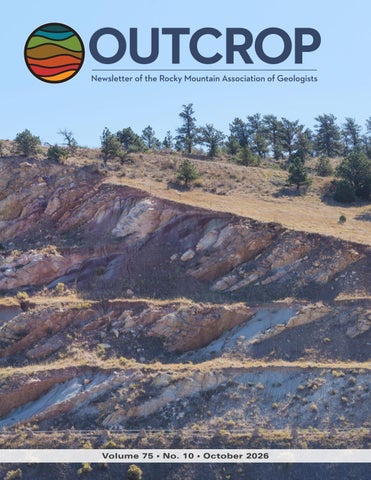
COVER PHOTO The famous I-70 road cut just north of Dinosaur Ridge. Photo by Meredith Fontana
38 In The Pipeline 40 Outcrop Advertising Rates 40 Welcome New RMAG Members! 41 Calendar 41 Advertiser Index
Vol. 75, No. 10 | www.rmag.org
5
OUTCROP | October 2026
SUMMIT SPONSORSHIP infographic link
OUTCROP | October 2026
6
2 0 2 7 Vol. 75, No. 10 | www.rmag.org
September 1, 2026 Geoscience Community: On behalf of the Rocky Mountain Association of Geologists, thank you to every Summit Sponsor and Event Sponsor who supported us this past year. Sponsors like you are the foundation of this organization, and everything RMAG accomplishes for the geoscience community starts with your generosity. In 2026, RMAG was proud to host a dynamic lineup of events, including an upcoming Symposium diving into the Mowry Formation. Members explored geologic wonders across the state, from the kimberlites to South Park and the Arkansas River Valley. We launched the Rocky Mountain Discovery Series, sitting down with senior statesmen of the industry to learn what shaped their careers and their success. Volunteers shared their passion for geoscience with students across the region through classroom visits and community festivals, and members connected outside the office through monthly lunches, coffees, happy hours, and our annual Golf Tournament. Every one of these programs was made possible by the sponsors who fund them. Looking ahead, 2027 brings exciting opportunities for RMAG and our partners, and your support is what makes each one possible. We'll open the year with a State of the Industry luncheon, diving into research shaping our field and hearing directly from the ECMC on where the industry is headed. The 2027 North American Helium and Hydrogen Conference is coming together, and our 101 series continues, sharing industry knowledge with our newest members while refreshing the expertise of working professionals. Networking in 2027 will include our regular happy hours, plus Rockbusters, the Golf Tournament, and more chances to connect with your colleagues. With your support, RMAG members will keep sharing the wonders of earth science through community and school outreach, and we'll continue our publication efforts, including the monthly Outcrop newsletter and the peerreviewed Mountain Geologist journal. As a Summit Sponsor, your commitment gives your employees access to every RMAG event, from our educational programs to the camaraderie of the Golf Tournament. RMAG also recognizes Summit Sponsors through in-person signage at events, on our website, in our publications, and across social media. Thank you to our current Summit Sponsors; we hope to count on your continued support in 2027. And if you're not yet sponsoring, there's no better time to join us. RMAG relies on sponsorship to keep this community running: it directly fuels the education, networking, and professional development opportunities we offer throughout the Rocky Mountain region. Simply put, our sponsors are vital to our success, and to the success of the geoscience community we all share. We invite you to review our sponsorship packages and find the level that best aligns with your company's goals. Whether you choose to become an annual Summit Sponsor or support a single event, your partnership will directly advance geoscience education and keep our community thriving. Ready to become a Summit Sponsor? Contact RMAG Executive Director Bridget Crowther at bcrowther@rmag.org or 720-672-9898 to discuss opportunities and reserve your sponsorship for 2027. Sincerely, Ali Sloan 2027 RMAG President
Bridget Crowther RMAG Executive Director
P: (720)672-9898 staff@rmag.org www.rmag.org
Vol. 75, No. 10 | www.rmag.org
730 17th Street, B1 Denver, CO 80202
7
OUTCROP | October 2026
RMAG ANNUAL
SUMMIT SPONSORSHIP
PLATINUM, GOLD, & SILVER
SPONSORSHIP LEVEL
PLATINUM
GOLD
SILVER
$10,000
$5,000
$2,500
$835
$417
$208
$10,000
$5,000
$3,000
4
2
1
Contribution Level Monthly Cost
Benefits Value
RMAG MEMBERSHIP Active or Associate Membership in the Association for employees
RMAG WEBSITE BENEFITS Company Logo on Summit Sponsor Page of www.rmag.org
Large Logo & Link
Articles and Ads on special Advertisers web page
4 articles & 4 large ads
Medium Logo and Link 2 articles & 2 medium ads
Small Logo and Link 2 small ads
PUBLICATION ADVERTISING 12 months of Outcrop advertising: To receive 12 full months, company logos and ad art must be received no later than the 20th of the month in which you register. The Outcrop (receive benefits for 12 issues, monthly online publication
Full page ad
2/3 page ad
1/2 page ad
Company Logo listed as an annual Sponsor in The Outcrop
Large Logo
Medium Logo
Small Logo
EVENT ADVERTISING Sponsorship will be acknowledged as part the summit sponsors at all RMAG Events. Additional Sponsorship Opportunities will be available for all RMAG Events. Company Logo Looping in Slide Decks
Large logo individual Slide
Medium logo
Small Logo
Company Logo on Summit Sponsor Signage at all events
Large logo
Medium Logo
Small logo
RMAG EDUCATION EVENTS Registration points are cumulative and can be used for Symposiums or Short Courses. For example a Platinum Sponsor can send 4 people to the upcoming symposium conferences and register for 2 short courses. Total Educational Tickets
6
3
1
RMAG SOCIAL EVENTS Registration Points are cumulative and can be used for any social event. For example, 1 point means 1 golfer, or 1 registration for Rockbusters. *2 points can be used for a golf hole if that makes more sense for your company. Total Social Event Tickets
8
4
2
3
2
RMAG LUNCHEONS & FIELD TRIP TICKETS Registration Points are cumulative for luncheons or one day field trips. Total Luncheon & Field Trip Tickets
5
For all event tickets please contact the RMAG office at staff@rmag.org to use your spots.
OUTCROP | October 2026
8
Vol. 75, No. 10 | www.rmag.org
RMAG 2027 SUMMIT SPONSORSHIP Payment Options
All sponsor benefits event tickets follow RMAG event registration deadlines. All benefits end 12 months after registration. RMAG 2027 ANNUAL SUMMIT SPONSOR OPPORTUNITIES Platinum Sponsor Gold Sponsor Silver Sponsor
Summit Sponsorship benefit term is for 12 months! Specify type of payment on signed form, and send logo and advertisements to staff@rmag.org Company: Company Representative: Address: City:
State:
Phone:
Zip Code: Email:
Payment Method:
ACH
Credit Card
Credit Card Information: Select Card: AMEX
Check VISA
Mastercard
Discover
Name as it appears on Credit Card: Credit Card #: Expiration Date:
Security Code:
Signature: ACH: contact the RMAG office at staff@rmag.or for directions. Mail Checks payable to RMAG: Rocky Mountain Association of Geologists (RMAG) 730 17th Street, B1 Denver, CO 80202
RMAG events are subject to change. Cancellation or rescheduling of events does not give the sponsor the right to refund. Summit Sponsors will receive benefits at any new events added into the RMAG schedule.
Thank you for your generous support! P: (720)672-9898 staff@rmag.org www.rmag.org
Vol. 75, No. 10 | www.rmag.org
730 17th Street, B1 Denver, CO 80202
9
OUTCROP | October 2026
RMAG SEPTEMBER 2026 BOARD OF DIRECTORS MEETING By Stephanie Forstner, Secretary sforstner@diagenyx.com
pool of contributors, including reaching out to students about writing for the Outcrop and offering a membership incentive. Join Geoscience Outreach for Girl Scout Day at Dinosaur Ridge on Oct. 10th, a Jeffco career fair Oct. 15th, and Park Science Night coming Nov. 8th. These programs are a great reminder that RMAG’s impact extends beyond our professional community and into the next generation of scientists and geoscientists. On the Rocks brought 21 field trippers to South Park Basin for what sounds like a memorable couple of days in the field. The fall calendar includes a Denver Downtown Building Stones walking tour Oct. 17th. Next year’s trips are already in the works; Cataract Canyon float trip, Cripple Creek mine tour, ‘Wine on the Rocks’ in Grand Junction and the Grand Mesa… just to name a few possibilities, stay tuned! Finally, a new project discussed by the Board could bring some geology into a special place: Hanging Lake. John Benton proposed a project to develop geologic signage along the Hanging Lakes Trail, with potential financial support from Bill Wallace and the RMAG Foundation. The project will require coordination with the U.S. Forest Service, and the team plans to visit the trail to assess the existing signage. As we head into fall, I hope you’ll find a way to get involved with RMAG. The leaves are changing, the field season isn’t quite over, and RMAG has plenty on the calendar. So grab a jacket, a hand lens, and a colleague to join us. See you out there.
October is my favorite time of year. The leaves are changing, the air is getting a little crisper, and RMAG is vibrant with activities for the season. The Board met on September 16 to hear updates from our committees and look ahead to a busy fall and winter season. RMAG continues to be in a healthy financial position, and the Golf Tournament was a major success, generating roughly $16,000 in profit. Investment accounts are healthy and we remain in good financial condition. The Continuing Education Committee is seeking sponsors for the The Mowry Symposium coming up November 5. The schedule and program are posted online. The committee is also already planning for 2027, including the Helium/Hydrogen conference planned for next spring. Membership is keeping things lively with monthly happy hours, coffee hours, and the Rocky Mountain Discovery Series. Donna Anderson will be the next featured geoscientist on November 12, and she will also appear in this month’s Outcrop Member Corner to give you a preview. We are also exploring some fun new ideas, including a rock identification happy hour, family-friendly outings, and opportunities to connect with other local geologic organizations. Publications is keeping the Outcrop pipeline full, with articles lined up on topics ranging from Dinosaur Ridge, to the Yampa River, and San Juan Mountains. The committee is also continuing to expand its
WRITE FOR THE OUTCROP
John C. Webb
Consulting Geologist Stratigraphy, Sedimentology and Petrography of Clastic and Carbonate Systems
Reservoir Characterization Petroleum, SWD, CCUS, Geothermal
OUTCROP | October 2026
The Outcrop is the monthly online newsletter of the Rocky Mountain Association of Geologists. The Outcrop circulates to the 1900-plus members of the RMAG and about 200 university libraries and industry associates. It's a great opportunity for young professionals to get their name out to other geologists in the community. It provides articles for the benefit and edification of its readers and gives authors a chance to reach local geologists on subjects that interest or concern them. Learn more here.
Louisville, Colorado Johnwebb20@comcast.net 303.917.0644
10
Vol. 75, No. 10 | www.rmag.org
The 2027 Helium Hydrogen Conference returns for it’s third edition: submit an abstract, pitch to investors, exhibit, or sponsor today! Call For Abstracts:
RMAG is seeking oral presentations on a range of topics related to Helium & Hydrogen exploration and commercialization including (but not limited to) Exploration Methods, Temporary Storage, Non-Hydrocarbon Commercialization, Play Characterizations and Case Studies in North America, Marketing, Regulations, and financing. New this year we're introducing a Showcase for Investors, a chance to highlight your company's investor ready project!
Exhibit and Prospect Expo
Sponsorship Opportunites
Includes Booth Registrations & Advertisement. Exhibit Booth: $2000 Prospect Booth: $1000
CHOOSE FROM 5 LEVELS: Diamond ($10,000), Titanium ($5,000), Platinum ($2,500), Gold ($1000), Silver ($500) BENFITS INCLUDE: Advertising: Digital and on-site signage, Complimentary Booth Space & registrations, Happy Hour Drink Tickets, and more...
Learn More: Vol. 75, No. 10 | www.rmag.org
RMAG.ORG/2027HeH 11
OUTCROP | October 2026
PRESIDENT’S LETTER By Sandra Labrum slabrum@slb.com
Learning From One Another
OUTCROP | October 2026
obvious choices were largely oil and gas or hardrock mining. There were certainly other options, but the career landscape felt much narrower than it does today. Fast forward a couple of decades, and I sometimes find myself amazed by just how many directions a geology degree can take you. (And no, I’m not just talking about becoming the designated rock identifier on family road trips. Although, as many of you know, that is a very real and largely unpaid career path.) Today, geoscientists are working in traditional energy, critical minerals, groundwater, environmental consulting, carbon management, geothermal energy, hydrogen, helium, engineering, data science, remote sensing, government, and technology. We are using machine learning and artificial intelligence to interpret seismic data, applying increasingly sophisticated models to understand the subsurface, and combining geological knowledge with enormous datasets. The numbers reflect this expanding landscape. The American Geosciences Institute estimates that roughly 261,000 people were working in geoscience-related occupations in the United States in August 2026, with employment showing a 3.6% year-over-year increase. The U.S. Bureau of Labor Statistics projects geoscientist employment to grow by 5% between 2025 and 2035—faster than the average for all occupations. Of course, a growing and diversifying profession comes with its
I don’t know about you all, but I am very relieved that the long, hot summer we’ve had here in the Denver area has finally started to loosen its sweaty grip on us. The days are getting shorter, the evenings are cooling off, and the leaves are starting to change. As we head into fall, I’ve been thinking about another kind of change: how much the field of geology, and the career paths available to geologists, have changed over the course of my career. When I graduated with my bachelor’s degree in geology from Eastern Washington University, it felt like there were a limited number of paths for a geologist. If you wanted to work in industry, the
12
Vol. 75, No. 10 | www.rmag.org
2026
RMS-AAPG ANNUAL MEETING Butte, Montana
OCT 24-26 Registration Now Open Early Bird Professional Registration: $300 Early Bird Student Registration: $50 Key Note Speakers
Field Trips Pre-Conference Field Trips Critical Minerals from Sea Bug Corpses Fault, Fold, and Clevage Duplexes of Sandy Hollow Post-Conference Field Trips Continetal Pit and Mill Berkley Pit and Memorial
Dr. Carlotta Chernoff
Dr. John MacLean
Join cutting-edge discussions, engaging field trips, and contribute to the advancement of geoscience in the Rockies. Vol. 75, No. 10 | www.rmag.org 13 OUTCROP | October 2026 rms-aagp2026.com
PRESIDENT’S LETTER
OUTCROP | October 2026
useful thing you learn at a technical luncheon isn’t the subject of the presentation itself. It’s a conversation over coffee, a question from someone working in a completely different field, or an idea that makes you reconsider a problem you’ve been staring at for weeks. This is one of the reasons I’m particularly excited about RMAG’s upcoming 2027 North American Helium & Hydrogen Conference. Helium and hydrogen are great examples of how geological expertise is being applied in new and evolving areas. From exploration and play characterization to storage, commercialization, and the practical challenges of developing these resources, there is a lot to learn—even if these commodities aren’t currently part of your day-to-day work. If helium and hydrogen aren’t on your radar, consider that an invitation to get curious. Come learn something new, meet people working on different problems, and expand your understanding of where geological knowledge can take you. You might discover a new professional interest, make a valuable connection, or simply leave with a better understanding of a part of our industry you hadn’t thought much about before. So, as the leaves change and we trade our summer field clothes for jackets and coffee that is hot instead of iced, let’s keep exploring not just the rocks beneath our feet, but the many opportunities within our profession. Who knows? Your next geological rabbit hole might lead somewhere completely unexpected. And if nothing else, you’ll have something new to talk about the next time someone hands you a rock and asks, “What is this?”
own set of challenges. The skill set expected of a geoscientist has expanded considerably. A strong understanding of geology remains our foundation, but these days, it helps to bring a few more tools along for the ride. Data analysis, project management, communication, and familiarity with new technologies are increasingly important parts of the job. The good news? I don’t think we all need to become programmers, data scientists, or experts in every emerging technology. Heaven knows most of us already have enough tabs open in our browsers. But we do need to remain curious, adaptable, and willing to learn from people who approach geological problems from a different perspective. And that brings me to one of the things I appreciate most about RMAG: the opportunity to learn from one another. Our membership represents an incredible range of experience, expertise, and career paths. Some of us spend our days interpreting seismic data or building geological models. Others work in groundwater, environmental consulting, critical minerals, carbon storage, or emerging energy resources. Some are early in their careers, while others have accumulated decades of experience— and probably a few more rock samples than they have room to store. That diversity is one of our greatest strengths. We may not work in the same industry, use the same software, or even agree on the best way to interpret a particular structure, but we share a common foundation in geoscience. And when we have opportunities to exchange ideas across disciplines, everyone benefits. Sometimes the most
14
Vol. 75, No. 10 | www.rmag.org
2026 RMAG MOWRY FORMATION SYMPOSIUM Thursday, November 5, 2026 Denver West Marriott | Denver, Colorado
The Rocky Mountain Association of Geologists invites abstract submissions for a one-day symposium dedicated to the exploration and production of the Mowry Formation. Join geoscientists, engineers, and industry professionals to share research, exploration insights, and field developments related to one of the Rocky Mountain region's significant unconventional resource plays.
PROGRAMMING ON: Regional geology and stratigraphy Geochemistry & source rock characterization Reservoir characterization & petrophysics Drilling, completion & stimulation Production performance & field case studies Seismic interpretation & subsurface mapping Basin modeling & resource assessment Emerging technologies & future exploration
REGISTRATION DETAILS
RMAG Members $300 Non-Members $400 Student Members $50
SPONSORSHIP OPPORTUNITIES AVAILABLE
rmag.org/mowry | staff@mag.org | (720) 672-9898 15 OUTCROP | October 2026
Vol. 75, No. 10 | www.rmag.org
LEAD STORY
DINOSAUR RIDGE CELEBRATING 150 YEARS OF DISCOVERY AND PRESERVATION BY LIBBY PRUEHER, PH.D.
HIS YEAR THE U.S. commemorat-
Stegosaurus and Allosaurus were among that trove of Jurassic age bones blasted out of the rock with dynamite and sent by railroad to Connecticut. It’s a miracle they survived such an indelicate process, and it’s believed that some did not. Now more than 200,000 visitors per year explore Dinosaur Ridge through guided tours and on their own reading interpretive signs. They come from around the world to marvel at the variety of footprints and see fossilized bones in situ. The hogback contains numerous fascinating geological sites including two volcanic layers that helped date the rocks. New scientific research is still happening on Dinosaur Ridge, adding to a century-and-a-half of exploration as the nonprofit organization Friends of Dinosaur Ridge (FODR) advocates for fossil protection while providing educational programs to school kids and the public. Sites within the Morrison-Golden Fossil Areas National Natural Landmark include what a panel of paleontologists led by the late co-founder of FODR, Dr. Martin Lockley, concluded was the nation’s #1 dinosaur tracksite. The sloping sandstone contains more than 250 dinosaur footprints from
T
Outreach and Archives Coordinator at Dinosaur Ridge
ed 250 years of independence. In Colorado, the focus has also centered around 150 years of statehood, having become the 38th state to join the union in 1876. The Centennial State’s “sesquicentennial” also happens to be an anniversary for a unique Front Range geological site. Iconic dinosaur tracks and fossils from both the Jurassic and Cretaceous are exposed along one singularly extraordinary mile-long roadway built in the 1930s. But it was 1876 when the first dinosaur bone fossils were spotted by a British geologist who had moved to the Colorado Territory to put his Oxford University education to use in the Rocky Mountains. The section of Dakota Hogback west of Denver, now called Dinosaur Ridge, became the epicenter of American paleontology when geology professor Arthur Lakes came across large bone fossils he later excavated and sold to famed paleontologist O.C. Marsh. There inside Yale’s Peabody Museum the fossils were cleaned up and named, and that’s where most of them remain today in the museum’s collection. Previously unknown dinosaurs including
OUTCROP | October 2026
16
Vol. 75, No. 10 | www.rmag.org
FIGURE 1:
The Department of the Interior designated the Morrison Fossil Area National Natural Landmark on Dinosaur Ridge in 1973. A plaque is displayed at the site of Arthur Lakes’ Quarry 5 where visitors can see bone fossils still embedded in Jurassic rock layers. FIGURE 2:
Dr. Libby Prueher points out a volcanic ash layer behind a protective grate on Dinosaur Ridge to a class of CU Boulder museum studies students.
Vol. 75, No. 10 | www.rmag.org
17
OUTCROP | October 2026
LEAD STORY University of Northern Colorado, and Red Rocks Community College (ah the life of an Adjunct Professor). Teaching Physical and Historical Geology, Physical Geography, Oceanography, Environmental Science, Rocks and Minerals, Dinosaurs of Colorado, and Introductory Physics while also working at FODR has been an excellent combination. The opportunity to bring students on field trips to Dinosaur Ridge, including the Physics classes, has been priceless. Physics and dinosaurs? Yes! In class, we discuss the velocity of the air and water that caused features such as the prominent ripple marks preserved on the Ridge now well over a mile above sea level. We also discuss water velocity changes that
the Cretaceous, made by 39 different adult and juvenile animals from three different species and one crocodilian. It has been a privilege to be involved with Friends of Dinosaur Ridge since 2001, first as a volunteer, then as a tour guide. I became the Outreach Event Coordinator in 2018 and am now heading up an archives project. If you were to ask me why the place is special, it’s not only because of the extraordinary geology and fossil history, it’s because of the passionate supporters and welcoming public access. These 25 years have been a wonderful complement to my teaching career at Colorado Community Colleges, Metro State University Denver, the
FIGURE 3: An excellent example of preserved ripple marks caused by both waves and shallow water currents is situated near the
top of the roadway on the east side of Dinosaur Ridge. Symmetrical ripples with rounded troughs and peaked crests, and asymmetrical ripples with gentle upstream and steep downstream slopes are both visible in stacked layers. (Photo courtesy of Meredith Fontana Photography.)
OUTCROP | October 2026
18
Vol. 75, No. 10 | www.rmag.org
Vol. 75, No. 10 | www.rmag.org
19
OUTCROP | October 2026
LEAD STORY
FIGURE 4: A rounded three-toed ornithopod footprint at the main tracksite on Dinosaur Ridge was made approximately 100 million
years ago by an Iguanodon-like herbivore that walked on all fours. These are the most common tracks found on the east side of Dinosaur Ridge. (Photo courtesy of Meredith Fontana Photography.)
OUTCROP | October 2026
Eruptions of basaltic magma (with the exception of flood basalt eruptions) can have less climate impact than eruptions of silicic magma. What does this have to do with Dinosaur Ridge? A volcanic ash layer was deposited on Dinosaur Ridge approximately 104 million years ago. The ash layer is white, and it stands out against the darker weathered sandstones surrounding it. Scientists from USGS dated the ash layer at 105.6 +/-1.3 million years. Researchers from MIT dated the same ash layer at 104.4+/-40,000 years ago. The source of the ash layer has been attributed to explosive eruptions in Nevada that occurred as a result of regional tectonic activity. Sedimentary rocks cannot be dated using radiometric dating techniques because the mineral grains have been reworked from existing rocks.
resulted in the deposition and/or erosion of bones. Having easy access to textbook terrain is a priceless teaching tool. Dinosaur Ridge is also an awesome place for volcano lovers like me! I studied cinder cones at Crater Lake National Park as a grad student. In the mid 1980s scientists thought cinder cones were parasitic to the main volcano and that the magma erupted by cinder cones came from the magma chamber under the main volcano. I discovered that is not always true. Many cinder cones have their own magma source. My Ph.D work involved examining the impact of volcanoes on climate. To do this, I studied ash layers, when they were deposited, and the chemistry of the ash deposited. The magma chemistry plays a part in the climate impact of the eruption.
20
Vol. 75, No. 10 | www.rmag.org
JOIN
FOR A
HOCKEY Denver University
GAME VS
Lindenwood University
Ticketed Sponsorship Opportunities Available Friday November 13, 2026 - 7pm Magness Arena - End Zone Tickets Join RMAG and DGS for a night of fast-paced action at a DU Hockey game, with group tickets that make it easy to cheer on the Pioneers together. Vol. 75, No. 10 | www.rmag.org
21
rmag.org/hockeygame
OUTCROP | October 2026
LEAD STORY
FIGURE 5: This drone image of the main tracksite at Dinosaur Ridge was taken during a 3-year photogrammetry project
commissioned by Jeffco Parks and Open Space from 2023-2025 to study year-over-year differences on the surface possibly caused by weather. (Photo courtesy Lance Murphey.)
OUTCROP | October 2026
22
Vol. 75, No. 10 | www.rmag.org
LEAD STORY
Vol. 75, No. 10 | www.rmag.org
However, the need to protect the tracks and bone fossils remains. Because the site is exposed to the elements on tilted layers, the emphasis has now shifted to protection from weathering and erosion. The organization has formed a Preservation Committee to work with County and State officials to agree on what measures can and should be taken. While some have expressed that nature should be allowed to run its course, FODR’s position is that the educational and paleontological value justifies erosion prevention. The Morrison Fossil Area was designated a National Natural Landmark in 1973 through the Department of the Interior because of its geological value. Unfortunately, the designation amounts to an agreement by the landowner to preserve the land, and not a status that affords permanent federal protection. The Colorado Geological Survey launched a study this year to map changes happening on the west side of Dinosaur Ridge relating to natural erosion. Data gathered through photogrammetry with the aid of GPS will provide evidence of seasonal change relating to weather exposure. Personally, I’m in strong favor of preserving the fossil sites on Dinosaur Ridge. We have learned much about the environment and historic climate of this part of Colorado because of the access for researchers. We have also learned about different organisms (in addition to dinosaurs) that lived here during the Cretaceous and Jurassic. Understanding the past climate and environment can help us understand our current climate and environment. In this sesquicentennial year, we share a few dates connected to Dinosaur Ridge to make sure Colorado’s historic remembrances include key moments at this significant site.
Any ages acquired would be the age of the original formation of the mineral grain and not the age of the volcanism. However, ash layers in a sequence of sedimentary rocks are useful to find and can be used as an age marker. At Dinosaur Ridge, layers of sediment had been deposited. Volcanoes erupted. Winds carried the lighter, finer-grained fraction of the volcanic ash to the area. The ash precipitated out of the atmosphere and was deposited on top of the sediment. The ash was then covered by more sediments. The area was subsiding, and sediment continued to be deposited. Time passed and the sediments solidified into rock. The uplift of the Rocky Mountains exposed this area, allowing us to see rocks that were deposited more than 100 million years ago. The ash layer is now visible and gives us an upper age marker for the deposition of the sediment below it and a lower age marker for the sediment deposited on top. This ash layer is thought to have been about six feet thick when originally deposited onto a small body of water. Over time, the ash layers were compacted, weathered, and eroded to the layer that we see today. The road cut on top of Dinosaur Ridge exposed a cross view of the layers. Additionally, we know that the ash layer on Dinosaur Ridge is a Tonstein type. This is volcanic ash that has been altered to clay minerals by deposition in swamps. Tonsteins are associated with coal layers. This is not the only evidence of volcanism in this part of Colorado. If we move north of Dinosaur Ridge a short distance to the I-70 road cut where colorful tilted layers now greet thousands of drivers daily, multiple ash layers have been found - a great way for us to determine the ages of the different rock layers. The creation of the nonprofit organization Friends of Dinosaur Ridge was an urgent issue in 1989 when fossil theft was happening and state lawmakers could not be convinced to address the issue. A small group of local geologists and historians felt compelled to protect the fossils and raise awareness about their value. The group worked with the land’s owner Jeffco Open Space to close the road to public traffic, which finally happened in 2008, bringing an end to the vandalism and poaching.
23
1. In 1876, Arthur Lakes discovered fossils on the west side of the hogback now called Dinosaur Ridge. 2. In 1937, dinosaur tracks on the east side of Dinosaur Ridge were exposed during road construction to make the commute between Denver and Red Rocks quicker and easier. 3. In 1973, the Department of the Interior designated the Morrison Fossil Area National Natural
OUTCROP | October 2026
LEAD STORY Landmark, which expanded northward in 2011 and is now the Morrison-Golden Fossil Areas National Natural Landmark.
We hope you will take time to explore this geological treasure when in the Denver area. There’s no place like it. If you live in the area and would like to volunteer, we are always looking for help. You can find info on our website DinoRidge.org.
*
*
*
Friends of Dinosaur Ridge is fortunate to be located in a place that attracts geologists to live and worknot only at USGS but also for numerous oil and gas companies in the Denver area, as well as the Colorado School of Mines in Golden, and other nearby universities where students and academics come together. Our organization was started by talented and passionate earth scientists and continues to be populated by volunteers with wonderful knowledge and experience including board members, docents, and tour guides. Our current Volunteer of The Year, Bob Mason, spends much of his retirement leading tours for local students, seniors, and every age in between. Bob exemplifies the type of volunteer who has kept Friends of Dinosaur Ridge going for 37 years. He helps advocate and supports the missions for its ongoing future.
OUTCROP | October 2026
Bob Mason puts his geology knowledge to great use as a tour guide helping students and visitors understand the rock formations and basic principles. Nearly every week since 2019 Bob has led a tour on Dinosaur Ridge or at Triceratops Trail in Golden. He’s also a longtime RMAG member, and as a champion bagpiper he belongs to the Western United States Pipe Band Association! (photo courtesy of Friends of Dinosaur Ridge.)
I began volunteering at Dinosaur Ridge in 2019. Why did I volunteer and why do I continue to do so 7 years later. There are several reasons. First, Dinosaur Ridge is the location of one of the most important sets of outcrops in the Western United States. Beginning in 1876, many scientific papers have been published on the geology and paleontology of Dinosaur Ridge. Indeed, many of these have been published in The Outcrop and The Rocky Mountain Geologist. So, the geology/paleontology that people encounter here is well exposed and iconic. Second, the science here is ongoing. Most
I’m Bob Mason. I began my 43 year career in oil and gas exploration in 1972 with Shell Oil Company in Denver, the same year I joined RMAG. I am still a member. I’ve worked for many companies over the years including Shell Oil, Southland Royalty. Meridian Oil, Burlington Resources, Andex Resources, and finally Thomasson Partner Associates before retiring in 2015. I had the good fortune to work for and with many outstanding people throughout my career, many of whom were RMAG members and whom I consider mentors. Both as an exploration geologist and as a manager I had the good fortune to work in oil and gas basins from Alaska to the Gulf Coast, including most of the basins in the Rockies, and from the West Coast to Michigan and Illinois also including many of the most prolific oil and gas basins in these areas.
FIGURE 6: Friends of Dinosaur Ridge Volunteer of the Year
24
Vol. 75, No. 10 | www.rmag.org
ON THE ROCKS PRESENTS
CATARACT CANYON MAY 15 TO 20, 2027
Join the Rocky Mountain Association of Geologists on a five-night, six-day one-hundred-mile float trip on the Colorado River
SAVE YOUR SPOT TODAY! Vol. 75, No. 10 | www.rmag.org
rmag.org/FloatTrip 25
OUTCROP | October 2026
LEAD STORY I lead tours mainly for school groups, but also for senior groups, professional organizations, and I even take the Ridge to people who can’t make the trip by giving them talks via posters/power points at local libraries/schools/outreach programs/zoom meetings. I have a special goal especially to inspire school kids about science, but I consider it a privilege to share the love of my science no matter the audience. The most important thing I did as a geologist was to further our science while providing for my family. But by far the most fulfilling thing I’ve done as a geologist is to volunteer at Dinosaur Ridge.
recently, a paper published in 2024 documented the presence at Dinosaur Ridge of the second largest dinosaur “Courting Arena” ever found! This discovery actually created a world-wide sensation with both local, US, and world news organizations either calling or coming to Dinosaur Ridge to learn more about this discovery. So the science here is dynamic and I get to learn about these new discoveries first-hand. Third, and for me the most important, Dinosaur Ridge has a two-fold mission that I embrace. First is preservation. Everything on Dinosaur Ridge is fragile and we do our best to get that across on our tours and how important it is to protect these fossils. Second is education. Every time I lead a tour, my primary goal is to show people on my tours how science works using the rocks, dinosaur tracks, and dinosaur bones so well exposed at the Ridge as my white board. Dinosaur Ridge gets approximately 250,000 visitors every year, so we volunteers are busy and our audience is varied.
WORKS CITED LIST
Buntin, R. C., Moklestad, T., Matthews, N. A., Breithaupt, B., Murphey, P. C., Kapinos, I., & Noffke, N. (2025). A new theropod dinosaur lek in the Cretaceous Dakota Sandstone (Dinosaur Ridge, Colorado, USA). Cretaceous Research, 176, 106176. https://doi. org/10.1016/j.cretres.2025.106176 Data from Friends of Dinosaur Ridge, 2026, History and Discoveries, History & Discoveries - Dinosaur Ridge Data from Tour Primer Volunteer Document, 2026
Thursday Thursday November November 12, 12, 2026 2026 8:30 8:30 to to 9:30 9:30 am am
Denver Denver Earth Earth Resource Resource Library Library
ROCKY ROCKY MOUNTAIN MOUNTAIN DISCOVERY DISCOVERY SERIES SERIES
An An interview interview series series with with Oil Oil & & Gas Gas Leaders Leaders Join us for a conversation with a longtime leader in the RMAG community, Donna Anderson. Growing up in the oil-derrick-dotted hills of the Los Angeles Basin, she was hooked on Deep Time before she finished primary school. She began her career in geotechnical engineering in 1974, navigating an era when women were routinely told they had no place in the field or on a drill site, and turned those barriers into fuel. She spent over four decades in the oil and gas industry across the western U.S. and internationally, including 12 years at Mobil and nearly a decade at EOG Resources where as a Geological Advisor from 2006 to 2015 she worked at the heart of the shale revolution. Donna has been a fixture of the Rocky Mountain geoscience community throughout her career and has plenty more to say. Come hear her story!
rmag.org/DiscoverySeries
OUTCROP | October 2026
26
Vol. 75, No. 10 | www.rmag.org
Detailed and accurate geology at your fingertips in Petra, GeoGraphix, ArcGIS, AccuMap, geoSCOUT and other digital mapping applications
Western Canada Geological Edge Set
Energy Alternatives & Critical Minerals - Canada Western USA Geological Edge Set Eastern USA & Eastern Canada Geological Edge Set
Energy Alternatives & Critical Minerals - USA
Central USA Geological Edge Set Mexico Geological Edge Set
Map layers provided in shapefile format for easy import into all mapping applications. Deliverables include: formation limits, outcrops, subcrop edges, O&G fields, structural elements, reefs, shorelines, channels, production fairways, shale gas trends, structure contours, isopachs, general culture, renewable & non-renewable energy projects, mineral deposits, mines, Petra Thematic Map projects, GeoGraphix GeoAtlas projects, ArcGIS MXD and Layer files, regional cross-sections, and full technical support.
Vol. 75, No. 10 | www.rmag.org
For more information: Joel Harding at +1 403 870 8122 27 joelharding@geoedges.com www.geoedges.com
OUTCROP | October 2026
HYBRID LUNCH TALK Speaker: Callum Thurley Date: October 7, 2026 | 12:00 pm - 1:00 pm
Montney & Duvernay Petroleum Systems Regional Geology and Resource Assessment of the Western Canadian Sedimentary Basin’s Two Premier Unconventional Plays Speaker: Callum Thurley, Kimmeridge thermally mature gas. Depth, resource density, and GOR trends across the three subunits are mapped to show how the Upper Montney’s dry-gas window remains comparatively undrilled relative to its resource density. The Duvernay, by contrast, is evaluated as a pure source-rock play, with oil and gas generated and retained in situ. Maturity modeling and TOC transformation-ratio analysis are compared against petrophysically-derived in-place volumes to test whether generated hydrocarbons can account for observed reservoir saturations across areas like Kaybob, Simonette, Willesden Green, and the Westerdale/Ghost Pine Embayment’s. Together, these analyses offer a basin-wide picture of how depositional setting, thermal maturity, and fluid origin combine to control resource distribution in the WCSB’s two flagship unconventional systems.
The Western Canadian Sedimentary Basin (WCSB) hosts two of North America’s most significant unconventional resource plays: the Triassic Montney and the Devonian Duvernay. Despite sharing a common foreland-basin setting, these formations represent fundamentally different petroleum systems — one a migrated hybrid play, the other a self-contained source-rock system — and that distinction shapes their stratigraphy, fluid behavior, and remaining prospectivity in very different ways. This talk presents an integrated regional evaluation combining petrophysical log interpretation, source-rock geochemistry, and basin-scale mapping across both formations. The Montney, though the shallower unit, is characterized as a hybrid play: its upper, middle, and lower siltstone-sandstone intervals, deposited in a deltaic system, host hydrocarbons largely migrated in from deeper in the basin rather than generated in place, producing drier, more
CALLUM THURLEY is a Senior Geoscientist at Kimmeridge, supporting the investment team through subsurface evaluation and exploration concept development across the firm’s portfolio, specifically in the Rockies region. Mr. Thurley has over 11 years of experience across the upstream energy sector in exploration, operations, and investment-focused technical roles. Prior to joining Kimmeridge, Mr. Thurley served as a Senior Exploration Geologist at Sharjah National Oil Corporation and Crescent Petroleum in the United Arab Emirates, where he led prospect generation, well delivery, and the drilling of high-impact exploration and appraisal prospects across conventional plays in the Middle East focused on the Oman Mountains and Kurdish Zagros Fold Belt. Earlier in his career, he gained regional screening and unconventional exploration experience with Equinor in Norway and Kimmeridge in London. Callum holds an MSc in Earth Geoscience from Royal Holloway, University of London, and a BSc in Geology from Durham University, UK. OUTCROP | October 2026
28
Vol. 75, No. 10 | www.rmag.org
Vol. 75, No. 10 | www.rmag.org
29
OUTCROP | October 2026
HYBRID LUNCH TALK Speaker: Bryan McDowell Date: November 4, 2026 | 12:00 pm - 1:00 pm
Subsurface Pressure Trends & Implications for Exploration Across the Rockies, Permian, Mid-Con, & Gulf Coast Speaker: Bryan McDowell, Managing Partner, Sabata Energy Consultants, Midland, TX view, pressure changes are small and gradual. The Denver, Williston, San Juan, Midland, and Arkoma basins are the clearest examples. • “Boots” are normally pressured at shallow depths, then show a sharp overpressured “foot” at depth. In map view, these basins show “bullseye” pressure zones, as in the Powder River and Green River basins. • “Hockey sticks” show a gradual increase in both mud density and variability with depth. Pressure varies widely both vertically and laterally, which makes exploration in basins such as the Delaware, Anadarko, and East Texas basins more nuanced.
Reservoir pressure is one of the most important controls on well productivity in low-permeability reservoirs, and it is also one of the hardest parameters to find. Direct measurements from DSTs, DFITs, and bottomhole pressure gauges are uncommon, rarely number more than a few dozen in a given area and are almost never made public. This presentation uses a widely available but often overlooked alternative: the drilling mud density recorded on wireline well log headers. We review 650,000 data points hand-collected from well log headers across every major basin in the Rockies, the Permian, the Mid-Continent, and the Gulf Coast, converted to pressure gradient and overpressure. Mud weight is not a direct measurement of pore pressure, but it reliably shows regional pressure trends. Based on the shape of their mud density vs. depth plots, basins fall into three characteristic profiles: • “Rulers” have tight vertical distributions with little to no change in mud density with depth. In map
Maps and cross sections show where these overpressured zones are located and how they appear in mud logs and drill stem tests. The results show how a simple, low-cost dataset can highlight prospective fairways, flag drilling hazards, and support exploration screening.
BRYAN MCDOWELL is a reservoir engineer and geologist specializing in subsurface data integration and visualization for oil and gas exploration and development. He is the founder of Sabata Energy Consultants in Midland, Texas, one of the largest private holders of geological data, which manages roughly 3 million digital files and 5 million physical documents. Bryan holds a B.S. in Geology from Texas A&M University and an M.S. in Petroleum Engineering from Colorado School of Mines, where he is completing his Ph.D. in Geology. With more than 15 years of experience in unconventional reservoirs, he has worked extensively across the Permian Basin, Rockies, and Mid-Continent.
OUTCROP | October 2026
30
Vol. 75, No. 10 | www.rmag.org
Seeking Editor Oversee a peer-reviewed journal Source articles from the entire Rocky Mountain Region Manage Peer-Review process Interest? Email: staff@rmag.org
Vol. 75, No. 10 | www.rmag.org
31
OUTCROP | October 2026
MEMBER CORNER
Meet Donna Anderson Semi-Retired Geologist, Honorary member RMAG and AAPG, Active GO Committee member WHAT BARRIERS HAVE YOU HAD TO OVERCOME ON YOUR PATH TO BECOMING A GEOSCIENTIST?
Editor’s Note: This month’s Member Corner introduces you to Donna Anderson, a longtime leader in the RMAG community. If you’d like to learn more about her career, we invite you to attend the next Rocky Mountain Discovery Series event on November 12 for Donna’s full interview.
This seems retro today, but maybe it isn’t. My grandfather (born in 1898) told me women had no place in science, and fortunately my parents (born in the 1920’s) disagreed with that statement. I had an interview in 1973 with Union Oil and was informed that I could only be hired as a geological secretary (of course, I told the interviewer that I didn’t type, even though I could). Around that same time a Chevron research geologist told me that women had no place in the oil business and could never go out on a drill site. My first company (engineering geology) wouldn’t hire women as geologists in 1974, partly because women generally lacked field camp coursework, although they eventually changed their tune. In fact, many companies changed their tunes in the mid1970’s with changes in Federal hiring rules, which, for a while, led to some male colleagues cheerfully telling me that I only got hired due to my gender. Academia came around in the 1970’s also. The university where I got my M.S. had a poor reputation for its treatment of women faculty/students, but by the time I attended (1978-1980) there were many women in the program. A professor at another local university said that women had no place in geology. He changed his tune when his daughter (my age) wanted to be a geologist. My field camp deficiency was real (my undergrad institution, as well as many other colleges/universities, either did not offer field camp or did not let women attend), so I set out with an empathetic male mentor who gave me side jobs where I learned field techniques. And eventually a company (Fugro) hired me to go out
HOW DID YOU END UP INVOLVED IN THE GEOSCIENCES? WHERE DID YOU GROW UP? From the time I had my first dinosaur book at age 6, I was fascinated with geology. My second influential book I recall was “A Wrinkle in Time” where I became enamored with time travel. What better field to pursue for travelling through Deep Time? The third influential book was the “Golden Book of Geology.” It covered all aspects of geology at the 5th grade level, and volcanoes and geysers were most attractive to me at the time. Growing up in the Los Angeles Basin of California where earthquakes were periodic, flash floods were common, and my favorite aunt was a rockhound, all sealed the deal. The hills around our neighborhood (formed as geologically young anticlines, but I didn’t know that at the time) were covered with oil derricks, and the Union Oil and Chevron research centers were just down the road from our home. It is an oily place, and I seemed destined to gravitate toward the oil/gas industry, which I joined in Denver in 1980. I have lived in the Denver area ever since: I avoided living in Texas for my whole career!
OUTCROP | October 2026
32
Vol. 75, No. 10 | www.rmag.org
A picture of Donna on a walk this past June where her book, Golden Rocks, is the item below the trail sign. Photo by Kristen Kidd.
Vol. 75, No. 10 | www.rmag.org
WHAT JOBS HAVE YOU HAD DURING YOUR CAREER? WHAT DID YOUR LAST JOB ENTAIL?
in the field constantly for 2 years, where I learned on the job. By the time I reached my M.S. program, I aced the field course UCLA made me take, and that deficiency was over and done with. I eventually went on to teach geology field camp to many students at Colorado School of Mines during my Ph.D. and as a faculty member. I love doing fieldwork and can honestly say it has been a large and constant part of my career. It would have been a lot easier to have taken field camp at first, though.
In the first 4 years of my career, I had 4 different jobs because I wanted to be a geologist without any constraints. My father told me at one point that I had to stay somewhere for at least 2 years to prove I could do that for future employers. So, I did to the day and then switched companies. I was pretty good at networking. I got one job from going to a New Year’s Eve party and 33
OUTCROP | October 2026
MEMBER CORNER
got the other jobs going on local geologic society field trips. After that, though, I realized that I desired variety within a company. After graduating with an MS in Geology from UCLA in 1980, I had several job offers from engineering/hydrology firms and a couple of oil companies. The oil business seemed to be a good fit for potentially providing a lot of variety (which turned out to be true). I worked for two large oil/gas companies for 12 (Mobil) and 9 (EOG Resources) years each, and I thrived. My last position at EOG Resources was a highlight of my career. I was a Geological Advisor from 2006-2015 through the heart of the shale revolution. I thrived there due to good collaborations, supportive management structure and people, and a desire on the company’s part to break new ground. Brainstorming was encouraged: the only technical constraint was that you had to obey the laws of physics! The company let me work part-time so I could also teach at Mines simultaneously. I leveraged my cumulative knowledge of Rocky Mountain geology, exploration/exploitation experience, and my specialty in sed-strat to exploit tight gas sand and shale resources. I correlated thousands of wells across the Rocky Mountain basins, made a lot of maps and described hundreds of feet of core, combining those interpretations into achievable results working across many scales of investigation. My last 25 years concurrently in academia as a research and affiliate faculty at Mines provided abundant variety in a constantly changing environment. I think my net time in academia (including grad-student time) was 40% and 60% in the private sector, mostly the oil and gas industry.
Donna in 1988 heading into the field in Alpine, WY with her normal “face.” particularly alternate paths when employment looks hopeless. I always kept the attitude that I could wash windows (not the software) when I had to. I taught Internet courses and consulted on how to use software programs for a while during my “down” times. I also re-educated myself mid-career during a major downturn by earning a Ph.D. from Mines from 1992-97. Never take no for an answer. Be a life-long learner. Continuously upgrade your skillsets, feed your intellect, and learn new technologies. I say that I “met” a lot of software that I didn’t like, but I would always learn. Be as interdisciplinary and collaborative as possible. Know enough of other subject matters to be dangerous and respect that danger. Also, I was engaged in professional groups from the beginning which created networks and many learnings from others. In those positions at RMAG, AAPG, RMS AAPG, RMS SEPM, I met a lot of amazing people and made long-time friendships. Never a dull moment.
WHAT IS THE BEST CAREER LESSON YOU HAVE LEARNED SO FAR? WHAT ADVICE WOULD YOU GIVE SOMEONE ENTERING INTO THE GEOSCIENCES?
Stay resilient and open to opportunities. That requires having a strategy of knowing what you enjoy doing, which can take some time and experimentation. I guarantee that you may not know what that opportunity will be until it presents itself. Having gone through a couple of up and down cycles in employment, even starting in my first job, there are times when all you can control is your attitude and personal relationships. Try to keep centered in those times and keep your finances in good order. Be open to opportunities,
OUTCROP | October 2026
WHAT DOES RETIREMENT LOOK LIKE FOR YOU IN TERMS OF GEOSCIENCE?
I flunked retirement twice. But now I am semi-retired and enjoy keeping a flexible non-schedule to do what seems like a fit with my interests/passions, which 34
Vol. 75, No. 10 | www.rmag.org
OCTOBER HAPPY HOUR JOIN YOUR FELLOW GEOSCIENTISTS FOR A DRINK Tuesday, October 20, 2026 4pm New Image Brewing - Arvada 5614 Olde Wadsworth Blvd Arvada, CO 80002
RMAG.ORG/HAPPYHOUR
Vol. 75, No. 10 | www.rmag.org
35
OUTCROP | October 2026
MEMBER CORNER challenging and a completely new set of expertise to learn and people to engage with! I took my ability to create leads and prospects to make wildfire mitigation plans and priorities in my HOA:….same methodology, different ingredients: creating GIS data, many maps, and then taking the resulting science to the public that may not want to hear it.
centers around geology, paleontology and community engagement. I am active on a couple of Boards, my HOA Fire Mitigation committee, and as a resident “advisor” for a city of Golden wildfire planning effort. I have been active on the RMAG Geoscience Outreach Committee since 2018, the last in a long line of engagements with RMAG (I am a past president, for example). I lead geology walks, interact with students at undergraduate and middle school levels, and give talks on the geology and mining history of Golden, based on a book I finished in 2021. I recently worked on the new geologic signage for the I-70 Roadcut refurbishment for CDOT. I occasionally lend advice to James Hagadorn and colleagues at DMNS on some of his projects. My husband tells me I am too busy, but I don’t like to sit still.
WHAT WAS THE LAST BOOK YOU READ?
I read several at once. The last two have been “A Far-Flung Life” and “Huttons’ Arse” about the geology of the Scottish NW Highlands. I am going to read “Your Inner Fish” next. I have a heavy natural history theme for my reading. And I just joined a natural history/paleontology-themed book group through Dinosaur Ridge to indulge that inner nerd.
WHAT ARE YOUR HOBBIES OR PASSIONS OUTSIDE OF WORK?
WHAT IS YOUR FAVORITE QUOTE?
Landscape design and native-plant gardening. My new passion is wildfire mitigation, which combines everything I’ve learned in my career, landscaping, native vegetation, and community engagement. It is very
“Opportunity favors the prepared mind,” which is a modification of Pasteur’s quote that “luck favors the prepared mind.”
CKS FOR : O R E H T JOIN ON ON THE STREETS STONES GEOLOGY ICONIC BUILDING DENVER’S Saturday October 17, 2026 Experience Denver’s geologic and architectural heritage with RMAG on a guided walking tour of the city’s most iconic stone buildings. Many of these structures—now more than 100 years old—were crafted from Colorado’s own geologic treasures. As we explore, you’ll learn about Denver’s early days and the quarries that supplied the distinctive rocks, including the Pike’s Peak Granite, Yule Marble, Lyons Sandstone, and Castle Rock Rhyolite. This two-mile loop also takes us down historic 17th Street, long known as the “Wall Street of the West.” For details and to register, go to: rmag.org/fieldtrips
OUTCROP | October 2026
36
Vol. 75, No. 10 | www.rmag.org
ADVENTURE AWAITS
Journey beyond Dinosaur Ridge with our expert-led travel programs. Explore world-renowned fossil sites, visit historical collections, and experience the excitement of discovery firsthand.
2026 TRIPS
Fossil Frontiers of New England
October 1 - 6
St. George Tracksites & Quarry
October 23-27
Travel with Dinosaur Ridge on an immersive paleontology adventure through the museums, dinosaur tracksites, and historic discoveries that shaped our understanding of American Paleontology. $1,950/person (member rates available)
Dig for fossils, explore dinosaur tracksites, and uncover Utah's ancient history on an immersive paleontology adventure in St. George at the Nation's #2 Dinosaur tracksites. $1,600/person (member rates available)
Vol. 75, No. 10 | www.rmag.org
BOOK NOW
37
OUTCROP | October 2026
h t t p s : //d i n o r i d g e . o r g /p r o g r a m s - a n d - e v e n t s / t r a v e l - a n d - fi e l d - p r o g r a m s /
IN THE PIPELINE SPE: Seeing Beyond the Borehole: Advanced Imaging for Unconventional Wells 11:30 am - 1:00 pm; SM Energy 1700 Lincoln St, 32nd Floor, Denver
OCTOBER 17, 2026 On The Rocks: Geology on the Streets: Denver’s Iconic Building Stones Trip Leaders: Rob Diedrich, & David Schoderbek; 9:00 am - 1:00 pm; Downtown Denver.
13th Annual Rockies Bash 5:00 pm - 9:00 pm; Coors Field 2001 Blake Street, Denver.
OCTOBER 20, 2026
SPE YP Halloween Party 5:30 pm - 7:30 pm; Tom’s Watch Bar 1601 19th Street Unit 100, Denver.
RMAG Happy Hour 4:00 pm - 6:00 pm; New Image Brewing Company - Arvada, 5614 Olde Wadsworth Blvd, Arvada, CO.
NOVEMBER 4, 2026
The Lasting Impact of Oil & Gas on the Future of Energy Join the Denver Petroleum Club for a presentation from Doug Sandridge (Senior Vice President of Fulcrum Energy Capital), where he’ll discuss The Lasting Impact of Oil & Gas on the Future of Energy. 7:30 am - 9:00 am.
RMAG Hybrid Luncheon “Subsurface Pressure Trends & Implications for Exploration Across the Rockies, Permian, Mid-Con, & Gulf Coast” Speaker: Bryan McDowell; Denver Earth Resources Library, 730 17th Street B1, Denver. NOVEMBER 5, 2026
OCTOBER 24, 2026
Mowry Symposium Seats are limited for this single-track, single-day event. Join geologists, geochemists, and engineers from across the basin for a full day on the formation everyone’s watching. Denver West Marriott
RMS-SEPM Fall Field Trip Paint Mines Interpretive Park, 8:00 am 5:00 pm. OCTOBER 24 - 26, 2026 2026 RMS Meeting Montana Tech, Butte, MT. Learn more about the meeting and keep up with details at rms-aapg2026.com
NOVEMBER 12, 2026 Rocky Mountain Discovery Series - An interview series with Oil & Gas Leaders: Donna Anderson; 8:30 to 9:30 am; Denver Earth Resource Library
OCTOBER 28, 2026 Rocky Mountain Prospect Expo 10:00 am - 7:00 pm
NOVEMBER 13, 2026
OCTOBER 29, 2026
RMAG and DGS DU Hockey Game 7:00 pm; Magness Arena, 2250 E Jewell Ave, Denver
53rd Annual Denver Land Institute $250 – $350; 7:30 am - 5:00 pm; The RitzCarlton Downtown Denver 1881 Curtis Street, Denver.
OUTCROP | October 2026
38
Vol. 75, No. 10 | www.rmag.org
Publish with… Publish with…
Expanded geologic focus: Why c • Entire greater Rocky Mountai • Rea • Qu • West Texas and New Mexico • Per • Great Plains and Mid-Contine • Qu
• Expanded geologic focus: • Entire greater Rocky Mountain area of North America Expanded geologic•focus: Why contribute? West Texas and New Mexico to northern British Columbia • Entire greater Rocky Mountain of Northregion America • Great Plains andarea Mid-Continent • Reach a broad industry and
Eve
• Westaudience Texas and New Mexico to northern British Columbia academic • Quarterly reviewed • Greatpeer Plains and contribute? Mid-Continent region Why journal https://www.rm • includes Reach a broad industry and academic audience • Permanent archiving AAPG Datapages • Quarterly peer-reviewed journal • Quick turn around •timePermanent archiving includes AAPG Datapages https://www.rmag.org • Every subdiscipline in the • Quick turn-around time geosciences • Every subdiscipline in the geosciences
Expanded geologic focus: • Entire greater Rocky Mountain
rea of North America area of North America orthern British• Columbia West Texas and New Mexico to northern British Columbia region • Great Plains and Mid Continent region
Email: mgeditor@rmag.org
https://www.rmag.org/publications/the-mountain-geologist/
Vol. 75, No. 10 | www.rmag.org
39
OUTCROP | October 2026
WELCOME NEW RMAG MEMBERS!
Tyler Dowdy
Zach Souval
is a Student Member from Robinson, Texas
with JG Drilling Consulting from Highlands Ranch, Colorado
with S&P from Franktown, Colorado
with Malvern Panalytical from Fairplay, Colorado
Don Heimmer
Debbie Siples
Christopher Jones
Zachary Tenney
with Quantum Water & Enviroment from Lakewood, Colorado
is a Student Member from Casper, Wyoming
OUTCROP ADVERTISING RATES 1 Time
2 Times
6 Times
12 Times
Full page (7-1/2” x 9-1/4”)
$350
$650
$1,800
$3,400
2/3 page (4-7/8” x 9-1/4”)
$250
$465
$1,290
$2,430
1/2 page (7-1/2” x 4-5/8”)
$200
$370
$1,030
$1,950
1/3 page horizontal (4-7/8” x 4-7/8”)
$175
$325
$900
$1,700
1/3 page vertical (2-3/8” x 9-1/4”)
$175
$325
$900
$1,700
1/6 page (2-3/8” x 4-7/8”)
$100
$185
$520
$970
Professional Card (2-5/8” x 1-1/2”)
$30
$55
$155
$290
OUTCROP | October 2026
40
Vol. 75, No. 10 | www.rmag.org
ADVERTISER INDEX
•DERL - Rocky Mountain Expo ������������������������������������������������������������������������19 •Dinosaur Ridge ����������������������������������������������������������������������������������������������37 •Dolan Integration Group ��������������������������������������������������������������������������������29 •GeoEdges ������������������������������������������������������������������������������������������������������27 •John C. Webb ������������������������������������������������������������������������������������������������10 •LMKR Gverse Geographix �����������������������������������������������������������������������������31 •RMS-AAPG ����������������������������������������������������������������������������������������������������13 •ROGII �������������������������������������������������������������������������������������������������������������35
CALENDAR – OCTOBER 2026 SUNDAY
MONDAY
TUESDAY
WEDNESDAY
THURSDAY
FRIDAY
SATURDAY
1
2
3
10
4
5
6
7
8
9
11
12
13
14
15
16
17 On The Rocks: Geology on the Streets
18
19
20
21
RMAG Happy Hour
22
23
2026 RMS Meeting
See more events on page 38
25
26
24
RMS-SEPM Fall Field Trip
27
28 Rocky Mountain Prospect Expo
29
30
53rd Annual Denver Land Institute
31
See more events on page 38
See Pipeline on page 38 for more about upcoming events. Vol. 75, No. 10 | www.rmag.org
41
OUTCROP | October 2026