OUTCROP Newsletter of the Rocky Mountain Association of Geologists
Volume 75 • No. 11 • November 2026
SUMMIT SPONSORS Platinum Sponsor
Silver Sponsors
OUTCROP | November 2026
2
Vol. 75, No. 11 | www.rmag.org
OUTCROP Newsletter of the Rocky Mountain Association of Geologists
730 17th Street, B1, Denver, CO 80202 • 720-672-9898 The Rocky Mountain Association of Geologists (RMAG) is a nonprofit organization whose purposes are to promote interest in geology and allied sciences and their practical application, to foster scientific research and to encourage fellowship and cooperation among its members. The Outcrop is a monthly publication of the RMAG.
2026 OFFICERS AND BOARD OF DIRECTORS
RMAG STAFF
PRESIDENT
2nd VICE PRESIDENT-ELECT
EXECUTIVE DIRECTOR
Sandra Labrum slabrum@slb.com
Ashley Castaldo acastaldo@slb.com
Bridget Crowther bcrowther@rmag.org
PRESIDENT-ELECT
SECRETARY
LEAD EDITOR
Ali Sloan ali@4jresources.com
Stephanie Forstner sforstner@diagenyx.com
Danielle Robinson danielle.robinson@dvn.com
1st VICE PRESIDENT
TREASURER
Nate La Fontaine nlafontaine@sm-energy.com
Walter Nelson wnelson@integratedenergyresources.com
CONTRIBUTING EDITORS
1st VICE PRESIDENT-ELECT
TREASURER-ELECT
Danielle Robinson danielle.robinson@dvn.com
Dan Bassett dbassett@sm-energy.com
Nate La Fontaine nlafontaine@sm-energy.com
2nd VICE PRESIDENT
COUNSELOR
Lisa Wolff lwolff@bayless-cos.com
John Benton jhbenton@mines.edu
Bobby Schoen bschoen@sm-energy.com
ADVERTISING INFORMATION
Rates and sizes can be found on page 40. Advertising rates apply to either black and white or color ads. Submit color ads in RGB color to be compatible with web format. Borders are recommended for advertisements that comprise less than one half page. Digital files must be PC compatible submitted in png, jpg, tif, pdf or eps formats at a minimum of 300 dpi. If you have any questions, please call the RMAG office at 720-672-9898. Ad copy, signed contract and payment must be received before advertising insertion. Contact the RMAG office for details. DEADLINES: Ad submissions are the 1st of every month for the following month’s publication. The Outcrop is a monthly publication of the Rocky Mountain Association of Geologists DESIGN/LAYOUT: Nate Silva | n8silva.com
Vol. 75, No. 11 | www.rmag.org
3 3
Elijah Adeniyi eadeniyi@slb.com
RMAG CODE OF CONDUCT RMAG promotes, provides, and expects professional behavior in every engagement that members and non-members have with the organization and each other. This includes respectful and inclusive interactions free of harassment, intimidation, and discrimination during both online and in-person events, as well as any content delivered by invited speakers and instructors. Oral, written or electronic communications that contain offensive comments or demeaning images related to race, color, religion, sex, national origin, age, disability, or appearance are not appropriate in any venue or media. RMAG reminds members of the diversity and mission statements found on our website. Please direct any questions to staff@rmag.org.
Outcrop | November 2026 OUTCROP
2026 NETWORKING EVENTS MARK YOUR CALENDARS
AUGUST SEPTEMBER OCTOBER NOVEMBER DECEMBER
5 2 7 4 2
LUNCHEON WEDNESDAY 12PM
HAPPY HOUR TUESDAY 4PM
FOR MORE INFORMATION ON THESE EVENTS AND TO SEE WHAT ELSE IS COMING VISIT: www.rmag.org/events
JULY AUGUST SEPTEMBER OCTOBER DECEMBER
28 25 29 20 1
OUTCROP Newsletter of the Rocky Mountain Association of Geologists
CONTENTS FEATURES
ASSOCIATION NEWS
6 2027 RMAG Summit Sponsorship Packet
2 RMAG Summit Sponsors
27 On The Rocks: Cataract Canyon
4 RMAG Networking Events
35 Rocky Mountain Discovery Series
14 Lead Story: Yampa/ Green Rivers Raft Trip 32 Book Review: The Boy Who Picked Up Rocks & GeoDestinies
11 Hockey Game: Denver University vs. Lindenwood University 13 2027 North American Helium & Hydrogen Conference
37 Mountain Geologist— Seeking Editor 37 October Happy Hour
DEPARTMENTS 10 RMAG October 2026 Board Of Directors Meeting 12 President’s Letter 26 November Hybrid Lunch Talk: Bryan McDowell
COVER PHOTO
28 December Hybrid Lunch Talk: Patricia E. Rodrigues
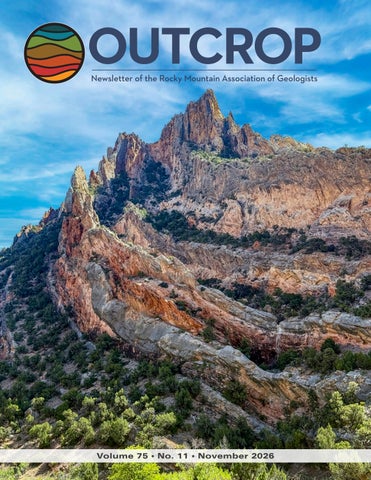
Drag fold adjacent to the Mitten Park Fault along the Green River. Photo by Kevin Schill.
38 In The Pipeline 40 Outcrop Advertising Rates 40 Welcome New RMAG Members! 41 Calendar 41 Advertiser Index
Vol. 75, No. 11 | www.rmag.org
5
OUTCROP | November 2026
SUMMIT SPONSORSHIP infographic link
OUTCROP | November 2026
6
2 0 2 7 Vol. 75, No. 11 | www.rmag.org
September 1, 2026 Geoscience Community: On behalf of the Rocky Mountain Association of Geologists, thank you to every Summit Sponsor and Event Sponsor who supported us this past year. Sponsors like you are the foundation of this organization, and everything RMAG accomplishes for the geoscience community starts with your generosity. In 2026, RMAG was proud to host a dynamic lineup of events, including an upcoming Symposium diving into the Mowry Formation. Members explored geologic wonders across the state, from the kimberlites to South Park and the Arkansas River Valley. We launched the Rocky Mountain Discovery Series, sitting down with senior statesmen of the industry to learn what shaped their careers and their success. Volunteers shared their passion for geoscience with students across the region through classroom visits and community festivals, and members connected outside the office through monthly lunches, coffees, happy hours, and our annual Golf Tournament. Every one of these programs was made possible by the sponsors who fund them. Looking ahead, 2027 brings exciting opportunities for RMAG and our partners, and your support is what makes each one possible. We'll open the year with a State of the Industry luncheon, diving into research shaping our field and hearing directly from the ECMC on where the industry is headed. The 2027 North American Helium and Hydrogen Conference is coming together, and our 101 series continues, sharing industry knowledge with our newest members while refreshing the expertise of working professionals. Networking in 2027 will include our regular happy hours, plus Rockbusters, the Golf Tournament, and more chances to connect with your colleagues. With your support, RMAG members will keep sharing the wonders of earth science through community and school outreach, and we'll continue our publication efforts, including the monthly Outcrop newsletter and the peerreviewed Mountain Geologist journal. As a Summit Sponsor, your commitment gives your employees access to every RMAG event, from our educational programs to the camaraderie of the Golf Tournament. RMAG also recognizes Summit Sponsors through in-person signage at events, on our website, in our publications, and across social media. Thank you to our current Summit Sponsors; we hope to count on your continued support in 2027. And if you're not yet sponsoring, there's no better time to join us. RMAG relies on sponsorship to keep this community running: it directly fuels the education, networking, and professional development opportunities we offer throughout the Rocky Mountain region. Simply put, our sponsors are vital to our success, and to the success of the geoscience community we all share. We invite you to review our sponsorship packages and find the level that best aligns with your company's goals. Whether you choose to become an annual Summit Sponsor or support a single event, your partnership will directly advance geoscience education and keep our community thriving. Ready to become a Summit Sponsor? Contact RMAG Executive Director Bridget Crowther at bcrowther@rmag.org or 720-672-9898 to discuss opportunities and reserve your sponsorship for 2027. Sincerely, Ali Sloan 2027 RMAG President
Bridget Crowther RMAG Executive Director
P: (720)672-9898 staff@rmag.org www.rmag.org
Vol. 75, No. 11 | www.rmag.org
730 17th Street, B1 Denver, CO 80202
7
OUTCROP | November 2026
RMAG ANNUAL
SUMMIT SPONSORSHIP
PLATINUM, GOLD, & SILVER
SPONSORSHIP LEVEL
PLATINUM
GOLD
SILVER
$10,000
$5,000
$2,500
$835
$417
$208
$10,000
$5,000
$3,000
4
2
1
Contribution Level Monthly Cost
Benefits Value
RMAG MEMBERSHIP Active or Associate Membership in the Association for employees
RMAG WEBSITE BENEFITS Company Logo on Summit Sponsor Page of www.rmag.org
Large Logo & Link
Articles and Ads on special Advertisers web page
4 articles & 4 large ads
Medium Logo and Link 2 articles & 2 medium ads
Small Logo and Link 2 small ads
PUBLICATION ADVERTISING 12 months of Outcrop advertising: To receive 12 full months, company logos and ad art must be received no later than the 20th of the month in which you register. The Outcrop (receive benefits for 12 issues, monthly online publication
Full page ad
2/3 page ad
1/2 page ad
Company Logo listed as an annual Sponsor in The Outcrop
Large Logo
Medium Logo
Small Logo
EVENT ADVERTISING Sponsorship will be acknowledged as part the summit sponsors at all RMAG Events. Additional Sponsorship Opportunities will be available for all RMAG Events. Company Logo Looping in Slide Decks
Large logo individual Slide
Medium logo
Small Logo
Company Logo on Summit Sponsor Signage at all events
Large logo
Medium Logo
Small logo
RMAG EDUCATION EVENTS Registration points are cumulative and can be used for Symposiums or Short Courses. For example a Platinum Sponsor can send 4 people to the upcoming symposium conferences and register for 2 short courses. Total Educational Tickets
6
3
1
RMAG SOCIAL EVENTS Registration Points are cumulative and can be used for any social event. For example, 1 point means 1 golfer, or 1 registration for Rockbusters. *2 points can be used for a golf hole if that makes more sense for your company. Total Social Event Tickets
8
4
2
3
2
RMAG LUNCHEONS & FIELD TRIP TICKETS Registration Points are cumulative for luncheons or one day field trips. Total Luncheon & Field Trip Tickets
5
For all event tickets please contact the RMAG office at staff@rmag.org to use your spots.
OUTCROP | November 2026
8
Vol. 75, No. 11 | www.rmag.org
RMAG 2027 SUMMIT SPONSORSHIP Payment Options
All sponsor benefits event tickets follow RMAG event registration deadlines. All benefits end 12 months after registration. RMAG 2027 ANNUAL SUMMIT SPONSOR OPPORTUNITIES Platinum Sponsor Gold Sponsor Silver Sponsor
Summit Sponsorship benefit term is for 12 months! Specify type of payment on signed form, and send logo and advertisements to staff@rmag.org Company: Company Representative: Address: City:
State:
Phone:
Zip Code: Email:
Payment Method:
ACH
Credit Card
Credit Card Information: Select Card: AMEX
Check VISA
Mastercard
Discover
Name as it appears on Credit Card: Credit Card #: Expiration Date:
Security Code:
Signature: ACH: contact the RMAG office at staff@rmag.or for directions. Mail Checks payable to RMAG: Rocky Mountain Association of Geologists (RMAG) 730 17th Street, B1 Denver, CO 80202
RMAG events are subject to change. Cancellation or rescheduling of events does not give the sponsor the right to refund. Summit Sponsors will receive benefits at any new events added into the RMAG schedule.
Thank you for your generous support! P: (720)672-9898 staff@rmag.org www.rmag.org
Vol. 75, No. 11 | www.rmag.org
730 17th Street, B1 Denver, CO 80202
9
OUTCROP | November 2026
RMAG OCTOBER 2026 BOARD OF DIRECTORS MEETING By Stephanie Forstner, Secretary sforstner@diagenyx.com
Publications continues to build a strong lineup for upcoming issues of The Outcrop, with articles covering the Yampa River float trip, the South Park Basin, and glacial flood deposits in the San Juan Mountains. The committee is also developing several future Mountain Geologist articles and working to bring new contributors into the publication. There is an opportunity for someone interested in helping lead this effort, as the committee is seeking a First Vice President-Elect. Geoscience Outreach is wrapping up a busy fall of connecting with students and the community. Recent activities have included Girl Scout Day at Dinosaur Ridge, and the committee is preparing for Park Science Night on November 8, with hands-on activities ranging from coring to mineral identification. These events are a great way to share our enthusiasm for geology and introduce younger generations to the many paths a career in geoscience can take. The On the Rocks committee is putting the finishing touches on this year’s field season and narrowing down an ambitious list of trips for 2027. Plans include the Spanish Peaks, a trip to the northeast corner of Colorado, and several collaborations with Colorado School of Mines. The committee is also considering ways to combine geology with community service, including potential volunteer efforts to help maintain significant fossil and track sites. Finally, the Board discussed opportunities for RMAG members to put their expertise to work beyond our usual programming, including trail and interpretive sign maintenance. These projects could be a meaningful way to give back to the places and communities that make Colorado such a wonderful place to be a geologist. We will need someone willing to help coordinate the effort, so keep that in mind if community service is something you’d like to help build within RMAG. As we head toward the end of the year, I’m grateful for the volunteers, committee members, speakers, authors, and event participants who keep RMAG moving. There’s plenty more to come, and I hope to see you at an event soon!
November is here, and while the days are getting shorter and the field season is winding down, RMAG certainly isn’t slowing down. The Board met on October 21 to hear committee updates, celebrate a few recent successes, and start looking ahead to 2027. RMAG membership has grown to approximately 1,100, with much of the recent increase driven by the Mowry Symposium. It’s encouraging to see technical programming bring new people into the organization, and we’re looking forward to finding more ways to keep those connections going. Our financial position remains healthy, and the Board continues to keep an eye on the long-term stewardship of RMAG’s resources. The Continuing Education Committee reported strong attendance at the October luncheon, with 73 participants joining in person and online. By the time you read this the Mowry Symposium will have been a success and planning is underway for next spring’s Helium/Hydrogen conference, scheduled for April 14–15 in Keystone. The committee is also building out the 2027 luncheon calendar and exploring additional short courses, including core description, Petrel, and reservoir engineering topics. Membership has had a busy fall, too. The September new-member happy hour at New Terrain brought out 27 people, and monthly gatherings continue with a DU Hockey game November 13 and Happy Hour at Prost December 1. The Rocky Mountain Discovery Series returns November 12, featuring Donna Anderson.
John C. Webb
Consulting Geologist Stratigraphy, Sedimentology and Petrography of Clastic and Carbonate Systems
Reservoir Characterization Petroleum, SWD, CCUS, Geothermal
OUTCROP | November 2026
Louisville, Colorado Johnwebb20@comcast.net 303.917.0644
10
Vol. 75, No. 11 | www.rmag.org
JOIN
FOR A
HOCKEY
GAME VS
University of Denver
Lindenwood University
Ticketes and Sponsorship Opportunities Available Friday November 13, 2026 - 7pm Magness Arena - End Zone Tickets Join RMAG and DGS for a night of fast-paced action at a DU Hockey game, with group tickets that make it easy to cheer on the Pioneers together. Vol. 75, No. 11 | www.rmag.org
11
rmag.org/hockeygame
OUTCROP | November 2026
PRESIDENT’S LETTER By Sandra Labrum slabrum@slb.com
Taking a Breath and Reflection
OUTCROP | November 2026
moving pieces of RMAG running behind the scenes. There is a tremendous amount of work that goes into organizing our programs, coordinating events, supporting our committees, and keeping the day-today operations moving. Much of that work happens quietly, but it makes an enormous difference. We are fortunate to have someone so dedicated to helping RMAG thrive. As we head into the holiday season, I hope you’ll consider how you might help support RMAG in the coming year. If you’re looking for a way to get more involved, joining a committee is a great place to start. Our committees are the lifeblood of the organization, bringing the ideas, expertise, and enthusiasm that make our programming possible. And if you’ve ever thought about serving on the RMAG Board, this is a great time to start that conversation. You can also support RMAG by making a donation to the association or the RMAG Foundation. These contributions help fund the programming and educational opportunities our members value, as well as scholarships that support the next generation of geoscientists. Whether you contribute your time, your expertise, or a financial donation, every bit helps strengthen our community. So, as we head into Thanksgiving, I hope you get a chance to slow down, enjoy some good food, spend time with the people you care about, and maybe even appreciate a few moments without checking your email. I’m grateful to be part of this community and for everything you do to make RMAG a place where geoscientists can connect, learn, and grow. Wishing you all a happy Thanksgiving and a wonderful start to the holiday season! —Sandra, RMAG President
Here we are again, hurtling much too quickly toward the end of the year. I say this every year, but I genuinely cannot believe how fast this one has gone. Now that my kids have crashed out from the insanity of Halloween and consumed what I can only describe as a metric ton of sugar, it’s time to turn our attention to the upcoming holidays. I love this time of year, and Thanksgiving in particular has always been my favorite. There’s something about taking a breath before the year wraps up and reflecting on the people and experiences that make our lives a little richer. As I think about what I’m thankful for this year, I keep coming back to the people who make up our geoscience community. Geology may be the study of the Earth, but a career in geology is about so much more than rocks, data, and interpretations. It’s about the colleagues who share their knowledge, the mentors who help us navigate our careers, the friends we reconnect with at conferences, and the people who are always willing to stop what they’re doing to help solve a problem or talk through a new idea. These connections are part of what makes this profession so rewarding, and they are a big part of what makes RMAG special. I’m especially thankful for our RMAG members and the time and energy you give to this organization. Whether you attend a luncheon, join us for a field trip, volunteer on a committee, or simply stay connected to what we’re doing, your involvement helps keep RMAG active, relevant, and growing. A professional society is only as strong as the community behind it, and everything we offer depends on members who are willing to show up, share their expertise, and make space for others to learn. I’m also incredibly thankful for Bridget, our excellent executive director, who keeps so many
12
Vol. 75, No. 11 | www.rmag.org
The 2027 Helium Hydrogen Conference returns for its third edition: submit an abstract, pitch to investors, exhibit, or sponsor today! Call For Abstracts:
RMAG is seeking oral presentations on a range of topics related to Helium & Hydrogen exploration and commercialization including (but not limited to) Exploration Methods, Temporary Storage, Non-Hydrocarbon Commercialization, Play Characterizations and Case Studies in North America, Marketing, Regulations, and financing. New this year we're introducing a Showcase for Investors, a chance to highlight your company's investor ready project!
DEADLINE: NOVEMBER 16, 2026 Exhibit and Prospect Expo
Sponsorship Opportunities
Includes Booth Registrations & Advertisement. Exhibit Booth: $2000 Prospect Booth: $1000
CHOOSE FROM 5 LEVELS: Diamond ($10,000), Titanium ($5,000), Platinum ($2,500), Gold ($1000), Silver ($500) BENFITS INCLUDE: Advertising: Digital and on-site signage, Complimentary Booth Space & registrations, Happy Hour Drink Tickets, and more...
Learn More: Vol. 75, No. 11 | www.rmag.org
RMAG.ORG/2027HeH 13
OUTCROP | November 2026
LEAD STORY
RMAG ON THE ROCKS
YAMPA/GREEN RIVERS RAFT TRIP Dinosaur National Monument – From Deerlodge Park, Colorado To Split Mountain, Utah JUNE 1-5, 2026
with contributions from Gary Gianniny and Cynthia Dott
WENTY-FOUR RMAG MEMBERS
Morrison Formation of Stegosaurus, Apatosaurus, Allosaurus and other dinosaurs. In 1938, the monument was expanded by 200,000 acres to include large portions of the free-flowing Yampa and Green Rivers upstream from the Quarry. Our adventure began on Sunday evening with an orientation at the OARS base in Vernal, Utah, led by our OARS Trip Leader Stell, with support from the other OARS crew (Alex, Boaz, Ben, and Doug). Gary provided a brief geology overview and David Schoderbek welcomed all on behalf of RMAG. After getting fitted with PFD jackets and helmets, we received instructions on how to pack gear for the Monday morning departure. All went back to their rooms and attempted to pack various loose gear into two waterproof (“dry”) bags – one akin to “checked luggage” that we could not access until camp each evening and the second a “carry-on bag” we could access during rafting. Although famous for the dinosaur quarry in the
T
COMPILED BY BILL CUTLER AND DAVID SCHODERBEK
participated in an exhilarating 71-mile raft trip down the Yampa and Green Rivers through Dinosaur National Monument for five days in early June. The raft trip was outfitted by OARS, one of the leading river rafting guide companies in the country and consisted of 5 days of rafting with 4 nights of camping along the river. Dr. Gary Gianniny, professor emeritus at Fort Lewis College in Durango, provided geological guidance consisting of lectures at breakfast, river stops, and happy hour around the chair circle at riverbank camp each evening. Gary has led multiple RMAG On the Rocks excursions, including the 14-day raft trip down the Grand Canyon last spring (see writeup in the December 2025 Outcrop magazine). Dinosaur National Monument was established in 1915 to protect an initial 80-acre Dinosaur Quarry, where discoveries were made in the Jurassic
OUTCROP | November 2026
14
Vol. 75, No. 11 | www.rmag.org
FIGURE 1: Map of Dinosaur National Monument. Hansen (1996)
Anticline to the north of the highway. Entering Deerlodge Park, we were treated to the Cross Mountain Fault thrusting Mississippian Madison Limestone over Cretaceous Mancos Shale. Due to the low snowpack and associated runoff this year, the river was at moderate stage, and we were told we’d be the last commercial float trip on this section of river for the year as certain sections would be too shallow for large raft travel! Deerlodge Park launch is situated on a grassy Holocene terrace with forests of broadleaf (or Fremont) cottonwoods; an ecology we would soon leave behind as we entered the canyons of the Yampa River. Our guides met us at the launch with four oar boats, a paddle boat, four inflatable kayaks (“duckies”), and a couple of standup paddleboards. While some hopped into the front or back of oar boats,
Morrison Formation, the geology along the raft trip focused on stratigraphy and structure within a broad span of geologic history: sedimentary rocks from the Cretaceous Frontier Formation down section through other Mesozoic and Paleozoic formations, and ultimately to exposures of the Proterozoic Uinta Mountain Group metamorphic rocks. As for paleontology, while no dinosaur bone finds were in the offing, we would be treated to wonderful invertebrate body and trace fossils in multiple formations.
DAY 1
Monday morning (Day 1) we departed Vernal in buses and drove back east to the Deerlodge Park launch site on the Yampa River. Along the drive were dramatic views of Split Mountain and the Cliff Ridge
Vol. 75, No. 11 | www.rmag.org
15
OUTCROP | November 2026
LEAD STORY
FIGURE 2:
Stratigraphic Column. Hansen (1996)
OUTCROP | November 2026
16
Vol. 75, No. 11 | www.rmag.org
LEAD STORY
others opted to join the paddle boat for more active participation on the float, while a few hardy explorers jumped into duckies to experience the waters without the aid of a boat guide. During the morning float, we moved down-section through hogbacks of the Cretaceous Frontier and Dakota sandstones, the poorly-exposed Jurassic Morrison Formation, and into the underlying Jurassic Entrada and Glen Canyon Sandstone formations. Our float continued down-section along the easterly-dipping monocline through the Triassic Chinle and Moenkopi Formations. Just before lunch, we left the Mesozoic rocks behind and entered the Yampa Canyon, whose walls are formed by the competent, nearly 1000 ft-thick Pennsylvanian Weber Sandstone of eolian origin and underlying Morgan Formation (composed of alternating sequences of limestone and eolian-dominated sandstone). The Weber and Morgan formations would become our trusted stratigraphic friends over the next few days, with distinct weathering profiles on the canyon walls helping us locate our position within the stratigraphic succession.
FIGURE 3: Rafts and duckies. Photo by Bill Cutler.
FIGURE 4:
Entrance to Yampa Canyon. Photo by Bill Cutler.
Vol. 75, No. 11 | www.rmag.org
17
OUTCROP | November 2026
LEAD STORY
FIGURE 5: Morgan Fm showing siliciclastic unit thinning. Photo by Gary Gianniny.
At lunch, we took a walk to inspect the Pennsylvanian Round Valley Limestone, containing crinkly-laminated stromatolites and jasperized coral, brachiopod, and crinoid fossils in float. During the afternoon rafting, we encountered a few modest rapid sections before finishing the day at Ponderosa Campground across from a beautifully exposed section of Upper Morgan Formation lying above the Round Valley Limestone. Within the Morgan Formation outcrop, we could observe clastic-carbonate sequences up to several tens of meters in thickness, with distinct lateral thickness changes and depositional clinoforms. Gary led a spirited debate on the depositional environment, and most agreed the depositional pattern was likely indicative of limited accommodation space during deposition. For those familiar with river camping, of course we had gear bags, tents, cooking gear and food to unload upon landing, and all jumped in to form a “fire line” to efficiently move gear from the oar boats to shore to set camp. While most guides slept on their boats, the RMAG guests scattered across the campsite to set up tents – although some opted to sleep on the ground under the stars and a few others strung hammocks between trees. While guests set up their camp sites, the guides set up the “kitchen” and the portable “restrooms”. For reasons we won’t OUTCROP | November 2026
FIGURE 6: Groover at Ponderosa camp. Photo by Bill Cutler.
18
Vol. 75, No. 11 | www.rmag.org
LEAD STORY
FIGURE 7:
Clastic dike. Photo by Bill Cutler.
detail, the river guides affectionately call the portable toilets “groovers” – and they found great joy in placing them in private locations with spectacular views!
DAY 2
After a hearty breakfast of blueberry pancakes, the group was set for the second day of rafting/paddling. Before launching, all potential duckie paddlers had to prove they could be dumped from the kayak and climb back aboard unaided – as heavier rapids were coming down the canyon. Our first stop along the river was to view and hypothesize on the origins of deformed beds (synclinal structure) in the Round Valley Limestone; was it caused by a sinkhole in the underlying Madison Limestone or by faulting? Both concepts seemed valid, and no certain explanation was agreed by all. At lunch break at the Big Joe Campsite, above the mighty Big Joe Rapids, the group took a five-star lunch walk up Starvation Valley to inspect the Lower Morgan Formation. Limestone beds were discovered Vol. 75, No. 11 | www.rmag.org
FIGURE 8: Chaetetes. Photo by Gary Gianniny.
19
OUTCROP | November 2026
LEAD STORY containing the extinct shallow marine, reef building, calcareous sclerosponges (Chaetetes), with beautifully preserved spicules (see photo). Above the sponge-bearing layer was a layer of deep red hematitic siltstone/mudstone (an inferred paleosol) and bedded siltstones/sandstones with a prominent syndepositional clastic dike. A few miles downstream we set camp early in the afternoon at the Harding Hole Campground. Most of the group took an afternoon hike to the Spiral Cave, an erosional feature formed by groundwater sapping within the Weber Sandstone. Guides Alex, Ben and Boaz led the hike, and once inside the cave we were treated to Ben’s flute playing melodies ascribed to the indigenous peoples who once lived in the canyon until several centuries ago.
DAY 3
Day 3 on the Yampa River began with a short wildflower tour led by Dr. Cynthia Dott (Dr. Gary’s better half!), where we observed evening primrose (Oenothera), copper globe mallow (Sphaeralcea coccinea), Astragalus (purple pea flowers), Townsend daisy (white daisy flower - Townsendia), golden aster (Heterotheca), sego lily (Calochortus, the Utah state flower), and the beautifully scented dogbane (Apocynum cannibinum) in flowFIGURE 9: Guide Ben playing flute in Spiral Cave. Photo by Bill Cutler. er! Note the evening primrose flowers bloom in the evening to attract night cave-forming sapping of the weakly cemented eopollinators like moths, then die the next morning, lian sandstone layer above the aquitard. followed each evening by a new flower cycle. Another 10 miles downstream we encountered Shortly after leaving the Harding Hole Campthe Tiger Wall, a vertical wall of Weber Sandstone ground, we pulled over to hike up to Signature Cave, a spectacular sapping feature (“cave”) in the exhibiting vertical stripes of desert varnish (manWeber Sandstone in which early Yampa River exganese oxide) precipitation from streamers of rainplorers left their graffiti signatures. The base of water or snowmelt flowing down the rock face. the cave consists of a cemented paleosol formFor good luck, many of our RMAG explorers kissed ing an aquitard above which groundwater in the the Tiger! Weber Sandstone exits the cliff face and results in During each day’s float, we were treated to a OUTCROP | November 2026
20
Vol. 75, No. 11 | www.rmag.org
LEAD STORY
host of wildlife, in particular bighorn sheep, mule deer, and a variety of birds including bald eagles, peregrine falcons, merganser ducks and swallows. We shared camps with an assortment of small lizards and songbirds, and the elusive ringtail - although we never saw the nocturnal raccoon-like mammal, we observed its tiny and distinctive footprints in the sand. The afternoon consisted of some wonderful rapid runs, including the mighty Warm Springs Rapids. Despite the heavy current, eddies and standing waves, all boats and duckies made the runs without flipping, demonstrating the true value of kissing the Tiger Wall earlier in the afternoon. We camped that evening at Box Elder Park, which exhibited both broad sand beaches and fascinating cobble bars. Above the beach and a plateau of box elders was a 1,000 ft wall of Weber Sandstone, capped by the Permian Park City Formation. Douglas Fir trees adorned the slopes next to the cliff apparently enjoying the cool shade it provides.
FIGURE 10: Evening Primrose - note last night’s flower still
blooming, prior night flowers wilted. Photo by Bill Cutler.
FIGURE 11:
Signature Cave. Photo by Art Curtis.
Vol. 75, No. 11 | www.rmag.org
21
OUTCROP | November 2026
LEAD STORY DAY 4 Day 4 brought us the most spectacular geology of the trip. A few miles after launch, the Yampa River joined the Green River beneath towering cliffs of the Weber Sandstone at aptly named “Echo Park” by early explorer and geologist John Wesley Powell. Hoots, hollers and whistles reverberated loudly off the rock walls. The clear greenish water of the Green River at the confluence provided a stark contrast with the light brown silty waters of the Yampa. Two miles down the Green River the group landed to observe the Mitten Park Fault, a Laramide thrust fault that resulted in 3,000 ft of vertical offset and produced a magnificent drag fold that we could observe on both sides of the river. The RMAG party took advantage of the perfect weather, clear air, and blue skies to take the formal group photo for the trip. After the Mitten Fault experience, we rafted further downstream and down stratigraphic section through Mississippian rocks, including the Madison Limestone (called the Redwall FIGURE 12: Tiger wall. Photo by Bill Cutler. Limestone in the Grand Canyon area) and then the underlying Cambrian Lodore Formation the irregular erosional surface. Interested RMAG’ers (note that no Ordovician, Silurian or Devonian rocks scampered up the rugged slope behind our lunchare preserved here). By lunch break we ventured stop beach and were able to put their finger on the further downsection where the Cambrian Lodore unconformity surface, above which they observed sandstones could be examined above the irregularly weathered surface of Proterozoic Uinta Mountain breccia clasts of Uinta Group rocks incorporated into Group metasediments. The unconformity surface exthe first deposited Cambrian sandstones. hibited ancient “sea stacks” of Uinta Formation rocks, We made an early afternoon landing at Jones up to several hundred feet high, where the CambriHole Campground, at the confluence of crystal-clear an sands onlapped the stacks and eventually buried Jones Hole Creek, where we spent our last night on OUTCROP | November 2026
22
Vol. 75, No. 11 | www.rmag.org
LEAD STORY
FIGURE 13: Group Picture at Mitten Fault. Photo by Kevin Schill.
Vol. 75, No. 11 | www.rmag.org
Dinner on this last evening was a special treat, not only did the OARS guides cook us steaks and all the fixings but revealed a grab bag of costumes the group adorned to prove geologists are more foolish than serious when in our rocky environs. Gary was in true form at the chair circle helping us recount the various highlights from the four days of adventure, in his best version of Monty Python accent (very funny, almost worthy of the big screen).
the river. The guides led many in the group on a hike of several miles up the trail along the creek to inspect the Cambrian Lodore Formation, the Devonian Parting Formation, and the soaring walls of the Madison Limestone. The setting was an ecological oasis, with tumbling waterfalls, wildflowers like the yellow monkey flower (Mimulus sp.) growing on rocks in the creek, and brown and rainbow trout feeding on insects in clear, swirling plunge pools. Our guide, Doug, led the hiking group to several well-preserved pictographs drawn by the ancient native people centuries ago, to include large-horned antelope and a group of men with wild (almost modern) haircuts! Several fishers decided not to join the hiking group but explored the lower creek to catch (and release) wild trout.
Day 5
23
Well, the final day was upon us as we left Jones Hole Campground on Day 5. After some excitement for boats and kayaks through the last of the rapids (Moonshine, SOB, Schoolboy and Hatch Beach Hole), the river turned mellow as we floated toward the
OUTCROP | November 2026
LEAD STORY
FIGURE 14: Pictographs of the antelope and three men. Photo by David Schoderbek.
FIGURE 15:
Gary and group in costume at the chair circle. Photo by Lorna Campell.
OUTCROP | November 2026
24
Vol. 75, No. 11 | www.rmag.org
LEAD STORY Sandstone, to our final destination at the Split Mountain boat ramp. After loading our gear onto buses, we drove back to OARS headquarters at Vernal, Utah, and said our goodbyes and best wishes to guides and fellow RMAG friends.
takeout at Split Mountain boat ramp. But before we’re done with the trip, we were treated to one last geological wonder – the drag fold on the Island Park Fault at the head of the Split Mountain Anticline! At this point, the Green River turns from westerly to southerly and breaks through the southern flank of the broad anticline – in such a way as to “split” through the southern flank of the east-west trending anticline. As such, we float up-section through our good friend, the Weber
REFERENCES
Hansen, W.R, 1996, Dinosaur’s Restless Rivers and Craggy Canyon Walls; A river runner’s guide to the geology of a classic canyon wilderness, Dinosaur Nature Association, Vernal UT. ISBN 0-9651504
FIGURE 16: Split Mountain drag fold. Photo by Art Curtis.
Vol. 75, No. 11 | www.rmag.org
25
OUTCROP | November 2026
HYBRID LUNCH TALK Speaker: Bryan McDowell Date: November 4, 2026 | 12:00 pm - 1:00 pm
Subsurface Pressure Trends & Implications for Exploration Across the Rockies, Permian, Mid-Con, & Gulf Coast Speaker: Bryan McDowell, Managing Partner, Sabata Energy Consultants, Midland, TX view, pressure changes are small and gradual. The Denver, Williston, San Juan, Midland, and Arkoma basins are the clearest examples. • “Boots” are normally pressured at shallow depths, then show a sharp overpressured “foot” at depth. In map view, these basins show “bullseye” pressure zones, as in the Powder River and Green River basins. • “Hockey sticks” show a gradual increase in both mud density and variability with depth. Pressure varies widely both vertically and laterally, which makes exploration in basins such as the Delaware, Anadarko, and East Texas basins more nuanced.
Reservoir pressure is one of the most important controls on well productivity in low-permeability reservoirs, and it is also one of the hardest parameters to find. Direct measurements from DSTs, DFITs, and bottomhole pressure gauges are uncommon, rarely number more than a few dozen in a given area and are almost never made public. This presentation uses a widely available but often overlooked alternative: the drilling mud density recorded on wireline well log headers. We review 650,000 data points hand-collected from well log headers across every major basin in the Rockies, the Permian, the Mid-Continent, and the Gulf Coast, converted to pressure gradient and overpressure. Mud weight is not a direct measurement of pore pressure, but it reliably shows regional pressure trends. Based on the shape of their mud density vs. depth plots, basins fall into three characteristic profiles: • “Rulers” have tight vertical distributions with little to no change in mud density with depth. In map
Maps and cross sections show where these overpressured zones are located and how they appear in mud logs and drill stem tests. The results show how a simple, low-cost dataset can highlight prospective fairways, flag drilling hazards, and support exploration screening.
BRYAN MCDOWELL is a reservoir engineer and geologist specializing in subsurface data integration and visualization for oil and gas exploration and development. He is the founder of Sabata Energy Consultants in Midland, Texas, one of the largest private holders of geological data, which manages roughly 3 million digital files and 5 million physical documents. Bryan holds a B.S. in Geology from Texas A&M University and an M.S. in Petroleum Engineering from Colorado School of Mines, where he is completing his Ph.D. in Geology. With more than 15 years of experience in unconventional reservoirs, he has worked extensively across the Permian Basin, Rockies, and Mid-Continent.
OUTCROP | November 2026
26
Vol. 75, No. 11 | www.rmag.org
ON THE ROCKS PRESENTS
CATARACT CANYON MAY 15 TO 20, 2027
Join the Rocky Mountain Association of Geologists on a five-night, six-day one-hundred-mile float trip on the Colorado River
SAVE YOUR SPOT TODAY! Vol. 75, No. 11 | www.rmag.org
rmag.org/FloatTrip 27
OUTCROP | November 2026
HYBRID LUNCH TALK Speaker: Patricia E. Rodrigues Date: December 2, 2026 | 12:00 pm - 1:00 pm
A Geology-Anchored, Two-Stage Workflow for Basin-Scale Well Log Normalization Using Statistical Volumes Speaker: Patricia E. Rodrigues, SeisPetro Geoconsulting Authors: Patricia E. Rodrigues, Reinaldo J. Michelena, Keyla Gonzalez, and Alejandro A. Valenciano, SeisPetro Geoconsulting, TGS
OUTCROP | November 2026
normalization statistical framework was subsequently applied to more than 24,000 additional wells with only a few hours of computation, demonstrating a level of scalability that is difficult to achieve using traditional normalization workflows. The resulting normalized dataset preserves regional geological trends while reducing non-geologic variability associated with casing effects, acquisition vintages, service companies, borehole conditions, and processing workflows. The normalized logs exhibit improved stratigraphic continuity, clearer expression of regional geological patterns, and substantially reduced acquisition-related artifacts. More importantly, the workflow enables construction of high-resolution 3D log-property volumes from large well populations. These volumes allow well logs to be analyzed in a spatial context similar to seismic data, making it possible to visualize geological variability, stratigraphic architecture, and regional trends at scales that are difficult to achieve through conventional well-to-well cross-sections. The methodology also establishes a foundation for workflows that extend beyond normalization itself. Normalized properties can be extracted along horizontal well trajectories, supporting geosteering and development studies. Because the approach is readily applicable to additional petrophysical logs, it enables the creation of multi-property 3D volumes
Modern reservoir characterization increasingly depends on the integration of well logs, seismic data, geological interpretations, and production information. Yet, despite the abundance of digital well logs in the Permian Basin, creating coherent regional datasets remains challenging. Variations in acquisition vintages, service companies, borehole conditions, casing programs, and processing workflows introduce significant non-geologic variability that obscures geological trends. These challenges become particularly severe when normalizing entire wells rather than isolated target intervals, as wells often contain multiple casing strings, incomplete depth coverage, and intervals acquired under different conditions. This study presents a workflow that normalized more than 26,000 gamma ray (GR) logs from surface to total depth (TD) across approximately 3,900 square miles and four counties in the Midland Basin, Texas, in less than two months. A carefully selected reference dataset was used to establish regional geological trends (2,700+ wells), which were then propagated through a volumetric normalization framework based on calibrated 3D statistical models. The workflow requires a limited number of key stratigraphic tops in the reference dataset to define the regional geological trends and establish a stratigraphic framework; whereas only casing-point information is needed for all wells in the study area. Once established, the
28
Vol. 75, No. 11 | www.rmag.org
Vol. 75, No. 11 | www.rmag.org
29
OUTCROP | November 2026
DECEMBER HYBRID LUNCH TALK
Original GR log interpolated along stratigraphic grid. (b) Interpolated GR log after 3D normalization and 3x3 median filter along stratigraphy. Location of the cross-section relative to well locations is shown in the upper right. Cell dimensions: 2500 ft x 2500 ft x 4 ft. within a common subsurface framework. The work demonstrates that log normalization can evolve from a well-by-well correction task into a basin-scale process that supports regional interpretation, 3D property modeling, development planning, and future data-driven subsurface workflows.
that can ultimately be integrated with completion and production data to investigate controls on well performance. In addition, the resulting datasets provide the consistency and scale required for emerging AI and foundation-model workflows that seek to integrate logs, seismic, and geological information
PATRICIA E. RODRIGUES received a Ph.D. in Geophysics from Colorado School of Mines and a B.S. and M.S. in Chemical Engineering from Universidad Simón Bolívar (Venezuela). She has more than 25 years of experience in the research, development, and application of reservoir characterization technologies, specializing in petrophysics, rock physics, and integrated reservoir studies for the oil and gas industry. Her career includes technical and leadership positions at PDVSA-Intevep, Tricon Geophysics, DRM Energy, iReservoir, Newfield Exploration, and Whiting Petroleum, where she served as Chief Petrophysicist and Director of Geology and Geophysics. Since 2020, she has been a Petrophysical and Geoscience Advisor at SeisPetro Geoconsulting. Her expertise includes advanced petrophysical modeling and multimineral analysis, as well as regional-scale petrophysical studies involving large datasets ranging from hundreds to tens of thousands of wells. She has taught multimineral analysis at Colorado School of Mines and is the instructor of the SPWLA Petrophysical Multimineral Analysis course. She has also served as Vice President of Technology and President of the Denver Well Log Society. OUTCROP | November 2026
30
Vol. 75, No. 11 | www.rmag.org
Detailed and accurate geology at your fingertips in Petra, GeoGraphix, ArcGIS, AccuMap, geoSCOUT and other digital mapping applications
Western Canada Geological Edge Set
Energy Alternatives & Critical Minerals - Canada Western USA Geological Edge Set Eastern USA & Eastern Canada Geological Edge Set
Energy Alternatives & Critical Minerals - USA
Central USA Geological Edge Set Mexico Geological Edge Set
Map layers provided in shapefile format for easy import into all mapping applications. Deliverables include: formation limits, outcrops, subcrop edges, O&G fields, structural elements, reefs, shorelines, channels, production fairways, shale gas trends, structure contours, isopachs, general culture, renewable & non-renewable energy projects, mineral deposits, mines, Petra Thematic Map projects, GeoGraphix GeoAtlas projects, ArcGIS MXD and Layer files, regional cross-sections, and full technical support.
Vol. 75, No. 11 | www.rmag.org
For more information: Joel Harding at +1 403 870 8122 31 joelharding@geoedges.com www.geoedges.com
OUTCROP | November 2026
BOOK REVIEW Reviewed by Rasoul Sorkhabi University of Utah, Energy & Geoscience Institute
The Boy Who Picked Up Rocks & GeoDestinies “Little boys who pick up rocks either go to prison or become geologists.” —Walter Youngquist
In 2004, I wrote a letter to Walter Younquist. I was planning to edit a book containing life stories of petroleum geologists and invited Dr. Youngquist to contribute a chapter. (The planned book did not materialize.) Those were the days of “peak oil” and “resource wars” debates, and I was reading a lot about these topics. I happened to see a very interesting book by Youngquist entitled GeoDestinies: The Inevitable Control of Earth Resources over Nations and Individuals. The book was massive – exactly 500 pages, with dozens of references cited at the end of each of its 29 chapters. It was published by a non-mainstream publisher, National Book Company, in Portland, Orogen. Not having Youngquist’s email or postal address, I sent my letter by snail mail to his publisher. A few weeks later, I received a reply, by snail mail, directly from Youngquist: “December 15, 2004 Dear Dr. Sorkhabi, I am in receipt of your good letter telling of your proposed volume WHAT LIES BENEATH: TALES OF PETROLEUM EXPLORERS, forwarded to me by one of my publishers, the National Book Company. It is a commendable effort as the public knows too little about the science and the people who provide the very basics of our industrial civilization. OUTCROP | November 2026
FIGURE 1: Letter
And I appreciate the invitation to appear in your volume. However, I am very much overextended now in writing commitments. My most recent book, GeoDestinies: The Inevitable Control of Earth Resources Over Nations and Individuals, has been out of print for some time. Several universities want to 32
Vol. 75, No. 11 | www.rmag.org
BOOK REVIEW
use it as a text and I am in the midst of revising it to seashells sixteen thousand feet up in the Andes, slip off a moss-covered log in the Oregon Cascade a 2nd edition, but it is a 600-page complete rewrite Mountains and break three ribs, get dysentery in job which occupies all my time and energies. Peru. Sometimes I wish I had studied Business AdI did in fact a number of years ago in my very ministration instead of Geology?” Youngquist confirst book – long since out of print – write about petinues: “The colorful old prospectroleum geologists and also teaching tor is gone,” “But he has a modern geology. I enclosed several reviews of equivalent – the professional geoloit. It is a fairly rare volume but occagist. He uses a Jeep instead of a bursionally copies show up in used bookro. And he may even have a Ph.D., stores and I buy them. I have one on but the rattlesnakes he meets aren’t hand now. It may be in the U of Utah impressed, nor is the rain, the snow, Library. If not, and if you would like the mud, nor the poison ivy.” to have this copy I would be pleased to send it to you. It is a rather humorous account A SKETCH OF LIFE of several aspects of being a geoloWalter Lewellyn Youngqgist. The title – OVER THE HILL AND uist was born in Minneapolis on DOWN THE CREEK – is taken from May 5, 1921. Son of Walter Raythe last chapter where I left Peru afmond Youngquist and Selma Reter working there for a number of gina (Knock) Youngquist, Walter years for what is now ExxonMobil belonged to what is sometimes Corporation and went over the Andes called the Greatest Generation – FIGURE 2: Over The Hill and and down the Amazon on my way those who came of age and matuDown the Creek back to the States. Got in a revolurity during the Great Depression tion on the way! It happens in South America. and World War II. He studied at Minnehaha AcadThank you again for your invitation, and I do emy in Minneapolis and graduated in 1939. He wish you well with your endeavors. then joined Gustavus Adolphus College in St. Peter, Yours truly, Minnesota, and graduated in 1942. He obtained an Walter Youngquist” MS in geology from the University of Iowa in 1943 with research work on Upper Devonian conodont The book Over the Hill and Down the Creek infauna from Iowa. The same year he married his trigued me. The University of Utah library did not college fellow Elizabeth Salome Pearson. (In the have a copy; the book, published in 1966, was out years to come, they had four children: John, Karen, of print although its publisher, Caxton Printers in Louise, and Robert.) Caldwell, Idaho was (and is) still around. I didn’t World War II interrupted Walter’s education. want to bother Youngquist with mailing me the He worked for a year as a junior geologist in the US book, so I searched Amazon vendors online and Geological Survey and then served as an ensign in luckily found a used copy. the US Naval Reserves from 1944-1945. After the Over the Hill and Down the Creek is packed war, Youngquist returned to the (State) University with life stories of Youngquist and his colleagues. of Iowa and obtained a PhD in geology in 1948. His It is written in a witty prose right from the begin140-page doctoral dissertation was on the cephaning. The first chapter opens with a sentence that lopod fauna from the White Pine Shale of Nevada I have chosen for the title and epithet of this artisupervised by Professor Arthur K. Miller. Youngqcle. In the foreword, Youngquist presents the scope uist also co-edited with Miller the GSA Memoir of his book in this manner: “Join me and pick up a 41 on American Permian Nautiloids published by few elephant tusks and shinbones in Alaska, sleep the Geological Society of American in 1949. From out with the Eskimos on Baffin Island, collect fossil 1942-1952, Youngquist extensively worked on
Vol. 75, No. 11 | www.rmag.org
33
OUTCROP | November 2026
BOOK REVIEW invertebrate fauna from Iowa, Ohio, Idaho, Nevada, Utah, New Mexico and Texas which resulted in 20 papers published in the Journal of Paleontology and AAPG Bulletin. Shortly after his PhD, Youngquist took a teaching position at the University of Idaho in Moscow and remained there for three years before being hired by Standard Oil of New Jersey (Esso) to work in Peru where he lived from 1951 to 1954. His book Over the Hill and Down the Creek narrates his life up to his Peru years which he ended with a solo trip over the Andes and down the Amazon (hence the book’s title). In Peru, Youngquist worked on La Brea-Parinas field and his work was later published in 1958 in the AAPG special volume, Habitat of Oil, edited by Lewis G. Weeks. What lured Youngquist to return home was an academic position at the University of Kansas in Lawrence, where he worked for three years. He then joined the University of Oregon in Eugene where he taught various courses including geology, paleontology, and petroleum geology for nine
OUTCROP | November 2026
years. He was a great mentor and many of his students were employed by petroleum companies. In 1967, Youngquist began his consulting practice for petroleum and geological companies. His work took him to more than 70 countries in Asia, Europe, Africa, and South America with assignments from Exxon, Sun Oil, Shell, and Amoco. He was a consulting geologist for the mineral department of Exxon Corporation from 1968-1973 and geothermal consultant for Eugene Water & Electric Board from 1973-1992. After 1992, he continued his independent consultancy based in Eugene, Oregon.
GEODESTINIES
34
While working as a consultant geologist, Youngquist published several books on mineral economics. His first book was Investing in Mineral Resources: Today’s Guide to Tomorrow’s Needs (published by US News & World Report Books, 1976); a second edition came out in 1980 by Dow Jones-Irwin. In 1990, Youngquist published Mineral Resources and the Destinies of Nations through National Book Company in Portland. This book became the foundation for his major work GeoDestinies: The Inevitable Control of Earth Resources over Nations and Individuals in 1997. As Youngquist had written in his letter to me, he was working on the second edition of GeoDestinies during the 2000’s. He completed his work in April 2012, two months before his 92nd birthday but its publication was delayed mainly because National Book Company went out of business. Youngquist died on March 2, 2018 (aged 96), in Eugene, but luckily his manuscript of the second edition of GeoDestinies was passed to his friends Leon Kolankiewicz and Michael Dowd who decided to publish it. The book was copy edited by Connie Barlow, and Charles A. S. Hall (a retired geology professor)
Vol. 75, No. 11 | www.rmag.org
Thursday Thursday November November 12, 12, 2026 2026 8:30 8:30 to to 9:30 9:30 am am
Denver Denver Earth Earth Resource Resource Library Library
ROCKY ROCKY MOUNTAIN MOUNTAIN DISCOVERY DISCOVERY SERIES SERIES
An An interview interview series series with with Oil Oil & & Gas Gas Leaders Leaders Join us for a conversation with a longtime leader in the RMAG community, Donna Anderson. Growing up in the oil-derrick-dotted hills of the Los Angeles Basin, she was hooked on Deep Time before she finished primary school. She began her career in geotechnical engineering in 1974, navigating an era when women were routinely told they had no place in the field or on a drill site, and turned those barriers into fuel. She spent over four decades in the oil and gas industry across the western U.S. and internationally, including 12 years at Mobil and nearly a decade at EOG Resources where as a Geological Advisor from 2006 to 2015 she worked at the heart of the shale revolution. Donna has been a fixture of the Rocky Mountain geoscience community throughout her career and has plenty more to say. Come hear her story!
rmag.org/DiscoverySeries
Vol. 75, No. 11 | www.rmag.org
35
OUTCROP | November 2026
BOOK REVIEW
FIGURE 3: GeoDestinies
PHILANTHROPIST
In 2007, Youngquist made two gifts totaling $500,000 to Gustavus Adolphus College – his alma mater – to fund two student scholarships:
OUTCROP | November 2026
(1) Robert Eric Youngquist Memorial Scholarship Endowment in honor of his son Robert who died at age 26, and (2) Walter R. Youngquist Memorial Scholarship Endowment in honor of his father who graduated from Gustavus in 1916. In addition to these two endowments, Youngquist established at Gustavus the Chester O. Johnson and Walter L. Youngquist Geology Student Research/Field Study Endowment Fund, the Chester O. Johnson Geology Scholarship Endowment Fund, and the Elizabeth Pearson Youngquist Music Scholarship Endowment Fund, which is part of the Jussi Björling Music Scholarship. After his wife died in 2010, Youngquist sold the 16 acres of land they owned on the outskirts of Eugene and created three funds, totaling $2.1 million, to Minnehaha Academy – his alma mater. These finance three scholarships for students: (1) The Robert Eric Youngquist Memorial Scholarship; (2) The Jeanne Youngquist Scholarship in honor of his sister, and (3) The Walter Youngquist 39 Scholarship. Such was the story of a man who devoted his life to rocks and “hunting with his camera,” and who earnestly wished, through his philanthropy, that more boys and girls pick up minerals, rocks, and fossils, learn about our home planet, and generate resources for the well-being of humanity.
and Richard Adrian Reese (an environmental writer) wrote a foreword. The book has been published online, so you can download a free copy of the book for yourself. Here is the web address: https://thegreatstory.org/geodestinies-youngquist-2022.pdf GeoDestinies is a book full of interesting information and insight for geologists and geology students. The foundational premise of the book is that Earth resources – water, soil, minerals, petroleum, etc. – have critical and controlling influences over human affairs – their economies, life standards, and politics. For instance, the progress of civilization has been in terms of various ages related to minerals – Stone, Copper, Bronze and Iron ages in that sequence. Youngquist also quotes a phrase from Will and Aariel Durant’s Lessons of History: “History is subject to geology.” Even though you may not agree with Youngquist’s “geo-destiny” outlook, the book offers a wide and historical perspective of how important Earth resources and the works and societal contributions of geologists are. The second edition contains 30 chapters in 598 pages.
36
Vol. 75, No. 11 | www.rmag.org
DECEMBER HAPPY HOUR JOIN YOUR FELLOW GEOSCIENTISTS FOR A DRINK Tuesday, December 1, 2026 4pm Prost Brewing Co. - Wheatridge 3801 Crossing Drive, Wheat Ridge, CO 80401
SPONSORED BY
RMAG.ORG/HAPPYHOUR
Seeking Editor Oversee a peer-reviewed journal Source articles from the entire Rocky Mountain Region Manage Peer-Review process Interest? Email: staff@rmag.org
Vol. 75, No. 11 | www.rmag.org
37
OUTCROP | November 2026
IN THE PIPELINE RMS-SEPM Happy Hour Rocky Mountain Section SEPM (Society for Sedimentary Geology) Geology Brewery Rendezvous; 4:30 pm - 6:30 pm; Vine Street Pub, 1700 Vine Street, Denver
NOVEMBER 4, 2026 RMAG Hybrid Luncheon “Subsurface Pressure Trends & Implications for Exploration Across the Rockies, Permian, Mid-Con, & Gulf Coast” Speaker: Bryan McDowell; Denver Earth Resources Library, 730 17th Street B1, Denver.
DECEMBER 1, 2026 RMAG Happy Hour 4:00 pm - 6:00 pm; Prost Brewing Co., 3801 Cossing Dr., Wheatridge, CO
NOVEMBER 5, 2026 Mowry Symposium Seats are limited for this single-track, single-day event. Join geologists, geochemists, and engineers from across the basin for a full day on the formation everyone’s watching. Denver West Marriott
DECEMBER 2, 2026 RMAG Hybrid Luncheon “A Geology-Anchored, Two-Stage Workflow for Basin-Scale Well Log Normalization Using Statistical Volumes” Speaker: Patricia Rodrigues, SiesPetro Geoconsulting; 12:00 pm - 1:00 pm; Denver Earth Resources Library, 730 17th Street B1, Denver.
NOVEMBER 12, 2026 Rocky Mountain Discovery Series - An interview series with Oil & Gas Leaders: Donna Anderson; 8:30 to 9:30 am; Denver Earth Resource Library
DECEMBER 3, 2026 AADE Happy Hour 4:00 pm - 7:00 pm; Thirsty Lion, Denver
NOVEMBER 13, 2026 RMAG and DGS DU Hockey Game 7:00 pm; Magness Arena, 2250 E Jewell Ave, Denver
JANUARY 29, 2027 2027 Rockbusters Ball Join us to celebrate the Rocky Mountain Association of Geologists (RMAG) at the 2025 Rockbusters Ball and kick off 2026! Set against a stunning display of over 2,000 minerals, fossils, and even moon rocks, this evening promises to be one for the books; 6:00 pm - 9:00 pm; Mines Museum of Earth Sciences, 1310 Maple St., Golden, CO
NOVEMBER 19, 2026 SIPES (Society of Independent Professional Earth Scientists) monthly luncheon 11:30 am - 1:30 pm; Wynkoop Brewing Company, 1634 18th St., Denver
OUTCROP | November 2026
38
Vol. 75, No. 11 | www.rmag.org
Publish with… Why contribute? • Reach a broad industry and academic audience • Quarterly peer-reviewed journal • Permanent archiving includes AAPG Datapages • Quick turn-around time • Every subdiscipline in the geosciences Expanded geologic focus: • Entire greater Rocky Mountain area of North America • West Texas and New Mexico to northern British Columbia • Great Plains and Mid-Continent region
Email: mgeditor@rmag.org https://www.rmag.org/publications/the-mountain-geologist/
Vol. 75, No. 11 | www.rmag.org
39
OUTCROP | November 2026
WELCOME NEW RMAG MEMBERS!
Oliva Dawson
from Boulder, Colorado
Samantha Koller
is a Student from Colorado Springs, Colorado
Alec Duncan
wih OXY from Arvada, Colorado
Caleb McCullough
is a Student from Tulsa, Oklahoma
Howard Feldman
with Colorado State University from Fort Collins, Colorado
Nick Argis
with Prairie Operating Co. from Englewood, Colorado
Peter Kaufman
Stuart Edgerly
from Carbondale, Colorado
Ahmed Laenaya from Denver, Colorado
with SM Energy from Denver, Colorado
Jerry Goedert
with Petrogulf Corporation from Denver, Colorado
Wade Skelton from Katy, Texas
Cathy Farmer
Jeffrey Sinclair
with Colorado School of Mines from Richmond, Texas
with Baker Hughes from Yukon, Oklahoma
Andrew Laskowski
with Montana State University from Bozeman, Montana
OUTCROP ADVERTISING RATES 1 Time
2 Times
6 Times
12 Times
Full page (7-1/2” x 9-1/4”)
$350
$650
$1,800
$3,400
2/3 page (4-7/8” x 9-1/4”)
$250
$465
$1,290
$2,430
1/2 page (7-1/2” x 4-5/8”)
$200
$370
$1,030
$1,950
1/3 page horizontal (4-7/8” x 4-7/8”)
$175
$325
$900
$1,700
1/3 page vertical (2-3/8” x 9-1/4”)
$175
$325
$900
$1,700
1/6 page (2-3/8” x 4-7/8”)
$100
$185
$520
$970
Professional Card (2-5/8” x 1-1/2”)
$30
$55
$155
$290
OUTCROP | November 2026
40
Vol. 75, No. 11 | www.rmag.org
ADVERTISER INDEX
•Dolan Integration Group ��������������������������������������������������������������� 29 •GeoEdges ������������������������������������������������������������������������������������� 31 •John C. Webb ������������������������������������������������������������������������������� 10 •LMKR Gverse Geographix ������������������������������������������������������������ 39 •ROGII �������������������������������������������������������������������������������������������� 35
CALENDAR – NOVEMBER 2026 SUNDAY
MONDAY
1
TUESDAY
2
WEDNESDAY
THURSDAY
4
5
6
7
12
13
14
Rocky Mountain Discovery Series
RMAG and DGS DU Hockey Game
19
20
21
27
28
3
RMAG Hybrid Luncheon
8
15
9
16
10
11
17
18
FRIDAY
SATURDAY
Mowry Symposium
SIPES luncheon RMS-SEPM Happy Hour
22
23
24
25
26
RMAG offices closed for Thanksgiving
29
30
Dec. 1 RMAG Happy Hour
2 RMAG Hybrid Luncheon
3
4
5
AADE Happy Hour
See Pipeline on page 38 for more about upcoming events. Vol. 75, No. 11 | www.rmag.org
41
OUTCROP | November 2026