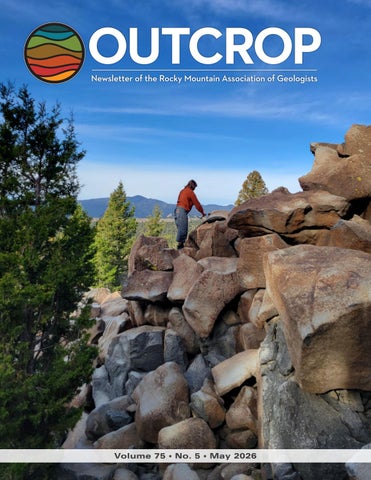
OUTCROP
Newsletter of the Rocky Mountain Association of Geologists
OUTCROP
Newsletter of the Rocky Mountain Association of Geologists
730 17th Street, B1, Denver, CO 80202 • 720-672-9898
The Rocky Mountain Association of Geologists (RMAG) is a nonprofit organization whose purposes are to promote interest in geology and allied sciences and their practical application, to foster scientific research and to encourage fellowship and cooperation among its members. The Outcrop is a monthly publication of the RMAG.
2026 OFFICERS AND BOARD OF DIRECTORS RMAG STAFF
PRESIDENT Sandra Labrum slabrum@slb.com
PRESIDENT-ELECT Ali Sloan ali@4jresources.com
1st VICE PRESIDENT
Nate La Fontaine nlafontaine@sm-energy.com
1st VICE PRESIDENT-ELECT
Danielle Robinson danielle.robinson@dvn.com
2nd VICE PRESIDENT Lisa Wolff lwolff@bayless-cos.com
2nd VICE PRESIDENT-ELECT
Ashley Castaldo acastaldo@slb.com
SECRETARY
Stephanie Forstner sforstner@diagenyx.com
TREASURER
Walter Nelson wnelson@integratedenergyresources.com
TREASURER-ELECT
Dan Bassett dbassett@sm-energy.com
COUNSELOR
John Benton jhbenton@mines.edu
ADVERTISING INFORMATION
Rates and sizes can be found on page 32. Advertising rates apply to either black and white or color ads. Submit color ads in RGB color to be compatible with web format. Borders are recommended for advertisements that comprise less than one half page. Digital files must be PC compatible submitted in png, jpg, tif, pdf or eps formats at a minimum of 300 dpi. If you have any questions, please call the RMAG office at 720-672-9898.
Ad copy, signed contract and payment must be received before advertising insertion. Contact the RMAG office for details.
DEADLINES: Ad submissions are the 1st of every month for the following month’s publication.
The Outcrop is a monthly publication of the Rocky Mountain Association of Geologists
DESIGN/LAYOUT: Nate Silva | n8silva.com
EXECUTIVE DIRECTOR
Bridget Crowther bcrowther@rmag.org
LEAD EDITOR
Danielle Robinson danielle.robinson@dvn.com
CONTRIBUTING EDITORS
Elijah Adeniyi eadeniyi@slb.com
Nate La Fontaine nlafontaine@sm-energy.com
Bobby Schoen bschoen@sm-energy.com
RMAG CODE OF CONDUCT
RMAG promotes, provides, and expects professional behavior in every engagement that members and non-members have with the organization and each other. This includes respectful and inclusive interactions free of harassment, intimidation, and discrimination during both online and in-person events, as well as any content delivered by invited speakers and instructors. Oral, written or electronic communications that contain offensive comments or demeaning images related to race, color, religion, sex, national origin, age, disability, or appearance are not appropriate in any venue or media. RMAG reminds members of the diversity and mission statements found on our website. Please direct any questions to staff@rmag.org
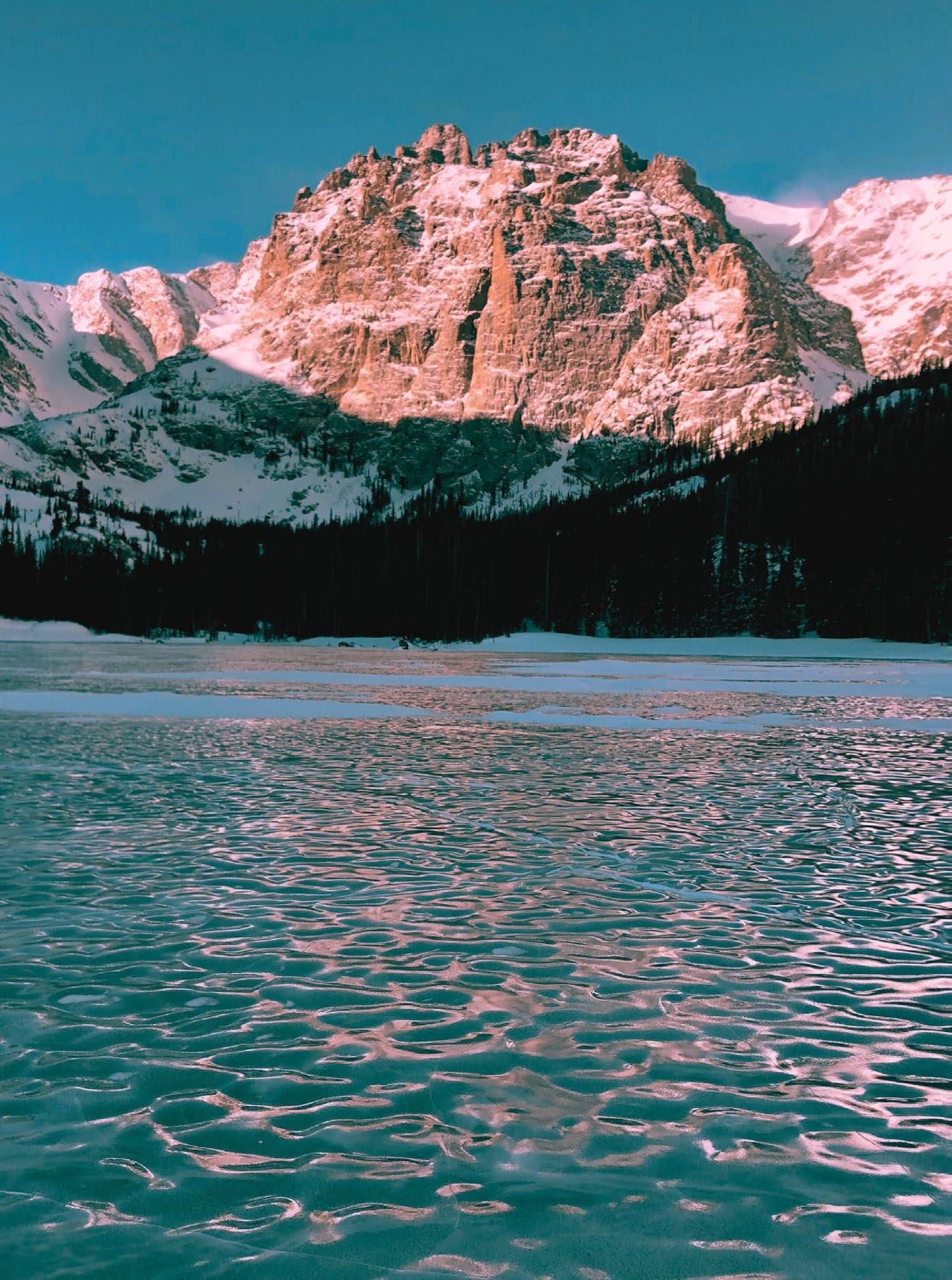
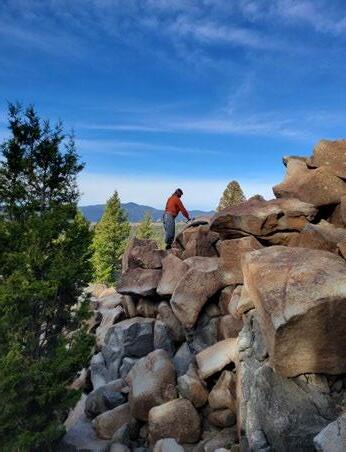
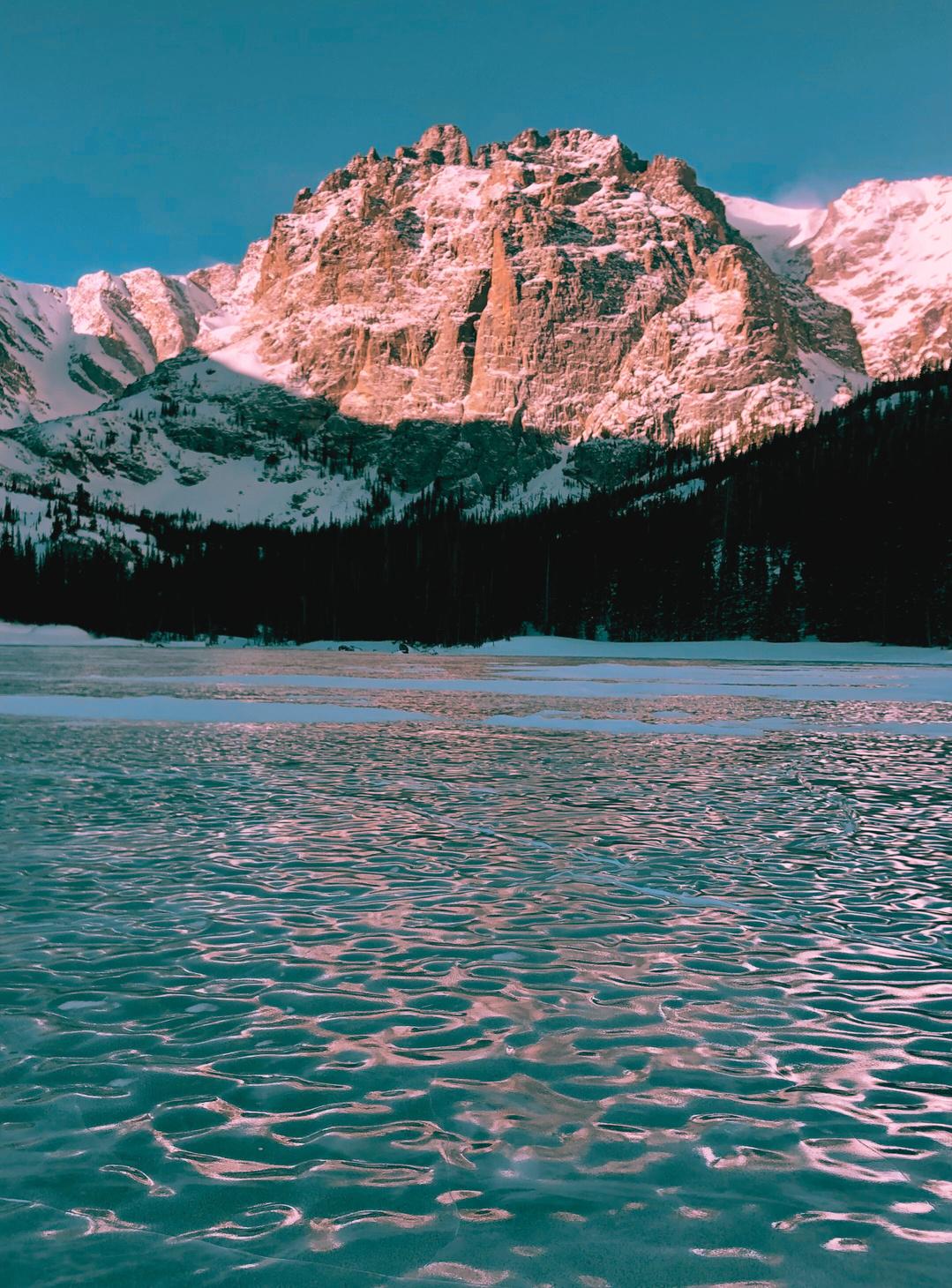
in North America. Photo by Amanda Rossi
MEMBERS
EVENT ATTENDEES
WEBSITE VISITORS
OUTCROP READERS
COMMUNITY CONTACTS
EMAIL SUBSCRIBERS
NETWORKING EVENTS
CONTINUING EDUCATION EVENTS
FIELD TRIPS
IN 2025YOUR SUMMIT SPONSORSHIP DOLLARS SUPPORTED: 1,200 1,400 8,000 8,000 7,000 4,000 28 13 8
2 0 2 6

October 24, 2025
Geoscience Community:
We greatly appreciate every Summit Sponsor and Event Sponsor who contributed to RMAG over the last year. Your support is essential to our organization.
In 2025, the Rocky Mountain Association of Geologists was proud to host a dynamic lineup of events, including the North American Helium & Hydrogen conference, which examined the quickly growing field Members explored the beauty and geological wonders of the Grand Canyon and the San Jaun’s as well geology across the state. Volunteers shared their passion for geoscience with students across the region through classroom visits and community festivals. Members also enjoyed numerous opportunities to connect outside the office through monthly lunches, coffees, happy hours, and our annual Golf Tournament.
Looking ahead, 2026 brings new opportunities for RMAG and our partners. Your financial support allows us to start the year off with a luncheon on the State of the Industry before diving into the impacts of new and evolving technologies on industry including in AI’s ever-growing presence. Plans are coming together to host a fundamentals class series throughout the year, two separate symposiums on the research out of USGS and research on the Mowry. Networking in 2026 will include our regular happy hours and coffee hour networking, plus we’ll have Rockbusters, the Golf Tournament and we’re bringing back the Clay Shoot. With your support RMAG Members share the wonders of earth sciences through community and school outreach. Finally, your financial support is crucial to our publication efforts, which include the monthly Outcrop newsletter and the quarterly Mountain Geologist journal.
Your financial commitment includes enrollment opportunities across all the RMAG events, whether joining the educational opportunities and joining the comradery of the golf tournament your employees will gain access. RMAG also recognizes Summit Sponsors through in-person signage, on our website, in our publications, and on social media.
Thank you to our current Summit Sponsors; we look forward to your continued support in 2026. For those not yet sponsoring, now is the perfect time to get involved. Sponsorship with RMAG d irectly supports the geoscience community – fueling education, networking, and professional development opportunities throughout the Rocky Mountain region.
We invite you to review or sponsorship packages and find the level that best aligns with your company’s goals. Whether you choose to become an annual Summit Sponsor or support a single event, your partnership will help us advance geoscience education and keep our community thriving.
Become a Summit Sponsor by contacting RMAG Executive Director, Bridget Crowther at bcrowther@rmag.org or 720-672-9898 to discuss opportunities and reserve your sponsorship for 2026.
Sincerely,
Sandra Labrum
Bridget Crowther 2026 RMAG President RMAG Executive Director

Registration
RMAG 2026 SUMMIT SPONSORSHIP
All sponsor benefits event tickets follow RMAG event registration deadlines. All benefits end 12 months after registration.
Silver
Summit Sponsorship benefit term is for 12 months! Specify type of payment on signed form, and send logo and advertisements to staff@rmag.org
Company:
Company Representative:
Address:
City: State: Zip Code:
Phone: Email:
Payment
Name as it appears on Credit Card:
Credit Card #:
Expiration Date:
Signature:
ACH: contact the RMAG office at staff@rmag.org for directions. Mail Checks payable to RMAG:
Rocky Mountain Association of Geologists (RMAG) 730 17th Street, B1 Denver, CO 80202
RMAG events are subject to change. Cancellation or rescheduling of events does not give the sponsor the right to refund. Summit Sponsors will receive benefits at any new events added into the RMAG schedule.
Thank you for your generous support!
P: (720)672-9898 staff@rmag.org www.rmag.org

730 17th Street, B1 Denver, CO 80202
RMAG APRIL 2026 BOARD OF DIRECTORS MEETING
By Stephanie Forstner, Secretary sforstner@diagenyx.com
If you’ve ever stood on top of a Colorado 14er and looked out at the landscape stretching in every direction, you know the feeling. But have you ever stood up there and actually understood what you were standing on? At our May 6th luncheon, Peter Blomquist will walk us through the geology behind those iconic peaks. It’ll make you want to lace up your boots and head straight for the trailhead — a fitting way to kick off what is shaping up to be a very full summer for RMAG.
The Board met on April 15th to review committee updates and plan for the months ahead, and the calendar is anything but quiet.
Operating revenue for March was driven primarily by membership renewals (ehem… have you paid your dues for the year?) and the luncheon. The investment account continues to reflect broader market
conditions with a steep March drop, though the organization’s financial footing remains stable.
RMAG and DGS are teaming up for a Rockies game in a shared suite, 1pm May 20th. A great chance to catch a game and connect with colleagues from both organizations. Sponsorship opportunities are still available, so please reach out if your company is interested. The Summer Hike Series kicks off May 30th at Matthew Winters Park. We’ve cancelled the Clay Shoot and will try again for next spring. For those who prefer their geology with a side of fairways, the Golf Tournament returns on August 28th — registration and team sponsorship is open.
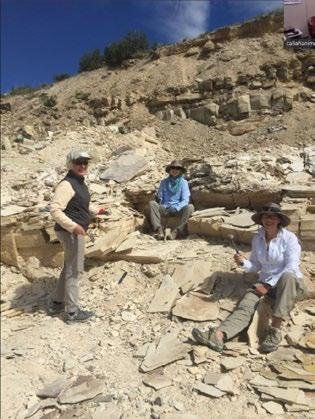
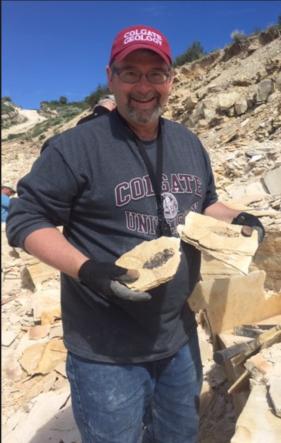
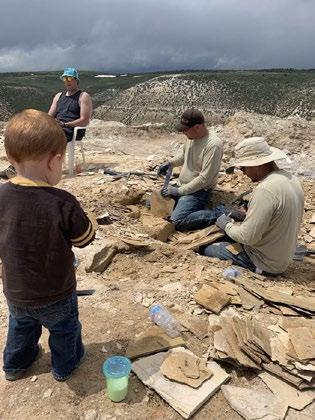
The On the Rocks Field Trip Committee has an ambitious schedule underway. The Yampa/Green River float trip kicks us off early June (sold out). Have you ever gone fishing in rocks? Join us for a family fossil trip to Kemmerer on June 20th And explore glacial geomorphology in the Upper Arkansas Valley June 26th. Space is filling up quickly for the latter two, register today!
Publications has the next three months lined out and a list full of leads for the rest of the year. This month, Dr. Colleen Elliott brings us a feature that is genuinely hard to believe until you hear it for yourself — the Ringing Rocks of Montana, a field of boulders that ring like bells when struck. Geology has never sounded so good.
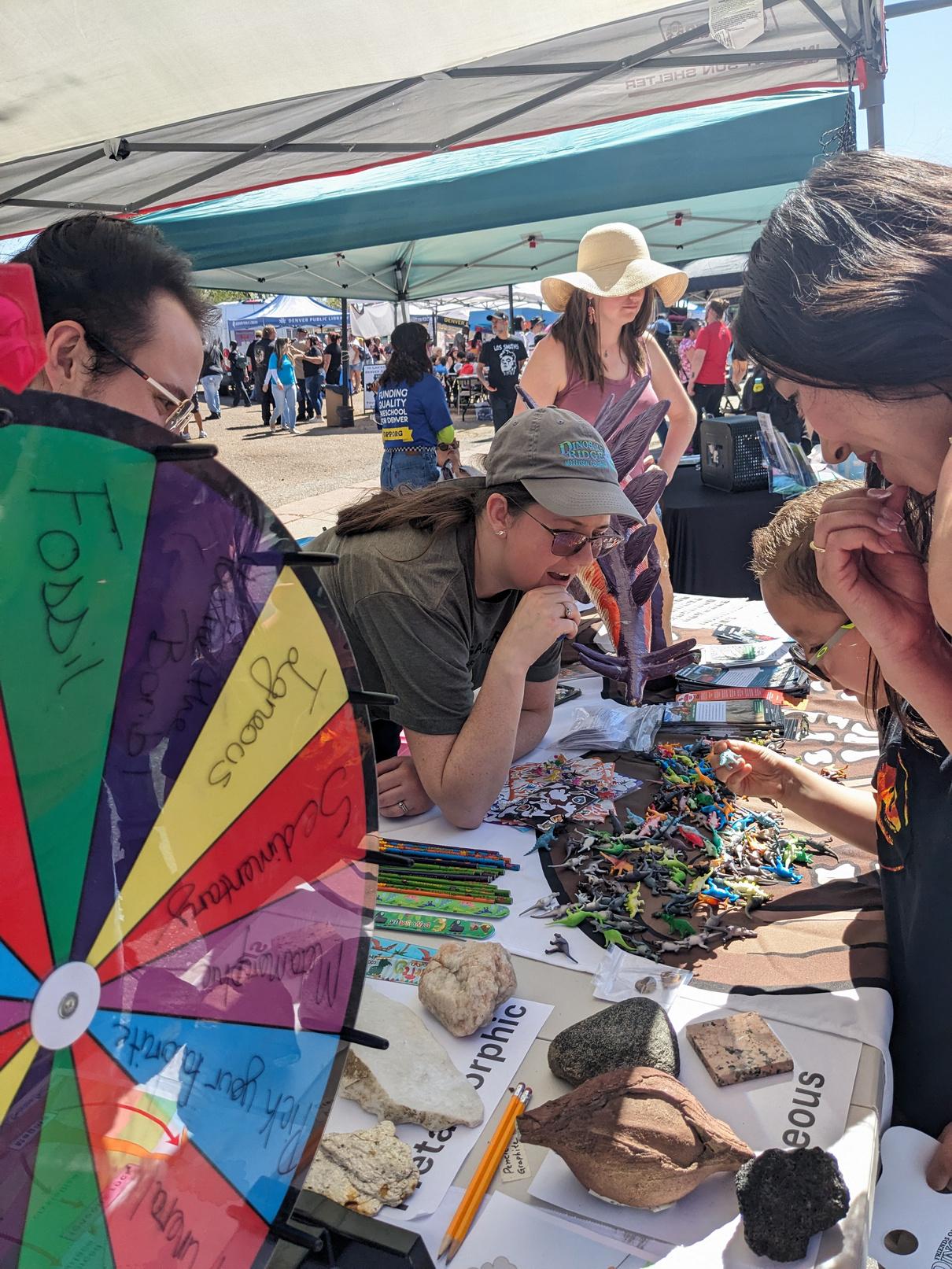
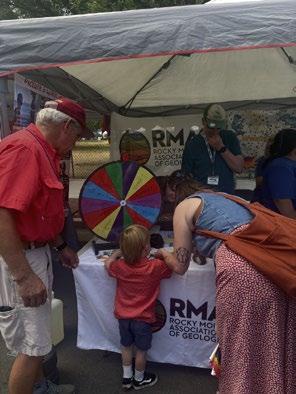
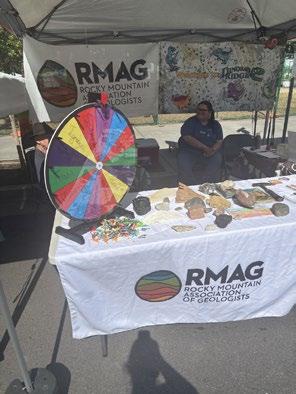
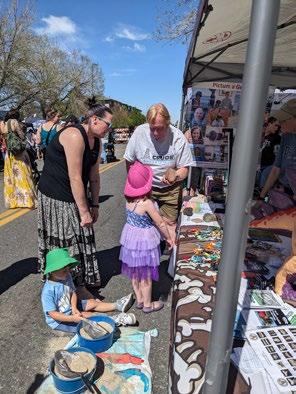
The Geoscience Outreach Committee has been especially active this spring, with volunteers out at the Denver Museum of Nature and Science, Manuel High School, Compass Montessori, Colorado Academy, and the State Science Fair. More May plans for outreach are in the works at Woodrow Wilson and Rocky Mountain Elementary.
As always, it is a privilege to serve this organization. I look forward to seeing many of you throughout a busy, rewarding summer.


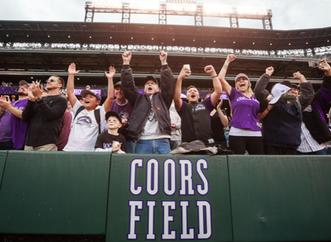
RMAG & DGS thank our sponsors for an afternoon of baseball, networking, and good company Wednesday May 20th @1:10PM
COLORADO ROCKIES VS. TEXAS RANGERS THANK YOU TO OUR SPONSORS THANK YOU TO OUR SPONSORS


Hi all,
PRESIDENT’S LETTER
By Sandra Labrum slabrum@slb.com
Travels to Spain & France
This month had me feeling a bit like a nomad. Work took me on the road—but before you feel too bad for me, the destinations were Barcelona, Spain and Montpellier, France. Not a terrible office for a few days. And, in true geologist fashion, I couldn’t resist tracking down the local rocks wherever I landed.
One morning in Barcelona, I found myself wandering through Park Güell, the iconic park designed by Antoni Gaudí. While it’s best known for its architecture and sweeping views, what stood out most (unsurprisingly) was how seamlessly the design leans into the natural geology of the site. It’s a place where the built environment doesn’t just sit on the landscape, it works with it.
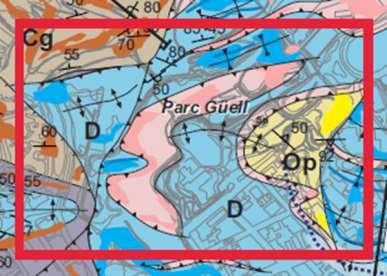
The rocks themselves are worth the visit. The limestones at the park are nodular, with red shale partings that give them a distinctive “griotte” appearance. In places, partial dolomitization has blurred the original bedding, and the rocks are rich in minerals like pyrite, chalcopyrite, siderite, and iron oxides. Karst features are also on display, adding another layer of texture and complexity. Overlying these massive limestones is the Olorda Formation—a mix of pink shales followed by alternating yellow limestones and red shales in thin, rhythmic layers. Higher up, marls and nodular limestones appear with discontinuous shale layers, all capped by well-stratified limestones and brown-green shales containing brachiopods. It’s the kind of stratigraphy that rewards slowing down and taking a closer look.
Structurally, the park doesn’t disappoint either. A major feature, the Parc Güell thrust, is exposed near the western entrance. This fault zone, up to about 15 meters thick, includes breccias and gouge and shifts orientation along its length, trending NE–SW in the north, NNE–SSW through the park, and NW–SE
farther south. It dips toward the ESE to near vertical and places the eastern block up over older Carboniferous rocks in the core of a synclinorium.
One last piece of geologic history I’ll admit I missed: during the park’s construction in 1900, remains of Pleistocene animals—including rhinoceros, elephants, and deer—were discovered on site. They now reside in the Museum of Natural Sciences of Barcelona. I didn’t make it there this time, so I may have just given myself a reason to go back.
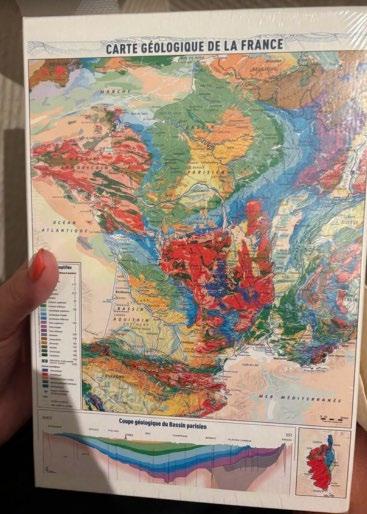
I didn’t get to explore much geology in Montpellier, I unfortunately had to do my actual job, but I did leave with a pretty great souvenir.
Travel has a way of reminding me how geology connects places, even when the settings feel worlds apart. Whether close to home or halfway across the globe, there’s always something to notice if you take the time to look down and maybe bring an extra bag, just in case.
Keep Wandering,
—Sandra
FIGURE 1: Geologic map excerpt (Santanach, Casas, Gratacos, Liesa, Munoz, Sabat, 2011).
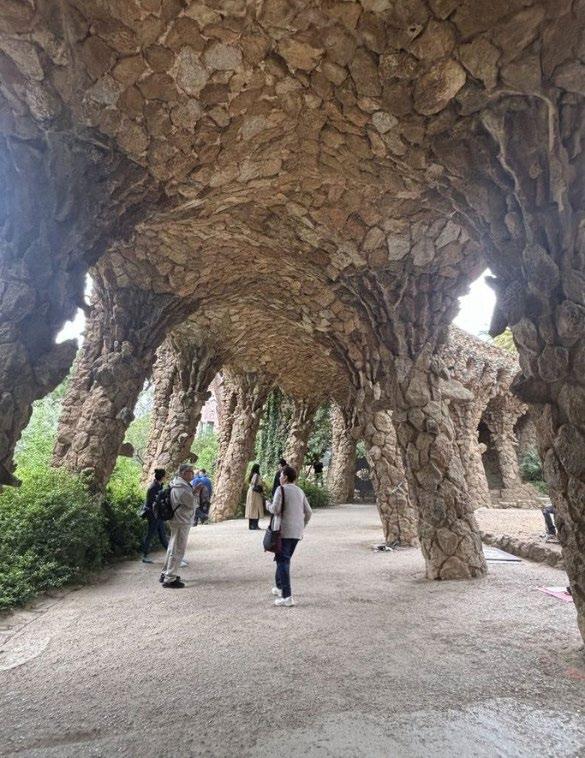
Above: Park Güell in Barcelona, Spain, featuring architectural structures designed by Antoni Gaudí
Right: A pretty great souvenir from Montpellier.
MONTANA’S RINGING ROCKS
COLLEEN ELLIOTT, Montana Bureau of Mines and Geology
AMANDA ROSSI, Bureau of Land Management
INTRODUCTION
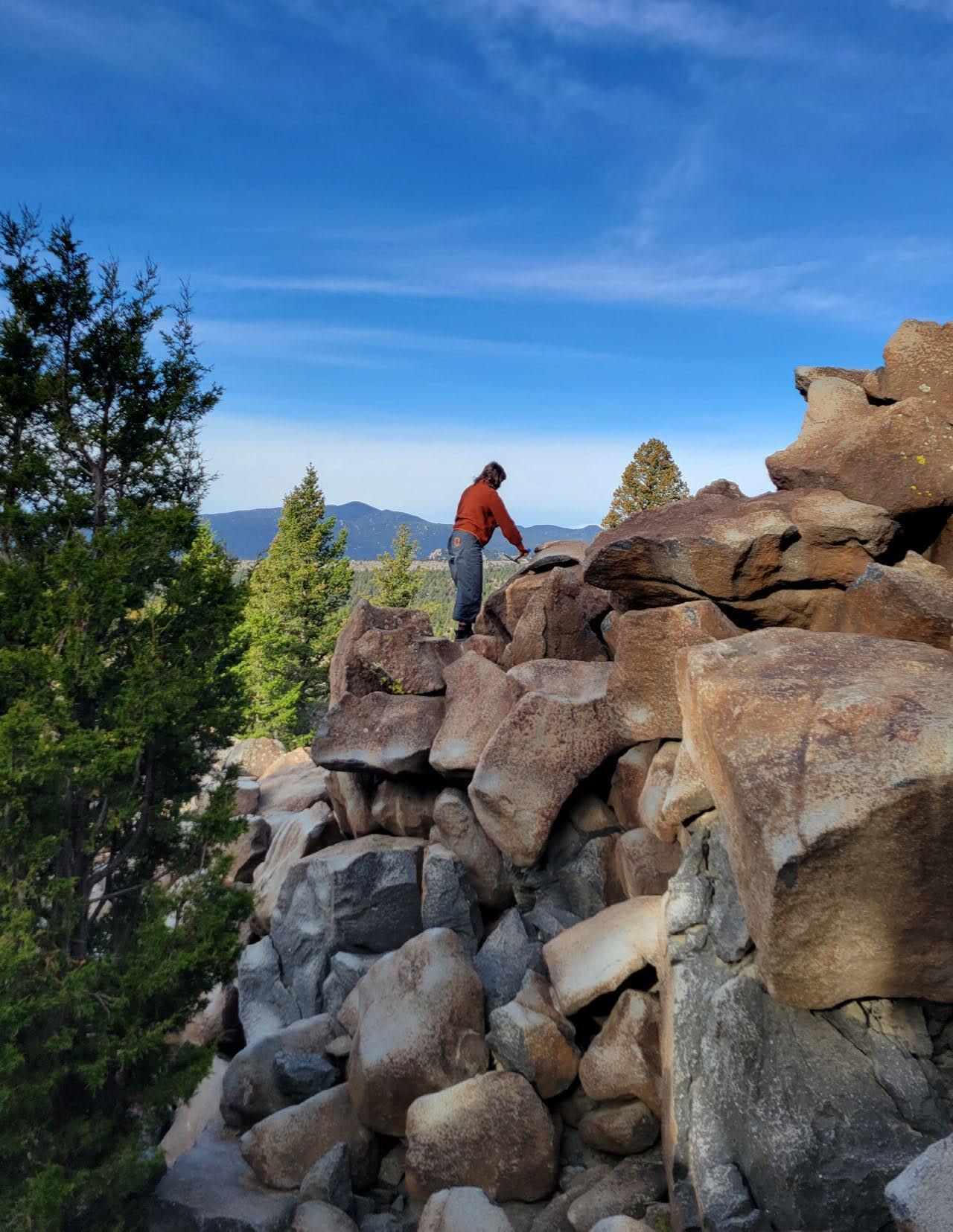
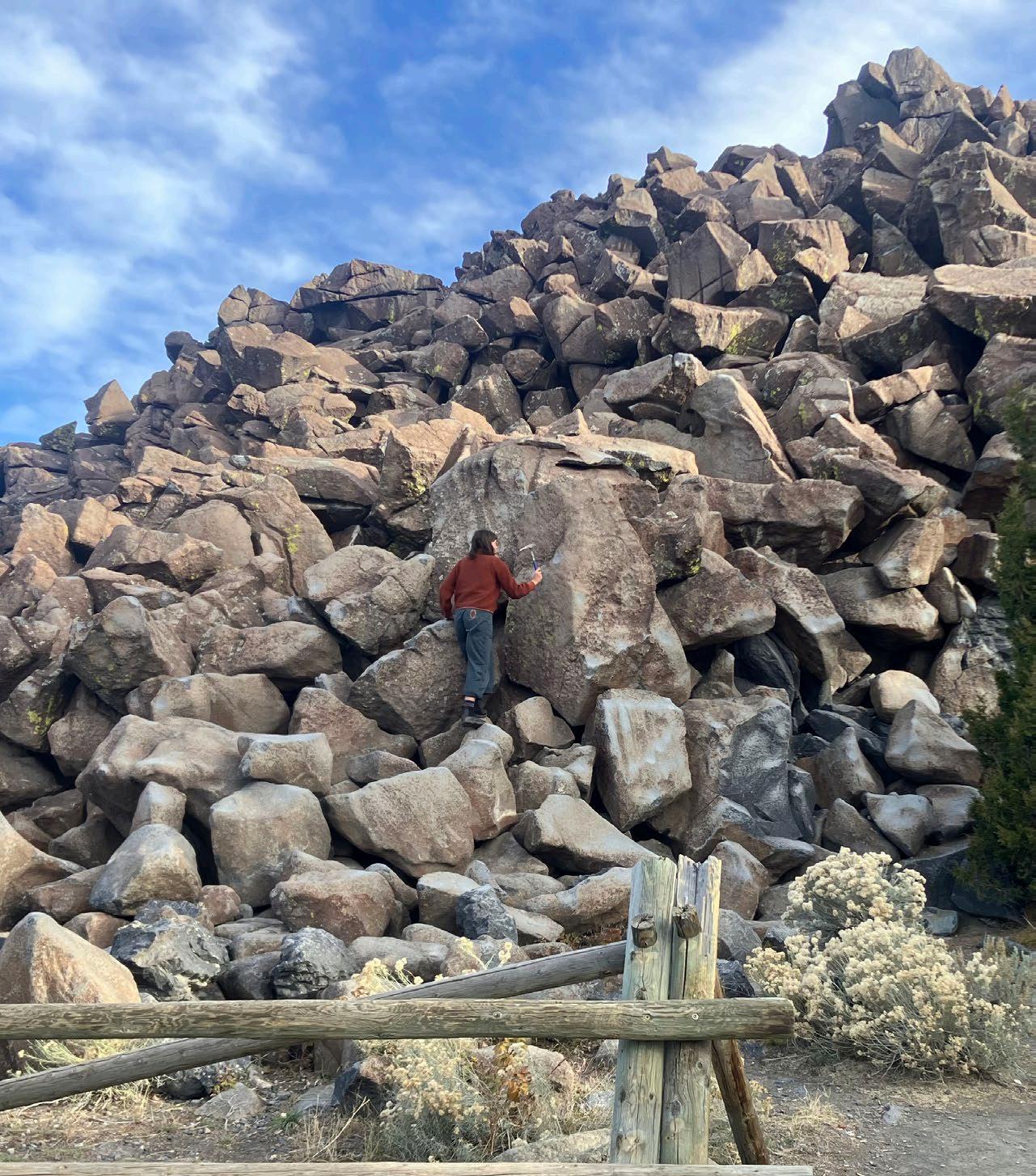
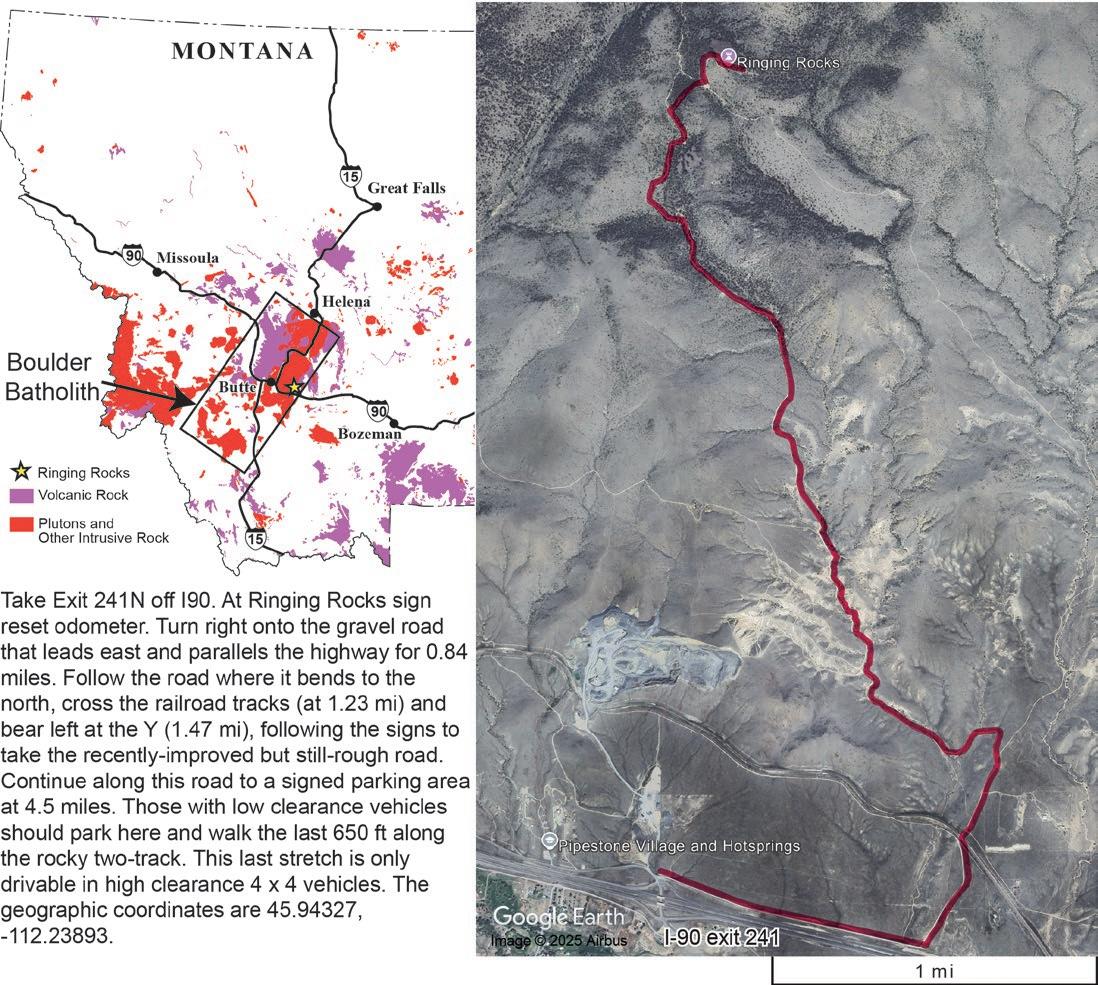
If you take Exit 241 off I-90 in Montana, you can follow a gravel road, first right, then left, for about 4.5 miles (Fig. 1), ending in a bumpy two-track that you may prefer to tackle on foot. At the end you will find yourself staring up at a pile of maroon boulders (Fig. 2). It’s a good-sized pile, at least 40 feet high, and looks like something dumped from a Lego box. Bring a hammer – not to break the rocks, but to make music. These are Montana’s Ringing Rocks.
Geologic features like this are called rock gongs, few of which are as sonorous as the Ringing Rocks. Rock gongs are a type of lithophone (stone + sound) that are naturally occurring and have not been modified into musical instruments. There are more than 30 reported rock gongs worldwide, and at least three in North America, the other two being the Ringing Rocks of Buck County, PA, and the Bell Rocks (La Cloche) of Killarney Park, Ontario (Gibbons and Schlossman, 1970; Bednarik, 1996; Kleinitz, 2004; Edwards, 2008; “Ringing Rocks,” Wikipedia, 2025).
The geology of the Ringing Rocks area is well
known, as is discussed below. How the boulder pile formed can be debated, but why the boulders ring is not well understood at all, as will also be discussed below.
GEOLOGIC SETTING
The Ringing Rocks are part of the Late Cretaceous Boulder Batholith which is over 100 miles long and 25 miles wide (Fig. 1). The rocks themselves are weathered from a half-mile-wide stock intruded into the Lower Elkhorn Mountains Volcanics, possibly before the deposition of the Middle Elkhorn Mountain Volcanics at around 84 Ma (age from Lund and Aleinikoff, 2022).
The Ringing Rocks stock (Fig. 3) has a granitic to monzonitic core and a mafic rim that has three phases: amphibole biotite monzonite, olivine pyroxene monzonite, and amphibole monzonite (“Ringing Rocks,” Wikipedia, 2025). Uncorrected biotite K-Ar ages published for the rim are 78.2 ± 3.1 Ma (Prostka, 1966; Tilling and others, 1968) and 75.1 ± 2.8 Ma (Daniel and others, 1981). The Ringing Rocks stock has a partial bullseye map pattern, with part
BY
Ringing Rocks in the Pipestone, Montana area composed of olivine pyroxene monzonite – one of the few known rock gongs in North America.
PHOTO
AMANDA ROSSI
of the east edge overlain by a stack of dacitic volcanic flows as revealed by new LiDAR data (Montana Lidar Library). In spite of the clear bullseye lithologic distribution, the presence of rim inclusions in the core and core inclusions in the rim, among other things, is interpreted to indicate magma mixing during intrusion (Johannesmeyer, 1999; Andrew Stroud, 2022, personal communication).
The gong rocks are boulders weathered from
part of the olivine pyroxene monzonite near the rim of the Ringing Rocks stock. The rocks are black on fresh surfaces and composed of zoned plagioclase, K-feldspar, olivine partly altered to serpentine, talc, magnetite, hypersthene, clinopyroxene, biotite, hornblende, and sparse quartz (Prostka, 1966; Butler, 1983; Johannesmeyer, 1999; Yakovlev, 2019). Geobarometry (Lambe, 1981) and the presence of orthoclase cryptoperthite (Andrew Stroud,
FIGURE 1: Location map and driving directions to the Ringing Rocks.
ON THE ROCKS
FIELD TRIPS FOR 2026
JUNE 1-5
Yampa River and Green River
Float Trip
JUNE 20 Fossil Digging in WyomingYour Best Day of Fishing Ever!
JUNE 26
JULY 11 AUGUST 14-15 SEPTEMBER 26-27
Upper Arkansas ValleyLeadville to Salida
Denver Downtown Building Stones Walking Tour South Park Basin
Picketwire Dinosaur Trackway
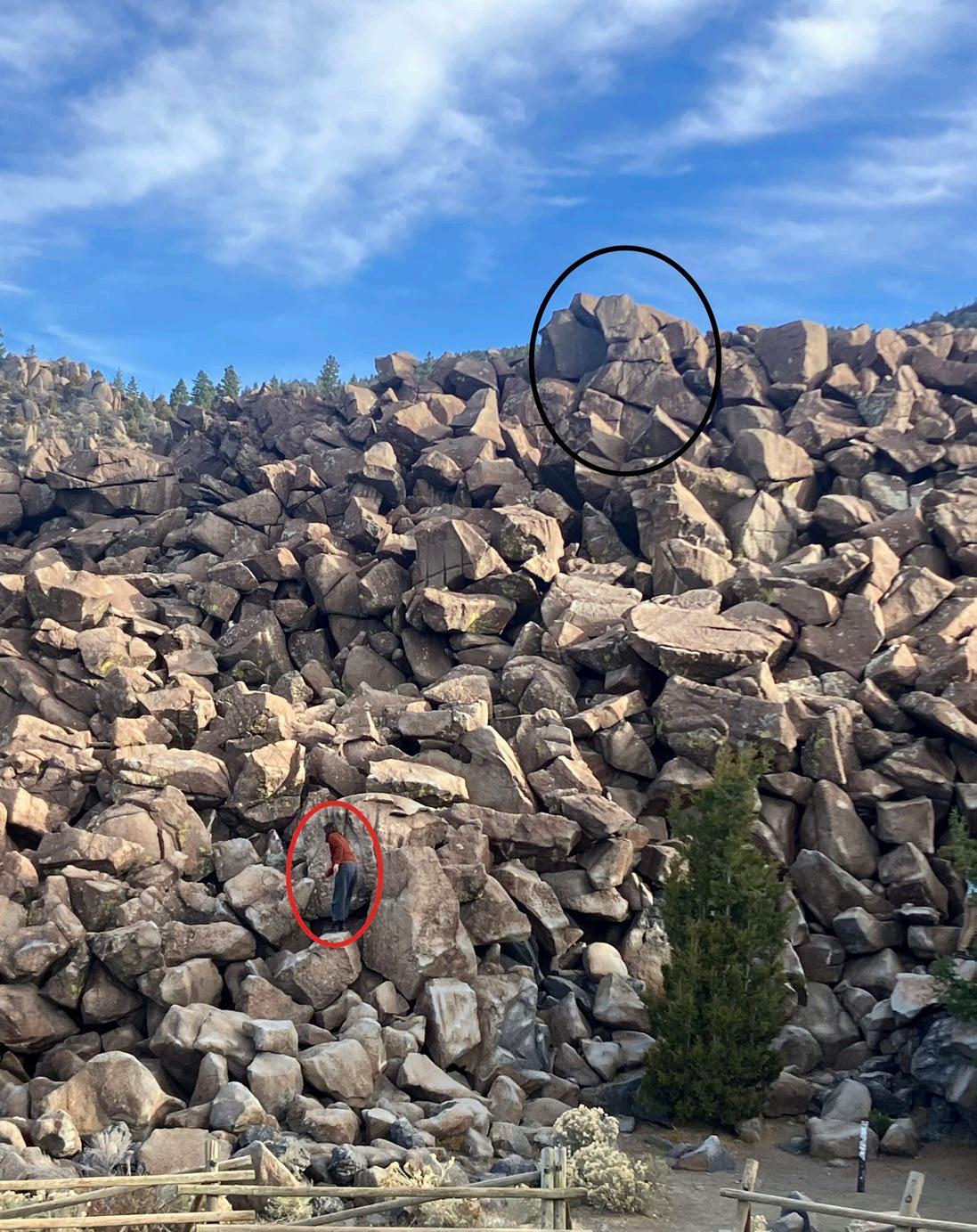
The Ringing Rocks pile. A normal-sized human is circled in red for scale. An in-situ group of boulders is circled in black.
FIGURE 2:

SATURDAY MAY 30 2026 9:00 - 11:00 AM
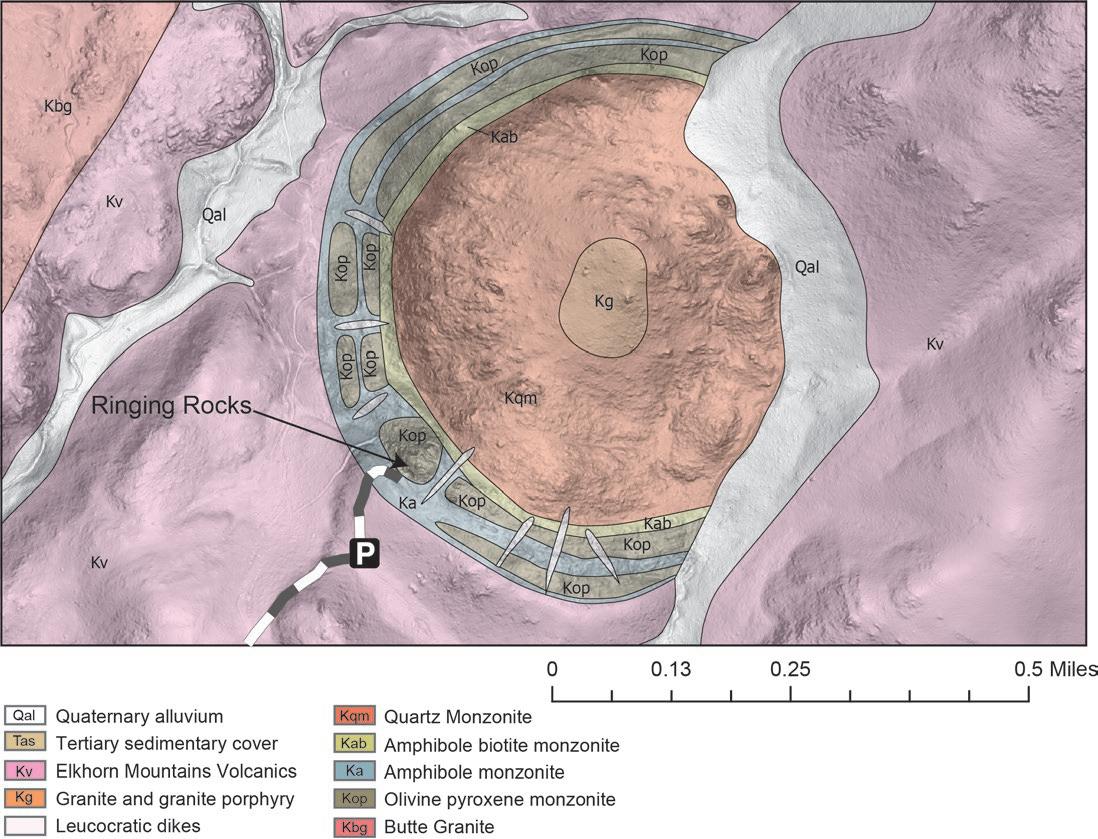
FIGURE 3: Geologic map of the Ringing Rocks stock. Compiled from original mapping, Scarberry and others (2019), and Wikipedia (“Ringing Rocks”).
personal communication, 2022) suggest that the mafic unit chilled very quickly and perhaps erupted as a volcano.
The musical qualities of the gong rocks have been widely commented on but rarely examined systematically. Loen (1995) noted that the best tones come from boulders that are 4-7 ft across, flat relative to others, and knobby. He measured pitches and found they were dominated by B, E, and C notes, though most had complex overtones. Some boulders produced different notes when struck in different places (e.g., Fig. 4). Loen (1995) found no correlation between pitch and shape or size of the boulders.
HOW DID THE BOULDER PILE FORM?
The origin of the boulder pile is debated. The boulders are not lithologically different from surrounding rocks, they have no matrix, they did not tumble down from a higher exposure because there is no higher exposure, and vein-like features can be traced from boulder to boulder (Fig. 2) indicating that parts of the pile have not moved at all. The main theories (besides space aliens and/or ancient civilizations) are that the pile is a felsenmeer or freeze-thaw blockfield (Butler, 1983), gas eruption ejecta (Gableman, 2019), or a tor (Yakovlev, 2019; “Ringing Rocks”, Wikipedia, 2025). The gas eruption theory can be rejected


Python Skill Series: Spatial Geoscience & Analytics is an intermediate-to-advanced course designed for geologists and engineers in the energy and mining sectors This one-day, hands-on workshop focuses on applying Python to real-world spatial data challenges, with practical workflows built using open-source tools
Participants will work through applied examples covering:
Geometric operations with Shapely (points, lines, polygons)
Spatial analysis with GeoPandas
Numerical computing with NumPy, SciPy, and optional acceleration with Numba*
Coordinate Reference Systems (CRS)
Public Land Survey System (PLSS) parsing with regular expressions
Automated well stick generation
Spatial and offset index merges
Raster data handling with Rasterio and GeoTIFFs
Well log analysis with LAS files (lasio)
Well deviation surveys and modeling (wellpathpy)
GeoProg generation
Synthetic well log generation
LiDAR processing and optional GPU acceleration with CuPy*
3D rock property modeling
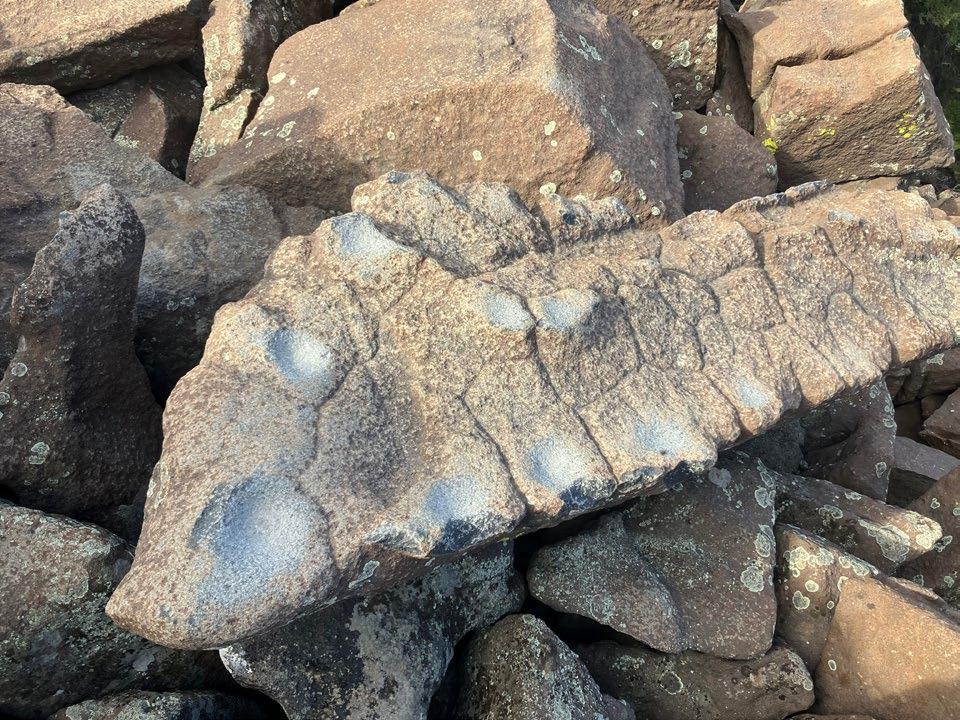
because the core of the boulder pile is in place and not the random jumble of boulders that would be expected if they were spewed from a vent. Though the pile has evidence of frost heave, like a felsenmeer, it is probably best described as a tor or kopje, which is a spire or tower-like outcrop eroded from a massive body like a pluton. Tors are a common feature of the Boulder Batholith, though they are typically less irregular and knobby than the Ringing Rocks pile.
WHY DO THE RINGING ROCKS RING?
This remains a big question. Rock gongs around the world formed from different kinds of rock of different ages and different tectonic settings. Their cultural significance is commonly
addressed in the archeological literature (e.g., Diaz-Andreu and Rosa, 2024; Diaz-Andreu, 2025), but the physical properties of rock gongs are rarely addressed.
There doesn’t seem to be a unique property that all gong rocks have in common. Many are mafic igneous rocks (Andrew Stroud, 2019, personal communication), but other rock types include quartzite (Edwards, 2008) as well as schist and limestone (Bednarik, 2010; Caldwell, 2013). Natural gong rocks are typically found in piles where the ringing boulders are perched on other rocks. However, Lund (2019) reports individual gong rocks in Sweden that rest on the ground. Some authors argue that ringing rocks must be intact (Gibbons and Schlossman, 1970), but Lund (2019) reports some boulders ring in spite of
FIGURE 4: A particularly resonant boulder that plays different tones depending on where it is struck. The white areas are spots where multiple visitors have struck the boulder. Notice the black fresh rock along the lower edge of the boulder where pieces have been broken off. Don’t do this.
being cracked. At Montana’s Ringing Rocks, rambunctious rock knockers have sadly broken many pieces off boulders, yet they continue to ring (Fig. 4)
The only semi-scientific study of gong rocks was done on a sample from Pennsylvania. Gibbons and Schlossman (1970) used strain gauges to measure the strain state of a mafic gong rock. They detected a release of elastic strain after the rock was cut. They proposed that hydration alteration produces minerals with larger volume than the fresh rock, creating a stress imbalance between the inside and the outside of the rock.
Andrew Stroud (2022, personal communication) suggests that the internal stress might be residual burial compression that failed to dissipate during rapid erosion and uplift of the rock. Gibbons and Schlossman (1970) did not test whether the stress imbalance they measured is exclusive to gong rocks. Their original experiment has not been repeated, to our knowledge, nor have any others been undertaken. The truth is that there has been very little scientific study of why rock gongs like the Ringing Rocks produce tones. The field is wide open to anyone who would like to take it on, perhaps someone whose curiosity is piqued by this article.
Ringing Rocks State Park: https://www.blm.gov/visit/ringing-rocks
REFERENCES
Bednarik, R.G., 2010, About lithophones. In R. Querejazu Lewis and R. G. Bednarik (eds), Mysterious cup marks: proceedings of the First International Cupule Conference, BAR International Series 2073, Archaeopress, Oxford, p. 115-118.
Butler, B.A., 1983, Petrology and geochemistry of the Ringing Rocks pluton Jefferson County Montana: Missoula, MS Thesis, University of Montana.
Daniel, F., and Berg, R.B., 1981, Radiometric dates of rocks in Montana: Montana Bureau of Mines and Geology Bulletin 114, 144 p., 2 sheets.
Díaz-Andreu, M. and da Rosa, N.S. eds., 2024, Exploring ancient sounds and places: theoretical and methodological approaches to archaeoacoustics. Oxbow books.
Díaz-Andreu, M., 2025, Archaeoacoustics: Research on Past Musics and Sounds. Annual Review of Anthropology, v. 54, p. 113-130. https://doi.org/10.1146/annurev-anthro-071323-113540
Edwards, S.A., 2008, La Cloche: Passage and Place. Sudbury, Ontario, MS Thesis, Laurentian University, , 133 p.
Gabelman, J.W., 2019, Ringing Rocks, Montana: A modern gas diapir?, in Scarberry, K.C., and Barth, S., eds., Proceedings of the Montana
Mining and Mineral Symposium 2018: Montana Bureau of Mines and Geology Special Publication 120, p. 31–38.
Gibbons, J., and Schlossman, S., 1970, Rock music: Natural History, v. 79, no. 10, p. 36-41.
Johannesmeyer, T.C., 1999, Magma mixing and mingling in the Late Cretaceous Ringing Rocks pluton, Jefferson County Montana, and implications for the generation of the Boulder batholith: Missoula, MS Thesis, University of Montana.
Kunz, R.S., 2003, The Alkalic intrusions of Garrison, Montana: A possible extension of the Central Montana Alkalic Province: Missoula, MS Thesis, University of Montana.
Lambe, R.N., 1981, Crystallization and petrogenesis of the southern portion of the Boulder Batholith, Montana. Berkeley, CA, PhD thesis, University of Berkeley, 171 p.
Loen, J.S., 1995, Geological curiosities of southwestern Montana. Northwestern Geology, v. 25, p. 79-90.
Lund, C.S., 2019, Ringing stones in Sweden in the past and present: some reflections. Time and Mind, v.12, p. 33–44. https://doi.org/10. 1080/1751696X.2019.1573496
Lund, K., Aleinikoff, J.N., 2022, Temporal Relations between the Boulder Batholith and Elkhorn Mountains Volcanics, Western Montana: “The Nature of Batholiths” Revised. In Proceedings of the Montana Mining and Mineral Symposium 2021, Scarberry, K.C., Gammons, C.H., and Barth, S., editors. Vol. 123, pp. 89-98. https://doi. org/10.59691/YXKU1170
Lund, K., Aleinikoff, J.N., Kunk, M.J., Unruh, D.M., Hodges, W.C., du Bray, E.A., O’Neill, J.M., and Zeihen, G., 2002, SHRIMP U-Pb and 40Ar/39Ar age constraints for timing of mineralization in the Boulder Batholith, Montana: Economic Geology, v. 97, p. 241–267, Doi: https://doi.org/10.2113/97.2.241
Martorano, M.A., 2024, Early rock music: Methodology to identify and analyse portable lithophones. An example from. Exploring Ancient Sounds and Places: Theoretical and Methodological Approaches to Archaeoacoustics, p.159.
Montana Lidar Library, Montana Lidar Inventory EB accessed 01Nov2025.
Prostka, H.J., 1966, Igneous geology of the Dry Mountain quadrangle, Jefferson County, Montana: U.S. Geological Survey Bulletin, v. 1221F, 21 p.
Scarberry, K.C., 2016, Geologic map of the Wilson Park 7.5’ quadrangle, southwestern Montana: Montana Bureau of Mines and Geology Geologic Map 66, 1 sheet.
Wikipedia “Ringing Rocks”, accessed Nov 01, 2025.
Yakovlev, P.V., 2019, Ringing Rocks. Northwest Geology, v. 48, p. 91-96.
John C. Webb
Consulting Geologist
Stratigraphy, Sedimentology and Petrography of Clastic and Carbonate Systems
Louisville, Colorado
Reservoir Characterization
Petroleum, SWD, CCUS, Geothermal
Johnwebb20@comcast.net
303.917.0644


HYBRID LUNCH TALK
Speaker: Peter K. Blomquist
Date: May 6, 2026 | 12:00 pm - 1:00 pm

Geology of the Colorado 14ers
Structure, Origin, and Serendipity
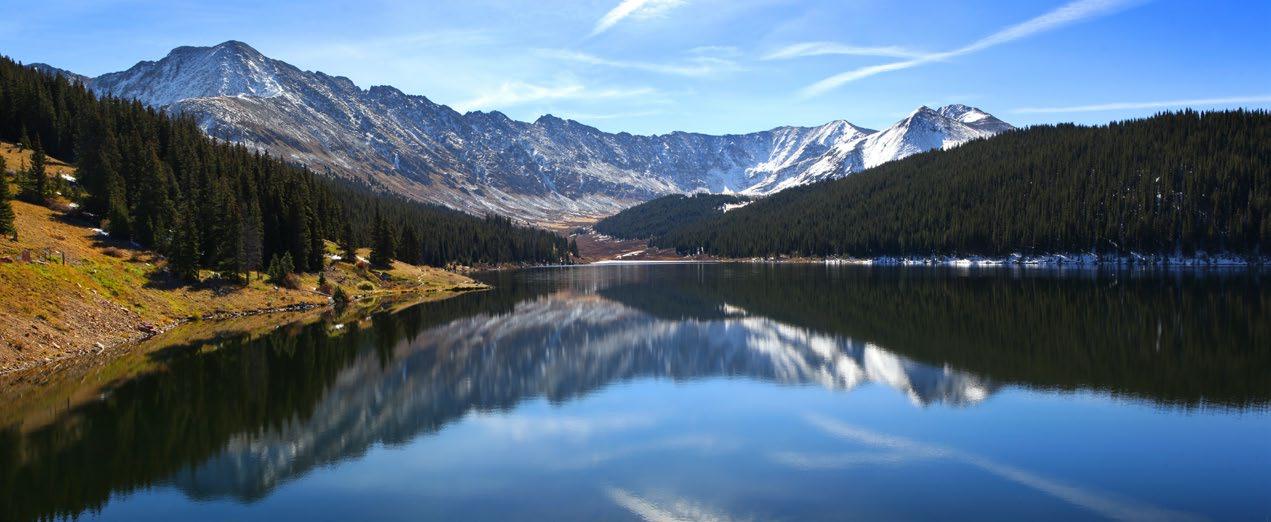
Mountains in Colorado are ubiquitous. Colorado has the most peaks over 14,000 feet in the Lower 48 states, with 54 such peaks collectively known as “Fourteeners”, and the highest, Mt. Elbert, reaches 14,433 feet. Located in nine mountain ranges within the Colorado Rockies, all Fourteeners are either hosted by Precambrian continental crust, or rocks intruded into or deposited upon it. Geology of the 54 Fourteeners consists primarily of 70% igneous, 13% sedimentary, and 17% metamorphic rocks. The Rockies are anomalous as a major mountain range, being 750-900 miles distant from an active tectonic margin. This distance is atypical when compared to other mountain ranges of the world, which are all within 350 miles of active plate margins, and most are less than 250 miles from a plate margin.
The Colorado Fourteeners originated after the Laramide Orogeny. Formation of these peaks began in the Cretaceous with subduction of the Farallon Plate beneath the overriding North American Plate. The Farallon Plate began with a steep descent, flattening out to nearly horizontal, then moved eastward under the North American plate, in a process called flat slab subduction. This movement across and under Western North America raised the Rockies, affected volcanism, and defined the Laramide Orogeny. After further cooling, the Farallon Plate sank at a steep angle into the aesthenosphere.
A regional post-Laramide erosion surface exists
across Colorado, which may have been uplifted as much as 10,000 feet during post-Miocene time. As was common in many older mountain belts, this ancient surface had an initial elevation of about 4,000 feet, and the postulated uplift would have raised the surface to that of present summit levels greater than 14,000 feet. Modern summit elevations cluster between 14,000 and 14,433 feet.
Spatially, the Fourteeners cluster in central Colorado, a region of anomalously high heat flow, with most of these peaks either along the flanks of the Rio Grande Rift or at the intersection with the Colorado Mineral Belt. In general, elevations of the Fourteeners decrease with increasing distance from this intersection or increasing distance from the Rift flanks. A regional thermal process is implied and related to extension of the continental lithosphere.
The Colorado Fourteeners are the result of serendipity as a combination of the Laramide Orogeny, Rio Grande Rift, and Colorado Mineral Belt. The majority and highest Fourteeners are found proximal to the intersection of these three regional features, and the Fourteeners generally decrease in number and elevation distally. This may also explain why there are no Fourteeners in any neighboring states and why many of the highest points of those states are proximal to the Colorado state line.
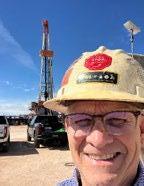
Peter Blomquist has over 20 years of experience in a variety of positions across the oil and gas industry, including drilling programs, operations, geologic mapping, regional studies, prospecting, exploration, and acquisitions. His work history includes operating wells, from which he learned that the pumper never calls with good news. Peter is passionate about geology and its role in the business of profitably extracting oil & gas. Peter has two degrees in geology: a bachelor’s degree from the University of Minnesota and a master’s degree from the Colorado School of Mines. He is currently a well site geologist for Diversified Well Logging. His geologic interests include fluvial systems, fractal geometry, paleokarst reservoirs, and exploration at all scales. He is a Registered Professional Geologist in Texas and Wyoming, a member of RMAG, AAPG, SEPM, and West Texas Geological Society, and is an accomplished mountain climber, having climbed 57 of the 59 Colorado 14ers.

HYBRID
Speaker: Kendall Kittleson
Date: June 3, 2026 | 12:00 pm - 1:00 pm
The Massive Structural Deformation
Produced by the Longmont Fault East of Boulder, Colorado
Strike-slip movement along the northeast-southwest oriented Longmont Fault on the northwest limb of the Denver Basin triggered a 281 square mile detachment of the Upper Cretaceous Pierre Shale bedrock from the surface to a depth of almost 550› above a singular stratigraphic horizon, termed Kp2. This structural event occurred in two stages-first movement along northeast portion of the Longmont Fault detached the bedrock above the unfaulted, two degree-dipping Kp2 horizon. The result was a relatively slow, two mile movement of detached bedrock, with its eventual termination as a series of subparallel ramp anticlines, offset up to 470’.
Later, strike-slip movement on the
southwest portion of the Longmont Fault, caused the upper Cretaceous bedrock, dipping nearly 20 degrees, from its proximity to the Front Range Mountain uplift, to detach and move with great speed above Kp2 nearly eight miles, until its termination as series of structurally complex, often chaotic features.
We will examine the abundant data supporting this structural presentation utilizing historical maps and talk about the area topographic features created, including the alteration of the original east-west orientation of Boulder Creek, as it leaves the city of Boulder, to a point eight miles to the east where its direction has been altered to a northeast orientation.
Kendall Kittleson has been an RMAG member for almost 25 years. He received B.S. and M.S. degrees in 1971 and 1973, respectively, from the University of Iowa and a M.S. degree from Colorado State in 1989. He currently works for Structural Solutions, LLC. He has been the recipient of the 2013 RMAG Distinguished Public Service to Earth Science Award and the 2025 RMAG Outstanding Scientist Award.

RMAG Foundation Scholarship Winners
The RMAG Foundation supports earth science research and academic study by graduate and undergraduate students through scholarships, awards and grants each year. This year, the Foundation awarded students over $112,000. We received 77 applications from 29 different universities, a significant increase over last year. This year we implemented Dickinson Grants to assist students with publishing and research expenses. The Foundation also awarded the C. Elmo and Kathleen W. Brown Field Camp Scholarship to undergraduates at three Colorado schools and the Neil J. Harr Outstanding Senior Award to students from nine Colorado schools. Winners receive
SM Energy Scholar Award
• Victoria Simoneau; PhD Candidate; Colorado School of Mines
Gary Babcock Memorial Scholarship
• Zane Wasicko; MS Student; University of Utah Bolyard Family Scholarship
• Winner will be announced soon
Robert M. Cluff Memorial Scholarship
• Worlanyo Ablordeppe; PhD Candidate; Oklahoma State University
Colorado School of Mines Memorial Scholarship
• Ahmed Ahmed; PhD Candidate; Colorado School of Mines
Michael S. Johnson Scholarship
a complimentary one-year membership in RMAG in addition to cash awards.
The applications were from a wide range of earth science topics, including geophysics, traditional field mapping and planetary science. The RMAG Foundation Trustees congratulates our winners for their academic excellence and research. For background on the winners and their work, visit the Foundation website at RMAGFoundation.org. The Trustees thank our generous donors. We would not be able to recognize outstanding scholarship and research without your help year after year.
• Jutamas Charoensuk; MS Student; University of Texas at Austin
Norman J. Foster Memorial Scholarship
• Owen Purcell; MS Student; University of Arizona
Philip J. McKenna Scholarship
• Juniper Berry; Junior; Colorado College
• Elizabeth Spradlin; Junior; Colorado College
RMAG Foundation Scholarship
• Samantha Khatri; PhD Candidate; South Dakota School of Mines and Technology
• Maggie Moss; PhD Candidate; Colorado State University
Stone/Hollberg Scholarship
• Joshua Zuniga; MS Student; Colorado School of Mines
Veterans Memorial Scholarship
• Joseph Moll; MS Student; Montana State University
Publication Grants
• Daniel Maya; PhD Candidate; University of Houston
Dickinson Grants
• Soren Rollin; Junior; University of Colorado
• Brayden Parks; Junior; University of Colorado
• Laniseya Perkins; Junior; University of Nevada, Las Vegas
C. Elmo and Kathleen W. Brown Field Camp Scholarship
• Braden Bensley; Colorado Mesa University
• Chris Piel; Fort Lewis College
• Abby Sawicki; Western Colorado University
Neil J. Harr Outstanding Senior Award
• Braxton Fenton; Metropolitan State University
• Lev Sugerman-Brozan; Colorado College
• Desmond Saldivar; University of Northern Colorado
• Anya Keena; University of Colorado
• Emma Nelson; Colorado School of Mines
• Hari Brogan; Colorado State University
• Grant Barnes; Colorado Mesa University
• Kayce Bridgewater; Western Colorado University
• Sally Thompson-Fort Lewis College
MAY 2-3, 2026
RMAG Outreach Event. Cinco De Mayo.
MAY 5, 2026
Denver Petroleum Club Speaker Series. Contact: Becca Causey, becca@ denverpetroleumclub.com
MAY 6, 2026
RMAG Luncheon.
Speaker: Peter Blomquist. Talk Title: “ Geology of the Colorado 14ers: Structure, Origin, and Serendipity.”
MAY 14, 2026
WOGA Wellhead Wake-Up Virtual Coffee Chat.
MAY 20, 2026
RMAG/DGS Colorado Rockies Game.
MAY 21, 2026
RMAG Coffee Hour. Little Owl Coffee, 401 17th Street, Denver, CO. 10 AM-11 AM.
WOGA Lean-In.
Speaker: Camille Romero. Talk: “Rewiring Confidence: Using Neuroscience to Reclaim Your Power.” 11:00 AM-12:30 PM.
MAY 26, 2026
RMAG Happy Hour. Arvada Beer Garden., 9258 58th Pl., Arvada, CO. 4-6 PM.
RMS-SEPM Luncheon. Speaker: Jesse Melick. “Stacked Channel Margins at a Base of Slope: Integrating BehindOutcrop Cores from Permian Deepwater Upper Brushy Canyon, Central Delaware Mountains, West Texas.” information@rmssepm.org Wynkoop Brewing Co., 11:30AM1:30 PM
MAY 30, 2026
RMAG Family Hike.
Matthew Winters Park Trail Head, 1103 County Rd 93, Golden, CO. 9-11AM.
JUNE 1-5, 2026
RMAG On the Rocks Field Trip. Yampa River and Green River Float Trip.
2026 RMAG MOWRY FORMATION SYMPOSIUM

The Rocky Mountain Association of Geologists invites abstract submissions for a one-day symposium dedicated to the exploration and production of the Mowry Formation Join geoscientists, engineers, and industry professionals to share research, exploration insights, and field developments related to one of the Rocky Mountain region's significant unconventional resource plays.
Regional geology and stratigraphy
Geochemistry & source rock characterization
Reservoir characterization & petrophysics
Drilling, completion & stimulation
Production performance & field case studies
Seismic interpretation & subsurface mapping
Basin modeling & resource assessment
Emerging technologies & future exploration
Format
Oral presentation (25 minutes)
Abstract Length 150–300 words
Submission Deadline July 15, 2026
Acceptance Notification September 15, 2026
How to Submit
Submit your abstract through the online portal by July 15, 2026. Submissions are reviewed for relevance, technical merit, and program balance

WELCOME NEW RMAG MEMBERS!
Mohammed Almubarak from Erie, CO
Kathleen Baczkowski from Centennial, CO
Juli Thompson at Oceaneering International, Inc. from Loveland, CO
Ahmed Adeyekun is a Student at West Chester University of Pennsylvania
Amelia Bargabos is a Student at Brigham Young University Idaho
Ashley Ford is a Student at Colorado State University
Cameron Grant is a Student at Colorado School of Mines
Daniel Duah-Boakye is a Student at Oklahoma State University
Glorianne Couey is a Student at Montana State University
Haley Brumberger is a Student at University of Colorado
Ibrahim Gurbuz is a Student at Colorado School of Mines
Itai Bojdak-Yates is a Student at Colorado State University
John Allard III is a Student at University of Colorado
Joseph Awuku is a Student Texas A&M University
Jutamas Charoensuk is a Student at Colorado School of Mines
Kaitlin Cowan is a Student at Montana State University
Mary Aboagye is a Student Member at University of Utah
Megan Flexhaug is a Student at Brigham Young University
Micah Curley is a Student at Brigham Young University Idaho
Muhamed Elshalkany is a Student at Texas A&M University
Nicholas Evett is a Student at University of Oklahoma
Oluwaseun Akinyemi is a Student Member at University of Houston
Sigourney Burch is a Student at Colorado School of Mines
Sophia D’Arcy is a Student at Colorado School of Mines
Steve Adjorlolo is a Student at University of Texas at Arlington
Trent Peppiatt is a Student at Texas A&M University
Worlanyo Ablordeppey is a Student at Oklahoma State
Zoe Bowers is a Student at Colorado School of Mines
Brayden Parks is a Student at University of Colorado
Daniel Maya is a Student at University of Houston
Evan Hoeft is a Student at University of Colorado
Evelyn Nsarful is a Student Member at Oklahoma State University
Hoang Anh Nguyen is a Student at Colorado School of Mines
John Johnson is a Student at Colorado School of Mines
Maggie Moss is a Student at Colorado State Univeristy
Marianna Marquardt is a Student at Colorado School of Mines



WELCOME NEW RMAG MEMBERS!
Mohamed Mousa is a Student at University of Texas at El Paso
Oluwaseye Oyetade is a Student at Obafemi Awolowo University
Paige McDowell is a Student at University of Colorado
Peyton Lewis is a Student at Texas Tech University
Rajkumar Mondal is a Student at University of Oklahoma
Samantha Khatri is a Student at South Dakota School of Mines and Technology
Sarah Marchant is a Student at Brigham Young University
Tobechukwu Oluchukwu Ude-Akpeh is a Student at University of Texas
Tochukwu Onyebum is a Student at University of Nebraska
Yamini Patel is a Student at Montana State University
Adam Walsh is a Student at Colorado State University
Alsihbah Syed is a Student at University of Arkansas
Amanda Rea is a Student at Colorado School of Mines
Edward Ruark is a Student at University of Oklahoma
Fatemeh Saberi is a Student at University of North Dakota
Hannah Walker is a Student at South Dakota School of Mines and Technology
Joshua Zuniga is a Student at Colorado School of Mines
Justin Petersen is a Student at Brigham Young University
Kwabena Poku-Agyemang is a Student at University of Utah
Laniseya Perkins is a Student at University of Nevada
Lily Zugschwert is a Student at University of Colorado
Noah Short is a Student at Kansas State University
Owen Purcell is a Student at University of Arizona
Reynaldo Sanchez is a Student at Colorado School of Mines
Shayan Rahimi is a Student at University of Texas at Arlington
Soren Rollin is a Student at University of Colorado
Victoria Simoneau is a Student at Colorado School of Mines
Yaser Rahmani is a Student at University of Utah
Ifeanyi Anyanwu is a Student at Texas A&M University
Nikhil Arolkar is a Student at Colorado School of Mines
D eta ile d a nd ac c ura te g eo lo gy at yo u r fin g ertip s in Pe tra , Ge o Grap h ix, A rc GIS , A cc u Map , ge o S C OU T an d o th er d ig ital ma p pin g a p plica tion s
We ste rn USA
Geol ogi cal Edge Set
Ene rgy Al te rnati ve s & Cri ti cal Mine ral s - USA
We ste rn Cana da
Geol ogi cal Edge Set
Ene rgy Al te rnati ve s & Cri ti cal Mine ral s - Ca nada
Ea ste rn USA & Ea st ern Ca nada
Geol ogi cal Edge Set
Cent ral USA
Geol ogi cal Edge Set
Me xi co
Geol ogi cal Edge Set
Map la ye rs p rov ided in s ha pe file fo rma t fo r ea sy impor t into a ll ma ppin g app lic at ions .
De liv er ab le s inc lude : f orma tion limits , o utc ro ps, su bc rop e dge s , O &G fie ld s, st ruc tu ra l eleme nt s, re ef s, sh ore lin es , c ha nne ls, pro duc tion f airw a ys , s ha le ga s tr en ds, st ru ct ure con tou rs , iso pa chs , g en era l cult ure , r ene w able & no n-r en ew ab le ene rg y pr ojec ts , min era l dep os it s, mine s, Pet ra T he mat ic Ma p pro je ct s, G eoG ra phix G e oA tla s pro je c ts , Ar cG IS M XD a nd La y er f ile s, re giona l c ro ss -s ec tion s, an d full te ch nica l s upp ort .
For mo re inf orma tio n: Joe l H a rding at + 1 4 03 87 0 8 12 2 joe lha rding@ g eoe dg es .c om ww w.ge oe dge s.c om

Expanded geologic focus:
Why contribute?
• Reach
• Quarterly
• Permanent
• Quick
• Every
Why contribute?
Expanded geologic focus:
• Entire greater Rocky Mountain area of North America
• West Texas and New Mexico to northern British Columbia
• Entire greater Rocky Mountain area of North America
• Reach a broad industry and academic audience
• Great Plains and Mid-Continent region
• West Texas and New Mexico to northern British Columbia
• Quarterly peer reviewed journal
• Great Plains and Mid-Continent region Why contribute?
• Permanent archiving includes AAPG Datapages
• Reach a broad industry and academic audience
• Quarterly peer-reviewed journal
• Quick turn around time
• Every subdiscipline in the geosciences
• Quick turn-around time
https://www.rmag.org/publications/the
• Permanent archiving includes AAPG Datapages
https://www.rmag.org/publications/the
• Every subdiscipline in the geosciences
Expanded geologic focus:
area of North America
• Entire greater Rocky Mountain area of North America
northern British Columbia region
• West Texas and New Mexico to northern British Columbia
• Great Plains and Mid Continent region
Email: mgeditor@rmag.org
https://www.rmag.org/publications/the -mountain-geologist/
RMAG Luncheon.
WOGA Wellhead Wake-Up Virtual Coffee Chat.
RMAG Coffee Hour.
WOGA Lean-In.
RMAG Family Hike.