MARTINE JEANS INSTALLATION. INTERVIEW: ISCP-NYC.ORG/JOURNAL/MARTINE-GUTIERREZ-ON-HER-FIRST-BILLBOARD-JEANS
Letter from the Editor 11
Editorial NEO-INDIO 18
Beauty Feature MASKING 46
Editorial QUEER RAGE 62
Interview WITH ARTIST MARTINE 82
Hair Feature DEMONS 90
Editorial BODY EN THRALL 102
Special Thanks & Love 124
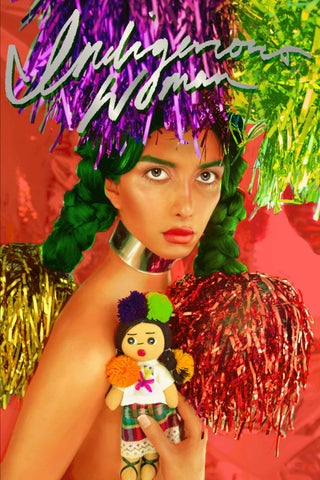
Letter from the Editor This is not a magazine about fashion, lifestyle, or celebrity. Indigenous Woman is an independent art publication dedicated to the celebration of Mayan Indian heritage, the navigation of contemporary indigeneity, and the ever-evolving self-image. It is a vision, an overture, a provocation. The word “indigenous” here is used to refer to native cultures from a particular region, but also as a synonym for the natural and innate. It signifies a real, authentic, native-born woman. There was a time when I believed there was no such title for me to claim. I was driven to question how identity is formed, expressed, valued and weighed as a woman, as a transwoman, as a latinx woman, as a woman of indigenous descent, as a femme artist and maker. It is nearly impossible to arrive at any finite answers, but for me, this process of exploration is exquisitely life-affirming. In working to convey my own fluid identity—an identity that bridges the binaries of gender and ethnicity—I aim in part to subvert cis, white, Western standards of beauty and to raise questions about inclusivity, appropriation and consumerism. From behind long lashes and lacquered lips, I use the fashion magazine’s glossy framework to play with perception. I employ mannequins, advertorials, and indigenous textiles to reassert control over my own image. Mine is a practice of full autonomy—all photography, modeling, styling, makeup, hair, lighting, graphic design, and product design I have executed myself. Indigenous Woman marries the traditional to the contemporary, the native to post-colonial, and the marginalized to the mainstream in the pursuit of genuine selfhood, revealing cultural inequities along the way. This is a quest for identity. Of my own specifically, yes, but by digging my pretty, painted nails deeply into the dirt of my own image I am also probing the depths for some understanding of identity as a social construction. It is also my ambition to forge a connection between the art world and my community. While it is my desire for Indigenous Woman to provide some sustenance for my fellow millennial non-binary transwomen of color, I sincerely hope that all audiences will find the work compelling and captivating. I believe it is possible to create an empathetic and supportive society, but it requires that we all educate ourselves, that we learn to be allies and activists who understand our own privilege. Mutual understanding has the power to change the world.
Martine Gutierrez Editor-in-Chief
NEO-INDIO
A MODERN COLLECTION OF TRADITIONAL MAYAN TRAJES DE GUATEMALA PHOTOGRAPHS BY MARTINE GUTIERREZ MODELED BY MARTINE STYLED BY MARTINE GUTIERREZ
18
LEGENDARY CAKCHIQUEL CAKCHIQUEL CINTA (HEAD SCARF) CAKCHIQUEL HUIPIL (BLOUSE) COLOTENANGO FAJA (BELT) CAKCHIQUEL CORTE (SKIRT)
20
KEKCHÍ SNATCH KEKCHÍ HUIPIL (BLOUSE) VINTAGE LEVI’S JACKET AMALIA’S JEANS 21
KEKCHÍ BUTCH KEKCHÍ CHAQUETA (JACKET) KEKCHÍ BOLSA (BAG) KEKCHÍ CAMISA (SHIRT) KEKCHÍ CINTURÓN (BELT) TZUTUJIL PANTALONES (PANTS) MARKET HUARACHES
22
CHEEK A BOOM VICTOR COSTA JACKET EMILIA BELLINI DRESS BEADED IXIL FAJA (BELT) VINTAGE VERSACE STILETTO 23
QUICHÉ MARKET MOOD QUICHÉ HUIPIL (BLOUSE) QUICHÉ FAJA (BELT) QUICHÉ CORTE (SKIRT)
24
CHUJ MINI GAG SAN MATEO IXTATÁN CHUJ HUIPIL (BLOUSE) MAM FAJA (BELT) QUICHÉ FAJA (BELT) HERMÈS SCARF COACH STILETTO SANDALS 25
TRADE IN YOUR QUICHÉ SKIRTS FISHERMAN’S BOLSA (BAG) PALM QUICHÉ SOMBRERO (HAT) QUICHÉ CAMISA (SHIRT) QUICHÉ CINTURÓN (BELT) QUICHÉ PANTALONES (PANTS) J.CREW SANDALS 26
MAM GOING BANANAS MAM HUIPIL (BLOUSE) MAM FAJA (BELT) MAM CORTE (SKIRT) J.CREW SANDALS
27
MONOCHROME MAMACITA VINTAGE CHRISTYS’ HAT MAM HUIPIL (BLOUSE) CAKCHIQUEL CAMISA (SHIRT) CAKCHIQUEL FAJA (BELT) CAKCHIQUEL CHOKER VINGAGE DIANE VON FURSTENBERG PANTS AMALIA’S PLATFORM SANDLE 28
CAKCHI LANA CALIENTE MOM’S HANDMADE MACRAME DRESS VINTAGE KNIT DESS CAKCHIQUEL FAJA (BELT) BOLSAS DE ANTIGUA (BAGS) VINTAGE VERSACE STILETTO 29
PODER DE LA FLOUR MISSONI SHIRT AND PANTS SET ANTIGUAN BEADED COLLAR MOPAN FAJA (BELT) MAM PARRAJE (SHAWL) VINTAGE DISCO SHOE 30
UNCLOCKABLE IN XINCA WORRY DOLL HEADBAND CAKCHIQUEL CAMISA (SHIRT) XINCA CORTE (SKIRT) AMALIA’S PLATFORM SANDLE
31
MAM SETS ARE THE BREAST CAKCHIQUEL CINTA (HAIR RIBBON) MAM CAMISA (SHIRT) XINCA CINTURÓN (BELT) MAM PANTALONES (PANTS)
32
TZUTUJIL PEREZOSO QUICHÉ CINTA (HEAD SCARF) THE NORTH FACE PUFFER VEST TECPÁN FAJA (BELT) TZUTUJIL CAMISA (SHIRT) CROCS 33
CAKCHIQUEL CALOR MAM HUIPIL (BLOUSE) CAKCHIQUEL FAJA (BELT) CAKCHIQUEL CORTE (SKIRT) CAKCHIQUEL CINTA (HEAD SCARF) J.CREW SANDAL 34
SERVING PLAYGROUND LOVE VINTAGE GUATEMALA T-SHIRT QUICHÉ CINTURÓN (BELT) CAKCHIQUEL PANTALONES (PANTS) CUSTOM CONVERSE 35
GLAMOUR IS A HEAVY BURDEN CAKCHIQUEL TZUTES (UTILITY CLOTH) QUICHÉ CAMISA (SHIRT) CAKCHIQUEL FAJA (BELT) IXIL FAJA (BELT) CAKCHIQUEL HUIPIL (BLOUSE) MARKET SCARFS MIU MIU STILETTO
36
SIEMPRE UNA DIVA RETRO POCOMCHÍ PONCHO QUICHÉ FAJA (BELT) VINTAGE PACO RABANNE DRESS VINTAGE DISCO SHOE
37
PLASTICO Y SWAG CAKCHIQUEL BOMBER JACKET VINTAGE JEAN-PAUL GAULTIER JUMPER VINTAGE DISCO SHOE 38
39
24K GUATEMALAN GOLD AFRICAN FLOWER BEETLE GHANAIAN SHEA BUTTER BRAZILIAN RAW HONEY
46
MASKING T RUE BEAUTY IS NOT SOMETHING WE CONFOR M T O , BUT A PRACTICE OF HEALTH AND SELF-CA R E T H A T C E L EBRATES OUR COMPLETE UNIQUENESS AND IN D I V I D U A L I T Y . H E R E A R E E L E V E N A T-HOME FACIALS THAT WILL CHANGE THE W A Y Y O U S E E Y O U R S E L F . E M B R A C E YOUR BEAUTY WITH A LITTLE HELP FROM MO T H E R N A T U R E .
PHOTOGRAPHY BY MARTINE GUTIERREZ MASKS BY MARTINE GUTIERREZ
47
JAPANESE ALGAE EASTERN OYSTER ALASKAN SALMON ROE CHINESE FRESHWATER PEARL WHITE ANCHOVY PASTE FISH OIL
48
RED SPATH PHILIPPINE STAR FRUIT WILD WHEATGRASS AFRICAN KIWANO FRUIT KAOLIN WHITE CLAY
49
BLACK SEAWEED GUATEMALAN COFFEE CARIBBEAN COCOA SLICED SPANISH ALMONDS SRI LANKAN CINNAMON AFRICAN PROTEA VIRGIN OLIVE OIL
50
CHILEAN SEEDLESS GREEN GRAPES NORTH AMERICAN GARLIC CHIVES VIETNAMESE DRAGON FRUIT CHINESE BLACK SESAME SEEDS CHINESE RED CABBAGE ITALIAN KIWI FRUIT JASMINE RICE PASTE
51
MEXICAN PAPAYA GUATEMALAN PLANTAIN THAI MOTHER ORCHID DEHYDRATED COCONUT MILK
52
DRIED GUATEMALAN PAPAYA DRIED MEXICAN PINAPPLE CRYSTALLIZED INDIAN GINGER EGYPTIAN FABA BEAN INDIAN TURMERIC POWDER CHANTENAY CARROT JUICE PAKISTANI SUGARCANE
53
MEXICAN PURPLE GARLIC PERUVIAN SERRANO CHILI PEPPER NIGERIAN SNAKE PLANT EAST AFRICAN ARECA NUT OIL CARIBBEAN JUJUBE FRUIT CRUSHED INDIAN GOLDEN ROOT
54
EUROPEAN GARDEN SNAIL PACIFIC HARD SHELL CLAM CRUSHED GUATEMALAN BOUGAINVILLEA CARIBBEAN SALTWATER JAPANESE MATCHA MAYAN CLAY
55
BRAHMA CHICKEN EGG SPANISH CANTALOPE GUATEMALAN MAIZE SILK HUSK GHANAIAN CAYENNE POWDER ROASTED MEXICAN SEA SALT FRENCH WHITE CLAY
56
GERMAN CRIMSON SWEET WATERMELON MEXICAN CHERRY TOMATO COLOMBIAN IVORY HYDRANGEA ORGANIC YOGURT POWDER SIBERIAN CHIVE
57
THE ANGST OF PREPUBESCENT DYSPHORIA A RECREATION OF MARTINE’S EARLY YEARS as depicted by Martine
62
October 14, 2006
“I was never a violent child, but that never stopped me from hitting them with a look. Out in the real world dressing loud was as much my weapon as it was my protection.” —Martine Gutierrez
63
Growing Up Bites—Quiché huipil collar (blouse collar), Limited Too button down, Jeremy Scott jumper, Cakchiquel faja (belt), Victoria’s Secret fishnets, American Apparel tights, Jimmy Choo shoes. 64
Eadent’s Crush—Jacquemus top, Tzutujil pantalones (pants), Xinca cinturón (belt), Party City gloves, vintage Prada stiletto sandal 65
66
Imagine Life-Size, and I’m Tyra—Hermès scarf, Versace scarf, Quiché huipil (blouse), Vivienne Westwood skirt, Salvation Army belt, model’s own jewelry, Mam pantalones (pants), vintage Prada stiletto sandal 67
Don’t Touch the Art—model’s own hand painted leather dress, Ebay vintage Princess Jasmine belt as choker, Mam faja (belt), vintage Gucci stiletto, model’s own Mayan doll 68
Talk to the Hand!—Quiché huipil collar (blouse collar), Hairyguppy necklace, model’s own Dia de los Muertos earring, Valentino blouse, Versace button down, handmade jean shorts, faux-shopped quiché bag, Ixil faja (belt) 69
Governor Ratcliffe and Pocahontas—Kekchí chaqueta (jacket), Kekchí vest, Lanvin blouse, Victoria’s Secret pajama pants, model’s own belt, Quiché faja (belt), vintage Guess boots, model’s own American Girl doll, model’s own digitally printed mask 70
Jenny From the Block—vintage Commes Des Garçons hat, Mam huipil (blouse) as head scarf, Quiché camisa (shirt), Jean Paul Gaultier skirt, model’s own bag, Stuart Weitzman boots 71
Dear Diary, No Signal During VH1’s Fiercest Divas—model’s own jewelry, Cakchiquel faja (belt), La Mendola dress, Club Monaco bag 72
P.S. Your Parents are Nuts—model’s own Barbie, handmade crochet dress, model’s own Mayan doll, handmade bracelets 73
Ghetto Boys Make Some Noise—Nebaj Ixil huipil (blouse), Hairyguppy necklace, Antiguan beaded medicine bag, Victoria’s Secret robe, Versace speedo, Hot Topic shorts 74
Swimming Lessons?… As If—model’s own mask, handmade hat, Antiguan beaded collar, model’s own jewelry, Ebay bathing suit, handmade tie-dye button-down and leggings, discount dance gloves, Mom’s vintage Mexican belt 75
Confessions of a Teenage Drama Queen—Dolce & Gabbana earrings, model’s own crown, Cakchiquel faja (belt), Claire’s necklace 76
That Girl was Me, Now She’s a Somebody—handmade necklace, vintage Balenciaga blouse, H&M dress, Marc Jacobs boots 77
P.P.S. Christopher Columbus was a Fuck Boi—Something Happening necklace and bracelet, hand-painted Christian Dior suit, hand-painted tights, Gucci stiletto, Tzutujil parraje (shawl), Antiguan faja (belt) 78
I Really Really Really Wanna Zig a Zig ah—Something Happening necklace and bracelet, faux-shopped Sumpango Cakchiquel boots, American Apparel skirt, Cotzal Ixil parraje (shawl), Cotzal Ixil tzutes (all-purpose utility cloth) 79
Girlicious *Like Me—Club Med beach wrap, model’s own jersey, San Antonio Aguas Calientes, Sacatepéquez textile, vintage Adidas pants, Guatemalan champion boxing gloves, vintage Versace stiletto 80
OUR LADY OF GUADALUPE 81
Interview
Demi-Celebrity: Martine The artist in front of the camera talks and talks and talks to sis Aponi “Butterfly”
Commanding the gaze from in front of and behind the camera is nothing new for Martine Gutierrez. The multimedia artist documents herself while embodying various feminine archetypes—the Hollywood actress, the Pop Star, the Call Girl, and now the Supermodel. Referring to herself as a “demi-celebrity,” the art darling is single-handedly responsible for catapulting her glamorously performative self-image. But who is the artist behind the camera? Though her characters appear familiar, they are not representations of reality; rather, they are hyperbolized manifestations of feminine glamour, desire, and sexuality. Her massive billboards, MTV-style music videos, and glossy photo spreads, in which she stars alongside mannequins, appear to be the seductive tools of luxury consumerism. They are easily mistaken for highcost productions though they are all self-produced on a meager budget, usually shot in Martine’s bedroom or at a friend’s home. Compelled by her personal need for validation, these reimaginings of the self call attention to the fictions that surround and define us all—those we internalize through daily life and those we create. Martine derives her power from her position at the crux of multiple points of intersectionality, and it is this energy that she infuses into her work. She confronts the politics of visibility as they relate to power dynamics and representation, to seeing versus being seen. The visual and social constructions of gender, race, and sexuality are the subject matter of her oeuvre. She does not employ these themes to simply make gender-based work—they are intimately intrinsic to her as an interracial, non-binary transwoman. Fluidly oscillating between the overt and the subtle, Martine masterfully draws on a range of media to interrogate such supposed norms. Synthesizing her knowledge of dance, photography and costume, she illuminates the narratives and products we legitimize by believing in
Indigenous Woman
them. Her pursuit of sincere, unironic representations of pop-cultural tropes allows her to occupy roles that society would traditionally not permit, as well as to affirm LGBTQ beauty in the LatinX community in contrast to the historic representation of trans and brown bodies as “other.” I’ve been a longtime friend and fan of Martine’s, but Indigenous Woman marks our first official interview. Over the course of three days, Martine hosted me in her Brooklyn studio. The studio is some kind of cross between a showroom at Bergdorf’s, a child’s costume box, and a crafty science fair diorama. Martine rescues and resuscitates modest materials—ripped curtains tacked with pushpins, a dusty Halloween wig—and transforms them before my eyes into the irrefutable trappings of glamour. What is invisible in her work is her almost athletic process, the meticulous endurance it takes to manifest an image from her mind’s eye. Each tableau is engineered to encourage the viewer to see a person instead of a mannequin, a woman where there is perhaps a man, or a high-end photo studio where there is only a bedroom. Martine insists she is “a terrible model” and I finally agree. It is ultimately not her physical form, but her craftsmanship and skill as an imagemaker that compels us to look longer than perhaps we would otherwise. Martine sits before me, cross-legged on the floor in a thin white silk bathrobe. Her face is washed. She wears no makeup. Her long black hair unfolds like heavy ribbons down to her waist. She pulls a mango from the windowsill. “He’s finally ready” she says, clicking open a pocketknife and peeling back the soft ripe skin. She licks her fingers and throws her head back with a cackle, letting the juice run down her elbow and onto the floor. I give her a look that says, “who is this messy girl?”—so playful and nonchalant when the camera is switched off.
82
Indigenous Woman
83
Interview A: How should we begin, sis? With a fiction or a fact? M: If there’s no truth in the lie, why are we telling it? A: Mood. M: Well, we can do it however we want. Keep in mind it’s “art.” I don’t know what that really means but, LOL. A: I take it as meaning “limitless,” a space for dialog. Like, is this going too far, or is it art? M: Tea. At its best, art is an opportunity for the artist to take greater risks, or be larger than life because nothing needs to be rooted in reality. It’s what we all desperately want celebrity to be—that escapism into nostalgia and glamour. A: How do you see your work standing? M: I think she wants to assimilate right now. I’m just trying to stunt and make my own gags, I’m over waiting. Maybe that’s my season of art. A: LOL. Shut that pretty little mouth. We all know you’re a girl about town with the low down on high art. M: I feel like I have nothing else to live for but the work. It doesn’t feel like a choice. I’d rather talk about wigs than current events. Don’t you want to learn how to be glamorous? A: Yes! Teach us glamour, teach us how to be famous. M: I wouldn’t say the two necessarily go hand in hand. Glamour feels like a mentality and has nothing to do with recognition. Look at Little Edie from Grey Gardens. She was a high society outcast, penniless and still fabulous. Fame feels more like a be-all and end-all, the adventure is in the rising notoriety. Once you’re famous the ride is basically over. There’s a brashness and a freedom to how someone acts before they know people are watching. It’s like letting yourself be more naive and therefore more brave, LMAO. Or something. A: How Andy Warhol of you to aspire to fame. M: Tea. This work is screaming, “let me be one of those Warhol superstar girls, who really lives for 15 minutes.” I don’t need to understand the cost, I just need someone to pay. A: Damn, that’s real. I’m a little stoned, but this is still hitting me really hard. M: LMAO, Mood! Me talking like I’m stoned but I’m not.
A: You just live in your world. Go off, sis! M: I do. I always see the fantasy first, then all the flaws that distract from it. It’s like learning to veil the ugliness of reality behind a mask. I think I may see ugliness as truth. And it’s probably like, really problematic because truth has such a positive connotation, right? But my fantasy has always lived in play, and much of my childhood was building an escape from the truth, my own world full of my own truths. A world I am still not willing to fully share or give up. A: Mood. Same. M: Stop! You’re such an adult, sis! Miss Ivy League over here! A: Stop! You MacGyvered like, 124 pages of faux million-dollar campaigns out of bed sheets and some chewing gum! You. Are. An. Icon. M: A demi-icon! I’m a scam. I’ll never truly pop off in the real world. All my skills come second to my identity, and probably always will. A: Tea. I feel that. M: If I wasn’t trans this would just be a conversation about how I’m mixed—buzz words like “ethnicity,” or “transformation” via the ethnographies of Mayan textiles or something. But I’m trans, and I have been transitioning publicly because I didn’t want to disappear or become irrelevant. And publicly trans people are expected to share their personal experiences with everyone. Being trans is being an educator, with friends, families, colleagues, everyone. The only time I feel normal is when I’m surrounded by my sisses. A: Tea. If you were a cis white artist we would be talking about your process or practice. And not your… ambiguous background, LOL. Regardless, Indigenous Woman is giving me life! But just because you’re in everything, doesn’t mean I think you are everything! LMAO. M: Biitch! Artists are self-indulgent freaks. People keep comparing me to Cindy Sherman and Frida Kahlo and that alone is sickening. I’m not about to refuse. A: I see it. You’re their love child, the daughter of self-portraiture, confronting identity, and womanhood. M: I’ll take it. They would be iconic moms. A: What has been your experience of viewing your art with your audience at art shows? You’re in everything, so I assume you’re used to being recognized publicly.
Being trans is being an educator, with friends, families, colleagues, everyone. Indigenous Woman
84
Interview M: The gag is, they don’t know! It’s one of my favorite things to watch people watch me. Usually people don’t recognize me in my work, I can stand alongside them as they scrunch up their noses, squint their eyes, or point. But to watch challenges my own self-perception, especially if they don’t see a woman when I do. A: You’re spiraling. Does your identity outside of your work ever feel false? That is to say, right now with no beat, no wig, do you identify with the girl in the mirror? Or is it the cover of Indigenous Woman that makes you feel seen? M: I need to see them as the same girl to get out of bed every morning. But it’s more than the trans identity. I believe we all negotiate who we are by trying on labels, like changing wigs. Life is a ball, you choose the costume—though most costumes are only available to white folks—and you try not to let life play you. A: So real. White privilege is owning all the cute costumes, but then white folks also covet what few modes of representation we as minorities have! Like all these white girls still wearing corn rows, or up on Instagram trying to look Latina in hoops and a red lip. M: Eek, I know. They all wanna be Selena. I mean who doesn’t? A: As interested as you are in identity, you sound just as wary of it. M: Definitely. I strive to pass in a way I never anticipated. The safety of being unseen allows me the opportunity to be anonymous. I’m not that queer from the high school art room anymore—but I only recently started looking like Pocahontas Barbie. I feel oddly in between both, like I’m in a perpetual makeover scene from The Princess Diaries, except instead of transforming from a nerd to a princess, I started as one of the lost boys from Hook. A: SCREAMING. OMG you’re referring to your yearbook photo that opens the “Queer Rage” spread. You look like your pronouns are Zip and Xoo. LMAO. M: Literally. I’ve devolved from an emo shaman into some sort of femme fatale, and I’m praised for it! It’s nuts! I sometimes wonder what life or society would look like if we swapped our divisive terminology for fewer definitions that were inherently more inclusive. It would be lit, but we would need to be more comfortable with the gray area. Like, imagine if there was no need for LGBTQ… R…S. Ideally your husband could also be your wife, and we would put into practice a recognized
gender-neutral pronoun. And… all self-identifying men would be penetrated. A: You think all men should be penetrated, even straight men?! M: Especially straight men! Are you kidding?! It would be lit, all men would be much better lovers. You can’t know what it feels like to give unless you know what it feels like to receive. Penetration is truly selfish. A: I’m quoting you saying “every man is a bottom”? LMAO. M: He is!!! A: The New GQ Man. M: …Also known as the GQ Woman!? Remember sis, in this ideal world these are fully inclusive titles. Publications won’t need to target only men, because by that time men will be fully integrated into womanhood! A: Umm, lit! Ok then, speak to womanhood. M: Well, the struggle to place our social understanding of the origins of womanhood is my mood. However, working on this project I was constantly asking whether “indigenous” was a label I could personally claim ownership of. Yes, my Abuelita (grandmother) was Kekchí Mayan Indian and my Dad immigrated to the United States from Guatemala. But my Mom is of Northern European decent and can trace her family back more than five generations in the United States. As someone whose ancestors are from different countries and cultures, how should you or I, or any mixed person, discern ethnicity? Is the decision even our own? I think society usually chooses for us. Genetics and lineage are rarely connected to perception, or how we pass publicly. A: I know the last visit was bad, but would you consider living in Guatemala in the future? M: Guatemala at this point is too traditional for me— too steeped in Catholicism that reinforces these old school binaries of male and female roles in society, like all of Latin America. It’s too exhausting to be true to yourself in that environment if you’re not heteronormative, or passing as. A: Indigenous Woman features an extensive catalog of traditional and modern Guatemalan textiles. I know some belong to your grandmother, while others were collected as a means of cultural preservation by your parents’ nonprofit GRP (Guatemala Relief Project), which was active during the 1980s and 90s. What was it like growing up in that environment?
I believe we all negotiate who we are by trying on labels, like changing wigs Indigenous Woman
85
Interview M: It’s always felt natural to wear traditional textiles; I grew up watching my mom and sister make them look designer. A crop top with a market skirt. It looked so casual for her to wrap up in a perraje (shawl) and go to the club. Sure, I’m photographing it as a glam moment, but what I’m presenting is a living contemporary culture, not just a buried history. I couldn’t make Indigenous Woman without the textiles. I’m so grateful to have traje (traditional costumes) that have been in my family for generations. In this day and age you don’t see quality like that in the market—these textiles are considered museum quality now! Many were collected to preserve the history because indigenous peoples in Guatemala were being disappeared by the government. A: So the GRP was formed to protect the people and cultures being threatened by the government? M: Our home became a “safe house” for Guatemalan refugees and their families fleeing torture and genocide. We had refugees stay at the house under false names so they could help them safely reunite with their family members. My mother never knew how many people she would be cooking dinner for, or how long they would be staying. I missed all of this though. I’m the youngest so my early memories of these events are mostly from my parents’ stories. A: What do you think is the role of indigenous art in the contemporary art world? M: Are you kidding, she’s never been invited to the main event, LOL. Her “role” is cleaning up after the Met Gala. Some designer snaps a pic of her huipil (traditional blouse) and it inspires an entire collection—which she receives no credit or coin for—and that’s tea. A: Bye! TEA. M: All tea, all shade. You’re our cultural studies fish. What’s the tea on indigenous art in the contemporary art world? A: Well, there is very little acknowledgment of the role indigenous art plays in the contemporary art world. Native art is often thought of as a thing of the past, but many of the most ancient traditions are still very much alive. Native art traditions have a complicated relationship with the western art market. Art history and its definitions are often prescribed by the western world (more narrowly cis, white, straight men), and have historically diminished indigenous art production as mere craft. And what has been deemed valuable—i.e. pillaged from colonized peoples—is
now largely quarantined behind glass in museums that the masses can’t even afford to enter. M: Boom! You said that way better. Decolonizing what we now understand as indigenous traditions feels like all I can do. So much is assimilated into whiteness. A: Tea, I just said that, but in my white voice, LMAO. M: Mood. Cunty academic white voice. I mean that’s something we should talk about too. How we are talking to each other right now. It’s coded language, and not everyone is going to understand it when they read it. A: Good, you’re not making this magazine for everyone! And when they get it eventually, this work will pop off a second time. Just like how there are some twenty Mayan dialects, we are speaking a different dialect too, of the urban diaspora… we should name her! M: Iconic. Like, Que-fierce or like Cunt-kchi, Doll-glish? A: LMAO, DONG-lish?! Might as well say Trann-inese! M: LOL BYE. No, Doll-glish, like the Dolls of English…? Yeah, it’s no good. A: Speaking of dialects, what languages were spoken in your home growing up? M: Mom spoke English, French and Spanish, and Dad barely spoke English. Like, Spanish wasn’t taught in my household even though it’s my Dad’s first language. I found myself constantly teaching him how to be American. It’s a hard space to navigate. There’s a cycle to being a first generation American where you are more grateful for what you have than your parents. I felt I had to actively seek out my heritage when we visited the fam in Guatemala, and even after that so much is still assimilated into whiteness. I can’t stress this enough: get to know your culture. A: Mood. What about fashion? M: What about faaashion? I think it’s great. A: We tell the world who we are by how we present ourselves. To an extent our cultures dictate how we dress. I mean sis, you said, “life is a ball,” and talked about wigs, LMAO. M: OMG true. Drag me sis, LOL. I mean sure, we present our identities in part by wearing them, assimilating obvious style archetypes to define personality like girly/baby doll, tomboy/athleisure, high femme/the little Gucci dress...see, I just gave you three of the Spice
what I’m presenting is a living contemporary culture, not just a buried history.
Indigenous Woman
86
Interview Girls! To an extent we can buy and put on whoever we want to be and project it out into the world. A: You can’t compare Baby Spice to Scary Spice. I see them as different moods, you don’t? M: Yeah as people they are all individuals, but the characters they represent in the band can all be recreated off any rack in any U.S. department store. Century 21 binaries, silhouettes like the feminine hourglass or the masculine square shoulder, they are embedded in the iconography of gender and always will be. This is why uniforms strip us of individuality, because we use our clothes as representations of ourselves—gender, sexuality, class, culture, age—all of it. A: Do you think of fashion as art? M: I think individuals bring the artistry to fashion, whether they’re photographers like Richard Avedon or Helmut Newton, or designers like Alexander McQueen or Rei Kawakubo for Comme des Garçons. There are many undeniably creative minds in fashion, but fashion as an industry, no, I don’t think it’s art. To quote the HBO original movie Gia, “Fashion is not art, fashion isn’t even culture. Fashion is advertising, and advertising is money. And for every dollar you earn, someone has to pay.” A: GIA?! Hate you quoting Gia like its legendary! M: It IS legendary! LOL, I love Gia. But the original Gia was Faye Dunaway in the film Puzzle of a Downfall Child. A must see, kids. A: From the editorials to the ads, Indigenous Woman really provides a menagerie of imagery, not just in your appearance, but the style of photography. Where do you look for inspiration? M: I don’t think it’s about actively seeking inspiration. You have to surround yourself with it, live a life that holds wonder and purpose. It’s when your life’s a mess that your work comes together, and when the world’s a mess that art can truly hold meaning. It’s finding the intention in the innovation of your craft that marks a true artist—innovation that contextualizes your truth, and your life. A: A reoccurring life challenge I assume, considering your previous statement that your childhood was, “building an escape from the truth,” creating a world full of your own truths. M: I think my feelings would best be expressed in a ballad from the Disney musical drama, Mulan—sung by a young miss Christina Aguilera, telling the story of a girl who impersonates a man to save her father’s
life: “There’s a heart that must be free to fly. That burns with a need to know the reason why! Why must we all conceal, what we think, how we feel? Must there be a secret me, I’m forced to hide? I won’t pretend that I’m someone else for all time. When will refection show, who I am insi-yiy-yiy-ed? When will refection show, who I am, inside?” A: Mulan, the trans icon. When she chopped off her hair I cried. I HATED haircuts as kid! M: OMG same! I used to go to school in wigs, LOL. Didn’t matter the color or style, the fantasy was always real for me. A: Tell me about the insane hair in your “Demons” feature. Did you do that yourself? And what about the jewelry? Who made that? M: Well yeah, I had to make each hair crown separately because they each represent a different deity. It’s my hair in combination with weave, braided into wire coat hangers as armatures. It’s mostly hair spray, a balloon or two, and hot glue. The jewelry is trash, LOL. Like cheap stuff that turns you green. There is some traditional Guatemalan market jewelry from Antigua, and some pieces I made that knock off museum artifacts. A: WHAT?! Can you do that to MY hair?! Tell me more about how the hair crowns relate to the individual Demons? M: Sure, sis! Anytime. The initial inspiration came from hieroglyphs depicting the Mayan demon of lust, Chin, and the Aztec Flower Prince deity known as Xochipilli, who were believed to possess both genders. I initially thought I was celebrating my pre-colonial ancestry by representing them, but then learned that the term “two gender” is actually a colonial notion based on the belief in a fixed binary. French sociologists came up with the title and other reductive terms like “two spirit.” The deities themselves, whether referred to as goddesses or demons, really serve more as historical references. A: Major. Why do we know so little about them? Is it because it was the colonizers who were transcribing these histories into our textbooks? M: Very that. It’s problematic that so many of these non-binary deities were recorded as the originators of homosexuality in ancient Mayan and Aztec cultures. It’s homophobic and feels transphobic too—the assumption that coveting, or being seduced by a woman with a dick would stigmatize her followers as gay. A brief history—while the Spanish and Portuguese are pillaging for gold throughout Central America (as commanded
I don’t think it’s about actively seeking inspiration. You have to surround yourself with it, live a life that holds wonder and purpose. Indigenous Woman
87
Interview by the Vatican via Jesus Christ, the son of God, “our true lord and savior”), indigenous communities are being taught that their deities like Chin, Xochipilli and Tlazoteotle are not only false, but are also transsexuals who originated sins like lust and homosexuality. The men and women who refused to join the church and fought back were said to be corrupted by witchcraft and demon-worship, and were condemned and burned. I just want to make it clear, my adoption of the Church’s demonization of these deities is intentional. By playing up the threat, the Church was making sure they wouldn’t be celebrated then, or resurrected now as some pop goddess with a vocoder. A: LMAO TRUE! Wow yeah, calling her a “demon” as opposed to a “goddess” immediately puts her in bed with Satan and biblical connotations of hell. M: At its core it’s an historical fear of non-binary bodies. And it’s my theory that only a straight white man would think devotion to a trans goddess means the devotee is now a homosexual. A: Transphobia is ancient, LMAO. Straight men like transwomen because transwomen ARE women. M: TEA!! LOL. FACT. A: But your parents have been supportive, right? I love your mom. M: She lovesss you. I mean, pretend I’m not a demon for a moment. Mom and Dad had no idea what it was like for me and my sister to be mixed. Too white to be indigenous in Guatemala. Too indigenous to be white in America. Too foreign for both. My cousins playfully used to call me “coconut” because my mom was a gringa (a white woman). A: You know my mother’s Black and Cherokee and my pop’s Mexican, so I get it. I was called a Blaxican or Mula, like Mulatto, and I feel like my friends threw it around like it was endearing. M: Yeah, it’s nuts. Our own communities totally perpetuate stereotypes—racism and self-hate can get so internalized that way. A: I feel like the mannequins you chose for “Body En Thrall” look mixed as well, was that intentional? The bald guy especially. He looks so much like my brother. And strangers always misjudge his ethnicity. M: I mean, your brother is trade, LOL. A: Ewww I know, and he asks about you way too often.
M: OMG stop. What does he wanna know? A: How to keep a job. M: Scream. Right. Um, it is important to me that viewers find their own narrative when looking at how I’ve grouped or separated myself with certain mannequins, blending in or standing out from them. A: Totally. By employing ambiguous mannequins as your counterparts, you highlight our societal need to categorize and stereotype others, the need to measure against the binaries of race and gender. M: Yeah, and class. We are conditioned to assume that physical appearance is, in fact, identity, which is often not the case. Like, as mixed transwomen, we’re often seen as male when we feel female, or have been assumed to be from another culture because our ethnicities are ambiguous. None of us fit neatly into one category. A: “Body En Thrall” is undeniably the most narrative-driven feature in the magazine, yet you leave the final resolution to the viewer. Whose body is the subject of the feature? Is it yours, or does the title suggest a role for the viewer to take on? M: I don’t wanna say. A: Say it as an academic fish. Talk like me, but pretend I’m not your sis, LMAO. M: The title itself is a play on words, a shifting between “in thrall,” which means being under someone else’s power, like morally or mentally enslaved, and “enthrall,” to capture the attention of another, to bewitch or fascinate. There is a subtle yet extremely significant shift in control between the two. While our social power structure perpetuates the lineage of historical oppression and conquest, what I present is a contemporary reorientation of fluid bodies whose oppression is nuanced through intimacy and inequality. A: I’m gagged! You need to talk like her all the time!! LMAO. M: I do! That’s my gallery voice. A: LOL, tea. Why not foreground some of these statements? Why camouflage them? Are you worried your insight will be lost in translation on an audience outside of our community—transwomen, brown women, non-binary folks? M: I don’t want to pander. I have faith in my audience. I believe people really wanna support one another, in today’s political climate more than ever. I don’t place
Transphobia is ancient.
Indigenous Woman
88
Interview impactful social themes first, otherwise the viewer won’t learn how to navigate those themes for themselves. It’s easy to be entertained by the confusion of navigating which characters are “real” and which are mannequins, but I’m like, let’s go beyond that! A: So you talk about how your personal journey informs your practice as an artist, but does that include our current political climate? M: I’m not political, sis. A: I know, but you gotta speak on Trump. You’re the one that said “it’s when the world is a mess that art can truly hold meaning.” M: Damn, did I say that? We are undeniably in the dark ages of the Trump dynasty. I don’t know how we withstand it. How can we raise and praise other brown women, black women, native women, Asian women, undocumented women with a president who is such a blatant racist and misogynist? And just as importantly, how do cis white folks who are equally outraged stand in solidarity with us, and us with them? How does it start? Is it an action or a consciousness?
A: Do you see art as a catalyst for change and open dialog? What does manifesting positive opportunities for marginalized folks look like to you? M: As artists we must ask, how do we tell our own stories? For minorities who sit at the often-isolating crux of intersectionality, how do we ensure our voices are not jeopardized by “opportunity”? How can we work against the very power structures that propagate beauty and normalcy to the masses? In the pursuit of personal gain, we all look at collaborations as positive opportunities, but for those of us who are minorities, we are almost always objectified, tokenized, and used to diversify or assume ally-ship. How can trans and femme-identifying folks of color gain recognition through exposure without being objectified?? …Make your own magazine, LMFAO. A: BYE!! M: No for real, to control our own image we need to be our own photographers, distributors, CEOs…all of it! We need to make our own gags! That’s tea.
A: Can I ask you a pageant question? M: If you want a pageant answer.
How can we work against the very power structures that propagate beauty and normalcy to the masses?
Indigenous Woman
89
DEMONS
DIABOLIZED FEMININE DEVOTION: AZTEC, MAYAN AND YORUBÁ DEITIES OF THE ANCIENT WORLD RESURRECTED IN HAIR. PHOTOGRAPHY MARTINE
90
AND
HAIR BY GUTIERREZ
XOCHIPILLI, THE FLOWER PRINCE, THE AZTEC DEITY OF ART, BEAUTY, DANCE, LOVE AND SONG. REPRESENTED AS THE EMBODIMENT OF TWO GENDERS.
91
92
TLAZOTEOTL, EATER OF FILTH, AZTEC DEITY OF THE UNDERWORLD, ADULTERERS AND SEXUAL VICES. ALSO SEEN AS THE GODDESS OF FORGIVENESS AND PURIFICATION, THOUGHT TO TRANSFORM PAIN AND SUFFERING INTO GOLD.
CHIN, DEMON OF LUST, CREATOR OF HOMOEROTICISM, PEDERASTIC PROSTITUTION AND TRANSVESTISM BETWEEN UNMARRIED MEN AND BOYS IN THE MAYAN CIVILIZATION.
93
94
YEMAYA, GODDESS OF THE LIVING OCEAN, THE YORÙBÁ ORISHA, CONSIDERED THE MOTHER OF ALL AND SOURCE OF ALL THE WATERS AND RIVERS. ASSOCIATED WITH MOONLIGHT, CHILDBIRTH AND THE PROTECTION OF WOMEN.
XOCHIQUETZAL, FLOWER QUETZAL FEATHER, TWIN SISTER OF CHIN, GODDESS OF FERTILITY, YOUTHFUL BEAUTY, MAGIC AND CRAFTS.
95
102
BODY EN THRALL Words and Photographs by MARTINE GUTIERREZ / Starring MARTINE EN FRIENDS The title itself is a play on words, a shifting between in thrall, which means being under someone else’s power, morally or mentally enslaved, and enthrall, to capture the attention of another, to bewitch, ensnare or fascinate. There is a subtle yet extremely significant shift in control between the two. While our social power structure perpetuates the lineage of historical oppression and conquest, what I present is a contemporary reorientation of fluid bodies whose oppression is nuanced through intimacy and inequality. One of the oldest storytelling conventions—the white male adventurer who “discovers” the indigenous woman i.e. fertile land—has been endlessly employed in mainstream media via science fiction, Disney and Anime, often down-playing colonialism as the force that propels the narrative. Without fail, these romantically-charged narratives are driven by the temptation of the exotic, brown, female body. She is both the primal seducer and the inexperienced virgin, always to blame for the consequences her people, and the future of men who see her as a conquest. The Oxford English Dictionary defines “thrall” as the state of “someone born into the condition of servitude, of thrall.” The indigenous woman’s body is just another piece of property, a savage landscape, ripe and wild, waiting to be conquered, possessed and inevitably ruined. Her body, like mine, contains an exotic history: the enthrall or carnal power of the flesh, the station and servitude of my flesh.
PUBLISHER RYAN LEE GALLERY & MARTINE GUTIERREZ
EDITOR-IN-CHIEF AND CREATIVE DIRECTOR MARTINE GUTIERREZ
SPECIAL THANKS & LOVE ALICE CHUNG / OMNIVORE AMALIA GUTIERREZ ARNOT ART MUSEUM AVA SANJURJO BECCA JARVIS CYNTHIA CHANG CYNTHIA LEUNG DAD DAVID MENDOZA INTERNATIONAL STUDIO AND CURATORIAL PROGRAM JEFFREY LEE JORDAN KARNEY CHAIM KEELY THOMAS-MENTOR MOM NATASHA TAUBER NOMI RUIZ RYAN LEE GALLERY SHULAMIT NAZARIAN TIM GOOSSENS
ISBN 978-0-692-15996-5