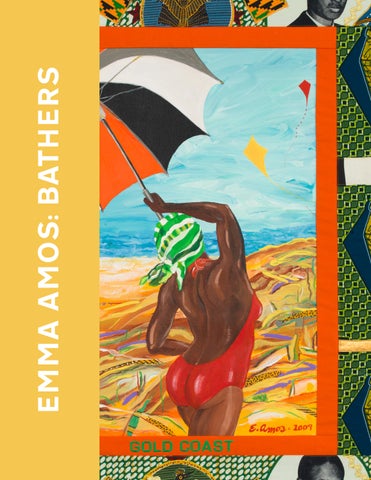
EMMA AMOS: BATHERS
EMMA AMOS
BATHERS
1
2
EMMA AMOS: BATHERS
3
Fig. A: Emma Amos, Bather (detail), 1998
4
BEACH DAY: EMMA AMOS AND THE ART OF BLACK REPOSE ADRIENNE L. CHILDS
Sporting a bathing cap and swimsuit, Emma Amos looks out at us as ocean waves rise behind her in her 1998 self-portrait Bather (Fig. A). An avid beachgoer since childhood, the painter, printmaker, and mixed-media artist returned again and again to aquatic subjects throughout her career. What makes this refrain so striking is that Amos herself never learned to swim and avoided the water. Nonetheless, she fashioned images of sun-drenched Black figures in action and repose — sunbathing, floating, diving, frolicking — fully enjoying the autonomous pleasures of the water and the water's edge. These images are at once personal, a release from her own fears, and a site of familial memory. They are also in conversation with the long history of the nude in Western art, a discourse of exploitation and exclusion that Amos self-consciously reckons with even as she draws inspiration from it. Yet with a deft hand and a subtle touch, her bathers and swimmers accomplish something quietly radical: they empower Black figures to enjoy the freedom of un-surveilled leisure. The reclining nude, the bather, Venus, the odalisque — the history of Western art is replete with tropes of female nudity that frame women as objects of sexuality and availability. These images are usually anchored in a story or mythological pretext: the biblical tale of Susanna and the Elders, in which two lecherous old men spy on Susanna while she bathes in her garden; the countless images of a nude, mythological Venus in any number of circumstances; or the odalisque, the exoticized "Eastern" woman, often attended by a Black female servant. Black women in European art were, in fact, frequently deployed to frame and heighten white female sexuality, even as they were sexualized themselves.1 5
6
Fig. B: Emma Amos, Tightrope, 1994, Acrylic on linen with African fabric borders, 82 x 58 inches (208.3 x 147.3 cm), Collection of Minneapolis Institute of Art, MN.
Although Amos admired modernists such as Henri Matisse and Paul Gauguin, she grappled with the European colonial framework that shaped the way we see exotic figures, particularly as it related to female bodies. Works such as Tightrope (1994) (Fig. B) and One Who Watches (1995) (Fig. D) quote Gauguin, casting his use of Tahitian women's bodies as an example of the power plays through which white male artists exploited the bodies of women of color. Yet looking at the autonomous bathers in Amos's To Sit (with Pochoir) (1981) (Fig. 12), Sand Tan (1980) (Fig. 11), and Sand Reflections (1980) (Fig. 10), I am reminded of Gauguin's 1892 painting Tahitian Women Bathing (Fig. C), in which three Tahitian women of color bathe at the water's edge, backs to the viewer. In refusing to face outward Gauguin's models withhold themselves, remaining quietly insular. Do Amos's bathers descend from Gauguin's women of color, or repudiate them? I propose no answer, but they certainly embody the tension of Amos's own conflicted admiration for Gauguin. This is just the kind of subtle, thoughtful complexity that characterizes Amos's richly textured feminism. Beach excursions are often some of the most enduring and pleasurable memories of childhood. Born in the segregated South, Amos and her family visited the beaches and pools that welcomed Black visitors, including the Washington Park Pool in her home city of Atlanta, Georgia and Amelia Island in Jacksonville, Florida.2 When she had her own family, they continued the tradition, visiting beaches up and down the East Coast. Her daughter India remembered, "We went to Martha's Vineyard every summer when Nick and I were kids…and as I recall, Mom loved going to the beach. She didn't go in the water, but she'd hang out on the sand and work on her tan and read."3 Amos also visited the beach with family friends in Jamaica, Queens, along with Block Island, Fire Island, East Hampton, and other coastal spots. But her fear of the water, along with her concerns about getting her hair wet, kept her out of it. A 1957 snapshot of Amos and friends on the beach (Fig. E) — she and another young woman posed in bathing caps — offers a glimpse of that world.
Fig. C: Paul Gauguin, Tahitian Women Bathing, 1892, Oil on paper, laid down on canvas, 43 1/4 × 35 1/4 in. (109.9 x 89.5 cm), Robert Lehman Collection, 1975. Collection of the Metropolitan Museum of Art, NY.
7
In the 1960s, when Amos began depicting women in bathing suits and on the beach, the spirit of her seaside experiences resurfaces. Although the figures in the painting Two Standing Women (1966) (Fig. 1) are not oceanside, their bathing suits recall the spirit of the 1957 photograph of Amos and friends at the beach. In the 1970s, she embarked on a series of prints featuring women in bathing suits, returning to the subject across media and decades. In her 1975 etching Dream Girl (Fig. 5), we encounter the torso of a reclining Black woman in a bathing suit and bathing cap. Sand Tan of 1980 revisits the Black woman in swimwear, again with the signature swim cap. The cap carries its own charge: in the 1950s, when Amos came of age, Black women were expected to maintain straightened hair as a marker of middle-class respectability, and the bathing cap protected the hair. Amos's recurring inclusion of the cap — including in the 1998 self-portrait Bather that opens this essay — is a subversive play on the tension between fully embracing the water and the pressures of Black respectability. Yet in Sand Tan, the sun-drenched brown bodies, amplified by their contrasting white bathing suits, revel in their own physical beauty. One soaks in the sun with eyes closed, one gazes back at the viewer, and the head of a third falls outside the picture frame, unavailable. There is a quiet sovereignty to Amos's bathing women. In Amos's feminist framework, Black women's bodies are fashioned not for consumption but for their own enjoyment. That they wear bathing suits is more than incidental — it is a way for Amos to claim the appeal of the body on her own terms. As she stated, "I did not want to see Black women with no clothes on. It means something else when a Black woman has no clothes on…it means that you are for sale."4 In refusing that exposure, Amos consciously repudiates the historical bather as a sexually available woman offered up to the viewer's gaze, while affirming the beauty of the Black female body on her own terms.
8
Fig. D: Emma Amos, One Who Watches, 1995, Acrylic on linen, heat transferred photographs on muslin collaged onto canvas, African Kanga cloth borders and cotton broadcloth fabric strips sewn onto linen, 52 3/4 x 41 in., Purchased with the gift of the Smith College Black Student Alliance 1999-2000, Smith College Museum of Art, Northampton, Massachusetts, SC 2001.1
9
Fig. E: Emma Amos at the beach with friends, c. 1957. Courtesy India Amos. 10
In the mid-1980s, Amos's interest in swimwearclad Black figures shifted from women in reclining inactivity toward more active scenes involving both men and women. Man (1987) and Water Wonder Woman (1987), from the Water Series (Fig. 17), portray figures stroking through watery depths, rendered with an expressionistic, painterly hand that amplifies their movement. Among the works from the Water Series is a diptych on paper related to her 1986 painting The Raft (Fig. 15, Fig. 16), which depicts three figures in a pool. Notably, the male figure reclines sensuously in a pose typical of the recumbent female nude trope, while the two women swim. Here Amos reverses the usual gendering of stillness and motion, a move typical of her broader challenge to gender roles. Amos's penchant for mixed-media techniques also informed her bathing subjects in very personal ways. In the late 1980s, Amos began integrating photo transfers of vintage photographs into her paintings. Her use of vernacular photography sought to recontextualize historic images and disrupt the assumed documentary role of photography in American memory.5 Yet she also drew on family photos she inherited, infusing the work with personal memory. In a group of works created in 2001, Amos inserted photographic images of family friends enjoying the beach. The prints Doc and Marjean (Fig. 23), It Was Early Summer (Fig. 24), Mae-Miss Riis Park 1945 (Fig. 26), and Will He Was Gorgeous (Fig. 25) center images of Amos's late godmother, Miss Mattie Mae Neely, and her "gorgeous" companion, Will. Enjoying the sand in front of the boardwalk — likely at Jacob Riis Park in Queens — Will and Mattie Mae appear to be the picture of youth and vitality. These kinds of photographs existed in abundance in the photo albums and archives of Black American families but were absent from the public imagination. In the racially segmented America of 1945, Amos illuminates her family's pursuit of leisure as its own form of unapologetic dignity and beauty.
11
In her 2007 painting On Color (Fig. 27), Amos weaves together figures from her own catalog of bathers. In a sunny beach-day gathering, two youthful couples relax near the water's edge, while a nude reclines in a beach chair. The women recall the languid, white-bathing-suit-clad figures in her 1980 print Sand Tan, while the men echo the athletic types she fashioned in earlier works like The Raft. The playful ease with which the couples embrace recalls Will and Mattie Mae in Amos's 2001 monoprints. The sensuous nude, arms raised above her head, suggests the modernist nudes of Gauguin, Matisse, and Picasso that Amos critiques in other works — yet here, among a cast of Amos's own Black bathers, she too seems to find repose. Indeed, here Amos gathers a party of youthful bodies who absorb sun and sea with radical pleasure. That radical pleasure finds a contemporary heir in the work of Derrick Adams. The Black figure at rest, the Black figure at play, the Black figure in color: these are the celebratory subjects at the heart of Adams's work — an artist who, generations after Amos, explores the joyous spirit of self-possessed leisure. Adams has cited Amos as among his key influences, and this kinship comes together in his Floaters series. Begun in 2016, Adams's series is set in immersive cerulean water and explores the radicality of Black leisure and joy as a revolutionary act. The woman in Floater 75 (Fig. F) glides on a whimsical pink flamingo float; in her patchwork bathing suit and multitoned skin, Adams's figure recalls Amos's own use of textiles and varied skin tones. Her direct gaze and defiantly leisurely posture echo Amos's Pool Lady of 1980. Both artists center freedom and joy as replenishing armament for the battles of Black life. In the end, for Amos as for Adams, radical leisure resolves into something disarmingly simple: a day at the beach. Fig. F: Derrick Adams, Floater 75, 2018, Acrylic paint, graphite, and fabric on paper, 50 x 50 inches, Courtesy of Derrick Adams Studio.
12
Fig. G: Emma Amos, bikini and photo c. 1959. Courtesy India Amos.
ENDNOTES 1. Adrienne L. Childs, "Exceeding Blackness: African Women in the Art of Jean-Léon Gérôme," in Blacks and Blackness in European Art of the Long Nineteenth Century, ed. Adrienne L. Childs and Susan H. Libby (New York: Routledge, 2014). 2. Larry Amos, phone conversation with Mary Ryan, Thursday, June 18, 2026. 3. India Amos, email message to Mary Ryan, Thursday, June 18, 2026. 4. As quoted from an interview of Amos by bell hooks in Shawnya L. Harris, "Emma Amos: Color Odyssey," in Emma Amos: Color Odyssey, ed. Shawnya L. Harris (Athens, Georgia: Georgia Museum of Art, 2021), 31. 5. Phoebe Wolfskill, "Photographic Disruption in the Art of Emma Amos," in Emma Amos: Color Odyssey, 64.
13
14
Fig. 1: Two Standing Women, 1966
15
16
Fig. 2: Three Ladies, 1970
"Amos consciously repudiates the historical bather as a sexually available woman offered up to the viewer's gaze, while affirming the beauty of the Black female body on her own terms." ADRIENNE L. CHILDS
17
Fig. 3: Do It, 1971
18
Fig. 4: Do It, 1971
19
Fig. 5: Dream Girl, 1975
20
21
22
Fig. 6: Girl On The Beach, 1977
"These pictures represent freedom to me, a definite letting go." EMMA AMOS
23
Fig. 7: Line Drawing, 1980
24
25
26
Fig. 8: Sand Pictures, 1979
27
Fig. 9: Pool Lady, 1980
28
29
30
Fig. 10: Sand Reflection, 1980
31
Fig. 11: Sand Tan, 1980
32
33
Fig. 12: To Sit (with Pochoir), 1981
35
36
"There is a quiet sovereignty to Amos's bathing women." ADRIENNE L. CHILDS
37
Fig. 13: Day Dreamer II, 1981
38
39
40
Fig. 14: Sister's Kanga, 1982
41
42
Fig. 15: The Raft, 1986 43
Fig. 16: The Raft, 1986 44
45
46
Fig. 17: Water Series (Octopus, Water Wonder Woman, Indigo Fish, Diver, Ray, Man), 1987
47
49
50
Fig. 18: Underwater Swimmer & Fish, c. 1987 52
53
54
Fig. 19: Narcissus, c. 1987
55
Fig. 20: Why We Left the Beach, 1987
56
57
Fig. 21: Free Fall, 1989
58
59
Fig. 22: Bather, 1998
61
Fig. 23: Doc and Marjean, 2001
Fig. 24: It Was Early Summer, 2001 62
Fig. 25: Will He Was Gorgeous, 2001
Fig. 26: Mae-Miss Riis Park 1945, 2001 63
64
Will He Was Gorgeous, 2001
65
66
It Was Early Summer, 2001
67
68
Fig. 27: On Color, 2007
69
70
71
Fig. 28: All I Know of Wonder, 2008 72
73
Fig. 29: All I Know of Wonder, 2008
74
"I love the figure now because I see it as just a big shape and the more contorted I can get it the better, you know, because everything just seems to work—there’s nothing as beautiful as the female figure." EMMA AMOS
75
Fig. 30: Gold Coast, 2009
76
77
EMMA AMOS: BATHERS
78
79
80
81
82
83
NOTES ON THE PUBLICATION This publication serves as an expanded thematic survey of Emma Amos’s Bathers, produced on the occasion of the exhibition at RYAN LEE, New York. Functioning as both a digital archival and print resource, this catalogue compiles a comprehensive visual and historical record of the motif across the artist's career. The illustrated plates encompass a broader selection of works than those physically presented in the gallery. Works physically on view in the gallery exhibition at RYAN LEE are designated with an asterisk (*). Emma Amos self-published almost all of her prints, most in small editions, and paper dimensions sometimes vary among prints from the same edition. ARTWORK INFORMATION *Fig. 1: Emma Amos Two Standing Women, 1966 Oil on canvas 52 1/2 x 61 3/4 inches (133.4 x 156.8 cm) *Fig. 2: Emma Amos Three Ladies, 1970 Etching, relief, and silkscreen Composition: 63 x 39 1/2 inches (160 x 100.3 cm) Edition of 20 Fig. 3: Emma Amos Do It, 1971 Silkscreen on vinyl Paper Dimensions: 26 1/2 x 23 3/4 inches (67.3 x 60.3 cm) Edition of 7 *Fig. 4: Emma Amos Do It, 1971 Silkscreen on vinyl Paper Dimensions: 25 3/4 x 23 3/4 inches (65.4 x 60.3 cm) Edition of 7 84
*Fig. 5: Emma Amos (Inked Fingers) Dream Girl, 1975 Etching with aquatint Image Dimensions: 14 3/4 x 17 3/8 inches (37.5 x 44.1 cm) Paper Dimensions: 24 x 26 inches (61 x 66 cm) Edition of 26 Fig. 6: Emma Amos Girl On The Beach, 1977 Etching with aquatint Paper Dimensions: 29 1/2 x 22 inches (74.9 x 55.9 cm) Edition size unknown; few known impressions Private collection Fig. 7: Emma Amos Line Drawing, 1978 Etching Image Dimensions: 21 1/2 x 17 1/4 inches (54.6 x 43.8 cm) Paper Dimensions: 29 7/8 x 22 1/8 inches (75.9 x 56.2 cm) Edition of 6 Fig. 8: Emma Amos Sand Pictures, 1979 Etching on handmade paper with chine collé Image Dimensions: 16 x 20 inches (40.6 x 50.8 cm) Paper Dimensions: 22 1/4 x 30 inches (56.5 x 76.2 cm) Variant edition of 7 *Fig. 9: Emma Amos Pool Lady, 1980 Etching with aquatint and styrene stencil Image Dimensions: 24 x 21 inches (61 x 53.3 cm) Paper Dimensions: 33 x 30 inches (83.8 x 76.2 cm) Edition of 20 *Fig. 10: Emma Amos Sand Reflection, 1980 Etching with aquatint Image Dimensions: 17 5/8 x 22 3/8 inches (44.8 x 56.8 cm) Paper Dimensions: 26 1/8 x 29 5/8 inches (66.4 x 75.2 cm) Edition size unknown; few known impressions *Fig. 11: Emma Amos Sand Tan, 1980 Etching with aquatint Image Dimensions: 26 1/2 x 22 1/2 inches (67.3 x 57.2 cm) Paper Dimensions: 34 x 30 inches (86.4 x 76.2 cm) Edition of 25
*Fig. 12: Emma Amos To Sit (with Pochoir), 1981 Etching with aquatint and styrene stencil Image Dimensions: 25 x 36 inches (63.5 x 91.4 cm) Paper Dimensions: 29 1/2 x 40 inches (74.9 x 101.6 cm) Edition of 25
Fig. 19: Emma Amos Narcissus, c. 1987 Acrylic on canvas with handmade weaving by the artist and African fabric border 88 1/2 x 49 1/4 inches (224.8 x 125.1 cm)
*Fig. 13: Emma Amos Day Dreamer II, 1981 Pastel Paper Dimensions: 24 x 24 inches (61 x 61 cm)
*Fig. 20: Emma Amos Why We Left the Beach, 1987 Acrylic on canvas with handmade weaving by the artist and African fabric border 78 x 73 inches (198.1 x 185.4 cm)
Fig. 14: Emma Amos Sister's Kanga, 1982 Pastel over photo transfer and monoprint Paper Dimensions: 42 x 30 inches (106.7 x 76.2 cm) Private collection
Fig. 21: Emma Amos Free Fall, 1989 Acrylic on canvas with handmade weaving by the artist and African fabric border 32 x 29 1/4 inches (81.3 x 74.3 cm)
*Fig. 15: Emma Amos The Raft, 1986 Acrylic and latex on paper (diptych) Paper Dimensions: 73 x 78 inches (185.4 x 198.1 cm) overall 73 x 38 inches (185.4 x 96.5 cm) each
*Fig. 22: Emma Amos Bather, 1998 Monotype Paper Dimensions: 21 x 29 1/2 inches (53.3 x 74.9 cm)
Fig. 16: Emma Amos The Raft, 1986 Acrylic on canvas with handmade weaving by the artist and African fabric borders 56 x 36 inches (142.2 x 91.4 cm) Private collection Fig. 17: Emma Amos Water Series (Octopus, *Water Wonder Woman, Indigo Fish, Diver, Ray, Man), 1987 Set of six silk collagraphs Image Dimensions: 40 x 31 1/2 inches Edition size and paper dimensions vary; only three known complete sets *Fig. 18: Emma Amos Underwater Swimmer & Fish, c. 1987 Acrylic on canvas with handmade weaving by the artist and African fabric border 86 1/4 x 49 1/2 inches (219.1 x 125.7 cm)
*Fig. 23: Emma Amos Doc and Marjean, 2001 Monoprint with photo transfer Paper Dimensions: 11 1/4 x 14 3/4 inches (28.6 x 37.5 cm) Variant edition of 8 *Fig. 24: Emma Amos It Was Early Summer, 2001 Monoprint with photo transfer Paper Dimensions: 11 1/4 x 14 3/4 inches (28.6 x 37.5 cm) Variant edition of 8 *Fig. 25: Emma Amos Will He Was Gorgeous, 2001 Monoprint with photo transfer Paper Dimensions: 11 1/4 x 14 3/4 inches (28.6 x 37.5 cm) Variant edition of 8 *Fig. 26: Emma Amos Mae-Miss Riis Park 1945, 2001 Monoprint with photo transfer Paper Dimensions: 11 1/4 x 14 3/4 inches (28.6 x 37.5 cm) Variant edition of 8
85
*Fig. 27: Emma Amos On Color, 2007 Acrylic on canvas with fabric collage and African fabric border 51 1/4 x 66 1/4 inches (130.2 x 168.3 cm) Fig. 28: Emma Amos All I Know of Wonder, 2008 Oil on canvas with African fabric border 70 1/2 x 55 1/2 inches (179.1 x 141 cm) Private collection *Fig. 29: Emma Amos All I Know of Wonder, 2008 Watercolor Paper Dimensions: 12 1/8 x 9 inches (30.8 x 22.9 cm) *Fig. 30: Emma Amos Gold Coast, 2009 Acrylic on canvas with fabric collage and African fabric border 52 x 43 inches (132.1 x 109.2 cm)
86
Emma Amos, c. 2000s Photo by Becket Logan
Published on the occasion of the exhibition EMMA AMOS: BATHERS September 10 – October 24, 2026 RYAN LEE Gallery 515 West 26th Street New York NY 10011 212 397 0742 www.ryanleegallery.com Member, Art Dealers Association of America Managing Editor: Isabella Vitti Photography: Mikhail Mishin Design: Anna Nasi Front Cover: Emma Amos, Gold Coast (detail), 2009 Back Cover: Emma Amos, On Color (detail), 2007 © 2026 RYAN LEE Gallery All rights reserved. Library of Congress Control Number: 2026949046