Introduction
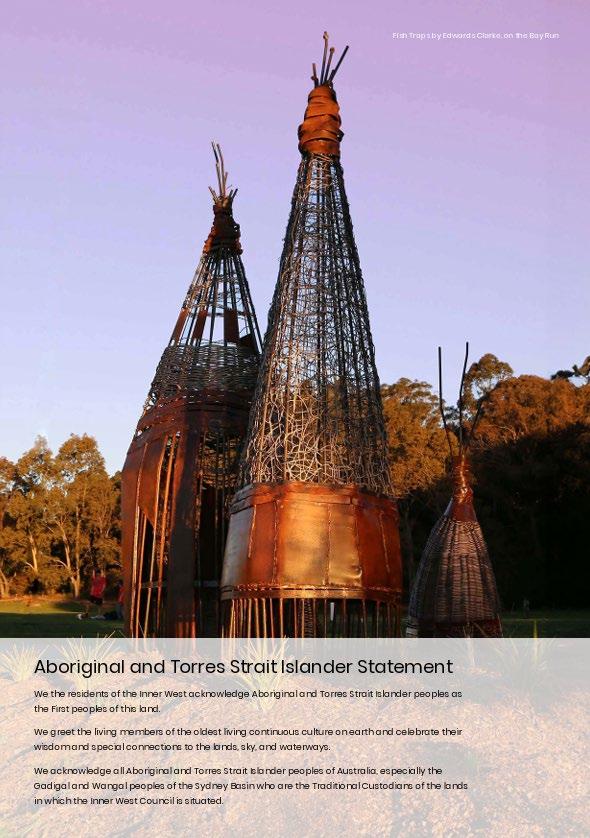
Aboriginal and Torres Strait Islander Statement
Executive Summary
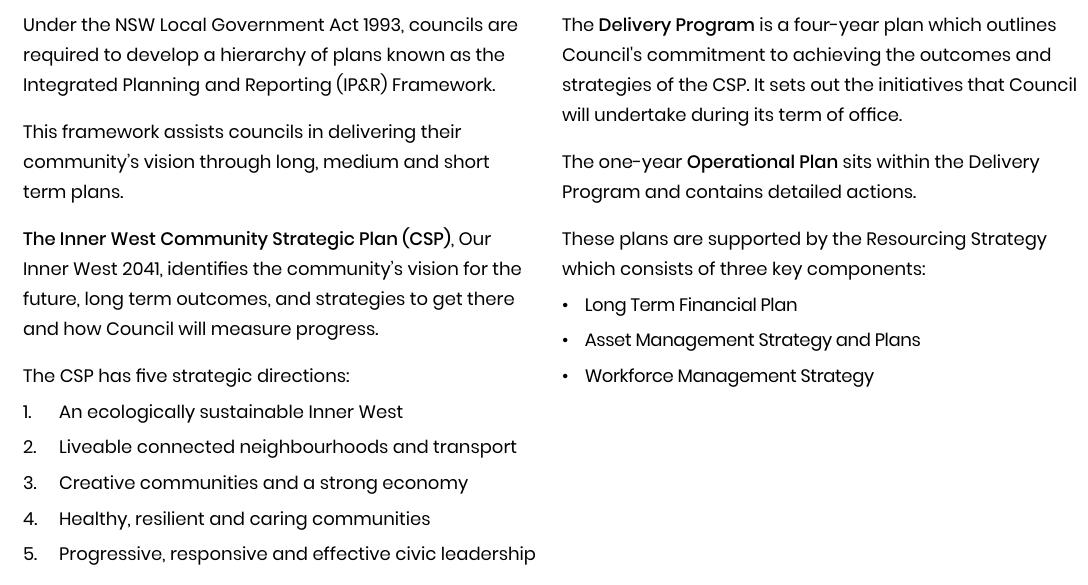
Council operates from a position of financial stability, using the IP&R Framework to drive long-term financial sustainability and ensure Council remains fit for the future
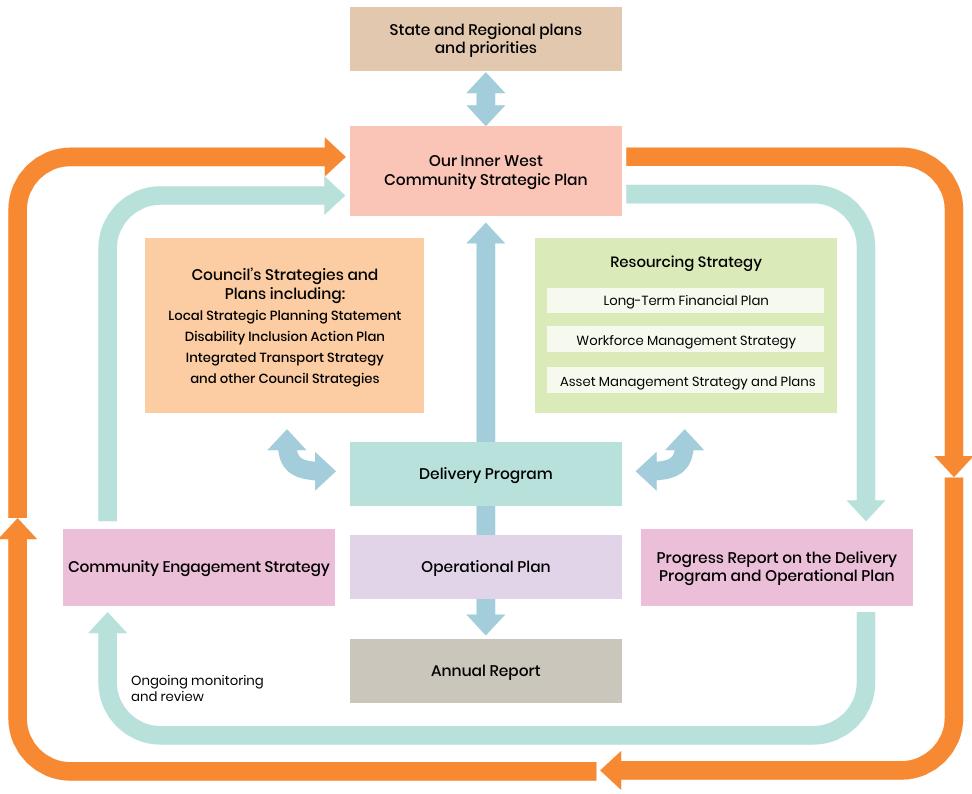
The Long Term Financial Plan (LTFP) is a ten-year rolling plan that informs Council's decision-making and shows how the Community Strategic Plan (CSP), and commitments in the Delivery Program and Operational Plan (DPOP) will be resourced and funded. The LTFP also provides the financial implications of Council's asset management and workforce planning by identifying how additional assets will be funded, existing assets renewed or upgraded, and changes to service levels accommodated.
The overall objective of this plan is to ensure that Council remains financially sustainable, while achieving the outcomes of its CSP. The integrated planning approach requires that Council understands its long-term financial position and best directs its resources to achieving these outcomes The LTFP uses a range of performance indicators to measure Council’s financial performance
This LTFP sets out two scenarios, each of these maintain current service levels and deliver modest budget surpluses. In summary:
Scenario 1 – Business as usual, maintain existing service levels.
• Council continues to operate and deliver its existing service levels to the community. The capital works program is maintained to ensure infrastructure is renewed or upgraded over the next 10 years. This scenario also ensures that Council is financially sustainable and there are funds available to deliver infrastructure and services to the community.
Scenario 2 – Addresses the infrastructure asset renewal backlog.
• Council continues to provide its services to the community as per Scenario 1, with an additional process to reduce the infrastructure backlog of $26.9m from the 2024/25 financial statements during this LTFP. The planned infrastructure spend spread over the 10-year timeframe to address this backlog would require using most of Council’s working funds, leaving us with insufficient financial capacity, and as such is not recommended.
Council is continually reviewing its efficiency and effectiveness and reinvesting efficiency gains back into the community. It is acknowledged there are challenges that will need to be monitored, particularly in capital works and asset management, and Council is working to meet these challenges and ensure that asset condition levels are improved.
Financial Planning Context
Working Capital
Working Capital represents money that Council is required by law to hold separately from Council’s General Fund and can only be spent for specified purposes.
Funds separated in Working Capital include:
• Developer contributions - raised under the Environmental Planning and Assessment Act 1979. These fund community infrastructure, consistent with the contributions plan that they were collected to fund. Council also holds Public Domain Contributions that developers contribute towards.
• Domestic Waste Management funds - raised under the Local Government Act 1993. These support waste collection, recycling and related activities. Funds are also used to replace garbage, recycling and green waste bin or truck fleets.
• Stormwater Management funds - raised under the Local Government Act 1993 Any funds not used in the year must be held and used on authorised stormwater management and related activities.
• Specific purpose grant funding from either the Commonwealth or State Governments - must be held and only used for the purpose that they were granted.
Other Funds that Council restricts for specific purposes include:
• Employee Leave Entitlements: Council sets aside cash to meet accrued employee annual and long service leave liabilities. Council’s Workforce Management Strategy identifies the need to cash back 49% of total leave liability to mitigate any financial risks surrounding employee leave entitlements.
• Plant, Technology and Vehicle replacement: Council has long-term models in place to forecast the timing of heavy plant, motor vehicle and information technology hardware replacement. Funds are allocated to ensure there is budget available for replacement.
• Funds that Council holds in trust, either on behalf of other parties or under a Trust arrangement: held separate to Council funds and are only spent in accordance with the terms of the trust arrangements.
• Loan funds: when required, Council raises loans to fund its capital program Unspent funds are held to ensure these works are completed. [Council currently funds all works from its unrestricted working capital. See next section: Loan borrowing ]
Other unrestricted working capital is held and allocated throughout Council’s LTFP to fund other operational and capital projects.
Loan borrowings
Council borrowed $40.0m to redevelop the Ashfield Aquatic Centre. This loan is held with NSW Treasury TCorp, an organisation that provides funding opportunities for Local Government and other State agencies. These borrowings are repaid from rate income raised over a 20-year period.
As at 30 June 2025, Council had principal outstanding on its loan borrowings of $30.7m Council’s Debt Service Cover ratio, which measures the availability of operating cash to service debt including interest and principal repayments, is forecast at 24.15 to 1 at the end of 2026/27. This is well above the recommended benchmark of 2 to 1.
When Council borrows funds for major capital projects, the funding is never used to fund operating projects.
Structure of this document
The LTFP is structured around two financial models. This is consistent with the IPR framework. These are:
• Scenario 1 is the base scenario that captures Council’s ‘Business as Usual’ approach and maintains existing service levels
• Scenario 2 models the elimination of the Asset Renewal Backlog.
The LTFP sets out the assumptions for the compilation of each scenario and the financial outcomes over the next ten years. It also lists the major opportunities and risks associated with each scenario, providing an analysis of the sensitivity of the modelling to a variety of changes.
The last section of the document contains high-level measures that Council’s long term financial performance will be measured against
Global Variables and Assumptions
Below is the list of variables and assumptions identified as drivers to predict Council’s revenue and expenditure forecasts over the 10 years of this plan These variables apply to each of the LTFP scenarios unless it is explicitly stated otherwise. All Consumer Price Index (CPI) references have an assumed rate of 0% per annum for expenditure and 3.6% per annum for income, unless stated otherwise.
Operating revenue drivers
The following tables summarise the revenue drivers on which the LTFP is modelled.
Operating
revenue area
General rates
Assumptions
Based on the following rate cap in future years:
• 4.4% 2026/27
• 4.5% 2027/28
• 4.0% 2028/29 & 2029/30
• 3.5% 2030/31
• 3.0% 2031/32
• 2.5% 2032/33 and onwards
Voluntary pensioner rebates Council offers voluntary pensioner rebates to eligible aged pensioners.
This rebate covers the domestic waste and stormwater charges for resident owners of ten years or greater.
Pensioner Rate Subsidy
Domestic Waste Management Charge (DWMC) and related User Charges
The State Government sets the Pensioner Rate Subsidy at a maximum of $250 per property per annum. This is a flat subsidy and does not increase annually.
The DWMC is modelled over the life of the Plan to cover service provision costs. Councils are prohibited under the Local Government Act from subsidising or receiving a profit from the Domestic Waste Management charge. Since 2018/19 Council has reviewed and applied the methodology of applying corporate overheads to the domestic waste services. The budget has been prepared on the basis of maintaining the Domestic Waste Management Charge in future years to allow capacity to cover any reactive cost increases.
Stormwater Management Service Charge
This is a flat charge used to fund stormwater planning and infrastructure. The charge as set under the Local Government Act and associated Regulations are:
• $25.00 per residential property per annum
• $12.50 per strata unit per annum
• $25.00 per 350m2 per business property per annum
Fees Council generally increases the fees for the services it provides to at least cover annual general movements in costs.
Statutory fees have been increased consistent with the advice from statutory bodies. Discretionary fees have been increased by the CPI. The LTFP assumes the following CPI increases:
• 3.6% 2026/27
• 3.5% 2027/28 to 2029/30
• 3.0% 2030/31
• 2.5% 2031/32 and onwards
Interest on investment
Interest on overdue rates
The interest Council receives on its investments has been modelled and is reviewed annually. The model is linked to the projected level of reserves and forecast interest rates. As cash is expected to diminish over time as Council completes its suite of major projects, a modest and sustainable level of interest income currently supports ongoing operations.
In accordance with section 566(3) of the Act, it has been determined that the maximum rate of interest payable on overdue rates and charges for the period 1 July 2026 to 30 June 2027 (inclusive) is 9.5% per annum as advised by the Office of Local Government.
Other revenues
Rental/lease income
Fines
This includes ex gratia rates payments, income from street furniture and credit card fees (until 30 September 2026, when they are no longer allowed to be charged). It is assumed that these revenue sources will not increase and are indexed according to commercial agreements
It is assumed that rental/lease income will increase at least by CPI, in line with provisions of current leases.
The State Government determines the dollar value of individual fines. The volume of fines is a product of the compliance levels and the level of enforcement activity. It is assumed that total income received from fines are flat.
Operating grants –general
Financial Assistance Grants (FAG)
It is assumed that total income from grants will be flat over the 10-year program and dependant on the initiatives provided by State and Federal Government.
It is assumed that total income from grants will be flat. The FAG is based on the relative growth of the Inner West LGA in comparison to the growth of Western Sydney. This projection is consistent with the methodology NSW Grants Commission uses to determine the annual Financial Assistance Grant distribution.
Transport for NSW block grant
Street lighting subsidy
Library subsidy
Disposal of property
This is a State Government grant with no increase across the 10 years.
This is a State Government subsidy and it is assumed it will be flat.
The State Library of NSW sets and administers this subsidy under the Library Regulation It is assumed that this will be flat
The scenarios assumes that Council will not receive any income from property sales during the 10-year lifetime of the LTFP. Any proceeds from sales including profits would be transferred to Council’s unrestricted working capital
Disposal of plant
The scenarios assumes that plant will be sold at its written down cost during the 10 years of the LTFP Proceeds from sales, including profits, are transferred to Council’s Plant Replacement restricted working capital.
Operating revenue sensitivity analysis
Operating revenue assumptions are sensitive to a variety of risks and opportunities, including the following:
• Future rate increases are based on the Local Government Price Movements that the Independent Pricing and Regulatory Tribunal (IPART) allows. Historically, rate increases have not kept pace with increasing costs. From 2024/25, IPART simplified their modelling by measuring the annual change in NSW councils’ base costs for three groups of councils which are metropolitan, regional and rural councils. The new model considers:
o Employee costs measured by the Local Government Award
o Asset costs measured by the Reserve Bank of Australia (RBA) forecast change in the CPI adjusted to reflect the average difference between changes in the Producer Price Index and changes in the CPI.
o All other operating costs measured by the RBA’s forecast change in the CPI.
o Included is a separate Emergency Services Levy factor which is lagged by one year that reflects the annual change in each council’s Emergency Service Levy contribution.
o A population factor to measure the change in a Council’s residential population.
• Rate increases only provide for the continuation of existing service levels. The Inner West community’s changing demographics suggests there may be demand for new or increased levels of services. These are not funded with ordinary IPART rate increases, which are based on movements in costs only.
• The plan takes into account rate increases due to increases in the number of dwellings as part of the State Government housing reforms that will be introduced over the next five financial years.
• The Pensioner Rate Subsidy is set at a maximum of $250 per property and has not increased since 1993. This creates a greater burden on pensioners.
• The State Government determines the level for individual traffic/parking offence fines.
• The Stormwater Management Charge is fixed and has not risen since its introduction in 2006/07
• Interest rates have been highly volatile over the past 12 months and are starting to increase It is forecast that interest rates will increase for two years before reducing over the next few years to be flat and decline as inflation reduces over the next financial year.
• Hoarding fees and other Development Assessment income is dependent on the level of development activity in the Inner West LGA. Although stabilised in the past 12 months, the expectations are that this will grow if greater building density occurs in the LGA through the proposed State Government housing reforms.
Capital revenue drivers
The following tables summarise the capital revenue assumptions on which the base scenario has been modelled.
Assumptions
Roads to Recovery grant This is a Federal Government grant, that Council uses to fund its roads improvement program. It is assumed this will be flat.
Developer contributions Council reviews the developer contributions funding each year. The funding is linked to the projected level of development. All funds are held in a restricted working capital fund for release to finance projects included in Council’s plan as a response to increased population growth in the LGA.
Capital revenue sensitivity analysis
Capital revenue assumptions will be sensitive to a variety of risks and opportunities, including the following:
• The Roads to Recovery grant program was introduced in 2013/14 and in 2019/20 it was extended until 2025/26 In May 2024, this grant was extended again until June 2029 with an increased level of funding for the next five years. The assumption is that the grant will continue throughout the 10 years of this LTFP.
• Council does receive capital grants other than for Roads to Recovery. However, these grants are tied to specific projects and are non-recurrent. As the receipt of other capital grants is difficult to predict, they are not included in the model.
Operational expenditure drivers
The following table summarises the operating expenditure assumptions on which the scenarios have been modelled.
Operational expenditure area Assumptions
Salaries and wages Salary and wages increase has been projected based on the estimated State Award. The award is currently being renegotiated for the coming 3 years. Estimated increases are:
• 4.0% from 2026/27 to 2028/29
• 3.5% in 2029/30
• 3.0% in 2030/31
• 2.5% from 2031/32 and onwards
Superannuation
This LTFP includes Superannuation at 12.0% in line with the Superannuation Guarantee Contributions. This remains flat for the 10 year projections.
It is assumed that superannuation costs for members of the Defined Benefits Schemes will be paid in accordance with the current advice from the Trustees of the Scheme. Council has developed a model to predict its ongoing contributions toward the Defined Benefits Schemes.
Workers Compensation Council’s Workers Compensation premium was set at $6.8m for 2025/26 and it is assumed it will increase to $7.5m in 2026/27. The future years increase is as follows:
• 5% 2027/28
• 3.0% 2028/29 and onwards
Training
Maternity leave
Long Service Leave
It is assumed that expenditure on training will be flat
It is assumed that expenditure on parental leave will be $437,000 in 2026/27 and will increase by Award increases.
Expenditure on Long Service Leave has been modelled and will increase by Award increases. The model is reviewed annually.
Operational expenditure area Assumptions
Materials and services
Disposal costs
Oil and fuel
Street lighting
Electricity
Gas
Water
Telephone and mobile phone
Depreciation
Other expenses
State Government Levies
Components of materials and contracts expenditure are reviewed individually. The budget includes cost estimates for the actual expected expenditure.
The cost of waste disposal has been modelled and is reviewed annually.
It is assumed that oil and fuel costs will have a CPI increase annually over 10 years.
It is assumed that electricity costs will increase 4.0% per annum for future years.
It is assumed that there will be a 4.0 % per annum increase in electricity costs in future years.
It is assumed that there will be a 4.0% per annum increase in gas costs in future years.
It is assumed that there will be a 4.0% per annum increase for water costs in future years.
It is assumed that fixed and mobile phone and data costs will have a CPI increase per annum over 10 years.
Depreciation has been modelled in accordance with Council’s Asset Management Plans. Refer to Page 6 of the Asset Management Policy and Strategy.
This includes contributions to organisations and doubtful debts. It is assumed that these expenses will have CPI increases.
Council’s annual contribution to the Emergency Services Levy (ESL) is based on the Council contribution assessment notice received from Revenue NSW On 30 April 2026 the notice for 2026/27 included an increase of 8.3% over the previous year The remaining State Government charges levied to councils contribute to a range of services and it is assumed that there will be a CPI increase to these levies.
Operational expenditure area Assumptions
Insurance It is assumed that insurance costs will increase as follows:
• 3.5% 2025/26 to 2029/30
• 3.0% 2030/31
• 2.5% 2031/32 and onwards
Operating expenditure sensitivity analysis
Operating expenditure assumptions will be sensitive to a variety of risks and opportunities, including the following:
• The current industrial award is currently being negotiated for the next 3 years, and will be agreed prior to 1 July 2026. In 2026/27 the award is estimated to be 4.0%
• The Federal government legislated for an increase to the Superannuation Guarantee Charge (SGC) to 12.0% in 2025/26 and the assumption is this remains flat for the next 10 years. Natural disasters and other unforeseeable events may impact increases to insurance premium levels.
Capital expenditure drivers
The following table summarises the operating expenditure assumptions on which the scenarios have been modelled.
Capital expenditure area Assumptions
Information and Communication
Technology – Hardware / Software Program
Council currently leases the majority of its Information Technology Hardware over a 4-year lease term. Software costs associated with hardware upgrades are forecast and included in the in the Operating Budget of the relevant year
The LTFP provides for the full cost of replacement of existing hardware and software. The budget includes both the hardware and software replacement program. This program replaces assets at the end of their useful life. It also takes into account the consolidation of three existing data centres into one and the consolidation of maintenance agreements and software licences. Maintenance costs are considered as part of the evaluation process and included in the operational budget where required for both software and hardware.
Local Roads and Lanes Program Council’s investment in its Local Roads network has been set at $8.6M in 2026/27. These are funded by FAGs, historical Special Rate Variation (SRV), Roads to Recovery and general funds. Funding levels are kept at levels to ensure Council exceeds its Renewal Ratio every year for its infrastructure portfolio throughout the LTFP
Regional Roads Program Council owns the Regional Road network. TfNSW subsidises upkeep through grants. Council matches funding under the Regional Roads program using unrestricted working capital or other available funding sources.
A total of $1.4m is anticipated to be spent on Regional Road capital works throughout the 2026/27 financial year. Council maintains funding levels to consistently exceed its Renewal Ratio each year for its infrastructure portfolio throughout the LTFP
Capital
Footpath Program Council’s investment in its Footpath Renewal and Upgrade Program has been set at $3.5m in 2026/27 funded by historical SRV and unrestricted working capital Council maintains funding levels to consistently exceed its Renewal Ratio each year for its infrastructure portfolio throughout the LTFP.
Bike Facilities Program
Traffic Amenities Program
Stormwater upgrade and renewal Program
Unrestricted working capital and developer contributions are allocated to improve bike facilities to match capital grant funding from the NSW or Federal governments or to fund direct works.
The traffic amenities program is funded from Developer Contributions, historical SRV, government grant funds or other working capital to improve traffic amenities. The traffic amenities program included in the budget is $4.1m (this includes $1.5m of PAMP) This program may continue to reduce as the developer contributions reduces nexus on traffic amenities from where the majority of these works are funded.
Council has a program of catchment studies across the various sub-catchments within its boundaries. These are funded from the Stormwater Charge.
Drainage capital works are funded from historical SRV funds and unrestricted working capital. Additional capital works are funded from the Stormwater Charge as detailed in the Stormwater Plan.
The total budget is $3.6m.
Parks Improvement Program
Park improvements are primarily funded from Developer Contributions, historical SRV and Federal or State Government grants. Council’s Parks Improvement Program is approximately $28.8m in 2026/27.
The Capital Program also incorporates expenditure on Council’s ‘Major Projects’ as follows:
Project Funding available in 2026/27
Leichhardt Park Aquatic Centre Major Project
Leichhardt Oval
Callan Park All Weather Sporting Field
Inclusive Playgrounds
Marrickville Town Hall
Aboriginal Community Hub Camperdown
Camperdown Park Sporting Ground
Cooks River Lighting
Mort Bay Park & Playground Stage 2
Steel Park Amenities
Capital expenditure sensitivity analysis
$32.0 million
$30.0 million
$7.9 million
$2.9 million
$2.3 million
$1.8 million
$1.8 million
$1.5 million
$1.5 million
$1.4 million
Capital expenditure assumptions are sensitive to a variety of risks and opportunities, including the following:
• Council has prepared Asset Management Plans for each of the four infrastructure asset groups. As data is updated on the condition of these assets it is likely that further investment will be required to ensure roads, footpaths, drainage, bike networks, parks facilities, buildings and the like continue to be available for both the current and future generations living in the Inner West
• Increasing investments to promote accessibility will also be required as the Inner West population ages. This will be planned to ensure an accessibility continuum between local roads, streetscapes and footpaths and transport infrastructure that the State Government manages including trains, buses and light rail.
Non-financial assumptions
The Inner West Council’s CSP provides an overview of the major issues impacting upon the local community. The data and analysis used to arrive at those issues also inform the preparation of this LTFP.
Scenarios
Context
It is evident that while Council’s immediate and long-term financial position enables the delivery of existing services at their current levels, given current costs, an uncertain economic environment and the changing nature of the Inner West community, Council should anticipate new or expanded demands for services and for associated funding.
The State Government caps Council’s major income source (rates) and they have grown at a slower pace than salaries, State Government levies and other costs. As a result, Council has undertaken the Financially Sustainable Service Delivery program that identified savings that could be realised without impacting delivery of key services Council has committed to a continuous improvement program to maintain financial sustainability throughout the life of this plan.
Scenario 1 outlines the method of delivering business as usual and Scenario 2 outlines the method for dealing with the infrastructure renewal backlog. These scenarios are illustrative only. As and when the need develops to fund major infrastructure, provide new or expanded services or invest more in infrastructure maintenance, Council will engage with the Inner West community and further develop these options.
Scenario 1: business as usual
Overview
Scenario 1 is predicated on:
• Continuation of existing services at current service levels
• Continuation of existing levels of investment in infrastructure renewal
• Continuation of existing income sources
• Delivery of major projects as set out in the 2026/27 budget
Financial projections
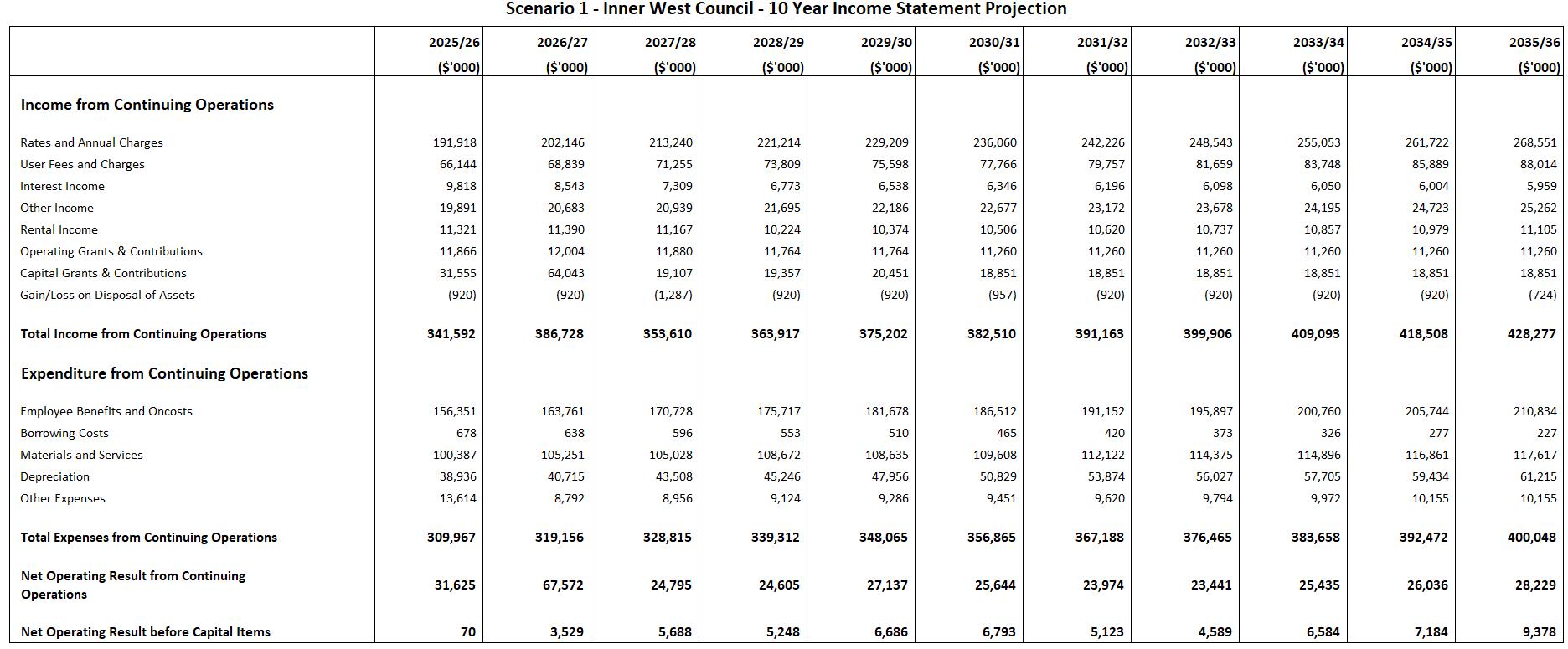
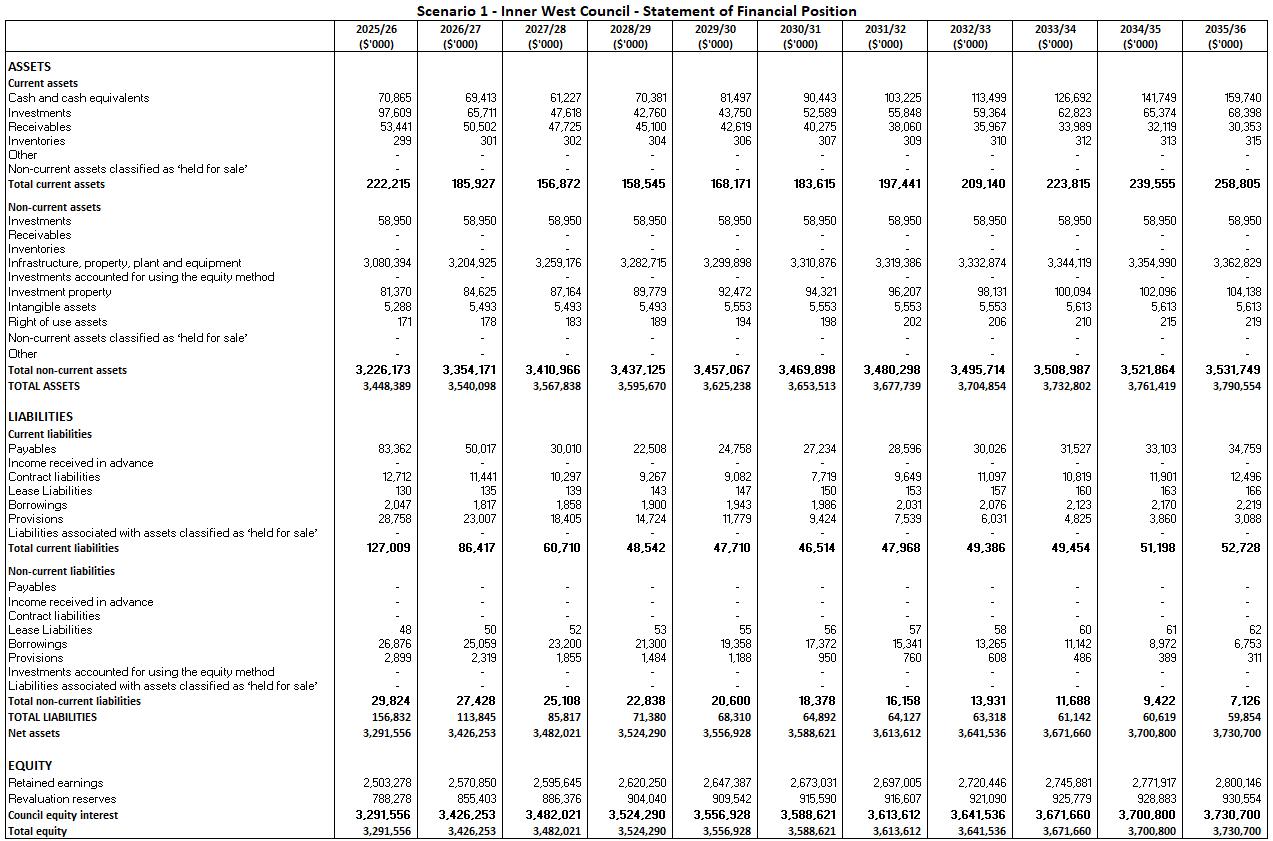
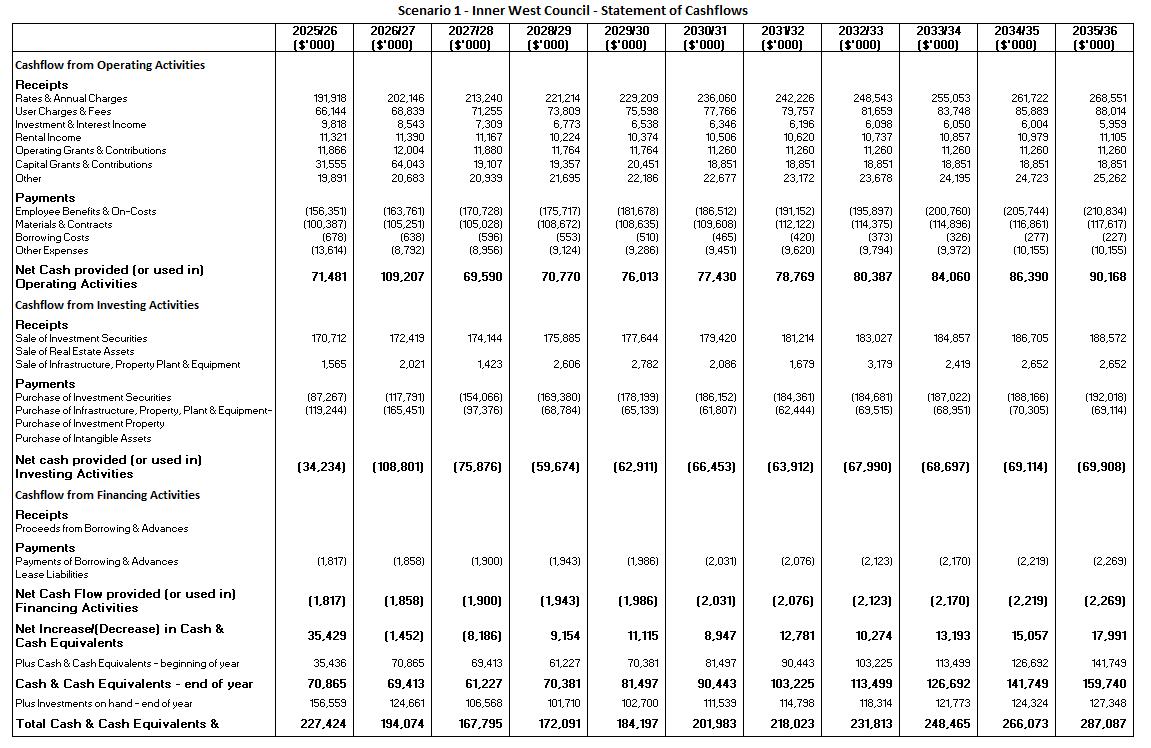
The following tables outline the financial impact of Scenario 1: Business as usual over the next 10 years (using external reporting categories)
Scenario 2: Asset management infrastructure renewal backlog
Overview
Scenario 2 aims to demonstrate the effects of funding the infrastructure backlog to meet the needs of the community and is predicated on:
• Assumptions as per Scenario 1, but with
• An expanded capital renewal program to reduced infrastructure backlog within the time horizon of this LTFP.
Assumptions
The annual budget includes provisions for operations, maintenance, renewal and new expenditure on infrastructure. When renewal funding is inadequate, any unfunded renewal demand is deferred, which generates a backlog. Council’s Asset Management Strategy states that the asset renewal funding ratio is to be a minimum of 110% until the renewal backlog has been addressed.
Council identified an infrastructure renewal backlog in the 2024/25 financial reports. The renewal backlog was estimated at approximately $26.9m across its asset portfolio. To address this backlog would require using most of Council’s working funds, leaving us with insufficient financial capacity, and as such is not recommended.
Sensitivity analysis
The assumptions on which Scenario 2 are predicated will be sensitive to a variety of risks and opportunities, including the following:
• Community engagement will provide a critical input to the service levels that the community expects.
• The additional renewal works will be based on the condition ratings of the assets.
Financial projections
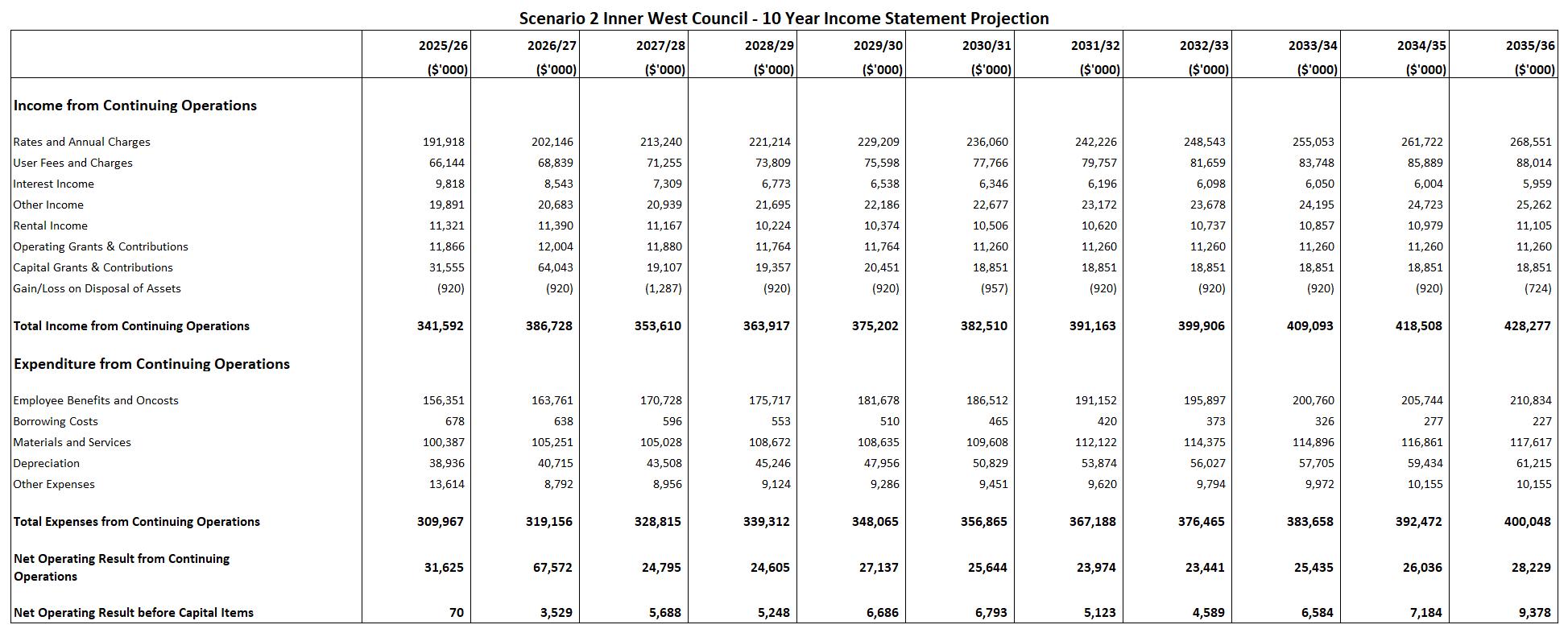
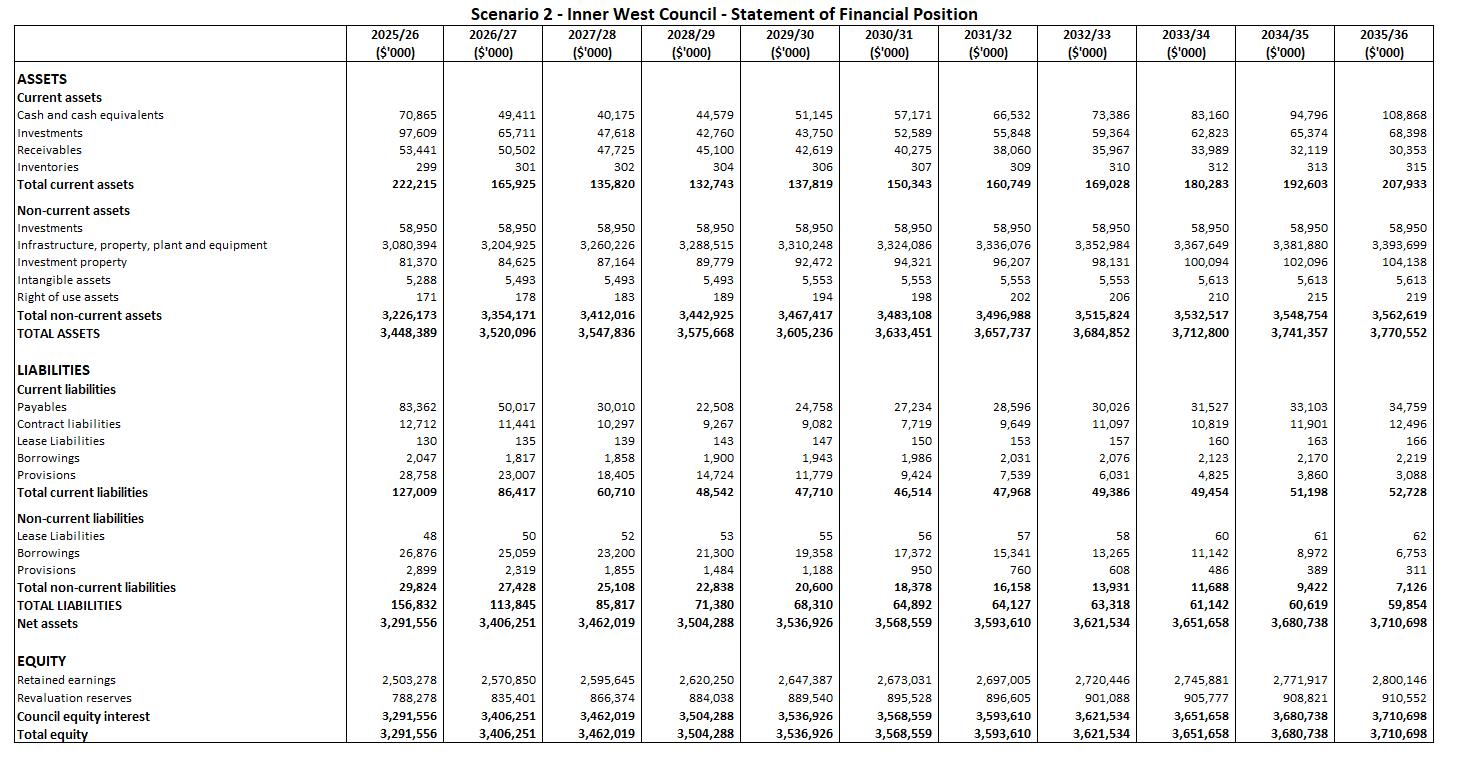
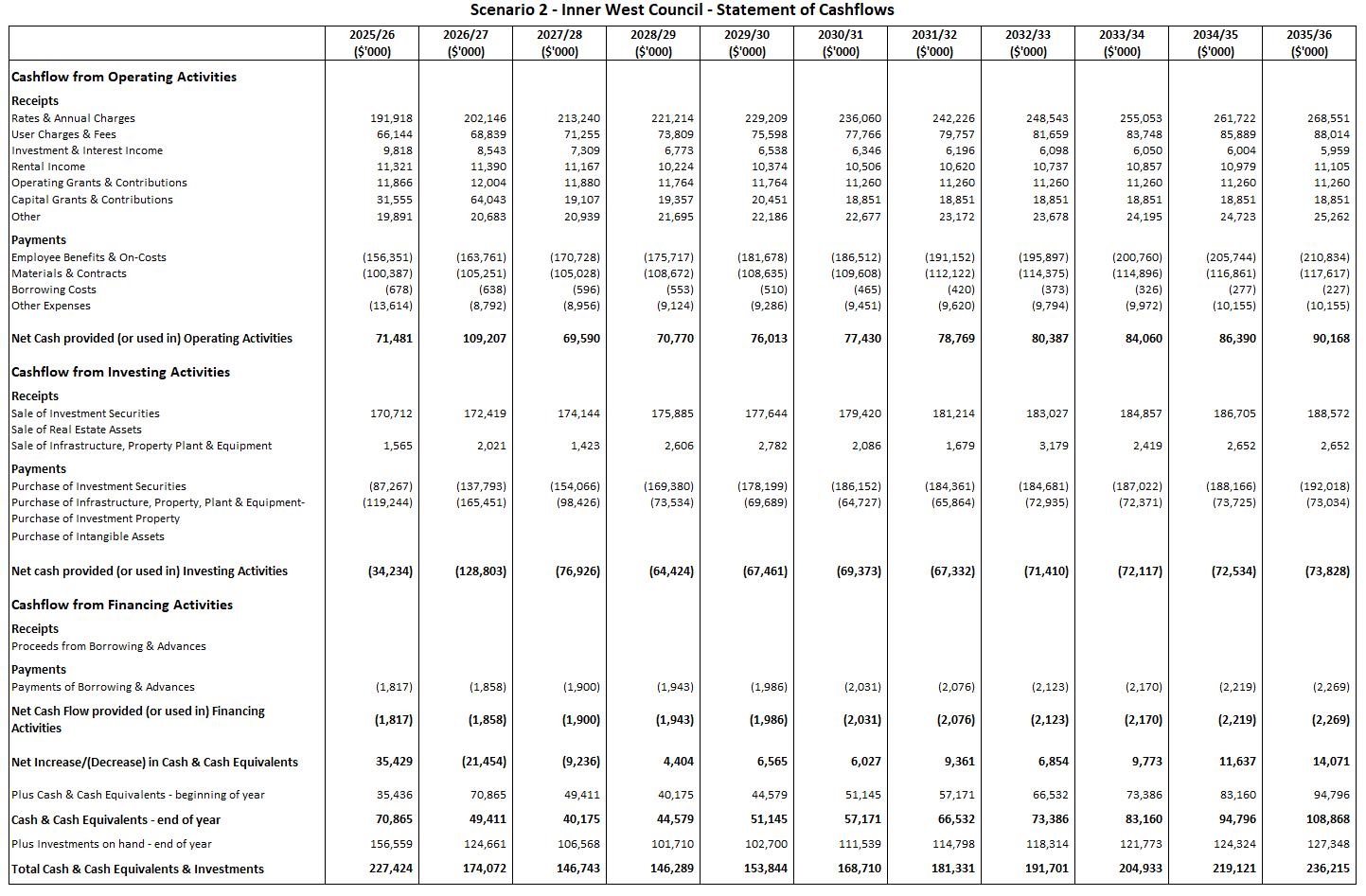
The following tables outline the financial impact of the Scenario 2: Reduce the infrastructure backlog over the next 10 years by external reporting category.
Performance Monitoring
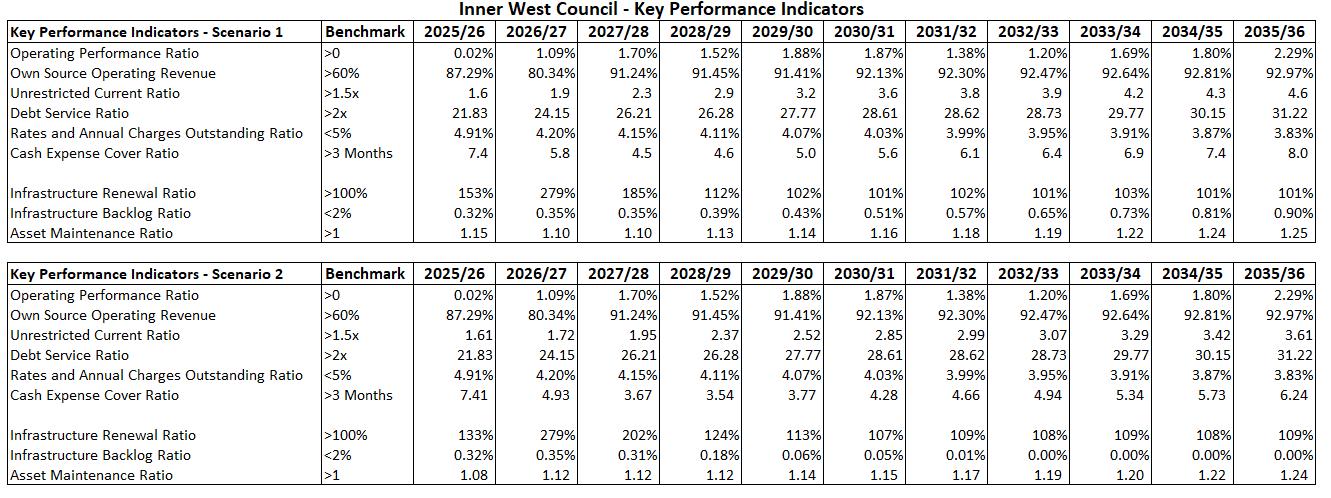
Inner West Council uses the following indicators to measure its financial performance. These measures are linked to those used in Council’s published financial statements and to the indicators previously used by the NSW Office of Local Government in its annual publication of comparative information on councils in NSW. This means that the measures and the Council’s progress against them, are both transparent and comparable. A table of the projected rates is provided at the end of this section.
Operating performance ratio
This ratio measures a Council’s achievement of containing operating expenditure within operating revenue. It is important to distinguish this ratio as focused on operating performance. This means that capital grants and contributions, fair value adjustments and reversal or revaluation decrements are excluded.
Own source operating revenue
This ratio measures financial flexibility, and it is the degree of reliance on external funding sources such as operating grants and contributions. The higher the level of its own sourced revenue, the greater the financial flexibility.
Unrestricted current ratio
The Unrestricted Current Ratio is specific to local government and is designed to represent a Council’s ability to meet short term obligations as they fall due. Restrictions placed on various funding sources (e.g. Developer Contributions, TfNSW contributions) complicate the traditional current ratio used to assess liquidity of businesses. This is because cash allocated to specific projects is restricted and cannot be used to meet a Council’s other operating and borrowing costs.
Debt services cover ratio
This ratio measures the availability of operating cash to service debt including interest, principal and lease payments.
Rates and annual charges outstanding
This ratio assesses the impact of uncollected rates and annual charges on liquidity and the adequacy of recovery efforts.
Cash expense cover ratio
This liquidity ratio indicates the number of months a Council can continue paying for its immediate expenses without additional cash inflow.
Building and infrastructure ratio
This ratio is to assess the rate at which these assets are being renewed against the rate at which they are depreciating.
Infrastructure backlog ratio
This ratio shows what proportion the backlog is against the total value of a Council’s infrastructure.
Asset maintenance ratio
This ratio compares actual maintenance costs versus the required annual asset maintenance. A ratio of above 1.0 indicates that the Council is investing enough funds within the year to stop the Infrastructure Backlog from growing.
Capital expenditure ratio
This indicates the extent to which a Council is forecasting to expand its asset base with capital expenditure spent on both new assets, and also the replacement and renewal of existing assets
Review of Long-Term Financial Plan
A final, qualitative performance measure is the regular review of this plan. Inner West Council takes a continuous improvement approach to this plan. It is expected that the document is progressively refined, as Council’s knowledge regarding the various assumptions increases and as Council and the community considers and discusses the various scenarios.
Council undertakes annual reviews of this plan including each of the scenarios.
Document Resourcing Strategy - Long Term Financial Plan 2026-2036
Custodian Chief Financial Officer Version # Version 3
Adopted By 16 June 2026 ECM Document # 40789531
Next Review Date June 2027
Community Languages
Talk free with an interpreter call 131 450
Chinese Simplified
Traditional Chinese
Italian
Vietnamese
Parliamo la vostra lingua. Per parlare gratuitamente con un interprete chiamate il numero 131 450. Chiedetegli di chiamare il Comune di Inner West al numero 02 9392 5000.
Chúng tôi nói ngôn ngữ của quý vị. Muốn nói chuyện có thông dịch viên miễn phí, hãy gọi số 131 450. Yêu cầu họ gọi cho Hội đồng Thành phố Inner West qua số 02 9392 5000.