RIPARIAN
THE RIVERS SCHOOL | SPRING 2026
NURTURING THE HUMAN IN EXCELLENCE WITH HUMANITY
SUPPORT SERVICES
FOSTER STUDENT
WELLNESS AT RIVERS
ALUMNI IN WELLNESS
PROFESSIONS
THE RIVERS SCHOOL | SPRING 2026
SUPPORT SERVICES
FOSTER STUDENT
WELLNESS AT RIVERS
ALUMNI IN WELLNESS
PROFESSIONS
42 ALUMNI IN WELLNESS PROFESSIONS
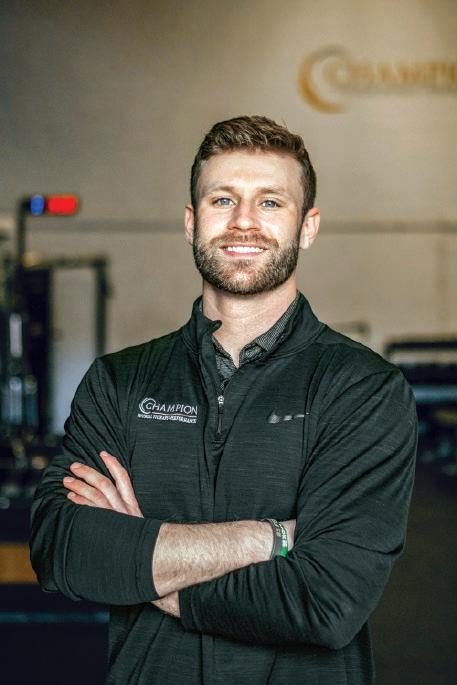
Alums such as physical therapist Brendan Gates ’14 are making a difference in wellness-related fields.
32
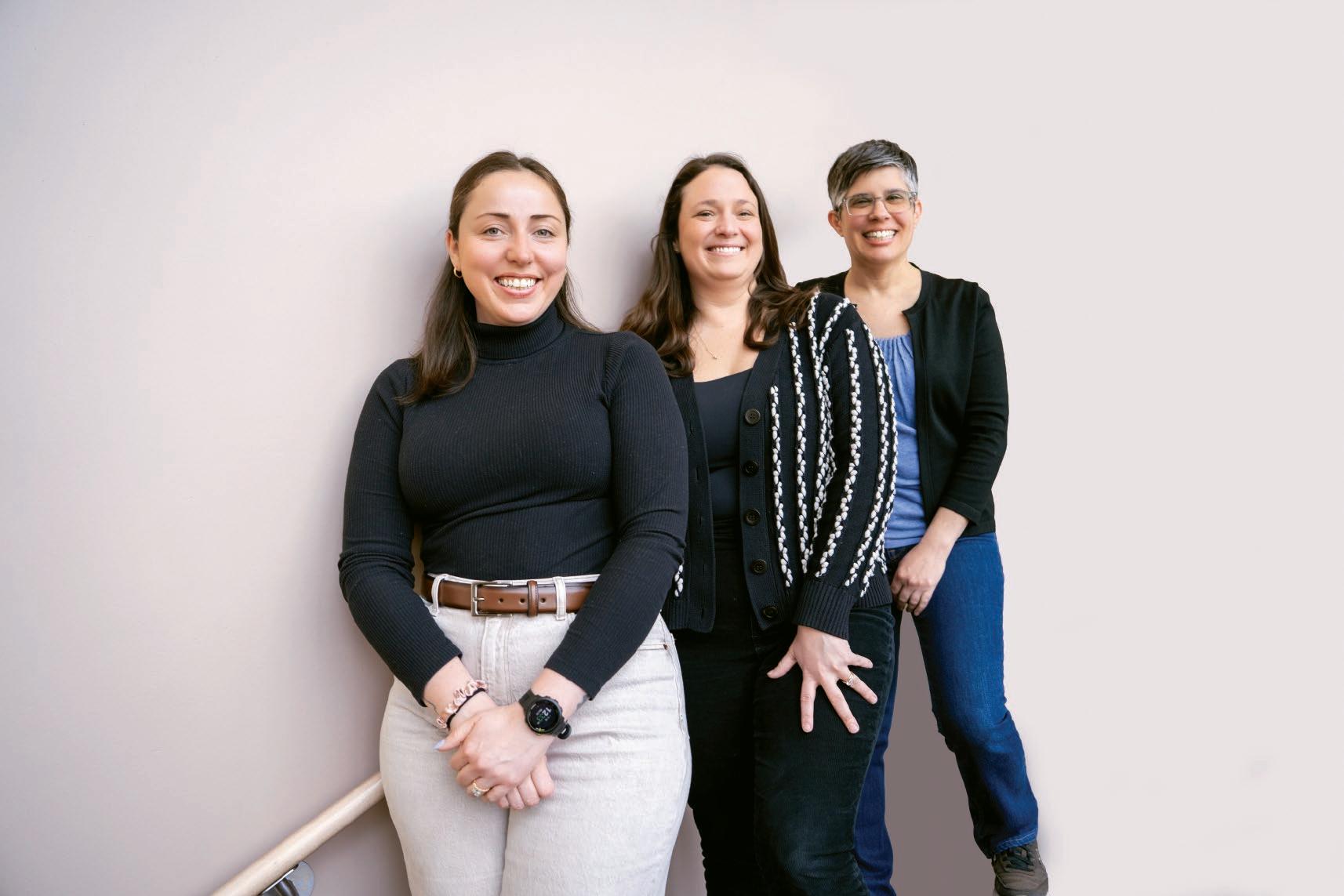
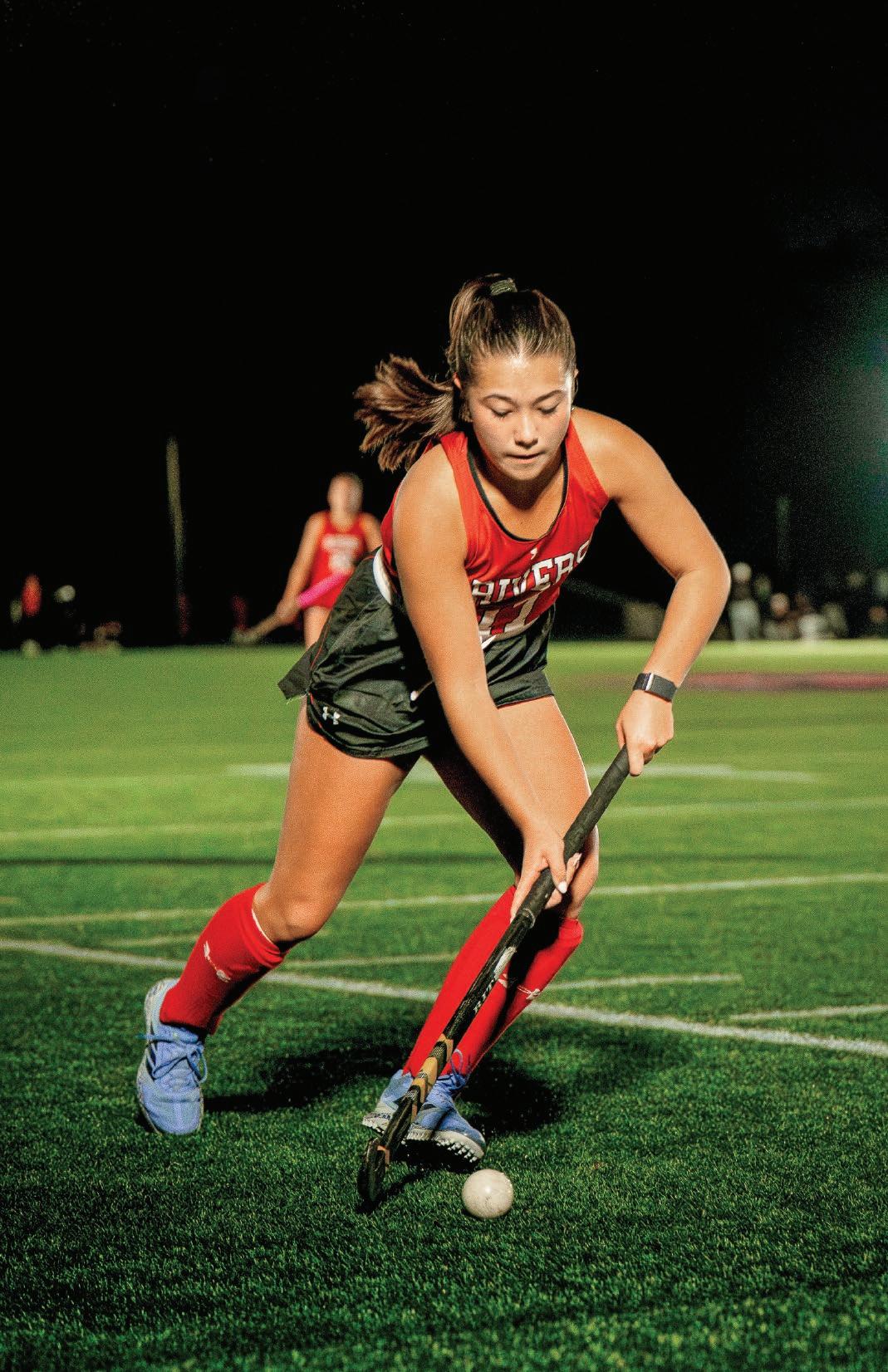
The Rivers counseling and wellness team supports students directly and indirectly though their work.
AT RIVERS, WE ARE defined by a unique dual commitment: We hold high expectations for our students to reach their fullest potential, and we foster caring relationships with them to support their growth. We call this Excellence with Humanity. Yet, in an era where the pace of life feels faster than ever and the bar for success keeps rising, we must continually ask ourselves: How do we safeguard the “human” within our students as we challenge them to strive for excellence?
Our new strategic plan provides an answer. As we expand on our foundation of academic excellence, one of our central goals is to “cultivate an ecosystem of connection, well-being, and belonging.” This is a proactive, holistic approach to how our students live, learn, and grow amidst the pressures of today. The work is guided by our expanded set of core values—integrity, perseverance, empathy, curiosity, and joy. These values reflect the fullness of human development and are traits we aspire to instill in our students to guide them long after they graduate. As I am fond of saying, it is important for our students to leave here with eyes wide open, full of curiosity, and whole as they receive their diplomas and embark on the next chapter of their lives.
This issue of the Riparian takes a deep dive into student wellness at Rivers. Our support systems have evolved significantly to meet the needs of today’s young people as they balance a variety of competing priorities. You will read about the vital work of our robust counseling and wellness team, from proactive education to responsive mental and physical health support, and the expertise of our expanded learning services team, which provides support with study skills, time management, and tutoring. And with guidance from our technology and wellness task force, our community is engaging with technology thoughtfully and mindfully as we all navigate an increasingly complex technological world.
Another highlight of our work on campus this year, and one that ties directly to student wellness, is our comprehensive schedule redesign. Utilizing a design thinking process, we’ve centered the student experience at every stage of the work, beginning with “empathy research” where members of our design team shadowed students for entire school days to experience the cadence of students’ lives firsthand. This immersion unearthed vital insights into the daily balance of academics, arts, athletics, and extracurriculars, and we look forward to launching a new schedule this fall that reflects those lessons.
The enduring impact of a Rivers education is perhaps best seen in the lives of our alumni, who carry this commitment to humanity into their professional callings. In our second feature story, you will hear from six Rivers graduates dedicating their careers to the well-being of others. They include a pediatric dentist, a physical therapist, an athletic trainer, two psychotherapists, and a nurse who stepped up in a moment of crisis. These alumni, inspired by their own Rivers experience, embody what it means to live a life of impact and purpose.
I am deeply grateful to our professional community, students, families, and alumni for partnering with us in this essential work. Together, we are ensuring that at Rivers, “excellence” and “humanity” always go hand in hand.
With gratitude,
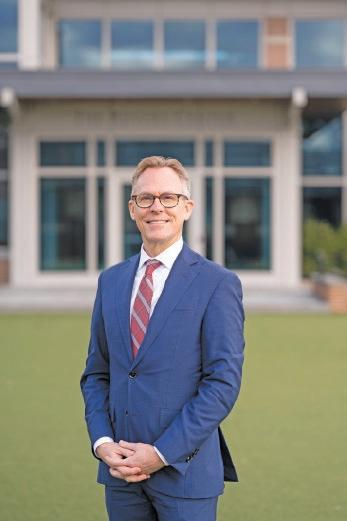
Ryan S. Dahlem Head of School
VOLUME XL, NUMBER 2
HEAD OF SCHOOL
Ryan S. Dahlem
MANAGING EDITOR
Alexandra Ghiz
ASSISTANT EDITOR
Grace Ramsdell
DIRECTOR OF MARKETING AND COMMUNICATIONS
Colette Porter
DIRECTOR OF FAMILY AND ALUMNI ENGAGEMENT
Janet McKeeney
CONTRIBUTING WRITERS
Allison Ashby, Alexandra Ghiz, Emily Lobono, Shea MacLaughlan ’27, Colette Porter, Erin Prichett, Grace Ramsdell
CONTRIBUTING PHOTOGRAPHERS
Kristie Rae Dean, Evelyn Dow, John Hurley, Emily Lobono, Maddie Malhotra, Grace Ramsdell
CREATIVE DIRECTOR
Ianka De La Rosa
The Rivers School 333 Winter Street Weston, MA 02493-1040 781.235.9300 www.rivers.org
RIPARIAN: “One that lives or has property on the bank of a river or lake.”
If your contact or mailing information has changed or if you need additional copies mailed to you or other members of your family, please let us know at advancement@rivers.org.
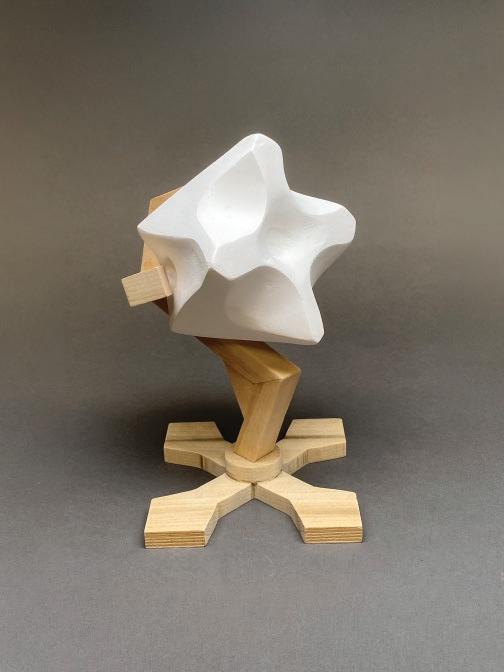
BY ALEX YANG ’28
“ When making my sculpture, I tried to pair a smooth, geometric plaster form with a natural, angular wooden base. From afar, the plaster appears precise and mathematically clean, but up close its divots, uneven planes, and deliberate asymmetry become visible. These surface variations contrast with the base’s stable structure, which I left unstained to highlight its rawness and the honesty of its material. Together, the two elements explore the tension between perceived perfection and the imperfect realities beneath it.”
This winter, the Scholastic Art & Writing Awards of Massachusetts honored “Polyhedral Docking” with a gold key award. Read more on page 20.
Exciting plans are in the works for fall! Homecoming 2026 will also be a reunion weekend for all Rivers alumni, with highlights for classes with graduation years ending in 1 or 6. On Friday, October 30, join us for an evening of connection, the Alumni Awards Ceremony, and dinner. Saturday, October 31, will be a day of fun for the whole family, featuring athletic competitions and Halloween-themed festivities.
Mark your calendars now!
More details will be shared in early summer.
VETERANS DAY 2025
RIVERS’ LONGSTANDING tradition of paying tribute to veterans with special programming on Veterans Day continued this November with an all-school assembly and service project.
The assembly began with a slideshow honoring members of the extended Rivers community who have served in the military, and Head of School Ryan S. Dahlem acknowledged that the connection to veterans and a life of service is a personal one for him and for many members of the community.
The assembly featured Capt. Jake Stenquist ’15 in conversation with Jim Long P’19, ’21, special assistant
to the head of school and Grade 8 dean, discussing Stenquist’s journey from Rivers to the Marine Corps. The talk was presented in a prerecorded segment due to the time difference between Rivers and Iwakuni, Japan, where Stenquist is on active duty, flying F-35 planes approximately twice a week.
Stenquist expressed gratitude for his parents, Lloyd and Dana Stenquist P’06, ’08, ’15, who were in attendance at the assembly. He credits them with giving him the opportunity to attend Rivers and instilling in him and his siblings the motivation to give back. “Our parents worked incredibly hard to give us opportunities and push us
along … to put us in a better position than they grew up in,” he said.
To conclude the assembly, Maya Kloman ’28 and Louie Particelli ’30 played taps. Later, over 100 members of the Rivers community contributed to a Veterans Day service project in Haffenreffer Gym, writing notes and assembling 450 care packages for homeless veterans in partnership with the nonprofit Provision Ministry. Between the special assembly and volunteer project, the theme of service—and honoring the service of others—was clear on campus this Veterans Day. R
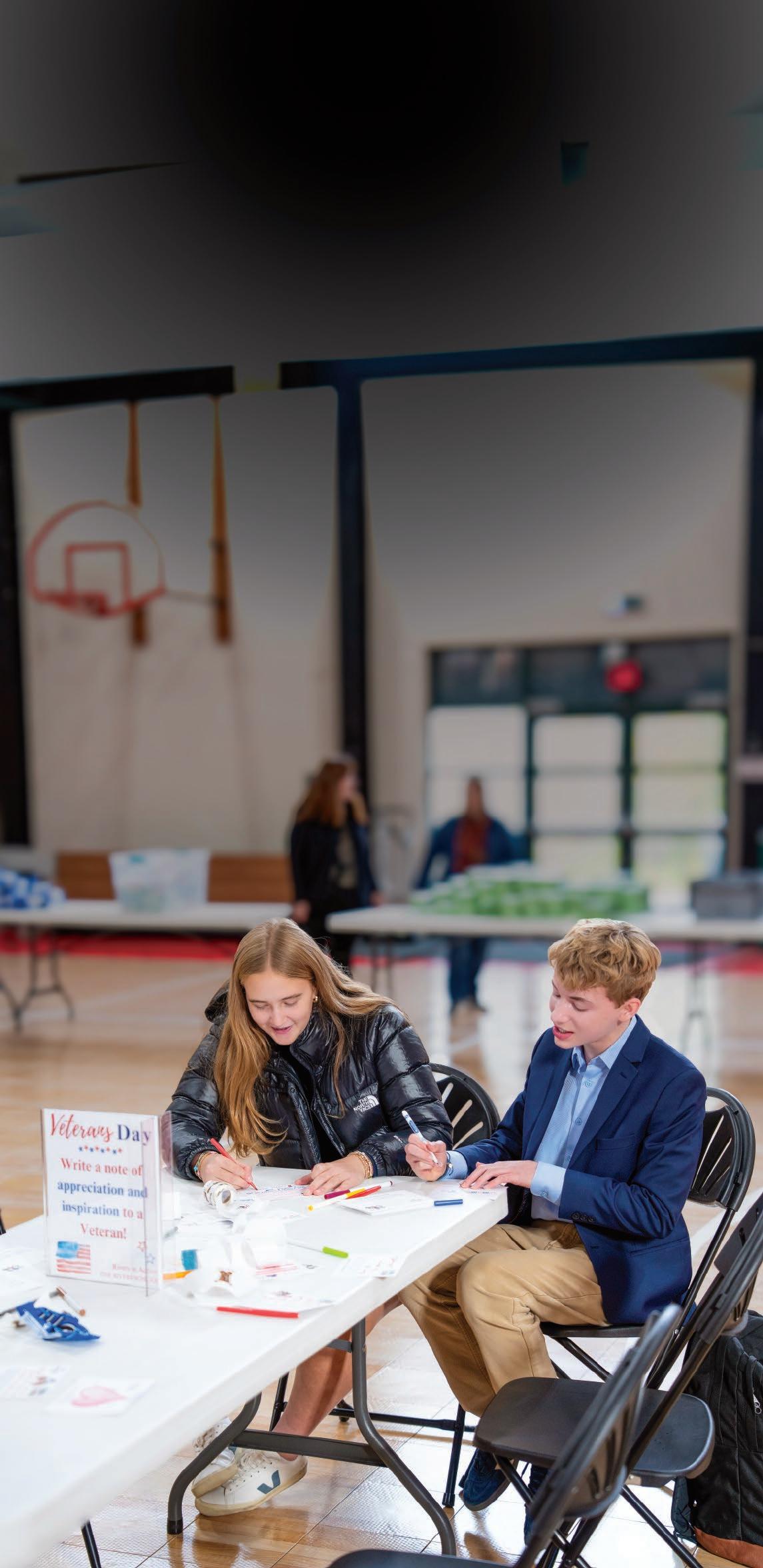
AVERY WRIGHT ’29 (left) and Tyler Constantino ’29 signed cards of support for veterans experiencing housing insecurity during Veterans Day programming at Rivers.
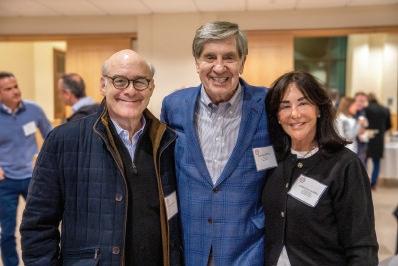
ROW: Attendees had a
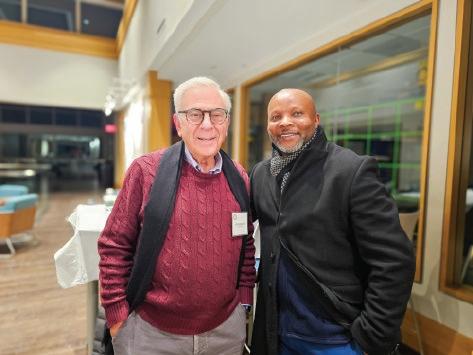
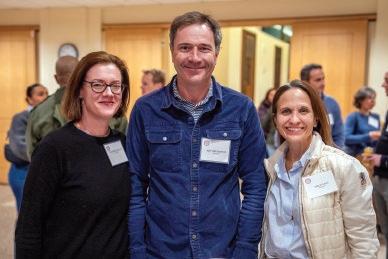
Roger E. Tackeff ’72, P’10; Roy S. MacDowell Jr. P’96, ’99, GP’12, ’24; Virginia S. MacDowell P’96, ’99, GP’12, ’24; Louis J. Grossman ’67, GP’31 and Daniel Lys P’24, ’29; Katherine C. Dallow P’30; Matthew Murphy P’29; Erica Flagg P’29.
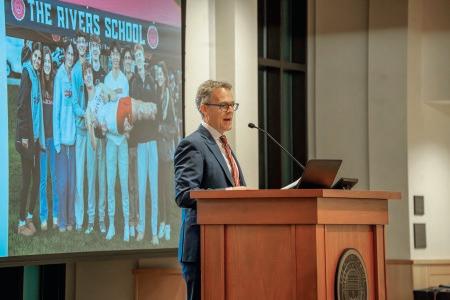
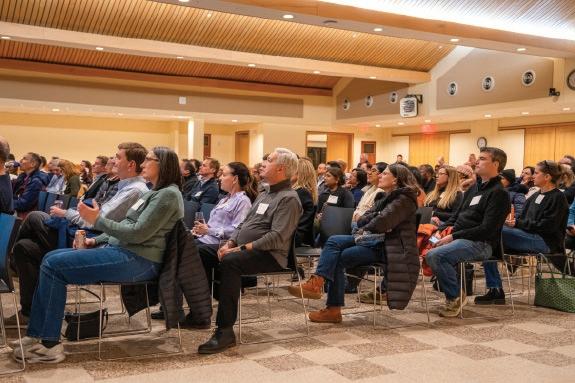
THE RIVERS SCHOOL held its third annual State of the School Update in February for parents, caregivers, and alumni. Head of School Ryan S. Dahlem gave a broad overview of success across the Rivers program, highlighting academic and college admissions success, recent athletics championships, inspiring artistic expression in visual and performing arts, high engagement in the school’s distinctive summer internship program, and cultural celebrations that highlight the rich diversity within the Rivers community. He shared an update on the rollout of the school’s
new strategic plan, which is being activated through three primary pillars: Pursue excellence through innovation; cultivate an ecosystem of connection, well-being, and belonging; and focus on lives of impact and purpose. Dahlem also honored Board President Alan D. Rose, Jr. ’87, who will complete his 17-year tenure on the Board at the end of the academic year.
Chief Financial Officer Jon Wasserman ’88, P’18, ’21 and Chief Advancement Officer Meret Nahas spoke about Rivers’ financial health as a point of significant pride. Wasserman emphasized
Rivers’ student-centered budgeting philosophy and argued for continuing to strengthen the endowment. Nahas highlighted the profound impact of philanthropy, sharing anecdotes from two alumni whose love for Rivers inspired them to give back for future Rivers generations. Dean of Academics and Institutional Research
Chris Dalton provided an update on the comprehensive schedule redesign (see page 10), driven by a dedicated design team and informed by over 150 focus group participants to center the student experience. R
THE RIVERS SCHOOL and Camp Nonesuch named James McGarry as Camp Nonesuch director in October 2025, following an extensive search. While new to the director role, McGarry is a longtime member of the Camp Nonesuch family. A former camper himself, he has worked alongside former director Paul Karasch for the past 14 years, serving in almost every role imaginable—from counselor and lifeguard to CIT director and, most recently, assistant director for the last two summers. A current English faculty member at Brookline High School, McGarry also brings his years of experience in youth development and mentorship to his new position.
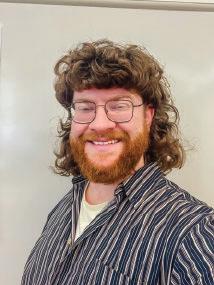
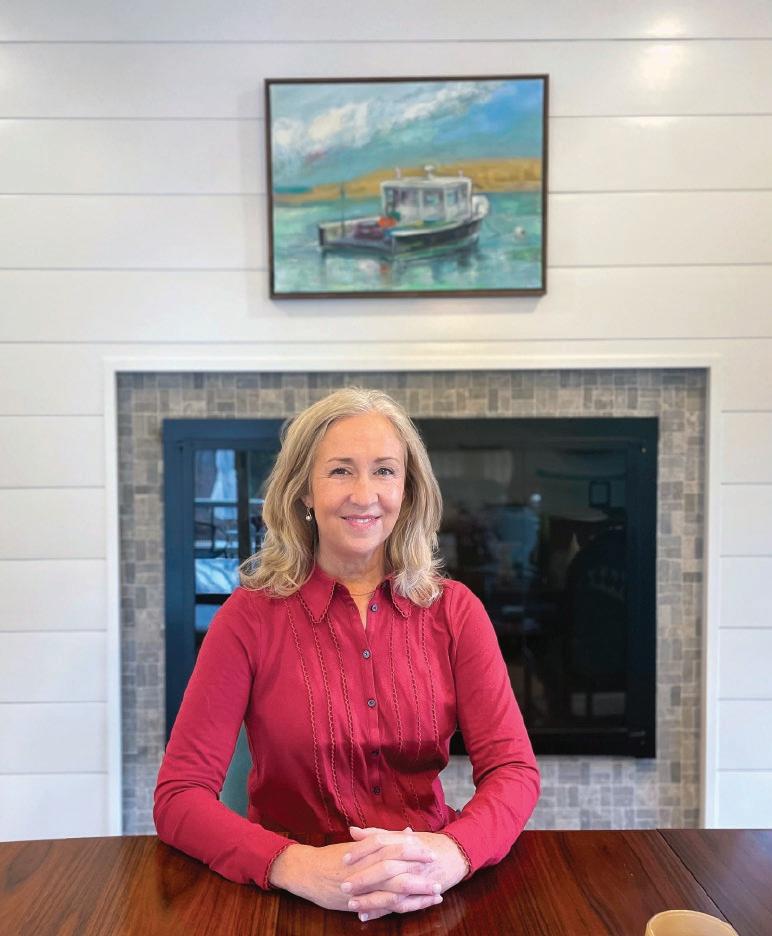
“James McGarry’s deep experience, creativity, passion, and strong understanding of camp operations and safety make him the perfect leader for this role,” said Head of School Ryan S. Dahlem.
McGarry expressed his enthusiasm for the new role and the opportunity to innovate while maintaining the ethos that has made Camp Nonesuch special for generations of kids. R
CAMPNONESUCH.ORG
FOLLOWING A ROBUST NATIONAL SEARCH, Colleen Shanley Kyle has been appointed as the next head of Upper School at The Rivers School, effective July 1, 2026.
“The enthusiastic response from professional community members and students who met Colleen during the search process speaks volumes about the strength of her candidacy and her readiness to lead the next chapter of our thriving Upper School,” said Head of School Ryan S. Dahlem.
Kyle comes to Rivers with an extensive leadership background, having most recently served as academic dean at the School for Ethics and Global Leadership in Washington, D.C. She previously served as upper school head at Roland Park Country School in Baltimore and worked at the Lakeside School in Seattle and Deerfield Academy in Deerfield, MA. Kyle also has over a decade of experience as an instructor for Rainier Scholars, an organization dedicated to advancing opportunity for underrepresented students. Kyle’s teaching background is in history, English, and interdisciplinary studies, and she will continue her teaching practice at Rivers. In her personal life, Kyle is an avid reader who enjoys running half-marathons, cycling, and kayaking.
“I am deeply honored to join The Rivers School, a community that so clearly lives out its commitment to Excellence with Humanity every day,” said Kyle. “From my first conversations with the search committee to my time on campus with students, faculty, and staff, I was struck by the school’s unique ability to pair high academic excellence with a joyful culture of care and integrity.” R
THE CODE TO VIEW A GALLERY OF HOMECOMING PHOTOS COMPETITION AND CONNECTION
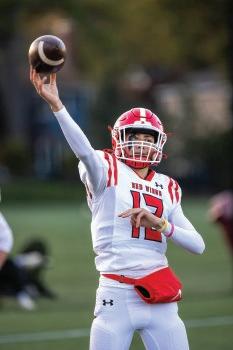
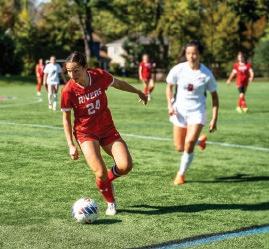
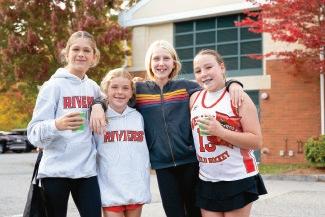
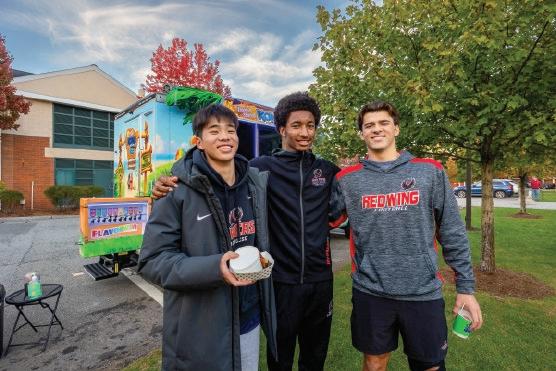
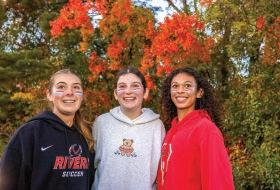
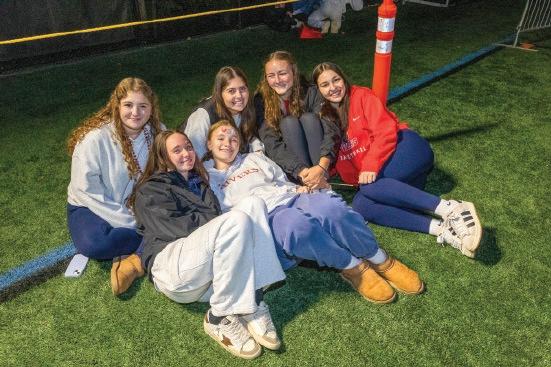
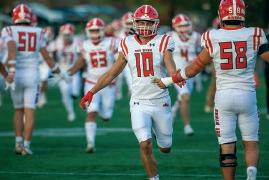
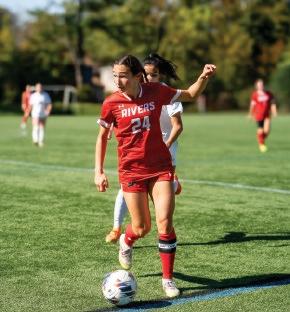
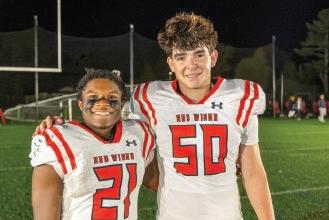
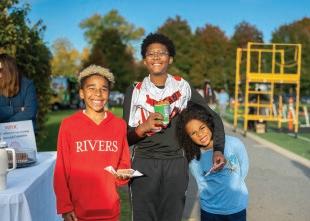
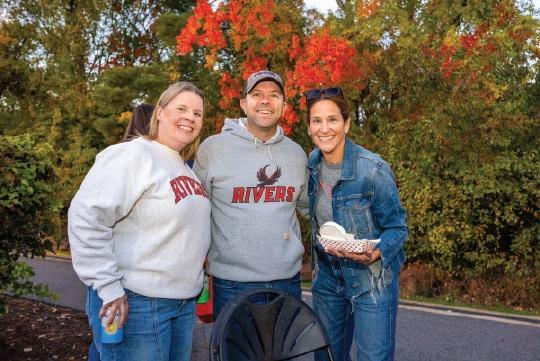
OVER 400 MEMBERS of the Rivers community gathered for Homecoming and Alumni Fall Fest in October, featuring sports games, food trucks, and familyfriendly fun.
Middle School boys’ soccer kicked things off with a Friday afternoon 2–1 win in the first of Rivers’ 13 home games and meets between Friday and Saturday. Jason Minicozzi ’26 set a Rivers course record for boys’ varsity cross-country, and varsity field hockey defeated Milton Academy 2–0 that night.
Festivities continued on Saturday afternoon, with simultaneous games at Nonesuch Field, Benson Gymnasium, Davis Field, and Baker Field. Between games, the community honored the 1995 varsity girls’ soccer team and the 1995 varsity girls’ cross-country team. Both teams won their respective NEPSAC Class C Championships 30 years ago—Rivers’ first NEPSAC Championship wins in girls’ athletics, just a few years after the Upper School went coeducational.
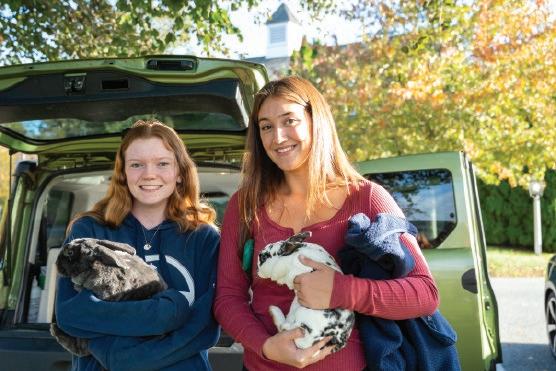
BETWEEN ATHLETIC competitions, connecting and reconnecting with friends, and exploring the Rivers campus in the beautiful October weather, there was something for everyone at Homecoming and Alumni Fall Fest.
Last but not least, varsity football defeated Groton 53–14 under the lights on Saturday night. “Homecoming weekend brought course records, big wins, high level performances, and amazing crowds to support our programs,” reflected Director of Athletics Kristin Cannon. “What a beautiful weekend for all of our community to embrace Rivers and enjoy all that our campus has to offer.” R

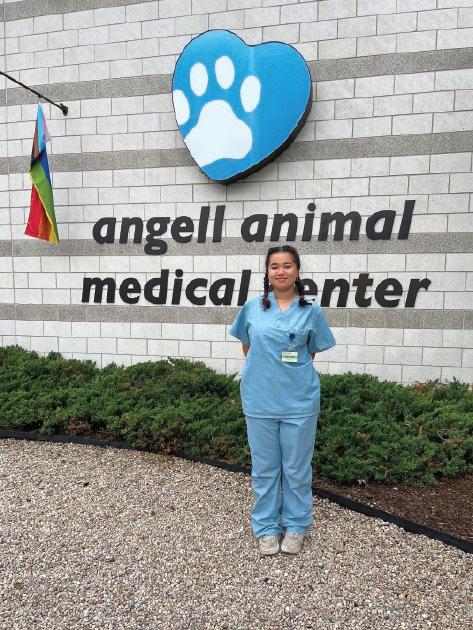
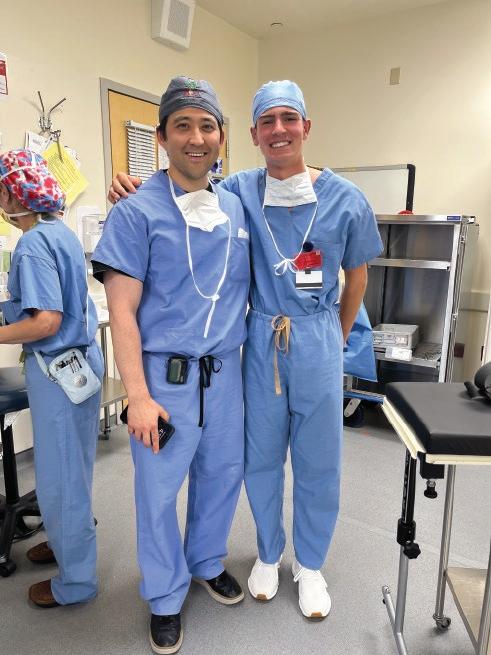
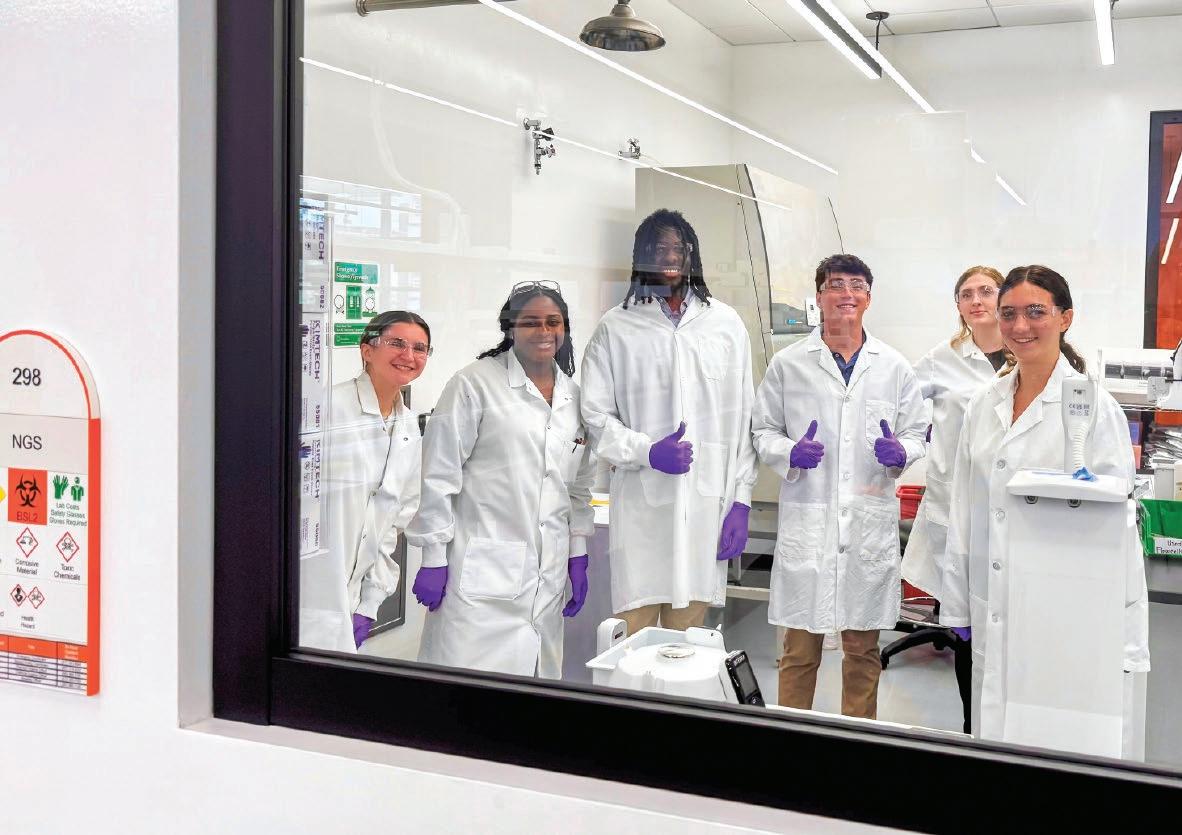
THIRTY-THREE MEMBERS of the Class of 2026 participated in the science internship program last summer—the highest number of interns in the program since its founding in 2005. Students pursued a variety of interests, including shadowing surgeons, dentists, and orthodontists; working with animals at a veterinary practice; helping children in pediatrics or speech and language therapy; working in a laboratory; coding; and more.
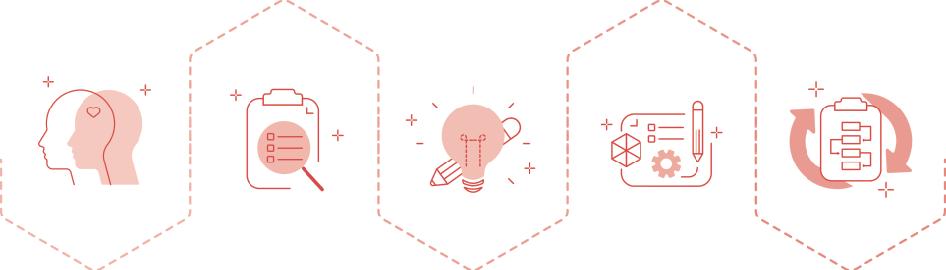
Empathize
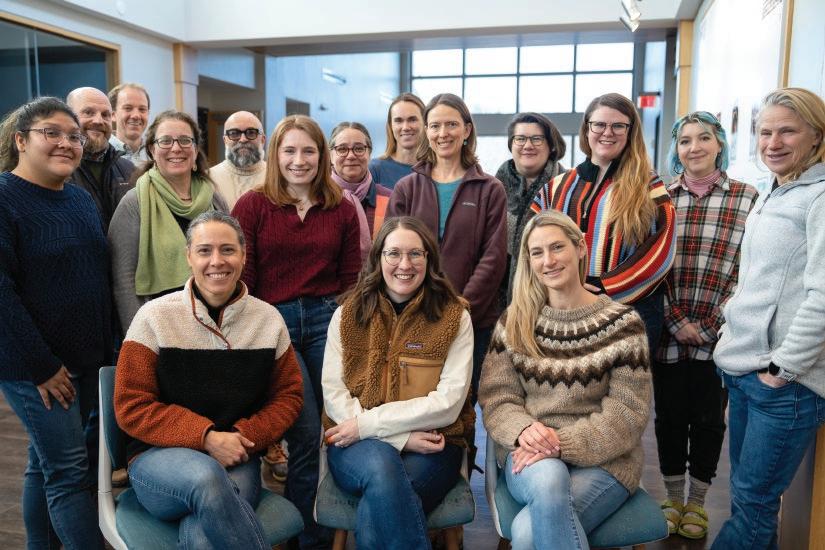
IN SEPTEMBER 2026, Rivers will launch a comprehensively redesigned academic schedule for the first time in over 10 years. Guided by Rivers’ updated strategic plan, mission, and core values, a cross-divisional steering committee and design team of professional community members have engaged in deeply collaborative work this year, centering the needs of students at every step in the design process.
In addition to the strategic plan, last year’s self-study as part of the AISNE accreditation process helped prompt the redesign. “In a fundamental way, a school schedule really sets the priorities of the school, because it dictates how much time we’re going to spend as a community on different activities with our students and how we’re going to pace that through a week, a month, a year,” says Chris Dalton, dean of academics and
institutional research.
The schedule redesign is also an opportunity to support programming that has expanded since the current schedule was set. The McCartney Scholars Program, the Special Program in Bioethics, and the Special Program in Creative Writing, among others, were not part of the landscape in 2011, when the present-day schedule was designed.
For this important work, Rivers partnered with Antonio Viva from the consulting firm Leadership+Design. Throughout the redesign process, Viva worked with the steering committee and the design team, which includes members of the steering committee and a cross-divisional group of educators. The combined teams gathered monthly for full-day immersive workshops with Viva to synthesize research and generate creative solutions that fit Rivers.
Viva led the Rivers team to use the principles of design thinking in their development process, following five steps: empathize, define needs, ideate, prototype, and test.
“What I love about this process is that we’re focused on understanding the needs and the values that are going to be at the core of the schedule, before we start getting into the nuts and bolts of how we’re going to make the time reflect those needs and values,” says Dalton.
As part of the first step in the design-thinking process, the design team conducted “empathy research.” Each team member shadowed a Rivers student for a full day in September 2025, gaining insight into the daily cadence of students’ varied course and extracurricular schedules. More than 30 professional community members also contributed to the research by keeping time journals about their
days, which helped the design team understand key pressure points and experience the schedule through a variety of perspectives.
Next, the team worked on defining needs. They observed that students and professional community members longed for more consistency and predictability in their schedules, as well as dedicated time for activities (clubs, affinity groups, and special programs) that are currently scheduled during lunch or before school. The team also identified adding more time for collaboration and dedicated blocks of time when students can access learning resources and support as goals for the redesign.
In the “ideate” phase, the team dove into research on design principles and examined the features of schedules from other independent schools.
Then, in December, the team pulled together all their research and a list of
In a fundamental way, a school schedule really sets the priorities of the school, because it dictates how much time we’re going to spend as a community on different activities with our students.”
–Chris Dalton, dean of academics and institutional research
Rivers’ needs to design four prototype schedules—each with a Middle School and Upper School model—which they presented to the community in January. Those prototypes were reviewed by 20-plus focus groups for students and professional community members. Professional community members from admission, equity and engagement, student life, counseling and wellness, learning services, athletics, and the performing arts had the chance to participate in programspecific focus groups. Then, the team tested its revised prototypes and
incorporated additional community feedback, resulting in the final schedule selection in the spring.
Even with a final schedule chosen, there will inevitably be tweaks and changes as it is adapted to better support students’ needs. “Change is hard because the schedule impacts everyone in our community, and everyone will be impacted to different degrees,” Dalton says. “What we’re aspiring to do is make sure our schedule is aligned with our mission and values and best supports our student experience.” R
“Nothing’s Gonna Change If You Don’t Change It”
Nonesuch Players Present 9 to 5: The Musical

THIS FEBRUARY, THE NONESUCH PLAYERS’ production of 9 to 5: The Musical whisked audiences to the 1970s, when the grind of office life meant typewriters, landlines, lots of paper—and keeping to the status quo of women being treated as less valuable than their male counterparts.
Featuring music and lyrics by Dolly Parton, the musical is an adaptation of the 1980 movie starring Parton, Jane Fonda, and Lily Tomlin. Three women, Violet Newstead (Jojo Stein ’27), Judy Bernly (Anya Carroll ’26), and Doralee Rhodes (Caroline Sorel ’27), are faced with the “sexist, egotistical, lying, hypocritical bigot” Franklin Hart (Henry Goldstein ’26) as their boss. Eventually, the women band together, taking charge of their own lives to make a difference—with plenty of
humor, heartfelt songs, and flashy dance numbers along the way.
“This show invites us to think about equity, voice, and standing up for what’s right, all while delivering the razzledazzle of a big ensemble musical,” wrote director and choreographer Zoë Iacovelli in the show’s program.
Reflecting on the experience, Jojo Stein ’27 commented, “I think the community is what I love most about theater at Rivers. Both the people in the production and also the broader Rivers community. You can really feel all the support and joy from everyone on opening night, which makes it my favorite night—getting to see so many people come to support you is one of the best feelings.” R

welcomed Cambodian musician and human rights activist Arn Chorn-Pond at the end of September as a guest in the Hall Family Speaker Series, a series made possible by the generosity of the Hall family and Trustee Alison Hall P’19. Chorn-Pond’s visit reflects the 2025–26 equity and engagement theme: “Courageous Voices, Global Impact: Leading With Integrity for a Just World.”
Chorn-Pond’s visit was part of his tour, “Commemorating 50 Years of Healing Through the Arts,” through which he shares his extraordinary
firsthand experience with survival, resilience, and healing through the power of music. A survivor of the Khmer Rouge regime in 1970s Cambodia, he endured the horrors of war and personal loss, and he now speaks to the power of the arts to connect people and nurture compassion. Chorn-Pond is also the founder of Cambodian Living Arts, a nonprofit with the mission of preserving and revitalizing Cambodian performing arts traditions.
“Arn Chorn-Pond embodies a profound generosity, offering his
whole self to everyone he meets,” said Director of Global Engagement Andrea Villagrán. “His presence is a force of unconditional love and dedication. I feel fortunate that our students, along with me, were privileged to share in his testimony firsthand.”
Chorn-Pond engaged with students and the professional community through an all-school assembly and programming on campus throughout his daylong visit, which included speaking to performing arts students from chorus, orchestra, and jazz band about using the arts as a tool for connection, healing, and peace. He had given a presentation for parents and caregivers the evening before. At both the evening presentation and the assembly, Chorn-Pond closed with a short performance of a lullaby on the bamboo flute and an invitation to visit Cambodia.
The events were led by members of the Global Education Scholars Program, designed for juniors and seniors who are committed to fostering a globally aware and inclusive school environment by bringing awareness of international relations to the Rivers community.
“Hearing Arn speak was both tragic and poignant,” said Global Education Scholar Soren Brockman ’27. “His story uncovers a part of history that is often forgotten in the U.S., and I think that’s what made it so powerful. Especially inspiring was his message at the end: to love one another, to remember that we are all the same and that everyone endures suffering.” R
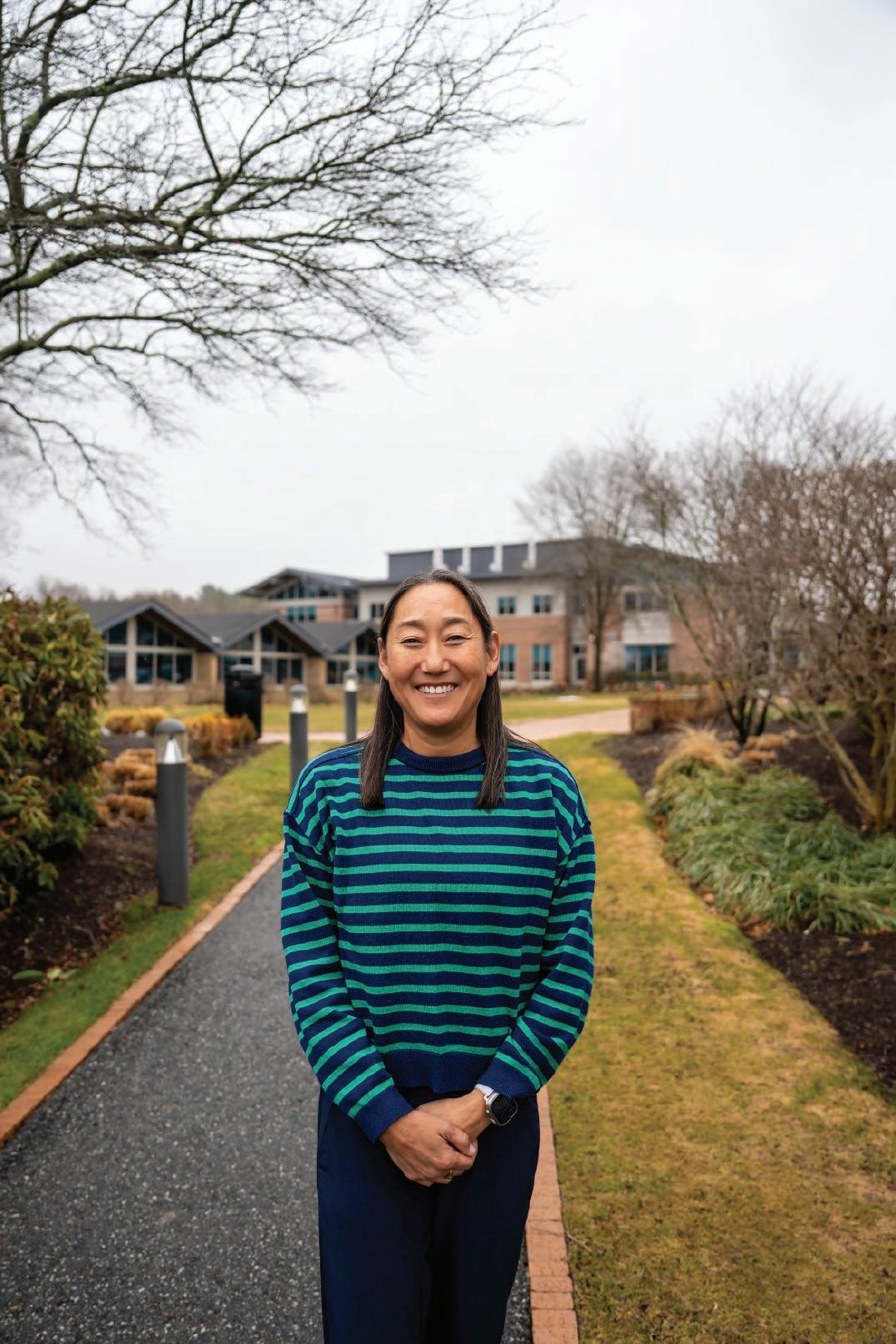
A dean of students occupies a critical but often abstract role in a school, covering everything from student involvement to enforcement of community norms to supporting genuine connection. Krista Sahrbeck took on the role at the start of the 2025–26 school year. “I love the job because no two days are the same,” she says.
Q: Where did you grow up, and what was your path to this career?
KRISTA SAHRBECK: I grew up in Cape Elizabeth, Maine, just outside of Portland, and I graduated with a class of around 100 kids, very similar in size to Rivers. I think I lucked out with my parents and my family in general. I’m adopted Korean, and I didn’t really feel I was different than any of my siblings in terms of race and background and looking different. Every neighbor knew who you were. It just felt really easy and safe.
I originally wanted to be an international environmental lawyer. After attending Bowdoin College for my undergraduate degree, I applied to law school and was wait-listed. I hadn’t experienced much failure before that point, and it made me really think about why I wanted to do what I was pursuing. If you looked at my résumé at that time, it was filled with camps, coaching, counseling, and just being with young people. At that point, I couldn’t ignore the fact that I was drawn to working with teenagers, so I enrolled at Boston College Lynch School of Education.
Q: What do you see as the crux of your role?
KS: For me, it is that I am the advocate of advocates for students, period. In every decision I help make, I’m always considering, “How does this benefit and help students?” and keeping in mind that, when we say “students,” we mean all students.
As a dean of students, I am a little bit of everything. If you’re only looking at student life through one lens, you’re too closed-minded, because students are doing 8,000 things. This student is the captain, who’s also in the AP class, who has to go home and pick up their younger sibling, make dinner, and then do their schoolwork starting at 8:30 p.m. We have to be able to provide flexibility for that person. But if we don’t have that relationship with that kid and family, how do we ever know that that’s
something that is happening?
At least 80 percent of my job is reacting to things, whether that’s student decisions and behaviors or big school decisions. That makes me ask, “How do we become more proactive?” and “What systems are we working with?” Systems might need to be tweaked so we can be better prepared, or so we can prepare others for things coming down the pipeline that we can predict and anticipate.
If there are programs or resources we want to provide students to give them a better experience, knowing that they will become better members of a larger community after they leave, that’s kind of my charge.
Sometimes, my role is just being present. That’s as easy as picking up a paddle and playing ping-pong in the lower Campus Center, or it’s walking through Benson Gym when people are playing knockout. Student life doesn’t always need an agenda. Community is communing, and it’s fighting for those pockets of time.
Q: Are there any partnerships that you’ve found particularly helpful as you’ve grown into this job?
KS: The counseling and wellness team has been phenomenal, both on a personal level when dealing with difficult situations and from a more institutional curricular standpoint. I think now, even more than when I was a kid, the health and wellness of students is critical, so it’s been great to work with the counseling team on how best to talk to a student from a different perspective, or to prepare for a difficult conversation with parents.
I am also responsible for the student advisors (senior students who serve as mentors for Grade 9 students), who have been a great help. Their ability to care beyond self is really impressive. Whenever I have asked for one or two volunteers to help me, all 10 of them respond immediately and say, “Yep, whatever you need. We’re there.”
Q: You’ve talked before about a “toolbox” for students. Can you explain what that means?
KS: To understand this concept, you almost have to work backward. What does a Rivers graduate look like, and what are the skills that they can demonstrate proficiently before they go off to college? Those skills are the tools. Can they advocate for themselves?
Can they think analytically, including critically, not just in a paper about a book that they read, but also in general, about their lives or their sport, or whatever else, to be active citizens in the community?
As a student goes through their time here, where along the way are we allowing them to fill their toolbox? Sometimes it’s through leadership opportunities. Sometimes it’s just doing the right thing when no one is watching. Through all of those lessons, that student walks away with additional tools. And part of my role is creating, developing, and promoting a school environment on the student side where you have trusted adults who can pass along that wisdom in different ways.
Q: You talked a lot about centering the well-being of students. How do you practice that for yourself?
KS: I have an emotional support dog, Tigger, who has allowed me to make more time for myself. He’s crazy, kind of looks like a Muppet, and he’s blissfully unaware—for him, everything’s happy, he just wants to be loved.
Also, as I’ve gotten older, I’ve taken more time to be reflective, slow down, and not move too quickly. I have also tried to listen more and talk less. This is my fifteenth year as a dean of students. At Rivers, I am grateful for the support of the school, which has enabled me to take time as I need it. It has allowed me to recognize where others need support—adults and students alike— and provide that, too. R
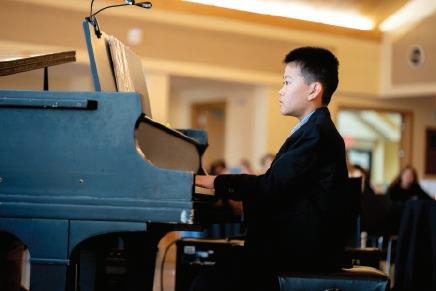
THE 18TH ANNUAL Rivers & RSC Jazz Festival in November put the spotlight on jazz musicians of all ages and abilities as each RSC jazz ensemble, as well as guest musicians, took the stage over the course of the daylong festival.
The 2025 featured artist was jazz legend Greg Hopkins, a trumpeter and composer. Hopkins may be a familiar face for fans of Rivers jazz— he’s been involved with Rivers for about a decade. As the commissioned composer for this year’s festival, Hopkins visited Rivers throughout the fall to workshop his piece, “Reflecting on Rivers,” with the Rivers Honors Big Band. The band premiered the piece at the festival, accompanied by Hopkins on trumpet.
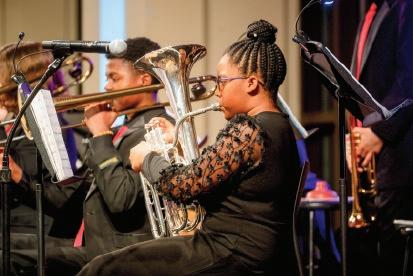
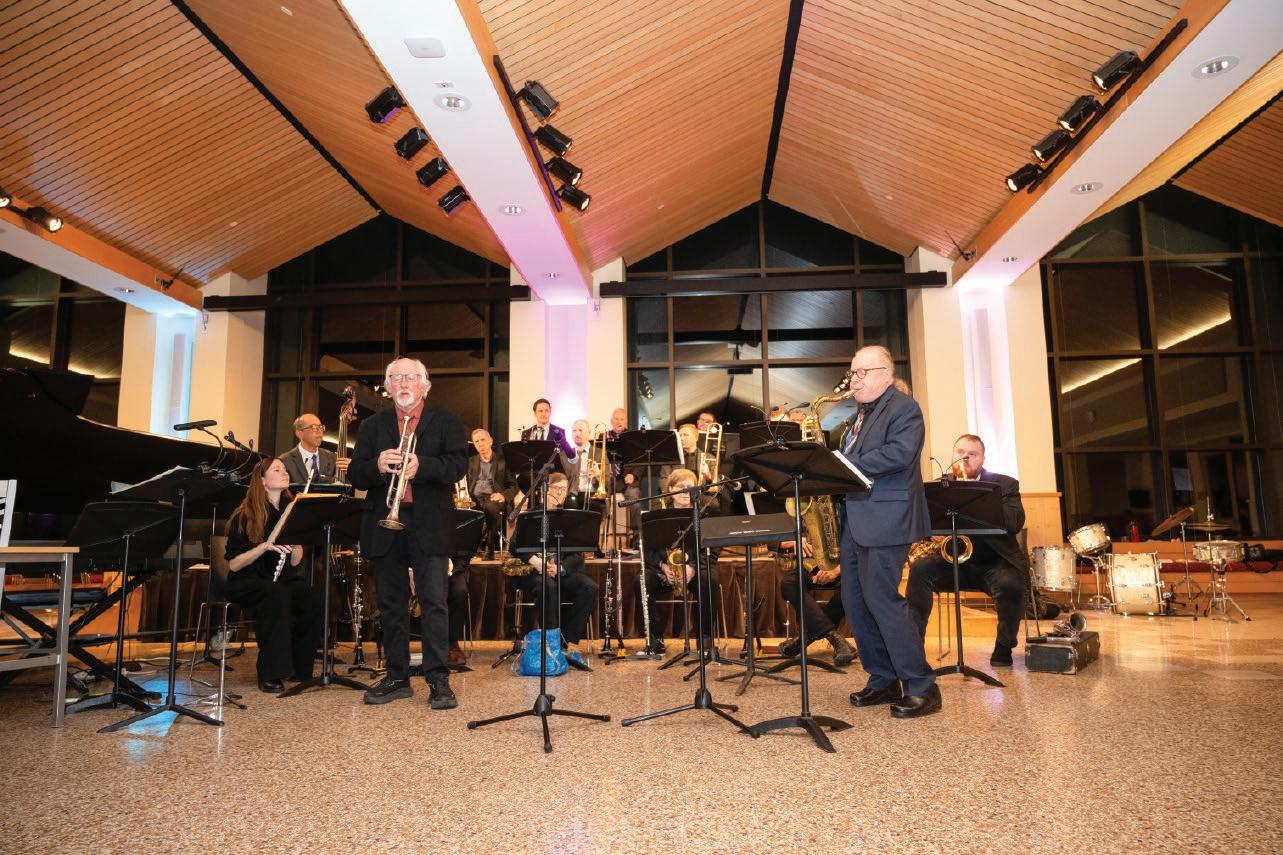
In addition to performing with Honors Big Band, Hopkins performed a set with his band, The Greg Hopkins Jazz Orchestra. He alternated between conducting and joining in on trumpet for all of the pieces. Rivers Jazz Director Philippe Crettien joined on saxophone and treated the crowd, which included many of his students, to several solos.
Shortly after the festival, Hopkins and the Honors Big Band reprised their performance of “Reflecting on Rivers” at an all-school assembly. “I want to thank the band for working on this piece so diligently,” Hopkins said after the performance. “I always write challenging music, but they got the challenge, and they went beyond.” R
DURING NATIVE AMERICAN HERITAGE MONTH in November, History Department Chair Ben Leeming P’17, ’19, ’21, ’23 led an all-school assembly on language in Indigenous cultures. The assembly focused on the Wampanoag people; their language was considered extinct until linguists such as Mashpee Wampanoag tribe member Jessie Little Doe Baird began efforts to revive it.
DEI coordinator and Middle School faculty member Ellie Strayer led Middle School students in an advisory activity about Wampanoag farming practices and the “Three Sisters” technique, in which corn, beans, and squash are planted together to share resources in a reciprocal relationship. Through these activities, the Rivers community connects with the history of land many of us know by different names. R
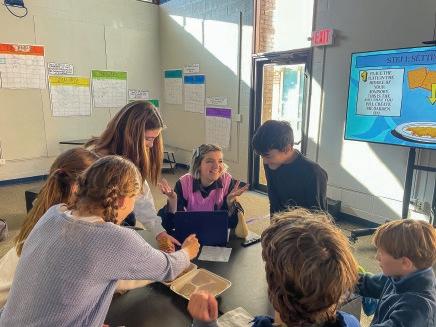
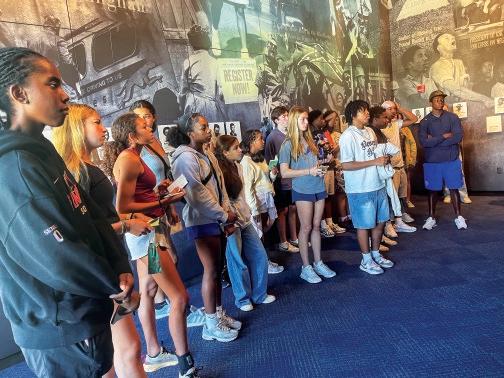
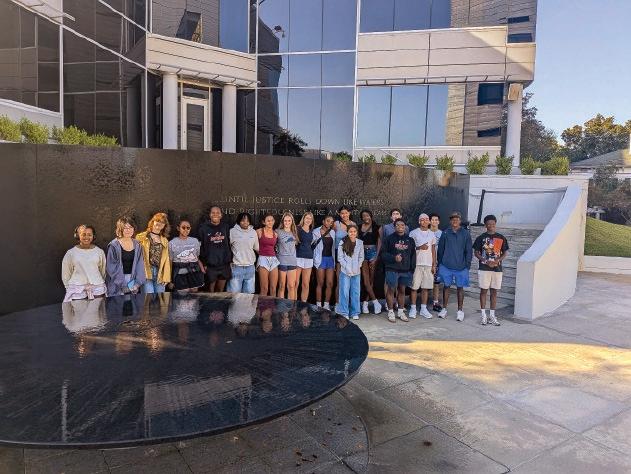
NINETEEN RIVERS STUDENTS explored cities and landmarks key to the American Civil Rights Movement on the Rivers Civil Rights trip in early October.
The trip, which is offered every other year, is open to all Upper School students and gives them an unmatched opportunity to experience U.S. civil rights history firsthand. Face-to-face with history, participants grapple with the long legacy of violence and discrimination against Black people in the United States.
Led by Upper School history faculty member Arturo Bagley, the group flew to Atlanta and traveled through Montgomery, Selma, and Birmingham in Alabama. “There’s something about experiencing it yourself, actually being at a historic site, that makes it more real than reading can,” said Bagley. R
VISITING ARTIST SERIES
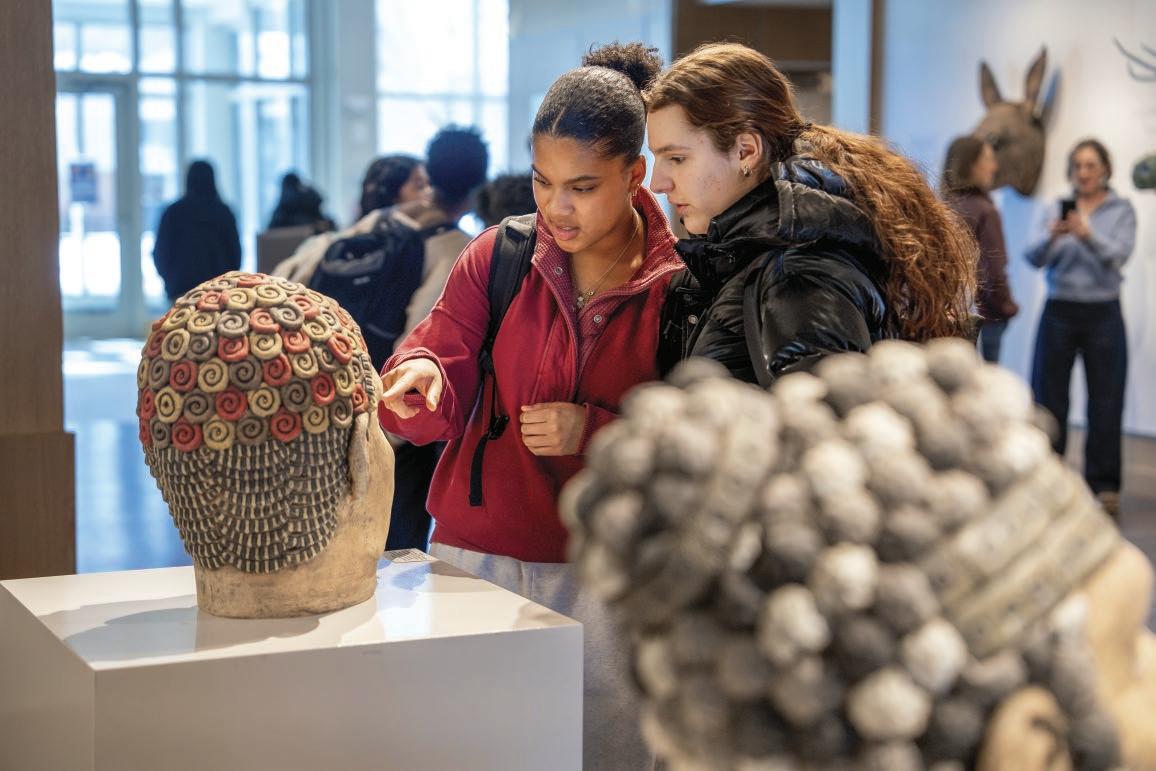
THIS YEAR’S GUEST in the Visiting Artist Series, ceramics sculptor George Rodriguez, spent a day at Rivers in February to speak at an assembly, work with ceramics students, and attend the closing reception for an exhibition of his work, which had been displayed on campus since December.
Visual arts faculty member and gallery coordinator Nicole Winters introduced Rodriguez at the assembly in Kraft Dining Hall. “Our visiting artist program brings working artists
to campus so you can see what a real creative practice looks like, how ideas become objects, how culture and identity shape art, and how artists build lives around making things that matter. It’s a chance to learn directly from someone who’s out in the world doing the work. George is an incredible example of that,” Winters said. “His work blends humor, storytelling, and meticulous craftsmanship in a way that’s completely his own.”
Rodriguez grew up in El Paso, Texas, studied ceramics at the
University of Texas at El Paso, and earned a master of fine arts degree from the University of Washington. His work has been displayed and collected by museums across the country, and his recent projects include a large-scale installation commissioned by the Kansas City International Airport. Rodriguez is an assistant professor at the Tyler School of Art and Architecture in Philadelphia and a co-organizer of The Color Network, an organization that aims to help artists of color advance
If my objects make me laugh, it’s a good sign.”
–George Rodriguez
in ceramic arts. This winter, Rivers displayed a collection of Rodriguez’s sculptures in the Bell Gallery and El Zodíaco Familiar, a series of wallmounted animal heads, in the Baldwin Family Art Commons.
El Zodíaco Familiar is one in a series of Mexican zodiac projects by Rodriguez, in which he reinterprets the animals of the Chinese zodiac narrative into animals from Mexico: chapulín, or grasshopper, in place of the rat, the mythical Quetzalcoatl in place of the dragon, and so on.
“I’m Mexican American, so I wanted to bring [the story] a little closer to home,” he explained during the assembly.
El Zodíaco Familiar is distinct for its collaborative nature: Rodriguez invited 13 artists of Mexican descent to work with him on the animal that corresponds to their birth year in the Chinese zodiac. Rodriguez sculpted the animal forms, which his collaborators adorned based on their own artistic mediums and styles. “This has been one of my favorite projects, because it’s not only about the artwork that I make. I get to teach a little bit of my practice,” Rodriguez reflected. “But then I get to learn from all these other artists and what they do.”
Rodriguez’s collaborators worked in a variety of mediums, such as
photography, fiber arts, metalworking, and even poetry.
“We made objects, but we also made friendships. I can call these people and have conversations or collaborate in the future,” Rodriguez said. “And that’s really, I think, what art [does] best as a function: You make connections with people, you affect people’s lives, and you get to share what you love.”
Rodriguez put that collaborative spirit into practice during his time with Rivers ceramics students. Providing insight into some of the logistical aspects of his work, Rodriguez shared molds he’s created for the ornamental details on his sculptures, which students borrowed to make their own decorative pieces.
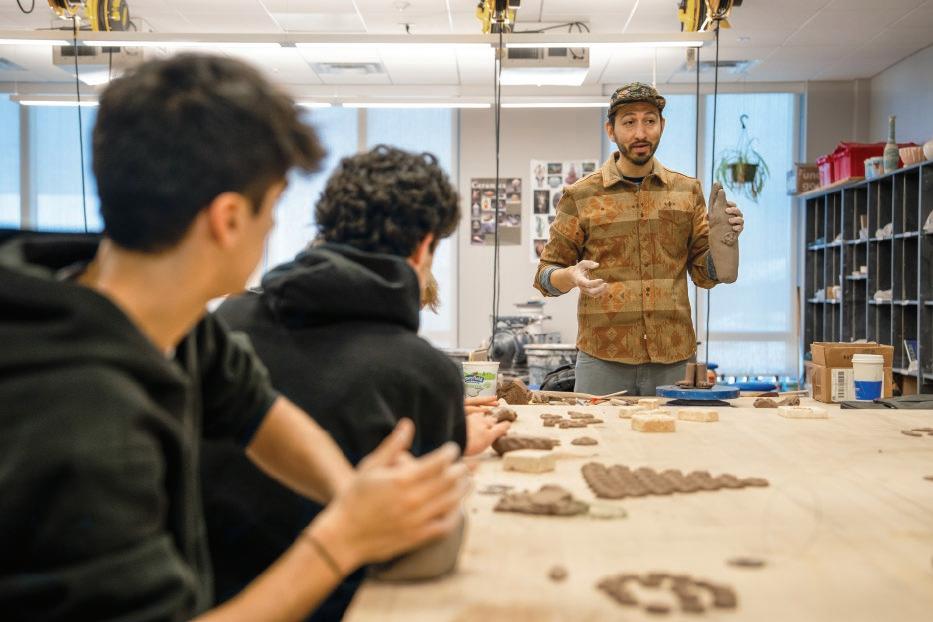
In Intermediate Ceramics with Tim Clark P’29, Rodriguez asked students to name an animal for him to make as a demonstration, then prompted them to pick what kind of hat and shoes it should wear. The result was truly one of a kind: a salmon wearing a top hat and flip-flops. “If my objects make me laugh, it’s a good sign,” Rodriguez told the students. It usually means the piece has good energy and that he’s having fun making it, he said.
At the assembly, Rodriguez talked about seeing the Rivers facilities for the first time during the installation of his exhibition. “There’s amazing creative energy that you have at your disposal. So, I just want to say, please tap into it,” he said. “And that doesn’t necessarily just mean visual arts, which is what I do—make artwork in the way that you know how to present that to the world. Because we need more creativity; we need more positivity.” R
GEORGE RODRIGUEZ worked on a ceramic fish with Intermediate Ceramics students.
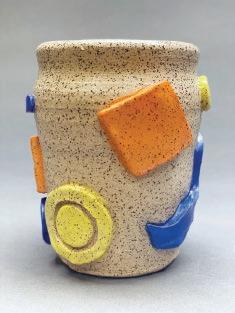


THIS WINTER, THE SCHOLASTIC ART & WRITING AWARDS of Massachusetts recognized 24 Rivers students for their creative work. Rivers students earned gold key, silver key, and honorable mention awards in the sculpture, mixed media, ceramics, editorial cartoon, photography, film, drawing, poetry, personal essay, speculative fiction, and writing portfolio categories.
Chris Love, chair of the Visual Arts Department, and Mary Mertsch P’27, ’29, chair of the English Department, commended Rivers’ honorees. “The entire process of creating work, choosing your best, and putting it out into the world gives us all a chance to celebrate wins and each other, to create wonder, dream out loud, and to develop resiliency when things don’t go our way,” Love reflected.
Mertsch added, “At a time when AI and STEM fields are capturing so much attention, it’s especially heartening to see Rivers students devoting their time and energy to the deeply human craft of writing.” R
GOLD KEY AWARDEES
Zimon Li ’26, Personal Essay & Memoir
Alex Yang ’28, Sculpture
SILVER KEY AWARDEES
Jenna Adams ’28, Ceramics & Glass
Vivian Dykema ’26, Drawing (two awards)
Matthew Gundersheimer ’27, Sculpture
Maylea Harris ’26, Writing Portfolio
Eleanor Leiva ’29, Photography
Oliver Mertsch ’29, Photography
Max Murray ’28, Sculpture
Braxton Seale ’27, Ceramics & Glass
Maggie Tompros ’30, Photography
HONORABLE MENTION AWARDEES
Aurelio Better Piermarini ’29, Sculpture
Ella Croom ’28, Sculpture
Angelina Fonte ’27, Mixed Media
Lauren Ganitsky ’30, Photography
Maylea Harris ’26, Poetry
Sabrina Holliday ’30, Photography
Ann Gloria Jean ’30, Photography
Lexie Keel ’29, Ceramics & Glass
Diana Lee ’30, Editorial Cartoon (two awards)
Alison Leiva ’27, Sculpture
Eleanor Leiva ’29, Speculative Fiction
Grace Mitrokostas ’30, Editorial Cartoon
Olivia Standish ’27, Ceramics & Glass
Trevor Thompson ’29, Ceramics & Glass
George Ullman ’28, Film & Animation
THE CODE TO VIEW THE FULL GALLERY
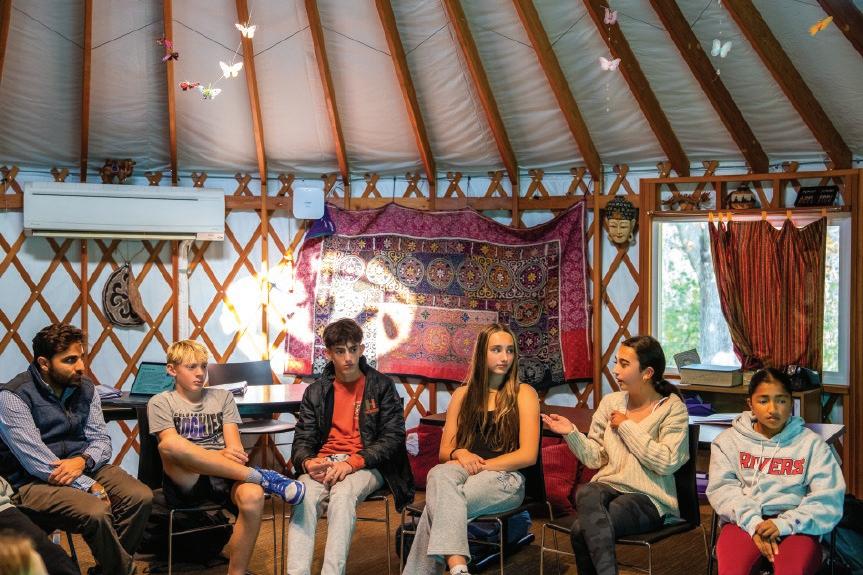
exhibition on immigration journeys at
As the final project in the unit, each
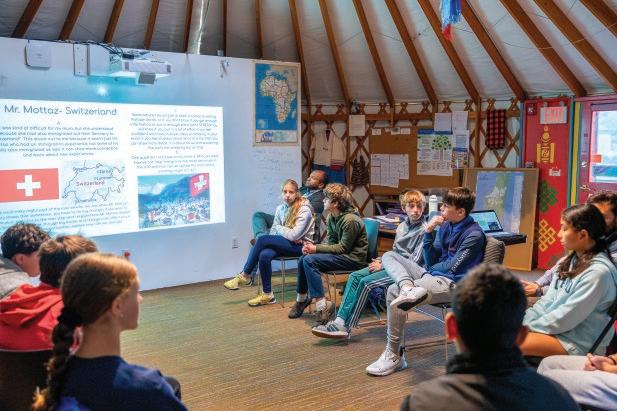
Yassine Talhaoui P’32 and reflected, “Before I had this interview, Mr. Talhaoui was just a face I’d seen on campus. Now, each time I see him, I remember his story.”
As the presentations came to a close, Tye encouraged his students to keep thinking about how the curriculum extends beyond the classroom. “I hope you can see that what we do relates to the real world,” he said. R
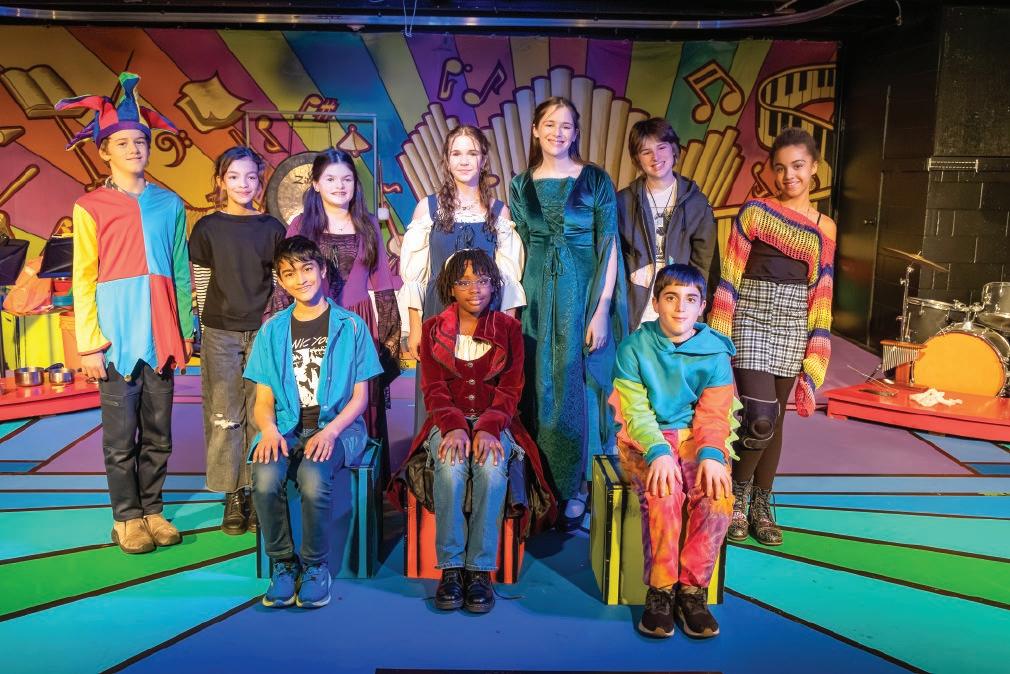
THE MIDDLE SCHOOL fall play treated audiences to a collage of sound and color in the Black Box Theater this November. The original production, Sounds Off, was created by faculty member Ellie Strayer and featured music by Performing Arts Department Chair Dan Shaud P’31. “Early in the process, I had the students write their own characters,” said Strayer. “It’s a special moment for the students, because it gives them a creative stake in what’s happening.” Shaud commented on the overall sonic environment of the show, which used cast members’ musical talents, but also incorporated the sounds of noisemakers, pots and pans, and whirly tubes. “Creating that environment was almost like being a kid again,” he said. “As a musician, I grew up doing that kind of stuff—making noise—and it was fun to bring it to the kids and have their input and see how it evolved.” R
“THE
PROTEST
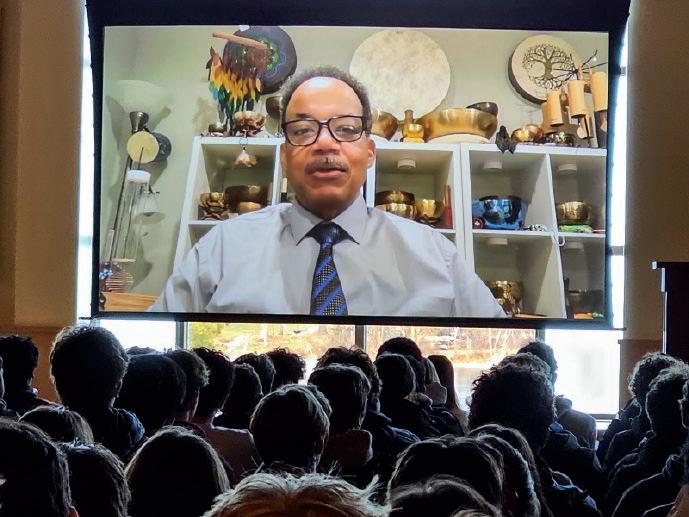
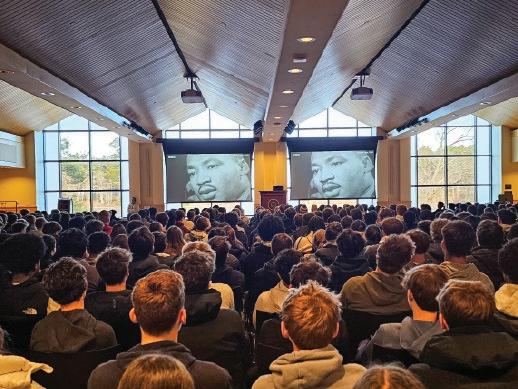
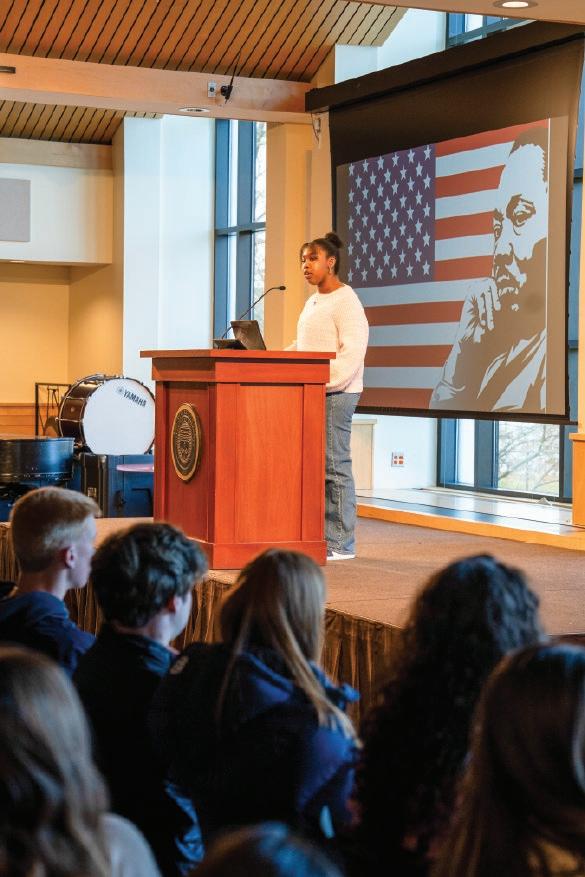
AT AN ALL-SCHOOL assembly in honor of Martin Luther King Jr. Day, members of the Rivers Black Student Union (BSU) led programming to honor King’s legacy. The community heard from BSU leaders, including Katherine Shaw ’26, who recited Maya Angelou’s poem “Still I Rise.”
History faculty member Arturo Bagley delivered the keynote address.
“Martin Luther King Day reminds
“The Civil Rights Movement provides an example of citizens fighting to achieve equality and, in fact, making significant progress. Most of these people were not famous. They were ordinary people, but they were
Constitution gives citizens the right of peaceable assembly, what King called ‘the right to protest for right.’ The [Civil Rights] Movement offers us hope and an example of how to navigate our way through challenging times.” R
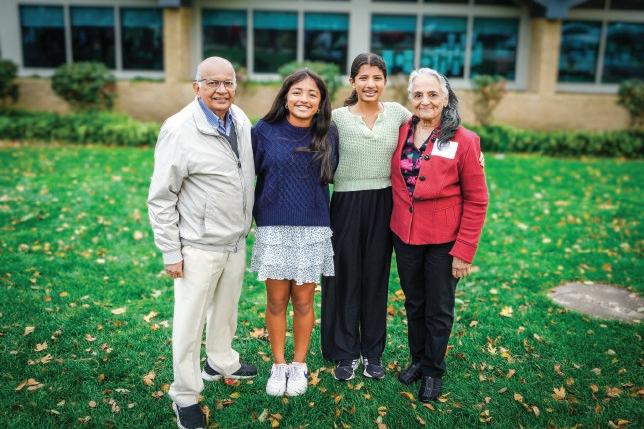
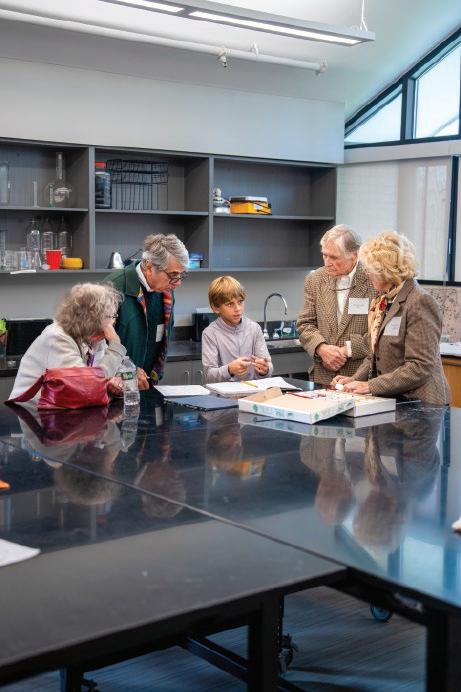
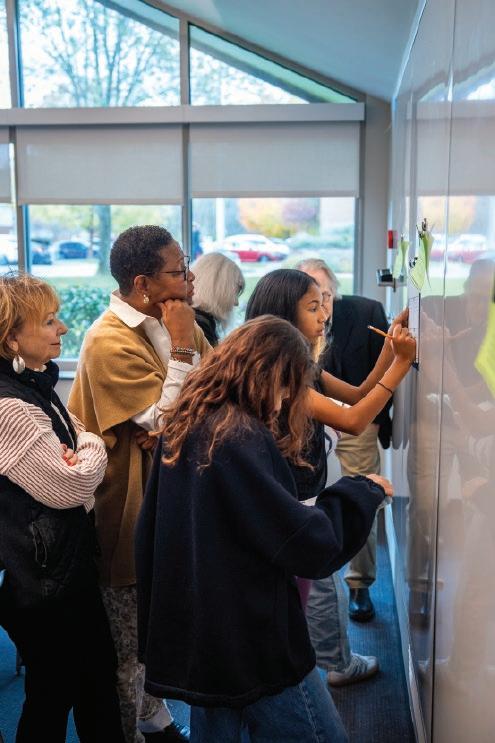
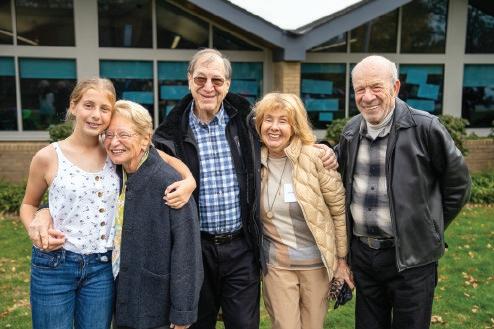
LOVED ONES TRAVELED to the Rivers campus from near and far one day in November for the Middle School’s annual Grandparents’ and Special Friends’ Day. Head of School Ryan S. Dahlem welcomed the guests in Kraft Dining Hall and spoke to the importance of grandparents in his own life. Head of Middle School John Bower P’31 honored the “mentors, storytellers, [and] cheerleaders” in the audience. “You have a way of offering both wisdom and comfort in equal measure,” he said. Four Middle School musical ensembles performed for the guests, and Matthew Wang ’30 gave a speech about his relationship to Rivers’ core values. Later, Middle School students brought their guests to classes before ending the day’s programming with a celebratory lunch. R
GRANDPARENTS AND SPECIAL FRIENDS of Middle School students spent the morning connecting with each other and the students, as well as attending classes.
THE CODE TO VIEW A GALLERY OF GRANDPARENTS’ AND SPECIAL FRIENDS’ DAY PHOTOS

“ I care about making [school] feel important to them in the moment, so that it leaves some sort of core impression.”
– tc HANMER
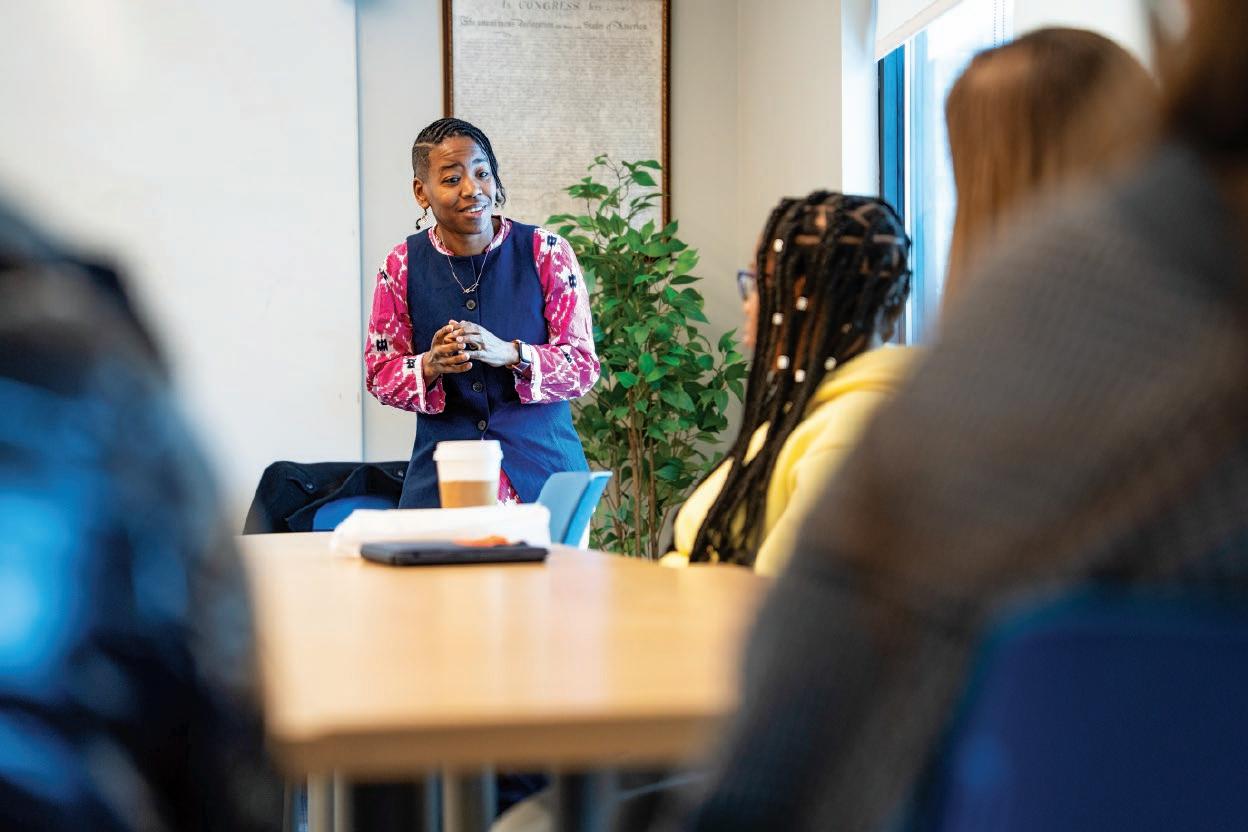
tc HANMER has only ever wanted to be two things: a veterinarian or a teacher. “When I realized how much math and biology there is in being a veterinarian, I thought for the safety of everyone, I should probably switch to teaching,” they joke. Rivers has certainly benefited from that career decision, with Hanmer’s care and creativity reaching far and wide at the school through their varied roles on campus since joining the community in 2022.
A member of the English faculty, Hanmer also most recently served as Grade 12 dean and Upper School DEI coordinator. In March, they were named the next director of DEI programming and support at Rivers, a role they will begin in the fall. In the English Department, Hanmer teaches English 11 and two signature Grade 12 electives: Dystopian Literature and Identity and Intersectionality.
“Dystopian Literature is definitely
my child,” Hanmer says. “I love science fiction, and I love dystopian literature.” The course is divided into three parts: monster, alien, and zombie dystopias; technology dystopias; and government dystopias.
“I make it really clear that we are talking about hypothetical worlds,” Hanmer explains. “We can talk about the ways in which we may or may not see elements of those worlds reflected in our world, but ultimately the point of the class is to talk about how a person can craft an engaging dystopia.”
Hanmer created Identity and Intersectionality in response to student feedback requesting more electives highlighting marginalized voices. Students engage with the themes of identity and intersectionality through literature, and they also examine their own understanding of and relationship to those themes through writing and
discussion. “I spend a lot of the first two or three classes trying really hard to model that this is not a class where you’re going to be praised for just repeating what I’ve said,” Hanmer says. “I want you to have your own opinion. I want this to be a conversation.”
That desire for authentic engagement is core to Hanmer’s philosophy as an educator. Hanmer’s hope for students is that they learn to think critically consistently enough that they are actively creating the lives they want to live, rather than waiting until they’re miles down the road to look back and realize where life has taken them.
“I don’t necessarily care if they remember all the books we read or if they even remember me,” Hanmer adds. “School needs to feel like it matters to them. I care about making it feel important to them in the moment, so that it leaves some sort of core impression.” R
Conservatory (RSC) wraps up its 50th anniversary celebration in the 2025–26 season, the school has celebrated five decades of extraordinary music-making through relationships with past RSC artists who returned to campus for a series of masterclasses to inspire today’s students. From a Broadway performer to a contemporary composer, RSC and Rivers alumni, along with one former RSC director, are bringing their artistry full circle.
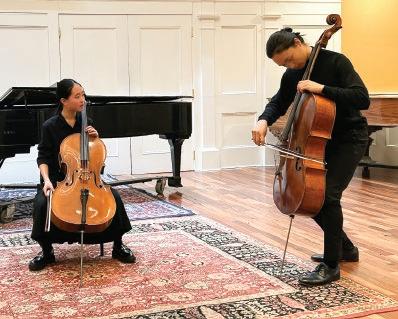
In the fall of 2025, accomplished cellist and RSC alum Leland Ko held two masterclasses for cello students. Ko, whose career has taken him
to prominent concert venues and international competitions, offered insights on tone production and musical phrasing to the young cellists to help them convey emotion in their performances.
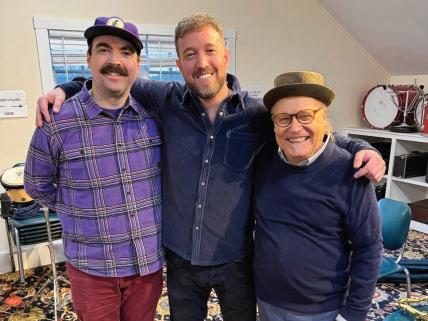
Tim Carman ’07, a chart-topping blues and jazz artist, returned to Rivers in December to speak with and perform for Conservatory Program jazz students. During his masterclass, Carman reflected on his formative years studying with Rivers Jazz Director Philippe Crettien and participating in ensembles at Rivers.
Now an internationally recognized performer, Carman has appeared at major venues and festivals,
including the Newport Jazz Festival. He emphasized that his success is rooted in the fundamentals he developed as a student-musician at Rivers. “My time at The Rivers School not only solidified my love of jazz, it also shaped my understanding that real work ethic means showing up prepared, listening deeply, and striving to get better every single day,” he said.
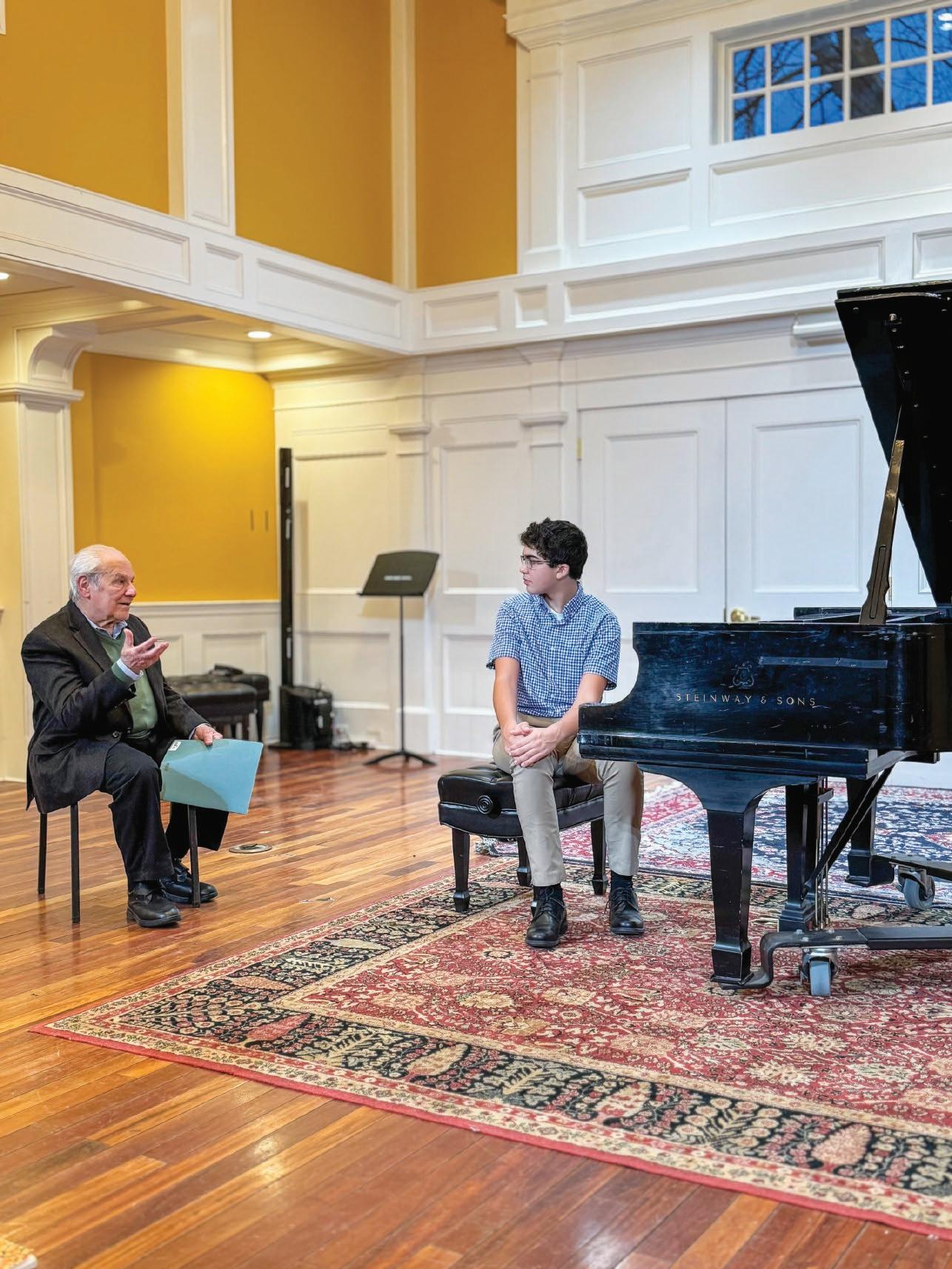
In January, an audience of piano students had the privilege of learning from A. Ramón Rivera, RSC director emeritus, whose visionary leadership shaped RSC for more than a decade and has left a lasting legacy. Rivera worked closely with piano students in
a masterclass that combined technical precision with expressive storytelling. This was a rare opportunity for attendees to experience firsthand the mentorship of a leader whose contributions are woven into the fabric of RSC.
Cole Delgado, an RSC student who performed the third movement of Maurice Ravel’s Miroirs in Rivera’s masterclass, found Rivera’s coaching broadly applicable to future performances. “I can use the contrasting dynamics or the imagery that he told me about … if I want to play Debussy or Ravel or other impressionist pieces in the future,” said Delgado.
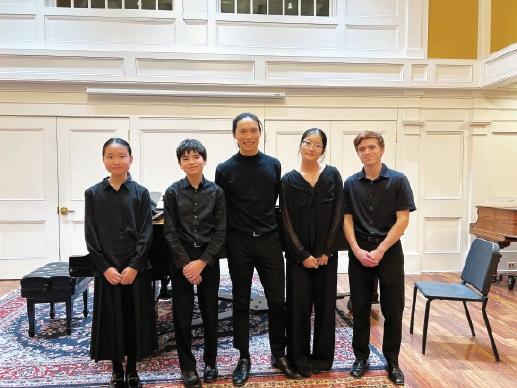
Anniversary programming continued with the return of two acclaimed alumni in April. Broadway performer Miles Jacoby ’07 gave a masterclass for Conservatory Program musical theater students, offering aspiring performers a glimpse into the demands and rewards of a theatrical career.
Renowned composer Matthew Aucoin, former RSC student and a 2018 MacArthur Fellow, returned as the featured composer for the Seminar on Contemporary Music for the Young. Throughout the weekend’s many concerts, students performed works by Aucoin and other contemporary
composers, and a student string quartet debuted a new arrangement of selections from Aucoin’s song cycle The Inner Core alongside award-winning bass-baritone William Socolof.
Together, these alumni visits reflect a defining strength of the Rivers and RSC community: connection across generations. “As artists, perhaps the best way to honor our mentors is to pay it forward and become beacons of inspiration for the next generation. I couldn’t be more grateful to these wonderful musicians who have returned to RSC on this exciting anniversary year to generously share their talents with our community,” said Javier Caballero, executive director of performing arts.
For current students, the message is powerful. Visits from RSC alums help them see that the practice rooms of today may be the launchpads for tomorrow’s careers, and that the teachers guiding them now are part of a continuum of musical excellence stretching back half a century. And as these guests tell their stories, they remind the community that beyond performance, music at RSC is about growth, mentorship, and enduring bonds formed through shared artistry. R
OPPOSITE PAGE: A. Ramón Rivera works with pianist Cole Delgado at the masterclass in January.
TOP TO BOTTOM: Leo McDonnell ’07, Tim Carman ’07, and Philippe Crettien; Carman (center) with Rivers Conservatory Program students; Leland Ko (center) with cello students from a masterclass in fall 2025; Ko gives a demonstration for a student.
BY SHEA MACLAUGHLAN ’27
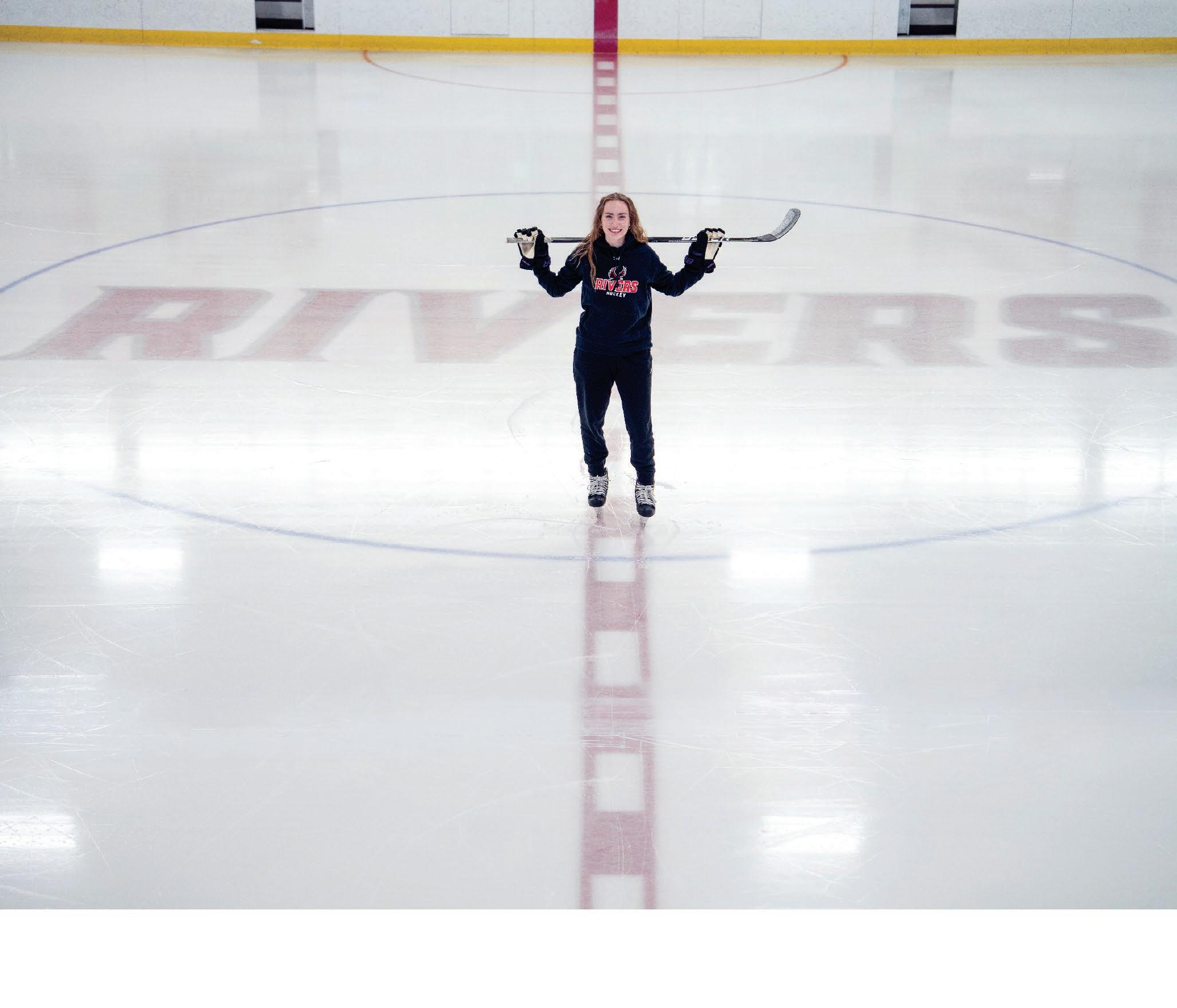
EVE STONE ’22 embodies the full-circle journey of a studentathlete returning to give back to the community that shaped her. While excelling in her senior season at Stonehill College this year as one of the top goalies in Division I, Stone also made the time to coach at Rivers.
Coming from a larger public school, she was first drawn to Rivers for its small class sizes and close teacherstudent relationships. “I had never had that before,” she recalls, explaining that the tight-knit environment gave her both academic and athletic confidence.
Hockey quickly became central to Stone’s Rivers experience. Having always played goalie, she experienced a level of support from her teammates and coaches at Rivers that she hadn’t received at her previous school. “Being on this hockey team was probably the biggest part of my experience here,”
she says. “I really felt comfortable with everyone and the coaches.”
Her dedication on the ice led to multiple NEPSAC tournament victories and MVP honors— achievements she believes reflect more than just athletic skill. “If anything, from my perspective, [the achievements] show that you have leadership,” she says, adding that her coaches and teammates “really prepared me for college and pumped up my confidence.”
After sustaining an injury last year, Stone returned to Rivers from college not as a player but as a coach. “Even though I wasn’t able to play hockey, I
Being on this hockey team was probably the biggest part of my experience here. I really felt comfortable with everyone and the coaches.”
—Eve Stone ’22
was able to coach, and it really kept me engaged and going,” she says. After recovering from her injury, Stone continued coaching at Rivers. In that role, she focused on mentoring goalies and teaching resilience.
“Goalies are such a specific position that not many coaches truly understand,” she says. “I always say to the girls that resilience is the most important part of hockey. It’s really just about how you respond to adversity, not the adversity itself.”
Stone’s story highlights the lasting impact of Rivers’ supportive environment. By mentoring current players, she bridges the gap between student and coach. “I was in their shoes only four years ago,” she notes. Today, she strives to provide current athletes with the same confidence, guidance, and sense of community that made her own Rivers experience unforgettable. R
ON NATIONAL SIGNING DAY in November, the Rivers community celebrated six student-athletes who will play at the Division I level in college. Students proudly wore their new school colors as they formalized the next step in their athletic careers.
“These six young people have set a wonderful example of what it means to be a dedicated Red Wing,” said Director of Athletics Kristin Cannon. “We wish them the absolute best as they transition to the next level.”
The following student-athletes will move on to play at the Division I level:
Karim Eljamal ’26
Providence College, soccer
Hannah Piché ’26
Davidson College, lacrosse
Molly Hazard ’26
University of Denver, lacrosse
Kyleigh Rabazzi ’26
Boston University, lacrosse
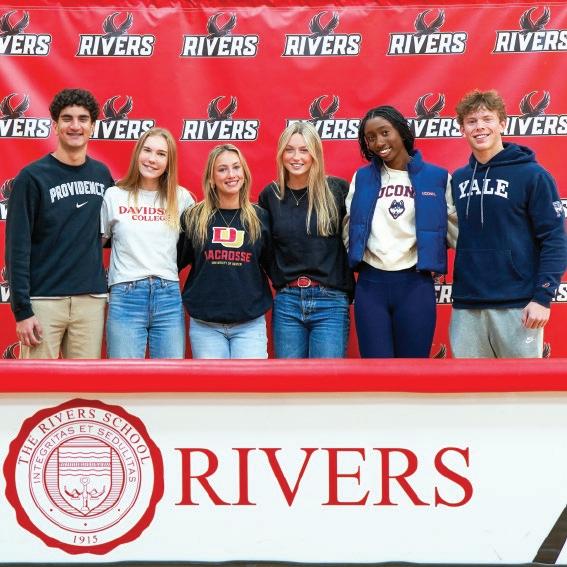
Jasmine McNish ’26
University of Connecticut, soccer
Devin Constantino ’27
Yale University, baseball
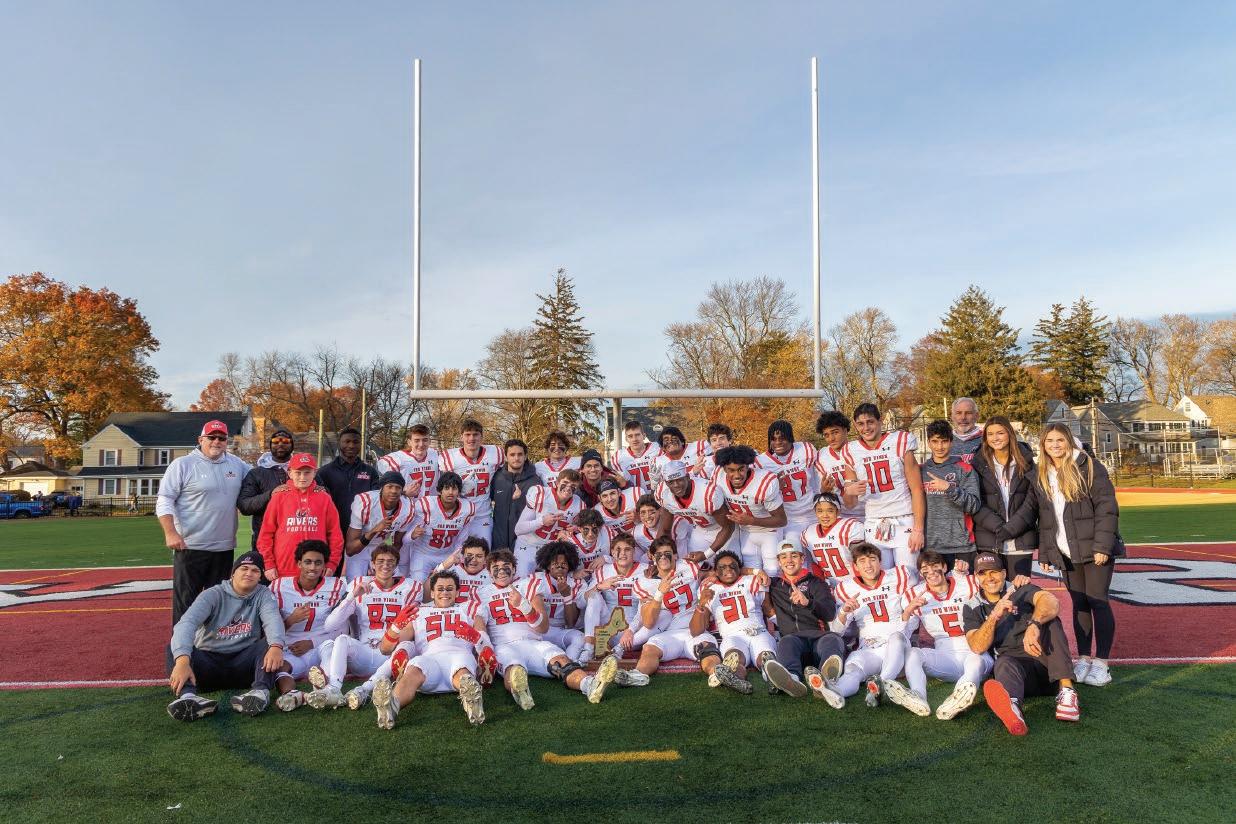
RIVERS STUDENT-ATHLETES continue to have a stellar record on and off the field. In the fall, four Rivers teams—varsity field hockey, varsity volleyball, boys’ varsity soccer, and varsity football—advanced to the postseason, with two teams earning high accolades. Varsity football won the NEPSAC championship for the third time in four seasons, bringing home the 2025 NEPSAC John Mackay Bowl trophy after a 14–11 victory over Kingswood Oxford, and varsity field hockey tied with Nobles for a first-place finish in the ISL after an incredible season.
8–1 RECORD IN 2025 SEASON 28.9 POINTS PER GAME SCORED IN THE 2025 SEASON
13.5 POINTS PER GAME ALLOWED IN THE 2025 SEASON

Creating an environment that supports students to the fullest extent is only possible through the power of community. In recognition of the support their own children received from the school, several Rivers parents have been inspired to give back, establishing dedicated funds for wellness initiatives.
“It was our goal to provide help for our students in a challenging world, to provide skills, and to understand their emotions and the pressures and stressors,” said Nikki Bartlett P’21, ’25, ’27, ’29. She and her husband, Marshall Bartlett P’21, ’25, ’27, ’29, established The Bartlett Family Fund for Wellness in 2021. “Initially, our
focus was on students—now, five years later, we are also looking to support parents and professional community members,” she said. Through the fund, Rivers has brought mental health literacy education to students, faculty, and families in partnership with McLean Hospital’s School Consultation Service. In
addition to this program, Rivers has provided parent support and education by bringing in specialized clinicians, such as Daniel Crump, a therapist and co-founder of The Be Center, who has led a number of workshops over the past four years.
In 2018, John and Amy Slavik P’18 established the Slavik Family Fund
“The Rivers humanity piece is what we’ve loved for 26 years.”
–Nikki Bartlett P’21, ’25, ’27, ’29, language faculty member
for Wellness. They were motivated to support wellness initiatives in light of new stressors for children in the age of technology and social media, which can affect adolescents’
“Things are very different today than when my wife and I were in high school,” said John Slavik. “There were no phones and no social media—everything was face-to-face. Problems are now getting magnified online. It puts pressure on kids that
Academic support also plays a pivotal role in overall student wellness, and it often goes unseen. Out of gratitude for their own son’s experience with the learning services team, John and Gina Dineen P’24 established the Dineen Family Fund for Learning Services in 2025. The fund supports the learning services team, which provides one-on-one executive functioning and academic skills support, as well as tutoring in specific areas.
“When we were looking at Rivers, learning that academic support was offered during the school day was reassuring,” said Gina Dineen. “This program helps students with different learning styles to thrive at Rivers and beyond, and we hope the program continues to expand and serve the needs of the student population at Rivers.”
John Slavik also emphasized the importance of visibility for the breadth of wellness resources at Rivers. “These resources exist and are actively being used,” he said. “They give the students the tools they need to develop into stronger people as they approach adulthood.”
For Nikki Bartlett, who is a member of the faculty teaching French and Spanish, the caring campus community is of prime importance.
“Rivers is making a difference with Excellence with Humanity,” she said. “The Rivers humanity piece is what we’ve loved for 26 years. That humanity piece is what makes Rivers different from other schools.” R
Read more about campus wellness initiatives in this issue’s cover story, “Nurturing the Human in Excellence with Humanity,” on page 32.
BY ALEXANDRA GHIZ
THE TERM “WELLNESS” may, for some, conjure images of sheet masks, green smoothies, and meditation centers; for others, it may call to mind the image of a self-assured individual climbing a mountain, taking a stroll with a dog, or just generally thriving and enjoying life. In an age of viral self-care products and habits, “wellness” has become a buzzword, and it’s hard to imagine a person today who is not familiar with some definition of it. But what does it really mean?
At Rivers, wellness is a value, not just a trend. It’s essential to the school’s focus on student well-being. Excellence with Humanity has been Rivers’ philosophy for roughly 20 years, and a call to “cultivate an ecosystem of connection, well-being, and belonging” is articulated in the June 2025 strategic plan as one of its three core pillars. It’s a notion that’s been in practice for quite some time—every trusted adult at Rivers plays a role in supporting students’ well-being, and each individual takes that role very seriously. As the new strategic plan reaffirms that commitment, student support professionals at Rivers lead the charge.
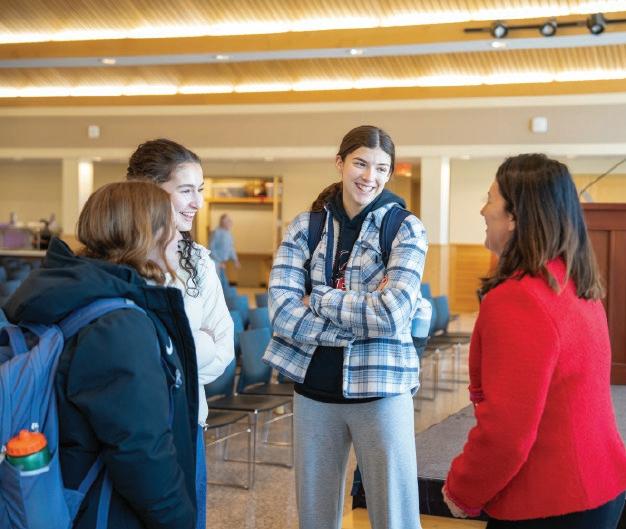
services team.
MIDDLE: An all-school assembly on social media led by researcher Jill Walsh (far right) sparked conversation among students, who approached Walsh eager to talk after her presentation.
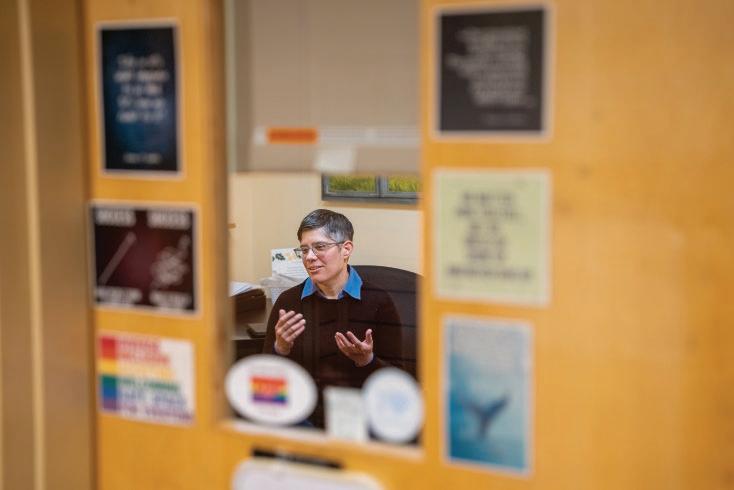
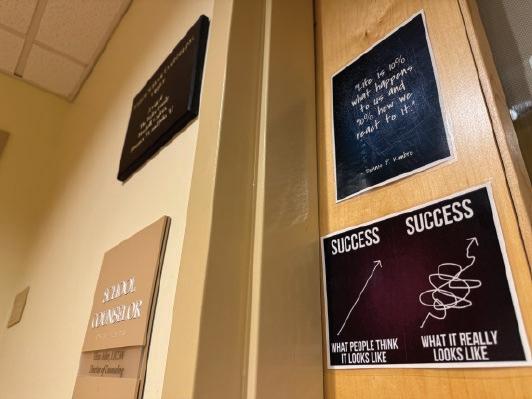
BOTTOM: Director of Counseling Services Eliza Adler in her office. The counselors’ offices are safe spaces for students to open up.
“Something that the Rivers counseling and wellness team often talks about is wellness programming as proactive and preventative. That looks like a lot of different things, but it really is meant to be the ground level of supporting our students—all students—in different capacities,” says Director of Wellness Programming Megan McCarthy.
is responsive to the individual needs of Rivers’ students and the community, which may be influenced by personal life circumstances as well as local tragedies, politics, and world events. While the cadence from week to week is somewhat unpredictable, the underlying commitment to providing a consistent, safe harbor for students remains a constant.
At the start of the 2025–26 academic year, part-time school counselor Sarah
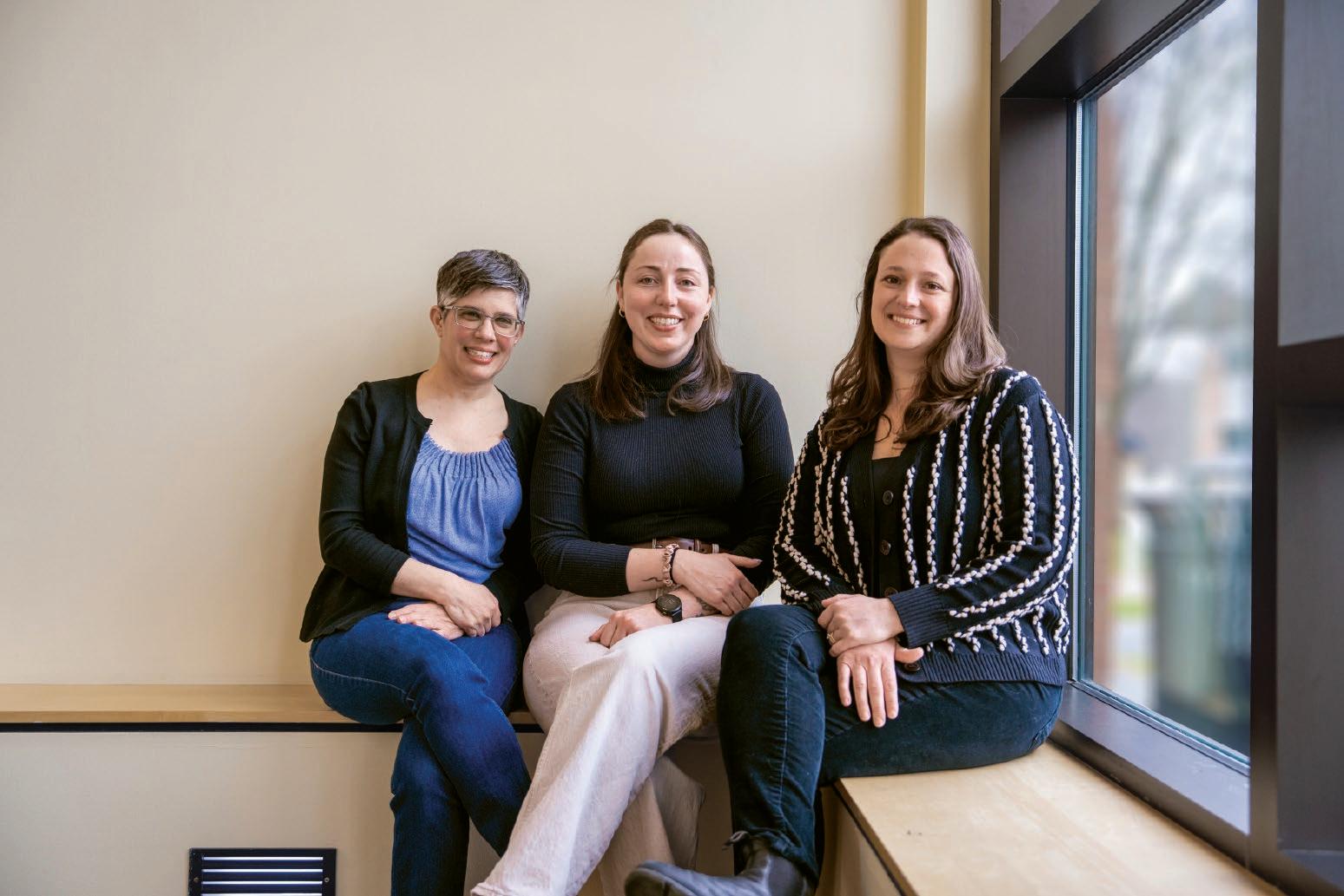
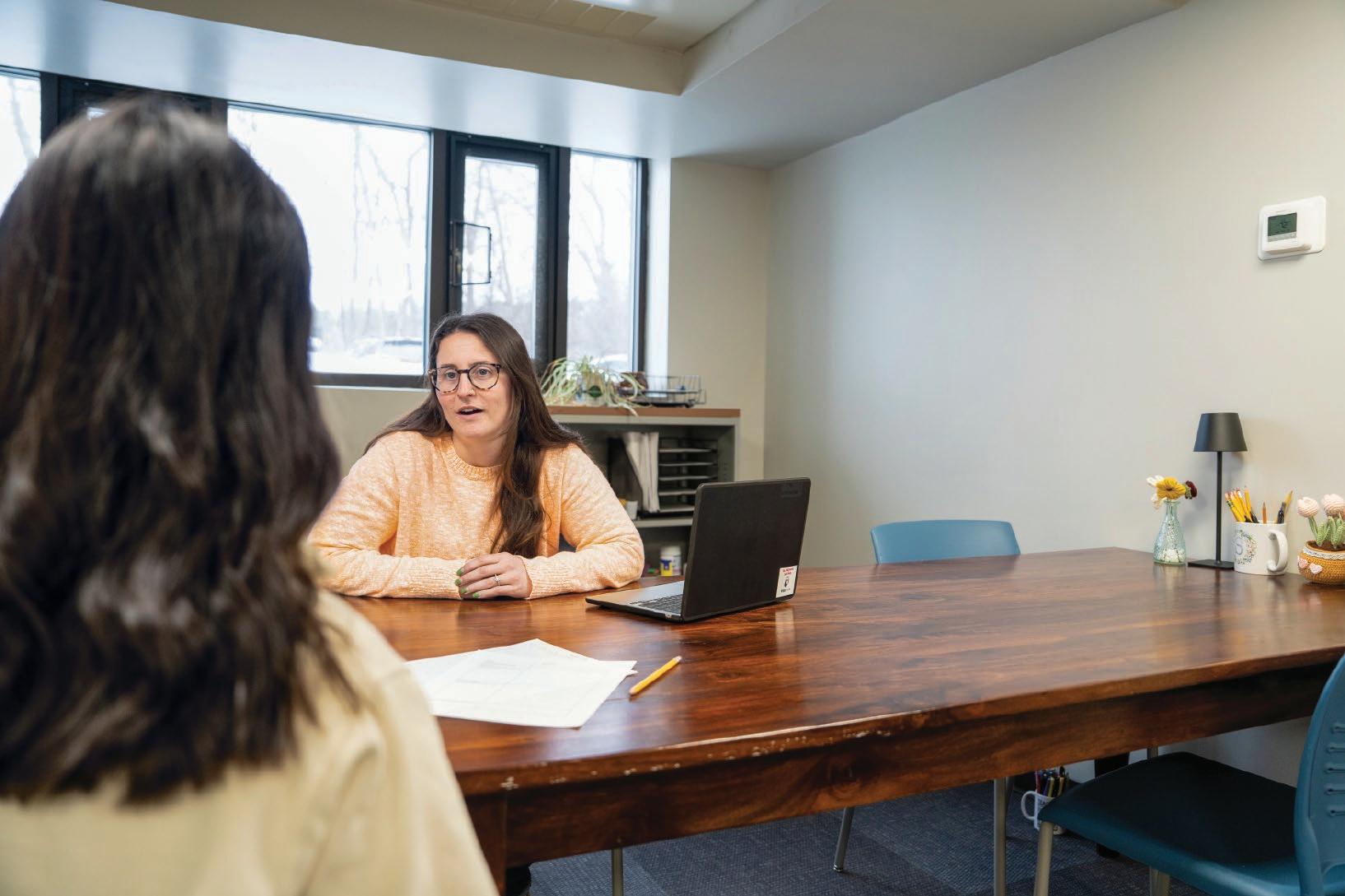
COUNSELORS ELIZA ADLER, Megan McCarthy, and Sarah Cucchiara provide critical support to the student body and professional community alike.
person served as counselor and director of wellness programming for the entire school. In a testament to Rivers’ continued commitment to student well-being, over the past four years, the counseling and wellness team has expanded to include more professionals on staff and more programming. The team also attends weekly student support meetings with grade deans, learning services, the school nurses, division heads, and members of the equity and engagement team to check in about needs. Whether or not a student comes to them directly, the counselors can offer support through students’ trusted adults on campus, whoever they may be.
“One of the ways we can be most effective and successful in helping the whole community is by building relationships with the adults who work here long-term, so that every student is seen and cared for,” says Adler. “Part of our job is forming relationships in the adult community, because we may not be the ones to talk to a student directly, but we can use our expertise in many ways to consult on problems big and small.”
The counselors’ offices, located on the lower level of the Campus Center, are known as safe spaces at school where students can let their guard down. Equipped with colorful fidget toys, couches, mood lighting, and candy, the space offers something for everyone, even for students just curious about the space in between classes nearby.
“It’s really sweet, because I’ve built these connections with kids who would never come to counseling one on one,” says McCarthy. “I love when they come in here, and they say they’ve never been in here before. Those are the moments where we destigmatize the counseling side of it, where we’re
IN ADDITION TO TAKING part in the wellness programs Rivers offers, students have stepped up to lead their own initiatives to promote well-being. In Psychology Club, led by Alicia Wen ’27 and Will Reidy ’28, students foster a supportive community where they can learn about psychology, practice selfcare, and cultivate a positive mindset, whether in sports, music, academics, or other areas of life. Psychology Club was born out of a personal turning point for Wen. As a competitive golfer, she initially entered the world of sports psychology to navigate the mental demands of tournaments, but her research into the field sparked a broader mission.“I wanted to create a space where other students with an interest in psychology could come together,” she says.
Reidy, also a golfer, shared her interest in psychology and signed on as a co-leader of the club. That interest has influenced his academic choices, too: He recently completed a research project in English class on sports psychology. The club functions as a collaborative space to dive into the mind in every context. Each month, Psychology Club focuses on a different theme related to psychology, such as goal-setting or flow state, and the leaders facilitate discussions that examine a specific facet of the theme. In addition to being a space for exploration, the club is also a space dedicated to supporting student wellness. With their faculty advisor, Megan McCarthy, the leaders share evidence-based strategies with students through school-wide initiatives, such as a wellness station during exam season and an educational bulletin board during Mental Wellness Month in January. Wen and Reidy’s goal in leading the club is to show other students how much the mind can dictate day-to-day life and to offer strategies in managing those thoughts and promoting overall well-being.
Another club addressing wellness, the Zen Den, is led by Jai Gardner ’27, Max Kaufman ’26, and Luke Taylor ’27. “Overall, the space is a place to decompress, where students should be comfortable to share their own thoughts,” says Kaufman. The club has garnered significant interest since its founding in 2024. Over 120 students are currently on the mailing list, and the typical turnout for weekly meetings is around 25 students. At club meetings, lights are dimmed or turned off, and yoga mats are provided for those who wish to lie down.
“A lot of clubs are based on talking and discussing with people,” says Gardner. “We make sure this is a place where you can sit in silence for 45 minutes if you need to.”
In addition to finding moments of quiet reprieve, Zen Den participants also engage in guided activities together. Sometimes, the leaders share stories and poems, and some younger students have begun sharing, too. Jeff Nisbet, who teaches Mindfulness in Drawing as a visual arts course in the fall, has visited the club to lead a mindfulness activity. At the end of each club meeting, participants share things they’re grateful for.
When he joined the club as a sophomore last year, Taylor appreciated the space for peer-to-peer connection about some of the challenges of high school. “I appreciated knowing that older students were feeling the same stress as me,” he says. As a club leader now, Taylor says it’s been rewarding to hear a similar sentiment from younger students about how they are benefiting from the Zen Den community.
“I love when [students] come in here, and they say they’ve never been in here before. Those are the moments where we destigmatize the counseling side of it, where we’re just a safe space for kids.”
— MEGAN MCCARTHY, DIRECTOR OF WELLNESS PROGRAMMING
just a safe space for kids.” Safe spaces are important in building a community where students feel comfortable connecting and being themselves, and so is education about coping strategies and building confidence in stressful situations.
“All of our programming is education-first,” says McCarthy. All-school wellness assemblies and targeted activities during advisory are integrated in all grades, from the Middle School through the Upper School. At the crux of the wellness curriculum is the Grade 9 Wellness Seminar, which lays the groundwork for students during the fall semester of their first year in the Upper School. The eight-week program highlights topics including physical health, mental health, study skills, and how to access campus resources. The seminar also includes modules from EducaHealth, an organization that offers age-appropriate health education and substance abuse prevention. Its curriculum is also used in the Middle School and Grade 10.
“Regardless of whether they are returning to Rivers for Grade 9 or joining from another school, we want to give all students the building blocks to be successful throughout their Upper School career,” McCarthy says.
Throughout the year, the broader community has the opportunity to engage with wellness guest speakers. In the 2025–26 academic year, the wellness team launched a speaker series for parents and caregivers called “Navigating Adolescent Development in an Interconnected World.” The series featured therapist Daniel Crump, co-founder of The Be Center, who spoke about finding balance in parenting, and Jill Walsh, a sociology lecturer and researcher at Boston University who studies how teens use digital spaces to shape their identities.
The common thread between that proactive wellness programming and responsive counseling is education, says McCarthy. “Giving people information and skills is one way to help them effectively long-term,” she says, adding that this also applies to parent programming. Ultimately, the goal is to give people tools to manage stressful and difficult emotions independently, while still being available as a resource for counseling and support.
In 2023, Rivers formed the technology and wellness task force, which provides information and tools to help community members manage the intersection of wellness and ever-evolving technology. The group originally consisted of Adler and McCarthy, Director of Technology and Innovation John Adams, and the deans of student life from both the Middle School and the Upper School, and this year it has expanded to include a few faculty members. The task force brings together a group of people with a variety of skill sets to consider how cell phone use and social media affect well-being for adolescents in particular. The task force reviews other institutions’ phone policies as well as recent studies on the matter to come up with recommendations for policy at Rivers.
“As we do with our classes, we wanted to take an interdisciplinary approach toward an aspect of our students’ experience at Rivers that we think needed special attention,” says Adams. Research shows that phone bans during the school day have positive impacts on mental health, but the task force’s goal is even more specific than that. “Our priority is actually building community,” says McCarthy. “If we’re really looking at what Rivers needs, lis-
JILL WALSH, who works with schools across the country to develop best practices and policies for technology and social media use, conducted focus groups with Upper School students and faculty about phone usage at Rivers.
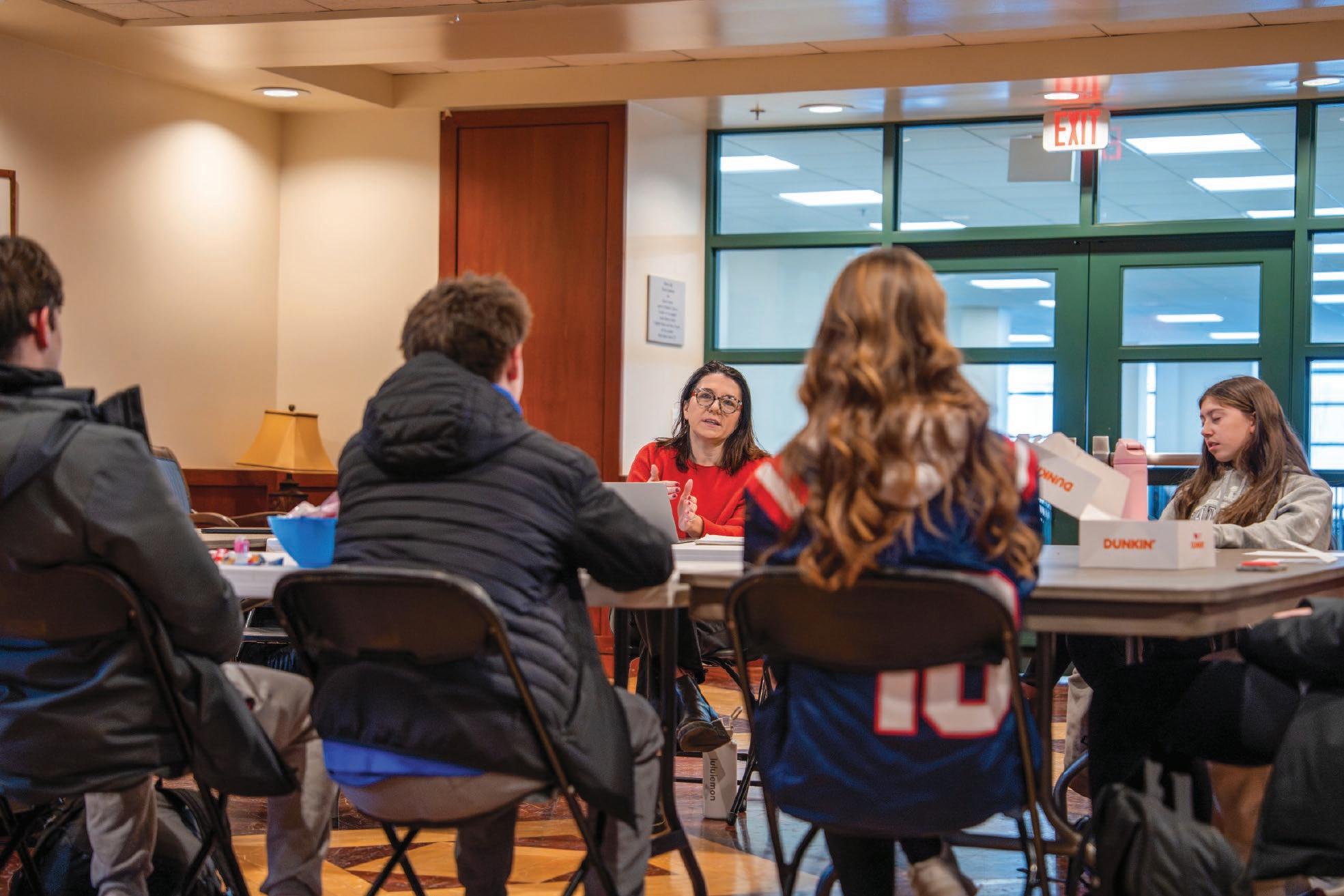
Upper School, students are required to place their phones in a bin at the start of each class and to refrain from using phones during assemblies.
In addition to giving a talk for
years, will inform recommendations for future phone and data policies at Rivers.
Beyond the task force’s work on phone policies, education on the
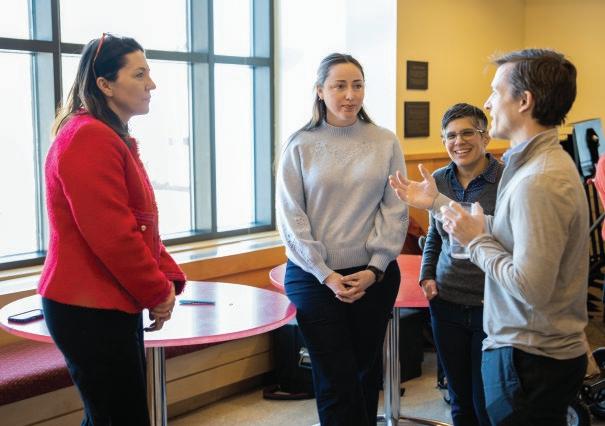
assembly about social media provided an example of the intersection between well-being and technology and got community members talking, including McCarthy, Adler, and Adams, pictured here in discussion with Walsh (left) after her presentation.
have a lot of kids being really thoughtful about their phone use, and I was able to come to that realization because this curriculum opened up space for kids to talk, think about their own data, and do so in a safe environment,” Adams says.
“Giving them the opportunity to have a voice in this discussion and share their thoughts and ideas is really valuable,” he adds.
Adams has also led a series of assemblies for Upper School students this academic year on artificial intelligence, which he says directly ties into another charge from the new strategic plan: to “incorporate emerging technologies.”
“Effective use of technology, or use that enhances or accelerates the work and learning done in class, comes when you’re putting relationships first.”
— JOHN ADAMS, DIRECTOR OF TECHNOLOGY AND INNOVATION
relationship between technology and wellness is also integrated into the curriculum and programming.
In the summer of 2024, Rivers announced a partnership with The Social Institute to implement its #WinAtSocial curriculum, a series of online lessons focused on technology and well-being. Used in the Middle School through Grade 10, including in the Grade 9 Wellness Seminar, the modules are interactive and serve to get kids talking.
Adams, who teaches a tech and wellness unit in the Grade 9 Wellness Seminar, says he’s learned from those conversations, too. He finds that when asked to report their own screen-time statistics, Grade 9 Rivers students set themselves apart from the prevailing narrative around adolescents and cell phones.
“Kids get out their phones, they open up their screen time apps, and they just erupt in chatter,” Adams says. Students tell each other about the different restrictions they have set on their phones and the rules they’ve given themselves to foster a more mindful relationship with technology.
“For me, it was eye-opening. We
The series kicked off with a session on how AI works, tips for using it effectively, and examples of its positive uses. In the next session, Adams and the students explored community norms regarding human communication and addressed situations where AI has its limits. “Generative AI is something that people turn to in small or large rates in places where human connection could be more valuable,” says Adams.
Rivers is a community that cares about “connection and belonging and relationships,” Adams says, and he encourages students to take advantage of that. As he put it in one Upper School meeting, “You are all motivated young people looking to be successful in so many different ways, and you are in your prime years for developing the skill that is a key ingredient to success: relationship building. You can do that by asking a teammate to get some food after practice, going up to talk to someone you have a crush on, asking a teacher about a question on a test, and everything in between.”
Ultimately, the technology and wellness task force, and education through The Social Institute and Ad-
ams’ AI series, are meant to promote a harmonious relationship between technology use, wellness, and the Rivers community.
“My hope is that our use of technology models what the school values and cares about and helps us fulfill our mission,” says Adams. “Effective use of technology, or use that enhances or accelerates the work and learning done in class, comes when you’re putting relationships first, if you’re a curious consumer, if you’re using technology to show perseverance through a challenging class, or if you’re putting technology away to foster a community of connection, well-being, and belonging.”
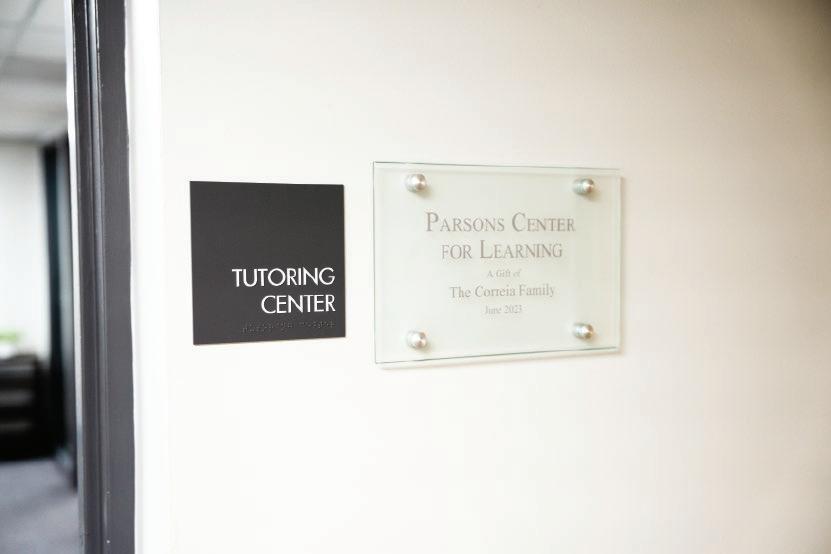
Counseling and wellness falls under the broader umbrella of student support services and programming at Rivers. Also under that umbrella is the learning services team, composed of Jennifer Litman, director of learning services, Katie Sia, learning specialist, and the tutoring department, led by Kathy Dorrien. The learning services team, including the tutoring department, are housed in the Parsons Center for Learning, located in the lower level of the Carlin Building. The center also has a community space and a breakout room for flexible use. Before the center was renovated and renamed in the summer of 2023, Dorrien met
LEARNING SPECIALIST Katie Sia coaches students and provides general learning support, such as time management and study skills, as well as one-on-one support and approval of learning accommodations.
“Something we will continue to do is really normalize the need. Everyone needs support sometimes.”
— JENNIFER LITMAN, DIRECTOR OF LEARNING SERVICES
with the architect to specifically advocate for spaces that would support students doing their best work.
Beyond finding a home in the Parsons Center for Learning, learning services as a program at Rivers has grown significantly in the past four years. Previously, the tutoring department covered elements that are now learning services offerings. In 2022, the program expanded with the addition of a part-time learning services coordinator and a commitment to offer one-on-one support to any student, provide teacher and parent/caregiver consultations, and develop teacher resources, such as individualized learning plans to support students.
Litman joined the Rivers community in fall 2023, and in fall 2025, Sia joined the team in a part-time capacity.
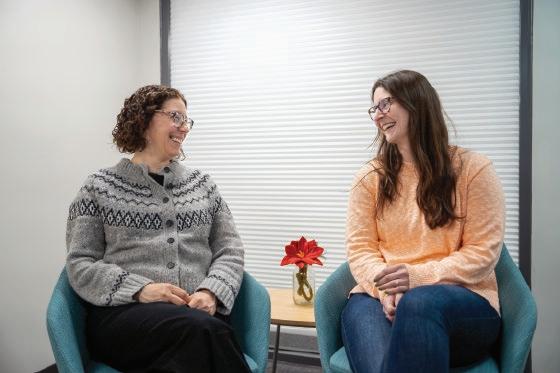
Litman and Sia emphasize that their support services are open to all students at Rivers. “We are available to anyone, with or without formal learning plans,” Litman says. The team offers general executive functioning support, such as helping with study skills and time management, as well as individual, targeted learning support and approval of learning accommoda-
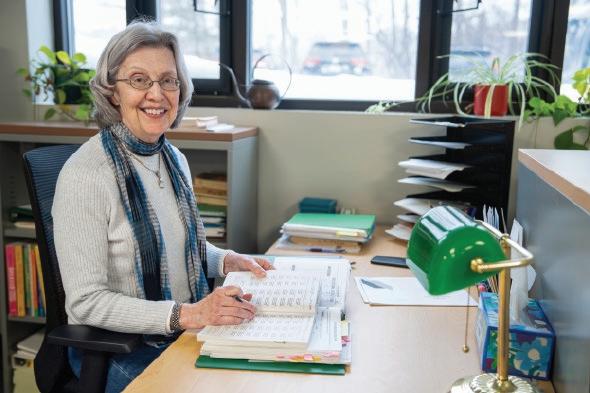
tions, such as extra time on tests.
As with any student service, the work is done in close partnership with other adults on campus. Working with teachers, deans, and advisors helps Litman and Sia determine the best resources to offer a given student.
Litman and Sia also attend the weekly student support meetings for Middle School and Upper School.
Asking for help in a school environment that has a reputation for academic excellence can be daunting for many students, but Litman and Sia seek to reduce that stigma.
“We will continue to normalize the need for help. Everyone needs support sometimes,” says Litman. “Study Skills” is one module in the Grade 9 Wellness Seminar, and Litman would like to expand the learning services curriculum across grade levels, as well.
That early visibility in Grade 9 helps get some students who need support in the door. Others may come in via a parent or teacher referral or self-select when they recognize they could use the help.
Those students who seek learning support are grateful for the results.
“Learning services have helped me manage my time, stress, workload, and study strategies,” says one student. “Their ability to find time out of my busy schedule to meet gives me the extra help and motivation to get me through my academic week. I feel like I have a whole team behind my back who want to see me succeed.”
Litman hopes for further expansion of learning services offerings as well. “We would like to increase our teacher consultation and support,” she says. “This year, we developed and shared resources to help teachers understand student learning profiles and evaluations, as well as strategies for supporting students in the classroom.
We would also like to offer topic-specific drop-in sessions for teachers to provide more support and collaboration around helping them help their students.”
Tutoring, which requires payment and booking of appointments, offers another layer of academic support for students. Dorrien and two other professional tutors, Gitte Irving and Katerina Buff, work with students, usually in weekly 40-minute sessions. Their expertise is critical, says Dorrien. Tutors dive into specific content areas within history, math, Spanish, and science and provide support for general skills like reading comprehension and test preparation.
Sessions provide structured, multisensory instruction with modeling and guided practice. Bringing years of training as learning specialists and experience in content areas, tutors often share ideas and collaborate to build the program.
Dorrien emphasizes that tutoring is not meant to replace the primary connection between a student and a teacher, but that the one-on-one setting allows tutors to pay extra attention to how a student processes the material so they can tailor their support accordingly. Tutoring is also an opportunity to quash any negative perceptions a student may have about themselves and their ability to learn, and to help them gain academic confidence.
“So much of learning is actively engaging with the material, and it’s hard to actively engage with the material when you don’t understand it or don’t know how to learn it,” says Dorrien. She explains that when students realize something is doable, they start to enjoy it more, which can lead to increased confidence and improved performance.
The strong interpersonal relationships and the community of care make Rivers a place families choose and alumni return to. That community is strengthened by the concrete support systems upheld by the counseling and wellness team, the learning services team, and a shared sense of responsibility and care throughout the Rivers community.
Dorrien has been a tutor at Rivers since 1990, and the many students she’s helped over the years have gone on to do great things. A few years back, a student she had tutored many years earlier won a Rivers alumni award, and he asked Dorrien to attend the ceremony.
“Now he is in education himself,” Dorrien says. “We keep in touch with former students because we love to see where they go and what they do. They’re such wonderful people to begin with, but just to see that growth over time is really rewarding.” R
BY GRACE RAMSDELL

IN A WORLD where wellness has become a trillion-dollar global industry, how do we keep track of what really matters? “I think we can often see something like a wellness influencer on Instagram and think that we need to be like that in order to be well, or we need the latest ‘wellness’ product in order to be well,” says mental health counselor Eliza Butler ’10. “I would really urge folks not to buy into that.”
Butler is one of many Rivers alums working in wellness-related fields. Amid the commercialization of wellness, these alums are driven by hard work, human connection, and the power of helping others— values that, for many, took root during their time at Rivers.
“When I got to Rivers, the two things that stuck out were the culture and the community,” says physical therapist Brendan Gates ’14. The culture at Rivers instilled in him a strong work ethic and time management skills, he says, and the community served him beyond his four years on campus.
Because of a lacrosse recruitment, Gates had known since his junior year where he would go to college. But during his first semester there, he started to doubt whether the school was the right academic fit. He reached out to Rivers Director of College Counseling Dave Lyons ’99, P’30, ’32 for guidance. “‘I just don’t know what to do,’”
Gates recalls telling Lyons. “And Mr. Lyons said, ‘When you come home for winter break, let’s go get a coffee. We’ll talk about everything.’”
By that point, Gates knew he wanted to be a physical therapist. That winter break conversation with Lyons helped him think through the steps he would need to take to make that goal a reality. Gates ultimately made the most of his undergraduate experience, using it as a springboard to pursue a physical therapy degree in graduate school. “I credit that all to the foundation of Rivers,” he says.
Pediatric dentist Adam Lowenstein ’10 feels similarly indebted to the school, saying, “I learned how to learn at Rivers.”
By not losing sight of the importance of meaningful connection and a strong foundation, these Rivers alums keep themselves grounded and, whether they are in a training room or a dental office, they support others in doing the same.
SAIPRIYA VALOTH ’15 learned a lot at Rivers, but a particular course stands out: Thanksgiving Undone, a history elective taught by Ben Leeming P’17, ’19, ’21, ’23, which broke down the dominant narrative around the U.S. holiday. Valoth, now a mental health counselor, describes the course as “paradigm-shifting” for her.
“You might think it’s not totally related to being a therapist or to wellness,” she says, “But that class helped plant the seeds of my perspective now, which is that wellness cannot be divorced from personal histories, our history as a country, the history of the world, and how experiences of colonization have long-lasting impacts on what we think of as ‘to be well’ or ‘to live well.’”
“Wellness cannot be divorced from personal histories, our history as a country, the history of the world.”
At Rivers and throughout college, Valoth was passionate about storytelling. Eventually, she chose to pursue psychology over a writing career.
“But I think what I ended up liking about this career path is that I get to hear people’s stories, and I get to write new stories with them,” she says.
Valoth believes connection to the self and connection to others are both essential to well-being. Another core characteristic of her practice is to acknowledge the ways systems of oppression impact mental and physical health. “The more marginalized identities you have, the more there might be burdens or feelings of loneliness, shame, or disconnection,” she says. Valoth often repeats to her clients something her own therapist told her: Identities are always in the room. Rather than pretend otherwise, Valoth says she prefers to be direct about the ways personal identities—including her own—are relevant to her work with a client.
“The world and how we’re experienced by other people create within us dominant stories. ‘I’m not good enough,’ ‘I’m not capable of this,’ ‘Other people will always see me this way,’ or ‘This is who I am,’” Valoth explains. “And what I really like about this work is that with my clients, we get to name and sit with the pain of stories that we’re told to believe about ourselves, but that may not actually be true. Or, even if they are true, maybe they’re not useful. So, how do we create new stories together?”


BEFORE HAVING THE WORDS to describe it, Eliza Butler ’10 knew that mind-body-spirit connection mattered. She majored in psychology in college, but it wasn’t until she discovered a master’s program in integrative health that things clicked. The holistic approach to wellness at the core of integrative health practices resonated with her deeply.
“That degree totally blew my mind wide open to all different modalities of healing,” Butler says. “We took everything from a nutrition course, to a mindfulness course, to an interpersonal neurobiology course, to an Indigenous medicine course.”
A couple of health coaching jobs and a move to Vancouver, British Columbia, later, Butler began working with officers from the Royal Canadian Mounted Police, the national police service of Canada, as part of her role at an integrative wellness clinic. “I noticed that a lot of the health habits of that demographic were not due to lack of motivation or knowledge, but were rooted in deeper traumas and systemic issues outside of their control,” Butler says. “It felt silly that we were making health goals of drinking more water, when it was clear so many of these men and women were suffering from PTSD, anxiety, depression, etc.”
“We can’t heal in isolation. We can’t be well in isolation.”
Butler found herself wanting to dive into those issues with the officers who were her clients. “But I couldn’t with my scope of practice—I wasn’t trained in that way,” she says. “So, I decided that I wanted to go back to school for counseling.” Now, Butler is a full-time somatic psychotherapist with her own practice, All Parts Wellness. She’s based in the U.S., but she works with clients from all over the world.
Wellness, Butler emphasizes, is not about “fixing” yourself. “It’s connection, finding a sense of belonging. It’s moving your body in a way that feels good and supportive. It’s eating whole foods and drinking water. It’s orienting yourself to joy and to pleasure in your day-today life,” she says.
“We can’t heal in isolation. We can’t be well in isolation. I think we’re sold this idea of self help, self healing, that we can do it all on our own—and we can’t,” Butler adds. “That’s a really important thing that I want people to know: We need each other to be well.”
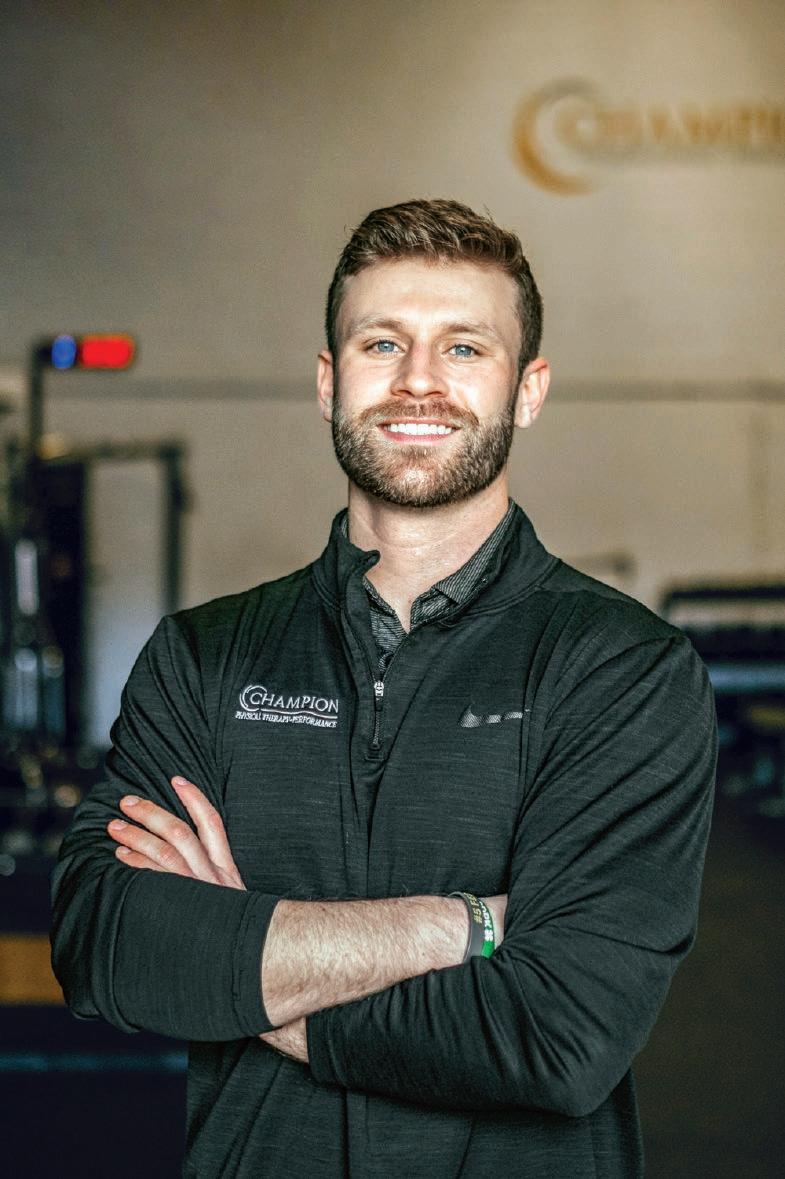
“THE END OF THE STORY is that I became a physical therapist,” says Brendan Gates ’14. “And the way I got there was because of Rivers.”
A shoulder injury during football season the fall of his senior year was a formative experience. “All I knew was I wanted to keep playing sports as long as I could,” he says. “When you get hurt and taken out of your sport, there’s a little bit of an identity crisis that happens.”
Rivers Athletic Trainer Myron Mentis played a key role in helping him navigate that injury. Gates was able to recover without needing surgery—and in time to make it back onto the lacrosse field in his final semester.
Mentis did more than help Gates get back in the game: He inspired his career path. Between Gates’ own injury recovery experience and taking Mentis’ sports medicine elective at Rivers, he saw how meaningful that kind of work could be, and he realized it was a way to stay around athletics beyond his years as a student-athlete.
“I went from being the athlete to finding a new identity of helping other people.”
After four years of playing Division I collegiate lacrosse, Gates headed to graduate school to become a physical therapist. “My identity shifted a little bit,” he says. “I went from being the athlete to finding a new identity of helping other people.”
Now at Champion Physical Therapy and Performance in Needham, MA, Gates has worked with clients anywhere from age 8 to age 82, including many high school athletes. The recovery process from an injury can be long—a torn ACL, for example, might take a year to treat. “When you’re 14 years old, a year is a significant chunk of your life. These kids are really struggling with that,” Gates says. “We have some deep, heart-toheart conversations.”
Gates’ favorite part of a given day is witnessing a client’s improvement, even if it’s just a small step in the right direction. And his favorite part of the job overall is to see those high schoolers fully recover. After all, he knows firsthand how that feels.
“Going to watch one of the kids’ games, their first game back after a whole year off or something—that’s a lot of fun,” Gates says. “It’s really cool to be a part of that.”
WHEN CHRISSY LEE ’04 arrived at Rivers as a Grade 10 student, athletics were essential to helping her settle in. Her cross-country coaches, Stephen Paluseo and Paul Karasch, “were amazing,” she says. “They really got my confidence up and taught me to push myself.”
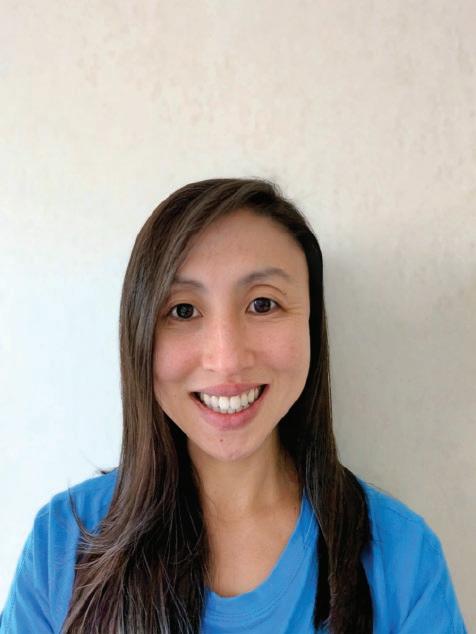

Her teachers helped with that, too. At Rivers, Lee found herself enjoying some subjects for the first time, like history with Bruce Taylor ’73. Physics with Stewart Pierson P’17, ’22, ’23 also stands out in her memory. “It was something I never expected to be particularly good at or like,” she says. “But he made it an enjoyable thing.”
When she got to college, Lee quickly found herself pursuing a career in athletic training.
“The health field was where I was leaning toward, and pairing that with athletics made sense for me,” she says. After graduation, she got a job at a physical therapy company in New York City. “It was a great experience because of the people I worked with,” she says. “I also learned a lot from there about what I want and don’t want in life.”
Later, Lee joined a physical therapy clinic that also contracted with local schools. “That’s how I ended up at the school I’m at now, because I was contracted out to them, and they took me on full time eventually,” she says.
pre-K to Grade 12 independent school for girls in New York City, for over 10 years now. “I’m glad I experienced the physical therapy clinic setting, but I found I really enjoy being in a school,” Lee says. “And I’ve been at Sacred Heart long enough now that I’ve seen students from the age of 6 who I’m now seeing graduate.”
“The health field was where I was leaning toward, and pairing that with athletics made sense for me.”
In addition to appreciating the strong relationships she formed with coaches and teachers at Rivers, Lee continues to be inspired by Rivers Athletic Trainer Myron Mentis, whom she describes as “supportive, honest, and unwavering in his dedication.”
“Seeing that level of care up close at Rivers not only inspired my professional direction, but also continues to influence how I build relationships with the students I work with now,” Lee says.
FOR ADAM LOWENSTEIN ’10, an inevitability. His father, a proud alumnus, made sure Lowenstein and his sister knew all about Rivers from a young age.
“The school always felt like such a backbone in our lives,” Lowenstein says. “And part of the reason why I’m so happy with my life is because of how I grew up at Rivers.”
Now, a career in pediatric dentistry seems like it was just as inevitable as attending his father’s alma mater—but it took a little longer for Lowenstein to see that. He pursued dentistry and sports journalism throughout college before ultimately becoming a pediatric dentist.
“I went to the same high school as my dad, the same college as my mom, the same dental school as both my parents, and then I went into the same dentistry specialty as my mom,” Lowenstein says. “When you look at that perspective, apparently I just followed in their footsteps—but there was no pressure whatsoever.”
Lowenstein practices dentistry in Framingham and Wellesley alongside his parents, and he’s also an assistant professor at Tufts University School of Dental Medicine. “My passion comes from wanting to help others,” he says.
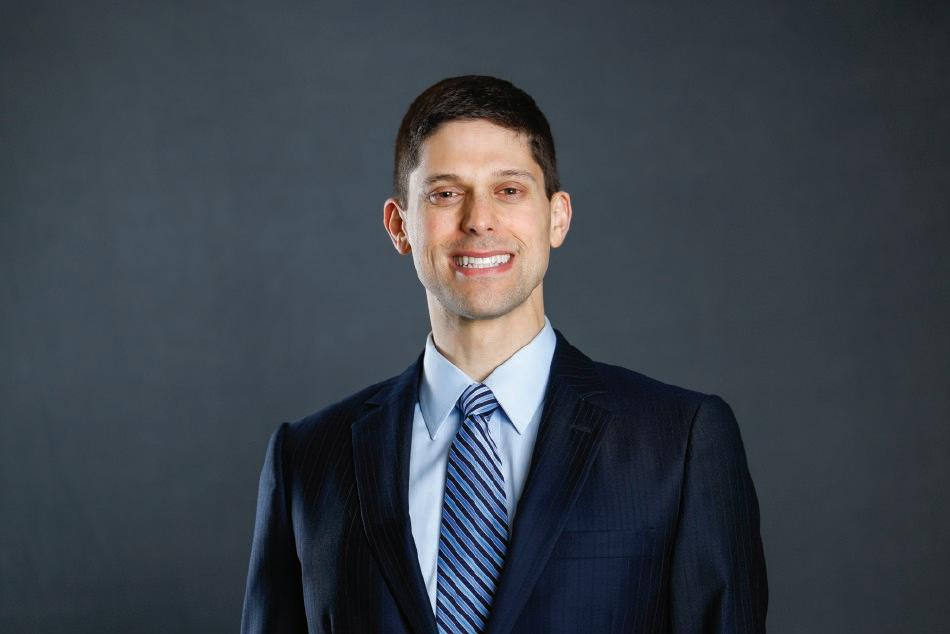
very relevant to dentistry.
“You may think that you’re just going in for a [dental] cleaning, but it still affects the rest of the body.”
Especially for his youngest patients, Lowenstein hopes visits to the dentist can be fun. With positive early exposure, children can build good habits and an understanding that keeping up their dental health is important. “I try to bring as much energy as I can. I try to bring excitement,” Lowenstein says. “And I can’t believe how many fun times I’ve had recently where kids have said they want to become dentists.”
One of the perks of a family practice is that it also offers an easy way to connect with kids who come in with their parents. “If a little one comes in with their mom or dad,” says Lowenstein, “I can say, ‘Look in the room next door—that’s my mom!’”

“EVERYBODY NEEDS A NURSE,” says Kaitlin Davidson ’16. Though she didn’t always know what career she wanted to pursue, Davidson knew she wanted her job to feel purposeful, and she wanted to be able to do it anywhere.
“What drew me to nursing is you get to go to sleep at the end of the day knowing that you made even a small difference in someone’s life,” she says. “And there are hospitals everywhere in the world.”
With encouragement from Rivers Director of College Counseling Dave Lyons ’99, P’30, ’32, Davidson chose Villanova University, where she could commit to a nursing track from the start.
“It’s a really empowering skill set,” Davidson says. “Not many people can say, ‘I know how to save someone’s life.’”
Now a perioperative nurse, Davidson assists with setup and patient care before, during, and after surgeries. Following through on her desire to work anywhere in the world, she relocated to Australia in 2024 and began working at the Sydney Surgical Centre.
In December 2025, Davidson found herself on the front lines of a tragedy that quickly became a global news story. While doing laundry in her
Bondi Beach apartment one evening, she heard something unusual and went to her window, where she could see two men opening fire on a Hanukkah celebration at the beach. Davidson watched police take down the shooters, and without stopping to put on shoes, she ran outside.
“Not many people can say, ‘I know how to save someone’s life.’”
Though the scene was unlike anything she’d ever experienced before, Davidson knew what to do in an emergency and immediately put her skills to work. She remembers telling an officer: “I’m a nurse. I’m not here to make things more complicated— I’m here to help. Please bring me to whoever needs help.”
The first man Davidson assisted survived, and he later got in touch with her. “He told me, ‘I remember your face. I will never forget what you did. My family will never forget what you did. You’re the reason I’m still alive,’” she recalls.
“The only reason that I had the courage and the skill set and the strength to take action was because I am a nurse,” Davidson says. R
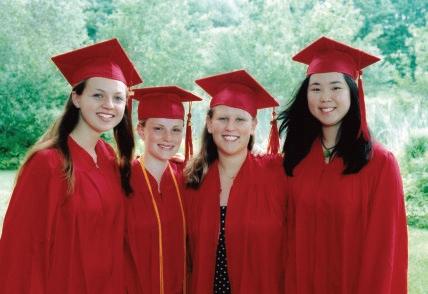
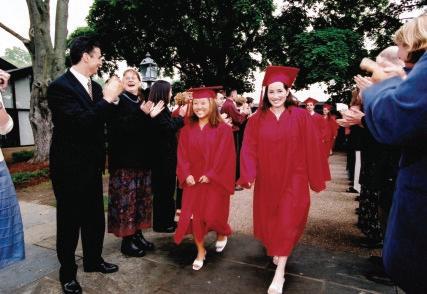
MANY THINGS HAVE changed over the years, but graduation at Rivers still looks a lot like it did when these photos were taken in 2005 (left two photos) and 2003 (right two photos). KNOW ANYONE IN THESE PHOTOS OR WANT TO SHARE YOUR OWN GRADUATION MEMORIES? Let us know by sending a note to alumni@rivers.org!
L.A. Jones ’68 writes, “Just celebrated 40 years of marriage! Two kids and two grandkids! Still working for myself after all these years and still wearing a necktie.”
John Stimpson ’88 writes, “I recently started a new job at CIFC Asset Management as a member of their investor solutions team.”
Andrew Kluter ’91 shares that he is now a state transportation planner for the California Department of Transportation, also known as Caltrans, in Oakland. “Enjoying life on the adjacent island city of Alameda in San Francisco Bay with my wife, YuJung. Drop me a line and say hello if you find yourself in the Bay Area: andrewkluter@gmail.com,” he writes.
Maceo Remy ’91 reports: “I am currently working in aerospace and defense acquisitions and development at AIG Aerospace, operating out of Rocket City— Huntsville, AL—where I’m helping drive the next-generation UAV systems. Our team is focused on advancing innovative VTOL drones and specialty aircraft, including the NASA-verified T-Wing series with its exceptional long-range endurance, hyper-agile performance, and all-weather capabilities for defense and commercial missions. While immersed in this exciting work amid Huntsville’s vibrant aerospace ecosystem, I live on the beautiful Gulf Coast between Alabama and Mississippi, enjoying the mild weather, beaches, and laid-back lifestyle. I occasionally visit D.C. and New England during the winter.”
Brad Woodley ’92 wrote in about his love of running in response to our call for alums passionate about wellness: “Running has evolved from something I simply tolerated into a lifelong pursuit that brings clarity, resilience, and a sense of discovery.
Continued on page 54
From Rivers to the Manhattan Theatre Club: Community and Catharsis on Stage
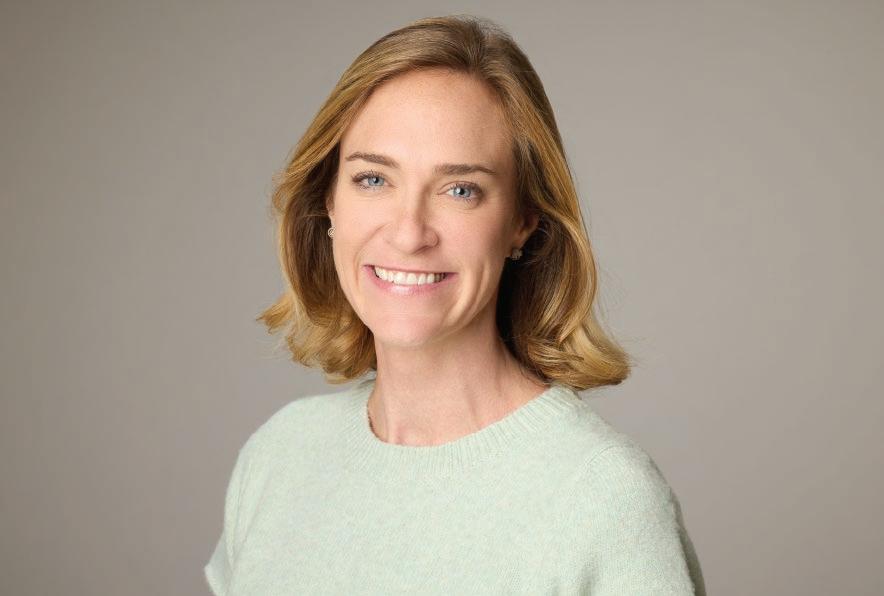
I learned from Rivers, and what is really serving me in my career in the theater, is being a well-rounded person who’s attuned to the world,” says Nicki Hunter ’05. In December 2025, Hunter became the artistic director of the Manhattan Theatre Club (MTC), one of the largest not-for-profit theaters in New York City producing shows on Broadway and off-Broadway every year.
After spending as much time as she could on stage at Rivers, Hunter studied theater and business at Lehigh University. “While my passion was performing on stage, I was keenly aware that it was supported within the comfort of an academic environment,
pressures to performing, it just wasn’t for me,” Hunter says. She began thinking about how she could combine her theater and business interests, and working for Manhattan Theatre Club was her answer.
In college, when Hunter read a play, she would pay attention to where it had first been produced. “I learned about Manhattan Theatre Club because most of the new plays I read during college received their world premiere productions at MTC,” Hunter says.
She didn’t get the first two internships she applied for at MTC, but she was persistent. “I went back to MTC, and I said, ‘The internships
I applied for, you didn’t give me. What other internships do you have to offer?’” Though the role they had wasn’t exactly what she’d been looking for, Hunter took it and made the
That go-getter attitude paid off— shortly after her summer internship ended, she heard from MTC artistic director Lynne Meadow, who encouraged Hunter to apply to be her full-time assistant. “Sixteen years later, I’ve held every position there is to hold in the artistic office,”
As she steps into the role of artistic director, a title Meadow held for over five decades, Hunter boils the job down to two main things: “Being an active producer for the shows that are on our stages, and simultaneously planning, developing, and programming the productions we’re doing next.”
Hunter has always loved that at MTC, no two days are the same, and community is central to the work. In a world she describes as increasingly siloed and screen-based, one of her responsibilities is to consider how MTC’s productions can help audiences “to understand the world at large, to understand humanity,” she says.
“Sometimes that means providing an escape, and sometimes that means providing a laugh, and sometimes that means providing the chance to shed a tear in community.”
Hunter believes art can heal, and she’s just as passionate about the power of live performance now as she was as a teenage actor at Rivers. “There’s a reason why theater has sustained so many ups and downs through human civilization,” she says. “It’s one of the most cathartic, most communal, most impactful forms of art.” R
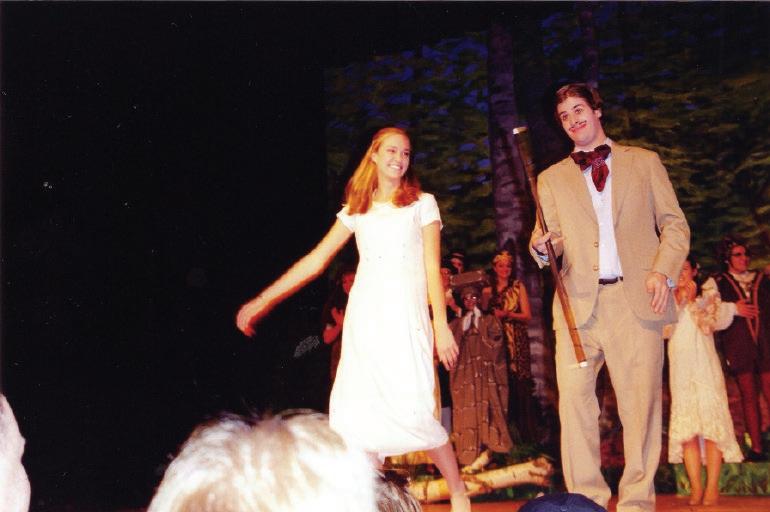
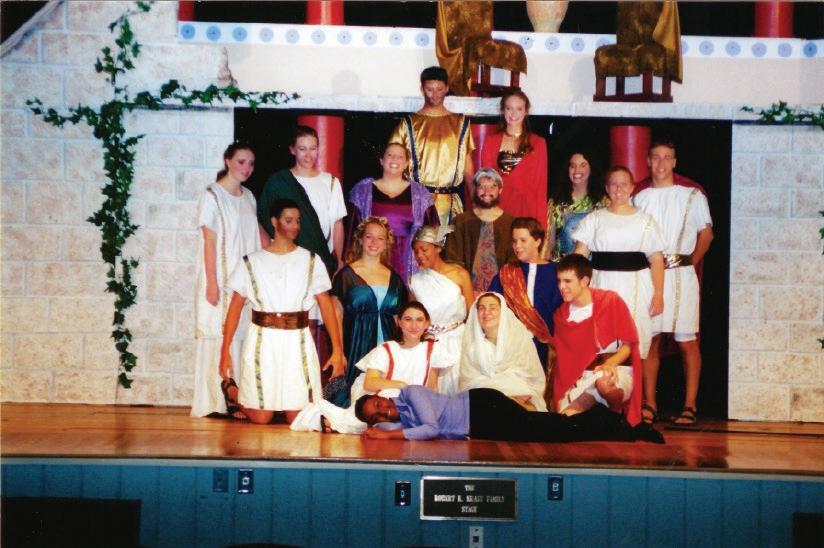
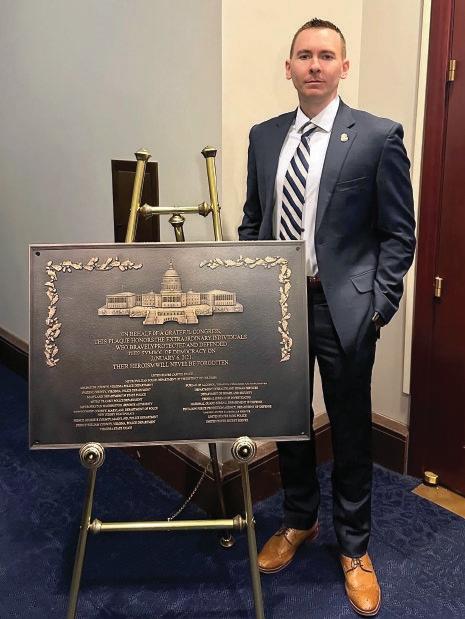
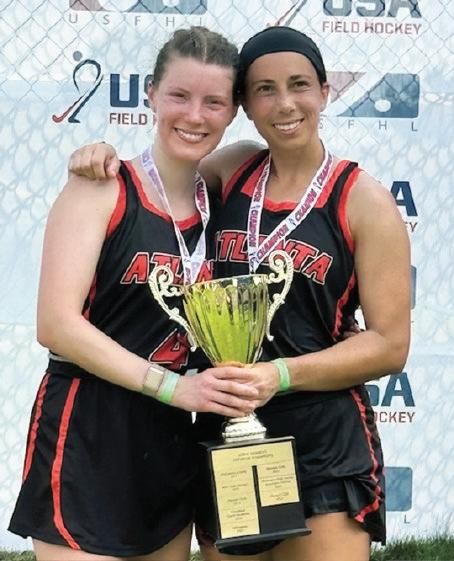
My interest began at Rivers and gradually grew into a year-round practice that supports my mental clarity and overall health. I have competed in races ranging from 5Ks to 50Ks on roads, trails, and several mountains over 4,000 feet, along with a number of duathlons. I have raced in snowshoes, on ice with Microspikes, and in all kinds of conditions. To date, I have logged 247 runs at the half-marathon distance or longer and have completed more than a dozen marathons, including two Boston Marathons, with my favorite taking place along New Hampshire’s Kancamagus Highway. I run because it offers an enjoyable escape, a chance to reset, and an opportunity to discover new places.”
Matt Talbot ’98 reports: “I am excited to share the launch of my new company this year, Key Operational Insights, a consultation and training company dedicated to helping organizations (education, corporate, healthcare, government, and more) prevent targeted attacks, intimate partner violence, stalking, self-harm, and other risk-related behaviors in the most defensible manner. I am also excited to share the recent release of a new book I co-authored with my business partners, Predators, Posers & Pained Personalities: Defensible and Effective Strategies for Preventing Targeted Violence and Managing Malevolent Behaviors, written for violence prevention professionals but likewise intended for everyone who cares about preventing violence and helping those in crisis. We want to help everyone have the tools to know what to say and what to do when a ‘see something, say something’ moment arises.”
See the 2020s class notes for an update on Elizabeth Hitti ’12!
Winston Pingeon ’12, a former officer with the United States Capitol Police, writes that he returned to the Capitol to testify before Congress in 2026 on the fifth anniversary of the January 6, 2021,
attack. He shared his experience of being violently assaulted, and he advocated for nonviolence in his testimony. He concluded his testimony by affirming his belief that, in his words, “Americans still have more in common than what separates us.” Despite harassment and threats of violence he has received for speaking out, he remains committed to speaking the truth of his experience.
Sawyer Helzberg ’15 and Eli Helzberg ’17 set out last summer on the Continental Divide Trail, widely considered the most remote and demanding of America’s Triple Crown long-distance hiking trails.
Tully Mahoney ’19 ran the 2026 Boston Marathon for Tufts Medical Center in honor of her uncle, who passed away from neuroendocrine cancer. She writes, “My fundraising will support Tufts’ mission to advance patient care, research, and education to help develop new treatments and provide compassionate care for patients and families facing cancer and other complex illnesses. It’s been a meaningful way to combine my love of running with a cause close to my heart.”
Since leading their respective Rivers field hockey teams to NEPSAC championships and playing in college (UPenn and Brown), Elizabeth Hitti ’12 and Julia Hitti ’20 have joined forces to continue the winning tradition. Playing together, the Hitti sisters guided Atlanta Field Hockey Club (AtlantaFHC.com) to its first national title in 2025—winning the USA Field Hockey League Women’s National Club Championship.
At his senior night hockey game at Bentley University, Pat Lawn ’20 reunited with former Rivers faculty member Laura Brewer, who was his advisor at Rivers.
Sam Amato ’21 ran the 2026 Boston Marathon as a charity runner for Special Olympics Massachusetts.
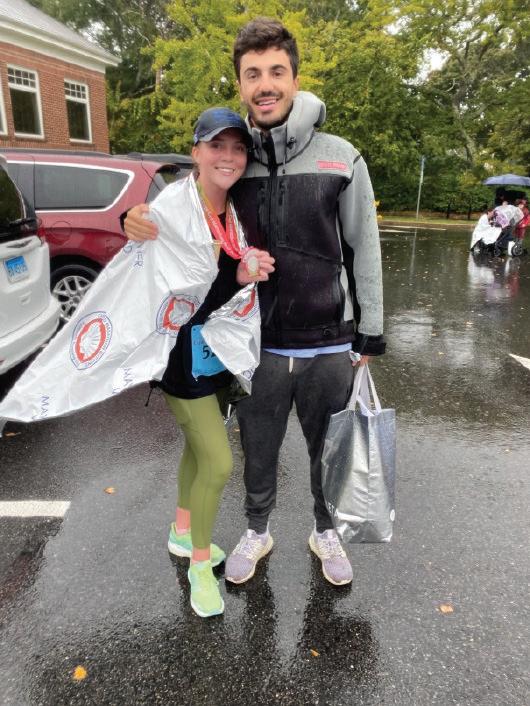
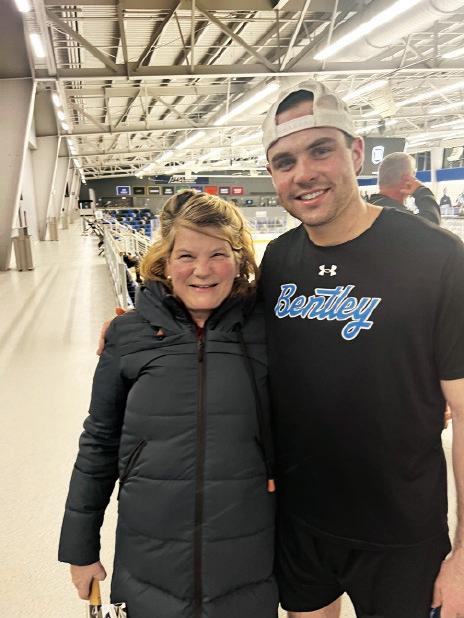
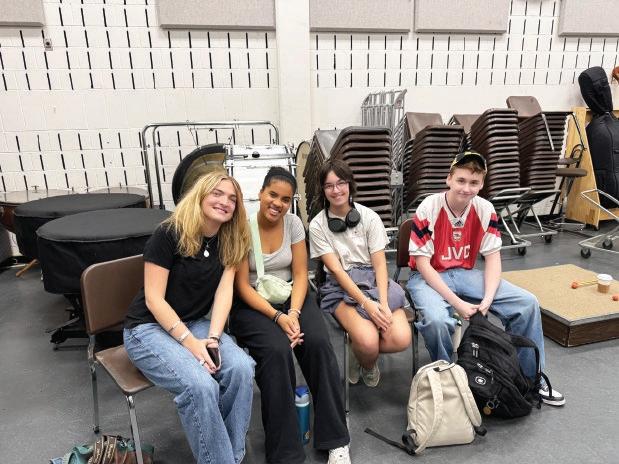
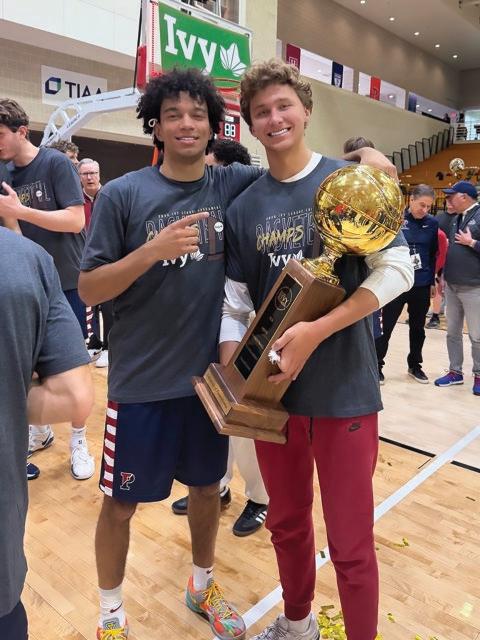
Richard F. Wagner ’49, March 11, 2026
Stephen B. Loring ’51, March 17, 2025
Thomas R. Heels ’55, December 5, 2025
Charles C. Clayton ’61 , August 22, 2021
David M. Timlin ’74 , October 24, 2025
Jonathan P. Bush ’76, March 26, 2025
Alexander A. Forse ’02, March 11, 2026
Aaron S. G. Hentoff ’12 , March 24, 2026
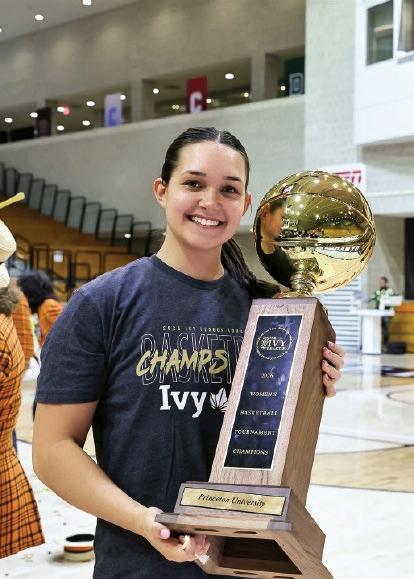
January 1, 1930–February 16, 2026
THE RIVERS COMMUNITY mourns the passing of Frederick Wiseman ’47, who died on February 16, 2026, at the age of 96. A true pioneer of American cinema, Wiseman was widely regarded as a master of the documentary form. Over a prolific six-decade career, he used his lens to explore the heartbeat of human society, fundamentally changing how we observe the institutions that shape our daily lives.
Joel M. Prives, April 30, 2020
Toni Rosenberg, March 22, 2020
H. Arto Shahrik, June 20, 2021
Franklin M. Hundley, June 6, 2025
Natalie Oxman, February 11, 2026
Anngenette G. Tyler, March 7, 2026
Margaret E. Senter, May 31, 2022
At Rivers, Wiseman was an enthusiastic student of literature and poetry—a foundational passion that eventually informed his lyrical, unscripted approach to filmmaking. After graduating, he pursued a career in law, earning his degree from Yale in 1954 and teaching at Boston University. However, his path shifted when he began documenting the world around him. His 1967 debut, Titicut Follies, became a landmark in cinematic history, sparking a decades-long conversation about privacy, dignity, and the power of the moving image. He was a master of “direct cinema,” choosing to let his subjects speak for themselves without narration or interference.
A recipient of an Honorary Oscar and the Venice Film Festival’s Golden Lion, Wiseman remained a curious and unflinching observer of life until the very end. We take great pride in his legacy of empathy and insight. He is survived by his sons, David and Eric, and three grandchildren.
Innovative, experiential programming for our students
Professional development and competitive salaries to attract and retain outstanding faculty
Financial aid that opens doors for more students and enriches our economically diverse, inclusive community
SHARE OUR SENSE OF PRIDE and join us in making a meaningful impact through your philanthropy.
Please make a gift to The Rivers Fund before our fiscal year ends on June 30! Scan the code or visit rivers.org/giving.

Maintaining and expanding a campus and facilities that are second to none