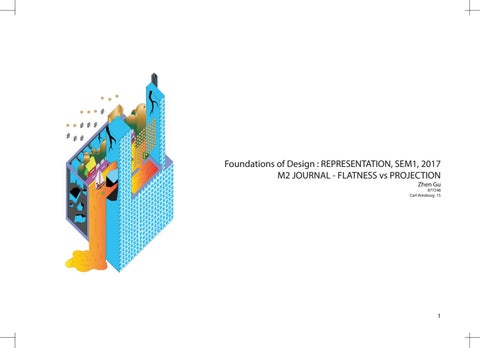
Foundations of Design : REPRESENTATION, SEM1, 2017 M2 JOURNAL - FLATNESS vs PROJECTION Zhen Gu
877248 Carl Areskoug 15
1
WEEK 3 READING: TITLE OF READING
Question 1: What is Pictorial Space according to Le Corbusier? (Maximum 100 words) Pictorial Space is that which cannot be entered or circulated through; it is irremediably space viewes from a distance, and is therefore eternally resigned to frontality.
Question 2: The Flatness of Le Corbusier’s painting’s are attributable to two properties. What are they? And what are these pitted against?(Maximum 100 words) One of the properties is that Le Corbusier insist on the rigid frontality of all objects experienced from a distance. Then, the combination of frontality and distance gives a real visual experience by inferencing. For Le Corbusier, the counterpoint between frontality and rotation equals the contrast between ideation and experience. Also, what Le Corbusier demands for architectural composition is that it should acknowledge the mutual interdependence of the one on the other.
2
MARIO’S WORLD
3
1ST MARIO’S WORLD
The first hand drawing based on two given 2d world images. As one of the world has columns of 20 centimeters, it could not fit on an A3 paper, A2 tracing papre was used.
4
COMBINED MARIO’S WORLD
Scan file of the hand drawing of Mario World. Broken pieces of the block, a river and so on were drawn.
5
WEEK 4 READING: TITLE OF READING
Question 1: Explain the difference between Pictoral (in this case perspectival) space and Projection? (Maximum 100 words) According to Lissitzky, perspective is limits space; it has made it finite, closed. Perspective, despite its nature as constructions, is essentially pictorial and work in symbolic register. Perspective has vanishing points. It is usually lilnked to fixed point of view. Projection or Axonometric can be imaginative. Axonometric projection can transmit abstract information and it was measurable and precise. It is the ideal tool to delineate the avant-grade’s vision of a new world. Axonometric projection was an ideal device to represent universal geometries and infinite spaces.
Question 2: Where did Axonometric projection first arise, and why? (Maximum 100 words) Axonometric has its origin in ancient visual practices, and Massimo Scolari has argued for a history of continuous development of parallel projection alongside that of continuous development of parallel projection alongside that of perspectival projection. The earliest systematic description of axonometric projection occurs in a military context. It is a history linked closely to École Polytechnique. The reason for this might be axonometric projection, originating in the abstract and instrumental world of the technical disciplines, does not pretend to map vision. Also, axonometric projection was an ideal device to represent universal geometries and infinite space.
6
ILLUSTRATED MARIO’S NEW WORLD
Two characters were added, Mario on the boat and a whale in the water. The boat is going to fall down, columns and grounds are cracking, dangerous things are happening while they cannot be seen on a 2d level. Blue and orange, which are two contrast colours are used to give a strong visual ecperience to the audiences. The decorative patterns on the wall is based on the given world.
The final Mario World was created by using Adobe Illustrator to trace and color.
7
8
APPENDIX
Some of the materials that were used through the process. There are tracing paper, T-square, pencils, eraser, fine liner, rulers and masking tape.
During the process, all the drawings were pinned up on the wall to avoid being folded or ruined.
1. The beginning of each project is always hard. This is one side of the Mario World. As this is the beginning, it took me the longest time to consider, measure and redraw. 2. The 100 coins might be the most complicated drawing part. 3. For the first time, the world is not that full, only a river was added. In order to make it more creative and crazy, cracked columns and grounds were drawn later and the river was made orange to show an imaginative world.
9