Italy
7500 km of coastal boundary and 1700 of territorial boundary
Areas of immig ration
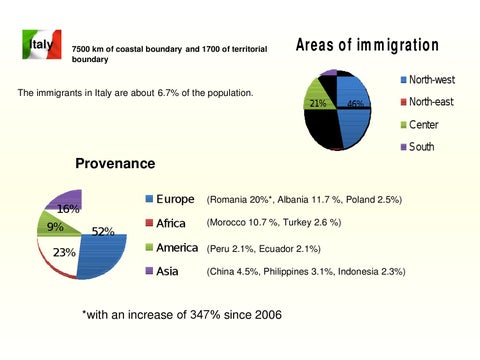
The immigrants in Italy are about 6.7% of the population.
North-wes t
10% 21%
46%
23%
North-eas t C enter S outh
P rov enanc e 16% 9% 23%
52%
E urope
(Romania 20%*, Albania 11.7 %, Poland 2.5%)
Africa
(Morocco 10.7 %, Turkey 2.6 %)
America
(Peru 2.1%, Ecuador 2.1%)
As ia
(China 4.5%, Philippines 3.1%, Indonesia 2.3%)
*with an increase of 347% since 2006
The immigrants in Turin’s province are 9.6 % of the total population The predominant age group is between 25 and 29 years old while 22% of the immigrants are children between 0 and 4 years old
P rov enanc e E uropean Union 11%
(Romania*, France)
*since 2006 increase of 23%
9%
O ther E uropean C ountries 43%
27%
A fric a
(Morocco, Nigeria, Tunisia, Egypt)
A meric a
(Peru, Brazil)
A s ia
(Philippines, China)
10%
City of Rivoli
57% of the total immigrants comes from Romania, while the main other areas of origin are Brazil (7,2%), Morocco (5,7%) and China (1,8%). At Liceo Darwin there are 13 foreign students out of 885. They are from France, Belgium, Poland, Romania, Turkey and Ukraine.
P rov enanc e E urope 4% 9%
13% 74%
A fric a A s ia A meric a
TURCO-NAPOLITANO’s LAW 6th March 1998 centre-left government • Finger-prints are taken from immigrants only if the police have doubts about their identities. • Immigrants have 90 days time after their arrival in Italy to find a job and to ask for the temporary residence permit. Losing their jobs is not a reason to lose their temporary residence permits. • The immigrants without documents are held into the CPT =Centers of Temporary Permanence for 30 days during which they must be identified, otherwise they will have to leave the country within other fifteen days at State’s expense. • After 5 years of regular permanence in the host country the immigrants get the residence permit for themselves and for their families indefinitely. This paper guarantees them the same rights as Italians.
BOSSI-FINI’s LAW 30th July 2009 (centre-right government)
This law is different from the previous one only in the time requirement and in the first two points: • fingerprints are taken from all immigrants applying for a residence permit; • the residence permit will be granted only to those who already have a regular work contract. If they lose their jobs, immigrants must return to their country of origin. • a foreigner without a residence permit is expelled by administrative way. After spending 60 days in a CPT the immigrants are told to leave the territory within 3 days at the State’s expense (the immigrant expelled who returns to Italy commits a crime); • legal immigrants obtain the definitive residence permit which guarantees them the same rights and duties the Italians have, after 6 years.
5th of July 2009: LAW ABOUT PUBLIC SECURITY (centre-right government) List of rules about this law
–The entrance and the illegal residence in the State territory is a crime that can be punished with a fine from 5,000 to 10,000 € or the expulsion for at least 5 years; –In case of re-entry after the expulsion, the illegal immigrant will be subject to imprisonment from six months to one year; –It is considered an offence helping clandestine immigration; –Limitations are added for the entries that are motivated by “family reuniting” and for the acquisition of the Italian citizenship by marriage; –An immigrant who enters Italy must pay a contribution for the granting of the temporary residence permit, must prove to have a job and know Italian language.
This law has been strongly criticized (while it was still under discussion or as already approved) by: 1.the Vatican which “has invited the Parliament to balance between security and hospitality”; 2.the United Nations which has considered Italian politics “repressive, xenophobic and intolerant” and has criticized the establishing of the “crime” of illegal immigration. The UN also stated that Italy is not the only European country where extremely strict laws have been adopted; 3.Turin’s, Bologna’s and Agrigento’s courts which have asked to the constitutional court the “legitimacy’s check” in the name of the constitution’s articles numbers 2 (inviolable rights of men and duty to politicaleconomic-social solidarity) and 3 (equality among all citizens without any racial, sexual, religious discrimination); 4.the High Commissioner for human rights of the UN who on the 14th October 2009 proposed asking Italy formally to change the law.
INITIATIVES OF RECEPTION, INTEGRATION AND SOLIDARITY
(at the State’s expense, which has appropriated 1,6 million Euro for them, or as voluntary work, above all juvenile) For irregular immigrants •CIE (centre for identification and expulsion, ex CPT) where illegal immigrants are detained for 180 days; •CDA (reception centres) that offer the first medical aid to the immigrants with the collaboration of voluntary doctors, psychologists, lawyers and interpreters; •CARA (reception centres for immigrants asking for political asylum) in which immigrants can be hosted for 35 days at the longest after which they will be deported.
For legitimate immigrants 1.free courses of Italian language; 2.courses in their mother tongues for the knowledge of the reciprocal cultures for Italian students and adults from any country; 3.Spreading of information about the rights and duties that are useful to be able to avail themselves of the services of education and health and to find their place in the world of work and in daily life; 4.psyco-social recovery activities for victims of violence, abuse, exploitation (especially women); 5.sex education courses and courses for the prevention of sexually transmitted diseases.