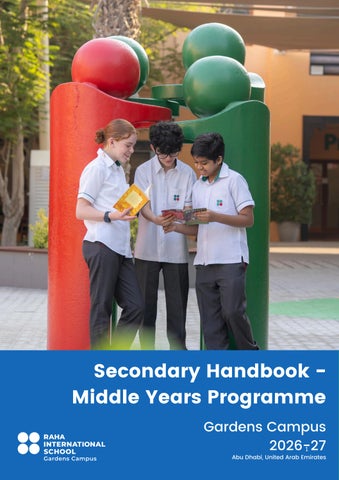
Secondary Handbook Middle Years Programme Gardens Campus 2026-27 1
Abu Dhabi, United Arab Emirates
Welcome to Gardens Campus Your MYP journey starts here! Welcome to the MYP Parent Handbook! We created this guide to make your experience smooth and enjoyable. Please take the time to read it carefully and keep it handy for any questions or guidance you might need throughout the year.
Here’s to a fantastic year ahead!
2
Table of Contents 4 5 6 7 8 9 10 11 12 13 14 15 16 17 19 21 22 23 25 26 27 28 30 31 32 34 35 36 37 38 39 40 44 47
Our Mission & Values Welcome from the Head of Secondary Who's Who at Gardens The International Baccalaureate The Middle Years Programme The IB Learner Profile Approaches to Learning (ATLs) The School Day School Uniform Being Prepared for School Bring Your Own Device (BYOD) Daily life at Raha Homework in the MYP MYP Overview Ministry of Education (MoE) Subjects Library Tutorial Lessons Pastoral Care & Student Wellbeing The Role of Advisory Teachers Epraise (Positive Student Behaviour Platform) Inclusion in the MYP Levels of SEND Support Booster Programme Assessment in the MYP MYP Subject Group Assessment Assessment in MOE Subjects MYP Core and Philosophy Service as Action (SA) OSRAH UAE National Identity Academic Integrity Communication The Raha GC Parent Team Important Contacts
3
Our Mission We Grow People
Our Values Relationships
We build strong connections by working together, solving problems, and ensuring everyone feels they belong.
Excellence
We succeed through hands-on experiences and collaboration with others and our environment.
Aspiration
We value our children’s needs, interests, and voices and allow them to participate actively in their learning.
4
Welcome from the Head of Secondary Dear Raha Families, Welcome to another exciting year in the Secondary School at Raha International School. Whether you are joining our community for the first time or returning for another year, we are delighted to have you with us and thank you for the trust you place in us as partners in your child's education. At Raha, we believe that education is about far more than academic achievement alone. As an International Baccalaureate World School, we are committed to developing knowledgeable, principled and compassionate young people who are equipped to thrive in an ever-changing world. Through the Middle Years Programme (MYP), Diploma Programme (DP) and Career-related Programme (CP), our students are challenged to think critically, act with integrity and make meaningful contributions to their communities. Our vision is simple: We Grow People. Every day, we strive to create an environment where students feel supported, challenged and inspired to become the very best version of themselves. We hold high expectations for learning, behaviour and personal responsibility, while ensuring that every student is known, valued and supported throughout their journey. Beyond the classroom, we encourage students to embrace the many opportunities available to them through sport, the arts, leadership, service and a wide range of co-curricular activities. These experiences help our students develop confidence, resilience and a sense of purpose, preparing them for success both in school and beyond. Strong partnerships between home and school are central to our success, and we look forward to working closely with you throughout the year. Together, we can ensure that every student feels a sense of belonging, achieves their potential and enjoys a rich and rewarding school experience. This handbook has been designed to support you and your family throughout the year. It contains important information about life in the Secondary School, our expectations, systems and procedures. Please take the time to read it carefully and refer to it whenever needed. We are excited about the year ahead and look forward to celebrating many successes together. Warm regards,
Laura Osman Head of Secondary Gardens Campus
5
Who’s Who at Gardens Secondary Leadership
Laura Osman Head of Secondary
Rachel Smith Assistant Head of Secondary - Pastoral
Sarah Ledgerwood Deputy Head of Secondary
Lara Dale Deputy Head of Secondary
Liam Fleming Assistant Head of Secondary - MYP Coordinator
Andrew Tomlinson Assistant Head of Secondary - DP Coordinator
Jason Roebuck Assistant Head of Secondary - CP Coordinator
Executive Leadership
Jan Stipek Principal
Simon James Head of Primary
Laura Osman Head of Secondary
6
The International Baccalaureate Established in 1968, International Baccalaureate (IB) programmes are offered in more than 4,000 schools worldwide. The IB aims to develop inquiring, knowledgeable and caring young people who help to create a better and more peaceful world through intercultural understanding and respect. The IB programmes encourage students across the world to become active, compassionate and lifelong learners who understand that other people, with their differences, can also be right. At Raha we offer four IB programmes: the Primary Years Programme (PYP), Middle Years Programme (MYP), Careers Related Programme (CP) and Diploma Programme (DP).
The International Baccalaureate® (IB) chooses to define ‘international education’ according to the following criteria: Developing citizens of the world in relation to culture, language and learning to live together Building and reinforcing students' sense of identity and cultural awareness Fostering students' recognition and development of universal human values Stimulating curiosity and inquiry in order to foster a spirit of discovery and enjoyment of learning Equipping students with the skills to learn and acquire knowledge, individually or collaboratively, and to apply these skills and knowledge accordingly across a broad range of areas Providing international content while responding to local requirements and interests Encouraging diversity and flexibility in teaching methods Providing appropriate forms of assessment and international benchmarking Read more at ibo.org
7
The Middle Years Programme
The MYP is designed for students aged 11 to 16 (Grades 6 to 10), aiming to help them grow in their understanding of themselves and their role within the community. This program encourages students to make connections between their studies and the world, fostering skills like critical thinking, creativity, and reflection. Key Elements of the MYP: Learning in Context: Students learn best when lessons are relevant to their lives. Through global themes, they explore topics such as identity, international challenges, and what it means to be open-minded. Conceptual Understanding: Focusing on “big ideas” that cross over subject areas, MYP students explore personal, local, and global issues holistically. Approaches to Learning (ATL): Students build foundational skills for independent learning and apply knowledge in new situations, learning how to learn. Service as Action: Encouraging a sense of community, MYP students engage in service activities, putting classroom learning into action to make a positive impact. Language and Identity: Students study at least two languages, supporting communication skills and intercultural understanding. The MYP challenges students to think globally and act compassionately, preparing them with skills essential for the 21st century. To learn more, please visit www.ibo.org/myp or speak with our MYP Coordinator at Raha.
8
The IB Learner Profile In the MYP, the IB learner profile promotes education of the whole person for a life of active, responsible citizenship emphasizing intellectual, personal, emotional and social growth. The attributes and descriptions of the learner profile define the type of learner Raha hopes to develop through its programmes. All members of the Raha Community including students, teachers, administration, support staff and parents strive to develop these qualities.
Attribute
Descriptor
Inquirers
We nurture our curiosity, developing skills for inquiry and research. We know how to learn independently and with others. We learn with enthusiasm and sustain our love of learning throughout life.
Knowledgeable
We develop and use conceptual understanding, exploring knowledge across a range of disciplines. We engage with issues and ideas that have local and global significance
Thinkers
We use critical and creative thinking skills to analyse and take responsible action on complex problems. We exercise initiative in making reasoned, ethical decisions
Communicators
We express ourselves confidently and creatively in more than one language and in many ways. We collaborate effectively, listening carefully to the perspectives of other individuals and groups.
Principled
We act with integrity and honesty, with a strong sense of fairness and justice, and with respect for the dignity and rights of people everywhere. We take responsibility for our actions and their consequences.
Open–minded
We critically appreciate our own cultures and personal histories, as well as the values and traditions of others. We seek and evaluate a range of points of view, and we are willing to grow from the experience.
Caring
We show empathy, compassion and respect. We have a commitment to service, and we act to make a positive difference in the lives of others and in the world around us.
Risk–takers
We approach uncertainty with forethought and determination; we work independently and cooperatively to explore new ideas and innovative strategies. We are resourceful and resilient in the face of challenges and change
Balanced
We understand the importance of balancing different aspects of our lives— intellectual, physical, (spiritual) and emotional—to achieve well-being for ourselves and others. We recognize our interdependence with other people and with the world in which we live.
Reflective
We thoughtfully consider the world and our own ideas and experience. We work to understand our strengths and weaknesses in order to support our learning and personal development.
9
Approaches to Learning (ATLs) At Gardens, the IB Approaches to Learning are a core element of both the Middle Years Programme (MYP) and the Diploma Programme (DP). These skills empower students to become independent, lifelong learners who can adapt to challenges and opportunities in a rapidly changing world.
Key ATL Skill Areas: Thinking Skills Students develop critical, creative, and reflective thinking skills to solve problems, analyze information, and generate new ideas. Communication Skills These skills help students express themselves confidently and effectively in a variety of modes, including speaking, writing, and using technology. Social Skills Collaboration is key. Students learn to work effectively with others, develop empathy, and resolve conflicts in constructive ways. Self-Management Skills Students build organization, time management, and emotional resilience, helping them to set goals, stay focused, and persevere through challenges. Research Skills The ability to find, evaluate, and use information responsibly is central to success. Students learn to formulate questions, gather data, and present findings effectively.
In the MYP:
The ATL framework is woven into all subjects, helping students apply these skills across disciplines and contexts. It lays the foundation for independent inquiry, ensuring students can learn how to learn and approach problems holistically. By focusing on Approaches to Learning, the IB encourages students to develop not just knowledge, but the skills and habits needed to thrive in a complex, interconnected world.
10
The School Day Our gates open at 7:00 am with staff supervision on school grounds. At 7:40 am, all students will be directed to their first lesson of the day. The National Anthem plays at 7:45 am each morning. Students must be in their first lesson by 7:45 am to stand attentively and pay respect to the UAE National Anthem. Your child is considered late if they enter the school gate after 7:45 am. Students arriving between 7:45 and 8:00 am, must report to the main reception to collect a yellow late slip. Late students will not be permitted into class without a late slip. Each day students will have a ho class, where students meet with their Osrah and their Advisory teacher. The role of the Advisory is to provide a consistent support system, helping students with academic guidance, personal development and well being as well as fostering a sense of community. Our daily schedule includes two, 30 minute breaks where students can eat food brought in from home (excluding any products that contain nuts), or our canteen. All students are dismissed at 3:00 pm. Bus students must make their way quickly to the bus to avoid delays. The buses leave promptly at 3:10 pm with no exceptions. All students must leave campus by 3:15 pm, unless they are attending an ECP.
Monday - Thursday
Friday
Lesson 1
7:45 - 08:45
Lesson 1
7:45 - 08:40
Lesson 2
8:45 - 09:40
Lesson 2
8:40 - 09:35
Break 1
9:40 - 10:10
Homeroom
9:35 - 10:15
Lesson 3
10:10: - 11:05
Break
10:15 - 10:35
Lesson 4
11:05 - 12:00
Lesson 3
10:35 - 11:30
Homeroom
12:00 - 12:40
Break 2
12:40 - 1:10
Lesson 5
1:10 - 2:05
Lesson 6
2:05: - 3:00 11
School Uniform At Raha International School, our uniform policy promotes a sense of belonging, equality, and pride. All students are expected to wear the correct uniform each day unless otherwise communicated.
General Requirements Students must wear the official Raha International School uniform at all times during the school day Uniforms must be clean, in good repair, and worn appropriately Jewellery should be minimal and discreet; earrings should be small studs only, no dangling earrings Hair must be neat and tidy; extreme styles or unnatural colours are not permitted Hats, caps, and hoods may not be worn indoors PE uniform is only to be worn during PE; students should bring their PE kit in a bag on the days they have PE and will be given time to change into and out of PE kit
Boys' Uniform Official school shirt (white with school logo, green collar) Grey trousers with red piping (full length, no jeans or joggers) Plain black or white socks Official school hoodie for cooler months
Girls' Uniform Official school shirt (white with school logo, green collar) Grey trousers with red piping (full length, no jeans or joggers) Plain black or white socks Official school hoodie for cooler months Headscarf (if worn) must be plain white or navy blue
PE Uniform Official school PE shirt (Kukri) Official school PE shorts or tracksuit bottoms (Kukri) Trainers suitable for sport (non-marking soles for indoor use) Students must bring their PE kit on designated PE days only PE uniform should not be worn for other lessons
12
Being Prepared for School Students who arrive after 7:45am are considered late and must visit the Front Desk in Building A to receive a ‘late slip’ before going to their homeroom. If a student will miss school for any reason their parent must email their Head of Grade and absent@ris.ae Being Prepared for School What to Bring Backpack Lunch or canteen money (payment cards only) Reusable water bottle Laptop or iPad, fully charged, and headphones Device charger Reading book Healthy snacks/lunch Appropriate school uniform Pencil case incuding:
Three blue or black pens (erasable pens are allowed for work in class) A pencil, sharpener and eraser One green pen (for self-assessment and feedback) Four different coloured highlighters (pink and green essential) One 15cm ruler One glue stick Scissors A whiteboard pen A selection of coloured pens (fine liners, or roller-ball pens) A scientific calculator G6 – G8: a protractor and compass set
Health and Wellbeing A healthy amount of nighttime sleep for secondary school students is 8-10 hours. Adequate sleep is crucial for teenagers' cognitive function, emotional regulation, and overall well-being. Ensuring your child gets enough rest can significantly enhance their academic performance and social interactions. A healthy breakfast is also vital for successful learning during the school day. It provides the energy and focus needed for students to engage effectively in their studies and participate actively in class. Encouraging healthy eating habits supports students' physical and mental health, contributing to their overall success at school. Teenagers need support in establishing healthy routines, such as putting their devices away for the night, going to bed early, and eating breakfast. Helping them develop these habits can make a significant difference in their daily performance and longterm health. Promoting a consistent sleep schedule and reducing screen time before bed can improve sleep quality and duration. Likewise, ensuring they start their day with a balanced breakfast sets a positive tone for learning and engagement throughout the day. 13
Bring Your Own Device (BYOD) Devices
In MYP we have a BYOD policy. In Grade 6 students are encouraged to continue using the iPad they used in Grade 5, with the addition of a bluetooth keyboard. In Grade 7 and above, our Secondary students prefer MacBook Air laptops. While these may be more expensive than other PCs, our experience shows that they tend to last significantly longer. MacBooks are available for purchase through our school supplier at the Apple Education Discount. You can sign up for access to the e-store here. Additionally, we recommend checking retailers like Carrefour, which often offer competitive prices.
While we do not wish to endorse one brand over another, it is important to note that having similar devices can be beneficial. When students use the same type of device, they can assist each other more effectively, especially when troubleshooting issues. Therefore, we encourage consideration of this factor when choosing a device for your child.
Software and Applications
variety of apps, programs, and platforms are used in secondary subjects to support learning. Students do not need to purchase any software. When they join the school in August, their teachers will assist them in downloading the Microsoft 365 applications, which are available using their school accounts. BYOD Acceptable Use Agreement At the start of each school year, students will sign a Bring Your Own Device (BYOD) Acceptable Use Agreement, committing to appropriate device use at school, guided and directed by their teachers. Students are expected to use their devices only for school-related purposes during the school day. Teachers reserve the right to review a student's browser and application history if there are concerns regarding appropriate conduct or academic integrity.
14
Daily life at Raha Canteen: Middle School students can buy food from the Canteen through our supplier, Food Nation. Food Nation uses a cashless system and only cards can be used to purchase food. The objectives of this are to prevent theft, reduce exposure to microbes in the food preparation area, and reduce waiting times. The pre-paid plan is recommended for our younger users, whereby parents can monitor what is purchased and even schedule the meals in advance. ECPs: Term 1 teacher-led and external ECP details will be published tentatively in Friday 11th September edition of Raha Reminders. Sign-ups on Schoolsbuddy will tentatively be open to parents at 6pm on Monday 14th September and remain open until 12pm on Friday 19th September. Term 1 teacher-led ECP’s will begin tentatively on Monday 28th September, and finish on Thursday 27th November.
Gate Timings: GATE – 1 24/7 GATE - 3 Mornings - 07:30 - 07:50 (weekdays) Afternoons 12:50 - 13:10 PM 13:50 - 14:10 PM Monday - Thursday 14:50 - 15:20 PM 15:50 - 16:15 PM 11:45 - 12:20 PM - Friday Dismissal GATE – 5 Mornings - 06:30 to 07:45 AM (weekdays) Afternoons - 15:00 - 17:00 PM (Monday - Thursday) Friday Dismissal - 12:00 TO 12:40 PM GATE – 8 Mornings - 06:15 - 17:40 PM (weekdays) 07:00 - 07:20 (students in canteen) GATE – 9 Mornings - 07:30 - 07:50 AM (weekdays) Only Gate 1 will be open to students after 07:50 AM In line with ADEK requirements and to ensure the wellbeing of our students, we have a clear dismissal policy for our Middle School. In Grades 6 - 8, students must be collected by a parent or guardian, or can register to leave campus with a Grade 9-12 sibling. Parents can give permission for students in Grade 9 and above to leave site and make their way home independently. 15
Homework in the MYP In our secondary school, we are committed to providing a comprehensive and transparent assessment and evaluation policy that supports student learning and achievement. Our policy is designed to align with the International Baccalaureate (IB) philosophy and standards, ensuring that our assessment practices are fair, rigorous, and reflective of our educational goals. Our MYP Homework Policy is designed to ensure that homework is purposeful, meaningful, and aligns with our belief that learning should extend beyond the classroom. We recognize the importance of balance in a student's life and aim to integrate academic rigor with holistic development Rationale & Beliefs We believe that homework, when assigned with deliberate purpose, is meaningful, relevant, and engaging, promoting inquiry and deep learning. Homework should be learner-centric, constructive, and allow for metacognition. Research indicates that the quality of homework has a greater impact on learning outcomes than the quantity.
Homework Guidelines
Our guidelines are grounded in extensive research, leading us to recommend specific time allocations for homework each day. MYP 1: Up to 60 minutes MYP 2-4: Up to 90 minutes MYP 5: Up to 120 minutes It is important to note that while we strive to adhere to these guidelines, there may be peak times, such as during project completions or assessment periods, when homework might slightly exceed these recommendations. Conversely, there will be days with little to no homework, ensuring students have time for rest and extracurricular activities. Guiding Principles Purposeful Learning: Homework will only be assigned if it directly contributes to student learning. It should reinforce classroom concepts, promote critical thinking, and encourage independent learning. Limited Quantity: Homework will be kept to a reasonable minimum, ensuring that students can complete it within a reasonable timeframe. Quantity will be based on grade level and individual student needs.
16
MYP Overview A Look at the MYP
The Middle Years Programme (MYP) is sometimes referred to by its levels, MYP1 to MYP5, and constitutes learners in Grades 6 to 10. This program is designed to build upon the knowledge and skills students have acquired in their earlier years of education and prepares them for the challenges of the Diploma Programme (DP) or the Careers Related Programme (CP) in Grades 11 and 12. The MYP framework encourages students to make practical connections between their studies and the real world, fostering conceptual understanding, critical thinking, inquiry, and reflection.
Subject Groups:
The MYP includes eight subject groups. This ensures that students receive a balanced education across various disciplines. Language and Literature Language Acquisition Individuals and Societies (I&S) Sciences Mathematics Arts Physical and Health Education (PHE) Design Interdisciplinary Learning: The MYP emphasizes interdisciplinary learning, encouraging students to make connections between subjects and apply their knowledge in realworld contexts. This approach helps students develop critical thinking and problem-solving skills. Conceptual Understanding: Central to the MYP is the development of conceptual understanding. Students explore key concepts (such as change, communication, and systems) and related concepts specific to each subject. This helps students understand big ideas and their applications across different subjects.
17
MYP Overview MYP Subject Groups Language and Literature: focuses on developing students' abilities in reading, writing, and analyzing texts. Students study literature from a variety of cultures and time periods, enhancing their understanding of language and its impact on human experience. The aim is to foster a love for reading and effective communication skills. Language Acquisition: helps students learn additional languages, promoting multilingualism and intercultural understanding. Students can choose from a range of languages offered at their school. The course emphasizes listening, speaking, reading, and writing skills, and it encourages students to explore different cultures through language. Individuals & Societies (I&S): includes subjects like history, geography, economics, and social studies. It encourages students to explore human societies, their structures, and interactions. The focus is on developing critical thinking skills and understanding the factors that shape cultures and civilizations. Sciences: encompasses biology, chemistry, physics, and integrated science courses. Students engage in scientific inquiry, experimentation, and analysis. The aim is to develop an understanding of scientific concepts and processes, and to appreciate the role of science in everyday life. Mathematics: is designed to build students' mathematical understanding, reasoning, and problem-solving skills. The curriculum covers a broad range of topics, including algebra, geometry, statistics, and calculus. It encourages students to apply mathematical concepts to real-world situations. Arts: includes visual arts, performing arts, and music. Students explore creativity and self-expression through various artistic forms. The aim is to develop an appreciation for the arts and to understand the processes involved in creating and presenting art. Physical & Health Education: promotes physical well-being and a healthy lifestyle. It includes physical activities, sports, and health education. Students learn about the importance of physical fitness, teamwork, and maintaining a healthy body and mind. Design: involves practical and creative problem-solving. Students learn to design and create products, systems, and solutions to meet specific needs. The course emphasizes the design cycle, which includes investigating, planning, creating, and evaluating.
18
MoE Subjects Ministry of Education Subjects In Abu Dhabi, schools integrate subjects mandated by the Ministry of Education (MoE) with their own curriculum. Teaching MoE subjects alongside the MYP subject groups ensures that students receive a comprehensive education that meets both national standards and international expectations. MoE subjects include Arabic Language, Islamic Education, UAE Social Studies, and Moral Education.
Key Points for Parents
The curriculum aligns with both MoE standards and IB principles. Regular assessments ensure students' continuous progress in Arabic, Islamic, and Social Studies. Holistic development is emphasized, integrating moral and social values into everyday learning. The curriculum is designed to foster a strong national identity while preparing students to thrive in a global context.
Importance of MoE Subjects
As residents of the United Arab Emirates, it is essential for students to have a comprehensive understanding of the country’s language, culture, religion, and history. The Ministry of Education (MOE) subjects play a crucial role in fostering this understanding. Learning Arabic is vital for integrating into UAE society, enabling students to communicate effectively and understand cultural nuances. Islamic Education provides insights into the Islamic faith, the foundation of the UAE’s cultural and societal norms, promoting moral values and ethical behaviour. Understanding these principles is essential for respectful and harmonious living in the UAE. UAE Social Studies educates students about the rich history and heritage of the UAE, cultivating informed and responsible citizens who appreciate the country’s journey and achievements. Moral Education emphasizes the development of ethical values, social responsibility, and personal integrity, shaping students into well-rounded individuals. These subjects are fundamental to the holistic development of students, providing the knowledge and skills necessary to thrive in a multicultural and dynamic society while preserving and appreciating the nation’s rich heritage and values. By mastering these subjects, students enhance their academic and professional prospects and contribute meaningfully to the UAE’s vibrant community.
19
MoE Subjects MOE Subject Breakdown Arabic Language (A&B): Objective: Develop proficiency in the Arabic language, focusing on reading, writing, listening, and speaking skills. Content: Literature, grammar, vocabulary, and composition. Islamic Education: Objective: Provide knowledge and understanding of Islamic principles, teachings, and values. Content: Quranic studies, Hadith, Islamic law, and history. UAE Social Studies A : Objective: Enhance understanding of the UAE's history, geography, and sociopolitical structure. Content: UAE history, geography, government, and economic development. Moral Education: Objective: Promote ethical and moral values, focusing on character development and civic responsibility. Content: Ethics, personal and social responsibility, cultural diversity, and global citizenship.
MoE Assessments
Examinations: Written exams that test knowledge and understanding of the subject matter. Projects and Assignments: Practical work that allows students to demonstrate their learning through research and application. Oral Presentations: Particularly in Arabic Language and Islamic Education, where students present their understanding verbally.
20
Library Library Lessons In addition to the eight subject groups, students in Grades 6–8 participate in one library lesson each week. These sessions focus on the explicit teaching of ethical use of digital platforms and AI, referencing, and academic integrity — equipping students with the skills they need to navigate information responsibly and produce work with honesty and rigour. Students also take part in the Read Theory programme, an adaptive online reading platform that assesses and builds comprehension skills through personalised passages and questions matched to each student's reading level. As students progress, the programme adjusts in difficulty, helping them strengthen vocabulary, inference, and critical reading skills at their own pace. Beyond these structured activities, library lessons give students the opportunity to enjoy independent reading time and explore our collection of library books, fostering a lifelong love of reading alongside the development of essential research and digital citizenship skills.
21
Tutorial Lessons Tutorial Lessons occur within our daily Advisory or “Homeroom” period. These sessions are a key component of our pastoral program, designed to support our students in becoming well-rounded IB learners. Our students also have the opportunity to engage in assemblies hosted by our Heads of Grade and Core Leaders within the school about their Wellbeing topics as well Moral Education, Service as Action, Student Leadership, and more! Tutorial is instrumental in fostering a supportive and inclusive school environment. They help students build strong relationships with their peers and teachers, develop critical life skills, and gain the confidence to face challenges both inside and outside the classroom.
Purpose of Tutorial Lessons
The primary goal of these Tutorial lessons is to promote the overall wellbeing and personal development of our students. By addressing a variety of important topics, we aim to equip our students with the knowledge, skills, and values necessary to navigate the complexities of today's world and to thrive both academically and personally These groups remain consistent, providing a sense of commonality and continuity as students progress through the school years. This structure helps maintain stable peer relationships and supports a cohesive learning environment.
Topics Covered
During our Tutorial lessons, we cover a wide range of topics that are essential for the holistic development of our students. Some of the key topics include: Bullying Prevention Inclusion & Diversity Healthy Lifestyles Emotions Self-Empowerment Careers Relationships Communication & Student Voice Online Safety & Digital Citizenship
22
Pastoral Care & Student Wellbeing We are committed to providing comprehensive student wellbeing and pastoral care to ensure each student's emotional, social, and academic success.
Pastoral Care
In our Secondary school, Pastoral Care is an integral part of our commitment to student wellbeing, ensuring that each student receives the support they need to thrive emotionally, socially, and academically. As an MYP and DP school, we recognize the unique challenges and developmental needs of students aged 11 to 18. Pastoral care at Raha encompasses a wide range of services and support systems designed to nurture the whole student. This includes personal and academic guidance, emotional support, and fostering a positive school culture where every student feels valued and respected. Ms. Rachel, our Head of Pastoral Care, oversees this crucial area. She works closely with the Heads of Grade, who are responsible for overseeing pastoral care at each grade level. Together, they ensure that every student has access to the resources and support they need to navigate their educational journey successfully. Our pastoral care system includes regular check-ins, mentoring, and tailored support plans to address individual needs. We also focus on creating a safe and inclusive environment where students can build strong relationships and develop resilience. Through our comprehensive pastoral care program, we aim to create a nurturing environment that supports academic excellence and personal growth, helping students to become well-rounded, confident, and capable individuals. For more information or specific concerns regarding pastoral care, please contact Ms. Rachel or the Head of Grade for your child’s grade level.
Rachel Smith Assistant Head of Secondary - Pastoral
23
Pastoral Care & Student Wellbeing Student Wellbeing
At Gardens Campus, student wellbeing is a top priority, encompassing the emotional, social, and physical health of our students. We are committed to creating a safe, welcoming, and supportive environment where students can thrive academically and personally. Our proactive approach includes fostering a culture of kindness, respect, and inclusivity, ensuring every student feels valued and respected. Our comprehensive pastoral care system is integral to supporting students' emotional and social needs. This system ensures that students have access to the guidance and support they need. Additionally, each day begins with an Advisory Class, where students build strong relationships with their peers and teachers, receiving academic and personal guidance. We have dedicated school counselors to provide professional support: Ms. Rebecca for Grades 6-9 and Mr. Darren for Grades 10-12. They are available for individual counseling sessions to help students navigate emotional and social challenges. Students can schedule appointments directly with them for confidential support. To promote student wellbeing, we implement bullying prevention programs, health and wellness activities, and encourage active parental involvement. These initiatives educate students on empathy, respect, and conflict resolution, while also supporting physical health and mental wellness. We also use Friday Tutorial Lessons to promote student wellbeing on an ongoing basis. We believe that student agency is vital for supporting wellbeing. Empowering students to take an active role in their learning and community enhances their sense of ownership, motivation, and self-efficacy. We offer numerous student leadership councils, such as the Student Representative Council, Wellbeing Ambassadors, Arts Leadership Council, Athletic Leadership Council, and more! By fostering student agency, we ensure that students feel valued, respected, and supported, which significantly contributes to their overall wellbeing.
Rebecca Greene G6-9 Counsellor
Darren Harrison G10-12 Counsellor
24
The Role of Advisory Teachers While Advisory Teachers share some similarities with PYP Homeroom Teachers, their role within the MYP is uniquely designed to support students as they navigate adolescence, increasing independence, and the academic demands of secondary school. Advisory Teachers work in close partnership with the Heads of Grade to ensure every student is known, supported, and able to thrive both academically and personally. Primary Responsibility: Advisory Teachers are dedicated to the academic, social, and emotional wellbeing of their students. Through daily interactions, they develop strong relationships that allow them to celebrate successes, identify concerns early, and provide ongoing guidance and encouragement. Frequency of Interaction: Advisory Teachers meet with their students every day during the homeroom lesson, providing regular opportunities for check-ins, relationship building, and the delivery of our structured Wellbeing Curriculum. Focus: The Advisory programme adopts a holistic approach to student development, combining academic mentoring with wellbeing education, personal growth, and the development of positive relationships and life skills.
Key Responsibilities
Serve as each student's trusted adult within the school, building strong relationships and monitoring their academic progress, wellbeing, and engagement. Deliver the school's Wellbeing Curriculum through daily Tutorial lessons, covering topics such as wellbeing, relationships, resilience, digital citizenship, and personal development. Work closely with the Heads of Grade to monitor student wellbeing, attendance, behaviour, and academic progress, implementing timely support where needed. Support students in setting academic and personal goals while developing effective organisation, study habits, and approaches to learning. Foster a positive and inclusive Advisory community through meaningful discussions, collaborative activities, and ongoing communication with families and the wider pastoral team.
An advisory teacher doesn't just teach subjects; they teach students how to navigate life with confidence, resilience, and a sense of purpose. 25
E-Praise In the MYP, positive student behaviour is rewarded through the e-praise platofrm. Students are awarded according to the Learner Profile attributes that they are demonstarting. Awards assumulate resulting in badges, rewards and certificates in termly reward assembies. Behaviour Policy & Student Growth At times, students may act in ways that do not align with our behaviour policy. We recognize that making mistakes is a natural part of growing up, and we believe that school should be a safe environment where students can learn and grow from their mistakes. When behaviour occurs that does not align with our behaviour policy, we issue consequences according to the severity of the behaviour, which will also be recorded on e-praise. Lapses in behaviour are defined by graduated infraction Levels from 1 to 4, with Level 4 being the most severe. Each level has progressive consequences in line with ADEK guidelines, ensuring that responses are appropriate and fair. All incidents are evaluated by the School Disciplinary Committee to ensure that an unbiased and fair consequence is issued. This committee considers all individuals involved and prioritizes the safety, support, and inclusion of each child. Our goal is to ensure that every student has the right to come to school feeling safe, supported, and included. By addressing behavioural issues thoughtfully and fairly, we help students understand the impact of their actions and encourage positive growth and development. Zero Tolerance for Bullying & Physical Altercations We take a zero-tolerance approach to bullying. Bullying is defined as repeated aggressive behaviour that involves a real or perceived power imbalance. This can be physical, verbal, or emotional harm directed at a student, and it is never acceptable. We educate our community to recognize that bullying is not a one-time incident but a pattern of behaviour that can have serious emotional and psychological effects. Any reports of bullying are thoroughly investigated, and appropriate consequences are issued in line with our behaviour policy to ensure a safe and supportive environment for all students. We also maintain a zero-tolerance policy for physical altercations. Regardless of whether a child is the instigator or responding to aggression, any form of physical conflict results in a consequence. We emphasize that two wrongs do not make a right, and the only appropriate response is for students to walk away and find an adult to intervene. Ensuring the safety and wellbeing of our students is our top priority, and we are committed to teaching them peaceful and constructive ways to resolve conflicts. By adhering to these policies, we aim to create a school environment where every student feels safe, respected, and valued. For more detailed information on our behaviour policy, please contact the Head of Pastoral Care, Ms. Rachel.
26
Inclusion in the MYP Student Support - English Language Learners At Raha, we view multilingualism as a strength to be nurtured, not a barrier to overcome. Our English Language learners bring diverse linguistic and cultural perspectives that enrich our school community and align with the IB’s vision of international-mindedness. We provide layered support that focuses on both social and academic language development, ensuring students can access the curriculum and express their understanding confidently. Through inclusive classroom strategies, targeted interventions, and language acquisition plans where needed.
Universal
Targeted
Individualised
Building language for learning through inclusive classroom practice
Developing language through targeted digital intervention
Creating personalised pathways for significant language needs
Students in Band D/E access learning through responsive, language-rich teaching. Teachers are expected to embed academic language from the outset. No formal plan is required.
Students in Band B/C receive targeted support through structured digital tools and teacher-guided strategies. Support supplements, not replaces, classroom learning.
Students in Band A follow individualised plans to support foundational language acquisition. Support includes one-to-one guidance, specialist input, and close home–school collaboration.
✔ Visuals, modelling, structured talk, and ✔ Short-to-medium-term digital ✔ Personalised language goals scaffolds intervention ✔ Medium-term digital intervention ✔ Academic vocabulary integrated into ✔ Pull out/Push in intervention sessions ✔ Pull out/Push in intervention sessions subject lessons ✔ One-to-one support as needed ✔ Language Acquisition Plan Student Support - Gifted, Talented, and High Ability Learners
ME 115 AN –1 26
115 MEA –1 26 N +1 27
ME AN
12 7+
At Raha, we recognise that some students demonstrate advanced potential in their thinking, problem-solving, or conceptual understanding. Our approach to supporting higher ability learners is built on providing the right level of challenge at the right time. We focus on developing each student’s knowledge, skills, and understanding through differentiated instruction, enrichment opportunities, and personalised pathways. Students may be supported through classroom-based strategies, individual learner profiles, or mentoring, depending on their needs.
Exceptional Ability & Mentoring Extending learning through mentoring and acceleration
Strengths-Based Enrichment Deepening learning through personalised planning
High Potential Responsive Teaching and Differentiation
27
Levels of SEND Support At Raha, we use a three-tiered model to provide the right support at the right time. This approach ensures that students receive help matched to their needs—whether through inclusive classroom strategies, short-term interventions, or highly personalised plans. The model is flexible and responsive. Students may move between levels of support as their needs change, and decisions are always made in partnership with families. While all students benefit from inclusive teaching, only those receiving Level 2 (Targeted) or Level 3 (Intensive) support have a formal learning plan.
Level 1
Students receiving Level 1 support are included through differentiated,
Universal
engaging, and responsive classroom practice. Teachers plan with learner variability in mind from the outset.
Removing barriers to access, engagement and expression
Some students may have an external report (e.g. Educational Psychologist), but no formal plan is required.
✔ Inclusive, strength-based teaching ✔ Flexible grouping and classroom scaffolds ✔ Progress tracked by class teacher
✘ No formal learning plan or scheduled meetings
Level 2
Targeted Unlocking potential by narrowing gaps in skills, knowledge and understanding.
Students receiving Level 2 support participate in additional small-group or oneto-one teaching to address specific learning needs. Interventions supplement— not replace—classroom instruction.
✔ Short-to-medium-term intervention ✔ Guided by internal data or external reports ✔ Regular review and classroom integration Written updates shared every half term Progress discussed during regular Parent–Teacher Conferences Formal Plan: Learning Intervention Plan (LIP)
28
Levels of SEND Support Level 3
Individualised Creating personalised pathways to meet significant or ongoing needs
Students receiving Level 3 support follow highly individualised learning plans. These may include one-to-one sessions, specialist teaching, or modified curriculum goals. The focus is on long-term progress and wellbeing.
✔ Specialist or one-to-one instruction ✔ Multidisciplinary input ✔ Aspirational, personalised goals
Written updates shared every half term Progress discussed during three formal IEP meetings per year Formal Plan: Individual Education Plan (IEP)
Our Partnership with You At Raha, we believe inclusion is a shared responsibility, not a place or a programme, but a mindset and a commitment. Whether your child is supported through everyday classroom strategies or has a formal learning plan, they are part of a school community that believes deeply in their growth, voice, and potential. We value open, ongoing communication with families. While we hold scheduled meetings for students with Individual Education Plans (IEPs) or Individual Accommodation Plans (IAPs), any parent or caregiver is welcome to request a meeting at any time to discuss their child’s learning, wellbeing, or support needs. If you have questions or would like to talk about the support your child receives, please contact their Homeroom Teacher or Inclusion Teacher. We are here to work alongside you, every step of the way.
29
Booster Programme Smaller Class size
Students move in/out based on need
Parents consulted
Mathematics
English
Same content as all Grade level lessons*
Assessed using MYP Language and Literature Year 1 criteria
Same assessment and reporting Pace and structure adapted to the needs of the students. Grade 6 & 7
*Except for students on a modified curriculum,
Units and assessments adapted for the cohort. Similar in principle to the differentiation between Standard, Extended, and Accelerated pathways in Maths) Grade 6 & 7
Push-in Support Learning Support Assistants work within the classroom using a Push-in model, supporting students alongside the subject teacher as an additional adult in the room. While the subject teacher oversees class instruction for all students, Learning Support Assistants provide additional scaffolding, adapted materials, and prompting to help targeted students access the lesson. This can include breaking down instructions into smaller steps, rephrasing or simplifying language, modelling tasks, checking for understanding, redirecting attention, and offering encouragement to build student confidence and independence. Our Learning Support Assistants focus their support in Science and Arabic.
30
Assessment in the MYP In our secondary school, we are committed to providing a comprehensive and transparent assessment and evaluation policy that supports student learning and achievement. Our policy is designed to align with the International Baccalaureate (IB) philosophy and standards, ensuring that our assessment practices are fair, rigorous, and reflective of our educational goals.
Key Features of Our Assessment Policy
Supportive and Continuous Learning: Continueous Assessment: These are ongoing assessments such as class tests, quizzes, projects, and presentations that provide immediate feedback to help guide student learning and identify areas for improvement. End of Unit Assessments: These are end-of-unit or term assessments that evaluate student learning against predefined criteria and learning outcomes. Diverse Assessment Methods: We utilize a variety of assessment methods including written exams, oral assessments, practical work, and projects to capture a comprehensive picture of student performance. Grading and Reporting: Our grading scale is consistent with the IB's seven-point scale, with 7 being the highest. We provide regular feedback through report cards, parent-teacher conferences, and Toddle, our online portal to ensure that students and parents are well-informed about academic progress. Academic Integrity: We uphold high standards of honesty and integrity in all academic work. Instances of academic misconduct are addressed seriously according to our school’s disciplinary procedures.
31
MYP Subject Group Assessment The goals of assessment in the MYP are to support and encourage student learning by providing feedback on the learning process, inform and improve teaching practices, offer opportunities for students to exhibit skill transfer across disciplines, promote positive attitudes towards learning, deepen understanding of subject content, and foster the development of critical and creative thinking skills. Achievement Levels In each MYP subject group, learning objectives correspond to assessment criteria. Each criterion has eight possible achievement levels (1 through 8). Each criterion is assessed at least twice per academic year, and the levels achieved in these assessments are used to determine the final level for each criterion. To calculate the total achievement score for a subject, the final levels for all four criteria are added together for a score out of 32 total points available. That total number of points is then translated using grade bands into a final grade on a scale of 1 to 7. These grade boundaries are periodically reviewed and adjusted based on global performance data. (Please see the next page.)
Teachers must gather sufficient evidence from a range of assessment tasks to enable them to make a professional and informed judgement guided by the criteria to determine a student’s achievement level according to how well the student has demonstrated mastery of the published criteria. Teachers adopt a “best fit” model when using the achievement level descriptors. The "best fit" model is a key principle in the IB assessment philosophy, particularly within the MYP. This model ensures that students' grades accurately reflect their current level of achievement by emphasizing the most accurate representation of their abilities over time. This model considers a range of evidence rather than relying on a single assessment. It acknowledges that learning is a process and that students may demonstrate their highest levels of achievement at various points throughout their learning journey. Unlike traditional models that might rely heavily on end-of-term or high-stakes exams, the “best fit” model incorporates continuous assessment. This means regular evaluation through various tasks that reflect the ongoing learning process.
32
MYP Subject Group Assessment Achievement Levels in the MYP Sum of Assessed Criteria
28 - 32
24 -2 7
19 - 23
15 - 18
10 - 14
6-9
1-5
MYP Grade
Description
7
Produces high-quality, frequently innovative work. Communicates comprehensive, nuanced understanding of concepts and contexts. Consistently demonstrates sophisticated critical and creative thinking. Frequently transfers knowledge and skills with independence and expertise in a variety of complex classroom and real-world situations.
6
Produces high-quality, occasionally innovative work. Communicates extensive understanding of concepts and contexts. Demonstrates critical and creative thinking, frequently with sophistication. Uses knowledge and skills in familiar and unfamiliar classroom and real-world situations, often with independence.
5
Produces generally high-quality work. Communicates extensive understanding of concepts and contexts. Demonstrates critical and creative thinking, sometimes with sophistication. Uses knowledge and skills in familiar classroom and real-world situations, and, with support, some unfamiliar real-world situations.
4
Produces good quality work. Communicates basic understanding of most concepts and contexts with few misunderstandings and minor gaps. Often demonstrates basic critical and creative thinking. Uses knowledge and skills with some flexibility in familiar classroom situations, but requires support in unfamiliar situations.
3
Produces work of an acceptable quality. Communicates basic understanding of many concepts and contexts, with occasionally significant misunderstandings or gaps. Begins to demonstrate some basic critical and creative thinking. Is often inflexible in the use of knowledge and skills, requiring support even in familiar classroom situations.
2
Produces work of limited quality. Expresses misunderstandings or significant gaps in understanding for many concepts and contexts. Infrequently demonstrates critical or creative thinking. Generally inflexible in the use of knowledge and skills, infrequently applying knowledge and skills.
1
Produces work of very limited quality. Conveys many signficant misunderstandings or lacks understanding of most concepts and skills. Very rarel demonstrates critical or creative thinking. Very inflexible, rarely using knowledge or skills.
33
Assessment in MOE Subjects The Arabic Department follows the Ministry of Education (MoE) curriculum within the International Baccalaureate (IB) framework. The curriculum aims to develop students' Approaches to Learning (ATL) skills and IB Learner Profile Attributes through a holistic approach. Arabic, Islamic, and Social Studies units are often linked to Units of Inquiry, MEX opportunities, and the National Identity Mark (NIM). Grades are reported to the Abu Dhabi Department of Education and Knowledge (ADEK) at the end of each term, with a passing grade of 60%.
Assessment Details
Arabic A & B: Skills Assessed: Reading, Writing, Speaking, Listening. Grade Distribution: Listening: 10% Speaking: 10% Reading: 50% Writing: 30% 2. Islamic A & B: Focus: Quran recitation, memorization, understanding the Hadith, and applying these teachings in real-life contexts. Grade Distribution: Holy Quran Recitation: 25% Holy Quran Memorization: 10% Project: 20% Written Summative Assessment 1: 20% Written Summative Assessment 2: 20% Noble Hadith Understanding: 5% 3. Social Studies A & B: Focus: History of the UAE and its surrounding region, assessed through written and performance tasks. Grade Distribution: Test 1: 20% Test 2: 20% Total Tests: 40% Performance Tasks: 60%
Moral, Social, and Cultural Studies
Delivery: Taught by homeroom teachers once weekly. Content: Combines moral education and social studies, aiming to develop a wellrounded understanding of societal values and cultural heritage.
34
Beyond the Classroom:
MYP Core and Philosophy Across all Lessons
Approaches to Learning (ATL): The MYP focuses on developing essential skills, known as Approaches to Learning (ATL). These include thinking skills, communication skills, social skills, selfmanagement skills, and research skills. ATL skills help students become effective learners and prepare them for future academic challenges. Global Contexts: The MYP integrates global contexts to make learning more relevant and meaningful. Students explore six global contexts: Identities and Relationships, Orientation in Space and Time, Personal and Cultural Expression, Scientific and Technical Innovation, Globalization and Sustainability, and Fairness and Development. These contexts help students understand the relevance of their studies to the wider world. Service as Action: Service as Action is a core component of the MYP, encouraging students to engage in community service and develop a sense of social responsibility. It helps students apply their learning in practical ways to make a positive impact on their communities. Personal Project: In the final year (MYP 5), students complete a Personal Project. This is an independent research project that allows students to explore a topic of personal interest in depth. It demonstrates their ability to manage and execute a significant piece of work, fostering independence and self-discipline.
Scope and Sequence Development
At Gardens Campus, we develop the scope and sequence of our curriculum within the MYP framework. This involves creating detailed plans that outline the content, skills, and assessment criteria for each subject and grade level. Our educators align the curriculum with the IB standards while incorporating local and national educational requirements. Additionally, we benchmark our standards against internationally renowned curricula, ensuring that our students are prepared to meet global academic expectations. We also have the flexibility to make adjustments to suit the unique needs of our learners, providing a personalized and effective educational experience. By understanding the MYP's structure, parents can better appreciate how this comprehensive framework supports their children's academic and personal growth, preparing them for the challenges of the Diploma Programme and beyond. In the following sections, we will delve deeper into the specific subjects, assessment criteria, rubrics, and the key and related concepts that form the foundation of the MYP. 35
Beyond the Classroom:
Service as Action Service as Action (SA) in the MYP
As part of the Middle Years Programme (MYP), we are committed to developing wellrounded students who are not only knowledgeable and inquiring but also caring and reflective global citizens. A key component of this holistic approach is Service as Action SA is a core aspect of the MYP that encourages students to engage in community service activities, allowing them to apply their classroom learning to real-world contexts. It is an opportunity for students to foster a sense of responsibility and empathy towards others. Learning Objectives Become more aware of their own strengths and areas for growth Undertake challenges that develop new skills Discuss, evaluate, and plan student-initiated activities Persevere in action Work collaboratively with others Develop international-mindedness through global engagement, multilingualism, and intercultural understanding projects that tackle global issues Consider the ethical implications of their actions
Service as Action IS: doing something to help make the world a better place or help your local/global community meeting a need in your commmunity something that you care about and are passionate about supervised by an adult aligned with the learning objectives
Examples
Direct Service leading a homework club peer coaching for a sport creating an organized clean up of a community space leading a school event/activity Advocacy organizing an activity to raise awareness about something such as a presentation, podcast, or similar
Service as Action IS NOT: an assessment chores at home simple, repetitive work a grade for money
Indirect Service helping to lead an event such as recycling project helping to fundraise COP28 working with a pet shelter or animal welfare group overseas service trips 36
Beyond the Classroom:
OSRAH
OSRAH means “family” in Arabic, which is important because we want a tight-knit school community. The Osrah system is an integral part of our school culture, designed to build camaraderie, foster a sense of belonging, and support the holistic development of our students. Our Osrah is strengthened through our Tutorial lessons which are delivered by our Advisors during the daily “homeroom” period.
House Teams
House teams are groups that all students and staff members belong to, creating smaller communities within our larger school environment. These teams are designed to promote school spirit, teamwork, and friendly competition. Each house team embodies the spirit of Osrah, encouraging everyone to support and uplift one another, much like a family.
Examples
Intramural sports at lunch such as basketball, football, dodgeball, and more! Cultural events such as talent shows, music and dance performances, and art competitions Academic challenges such as quizzes, debates, spelling bees, etc Community service projects Wellbeing activities that promote a supportive environment
OSRAH Teams
Red Lynx Purple Falcon Orange Scorpion Green Oryx Yellow Fox Blue Shark Vernon Bakare OSRAH Coordinator
37
UAE National Identity National Identity Policy
We are deeply committed to nurturing a strong sense of UAE National Identity among our students. We recognize the importance of embedding the values, traditions, and cultural heritage of the United Arab Emirates into our educational framework. Through our comprehensive curriculum, we aim to cultivate a profound appreciation and understanding of the nation's rich history and cultural legacy. Our policy is designed to ensure that students not only learn about their heritage but also develop a genuine sense of pride and belonging to their national community.
Key Concepts
Promoting National Values: Integrating stories and examples of the UAE's history and heritage into the curriculum, emphasizing the spirit of unity. Arabic Language: Emphasizing Arabic as the foundation of national identity and a gateway to understanding Emirati culture and heritage. Islamic Education and Values: Enhancing Islamic values integral to the UAE's social fabric by discussing ethics and behaviours that reflect these values in daily life. Social Studies and Heritage: Expanding students' knowledge of the UAE's cultural and social heritage, including traditions, arts, and customs, and their impact on national identity. Community Engagement: Encouraging participation in events that promote national belonging and pride, such as National Day and Flag Day. Utilizing Technology: Leveraging technology to deliver educational content that reinforces national identity using relevant digital platforms. Local Community Integration: Fostering partnerships with local institutions to provide educational experiences that deepen students' understanding of national identity.
Through these initiatives, we aim to ensure that our students develop a robust national identity, grounded in the values and traditions of the UAE, and carry this pride with them throughout their lives.
38
Academic Integrity Our Academic Integrity Policy is designed to promote principled behaviour in all assignments, work, and assessments. It emphasizes the importance of individual and original efforts, fostering a community of honesty and fairness. Upholding academic integrity is essential for demonstrating the IB values we cherish, including integrity, honesty, and a strong sense of fairness.
Definitions and Examples of Academic Misconduct
Plagiarism: Using another person's ideas, words, or work without proper acknowledgment. Examples include copying from the internet without citation, using AI text generators without permission, and presenting someone else’s work as your own. Collusion: Supporting academic misconduct by another student. Examples include allowing another student to copy your work, working collaboratively on individual assignments, and failing to report known incidents of misconduct. Exam Misconduct: Any behaviour that gives an unfair advantage or disadvantage during assessments. Examples include taking unauthorized materials into an exam, communicating with others during an exam, and accessing exam papers before the required date. Duplication of Work: Presenting the same work for different assessments. Examples include resubmitting an assignment from another subject or school, and self-plagiarism detected by Turnitin. Falsification: Making up or changing information to present something as true. Examples include falsifying SA/CAS records, making up research data, and fabricating survey responses. Content Communication: Sharing information about tests and assessments in a manner that provides an unfair advantage to others.
39
Communication Academic Queries Course content clarification or concerns Grading policies and criteria Individual student progress and performance Questions regarding assessments, exams, assignments, and homework Special accommodations or considerations for students with specific needs Curriculum planning and course selection guidance Academic support and enrichment opportunities Issues related to classroom dynamics or teaching methods Guidance on subject-specific extracurricular activities, competitions, and events Feedback or concerns regarding a specific teacher's approach to a subject
Subject Teacher
Contact via email
Head of Department
See contacts below
MYP - Mr. Liam
Deputy Head (6-9) - Ms. Sarah
Head of School - Ms. Laura
Department
Head
Physical Education & Athletics
Mr. Ben Davies (BDavies@ris.ae) Mr. Ben Sapwell-West (Bsapwellwest@ris.ae)
Arabic A Arabic B
Mr. Mohamed (Melbeltagi@ris.ae) Ms. Mona (Mkamel@ris.ae)
Islamic
Momtaz Ahmed (mahmed@ris.ae)
Head of Arabic & Islamic
Amer Haj Ali (Ahajali@ris.ae)
Language Acquisition
Michelle Schattat (email address TBC)
Mr. Liam: Lfleming@ris.ae
Ms. Sarah: Sledgerwood@ris.ae
Ms. Laura: Losman@ris.ae
Department
Head
Mathematics
Ms. Mari (MTomos@ris.ae)
English
Ms. Emma (Ezeiler@ris.ae)
Sciences
Ms. Winell (WGous@ris.ae)
Individuals & Societies
Mr Hadi (Hmansour@ris.ae)
Arts & Performing Arts
Ms. Katee (KVanCampen@ris.ae) Ms. Caroline (CarolineKelly@ris.ae)
Design
Mr. Peter (PMccabe@ris.ae)
If you have any concerns for the safety of any child, you must immediately contact Ms. Sarah, the Designated Safeguarding Lead for Secondary School or Ms. Laura, the Child Protection Officer at RIS.
40
Communication Pastoral Queries Attendance concerns or reporting absences Behavioural issues or disciplinary matters Emotional or social well-being of the student Bullying or conflicts with peers Requests for advice on student well-being and development Guidance on extracurricular activities and clubs Support for transitioning to a new grade or school level Concerns related to students' overall adjustment and happiness at school Health and wellness matters (excluding medical conditions) Communication about school policies and procedures Family or personal circumstances affecting the student Advisory Teacher
Contact on Toddle
Head of Grade
See contacts below
Head of Pastoral - Ms. Rachel
Ms. Rachel: Rachelsmith@ris.ae
Deputy Head (6-9) - Ms. Sarah
Ms. Sarah: Sledgerwood@ris.ae
Head of School - Ms. Laura
Ms. Laura: Losman@ris.ae
Grade
Head
Grade 6
Ms. Laura (Lmannion@ris.ae)
Grade 7
Mr. Dan (Dmorgan@ris.ae)
Grade 8
Ms. Hannah (Hlindo@ris.ae)
Grade 9
Ms. Katie (Kokeeffe@ris.ae)
Grade 10
Mr. Vaughan (VKitson@ris.ae)
Grade 11
Mr. Walter (Wclarke@ris.ae)
Grade 12
Mr. Kareem (KYouakim@ris.ae)
If you have any concerns for the safety of any child, you must immediately contact Ms. Sarah, the Designated Safeguarding Lead for Secondary School or Ms. Laura, the Child Protection Officer at RIS.
41
Communication Student Support Queries Personal or emotional concerns affecting the student's well-being Mental health support or referrals Academic or career guidance and planning Coping strategies for stress, anxiety, or other challenges Special education needs assessment and support Individualized Education Plans (IEPs) or accommodations Inclusive education practices and resources Transition planning for students with special needs Language development and support for students learning English as an Additional Language Strategies for academic success in an English-speaking environment Cultural adjustment and integration Enrichment opportunities for gifted and talented students Differentiated instruction and curriculum options Guidance on extracurricular activities and competitions for advanced learners Career counsellors for university application guidance, college applications, etc.
Role
Head
Head of Inclusion
Ms. Maxine (Mbrown@ris.ae)
Student Counsellor Grades 6-9
Ms. Rebecca (Rgreene@ris.ae)
Student Counsellor Grades 10-12
Mr. Darren (Dharrison@ris.ae)
42
Communication Forms of Communication
Weekly Updates: We provide weekly updates through "Raha Reminders," our school newsletter, to keep you informed about school events, important dates, and general school news. Emails: We also send emails to share information and important updates. It is crucial for parents to read these emails to stay informed about school matters and ensure they do not miss any important announcements. Toddle: We are currently using Toddle to share key annoucnments to students and parents. In addition Toddle Gradebooks provide parents with live feedback on students progress and attainment in subject groups.
Parents can always contact any staff member through their school email. This direct line of communication ensures that parents can easily reach out with questions or concerns. By utilizing these communication tools, we aim to create a transparent and supportive environment where parents feel connected and involved in their child's education.
43
The Raha GC Parent Team The Raha Parent Team is a dedicated and enthusiastic group of volunteer parents on Gardens Campus who are elected to various roles that help support our mission. The principal mission of the Raha Parent Team is to help build a sense of community, and we do this in a number of ways: Welcoming New Families: One of the most important things that the Parent Team does is welcome new families to the community. Our Welcome Ambassador, Natasha Miguel, is your first point of contact on the Parent Team and a reliable source of information about Raha and the wider community. She also organizes specific Coffee Mornings and visits to culturally important sites in Abu Dhabi to help families settle into their new school and city. Class Parents & Grade Parents: The Parent Team recruits and co-ordinates Class Parents for each classroom between EY1 and Grade 5 and Grade Parents from Grade 6 to 12. Our Class Parent Coordinators this year are Maha Dahdah Katra and Smriti Vishkawarma. Our Secondary Grade Parent Coordinator is Michelle Ahmed. Class Parents and Grade Parents play an important role at Raha, and provide much needed support to both PYP teachers, Secondary Heads of Grades and parents. They are also the first point of contact when the Parent Team needs to communicate messages to the parent community or help organize events. Volunteers: The Parent Team has an active group of parent volunteers that we can call on when needed. If you are interested in joining the WhatsApp group and helping out periodically on campus, please reach out to our Volunteer Coordinator, Ekta Hinduja, via our email or Instagram. You can also use the QR code on the Parent Team board at the Raptors Nest to send us your contact details. SHUS: In addition, the Parent Team operates a Secondhand Uniform Shop (SHUS) in an effort to provide Raha families with affordable but gently used uniforms for students from EY to DP. We provide a donation box on campus at the Main Gate for those families that want to drop off uniforms they no longer need. Our SHUS Coordinator, Samar Aboudi, washes and re sells these uniforms and hoodies to the community for AED50 each. Please ensure you bring cash when you visit the SHUS – we do not accept cards or bank transfers. Our shop hours are posted on our Instagram page and on the Parent Team board near the Raptors Nest.
44
The Raha GC Parent Team Lost Property: There are always a large number of lost items that end up in the Canteen at our Lost Property. Parent Team member, Hala Al Sharif, checks on the Lost Property area weekly to keep it clean and organized. She also organizes a Lost Property Clean Up each term in an effort to declutter the lost property area and help re-unite students with their lost items. You can help by ensuring that all items brought to school (hats, water bottles, hoodies, swim kits, uniforms, etc) are properly labelled with the first and last name of the student. Events: We organize a number of events to benefit the entire school community including the Holiday Bazaar, Global Village, Movie Night, Activ’ and Creativ’ Events, Coffee Mornings, and International Women’s Day. We also help show our gratitude to the school staff by organizing an event for World Teachers Day and a Staff Appreciation Week. Each year, the Parent Team also raises funds for breast cancer awareness through a Pinktober Charity Sale. For the second annual year, the Parent Team organized The Giving Campaign, which allowed students, staff, and parents to collect and distribute over 100 donation boxes filled with essential items to our maintenance, cleaning, security, and transportation teams. School Activities: The Parent Team also provides the school with extra resources to support their activities on campus. These include providing parent volunteers for events like the Color Run, Sports Days, selling tickets for all of the musical productions organized by the Arts Department, or donating funds where needed (Graduations, Sports Awards Ceremony, Stem Week). Contact Us: To get in touch with any member of the Parent Team, or to join our group of Class Parents, Grade Parents or parent volunteers, you can email us at parent.team@ris.ae or DM us on our Instagram page. Often you can find us on campus in our blue Parent Team shirts! We also encourage all parents to read our weekly newsletter by clicking on the Parent Team link in the Raha Reminders.
45
46
Important Contacts Main Reception +971 (0)2 556 1567 frontdesk@ris.ae
Database / School Systems Support
For absent reporting: absent@ris.ae
Gladys Reyes Database Administrator dbadmin@ris.ae
School Assistants
Extra-Curricular Program
Robyn Djelepov Assistant to the Head of Secondary SecondaryAssistant@ris.ae Angeline Pulido Assistant to the DP Coordinator dpc-assistant@ris.ae
School Clinic / Nurses clinic@ris.ae
Accounts Department Sharen Baretto Accounts Assistant accounts@ris.ae
Pippa Conway ECP Coordinator ecp@ris.ae
Transportation
Phone: +971 (0)50 665 1780 Email: sde-risg@sts-group.com
Parent Team
parent.team@ris.ae
Withdrawals
Should you be leaving us, please email GCadmissionsadmin@ris.ae
Ameena Al Ali Accounts Assistant accountsassistant@ris.ae
47