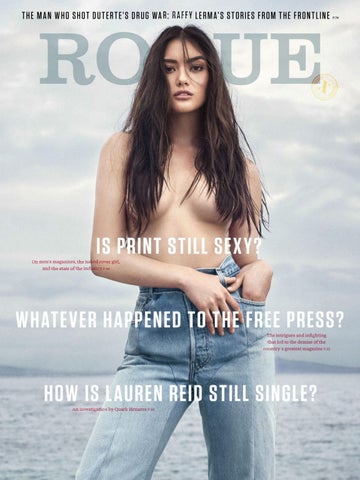
T HE M A N W HO SHO T D U T E R T E ’ S DRUG WAA R :
F Y L ERM A’ S S T ORIE S F ROM T HE F RON T L INE
P.74
E A
OF RO
On m
s i , the nd the state o he
c er g l,, co t
P 488 P.
igue
i e e
ou un
A
to
s
a
n
G
E
ISSUE 110
CONTENTS June 2017
AGENDA
Super Single
Musical drama Respeto navigates the streets of Manila to unveil the turns and travails of its underground rap scene; Gene Paul Martin silences the noise of a blank canvas with a chaotic landscape shaped by objects familiar and unfamiliar; John F. Kennedy’s Hollywood good looks and mesmeric media presence are immortalized in this stunning portrait of his path to the White House.
For many, recall would begin and end with her brother, but the Lauren Reid story is incomplete without mention of her ten siblings, a close call with a knife, and a stint working in a slaughterhouse. Quark Henares discovers there’s more to the tale—like the illusive reason for her return to Manila.
90
11
SPACE Sound junkie and audio specialty shop owner Jay Amante ends your hunt for old-school speakers that deliver not just a dose of nostalgia, but the impeccable sound to back them up; we make a case for the new generation of wall coverings, each distinguished by a wealth of prints and textures, heralding the jolting return of maximalism to the design game.
23
THE EYE
In this age of raw minimalism, we resurrect what many have thought to be dead: prints and patterns; each a classic in its own right, the watches of OMEGA’s original 1957 trilogy are reintroduced in this limited edition collection; as fashion rings in the rise of men’s streetwear into the mainstream, we dish on the fresh labels still channeling the edgy and avant-garde.
31
THE SLANT Media: public trust, or commercial product? We asked three voices— emerging, mid-career, and veteran—to give us the lowdown on a profession that today evokes mercurial response: from reverence to revulsion.
41
PHOTOGRAPHED BY BJ PASCUAL
THE CURIOUS CASE OF THE DISAPPEARING WOMAN WITH VERY LIT TLE CLOTHING She’d loved her job so much she’d do anything for it—even if it meant getting naked in front of everyone. But the Sexy Cover Girl, according to sources, has been murdered and dumped. Ex-publishing insider Kendrick Moreno begins his investigation.
48
THE SUFFERER AND THE WITNESS Everyone knows its legacy—a century of chronicling the journey of the Filipino everyman does that—but few know just how The Philippines Free Press ended. Paolo Enrico Melendez, Totel de Jesus, Joel M. Toledo, and Jose Victor Z. Torres unearth the facts and the intrigue behind the demise of the country’s greatest magazine.
52
THE UNFINISHED BAT TLE OF RAFFY LERMA
Covering the deaths in the streets can turn a photojournalist into a crusader. Jerome Gomez sits down with the photographer behind the most famous photograph of Rodrigo Duterte’s war on drugs.
74
QUICK TO THE DRAW As the digital age rages, the editorial cartoon has evolved to fit screens of all sizes. Four artists of the medium take to the pages of Rogue to unveil their visions of the time’s plagues, from war and imagined peace to madmen leading the blind.
80
BACK IN BLACK Before its controversial end, Black Sheep was a culinary status symbol synonymous with modern Filipino fare to die for. One rough second start later, has it finally regained its footing? Jonty Cruz sits down with the man behind its return, head chef Patrick Go.
100
ABRA PHOTOGRAPHED BY GELOY CONCEPCION
ON THE COVER Deputy Editor JONTY CRUZ Executive Editor JEROME GOMEZ Managing Editor JACS T. SAMPAYAN Associate Editor PAOLO ENRICO MELENDEZ Contributing Editor DEVI DE VEYRA Founding Editor JOSE MARI UGARTE Editorial Assistant PATRICIA CHONG Online Editor PHILBERT DY Editor at Large TEODORO LOCSIN, JR.
Photographed by BJ Pascual Styled by Pam Quiñones Makeup by John Pagaduan using Make Up Forever Hair by Apriel Seguin Stylist Assisted by Margarita Baello of Qurator Lauren Reid wears Vetements jeans.
ART Senior Art Director KARL CASTRO Junior Designer MARK SANTIAGO Online Junior Art Director ANDREW PANOPIO Photographer at Large MARK NICDAO Photographer STEVE TIRONA
Contributing Writers MIO BORROMEO, TOTEL DE JESUS, THE GUIDON EDITORIAL BOARD, QUARK HENARES, EMIL HOFILEÑA, SANDY MIGUEL, KENDRICK MORENO, JOEL PABLO SALUD, BLAKE SAMSON, NANTE SANTAMARIA, JOEL M. TOLEDO, JOSE VICTOR Z. TORRES Contributing Photographers & Artists PERGY ACUÑA, AARON ASIS, JOHANN BONA, GELOY CONCEPCION, PATRICK DIOKNO, KENJI MERCADO, ARTU NEPOMUCENO, RENAN ORTIZ, BJ PASCUAL, PAUL ERIC ROCA, PENTADOS, NICO VILLARETE Interns JAE ALDE, GELO DIONORA, EUSELA LANDRITO, SAM SIANGHIO
PUBLISHING Publisher VICKY MONTENEGRO / vicky.montenegro@roguemedia.ph Associate Publisher ANI A. HILA / ani.hila@roguemedia.ph Publishing Assistant MADS TEOTICO / mads.teotico@roguemedia.ph Senior Advertising Sales Director MINA GARA / mina.gara@roguemedia.ph
Unit 102, Building 2, OPVI Centre 2295 Jannov Plaza, Pasong Tamo Extension Makati, 1231 Telephone: (+632) 729-7747 Telefax: (+632) 894-2676 Email: mail@roguemedia.ph Online Presence:
Account Managers IRA GUEVARRA, VELU ACABADO, DENISE MAGTOTO
rogue.ph
Marketing Manager TRIXIE DAWN CABILAN
Facebook.com/rogue.magazine
Advertising Traffic Officer & Production Coordinator MYRA CABALUNA
Twitter: @rogueonline
Associate Circulation Manager RAINIER S. BARIA
Instagram: @rogueonline
Circulation Supervisor MARK ROLAND LEAL
Tablet version available at:
Circulation Assistant JERICO ALDANA
Zinio.com/Rogue
Dispatch Supervisors ERIC GARCIA, JIMUEL TATAD Controller EDEN G. ARGONZA Credit & Collection Officer MISCHELLE MOLA Finance Analyst JEMMALYN LUCERO
Official Internet Service Provider:
HR Supervisor RUSCHEL REYES Administrative Supervisor DEANNA GUEVARRA
This issue would not have been possible without the help of MICHELLE AYUYAO, MONSTER JIMENEZ, MARGA MANLAPIG, R. JORDAN SANTOS, THE LOPEZ MUSEUM AND LIBRARY
For subscriptions, back issues, bulk orders, and other circulation concerns please contact: Rainier S. Baria (+632) 729-7747 rainier.baria@roguemedia.ph ROGUE MAGAZINE IS PUBLISHED MONTHLY, ELEVEN TIMES PER YEAR. THE EDITORS AND PUBLISHERS OF THE MAGAZINE MAKE NO REPRESENTATIONS OR WARRANTIES IN RELATION TO THE ACCURACY OR COMPLETENESS OF THE CONTENTS OF THE ADVERTISEMENTS, PRODUCTS, AND SERVICES ADVERTISED IN THIS EDITION. OPINIONS EXPRESSED IN THIS MAGAZINE ARE SOLELY THOSE OF THE AUTHORS AND DO NOT NECESSARILY REFLECT THE VIEWS OF ROGUE MAGAZINE. THIS MAGAZINE IS FULLY PROTECTED BY COPYRIGHT, AND NO PART OF THIS MAGAZINE MAY BE USED OR REPRODUCED IN ANY MANNER WHATSOEVER WITHOUT THE WRITTEN PERMISSION FROM THE EDITORS AND PUBLISHERS.
JUNE 2017
T H E
R O G U E
A R E N A
Promotions and relevant items, direct from our partners
Bottled Up
In celebration of the V.S.O.P. Privilège Blend’s 200th anniversary, Hennessy collaborates with Carnovsky to show elements of its cognac, layer by layer
POUR A GLASS OF Hennessy VSOP Privilège Blend, and you see elements of cognac-making form right before your eyes, as colors arrange into shapes through filters on the glass bottle. Credit the spectacle of the blend’s limited-edition bottle design—created for its 200th anniversary— to Hennessy’s latest collaboration with Milan-based artistic duo Carnovsky; it’s the brand’s continuing tradition of supporting the arts through design partnerships with renowned artists. Composed of art and life couple Francesco Rugi and Silvia Quintanilla, Carnovsky is known for its RGB Project, a layering technique that uses the virtual world’s primary colors of red, green, and blue to form images that coexist in depth with each other. With colors mixing and lines and shapes entwining, RGB becomes an exploration of the “surface’s deepness” with images appearing clearer by layers of corresponding filters. Carnovsky took inspiration from Hennessy’s creation of the classic cognac and the traditional process maintained in modern times. A layer of red depicts the elements involved in VSOP Privilège’s creation, such as the sun and moon, water (in the form of flowing fountains) for cultivating grapes, and the mastery of the craft in the form of the Hennessy family coat of arms and a compass. Green symbolizes vine shoots, leaves, grapes, oaks, and flower embellishments as essential to bringing out the versatile flavor. Blue represents elements of fantasy that take shape upon tasting the versatile blend. These combined with Privilège’s flavors take one back to Hennessy’s own story, to a journey from the crown. —JAE ALDE
ISSUE 110
THE EDITORS’ NOTE June 2017
L
ast May 24, on the eve of Montana’s special congressional elections, The Guardian’s Ben Jacobs was attacked and body slammed by Republican candidate Greg Gianforte after the candidate had enough of the reporter’s questions. The incident as reported by Fox News’ Alicia Acuna happened as such: “Gianforte grabbed Jacobs by the neck with both hands and slammed him into the ground behind him... Gianforte then began punching the reporter. As Gianforte moved on top of Jacobs, he began yelling something to the effect of, ‘I’m sick and tired of this!’” Twenty-four hours after viciously assaulting a member of the press, Gianforte was elected into office. The recent incident was yet another attack against the media; another manifestation of the growing hatred against the Fourth Estate being engendered by President Donald Trump. He didn’t start this, of course. Trump’s beloved Vladimir Putin has long been accused of using his administration to strong-arm and kill journalists who go against his rule. Within our own shores, the days that followed Rodrigo Duterte’s election into
office also brought insults and attacks against the media. Recently, the president has threatened media institutions such as ABS-CBN and The Philippine Daily Inquirer, accusing both companies of crimes. He says of ABS-CBN, “Ang ginawa ninyo sa amin estafa, swindling.. marami pa yan. Putang ina harap-harapan magkolekta kayo tapos estafa ninyo kami.” Duterte was more direct in naming the Prietos of Inquirer, “The oligarchs, the number one among them are the Prietos, the owners of Inquirer. You can be sure that I will proceed with you harshly,” further adding, “I assure you, after all of these things here, I will start to recover what is government’s property, including that Inquirer. The loudest, one of the loudest of it all.” While conflict between the powers that be and the press is nothing new, recent events recall darker times when the press was not only attacked but forcibly silenced. It isn’t so long ago that Marcos shut down countless media outlets, arrested journalists, and tried to pass off propaganda as official news. To this day, we still hear of stories from citizens and journalists alike still reeling from the effects of the Marcos administration.
THE ROGUE TEAM
And without a strong body of independent press present at that time, most of the atrocities continue to be hard to prove. But one need not look so far into the past to see abuses against the press. The Maguinadanao Massacre, where 32 journalists were killed and dumped along the road like filth, is still fresh in our minds. After three presidents in office, they have still not seen justice. For tyrants, dictators, and murderers, a formidable press is their greatest threat. There can be no justice without truth and truth is the business of the free press. Democracy cannot live without the support of the Fourth Estate. And as citizens it is our responsibility to march for the truth, to support the press, and fight against those that aim to silence them. Fake news, alternative facts, and posttruths should not be the norm. These are shackles that hinder our freedoms. These are weapons that promote autonomy and totalitarianism. It is truth that stops us from making the same mistakes over and over again. And without the free press to not only uncover the truth but to defend it, the flame of democracy flickers and dims, leaving us all in the dark.
EDITORIAL CARTOON BY E. Z . IZON, PHILIPPINES FREE PRESS JANUARY 23, 1971
Who Watches the Watchmen
ISSUE 110
THE GUEST LIST June 2017
PENTADOS’s earliest drawings were copies of religious artworks—the ones he’d see in pasyon and novena booklets as a child—which he did on cigarette boxes from the family sari-sari store. These days, his artwork appears more often on book covers and film posters.
JOEL M. TOLEDO holds a Masters degree in English Studies (Poetry) from the University of the Philippines Diliman, where he likewise finished two undergraduate degrees. Toledo was the recipient of the 2006 NCCA Literary Prize, a three-time National Book Awards finalist, and has won awards for his poetry in English, including two Don Carlos Palanca Memorial Awards.
QUARK HENARES makes films. One of them a serial killer romantic comedy, another a love letter to the indie band scene. He’s won some awards for these and his writing. In this issue, he investigates why our cover girl Lauren Reid is still “super single.”
GELOY CONCEPCION is a photographer who has known the vibrancy and chaos of the city his whole life, having been born and raised in Pandacan, Manila. His works have been exhibited in countries like Japan, Singapore, India, and Australia.
NICO VILLARETE, for all intents and purposes, is an artist—though where you see his works vary. On the internet, his designs and illustrations find a home in the webpages of Rappler. In the material world, his art belongs on the streets he paints with art group Ang Gerilya.
JOSE VICTOR Z. TORRES is a historian, essayist, and an award-winning playwright—though he currently works as an associate professor for De La Salle University’s History Department. In this issue, he writes about the icons that passed thru the esteemed halls of the Philippines Free Press.
TOTEL DE JESUS is a journalist and lifestyle reporter with stints under TODAY, Business Mirror, The Philippines Free Press, and The Philippine Daily Inquirer. He is now an online editor under Microsoft Philippines while contributing to Inquirer’s theater section.
RENAN ORTIZ’s first love was always art, though he ended up pursuing a degree in political science first. These days, he is both an artist and an activist, with many of his political illustrations appearing on bulatlat.com and PinoyWeekly.
PAUL ERIC ROCA has been an illustrator since the 90s, providing art for his own storybooks such as Si Ching na Takot sa Dilim and editorail cartoons for publications such as Singapore’s The Straits Times. Now back in Manila, he currently works for the Manila Bulletin.
JUNE 2017
T H E
R O G U E
A R E N A
Promotions and relevant items, direct from our partners
One for the Road
The Thule Subterra travel bag collection helps the modern traveler live out his wildest adventures
WHETHER TREKKING THROUGH Jake Brothers Inc., Marketing Manager Paulino Servando with a piece from the Subterra Luggage collection
the wilderness or exploring the urban jungle, the perfect travel partner is one that’s game for anything. With this in mind, Thule presents Subterra, its latest collection of sleek travel bags and luggage, all of them durable (and stylish) enough to keep up with adventures on the wild side. Light packers and adrenaline junkies will find a match in the collection’s Carry-On 40L, a soft-sided bag that can be worn as a backpack and a shoulder bag. Added perks include its generous compartments and separate laptop sleeve with tablet storage, PowerPocket, and accessory organization. Those in the market for something closer to an everyday backpack can turn to the Travel Backpack 34L, which keeps gadgets safe with its padded SafeEdge laptop sleeves and soft interior pockets. Accessories such as cords and chargers can be neatly put away in the internal PowerPocket and packing cube, which can also be used to pack clothes, all easily accessed through its side zippers and wide rolltop opening with magnetic closure. For more space, the Subterra Luggage 70cm/28” is a two-in-one rolling duffel bag made of waterresistant materials. With main compartments divided for easy packing, this travel bag provides easy access to smaller items through its zippered pocket. An even handier alternative is the Luggage 55cm/22”, which conveniently splits into two independent carry-on-compliant pieces when needed. The stylish duffel also moves smoothly with its tough, oversized wheels and V-Tubing telescoping handles. —PATRICIA CHONG Available at SM Aura Premier, Bonifacio Global City, Taguig; 478-1974.
JUNE 2017
T H E
R O G U E
A R E N A
Promotions and relevant items, direct from our partners
Whether it’s the safety goggles of the 1900s or the sleek frames of its 2017 eyewear collection, Dunhill delivers the same statement of elegance and style SINCE AUTOMOBILES IN the early 20th century didn’t have doors or
roofs, motorists had to wear safety goggles to protect their eyes from flying dust and the harsh elements. Back in the day, owning a car connoted affluence, prompting accessory makers to create fancier—and pricier—products for motorists. Among those who supplied the market with upscale motoring goods was English tobacconist Alfred Dunhill. A century later, Dunhill remains faithful to its automobile accessories roots. For its Spring/Summer 2017 eyewear collection, vintage elements, like the aviator style, are utilized alongside contemporary features: think sleek metal double-bridged frames, acetate-metal combination frames, metallic touches, and round lenses. Key Dunhill details—the barley pattern and the Longtail logo—are also incorporated in the new collection’s pieces. —GELO DIONORA Newport Boulevard, Pasay; 239-1409; dunhill.com.ph
Yoga takes center stage in UNIQLO’s Spring/Summer collection FOR SPRING/SUMMER 2017, Japanese casual clothing brand UNIQLO unveils apparel for the centuries-old discipline of yoga in its SPORT collection, which already features active wear for running and weight training. Recognizing people’s need to incorporate fitness into their busy schedules, Uniqlo designs its Sport collection pieces to take individuals “from the [yoga] studio to the streets.” The women’s line features the AIRism Yoga Cropped Pants, fashioned for easy mobility, and the sweat-wicking Dry Yoga Tunic. The AIRism Sports Bra and UV Cut Mesh T-shirt provide the same benefits, and accommodate a wide variety of fitness regimens. All the pieces are designed to flatter the female silhouette, and are wearable with other workout clothes. The men’s line goes beyond yoga and features the AIRism Performance Support Tights, which cater to low- and high-impact training, and the DRY-EX Polo Shirt, which wicks sweat and can be coordinated with other workout clothes or basic casual pieces. Finally, the unisex Performance Socks promise a snug, no-slip fit, breathability, and minimal odor. —GELO DIONORA Glorietta 5, Ayala Center, Makati; 551-2710; uniqlo.com.ph
June 2017
Edited by
JEROME GOMEZ
AGENDA
F O O D + E N T E RTA I N M E N T + C U LT U R E + T R AV E L
Words were as much part of the game as a television-ready smile in John F. Kennedy’s path to the White House—that much is clear in TASCHEN’s stunningly illustrated re-issue of the treatise that made him president WORDS BY MIO BORROMEO
Issue
110
R
L
ong before contemporary media dropped a load of analysis and features on our heads depicting the electoral race as an embodiment of a nation, there was Norman Mailer, who in November 1960, months after the first televised US presidential debate and just weeks before the polls opened, broke a firsthand summing up of America from the vantage point of the Democratic National Convention in Los Angeles. At the time, Mailer’s story—which the publishers entitled “Superman Comes to the Supermarket,” much to the author’s chagrin—marked the dawn of a new and unconventional journalistic style that attempted to make the reader assume the writer’s perpective. Mailer supplied the psychic context that was the backdrop of the whole election. According to him, the circumstances that plagued the Democratic Party were strangely and overwhelmingly existential, recognizing the fundamental American belief in the myth of the hero. One can draw comparisons between the dilemma Mailer identified back then to the one the United States faced over the past year: “America’s need in those years was… to face into that terrible logic of history which demanded that the country and its people must become more extraordinary and more adventurous, or else perish, since the only alternative was to off ff r a false security in the power and the panacea of organized religion, family, and the FBI…” It likewise helps to know that there was some level of divisiveness that struck the party at the time, again reminiscent of the election just past. That there was doubt as to whether the eventual nominee John F. Kennedy was qualified or experienced enough to hold a candle to the older, veteran candidates in the convention threw some supporters off. Mailer, at some point, reveals that the depression lain over the convention stemmed from
12
the realization that their eventual nominee, “no matter how serious his political dedication might be, was indisputably and willy-nilly going to be seen as a great box-office actor…” Comparisons to the present aside, Mailer’s essay provides observers of the dynamics between Western politics and society an insightful examination into the conscience of the Democratic Party. There is a deep understanding of what it means for the Party to choose a candidate, to choose its hero. When the Party gives way for a less experienced nominee who has exhibited grace in the campaign trail and tenacious bravery following the harrowing experience of war trauma, there is a sense that he will be able to lead the nation in engaging the myth of the hero once again; that everyone will be able to see himself or herself performing work no less than extraordinary. Now re-imagined by TASCHEN (taschen.com) as a book that follows Kennedy on the campaign trail, Superman Comes to the Supermarkett is cultural commentary elevated into national narrative, now codified as historical artifact. The photographs that accompany the essay present Kennedy in quotidian moments—the lead image being one that actually sees Kennedy walking through a supermarket—but t they do so much to give the reader an idea of how Kennedy wanted to project himself: an everyman charged with the hope of an entire generation. After the election, the president would cite his apparent victory at the debate as the turning point of the campaign. But Mailer was confident enough to say that his treatise backing Kennedy just before Election Day was the true clincher. Nowadays, there is little room for a piece like his to emerge and stand out. In the words of Mailer himself, the times were such that “the consequences […] were staggering and not at all easy to calculate.”
TASCHEN
AGENDA BOOKS
More from Camelot Apart from the publication of the TASCHEN book, a small Kennedy fever accompanies the 100th birthday of JFK
THE JFK DIARY
A JACKIE O WATCH AND ART
100 PHOTOS OF JACK
A diary he kept in his brief career as journalist post WWII sold for $700,000 at the Boston Auction in late April. In the diary, which included a dozen handwritten pages, the young Kennedy ruminated on Hitler, the situation that surrounded the dictator’s death, and Berlin which the diarist visited in 1945. He was 28 at that time and soon after will declare he is running for Congress.
A timepiece given to Jackie Kennedy and a painting by her is coming up for auction this 21st of June at Christie’s in New York. The watch—an 18k gold Cartier tank—is a gift from her brother-in-law Stanislav Radziwill to commemorate a hike she initiated in 1963 with her sister Lee and Chuck Spalding. As a gesture of thanks, Kennedy painted a picture of Radziwill and Spalding.
One hundred black and white photographs of the pre-presidency JFK came up for action last May 28 at the R.R. Auction House in Boston. The collection included previously unpublished pictures, family photos, a photo of John and Jackie on their wedding day, and a lot of pictures from the early days of JFK’s political career. The collection is estimated at US$39,000.
THE GREAT GAME
In order to build his everyman appeal, Kennedy gave photographers from magazines such as Life and Look open access to capture quotidian moments from his campaign, like this jaunt through a West Virginia grocery store in April 1960.
JUNE 2017
13
R
GIVE MY REGARDS TO P. GUEVARRA
AGENDA FOOD
A After three decades, the San Juan in nstitution Café Ysabel closes its doors and moves to a new home. But not before we’ve paid our respects to a magnificent sttructure that reminds us of a better version of ourselves
Wheen it comes to food, trust yourr taste buds—or check out agram’s @masarapba, Insta “ang g pinakahonest na food acct sa history of mankind”
An online search for any local eating establishment will likely yield a page from a prominent food blog, which will tell you about the ambiance of the restaurant, the size of its food portions, and the blogger’s personal experience eating its cuisine. To some extent, the information can be useful—entertaining even, if the writer is any good. But it doesn’t answer the only question that matters: does the food taste good? Enter Masarap Ba?, an Instagram account devoted solely to that question. Typically, a post on the account involves a picture of a food item. Overlaid text on the image identifies what the food is and a simple verdict: Masarap or Hindi Masarap. The accompanying caption on the image offers a little more detail, the person (or people) behind the account explaining, in the vernacular, his/her/their thoughts on eating the said food item. Such unequivocal and often hilarious opinions have garnered the account its substantial online following. In a country where so few are willing to publicly declare whether they like something or not, @masarapba charms with its unadorned frankness. The whole attitude of the feed is reflective of how average people actually engage with food. Strange, but society has somehow decided that a separate class of people called “foodies” exists, as if this class is the only one that likes to eat and talk about what it eats. Talking about whether food is good or not is part of everybody’s daily life; any meal shared with at least one other person inevitably leads to some discussion about the quality of the dish. It doesn’t matter if you’re in a McDonald’s, a carinderia, or at a fancy establishment serving an impossibly expensive degustation. At some point, you’re going to say something about the
14
food. And if someone is there with you, you’re going to tell them what you think. This is the work of Masarap Ba? It offers genuine opinions about every type of food, whether it be a packaged sandwich from the grocery, the latest item introduced by a fast-food chain, the signature dish of a hot new restaurant, or the latest food craze. It treats all food equally, putting aside the need for extensive narratives about how the table was set or how handsome the waiters were. Everything boils down to a binary proposition: the food is either good—or it isn’t. It is unclear whether Masarap Ba? has had much impact on the restaurants responsible for the food it has reviewed. But that isn’t really the point of criticism. Go through the comments of any one of the account’s posts and you’ll find people arguing for and against the verdict. Yes, the account’s followers have their own opinions on the food as well. Sometimes they’re polite; other times, they’re enough to start a heated exchange. In either case, the account has created a little space for the kind of candor that we have in real life for the food that we eat. It’s leading by example, showing people that we can just talk honestly about what we feel regarding any given dish. Recently, the account started taking submissions from its followers, setting up an email address for anyone to send in reviews under the account’s very specific format. This further democratizes the local food culture, providing a platform for people who have something to say about a food they just ate. It might not seem that important, but this discourse has people engaging with a part of culture in a pretty meaningful way. If nothing else, it forces them to ask the question: is this good? And from that simple judgment, so much more can be revealed. —PHILBERT DY
e parked his red-hot Toyota Corolla, then guided his pretty date up the little walkway, g through the plants. Like the an his mother raised him to pened the door for her to their sp pecial place, setting the stage for another memorable Saturday date night. Staring m at her, all fresh and brimming with youthfulness in her Esprit outfit, the faint whiff ff of her Denenes tickling his nose, he wondered how he got so lucky to go out with someone as stunning as her. She fidgets with her charm bracelet, the one given to her by her papa for her debut a few years back, and takes him in with equal adoration—his face framed in tortoise shell glasses, white polo tucked into chinos, and sleeves rolled up to his elbows, a bit too much Drakkar Noir emanating from behind his ears. The captain waiter serves them some dinner rolls and little balls of butter. Immediately they both notice their stomachs growling in hunger, and start perusing the menu. As they are serenaded to the strains of a lone acoustic guitar, he gently asks her, “What are you having?” “Well, I’m thinking of something new today,” she says. “Do you know what you want? Hmm…let’s play a game. If we really know each other well, let’s say what the other person is going to order. On the count of three, okay? One… two… three.” “Carbonara and iced tea!” they proclaim in unison. Yeah, it’s an old joke from people of a certain generation, but it pretty much sums up a typical night at Café Ysabel, the much-venerated San Juan restaurant that’s closing this June. It is, undoubtedly, one of the last of these kinds of restaurants, with a menu that practically screams throwback: Caesar salad, prawn Thermidor, halibut Almondine, tournedos Rossini, salpicao, gambas…the menu reads like a time capsule. Sure, it’s moving to a new location, but the structure that houses the café is all part of the Café Ysabel
ILLUSTRATION BY AARON ASIS
BY JJ YULO
The Only Question That Matters
GOODBYE TO ALL THAT
PHOTOGRAPHS BY KRISTELLE RAMOS
The ancestral-hometurned-restaurant opened in the 1980s and has since become host to many family and romantic occasions. Below: Chef Gene Gonzalez says he plans to tear down the structure but save whatever he can to bring to Cafe Ysabel’s next address.
even only for a moment. Everyone is out chasing the Next Big Thing, whatever that may be, and because of that, in a blink of an eye, today’s poke bowl becomes yesterday’s glass of Zagu. So as the sun sets gently on the days of this institution, we remember the restaurants of yore and offer a toast to that elusive trait that today’s restaurateurs are praying to achieve: stability. Every owner yearns for it, and those old enough to remember also pine for those simpler times. Café Ysabel had its time for 30 years—longer than a lot of relationships that started in its dining room—and one can only tip his hat to this feat of longevity. See you later in your new digs, CY, we hope the stoves keep a-blazing there, too.
experience—the scene of many dates like the abovementioned, of birthday parties, engagements, and the like. Three decades of life celebrations. Personally, I think that old house made the food more special. In this day and age when dining destinations are opening faster than you can say poke, Café Ysabel was born at a time when restaurants actually made connections with their diners. Today, everything is like fast fashion: quick, disposable. But back then, people went to places because they just felt right and eating there resonated with them. Café Ysabel, like other restaurants of its ilk, is a specialist in making you feel welcome in a very Filipino way. To its patrons, it’s a safe haven, very non-threatening, with food that’s both date-worthy and crave-worthy, comforting and fancy all at once, like food from your lola’s house, served in a cool, candlelit room, where the subtle sounds of diners’ conversations and music by Everything But The Girl and Basia hummed in the background. It hearkens back to a more innocent time. No checking e-mails, no “checking in” or Facebook status updates. No food harmed and Instagrammed to death. Café Ysabel was where you brought yourself and your party, fully present, to talk and flirt and banter and joke. It was as real as it got. Under the watchful eye of veteran chef Gene Gonzalez, the food was exactly what impressionable Manileño diners wanted to have. We crack jokes about carbonara now, but back then it was on point, and there was nothing more romantic than sharing some crêpes à la mode for dessert. And the magic was you wanted to go back again and again, because you knew what you were getting and there was always something for everyone. Nowadays, everyone is out to out-cool each other. Nothing wrong with that, per se, but the after-effect is that no one is satisfied anymore with staying put—if
JUNE 2017
15
R
AGENDA ART
WELCOME TO THE MADNESS
From geometric shapes to grotesque figures, the art of Gene Paul Martin straddles the line between the surreal and the abstract WORDS BY PATRICIA CHONG PORTRAIT BY JOHANN BONA
J
ust before his portrait is taken, Gene Paul Martin pulls out a straw hat seemingly from out of nowhere. Somehow, nothing looks more natural with the bright pink flamingo pattern on his shirt. “Sellout ako,” he says as he wears the hat. “Seryoso.” You’re not sure if he is. On the wall behind him is an enormous oil painting in its early stages, a landscape conjured in shades of gray, green, and violet. Synths are spread on the counter, with a naked child toy sitting atop a large speaker. The artist’s dog has a streak of blue paint on its ear. The little things give it away; what appears to be normal is decidedly odd. This is, after all, the space of the artist whose most recent work has been described as “ecstatic absurdity” and “apocalyptic postmodernism.” Martin’s dark, surreal landscapes find themselves occupied by the familiar transformed into the unfamiliar by newfound contexts and configurations—a cigarette held aloft by an invisible smoker, a palm tree connected to a pair of legs through geometric lines and curved shapes. “Para siyang failed abstraction and failed figuration,” he says, relaxing on the floor even though there’s a chair right next to him. “It’s struggling to define itself. Hindi niya alam kung wasak siya or figurative siya,” he says, describing his recent works. Officially, Martin has been in the art scene for five years, but his beginnings go back a little further, to his days as
16
“Sobrang ingay ang blank canvas,” he says. “Once you start drawing or putting paint on it, you begin to strip down its potential. Maybe you’re gunning for a certain aesthetic. Hanggang tumahimik ‘yung picture.”
a fine arts student at the Far Eastern University. His stumbling upon the arts and culture rag Juxtapoz while scrounging for materials in Recto, would become the gateway to “the cute stuff” he first became known for. If you look at his works from those early days, many of them were marked by mutated candy-colored figures in the vein of pop surrealism. His exposure to the gallery scene led to his departure from this initial style. The works of Manuel Ocampo and Don Dalmacio, among others, had a big impact on the twentysomething. “Shit—parang nasabi nila ang ‘di ko masabi,” he says. He was, as he puts it, “devirginized” in the world of art. Whatever style he had previously embraced was no longer sufficient enough to express what was really going on in his head. Martin’s shift to his current style of abstraction began with the search for new visual problems to parallel his state of mind. The visual problem is where his work begins, with the first layer of paint dedicated to presenting it. The second layer brings a solution, and again, a question—another layer brings another answer, and so on, until the canvas is silenced. “Sobrang ingay ang blank canvas,” he says. “Kasi ‘pag blank siya, sobrang dami niyang potential. Once you start drawing or putting paint on it, you begin to strip down its potential. Maybe you’re gunning for a certain aesthetic, a certain balance. Hanggang tumahimik ‘yung picture.” The shift in style resulted in mixed reactions—one of which was the withdrawal of many of his collectors. This triggered Martin’s self-doubt. (“Shit, okay ba itong ginagawa ko?”) But his true admirers have remained and new buyers have surfaced as his styled progressed, pushing the artist forward. “Nag-prevail pa rin ang passion ko na gawin ko ang gusto ko.” It’s made him feel sort of a badass, sticking to his guns. “Iyon ang punk attitude. ‘Pag artist ka, punk ka.”
LOVE AND MONSTERS
Clockwise from top: Martin’s oil on canvas works, Untitled; Flat Landers 2; and Flat Landers 1. Asked about his inspiration, Martin says it’s Manila—”very chaotic, tapos parang tropical disco acid. Hybrid.” Opposite: The artist in his studio.
JUNE 2017
17
R
AGENDA FILM
POETIC JUSTICE Not since FrancisM has a local rap artist combined mass magnetism and street cred until Abra came along. Now the young powerhouse is bringing his rhymes to the big screen in the most anticipated feature in this August’s Cinemalaya WORDS BY EMIL HOFILEÑA
18
ABRA PORTRAIT BY GELOY CONCEPCION; OPPOSITE: PHOTOGRAPH BY KENJI MERCADO
O
n the set of the 2017 Cinemalaya entry Respeto, the first-timer is king. The film’s director Treb Monteras II has over 300 music videos to his name, but is only starting to make the jump to feature-length narrative filmmaking. Producer Monster Jimenez, while experienced and prolific in her own right, is a newcomer to the world of local hip-hop. And rap superstar Abra, who honed a hard-earned career in both the underground scene and the mainstream music industry, is eager to take on his first leading role. Respeto is Monteras’s longgestating tribute to the underground subculture; it’s an idea that formed in the director’s mind as far back as five years ago. The story of a young rapper raring to make it in the local scene, the material drew Jimenez and Abra because of its nuanced world. “It doesn’t stop at the celebration of hip-hop,” Jimenez explains. “This film is also about words, martial law, poverty, and how violence begets violence.” Abra’s character raps to escape the dead-end nature of his community, and also to find hope and healing through his art.
correctness. However, to place such a strict, black-and-white expectation on FlipTop is to disregard the context it was born from. While shooting Respeto, Jimenez observed that rap had become a way for people to transform their harsh environment into fuel for their art. It had become a non-violent outlet in the tradition of the balagtasan. “For me, ‘yung rappers, matatalinong tao,” Monteras says proudly. “Meron silang ibang skill na hindi kaya ng kahit sinong tao. May mga rappers na hindi
less fortunate; these are their ways of coping with and making sense of the constant danger they live in. Jimenez narrates a moment on set when they had actors dressed as policemen demolishing a home. Suddenly, a fouryear-old approached them to ask if they were going to become victims of the government’s controversial anti-drug campaign, Oplan Tokhang. “They were so scared,” Jimenez recounts. “This movie talks about that reality now.”
“It doesn’t stop at the celebration of hip-hop,” Jimenez explains. “This film is also about words, martial law, poverty, and how violence begets violence.” However, no matter how truthful the film is, the Respeto team acknowledges that, in reality, these conclusions don’t come easy. In the underground rap scene, first-timers are barely given any leeway. They’re irrelevant, at least, until they prove themselves. “Kailangan mo pagdaanan lahat. Walang shortcuts,” Abra warns, adding that it can take five to 10 years of hard work, practice, and public rap battles to get any sort of success. “Sariling sikap mo lahat bago dumating lahat ng blessings.” Mentors and independent labels exist, but never to serve as lifelines. Every rapper’s career must come from his or her character and identity. This trial of forging one’s persona can be traced back to the genre’s own identity crisis in the Philippines. Monteras recalls a time when Filipino hip-hop lacked its unique characteristics; then, rappers settled for imitating American styles. “Then nung lumabas si Francis M,” Monteras says, “nagkaroon bigla [ng identity].” Francis Magalona changed the music industry in the 1990s with a fresh brand of nationalistic rap, mainstream appeal, and genre flexibility—paving the way for local hip-hop as we know it today, especially in its most unique and popular form: the rap battles of the FlipTop Battle League. To the uninitiated, FlipTop may seem barbaric; in a way, it is. Over several rounds and without the help of a beat or a backing track, competitors are asked to insult each other through verse based on whatever information they can dig up about their opponent. “Bawal ang pikon,” Jimenez says. “Titirahin ‘yung nanay mo at ‘yung jowa mo.” The results are inventive, intense, and hugely entertaining to the thousands of people who watch the battles live—and the millions who view recordings of the matches online. Still, FlipTop is understandably not everyone’s cup of tea; some would prefer that the League falls within limits of decency or political
graduate ng high school or elementary, pero pagdating sa rap, magagaling at matatalino sila.” This is how local rap brings such a tightly knit community together: in a system where not all Filipinos have easy access to education, rap becomes an unorthodox alternative to encouraging literacy, research, hard work, and self-expression—and it’s cheap, if not completely free to learn. Though it wears the guise of a confrontation, FlipTop is a space where art is shared and exchanged. And while the battles are saturated in profanity and low-blow insults, any experienced MC will tell you that the foundation of every match is ultimately respect for the other rapper sharing the stage. And this is where Respeto comes in. Apart from having the film shine a light on this subculture that is either ignored or misunderstood by the rest of Philippine society, Monteras, Jimenez, and Abra aim to go deeper— to illustrate how inseparable violence is from poverty. FlipTop and the underground rap scene aren’t simply inconsequential diversions for the
Refusing to dwell on the grim reality faced by urban Filipino communities, Monteras is also optimistic about the message of his film. He hopes to take the idea of respecting one’s FlipTop opponent, and aim that respect inwards. “Ang respeto, nagsisimula sa sarili,” he says. “In the case of our characters in Respeto, ‘yung respeto na hinahanap nila, nasa sarili lang pala.” Abra is similarly hopeful that the film will do justice to the community he loves, and that it will bode well for the future of hip-hop in the Philippines. When the performer began his career, YouTube was still in its infancy, and he had to push himself even harder to learn how to rap. Now, he considers the youth lucky that it has so many resources and sources of inspiration at its fingertips. “Ang galing ng mga bata ngayon. Nakakabaliw,” he marvels, confident that they will change the scene for years to come. “Kahit base [ang rap] sa kanto, ‘di siya ‘yung tipong iisipin mong jologs, baduy, o sobrang babaw,” he says. “’Yung maganda sa film na ‘to, makikita mo na it doesn’t matter. Kaya mong maging malupit.”
KING INANG BAYAN
Assistant director Timmy Harn, producer Monster Jimenez and director Treb Monteras II behind the scenes. Opposite: In Respeto, rap superstar Abra takes on his first leading role in a film.
JUNE 2017
19
R
AGENDA MUSIC
NOTES FROM THE GUITAR MAN No matter which mountain or city his folk music takes him, Ian Penn never loses his old soul and youthful curiosity WORDS BY EMIL HOFILEÑA PHOTOGRAPHED BY ARTU NEPOMUCENO
20
I
an Penn manages to be, at once, everything you would expect from a folk singer-songwriter and an artist who constantly resists being defined. But to call him a contradiction doesn’t cut it; that would suggest some sort of internal conflict. Instead, Penn’s music is a pacifying celebration of the most elemental things—his lyrics and high-pitched vocals evoking crisp images of nature, the wistfulness of longing, and the warmth of nostalgia. It’s folk music in every sense of the word, with repeated melodies functioning as both restless yearning and soothing reassurance. But, of course, that’s just one way of looking at it. “I don’t really have a say on what [my music] is about because other people have different interpretations,” Penn says. “Might as well just leave it up to them.” In other
words, your guess is as good as anyone’s. This is not to say, though, that he is a mystery to be solved. If anything, he wears his old soul on his sleeve— his laid-back attitude a result of a happy childhood with his family on the foothills of Mt. Arayat. Penn describes the six tracks from his first release, Wild Abandon, as “sacred” to him because of how much of Arayat it contains. He recalls having to record the songs in total darkness to mentally transport himself back to the mountain. One might think he knows where Penn’s story goes from there: the country boy moves to the city and fights to retain his purity and closeness to nature. But while the idea of writing “city songs” had crossed his mind when he relocated to Makati two years ago, Penn says his continuing journey isn’t bound to a cut-and-dried dichotomy of rural versus urban. His latest single, “Water from the Creek,” continues to embrace the mood and poetry of his earlier songs, but also feels significantly more modern, thanks to a full band complementing his harmonica and acoustic guitar. However, if Penn hasn’t had much trouble navigating a different geography, his biggest challenge so far has been the shift from working under a label to recording independently for his second album, to be released on the first of July. “Every creative idea lives for a while until someone kills it,” Penn states, referring to the overlapping of musical ideas in the studio. Seeking to capture the energy being tossed around, Penn insisted that all first takes be kept as a reference for the kind of rawness that he wanted in the final product. What matters most to him isn’t the polish of the end result, but the act of creation itself. And so Penn keeps on creating. In fact, he can’t sit still. When he isn’t holding a guitar, he’s capturing his surroundings on film or sticking scraps of nature onto his hat. There’s an adventurousness about him that translates clearly to his music; so much of it is about looking for one’s place—and yet Penn seems to know exactly where he’s headed.
JUNE 2017
T H E
R O G U E
A R E N A
Promotions and relevant items, direct from our partners
The Fine Print
Intricate patterns from India and Turkey join sea-inspired motifs in Pottery Barn’s Summer 2017 collection
THE ANCIENT INDIAN art of Kalamkari is highlighted in Pottery Barn’s Summer 2017 collection. The rich history and tradition of the technique inspire the design of the Selena Block Print Duvet Cover and Sham seen in their geometric, leaf, and flower patterns. A similar intricacy also appears in the Leona Medallion pillows, which bear a sun motif, and the Del Sol Melamine platters, hand-painted in elaborate blue, red, and green flower designs. From ancient India, Pottery Barn also goes to the coast to feature aquaticinspired patterns; seahorses, seaweed, shells, and corals come alive on the Monterey Coastal Print sheet set. These sea creatures accompany the turtles and octopi from the La Paz pillow collection, the starfish from the Under the Sea platter collection, and the big blue crab from the Sea Life collection. Surfacing from the ocean, Pottery Barn also stops over in Turkey to draw inspiration from Iznik ware. These ceramic products, which capture the look of pieces manufactured in Iznik, Turkey, from the 15th to 17th centuries, bear botanical designs and fauna like birds and deer. —GELO DIONORA Central Square, Bonifacio High Street; Estancia, Capitol Commons; facebook.com/PotteryBarnPH; @potterybarnPH
Man of Steel Sunnies Specs teams up with Erwan Heussaff to showcase metal eyewear fit for dynamic lifestyles
FOOD WRITER, RESTAURATEUR, and travel junkie Erwan
Heussaff has gone through many major life changes: he dropped his sedentary and indulgent lifestyle (and around 90 lbs.) to embrace a healthy way of living (read his reflections in The Fat Kid Inside); he has lived and worked all over the world, including Russia, France, and around the Philippines; and he likes wearing different shades. Always on the lookout for new styles, Heussaff says changing up his eyewear “goes hand in hand with the way [he carries himself] and what [he’s] concentrating on.” Dynamic lifestyles like his inspire the design process of Sunnies Specs. Keen on creating a variety of prescription eyewear to fit a range of lifestyles, Sunnies offers versatile models in stainless steel and non-metal frames, each available in three to four different shades. For 2017, Sunnies Specs released its Steel Series collection, full-rimmed and semi-rimless steel frames in metallic shades. The shapes of the lenses vary to complement different facial contours. Heussaff’s picks include the Roosevelt (in charcoal) and Reagan (in silver), both from the Steel Series collection, and the Kinley (in coffee), from the Autumn/Winter 2016 collection. —GELO DIONORA
June 2017
Edited by
Issue
JEROME GOMEZ
DESIGN + INTERIORS + ARCHITECTURE + TECHNOLOGY
The resurgence of vinyl has sparked a fascination for old-school speakers that deliver not just nostalgia but impeccable sound. They’re just a little harder to find. The Grey Market’s Jay Amante provides us a shortlist that should prick up your ears IL USTR S TII
S BY BY P
CU U
THE WILSON WATT PUPPY If you enjoy accurate and pinpoint imaging from your speakers, these are for the singer and instruments are placed. These speakers are a joy to listen to, and succeed to impress.
24
THE MAGNEPAN
Design-wise, Maggies are not your ordinary-looking speakers. They are known for their thin, at, planar construction. Magnepans give the audience a unique listening experience, where the music seems to envelop the whole room. You will need a lot of power to drive these babies.
THE HARBETH SUPER HL5 PLUS
The person responsible for Harbeth speakers is the same guy who designed the LS/35A speakers, BBC engineer Dudley Harwood. So if you enjoy LS3/5As but want more bass and clarity, these new production Harbeths are for you. Locally, they are distributed by Ferdie Ludo of Cebu-based Sounds N Images.
JUNE 2017
25
THH E CHA T
155 O H LS3// 5A
The LS/35A speakers were produced as studio monitors for the BBC during the early 70s and have become sought after by audio enthusiasts since. They attained their cult status because of their ethereal mid-range. Your best bet to find these vintage gems is on eBay or Audiogon.
THE ALTEC 515B WOOFERS Vintage Altec speakers have become scarce as of late. If you can find them on eBay, send them to Joey Abad Santos of Manila-based Harana Audio (0917-8525456). He can build you speaker cabinets and crossovers for your Altecs. These are the speakers I use at my bar, 78-53-86. They are best powered by very low wattage single-ended triode amplifiers. You will have sleepless nights listening to these Altecs.
26
FOR THE LATEST IN AUDIO AND VIDEO EQUIPMENTS, THE ANNUAL NOVEMBER HI-FI SHOW WILL BE HELD AT THE DUSIT THANI HOTEL THIS YEAR, FROM DECEMBER 2 TO 3.
JUNE 2017
T H E
R O G U E
A R E N A
Promotions and relevant items, direct from our partners
Prime Space The Paris design fair Maison & Objet provides a global showcase for Filipino design and craftsmanship
IN THE PHILIPPINES, there is only one homegrown name synonymous with the best reproductions of French-style furniture, and it’s Betis Crafts, Inc., the Pampanga-based company that’s been around for more than three decades. It is no surprise then that while we were admiring some very finely gilded chairs and bookcases at last January’s Maison & Objet (M&O) fair in Paris, a few steps from these objects of beauty was Leslie Mendiola of Betis. Mendiola, it turns out, is the manufacturing partner of Frederic Mahieu, CEO of Furniture and Artcraft-Exclusive Interiors, whose headquarters is in Belgium. Since working together in 2011, the two have supplied furniture and antique reproductions to prestigious homes in Europe, Asia, and the Middle East. Mahieu, who was also at the event, proudly said that everything displayed in the booth is all made in the Philippines. Unlike September 2016’s edition of M&O, when a group from the Philippines displayed their wares in a special pavilion, the most recent fair had no major Philippine presence—save for the beautiful lighting fixtures (designed by a Thai artist) in the France-based furniture company Forestier, as well as luxurious offerings at R&Y Augousti, the Cebu-based company whose name is already a byword in the international design market. Partnering with a foreign outfit is just one way for Filipino designers to showcase their products in an arena as big and as important as Maison & Objet, certainly one of the most influential design fairs in the world. Our very own CITEM (or Center for International Trade Exhibitions and Missions) also puts together a select group of designers to present its wares in the Philippine pavilion, assuring exposure to a very wide and quality audience. “M&O serves as the platform for Filipino designers to showcase their creativity internationally,” said Chiqui Veneracion who is the fair’s liaison officer in Manila. What makes Maison & Objet different from other furniture exhibitions? First, the fair has been around for 22 years now. “The progress made since 1995 is considerable,” added Veneracion.“The early vision, which was daring and unique, has stayed inimitable: bringing together all the major players in home and decoration at a single show.” The show attracts visitors from all over the world in search of products to supply their stores, furnish their homes, and complete commercial establishments. This January alone, it brought together more than 2,871 national and international brands and 85,825 buyers in the expansive Paris Nord de Villepinte Exhibition Centre. “M&O has proven that it is the place for creativity and quality for the interior design and decoration industries,” Veneracion said. How does M&O help a designer or a group of designers put up a show and booth in the Paris fair? “Each country has a dedicated office to support its exhibitors,” Veneracion said. “The Philippine office was established to do just that; to encourage, support, and guide the exhibitors, as well
Mahieu and his wife flank Mendiola at their booth at MSO
as the visitors through the process of enrolment. It is also there to assist and identify accredited suppliers to support the exhibitors (forwarders, construction assistance, etc.). The M&O press department is also there to maximize the exhibitors’ exposure to its markets.” Last January, it was Mahieu and Mendiola’s first time as a company to exhibit at the M&O (though Betis has participated in the Philippine pavilion in the past), and when we met them on the last day of the five-day show, they happily announced that they were very pleased with the inquiries they got. “The people who visited us came especially for the kind of work we do,” Mahieu offered. “They’re the ones who really appreciate this kind of furniture, the intensity of the carvings, this older French style.” Their being showcased in the Maison & Objet website, a privilege enjoyed by all the fair’s participants, no doubt helped in promoting their brand, giving visitors an ample backgrounder in the kind of business they do. “I think we’re going to have a very good start of the year,” said Mendiola. —JEROME GOMEZ
R
SPACE DESIGN
THESE WALLS COULD TALK A new generation of wallcoverings promise major impact for your space. Miguel Rosales dispenses advice on what you should watch out for WORDS BY JEROME GOMEZ
W
allpaper brings a space to life, distinguishes one area of the house from another, and helps define a room’s purpose. For a time, it lost its popularity when minimalism was all the rage and there was nothing more modern than a raw wall, or something painted in ashen shades and eggshell. But maximalism’s return has brought a jolt of excitement back into interiors, and while once upon a time there was just the one-dimensional wallpaper that came in an array of prints, the last few years has seen a lot more going for this design device. What was once flat now offers texture—lots of it—different kinds of sheen, digitally designed bespoke patterns, and a wide range of elements, from sturdy fabrics to earth-friendly materials. They’re not just wallpapers anymore, they’re wallcoverings. But what to watch out for when opting to use these swaths of eye candy on your home or office? “I think CREATING appropriateness, A SPLASH both for aesthetics Clockwise from top: the Aalto from and practicality, should be considered Altfield; the Kaleido Tesoro from Studioart; when doing Altfield’s Pacific Ray; anything to a wall,” Altfield’s etched washi in graphite grey; says Miguel Rosales, Hudsons in mahogany creative director of from Innovations; and Caramel Creative Studioart’s Framenti Urban in Caramel. Consultancy. In his projects, he’s used an oyster ground Florence Broadhurst wallcovering “in a powder room to make it pop,” and one by Fornasetti printed with books for a private basement in Bel-Air. “It should be pleasing to the eye and work with the overall design intention, and take into account the practical considerations such as the function of the room and conditions in that space such as humidity, etc. “Everything has a shelf life, wallpaper included. Just so happens that with our extremely strong sunlight and humidity it tends to have a shorter lifespan here. That said, proper wall preparation and
28
installation should help improve how long it lasts.” The selections in this spread come from Altfield Interiors, which has a shop in Hong Kong (www.altfield.com.hk) and just recently opened a showroom in Singapore. It carries brands such as Innovations, Thesign, and Maya Romanoff. A quick browse through its selections will give you an idea just how far wallcoverings have improved and the people who make it have stretched their visions. Here in Manila, Rosales personally likes to go to Studio Eleven and First Edition. “I’ve been going to them for many years and they always have something that fills my requirements,” he says. The whole reality of dealing with humidity will discourage the weak of heart from introducing this most impactful of accents; still, it pays to repeat in one’s head what Rosales said about things having a shelf life. But consider this: when the time comes to tear up the covers for whatever tragic reason, it only opens up an opportunity to reinvent the space that surrounds you.
JUNE 2017
29
June 2017
Edited by
JACS T. SAMPAYAN
THE EYE FA S H I O N + S T Y L E + G R O O M I N G
T H E R E ’ S A PAT T E R N H E R E While we rue the slow and painful fade of print, prints, however continue to fight for attention, as Bally’s Spring / Summer 2017 looks encourage you to pile it on with textures, color, and accessories that pop
Issue
110
If Pablo Coppola had a mantra that fueled this collection, it’s “Opposites attract.” Asked by Vogue to elaborate, the designer gave a myriad of references that included “David Hicks’s bold colors for Japanese kimonos” to “Jackie Brown and her pimp-ish gangsta look.”
BALLY IS AVAILABLE AT GREENBELT 5, AYALA CENTER, MAKATI; 757-1269; BALLY.COM
The mishmash of homages—varsity jackets and disco attitude, alpine prints and Eastern eccentricities—and the quirkiest styling are no doubt the collection’s biggest draws. But look closer and Coppola has equipped it too with elegant tailoring and impeccably classic-looking accoutrements.
CALL OF THE WILD Alice Shirley captures nature—from flying zebras to ferocious bears—in whimsical detail for Hermès WORDS BY GELO DIONORA
34
onsider “GRRRRR!,” a silk scarf from Hermès, the closest you’ll ever get to a brown bear. Wideeyed, mouth slightly agape, and fangs exposed, the ferocious mammal joins a winged zebra, a tiger frolicking in a flower garden, underwater creatures from the Great Barrier Reef, and other animals in an assortment of silk scarves by British artist Alice Shirley, whose colorful illustrations of nature have graced the French fashion house’s coveted accessory since 2014. These days, GRRRRR!’s brown bear marks new territory in the Slim d’Hermès GRRRRR! watch. Shirley’s original illustration is replicated in a miniature enamel painting on a white gold dial. The 39.5 mm round white gold case features a sapphire crystal and case-back with anti-glare treatment, and is waterresistant up to 30 meters. The mechanical self-winding watch is powered by Manufacture Hermès ultra-thin H1950 movement, with the micro-rotor and bridges adorned with the brand’s signature H pattern. The strap is made of smooth burgundy alligator leather with a white gold pin buckle. The meticulousness of the bear painting on the watch—fine strokes of pigment dried and fired layer upon layer until the final translucent enamel coating is applied– is reminiscent of Shirley’s own painstaking creative process. “Every new piece involves extensive research, whether it is about animal behavior and movement, plant reproduction, mineral deposits from extinct coral reefs, plate tectonics, or the way sea monsters make me feel about the open ocean,” she said in an interview. “All my research helps me understand how the world is put together, and therefore helps me understand my place in it better.”
GREENBELT 3, AYALA CENTER, MAKATI; 757-8910
IMAGE COURTESY OF PIERRE-WILLIAM HENRY
R
THE EYE WATCHES
IMAGE OF BUZZ ALDRIN BY NEIL ARMSTRONG, COURTESY OF NASA
TOTAL RECALL
Sixty years and numerous reiterations after, OMEGA’s original trilogy—the 1957 Seamaster 300, Railmaster, and Speedmaster—is reintroduced in a limited-edition collection WORDS BY GELO DIONORA
hen OMEGA launched its Seamaster 300, Speedmaster, and Railmaster watches in 1957, each one would go on to be a classic in its own right. Water-resistant to almost 1,000 feet, the Seamaster 300 is the favorite watch of deep-sea divers and those whose work takes them underwater. In the biopic L’Oddyse, famed oceanographer Jacques Cousteau, his son, and his crew sported the timepiece during their many sea adventures aboard Cousteau’s vessel, the Calypso. Originally designed for racing, the Speedmaster became better known as the watch worn by Apollo 11
astronaut Buzz Aldrin during his historic walk on the Moon in 1969. Today, the Speedmaster is one of the timepieces recognized and approved for spaceflight by NASA. Of the three, the Railmaster kept a modest profile, operating more for day-to-day activities. With their anti-magnetic properties (thanks to a stainless steel outer case and MU-metal inner plate—a doubleconstructed case that protects their movement), the first Railmasters were created for professionals who worked in close proximity of electrical fields: train employees, scientists, engineers, and electricians, to name a few. Sixty years later, the three watches reunite in the OMEGA 1957 Trilogy collection. Based on the original drawings of their predecessors, combined with accurate crosssections and dimensions mapped through digital scanning technology, these updated iterations come in a polished and brushed stainless steel case and feature a black “tropical” dial and retro-style logo on the clasp. Each watch is limited to 3,557 pieces.
SEAMASTER This retains the original’s Naïad sign on the crown, which was a mark of exceptional water resistance.
RAILMASTER Originally, the anti-magnetic double-case was designed for anyone who worked close to electrical fields.
SPEEDMASTER This was the first chronograph in the world with its tachymeter scale on the bezel instead of the dial.
R
THE EYE WATCHES
The Speedmaster draws power from the Omega 1861 caliber. It retains its signature “Broad Arrow” hands and features a redrawn font on the tachymeter scale to match the original ’57 tachymeter. The Railmaster, powered by the OMEGA caliber 8806, has deeper vintage indexes, allowing light from the Super-LumiNova filling to shine stronger. Maintaining its black aluminum bezel and Naïad sign on the crown (true marks of superior water resistance), the Seamaster 300 is also powered by the Master Chronometer 8806. Omega (Greenbelt 5, Ayala Center, Makati; 728-0436; omega.GB5@ lucerneluxe.com; omegawatches.com) offers all three watches in a special Trilogy presentation box. The outer box, made of Swiss oak wood, contains a leather watch roll, extra watch straps, a changing tool, and a smaller watch box. Each dial in the set has the word “Trilogy” printed on it, and each caseback is engraved with “Limited to 557 Timepieces.”
JUNE 2017
35
R
THE EYE STYLE
THESE ARE NOT YOUR FATHER’S THREADS With edgy street labels establishing a marked hold on fashion, will they soon take over the modern man’s wardrobe? Before you make room for Vetements in your closet, a brief on the labels that matter WORDS BY NANTE SANTAMARIA
I
t is a strange time when the formerly underground New York skatewear brand Supreme collaborates with French fashion house Louis Vuitton, when the largely anti-fashion Comme des Garçons is a theme of the 2017 Met Ball, and when social media endorsements are bared as empty facades after the infamous ashes of Fyre Festival. When a local news anchor like Julius Babao sports Supreme like a skateboarding star, is the brand still considered cool among its clique? Fortunately, not all of the avant-garde and edgy have been co-opted by the big houses and Hollywood. Here, a handful of fresh labels vending menswear with street cred.
36
GR E EN DESIGNER: CRAIG GREEN In 2015, UK’s Fashion Museum announced as its Dress of the Year an oversized blue quilted ensemble by menswear designer Green. It was the first time in the history of the annual fashion award to select menswear exclusively. But Green’s imaginings of workwear are covetable even to the opposite sex, and in the brand’s rack sales, women purchase its items as much as men. Perhaps because of this, Green presented the same items in a subsequent show, this time worn by both men and women. There could be no clearer sign that Green is venturing into the future of fashion. If, in the past, the tabloids and even male supermodel David Gandy had mocked his runway presentations, today, the designer’s creation is the garb of choice in Drake’s concert tour. Green’s utilitarian regalia was also sported by the cast of Ridley Scott’s most recent sci-fi installment, Alien: Covenant. Last year’s recipient of the British Fashion Council Menswear Fund, Green recently launched his Core Collection, staples that will be continuously sold along his seasonal offerings. To echo Tim Blanks after Green’s outing in London Collections: Men, “The cult of Craig Green is about to explode.”
GOSHA RUBCHINSKIY FOUNDER: GOSHA RUBCHINSKIY There has probably never been as much exhilaration in the Rubchinskiy universe as when it held one of its earliest runway shows in an Orthodox Church-turned-Soviet Gymnasium back in 2009. The designer’s proposition back then—suburban skinheads wearing Tommy Hilfiger panels tampered with the insignia of the Russian and Chinese flags—made the fashion world hold its breath. And it continues to keep watch: Comme des Garcons president Adrian Joffe, for one, offered to produce the label’s clothes and give it a prime spot in his terribly hip Dover Street Market. But it is not just about clothes, it seems, for Rubchinskiy who is not only a designer but a youth culture photographer carrying out visual sentences aligned with the aesthetics of American directors Larry Clark and Gus Van Sant, and German photographer Wolfgang Tillmans. Rubchinskiy inscribes the label’s ideals on T-shirts and other track staples, which includes collaborations with Adidas Football, FILA, and most recently, Kappa. With Cyrillic graphic type emblazoned on the chest— ȻɍȾɖȽɈɌɈȼȼɋȿȽȾȺȽɈɌɈȼ (Be Prepared, Always Prepared), ȽɈɌɈȼɄɌɊɍȾɍɂɈȻɈɊɈɇȿ (Ready For Labor and Defense), ɋɉȺɋɂɂɋɈɏɊȺɇɂ (Save and Protect)—Rubchinskiy is here to cross boundaries.
PALACE
V ETEMENTS
OFF-WHITE
DESIGNER: LEV TANJU
DESIGNER: DEMNA GVASALIA
FOUNDER: VIRGIL ABLOH
Despite running a full-fledged skateboard brand that only happens to dabble in fashion, Tanju, founder and proud non-designer of the British label Palace, is happy to see non-skaters wear his stuff. Actor Jonah Hill has appeared in hilarious promo clips announcing the opening of its New York store, and music mogul Jay-Z was spotted sporting a white jacket with the signature triangle logo while shopping with Beyonce and Blue Ivy in Paris. Indeed, for a brand so revered for its authenticity and commitment to skate culture, the 2009-founded Palace embraces its wide array of followers, from American skateboarders to English footballers and even the peacock bunch that goes to Pitti Uomo and shops at one of Palace’s banner stockists, Dover Street Market. Photographer Alasdair McLellan, who compiled 120 images documenting the birth and rise of Palace in a book, describes the look as almost Dickensian, like straight out of Oliver Twist. Palace has collaborated with the likes of Umbro, Reebok Classics, and adidas Originals; as a result, Tanju has successfully differentiated his skatewear from the rest of the world. With no formal departments for design, marketing, or PR, Tanju, together with his main crew, Palace Wayward Boys Choir, manages to peddle his uniquely British take on men’s casuals.
After stints with two high-profile brands—at Maison Martin Margiela before its eponymous designer left the house, and then at Louis Vuitton under both Marc Jacobs and Nicolas Ghesquière—Gvasalia ventured out on his own in 2014 with Vetements (which means clothing in French) and was immediately poached to be the new creative director of Balenciaga. His brand proposition is that of a post-luxury, anti-glamour, antiexclusive, product-oriented fashion that is packaged in pure irony. Trained in Belgium’s Royal Academy of Fine Arts, alma mater to the illustrious Antwerp Six (one of them, Walter van Beirendonck, would go on to become Gvasalia’s mentor and first boss), Gvasalia and his collaborators do not follow seasons when building collections; instead, they start with ideas of garments that they wish to wear. Gvasalia, for instance, has 15 pieces of the same “Securite” T-shirt, which became a brand staple. He also struck a deal with DHL, trading 20 T-shirts for the copyright to the international courier’s logo, then had his fashion design contemporary Gosha Rubchinskiy wear a coveted reworking of the tee to open the Vetements show. For Gvasalia, it’s all about subverting consumerist ideals, a theme that has extended to his design appropriations in the house of Balenciaga.
When streetwear god Raf Simons was asked which among the new designers—those that connect to the youth through fashion—inspire him, he declared, “Not Off-White.” To this, Abloh, the engineering-andarchitecture-trained founder and creative director of Off-White, responded, “We are all the after-effects of [Simons’] earthquake.” There is great humility in this statement, considering Abloh is not exactly an upstart, having collaborated with the famously cavalier Kanye West since 2003, then being named LVMH Prize finalist barely a year after his label was founded in 2013. Off-White’s signature diagonal stripes have been stamped on collaborations with Vans, Moncler, and Nike. This graphic element has made so much hot commodity that the brand is now embroiled in a legal battle that puts this trademark into question. Selling as far east as Hong Kong, Singapore, and Tokyo, OffWhite is now based in the world’s menswear capital, Milan, its success contributing significantly to the current stature of streetwear as the great influencer to high fashion. Already, the brand shares the latter’s snob mentality. “The obligation isn’t to buy OffWhite,” Abloh said last year, “It’s to just look at it…”
JUNE 2017
37
THE
ROGUE REGISTER
The award-wining media man and former DJ on Motown, money clips, Bill Nye, and winning in sports INTERVIEW BY JACS T. SAMPAYAN
BOYET SISON
B
oyet Sison is much more than the local version of Al Roker. Perhaps the most charming anchor in cable news today, Sison is noted for his jaunty outfits—such as his signature bowtie—and gives the news a boost of much-needed energy away from the often robotic reporting of his colleagues. He is the resident weatherman of ABS-CBN Cables News (ANC) and hosts Hardball, the network’s weekly sports talk show, alongside Bill Velasco.
1
What was your earliest ambition? To be a musician. What is your most treasured possession? A rosary given to me by my late mother that was blessed by Pope Paul VI. Who are your favorite writers? I am not much of a bookworm, but reading books on history, as well as biographies, is my thing. What do you consider your greatest achievement? That in spite of not finishing school, I am able to do work that has already given me two Gawad Tanglaw awards, and recently a KBP Golden Dove Award for radio. What would you like to own that you don’t currently possess? I don’t really ask for much anymore materially, but I would like to own a house, away from the city, to spend my twilight years, eventually. What drives you on? Many things: my desire to improve myself, to help others, and to help make my country the best it can be. What are you working on now? My program on ANC, Hardball, and my weekly radio show on DZMM, Fastbreak. I also emcee or host for events, private functions… and I occasionally still DJ if time permits. What time of the day are you most inspired? It varies, depends on my
38
mood. It can be the moment I wake up, thankful for a new day, or it could be triggered by a wonderful occurrence or a memory. Favorite hotel? Too many to mention, there can’t be just one. But I usually rate the breakfast buffet, the comfort of the bed, and the how nice the pool is. Necessary extravagance? Sleep, if that is considered one. Ideal playlist? Since I have been DJing for over 35 years, I have one for different moods and occasions. But I love jazz, soul, Motown, and house. Favorite artists? John Coltrane, Chet Baker, Miles Davis, Stan Getz, Antonio Carlos Jobim, Herbie Hancock, Ella Fitzgerald, Dianne Reeves, Diane Schuur, Anita Baker, Stevie Wonder, Beatles, APO, Basil Valdez, to name a few. Favorite actors? Charlton Heston, Al Pacino, Robert De Niro, Dustin Hoffman, Jack Nicholson, George Clooney, Meryl Streep, Jodie Foster, Charlize Theron, Julia Roberts, Scarlett Johansson, Anne Hathaway, and Gwyneth Paltrow. Favorite gadget? My music player. Favorite fitness activity? If I have time, basketball, or just doing cardio workouts. Where do you live? In a condo in the Mandaluyong area. Favorite cocktail? My usual is a scotch on
3
4
5
6
the rocks. Favorite athlete? Too many favorites through the years, and many more as the years go by. The world of sports is the best example of people putting in the hard work and emerging victorious. And if you fail, the challenge of getting better to achieve the goal. Sports team you root for? The Philippine Team. And I’m also a Boston Celtics fan. Favorite TV show? At the moment, 3 Bill Nye Saves the World. Favorite movie? At the moment, The Bucket List. Favorite dishes? I love pizza, pasta, steak, oysters, veggies, shrimp, lobster. I could go on and on. Favorite jeans? 6 My 15-year-old Levi’s 501s. Favorite footwear? My 4 Stacy Adams suede brogues. Favorite watch? My 1 TW Steele CEO Canteen in rose gold. Wallet or money clip? I switched to a money clip since last month. Favorite fragrances? 2 Christian Dior’s Eau Savage, L’Eau d’Issey by Issey Miyake, and Green Water by Jacques Fath. Who cuts your hair? 5 Hangar Fine Barbers in Makati. What was your last social media post about? Receiving my KBP Golden Dove Award. What’s next on your bucket list? To go on a much-needed vacation for a week.
ILLUSTRATION BY ANDREW PANOPIO
2
R
THE EYE STYLE
FACES IN THE CROWD Tod’s celebrates the names that defined style through the years WORDS BY GELO DIONORA
D
iego Della Valle is one of several leaders of Italian luxury brands that are at the forefront of restoring Italy’s monuments: the CEO of leather goods company Tod’s pledged $33 million to fund the Colosseum, a historical landmark in a state of deterioration. “One of the reasons for doing this was to emphasize the pride of being Italian and doing things for the country,” he said in an interview. This sensibility toward heritage carries over to Tod’s style and design process, which Della Valle defines as “a good mix between many generations of people, between the old roots and the modern sense of [Italian] life.”
In keeping with this vision, Tod’s Spring/Summer 2017 womenswear collection, which embraces the theme “Timeless Icons,” presents updates of the brand’s classics, like the Gommino moccasins and the Double T bag. Muses like French actress and singer Brigitte Bardot and American model and actress Lauren Hutton inspired the design process, and are immortalized in Tod’s Timeless Icons, a photo-heavy book of select individuals of elegance, true paragons of fashion in their time. The complete tome documents decades of style, from Audrey Hepburn and James Dean to Emma Watson and Leonardo
CAN’T TAKE MY EYES OFF YOU
From top: Brigitte Bardot; Lauren Hutton; Audrey Hepburn
GREENBELT 4, AYALA CENTER, MAKATI; 757-6292; TODS.COM
DiCaprio. Asian celebrities like movie star Zhang Ziyi, Chinese supermodel Liu Wen, and one of the “Four Heavenly Kings” of Hong Kong entertainment Aaron Kwok, are also featured in the book. Della Valle believes that “Italian style is close to [their] DNA,” linking the centuries-old expertise of artisans who gave rise to monuments like the Colosseum to the craftsmanship of current artisans of Italian fashion and art. Keen on propelling the “Made in Italy” label to global prominence, the Tod’s CEO pursues passions that are both a celebration and preservation of Italian artistry.
JUNE 2017
39
June 2017
Edited by
PAOLO ENRICO MELENDEZ
THE SLANT
Issue
110
OPINIONS + IDEAS + PERSPECTIVES
“Alas, the situation today had tipped from being precarious to being outright perilous. If this is true for everyone, it is more so for the journalist.” 01 Beacons of Resistance
02 Journalism: Some Kinda Ugly
03 Optimization Retrogression
THE GUIDON EDITORIAL BOARD
JOEL PABLO SALUD
SANDY MIGUEL
The times beg the question: What does the future hold for student journalists? In a historical look at the role of the campus press, the editors of Ateneo de Manila University’s Guidon offer a detailed retrospective and fearless forecast.
What drives an individual to seek— and report on—the truth, no matter how risky? The Philippines Graphic’s editor-in-chief sounds off on the burdens and redemptions of life in the press room.
There was a time search engine writing businesses competed for a slice of the BPO pie. But what once seemed to be a harmless way to game algorithms has turned out to be fake news’ greatest unwitting ally.
HIP SHOTS FROM MINDANAO BY REM ZAMORA One of the saddest facts of our history is that lush, beautiful Mindanao is often called upon only in the context of sacrifice. Armed with only a phone cam, one of the country’s busiest photojournalists shows another side of the region: beauty, serenity, and business as usual.
01
The Guidon n Editorial Board on the future of campus journalism
BEACONS OF RESISTANCE The times beg the question: What does the future hold for student journalists? In a historical look at the role of the campus press, the editors of Ateneo de Manila University’s Guidon offer a detailed retrospective and fearless forecast
E
arlier this year, a newly hired principal at a Kansas high school was forced to resign after a local newspaper broke a story raising inconsistencies about her credentials. The paper that reported the news was not run by professional journalists. It was uncovered by staff ff rs of the Booster Redux, the student publication of Pittsburg High School. The original plan was to write a feature article on the new principal. Yet in researching for the piece, the students found alarming discrepancies on her educational background. For starters, the university where she completed her master’s and doctorate degrees was not accredited by the US Department of Education. Further digging led to a report that a school authority in Dubai suspended the license of the school where their new principal was previously connected; in short, she was not authorized to serve as principal of a school that was eventually shut down. The result was an expose that taught a community of 860 students a lesson in accountability. Generally, people have this perception that campus newspapers are simply newsletters that disseminate the latest information from the administration or announce events from diff ff rent organizations within the school. But as proven by the staff ff of the Booster Redux x and others in our own history, running a school newspaper as a campus journalist entails a huge responsibility to one’s community and ultimately, to one’s nation. This responsibility presses campus journalists to arrive at an understanding that writing is not for validating their talents, but for bringing unheard voices and covert injustices to the fore. Despite the passive and value-neutral implication of the word 42 J U N E 2 0 1 7
“media,” campus newspapers have proven since time immemorial that more than just relaying information, published stories can spark debate and discussion, and further incite action. In our own university, the controversial manifesto “Down from the Hill” was published in the November 1968 issue of The Guidon. It off ff red a damning critique of the Ateneo de Manila University’s elitism and conservatism at a time of great social upheaval: “We find the Ateneo today irrelevant to the Philippine situation because it can do no more than service the power elite. Its academic community is unresponsive to the needs of the Philippine standards and conditions. We, therefore, maintain that the Ateneo, as a university, has not exercised its moral and intellectual obligations of service to the oppressed masses but instead has catered exclusively to the oppressive power elite.” Following the publication of this manifesto, The Guidon n turned markedly radical in its coverages, not only of events within the university but in the nation as well. The paper criticized authority figures ranging from Jesuit administrators to the President of the Republic. It questioned tuition hikes as well as corruption in the national government. The height off The Guidon’s radicalness came in the early 1970s when it published in Filipino as Ang Pandayan. Its pages recorded the dismissal of Atenean activists such as Billy Begg and Alexander Aquino. Perhaps this is the reason why student publications were shut down when Ferdinand Marcos declared martial law in 1972. Universities were rightly the hotbeds
of critical thought and activism that were seen as threats to the authoritarian regime. Consequently, the student papers reflected the passionate discourse within the campus community. Thus, it is also not surprising that Liliosa Hilao, the first political detainee who died under martial law, was an editor of Hasik, then the student organ of the Pamantasan ng Lungsod ng Maynila. Marcos eff ff ctively silenced mainstream media during martial law, turning them into mouthpieces for his New Society. But resistance was persistent. Campus publications were part of the so-called “mosquito press,” off ff ring alternative viewpoints from those presented by the regime. Before student publications were allowed to operate again, Ang Pandayan covertly distributed mimeographed copies of typewritten issues around the university. Papers such as the University of the Philippines-Diliman’s Philippine Collegian continued to criticize Marcos despite the dangers. In 1976, editor Abraham Sarmiento challenged the student body with these immortal words published in the banner of the Collegian n circulated in time for Marcos’ visit in the university: “Kung ‘di tayo kikibo, sino ang kikibo? Kung ‘di tayo kikilos, sino ang kikilos? Kung hindi ngayon, kailan pa?” Weeks later, Sarmiento was arrested. Today, as the cloud of authoritarianism threatens our democracy once more, campus publications are called to be the beacons of resistance. History shows us that truth is the number one enemy of dictators (and would-be dictators), whose own version of reality instills fear that allows them to erode basic human rights and suppress all forms of dissent.
Perhaps, this is the reason why student publications were shut down when Ferdinand Marcos declared martial law in 1972. Universities were rightly the hotbeds of critical thought and activism that were seen as threats to the authoritarian regime.
Campus journalists must not stand on the sidelines while truth is being distorted for the benefit of a few. In a time when journalism serves as propaganda of people in power, silence is not and will never be an option. Despite the wanton vilification that comes from fanatics and conformists, the value of critical thinking in journalism must at all times be emphasized over its repercussions. Therefore, it is of great importance to realize that being part of a campus newspaper is not child’s play. Writing has the power to make or break regimes. Campus publications also have the unique position of being heirs to the great tradition of journalism as well as its challenges. It is where the basics of writing and reporting, as well as the values of truth-telling and fairness are instilled. But it is also a place where new and more compelling ways of storytelling can develop. Just this April, our publication released “Execution Day,” an interactive article which features a timeline of a death row prisoner’s last day before being executed through lethal injection. People noted the article both for its writing and its novel presentation. Combining the elements of good writing and new technology in a creative way, the article effectively conveyed its message and sparked discourse. Campus publications can thus become laboratories of development for journalism and media in the country. School papers have been a traditional breeding ground for many of this country’s most respected journalists. Yet given the proper support and resources, campus publications can develop more compelling ways of storytelling through
multimedia and even data-driven journalism. And given that school publications are not beholden to any interests and are not as constrained as those in mainstream media, campus journalists can boldly push the envelope in terms of content and innovation. Despite the characteristic independence of campus publications, many still rely on the support and funding from their respective schools. Thus, we call on all school administrators, the government, and other institutions to protect and support campus publications. Some publications, especially from state universities and colleges, have faced bullying and intimidation from administrators because of critical content. These range from interfering with editorial content to deprivation of funds. We call on our legislators to further strengthen protection for campus publications, including the Campus Journalism Act of 1991. Amendments should take into account new platforms aside from print and should ensure the funding, development, and protection of student papers. Defending campus journalism means defending our democracy. As a people, we have proven in the past that we are committed to exhausting all means to reclaim and safeguard democracy. It is only our hope at present and in the future that we do not lose sight of this deeply ingrained tradition. As long as campus journalists and publications uphold the principles of accuracy, fairness, and accountability, truth will serve as a mighty weapon. And quite frankly, it is the only weapon we need.
A young lumad stares at foreign nationals visiting Barangay Sanjay in Malita, Davao Occidental. Malita is the only community in the province whose early inhabitants are mostly Tagacaolo, B’laan, Manobo, Maguindanao, Sangil, and Bagobo tribes.
JUNE 2017
43
022
Joel Pablo Salud
on the rewarding vexation that is journalism
JOURNALL ISM: SOME KINDAA UGLY What drives an individual to seek— and report on—the truth, no matter how risky? The Philippines Graphic’s editor-in-chief sounds off on the burdens and redemptions of life in the press room
“No Social Climbing” sign. Likewise, assassina ations of journalists, wholesale murders, co orruption in high office, corporate politics, wars, tyranny’s abuses, let lame it on the bossa nova. The cheap alone rapes, home inv vasions, sexual crimes: whisky, too. Or maybe the explosions these are stuff ff you don’t want to drag around that rocked Davao City and Quiapo as your best memorie es of life on Earth. Our weeks back. Martial law in Mindanao helps children deserve more e than raw reality. little, if at all, in forming any opinion to what I’m not encouragin ng that we lie to them. I the future may hold for Philippine jourthink we’ve had enough of government press nalism. statements to build a cottage industry made One thing is certain: Philippine journalism out of fibs and slurs. will thrive, survive, not dive, come hell or Our beloved graduates can extend a Digong, in these days of whines and poses. helping hand through h other professions professions. One After 33 years of writing professionally, can be a doctor, a social media psychiatrist 15 of them dedicated to the craft of print (that’s a first), or an engineer. Get a crack at journalism, my experience has come down to being an entrepreneur who’d resist the urge this: Journalism is some kinda ugly. to sell fakes from China. This profession, which Dream even bigger and has become risqué for When I asked one of who knows? One might the unscrupulous, had end up as a senator of proven too risky for the them why she wanted the republic—“Another more idealistic. Much too pezzonovante,” as Michael risky these days that I to be a journalist, she Corleone describe had to scar my university it in Mario Puzo’s journalism lectures with said, without even masterpiece—but way calls for pre-graduates outside the “celebrity” to abandon all thoughts blinking, “I think, cone witless lawmakers of joining the newsroom love to flaunt. ranks. sir, that it’s my best Reality for a journalist It’s not without is too unfeigned for reason. chance at being comfort, like one raw First, it’s only fair famous. I want to be wound that refuses to to warn them that heal. Let’s not even go journalism is not a on TV. I really want to to a young alumnus’ crack at the red carpet. thirst for being a war I once had the pleasure be a ramp model.” correspondent for that of sending off ff three extra spice in his drink. on-the-job trainees Let’s take the interview back to their university alone. Yes, right here within the safety of an hour after my initial pep talk. When I Imperial Manila. asked one of them why she wanted to be a Here you are, looking all slick and dapper journalist, she said, without even blinking, for that one- or two-hour exclusive with a “I think, sir, that it’s my best chance at being cabinet member, or worse, the President. famous. I want to be on TV. I really want to be I once interviewed a former secretary of a ramp model.” finance who, after having me wait for half an Judging by their flimsy but stylish clothes, hour, began imposing his ideas even before I heels too precipitous they needed mountain shot a question. As his babbling leaped from gear to wear them, I felt it wise to hold up the You can crush the flowers, but you cannot stop the spring. —CHILEAN POET PABLO NERUDA
B
44 J U N E 2 0 1 7
one topic to the other, I noticed a certain pattern in his sentences. It was somehow polished, much too linear to use in regular conversation. After the interview I checke ed the press kit. I was right. Suffice it that abou ut 80 percent of the recorded interview was lifted from the press kit—verbatim, errors and all. The least he could’ve done was check hiis subject-verb agreement. When interviewing the President, the situation is almost always desperate. Refuse the temptation to expect anything invigorating to come out of the th discussion, with the exception of the final selfie. If lucky, a journalist could end up with the official spiel, all boxed and wrapped in cute ribbons. Otherwise, 50 percent will begin and end with “off ff the record.” If you happen to interview a President who displays a fondness for allegories, like the slumber party administration we had last time, you can look forward to someday losing your marbles, if not your job right after the interview. All because there was nothing worth publishing. That, believe me, is on a good day. On worse occasions, patience pays off. Let’s go to the Strongman President. Two-and-a-half hours late, as I earlier anticipated. Unwilling to explain himself, he arrived with his own set of questions. “I’ve been a mayor for more than two decades. What interest can Manila have in me?” “Word on the street, sir, is that you’re a killer.” That took the breath right off ff his lungs. I had another mayor from Manila asking me the very same thing years back. “Been a politician for decades. What else can you ask me that I have not answered?” “How’s your son? The alleged drug addict?” To ease the sudden jolt, the mayor motioned for his assistant to fetch him a fruit plate. It took him 15 minutes to finish a quarter of a watermelon, scout’s honor. But here’s the lowdown: what I thought
would end quite abruptly that day—my life, that is—extended to a two-and-a-half-hour interview. Apparently, the dodgy situations I always find myself in had proven favorable to the profession. The interview with the Strongman President ended up garnering 37,767 shares on Facebook. As for the mayor of Manila with a drug dependent for a son, I was the first to write his son’s story. Unabridged, curses and all, as was his request. Alas, the situation today had tipped from being precarious to being outright perilous. If this is true for everyone, it is more so for the journalist. I have always believed that to topple a democracy, truth must first suffer a crisis in credibility. Not that this hasn’t happened before. Government, by nature, is secretive. Lies were employed as a matter of underground policy. Today, however, there seems to be a concerted effort to not only twist the message, but in so doing, discredit the messengers themselves. Social media, with its memes and invalidated information, has been turned into a minefield. A journalist with less than credible training and sense of caution on how to spot “fake news” could end up a casualty in this virtual “genocide.” Fake news is but one of many other attacks aimed at maiming the truth. Smart-shaming is much a part of the blitzkrieg as the murders of reporters and editors. Online trolls call them “armchair warriors,” a derogatory term for journalists or writers with allegedly little or no experience in the physical arena of battle. In the world of social media where journalists engage their readers, typically on the level of ideas, their “Ivory Tower” air works as much in their favor as it could against them.
Unknown to many, these journalists and writers are themselves activists in some form or the other. In cases where government had failed in its mandate to protect the people, as in the Kidapawan Massacre and the Ampatuan Massacre, for example, these newsroom hound dogs had taken the matter to the streets. They believe as Thucydides believed, that “[The] society that separates its scholars from its warriors will have its thinking done by cowards and its fighting by fools” (History of the Peloponnesian War, ca 410 BCE). In the campaign for hearts and minds, battles are first won in the mind. To the wielder of ideas and stories, the word is as powerful as automatic gunfire. As such, journalists are first on the scene. This brings me to the point of my essay: young people should know better than to choose journalism half-heartedly. Yes, there’s a future for young folks in Philippine newsrooms. And what better future to have than to enjoy a front row seat in light of these interesting times. But one must want it bad enough in order for the would-be journalist to survive the gauntlet. Anything less than an intellectual’s savoir-faire and a soldier’s dedication could land the would-be journalist in a drainage pipe. Bloody, if not dead. The political pendulum has swung to the extreme right. Acts of terror have become daily breakfast fare. Governments have found their long sought-after excuse. Journalism is being dragged into a vortex of lies and counter-lies that, if you look closely, the elbowroom to write freely is being gobbled up, slowly thinning. Democracy is at a crossroads. The bright side is: this now poses a serious challenge to both young and seasoned journalists. Must we settle for past achievements, or should we move on by
raising the level of discussion? Should we simply rely on stories bereft of context, or must we expand our writing to include the bigger picture? Hardly noticeable is some journalist’s propensity to miss the point of his one and only calling: to be fiercely, unimpeachably accurate. Break a story, go right ahead. But I suggest we all break a leg, too. Go the extra mile in culling details, names, places, and context—the stories behind the story. Accuracy trumps a scoop anytime. And in this era where an honest mistake—an honest mistake!—can push anyone into the jaws of an online lynch mob, journalists must always think twice before hitting the enter button. It doesn’t hurt to steal a handful of seconds, stretch the deadline a bit. An erroneous scoop is as damaging to the reader as lying for a few filched bucks is to the writer. This year, I received the odd distinction (I call it odd because I did not expect it) of being the recipient of a journalism fellowship granted by the Center for Media Freedom and Responsibility (CMFR) and the Jaime V. Ongpin Awards for Excellence in Journalism. I was one of five journalists that vied for the prestigious Marshall McLuhan Fellowship. Of course I didn’t get it. I had to beg off earlier due to the load of work. It was enough honor for me to be in the company of four other journalists I highly respect. These are people who give journalism a good name. With democracy at the crossways, you can bet your fingers that journalism itself will be wrangling for ways to redefine itself. And it should, if it wants to retain its good name. The path ahead is steep, the tunnel dark. Those date nights sparkling with single malt after a day’s work don’t seem to cut it anymore. There is, however, a catch to all this. Our country’s revolutionary history tells me that while we have suffered much as a nation, it was the poet, novelist, and the journalist who took the cudgels for us if only to set our eyes on grander schemes than our current reality. The Philippines is perhaps one of few nations whose list of heroes includes not only the soldier, but the journalist. Is this destiny, or sheer chance? Whatever it is, this much is true: to speak truthfully is to live dangerously. It is journalism’s greatest good and greatest flaw. Thus, journalists thrive in the line of fire. It is, as one activist said, the place of honor. While I believe no story is worth one’s life, the stories good journalists tell are worth the lives of several generations. Call it mindless idealism. I call it one hell of a ride.
A graffiti of President Rodrigo Duterte in Davao City, where he resided prior to winning the elections. Duterte vowed to end drugs in six months, but asked for an extension of another half year, saying he hadn’t expected the gravity of the situation.
JUNE 2017
45
03
Sandy y Miguel g
on the curse of clickbait
OPTIMIZATION RETROGRESSION A journalist gives us the lowdown on the commercialization of stories. The insights will blow your mind
T
echnology has changed our lives by leaps and bounds, but I often wonder whether it’s setting us back in terms of publishing stories with substance and credibility. The changing dynamics inside the newsroom, confirmation bias, and algorithms, I fear, are to blame. This idea bothered me more when I landed a writing gig at a trending news website after taking a “career” break. It was one that loved clickbait, search engine-optimized headlines, in the tabloid sense of the word. Unfortunately, it wasn’t Buzzfeed. I was two weeks into an “online” internship and slowly coming to terms with how that was going to be my means of income through to the foreseeable future. If I wanted to pursue a soul-nourishing writing job, I could do it on my own time, I reassured myself. The pay was initially motivating enough: $10 for each output, as an intern, that could go up to $15 or more. Plus commissions for thousands of views for each article, I could rake in some $1,000 a month, give or take. Not bad for a hack. I had a couple of editors attending to my needs during that stint. A pretty blonde lady, however, was key to improving my performance. She worked with me in “helping me gain a better understanding of how to write articles” for the interwebs, and “optimize” headlines and story angles. “A great deal of our views comes from Google,” she stressed during my first text chat with her, “which is why it’s important to include keywords in your headlines that people search for.” “It’s simple,” she continued. “Pick a focus keyword, say [insert celebrity name here], then combine it with keywords that people are likely to search on Google [celebrity name + rumor]. Don’t forget to include other
46 J U N E 2 0 1 7
relevant keywords in your title.” Thanks for the tip. My life is forever changed. I WAS NO STRANGER to Search Engine
I made sloppy decisions when I chose political topics, such as the sham Hong Kong elections or the ASEAN’s stance on North Korea’s nuclear tests, over writing about ff s. I eventually wrote about pregnant giraff the latter, and the predictions surrounding th b the baby b giraff i ffe’s ’ name. The work became harder, rather than easier, as my internship went on. I worked at a slow pace because formulating an SEO headline and lead took me some time. It should have been second nature to me, considering my digital marketing experience, but it wasn’t. Another aspect of the work was having to piggyback on the popularity of other websites’ stories. If a story was trending, then you had to write about it. This challenge made it tempting for trending news writers to repackage stale stories with a “unique” headline and a sentence worth of new information. Plagiarism was another temptation. An Indian colleague, who we’ll just call Rajit, was mosaic plagiarizing the shit out of other celebrity news sites. But he was getting thousands of hits, which was good on the business side of things. Fuck it, I thought. Being a hack also takes a lot of work, so why do people settle for mediocrity? Stories about the pregnant giraffe, ff a celebrity’s boyfriend, and a fundraising gala piled up on the trending news site’s homepage. Rajit continued to shuffle around words he had copy-pasted from an article. Disgusted, I quit just days before my internship was through.
Optimization (SEO). I was there when it became wildly popular in 2008, and demand BACK IN THE good old days, you couldn’t for online writers equipped with SEO skills spin other people’s shit and pass it off ff as your went through the roof. own. There was no so-called aggregation, The concept behind it is that Google’s or its “sophisticated” and “editorial savvy” algorithm—a set of rules that performs a sister, “curation.” There was no Skype sequence of actions—dictates which websites newsroom. There was you, a group of editors would rank higher and get special treatment keeping tabs on you, your sources, and a from search engines. It’s based on a set of blank page. keywords strategically placed in web copy, articles, The stakes were pretty Algorithms are or blogs, now deemed high. My editors were as “content.” doing the thinking anal about grammar, who The algorithm also picks said what, accuracy and up on your online habits timeliness. When I was a for you now, and or digital footprint, such as noob at a local Japanese which websites you visit, newspaper, my editor-inhelping blur the friends you talk to, and chief would call me at 11 products you buy online. line between fact p.m. and ask me to explain There’s an entire industry myself when a typo, which dedicated to manipulating and fiction. Forget added to a syntactical this algorithm, and people error, confused him. make careers inside of it. about hearing the Thank God I didn’t have I made money from this to be in the office for that, other side of the story. because online marketing niche and my other editors that is exactly why I have a would have required me to Share and escalate problem with it. I now look clarify details of my stories at SEO as a means to profit, in person. an issue without especially for businesses Slow news day on and digital marketers, not a Sunday? Call the basis. Normalize. to peddle news stories, as if opposition’s campaign they are a commodity. representative. Find the My work at the trending story. Scoops were a big deal. news site was evaluated every week, and each There was no escaping seeing your week I was admonished for my poor article editor in the flesh. There was no escaping views. I saw myself hustling in the following his screaming at you when you were days—for views, not because the story scatterbrained one morning, and had trouble mattered. setting an appointment with subjects and
photographers for a shoot in two days. You could sense him hovering behind you as you typed your story. He was notoriously fickle, most of the time an asshole, but nonetheless brilliant. He lived up to his reputation as a gatekeeper. Another editor would be there to tell you to write something “inspired.” She was there to tell you that your language was too dumbed down for business readers. She repeatedly asked you to revise your story because it didn’t quite fit her standards for a good magazine feature, then asked you to revert to your original copy. She had a flair for editing, and knew how to unify the tone of your entire magazine. She was stubborn, but only because she knew the craft inside out. THESE THINGS TOUGHEN up reporters, forcing them to up their game. Likewise the days spent in the heat, braving Metro Manila traffic, or being the last person at work to close tomorrow’s newspaper. Or being squashed in between a row of angry protesters and police marching from behind. In the age of trending news, algorithms, and armchair journalists, stories such as those about innocent victims killed from President Duterte’s war on drugs, are eventually reduced to footnotes. The situation is headed for the worse, with important stories buried under the fake news that is pushed higher on the search engine results pages by what the digital marketing industry refers to as social signals. These include likes, comments, shares, and keywords. The real danger of algorithms and placing
too much value on SEO is that it’s easy to lose your hold on the truth. Confirmation bias is at an all-time high, thanks to social media and search engine algorithms promoting stories that reaffirm one’s pre-existing beliefs. Algorithms are doing the thinking for you now, and helping blur the line between fact and fiction. Forget about hearing the other side of the story. Share and escalate an issue without basis. Normalize. Facebook, in its bid to further increase its market share, had sacrificed its integrity by focusing on further “streamlining” its business and putting its trust on its algorithm. In 2016, it announced that it would fire its human editors, freelancers who were hired to write news briefs for its Trending Topics section. The tech behemoth said its goal was to “reduce” confirmation bias. The initiative was counterproductive, of course; within two days of the announcement, a fake news story about Fox anchor Megyn Kelly surfaced on thousands of Facebook feeds. That was enough for the algorithm to highlight it, and serve it to more readers. Five million Facebook likes and constant fan engagement will undeniably train the social media spotlight on you. This has also allowed pro-establishment entertainers like Mocha Uson to gain a bigger platform to sing praises for Duterte, and stir the pot. Uson, the recently appointed Presidential Communications Operations Office Assistant Secretary, just posted online the wrong photo of army men tasked to vanquish terrorists in the Marawi clash. Facebook can’t identify these types of errors. People can.
I BELIEVE THERE is a silver lining to all this, however. Trends are pointing to a resurgence in reading quality long-form journalism that doesn’t give a shit about SEO. This keeps traditional media afloat, as The Guardian journalist Caelainn Barr suggests in an interview with the South East European Media Observatory. Moreover, editors are becoming more selective of the stories they publish, and reinvigorated in their role as watchdogs. They simply do not have a choice but to fight fake news and rise above mediocre media outlets whose business model is founded on rehashing news. As a close friend of mine once said, we have to find something noble in our job, no matter how disillusioned we are. Are we going to be one of the spin masters, or the real writers? As writers and readers, we have to make a conscious effort to verify the truth behind the things we read, and constantly challenge our beliefs. Take everything with a grain of salt, as the saying goes. It’s like mental calisthenics; it gets blood flowing to the brain and keeps you alert from all the bullshit.
A vendor rests inside his makeshift shoe store in Samal, Davao del Norte. Samal is a part of the Metropolitan Davao area and is located two kilometers away from Davao City, which is the largest city and the primary economic center of Mindanao.
JUNE 2017
47
,
R
T G
D
RK RK
I have been given the dire task of looking into the case of an alleged murder victim: the Sexy Cover Girl.
PIC, 1973
Pic called itself The Ultimate Magazine for Adults, and was one of the early lad mags who employed the formula of brandishing literary heavyweights together with a sexy woman on the cover—in this particular one, the young Cebuana bombshell Annabelle Rama.
GINOO, 1975
Published during the years of Martial Law, the shortlived Ginoo was published by Rod Reyes. It featured scantily-clad women on its covers, including movie stars of the day, and inside carried a mix of serious and light stories, sometimes picking up from US Esquire.
She had been murdered, or so my source said, dumped unceremoniously. She and I were close. For near to a decade, I worked with her; we had the same employer, the men’s magazine. Hearing that she had died was horrible. I don’t even believe it completely. I may have seen her around still, in my peripheral perhaps—but I just can’t be totally sure because where was all that bombast that used to surround her? If she’s still alive, she’s certainly a lot more low-key than usual—which, if you believe that someone is out to kill you, is a really pretty useful trait to have. I dive into the investigation with the mindset that she might not be dead after all. Maybe she wasn’t murdered. Yet. But she believed that someone was after her and so she went into hiding. Or, she could also be truly, completely dead, left by the wayside, breathless and still. Let’s assume the latter first. Here are my suspects: her boss at the men’s magazine, her countless admirers, and of course, the jealous rivals. Her boss was extremely fond of her to start with, the apple of his eye. She had the right skills (and the great beauty, the great body, and the great ability to sell a shitload of product). She was perfect for the job and she could do no wrong. Their working relationship started in the late ‘90s/early 2000s, and every month she’d impress him with new tricks to keep everyone coming back for more. It was great and life was peachy. Once a year, they’d throw a wild, massive party for her, a celebration of her achievements and at the same time, a chance for fans of her work to show some love. And she loved her work so much she’d do anything for it—even getting naked in front of everyone...which she actually kind of literally did in the mid-to-late 2000s, when she was in her prime. She was killing it, and the boss was happy, and the boss’ boss too. Then the 2010s happened, and, well, she was still actually incredible. But she also grew up somewhat during this time—a little less tits and ass, although there was definitely still a lot of that, but there was also more fur, boots, and I guess, faux high-fashion things? Some didn’t like her previous bold ways, and asked her to be more sophisticated, and she
FHM, 2008
In its early years, the local franchise of FHM pushed the boundaries of showing skin on their covers. Here, Precious Adona is not only wet but is wearing nothing but a flimsy piece of fabric.
50 J U N E 2 0 1 7
ROGUE, 2008
One of Rogue’s defining covers, combining a strong concept attuned to its theme, and a sexy woman to lure the newsstand audience. This cover of Joey Mead caused a minor furor when it came out.
listened, and she told her boss, and her boss just kind of went with it. The admirers, they noticed the change, and slowly, they started feeling like they didn’t know her anymore. Perhaps it was during this turning point that she began to fade. Sometimes, she’d still show moments of brilliance, but she had lost the consistency, and in the process, lost perhaps the status of being the apple of her boss’ eye. Underperformance, however, rarely gets one fired up to kill someone. Let’s cross out her employer. It’s probably the admirers, right? The men who buy the product, the magazines she banners. (History has had a few obsessive types falling into a murderous mood after all.) Maybe they got tired of the monthly ritual of allocating money for the chance to take home the Sexy Cover Girl’s printed visage. Why pay when you have dozens of other lad-mag-cover-worthy women on Instagram flaunting their goods practically for free? A data connection isn’t free but a gigabyte of data costs just around P50. A gigabyte of data is equivalent to a lot of photos of many different women. During its peak, a men’s magazine cost around P120, with around 30 to 50 photos of maybe five to six women, cover girl included. You can do the math, but the gist is... men see more on social networks, and a considerable amount of women have been more than willing to indulge them. Compare also the time it takes to go to a store to pick up a magazine versus simply fishing out a phone from a pocket and firing up an app. This, however, is a case of losing interest in one thing as other options with better value propositions pop up—and not a story of lurid lust turning into obsession turning into hatred. Cross out the admirers. We’re down to our last suspect: the jealous rivals. Maybe the women themselves had a part to play in the crime too. Ann B. Mateo, a sexy girl, has 1.5 million followers on Facebook, and half a million on Instagram. The Philippines’ most widely circulated men’s magazine, FHM Philippines, has 4 million on Facebook. FHM’s is still considerably bigger, but as the numbers show, some women know now how to get the eyeballs. Emily Ratajkowski, also a very sexy girl, has 12.8 million Instagram followers. She shot
ESQUIRE, 2013
FHM, 2016
Solenn Heussaff’s cover photographed by BJ Pascual for the local Esquire proved to be so hot some newsstands covered her body with paper on their display.
Her previous outing for the magazine in March of 2011 signaled the arrival of a certain polish in the rag’s visuals. In this followup, Solenn flaunts more fashion than flesh.
On social media, it’s the girls deciding how they present themselves... It’s its own scantily clad way of female empowerment, while still pandering to the male gaze.
LUI, 2016
The French magazine has always been known for its racy covers. And even women in Hollywood have posed for it, beginning with Jane Fonda in the 60s. Here, model Isabeli Fontana stares at Eduardo Rezende’s camera.
R
ROGUE, 2009
ROGUE, 2017
The magazine’s boldest cover ever featured the inveterate traveler and incurable basketball fanatic Rosanne Prieto.
The women Rogue photographs for its covers, whether its an ingenue or A-list star, possess knockout physical allure and a certain cool.
to fame by appearing nude in a music video. She also has various media appearances and a constant flow of skinheavy photos on her social media account. Countless others follow a similar strategy. As many women have discovered, Instagram is a great place to show people what they got— something once offered, with some degree of exclusivity, by men’s magazines. But as the evidence has shown, the men’s magazine is no longer as essential as it once was for sexy women looking to get men looking. Online platforms can do that for them now. The men’s magazine and the sexy cover girl are still there. And it’s overly dramatic to say that they’re clinging on to the vestiges of a bygone era; but their influence has significantly decreased and for the women, so has the significance of being put on the metaphorical pedestal, the cover. The aforementioned sexy girls, Ann B. Mateo and Emily Ratajkowski, have both made their appearances in men’s magazines. However, what was once an irregular chance for them to strut it on a monthly mag has now become a 24/7 opportunity to post a #WokeUpLikeThis beauty shot or a photo of them in a tiny bikini. And like I’ve said, there are countless others, treating the male gaze to a nearly endless stream of tiny bikinis. This omnipresence may have had a direct effect on a guy’s men’s magazine buying habits: By the time he sees a new issue in a store or posted online, the excitement is gone; his desire has been satisfied with a flick of the thumb and then some. He’s basically seen it all, seen ‘em all already—even the showbiz A-lister, many of whom have no qualms about getting all sexy on Instagram. Perhaps this new-ish “no-qualms-getting-all-sexy” attitude has also had a hand in the death of the Sexy Cover Girl. Men’s magazines are basically for-men, by-men (mostly) publications. Mostly, it’s the editors that control how the cover girl or any of the non-cover models are presented; although, of course, there is also some manner of input from the girls. On social media, it’s the girls deciding how they present themselves. It’s the women themselves shaping their own portrayal of sexy, effectively sending a message to other women that they too can do the same. A win for both sexes? It’s its own scantily clad way of female empowerment, while still pandering to the male gaze. Women now can choose to have control. They can still choose to appear in a men’s magazine, and there’s nothing wrong with that. But here’s the key: they now have the additional choice of doing it on their own, thanks to today’s tools—tools that include not just social media platforms but also smartphones with great cameras, and data connections. Men’s magazines once dominated the market for women in tiny bikinis. They had the pro cameras, the ability to publish, and the ability to help along a model’s career. Now, every girl can choose to model a tiny bikini online. And who’s the biggest winner? Obviously the online bikini sellers that now have an army of endorsers at their doorstep. Sherlock, we have your killer. Like video killing the radio star, it wasn’t her employer or the hoards of former admirers, it was the onset of new technologies that did the Sexy Cover Girl in. New technologies that her jealous rivals—an army of equally beautiful women who weren’t being given the cover treatment—wielded as weapons to steal the throne. Sexy girls these days.
MAXIM, 2015
An unusual cover surprised the lad mag’s fans in 2015: Taylor Swift baring only the skin on her face and neck and whatever her peek-a-boo top allows. In the cover story, she talked about feminism being the “most important movement to embrace.”
51
It was arguably the greatest Filipino weekly magazine. Certainly the longest running. The Philippines Free Press has been called “The Bible of Filipinos,” and its remarkable history surely bears the weight of that problematic title. It started as a conservative colonial experiment under the Americans. Under Filipino leadership, it morphed into a fearless if antagonistic whistleblower, so influential that Imelda Marcos herself had collected and defaced copies of the magazine with Ferdinand Marcos’s alleged mistress on the cover. And its descent— perhaps inescapable— was accelerated by a shrinking market and increasingly cynical editorial thinking. The story of the Philippines Free Press is the story of the Philippines itself, and is thus straight out of the most fictive kind of truth
PAOLO ENRICO MELENDEZ
ny conversation with a Free Press old-timer hints at this complexity. One can sense a palpable desire to speak of the magazine at length: a sort of catharsis. One can also sense a great hesitation to narrate the end; they loved this magazine to bits! And perhaps they believe that talk of the lows negates appreciation of the highs. There is certainly an abundance of both. Here’s a primer. Our story begins when R. McCulloch Dick, then editor of Manila Times, thought to launch a paper of his own. He went around to ask advice from local businessmen. Many predicted failure. Dick went ahead anyway, armed with five years’ worth of savings for his seed money. Earlier, a conservative organ called The Philippines Free Press had had a one year run before folding up. Founded by Judge W.A. Kincaid, it had served as the official paper of the Moral Progress League. Dick offered to buy the rights to the title. Kincaid agreed, and received a token amount of one peso. The new Free Press launched its first issue on August 29, 1908, this time in magazine form. The office was located in No. 44 Escolta, which at the time was the hub for Manila papers. Dick was both editor and business manager. Everyone else worked part time. The staff would work til one or two in the morning. And despite positive early reception, the seed money was used up in seven months. Despite strong reservations against debt, Dick secured a bail out. This was promptly used up as well. Finally, after a second debt, the magazine found its legs, and circulation went up. Foil to the introverted Edinburghborn Dick, who had found himself in Manila after a sea voyage prescribed to him to arrest hair loss from typhoid, was the fiery F. Theo Rogers, who had come to the Philippines to help quell the insurrectos. Rogers began to take care of the business end of the Free Press. The soul, however, remained Dick. Called “The Old Man,” he was a bit of a neat freak, picking up the smallest bits of office trash. A grammar warrior, too. But he expected all of his employees to speak up. His attitude spilled over to the maga-
54 J U N E 2 0 1 7
zine’s editorial content. The militant stories earned libel suits, among them from then-senator Manual Quezon. Death threats were common. And Dick himself once faced deportation for supporting Philippine independence. Throughout all this, the Free Press kept up with rising demand from subscribers, by holding, of all things, a regular beauty contest. THE SECOND KEY figure to the Philip-
pines Free Press story was, of course, Teodoro Locsin, Sr. Born in Silay, Negros Occidental, he was known as Ka Teddy and TLL to colleagues. A graduate of Ateneo and the University
of Santo Tomas, Locsin Jr. practiced law before joining the Free Press on what was to be a 61-year career with the only magazine he would ever join. It was during Locsin and Dick’s leadership that the Free Press would undergo its first two major crises. The first was the war in the Pacific. Dick would be incarcerated. Locsin would return to the province to join the guerillas. The Free Press office was bombed, losing its entire archive to an invading army spiteful for having been editorialized as a tyrannical emperialist incursion. The magazine resumed operations shortly after the war. Locsin would
CALL IT AS WE SEE IT
in a precursor role to today’s versions. One widely-told story has Dick airlifting anti-rabies to a remote barrio where it was needed by a child. Dick continued to be the old man of the publication. A staff writer once misquoted a subject, and Dick ignored him for an entire week. Another staff member would go on record to say that, under his Free Press stint, he had come to believe that “You are more than a newspaperman. You are a Filipino citizen.” With its formidable stature, the Free Press attracted some of the best bylines of the time. They included Filemon Tutay, Leon Ty, D.L. Francisco, and Ramon Navas. The magazine fearlessly covered the Sakdal revolt, criticized missteps such as the first constitutional convention. Other bylines were brought in, such as Juan Collas, and Leon Ma. Guerrero, whom scholars point to as the first Filipino writer to master the American idiom. And of course, there was E.Z. Izon,
ALL IMAGES COURTESY OF THE LOPEZ MUSEUM AND LIBRARY, AND THE RIZAL LIBRARY OF THE ATENEO DE MANILA UNIVERSITY
The Free Press voice was unique in its calm but morally combative tenor. Above: R. McCulloch Dick. From a caption: “When the news [of his passing] came to the Free Press family, no one had time to mourn (as he must have wished) : it was a deadline.” Top right: the original Free Press staff (from left) Francis Theobald Rogers, Percy Tinan, and Don Alberto Campos. Below: Free Press staff through the years: the first Free Press staff in the 1900s (top) and in the 1960s (bottom; first row from left: staff writers Filemon Tutay and Leon O. Ty, Dick, associate editor Richard E. Kennewick, staff artist E. Z. Izon, and PRO Melecio Castaños). Lower right: The first page editorial cartoon on the week of the magazine’s post-war resumption, as published in a retrospective.
later receive the Philippine Legion of Honor. His wartime account, “The Heart of the Enemy,” will be considered a seminal piece of journalism under occupation. Scholars point to the Free Press’s post-war resumption as a turning point to its relevance. Barrio leaders for example would subscribe to the magazine, translating for the rest of the community the Englishlanguage articles only they could read. Arguments were settled with, “But the Free Press said…” The magazine’s most popular page was its first. It contained an outspoken editorial, and a scathing political cartoon. Both were backed by solid evidence. The magazine’s influence was such that it helped secure a victory for reform candidate Ramon Magsaysay. It exposed the shady dealings of the Elpidio Quirino government. It scorned society photographs, and instead functioned as a public service
R
55
FOURTH ESTATE CLASSIC
Together with the dailies of its time, the Free Press functioned as both political and cultural watchdog. Right: Dick and Rogers with President Elpidio Quirino (left). Above: a cartoon from Aug 26, 1950. An excerpt from the text that accompanied it: “Speaker Eugenio Perez is generally known for his mild temper...but last week, the even-tempered Boss of the Lower House saw red when a member of congress showed him the Free Press articles in which Quirino said he could no more control Perez’ conduct than he could improve his English.” Left: select covers from the post-war years.
whose editorial cartoons were ahead of his time. Like Dick and Locsin, Izon was a guerilla during the Free Press wartime hiatus, and such was his reputation that he was tapped to craft the propaganda drawings that would be later dropped onto Hiroshima and Nagasaki. Unfortunately, it was the Free Press’s golden generation that was to experience its third crisis. At the time, the magazine ran a Filipino supplement called Pilipino, under journalist and poet Jose F. Lacaba. One day, Locsin Sr. shut the supplement down after receiving a death threat. He was of the mind that Lacaba and other members of a new union, headed by Nick Joaquin, was behind it. Locsin Sr. wanted the union shut down. “Radical bums” was the term, according to his son, Teddy Boy. A second union was begun, led mostly by relatives of Free Press executives. Specters were raised, among them infiltration by the Kabataang Makabayan, later a plot by Malaca56 J U N E 2 0 1 7
ñang. A strike later ensued. At one point, Joaquin in an editorial published by the Free Press itself had written: “Rather stunning to see an editorial page that had been used to champion the cause of reform and the masses being used to scare the labor force of the Free Press from joining a union that management disapproved of.” Among the rumors circulating at the time about union motivations included Joaquin’s demand for an aircoditioning unit, and Lacaba’s insistence on toilet paper in the editorial comfort room. Joaquin closed the editorial quoted above with a public resignation. Lacaba resigned with him, as did Greg Brillantes, Ding Nolledo, Kerima Polotan, Danny Dalena, and others. “The press may be free,” wrote Joaquin, “but the Free Press ain’t.” THE MAGAZINE HAS not been shy
to dissuade its own myth. For instance, it references the first ever use of the
Nick Joaquin closed the editorial with a public resignation. Jose Lacaba resigned with him, as did Greg Brillantes, Ding Nolledo, Kerima Polotan, Danny Dalena and others. “The press may be free,” wrote Joaquin, “but the Free Press ain’t.”
AN ARTIFACT OF ITS TIME
The early days of the magazine were a time of financial pragmatism. To help cover operational costs, the magazine ran a regular beauty contest. Left: The cover shortly before the Continental war shifted to the Pacific. Below: A reader wrote to the magazine about this picture published in 1929 to accompany an article entitled “Skirt Climbs Onward and Upward.” The letter said, in part: “these ‘pictures’ and ‘articles’ could not have interested any but the sordid mind.....most of your readers are practicing Catholics. If these objectionable features were introduced for the sake of ‘modernism,’ permit me to remind you sir, that in Catholic morality there is no change, no innovation.”
R
57
SECOND CRISIS
The Free Press was unrelenting in its criticism of Ferdinand Marcos. It was thus one of the first titles to feel the heat under increasing state suppression. When Martial Law was declared, many Free Press staff scattered to continue their work as part of the underground press. Right: covers from the pre-Martial Law years shows the range of the magazine’s interests. Opposite, clockwise from bottom right: An image of the magazine with Dovie Beams on the cover presumably defaced by Imelda Marcos, found in Malacaùang after the palace was stormed during the People Power revolt of 1986; the magazine also covered the alleged romance between Imelda Marcos and Hollywood actor George Hamilton; Beams appearing in two covers in one year.
58 J U N E 2 0 1 7
visual depiction of Juan de la Cruz, the Filipino everyone. It turns out, that achievement belongs to a different publication. What’s on record, though, is that the magazine continued with its provocative, and later adversarial reporting. It covered Marcos’s alleged affair with American actress Dovie Beams. It scooped Imelda Marcos’s own alleged trysts with Hollywood leading man George Hamilton. And in the opening days of the Cory Aquino administration, a government which the Free Press openly supported, the magazine did not hesitate to report on one of that government’s earliest and biggest atrocities, which was the Mendiola Massacre. Infighting continued as well. In the Free Press literary section, for example, writers Adam David and Norman Wilwayco would experience repression similar to that faced by the magazine unionists decades before. Do the lows negate the highs? There is much room for scholarly debate on this. What’s most interesting for
the meantime is that the Free Press narrative shows us how a publication can flourish primarily as public trust, and how it can flounder when run essentially as media product. It shows us how a title can become a caricature of itself and a long-running myth of virtue at the same time. And finally, an insight born out of getting this feature together, the Free Press narrative shows us the importance of checks and balances in the presentation of a story. And so we have here three voices that both add to and remove from the Free Press mythology: a historian, who explains how the magazine gave the country some of its most indelible modern symbols; a poet, who speaks of the magazine’s labor of words; and a journalist, who chronicles the last few days of the Free Press as it imploded, in what has been an emotionally mercurial feature to put together: a story of intensely public hope, and inextinguishably private grief.
The Free Press narrative shows us how a publication can flourish primarily as public trust, and how it can flounder when run essentially as media product. It shows us how a title can become a caricature of itself and a long-running myth of virtue at the same time.
R
59
THE EVOLUTION OF JUAN DE LA CRUZ
JOSE VICTOR Z . TORRES
t was the idea of Philippines Free Press editor and publisher R. McCulloch Dick to make an Everyman character for the Filipinos. Much like Uncle Sam of the Americans. His magazine was a highly opinionated publication of the times, and an icon for his readers would give them a voice in his editorials. Much like a man on the street commenting on what was happening in the country. He was to be the symbol of the ordinary Filipino. And to be ordinary, he had to look ordinary. So he was dressed in the attire of what the Filipinos wore during the American colonial times: a long-sleeved camiso; thick cochos (those leather slippers worn by lower, middle, and upper-class alike), a pair of bakya (wooden clogs) or barefoot; long pants and a salakot. He needed a name for the character. Then it came to him. Dick had been writing about Filipinos especially in news that involved petty crimes. And the same name kept appearing in the police blotters: “Juan de la Cruz.” The name also seemed common with baptized Catholics since parents preferred giving a saint’s name to their children. Juan de la Cruz (literally meaning “John of the Cross”) was also a frequent name that appeared in many family records. The name completely fitted the typical Filipino in society. And it was perfect as a foil for Uncle Sam. Every American called his Everyman “John.” “Juan” is the Spanish equivalent of the name. Ordinary Filipino, ordinary name. It was also a perfect way for America’s plan of making Filipinos facsimile Americans as their transformation of the Philippines into an American colony began. Thus was born Juan de la Cruz— the Filipino cartoon icon that was the answer to America’s Uncle Sam. It was in the August 29, 1908 issue of the Philippines Free Press that he made his debut—a life that continues in the hearts and minds of many Filipinos and their culture today.
60 J U N E 2 0 1 7
LADIES LIBERT Y
Inang Bayan was frequently depicted on the pages of the Free Press. Opposite: Likewise, starlets who helped boost magazine sales. Perhaps an early instance of the contradictions that would later weaken the title.
Juan de la Cruz was the creation of painter and magazine illustrator, Jorge Pineda, whose works have graced early 20th-century magazines like Renacimiento Filipino and the Free Press. His artwork ranged from portraits and illustrations of everyday life to caricatures of situations in Philippine society. Ironically, even though his illustration of Juan de la Cruz has been a popular icon for over a century now, few people know Pineda as its creator.
I NA N G B AYA N ( M A D R E F I L I P I NA ) Icons in our society are not new. There has always been a need to personify the idea of one’s own country or homeland. When the idea of Motherland began during the Reformist Movement in the late 19th century, artists portrayed the Philippines as a mother (ina) that looked after her children. Thus, we have Inang Bayan (Mother Country) as the Filipina with long tresses, dressed in a terno or a baro’t saya. One of the earliest portraits we have of her is a painting by Juan Luna entitled España guía a Filipinas por el
camino del progreso (Spain Guiding the Philippines to the Road of Progress) painted in 1885. Here we see the image of Filipinas climbing flower-strewn steps toward a new dawn while Spain (Madre España) holds her by the waist and points towards the rising sun—the symbol of a progressive colony under the tutelage of Spain, which, at that time, was the objective of the reformists. But as the Filipinos revolted against Spain and our independence was declared in 1898, Filipinas became Madre Filipinas and she was usually shown holding the Filipino flag or standing with young boys around her, symbolizing a young nation to be guided toward a new beginning. Madre Filipinas became the image in visual and literary works as we struggled toward our nationhood. This is the image that we still see and use today. The arrival of the Americans, however, put a hold on the independence of our country. We became America’s first colony. And changes began to happen that transformed our society again. The era that historian Teodoro Agoncillo called, “The Period of
SAME OLD, SAME OLD
Former editor Manolo Quezon once wrote that one of the most poignant observations to be made in a survey of the magazine is that most of the issues plaguing the country remain the same. Left: a cartoon by E.Z. Izon. Below: A cover predicting what’s to come for the Philippines. Oppposite: Maita Gomez on the cover in ‘68.
Suppressed Nationalism” began during the first decades of American colonial rule. The enforcement of the Sedition Act of 1901 prohibited any publication, display, performance, or utterance of anything about Philippine independence. Violation meant an act of sedition that was punishable by fines and jail terms. The performance also included any reference to Inang Bayan who was, of course, the epitome of independence. Playwright Aurelio Tolentino was sentenced to a long jail term after his play, “Kahapon, Ngayon at Bukas,” was deemed seditious by the courts. The female lead of his drama was Inangbayan who was being deceived by symbolic characters of colonial Spain (Dilat na Bulag) and America (Bagongsibol). The Sedition Act and other suppressive laws momentarily pushed back the image of Inang Bayan to the sidelines.
E N T E R J UA N American colonization was more than a decade old when Juan de la Cruz made his first appearance in the American colonial press in the Philippines. The earliest illustration we have here of Juan, however, is not from the Free Press but from the SpanishTagalog magazine Renacimiento Filipino, owned by nationalist editor and publisher Martin Ocampo. It was Ocampo, along with editor Teodoro M. Kalaw and writer Fidel Reyes, who faced a libel suit in 1908 filed by Secretary of the Interior Dean Worcester. It became known in our history as the celebrated “Aves de
62 J U N E 2 0 1 7
Rapiña” Libel Case after the editorial that appeared in the newspaper, El Renacimiento. Ocampo lost the criminal suit and a civil suit that was also filed by Worcester. Ocampo was forced to sell his newspaper to pay for damages and the court expenses. But barely had the last piece of furniture been sold when he opened another magazine— Renacimiento Filipino—in 1910. The magazine was already two years old when Juan first appeared on the back cover, on an advertisement for the photogravure services of the Renacimiento Filipino. It showed Juan dressed in a long-sleeved checkered camiso, long pants, cochos, and a salakot. An addition to his attire was a wooden cane like the gobernadorcillos of old—the cane a symbol of authority during the Spanish period. But Juan became more than an advertisement. Dick’s idea was to make Juan the voice of the Filipinos so it meant stating opinions, criticizing government officials and offices, calling attention to the government’s faults, and attempting to give solutions to society’s problems. And the cartoon would show Juan dressed in all the attire of the different classes in society, from a middle-class official to the poor peasant, to prove that he didn’t just represent one sector of society. So, the Free Press before World War II became known for its image of Juan as a spectator or a participant in expressing public opinions on the problems of the times—corruption, traffic, abuses of authority including the religious, etc. For example, in a March 11, 1922 cartoon, you have two versions of Juan: one, as a well-paid
worker capable of paying taxes; the other, an emaciated Juan with empty pockets asking a tax collector where he can get the money to pay his taxes. At first, Juan de la Cruz was rarely shown in disagreement with America’s Uncle Sam. Many times he was either hand in hand with or accompanying Uncle Sam as a symbol of American-Filipino friendship. But as the struggle for independence continued and eventually began to gain support even in the United States, cartoons of Juan in disagreement with Uncle Sam appeared in other magazines. Juan de la Cruz continued to appear in the Free Press magazine even after World War II. But by that time, other newspapers and magazines also began to use the image in their pages. Ironically, a popular icon of the Filipinos was never copyrighted by its creator nor the magazine. It became a public icon to be drawn and redrawn by different artists in different publications through the years. The image of Juan de la Cruz has since changed in features, body build, and attire. He is drawn wearing different clothes, from the camiso de chino with long sleeves to a barong; gone from barefoot to cochos to bakyas to shoes; and from a salakot to a sambalilo or woven hat. He has been portrayed as middle-class and a peasant (not surprisingly, there seems to be no image of Juan de la Cruz as a rich Filipino). But his stature remains the same—Juan de la Cruz, like any other ordinary Filipino, is still small.
J UA N T H E R E B E L There were attempts made by some politicians to replace Juan de la Cruz with other icons. (Remember, President Fidel Ramos’ Mang Pandoy?) Still, the original stayed on as part of our culture and society. In this generation of Juan de la Cruz cartoons, the icon is no longer portrayed as a middle-aged man but rather as a young adult—a silent message that Filipino people come in all ages and have their own concerns and (perhaps) answers to today’s problems. Juan de la Cruz became cute and chubby-cheeked; sometimes, he appeared anime-inspired handsome. He is also dressed like the mythical image of Katipunan founder Andres Bonifacio with red pants and a red
R
The cartoon would show Juan in all the attire of the different classes in society, from a middle-class official to the poor peasant, showing that he didn’t just represent one sector of society. kerchief around his neck. And, in tribute to the nationalistic fervor we always have in us, he is also drawn with the sun and stars of the Philippine flag, or sometimes paired with Inang Bayan. The revolutionary streak of the 60s and 70s transformed Juan not just into a voice against society but also an active factor for public awareness in changing it. The tumult of the 70s and the oppression brought about by the declaration of martial law in 1972 created Juan the Rebel in writer Jose F. Lacaba’s poem Ang mga Kagilagilalas na Pakikipagsapalaran ni
Juan de la Cruz, where the simple, mild-mannered Citizen Juan is transformed into Juan the Rebel who is wanted by the Philippine Constabulary after silently suffering through the poverty and other ills of society brought about by the lack of social justice. It was a masterpiece of contemporary protest literature that brought about a new identity to Juan de la Cruz. The end of martial law in 1986 and the new breathing space provided by the freedom of the press also resurrected the original role of Juan de la Cruz as a watchdog against govern-
63
The image of Juan de la Cruz has since changed in features, body build, and attire. But his stature remains the same— Juan de la Cruz, like any other ordinary Filipino, is still small.
EVERYDAY EVERYMAN
Cartoonist E.Z. Izon was savvy enough to anthropomorphize the idea of the Filipino identity in ways that reflected class. There were thus working class and technocrat versions of Juan de la Cruz. Below: Juan de la Cruz, man of the year. Opposite: The magazine’s cover on the very day that martial law was declared.
ment abuses. Like the Free Press of old, Juan de la Cruz was given a voice again to air out his opinions on how the government was being run. But like the Juan de la Cruz of old, he too was heeded and ignored. Yet, he remains in the middle of things, watching and criticizing. And, like the decades that had passed, Juan de la Cruz remains the true Filipino. Perhaps a fitting tribute for Juan was written by then Free Presss staff writer Teodoro M. Locsin Sr. (who later became its publisher and editor) in the first issue of the magazine for 1953, when Juan de La Cruz became the Man of the Year. Locsin starts with the travails of the previous year, declaring that “1952 was a year of waiting, of some progress
64 J U N E 2 0 1 7
here and disappointments there, of suspended judgment. The year could have been better; it could also have been worse…” Then he praised Juan de la Cruz, who “had carried his burden with good humor, although the good humor is wearing thin. “For being patient and wise, but not too patient, which is to be unwise; for becoming increasingly vigilant for his liberties after losing so many of them and so often; for not rising in wrath and resorting to violence because of an injustice, righting one wrong by another, at the same time for being nobody’s fool. Juan de la Cruz is hereby named ‘Man of the Year’ for 1953.”
THE GREAT PHILIPPINES FREE PRESS DISAPPEARING ACT
JOEL M. TOLEDO
riting this is like excavating where there are no bones. Everybody knows the site, right smack in the middle of a busy intersection. Everyone knows the legacy. Yet going on Facebook to check the Philippines Free Press page—one of only two available online links of the defunct magazine—will show posts from more than a year of the magazine’s existence, from 2011 to early 2012. However, the links to philippinesfreepress.com.ph where the Free Press files should be (all the poems, articles, columns, stories) are dead, directing you instead to a for-sale domain that links poems from a poet whose name sounds appropriately foreign and Indian. IN LATE 2010, I got a text offering
a possible job with the Free Press. It came from the secretary of Henry Locsin, a certain Norie Moldez. After what seemed like a dreamy, budol-budol discussion of the salary and other duties, it was set. I was to be the new literary editor, working alongside managing editor Guiller De Guzman and features editor Totel De Jesus. Henry Locsin was the magazine’s president and overall manager, with his younger brother Teddy Boy Locsin as publisher and de facto EIC (who had the habit of dropping by the office to make lightning-quick edits on pages). I was to work with one of my friends from what once was a more familiar field that is music writing, associate editor Ricky Torre. How could I say no, really? It’s every Filipino writer’s dream to be given a chance to edit for this magazine, the oldest of its kind, founded in 1908 and continued on throughout the decades by the Locsins. A bastion for unparalleled writing and cultural legacy, the Philippines Free Press was the go-to read for insightful and hard-hitting essays and commentaries on politics, as well as the starting point for some of the country’s best writers and their literary
66 J U N E 2 0 1 7
CREAM OF THE CROP
The Free Press featured some of the best writing of its time. This gave the magazine the cache to start and run one of the most prestigious English-language literary sections of the country. Clockwise from top: a cover featuring Jose Garcia Villa; Congressman Arsenio Lacson who was previously the mag’s sports writer; and a young Greg Brillantes. Opposite, clockwise from top: Nick Joaquin; a telegram addressed to the writer; an ad of his play which appeared in the Free Press pages; and a cover announcing a story he wrote under his pen name Quijano de Manila.
works. From National Artist for Literature Jose Garcia Villa’s story, “Mir-i-nisa” and Gregorio Brillantes’ “Faith, Love, Time, and Dr. Lazaro” to would-be enduring works from the 2010 winners of the Philippines Free Press Literary Awards, Luisa Igloria and Caroline Hau. And it was a great honor to follow the footsteps of past literary editors, which include Nick Joaquin, Leon Ma. Guerrero, and the Locsin patriarch, Teodoro Locsin Sr. More recent literary editors of the magazine at the time were friends, too: the poet Paolo Manalo and fictionist Sarge Lacuesta. I wasn’t concerned so much with why they had left as the opportunity presented to me. I’ve no recollection as to why I had been considered in the first place. No naivete there; I did understand even then that everything has politics written all over it. Still, I felt giddy and buckled down; I was going to make things work. My friends Ricky and Totel didn’t seem convinced with the direction of the magazine, though; the weekly visits during those first few months would lead to drinks
and conspiracy theories and lots of scowling. The deal I’ve ironed out for the job was ideal: I get to continue teaching literature in a university and do most of the edits at home, only required to come to the office once a week, and during important planning meetings. We set up a new e-mail address for the submissions, and collated all the backlog of unpublished works from before my time. The reputation of the magazine ensured that submissions were fluid; the more difficult part was discerning which ones were “worthy” of getting published. My selections came with personal preferences and poetic biases, of course, but there were no compromises based on requests or favors. In any case, the power to decide came with the job, and I embraced it. It goes without saying that the 100-plus years of the Free Press prestige was only matched by its reputation of having politicians’ faces plastered on the cover almost on a weekly basis: paid-for write-ups that amusingly juxtaposed with well-researched articles on the country’s most heated issues. The Free Press prided itself on having some of the most respected columnists in Philippine journalism, tempered only by its fiery editor, Teddy Boy. I never met Teddy Boy in the office. Not even once. I would see occasional scrawls on some of the pages I was editing, but nothing interesting, nothing disagreeable. He didn’t seem to bother much with my section. But this was, of course, toward the end, and maybe he just didn’t care anymore. In contrast, Henry was all over the place, dragging his feet along those floors in the Makati office. It looked eerily more business-like that way, his syncopated shuffling and imbalance of gait. I never bothered to ask if it was gout.
The reputation of the magazine ensured that submissions were fluid; the more difficult part was discerning which ones were ‘worthy’ of getting published.
INTERESTINGLY, A QUICK Google would lead to a Wordpress blog called
R
67
Philippines Free Press Online, with a subtitle that reads, “Selected articles from the nation’s oldest and most respected news weekly.” Scanning the contents of the archives would reveal that these are actual articles that were salvaged by probably the sanest and most history-conscious of the magazine’s final batch of editors, Manolo Quezon III, who at that time was Undersecretary of the Presidential Communications Development and Strategic Planning Office under the
Noynoy Aquino regime. The blog does not have any archived articles for the entirety of time I was working with the magazine. Made sense; he had left the magazine and even his stint as columnist for the Philippine Daily Inquirer a couple of years prior to focus on his work for the government. It’s curious, though, that he would continue writing articles and opinion pieces after the magazine’s folding, putting them up on the Free Press blog proudly, under the umbrella legacy of the now-disappeared Free Press. Still, he would stop posting on this page by May of 2013. I’ve had the chance to talk with Manolo a few times after we had left the magazine, but we never got into the details of any possible animosity between the Locsin brothers nor among the three of them. He never brought it up and whenever I would mention my stint with the magazine, he would not indulge the tangent. We just stuck to playing online RPG with the likes of Leah Navarro and some other writer friends who were then connected to the Aquino government. Maybe it was because early on, Manolo got wind of Henry’s involvement in the PhilComSat case from his
connection with the Gloria Macapagal Arroyo administration, and knew that the magazine’s image had been deeply tainted by this (Henry would eventually be charged with graft, by the end of 2011). I didn’t realize that I came in just as the magazine started its downward spiral. By the beginning of 2012—only over a year after—online editor Marlon Magtira and I would stubbornly continue putting up web editions of the literary section, plugging away, hoping somebody would hear and something could be done to resurrect the Free Press. But the magazine was undone as early as late June of the past year. On routine visits to the office late that year, I would feel as though a typhoon had sacked the place. The staff’s carrel desks were gone or pushed hastily to the sides. Past issues and books and other documents were bundled up sloppily in corners. There was to be no more physical copies printed. By then Ricky had long gone, along with Totel. Even long-time managing editor Guiller de Guzman, who had stayed with the Locsins for ages, couldn’t be found. Conversations with Ms. Norie were short, her replies elusive.
MY BROTHER, MY EXECUTIONER
The title was no stranger to controversy. Libel suits were frequent. As were infighting, such as a labor union dispute that sundered its staff at the height of the magazine’s run. Top: Teodoro Locsin speaking before congress in the 60s, regarding a bill to nationalize mass media. Opposite top right: The Free Press “family” before martial law posing in front of the title’s building which had then just been inaugurated; and an editorial from 1972.
IT WAS THE 12th of July, 2011, at the club café of the Makati Sports Club. This was my first year in charge of the annual Philippines Free Press Literary Awards, which gave the biggest prize money for the best fiction and poetry published in the magazine over the past year. We had just finished with the program and awarding. People were having photo-ops. Henry congratulated me for the smoothly run program, which I interpreted to mean the sponsors of the awards were content with how it turned out (the funding for the awards comes from the National Book Development Board, Philippine Amusement and Gaming Corporation, Philippine Charity Sweepstakes Office, the Yuchengco Group of Companies, and San Miguel Corporation). National Artist F. Sionil Jose was present, along with poetry judges Gemino Abad, Marne Kilates, and Noelle Leslie Dela Cruz, and fiction judges Alexis Abola, Celeste FloresCoscolluela, and Charlson Ong. Even Ambassador Alfonso Yuchengco showed up. I cozied up to Ricky, who was already a bit drunk, convinced that this was to be the last year of the magazine. He mentioned the graft case, and insisted that the Locsins would not have the money to continue funding our salaries, much less future issues. We had brought with us copies of the newest issue of the magazine, which included the winning works. We piled them up neatly on one of the
tables. By the time the night was over, all of the copies were gone. We never got a proper or even a decent explanation as to why the magazine folded. No formal letter, nothing. As sudden as I got the job, the magazine was done. Less than a year into it and one Free Press Awards later. For a magazine with such a huge history, one would hope for a more tangible archiving work and database. But aside from the ones with Manolo, most of the files are gone or hidden or stashed away. Maybe they are with the Locsins? And can the online copies be retrieved? Anyway, I’m still asking. Because we need the Free Press. To this day, I still get tons of messages from people asking for access to the magazine’s database. For research, from past contributors who want to get a copy of their work in print or just to catch their echoes somewhere in the web. And, generally, from curious readers who are simply wondering, what happened to the Free Press? Sometime after the declaration of martial law, the magazine disappeared, and was promptly resurrected by Teodoro Locsin Sr. when Cory Aquino stepped into power. He kept plugging away until his death in 2000. What a grand idea, then, if the sons would bother to bring back the Free Press again. And an even grander irony if done now, in 2017, in a period of knee-jerk government declarations. It would now be an honoring of two legacies, the magazine’s and their father’s. And because the cliché and corny beg to be said, still: what is a country, after all, without a Free Press?
For a magazine with such a huge history, one would hope for a more tangible archiving work and database.
JUNE 2017
69
TOASTING THE END OF THE WORLD
TOTEL DE JESUS
he Philippines Free Press magazine was once like a favorite, older neighbor I used to get drunk with every Thursday night. In the late 1990s, I was employed as a writer for the supplements section of TODAY newspaper, the sister publication of Free Press. Both were owned and managed by the Locsins—Teodoro Sr., Teddy Boy, and Enrique. The bosses went by their initials: TML, TLL, and ELL, respectively. At the time, TLL and ELL’s younger brother, Monchito, was still working for the Philippine Consulate in New York, and was simply referred to as Monchito. He would later come home to help in the campaign when TLL ran for Congress. During the last few years of the Free Press, he was a frequent visitor at the magazine’s office, and I heard that he helped in the marketing chores. I never saw the main man, TML, in person because, if memory serves, he was semi-retired at the time and would just oversee the magazine from home. ELL was manning the admin and business department, which held a separate office from editorial. I saw TLL more often because he taped Assignment, an investigative-documentary show he was hosting for ABS-CBN, at the advertising department of TODAY. Free Press, being a weekly, would close its pages every Thursday and during those crucial hours, we would visit its editorial office and have a few drinks with two of its senior political writers, Ricky Torre and James Saspa. Torre and Saspa were moonlighting as contributing editors and writers for TODAY’s advertising supplements section.
Call it our version of the Thursday Group. It included Lourd de Veyra, who was staff writer for TODAY’s lifestyle and entertainment sections. There were Brian Afuang and Benjie Lontoc, TODAY’s layout artist and editorial cartoonist respectively. We were regularly joined in by Bert Sulat, also a TODAY contributor. Sulat and Torre used to write for the defunct Jingle Magazine, where Saspa was its last editor-in-chief, so the group had a foundation prior to Free Press. In later years, Saspa and Torre would assign me, De Veyra, and Sulat to write for the Free Press. “Raraket ka na rin lang, eh di sa sister company na,” was our reason. TODAY OCCUPIED THE first and third floors of Macrima, a three-story building owned by the Jaka Group of Companies, along Edsa, in Guadalupe, Makati City. The Free Press used to hold office at the Makati Tuscany Building along Ayala Avenue, and Saspa and Torre would just tell me to send via fax the proofs for them to edit. From Tuscany, the Free Press editorial transferred to a two-story apartment unit at the back of Macrima, a cigarette away from where TODAY lifestyle columnist Jessica Zafra resided. Thursday sessions would start after the final pages of TODAY were put to bed. While Torre and Saspa were still typing their stories, we’d start drinking. There was a VCD player and either Sulat or De Veyra would bring copies of their favorite films, such as Wes Anderson’s Rushmore and Kevin Smith’s Dogma. Up to now I still wonder how Torre and Saspa were able to beat their
At the editorial, the chairs were creaky, the upholstery split as if it had given up accommodating all the asses of various shapes and sizes for decades.
70 J U N E 2 0 1 7
deadlines with all the noise we made around them, and how then managing editor, Guiller De Guzman, tolerated it. By 10 p.m., while the stories of Torre and Saspa were being proofread, laid out, and having final corrections, they would join us for drinks. Torre, Saspa, and De Veyra would exchange notes on John Coltrane, Miles Davis, Bob Dylan, all the greats. I would just listen to them. “Davis had his worse recordings in his last years when he was sober” and “I never liked Dylan, boses pekpek” were some of the quotes I remember. Saspa, a natural satirist, had a way of breaking the ice when topics would delve into something deep and obscure, at least for me. “Basag trip” was how we called it. He would bring out cassettes of his supposed favorite artists, bootleg recordings containing the hits of Andy Gibb and Boz Scaggs. When conversations went dull, it was De Veyra who would go to the library and bring out a volume or two from the Free Press archives. True to the description, “The Bible of Filipinos,” a Free Press issue would have 200 pages or more: the equivalent
of a monthly glossy nowadays. I could imagine the pressure on Joaquin, TML, and the rest of the staff. These were issues from the mid-1950s up to the early 1970s, when it was closed by dictator Ferdinand Marcos. Veteran classical music writer Pablo Tariman would brag about how he got his first paycheck from the Free Press, way back in 1969. “The Free Press would pay you in advance once your story got approved for publication. ‘Di mo pa nakikita in print, bayad ka na,” he’d tell me later on. Torre would later point out to me Nick Joaquin’s story on Ernest Hemingway. Titled “Hemingway Was Here” (FP, July, 1961), it was Joaquin’s chronicle of Hemingway’s two brief stops in the Philippines in February and May in 1941. Another was Joaquin’s story on the controversial Beatles concert in July 1966. I don’t think either piece can be found in National Book Store. Our drinking sessions would last
R
beyond midnight. At times we would continue in nearby flea-beaten joints in Guadalupe. Saspa, being a resident of Marikina, would just stay and sleep in chairs lined side by side. That was around the time the Free Press messenger would leave on his beaten Honda, carrying the negatives of the issue to the printing press before the crack of dawn. AFTER TML DIED ON January 22,
2000, TODAY and Free Press transferred to 55 Paseo de Roxas, in a bungalow that used to be occupied by a consulate. TODAY occupied the entire first floor and under it, the Free Press editorial was housed in what looked like a stock room that was converted into an office. “Underground press na kami, pre,” Torre used to describe in jest. There were no more Thursday nights for us. And the Free Press, without TML’s editorial guidance, wasn’t the same anymore. TLL was the
WITNESS TO HISTORY
Its weekly run and nationwide network gave the magazine a unique capability to report with authority on issues both current and developing. It was thus often at the center of history. This platform would later be exploited by politicians who paid for PR in the form of supplements.
best successor for it but he was just elected as first-time congressman for the First District of Makati and by law, he needed to take a leave from the Free Press and TODAY. With its meager staff, Free Press forged on and from the Paseo office, transferred to Great Wall building at 167 Yakal Street in Makati City. In 2008, the year Free Press celebrated its centenary as a newsweekly, and 10 years after I smoked joints and got drunk at its office every Thursday, I started writing for the magazine. But because I was officially writing for Business Mirror, I had to write under a nom de guerre, which was John Lloyd de Jesus. Torre was co-editing the features section of the Free Press with Erwin Romulo, and those were the times, giving credit where it’s due, when the magazine regained a few new readers, mostly from the academe and the literary circle. Ely Buendia would grace the cover at the time the Eraserheads had its “Final Set” reunion concert. So did Manny Pacquiao, who was fast gaining world popularity. I had the honor of writing cover stories about showbiz personalities like KC Concepcion. Those years, there were almost no returned copies from suppliers nationwide. It was also in those years when I first read the works of the late film critic Alexis Tioseco, whose earlier writings appeared in his blog. His powerful “Wishful Thinking for Philippine Cinema,” the extended version, appeared in the Free Press on December 13, 2008. This piece would later be the basis of a lot of changes in the local film industry. The Free Press also published in full my four-page Q&A with Lav Diaz, which later on would earn his ire. I eventually asked Diaz why, but he just gave me a blank stare. I guess it was the part when I quoted his joke about having an Eastern European girlfriend. The vibe was not always like a “rakenrol” gig all the time, however. I was witness to the kind of verbal squabbles common among creative people. At one point, I was surprised when Torre raised his voice at me over the phone. “What have I done?” was my thought bubble. Later, Torre would say sorry over beers, and tell me he and Romulo had a bit of a misunder-
71
The Free Press felt like it was stuck in the era before computers. Manolo Quezon, former managing editor, started a Wordpress blog for the magazine, but it was discontinued when he became Undersecretary for Communications. standing on the cover photo, but that they had patched things up. When I left Business Mirror in the latter part of 2009 to work briefly for the new Climate Change Commission in Malacañang under the waning Gloria Arroyo administration, I still made frequent Thursday night visits to the Free Press to drink with Torre. If ELL wasn’t around, we’d drink the night away in his office, consuming more than half of the vodka he kept in a corner beside the round wooden conference table. I guess he never noticed why his bottle kept getting less full. But I can’t imagine Torre and I being summoned to his office, only to be scolded, “Hindot, how dare you two drink my vodka!” It was ELL’s favorite expression. Before TODAY died, ELL was hired by TLL to become its president and business manager. I remember Afuang telling us how in an informal management committee meeting, ELL would do a presentation punctuating his sentences with “hindot.” TODAY had an editorial consultant then named Vishua Nathan, an Indian from Kerala whom TLL hired from a newspaper in Hong Kong. In his late 50s, Nathan had a receding hairline. After the meeting, he apparently asked around what “hindot” meant. One of the senior editors told him, “Ah, don’t worry, ‘hindot’ simply means stupid bald Indian.” When I was finally freed from affiliations with other publications, I said good-bye to John Lloyd and started
72 J U N E 2 0 1 7
using my real byline. I bombarded Torre with story proposals, and was able to write about theater. Romulo had left by then, and Torre was the only one manning the features section. At the time, the Free Press’ editorial and business departments occupied the entire third floor of Great Wall building. I remember there was a massage parlor in front and it was a relaxing, tempting view from the windows facing Yakal. On some late afternoons, as habitual smokers looking at the massage parlor, Guzman, Torre, and I would find ourselves talking about anything under the sun. ELL would arrive and ignore our nicotine fumes. He looked like his mind was always somewhere else. THE FREE PRESS office at Great Wall
was a typical newsroom of stucktogether, stuffy old copies of the magazine placed in the corner, at the entrance, on the walls, beside each employee’s table, on everybody’s tables. It was as if the magazine’s circulation department had been sleeping on the job for the whole year, and returns had become a regular thing. At the time, TLL seldom visited the editorial office because it had no elevator. From the look of it, the magazine was still earning from advertising sales. Every page was paired with an ad, though mostly of liquor, cigarettes, and of politicians wanting to project that they were the best thing that happened to the country. I read somewhere in the archives
that paid supplement stories from politicians and any ads promoting liquor, cigarettes, and other vices were not accepted by Free Press founder, the expat Scot journalist Robert McCulloch Dick. This kept the magazine’s independence and credibility during his time. When TML bought the Free Press from the great old Dick and ran it as editorin-chief, the policy remained the same. Obviously, it was the exact opposite during ELL’s time. A senior editor-writer who once was staff member of the magazine during TML’s time told me, over beers and smokes, “Paikot-ikot na sa hukay ang mga kalansay nina McCulloch Dick at TML sa ginagawa ni ELL.” Such was the situation on the day I took over the features section of the Philippines Free Press just a few months before it was closed for good in the middle of July 2011. I was there full-time for about six months and two weeks. Torre, who was with the Free Press for more than 10 years, left his comfort zone for a new job. However, he was still a sort of guide to me during the latter part of 2010. He would arrive on Thursday night and edit what I had produced for him. We’d split the monthly editing fee. To save up on contributors’ fees, it came to a point where we were told to use stories from the old issues of TODAY, whose archives, together with what was left in the Free Press volumes, were filed in ELL’s office. For two months, I ran TLL’s historical novel on Jose Rizal, The Heroic Confession. It was the safest thing to do. The Free Press felt like it was stuck in the era before computers. Manolo Quezon, former managing editor, started a Wordpress blog for the magazine, but it was discontinued when he became Undersecretary of the Presidential Communications Development and Strategic Planning Office. De Guzman, while smoking and
FIGHTERS TIL THE END
No nationwide misstep was spared a Free Press call out. The void it leaves as a Filipino media institution is considerable, and awaits filling to this day. Opposite, lower left: The original Free Press location. Lower right: the bas-relief which adorned the old Free Press building.
R
looking at the massage parlor downstairs, once told me that TLL wasn’t happy when Torre and Quezon left the magazine to join then President Benigno Aquino III’s communications team. I was once told that TLL used to describe Quezon as “the son I never had.” Torre, on the other hand, had a direct line to TLL. Many times, Torre told me he didn’t want to leave the Free Press. All he was asking for was a raise. He was denied that, because ELL believed that it would start a chain reaction of raises among the staff. TLL took over when he finished his three terms in Congress. Suddenly, come Monday morning, a copy of the magazine would land on De Guzman’s table with red “X” marks on the pages, paired with TLL’s comments on how to improve and what not to publish in the future. The worst-received articles would have “PUTANGINA” written in bold over them. A new marketing guy later came on board. He held closed-door meetings with only ELL and two other newly hired supervisors in attendance. Morale suffered. Physically, the Free Press office needed a major makeover. At the editorial, the chairs were creaky, the upholstery split as if it had given up accommodating all the asses of various shapes and sizes for decades. Keeping the staff company for 24 hours were the rats and roaches, crossing people’s paths as they made their way to the comfort room.
The liquor ads continued, but with the elections over, the advertising supplements, which were the lifeblood of the magazine, seldom came. The magazine’s closure came abruptly for the regular employees. The official word was that the Free Press’ business license had been expired for the past 60 years. I hadn’t been listing my real name on the editorial box before then. For the last issue, I did. On the cover was first-time lawmaker Mohammed Hussein Pangandaman from Lanao del Sur, who was in the news at the time for allegedly mauling a security guard in Congress. I never saw a copy of it. The office was closed the following week. One Tuesday morning of July 26, 2011, I received an SMS from an unregistered number. It read: “Totel, prepare materials. We may be given signal to continue publishing. Waiting for word. Guiller.” There was never any word. ONE MORNING, AS I rode the LRT
from Vito Cruz Extension to Roosevelt Avenue in a daze from night shift duty at the Philippine Daily Inquirer, the train malfunctioned and stopped shortly after passing Recto Station. I was looking outside when I noticed something familiar: sculpted figures like relief art on the topmost, central part on the wall of the building in front of me. The figures were two near-naked men similar to Hermes from Greek mythology. They were seated, facing
away from each other. One was writing on a book and the other looked like, well, he was stretching his legs. Between them was the caduceus with two snakes, but without the winged image at the center. I had goose bumps, but I didn’t get off the next station to check out what I knew the building was: the Free Press’ original location. Later, Torre told me he had passed by the same building once, too, on his way to Malacañang. There were ukay-ukay stalls on the first floor, and a gay bar on the second floor. I kidded Torre, “Why don’t we visit it and have a few drinks?” I remember reading one of Joaquin’s articles in the archives that came out in the late 1960s. He wrote that going to the Pasong Tamo building where the Free Press editorial department transferred to was all about work. “You go there, file your stories and leave.” Joaquin added that the real Free Press was left in that building on Avenida Rizal. I’d drink to that. It proved prophetic in the following decades.
73
The unямБnished battle of Raffy Lerma PORTRAIT BY CARLO GABUCO
74 J U N E 2 0 1 7
R
75
“As a photojournalist we should always be neutral. It’s hard as everyone has opinions on different things. It sometimes depends on one’s upbringing, religious belief or the community where the photographer grew up. After that police raid, I’m not sure if I can still be neutral.” —NOEL CELIS, Time
Its loyal crowd of elderly literati had disowned it for the evening, and so had the seasoned photojournalists from local and foreign news agencies who are the dive’s frequent hangers-on. Except for the staff and a couple nursing their drinks on one table, there were two women by the foot of the steps sitting on bar stools, one of them with her head on her arm resting on a high table, the other whispering what one would think are words of consolation. As it turned out, we had just arrived early. And the photographs being feted, after all, were at the bar’s loft—a collection of pictures from the past nine months from 14 photojournalists covering the wrath of the administration’s anti-drugs campaign. The photographs are not framed or shielded by glass, not even hanging onto a nail. Noel Celis’ harrowing bird’s eye view photo of inmates sleeping in an overcrowded open-air basketball court of a city jail. Raffy Lerma’s dramatic picture of hands cuffed from an arrest in Quezon City. Celis’ quote above, from a Time piece where he, among other photojournalists, recounted the stories behind the images that moved him the most, has a prime spot. It is about a tokhang operation the photographer witnessed in a shanty community in Delpan. The quote and the rest of the pictures are attached on the walls, I assumed, by tape— perhaps a variation of the kind one might see in one of the photos, wrapped around the head of a dead victim. Of the show’s participating photojournalists, the only one around when we stepped into the exhibit space was Lerma, as sparsely presented as the photographs in our midst: light of skin and light of frame, his eyes like frugal slits, slightly bemoustached, wearing a blue cap, an orange shirt, and jeans that have dealt with age. If you haven’t been following the extrajudicial killings online and on print, you
are wont to miss his presence, or wouldn’t have guessed he is quite the big deal. Of the many photographs taken of Rodrigo Duterte’s war on drugs, the most famous one just happens to be Lerma’s: the image of the lifeless body of pedicab driver and suspected drug pusher Michael Siaron cradled in the arms of his weeping partner Jennilyn Olayres. It has come to be known as the Pieta—because it calls to mind the Michelangelo sculpture of the Virgin Mary cradling the body of Jesus Christ. It also made the Time feature. “As a news photographer it was my job to document what was happening, but a part of me that heard Olayres’ pleas for help also died a little,” Lerma’s quote went. “It was raw and gut-wrenching, but I could do nothing but press the shutter button.” Other photojournalists have a version of that image, but it was Lerma’s that made it on the front page of the Philippine Daily Inquirer, the country’s most influential paper, on a Sunday, with the banner headline that read “Church: Thou shall not kill”—elements that clearly added to the inherent power of the photograph. Some people found it most effective in capturing the utter helplessness of the poor in the time of Rodrigo Duterte’s war on drugs. Some were of the opinion that it was manipulated, even staged, prompting the Photojournalists’ Center of the Philippines to issue a press statement defending its integrity. That the new President memorably, even if in the most forgettable words, referenced it in his first State of the Nation Address, calling it mere “drama,” sealed its cache of importance, a defining photograph of its time. Lerma is quiet and unassuming in person, with a stare and confidence of one that’s seen a lot and with stories to tell—which he does almost earnestly when asked, in an easy manner and tone that sometimes breaks into a creak like a boy finding his man voice. After months of covering the drug war, he talks about the deaths he’s witnessed like it’s become his personal crusade to put a stop to the carnage. He puts his published pictures on Instagram, never mind his publication’s rules of ownership. An artist appropriates one of his pictures and he sees it as just another way to bring the word out on the extrajudicial killings. He agrees to invitations to talk to students in schools. News agencies like The New York Times and the BBC would come out with documentaries framing their stories from his point of view. “I am for the drug war,” Lerma said to BBC, “but not the killings.” Why would they interview a photographer? a pundit would ask on Facebook. Why not a writer who would presumably be more eloquent? As if we’re out there to impress the international audience. As if eloquence is needed to help tell a narrative that, for Lerma, has always
PHOTOGRAPHS BY TAMMY DAVID
It was the night of the show’s closing party, but there was no trace of celebration the minute we arrived at the Oarhouse Pub in Malate.
THE LAST PICTURE SHOW
Scenes from the closing party last March of the photo exhibit at Oarhouse, the pub in Malate run by the former photojournalist Ben Razon. Opposite: photojournalist Lerma, one of the 14 photographers whose pictures on the war on drugs filled the walls of the Bocobo Street dive.
been clear as day: suspected drug pushers are being gunned down in the streets, inside their homes, without being given their right to a day in court. Their stories need to be told, and he, together with his comrades in the graveyard shift, is giving these victims faces, bodies, some semblance of proof they once walked this earth. Or else they turn into mere entries in the police logbook, a number in the growing list of victims of Duterte’s war, a recent count of which has already amounted to 7,000 deaths by early May according to Human Rights Watch. The rest of the photographers turned up at the bar around 10 p.m, and so began the buzz of conversation and the clinking of beer bottles. They have been called The Nightcrawlers, these journalists who cover the killings, and they usually gather at Oarhourse every Saturday as a way of unwinding from the week’s horror stories from the streets. The Nightcrawlers is a tag Lerma says is not exactly accurate, as their coverage go beyond the midnight shift: they go to the victims’ funerals on Sundays, attend wakes. They follow the likes of the OFW mother of the clubfooted teenager Raymart Siapo when she arrived from the airport and proceeded to the barangay in Navotas to question authorities on the details of her son’s death. Some of the journalists are freelancers, not bound by newspaper companies to turn up with photographs by the end of the day, yet on most nights they come to the Manila Police District (MPD) headquarters in U.N. Avenue anyway, to wait for a tip on an operation, or on a dead body found in some dark alley. Lerma is not a neophyte to the graveyard shift. He’s had his taste of it during the Arroyo administration and stuck with it for more than a year. He requested to be reassigned to the beat when the new President was about to assume power, foreseeing the ungodly hours are where all
the action is. Duterte, after all, won the May 2016 elections largely because he promised to wipeout the streets of thousands of criminals. “I could always compare 2007 to this administration na one month ko pa lang sa night shift, mas marami na na-cover ko na pinapatay na drug-related killings, summary executions, compared to my first year,” Lerma says. “Of course there were people getting killed din before, in 2007—petty crimes, minsan may drug-related—but it wasn’t at this level ‘yung dami, ‘yung frequency.” His first night back at the shift was ominous at the very least. “Ten minutes pa lang, kakapasok ko pa lang ng MPD tatlo kaagad patay,” he recounts. “Not long after, there were another three, “pero buhay naman, buy bust, sa Taguig. Tapos to cap the night, eto, may summary execution sa Taft. May binalutan ng tape, dumped along Taft Avenue.” The CCTV footage provided a sort of surreal comedic touch: the dead body was in a tricycle. After the body was thrown to the street, the tricycle was hit by a car. The impact was such that the tricycle driver was also thrown out of his vehicle. It was already 5 a.m. when Lerma got back to the Inquirer office to file his stories. The sun was up when he got home. It was a bad night and would turn out to be one of the worst. He remembered the evening when he took the famous Pieta photograph, which was already the third killing he had covered for the night. He remembered the morning of November 17 when there were eight summary executions, each one with the head wrapped in packaging tape. He says the bodies were part of a group but were dumped in different areas of the city, some in Makati, a couple in Pasay. “At one point, parang, tangina, tama na. Napapa-ganon ka lang sa sarili mo e. Tangina, tama na.” It didn’t help that at the scene near the boundary of Pasay and Makati, he spotted a few bystanders, grownups, taking selfies with the dead as background. Lerma lost his cool. “Napa-stop ako e, nilapitan ko sila e, parang, ‘Tama ba ‘yung ginagawa nyo? Nakakatawa ba yung nagseselfie kayo sa harap ng patay?’” In hindsight, he says he could have just played his role and snapped a photograph but he couldn’t stop himself from telling the offenders off.
L
erma has been a photographer for the Inquirer for 14 years, and has been a photojournalist for close to 20, counting his years as a staffmember in the Philippine Collegian, the official school paper of the University of the Philippines. His early school years were spent at the Southridge School in Alabang, a private school for boys, whose spiritual constitution is dictated by the Opus Dei. He says he was quiet and quite shy when he was younger, but friends say he was very well liked in school. “Definitely very popular around campus,” says the writer
JUNE 2017
77
CAUSE CELEBRE
“Their output is about the emotional and psychologically difficult situation which they have seen, photographed, and have attempted to make any kind of sense and understanding of this nightly carnage that has unfolded before them in the course of their jobs as working journalists,” wrote Ben Razon of the pictures in the exhibition. Top: Mark Nicdao, Lerma’s batchmate in UP Fine Arts, during the closing night. Right: Lerma’s “Pieta” on the front page of the Inquirer. Opposite: some of the journalists who cover the government’s campaign against drugs. From left, Jes Aznar (partly hidden), Ramon Royandoyan of the Inquirer, Ezra Acayan, Eloisa Lopez, and Aie Balagtas.
78 J U N E 2 0 1 7
Erwin Romulo, a friend, also from Southridge. “He was good at football. Went to Gothia Cup. And teachers also liked him. So the perfect Southridge student, I guess. I bet he still knows his Catechism.” “He wore what he wanted, said what he wanted, and did what he wanted. He wasn’t one of those stupid preppy guys who all dressed the same and wore so much cologne, and were pa-angas-angas kuno,” says writer Gabbie dela Rama, who Lerma took to her prom. “I always had a feeling he would be someone in the future and not something boring like a millionaire or a model. He seemed to me like he was made for something bigger. I just couldn’t tell what.” Lerma got into UP with a sports scholarship, and took a public administration course at first because the scholarship didn’t allow him to choose from among the quota courses. He eventually shifted to architecture, and then ended up in the fine arts department when he started getting into photography. He took a basic photography workshop in school, and started noticing from his shots that he liked taking pictures of people. “I was very quiet back then, and I had to train myself to talk to people,” he says. Having a camera gave him license to start conversations with strangers. “Tapos, practice ako sa Quiapo. Doon mumurahin ka talaga ng ‘Putangina!’ So kailangan mo lang silang kausapin.” Of his early years, he remembers what the revered John Stanmeyer once told him during a workshop in Hanoi in 2004. “If you think this job is all about glamour and rock’n’roll, you’re in the wrong profession,” says Lerma, paraphrasing the American photojournalist. “Banish that from your heads because what we do here is not easy.”
A
t the start of covering the drug war, Lerma didn’t expect the number of deaths he would encounter. Mondays used to be a very busy night for some reason. For what reason? It was a mystery he and his comrades never quite solved. “Some [journalists], alam na nila ‘yung pattern, hindi na pupunta sa ibang days. Some would say, ‘Kahit Monday lang kayo pumunta maraming mangyayari diyan.’ Dati mga two to three months gano’n, puro Monday. Sa ibang days, isa, dalawa, pero ‘pag Monday hindi
bababa ng lima.” He remembers one evening when he photographed about eight dead bodies. “Mababaliw ka kung saan ka pupunta eh,” he says. “It’s impossible to cover them all.” Nothing could have prepared him for his third night on the shift. At a crime scene, a pair of scissors was used to remove the tape wrapped around a dead man’s head. “Gugupitin nila ‘yung tape para makita ‘yung mukha,‘di ba?” Lerma explains. Using his long lens, he focused on the face—he rarely shoots a face in close up. “Pagtanggal ng tape, nakatingin sa’kin yung bangkay,” he recalls. “Talagang nangilabot ako. I felt na naramdaman ko kung anong naramdaman niya nung time na pinapatay siya, binabalot ka, nawawalan ka ng ilaw, yung parang binabaon ka sa hukay.” Lerma felt like he too was gasping for air as he trained his lens on the dead’s face. There was also that time when a body was lying on its stomach, its head wrapped in tape. When the body was turned over to lie on his back, a smiley was drawn on the tape that covered the head. “Parang naka-smile sa amin,” the photographer relates. “Yung iba sa amin napamura eh. May isang babaeng tumili. Sobrang vile ng pakiramdam. Pinatay na nga, pinaglaruan pa. Pinagkatuwaan pa.” Like many photographers drawn to documentary journalism, Lerma needed to be where real action unfolded. And like many photojournalists covering wars and disasters, there are days when he feels like a vulture: that he’s just out there to take a photograph for tomorrow’s news, making a living off of people’s tragedies. It doesn’t help that on top of dealing with the limitations of their job, photographers are accused of painting a bad image of the country—or worse, and very characteristic of how low and unlearned the blows online have become, that they are supposedly being paid for it by anti-administration groups. Lerma could just easily cover another beat—he’s covered lifestyle before, fashion (“Mukha ba akong fashionista?” he asks)—but he wanted to stay in the graveyard shift, along with, as he once said in his Instagram feed, the “company of journalists who share the same passion and commitment.” Yes, he can take decent pictures of food and clothes. He’s been a roving photographer in the afternoon shift, been assigned to the beat of a certain area like Quezon City. They’re all part of the reality of being a staff photographer. “You cover one story
to the next and sometimes you don’t even know anymore what you’re covering. You click, you look for photos, but can you talk about it? I can tell you small details.” But the government’s drug war he feels he has a strong grasp of, its ins and outs, its patterns. “Documenting the nightly executions, hearing the victims’ families and helping out in whatever way we can is what I believe is important,” he wrote on Instagram. He has come to know some of the victims’ families enough that he has been asked to be a ninong sa binyag. The past months has left indelible images in his mind, exposed him to brutalities (he once witnessed a policeman threaten someone who was arrested, “Putangina ka, papatayin kita ngayon, buti na lang andito ‘yung photographer”), and raised questions about his country and his countrymen. “Fuck, ganito na tayo?”
O
ver the last few months, a few things have changed in the EJK front. The noise on the killings have subsided. “Meron pa din, definitely, marami pa rin pinapatay vigilante-style. Pero with police operations I feel now na marami na silang hinuhuli ngayon.” The police’s attitude toward journalists has also changed. “They let us shoot from behind the police lines but of course mas ramdam namin ‘yung restrictions. Mas malayo kami mag-cover. Less na yung tips.” Lerma doesn’t go to the nightly coverage that much anymore the last time we saw him (he starts his freelance life later this June) but that does not mean he’s abandoned the issue altogether. When we spoke in early April for this story, in a restaurant at Capital Commons near where he lives, he was thinking of focusing his attention on the precinct jails where the arrested pushers and dealers are brought, even as he was already about to begin documentation work on the rehabilitation program that the Argentinian priest Fr. Luciano Felloni set up in Caloocan for drug
“Pag-tanggal ng tape, nakatingin sa’kin yung bangkay,” he recalls. “Talagang nangilabot ako. I felt na naramdaman ko kung ano’ng naramdaman niya nung time na pinapatay siya, binabalot ka, yung parang binabaon ka sa hukay.”
R
addicts who surrender to police. Lerma will still be wearing the hat of the photojournalist, of course, a job he has accepted will be his lifelong career. “Hindi ka yayaman niyan,” we chide him. “Alam ko. At least mayaman ako sa kuwento.” As it nears midnight, the party at Oarhouse draws to a close, but not after each photograph is taken down from the walls. Of the show, Ben Razon, who runs the bar and was himself an esteemed photojournalist back in the day, wrote as a sort of exhibition note, “For young but veteran photojournalists such as Raffy Lerma, it has been a thankless task to be witness to murders, which, rightly or wrongly, points to a much deeper and dysfunctional problem of how justice has long been administered in this country. But this [show] is not about the politics or the cause of anyone. For this group, it is about remembering why they became journalists and photographers in the first place.” While Lerma is passionately against the killings, it is clear to him that the local coverage has been effective in telling the story of the pitfalls of Duterte’s war on drugs, and that it made a great impact in the national consciousness, restoring the once diminishing value and importance of photojournalism in Philippine media. It is the photographs, too, and the stories behind them, that sent foreign news outfits flying in to the country to take their own pictures and tell their own story of the killings to the international audience. In Lerma’s words, it was the Filipino photojournalist that started the fire. “And we know that when they leave, tayo pa rin maiiwan dito, and we have to continue,” says Lerma. “‘Di pa tapos e. ‘Di pa tapos.” It is not the last time the pictures from the Oarhouse show will see the light of day, it turns out. One of Lerma’s comrades, Ciriaco “Brother Jun” Santiago of the Redemptorists who works with a church organization in Baclaran, is taking them to the United Nations office in Geneva. As the photographers and guests make their way out to pay the evening’s tabs, we sit across Lerma watching the pictures that have been mounted on foam boards pile up neatly on one of the bar’s tables. They are eventually wrapped together on hard paper like some gift package. As goodbyes are said, and last orders taken, Lerma looks at the bundle of photographs for a while as he holds his bottle of light beer, very likely hopeful that wherever they go, they will tell the stories they need to tell.
79
There is a provocation unique to the political cartoon. Extremists know this well. Recall how the satirical publication Charlie Hebdo was attacked for lampooning radical Islam. The form has acted as both a witness to and a weapon against the falls and faults of shoddy thought, standing as a bastion of sharp and sound commentary where words fail. There is a dynamic that only a good editorial cartoon can enable: the form artful yet to the
point; the impact stark and immediate. Recall our own Danny Dalena, for instance, who rendered himself as the conflicted Filipino Everyman during Ferdinand Marcos’s Martial Law – one of the worst times to expose oneself as an individual of doubt. There is a power that is the editorial cartoon’s exclusive, shown here as four illustrators take to the pages of Rogue to underscore the character of our country’s chronic meanderings, telling not only the story of its dead ends but the moral bearing that may be our way out of them. From games against global giants and moribund public transport to sieges on ivory towers and podiums built on bullets, there isn’t a tikbalang too feral for the political cartoonist to tame. And therein lies the key to that exclusive power, which is endowing it to those who have none.
Nico Villarete on the future of the train system
T
he news today is a digital native’s world, and few know that better than Nico Villarete, whose dynamic approach to the everyman’s woes takes on new life in his designs for Rappler and in the art that he and Ang Gerilya put out on the streets. As the beat goes on, now at the speed of a thousand clicks, the artist illustrates one future that may just be hitting a standstill—that of Manila’s light rail transit system. Many would say that editorial cartoons really belong to print. As someone who designs for digital media, what power do you think editorial cartoons hold today? It’s probably more democratized than it used to be—at least to those with online access. Meaning people who don’t necessarily do them for a living can share them through an online platform or social media. The share-ability of digital media also helps gauge the work’s impact, and discourse can easily be had in comments sections. Political cartoons usually prop up a lot and trend during major political or social events—so basically social media flame wars among the rants and memes. You were already creating street art with Ang Gerilya by the time you started designing for Rappler. How does your approach to different issues differ between the two? It’s pretty much in the process. Ang
82
Gerilya usually does murals so the scale is more massive. It’s also a collective effort, so there would be discussion and a more collaborative approach to the design and workflow. The work also takes a lot more time—either a few hours to several days. The topics are also more cultural and sociopolitical and the work is usually targeted to the open public as it is on public spaces. With Rappler, everything moves much quicker with a heavier workload. Sometimes you have to draw [in] 20 minutes to an hour for an article—sometimes a few days for infographics. My main job is the #AnimatEd Editorial cartoon, [which] takes a few hours since I have to animate it and it has to go through an editorial process. The workflow usually is linear as you have to illustrate from an article and you have an online audience to think of. How do you begin interpreting different issues in your art? I usually go personal or base it on how it affects people I know. With the LRT cartoon, I remembered how SM and Trinoma were arguing over where the LRT-MRT common station should be. I tapped into the annoyance I felt with how the rivalry over foot traffic was at the table of the discussion rather than the betterment of people’s transportation problems. So it’s Ayala and Sy eating a plate of spaghetti-trains full of commuters while the Department of Transportation fiddles in the background.
Renan Ortiz on Duterte’s first year in office
A
rt and activism are two constants in the works of Renan Ortiz. Occupying the (web)pages of alternative news sources, his searing depictions of Philippine society’s bidas and kontrabidas are rendered always with stark lines that recall the era when print was king. Rogue talks to the illustrator about life, art, and cartoons in the age of Duterte. You initially took up political science— what made you decide to go into art? My parents wanted me to be a doctor. When I told them I wanted to take up fine arts, they dissuaded me with “gusto mo bang maging tagapinta ng mga billboard ng pelikula?” I endesd up taking biology at the University of the Philippines, but my lack of interest made me shift to political science. Upon graduating, my parents wanted me to be a lawyer, but I bargained for a master’s degree in public administration. Again, disinterest brought me to finally realizing that I wanted to pursue my first love, art—so I took up painting. How do you strike the balance between being an activist and an artist? It’s always a struggle to inform your art with socio-political conditions. At the same time, as an art-trained activist, you always struggle to improve upon the cultural and artistic quality of art in mass movement: murals, effigies, campaign materials, etc. I believe the balance lies in the belief that art is not removed from the economic and political
84
conditions that stifle its true potential: liberation. If art is used to liberate us, then we have only two vital roles—popularize this art and raise the standards of politically engaged art. With a presidency as controversial as Duterte’s, how do you begin to interpret its issues in your cartoons? The Duterte administration is different from past [ones] because it has both leftist and rightist elements. It’s more confusing and complex. He asserts his stance against bullying by the USA, which is good, but then he pursues his war on drugs, thereby committing human rights violations, which is bad. He supports the free distribution of land to farmers, but declares martial law in Mindanao with the threat of imposing it nationwide. He is adamant in his stand against large-scale mining but continues his misogynist comments. While it’s a field day for cartoonists to strongly criticize him, [they] rarely depict the positive, moreso balanced perspective. People are used to seeing cartoons as weapons for critique, rather than a nod of approval. My cartoon talks about this precarious situation where, in the progress of the formal peace talks, there is the continuing threat of extrajudicial killings—the bullet podium and the “militarization” of the cabinet. The volatile nature of Duterte’s first year of presidency is hanging in the balance. Will it tilt to the left? To the right? We’ll see.
Paul Eric Roca on the West Philippine Sea
C
lean lines and an astounding versatility are trademarks of Paul Eric Roca’s long career as an illustrator of his own storybooks, the cartoons for Singapore’s The Straits Times, and more recently, The Manila Bulletin. Rogue talks to the award-winning cartoonist as he settles back into the hustle of a country hit with conflict inside and out, like the trouble brewing in the West Philippine Sea. You’ve definitely made your fair share of editorial cartoons. How do you even begin interpreting different issues? I start by choosing a topic that I want to illustrate, or it is assigned to me. I keep in mind that it should be easily “read” by the readers, the simpler the better. I choose the appropriate symbolisms to represent fully the message that I want to express. In the case of my editorial illustration on the West Philippine Sea, I wanted to show the dynamics between China and the Philippines, how differently they react to the situation at hand. The West Philippine Sea conflict, which I represented by a chess match, depicts the action and inaction (or the bold moves and hesitations) of each party. The crowd represents the world, the audience watching the ongoing match. Aside from the work you’ve done for different publications, you’ve also illustrated storybooks. How have your
86
two styles of illustration affected each other? Some artists are more inclined to adopt just one style. Doing this easily identifies the artist and gives the artwork his distinct stamp and mark. I have been nudged to the other side of the path. It was quite hard at the start: [I] had to cater to [my] clients’ style to get work—it was a blessing just to get one [job]. So I ended up doing several styles just to be able to have “steady” work load, which I don’t think is a negative thing. Some styles are more appropriate to a certain genre than another, so I use this to my advantage. The playfulness and whimsy of my children’s book illustration style may not work with editorial illustration, which has a more satirical tone. They both tell stories, although one takes just a spot and the other takes several pages. In a way, I have compartmentalized each one to their different genres. How do you think editorial cartoons have changed over the years? Have they lost their impact—or gotten stronger? I think editorial illustrations, like any other media, adopt to the times that shape them. The voice or tone may change, whether it is more direct or subtle, serious or humorous—but the problems and concerns are still the same.
Pentados on media in the post-truth era
I
n an age where screens are the new canvas for art, Pentados’ hand-drawn designs hark back to a time of illuminated manuscripts and monsters lurking at the edges of maps, touching the contemporary where they appear on books and film posters. With his distinctive style, the artist illustrates the time’s plague: madmen leading the blind. What got you started on pursuing such a distinct style? As a child, I was occupied with reading Arthur Mee’s Children’s Encyclopedia, which is where I first encountered religious medieval illustrations. I’ve always been fascinated with the whimsical and subtle humor in their flat but evocative drawings. On one hand it tells of God’s mysteries and evokes awe, but on the other hand it tells the story of the monks who make them; who, despite being sworn to their church, find time to insert ridiculous Easter eggs (like fart jokes). Your illustrations seem to call back to another age. How do you begin to interpret a contemporary issue like today’s media into your art? I drew the parallelism while working on a book project where I needed to create a metaphor for “new media.” The very first image that came into my mind was the medieval witch hunt and burning at the stakes—representing the kuyog mentality of our country’s Facebook mob—and the irony of being in the 21st century yet having such out-of-date mindsets. It was easy to extend
88
the metaphor: I just needed to play with images just like the monks and non-secular scribes did. (They had fart jokes.) With this illustration, I started with a Hogwarts mountain troll and inserted the contemporary interpretation of “troll.” In reality, many paid trolls use many fake accounts, hence the many screen faces. From that followed the idea for the click farms, the siege, and the “ivory tower,” which a few well-established journalists are accused of [occupying]. As someone whose style lies on the traditional end of the spectrum, what power do you think editorial cartoons hold in the digital age? There’s this Facebook page that I follow, Classical Art Memes, which perfectly captures the millennials’ way of appreciating classical arts in the digital age. It displays this generation’s ability to relate art to current issues, and from a broad spectrum too: it can be about politics and societal commentaries, but it could also simply be about the Starbucks barista’s inability to get our names right. In the age of internet memes where complex ideas are broken down and simplified to Impact typeface over a picture, political cartoons must play the vital role of enticing people with short attention spans to read, think, and be critical. I still believe that people can and will appreciate the arts and look into the messages of political cartoons with an open mind.
: L e
. pp p es, a n tz,, . s h l
, .
D
B
S
L
Samantha Lee, wunderkind director of the Cinema One Originals awardwinning film Baka Bukas, is pitching a web series. — It’s about this girl. And she just moved to Manila. And basically every episode is about her misadventures when dating someone new. The Committee gives her idea a thumbs up. She takes a deep breath before presenting another idea. — Can it star Lauren Reid? Why? The Committee asks. — Because I want to name the show after something she said. I shot her for Rogue recently, and she was talking about her dating life. And then she said that she was single. A pause. — SUPER single.
A Quick Guide on the Bondi & Bourke Menu I’m late for my interview with Lauren Reid. I text Caryl her handler (I think the Philippines is the only country where we call managers “handlers”) that I’ll be late. MON, FEB 13, 8:00 PM
Carylllll medyo stuck ako in edsa hope Lauren will be late hehehe she’s there na hahahaha waiting dor you Omg McKinley na memshie Goooooo pkayclang yan! :) Let it be put on record that Caryl is the coolest handler I’ve ever communicated with. I enter Bondi & Bourke to find Lauren working on her laptop, listening to some music. I later find out that she’s listening to the La La Land soundtrack. — It just came out this year (in Manila – ed.), but I already think it’s the best movie of the year. I watched it twice with my friends and the next day by myself…and I’ve had the playlist on repeat. We then jump into an animated discussion about our shared love for Ryan Gosling, and what a brilliant actor he is. Then we transition to Damien Chazelle, and I recommend Whiplash to her. — Wait. Let me write that down. I like doing stuff like that: writing things down.
Styled by Pam Quiñones Makeup by John Pagaduan using Make Up Forever Hair by Apriel Seguin Stylist assisted by Margarita Baello of Qurator Special thanks to Michelle Ayuyao
92 J U N E 2 0 1 7
She puts her laptop aside, then grabs her notebook. Takes her pen out of her bag. Writes it down, mouthing “whip… lash” in a whisper. Then, in a flash, she takes out the menu and gives me a guided tour of Bondi & Bourke’s cuisine. She talks about things she’s not supposed to eat (“I’m gluten intolerant, but if you want to ride this Truffle Pasta train, I’m on it”), and laments food that’s no longer part
of the selection (“my favorite was, like, a coconut kinda crusted snapper fish with a Thai kind of dressing—so good but it’s not here anymore”). She gives me an insider tip about the burgers, too (“the beef burger and the Australian burger— there’s no difference. They just put, like, a little piece of steak on it, and it’s kind of not that great. Ha ha”). In many ways, she reminds me of a movie character. Not the manic pixie dream girl, though she does exhibit some qualities. More like that spunky tomboyish type that always has a pencil behind her ear and is ready to spring into action. And so after about five minutes, I feel I have her pegged: Aussie-cuisine-loving, Macbook-and-cute-earphones-wielding, notebook-and-pen-ready-with-a-copyof-Paulo-Coelho’s-The-Alchemist, gluten-intolerant, La-La-Land-loving Sydney gal. This should be easy. And then she springs me with a surprise: — I’m also into 90s gangsta rap. Definitely anything Biggie. Here. This is Biggie (shows her phone wallpaper) drawn in a very artistic kind of way. I know every word to “Juicy,” I’m not gonna lie. Wait, what? — I grew up with my older brother. My brothers, the eldest is, like, 36, so they raised us on 90s, 80s things that they grew up with. Like my favorite movies: Stand By Me, The NeverEnding Story, you know, all these really old-school films—Ferris Bueller’s Day Off, are, like, my thing. What is going on… — And I love reading. Haruki Murakami is my favorite author. I do love Norwegian Wood, it’s fantastic. Sputnik Sweetheart is also a really good short read. 1Q84, I didn’t quite get. WHO IS THIS WOMAN?
OPPOSITE: HEY BABE SWIMSUIT AVAILABLE AT UPTOWN MALL , TAGUIG (HEYBABE.COM.PH). PREVIOUS SPREAD: MAISON MARTIN MARGIELA SHIRT AVAILABLE AT UNIVERS, ONE ROCKWELL EAST TOWER, MAKATI (553-6811), FLOAT BIKINI BOT TOM AVAILABLE AT FLOATSWIMWEAR.COM
Foreword That Has Nothing to Do with Anything, Really
94 J U N E 2 0 1 7
OPPOSITE: VETEMENTS JEANS, UNIVERS, ONE ROCKWELL EAST TOWER, MAKATI (553-6811)CLOTHING CREDITS HERE PLEASE
This Woman Lauren Danielle Lorenzo Reid is the sister of the actor James Reid. James Reid, and I’m explaining this because I doubt Rogue Magazine readers are his market, is pretty much the biggest young actor in the Philippines today: one half of the colossal love team JaDine (that’s him and his girlfriend Nadine Lustre). Lauren moved here six months ago to be with her siblings and her dad, and one day James posted a tongue-in-cheek parody cover of a fake magazine called Fresh with Lauren all model-like on Instagram. The post, which had mock headlines like “Get Fit! With Loz One-er’s Fitness Program ‘Health is Wealth’” and “the KEY to gluten-free!”, piqued the interest of Viva Artists Agency, which then recruited Lauren as its new actress/host. Acting and hosting, however, are not what she came here for. She came to work for the Australian Embassy, or maybe for the Asian Development Bank. She also wanted to do charity work with organizations like the Red Cross, but they wouldn’t accept her. — I got really emotional, like, why don’t you wanna take me? I was, like, ‘I’m qualified for this, so you know….’ Finally, she decided to bite the bullet
R
and give modeling a try. As you can see in these pictures, she’s pretty good at it. Before that, in Australia, she worked at… a slaughterhouse. Yes, this holisticliving health nut used to be human resources manager for a hygiene services company that serviced abattoirs. — At the time, I was actually vegan. So I had this moral kind of—I had issues with it…but it’s actually a big industry in Australia that, you know, I was okay with it. I understood it. And this isn’t a fluke. Asked about what she feels strongly about, she answers: the environment, sustainability, and nutrition. — Food is important to me. People don’t learn when they’re young how to eat properly. In the Philippines, diabetes is a really big thing, and so is cholesterol— because of the kinds of foods that we eat in the Philippines. I’ve realized that what I eat affects everything about me: my mood, my skin, my body, my feelings, how I interact with people…. and oh my gosh, consumerism. I’m so passionate
about consumerism—l like, if you look at ice cream: an ice cream fridge. An ice cream fridge is low, it’s got all these beautiful colors, and it’s got your favorite artistas like James and Nadine, and it feels tight… because children are short. And the children purchase it. Children tell their parents, I want this because they can see it and it’s right there… She proceeds to take out her phone to show a picture of the whale sharks at Oslob, followed by an impassioned speech about how coddling can actually be a form of abuse, and how the whale sharks have lost all ability to become independent. She segues to an anecdote about how, at the age of 13, she was featured on the morning news for putting up her own little charity called Hat Hair. Skin cancer is the number one killer in Australia, and she and her buddy decided they wanted to collect hats and give them to anyone who needed one. This woman. She’s got a lot of heart.
95
R
97
FOREVER 21 JACKET AVAILABLE AT SM MEGAMALL , MANDALUYONG (47 7-2733)
“I take myself out on dates so I will go and have a meal, I’ll have wine, I’ll take myself to a movie... I just wanna be selfish for myself because I haven’t had the opportunity to do that for a long time.”
It’s funny how much you can learn about a person in an hour. I mean, yes, you get to hear their anecdotes and stories, but in that brief period, window patterns start to emerge. And then you get the bigger picture. You start to see what a person is really about. With Lauren, her love of culture becomes very apparent, as does her passion for health and consumerism, right away. But the theme that keeps recurring, whether she’s discussing her handler, her past, or her brother’s fans— is family. Lauren’s eyes light up when she talks about family. It’s a big one, too—consisting of three moms, five dads, and 10 siblings. She had just gotten back from San Diego to surprise her brother, and she put herself in a big-ass cardboard box pretending to be a package. Her brother thought it was a mower and almost opened the package with a knife. She also talks about the time their new stepmom decorated the Christmas tree (when, traditionally, Lauren and James handle decorating duties), and how they refused to take the tree down after the holidays. They ended up driving their stepmom out of the house for a week. — Christmas happened, another six months happened, another year happened, and we still didn’t take down the Christmas tree, and she’d try to make us take it down for, like, a year, but we just wouldn’t do it. We said, you put it up, you can take it down. We were terrible children, terrible. And then she finally tells me the real reason she came to the Philippines. 98 J U N E 2 0 1 7
The Real Reason La La Land Resonates — I have not talked about this a lot with anybody, no other interviewer, but I will talk about it here…I was in a five-year-relationship, actually, and I was engaged at a very young age; he was, like, 10 years older than me. Beautiful man: he was Korean, actually, but then I decided—a few things happened throughout the relationship and I decided that’s not what I want with my life. James was actually the one who told me that’s not right for you, Lauren, you should come and be with the family. And so here she is: Manila fashion’s “It” girl who actually wears the same thing every day. The 22-year-old ingénue who just went through a quarter-life crisis. The magazine cover girl who would rather go by unnoticed. The vegan who worked in a slaughterhouse. The health nut who abhors, yet is fascinated by, consumerism. So many contradictions; probably enough to keep oneself entertained for a while. And maybe this is why she’s super single. — I take myself out on dates so I will go and have a meal, I’ll have wine, I’ll take myself to a movie, and I’ll go and just sit in a park or something and just do stuff by myself. I just wanna be selfish for myself because I haven’t had the opportunity to do that for a long time. I’ve always had to consider another person. If I were to go on a date with someone, which I haven’t, I’d be okay with that. But I’ve got friends to go on, like, friend dates with, and that’s enough for me.
— That’s true, that’s good. — Yeah, I’m 23, I don’t need that kind of… — Yeah, you’re so young, don’t worry you got— — I almost. Oh my God, I almost got married at, like… — Right now, as we speak, you would have been married. — I might have had a kid. Pregnant, like, about to have a kid. Maybe. This is awesome. We did really good. At that point she was talking about finishing the meal. But yeah, she may as well have been talking about herself.
OPPOSITE: FLOAT SWIMSUIT AVAILABLE AT FLOATSWIMWEAR.COM
Why Christmas Is No Longer Celebrated in the Reid Household
With the closing of its high profile BGC location and then a humbling Makati reopening, many thought Black Sheep was done for. But after a completely revamped menu and a more concerted effort to think outside the box, has it finally found its footing? New head chef and partner, Patrick Go, tells Jonty Cruz that the battle has just begun
PHOTOGRAPHED BY PATRICK DIOKNO
“We still get calls from people thinking we’re still in BGC or some guests would dine here and look for Jordy’s food.” Chef Patrick Go is between services at Black Sheep along Pasong Tamo, Makati. The same Black Sheep that caught Manila’s attention and piqued its appetite back when it was still in a swanky two-story penthouse at the heart of Bonifacio Global City. At that time, the restaurant was known for its tasting menu that featured modern Filipino dishes by Chef Jordy Navarra. That first incarnation went the way of similar fine dining restaurants: expensive, decadent, and a sort of culinary status symbol. But just as fast as it gained popularity, Black Sheep closed shop as the owners parted ways with Navarra, who went on to start Toyo Eatery. Go was part of Black Sheep’s original team and helped Navarra as a chef de partie. “I learned a lot from Jordy,” says Go. “He taught me how to value produce, etcetera. It was fun and I learned a lot of modern techniques. [He] influenced me the most. [Sa kanya] ko nakita kung paano mag-operate ‘yung restaurant. Tinulungan niya ko kung paano mag-lead ng tao, how to communicate to people the right way.” But as the early end of Black Sheep proved, there were a lot of issues amidst all the acclaim. “I think the problem before was that people were looking for something more,” says Go. “They were looking for something different all the time. The menu didn’t change that frequently. We were open for, like, two years and the menu changed only once.” It’s been a little over a year since Go headed this second incarnation of Black Sheep. Now in a more modest, blink-and-you’ll-missit location (2230 Chino Roces Avenue, UPRC1 Building, Bangkal, Makati; 744-1569), the restaurant has traded the pomp and circumstance of the original for something more manageable. “I told myself that I wanted to do a different version of Black Sheep but maintaining the brand. Black Sheep has to be outside the box but still appealing to the people.” Taking a page from Navarra’s book, Go wanted to create food that’s heavily influenced by his roots. Hence, from modern Filipino, he decided to give Black Sheep his own interpretation of Filipino-Chinese cuisine. “I wanted to infuse my roots. I’m halfFilipino, half-Chinese.” But like most things, that proved easier said than done. “Actually when we started, medyo hindi ko pa siguro mahanap yung sarili ko. Especially the first two months. It was totally different,” admits Go. Call it the necessary birthing pains but getting his first crack as head chef (not to mention being a partner) provided even
102 J U N E 2 0 1 7
more pressure for him. “The first month, the menu was parang multicultural. I was pushing for a multicultural thing where there were influences of Western, European, etcetera, etcetera. And then I felt na hindi na siya nagwo-work. I learned I wanted to represent myself also.” After a rough first month, Go took it upon himself to not only hone in on his roots but spend more time researching and relearning the cuisine he grew up on. “I just studied all the flavors that are familiar to Filipinos, kung paano nire-represent ang Chinese cuisine in Manila. I went around Manila and checked out more Chinese restaurants. Ano ba appealing sa mga tao? Ano yung alam niyo na Chinese food? When I talk to people kasi I tell them na parang Filipino cuisine is very broad. I can say 50 or 60 percent of Philippine cuisine is influenced by Chinese cooking. Like soy sauce. Soy sauce is not Japanese. It’s not Filipino. It’s Chinese.” As he refocused his menu, Go learned another problem he needed to solve. One of the biggest critiques of Black Sheep during its first few months was that its pricing was too high for such small portions. And considering that Filipino and Chinese cuisines are usually served in large, family-sized portions, he knew he needed the restaurant to adjust
as well. “Most of the items are bigger now to cater to families or big groups. Most of the a la carte dishes now are good for sharing. Like lauriat style, in a way. But we try to make it more defined and unique pa rin.” The son of an Ilonggo mother and a Chinese father, Go spent his childhood with an appreciation for and an abundance of food. “My mom loved to cook. So I was exposed to different Filipino dishes, like the Ilonggo tinola, batchoy, etcetera. Sa Dad’s side, we’d go to Peking Garden or Jade Garden or we’d go to Binondo also. Binondo food, I think it’s a version of Chinese. It’s the perfect interpretation of FilipinoChinese cuisine. They try to make it as authentic as they can but they cater pa rin to Filipinos.” The product of all of this is Go making the most of his culinary heritage, combining Filipino-Chinese flavors and techniques to offer something both familiar but refined at the same time, such as Black Sheep’s Salmon Charred-Sui. “It’s our take on pork asado,” says Go. “We marinated the salmon in the pork char siu sauce and we grill it then smoke it. And then pair it with our house made X.O. sauce rice, instead of bagoong rice. It’s very hearty. It has both modes of Filipino and Chinese and it’s good to share. Everyone loves it here kasi you have the Asian-y component of the char siu and you have that
Filipino-flavored rice. It’s a crowd favorite. I guess ‘yun yung best na nagre-represent ng Black Sheep now.” “Before kasi when we started, [our dishes were] like, all ‘sparkly’ and very pretty. It was totally different,” describes Go. “Nung nilabas ko siya and all the reviewers came, iba-iba yung review. May okay, may hindi, ‘di ba? As a chef, it hurts but you have to still push [yourself] and your philosophy. But siguro, I realized you have to listen to other people also. Some chefs I know kasi, they’re very stiff. They’re pushing for only what they know. But the market is really important rin. So I have to listen to them and to those reviews also. It helped me change the menu and [refocus] the philosophy.” After about a year and half of operation and a revamped menu, it seems Go and Black Sheep have finally found their footing, but the chef admits it’s still an uphill battle. “It’s very hard for everyone na magsta-start ka ng
rant anymore. We want it for big groups, for families. Just represented as a very accessible restaurant. What I like about it now is it’s very fun. The food is very fun. Very playful pero very familiar pa rin. I’m trying to pick up what the market wants now. I’m trying to balance it. And then slowly incorporate it sa menu. It’s about trying to find the right balance.” Another issue he’s still trying to address is the misconception that Filipino and Chinese food are “cheap.” For Go, the challenge is to showcase the cuisine as more than just the usual fare. “For a lot, it’s more of like a casual thing. Parang ‘di siya tini-take very seriously. It’s like ‘gutom ka ba?’ ‘Kain tayo Chinese food? Chowking or whatever.’ Parang ganun. And even Filipino food eh. Like before, it was just kung nagugutom ka or wala kang makainan, kain tayo sa carinderia. Yun yung mga misconceptions. It wasn’t really presented properly. It wasn’t given that recognition. Filipino food kasi is very flavorful. It’s not simple at all. A
for Go, he understands that it’s all in the past and says he still maintains a healthy relationship with Navarra. “It sounds complicated. I don’t know. I visit him sometimes, we’ll be talking. I don’t know kung ano rin interpretation ng mga tao eh. I’m just working here. I’m working the restaurant. For me, it doesn’t matter. If it’s gossip talaga, I don’t know. It doesn’t matter to me.” For Go the focus is on not only making Black Sheep his own but making it successful amidst Manila’s oversaturation of restaurants. “It’s been a year and a half and, well, I know a lot of people hindi pa rin alam na nandito kami [in Makati]. I’m not sure why.” He says maybe it’s an issue of proper marketing. “Yun nga, some of the people, when they call, they think na nasa BGC pa rin kami. I don’t know kung bakit ganun. Sobrang daming restaurants now. Siguro walang soul, walang story or walang background. Like, yung mga gastropub, business side lang talaga.
“I don’t want to be a celebrity chef. I don’t want to be famous. I just want to feed people.” sarili mo. It’s very hard to think of a concept that would really stand out, ‘di ba? It’s either you follow the trend or you go out of the box and fight for what you believe in. That’s what we’re doing here right now and, yeah, it’s still very challenging.” “To be honest [the market] is pretty slow pa rin but it’s gradually picking up,” says Go. “Right now, we want to reintroduce Black Sheep as, not like a fine dining restau-
lot of people are saying it’s very simple but it’s not. It has to be cooked well, [has to] taste very good. The misconception is that it’s very casual or it can’t be upscale. That Filipino food can’t be fine dining. Well, look at Jordy now. Look at Toyo. Look at Vask. They’re infusing Filipino.” Despite less than five years in the industry, Black Sheep has garnered a controversial reputation in and outside of the kitchen. But
I understand rin naman their side. As businessmen, mas gusto nila kumita ng pera. It’s understandable. But I think it’s better if you also represent something greater. Like for us chefs, we want to prove something. We want to represent something greater than money. Like ako, I just want to make people happy. You know what I mean? People come back when they enjoy the food, when they enjoy the entire menu. Yun lang. I don’t want to be a celebrity chef. I don’t want to be famous. I just want to feed people.” Go has a lot of good intentions and the skills to back them up, but he also knows that it’s a tough business with all the expectations that come with running a restaurant. “It’s hard. This year, next year, you really don’t know what’s going to happen, kung paano magre-react yung market. Next year baka iba na naman yan. Baka ‘di na nila type yung ganitong concept. Baka gusto na nila mas casual. So I’m trying to balance it out para kung ano yung gusto ng market [we will cater to it] and still represent myself and Black Sheep.” The name might be familiar but after several months of ironing out the kinks and refocusing the menu, Go is achieving what he set out to do in the first place: to make Black Sheep feel entirely new and inspired again. No matter the baggage of its past, Go is now carrying the restaurant on his shoulders and only time will tell if Black Sheep can establish itself once again as a must-try destination or if success lies in greener pastures.
COMING OF AGE
Chef Patrick Go has overhauled a majority of his menu to meet the demands of his ever-changing market. The result is an inspired selection based on the Filipino and Chinese cuisne he grew up with. From left: Black Sheep’s take on a Whisky Sour made with fermented calamansi; a plate of Salmon Charred Siu, a crowd favorite dish. Opposite: Black Sheep’s new interiors in Pasong Tamo.
R
103
ISSUE 110 ARS
R
O
GU
E
TE
N
YE
OF
GOIN
G
June 2017
In celebration of Rogue’s 10th year, we revisit our past issues to bring back previously featured personalities, this time as Famous Rogues. Danny Dalena was first featured in our fifth Art Issue in November 2012.
“People have told me that if I don’t have new works, I will be forgotten. Walang kaso sa akin ‘yon. If I can’t do anything that will be new to people’s eyes, I just won’t do it. Alam ko kung pangit.”
Danny Dalena,
PHOTOGRAPHED BY JOSEPH PASCUAL
D
eep into the reign of the Philippines Free Press in the 60s, a fresh Fine Arts graduate named Danny Dalena joined its ranks as an illustrator. Soon enough, the Free Press would begin to carry the most scathing political cartoons and illustrations that the country had ever seen, each stroke of Dalena’s pen chronicling the story of the urban everyman with incisive wit—something that would carry into the art he began to create with oil and canvas once martial law left him without a job. Dalena would rock the art scene and immortalize the down-and-out masses in his “JaiAlai” and “Alibangbang” paintings, satirizing misfortune for decades at whatever pace he pleased. Eventually, he would use broad strokes and artist his signature dark humor to paint even himself as one of two decrepit men sitting side by side in their tsinelas. In the painting Ano Kamo? he cups his hand to his ear as a demon whispers to him. “He’s telling me it’s time to go,” says Dalena, cackling gleefully, “but I can’t hear him.”