THE BRIDGE:
Joint Edition of the Journals of
History and Rhode Island History
Spring 2026
Spring 2026
www.NewportHistory.org
www.rihs.org
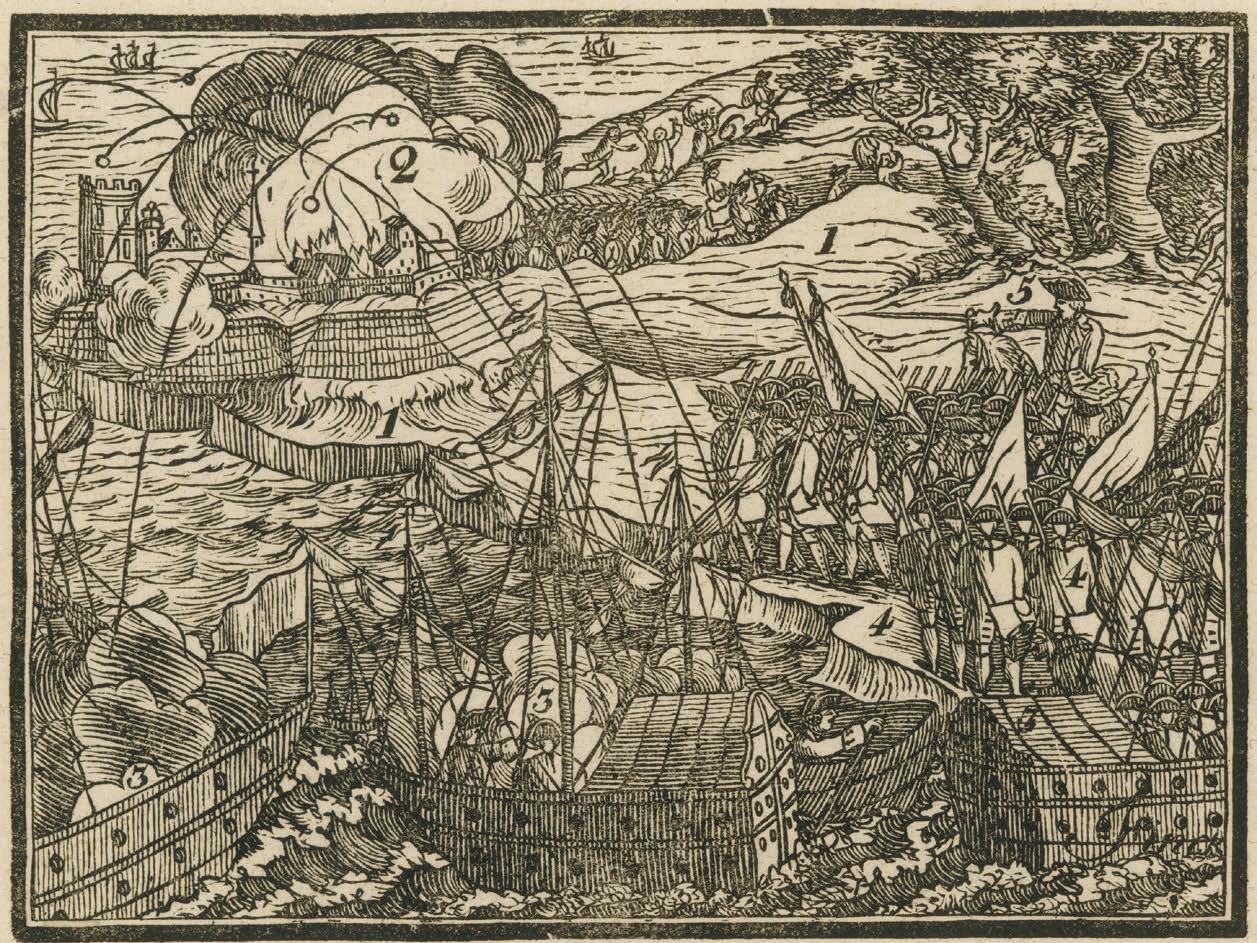
FRONT COVER: Artist’s impression of the British occupation of Newport in December 1776. Rhode Island. Prise de Possession de l’Isle de Rhode-Island en Amérique, par les Anglois, en Décembre 1776, 1777. JOHN CARTER BROWN LIBRARY, 74-231.
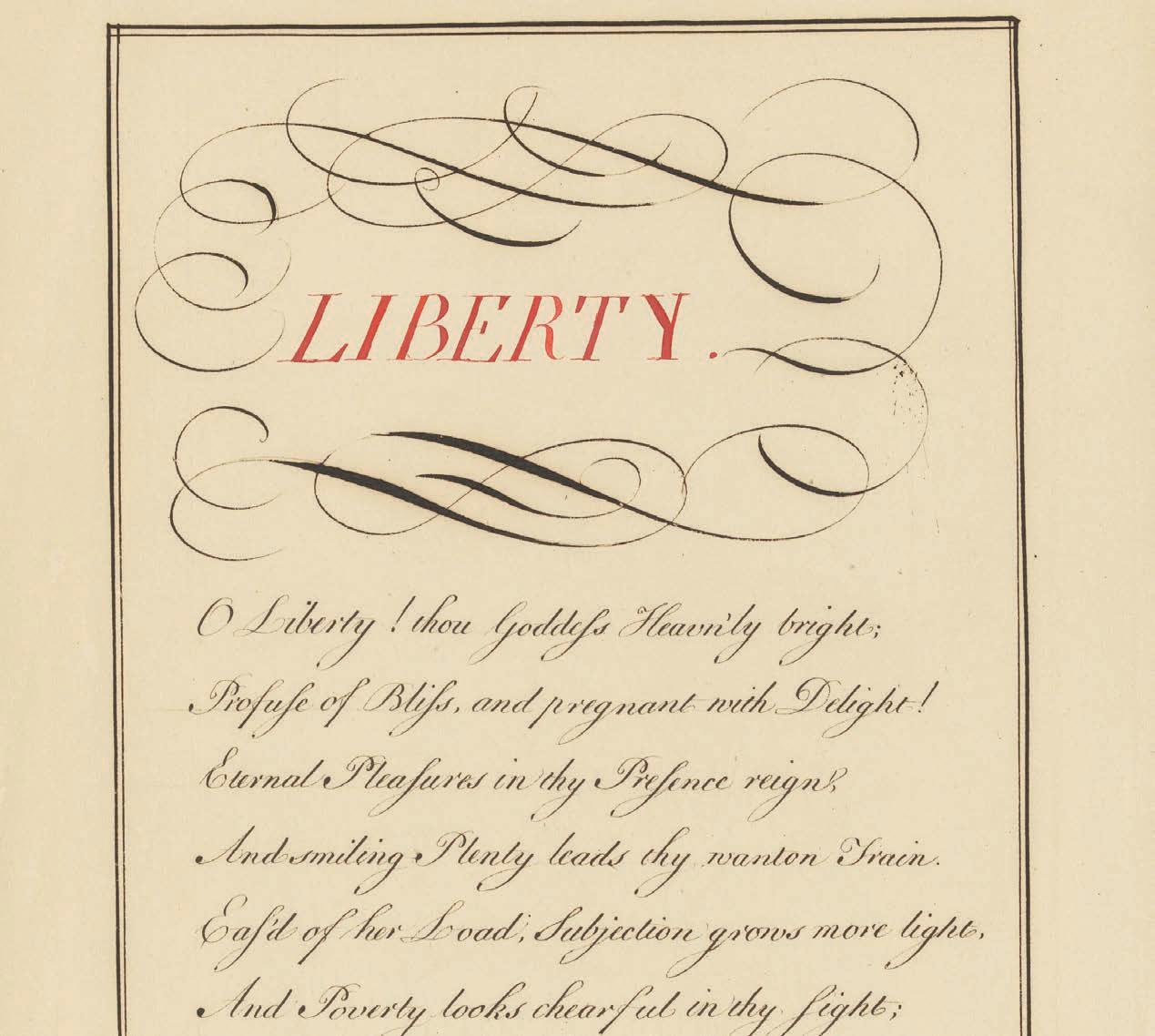
BACK COVER: Harvard University’s Houghton Library holds more than 200 samples of fine penmanship by Abiah Holbrook and his students. This sample was penned by Abiah himself in 1766. Its title “Liberty” is ironic given that Abiah Holbrook had enslaved a young African boy in 1750. HOUGHTON LIBRARY, HARVARD UNIVERSITY, MS TYP 473.2.
The Bridge: A Joint Edition of Newport History, scholarly journal of the Newport Historical Society and Rhode Island History, scholarly journal of the Rhode Island Historical Society, replaces Newport History, Volume 104, Number 293 and Rhode Island History, Spring 2026, Volume 83, Numbers 1 & 2.
Rebecca J. Bertrand, Executive Director, Newport Historical Society
C. Morgan Grefe, Ph.D., Executive Director, Rhode Island Historical Society
Ingrid Peters, Deputy Executive Director for Operations and Academic Services, Newport Historical Society
Richard J. Ring, Senior Director of Library and Museum Collections, Rhode Island Historical Society
Kaela Bleho, Director of Digital Collections, Newport Historical Society
JD Kay, Digital Imaging Specialist, Rhode Island Historical Society
Elizabeth C. Stevens, Ph.D., Editor
Gayle Bordlemay, Designer
For a full list of staff and trustees, visit www.newporthistory.org or www.rihs.org.
support for the bridge was provided by :
The Rhode Island Society of the Cincinnati
The Newport Historical Society and the Rhode Island Historical Society assume no responsibility for the opinions of contributors to The Bridge: A Joint Edition of the Journals of Newport History and Rhode Island History. This issue and all issues of Newport History and Rhode Island History are peer-reviewed. Newport History and Rhode Island History are published two times a year by their respective institutions: the Newport Historical Society at 82 Touro Street, Newport, Rhode Island 02840 and the Rhode Island Historical Society at 110 Benevolent Street, Providence, Rhode Island 02906. For information on subscribing or submitting to Newport History, visit www.NewportHistory.org. For information on subscribing or submitting to Rhode Island History, visit www.rihs.org.
COPYRIGHT © 2026 by the Newport Historical Society, 82 Touro Street, Newport R. I. 02840; (401) 846-0813. (ISSN 0028-88918 [Newport History] and ISSN 0035-4619 [Rhode Island History]).
Editor’s Note
Elizabeth C. Stevens
Aaron Briggs: The True Fight for Freedom in the Gaspee Affair
Joey La Neve DeFrancesco
Felix Holbrook: Massachusetts Abolitionist Organizer and Rhode Island Soldier
Christian McBurney
Finding the Story: Revolutions in the Blackstone River Valley
Allison Horrocks and Mark Mello
Carpenter, Mariner, Soldier, Veteran:
Cato Vernon and Black Service in the American Revolution 86
Heather Bollinger
“Liberty is Sweet” Rhode Island Black Pragmatists, the Revolution and the Atlantic World
Jane Lancaster
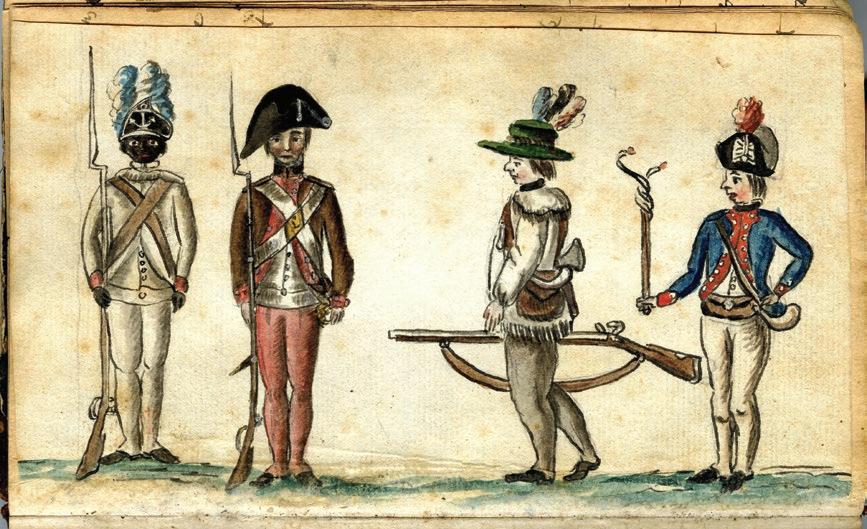
“Soldiers in Uniform” by Jean Baptiste Antoine de Verger, c1781. This watercolor by a French sub-lieutenant shows a variety of soldiers fighting with the colonists for independence from Britain. The figure on the left depicts a Black soldier with the First Rhode Island Regiment. LIBRARY OF CONGRESS, 2021669876.
qJane Coggeshall, who was enslaved in Newport, took an opportunity to self-emancipate in March 1777 when she and two other enslaved persons, Violet Pease and William Carpenter, fled from Britishoccupied Aquidneck Island . According to one source, “the trio stole a rowboat and paddled twelve miles across Narragansett Bay to reach the Patriot encampment at Point Judith .” Once on the mainland, the three Newporters were taken to appear at the General Assembly, then sitting at South Kingstown . After providing information about British troop activities to the Rhode Island authorities, Jane Coggeshall and her companions were deemed “free,” and given license to travel anywhere where they might find work 1
During the next few years, Jane Coggeshall labored as a domestic worker in Providence and Woodstock, Connecticut . Despite the declaration of her freedom in 1777, Jane Coggeshall again petitioned the R .I . General Assembly in 1785 . Although she had conducted herself well “with respect to her industry, sobriety of manners, and fidelity,” during her freedom, she was “alarmed with the claim” that heirs of her former enslaver in Newport sought to re-enslave her Jane Coggeshall had “enjoyed the inestimable blessing of liberty for near eight years,” the legislative record claimed In 1785, Rhode Island legislators resolved that she was “hereby entirely emancipated and made free ”2
The theme of Jane Coggeshall’s ‘inestimable blessing of liberty” lies at the heart of our five articles in this issue of The Bridge: A Joint Edition of the Journals of Newport History and Rhode Island History as we mark the semiquincentennial of our nation’s rebellion against British tyranny, and the formation of our new republic . The essays concern various aspects of freedom in the Revolutionary Era . The lack of liberty and the quest for liberty, the promise of freedom and the complicated reality of freedom drive the narratives here This issue is a collection of accounts of eighteenth-century Rhode Island people who fought for their own freedom and for the freedom of others . Now, from a perspective of two-hundred-and-fifty years, these articles ask us again to consider what it means to have a right to “life, liberty, and the pursuit of happiness .” There is so much packed into that claim of liberty narratives of courage and dislocation, promise and despair, possibility and ruin . The biographies herein convey a combination of hope and trepidation, perhaps similar to the feelings that Jane Coggeshall possessed when she embarked with her colleagues from the Newport shore in March 1777, seeking “the inestimable blessing of liberty ”
Our lead article, Joey La Neve DeFrancesco’s “Aaron Briggs: The True Fight for Freedom in the Gaspee Affair,” is a compelling entry into the world of Revolutionary Rhode Island . Aaron Briggs was a young man enslaved on Prudence Island at the time of the Gaspee Affair in 1773 when prominent R .I . citizens attacked a British revenue cutter off Warwick . Aaron Briggs became a well-known figure in the Affair after he left his enslaver’s employ and sought freedom aboard a British ship in Narragansett Bay . Our second article “Felix Holbrook: Massachusetts Abolitionist Organizer and Rhode Island Soldier,” by Christian McBurney, also treats a subject who came to prominence in the several years before the Revolutionary War began Felix Holbrook, who was enslaved as a child of seven in Boston, spent several years as a leading antislavery advocate in Massachusetts . This gifted activist moved to Rhode Island after hostilities commenced, and enlisted as a soldier in a Rhode Island regiment . McBurney has tirelessly worked to uncover every shred of evidence about Holbrook’s life and work .
1 “Jane Coggeshall’s Self-Emancipation in Revolutionary Rhode Island,” https://www.rihs.org/jane-coggeshallsself-emancipation-in-revolutionary-rhode-island/. Accessed April 17, 2026.
2 John Russell Bartlett, ed., Records of the Colony of Rhode Island and Providence Plantations in New England (Providence: A.C. Greene, 1856-65), 10:143.
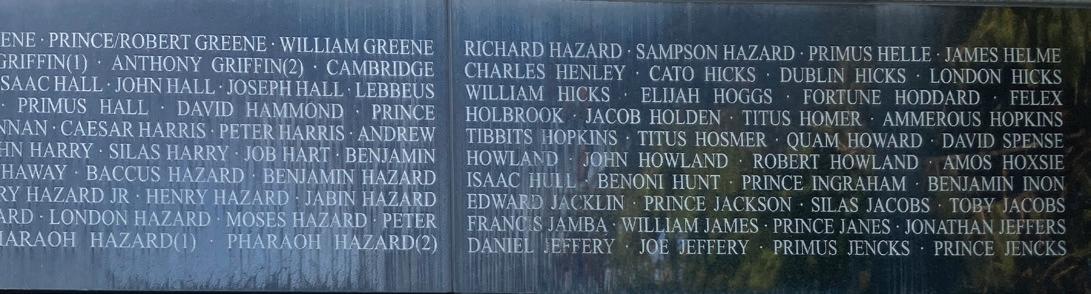
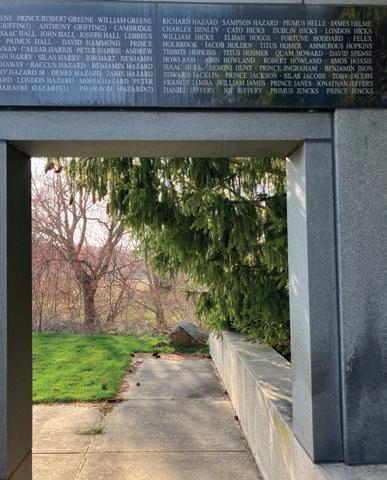
ABOVE AND RIGHT: Memorial to the First Rhode Island Regiment of the Continental Line, Patriots Park, Portsmouth, R. I.
PHOTO COURTESY OF NORMAN M. MACLEOD.
In our third article “Finding the Story: Revolution in the Blackstone River Valley,” two public historians, Allison Horrocks and Mark Mello, describe their search for Revolutionary War history and sites in northwestern Rhode Island . Horrocks and Mello take their readers along with them when they tramp along streams, climb strenuous hills, explore out-of-the-way cemeteries, and as they pore over artifacts and written books and documents to augment their search Although the area the two authors explore was never a site of armed conflict during the war, by focusing on individual people and their experiences, Mello and Horrocks demonstrate the war’s ample effects on the inhabitants of the region .
Our fourth article, “Carpenter, Mariner, Soldier, Veteran: Cato Vernon and Black Service in the American Revolution,” by Heather Bollinger, is an in-depth account of an enslaved man who gained his freedom by enlisting in a Rhode Island regiment in 1778, and who survived five years of combat Bollinger has scrupulously examined archives, public records, newspapers and other sources to find every possible scrap of information relating to Cato Vernon . In so doing, she has uncovered the complex meaning of liberty for one Newport man who risked his life to be free, and, in freedom, encountered serious obstacles .
Our final article, “‘Liberty is Sweet’: Rhode Island Black Pragmatists, the Revolution and the Atlantic World,” by Jane Lancaster, explores the scores of Black Rhode Islanders who joined the British during the war, and who left the country from New York on British ships at the close of the conflict Many headed to British Canada, but several went to Germany, and one family evacuated with a British group to the Bahama Islands; another family emigrated from Canada to Africa . Lancaster mined a priceless ledger, “The Book of Negroes,” kept by the British in which officials recorded every single Black person who emigrated on their ships in 1783 . This source provided granular data on the Rhode Island emigres; Lancaster has enhanced the information she has gleaned from the Book by scouring archives from Britain, Canada and Africa, as well as the U S
Elizabeth C Stevens EDITOR
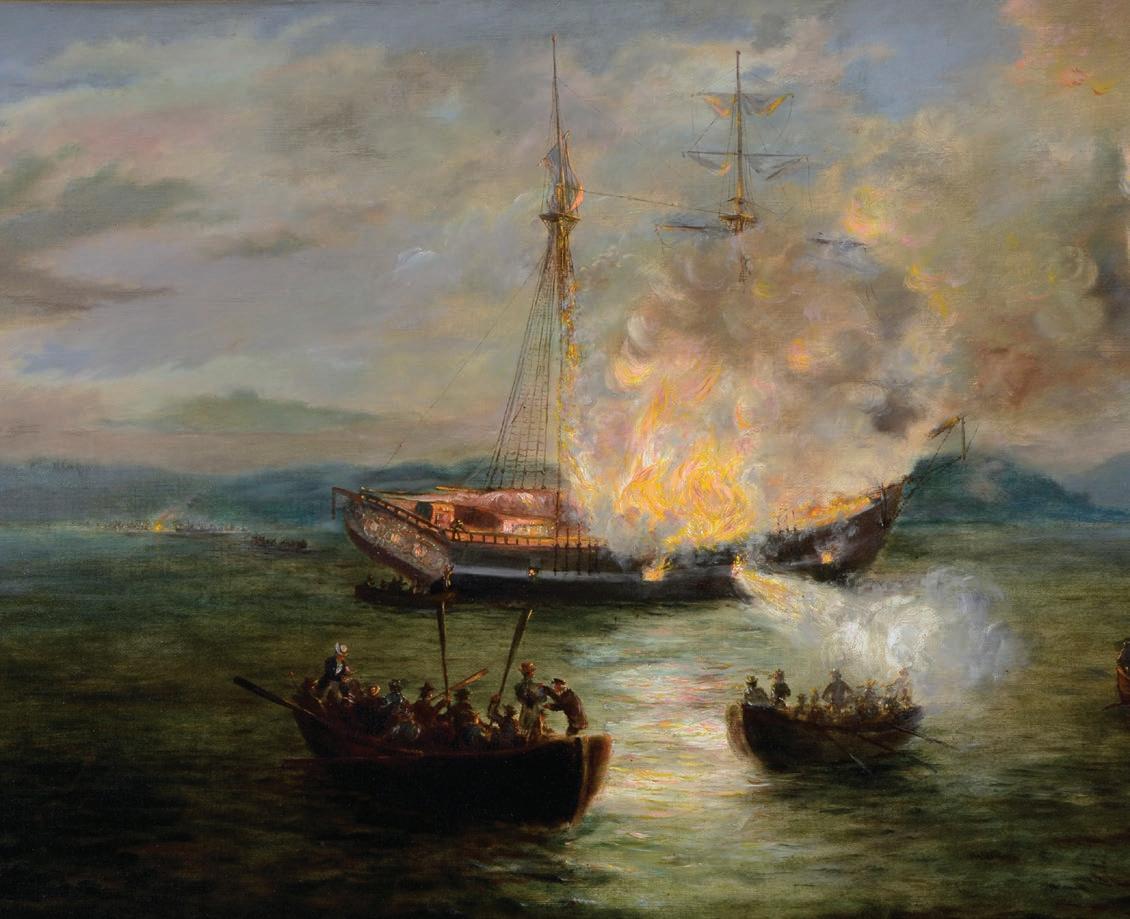
Charles DeWolf Brownell, The Burning of the Gaspee, 1772, 1892. Brownell was a descendent of Rhode Island’s DeWolf family, the largest slave-trading dynasty in U.S. history. The first DeWolf traders were trained by their uncle Simeon Potter, one of the leaders of the Gaspee raid and the man Aaron Briggs identified as conscripting him into the attack. Brownell painted many of his works while living on the DeWolf’s plantation in Cuba. RHODE ISLAND HISTORICAL SOCIETY, RHIX510
Joey La Neve DeFrancesco q
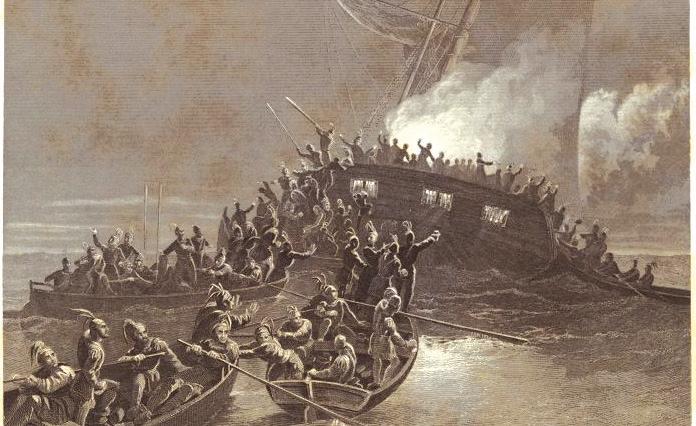
In the late hours of June 9, 1772, a few dozen Rhode Islanders quietly rowed their longboats into Narragansett Bay toward the British schooner Gaspee , which was stranded in shallow water off Warwick . In the popular retelling of the event, colonists were fed up with the tyranny of the Gaspee’s commander, Lieutenant William Dudingston, and resolved to destroy the ship to rid their waters of this menace When the colonists arrived at the British schooner, they shot Dudingston, boarded the Gaspee , evacuated its crew, then lit it on fire and watched it burn . In the following months, the British launched a commission to investigate the raid and bring the culprits to justice . However, Rhode Islanders refused to cooperate with imperial authorities, and the exasperated British were forced to abandon their efforts without making a single arrest
The Gaspee attack and subsequent investigation together known as the “Gaspee Affair”— remain widely celebrated across Rhode Island as a contributing factor to the American Revolution, and a manifestation of the state’s uniquely raucous spirit But these celebrations rarely if ever consider the Affair’s roots in Rhode Island’s slave economy, nor do they give proper attention to the man at the center of the investigation: Aaron Briggs . 1 Briggs was an unfree Black and Native man who, in the wake of the Gaspee raid, escaped bondage on Prudence Island by fleeing to a British ship stationed in Narragansett Bay and agreeing to testify that the colony’s most powerful men were behind the Gaspee attack Following the Gaspee events, Briggs remained with the British
and joined the Royal Navy as a full seaman, never again returning to bondage in Rhode Island 2 Where the standing historiography of the Gaspee Affair has noted Briggs at all, it has largely centered on assessing the veracity of his testimony to the British . Of greater importance, though, is an examination of who Briggs was, why he fled his enslaver, the colonial elite’s reactions to Briggs, and how Briggs’s story demonstrates the centrality of race and the business of slavery to the Gaspee Affair and colonial Rhode Island . Briggs’s escape disrupts the standard public memory of the Gaspee, which remains firmly planted in a Whiggish tradition that nebulously frames the attackers as courageous, everyday patriots fighting for American freedom 3 In reality, the leaders and nearly all the participants in the raid were members of Rhode Island’s small merchant elite, whose wealth and power stemmed from the Atlantic slave economy . 4 Their commerce included the provisioning of slave plantations in the West Indies, as well as direct involvement in the transatlantic and inter-American slave trades Rum, Rhode Island’s principal export, was the system’s currency and lifeblood 5 While the entire colony depended on the business of slavery, the Gaspee conspirators were its primary designers, beneficiaries, and protectors . Further, nearly all of the attackers personally enslaved people in their homes and businesses Since the Gaspee was a British revenue collector attempting to tax and regulate the rum trade, it posed a material threat to the interests of this merchant elite . In contrast to Briggs’s flight to freedom, the attack on the Gaspee by the merchant class was a self-interested attempt to
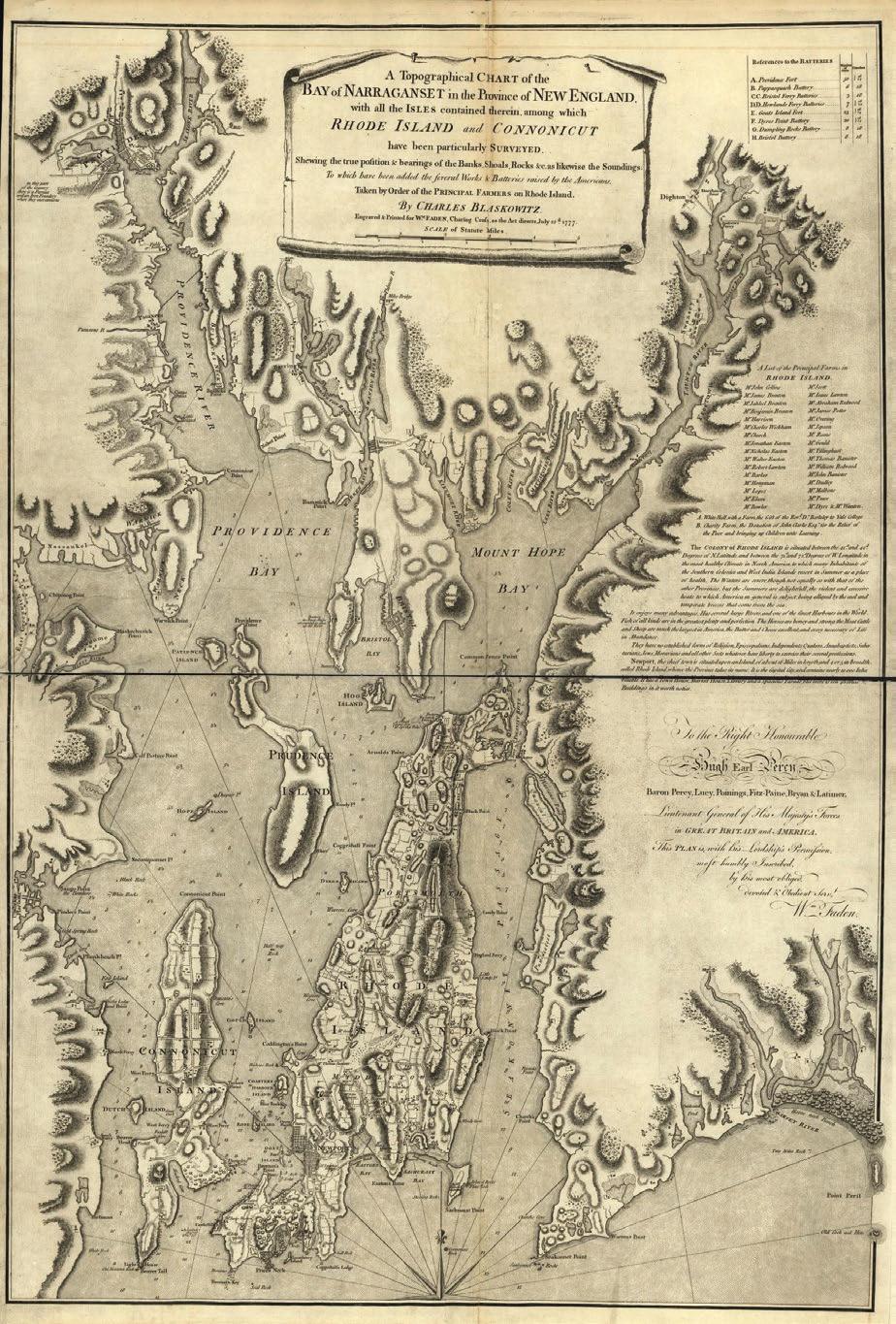
Topographical chart of Narragansett Bay and its Islands, 1777. Note the locations of Prudence Island, where Aaron Briggs was held in bondage, and “Gaspe
where colonists attacked the Gaspee LIBRARY OF CONGRESS, G1201.S3 F2 1845.
Bridge
preserve an unregulated business of slavery, not a spontaneous mob expressing righteous anger toward the British 6 If the Gaspee burning marked the first instance of anti-British violence on the path to the American Revolution, then Aaron Briggs should be celebrated as one of the first of the tens of thousands of unfree men, women, and children who claimed their freedom in the Revolutionary Era by escaping colonial enslavers . 7
Aaron Briggs escaped from bondage on Prudence Island on July 2, 1772 roughly a month after the Gaspee attack by stealing one of his enslaver’s canoes and rowing to the nearby British brigantine Beaver According to his own deposition, Briggs fled “with an intention not to return again to his master . ”8 Other sources corroborate that Briggs went to the British on his own volition, including prominent Newport minister Ezra Stiles, who noted that Briggs “wanted to be free and differed with his master and upon the burning of the Gaspee run off and went aboard as an Informer, but really to get away from his Master . ” 9 At first, the British took Briggs aboard and severely mistreated him, binding him in chains as punishment for fleeing his enslaver . Often when the British were stationed next to enemy territory during wartime and a locally enslaved person escaped to them, they embraced the runaway . But in 1772, the British still saw Rhode Island as British, though Rhode Islanders may have thought otherwise . As such, they detained and punished Briggs as a fugitive slave, not a defector from a foreign enemy
After some time aboard the ship, the British either became aware that Briggs held valuable information about the Gaspee, or they chose to have him impersonate an eyewitness . Briggs was unshackled and moved to the British warship Swan, where he described the Gaspee events to the British in accurate detail, recalling that he had been returning on a boat from an errand to Bristol, Rhode Island when he was kidnapped and forcibly enlisted to participate in the Gaspee assault . He named two of Rhode Island’s most powerful men as the leaders of the raid: John Brown and Simeon Potter, both wealthy merchants, politicians, slave traders, and slave owners . Briggs’s testimony was substantiated by one of the Gaspee’s sailors, Patrick Earle, and closely matched Lieutenant Dudingston’s version of events After testifying, Briggs became one of Rhode Island’s most wanted men . Colonial authorities repeatedly attempted to extradite Briggs back to land, but the British refused . 10
In another attempt to secure Briggs, his former enslaver Samuel Tompkins sued the Swan ’s commander Captain Linzee for theft e .g . keeping Briggs onboard his ship and colonists arrested Linzee . Admiral John Montagu, the head of the Royal Navy in New England, responded to the attempts to retrieve Briggs by stating, “I find the master of Aaron, the black, has arrested Captain Linzee for the detention of his servant; therefore, as Captain Linzee has done nothing but by my orders, I have bailed him, and will keep the fellow . ”11 Montagu personally accompanied Briggs to testify before the Gaspee Commission, and afterward promptly brought him back onboard the Swan .
Numerous historians have fixated on evaluating the truth of Briggs’s testimony, with most deciding he likely faked his story . This assumption raises several questions, though . Why would the British choose as their witness an unfree Black and Native man whose testimony was more readily dismissed in court than a white witness? Perhaps the British were unable to find any whites to testify, as it was a dangerous undertaking, but were able to exploit Briggs’s precarious position . The notion that the British entirely fabricated Briggs’s testimony is plausible, but also plays into colonial tropes framing the British as specifically allied with Black people, Native people, Catholics, and various Others against the white Protestant colonists Moreover, while many historians reject Briggs’s deposition, they accept at face value the testimony of those who were brought to discredit Briggs . Historian Eugene Wulsin, for instance, wrote that “a relative of the runaway negro Aaron Briggs [discounted] the negro’s story,” and offers no further analysis . 12 Those testifying against Briggs included two men Somerset and Jack who, like Briggs, were held in involuntary servitude by Samuel Tompkins . Samuel Thurston, Samuel Tompkins’s father-in-law who lived with and ran the farm with Tompkins, also testified against Briggs These witnesses all claimed that Briggs remained home on Prudence Island from June through the time of his escape on July 2 As unfree men, Somerset and Jack had little choice on the content of their testimony, and Thurston had an obvious interest in protecting his family’s human property 13 Perhaps Briggs unwillingly participated in the Gaspee raid as his deposition stated, or perhaps he heard rumors of the raid and used it as a pretext to escape to the Beaver Whatever the case, Briggs’s interest was in claiming his freedom, and he successfully navigated the Gaspee crisis to do exactly that .
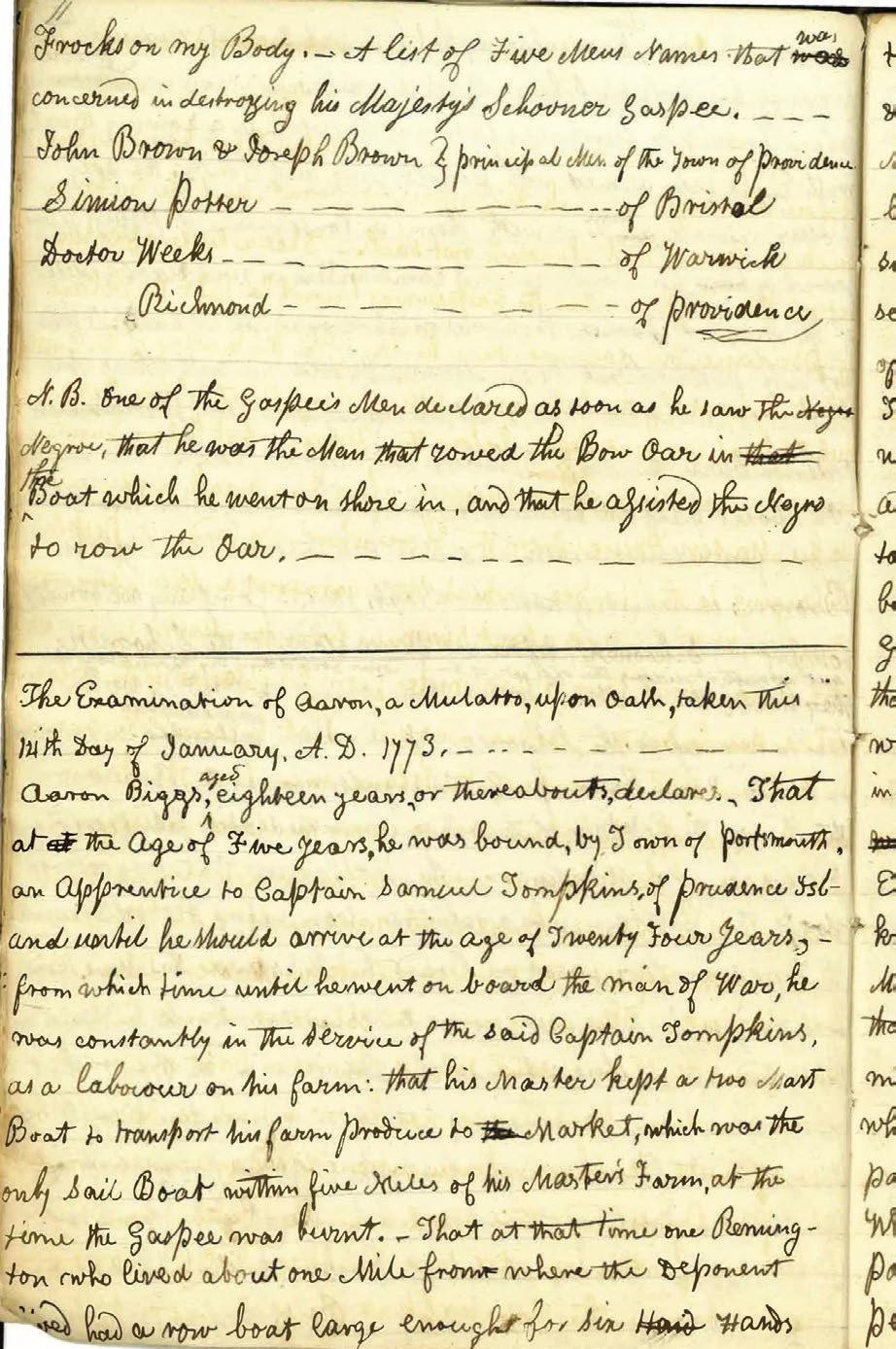
The first page of Aaron Briggs’s testimony to the Gaspee Commission. RHODE ISLAND HISTORICAL SOCIETY, MSS434B1F4.
Briggs lived on Prudence Island in Narragansett Bay at the time of the Gaspee attack and was bound to a man named Samuel Tompkins . Tompkins bound at least two other men at the time Somerset and Jack both of whom Tompkins brought to the Gaspee Commission to discredit Briggs . The 1774 census noted that Tompkins held five “Blacks” and zero “Indians” in his household 14 Court records stated that Somerset and Jack were both servants, and were likely among the five “Blacks” listed in 1774, but the other three people were not mentioned by Tompkins nor the court . Briggs, Somerset, and Jack being listed as “Black” said little about the men’s true heritage . In colonial Rhode Island, whites used the word “Black” as a general label for anyone deemed not entirely white, regardless of their ethnic background Beginning in the mid-eighteenth century, Rhode Island officials increasingly listed Native people as “Negro” or “Black” in official records . By grouping together all people of color into a single non-white category, whites attempted to assert their racial dominance, and advanced their efforts to erase Native people from the historical records 15 The practice also served to strip children of any rights they could claim as descendants of Native people, such as access to reserved lands . 16 Rhode Island officials regularly applied different racial categories to the same person depending on the context and the writers’ intentions . Indeed, documents surrounding the Gaspee Affair alternatively referred to Aaron Briggs as “Black,” “Indian,” “Negro-Indian,” “slave,” “servant,” and “mulatto,” among others These identifiers were ambiguous, yet they all marked Briggs as inherently unfree . 17
Ezra Stiles wrote multiple descriptions of Briggs and referred to him interchangeably as “the Negro-Indian Witness,” “the Indian,” and “the mulatto . ”18 In one passage, Stiles elaborated that Briggs’s:
…mother was an Indian at Little Compton, and being born free, was by the Town Council put out as a poor child in youth to a man on Prudence till aet 24 as usual with Indian or Negro children He is perhaps aet . 21 and supra, and wanted to be free and differed with his master and upon the burning of the Gaspee run off and went aboard as an Informer, but really to get away from his Master . 19
If Stiles’s account is correct, then Briggs was born in Little Compton to a Native mother and a Black father Given the geography, Briggs’s mother was likely a member of the Sakonnet people, the Native people of the area now known as Little Compton . 20 Relationships between Native and Black people in Rhode Island were common in the colonial period . While not occupying identical social and legal positions, the two groups frequently worked in close proximity, and were both legally relegated into lower social statuses 21
When Stiles wrote that Briggs “was by the Town Council put out as a poor child in youth to a man on Prudence till aet . 24,” he meant that Briggs was stolen from his mother by the town of Little Compton and forcibly indentured to Samuel Tompkins, supposedly until the age of 24 Briggs’s deposition before the Gaspee Commission in January 1773 confirmed most of these details, though it stated that he was bound out by the town of Portsmouth: “Aaron Briggs, aged eighteen years or thereabout, declares, that at the age of five years he was bound by the town of Portsmouth, an apprentice to Capt . Samuel Tompkins, of Prudence Island, until he should arrive at the age of twenty-four years ” 22 How Briggs arrived in Prudence Island from Little Compton was unclear, and it is possible that Stiles was mistaken . Prudence Island was part of the town of Portsmouth, so perhaps the Little Compton Town Council was unable to bound out Briggs locally and so indentured him to the nearby Tompkins . It was common for local councils across Rhode Island to bound out children across town and even colony lines Historian Marjory Gomez O’Toole identified numerous Little Compton children who were forcibly indentured outside of the town . For instance, the town indentured Moses Suckanush to a family in Adamsville, Massachusetts, and his brother Jonathan to a man in Tiverton . Like Briggs, the Suckanush brothers were described in many documents as “Black” and may have been multiracial Another boy named Aaron Suckanush, who was likely a cousin of the brothers, was also indentured out around the same time to a family in Westport, Massachusetts . 23 Like Briggs, Jonathan and Aaron claimed their freedom by running away from their indentures . Briggs’s name also potentially connected him to Little Compton’s wealthy Briggs family The family enslaved and indentured several people, owned large farmlands, and included prominent slave traders 24 It is fraught, however, to assume much from Briggs’s name itself . Some sources spelled
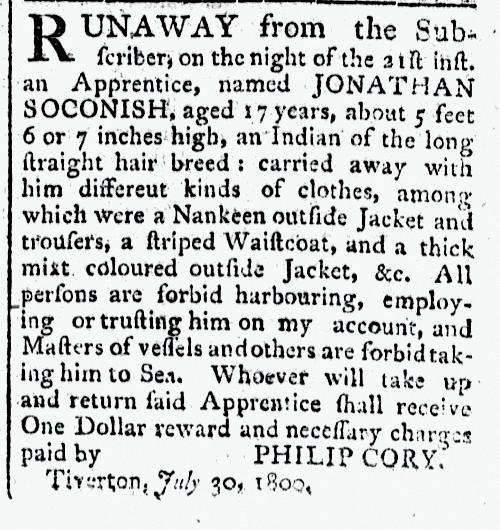
Runaway notice for Jonathan Soconish (also spelled Suckanush), The Columbian Courier (Fall River, Mass.), August 1800. Like Briggs, Soconish was a Native and possibly multiracial man who was bound out by the town of Little Compton as a child, and who later claimed his freedom by fleeing bondage. Columbian Courier, August 22, 1800.
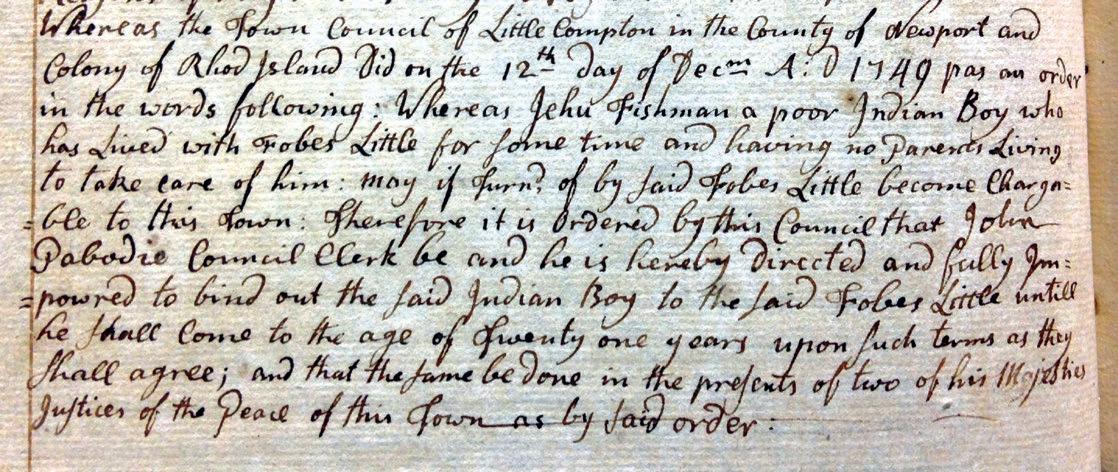
1749 indenture papers for a Native boy named Jehu Fishman from Little Compton. Little Compton Town Council and Probate Records. COURTESY OF THE LITTLE COMPTON HISTORICAL SOCIETY.
Briggs’s name as “Biggs,” and Briggs himself signed documents with an “X . ” Variations in spellings were common, and officials frequently anglicized Native names, often deliberately rewriting surnames to break records of Native family lines and property claims 25
Colonists used a variety of terms to describe Briggs’s freedom status The Gaspee Commission alternatively referred to Briggs as a “servant,” “indentured servant,” and “slave .” The lines between these degrees of unfreedom were blurry in eighteenth-century Rhode Island . White colonists frequently held indentured Black, Native, and multiracial people in servitude for indefinite periods of time in conditions closely mirroring enslavement Many Native people were ordered by courts into debt-servitude that also approximated enslavement, and this status was inherited by their children . Once free, formerly indentured or enslaved people were sometimes ordered back into bondage for debts or petty crimes . This article uses the terms “unfree” and “in bondage” to describe any individual held in some state of forced servitude, and will use more precise terms where the historical record clearly demonstrates an exact legal status . The term “enslaver” is used to describe anyone holding someone in bondage .
Rhode Island colonists first enslaved Native people with the end of the Pequot War in the 1630s, when they sold many Pequot people into bondage Following King Philip’s War in the 1670s, colonists enslaved and sold even greater numbers of Native people . Seeking a full removal of Native people from colonial society, Rhode Island towns then began outlawing the enslavement of Native people within the colony . Rhode Island ethnically cleansed much of its remaining Native population into parts of South County and Sakonnet Some Native people resisted and remained living throughout Rhode Island, while still others chose to escape the colony altogether . 26
While laws forbade the enslavement of Native people, colonists used legal ploys and violence to hold Native people in de facto slavery . With diminished resources and military power, increasingly high numbers of Native people found themselves caught in the colonial legal system where they were sentenced to what historian Margaret Ellen Newell called “judicial enslavement,” or court-ordered servitude . The Narragansett people regularly asked the General Assembly for relief from these oppressive conditions . A 1763 petition warned that because their lands were illegally taken in various schemes, much of the “tribe are in danger of being utterly
deprived of the means of procuring a maintenance, and must either starve, or become a town charge… . ” 27 The laws governing judicial enslavement were sparse and sometimes contradictory, giving enormous arbitrary power to enslavers and local officials Colonists forced Native people into the court system for petty crimes, such as trespassing or stealing small amounts of food, and others were arrested for debts to whites that were impossible to pay . Those forced into bondage for debts were then charged additional fees by their enslavers, and so kept in a perpetual debt-slavery . Some Native people were trapped in debt-slavery until their deaths, and their children inherited their debt and legal status A group of Narragansett people from Charlestown complained of colonists who “Oblig’d [us] to Bind our Children Servants to the English Credi[tor]s, to keep out of Prison . ” 28
Judicial enslavement was buttressed by “pauper laws” that allowed towns to forcibly take children from families judged as unable to support themselves These forced child indentures regularly occurred after a complaint from a white colonist against a family of color Sometimes towns refused to acknowledge the validity of relationships between parents of color, and so declared their children illegitimate and put them into bondage . Colonists often sought to indenture the children of mothers who were themselves indentured, held in debt bondage, or enslaved While hereditary enslavement of Native people was outlawed, colonists employed pauper laws to ensure that the children of unfree Native people continued to provide free labor . 29
Poor and laboring-class white children, or those without parents, were also bound out by town councils, and white indentured servitude was a system rife with physical abuse and brutal working conditions 30 The Providence Gazette was filled with notices of young white runaway apprentices and indentures . Some middling white families, though, willfully entered their children into indenture contracts . Their children emerged from the arrangement with extensive training in a trade that could result in a secure, middle-class artisan life For instance, in October 1770, the Providence Town Council fulfilled the request of a white boy named Samuel Daggett to be bound out for an apprenticeship . The Town Council required that the boy be taught English, cypher, math, and the art of navigation, and that he receive a suit of apparel at the close of the apprenticeship 31
Children of color were bound out at significantly higher rates than white children . While Little Compton’s population was at maximum 10% people of color, children of color made up 50% of forced indentures . These children were labeled as “Indian,” “black,” or “mulatto,” and all were at least partly Native American 32 Briggs’s racial background, then, was shared by most children bound out by Little Compton 33 The indentures of Black and Indigenous children were vastly harsher than those of white children, often “barely discernable from slavery . ” 34 Indentured children like Briggs had no choice in the matter . This was not an agreement between a master and apprentice to learn a trade as it was for many whites; it was an involuntary period of forced labor in which the child received no education or formal training . 35 That Briggs signed his Gaspee Commission depositions with an “X” demonstrated that he did not receive an education, even if one was stipulated by his indenture . There were almost never clear contracts stating the exact terms of a child of color’s indenture, and enslavers used a variety of techniques to extend these indentures, sometimes indefinitely They cited debts or bad behavior as a reason to extend a contract, left the indentured person in their will to another family member without noting the term of service, or sold the indentured person to another colony, among other strategies 36
Native people had few legal protections in such cases, but they nevertheless attempted to use the court systems to free themselves and their families . Because the outright enslavement of Native people was illegal, Native peoples’ freedom cases frequently centered on demonstrating their Nativeness to the courts . Enslavers, on the other hand, sought to tie the person to Blackness and therefore make their forced servitude lawful For instance, when an indentured Narragansett woman named Sarah Chauqum was sold by her enslaver to another man named Edward Robinson, her enslaver listed her on the bill of sale as a “mollato” to make the sale legal . Sarah brought the case to court and won her freedom by demonstrating her Native ancestry Most others did not succeed By the 1774 census, despite Native slavery being illegal for nearly 100 years, more than one third of Rhode Island’s Native people lived in white households . 37 Briggs’s multiracial background rendered any attempt at winning his freedom through the legal system virtually impossible . Enslaved Rhode Islanders in the interior South County typically worked in agriculture, and enslaved people in cities
such as Newport often worked in manufacturing, such as candle-making, rum-distilling, bread-making, and metal trades . But Prudence Island was geographically unsuited for large scale agriculture, and not densely populated enough for the industries that existed in Newport Consequently, Briggs likely performed a variety of labor His Gaspee deposition noted that he returned in the early morning from the raid, “and upon his master’s knocking, he got up and went to fetch the cows . ”38 Briggs stated that on the night of the Gaspee attack, he was in a boat transporting a man named Samuel Faulkner to Bristol . It was on the return voyage back to Prudence Island that Simeon Potter intercepted Briggs and drafted him into the Gaspee attack Briggs and Faulkner had visited Bristol on an earlier occasion and observed Simeon Potter on a wharf . Faulkner, a laborer from Bristol who lived on Prudence Island in 1772 and worked for Briggs’s enslaver Samuel Tompkins, corroborated this much of Briggs’s story in his own testimony . Faulkner said that he had “once or twice to let Aaron go with him to Bristol” and had gone on business to “Mr [Simeon] Potter’s ropewalk in Bristol in company with Aaron… ” He also commented that Aaron was “milking cows at sunset” on the night of the Gaspee raid . 39
If Briggs was skilled enough to pilot a boat to Bristol on multiple occasions, he may have made similar trips around Narragansett Bay Such maritime activity allowed Briggs to keep abreast of political developments from across the Atlantic World . As historian W. Jeffrey Bolster demonstrated in his work Black Jacks, unfree people working in maritime environments had greater access to information than those who were landlocked . Black and multiracial mariners from across the Atlantic formed an information network, sharing news of abolition, revolution, and strategies for survival 40 Briggs likely spoke with a variety of people in Bristol and coastal Rhode Island who had recently arrived from around the West Indies, Africa, and Europe .
Whether because of increased access to information, or easier access to escape routes, enslaved people in maritime areas fled at higher rates than those enslaved further inland 41 Numerous other unfree Rhode Islanders escaped via the water like Briggs . For example, in 1727 a man named Jethro stole a canoe from his enslaver and fled to Martha’s Vineyard where he “hid among the Indians . ” 42 Maritime escapes were so common that most Rhode Island runaway notices ended with a specific warning to “Masters of vessels” against aiding
fleeing enslaved people, indentured servants, and apprentices . On October 30, 1773, Mary Greene of Warwick placed an ad in the Providence Gazette for a man named Buck whom she described as an “Indian Man ” She mentioned that he “played tolerably well on the violin” and closed by stating that “All Masters of Vessels and others are forbid carrying off or harbouring said Indian . ” 43 The General Assembly passed multiple laws specifically aimed at constricting unfree peoples’ movement over water . The first came in 1714, when the General Assembly banned enslaved people from boarding ferries alone without a certificate of ownership signed by their enslaver A 1757 act sought to “…prevent the commanders of privateers, or masters of any other vessels, from carrying slaves out of this colony .” The law mandated that the master of any ship stealing an enslaved person pay a “£500” fee, plus possible further legal damages, and allowed any enslaver to enter and search a suspect vessel 44 Bolster argued that such laws were meant “to halt the black runaways who gravitated to chronically shorthanded ships in hopes of replacing white deserters . ” 45
Whether by water or land, many unfree people sought to escape bondage in colonial Rhode Island, as they did across the Atlantic world Some 100 separate runaway notices appeared in Rhode Island papers during the colonial period 46 A significant percentage of Providence Gazette issues carried at least one runaway notice, and some contained multiple ads .
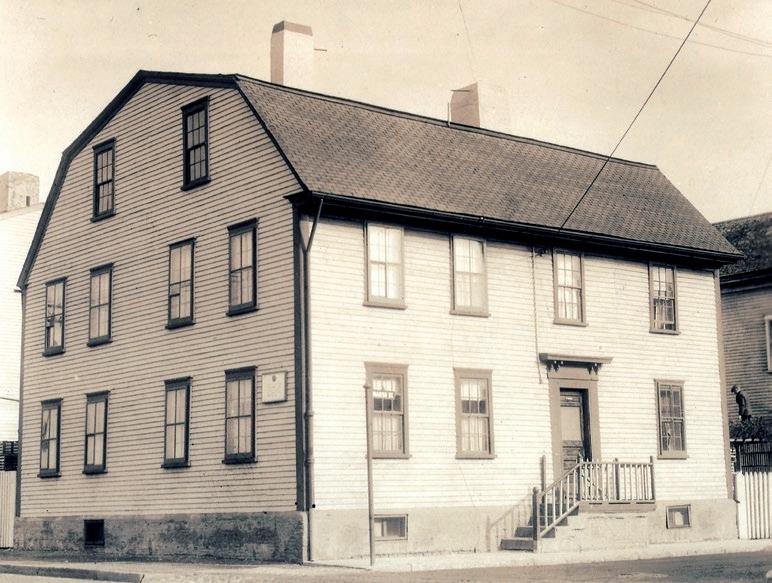
Simeon Potter House, Newport, R.I. Potter’s primary residence was in Bristol, R.I., but he owned properties throughout the colony. NEWPORT HISTORICAL SOCIETY, P4845.
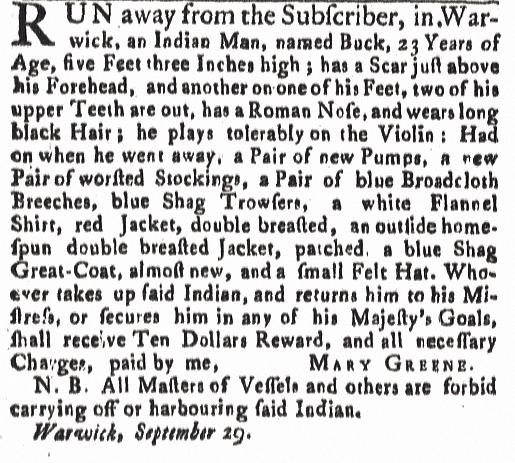
A 1773 Providence Gazette advertisement requesting the return of Buck, a Native man who escaped bondage under Mary Greene of Warwick. Note that the ad specifically states that, “All Masters of vessels and others are forbid carrying off or harbouring said Indian,” highlighting the frequency with which unfree people like Aaron Briggs escaped via ships. Providence Gazette, October 30, 1773.
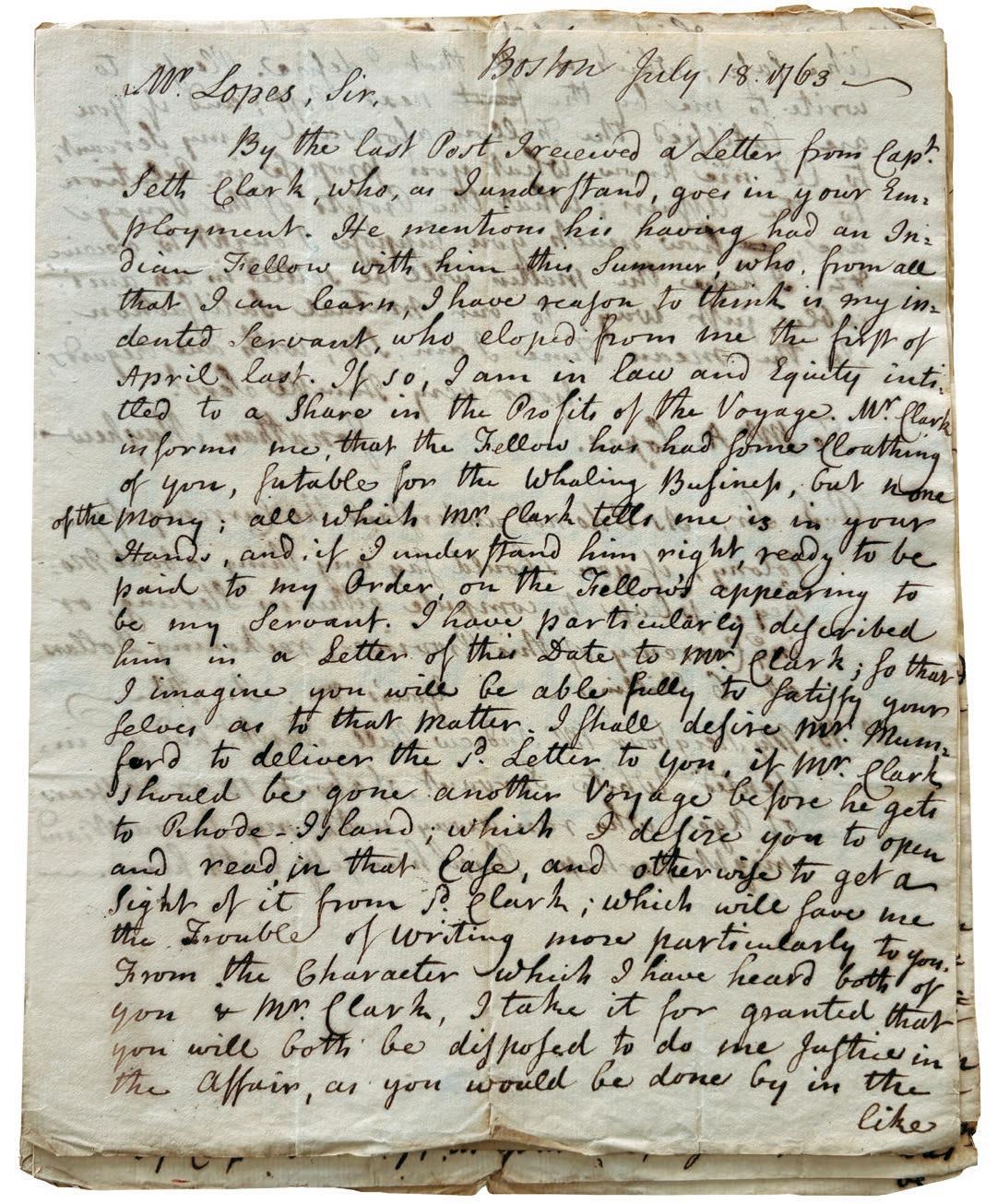
During the two years of the Gaspee Affair, 1772-1773, the paper printed twenty-eight unique notices some 104 times for the recovery of freedom-seeking enslaved people, indentured servants, and apprentices Of those 104 notices, forty-seven were for Black or Native runaways . The remainder were for white apprentices and indentured servants . Most fugitives were, like Briggs, men under the age of thirty The notices spiked in the spring and early fall, as most freedom-seekers appeared to plan their flight to avoid the summer or winter weather extremes 47
Other enslaved people committed arson, property damage, and violence directed at enslavers . Such incidents normally ended with the execution or suicide of the enslaved person In 1762 a man named Fortune, who was identified as an “abandoned negro,” was accused of setting fire to Providence’s Long Wharf Colonial authorities quickly captured Fortune and executed him by hanging 48 On February 29, 1772, just months before the Gaspee raid, the Providence Gazette reported that an unnamed enslaved man set fire to the house of his enslaver in Newport, “Ebenezer Malbone, Merchant,” and also “sat [sic] Fire to his Master’s Still-House, where there was a large Quantity of Rum, and drowned himself in one of the Vats, first opening all the Scuttles ” Immediately below this story appeared the newspaper’s first mention of the Gaspee seizing rum from Rhode Island vessels . 49
Unfree people also survived and resisted by preserving cultural practices and maintaining communities . The most well-documented example was “Negro Election Days,” also known as “Pinkster Days,” where enslaved people gathered for one or two days of feasting, drinking, and the election of their own symbolic Governor for the coming year . Enslaved communities throughout Rhode Island and the Northeast celebrated these festivities, and enslavers periodically attempted to ban them out of fear they were fostering rebellion . 50 Briggs’s escape and testimony against Rhode Island’s colonial elite was not an anomaly, but part of a larger pattern of resistance by unfree people in colonial Rhode Island .
The men involved in the Gaspee attack and cover-up were almost universally both slaveholders and economically dependent on the business of slavery As such, they held a clear interest in maintaining the racial caste system undergirding the
slave economy Much of the elite’s concern with the control of enslaved and free Black and Native people was visible in the Rhode Island General Assembly’s records . The General Assembly’s first act pertaining to slavery came in 1703, which read in part:
If any negroes or Indians either freemen, servants, or slaves, do walk in the streets of the town of Newport, or any other town in this Collony, after nine of the clock of the night, without a certificate from their masters, or some English person of said family with them, or some lawfull excuse for the same, that it shall be lawfull for any person to take them up and deliver them to a Constable 51
De facto slavery already existed in Rhode Island for decades, but this act wrote racialized slavery into law . It marked all Black and Native people regardless of their legal status, and deputized all white people to enforce control over non-white people If a Black or Native person was caught in violation, they were to be whipped in public . The General Assembly passed several other acts throughout the eighteenth century further protecting slavery and circumscribing the freedoms of both free and unfree Black and Native people For instance, a 1750 law banned the selling of liquor to any “Indian, Mulatto, or Negro Servant or Slave,” and forbade anyone from “entertaining” servants and slaves . 52
As the numbers of unfree people increased, so did the number of laws controlling them, and the General Assembly passed a further set of acts in the years immediately preceding the Gaspee attack Though no specific voting record exists in the Rhode Island State Archives, these laws were enacted while many of the Gaspee attackers and their relations were in office . In 1769, the General Assembly noted that “many vain and disorderly persons, negroes, tawnies, and others” were meeting near the General Meetings of Quakers . In response, the General Assembly banned the sale of liquor near Quaker meeting houses on the days of meetings, specifying that “if the offender or offenders shall be a slave or slaves, the owner or owners shall pay” the fee . 53 In February 1770, the General Assembly passed “An Act for the breaking up disorderly houses, kept by negroes and mulattoes; and for putting out such negroes and mulattos to service ” The Act authorized towns to close establishments run by Black and Native people, and bound their owners into servitude for up
to four years 54 In September 1770, the General Assembly complained that, the Colony’s laws were “found insufficient to keep Indian, Mulatto, and Negro Servants and Slaves,… in due Order,” and so ordered the town of Newport to “erect a Cage, or other convenient Place, for the Confinement of Indian, Mulatto, and Negro Servants and Slaves, who shall be found about after nine of the clock at night without being able to give a satisfactory Account of themselves . ”55
These laws were explicitly racialized and covered a range of free and unfree statuses . They clearly pertained to enslaved people but were carefully worded to also apply to servants and even free Black and Native people As historian Christy ClarkPujara summarized, “Race was continually remade in colonial Rhode Island, first by town officials with limited authority and then by a collective body of legislators with central authority . White Rhode Islanders used the law to attach race to both slavery and mastery . ”56
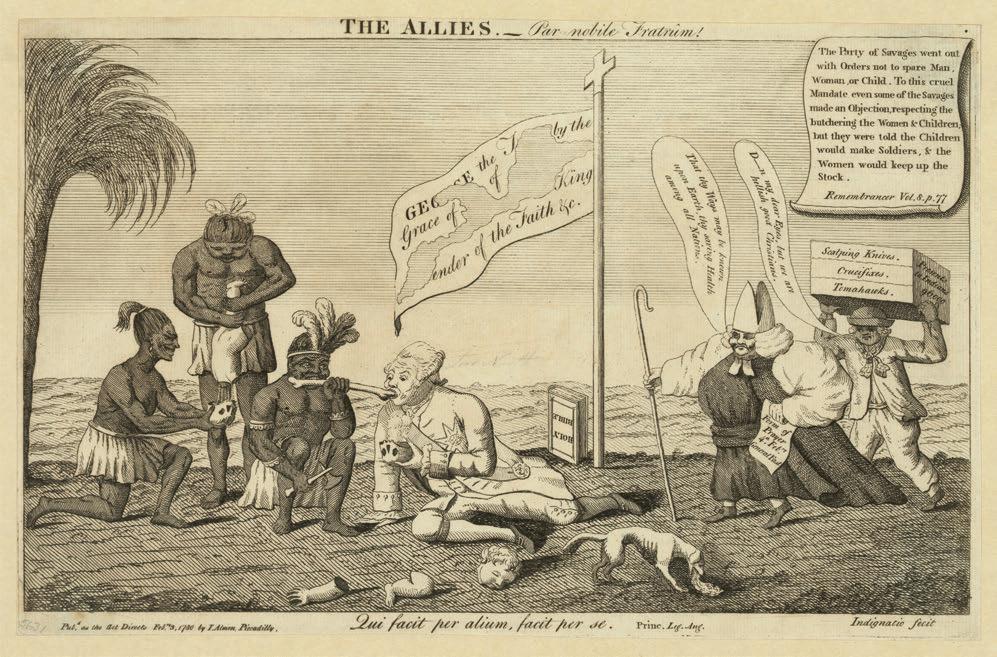
In the Revolutionary Era, colonial elites’ racial ideology increasingly fixated on linking the hated British Empire with African Americans, Native Americans, Catholics,
and various “others .” In his book Common Cause, historian Robert G . Parkinson argued that colonists’ fear of slave uprisings, Catholics, and the Other unified them in opposition to the British 57 Colonists came to view these Others as agents of British power, enemies waiting nearby to overthrow their Protestant utopias . They fantasized the British were conspiring to grant rights and freedoms to Black people, Native people, and others, while plotting to enslave white Protestant colonists .
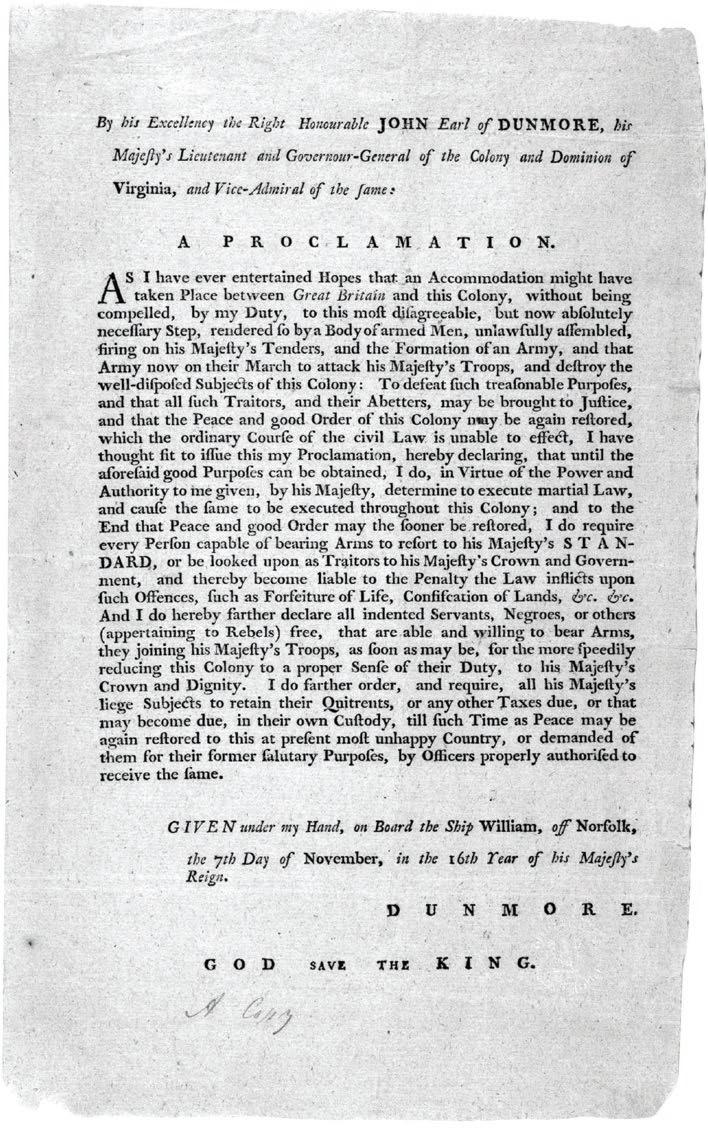
This colonial ideology spread in earnest with Lord Dunmore’s 1775 proclamation that freed enslaved people who escaped to British ranks, but it was common in the earlier Revolutionary Era as well . 58 For instance, in a 1768 petition to the British, Boston’s Selectmen, including John Hancock, accused the British of encouraging “Negro slaves in Boston aforesaid, the property of several of the town inhabitants, to cut their master’s [sic] throats, and to beat, insult, and otherwise ill treat their said masters, asserting that now the soldiers are come, the Negroes shall be free, and the Liberty Boys slaves ” 59
In reaction to Briggs’s testimony during the Gaspee investigation, Rhode Island’s elite deployed this ideology that
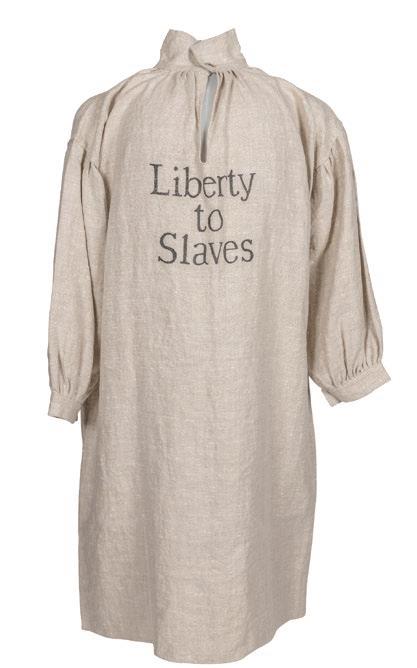
A reproduction in the Virginia Museum of History & Culture of the “Liberty to Slaves” frock possibly worn by formerly unfree men who fled their enslavers to enlist in Lord Dunmore’s Ethiopian Regiment. VIRGINIA MUSEUM OF HISTORY & CULTURE, NA.0002.
Lord Dunmore’s 1775 proclamation freeing any enslaved and indentured people who escaped to the British army. Dunmore’s proclamation terrified colonists, and greatly accelerated the rate at which unfree people self-emancipated in the Revolutionary Era. LIBRARY OF CONGRESS, EPHEMERA COLLECTION, PORTFOLIO 178, FOLDER 18.
disparagingly connected London with a racialized Other Merchant leaders scarcely believed that anyone dared to testify against them, let alone an unfree man of color . Ezra Stiles wrote mockingly that if Admiral Montagu and Lieutenant Dudingston were able to conduct the Gaspee investigation their way, “they might have only applied for some single bought up Justice of Peace, privately got a Warrant, called Troops from N . York, and traversed Providence and Warwick, & seized such person as a Negro or a Dudingston might accuse, and whip him aboard ship and so to England for Trial . ” 60 Stiles referred to Briggs in earlier diary entries as a “Negro-Indian” or “Mulatto” or “Indian ” This was the only context in which he referred to Briggs as “a Negro,” underscoring Stiles’s conscious choice to use “Negro” to express the absurdity of such a person daring to speak in court .
Reverend John Allen’s popular revolutionary pamphlet “An Oration on the Beauties of Liberty” focused heavily on the Gaspee Affair It was the sixth most read pamphlet in the Revolutionary Era, ahead of Benjamin Franklin’s Examination and John Hancock’s Oration, and behind only works by Thomas Paine, Jonathan Shipley, Charles Lee, John Dickinson, and Matthew Robinson . 61 At the pamphlet’s emotional and rhetorical peak, Allen, like Stiles, condemned Briggs and the British for daring to use the testimony of a Black man:
See your danger death is near ¾ destruction is at the door Need I speak? Are not your harbours blockaded from you? Your castle secured by captives your lives destroyed revenues imposed upon you taxation laid military power oppressing… your liberties departing, and not content with this, they now attack the life, the soul, and capitol of all your liberties…and erect new courts of admiralty to take away by violence the husband from his family, his wife, his home, his friends, and his all, through a scene less joyful than Pluto’s horrid kingdom . To be confin’d and tried for his life by the accusation of a negro . 62
In his letters to Admiral Montagu, Rhode Island Governor Joseph Wanton warned the British of the dangers of using Briggs as a witness, arguing that rebellion from servants and slaves could not be tolerated Wanton speculated on Briggs’s “General bad character” and his “weak or wicked mind ” In a longer plea for Montagu to hand over Briggs, Wanton
wrote: “I have transmitted to you the several depositions, by which I apprehend you will agree with me in opinion, that no dependence can be had on the declaration given by the informant, but must wholly be disregarded Villany of this kind is not new . ” 63 According to historian Peter C . Messer, this was a plea for Montagu to stop “enforcing imperial trade laws in favor of upholding the higher principle of social order by protecting men of standing from libel by unruly servants ” 64
Colonial newspapers echoed the elite’s racialized attacks on Briggs and joined in connecting him with the British Rhode Island’s papers served as Whig merchant mouthpieces and their editors were closely connected to the Gaspee attackers and their allies . For instance, the Providence Gazette was edited by William Goddard and John Carter, close associates of Stephen Hopkins the Chief Justice of the Rhode Island Supreme Court who played a key role is disrupting the Gaspee Commission and Gaspee raid leader John Brown 65
On January 9, 1773, the Providence Gazette referenced Briggs for the first time, though it refused to use his name and only referred to him as “a Mulatto .” The paper called him a “Villain” who had “impeached some of the best Characters in the Colony .” The author went on to denounce the British for relying on the testimony of “a lying Servant, that has not spoke a Word of Truth .” The next edition on January 16 called Briggs “The Mulatto Fellow…who pretend[s] to give Evidence concerning the Gaspee Schooner .” The Newport Mercury wrote that Lieutenant Dudingston was “more imperious and haughty than the Grand Turk himself…” Another Providence Gazette piece called the British “worse than Egyptian taskmasters, the dregs of mankind ” 66 A South Carolina newspaper explicitly connected the British with a frightening Black enemy, referring to Briggs as “AARON the BLACK, alias the American Britain . ” 67
Additional events in late-colonial Rhode Island reinforced the ideological linking of Britain with the Other . When Rhode Island merchants refused to comply with the anti-British boycotts in the late 1760s, Ezra Stiles incorrectly claimed the only merchants still trading with the British were “five or six Jews & three or 4 Tories ” 68 When the British passed the Quebec Act, granting Catholic Quebecois many of the same rights as white Protestant colonists, Protestant Rhode Islanders believed the British were allying with a Catholic enemy to destroy them In Newport, in a replay of Stamp Act protests, colonists burned effigies of not one but two Popes .
The Popes were burned on a stage accompanied by a devil and the “effigies of L—d North, and that old traitor T. Hutchinson, which afford great satisfaction to all friends of Liberty in this place . ” 69 Thomas Hutchinson was the loyalist governor of Massachusetts during the tumult of the early 1770s, and Lord North was the Prime Minister of Great Britain and oversaw the implementation of the Coercive Acts in early 1774 . For rebellious colonists, the two men served as symbols of the most hated aspects of the empire . Burning their effigies alongside the Pope was meant to warn Newporters that Britain had abandoned the Protestant colonists in favor of a frightening Catholic Other Colonists reinforced the British-Other connection with rituals, songs, and poems . A colonial protest tradition involved dressing as Native or Black people and wearing blackface . According to many accounts, the Gaspee attackers dressed as Native caricatures and wore blackface, a ritual also performed during the Boston Tea Party, as well as during John Brown’s kidnapping of Newport Customs Collector William Ellery Jr decades later Running with the charade, Rhode Island newspapers initially claimed that “Narragansett Indians” attacked the Gaspee . A song published in 1772 similarly blamed the Narragansetts for the attack, reading in part:
The news of it flew that very day / That they on Nanquit point did lay: That ni’ght about half after ten, / Some Narragansett Indianmen, Being sixty-four if I remember, / Which made their stout coxcomb surrender, And what was best of all their tricks, / They in his britch a ball did fix 70
In an attempt at humor following the announcement of the Gaspee Commission, the Providence Gazette published a piece originally appearing in the Boston Spy that imagined a Whig enslaver asking his enslaved man named Cuffee about the Gaspee attack . The author had Cuffee explain the events in a stereotyped vernacular, praising the colonists and condemning Dudingston The enslaver then responded in formal English and expressed his outrage at the British This kind of racial caricaturing whether through physical or literary blackface served multiple functions . It allowed colonists to reassert white supremacy through mocking Black and Native people, their clothing, and their language . It also provided white colonists with an imaginary control over Black and Native peoples’ political beliefs, creating a reassuring image of unfree people supporting elite Whig ideology
Aaron Briggs’s flight from bondage occurred amid growing rebellion and resistance to slavery throughout the Atlantic World . Shortly before Briggs’s escape, Rhode Islanders were shocked by the news of another man who fled slavery in England, named James Somerset Somerset sued for his freedom in the English courts, and Britain’s highest judge, Lord Mansfield, ruled in his favor . Issued in June 1772, the very same month as the Gaspee burning, Mansfield’s landmark ruling not only freed Somerset but set a new precedent that effectively ended slavery within England itself and opened the legal possibility of outlawing slavery throughout the empire James Somerset was born in West Africa around 1741 and at the age of eight was kidnapped and sold to transatlantic slave merchants who transported him to the American colonies . A Scottish merchant named Charles Stewart purchased Somerset in Virginia while working as a Royal customs officer . After living in the colonies for nearly two decades, including a long period in Boston, Stewart took Somerset with him to London in 1769 In February 1771, Somerset escaped from Stewart and lived as a free man until that November when he was kidnapped and imprisoned aboard Stewart’s ship the Ann and Mary . Stewart declared that Somerset would be transported to Jamaica and sold into plantation slavery as punishment for his escape Within a week, Somerset’s contacts in London’s free Black community filed for a writ of habeas corpus on his behalf, which was quickly granted by Lord Mansfield . 71
Both sides of the Atlantic closely followed the ensuing Somerset v Stewart case . A group of West Indian planters funded Charles Stewart’s defense, and British antislavery leader Granville Sharp led the London abolitionists advocating for Somerset . On June 22, 1772, fewer than two weeks after the Gaspee raid, Mansfield declared that slavery had no basis in English common law, and therefore a matter “so odious” as slavery could only be supported by “positive law”—that is, by an act of Parliament Since slavery was neither protected by British common law nor by parliamentary action, England’s fifteen thousand enslaved people had the legal right to walk away from their enslavers . London’s free black population held a party in Somerset’s honor on the night of the ruling . Enslaved people across the country began claiming their freedom,72 including a formerly enslaved man in Glasgow whom the Providence Gazette reported as “following the
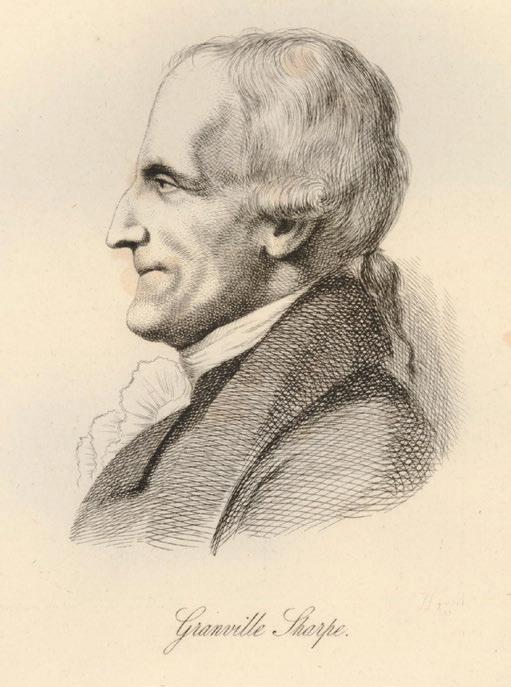
Portrait of Granville Sharpe. Granville Sharpe was a prominent English abolitionist who played a key role in the campaign to win James Somerset’s freedom in the landmark Somerset v. Stewart case that also effectively banned slavery within England. He went on to form the Society for Effecting the Abolition of the Slave Trade. There are no known images of James Somerset himself. THE BRITISH MUSEUM, 1613128041.
example of Somerset [and] proceeding at law against his master for his freedom, and it is generally believed that he will succeed . ”73
Writers in Britain and throughout the Atlantic world debated the meaning of the Somerset case for colonial slavery Would Mansfield now free enslaved people in the West Indies and North America? Would enslaved people in the Americas sneak aboard ships to Britain to gain their freedom? In reality, the British did not end slavery in the colonies for decades . From Bengal to Ireland to the Caribbean, the empire remained as brutal as ever and enthusiastically continued the transatlantic slave trade and plantation system just as before Somerset 74 But the case encouraged unfree people across the British Atlantic to claim their own freedom .
Briggs and other Rhode Islanders were not aware of Mansfield’s decision at the time of the Gaspee raid . The High Court’s decision came down thirteen days after the attack, and the news did not reach the colonies until weeks later However, Somerset was initially recaptured in November 1771, and hearings began in February 1772, so some news of these proceedings potentially reached New England by that June . Henry Marchant a powerful Rhode Island lawyer, farmer,
and General Assembly member was in London on colony business in 1772 Like most Rhode Island elites, Marchant held close political, social, and economic connections with many of the Gaspee attackers . He attended the trial in both February and May of 1772 and wrote about it extensively in his diary . His entries did contain some antislavery sentiments: he blamed the British for allowing the slave trade, stating that his fellow Rhode Islanders “never could have supported themselves in the Trade” without British sanction and protection However, his conclusions are decidedly proslavery, bemoaning that Lord Mansfield’s decision fundamentally “cheat[ed] an honest American of his Slave . ” 75 Fearing for the rights of enslavers, he hoped that the ruling would “not draw Circles in particular Spots, with magic Wands and juggle all without it out of their Property ” 76
Rhode Island newspapers began reacting to the decision in July 1772 and went on to print more articles on the case than any other colony except for Virginia, with which it was tied . The papers’ reactions often highlighted the potential threat to Rhode Island merchants’ economic interests . While elites had previously been upset with British taxation, which “may have taken some of their property,” now “Somerset threatened to take it all ” 77 The front page of the August 1, 1772 Providence Gazette fully connected Rhode Island merchants’ economic and racial fears:
A correspondent says, this cause seems pregnant with consequences extremely detrimental to those gentlemen whose estates chiefly consist in slaves: It would be a means of ruining our African trade; if it should be determined in favour of the negroes, we are apprehensive that the black gentry will visit us in too great an abundance, intermarry with our women, and thus in time we shall become a nation of molattoes 78
Elsewhere in the same edition of the Gazette, an article noted that the Greenes a wealthy family of merchants, manufacturers, and politicians whose illegal molasses
was apprehended by the Gaspee in February 1772 were suing Lieutenant Dudingston for seizing their goods .
On September 12, 1772, the Gazette published an article from London warning of the dire consequences the decision posed for the colonies It cautioned that:
The late decision with regard to Somerset the negro, a correspondent assures us, will occasion a greater ferment in America (particularly in the islands) than the stamp-act itself; for the slaves constituting the great value of (West-India) property…[and so the case will] leave the subject at Jamaica, or Barbados, wholly without a hand to cultivate his plantation 79
The paper printed a longer editorial on October 10, 1772, that made the connections with the Gaspee Affair clearer This piece attacked Lord Mansfield for violating the laws of the colonies by freeing Somerset, arguing he had no jurisdiction to overturn colonial slave laws and steal an enslaver’s property .
The author further posited that Black and Native people had no rights under English law . Noting that English law grants citizenship to anyone residing in the colonies for seven years, the writer asked, “But did any man ever conceive that Guinea Negroes were included within the meaning of this act?” 80
Beginning in 1773, some writers in the Gazette sympathized with Somerset and presented an antislavery position, though this view was often tempered with the caveat that the British should not have the power to dictate colonial law on slavery .
The Somerset decision came amid decades of slave resistance and rebellions across the British Atlantic that terrorized the white colonial public During the years spanning the Gaspee Affair, news items on slave uprisings regularly appeared in the Providence Gazette and Newport Mercury . For instance, enslaved Africans led an uprising in Surinam, a prime Rhode Island trading location, from 1772-1773, and the local papers universally responded with horror 81 The July 25, 1772 Providence Gazette recounted the “bad news” from Surinam that “a fresh party of fugitive negroes, more in number than any heretofore, have retired into the woods and marshes, whither it is impossible to follow them, and have taken an oath to pillage all the plantations, and defend themselves against the whites to the last extremity ” 82 On August 29, the paper wrote that in Surinam, “the wild negroes cut off two plantations, and killed two white men on one of them ” 83
The paper provided an update from Dutch colonists on November 7, 1772, observing that the formerly enslaved “are now assembled 1000 strong, very formidable…and have defeated our soldiers…one of their parties, 50 in number, came and carried off about 80 negroes [from a plantation] We have been obliged to set three or four hundred of our stoutest negroes free, to defend us… ” 84 Coverage of the Surinam uprising continued in every issue of the Gazette that November, and sporadically afterward .
Following a devastating hurricane in the popular Rhode Island trading destination of St . Croix, the Providence Gazette printed an emergency slave code established on the island that forbid any Black person from being in public at nighttime 85 The November 7, 1772 issue noted “a dangerous insurrection of the Indians and Negroes at Baldivis mines, in Chili, in South America . ” 86 In yet another example, on August 14, 1773, a horrified Providence Gazette reported on a “slave insurrection of Negroes in the bay of Honduras ” Rhode Island’s famed furniture industry was dependent on a steady supply of mahogany from the Bay of Honduras (modern-day Belize), and so merchants were particularly alarmed with this uprising . 87 A September 25, 1773 Providence Gazette article made the economic connections clear for Rhode Island’s merchants: “…about 20 of the most desperate Negroes are still in Arms…they had murdered about 20 white People… the Trade being entirely at an End; and that no Logwood or Mahogany had been cut this Year . ” 88 Another piece clarified that “the negro insurrection is not at all abated . . .and that all the wood already cut would be carried away by the floods . ” 89
Aaron Briggs must also be understood in the context of centuries of enslaved people exploiting competition between colonial powers to win their freedom . Across the Atlantic World, enslaved people fled from territory controlled by one power to an area held by another, or joined the military forces of a competing country in order to win their freedom . This process intensified during the Seven Years’ War, as the British, French, and Spanish all enlisted significant numbers of enslaved Africans as soldiers and encouraged enslaved people from enemy colonies to join their side None of these European powers enacted these policies out of an abolitionist commitment, but rather as an attempt to weaken their enemies and grow their own ranks . Few enslaved people held
an affinity for one European enslaver over another; rather, they were “seeking leverage abroad to overcome rapacity at home . ”90
Some unfree people—particularly those living in maritime areas fled to the British Navy because they “found the [Royal] navy a refuge from the myriad oppressions arrayed against them, even as white sailors (especially impressed ones) rhetorically described naval service as slavery ” 91 The Royal Navy offered regular meals and the possibility of sharing in the loot of a captured prize . Moreover, the British often protected Black sailors from their former enslavers who sought to return them to slavery . One formerly enslaved man named William Castillo worked for years aboard a Boston-based merchant ship before escaping to the Royal Navy . When his former enslaver attempted to retrieve him, the Lords of Admiralty intervened and refused to return Castillo, just as the British refused to return Aaron Briggs to Rhode Island . The British did not always protect fugitives, but they commonly did, especially when ships needed seamen in times of war 92 As an unfree man who moved through Narragansett Bay as part of his labors, Aaron Briggs was likely aware of such escapes and of the possibility of Royal Navy protection
The number of runaways increased dramatically with the beginning of hostilities in the American Revolution . In March 1775, before violence broke out at Lexington and Concord, “several negroes” from Bristol ran away and were armed by “Col . Gilbert’s Banditti,” a group of Loyalists who stole arms from a ship in Newport harbor . 93 In 1775, the former Royal Governor of Virginia, Lord Dunmore, issued a proclamation stating that anyone enslaved by the colonists who ran away and joined the British would be granted their freedom . Dunmore’s Proclamation greatly accelerated the mass escape of unfree people across North America Estimates vary greatly, but tens of thousands of formerly unfree people fled to the British ranks, often then fighting against their former enslavers . 94 Historian Alan Gilbert posited this mass self-emancipation as a second revolution within the American Revolution 95 A smaller number of unfree people also joined the Whig side . In 1778, Rhode Island permitted the enlistment of Black and Native men into the militia The state compensated enslavers for enslaved people who enlisted, and in some towns enslavers were permitted to avoid their own militia duty by sending an enslaved person in their place . Providence merchant and Gaspee attacker Joseph Tillinghast did just that, sending an
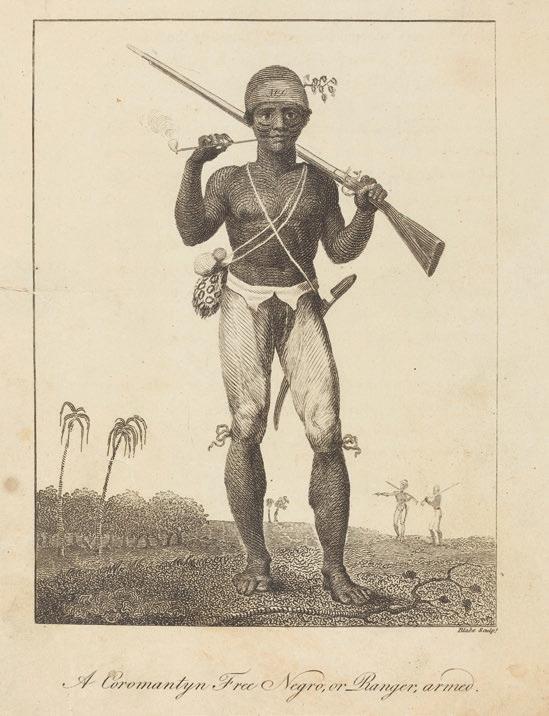
An illustration by the poet William Blake of a free, armed Black man in Surinam during the antislavery uprising led by maroon communities between 1772-1777. During the period of the Gaspee Affair, Rhode Island newspapers regularly published articles expressing sympathy with the Dutch colonists and expressing horror at the antislavery rebellion. Blake was a noted abolitionist and created a series of illustrations for a book on the uprising. “A Coromantyn Free Negro, or Ranger, armed,” William Blake, 1793. NATIONAL GALLERY OF ART, 1943.3.1827.
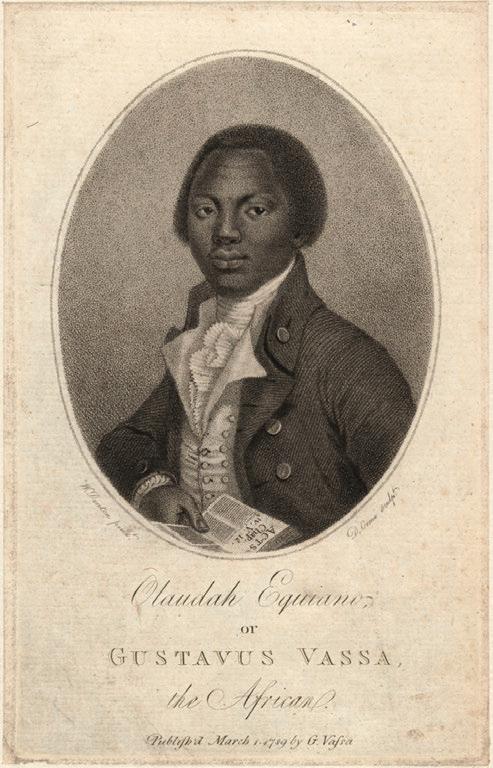
Portrait of Olaudah Equiano by Daniel Orme, 1789. Equiano was one of the most prominent men enslaved in maritime industries who won his own freedom in the 18th century. Born in modern day Nigeria, he was kidnapped into slavery as a child and forced to labor aboard several ships throughout the Atlantic. He became a skilled seaman and purchased his freedom in 1766. He published a widely read autobiography and was one of the leading figures in the British abolitionist movement. NATIONAL PORTRAIT GALLERY, NPG D8546.
enslaved man to fight on his behalf . 96 Some 140 Black and Native Rhode Islanders enlisted and served as the majority of Rhode Island’s 1st Regiment, which saw continuous action in multiple campaigns throughout the war 97
For years, historians failed to answer the question of where Briggs ended up following the Gaspee Affair . Some suggested that he remained with the British, some argued that he returned to Prudence Island under his enslaver’s rule, and others even hypothesized that he fought in Rhode Island’s 1st Regiment Finally in 2022, historian Charles R Foy demonstrated that Briggs remained with the British and became a full seaman in the Royal Navy . Foy found that in November 1773, just months after the end of the Gaspee Commission, Briggs was transferred to the British ship
Captain . The Captain landed in Portsmouth, England in July 1774, and from there Briggs was transferred to Chatham, England in August, 1774 Foy found no further mention of Briggs in the historical record The discovery proved that Briggs successfully escaped his enslaver and made his way out of Rhode Island despite being the colony’s most wanted man . 98 Rhode Island’s elite merchants attacked the Gaspee to preserve their lucrative, unregulated business of slavery Aaron Briggs, however, navigated the aftermath of this proslavery raid to escape bondage and win a real victory for freedom . He should be celebrated alongside all unfree people who struggled against slavery throughout the eighteenthcentury Atlantic .
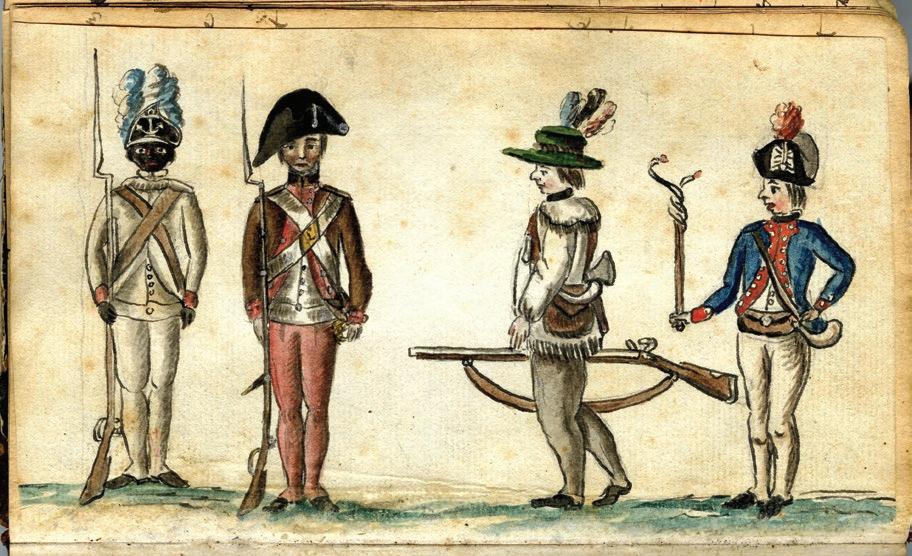
“Soldiers in Uniform” by Jean Baptiste Antoine de Verger, c1781. This watercolor by a French sub-lieutenant shows a variety of soldiers fighting with the colonists for independence from Britain. The figure on the left depicts a Black soldier with the First Rhode Island Regiment. LIBRARY OF CONGRESS, 2021669876. q
Joey La Neve DeFrancesco is a public historian, writer, and labor organizer. He has created public programs at museums across Rhode Island, and published several articles on the state’s history largely focused on labor history and the history of slavery.
1 For examples of the Whiggish standing historiography on the Gaspee Affair, see Eugene Wulsin, “The Political Consequences of the Burning of the Gaspee,” Rhode Island History 111 (April 1944): 55-64; Lawrence DeVaro Jr., “The Gaspee Affair as Conspiracy,” Rhode Island History 32 (Nov. 1973): 107-121; Sydney James, Colonial Rhode Island: A History (New York: Charles Scribner’s Sons, 1975), 316.
2 Charles M. Foy, “The Gaspee Affair and Maritime Fugitives in the Anglo-American Atlantic, 1772-1783,” The Bridge: A Joint Edition of the Journals of the Rhode Island History and Newport History 79 (Spring 2022): 15-26.
3 For examples of Gaspee public history and memorial, see “True Tales of Rhode Islanders, Full Gaspee Day Story,” Motif Magazine, June 5, 2019, accessed online May 14, 2025, https://motifri.com/drawntogaspee; Patrick T. Conley, “The Burning of the Gaspee,” Providence Journal, June 8, 2019, accessed online May 14, 2025, https://www.providencejournal.com/ opinion/20190608/my-turn-patrick-t-conley-the-burning-of-gaspee; Daniel F. Harrington, “The Gaspee, the hero, and the Dud,” Providence Journal, June 2, 2015, accessed online May 14, 2025, https://www.providencejournal.com/article/20150602/OPINION/150609901; “Gaspee Days,” Gaspee Days Committee, accessed online May 14, 2025, https://www.gaspee.com; Sheldon Whitehouse, “Whitehouse Commemorates 250th Anniversary of the Burning of the Gaspee.” June 7, 2022, accessed online May 14, 2025, https://www.whitehouse.senate.gov/news/release/ whitehouse-commemorates-250th-anniversary-of-the-burning-of-the-gaspee.
4 Christy Clark-Pujara, Dark Work: The Business of Slavery in Rhode Island (New York: New York University Press, 2016).
5 For analysis of colonial Rhode Island’s involvement in the Atlantic slave economy, see Clark-Pujara, Dark Work; Jay Coughtry, Rhode Island and the African Slave Trade:1700-1807 (Philadelphia: Temple University Press, 1981); James B. Hedges, The Browns of Providence Plantations: Colonial Years (Cambridge: Harvard University Press, 1952).
6 For a full analysis of the Gaspee attackers, see Joey La Neve DeFrancesco, “The Gaspee Affair: Slavery, Trade, and Elite Rebellion in Colonial Rhode Island.” (Master’s Thesis, University of Rhode Island, 2024).
7 Alan Gilbert, Black Patriots and Loyalists (Chicago: The University of Chicago Press, 2012); Gary B. Nash, Race and Revolution (Lanham, Md.: Madison House, 2001); Woody Holton, Liberty Is Sweet: The Hidden History of the American Revolution (New York: Simon & Schuster, 2021); Cassandra Pybus, Epic Journeys of Freedom: Runaway Slaves of the American Revolution and their Global Quest for Liberty (Boston: Beacon Press, 2006).
8 William Read Staples. A Documentary History of the Destruction of the Gaspee (Providence: Knowles, Vose, and Anthony, 1843), 34.
9 Ezra Stiles, The Literary Diary of Ezra Stiles, D.D., LL.D.(New York: Charles Scribner’s Sons, 1901), 1:348.
10 Governor Wanton to Captain Linzee, of the Beaver, July 15, 1772, in Staples, Documentary History, 34; Governor Wanton to Admiral Montagu, July 22, 1772, in Staples, Documentary History, 35-36.
11 Admiral Montagu to Governor Wanton, September 1, 1772, in Staples, Documentary History, 36-37.
12 Wulsin, “Burning of the Gaspee,” 60.
13 Staples, Documentary History, 32-33.
14 Census of the Inhabitants of the Colony of Rhode Island and Providence Plantations, Taken By Order of the General Assembly, In the Year 1774 (Providence: Knowles, Anthony & Co., State Printers, 1858).
15 Ruth Wallis Herndon and Ella Wilcox Sekatau, “The Right to a Name: The Narragansett People and Rhode Island Officials in the Revolutionary Era,” in Colin G. Calloway, ed., After King Philip’s War: Presence and Persistence in Indian New England (Hanover, N.H.: University Press of New England, 1997), 114-143; Ruth Wallis Herndon and Ella Wilcox Sekatau, “Colonizing the Children: Indian Youngsters in Servitude in Early Rhode Island,” in Colin G, Calloway and Neal Salisbury, eds., Reinterpreting New England Indians and the Colonial Experience (Boston: The Colonial Society of Massachusetts, 2003), 140-146; Marjory Gomez O’Toole, If Jane Should Want To Be Sold: Stories of Enslavement, Indenture and Freedom in Little Compton, Rhode Island (Little Compton, R.I.: Little Compton Historical Society, 2016), 10.
16 For example, in 1780, white New Shoreham residents declared that the town’s Native people were “extinct” as a pretext to take over all remaining lands reserved for Native people. Herndon and Sekatau, “The Right to a Name,” 133.
17 Regarding terminology in the present study: When quoting primary sources, I reproduce the terms used in the source. Otherwise, I use the terms “Black” or “African-American” to refer to people in the New World descended from ancestors in Africa. I use the terms “Native” or “Indigenous” to refer to the original peoples living in the Americas prior to European colonization and their descendants. “Person of color” is used as a broader term when a Black, Native, or multiracial individual’s specific ancestry is unclear. While I attempt to use these terms as accurately as possible, the misuse and inconsistencies of racial categories in the historical record means that this study will also inevitably replicate some of those errors.
18 Stiles, Literary Diary, 1:336-348.
19 Stiles worked to convert Rhode Island’s Native people, and so visited and was familiar with Little Compton’s Native communities, Stiles, Literary Diary,1:348; O’Toole, If Jane Should Want To Be Sold, 55.
20 O’Toole, If Jane Should Want To Be Sold, 20-63, 75.
21 Daniel R. Mandell, “Shifting Boundaries of Race and Ethnicity: Indian-Black Intermarriage in Southern New England, 1760-1880,” The Journal of American History 85 (September 1998): 466-470; Lorenzo Greene, The Negro in Colonial New England: 1620-1776 (New York: Columbia University Press, 1942), 19-20.
22 Staples, Documentary History, 63-66.
23 O’Toole, If Jane Should Want To Be Sold, 39-40.
24 Ibid., 56.
25 Herndon and Sekatau, “Colonizing the Children,” 157-159.
26 Margaret Ellen Newell, Brethren By Nature: New England Indians, Colonists, and the Origins of American Slavery (Ithaca: Cornell University Press, 2016), 17-42; 211-214.
27 John Russell Bartlett, ed., Records of the Colony of Rhode Island and Providence Plantations in New England, Vol VI: 1757-1769 (Providence: Knowles, Anthony & Co., 1861), 357.
28 Newell, Brethren, 217-226; Daniel Vickers, “The First Whalemen of Nantucket,” in Colin G. Calloway, ed, After King Philip’s War: Presence and Persistence in Indian New England (Hanover, N.H.: University Press of New England, 2007), 105-106.
29 Herndon and Sekatau, “Colonizing the Children,” 143-159.
30 O’Toole, If Jane Should Want To Be Sold, 52.
31 Providence Town Council Meeting Records, 1743-1774, No. 4, October 6, 1770, 304. Providence City Archives, Providence, R. I.
32 O’Toole, If Jane Should Want To Be Sold, 45-46.
33 Herndon and Sekatau, “Colonizing the Children,” 137-173.
34 O’Toole, If Jane Should Want to Be Sold, 26.
35 Ibid., 48.
36 Hendon and Sekatau, “Colonizing the Children,” 137-173.
37 Newell, Brethren, 230-236; O’Toole, If Jane Should Want to Be Sold, 21.
38 Aaron Briggs, “Deposition of the Negro Aaron Briggs,” January 14, 1773, in John Russell Bartlett, A History of the Destruction of His Britannic Majesty’s Schooner Gaspee in Narragansett Bay (Providence: A. Crawford Greene, Printer to the State, 1861), 84-87.
39 Samuel Faulkner, “Examination of Samuel Faulkner,” in Staples, Documentary History, 93.
40 W. Jeffrey Bolster, Black Jacks: African American Seamen in the Age of Sail (Cambridge: Harvard University Press, 1997), 19-36; see also Julius S. Scott, The Common Wind: Afro-American Currents in the Age of the Haitian Revolution (London: Verso, 2018).
41 Bolster, Black Jacks, 23.
42 Clark-Pujara, Dark Work, 34.
43 Providence Gazette, October 30, 1773.
44 Bartlett, Records VI, 64-65.
45 Bolster, Black Jacks, 25.
46 Clark-Pujara, Dark Work, 55.
47 Providence Gazette, 1772-1773.
48 Clark-Pujara, Dark Work, 56.
49 Providence Gazette, February 29, 1772.
50 Greene, The Negro in Colonial New England, 249-252.
51 John Russell Bartlett, Records of the Colony of Rhode Island and Providence Plantations in New England, Vol. III: 1687-1706 (New York: AMS Press, 1968), 492.
52 Clark-Pujara, Dark Work, 35-38.
53 Bartlett, Records VI, 578-579.
54 “An Act for the breaking up disorderly houses, kept by negroes and mulattoes; and for putting out such negroes and mulattos to service,” February 1770, Rhode Island General Assembly Records, Rhode Island State Archives, Providence, Rhode Island; Andrew Polta, “Disorderly House Keepers: Poor Women in Providence, Rhode Island, 1781-1832.” (Master’s Thesis, University of Rhode Island, 2018).
55 Rhode Island General Assembly Records, September 1770, Rhode Island State Archives, Providence, Rhode Island.
Aaron Briggs: The True
56 Clark-Pujara, Dark Work, 40.
57 Robert G. Parkinson, Common Cause: Creating Race and Nation in the American Revolution (Chapel Hill: The University of North Carolina Press: 2016).
58 Historian Gerald Horne argues for an even earlier establishment of a colonial ideology connecting the British with a racialized other, citing colonists’ fears of the British arming enslaved Africans, Natives, and others going back decades, particularly during the Seven Years’ War. Gerald Horne, The Counter-Revolution of 1776 (New York: New York University Press, 2014).
59 The petition appears in Oliver Morton Dickinson, Boston Under Military Rule, 1768-1769 (Boston: Chapman and Grimes, 1936), 16.
60 Stiles, Literary Diary,1: 374.
61 Steven Park, “Revisiting the Gaspee Legacy,” Journal of the American Revolution, July 28, 2015. Accessed online, May 14, 2025, https://allthingsliberty.com/2015/07/revising-the-gaspee-legacy.
62 John Allen, An Oration on the Beauties of Liberty or The essential rights of the Americans. Delivered at the Second Baptist-Church in Boston, upon the last annual thanksgiving, Dec. 3d, 1772. Dedicated to the Right Honourable the Earl of Dartmouth (Boston: E. Russell, 1773). Accessed online, May 14, 2025 https://name.umdl.umich.edu/N10250.0001.001.
63 Admiral Montagu to Governor Wanton, July 22, 1772, in Staples, Documentary History, 35-36.
64 Peter C. Messer, “The Burning of the HMS ‘Gaspee’ and the Delaying of the American Revolution,” The New England Quarterly 88 (December 2015): 582-622.
65 Frederick Bernays Wiener, “The Rhode Island Merchants and the Sugar Act,” New England Quarterly 3 (July 1930): 464-500.
66 Providence Gazette, January 9, 1773; Newport Mercury, November 9, 1772; Providence Gazette, December 26, 1772.
67 Quoted in Messer, “The Burning of the HMS ‘Gaspee,’” 597.
68 Stiles, Literary Diary, 1:54.
69 Newport Mercury, November 7, 1774.
70 “New Song Called The Gaspee,” 1772, RHiX17320, Rhode Island Historical Society, Providence, Rhode Island.
71 William M. Wiecek, “Somerset: Lord Mansfield and the Legitimacy of Slavery in the Anglo-American World,” The University of Chicago Law Review 42 (Fall 1974): 86-146; George Van Cleve, “‘Somerset’s Case’ and Its Antecedents in Imperial Perspective,” Law and History Review 24 (Fall 2006): 601-645.
72 Alfred W. Blumrosen and Ruth Blumrosen, Slave Nation: How Slavery United the Colonies and Sparked the American Revolution (Naperville, Ill.: Sourcebooks, 2005), 1-14.
73 Providence Gazette, October 9, 1773.
74 For instance, at the end of the First Carib War, a key British demand was the return of runaway slaves. Providence Gazette, April 17, 1773.
75 Henry Marchant quoted in Matthew Mason, “North American Calm, West Indian storm: the politics of the Somerset decision in the British Atlantic,” Slavery & Abolition 41 (2020): 723-747.
76 Sally Hadden and Patricia Hagler Minter, “A Legal Tourist Visits Eighteenth-Century Britain: Henry Marchant’s Observations on British Courts, 1771 to 1772,” Law and History Review 29 (February 2011): 133-179. Quotation appears on page 162.
77 Blumrosen and Blumrosen, Slave Nation, xi-xii.
78 Providence Gazette, August 1, 1773.
79 Providence Gazette, September 12, 1772.
80 Providence Gazette, October 10, 1772.
81 On April 24, 1773, the Providence Gazette recalled with shock the story of a woman from Holland who was murdered by rebelling Africans in Surinam, and another woman who only survived an attack “by the Negroes” because of an elaborate hat she was wearing.
82 Providence Gazette, July 25, 1772.
83 Providence Gazette, August 29, 1772.
84 Providence Gazette, November 7, 1772.
85 Providence Gazette, October 24, 1772.
86 Providence Gazette, November 7, 1772.
87 Newport furniture makers Goddard and Townsend made renowned luxury pieces for elites such as the Brown family. Tropical mahogany was considered the only acceptable material for these expensive items. Jennifer L. Anderson, Mahogany: The Costs of Luxury in Early America (Cambridge: Harvard University Press), 42-43.
88 Providence Gazette, September 25, 1773.
89 Providence Gazette, September 4, 1773.
90 In mainland North America, the clearest mid-18th century example of this process was enslaved people in South Carolina fleeing to freedom in Spanish-controlled Florida. Horne, The Counterrevolution, 13-21.
91 Bolster, Black Jacks, 31-32.
92 Ibid.
93 Newport Mercury, April 17, 1775.
94 Gilbert, Black Patriots and Loyalists, 15-45; See also Nash, Race and Revolution; and Pybus, Epic Journeys of Freedom
95 Gilbert, Black Patriots, 1-14; For the experiences of Black Rhode Islanders who sought their freedom with the British during the Revolution, see Christian M. McBurney, “Freedom for African Americans in British-Occupied Newport, 1776-1779, and the ‘Book of Negroes,’” Newport History 87 (Summer 2017): 1-41; and MaryKate Smolenski, “The Aftermath of Loyalism Through the Experience of Four Newport Women,” Newport History 94 (Winter 2021): 21-28.
96 Wayne G. Tillinghast, The Tillinghasts in America – The First Four Generations (Hope, R.I.: Rhode Island Genealogical Society, 2013). E-book Edition.
97 Gilbert, Black Patriots, 98-103; Lorenzo Greene, “Some Observations on the Black Regiment of Rhode Island in the American Revolution,” The Journal of Negro History 37 (April 1952): 142-172; Robert A. Geake and Lorén Spears, From Slaves to Solders: The 1st Rhode Island Regiment in the American Revolution (Yardley, Pa.: Westholme Publishing, 2016).
98 Foy, “The Gaspee Affair and Maritime Fugitives in the Anglo-American Atlantic, 1772-1783,” 15-26.
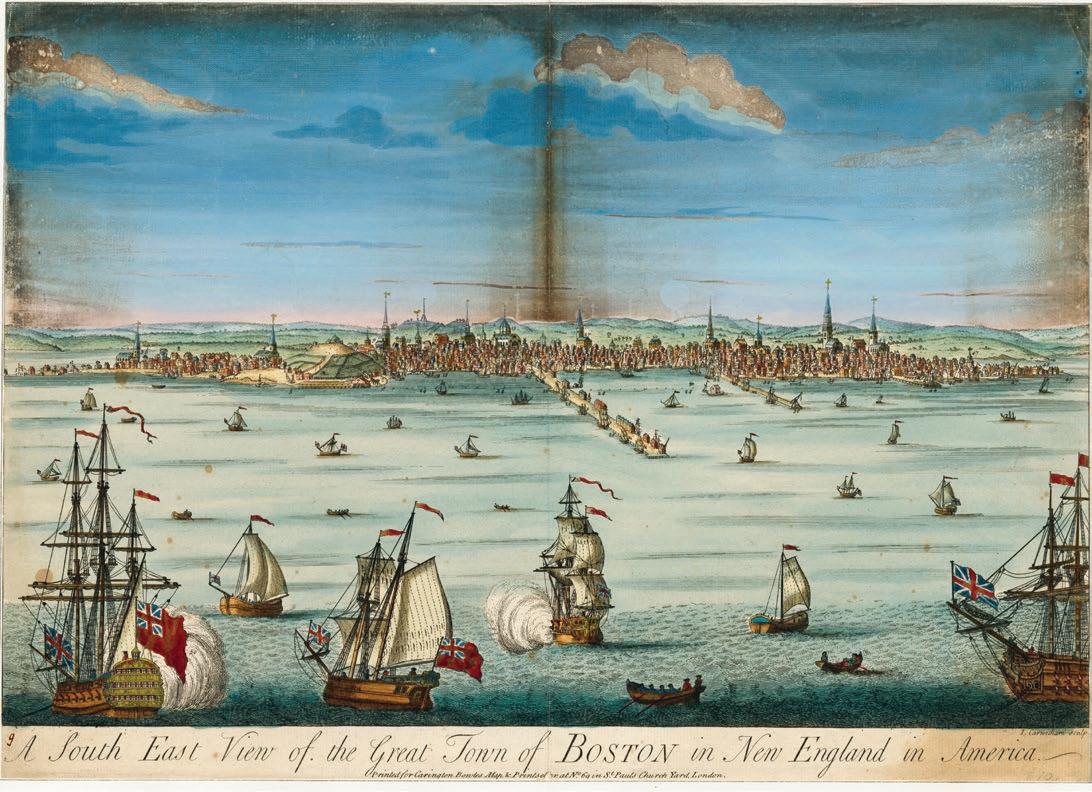
When he was about seven years old, Felix Holbrook was forcibly taken across the Atlantic Ocean, from Africa to North America, in a slave ship which landed at Boston around 1750. A south east view of the great town of Boston in New England in America, circa 1730, J. Carwitham, engraver. NEW YORK PUBLIC LIBRARY DIGITAL COLLECTIONS, EM2079.
Christian McBurney q
Felix Holbrook is one of the most compelling men of revolutionary New England, but he has not figured prominently in histories of the American Revolution He was captured as a boy in Africa, carried to Boston on a slave ship, and sold to a man named Abiah Holbrook . As a young man Felix Holbrook was the main organizer of antislavery efforts to pressure the Massachusetts legislature in 1773 and 1774, despite being enslaved at the time After the Battle of Lexington and Concord and sometime before mid-1778, Holbrook became free and moved to Rhode Island . In July 1778 he volunteered to fight for the Patriots in their war of independence against Great Britain, serving in a Rhode Island state regiment for eight months and, starting in July 1780, for another five months with Continental Army recruits annexed to the First Rhode Island Regiment of the Continental line the famous “Black Regiment ” After the war, Felix Holbrook was one of the founders of a Black mutual aid society in Providence . Despite his status as a veteran, in 1792 the Providence town council ordered him to leave the town and return to Boston, out of concern that he would become a public charge Holbrook probably died two years later
This article is a comprehensive account of Felix Holbrook’s contributions in the Revolutionary Era . 1 In 1773 and 1774, Holbrook was the principal organizer behind efforts to persuade the Massachusetts legislature to ban slavery in the colony As a man who could read and write, Holbrook was able to lead three other enslaved or formerly enslaved men in this public effort He gained important allies, including influential ministers and the renowned Patriot Samuel Adams . His antislavery proposals were supported by several Massachusetts town meetings . When Felix Holbrook’s efforts
did not progress, he shifted to pressuring the legislature to end the importations of African captives in 1773 and 1774; the legislature passed a resolution supporting the ban in 1774 but the bill was vetoed by the governor of the colony who had been appointed by the King . Holbrook and his three colleagues succeeded in waging a campaign to bring the issue of enslaving Black people to the public’s attention at a time when white colonists were demanding that their rights to freedoms not be infringed by the British Crown
Heightened Patriot rhetoric fueled a nascent abolitionist movement in the thirteen colonies, especially in New England . 2 As W. E . B . Dubois wrote of Revolutionary Era efforts to ban the African slave trade, “the new philosophy of ‘freedom’ and the ‘rights of man,’ which formed the cornerstone of the Revolution, made even the dullest realize that, at the very least, the slave-trade and struggle for ‘liberty’ were not consistent . ”3 The Continental Congress actually banned American participation in the African slave trade in 1774, and not just with British colonies . 4 Felix Holbrook saw the opportunity to push for the liberation of the enslaved people in Massachusetts using the Patriots’ own rhetoric
Historian Christopher Brown has argued that the 1773 and 1774 petitions were the earliest examples of Black abolitionists who did not simply condemn the evils of slavery but attempted to engage public opinion and influence the colonial legislature . 5 Historian Chernoh M . Sesay wrote of the 1773 and 1774 New England campaigns, “For the first time in American history, people of African descent had successfully lobbied a governing body to take up the slavery question as it related to an entire enslaved population . ” 6 Another historian, Nicholas P. Wood, called the Massachusetts legislature’s 1773 bill to end the importation of African captives “significant as
the first legislation in America drafted in response to Black petitioners . ” 7 The same bill passed by the Massachusetts legislature in 1774 was probably the first piece of legislation passed by a legislature in response to Black petitioners .
Despite Holbrook’s determined opposition to a government that had once sanctioned his enslavement, Holbrook enlisted to fight for the Patriot cause in two Rhode Island regiments . He fought at the Battle of Rhode Island on August 29, 1778, and later served in Rhode Island’s segregated Black Regiment . After the war, Holbrook continued his leadership activities by helping to found the Free African Union Society, a mutual aid organization that was Providence’s first Black-run association As an enslaved man, Holbrook took the lead in prewar antislavery activism in Massachusetts, he enlisted in and fought in Patriot regiments, and he contributed to the establishment of a significant, Black-led organization in Providence after the war . He should be remembered as a notable figure in the history of the Revolutionary War era in New England
In 1792 Felix Holbrook recounted that he was born in Africa and that he was forcibly taken on a slave ship to Boston, Massachusetts, in about 1750 He was around seven years old at the time After his arrival, Felix recalled, he was sold to a man in Boston named Abiah Holbrook, Jr ., and his wife, Rebecca Burroughs Holbrook . Felix was enslaved by the Holbrooks for almost twenty-five years . 8 Abiah and Rebecca may have purchased Felix at an auction held in Boston . Boston merchants were not as active in the African slave trade as were the ship owners of Newport, Rhode Island, but they likely carried more captive Africans on their slave ships in colonial times than the merchants of any other New England port after Newport . 9 When he was purchased by Abiah and Rebecca Holbrook, Felix’s African name, which is not known, was changed to an Anglicized name chosen by the Holbrooks When Felix arrived at the Holbrook household, he entered the world of a prominent teacher who earned a comfortable living but was not rich . Abiah Holbrook headed the Boston South Writing School from 1743 until his death in 1769 . The Boston South Writing School enrolled mostly sons of Boston tradesmen, from ages seven to thirteen, who were not preparing for college Students received lessons in reading,
writing and enough mathematics to help them balance their books after they left school and became tradesmen . Young girls of wealthy families sometimes had lessons there as well Abiah earned about £100 a year most years for serving as a teacher, a decent sum and enough for him to purchase an enslaved child, but not a salary that would have made him wealthy . From that amount, he had to purchase ink for his students The town of Boston paid Abiah’s salary 10
The South Writing School was located in the southern part of Boston Common . Abiah and Rebecca’s house and property, where Felix also resided, were nearby, in lower Boston Common . Their large house, which faced the Common, was accompanied by out-buildings and a fruit tree orchard 11
The school typically enrolled a large number of students . In 1745, Abiah petitioned the Boston Town Meeting to allow him to hire an assistant teacher, called an usher, as Abiah had a class of 220 students; the town agreed and Abiah’s younger brother, Samuel, was hired . From 1758 to 1768, Abiah taught on average around 240 students 12
Abiah Holbrook’s forte was teaching elegant, graceful handwriting, which at the time was a highly prized skill Abiah sometimes took his craft to an extreme, treating it as calligraphy . At his death in 1769, an obituary praised him as “the greatest master of the pen we ever had among us ”13
The school was located in an area of some of the finest homes in Boston, including that of wealthy merchant and Patriot leader John Hancock . As a boy, Hancock, who became known for his over-sized and graceful signature on the Declaration of Independence, took writing lessons from Abiah Holbrook 14
In the years prior to the start of the Revolutionary War in 1775, Black people were enslaved in every one of the thirteen colonies The vast majority of enslaved people resided in the South, but slavery was an accepted institution in colonial New England as well Prior to 1775, Blacks and people of mixed-race heritage constituted about 1 .5 percent of the population in Massachusetts, three percent in Connecticut, and six percent in Rhode Island 15 Many of the enslaved people resided in port cities . Boston had the highest population of free and enslaved Blacks of any city in New England in 1752, with more than 1,500 (or more than one of every ten Boston residents) . 16
Slavery everywhere, including in New England, was a tyrannical, arbitrary, and dehumanizing institution enforced by the threat of severe punishment for running
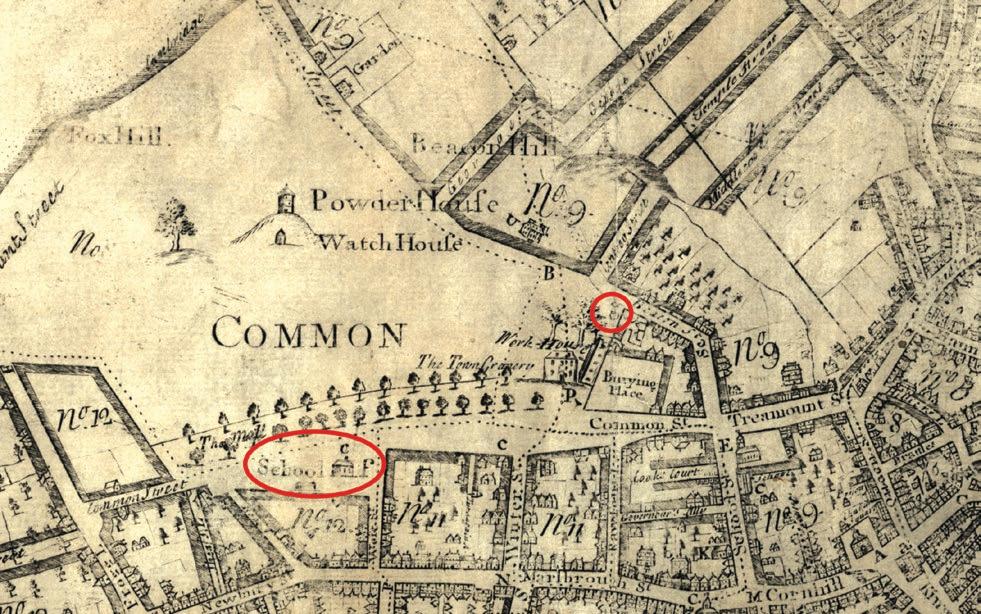
The location of the South Writing School, nestled in Boston Common, is seen in the lower left-hand quadrant on this excerpt from a 1769 map of Boston (with an “F” next to the drawing of a small schoolhouse, all circled in red). Abiah Holbrook taught students artistic penmanship here and Felix Holbrook undoubtedly worked at the schoolhouse in some capacity and lived with the Holbrooks nearby. To the north and east (also circled) is the location of Boston’s Almshouse, where Felix would spend his last years. Excerpt from A new plan of ye great town of Boston in New England in America with the many additionall buildings & new streets, to the year, 1769, engraved and printed by Fra. Dewing, Boston 1722 [1772]. LIBRARY OF CONGRESS, G3764.B6 1769.P7.
Harvard University’s Houghton Library holds more than 200 samples of fine penmanship by Abiah Holbrook and his students. This sample was penned by Abiah himself in 1766. Its title “Liberty” is ironic given the subject of this article, Felix Holbrook, who was enslaved by Abiah Holbrook as a child. HOUGHTON LIBRARY, HARVARD UNIVERSITY, MS TYP 473.2.
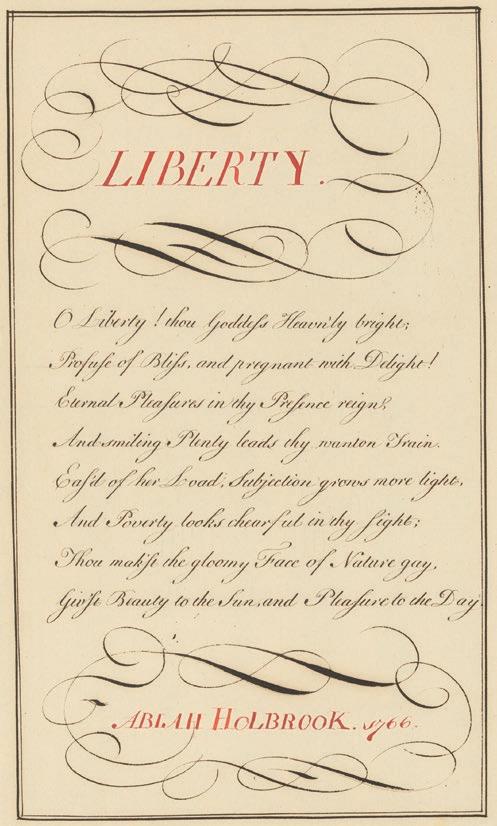
away or violating other rules imposed on enslaved people But conditions of slavery in New England differed in some ways from those in the South . For one, unlike in the South, where teaching an enslaved person to read was illegal, in the North it was not against the law, even if most people enslaved in New England did not gain literacy skills during their time in bondage Felix would be very fortunate in this regard 17
As a boy enslaved in an urban household, Felix would have worked as a domestic servant helping with household chores . He would have learned, for example, to care for Abiah’s horse, clean the house and clear up after meals, and keep fires burning in the fireplaces As he got older, he almost certainly would have helped to operate the school as well An important manual task would have been to keep the wood fires going to provide heat for the teacher and students . He may have also handed out ink and paper to the students and swept the schoolhouse and otherwise kept it and students’ desks clean .
A common task of enslaved people in Boston was to deliver messages and run errands for their enslavers It is probable that Felix undertook such duties While doing these chores, Felix would have encountered other enslaved people . He also would have interacted with others in bondage like himself, while attending Congregational Church services at the Hollis Street Church Felix was baptized at the church on November 12, 1769 18 In these activities, he would have undoubtedly made contacts among enslaved people that he would utilize in later years .
During his time of enslavement Felix became literate . 19 His writing shows a neat and legible cursive style . The Holbrooks possibly taught Felix to read and write so that he could provide more effective assistance in the school
Alternatively, Felix may have learned to read and write on his own, while he was working at the school and listening to Abiah’s lectures . In mastering literacy skills while still enslaved, Felix Holhrook was extremely fortunate . Felix’s advantages would prove essential in his antislavery lobbying activities in the 1770s
On January 28, 1769, Abiah Holbrook unexpectedly died at the age of fifty . 20 In Abiah’s will, Rebecca inherited all of his property, which under the prevailing laws included Felix . 21 In the inventory of Abiah’s estate, Felix was the only enslaved person listed . He was valued at £40 . Felix was the second-highest item of “property” listed in the inventory after Abiah’s “Mansion House and Land” valued at £1,000 22
After Abiah’s death in 1769, Rebecca Burroughs Holbrook no longer had a healthy income supporting her . She carved out one-third of the Boston Common house to live in and rented out the rest of the house . Rebecca raised a bit of money by selling books from Abiah’s extensive collection She unsuccessfully tried to sell her house on the Boston Common 23 After her husband’s death, the South Writing School was run by Abiah’s younger brother, Samuel . 24 Perhaps Felix continued to assist in performing his chores for the school and perhaps Samuel paid Rebecca a small fee for Felix’s work Felix continued to be enslaved by Rebecca Holbrook during this time
Felix may have had opportunities to earn some money for himself during his time of enslavement, perhaps after his regular chores were completed . Among the debts owed by the estate of Abiah Holbrook was £2 due to Felix Holbrook . 25
A surviving record from 1772 shows that Caleb Davis, a Boston merchant (who was also a member of the Sons of
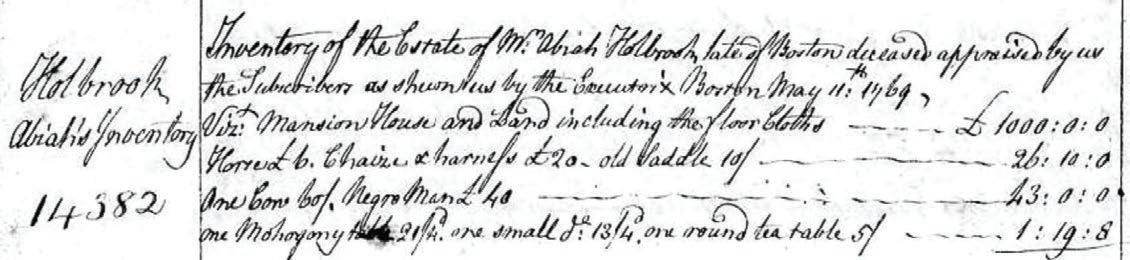
This excerpt from the inventory of Abiah Holbrook’s estate includes the listing, “Negro Man £40,” referring to Felix Holbrook. Inventory of the Estate of Mr. Abiah Holbrook, late of Boston, deceased, appraised by us the subscribers as shown us by the Executrix, Boston, May 11, 1769, SUFFOLK COUNTY PROBATE RECORDS, VOL. 68, P. 58, SUFFOLK COUNTY, MASSACHUSETTS.
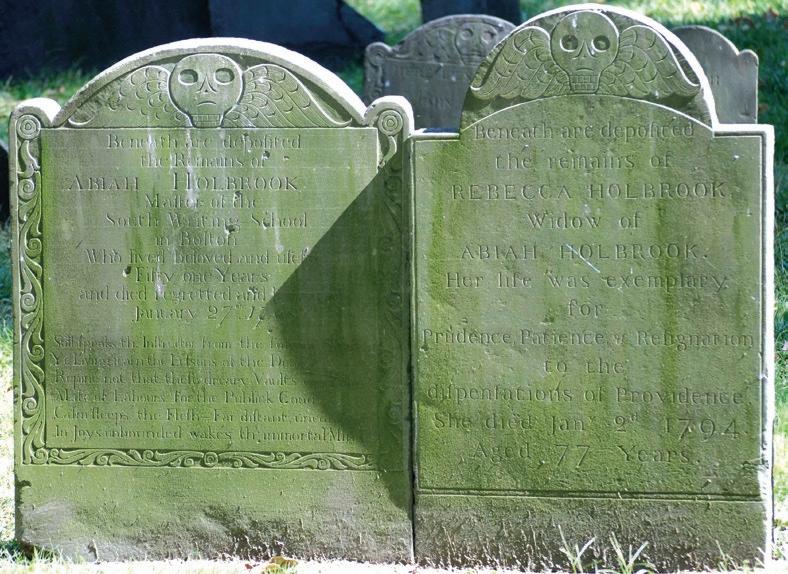
Liberty) paid Felix £1 .2 .8 for eight and one-half days’ work . 26 By this time, Felix may have been allowed to spend time working for himself so that perhaps one day he could purchase his own freedom
Felix married in 1772, when he was about thirty years old . On July 9, 1772, Felix wed a woman named Lusanna Cato in Scituate, Massachusetts . Little is known about her . The marriage record describes Lusanna as “a free negro” and Felix as a “Negro servant of Mrs Holbrook of Boston ” 27 Felix’s description in this record indicates that he was still enslaved . Lusanna was the daughter of Caesar, a “Slave” of Captain Caleb Torry of Scituate, and Sarah Wapping, a “free Indian woman . ”28 It appears Caesar took the last name of
Headstones for Abiah and Rebecca (Burroughs) Holbrook, Felix’s enslavers, at Boston’s Granary Burying Ground. Abiah’s unexpected death in 1769 dramatically altered the lives of both Rebecca and Felix. COURTESY OF FIND A GRAVE USER KOCART; https://www.findagrave.com/ memorial/21037243/abiah-holbrook.
Cato . Sarah Wapping was probably from the Massachusett tribe
Apparently Felix continued to live in Boston as an enslaved man after his marriage He was admitted as a member of the Hollis Street Congregational Church in Boston on August 2, 1772 . The Hollis Street Church records later note that Lusanna, “a free negro,” who was the wife of Felix, was dismissed from the Scituate church on December 5, 1773 . 29 This notation undoubtedly meant that Lusanna had left the Scituate church in order to reside in Boston with Felix and to join the Hollis Street Church together with him . This is the last known mention of Felix and Lusanna together in the public records .
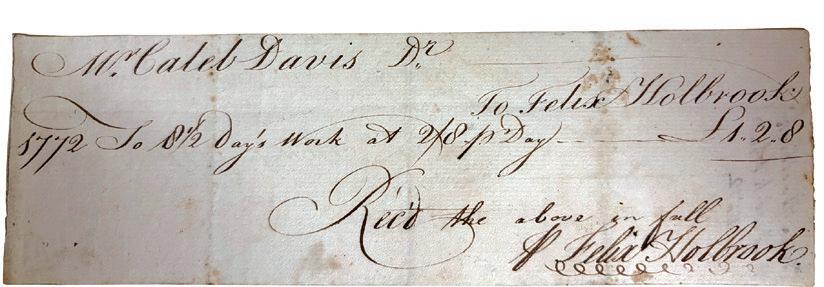
Felix Holbrook signed this receipt when he was paid a fee after performing services for Boston storekeeper Caleb Davis in 1772. Despite being enslaved, Felix was apparently able to earn some wages for himself. This signature is the fanciest of Felix’s three signatures that have survived. MASSACHUSETTS HISTORICAL SOCIETY, MS. N-1096.
The first serious antislavery legislation considered by the Massachusetts General Assembly was a 1767 proposal to ban slavery in the colony . Likely prompted by Boston’s town meeting, the bill was introduced into the House of Representatives “for preventing the unnatural and unwarrantable custom of enslaving mankind in this Province ” 30 The bill did not progress In 1771, both houses of the General Assembly passed a bill to end the importation of African captives into the colony, but Governor Thomas Hutchinson withheld his assent fearing that officials in London would revoke the law . 31 He was likely correct given that Great Britain was then the world’s leading slave trading country, British officials did not want to permit any laws that would threaten the profitability of the trade . 32 Still, with all the talk of liberty and freedom that was circulating among Patriots in Revolutionary Boston, and the General Assembly’s efforts to limit the slave trade, Felix Holbrook and some of his friends must have hoped that abolition was achievable
Felix Holbrook’s public antislavery efforts began in January 1773 He submitted a petition on behalf of “many slaves living in the town of Boston and other towns in this Province” to Massachusetts governor Thomas Hutchinson, the Council, and the General Court The Massachusetts legislature, known as the General Court, had two houses the House of Representatives and the Council . House members were elected by towns, while Council members were appointed by the colony’s royal governor . The royal governor was appointed by Crown officials in London Felix’s January 1773 petition entreated the legislature and royal governor to enact legislation that would free the enslaved people of Massachusetts, basing the appeal mostly on religious grounds It included the following powerful plea: “We have no property . We have no wives We have no children We have no city No Country . But we have a Father in Heaven… . ” 33
The petition was signed “Felix,” which was an unusual name in Boston 34 There is no doubt that the man who wrote and signed this petition was Felix Holbrook .
In late January, the House of Representatives turned its attention to “A Petition of a Number of Negroes, praying that they may be declared Free, on certain Conditions .”
The petition, according to the House’s journal, was “[r]ead and ordered to lie . ” 35 While it is not certain, this document was likely Felix Holbrook’s January petition Even though the House did not address it, the petition apparently inspired the House to consider a bill to prohibit the importation of African captives in the same January-March 1773 session; the House ultimately referred the bill to the next session 36
Three months later, Holbrook and several other men wrote and distributed a printed circular letter, dated April 20, 1773, containing a plea for the colony to end the institution of slavery It was signed by a group of four enslaved or formerly enslaved men from Boston, one of whom was Felix Holbrook . The circular letter, intended to supplement Holbrook’s January petition carried over to the General Assembly’s May-June 1773 session, was distributed to House members, and was accompanied by an antislavery tract penned by James Swan, a Boston merchant 37 The letter from Felix Holbrook and three other men stated in part:
The efforts made by the Legislature of this Province in their last sessions to free themselves of slavery gave us, who are in that deplorable state, a high degree of satisfaction… [W]e cannot but expect your House will again take our deplorable case into serious consideration, and give us that ample relief which, as men, we have a natural right to . 38
Holbrook and the other three petitioners apparently considered the “efforts made by the Legislature…to free themselves of slavery” to be the bill to prohibit the importation of African captives that had been considered in the JanuaryMarch 1773 session . They saw that failed and limited bill as a sign that a majority of House members were serious about ending slavery in the colony .
The petitioners clearly desired their liberty consistent with the colony’s Patriots who demanded political liberties from the Crown But these antislavery activists discussed other alternatives as well . On the practical side, they realized that seeking full compensation for their past work would be unrealistic (even if it was an entirely justifiable demand) . “We are very sensible that it would be highly detrimental to our present masters, if we were allowed to demand all that of right belongs to us for past services,” they declared in their
April 20th circular letter They implied, however, that at the least, legislators should consider adopting the practice in South American colonies where enslaved people were allowed to work for themselves one day a week, so that they could earn sufficient funds to purchase their own freedom The April 20, 1773 letter continued:
We are willing to submit to such regulations and laws, as may be made relative to us, until we leave the province, which we determine to do as soon as we can from our joint labors procure money to transport ourselves to some part of the coast of Africa, where we propose a settlement . 39
At this time, Holbrook and the other Black signatories believed that if they became free, they would sail for Africa and make a settlement there . This idea was a precursor to the African colonization movement, which was based on the belief that
endemic racism in the British North American slaveholding colonies was simply too powerful to overcome . 40
The letter ended, “In behalf of our fellow slaves in this province, and by order of their Committee” and it is signed, in alphabetical order, by Peter Bestes, Sambo Freeman, Felix Holbrook, and Chester Joie 41 Little is known of the three men who signed with Felix . Bestes came from Boston and in 1777 he was a signatory to another freedom petition . Sambo Freeman and Chester Joie apparently resided in towns outside Boston . It is not known if each man was enslaved in April 1773, although based on Sambo’s last name, it appears he was a free man, and evidence indicates Chester Joie was enslaved . 42 It is also not known if Felix Holbrook knew any of the three men previously or if they had been inspired by Holbrook’s January 1773 petition and in the interim between his solo petition and the April circular letter, had made contact with Holbrook
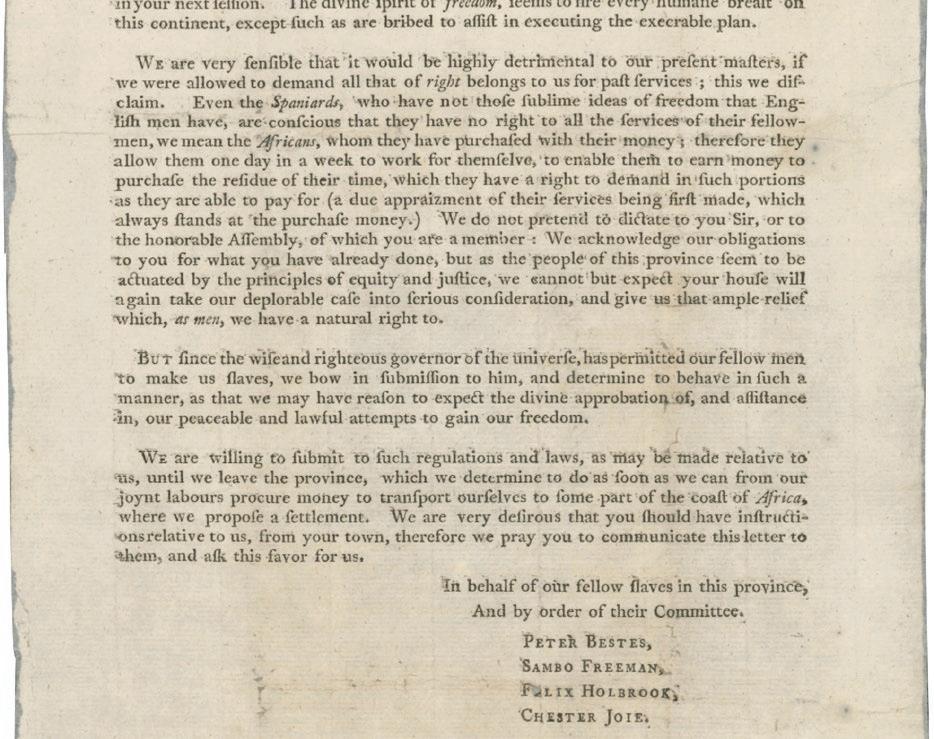
Excerpt from the Black abolitionists’ April 20, 1773 circular letter; this copy was intended for Taunton’s town meeting. It shows the bottom of the first page, including the signers listed in alphabetical order: Peter Bestes, Sambo Freeman, Felix Holbrook, and Chester Joie. MASSACHUSETTS HISTORICAL SOCIETY. BDSES 1773 APR. 20.
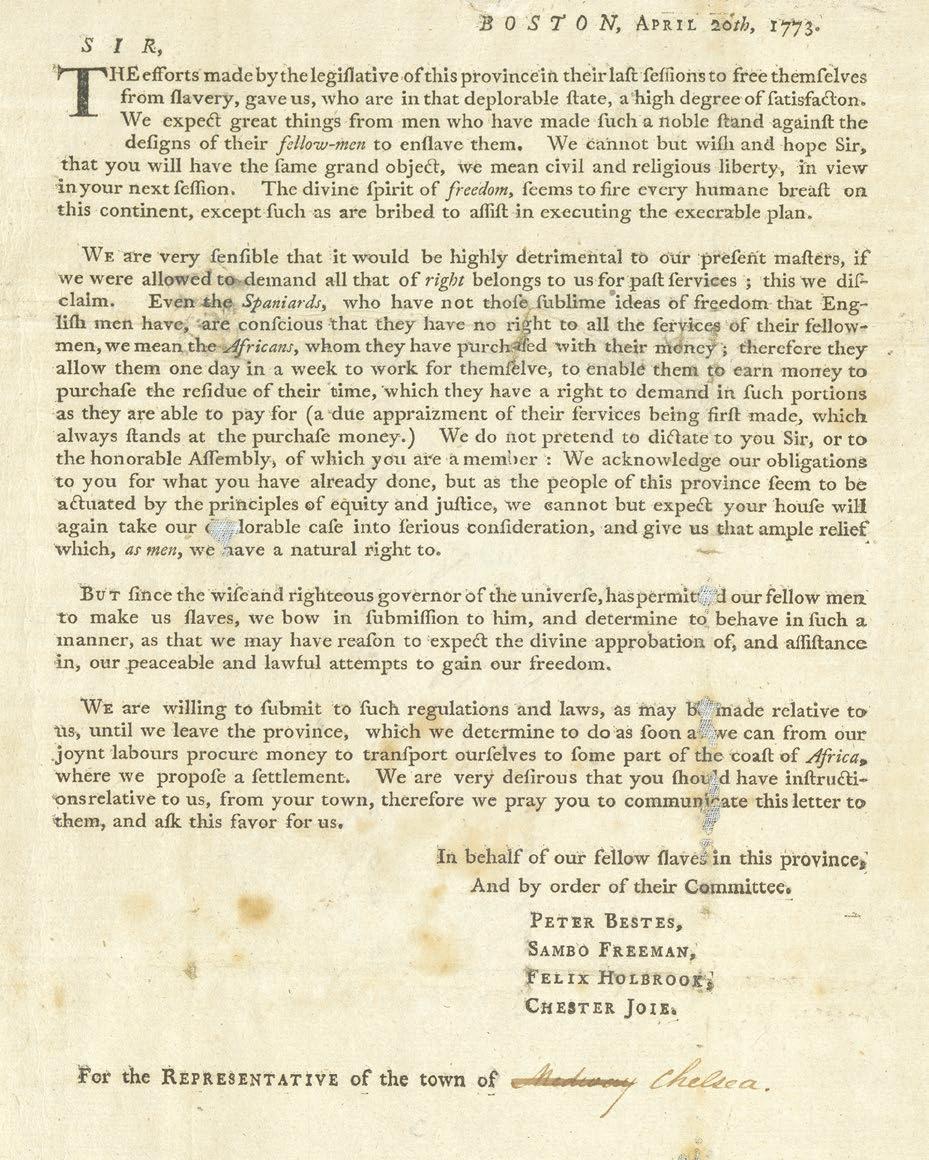
This copy of the April 20,1773 circular letter, one of four that have survived, appears here in a publication for the first time. The handwriting at the bottom shows “Medway” crossed out and “Chelsea” written in its place. BOSTON PUBLIC LIBRARY, H.90A.52.
Four copies of the April 20th letter have been found The main text in all of them is identical . The addressee differs in each letter . A pristine copy of the circular letter held by the Massachusetts Historical Society has the following inscription at the bottom: “For the Representative of the town of ____ ” In the copy held by the Society, “Taunton” is written in the blank after “town of ” On the back of the letter, the following is hand-written: “To the Clerk of the Town of Taunton, for the use of the present Representatives and their successors .” The printed text of the April 20, 1773 letter ends by asking the intended recipient, the House member, to let his town know of the letter’s contents and to seek instructions from the town regarding the proposal to end slavery The town meeting of a Massachusetts town sometimes instructed the town’s representative in the House how to vote on certain matters . The goal of the letter was to persuade the towns to instruct their House members to vote in favor of antislavery legislation The letter was part of a broad lobbying effort to end slavery in Massachusetts that was focused on all House members
A copy of the circular letter held by the Boston Public Library has never been mentioned in a published work . This copy has “Medway” handwritten on it and then crossed out; “Chelsea” was handwritten in its place 43 Medway and Chelsea were both towns in Suffolk County Neither town,
however, had elected a member of the House for the 1773 or 1774 sessions, so perhaps this document was never sent, which would help explain why it survived . 44 “Stoughtonham” was written at the bottom of a copy of the circular letter that was reviewed by a writer in 1847 45 The towns of Stoughton and Stoughtonham, in Suffolk County, consistently elected Hezekiah Gay as their House member 46 Another copy at the New-York Historical Society has “Thompson” written at the bottom . 47 This was probably intended for Samuel Thompson, a member of the House from Brunswick, Maine (then part of Massachusetts) who did not appear at the 1773 session and showed up late for the 1774 session 48
The lobbying effort by Felix Holbrook and his fellow signatories met with some success . The June 14, 1773 edition of the Boston Gazette contains the following instructions from the town meeting of Pembroke, Massachusetts, to its legislator in the General Assembly:
We think the Negro Petition reasonable— agreeable to natural justice and the precepts of the Gospel, and therefore advise that in concurrence with the other worthy members of the Assembly, you endeavour to find a way in which they may be freed from slavery without wrong to their present masters or injury to themselves . And that a total abolition of slavery may in due time take place . 49
The town of Pembroke published its instructions to its member of the House of Representatives, including this resolution supporting the “Negro Petition.” As seen here, the vote of the town meeting on its instructions was unanimous.
BOSTON GAZETTE, JUNE 14, 1773.
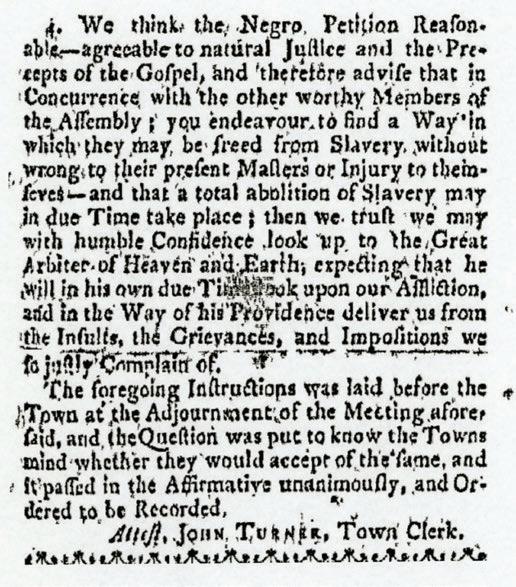
While Pembroke was the only town to publicly support “the Negro Petition,” in May 1773 the town of Leicester did instruct its legislator, “as we have the highest regard for… Liberty, we cannot behold but with the greatest abhorrence any of our fellow creatures in a state of slavery ” 50 But Leicester and other towns, such as Sandwich and Medford, were only willing to go so far They focused their antislavery efforts on trying to impose high tariffs on imports of African captives, hoping to end the slave trade, or they supported gradual emancipation freeing the children of enslaved people when they became adults . 51
Later, Holbrook drafted another petition with other Black men It was submitted before the end of the General Court’s May-June 1773 session . On the afternoon of Friday, June 25, 1773, the petition was read in the House of Representatives . The official journal for the House of Representatives stated that the petition was submitted by:
Felix Holbrook, and others, Negroes, praying that they may be liberated from a State of Bondage, and made Freemen of this Community; and that this Court [i e , legislature] would give and grant to them some part of the unimproved Lands belonging to the Province, for a Settlement, or relieve them in such other Way as shall seem good and wise upon the Whole . 52
Because the original has not been found, the identities of the other Black petitioners are not known .
The first three paragraphs of the June 1773 petition, which appear in an incomplete version of the document held by the Massachusetts Historical Society, read as follows:
To his Excellency Thomas Hutchinson Governor of said Province, to the Honorable his Majesty’s Council, [and to the] Honorable House of Representatives in General Court assembled June 1773
The Petition of us the subscribers in behalf of all those who by divine Permission are held in a state of slavery, within the bowels of a free Country, Humbly sheweth—
That your Petitioners apprehend they have in common with other men a natural right to be free and without molestation to enjoy such Property as they may acquire by their industry, or by any other means not detrimental to their fellow men, and that no person can have any just claim to their services unless [text ends] 53
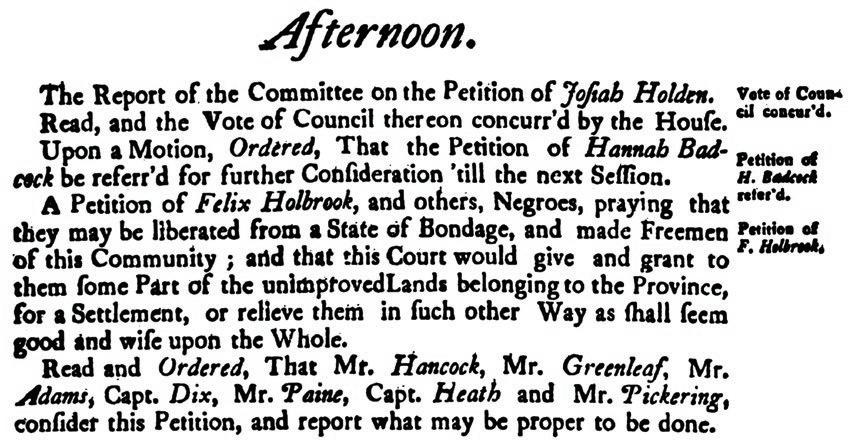
Here, the petitioners adopted the language of Patriots in arguing that they too had “a natural right to be free and without molestation to enjoy such Property as they may acquire by their industry . . . .”
Although no complete original of the June 1773 petition is known to exist in any archive, what is apparently a full rendition of the text was reprinted by some local newspapers Following the three paragraphs that appear in the incomplete Massachusetts Historical Society version, the reprinted petition then refers in part to the cruelties of the African slave trade:
…unless by the laws of the land they have forfeited them, or by voluntary compact become servants; neither of which is our case; but we were dragged by the cruel hand of power, some of us from our dearest connections, and others stolen from the bosoms of tender parents and brought hither to be enslaved . Thus are we deprived of everything that has a tendency to make life even tolerable…54
The June 1773 petitioners next turned to the topic of slavery and the Christian religion The petition ended with the specific demands:
We would therefore in addition to our prayer, that all of us, excepting such as are now infirm through age, or otherways unable to support themselves, may be liberated and made free men of this community, and be entitled to all the privileges and immunities of its free and natural born subjects Further humbly ask that your Excellency and [your] Honours would be pleased to give and grant to us some part of the unimproved land, belonging to this province, for a settlement, that each of us may there quietly sit down under his own fig tree [and enjoy] the fruits of his labour 55
Following the reading of the 1773 petition, the House ordered two of the colony’s most prominent Patriots, John Hancock and Samuel Adams, as well as Captain William Heath (later a major general in the Continental Army), Robert Treat Paine (a future signer of the Declaration of Independence), John Pickering, Jr ., and two other Massachusetts representatives, to “consider this Petition, and report what may be proper to be done . ” 56 The committee decided to defer consideration
of the June 1773 petition On Monday, June 28th, the “Committee on the Petition of Felix Holbrook, and others, in behalf of themselves and others; praying to be liberated from a State of Slavery, reported that the further Consideration of the Petition be referred till next Session ” 57 Holbrook must have been disappointed or furious, or both
Felix Holbrook and his colleagues received a major boost from two pamphlets published in Boston in 1773 . The first pamphlet was issued by Jonathan French, a Harvard-educated Congregationalist minister, in early February 1773 . As part of its title French wrote, “Some observations on the expediency of the petition of the Africans living in Boston, &c : lately presented to the General Assembly of this province…” and he annexed the text of Felix Holbrook’s January 6, 1773 petition to his pamphlet . He also wrote, “What a pity it is that every town did not instruct their representatives, relative to this most interesting and important subject, when they lately took into their consideration some other weighty matters, in regard to freedom…”58 French here was tying the freedom of Patriots in their struggle against the Crown to the freedom of the enslaved .
The appeal of Felix Holbrook and others made an impression on another minister . John Allen, a fiery Baptist clergyman from Boston, published a pamphlet in 1773 that became one of the most popular ever issued in the thirteen colonies 59 The pamphlet derived from a sermon Allen gave on December 3, 1772 . Allen’s main argument was that the burning of the British revenue cutter Gaspee by Rhode Island Patriots on June 9, 1772 was an important blow against British tyranny . In the pamphlet’s fourth edition, published in May 1773, Allen added an appendix that included a powerful argument against the institutions of slavery and the African slave trade . He also provided a printed transcript of Holbrook’s and his colleagues’ April 20, 1773 circular letter, noting that it had recently been submitted to the Massachusetts legislators . 60 An advertisement for the sale of the fourth edition stated that Allen had “inserted” the antislavery material “by particular desire ”61
Knowing that the next legislative session was due to start near the end of January 1774, Felix Holbrook and his associates approached the most influential Massachusetts Patriot of all, Samuel Adams, to assist their efforts That the enslaved and formerly enslaved men would consult with Adams on this matter was remarkable in itself, and it was also a testament to how they felt about Adams who was an activist renowned for advocating the rights of Patriots in opposition to Parliament . Holbrook and his colleagues must have also recognized that Adams was sympathetic to the antislavery cause Adams wrote to John Pickering, Jr ., an influential House member from Salem who in the last session had been appointed (along with Adams and others) to the committee to consider the “Negro Petition . ” 62 It appears that Pickering was taking the lead among the committee members as they discussed how to respond to the petition of Holbrook and the other antislavery activists . On January 8th Adams wrote to Pickering: [T]he Negroes whose petition lies on file and is referred for consideration, are very solicitous for the event of it, and having been informed that you intended to consider it…they earnestly wish you would complete a plan for their relief . And in the meantime, if it be not too much trouble, they ask it as a favor that you would by a letter enable me to communicate to them the general outlines of your design 63
This letter indicates that Holbrook and his colleagues were engaged in trying to push the legislation to a vote . The Black activists were also wise to focus on Samuel Adams; he had taken their request seriously by writing to Pickering However, there is no existing record of Pickering’s response to Adams’s January 8th letter advocating for action on Felix and his associates’ proposed legislation In fact, it appears no plan was developed for the bill’s passage . Holbrook and his colleagues’ petition was taken up by the House in the afternoon of the first day of its opening session, on January 26, 1774, an indication of the matter’s importance to the legislators House members did not vote on it, but again referred it to a committee . The Journal of the House records the matter of, “A petition of a number of Negro men, which was entered on the Journal the 25th of June last [1773], and referred for consideration to this session .” The Journal
continues that the petition was “[r]ead again, together with a memorial of the same petitioners…” Given that the petition was read “again,” and had been recorded in the Journal the previous June, it was undoubtedly the same petition that Felix and his “committee” originally dated June 1773 that was read to the House in 1774 . The text of the “memorial” that was also read to the House at this time is not known . Perhaps it has not survived; or, it could have been Holbrook’s January 6, 1773 petition or the April 20, 1773 circular letter The House voted for the Speaker (Thomas Cushing), and John Hancock, Samuel Adams, Robert Treat Paine, William Phillips, John Pickering, Jr ., and John Greenleaf to “consider the same and report . ”64 The committee was stacked with prominent members, including all five members from Boston and all two from Salem There is no indication, however, that the Massachusetts legislature gave any further consideration to the petition in 1774 . The committee members must have believed that, following the Boston Tea Party in December 1773, the time was not ripe for moving forward on emancipating the enslaved in Massachusetts
As indicated in the two petitions of 1773 and 1774, and in the official Journal of the House, Holbrook and his party requested not only the freedom of the enslaved in Massachusetts, but also grants of land Holbrook recognized that freedom without some economic support would not bode well for formerly enslaved people . Unlike free people, enslaved men and women did not earn wages for their labor; a few of the enslaved in port cities, mainly artisans, could sometimes earn some extra cash after their regular duties were completed, but the vast majority of people held in bondage were not able to accumulate capital or property . Holbrook and other activists who submitted the petitions sought partial compensation for their past unpaid labor in the form of undeveloped land in Maine that formerly enslaved men could turn into productive farms through their own efforts . At that time, Maine was part of the colony of Massachusetts and it was lightly populated . Holbrook and his colleagues probably thought it also would have been fair for the legislature to grant freed people cash as capital for improving the land into farms, but they likely concluded that such a request would never have been approved . Importantly, the request for land spearheaded by Holbrook and others indicates that, by this time, they had set aside any plans to sail to Africa and start a settlement there Instead, they sought to start a new life in America, within the borders of Massachusetts .
It appears that after January 26, 1774, Holbrook and his associates reevaluated their approach . Rather than push the General Court to enact a law prohibiting slavery, they apparently changed their focus to a more realistic goal that would still advance the abolitionist cause It resulted in a signal, if only partial, success for Holbrook and his colleagues On March 2, 1774, a bill “to prevent the importation of Negroes and others as Slaves” into the colony was introduced . It was then read for its first reading . The next day, on March 3d, it was read again in the morning session and for a third time in the afternoon session; it was then passed by the House Next, it was sent up to the Council 65 The Council, in turn, amended the bill and passed it, sending it back to the House on March 4th . 66 The bill, as amended, was enacted by the House on March 7th . 67 As he did in 1771, Governor Thomas Hutchinson refused to give his assent to the bill . Royal governors were instructed from London not to sign any such legislation that would tend to interfere with Britain’s lucrative African slave trade 68
A new antislavery petition was subsequently drafted; it was dated May 25, 1774, the day the next session of the General Assembly began . There is no indication that Felix Holbrook was involved with crafting this document . It was clearly written by a different person than the earlier ones associated with Holbrook, based on spelling, syntax, and its unique abolition approach The petition’s authorship has been attributed to Prince Hall, a free literate Black man from Boston; it was signed by Hall and seven other Black men, but not Felix Holbrook . 69 It was addressed in part to General Thomas Gage, who had arrived in Boston less than two weeks earlier to supersede Thomas Hutchinson as royal governor The petition was submitted in the name of “a Grate Number of Blackes of this Province who by divine permission are held in a state of Slavery within the bowels of a free and Christian country .” The petition contained a forceful appeal for emancipation and asked for the Massachusetts legislature to free all adult enslaved people immediately, and to free their children when they reached the age of twenty-one 70 (Thus an enslaver would be reimbursed for the cost of raising children he enslaved by receiving free labor until they turned twentyone .) It does not appear that the May 25, 1774 petition was submitted to the General Court or to the royal governor . If it was, there is no existing response from them in legislative records
In May 1774 Abigail Adams wrote to her husband John of news that some of Boston’s enslaved residents had forwarded a freedom petition to General Gage that promised they would bear arms for British authorities in exchange for their liberty . Little else is known about this effort if it ever existed Nor is it known whether Felix Holbrook was involved in drafting this document It may be that Patriots became suspicious when they heard that a freedom petition was submitted to Gage in May 1774, resulting in the creation of a false rumor that circulated in the town . 71
On June 16th (during the May 25-June 17, 1774 session of the General Assembly), the House of Representatives again passed a bill “to prevent the Importation of Negroes into this Province . ” 72 It was likely the same bill that Felix Holbrook and his colleagues had lobbied for in 1773 . There is no indication, however, that the Council took any action on the bill . By this time, Parliament’s Coercive Acts had been passed to punish Boston for its tea party held in December 1773 In mid-May, British General Thomas Gage assumed the post of governor of Massachusetts and doubled as commander in chief of North American forces .
In the 1790s, the Reverend Jeremy Belknap of Boston sent out a request for information on abolitionist activity in colonial Massachusetts Samuel Dexter, a former Council member from Weston, Massachusetts, responded to Belknap that Felix Holbrook spearheaded the 1774 legislative effort to convince Massachusetts legislators to end importing African captives . Dexter wrote to Belknap: “I took up a pamphlet which I had not looked into for several years… it was given to me in the name and at the desire of a number of negroes, then petitioners to the General Court At the head of these was Felix Holbrook ”73 Dexter clearly identifies Holbrook as the principal organizer among the Black petitioners . When Dexter mentioned that “a number of negroes” had backed the petition, it is not known if he is referring to Holbrook and his three colleagues or whether there were more petitioners of color
Dexter also provided more details of Black activism in Massachusetts in the 1770s He further recalled that he was given the pamphlet by “the negroes [who] had been informed that I was against the slave trade, and was their friend . ”74 Dexter remembered that the intermediary who handed him the pamphlet was a free Black man named Newton Prince, the owner of a successful business in Boston 75 If he was
still enslaved at the time, which is probable, it is likely that Holbrook would not have been permitted to lobby members of the General Court while in session .
Felix Holbrook and his colleagues were among the first Black people to petition a colonial legislature for their freedom and the liberty of all other enslaved people in their colony Holbrook’s efforts did not succeed, probably because the legislators wanted to avoid a divisive issue when their attention was focused on opposing British tyrannical rule (in any event, the Royal governor would never have assented to such a law) . But work such as his represented real progress for the abolitionist cause by publicizing the demands to end slavery in Massachusetts and the African slave trade The fact that the demands emanated from Holbrook and other enslaved or formerly enslaved people made the effort even more powerful .
During the night of September 14, 1774, a small party of Boston Patriots stole two brass cannon, guarded by British soldiers, from a building next door to the South Writing School and briefly hid them in the school The cannon were concealed in a large box under the schoolmaster’s desk Samuel Holbrook, who then ran the school, helped to hide the cannon . Felix Holbrook may have known about, and even assisted Samuel with hiding the cannon which were later smuggled out of Boston When the British army marched out of Boston in the early morning of April 19, 1775, one of their main goals was to recover these two cannon in Concord 76 Felix may have played a small role in this incident that ignited the Revolutionary War . After hostilities broke out at the Battle of Lexington and Concord, Samuel Holbrook closed the South Writing School and left Boston . 77 With the school closed and the siege of British-occupied Boston underway, both Felix’s and Rebecca’s lives would have been upended
The details of Felix Holbrook’s manumission and his move to Rhode Island are not known Perhaps the publicity of Holbrook’s antislavery campaign resulted in pressure on Rebecca Holbrook to agree to manumit Holbrook With her husband Abiah dead, and the school closed in Boston after April 1775, she may have found it difficult to afford to feed and clothe Felix and so agreed to free him . Another petition for the end of slavery in Massachusetts, dated January 13, 1777, was submitted to the General Court, but Holbrook
was not one of its eight Black Boston signatories 78 This may indicate that Holbrook had already left Massachusetts, or he may have been so disillusioned by the political process there that he refused to participate in the new effort . In any event, Felix was a free man by the time he enlisted in the military in June 1778
From the time Rhode Island created its first state and county militia regiments in 1775 and 1776, free Black, Indian, and multiracial men appeared in their ranks . At the time, most of the Black men in Rhode Island able to bear arms were enslaved . Enslaved men, however, were not permitted to enlist, unless they served as a substitute for a white man who had been drafted 79 In the Continental Army, General George Washington initially sought to ban enlistments by men of color . However, the dire need to fill the ranks of Continental regiments led recruiters to permit free men of color to enlist in Continental regiments . Massachusetts, Rhode Island, and other Continental regiments from New England states became integrated 80
In January 1778 Washington approved a proposal by Rhode Island Continental officers to make the First Rhode Island Regiment a segregated regiment with Black men, Indians, and multiracial men serving as privates . Even more surprising, in February 1778 Rhode Island’s General Assembly enacted a law permitting enslaved men in the state to obtain their freedom by enlisting in the First Rhode Island Regiment, which soon became known as the Black Regiment . More than 130 enslaved men obtained their freedom by enlisting . They were joined in the newly formed regiment by free Indian, Black, and multiracial veterans from the First and Second Rhode Island Regiments, as well as by newly enlisted free recruits from those same groups 81 Felix Holbrook could have enlisted in the Black Regiment, but he decided to join a state regiment . Perhaps Holbrook felt that he would rather enlist in a state regiment, which would likely remain in Rhode Island, than to fight in the Black Regiment, which as a Continental Army unit could be assigned to any of the thirteen states .
On June 5, 1778, Holbrook enlisted in one of the two state infantry regiments established by Rhode Island, the First State Regiment, commanded by Colonel John Topham . 82 The General Assembly re-established the First and Second State Regiments where enlistees would serve for twelve months, from March 16, 1778 to March 16, 1779 . Holbrook joined the state infantry regiments a few months later than
March, perhaps because he had moved from Boston after March 16th but before June 5th . He is not mentioned in either the Rhode Island census of 1774 or in the military census taken in April 1777, further indications that he moved to Rhode Island sometime in 1778 before his enlistment 83
Holbrook served in Captain Christopher Dyer’s Company, a unique company that included about forty-six rank-and-file Black, Indian, and multiracial soldiers . The company’s officers and non-commissioned officers (sergeants and corporals) were white men, and two of the privates were white men, but the rest of the soldiers were Black, Indian, or multiracial .
Some of the soldiers had served in other companies in the regiment and had been transferred to Dyer’s Company . The rank-and-file soldiers in the regiment received the same pay as the white rank-and-file soldiers in other companies of the regiment Thus, Captain Dyer’s Company was segregated in a manner similar to the much more famous Black Regiment of the Rhode Island Continental line Captain Dyer’s Company was one of only a handful of segregated companies that served in the American Army during the Revolutionary War . 84
At the first muster roll taken for Captain Dyer’s Company as a full company, a total of thirty-six free Indians, Blacks,
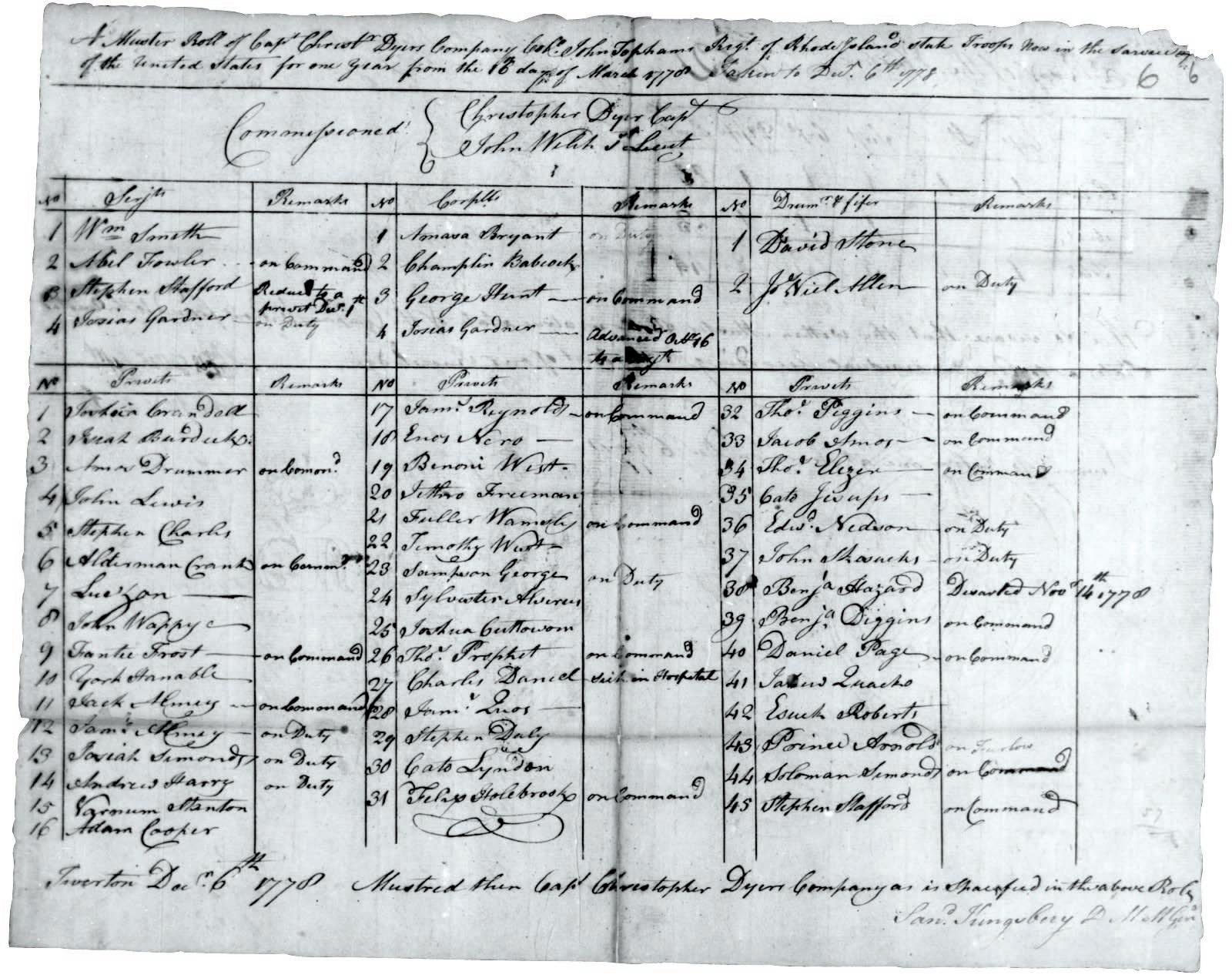
In the Muster Roll for Captain Christopher Dyer’s Company, Felix Holbrook is recorded as the 31st private (see the end of the second column listing privates). This Rhode Island unit was one of the few segregated units of the war in the American Army. Captain Christopher Dyer’s Company, Colonel John Topham’s First Rhode Island State Regiment, December 6, 1778, Tiverton. NATIONAL ARCHIVES, WASHINGTON, D.C.
and multiracial men, including Felix Holbrook, responded when their names were called; another man was discharged, on the ground that he was found to be “a bound slave . ” 85 The soldiers in the company lined up for roll call in Tiverton, except five who were sick in the military hospital, one who was “on command” performing duties away from camp, two waggoners, and three absent from camp with permission 86 Felix would have been issued military equipment by the state and received his first training as a soldier . The state regiment did not have uniforms for its rank-and-file soldiers, so Felix would have worn his civilian clothes . He would have been issued a musket, a bayonet, and a cartridge box Next came mastering common words used in military drill, learning how flint was used to create a spark that ignited the gunpowder inside the musket causing it to fire, and that a cartridge box held paper cartridges, each filled with gunpowder and a round, lead musket ball . Then Holbrook would have participated in military drill, learning how to shoulder arms and how to load and fire a musket, and then to reload Soldiers were trained to fire at least two rounds per minute They also learned how to use bayonets secured to the end of muskets for close-range combat . In addition, Felix and his fellow soldiers would have practiced marching in unison by company and later by the full regiment
In early August 1778, the American Army under Major General Sullivan gathered in Tiverton, ready to invade the northern part of Aquidneck Island across what is today called the Sakonnet River . The British had occupied Newport and the rest of Aquidneck Island since December 1776 . Lacking a strong navy, the American army previously could not invade Aquidneck Island and had to be content with trying to guard against raids by the British from Newport on the mainland The situation changed dramatically in April 1778 when France declared itself an ally of the United States in its war for independence . Now, with a powerful French Navy arriving off Narragansett Bay, the American army was cooperating with the French in trying to capture the British garrison in Newport
Sullivan’s army, including Felix’s regiment led by Colonel Topham, was ready to begin its invasion of Aquidneck Island on August 9th . Before dawn that morning, the men of Captain Dyer’s Company and the rest of the soldiers of Colonel Topham’s Regiment —stepped into small boats in Tiverton and were rowed over to Aquidneck Island, near Common
Fence Point in Portsmouth Topham’s Regiment was among the first regiments from the American Army under Major General John Sullivan to land on enemy territory . Sullivan then ordered Topham’s Regiment to march to Butts Hill Fort, the main British fortification in the northern part of Aquidneck Island, to make sure it had been evacuated by the British army Marching inland to the southwest, the men of Captain Dyer’s Company and the rest of the regiment discovered amid the earthen walls and wooden barracks at Butts Hill Fort only dummy soldiers red-coated uniforms stuffed with straw .
The soldiers of the regiment then participated in the siege of Newport in Middletown in mid-August, suffering through a hurricane lasting from August 11th to the 13th
During the ensuing Battle of Rhode Island on August 29, 1778, Felix Holbrook’s regiment was posted on the far right of the American defensive line extending from Butts Hill Fort, to the west of the West Road . Most of Sullivan’s troops on the west side were posted behind stone walls closer to the West Road Enemy troops charged three times at the American defenders on the West Road but were repulsed each time The soldiers of Captain Dyer’s Company, including Felix and the rest of the regiment fired their muskets at attacking enemy soldiers, although the enemy was in the distance to their left . Felix and the men of his regiment were likely protected as they were posted behind stone walls After their third charge, the enemy attackers fled the field of battle and left their dead and wounded behind . Topham’s Regiment suffered two casualties during the battle, but none from Captain Dyer’s Company . The next evening, the regiment and the rest of the American Army was safely evacuated off the island and returned to Tiverton 87
The Battle of Rhode Island, and the American-French Rhode Island Campaign, were over . The British continued to occupy Newport and the rest of Aquidneck Island, and Rhode Island regiments returned to patrolling the coastline watching for enemy raids, all as before . The next muster roll for Captain Dyer’s Company was taken two weeks after the battle, at Tiverton on September 13, 1778 Holbrook was listed as “on duty ” While there were no casualties from the Battle of Rhode Island listed on the muster roll, a few more men were reported as “sick in camp . ” 88
Holbrook appeared in muster rolls for Captain Dyer’s Company from October 17, 1778 through February 20, 1779, all taken at Tiverton He was listed as “on command” on all
of them, except the last one The “on command” reference likely means that Holbrook was absent from the muster, but assigned to official business . He may have then been patrolling the Tiverton coast . 89 Holbrook left the company and regiment when his term expired on March 16, 1779 Unlike some twenty of the company’s soldiers, Holbrook did not reenlist 90 Felix Holbrook took a three-month break from military service . He reenlisted in another regiment in July 1780 . In that month, Rhode Island recruited Continental troops to serve in the state for just six months, to be annexed to the First Rhode Island Regiment . 91 The British had evacuated Newport in December 1779, and a French army under Count de Rochambeau had just arrived in Newport French and American generals feared that a powerful British expeditionary force might try to invade Newport before the French had time to establish their defenses (the British did indeed contemplate such an attack, but it never came off) . 92 Holbrook enlisted on July 11, 1780, the day French troops were landed at Newport for the first time His oath pledging allegiance to the United States was witnessed in Providence by Metcalf Bowler, formerly a speaker of the House of Deputies of the Rhode Island General Assembly, and at the time Holbrook took his oath, a spy for the British . 93
Initially, the General Assembly’s members believed that, in order to attract white recruits, it would be necessary for Continental Army officers to avoid having the new troops associate with the Black soldiers of the First Rhode Island Regiment Moreover, in requiring the towns to create lists of men eligible to be drafted, the Assembly excluded “deserters, Indians, mulattoes and negroes ” 94 However, the Continental Army rejected the suggestion and the recruiters ended up enlisting sixty-five men of color (including Felix Holbrook) who constituted more than 12 percent of the men who were drafted .
About 530 soldiers were recruited in June and July 1780 and annexed to the First Rhode Island Regiment 95 Each town was ordered to supply a certain number of men . Providence was to furnish forty-two men; Felix Holbrook was city recruit number 38 . In the recruitment roll for the regiment, Holbrook was described as 37 years old, and 5’ 4” in height; serving for the town of Providence; born in Boston; and a “Negro ” Holbrook was markedly older than most other recruits of color, as their average age at the time of enlistment was twenty-two . 96 He received a good amount as an enlistment bounty—“fifty Spanish milled dollars . ”97 That amount was more than his “value” as an enslaved man, determined by the appraisers of Abiah Holbrook’s estate in 1769 98
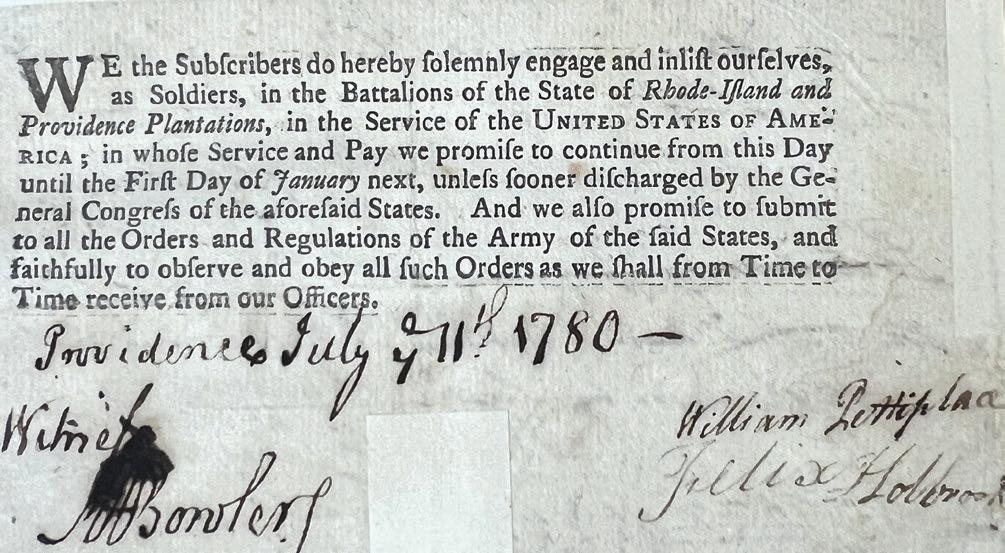
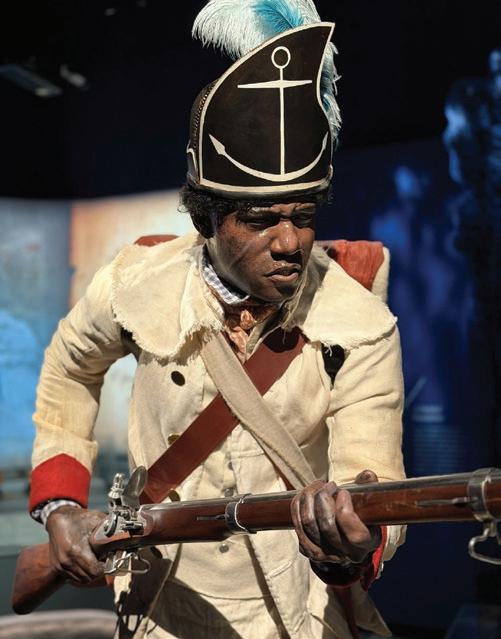
Mannequin of Cato Vernon of the First Rhode Regiment of Continentals, at the National Museum of the United States Army, Fort Belvoir, Virginia. Cato, a carpenter prior to the war, was enslaved by Newport merchant and slave trader William Vernon. By enlisting in the First Rhode Island Regiment on March 11, 1778, Cato obtained his freedom; he survived the war. Felix Holbrook served in a unit that was annexed to the First Rhode Island Regiment.
PHOTOGRAPH BY THE AUTHOR, 2026.
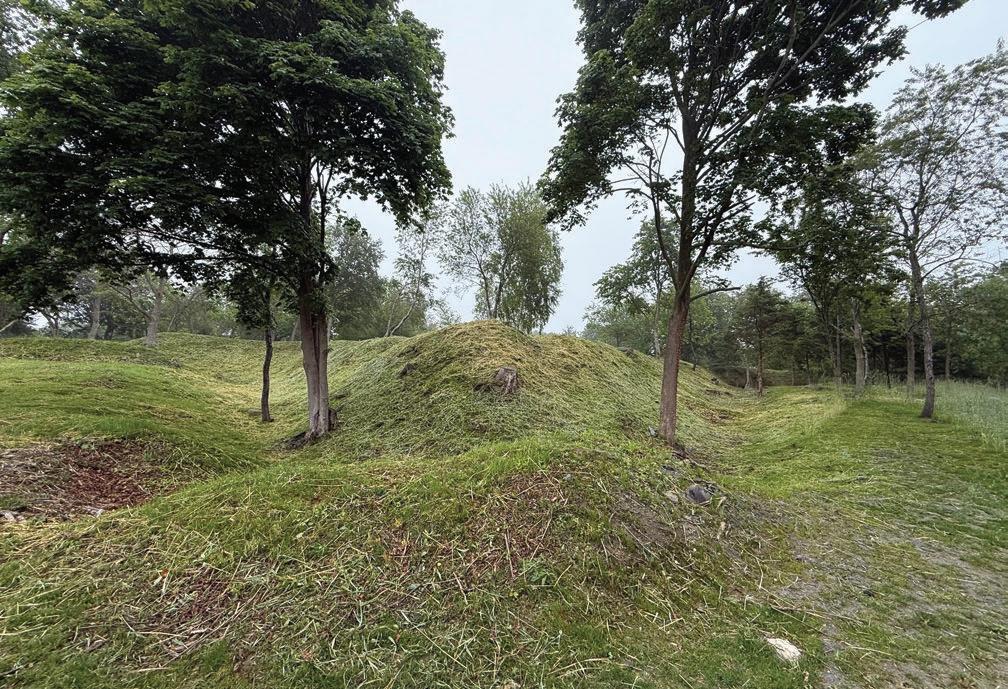
Holbrook and the other “six months men” were annexed to the First Rhode Island Regiment of Continentals, the Black Regiment . 99 Lieutenant Colonel Samuel Ward of the First Rhode Island, who had led the regiment’s courageous defense at the Battle of Rhode Island, signed Holbrook’s July 11, 1780 enlistment, making the enlistment official The Black Regiment, which now included the “six months men,” spent most of what turned out to be a five-month stint in the town of Portsmouth on Aquidneck Island, fixing up Fort Butts Hill, Howland Ferry fortifications, and other defensive posts, as well as standing ready to defend the island in case of an invasion by the enemy 100 To improve their fighting skills, Holbrook and the other soldiers and officers of the First Rhode Island also engaged in two mock battles in northern Aquidneck Island, with the First Rhode Island and some French troops performing as the defenders, and some other French troops pretending they were British invaders . 101 Felix likely completed his term with this battalion in late November 1780 102
It is noteworthy that Holbrook did not enlist in the First Rhode Island Regiment of Continentals for a term of three years in June 1778 . He also did not reenlist for three years in the Rhode Island Regiment (as it was renamed) in early 1781, as did some “six months” men of color; these men wound up marching to the Hudson Highlands in New York, to Yorktown, Virginia, and to Philadelphia, Pennsylvania 103 Instead, Holbrook enlisted for relatively short terms in two different regiments that were posted within Rhode Island . After the Battle of Rhode Island, he did not engage in further combat and he avoided death by disease, a common fate of ordinary soldiers
At war’s end, Holbrook remained in Providence . The organizational skills he honed in prewar legislative lobbying campaigns in Massachusetts must have been appreciated by Black leaders in Providence . In 1789 Holbrook was one of ten men who founded Providence’s Free African Union Society . 104 The Free African Union Society became a mutual benefit aid society, with members paying dues; the organization created a fund that could be used for members who were in need of financial assistance (such as paying for funerals) 105 This was the first time Blacks in Providence had formed an organization to promote the Black community . As historian CJ Martin
wrote about the ten Black founders in his book, The Precious Birthright , “The first leadership class in Providence’s Black Community had etched their names into posterity . ”106
While Holbrook may have moved to the maritime port of Providence to have more employment opportunities, he experienced financial difficulties at this time Rhode Island’s post-war economy was poor 107 Most Blacks in Rhode Island were free by 1790, as reflected in the 1790 census, but they remained the victims of prejudice based on their race . Black people were segregated in churches, kept out of schools, and denied employment for many types of jobs . Veterans did not receive financial assistance from the state of Rhode Island unless they were disabled during the war The federal government did not begin to pay pensions for indigent veterans until 1818 . 108
While he experienced difficult financial circumstances, Felix Holbrook came to the attention of the Providence town council Town councils throughout Rhode Island and the rest of New England engaged in “warning out” town residents who came from elsewhere and who did not own real estate in the town because such persons were at risk of becoming a public charge . In colonial times and throughout the remainder of the eighteenth century, there was little in the way of a public welfare system in Rhode Island People in need of assistance might receive a few handouts from the town council In Providence, there was at least a small poorhouse Taxpayers were loath to fund such handouts and facilities, especially for people who were not originally from their towns . Accordingly, town councils were charged with identifying so-called “transients” who were at risk of becoming public charges and ordering them to leave town and return to their original towns of residence While transients of all creeds and colors were warned out, too often the practice was imposed on people of color . 109
The Providence town council called in Holbrook for an interview on April 5, 1790 . The minutes of this meeting provide the following:
Felix Holbrook being before this Council for examination saith that he was born in Africa, that about 40 years since he came to America & landed at Boston & was sold to Mr Abiah Holbrook of said Boston, with whom he lived upwards of 25 years, then came to this town where he has resided ever since . 110
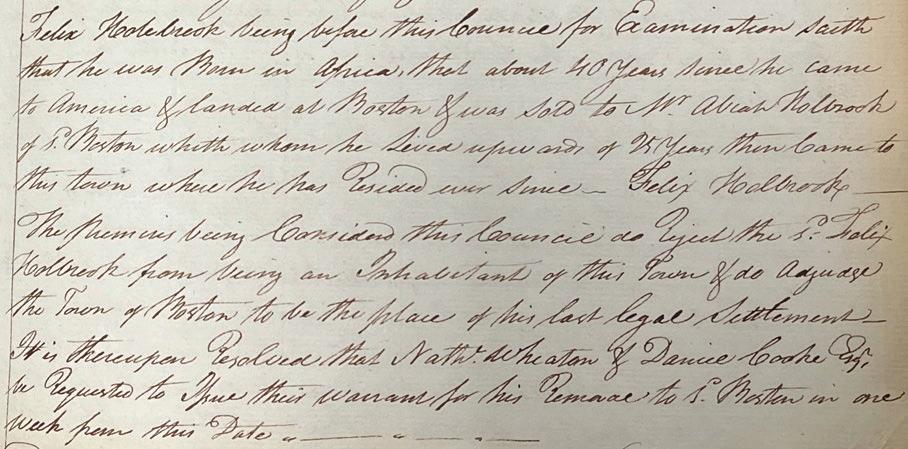
This excerpt from the Providence Town Council Meeting Records shows the results of the Town Council’s interview with Felix Holbrook at the beginning of the “warning out” process. Entry for April 5, 1790, PROVIDENCE CITY ARCHIVES, PROVIDENCE TOWN COUNCIL MEETING RECORDS, VOL. 6, P. 111.
Holbrook’s testimony was enough for the town council . It found that Holbrook was not a legal inhabitant of Providence and that Boston was his last legal place of residence
The Town Council ordered that a warrant be issued requiring Holbrook’s removal to Boston within a week 111 The warrant was issued later the same day . The warrant required Holbrook to be removed to North Providence (a town just north of Providence) and then from town-to-town until he could be left with Boston’s Overseers of the Poor . 112 Despite his oneand-a-half years serving in Rhode Island regiments during the Revolutionary War and fighting in the Battle of Rhode Island, Felix Holbrook was summarily banished from the state .
Holbrook may have been able to remain in North Providence for some time . When the first United States census was taken in 1790, he was recorded as a resident of that town He is the only person listed in his household His wife, Lussana, was apparently not living with him
The two may have separated or she might have died The household of another Black man, Bristol Nightingale, is listed immediately before Felix Holbrook in the 1790 census indicating that the two were neighbors in North Providence . Nightingale headed a household of seven people of color, likely Blacks, but not stated 113
Eventually, Felix Holbrook was taken to Boston where his financial difficulties continued . On August 16, 1792, the Boston Overseers of the Poor admitted “Felix Holbook…
a Black” to the Boston almshouse . 114 The Almshouse, a large, two-story building constructed in 1686 for the relief of Boston’s poor, was located at the junction of Beacon and Park Streets across from the northeast corner of Boston Common, a short walk from where Felix was once enslaved The Almshouse was notoriously overcrowded . According to a 1790 report, prior to the war it held not more than 180 poor people in the winter and 120 in the summer, but in the summer of 1790 the Almshouse had more than 280 residents and likely would need to hold “between…300 and 400” that winter The report also described the Almshouse as “foul” and “disease-ridden ” 115 After his admission to the Almshouse, Holbrook disappears from the surviving records . He may have died within a year or two of entering the almshouse, likely of disease . 116
Before the Revolutionary War began, Holbrook and other Black antislavery workers demonstrated to the white Patriots in power that they were willing to advocate for their own freedom within the existing political structure and using the Patriot rhetoric of the era . As historian Grant Stanton has observed, “Of the thousands of petitions presented to the Massachusetts government between 1773 and 1777, only the freedom petitions,” submitted by Holbrook and other Black antislavery agitators, “were printed in and supported by the leading patriot newspapers and embedded within the most popular patriot pamphlets of the day . ”117 Holbrook’s
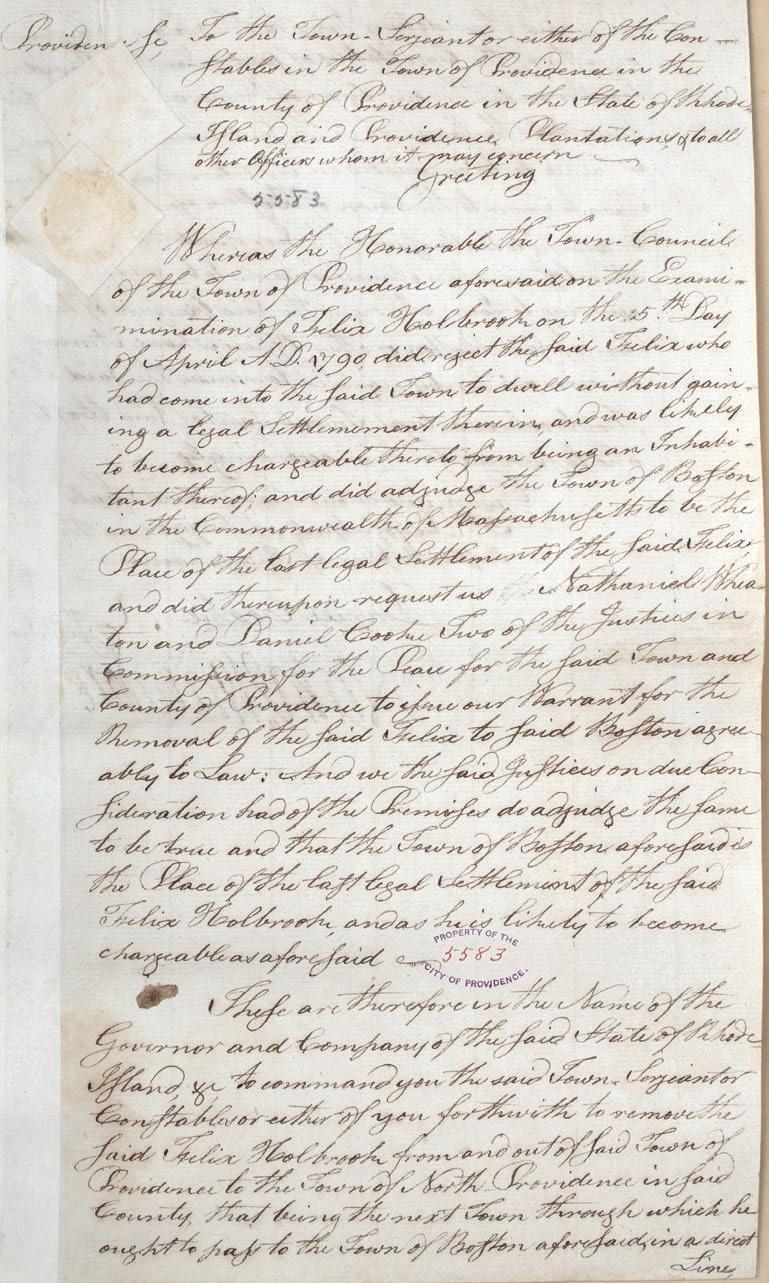
The first page of a two-page Warrant for the Removal of Felix Holbrook issued by the Providence Town Council on April 5, 1790. RHODE ISLAND HISTORICAL SOCIETY, PROVIDENCE TOWN PAPERS, VOL. 13, P. 70, RHI X17 5166A.
antislavery activism did not result in the abolition of slavery and the African slave trade at a single blow . It took time and all efforts counted . Eventually, abolitionists succeeded . Massachusetts banned slavery in its 1780 state constitution (as interpreted by Massachusetts judges) and Rhode Island enacted a law in 1784 that gradually ended slavery in the state 118
Felix Holbrook served two tours of duty in two Rhode Island regiments for a total of thirteen months . His motives for joining the American army during the Revolutionary War are not known . Many new recruits who enlisted sought the promise of a steady paycheck, and Holbrook may have been driven by the same desire Regardless of his motivations, by entering military service in the two Rhode Island regiments, he had joined the fight for the independence of his country the new United States from Great Britain . He fought when it really counted in our country’s history in the existential fight to become a free nation He did this knowing that his country continued to countenance slavery and that prejudice against Black people was widespread Perhaps he hoped that by taking up arms for the Patriot cause, after the war whites would agree to abolish slavery and treat Black people as full citizens .
Felix Holbrook experienced many hardships in his life As a child he was taken from his family in Africa, forced to travel to the African coast, sold to a slave ship captain, and carried across the dreaded Middle Passage to Boston, where he was purchased by Abiah Holbrook He endured about twentyfive years of enslavement After serving in a Rhode Island regiment in the Revolutionary War, Felix moved to Providence where he participated in the founding of a leading organization to benefit the Black community there . However, Felix suffered financial distress and was banished from Rhode Island . He may have died in an overcrowded Boston almshouse . Despite the obstacles and challenges that Felix Holbrook faced, he accomplished much in his lifetime Although enslaved as a boy, he became literate . Using this precious skill, while likely still enslaved, he was the main organizer and leader for Massachusetts antislavery legislative efforts in 1773 and 1774 . He served as the driving force behind multiple petitions as well as a circular letter to legislators requesting passage of antislavery legislation He was among the earliest abolitionist organizers in the thirteen colonies of any race Holbrook’s prewar antislavery activism, his military service in the war and his contribution to the establishment of a Black mutual aid society in Providence in the postwar era are indicative of a man who felt impelled to work for justice and freedom His life work in the Revolutionary era must be remembered and celebrated
I thank the following scholars for their assistance with this article: Mary Blauss Edwards for providing me with Hollis Street Church records, and Jared Ross Hardesty for sharing a link to Abiah Holbrook’s will and house deed. q
Christian McBurney is the author of numerous books on the American Revolutionary War and on Rhode Island (some individual books cover both topics). He is also the editor and publisher of the Rhode Island history blog at smallstatebighistory.com.
1 Two articles have a decent amount of information about Felix Holbrook, but they do not contain the level of detail about his antislavery efforts, military service and life that appear in this article. See Grant Stanton, “The Freedom Petitions: Black Patriotism, Black Politics, and the Abolition of Slavery in Massachusetts, 1773-1783,” Early American Studies: An Interdisciplinary Journal 22 (Spring 2024): 269–77; Chernoh M. Sesay, Jr., “The Revolutionary Black Roots of Slavery’s Abolition in Massachusetts,” The New England Quarterly 87 (March 2014): 99-131. Stanton has the most complete and accurate discussion about the 1773 and 1774 petitions submitted by Holbrook and his three colleagues. See also Mary Blauss Edwards, “1773 Pembroke Letter Supporting Massachusetts Abolition,” Hanson Historical Society, Jan.2017, 16, https://hansonhistoricalsociety.wordpress.com/2017/01/16/object-of-the-month-january-2017-1773-pembrokeletter-supporting-massachusetts-abolition/, accessed June 17, 2025. Daniel M. Popek mentioned that Felix Holbrook enlisted in Colonel John Topham’s state regiment in 1778 and in the Continental line in 1780.
See his They “… fought bravely, but were unfortunate”: The True Story of Rhode Island’s “Black Regiment” and the Failure of Segregation in Rhode Island’s Continental Line, 1777-1783 (Bloomington, Ind.: AuthorHouse, 2015), 199, 323 and 686. Popek did not mention Holbrook’s role as an abolitionist in colonial Massachusetts, and this article delves into greater detail about Holbrook’s military service than does Popek’s book.
2 See Christian McBurney, “The First Efforts to Limit the African Slave Trade Arise in the American Revolution: Part 1 of 3, The New England Colonies,” Sept. 14, 2020, Journal of the American Revolution, https://allthingsliberty. com/2020/09/the-first-efforts-to-limit-the-african-slave-trade-arise-in-the-american-revolution-part-1-of-3-the-newengland-colonies/; Christian McBurney, Dark Voyage: An American Privateer’s War on Britain’s African Slave Trade (Yardley, Pa.: Westholme, 2022), 16-19; Edward J. Larson, American Inheritance: Liberty and Slavery in the Birth of a Nation, 1765-1795 (New York: W. W. Norton & Co., 2023), 31-93. For a summary of legislative efforts in Massachusetts to end the African slave trade and slavery there in the years from 1766 to 1775, see also George H. Moore, Notes on the History of Slavery in Massachusetts (New York, N.Y.: D. Appleton, 1866), 124-42; Lorenzo J. Greene, “Slave-Holding New England and Its Awakening,” The Journal of Negro History 13 (Oct. 1928): 527-30. For an excellent modern discussion of antislavery efforts in Revolutionary Massachusetts, see Stanton, “The Freedom Petitions,” 270-74, 277-84, and 293-94. Stanton adds, “By 1780 at least thirty-six towns across nearly every county in Massachusetts had voiced their opposition to slavery, or support for civil rights, when almost none had before.” Ibid., 301 and 157n.
3 W. E. B. DuBois, The Suppression of the African Slave Trade to the United States of America, 1638-1870 (New York: Longmans, Green, 1896), 84.
4 McBurney, Dark Voyage, 20-21.
5 See Christopher L. Brown, Moral Capital: Foundations of British Abolitionism (Chapel Hill, N.C.: University of North Carolina Press, 2006), 289.
6 Sesay, “Revolutionary Black Roots,” 100.
7 See Nicholas P. Wood, Let the Oppressed Go Free: Abolitionism in Colonial and Revolutionary America (Philadelphia: University of Pennsylvania Press, 2004), 117.
8 See Town Council Meeting Minutes, April 5, 1790, in Providence Town Council Meeting Records, 1787-1794, vol. 6, p. 111, Providence City Archives. For determining Holbrook’s age in 1750, I reviewed a 1780 list of Rhode Island soldiers and their background information. Roll of Recruits Mustered for the Rhode Island Line, July 1780, in Military Papers, Revolutionary War, vol. 9, 121-33, Rhode Island State Archives. One of the soldiers was Holbrook, whose age was provided as thirty-seven. If that is correct, he would have been around seven years old in 1750.
9 For more on Rhode Island’s slave trade, see Jay Coughtry, The Notorious Triangle: Rhode Island and the African Slave Trade, 1700-1807 (Philadelphia, Pa.: Temple University Press, 1981), passim; Sean M. Kelley, American Slavers: Merchants, Mariners, and the Transatlantic Commerce in Captives, 1644-1865 (New Haven, Ct.: Yale University Press, 2023), 38-39, 77-107, 152-175, 271-78, 309-12, 336 and 338; McBurney, Dark Voyage, 9-18 and 271-74.
10 See J. L. Bell, The Road to Concord: How Four Stolen Cannon Ignited the Revolutionary War (Yardley, Pa.: Westholme, 2016), 82-86.
11 For the location of the South Writing School in Boston Common, see, e.g., Boston Evening-Post, June 25, 1744; Boston Town Meeting Records, March 4, 1744, in A Report of the Record Commissioners of the City of Boston Concerning the Boston Town Records, 1742 to 1757 (Boston: Rockwell and Church, 1885), 16:46 (voting that “the South Writing School in the Common be enlarged to accommodate more students). For the location of the Holbrook house, see advertisements for the sale of the house in Boston Gazette, Oct. 14, 1771 and Columbian Centinel (Boston, Massachusetts), April 2, 1794. In the former advertisement, “The Dwelling House, Buildings, and Land . . situated at the bottom of the Common in Boston” were advertised for sale. In the latter advertisement, the property was described as having “a Mansion House, Out-Houses, and Garden, of excellent English fruit trees, on one of the most elegant spots in the town of Boston.” One modern author stated that the house faced “the Common on what is now Tremont Street, near Avery” Street. Ray Nash, “Abiah Holbrook and his ‘Writing Master’s Amusement,’” Harvard Library Bulletin, vol. VII (Winter, 1953): 88-104: quotation on p. 99. An earlier author placed nearby South Writing School “on the corner of West Street, on land then occupied by Colonnade Row on Tremont Street…” Arthur E. Brayley, Schools and Schoolboys of Old Boston: An Historical Chronicle of the Public Schools of Boston from 1636 to 1844…(Boston: L. P. Hager, 1894), 39.
12 Abiah earned £100 per year from 1750 to 1768. See Robert Francis Seybolt, The Public Schoolmasters of Colonial Boston (Boston: Harvard University Press, 1939), 22-23. See also Boston Town Meeting Records, May 16, 1758, in A Report of the Record Commissioners of the City of Boston Concerning the Boston Town Records, 1758 to 1769 (Boston: Rockwell and Church, 1886), vol. 17, 11; Boston Town Meeting June 12, 1759, in ibid., 26; Boston Town Meeting, May 13, 1760, in ibid., 46 ; Boston Town Meeting, May 10, 1763, in ibid., 96 ; Boston Town Meeting, May 15, 1764, in ibid., 114; Boston Town Meeting, May 14, 1765, in ibid., 142; Boston Town Meeting, May 8, 1768, in ibid., 212. The town meeting also approved Abiah’s £100 salary at these meetings. Ibid. The year 1745, when the South Writing School had 220 scholars, was the first time the Boston Town Meeting voted for an usher to assist Abiah. See Boston Town Meeting Records, March 5, 1745, in A Report of…the Boston Town Records, 1742 to 1757, 82.
13 Boston Evening-Post, Jan. 30, 1769. Harvard University today has dozens of splendid samples of penmanship works by Abiah and his students. Abiah Holbrook Papers, MS Sparks 10, Houghton Library, Harvard University.
14 Historian William M. Fowler, Jr. wrote that after attending Latin Grammar School, young John Hancock and other fellow students would walk down to the South Writing School and receive writing lessons from Abiah Holbrook for an hour. See William M. Fowler, The Baron of Beacon Hill: A Biography of John Hancock (Boston: Houghton Mifflin, 1980), 20. Fowler wrote colorfully of Abiah, “To Holbrook, handwriting was an art. If he had been born only a few centuries earlier he undoubtedly would have spent his lifetime in some remote monastery, illuminating manuscripts.” Ibid.
15 For New England’s Black population, see Lorenzo Greene, The Negro in Colonial New England, 1620-1776 (Port Washington, N.Y.: Kennikat Press, 1966), ch. 3. A census taken in 1774 reveals that Rhode Island had about 3,650 Black people out of a total population of about 60,000, or 6 percent of the population. See John R. Bartlett, ed., Census of the Inhabitants of the Colony of Rhode Island and Providence Plantations 1774 (Providence: Knowles, Anthony & Co., 1858), 239.
16 Greene, The Negro in Colonial New England, 84. Boston’s Black population apparently declined in the next quarter century. Ibid, 85. For an argument that Boston’s Black population was underreported, see Jared Ross Hardesty, Unfreedom: Slavery and Dependence in Eighteenth-Century Boston (New York: New York University Press, 2016), 23.
17 For more on slavery in Rhode Island as well as the rest of New England, see Joanne Pope Melish, Disowning Slavery, Gradual Emancipation and “Race” in New England, 1780-1860 (Ithaca, N.Y.: Cornell University Press, 1998), and John Wood Sweet, Bodies Politic: Negotiating Race in the American North, 1730-1830 (Baltimore, Md.: Johns Hopkins University Press, 2003).
18 See Hollis Street Church in Boston, Records of Admissions, Baptisms, Marriages and Deaths, 1732-1887, “Negroes” section, Transcribed by Robert J. Dunkle and Ann Smith Lainhart, The New England Historic Genealogical Society.
19 Felix signed two Rhode Island military papers in 1780. See Felix Holbrook enlistment and oath of engagement and Felix Holbrook receipt of bounty, July 11, 1780, Providence Town Papers, Aug. 1779-Jan. 1781, vol. 5, 93-94, R.I. Historical Society. He also signed a receipt of payment from Boston merchant Caleb Davis. Receipt of Payment by Felix Holbrook from Caleb Davis, 1772, in Caleb Davis’s Account Books 1771-1782, Ms N-1096, Caleb Davis Papers, Massachusetts Historical Society. Felix signed the receipt, writing his name beautifully. These are the only samples of his handwriting that have been found. No drafts of the 1773 or 1774 petitions and letters Felix worked on are known to exist. Felix’s signatures on the R. I. military papers are among the few signatures penned by soldiers of color who enlisted in R. I. regiments in the Revolutionary War; most signed with an “X” indicating that they were not literate.
20 See Abiah Holbrook Jr. gravesite photograph, Granary Burying Ground, Boston, Massachusetts. His birthdate is July 14, 1718 and date of death is January 27, 1769. See https://www.findagrave.com/memorial/21037243/abiahholbrook, accessed Sept. 25, 2025. Rebecca Burroughs Holbrook was born January 11, 1716 and died January 2, 1794, Ibid. Abiah and Rebecca married, Feb.13, 1745. See Boston Marriage Publications, 1741-59, vol. 4, at ancestry.com (accessed September 25, 2025).
21 Abiah Holbrook Jr. will, May 14, 1768, Suffolk County Probate Records, vol. 67, 189-90, Suffolk County, Massachusetts. In the will, Abiah stated that he was “of weak body but sound mind.”
22 Inventory of the Estate of Abiah Holbrook, late of Boston, deceased, May 11, 1769, ibid., vol. 68, 58.
23 See obituary at Boston Evening-Post, Jan. 30, 1769; book sale advertisements in Boston News-Letter, May 24, 1770 and Boston Gazette, June 12, 1769; property sale advertisements in Boston Gazette, Oct. 14, 1771 and Dec. 2, 1771. For Rebecca having rights to one-third of the Boston Common house, see Deed granting Rebecca Holbrook One-Third of Abiah Holbrook’s House, Sept. 20, 1771, Abiah Holbrook Will and Estate Records, Probate Records, Suffolk County, Massachusetts, AmericanAncestors.org, page 14382:16-17, https://www.americanancestors.org/ databases/suffolk-county-ma-probate-file-papers/image?volumeId=48699&pageName=14382:16&rId=69562579, accessed Dec. 8, 2025. Rebecca never sold the house; she still owned it at the time of her death. See real property advertisement, Columbian Centinel (Boston, Massachusetts), April 2, 1794.
24 See A Report of the Record Commissioners of the City of Boston Concerning the Boston Town Records, 1758 to 1769 (Boston: Rockwell and Church, 1887), vols. 18, 23 (1770), 55 (1771), 79 (1772), and 131 (1773). Forced out of Boston by the “cruel Hand of Tyranny,” Samuel tried to continue the writing school in Northampton, Mass., in June 1775 and in Hartford, Conn., in October 1775. See Samuel Holbrook advertisements for writing lessons, New England Chronicle [Cambridge, Mass.], June 22, 1775 and Connecticut Courant [Hartford], Oct. 23, 1775. In March 1780, he advertised providing lessons at his home in Boston because “the Writing-School in the common has been lately accidentally consumed by fire.” Samuel Holbrook advertisement for writing lessons, Independent Chronicle (Boston, Massachusetts), March 2, 1780.
25 See List of Debts of Abiah Holbrook, Feb. 15, 1771, Abiah Holbrook Will and Estate Records, Probate Records, Suffolk County, Massachusetts, AmericanAncestors.org, page 14382:13, https://www.americanancestors.org/ databases/suffolk-county-ma-probate-file-papers/image?volumeId=48699&pageName=14382:16&rId=69562576, accessed Dec. 8, 2025.
26 Receipt of Payment by Felix Holbrook from Caleb Davis, 1772, in Caleb Davis’s Account Books 1771-1782, Ms N-1096, Caleb Davis Papers, Massachusetts Historical Society.
27 See Vital Records of Scituate, Massachusetts, to the Year 1850, 2 vols. (Boston: New England Genealogical Society, 1909), 2: 53, 341. Felix’s name was misspelled “Fenix” in the first entry and “Fenex” in the second.
28 Ibid., vol. 1, 434 (two entries). For more on Caesar and Sarah, see Thomas W. Baldwin, Vital Records of Cohasset, Massachusetts, to the Year 1850 (Boston: Wright & Potter, 1916), 177, 181.
29 For both entries, see Hollis Street Church in Boston, Records of Admissions, Baptisms, Marriages and Deaths, 1732-1887, “Negroes” section, 276-77, Transcribed by Robert J. Dunkle and Ann Smith Lainhart, The New England Historic Genealogical Society. The second entry described Felix as “Felix negro servant of [the] widow Holbrook,” which indicated that Felix was enslaved.
Felix Holbrook: Massachusetts
30 House of Representatives Resolution, March 16, 1767, in Journal of the House of Representatives of Massachusetts, 1767 (Boston: Massachusetts Historical Society, 1974), vol. 43, pt. 2, 393. The bill also would have ended the importation of African captives into Massachusetts. Ibid.
31 See Moore, Notes on the History of Slavery in Massachusetts, 130-33; House of Representatives Resolutions, April 22 and 24, 1771, in Journal of the House of Representatives of Massachusetts, 1770-1771 (Boston: Massachusetts Historical Society, 1978), 47: 236, 240-42.
32 For example, from 1759 to 1772, Virginia’s House of Burgesses attempted to increase tariffs on imports of African captives with the goal of reducing them to a trickle, but under pressure from Bristol and Liverpool slave traders, the Board of Trade in London quashed the effort. See McBurney, Dark Voyage, 18.
33 Quoted in George W. Williams, History of the Negro Race in America from 1619 to 1880 (New York and London: G. P. Putnam’s Sons, 1882), 462. The petition was published in Massachusetts Spy, September 1, 1774.
34 See the full petition, plus at the end, “Signed, Felix,” at https://wwnorton.com/college/history/america7_brief/content/ multimedia/ch06/research_01a.htm. Accessed Feb. 10, 2025. A printed copy is held at the Boston Athenaeum and in the Plimpton Collection, Columbia University.
35 See House of Representatives Order, Jan. 28, 1773, in Journal of the House of Representatives of Massachusetts, 1772-1773 (Boston: Massachusetts Historical Society, 1980), vol. 49, 195.
36 See, e.g., House of Representatives Resolution, Feb. 2 and 3, and March 5, 1773, in ibid., 203, 208, and 287.
37 Swan’s pamphlet was titled A Dissuasion to Great Britain and the Colonies, from the Slave-Trade to Africa, Shewing the Injustice Thereof…(Boston: J. Greenleaf, 1773). Boston minister John Allen stated that the April 20, 1773 circular letter “accompanied with Mr. Swan’s Piece, entitled a Dissuasion to Great-Britian…were lately presented to the Gentlemen who are chosen Representatives for this Province.” Quoted in John Allen, An oration, upon the beauties of liberty, or the essential rights of Americans. Delivered at the Second Baptist-Church in Boston upon the Annual Thanksgiving, December 3d, 1772, fourth edition (Boston: E. Russell, 1773), 78. I found Allen’s quote in Nicholas P. Wood, Let the Oppressed Go Free, Abolitionism in Colonial and Revolutionary America (Philadelphia: University of Pennsylvania Press, 2025), 296, n. 35.
38 See printed letter held by the Massachusetts Historical Society, and a printed transcript of it, at https://www.masshist. org/database/viewer.php?item_id=443&img_step=1&mode=dual#page1. Accessed Feb. 10, 2025.
39 Ibid.
40 See Erik J. Chaput and Russell J. DeSimone, “‘Boasted Land of Freedom’: Rhode Island Black Leaders and the Early Black Convention Movement, 1830-1835,” The Online Review of Rhode Island History, https://smallstatebighistory. com/boasted-land-of-freedom-rhode-island-black-leaders-and-the-early-black-convention-movement-1830-1835/. Accessed Feb. 10, 2025. It was only in later decades that colonization efforts would be viewed as racist attempts to persuade Blacks to leave the United States for Africa.
41 See printed letter held by the Massachusetts Historical Society, with printed transcript, at https://www.masshist.org/ database/viewer.php?item_id=443&img_step=1&mode=dual#page1. Accessed Feb. 10, 2025.
42 It is not certain that all four of the signers to the petition were enslaved in 1773. Felix Holbrook was likely still enslaved in 1773. Based on a review of sources mainly accessible on ancestry.com, I determined the following about the other three men. Peter Bestes (“Bess”) appeared as one of seven men signing a 1777 antislavery petition and (as Peter Best) as a founding member of Boston’s African Lodge of Freemasons. See Gary B. Nash, Race and Revolution (Lanham, Md.: Rowman & Littlefield, 1990), 174. I found no indications that Sambo Freeman was enslaved. It was not uncommon for freedmen to change their last names from their enslaver’s name to Freeman. Ancestry.com records indicate that he married Eleanor Oxford in 1766, appeared as a freeman heading a household of seven in Holliston, Mass. in the 1790 federal census, and died at Hollister, Mass., in 1797. See records for Sambo Freeman, Massachusetts, https://www.ancestry.com/search/collections/61401/records/354829?tid=&pid=&queryId=7e031cf6-c8ea-4f959aae-b8b55ab0be7b&_phsrc=MeW121&_phstart=successSource. Accessed Sept. 30, 2025. Chester Joie (or Joy) died on Dec. 6, 1774 of consumption at the age of 39. His death record in the Wakefield, Mass. records described him as the “negro servant to Capt. Goodwin,” indicating that he was still enslaved. See Thomas W. Baldwin, ed., Vital Records of Wakefield, Massachusetts, to the Year 1850 (Boston, Mass.: Wright & Potter, 1912), 304. Apparently, at least two of the four men did not hail from Boston. For a bit more information about these three men, see Stanton, “The Freedom Petitions,” 280, n. 66.
43 See General Manuscripts Collection, H.90A.52, Rare Books Department, Boston Public Library.
44 See List of House Members from the Various Towns and Counties of Massachusetts (“List of House Members”), in Journal of the House of Representatives of Massachusetts, 1773-1774 (Boston: Massachusetts Historical Society, 1981), 50: 4.
45 See Enoch Lewis, ed., Friends’ Review; a Religious, Literary and Miscellaneous Journal (Philadelphia: J. Tatum, 1847), 823. This copy has apparently been lost or destroyed.
46 See List of House Members for sessions beginning May 26, 1773 and May 25, 1774, in Journal of the House, 50: 4.
47 Broadsides, SY1773 no.22, New-York Historical Society. The Library of Congress has an image of the circular letter. See https://www.loc.gov/resource/rbpe.03701600/. Accessed Feb. 10, 2025.
48 See Journal discussions, May 28, 1774, May 25-June 17, 1774 session, in Journal of the House, 50: 13. The List of House Members for this 1774 session, as well as for the 1773 session, indicates that Brunswick did not send a member for the opening of the session. See List of Members for sessions beginning May 26, 1773 and May 25, 1774, in ibid., 4.
49 The Pembroke instructions are quoted in Sesay, “Revolutionary Black Roots,” 115, and Mary Blauss Edwards, “1773 Pembroke Letter Supporting Massachusetts Abolition.”
50 Quoted in Emory Washburn, An Address Commemorative of the Part Taken by the Inhabitants of the Original Town of Leicester, in the Events of the Revolution (Boston: C. C. P. Moody, 1849), 43.
51 See ibid.; Moore, Notes on the History of Slavery in Massachusetts, 133-34. Salem also expressed support for ending importations of African captives. Ibid., 133. See also Stanton, “The Freedom Petitions,” 284 (including note 81).
52 House of Representatives Resolution, June 25, 1773, in Journal of the House, vol. 50, 85.
53 Petition for Freedom, June 1773, vol. 161.F, Jeremy Belknap Papers, microfilm edition, 11 reels (Boston, Massachusetts Historical Society, n.d.), reel 8. This excerpt was published by the Massachusetts Historical Society in Petition for Freedom, June 1773, in “Negro Petitions for Freedom,” Massachusetts Historical Society Collections, 5th Series, vol. 3 (1877), 432.
54 The June 1773 petition was reprinted in full in the Massachusetts Spy, July 29, 1773 and the New England Chronicle or Essex Gazette, Aug. 3, 1773.
55 Petition for Freedom, June 1774, in “Negro Petitions,” 434-35. Images of the original of the June 1774 petition and its transcription are on the website of the Massachusetts Historical Society, accessed March 24, 2024, at https://www.masshist.org/database/viewer.php?item_id=550 and https://www.masshist.org/database/viewer. php?item_id=550&img_step=1&mode=transcript.
56 House of Representatives Resolution, June 25, 1773, in Journal of the House, 50: 85.
57 House of Representatives Resolution, June 28, 1773, in ibid., 94.
58 Jonathan French, The Appendix: or, Some observations on the expediency of the petition of the Africans living in Boston, &c.: lately presented to the General Assembly of this province. To which is annexed, the petition referred to. Likewise, thoughts on slavery. With a useful extract from the Massachusetts Spy, of January 28, 1773, by way of an address to the members of the Assembly (Boston: E. Russell, 1773). A copy is held by the Boston Athenaeum (Tract B610, no. 13 and Tract C74, no. 2) and New-York Historical Society (ESTC W38290). A copy was advertised for sale in the February 4, 1773 edition of the Massachusetts Spy.
Felix Holbrook: Massachusetts Abolitionist Organizer and Rhode Island Soldier
59 John Allen, An oration, upon the beauties of liberty, or the essential rights of Americans. Delivered at the Second Baptist-Church in Boston upon the Annual Thanksgiving, December 3d, 1772, fourth edition (Boston: E. Russell, 1773). Original copies of the fourth edition are held by the John Carter Brown Library at Brown University and the American Antiquarian Society. It is also on microfilm in Early American Imprints, first series, no. 13018. For the timing of the release of the fourth edition, see Massachusetts Spy, May 5, 1773 (advertising fourth edition for sale). A fifth edition published in Hartford by Ebenezer Watson in 1774 also contained the antislavery appendix. See John M. Bumsted and Charles E. Clark, “New England’s Tom Paine: John Allen and the Spirit of Liberty,” The William and Mary Quarterly 21 (Oct. 1964): 561-70. The antislavery appendix to Allen’s pamphlet, which includes a copy of the April 20, 1773 letter, is printed in Stewart M. Robinson, The Political Thought of the Colonial Clergy: Words of the Declaration of Independence Foreseen in the Writings of Clergymen Prior to July 1776 (Privately Printed, 1956), 34-39. Boston printer Ezekiel Russell published both the French and Allen pamphlets. Perhaps Russell also set the type for, and printed, the April 20, 1773 circular letter. Or the publisher of the letter could have been Joseph Greenleaf, who published James Swan’s antislavery pamphlet that was distributed to House of Representative delegates with the letter.
For Allen’s pamphlet as one of the most popular in colonial America, see Steven Park, The Burning of His Majesty’s Schooner Gaspee: An Attack on Crown Rule before the Revolution (Yardley, Pa: Westholme, 2016), 90-92. Park measured the popularity of pamphlets by the number of times the pamphlet was printed in a separate edition and the number and towns in which the edition appeared. Bumsted and Clark in “New England’s Tom Paine,” claim that the Oration “proved to be one of the best-selling pamphlets of the pre-Revolutionary crisis, passing through seven editions in four cities between 1773 and 1775,” 561.
60 See Allen, An oration, upon the beauties of liberty, 568.
61 Massachusetts Spy, May 5, 1773, quoted in Sesay, “Revolutionary Black Roots,” 110.
62 For Pickering’s appointment, see House of Representatives Resolution, June 25, 1773, in Journal of the House, 50: 85.
63 Samuel Adams to John Pickering, January 8, 1774, in Harry Alonzo, ed., The Writings of Samuel Adams (New York, N.Y.: Putnam, 1907) 2: 78. The original of this letter is held by the N. Y. Public Library, Manuscripts and Archives Division, MssCol 20.
64 House of Representatives Resolution, January 26, 1774, in Journal of the House, 50: 104.
65 House of Representatives Resolution, March 2 and 3, 1774 in ibid., 221 and 224.
66 Journal of the House, March 4, 1774, in ibid., 226.
67 House of Representatives Resolution, March 7, 1774, in Journal of the House, in ibid., 237.
68 See McBurney, Dark Voyage, 16-19.
69 “See Petition for freedom (manuscript copy) to the Massachusetts Council and the House of Representatives, [13] January 1777,” Massachusetts Historical Society, Collections Online, https://www.masshist.org/database/557, accessed Jan. 22, 2026.
70 See Petition for Freedom, May 25, 1774, in “Negro Petitions for Freedom,” 432-33 and volume 161.F, Jeremy Belknap Papers, microfilm edition (Boston, Massachusetts Historical Society, n.d.), reel 8. For a discussion of this petition, see Thomas J. Davis, “Emancipation Rhetoric, Natural Rights, and Revolutionary New England: A Note on Four Black Petitions in Massachusetts, 1773-1777,” New England Quarterly 62 (June 1989): 248-263, 260-61; Sesay, “Revolutionary Black Roots,” 122-23.
71 See Jared Ross Hardesty, Unfreedom, 170-71; see also, Hardesty, Black Lives, Native Lands, White Worlds: A History of Slavery in New England (Amherst, Mass.: University of Massachusetts Press, 2019), 129-30.
72 House of Representatives Resolution, June 10 and June 16, 1774, in Journal of the House, vol. 50, May 25-June 17, 1774 session, 27 and 41.
73 Samuel Dexter to Rev. Dr. Jeremy Belknap, Feb. 26, 1795, quoted in Rev. Jeremy Belknap, “Queries Relating to Slavery in Massachusetts,” Massachusetts Historical Society Collections, 5th Series (Boston: The Society, 1877), 3:387.
74 Samuel Dexter to Rev. Dr. Jeremy Belknap, Feb. 26, 1795, quoted in “Queries Relating to Slavery in Massachusetts,” 387.
75 For more on Newton Prince’s efforts, see J. A. Bell, “Newton Prince: Civil Rights Lobbyist,” May 26, 2006, Boston 1775, at https://boston1775.blogspot.com/2006/05/newton-prince-civil-rights-lobbyist.html. Accessed Feb. 10, 2025.
76 Bell, The Road to Concord, 82-90.
77 See New England Chronicle or Essex Gazette, June 22, 1775 (Samuel Holbrook announces that after being driven out of Boston by the British, he is opening a school in Northampton); Connecticut Courant, Oct. 23, 1775 (Samuel Holbrook announces he has moved his school to Hartford).
78 See “Negro Petitions for Freedom,” 436-37. An original of this petition is in the Massachusetts Archives at volume 212, page 132. For a discussion of this petition, see Davis, “Emancipation Rhetoric,” 361-63.
79 See Shirley L. Green, Revolutionary Blacks, Discovering the Frank Brothers, Freeborn Men of Color, Soldiers of Independence (Yardley, Pa.: Westholme, 2023), 35-37.
80 Ibid., 29-37; Judith L. Van Buskirk, Standing in Their Own Light, African American Patriots in the American Revolution (Norman: University of Oklahoma Press, 2017), 53, 61-66.
81 See Greene, Revolutionary Blacks, 81-86; Robert A. Geake, with Lorén Spears, From Slaves to Soldiers, the 1st Rhode Island Regiment in the American Revolution (Yardley, Pa.: Westholme, 2016), 39-42; Buskirk, Standing in Their Own Light, chapter 3.
82 Muster Roll for Captain Christopher Dyer’s Company, Colonel John Topham’s Regiment, July 11, 1778, taken at Tiverton, Rhode Island, in Revolutionary War Rolls, 1775-1783, Rhode Island, M246, RG 93, Microfilm Roll 88, Folder 59, National Archives (hereafter “Rolls”).
83 See Bartlett, ed., Rhode Island 1774 Census; Mildred Chamberlin, ed., The Rhode Island 1777 Military Census (Baltimore: Genealogical Publishing Co., 1985).
84 See John U. Rees, “‘Negro, Mulatto, or Indian man slave[s]’: African Americans in the Rhode Island Regiments, 1775-1783,” April 15, 2024, updated Oct. 15, 2025, American Battlefield Trust, https://www.battlefields.org/learn/ articles/negro-mulatto-or-indian-man-slaves-african-americans-rhode-island-regiments-1775-1783 (describing a few companies in Continental regiments that had segregated companies, including two companies in the Rhode Island Regiment, the successor to the First Rhode Island and Second Rhode Island Regiments, but not mentioning Captain Dyer’s Company). Accessed Jan. 7, 2026.
85 Muster Roll for Captain Christopher Dyer’s Company, Colonel John Topham’s Regiment, July 11, 1778, taken at Tiverton, Rhode Island, in Rolls.
86 Ibid.
87 See Christian McBurney, The Rhode Island Campaign: The First French and American Operation of the Revolutionary War (Yardley: Westholme, Pa.: 2012), 100, 112, 132-48, 155-64, 170-75, 187-95, and 196-205. The two casualties during the Battle of Rhode Island in Colonel Topham’s Regiment were Joseph Button, who lost his left leg and part of his thigh in the combat, and James Austin, who was wounded by a cannonball. See Military Papers, Revolutionary War, vol. 9, R. I. State Archives; James Austin Revolutionary War Pension Application, Rhode Island, National Archives.
88 Rolls, September 13, 1778, Tiverton.
89 See Rolls, Oct. 17, 1778, Nov. 10, 1778, Dec. 6, 1778, Jan. 17, 1779, and Feb. 20, 1779.
90 See Rolls, June 6, 1779. This roll lists 19 soldiers, down from 43 reported in the February 20, 1779 roll.
91 See General Assembly Resolutions, June and July 1780 Session, in John R. Bartlett, ed., Records of the State of Rhode Island and Providence Plantations in New England (Providence: Alfred Anthony, 1864), 9:101-105, 126, and 175-78.
92 See Christian McBurney, Spies in Revolutionary Rhode Island (Charleston, S.C.: History Press, 2014), 80-96.
Felix Holbrook: Massachusetts Abolitionist Organizer and Rhode Island
93 See Felix Holbrook enlistment and oath of engagement, and Felix Holbrook receipt of bounty, July 11, 1780, Providence Town Papers, Aug. 1779-Jan. 1781, vol. 5, pp. 93-94, R. I. Historical Society. On Bowler as a British spy, see McBurney, Spies in Revolutionary Rhode Island, 55-61.
94 See General Assembly Resolution, July 1780 Session, in Bartlett, ed., Records of R.I., 9:126. See also William Heath to George Washington, July 23, 1780, in Heath Papers, Massachusetts Historical Society (“The motive for [the General Assembly] making the disposition proposed is the much greater ease in obtaining the recruits if to be formed by themselves, as many are averse to being incorporated with the blacks”).
95 Roll of Recruits Mustered for the Rhode Island Line, July 1780, in Military Papers, Revolutionary War, Vol. 9: 121-33, R. I. State Archives.
96 The information on Holbrook and the other 65 soldiers of color who were “six months men” is in Roll of Recruits Mustered for the Rhode Island Line, July 1780, in Military Papers, Revolutionary War, vol. 9:121-33, R. I. State Archives.
97 See Felix Holbrook enlistment and oath of engagement, and Felix Holbrook receipt of bounty, July 11, 1780, Providence Town Papers, Aug. 1779-Jan. 1781, vol. 5, pp. 93-94, R. I. Historical Society. Felix and other recruits received another 15 “hard” dollars from the Town of Providence for enlisting. Town of Providence Hard Money Account, 1780, in ibid., p. 110.
98 See Inventory of the Estate of Abiah Holbrook, late of Boston, deceased, May 11, 1769, Suffolk County Probate Records, vol. 68, 58, Suffolk County, Massachusetts.
99 See General Assembly Resolution, Oct. 1780 Session, in Bartlett, ed., Records of R.I. 9: 318; General Assembly Resolution, July 1781 Session, in ibid., 445. In July 1780, General Washington called upon the state of Rhode Island for 630 able-bodied, effective men for three months’ service, and the General Assembly then ordered that number enlisted in the Continental Army. However, many fewer troops than 630 were enlisted and the term of service ended at six months. Ibid.
100 See Gloria Schmidt, “The Black Regiment at Butts Hill Fort,” at https://portsmouthhistorynotes.com/2022/02/02/ the-black-regiment-at-butts-hill-fort/. Accessed Feb.10, 20025.
101 See Gloria Schmidt, “I had Like to Have Forgot to Mention a Famous Sham Battle,” Oct. 25, 2024, The Online Review of Rhode Island History, https://smallstatebighistory.com/i-had-like-to-have-forgot-to-mention-a-famoussham-battle/. Accessed Feb. 10, 2025.
102 One of the few returns for the First Rhode Island Regiment that counted Felix Holbrook and the other “six months men” is Return of the First Rhode Island Regiment, July 29, 1780, Portsmouth (Rhode Island), in Military Returns, Revolutionary War, vol. 2, 99, R. I. State Archives. This return shows a total of 584 rank and file, 524 of whom were present and fit for duty. Around this time, without the “six months men,” the segregated First Rhode Island numbered about 115 rank and file.
103 List of the Non-Commissioned Officers and Privates in the Rhode Island Regiment, 1st of February 1781 with those who joined after that period specifying the Date and Term of Enlistment, Casualties, and Etc., Revolutionary War Military Records, Mss 673, Subgroup 2, Series 1, SS-A, Box 1, Folder 60, R. I. Historical Society. A total of about 45 men of color enlisted in the R .I. Regiment in December 1780 and January 1781, and several more did later in the year. Most of the enlistees were Black men, while others were Narragansetts and men of mixed race. Ibid.
104 Holbrook was listed as a signatory to a letter from the Providence Free African Union Society to the Newport African Union Society, dated September 22, 1789. His name was spelled as “Phillix Holbrook.” The letter is in The Book of Records of the African Union Society 1674B, 1787-1796, 26-28, Newport Historical Society. Founded in the 1780s, Newport’s Free African Union Society may have been the first all-Black mutual aid society in the United States.
105 See CJ Martin, The Precious Birthright, Black Leaders and the Fight to Vote in Antebellum Rhode Island (Amherst, Mass.: University of Massachusetts Press, 2024), 31-33 and 35.
106 Ibid., 32; see also Letter from the Providence Free African Union Society to the Newport Free African Union Society, September 22, 1789, in William H. Robinson, ed., The Proceedings of the Free African Union Society and the African Benevolent Society, Newport, Rhode Island, 1780-1824 (Providence: Urban League of Rhode Island, 1976), 26-27.
107 James B. Hedges, The Browns of Providence Plantations: Colonial Years (Cambridge, Mass: Harvard University Press, 1952), 287. Hedges wrote that the United States “slipped into the great depression of the 1780’s”; see also ibid., 287-314.
108 See, e.g., List of Invalids Resident in Rhode Island who have been Disabled in the Service of the United States during the Late War…Who Receive a Pension under a Congressional Act Passed June 7, 1785, in Bartlett, ed., Records of R.I. 9, 162-67; Buskirk, Standing in Their Own Light, 189-93.
109 For more on the warning out system in Rhode Island, see Ruth Wallis Herndon, Unwelcome Americans: Living on the Margin in Early New England (Philadelphia: University of Pennsylvania Press, 2001), passim (relying mostly on Rhode Island records); Melish, Disowning Slavery, 122-30.
110 Town Council Meeting Minutes, April 5, 1790, in Providence Town Council Meeting Records, 1787-1794, vol.6, p. 111, Providence City Archives. When he enlisted in the Continental line in July 1780, it was recorded that Holbrook was born in Boston, his prior place of residence. His statement to the Providence Town Council in 1790 that he was born in Africa is more credible because it was key information in an official “warning out” proceeding.
111 Town Council Meeting Minutes, April 5, 1790, in Providence Town Council Meeting Records, 1787-1794, vol. 6, p. 111, Providence City Archives.
112 Removal of Felix Holbrook, April 5, 1790, in Providence Town Papers, Dec. 1789-Dec. 1790, vol. 13, pp. 70-71, R, I. Historical Society. The removal order required Holbrook to be moved to North Providence first, and then to Boston. Ibid. It is not known why the order required Holbrook to be sent to North Providence.
113 See Heads of Families at the First Census of the United States Taken in the Year 1790, Rhode Island (Bureau of the Census, 1908), 32
114 See Almshouse Admissions, August 16, 1792, in The Eighteenth-Century Records of the Boston Overseers of the Poor (Boston: Publications of the Colonial Society of Massachusetts, 2006), 69:476. Also, https://www.colonialsociety.org/node/3090#p476. Accessed Feb. 10, 2025.
115 Almshouse Committee Report to the Boston Town Meeting, 1790, quoted in Eric Nellis and Anne Decker Cecere, eds., The Eighteenth-Century Records of the Boston Overseers of the Poor (Boston: The Colonial Society of Massachusetts, 2006), 69. For the location of the Almshouse, as well as the Workhouse, at the northeast edge of Boston Common, see ibid., 59.
116 This was also the conclusion of historian Jay Coughtry. See Jay Coughtry, “Holbrook, Felix (ca. 1743–ca. 1794),” in Randall M. Miller and John D. Smith, eds., Dictionary of Afro-American Slavery (Westport, Ct.: Praeger, 1997), 336–37. Holbrook does not appear in Boston’s 1795 Almshouse records, which are more complete than those from 1790 to 1794.
117 Stanton, “The Freedom Petitions,” 267.
118 In its 1780 state constitution, Massachusetts included the phrase, “all men are born free and equal,” which was interpreted by Massachusetts courts as ending the institution of slavery. See Stanton, “The Freedom Petitions,” 301-02; Greene, The Negro in Colonial New England, 184. For Rhode Island’s gradual ending of slavery, see General Assembly, An Act for the Gradual Abolition of Slavery, Feb. 1784 Session, John R. Bartlett, ed., Records of the State of Rhode Island and Providence Plantations in New England, vol. 10 (Providence: Alfred Anthony, 1865), 7-8 and General Assembly, Amendment to the Act for the Gradual Abolition of Slavery, Oct. 1785 Session, in ibid., 132-33. For more on the complicated workings of the law, and revisions to it, see Melish, Disowning Slavery, 71-73 and chapter 3.
Felix Holbrook: Massachusetts
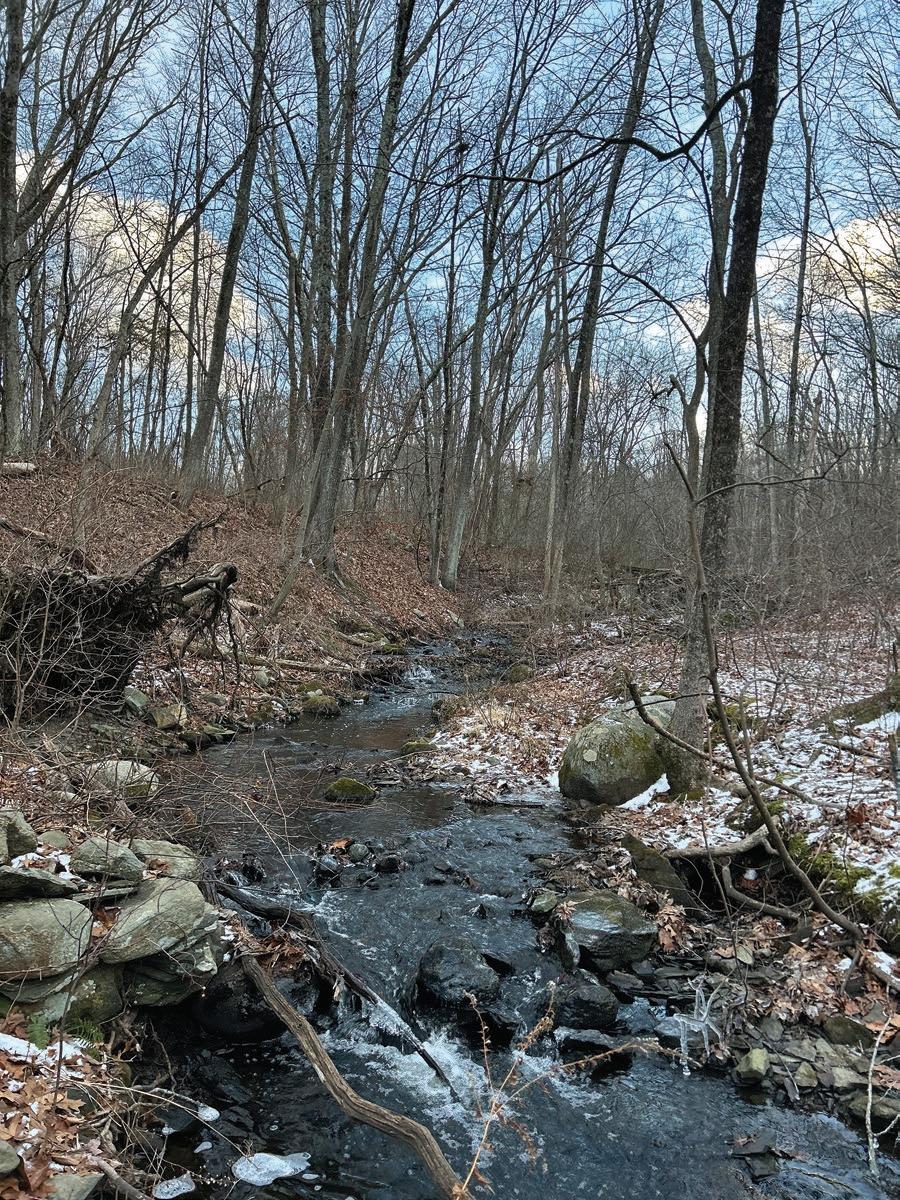
Allison Horrocks and Mark Mello q
Even in the dead of winter, the path we took in the woods of Lincoln, Rhode Island, to find a long-forgotten landmark along Mussey Brook was overgrown and difficult to follow More than two centuries ago, a colonist named Oziel Wilkinson (1744-1815) ran a forge along the brook, a meandering waterway that returns to the mighty Blackstone River, and from there, through bodies of water that eventually flow into the Atlantic Ocean . We did not expect to find any monument or marker, nor did we find one for the forge that was once in action along this otherwise unremarkable waterway . Nevertheless, we explored this area in pursuit of traces of the Wilkinson family’s story, seeking connection to people who lived in an age of revolutions .
Prior to settling in Lincoln, Wilkinson’s ancestors crossed the ocean to begin a new life in Providence as part of a wave of dissatisfied English migrants 1 In time, the Wilkinson family spread across northern Rhode Island, putting down roots and growing their reputation, some as members of The Religious Society of Friends (also known as Quakers), and others, as expert blacksmiths . By the late eighteenth century, Oziel and his wife Lydia Wilkinson (1746-1831) had a sizable homestead with a forge by the Mussey Brook in Lincoln These Wilkinsons worked, grew their family, and worshipped with Friends living nearby . Due to his moral conviction and fellowship with the local Quakers, Oziel Wilkinson would “not appear upon the Military rolls of that eventful period . ” 2 Instead, Oziel was found “in his shop,” making cannons, anchors, chains, and more, all for the war effort According to one descendent, he “served his country as well there” as on the battlefield 3 Following the war, Oziel and his son David Wilkinson (1771-1852) were important machinists, working among the first generation of innovators who turned small workshops into engines of industry that created a new system of manufacturing 4
As park rangers in the Blackstone River Valley, we are most accustomed to telling the story of what happened to people like the Wilkinsons after the War for Independence . Known as the birthplace of the American Industrial Revolution, the Blackstone Valley includes two dozen cities and towns in northern Rhode Island and central Massachusetts . 5 It encompasses the Blackstone River Watershed, from Worcester, Massachusetts, to Providence, Rhode Island Across this landscape, there are notable tributaries, and many small waterways that served an outsized role in the development of industry Given its importance as a place for water-powered industry, most histories of the Blackstone Valley mention the Revolutionary War in passing, and typically as prelude to the launch of textile mills in Pawtucket, Rhode Island in the 1790s
In the absence of an authoritative history on the Revolution in the Blackstone Valley, we began with the landscapes (both archival and geographical) that we knew well We consulted town histories, government records, and other aged primary sources . We followed passing references, such as mentions of small forges, and spent time in the woods, overgrown fields, tidy historic cemeteries, winding paths, and even a few steep hills, to discover the rest of the story . This approach was born out of necessity initially, we were not sure where to look
The Blackstone Valley does not boast a single Revolutionary battlefield, and it is home to only a few monuments to soldiers of the era, such as the Memorial to French Soldiers (or “French Monument”) located in North Burial Ground, Providence . Most people preparing for the semiquincentennial within and outside of our agency, the National Park Service (NPS), will gravitate to Revolutionary War military sites The Blackstone Valley is not likely to be at the top of their lists, but we knew there could be an
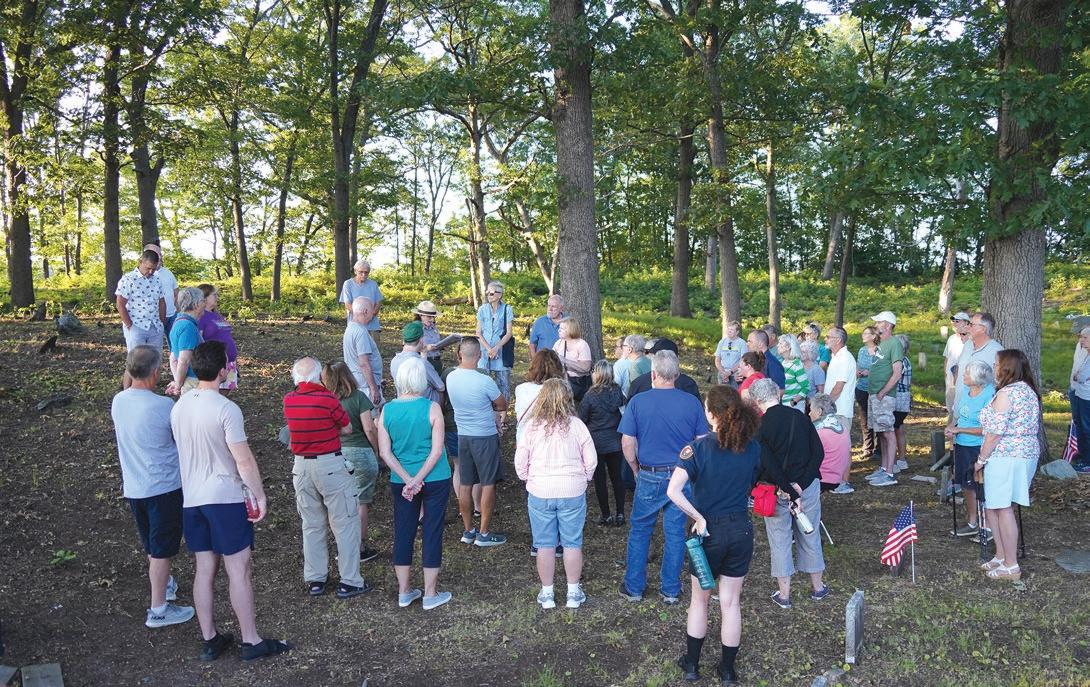
important story to tell for local audiences, even in the absence of a nationally renowned landmark . This meant interpreting colonial history broadly and opting to look for narratives not readily apparent in the wooded lots, post-industrial landscapes, and the residential sprawl of our communities
As we started to map out hyper-local social histories of the era, we treated the “colonial period” as more than a prologue to industry . To start, the very idea of the Blackstone Valley reflects the region’s colonial history . 6 The river that flows from Worcester, Massachusetts, to Providence, Rhode Island, and winds its way through a deep valley has given its residents life for thousands of years Most refer to the fortysix-mile river as the Blackstone, so named for the colonist William Blackstone . 7 That was not always the case . This river has been known by many names, including Nipmuc River, Pawtucket, and Kittacuck . 8 These words were first used by Indigenous people, and they have been revived in recent history by their descendants Yet, most simply call the river “the Blackstone,” and this, too, is part of our colonial history For the Wilkinsons and their neighbors, the colonists of the Revolutionary era, their families’ comparatively short tenure on the land of the Blackstone Valley did not diminish their sense of place, nor their claims to ownership . For them, the War for Independence was about their break from an empire Today, we look back and see the entrenchment of colonizers, and the start of a new empire 9
We tried to balance this awareness of imperial history with an effort to meet colonists on their own terms . This first meant finding the names and homes of local Patriots . Starting with military records, we saw that with large amounts of newly digitized sources, it was easier than ever to find basic information on people who served in the Revolutionary War Through muster rolls, town records, censuses, and pension files, we saw patterns revealing just how disruptive this war could be, even for people far from a battlefield . The colonists of the Blackstone Valley were typically removed from intense military action, but for some, the experience of serving in the war stayed with them for life In our first perusal of official records, we found lots of granular details and soon sensed that we were missing something about the general experience of living in the revolutionary age . This is where Benjamin Cowell, Esquire, came into our story .
Somewhere on his trek from Weybosset Street, in downtown Providence, and the steep incline of Catamint Hill in rural Cumberland, Judge Benjamin Cowell (1781-1860) must have doubted the wisdom of his plan to interview an elderly woman for her widow’s pension file This was not typically part of Cowell’s work of collecting names, dates, and stacks of paper, all to verify a soldier’s service from more than fifty years prior . Nonetheless, a middle-aged Cowell agreed to travel to see Hannah Whipple Emerson Tower, a ninety-twoyear-old widow, and to visit her first husband’s resting place . Nearly six decades earlier, Hannah married William Emerson during the War in the summer of 1778 Before and after the nuptials, Emerson “served a great deal at various times” in local companies led by Lieutenant Nathan C . Gould, Captain Levi Tower, and Captain Amos Whipple . 10
By Cowell’s 1830s visit, the site of the widow’s home was “hardly passable for a carriage” and so rough that Cowell resorted to walking But Cowell must have been determined to see where Hannah’s husband had been laid to rest in a “sacred spot” atop the great hill . 11 Emerson had been dead for years, and the grave itself proved nothing about his service . Yet it was here that Cowell saw something special, something that transcended the family plot As Hannah Tower spoke about her late husband, Cowell felt he had experienced “the true spirit of a Rhode Island wife in the days of the Revolution”— and that was a kind of evidence to him . 12
Hannah Tower sought a military pension for her husband late in life, and while she was among the oldest people Cowell met, she was not a singular case . The pension process for many was filled with long delays, and disappointments Granting pensions to disabled soldiers began as early as 1776 under the Continental Congress and was later assumed by the new U .S . government in 1789 after the signing of the Constitution . However, as Laurel Daen has shown, “few scholars have studied Revolutionary War invalid pensions” due to a problem in the source base: “[t]he vast majority of early federal invalid pension case files burned in fires at the War Department in 1800 and 1814 ” 13 More scholars focus on service pensions veterans sought after 1818, when Continental Line soldiers who served under George Washington could apply for a pension . 14 Two years
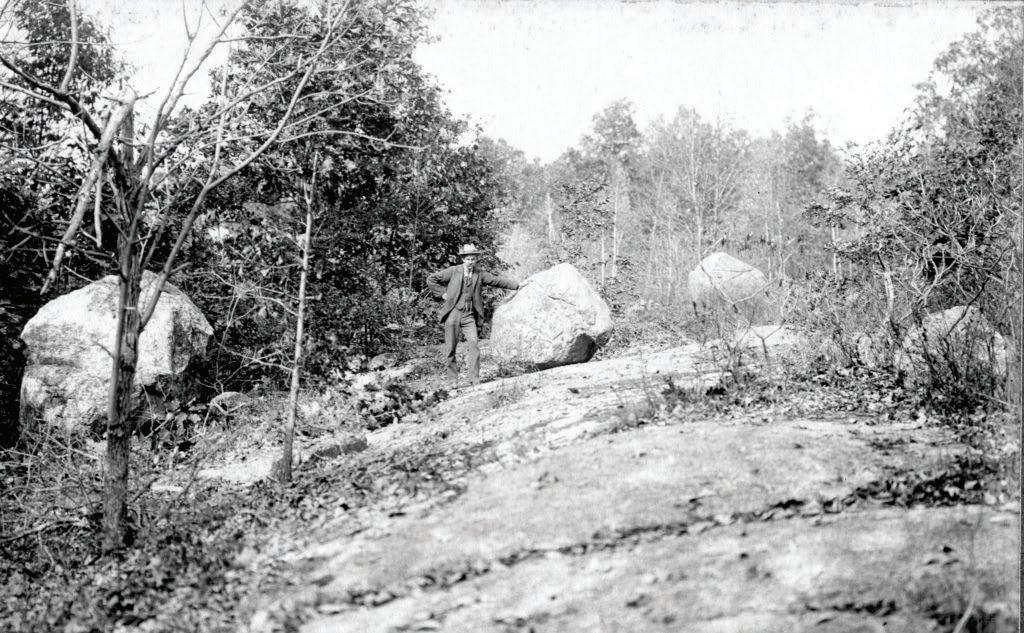
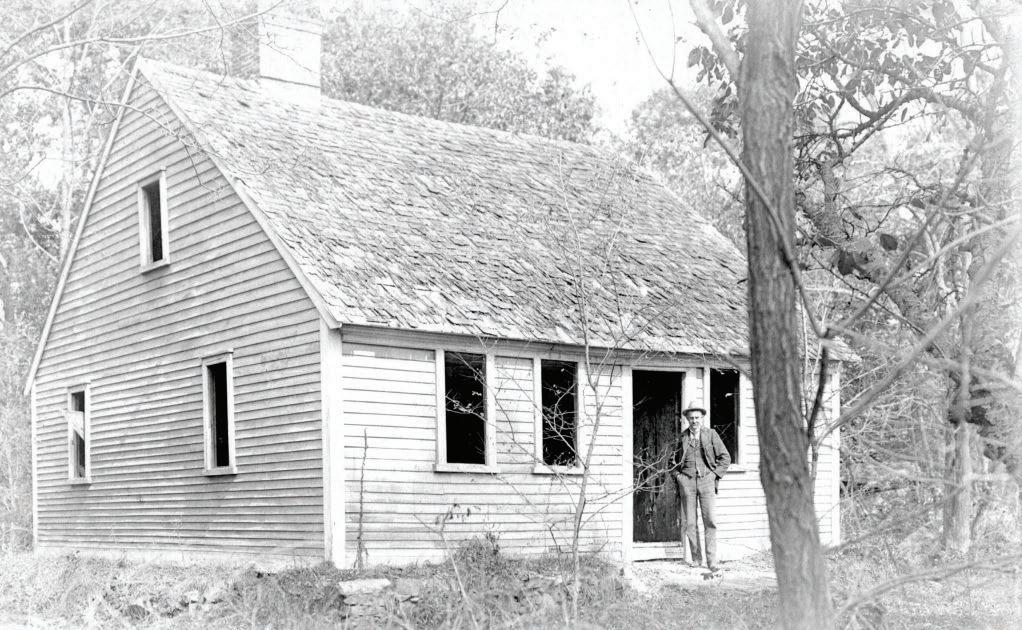
later, the Act of 1820 had a new provision: soldiers would have “to prove financial need . Applications list the veteran’s property and describe the state of health of everyone in the household . ”15 Over a decade later, two more Acts further expanded the scope of eligibility: the first paved the way for those with militia service to apply for a pension (1832) and the second afforded pensions to widows (1836) 16
Hannah Tower applied following the 1836 act; she did not send for Cowell or initiate the pension process because she wanted accolades . Spirited as she was, at the advanced age of ninety-two, what she wanted was financial compensation, even if it came more than half a century late In the 1830s, Cowell was one of the people who could make financial support a reality for former soldiers and their spouses in Rhode Island . He worked on “preparing and substantiating pension claims, which required extensive research and examination of old
muster rolls, marriage records, Bibles and gravestones[ ]”17 This was a legal process as well as a highly personal one, and Tower was just one of many widows and aged veterans with whom Cowell interacted while collecting pension applications . Stories of resilience like Hannah Tower’s made enough of an impact on Cowell that years later, he returned to the subject to write a book, The Spirit of ‘76 in Rhode Island 18
While pension files, including Hannah Tower’s, are easily available on the Library of Congress website, they can read as obtuse, and lacking humanity . They were not created to tell a life story . Such records were compiled to prove the value and worth of a soldier’s service so that a person, long removed from the war itself, could get meager compensation for wartime contribution 19 This is why we found Cowell’s book to be such an important companion to Revolutionary War veterans’ pension files . While The Spirit of ‘76 is not a
Excerpt from Hannah Tower Pension file. Note Benjamin Cowell’s signature near the bottom of the page. NATIONAL ARCHIVES REVOLUTIONARY WAR PENSION AND BOUNTY LAND WARRANT APPLICATION FILE W. 14,025, WILLIAM EMERSON, R.I. NAID: 54515594.
travelogue, it is also more than just lists of service records For us, the richest part was the section of sketches Cowell included to precede many pages of service lists . Cowell chose to dedicate time to narrative, and to provide a much-needed measure of humanity to what otherwise must have been a daunting and often disappointing process
In writing up this scene, Cowell did more than provide a financial path for Tower; he also shed light on an otherwise obscure and byzantine bureaucratic process . In his short narrative, we got a glimpse into the intangible “spirit” that is often elusive in the archives . 20 The encounter with Tower also provided a geographic data point; we could look on an old map of Cumberland, see the exact place where Hannah Tower paid tribute to her husband, and imagine the journey the lawyer took from the state’s capital to get there . Tower lived to see the rise of industry in the Valley, and her story was a reminder that we could not make an artificial distinction between the age of industry and the war that preceded it Hannah Tower was not a singular figure, either; in fact, she was one of many who shared deeply personal and distant testimony with Mr . Cowell .
Born on December 9, 1781, in Wrentham, Massachusetts, Benjamin Cowell was truly a product of the Revolution . Born just under three months after the British surrender at Yorktown, he was the eighth child of Major Samuel Cowell and his wife Jemima Metcalf Cowell His father Samuel’s military career was common for a militiaman of his era He served for short stints ranging from eleven days when he answered the call to march to Concord on April 19, 1775, to as long as five months during the Battle of Rhode Island . By the late spring of 1781, his military service was effectively over, and nine months later, he and his wife Jemima welcomed Benjamin into the world 21
Benjamin traveled away from his family home in Wrentham, attending Brown University in Providence, Rhode Island . After graduating with a law degree in 1803, he permanently settled in Providence . While establishing his legal career, Cowell became involved with the Greene Association, named in honor of General Nathanael Greene 22 This civic and quasi-militia organization held a yearly commemoration of their namesake in Providence on the anniversary of Greene’s birthday . 23 In 1814, the Association selected Cowell to provide
a public oration at the Second Congregational Meeting House in which he highlighted the military victories of the Continental Army under Greene’s command . 24 Even as a young man, his interest in the Revolution was sprouting
In January 1818, Cowell was “appointed U S District Clerk, in Rhode Island ” 25 In that same year, Cowell married Elizabeth Howell . Elizabeth, the granddaughter of David Howell, and daughter of Judge Jeremiah Howell, may have played a role in shaping Cowell’s career . 26 David Howell was a delegate to the Continental Congress and served as a prominent attorney in Rhode Island, rising to the rank of Attorney General Benjamin Cowell’s father-in-law, Jeremiah Howell, was in a state militia during the Revolutionary War; at war’s end, he was a U .S . Senator who became Chairman of the Committee on Pensions . 27 Perhaps it was not by chance that his son-in-law became involved in the pension process in Rhode Island
From 1818-1835, Benjamin Cowell was a Clerk of the United States Circuit and Federal Courts for the District of Rhode Island . In this role, he would handle hundreds of pension applications . Starting in October 1818, Cowell ran a
notice in the Rhode-Island American, and General Advertiser addressing “Revolutionary Officers and Soldiers” who applied under the pension act passed that year . Cowell advised that “as soon as their Certificates have been received from the War Department, or their applications returned,” a notice would come from his office Cowell acknowledged that a “great number of applications at the War Department [had] been stated as the cause of delay . ” 28
Cowell grew more involved in the pension process with time . In 1825, Cowell sought “relief” for “indigent officers” who served under Col . Archibald Crary (2nd Rhode Island Regiment) He was advocating on behalf of men like Thomas Shippey of Glocester, who served under Col Crary, and made a case for his need of a pension in 1821 . Shippey laid his personal inventory bare, down to the details of his “cracked skillet” and “old suit of clothes for self . ” After the war, Shippey, a “very infirm” farmer, could not rely on his children for support Already in debt, Shippey explained to a court of common pleas that he had “lately broken one of the bones in my arm which will probably render me a cripple all my days . ”29 Secretary of War John C . Calhoun rejected Cowell’s petition for the indigent officers, but applauded Cowell for his efforts “to administer relief to the unfortunate persons whose condition you describe with so much pathos[ ]”30 Calhoun advised him “to petition the next Congress ” 31 Cowell was
testing the limits of this early pension law by submitting files for men who did not serve on the Continental line . In his letter, Calhoun did not indicate that such men would never get compensation, just that Cowell ought to try again . Cowell never wrote down why he became so interested in the stories of the veterans of the Revolutionary War from his adopted state, but one would imagine his own father’s story played a role . Major Samuel Cowell served in Massachusetts, but his son focused on veterans from Rhode Island . Perhaps Cowell believed that Minutemen like his father had received enough credit for the war, while the individuals whom he worked with were often overlooked in favor of their fellow soldiers to the north and east Cowell claimed of Rhode Island that “[n]o state made greater sacrifices – no state furnished more men in proportion to population – none more money in proportion to its wealth .” If, as Cowell suggested, historians had only “rendered but partial justice to the efforts of Rhode Island during our Revolutionary struggle” then he attempted to set the record straight 32
Throughout the 1830s, Cowell represented numerous veterans including William Wilkinson of Scituate, and other survivors of the Rhode Island Brigade who were fighting for a Continental Line pension . 33 In 1832, Cowell placed advertisements with the Rhode-Island American and Providence Daily Advertiser Cowell was seeking appointments with local
“Applicants for Pension” appeared in the Rhode Island American on October 27, 1818. Benjamin Cowell placed similar notices in local newspapers to notify veterans of the pension application process.
“REVOLUTIONARY PENSIONERS” at “the District Court Room” in the Arcade, a building in Providence that still stands today . Pensioners interested in making an application were advised to bring “their declarations previously prepared, and agreeably to the regulations of the War Department” to Cowell 34 Many files included written testimony about a fellow soldier’s experiences or confirmation of a marriage Later, while writing The Spirit of ’76 in Rhode Island, Cowell must have realized that he was doing more than just compiling service records . At some point, Cowell became interested in interpreting the meaning of the war . This had as much to do with those who were left behind as those who served in local militias and the Continental line
“Their Sacrifices, their anxieties, their feelings and sufferings”
In his preface, Cowell reflected on the importance of women to the war effort He argued that the women who remained in Rhode Island while their menfolk served in the military, “not only performed all the necessary work in-doors, but much of the outdoor labor on the farms” as well . 35 Cowell drew this conclusion based on his time hearing women’s testimony . A historian, Cowell acknowledged, “could fill a volume with what we have been told by them of their efforts, their sacrifices, their anxieties, their feelings and sufferings, in the great struggle for Independence ”36 Notably, Cowell did not see himself as that historian . Cowell did not “fill” or write a complete book about women alone . But he did include sketches on Anna Aldrich, Hannah Tower, and Sarah Dyer, all widows from the Blackstone Valley who were extraordinary in terms of their longevity and the fact that they sought Federal widows’ pensions at the ages of eighty-nine, ninety-two, and ninety-three, respectively Pairing genealogical records with Cowell’s sketches, we sought to learn more about these women who lived long after the last musket in the war was fired .
Anna Mann (1749-1839) married Israel Aldrich in 1773, the year of the destruction of the tea in Boston Harbor They lived on a farm in what is today North Smithfield, Rhode Island Israel was a drummer who served under his brother, Captain Simeon Aldrich (1740-1821), as well as “Col . [Chad] Brown’s regiment & other companies[ . ]” 37
A fellow soldier recalled Aldrich’s service during “General Sullivan’s expedition…on the island of Rhode Island” as well as time in Bristol 38 After her husband’s death in
1813, Anna Mann Aldrich never remarried, a fact she mentioned in her petition for a pension . Cowell recounted her “Revolutionary history” and painted a picture of “zeal and perseverance which would do honor to a Roman matron ” Cowell was intent on praising the Revolutionary generation, but the details his book provide remind us of harsh realities, too Aldrich recalled that she had “carried her baby into the field” and kept the child “cradled…in the boughs of a tree, secured in a blanket[ .]” During the war, Aldrich “did the work on the farm generally whatever her husband would have done had he been at home . ” 39 She had to act as a stoic matron and farmer, managing a complex household with her two young children and community . Late in life, like Tower, Aldrich wanted recognition for her husband, on behalf of their seven children, and likely for herself, too . Upon her death, the widow was buried in an Aldrich plot in what is now North Smithfield . The woman who fattened up cattle for her family and market is buried near a popular beef sandwich restaurant on Industrial Drive, in a landscape that now has few surviving family farms
Similarly, Sarah Bishop Dyer (1744-1841) recalled taking to her family’s fields in Glocester while her husband Anthony (1743-1808) was absent . She found it difficult to do “men and women’s work” on their farm “at the same time, or on the same day ” Sarah married her husband in 1763 and was the mother of Anthony Dyer Jr (b 1765), Freelove Dyer (b 1769), and Elisha Dyer (b 1772) During the war, she raised three young children and took care of the family’s hay operation, “hoed and gathered in potatoes, and harvested corn,” while Anthony was part of Captain General’s Cavaliers, a small militia company . 40 Throughout much of 1776, Dyer’s unit was “on the Island of Rhode Island [i e , Aquidneck Island] ” Later that year, they spent five weeks closer to home on Tower Hill . 41
In the Dyer pension file, Sarah “declares that it is out of her power to give anything but a general specification of her husband’s services” as a soldier . When it came to dates, however, she knew that in 1777, “her husband was gone from home most, or at least a greater part of the time” as “she well remembers this from the circumstances ” She could recall the added burdens of each week, seeking local male help that could not be found, and all she did “in consequence of her husbands [sic] absence[ .]”42 Dyer outlived her husband by many years, hence the late-in-life pursuit of a pension Now they rest together, with an American flag they would not recognize planted between them in the Swan Point Cemetery in Providence .
About twelve miles north of Providence as Cowell scaled Catamint Hill in Cumberland, he seemed genuinely impressed by Hannah Emerson Tower, not just for the remote location of her husband’s grave, but for her devotion to safeguarding his legacy Hannah married William Emerson in July 1778, six months after the death of his first wife, Sarah Bartlett Emerson . Hannah recalled that her husband “did a great deal of military service .” While it was not within “her power to specify his services” she recalled “his bravery” well . In 1839, Cowell explained Hannah’s situation in a letter: “From what I have understood he [husband William Emerson] served a great deal at various times, but death has deprived her of the hard testimony she had reason to expect but only 2 or 3 witnesses are now living who served with him .” Nathan Streeter, age eighty-nine, remembered that Emerson had been an Ensign in 1778, and knew of his various periods of service in local militias 43
The pension file notes that William Emerson served with another Cumberland man, Captain Levi Tower (1742-1826) . This only hints at the connections between the Emersons and Towers . In addition to the shared military service between Levi and William, Hannah knew Levi Tower as her brotherin-law Levi Tower, a blacksmith was very active in town affairs; he married Hannah’s sister Mary Whipple (b 1745) in 1771 . Their youngest child, born in 1789, was named Emerson Tower, perhaps in honor of the man who had married Mary’s sister, Hannah, in 1778 . Mary Whipple Tower died after 1789 . Levi Tower married his sister-in-law, Hannah, William Emerson’s widow, in January 1817, four years after her husband’s death
Despite the decades that had passed, and a second marriage, Cowell saw that Hannah Emerson Tower still “tenderly respected” her previous husband, and “could never be persuaded to quit” his burial place atop the hill, a very small and isolated family plot 44 William Emerson died on what was to become Veteran’s Day, on the eleventh of November, in 1815 On Emerson’s stone, there is a simple, common poem reminding visitors: “Behold and see as you pass by, As you are now so once was I, As I am now so must you be, Prepare to die and follow me .” Hannah Emerson Tower outlived both of her husbands by many years She did not “prepare” to “follow” William and instead, held his memory close; it was this devotion that became immortalized in Cowell’s writings .
When he first started posting notices in newspapers seeking information about local soldiers, Cowell could not have known how long he would be studying veterans’ lives or how many intimate details he would be privy to over time In addition to the papers he compiled, Cowell came to know people through stories about second marriages, hard days of work, and babies crying in local fields . Through Cowell’s documentation, it was clear to us that in places like Catamint Hill, friends and family lived, suffered, worshipped, married, remarried, and died all in near proximity This changed how we saw the hills, swamps, and brooks of northern Cumberland, places best known today for the deposits of iron, in the earth Obviously, there was another story buried there, too, in spite of the fact that others had once surmised that Cumberland was “not too much affected by the American Revolution . ” 45 To better understand this generation, we knew we needed to
balance information about the hyper-local and familial level with information on how towns in the Blackstone Valley responded to the crisis of the war .
Banjamin Cowell grew up with a war veteran, and of course, he was not the only one seeking to bridge the gap between his generation and the one that preceded him . Although Cowell provided a type of first draft, town histories were a second draft, providing residents with a hyper-local narrative Town histories are easy to dismiss, but these provide rich starting points, for they often include names of otherwise forgotten people . They are also reminders of how ideas about colonial settlement became deeply engrained in the nineteenth century . For many of these authors, anything prior to their town’s creation was simply an extended prologue, a vague period of Indigenous ownership that had long since passed 46 Elizabeth Perry’s 1886 book, A Brief History of the Town of Glocester, Rhode Island , is typical of New England town histories from this era . Perry combines highlights of people she deems notable (“citizens of high personal worth”) and sparse descriptions of local or global events in a passive voice Perry also provides information on notable local soldiers, including Reuben Mason, a Glocester man who became a “surgeon in General William West’s brigade in the Revolution . ” 47 Like Cowell, who hesitated to tell the full story of women during the Revolution, Perry restrains herself from going into too much detail Those seeking full biographies of Glocester residents who lived during the war will be disappointed But one of Perry’s passing remarks is telling, and poignant: living only a few generations after the end of the war, Perry refers to life “before the Revolution” and “after the Revolution” it was the singular moment of disruption in Glocester’s history for this town historian .
Elizabeth Perry’s (at times dry) accounting of the events leading up to the war also serves as a reminder that those living prior to the nineteenth century had no such clarity . In one of Perry’s timelines, great contradictions spring up between ostensibly straightforward facts:
May 11, 1774, was set apart by the government as a day of fasting, humiliation, and prayer, the proclamation being issued by the Governor The day was generally appropriately observed
Mr Asa Kimball was appointed to take account of all arms, powder and ammunition in this town; and as there were private as well as public stocks, he was empowered to go to the house of each citizen in the town and there take the account 48
While fasting and apparently abiding by the Governor’s authority on the one hand, colonists were also taking stock of weapons . In the months and years to come, ammunition gathered by local towns would be used in their fight for independence .
Elizabeth Perry’s local history was also a product of the nation’s ongoing fervor for the centennial In 1876, Congress issued a charge for towns to commission “an historical sketch” of their local history . Taken altogether, these would make “a complete record…of the progress of our institutions during the first centennial of their existence” as part of the United States This occasion was the ideal “time for the gathering of scattered records of towns, counties, and States, into a permanent printed form . ” 49 For years to come, local towns continued to rely on ministers, historians, or local experts for accounts of their founding . In this genre, Thomas Steere’s History of the Town of Smithfield (1881) provides further background for understanding many other Blackstone Valley towns Steere’s work follows the pattern set by other local historians . 50 After a comprehensive overview of Roger Williams’s relations with Indigenous people, mention of Indigenous leaders or communities all but disappear, except in the form of place names 51 With non-Anglo actors out of the frame, Steere plows ahead with his topic of interest, examining how communities of colonists governed themselves prior to the Revolutionary War Steere also explains how local men prepared quotas of “fire arms” and got weapons into the hands of “captains of the foot companies” in local towns . 52
We found important details in Steere’s and Perry’s second “drafts” of history, but there were limits to these sources Despite finding some good leads for cemetery investigations and pensions to review, these books left us lost amid vague flourishes about patriotism and greatness . Researchers today can access far more history than Steere or Perry could have ever dreamed of with the click of a few keys . There are almost endless digital resources in the form of scanned files, such as state and federal pension and census records .
From these records, and Mildred Chamberlain’s tabulation of “Rhode Islanders in Military Service in Select Towns,” we worked to get a better picture of how many people served, seeking context beyond what these early historians could glean Chamberlain’s files show that hundreds of men, some 300 to 600, served in the military from the towns of Cumberland, Glocester, Providence, Scituate, and Smithfield Just over 8% of men enlisted in Cumberland; in Scituate, that number was less than 1%, and in Glocester, just over 1% . In Providence, 4% of men enlisted . In Smithfield, 3% of eligible men enlisted . 53 These numbers do not include the contributions of men such as Oziel Wilkinson, as well as the many women and children who labored on behalf of the war and aided in their own way . Cowell gave us tantalizing glimpses of humanity and lists of soldiers; town histories showed the deliberate steps individuals took and the ways people sacrificed to raise the funds and goods needed to wage war Steere, for example, recounted in addition to ongoing enlistments, men in Smithfield were handling a wide array of logistical challenges Some were involved in a “committee to purchase the town’s proportion of grain and beef, for the supply of the Commissary General .” Others were tasked with the “collection of blankets for the soldiers” or “bushels of corn for the army,” not just once, but over the course of several years 54 While town histories give us the short versions of these initiatives, these only hint at the personal exertions undertaken by many while some kept a running total of what towns sacrificed in goods and money for the war . Numbers provided us with data, but one of the cruelest aspects of war is the way statistics make human suffering a safe abstraction Whereas people in Newport, Rhode Island, endured the occupation of enemy forces, residents in Glocester and Cumberland were often far removed from the direct threats other colonists experienced . 55 It is difficult to know how much people feared imminent attack in the remote corners of Smithfield Even if, as Perry contended, such rural Rhode Islanders were partially seeking to aid their fellow colonists in their own defense, we wondered how much the fear of war hit home . Using the names we saw out in cemeteries and throughout the Valley, we looked for more material on the veterans themselves .
Nationwide, descendants of Patriots have documented their ancestors’ wartime contributions through records kept by the Sons of the American Revolution (SAR) and the Daughters of the American Revolution (DAR) . Federal pension files and records of descendant groups, such as the SAR and DAR, helped us round out some local histories In the case of Capt Levi Tower, for instance, a SAR application file provided an important, albeit brief resource on his time in the military . What surprised us was how much our work necessarily relied on retrospective reporting on one’s service . Distance from the actual events of the war should be expected in a DAR or SAR file complied by a descendant writing in the twentieth century But the long gap between one’s time of service and the opening of the pension process must not be forgotten, either .
The musician Asa Bartlett (1757-1839) of Cumberland sought a pension in old age, like many of his peers . During the Revolutionary War, Bartlett served in a local militia unit under the command of Colonel George Peck Although these militiamen never served on the Continental Line, the unit was repeatedly called into service for short stints from 1776 to 1779 during the British occupation of Newport, Rhode Island . Due to the irregular nature of his service, written records of Asa’s time in the military were essentially nonexistent In his pension application, a man testified to Bartlett’s service in the war, reporting: “I am well acquainted with Asa Bartlett, of said Cumberland, who was formerly a fifer . . .in the Revolutionary War . I believe said Asa belonged to it from the time said company was formed to the end of the war . ”56 The tentative language this veteran used to talk about Bartlett is not uncommon Still, his words, and the mere act of trying to document one’s service mattered in the pension process In lieu of careful wartime documentation, veterans often relied on comrades to provide testimony of their service during the war . 57 By the time Bartlett started this process, he was seventy-six years old . The work of gathering witnesses and proving basic facts about one’s life, including personal details, such as a marriage date, and details of one’s term of service, must have been daunting Thankfully, some could rely on their neighbors, who had also served in the military or who had witnessed individual service during the war .
A desire for recognition might have fueled some veterans, but the financial aspect must not be overlooked . Some men and their widows were driven to apply for a pension out of desperation . After the Act of 1820, men also needed to prove financial need to be eligible On October 5, 1824, Rufus Pendock (1763-1830), a resident of West Greenwich, Rhode Island, described his difficult situation, in court By this time, Pendock had been struggling “for the last five years,” and was “wholly dependent on charity for support .” Formerly a teacher, he was forced to quit his job when he became blind . Unable to even sign his own name by 1824, he “left his mark” with a simple “X” written beneath the scroll of the clerk 58 Originally from Smithfield, Pendock enlisted to serve on the frigate Providence in January 1778 . Shortly after his enlistment, the Providence set sail from Rhode Island with important dispatches for the French court . Blasting through the British blockade during the occupation of Newport, Pendock and his comrades damaged the HMS Lark and outran another vessel After completing the transatlantic voyage, Pendock remained in France for the remainder of 1778 59 Two months later, after a return voyage home, Pendock was honorably discharged from service after being on duty for “one year and seventeen days . ”60
His pension file documents Pendock’s struggle to support himself and his wife In his testimony before the court, Pendock described his dire circumstances Pendock “lived on charity, and should have applied for a pension long ago, if he had had anyone to assist him . ” 61 Benjamin Cowell paid the ailing Pendock a visit in April 1825 during the pension application process . In a letter now included in Pendock’s pension file, Cowell confessed “I never saw such poverty and wretchedness in my life ” 62 Pendock was certainly worthy of a pension and was finally awarded it forty-five long years after his service . His pension was paid twice a year in the amount of $38 .13 . It arrived late in life and while he was living with a disability, there is no way of knowing if Pendock believed it was enough Pendock died five years after his pension was granted 63 Much of Rufus Pendock’s life story has been lost to time and without this record, aspects of his service and his family history might have been forgotten entirely .
Other stories of better-documented individuals who also struggled for compensation provide additional context . One famous example is the captain of the Providence , Commodore Abraham Whipple (1733-1819), a man who knew Rufus Pendock He was a descendant of John Whipple,
an early inhabitant of Roger Williams’s Providence In his adolescence in Rhode Island, Abraham Whipple went on his first voyage as a cabin boy for a man who was most likely his uncle, Christopher Whipple . By his early twenties, Abraham was given command of his first ship 64 After a stint as a privateer during the French and Indian War (1754-1763), Whipple became deeply engaged in the turbulent events leading up to the War for Independence . During one of Rhode Island’s most notable incidents before the war, Whipple was one of the ringleaders in the Gaspee Affair . When war was finally declared, Whipple became one of the first captains in the Continental Navy He first commanded the Columbus, a 24-gun ship, in an expedition in the Bahamas He later captained the Providence, Ranger, and Queen Anne . He successfully led several missions both at home and abroad . Fortunes changed for Captain Whipple when his forces were captured on land while aiding in the siege of Charleston, South Carolina On Saturday, May 20, 1780, he formally signed an agreement which began: “I the subscriber Abraham Whipple, Commodore and Commander of the Continental Ship of War Providence , do hereby acknowledge myself a prisoner of War to his Majesty . ” 65 Subsequently, Whipple secured a parole and was allowed to leave Charleston for Chester, Pennsylvania in June 1780 The war was effectively over for Commodore Whipple
While in Chester, Whipple rented a sizeable residence for many of his colleagues and himself . He supported several men through illness whilst the Continental dollar’s value fell . In July 1780, Whipple sent an account of his wartime pay and expenses to Congress totaling £7,350 . 66 John Brown, secretary of the Admiralty Board, tersely responded to the request several days later: “The officers captured at Charleston have no right to expect anything more than their pay untill they are exchanged, by the resolution of the 20th March, 1778 . ” 67 The formerly well-standing Whipple was in debt, and he was not alone . As Sheldon Cohen states in his biography of Whipple, the captain had great debts and uncertainty, “the aspirations of many of its [Rhode Island] citizens would be thwarted during the first postwar years, and their confidence in the new republic would be tested .” The “new national government” did not have easy or quick responses to men in high or low places who had served in the American military and wanted their debts incurred in wartime repaid This fact could shake one’s belief in the early republic 68
In 1786 having left behind his seafaring life to settle as a farmer in Cranston, Whipple wrote to one of George Washington’s closest advisors, General Henry Knox, to petition Congress on his behalf . Whipple argued that “this honorable Assembly will feel [sympathetic] to the misfortunes of an old and faithful servant, and extend to him that relief which Justice and Humanity shall dictate to their benevolent and Enlightened minds on Occasion so interesting [important] to the welfare of himself and his family . ” 69 Finally, after much pleading, Whipple received a partial reimbursement from Congress . Unlike Pendock who waited decades to receive compensation from the government, the influential Whipple received aid just a few years after the war’s conclusion . Subsequently, Whipple was induced by the passage of the Northwest Ordinance to move west . He settled in the frontier community of Marietta, Ohio in August 1788, where he lived until he died on May 27, 1819 . He is buried in Mound Cemetery in Marietta
With his wealth, Whipple’s experience was not typical of others who served in the military because he was a prominent figure who had connections in the early government . But his experience nonetheless sheds light on very common problems experienced by others during and after the war . From the lowliest deckhands like Pendock to a Commodore in the Continental Navy, many veterans suffered financially because of their wartime service Pendock, Whipple, and thousands of others sought aid from the government they had fought to create, years or decades after their service was over . Ironically, their claims for reimbursement and support provide us with some of the best retrospective accounts of their lives during the war National databases and record groups, as well as pension files, and other records from groups such as the SAR, bring new voices into the historical record of the Revolution . Some of the conversations between these aged veterans and people like Cowell never made it onto pieces of paper . But the records they have left behind provide a link to the Revolutionary experience of many Rhode Islanders, and a world and people now lost to us
Aside from more traditional military sources, we have been surprised by how many stories we have found when we were not looking for them Cemeteries have proved invaluable in
our quest to better understand the impact of the Revolution because they challenge some of our preconceptions . One place we did not expect to find Revolutionary War history was in a Quaker cemetery 70 Quakers, also known as Friends, (like the Wilkinsons), have been historically regarded as pacifists, so we were surprised to find veterans’ honors for Sergeant Israel Arnold (1754-1840) in the Saylesville Friends Cemetery in Lincoln, while preparing to give a tour there . 71 Arnold’s small, worn stone includes his name, dates, and the words “BOWEN’S R I MIL REV WAR” across two lines Arnold was interred in a place once so full of people from his family that it was called “Arnoldia ” His great-grandfather, Eleazer Arnold, built a home that still stands near the cemetery, on the Great Road in Lincoln . It was Eleazer Arnold’s descendants who turned family land into a notable meeting place for Quakers . 72
Through the family’s SAR membership file, we were able to determine that Arnold was part of the Rhode Island militia and served in seasonal campaigns for several years . By the war’s end, Arnold achieved the rank of “Sergeant in Captain Day’s company, Col Jabez Bowen ” 73 Arnold’s pension file includes testimony from comrades and his own account . In 1835, at the age of eighty, he appeared in court to testify about his time as a solider in Providence, as well as when he was “stationed on the shores of the [Narragansett] Bay .” A teamster, Arnold was vague about timing (he could not “remember with certainty” when many of his short tours were) in part because he was “pretty much in the same places, I do not remember any difference[ .]” Arnold had recalled being paid but noted that he was “paid in continental money, a paper currency which greatly depreciated so much so that one occasion I remember of giving forty dollars for two pound of Sugar . ” 74
Many years after his service had ended, Arnold knew for certain that “he always went when it came to his turn & never hired any one to take his place as a substitute for him[ ]”75 This is notable phrasing for a Quaker, reinforcing that Arnold did not look to others to fill his place . At a time when other Quakers were admonished for serving, this decision ran counter to the values of many of his neighbors and loved ones . The example of General Nathanael Greene, who hailed from a local Quaker family, may have been enough to move Arnold to serve in the military 76 Unfortunately, Arnold’s pension file is more factual than reflective . From the
documents contained within the file, it remains difficult to determine if the desire to contribute and to travel throughout the state in service was entirely Arnold’s own . 77 Nor does the file shed light on the contributions of his wife, Deborah Olney Arnold
Israel married Deborah Olney near the start of the war in September 1775 78 They welcomed their first child, a boy named Israel, in 1776 . 79 He was followed by nine more children born between 1776 and 1798 . Deborah Arnold died following “a long and distressing illness” in January 1799 . 80 During Israel’s time in service, Deborah was home near the Great Road and occupied with the close care of young children for more than two decades 81 The National Register Nomination for the “Israel Arnold House” in Lincoln ignores the existence of Deborah entirely, only acknowledging that the house was originally owned by the Olney family, until it “passed by marriage into the Arnold family,” through its namesake Israel Arnold 82 The home was Deborah’s through lineage, and her domain by birthright after all, in life, she would have been associated with the stone hearth, and the labor needed to keep the wooden home warm . 83
Had Deborah Olney Arnold lived to give testimony for his pension file, she may have recalled her husband’s intermittent absences from 1776-1779 in greater detail If she had met Cowell, perhaps she would have also shared why her husband risked alienating his fellow Quakers by enlisting . 84 An American flag and a small grave marker from the SAR are planted next to Arnold’s marble gravestone in the Saylesville cemetery . It is unclear where Arnold’s first wife, Deborah, or his second wife, Catherine Jenckes Arnold (17751805) are buried, for no monument marks their resting place near Israel Arnold’s grave In general, Quakers in that era resisted “formal burial markers” and relied on ‘maps’ showing “family positions” on the landscape . 85 Arnold’s small marble gravestone is not unique in the Blackstone Valley; Walter Allen, who is buried in the Friends Cemetery in Woonsocket, has a similar veteran’s marker Even in a community where one might expect resistance to recognition for war service, first from the Patriot, and then from family members, it is clear that some people chose to document Quaker service during the American Revolution with grave markers .
Another story we unexpectedly stumbled upon was that of the Wilkinsons . The Wilkinson Mill (1810) in Pawtucket is part of the campus at Old Slater Mill National Historic Landmark, one of six sites that comprise Blackstone River Valley National Historical Park Completed nearly three decades after the end of the Revolutionary War, this three-and-a-half story stone structure on the banks of the Blackstone River was built by Oziel and his son David . 86 Here, the Wilkinsons ran an important machine shop, further developing their family’s well-established business in blacksmithing . 87 The Wilkinsons are not people who would typically be included in military histories Yet family history, once again, provides another dimension to our understanding of service in the Revolutionary War, this time in the form of a collective memoir .
In Israel Wilkinson’s Memoirs of the Wilkinson Family in America (1869), a descendant carefully documents his Quaker family’s contributions to the colonial period and beyond Israel notes that before Oziel brought his operations to Pawtucket in 1783, he ran a shop along Mussey Brook in present day Lincoln . From that shop, Oziel aided the war effort, manufacturing cannon barrels for the Continental
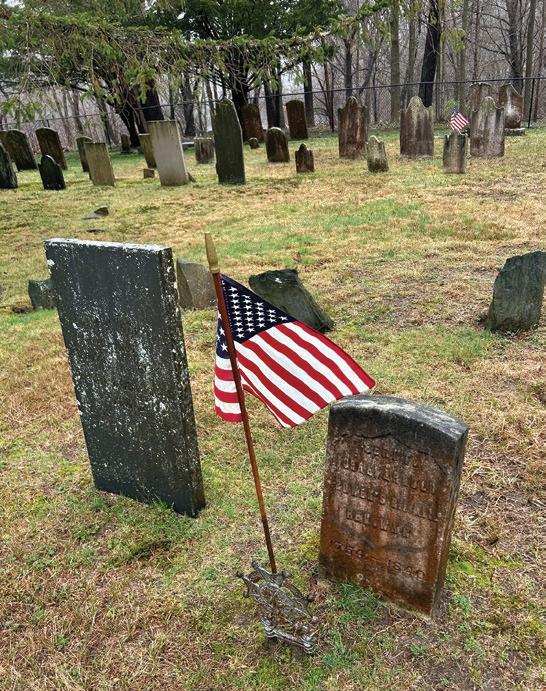
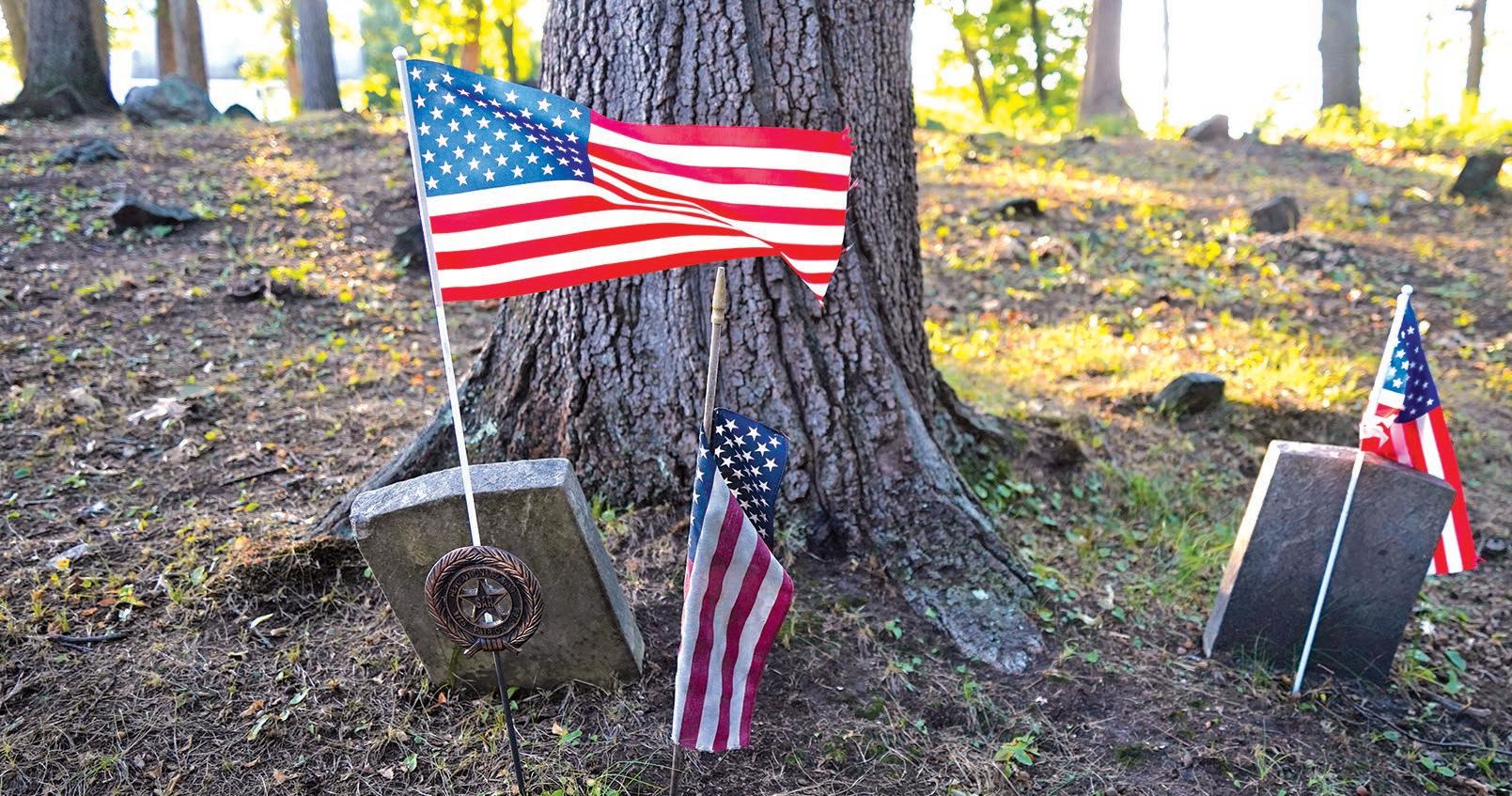
forces . The family biographer commented that Oziel and his cousin Israel “did not fire the cannon he cast them, and if he did not use carnal weapons he put no obstacles in the way of others using whatever was necessary to utterly destroy oppression and tyranny ” 88 If this type of service created conflict for the Wilkinsons during the war, Oziel did not document it, and Israel did not comment on it .
At times, researching the Revolutionary generation seemed to be taking us away from our primary focus, which has always been the rise of the Industrial Revolution However, the Wilkinson story reminded us just how important it was to study the years leading up to the opening of Slater Mill in 1793 . The circumstances of the war pushed blacksmiths and mechanics toward experimentation and domestic production . For example, Oziel experimented with cold cutting iron nails around 1775-1776 This work was most likely prompted by a scarcity of imported nails due to the growing conflict between the colonies and Great Britain The lack of British goods prompted colonial production, and domestic production spurred innovation . This would have long-ranging consequences past the war . Anthony Connors, author of Ingenious Machinists, asserts that “war with Great Britain provided the opportunity for inventive men to lend their talents to the revolutionary cause… The war and rise of industrialization reinforced each other . ”89
This time of inventiveness had a great effect on Oziel’s son, David . As the war raged on, six-year-old David sat at a makeshift workstation, heading nails with his father’s pinch press Nearly seventy years later, David reminisced about the positive effect that work had on his life: “So durable are the first impressions of the mind of youth . ”90 One of the great machinists of the early industrial era, David Wilkinson’s life was shaped by the ingenuity and domestic production prompted by the war . Despite the “widespread use” of his invention “in shops, factories, and federal arsenals,” David “made almost no profit” from his work 91 Wilkinson found himself floundering in debt, and he was compelled to appeal to his government for relief . One of his inventions, the sliding lathe, proved so important to early industry that Congress gave Wilkinson $10,000 in 1848, a long overdue remuneration . 92 Wilkinson acknowledged how formative the Revolutionary Era was in his development as a young machinist 93 The people of his community who served in the war also may have had an impact on him; much like veterans of his era, David fought for what he regarded as his due, in other words, a pension, from the government .
Israel Wilkinson’s Memoirs focuses on the work of the male blacksmiths, but a broader view of the family should also acknowledge the importance of women’s labor in the Revolutionary Era . As David and other males in the family
conducted their businesses, the women of the Wilkinson family had the endless work of running the household, work that was fraught with new meanings during the Revolution . David’s sister Hannah (the future wife of Samuel Slater) and his mother Lydia were among the thousands of women forced to think differently about their consumption of textiles during the war because imported goods from Britain were boycotted As Benjamin Cowell explained, “all the ladies, married and unmarried, were engaged, in one way or another, in sustaining the great cause of liberty” in that generation . 94
Free women in Rhode Island contributed by hosting spinning bees (parties) to make their own yarn 95 They did not want to buy finished yarn or cloth from England, so they became “daughters of industry . ” 96 The mundane task of spinning, which could be time-consuming and tedious, was transformed into an act of defiance . The mid-to-latenineteenth-century romanticization of the act of spinning during wartime happened alongside the growth of mill villages, as people became accustomed to buying thread and cloth produced on locally made machines In 1891, the DAR adopted a design featuring a spinning wheel (with thirteen stars and thirteen spokes) as the main symbol for their insignia . 97
The white woman who determined to undermine an empire, one foot-powered revolution at a time, has historically found her counterpart in the armed soldier, usually a white man (often a minuteman) marching off to war Such images of colonial Patriots have been used widely as content in history books, by descendant groups such as the SAR, and in government publications, including wartime propaganda . 98 Narrowing the frame to include only these types of Patriots and women leaves us with a myopic, romanticized view of the past that is incomplete and inaccurate Most in Rhode Island were not thinking about universal liberation In a state where people generally accepted or actively benefited from slavery, most white, Anglo settlers did not question the status of people of color during the revolutionary age .
To ignore Rhode Island’s history of enslavement, involvement in the slave trade, and the roles of people of color during the Revolution is to miss a significant element of the state’s history One of the reasons why Rhode Island was an important asset in the Revolution was the considerable wealth
held by some of its citizens That wealth, often derived from enslaved people’s labor and the trafficking of captives, formed the bedrock of the Rhode Island economy in the eighteenth century . 99 As Joanne Pope Melish has shown “at least 14% of Rhode Island households still held slaves” in 1774, just prior to the war 100 In general, “the institution of slavery, though under attack, was still firmly entrenched in New England, as it was elsewhere in the colonies, on the eve of the Revolution . ” 101
Compared to the rest of the colony, the number of households that included enslaved people was lower in the Blackstone Valley (about 3 . 2%) than elsewhere in Rhode Island 102 Overall, people of African descent (both free and enslaved) comprised a smaller percentage of the population of these communities, outside of Providence, which was not yet a city . Around 1774, Cumberland was home to seventeen Black residents; Glocester was home to nineteen . These numbers were small in comparison to Providence, with three-hundred-and-three Black residents . Smithfield, where the Wilkinsons primarily resided, had fifty-one Black residents, and an additional twenty-three Indigenous people living in the town . Some soldiers from rural areas of northern Rhode Island would have served in port cities, possibly for the first time, during the war Comparatively, in Newport, one fifth of the population was Black by 1750 . 103 When white men like Israel Arnold came to Newport during the war, they were seeing a community not just built by enslaved labor, but also a place where free and enslaved Black people made up a much higher percentage of the population
Soldiers from predominantly white areas of the Blackstone Valley also fought with recently emancipated men of color, a new experience for all 104 In 1778, the Rhode Island General Assembly passed legislation to enlist men of African descent, including enslaved men, as soldiers, and to promise them freedom in return for their service 105 Out of desperation to meet quotas, the 1st Rhode Island, was born . 106 Cowell considered the “act to enlist slaves… to serve during the war” and the promise of freedom that came with it, “the first legislative act in this state, to abolish slavery ”107 For the men of color from Rhode Island who served in the War for Independence, this was a step towards freedom . They were in the company of thousands of men of African and Indigenous descent who fought in the War for Independence along with people who participated in the slave trade or benefited from the institution of chattel slavery 108
Free men of African and Indigenous descent in Rhode Island who served in the military during this period did not leave behind a robust paper trail from their time before their service . However, scholars have studied their military service extensively in recent years, greatly adding to our understanding of how, why, and where patriots of color served during the Revolution 109 In looking at the military records of the 1st Rhode Island, historians can find fine, granular details: how tall a man was, how long he served, and most importantly, whether he lived or died . One such example is Bristol Olney, a solider in the 1st Rhode Island from Rehoboth who served for the town of Cumberland According to military records, Olney was just sixteen when he enlisted He died when he was still young, in January 1782 . Olney’s life was cut short in Yorktown, Virginia . 110 If he had lived, Olney could have been the peer of the Wilkinson children, who grew into powerful industrialists . How sparse this biography of Olney reads in comparison to theirs; there has not been a family historian to fill in the gaps, or continue the narrative Olney survives in the historical record only as a solider and a young man who died of sickness during the war . He did not live to tell his story to Cowell, or to anyone .
When working with other Patriots with family burial plots, it was easier for us to fill in the details When left with only military records, we found thin profiles For example, another Black soldier from northern Rhode Island, Simon Whipple, resided in North Providence . He also joined the 1st Rhode Island and was a recruit for the town of Smithfield . A DAR history notes that this Simon Whipple was distinct from “the four DAR established patriots” who also hailed from the area, all with the same name Before soldiering, Simon Whipple was a “labourer,” and he stood 5'4" tall Whipple was thirty-five years old when he enlisted in 1781, much older than Olney . 111 Yet Whipple and Olney came to similar ends . Whipple saw no shortage of action, being present for the last major engagement of the war . He died in either February or May 1783 112 If he considered Rhode Island his home, he was far from it when he came to his end
In thinking about paths to freedom, we knew that not all men saw service as their best course for liberation . Two years into the Revolution, Yockway Fenner, of Glocester, claimed his freedom on his own terms . He was not a solider but a freedom-seeker who had run away In October 1777, the Providence Gazette ran an advertisement demanding the
return of “Yockway” (also spelled Yockwhy) to John Fenner 113 Yockway’s clothing was described in detail: Yockway “had on and took with him a light cloth-colored homespun coat, with wooden buttons, breeches of the same color, blue serge jacket, pair of good leather breeches, a fine Holland shirt…one good castor hat without loops, one felt do [ditto], one pair of shoes without strings, one pair of silver sleeve buttons ” 114 The person who provided information for this advertisement knew intimate details about Yockway . He was willing to pay six dollars for his ransom . When we compare this number with what some men would earn for a veteran’s pension, after decades of delay, this was no small amount
The common cruelty of an advertisement seeking the capture of a freedom-seeker coexisted with news of the war in period newspapers . This is not surprising when we consider that some men were sent into service while still in bondage . 115 While the story of the 1st Rhode Island is rightly celebrated in the state’s military history, freedom was far from a guarantee for some of the men of African descent who were forced to serve in the early months of the war Prince Jenckes, a Providence man who served in the 1st Rhode Island Regiment, was enslaved when he was forced into military service . Prior to the war, Prince lived on College Hill . He was enslaved by the Jenckes family; their home still stands on the corner of Jenckes and Benefit Streets In February 1777 Prince’s enslaver John Jenckes, “a white man who likely did not want to serve…enlisted his enslaved people [Prince and Primus] into the Continental Army instead . ” 116 It was not until the next year that “the Rhode Island legislature…announced the end of slave enlistment on 10 June 1778 . ”117 Prince Jenckes continued to serve in the military until June 1783 118
Less than a year after Jenckes concluded his service, Rhode Island passed the Gradual Emancipation Act, declaring that no one “born within the limits of the state, on or after the first day of March, AD 1784, shall be deemed or considered as servants for life, or slaves[ .]”119 For people held in bondage in Rhode Island, people Prince could have known, this Act did not confer immediate emancipation Enslaved children could still be held in forced bondage up to their eighteenth or twenty-first birthday . The goal of a “gradual” emancipation was not to “legislate slavery out of existence .” After the war, enslaved people were listed “in the population schedules for New England states through the 1840 federal census .” A child born to one of Prince’s peers, a woman of African descent held
in bondage, would “give birth to a new generation of persons of color…born free into servitude . ”120
Clare Tyler, who has extensively studied Prince Jenckes’ enlistment, years of service and decline after the war, chronicled his various attempts at securing support and relief At war’s end, Prince Jenckes was disabled, partially due to extended exposure to freezing temperatures during his military service, and he was struggling . In 1788, Jeremiah Olney sought a pension for Prince through the Rhode Island General Assembly . By this time, Prince was living in a “Work House” following “a Late Amputation of one of his Leggs” in Providence On Prince’s behalf, Olney sought the “Relief and Support as has been Extended to other Invalids ”121 Even with a small state pension, Prince was destitute . During “the winter of 1799,” Prince wrote or dictated the following plea for help in a local paper: “I am poor… so miserably poor, that all my possessions are about two thirds of a human body, containing, however, a grateful heart ” Prince “assisted General Washington…in achieving the liberties of America,” but felt he had nothing to show for it 122 Significantly, Prince’s story is legible to historians, in part, because details of his life have been recorded by others, through military rolls, workhouse records, pension petitions, and more . Without these interactions with the state, Tyler argues, “his post-war life could not be studied ”123
It would have been little comfort to Prince Jenckes to know that he was not alone, as the new country “faced a burgeoning crisis of poverty among its first generation of war veterans . ”124 On a personal level, the experience of the war must have changed every soldier in countless ways . For the families who remained behind in the Blackstone Valley, the periods of absence and worry left such a mark on some survivors that they were keen to give testimony up to six decades later . Benjamin Cowell came of age in a position of relative privilege, in a time when veterans such as his father, and neighbors who served, were likely still grappling with their time in battle Christopher Jenckes’s well-preserved, and well-situated home on College Hill is painted a bright yellow Walking up the hill to Jenckes Street to see where Prince was once forced to work, we wondered what a fitting tribute to the Revolutionary generation would look like with Prince’s story at the fore .
As we have explored the Blackstone Valley in search of stories of the Revolution, we have been struck by how laden with history our landscapes are, and how much work we have yet to do in uncovering the history of Rhode Island’s relation to the Revolutionary War . Of course, the story of the American Revolution in the Blackstone Valley cannot be found in one place, or in one source . It cannot be limited to one single trail, for there was no single trajectory followed by the people of this region . If we had stuck to war memorials, we would have assumed there was no story to tell . There are few places in the Blackstone Valley where a passerby is forced to recall the memory of the American Revolution . The people who served in the war and their families, often at great personal sacrifice, largely faded into obscurity, save for the records carefully preserved by genealogists and officials such as Benjamin Cowell . But Cowell’s example of dogged research reiterated for us that paper trails, as well as the evidence found in genealogical records, and on local gravestones, could help us form part of the story .
The past is a layered territory, and particularly in Rhode Island, many people will joke about residents’ tendency to use a kind of geography of the past tense . It is common here to refer to landmarks that once existed, as opposed to anything one might see today . This habit, which makes driving directions challenging for out-of-staters, could be interpreted as an unusual or endearing appreciation for history . It can also be seen as a sign of troubling nostalgia, or as a love for trivia that has in fact become almost entirely divorced from useful history . Similarly, we may see names of people who served in wars all over our communities, but know nothing about these conflicts, their lives, or their families’ sacrifices .
Geography is typically thought of as a straightforward, scientific process . But the work of placing people back on the map, and into context, proved to be a kind of unusual work of intellectual and emotional cartography for us . While thinking about Jenckes, Brayton, Whipple, and the thousands of other servicemen and servicewomen of the Blackstone Valley, we have wondered when it is too late to say thank you to someone who has served their country . More than 35,000 veterans experience homelessness today in the
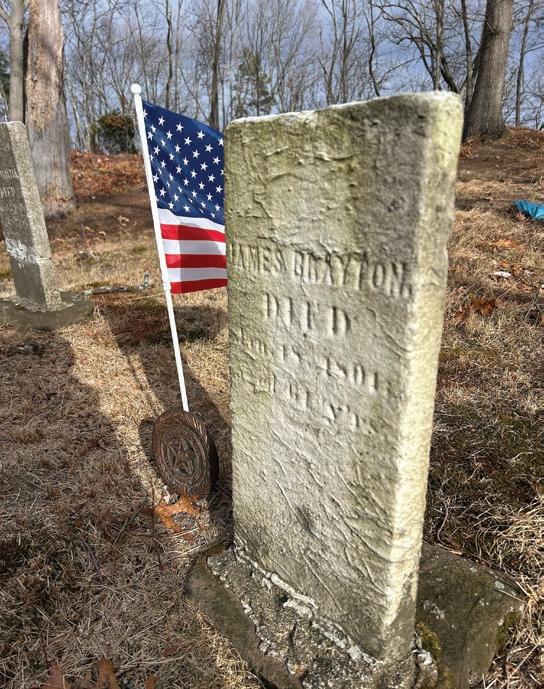
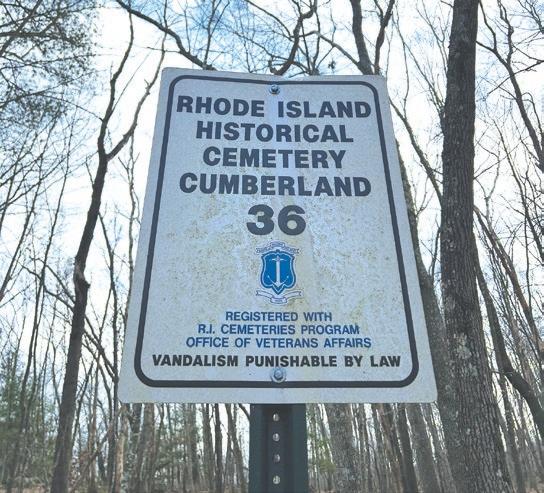
United States 125 Many live with challenges like those our nation’s first veterans endured, including post-traumatic stress disorder, substance abuse disorder, disability, and poverty . In the shadow of war monuments throughout the Blackstone Valley, we can see some of the human costs of war, and continued forms of inequality that affect people in communities across the United States
In revisiting this local history of the American Revolution, we can also see the importance of early veterans who fought for their due and for a more humane government . 126 The pension process came too late for many . Others had to wait until they were in their nineties But for some of the people who lived in the early days of the Industrial Revolution, the change from subject, to citizen, to wage earner, also included a chance for government compensation . This brings us back, again, to the hill Cowell climbed all those years ago .
About a year after first hiking along Mussey Brook in Lincoln, in search of remnants of the Wilkinson’s forge, we once again found ourselves walking in the woods . This time, we were in the northeastern part of the state in Cumberland, Rhode Island along Tower Hill Road As we walked along trails and the remnants of an old bridle path, we imagined we were in the footsteps of Benjamin Cowell . Up and down, over several substantial hills, we imagined Cowell’s carriage getting stuck and his choice to complete the journey on foot, just as we were doing . As we neared the likely location of the cemetery, we spotted one of the white signs that marks a historic cemetery in Rhode Island This sign meant that we had succeeded in finding the Emerson plot . At first glance, this patch of land was no different from what we had traversed for the past hour . Surrounded by old stone walls and a thickly wooded landscape, the small Emerson family cemetery could have easily just been lost in the woods, unmarked
For our research, merely looking at a picture of William Emerson’s headstone and footstone could have sufficed, but like Cowell, we wanted to see the resting place for ourselves . Emerson’s headstone is broken, and it is unclear where Hannah Whipple Emerson Tower is buried; no one marked her place with a stone If she is buried with her second husband, Levi
Tower, in the Elder Ballou Cemetery in Cumberland, Rhode Island, she is not marked in that hilly cemetery, either . 127 After spending substantial time thinking about Hannah Tower’s story, we found a place she called sacred, on the land that had been her home This was the place where Hannah Tower had bravely demanded a witness to her grief For Tower, the act of remembrance required careful storytelling, and claiming a connection to the land under her feet . Even after her second marriage, she could not separate herself fully from her first marital home, or her first husband’s grave, and so moved, Cowell preserved her story for posterity . Nearly two centuries later, we, too, wanted to understand Tower and the revolutionary generation High up on Hannah Tower’s hill, we knew that the “spirit” of Revolution remained an intangible and elusive thing . Yet with this trip, we knew, at last, that a history of soil and source could be found among such unremarkable hilltops and lands with winding brooks .
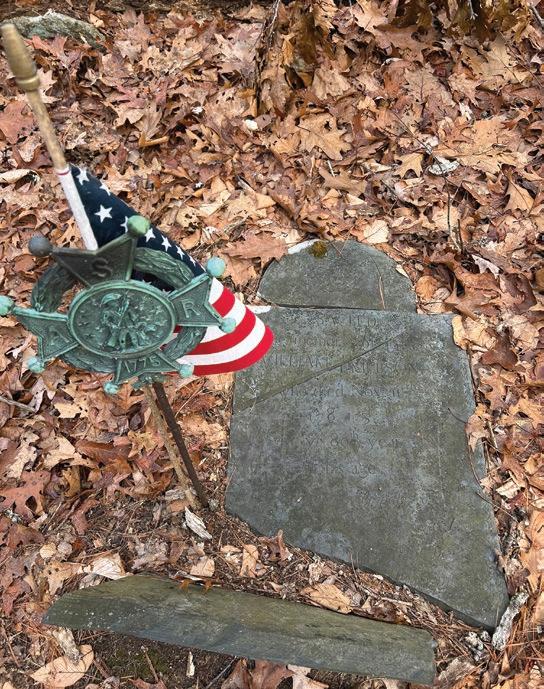
After an hour-long hike in the woods around Catamint Hill in Cumberland, Rhode Island, the authors finally found the gravestone of William Emerson. The gravestone has been broken but is still legible. An original Sons of the American Revolution copper marker is still in place by the gravestone. PHOTO BY ALLISON HORROCKS.
While finding the story of the American Revolution in the Blackstone Valley, we had many collaborators, particularly in the process of exploring pension files . In addition to family histories, town histories, and Benjamin Cowell’s book (The Spirit of ’76 ), the resources in national genealogical databases and a federal record group were equally important to our research . The National Archives and Records Administration (NARA) manages 80,000 pension records, which are also available online These rich, digitized files contain images of handwritten records that follow standard formats, as well as unusual forms of documentation, including family samplers
While pension application files are hosted on the NARA website and freely available, they are not necessarily accessible to all users . 128 These documents present challenges to people who cannot read handwriting or are unfamiliar with cursive . They are also difficult for people with low vision to read on a screen Hence, in preparation for the semiquincentennial, the National Park Service (NPS) and NARA have encouraged people to locate, read, and transcribe as many records from pensioners as possible As part of our work with NPS, we hosted transcription events with the public starting in July 2025 and personally read as many pension files as possible .
Pension file records have provided us with a tangible link to people who lived and walked on the same lands as we do, close to two-hundred-and-fifty years ago These records have proved valuable in terms of basic documentation of military service, particularly with men who did not serve on the Continental line . They are also records of persistence . With allies such as Benjamin Cowell, veterans in Rhode Island pushed to expand the scope of eligibility for pensions through the 1820s and 1830s . Those who survived long enough used the process of collecting information on their service to share what they were proud of, too Overall, “veterans often told much more than required, perhaps seeing this as their chance as elderly and largely illiterate men in the twilight of their lives to get their stories on the record ” 129 For some, there must have been fear that recognition would come too late The people who have attended these pension transcription events often find these files fascinating, and they pore over their contents . For us, teaching others about the files is one small way to recognize our nation’s first Patriots, and the countless ways that people did the work of creating a new nation .
Allison Horrocks and Mark Mello are park rangers at the Blackstone River Valley National Historical Park. Allison is a historian of women and labor who has worked at a number of local historic sites, from Newport to Lowell, Mass. Her work has been published in The Public Historian, and she is the co-author of Dolls of Our Lives: Why We Can’t Quit American Girl. Mark has worked for the National Park Service for ten years. His work focuses on the intersections between military, social, and economic history. Mark has an M.A. in American History from Providence College
1 Israel Wilkinson, Memoirs of the Wilkinson Family in America (Jacksonville, Ill.: Davis and Penniman, 1869), i-iv.
2 Wilkinson, Wilkinson Family, 403.
3 Wilkinson, Wilkinson Family, 469.
4 Anthony Connors, Ingenious Machinists: Two Inventive Lives from the American Industrial Revolution (Albany, N.Y.: State University of New York Press, 2014).
5 Joseph Cullon, “Introduction: A River Transformed, a Valley Remade” in Museum of Worcester, ed., Landscape of Industry: An Industrial History of the Blackstone Valley (Lebanon, N.H.: University Press of New England, 2009), 1-5.
6 Jean M. O’Brien, Firsting and Lasting: Writing Indians Out of Existence in New England (Minneapolis: University of Minnesota Press, 2010), 69-71.
7 John Williams Haley, “William Blackstone, The ‘First Settler’ of Boston and Rhode Island,” Old-Time New England 49 (July-September 1958): 8-10.
8 Lisa Brooks, Our Beloved Kin: A New History of King Philip’s War (New Haven, Ct.: Yale University Press, 2018).
9 Daniel Immerwahr, How to Hide an Empire: A History of the Greater United States (New York, N.Y.: Farrar, Straus, and Giroux, 2019).
10 William Emerson, R.I., Revolutionary War Pension and Bounty Land Warrant Application File W. 14,025, Case Files of Pension and Bounty-Land Warrant Applications Based on Revolutionary War Service, Records of the Department of Veterans Affairs, Record Group 15, National Archives Building, Washington D.C. [online version available through the Archival Research Catalog] Hereafter cited as “Pension Files.” (ARC identifier 54515594) at www.archives.gov.
11 Benjamin Cowell, The Spirit of ‘76 in Rhode Island or, Sketches of the Efforts of the Government and People in the War of the Revolution. Together with the Names of Those Who Belonged to Rhode Island Regiments in the Army (Boston, Mass.: A. J. Wright, Printer, 1850), 11.
12 Cowell, Spirit of ‘76, 11.
13 Laurel Daen, “Revolutionary War Invalid Pensions and the Bureaucratic Language of Disability in the Early Republic,” Early American Literature 52 (2017): 167; Nadine Dolby, “Research in Youth Culture and Policy: Current Conditions and Future Directions.” Social Work and Society: The International Online-Only Journal 6 (2008), www.socwork.net/sws/article/view/60/362, accessed Nov. 10, 2025.
14 Michael McDonnell and Briony Neilson, “Reclaiming a Revolutionary Past: War Veterans, Pensions, and the Struggle for Recognition,” Journal of the Early Republic 39 (Fall 2019): 467–502.
15 “Revolutionary War Veteran and Widow Pensions,” National Park Service, https://www.nps.gov/articles/000/revolutionary-war-veteran-and-widow-pensions.htm, accessed November 15, 2024.
16 “Revolutionary War Veteran and Widow Pensions,” National Park Service.
17 “Benjamin Cowell,” United States District Court, District of Rhode Island, https://www.rid.uscourts. gov/historical/benjamin-cowell, accessed Feb. 12, 2025.
18 Cowell, Spirit of ’76
19 Edward F. Waite, “Veteran’s Pensions: The Law and Its Administration from the Revolutionary War to the Civil War,” Harper’s New Monthly Magazine 86 (January 1893): 235-243.
20 Cowell, Spirit of ‘76, 11.
21 Massachusetts Soldiers and Sailors of the Revolutionary War (Boston, Mass.: Wright and Potter Printing Company, 1896), 35.
22 Joseph Tillinghast, An oration pronounced at the First Congregational Meeting-house, in Providence before Greene Association, on their anniversary, August 7, 1813: being the birth-day of their patron, Gen. Nathaniel [sic] Greene (Providence, R.I.: H. Mann and Co., 1813).
23 Amos Perry, ed., “The Greene Association,” Publications of the Rhode Island Historical Society 5 (1897): 136.
24 “Benjamin Cowell, Esq.,” The Rhode Island American, and General Advertiser, June 14, 1814.
25 “Benjamin Cowell Esq,” Providence Gazette, Jan. 3, 1818.
26 James Grant Wilson and John Fiske, Appletons’ Cyclopaedia of American Biography (New York: D. Appleton and Company, 1888), 2: 757.
27 “Jeremiah Brown Howell,” United States Congress, https://bioguide.congress.gov/search/bio/ H000865, accessed Dec. 2, 2025. https://bioguide.congress.gov/search/bio/H000865.
28 “Applicants for Pensions,” Rhode-Island American, and General Advertiser, Oct. 27, 1818.
29 Thomas Shippey, R.I., Revolutionary War Pension and Bounty Land Warrant Application File W. 15516, Pension Files, (ARC identifier 196622031) at www.archives.gov, accessed February 12, 2026.
30 “U. S. Pensioners,” Rhode Island American and Gazette, June 15, 1832.
31 “U. S. Pensioners,” Rhode Island American and Gazette, June 15, 1832.
32 Cowell, Spirit of ’76, 7.
33 Cowell, Spirit of ’76, 119.
34 “U. S. Pensioners,” Rhode Island American and Gazette, June 15, 1832. Cowell had also dealt with pension requests pertaining to the 1818 law. See also: “Cols. Crary; Topham; Elliott’s; Revolutionary Army; Congress; March; Benjamin Cowell; Esq,” Providence Patriot & Columbian Phenix, Nov. 12, 1825.
35 Cowell, Spirit of ’76, 8.
36 Cowell, Spirit of ’76, 8.
37 Israel Aldrich R.I., Revolutionary War Pension and Bounty Land Warrant Application File W. 15516, Pension Files (ARC identifier 53795002) at www.archives.gov, accessed Nov. 5, 2024.
38 Aldrich Pension File.
39 Aldrich Pension File.
40 Cowell, Spirit of ’76, 9-10.
41 Henry Dyer, R.I, Revolutionary War Pension and Bounty Land Warrant Application File S.12835 Pension Files (ARC identifier 54482332) at www.archives.gov. accessed Nov. 1, 2025.
42 Dyer Pension File.
43 Emerson Pension File.
44 Emerson Pension File.
45 Michael Roberts, “Blackstone River Valley National Heritage Corridor Interpretive Plan,” Blackstone River Valley National Heritage Corridor Commission, npshistory.com/publications/nha/ blackstone-river-valley/ip-1989.pdf, accessed February 5, 2026.
46 O’Brien, Firsting and Lasting, xii.
47 Elizabeth Perry, A Brief History of the Town of Glocester (Providence, R.I.: Providence Press Company, 1886), 23.
48 Perry, A Brief History,19.
49 Thomas Steere, History of the Town of Smithfield from its Organization, in 1730-1, to its division in 1871 (Providence, R.I.: E.L. Freeman and Company, 1881), 11.
50 O’Brien, Firsting and Lasting, 69.
51 Welcome A. Greene, Historical Sketch of the Town of Lincoln (Central Falls, R.I.: E.L. Freeman & Co., 1876); Rev. S.S. Griswold, Historical Sketch of the Town of Hopkinton (Hope Valley, R.I.: L.W.A. Cole, 1877).
52 Steere, History of the Town of Smithfield, 32.
53 Mildred Chamberlain, The Rhode Island 1777 Military Census (Baltimore, Md.: Genealogical Publishing Company, 1985).
54 Steere, History of the Town of Smithfield, 41-43.
55 Joel A. Cohen, “Rhode Island Loyalism and the American Revolution,” Rhode Island History 27 (October 1968): 97-112.
56 Asa Bartlett, R.I., Revolutionary War Pension and Bounty Land Warrant Application File S.21055, Pension Files (ARC identifier 53908252)], accessed Nov. 3, 2024.
57 Thomas Brayton, R.I., Revolutionary War Pension and Bounty Land Warrant Application File W. 12, 359, Pension Files (ARC identifier 54041681)], accessed Nov.10, 2024.
58 Rufus Pendock, R.I., Revolutionary War Pension and Bounty Land Warrant Application File S.38997, Pension Files (ARC identifier 196376286), accessed Nov. 3, 2024.
59 Sheldon Cohen, Commodore Abraham Whipple of the Continental Navy: Privateer, Patriot, Pioneer (Gainesville: University Press of Florida, 2010), 77-93.
60 Pendock Pension File.
61 Pendock Pension File.
62 Pendock Pension File.
63 Pendock Pension File.
64 Cohen, Commodore Abraham Whipple, 2-9.
65 Abraham Whipple Parole Agreement, May 20, 1780, Whipple Family genealogical website, https://genweb.whipple.org/, accessed March 24, 2024.
66 Cohen, Commodore Abraham Whipple, 124.
67 Board of Admiralty to Abraham Whipple, May 20, 1780, National Archives, https://founders.archives.gov/documents/Madison/01-02-02-0003, accessed March 24, 2024.
68 Cohen, Commodore Abraham Whipple, 129.
69 Whipple to Henry Knox, June 10, 1786, as quoted in Cohen, Commodore Abraham Whipple, 138.
70 Geoffrey Plank, “Quaker Reform and Evangelization in the Eighteenth Century,” Amerikastudien / American Studies 59 (2014): 184.
71 Peter Brock, Pacifism in the United States: From the Colonial Era to the First World War (Princeton, N.J.: Princeton University Press, 1968).
72 Edward Field, State of Rhode Island and Providence Plantations at the End of the Century: A History (Boston, Mass.: Mason Publishing Company, 1902), 598.
73 Israel Arnold, R.I., Revolutionary War Pension and Bounty Land Warrant Application File S. 21050, Pension Files (ARC identifier 53836552), accessed Nov. 3, 2024. Arnold’s service is also documented in Chester Curtis Foster’s Sons of the American Revolution membership application file. Foster, a descendant of Arnold, applied for membership in the SAR. This application file is part of the Sons of the American Revolution Membership Applications, 1888-1970 collection, accessible on microfilm at the National Society of the Sons of the American Revolution in Louisville, Ky., or digitally courtesy of Ancestry.com.
74 Arnold Pension File.
75 Arnold Pension File.
76 Gerald M. Carbone, Nathanael Greene: A Biography of the American Revolution (New York, N.Y.: St. Martin’s Press, 2008).
77 William C Kashatus III, Conflict of Conviction: A Reappraisal of Quaker Involvement in the American Revolution (Lanham, Md.: University Press of America, 1990).
78 Richard H. Benson, The Arnold Family of Smithfield, Rhode Island (Boston, Mass.: Newbury Street Press, 2009), 503.
79 Representative Men and Old Families of Rhode Island (Chicago, Ill.: J.H. Beers and Co., 1908), 1737.
80 “DIED,” United States Chronicle, January 31, 1799.
81 Richard H. Benson, The Arnold Family of Smithfield, Rhode Island, 501-503.
82 Arnold (Israel) House, National Register of Historic Places and National Historic Landmarks Program Records: Rhode Island, Records of the National Park Service (1785-2006), Record Group 79, National Archives at College Park – Electronic Records, College Park, Md. [online version available through the Archival Research Catalog (ARC identifier 41375578) at www.archives.gov], accessed Feb. 16, 2025.
83 Arnold House, National Register of Historic Places, accessed Feb. 16, 2025.
84 Arthur Mekeel, The Relation of the Quakers to the American Revolution (Lanham, Md.: University Press of America, 1979).
85 Karin Wulf, Lineage: Genealogy and the Power of Connection in Early America (N.Y: Oxford University Press, 2025), 126.
86 “Wilkinson Mill – 1810,” The American Society of Mechanical Engineers, https://www.asme.org/ about-asme/engineering-history/landmarks/30-wilkinson-mill, accessed Jan. 24, 2024.
87 Connors, Ingenious Machinists, 72-73.
88 Wilkinson, Memoirs of the Wilkinson Family, 403.
89 Connors, Ingenious Machinists, 25.
90 David Wilkinson, “David Wilkinson’s Reminiscences” in Transactions of the Rhode Island Society for the Encouragement of Domestic Industry in the Year 1858 (Providence, R.I.: Knowles, Anthony & Co., State Printers, 1859), 101.
91 Gary Kulik and Patrick M. Malone, The Wilkinson Mill (New York, N.Y.: American Society of Mechanical Engineers, 1977), 3.
92 Connors, Ingenious Machinists, 93.
93 Wilkinson, “David Wilkinson’s Reminiscences,” 101.
94 Cowell, The Spirit of ’76, 8.
95 Laurel Thatcher Ulrich, The Age of Homespun: Objects and Stories in the Creation of an American Myth (Evansville, Ill.: Vintage Publishing, 2002), 178-184.
96 Ulrich, Age of Homespun, 180.
97 Lynn Young, “Celebrate 125! Monday: The DAR Insignia,” Daughters of the American Revolution, https://blog.dar.org/celebrate-125-monday-dar-insignia, accessed Oct. 5, 2025.
98 See Americans Will Always Fight for Liberty, 1943, four color print on paper, Museum of the American Revolution, Philadelphia, https://www.amrevmuseum.org/collection/ accessed Nov. 1, 2025.
americans-will-always-fight-for-liberty-poster, accessed Nov. 1, 2025.
99 Christy Clark-Pujara, Dark Work: The Business of Slavery in Rhode Island (N.Y.: New York University Press, 2016).
100 Joanne Pope Melish, Disowning Slavery: Gradual Emancipation and ‘Race’ in New England, 1780-1860 (Ithaca, N.Y.: Cornell University Press, 1998).
101 Melish, Disowning Slavery, 56.
102 Jan Armstrong, “People of Color in the Blackstone Valley, 1790-1990,” unpublished research report for the Blackstone River Valley National Heritage Corridor, 1999.
103 https://collections.newporthistory.org/Detail/objects/22657.
104 Robert Geake and Lorén Spears, From Slaves to Soldiers: The 1st Rhode Island Regiment in the American Revolution (Yardley, Pa.: Westholme Publishing, 2016); Daniel Popek, They “…fought bravely, but were unfortunate”: The True Story of Rhode Island’s “Black Regiment” and the Failure of Segregation in Rhode Island’s Continental Line, 1777-1783 (Bloomington, Ind.: AuthorHouse, 2015).
105 Cowell, Spirit of ’76, 161-162.
106 Cameron Boutin, “The 1st Rhode Island Regiment and Revolutionary America’s Lost Opportunity,” Journal of the American Revolution, https://allthingsliberty.com/2018/01/1st-rhodeisland-regiment-revolutionary-americas-lost-opportunity/, accessed January 18, 2026; Lorenzo J. Greene, “Some Observations on the Black Regiment of Rhode Island in the American Revolution,” The Journal of Negro History 37 (1952): 142–172.
107 Cowell, Spirit of ’76, 159.
108 “10 Facts: Black Patriots in the American Revolution,” American Battlefield Trust, last updated June 14, 2024, https://www.battlefields.org/learn/articles/10-facts-black-patriots-american-revolution. accessed October 8, 2025.
109 Shirley Green, Revolutionary Blacks: Discovering the Frank Brothers, Freeborn Men of Color, Soldiers of Independence (Yardley, Pa.: Westholme Publishing, 2023).
110 Popek, They “…fought bravely,” 819.
111 Eric G. Grundset, ed., Forgotten Patriots – African American and American Indian Patriots of the Revolutionary War: A Guide to Service, Sources, and Studies (Washington, D.C.: National Society Daughters of the American Revolution, 2008), 236.
112 Popek, They “. . . fought bravely,” 588, 848.
113 Cited in Perry, A Brief History, 35-36, and Armstrong, “People of Color in the Blackstone Valley,” 61.
114 Advertisement printed in the Providence Gazette, October 18, 1777.
115 John Wood Sweet, Bodies Politic: Negotiating Race in the American North, 1730-1830 (Baltimore, Md.: Johns Hopkins University Press, 2003), 86.
116 Clare Tyler, “‘Prince Jenckes a Black Invalid Soldier’: A Unique Case of Disability, Race and Poverty in the Early United States” (undergraduate thesis, University of Rhode Island, 2022), 20.
117 Sweet, Bodies Politic, 208-209.
118 Tyler, “Prince Jenckes,” 3, 48, 54.
119 “An Act for the gradual abolition of slavery, 1784,” Black Rhode Islanders Collection (1652-1885), Rhode Island State Archives, Providence, R.I. [online version available through the Rhode Island Department of State ArchivesSpace at https://catalog.sos.ri.gov/repositories/2/digital_object_ components/73], accessed November 4, 2024].
120 Melish, Disowning Slavery, 76.
121 Tyler, “Prince Jenckes,” 57.
122 “To The Good Mrs. F,” Providence Gazette, April 4, 1807.
123 Tyler, “Prince Jenckes,” 2-3.
124 “Revolutionary War Veteran and Widow Pensions,” National Park Service.
125 Rian Stockett, “Veterans Day highlights the plight of over 35,000 homeless veterans in the US,” ABC 13 News, https://wlos.com/news/local/veterans-day-homeless-population-united-states-north-carolina-programs-help-assist-community-asheville-buncombe-communitychristian-ministry, accessed Nov. 12, 2025.
126 Linda Gordon, Pitied But Not Entitled: Single Mothers and the History of Welfare (Cambridge, Mass.: Harvard University Press, 1994).
127 National Archives at Washington D.C.; Washington D.C., USA; Applications for Headstones For U.S. Military Veterans, 1925-1941; NAID: 596118; Record Group Number: 92; Record Group Title: Records of the Office of the Quartermaster General.
128 “Revolutionary War Veteran and Widow Pensions,” National Park Service.
129 “Revolutionary War Veteran and Widow Pensions,” National Park Service.
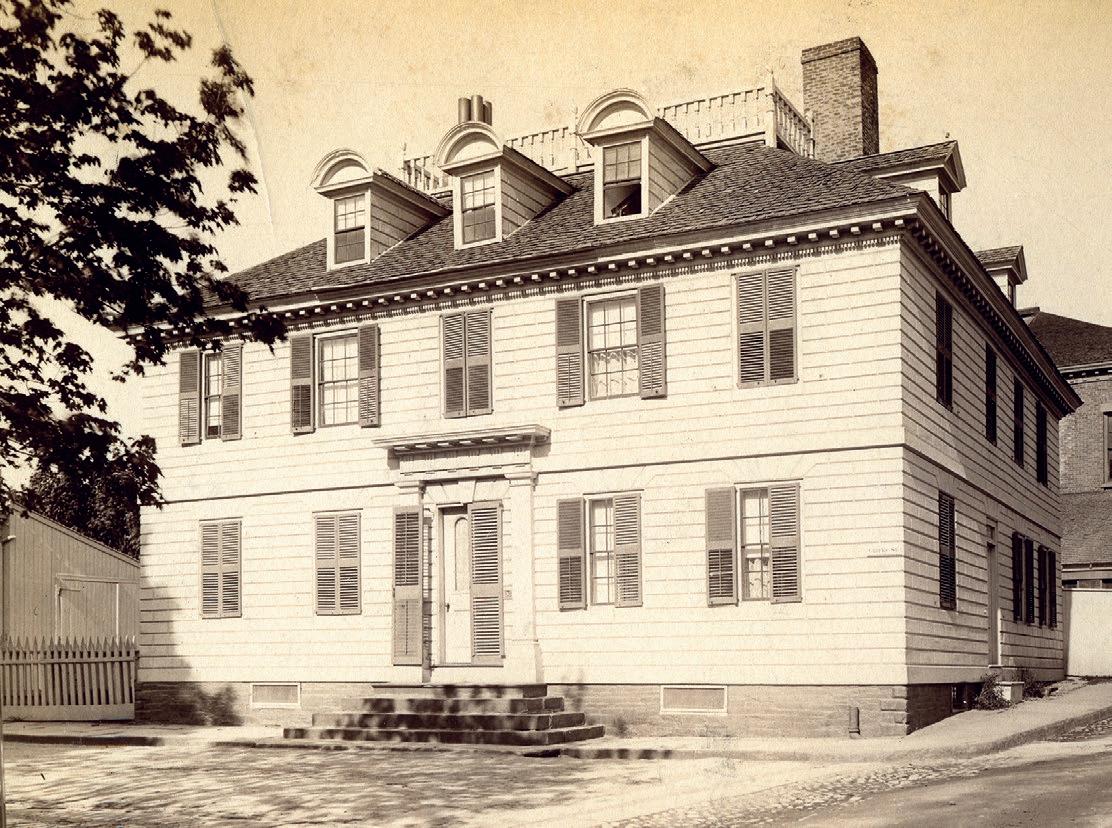
The William Vernon house at 46 Clarke Street was likely the site of Cato Vernon’s enslavement until his enlistment in the 1st Rhode Island Regiment in 1778. Newport Restoration Foundation presently owns and maintains the home.
HISTORICAL SOCIETY, P375.
Heather Bollinger
q
Cato Vernon was a ship carpenter, a mariner, and a veteran of the American Revolution 1
Born into slavery in Newport in 1759, Cato enlisted in the 1st Rhode Island Regiment, part of the Continental Army, in 1778, after the passage of the Slave Enlistment Act . Immediately emancipated from slavery upon his enlistment, Cato served for the duration of the Revolution . In addition to his freedom, Cato was promised wages for his service in the Continental Army, and likely looked forward to some financial security at the war’s end . However, after the war, he fought for over a decade to receive the back pay he was owed for his army service, all while building a life as a free man in the town where he was once enslaved . Although he managed to survive the war physically unscathed, Cato Vernon faced both private and public hardships that would prove difficult in post-Revolution Newport
Details of Cato’s childhood and early adolescence are largely unknown . In his March 1778 enlistment record for the 1st Rhode Island Regiment, Cato’s birthplace was recorded as Newport, and his age was given as nineteen years old, putting his birth year about 1759 2 Cato spent his childhood and adolescence enslaved by William Vernon (1719-1806), one of Newport’s most prolific slave traders . The names of Cato’s parents or other family members are not known, although it is probable that his mother was enslaved by William Vernon . In 1774, William Vernon purchased the home at 46 Clarke Street in Newport, known today as the Vernon House According to the 1774 Rhode Island Census, in addition to white inhabitants, William Vernon’s household included five unidentified people who were undoubtedly enslaved: two Black males under the age of sixteen, two Black males over the
age of sixteen, and one Black female over the age of sixteen Cato is likely one of the two Black males enumerated under the age of 16 in 1774 3
The house at 46 Clarke Street was probably the site of Cato’s enslavement until the American Revolution began . Although William Vernon was a Patriot and supported the colonists’ cause, when the British Royal Navy sailed into Narragansett Bay in late 1776, Vernon fled to Massachusetts with his family, taking three enslaved men— Barre, Accra, and Caesar with him, but not Cato . 4 Vernon also left two enslaved women, Cadys and Belinda, and Belinda’s child, in Newport . 5 Cato’s exact whereabouts when William Vernon left Newport are unknown . However, by March 1778 he was still enslaved and indentured to John Glazier, a shipwright in East Greenwich According to correspondence between Glazier and Cato’s enslaver, William Vernon, it appears that William Vernon made arrangements for Cato to informally apprentice under Glazier before Vernon left Newport at the end of 1776 .
In February 1778, the Rhode Island state legislature passed the Slave Enlistment Act, which granted immediate freedom to enslaved men who passed muster and who joined the Continental Army for the duration of the war . 6 On March 11, 1778, Cato Vernon enlisted in the 1st Rhode Island Regiment at East Greenwich . 7 With his enslaver then living in Massachusetts, Cato undoubtedly saw the opportunity to gain his freedom and seized it Although the Slave Enlistment Act guaranteed freedom for enslaved men who enlisted in the Continental Army, it also compensated enslavers for the “Loss” of their enslaved labor . 8 On March 18, 1778, one week after Cato joined up, John Glazier, to whom
Cato was apprenticed, informed William Vernon of Cato’s enlistment . Vernon was in Boston serving as president of the Eastern Naval Board for the American colonies . Glazier wrote:
Sir I take this opportunity to inform you Cato is inlisted into the Continental Service by virtue of an Act of Assembly that frees all Negros that inlist The committee has this Day valued Cato at one hundred & fourteen pounds . You are entitled to a Treasury Note baring [ sic ] six percent Interest payable when the Treasury is supplied with money . 9
In his letter to Vernon, John Glazier claimed Cato as an apprentice, “as if you had given me an Indenture .” It seems that Cato’s apprenticeship was not formalized in writing, but resulted from a verbal agreement between the two men Glazier further wrote that the Slave Enlistment Act entitled “masters of an apprentice” to the interest earned on the value
of formerly enslaved enlisted men until they reached the age of twenty-one, which meant that Glazier could receive the six percent interest accrued on Cato’s initial valuation of £114 currency for about two years, as Cato was nineteen when he enlisted . Glazier noted at the end of his letter that he had already “delivered up his [Cato’s] whole clothing”— meaning that Glazier had given Cato’s clothing to the officer who enlisted him the action required by law that guaranteed the enslaver his compensation . 10 Glazier’s request for the interest accrued on Cato’s valuation was undoubtedly an opportunity for him to take advantage of Cato: he had already exploited Cato’s labor through an informal apprenticeship (over which Cato had little agency) and now sought additional financial gain through Cato’s military service
Cato Vernon’s regiment, the 1st Rhode Island Regiment, was a largely segregated unit of free and formally enslaved
John Glazier’s letter to William Vernon informing him of Cato’s enlistment, March 18, 1778.
NEWPORT HISTORICAL SOCIETY, BOX 43A, FOLDER 26, ITEM 3.
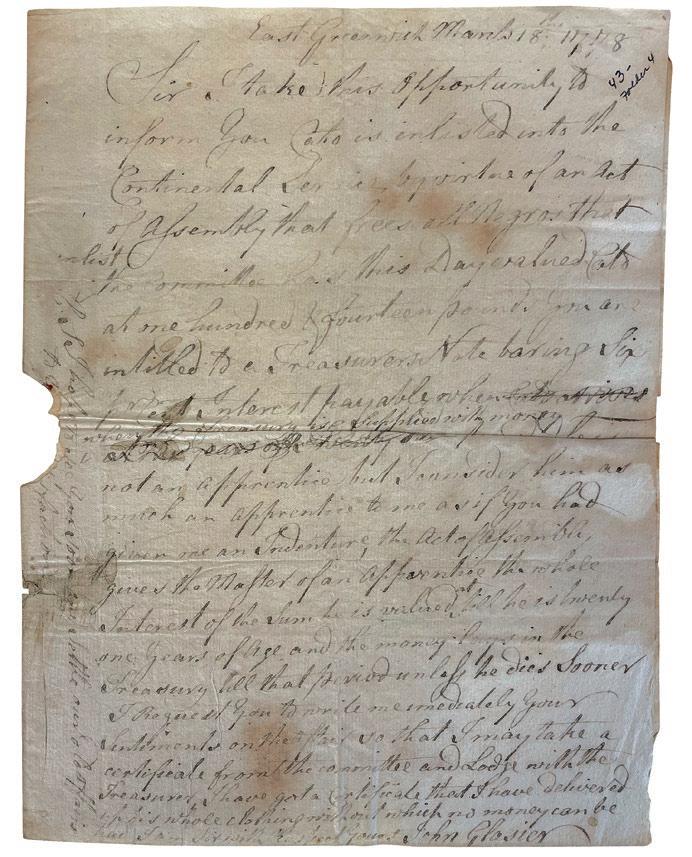
Black, multiracial, and Native American men Cato served at the rank of Private for the duration of the war . Led at first by Col . Christopher Greene, Cato’s regiment experienced fierce fighting throughout the conflict . The men fought in the Battle of Rhode Island in August 1778, when the Americans sought to drive the British army from Aquidneck Island Seven soldiers from the 1st Rhode Island Regiment were killed during heavy shelling . 11 In January 1781, the 1st and 2nd Rhode Island Regiments merged, becoming an integrated unit of both white soldiers and soldiers of color known as the Rhode Island Regiment . In May 1781, the Rhode Island Regiment was stationed near Fishkill, N Y , the headquarters for the Continental Army under Gen George Washington Encamped at Pines Bridge, the Rhode Island Regiment suffered a surprise attack from a Loyalist unit of light horse infantry and experienced significant casualties . Eight soldiers died, six of whom were identified as men “of color,” and the regiment’s commanding officers, Maj Ebenezer Flagg and Col Christopher Greene, were also killed Col Greene was cut down by a saber, dragged to the woods nearby, and drawn and quartered . Col . Jeremiah Olney then assumed command of the regiment . 12
In October 1781, the Rhode Island Regiment fought in the Battle of Yorktown in Virginia Cato’s regiment stormed one of two surviving British redoubts at Yorktown, attacking with fixed bayonets After hostilities in the North had ceased, the regiment slowly marched back to New England, quartering in Philadelphia from November 1781 until June 1782 . After patrolling the Hudson River valley for about two years, the Rhode Island Regiment was formally disbanded in December 1783 at Saratoga, New York 13 Discharged on June 15, 1783, Cato had been present for every engagement and posting in which the 1st Rhode Island and the consolidated Rhode Island Regiments saw action . 14
Little is known about Cato’s personal experience during the Revolution, as no pension application in Cato’s name, which would have supplied greater detail, has been located 15 However, letters from commanding officers during the conflict, and affidavits from veterans who lived to apply for pensions, paint a grim picture of the conditions experienced by the soldiers . The regiment was rarely supplied with proper coats, clothing, and shoes that could protect against the harsh New England weather; many soldiers suffered from frostbite and open wounds on their feet, particularly from marching
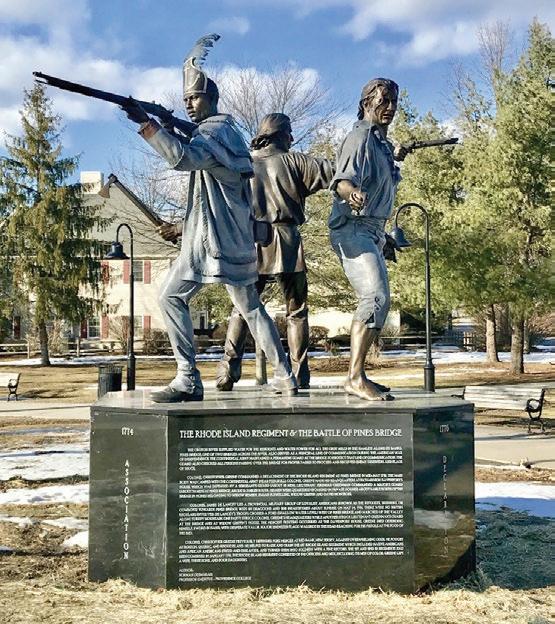
Uniform button stamped with the letters “RIR,” for “Rhode Island Regiment,” late 18th century. FROM THE COLLECTION OF NICK MANGANIELLO & FRANCINE CARRICK.
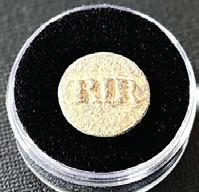
with no shoes The clothing they did have grew worn and thin Food was scarce . During the Rhode Island Regiment’s return march to New York, during the winter of 1781 and early 1782 at Philadelphia, smallpox broke out among the men, resulting in the deaths of several dozen soldiers, Black and white alike 16 Somehow, Cato survived these extraordinary, brutal conditions, mustering out after a total service of five years, three months, and six days . Cato received an Honorary Badge of Distinction for his “bravery, fidelity and good conduct,” per George Washington’s “General Orders” written on August 7, 1782 . 17
It is not known precisely when Cato returned to Newport after his discharge; what is certain is that he faced a challenging job market upon his arrival . As a youth growing up in Newport in the 1760s and 1770s, Cato witnessed Newport’s thriving seaport economy, built on the transatlantic trade and the trafficking of human bodies . Dozens of merchants used enslaved Black and Indigenous labor on their wharves and ships, compensating enslavers but rarely the enslaved laborers Forced to learn ship carpentry as an adolescent, while enslaved by William Vernon, Cato had very little agency over his time and resources . In the aftermath of the Revolution, Newport’s economy had withered as a result of British and
French occupations, blockades, and runaway inflation, and it was difficult to find employment . Cato identified himself as a mariner during this time, a term that included anything from shipbuilding, to sailing, to dock work loading ships . 18 Cato may have initially sought work in other fields while he waited for the government to source the funds to pay veterans Given dire economic conditions in Newport, it was especially imperative for Cato to recover the wages he was owed for his military service .
Cato Vernon’s quest to receive his final wages and the value of his rations from his Continental Army service likely began as soon as he was discharged At the end of the war, Rhode Island’s Treasury Secretary, Henry Ward, recorded that Cato Vernon, “late a soldier in Col . Olney’s Continental Battalion,” was owed fourteen pounds, four shillings with compound interest from January 1, 1782, until paid . 19 This was no small sum . While converting American colonial currency to modern United States dollars is very difficult each colony issued its own currency, with no standardized rates of exchange, and bartering was part of normal business comparing the value of household objects with the sum owed to Cato provides some insight into how Cato’s circumstances may have been improved with his backpay in hand . An examination of
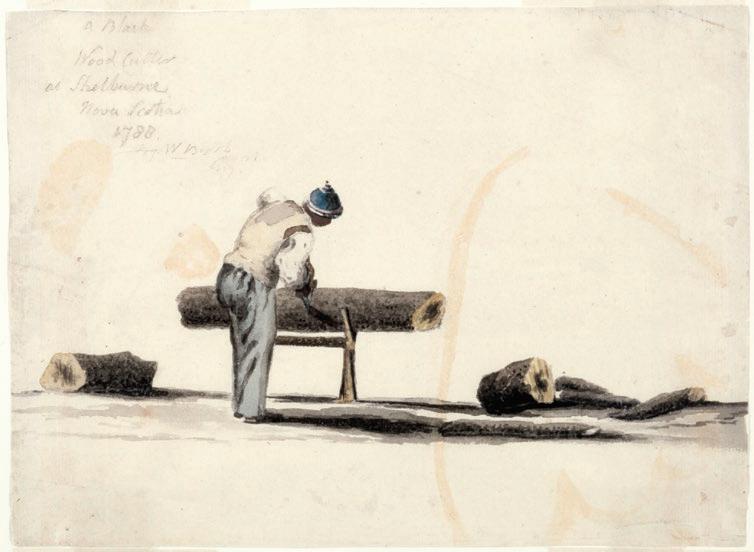
Trained as a ship’s carpenter, Cato would have cut and shaped timber to repair decks, masts, and hulls. This watercolor depicts an unidentified Black man cutting logs, 1788. “A Black Canadian Wood Cutter at Shelbourne, Nova Scotia,” LIBRARY AND ARCHIVES CANADA, ACC. NO. 1970-188-1090 W.H. COVERDALE COLLECTION OF CANADIANA.
Newport’s probate records from 1781 to 1785 shows that, overwhelmingly, the most expensive household items were the bed, pillows, and blanket . 20 Beds were typically valued between five and seven pounds, though finer woods and fabrics could be worth more For example, the January 1784 inventory of Captain Ebenezer Vose’s property accounts for “one bed, bedstead, bolster, pillow & furniture,” valued at twelve pounds . 21 In the inventory of the estate of Thomas Vernon (brother of Cato’s former enslaver William Vernon), one large round mahogany table was worth one pound, four shillings; and one silver watch was valued at three pounds . Utensils such as forks, spoons, and knives were worth a few pence each 22
With Newport’s economy in a depressed state, and opportunities for work uncertain, Cato would have needed every shilling of his backpay to make a new start as a veteran and freed man . The federal government struggled to generate the revenue required to fund the payout of soldiers’ wages plus interest, resulting in heated debate between the states and the federal government over Congress’s authority to levy taxes . Soldiers’ backpay was significantly delayed, and discontent rose among Revolutionary War veterans . 23 Even after the Rhode Island General Treasury was appropriately funded, veterans struggled to receive the pay that they were rightfully owed
The application process for backpay itself was tedious and lengthy; additionally, fraudulent applications filed in the names of veterans by people who had not fought in the war, or soldiers who had already received their full wages, plagued the treasury department . The fraud was so rampant that in May 1791, Rhode Island’s General Treasury stopped issuing notes altogether, holding them indefinitely, until an equitable resolution could be found . 24 At least one hundred Rhode Island veterans became the victims of this fraud, dozens of them Black and Indigenous, according to a notice in a June 1793 edition of the Gazette of the United States, a national newspaper published in Philadelphia In this notice, Rhode Island’s General Treasurer Henry Sherburne released a list of Rhode Island’s Continental soldiers who had had fraudulent notes issued in their names, with a “caution to all persons” not to purchase the notes . 25
Cato Vernon’s name appears in Sherburne’s list, as do the names of other Black Newporters Unfortunately, Cato was the victim of a fraudulent application for his wages made in his name by a man named Stanton Campbell 26 A native
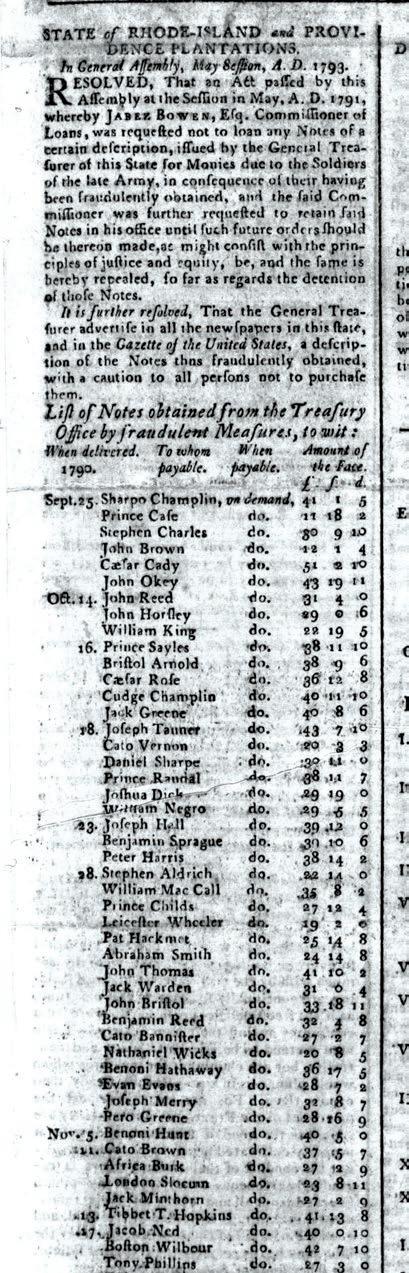
Excerpt from Sherburne’s “List of Notes obtained by Fraudulent Means.” Cato Vernon’s name is listed under October 18. GAZETTE OF THE UNITED STATES (PHILADELPHIA, PA.), JUNE 1, 1793.
of Voluntown, Connecticut, Campbell was a Revolutionary War veteran who enlisted in Colonel John Topham’s Rhode Island Regiment of State Troops for a period of twelve months in 1778 . 27 Campbell was discharged in 1779 and did not reenlist Although the precise details are unknown, on September 18, 1790, Stanton Campbell represented to the R I General Treasury that Cato Vernon, “laborer, of Stonington, Connecticut,” had appointed Campbell as his “legal attorney”— essentially, a representative who could make decisions about Cato’s property and finances on his behalf —“to collect the wages, rations, etc . due him as a Continental soldier under Col Jeremiah Olney ” Cato had allegedly signed this document in South Kingstown, Rhode Island . 28
On the basis of this fraudulent claim, Campbell received three final settlement certificates from the state treasurer in Newport on September 23, 1790 . 29 How did Stanton Campbell learn of Cato Vernon’s wages? Although Campbell and Cato both fought in the Revolution, there is no evidence to suggest they knew each other before, during, or after the war . However, Stanton Campbell was second cousin to Archibald Crary (1748-1812), who, before he was appointed as Rhode Island’s first Adjutant General in 1780, held leadership roles in the 1st and 2nd Rhode Island Regiments In his capacity as Adjutant General, Crary may have become acquainted with Cato, but also, may have reviewed muster and payrolls for Rhode Island’s militia . 30 There is no evidence linking Crary with Campbell’s scheme, but the familial relationship between the two men suggests a possible connection .
No matter how Stanton Campbell learned of Cato Vernon’s back wages whether through his cousin or otherwise his scheme to defraud Cato was discovered, as was the name of his alleged co-conspirator, Caleb Church (who was originally from Stonington, Connecticut) . The Newport Herald reported Campbell’s and Church’s deception on April 16, 1791:
At the Honorable Superior Court of this State [Rhode Island]…Stanton Campbell and Caleb Church were convicted of counterfeiting an order on the Treasurer of this State in the name of Cato Vernon, late a soldier in the Continental Army, and by means thereof procuring certain certificates or final settlements, the property of the said Cato Vernon . They were sentenced by the court each
to stand upon the pillory in the town of South Kingstown for one hour, to be cropped of each of their ears, and branded on each of their cheeks with the letter R, to pay a fine each of thirty pounds, with costs of prosecution and conviction 31
Campbell’s and Church’s brutal punishment to stand in South Kingstown’s town stocks, have their ears cut off, and their cheeks seared by hot iron molded into the shape of the letter “R” for “Rogue” undoubtedly sent a message that they should not be trusted by anyone who crossed their paths in the future . 32 Unfortunately for Cato, the fraud committed in his name further delayed the receipt of his back wages, and he likely continued to struggle financially even after the Campbell and Church case concluded
About a year after Campbell and Church’s convictions, in April 1792 the Gazette of the United States ran the following notice:
Information – A NEGRO MAN by the name of Cato Vernon, enlisted in Col Greene’s Regiment of Blacks, early in the late War He survived the War, and settled as supposed, in or near Philadelphia . If he will apply to the Editor hereof, he will be informed of something considerably to his advantage . 33
It is unclear why the Gazette’s editor, John Fenno, believed Cato may have resided in Philadelphia in 1792 . According to regimental records, Cato served as a “waiter” for “Maj McPharson” [likely William Macpherson] in Philadelphia for a few months in the late winter of 1782 or spring of 1783 after hostilities in the North had ceased . 34 It is not known what Fenno may have had to offer Cato had he contacted him . 35 At present, no evidence directly linking Cato to Philadelphia after 1783 has been found .
Very little is known of Cato’s life in Newport in the early 1790s, but surviving archival records reveal that he had returned to the town that was once the site of his enslavement . In Newport, Cato may have found employment with his former enslaver, William Vernon, who continued to traffic human beings as part of the transatlantic trade . 36 As a ship’s carpenter, Cato could have worked aboard Vernon’s ships or labored on Newport’s wharves He must have had some contact with William Vernon, because on January 30, 1793, Cato granted a power of attorney to Vernon, “especially for recovering and obtaining Three final settlements for my Wages in the Army of the United States…and my back rations .”
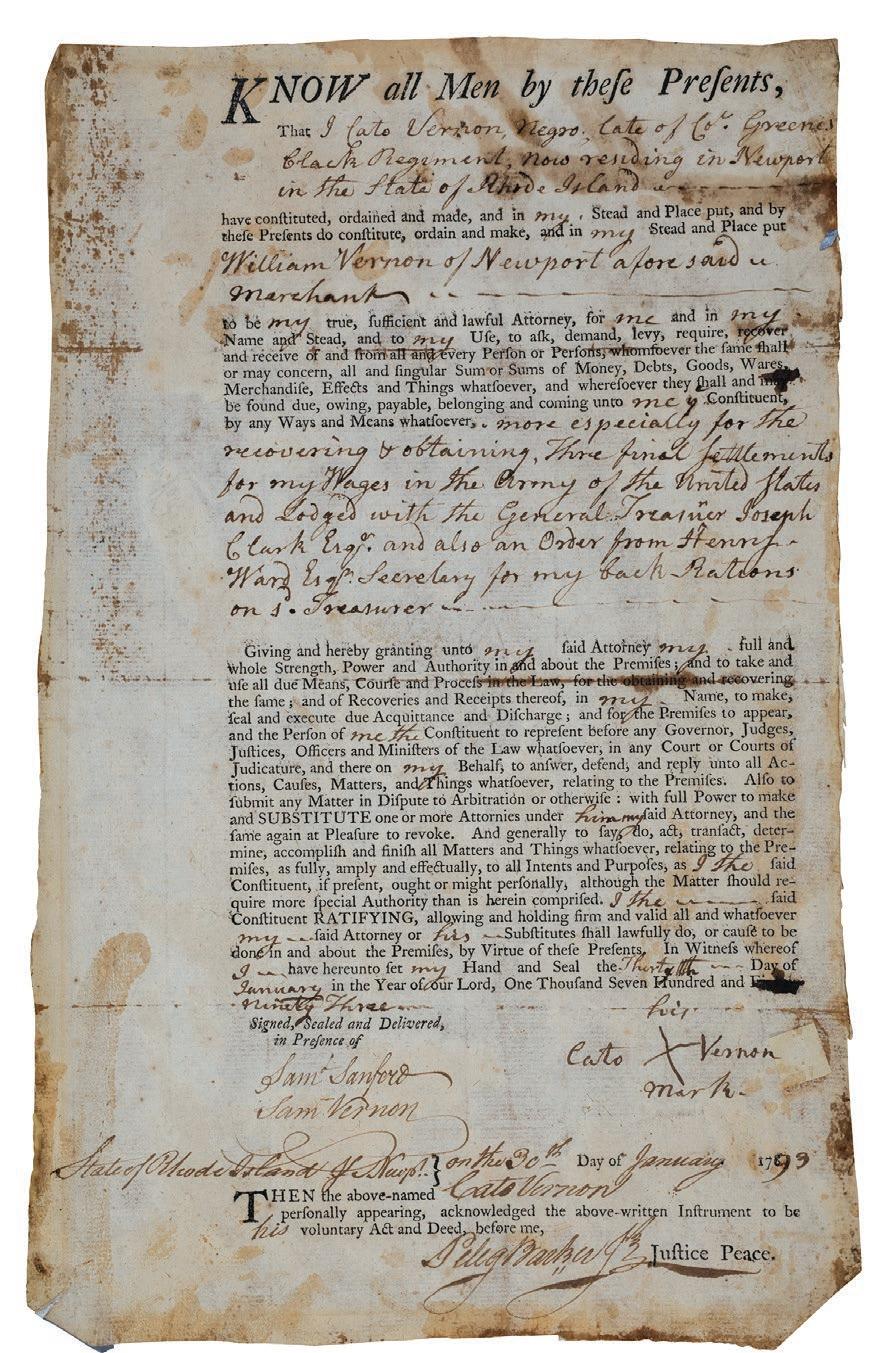
Affixed with his signature (an “X,” indicating he was illiterate) and his seal, witnessed by Samuel Sanford and Samuel Vernon, William Vernon’s brother, and attested to by Peleg Barker, Justice of the Peace, there is little doubt that this power of attorney was Cato’s true act and deed 37 No records have been identified indicating that William Vernon assisted Cato with recovering his wages For reasons unknown, William Vernon could not or would not pursue the matter with the General Treasury on his own .
Cato Vernon was in Newport, and experiencing hardship, as seen in a letter of August 1793, written on Cato’s behalf to William Vernon Although the exact details are unknown, in August 1793, Cato was imprisoned in Newport’s jail, because of a debt he owed Barre Vernon, also formerly enslaved by William Vernon, who had been taken to Boston with Vernon in late 1776 . Likely out of desperation, Cato asked an unknown individual to write William Vernon on his behalf from “Newport Gaol [Jail]” for “four or five dollars more
to take me out of this Dredfull Place,” which would have allowed Cato to seek medical treatment for an injury to one of his feet . In his letter, Cato stated that he suffered from a “lame foot” which caused him such pain that he could not sleep, and he feared he would lose his foot to gangrene Cato assured Vernon that he would repay him and “will Endeaver to Behave myself so as to git the good will of all people, wight [sic] and Black . ”38 It is unclear why Cato included this assurance in his letter to Vernon, but two days after Cato’s letter, William Vernon paid Cato’s debt to Barre Vernon . 39 It is not known whether Cato Vernon received medical treatment for his foot injury, which he made clear to William Vernon was so severe that it might have required amputation Judging by the anguished tone of Cato’s letter, if Cato received the loan from Vernon, he likely would have immediately sought a doctor’s care . Depending on the amount of the loan and the severity of Cato’s foot injury, he may have found himself further indebted to Vernon and others
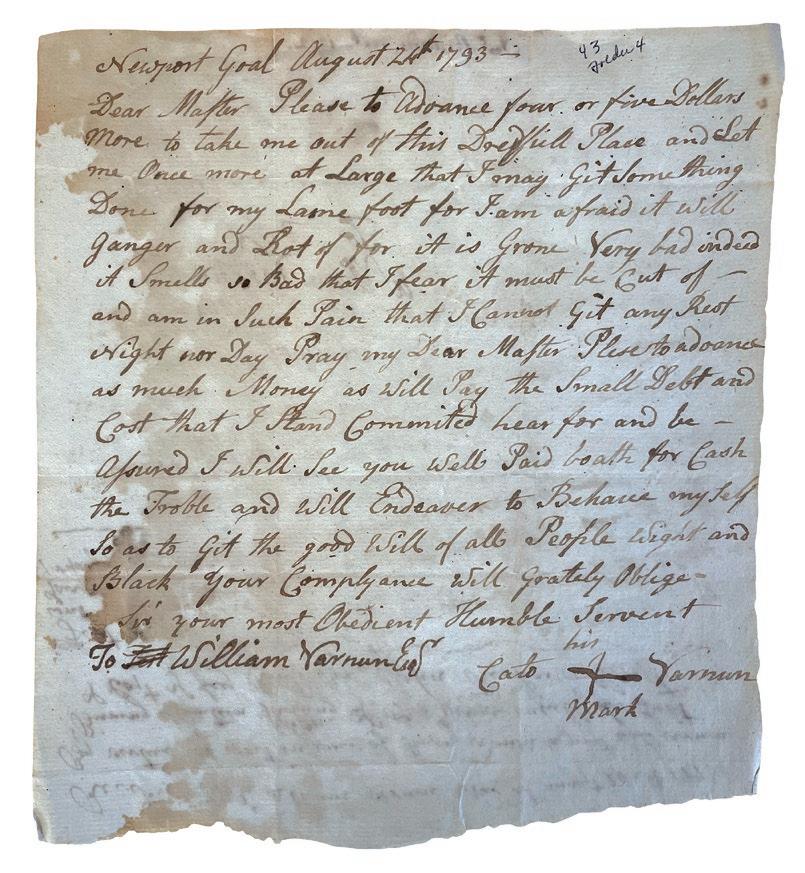
After the autumn of 1793, it becomes exceedingly difficult to discern who may have sought to help Cato recover his backpay, and who may have tried to take advantage of him . One man with questionable motives was an attorney named John Faxon Among the General Treasury records at the Rhode Island State Archives is a July 14, 1795 order to pay Faxon the full balance of wages due Cato Vernon, which, with twelve years’ compound interest, now amounted to 28 pounds, 15 shillings, and 7 pence . 40 Three days later, on July 17, 1795, John Faxon attested that he received the amount in full . Included with this order to pay is a power of attorney allegedly executed by Cato Vernon to John Faxon, dated October 4, 1793, nearly two years prior 41 The note was issued to John Faxon after a committee investigation, ordered by the General Assembly, concluded that “the late Treasurer” (Joseph Clarke, who had died in 1792) had issued a note for a balance due Cato Vernon, “late a Soldier in this State’s
Continental Battalion,” but that the certificate ordering the note to be issued had been obtained by “fraudulent means . ” 42 Undoubtedly, the fraud alluded to was that committed by Stanton Campbell and Caleb Church, for which they were convicted of counterfeiting in April 1791
John Faxon (1761-1826) practiced law in Newport, and was admitted to the bar in December 1789, the same month that he married Lydia Gardiner Champlin (17531846), widow of Captain Robert Champlin of Newport . 43 Faxon appears to have been a man of unscrupulous character . In June and July 1791, for instance, the Newport Herald published a series of letters to the editor concerning accusations against Colonel George Irish (1729-1801), a Revolutionary War veteran and a resident of South Kingstown . Irish had been arrested in March 1791 on a federal charge of attempting to sell a counterfeit final settlement note from the General Treasury to John Faxon, and was subsequently acquitted .
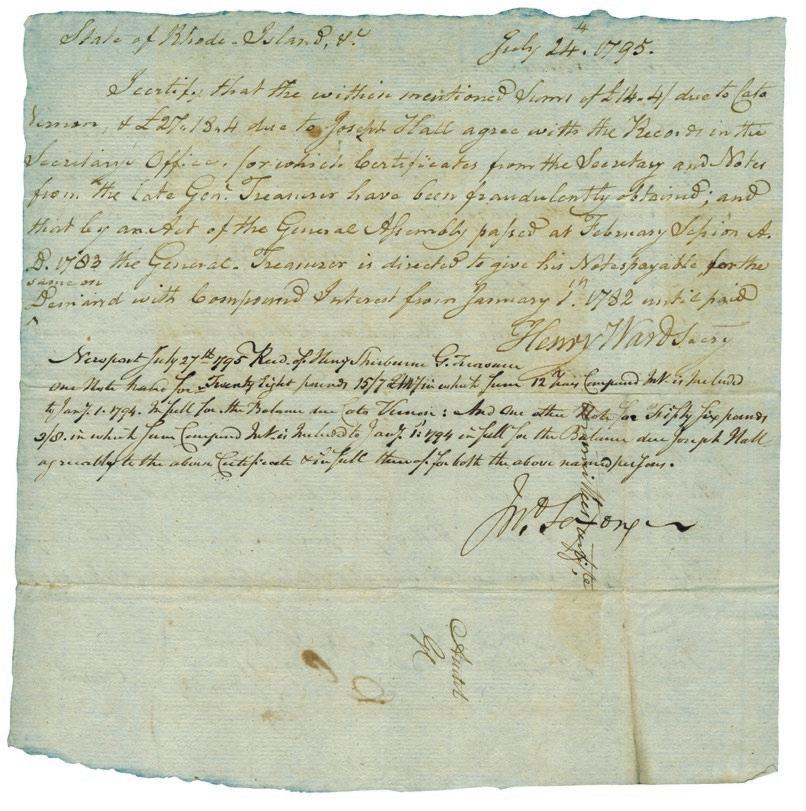
John Faxon’s attestation that he had received the wages due Cato Vernon and another soldier, Joseph Hall, July 27, 1795. RHODE ISLAND STATE ARCHIVES, GENERAL TREASURER REVOLUTIONARY WAR SERVICES AND SUPPLIES BACK PAY RECORDS, 1795-1818.
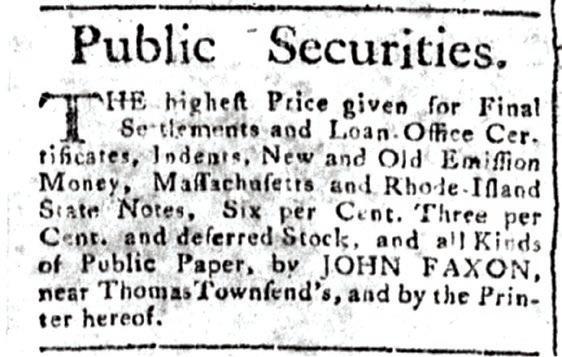
In his letter to the Herald, Irish accused Faxon of impugning his character and giving dishonest testimony in the case 44 Irish asserted that he had sought out Faxon because it was known that “Mr . [Sheffield] Attwood and Mr . [John] Faxon gave for such securities twelve shillings on the dollar,” and as such, wanted his opinion as to whether the certificate was genuine 45
Local Rhode Island historian Robert Geake states that speculators took advantage of “desperate” veterans by either issuing loans against their final settlement notes with very high interest, or by purchasing the notes at “a fraction” of what they were worth . 46 Faxon appears to have been one of these speculators who purchased treasury notes at less than face value 47 In his Newport Herald letter, Irish published William Dyer’s deposition in the case Dyer, also from South Kingstown, swore that he had purchased the settlement note that turned out to be counterfeit in December 1790 from Caleb Church . Church was the same man who was convicted in April 1791 along with Stanton Campbell for counterfeiting a treasury note in Cato Vernon’s name 48
Taking into account these prior allegations against John Faxon, and his penchant for purchasing treasury notes for less than face value, it is likely that Faxon defrauded Cato of his wages . Cato Vernon’s and John Faxon’s names appear on an undated (although likely 1790s-era) treasury document entitled “List of Second Certificates in Lieu of those supposed to have been fraudulently obtained,” indicating that Cato’s treasury note was delivered to John Faxon, “Atty [Attorney] ”49 However, no evidence has been found indicating that John Faxon delivered or otherwise paid over to Cato the wages he was due . The possibility exists that Cato signed over his treasury notes to John Faxon, perhaps to have some currency in hand, even if it was not the full amount he was owed
One of several newspaper notices placed by John Faxon advertising his interest in purchasing bonds, securities, and currency. NEWPORT HERALD (NEWPORT, R.I.), JULY 30, 1791.
The confusion surrounding Cato Vernon’s back wages is compounded by yet another power of attorney dated March 1795 . Three months before John Faxon received Cato’s wages from the General Treasury, Cato appointed Cato Mumford of Providence his proxy to recover his backpay . 50 Mumford was a member of the Providence chapter of the Free African Union Society, a free Black mutual aid association 51 It is not known how Cato Vernon and Cato Mumford knew each other, but it appears that Mumford made a good-faith effort to recover Cato’s wages . Cato Mumford’s advocacy on Cato Vernon’s behalf can be seen in a singular affidavit regarding Mumford’s power of attorney and Cato Vernon’s backpay The statement was written by Theodore Foster (1752-1828), a U S senator from Rhode Island, and signed August 15, 1798 It is not known why Foster gave this affidavit in 1798 it is possible that Cato, his family, or his representatives may have filed an inquiry with the state or federal government into Cato’s backpay and rations, but no evidence of an inquiry or lawsuit has been found In his affidavit, Foster declared:
In the year 1795, I was requested to enquire what was due from the United States to Cato Vernon . I accordingly applied at the War Office, where I was informed that his Claim had been fully settled; and that Archibald Crary Esqr of Newport had recd [received] what was due to him; by virtue of a Letter of Attorney, from said Cato Vernon …At the request of Cato Mumford I wrote since to Col . Crary, for information from him, of the Amount of the Money [illegible] rec’d for Vernon, and desiring that he would account for it to said Cato Mumford who says [sic ] he has a Letter of Attorney from said Cato Vernon dated subsequently to Col Crary’s But I have rec’d no answer from Col Crary 52
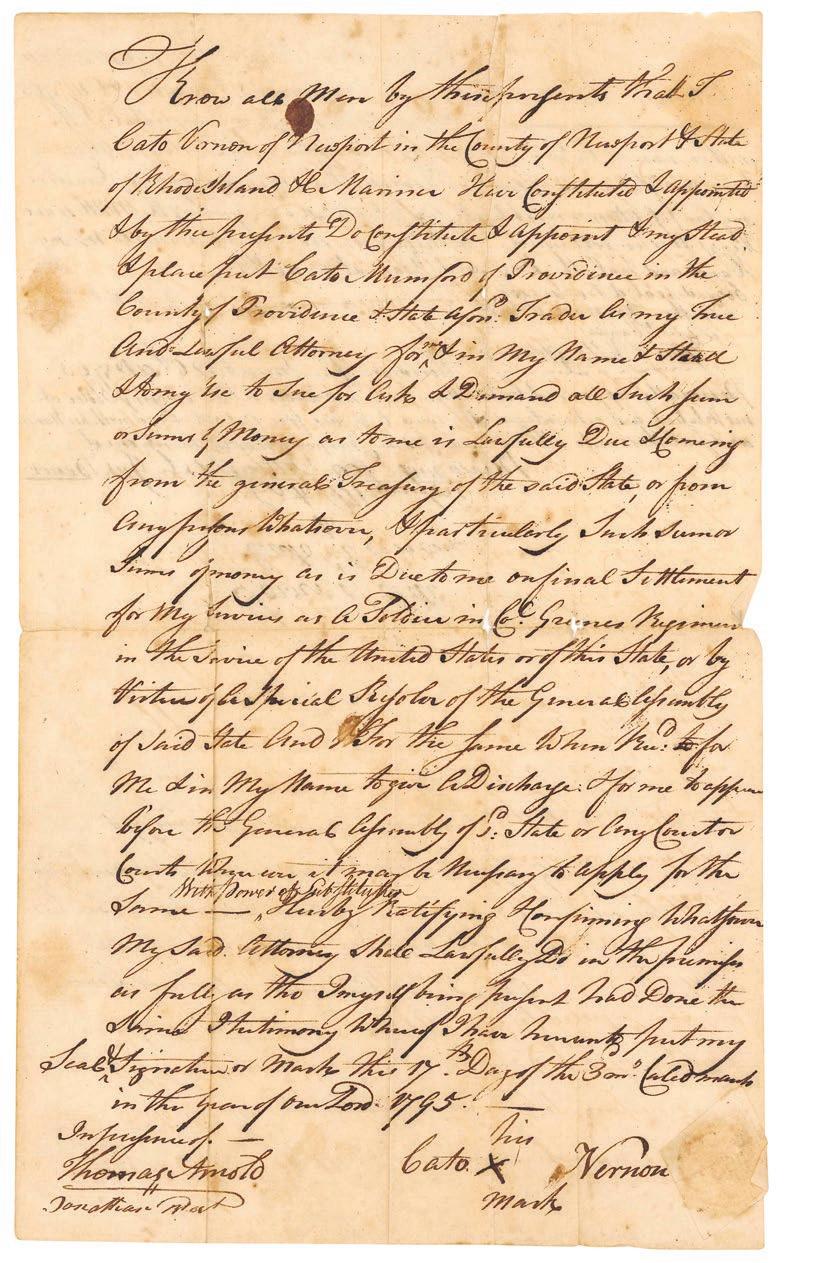
Cato Vernon’s power of attorney to Cato Mumford, March 17, 1795. RHODE ISLAND HISTORICAL SOCIETY, THOMAS SESSIONS FAMILY PAPERS, MSS 712, BOX 3, FOLDER 9.
Carpenter, Mariner, Soldier, Veteran: Cato Vernon and Black Service
The War Office was located in Philadelphia, the nation’s temporary capital in the 1790s while Washington, D .C . was under design and construction . As senator, Foster likely received hundreds, if not thousands, of letters from his constituents on all matters of concern— including appeals for aid from poverty-stricken Revolutionary War veterans It is probable that Cato Mumford wrote Foster concerning Vernon’s wages, perhaps in one final attempt to help Cato receive the wages he was owed and desperately needed, escalating the inquiry to the highest offices in the federal government .
Foster’s affidavit includes an astounding assertion: that Archibald Crary, the commanding officer in the 1st and 2nd Rhode Island regiments (under whom Cato Vernon may have served) had settled Cato’s claim by yet another power of attorney and had received his wages . Crary had been Rhode Island’s Adjutant General during the war, and was second cousin to Stanton Campbell, the first person to defraud Cato Furthermore, Crary had apparently not replied to Foster’s letter asking him to confirm that Cato had received his backpay . Crary’s silence implied by Foster’s affidavit is deafening and raises many questions as to Crary’s intentions on Cato’s behalf . It seems there were two claims on Cato’s wages made at the same time records at the Rhode Island state archives indicate that John Faxon received the full amount of Cato Vernon’s back pay in July 1795, while the War Office in Philadelphia informed Theodore Foster that Archibald Crary had settled Cato’s claim as of August 1795 .
Cato could have granted multiple powers of attorney at the same time, but it would have been risky . Questions and confusion around who had authority over Cato’s private affairs would arise If Cato did grant powers of attorney to William Vernon, John Faxon, Archibald Crary, and Cato Mumford concurrently, that is, to his former enslaver, a financial speculator, a former commanding officer, and his friend, these decisions reveal his utter desperation to receive his backpay and to improve his circumstances in life
No evidence has been found to suggest that Cato Vernon ever received any of the back wages he was owed from his Continental Army service in the American Revolution . After 1795, Cato disappears from the archival record, except for two
instances: his name was included in an 1818 newspaper notice that listed Continental soldiers from Rhode Island eligible for a land bounty; the list was published again in 1828 . 53 Cato does not appear in any known pensioners’ list created by the Rhode Island government, and no land bounties or pension applications in Cato’s name have been located It is possible that Cato Vernon died before the first pension act was passed in 1818 .
Cato Vernon’s story is not unique . Dozens, if not hundreds, of Black and Indigenous Rhode Island Revolutionary War veterans were defrauded of their rightful pay, either through notes issued by the government to people impersonating veterans, by speculators, or by dismissal of their petitions due to “lack of evidence” of their military service . 54 Formerly enslaved veterans were often illiterate, and therefore completely dependent on others to petition the government or write letters on their behalf to recover their wages . In 1877, Sidney Smith Rider, an amateur historian and prolific collector of Rhode Island historical records and artifacts, posited that one of the reasons that Black, Indigenous, and multiracial Rhode Island veterans were denied their back pay was because the government concluded that the freedom from enslavement that veterans of color gained from their service was worth more than their wages 55 Veterans of the 1st Rhode Island Regiment faced serious illness, disability, and poverty, and their needs were placed upon the overseers of the poor of the towns in which they lived . 56
Cato Vernon gained his freedom by enlisting in the 1st Rhode Island Regiment, serving his country for over five years . After the war, although he was emancipated, Cato spent years fighting for his rightful pay Although the exact details of Cato’s financial situation following the Revolution are largely unknown, if he had received his wages, Cato’s quality of life could have only been improved . He may have had better access to necessities such as food and shelter, medical care, or the opportunity to own property . Cato Vernon’s fate is unknown, but his story is one of continued perseverance against seemingly insurmountable odds Cato seized the opportunity to obtain his freedom and put his life at significant risk in defense of the country that had sanctioned his enslavement . 57
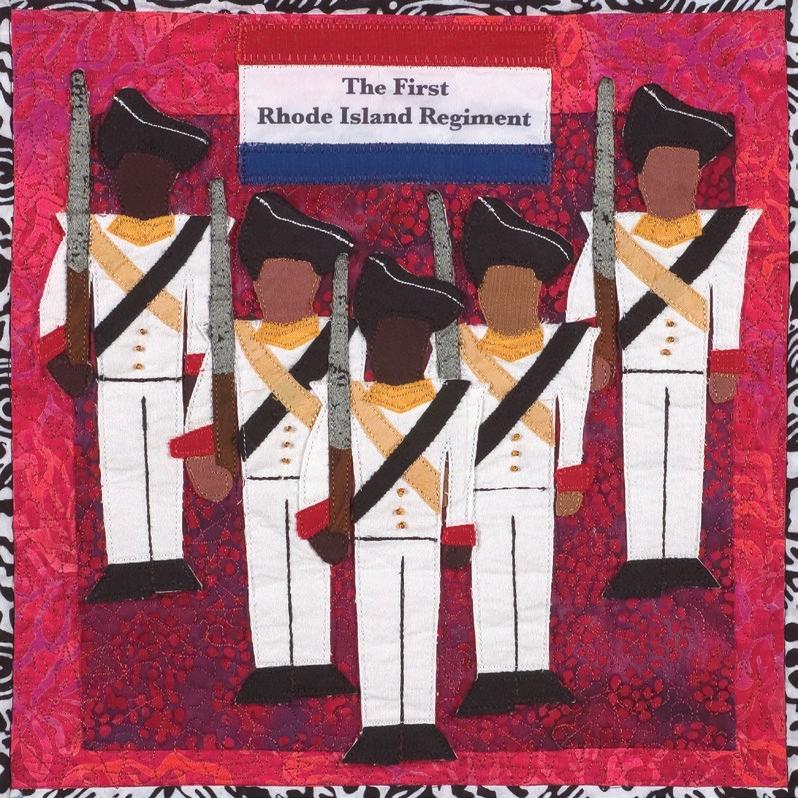
This block commemorating the 1st Rhode Island Regiment was created by textile artist and quilter Sandra Smith, as part of a quilt honoring the African American heritage of Rhode Island, commissioned by Roger Williams University in Bristol, R.I. The complete quilt and individual quilt blocks can be seen in their entirety at https://www.sandrasmithquilts.com/rhode-island-quilt.html.
Celebration of Rhode Island Heritage, artist Sandra Smith, Roger Williams University. IMAGE COURTESY OF SANDRA SMITH.
Heather Bollinger is Voices Research Assistant at the Newport Historical Society, where she uncovers evidence of the enslaved and free Black and Indigenous communities in Newport during the eighteenth and nineteenth centuries. She is a frequent contributor to the digital humanities project, Enslaved: Peoples of the Historical Slave Trade (Enslaved.org) and is a member of the editorial board for the Journal of Slavery and Data Preservation.
Carpenter, Mariner, Soldier, Veteran: Cato Vernon and Black Service
1 Cato Vernon’s surname was also spelled “Varnum” or “Vernum.”
2 Revolutionary War Record Book, First Rhode Island Regiment, 1781-1783, Rhode Island State Archives, p. 37, digital image 55, https://catalog.sos.ri.gov/repositories/2/archival_objects/871, accessed July 29, 2025.
3 John Russell Bartlett, Census of the Inhabitants of the Colony of Rhode Island and Providence Plantations, taken by order of the General Assembly in the year 1774; and by the General Assembly of the state ordered to be printed (Providence: Knowles, Anthony, & Co., 1858), 34.
4 Historian Christian McBurney has studied and written at length about the Vernon house and its inhabitants, including the white Vernon family and the people enslaved at the house, during the years leading up to the Revolution, throughout the conflict, and after the war ended. See Christian McBurney, “A History of Enslaved People at the Vernon House, Rhode Island Slave History Medallions, https://rishm.org/newport-county/newport/ vernon-house/vernon-house-a-history-of-enslaved-people-at-the-vernon-house/, accessed August 5, 2025. William Vernon’s letter regarding the enslaved men he took when he left Newport in December 1776, and the enslaved women and children he left behind, was first referenced in Maud Lyman Stevens, A History of the Vernon House in Newport, R.I. (Newport: The Charity Organization Society, 1915), 20.
5 “Vernon House,” Newport Restoration Foundation, https://www.newportrestoration.org/programs-initiatives/ telling-stories-dispersed-monument/vernon-house/, accessed July 29, 2025. For more information on Belinda and her family, see Zoe Hume, “History Bytes: The Person Behind the Name,” Newport Historical Society, July 22, 2021, https://newporthistory.org/history-bytes-the-person-behind-the-name/, accessed July 29, 2025.
6 “Act allowing slaves to enlist in the Continental Battalion [Slave Enlistment Act],” February 1778, Rhode Island State Archives, https://catalog.sos.ri.gov/repositories/2/digital_object_components/8905, accessed August 30, 2025. The Slave Enlistment Act was repealed in April 1778, and by June 1778, no Black, Indigenous, or multiracial man was permitted to enlist in the Continental Army from Rhode Island, though that changed as the war dragged on. For additional information, see Cameron Boutin, “The 1st Rhode Island Regiment and Revolutionary America’s Lost Opportunity,” Journal of the American Revolution, January 17, 2018, https://allthingsliberty.com/2018/01/1st-rhode-island-regiment-revolutionary-americas-lost-opportunity/, accessed March 10, 2026.
7 Revolutionary War Record Book, R.I. State Archives, p. 37, digital image 54.
8 “Act allowing slaves to enlist. . .”
9 Letter from John Glazier to William Vernon, March 18, 1778, Manuscripts Box 43A, Folder 26, Item 3, Newport Historical Society [NHS], Newport, R.I. The Slave Enlistment Act stated that the committee for assessing the value of enslaved men was to be made up of five men, one from each county, with any three forming a quorum. The men selected for this committee were Thomas Rumriel of Newport, Samuel Babcock of South Kingstown, Christopher Lippett of Cranston, Thomas Tillinghast of East Greenwich, and Josiah Humphrey of Barrington. The maximum value allowed for an enslaved person per the Slave Enlistment Act was £120. See “Slave Enlistment Act,” R.I. State Archives.
10 Letter from John Glazier to William Vernon, NHS; “Regarding the payment of interest to apprenticed slaves and principal to owners, March 1778,” Black Rhode Islanders Collection, 1652-1885, Rhode Island State Archives, https://catalog.sos.ri.gov/repositories/2/digital_object_components/60, accessed July 29, 2025.
11 Robert A. Geake and Lorén Spears, From Slaves to Soldiers: The 1st Rhode Island Regiment in the American Revolution (Yardley, Pa.: Westholme Publishing, 2016), 50-58.
12 Ibid., 68-72.
13 Ibid., 59-82.
14 Revolutionary War Record Book, p. 94, digital image 104.
15 Pension laws designed to aid veterans of the American Revolution were first passed in 1818, over thirty years after the war ended.
16 Geake and Spears, From Slaves to Soldiers, 58-62, 81-85.
17 Revolutionary War Record Book, p. 94, digital image 104. George Washington created three military badges to award soldiers who fought in the Revolution; most soldiers who had enlisted in the 1st Rhode Island Regiment and served 3-5 years received Honorary Badges of Distinction. See George Washington, “General Orders, 7 August 1782,” in The Writings of George Washington, John C. Fitzpatrick, ed. (Washington, D.C.: Government Printing Office, 1938), 24: 487, Library of Congress; and “Military Badges,” Center for Digital History, George Washington’s Mount Vernon, https://www.mountvernon.org/library/digitalhistory/digital-encyclopedia/article/ military-badges, accessed August 31, 2025.
18 Power of Attorney, Cato Vernon of Newport to Cato Mumford of Providence, 1795, in Thomas Sessions Family Papers, MSS 712, Box 3, Folder 49, Rhode Island Historical Society.
19 Revolutionary War Military Papers, Vol. 8, p. 373, R.I. State Archives.
20 This comparison is made only with the valuations of inanimate household goods, and not with valuations of livestock, or people enslaved in Newport at this time, as determining the “value” of a human being held in bondage against their will is intensely dehumanizing.
21 Inventory of the Estate of Ebenezer Vose, Newport Probate Vol. 1: 127-128, February 1784, Newport City Hall, Newport, R.I.
22 Inventory of the Estate of Thomas Vernon, Newport Probate Vol. 1: 150-152, May 1784, Newport City Hall, Newport, R.I.
23 George William Van Cleve, “The Anti-Federalists’ Toughest Challenge: Paper Money, Debt Relief, and the Ratification of the Constitution.” Journal of the Early Republic 34 (2014): 551-555.
24 “State of Rhode Island and Providence Plantations,” Gazette of the United States (Philadelphia, Pa.), June 1, 1793.
25 Ibid.
26 Other Black Newporters on this list include Jack Coddington and Sharper Champlin.
27 Stanton Campbell, in U.S., Compiled Revolutionary War Military Service Records, 1775-1783, Rhode Island, Topham’s State Troops, C-H, images 88-95, www.ancestry.com, accessed March 10, 2026.
28 Cato Vernon military records, index cards, Rhode Island State Archives.
29 Ibid. It is likely that Stanton Campbell presented a power of attorney to the General Treasurer, which was either kept on file or recorded in a ledger. At present, the original document is mislaid within the Rhode Island state archives.
30 Stanton Campbell’s and Archibald Crary’s common ancestor was their great-grandfather, Robert Campbell (1673-1725), who emigrated with his wife and several children from Ireland, first to Boston in 1714, then to rural Connecticut. Prior to his appointment as Adjutant General, Archibald Crary briefly led the 2nd Rhode Island after the death of Col. Daniel Hitchcock in January 1777. See Rose S. Vincent, Our Campbell Ancestors (Detroit, Mich.: Edward Brothers, 1978), 31, 122.
31 “Domestic Intelligence - Newport, April 16,” Newport Herald [Newport, R.I.], April 16, 1791. After his sentence was carried out, Stanton Campbell appealed to the General Assembly to have his fine remitted as he had “suffered his Punishment according to his Sentence” and had no estate to pay the fine, and he believed he would “inevitably Suffer and dye in Gaol.” The General Assembly granted the remittance, but he was ordered to pay the costs of his prosecution and his support in prison. It is presumed he was released, as a Stanton Campbell is recorded as living in Stonington, Connecticut in the 1800 U.S. Census. See “Petitions to General Assembly, 1791, regarding Cato Varnum,” Rhode Island Judicial Records Center, Pawtucket, R.I.
Carpenter, Mariner, Soldier, Veteran: Cato Vernon and Black
32 Emily Cook, “Proportionate Maiming: The Origins of Thomas Jefferson’s Provision for Facial Disfigurement in Bill 64,” Transactions of the RHS [Royal Historical Society] 29 (2019): 146. Cook notes that in English common and statutory law, branding on the face had largely been eliminated as a form of punishment by the mid-18th century; however, branding on the face for “counterfeiting coins” was permitted well into the late 1700s. As Stanton Campbell and Caleb Church were convicted of what amounted to a counterfeiting crime, it is very likely that they were branded on the cheeks for this reason. In addition to his punishment for fraud, Church was sentenced to 39 lashes on his back once a day for three days for stealing a horse in Newport, then he was to be banished from the county of Newport, to “return on pain of death.” Church petitioned the state legislature to repeal his whipping and banishment sentences. The upper house of the General Assembly ordered that his sentences for both convictions be carried out, except for the banishment, fines, and costs, which were apparently forgiven. See A Citizen, “Burglary!,” Newport Herald, March 18, 1790, and “Petitions to General Assembly, 1791, regarding Caleb Varnum,” Rhode Island Judicial Records Center, Pawtucket, R.I.
33 “Information,” Gazette of the United States, April 4, 1792
34 Revolutionary War Military Papers, vol. 3, p. 574, R.I. State Archives.
35 Muster Roll of the Sixth Company of the First Rhode Island Regiment, March 1783, Revolutionary War Papers, MSS 673 Subgroup 2, Series 1, SS-A, Box 7, Folder 28, Rhode Island Historical Society. The “Major McPharson” referenced in Cato’s military records may be Maj. William MacPherson (1756-1813). American Aristocracy, https://americanaristocracy.com/people/william-macpherson, accessed March 26, 2026.
36 Historian Leonard Marques discusses the changing views toward the transatlantic slave trade in the wake of the American Revolution. Abolitionist movements introduced before the war, largely led by the Society of Friends (Quakers), gained momentum after the war ended. Marques also points out the legal challenges to human trafficking: in 1779, Rhode Island outlawed the sale of enslaved people out of the state; in 1784, Rhode Island passed an act for the gradual abolition of slavery; and in 1787, Rhode Island forbade its citizens from participating in the trade at all, under threat of significant financial penalty. Despite this, William Vernon and his brother, Samuel, continued to traffic human beings domestically and internationally through the early 1800s. The transatlantic slave trade was outlawed in Britain and the United States in 1808. See Leonard Marques, “Slave Trading in the New World,” Journal of the Early Republic vol. 32, no. 2 (Summer 2012): 239-241. For evidence that the Vernons knew slave trading was illegal, see William Vernon to William H. Vernon, Letter Concerning Role in Slave Trade, January 20, 1800, Box 49, Folder 6D, Item 7, NHS, https://collections.newporthistory.org/Detail/objects/37028, accessed April 1, 2026.
37 Power of Attorney, Cato Vernon to William Vernon, January 30, 1793, Object 2024.017.001, Newport Historical Society, Newport, R.I.
38 Letter from Cato Vernon to William Vernon, August 24, 1793, Manuscripts Box 43A, Folder 26, Item 1, p. 1, NHS.
39 Ibid.
40 “Vernon, Cate [Cato] and Joseph Hall_1795-07-24_01,” General Treasurer Revolutionary War Services and Supplies Back Pay Records, 1795-1818, Rhode Island State Archives.
41 “Vernon, Cate [Cato] and Joseph Hall_1795-07-25_01,” General Treasurer Revolutionary War Services and Supplies Back Pay Records, 1795-1818, Rhode Island State Archives.
42 “Vernon, Cate [Cato] and Joseph Hall_1795-07-24_01,” General Treasurer Revolutionary War Services and Supplies Back Pay Records, 1795-1818, Rhode Island State Archives.
43 “Newport, Dec. 31,” Newport Herald, December 31, 1789; “Matrimony Notice,” Newport Mercury, January 6, 1790.
44 For the series of letters and published testimony, see George Irish, “To the Impartial Public,” Newport Herald, June 25, 1791; John Faxon, “For the Newport Herald,” Newport Herald, July 2, 1791; and Sheffield Attwood, “For the Newport Herald,” Newport Herald, July 21, 1791.
45 “To the Impartial Public,” Newport Herald. George Irish’s family was also connected to Stonington, Connecticut, where Caleb Church was born and where Stanton Campbell stated that Cato Vernon resided when Campbell submitted the fraudulent power of attorney.
46 Geake and Spears, From Slaves to Soldiers, p. 92; Max M. Edling, “‘So Immense a Power in the Affairs of War’: Alexander Hamilton and the Restoration of Public Credit,” The William and Mary Quarterly 64 (April, 2007): 288-289.
47 John Faxon stated that he would pay the “highest price” on final settlement certificates and other forms of currency in a series of notices in the Newport Herald in the summer and fall of 1791. See “Advertisement” in Newport Herald editions of July 16, 1791; July 30, 1791; August 6, 1791; August 13, 1791; August 20, 1791; August 27, 1791; and September 3, 1791.
48 William Dyer testified that Caleb Church kept blank certificates in his pocket and on one occasion, showed them to Irish and himself, stating that they had not been “fill’d up.” Irish and Dyer both testified that Caleb Church was not under any prosecution for fraud at the time Dyer acquired the notes. Church was arrested and convicted with Stanton Campbell in April 1791 for defrauding Cato Vernon. For the testimony of Dyer and Irish, see “To the Impartial Public,” Newport Herald, June 25, 1791.
49 Military Papers, Letters and Accounts, 1775-1782, R. I. State Archives, undated, p. 1.
50 Power of Attorney, Cato Vernon of Newport to Cato Mumford of Providence, 1795, in Thomas Sessions Family Papers, MSS 712, Box 3, Folder 9, Rhode Island Historical Society.
51 Before his admission into the Free African Union Society, Cato Mumford was likely enslaved, although the identity of his enslaver is not presently known. He may be the same Cato Mumford who is enumerated in a 1777 Rhode Island Militia Census in Warwick, Rhode Island; and he is likely the same Cato Mumford who was baptized by Reverend Gardner Thurston in the Second Baptist Church in Newport in 1775, and excommunicated from its membership in April 1783 due to his friendship with Kingston Pease, a freedman from Newport who was excommunicated from Second Baptist Church in October, 1782.
52 Memorandum from Theodore Foster re: Power of Attorney, Cato Vernon of Newport to Cato Mumford of Providence, 1795, in Thomas Sessions Family Papers, MSS 712, Box 3, Folder 49, RIHS.
53 “Old Soldiers’ Claims,” Rhode-Island American and General Advertiser [Providence, R.I.], January 2, 1818; “Notice,” Rhode-Island Republican [Newport, R.I.], March 27, 1828. In lieu of issuing notes for backpay, the federal government eventually turned to land bounties to compensate Revolutionary War veterans.
54 Geake and Spears, From Slaves to Soldiers, 89-93.
55 Sidney Smith Rider, An Historical Inquiry concerning the Attempt to Raise a Regiment of Slaves in Rhode Island, Rhode Island Historical Tracts no. 10 (1880).
56 Geake and Spears, From Slaves to Soldiers, 92-93.
57 Though the archival record ends for Cato Vernon in Newport around 1795, a promising lead has been uncovered in the British national archives. A “Cook Negro” – that is, a Black cook– named Cato Vernon appears in the Register of French Prisoners at Liverpool, ADM 103/221, National Archives at Kew. This Cato Vernon had been aboard the French privateer Le’ Vengeur, which is likely the same vessel captured in the English Channel by the British HMS Indefatigable, Cambrian and Childers in January 1798 during the French Revolutionary Wars. According to the POW register, Cato Vernon was imprisoned in February 1798, first in Ireland, then transferred to Liverpool. In December 1798, he was impressed into Tyndale’s Regiment, an American fencible regiment. Additional research is needed to determine whether the Cato Vernon who was a French POW in Liverpool is the same Cato Vernon from Newport, and if so, to ascertain the circumstances surrounding his presence aboard a French vessel, his imprisonment, and ultimately, his fate.
Carpenter, Mariner, Soldier, Veteran: Cato Vernon and
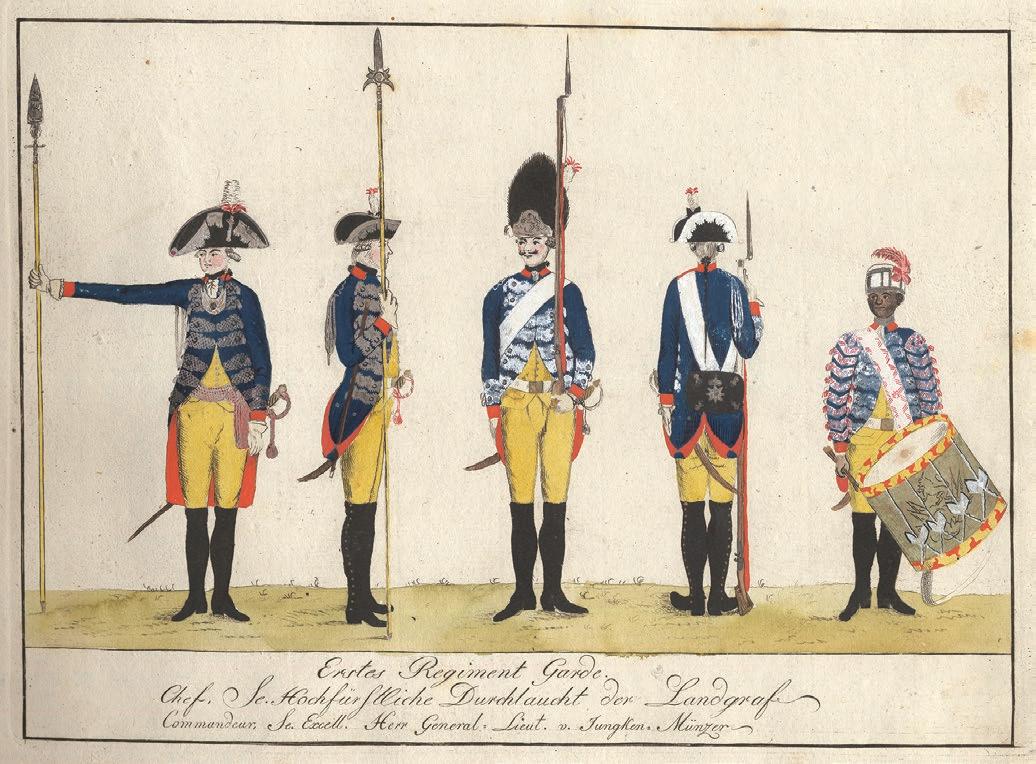
It had long been fashionable for European aristocrats to employ Black musicians. During the American Revolutionary War soldiers from Hesse-Kassel, allies of the British, used Black drummer boys to provide the rhythm for marches. When the Hessians returned to Germany they took about a hundred Black musicians with them, including one from Rhode Island. Some eventually became free German subjects. J. H. Carle, “Erstes Regiment Garde” (1784). BROWN UNIVERSITY, BDR249646.
Jane Lancaster q
Lund Washington, who was looking after his cousin George’s plantation, his enslaved people, and indentured servants while the general was busy elsewhere, wrote in 1775 “there is not a man of them but would leave us if they believ’d they could make there [sic] Escape… Liberty is sweet .” 1
Many Black Americans, knowing liberty was sweet, chose the British side, and became “Black Loyalists,” a convenient but inaccurate label: it is more appropriate to call them Black pragmatists . As Benjamin Quarles wrote, their loyalty during the Revolutionary War “was not to a place nor to a people, but to a principle, freedom ” And if the British were offering them freedom, they became loyal to King George, at least for a while . 2 American offers of freedom to enslaved men who fought in the Continental Army were not always honored, and only about five hundred soldiers and widows of the estimated five thousand or so Black men who served in the Patriot military later applied for a pension when they became available decades after the war 3 There were other ways enslaved people could gain their freedom: manumission in an enslaver’s will, purchase by oneself or a family member, or by self-emancipating, but the freeing of Black Loyalists during the Revolutionary War and their mass exodus in 1783 was the largest single emancipation until the Thirteenth Amendment was ratified in December 1865 4
Many observers noted the inconsistency between the Patriots’ demands for liberty from “British tyranny” and the existence of enslaved Africans in the American colonies . Thomas Paine, whose writings inspired the Patriots, wondered “with what consistency, or decency they complain so loudly of attempts to enslave them, when they hold so many hundred thousands in slavery; and annually enslave many thousands more . ”5 Abigail Adams, wife of the Massachusetts lawyer
and future president of the United States, wrote “it always appeared a most iniquitous scheme to me to fight ourselves for what we are daily robbing and plundering from those who have as good a right to freedom as we have . ” 6
The American Revolution is rightly celebrated as the birth of independence and liberty in the former British colonies And at least fifty-two Rhode Island Black men, women and children decided that they, too, were entitled to independence and liberty . Like thousands of enslaved individuals and free Blacks in the thirteen colonies, they believed the Revolutionary rhetoric of liberty, and if they had to leave the new United States to get their freedom, so be it . Hoping for a better world, some of them succeeded: they made new lives in Nova Scotia and New Brunswick, Canada; in Freetown, Sierra Leone; and perhaps, most surprising of all, in the elegant town of Kassel in central Germany, where one youth found himself in the Landgrave’s private army .
Thanks to the bureaucratic inclinations of the British authorities, to the diligence of archivists and to the search capabilities of the web, we can piece together a long-ignored history of Black family formation, of work and survival among a small group of Rhode Islanders . Poor and illiterate or semiliterate people leave few records, but there are at least eighteen Black Rhode Islanders who emigrated after the Revolutionary War traceable to later generations Their stories illustrate the varieties of the refugee experience They include four women who found independence in Canada and three of them formed new families: Keatie Dyer used the law to assert her
land claims; Jenny Toney reunited with her daughters and obtained land; Nancy Mumford formed a new family with a man she met in New York, as did Rose Eastman Goseman, whose descendants live to this day in New Brunswick . The eighteen also include Arthur Bowler who returned home to Africa and unfortunate Ben Freebody who left a different kind of mark Although he boarded a ship for Nova Scotia he changed his mind at the last moment and stayed in New York . After a series of personal disasters Ben Freebody was re-enslaved in Rhode Island . Teenaged Casar Nichols found himself in a fancy uniform in Germany, while Bridget Wanton scratched a living in the Bahamas These stories and a handful more offer a new light on Rhode Island history and on the complexities of loyalty and patriotism during the American Revolution . The lives of these Rhode Island emigres illuminate a continuing African diaspora while giving
tantalizing glimpses of Black life and family formation in the Americas before, during and after the Revolutionary War . Between 1775 and 1784 an estimated 60,000 people left the American colonies, including at least 20,000 Black people This was almost four percent of the total population of the colonies, and a higher percentage of the enslaved 7 Some believed that they would have a better life under the British, others disappeared into swamps and mountains or joined Native American groups . Details of those who simply melted away may never be known, but details of the three thousand Black people who were evacuated by the British from New York appear in a remarkable document, “The Book of Negroes,” which listed names, ages, and brief descriptions: individuals were “tall and stout” or a “feeble wench” or a “fine child .” The Book noted where they came from, their former enslavers, or if still unfree, the names “of persons whose possession they now are . ”8
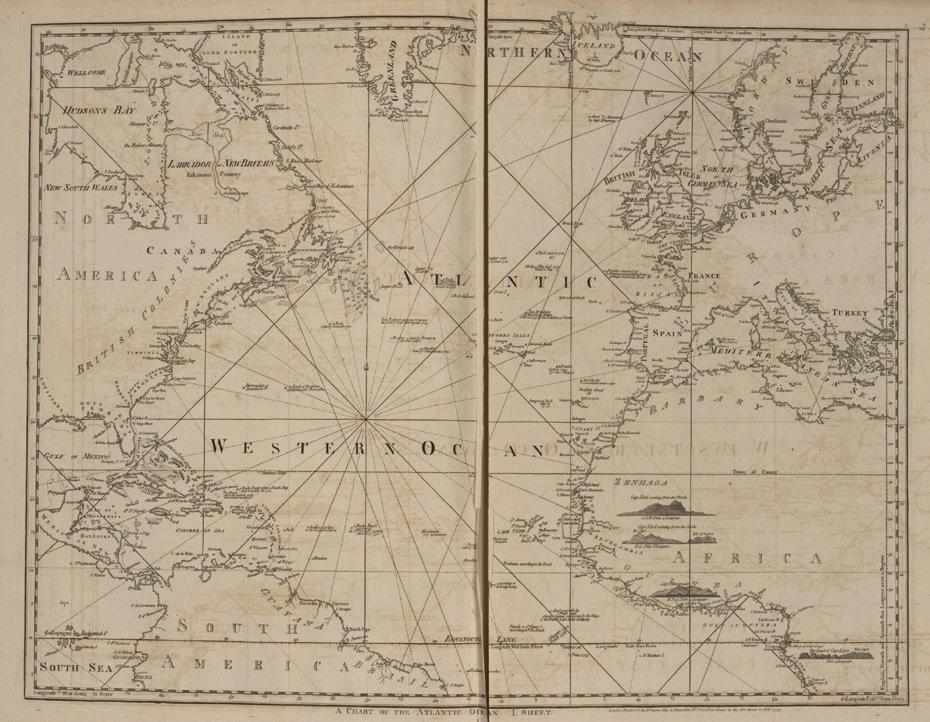
Arthur Bowler made at least four sea voyages. He may have come from the Gold Coast, in what is now Ghana, an area where Rhode Island slave captains frequently traded. His first transatlantic voyage brought him to Newport as a captive. Arthur traveled from Newport to New York City in 1781 and was a passenger on the Nisbet sailing from New York to Nova Scotia in 1783, He was on one of fifteen ships in the fleet sailing from Nova Scotia to Sierra Leone in 1792. Thomas Jeffereys, The West India Atlas, 1771, published by Robert Sayer and John Bennett, 1775.
LIBRARY OF CONGRESS, HTTPS://WWW.LOC.GOV/ITEM/74175045/.
Slave ownership was widespread in colonial Rhode Island: 6 .3 percent of Rhode Islanders in 1774 were Black (most of them enslaved), the highest proportion in New England . 9 Many lived in Providence or Newport, where in the mideighteenth century almost one in three white households included at least one enslaved person Urban slavery was, however, different from the experiences of plantation slaves in the South or in South County, Rhode Island, but it was still slavery, and the enslaved had no legal identity, and very few rights . An enslaved person could not marry, buy or sell property, testify in court, or raise children without the possibility of their being sold and taken away forever If their enslavers used lethal force for any reason, the enslaver would not be charged with murder or prosecuted . 10
The Treaty of Paris, signaling the end of the Revolutionary War, was a less than noble document . Negotiated by slave traders on both sides, the British agreed to withdraw their garrisons and fleets and recognized slavery by agreeing to not carry away “any Negroes or other property of the American inhabitants ” But having promised in 1775 and 1779 Proclamations to free the enslaved who joined them, the British kept their word . These offers of freedom were not altruistic as they undermined enslavers’ wealth and their ability to leave their plantations to fight in the Continental Army British commander-in-chief Sir Guy Carleton told George Washington he could not honor anything in the peace treaty “inconsistent with prior Engagements binding the National Honor, which must be kept with all Colours,” and to do otherwise would be a “dishonorable Violation of the public Faith . ” 11 Washington was not amused .
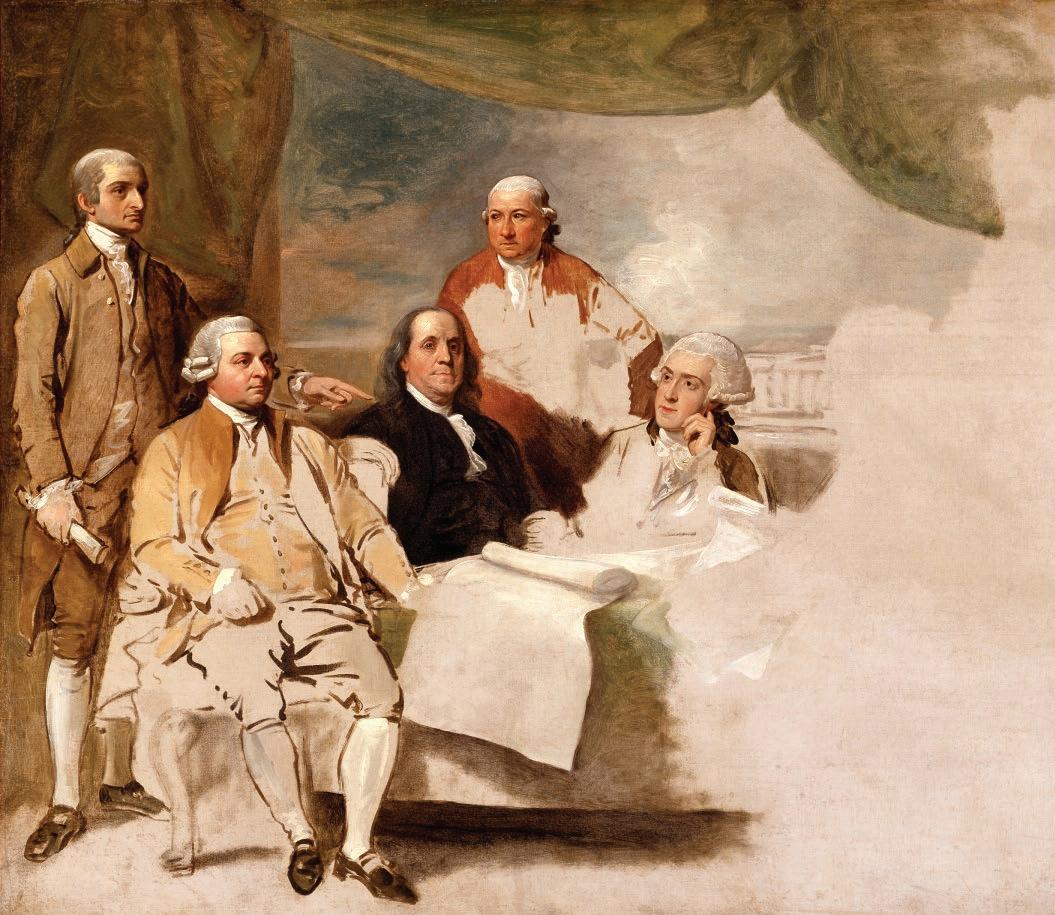
Carleton, realizing there could be disputes about the “property” he was planning to evacuate, appointed inspectors to check the papers of the Black would-be refugees . Starting in late May 1783 (many weeks after a spring fleet of evacuees had departed) British and American Commissioners met weekly at Fraunces Tavern in New York City to discuss disputed cases The Americans soon learned that the British had little intention of returning the formerly enslaved to their enslavers; as a colleague told Washington in June “We conceive it is now reduced to a certainty that all applications for the Delivery of Property will be fruitless . ” 12
Most of the Blacks checked were deemed free free to choose whether they wanted to go or stay Three thousand people chose to leave: they now had the rights of Englishmen, (and the men, perhaps more rights than Englishwomen) . 13 Their printed certificates read as follows: New-York_______1783: This is to certify to whomsoever it may concern that the Bearer hereof _______________, a Negro, resorted to the British Lines, in consequence of the Proclamations of Sir William Howe, and Sir Henry Clinton, late Commanders in Chief in America; and that the said Negro has hereby his Excellency Sir Guy Carleton’s Permission to go to Nova-Scotia, or wherever else _________ may think proper . By Order of Brigadier General Birch 14
British and American commissioners met at Fraunces Tavern on Pearl Street in 1783 to review the eligibility of Black Loyalists for evacuation. They usually ruled against the would-be re-enslavers in disputed cases. THE NEW YORK PUBLIC LIBRARY DIGITAL COLLECTIONS, IMAGE ID 1633269.
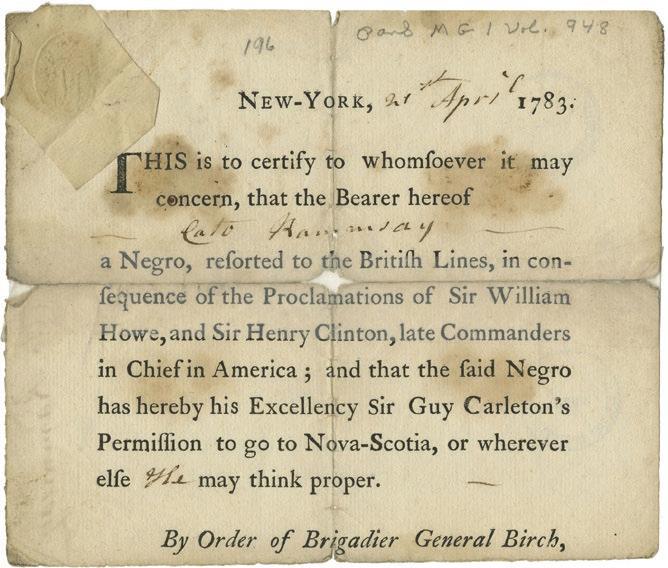
Passport for Cato Ramsay to emigrate to Nova Scotia, 21 April 1783.
A certificate issued to a Black Loyalist wishing to leave New York City.
Three thousand of these precious certificates were issued and only five are known to have survived. Brigadier General Samuel Birch (1735-1811) was the Commander in charge of New York City from 1780-1783.
NOVA SCOTIA ARCHIVES, MG VOLUME 948 NUMBER 196.
In April 1783 the New York docks throbbed with activity . Thousands of Loyalists, having lost the civil war known as the American Revolution, were preparing to leave the new United States Over the next seven months the British evacuated thirty-three thousand individuals from New York (more than 20,000 others had left just before or during the war), sending most of them to barely settled Nova Scotia in the Canadian Maritimes . One in ten of the 1783 evacuees was African American, and one in six of those African Americans came from Rhode Island . Two thirds of the three thousand Blacks who left came from Virginia (1,128) South Carolina (474) or New York (448), but Rhode Island accounted for the largest number from New England . 15
The transportation and resettlement of the Loyalist refugees, Black and white, posed enormous challenges (and expense) to the British authorities, complicated by distance, poor communication, and by race and class The British promised land; within a year two-thirds of the white Nova Scotian Loyalists received a hundred acres or more They were mostly of the “middling sort”; some 8,000 of the wealthiest had gone to England while others had gone to Florida, or Caribbean islands . The demobilized white soldiers and the Blacks usually received “town land” on which to build a cabin and plant a garden, but they had to wait for larger allocations Some (but not all) eventually received twenty or thirty acres 16
Before any Black evacuees could leave New York, however, British and American officials inspected the ships and listed the refugees’ details in a three-volume ledger called The Book of Negroes . The Book of Negroes is an imperfect source: it was not always in the formerly enslaved person’s or free Black’s best interests to tell the truth Nor is it a complete tally of the Black people, enslaved or free, who left the new United States . Some left earlier or later . Whatever its shortcomings, however, by late November 1783, The Book of Negroes was a register of 3,000 people of color who had joined the British prior to the signing of the provisional Treaty of Paris in late 1782; it included 1,336 men, 914 women and 750 children More than a third were claiming freedom “by proclamation”— either Lord Dunmore’s 1775 edict that any enslaved Virginian fighting for the British would be free, or General Sir Henry Clinton’s enlargement of this proclamation in 1779 to all of the enslaved who found their way inside British lines . The second largest group was those who had self-emancipated
Sir Guy Carleton, 1st Baron Dorchester, (1724-1808), was Governor of Quebec 1768-78 and 1785-95, and British Commander in Chief in New York City 1782-83, refusing to fully evacuate New York until all the Loyalist refugees, Black and white, had left. Painter, Mabel B. Messer,1923. (A copy of an original portrait by an unknown artist; the original was lost in a fire which consumed Rideau Hall, Ottawa, in 1979). LIBRARY AND ARCHIVES CANADA LIBRARY AND ARCHIVES CANADA, 1997-8-1.
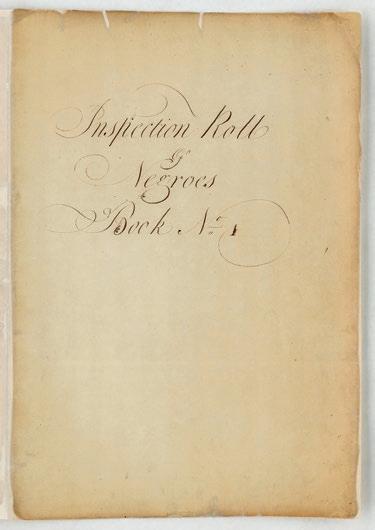
The so-called “Book of Negroes” listed some 3,000 Black men, women and children, most of them formerly enslaved, whom the British evacuated from New York in 1783. There are two copies of this document, one in the Guy Carleton Papers in the National Archives of Great Britain in London, and this one in the Continental Congress Papers in the U.S.National Archives in Washington D.C. NATIONAL ARCHIVES, INSPECTION ROLL OF NEGROES BOOK NO. 1; 1783; RECORD GROUP 360.
during the war, and about fourteen percent claimed to have been born free or to have been emancipated . 17
The profile of the Black Rhode Islanders was different . Twenty-eight of them, over half the total, convinced the inspectors they were free, either born free (including the four babies born in New York behind British lines who were automatically free), or freed by sale or in their enslaver’s will Some, but not all, had documents to prove it . This was a suspiciously large number . Although manumission of elderly or disabled slaves was not uncommon, the majority of the Rhode Island adults in The Book of Negroes were in mid-life: the eldest was fifty-three, and only one was noted as disabled in any way; Peter Parker was a “stout fellow” with one arm, and Jenny Toney was judged “worn out” at fifty-two, but once she became a landowner in Nova Scotia (at fifty-six) she continued working her fields for many years . Only one Rhode Islander claimed freedom “by proclamation . ”18
The backgrounds of the Rhode Island refugees were very varied Thirty of the fifty-two, whose ages ranged from fifty-three to five months, traveled in family groups, all but two headed by women . Only three of the free Blacks were men, while fourteen were women . There were fifteen children, eleven of whom were free . Seven evacuees said they left with the troops when the British left Newport in the fall of 1779 At least four women had married in New York and were traveling with spouses Many of the Black refugees from Rhode Island had worked for the British or the Hessians on Aquidneck Island and four were of mixed race . One said she had been an indentured servant . Seven came from Narragansett, Providence, Warwick, or Portsmouth and one from Connecticut, but the majority were from Newport, and had lived there during the British occupation One woman joined British troops as a Black Pioneer, one child worked for the Hessian troops as a drummer boy; several other Rhode Islanders had served as auxiliaries to the British as carters and laborers in the Wagon Master General’s Department .
The Rhode Islanders’ enslavers, many of whose families went back to the founding of the colony, ran the gamut too There was a British spy (who was simultaneously a senior official in Rhode Island), a Jewish merchant, some Episcopalian worthies, some determined Patriots, a Loyalist who took his enslaved people into exile in New York (but died before he could take them any farther), and a whole group of fencesitters, waiting to see which way the war would go
Map of Shelburne and Birchtown showing the location of the Black and white settlements, in 1798. Due to its geographical location, the Royal Navy saw it as a safe harbor. A New Chart of the Coast of Nova Scotia…by Captain Holland. NOVA SCOTIA ARCHIVES.
Half the evacuated Rhode Islanders went to Port Roseway, Nova Scotia, later renamed Shelburne, and most lived in Birchtown, a nearby Black township which, with some 1,500 inhabitants, was the largest free Black town in North America Shelburne is at the southwestern tip of Nova Scotia, and boasts one of the best natural harbors on the Eastern seaboard: it was strategically necessary for the Royal Navy . Five of the eighteen individuals from Rhode Island who went there in either the spring or summer fleets reappear in official records, two of them well into the nineteenth century This is remarkable, as few poor eighteenth-century people of limited means, whatever their color or level of literacy, leave much of a mark on history . Eight of the Rhode Islanders on the Spring Fleet have not been traced after they boarded the ships: this may be because five of them had indentured themselves, and the female-headed Jackson family had traveled independently . If they worked for someone who supported them, they had no need of British provisions and would not have been counted in the Birchtown Muster, an official listing of those requiring assistance from the authorities . The Summer Fleet was similar: four members of the female-headed Bull family, who could not be traced, were indentured, as was Pompey Lyndon, while most of the others have left an archival trail 19
Sailing to Port Roseway in the spring was “ordinary man” Jacob Wanton, aged thirty-five, formerly enslaved
Birchtown at its height had some fifteen hundred Black residents, and was said to be the largest settlement of free Blacks in North America. Now there are only a scattering of dwellings, a church and the Black Loyalist Heritage Centre.
PHOTO COURTESY OF TOURISM
NOVA SCOTIA.
by Latham Thurston in Newport; he’d freed himself under General Clinton’s Proclamation . When the British checked the residents of Birchtown in 1784 to see who still needed provisions, Wanton had become Jacob Wanton Nicholson, hatmaker . He was probably making fur hats from the animals that roamed the forests nearby: musquash from the muskrat, raccoon skins, beaver, even bearskins . 20
New families were forming . Twenty-one-year-old Nancy Mumford from Newport, a “Stout wench,” also went to Port Roseway She had a bill of sale to prove that her father, Bristol, had purchased her mother from a Mrs Mumford 21 By 1784 she was married to a freeborn Jamaican cooper, John Prior, who was twenty-seven, and by the late 1780s, when Shelburne and Birchtown were failing, they moved across the Bay of Fundy to Annapolis, where the Prior family stayed for generations Nancy Prior was buried in the local Anglican churchyard on September 27, 1827; two of her granddaughters married at the same church, and Tom Prior, possibly a son or a nephew, worked for a white Annapolis family for many years . 22
The Summer Fleet left New York in July 1783 . Free Rose Williams, noted as a “stout wench,” and one-year-old Harry, her New York-born “sickly child” sailed on the military transport L’Abondance 23 A former Newport resident, Rose was traveling with Harry Williams, a thirty-five-year-old “stout fellow” who had left his enslaver John Gray of Bladen County, North Carolina, four years earlier . The name of her
“sickly” child suggests that Harry Williams was the father A year later the little family appears in the Birchtown Muster, Harry now thirty-six, Rose, twenty-eight, and little Harry, perhaps having outgrown his “sickliness,” aged two . After that, they disappear from any public records
Also sailing aboard L’Abondance was Jenny Toney (or Tony), a free woman who appears in the 1774 Newport census as head of a household of three Black people . The formation and re-formation of her family reveals the fluidity of the refugee situation . The inspectors recorded her as “worn out” at fifty-two . She declared she was formerly the property of Daniel Underwood (1706-77) of Connecticut and Rhode Island, and freed by bill of sale, a document she showed the Inspectors . Once free, she moved to Newport to find work for her daughters and herself; as Jane Toney she was allocated twenty acres of land in Birchtown in 1787 . One daughter may have been twenty-four-year-old Molly Burgis who had left her owner in Buttermilk Bay, near Wareham, Massachusetts, four years earlier, and married Jeffery Burgis, from Norfolk County, Virginia, who travelled on the same ship . Molly appears with Jenny Toney, Judith Toney, fifteen, and Patience Toney, twenty-three, in the Birchtown Muster in April 1784, without Jeffery Burgis, but adding nineteen-year-old laborer Edward Parsley The British set up companies in order to organize the refugees, and the Toneys were in Colonel Blucke’s company, although Patience Toney and Edward Parsley don’t appear in the Book of Negroes . Judith Toney was, however, surely fourteen-year-
old “fine girl” Judy Weeden, whose name appears immediately after Jenny Toney’s in the Book of Negroes listed as “free by Bill of Sale” like her mother . In Canada, she resumed her mother’s surname . 24
By Fall, when the last batch of evacuees left New York, the British decided that Shelburne was overcrowded, and transported 558 unfortunate refugees to Port Mattoun, a few miles up the Atlantic coast . It had a fine harbor, but few other advantages and it was a terrible place to be going in late November . The ground had started to freeze and lumber supply ships were delayed so shelter was limited: most of the settlers had to make do with tents, sod huts or bark shelters Fights broke out A fire in the spring destroyed the warehouses storing settlers’ provisions, and most refugees, white and Black, abandoned the village . The whites moved north to Chedabucto, the Blacks moved south to Birchtown . 25
An early arrival in Port Mattoun was “ordinary fellow” Ben Frankham, twenty-one, who told the inspectors he was born free in Charleston, South Carolina In fact he was freeborn in Johnston, Rhode Island, and did not wish the British to know he had served for several years in the Continental Army . He moved to Birchtown in 1784 and then to Digby, a Black township near Annapolis, where he raised a family and had a long and well-documented career 26
The brig Elijah sailed to Port Mattoun in November 1783 Some of the men belonged to the Wagon Master General’s department (WMG), and some women were probably servants, washerwomen, or camp followers . One passenger was a free Rhode Islander, twentythree-year-old “mulatto” Patience Jackson, listed as a “very likely wench ” She carried a certificate issued by General Birch She was among the seventytwo individuals who moved with Robert Bridge’s company to Birchtown in April 1784, along with more than two hundred other free Blacks from Port Mattoun . By the time she arrived in Birchtown and claimed the “King’s Bounty” of supplies, she was Patience Warrington, and her descendants appeared in Birchtown and Shelburne records for many generations . 27
This reproduction of an early pit house was built on the grounds of the Black Loyalist Heritage Centre, Birchtown. Many of the Black Loyalists spent their first winters in dwellings like this. PHOTO COURTESY OF JANE CANAPINI, GROWNUPTRAVELS.COM.
In November 1783 Rose, a thirty-year-old “stout wench” sailed from New York on the sloop Skuldham taking with her two children aged twelve and five . The inspectors were in a hurry; they did not note down the children’s names . She had left her enslaver, Daniel Russel of Newport, in 1776, as soon as the war started, so her second child was born after her departure 28 She was traveling with Cato, a free man described as a thirty-five-year-old “stout fellow”: both of them were under the protection of Godfrey Wainwood (or Wenwood) . This is odd, because London-born baker Godfrey Wainwood lived in Newport, and he apparently never left . Wainwood was famous for his “Bread, Bisquet, Ginger bread and all Sorts of Cakes” as well as offering to bake pies or meat in Mrs . Penelope Stelle’s bakehouse (useful for people with no ovens of their own) at “two Coppers a Dish . ” 29 Wainwood died in Newport on October 2, 1816, aged seventy-seven years . His particular claim to fame was helping to bring to light the “treasonable correspondence” of Dr Benjamin Church of Boston 30
Most interesting of the Rhode Island families who settled in Birchtown was a family of three, the Bolers or Bowlers, headed by Arthur, a “stout fellow” aged thirty-four, who was formerly enslaved by Rhode Island merchant and politician Metcalf Bowler Arthur was born in Africa about 1749 and had been captured and enslaved by the mid-1760s Boys were popular captives in New England, and they were more likely to become household servants or trained as artisans rather than used as field hands . Arthur Bowler is unusual, in that he is mentioned in two surviving Rhode Island records, and six British records . In addition to Cesar Lyndon’s accounts, where Arthur traded with Newport’s most entrepreneurial unfree person, he appears in a letter written in 1774 by his enslaver, Metcalf Bowler, who clearly trusted his “servant” to go to Newport to collect a debt of two hundred dollars from merchant William Vernon . Arthur Bowler’s wife Phebe was a thirty-five-year-old free born “wench” from Portsmouth, and their twelve-year-old daughter Betsy, a “likely girl” was also born free in Portsmouth It is possible that Phebe was Indigenous; Narragansett women most of whom were free, sometimes formed partnerships with enslaved Black men . 31
By April 1784 the family was in Birchtown where Bowler described himself as a laborer, working while he waited for his land allocation He received thirty-two acres in 1787 32 Four years later the Bowlers appear on a list of 155 Birchtown
Anne Fairchild Bowler, wife of Metcalf Bowler wealthy R.I. merchant and enslaver. Artist, John Singleton Copley 1763. The portrait was painted around the time her husband enslaved the child he called Arthur. National Gallery of Art, 1968.1.1.
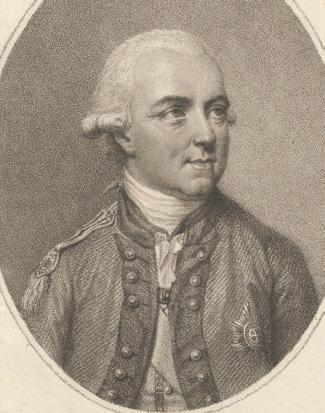
General Sir Henry Clinton (1730-1795) commanded the British troops when they occupied Newport from 1776-79. He corresponded with enslaver and local politician Metcalf Bowler who was spying for the British. Miniature, watercolor on ivory, by John Smart, 1777. Sir Henry Clinton, engraved by Francesco Bartolozzi, 1780.YALE CENTER FOR BRITISH ART, B1978.43.599.
Arthur Bowler, fifty-three, was still in Freetown in 1802 He was then married to the widow of Richard Richards, and lived with his adult daughter and her children, the census taker noting disapprovingly in the margin she had “1 Boy and 2 Girls by as many Fathers I suppose ” 36 Arthur Bowler had outlived his former enslaver by a decade, buried a wife, and seen his grandchildren born He had survived the Middle Passage, enslavement in Rhode Island, the voyage from New York to Nova Scotia where he and his family barely survived, and then another transatlantic journey to Africa .
One of the last ships to depart New York in 1783 was the brig Concord ; George Washington had already entered the city in triumph before it finally set sail on 30th November Traveling on it was twenty-four-year-old Rose Goseman listed as a “stout wench,” her baby daughter Fanny, and her husband John Goseman . 37 Rose was either a farm worker or a house servant, one of seven people enslaved by John Easton of Newport who bequeathed her to his children in his 1777 will She left the town with dozens of other Black people in 1779 when the British evacuated Newport 38
Rose Easton met John Goseman in New York . He was twenty-three years old in 1783, and came from New London, Connecticut . His former enslaver, John Latham, a member of a large shipbuilding family, died in 1779, and Goseman may have adopted a new surname after attaching himself to a Hessian regiment 39 Both of the adult Gosemans had certificates, and they were going to Nova Scotia as servants to a Mr . Weir . If this was the merchant from North Carolina who was one of the Port Roseway Associates, they were not under his protection for long, for Thomas Weir died in 1784 . 40
Few of the refugees sent to Port Mattoun stayed there; the Gosemans were among those who soon found their way to Birchtown . Now thirty-five minutes by car, in the winter of 1784 it required finding a boat to sail the wintry coast to the relatively sheltered Shelburne Bay . Life in Birchtown was not easy, particularly for the Black settlers who had little land and few resources By the late 1780s British food handouts ended, and food was in very short supply As Boston King, a Black resident of Birchtown, wrote in his memoir:
Many of the poor people were compelled to sell their best gowns for five pounds of flour, in order to support life . When they had parted with all their clothes, even to their blankets, several of them fell down dead in the streets, thro’ hunger . Some killed and eat [sic] their dogs and cats; and poverty and
distress prevailed on every side; so that to my great grief I was obliged to leave Birchtown, because I could get no employment 41
In 1788, John Goseman, who was trying to make a living as a woodcutter, didn’t leave, instead he killed a young ox he found stuck in a thicket He left it where it was, and when he returned it was rotting, so there was little edible meat . Overwhelmed by guilt, he went to the magistrates and confessed . 42 There is no record of his punishment, but he and his family moved to New Brunswick where some of his later children were born Five generations later, the Gosemans (now Gosmans) still live in Fredericton, New Brunswick 43
One in five of the evacuated Rhode Islanders went to St . John, or St . John River, Nova Scotia . They included “Tall and stout” Jeremy (or Jeremiah) Dyer, aged twenty and Keatie (or Katie) Dyer, described as a “stout mulatto wench,” aged twenty, who said she was a servant, rather than enslaved 44 Both of them left Newport with the British troops in 1779 and traveled on the Spring Fleet in April 1783 as servants to British military officers . Jeremy disappears from the historical record, but Keatie farmed, raised a family, and appeared in legal papers into the 1820s petitioning for the rights to her lands, which had formerly belonged to Acadians In 1821 she wrote that she had been in the province since she arrived with the troops in 1783 and was now an “Old Woman between 60 and 70 years of age .” She also said she had never had any land granted her in the province, but that she had lived in Queensbury Parish for more than thirty years, had “laboured hard and brought up her Children .” Her son now lived on the land with his wife and five children She asked for the part of the lot where she had farmed and built “improvements,” plus a hundred acres of unimproved land nearby . 45
Summer arrivals included Pompey Lindon aged 27, a “squat fellow” with “cuts on his cheeks,” suggesting he was African-born . He’d been enslaved by Josias Lyndon, a former governor of the Rhode Island colony, and long-time chief clerk to the General Assembly Lyndon enslaved four people in 1774; Pompey was one of them, while another, Cesar, was literate and worked as his enslaver’s clerk and secretary . Cesar did not leave Newport, but instead became involved in
the Free African Union Society, which was founded in 1780; he resigned through ill health in 1793 and died, impoverished, the following year . 46 Pompey went to Shelburne as servant to Josiah Dursey, but he doesn’t appear on the muster list the following April . As a servant, Pompey had no need for British provisions 47
Cuff Potter, described as a “mulatto” was on the Symmetry when it sailed in mid-June 1783 He was an “ordinary fellow” of fifty-three, and had a certificate confirming his freedom . 48 He told the inspectors he was formerly enslaved by Ralph Potter of Newport . “Ralph” was farmer Rowse Potter, captured by the British along with his enslaved man Cuff in North Kingstown on August 24, 1778, and taken to Newport . Potter was released three weeks later and returned home, but Cuff stayed in Newport until he was evacuated with the troops more than a year later . 49 Once he arrived in St . John his name disappears He could have changed it; he could have moved on; he could have died .
The next group of Rhode Islanders, including twentyfive-year-old “stout fellow” John Potter, embarked soon after July 8 in a small fleet headed for St John River Their arrival put pressure on people already there, and there was an extreme shortage of food and shelter To make ends meet, local leader Richard Corankapoon wrote, they had to work for “pepel that is able to hier them ”50
Corankapoon was an energetic African-born man who had bought his own freedom in 1776, and who would later become a leader of the Sierra Leone community 51 In 1786 he submitted a petition to the Governor for title to 1,750 acres of “back land” for sixteen members of his company, which included John Potter . Corankapoon wrote: “Your Petitioner hopes that those who know him think he sincerely desires that the Blacks, shou’d lead Industrious, honest Lives and instead of being a Burthen, shou’d be an Advantage to the Community ” The sixteen men were, he asserted, the most likely to succeed with their landholdings The number of claimants grew to thirty-one, and in 1787 they were each granted fifty acres, with the usual rights and provisos . The nine-hundred-andninety-nine-year lease gave them rights to the woodlands, fishing, hunting, mines and minerals, with certain exceptions . White pine trees, which were used for naval-ships’ masts were reserved to the Crown, and gold, silver, copper, lead and coal were omitted from the mineral rights The new lessees were expected to pay a tax of a shilling per fifty acres, starting in ten
years, and moreover they would forfeit the land unless they had made some improvements within three years, by which time they had to clear three acres of land, or drain three acres of swamp, or erect a good dwelling house, twenty by sixteen feet If they failed to achieve any of these tasks, the land would revert to the Crown 52 John Potter was tempted to give up, for it was reported in 1786 that he had “goun over the Bay ” 53 He eventually received his fifty acres, but working the claims was easier said than done . Some of the land was inaccessible, stony, or marshy; whether he actually farmed it is not known . 54
The Peggy , also bound for St John River, transported fifteen Black passengers including forty-year-old Peter Parker a “stout fellow with one arm,” formerly enslaved by Thomas Parker of Providence, Rhode Island, who he said had given Peter his freedom . 55 Peter was traveling with Englishman Thomas Mallard who had arrived in New York City in 1776, not the most opportune of times A freemason, as were many military officers, lawyers, and politicians, Mallard became
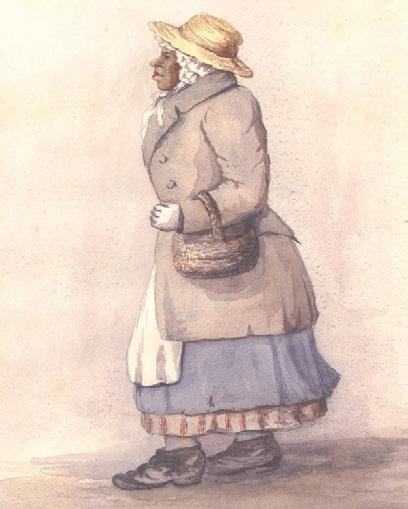
Rose Fortune, depicted in a very rare watercolor by an unknown artist, c.1830. Rose was probably born into slavery in Virginia ca. 1774; her father was evacuated by the British from New York, sailing on the ship Peggy in April 1783. Rose, an unnamed child above ten, was in the Annapolis Royal, Nova Scotia records in 1784. She was an entrepreneur whose baggage-handling business was continued by her children and grandchildren for a hundred years; she was also Canada’s first female police officer. She died in Annapolis Royal in 1865. NOVA SCOTIA ARCHIVES DOCUMENTARY ART COLLECTION, 1979-147.
a second lieutenant in the New York Volunteers, one of the first Provincial Regiments raised during the American Revolution . 56 He moved to St . John in 1783, with his family and four free Black servants, one of whom was Peter Parker, and an enslaved fourteen-year-old “mulatto” girl named Jenny In 1785 he purchased a lot on King Street, St John for the princely sum of nine guineas, and erected a large two-story building . The “Long Room” which occupied the whole of the second floor, was used variously as a Masonic Lodge, for meetings of the provincial legislature, and as a theater . The ground floor became one of the principal inns of the town 57 There would be plenty of work for servants, and the fact that Parker does not appear on any muster rolls, nor was he allotted any land, suggests he either continued working for Mallard, or died .
“Ordinary fellow” thirty-five-year-old Ben Freebody, formerly from Newport, was on board the sloop Cato in New York Harbor in October 1783 He was preparing to sail to Annapolis on the eastern coast of the Bay of Fundy However, for some reason Ben became alarmed and although he had a certificate making him a free man, he bolted and the ship sailed without him . This was a very bad decision . He had left Newport in 1775 when his enslaver, distiller Samuel Freebody, rented Ben out to a slave ship’s captain so he could use his wages to buy his freedom: the few months became six years, as Captain James Brattle refused to pay him and refused to release him . As a landsman with no maritime experience, Ben was simply a manual laborer, the lowest ranking seaman; he was badly mistreated and forced to work on a privateer . He never saw a share of the prizes, and neither did his owner, which led to a later lawsuit 58
Released in 1781 Ben stayed in New York, and found work with ship’s master Benjamin Hart, a New Hampshire Loyalist, who wanted to take him to Shelburne, Nova Scotia . Although he had already boarded the ship Cato, Ben jumped ship and stayed in New York . Within weeks he caught smallpox and became blind in one eye, which he blamed on carrying his master’s clothes to a washerwoman “which,” he wrote, “was the way [I] got the Small Pox ” He was ill and unable to work most of the winter; and his landlord was threatening to sell him to realize back rent, so in April 1784 Ben Freebody wrote to his enslaver Samuel Freebody in Newport saying he was in a “very low State of health and without a friend or a Copper to bless,” adding, “I’m sensible Dear master I belong to you ” 59 Two years passed by, with Ben working as
a manservant until Freebody decided to sue Captain Brattle, who had hired and mistreated Ben, and furthermore had never paid for his labor . In April 1786 Brattle visited Freebody’s house to discuss the matter Ben was called into the room and he related a sorry tale Less than three weeks into the voyage, he said, Brattle had him stripped, tied to the rigging and then whipped with the topsail brace until blood ran onto the deck . The Captain then “pickled” Ben’s back with brine literally rubbing salt into the wound . Brattle did not deny it, but when Ben said he’d done nothing to deserve it, Brattle said “you lie, you Rascal .” Ben claimed that later, when he was in Grenada, he was tied spread-eagled on the town square and whipped 60 Samuel Freebody sued Brattle for £264; witnesses were brought and deposed . Brattle offered to give Freebody £200 if he handed Ben over to him but Freebody refused . The last we hear of Ben he was still enslaved in Rhode Island, but he was far from happy Samuel Freebody signed a pass which said he allowed my man Servant, Ben, to absent himself from my Service Thirty (30) Days, in order to Look out in the Country for a Person to buy him, as he is discontented living with me, I wish him a better Master I will sell him for a Reasonable pay and Price
Saml Freebody, Newport, Augst 10th 1790 61
Ben believed that if Brattle had paid Freebody, he might have purchased his freedom with the possibility of “good surcomstances [circumstances]”with his share of the pay . But fifteen years later he was still enslaved . Samuel Freebody died in 1801, aged eighty-two, and what happened to Ben is unknown Had he stayed on the Cato he would have been free as long as he survived But if he was like his fellow Black passengers on the vessel he may have never received much or any land, and been forced to labor for others .
A fleet of eleven British ships sailed from New York to Germany (often via Spithead, England), and upon them were twenty-four Black people traveling as servants to Hessian military officers Major General Hans von Knoblauch took ten servants, General Wilhelm von Knyphanson had two, and the Hereditary Prince of Hesse-Cassel was accompanied by a “stout” seventeen-year-old boy . 62
A small number of Black people, some enslaved, some free, were a familiar sight in Kassel, the capital city of Hesse . The local aristocracy used enslaved boys known as Kammer-Mohren (“chamber Moors”), to wait on them, and some Hessian officers sent such boys from America as gifts to their noble friends “like crates of exotic fruit ” 63 The landgrave of Hesse-Kassel, Friedrich II, (uncle of George III of Great Britain) already had Black drummers in his personal regiment . At least 150 Black Americans were enlisted in Hessian regiments, some as soldiers, and some as laborers . The Hessians also employed adolescent boys as musicians As army tactics changed and formation marching became more important, the need for drummers, trumpeters and fifers grew, and boy musicians freed adult soldiers to actually fight as musketeers or grenadiers . There were also hundreds of civilian camp followers, day laborers, servants, midwives, cooks, maids, laundresses, grooms, nurses, wagon drivers and prostitutes 64
On November 9, 1783, a large ship, the Commerce, set sail from New York carrying four Black folk; all had worked for the Regiment du Corps, part of the Hessian army . 65 Three were Rhode Islanders including twelve-yearold drummer Casar Nichols, “a fine boy,” his mother Rhose, a thirty-six-year-old “ordinary wench” and her “mulatto” friend Cathern Townshend, a “likely wench” of seventeen, who insisted she was free, but working for Ben Nichols, who had enslaved her two companions .
The white Hessian soldiers were demobilized on their return home, but not the Black ones . Friedrich II decreed on October 31,1783, “No Negroes are to be dismissed; but they shall all be retained, and until they can be transferred to my First Battalion Garde they shall receive a monthly bonus payment from the accumulated peace budget from my royal chatoul [his personal funds] .” Within a matter of months all the Black Hessian soldiers, presumably including Casar Nichols, were integrated into Friedrich’s personal corps, and began wearing the elaborate braided uniform and the white turban of the Hessian Corps . They were free subjects of the landgrave, and privileged “Moors” with powerful protection and respect at court 66
This was quite a change from their previous lives, when they were enslaved by and worked for Benjamin Nichols, whose cousin Walter ran the White Horse Tavern in Newport . When three thousand or so Hessians arrived in Newport with an equal number of British troops in November 1776, some of the officers were billeted in the Tavern Walter Nichols and his wife fled to the mainland, but left workers behind, including Rhose, Cathern and Casar . 67 In 1778, when some of the Hessians left for deployment elsewhere, Rhose emancipated herself, gathered up her seven-year-old son and her seventeen-year-old fellow servant, and left with the Hessian troops 68 1778 was a momentous year for the Black Nichols, who were trying to free themselves Thomas Nichols, enslaved by a Benjamin Nichols of Warwick (possibly the same Benjamin Nichols) enlisted in Captain Thomas Coles’ Company, the “Black Regiment” with the promise of freedom after the war . Perhaps he inspired his fellow Nichols enslaved people, who were younger or female, to find a different path to freedom 69
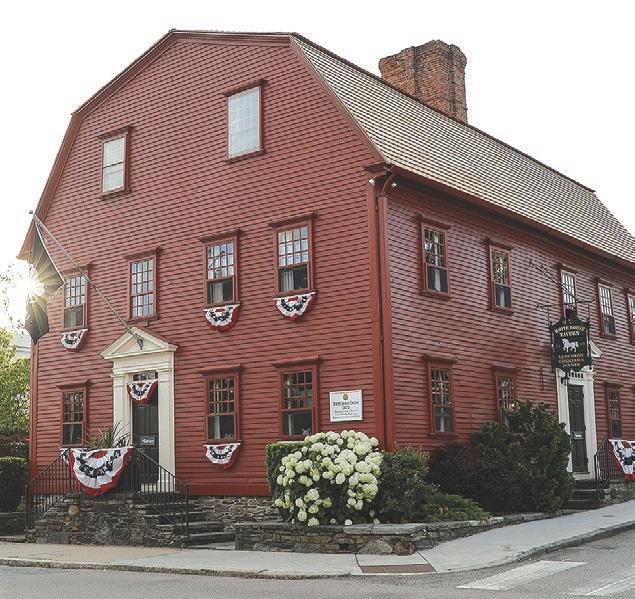
The most unusual destination for the Rhode Island evacuees was Abaco, a sandy spit of land in the Out Islands of the Bahamas . Eighty of the three thousand Black people who appear in the Book of Negroes went there, with about fourteen hundred white Loyalists 70 Twenty-two-year-old Bridget Wanton, a “stout little woman,” and her five-yearold daughter were the only Rhode Islanders among the eighty . They traveled with fifty-five others on the troop transport William . 71
Bridget told the inspectors on August 27, 1783, that although she had formerly been enslaved by Colonel Joseph Wanton Jr of Newport, he had left her free at his death, which occurred in New York City on August 8, 1780 . 72 Joseph Wanton Jr . was a Harvard graduate, privateer, merchant, and twice-elected deputy governor of Rhode Island when Stephen Hopkins was governor . Colonel Joseph and his brother William Wanton enslaved six people in 1774, and according to the Newport tax list were the second wealthiest family in town Their fortune came from ownership of a slaving vessel and the import and export of molasses, an integral part of the triangle trade as well as a welcome addition to local conviviality in the form of rum . 73
Active in the Loyalist cause, Wanton was imprisoned by the Rhode Island militia and accused of treason On his release he redoubled his Loyalist sympathies and raised troops for the King’s cause . He paid dearly: his beautiful house, now known as the Hunter House and a property of the Newport Preservation Society, was seized and his property on Conanicut, Prudence and Gould Islands was confiscated . 74 When the British withdrew from Newport he was among the two dozen Loyalists who went with them to New York The General Assembly banned him (and the other Loyalists) from returning to Rhode Island . Although his young second wife, the former Sarah Brenton, stayed behind with her toddler son to watch his remaining property, he took some of his enslaved people, including Bridget and her daughter, with him 75 Whether Bridget simply walked away and freed herself, or whether Colonel Wanton formally freed her is unknown, but by 1783 Bridget had met Captain John Davis, in New York, one of the organizers of the Abaco Loyalists, who paid her passage to the Bahamas . In the months leading up to their departure, Davis held several meetings of “respectable” Loyalists in his house “At the Sign of Rodney’s Conquest, Bottom of Little Queen Street, on the North River ” 76
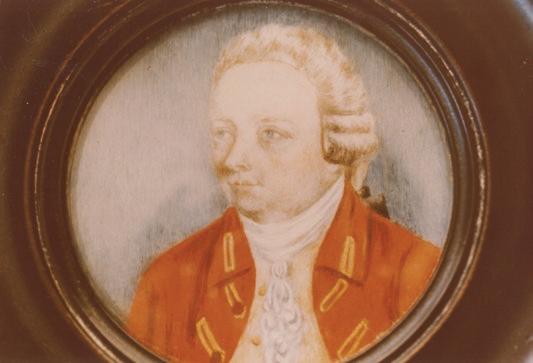
The Abaco settlers called their landing place Carleton, after the general . It was a poor choice of site, and a hurricane flattened most of the buildings in 1785; the settlers then moved further south . Conditions on the islands were poor; the soil was sandy; fresh water was scarce, and sugar, rice and tobacco would not grow People ventured to these outer islands only to cut timber, catch turtles, or salvage shipwrecks . 77 A month after their arrival, the refugees were asking for help from General Carleton . They wanted “a few rolls of osnaburgs [a coarse canvas-like linen cloth, used for garments for enslaved people, and for making shelters or protecting wagons], a Thousand pair of Military Shoes, some nails (6 casks) for building of Houses, a Cross-cut saw…a few whip saws ” They also wanted “some medicines as the People are Landed very sickly from the Ships . ” 78 Leaving New York in hurricane season was not conducive to calm sailing .
Planters discovered that Sea Island cotton would grow in Abaco, and the first couple of years saw bumper crops The crop became infested with chenille bugs in 1788, however, and the market for Sea Island cotton collapsed after Eli Whitney developed his cotton gin in 1793, enabling inland American planters to grow short staple cotton, which was easier to process . It is unlikely that Bridget Wanton found herself picking cotton; she is more likely to have continued as a servant to John Davis, raised her daughter and perhaps several more children, but records of what happened to servants like her are rare indeed . 79
Many enslaved and free Blacks, knowing that liberty was sweet, decided which side in the Revolutionary War would benefit them the most . Some served in the Continental Army with the promise of freedom if they survived . Up to 20,000 of them voted with their feet, either stealing themselves away into forests and marshes, or moving behind British lines The ones who appear in the Book of Negroes had found their way to New York City, where they had tried to scrape a living . When the British offered to take them to Nova Scotia, or to other British possessions, some three thousand accepted the offer, including fifty-two individuals from Rhode Island The early years for most of the evacuated Black Loyalists were very difficult, as they often are for refugees: food was in short supply, and lodgings were very basic . Life was little better for those who stayed behind, however, despite the passage of gradual emancipation laws in New England (which emancipated no one in the short term), enslaved people in the southern states would have to wait eighty years to be free Black men in Rhode Island, recently enfranchised, were deprived of the vote in the 1820s, and Black individuals faced discrimination in employment and violence on the streets of Providence, with race riots in Hard Scrabble in 1824, and Snowtown in 1831 . As we have seen, some of those Rhode Islanders who stayed in Canada were well-established by then, and for the family in Freetown, Sierra Leone, British colonial policy had permitted the so-called Nova Scotians to fill professional jobs . 80
A Black Loyalist Heritage Center was founded in Birchtown in the late 1990s. The collection was previously housed in the Old Birchtown school house, which was deliberately burnt down by arsonists in 2006. The current building opened in 2015. COURTESY OF TOURISM NOVA SCOTIA.
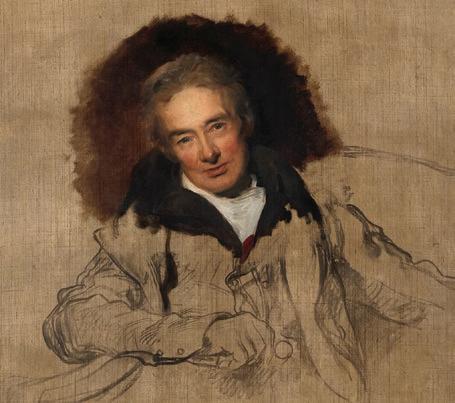
National Portrait Gallery UK. William Wilberforce, detail of an unfinished painting by Sir Thomas Lawrence, 1828; in the NATIONAL PORTRAIT GALLERY, LONDON. q
Some of the Black Loyalists who left prevailed and created homes and families, whether in the Canadian Maritimes, West Africa, the Bahamas, Germany, or England And a few of those who succeeded were from Rhode Island . Those who went to Sierra Leone demanded a say in their government, and after a while they got it . To the dismay of the British administrators the new settlers argued for their rights as free men and women using the revolutionary rhetoric they learned in America William Wilberforce, the famous British abolitionist, complained they were “as thorough Jacobins as if they had been trained and educated in Paris . ” 81 They didn’t need Paris: their rhetoric was home-grown in America, and they tried, and sometimes succeeded, in applying it in their new homes
Jane Lancaster holds a Ph.D. from Brown University. She has written and published extensively about women and African Americans, particularly in Rhode Island. Her first novel, Survival, which is based on some of the people she discovered while researching this article, will be published by Stillwater River Publications in June.
1 Lund Washington to George Washington December 3, 1775. http://founders.archives.gov/documents/ Washington/03-02-02-0434; accessed 9/20/24.
2 Benjamin Quarles, The Negro in the American Revolution (Chapel Hill: University of North Carolina Press, 1961), vii. Scholarship on the Black Loyalists includes James W. St. G. Walker, The Black Loyalists: The Search for a Promised Land in Nova Scotia and Sierra Leone, 1783-1870 (New York: Africana Publishing Co., Dalhousie University Press, 1976); Cassandra Pybus, Epic Journeys of Freedom: Runaway Slaves of the American Revolution and their Global Quest for Liberty (Boston: Beacon Press, 2006); Simon Schama, Rough Crossings: Britain, the Slaves and the American Revolution (New York: Harper Collins, 2006), Maya Jasanoff, Liberty’s Exiles: American Loyalists in the Revolutionary World (New York: Alfred A. Knopf, 2011); Alan Gilbert, Black Patriots and Loyalists: Fighting for Emancipation in the War for Independence (Chicago: University of Chicago Press, 2012).
3 https://allthingsliberty.com/2023/08/black-soldiers-of-liberty/ accessed 2/26/25.
4 For an account of Aaron Briggs, a Rhode Island maritime fugitive, who escaped to the Royal Navy in 1772, see Charles R. Foy, “The Gaspee Affair and Maritime Fugitives in the Anglo-American Atlantic, 1772-1783,” The Bridge: A Joint Edition of Rhode Island History and Newport History, Spring 2022, 17-18. Briggs, however, was not technically enslaved, but “indentured.”
5 Thomas Paine, The Writings of Thomas Paine, Moncure Daniel Conway, ed. (New York: AMS Press, 1967), 1: 7, quoted in Mary Louise Clifford, From Slavery to Freetown: Black Loyalists After the American Revolution (Jefferson, N.C.: McFarland & Company, 1999),17.
6 Charles Francis Adams, Familiar Letters of John Adams and His Wife Abigail Adams (New York: Hurd and Houghton, 1876), 41-42, quoted in Ellen Gibson Wilson, The Loyal Blacks (New York: Capricorn Books, 1976), 5.
7 The American population in 1776 was an estimated 2.4 million. Around eight thousand wealthier whites and about five thousand free (or freed) Blacks went to England. See Mary Beth Norton, The British-Americans: The Loyalist Exiles in England 1774-1789 (New York: Little, Brown, 1972), 37. See also Cassandra Pybus, “Jefferson’s Faulty Math: The Question of Slave Defections in the American Revolution,” William and Mary Quarterly 62, 3rd Series (April 2005).
8 Two original copies of the Book of Negroes survive. There are minor spelling variations, but more important differences. The copy now in the National Archives in Washington, D.C. lists 2,555 Blacks, of whom some 14% were still enslaved by Loyalists, while the more complete copy in the British Public Records Office at Kew, London, lists 3,000, of whom 407 (12%) were still enslaved. See Graham Russell Hodges, ed., The Black Loyalist Directory: African Americans in Exile After the American Revolution (New York: Garland, 1996), Appendix 1, 217-223. Henceforth Hodges, Directory. It is readily available online at http://www.Blackloyalist.info/sources; accessed 9/20/24.
9 John Russell Bartlett, arranger, Census of the Inhabitants of the Colony of Rhode Island and Providence Plantations, 1774 (Providence, 1858).
10 Elaine Forman Crane, A Dependent People: Newport, Rhode Island in the Revolutionary Era (New York: Fordham University Press, paperback edition 1992), 58; James N. Arnold, Vital Records of Rhode Island 1636-1850, 21 vols. (Providence: Narragansett Historical,1891-1912). Also, Slavery and Justice: Report of the Brown University Steering Committee on Slavery and Justice (Providence: Brown University, 2007), 13, and John Wood Sweet, Bodies Politic: Negotiating Race in the American North, 1780-1860 (Philadelphia: University of Pennsylvania Press, 2003), 71.
11 Benjamin Franklin (former slave owner, then abolitionist) headed the American delegation, but his colleagues included South Carolina planter and slave trader Henry Laurens, while Henry Oswald, Britain’s chief negotiator, was a former slave trading partner of Laurens, and formerly the principal owner of Bunce (Bance, or Bence) Castle in the Sierra Leone River, where captured Africans were penned awaiting the horrors of the Middle Passage. William Smith, Historical Memoirs of William Smith, 1778-1783, W.H.W. Sabine, ed. (New York: New York Times and Arno Press, 1971), 574, quoted in Jasanoff, Liberty’s Exiles, 89.
12 See http://Blackloyalist.com/cdc/story/exile/certificate.htm; accessed 9/20/2024. According to surviving records only ten disputed cases were heard by this board with at least seven of the enslaved people freed. Another source says 14 cases were heard, 9 people were deemed free, 2 were returned to their enslavers, and the remaining 3 were held to be not under the board’s mandate, and their cases were dismissed.
“To George Washington from Egbert Benson, 14 June 1783,” Founders Online, National Archives, http://founders.archives.gov/documents/Washington/99-01-02-11449, accessed 9/20/24.
13 See Wilson, The Loyal Blacks, 68; Bob Ruppert, “How Article 7 Freed 3000 Slaves,” Journal of the American Revolution, August 4, 2016, https://allthingsliberty.com/2016/08/how-article-7-freed-3000-slaves/, accessed 9/20/24.
14 A copy of this certificate is reproduced in Jasanoff, Liberty’s Exiles, 3, as Black Loyalist Certificate/NSARM. (Nova Scotia Archives and Record Management). After Birch returned to England the later certificates were signed by General Sir Thomas Musgrave.
15 See Appendix 1 of Hodges, Directory, 217-223, for these numbers.
16 Pybus, Epic Journeys of Freedom, 148.
17 The American version has a somewhat smaller total (2873), namely 1,119 men, 914 women, 339 boys, 335 girls and 76 children whose gender was not specified. The freedom of New York born babies is a precursor of birthright citizenship.
18 Christian M. McBurney, “Freedom for African Americans in British-Occupied Newport, 1776-1779,” Newport History: Journal of the Newport Historical Society 87 (Summer/Fall 2017): 21.
19 They were: Hana Hazard (36) free, and Ben Hazard (11) free, indentured to Andrew Hoggarth; Fonlove Jackson (25) free, Dinah Jackson (9) free, Ned Jackson (6) free, all traveling “on [their] own bottom,” Samuel Warner (36) left enslaver at beginning of the war, indentured to Phil Ackland; Jack Rogers (50) freed c 1770, indentured to John Libby. Summer Fleet: Jemina Bull (26) indentured to Donald Ross, left enslaver in 1779; Philip Bull (13) Milia Bull (6) left enslaver 1779; Ceazar Bull (1) born free in New York; Amos Carrey (45) left enslaver 1776.
20 For the Birchtown Muster of 1784, see http://www.Blackloyalist.info/event/display/8, accessed 9/20/24. There is no evidence he was a hatmaker in Newport.
21 The Mumford family was heavily involved in slavery and the slave trade in Newport, the Charlestown and Narragansett areas, and also in Lyme, Connecticut, where one family member is said to have controlled some 250 enslaved people. Joel Lang, “The Plantation Next Door,” Hartford Courant, September 29, 2002. Peter Mumford of Newport was a sugar importer, and in 1774 he owned seven enslaved people. A Mrs. Anne Mumford died in Newport in 1773, aged seventy-one; a Mrs. Susannah Mumford died in Newport in 1792, aged seventy-seven and Mrs. Abigail Mumford also died in Newport, in 1808, aged eighty-one. Crane, A Dependent People, 28; Arnold, Vital Records, 5:125.
22 Easson family, Nova Scotia Archives MG 1 vol. 3478 A/235. A note in the archives suggests that Tom Prior was a formerly enslaved person living in the Easson household and that he was born in 1773. He is not in the Book of Negroes. https://novascotia.ca/archives/africanns/archives.asp?ID=66; accessed 9/20/24.
23 Phyllis R. Blakeley and John Grant, eds., Eleven Exiles: Accounts of Loyalists in the American Revolution (Toronto: Dundurn Press, 1982), 274.
24 Arnold, Vital Records, 5: 364; Hodges, Directory, 106. According to the 1790 census, a family of six headed by Cuff Tony, a “negro,” lived in South Kingstown; http://www.Blackloyalist.info/person/display/2314; accessed 9/20/24.
25 https://windsorhistoricalsociety.org/nancy-and-toney-part-2/, accessed 4/1/2026.
26 See Shirley L. Green, Revolutionary Blacks: Discovering the Frank Brothers, Freeborn Men of Color, Soldiers of Independence (Yardley, Pa.: Westholme Books, 2023).
27 For Patience Warrington see https://www.ancestry.com/family-tree/person/tree/65895700/ person/382095309656/facts, accessed July 2025.
28 Hodges, Directory, 163.
29 Newport Mercury. November 12, 1764. Wainwood was no Loyalist, as his handling of a ciphered letter from British spy Dr. Benjamin Church shows. He also mistreated his enslaved man Robert who, with the help of the Abolition Society, sued him in 1789-90. The case was finally settled. See Sweet, Bodies Politic, 255-56. For Robert v. Godfrey Wainwood, see http://www.brown.edu/Research/Slavery_Justice/damiano/Case%20 File%20Transcription%202.html, accessed 9/20/24.
30 Stiles Diary, October 2, 1775, quoted in Christian M. McBurney, Spies in Revolutionary Rhode Island (Charleston: History Press, 2014), 18. McBurney calls Wainwood “Wenwood,” but as a Bannister’s Wharf baker, it is undoubtedly the same man. Church, a highly qualified physician, was the first director-general and chief physician of the army. He was also handsomely paid: Congress directed that he should receive four dollars a day, while nurses would get two dollars a month. Francis Randolph Packard, The History of Medicine in the United States (Philadelphia: J.B. Lippincott Company, 1902), 17; George Champlin Mason, Annals of Trinity Church, Newport, Rhode Island, 1698-1821, Vol. 1 (Newport, R.I.: George C. Mason, 1890), 167.
31 Cesar Lyndon, “Account and Memorandum Book,” Rhode Island Historical Society, MSS 9004 v.10 p. 82-84. Letter from Metcalf Bowler to “Mr. Willm Vernon, Mercht of Newport, p Arthur.” January 14,1774. Newport Historical Society, Vernon Family Papers, Box 49A Folder 12. He was sent to merchant and slave trader William Vernon, one of the wealthiest men in the town, who had recently purchased Bowler’s town house.
32 Birchtown Muster http://www.Blackloyalist.info/event/display/8. See Nova Scotia Land Papers 1765-1800 at https://novascotia.ca/archives/landpapers/archives.asp?ID=1080&Doc=document&Page=201108174, accessed 9/20/24.
33 “List of the Blacks in Birchtown who gave their names for Sierra Leone on November 1791” http://www.Blackloyalist.info/source-image-display/display/114, accessed 9/20/24.
34 Walker, Black Loyalists, 146-48.
35 Lt. John Clarkson Diary (19 March 1792-4 August 1792) University of Illinois, Chicago. Special Collections, Sierra Leone Collection, Box 1, folder 4.
36 1802 Freetown Sierra Leone Census, TNA, WO 1/352. My thanks to Suzanne Schwartz for this reference.
37 Their four times great-granddaughter is a Canadian opera singer called Measha Brueggergosman whose genealogy was traced on the Canadian TV show Who Do You Think You Are? in 2012.” Measha Gosman added her German husband’s name to her own. She was also the subject of a documentary, Songs of Freedom, produced in 2015. An analysis of her DNA suggested that one of her ancestors came from what is now Cameroon in West Africa.
38 See Mss. 9001E, RIHS for Easton’s will and Crane, Dependent People, 26, for the tax records.
39 A Joseph Latham died in Groton Connecticut in June 1779, aged 66. Another Gosman, without the middle “e” and with no first name, is, however, on the muster roll of the Black Pioneers, having joined the regiment in Newport in May 1776. He did not survive long, and a later muster roll shows that he died in January 1777. Ward Chipman Papers, Muster Rolls and Casualty Returns 1777-1783, DeLancey’s Brigade, King’s Orange Rangers, New York Volunteers, O’Hierlihy’s Independent Companies, Black Pioneers, Georgia Light Dragoons, Georgia Loyalists, Guides and Pioneers, Hussars (60th Regt.) M.G. 23, D1 Series 1, Volume 25, Library and Archives, Canada.
40 List of Shelburne Loyalists, Nova Scotia Archives, http://archives.gnb.ca/exhibits/forthavoc/html/ Shelburne-Loyalists.aspx?culture=en-CA#linkW, accessed 9/20/24.
41 “Autobiographical memoir of Boston King, a fugitive slave from South Carolina who became a teacher and minister in Sierra Leone,” serialized in 1798 in The Methodist Magazine. See http://Blackloyalist.com/cdc/ documents/diaries/king-memoirs.htm. Accessed 9/20/24.
42 See County of Shelburne Records, 26 November 1789 and 10 October 1790. RG60 Vol.46.4, Nova Scotia Archives, Halifax, Nova Scotia.
43 The genealogy of a descendant, Measha Brueggergosman, who is a Canadian opera singer, was explored on the Canadian Broadcasting Company’s “Who Do You Think You Are?” on Oct. 2, 2012.
44 These alternative spellings come from a document in which the U. S. Secretary for Foreign Affairs listed the Rhode Island “Negroes belonging to the Citizens of [this] State, and carried away by the British in Contravention of the late Treaty of Paris,” in order to help former enslavers claim compensation for the loss of their property. It was never done, which the Americans used as justification for not compensating Loyalists for their losses. See RIHS, RI Congress, MSS 9003, v. 14. This list must necessarily have come from the American version of the Book of Negroes; see also Judith L. Van Buskirk, Generous Enemies: Patriots and Loyalists in Revolutionary New York (Philadelphia: University of Pennsylvania Press, 2002), 39n, 231.
45 Petition of Catherine Dyer, 15 May 1821, Fredericton, “Black Loyalists in New Brunswick, 1783-1854,” Atlantic Canada Virtual Archives, diplomatic rendition, document no. Dyer_Catherine_1815_01. RS 108: Index to Land Petitions: Original Series, 1783-1918, Provincial Archives of New Brunswick, Fredericton, New Brunswick.
46 And an inventory taken in 1779 lists three enslaved people, the two Cesars and “1 Negro Girl Sarah.” Warren Wills and Inventories, Vol. 1, 463. I am grateful to Patricia Mues and Sarah Weed for this information. For Cesar Lyndon’s postwar career, see Tara Bynum, “Cesar Lyndon’s List, Letters, and a Pig Roast,” Early American Literature 53 (2018).
47 Crane, Dependent People, 26; Hodges, Directory, 52-53.
48 The African name Cuffee denotes a boy born on a Friday. See also Hodges, Directory, 54.
49 Robert Pigot to General Sullivan September 14, 1778, quoted in Christian M. McBurney, “Freedom for African-Americans in British-Occupied Newport, 1776-1779, and the ‘Book of Negroes.’” Newport History 87 (Summer/Fall 2016): 276, 53n, 39.
50 Draught of a Grant made to Wheeler and Company, 1787, Fredericton, “Black Loyalists in New Brunswick, 1783-1854,” Atlantic Canada Virtual Archives, diplomatic rendition, document no. Wheeler_Richard_1785_08. RS 108: Index to Land Petitions: Original Series, 1783-1918, Provincial Archives of New Brunswick, Fredericton, New Brunswick.
51 In the Book of Negroes he was described as “Richard Wheeler, 30, stout man. Purchased his freedom from Caleb Wheeler, New Jersey; left him 7 years ago.” Caleb Wheeler of Newark was an officer of militia attached to the Continental Army.
52 W. A. Spray, The Blacks in New Brunswick (Fredericton: Brunswick Press, 1972), 30-32.
53 Draught of a Grant made to Wheeler and Company, 1787, Fredericton, “Black Loyalists in New Brunswick, 1783-1854,” Atlantic Canada Virtual Archives, diplomatic rendition, document no. Wheeler_Richard_1785_08. RS 108: Index to Land Petitions: Original Series, 1783-1918, Provincial Archives of New Brunswick, Fredericton, New Brunswick.
54 Memorial of Richard Corankapoon Wheeler and Company, 25 July 1786, Fredericton, “Black Loyalists in New Brunswick, 1783-1854,” Atlantic Canada Virtual Archives, diplomatic rendition, document no. Wheeler_Richard_1785_01. RS 108: Index to Land Petitions: Original Series, 1783-1918, Provincial Archives of New Brunswick, Fredericton, New Brunswick.
55 Hodges, Directory, 79.
56 They served in Georgia and South Carolina, though Mallard was not with them in those southern campaigns as he was in New York in 1780 living with his wife Ann and new baby in Hanover Square, where he paid thirty pounds for six months’ rent. The receipt survives, and names him Mr.Thomas Mallard, so it is unlikely that he was still a serving officer.
57 Book of Negroes, 79; Harvey Amani Whitfield, North to Bondage: Loyalist Slavery in the Maritimes (Vancouver: UBC Press, 2016), 52. For the Mallard Inn’s claim to fame, the riot of 1785, see Jasanoff, Liberty’s Exiles, 185-88.
58 Hart was master of a 12-ton brigantine, which sailed between New York and Rhode Island. He was going to Nova Scotia and told Ben he wanted to take him along, though Ben was scheduled to go with Stephen Freeman. See Charles R. Foy, “The Gaspee Affair and Maritime Fugitives in the Anglo-American Atlantic, 1772-1783,” The Bridge (Spring 2022): 21.
59 Ben was unlucky to get smallpox when he did, but lucky to survive. Letter addressed “Ever honour’d Master,” from Benjamin, slave to Samuel Freebody, April 8, 1784. One of three letters, a bill, three depositions and two pages of litigation notes concerning Ben Freebody, which was heard in several Rhode Island courts in 1786. RIHS Mss. 9003 Vol. 16, 97-103; Arnold, Vital Records, 5:398. The smallpox information was from Samuel Freebody’s unsigned and undated litigation notes in the RIHS collection. My thanks to Joanne Pope Melish for this information. Her important book Disowning Slavery: Gradual Emancipation and “Race” in New England, 1780-1860 (Cornell University Press, 1998) deals with the lives of the formerly enslaved in the period after the Black Loyalists had left the United States.
60 Joshua Storey, a cooper on board Brattle’s ship, was questioned by Samuel Freebody about the events in Grenada. He testified that Ben Freebody left the ship on a Sunday and returned on the following Tuesday (this is something he was not supposed to do). He did not mention the whipping. Box 58 Folder 2 Joshua Storey evidence, Newport Historical Society.
61 September 1790 Pass issued by Samuel Freebody, RIHS Mss. 9003, Vol. 16, p.103.
62 Hodges, Directory, 119-124.
63 See Maria I. Diedrich, “From American Slaves to Hessian Subjects: Silenced Black Narratives of the American Revolution,” in Mischa Hone, Martin Klimke, Annette Kuhlman, eds., Germany and the Black Diaspora: Points of Contact 1250-1914 (New York: Berghahn Books, 2013), 93-108.
64 See Emma Nogrady Kaplan and Sidney Kaplan, Black Prescence in the Era of the American Revolution (Amherst: University of Massachusetts Press, 1989), 127.
65 http://www.uelac.org/Loyalist-Ships/Loyalist-Ships.php, accessed 9/20/24, is a database of Loyalist ships traveling to Canada. The Commerce made two trips to New Brunswick, sailing on July 24 and September 27, 1783.
66 Diedrich, “American Slaves,” 108. See A New System of Geography Vol.6 (1762), 199 (available as an e-book).
67 Antoinette Downing and Vincent Scully, The Architectural History of Newport, Rhode Island, 1640-1915, 2nd ed. (New York: Clarkson N. Potter, 1967), 433-434.
68 See Don N. Hagist, General Orders: Rhode Island December 1776-January 1778 (Bowie, Md.: Heritage Books, 2001), 43-45. Also Walter K. Schroder, The Hessian Occupation of Newport and Rhode Island 1776-1779 (Westminster, Md.: Heritage Books, 2005). At the general evacuation in 1779 the troops marched through the empty streets and British general Richard Prescott, apparently fearing that some of his soldiers, English and Hessian, might want to stay behind, ordered that all the houses should be closed, and no one, particularly no women, should be seen at a window. With regimental flags flying and bands playing they boarded the transports for New York. Although Casar had left Rhode Island already, some of his former colleagues beat the retreating march. Schroder, The Hessian Occupation, chapter 18. Tracing the Nichols family once they arrived in Germany is, however, difficult, as many potential sources, such as parish records, were lost when the Royal Air Force bombed Kassel during World War II. http://www.americanrevolution.org/hessians/hess18.php, accessed 9/20/24.
69 Daniel M. Popek, “They…Fought Bravely But Were Unfortunate”: The True Story of Rhode Island’s “Black Regiment” and the Failure of Segregation in Rhode Island’s Continental Line, 1773-1783 (Bloomington, Ind.: Author House, 2015).
70 Jasanoff, Liberty’s Exiles, 399, fn23.
71 Hodges, Directory, 129.
72 Loyalist newspaper Rivington’s Royal Gazette reported his death, saying that he had been “Superintendent-general of the Police in Rhode Island,” a title he had surely abandoned when he left Newport with the British. Joseph Wanton Jr. was never a military man, but was given the title to distinguish him from his father, Governor Joseph Wanton. To make matters more confusing both Josephs died in 1780, the father in Newport in July, the son in New York in August. Stiles, Diary, 1:50n.
73 Crane, Dependent People, 25.
74 It was originally built by Jonathan Nicols Jr. between 1748 and 1754, and on his death, Colonel Wanton Fleet occupied it in 1780. Threats to this house in the 1940s led a group of women to found the Newport Preservation Society; the house is now displayed as it might have been in Colonel Wanton’s day.
75 http://registers.trinitywallstreet.org/files/history/churchyard/, accessed 9/20/24. John Russell Bartlett, compiler, Records of the Colony of Rhode Island and Providence Plantations in New England, Vol. X, 1780-83 (Providence: Alfred Anthony, 1864), 350. Joseph Wanton Jr. was buried in Trinity Cemetery on Broadway, New York on August 9, 1780. Unlike most of the Wantons who were Quakers, Joseph Wanton had joined the Episcopalian Church when he married his first wife, the daughter of the Reverend James Honyman, rector of Trinity Church, Newport, which welcomed Black parishioners, as long as they sat in the special pews set aside for the “negro servants” and free Blacks.
76 Sandra Riley, Homeward Bound: A History of the Bahama Islands to 1850 with a Definitive Study of Abaco in the American Loyalist Plantation Period (Miami, Florida: Island Research, 2000), 137-146.
77 Dr. Lewis Johnston to unknown recipient, May 15, 1783, quoted in Jasanoff, Liberty’s Exiles, 220. Even though the 1783 arrivals had settled and started to create a new life, the following year new problems arose when a large influx began from Florida. Loyalist enslavers who had moved there found themselves under Spanish rule thanks to the Treaty of Paris, and between 1784 and 1785 between four and five thousand enslaved people plus their white enslavers arrived in the Bahamas, and the pressure on the existing residents led to numerous disputes and conflicts.
78 Letter to Sir Guy Carleton, October 1, 1783, quoted in Riley, Homeward Bound, 144.
79 For the chenille bugs, see Jasanoff, Liberty’s Exiles, 231.
80 See Walker, Black Loyalists, chapter 13: “The Golden Age: Position and Prosperity 1815-27.”
81 William Wilberforce to Henry Dundas, April 1, 1800, Melville Papers Add MSS 41085, British Library, quoted in Pybus, Epic Journeys, 202.
Newport Historical Society
82 Touro Street
Newport, Rhode Island 02840