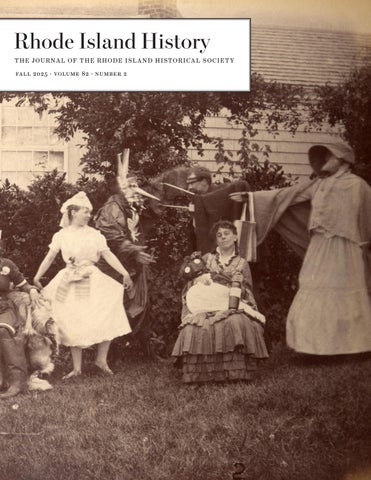
Rhode Island History T HE JOUR NA L O F T H E R H O D E I S LAN D HISTORICA L SOC IETY Fall 2025 · volume 82 · number 2
Rhode Island History
Published by The Rhode Island Historical Society 110 Benevolent Street Providence, Rhode Island 02906–3152
Fall 2025 · volume 82 · number 2
62 “So Near, Yet, Oh, How Far”: Creating Little Compton as a Summer Destination Steven Lubar 8o The Joyland Roller Rink of Woonsocket:
Roberta Gosselin, chair Winifred E. Brownell, vice chair Mark F. Harriman, treasurer Peter J. Miniati, secretary C. Morgan Grefe, executive director
A Microhistory of Twentieth-Century French-Canadian New England Aruna Balasubramanian
Publications Committee Charlotte Carrington-Farmer, chair Catherine DeCesare J. Stanley Lemons Craig Marin Seth Rockman Luther Spoehr Evelyn Sterne Staff Richard J. Ring, editor J. D. Kay, digital imaging specialist Silvia Rees, publications assistant
cover: The Owl’s Nest, home of Ruth and George Burleigh, was the center of literary culture in Little Compton in the 1860s. Courtesy of the Little Compton Historical Society.
Rhode Island History is a peer-reviewed journal published two times a year by the Rhode Island Historical Society at 110 Benevolent Street, Providence, Rhode Island 02906-3152. Postage is paid at Providence, Rhode Island. Society members receive each issue as a membership benefit. Institutional subscriptions to Rhode Island History are $40.00 annually. Individual copies of current and back issues are available from the Society for $20.00 (price includes postage and handling). Our articles are discoverable on ebscohost research databases. Manuscripts and other correspondence should be sent to editor@rihs.org. The Rhode Island Historical Society assumes no responsibility for the opinions of contributors. © The Rhode Island Historical Society Rhode Island History (issn 0035–4619)
STEVEN LUBAR
“So Near, Yet, Oh, How Far” Creating Little Compton as a Summer Destination
Little Compton enjoys a reputation as a place apart, isolated, and hard to reach. A 1982 Boston Globe travel article played the line for all it was worth. “Little Compton enjoys an island-like isolation,” it declared, offering a history of English settler families who “intermarried in isolation, maintaining one of the last coastal strongholds of Yankeedom while industrialization and immigration changed the world outside.” The town was isolated, it seemed, not only in space but in time.1 The New York Times, a few years earlier, had similarly conflated isolation and the unchanging nature of the town. Its take on Little Compton’s history was a bit more accurate in one way, calling the town “a wooded stronghold of Republican Yankee obstinacy with a healthy dose of Portuguese seasoning.” But the article’s suggestion that the town is “not really all that different today from what it was three centuries ago”— when the Sakonnet people were being driven from their homes in the midst of King Philip’s War—reveals a blindness to the real history of the town.2 It’s an odd trope, Little Compton’s isolation and unchangingness, given that the town is not an island or a stronghold but a half-hour drive from Providence or an hour from Boston, if you drive fast. But the sense of remoteness in time and space has stuck. Little Compton still thinks of itself as hard to reach, a place apart. It wasn’t always that way. Indeed, for much of its history, the town seemed no more distant than many small Rhode Island towns. Starting in the 1860s, though, and ever since, articles about the town emphasized its remoteness. The idea that Little Compton was a remote community, still happily holding onto its 62
old ways, was in part technological, the effect of new transportation systems that bypassed the town. But it also was an intentional creation, part of the remaking of the town as a sophisticated summer community. This article explores the origin of the idea that Little Compton is far away, isolated, unchanging, even something of an island, and finds it in the work of a small group of summer residents who created that mythology to define a particular kind of community for themselves. This article also considers why the notion was so successful, how it shaped the town’s history, and how it continues to shape the town today.
Little Compton Connected The Little Compton Historical Society’s summer 2024 exhibit was Little Compton Connected: A Local Transportation Story. The exhibit explored the ways that transportation shaped the town, considering the paths, roads, and waterways that linked first Sakonnet and then Little Compton to nearby towns and beyond, as well as the mishoons, ferries, ships, carriages, railroads, wagons, cars, and trucks that carried produce, goods, and people. The exhibit argued that despite Little Compton’s present self-image of being hard to reach, from its earliest days, the town was connected to the rest of the world. The first section of the exhibition made that case for the area’s earliest history. The Sakonnet people’s trade routes and political and cultural affiliations connected them not only to local tribal communities but also to tribes across the Northeast and beyond. Projectile points and celts uncovered in town fields reveal
materials from as far as New York and Michigan.3 The English who settled here had ties to Plymouth and Aquidneck Island and later to Boston, as well as to England and its colonies and the whole Atlantic world. Little Compton was a farming town, and what that meant in eighteenth century New England was exporting produce to feed residents in cities such as New York and enslaved people on Caribbean plantations.4 Little Compton was, in many ways a more diverse place in 1780 than it is today. About 5 percent of the population was of African descent, both free and enslaved. Many Sakonnet people still lived here. It was diverse in 1900, too. In that year, the census found 162 foreign-born individuals, about 15 percent of the town; almost 100 of them had been born in the Azores.6 Everywhere you look in the seventeenth, eighteenth, and nineteenth centuries, and even earlier, the town is above: Manifest from the sloop Lively, 1793: Isaac Bailey shipped 1,200 bushels of barley from Little Compton to New York via New Bedford. This manifest shows one of the ways that this agricultural town was connected to the wider world. Little Compton produced some 10,000 bushels of barley—about 250 tons— annually at the beginning of the nineteenth century.5 Courtesy of the Little Compton Historical Society. Gift of Alan and Susan Hooker.
tied to the region, the country, and the world, though not quite as well as neighbors including Newport or New Bedford—Little Compton did not have a good port—but still, proudly part of the wider world. Those connections are revealed in the early days of its role as a vacation destination. If you were in Boston in the 1840s thinking about a summer holiday— still a new idea—a glance at the newspaper would offer advertisements for resorts from Upstate New York to Nahant, Massachusetts, and from Maine to New Jersey.8 One ad might be for the Seaconnet House, one of the first hotels in Little Compton. Its ads, in newspapers in Providence and Boston, emphasized how easy it was to reach. Readers of the Boston Daily Atlas in the summer of 1845 would find ads for the “new and spacious BOARDING HOUSE” with “advantages for fowling, fishing and bathing . . . probably unsurpassed at any resort in the country.” The ads noted convenient daily stagecoaches available from Newport, Boston, Fall River, and Providence.9 Ads such as these suggest that in the nineteenth century, and even earlier, Little Compton didn’t seem that hard to reach. Starting in the eighteenth century, ferries crossed the Sakonnet River to Portsmouth and 63
Rhode Island History
Middletown.10 Starting in the mid-nineteenth century, decent roads and scheduled stagecoaches connected Adamsville, the Commons, and Sakonnet Point to Bristol, New Bedford, and Fall River. An 1858 article in The Providence Daily Journal calls Little Compton a “delightful place almost in stone’s throw from our own good city.”
Little Compton, Harder to Reach The belief that Little Compton was easy to reach changed, starting in the 1860s, for two reasons. One is technological: the advent of the railroad. The other is cultural: the intentional creation of the idea of Little Compton as a place apart in both space and time. In 1864, the Old Colony Railroad opened a train station in Tiverton, Rhode Island, Little Compton’s neighbor to the north. It had direct service from Boston and connections to Providence, New Bedford, and the Fall River Line boats to New York City. A stagecoach met the train and took passengers to Little Compton. Ironically, the coming of the railroad made Little Compton seem farther away, not closer. Other resorts were directly on train lines, and Little Compton wasn’t. It was, in fact, easier to get to than it had been, but by comparison, it now seemed harder. An 1886 article from The Providence Journal summed it up: To the traveller [sic] of a hundred years ago, riding long distances in stage coaches or open wagons, the fifteen-mile ride over the country road from Tiverton, the nearest station, would present no great 64
The Rhode Island Red (its state bird commemorated by this monument in Adamsville) was bred in Little Compton with birds from China, Malaysia, India, and Italy.7 Courtesy of the Little Compton Historical Society.
objection; but there is nothing inviting in it to the tourist of to-day, accustomed, as he is, to a comfortable chair in a railroad train or steamboat.11 In the eighteenth and first half of the nineteenth century, Little Compton seemed easy to reach, or at least no harder than many other places. But with the advent of rail travel in the mid-nineteenth century, travelers became spoiled. It just seemed too difficult to go anyplace not on the train line. The relative difficulty of getting to Little Compton in the age of the railroad was one reason that it seems the town began to seem hard to reach. But there’s another reason, at least as
The Seaconnet House, about 1850. Courtesy of the Little Compton Historical Society.
The Old Colony and Newport Railroad station, Tiverton, Rhode Island, about 1890. Courtesy of the Collection of Matthew D. Cosgro.
important: a cultural construct, an intentional campaign to create a new image for the town.
Little Compton, Disconnected It was in the 1860s—just when the town was becoming increasingly connected and the railroad made it easier to reach—that the trope that it was so disconnected
appeared. Look closely at some of the mid-nineteenth century articles where the claim first appeared, and you can see how and why Little Compton gained its reputation as a remote community, and, as important, a place out of time, a town still holding onto its old ways. More generally, it was about the creation of psychological distance as a substitute for physical distance. 65
Rhode Island History
Sarah Helen Whitman, a Providence poet and frequent visitor to Little Compton in the 1860s, devised this trope—or made it public—in an 1869 Providence Daily Journal article titled “Seaconnet.”12 In the article, we can see the reinvention of the town as a summer destination not for men who come to fish or fowl or for families looking for a beach holiday but for wealthier and more sophisticated visitors who would come for longer stays and who created social networks of others like themselves. Whitman was among the first of what we now call the summer people. These first summer people invented Little Compton as a place to get away, in space and in time. It was important to them that it seem hard to reach, and thus, exclusive. Whitman is best known for her romance with Edgar Allan Poe, but she was a significant writer in her own right. She was a transcendentalist and a spiritualist, interested in the occult. In the 1830s and 1840s, Whitman was considered one of America’s foremost poets and literary critics, an important theorist of Romanticism. In her literary writings, she promoted the works of writers including Goethe, Shelley, and Byron. She was fluent in German, French, and Italian. She knew both Emerson and Thoreau—Providence was a hotbed of transcendentalism—as well as most of the other important literary figures of her day. She wrote for The Providence Journal about political and social matters, including homelessness, poverty, and women’s rights. (She also wrote in defense of Providence’s hand-organ grinders, a hot issue in the 1870s.)13 Whitman also wrote a good number of travel articles. In her sixties, each summer, she wrote about where she vacationed. Whitman’s 1869 article 66
Portrait of George Burleigh, courtesy of Brown University.
describes her summer vacation in Little Compton. It is full of literary references that would be familiar to her audience. More precisely, the sophisticated audience she was interested in, and for whom the article was written, would be familiar with them. Whitman’s Little Compton only makes sense in light of her Romantic, poetic imagination, and her writing about the town conveys its full meaning only to those who partake of that same imagination. Whitman began her article by noting a friend’s reaction to her trip: “Going to Seaconnet! I thought nobody went there now.” There was no hotel—the Seaconnet House had closed—and it was no longer a place for casual vacationers. There were easier places to reach by train, and vacation fashions had changed. “To stay in Little Compton comfortably,” writes local historian Janet Lisle, “you had to know someone.”14 And so, there was a new kind of visitor. Little Compton was starting to be a place for repeat, weeks-long,
been obvious and meaningful to her circle of artists, poets, and scholars. Whitman is not only taking a trip to Little Compton but also taking a trip through her library. This quote is from Goethe’s Faust, Part 2, Act 3. (Whitman was great admirer of Goethe.) Helen of Troy tells Faust: I feel so far away and yet so near And gladly say now: “Here, I am! Here!16
Sarah Helen Whitman, daguerreotype by Joseph White, 1856. Whitman was known for wearing black, her long flowing veils, and the coffin-shaped charm she wore as a necklace. One of her contemporaries noted her “perpetual aura of melancholy” and called her “a sensitive plant” who shrinks from contact with the world. Courtesy of the John Hay Library, Brown University.
even summer-long visits. These visitors would stay in farmhouses. The town had become a more private place, available only to insiders, those in the know, those with the right connections.15 Whitman then describes her trip. First, take the afternoon steamboat to Bristol. Hire a carriage to Little Compton—she doesn’t want to take the stagecoach. And it’s so far; it takes more time to get there than it does to get to New York! “So near, yet, oh, how far,” declaims Whitman; it is distant not in space, but in mind; it is a place to get away. Whitman sets that line off by putting it in quotes and centering it on the page. It is the first of many unidentified quotes from Romantic poets and others of similar persuasion that dot Whitman’s article, quotations that would have
It’s the moment when Helen has been mysteriously transported to Faust’s castle, and she seems to fall in love with him. Faust replies: “This is a dream: time and place have fled.” Whitman knew that her readers—the sophisticated ones, her friends—would catch the longing in the line and think of Little Compton as that new love, part of that dream of being out of time and place. Whitman had used this line as an epigram in an earlier poem, “A Vision of the Night,” which combined what she calls “The visioned past”— perhaps a lost love—with a view of a wonderous landscape.17 Again, distance and longing tied to an exotic place—and here, that faraway place is Little Compton. Whitman continues her travels down the Great West Road. It is “an old, old road, innocent of stages or railroad crossings.” (A few years earlier, Whitman wrote of her summer vacation in Cape Elizabeth, Maine, describing the last part of the trip, probably not all that different, as “a pleasant stage ride of seven miles.”18) There are “gnarled branches, twisted and warped”—a Romantic description if ever there was one, and one that might well be a reference to British nature writer Edward Jesse’s description of Windsor 67
Rhode Island History
The Owl’s Nest, home of Ruth and George Burleigh, was the center of literary culture in Little Compton in the 1860s. George Burleigh is seated second from left. Courtesy of the Little Compton Historical Society.
Great Park in his 1853 Scenes and Occupations of Country Life.19 But this landscape isn’t just old, blessedly free of modern connections. Whitman goes further: It’s like the “Demon-haunted woodlands in Doré’s illustrations of Dante’s Inferno.” Paul Gustave Doré was a French illustrator and printmaker famous for his work illustrating books including the Bible and The Works of Rabelais. His images of the Inferno, published in 1857, show Dante wandering through the dark woods, pursued by a lion and a she-wolf. Whitman is taking poetic license; Little Compton in 1869 had few trees on the west side of town and certainly no lions or wolves.20 Why Dante’s “dark woods” as a description of her trip? It’s dramatic, and what better metaphor of how hard it is to get to Little Compton! But there’s more than that: The dark woods are where Dante meets Virgil, the great Roman poet, who will be his guide to the underworld. Whitman will be meeting another famous poet in Little Compton, and Dante’s wandering in the woods sets that up nicely. Whitman offers two literary references that help explain her feelings about Little Compton. It’s the kind of wildness, she suggests, that Thoreau—“the Dryad of Walden Pond”—would appreciate. Walden Pond was where Thoreau went to get away from the crowds, a quiet place where he might gain self-understanding. In fact, Walden Pond was a short walk from Concord— it was neither wild nor remote. So too, Whitman is suggesting, Little Compton. Whitman’s other reference is more obscure: Little Compton might offer the “charm of remoteness” enjoyed by “the dwellers in Dr. Johnson’s Happy Val-
ley.” Samuel Johnson’s Prince of Abissinia, though written in 1759, was newly popular in the 1860s. It tells the tale of Rasselas, the fourth son of the King of Abyssinia, exiled to The Happy Valley until called to the throne. There, “All the diversities of the world were brought together, the blessings of nature were collected, and its evils extracted and excluded.” Its residents knew only the “soft vicissitudes of pleasure and repose, attended by all that were skilful to delight, and gratified with whatever the senses can enjoy.” A beautiful place, but also a social place, with fascinating people to talk with.21 A Romantic poet needed that combination of sublime nature and the works of man, and people to discuss them with. In Little Compton, the ocean provided sublime nature. In the eighteenth century, the ocean had been considered dangerous, forbidding, demonic, but for the Romantics, it became a “favorite spot for self-knowledge . . . standing on the shore stirred the self in a special way.”22 Whitman wanted a particular distance from nature, a particular view of the ocean. A proper Romantic place had the works of man as part of the view as well as cozy places from which to view them. The sublime required some civilizing context, and Little Compton provided that. When Whitman looks at the ocean, she sees not only nature but also the Ocean House, the hotel across the Sakonnet River in Newport. (“If you care to do so,” she writes, you can make out the flag on its cupola. She clearly doesn’t care to, preferring “the larger features of the landscape.”) Similarly, when she looks from the shore in one of her best-known poems, “Nightfall on the Seaconnet Shore,” she sees “Point Judith’s fires aglow.”23
68
Creating Little Compton as a Summer Destination
Her version of Romantic nature includes people; it’s a place where the wild and the domestic come together, where the human and the wild interact. In another Providence Journal article, Whitman described a dreadful storm at Sakonnet Point in Biblical, religious terms, John Grier Varner, who wrote the most thorough study of Sarah Helen Whitman, writes that she found “a spiritual communication in the landscape of Little Compton, and she saw in it “the hand of a liberal God.”24 That seems right. It was a perfect place for a Romantic nature poet to go on a holiday, providing just the right combination of nature and civilization. As important as the landscape were the people. For a small farming town, Little Compton has had a surprising history as a place for poets, artists, and activists, starting before the Civil War. What was the point of Romantic landscape without companions to discuss it with? And so, it’s no surprise that just as much as nature, and the windmills, seawalls, and buildings so nicely complementing it, Whitman’s other great pleasure was conversation with the literary people with
whom she stayed in Little Compton, the circle that gathered around George Shepard Burleigh and his wife, Ruth Burleigh. Whitman describes the “cheerful company” that visited with the Burleighs in Little Compton, including local people, visitors from various cities, and even young men from Providence who sailed down for a few days. George Burleigh was a nationally known poet and a speaker on abolition. He first visited Little Compton on one of his lecture tours. There he met Ruth Burgess, whose father was a leader of the Little Compton abolition movement, and married her in 1849. The Burleighs moved to Little Compton in 1859. George continued to make his living as a speaker and writer, authoring thousands of magazine articles and hundreds of poems, including several about Little Compton. Some of his Little Compton poems were timely, on serious topics, including “The Maniac,” about Abram Simmons, whose sad story of being confined in a dungeon in the Little Compton poor house led to significant reform in the treatment of mental illness. Some were lighter, like “The Tipsy Fisherman 69
A summer costume party with the Burleighs. Courtesy of the Little Compton Historical Society.
of Seaconnet.” But most, like “Storm on Saugonnet,” “Seaconnet Sea-Nymphs,” “Comorant Rock,” and “Pabodie House,” were good Romantic descriptions of nature and history in the town.25 While most of Burleigh’s poetry was soon forgotten— one survey says “Burleigh has little claim on posterity as a poet”26—he clearly made an impression on the people of Little Compton. Here’s how Roswell Burchard remembered him in 1904, a year after his death: One of the endearing memories, we shall all of us carry through life is that of the village poet. He looked, he lived, the part—he did not affect it—for his life was spontaneous and beautiful as the blossoms that embowered his home. His patriarchal presence, his illumined face with silvery wealth of flowing hair, when encountered on some wooded byway brought Camelot to mind and bards who sang of chivalry. 70
Burchard concluded: “His poetry germinated and bloomed under the influence of the woods, the air, the ocean, the life and the love that environed his seaside home.”27 Whitman wasn’t the only member of her Providence literary circle to visit Little Compton and stay with the Burleighs. Many of her friends visited, too. Sarah D. Wilkinson, a Providence artist and art teacher, was another one of the town’s other early summer visitors, joining the literary and artistic circle that grew around the Burleighs. She taught George and Ruth’s son, Sydney, watercolor painting, and married him in 1875. Painters found the landscape appealing. Thomas Worthington Whittredge, who visited often at this time, wrote that the area “had great charm for me and many things I saw seemed perfectly familiar to me, although never seen before. . . . In short it was the land of my forefathers.” A town out of time.28 We can get a sense of the activities of this group from Whitman’s article. They strolled together to the
George Burleigh was an artist as well as a poet. His paintings show what Whitman and her circle saw in Little Compton: Wild nature, but with a human touch; note the sailboats in each of these paintings. Courtesy of the Little Compton Historical Society.
seashore. They admired the “ancient” windmills— which, of course made them think of Don Quixote, “the most romantic of all romances.” We can join them on an evening where they watch the stars and listen as Burleigh reads from his then-underway translation of Victor Hugo’s Légendes des Siècles. We can even listen in on a bit of repartee, captured in a postcard that Whitman wrote to Burleigh in about 1875 that contained insider jokes, friendly asides, clever retorts, even a bit of French and Latin.29 It’s not just at the Burleighs that Whitman finds people to her liking. “There is no dearth of society,” she notes in her Providence Journal article. “Nearly all the houses in the neighborhood are filled with summer guests.” (A sign perhaps, that it’s not that hard to get to Little Compton!) She is delighted to visit with Charles Edwin Wilbour, famed Egyptologist and the first translator of Les Misérables, and his spouse, Char-
lotte Beebe Wilbour, a popular speaker and writer, a supporter of women’s suffrage, and “an acknowledged leader of fashion and queen of society.” (Whitman compares her dress with that of the Lady of the Lake from Tennyson’s “Morte d’Arthur”!) Whitman is thrilled by the rumor that Harriet Beecher Stowe has been spotted in town and rides “five miles along the cool sea-beaches and fragrant lily-ponds” to see her— but uses her article to defend the poet Lord Byron from Stowe’s recent attack on him in the pages of The Atlantic. Whitman’s article was aimed a very particular audience.30 Whitman sums up her thoughts about her summers in Little Compton: The town had an “inexpressible charm . . . so free, so untrammeled, so social, so kindly, so restful.” So distant from everyday life. It is a place apart, a place to connect to nature and friends— in a Romantic way. She may have begun her article 71
Rhode Island History
with “I thought nobody went there now,” but what she meant was that only a particular kind of person should go there now. Whitman ends her article with a quote from Tennyson’s poem “Ulysses”: “The long day wanes: the slow moon climbs; the deep moans round with many voices.” Ulysses in old age decides once again to join with his crew and seek new adventure. She misquotes it, though, or intentionally changes it. The original ending reads: “Come, my friends, / ’Tis not too late to seek a newer world.” Whitworth ends instead with “So good night.” Whitman had found the world she wanted, in Little Compton.31 What made Little Compton the place that Whitman and her circle found so Romantic, such a perfect getaway? There’s a strong streak of antimodernism in Whitman’s Romanticism, what historian T. J. Jackson Lears analyzes as a “recoil from an ‘overcivilized’ modern existence.”32 In Rhode Island of the 1860s and 1870s, that meant a reaction against industrialization and immigration, railroads, and steamboats. Little Compton, with no significant waterpower sites or significant harbor, and too far from Pawtucket and the Blackstone Valley to be drawn into the rural outwork that characterized some farm towns in the state, never industrialized. (Its windmills seemed wonderfully antiquated, a nostalgic symbol of the preindustrial past; they brought to mind Don Quixote, not dark satanic mills. “I confess a weakness for windmills,” Whitman wrote.) The town’s population in 1870 was only threequarters of what it had been at the turn of the century; abandoned farmhouses no doubt have added to its charm. The town didn’t attract many immigrants until closer to the end of the century, and they were mostly 72
farm laborers, not factory laborers. And, of course, its undeveloped shoreline allowed for the views that Whitman and her friends could turn into breathless poetry and soulful paintings. Whitman feared that, like every utopia, Seaconnet was doomed. It would “suffer a sea change,” she feared, quoting from The Tempest, another story of a remote island. She worried that developers would build “a great hotel” and soon “city belles” would visit. (She, of course, did not count herself as one of those city belles.) And so, it was increasingly important to emphasize the difficulty of getting there. She had discovered her Happy Valley, her Walden, and didn’t want others to spoil it. It’s a story that is familiar today. And indeed, there were great hotels being built at many of New England’s beaches. Whitman and her friends, and those who followed them, wanted the town to be hard to reach—or, more precisely, she wanted it to seem that way. “The charm of remoteness”—not remoteness itself— is what she wanted to preserve.
Little Compton, Reconnected Not everyone agreed. Henry Sisson, who owned much of Sakonnet Point, put a great deal of effort into making Little Compton easier to reach. First, he supported the steamboats that came to the point, starting in the 1870s and then really taking off by the 1880s. These boats brought day-trippers for a day at the beach and carried goods to town and agricultural products to Providence. The Sakonnet House at Sakonnet Point— the hotel that Whitman had feared—opened in 1888.
Creating Little Compton as a Summer Destination
Sarah D. Wilkinson, “Noble Bitings,” 1870. Courtesy of the Little Compton Historical Society. Gift of the Vernon sisters.
Next, Sisson promoted first a railroad and, when that failed to materialize, a trolley line to Sakonnet Point.33 An 1885 newspaper article on Sisson’s proposed railroad noted that “if constructed, will open up a large and fertile country that has heretofore been practically isolated from connection with outside centers.”34 He got some support, and in the 1880s, summer tourism, the real estate market, and maybe even industrial development seemed poised to take off. “Little Compton has Decided to Connect with the Outside World” was the headline for an article describing a meeting in May 1891, where the citizens of the town voted in favor of supporting an electric rail line from Tiverton to Sakonnet Point. There were at least five proposals for building train or trolley lines in Little Compton between 1875 and 1910, none of which got beyond votes of approval, state charters, plans on paper, and, in at least one case, landowner and investor buy-in.35 Indeed, many residents were resistant to change, for a range of reasons. The Providence Journal noted resistance from “the ultraconservativism of the natives and the desire for exclusiveness on the part of some of the
wealthy summer residents.”36 Anti-modernism, Lears notes, meant different things to different people, and the division between pro-growth and anti-growth did not break down along simple lines of class, ethnicity, gender, or wealth. Gentrification, to use the modern term, is complicated. One might think of Whitman and her circle as early gentrifiers, the artists who move into neighborhoods in a first wave of displacement and who then resist the plans of people like George Sisson to develop the area that they themselves have changed. Many summer visitors and some local farmers liked the quiet exclusivity that the town’s “so far away” and “so hard to get to” dogma protected. (Other farmers would have liked an easier connection to market their milk or crops.) The same article that declared that the town had decided to connect with the outside world worried that a new population “will at once overflow on to the sedate commons of the aristocratic village by the sea.” The Little Compton Town Council president argued that the trolley “would flood the village with a very undesirable class of people from Massachusetts and Rhode Island”—presumably Fall River or Tiverton mill workers on holiday or even mill workers who 73
Rhode Island History
might move here and take the trolley to work.37 There was considerable investment in keeping that hard-won distance, in preserving Little Compton’s “charm of remoteness.”
Little Compton and Its Imagined Remoteness In the twentieth century, Little Compton tried to balance joining the outside world with the pleasures of an imagined remoteness—even as the automobile made getting to the town easier than ever. In the 1930s, the mythology of Little Compton as a remote, unchanged, hidden place was well entrenched. Little Compton made the New York newspapers when George Hibbitt, a Columbia University professor of English—who, it’s important to note, summered in Little Compton— secretly recorded the old-timey accents of locals at the annual meeting of the Little Compton Historical Society. He told the Times that the town “has long been cut off from neighboring towns by lack of transportation facilities, and thus retains much of its Colonial flavor.”38 The Times followed up with an editorial comment the next day, calling Little Compton “one of the most meritorious towns in the United States.” Isolation, or backwardness, apparently, had reactionary political charm. Again, time and distance combined: Though close to Newport, “it is fortunately several centuries away in most other respects. It is old Rhode Island.”39 It was an exciting enough story that the New York Herald Tribune sent its reporter to the “wind-swept ocean peninsula” to hear the “weather-gnarled” “elderly natives” discuss their “sudden notoriety.” 74
(It wasn’t easy: “Only one bus runs daily into Little Compton, whose isolation from a more hectic world is therefore well nigh complete.”) Those natives were, mostly, annoyed and amused. Elizabeth Manchester, one of Hibbitt’s main informants, let the reporter know that she had studied in Brooklyn and spoke often with her niece in New York. They discussed Shanghai Pierce, who often visited from Texas. As Lizzie Manchester put it, “Mr. Hibbitt obtained no unadulterated speech sample.”40 The residents of Little Compton were more cosmopolitan than visitors might think. The town’s isolation was an outsider’s fantasy, not a lived reality. Indeed, it seemed that when anyone looked closely, the town was not really so isolated and ancient as myth would have it. A 1930 Providence Journal article on rum-running described the town as “a few years ago the most secluded and peaceful spot in Rhode Island— but to-day is a centre of law breaking and a battle ground in the warfare between bootleggers and hijackers.” And not just bootleggers. “Property of farmer and summer resident is increasingly exposed to assault by the wayfaring and criminal.”41 But the fantasy was hard to do in, especially for summer vacationers who, like Whitman, wanted the feeling of remoteness, that exclusivity, even—maybe especially—if it was easy to reach, if not in distance, then in time; Little Compton was valued as a place from an earlier time. The 1972 Boston Globe article played this for all it was worth: “Little Compton simply has chosen not to catch up with the twentieth century. Thus it is a Shangri-La for those who seek a retreat of unblemished serenity. . . a time frame from
Creating Little Compton as a Summer Destination
the past.”42 The sense that remoteness in time—the Industrial Revolution bypassed the town, suburbanization had not yet transformed it—somehow also implied a physical remoteness has stuck. Little Compton still likes to think of itself as hard to reach. And that belief seems widely held. Tell someone in Providence that you live in Little Compton, and, often, the first reaction is “It’s so beautiful.” And then: “But it’s so far away.” Was Little Compton, as newspapers have had it over the years, an island, a Shangri-La? Was it hard to reach? Physically, no. It is not isolated and never has been. But getting there—metaphorically if not physically—does require some slowing down, some shifting of gears. In the articles noted earlier in this essay, both the Globe and the Times used the word “stronghold” to describe the town, a suggestion that the town not only was distant in time and space but also proud of it and eager to defend it. Little Compton’s distance is more a cultural stance than a geographical fact. The belief in that mythology has shaped the town’s history and still informs its political debate on issues from road signs to zoning to affordable housing.43 Little Compton resident Karla
Moran noted the advantages and disadvantages of this in a 2013 oral history: Little Compton has this thing, a peninsula thinking. Most places that are only one way in and one way out, it becomes isolated. In some ways that’s a good thing and in other ways it’s a bad thing. Because in your isolation, you think that’s the only way it can be, when in fact it’s not.44 She’s right; “peninsula thinking” can be a problem. And one way to overcome it—to get out more and to welcome new people and new ideas in—is to understand the source of that thinking. Steven Lubar is George L. Littlefield Professor of American History emeritus at Brown University and President of the Little Compton Historical Society. He writes on museums, public and digital humanities, and the history of technology. A Guggenheim fellowship supported his Inside the Lost Museum: Curating, Past and Present (Harvard University Press, 2017). Lubar was a curator at the National Museum of American History before coming to Brown, where he was director of the John Nicholas Brown Center for Public Humanities and Cultural Heritage and the Haffenreffer Museum of Anthropology, and faculty director of the Center for Digital Scholarship.
Notes 1. Carol Stocker, “Happily Isolated in R.I.,” Boston Globe, August 30, 1982. 2. Terry H. Schwadron, “Why Little Compton Has Lasted So Long,” The New York Times, June 15, 1975. 3. Kevin P. Smith, “Sakonnet History Project: Community Collection Assessment 1” (Osprey Heritage Consulting LLC, 2023); On
Native connections more generally, see Lisa Brooks, Our Beloved Kin: A New History of King Philip’s War (New Haven, CT: Yale University Press, 2018), 27–35. 4. Eric Kimball, “‘What Have We to Do with Slavery?’ New Englanders and the Slave Economies of the West Indies,” in Slavery’s Capitalism: A New History of American Economic
75
Rhode Island History
Development, ed. Sven Beckert and Seth Rockman (Philadelphia: University of Pennsylvania Press, 2016), 181–95. 5. William Emerson, “Notes on Compton, a Township in Newport County, State of Rhode-Island. September, 1803,” Collections of the Massachusetts Historical Society, 1804, 200. 6. On people of color in Little Compton, see Marjory Gomez O’Toole, If Jane Should Want to Be Sold: Stories of Enslavement, Indenture and Freedom in Little Compton, Rhode Island (Little Compton, RI: Little Compton Historical Society, 2016); William McKenzie Woodward, Historic and Architectural Resources of Little Compton, Rhode Island (Providence, RI: Rhode Island Historical Preservation Commission, 1990), 22. 7. Carol Ekarius, Storey’s Illustrated Guide to Poultry Breeds (North Adams, MA: Storey Publishing, 2007). 8. On the rise of summer resorts, see Jon Sterngass, First Resorts: Pursuing Pleasure at Saratoga Springs, Newport, and Coney Island (Baltimore: Johns Hopkins University Press, 2001), 1–6; Cindy S. Aron, Working at Play: A History of Vacations in the United States (Oxford: Oxford University Press, 1999), 15–30. 9. E. & J. Cole, “Seaconnet House,” Boston Daily Atlas, July 26, 1845, 1. 10. Anna Augusta and Charles V. Chapin, A History of Rhode Island Ferries, 1640–1923 (Providence, RI: Oxford Press, 1925), 207–99; a 1714 accident that destroyed a ferry transporting twelve horses suggests the size of the ferries and raises the possibility that Little Compton may have been part of the extensive horse-export business to the West Indies (208). 11. S., “A Primitive Seaside Community,” The Providence Journal, August 1, 1886; it’s amusing to note the article exaggerated the distance—it’s ten miles, not fifteen miles from the station to Sakonnet Point.
August 22, 2024, https://www.poetryfoundation.org/poets/sarah -helen-whitman; an extensive bibliography of her writings is available in Andrew Ball, “Sarah Helen Whitman,” in American Literature, ed. Jackson R. Bryer (Oxford: Oxford University Press, 2023). 14. Newport had similarly seen the closing of hotels and the rise of longer-term visitors. An 1873 New York Times article headlined the change: “The City of Cottages: Decline of Newport Hotel Life.” Quoted in Sterngass, First Resorts, 183; Janet Lisle, The History of Little Compton: A Home By the Sea, 1820–1950 (Little Compton, RI: Little Compton Historical Society, 2012), 146. 15. On the summer visitors to Little Compton, see Lisle, A Home By the Sea, 204–5. 16. Goethe, Johann Wolfgang von, Faust Part II, trans. A. S. Kline (Poetry in Translation), accessed August 21, 2024, https://www .poetryintranslation.com/PITBR/German/FaustIIActIII.php, lines 9412–13. Whitman’s translation is slightly different from the published translations. 17. Sarah H. Whitman, “A Vision of the Night,” The United States Magazine and Democratic Review 18, no. 92 (February 1846): 116–17. 18. S. H. W., “Summer Days on the Sea-Shore,” The Providence Journal, August 15, 1863, 2. 19. Edward Jesse, Scenes and Occupations of Country Life: With Recollections of Natural History (London: John Murray, 1853), 19. 20. The images are available at Aida Audeh, “The World of Dante: Gustave Doré,” accessed August 22, 2024, http://www .worldofdante.org/gallery_dore.html. 21. Samuel Johnson, The History of Rasselas, Prince of Abissinia (London: F. C. and J. Rivington, 1820), 2, https://catalog.hathi trust.org/Record/009025170.
12. S. H. W., “Seaconnet,” The Providence Journal, August 25, 1869.
22. Alain Corbin, The Lure of the Sea: The Discovery of the Seaside in the Western World, 1750–1840, trans. Jocelyn Phelps (Berkeley and Los Angeles: University of California Press, 1994), 164.
13. The best long study of Whitman remains John Grier Varner Jr., “Sarah Helen Whitman: Seeress of Providence” (Disertation, University of Virginia, 1940); an excellent summary of her life and work is at “Sarah Helen Whitman,” Poetry Foundation, accessed
23. Sarah Helen Whitman, “Nightfall on the Seaconnet Shore,” in Poems of America: New England, ed. Henry Wadsworth Longfellow (Boston, MA: Houghton Mifflin Company, 1882), 242–43.
76
Creating Little Compton as a Summer Destination
24. S. H. W., “Seaconnet in a Storm,” The Providence Journal, September 16, 1869; Varner Jr., “Sarah Helen Whitman,” 583. 25. “Burleigh, George Shepard,” in Dictionary of American Biography (New York: Charles Scribner’s Sons, 1928), https://archive .org/details/dli.ernet.425629; a complete listing of Burleigh’s work can be found in Minnie Lee Spies, “George Shepard Burleigh” (AM Thesis, Brown University, 1934); George Shepard Burleigh, The Maniac: and Other Poems (Philadelphia: J. W. Moore, 1849). Burleigh’s manuscripts can be found at the John Hay Library, Brown University, and at the Little Compton Historical Society; a good summary of Burleigh’s politics and that of his family is available at “George Shepard Burleigh: Poet of Reform, Nature, and Sentiment,” The Burleigh Family of Plainfield, Connecticut: An Anti-Racist Abolitionist Legacy, accessed August 24, 2024, https://exhibits.sjsu.edu/s/burleigh/page/gsb.1849 26. “Burleigh, George Shepard.”
ton, RI: Little Compton Historical Society, 2011); on railroads, see Benjamin Franklin Wilbour, Notes on Little Compton, ed. Carlton C. Brownell (Little Compton, RI: Little Compton Historical Society, 1970), 74; Bart Brownell, Steven Lubar, and Marjory O’Toole, Little Compton: A Changing Landscape (Little Compton, RI: Little Compton Historical Society, 2019), 152–55; and Lisle, A Home By the Sea, 207–10. 34. “Railroad Matters: The Seaconnet Railroad,” Boston Daily Advertiser, September 3, 1885, https://link.gale.com/apps/doc / GT3006746871/NCNP?sid=bookmark-NCNP&xid=06d38462. 35. Steven Lubar, “Railroads That Never Were,” in Little Compton: A Changing Landscape, ed. Bart Brownell, Steven Lubar, and Marjory O’Toole (Little Compton, RI: Little Compton Historical Society, 2019), 154–55. 36. Robert Grieve, The New England Coast: Its Famous Resorts. (Providence, RI: J. A. & R. A. Reid, 1891), 41.
27. R. B. Burchard, “Historical Address, The Town of Little Compton,” in The Two-Hundredth Anniversary of the Organization of the United Congregational Church in Little Compton (Providence, RI: The Providence Press, 1906), 107.
37. “A Long Electric Road,” Newport Mercury, May 16, 1891, 8.
28. Lisle, A Home By the Sea, 146–49.
39. “Little Comptonians,” The New York Times, December 1, 1936, 24.
29. The postcard is in the Burleigh Collection, John Hay Library, HA467 (4). 30. For more on the Wilbours and their circle in Little Compton, see John Adams, “A Bad Dream of New York: The Rise, Fall, and Redemption of Charles E. Wilbour,” accessed August 22, 2024, https://www.academia.edu/6990369/A_BAD_DREAM _OF_NEW_YORK_The_Rise_Fall_and_Redemption_of_Charles _E_Wilbour. 31. Alfred, Lord Tennyson, “Ulysses,” The Poetry Foundation, accessed August 22, 2024, https://www.poetryfoundation.org /poems/45392/ulysses. 32. T. J. Jackson Lears, No Place of Grace: Antimodernism and the Transformation of American Culture, 1880–1920 (1981; reprint, Chicago: University of Chicago Press, 2021), xxiii. 33. On travel and tourism to Sakonnet Point, see James C. Garman and Michelle G. Styger, Sakonnet Point Perspectives (Little Comp-
38. “Shanghai Pierce, New Folk Hero, Had Voice One Could Hear 2 Miles,” The New York Times, November 30, 1936, 23.
40. The New York Herald Tribune, December 2, 1936, quoted in Wilbour, Notes on Little Compton, 246–47. 41. Unidentified newspaper, quoted in Wilbour, 241–42. 42. George Sullivan, “Little Compton: Like Shangri-La, It Wants to Be Hidden,” The Boston Globe, August 27, 1978. 43. For the housing debate, see Antonia Noori Farzan, “A Livable Solution for Housing: Little Compton Initiates Path for Low-Cost Homes,” The Providence Journal, December 16, 2024; the language of “us,” not “outsiders,” is a reflection of “peninsular thinking.” 44. Marjory O’Toole, ed., Remembering Adamsville: Oral Histories Collected by the Little Compton Historical Society (Little Compton, RI: Little Compton Historical Society, 2013), 153–55; available at https://littlecompton.org/historical-resources/little-compton -womens-history-project/karla-moran/.
77
Rhode Island History
Bibliography Adams, John. “A Bad Dream of New York: The Rise, Fall, and Redemption of Charles E. Wilbour.” Accessed August 22, 2024. https://www.academia.edu/6990369/A_BAD_DREAM_OF _NEW_YORK_The_Rise_Fall_and_Redemption_of_Charles _E_Wilbour. Alfred, Lord Tennyson. “Ulysses.” The Poetry Foundation. Accessed August 22, 2024. https://www.poetryfoundation.org /poems/45392/ulysses. Aron, Cindy S. Working at Play: A History of Vacations in the United States. Oxford: Oxford University Press, 1999. Audeh, Aida. “The World of Dante: Gustave Doré.” Accessed August 22, 2024. http://www.worldofdante.org/gallery_dore .html. Ball, Andrew. “Sarah Helen Whitman.” In American Literature, edited by Jackson R. Bryer. Oxford: Oxford University Press, 2023. Boston Daily Advertiser. “Railroad Matters: The Seaconnet Railroad.” September 3, 1885. https://link.gale.com/apps/doc /GT3006746871/NCNP?sid=bookmark-NCNP&xid=06d38462. Brooks, Lisa. Our Beloved Kin: A New History of King Philip’s War. New Haven, CT: Yale University Press, 2018. Brownell, Bart, Steven Lubar, and Marjory O’Toole. Little Compton: A Changing Landscape. Little Compton, RI: Little Compton Historical Society, 2019. Burchard, R. B. “Historical Address, The Town of Little Compton.” In The Two-Hundredth Anniversary of the Organization of the United Congregational Church in Little Compton, 61–108. Providence, RI: The Providence Press, 1906. “Burleigh, George Shepard.” In Dictionary of American Biography. Vol. 3. New York: Charles Scribner’s Sons, 1928. https:// archive.org/details/dli.ernet.425629. Burleigh, George Shepard. The Maniac: and Other Poems. Philadelphia: J. W. Moore, 1849. Chapin, Anna Augusta and Charles V. A History of Rhode Island Ferries, 1640–1923. Providence: Oxford Press, 1925. Cole, E. & J. “Seaconnet House.” Boston Daily Atlas, July 26, 1845. Corbin, Alain. The Lure of the Sea: The Discovery of the Seaside in the Western World, 1750–1840. Translated by Jocelyn Phelps. Berkeley and Los Angeles: University of California Press, 1994.
78
Ekarius, Carol. Storey’s Illustrated Guide to Poultry Breeds. North Adams, MA: Storey Publishing, 2007. Emerson, William. “Notes on Compton, a Township in Newport County, State of Rhode-Island. September, 1803.” Collections of the Massachusetts Historical Society, 1804. Garman, James C., and Michelle G. Styger. Sakonnet Point Perspectives. Little Compton, RI: Little Compton Historical Society, 2011. Goethe, Johann Wolfgang von. Faust Part II. Translated by A. S. Kline. Poetry in Translation. Accessed August 21, 2024. https://www.poetryintranslation.com/PITBR/German /FaustIIActIII.php. Grieve, Robert. The New England Coast: Its Famous Resorts. Providence, RI: J. A. & R. A. Reid, 1891. Jesse, Edward. Scenes and Occupations of Country Life: With Recollections of Natural History. London: John Murray, 1853. Johnson, Samuel. The History of Rasselas, Prince of Abissinia. London: F. C. and J. Rivington, 1820. https://catalog.hathitrust.org /Record/009025170. Kimball, Eric. “‘What Have We to Do with Slavery?’ New Englanders and the Slave Economies of the West Indies.” In Slavery’s Capitalism: A New History of American Economic Development, edited by Sven Beckert and Seth Rockman, 181–95. Philadelphia: University of Pennsylvania Press, 2016. Lears, T. J. Jackson. No Place of Grace: Antimodernism and the Transformation of American Culture, 1880–1920. 1981. Reprint, Chicago: University of Chicago Press, 2021. Lisle, Janet. The History of Little Compton: A Home By the Sea, 1820–1950. Little Compton, RI: Little Compton Historical Society, 2012. Lubar, Steven. “Railroads That Never Were.” In Little Compton: A Changing Landscape, edited by Bart Brownell, Steven Lubar, and Marjory O’Toole, 154–55. Little Compton, RI: Little Compton Historical Society, 2019. Newport Mercury. “A Long Electric Road.” May 16, 1891. Noori Farzan, Antonia. “A Livable Solution for Housing: Little Compton Initiates Path for Low-Cost Homes.” The Providence Journal, December 16, 2024. O’Toole, Marjory, ed. Remembering Adamsville: Oral Histories Collected by the Little Compton Historical Society. Little Compton, RI: Little Compton Historical Society, 2013.
Creating Little Compton as a Summer Destination
O’Toole, Marjory Gomez. If Jane Should Want to Be Sold: Stories of Enslavement, Indenture and Freedom in Little Compton, Rhode Island. Little Compton, RI: Little Compton Historical Society, 2016. Poetry Foundation. “Sarah Helen Whitman.” Accessed August 22, 2024. https://www.poetryfoundation.org/poets/sarah -helen-whitman. S. “A Primitive Seaside Community.” The Providence Journal, August 1, 1886. Schwadron, Terry H. “Why Little Compton Has Lasted So Long.” The New York Times, June 15, 1975. S. H. W. “Seaconnet.” The Providence Journal, August 25, 1869. ———. “Seaconnet in a Storm.” The Providence Journal, September 16, 1869. ———. “Summer Days on the Sea-Shore.” Providence Journal, August 15, 1863. Smith, Kevin P. “Sakonnet History Project: Community Collection Assessment 1.” Osprey Heritage Consulting LLC, 2023. Spies, Minnie Lee. “George Shepard Burleigh.” AM Thesis, Brown University, 1934. Sterngass, Jon. First Resorts: Pursuing Pleasure at Saratoga Springs, Newport, and Coney Island. Baltimore: Johns Hopkins University Press, 2001. Stocker, Carol. “Happily Isolated in R.I.” The Boston Globe, August 30, 1982.
Sullivan, George. “Little Compton: Like Shangri-La, It Wants to Be Hidden.” The Boston Globe, August 27, 1978. The Burleigh Family of Plainfield, Connecticut: An Anti-Racist Abolitionist Legacy. “George Shepard Burleigh: Poet of Reform, Nature, and Sentiment.” Accessed August 24, 2024. https://exhibits.sjsu.edu/s/burleigh/page/gsb. The New York Times. “Little Comptonians.” December 1, 1936. The New York Times. “Shanghai Pierce, New Folk Hero, Had Voice One Could Hear 2 Miles.” November 30, 1936. Varner Jr., John Grier. “Sarah Helen Whitman: Seeress of Providence.” Dissertation, University of Virginia, 1940. Whitman, Sarah H. “A Vision of the Night.” The United States Magazine and Democratic Review 18, no. 92 (February 1846): 116–17. Whitman, Sarah Helen. “Nightfall on the Seaconnet Shore.” In Poems of America: New England, edited by Henry Wadsworth Longfellow, 242–43. Boston, MA: Houghton Mifflin Company, 1882. Wilbour, Benjamin Franklin. Notes on Little Compton. Edited by Carlton C. Brownell. Little Compton, RI: Little Compton Historical Society, 1970. Woodward, William McKenzie. Historic and Architectural Resources of Little Compton, Rhode Island. Providence, RI: Rhode Island Historical Preservation Commission, 1990.
79
ARUNA BALASUBRAMANIAN
The Joyland Roller Rink of Woonsocket A Microhistory of Twentieth-Century French-Canadian New England1
Woonsocket, Rhode Island, claims a long and rich French-Canadian or Québécois heritage as reflected in its community of Franco-Americans. In 1900, the town claimed the highest percentage of Franco-Americans in any US municipality, the result of a great wave of labor migration that sent people from Quebec to New England during the nineteenth century.2 More than a hundred years ago, this strong presence led some to call Woonsocket “la ville la plus française aux États-Unis”—the most French city in the United States.3 Indeed, by 2000, an estimated 70 percent of the town’s population traced French descent. Among the institutions that sustained this community was the Joyland or Salle de joie roller-skating rink, which was built in 1922. Perched beside a small body of water called Sylvestre Pond and encircled closely by trees, this venue, which was unassuming from the outside, had a massive interior and served as a crucial meeting place for Franco-Americans in Woonsocket. Joyland was more than just a rink; it was a fixture of its community for fifty years. Operating every day of the week and offering many forms of entertainment— not just skating but also music, dancing, and more— it brought members of the Franco-American community together and strengthened their esprit de corps. Generations of families spent leisure hours in the space, where they formed relationships and positive memories. Today, however, Joyland no longer exists; it burned to the ground in a fire in 1973. Drawing on interviews with two individuals who were born in the 1930s and who remember Joyland from their youth, 80
as well as on photographs and news stories, we can assemble an underappreciated but important part of Woonsocket’s past—a place of celebration, entertainment, and fun. In the process, we can see how the microhistory of a roller-skating rink like Joyland can speak to the history of Franco-American Woonsocket as it developed relative to Rhode Island, the United States, Canada, and the wider francophone world.
Joyland In a class at Yale University on the history of Quebec, Canada, and French North America, Professor Jay Gitlin told me about one of his friends, Joe Belanger, a fellow musician who had grown up in the FrancoAmerican community of Woonsocket. Professor Gitlin mentioned that Belanger’s family had operated a roller-skating rink that functioned as an important social center in the town. When I expressed interest, he offered to put me in touch. On December 2, 2024, at 4:30 p.m., I was able to call Belanger at his home in Florida to discuss Joyland over the phone. Born in 1938, Belanger knew Joyland well because his father owned it for six years. The rink was so large, he told me, that it could accommodate 2,000 people. And yet, its vastness was not obvious from the outside because thickets of trees obscured it from view. For this reason, he mentioned, there are no good photographs of Joyland from the exterior. As for the interior, a bar on a balcony overlooked the skating rink, while the ground floor contained a second
In 1946, Edward Ferris, who owned Joyland at the time, joined the Roller Skating Rink Operators Association of the United States. This advertisement is from that era. The association was established in 1937 and still exists today as the Roller Skating Association International. Image courtesy of the website Forgotten Roller Rinks of the Past, “Joyland of Woonsocket,” accessed December 2024, https://forgottenrollerrinksofthepast.com/joyland.html (hereafter FRRP).
Above and top: 1949 Annual banquet of the Slatersville Finishing Company. This event would have occurred around the time Belanger’s family began operating Joyland. FRRP.
bar and cocktail lounge. Belanger recalled how music always filled the space. At first, Joyland had an organ; tape music replaced it later. As a teenager in the early 1950s, Belanger ran the tape machine and performed odd jobs such as checking coats and acting as a floor man to monitor skaters’ safety.
When the Belangers owned Joyland, the rink offered single-session skating on all weekdays and a double session on Sundays. On Mondays, Joyland sponsored the occasional wrestling and boxing match, while on Saturdays, it featured ballroom dancing in the daytime and headliner performances at night. Belanger recalled 81
Rhode Island History
that Duke Ellington, Count Basie, Louis Prima, Mel Tormé, Kay Starr, and many other well-known musicians performed there. Sometimes Joyland sponsored major functions. For example, the town of Woonsocket organized an annual Mardi Gras celebration, which the mayor always attended. A photograph, showing a banquet for employees of the Slatersville Finishing Company in 1949, illustrates the kind of corporate and civic events that Joyland hosted and the large number of attendees they drew. The Belangers ran these events with the help of twenty-eight employees. Now that Joyland is gone, we can only imagine the sounds that might have once drifted through the space: bubbling laughter, rolling skates on wooden floors, bouncy music, clinking glasses, and voices chattering in French or English. Belanger reminisced that the rink was a “different world, like the twilight zone . . . it was fabulous.” He called it an “exciting” and a “happening place in Woonsocket.”4 Belanger put me in touch with his friend Ralph “Raoul” Giguere, who was born in 1936 and still lives in Woonsocket today; he remembers Joyland fondly, too. Giguere described it as “wonderful.”5 He told me that he could even recall the day the rink burned down: August 3, 1973. At that time, Tim Manigan of The Woonsocket Call wrote in an article titled “Flames Destroy Joyland” that the rink was “one of Woonsocket’s best-known landmarks for the past half-century” and a “nostalgic” place. He wrote that “nothing remained [afterward] but a few charred timbers” of the building. Firemen managed to save the multifamily house attached to the rink, though not the rink itself.6 82
Flames burned Joyland to the ground in 1973. This image is from an article in The Woonsocket Call on August 3, 1973. Calling the rink “one of Woonsocket’s best-known landmarks for the past half-century” and a “nostalgic” place, Tim Manigan wrote that “nothing remained but a few charred timbers.” He added that firemen were able to save the house attached to the rink. This is the house that the Belangers used to inhabit. FRRP.
Roller Rinks in North American History During its heyday in the early twentieth century, Joyland was one of many local roller-skating rinks in North America. For example, one scholar described Galaxy Skateland in Winnipeg, Manitoba. Once the largest rink in Canada, Galaxy Skateland occupied a multistory building and had a vast maple-wood floor. Established in the 1930s, the University of Winnipeg demolished the rink in 2007 to make way for a new science complex. At that time, the rink’s former manager reminisced that he had regarded Galaxy Skateland as a second home—attesting, as Belanger and Giguere did with Joyland, to the ability of roller-skating rinks to forge communities.7 More recently, in May 2024, The New York Times reported on the closing of a seventeenyear-old rink called Roller Jam USA in Staten Island, New York, which was designed to evoke a roller disco of the 1970s. Its patrons lamented the loss of the business, citing the lifelong friendships that it fostered. All of these cases beg the question: What could have made the roller-skating rink so important to the public memory of a community? The American-style roller-skating parlor originated in 1866 when James Plimpton opened a rink in the affluent summer resort town of Newport, Rhode Island, to appeal to ice-skating customers during the hot-weather season. By the 1880s, rinks like Plimpton’s had spread all over North America, Europe, and Australia.8 They gained popularity as medical and religious communities of the American East Coast endorsed roller-skating as a healthy and wholesome activity.9 What ultimately made these businesses so appealing was that they offered low-cost attractions
for working-class people to meet, socialize, and enjoy themselves regardless of age or gender. As supervised spaces that employed attendants to monitor safety and appropriate behavior, many people considered rollerskating rinks to be respectable, “family friendly” sites of entertainment. The modesty and propriety of the rink would have been especially appealing in a place like Woonsocket, a working-class town where churches played an important role in society.10 Indeed, local Catholic parishes were influential social authorities—as well as patrons of francophone culture—in the Québécois communities of New England.11 Woonsocket contained churches including Saint Ann’s and l’Église du Précieux Sang (Church of the Precious Blood), which not only served the Franco-American community but also provided bilingual education.12 One person born in 1898 recalled that as a child he attended the parochial school attached to l’Église du Précieux Sang, where “everyone spoke French all day except for an hour of English.”13 Rinks like Joyland also came to occupy important places in public memory because they were sites of sociability and fun, where young people forged
friendships during formative stages of life. In a master’s thesis written at McGill University in Montreal, Romy Poletti suggested that the soundscapes of rollerskating rinks—the association of music, movement, and leisure—intensified the sensory and memorybuilding experiences of time spent in roller-skating rinks, helping to explain why they elicited so much nostalgia among people later in their lives. As cognitive psychologists have confirmed, music and sound trigger remembered emotion.14 Certainly, roller rinks were replete with music and other sounds, as Belanger recalled about Joyland when he spoke at length about the great bands that performed there and about the organ and tape music that pulsed through the space during skating sessions. The sonic culture of the rink made Joyland memorable as a locus for Woonsocket’s Franco-American community.15 In a PhD dissertation in history from Middle Tennessee State University, Olivia Lane Tillner suggested that roller-skating rinks may have elicited feelings of nostalgia not only because youth spent happy hours there in a formative stage of their lives but also because they socialized with families and communities in ways that transcended distinctions of age. 83
Rhode Island History
Tillner drew examples from rinks in the Southeastern, Midwestern, and Mid-Atlantic regions of the United States.16 The example of Joyland confirms that the North American roller-rink phenomenon, and the place of roller rinks in public memory, also prevailed in New England. For this reason, Joyland, and the stories of those who remember it, can serve as a lens for viewing the Franco-American community of Woonsocket through the history of leisure.
Joe Belanger’s Story To explain the history of Joyland as he knew it, Joe Belanger began by mentioning that his paternal grandparents immigrated to New England from Quebec. However, they initially settled not in Woonsocket but in Southbridge, Massachusetts, a mill town and center of manufacturing that was noted for its textiles and optical products and that had a significant FrenchCanadian population.17 Belanger’s father met his mother, who was Jewish, in New York when he was on leave from the US Navy. They married when they were both nineteen years old. At that time, Belanger recalled, it was “unheard of” for Catholic and Jewish people to wed in the United States; he was the product of a “mixed” marriage. Belanger was born in Southbridge, the town where his grandparents had settled, as the youngest of five children—all boys. His parents moved several times before and after his birth. They lived in the Bronx, New York, immediately before they relocated to Woonsocket. They opted for Rhode Island because his father 84
Skaters at Joyland in the 1970s. FRRP.
The Joyland Roller Rink of Woonsocket
had connections to other “Franco” families—relatives and friends—in the state. Belanger’s father owned Joyland from 1949 to 1955. During that time, the Belangers lived in a three-family house attached to the skating parlor. They inhabited the first floor and rented out the second and third floors to other families. As a teenager, Belanger would wake up in the morning, shower, and walk to the rink and grab a pair of skates. Belanger did not grow up close to his older brothers due to their age gap. By the time he was born in 1938, the oldest was already married and soon joined the US military to serve in World War II. He recalled that when his family lived in Woonsocket, his brother Louis worked as a foreman for the United States Rubber Company (“US Rubber”), while his brother Robert owned a distributorship for Cott Beverage Corporation (“Cott Soda”) in nearby Pawtucket.18 In many ways, the Belangers were a typical FrancoAmerican family in Woonsocket. Indeed, Belanger’s grandparents arrived in New England as part of a large-scale pattern of French-Canadian labor migration from Quebec to Rhode Island, which occurred during the mid-to-late nineteenth century and the opening years of the twentieth century. Francophone families started migrating en masse from Canada to the Northeastern United States following Quebec’s socioeconomic “troubles” and agricultural crisis of the 1830s and then during the American Civil War (1861– 65) when manufacturers began appealing to Québécois people as replacement workers amid labor shortages.19 Historian Pierre Anctil suggested that in the late 1800s, “about 20 percent of Québécois may have
crossed the border to find industrial work,” choosing to move to the United States rather than migrate to a Canadian urban center. These 20 percent were largely rural people who sought a better life and more reliable wages. They traveled along railway lines to New England looking for work. Many expected to make money and return to a farm in Quebec, especially since, in this period, “there was no real [migration] check at the Canadian-American border.”20 Because so many planned to return to Quebec, they explicitly or implicitly decided not to assimilate to American ways of life. They took efforts to maintain kinship networks across the US-Canada border and to retain their language and culture. These assumptions help to explain why Franco-Americans maintained somewhat insular linguistic and religious practices for more than a century in New England while maintaining close ties to other migrant francophone communities and staying in touch with extended families in Quebec. Belanger’s father’s connection to kinship networks in New England—which brought his family to Joyland— exemplifies that practice and outlook. According to Anctil, the existence of such large and robust FrancoAmerican networks in Quebec and the United States gave rise in the twentieth century to the idea among some scholars that Franco-Americans had “two national homelands.”21 The French Canadians who settled in Woonsocket tended to work in three key industries: cotton, worsted wool, and rubber. Indeed, when describing the town, Belanger and his friend Ralph Giguere mentioned the local mills many times. Today, Woonsocket’s Museum of Work & Culture is housed in a historic mill, while 85
Rhode Island History
its exhibits and shop place great emphasis on the local cotton industry. A photographic history of Woonsocket similarly emphasizes its development as a mill town.22 While Belanger’s family was not involved with the mills, his older brother Louis did work in rubber, another top-three industry of the area.23 Belanger’s family left Woonsocket and moved to New Haven, Connecticut, in 1955 following floods caused by Hurricane Carol (August 1954) and then Hurricane Edna (September 1954), which devastated the local economy and caused about $460 million worth of damage in New England.24 The catastrophe destroyed the US Rubber building where Louis Belanger worked. Joyland sustained structural damage, too.25 Giguere remembered that floods submerged half the city of Woonsocket. He cited the environmental issues of the 1950s as a major factor behind the exodus of manufacturers and the economic decline that ensued.26 By the early 1950s, many of New England’s industries had moved to the Southern and Southeastern United States, to places such as South Carolina, Georgia, and Mississippi, in a process that had begun a generation earlier. In 1954, Massachusetts Senator and future US President John F. Kennedy (1917–63) criticized New England manufacturers for maximizing their profits by moving factories to states that paid workers much lower wages. The same states benefited from federally subsidized hydroelectric plants, which made their electricity cheaper than companies could secure in New England.27 Although wool mills left Woonsocket starting in 1955, cotton factories already had begun moving out in 86
the 1920s, while rubber and machine shops had begun to dismantle operations after World War II. Due to the loss of these manufacturing jobs, “Woonsocket had high unemployment, an unusually high number of welfare recipients, and one of the highest school dropout rates in Rhode Island” by the early 1980s.28 For his part, Belanger remarked, once the factories moved to the Carolinas, Woonsocket was never the same. For the Belangers, the cost of flooding damages to Joyland in the mid-1950s, coupled with the increasing competition that rinks faced with the rise of drive-in movies, meant that the roller-skating business became less lucrative. Compounding the problem was that rock and roll and rhythm and blues were edging out ballroom dancing in popular culture; the music widened generational divides. The fact that new forms of American popular culture began to outcompete Joyland in the francophone context of Woonsocket signaled the increasing Americanization and assimilation of the town’s French-Canadian community. Historian Gary Gerstle described an earlier wave of Americanization in Woonsocket in the post-World War I period as follows: Mass culture, thought to be a great Americanizer, penetrated Woonsocket’s French-Canadian community during the postwar years much as it did virtually every American city and town large enough to support a movie theater and car dealership. In 1919, hysterical reaction among the clergy to the opening of movie theaters in the heart of Woonsocket’s French-Canadian commercial district suggests that this new cultural medium enjoyed as widespread a
The Joyland Roller Rink of Woonsocket
popularity among the city’s French Canadians as it did among every other group of ethnic Americans at this time. Gerstle argued that the encroachment of features of American mass culture in Woonsocket, like the movie theater and perhaps also like Joyland (which was established in 1922), inspired worries among community traditionalists who saw a threat to la survivance: the survival of Québécois culture and the French language in the face of assimilation.29 In fact, these concerns inspired Woonsocket’s “Sentinelle Affair” of the 1920s, when Elphège Daignault led a militant local political movement in the name of la survivance. His group sought to counter what they perceived as excessive Irish influence over the district’s Roman Catholic Church, believing that the Irish increased the threat of Americanization by spreading English-language culture through church channels.30 In many ways, traditionalists’ worries about the assimilative effect of American mass culture were prescient: Today few people in Woonsocket speak French, while rates of French-language usage declined quickly in the twentieth century. For instance, Belanger never learned to speak French himself, even though his father and many of his friends spoke it with older relatives. His mother, after all, was an English speaker from New York, so English was his “mother tongue.” During our conversation, when I asked if he often heard French spoken at Joyland, he said no. Most people his age spoke in English, he believed, and only the elderly conversed in French.31 On the other hand, when I asked Ralph Giguere about the use of French
at Joyland, he disagreed. Thinking about the 1950s, he guessed that around 60 percent—or just over half—of conversations among Joyland attendees occurred in French. Belanger’s and Giguere’s different perceptions in this regard can speak to the bilingualism of Woonsocket by mid-century and the increasing importance of English. It was possible and even normal to navigate the Franco community of Woonsocket entirely in English by the 1950s, although not everybody did.32
Ralph “Raoul” Giguere’s Story Ralph “Raoul” Giguere, who was 88 years old in 2024, told me that he had lived in Woonsocket his entire life. He even met his wife at Joyland. I called him on December 3, 2024, after Belanger gave me his number. They were old friends from childhood but had not heard from each other for seventy years until they recently reconnected. Giguere identified himself as a French speaker, so I asked him about the prevalence of French in Woonsocket in his youth compared with today. He told me that few people now speak French in Woonsocket; even the younger members of his family do not know how to speak it. In his youth, however, many people spoke French, particularly because his primary school taught classes in French for half of every school day.33 Before he was born, Giguere maintained, one would hear French spoken more often in Woonsocket. Confirming his claim, the American Leader, a publication of the American Association of Foreign Language Newspapers, reported in 1913 that 47 percent of Woonsocket spoke French at the time. It also 87
Rhode Island History
was fifth on the list of cities with the largest FrenchCanadian populations in the United States and ranked sixth as the US city with the greatest total French population—including French speakers who had come directly from Europe.34 The fact that Giguere had a bilingual primary education indicates that he attended a Franco-American parochial school. Across New England, such institutions opened as Franco-American parishes adopted the “conviction that abandoning the French language was tantamount to abandoning the Catholic faith,” with Catholicism occupying an important place in Québécois culture. Through the 1950s, these schools used French to teach cultural subjects such as grammar, catechism, Canadian history, art, and music. They used English to teach more general subjects such as history, mathematics, and geography.35 When I called Giguere, I also spoke to his granddaughter, Kristen Lanctot, who does not speak French but proudly identified herself as “100 percent French Canadian.” Her husband, she explained, also is a French-Canadian American. She told me that after my call, her grandfather was planning to attend a meeting of the Cercle Laurier.36 Giguere described the Cercle Laurier as a nonprofit organization that mainly hosts social events. He has gone there often to drink beer with other Franco-Americans and to play games of cards or shuffleboard. The Cercle Laurier also hosts sports and charity events.37 The Cercle Laurier is one of many FrenchCanadian solidarity societies in North America. These follow in a long line of such institutions starting with the Société Saint-Jean-Baptiste. This society 88
was established in Montreal in 1834 by the renowned Ludger Duvernay (1799–1852), a leader of the Quebec “Patriote” party who resisted the spread of British influence in Canada and who later fled arrest by going to Vermont in 1837. In the second half of the nineteenth century, similar associations spread to New England as Québécois immigrants arrived. Historian Gerard J. Brault wrote that the names of these organizations “reflect a French-Canadian prototype or the nationality of its members.” He cited organizations such as the Société Saint-Jean-Baptiste of Woonsocket, Rhode Island (1868); the Union Canadienne of Holyoke, Massachusetts (1881); the Société St.-Joseph of Burlington, Vermont (1859); the Institut Jacques Cartier of Lewiston, Maine (1872); and more.38 According to the Cercle Laurier’s website, the association was founded in 1932 to make up for the absence of a local Franco-American club and was quickly designated “Le Club Canadian Français.” The founders sought to cultivate French-Canadian identity as distinct from the identities of other local francophone groups of Belgians and metropole Frenchmen. In the 1940s, Le Club Canadian Français evolved into the Cercle Laurier when its members filed for articles of incorporation with the State of Rhode Island. At that time, they renamed the association after Sir Wilfred Laurier (1841–1919), the first French-Canadian prime minister of Canada, whose tenure as prime minister from 1896 to 1911 rendered him a hero in the eyes of many Québécois—and clearly, in the eyes of many Franco-Americans, too.39 In fact, Belanger’s father was named Wilfred like
The Joyland Roller Rink of Woonsocket
the prime minister: it became a popular boy’s name among French Canadians after the politician’s rise to fame.
Conclusion The Cercle Laurier and other social clubs were places of leisure that united people of similar cultural and ethnic backgrounds. Joyland also was such a place of community-centered leisure, and, as its name suggests, of joy. It emerged in a period when roller-skating rinks were popular across both the United States and Canada. Joyland was at once a site of entertainment, community building, and Americanization, and in its heyday, it attracted people of all ages for skating as well as for dancing, concerts, business events, functions, and more. In other words, it was a multipurpose civic space. In a working-class town like Woonsocket, Joyland mattered: People labored together, lived together, ate together, and played together. Their sociability sustained French-Canadian or Franco-American culture. Focusing on a place like Joyland opens a window into the history of Woonsocket, Rhode Island. Starting from the recollections of Joe Belanger and Ralph Giguere about the Salle de joie skating parlor, we can learn about Québécois immigration and assimilation to New England, French-Canadian diasporic identity, and the linguistic and cultural past of Woonsocket’s francophone population from the 1920s through the early 1970s. In terms of music, we can trace histories stretching from the age of Duke Ellington, Count Basie, and big-band musical culture to the age of disco and the cassette tape.
Joyland burned down in 1973, but its memory lives on for octogenarians including Belanger and Giguere. They are not alone; Joyland also lives on in Facebook groups whose members posted about the parlor on several occasions between 2014 and 2024.40 When tracing the development of Franco-American communities, historians have tended to focus on the industrial history of New England towns like Woonsocket or on the history of schools and churches. This study suggests that we should look at the history of sites of leisure, too—the history of places like the Joyland roller-skating rink—which enabled members of Woonsocket’s French-Canadian community to come together for moments of festivity. Finally, this study can prompt us to reflect on our own times, which in important respects leave people more isolated. Today, the kind of social togetherness that Joyland fostered and the lifelong relationships that it produced may strike many Rhode Islanders and Americans at large as foreign. As political scientist Robert D. Putnam explained in his classic article of 1995, “Bowling Alone: America’s Declining Social Capital,” leisure by the end of the twentieth century was becoming more individualized. People were not gathering to do things together as often. Putnam elaborated on these ideas in his 2000 book, Bowling Alone: The Collapse and Revival of American Community, in which he expressed concern about the impact that growing social isolation was having, and would continue to have, on civil society and civic solidarity.41 By the 2020s, Putnam’s analysis seems to have become only more relevant: The individualization of time spent during non-working hours has intensified with the rise 89
Rhode Island History
of digital technologies such as cellphones. People are “bowling alone”—or skating alone—as opposed to spending time with leagues of friends, which was much more common in the past. As The New York Times reported in 2025, Americans are increasingly eating alone, too, contributing to lower rates of reported happiness among people of all ages and backgrounds, as confirmed by data from the US Bureau of Labor Statistics and by findings in the 2025 World Happiness Report.42 As a social and cultural institution that brought Woonsocket’s Franco-Americans together for fifty years, the Salle de joie rink may have lessons to offer
Rhode Islanders and Americans in the early twentyfirst century. Its history can impart lessons about the value of getting out and about; meeting friends, relatives, and colleagues face-to-face; having casual fun in groups; listening to music together; and exercising in ways that support fitness and well-being. Where are our Joylands today? Aruna Balasubramanian is pursuing degrees in Anthropology and History at Yale University. A lifelong French speaker, she is fascinated by the francophone cultures of New England. Aruna is grateful to her advisor Dr. Jay Gitlin and her Woonsocket interviewees Joe Belanger, Ralph Giguere, and Kristen Lanctot for supporting her work.
Notes 1. The author would like to thank Professor Jay Gitlin of Yale University as well as two anonymous reviewers for their valuable feedback.
Typology, and Preservation of Historic Roller Skating Rinks,” PhD dissertation, Middle Tennessee State University, 2019, 10–12; Poletti, “Residual Culture of Roller Rinks, 6–7.
2. Pierre Anctil, “The Franco-Americans of New England” in Dean R. Louder and Eric Waddell, eds., French America: Mobility, Identity, and Minority Experience Across the Continent (Baton Rouge, LA: Louisiana State University Press, 1992), 40; Joe Belanger in discussion with the author, December 2, 2024.
9. Frank Rojas, “Staten Island’s Roller Rink Celebrated Its Last Dance,” The New York Times (Staten Island, NY), May 6, 2024.
3. Robert R. Bellerose, Woonsocket, Images of America (Charleston, SC: Arcadia Publishing, 2003), 29.
11. Gerald J. Brault, The French-Canadian Heritage in New England (Lebanon, NH: University Press of New England, 1986).
4. Joe Belanger in discussion with the author, December 2, 2024.
12. Bellerose, Woonsocket, Images of America, 87, 90.
5. Ralph Giguere in discussion with the author, December 3, 2024.
13. New England Historical Society, “The Miracle of the Woonsocket Mill Order,” 2022, https://newenglandhistoricalsociety .com/tag/great-depression/page/6/?utm_content=cmp-true.
6. Tim Manigan, “Flames Destroy Woonsocket,” The Woonsocket Call (Woonsocket, RI), August 3, 1973. 7. Romy Poletti, “Residual Culture of Roller Rinks: Media, the Music & Nostalgia of Roller Skating,” MA thesis, McGill University, 2009, 1. 8. Olivia Lane Tillner, “Rinking Remixed: The Cultural Creation,
90
10. Lynne Marks, Revivals and Roller Rinks: Religion, Leisure, and Identity in Late-Nineteenth-Century Small-Town Ontario (Toronto: University of Toronto Press, 1997), 128–129.
14. Poletti, “Residual Culture of Roller Rinks,” 10–11. 15. Belanger, December 2, 2024. 16. Tillner, “Rinking Remixed,” 33–34.
The Joyland Roller Rink of Woonsocket
17. See Félix Gatineau, Histoire des Franco-Américains de Southbridge, Massachusetts (Framingham, MA: Lakeview Press, 1919).
in a Textile City, 1914–1960 (Princeton, NJ: Princeton University Press, 1989), 49.
18. Belanger, December 2, 2024.
30. Richard S. Sorrell, “Sentinelle Affair (1924–1929)—Religion and Militant Survivance in Woonsocket, Rhode Island,” Rhode Island History 36, no. 3 (1977): 67–79.
19. Allan Greer, The Patriots and the People: The Rebellion of 1837 in Lower Canada (Toronto: University of Toronto Press, 1993); Marie Louise Bonier, “The Emigration of French Canadians to the United States: Origin, Causes and Consequences,” in The Beginnings of the Franco-American Colony in Woonsocket, Rhode Island, trans. and ed. Claire Quintal (Worcester, MA: Institut Français Assumption College, 1997), 88–95. 20. Anctil, “The Franco-Americans of New England,” 43; Brault, The French-Canadian Heritage in New England.
31. Belanger, December 2, 2024. 32. Giguere, December 3, 2024. 33. Giguere, December 3, 2024. 34. “French Towns in the United States,” The American Leader 4, no. 1 (1913): 673–674. 35. Brault, The French-Canadian Heritage in New England, 73–75.
21. Anctil, “The Franco-Americans of New England,” 37; Brault, The French-Canadian Heritage in New England, 51–54.
36. Kristen Lanctot in discussion with the author, December 3, 2024.
22. Bellerose, Woonsocket, Images of America, 29.
38. Brault, The French-Canadian Heritage in New England, 76–77.
23. Anctil, “The Franco-Americans of New England,” 40; Belanger, December 2, 2024; Giguere, December 3, 2024; accessed December, 2024.
39. Cercle Laurier, “History,” https://cerclelaurier.com/history, accessed December, 2024 (site discontinued).
24. Atlantic Oceanographic and Meteorological Laboratory, “60th Anniversary of Hurricane Carol,” US Department of Commerce, accessed December 9, 2024. 25. Belanger, December 2, 2024. 26. Giguere, December 3, 2024. 27. John F. Kennedy, “New England and the South: The Struggle for Industry,” The Atlantic, January 1954. 28. Anctil, “The Franco-Americans of New England,” 41. 29. Gary Gerstle, Working-Class Americanism: The Politics of Labor
37. Giguere, December 3, 2024.
40. Woonsocket: Past and Present Public Group, “Any one remember joyland roller skating place,” Facebook, December 18, 2020; Woonsocket: Past and Present Public Group, “Does anyone have the Woonsocket Call article on the joyland fire [sic],” Facebook, June 25, 2024; Woonsocket: Past and Present Public Group, “Joyland sign 1960,” Facebook, February 22, 2014. 41. Robert D. Putnam, “Bowling Alone: America’s Declining Social Capital,” Journal of Democracy 6, no. 1 (January 1995): 65–78; Robert D. Putnam, Bowling Alone: The Collapse and Revival of American Community (New York: Simon & Schuster, 2000). 42. Sopan Deb, “Americans Are Unhappier Than Ever. Solo Dining May Be a Sign,” The New York Times, March 20, 2025.
References Anctil, Pierre. “The Franco-Americans of New England.” In French America: Mobility, Identity, and Minority Experience Across the Continent. Edited by Dean R. Louder and Eric Waddell. Baton Rouge, LA: Louisiana State University Press, 1992.
Atlantic Oceanographic and Meteorological Laboratory. “60th Anniversary of Hurricane Carol.” US Department of Commerce. Accessed December 2024. https://www.aoml.noaa.gov / hurricane_blog/60th-anniversary-of-hurricane-carol/.
91
Rhode Island History
Belanger, Joe. Interview in discussion with the author. December 2, 2024. Bellerose, Robert R. Woonsocket, Images of America. Charleston, SC: Arcadia Publishing, 2006. Bonier, Marie Louise. “The Emigration of French Canadians to the United States: Origin, Causes and Consequences,” in The Beginnings of the Franco-American Colony in Woonsocket, Rhode Island. Translated and edited by Claire Quintal. Worcester, Massachusetts: Institut Français Assumption College, 1997. Brault, Gerald J. The French-Canadian Heritage in New England. University Press of New England, 1986. Cercle Laurier. “History.” Accessed December 2024. https:// cerclelaurier.com/history. Deb, Sopan. “Americans Are Unhappier Than Ever; Solo Dining May Be a Sign.” The New York Times, March 20, 2025. Forgotten Roller Rinks of the Past. “Joyland of Woonsocket.” Accessed December 2024. https://forgottenrollerrinksofthe past.com/joyland.html. “French Towns in the United States.” The American Leader 4, no. 1 (1913). https://books.google.com/books?id=j8HMDSORztsC &pg=PA672#v=onepage&q=47&f=false. Gatineau, Félix. Histoire des Franco-Américains de Southbridge, Massachusetts. Framingham, MA: Lakeview Press, 1919. Gerstle, Gary. Working-Class Americanism: The Politics of Labor in a Textile City, 1914–1960. Princeton, NJ: Princeton University Press, 1989. Giguere, Ralph. Interview in discussion with the author. December 3, 2024. Greer, Allan. The Patriots and the People: The Rebellion of 1837 in Lower Canada. Toronto: University of Toronto Press, 1993. Kennedy, John F. “New England and the South: The Struggle for Industry,” The Atlantic, January 1954. Lanctot, Kristen. Interview in discussion with the author. December 3, 2024. Manigan, Tim. “Flames Destroy Woonsocket.” The Woonsocket Call (Woonsocket, RI), August 3, 1973. https://forgottenroller rinksofthepast.com/joyland.html. Marks, Lynne. Revivals and Roller Rinks: Religion, Leisure, and Identity in Late-Nineteenth-Century Small-Town Ontario. Toronto: University of Toronto Press, 1997.
92
New England Historical Society. “The Miracle of the Woonsocket Mill Order.” 2022. https://newenglandhistoricalsociety.com /tag/great-depression/page/6/?utm_content=cmp-true. Poletti, Romy. “Residual Culture of Roller Rinks: Media, the Music & Nostalgia of Roller Skating.” MA thesis. McGill University, 2009. Putnam, Robert D. “Bowling Alone: America’s Declining Social Capital.” Journal of Democracy 6, no. 1 (1995): 65–78 Putnam, Robert D. Bowling Alone: The Collapse and Revival of American Community. New York: Simon & Schuster, 2000. Rojas, Frank. “Staten Island’s Roller Rink Celebrated Its Last Dance.” The New York Times (Staten Island, NY), May 6, 2024. https://www.nytimes.com/2024/05/06/style/staten-island -roller-skating-rink-close.html. Sorrell, Richard S. “Sentinelle Affair (1924–1929)—Religion and Militant Survivance in Woonsocket, Rhode Island.” Rhode Island History 36, no. 3 (1977): 67–79. The Rhode Island Historical Society. “Museum of Work & Culture.” Accessed December 2024. https://www.rihs.org /locations/museum-of-work-culture/. Tillner, Olivia Lane. “Rinking Remixed: The Cultural Creation, Typology, and Preservation of Historic Roller Skating Rinks.” PhD dissertation. Middle Tennessee State University, 2019. Woonsocket: Past and Present Public Group. “Any one remember joyland roller skating place [sic].” Facebook, December 18, 2020. https://www.facebook.com/groups/269112089770353 /posts/4259889817359207/. Woonsocket: Past and Present Public Group. “Does anyone have the Woonsocket Call article on the joyland fire [sic].” Facebook, June 25, 2024. https://www.facebook.com/groups /269112089770353/posts/does-anyone-hav%E2%81%B9e-the -woonsocket-call-article-on-the-joyland-fire-i-caught-3-kid /8656701794344632/. Woonsocket: Past and Present Public Group. “Joyland sign 1960.” Facebook, February 22, 2014; https://www.facebook.com /groups/269112089770353/posts/810416242306599/.
The Rhode Island Historical Society
non-profit org.
110 Benevolent Street
u.s. postage paid
Providence, Rhode Island
Milford, CT
02906–3152
permit no. 80