DISCLAIMER: This summary is derived from the original research study. For complete details, methodology, and comprehensive findings, please refer to the full publication.
Field:Education, Higher Education Study Type:Case-Study
Undergraduate Students Develop Questioning, Creativity, and Collaboration Skills by Using the Question Formulation Technique Authors of Study: Mindi Summers, Jordann Fernandez, Cody-Jordan Handy-Hart, Sarah Kulle, Kyla Flanagan This study explored the process of how undergraduates in an upper-division biology course used the Question Formulation Technique (QFT) to collaboratively generate questions.
Key Findings Instructors found that the QFT can be applied in a wide range of disciplines and university settings to engage student curiosity and develop the skill of asking questions, as well as promoting student collaboration. Instructors recognized the value of using the QFT for both formative and summative assessments. Students participated well in the QFT and reported that it had a positive impact on their learning. The total number of questions generated was 36% higher at the end of the term compared to the beginning.
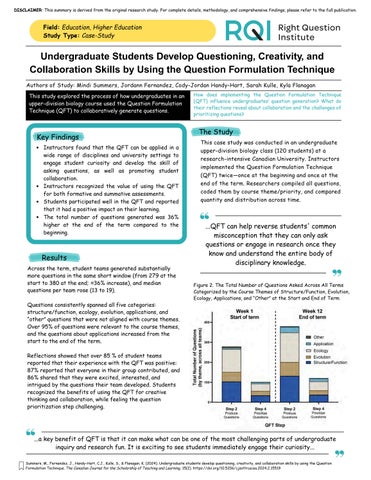
Results Across the term, student teams generated substantially more questions in the same short window (from 279 at the start to 380 at the end; ≈36% increase), and median questions per team rose (13 to 19). Questions consistently spanned all five categories: structure/function, ecology, evolution, applications, and “other” questions that were not aligned with course themes. Over 95% of questions were relevant to the course themes, and the questions about applications increased from the start to the end of the term. Reflections showed that over 85 % of student teams reported that their experience with the QFT was positive: 87% reported that everyone in their group contributed, and 86% shared that they were excited, interested, and intrigued by the questions their team developed. Students recognized the benefits of using the QFT for creative thinking and collaboration, while feeling the question prioritization step challenging.
How does implementing the Question Formulation Technique (QFT) influence undergraduates’ question generation? What do their reflections reveal about collaboration and the challenges of prioritizing questions?
The Study This case study was conducted in an undergraduate upper-division biology class (120 students) at a research-intensive Canadian University. Instructors implemented the Question Formulation Technique (QFT) twice—once at the beginning and once at the end of the term. Researchers compiled all questions, coded them by course theme/priority, and compared quantity and distribution across time.
...QFT can help reverse students' common misconception that they can only ask questions or engage in research once they know and understand the entire body of disciplinary knowledge. Figure 2. The Total Number of Questions Asked Across All Terms Categorized by the Course Themes of Structure/Function, Evolution, Ecology, Applications, and “Other” at the Start and End of Term
Insert Table/Figure
...a key benefit of QFT is that it can make what can be one of the most challenging parts of undergraduate inquiry and research fun. It is exciting to see students immediately engage their curiosity... Summers, M., Fernandez, J., Handy-Hart, C.J., Kulle, S., & Flanagan, K. (2024). Undergraduate students develop questioning, creativity, and collaboration skills by using the Question Formulation Technique. The Canadian Journal for the Scholarship of Teaching and Learning,15(2). https://doi.org/10.5206/cjsotlrcacea.2024.2.15519