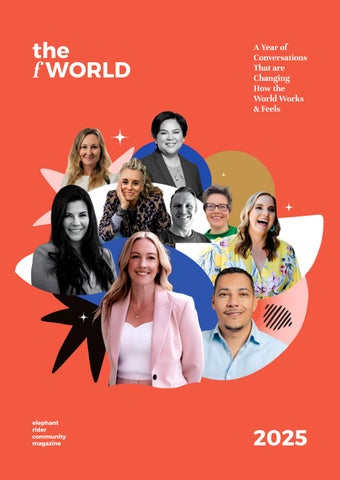

the f WORLD
r&e core belief. Everyone deserves to be heard.
We all have within us the means to redesign our lives but sometimes we lack the means to express what we’re experiencing. riders&elephants is the world’s leading prompted emotion conversation starter. Our powerful systems & tools give people the structured conversations they need to improve performance: move themselves, their cultures, and change their experiences for their customers.
Mission:
We believe in re-humanising the workplace
Vision:
To become the world’s most widely adopted culture system on the planet
editorial introduction.
This year marked a turning point in how organisations understand emotion.
For decades, culture work focused on values, behaviours and strategy, the visible parts of how teams operate. But 2025 made something unmistakably clear:
Emotion sits underneath all of it. How people feel shapes how people work. And how people work shapes how organisations perform. Across industries, countries and contexts, we saw the same pattern:
When teams design their emotional culture with intention, everything becomes easier, communication, trust, clarity, pace and performance.
This year’s F-World captures that shift. It brings together the ideas, research, stories and breakthroughs that shaped the rise of Emotional Performance, from emerging global research, to the evolution of emotional culture systems, to the real experiences of our community around the world. And at the heart of all of it is something very human:
The conversations that surface truth. The conversations that build trust. The conversations that help people feel seen, understood and supported. The conversations leaders have avoided for years, and are finally learning how to hold.
This issue is a celebration of the conversations that change how people feel, behave and perform.
A global movement that is maturing in depth, sophistication and impact. A movement built on one simple truth:
When we understand emotion, we understand people. And when we understand people, we build better workplaces.
Here’s what we learned this year, the community bringing it to life, and where the story goes next.
We hope you feel inspired by exploring everything inside these pages
founders letter.

JEREMY, R&E Founder
I want to start by saying how inspired & grateful I am to every single person in our community.
I’ve always believed that a community is a place you come to for support and help. Connection is the byproduct of that. It’s what happens when people come together looking for advice, inspiration, ideas, reassurance and a sense that they’re not doing this alone.
To most people who don’t understand the work we do yet, our community probably looks a bit bizarre. “You ride elephants?”, and talk about emotions, and use card decks at work. From the outside, I get why it might seem strange.
But you all know it’s so much more than that.
At the heart of our community is a shared belief. That emotions hold the power to change our lives and the lives of the people we serve. That emotional culture matters. That the conversations we create, the language we use, and the tools we share can shift something real inside teams, organisations and systems. That the work we do moves people & performance for the better.
Someone said to me the other day that what we do is “make the intangible tangible”. I love that. We take something often seen as soft or fluffy and make it real. Usable. Felt. We treat emotions as data. We understand emotional culture as the result of the collective emotions of the people inside a system. And once you see it, you can’t unsee it. You feel it. You live it. You know it’s real.
And our community isn’t immune from that either.
We’re shaped by the emotional contagion of the people here. I feel inspired when you’re feeling inspired. I hope you feel inspired when others share moments of growth, courage or pride. I feel overwhelmed when you feel overwhelmed. And I know many of you feel that way from time to time too. We’re actively working on how we care for that better as we move into 2026.
I feel proud when I see bright spot moments share. When someone talks about the impact of their ECD work. When someone shares the story behind their first workshop, or the moment they finally took the cards into a room and trusted themselves.
I feel brave when you share your challenges and what you did to overcome the obstacles you’ve faced. When you name your inner dragons (to use Steven
Pressfield’s beautiful metaphor form The War of Art). The fear. The doubt. When you do the thing anyway. Using The ECD 1:1 for the first time. Walking into a workshop with people you don’t know. Trying something new because it matters. That fear is real. I still feel it. And I know many of you do too.
But the thing that makes me feel most proud is this. None of us are doing this alone.
I never want you to feel alone here. Whatever you’re experiencing, someone else has felt it, is feeling it, or has moved through their version of it already. There is so much wisdom, insight & generosity in our community. (It makes me feel a bit intimidated at times too). Our impact is greater because people here share so openly & generously.
The feedback you give me, your ideas, your white-card
emotions, your frustrations and hopes all shape what we build at R&E. They push me to do better. To care even more. To keep going above & beyond what might be expected. To make sure this community continues to feel welcoming, supportive, brave, inspiring and human. And I hope that inspires you to do the same in your ECD practice too.
As you read this years F-World Magazine, I hope you feel inspired. And surprised. And maybe even a little bit in awe of what you discover inside.
It is almost impossibly difficult to distil 365 days of activity, emotion, learning & connection inside our community into such a small number of pages. We’ve tried our best to do that here. To showcase the broad & beautiful range of lessons, ideas, bright spots, moments and insights that have emerged from across our global community this year.
Everything that’s happened in 2025 has also inspired me to look closely at how we shift a few things and evolve The ECD and our business as we move into 2026. As I look ahead to what’s next, I feel both excited and deeply responsible for how we grow, what we protect, and what we make possible together.
There’s a short video included here that gives you a little glimpse into what that future might look like. If you’re feeling curious or intrigued about where we’re heading next, I’d love you to watch it when you get the chance.
What will always remain the same though is this. Our community exists for anyone who cares enough to be brave. Brave enough to question the status quo. Brave enough to work with emotions. Brave enough to contribute to our shared mission of rehumanising the workplace and changing how the world & workplaces feel.
big picture.
The emotional shifts shaping the way we work.
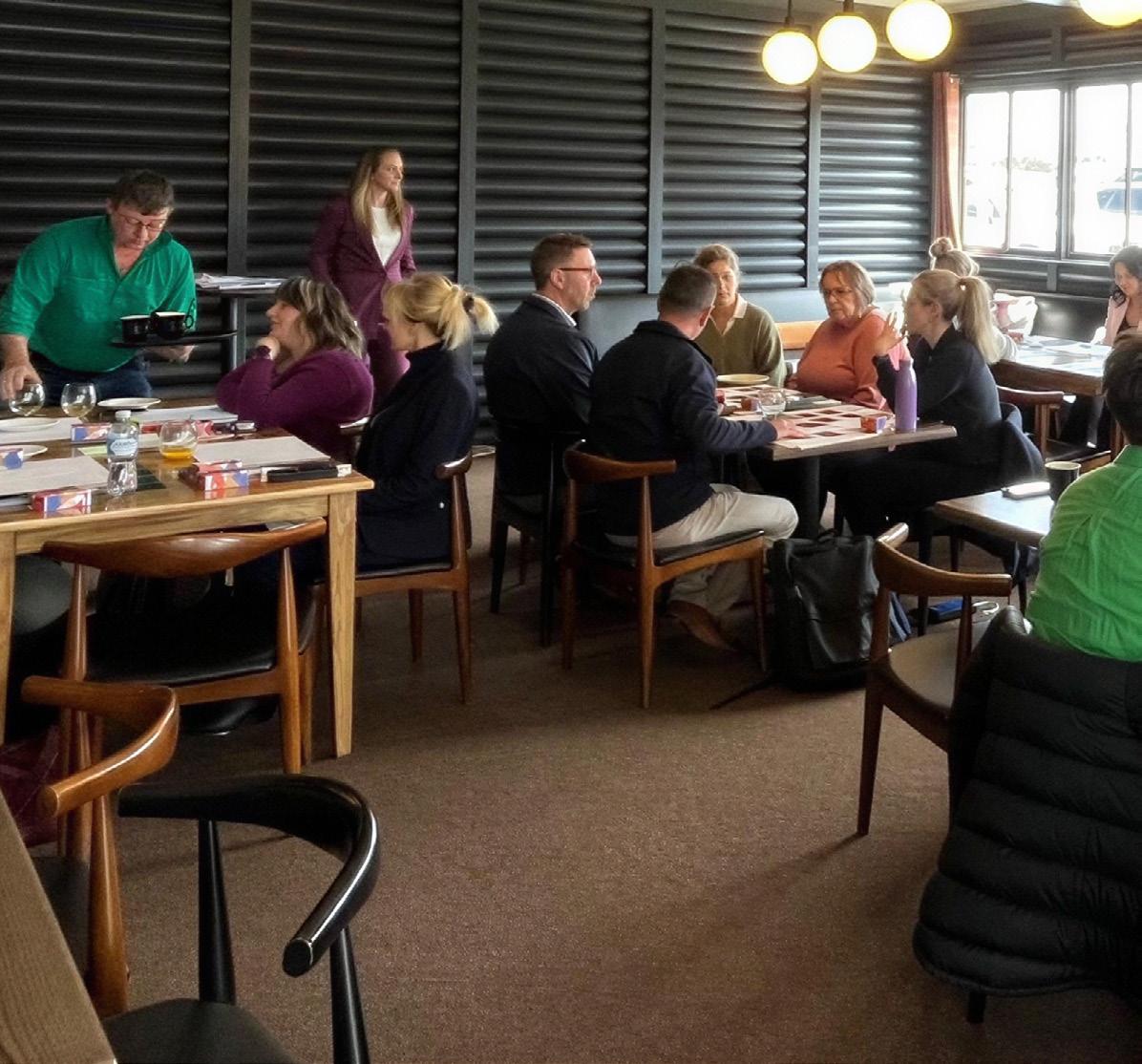
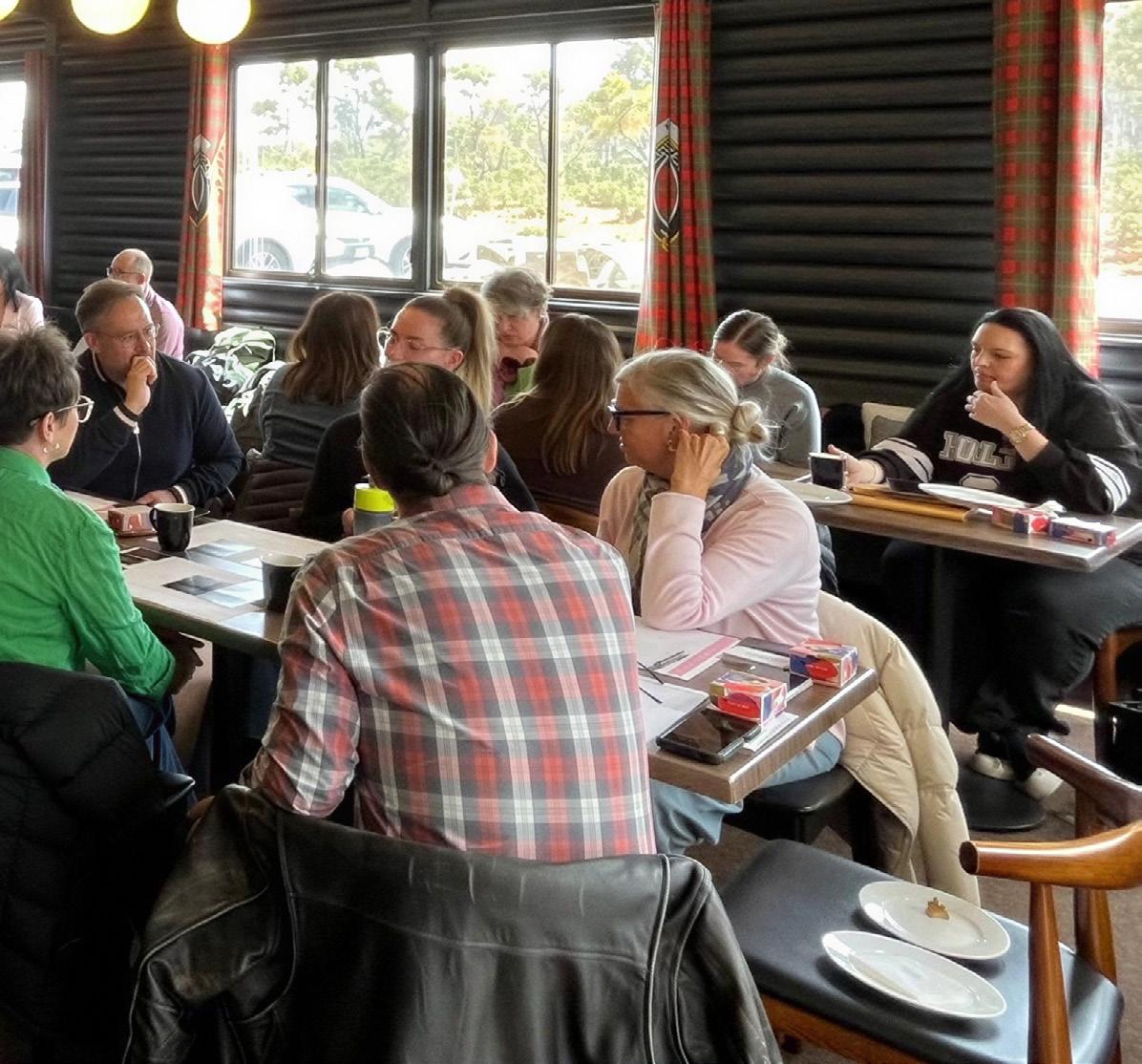
The Shift That’s Redefining Leadership, Culture & Performance in 2025
For years, culture became one of the most overused and least understood words in business. Organisations tried to shift behaviour by rewriting valuestheir cognitive culture, launching employee experience & engagement
and more recently wellbeing initiatives. Yet behaviour (and culture) rarely changed, because the emotional system underneath it hadn’t. 2025 made one thing unmistakably clear to us. Emotion isn’t just the
ignored part of culture, it shapes the performance people & workplaces itself.
Hybrid and distributed work removed the informal cues leaders once relied on. People felt tension, overwhelm
Teams didn’t need new structures. They needed emotional connection
or disconnection long before leaders could see it.
Behavioural problems and culture challenges and failed transformation programmes weren’t caused only by capability gaps, they were caused by a lack of attention on the emotions of the people & teams within them.
Global signals confirmed the same pattern. Deloitte warned that organisations are “pushing structural change faster than people can emotionally absorb it.”
Gallup found that teams with emotional clarity outperformed those relying solely on process
What changed this year
Teams began moving faster when emotion became visible. Once people understood how others were feeling, decisions sharpened, creativity & teamwork increased. Workload issues surfaced earlier, and cross-functional collaboration improved. Leaders also discovered blind spots they had missed for years, particularly the emotional impact of their own presence.
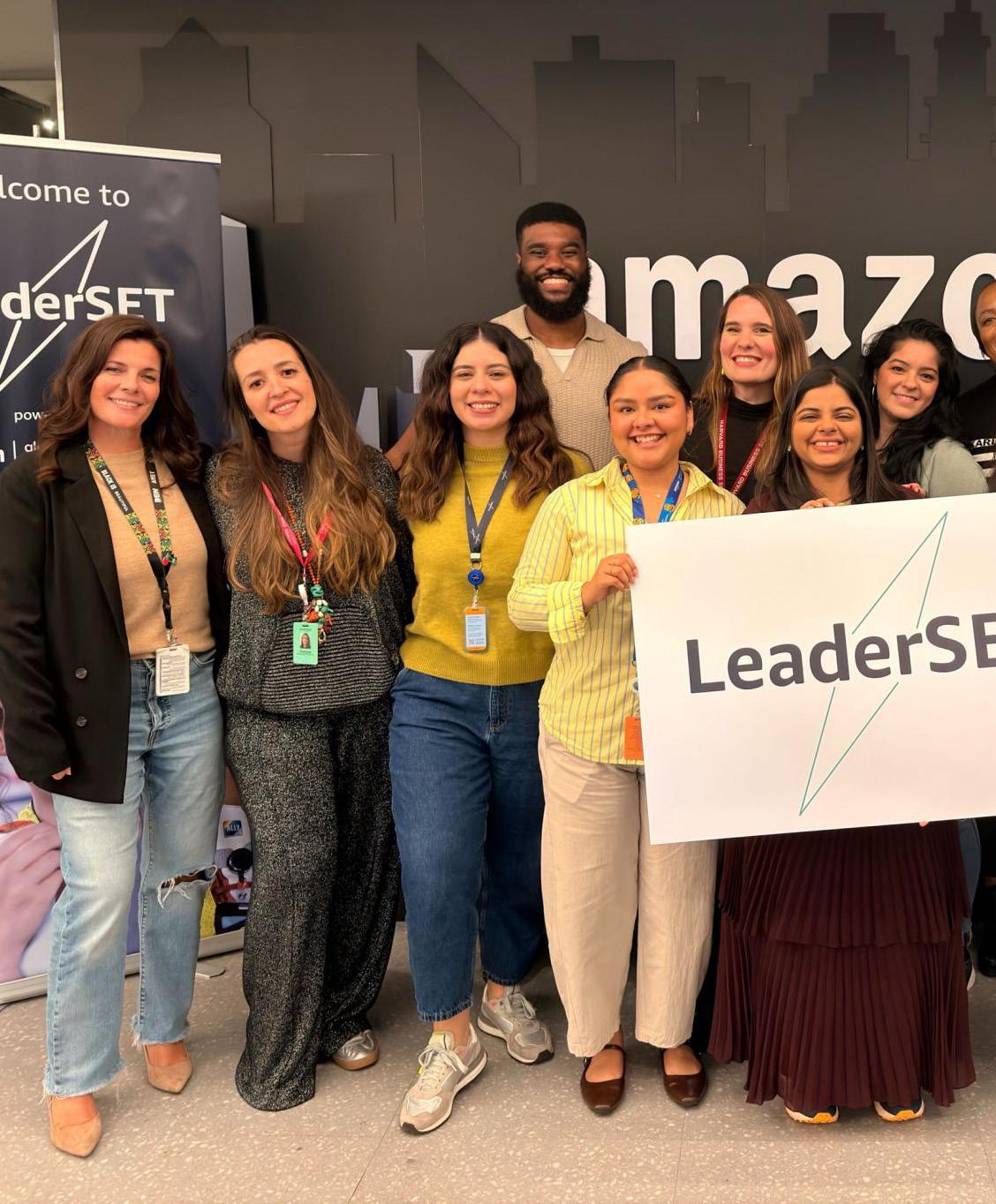
In our Amazon pilot, naming a single emotion at the start of each stand-up
created measurable gains in psychological safety and employee voice in just 42 days. Emotional culture conversations didn’t soften the work. It formed the structure and foundation of how they worked.
And across industries, the same insight appeared again and again:
The teams that intentionally crafted emotional culture conversations saw improved measures across key performance indicators.
Emotion Behaviour Performance
The system underneath every team. Emotion is the starting point. It influences how people think, speak up, collaborate and respond under pressure. Behaviour is emotion made visible. People act differently when they feel confident, ignored, overwhelmed or supported. Performance is the long-term pattern of those emotional experiences compounding over time. Teams with emotional clarity communicate more effectively. Teams with emotional safety & support
learn faster. Teams with emotional connection collaborate more generously.
Emotion in the workplace has historically been seen as either separate from performance not not related to it. But emotion is the foundation of what drives performance whether we want to believe it or not. Traditional culture work asks people to behave differently. This year proved that is the wrong starting point. Behaviour only changes when the emotional culture is understood. Teams that built simple emotional
Organisations that will win the next decade are those that treat emotional culture as infrastructure, not an afterthought.
systems, shared language, ritualised reflection, guided conversations, and clear naming of emotional red flags — saw improvements in psychological safety, trust in leadership, problemsolving pace, retention and collaboration across distance. Because people expressed and shared how they felt they moved their real experiences. As one leader captured during a field study:
“We made better decisions once we stopped guessing how people were coping.”
A movement shaped by people, not programmes
This shift didn’t emerge from theory alone. It was shaped by thousands of leaders, consultants and teams experimenting in real ECD workplaces, naming emotions, designing rituals, surfacing concerns, and building emotional systems that made their work healthier, clearer and more human. The rise of what we call ‘Emotional Performance’ is a collective achievement from a global community proving that
emotional connection and culture crafting is becoming possible at scale and it moves people, teams, organisations & performance.
Emotion has become a leadership discipline. The leaders who excel now are those who can spot emotional patterns early, create environments where expression is normal, and integrate emotional connection into their regular rhythms & rituals. They treat emotional information like any other form of
operational data, something to observe, interpret and act on. And the long-term implication:
Organisations that will lead the next decade are those that treat emotional culture as infrastructure, not an afterthought.
Emotion is the system, the hidden infrastructure beneath behaviour and performance.
It is the emotional shift shaping the way we work.
Ten Emotional Truths That Defined 2025
What the world’s leaders, teams and communities taught us about how emotion really shapes behaviour and performance.
Across thousands of ECD conversations, workshops, change programmes, meetups and organisations this year, a clear pattern emerged. No matter the country, industry or challenge, the same truths kept returning, simple, human, and powerful.
These are the emotional truths shaping the future of leadership, culture & performance.
1. Emotion is direction, not disruption.
The most effective leaders continued to prove that emotion isn’t noise, it’s data. It tells us where people are, what they need, and where energy is stuck. And it indicates for themselves
where they are are at and how they need to behave to show up effectively for their people.
2. Language creates movement. When people gain the words to describe what they feel, both their emotions & behaviour shifts.
3. Leaders shape the experiences of their people.
The emotional state of one person, especially the leader, ripples further than most realise. Awareness is now a performance capability.
4. Safety comes from structure.
Rituals, reflections, and guided conversations helped people go deeper, faster. Consistency created trust. Trust opened everything.
5. Culture changes one feeling at a time.
Every meaningful shift we saw began with a single emotional truth spoken out loud, not a strategy document.
6. Change succeeds when emotion is named.
Hope, fear, uncertainty and excitement shape & stall every change project. Ignoring them slows progress. Naming them accelerates & fuels change adoption.
7. Resistance is insight in disguise. What looks like pushback is often fear of loss, confusion or misalignment. When leaders listen emotionally, the path forward becomes clearer.
8. Conversation builds capability. People don’t learn or craft emotional culture from theory. They learn it by practising
emotional culture conversations, together, in real time.
9. Belonging is a performance advantage.
Community was a standout theme of the year. People grew faster, braver and more skilled when surrounded by others doing the work.
10. Emotional culture is becoming a leadership & business capability driver.
Across organisations worldwide, emotional culture moved from “interesting” to “essential” to “strategic”
Leaders are treating it as infrastructure, not a side project or a one-off team building activity.
Across every organisation, team and consultant we worked alongside this year, regardless of industry, size or geography, the same patterns kept surfacing. People already feel something, and those feelings shape decisions, connection and results long before any strategy can.
Culture shifts through small, human-tohuman rituals repeated over time, not slogans or policy. As emotional culture becomes more observable & measurable, one thing is increasingly clear: emotion is no longer a side note to performance , it is the system underneath it.
Emotion is no longer a side note to performance , it’s the system underneath it.
emotional performance in organisations.
How teams used emotion to shift behaviour this year.
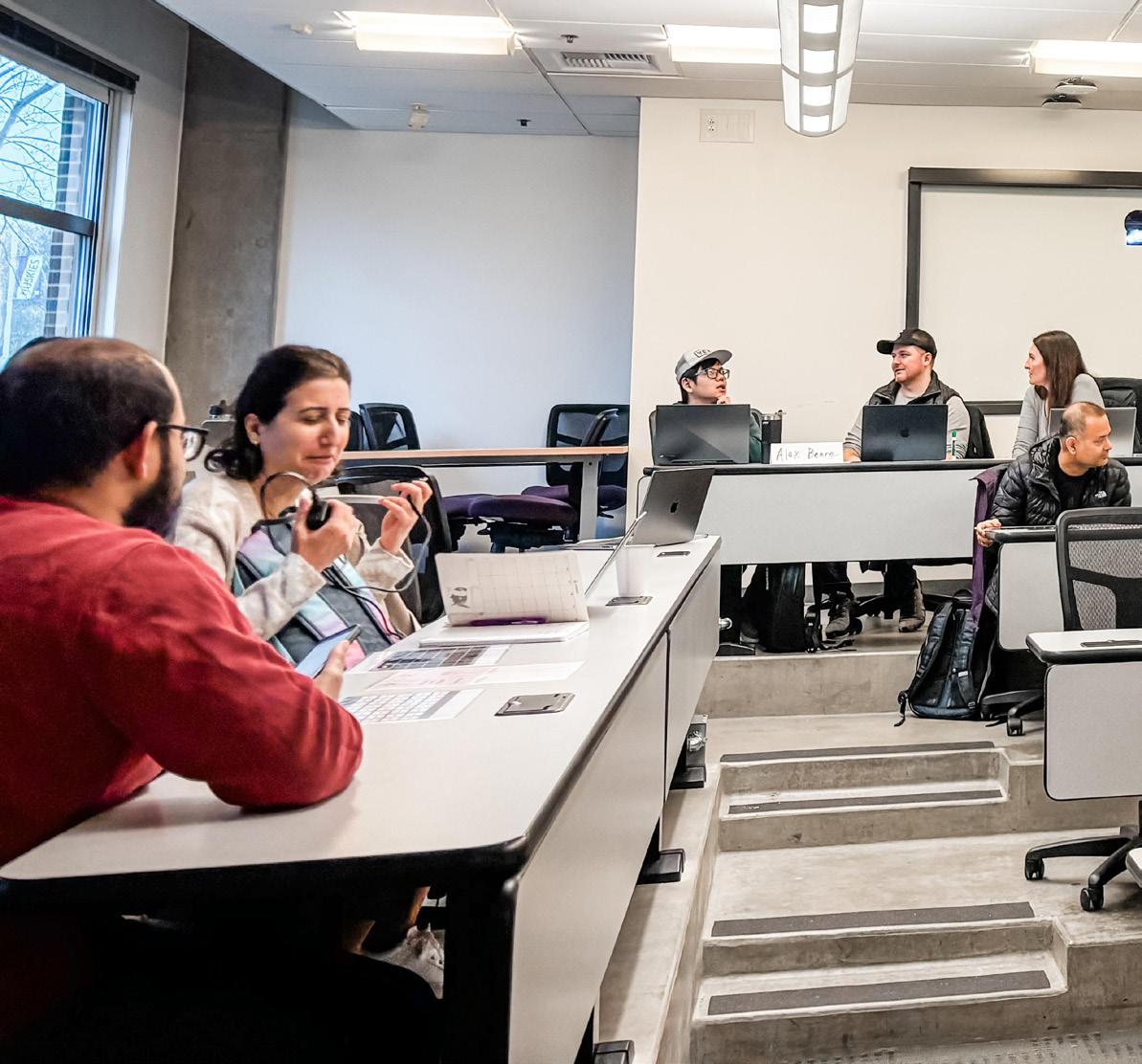
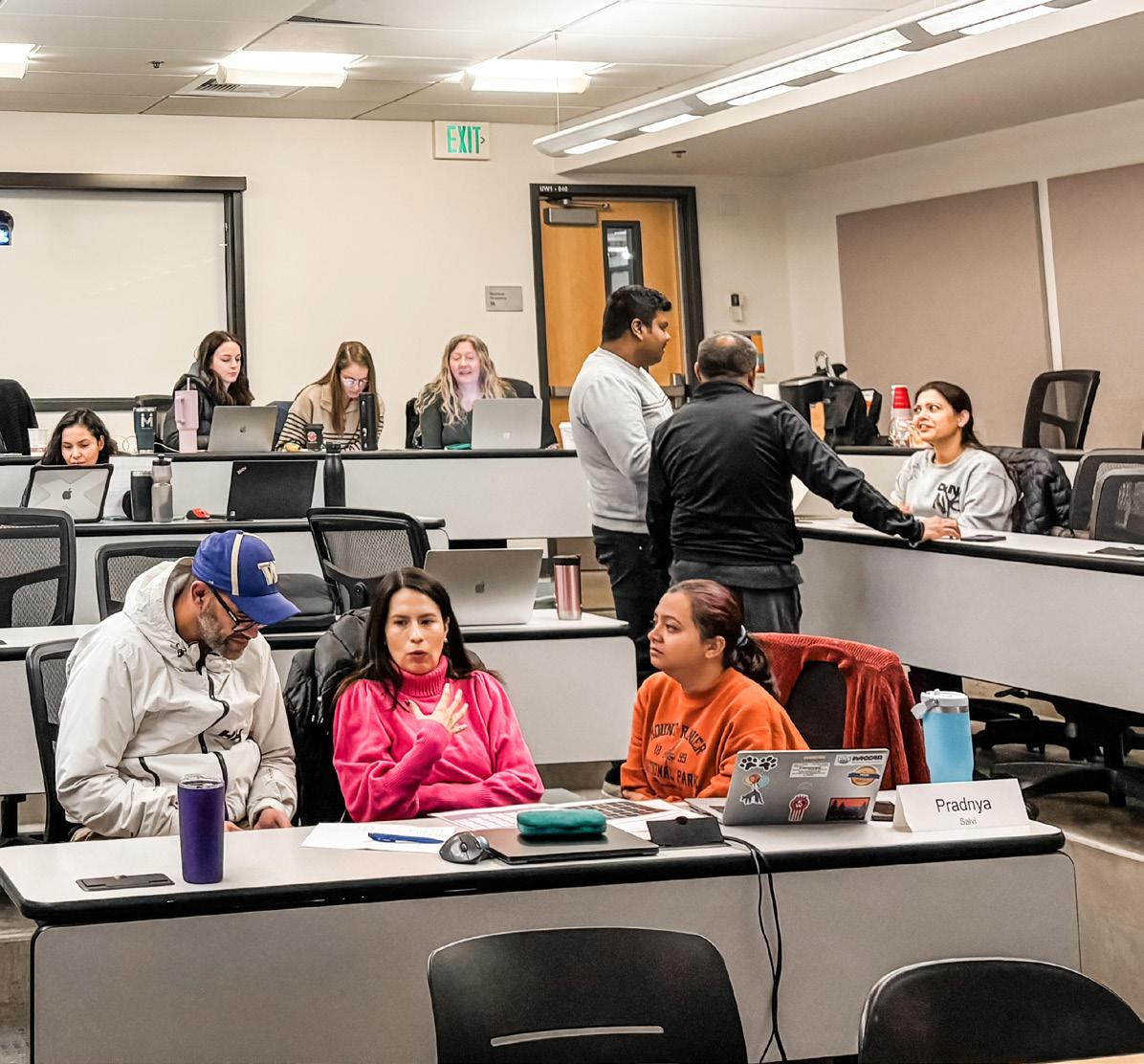
Emotional Culture in Practice: What Real Organisations Are Teaching Us
Organisations across healthcare, technology, manufacturing and essential services partnered with R&E this year to understand how emotional culture affects safety, cohesion and performance in real work settings.
Some of this work was delivered in collaboration with our research partner, Professor Michael Parke at The Wharton School, through field studies measuring psychological safety, emotional expression and behavioural outcomes. Other insights came from leaders and consultants
inside organisations who embedded emotional culture into their everyday systems and tracked the impact over time.
Together, these programmes created a diverse evidence base across industries, geographies and levels of emotional readiness.
Across all cases — whether Wharton-supported or practitionerled — the same pattern emerged:
• Psychological safety increased
• Employee voice strengthened
• Positive emotion and motivation lifted
• Stress emotions reduced
• Leaders became more emotionally attuned
• Teams aligned faster and collaborated more openly
• Operational performance shifted in measurable ways (including safety outcomes in manufacturing environments)
And through every setting, one insight remained constant:
When people gain the space, language and structure to express how they feel, the way they work changes.

Case Study: Amazon Emotional Culture as an Organisational System
Practitioner Lead: Susannah King, Advanced Culture Practitioner
Research Partner: Professor Michael Parke, The Wharton School
Sector: E-commerce & Global Logistics
Organisation: Amazon
Amazon partnered with riders&elephants and Professor Michael Parke of The Wharton School to test whether a condensed emotional culture system could strengthen performance conditions in a high-pressure, globally dispersed team.
A six-week pilot was run with a team working across APAC, AMET and LATAM. They faced tight deadlines, no shared history, limited overlap hours and a consistently high cognitive load, a context where traditional culturebuilding methods were neither practical nor possible.
The intervention introduced a simple, repeatable emotional system: shared emotional language, a weekly reflective cadence and a small behavioural experiment each week.
The results indicated that emotional systems can meaningfully strengthen performance conditions in a short timeframe, without additional headcount, budget or structural change.
Context and Constraints
Following an internal restructure, the team formed rapidly and immediately confronted several challenges:
• Geographical dispersion across three continents
• An 11-hour time-zone spread, limiting informal interaction
• High operational demand, with major programme deadlines imminent
• No pre-existing team norms, cohesion or relational trust
Traditional culture-building methods (offsites, facilitated values exercises, extended workshops) were neither feasible nor suited to the operational context. A rapid-cycle, evidence-informed design was required.
Intervention Design
The pilot introduced a structured emotional system consisting of three components:
1. Foundation-setting workshop
A facilitated session established:
The emotions required for effective collaboration
• The emotions most likely to impair performance
• The emotional outcomes desired for stakeholders
This created a shared emotional model for the team’s work.
2. Weekly reflection cadence
Over six weeks, the team adopted a brief but consistent practice:
• A 10-minute reflective check-in
• A weekly emotional tracker to surface patterns and stress indicators
• A small behavioural experiment reviewed the following week
These practices normalised emotional reflection and linked insight to intentional action.
3. Leader emotional modelling
The team leader began each stand-up by naming her emotional state and its potential impact.
This signalled psychological safety, reduced emotional ambiguity and encouraged open dialogue.
Measured Outcomes
Independent analysis conducted by Professor Parke recorded meaningful shifts:
Key findings from the 6-week ECD Team-formation programme
Movement between Time 1 (pre-Programme) and Time 2 (post-Programme)
All results reflect participants who selected “agree” or “Very much agree” (4-5 on a 5-point scale).
What This Tells Us
These results echo what leaders often “feel” but rarely measure: when a team forms its emotional culture early, builds weekly check-ins, and leaders model affectlabelling, psychological safety the results happen-fast. The Amazon programme shows that even a globally dispersed team can generate double-digit gains in a short period of time.
What
else
improved for team members?
feel their manager shows genuine
say they are comfortable expressing true feelings.
feel safe to speak up with ideas.
input.
Key cultural shifts at a glance
• Psychological Safety + 20 % - More people agree that “expressing your true feelings is welcomed,” giving the new tri-region team freedom to surface issues fast.
• Employee Voice + 12 % - Higher agreement that “I speak up with recommendations about fixing work-related problems,” so continuous-improvement ideas now flow more freely.
• Experience Positive Emotions + 12 % - Team members report feeling more positive emotions, boosting resilience and creativity under tight deadlines.
• Leader Emotional Support + 6.7% - More people feel their manager encourages them to share feelings, strengthening trust and retention.
• Leader Voice Solicitation + 8.2 % - Leaders actively ask for input on how to improve the team, signalling psychological ownership across time zones.
• Affect-Labelling (Positive) + 10 %Members more frequently verbalise positive emotions (e.g., “I’m excited about this”), reinforcing wins and modelling emotional literacy..
Metrics listed above correspond to the survey items shown in the bar-chart
Consistency, not scale, produced the most significant behavioural shifts
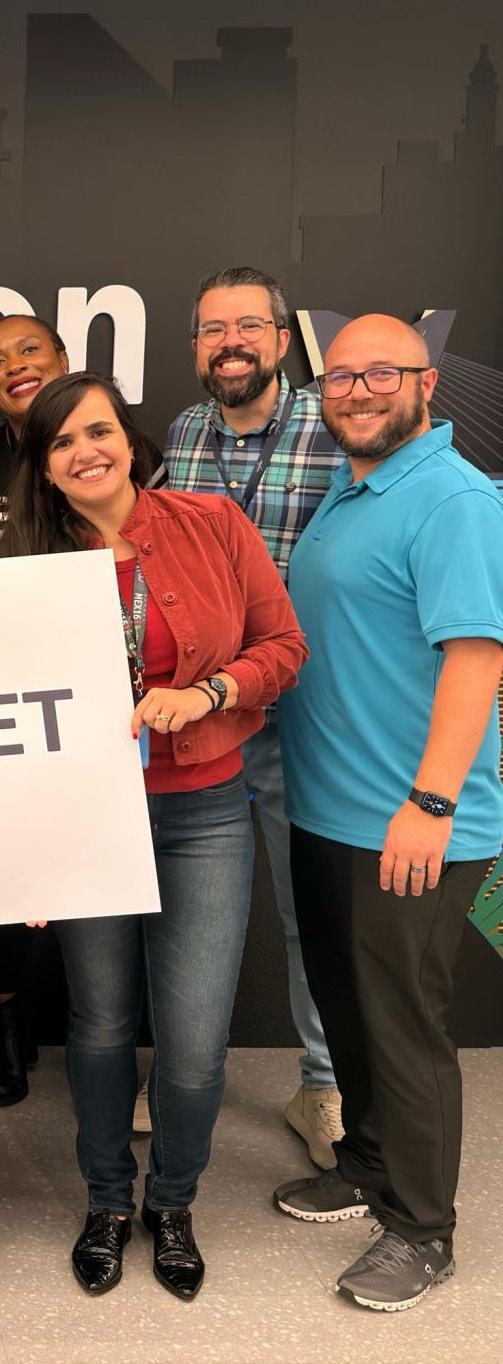
Amazon Case Study — Insights
INSIGHT 1
Emotional culture can shift fast when leaders make emotions visible.
Practice Lesson: Culture change doesn’t need years. Amazon moved the dial in just six weeks. Start small — one honest conversation or check-in can shift the tone of an entire team.
INSIGHT 2
Shared emotional language removes guesswork
Practice Lesson: Don’t guess how people feel. Ask them. Add a five-minute emotional check-in to your weekly meeting — the team will name truths you’ll never find in a KPI.
INSIGHT 3
Teams trust leaders who model openness first.
Practice Lesson: Go first. Name how you’re feeling before asking others. When people see you speak about emotion with intention, they feel permission to do the same.
INSIGHT 4
The emotions that drive performance aren’t always the ones you expect.
Practice Lesson: Challenge your assumptions. Ask the team which emotions helped them perform and which ones held them back. You’ll uncover strengths and signals hiding in plain sight.
INSIGHT 5:
Small rituals outperform big cultural initiatives.
Practice Lesson: Pick one emotional ritual and repeat it for six weeks. Keep it simple, predictable and short — the power is in the rhythm, not the size.
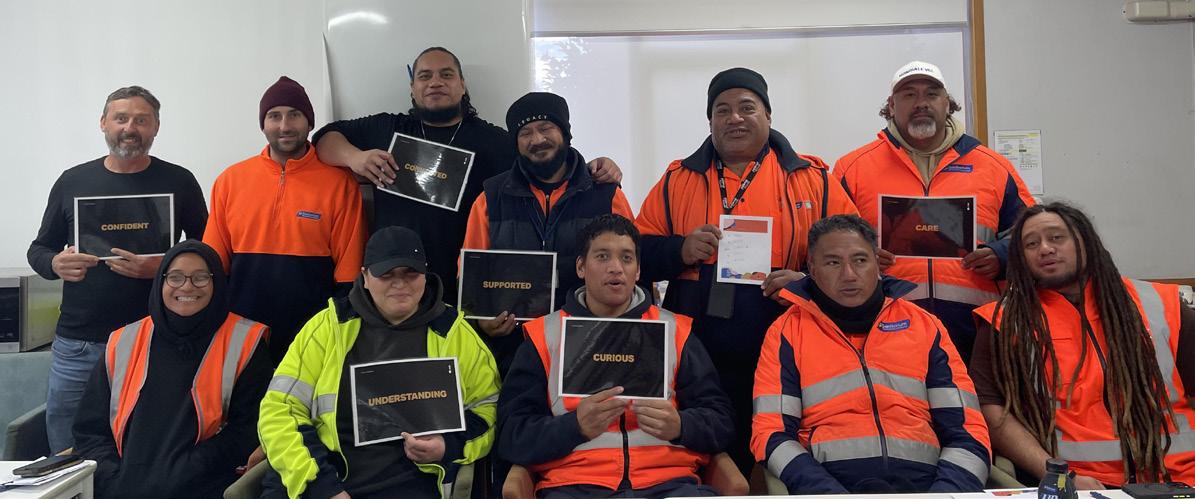
Case Study: Sanitarium



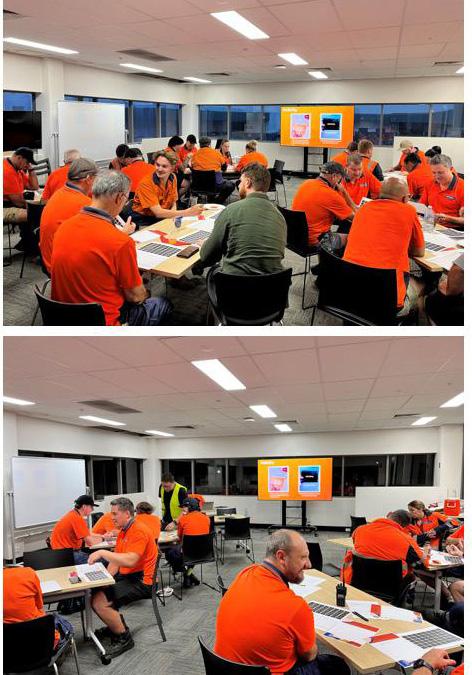
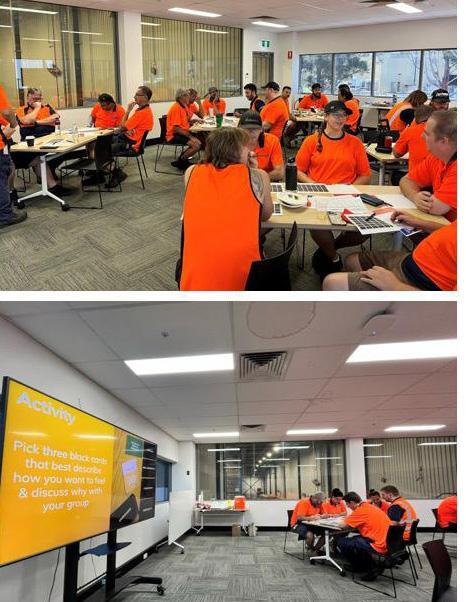
When Sanitarium opened its new stateof-the-art national distribution centre they faced more than just an operational shift. Two distinct teams were coming together for the first time with different habits, relationships, and expectations.
PRACTITIONER LEAD: Chelsea Lang, Certified Consultant in Training, and Danii Garrett Emotional Culture Practitioner, Australia
RESEARCH PARTNER: Professor Michael Parke, The Wharton School
SECTOR: Food & Beverage Manufacturing
ORGANISATION: Sanitarium
They saw a unique opportunity: not just to manage the transition, but to reset how the team connects, communicates, and leads.
So they launched Reset & Elevate. A bold, human-centred culture programme designed by Chelsea Lang and Dani Garrett, Elephant Riders inside Sanitarium. Their goal: bring people together, rebuild trust, and lay the foundation for a team culture where everyone feels respected, supported, and proud to belong.
The results were extraordinary.
The Emotional & Cultural Shifts
Chelsea and Danii embedded The Emotional Culture Deck into the programme helping leaders and team members have more honest conversations, build emotional literacy, and set a clear tone for how the team wants to work together.
Over the course of the programme, we saw significant emotional and cultural shifts, including:
in motivation and enthusiasm
These aren’t just numbers. They’re signs of something deeper a team stepping into a new chapter together, with shared language and leadership that makes space for both performance and humanity. increase in recognising the emotions of others
What Made It Work?
Reset & Elevate wasn’t a cookie-cutter programme. Chelsea and Danii tailored it to the realworld complexity of Sanitarium’s operational teams. They focused on:
Strengthening trust and relationships across shifts
Supporting new Leading Hands as they transitioned into leadership roles
Building confidence and capability in emotional leadership
Creating shared clarity around what “good” looks like day to day
The programme made space for reflection, conversation, and emotional connection, giving people permission to speak up, feel seen, and reimagine what work could feel like.
The Wider Programme Results
Key findings from the reset & elevate Culture programme
What else improved for team members?
• 50% feel relationships with team members have improved.
• 60% feel their team treats each other with increased care and respect.
• 70% feel increased care from their manager.
• 60% feel their manager seeks their input more about team improvements.
• 45% feel increased positivity and enthusiasm about their job.
• 40% feel increased motivation and commitment to their work.
• 20% feel decreased burnout from their work.
• 20% feel workload demands have improved.
What This Tells Us:
These findings offer strong indicators that the Reset & Elevate Culture Programme is having a measurable emotional impact on the workforce. They validate what many leaders feel intuitively: when teams build emotional literacy and permission to express feelings, connection and psycholof all improve. The ECD work - including check-ins, team rituals, and emotional reflection - is woven throughout the Reset & Elevate programme. The measured changes in emotional clarity, empathy, and emotional expression map directly to outcomes The ECD was designed to influence.
Insights from Sanatarium’s Emotional Culture Practice
INSIGHT 1
People speak up when emotions become discussable.
Practice Lesson: Don’t wait for issues to spill over. Invite your team to name one concern they haven’t voiced yet, and the emotion underneath it. You’ll surface truth faster than any survey.
INSIGHT 2
Leaders grow quickest through non-reactive listening.
Practice Lesson: In your next 1:1, don’t fix. Listen all the way through. Notice what changes.
INSIGHT 3
Structured emotional conversations shift trust quickly. Practice Lesson: One guided emotional conversation can reset a relationship more effectively than months of messaging.
INSIGHT 4
Employee voice is a performance accelerant, not a ‘nice to have’.
Practice Lesson: Ask weekly: “What should we talk about sooner rather than later?”
INSIGHT 5:
Busy environments need clarity most.
Practice Lesson: Five minutes of emotional check-in saves hours of friction later.

Case Study: Construction Measuring & Moving Performance Through Emotional
Culture
PRACTITIONER LEAD:
Kristian Colegate, Certified Consultant, Australia
INDUSTRY: Construction & Infrastructure
REGION: Australia
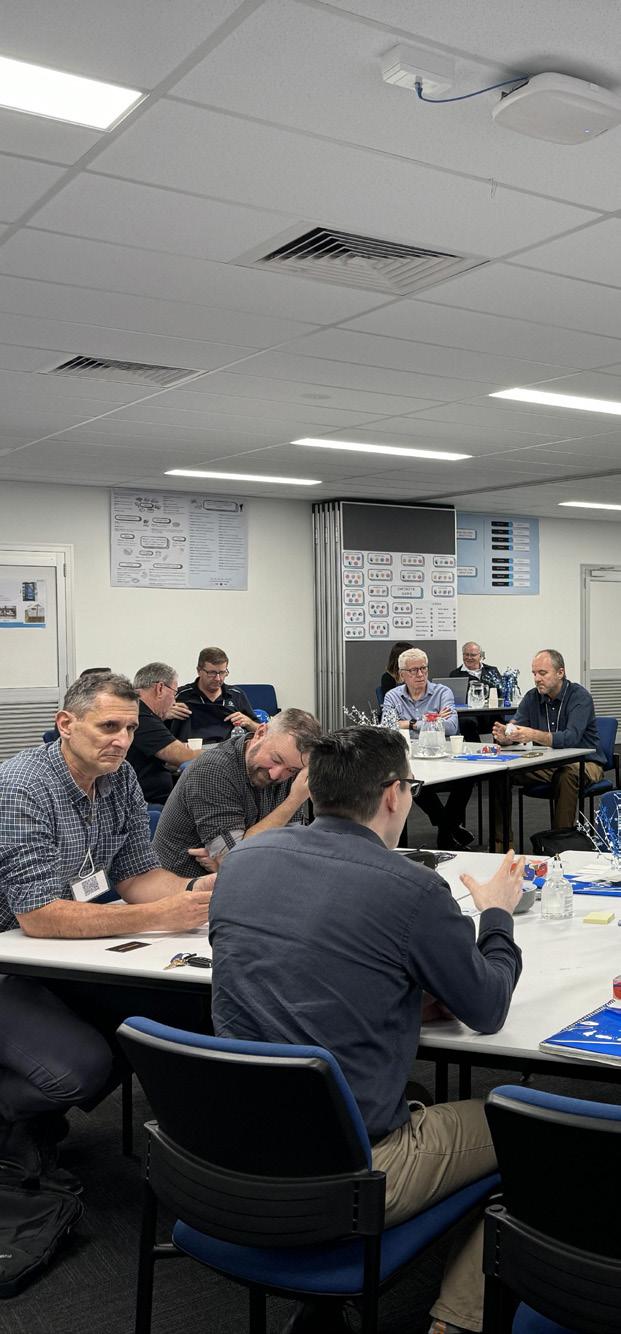
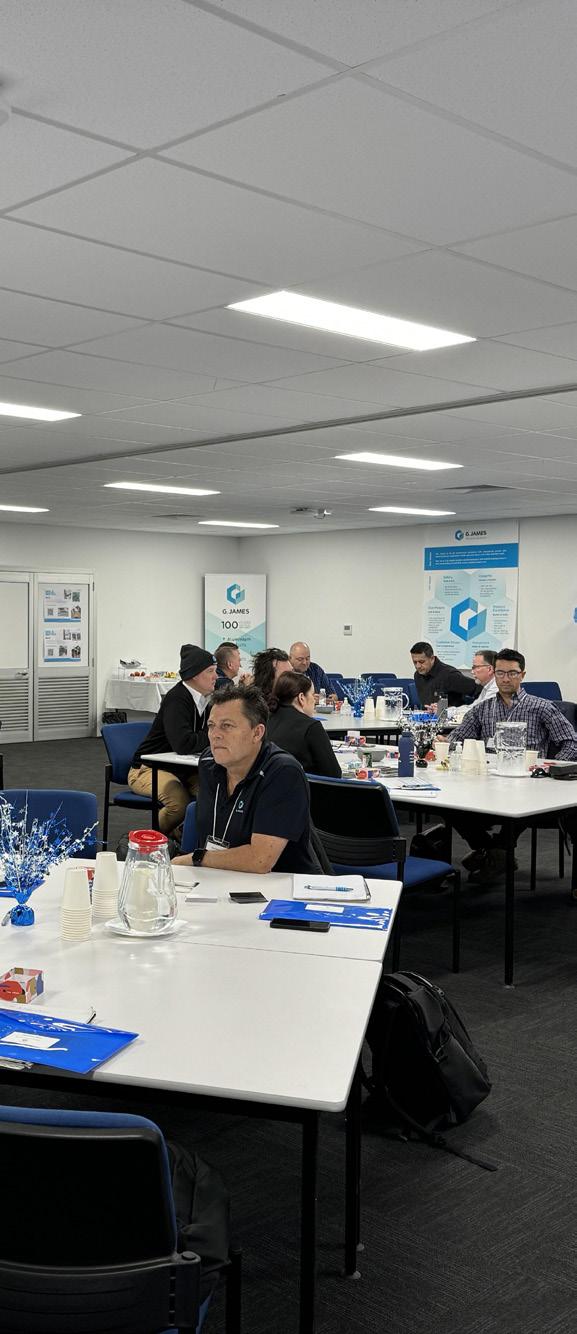
In a traditionally male-dominated, safety-critical industry, one organisation introduced a structured emotional culture system across 17 sites. What emerged was not a “soft skills” initiative — but a measurable shift in performance, safety outcomes and leadership capability.
Before any formal programme was announced, teams began reporting clear signs of change:
• 40% reduction in lost time injuries (LTIs)
• Higher team engagement where leaders normalised emotional conversation
• Lower turnover in branches using the system consistently
• Increased safety reporting and psychological safety
• Emotional culture built into retention, 360s and leadership capability assessments
Leaders inside the organisation now describe emotional culture as:
“A strategic performance lever.”
Context and Constraints
1. Emotional data became operational data
The organisation replaced informal assumptions about “morale” with observable emotional signals.
Patterns emerged:
• Feelings of disconnection correlated with absenteeism
• Feelings of overwhelm correlated with higher incident risk Feelings of support and recognition predicted stronger reporting and team cohesion
This allowed site leaders to use emotional insight the way they use operational metrics — to anticipate risk, intervene early and support better decision-making.
2. Emotional literacy strengthened leadership capability
As leaders adopted shared emotional language, new patterns appeared across 360 feedback, performance conversations and team reflections.
Leaders became:
• more consistent in naming emotional drivers of behaviour
• more confident in addressing early tensions
• more effective at creating psychological safety in high-pressure environments
The organisation observed that leaders who could name, model and regulate emotion guided teams through ambiguity with fewer errors and stronger trust.
3. Safety improved as emotional culture strengthened
Across the 17 sites, teams began integrating emotional reflection into safety rituals, toolbox talks and hazard reviews.
This created a shift from mechanical compliance to human-centred awareness
The measurable results:
• 40% reduction in LTIs
• Improved hazard reporting
• Fewer near-misses
• Greater ownership of safety behaviours
Leaders reported that when people felt heard, seen and connected, they communicated risk earlier — and more honestly.
4. Emotional culture became part of the performance system
What started as a leadership practice evolved into a network of organisational routines.
Emotional culture is now integrated into:
• onboarding and induction
• safety and lean frameworks
• performance and development conversations
• leadership programmes
• change and transition work
Monthly emotional reflections are tracked across sites using digital boards, creating visibility and continuity across the business.
The organisation now reviews emotional culture trends alongside operational KPIs — recognising that how people feel directly shapes how they perform.
5. Culture change sustained itself beyond a single leader
One of the most compelling outcomes is the movement’s durability.
As emotional culture became embedded in systems, rituals and shared expectations, leaders at multiple levels began requesting training and development to deepen the work.
It no longer relied on one sponsor.
It became part of “how we lead here.”
Construction Case Study — Insights
INSIGHT 1
Emotional culture is a safety system.
Practice Lesson: Before a shift, ask: “What do we need to feel today to work safely?”
INSIGHT 2
Teams open up when the environment feels structured, not soft.
Practice Lesson: Use a clear emotional framework. Structure reduces defensiveness.
INSIGHT 3
Frontline leaders set the emotional climate
Practice Lesson: Open toolbox talks with one sentence: “Here’s how I’m showing up today.”
INSIGHT 4
Name emotion before behaviour
Practice Lesson: Ask teams to identify one undesired emotion creeping into the job (e.g. frustration, pressure, confusion). Then ask:
“What behaviour does this create, and what do we want instead?”
INSIGHT 5:
Emotional conversations make high-pressure work more sustainable.
Practice Lesson: End each week by asking: “What emotion helped you cope this week, and what drained you?”
insights from community Practice.
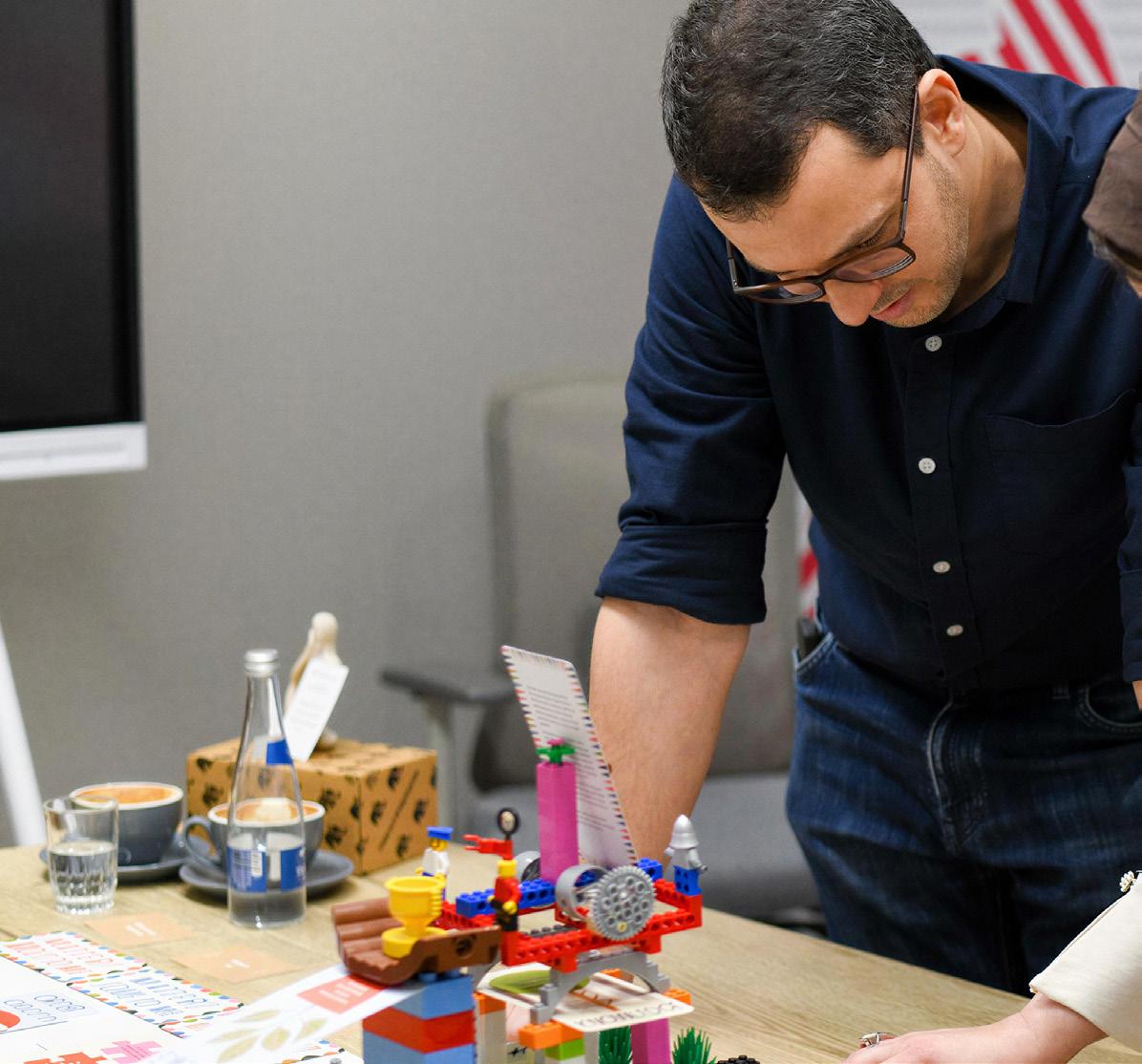
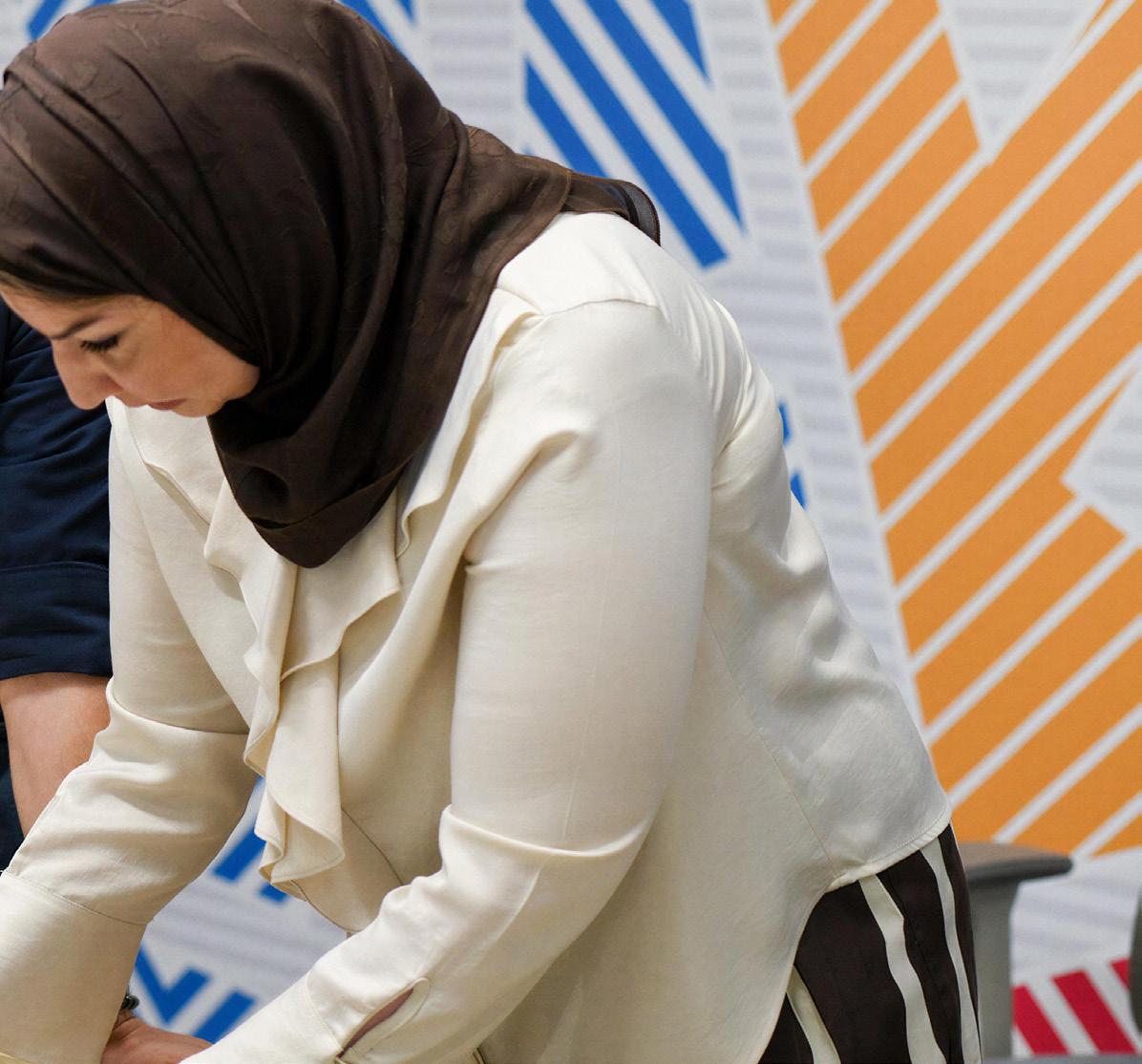
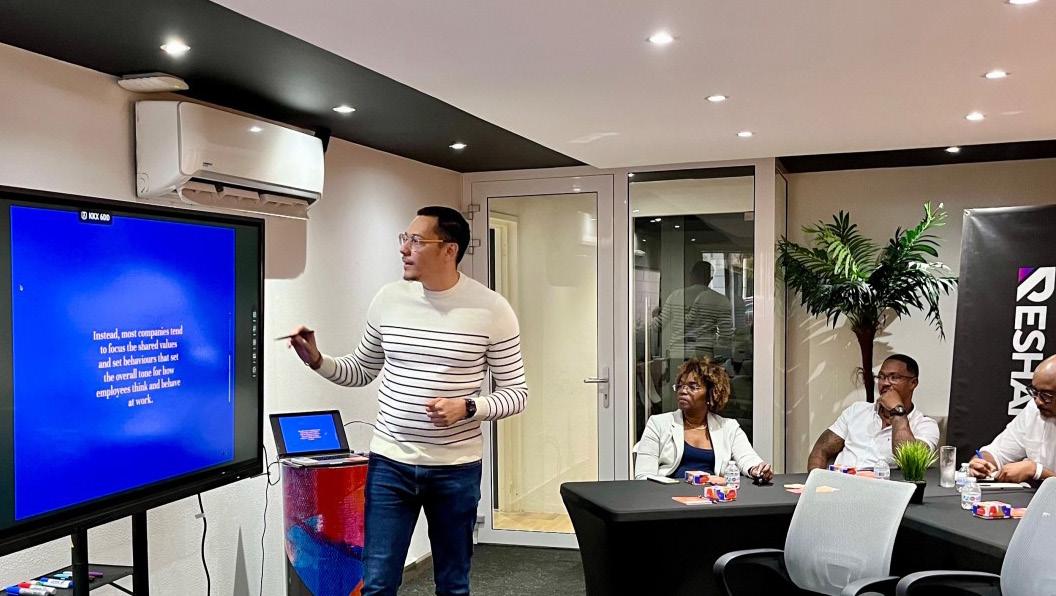

When Leaders Feel, Teams Feel It Too
In this reflection, Daniel Corsen shares the moment he realised how deeply his emotional state shaped his team, and how emotional culture work transformed his approach to leadership.
I used to think showing emotion at work was unprofessional. As a young entrepreneur, I prided myself on being rational and keeping feelings out of it. But a decade of leading teams taught me I was wrong. Leading with both your head and heart is not superficial, it’s essential.
I learned this lesson the hard way when we shared a cramped office space back in the days. Five of us packed together in our bunker-like workspace, practically breathing down each other’s necks. One morning, I walked in feeling overwhelmed and irritable after a rough night’s sleep. Within hours, I watched my mood affect the room like ink in water. My short responses and heavy sighs bounced off the walls, causing my energetic team to grow quiet and withdrawn. The usual banter disappeared. People kept their headphones on and avoided eye contact. By mid-afternoon, the creative energy in our space evaporated.
That afternoon, I had a moment of clarity in the quiet kitchen. Looking at my team, I saw how my emotional state spread through our space. In such close quarters, my feelings weren’t just mine—they shaped everyone’s workday.
That wake-up call changed my leadership approach. I realized that it isn’t just about decision-making and strategy; it’s also about emotional influence. Research supports this: a Harvard Business Review study on emotional culture showshow emotions ripple through organizations. Leaders shape team culture. When I’m having a rough day and let it show, my team gets tense and defensive. But when I bring genuine enthusiasm and openness to our meetings, ideas flow freely, and collaboration thrives.
“Leaders influence culture in every moment, not just through decisions, but through the emotions they transmit.”
Daniel is a leadership coach, facilitator and Founder of Reshapers, with over a decade of experience helping leaders and teams strengthen emotional awareness, navigate change and build human-centred cultures. His work focuses on empowering people to understand how emotions shape behaviour, connection and performance.
As part of my journey to become an Emotional Culture Deck Certified Consultant (ECD), I worked with leaders to explore the connection between emotions and organizational culture. The process included conducting 1:1s with several using The Emotional Culture Deck (ECD), a simple yet transformative tool for fostering workplace conversations about emotions. The experience deepened my understanding of emotions in leadership and yielded actionable insights. Here are the three biggest lessons I learned:
Emotional Self-Awareness Shapes Team Dynamics
If leadership is about influence, then selfawareness is the foundation. Most leaders underestimate how much their emotional state affects their teams using The Emotional Culture Deck in conversations. As we set the emotional tone for our groups, our feelings are contagious. Neuroscience reminds us: through mirror neurons, people unconsciously pick up on the feelings and moods of those around them, especially their leaders.
I worked with an leader, a senior manager in a financial services company, who felt overwhelmed by his workload and unintentionally projected impatience during team meetings. He used the ECD to identify the emotions for himself and his team, aspiring to create a collaborative and supportive culture. This awareness became a turning point. By recognizing his emotional patterns and practicing intentional selfregulation, he fostered a calmer and more positive environment.
Emotional self-awareness doesn’t mean suppressing feelings. It’s about noticing emotions as they arise and taking responsibility for their impact. Leaders who embrace their emotional influence create psychologically safe spaces where people feel valued and heard.
Resistance to Change Isn’t Just a Hindrance – It’s Insight in Disguise
In another 1:1 conversation, an education professional admitted to struggling with resistance to change. Emotional undercurrents create friction, whether it’s a new process or shifting team dynamics.
My feelings weren’t just mine — they shaped everyone’s workday.
Through the ECD exercises, I discovered that resistance is rarely about lack of knowledge or expertise—it’s often tied to fear or uncertainty.
This friend shared her challenging workplace transition, moving from a job she loved to a new department where she felt disconnected. Through an ECD exercise, she was able to label her emotions, which gave her more clarity about what she was experiencing and resisting. I appreciated how it helped her recognize that, despite the challenges, she has the capacity to grow through this change. It was powerful to see
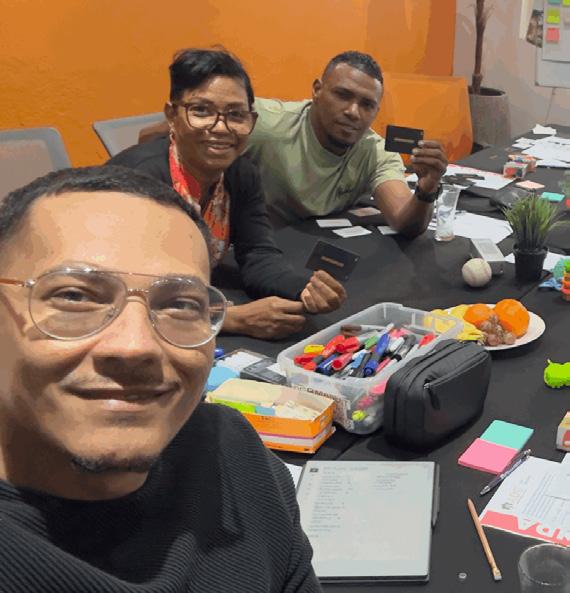
her shift from feeling stuck to feeling a slight sense of hope about her journey.
Resistance isn’t bad. It’s valuable data. When leaders shift their perspective and explore the emotions behind it, they can design practical solutions and guide their teams through change.
Connecting Values to Emotions Creates an Authentic Workplace
With the The Emotional Culture Deck we can connect emotions to organizational values. Many leaders understand the importance of defining core values, but they often stop there. They treat them as static words on a poster rather than active principles. The ECD reframes values as emotional commitments.
In one session, an entrepreneur in a growing startup identified “collaboration” as a key value for her team. When we explored the emotions connected to it, she identified feelings like trust, joy, and respect as central
to fostering this value. This realization helped her shift the focus from operational metrics to creating emotional conditions that support collaboration.
When values are tied to emotions, they become tangible. Leaders can ask: How do we want our team to feel? By designing for desired emotions, workplaces become more genuine and human-centered.
The Ripple Effect of Leading with Compassion
These lessons reinforce my belief that leadership is about managing both the cognitive and emotional culture: strategic decision-making and emotional connection. Research on emotional culture explains that organizations thrive when leaders shape their emotional landscape. Whether promoting joy and pride or addressing fear and uncertainty, emotions drive performance, creativity, and collaboration.
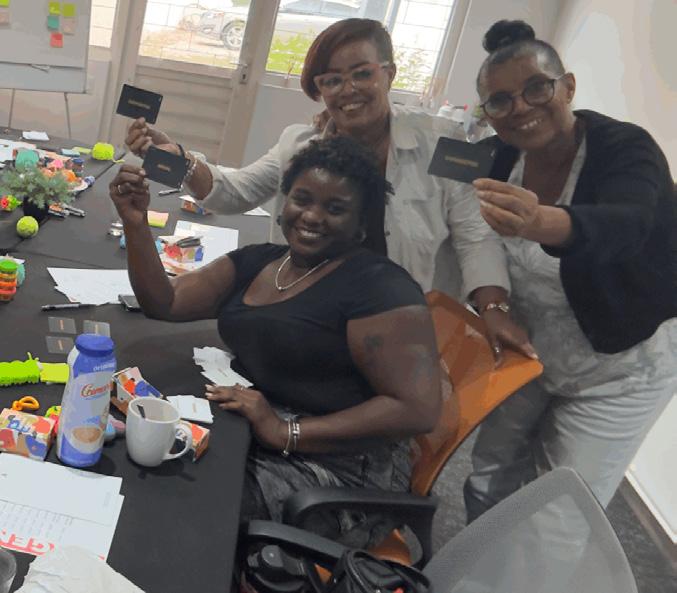
Leading with heart benefits both people and business. When leaders embrace their emotional influence and cultivate an intentional emotional culture, they unlock their teams’ potential. I am energized by the possibility of helping more leaders and teams build workplaces where people thrive.
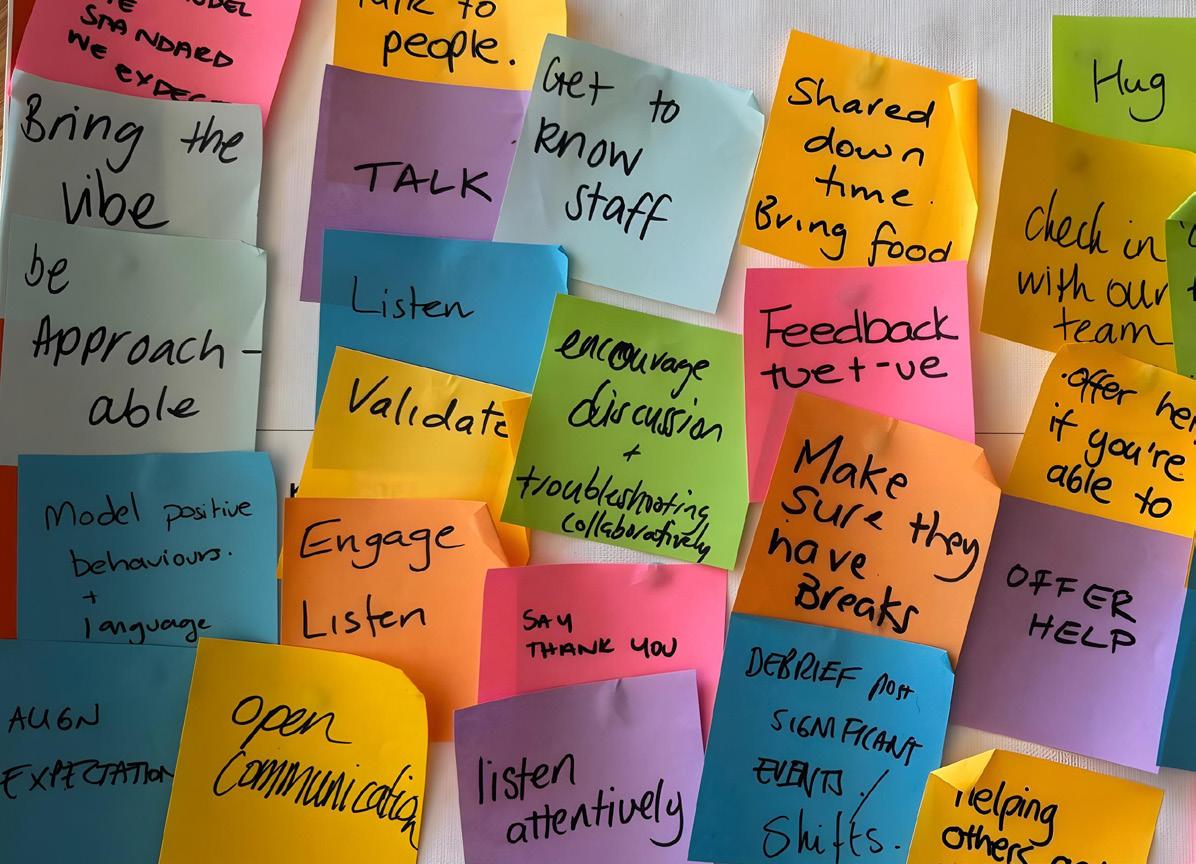
Feeling Our Way Forward: Changing Healthcare Culture Through Emotion
BY CLAIRE MCKIE, Certified Consultant, NSW, Australia
Healthcare is one of the most emotionally demanding environments in the world — yet the emotional experience of clinicians, staff and patients is often the part least discussed.
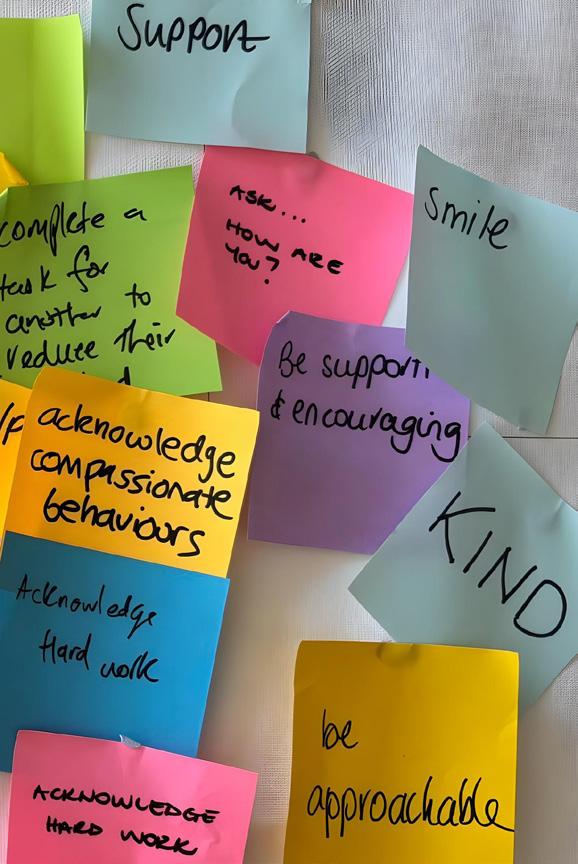
Over the past year, ECD Certified Consultant Claire McKie has been working inside healthcare settings to understand how emotions shape wellbeing, teamwork and patient care. What she found is simple and powerful:
You cannot change healthcare culture without changing how people feel at work.
Her insights show why emotional literacy is not “soft”, why individual rituals matter as much as system reform, and why healthcare workers are asking for something deeper than policy, they want space to feel, name and navigate the emotional load of their work.
Claire’s five lessons show why emotional culture is not an add-on, it’s the foundation of safe, high-performing healthcare.
Claire McKie is a doctor and leadership facilitator who supports healthcare leaders and teams to build cultures where emotional awareness strengthens communication, resilience and patient care. In this reflection, Claire explores nine months of emotional culture work in healthcare and why feeling, not just thinking, must sit at the heart of system change.

Over the past nine months, I’ve been completing my training to become an Emotional Culture Deck (ECD) Certified Consultant. I’ve been focusing on exploring the role of emotions in healthcare - how they impact individuals, teams, and patients. Throughout this journey, I’ve uncovered powerful lessons about the importance of how we feel at work. Here are the five things I keep coming back to.
1. Two Things Can Be True – We Need Both Thinking and Feeling
Healthcare has a long history of valuing and prioritising thinking. We pride ourselves on our analytical skills and our ability to make rational, data-driven decisions. And there’s no doubt that this approach is important and has led to incredible advancements in care.
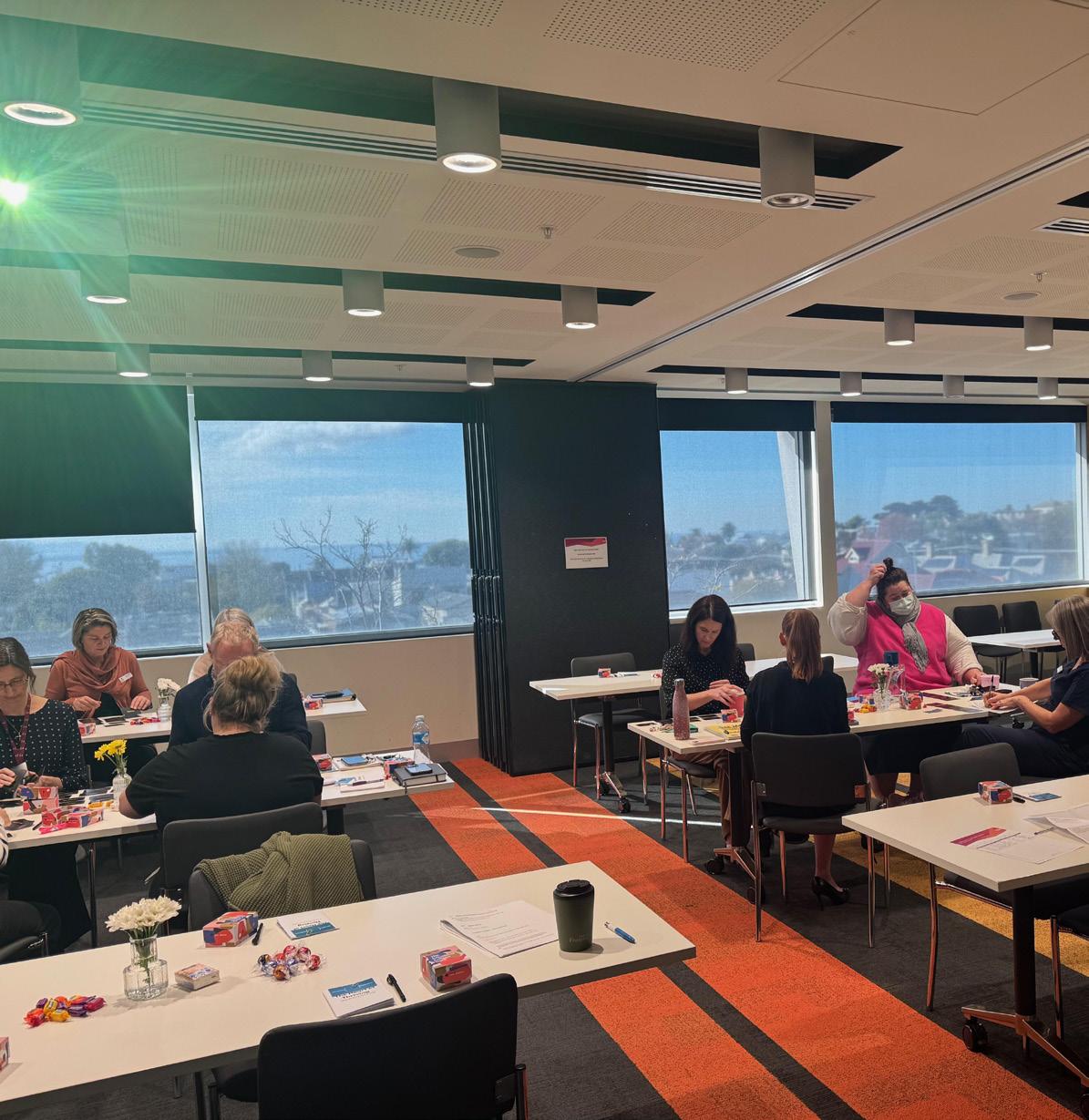
But our singular focus on thinking has come at a cost. The emotional side of healthcare - the feelings we experience as clinicians, the emotions our patients bring - has been minimised, dismissed, and even pathologised
as a weakness. We’ve been taught that being ‘strong’ means suppressing our emotions, yet research tells us the opposite: acknowledging and understanding our emotions makes us more resilient.

The highest-performing teams embrace both thinking and feeling. They create spaces where emotions are recognised and validated, where people feel psychologically safe to express themselves. And they consider emotions at every level of the organisation and in every decision they make. They value and prioritise feelings. In a profession that demands so much of us, emotional literacy isn’t a luxury - it’s essential for our wellbeing and our ability to provide compassionate care.
2. The Culture in Healthcare Needs to Change - And Emotions Need to Be Part of the Revolution
Everyone working in healthcare knows that the culture needs to change. Burnout, moral distress, and high turnover rates are clear indicators that the current system isn’t working. And unfortunately, the conversation about cultural change mostly focuses on workflow efficiencies, policies, and structural reformswithout considering, let alone addressing, the emotions of the people working within the system.
Healthcare has valued thinking for decades. But we cannot ignore what people feel
If we want to create sustainable, healthy workplaces, we need to stop seeing emotional intelligence, vulnerability, and selfawareness as ‘soft skills’ and start recognising them as power skills. These are the skills that enable meaningful connection, effective teamwork, and compassionate patient care. And they aren’t optional extras—they are fundamental to our future.
We need to value and prioritise how our people and the people we serve feel and make this part of how we approach decision making and planning.
3. Culture Change Needs to Happen from Both the Top and the Bottom
One of the most consistent messages I’ve heard in the workshops I’ve run with frontline healthcare teams is they want to engage with emotions at work. They want space to talk about how they feel and how they need to feel to thrive. And they want to talk about what this change looks like and how they can be involved. They want more of this for themselves and they want it for their colleagues – people they work with, people
from other departments, and for leaders.
They are ready and committed to culture change.
And, it cannot, and should not, be up to them alone.
These teams consistently identified that to thrive at work they need to feel supported And they can’t do this without support – from leadership and from the people making decisions that affect them every day.
Culture change cannot be a grassroots movement alone, nor can it be imposed from above without engagement from those on the ground. The most effective change happens when leadership models the behaviours they want to see, while also empowering individuals and teams to take ownership of emotional culture in their own environments. Real transformation happens when emotional culture is embedded into the way we work, not just something we talk about in workshops.
4. We Need Both Big System-Level Plans and Small Individual Actions
It’s easy to get caught up in the idea that fixing the culture of healthcare requires massive, system-wide reform. And while those reforms are important, they take time - often years - to implement. The idea of trying to change the whole culture of healthcare feels so overwhelming to be paralysing. Meanwhile, the people working in the system need change now.
The reality is, small actions matter just as much as big plans.
We need to change our focus to shift-by-shift wellbeing - and the one tiny action we can each do every shift. Daily practices that build a culture where emotions are acknowledged and respected. Every person, no matter their role, can influence culture through their actions. One tiny action by every person every shift can be bigger and more powerful than one huge policy document or survey.
We need both big structural changes AND tiny individual actions to create workplaces where people feel valued, supported, and able to do their best work.
5. Mini-Experiments and Messy Starts Are the Way Forward
One of the biggest barriers to change in healthcare is the belief that we need the perfect solution before we take action. We wait for the right research, the right funding, the right policy, meanwhile, the status quo continues.
But meaningful change doesn’t happen in one big leap. It happens through mini-experiments - small, low-risk actions that allow us to learn, adapt, and iterate. Whether it’s trialling a new way of checking in with teams, experimenting with reflective practice, or introducing conversations about emotions into meetings, the key is to start somewhere. It won’t be perfect, and that’s okay. Progress is messy. What matters is that we’re moving forward.
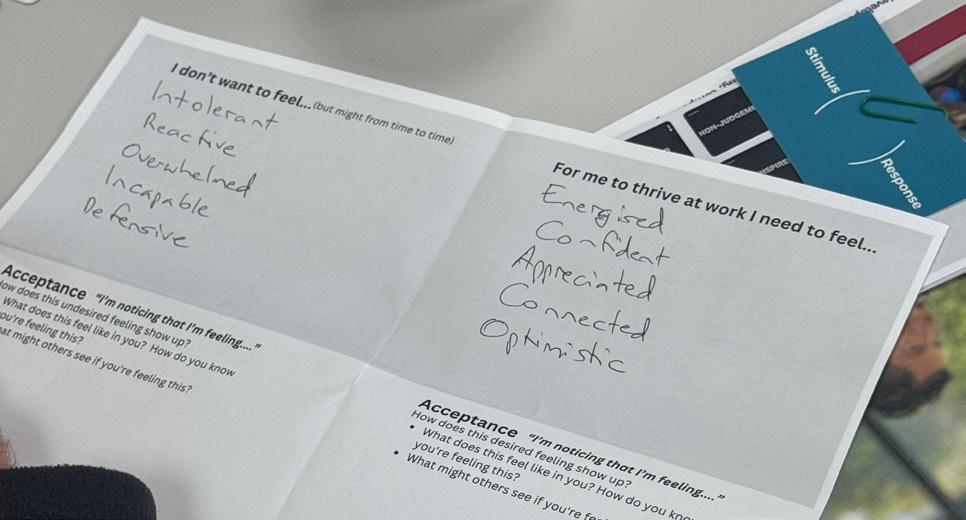
Final Thoughts
This training has reinforced something I’ve always known deep down: emotions aren’t just ‘nice to have’ in healthcare - they’re fundamental to how we work, how we connect, and how we care. We need to stop treating emotions as a distraction from the ‘real work’ and start recognising them as the work
The more we talk about emotions, the more we normalise them. The more we acknowledge them, the more we can harness them for better teamwork, better leadership, and better patient care. And when we commit to bringing both thinking and feeling into our workplaces, we create cultures where people - and healthcare itself - can truly thrive.

What Carey Davis-Munro Learned From Leading Emotional Culture Work Across a UK Bank
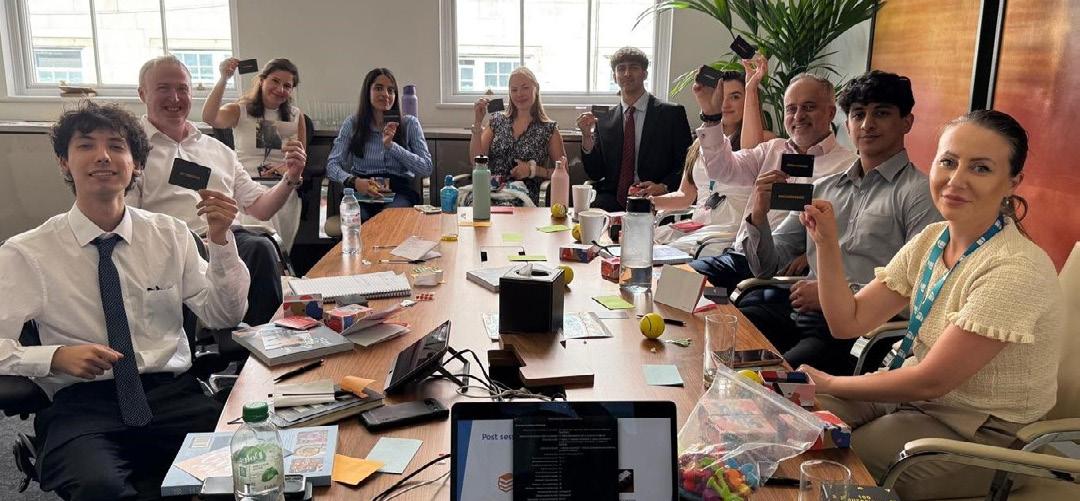
When Carey Davis-Munro said yes to a project that would take her across two cities, eight workshops, and more than 150 people, she wasn’t looking for perfection — she was looking for connection.
A chance conversation at a Christmas dinner had opened the door. A few months later, Carey found herself standing in a crowded room at a UK bank, entrusted with helping people talk honestly about how they feel, what they need, and what helps them feel included. What unfolded was a mix of honesty, exhaustion, generosity and deep human insight — the very things that define emotional culture work in real organisational life. What unfolded was a mix of honesty, exhaustion, generosity and deep human insight — the very things that define emotional culture work in real organisational life.
Before any tools came out, Carey invited each group to define what psychological safety meant to them.
“We can’t talk about feelings if people don’t feel safe. You can’t outsource safety to the facilitator — it’s something we build together.”
Saying Yes Before You Feel Ready
This entire project began with a moment of courage.
“It’s amazing how one small conversation can open doors you never planned for. Just say yes and work it out later.”
That spirit carried her through eight sessions, sometimes four in two days, a schedule she later described with characteristic honesty:
“I’d never do that again! Protect your own energy so you can hold the room well.”
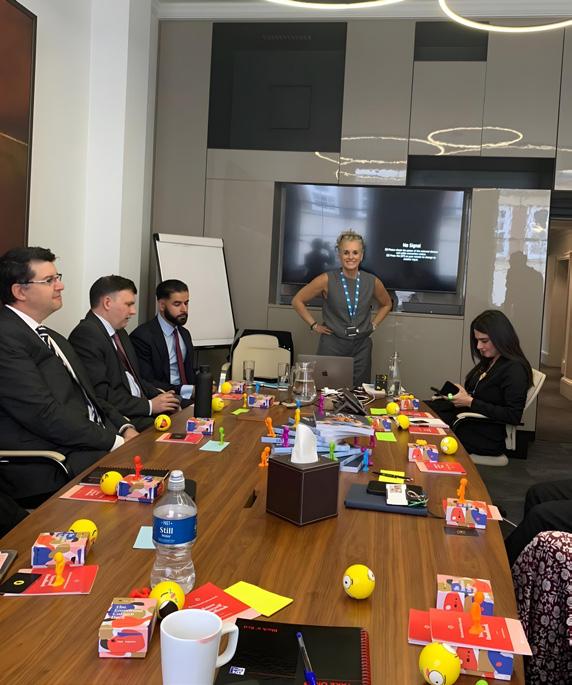
Across the workshops, she navigated crowded rooms, spilled-over attendance, mixed levels of seniority, and an unexpected influx of interns and workexperience students. Each session required adapting in real time while still anchoring the group in emotional safety.
Designing for Depth, Not Performance
Carey opened each session with two deceptively simple prompts:
I want to feel…
I don’t want to feel…
Then she added a coaching twist:
“I suddenly realised I didn’t know where people were starting from. So I asked them to rate it, and that opened up amazing conversations.”
That single moment of intuition reshaped the entire day. People didn’t just name emotions, they grounded them in lived experience. Across the rooms, smaller groups generated the deepest conversations:
“I learned I prefer smaller groups — where I can really hold the space and stay connected with people.”
She also adapted the client’s original request, a narrow “men vs women” brief, into something far more inclusive. The work became about all forms of difference, all lived experiences, and what belonging actually feels like.
Rituals That Make Emotional Work
Possible
Carey used small rituals, tactile objects, question cards, and a simple “everyone has a voice” practice, to help people ease into emotional conversations:
“Everyone needs to feel they can speak.”
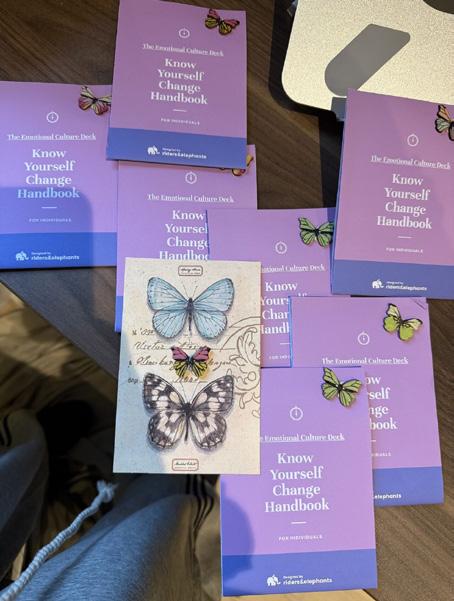
But her closing ritual became the moment participants remembered most. At the end of each session, she offered a table of postcards. People chose one, paired it with a stamp, and decided who to send it to. One man told her:
“I’m sending this to my estranged stepdaughter — she’s always asked me to talk about my feelings.”
Another stayed behind after the final session:
“We’ve been talking about caring for others — I wanted to help.”
Listening Is the Work
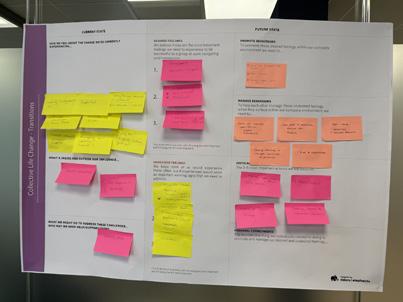
Across eight workshops, Carey gathered hundreds of notes capturing what helped people feel the emotions they wanted, and what fuelled the emotions they didn’t.
Reflecting on the responsibility of this work, she shared:
“If you ask people to share their emotions, you have to show them you’ve listened. Feed it back. Otherwise, trust is lost.”
She synthesised everything into themes and insights for the leadership team, a mirror held up to the organisation’s emotional landscape.
Carey’s experience is a glimpse into what emotional culture systems look like in the real world: human, adaptive, imperfect, generous, and deeply impactful.
It shows what becomes possible when organisations take emotion seriously, and when practitioners hold space with courage, boundaries, and care.
Her story is still unfolding, but the message is already clear:
“When we talk about emotions at work, we don’t just change people’s days — we change what’s possible in an organisation.”
Carey Davis-Munro, Certified Consultant, United Kingdom
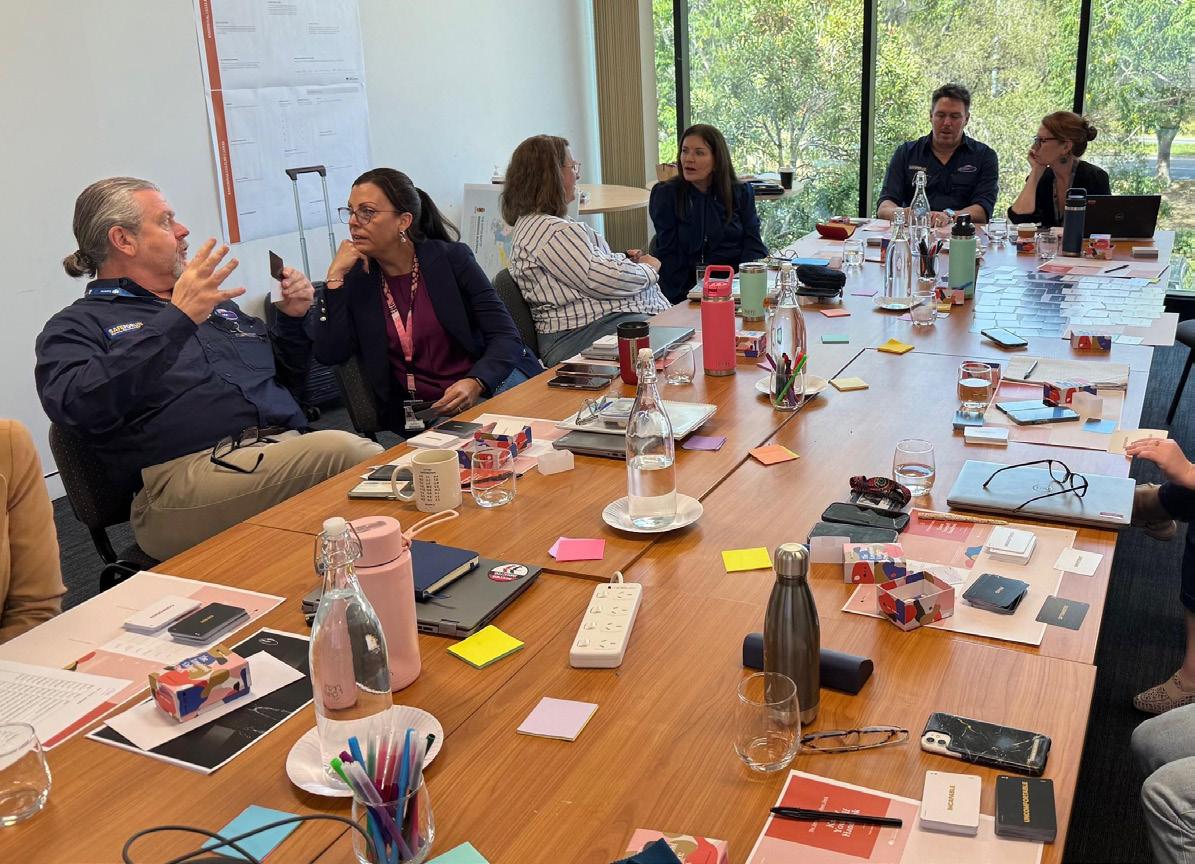
Shifting the Change Conversation: Starting with How People Feel
KELLY WALKER, Certified Consultant, Australia
We talk a lot about change. But rarely about how it feels. In this reflection, leadership coach and ECD Consultant Kelly Walker explores what happens when we bring emotion into the centre of the change conversation, and why structure, rituals and support matter more than we think.
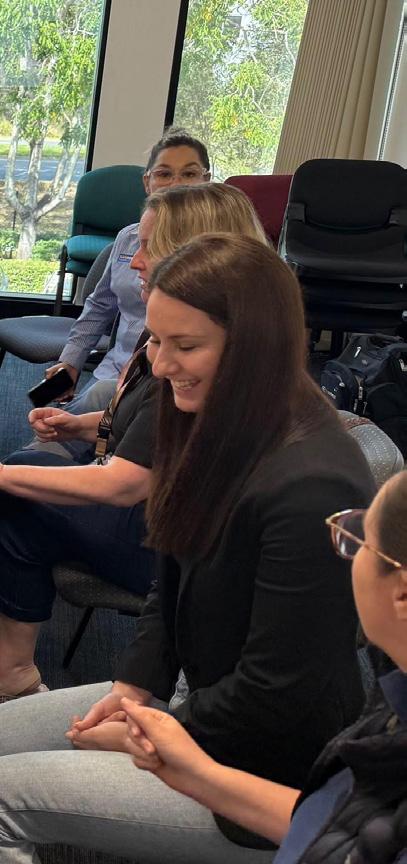
Change is constant - we know that. But what’s often missing from the conversation is how we feel about it.
I’ve recently completed the Emotional Change Strategy module as part of my ongoing journey to become a Certified ECD Consultant with riders&elephants. This phase introduced a powerful new lens to my leadership and coaching work: helping leaders and teams navigate change by starting with emotion, not action.
It wasn’t just about learning new tools (though there were plenty). It was about doing the inner work - reflecting on my own change experiences, exploring emotional responses and understanding how to guide others with empathy and structure.
Kelly Walker is an executive coach and founder of Prospera Consulting, bringing extensive experience in leadership development and holistic wellbeing to help people navigate change with clarity, structure and emotional insight.
What I Learned About Change and Emotion
Here are some reflections that continue to resonate:
Structure Matters More Than
I Thought:
Even though I naturally prefer flexibility, I discovered through this process that structure provides essential grounding during times of change. When everything feels up in the air, a simple plan or framework can offer a sense of control and calm.
Rituals Anchor Us:
The Change Rituals Canvas helped me identify rituals I’d already been using - and inspired me to become more intentional with them. Rituals, even small ones, provide stability and reinforce selfcare during transitions.
We Often Forget to Ask for Help:
One of the hardest questions I had to answer was: What support do I need right now? That question shouldn’t be hard - but often it is. It reminded me how crucial it is to create space for that reflection with others, too.
Gratitude Has Quiet Power: A deceptively simple exercise - reflecting on three good things - shifted my perspective in the middle of a hectic, stressful week. I’ll be weaving this into both my personal routines and my coaching practice.
There’s Value in Acknowledging Loss:
The Transitions Handbook encouraged me to explore not just what I was gaining from change, but what I was leaving behind. It was emotional, but essentialand something I think many leaders and professionals overlook.

Coaching Through Change — With Heart
One of the most rewarding experiences during this phase was guiding a leader through a 1:1 Emotional Change Strategy session. What emerged was a deep, authentic conversation full of vulnerability and insight.
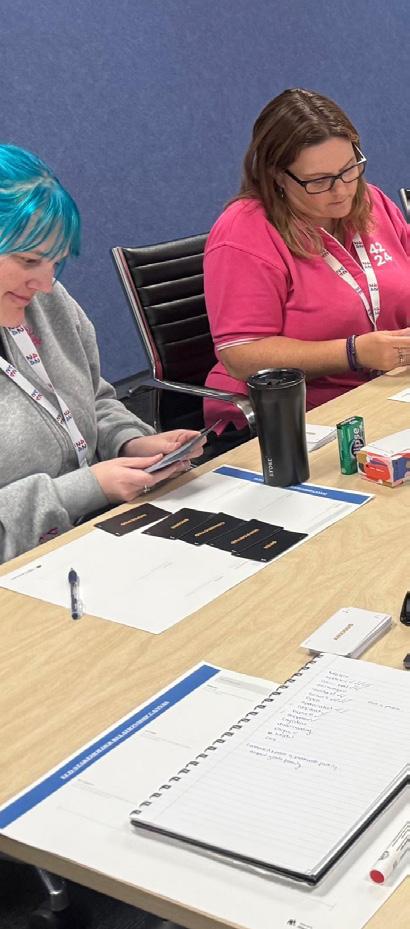
This leader reflected openly on how they felt about the change they were leading. They shared things they hadn’t voiced before - and they left the session feeling seen, grounded and better equipped to support their team.
It reminded me of the transformative power of holding space - and how rare it is to give ourselves permission to explore our own emotions as leaders during change.
Integrating ECD Into My Work
This phase has added depth to how I support peoplewhether in coaching, group workshops, or strategy sessions. It’s given me tools that humanise change, spark reflection and bring emotion to the surface in safe and supportive ways.
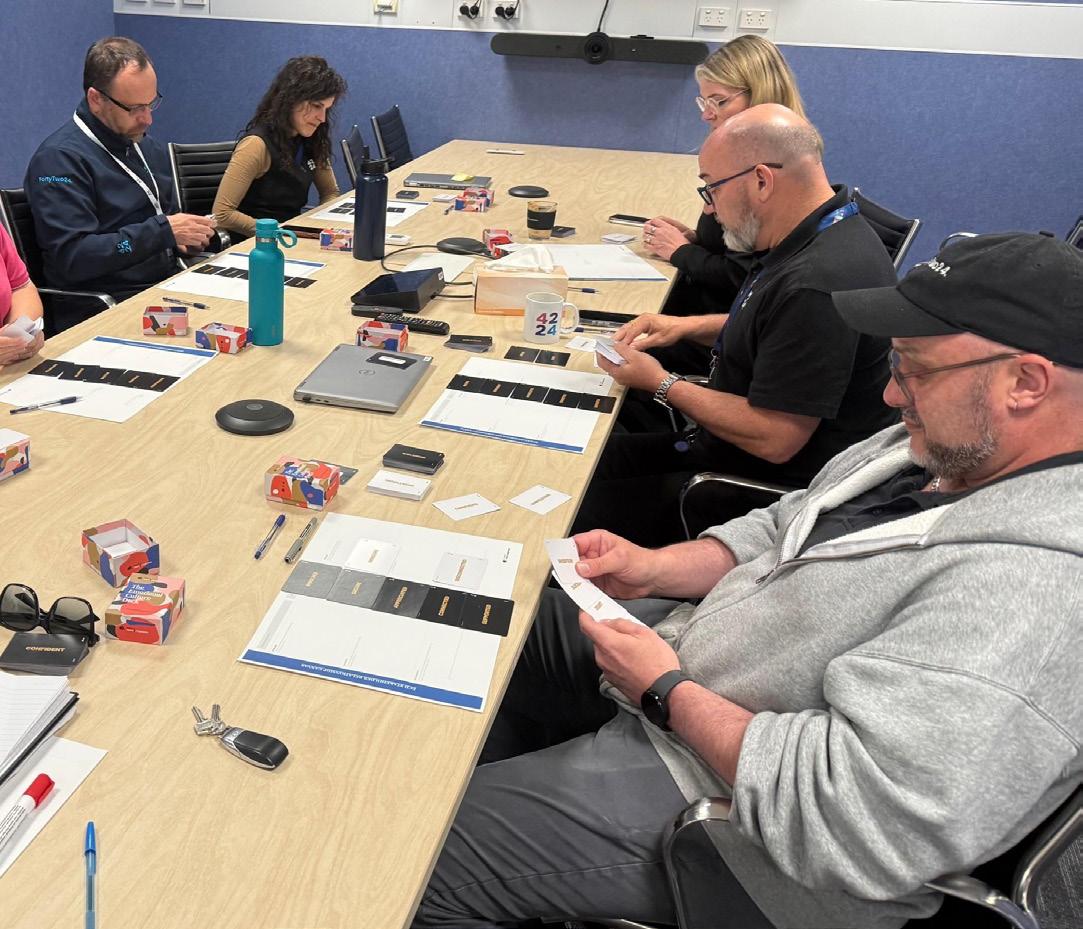
I’ll be integrating these tools across:
• Executive and leadership coaching
• Change facilitation and planning
• Team transitions and onboarding support
• Burnout recovery and wellbeing initiatives
Because when we start with how people feel, we create space for trust, ownership and real engagement.
The Missing Piece in Team Culture Work
ANNE KOOPMANN-SCHMIDT, Certified Consultant, Germany

Teams don’t just work together, they feel together. In this reflection, leadership coach Anne Koopmann-Schmidt explores why shared emotion is one of the strongest forces in team performance, and why leaders need simple ways to name what’s moving beneath the surface.
Most leaders focus on team goals, tasks, and communication, but overlook the emotional undercurrents that shape everything. Teams don’t just operate as a collection of individuals. They carry a shared emotional tone that drives collaboration, trust, and performance.
This is what the research calls Group Affect, and it matters far more than we often acknowledge. (Source: ”Group Affect” – Sigal G. Barsade & Andrew P. Knight)
When teams experience positive emotions together, they cooperate more, perform better, and make stronger decisions
The study shows that shared emotions in teams influence decision-making, motivation, and the ability to handle stress. When teams experience positive emotions together, they cooperate more, perform better, and make stronger decisions. But when negative emotions, like stress, frustration, or disconnection, go unspoken, they quietly erode performance from within.
In addition, emotions in teams are dynamic. They can quickly spread like a virus, often unconsciously, and leaders are one of the biggest transmitters.
That’s why shaping emotional culture intentionally isn’t a nice-to-have; it’s a leadership responsibility.
Anne is an award-winning leadership and team development facilitator, coach, lecturer and speaker, with 15 years’ international experience in engineering, manufacturing and academia.
Opening the Door to What’s Really Going On
I’ve worked with many tools and frameworks over the years, but few have had the immediate and lasting impact that the Emotional Culture Deck (ECD) has when it comes to opening up meaningful conversations.
Time and time again, I’m amazed by how something as simple as a deck of cards can create such profound moments. Within minutes, participants drop their usual guard, speak from the heart, and begin to connect not just with each other, but with themselves. That is transformational.
In one recent session, a team that had been navigating a challenging period finally said out loud what everyone had been feeling but didn’t know how to express:
“We understand difficult decisions have to be made. We know that the business changes. But we need more time and space to feel our emotions. We need to feel appreciated throughout this process, to be taken on the journey, not just operationally, but emotionally. We want to feel seen.”
That moment was powerful. It wasn’t about fixing everything. It was about allowing space for humanity to enter the room. And that changes everything.
There is a missing piece in Team Culture work.
In so many of the teams I support, especially during times of transition, I see the same thing: they’ve never had the time, the space, or the language to connect on this level. We talk about psychological safety. We do emotional intelligence training. But we often stop at the surface. We don’t provide the tools that allow people to really reflect on how emotions shape their behavior or the culture of their team.
The broader world still doesn’t fully grasp how profoundly our emotions shape what we do, how we relate, and how we lead. Emotional culture work fills that gap. It

turns emotional awareness from a personal skill into a shared team language.
What still challenges me is how to communicate the value of this work beforehand. How can we describe this work in a way that makes people feel its power before they’ve experienced it?
Talking about emotions at work still makes some people nervous. When I describe this work to new clients or leaders, I often see skepticism in their eyes. It sounds soft. It sounds abstract. It doesn’t sound strategic. People even feel that it doesn’t belong in strategy conversations.
But what if it’s actually the foundation for strategy?
What if emotional culture is the glue that holds your goals, your
change efforts, and your team performance together?
Language here matters. And I’m still learning how to speak about this work in a way that captures its depth and strategic value.
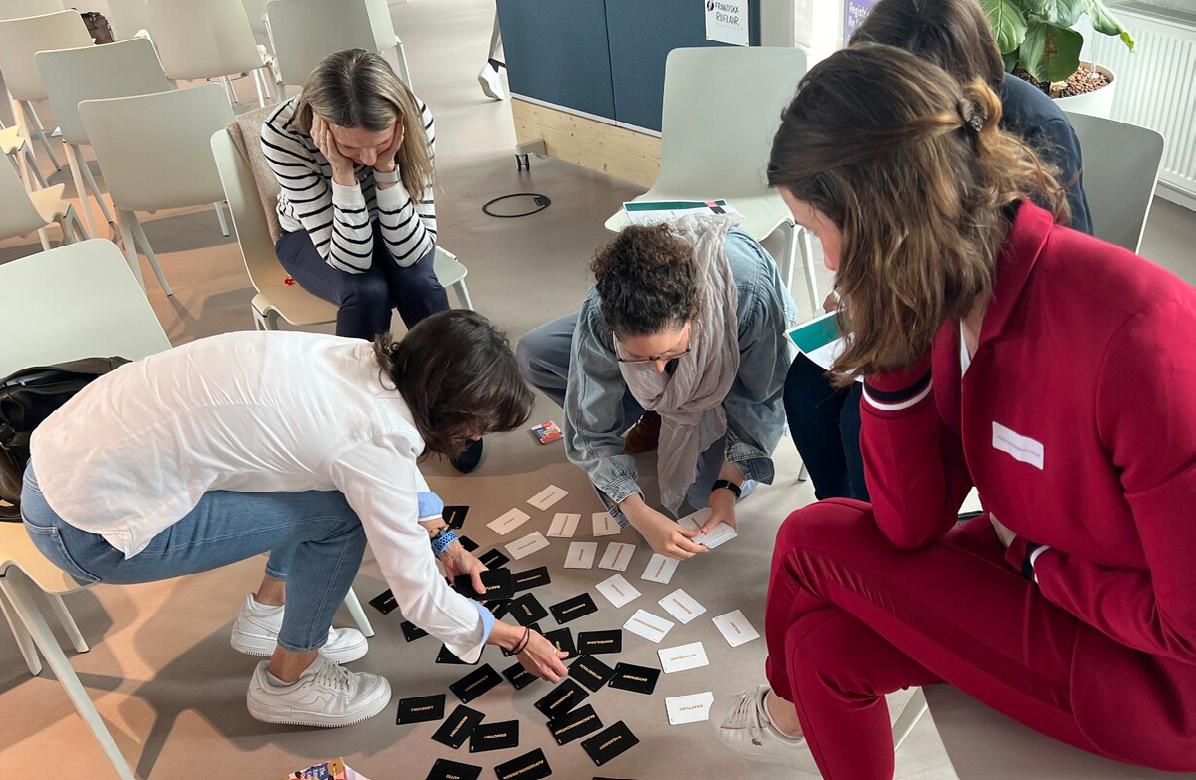
But one thing I know is: Once people hold the actual emotion cards in their hands, it all changes. Skepticism turns into understanding.
The cards create a portal, a shared, non-threatening way to enter deeper conversations. They unlock something. I see people “get it” in real time. The energy shifts. The room softens. People lean in. That’s when I know transformation is possible.
Facilitating emotional culture conversations is some of the most meaningful work I’ve
Shaping emotional culture intentionally isn’t a niceto-have; it’s a leadership responsibility
ever done. It gives me a sense of purpose. It reminds me why I do what I do. I love humans and their emotional landscapes. I love seeing people connect on a real human level. I believe that’s where real trust, motivation, and collaboration are born.
That’s the shift I want to help more leaders and teams make.
When I Started Paying Attention to Emotions in Stakeholder Engagement
In her stakeholder work, Helen Melville discovered that progress didn’t stall because of poor plans or unclear roles, it stalled because emotions were going unnamed. In this reflection, Helen shares how slowing down, noticing emotional signals, and designing conversations with intention transformed how she works with stakeholders.
It turns out, emotion isn’t a side note in stakeholder relationships. It’s the whole soundtrack. Here are the biggest lessons that surfaced when I slowed down long enough to pay attention.
HELEN MELVILLE, Certified Consultant, Australia
Slowing Down Changes Everything
I’m not someone who naturally slows down. If there’s work to do, I’m on the tools. I like momentum. I like clarity. I like knowing the next step. I get shit done. But these ECD tools forced me to pause.
Each one nudged me to stop long enough to actually notice the emotional tone of a relationship.
Not just: “What do they need from me?”
But also: “How do they feel right now?” “How do I feel?”
“What emotion is shaping this moment?”
Emotions Became Data - Not A Drama (Llama)
One thing I realised fast: emotions tell the truth long before words do. Just like you can’t hide resting bitch face, you cannot hide what people feel (unless you’re SAS trained). Using the Journey Canvas and the cards, I could suddenly see patterns I’d been feeling for years but never named.
The moments when clients feel confident. The moments when they feel uncertain.
The points in the relationship where confusion sneaks in. The early triggers that make someone pull away.
Once you notice these emotional cues, you can’t unnotice them. And you start making different decisions and more intentional ones.
Ask me what I now have instead of coaching contracts...
Helen Melville is a leadership and culture consultant and Director of Blue Dog Culture, with over a decade of experience working in the leadership, culture and organisational development field. She partners with individuals, teams and organisations to build workplaces where courage leads, emotion is treated as strength, and leaders are supported to grow before things go wrong.

Values Don’t Mean Anything Until You Live Them
The Emotion Values Design Canvas held up a mirror. It made me look at where my own rituals lined up with my values — and where they didn’t.
Do I create space for clients to express the uncomfortable emotions? Do I check in when something feels off? Do I communicate clearly, even when a project hits turbulence?
Sometimes yes. Sometimes… not as well as I thought.
It was a good nudge to act in line with what I say I care about.
My Inside World Shapes the Outside Experience
One of the biggest breakthroughs came from the EX&CX map. It reminded me that how / feel in my work leaks into my stakeholder relationships. If I’m stretched too thin, it shows. If I’m energised and connected, that shows too. As a one-person business, my emotional culture isn’t a “nice to have”. It’s the experience my stakeholders get every single day.
Curious & Courageous. Supported & Daring. Inspired & Energised.
Blockers and Enablers Make or Break a Relationship
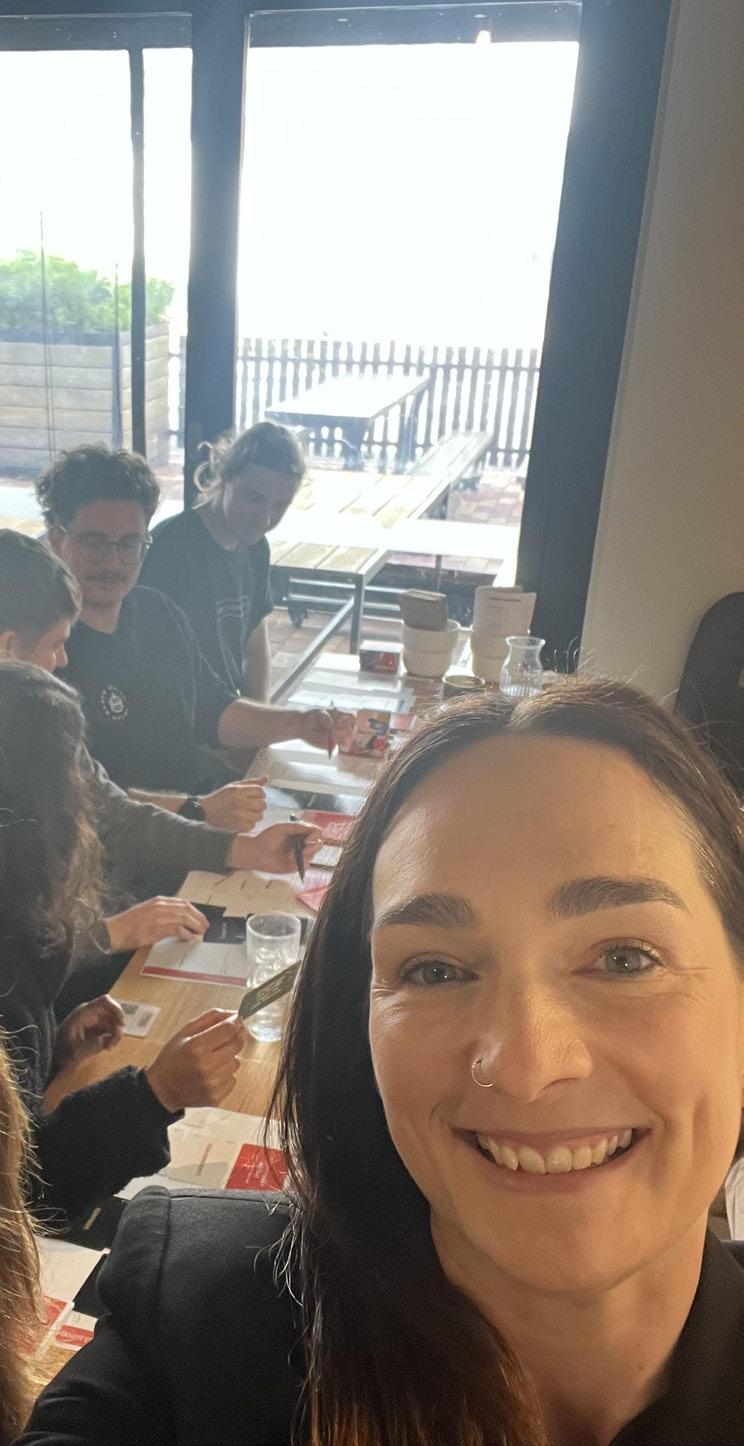
The Relationship Canvas helped me see this clearly.
Enablers: Keep asking probing questions. Be patient. Reflect
Blockers: Being shutdown and spoken over. Sharing own baggage. Comparison The moment I named these, I could work with them. It gave me agency and not guesswork.

The Hardest Part? Everyone Needs Something Different
Some stakeholders want connection. Some want certainty. Some want fast answers. Some want space.
Balancing all of that — without losing myself — is still something I’m learning. But now I’m conscious of it, and that awareness alone feels like progress.
My Real Takeaway Stakeholder engagement is emotional work.
And emotional work is leadership. It asks for intention, presence, and courage. It asks us to listen differently. And to design relationships with emotion in mind, not as an afterthought.
When we design for emotion, we design for connection. And when we design for connection, everything else follows.
The Philippines Leads the World in Emotion. Here’s Why That Matters for Work
JOLINA KAHN, Certified Consultant in Training,
Phillipines.
In a culture where people feel deeply and express openly, Jolina Kahn shows why strategy only comes to life when leaders understand the emotional currents beneath their teams. In this reflection, Jolina Kahn explores what happens when leaders pause long enough to ask how people feel, and discover that emotional culture is not separate from strategy, but the engine that drives it. Her work in the Philippines offers a powerful reminder that emotion is data, direction and performance.
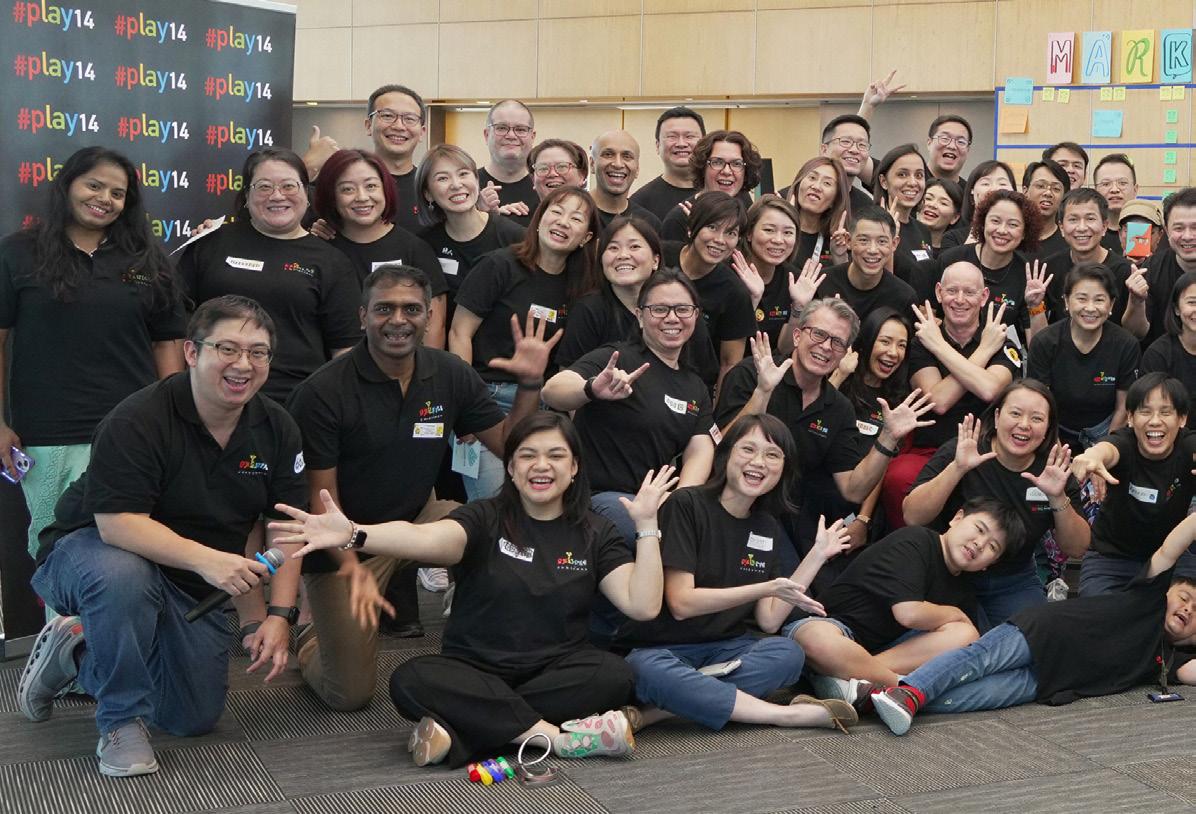
The Philippines has once again been named the most emotional country in the world.
In Gallup’s 2025 Global Emotions Report, 60% of Filipinos reported experiencing
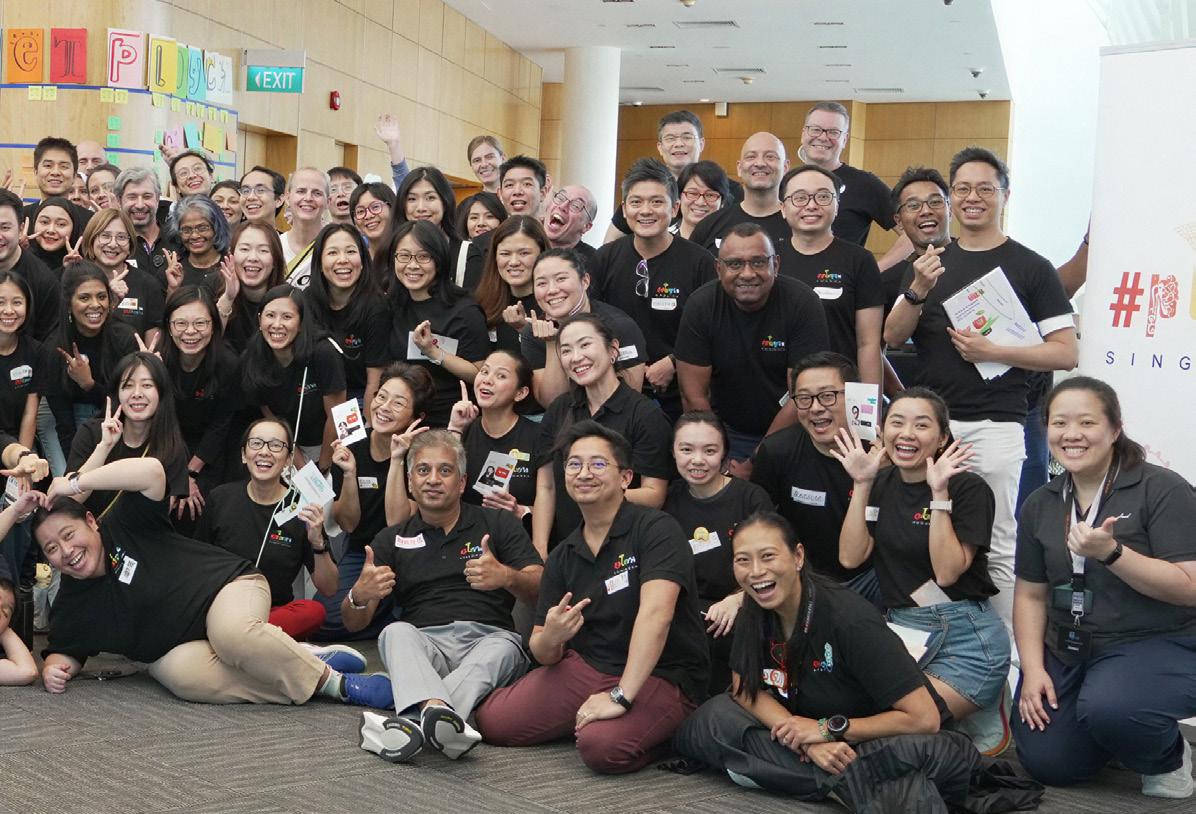
strong emotions, positive or negative, on a typical day. We topped the list ahead of El Salvador and Bahrain. For many, this might sound surprising. For those of us who live and work here, it’s not.
We are expressive. We feel deeply. And yet, in most workplaces, emotion is still seen as something to manage, not something to understand. Something to suppress, not something to lead with.
That’s why The Emotional Culture Deck by riders&elephants (https://www.linkedin. com/company/ridersandelephants/) has become such an important part of my work.
Jolina is a Partner at Management Strategies and a strategist, futurist and designer. She has close to 25 years of international experience across Asia Pacific, Africa, the Middle East, Turkey, Puerto Rico and Ireland, including senior roles at Unilever and Microsoft
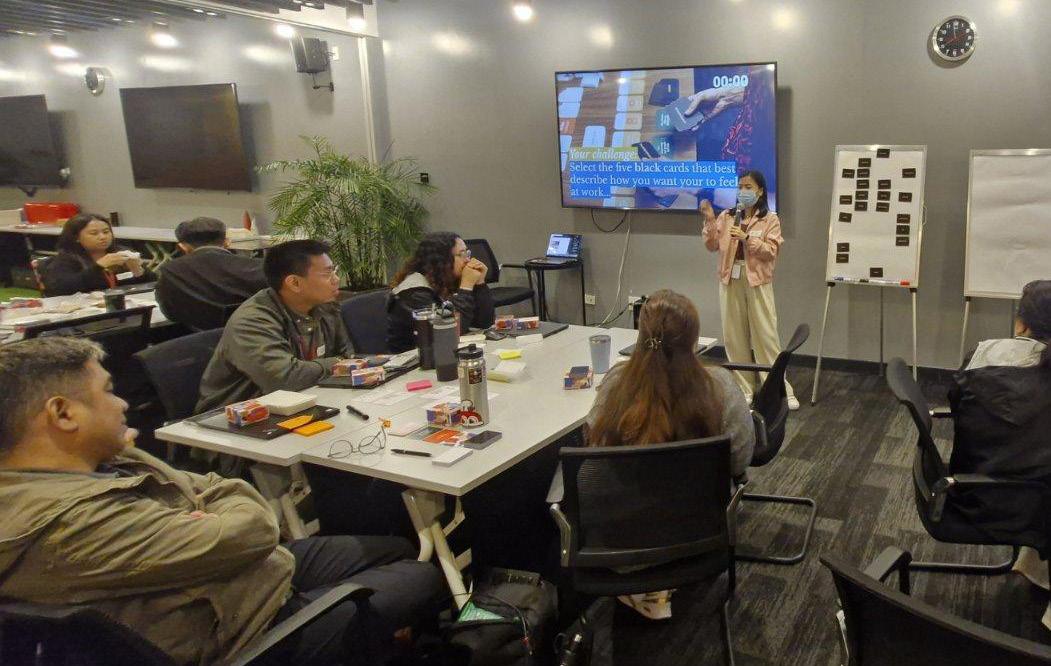

From Insight to Intention
Recently, I worked with a group of leaders who were trying to make sense of why motivation felt low, even when goals and plans were clearly defined. On paper, everything looked strong. But something was missing.
So we reflected on a simple question: “Do our people have the energy and emotions needed to bring this plan to life?” That moment created pause and opened up space for honest reflection.
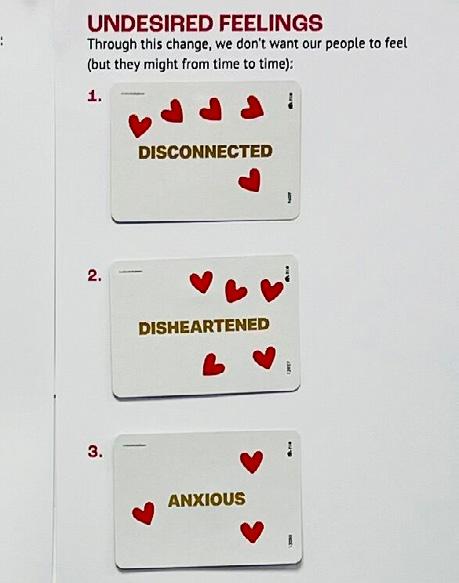
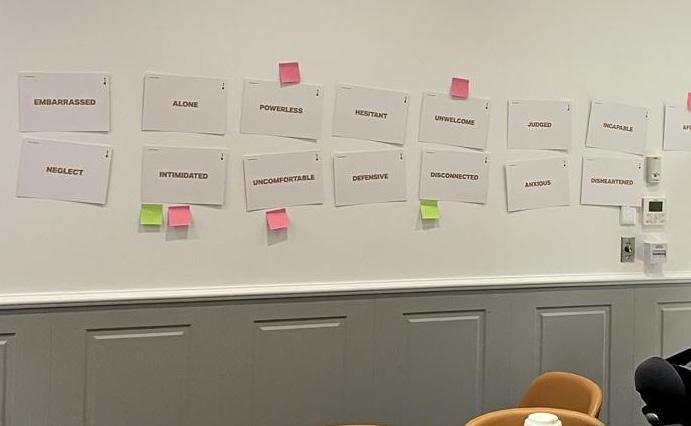
We turned to the Emotional Culture Deck to map out how people were currently feeling,
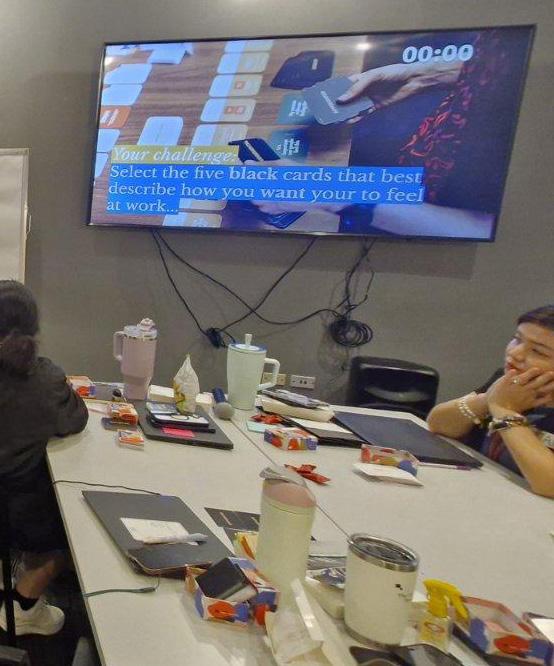
based on feedback, observation, and team conversations. When the emotions were laid out, it became clear. The undesired emotions outweighed the desired ones.
That clarity shifted the conversation.
Emotional Culture Is Strategy
The team at that point embraced the idea that emotional culture wasn’t separate from strategy. It was the missing link.
We then together defined what emotions people needed to feel to bring that strategy to life. Then we asked: What actions and rituals would help us feel those emotions?
The deck gave us language. It gave us structure. But more than that, it gave us permission to talk about the things that really shape behavior: connection, appreciation, inspiration.
Not Always Easy. But Always Worth It.
Of course, not everyone is immediately comfortable. Some leaders hesitate. Others admit they’ve never talked about emotions at work before. That’s okay. ECD is not about forcing vulnerability. It’s about creating space for honest reflection.
And each time we make space, something shifts. Whether in a one-on-one session with a leader or a room full of employees, the conversations go deeper. People begin to see that how people feel is culture. It’s also performance. It’s also retention. It’s also innovation.
Crafting Emotional Culture in the Most Emotional Country in the World
When I reflect on why this work matters so much, I go back to that Gallup data.
Filipinos are deeply emotional, not in a dramatic way, but in a human way. We care. We carry things. We express joy and frustration. And we deserve workplaces where those emotions are not seen as liabilities, but as signals. As data. As drivers of culture. Do our people have the emotional energy needed to bring this plan to life?
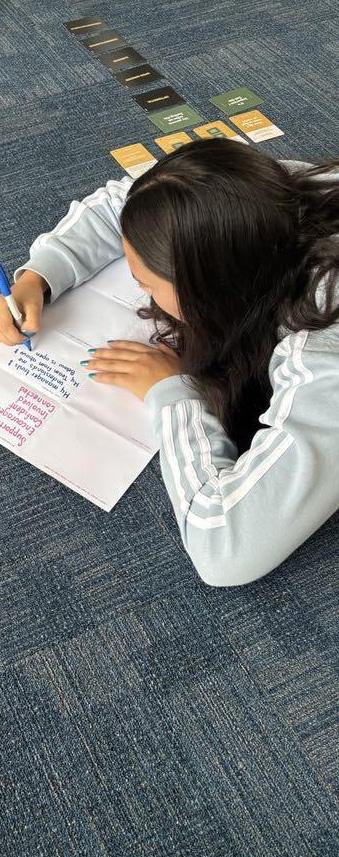
From Awkward to Impactful: Clare Lundon’s First Steps Into her Emotional Culture Practice
From our Elephant Rider Speaker Series. How one Practitioner built confidence, capability, and courage, one conversation at a time.
Image source from Clare Lunden, Advanced Culture Practitioner, Wellington
Every facilitator remembers their first emotional culture workshop. The nerves, the doubt, the “am I doing this right?” moment. Clare Lundon’s story is one of the most honest and relatable accounts of what it looks like to begin this workimperfectly, courageously, and with a deep commitment to holding space for others.
With more than 20 years’ experience in community engagement in local government, Clare stepped into independent facilitation in 2024. Emotional culture work quickly became central to how she wanted to support teams, but the transition wasn’t smooth or linear. It was honest, awkward, and full of breakthroughs.
This is Clare’s story of becoming an ECD facilitator through practice, not perfection.
Starting is the hardest part Clare is clear about one thing:
“Don’t think you can wing it. Take the time to do the work and prepare before taking it into the world.”
Her first workshop was ambitious and fast-paced. The team left energised, but Clare walked away feeling scattered. That moment became a turning point — a lesson in slowing down, being intentional, and trusting the craft.
You understand the work by doing the work
Although she’d finished the course months before, Clare realised she hadn’t yet felt the full impact of the practice:
“I didn’t really understand the full impact the first time around. I was constantly behind, rushing, and just trying to get to the end.”
It wasn’t until she started facilitating real conversations — and revisiting the material slowly — that the meaning deepened. Understanding came not in theory, but through practice and repetition.
She began practising with a weekly swim group of retired women:
“At first it was awkward… then it became fun. And I became less awkward too.”
Safe spaces turned out to be essential stepping stones.
Anchors that help you hold the room
One of Clare’s most valuable tools was the Facilitator Prep Worksheet:
“It helps you think through how you want to feel, what could go wrong, and what to do when you feel overwhelmed.”
As her confidence grew, she began adapting structure to suit the emotional energy of a room — sometimes starting with deeper “It helps you think through how you want to feel, what could go wrong, and what to do when you feel overwhelmed.”
conversations first, sometimes slowing the pace entirely.
Her biggest realisation? Presence matters more than process.
As she put it:
“I was rushing to tick things off, but I needed to slow down and just be with the team and their feelings.”
Practice reveals your preferences
Through each workshop, Clare learned what helped her show up at her best:
• She prefers smaller groups where she can hold the space more closely:
“I learned I prefer smaller groups — where I can really hold the space and stay connected with people.”
• She discovered the value of brave questions in the community:
“I realised the only way to learn was to be brave and ask. People are so generous here.
• She found that beginning with what’s emotionally real — not just what’s planned — can unlock deeper insight:
“The conversation went so much deeper…”
Every workshop taught her something. Every awkward moment strengthened her craft.
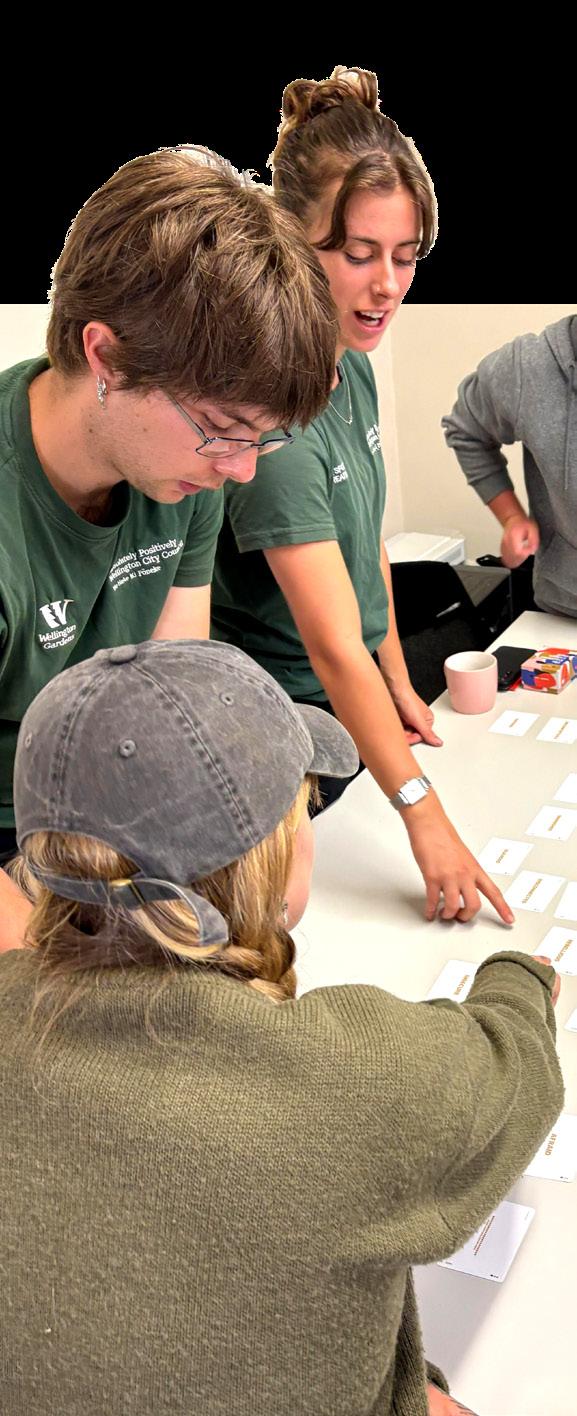
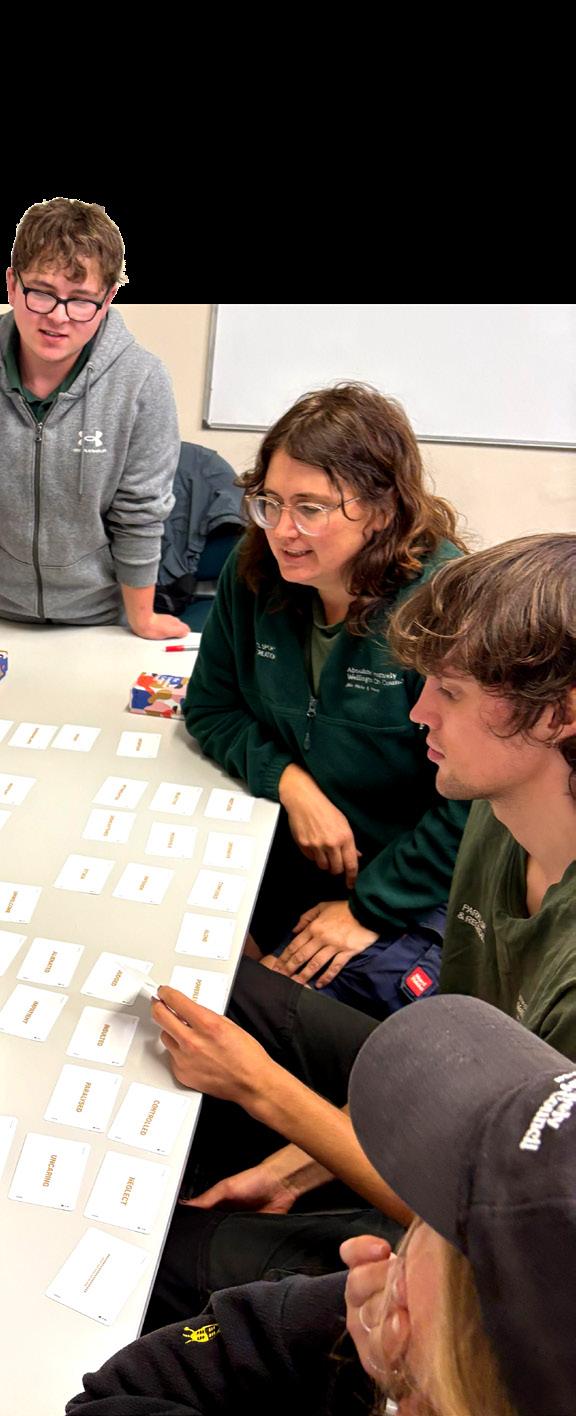
Image source from
Clare Lunden, Advanced Culture Practitioner, Wellington


The human lesson at the centre of it all
Clare says the greatest shift wasn’t technical, it was emotional:
“Even if your workshop feels like a disaster, the group probably got more from it than you realise. Every group you work with benefits from the last one. Every awkward moment helps the next team. You don’t need to do it all in the room. What matters is the emotional safety you create while you’re there.”
These insights echo something we’re seeing across the movement: emotional culture practice grows through courage, not perfection. Through people willing to begin before they feel ready.
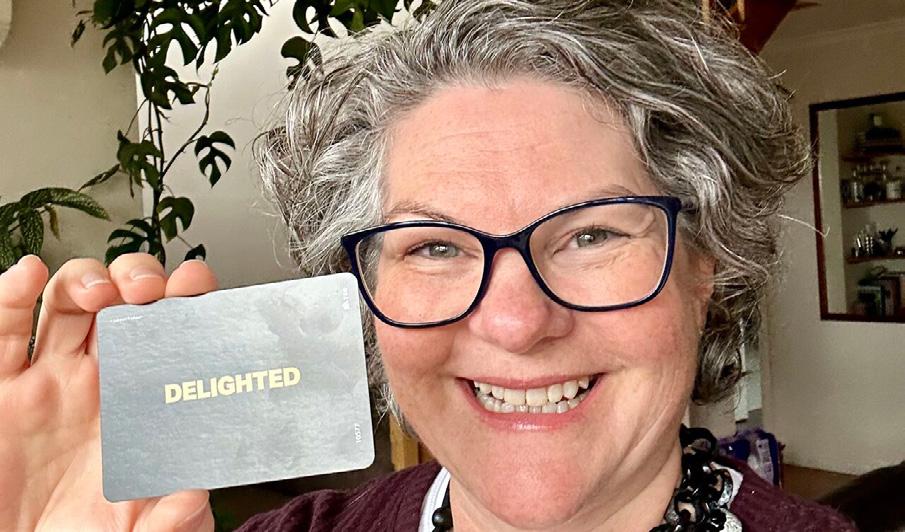
AI meets Emotional Culture Facilitation



As emotional culture work scales, facilitators are being asked to hold more voices, more data, and more complexity, without losing presence.
Inside the Elephant Rider community, Practitioners, Consultants & Masters are experimenting with digital tools and AI to enhance how Emotional Culture work comes to life. In a way that doesn’t re-
place human connection, but to deepens it and makes it more measurable & scalable.
During a recent community coaching call, ECD Certified Consultant and Elephant Rider Mentor, Katherine Riddoch shared practical insights from two years of integrating digital facilitation & experiences into her emotional culture & leadership workshops and programme.
The session became a window into what the next era of emotionally connected facilitation will look like: more inclusive, more adaptive, and more scalable, without losing the heart of what makes our emotional culture deck work magical - the stories behind the emotions we uncover and explore.
AI can summarise patterns, but only humans understand context, power, relational nuance, and emotion.
What This Signals for the Future of
Emotional Culture Delivery
The experiments shared by Katherine in this session point to three emerging capabilities for facilitators:
1. Blending Human Reflection with Digital Expression
Typed inputs give quiet thinkers and neurodivergent participants safer pathways to contribute. Spoken reflection brings nuance, emotion, and relational depth. Future-ready facilitation integrates both.
2. Data accelerates insight — humans create meaning
Digital tools allow groups to surface patterns quickly, emotional tension, alignment, uncertainty, but data only matters when someone holds the room with care Facilitators remain the sense-makers, not the software.
3. Designing for Both Psychological Safety and Psychological Insight
Digital pathways reduce social pressure. Human pathways deepen trust. Together, they create dual safety: safer contribution, and safer vulnerability.
Design Principles for Tech-Enabled Emotional Culture Work
The session reinforced several principles that will increasingly define highquality Emotional Culture practice:
The facilitator is the instrument.
Tech supports the work, it never leads it.
Human first, data second.
Emotional culture is about lived experience, not output screens.
• Simple beats clever. A single digital prompt can unlock more insight than a complex flow.
• Design for multiple ways of “being in the room”.
Talkers, typers, reflectors, feelers, emotional culture work becomes more equitable when people can contribute in ways that fit their wiring.
• Plan for imperfection. Glitches, misreads and unexpected results often create the richest conversations.
Five Practical Tech Experiments Worth Trying
1. Use live digital inputs to surface emotional patterns quickly
One prompt reveals the emotional temperature in seconds — then the real work begins in conversation.
2. Pair silent digital reflection with small-group sense-making
This combination consistently increases psychological safety.
3. Use AI as a synthesis partner, not a meaning-maker
AI can summarise patterns, but only humans understand context, power, relational nuance, and emotion.
4. Design “talk + type” sequences
Let people articulate privately first, then share publicly with more clarity.
5. Link emotional insights directly to rituals, decisions, or behaviour experiments
The shift happens when insight becomes practice.
The Future of Emotional Culture Systems Is Digital
As organisations become more distributed, more diverse, and more time-poor, Emotional Culture work must continue evolving.
This session showed that:
• digital tools can increase psychological safety
• AI accelerates insight
• and facilitators remain the guardians of emotional meaning
The future of Emotional Culture
Conversations is not replacing human connection, it’s expanding the ways people can participate in them and the meaning we can capture & measure from them.
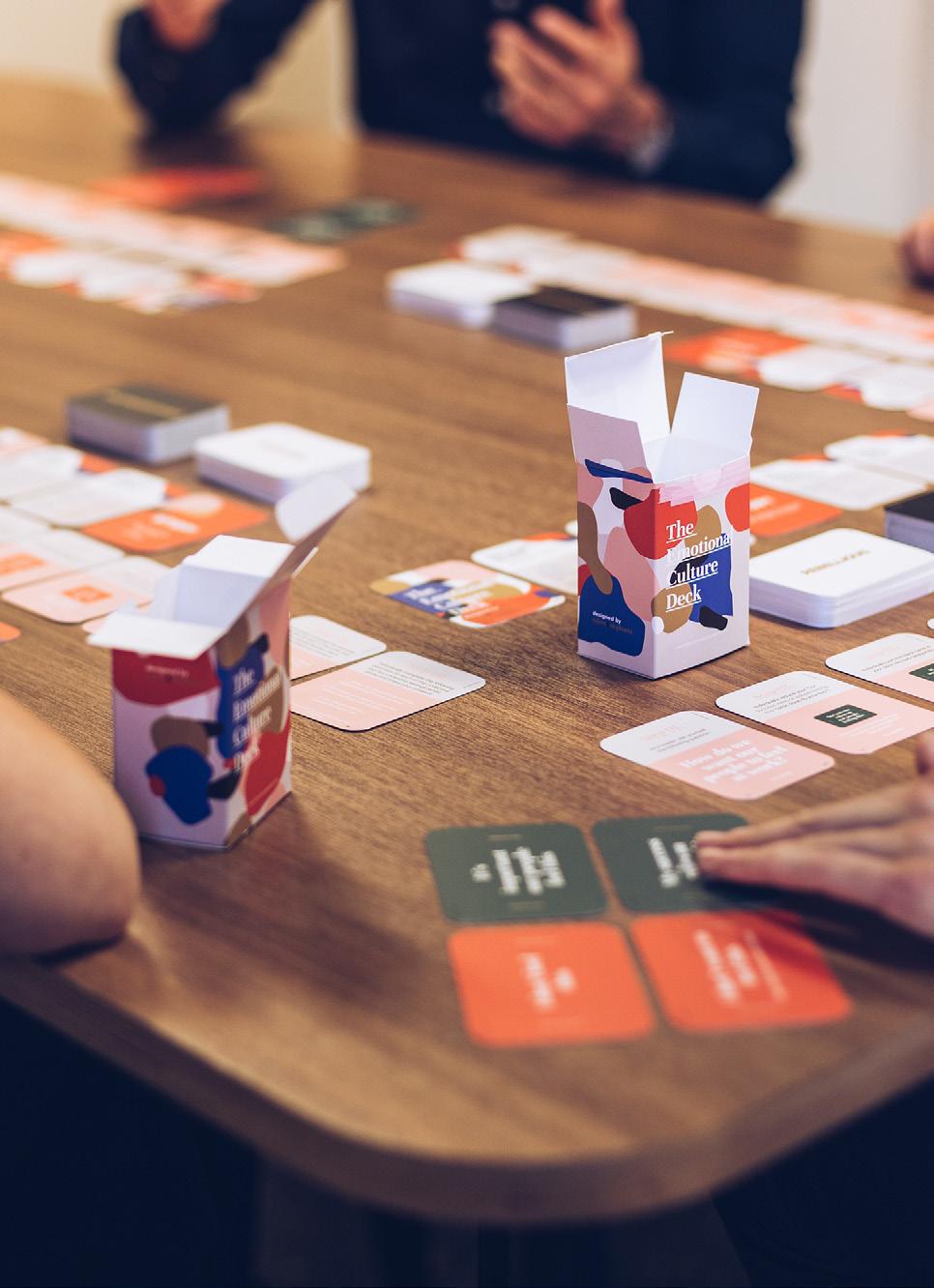
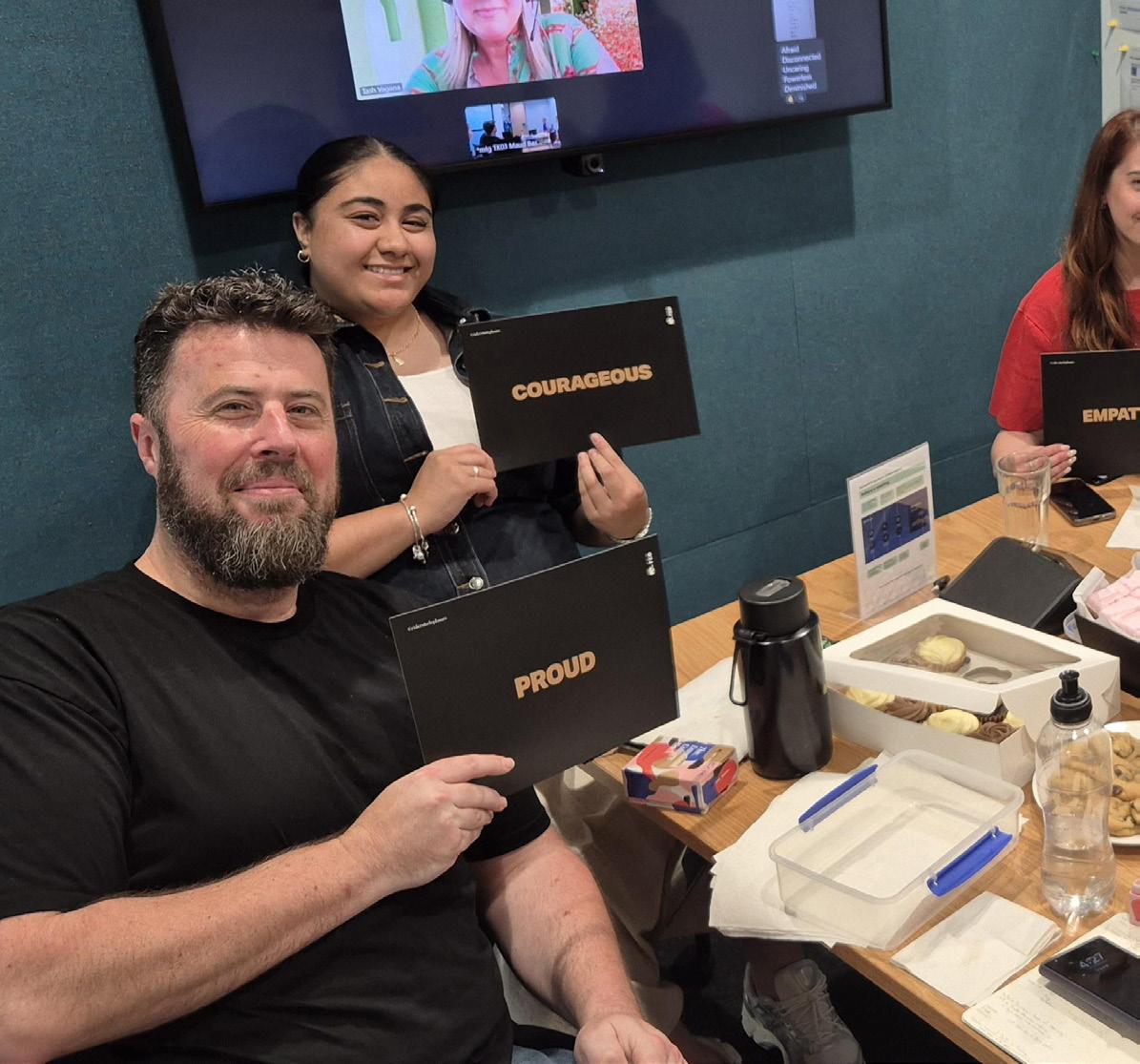
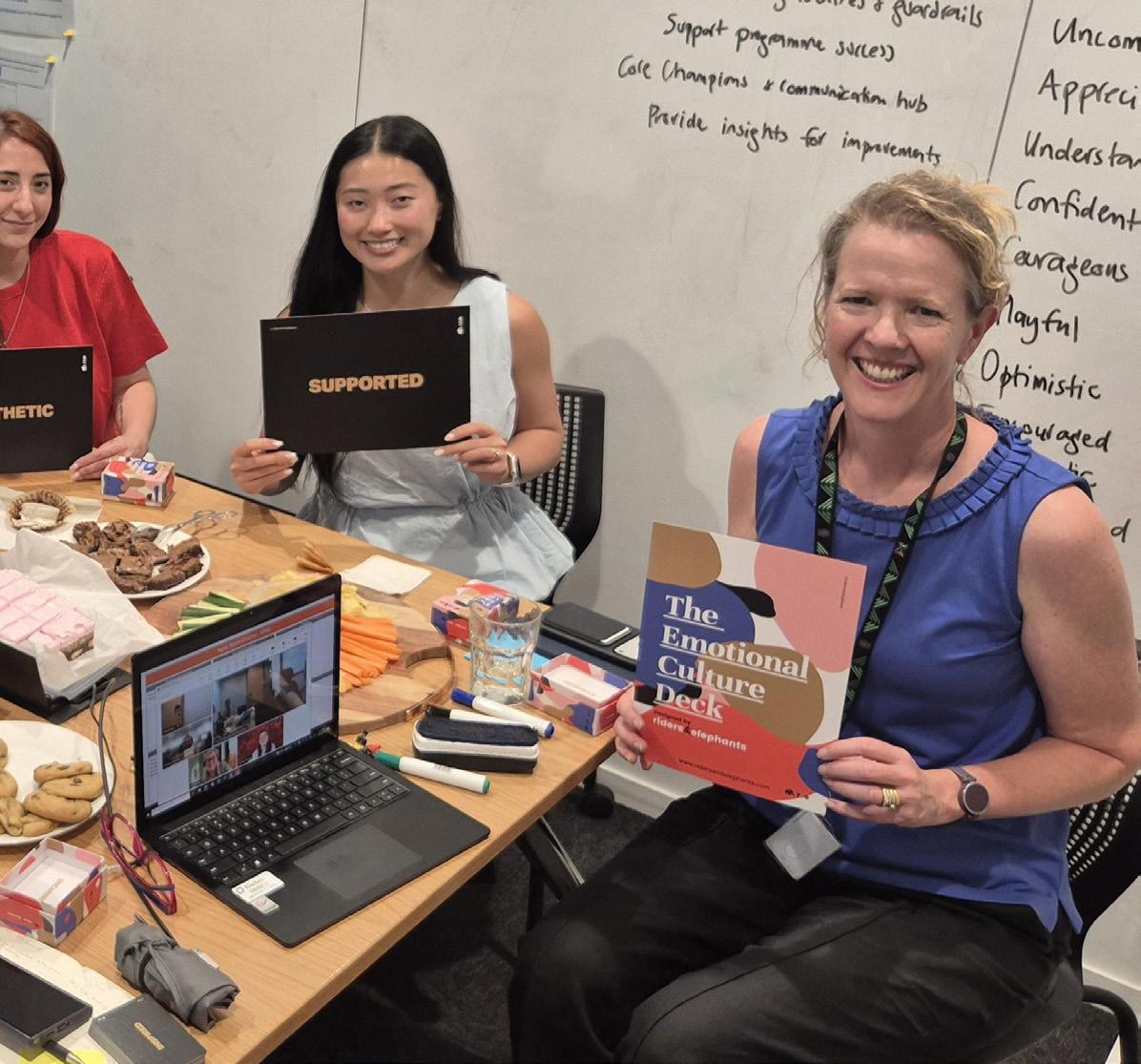
community in action.
Where emotional culture came to life.
Bright Spots from Our Global Community
Every day, inside our Elephant Rider community, people share their Bright Spots.
These are moments of progress, courage, learning and connection. Sometimes they’re big wins. Sometimes they’re quiet shifts. Often they sit right alongside challenge, uncertainty or something that didn’t go to plan.
Together, they show emotional culture in motion. This year alone, Elephant Riders inside our community shared 386 Bright Spots inside our Bright Spots community room.
Those stories sparked 1,248 comments, with people reflecting, encouraging, asking questions and learning from each other.
They were viewed 4,629 times by members across the year.
That level of engagement tells its own story.
Bright Spots have become one of the most active and meaningful spaces in our community. A place where people pause to notice what went well, name what they’re proud of, and make sense of what they’re learning in real time.
They’ re not polished case studies. They’re honest snapshots of practice.
Across roles, countries and contexts, these stories show how emotional culture grows:
• through small acts of naming what matters
• through noticing emotional shifts as they happen
• through sharing learning, even when it’s messy or unfinished
This is how emotional culture takes root. Not through theory alone, but through everyday practice.
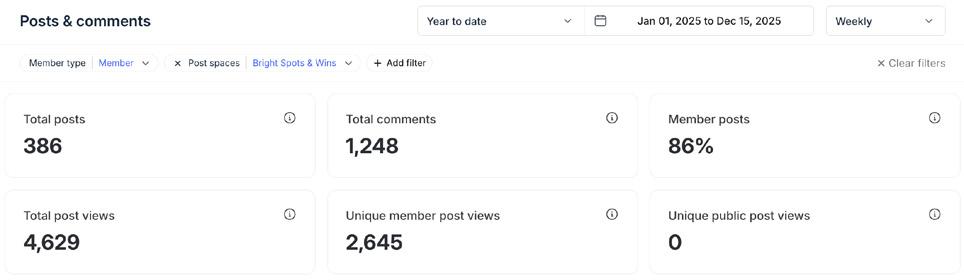
Bright Spots remind us that culture shifts through practice. When we share what’s working we learn from each other. We inspire each other and give others in our community the confidence that it can be done. That is being done and it works!
They show how emotional culture is built:
• in conversations that take courage
• in moments of reflection after something didn’t land
• in teams learning a new language for how they feel
• in leaders choosing to pause, notice and respond differently
These stories capture the heartbeat of the Elephant Rider community.
They show what’s possible when people are given the tools, the language and the permission to talk about emotion in simple, human ways.
And they offer something powerful to anyone reading from the outside: A glimpse into how emotional culture actually shows up in the world.
We’re not just running workshops; we’re gathering data, testing theories, and proving what we’ve seen anecdotally for years: emotional culture drives real outcomes
A Snap Shot of Bright Spots from around our community in 2025
WITH SHAE BESWICK & HELEN MELVILLE — PERTH, AUSTRALIA
ECD Certified Consultants & Chapter Leads
Shae & Helen hosted their second ECD meetup in Perth, a session that unfolded as a natural, flowing conversation. With an HR consulting group who already shared trust and history, the dialogue moved quickly from concepts to real application. Shae and Helen spoke less than ever before, a sign that the group had truly taken ownership of the learning.
“This success was a direct result of bringing a group with existing relationships and shared professional contexts together, allowing them to instantly connect the material to their work.”
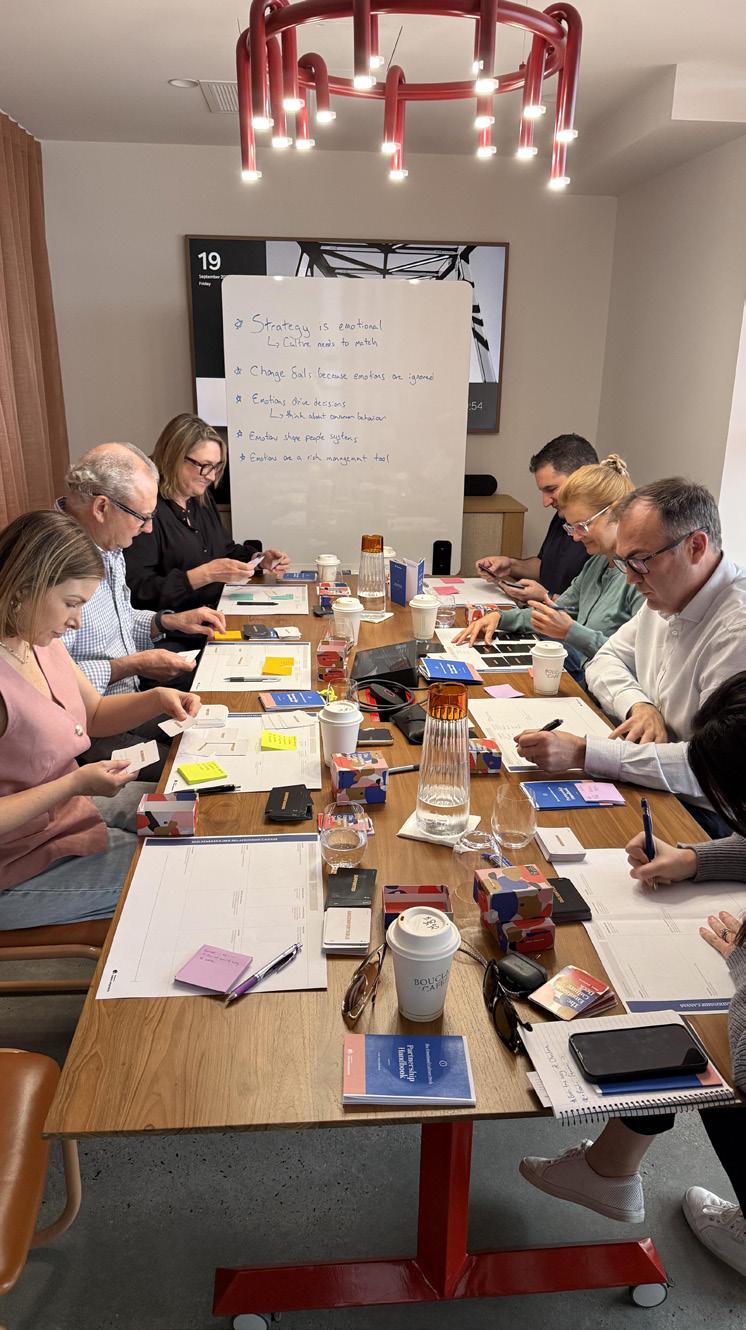
Change, Change, Change
WITH KATE BACCHUS — NEW ZEALAND,
ECD Certified Consultant
Last week - I designed and facilitated a session for the GM of a division who had newly joined the team. There had been some turmoil and both the CEO and COO had left unexpectedly during the year. There was some nervousness in the room about whether the workshop might signal upcoming organisational change - so we named that directly at the start. That cleared the air.
We looked at what was in people’s ‘change back packs’ and then did a session loosely planned around the Team change readiness workshop by with a couple of groups exploring different future changes on an A3 canvas and then reporting back to the wider group. We looked at three change in play in the next 6 months impacting the team.
I got the group up and moving early with a mix of individual reflection, duo conversations, and small
group work - this helped pace the energy and stopped the more confident voices from dominating. A key insight surfaced around self-perception vs behaviours in change: several people who rated themselves highly as “comfortable with change” showed behaviour more aligned with discomfort or resistance. This became a valuable, non-judgemental reflection moment for the
We looked at three change in play in the next 6 months impacting the team.
team and linked to a wider discussion about emotional contagion.
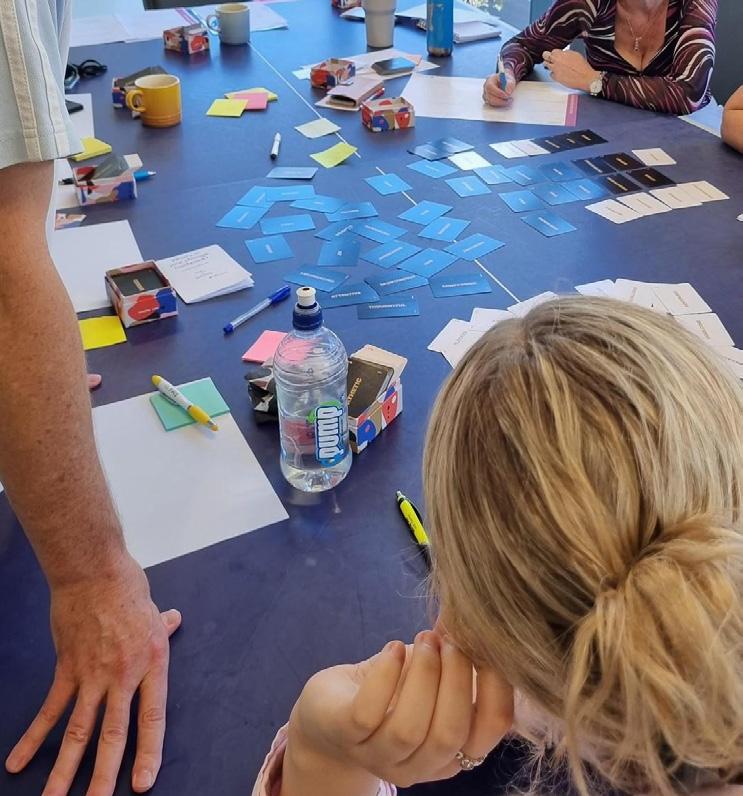
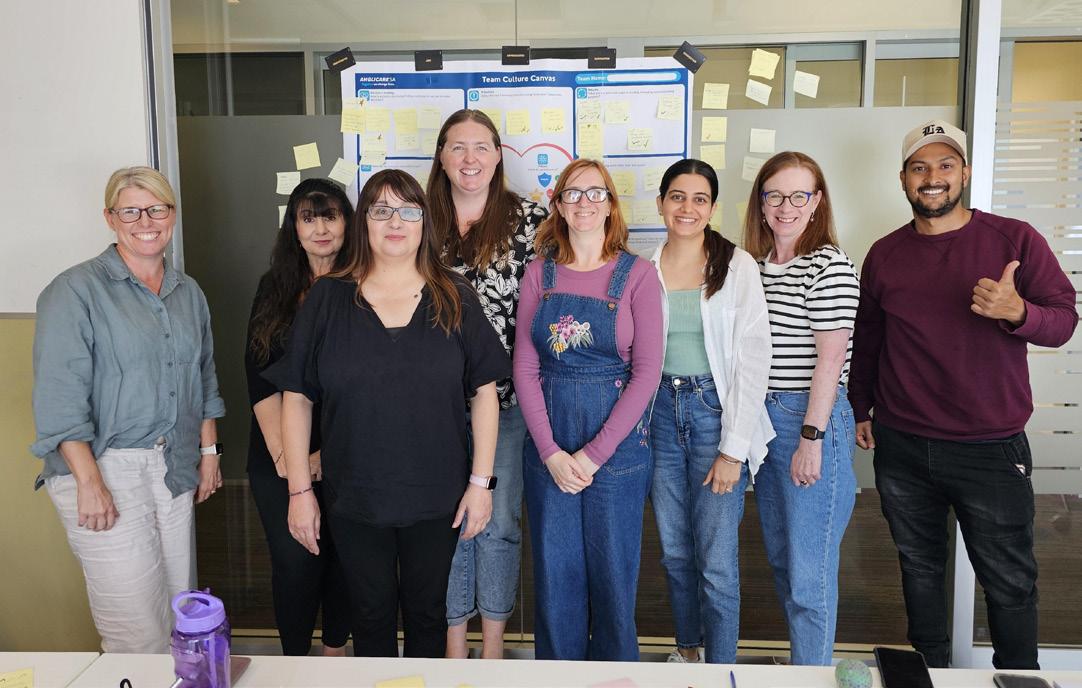
Feel First, Lead Better
FROM ANNA CLAYTON, ADELAIDE, AUSTRALIA -
ECD Certified Consultant
Anna introduced 180 leaders at AnglicareSA to emotional culture for the very first time, a keynote that turned into a live redesign of their employee experience. The moment the room shifted from “what do we need people to do?” to
“how do we want people to feel?” the energy changed immediately. Crossfunctional leaders, including senior executives and the CEO, began reimagining induction, team meetings and everyday rituals through an emotional lens.
“The biggest surprise was how every speaker after me referenced emotion — even the senior execs I didn’t think were fully bought in. The ripple effect was real.”
“ The moment the room shifted from “what do we need people to do?” to “how do we want people to feel? the energy changed immediately.
Facing the White Cards
LOTTY ROBERTS — NEW ZEALAND
Master Culture Consultant
October asked Lotty to step into the tough end of emotional culture work, teams avoiding tension, withholding truth and carrying heavy white-card emotions. Across multiple workshops, she guided people into conversations they’d been skirting for months, creating enough safety and structure for them to finally name what was already in the room.
“Once the emotions were brought to the surface, people could see that avoiding them had actually made them stronger. Avoidance had been the strategy, and that strategy had been fanning the flames of the unpleasant emotions. When teams are supported to face the white cards, the intensity starts to reduce. People can then work together more proactively on the things that were sitting underneath the tension.’

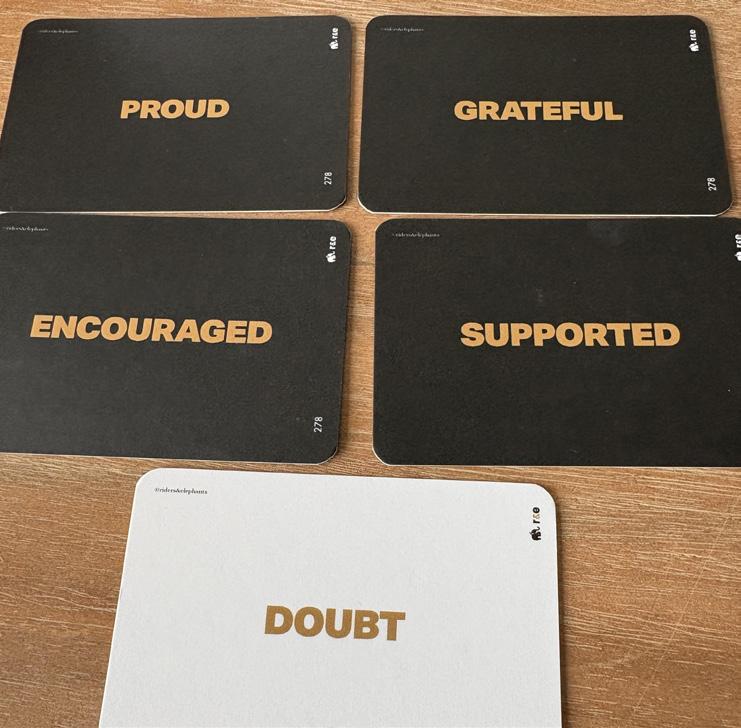
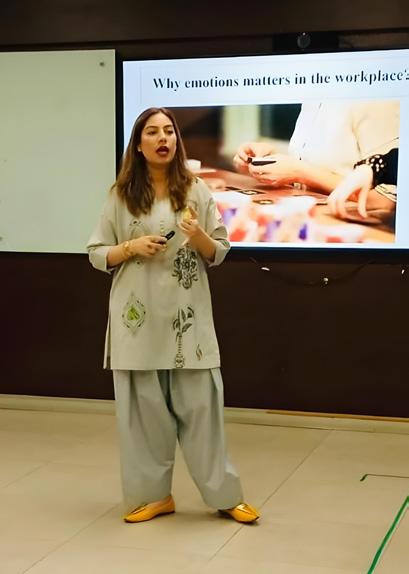
Name It to Tame It
SABA UMAIR — PAKISTAN
Rising Culture Practitioner
During a workshop with middle managers, Saba witnessed the moment the Emotional Culture clicked. As participants found new emotional language, they began articulating their experiences with clarity — and, unprompted, restated the core workshop objective back to her.
“The ECD expanded their emotional vocabulary and helped them articulate their feelings throughout the session.”
First Leadership Workshop
RAECHEL FORD — NEW ZEALAND
ECD Leadership Practitioner
Raechel delivered her very first ECD Leadership workshop — a moment of courage that turned into a breakthrough. She discovered the power of flexibility, pacing and simply placing cards in people’s hands to unlock engagement, even from sceptical leaders.
“My key learning - and you all said it - I simply did not have enough time to do it real justice at the end. But this was my first rodeo and I just know I am going to get better and better as I continue “
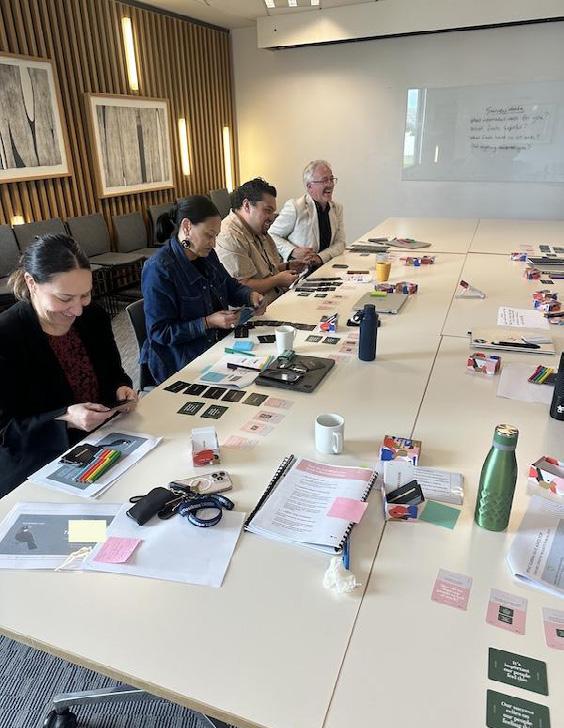
Sugar, Insight & Senior Leaders
ANGELLA CLARKE-JERVOISEECD CULTURE, CHANGE & LEADERSHIP PRACTITIONER
Angella & Julia introduced 36 senior leaders to the power of emotional culture using The Emotional Culture Deck and versatility tools. The energy in the room was palpable — deeply engaged, emotionally honest, and refreshingly open. The permission slips wall filled quickly, and so did the room with connection and conversation.
One line says it all: “In a time when leaders need a new guide to leading people in the 21st century, this work sits right in my sweet spot.” underneath the tension.’
“In a time when leaders need a new guide to leading people in the 21st century, this work sits right in my sweet spot.” underneath the tension.’
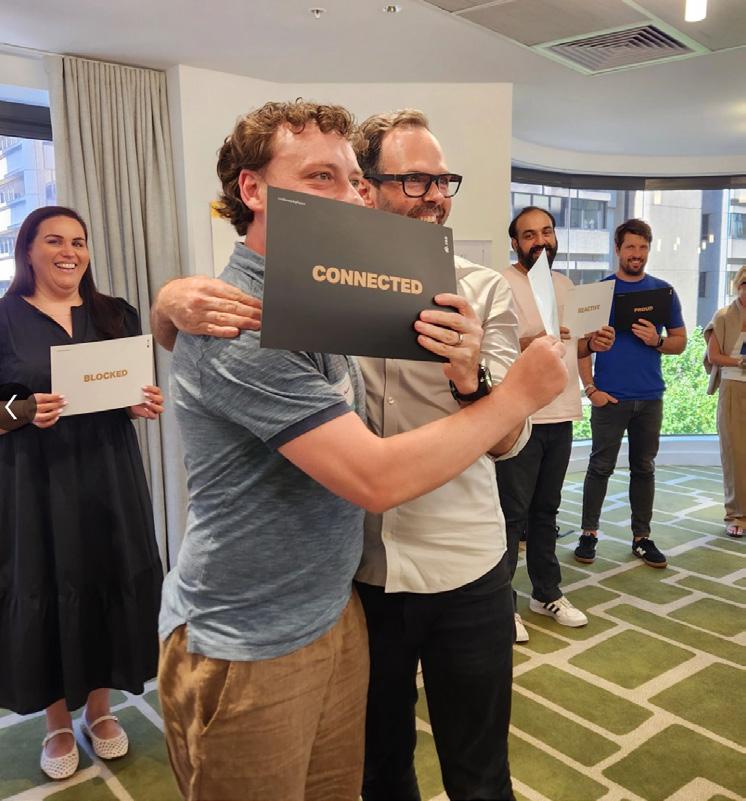
Emotional Culture Map of the Emergency Department
PAULA MUNCH
ECD Culture Practitioner
Paula led a deeply impactful and courageous series of five Emotional Culture
Mapping workshops with
Emergency Department staff. Despite resistance after an emotionally heavy second session, she advocated for continuing—and it paid off. The same six desired and undesired emotions consistently emerged across groups, providing clarity and direction. Paula created a full ED Emotional Culture Map and is now working with leadership to turn insights
into rituals and team-led actions.
Why it’s a Bright Spot:
This is one of the most courageous and inspiring applications of the ECD shared in our community. Paula’s vulnerability, leadership, and followthrough are creating real change—and inspiring others to step forward too.
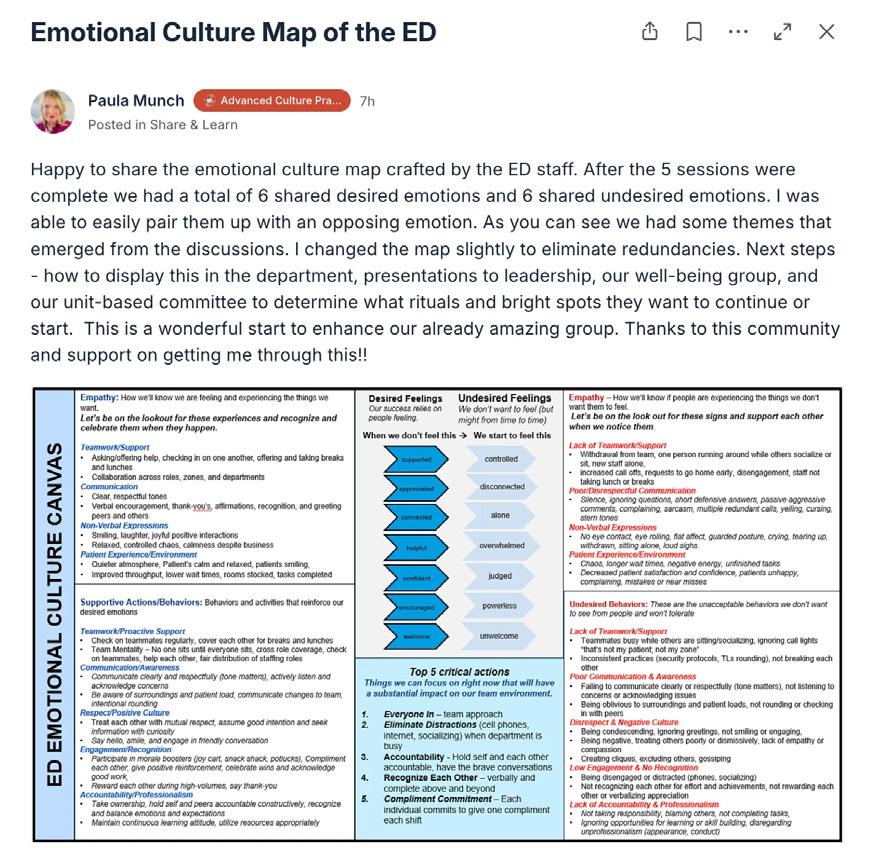
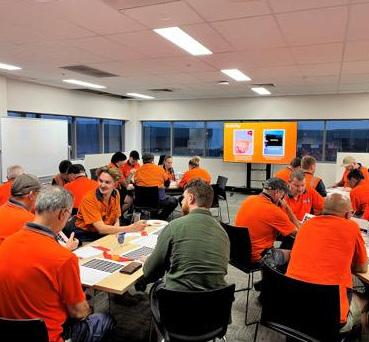
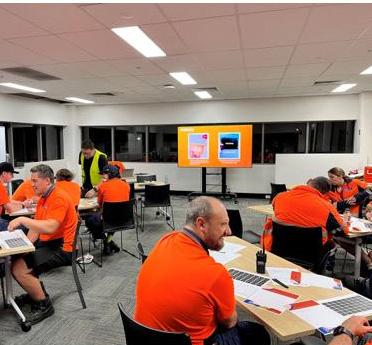
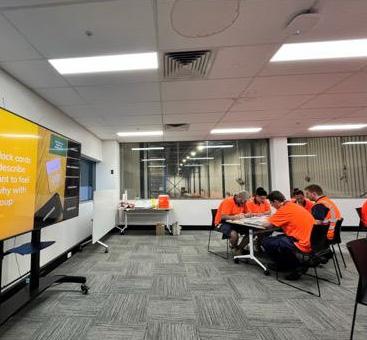
ECD in 30 mins. Its possible
BY CHELSEA LANG
Trainee ECD Certified Consultant
If you’re only given 30 minutes to help a site reset and elevate its culture after 12 months of change, how would you run the standard ECD 2-4 hour workshop in three sets of 30-minute sessions at 6am, 2pm, and 10pm with 20 - 30 distribution team members in each time slot?
Answer: it’s possible, but it requires some hacking and a promise to return next week for more playing!
This is how we did it in a 30 min sprint
Spend 10 minutes on the why. Explain why emotions are at the heart of resetting and elevating their culture. Hook them with emotion vs. feeling with a real-life story about seeing the snake in the car park. Stories build culture. Stories get attention. Don’t mess around with the cards. Give everyone a set of virtual printouts. Don’t forget the icebreaker. It really helps the team relax and get comfortable using the tool. Get facilitator help. Assign table leads at each table to encourage a safe space where everyone can share what is important to their success in the team.
Spend 15 minutes picking the top three emotions they need to feel to thrive in the team and explaining why. Share. Get them to write these down on the handout, take a photo, and give the hard copy back to their table leader for the next session, to continue the game next week and turn their focus to how they’ll thrive collectively as a shift team. This is where I will bring in the big cards.
Winning moment? One table clapped after each team member sharing their top feelings. Extra winning moment this was all facilitated by who did a marvellous job
Bright Spot: Navigating the Line Between Vulnerability and Oversharing with the ECD
BY KATHERINE RIDDOCH ECD Certified Consultant
One of the coaching conversations that’s really stayed with me from Friday came from exploring the fine line between vulnerability and oversharing in leadership.
As practitioners, we know the ECD invites people to name and explore emotions in a way that’s constructive, human, and work-relevant. But that level of emotional honesty can also feel risky for leaders who are still building confidence in this space.
A helpful insight that emerged:
Vulnerability is purposeful. Oversharing is unprocessed. Vulnerability creates connection, clarity and trust. Oversharing creates discomfort, confusion or emotional weight that others didn’t consent to hold.
Share from the scar, not the wound.
Leaders don’t need to tell their life stories or provide raw detail. They just need to offer enough insight for people to understand how they show up, what they need, and what they’re working on.
When we coach leaders through ECD work, a few prompts can help them stay grounded:
• Is what I’m sharing relevant to the purpose?
• Is this processed enough that I can share it calmly?
• Will this help my team understand me or work better together?
When the answer is yes, vulnerability becomes a powerful act of leadership –modelling emotional clarity without burdening others.
This bright spot reminded me of the nuance that lies in coaching and facilitating emotional culture work, and of how important our role is in helping leaders navigate it well.
Would love to hear how others frame this distinction in their coaching and workshops.
Here’s me smiling after the session, realising it was such a valuable conversation.
A simple rule that resonated strongly:

Surprise
hybrid workshopsyou’ve got to love them!
Wow, I wasn’t expecting this to be a hybrid workshop. I’ve worked with this team before, with everyone in the room, but they’ve grown, and have now got people in different places. They wanted a workshop which we all set up, then a week before, it turned out it would be a good idea if someone were able to join in remotely. All good, I’ve done it before, and with just one person, we talked through logistics of how to do it.
Then, the night before - I hear there are going to be 3-4 people…. 28 people in the room, plus 3-4 online …
“Okay, I’ve done that before too, but never on my own as a sole facilitator. Breathe … I’ve got this. I can do this.”
So, things that are important:
• Each person attending needs to be on a separate laptop in the room, with a buddy looking after them
• I recommend cameras on!
• Use breakout rooms for small group or pair activities, and move the laptops to join groups so that they can participate without the noise of everyone. It’s helpful if there are little meeting rooms to move to like there were in this case.
• Use a platform that you are really comfortable with. We used Google Meets which I’d used before, but I wish I’d used Zoom as I’m much more comfortable with that.
• Send the online people the virtual sheets of cards and any handbooks you’re using prior to the workshop so they have them available. We used the physical decks with everyone in the room.
• Check in with your online people - allow space for them to share back. Include them in your Group Agreement - what do we need to do so that EVERYONE is able to participate effectively and safely.
• Have regular breaks. It’s really tiring online!
• Enjoy it! It does work, and it’s better for the people to be part of the group at the workshop, than not to be there at all. The ECD needs to be experienced, and as many people as possible need to be part of the conversations.
This was a workshop about managing the change that they’ve been going through and was much needed.
How do we feel about the current change?
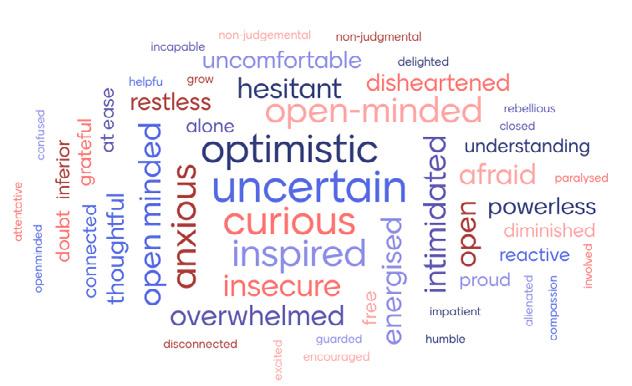
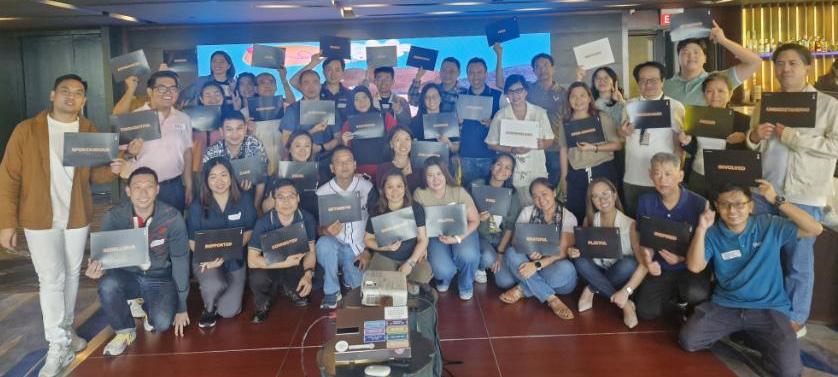
Change is emotional.
JOLINA KAHN
Trainee ECD Certified Consultant
I just came off a workshop with 40+ pax for a team that is going through a largescale change process for the next 3 years, composed of people across 6 functions and 5 countries (Malaysia, Philippines, Thailand, Indonesia and Vietnam). They asked me to do their teambuilding and I reviewed the brief what else they had lined up. I was going to run their 3rd day to culminate all the conversations they had in relation on this massive project.
I proposed a program that would use the exploring team change canvas. While the team was onboard with the plan, the leader of the team was initially hesitant. She thought it was the first time they were coming together so there was concern about how open they would be to talk about their emotions. This is where I had to use my skills as a consultant and a trusted adviser. I assured my client that I knew where her concern was coming from, then reminded her that change is emotional. I shared that most change processes fail when emotions are not considered in the whole journey, and said that I believed we are setting up her team for success by addressing it at this stage.
Thankfully I’ve worked with this leader a lot and she puts her trust in me so she gave the go-signal and we proceeded with the plan. We planned and set up a great day for the team, not just in terms of experience, but in terms of output. They now have a clear set of norms and rituals that will guide them through their project in both the 6 smaller and larger teams, grounded on the desired and undesired emotions they discussed.
This was one of my favorite ECD workshops I’ve run so far. Lots of white card uncertainty enterting this but we ended with black card inspired in the end.
My first ECD workshop!
FRAN CORMACK
ECD Change Practitioner
Having only recently joined the community, following a great training by Rich Batchelor, I am now experimenting with the many ways the ECD can be used.
This week I ran my first free workshop. An introduction for people to get familiar with the ECD.
I hosted an engaged community, joining from across the globe. We had Poland, Philippines, and Australia represented as we explored the mini “Know Yourself” handbook.
It won’t surprise this community to hear how engaged the conversation was, in even a short 1 hour session.
I am now energised and thinking of what’s next.
This week I ran my first free workshop. An introduction for people to get familiar with the ECD.
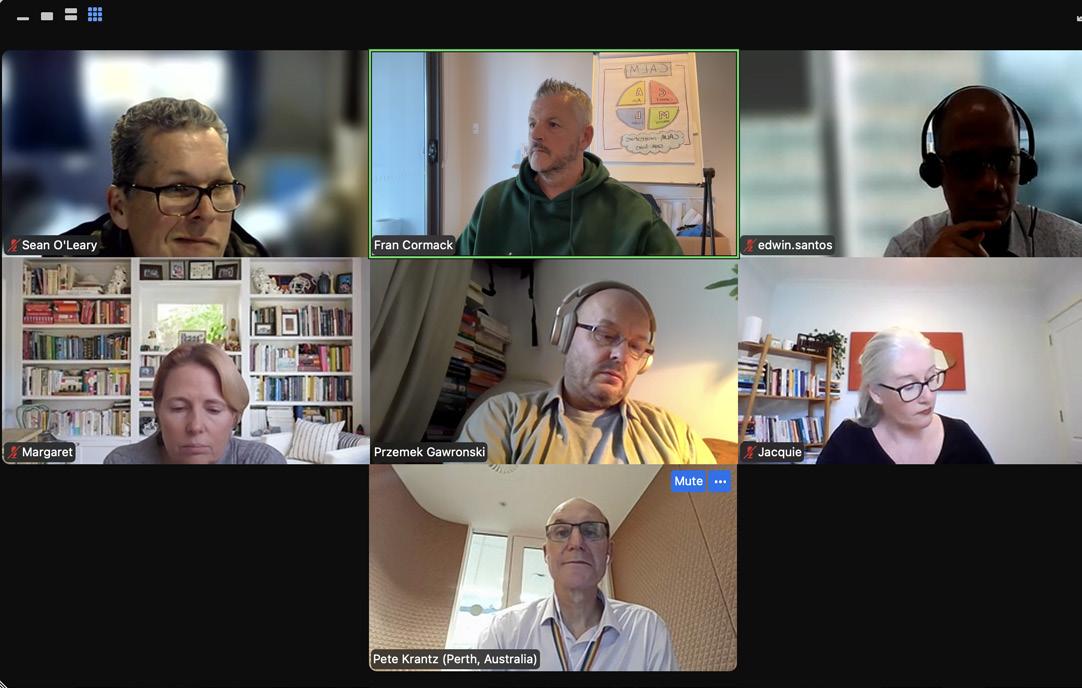
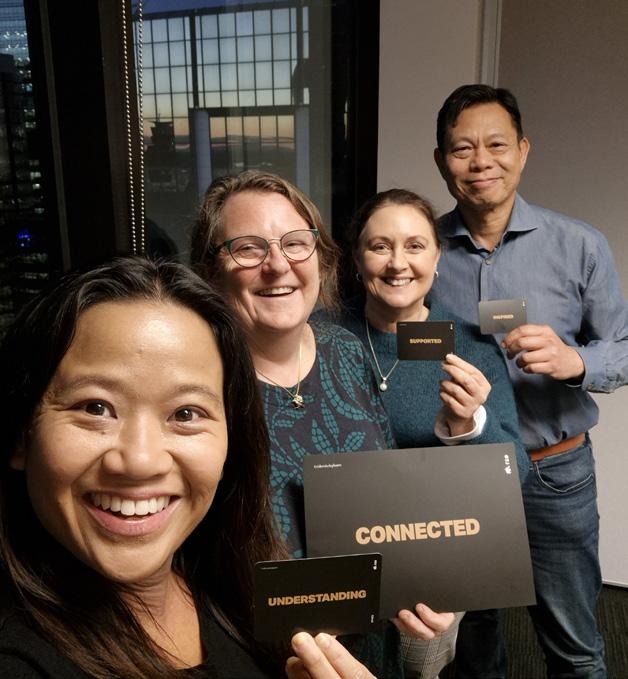
The clock was ticking, and I ended up asking if they could bring up that discussion later, and asked the person, if she could accept “Neglected” just for the moment, so we could move on with the Workshop.
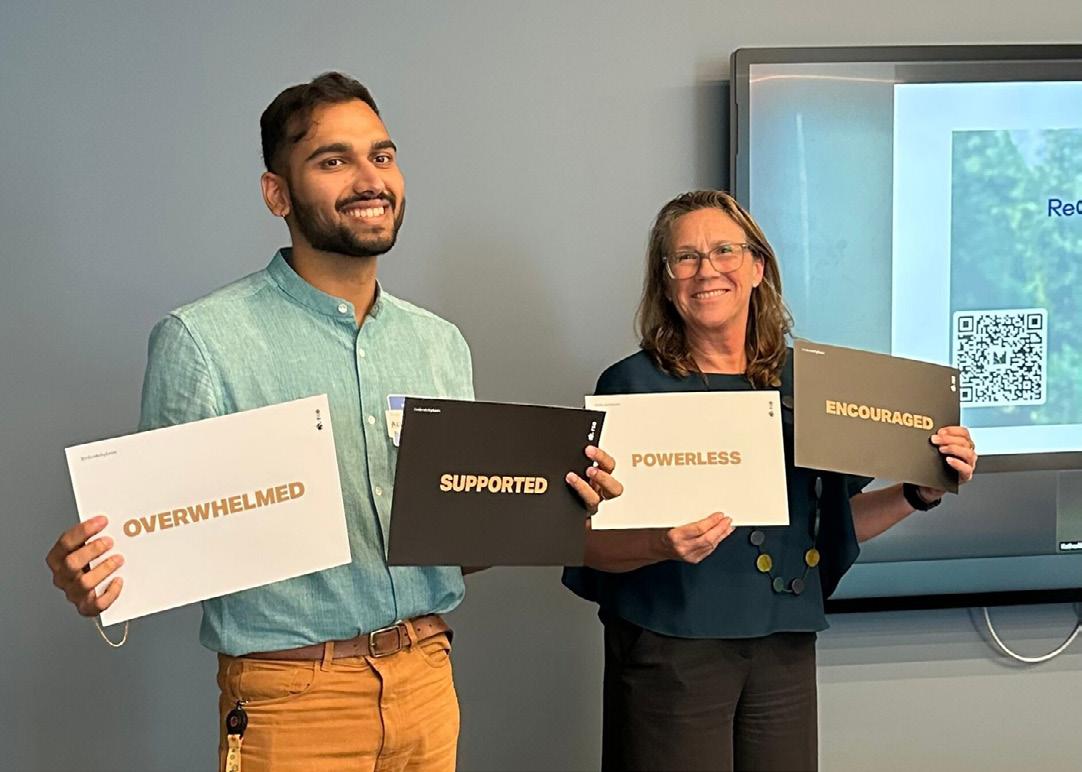
When you feel Neglected in a Change Process
RITA PRATES
ECD Certified Consultant
This Workshop meant to create a moment for a group of managers to stop and reflect on a Change Process currently in place, with a poor communication process behind, and involve them in the definition of how they wanted to feel and not feel from that moment onwards, as well as how they could support their teams throughout the process.
The dynamic went well, despite time constrains as
always, the group was happy with outcome, but I’ve lost one person in the process. While selecting the Undesired Feelings the group was undecided between Neglected, Unwelcome and Alienated (the meaning was pretty much the same, and they needed to pick up the most relevant “F” Word). And the group (more than 20) chose Neglected. All except one! And that one refused to accept that word (most probably a word with a strong meaning for her).
I’ve tried to manage with the group any of the other 2 words (or any other) could serve the same purpose, to accommodate the col-
league, but the group chose to keep it.
The clock was ticking, and I ended up asking if they could bring up that discussion later, and asked the person, if she could accept “Neglected” just for the moment, so we could move on with the Workshop. The group said “yes” (they would discuss later), she said “yes” (she could accept it for the moment), but the truth is that I’ve lost her for the rest of the workshop.
I wonder if anyone here has had a similar situation and if so, how have you handled it, so I can learn from the collective wisdom.
Inside our Worldwide Elephant Rider Chapters
This year Elephant Riders gathered in rooms around the world, small, human spaces designed for practice, reflection and honest emotional culture conversations.
These meetups are learning environments. Places where people deepen capability, test ideas from their Emotional Culture practice, and reconnect with the work and with each other.
Local chapters are run by volunteer leaders who believe in rehumanising work through small, consistent actions. Their role is simple & powerful: bring our community together & create the experiences for people to connect & practice.
And every gathering contributes to something bigger, a distributed movement of leaders who are reshaping how workplaces understand emotion, behaviour and performance.
“Culture shifts when people practice together.”
WHAT WE’RE LEARNING FROM OUR CHAPTERS
What 2025 Taught Us Practice builds confidence. Regular gatherings strengthen emotional leadership muscles. Rituals matter. Small, repeated behaviours create belonging and consistency. Community accelerates learning. People learn faster together than alone.
• In-person connection still matters. Especially in a digital-first world.
Where We Gathered This Year
Auckland • Wellington • Nelson-Tasman • Melbourne • Sydney • Brisbane • Perth • Canberra • Hobart • Toronto • United Kingdon • Germany
Across 11 cities and 3 continents, Elephant Riders met to explore & practice emotional culture conversations and support each other’s growth.
Looking Ahead
As we move into 2026, our global Chapters will continue to grow in depth, consistency and impact. Our vision is to both support our local Elephant Riders & connect everyone across the globe. We’ll support more spaces where Elephant Riders can practice the work, connect with each other, and strengthen the movement city by city.
If you’re an Elephant Rider and haven’t joined a Chapter yet, we’d love to welcome you into a local or regional chapter near you. These are for you, to learn, to experiment, to reconnect with the system, and to be part of the global community shaping the future of emotional culture.
We’re not just running workshops; we’re gathering data, testing theories, and proving what we’ve seen anecdotally for years: emotional culture drives real outcomes
With Heartfelt Thanks to Our Chapter Leads
None of this happens without the courage, care, and consistency of our Chapter Leads.
You stepped into the unknown with us. You hosted rooms before knowing who would show up. You held space for vulnerability, curiosity, and connection, again & again.
On behalf of R&E and our community, thank you for creating these experiences for our community.
A Special Goodbye & Thank You
We want to acknowledge the enormous contribution of Rebecca Frazer, who wrapped up her role this year after two years as Auckland Chapter Co-Lead.
Rebecca, you created incredible momentum, warmth, and heart in that chapter. We are deeply grateful for everything you’ve brought, to Auckland and to our wider Chapter Lead Community.
Welcoming Our Chapter Leads for 2026
It was energising to see new faces step forward to co-lead across the community. Here’s who’s now taking on Chapter leadership roles for 2026:
Andrew Bath — teaming up with Lorissa Garcia (Melbourne)
Jonathan Bedlow — joining Katherine Riddoch (Hobart)
Angella Clarke-Jervoise — teaming up with Elena KingstonBedford (Brisbane)
Daria Tippin — teaming up with Joanne Free-Pameli (Toronto, Canada)
Helen Melville — joining Shae Beswick (Perth)
Sarah Rackley — teaming up with Cathie Gould (Nelson–Tasman)
Amber Gladstone — joining Desleigh White (Sydney)
Sarah Dena — officially leading the UK Chapter
Susanne Heiss & Peter Kleinau — launching the Germany / Austria / Switzerland (DACH) Regional Chapter
Lili Mesesan & Mihai Nastasescu — leading the Central & Eastern Europe Regional Chapter
This shift toward co-leads came from a simple realisation: leading alone can feel lonely. Duos create shared energy, support, and space to collide ideas. It already feels like a powerful evolution in how we run chapters.
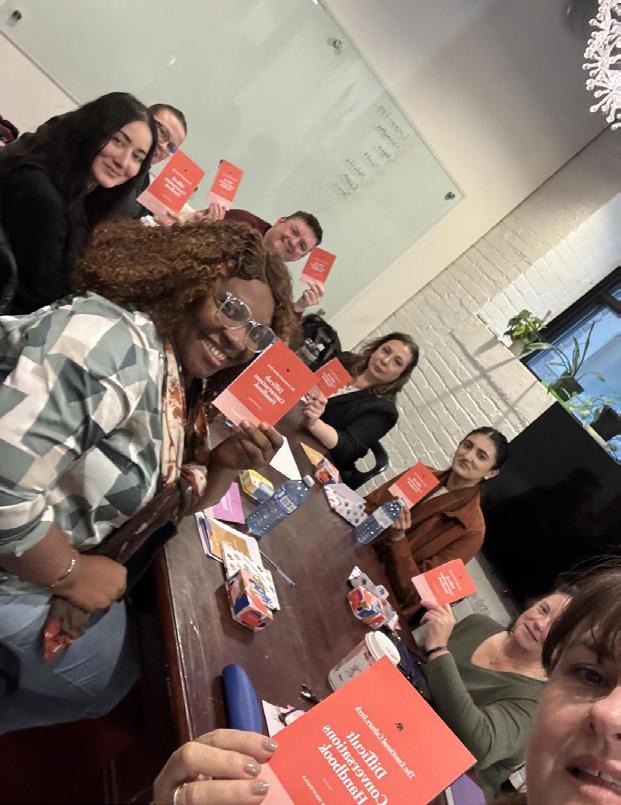
BRISBANE, AUSTRALIA
Led by Elena Kingston-Bedford
TORONTO, CANADA
Led by Joanne Free-Pameli
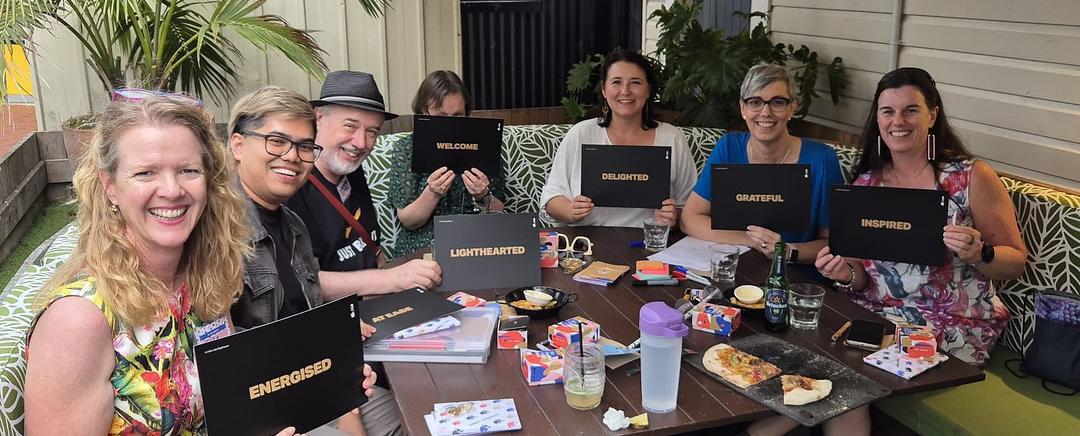
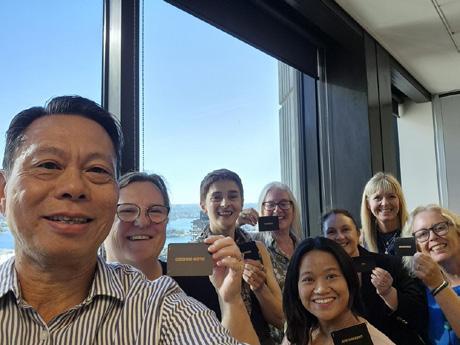
AUCKLAND, NEW ZEALAND
Led by Erika Barden & Rebecca Frazer
PERTH, AUSTRALIA
Led by Shae Beswick
MELBOURNE, AUSTRALIA
Led by Lorissa Garcia
SYDNEY, AUSTRALIA
Led by Desleigh White
NELSON-TASMAN, NEW ZEALAND
Led by Cathie Gould with support from Michelle Nunes-Vaz
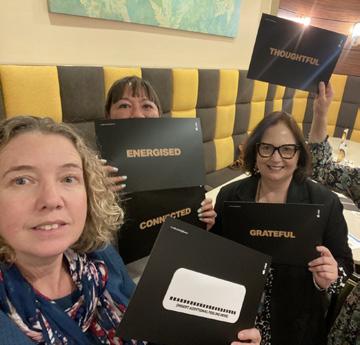
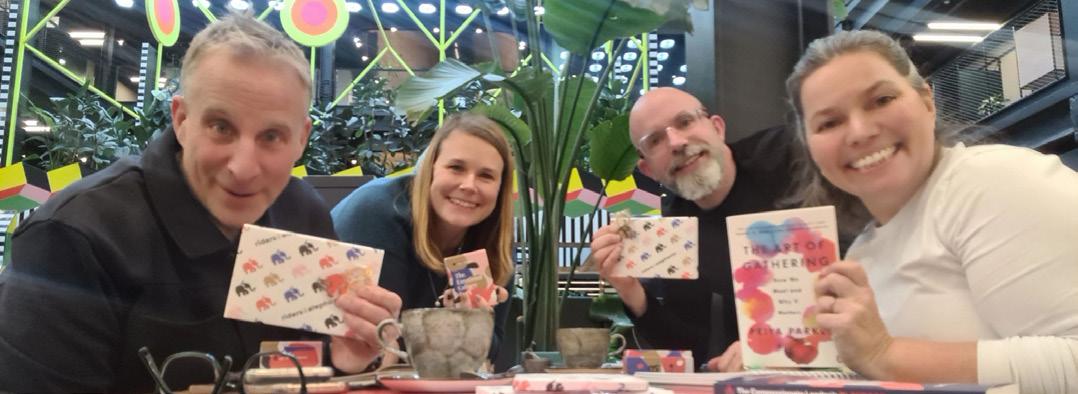
WELLINGTON, NEW ZEALAND
Led by Andrea Hancox & Kristin Murray
HOBART, AUSTRALIA
Led by Katherine Riddoch
CANBERRA, AUSTRALIA
Led by Tubi Oyston & Renate Triffitt
UNITED KINGDOM
Led by Sarah Dena
Our Partners expanding emotional culture practice around the world
This year marked our biggest leap yet in the professionalisation of our Emotional Culture System.
Across a year of practice, reflection and real-world delivery, 17 new ECD Certified Consultants completed the 12 month programme, joining more than 50 Certified Consultants worldwide now who are reshaping how leaders think, feel and connect at work.
They come from coaching, healthcare, leadership development, financial services, engineering, change and education, but share one belief: When emotion becomes discussable, performance becomes changeable.
Across the Elephant Rider community, there is a group of leaders who have chosen to go all in and all the way through our certification pathway.
They have done the work. They have committed time, energy, reflection and realworld practice to deepen how emotional culture is understood, facilitated and applied in organisations & communities. They represent the highest standard of emotional culture practice today. Each brings a unique discipline, coaching, change, leadership, wellbeing, systems thinking, into the Emotional Culture field.
These spreads celebrates every Certified Consultant & Master across our global community.


Joanne Free-Pameli Toronto, CAN
Rich Batchelor Toronto, CAN

Rosz Duffy Philadelphia, USA

Mattison Grey Texas, USA

Amie Myrick Baltimore, USA


Hitomi Whitlock Seattle, USA
Celine Sugay-Costales New York, USA & Philippines


Danielle Swain Reading, ENG
Juliett Bohanna Chelmsford, ENG
Jenni Sandford-Nedoszytko Bath, ENG
Sarah Dena Swindon, ENG
Sonali Kumarakulasinghe Cambridge, ENG
Steven Hargreaves Bristol, ENG
Rebecca Holliday Worcester, ENG


Cara Cunniff England, UK
Carey Davis-Munro Surrey, UK

Rita Prates Porto, Portugal

Silvia Layani Morges, Switzerland

Lili Mesesan Brasov, Romania

Sussane Heiss Heidelberg, Germany

Daniel Corsen Curaçao

Nada Al Moosa Muscat, Oman

Leilanie Mohd Nor Shah Alam, Malaysia

Safura Atan Selangor, Malaysia

Anna Clayton Adelaide, AUS
Claire Marriott Hunter Region, AUS

Claire McKie Sydney, AUS

Deanne Boules Sydney, AUS

Katherine Riddoch Hobart, AUS

Helen Melville Perth, AUS

Jess Tayel Sydney, AUS


Leo Castillo Manilla, Philippines

Andrea Hancox Wellington, NZ

Cathy Sheppard Wellington, NZ

Cristina Porter Wellington, NZ

Clare Reid Hawkes Bay, NZ

Jim Dryburgh Wellington, NZ

Mat Kearney Wellington, NZ

Kate Haley Christchurch, NZ

Jakub Jurkiewicz Auckland, NZ

Denise Hartley-Wilkins Nelson, NZ

Kathryn Ruge Christchurch, NZ

Kate Bacchus Auckland, NZ

Suzanna Rangi Auckland, NZ


Shae Beswick Perth, AUS
Sonja Montague Mackay Perth, AUS
Kelly Walker Hobart, AUS
Lorissa Garcia Melbourne, AUS
Kristian Colegate Brisbane, AUS
Leticia Whelan Sydney, AUS
Tubi Oyston Canberra, AUS
Kristin Murray Wellington, NZ
Kayleigh Woodings Queenstown, NZ
Kirsty Allott Christchurch, NZ
Lotty Roberts Wellington, NZ
Nike Lawal Canterbury, NZ
Certified Partners
A shift in how we work, learn and deliver emotional culture together
This year we also introduced an important evolution in how we recognise our Certified Consultants & Masters.
We now recognise them as ECD Certified Partners.
This reflects how we work together today.
Certified Partners collaborate closely with R&E to deliver the ECD Specialist Course inside organisations and as public programmes. They design and facilitate learning experiences that bring emotional culture to life across leadership, change, stakeholder engagement and community contexts.
Alongside this formal role, Certified Partners contribute in many other ways. They share insights from the field with R&E. They test and refine tools in real environments. They offer feedback that shapes how our courses, pathway,
frameworks and systems continue to evolve. They support other practitioners coming through the pathway and strengthen the learning culture of our wider Elephant Rider community.
Each partnership is unique. Some focus on organisational delivery. Others work in coaching, healthcare, education, government or community spaces. All are grounded in shared trust, shared values and a shared commitment to rehumanising work through emotional culture.
They believe in the direction of the work being built at Riders & Elephants and actively contribute to its evolution through realworld practice, learning and collaboration.
Becoming a Certified Partner marks a deep level of engagement with R&E and the Emotional Culture System and an ongoing relationship with the work, the community and the future we’re building together.
With Gratitude
To every ECD Certified Consultant & Master across our global community, thank you for choosing to bravely step into the unknown each time you use The ECD.
Thank you for helping rehumanise work one f-word conversation at a time.
Our community exists because of so many of you and what you have contributed and shared with us all.
What Our Certified Partner Community Made Possible in 2025
“Each certification represents a learning experience created, a group brought together, and a workplace given shared language & tools”
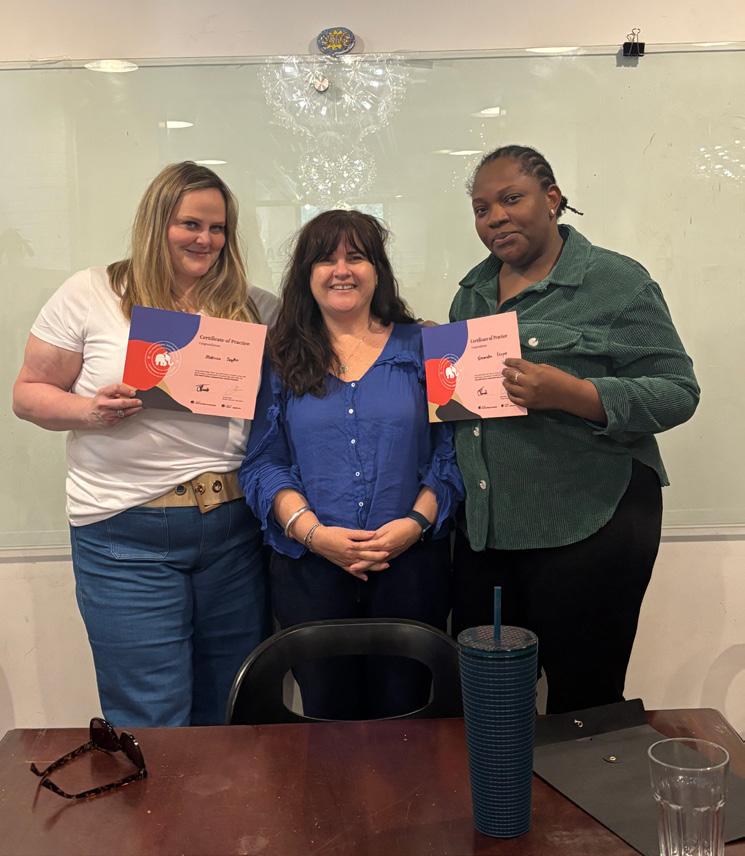
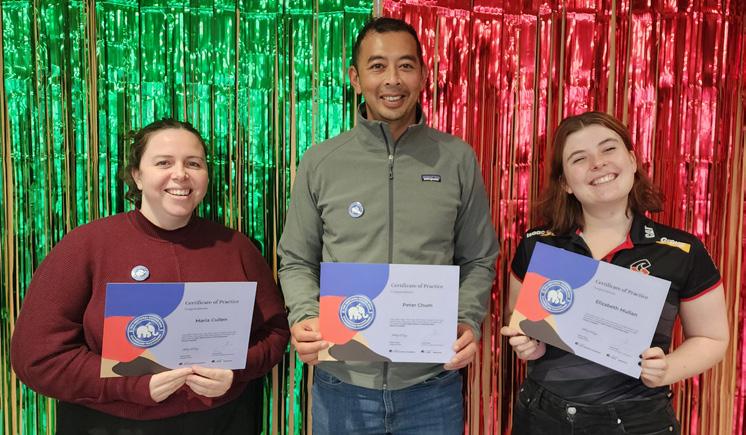
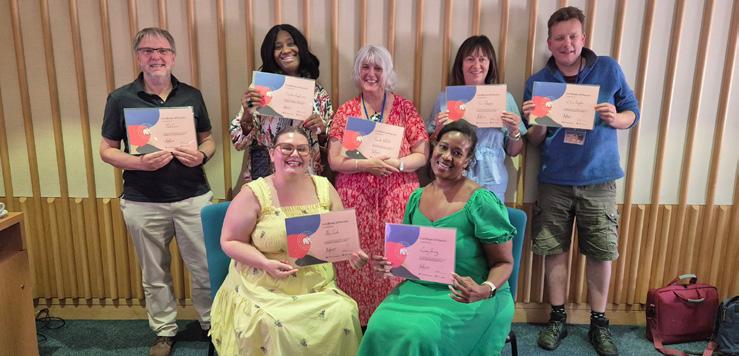
2025 marked an important moment in the growth of our Emotional Culture System and the Elephant Rider community.
Across the year, our ECD Certified Consultants & Masters stepped into a new level of responsibility within our broader ECD ecosystem. They were formally authorised & endorsed by R&E to deliver our ECD Specialist Courses and certify ECD Practitioners extending the reach of ECD practice through trusted, experienced leaders around the world.
“Each certification represents a learning experience created, a group brought together, and a workplace given language.”
This authorisation reflects the depth of practice, reflection and real-world delivery held across this community. It recognises people who have consistently demonstrated the bravery & skill in facilitating emotional culture conversations, and who continue to contribute their learning back into the collective.
Through their work in 2025, our Consultants & Masters certified:
194 Leadership Practitioners
152 Change Practitioners
13 Stakeholder Practitioners
That’s 359 newly certified ECD Practitioners joining our global community this year.
Each certification represents a learning experience created, a group brought together, and a workplace given language to explore how emotion shapes behaviour, culture and performance. These moments happened in leadership programmes, healthcare settings, organisations, communities and classrooms, across countries, sectors and contexts.
Together, our ECD Certified Partner community has expanded access to emotional culture practice in ways that are thoughtful, grounded and human. It is a collective contribution that brings our mission to rehumanise work to life, conversation by conversation, place by place.
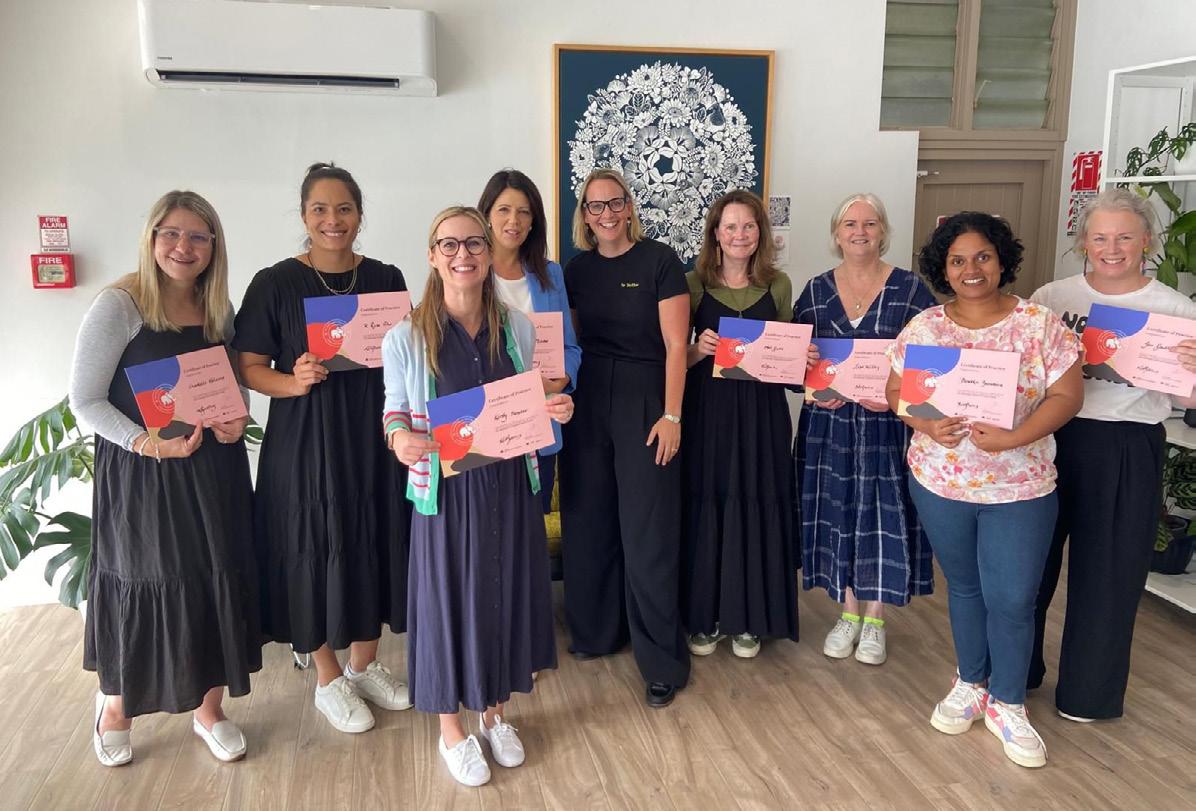
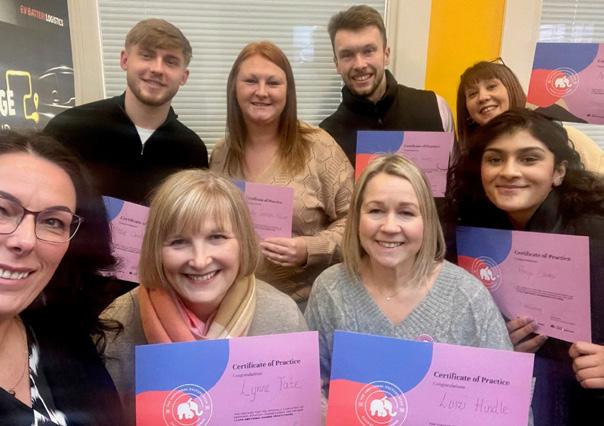
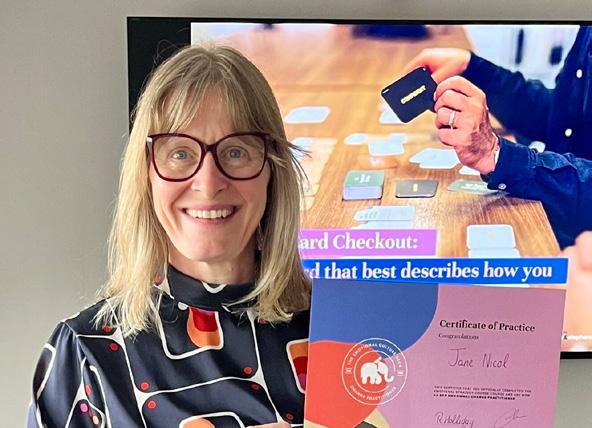
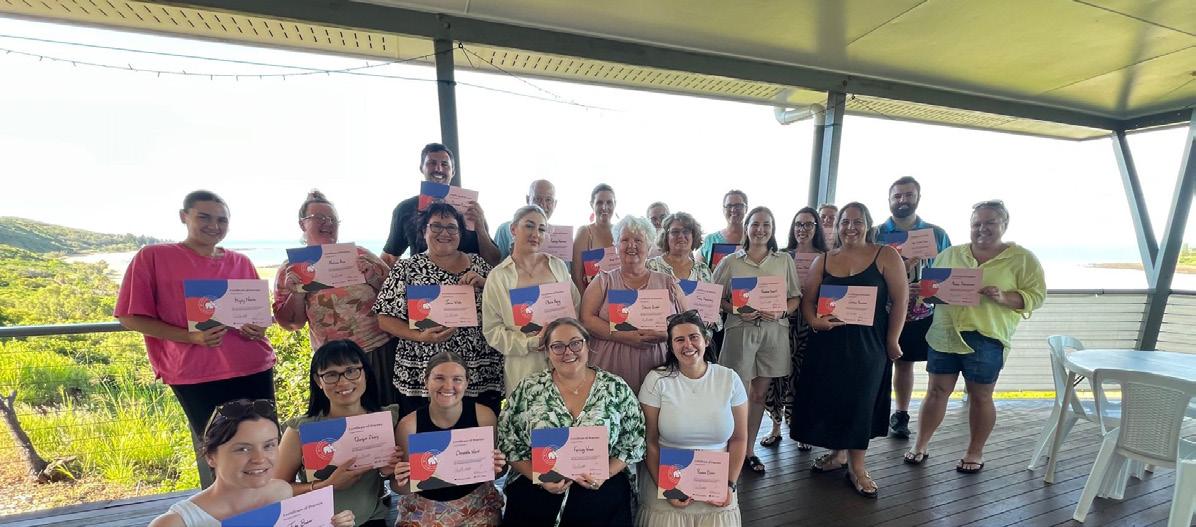
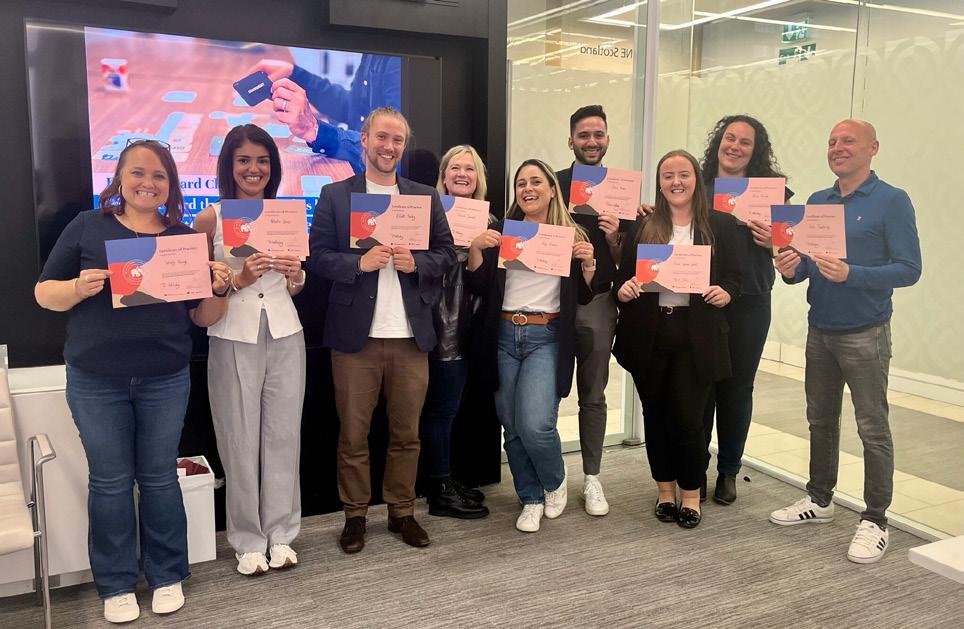
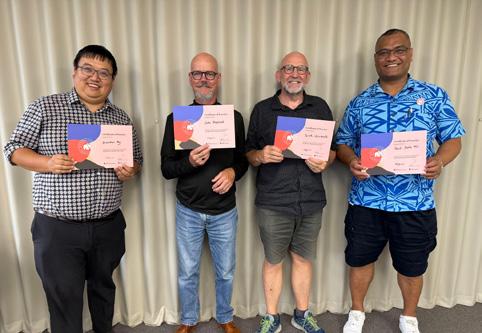
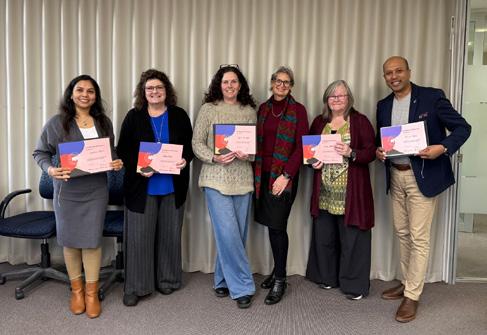
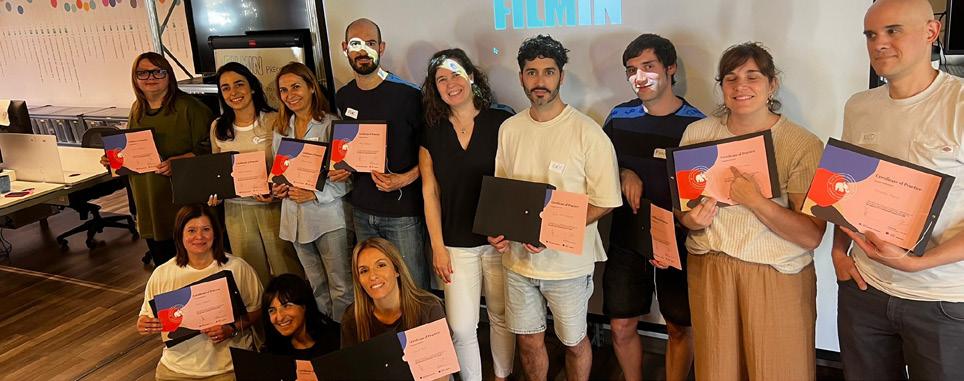
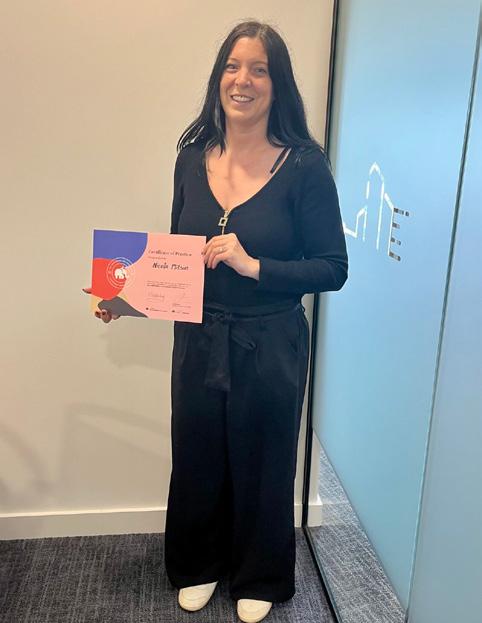
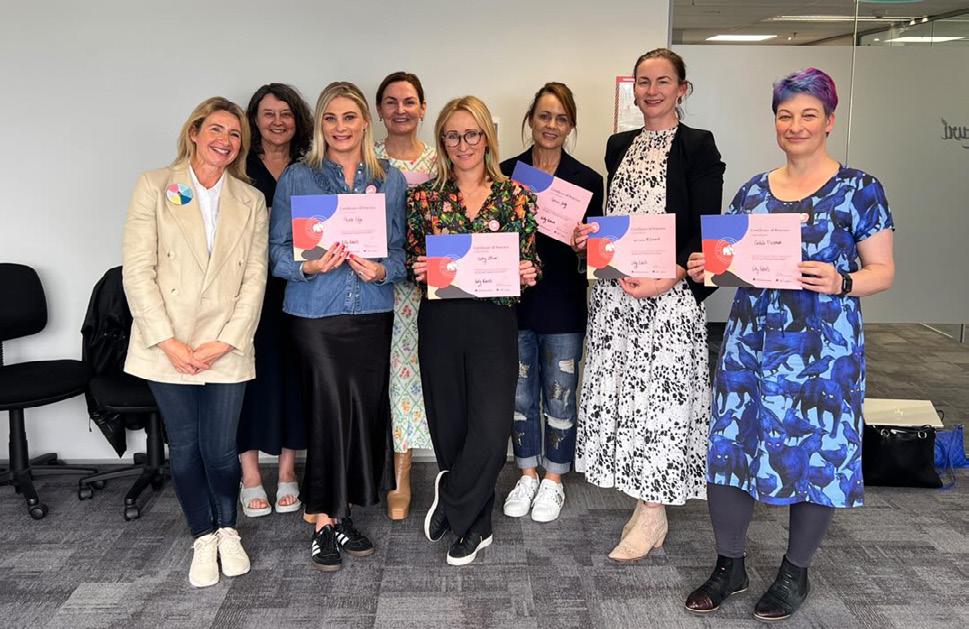
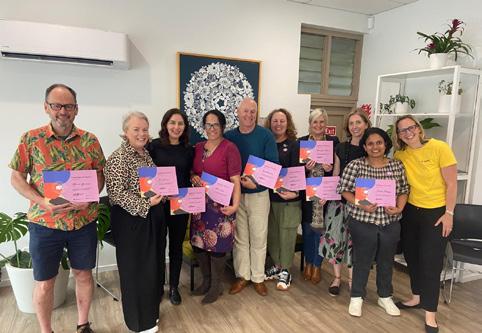
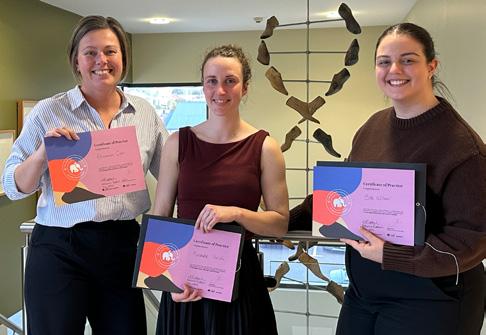
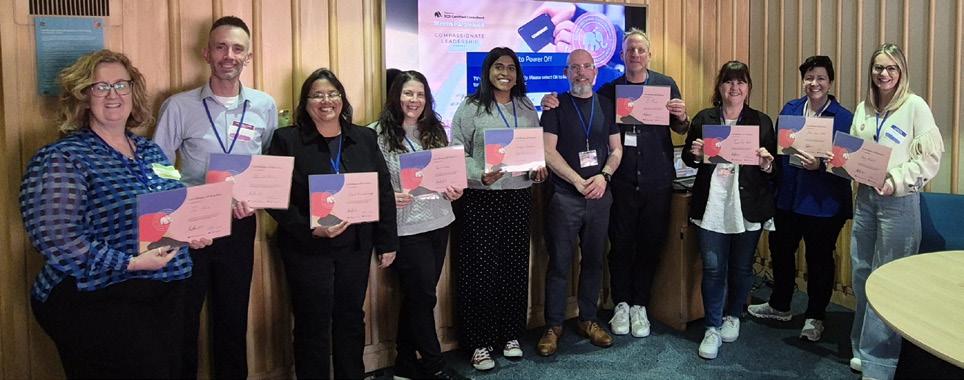
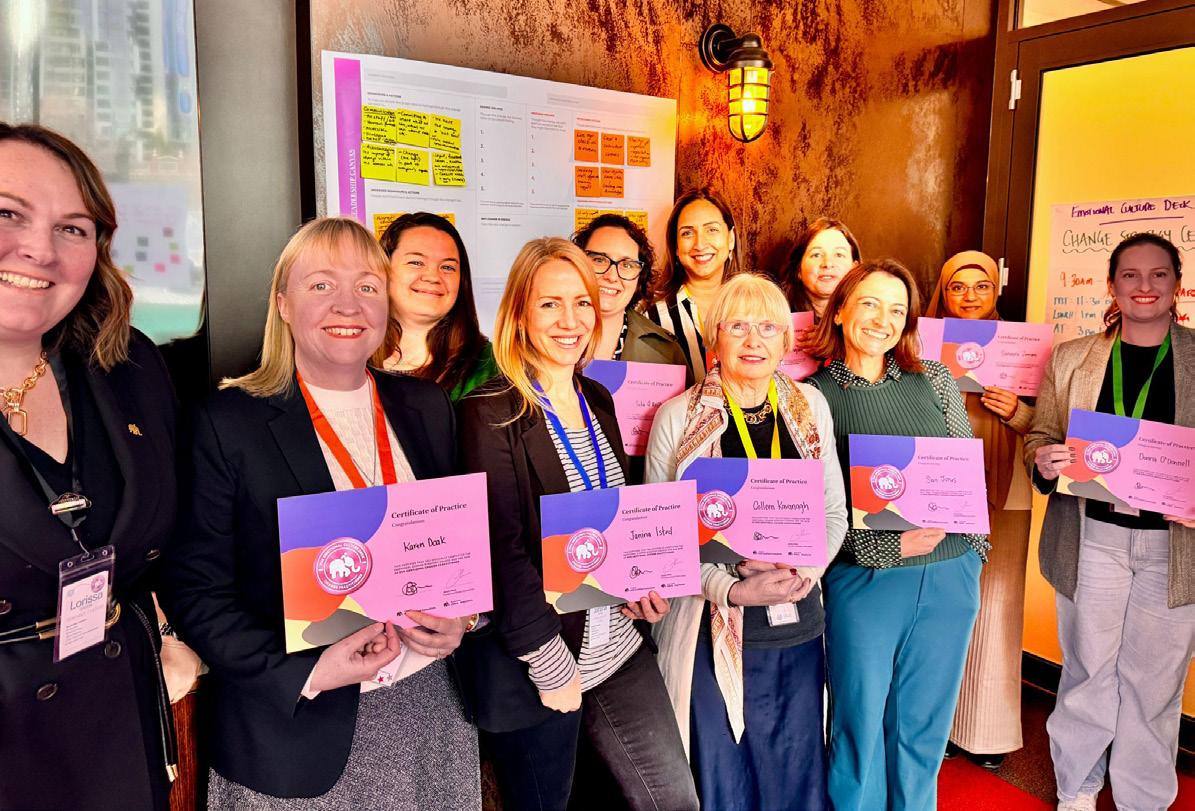
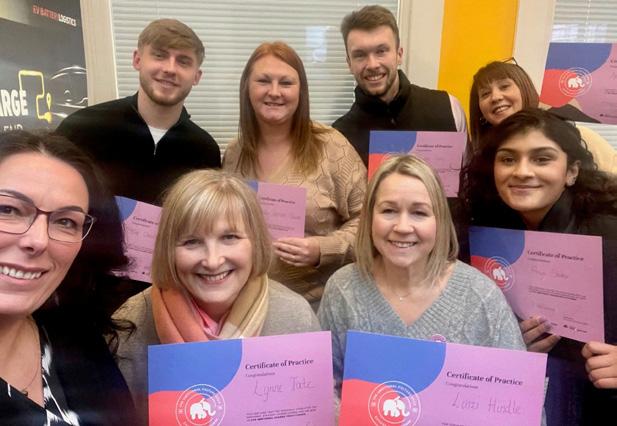
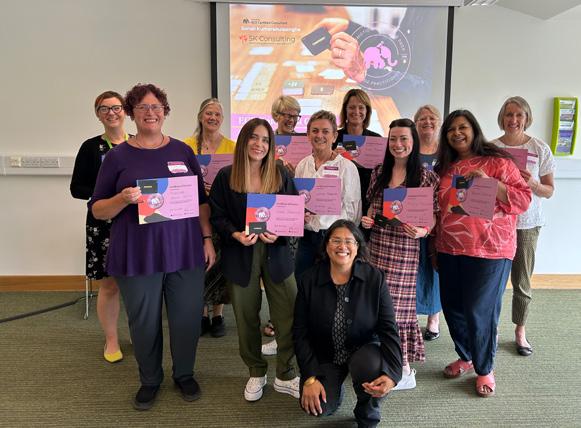
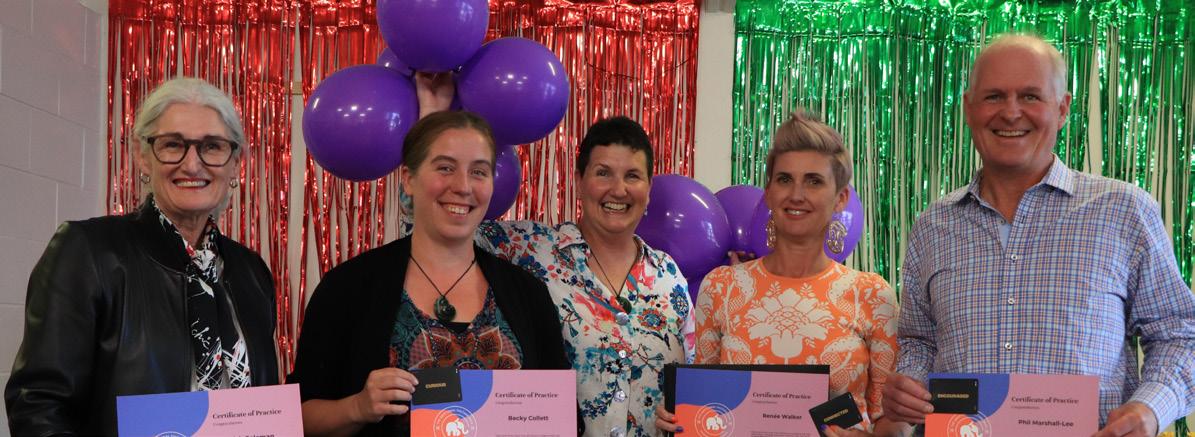
One Pathway, Many Practices
While Consultants & Masters sit at the top of our certification pathway, there is no single way to practice this work.
Some support senior leaders. Some work in healthcare, education or government. Some focus on community, coaching, or organisational change. Some lead quietly, others publicly.
What unites them is why they do this work. A shared belief that emotions matter at work, and that culture shifts when people are given the language, tools and permission to talk about how they really feel (or don’t feel).
A Collective Achievement
This page intentionally shows names and faces together. Because emotional culture is not built alone. It is built through:
• Shared language
• Shared learning
• Shared courage
Every Consultant & Master here has shaped our community in their own way through the conversations they’ve held, the teams they’ve supported, and the cultures they’ve influenced.
Being on your ECD
Certified Pathway is a huge commitment to keep practising your craft, and contributing to our collective growth and understanding of emotions at work and their impact.
What ECD Certification Represents
Becoming an ECD Certified Consultant or Master is a journey
It reflects sustained engagement with the Emotional Culture System, including learning, delivery, reflection, and contribution back into the community.
Those recognised & celebrated here have:
• Facilitated emotional culture conversations in real workplaces
• Applied the tools across leadership, culture, change and stakeholder contexts
• Engaged in ongoing learning & coaching
• Contributed insights, stories and practice back into the wider Elephant Rider community
Certification marks their depth of practice and commitment to emotional culture conversation and flipping workplace culture, leadership & how people experience their work every day.
It recognises people who have chosen to stand at the front of this work, holding complexity, modelling emotional leadership, and helping others navigate meaningful conversations
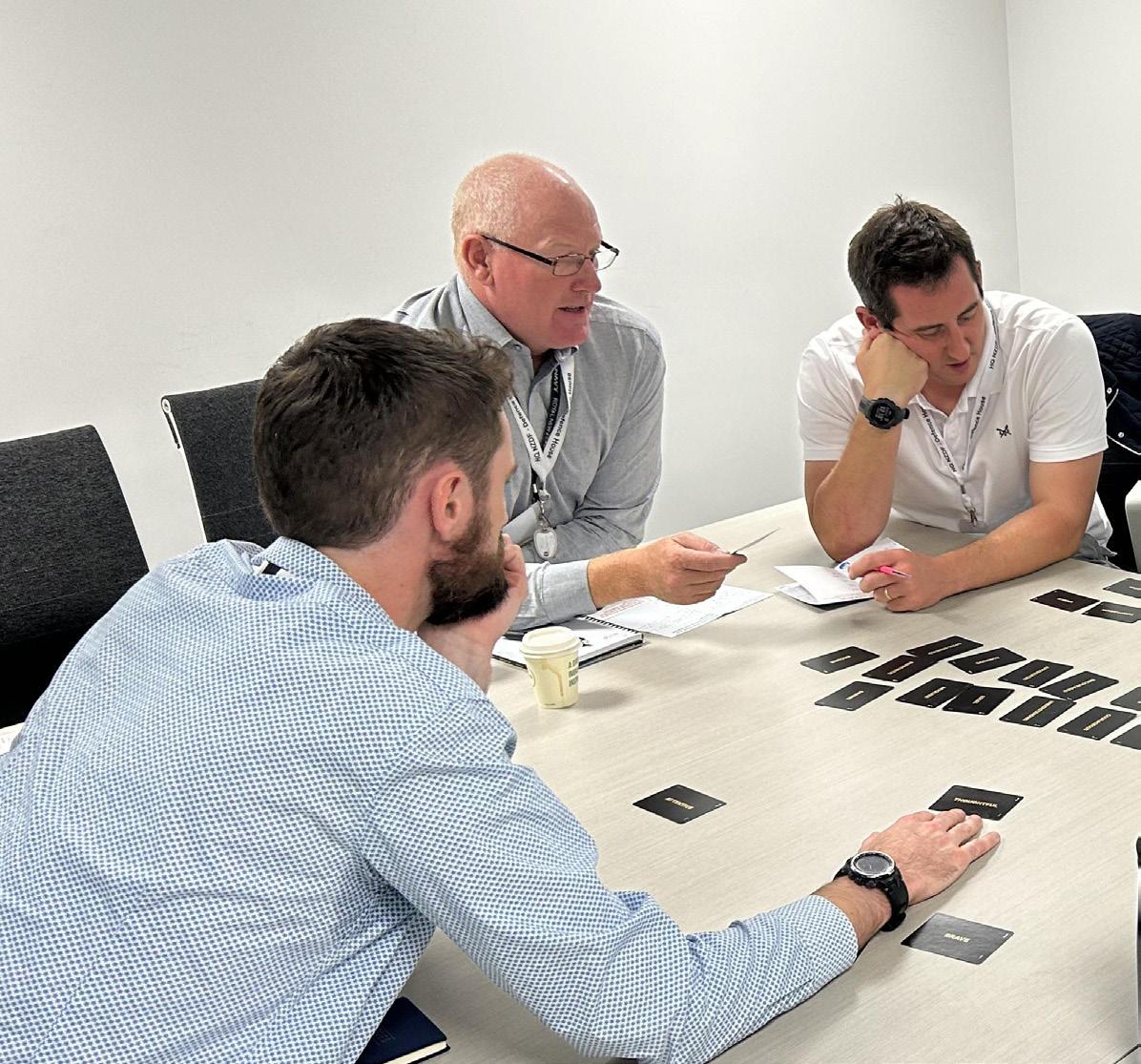
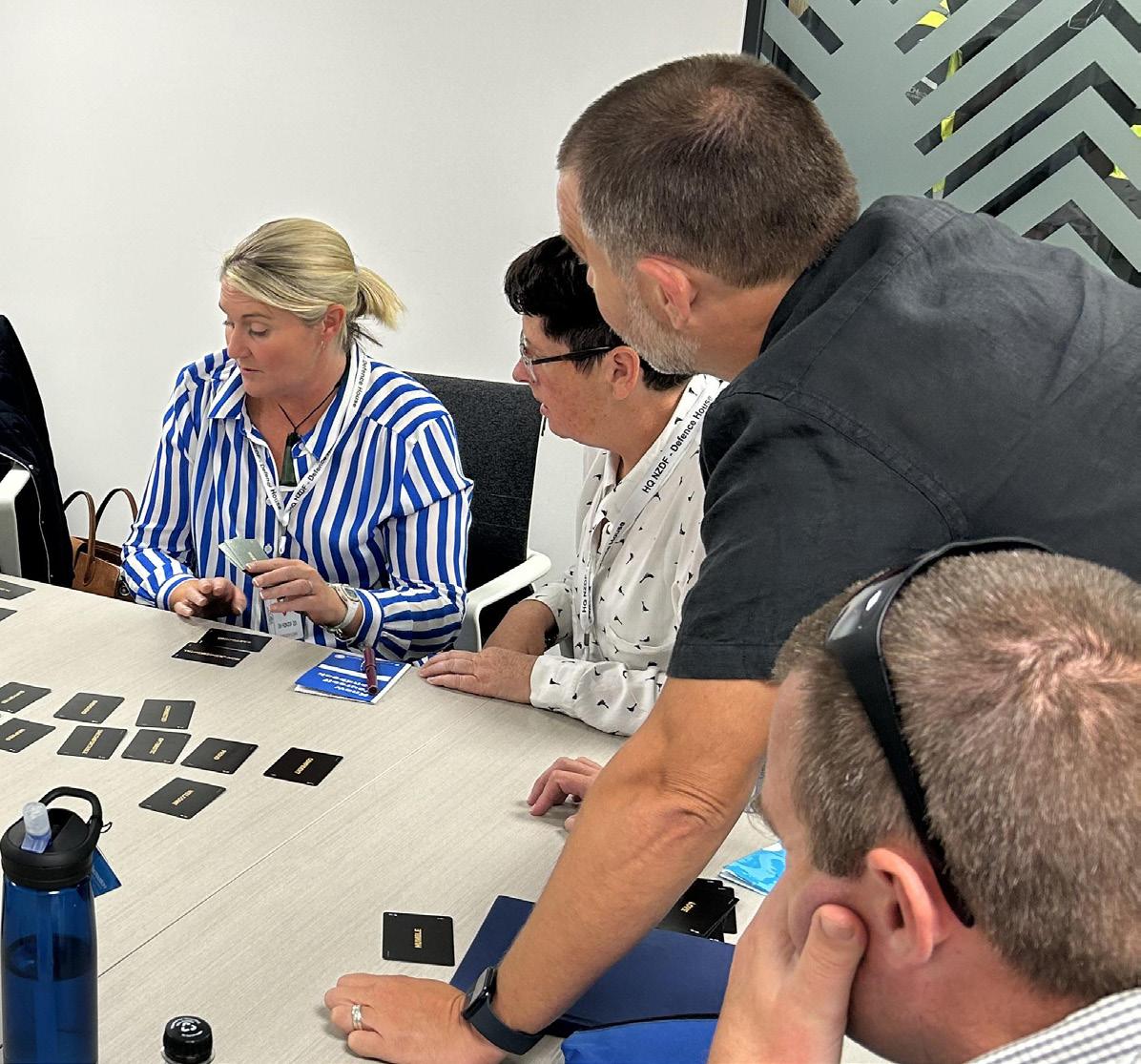
The Year in Research:
Wharton X R&E
What our field experiments taught us about emotional culture and performance.
This year, R&E and Professor Michael Parke, The Wharton School, partnered with organisations across healthcare, manufacturing and corporate operations to run a series of field experiments on emotional culture.
From factory floors to globally dispersed teams, these studies combined simple human experiences with rigorous pre- and post-measurement. Together, they’re starting to draw a clearer picture of how emotional culture actually moves inside real organisations.
What we’re learning so far
1. When emotion is named, voice follows.
In multiple Unspoken Conversation Workshops, employees who hadn’t felt safe raising concerns used structured emotional language to do so. Check-out data showed increases in “my voice matters” and “my leader cares about me” after just one guided conversation. Leaders reported a deeper understanding of their people’s real worries, not just their workload.
2. Small, designed conversations shift safety faster than large programmes. Across different sites, short, repeatable practices, 60-minute workshops, weekly emotional check-ins, simple reflection rituals, produced measurable gains in psychological safety, perceived care and collaboration. The pattern is consistent: light-touch, well-designed emotional routines outperform heavy, one-off culture initiatives.
3. Leaders change culture most through how they listen.
In every setting, leader behaviour was decisive. When leaders listened without fixing, named their own emotions, and acknowledged difficulty without defensiveness, teams reported higher levels of trust, care and willingness to speak up. Emotional culture shifted less through new slogans, more through leaders practising a different kind of presence.
4. Emotional culture is observable, trackable and quicker to move than expected. Pre/post surveys, check-out data and team reflections showed that emotional culture can shift in weeks, not
years, when organisations work with it intentionally. Indicators like psychological safety, employee voice and perceived care all moved in response to relatively small changes in how teams talked and reflected together.
5. Leaders & Employees Want More of These Conversations
Across the research and projects we completed in 2025, one signal came through clearly: both leaders and employees want more opportunities to talk about emotions at work.
For people inside our community, this won’t come as a surprise. Many Certified Consultants and Practitioners hear this regularly in workshops, coaching sessions and team conversations. The desire has always been there, shared anecdotally through experience in the field.
What shifted this year is that we are now collecting evidence and data that clearly supports this lived experience. Again and again, participants told us they valued having language, structure and permission to explore how work actually feels, not just what needs to be done. Leaders spoke about the increased understanding and connection they developed for thier peope. Employees described feeling more seen & heard, willing to contribute when emotions were made discussable.
Together, this data reinforces something our community has long known through practice: when emotional conversations are designed well and held safely, people want to be part of them.
“This insight will shape how we design new conservations tools, learning experiences & research projects.. The evidence will begin to guide what comes next.
Where this takes us next
Our partnership with Professor Michael Parke is now focused on expanding this evidence base, testing emotional culture interventions in more sectors, designing more research-backed tools from the research we’re doing together to create real, tangible and measurable performance and leadership shifts by building practical guidance leaders can use inside everyday operations.
It’s the groundwork for the next chapter of R&E: a research institute is going to be developed to bridge academic research, realworld practice and simple tools leaders can use to redesign how work feels and how it performs. Watch this space in 2026.
Inside R&E:
How the Emotional Culture Methodology Evolved
How a simple conversational tool became a system, and why emotional culture is emerging as a critical organisational practice
Over the past decade, emotional culture has shifted from a fringe curiosity to a credible organisational discipline. What began with a simple question, “How do people feel at work, and why does it matter?”, has grown into
a structured methodology used across organisations, leadership programmes, and research partnerships around the world.
As the work matured, something became impossible to ignore: Emotion is a system variable. And systems need more than tools, they need frameworks, rituals and shared language.
This realisation has shaped the evolution of our methodology.
From a Single Deck of Cards to a MultiLayered System of Conversations & Tools
When we first designed The Emotional Culture Deck, it opened conversations that teams had avoided for years. It made the most human aspect of work discussable. It reduced defensiveness
and invited participation. It created shared language and connection in a deceptively simple way that many people hadn’t experienced before. Then something else happened. Leaders, coaches & consultants ran more and more workshops and they didn’t stop at running oneoff sessions. They started desiging & delivering entire programmes of work within organisations.
Emotional check-ins became weekly rituals.
Emotional trackers became early-warning signals.
Emotional language shaped onboarding, safety briefings,
customer experience, leadership coaching and change programmes.
Without intending to, teams were building an emotional operating system. Over the past 12 months, we captured and formalised what practitioners were already doing instinctively.
The R&E Emotional Culture System now includes:
Four interconnected domains: Emotional Culture, Emotional Leadership, Emotional Change, Emotional Stakeholder
Dozens of conversations & tools that make the
intangible (emotions), tangible
A shared emotional language that makes behaviour observable
Structured rituals for reflection and psychological safety
Frameworks & canvases that guide teams into deeper clarity
A progressive learning pathway that builds real-world, practical capability & skills within our Certified community
A research engine testing and refining the impact of our work in real organisations
It is an entire system for emotional culture.
Why This Evolution Was Inevitable
1. The evidence expanded
Research with The Wharton School shows consistent patterns when emotional labelling becomes normal, behaviour changes faster, and performance follows. Across industries we saw shifts in psychological safety, decision-making, employee voice and trust, often within weeks.
2. Work become more complex
Hybrid environments, distributed teams and cognitive overload demand more emotional clarity, not more process. Traditional culture programmes weren’t built for this world. Emotional systems are.
3. Practitioners innovated the field
Our global Elephant Rider community turned a conversation into a discipline. They adapted emotional systems for:
• healthcare
• construction
• government
• education
• manufacturing
• technology
They showed us emotional culture could be designed consistently, embedded gradually, measured meaningfully and scaled sustainably. Their innovation is the engine of this movement.
Emotional Culture as a System
Our methodology rests on one simple premise:
When emotions become discussable, behaviour becomes changeable.
When behaviour becomes changeable, performance becomes designable.
Organisations that treat emotion as operational data are discovering: emotional intention speeds up team formation emotional safety improves decision quality emotional connection reduces friction and rework emotional modelling strengthens leadership credibility emotional reflection builds resilience and adaptability
Emotion is a mechanism. And mechanisms can be designed.
What Comes Next
As we prepare to launch our formal research institute, our emotional culture methodology is entering its next chapter:
• More rigorous field experimentation with Wharton and partner organisations
• A digital measurement layer to track emotional patterns & performance shifts over time
• A growing evidence base positioning emotional culture as strategy, not sentiment
Our aim is simple:
To help the world see emotional culture both as a conversation to have, and a system to run.
A system of conversations that organisations can use. A system leaders can design. A system that makes work more human, and more effective.
Three Signals That Emotional Culture Has Become a System
1. Repeatability
Emotional culture practices become weekly rhythms rather than oneoff events, a hallmark of true systems.
2. Transferability
Teams in different countries and sectors achieve similar shifts using the same conversations, tools & frameworks.
3. Measurability
When emotional interventions reliably move psychological safety, voice or behaviour, emotion becomes organisational data.
acknowledgements.
This magazine and everything in it exists because of the people who make our community & emotional culture conversations real, every day.
To every ECD Certified Master, Consultant, Practitioner, our Chapter Leads, Elephant Rider members who contributed articles, shared Bright Spots, offered reflections, led workshops with their people & teams, or shared the obstacles they faced in their emotional culture crafting journeys unfolding inside their organisations, thank you. Your stories shape the future of this work.
A special thank you to all our Certified Partners whose
writing appears in this issue. Your insights, courage and words continue to push our whole community forward.
To our global Elephant Rider community - now over 2000 people in 49+ countries, your ongoing curiosity, generosity and commitment to more human workplaces is the heartbeat of R&E. We feel proud & inspired to learn alongside you.
To Professor Michael Parke & his research team, thank you for your partnership, your leadership. your rigour and your belief in our community and The ECD and the importance of understanding the emotions behind human performance at work.
finally to our mentor team.
A huge thank you for your generosity, challenge & guidance you bring to our community every day. And especially for your unwaivering support and challenging Jeremy & R&E to get better every day. Your emotional leadership guides and inspires so many people inside our community & beyond.
• Steve Hargreaves
• Kayleigh Woodings
• Denise Hartley-Wilkins
• Katherine Riddoch
• And to Kate Bacchus who’s joining our Mentor Team in 2026

And we can’t forget the man behind the design of the F-world, Diego Catto. Your craft brings our community to life on these pages and shapes how people see & feel this work outside of our online community platform. Thank you for elevating every page & story.
Finally, to everyone who sparked an emotional culture conversation that needed to be had, who asked a beautiful question, invited people to share, or helped someone name a feeling for the first time, our community grows because of you.
We’re here to rehumanise work.
Thank you for being part of our mission.
Based on what we achieved across our community in 2025, it’s hard to imagine what ripples we might create and impact we might have together in 2026!