RIDE Issue 26
INDOOR CYCLING INSIGHTS & INSPIRATION
01.2026
HIGH
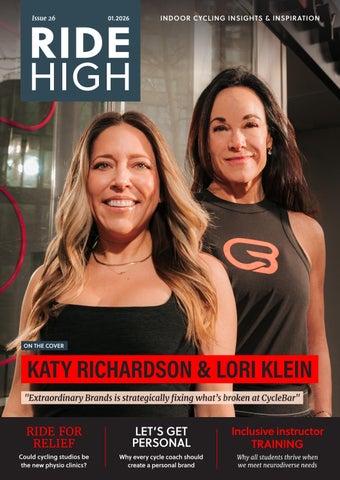
ON THE COVER
KATY RICHARDSON & LORI KLEIN "Extraordinary Brands is strategically fixing what’s broken at CycleBar"
RIDE FOR RELIEF
LET’S GET PERSONAL
Inclusive instructor
Could cycling studios be the new physio clinics?
Why every cycle coach should create a personal brand
Why all students thrive when we meet neurodiverse needs
TRAINING
Get into the groove at FIBO 2026
FIBO Global Fitness
Indoor cycling studios are magical spaces: worlds of endorphins, escapism, excitement and energy. Join us at FIBO to celebrate the vibe! www.body-bike.com/fibo26
16-19 April 2026 Exhibition Center Cologne Messepl. 1, 50679 Köln, Germany Find us at Hall 6, Aisle A, Booth 13
INTRODUCTION
“Indoor cycling should lift people up, not lock them out. Keep your riders at the heart of every choice you make.”
Remember who we do this for
I
n indoor cycling, we talk a lot about innovation. About the next piece of technology, the next evolution of programming, the next level of choreography. And of course, there’s a place for all of this. Progress keeps our sector moving forward. But amid the excitement of what’s new and what’s next, it’s worth pausing to remind ourselves of something far more fundamental: that none of this means anything without our riders. As an industry, we’re passionate people, many of us fitness enthusiasts who love training, love the burn, love pushing our limits. But this isn’t about preaching to the choir. When we look inwards and build workouts we would enjoy, we risk alienating those who simply want to feel welcome, uplifted, capable – not fearful of the class – and above all, who want to feel part of a community. This is what indoor cycling can do so well if we get back to basics, remembering that first and foremost, ours is a people business. “You don’t have to be the biggest brand or even the hottest trend if you get your grassroots marketing right, building a local community for your studio,” confirms Katy Richardson of Extraordinary Brands (see interview, page 6). Meanwhile, in our Fit Guide podcast on page 16, Steph Sklar-Mulcahy – owner of five-star-rated CycleBar Culver City
– shares a beautifully grounding habit. Whenever she’s in the studio, she makes a point of thanking her riders. Not out of routine, but out of genuine appreciation. Because without them, she says, her studio wouldn’t exist. It’s a small gesture that speaks volumes – a reminder that our riders aren’t a given. They’re a gift. Even for instructors building their personal brands – a topic we explore on page 32 – the message is consistent. Authenticity matters, but so does purpose. As a coach, who do you want to be for people? How do you want to make them feel? As Alicia Portelli puts it: “Focus on the people who keep showing up to your class. They are the ones your work is meant for.” So yes, we should absolutely innovate, refine and experiment – but we must always remember why. Indoor cycling should lift people up, not lock them out. Keep your riders at the heart of every choice you make and the whole chain becomes stronger. When we remember who we do this for, success follows – one grateful rider at a time.
Uffe A. Olesen CEO, Body Bike International A/S
RIDE HIGH
January 2026
3
CONTENTS
06
16
4
06
Extraordinary Brands
20
Training talent, not labels
16
Raising the Bar
32
What’s your personal brand?
Following its recent acquisition of CycleBar and Rumble, Extraordinary Brands is “slowing the brands down to speed them up”. RIDE HIGH investigates.
CycleBar Culver City is one of only a few cycle studios globally to receive a fivestar Fit Guide rating. Its owner shares her secrets in this excellent podcast.
RIDE HIGH
January 2026
What does best practice instructor training look like for neurodiverse individuals? The same as it does for everyone else, say our experts.
As soon as you become a fitness coach, you should be thinking about your personal brand, says Alicia Portelli. She tells RIDE HIGH why – and how it’s done.
ISSUE 26 – 01.2 026
20 38
32 38
CHAIN reaction
Could cycle studios be the new physiotherapy clinics? For hip osteoarthritis, they might just be. Kate Cracknell reports on the findings of an exciting new study.
Do you have a great indoor cycling story you’d like to share? From studio successes to new innovations – and everything in between – we’re keen to showcase best practice in indoor cycling from around the world. So if there are any topics
FOLLOW US ridehighmagazine
CONTENT & CONTRIBUTIONS
you think we should cover, please let us know!
@ridehighmagazine
ALL IDEAS ARE WELCOME – info@ridehighmagazine.com
RIDE HIGH
January 2026
5
INTERVIE W - AMERIC AS
LONG READ
WHOLE STORY
Extraordinary
BRANDS
Following its recent acquisition of CycleBar and Rumble, Extraordinary Brands is slowing the brands down to speed them up, say COO Katy Richardson and CycleBar brand president Lori Klein. They speak to Kate Cracknell
Katy Richardson
6
RIDE HIGH
January 2026
Lori Klein
The way CycleBar classes make you feel will become a key marketing message
“Even though we don’t have all the answers yet, we’re sensing a return of cautious optimism”
Tell us about your portfolio.
KR: Rather than creating brands internally, Extraordinary Brands is building its portfolio through acquisition. Our initial partnerships were smaller, but Rumble and CycleBar have proved we can integrate brands with a lot more scale and/ or the ability to grow quickly and nationwide. As a start-up, it makes sense that this is where we focus our time and resources. So, while Neighborhood Barre and Row House are still in the portfolio alongside new acquisitions CycleBar and Rumble, we’re divesting the other brands [Pūrvelo Cycle and Eat the Frog Fitness – see An Extraordinary journey, pages 10–11]. Neighborhood Barre is already in growth mode: it came into the portfolio in 2024 prepped and ready to grow. The other three are great brands, but we took them on in a distressed state. They will need to contract
and stabilise before growing again in a way that fits the boutique market at that time. In fact, Row House is almost there – we’re looking at Q1 2026 to restart growth – but for CycleBar and Rumble, we first need to audit and stabilise. It would make no sense to throw these two brands into franchise development right now. The good news is, so many of the problems are fixable. By giving these brands the attention they deserve, we have a chance to revitalise them and build franchisee success. Beyond these four brands, we’re also interested in further acquisitions where it makes sense for the portfolio – not only in boutique fitness, but also in wellness.
What’s the current status at CycleBar? LK: We’ve been identifying the core issues at the heart of the business, both collectively and at a local level. Our goal
RIDE HIGH
January 2026
7
is to understand what’s broken and fix it quickly but also as strategically as possible. Our immediate focus has been on rebuilding franchisee trust, opening up channels of communication, speaking one-to-one with them, listening and offering some transparency around what’s going on behind the scenes. We’re diagnosing the health of each individual location, working with our franchisees to build roadmaps to success and profitability wherever possible. Even though we don’t have all the answers yet, we’re sensing a return of cautious optimism.
8
RIDE HIGH
January 2026
Meet our interviewees A former consumer services franchise founder, Lori Klein also had boutique fitness experience prior to joining Extraordinary Brands, working for Flywheel and consulting for CycleBar. When CycleBar was acquired by Extraordinary Brands, she joined the company full-time as CycleBar brand president. Katy Richardson – now COO of Extraordinary Brands – came into the business as VP when it acquired the 23 sites of her business, Neighborhood Barre. Her promotion to COO in February 2025 pre-empted the July 2025 acquisition of CycleBar and Rumble, taking the Extraordinary Brands portfolio to four brands.
INTERVIE W - AMERIC AS
Left: CycleBar currently operates 130+ studios, the majority in North America Below: Neighborhood Barre, now owned by Extraordinary Brands, was founded by Katy Richardson in 2011
“A recurring theme among underperforming sites is an overly large footprint. Many sites need to shrink by 30–50 per cent.”
KR: We do have some franchisees who decided to exit before we came onboard. Some have now changed their minds and chosen to stay with us, but where there are problems we can’t solve – where sites simply weren’t set up for success – we’ll help them exit in a way that works for them. LK: A recurring theme among underperforming sites is an overly large footprint, with high start-up and running costs making ROI very hard to achieve. Many sites need to shrink by 30–50 per cent. KR: That will certainly be the model for new locations: it’s better to have waiting lists than half-empty studios and high utility costs. We could reduce overall footprint by 40 per cent and only lose around 10 bikes.
For existing studios, closure may be an option, but we’ll aim for re-sale where possible. For overly large sites, relocation may be an alternative. And although we aren’t actively looking at this yet, in the future we might also consider dividing larger sites to offer multiple modalities under one roof.
How big is CycleBar now?
KR: There are currently 130+ CycleBar sites [see Extraordinary Brands in numbers, page 13], but we expect around a 20–30 per cent contraction in the estate before it begins to grow again. We need to slow down to speed up. The majority of CycleBar studios are in North America – the US and Canada – but
9
we also partner with an amazing group in Australia that runs its own franchise operation for CycleBar and Rumble, supported at a high level by Extraordinary Brands. CycleBar is also operational in Japan. Once we start to grow the brand again, our focus will be on North America. We will continue to work with existing international master franchisees – including offering them our other brands – but there’s so much white space in the US and Canada that for now, these will be our key growth markets across all four brands.
Why not merge Pūrvelo Cycle and CycleBar?
LK: Even though they’re both indoor cycling and both based around music and rhythm, the brands are very different. Pūrvelo Cycle is a dark room with no mirrors or metrics. CycleBar is almost the opposite customer experience: very metrics-driven. CycleBar does offer a variety of programmes, including one – CycleBar Connect – that’s more introspective and soulful. We may diversify the programming further once the brand is stabilised and the franchisees profitable. But in the meantime, Pūrvelo and CycleBar are almost different modalities – it would be really hard to pitch them as the same brand – and our view is that CycleBar’s programming is more in line with what consumers are looking for today. KR: All that said, our Pūrvelo franchisee runs a very successful business. She’s a capable self-starter who does the grassroots work and activates at a local level, which is
An Extraordinary journey
10
JUNE 2022
APRIL 2024
MAY 2024
Founder and CEO Paul Flick launches multi-franchisor platform Extraordinary Brands with the acquisition of indoor cycling brand Pūrvelo Cycle
Eat the Frog Fitness is onboarded as Extraordinary Brands’ second studio brand
Extraordinary Brands acquires Row House from Xponential Fitness
RIDE HIGH
January 2026
CycleBar programming may diversify further once the brand is stable
“Every product needs to evolve to keep up with changing trends, but CycleBar hasn’t moved forward enough over recent years”
AUGUST 2024
JULY 2025
JULY 2025
Neighborhood Barre joins the Extraordinary Brands family
Extraordinary Brands acquires CycleBar and Rumble from Xponential Fitness
Extraordinary Brands’ portfolio consolidates to four brands – CycleBar, Rumble, Neighborhood Barre and Row House – with other brands being divested
RIDE HIGH
January 2026
11
INTERVIE W - AMERIC AS
“There’s so much white space in the US and Canada that for now, these will be our key growth markets across all four brands”
12
RIDE HIGH
January 2026
Above: Rumble was acquired from Xponential Fitness in 2025 Right (top to bottom): Extraordinary Brands’ portfolio now spans four brands: CycleBar, Row House, Neighborhood Barre and Rumble
Extraordinary Brands in numbers CycleBar – 130+ sites Rumble – 85+ sites Row House – 40+ sites Neighborhood Barre – 25+ sites
exactly what’s needed to be successful in this business. She’s embraced everything we’ve taught her; she still has access to our assets, playbooks and so on; and she runs a great shop. We gave her the option to bring her two sites into the CycleBar brand, but we were never going to force that on her and she’s chosen to stay as Pūrvelo Cycle. The third Pūrvelo site is corporately-owned. We’re currently making a plan for that studio.
Will the CycleBar product change?
LK: Every product needs to evolve to keep up with changing trends, but CycleBar hasn’t moved forward enough over recent years. That’s something we’re now addressing. New programming is currently in development, so I can’t say too much, but we will certainly be looking at new and better ways of incorporating strength, giving people the cardio they need and the strength they want all in one class. We also need to recognise our ageing population – for whom cycling is an accessible option – and consider the growing focus on longevity, healthspan and functional wellness. And we need to understand that consumers now want something more meaningful than a party on a bike. They want to see and measure the impact of their workouts on their lives. Our product team is looking at all of this, diving into the research, the science and consumer demand to understand how we best evolve our product.
RIDE HIGH
January 2026
13
INTERVIE W - AMERIC AS
We want to create unique, results-based, scalable programmes that support people’s holistic health journeys. We’re also identifying the wellness metrics that really matter to people and looking at the technology we need to measure these, so we can demonstrate the value of all our modalities. The strategic brand repositioning we’re currently undertaking ties in with all of this. CycleBar remains the largest cycle franchise in the world, but we need to make sure we’re putting it in front of the right audience with the right voice and right message. We’re still working on this project, but the way our classes make people feel – the community, the dopamine hit, the release – will be key. A more distilled audience is also likely to be part of the solution. You can make everyone welcome without saying you’re ‘for everyone’, because in practice that means you’re not really ‘for’ anyone. We’re also expecting the repositioning to support a better balance between push and
14
RIDE HIGH
January 2026
pull, not relying so heavily on gimmicky sales offers to get people through the doors.
What support do you give franchisees?
LK: Our focus is on franchisee profitability. You can’t build a portfolio of brands if you don’t put franchisees first. This is what attracted me to Extraordinary Brands. I understand from personal experience the challenges of being a franchise owner and entrepreneur [see Meet our interviewees, page 8] and I know that CycleBar owners in particular have had a tough time. Having the chance to step in and be part of the solution was very appealing. Our dedicated business coaching for franchisees is something we pride ourselves on. This is extensive, tactical coaching that’s designed to support the holistic health of franchisees’ businesses, not just sales. It’s delivered by a team of coaches with a wealth of boutique fitness experience, who are able to get very granular with the
“You don’t have to be the biggest brand or even the hottest trend if you get your grassroots marketing right, building a local community” Below left: CycleBar is currently going through a ‘strategic brand repositioning’, says Klein Below: Extraordinary Brands is looking at Q1 2026 to restart growth at Row House
franchise owners and their GMs. They look at the experience within the four walls, the touchpoints that keep customers coming back, the ways of using data to reach out and personalise the experience, the KPIs that help franchisees run a better business from the top. It’s extremely effective. KR: We also provide assets and playbooks, all of which support a hyperlocalised approach. We talk about ‘four walls, four blocks, four miles’: create your experience, know who you are for those closest to you and go out from there. This hyper-localised approach is critical in boutique fitness. You don’t have to be the biggest brand or even the hottest trend if you get your grassroots marketing right, building a local community for your studio. I can speak as the founder of Neighborhood Barre, where revenue has consistently risen 20 per cent year-onyear since joining Extraordinary Brands. That’s great success for a brand that didn’t come into the portfolio distressed. You do have to be the right person, though, so we’re looking closely at the prototype for our franchisees. For all new agreements, we will be discerning about who we partner with, looking for those who are passionate about the industry and making sure we pair the right people with the right brand. l
@extraordinarybrands
And there’s more… Hear from the CycleBar owner who’s setting the standard for five-star indoor cycling. Catch the podcast on page 16.
RIDE HIGH
January 2026
15
“If you build it, they do not just come. You have to mean something to the community.”
Raising the Bar CycleBar Culver City is one of only a few cycle studios globally to receive a five-star rating from The Fit Guide. Owner Steph Sklar-Mulcahy shares her secrets in this excellent new podcast
“We make sure every class is worth at least the drop-in rate,” says Sklar-Mulcahy
16
RIDE HIGH
January 2026
INTERVIE W - AMERIC AS
A former TV & film exec, Sklar-Mulcahy felt a franchise was her best route to studio ownership
If we were to write a school report for the indoor cycling sector right now, it might read something along the lines of ‘good, but could do better’. Certainly The Fit Guide’s rigorous global benchmarking suggests there’s room to raise the bar. Yet there are studios truly excelling, delivering exceptional experiences and earning five stars across the board. Their achievements are celebrated in the Five Star Fitness by The Fit @cyclebarculvercity
Guide podcast, which delves into the stories behind the successes. In partnership with this fantastic podcast, RIDE HIGH is showcasing some of these five-star performers, sharing their insights to inspire the wider sector. In this, the third part of our series, we visit CycleBar Culver City in Los Angeles – a cycle studio that really does raise the bar, whose owner has generously shared her secrets to five-star success.
@wearethefitguide
RIDE HIGH
January 2026
17
INTERVIE W - AMERIC AS
Below: For the full story, check out the podcast –
CLICK TO
available on YouTube now!
PLAY
Listen to the podcast now to discover… How clients and instructors are matched to ensure best-fit experiences How multi-sites can unwittingly make staff feel they aren’t on the ‘A’ team The early-days sales tactic Sklar-Mulcahy now wishes she’d avoided Her unexpected source of ‘if it isn’t perfect, throw it away’ inspiration The value of an owner showing genuine gratitude to teams and clients How a franchise network enables her to offer a home away from home Why she believes instructors have stayed with her for nine years – and counting
… and far more besides 18
RIDE HIGH
January 2026
Check out the podcast now!
Above: Sklar-Mulcahy (far left) with her team of CycleBar instructors Left: “We want to be the best part of our clients’ days, but also the best part of our instructors’ days,” says Sklar-Mulcahy
Listen to this full episode and explore more from
RIDE HIGH
January 2026
19
INDOOR C YCLING AC ADEMY
TRAINING
TALENT,
WHOLE STORY
NOT LABELS What does best practice instructor training look like for neurodiverse individuals? The same as it does for everyone else, say our experts. Kate Cracknell reports.
Above: It’s important to find a training environment that ‘gets you’, says Marshall Bean
20
RIDE HIGH
January 2026
LONG READ
Putting students on bikes helps them “remember what good and bad feels like”
“W
e’re talking more about neurodiversity nowadays, but there’s still so much we don’t understand. It means labels aren’t always that helpful,” says Angela Reed-Fox, course director at the UK’s Indoor Cycling Institute (ICI). “The way I see it, there’s a spectrum and everyone’s on it somewhere, from a formal diagnosis through to simply finding some things more difficult. For example, a fear of public speaking makes people uncomfortable about talking in a group or performing in front of others, but it isn’t a diagnosis. It’s just a hugely common obstacle. “It’s why we always look at people, not at labels, aiming to remove any obstacles that stand in the way of a student being the best they can be.” It has been a progressive journey, she says, constantly trying new things to make learning more inclusive and accessible. But
“Our adaptations don’t only benefit neurodivergent individuals. They make learning more effective and enjoyable for all students.” the biggest learning of all? “Our adaptations haven’t only benefited neurodivergent individuals. They’ve made learning more effective and enjoyable for all students.”
A widespread need
Natasha Schofield, associate director for education and career development at CIMSPA – the UK’s professional development body – agrees: “An estimated 15–20 per cent of the general population are neurodiverse,
RIDE HIGH
January 2026
21
INDOOR C YCLING AC ADEMY
People with ADHD bring great energy as instructors, says Marshall Bean
whether diagnosed or undiagnosed. Rather than singling people out, our advice is therefore to make all training inclusive and accessible for everybody. It’s highly unlikely you’ll ever run a course where no-one needs extra support, and what benefits one person will very likely benefit others.” In fact, the neurodiverse percentage often skews even higher among those attracted to the creative, movement-based, less traditionally academic fitness sector.
“We now teach only in small groups, allowing the focus to shift towards a more relaxed conversation among the students” 22
RIDE HIGH
January 2026
“We’ve been working on a pilot project with the Department for Work and Pensions, bringing individuals from job centres into training and then on to an employer with vacancies. In this cohort, around 30 per cent have presented requiring some level of additional support,” confirms Schofield. It’s compelling evidence to support an inclusive approach not just to initial training, but also to recruitment, CPD and career development. “Education providers and employers have a duty of care to support the individual in front of them,” says Schofield. “It’s inexcusable in this day and age to simply say ‘we can’t cater for you’.” The devil will be in the detail as our understanding of neurodiversity grows, but crucially, says Schofield, it won’t be a tick-box process. Open, empathetic conversations will be key to understanding individual needs, all rooted in a genuine commitment to doing the right thing. Don’t expect set protocols to work for everyone. With this in mind, she notes, “we need to support education providers to in turn support the individual” – which is why CIMSPA is working to signpost operators and training providers towards best practice
MEET OUR EXPERTS Tash Marshall Bean
Angela Reed-Fox
Odile Philipson
Natasha Schofield
Laura Davis RIDE HIGH
January 2026
23
Teaching in smaller groups is more expensive, but has a “hugely positive impact”
and helpful resources. It is also encouraging those who hit the mark in its quality assurance to clearly market their inclusivity. “People with additional learning needs don’t always want to actively ask for help,” Schofield explains, “so it helps if they can go into a training course confident they’ll have a great experience”.
Removing obstacles
Education providers such as the ICI and Canada-based Authentic Instructor Training would certainly feel justified in putting their hands up here, achieving strong results through their inclusive training
24
RIDE HIGH
January 2026
experiences – not least the qualifying of numerous students who previously failed on other, less adaptive courses. It’s a constant process of trial and error, says Reed-Fox, phasing in new ideas and “trying to identify anything we’re doing that’s making it harder for people”. She explains: “We accommodate different learning styles and preferences, with most of our pre-course learning available as videos as well as in written format. Everyone gets a copy of our indoor cycling handbook to refer back to as well, plus you can call or email us at any point and join our Facebook community. There’s lots of aftercare.”
PHOTO: ©SHUTTERSTOCK/JACOB LUND
She continues: “We boil important skills such as bike set-up and session planning down to simple formulae that can be repeated every time. We have students do guided doodles – diagrams relating to safe and effective cadences, for example – because we’ve found learnings embed better when we connect brain and hand. And we use kinaesthetic learning, putting students on bikes so they remember what good and bad feels like. “But the biggest change we’ve made so far has been in the size of our courses, which we now teach only in small groups. It’s more expensive to run them this way,
“We’ve radically changed our approach to assessment. If at any point you demonstrate the competence we’re looking for, you get a tick in the box.” RIDE HIGH
January 2026
25
INDOOR C YCLING AC ADEMY
Right: A neurodiverse diagnosis shouldn’t limit your self-belief, says Reed-Fox Below: Writing things down can help embed important learnings in students’ memories
but it’s had a hugely positive impact, allowing the focus to shift away from a PowerPoint presentation and towards a more relaxed conversation among the students. We stick to a structure so they know what’s coming, but there are opportunities to ask questions and check understanding as we go. “The whole approach allows us to address the different mindsets, challenges and receptiveness within each group and helps prevent sensory overload – great for anyone who hasn’t been in training or education for a while. We’ve had a lot of neurotypical people, especially older learners, tell us how much they like being able to ask questions as they think of them, for example. “We’ve also radically changed our approach to assessment in a way that benefits neurodiverse people, but that’s been transformational for everyone. Assessments are no longer the last thing
26
RIDE HIGH
January 2026
PHOTO: ©SHUTTERSTOCK/PEOPLEIMAGES
“We’ve found our neurodiverse students really only have a heightened level of the needs many other students have” you do – a pressured 15 minutes that you’re dreading all day. Instead, we do things in bite-sized chunks and if at any point in the day you demonstrate the competence we’re looking for, you get a tick in the box. “As I say, this is how we now deliver all training for everyone, because it isn’t only neurodiverse people who benefit. It makes for better learning, better outcomes and ultimately better, more rounded instructors across the board.”
Building confidence
Put another way, says Reed-Fox: “When it comes to learning, we’ve found our neurodiverse students really only have a
heightened level of the needs many other students have. It’s why we encourage everyone not to fixate on labels, because they can undermine your confidence. You start to believe your diagnosis limits what you can do, but everyone has potential.” Tash Marshall Bean, founder of Authentic Instructor Training, agrees: “I have ADHD and for years was made to believe there were things I couldn’t achieve. It’s why my default now is: ‘You can and I’ll help you.’ “In fact, I believe people with ADHD make incredible indoor cycling instructors, with high energy and creativity, brilliant attention to detail and a natural ability to read and quickly adapt to the room.
RIDE HIGH
January 2026
27
PHOTO: ©SHUTTERSTOCK/DRAZEN ZIGIC
“We teach using every learning style – visual, audio, kinaesthetic – and we adjust as we go because every group is different” “However, that same attention to detail can be your Achilles heel, driving a perfectionism that will see you slave over a playlist for hours or be so hard on yourself for a tiny slip in class that noone else even noticed. The inner critic gets loud, replaying moments, overanalysing and convincing you that great isn’t good enough – but the truth is our riders feel our energy, not our mistakes. “It’s why, in our training, we focus on building the confidence that quiets the self-criticism. Our courses go far beyond the bike. They’re about self-development.” She continues: “We teach using every learning style – visual, audio and kinaesthetic – and we adjust as we go
28
RIDE HIGH
January 2026
because every group is different. Each client also leaves with playlists they can use right away – as well as the tools to create their own – so they can focus on connection, not perfection.” She concludes: “Our programme is designed for everyone, but I’m especially passionate about supporting those with ADHD because I know how powerful our brains can be when they’re understood, not judged. You just need a training environment that gets you.”
Flexible assessment
There’s a long way to go before inclusivity is embedded at the heart of every qualification and CPD course, confirms
Left: Many people like to ask questions as they think of them. Small group courses enable this.
PHOTO: ©ØRBIKE
INDOOR C YCLING AC ADEMY
Right: AIT gives clients playlists they can use right away, as well as the tools to create their own Below: By embedding inclusivity, we can make ours an appealing sector to young people
Schofield, but this must be our roadmap and something we accelerate towards. It is worth the investment, says Laura Davis, CEO of the British Association for Supported Employment (BASE) in a fascinating webinar for CIMSPA. “Only 4.8 per cent of adults known to social care as having a learning disability and/or autism have access to any kind of employment, but teams that are more diverse tend to be more productive and innovative,” she explains. “Plus, why would you not want to be thinking about a hidden talent pool of people who are motivated and desperate to work?”
RIDE HIGH
January 2026
29
PHOTO: ©SCLPTCYCLE
INDOOR C YCLING AC ADEMY
Of course, it’s likely your existing workforce also includes neurodiverse people – even if they haven’t told you. “The chances are you have more neurodiverse people on your team than you know,” confirms indoor cycling instructor Odile Philipson, who is herself dyslexic. “Many will have never disclosed it.” She adds: “I instruct Cyclone for David Lloyd Clubs [DLC] and have to do compulsory training every quarter. Each time, I feel my anxiety levels rise. I have never failed, but I know I’m slower at learning and reading than the average person. With some typefaces, it becomes harder still. “A few years ago, I decided to tell the DLC product team and they were really good about it. They gave me the option
30
RIDE HIGH
January 2026
to have someone sit with me during exams; they told me the exams wouldn’t be timed – that was a key one for me; and they told me if I did fail, I could re-sit. Just knowing all that allowed me to relax.” When training and assessment are carried out in-person, there’s scope for even greater adaptation, says Philipson: “On one occasion, having disclosed my dyslexia on arrival, the master trainer asked me to stay behind after the exam to talk through my response to a question. He knew my standards of instructing and he knew I knew the right answer, but I hadn’t managed to put it in writing within the time allocated. My verbal explanation was totally different from what I had written; his taking the time to adapt to my neurodiversity meant I passed.”
“The chances are you have more neurodiverse people on your team than you know. Many will have never disclosed it.” Left: Every club should have an ambassador members can speak to, says Philipson Above: AIT has successfully qualified many students who failed on less adaptive courses
Embedding inclusivity
Crucially, supporting neurodiverse individuals in your team means supporting members too. Says Philipson: “I want to own the fact I’m dyslexic, so I’m open with my classes about it. There should be no shame in it. As a result, members sometimes come to me to discuss where they’re struggling as a participant – if they have dyscalculia and find it hard to see the numbers in the Cyclone app, for example. “It would be great if every health and fitness club had an ambassador in this space – someone members, and for that matter other instructors, know they can talk to. We should be out and proud and helping each other.” Schofield concludes: “Quite aside from the existing instructors we can support better, there are almost 1 million NEET [Not
in Education, Employment or Training] young people in the UK alone. Learning disabilities are likely a factor for many. “As a sector, we have an opportunity to embed inclusivity – mental as well as physical – into our professional standards, showcasing ours as a wonderful industry for these young people to step into.” l
@indoorcyclinginstitute @trainingwithtashie @cimspa
/base-uk
/odile-philipson-fitness-wellbeing/
RIDE HIGH
January 2026
31
PHOTO: ©CHARLOTTE DECKERS
Above: “Successful personal branding is about scaling authentically,” says Alicia Portelli
32
RIDE HIGH
January 2026
ROCKSTAR INSTRUCTORS
“The more I embraced who I was, the more real my connection with riders became”
What’s your personal brand? As soon as you become a fitness coach, you should be thinking about your personal brand, says Alicia Portelli. She tells RIDE HIGH why – and how it’s done.
F
rom teaching her first rhythm cycling classes in Sydney to launching and running her own studio, guest coaching internationally and being headhunted by Absolute Cycle, Alicia Portelli has built a reputation based on a strong personal brand. She tells RIDE HIGH why a personal brand is so important for fitness coaches and instructors – and how to create one.
Why is a personal brand important? Your personal brand is what makes you unique. It tells people why they should come to your classes and helps you stand out from your peers. It’s also key to your happiness and sense of fulfilment. So often, we try to mould ourselves into what we think others want us to be, or we try to emulate another successful coach. But this isn’t just disingenuous. It also makes connection harder. Constantly trying to live up to someone else’s idea of who you should be is draining.
I experienced this first-hand in my early career. The more I embraced who I was and allowed that to come through in my classes, the more real my connection with riders became. For me, that meant leaning into my identity as an athlete, doing things that pushed people beyond what they believed they could do. When you look across the industry, the coaches who have built big global brands are the ones who have created an identity that’s true to them and grounded in their values. The authenticity is what builds trust and community.
How do you create a personal brand? A personal brand is something you have to identify for yourself. Nobody else can tell you who you are. Certainly trying to build your brand around someone else’s image, emulating another coach, will mean you’re constantly compared to them – and you will always be second-best. When I’m mentoring people, I have them answer a few key questions. What is your
RIDE HIGH
January 2026
33
Left: Portelli’s coaching style and personal brand leans into her identity as an athlete Right: Portelli is currently at Absolute Cycle: “I have worked hard to carve out my space in south-east Asia.” Below right: Portelli references Akin Akman of AARMY as one of her sources of inspiration
“A great coach can authentically show up anywhere and still attract people who connect with them” ‘why’? Who do you want to be for people? How do you want to make them feel? I also ask them to make a list of the people who inspire them; this can really help identify the qualities that matter most to them. For me, my sources of inspiration are my former dance teacher, who was tough, as well as Michael Jackson and Akin Akman. Both are (or were, in MJ’s case) exceptional at what they do and don’t let themselves be affected by the views of those who don’t align with their brands. Throughout my career, people who don’t connect with my approach have told me my classes are unachievable. But staying true to your brand and
34
RIDE HIGH
January 2026
finding the people it resonates with also means coming across people it doesn’t resonate with – and that’s OK. My personal mantra is: Touch, Move, Inspire. I want to leave people better than I found them. I’m motivated by showing them they can push themselves further than they thought possible. I’ve always learnt through hard lessons and I teach in the same way. Life is tough, but if you can do hard things in a cycle class, you can take that same grit into everyday life.
Can your brand limit where you work? A strong personal brand will influence the studios you want to work at and
ROCKSTAR INSTRUCTORS
the riders who come to your classes. However, unless you’re in a city with a high studio density, you can’t be too focused on typecasting yourself or finding the perfect studio. A great coach can authentically show up anywhere and still attract people who connect with them. I am currently at Absolute Cycle and have worked hard to carve out my space in south-east Asia, attracting people who align with my brand. Whether I’m focusing on endurance, resistance, pace or technique, whether it’s an advanced or more entrylevel class, I stay true to my personal brand, pushing people through hard lessons and motivating them to grow in different ways.
CLICK TO PLAY
RIDE HIGH
January 2026
35
ROCKSTAR INSTRUCTORS
Can everyone form a strong brand? Not everyone will become a global name, but if your brand is authentic, there will be people who are drawn to you. Every personal brand will have its audience. For me, successful personal branding isn’t about attracting roaring crowds. It’s about scaling authentically through genuine connection. Importantly, identifying your ‘why’ is only the beginning. You also need the work ethic to constantly develop your brand. No coach should stay static. I’m forever taking classes with other instructors to be inspired by them and to work out what I can make my own in areas such as technique, conversation and drills. There’s so much learning you can do while staying true to your brand. My personal brand is also about hard work and self-improvement. To
36
RIDE HIGH
January 2026
Left: Portelli (middle of the top row) with her class while guest coaching in Guatemala Right: “No coach should stay static,” says Portelli. “You need to constantly develop your brand.” Below left: Wherever she coaches, Portelli aims to “leave people better than she found them” Below right: Immerse yourself in one of Portelli’s classes at Absolute Cycle Singapore
“Focus on the people who keep showing up to your class. They are the ones your work is meant for.” embody that and help others grow, I need to keep growing myself. As you learn about yourself and grow outside of fitness, your personal brand will evolve.
CLICK TO PLAY
What’s your best piece of advice for other instructors? If you have people who love you, you will also have people who dislike you; this is equally true for many of the globally recognised coaches. Focus on the people who keep showing up to your class. They are the ones your work is meant for. l
@missaliciaportelli @missaliciaportelli
RIDE HIGH
January 2026
37
THE SCIENCE OF INDOOR C YCLING
CHAIN reaction Could cycle studios be the new physiotherapy clinics? For hip osteoarthritis, they might just be. Kate Cracknell reports on the findings of an exciting new study
“You need to exercise in the right way for specific osteoarthritic joints. For hips, cycling seems to work really well”
38
RIDE HIGH
January 2026
LONG READ
WHOLE STORY Osteoarthritis isn’t life-threatening, but it is very much life-limiting in terms of quality of life
RIDE HIGH
January 2026
39
PHOTO: ©SHUTTERSTOCK/PEOPLEIMAGES
THE SCIENCE OF INDOOR C YCLING
C
HAIN (Cycling against Hip pAIN) is a programme of exercise and education first launched in 2013 to promote the self-management of osteoarthritic symptoms through lifestyle change. Based on NICE guidelines – the UK’s National Institute for Health and Care Excellence – the programme drove strong results from the outset, improving pain, function and quality of life for patients as well as enhancing confidence and motivation to exercise. Fast-forward to 2025 and CHAIN hit the headlines again, this time courtesy of a study
Osteoarthritis is one of over 20 chronic diseases where increasing physical activity is the first line treatment – published in The Lancet – which compared CHAIN with standard physiotherapy for hip osteoarthritis. It found CHAIN achieved the greater improvements in pain and function. We dive into the details with Professor Tom Wainwright, who co-created CHAIN alongside Professor Rob Middleton, both of the Orthopaedic Research Institute (ORI) at Bournemouth University (see Leading their field, page 48).
Above: Prof Tom Wainwright is co-creator of CHAIN
40
RIDE HIGH
January 2026
Why the focus on osteoarthritis? Osteoarthritis isn’t life-threatening, but it is very much life-limiting in terms of quality of life. It’s also something most of us will
Left: Once participants are in the leisure centre environment, they feel more confident to try other activities Right: The delivery of CHAIN focuses on building a sense of camaraderie and mutual encouragement in the group
have to a greater or lesser extent as we get older: by the time we get into our fifth and sixth decades of life, a large proportion of us will have osteoarthritis of the hip or knee. Over 100,000 hip replacements are done every year in England and they’re very successful – but they’re costly. So there’s a real societal need to look at how we best manage osteoarthritis, exploring ways we can support people to manage it themselves.
How beneficial is exercise? Historically, osteoarthritis was always seen as a biomechanical condition: wear and tear of the joints. We’re now understanding that it’s much more of a biological, systemic condition – one that probably develops over a long period of time, alongside other factors such as inflammation. Additionally, there’s a strong association between patients who have osteoarthritis and who also have a background of cardiovascular or metabolic disease. And so we’re recognising that treating osteoarthritis could be similar to treating cardiovascular and metabolic diseases. These are all hypotheses at the moment, but we certainly know osteoarthritis to be one of over 20 chronic diseases where increasing physical activity is the first-line treatment. Why cycling specifically? You need to exercise in the right way for specific osteoarthritic joints – and for hips, cycling seems to work really well. Our story goes back over 10 years. My colleague Rob [Middleton] was part of the NICE committee and on a body reviewing the evidence around treating osteoarthritis. For the hip and knee specifically, three frontline treatments emerged. First, exercise – both local muscle strengthening
RIDE HIGH
January 2026
41
PHOTO: ©SHUTTERSTOCK/BAZA PRODUCTION
and cardiovascular. Second, education on osteoarthritis as a condition and on the benefits of exercise and other lifestyle modifications. And third, where relevant, weight loss. But what sort of exercise? I was asked what we were doing in the physiotherapy department, but I felt we were selling patients short, massively under-dosing them by giving them outdated exercise sheets with a few mobilisation exercises for 10 reps, three times a day. They weren’t getting any intervention I felt would really make a difference. Meanwhile, Rob and I were keen cyclists and had just completed a Land’s End to John o’Groats ride with 400–500 others – many of whom shared their aches and pains once they found out I was a physio and he an orthopaedic surgeon. Over the week, it became clear people had moved to cycling from team sports and running because cycling didn’t hurt their hips as much.
42
RIDE HIGH
January 2026
We then remembered the story of Floyd Landis, the 2006 Tour de France winner. He was subsequently stripped of his medal for using performance-enhancing drugs – but the point is, he had a hip replacement just three months after the race. Every evening of the Tour, his hip pain was so bad he was carried to his bedroom. Yet when he got on the bike, he could still cycle.
How did this inspire CHAIN? We started experimenting with our patients, using indoor cycling as one of the most inclusive forms of group exercise; everyone can do it at their own level. We also embraced learnings from my time as a junior physio running cardiac rehab sessions, where everyone was scared stiff of raising their heart rate for fear of another heart attack. Education sessions were used explain the need to exercise, raise heart rates and get fitter to avoid another heart attack.
In a five-year follow-up, 100 per cent of CHAIN participants were still being active every week
The cardiac rehab model inspired CHAIN, using education sessions to explain the need to exercise There’s a similar need for education on osteoarthritis. When something hurts, our instinct is to stop doing it – but not moving osteoarthritic joints causes them to stiffen and become more painful. Moving the joint mobilises it and has an analgesic effect, as well as recruiting the muscles around it so they become stronger. And of course, if we exercise in a way that promotes an aerobic response, we also train the cardiovascular system and release endorphins, further regulating pain. This model of education plus exercise – specifically indoor cycling for our audience
– inspired CHAIN. We secured funding for a pilot from our local GP practice and took 96 patients through what was then a six-week programme; in response to patient feedback, it’s now eight weeks.
Tell us about CHAIN. Designed specifically for those with hip pain and hip osteoarthritis, CHAIN is a weekly group programme of 30 minutes’ education on self-managing the condition, followed by 30 minutes of modified indoor cycling. The group aspect – ideally 12–15 people – enables a sense of camaraderie and mutual encouragement.
RIDE HIGH
January 2026
43
THE SCIENCE OF INDOOR C YCLING
Our education sessions consist of a fiveminute video on a different topic each week, followed by a group discussion. We’re very open and fluid around what the participants want to know and will signpost them towards any specific advice they want. We cover topics such as the benefits of exercise; planning for continued physical activity after the programme; lifestyle modifications such as smoking cessation and diet – there’s good evidence linking high levels of processed foods with arthritis; and assistive devices such as walking poles. We even discuss gadgets and supplements, from copper bracelets to turmeric, taking a neutral stance by simply presenting the scientific evidence as it exists. For the cycling, we’ve designed our own interval-based programme. The first couple of weeks are relatively sedate and, as we build up, it’s initially with a focus on cadence rather than resistance. We don’t want to put people off with muscle soreness in the early weeks, preferring to shift the work to the heart and lungs. By the end of the eight weeks, it’s similar to a light, entry-level indoor cycling class at the local leisure centre. We encourage participants to stay in the saddle, we make sure they’re comfortable on the bike and we talk to them about technique – about recruiting muscles on the up- as well
Above: CHAIN cycle sessions are led by a BH Live instructor to de-medicalise the experience Left: Some conditions will still require one-toone physiotherapy, says Wainwright (pictured here)
44
RIDE HIGH
January 2026
Even just turning legs at an RPM of 60 or 70 means thousands of hip mobilisations in half an hour
as the down-stroke. But to be honest, we keep it pretty simple and we aren’t precious about it. The important thing is they’re pedalling. As they get into it, some really get a sweat on. Others just turn their legs for half an hour, but that may be far more than they’ve done for a very long time. Even just turning their legs at an RPM of 60 or 70, they’ll do thousands of hip mobilisations in the space of half an hour, all in a range they might normally struggle to do.
How is CHAIN delivered? From the outset, CHAIN has been delivered in partnership with local leisure trust BH Live, which operates the Littledown Leisure Centre opposite Bournemouth Hospital. This is critical, because exercise works for osteoarthritis only for as long as you keep
exercising. By conducting our sessions in a leisure centre, we open the door to all the other activities on offer and show our patients they belong there. They might carry on cycling after the eight weeks – there’s a Nice & Easy Spin class timetabled right after CHAIN – or they might choose something else. The point is, they’re in the right place to stay active. The education session is always facilitated by a senior physiotherapist from the hospital, but the cycling class is delivered by a BH Live instructor. That’s important. We give the instructor the workout profile, but we limit the clinical knowledge we share – we don’t want to negatively impact their belief in anyone’s abilities – and they bring their own personality and music to class, demedicalising the experience and making it fun.
RIDE HIGH
January 2026
45
PHOTO: ©SHUTTERSTOCK/PATRIZIA TILLY
The physiotherapist takes part in the cycling, too. They can jump off and help if anyone’s struggling, but riding alongside the patients helps normalise the experience. This integrated, supportive group approach – bringing together the hospital’s and the leisure centre’s respective expertise – is key. It simply doesn’t work as well if patients are blindly referred to an indoor cycling class where no-one else has the same problem as them. It takes a certain type of patient and personality to brave that out.
What results have you achieved? In our initial pilot, over 80 per cent of patients had improved function, less pain and improved strength after the programme, with 100 per cent saying they would recommend CHAIN to a friend. We followed up five years later and found that 45 per cent had not returned to their GP for further treatment of their hip pain; 57 per cent had avoided surgical intervention; 96 per cent felt CHAIN had increased their ability to self-manage their hip pain; and 100 per cent were engaged in physical activity at least once a week.
46
RIDE HIGH
January 2026
There wasn’t a control group in our study and there isn’t any national data to benchmark against, but we believe these to be strong findings. We then did a second study among patients referred to a surgeon, this time with funding from the hospital. Where surgery was deemed not presently necessary, patients were referred to CHAIN rather than to physiotherapy. Between February 2018 and September 2019, 167 patients completed the CHAIN programme and demonstrated similar improvements to the original cohort in terms of pain, function, quality of life and motivation to exercise. There were slightly more patients who didn’t benefit – likely because their osteoarthritis had progressed to the point of surgical referral – but the results were still positive.
Tell us about your latest study. Our success allowed us to apply to the National Institute for Health Research to do a randomised controlled trial – since published in The Lancet – to evaluate the CHAIN intervention versus standard NHS one-to-one physiotherapy. From a total of 221 participants, 111 were randomly allocated to physiotherapy and 110 to
THE SCIENCE OF INDOOR C YCLING
Left: CHAIN’s education sessions cover a wide range of topics, including the role of assistive devices such as walking poles Below: In the initial pilot, CHAIN led to improved function and less pain in 80 per cent of patients
Economic analysis showed CHAIN to be economically far more effective than standard physiotherapy
CHAIN. Our primary outcome measure was the ADL (Activities of Daily Living) score, looking at patients’ reported pain and hip function before intervention and at 10 weeks post-treatment. With physiotherapy, the average ADL score increased by 6.1 points. With CHAIN, it increased by 12.7 points – 6.6 points more than with physiotherapy. Note that we had been looking for a minimum 7.4 point difference between the groups. However, subsequent published studies have found any difference over 6.0 points to be clinically significant. Alongside this, economic analysis showed CHAIN to be economically far more effective than standard physiotherapy. NICE has a cost-effectiveness threshold of £20,000–30,000 per Quality Adjusted Life Year (QALY) to decide whether a treatment is an acceptable use of NHS resources. CHAIN cost just £3,000–4,000 per QALY.
Should the physio model change? Some patients need one-to-one care, but for high-volume conditions, it’s worth looking for commonalities that might allow for group-based treatment. One physiotherapist seeing 15 patients at a time is an effective way to manage NHS waiting lists. Additionally, the NHS isn’t going to have the money to support everyone being treated for every condition moving forward. Self-management will be key. Of course, just because it works in hips, doesn’t mean it will work exactly the same for other specialities; we’ve responsibly researched CHAIN and evaluated it against standard care, so we know we’re doing the right thing. However, there probably are lots of other groups of patients we could treat in a similar way. We should certainly be looking at this. The key point, though, is that it has to be choreographed. You can’t just hand a patient
CHAIN resources l Find out more on the
CHAIN web page
l Read The Lancet article l Download the Android app l Download the iPhone app l View the CHAIN
content on YouTube
RIDE HIGH
January 2026
47
THE SCIENCE OF INDOOR C YCLING
We’re rolling CHAIN out, making all our content available for free. We’ve also created a toolkit for other hospitals.
Right: When hips hurt, the instinct is to stay seated, but moving them will help reduce pain Below: It was a Land’s End to John o’Groats bike ride that first inspired Wainwright (right) and Middleton (left) to develop CHAIN
Leading their field Tom Wainwright is a professor of orthopaedics at Bournemouth University, deputy head of the university’s Orthopaedic Research Institute and a physiotherapist at University Hospitals Dorset NHS Foundation Trust. He has worked in the field of hip osteoarthritis for over 20 years, is recognised as an international expert in Enhanced Recovery After Surgery (ERAS) protocols in orthopaedics and was lead author of the first ERAS Society guidelines for hip and knee replacement. Rob Middleton is a professor of orthopaedics at Bournemouth University and a consultant orthopaedic surgeon specialising in robotic hip replacement procedures. He was previously national clinical lead in hip and knee replacement at the NHS Institute of Innovation and Improvement, specialising in the development of enhanced techniques for faster recovery and better outcomes from surgery. The Lancet-published study was a collaboration between the team at Bournemouth University’s Orthopaedic Research Institute, the University Hospitals Dorset NHS Foundation Trust physiotherapy department and BH Live.
48
RIDE HIGH
January 2026
PHOTO: ©SHUTTERSTOCK/WAVEBREAKMEDIA
off to a leisure centre. You have to invest in the relationship, as we have with BH Live, working closely together, understanding each other’s needs, respecting each other’s strengths and appreciating the value we each bring.
Is CHAIN an ongoing programme? CHAIN takes place at Littledown Leisure Centre every Tuesday, funded as part of normal NHS practice: patients are referred to the hospital’s physio department; suitable patients are referred on to CHAIN; and the hospital pays the leisure centre to host the sessions and run the cycling classes. A new cohort starts every eight weeks; we have 18 in the current group. We’re also rolling CHAIN out, making all our content available for free. The cycling sessions can be found on YouTube, while our free ORI Education app – available on Apple and Android
– shares all the educational videos, educational material and cycling videos, so people can do the programme from home if they don’t live close enough for an in-person referral. We’ve also created a toolkit for other hospitals: launching in early 2026, it will be accessible via our web page. And we’ve already trained the team at the Royal Orthopaedic Hospital in Birmingham, which is now [October 2025] on its second cohort, partnering with Cocks Moors Woods Leisure Centre. Increasingly, this is the way we’re going to have to work. We don’t have the capacity in the NHS to see everyone as much as we’d like, so we have to promote self-management. We have to step outside of the NHS, recognise the expertise and willingness that exists in the health and fitness industry and embed these partnerships within our standard practice. l
RIDE HIGH
January 2026
49
RIDE
HIGH MAGAZINE .COM
POWERED BY
Get every edition of RIDE HIGH delivered direct to your inbox - FOR FREE