HOUSTON
Volume 16 | Issue 8
Inside This Issue
August Edition 2026
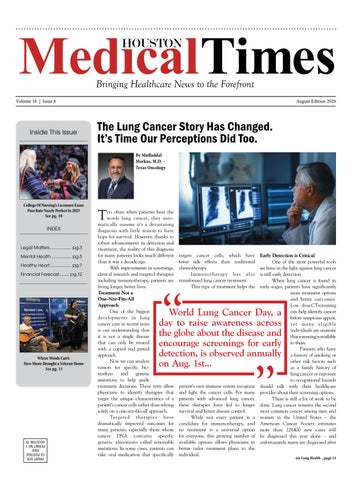
The Lung Cancer Story Has Changed. It’s Time Our Perceptions Did Too. By Muffaddal Morkas, M.D. – Texas Oncology
College Of Nursing’s Licensure Exam Pass Rate Nearly Perfect In 2025 See pg. 10
INDEX Legal Matters........................ pg.3 Mental Health...................... pg.5 Healthy Heart....................... pg.7 Financial Forecast............ pg.12
Where Words Can’t: How Music Brought a Veteran Home See pg. 11
T
oo often when patients hear the words lung cancer, they automatically assume it’s a devastating diagnosis with little reason to have hope for survival. However, thanks to robust advancements in detection and treatment, the reality of this diagnosis for many patients looks much different than it was a decade ago. With improvements in screenings, clinical research and targeted therapies including immunotherapy, patients are living longer, better lives. Treatment Not a One-Size-Fits-All Approach One of the biggest developments in lung cancer care in recent years is our understanding that it is not a single disease that can only be treated with a copied and pasted approach. Now we can analyze tumors for specific biomarkers and genetic mutations to help guide treatment decisions. These tests allow physicians to identify therapies that target the unique characteristics of a patient’s cancer cells rather than relying solely on a one-size-fits-all approach. Targeted therapies have dramatically improved outcomes for many patients, especially those whose cancer DNA contains specific genetic alterations called actionable mutations. In some cases, patients can take oral medication that specifically
targets cancer cells, which have fewer side effects than traditional chemotherapy. Immu not herapy ha s also transformed lung cancer treatment. This type of treatment helps the
Early Detection is Critical One of the most powerful tools we have in the fight against lung cancer is still early detection. When lung cancer is found in early stages, patients have significantly more treatment options and better outcomes. Low - dose CT screening can help identify cancer before symptoms appear, yet m a ny el i g ible individuals are unaware that screening is available to them. Patients who have a history of smoking or other risk factors such as a family history of lung cancer or exposure to occupational hazards should talk with their healthcare provider about their screening options. There is still a lot of work to be done. Lung cancer remains the second most common cancer among men and women in the United States – the American Cancer Society estimates more than 229,400 new cases will be diagnosed this year alone – and unfortunately many are diagnosed after
World Lung Cancer Day, a day to raise awareness across the globe about the disease and encourage screenings for early detection, is observed annually on Aug. 1st... patient’s own immune system recognize and fight the cancer cells. For many patients with advanced lung cancer, these therapies have led to longer survival and better disease control. While not every patient is a candidate for immunotherapy, and no treatment is a universal option for everyone, this growing number of available options allows physicians to better tailor treatment plans to the individual.
see Lung Health ...page 14
PRSRT STD US POSTAGE PAID PERMIT NO 1 HOUSTON TX